Infiniti QX80 (2023 year). Manual in english - page 15
 

  Index      Manuals     Infiniti QX80 (2023 year). Manual in english


Search            copyright infringement  


Content      ..     13      14      15      16     ..


Infiniti QX80 (2023 year). Manual in english - page 15


6-10

In case of emergency

the ignition switch ON/OFF one time.

SCE0910

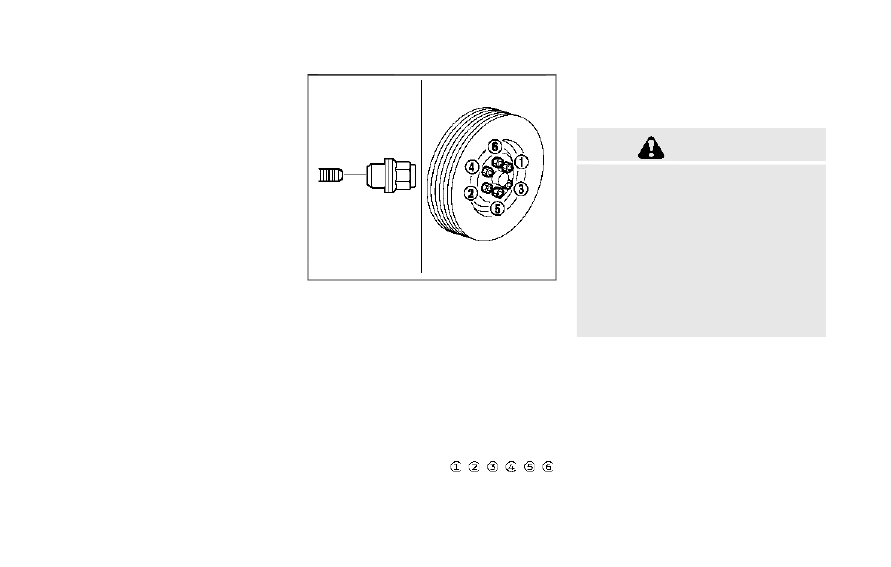
Installing the spare tire

The full-size temporary use only spare tire
(if so equipped) is designed for emergency
use. (See specific instructions under the
heading “Wheels and tires” (P.8-27).)

1. Clean any mud or dirt from the surface

between the wheel and hub.

2. Carefully put the spare tire on and

tighten the wheel nuts finger tight.

3. With the wheel nut wrench, tighten

wheel nuts alternately and evenly in the
sequence illustrated ( ,

,

,

,

,

)

until they are tight.

4. Lower the vehicle slowly until the tire

touches the ground. Then, with the

wheel nut wrench, tighten the wheel
nuts securely in the sequence as illu-
strated. Lower the vehicle completely.

WARNING

.

Incorrect wheel nuts or improperly
tightened wheel nuts can cause the
wheel to become loose or come off.
This could cause an accident.

.

Do not use oil or grease on the wheel
studs or nuts. This could cause the
nuts to become loose.

.

Retighten the wheel nuts when the
vehicle has been driven for 600 miles
(1,000 km) (also in cases of a flat tire,
etc.).

.

As soon as possible, tighten the wheel

nuts to the specified torque with a
torque wrench.
Wheel nut tightening torque:

98 ft-lb (133 N·m)

The wheel nuts must be kept tigh-
tened to specification at all times. It
is recommended that wheel nuts be
tightened to specifications at each
lubrication interval.

.

Adjust tire pressure to the COLD

pressure.

CarManuals2.com

-------------------------------------------------------------------------------------------------------------------------------------------------------------

COLD pressure:

After the vehicle has been parked for
three hours or more or driven less
than 1 mile (1.6 km).

COLD tire pressures are shown on
the Tire and Loading Information
label affixed to the driver side center
pillar.

After adjusting tire pressure to the COLD
tire pressure, the display of the tire pressure
information may show higher pressure than
the COLD tire pressure after the vehicle has
been driven more than 1 mile (1.6 km). This is
because the tire pressurizes as the tire
temperature rises. This does not indicate a
system malfunction.

Stowing the damaged tire and tools

1. Securely store the damaged tire, jack and

tools in the storage area.

2. Close the cargo floor cover.
3. Replace the cargo floor board.
4. Close the liftgate.

WARNING

.

Always make sure that the spare tire
and jacking equipment are properly
secured after use. Such items can
become dangerous projectiles in an

accident or sudden stop.

.

The full-size temporary use only
spare tire (if so equipped) is designed
for emergency use. (See specific in-
structions under the heading “Wheels
and tires” (P.8-27).)

To start your engine with a booster battery,
the instructions and precautions below must
be followed.

WARNING

.

If done incorrectly, jump starting can
lead to a battery explosion, resulting
in severe injury or death. It could also
damage your vehicle.

.

Explosive hydrogen gas is always
present in the vicinity of the battery.
Keep all sparks and flames away from
the battery.

.

Do not allow battery fluid to come
into contact with eyes, skin, clothing
or painted surfaces. Battery fluid is a
corrosive sulphuric acid solution
which can cause severe burns. If the
fluid should come into contact with
anything, immediately flush the con-
tacted area with water.

.

Keep the battery out of the reach of
children.

.

The booster battery must be rated at
12 volts. Use of an improperly rated
battery can damage your vehicle.

.

Whenever working on or near a
battery, always wear suitable eye
protectors (for example, goggles or

In case of emergency

6-11

JUMP STARTING

CarManuals2.com

-------------------------------------------------------------------------------------------------------------------------------------------------------------

6-12

In case of emergency

industrial safety spectacles) and re-
move rings, metal bands, or any other
jewelry. Do not lean over the battery
when jump starting.

.

Do not attempt to jump start a
frozen battery. It could explode and
cause serious injury.

.

Your vehicle has an automatic engine
cooling fan. It could come on at any
time. Keep hands and other objects
away from it.

JVE0495X

WARNING

Always follow the instructions below.
Failure to do so could result in damage to
the charging system and cause personal
injury.

1. Remove the engine compartment cover,

if necessary. See “Engine compartment
check locations” (P.8-3).

2. If the booster battery is in another

vehicle

, position the two vehicles (

and

) to bring their batteries into close

proximity to each other.

Do not allow the two vehicles to touch.

3. Apply parking brake. Move the shift lever

to the P (Park) position. Switch off all
unnecessary electrical systems (light,
heater, air conditioner, etc.).

4. Remove vent caps on the battery (if so

equipped). Cover the battery with a
firmly wrung out moist cloth

to reduce

explosion hazard.

5. Connect jumper cables in the sequence

as illustrated (

?

?

?

).

CarManuals2.com

-------------------------------------------------------------------------------------------------------------------------------------------------------------

CAUTION

.

Always connect positive (+) to posi-
tive (+) and negative (−) to body
ground (as illustrated) — not to the
battery.

.

Make sure the jumper cables do not
touch moving parts in the engine
compartment and that clamps do
not contact any other metal.

6. Start the engine of the booster vehicle

and let it run for a few minutes.

7. Keep the engine speed of the booster

vehicle

at about 2,000 rpm, and start

the engine of the vehicle being jump
started

.

CAUTION

Do not keep the starter motor engaged
for more than 10 seconds. If the engine
does not start right away, push the
ignition switch to the OFF position and
wait 10 seconds before trying again.

8. After starting your engine, carefully

disconnect the negative cable and then
the positive cable (

?

?

?

).

9. Replace the vent caps (if so equipped).

Be sure to dispose of the cloth used to
cover the vent holes as it may be
contaminated with corrosive acid.

10. Put the battery cover on.

Do not attempt to start the engine by
pushing.

CAUTION

.

Automatic transmission models can-
not be push-started or tow-started.
Attempting to do so may cause
transmission damage.

.

Three way catalyst equipped models
should not be started by pushing
since the three way catalyst may be
damaged.

.

Never try to start the vehicle by
towing it; when the engine starts,
the forward surge could cause the
vehicle to collide with the tow vehi-
cle.

In case of emergency

6-13

PUSH STARTING

CarManuals2.com

-------------------------------------------------------------------------------------------------------------------------------------------------------------

6-14

In case of emergency

CAUTION

.

Do not continue to drive if your
vehicle overheats. Doing so could
cause engine damage or a vehicle fire.

.

To avoid the danger of being scalded,
never remove the radiator cap or
coolant reservoir cap while the en-
gine is still hot. When the radiator
cap or coolant reservoir cap is re-
moved, pressurized hot water will
spurt out, possibly causing serious
injury.

.

Do not open the hood if steam is
coming out.

If your vehicle is overheating (indicated by an
extremely high temperature gauge reading),
or if you feel a lack of engine power, detect
abnormal noise, etc., take the following
steps:
1. Move the vehicle safely off the road,

apply the parking brake and move the
shift lever to the P (Park) position.

Do not stop the engine.

2. Turn off the climate control. Open all the

windows, move the heater or air condi-
tioner temperature control to maximum
hot and fan control to high speed.

3. If engine overheating is caused by climb-

ing a long hill on a hot day, run the engine
at a fast idle (approximately 1,500 rpm)
until the temperature gauge indication
returns to normal.

4. Get out of the vehicle. Look and listen for

steam or coolant escaping from the
radiator before opening the hood. (If
steam or coolant is escaping, turn off the
engine.) Do not open the hood further
until no steam or coolant can be seen.

5. Open the engine hood.

WARNING

If steam or water is coming from the
engine, stand clear to prevent getting
burned.

6. Visually check drive belts for damage or

looseness. Also check if the cooling fan is
running. The radiator hoses and radiator
should not leak water. If coolant is
leaking or the cooling fan does not run,
stop the engine.

WARNING

Be careful not to allow your hands, hair,
jewelry or clothing to come into contact
with, or get caught in, engine belts or the
engine cooling fan. The engine cooling
fan can start at any time.

7. After the engine cools down, check the

coolant level in the reservoir tank with
the engine running. Add coolant to the
reservoir tank if necessary. Have your
vehicle repaired. It is recommended you
visit an INFINITI retailer for this service.

IF YOUR VEHICLE OVERHEATS

CarManuals2.com

-------------------------------------------------------------------------------------------------------------------------------------------------------------

When towing your vehicle, all State (Pro-
vincial in Canada) and local regulations for
towing must be followed. Incorrect towing
equipment could damage your vehicle. Tow-
ing instructions are available from an
INFINITI retailer. Local service operators
are familiar with the applicable laws and
procedures for towing. To assure proper
towing and to prevent accidental damage to
your vehicle, INFINITI recommends that you
have a service operator tow your vehicle. It is
advisable to have the service operator care-
fully read the following precautions.

WARNING

.

Never ride in a vehicle that is being
towed.

.

Never get under your vehicle after it
has been lifted by a tow truck.

CAUTION

.

When towing, make sure that the
transmission, axles, steering system
and powertrain are in working con-
dition. If any of these conditions
apply, dollies or a flatbed tow truck
must be used.

.

Always attach safety chains before
towing.

For information about towing your vehicle
behind a recreational vehicle (RV), see “Flat
towing” (P.10-31).

In case of emergency

6-15

TOWING YOUR VEHICLE

CarManuals2.com

-------------------------------------------------------------------------------------------------------------------------------------------------------------

6-16

In case of emergency

SCE0925

Two-wheel drive models

TOWING RECOMMENDED BY
INFINITI

Two-Wheel Drive (2WD) models

INFINITI recommends that your vehicle be
towed with the driving (rear) wheels off the
ground or place the vehicle on a flat bed
truck as illustrated.

CAUTION

.

Never tow automatic transmission
models with the rear wheels on the
ground or four wheels on the ground

(forward or backward), as this may
cause serious and expensive damage
to the transmission. If it is necessary
to tow the vehicle with the front
wheels raised, always use towing
dollies under the rear wheels.

.

When towing rear wheel drive models
with the front wheels on the ground
or on towing dollies: Place the igni-
tion in the ACC or ON position, and
secure the steering wheel in a
straight-ahead position with a rope
or similar device.

CarManuals2.com

-------------------------------------------------------------------------------------------------------------------------------------------------------------

SCE0907

Four-wheel drive models

Four-wheel Drive (4WD) models

INFINITI recommends that towing dollies be
used when towing your vehicle or the vehicle
be placed on a flat bed truck as illustrated.

CAUTION

Never tow 4WD models with any of the
wheels on the ground as this may cause
serious and expensive damage to the

powertrain.

In case of emergency

6-17

CarManuals2.com

-------------------------------------------------------------------------------------------------------------------------------------------------------------

6-18

In case of emergency

JVE0433X

Front

JVE0434X

Rear

VEHICLE RECOVERY (freeing a
stuck vehicle)

WARNING

.

Stand clear of a stuck vehicle.

.

Do not spin your tires at high speed.
This could cause them to explode and
result in serious injury. Parts of your
vehicle could also overheat and be
damaged.

Pulling a stuck vehicle

If your vehicle is stuck in sand, snow, mud,
etc., use a tow strap or other device
designed specifically for vehicle recovery.
Always follow the manufacturer’s instruc-
tions for the recovery device.
Attach the tow strap to the towing hook.

CAUTION

.

Tow chains or cables must be at-
tached only to the main structural
members of the vehicle or the towing
hooks. Otherwise, the vehicle body
will be damaged.

.

Use the towing hook only to free a
vehicle stuck in sand, snow, mud, etc.
Never tow the vehicle for a long
distance using only the towing hook.

.

The towing hook is under tremendous
force when used to free a stuck
vehicle. Never pull the hook at an
angle.

.

Always pull the cable straight out
from the front or rear of the vehicle.

.

Pulling devices should be routed so
they do not touch any part of the
suspension, steering, brake or cooling
systems.

.

Pulling devices such as ropes or
canvas straps are not recommended
for use in vehicle towing or recovery.

Rocking a stuck vehicle

If your vehicle is stuck in sand, snow, mud,
etc., use the following procedure:
1. Turn off the Vehicle Dynamic Control

(VDC) system.

2. Make sure the area in front and behind

the vehicle is clear of obstructions.

3. Turn the steering wheel right and left to

clear an area around the front tires.

4. Slowly rock the vehicle forward and

backward.

CarManuals2.com

-------------------------------------------------------------------------------------------------------------------------------------------------------------

.

Shift back and forth between R (Re-

verse) and D (Drive).

.

Apply the accelerator as little as

possible to maintain the rocking mo-
tion.

.

Release the accelerator pedal before

shifting between R and D.

.

Do not spin the tires above 35 MPH

(55 km/h).

5. If the vehicle cannot be freed after a few

tries, contact a professional towing
service to remove the vehicle.

In case of emergency

6-19

CarManuals2.com

-------------------------------------------------------------------------------------------------------------------------------------------------------------

6-20

In case of emergency

MEMO

CarManuals2.com

-------------------------------------------------------------------------------------------------------------------------------------------------------------

7 Appearance and care

Cleaning exterior ................................................................ 7-2

Washing .......................................................................... 7-2
Waxing ............................................................................ 7-3
Removing spots ............................................................ 7-3
Underbody ...................................................................... 7-3
Glass ................................................................................ 7-3
Wheels ............................................................................. 7-3
Chrome parts ................................................................ 7-4
Tire dressing ................................................................. 7-4

Cleaning interior ................................................................. 7-5

Air fresheners ................................................................ 7-5

Suede material (SENSORY models) ...................... 7-6
Open pore matte finish wood trim
(SENSORY models) ................................................... 7-6
Floor mats .................................................................... 7-6
Seat belts ..................................................................... 7-8

Corrosion protection ....................................................... 7-8

Most common factors contributing to
vehicle corrosion ........................................................ 7-8
Environmental factors influence the rate
of corrosion ................................................................. 7-8
To protect your vehicle from corrosion ............... 7-9

CarManuals2.com

-------------------------------------------------------------------------------------------------------------------------------------------------------------

7-2

Appearance and care

In order to maintain the appearance of your
vehicle, it is important to take proper care of
it.
To protect the paint surface, wash your
vehicle as soon as you can:

.

after a rainfall to prevent possible da-

mage from acid rain

.

after driving on coastal roads

.

when contaminants such as soot, bird

droppings, tree sap, metal particles or
bugs get on the paint surface

.

when dust or mud builds up on the

surface

Whenever possible, store or park your
vehicle inside a garage or in a covered area.
When it is necessary to park outside, park in
a shady area or protect the vehicle with a
body cover.

Be careful not to scratch the paint surface
when putting on or removing the body
cover.

WASHING

Wash dirt off the vehicle with a wet sponge
and plenty of water. Clean the vehicle
thoroughly using a mild soap, a special
vehicle soap or general purpose dishwashing
liquid mixed with clean, lukewarm (never hot)
water.

CAUTION

.

Do not use car washes that use acid in
the detergent. Some car washes,
especially brushless ones, use some
acid for cleaning. The acid may react
with some plastic vehicle compo-
nents, causing them to crack. This
could affect their appearance, and
also could cause them not to function
properly. Always check with your car
wash to confirm that acid is not used.

.

Do not wash the vehicle with strong
household soap, strong chemical de-
tergents, gasoline or solvents.

.

Do not wash the vehicle in direct
sunlight or while the vehicle body is
hot, as the surface may become
water-spotted.

.

Avoid using tight-napped or rough
cloths, such as washing mitts. Care
must be taken when removing caked-

on dirt or other foreign substances so
the paint surface is not scratched or
damaged.

.

Do not wash the engine compart-
ment. Doing so may cause a failure in
engine starting or a malfunction. The
possibility of water intrusion into
electrical connections may result in a
short circuit or electrical components
to malfunction.

Rinse the vehicle again with plenty of clean
water.
Inside flanges, seams and folds on the doors,
hatches and hood are particularly vulnerable
to the effects of road salt. Therefore, these
areas must be regularly cleaned. Make sure
that the drain holes in the lower edge of the
door are open. Spray water under the body
and in the wheel wells to loosen the dirt and
wash away road salt.
Avoid leaving water spots on the paint
surface by using a damp chamois to dry the
vehicle.
For SENSORY models, be sure to wash dirt
off the cylindrical part or lens of the side step
light with a high-pressure washing machine.
Otherwise, the brightness of the lights may
decrease due to the adhesion of dirt.

CLEANING EXTERIOR

CarManuals2.com

-------------------------------------------------------------------------------------------------------------------------------------------------------------

WAXING

Regular waxing protects the paint surface
and helps retain new vehicle appearance.
Polishing is recommended to remove built-
up wax residue and to avoid a weathered
appearance before reapplying wax.
An INFINITI retailer can assist you in choos-
ing the proper product.

.

Wax your vehicle only after a thorough

washing. Follow the instructions sup-
plied with the wax.

.

Do not use a wax containing any abra-

sives, cutting compounds or cleaners
that may damage the vehicle finish.

Machine compound or aggressive polishing
on a base coat/clear coat paint finish may
dull the finish or leave swirl marks.

REMOVING SPOTS

Remove tar and oil spots, industrial dust,
insects, and tree sap as quickly as possible
from the paint surface to avoid lasting
damage or staining. Special cleaning pro-
ducts are available at an INFINITI retailer or
any automotive accessory stores.

UNDERBODY

In areas where road salt is used in winter, the
underbody must be cleaned regularly. This
will prevent dirt and salt from building up
and causing the acceleration of corrosion on
the underbody and suspension. Before the
winter period and again in the spring, the
underseal must be checked and, if necessary,
re-treated.

GLASS

Use glass cleaner to remove smoke and dust
film from the glass surfaces. It is normal for
glass to become coated with a film after the
vehicle is parked in the hot sun. Glass cleaner
and a soft cloth will easily remove this film.

CAUTION

When cleaning the inside of the win-
dows, do not use sharp-edged tools,
abrasive cleaners or chlorine-based dis-
infectant cleaners. They could damage
the electrical conductors, radio antenna
elements or rear window defroster ele-
ments.

WHEELS

Wash the wheels when washing the vehicle
to maintain their appearance.

.

Clean the inner side of the wheels when

the wheel is changed or the underside of
the vehicle is washed.

.

Inspect wheel rims regularly for dents or

corrosion. Such damage may cause loss
of pressure or poor seal at the tire bead.

.

INFINITI recommends that the road

wheels be waxed to protect against road
salt in areas where it is used during
winter.

CAUTION

Do not use abrasive cleaners when
washing the wheels.

Aluminum alloy wheels

Wash regularly with a sponge dampened in a
mild soap solution, especially during winter
months in areas where road salt is used. Salt
could discolor the wheels if not removed.

Appearance and care

7-3

CarManuals2.com

-------------------------------------------------------------------------------------------------------------------------------------------------------------

7-4

Appearance and care

CAUTION

Follow the directions below to avoid
staining or discoloring the wheels:

.

Do not use a cleaner that uses strong
acid or alkali contents to clean the
wheels.

.

Do not apply wheel cleaners to the
wheels when they are hot. The wheel
temperature should be the same as
ambient temperature.

.

Rinse the wheel to completely re-
move the cleaner within 15 minutes
after the cleaner is applied.

Bright wheels (if so equipped)

The bright wheels use a different coating
process than typical aluminum alloy wheel
and they are not plated wheels. These
wheels are clear-coated and require the
following special cleaning. They should be
regularly washed with a soft sponge soaked
in a lot of water. After washing with water,
wipe clean with a dry, soft cloth and dry
completely. When there is chemical or tire
wax, or dirt such as an antifreeze agent on
the surface, wash them with water as soon
as possible.

CAUTION

.

The surfaces of the wheels use a
different coating process than typical
aluminum alloy wheels. Do not use
aluminum alloy wheel cleaners or
abrasive cleaners to clean the wheels.
Using such cleaners could damage the
wheel surfaces.

.

Do not use an automatic car wash if
the vehicle is equipped with bright
wheels. The wheel coating may be
damaged.

.

Do not use a brush to wash the
wheels if the vehicle is equipped with
bright wheels. The wheel coating may
be damaged.

CHROME PARTS

Clean chrome parts regularly with a non-
abrasive chrome polish to maintain the
finish.

TIRE DRESSING

INFINITI does not recommend the use of tire
dressings. Tire manufacturers apply a coat-
ing to the tires to help reduce discoloration
of the rubber. If a tire dressing is applied to
the tires, it may react with the coating and

form a compound. This compound may come
off the tire while driving and stain the vehicle
paint.
If you choose to use a tire dressing, take the
following precautions:

.

Use a water-based tire dressing. The

coating on the tire dissolves more easily
with an oil-based tire dressing.

.

Apply a light coat of tire dressing to help

prevent it from entering the tire tread/
grooves (where it would be difficult to
remove).

.

Wipe off excess tire dressing using a dry

towel. Make sure the tire dressing is
completely removed from the tire tread/
grooves.

.

Allow the tire dressing to dry as recom-

mended by tire dressing manufacturer.

CarManuals2.com

-------------------------------------------------------------------------------------------------------------------------------------------------------------

Occasionally remove loose dust from the
interior trim, plastic parts and seats using a
vacuum cleaner or soft bristled brush. Wipe
the vinyl and leather surfaces with a clean,
soft cloth dampened in mild soap solution,
then wipe clean with a dry soft cloth.
Regular care and cleaning is required in order
to maintain the appearance of the leather.
Before using any fabric protector, read the
manufacturer’s recommendations. Some
fabric protectors contain chemicals that
may stain or bleach the seat material.
Use a cloth dampened only with water, to
clean the meter and gauge lens.

WARNING

Do not use water or acidic cleaners (hot
steam cleaners) on the seat. This can
damage the seat or occupant classifica-
tion sensors. This can also affect the
operation of the air bag system and
result in serious personal injury.

CAUTION

.

Never use benzine, thinner, or any
similar material.

.

For cleaning, use a soft cloth, dam-
pened with water. Never use a rough
cloth, alcohol, benzine, thinner or any
kind of solvent or paper towel with a
chemical cleaning agent. They will
scratch or cause discoloration to the
lens.

.

Do not spray any liquid such as water
on the meter lens. Spraying liquid
may cause the system to malfunction.

.

Small dirt particles can be abrasive
and damaging to the leather surfaces
and should be removed promptly. Do
not use saddle soap, car waxes,
polishes, oils, cleaning fluids, sol-
vents, detergents or ammonia-based
cleaners as they may damage the
leather’s natural finish.

.

Only use fabric protectors approved
by INFINITI.

.

Do not use glass or plastic cleaner on
meter or gauge lens covers. It may
damage the lens cover.

.

Do not spill on or make contact with
interior surfaces while handling air
fresheners, aroma agents, cosmetics,
sunscreen, etc. They may cause per-
manent discoloration, stain, crack,
paint peeling, etc. depending on the
ingredients. If they contact the inter-
ior surface, wipe them off immedi-

ately using a soft cloth.

.

Do not use the chlorine-based clean-
ing liquid such as chlorine dioxide and
hypochlorous acid, which may cause
the paint peeling, corrosion, etc. If it
is unavoidable to clean or sterilize
interior surfaces, use less than 75%
ethanol. Wipe the interior parts with
a dry cloth dampened with ethanol.
Wipe off ethanol completely. If you
leave it uncleaned, it may cause paint
peeling, discoloration, etc. Since
ethanol is flammable, be careful of
fire.

AIR FRESHENERS

Most air fresheners use a solvent that could
affect the vehicle interior. If you use an air
freshener, take the following precautions:

.

Hanging-type air fresheners can cause

permanent discoloration when they con-
tact vehicle interior surfaces. Place the
air freshener in a location that allows it
to hang free and not contact an interior
surface.

.

Liquid-type air fresheners typically clip

on the vents. These products can cause
immediate damage and discoloration
when spilled on interior surfaces.

Carefully read and follow the manufac-

Appearance and care

7-5

CLEANING INTERIOR

CarManuals2.com

-------------------------------------------------------------------------------------------------------------------------------------------------------------

7-6

Appearance and care

turer’s instructions before using air fresh-
eners.

SUEDE MATERIAL (SENSORY
models)

The ceiling, moonroof sunshade and pillar
trim are made from a suede material.
Clean the suede material as follows:

CAUTION

To help prevent damaging the suede
material parts while cleaning:

.

Do not rub the material with a cloth.
Doing so can damage the surface of
the material or cause a stain to
spread.

.

Never use benzine, thinner or any
similar chemical to clean the suede.
This may discolor the material and
damage the surface.

.

Clean water or oil based stains by
patting the surface with a clean soft
cloth dampened in warm water. Press
a clean dry cloth onto the surface to
remove as much dampness as possi-
ble and then let air dry.

OPEN PORE MATTE FINISH
WOOD TRIM (SENSORY models)

The wood trim on the SENSORY models
uses a different coating process than a
typical wood trim. Improper care can affect
the appearance of the wood trim and cause
damage to it.

CAUTION

.

Do not hit the wood trim with a hard
or sharp object.

.

Do not rub the wood trim surface
hard.

.

When cleaning, use a soft, dampened
cloth (such as a microfiber cloth). Dry
with a clean soft cloth.

.

Do not use waxes, polishes, com-
pounds or solvents to clean the wood
trim.

FLOOR MATS

WARNING

To avoid potential pedal interference
that may result in a collision, injury or
death:

.

NEVER place a floor mat on top of
another floor mat in the driver front
position or install them upside down
or backwards.

.

Use only genuine INFINITI floor mats
or equivalent floor mats that are
specifically designed for use in your
vehicle model and model year.

.

Properly position the mats in the
floorwell using the floor mat posi-
tioning hooks. See “Floor mat instal-
lation” (P.7-7).

.

Make sure the floor mat does not
interfere with pedal operation.

.

Periodically check the floor mats to
make sure they are properly installed.

.

After cleaning the vehicle interior,
check the floor mats to make sure
they are properly installed.

The use of genuine INFINITI floor mats can
extend the life of your vehicle carpet and

CarManuals2.com

-------------------------------------------------------------------------------------------------------------------------------------------------------------

make it easier to clean the interior. Mats
should be maintained with regular cleaning
and replaced if they become excessively
worn.

JVA0034X

Front (example)

Floor mat installation

Your vehicle is equipped with floor mat
positioning hook(s). The number and shape
of the floor mat positioning hooks for each
seating position varies depending on the
vehicle.
When installing genuine INFINITI floor mats,
follow the installation instructions provided
with the floor mat and the following:
1. Position the floor mat in the floorwell so

that the mat grommet holes are aligned
with the hook(s).

2. Secure the grommet holes into the hook

(s) and ensure that the floor mat is

properly positioned.

3. Make sure the floor mat does not

interfere with pedal operation. With the
ignition in the OFF position and the shift
lever in the P (Park) position, fully apply
and release all pedals. The floor mat
must not interfere with pedal operation
or prevent the pedal from returning to its
normal position. It is recommended you
see an INFINITI retailer for details about
installing the floor mats in your vehicle.

Appearance and care

7-7

CarManuals2.com

-------------------------------------------------------------------------------------------------------------------------------------------------------------

7-8

Appearance and care

SAI0052

Bracket positions

The illustration shows the location of the
floor mat positioning hooks.

SEAT BELTS

The seat belts can be cleaned by wiping
them with a sponge dampened in a mild soap
solution. Allow the belts to dry completely
before using them.
See “Seat belts” (P.1-18).

WARNING

Do not allow wet seat belts to roll up in
the retractor. NEVER use bleach, dye, or
chemical solvents to clean the seat belts,

since these materials may severely
weaken the seat belt webbing.

MOST COMMON FACTORS
CONTRIBUTING TO VEHICLE
CORROSION

.

The accumulation of moisture-retaining

dirt and debris in body panel sections,
cavities, and other areas.

.

Damage to paint and other protective

coatings caused by gravel and stone
chips or minor traffic accidents.

ENVIRONMENTAL FACTORS IN-
FLUENCE THE RATE OF COR-
ROSION

Moisture

Accumulation of sand, dirt and water on the
vehicle body underside can accelerate corro-
sion. Wet floor coverings will not dry
completely inside the vehicle, and should be
removed for drying to avoid floor panel
corrosion.

Relative humidity

Corrosion will be accelerated in areas of high
relative humidity, especially those areas
where the temperatures stay above freezing
where atmospheric pollution exists, or where
road salt is used.

CORROSION PROTECTION

CarManuals2.com

-------------------------------------------------------------------------------------------------------------------------------------------------------------

Temperature

A temperature increase will accelerate the
rate of corrosion to those parts which are
not well ventilated.

Air pollution

Industrial pollution, the presence of salt in
the air in coastal areas, or heavy road salt
use will accelerate the corrosion process.
Road salt will also accelerate the disintegra-
tion of paint surfaces.

TO PROTECT YOUR VEHICLE
FROM CORROSION

.

Wash and wax your vehicle often to keep

the vehicle clean.

.

Always check for minor damage to the

paint and repair it as soon as possible.

.

Keep drain holes at the bottom of the

doors open to avoid water accumulation.

.

Check the underbody for accumulation of

sand, dirt or salt. If present, wash with
water as soon as possible.

CAUTION

.

NEVER remove dirt, sand or other
debris from the passenger compart-
ment by washing it out with a hose.
Remove dirt with a vacuum cleaner.

.

Never allow water or other liquids to
come in contact with electronic com-
ponents inside the vehicle as this may
damage them.

Chemicals used for road surface deicing are
extremely corrosive. They accelerate corro-
sion and deterioration of underbody compo-
nents such as the exhaust system, fuel and
brake lines, brake cables, floor pan and
fenders.

In winter, the underbody must be cleaned
periodically.

For additional protection against rust and
corrosion, which may be required in some
areas, it is recommended you consult an
INFINITI retailer.

Appearance and care

7-9

CarManuals2.com

-------------------------------------------------------------------------------------------------------------------------------------------------------------

7-10

Appearance and care

MEMO

CarManuals2.com

-------------------------------------------------------------------------------------------------------------------------------------------------------------

8 Do-it-yourself

Maintenance precautions ............................................... 8-2
Engine compartment check locations ......................... 8-3

VK56VD engine model .............................................. 8-3

Engine cooling system ..................................................... 8-4

Checking engine coolant level ................................. 8-5
Changing engine coolant .......................................... 8-5

Engine oil ............................................................................. 8-6

Checking engine oil level ........................................... 8-6
Changing engine oil and filter .................................. 8-6

Automatic Transmission Fluid (ATF) .......................... 8-8
Power steering fluid ......................................................... 8-8
Brake fluid ........................................................................... 8-9

Brake fluid ..................................................................... 8-9

Window washer fluid ................................................... 8-10
Battery ............................................................................... 8-11

Jump starting ............................................................. 8-12

Variable voltage control system ................................. 8-13
Drive belts ......................................................................... 8-13
Spark plugs ....................................................................... 8-14

Replacing spark plugs .............................................. 8-14

Air cleaner ......................................................................... 8-14

Windshield wiper blades .............................................. 8-15

Cleaning ..................................................................... 8-15
Replacing ................................................................... 8-16

Rear window wiper blades .......................................... 8-16
Brakes ................................................................................ 8-17

Self-adjusting brakes ............................................. 8-17
Brake pad wear warning ....................................... 8-17
Brake booster ........................................................... 8-17

Fuses .................................................................................. 8-18

Engine compartment .............................................. 8-18
Passenger compartment ...................................... 8-20

Intelligent Key battery replacement ......................... 8-21
Lights ................................................................................. 8-23

Headlights ................................................................ 8-24
Exterior and interior lights ................................... 8-24

Wheels and tires ............................................................. 8-27

Tire pressure ............................................................. 8-27
Tire labeling .............................................................. 8-31
Types of tires .......................................................... 8-34
Tire chains ................................................................. 8-35
Changing wheels and tires ................................... 8-35

CarManuals2.com

-------------------------------------------------------------------------------------------------------------------------------------------------------------

8-2

Do-it-yourself

When performing any inspection or main-
tenance work on your vehicle, always take
care to prevent serious accidental injury to
yourself or damage to the vehicle. The
following are general precautions which
should be closely observed.

WARNING

.

Park the vehicle on a level surface,
apply the parking brake securely and
block the wheels to prevent the
vehicle from moving. Move the shift
lever to P (Park).

.

Be sure the ignition switch is in the
OFF or LOCK position when per-
forming any parts replacement or
repairs.

.

Never connect or disconnect the
battery or any transistorized compo-
nent while the ignition switch is in the
ON position.

.

Never leave the engine or automatic
transmission related component har-
nesses disconnected while the igni-
tion switch is in the ON position.

.

If you must work with the engine
running, keep your hands, clothing,
hair and tools away from moving
fans, belts and any other moving

parts.

.

It is advisable to secure or remove
any loose clothing and remove any
jewelry, such as rings, watches, etc.
before working on your vehicle.

.

Always wear eye protection when-
ever you work on your vehicle.

.

If you must run the engine in an
enclosed space such as a garage, be
sure there is proper ventilation for
exhaust gases to escape.

.

Never get under the vehicle while it is
supported only by a jack. If it is
necessary to work under the vehicle,
support it with safety stands.

.

Keep smoking materials, flame and
sparks away from fuel tank and the
battery.

.

Your vehicle is equipped with an
automatic engine cooling fan. It may
come on at any time without warn-
ing, even if the ignition key is in the
OFF position and the engine is not
running. To avoid injury, always dis-
connect the negative battery cable
before working near the fan.

.

On gasoline engine models, the fuel
filter or fuel lines should be serviced
because the fuel lines are under high
pressure even when the engine is off.

It is recommended you visit an
INFINITI retailer for this service.

CAUTION

.

Do not work under the hood while the
engine is hot. Turn the engine off and
wait until it cools down.

.

Avoid direct contact with used en-
gine oil and coolant. Improperly dis-
posed engine oil, coolant, and/or
other vehicle fluids can damage the
environment. Always conform to lo-
cal regulations for disposal of vehicle
fluid.

This “8. Do-it-yourself” section gives in-
structions regarding only those items which
are relatively easy for an owner to perform.
A genuine INFINITI Service Manual is also
available. (See “Owner’s Manual/Service
Manual order information” (P.10-35).)
You should be aware that incomplete or
improper servicing may result in operating
difficulties or excessive emissions, and could
affect your warranty coverage.

If in doubt

about any servicing, it is recommended you
have it done by an INFINITI retailer.

MAINTENANCE PRECAUTIONS

CarManuals2.com

-------------------------------------------------------------------------------------------------------------------------------------------------------------

WAA0134X

VK56VD ENGINE MODEL

1.

Window washer fluid reservoir

2.

Fuse/fusible link holder

3.

Engine oil dipstick

4.

Power steering fluid reservoir

5.

Engine oil filler cap

6.

Brake fluid reservoir

7.

Fuse/fusible link holder

8.

Battery

9.

Radiator filler cap

10. Engine coolant reservoir
11. Drive belts

12. Air cleaner

Do-it-yourself

8-3

ENGINE COMPARTMENT CHECK
LOCATIONS

CarManuals2.com

-------------------------------------------------------------------------------------------------------------------------------------------------------------

8-4

Do-it-yourself

The engine cooling system is filled at the
factory with a pre-diluted mixture of 50%
Genuine NISSAN Long Life Antifreeze/
Coolant (blue) and 50% water to provide
year-round anti-freeze and coolant protec-
tion. The antifreeze solution contains rust
and corrosion inhibitors. Additional engine
cooling system additives are not necessary.

WARNING

.

Never remove the radiator or coolant
reservoir cap when the engine is hot.
Wait until the engine and radiator
cool down. Serious burns could be
caused by high pressure fluid escap-
ing from the radiator. See precau-
tions in “If your vehicle overheats”
(P.6-14).

.

The radiator is equipped with a
pressure type radiator cap. To pre-
vent engine damage, use only a
genuine NISSAN radiator cap.

CAUTION

.

Never use any cooling system addi-
tives such as radiator sealer. Addi-
tives may clog the cooling system and
cause damage to the engine, trans-

mission and/or cooling system.

.

When adding or replacing coolant, be
sure to use only Genuine NISSAN
Long Life Antifreeze/Coolant (blue)
or equivalent. Genuine NISSAN Long
Life Antifreeze/Coolant (blue) is pre-
diluted to provide antifreeze protec-
tion to −34°F (−37°C). If additional
freeze protection is needed due to
weather where you operate your
vehicle, add Genuine NISSAN Long
Life Antifreeze/Coolant (blue) con-
centrate following the directions on
the container. If an equivalent cool-
ant other than Genuine NISSAN Long
Life Antifreeze/Coolant (blue) is
used, follow the coolant manufac-
turer’s instructions to maintain mini-
mum antifreeze protection to −34°F
(−37°C). The use of other types of
coolant solutions other than Genuine
NISSAN Long Life Antifreeze/Cool-
ant (blue) or equivalent may damage
the engine cooling system.

.

The life expectancy of the factory-fill
coolant is 105,000 miles (168,000
km) or 7 years. Mixing any other type
of coolant other than Genuine
NISSAN Long Life Antifreeze/Cool-
ant (blue) (or equivalent coolant),
including Genuine NISSAN Long Life
Antifreeze/Coolant (green), or the

use of non-distilled water will reduce
the life expectancy of the factory-fill
coolant. Refer to the "9. Mainte-
nance and schedules" section for
more details.

ENGINE COOLING SYSTEM

CarManuals2.com

-------------------------------------------------------------------------------------------------------------------------------------------------------------

JVM0744X

CHECKING ENGINE COOLANT
LEVEL

Check the coolant level

in the reservoir

when the engine is cold.

If the coolant level

is below MIN

, open the reservoir tank cap

and add coolant up to the MAX

level. If the

reservoir tank is empty, check the coolant
level in the radiator

when the engine is cold.

If there is insufficient coolant in the radiator,
fill the radiator with coolant up to the filler
opening and also add it to the reservoir tank
up to the MAX level

.

Tighten the cap securely after adding engine
coolant.

If the cooling system requires coolant fre-

quently, have it checked. It is recommended
you visit an INFINITI retailer for this
service.

CHANGING ENGINE COOLANT

It is recommended that major cooling system
repairs be performed by an INFINITI retailer.
The service procedures can be found in the
appropriate INFINITI Service Manual.

Improper servicing can result in reduced
heater performance and engine overheat-
ing.

WARNING

.

To avoid the danger of being scalded,
never change the coolant when the
engine is hot.

.

Never remove the radiator cap or
coolant reservoir cap when the en-
gine is hot. Serious burns could be
caused by high pressure fluid escap-
ing from the radiator.

.

Avoid direct skin contact with used
coolant. If skin contact is made, wash
thoroughly with soap or hand cleaner
as soon as possible.

.

Keep coolant out of reach of children
and pets.

Engine coolant must be disposed of prop-
erly. Check your local regulations.

Do-it-yourself

8-5

CarManuals2.com

-------------------------------------------------------------------------------------------------------------------------------------------------------------

8-6

Do-it-yourself

JVM0728X

CHECKING ENGINE OIL LEVEL

1. Park the vehicle on a level surface and

apply the parking brake.

2. Run the engine until it reaches operating

temperature.

3. Turn off the engine.

Wait more than 15

minutes for the oil to drain back into the
oil pan.

4. Remove the dipstick and wipe it clean.

Reinsert it all the way.

5. Remove the dipstick again and check the

oil level. It should be within the range

.

If the oil level is below

, remove the oil

filler cap and pour recommended oil
through the opening.

Do not overfill

.

6. Recheck oil level with the dipstick.

It is normal to add some oil between oil
maintenance intervals or during the break-
in period, depending on the severity of
operating conditions.

CAUTION

Oil level should be checked regularly.
Operating the engine with an insuffi-
cient amount of oil can damage the
engine, and such damage is not covered
by warranty.

CHANGING ENGINE OIL AND
FILTER

Vehicle set-up

1. Park the vehicle on a level surface and

apply the parking brake.

2. Run the engine until it reaches operating

temperature.

3. Turn the engine off and wait more than

15 minutes.

4. Raise and support the vehicle using a

suitable floor jack and safety jack stands.

.

Place the safety jack stands under the

vehicle jack-up points.

.

A suitable adapter should be attached

to the jack stand saddle.

5. Remove the engine undercover.

.

Remove the bolts that hold the under-

cover in place.

CAUTION

Make sure the correct lifting and sup-
port points are used to avoid vehicle
damage.

ENGINE OIL

CarManuals2.com

-------------------------------------------------------------------------------------------------------------------------------------------------------------

SDI2528

Engine oil and filter

1. Place a large drain pan under the drain

plug.

2. Remove the oil filler cap.
3. Remove the drain plug

with a wrench

and completely drain the oil.

CAUTION

Be careful not to burn yourself, as the
engine oil is hot.

.

Waste oil must be disposed of prop-

erly.

.

Check your local regulations.

4. (Perform steps 4 to 7 only when the

engine oil filter change is needed.)
Loosen the oil filter

with an oil filter

wrench. Remove the oil filter by turning it
by hand.

5. Wipe the engine oil filter mounting sur-

face with a clean rag.

CAUTION

Be sure to remove any old rubber gasket
remaining on the mounting surface of
the engine. Failure to do so could lead to
engine damage.

6. Coat the gasket on the new filter with

clean engine oil.

7. Screw in the oil filter clockwise until a

slight resistance is felt, then tighten
additionally more than 2/3 turn.

Oil filter tightening torque:

11 to 15 ft-lb
(15 to 21 N·m)

8. Clean and re-install the drain plug with a

new washer. Securely tighten the drain
plug with a wrench.

Drain plug tightening torque:

22 to 29 ft-lb
(29 to 39 N·m)

Do not use excessive force.

9. Refill engine with recommended oil and

install the oil filler cap securely.

CAUTION

The dipstick must be inserted in place to
prevent oil spillage from the dipstick
hole while filling the engine with oil.

See “Capacities and recommended
fluids/lubricants” (P.10-2) for drain and
refill capacity. The drain and refill capa-
city depends on the oil temperature and
drain time. Use these specifications for
reference only. Always use the dipstick
to determine the proper amount of oil in
the engine.

10. Start the engine and check for leakage

around the drain plug and the oil filter.
Correct as required.

11. Turn the engine off and wait more than

15 minutes. Check the oil level with the
dipstick. Add engine oil if necessary.

Do-it-yourself

8-7

CarManuals2.com

-------------------------------------------------------------------------------------------------------------------------------------------------------------

8-8

Do-it-yourself

After the operation

1. Install the engine undercover into posi-

tion as the following steps.
a. Pull the center of the small plastic clip

out.

b. Hold the engine undercover into posi-

tion.

c. Insert the clip through the undercover

into the hole in the frame, then push
the center of the clip in to lock the clip
in place.

d. Install the other bolts that hold the

undercover in place. Be careful not to
strip the bolts or over-tighten them.

2. Lower the vehicle carefully to the

ground.

3. Dispose of waste oil and filter properly.

WARNING

.

Prolonged and repeated contact with
used engine oil may cause skin cancer.

.

Try to avoid direct skin contact with
used oil. If skin contact is made, wash
thoroughly with soap or hand cleaner
as soon as possible.

.

Keep used engine oil out of reach of
children.

When checking or replacement is required,
we recommend an INFINITI retailer for
servicing.

CAUTION

.

It is recommended that you use only
Genuine NISSAN Matic S ATF. Do
not mix with other fluids.

.

Using automatic transmission fluid
other than Genuine NISSAN Matic S
ATF may cause deterioration in dri-
veability and automatic transmission
durability, and may damage the
automatic transmission. Damage
caused by the use of fluid other than
as recommended is not covered by
the INFINITI new vehicle limited
warranty.

SDI1765A

Check the fluid level in the reservoir.
The fluid level should be checked using the
HOT range ( : HOT MAX.,

: HOT MIN.) at

fluid temperatures of 122 to 176°F (50 to
80°C) or using the COLD range ( : COLD
MAX.,

: COLD MIN.) at fluid temperatures

of 32 to 86°F (0 to 30°C).
If the fluid is below the MIN line, add
Genuine NISSAN PSF or equivalent. Remove
the cap and fill through the opening.

CAUTION

.

Do not overfill.

AUTOMATIC TRANSMISSION
FLUID (ATF)

POWER STEERING FLUID

CarManuals2.com

-------------------------------------------------------------------------------------------------------------------------------------------------------------

.

Use Genuine NISSAN PSF or equiva-
lent.

For further brake fluid specification infor-
mation, see “Capacities and recommended
fluids/lubricants” (P.10-2).

WARNING

.

Use only new fluid from a sealed
container. Old, inferior or contami-
nated fluid may damage the brake
system. The use of improper fluids
can damage the brake system and
affect the vehicle’s stopping ability.

.

Be sure to clean the filler cap before
removing.

.

Brake fluid is poisonous and should
be stored carefully in marked con-
tainers out of the reach of children.

CAUTION

.

Do not add brake fluid with the
ignition switch in the ON position or
the engine running. Doing so could
make the brake fluid overfill when the
ignition switch is turned off.

.

Do not spill the fluid on painted
surfaces. This will damage the paint.
If fluid is spilled, wash the surface
with water.

SDI2513

BRAKE FLUID

Check the fluid level in the reservoir. If the
fluid is below the MIN line

or the brake

warning light comes on, add Genuine
NISSAN Super Heavy Duty Brake Fluid or
equivalent

DOT 3

fluid up to the MAX line

.

To add brake fluid:
1. Be sure the ignition switch is in the OFF

or LOCK position.

2. Depress and release the foot brake pedal

more than 40 times.

3. Open the reservoir filler cap and add

brake fluid up to the MAX line

. (See

“Capacities and recommended fluids/
lubricants” (P.10-2) for the recom-

Do-it-yourself

8-9

BRAKE FLUID

CarManuals2.com

-------------------------------------------------------------------------------------------------------------------------------------------------------------

8-10

Do-it-yourself

mended types of brake fluid.)

NOTE:

When the ignition switch is placed in the ON
position after adding brake fluid up to the
MAX line

in the reservoir, the brake fluid

decreases below the MAX line

. This is

normal.

If fluid must be added frequently, the system
should be checked. It is recommended you
visit an INFINITI retailer for this service.

SDI2517

WARNING

Antifreeze is poisonous and should be
stored carefully in marked containers
out of the reach of children.

Fill the window washer fluid reservoir per-
iodically. Add window washer fluid when the
low window washer fluid warning illumi-
nates.
To fill the window washer fluid reservoir, lift
the cap off the reservoir tank and pour the
window washer fluid into the tank opening.
Add a washer solvent to the washer for

better cleaning. In the winter season, add a
windshield washer antifreeze. Follow the
manufacturer’s instructions for the mixture
ratio.
Refill the reservoir more frequently when
driving conditions require an increased
amount of window washer fluid.
Recommended fluid is Genuine NISSAN
Windshield Washer Concentrate Cleaner &
Antifreeze or equivalent.

CAUTION

.

Do not substitute engine anti-freeze
coolant for window washer solution.
This may result in damage to the
paint.

.

Do not fill the window washer re-
servoir tank with washer fluid con-
centrates at full strength. Some
methyl alcohol based washer fluid
concentrates may permanently stain
the grille if spilled while filling the
window washer reservoir tank.

.

Pre-mix washer fluid concentrates
with water to the manufacturer’s
recommended levels before pouring
the fluid into the window washer
reservoir tank. Do not use the win-
dow washer reservoir tank to mix the

WINDOW WASHER FLUID

CarManuals2.com

-------------------------------------------------------------------------------------------------------------------------------------------------------------

washer fluid concentrate and water.

.

Keep the battery surface clean and dry.

Clean the battery with a solution of
baking soda and water.

.

Make certain the terminal connections

are clean and securely tightened.

.

If the vehicle is not to be used for 30 days

or longer, disconnect the negative (−)
battery terminal cable to prevent dis-
charging it.

NOTE:

Care should be taken to avoid situations
that can lead to potential battery discharge
and potential no-start conditions such as:

1.

Installation or extended use of electro-
nic accessories that consume battery
power when the engine is not running
(Phone chargers, GPS, DVD players,
etc.)

2.

Vehicle is not driven regularly and/or
only driven short distances.

In these cases, the battery may need to be
charged to maintain battery health.

WARNING

.

Do not expose the battery to flames
or electrical sparks. Hydrogen gas
generated by the battery is explosive.
Do not allow battery fluid to contact
your skin, eyes, fabrics, or painted

surfaces. After touching a battery or
battery cap, do not touch or rub your
eyes. Thoroughly wash your hands. If
the acid contacts your eyes, skin or
clothing, immediately flush with
water for at least 15 minutes and
seek medical attention.

.

Do not operate the vehicle if the fluid
in the battery is low. Low battery
fluid can cause a higher load on the
battery which can generate heat,
reduce battery life, and in some cases
lead to an explosion.

.

When working on or near a battery,
always wear suitable eye protection
and remove all jewelry.

.

Battery posts, terminals and related
accessories contain lead and lead
compounds. Wash hands after hand-
ling.

.

Keep the battery out of the reach of
children.

Do-it-yourself

8-11

BATTERY

CarManuals2.com

-------------------------------------------------------------------------------------------------------------------------------------------------------------


Content      ..     13      14      15      16     ..