Infiniti QX80 (2023 year). Manual in english - page 16
 

  Index      Manuals     Infiniti QX80 (2023 year). Manual in english


Search            copyright infringement  


Content      ..     14      15      16      17     ..


Infiniti QX80 (2023 year). Manual in english - page 16


8-12

Do-it-yourself

DI0137MA

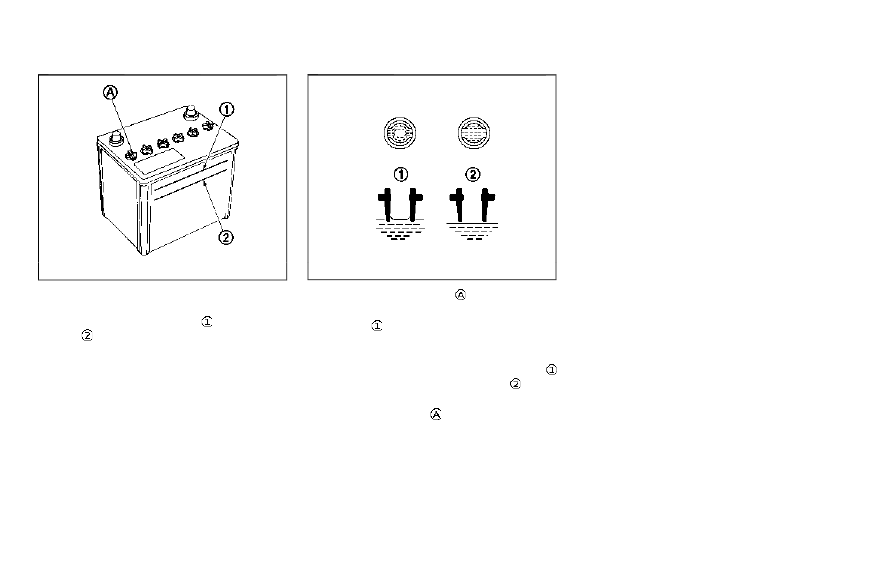
Check the fluid level in each cell (Remove the
battery cover if it is necessary). It should be
between the UPPER LEVEL

and LOWER

LEVEL

lines.

If it is necessary to add fluid, add only
distilled water to bring the level to the
indicator in each filler opening.

Do not

overfill.

SDI1480C

1. Remove the cell plugs

.

2. Add distilled water up to the UPPER

LEVEL

line.

If the side of the battery is not clear,
check the distilled water level by looking
directly above the cell; the condition
indicates OK and the conditions

needs

more to be added.

3. Tighten cell plugs

.

Vehicles operated in high temperatures or
under severe conditions require frequent
checks of the battery fluid level.

JUMP STARTING

If jump starting is necessary, see “Jump
starting” (P.6-11). If the engine does not
start by jump starting, the battery may have
to be replaced. It is recommended you visit
an INFINITI retailer for this service.

CarManuals2.com

-------------------------------------------------------------------------------------------------------------------------------------------------------------

CAUTION

.

Do not ground accessories directly to
the battery terminal. Doing so will
bypass the variable voltage control
system and the vehicle battery may
not charge completely.

.

Use electrical accessories with the
engine running to avoid discharging
the vehicle battery.

The variable voltage control system mea-
sures the amount of electrical discharge
from the battery and controls voltage gen-
erated by the generator.

SDI2533

1.

Power steering fluid pump

2.

Water pump

3.

Alternator

4.

Crankshaft pulley

5.

Air conditioner compressor

WARNING

Be sure the ignition switch is in the OFF
or LOCK position before servicing drive
belts. The engine could rotate unexpect-
edly.

1. Visually inspect each belt for signs of

unusual wear, cuts, fraying or looseness.

If the belt is in poor condition or loose,
have it replaced or adjusted. It is recom-
mended you visit an INFINITI retailer for
this service.

2. Have the belts checked regularly for

condition and tension in accordance with
the maintenance schedule shown in the
“9. Maintenance and schedules” section.

Do-it-yourself

8-13

VARIABLE VOLTAGE CONTROL SYSTEM

DRIVE BELTS

CarManuals2.com

-------------------------------------------------------------------------------------------------------------------------------------------------------------

8-14

Do-it-yourself

WARNING

Be sure the engine and the ignition
switch are off and that the parking
brake is engaged securely.

CAUTION

Be sure to use the correct socket to
remove the spark plugs. An incorrect
socket can damage the spark plugs.

SDI2020

REPLACING SPARK PLUGS

If replacement is required, it is recommended
you visit an INFINITI retailer for this service.

Iridium-tipped spark plugs

It is not necessary to replace the iridium-
tipped spark plugs as frequently as the
conventional type spark plugs since they will
last much longer. Follow the maintenance
schedule shown in the “9. Maintenance and
schedules” section, but do not reuse them by
cleaning or regapping.

Always replace spark plugs with recom-
mended or equivalent ones.

SDI2515

To remove the filter, release the lock pins
and pull the unit upward

.

The filter element should not be cleaned and
reused. Replace it according to the main-
tenance intervals. See “9. Maintenance and
schedules” section for maintenance inter-
vals. When replacing the filter, wipe the
inside of the air cleaner housing and the
cover with a damp cloth.

WARNING

.

Operating the engine with the air
cleaner removed can cause you or
others to be burned. The air cleaner

SPARK PLUGS

AIR CLEANER

CarManuals2.com

-------------------------------------------------------------------------------------------------------------------------------------------------------------

not only cleans the air, it stops flame
if the engine backfires. If it isn’t
there, and the engine backfires, you
could be burned. Do not drive with
the air cleaner removed, and be care-
ful when working on the engine with
the air cleaner removed.

.

Never pour fuel into the throttle body
or attempt to start the engine with
the air cleaner removed. Doing so
could result in serious injury.

CLEANING

If your windshield is not clear after using the
windshield washer or if a wiper blade
chatters when running, wax or other materi-
al may be on the blade or windshield.
Clean the outside of the windshield with a
washer solution or a mild detergent. Your
windshield is clean if beads do not form
when rinsing with clear water.
Clean each blade by wiping it with a cloth
soaked in a washer solution or a mild
detergent. Then rinse the blade with clear
water. If your windshield is still not clear
after cleaning the blades and using the
wiper, replace the blades.
Worn windshield wiper blades can damage
the windshield and impair driver vision.

When a washer nozzle is clogged

It is recommended you see an INFINITI
retailer if a washer nozzle is clogged or any
malfunction occurs. Do not attempt to clean
the nozzle using a needle or a pin. Doing so
may damage the nozzle.

Do-it-yourself

8-15

WINDSHIELD WIPER BLADES

CarManuals2.com

-------------------------------------------------------------------------------------------------------------------------------------------------------------

8-16

Do-it-yourself

SDI2048

REPLACING

Replace the wiper blades if they are worn.
1. Pull the wiper arm.
2. Push the release tab

, and then move

the wiper blade down the wiper arm
while pushing the release tab to remove.

3. Insert the new wiper blade onto the

wiper arm until a click sounds.

4. Rotate the wiper blade so the dimple is in

the groove.

CAUTION

.

After wiper blade replacement, re-
turn the wiper arm to its original
position;

otherwise it may be damaged when
the hood is opened.

.

Make sure the wiper blades contact
the glass; otherwise the arm may be
damaged from wind pressure.

It is recommended you visit an INFINITI
retailer if checking or replacement is re-
quired.

REAR WINDOW WIPER BLADES

CarManuals2.com

-------------------------------------------------------------------------------------------------------------------------------------------------------------

If the brakes do not operate properly, have
the brakes checked. It is recommended that
you visit an INFINITI retailer for this service.

SELF-ADJUSTING BRAKES

Your vehicle is equipped with self-adjusting
brakes.
The disc-type brakes self-adjust every time
the brake pedal is applied.

WARNING

Have your brake system checked if the
brake pedal height does not return to
normal. It is recommended you visit an
INFINITI retailer for this service.

BRAKE PAD WEAR WARNING

The disc brake pads have audible wear
warnings. When a brake pad requires repla-
cement, it will make a high pitched scraping
sound when the vehicle is in motion. This
scraping sound will first occur only when the
brake pedal is depressed. After more wear of
the brake pad, the sound will always be
heard even if the brake pedal is not
depressed. Have the brakes checked as soon
as possible if the wear warning sound is
heard.
Under some driving or climate conditions,

occasional brake squeak, squeal or other
noise may be heard. Occasional brake noise
during light to moderate stops is normal and
does not affect the function or performance
of the brake system.

Proper brake inspection intervals should be
followed.

For additional information, see the

maintenance schedules shown in the “9.
Maintenance and schedules” section.

BRAKE BOOSTER

Check the brake booster function as follows:
1. With the engine off, depress and release

the foot brake pedal more than 20 times.
When the foot brake pedal movement
(distance of travel) remains the same
from one pedal application to the next,
continue on to the next step.

2. While depressing the foot brake pedal,

start the engine.

3. With the foot brake pedal depressed,

stop the engine. Keep the pedal de-
pressed for about 30 seconds.

4. Run the engine for 1 minute without

depressing the foot brake pedal, then
turn it off. Depress the foot brake pedal
several times. The pedal travel distance
will decrease gradually with each de-
pression as the hydraulic pressure de-
creases.

If the brakes do not operate properly, have
the brakes checked. It is recommended that
you visit an INFINITI retailer for repair.

Do-it-yourself

8-17

BRAKES

CarManuals2.com

-------------------------------------------------------------------------------------------------------------------------------------------------------------

8-18

Do-it-yourself

SDI2518

SDI2532

WAI0113X

ENGINE COMPARTMENT

WARNING

Never use a fuse of a higher or lower
amperage rating than that specified on
the fuse box cover. This could damage
the electrical system or electronic con-
trol units or cause a fire.

If any electrical equipment does not operate,
check for an open fuse.
1. Be sure the ignition switch is pushed to

the OFF or LOCK position and the
headlights are off. (See “Headlight

switch” (P.2-44) or “Autolight system”
(P.2-44).)

2. Open the engine hood and remove the

cover on the battery.

3. Remove the fuse/fusible link holder

cover

,

,

or

.

4. Remove the fuse with the fuse puller.

FUSES

CarManuals2.com

-------------------------------------------------------------------------------------------------------------------------------------------------------------

SDI1753

Type A

SDI1754

Type B

5. If the fuse is open

, replace it with a

new fuse

. Spare fuses are stored in the

passenger compartment fuse box.

6. If a new fuse also opens, have the

electrical system checked and repaired.
It is recommended you visit an INFINITI
retailer for this service.

Fusible links

If any electrical equipment does not operate
and fuses are in good condition, check the
fusible links. If any of these fusible links are
melted, replace only with genuine INFINITI
parts.

Do-it-yourself

8-19

CarManuals2.com

-------------------------------------------------------------------------------------------------------------------------------------------------------------

8-20

Do-it-yourself

JVM0200X

PASSENGER COMPARTMENT

WARNING

Never use a fuse of a higher or lower
amperage rating than that specified on
the fuse box cover. This could damage
the electrical system or electronic con-
trol units or cause a fire.

If any electrical equipment does not operate,
check for an open fuse.
1. Be sure the ignition switch is pushed to

the OFF or LOCK position and the
headlights are off.

2. Open the fuse box lid.
3. Remove the fuse with the fuse puller

.

4. If the fuse is open, replace it with a new

fuse.

5. If a new fuse also opens, have the

electrical system checked and repaired.
It is recommended you visit an INFINITI
retailer for this service. Spare fuses are
stored in the fuse box.

SDI2704

Extended storage fuse switch (if so
equipped)

To reduce battery drain, the extended
storage fuse switch comes from the factory
switched off. Prior to delivery of your
vehicle, the switch is pushed in (switched
on) and should always remain on.
If the extended storage fuse switch is not
pushed in (switched on), the “Shipping Mode
On, Push Storage Fuse” warning may appear
on the vehicle information display. See
“Vehicle information display” (P.2-20).
If any electrical equipment does not operate,
remove the extended storage fuse switch
and check for an open fuse.

CarManuals2.com

-------------------------------------------------------------------------------------------------------------------------------------------------------------

NOTE:

If the extended storage fuse switch mal-
functions or if the fuse is open, it is not
necessary to replace the switch. In this case,
remove the extended storage fuse switch
and replace it with a new fuse of the same
rating.
How to remove the extended storage fuse
switch:

1. To remove the extended storage fuse

switch, be sure the ignition switch is in
the OFF or LOCK position.

2. Be sure the headlights are off. (See

“Headlight switch” (P.2-44) or “Auto-
light system” (P.2-44).)

3. Remove the fuse box cover.
4. Pinch the locking tabs

found on each

side of the storage fuse switch.

5. Pull the storage fuse switch straight out

from the fuse box

.

CAUTION

Be careful not to allow children to
swallow the battery and removed parts.

SDI2451

Replace the battery as follows:
1. Release the lock knob at the back of the

Intelligent Key and remove the mechan-
ical key.

2. Insert a small screwdriver into the slit of

the corner and twist it to separate the
upper part from the lower part. Use a

Do-it-yourself

8-21

INTELLIGENT KEY BATTERY
REPLACEMENT

CarManuals2.com

-------------------------------------------------------------------------------------------------------------------------------------------------------------

8-22

Do-it-yourself

cloth to protect the casing.

3. Replace the battery with a new one.

Recommended battery: CR2025 or
equivalent.

.

Do not touch the internal circuit and

electric terminals as it could cause a
malfunction.

.

Hold the battery by the edges. Hold-

ing the battery across the contact
points will seriously deplete the sto-
rage capacity.

.

Make sure that the + side faces the

bottom of the case.

SDI2452

4. Align the tips of the upper and lower

parts

, and then push them together

until it is securely closed

.

5. Push the buttons two or three times to

check its operation.

It is recommended you visit an INFINITI
retailer if you need any assistance for
replacement.

FCC Notice:

For USA:

This device complies with Part 15 of the
FCC Rules. Operation is subject to the
following two conditions: (1) This device
may not cause harmful interference, and (2)
this device must accept any interference

received, including interference that may
cause undesired operation.

Note: Changes or modifications not ex-
pressly approved by the party responsible
for compliance could void the user’s author-
ity to operate the equipment.

For Canada:

This device contains licence-exempt trans-
mitter(s)/receiver(s) that comply with In-
n o v a t i o n , S c i e n c e a n d E c o n o m i c
Development Canada’s licence-exempt
RSS(s). Operation is subject to the follow-
ing two conditions: (1) This device may not
cause interference. (2) This device must
accept any interference, including interfer-
ence that may cause undesired operation of
the device.

CarManuals2.com

-------------------------------------------------------------------------------------------------------------------------------------------------------------

JVM0854X

1.

Map light

2.

Front parking light/daytime running
light/front turn signal light

3.

Headlight (high-beam)

4.

Fog light

5.

Headlight (low-beam)

6.

Front side marker light

7.

Puddle light

8.

Step light (if so equipped)

9.

Side turn signal light

10. Front armrest light
11. Rear armrest light

12. Cargo light
13. High-mounted stop light
14. Side step light (if so equipped)
15. Rear personal light
16. Rear combination light (tail/stop/side

marker light)

17. Rear turn signal light
18. Back-up light
19. License plate light

Do-it-yourself

8-23

LIGHTS

CarManuals2.com

-------------------------------------------------------------------------------------------------------------------------------------------------------------

8-24

Do-it-yourself

HEADLIGHTS

If replacement is required, it is recommended
you visit an INFINITI retailer for this service.

EXTERIOR AND INTERIOR LIGHTS

Item

Wattage (W)

Bulb No.

Headlight*

High beams

LED

Low beams

LED

Front turn signal light*

LED

Fog light*

LED

Front parking light*

LED

Front side marker light*

LED

Rear combination light*

tail

LED

back-up

LED

stop/tail

LED

side marker

LED

Rear turn signal light*

21

PY21W

License plate light*

5

W5W

Puddle light*

LED

Front and rear armrest light*

LED

Map light*

LED

Rear personal light

8

Cargo light

8

Vanity mirror light

2

Step light* (if so equipped)

5

Side step light* (if so equipped)

LED

High-mounted stop light*

LED

*:

It is recommended you visit an INFINITI retailer for replacement.

CarManuals2.com

-------------------------------------------------------------------------------------------------------------------------------------------------------------

NOTE:

Always check with the Parts Department at an INFINITI retailer for the latest
information about parts.

Replacement procedures

All other lights are either type A, B, C, D, E or
F. When replacing a bulb, first remove the
lens and/or cover.

Do-it-yourself

8-25

CarManuals2.com

-------------------------------------------------------------------------------------------------------------------------------------------------------------

8-26

Do-it-yourself

SDI1679

SDI2031

Rear personal light

WAI0295X

Cargo light

SDI2032

Vanity mirror light

CarManuals2.com

-------------------------------------------------------------------------------------------------------------------------------------------------------------

If you have a flat tire, see “Flat tire” (P.6-3).

TIRE PRESSURE

Tire Pressure Monitoring System
(TPMS)

This vehicle is equipped with the Tire
Pressure Monitoring System (TPMS). It
monitors tire pressure of all tires except the
spare. When the low tire pressure warning
light is lit and the “Tire Pressure Low Add
Air” warning appears in the vehicle informa-
tion display, one or more of your tires is
significantly under-inflated.
The TPMS will activate only when the
vehicle is driven at speeds above 16 MPH
(25 km/h). Also, this system may not detect
a sudden drop in tire pressure (for example, a
flat tire while driving).
For more details, see “Low tire pressure
warning light” (P.2-16), “Tire Pressure Mon-
itoring System (TPMS)” (P.5-5) and “Tire
Pressure Monitoring System (TPMS) ” (P.6-
3).

Tire inflation pressure

Check the pressure of the tires (in-
cluding the spare) often and always
prior to long distance trips. The
recommended tire pressure specifica-
tions are shown on the Tire and

Loading Information label under the
“Cold Tire Pressure” heading. The Tire
and Loading Information label is
affixed to the driver side center pillar.
Tire pressures should be checked
regularly because:

.

Most tires naturally lose air over

time.

.

Tires can lose air suddenly when

driven over potholes or other ob-
jects or if the vehicle strikes a curb
while parking.

The tire pressures should be checked
when the tires are cold. The tires are
considered COLD after the vehicle
has been parked for 3 or more hours,
or driven less than 1 mile (1.6 km) at
moderate speeds.
TPMS with Tire Inflation Indicator
provides visual and audible signals
outside the vehicle for inflating the
tires to the recommended COLD tire
pressure. (See “TPMS with Tire Infla-
tion Indicator” (P.5-7) about the
TPMS with Tire Inflation Indicator.)

Incorrect tire pressure, including un-
der inflation, may adversely affect

tire life and vehicle handling.

WARNING

.

Improperly inflated tires can fail
suddenly and cause an accident.

.

The Gross Vehicle Weight rat-
ing (GVWR) is located on the F.
M.V.S.S./C.M.V.S.S. certifica-
tion label. The vehicle weight
capacity is indicated on the Tire
and Loading Information label.
Do not load your vehicle beyond
this capacity. Overloading your
vehicle may result in reduced
tire life, unsafe operating con-
ditions due to premature tire
failure, or unfavorable handling
characteristics and could also
lead to a serious accident.
Loading beyond the specified
capacity may also result in fail-
ure of other vehicle compo-
nents.

.

Before taking a long trip, or
whenever you heavily load your
vehicle, use a tire pressure

Do-it-yourself

8-27

WHEELS AND TIRES

CarManuals2.com

-------------------------------------------------------------------------------------------------------------------------------------------------------------

8-28

Do-it-yourself

gauge to ensure that the tire
pressures are at the specified
level.

.

For additional information re-
garding tires, refer to “Impor-
tant Tire Safety Information”
(US) or “Tire Safety Informa-
tion” (Canada) in the Warranty
Information Booklet.

CarManuals2.com

-------------------------------------------------------------------------------------------------------------------------------------------------------------

SDI2496

Tire and Loading Information label

Seating capacity: The maximum
number of occupants that can be
seated in the vehicle.
Vehicle load limit: See “Vehicle
loading information” (P.10-15).

Original size: The size of the tires
originally installed on the vehicle
at the factory.
Cold tire pressure: Inflate the
tires to this pressure when the
tires are cold. Tires are consid-
ered COLD after the vehicle has

been parked for 3 or more hours,
or driven less than 1 mile (1.6 km)
at moderate speeds. The recom-
mended cold tire inflation is set
by the manufacturer to provide
the best balance of tire wear,
vehicle handling, driveability, tire
noise, etc., up to the vehicle’s
GVWR.
Tire size — see “Tire labeling”
(P.8-31).
Spare tire size or compact spare
tire size (if so equipped)

Do-it-yourself

8-29

CarManuals2.com

-------------------------------------------------------------------------------------------------------------------------------------------------------------

8-30

Do-it-yourself

SDI1949

Checking the tire pressure

1. Remove the valve stem cap from

the tire.

2. Press the pressure gauge squarely

onto the valve stem. Do not press
too hard or force the valve stem
sideways, or air will escape. If the
hissing sound of air escaping from
the tire is heard while checking the
pressure, reposition the gauge to
eliminate this leakage.

3. Remove the gauge.

4. Read the tire pressure on the

gauge stem and compare it to the
specification shown on the Tire
and Loading Information label.

5. Add air to the tire as needed. If too

much air is added, press the core of
the valve stem briefly with the tip
of the gauge stem to release
pressure. Recheck the pressure
and add or release air as needed.

6. Install the valve stem cap.
7. Check the pressure of all other

tires, including the spare.

8. Check the pressure when driving

the vehicle at speeds of 100 mph
(160 km/h) or higher where it is
legal to do so.

WARNING

.

Driving at high speeds, 100
mph (160 km/h) or higher sus-
tained where it is legal to do so,
can cause tires to have exces-
sive heat build up, which may
result in a tire failure causing

loss of control, crash, injuries or
even death. Some high-speed
rated tires require inflation
pressure adjustment for high-
speed operation. When speed
limits and road conditions allow
vehicle driving at high speeds,
make sure tires are rated to
support high speed operation,
tires are in optimal conditions
and pressure is adjusted to
correct cold inflation pressure
for high speed operation.

.

Tires require adjustment to the
inflation pressure when driving
the vehicle at speeds of 100
mph (160 km/h) or higher
where it is legal to do so. See
recommended tire inflation
chart for correct operating
pressure.

.

After vehicle high speed opera-
tion has ended, readjust the tire
pressure to the recommended
cold inflation pressure. (See
“Checking the tire pressure”

CarManuals2.com

-------------------------------------------------------------------------------------------------------------------------------------------------------------

(P.8-30).)

Size

Cold Tire In-
flation Pres-

sure

Front Original Tire:
P275/50R22 111H

35 psi, 240
kPa

Front Original Tire:
P275/60R20 114H

35 psi, 240
kPa

Rear Original Tire:
P275/50R22 111H

35 psi, 240
kPa

Rear Original Tire:
P275/60R20 114H

35 psi, 240
kPa

Spare Tire:
265/70R18 116M

51 psi, 350
kPa

Recommended tire inflation pressures
at speeds of 100 mph (160 km/h) or
higher where it is legal to do so.

Size

Cold Tire In-
flation Pres-

sure

Front Original Tire:
P275/50R22 111H

41 psi, 280
kPa

Front Original Tire:
P275/60R20 114H

36 psi, 250
kPa

Rear Original Tire:
P275/50R22 111H

41 psi, 280
kPa

Rear Original Tire:
P275/60R20 114H

36 psi, 250
kPa

SDI1575

Example

TIRE LABELING

Federal law requires tire manufac-
turers to place standardized informa-
tion on the sidewall of all tires. This
information identifies and describes
the fundamental characteristics of
the tire and also provides the tire
identification number (TIN) for safety
standard certification. The TIN can be
used to identify the tire in case of a
recall.

Do-it-yourself

8-31

CarManuals2.com

-------------------------------------------------------------------------------------------------------------------------------------------------------------

8-32

Do-it-yourself

SDI1606

Example

Tire size (example: P215/60R16
94H)

1. P: The “P” indicates the tire is

designed for passenger vehicles.
(Not all tires have this informa-
tion.)

2. Three-digit number (215): This

number gives the width in milli-
meters of the tire from sidewall
edge to sidewall edge.

3. Two-digit number (60): This num-

ber, known as the aspect ratio,
gives the tire’s ratio of height to

width.

4. R: The “R” stands for radial.
5. Two-digit number (16): This num-

ber is the wheel or rim diameter in
inches.

6. Two- or three-digit number (94):

This number is the tire’s load index.
It is a measurement of how much
weight each tire can support. You
may not find this information on all
tires because it is not required by
law.

7. H: Tire speed rating. You should

not drive the vehicle faster than
the tire speed rating.

JVM0694X

Example (Type A) (if so equipped)

TIN (Tire Identification Number)
for a new tire (example: DOT XX
XX XXX XXXX)

1. DOT: Abbreviation for the “De-

partment of Transportation”. The
symbol can be placed above, be-
low or to the left or right of the
Tire Identification Number.

2. Two-digit code: Manufacturer’s

identification mark

3. Two-digit code: Tire size
4. Three-digit code: Date of Manu-

facture

CarManuals2.com

-------------------------------------------------------------------------------------------------------------------------------------------------------------

5. Four numbers represent the week

and year the tire was built. For
example, the numbers 3103
means the 31st week of 2003. If
these numbers are missing, then
look on the other sidewall of the
tire.

WAI0339X

Example (Type B) (if so equipped)

TIN (Tire Identification Number)
for a new tire (example: DOT XXX
XXXXXX XXXX)

1. DOT: Abbreviation for the “De-

partment of Transportation”. The
symbol can be placed above, be-
low or to the left or right of the
Tire Identification Number.

2. Three-digit code: Manufacturer’s

identification mark

3. Six-digit code: Descriptive code

used to identify significant char-
acteristics of the tire.

4. Four numbers represent the week

and year the tire was built. For
example, the numbers 3103
means the 31st week of 2003.

Tire ply composition and material
The number of layers or plies of
rubber-coated fabric in the tire.
Tire manufacturers also must in-
dicate the materials in the tire,
which include steel, nylon, polye-
ster, and others.
Maximum permissible inflation
pressure
This number is the greatest
amount of air pressure that
should be put in the tire. Do not
exceed the maximum permissible
inflation pressure.
Maximum load rating
This number indicates the max-
imum load in kilograms and
pounds that can be carried by
the tire. When replacing the tires
on the vehicle, always use a tire
that has the same load rating as
the factory installed tire.
Term of “tubeless” or “tube type”

Do-it-yourself

8-33

CarManuals2.com

-------------------------------------------------------------------------------------------------------------------------------------------------------------

8-34

Do-it-yourself

Indicates whether the tire re-
quires an inner tube (“tube type”)
or not (“tubeless”).
The word “radial”
The word “radial” is shown, if the
tire has radial structure.
Manufacturer or brand name
Manufacturer or brand name is
shown.

Other tire-related terminology:

In addition to the many terms that are
defined throughout this section, In-
tended Outboard Sidewall is (1) the
sidewall that contains a whitewall,
bears white lettering or bears manu-
facturer, brand and/or model name
molding that is higher or deeper than
the same molding on the other side-
wall of the tire, or (2) the outward
facing sidewall of an asymmetrical
tire that has a particular side that
must always face outward when
mounted on a vehicle.

TYPES OF TIRES

WARNING

.

When changing or replacing tires, be
sure all four tires are of the same type
(Example: Summer, All Season or
Snow) and construction. An INFINITI
retailer may be able to help you with
information about tire type, size,
speed rating and availability.

.

Replacement tires may have a lower
speed rating than the factory
equipped tires, and may not match
the potential maximum vehicle speed.
Never exceed the maximum speed
rating of the tire.

.

Replacing tires with those not origin-
ally specified by INFINITI could affect
the proper operation of the TPMS.

.

For additional information regarding
tires, refer to “Important Tire Safety
Information” (US) or “Tire Safety
Information” (Canada) in the War-
ranty Information Booklet.

All season tires

INFINITI specifies all season tires on some
models to provide good performance all

year, including snowy and icy road condi-
tions. All Season tires are identified by ALL
SEASON and/or M&S (Mud and Snow) on
the tire sidewall. Snow tires have better
snow traction than All Season tires and may
be more appropriate in some areas.

Summer tires

INFINITI specifies summer tires on some
models to provide superior performance on
dry roads. Summer tire performance is
substantially reduced in snow and ice. Sum-
mer tires do not have the tire traction rating
M&S on the tire sidewall.
If you plan to operate your vehicle in snowy
or icy conditions, INFINITI recommends the
use of SNOW tires or ALL SEASON tires on
all four wheels.

Snow tires

If snow tires are needed, it is necessary to
select tires equivalent in size and load rating
to the original equipment tires. If you do not,
it can adversely affect the safety and
handling of your vehicle.
Generally, snow tires will have lower speed
ratings than factory equipped tires and may
not match the potential maximum vehicle
speed. Never exceed the maximum speed
rating of the tire.
If you install snow tires, they must be the

CarManuals2.com

-------------------------------------------------------------------------------------------------------------------------------------------------------------

same size, brand, construction and tread
pattern on all four wheels.
For additional traction on icy roads, studded
tires may be used. However, some U.S.
states and Canadian provinces prohibit their
use. Check local, state and provincial laws
before installing studded tires. Skid and
traction capabilities of studded snow tires,
on wet or dry surfaces, may be poorer than
that of non-studded snow tires.

TIRE CHAINS

Use of tire chains may be prohibited accord-
ing to location. Check the local laws before
installing tire chains. When installing tire
chains, make sure they are the proper size
for the tires on your vehicle and are installed
according to the chain manufacturer’s sug-
gestions.

Use only SAE Class S chains.

Class

“S” chains are used on vehicles with re-
stricted tire to vehicle clearance. Vehicles
that can use Class “S” chains are designed to
meet the SAE standard minimum clearances
between the tire and the closest vehicle
suspension or body component required to
accommodate the use of a winter traction
device (tire chains or cables). The minimum
clearances are determined using the factory
equipped tire size. Other types may damage
your vehicle. Use chain tensioners when
recommended by the tire chain manufac-
turer to ensure a tight fit. Loose end links of

the tire chain must be secured or removed to
prevent the possibility of whipping action
damage to the fenders or underbody. If
possible, avoid fully loading your vehicle
when using tire chains. In addition, drive at
a reduced speed. Otherwise, your vehicle
may be damaged and/or vehicle handling
and performance may be adversely affected.

Tire chains must be installed only on the
rear wheels and not on the front wheels.

Never install tire chains on the full-size
temporary use only spare tire (if so
equipped).
Do not use tire chains on dry roads. Driving
with tire chains in such conditions can cause
damage to the various mechanisms of the
vehicle due to some overstress.

SDI1662

CHANGING WHEELS AND TIRES

Tire rotation

INFINITI recommends rotating the
tires at the specified interval shown
in the maintenance schedule. (See the
“Maintenance and schedules” section.
For tire replacing procedures, see
“Flat tire” (P.6-3).)

As soon as possible, tighten the
wheel nuts to the specified torque
with a torque wrench.

Do-it-yourself

8-35

CarManuals2.com

-------------------------------------------------------------------------------------------------------------------------------------------------------------

8-36

Do-it-yourself

Wheel nut tightening torque:

98 ft-lb (133 N·m)

The wheel nuts must be kept tigh-
tened to the specification at all times.
It is recommended that wheel nuts be
tightened to the specification at each
tire rotation interval.

WARNING

.

After rotating the tires, check
and adjust the tire pressure.

.

Retighten the wheel nuts when
the vehicle has been driven for
600 miles (1,000 km) (also in
cases of a flat tire, etc.).

.

Do not include the full-size
temporary use only spare tire
(if so equipped) in the tire
rotation.

.

For additional information re-
garding tires, refer to “Impor-
tant Tire Safety Information”
(US) or “Tire Safety Informa-
tion” (Canada) in the Warranty

Information Booklet.

SDI1663

1.

Wear indicator

2.

Wear indicator location mark

Tire wear and damage

WARNING

.

Tires should be periodically in-
spected for wear, cracking, bul-
ging or objects caught in the
tread. If excessive wear, cracks,
bulging or deep cuts are found,
the tire(s) should be replaced.

.

The original tires have built-in

CarManuals2.com

-------------------------------------------------------------------------------------------------------------------------------------------------------------

tread wear indicators. When
wear indicators are visible, the
tire(s) should be replaced.

.

Tires degrade with age and use.
Have tires, including the spare,
over 6 years old checked by a
qualified technician, because
some tire damage may not be
obvious. Replace the tires as
necessary to prevent tire failure
and possible personal injury.

.

Improper service of the spare
tire may result in serious perso-
nal injury. If it is necessary to
repair the spare tire, it is re-
c o m m e n d e d y o u v i s i t a n
INFINITI retailer for this ser-
vice.

.

For additional information re-
garding tires, refer to “Impor-
tant Tire Safety Information”
(US) or “Tire Safety Informa-
tion” (Canada) in the Warranty
Information Booklet.

Replacing wheels and tires

When replacing a tire, use the same size,
tread design, speed rating and load carrying
capacity as originally equipped. (See “Speci-
fications” (P.10-8) for recommended types
and sizes of tires and wheels.)

WARNING

.

The use of tires other than those
recommended or the mixed use of
tires of different brands, construc-
tion (bias, bias-belted or radial), or
tread patterns can adversely affect
the ride, braking, handling, ground
clearance, body-to-tire clearance,
tire chain clearance, speedometer
calibration, headlight aim and bum-
per height. Some of these effects may
lead to accidents and could result in
serious personal injury.

.

For Two-Wheel Drive (2WD) models,
if your vehicle was originally
equipped with 4 tires that were the
same size and you are only replacing
2 of the 4 tires, install the new tires
on the rear axle. Placing new tires on
the front axle may cause loss of
vehicle control in some driving condi-
tions and cause an accident and
personal injury.

.

If the wheels are changed for any
reason, always replace with wheels
which have the same off-set dimen-
sion. Wheels of a different off-set
could cause premature tire wear,
degrade vehicle handling character-
istics and/or interference with the
brake discs/drums. Such interference
can lead to decreased braking effi-
ciency and/or early brake pad/shoe
wear. See “Wheels and tires” (P.10-
9) for wheel off-set dimensions.

.

Since the spare tire is not equipped
with the TPMS, when a spare tire is
mounted or a wheel is replaced, the
TPMS will not function and the low
tire pressure warning light will flash
for approximately 1 minute. The light
will remain on after 1 minute. Have
your tires replaced and/or TPMS
system reset as soon as possible. It
is recommended you visit an INFINITI
retailer for these services.

.

Replacing tires with those not origin-
ally specified by INFINITI could affect
the proper operation of the TPMS.

.

The TPMS sensor may be damaged if
it is not handled correctly. Be careful
when handling the TPMS sensor.

.

When replacing the TPMS sensor, the
ID registration may be required. It is

Do-it-yourself

8-37

CarManuals2.com

-------------------------------------------------------------------------------------------------------------------------------------------------------------

8-38

Do-it-yourself

recommended you visit an INFINITI
retailer for ID registration.

.

Do not use a valve stem cap that is
not specified by INFINITI. The valve
stem cap may become stuck.

.

Be sure that the valve stem caps are
correctly fitted. Otherwise the valve
may be clogged up with dirt and
cause a malfunction or loss of pres-
sure.

.

Do not install a damaged or deformed
wheel or tire even if it has been
repaired. Such wheels or tires could
have structural damage and could fail
without warning.

.

The use of retread tire is not recom-
mended.

.

For additional information regarding
tires, refer to “Important Tire Safety
Information” (US) or “Tire Safety
Information” (Canada) in the War-
ranty Information Booklet.

Four-Wheel Drive (4WD) models

CAUTION

.

Always use tires of the same type,
size, brand, construction (bias, bias-
belted or radial), and tread pattern
on all four wheels. Failure to do so
may result in a circumference differ-
ence between tires on the front and
rear axles which will cause excessive
tire wear and may damage the trans-
mission, transfer case and differential
gears.

.

ONLY use spare tires specified for
the 4WD model.

If excessive tire wear is found, it is recom-
mended that all four tires be replaced with
tires of the same size, brand, construction
and tread pattern. The tire pressure and
wheel alignment should also be checked and
corrected as necessary. It is recommended
you visit an INFINITI retailer for this service.

Wheel balance

Unbalanced wheels may affect vehicle hand-
ling and tire life. Even with regular use,
wheels can get out of balance. Therefore,
they should be balanced as required.

Wheel balance service should be performed
with the wheels off the vehicle. Spin
balancing the wheels on the vehicle could
lead to mechanical damage.

For additional information regarding tires,
refer to “Important Tire Safety Information”
(US) or “Tire Safety Information” (Canada) in
the INFINITI Warranty Information Booklet.

Care of wheels

See “Cleaning exterior” (P.7-2) for details
about care of the wheels.

Spare tire

Since the spare tire is not equipped with the
TPMS, when a spare tire is mounted (TEM-
PORARY USE ONLY), the TPMS will not
function.

Spare tire (FULL-SIZE TEMPORARY USE
ONLY spare tire):

Observe the following precautions if the full-
size temporary use only spare tire must be
used, otherwise your vehicle could be da-
maged or involved in an accident.

WARNING

.

The full-size temporary use only
spare tire should be used for emer-
gency use. It should be replaced with

CarManuals2.com

-------------------------------------------------------------------------------------------------------------------------------------------------------------

the standard tire at the first oppor-
tunity to avoid possible tire or differ-
ential damage

.

Drive carefully while the spare tire is
installed. Avoid sharp turns and
abrupt braking while driving. The
vehicle driving performance may be
affected when driving on wet or
snow covered roads.

.

When the spare tire is installed, the
following systems may not work
correctly.

— Tire Pressure Monitoring System

(TPMS)

— Vehicle Dynamic Control (VDC)

System

.

Periodically check spare tire inflation
pressure. Always keep the spare tire
inflated to the pressure specification
shown on the Tire and Loading
Information label. For Tire and Load-
ing Information label location, see
“Tire and Loading Information label”
in the index of this manual.

.

With the spare tire installed do not
drive your vehicle at speeds faster
than 70 MPH (112 km/h).

.

When driving on roads covered with
snow or ice, the spare tire should be
used on the front wheels and original

tire used on the rear wheels (drive
wheels). Use tire chains only on the
two rear original tires.

.

Do not use the spare tire on other
vehicles.

.

Do not use more than one spare tire
at the same time.

CAUTION

Do not use tire chains on the spare tire.
Tire chains will not fit properly and may
cause damage to the vehicle.

Do-it-yourself

8-39

CarManuals2.com

-------------------------------------------------------------------------------------------------------------------------------------------------------------

8-40

Do-it-yourself

MEMO

CarManuals2.com

-------------------------------------------------------------------------------------------------------------------------------------------------------------

-------------------------------------------------------------------------------------------------------------------------------------------------------------

9-2

Maintenance and schedules

Some day-to-day and regular maintenance
is essential to maintain your vehicle’s good
mechanical condition, as well as its emission
and engine performance.
It is the owner’s responsibility to make sure
that the scheduled maintenance, as well as
general maintenance, is performed.
As the vehicle owner, you are the only one
who can ensure that your vehicle receives
the proper maintenance. You are a vital link
in the maintenance chain.

GENERAL MAINTENANCE

General maintenance includes those items
which should be checked during normal day-
to-day operation. They are essential for
proper vehicle operation. It is your respon-
sibility to perform these procedures regularly
as prescribed.
Performing general maintenance checks re-
quires minimal mechanical skill and only a
few general automotive tools.
These checks or inspections can be done by
yourself, a qualified technician or, if you
prefer, an INFINITI retailer.

SCHEDULED MAINTENANCE

The maintenance items listed in this section
are required to be serviced at regular inter-
vals. However, under severe driving condi-
t i o n s , a d d i t i o n a l o r m o r e f r e q u e n t
maintenance will be required.

WHERE TO GO FOR SERVICE

If maintenance service is required or your
vehicle appears to malfunction, have the
systems checked and serviced. It is recom-
mended you visit an INFINITI retailer for this
service.
INFINITI technicians are well-trained spe-
cialists and are kept up to date with the
latest service information through technical
bulletins, service tips, and training programs.
They are completely qualified to work on
INFINITI vehicles

before

work begins.

If your vehicle is involved in a collision, it is
recommended that you ask your INFINITI
retailer where the nearest INFINITI Certified
Collision Center is located, or go to http://
collision.infinitiusa.com.
You can be confident that an INFINITI
retailer’s service department can perform
the service needed to meet the maintenance
requirements on your vehicle.

During the normal day-to-day operation of
the vehicle, general maintenance should be
performed regularly as prescribed in this
section. If you detect any unusual sounds,
vibrations or smells, be sure to check for the
cause and have it checked promptly. It is
recommended to have an INFINITI retailer
do it promptly. In addition, it is recom-
mended you visit an INFINITI retailer if you
think that repairs are required.
When performing any checks or mainte-
nance work, closely observe “Maintenance
precautions” (P.8-2).

EXPLANATION OF MAINTE-
NANCE ITEMS

Additional information on the following
items with “*” is found in the “8. Do-it
yourself” section of this manual.

Outside the vehicle

The maintenance items listed here should be
performed from time to time, unless other-
wise specified.

Doors and engine hood:

Check that all doors

and the engine hood, operate properly. Also
ensure that all latches lock securely. Lubri-
cate hinges, latches, latch pins, rollers and
links if necessary. Make sure that the
secondary latch keeps the hood from open-
ing when the primary latch is released.

MAINTENANCE REQUIREMENT

GENERAL MAINTENANCE

CarManuals2.com

-------------------------------------------------------------------------------------------------------------------------------------------------------------

When driving in areas using road salt or
other corrosive materials, check lubrication
frequently.

Lights*:

Clean the headlights on a regular

basis. Make sure that the headlights, stop
lights, tail lights, turn signal lights, and other
lights are all operating properly and installed
securely. Also check headlight aim.

Road wheel nuts (lug nuts)*:

When checking

the tires, make sure no wheel nuts are
missing, and check for any loose wheel nuts.
Tighten if necessary.

Tire rotation*:

Rotate tires at the specified

interval shown in the maintenance schedule.

Tires*:

Check the pressure with a gauge

often and always prior to long distance trips.
If necessary, adjust the pressure in all tires,
including the spare, to the pressure speci-
fied. Check carefully for damage, cuts or
excessive wear.

Tire Pressure Monitoring System (TPMS)
transmitter components:

Replace the TPMS

transmitter grommet seal, valve core and
cap when the tires are replaced due to wear
or age.

Wheel alignment and balance:

If the vehicle

should pull to either side while driving on a
straight and level road, or if you detect
uneven or abnormal tire wear, there may be
a need for wheel alignment.

If the steering wheel or seat vibrates at
normal highway speeds, wheel balancing
may be needed.
For additional information regarding tires,
refer to “Important Tire Safety Information”
(US) or “Tire Safety Information” (Canada) in
the INFINITI Warranty Information Booklet.

Windshield:

Clean the windshield on a

regular basis. Check the windshield at least
every six months for cracks or other damage.
Have a damaged windshield repaired by a
qualified repair facility. It is recommended
that you have a damaged windshield re-
paired by an INFINITI retailer, or an INFINITI
Certified Collision Center. To locate a colli-
sion center in your area, refer to http://
collision.infinitiusa.com.

Windshield wiper blades*:

Check for cracks

or wear if they do not wipe properly.

Inside the vehicle

The maintenance items listed here should be
checked on a regular basis, such as when
performing periodic maintenance, cleaning
the vehicle, etc.

Accelerator pedal:

Check the pedal for

smooth operation and make sure the pedal
does not catch or require uneven effort.
Keep the floor mat away from the pedal.

Automatic transmission P (Park) mechan-
ism:

On a fairly steep hill, check that your

vehicle is held securely with the shift lever in
the P (Park) position without applying any
brakes.

Brake pedal:

Check the pedal for smooth

operation. If the brake pedal suddenly goes
down further than normal, the pedal feels
spongy or the vehicle seems to take longer to
stop, have your vehicle checked immediately.
It is recommended you visit an INFINITI
retailer for this service. Keep the floor mat
away from the pedal.

Brakes:

Check that the brakes do not pull the

vehicle to one side when applied.

Parking brake:

Check the parking brake

operation regularly. The vehicle should be
securely held on a fairly steep hill with only
the parking brake applied. If the parking
brake needs adjusted, it is recommended you
visit an INFINITI retailer for this service.

Seat belts:

Check that all parts of the seat

belt system (for example, buckles, anchors,
adjuster and retractors) operate properly
and smoothly, and are installed securely.
Check the belt webbing for cuts, fraying,
wear or damage.

Seats:

Check seat position controls such as

seat adjusters, seatback recliner, etc. to
ensure they operate smoothly and that all
latches lock securely in every position. Check
that the head restraints/headrests move up
and down smoothly and that the locks (if so

Maintenance and schedules

9-3

CarManuals2.com

-------------------------------------------------------------------------------------------------------------------------------------------------------------


Content      ..     14      15      16      17     ..