FM 3-04.111 (FM 1-111) Aviation Brigades (AUGUST 2003) - page 12
Appendix K
SHIFT MANAGEMENT
K-124. Shift changes are usually scheduled at
12-hour intervals.
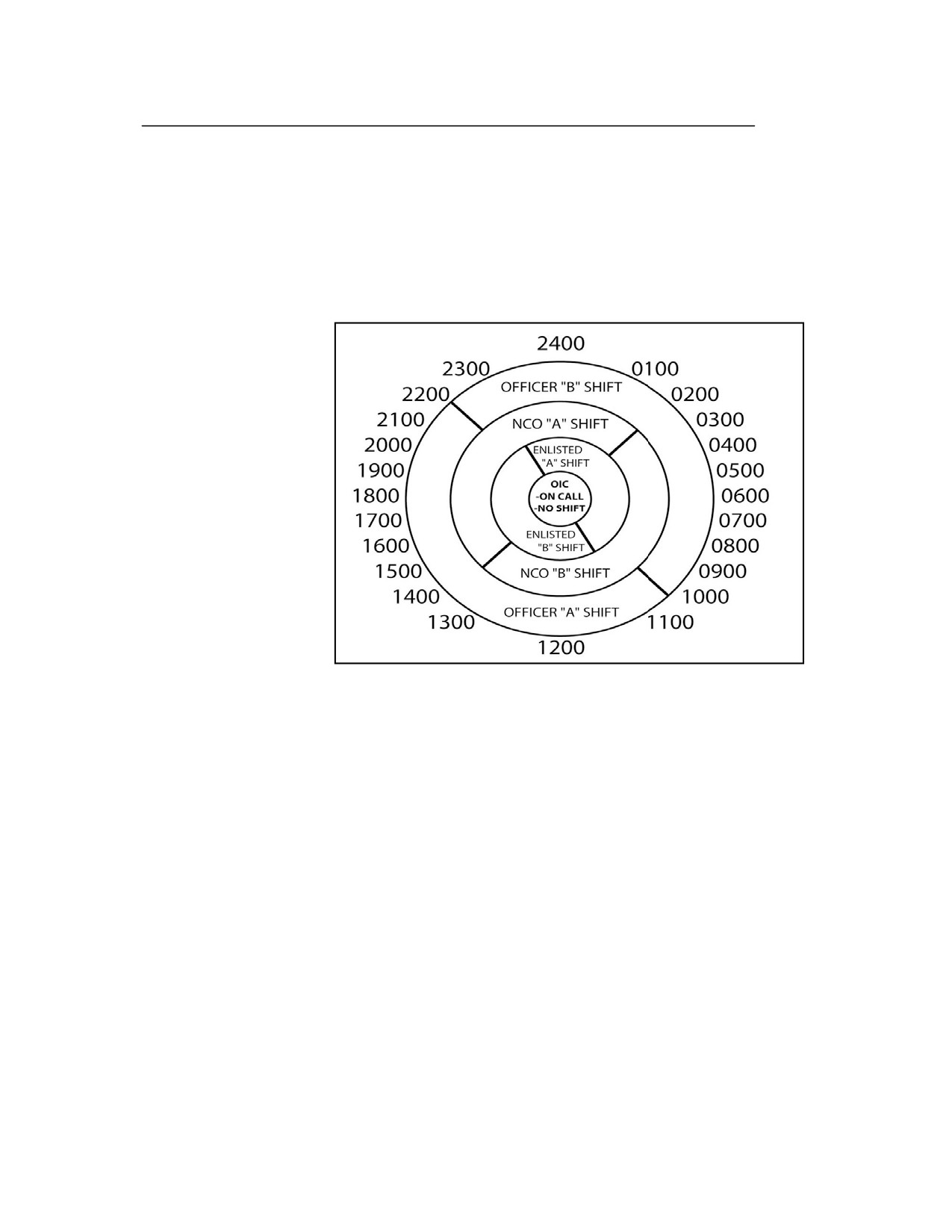
Commanders should consider offsetting shift changes at midshift for key
personnel. Staggering personnel in this manner will maintain a constant
interface of new and old shift personnel. This practice will ensure that at
least one individual knows what happened during the previous shift. Figure
K-10 provides an example.
Figure K-10. Example of Staggered Shift Changes
K-125. Soldiers must conduct a one-on-one exchange of information with the
person who they are relieving. This exchange must be followed by sectionwide
debriefs to ensure continuity in information flow and handoff of ongoing staff
actions.
K-126. Following the individual brief, section-level products and actions
should be reviewed. Each staff section should accomplish the following
actions:
• Review the digital journal for the past 12 hours.
• Review and update any CCIR.
• Review the current approved overlays.
• Review the current COP products.
• Check files to ensure that standard naming conventions are used.
• Review the UTO.
• Check section web products for updating and to ensure that they are
posted properly.
K-127. A collective information exchange, in the form of a shift change brief,
must be conducted so that the incoming shift receives a positive change of
control. Personnel from different staff sections will have access to the key
information produced by other sections and CPs. Handover briefings focus
much less on the rote exchange of information. Rather, these briefing
K-29

FM 3-04.111 (FM1-111)
sessions can function to focus personnel on available information, evaluation
of information, the status of the current operations, and tasks to support
future operations.
K-128. Critical digital considerations should be briefed collectively within
the CP. Table K-2 provides an example of what this brief may look like. There
is presently no doctrinal guidance on this process. Units should develop SOPs
to address this requirement.
Table K-2. Example of a CP Shift Change Brief
Staff
Sample Briefing Items
Position
Current higher and brigade changes to task organization
Disposition/status of units
Current and future missions
S3
Current operations
Battle
LNO updates
Captain
Combat power status
Projected operations over next 12 hours
Current timelines
PIR/CCIR
Current SU and location/status of all ISR assets (national to division/brigade)
RFI/RFA to higher (ARFOR or national)
S2/
Weather - next 12 hours impact/effects on friendly and enemy systems
Weather
HVT/HPT
Battle damage assessment
Significant activities during past 12 hours
Organization for combat
Unit locations and status
Priority of fires
FSE
HPT/attack guidance matrix
Fire support control measures
Significant activities
Preplanned request status
ALO
Immediate request status
In-flight reports
Organization for combat
Current AD warning status
AD
Aircraft engagements
Location and status of AD units
Operations since last update
Status of equipment and Class IV/V
Engineer
Future engineer operations
Recommendations for the commander
NBC condition
Current and recommended MOPP
Chemical
Enemy NBC activity
Chemical unit locations and status
Equipment status
S1/S4/
Class VIII status
Surgeon
Priority of support
Personnel status/health service status
BATTLE RHYTHM
K-129. Battle rhythm is a nondoctrinal
term
that
describes
a
process
essential to effective and efficient battle staff operations. The cycle of
K-30
Appendix K
recurring events within a CP focuses staff members to meet information and
action requirements. These recurring events include—
• Shift changes.
• Targeting meetings.
• Reports.
• Battle updates without the commander.
• Battle update briefings.
• Commanders’ collaborative sessions.
• Battle captain collaborative sessions.
K-130. The staff must achieve a battle rhythm for updating and viewing
information and understand how to use it to affect operations. A well-
established battle rhythm will aid the commander and staff with CP
organization, information management and display, decision making, and
fighting the battle from the CIC and via satellite C2 systems. Battle rhythm
demands careful planning and design. The many competing demands must
be deconflicted. Even subordinate units affect a higher echelon’s battle
rhythm based on their needs and unit procedures. Two key things to consider
when establishing SOPs for battle rhythm are scheduled updates (both with
higher and subordinate units) and bandwidth. ABCS competes for bandwidth
with the commander’s digital updates or VTCs especially if the data passes
over communications links between CPs. The MDMP can have one of the
most dramatic effects on battle rhythm. The process is lengthy and detailed
and must be closely coordinated with other ongoing actions.
BATTLE UPDATE BRIEFING
K-131. The battle update briefing provides the commander with analyzed
information essential to decision making and to synchronize the staff’s
actions. Use of the COP expedites the battle update and makes it more
current. The more information used from the COP, the more time that the
staff has to analyze and evaluate the information. The battle update briefing
itself will center on the COP displayed in the CIC. The staff must be selective
as to what other information is presented given the wealth of data and the
fact that it is already available at each BAS. Unit SOPs, command guidance,
and operational requirements will guide what information is briefed. Facts
and capabilities may be presented in digital staff estimates for the
commander to review before the briefing. This allows the battle update
briefing to focus on by-exception information and on specific commander
issues. Methods to update the commander depend on his location,
connectivity, and the information that he requires. Table K-3 compares
delivery methods.
K-31

FM 3-04.111 (FM1-111)
Table K-3. Update Delivery Comparison
Commander in an Aviation CP
Commander in Another CP
Verbal
Voice (radio, phone)
Over the shoulder of an operator
FBCB2
Commander’s update page and pull-up
MCS or access to another BAS at his
information
location
Links to staff section pages and pull-up
Collaboration session
information
Collaboration session
Large Screen Display
K-132. Traditionally, these updates were a recounting of significant events
since the last update. To build the update, the CP would establish an
information cut-off time. The focus was on maintaining SU. ABCS has
altered this briefing from a staff brief to a constantly available information
package focusing on the commander’s needs. Table K-4 shows how the
briefing has evolved from its traditional analog form to its digital form.
Table K-4. Traditional Versus Digital
Traditional
Digital
Significant events since last update
Commander accesses his own critical
information needs
Current as of cut-off time
Updated continuously
Periodic event
Available anytime
Current SU
Enhances SU
Staff presentations and their preparation
Staff routinely maintains information files,
were significant event
which continues with normal operations
K-133. Battle update briefs should maximize the use of information from
BASs to aid in understanding the COP. Cutting and pasting information to
non-ABCS briefing slides focus on fact finding and less on analysis. The
traditional form also consumes considerable time: more than one hour to
build/transmit slides, one hour to present
(at brigade level), and one
additional hour to present (at the division level). By the time that slides are
briefed, their information is outdated and inconsistent with the more current
COP.
ANALOG UNIT INTERACTION
K-134. Digitized units must be prepared to operate with nondigital units
that do not have the technology to access the digital COP. Liaison parties will
almost always be necessary to ensure full exchange of information between
digitized and nondigitized units. The primary tasks of digital LNO teams
are—
• Receipt and transmission of orders, graphics, and intelligence data via
BAS.
• Provision of friendly and enemy SU to the analog unit using its BAS.
K-32
Appendix K
• Manual creation of the analog unit friendly and enemy SU and its
transmission back to the parent organization.
• Fire support and coordination.
PLANNING
K-135. A digitized unit must exchange liaison teams with nondigitized units
early and consistently throughout the planning process. Nondigitized units
must strive to conduct parallel planning but will be at a disadvantage
without digital staff tools. Parallel planning requires rapid exchange of
information with analog units during the planning process. Involving higher,
adjacent, and lower staff elements early in the planning process allows the
entire staff to see both current and future operations and to identify known
or potential problem areas.
LIAISON TEAMS
K-136. Digital liaison teams may be sent to the analog unit’s CP. Liaison
provides at least some digital capability to analog units. These teams will
support SU for both the digital and nondigital unit, the issue of orders, and
informal information exchange. The number of liaison teams is limited, and
these alone cannot solve the C2 challenges of analog units that are without
digitally based SU. Liaison teams may be needed to escort elements of the
analog unit, even down to single vehicles if necessary. This latter option will
provide SU for these analog elements but is only practical if the digital unit
forms additional liaison elements.
EQUIPMENT REQUIREMENTS
K-137. The equipment and skills required of the liaison teams are a function
of the type of operation being conducted and the force with which the team is
coordinating. There are three basic forms of liaison that affect the task
organization of liaison teams:
• Digital unit to digital unit: This requires the least equipment and
personnel because information is easily shared in near-real time;
critical SU is maintained in each unit’s knowledge base.
• Digital unit to analog unit: This may occur when conducting
operations with some active component units, most reserve component
units, and coalition forces; these teams require a full suite of digital
systems to maintain the parent unit’s COP and to provide SU of the
nondigitized force back to the digital headquarters. Representation
from each staff section may be required on the team.
• Digital unit to nonmilitary forces/agencies: This is the same as for
analog units but augmented with additional specialties such as the
S5/G5.
K-33
Appendix L
Army Airborne Command and Control System
SECTION I - INTRODUCTION
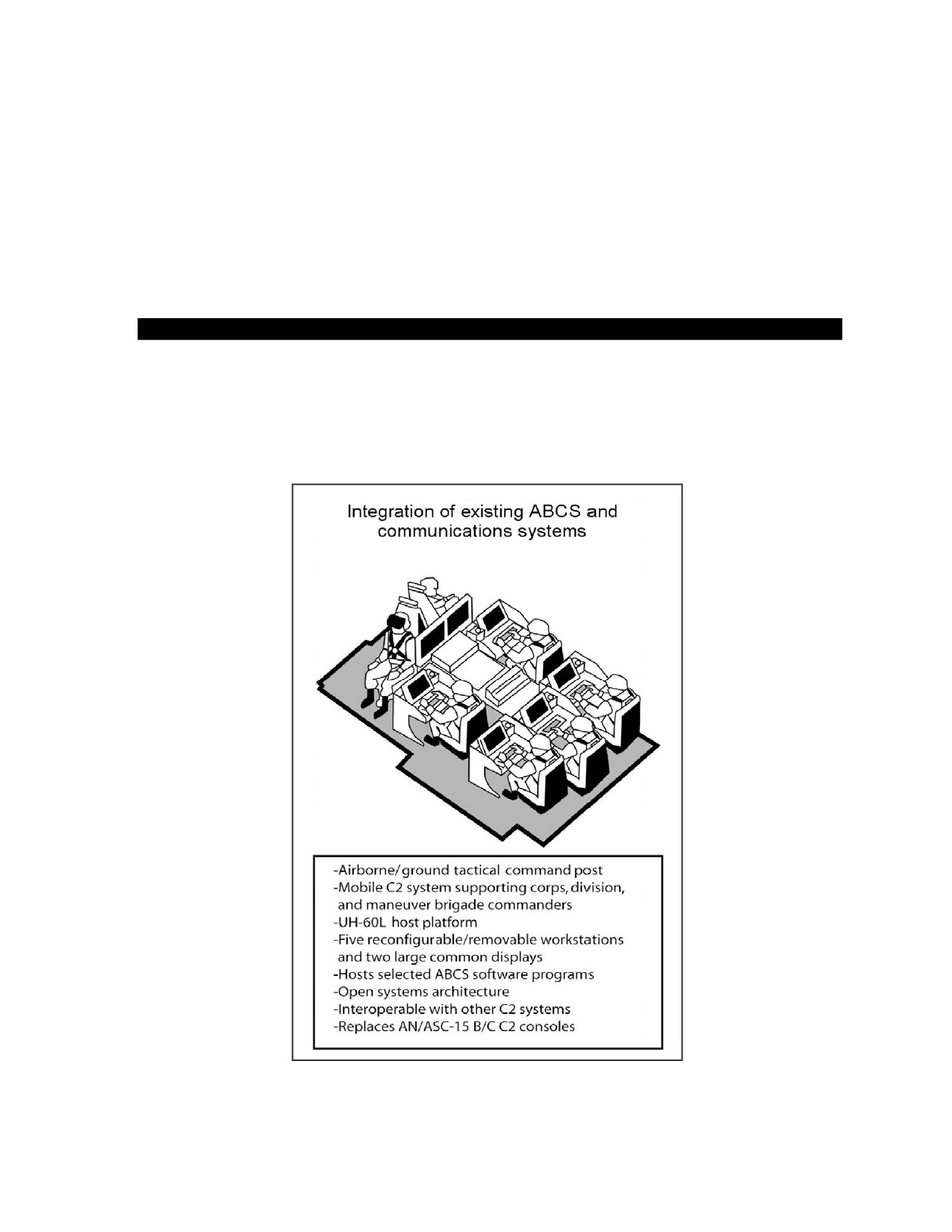
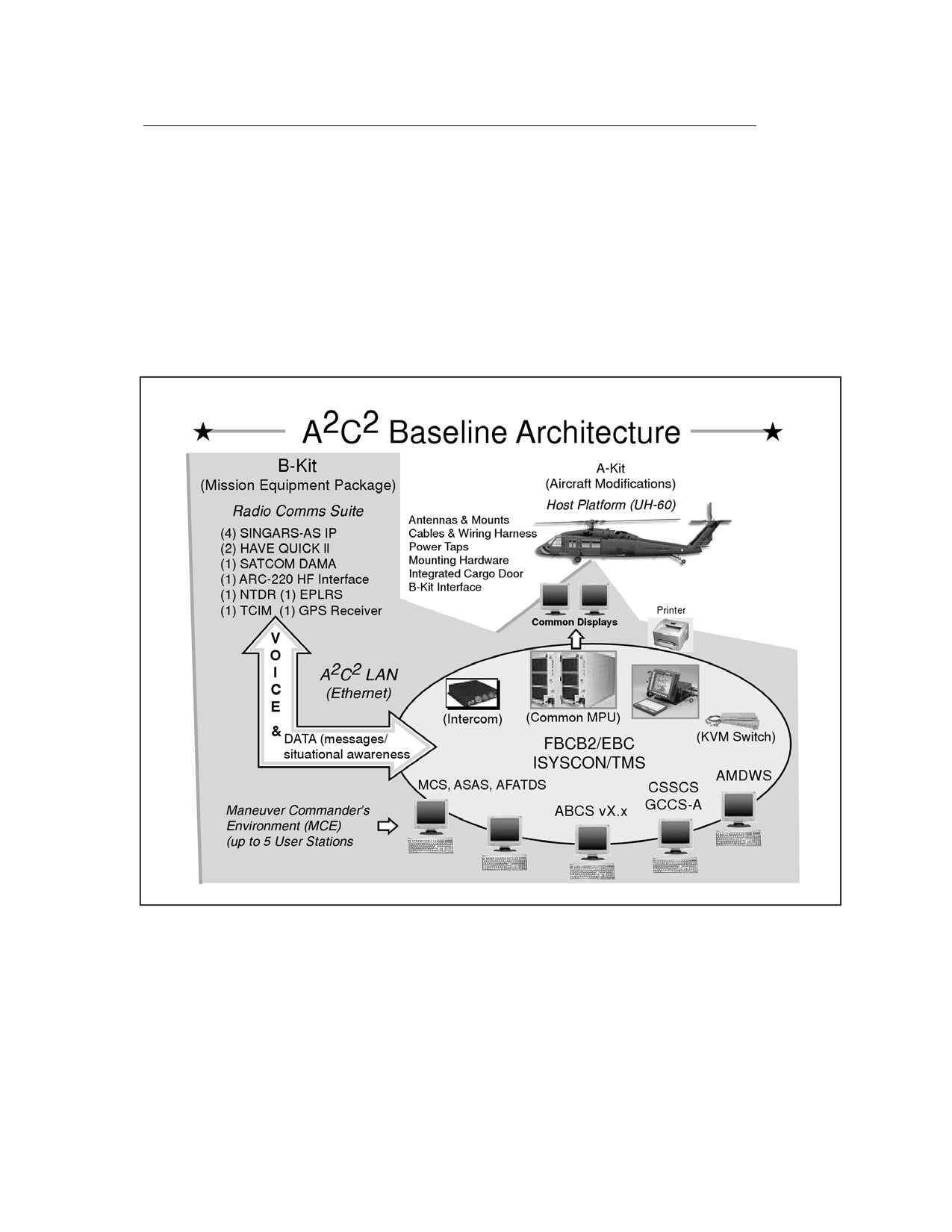
L-1. The A2C2S is a UH-60 Black Hawk-based C2 system that serves as an
airborne tactical CP. Through its onboard MCS, ASAS, AFATDS, AMDWS,
CSSCS, and FBCB2, A2C2S provides continuous battlefield SA. It also is the
source of digital information for nondigitized aircraft supporting the
operation (Figure L-1).
Figure L-1. A2C2S Configuration
L-0
Appendix L
MISSION
L-2. A2C2S provides maneuver commanders—from ATKHB to echelons above
corps—with on-the-move C2. The system supports three major operational
functions: mission planning, mission execution, and mission support. Its
primary function is to monitor the execution of current operations while the
main CP focuses primarily on planning future operations.
ARMY AIRBORNE COMMAND AND CONTROL SYSTEM CAPABILITIES
L-3. A2C2S enables the commander and his staff to traverse the battle space
to critical places at critical times. The commander and staff can perform all
battle command and coordination functions from A2C2S. It has simultaneous
multiband voice and data channels and dynamic visual battlefield SA and C2
via C4I connectivity. A2C2S provides access to the TI to manipulate, store,
manage, and analyze SA information, intelligence data, mission plans, and
mission progress data to support the C2 decision-making process. The system
has triservice interoperability and is compatible with NATO, civil aviation,
maritime, and law-enforcement communications.
FEATURES AND PERFORMANCE
L-4. A2C2S provides—
• Robust LOS and NLOS communications through SINCGARS
Advanced System Improvement Program (ASIP), SATCOM demand
assigned multiple access (DAMA), Have Quick II, EPLRS (friendly
positions), NTDR (SA), and HF.
• GPS for present position and standard NIMA maps with overlays for a
complete picture of the battlefield.
• Automated display of SA and C2.
• Five automated, reconfigurable, and removable workstations and a
command database and two large common displays; each workstation
incorporates a keyboard, monitor, and audio communications unit.
• Real-time battle-space control and monitoring.
• Common displays.
• Enhanced control of battle.
• Digital connectivity with all ABCSs.
• Standard communications and information security.
• Airborne and ground operational modes.
ARMY AIRBORNE COMMAND AND CONTROL SYSTEM INTERFACES
L-5. A2C2S interfaces with—
• JSTARS.
• TACSAT.
• Maneuver TOCs.
• RAH-66 Comanche (when fielded).
• CH-47F Chinook (when fielded).
• AH-64D Longbow.
L-1
FM 3-04.111 (FM1-111)
• OH-58D.
• M1 main battle tank.
• M2/M3 cavalry fighting vehicle.
• MLRS.
OPERATION AS A GROUND CP
L-6. The preferred power source for ground operations is commercial power.
If commercial power is not available, a generator is the next preferred power
source. If external power is not available, aircraft power is required.
Extended ground times may require a ground power unit, which could be
brought in via sling load, or by a tactical ground vehicle, such as a HMMWV
with a generator kit.
COMMAND AND CONTROL MISSION PLANNING CONSIDERATIONS
L-7. C2 planning considerations unique to A2C2S are discussed below.
SYSTEM INITIALIZATION
L-8. Initialization is an important step in preparing A2C2S automated
systems. If A2C2S begins a mission without proper initialization, it is difficult
to transfer the necessary volume of initial information while en route (in a
timely manner) to exploit the capabilities of the automated workstations and
data communications. A2C2S initialization is a three-step process:
• Initializing radios.
• Initializing the IDM (+)/INC.
• Loading of MCS data.
SYSTEM OPERATOR
L-9. A master operator manages the software/hardware while the
commander and staff control the battle. The operator must be trained to
initialize the system, use each of the component systems, and troubleshoot
the system and provide immediate work-around solutions in case of
malfunctions. The aviation unit may not have personnel available to operate
the system. The supported unit commander must be prepared to provide a
systems operator.
ARMY AIRBORNE COMMAND AND CONTROL SYSTEM OPERATOR
MANUALS
L-10. This appendix is written to provide an overview of A2C2S. Operator
manuals take precedence over any procedure in this appendix.
SECTION II - EMPLOYMENT
L-11. The information management capabilities of A2C2S are focused on
controlling the execution of an operation. Planning capability is limited.
Mission data are transferred to A2C2S from the digital TOC to bring it up to
the same (current) operational status at the start of a mission.
L-2
Appendix L
INFORMATION FLOW
L-12. The ATCCSs are primarily top-down planning tools. Once the
execution phase begins, the primary flow of information is bottom-up via
FBCB2. A2C2S draws real-time data from broadcast sources to determine
changes to the enemy situation during the execution phase of a mission. The
intelligence information that the ASAS provides is an analyzed and formal
product. Intelligence information that A2C2S receives from tactical related
applications (TRAP), Tactical Data Information Exchange-Broadcast (TADIX-
B), and Tactical Information Broadcast Service (TIBS) broadcast sources is
raw data (Figure L-2).
Figure L-2. A2C2S Information Flow
BATTLEFIELD EMPLOYMENT
L-13. A2C2S expands the battlefield by providing the means to exercise C2
and gather tactical information in support of a mission while on the move.
From A2C2S, the commander and staff influence the battle via direct
exchange of voice and digital information with units conducting the mission.
They simultaneously develop the situation beyond the range of their unit’s
sensors and shooters by accessing broadcast intelligence sources.
L-3
FM 3-04.111 (FM1-111)
COVERING FORCE AND DEEP AREAS
L-14. A2C2S enhances lethality during covering-force missions and shaping
operations in deep areas by moving its command forward so that it can
maintain contact with the maneuver forces. From A2C2S, the commander and
staff can synchronize deliberate and hasty artillery fires. A2C2S can have a
direct link to artillery, including the ATACMS. However, direct linkage is not
necessary for direct FS or priority of fires.
CLOSE AREAS
L-15. Integral activities during operations in close areas include maneuver,
close combat (including TACAIR), indirect FS, CS and CSS of committed
forces, and C3I. Aviation organizations may be employed as a security or
reserve force in the security or main battle area. A2C2S gives the commander
a clear picture of the close battle and allows him to coordinate and
synchronize maneuver and fires. Linked with other automated systems,
A2C2S can pull information on demand. This allows the commander to
operate at his own tempo, without the information delays characteristic of
traditional reporting methods.
REAR AREAS
L-16. The aviation brigade gives the division commander a highly mobile and
lethal combat force to counter a Level III incursion in the rear area. As a
maneuver headquarters, the brigade can be tasked as a tactical combat force
to respond to a significant threat. A2C2S provides a flexible and highly mobile
tactical CP to control operations.
STABILITY AND SUPPORT OPERATIONS
L-17. During SASO, the system provides connectivity to special operations
C2, embassy, law enforcement, maritime, civil, and/or other humanitarian
information and communication networks. A2C2S can improve the ability of
local, state, and federal agencies to communicate and coordinate in a crisis
environment such as a hurricane or forest fire.
L-4
Appendix M
Media Considerations
SECTION I - MEDIA SUPPORT
GENERAL
M-1. This section addresses how forces support media information needs
while protecting operational security.
MEDIA PRESENCE ASSESSMENT
M-2. The commander needs to know how many media representatives are in
the theater before force deployment and the anticipated level of media
presence once deployment begins. He requires analysis of the media type
(print or broadcast), media visibility (local, national, international, American,
or foreign), and media style (news, information, or entertainment) covering
the operation. The media presence assessment should address the authority
under which media representatives are operating in the theater and their
degree of access to the theater of operations. With this information, units
prepare for the media environment that they are about to enter.
MEDIA CAPABILITIES
M-3. Commanders examine the media’s technological capabilities and their
logistics support including their transportation and resupply assets. Units
may have to transport and logistically support media members.
HOME-STATION INFORMATION NEEDS
M-4. Units must know what information that they are to provide and to
whom. Public affairs planners determine the information needs of soldiers
and family members
(internal audiences) and of the American public
(external audience). A thorough audience analysis is essential to determine
how different audiences will perceive information made available to the
media. Information products provided to internal and external audiences will
vary. Units exercise caution in providing information about Army
capabilities, the force’s size and structure, unit activities, deployments, and
other operational information.
DEPLOYED UNIT NEEDS
M-5. For deployed soldiers, the public affairs office (PAO) includes products
(print, broadcast, and electronic) that provide news and information about
the home station, the local community, and national and international
events.
M-1
FM 3-04.111 (FM1-111)
PROTECTING INFORMATION
M-6. Commanders balance the need to inform the public with the
understanding that units must practice OPSEC. The threat has access to the
same media resources as the friendly force and public. Both sides can benefit
from and be hurt by information that the media gains and disseminates.
Pieces of the right information in the wrong hands can adversely affect the
outcome of operations. Soldiers must protect vital information by practicing
security at the source, following established OPSEC measures. In addition to
protecting both raw and completed information products, units protect
information networks.
MEDIA FACILITATION
M-7. The commercial news media are major players in the global information
environment. News media will cover future military operations and, in many
cases, will be on the ground before American forces arrive. They will transmit
images to the world of events as they happen, from both sides of the conflict.
It is the commander’s task, through the staff, to develop a responsive
infrastructure to facilitate media interaction.
PREPARING FOR THE MEDIA
M-8. Commanders must understand the role of news organizations and
journalists. They must understand media capabilities to gather and
broadcast information from the battlefield or AO in near-real time.
Commanders must provide media access to the force, keeping in mind the
effect that media technology can have on operational security. Commanders
must also provide support and resources to assist the media in their mission.
UNIT MEDIA FACILITATION REQUIREMENTS
M-9. The objective of media facilitation is to support reporters in their efforts
to cover the force and the operation, while minimizing the possibility that
media activities will interfere with the operation, endanger mission
accomplishment, or compromise soldier safety or privacy. Units should
prepare to support the following requirements to facilitate visits by the
media:
• Assisting media entry into the area.
• Registering media representatives.
• Orienting them on ground rules for coverage.
• Ensuring that they understand security policies.
• Arranging interviews and briefings.
• Coordinating unit visits and escorts.
• Providing transportation to media representatives.
• Providing thorough and timely responses to media queries.
• Embedding media in operational units, if required.
ASSESSING THE MEDIA INTEREST LEVEL
M-10. Commanders should assess the level of news media interest in their
operation to anticipate and provide those assets necessary for the media.
M-2
Appendix M
Commanders and staff must also assess the intensity of news media interest
and anticipate the personnel, communications, transportation, and
deployment requirements for communicating through the news media during
all stages of the operation.
EMBEDDING THE MEDIA
M-11. The PAO may seek out media members who are willing to spend
extended periods with soldiers during an operation and embed them into
units. Embedding is the act of assigning reporters to units as members of
those units. They eat, sleep, and move with units. They are authorized open
access to all sections of units and are not escorted by public affairs personnel.
Rather, units are the reporters’ escorts. Reporters file their stories from unit
locations. The unit commander establishes OPSEC guidelines on what and
when the reporter can report.
GROUND RULES
M-12. Sustained contacts between military forces and the news media can
result in the most complete and accurate stories about their units. They seek
to convince reporters that acceptance of reasonable military ground rules in
the integration of journalists into operational units is in the best interest of
both institutions. Some reporters will choose not to cooperate. Commanders
have no responsibility for such individuals and should focus their attention
on the reporters who desire to abide by the procedures outlined for the
operation.
MEDIA SECURITY
M-13. Some members of the media may claim that their security is of no
concern to the military and that DOD policy calls for working with journalists
without regard for their safety. The captures of journalists by U.S.
adversaries in Panama during Operation Just Cause, in Iraq during
Operation Desert Storm, and in Afghanistan have proven that no one can
guarantee the security of all reporters. However, those who accept the
protection afforded them by military units are in the best position to cover
the story and avoid harm.
PUBLIC AFFAIRS OFFICE ESCORTS, INTERVIEWS, AND BRIEFINGS
M-14. Public affairs and operational personnel should be available to furnish
context to transmitted images or reports. Without command assistance, there
is a chance of misperceptions and misunderstandings; however, it is
unrealistic to expect that trained public affairs professionals will accompany
all journalists. Often, PAOs are not the most qualified personnel to act as
escorts because they lack specialized expertise to explain detailed activities of
different units involved in an operation. Units should be prepared to provide
their own escorts for visiting media representatives.
MEDIA TRANSPORT
M-15. The PAO normally arranges for the press to visit a unit. He assists in
transport to the unit and relies on designated subject matter experts (such as
M-3
FM 3-04.111 (FM1-111)
an XO, first sergeant, or platoon leader) to assist the media while with that
unit. Transportation arrangements need not place special requirements on
the unit. Reporters can move with supply columns or any other transport
that shuttles within the organization.
COMMAND INTEREST
M-16. Commanders at every level should stay abreast of what reporters are
saying about their efforts. Tactical-level commanders will often learn from
the reporters integrated with their units, from news summaries, or other
reports published or broadcast after the fact. They need not like or agree with
news reports, but they do need to understand the report’s effect. Media
reports help shape public perception and opinion of the command’s
effectiveness. With an effective media facilitation program, the command is
aware of differences between its version of events and what the news media
may report. Relying on technology, assessments, and media facilitation plans,
commanders and PA staffs continuously work to narrow that inevitable gap.
M-17. Information should be fully and readily available, consistent with
statutory requirements, unless current and valid security classifications
preclude its release. Units adhere to the following guidelines:
• Support provisions of the Freedom of Information Act (FOIA) in both
letter and spirit.
• Allow members of the Armed Forces and their family members to
freely exchange general and military information with media
members, without censorship or propaganda.
• Do not classify or withhold information to protect the government
from criticism or embarrassment.
• Withhold information only when disclosure would adversely affect
national security, compromise the mission, or otherwise threaten the
safety or privacy of soldiers.
• Plan and coordinate public affairs details within DOD and with other
government agencies to meet DOD obligations to provide information
to the public.
• Do not employ propaganda in DOD public affairs programs.
PREPARING FOR MEDIA INTERVIEWS
M-18. Figure M-1 is a checklist to aid in preparation for media interviews. It
includes typical questions that reporters may ask. An interview with the
media is never a casual conversation. The military representative should
never go into a media interview without preparing, rehearsing (if practical),
and remembering that he represents the unit and the U.S. Army.
M-4

Appendix M
THINGS YOU SHOULD THINK ABOUT AND BE AWARE OF:
a. When human safety or other serious concerns are involved, deal with those
considerations first.
b. Communicate only information that is approved for external distribution. Always tell the
truth.
c. Know to whom you are speaking. Get the person’s name and telephone number if
necessary.
d. Do not be intimidated. You may tell a reporter that you need to clarify an important matter
before you can answer questions.
e. Talk from the public’s viewpoint. Avoid jargon. Speak within the audience’s frame of
reference.
f. If the questions do not lie within the framework of approved statements or within your
area of expertise, find the appropriate technical advisor or spokesperson.
g. State the most important fact at the beginning. Place your own headline on the answer.
h. Attack problems in your answers, not people.
i.
Do not repeat offensive or negative language. Do not let other people put words in your
mouth.
j.
Direct questions deserve equally direct and forthright answers.
k. Do not exaggerate the facts. Listen to how your answer sounds when spoken.
l.
Ignore cameras and microphones. Talk to the reporter.
m. During videotaped interviews, it is acceptable to stop your statement and start over.
n. Do not say “no comment”, explain why you do not have an immediate answer.
o. Keep your composure, even if a news reporter gets snappy.
p. Be prepared to provide sufficient evidence for statements that you make.
q. Be especially alert about photos. You have little control over photos taken off military
reservation property, but you have every right to control photos taken on the military
reservation. Be aware of your surroundings, and follow local OPSEC rules when
determining the interview location.
WHAT WILL BE ASKED?
a. What happened and where? When did this occur?
b. Are there injuries or deaths as a result? How many? Who are the injured and dead?
c. What actions is the unit taking to control the situation?
d. Have chemicals or other hazardous substances been released into the environment?
What kinds? How much?
e. What types of hazards are presented to a person offsite?
f. Have offsite emergency response personnel been notified? Which ones?
g. Are unit operations shut down?
h. Has the site or facility been evacuated?
i.
How many people are employed at this site?
j.
What do you do at this site?
k. How old is the facility? Does it meet current regulations?
l.
Why did this situation occur? (Do not speculate.)
m. Are there safety rules covering the situation? Were they violated?
n. Has a site emergency response plan been activated? What does that involve?
o. Tell me about your organization.
p. Will this situation have nationwide ramifications, or will its effect likely be limited to a
single site or region?
q. How much money is this going to cost the taxpayers?
r. Is there insurance coverage for the loss or damage? How much?
Figure M-1. Media Interview Guidelines
M-5
FM 3-04.111 (FM1-111)
SECTION II - GUIDELINES
M-19. This section explains DOD media guidelines for reporters and the
units that support them.
DEPARTMENT OF DEFENSE MEDIA GUIDELINES
M-20. DOD Directive 5122.5 provides the following guidelines for covering
combat operations:
•
Open and independent reporting will be the principal means covering
of U.S. military operations.
•
Pools are not to serve as the standard means of covering U.S. military
operations; however, pools may sometimes provide the only feasible
means of early access to a military operation. Pools should be as large
as possible and disbanded at the earliest opportunity, within 24 to 36
hours when possible. The arrival of early access pools will not cancel
the principle of independent coverage for journalists already in the
area.
•
Even under conditions of open coverage, pools may be appropriate for
specific events such as those at extremely remote locations or where
space is limited.
•
Journalists in a combat zone receive credentials from the U.S. military
and will be required to abide by a clear set of military security ground
rules that protect U.S. forces and their operations; violation of the
ground rules can result in suspension of credentials and expulsion
from the combat zone for the journalists involved. News organizations
will make their best efforts to assign experienced journalists to combat
operations and then make them familiar with U.S. military
operations.
•
Journalists will be provided access to all major military units; special
operations restrictions may limit access in some cases.
•
Military public affairs officers should act as liaisons but should not
interfere with reporting.
•
Under conditions of open coverage, field commanders will permit
journalists to ride in military vehicles and aircraft whenever feasible;
the military will be responsible for the transportation of pools.
M-21. Figure M-2 is a sample of media ground rules.
M-6
Appendix M
OPERATION DESERT STORM GROUND RULES
The following information should not be reported because its publication or broadcast could
jeopardize operations and endanger lives:
(1) For U.S. or coalition units, specific numerical information on troop strength, aircraft, weapons
systems, on-hand equipment or supplies—such as artillery, tanks, radars, missiles, trucks, and
water—including amounts of ammunition or fuel moved by support units or on hand in combat
units. Unit size may be described in general terms such as
“company-size, multibattalion,
multidivision, naval task force, and carrier battle group.”Number and amount of equipment and
supplies may be described in general terms such as “large, small, or many.”
(2) Any information that reveals details of future plans, operations, or strikes, including postponed
or cancelled operations.
(3) Information, photography, and imagery that would reveal the specific location of military forces
or show the level of security at military installations or encampments. Locations may be described
as follows: all Navy embark stories can identify the ship upon which embarked as a dateline and
will state that this report is coming “from the Persian Gulf, Red Sea, or North Arabian Sea.”
Stories written in Saudi Arabia may be datelined “Eastern Saudi Arabia, near the Kuwaiti border.”
For specific countries outside Saudi Arabia, stories will state that the report is coming from the
Persian Gulf region unless that country has acknowledged its participation.
(4) ROE details.
(5) Information on intelligence collection activities, including targets, methods and results.
(6) During an operation, specific information on friendly force troop movements, tactical
deployments, and dispositions that would jeopardize operational security and lives. This would
include unit designations, names or operations, and size of friendly forces involved until released
by [Central Command] CENTCOM.
(7) Identification of mission aircraft points of origin, other than as land or carrier based.
(8) Information on the effectiveness or ineffectiveness of enemy camouflage, cover, deception,
targeting, direct and indirect fire, intelligence collection, or security measures.
(9) Specific identifying information on missing or downed aircraft or ships while search-and-
rescue operations are planned or underway.
(10) SOF methods, unique equipment, or tactics.
(11) Specific operating methods and tactics—such as air [operations] angles of attack or speeds,
naval tactics, and evasive maneuvers. General terms, such as “low” or “fast,” may be used.
(12) Information on operational or support vulnerabilities that could be used against U.S. forces—
such as details of major battle damage or major personnel losses of specific U.S. or coalition
units—until that information no longer provides tactical advantage to the enemy and is, therefore,
released by CENTCOM. Damage and casualties may be described as “light,” “moderate,” or
“heavy.”
Figure M-2. Sample Media Ground Rules
SECTION III - MEDIA IN STABILITY AND SUPPORT OPERATIONS
M-22. SASO present unique challenges and may require greater diplomacy
in dealing with the media. The Army may also coordinate media coverage
with other nonmilitary agencies in the AO.
MEDIA FOCUS
M-23. Media attention should be viewed as an asset rather than a hindrance.
The public often considers media reports more credible than official
pronouncements. News reports are a primary conduit for communicating
Army goals, capabilities, and accomplishments. They contribute to
M-7
FM 3-04.111 (FM1-111)
perceptions of legitimacy, requiring the presentation of consistent, clear
information about the operation.
SOLDIER PREPARATION
M-24. SASO usually receives intense international media attention;
therefore, soldiers must understand that their decisions and actions can have
immediate strategic and political implications. They should understand the
nature of the operation and know its goals. Internal information programs
build soldier knowledge of the history and cultural factors that shape the
operation and its context. These also enhance knowledge of coalition
partners, thereby contributing to mutual trust and respect.
MULTINATIONAL OPERATIONS
M-25. Political considerations and media involvement may be the most
important factors in a multinational operation. Combined operations help to
solidify international acceptance of the SASO; however, the accompanying
international media coverage presents unique challenges.
OPERATIONAL CONSIDERATIONS
M-26. To reinforce unity of purpose, spokespersons from all nations should
speak with one voice. Multinational partnerships consist of alliances and
coalitions. Alliances are long-standing relationships of nations with formal,
standardized agreements and operating procedures oriented on long-term
objectives. Coalitions are more short term in duration and goal. Cultural,
psychological, economic, technological, and political factors influence these
alliances and coalitions.
COALITIONS
M-27. The United States enters coalitions for a single purpose of finite
duration. Coalition members may be diverse in culture, politics, and
philosophy. Their relationships may be tenuous and fragile. Each nation
enters an alliance or a coalition for its own reasons; therefore, mutually
agreed upon end states must be clearly defined. Coalition nation reporters
may show interest in U.S. Army units. Exercise particular caution because
reports may strengthen or weaken coalition nation public opinion about the
SASO.
PEACE OPERATIONS
M-28. Peace operations are nearly always multinational, subject to intense
media scrutiny, and designed to allow the political process to resolve
conflicts. It is vital for peacekeepers to be seen as impartial to belligerents
while firmly united within their coalitions. Political and cultural complexities
of past and present alliances and coalitions can make impartiality difficult.
Media recognition that the operation is an impartial, team effort enhances
mutual confidence and respect and solidifies the partnership. On the other
hand, media perception that the U.S. Army lacks confidence in and respect
for coalition partners can doom an operation.
M-8
Appendix M
CROSS-CULTURAL INTERACTION
M-29. Spokespersons must show great sensitivity to cultural differences
when addressing issues involving other coalition members. Even an
appearance of cultural insensitivity can undermine popular and political
support for a member-nation’s participation, thus threatening coalition unity.
Army units addressing media members must clearly define common
objectives in a multinational environment.
INFORMATION RELEASE AUTHORITY
M-30. Not all nations share a common belief in the U.S. policy of maximum
disclosure with minimum delay. Media procedures should be worked out with
coalition members to avoid disparities and delays. Standard procedures can
eliminate conflicts and confusion created when one nation addresses an
incident that another will not acknowledge. Operations and public affairs
planners must—
• Designate a primary spokesperson for the multinational force and
operation.
• Ensure that coalition members speak with one voice.
• Develop a clear definition of operation objectives and measures of
success.
• Understand that not all nations are equally candid about success and
failure.
• Be aware of cultural differences and sensitivities of coalition partners.
OTHER AGENCY INTERACTION
M-31. The country team coordinates activities to achieve a unified program
for the U.S. national interests and the host nation. Working under the
ambassador’s direction, the country team pools the skills and resources of the
participating agencies. This combined effort helps eliminate problems and
realize U.S. national objectives and goals.
UNITED STATES AMBASSADOR
M-32. The ambassador presides over the country team. He or she determines
the composition, which normally includes but is not limited to the—
• Deputy Chief of mission.
• Director, U.S. Agency for International Development.
• Director, U.S. Information Agency (USIA).
• FBI liaison.
• Central Intelligence Agency (CIA) station chief.
• Press secretary.
• Department attaché.
• Economic officer.
• Political officer.
M-9
FM 3-04.111 (FM1-111)
• Chief of the security assistance office.
• Embassy staff personnel, as appropriate.
• Defense attaché.
UNITED STATES GOVERNMENT AGENCIES
M-33. Effective media support may sometimes require close contact with the
U.S. military services, the Department of State
(DOS), and other U.S.
Government agencies. Normally, an executive order defines agency
responsibilities, functions, and interagency relationships. This order assigns
overall responsibility for U.S. and media interaction in the area to either the
senior DOS representative or the U.S. commander.
DEPARTMENT OF STATE
M-34. Because the DOS formulates and implements foreign policy, it has a
stake in media activities. In this area, the DOS has primary or joint
responsibility with DOD for policy concerning—
• The extent to which U.S. forces will aid a host government.
• Any matters affecting U.S. relations with other nations, particularly
allies or neutrals.
• How U.S. operations will influence or maintain the country’s economy.
• Matters involving media access or other measures that may influence
populace attitude.
UNITED STATES INFORMATION AGENCY
M-35. The USIA is an independent U.S. Government agency helping to
achieve U.S. foreign policy objectives by influencing public attitudes in
foreign areas. It advises the President and the various U.S. departments and
agencies of the possible effect of policy, programs, and official statements on
foreign opinion. The USIA has interests in media operations in the host
country or theater of operations.
NONGOVERNMENTAL ORGANIZATIONS
M-36. Nongovernmental organizations
(NGOs) and humanitarian groups
often locate in the AO before, during, and after any military operation. If
present before the media arrive, they often are the initial sources of
information for journalists and may serve as major sources during an
operation. These organizations may conduct operations that are
humanitarian
(short term) or developmental
(long term) in scope. The
sponsoring groups or agencies may be private corporations, foundations,
professional associations, or religious groups. Units on the ground should
contact these organizations to develop an understanding of their concerns,
goals, and potential needs. Representatives of these organizations are
credible spokespersons on the local situation and may provide invaluable
background information on the operational situation.
M-37. The G5 maintains a list of NGOs. The S5 should coordinate efforts
with the G5.
M-10
Appendix N
Rules of Engagement
GENERAL
N-1. ROE are directives issued by competent military authority that
delineate the circumstances and limitations under which United States forces
will initiate/continue combat engagement with other forces. In a general war
between two uniformed, similarly-equipped opponents, the complexity of
ROE is normally low. The soldier in contact with the enemy is usually
instructed on the priority of target classes to engage, with restricted targets
delineated by the laws of war. In the same conflict, however, soldiers
performing support missions may find their ROE are more complex,
reflecting the ROE more often associated with SASO, rather than the ROE
associated with direct combat.
N-2. ROE must be clear. Soldiers operating with confusing or uncertain
guidance can compromise the mission.
N-3. Despite similarities that may exist between operations, each operation
has its own ROE. These rules are generally delineated in the OPLAN ROE
annex (Figure N-1); however, based on changing circumstances, they may be
further refined in the OPORD. For continuing operations, any further
changes are specified in follow-on FRAGOs. The overall commander approves
these rules with advice from the SJA, the CMO, the political advisor
(POLAD), and others as required.
FORCE-PROTECTION LEVELS
N-4. DOD Directive
2000.12 sets out the DOD Antiterrorism/Force
Protection Program responsibilities. DOD Directive 0-2000.12H establishes
guidance for force-protection levels. DOD Instruction 2000.16, sets out the
responsibilities of establishing force-protection levels. Full references can be
downloaded from http://www.dtic.mil/whs/directives/.
N-5. The graduated series of force-protection conditions range from
force-protection conditions normal to force protection conditions delta (Table
N-1). The four-force protection conditions above normal are—
• Force-Protection Conditions ALPHA: These conditions apply when
there is a general threat of possible terrorist activity against
personnel and facilities, the nature and extent of which are
unpredictable, and circumstances do not justify full implementation of
force protection conditions BRAVO measures. The measures in these
force protection conditions must be capable of being maintained
indefinitely.
N-1

FM 3-04.111 (FM1-111)
Copy ____ of _____ copies
HQs, TF 1-19
Camp Deployed, Any Country
DateTime Group
ANNEX E (ROE) to 1-19 TF OPORD 01-01
References: No change.
1. Rules of Engagement.
a.
ROE will be briefed in detail to all soldiers upon issuance of each 1-19 TF OPLAN/OPORD/FRAGO.
The commander will resolve conflicts between ROE and the 1-19 TF OPLAN/OPORD/FRAGO.
b.
Nothing in these rules limits the rights of individual soldiers to defend themselves or the rights and
responsibilities to leaders to defend their units.
c.
ROE follow:
1)
SOLDIERS CARD: You will carry this card at all times.
2)
MISSION: Your mission is to assist in the implementation of and to help ensure
compliance with this peacekeeping operation.
3)
SELF DEFENSE:
a) You have the right to use necessary and proportional force in self-defense.
b) You will use only the minimum force necessary to defend yourself.
4)
GENERAL RULES:
a) You will use only the minimum force necessary to accomplish your mission.
b) You will not harm hostile force/belligerents who want to surrender. Disarm them
and turn them over to your superiors.
c)
You will treat everyone, including civilians and detained hostile
forces/belligerents, humanely.
d) You will collect and care for the wounded, whether friend or foe.
e) You will respect private property. Do not steal. Do not take war trophies.
f)
You will prevent or report to your superiors all suspected violations of the Law
of Armed Conflict.
5)
CHALLENGING AND WARNING SHOTS:
a) If the situation permits, issue a challenge:
English: U.S. Forces! STOP or I WILL FIRE
Local Language #1: U.S. Forces! STOP or I WILL FIRE!
Local Language #2: U.S. Forces! STOP or I WILL FIRE!
b) If the person fails to halt, you may be authorized by the on-scene commander
or by standing orders to fire a warning shot.
6)
OPENING FIRE: You may open fire only if you, friendly forces, or persons or property
under your protection is threatened with deadly force. This means that:
a) You may open fire against an individual who fires or aims a weapon at, or
otherwise demonstrates intent to imminently attack you, friendly forces, or
persons or property designated as under your protection.
b) You may open fire against an individual who plants, throws, or prepares to
throw an explosive or incendiary device at, or otherwise demonstrates intent to
imminently attack you, friendly forces, or persons or property designated as
under your protection.
c)
You may open fire against an individual deliberately driving a vehicle at you,
friendly forces, or persons or property designated as under your protection.
d) You may fire against an individual who attempts to take possession of friendly
force weapons, ammunition, or property designated as under your protection if
there is no other way to prevent this act.
e) You may use minimum force, including opening fire, against an individual who
unlawfully commits or is about to commit an act which endangers life, in
circumstances if there is no other way to prevent the act.
7)
MINIMUM FORCE: If you have to open fire, you must:
a) Fire only aimed shots.
b) Fire no more rounds than necessary.
c)
Take all reasonable efforts to avoid unnecessary destruction of property.
d)
Stop firing as soon as the situation is resolved.
e)
Refrain from intentional attack on civilians, or property that is exclusively
civilian or religious in character unless the property is being used for military
purposes or engagement is authorized by your commander.
Figure N-1. Example ROE OPLAN/OPORD/FRAGO Annex
N-2

Appendix N
•
Force-Protection Conditions BRAVO: These conditions apply when an
increased and more predictable threat of terrorist activity exists. The
measures in these force-protection conditions must be capable of being
maintained for weeks without causing undue hardship, affecting
operational capability, and aggravating relations with local
authorities.
•
Force-Protection Conditions CHARLIE: These conditions apply when
an incident occurs or intelligence is received indicating that some form
of terrorist action against personnel and facilities is imminent.
Implementation of measures in these force-protection conditions for
more than a short period probably will create hardship and affect the
peacetime activities of the unit and its personnel.
•
Force-Protection Conditions DELTA: These conditions apply in the
immediate area where a terrorist attack has occurred or when
intelligence has been received that terrorist action against a specific
location or person is likely. Normally, these force-protection conditions
are declared as a localized condition.
Table N-1. Force-Protection Levels
FORCE PROTECTION LEVELS
PERSONNEL
VEHICLE
WEAPON
BASE CAMP
FORCE
FORCE
FORCE
FORCE
PROTECTION
PROTECTION
PROTECTION
PROTECTION
MEASURE
MEASURE
MEASURE
MEASURE
O
H
W
A
I
I
X
B
II
J
Y
C
III
K
Z
D
O - Soft cap
H - 2 veh, 2 pax/veh
W - Wpn and ammo
A - One roving
in arms room
patrol, towers &
I - Kevlar, LBE,
I - 3 veh, 2 pax/veh,
fighting positions
weapon
M16+ per veh,
X - Wpn carried,
unmanned, QRF on
commo check every
magazine in pouch
II - Kevlar, LBE,
2-hour recall
hour
weapon, body armor
Y - Wpn carried,
B - 2 pax in towers,
J - 4 veh, 2 pax/veh,
magazine in wpn, no
III - Kevlar, LBE,
1 roving patrol, QRF
M16+ per veh, crew-
rounds chambered
weapon, body armor,
1-hour recall, commo
mask
served wpn, commo
Z - Wpn carried,
check every hour
check every 30 min
magazine in wpn,
C - 2 pax in towers,
K - 4 veh, 2 pax/veh,
rounds chambered,
2 roving patrols, QRF
M16+ per veh, crew-
wpn on safe
30-min recall,
served wpn,
commo check every
continuous commo,
30 minutes
MP escort, LTC
permission
D - 2 pax in towers,
2 roving patrols, all
fighting positions
manned; pull in OPs,
CPs, & remote sites,
QRF at REDCON 1,
continuous commo
N-3
FM 3-04.111 (FM1-111)
RULES OF ENGAGEMENT REHEARSALS
N-6. ROE cards are excellent reminders, but to ensure that ROE are
understood, situational training exercises are essential. For example, an ROE
may be “fire only in self-defense.” But when does a soldier know that he is
really being fired upon? Is it possible that the shooter is just some inebriated
person in the crowd shooting into the air? If an aircrew sees tracers going by,
does it mean that the search on the ground saw the aircraft and are firing at
it or is it just celebratory fire?
N-7. This manual will not debate the correct answer to the above; it only
points out that soldiers need clear examples of situations to ensure that they
fully understand the ROE. An exercise to demonstrate the above would
require role players, the training unit, observer-controllers, and a range
safety plan.
N-8. ROE situations should be rehearsed in detail before deploying or
executing a mission. No situation should occur in which personnel are unsure
whether they should use force and what types of force—to include deadly
force—are warranted.
N-4
Appendix O
Environmental Considerations
This appendix provides guidance on how to attain balance between mission
accomplishment and protection of the natural and physical environment. ARs
200-1 and 200-2 provide information on Army environmental programs. FM
4-04.4 (FM 3-100.4[20-400]) lists items of interest in the preparation for daily
operations, training, and combat operations while respecting the natural and
physical environment.
SECTION I - ENVIRONMENTAL RESPONSIBILITIES
COMMANDER
O-1. Commanders must instill an environmental ethic in their subordinate
leaders, staffs, and soldiers. They train and counsel subordinate leaders to
monitor potential environmental hazards to the environment and enforce
compliance with laws and regulations.
O-2. AVUM and AVIM commanders have unique environmental concerns
and responsibilities. HHC commanders who supervise ground maintenance
activities and NBC and Class III operations have similar responsibilities.
Table O-1 shows points of contact available to assist commanders in
environmental matters.
STAFF
O-3. Primary staff officers and NCOs integrate environmental considerations
into the MDMP in operations and training. At battalion and above level, the
commander appoints an assistant staff officer to serve as the environmental
compliance officer (ECO) for the unit. Nevertheless, all staff officers must
integrate environmental considerations into their activities. The S3 and S4
have the major responsibilities.
FLIGHT SURGEON
O-4. The flight surgeon monitors potential environmental hazards that could
affect the health of soldiers in the command. When deployed, monitoring
could include regional health matters such as water quality, air pollution,
and environmental, endemic, and epidemic diseases. He monitors
environmental considerations—such as smoke, chemical, and biological
weapons—that the enemy could impose on the friendly force. He monitors
field sanitation to ensure elimination of unnecessary environmental
disruption and danger to soldiers from unsanitary conditions.
O-1

FM 3-04.111 (FM1-111)
Table O-1. Environmental Assistance
TOPIC
POINT OF CONTACT
Air Pollution
Environmental Management Office
Audits/environmental compliance
Environmental Management Office
assessment system (ECAS)
Archaeological & Historic Sites
Environmental Management Office and Range Control (DPTM)
Clean and Safe Water
Environmental Management Office
Command Environmental Issues
Chain-of-Command/ Environmental Quality
Control Committee/Environmental Compliance Review Board
Environmental Training
G3/S3, Environmental Management Office
Hazardous Communications
G3/S3, Safety Office, Fire Department
(HAZCOM) (Gas) Training
Hazardous Materials (HM)
G4/S4, Directorate of Logistics, Safety Office, Fire Department
HW
G4/S4, Environmental Management Office, Defense Reutilization
and Marketing Office
Laws and Regulations
G1/S1, Environmental Management Office, JAG/Legal Office
Noise Pollution
Environmental Management Office, Range Control (DPTM)
Range Clearances/Restrictions
Range Control (DPTM)
Recycling Program
G4/S4, Environmental Management Office (EMO)
Standard Operating Procedures
G3/S3 and G4/S4, EMO
Spill Reporting
G3/S3, and G4/S4, EMO, Fire Department
Threatened/Endangered Species
EMO (Fish and Wildlife)
Water Pollution
EMO, G3/S3, and G4/S4
Wetland Protection
EMO, Range Control (DPTM)
Wildlife Management
EMO (Fish and Wildlife), Range Control, Provost Marshal Office
CHEMICAL OFFICER/NONCOMMISSIONED OFFICER
O-5. The chemical officer/NCO recommends the use of and requirements for
chemical protection assets, decontamination and NBC defense, and smoke
operations. With the flight surgeon, the chemical officer advises the
commander on possible NBC hazards such as low-level radiation and toxic
industrial material.
AVIATION MAINTENANCE OFFICER/NONCOMMISSIONED OFFICER
O-6. Aviation maintenance officers/NCOs plan and supervise maintenance
and repair activities within the flight company, AVUM, or AVIM. These
activities routinely use HM and generate HW. The maintenance officer/NCO
ensures safe use, storage, and disposal of these materials. Activities may
involve operating temporary storage areas for used oils, contaminated fuels,
paint residues, spill cleanup residues, and solvents. Because maintenance
personnel work with hazardous chemicals, the maintenance officer/NCO
must ensure that all personnel comply with safety requirements.
GROUND MAINTENANCE OFFICER/NONCOMMISSIONED OFFICER
O-7. Ground maintenance officers/NCOs plan and supervise repair activities
within the HHC of the aviation battalion and brigade. Flight companies may
appoint a ground maintenance officer/NCO as an additional duty. These
O-2
Appendix O
leaders must enforce proper use of HM and disposal of HW, while ensuring
safe temporary storage of the same. Proper disposal and recycling of oil,
coupled with the use of drip pans, ensure compliance with applicable
regulations.
CLASS III/V PLATOON LEADER/SERGEANT
O-8. FARP activities can generate substantial HW unless the III/V platoon
leader/NCO enforces the use of tarps under fuel drums, drip pans near
nozzles, and sand bags under hose joints. The refueling activity itself has
many potential environmental, safety, and health hazards requiring
grounding, proper protective clothing, gloves, eyewear, and helmets. Proper
fuel-truck operations and manned emergency shut-off valves help prevent
major fuel spills. Waste fuel and other POL must be stored and disposed of
properly. Fuel testing occurs daily to ensure that fuel has not been
contaminated with water. Leaders ensure that safeguards exist to prevent
fuel spills during fuel recirculation to filter out water/impurities.
ENVIRONMENTAL COMPLIANCE OFFICER
O-9. Each unit, down to company level, appoints an ECO. AR 200-1 directs
all unit commanders to “appoint and train ECOs at appropriate levels to
ensure compliance actions take place.” In company-sized units, this generally
translates into an extra duty. The appointed person advises the commander
on environmental compliance matters and coordinates with the battalion
ECO to clarify requirements or obtain assistance. The battalion ECO, in turn,
coordinates with the supporting installation environmental staff.
O-10. The ECO accomplishes environmental compliance requirements on
behalf of the commander. The ECO does the following:
• Advises the unit on environmental compliance during training,
operations, and logistics functions.
• Serves as the commander’s environmental eyes and ears.
• Coordinates between the environmental staffs of the unit and
higher/installation headquarters.
• Manages information concerning the unit’s environmental training
and certification requirements.
• Performs unit environmental self-assessment inspections.
• Performs environmental risk assessments.
SUBORDINATE LEADERS
O-11. The role of leaders in environmental stewardship centers on building
an environmental ethic in their soldiers by training, operating, and
maintaining/sustaining in an environmentally responsible manner. Leaders
counsel subordinates, lead by example, and enforce compliance by holding
soldiers accountable. Leaders do the following:
• Communicate the Army environmental-friendly ethic while training
soldiers to operate properly.
O-3
FM 3-04.111 (FM1-111)
• Develop and sustain a positive and proactive commitment to
environmental protection.
• Identify environmental risks associated with individual, collective,
and METL task performance.
• Plan and conduct actions and training that sustain and protect the
environment and integrate environmental considerations into daily
unit activities.
• Analyze the influence of environmental factors on mission
accomplishment.
• Train peers and subordinates to identify the effects of plans, actions,
and missions on the environment.
• Counsel soldiers on the importance of protecting the environment and
possible consequences of noncompliance with environmental laws and
regulations.
• Ensure that soldiers are familiar with the unit’s SOP, and supervise
their compliance with laws and regulations.
• Incorporate environmental considerations into after-action reviews
(AARs).
• Understand the linkage between environmental considerations and
their associated effect on safety, force protection, and force health
protection.
SOLDIERS
O-12. Soldiers have the inherent professional and personal responsibility to
understand and support the Army’s environmental program. They must do
the following:
• Comply with environmental requirements in unit and installation
SOPs.
• Maintain environmental awareness throughout daily activities.
• Provide recommendations to the chain of command on techniques that
ensure compliance with environmental regulatory requirements.
• Identify the environmental risks associated with individual and team
tasks.
• Support recycling programs.
• Report HM and HW spills immediately.
• Make sound environmental decisions based on guidance from the
chain of command, training, and personal concepts of right and wrong.
SECTION II - PLANNING—INTEGRATING ENVIRONMENTAL
CONSIDERATIONS
O-13. Commanders and staffs integrate environmental considerations into
the MDMP and training plan process.
O-4
Appendix O
MILITARY DECISION-MAKING PROCESS
O-14. The commander and staff should include environmental considerations
in the MDMP. The commander and staff refer to the environmental appendix
of the higher HQ order and gather maps, SOPs, FMs, host-nation
agreements, and existing staff estimates, lessons learned, and AARs to assess
potential environmental impact. Staff planners make a generic list of
environmental factors that pertain to their staff area and integrate these
considerations into the seven-step process during—
• Receipt of Mission: Gather resources to help restate the mission and
include environmental information resources.
• Mission Analysis: During the 17-step mission-analysis process, the
staff considers environmental impact as a factor.
• Course-of-Action Development: In SASO, environmental factors have
more effect than in combat; weigh environmental risk against mission
requirements.
• Course-of-Action Analysis: Will a FARP location, dropped external
fuel tanks, or fuel drums pollute fresh-water sources for friendly forces
and civilians?
• Course-of-Action Comparison: When comparing most likely enemy
and best friendly COAs, consider the likelihood that the enemy may
pollute as a means of obscuring the battlefield or preventing friendly
use of abandoned resources; this, in turn, may affect flight visibility,
friendly and enemy force identification, and laser designation and
range-finding.
• Course-of-Action Approval: When choosing the most likely friendly
COAs, consider whether slight plan modification would reduce
environmental impact without affecting the mission.
• Orders Production: Include environmental impacts and precautions in
coordinating instructions of the execution paragraph or Annex F
(Engineer), Appendix 2 (Environmental Considerations).
TRAINING PLAN DEVELOPMENT
O-15. During development of long-range, short-range, and near-term plans,
the planning staff should consider the effect of training on the natural and
physical environment and include environmental-specific training in the
plan.
ASSESSMENT
O-16. The training process begins with an assessment of unit strengths and
weaknesses and a plan to sustain strengths while improving areas of
weakness. This process applies equally to the unit’s environmental
awareness and compliance. Commanders identify and assess known
environmental risks during training planning.
LONG-RANGE PLAN
O-17. During long-range planning, units create the long-range training
calendar based on major training area availability, training ammunition and
O-5
FM 3-04.111 (FM1-111)
fuel allocated, flight hours available, and deployments and mission
timeframes already identified.
O-18. The environmental focus during this phase includes—
• Conducting reconnaissance of the training site.
• Assessing potential environmental risks and corresponding
cleanup/restoration skills training required.
• Coordinating with installation environmental and wildlife staffs.
• Reviewing plans and SOPs.
• Obtaining clearance and land-use permits.
• Requesting special equipment or support resources.
• Coordinating with preventive medicine personnel.
SHORT-RANGE PLAN
O-19. Short-range planning refines and defines the broad guidance of the
long-range calendar. It is often a quarterly plan. During short-range
planning, units prepare for upcoming training by reviewing existing
environmental procedures and guidance; updating as required, the unit SOP
and risk assessment matrices; and training soldiers on any new procedures.
Activities with an environmental focus during this phase include—
• Briefing the commander and staff.
• Reconnoitering the training site.
• Obtaining maps or overlays indicating environmentally sensitive
areas.
• Coordinating with the environmental management office to identify
recent changes in environmental conditions.
• Planning for HM/HW storage and transport.
• Reviewing spill-prevention measures.
• Modifying plans as necessary.
NEAR-TERM PLAN
O-20. Near-term planning defines specific actions for executing the short-
range plan. It is the final phase of planning before training execution. During
this phase, leaders exercise an environmental focus by—
• Briefing soldiers on environmental constraints and issues and
modifying plans as necessary.
• Rehearsing the training to include the environmental awareness
preventive measures built in and cleanup contingencies planned.
• Checking equipment for oil and fuel leaks and identifying HW
disposal locations at the training site.
• Planning for HM/HW storage and spill containment.
• Ensuring that subordinate unit SOPs meet the requirements for the
specific training site.
O-6
Appendix O
TRAINING EXECUTION
O-21. Precombat checks help ensure adequate preparation for training to
standard. Leaders execute precombat checks by—
• Briefing environmental considerations as part of the OPORD.
• Including environmental considerations in the safety checks and crew
briefings.
• Verifying completion of PMCS on vehicles, refueling equipment,
weapons, communications, and NBC equipment to include checks for
leaks and serviceability.
• Checking and confirming that vehicle load plans ensure security of
HM and equipment to contain spills.
O-22. During training execution, leaders continue to monitor potential risks
to the natural and physical environment by—
• Conducting environmental awareness training.
• Supervising high-risk operations.
• Conducting periodic environmental assessments.
• Correcting problems on the spot.
• Avoiding off-limits areas.
• Preventing and containing spills.
• Reporting damage accurately and in a timely manner.
• Removing HM/HW in a timely and appropriate manner.
EVALUATION
O-23. Evaluation is continuous and integral to training. Leaders at every
level evaluate training. In the process, they discuss both the environmentally
correct and incorrect actions that may occur. The AAR process should include
environmental performance and should cover—
• Ensuring environmental accountability by identifying the problems
encountered during training and how the unit corrected them as they
arose.
• Ensuring HM/HW accountability by identifying how the unit
accounted for the HM/HW and any difficulties that it may have had
removing contaminated soil and restoring sites to near-original
condition.
• Identifying potential consequences of environmental damage that
make the damage a serious concern.
• Developing environmental lessons learned and suggested SOP
changes.
O-7
FM 3-04.111 (FM1-111)
SECTION III - OPERATIONS: INTEGRATING ENVIRONMENTAL
CONSIDERATIONS
ENVIRONMENTAL PROTECTION DURING MILITARY OPERATIONS
O-24. Protecting the physical and natural environment while conducting
operations against a hostile force is seldom feasible. The spectrum of conflict
or nature of the SASO determines the viable environmental control
measures. Units establish protective actions that minimize environmental
impact while accomplishing the mission.
O-25. Rescue and NEOs, humanitarian assistance, firefighting, and overseas
flight and logistical operations may impose unique environmental
requirements and hazards. CALL Newsletter
99-9, Integrating Military
Environmental Protection, provides insights on the emerging doctrine for
base-camp operations that may include airfields. Operations, when possible,
should avoid unnecessary effects on the environment of the host nation and
should minimize collateral damage.
UNNECESSARY ENVIRONMENTAL IMPACTS
O-26. Unnecessary impacts include environmental damage that military
necessity cannot justify. These acts are either wanton intentional acts or
negligent unintentional acts. Examples of a wanton act could include
dumping JP8 into a river or dropping 500-gallon fuel drum external loads or
230-gallon extended-range fuel tanks onto a farmer’s field without adequate
emergency rationale. An example of a negligent act might include spilling
changed oil from a drip pan onto the ground, because of hurried attempts to
dispose of the oil properly.
ENVIRONMENTAL COLLATERAL DAMAGE
O-27. Environmental collateral damage results from military actions during
armed conflict that unintentionally cause other environmental consequences.
Damaging enemy targets—such as ammunition stockpiles or wastewater
treatment plants—can release hazardous substances that cause unintended
casualties long after the battlefield/AO is secured. This may result in health
and logistical
(water) problems that could jeopardize the health of
noncombatants—including occupational peace enforcement and peacekeeping
allied forces left behind. Such collateral damage increases rebuilding efforts
and may leave noncombatants with negative feelings toward the United
States and its allies.
O-28. Articles
54 and
55 of the Geneva Convention protect objects
indispensable for the survival of the civilian population and natural
environment, respectively. There are similar issues regarding destruction of
ancient monuments, churches, and similar cultural sites.
RISK MANAGEMENT
O-29. Preparation is key to successful environmental awareness and
protection in daily operations and training. Commanders
(company and
O-8
Appendix O
above) must designate an environmental compliance officer to be responsible
for environmental education, SOP updates, environmental risk assessments,
and incident reporting. Commanders and ECOs also must assess areas where
unit activities are most likely to violate environmental compliance.
O-30. The commander or ECO can coordinate most matters by contacting the
EMO, Chief of Range Division, and the military fire department. In most
cases, the EMO also includes the fish and wildlife officers and foresters, all
located under the Directorate of Public Works (DPW). In cases where training
is conducted overseas without corresponding U.S. organizations, units must
coordinate with the host nation’s equivalent of the above listed POCs. If there
is no host-nation equivalent, training is conducted according to U.S. policies
and regulations.
ARMY ENVIRONMENTAL COMPLIANCE ASSESSMENT PROGRAM
O-31. Units are periodically inspected by appropriate offices to ensure
compliance with Environmental Compliance Assessment Program (ECAP)
protocol. Units should obtain ECAP protocols from the EMO/DPW or, if
unable, by calling the Army environmental hotline at 1-800-USA-3845 or
DSN 584-1699.
UNIT-LEVEL ENVIRONMENTAL PROGRAMS
O-32. FM
4-04.4
(FM 3-100.4[20-400]) outlines unit-level programs. It
specifies that unit leaders should—
• Ensure that all unit personnel have had (or are scheduled to receive)
environmental awareness training; Chapter 3 of FM 4-04.4 (FM 3-
100.4[20-400])identifies environmental training sources, and Chapter
5 identifies sources of assistance at the installation/garrison/base
level.
• Designate, in writing, an ECO who is properly trained and qualified;
this individual interfaces with appropriate environmental personnel
and ensures that the unit complies with environmental laws and
regulations.
• Meet with key higher unit staff (battalion S3 and S4 for company
commanders) and installation personnel who deal with environmental
issues and find out what their requirements are concerning
environmental training, qualifications, and certification of unit
personnel; ECAS inspections that may affect the unit, and common
environmental problem areas and how to avoid them.
• Ensure that the unit SOP addresses environmental issues and
procedures that apply to the unit (coordinate SOP environmental
requirements with appropriate installation/chain-of-command
personnel); Appendix C of FM 4-04.4 (FM 3-100.4[20-400]) has an
example of an environmental SOP with items of concern that the
commander can integrate into normal unit SOPs.
O-33. Table O-2 shows typical environmental program areas and their
goal/impact.
O-9

FM 3-04.111 (FM1-111)
Table O-2. Typical Environmental Program Areas
ENVIRONMENTAL PROGRAMS
Program Area
Goal
Military Impact
Air
Control emissions
POL storage, energy production, waste disposal, smoke
operations, fugitive dust
Asbestos
Minimize release of and
management
exposure to asbestos
Building acquisition, site demolition, vehicle repair parts
Cultural resource
Protect historic and cultural
management
heritage
Training area restrictions, additional cost for bldg. renovations
Environmental noise
Protect health and reduce
management
community annoyance
Timing and location of training events, flight paths, firing points
HM management
Prevent pollution and
Procurement, installation storage and inventory management,
comply with HM regulations
turn-in programs for HM
HW and solid waste
Minimize generation of
Training in segregation, recycling, and substitution to minimize
management
wastes
HM and medical waste
Natural resource
Protect natural environment
Integrated Natural Resource Management Plan (INRMP),
management
ITAM, training area protection and maintenance
Pollution prevention
Reduce pollution and waste
Turn-in procedures for reusable items, energy efficiency
generation
programs, recycling
Spill
Prevent and respond to
prevention/response
spills
Installation and unit spill plans
Water resources
Conserve and protect water
Erosion control, storm-water control, vehicle drip pans, wash
management
racks
TYPES OF UNIT PROGRAMS
O-34. FM
4-04.4
(FM
3-100.4[20-400]) gives specific guidance on the
following unit or installation environmental protection programs:
• HM management.
• HW management.
• HAZCOM programs.
• Pollution prevention and hazardous waste minimization (HAZMIN)
recycling programs.
• Spill-prevention and response-plan programs.
SUMMARY
O-35. Unit leaders use environmental risk assessments to estimate the
potential effect of unit activities on the natural and physical environment.
This process applies to routine activities, training, mobilization, or
deployment. The environmental risk assessment allows leaders and their
staffs to identify potential environmental problems. The process also allows
unit leaders to identify and manage residual risk.
O-10
Appendix P
Joint Air Attack Team Operations
SECTION I - PURPOSE
GENERAL
P-1. JAAT is an engagement technique used to increase the effectiveness of
offensive or defensive operations by combining the firepower of fixed-wing
aircraft with that of armed rotary-wing aircraft. Artillery or NSFS fires—
along with direct fires from ground forces—should be employed, whenever
possible, to increase the synergistic effect. The attack may be against a single
enemy element or several enemy elements within a specified area. Air
cavalry and attack helicopter assets are often called upon to employ an
immediate or spontaneous JAAT while conducting their assigned missions.
This combination gives both the Army aviation team and CAS team greater
survivability while increasing the effectiveness of their firepower and
complicating the enemy’s movements.
PROCEDURES
P-2. The JAAT works best when helicopter and fixed-wing pilots
communicate directly. Detailed attack synchronization is sometimes
necessary; however, the most valuable attribute of a JAAT is the ability to
respond rapidly to an opportunity and overwhelm the enemy by applying
enormous amounts of firepower within a short time. All coordination
measures and communications should be directed toward achieving this
effort, while minimizing the potential for fratricide and maximizing the
survivability of the participants. Supporting units should address JAAT in
their SOPs and training programs.
NIGHT SYSTEMS
P-3. Modern systems enable JAAT operations anytime, day or night, at any
place on the battlefield. AH-64 systems include NVG and FLIR and, in the
AH-64D, millimeter wave radar. OH-58D systems include NVG and a TIS.
Air Force ground-attack aircraft are equipped with NVG as well as IR
pointers and may carry IR and white-light flares. Some F-16s are equipped
with low altitude navigation target infrared night (LANTIRN) pods and
NVG. Marine and Navy F/A-18 and AV-8 aircraft may be equipped with a
FLIR or a targeting pod, and their pilots usually are equipped with NVG. The
night capabilities that these systems provide make night JAAT operations
particularly effective but require close coordination and frequent training
with Air Force, Navy, and Marine air units.
P-1
FM 3-04.111 (FM1-111)
SECTION II - PLANNING
PLANNING TEAM
P-4. Ground and aviation commanders use their S3s, FSOs, and the TACP to
plan the JAAT mission. Air commanders may use the FAC, TACP, air
support operations center (ASOC), air operations center (AOC), wing ground
LNO, or squadron commanders.
COMMANDER
P-5. The ground-maneuver force commander is responsible for the ground
and airspace below the coordinating altitude within the JAAT AO. The
supported commander synchronizes the JAAT into the battle and brings
these combined fires into play at the decisive moment.
AIR RECONNAISSANCE AND ATTACK HELICOPTERS
P-6. The attack helicopter portion of the JAAT may be performed by the OH-
58D or AH-64 or a combination. Except for the additional planning and
coordination necessary for a joint operation, the unit conducts the JAAT
operation as it would a normal attack mission. The AMC plans the operation,
coordinates attacks in the EA, and coordinates JSEAD systems for attacking
CAS and helicopters. The air cavalry squadron or ATKHB provides
suppressive fires against enemy AD, while the primary armor killers are
CAS. The size of the JAAT depends on the aviation commander’s analysis of
the factors of METT-TC and the number of CAS sorties allocated.
TACTICAL AIRCRAFT
P-7. CAS assets that normally perform CAS are the Air Force A/OA-10 and
F-16, Navy F/A-18, and Marine AV-8 and F/A-18; but other aircraft may be
employed. The Air Force A/OA-10 provides the most flexible support to
JAATs and has several advantages over other aircraft. A/OA-10s were
specifically designed for and dedicated to the CAS mission. Their night-attack
capabilities have increased with the fielding of NVG and associated
equipment. The A/OA-10 has extensive loiter and multipass capabilities and
can react quickly to a changing attack plan. Other CAS assets do not possess
the extended loiter capability of the A/OA-10 but are capable because of their
LANTIRN or targeting pods, FLIRs, or NVG. The availability of aerial
refueling assets can greatly increase both loiter time and payloads carried by
attack aircraft.
FORWARD AIR CONTROLLER
P-8. The FAC hands off fixed-wing aircraft to the JAAT AMC who controls
the JAAT from the initial point inbound. The CAS flight leads control
employment of the flight. The FAC can help locate targets and threats before
or during the mission.
JOINT AIR ATTACK TEAM FIRE SUPPORT
P-9. Indirect fires can greatly increase survivability of friendly aircraft and
destruction of the enemy. Fire support is normally used to begin the attack,
P-2
Appendix P
suppress or destroy enemy AD, force armored vehicles to deploy, and create
confusion within the C2 of the element under fire. The FSO coordinates with
the Air Force TACP located at a ground-maneuver brigade, aviation brigade,
division, or corps headquarters so that FS fits smoothly into the plan. Once
the JAAT mission begins, the AMC works directly with the FSO to coordinate
FS.
MISSION PLANNING
P-10. Constant coordination is required between the commander, AMC, CAS
flight lead/ALO/FAC, and FSO. As elements of the mission change, all
members must be informed so that they can adjust their plans accordingly.
Success of the JAAT depends on the proper synchronization of assets and
how well each member of the JAAT understands the operation. JAAT
operations may be preplanned, immediate, or spontaneous.
PREPLANNED
P-11. A preplanned JAAT operation is used when time is available to request
CAS in the normal planning cycle (usually 36 hours). The preplanned request
is drafted by the FSO in coordination with the TACP and processed through
Army channels to the AOC. The AOC processes the request according to
priorities established by the joint force commander. Approved preplanned
JAATs will appear on the ATO with the number of sorties, times, and
ordnance.
IMMEDIATE
P-12. An immediate request for CAS is used when time is not available to
process the request within the normal planning cycle. An immediate CAS
request should be submitted as soon as the need is recognized.
SPONTANEOUS
P-13. A spontaneous JAAT operation occurs when all members of the team
are available but no time is available to plan and coordinate. Spontaneous
JAAT operations depend on unit SOPs, training, and communications. A
successful JAAT operation is possible anytime that pilots are able to
coordinate actions by talking with each other. A common JAAT radio
frequency that can be used by the team members is a critical portion of a
spontaneous operation and should be included in SOI and Air Force ATOs. A
common frequency allows the AMC to communicate and coordinate his
attacks with the CAS aircraft in a minimal amount of time.
SEQUENCING
P-14. A well-orchestrated operation normally requires a number of radio
calls. To minimize radio traffic, commanders often use a preplanned method
of coordinating JAAT activities.
JOINT AIR ATTACK TEAM CLOCK
P-15. The JAAT clock (Figure P-1) is the best-known and most widely used
method to control operations. It is a method of sequencing the engagement
P-3
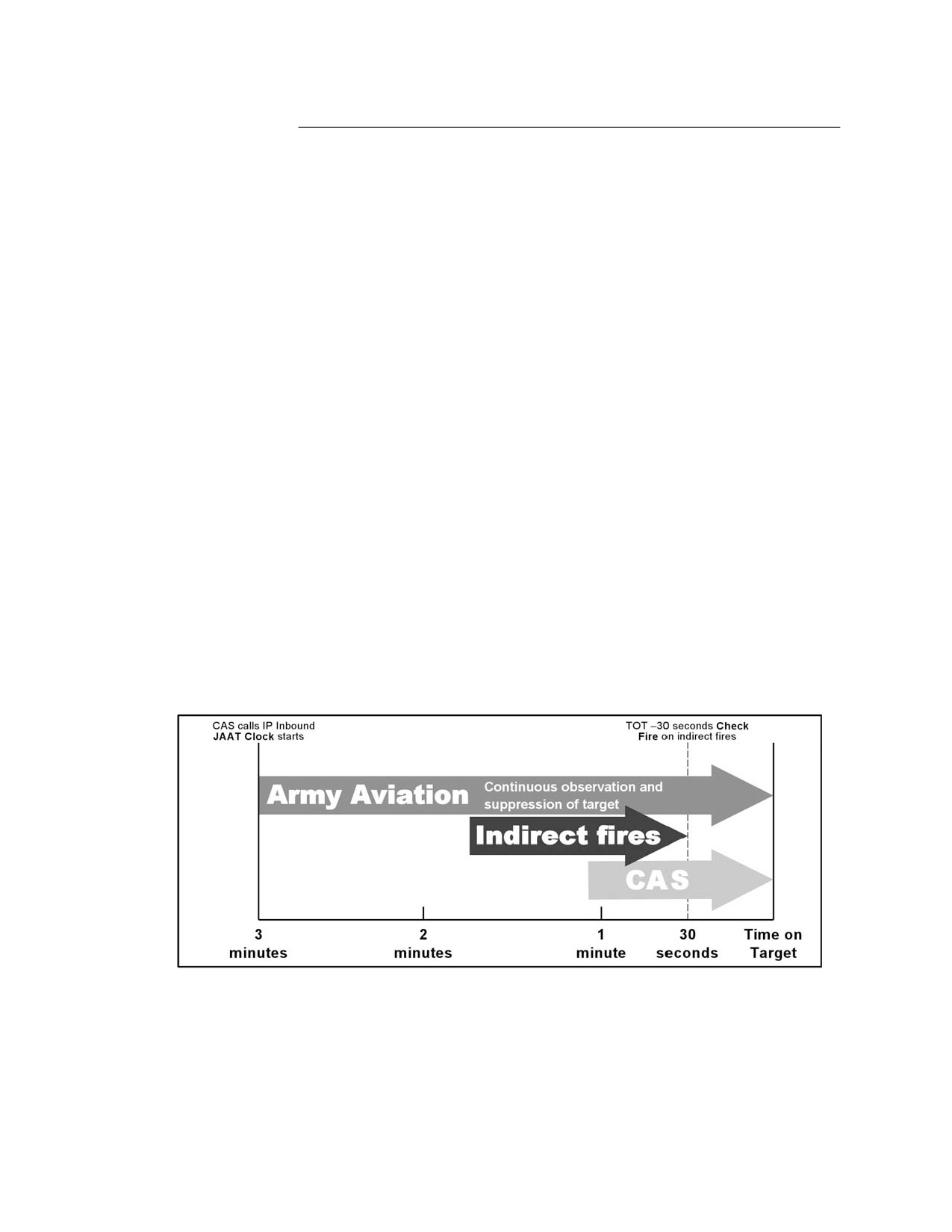
FM 3-04.111 (FM1-111)
based on time. To initiate the JAAT, the aviation AMC updates the target
information and issues the CAS a time hack (three minutes is the most
common) that starts the JAAT clock. The time hack serves as the TOT for the
CAS. CAS has ordnance impact or is over the target when the JAAT clock
runs out. The AMC can employ fires throughout the JAAT clock, except
during a safety buffer (normally 30 seconds) before the TOT. This safety
buffer ensures that residual ordnance effects of the impacting rounds do not
endanger CAS. The aviation AMC employs additional fires, as required,
suppressing the enemy during the CAS egress. A reattack can be either
immediate or based on an abbreviated JAAT clock. An example of a typical
engagement follows:
• AMC coordinates the attack, then calls “three-minute hack—ready,
ready, hack.”
• CAS lead responds with “good hack.”
• AMC engages the target with indirect fires, as required, to suppress
the enemy.
• CAS departs the initial point as required, to meet the three-minute
TOT.
• AMC ensures “check fire” on all indirect fires at the required time;
this time is calculated by subtracting the required safety buffer (30
seconds) and the artillery time-of-flight (generally 10 to 30 seconds)
from the TOT. The AMC may continue to suppress with direct fire
weapons using visual separation.
• CAS engages the target at the three-minute mark.
• AMC issues CAS “reattack” or “return to initial point” and suppresses
with direct fire to cover the CAS egress.
Figure P-1. Joint Air Attack Team Clock
P-4
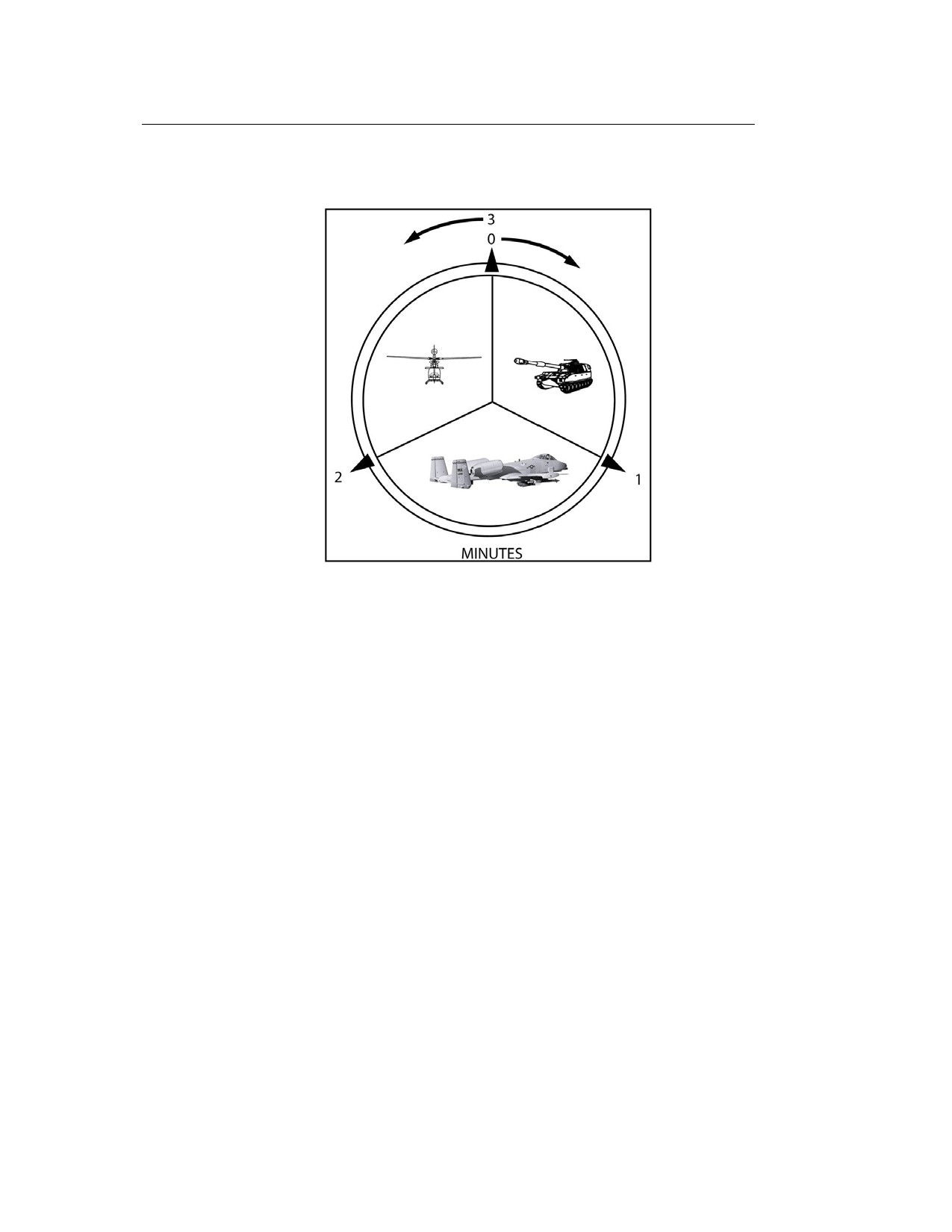
Appendix P
P-16. Figure P-2 shows an alternative JAAT clock.
Figure P-2. Alternative JAAT Clock
JOINT AIR ATTACK TEAM SEQUENCE CARD
P-17. The JAAT sequence card (Figure P-3) lists a number of different attack
sequence options. All of those likely to be involved in a JAAT operation use
the card. The option to be used for any specific attack is broadcast by the
AMC—giving the letter code, a number, and an H-hour. The letter code refers
to the type of attack and the number to the length of time of the artillery
bombardment. For example, if the AMC orders “KILO 3 at 1232 hours,” the
attack begins at
1232 hours, with an artillery bombardment for three
minutes, followed at 1235 (1232 plus three minutes) by armed helicopters,
and then the CAS at 1237. The artillery then engages (rounds on target) at
1240, until given check fire by the artillery observer. From the single call, all
JAAT players can work out their involvement and plan accordingly. The
format of the card varies and can be constructed or amended to meet different
situations.
EMPLOYMENT
P-18. Employment of the JAAT depends on the factors of METT-TC. The
commander selects the method of employment as early as possible so that
attacking assets can be coordinated. The two basic employment methods are
sector attacks and combined attacks. Sector attacks allow each element of the
JAAT to attack within a specified sector. Combined attacks occur when JAAT
elements mass their fires by attacking in the same sector.
P-5
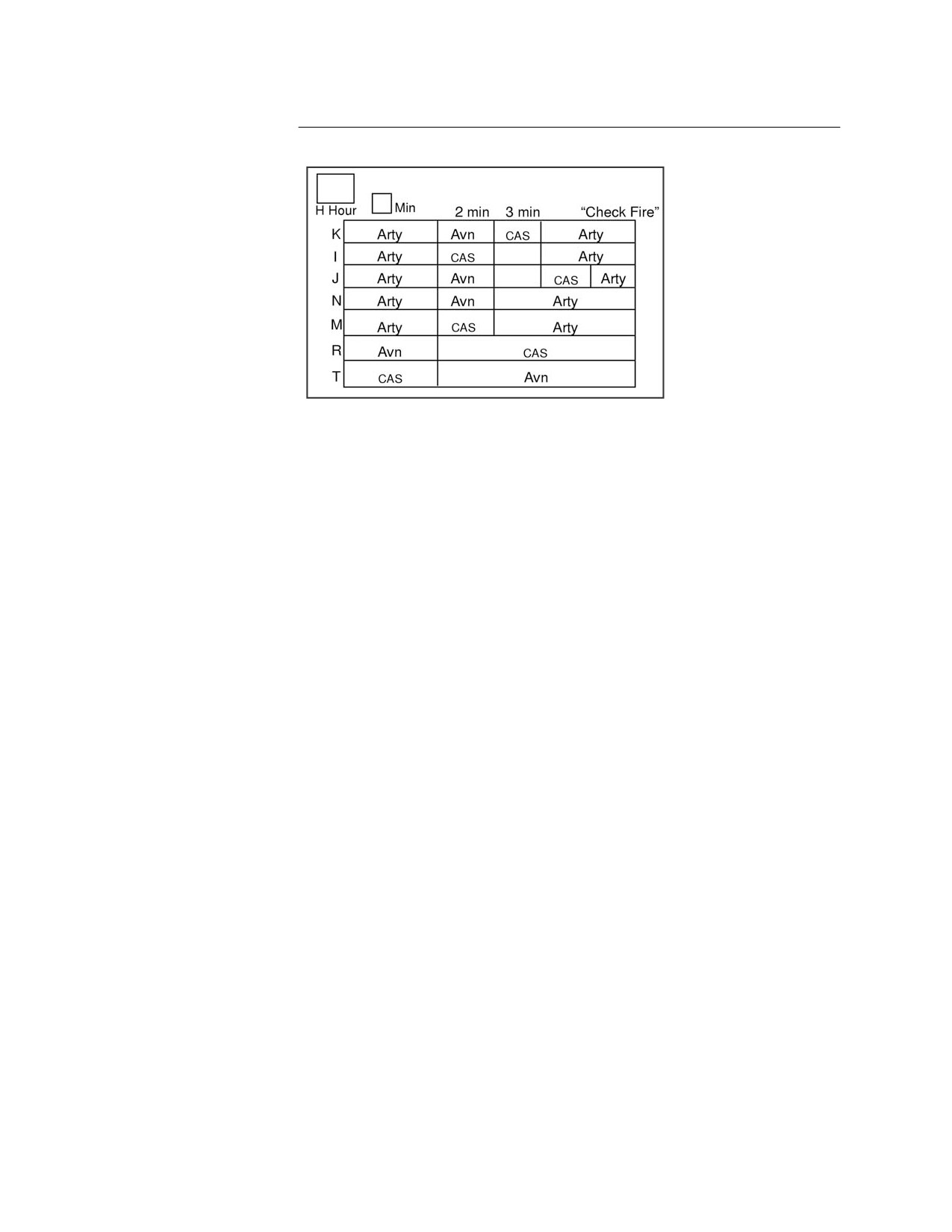
FM 3-04.111 (FM1-111)
Figure P-3. Joint Air Attack Team Sequence Card
SECTOR ATTACKS
P-19. The three types of sector attacks are sector-simultaneous, sector-
sequential, and sector-random. Sectors work best when easily recognizable
terrain features—such as roads, rivers, ridgelines, or tree lines—are used.
Sectoring the target (Figure P-4) reduces targeting conflicts and provides
each weapon with system flexibility in prioritizing the targets within the
designated sector.
SECTOR-SIMULTANEOUS
P-20. During sector-simultaneous attacks, each element maneuvers to attack
within its assigned sector to engage targets simultaneously with other JAAT
elements. All aircraft must coordinate ordnance fans to reduce the potential
for fratricide.
SECTOR-SEQUENTIAL
P-21. During sector-sequential attacks, each element maneuvers to attack
within its assigned sector in a predetermined sequence. This sequence may
range from several seconds to several minutes. This option reduces the
ordnance fan coordination problem and facilitates covering fire for each
preceding element.
SECTOR-RANDOM
P-22. During sector-random attacks, each element maneuvers to attack
within its assigned sector and engages targets at will. All elements must
coordinate ordnance fans to reduce the potential for fratricide.
COMBINED ATTACKS
P-23. The three types of combined attacks are combined-simultaneous,
combined-sequential, and combined-random. Combined attacks usually
involve armed helicopters and CAS using about the same avenue of approach
to the target. Combined attacks typically provide good mutual support
between the different elements but require more coordination and are more
predictable to the enemy after the initial attack.
P-6
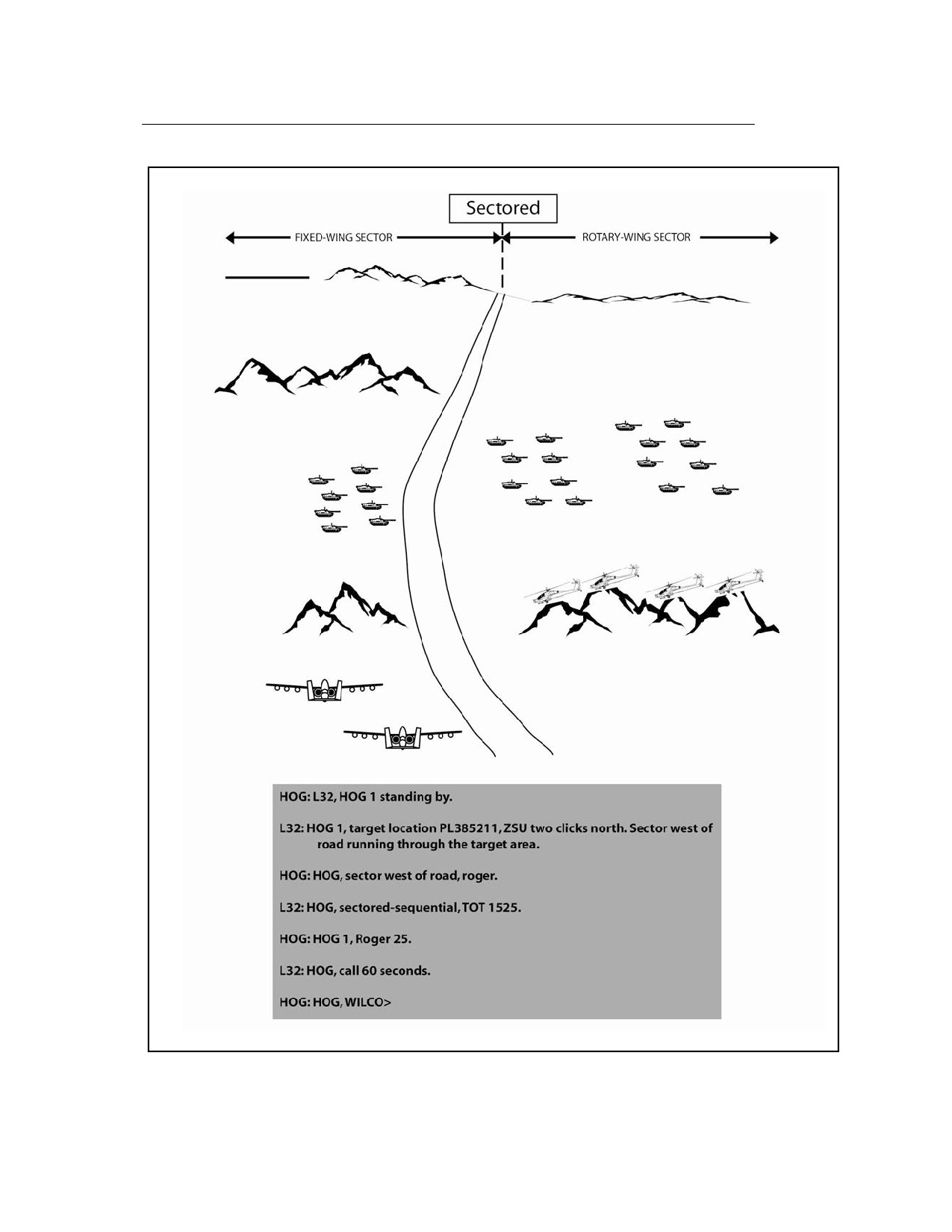
Appendix P
Figure P-4. Example of a Sector Attack
P-7