FM 3-04.111 (FM 1-111) Aviation Brigades (AUGUST 2003) - page 11

FM 3-04.111 (FM1-111)
Table I-8. C-12 Specifications
Length
43'10”
Height
15'5”
Wingspan
C-12C: 54'6”, C-12D: 55'6.5”, C-12T1/T2: 55'6.5”
Max gross
13,500 lb. (C and D1 models),
weight at takeoff
14,000 lb.(D2, T1, and T2 models)
Cargo door
C-12C not installed
dimensions
C-12D and C-12T1/T2 52” x 52”
Cruise airspeed
Max 260 knots indicated airspeed, varies with conditions
Ceiling
Max 31,000 MSL, varies with conditions
Varies; for example, 386-gallon main fuel yields 960 NM and 4.5 hours
endurance (standard day, zero wind, cruise PA 26,000', 1,700 RPM): same
Range
conditions with 544-gallon full main and auxiliary fuel yield more than 1,600
NM and 7 hours endurance
Crew
2 pilots
CAPABILITIES
I-83. The C-12 provides the following:
• Transport of up to eight personnel.
• Communication equipment capable of supporting key passengers.
• Light cargo transport capability.
ARMAMENT SYSTEMS
I-84. The C-12 is unarmed.
COMMUNICATIONS
I-85. The C-12 has the following communication systems, depending on the
model:
• The AN/ARC-164
(C, D1, and D2) provides two-way voice
communications in the 225- to 399.975-megahertz range for a normal
range of 50 miles.
• The UHF-20B (C and D1) provides VHF-AM communications in the
116- to 151.975-megahertz frequency range for a normal range of 50
miles.
• The
718U HF command set (C and D1) provides high-frequency
communications in the frequency range of 2 to 29.999 megahertz.
• The AN/ARC-186 (C and D1) provides VHF-AM/FM communications.
• The AN/ARC-210
(V)
(T1 and T2) provides multifrequency
communications in the 30 to 88 FM band, 108 to 136 AM band, 136 to
156 FM band, 156 to 174 FM maritime band, and 225 to 400 AM/FM
Have Quick and SATCOM bands.
• The VHF-22C (D2, T1, and T2) provides VHF communications.
• The KHF 950 (D2, T1, and T2) provides high-frequency, long-range
communications.
I-20
Appendix I
NAVIGATION SYSTEMS
I-86. The C-12 has the following navigation systems:
• The KLN-90B GPS provides global positioning system navigation.
• Two VIR-30 VOR receivers are installed, one without marker beacon
capability for instrument navigation.
• The KR 87 ADF provides automatic direction finding capability with
AM transmitters.
• The DME-40 provides distance-measuring equipment capability.
• The AP-106 autopilot system works with other navigation equipment
to fly the aircraft en route.
AIRCRAFT SURVIVABILITY EQUIPMENT
I-87. The C-12 has no aircraft survivability equipment because of the nature
of its mission profiles.
LIMITATIONS
I-88. The C-12 has no self-defense protection system and limited capability to
survive against airborne threats. It is not normally flown at terrain-flight
altitudes.
SECTION VIII - C-23 (B AND B+)
I-89. The C-23B or B+ supports theater aviation needs for cargo transport,
airdrop, and aeromedical evacuation.
DESCRIPTION
I-90. The C-23B Super Sherpa is a twin turboprop, fixed-wing aircraft. Its
rectangular-shaped cabin readily accommodates palletized cargo; up to 500
pounds of additional baggage can be stored in a nose compartment. The C-
23B has a crew of three.
SPECIFICATIONS
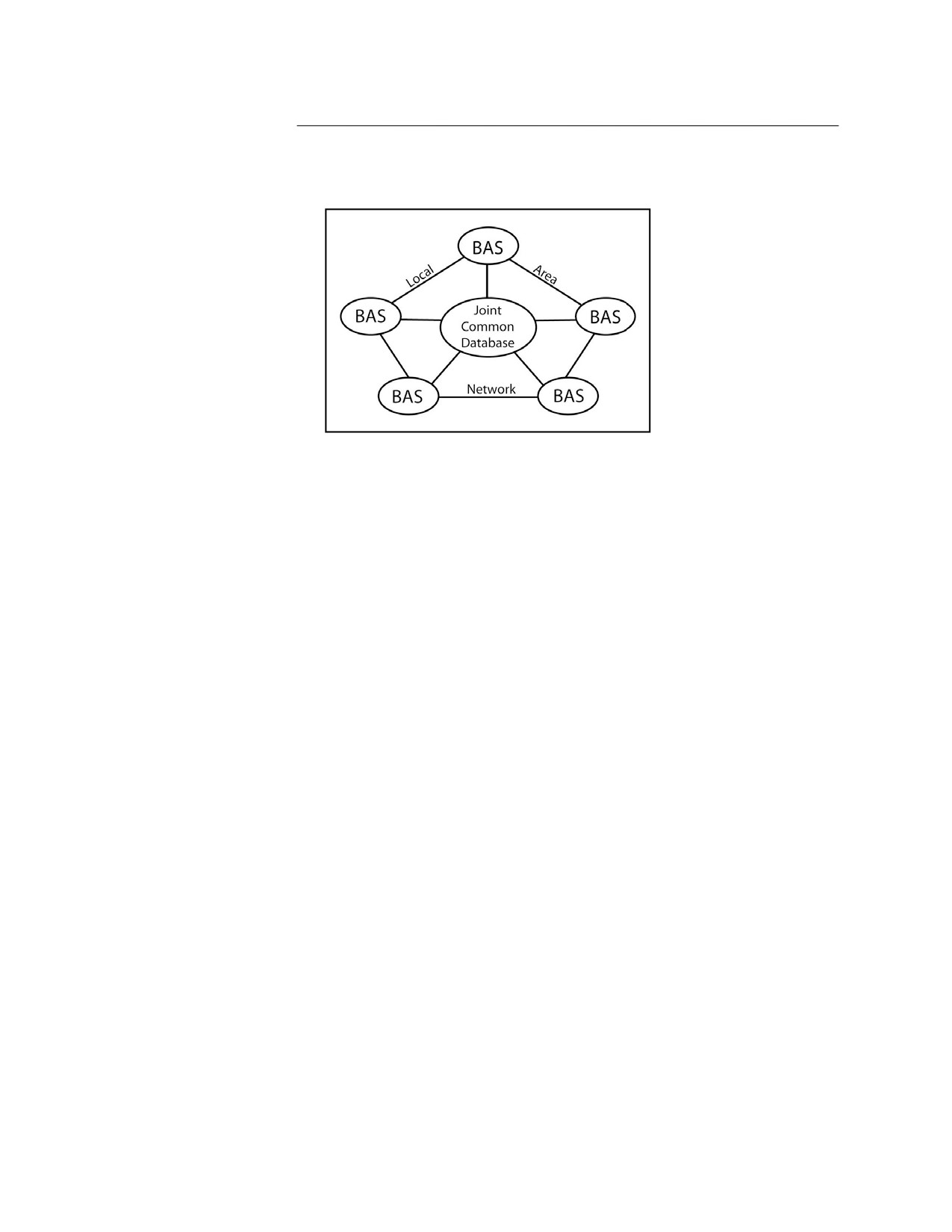
I-91. Table I-9 outlines C-23B specifications.
I-21

FM 3-04.111 (FM1-111)
Table I-9. C-23B/B+ Specifications
Length
58'½”
Wingspan
74'8”
Height
16'3”
Cabin dimensions
29' long x 5'6” wide x 6'6” high
Maximum payload
7,100 pounds
Maximum gross weight
25,500 pounds
Maximum airspeed
190 knots
More than 1,000 miles (varies with environmental/
Range
mission conditions)
Typical mission range
770 miles with 5,000-pound payload
CAPABILITIES
I-92. The C-23 provides the following:
• Transport of up to 30 seated passengers.
• Transport of 27 paratroopers.
• Transport of 18 litters and 2 medical attendants.
• Transport of palletized cargo.
ARMAMENT SYSTEMS
I-93. The C-23B is an unarmed aircraft.
COMMUNICATIONS
I-94. The C-23B and B+ lack SINCGARS, Have Quick, and HF capability.
The two organic AN/ARC-182(V) radios operate in the
30- to
399.975-
megahertz frequency ranges.
NAVIGATION SYSTEMS
I-95. The C-23B has the following navigation systems:
• Two VIR-32A VHF navigation receivers with DME 42 and ILS/GS.
• Two RMI-36 radio magnetic indicators.
• One ADF-60A ADF.
• Two EHSI-74 electronic horizontal situation indicators.
• One TDR-90 transponder.
• One AN/APX-100(V) transponder.
AIRCRAFT SURVIVABILITY EQUIPMENT
I-96. Appendix J covers X-23 ASE.
I-22
Appendix I
C-23B LIMITATIONS
I-97. The following are limitations of the C-23B:
• The C-23B is not pressurized; therefore, aircrew members require
oxygen for sustained flights above 10,000 feet. Passengers would also
require oxygen above that altitude, which would generally be
impractical; resultant flights with passengers at lower altitude will
adversely affect range and endurance.
• The narrow cabin will not permit internal loading of Army vehicles
such as the HMMWV.
I-23
Appendix J
Aircraft Survivability
SECTION I - FUNDAMENTALS
THREAT
J-1. Aircraft survivability is a primary concern throughout planning and
execution of all missions. Army aircrews operate in an extremely hazardous
environment of highly lethal air defense threats. The array of enemy air
defense systems includes radar, IR, EO, and directed-energy weapons. Proper
use of ASE, combined with careful route planning and movement techniques,
greatly reduces the enemy’s ability to effectively engage Army helicopters.
Section III contains further threat information.
AIRCRAFT SURVIVABILITY TENETS
J-2. Aircrews deny or degrade the enemy’s ability to detect, acquire, engage,
and damage friendly aircraft by reducing aircraft radar, IR, visual, and
acoustic signatures. This reduction is accomplished through the tenets of—
• Tactics.
• ASE.
• Aircraft hardening.
TACTICS
J-3. Appropriate tactics are the most effective means of enhancing aircraft
survivability. Mission planning begins with a detailed analysis of the enemy
air defense threat. Planners then determine how to best avoid or degrade
that threat. Flight planning incorporates a detailed flight route analysis,
seeking to avoid known or suspected enemy air defense sites and reduce the
chances of detection or engagement by the enemy. Flight modes (low-level,
contour, and NOE) and techniques (traveling, traveling overwatch, and
bounding overwatch) are selected. Effective terrain flight not only limits LOS
exposure times but also places the aircraft’s radar, IR, and visual signature
in a cluttered environment. Chapter 4 addresses flight modes and movement
techniques.
AIRCRAFT SURVIVABILITY EQUIPMENT
J-4. ASE systems can be categorized in three general areas: signature
reduction (design passive), SA (electronic passive), and jamming and decoying
(electronic active) countermeasures. ASE is used in combination with sound
tactics to enhance survivability. ASE cannot compensate for dangers
introduced by poor tactics.
J-0
Appendix J
Signature Reduction (Design Passive)
J-5. These measures are incorporated during manufacture or modification of
aircraft. Examples include flat canopies, exhaust suppressors, and IR
reflective paint. Aviators, in choosing how much signature to expose to the
threat, also influence signature control. The IR and radar signatures are
least when viewed from the front, while the maximum IR signature is from
the rear quadrants. The maximum visual and radar signatures are from the
sides. Aircrews reduce the signature by using terrain and changing the
aircraft’s physical orientation to the threat, based on the type of enemy
system anticipated or encountered.
Situational Awareness (Electronic Passive)
J-6. Electronic passive ASE systems provide early warning to aircrews,
allowing them reaction time. These systems include radar detecting sets,
laser detecting sets (LDSs), and IR missile warning systems. Aircrews use
cues from these systems to change modes of flight or increase vigilance
(actively seek masking terrain features).
Jamming and Decoying (Electronic Active)
J-7. If detected, aircrews use electronic active countermeasures (jammers,
chaff, and flares) to provide some protection while they maneuver to masking
terrain or outside threat range. Radar threats can be decoyed by chaff. Other
sets can jam radar and IR threats. Flares can decoy IR missiles.
AIRCRAFT HARDENING (VULNERABILITY REDUCTION)
J-8. Hardening provides ballistic tolerance, redundant critical flight systems,
and crashworthy features in an attempt to minimize the damage to an
aircraft that has been hit.
SECTION II - AIRCRAFT SURVIVABILITY EQUIPMENT
J-9. This section includes a brief description of each ASE system with
available configurations to optimize the ASE system.
AN/APR-39(V)1
J-10. The AN/APR-39(V)1 is a passive, omnidirectional radar signal
detecting set (RSDS). The system detects friendly and threat radar systems
in the high (E, F, G, H, I, and J) bands, as well as missile guidance radars in
the low (C and D) bands. Some enemy systems may operate outside these
bands. Therefore, crews must be aware if these systems are in the AO.
AN/APR-39A(V)1
J-11. The AN/APR-39A(V)1 RSDS is an upgraded version of the AN/APR-
39(V)1. It uses a digital processor, alphanumeric symbology display, and
synthetic voice warning to alert the aircrew of radar-directed air defense
threat systems. It provides coverage for C, D, and E through M band pulsed
wave radar. The theater-specific mission data set software is
J-1
FM 3-04.111 (FM1-111)
reprogrammable. Although the band coverage is extended, some enemy
systems cannot be detected. Because of the limited memory and
reprogramming of the system, aircrews should check with the unit EWO or
ASE officer to understand which enemy systems are actually being displayed.
AN/APR-44(V)1/3
J-12. The AN/APR-44(V)1/3 RSDS is a passive system used to detect
continuous wave (CW) radar signals aimed at the aircraft. A light indicates
the detection, a tone is heard in the headset, and a logic signal is produced for
external use. The AN/APR-44(V)1 is connected to the AN/APR-39A(V)1 and
warns the pilot through the AN/APR 39A(V)1 or a warning display on the
multifunctional display. The AN/APR-44(V)3 is a stand-alone system and
warns the pilot with a light and a tone in the headset. The AN/APR-44(V)3
has additional components that enable an aircraft to detect airborne
interceptors.
AN/APR-48A
J-13. The AN/APR-48A RFI detects emitting radar targets and computes
accurate target azimuth and target identification for AH-64D LBAs equipped
with FCR. Mounted on the mast above the rotors, the RFI provides
continuous 360-degree emitter detection and threat identification, including
early warning, ground targeting, counterbattery, and aircraft radars. For fine
direction-finding measurements, a four-element interferometer array with a
90-degree FOV provides the DF accuracy and tolerance to multipath induced
errors found from radar reflectance.
AN/AVR-2/2A
J-14. The AN/AVR-2/2A LDS is a passive laser warning system that provides
input to the AN/APR-39A(V)1 to detect laser energy. The 2A version is also
used as sensors for MILES/AGES. The system has reprogrammable emitter
identification (EID).
AN/ALQ-136(V)5
J-15. AN/ALQ-136(V)5 countermeasures set (CMS) is an airborne, automatic
electronic radar jammer designed to defeat/degrade the tracking capability of
a limited number of hostile threat pulse radars. When threat signals are
identified and verified, jamming automatically begins and continues until the
threat radar signal is no longer detected. The CMS then ceases jamming but
continues to receive and analyze radar signals.
AN/ALQ-144A(V)1/3
J-16. The AN/ALQ-144A(V)1/3 CMS is an active, continuous operating
omnidirectional IR jammer system designed to confuse or decoy threat IR
missile systems. The AN/ALQ-144A(V)1 CMS provides jamming of all known
threat IR missile systems when operated on an aircraft that has been
equipped with low-reflective paint and engine exhaust suppressors. The
J-2

Appendix J
system has specific jam-program number settings that must be set before
flight.
AN/ALQ156(V)1
J-17. The AN/ALQ156(V)1 missile approach detector is an airborne radar
system that provides IR homing protection to the aircraft by detecting the
approach of antiaircraft missiles. Upon detection of an incoming missile, the
missile detector automatically initiates a signal, which triggers the M-130
general purpose dispenser system. The dispenser system then releases a flare
to decoy IR missiles away from the aircraft.
M-130
J-18. The M-130 general purpose dispenser has a dual countermeasure
capability of chaff and flares. The system is operated either manually with
AN/APR-39 RSDS warning or automatically through interface with the
AN/ALQ-156. The dispenser system can dispense flares only (30 each) or
chaff only (30 each). By adding a second M130 dispenser assembly and
payload module, the aircraft may dispense flares or chaff, independently.
Chaff and flare cartridges cannot be mixed in any payload module. The chaff
protects against radar-directed antiaircraft weapon systems, while the flares
protect against IR-directed missile systems. When the M-130 is set to
dispense chaff, the electronic control module must be set with the program
setting for the aircraft before flight. Currently, only the CH-47D has an
approved airworthiness release to fire flares from the M-130.
J-19. Table J-1 depicts the systems that are in each aircraft. Note that
aircraft carry only one AN/APR-39 system at a time. In addition, very few
aircraft use the AN/APR-44 system.
Table J-1. Aircraft ASE Matrix
ASE
AH-64A
AH-64D
OH-58D
UH-60A/L
CH-47D
HH-60L
RC-23B
AN/APR-39(V)1
X
X
X
AN/APR-39(V)2
X
AN/APR-39A(V)1
X
X
X
X
X
X
AN/APR-44(V)1/3
X
X
X
X
AN/APR-48A
X
AN/ALQ-136(V)2
X
AN/ALQ-136(V)5
X
X
AN/ALQ-144A(V)1
X
X
X
AN/ALQ-144A(V)3
X
X
AN/ALQ-156(V)1/2
X
X
AN/ALQ-162(V)3
X
AN/AVR-2A
X
X
X
M-130 (CHAFF)
X
X
X
X
X
M-130 (FLARE)
X
X
X
J-3
FM 3-04.111 (FM1-111)
SECTION III - THREAT CONSIDERATIONS
J-20. This section provides general information about the capabilities and
characteristics of threat systems. It may be applied to specific threats on a
case-by-case basis.
THREAT ENGAGEMENT SEQUENCE
J-21. All weapon systems must complete an engagement sequence to actually
have an effect on the target aircraft. A step in the engagement sequence that
is missed forces the threat to start over again. Weapon systems sensors
must—
• Detect.
• Acquire.
• Track.
• Launch and guide or fire a ballistics solution.
• Assess damage.
EXAMPLE OF A THREAT SYSTEM
J-22. Five elements required to compute an AD fire control solution are
range, azimuth, elevation, velocity, and time of flight (TOF). If one of the fire
elements is incorrect, the AD system will not hit the target.
TIME AND SPACE
J-23. The threat must detect, acquire, track
(establish a fire-control
solution), and fire at the aircraft. The TOF of the projectile must be
determined. The threat must predict where the aircraft target will be (within
a few meters) when its ordnance travels to a point in space and time.
ACQUISITION VERSUS TRACKING
J-24. The difference between detection and acquisition, compared to
tracking, is very important. In detection and acquisition, the threat weapon
system does not have refined data to fire. The threat weapon system must
track the aircraft long enough to determine range, azimuth, elevation, and
velocity to predict when and where to fire to hit its target. Indications of
search or acquisition activity may alert the aircrew in time to increase its
vigilance (for example, change mode of flight, actively searching for masking
terrain features). Tracking indications alert the aircrew to an immediate
action requirement (masking or, when terrain is not readily available, ASE
decoys and evasive maneuvers).
ENGAGEMENT ENVELOPE
J-25. Threat systems have a minimum and maximum effective altitude and
range. These numbers are computed against a cooperative engagement
(nonmaneuvering aircraft, blue-sky background, flat terrain, and steady
velocity). The typical effective envelope for a threat system is based upon a 50
percentile; that is, at the maximum
(or minimum) effective range
(or
J-4
Appendix J
altitude), the weapon system is able to hit the target one out of two times. As
the target gets further into the threat’s envelope, the probability of a first-
shot kill increases. As the target gets further outside the threat envelope, the
probability decreases until the target is outside the threat’s maximum range
(or altitude), where it is physically impossible to hit.
J-26. The aircrew, even if exposed, can make the engagement more difficult
for the threat. A stationary target, for example, allows the threat to adjust
each shot off the last until it hits the aircraft. A more difficult engagement is
a moving, constant-velocity shot. A prediction can be made, and if a miss
occurs, an adjustment can be made based off the last shot. The most difficult
engagement is against a moving target that varies range, altitude, attitude,
and velocity. Prediction is impossible because all four factors are changing at
differing rates.
THREAT WEAPON SENSORS
J-27. There are four major types of threat weapon sensors: radar, IR,
directed energy, and optical. For in-depth information concerning particular
threat systems, aircrews should contact the unit EWO, ASE officer, or
tactical operations officer.
RADAR
J-28. Direct threat radar weapons require LOS to hit the target. They are
either fire-controlled antiaircraft artillery
(AAA) or, for missile systems,
command, semiactive radar homing (SARH), or active radar homing (ARH).
Radar weapons must detect, acquire, track, launch and guide (or fire a
ballistic solution), and assess damage. Radar systems are hampered by
ground clutter. To pick out targets from ground clutter, radar systems can
detect movement though the use of a MTI, Doppler (continuous-wave radar),
or pulse Doppler. Some modern radar systems track not only the movement
of the aircraft itself but also the movement of rotor blades. Radar systems can
be detected, avoided, decoyed, jammed, and destroyed by direct and indirect
fires (self-artillery and antiradiation missiles).
INFRARED
J-29. IR direct threat weapons require LOS before launch. The in-flight
missile must maintain LOS with the target until impact or detonation of the
proximity fuse. IR missiles require the operator to visually detect the target
and energize the seeker before the sensor acquires the target. The operator
must track the target with the seeker caged to the LOS until it is determined
that the seeker is tracking the target and not background objects (natural or
man-made objects such as vehicles, the sun, or reflected energy of the sun off
clouds). The IR sensor is also susceptible to atmospheric conditions (such as
haze or humidity), the signature of the aircraft and its background, flares,
decoys, and jamming. Generally, the portability of IR systems makes it
difficult to predict where they may be located. Their passive sensors make
them difficult to detect before launch. Aircrews have little time to respond to
a launch because of the missile’s short TOF.
J-5
FM 3-04.111 (FM1-111)
DIRECTED-ENERGY WEAPONS
J-30. Laser-guided or
-aided weapons use lasers to perform ranging,
tracking, or guiding functions for conventional explosives. Pure directed-
energy weapons (DEW)s use laser and other forms of DEWs to inflict damage
to the aircraft or its sensors. DEWs are of short duration, hard to detect,
extremely hard to decoy or jam, and hard to kill. They rely upon LOS and
atmospheric conditions and are somewhat short ranged at present.
OPTICAL/ELECTRO-OPTICAL
J-31. Optical/EO sensors are used as either the primary or the secondary
sensor for all weapon systems. They are, with very few exceptions, completely
passive. They are limited by human eyes, atmospheric conditions, distance,
jitter, and in many cases, by darkness. The optical/EO sensors are most
difficult to detect, seldom can be decoyed, and can be jammed in the sense of
obscurant, but, when located, can be killed.
SECTION IV - OPERATIONAL EMPLOYMENT CONSIDERATIONS
J-32. For ASE to provide effective protection, configuration settings must be
optimized for known and suspected threats. The ASE/EWO and tactical
operations officer ensure that optimum ASE configuration settings are
prepared for each flight.
MISSION PLANNING
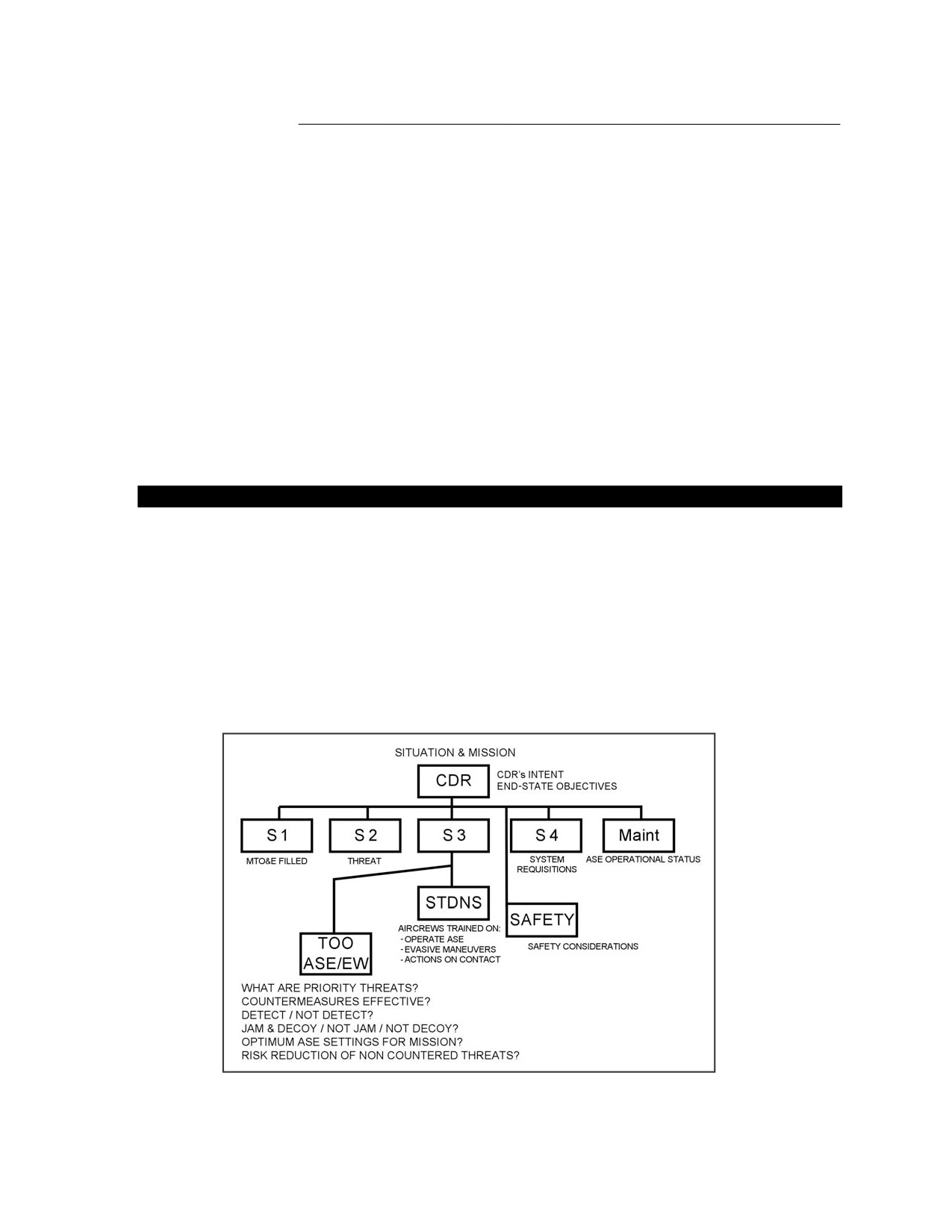
J-33. ASE and EW must be considered in all phases of mission planning and
execution. Figure J-1 illustrates the roles and responsibilities of ASE
planning.
Figure J-1. Roles and Functions
J-6
Appendix J
OPERATION ORDER SUPPORT
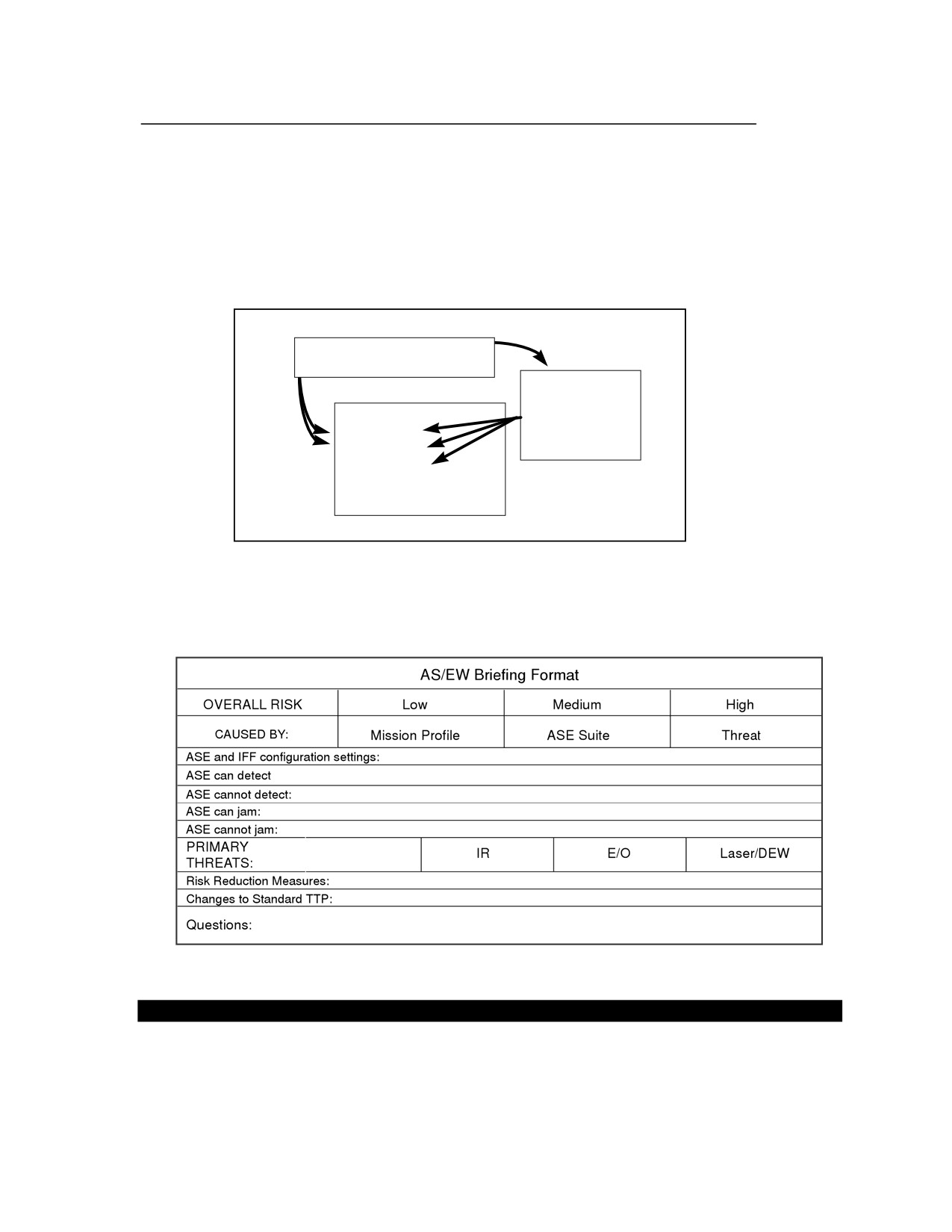
J-34. The EW annex is created to support the OPORD. The enemy and
friendly situations are further defined with the emphasis on the EW
capabilities that each have to find, fix, jam, deceive, disrupt, or destroy each
other. Figure J-2 illustrates the support to OPORD development.
Situation
Mission, Intent, & End States
Risk Analysis
Enemy & Friendly
OPORD & FRAGO:
Mission
1. Situation
ASE Settings
2. Mission
Briefing
3. Execution
4. Service Support
5. Command and Signal
Figure J-2. OPORD and FRAGO
J-35. A supplement to the overall mission briefing is the ASE briefing
(Figure J-3).
Figure J-3. ASE Mission Brief Format
SECTION V - MISSION EXECUTION
J-36. Aircrews must be familiar with ASE SA displays and their threat
indications. Some actions must be performed immediately. After receiving
visual indications of enemy gun or missile firing or ASE indications of radar
J-7
FM 3-04.111 (FM1-111)
track or launch, the aircrew has but seconds to react. The aircrew should
immediately—
• Deploy to cover.
• Perform evasive maneuver if masking terrain is not readily available.
• Determine whether to continue or abort the mission.
CREW COORDINATION
J-37. Crew coordination must be rehearsed to perform evasive maneuvers.
Standardized terminology, such as
“Missile
3 o’clock, break right” and
“Breaking right,” should be used to avoid confusion.
MULTISHIP CONSIDERATIONS
J-38. Formations and spacing intervals should be selected to provide all
aircraft maneuver space to evade hostile fire. Standardized terminology, such
as “Chalk three, tracers 3 o’clock, breaking left,” should be used to alert the
flight. Briefings should include evasive formation break-up procedures and
how to reestablish the formation after breaking the engagement. Terrain,
narrow radar beam, altitude, maintenance problems, or other factors may
prevent all aircraft in the formation from receiving signals; therefore, it is
important to communicate ASE alerts or indications immediately.
J-8
Appendix K
Digitization
This appendix summarizes key information that leaders require to
exercise C2 using the ABCS. It includes information on the components of
ABCS and its supporting systems and how to use ABCS within a CP to
support battle planning, preparation, execution, and sustainment.
SECTION I - INTRODUCTION
GENERAL
K-1. For military operations in the twenty-first century, force projection,
split-base operations, information warfare, and joint or combined operations
will be the rule. Crucial to these capabilities is the effective flow of
information to support warfighting throughout all phases of an operation (see
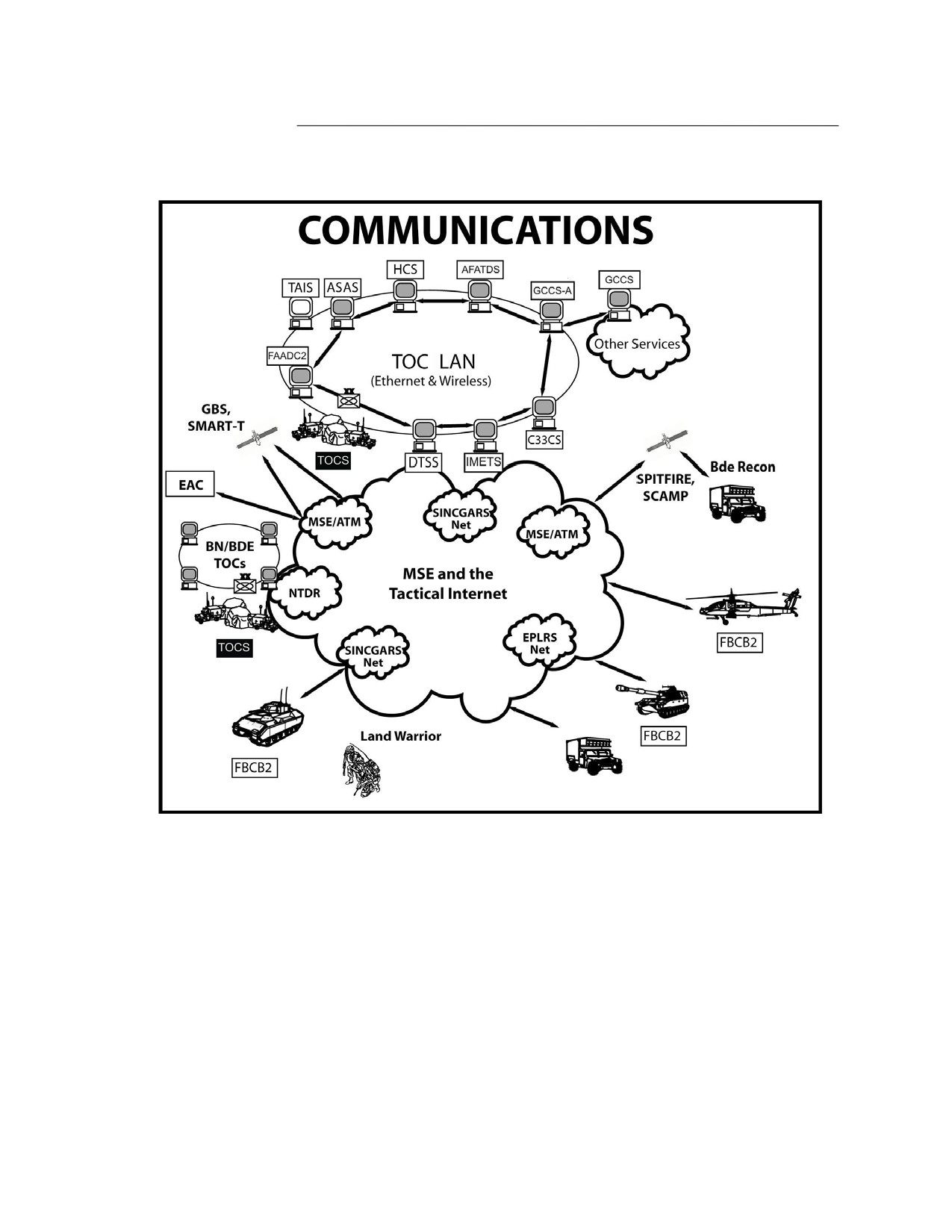
Figure K-1). ABCS provides rapid and reliable information nets to enable the
Army to project the force, protect the force, gain information superiority,
determine the battle space, conduct decisive operations, and sustain the
force. It provides real-time and near-real-time information that enables
sound decision making inside the enemy’s decision cycle.
K-2. ABCS is a collection of information management systems that assists
the commander in exercising C2. It assists him in gaining SU of the
battlefield. ABCS permits him to apply his judgment more productively, to
use his command presence more efficiently, to develop and disseminate his
vision effectively, and to understand better the dynamics of war (in general)
and the specific operation (in particular).
K-3. ABCS provides a visual means to see friendly and enemy forces and the
ability to arrange and maneuver forces to accomplish missions. The ABCS
components assist in answering the following questions:
• Where am I?
• What is my status?
• Where are the other friendly units?
• What is their status?
• Where is the enemy?
• What is the enemy’s status?
K-4. Digitization capability is an evolutionary process that will occur over
many years. This appendix describes envisioned objective operations. When
capability is incomplete, the challenge is to devise ways to mix traditional,
manual methods with the automated systems that permit more rapid
planning and synchronized execution. As always, these guidelines should be
applied to a degree that complements the existing level of automation.
K-1
FM 3-04.111 (FM1-111)
Figure K-1. Digitized Communications
COMMON PICTURES
K-5. Definitions of common pictures follow. In practice, the terms common
operational picture (COP) and common tactical picture (CTP) are often used
interchangeably.
• Common Operational Picture. The COP is an operational picture
tailored to the user’s requirements, based on common data and
information shared by more than one command; the COP facilitates
collaborative planning and assists all echelons in achieving SU, which
helps to synchronize execution.
• Common Tactical Picture. The CTP is an application available on
ABCS computers and supporting systems; the application uses a
common mapping background, is accessed through a common user
K-2
Appendix K
interface, and displays information shared from the Joint Common
Database (JCDB). The CTP is dynamically updated as data change in
the JCDB.
K-6. Examples of COP overlays are the force disposition, enhanced by
overlaying the operational overlay; FS overlays; and the A2C2 overlay.
Additional information is available at the description of each system.
K-7. ABCS assists in answering these questions by providing a COP of the
battle space through timely presentation of information in various types of
formats including voice, data, imagery, graphics, and video. The operational
picture also provides—
• Access to planning documents.
• Status reports.
• Timely, automatic warnings of air, missile, and NBC attacks.
K-8. Although each battlefield automated system (BAS) of ABCS makes
contributions that support its own BOS-oriented tasks, the key contribution
of ABCS is as an interoperable
“system of systems.” The synergistic
capabilities of ABCS allow commanders to reach across the BOS to request,
select, and evaluate data from diverse resources to create relevant
information. The COP begins with a common map background against which
a commander can display a variety of information such as—
• Friendly locations and graphic-control measures.
• Enemy units and equipment.
• Fire support control measures, range fans, and targets.
• Air tracks and tactical ballistic missile tracks.
• Logistics status and joint information.
K-9. The COP includes Army units; joint, allied or coalition forces; and
enemy, neutral, or unknown forces. Each user can tailor his COP to show as
little or as much information as he requires. ABCS' essential contribution to
C2 is that it provides identical, shared data. ABCS enhances warfighting in
the following ways:
• Accelerates the MDMP, preparation of estimates, COA development,
wargaming, and orders production and dissemination.
• Assists in gathering and displaying relevant information while
filtering out unnecessary data.
• Allows for dissemination of information in near-real time and
minimizes latency of information exchanges.
• Facilitates the synchronization of CSS by increasing the opportunities
for real-time coordination.
• Exploits digital map data and terrain-analysis products.
• Facilitates rehearsal and training through compatibility with current
and future simulation and simulation systems.
• Enhances interoperability through commonality of task procedures.
• Provides data access to the commander in austere environments
through reach-back capability.
K-3
FM 3-04.111 (FM1-111)
COMMON SERVICES
K-10. ABCS provides several information management applications.
COLLABORATION TOOLS
K-11. Collaboration tools include—
• VTC, whiteboard, and shared applications.
• Messaging.
• File transfers.
• Calendar creation/scheduling.
• Task management.
• Internet browser.
• Database query tools.
TRAINING APPLICATIONS
K-12. These provide training and simulation capabilities for individual and
collective training events.
APPLICATIONS
K-13. Common applications include word processor, spreadsheet, and
presentation/graphics programs. Document interchange services support
document exchanges between heterogeneous computer systems using
common file formats.
K-14. The operational picture application creates a shared picture of the
battle space.
K-15. The planning application automates aspects of the MDMP and enables
parallel and collaborative planning.
ARMY BATTLE COMMAND SYSTEM COMMUNICATIONS NET
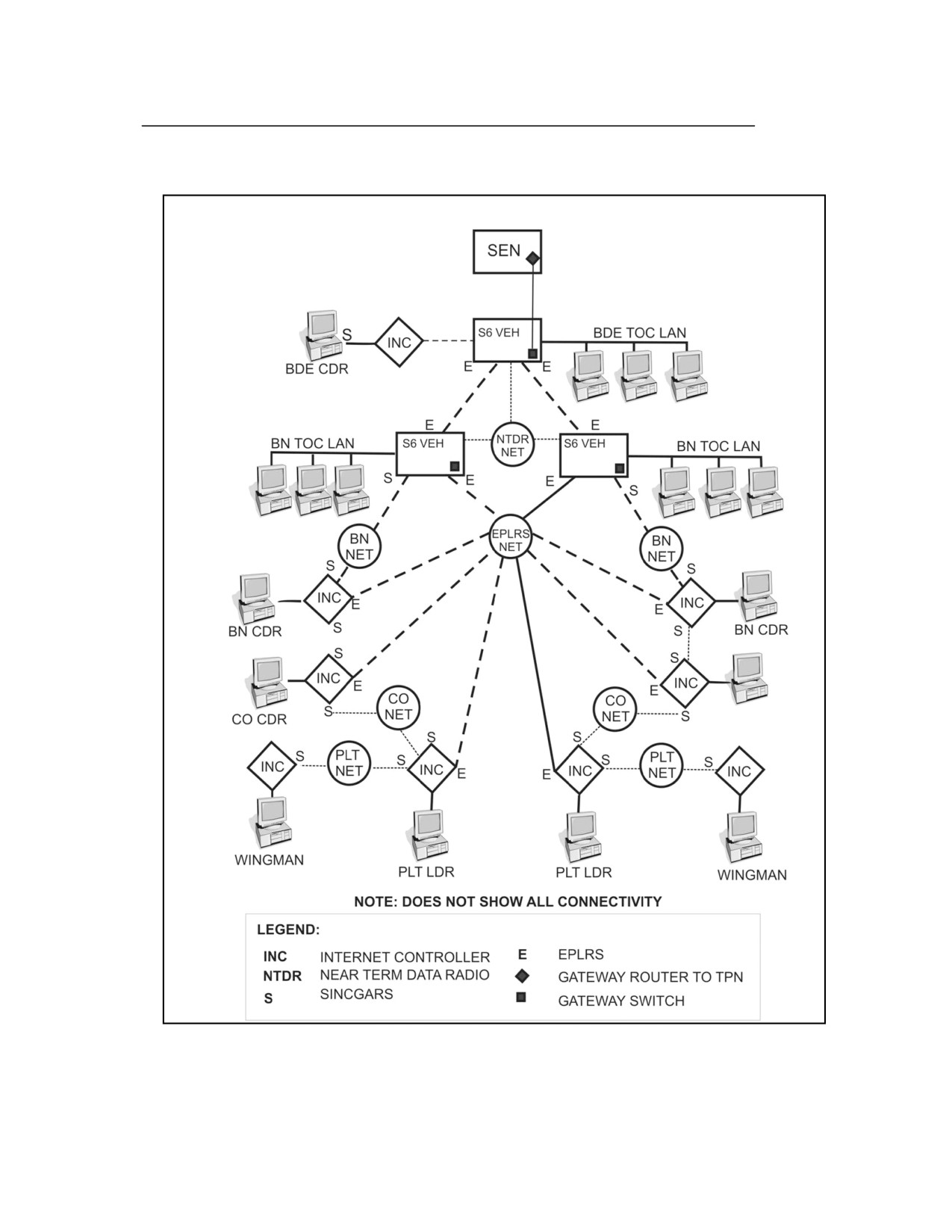
K-16. Connectivity is provided by tactical communications systems: MSE,
near term digital radio (NTDR), SINCGARS, and EPLRS. The ABCSs within
the brigade, division, and corps CPs are supported by a wide area network
(WAN) and LAN switch/router architecture(Figure K-2.).
OTHER DIGITAL SYSTEMS
K-17. Additional systems interfacing with ABCS may include the A2C2S, the
Digital Topographic Support System/Quick Response Multicolor Printer
(DTSS/QRMP), and CGS.
K-4
Appendix K
Figure K-2. Example of an ABCS Communications Net
K-5
FM 3-04.111 (FM1-111)
SECTION II - SYSTEMS DESCRIPTIONS
K-18. ABCS is a system of systems that consists of information technology
applications, nets, and communications that enable data exchange
throughout the force. It is composed of subsystems for each BOS. Each
subsystem supports and provides information to other systems to improve
battlefield SU. By integrating the ABCS components to a JCDB, the COP can
be viewed at any workstation according to the commander’s specific
requirements. In addition, ABCS subsystems provide an array of specialized
capabilities and applications for units at all levels.
ARMY BATTLE COMMAND SYSTEM COMPONENTS
K-19. ABCS consists of the following subsystems:
• GCCS-A.
• FBCB2.
• TAIS.
• DTSS.
• Integrated Meteorological System (IMETS).
• ATCCS.
GLOBAL COMMAND AND CONTROL SYSTEM—ARMY
K-20. GCCS-A is the Army hardware and software that directly support
Army implementation of the joint GCCS. It supports monitoring, planning,
and execution of joint, combined, and Army operations for EAC. GCCS-A
ensures Army access to key information within the joint realm such as force
tracking, host-nation and civil affairs support, theater air defense, targeting,
PSYOP, C2, logistics, and medical and personnel status. In turn, this
information supports corps-level planning, execution, and monitoring of
mobilization, deployment, sustainment, and redeployment.
LOCATION
K-21. There is a GCCS-A system at the corps main and tactical CPs.
KEY CAPABILITIES
K-22. The commander’s force analyzer provides current, time phased force
deployment data
(TPFDD). This information is key for planning the
movement of forces and monitoring unit status and availability.
K-23. The logistics analyzer allows planners to forecast resources needed in
various combat situations.
K-24. GCCS-A shares the client-server architecture common operating
environment
(COE) with the joint GCCS for the general functions of
teleconferencing, messaging, file transfers, office automation, utilities, and
system administration.
K-6
Appendix K
FORCE XXI BATTLE COMMAND BRIGADE AND BELOW
K-25. FBCB2 provides C2 and SU to the lowest tactical echelons. It supports
OPCON chiefly through the transmission and receipt of orders, reports, and
data via combat messages. FBCB2 employs position navigation and reporting
capability to depict and transmit the unit’s own location. FBCB2 can also
access other friendly units’ locations, as well as intelligence, to show the
friendly and enemy picture in near-real time, even while on the move.
LOCATION
K-26. FBCB2 is found on platforms from the commander to the soldier level.
KEY CAPABILITIES
K-27. FBCB2 assists SU by telling the user his location and the locations of
other friendly forces, observed enemy forces, and reported battlefield
obstacles. The user can adjust his picture of the battlefield by selecting which
overlays, graphics, and icons are shown. Unit displays can be altered by
grouping icons according to unit type or echelon.
K-28. FBCB2 automates frequently used urgent messages for reporting the
enemy, requesting MEDEVAC, NBC attack, call for fire, cease fire, and unit
situation reporting. Enemy information can be rapidly formatted via an
automated report. This information is forwarded to all other FBCB2 users
and the all source analysis system (ASAS) supporting the user, usually the
task force or brigade S2.
K-29. FBCB2 supports the call-for-fire process via a message in JVMF sent
directly to AFATDS. The integration of the laser ranger finder with FBCB2’s
Ground Positioning System greatly improves the speed and accuracy of both
calls for fire and enemy spot reports. It provides key information to the
CSSCS on unit logistical status.
TACTICAL AIRSPACE INTERGRATION SYSTEM
K-30. TAIS is a digitized, integrated airspace management and decision
support system to assist the ground commander’s role in the air battle. It
supports automated A2C2 planning and operations and air traffic services. It
also helps planners build Army input for the joint ACO to distribute the
approved A2C2 overlay. TAIS can display ACMs in two or three dimensions
while monitoring the real-time airspace situation. TAIS provides SU of the
third dimension by providing real-time airspace information that displays the
location and movement of aircraft transiting the battle space overlaid against
current ACMs.
LOCATION
K-31. A TAIS is found at the DMAIN. A second TAIS is located at the
division tactical CP or aviation brigade where it can optimally provide flight-
following functionality. At corps level, one TAIS is at the main CP while a
second is placed consistent with the tactical situation. TAIS is also at EAC.
K-7
FM 3-04.111 (FM1-111)
KEY CAPABILITIES
K-32. TAIS deconflicts
(mathematically and graphically), in real time,
airspace usage in the third and fourth dimensions (altitude and time). For
example, the operator can graphically rotate a three-dimensional
representation of the airspace to see ACMs from different angles, enabling
him to see how they intersect and overlap.
K-33. The air traffic services display includes information from the ACO and
ATO. TAIS operators can use this display to track the flight of aircraft. If an
aircraft leaves the safe transition corridor, TAIS can alert the operator. TAIS
will be able to communicate (voice and data) with current and future military
aircraft (joint/combined), civilian aircraft and air traffic control systems, and
other U.S. and allied forces airspace users.
DIGITAL TOPOGRAPHICAL SUPPORT SYSTEM
K-34. DTSS enables topographic support personnel to receive,
format/reformat, store, retrieve, create, update, and manipulate digital
topographic data. It gives digital terrain analysis, terrain databases, updated
terrain products, and hard-copy reproduction of topographic products to
include maps. Its tactical decision aids support COA analysis and the MDMP.
These aids include mobility analysis, intervisibility
(LOS) analysis,
environmental and climatology analysis, terrain elevation, and other special
products. Using the Global Broadcast Service (GBS), DTSS receives and
distributes digital terrain data from the NIMA. DTSS can update existing
digital maps from satellite imagery and produce full-size, color paper maps
from any DTSS product.
LOCATION
K-35. DTSS is found at the corps main CP, DMAIN, and tactical and brigade
CPs.
KEY CAPABILITIES
K-36. DTSS produces sophisticated mobility analysis products. For example,
it provides a detailed analysis comparing off-road mobility of the HMMWV
and M1 tank.
K-37. DTSS performs intervisibility analysis, which is overlaid on a terrain
map backdrop. For example, from any point on the map, it can depict every
other point within LOS of the first point.
K-38. DTSS depicts a three-dimensional view such as a fly-through area.
Colored areas show threat and friendly air defense domes superimposed on
satellite imagery. The DTSS database contains detailed terrain information
but not weapon characteristics and locations; these must be obtained from
the intelligence staff.
INTERGRATED METEOROLOGICAL SYSTEM
K-39. IMETS is the meteorological component of ABCS. It provides an
automated, high-resolution weather system to receive, process, and
K-8
Appendix K
disseminate current weather observations, forecasts, and weather and
environmental effects decision aids.
LOCATION
K-40. IMETS workstations, manned by staff weather teams, are at the
aviation brigade, division, and corps main CPs.
KEY CAPABILITIES
K-41. IMETS receives and integrates weather information from polar-
orbiting civilian and military meteorological satellites, the Air Force Global
Weather Center, artillery meteorological teams, remote sensors, and civilian
forecast centers.
K-42. IMETS processes and collates forecasts, observations, and
climatological data to produce timely and accurate weather products tailored
to the warfighter’s specific needs. Additional weather information is available
via the IMETS web pages. Severe weather warnings are disseminated to
units via USMTF message.
K-43. The integrated weather effects decision aid (IWEDA) displays weather
effects on weapon systems or missions. For example, it can show the various
weather effects—whether favorable, marginal, or unfavorable—on various
weapons over the next 24 hours.
ARMY TACTICAL COMMAND AND CONTROL SYSTEM
K-44. ATCSS is a family of automated C2 tools. ATCCS consists of these
systems:
• MCS.
• Maneuver Control System-Light (MCS-L).
• ASAS.
• All Source Analysis System-Light (ASAS-L).
• AFATDS.
• AMDWS.
• CSSCS.
MANEUVER CONTROL SYSTEM
K-45. MCS is the S3’s tool. It displays the current battle and enables
planning for the future battle. It provides the ability to collect, coordinate,
and act on near-real time battlefield information. MCS integrates
information horizontally and vertically to provide the COP of friendly, enemy,
and noncombatant locations.
Location
K-46. MCS is found at echelons from battalion through corps.
Key Capabilities
K-47. A message processor is available on all MCS workstations. It is used to
create, edit, transmit, print, and store messages in both USMTF and JVMF.
K-9
FM 3-04.111 (FM1-111)
K-48. With word-processing templates and web-browser technology, MCS
can rapidly produce and distribute OPLANs, OPORDs, FRAGOs, and
WARNOs. Task organizations are created, edited, and displayed using the
unit task organization (UTO) tool.
K-49. MCS collaborative planning tools enable multinode collaborative
planning sessions within or between CPs. These tools include data
conferencing, chat, and whiteboard. The whiteboard is a powerful capability
for war-gaming, orders briefs, and back-briefs. The chat feature is similar to
current chat programs available on personal computers. Multiple users can
communicate simultaneously by posting text messages that can be read
simultaneously by all chat participants.
MANEUVER CONTROL SYSTEM -LIGHT
K-50. MCS-L operates as a client of MCS. It is able to obtain data directly
from the JCDB and to update the JCDB with friendly locations and
battlefield geometry. The main difference between MCS-L and MCS is the
ability of the latter system to perform various net server functions and to
interface with FBCB2.
Location
K-51. MCS-L is found at battalion, brigade, and certain separate companies.
Key Capabilities
K-52. The MCS-L can be used to—
• Produce orders, plans, and annexes; used to develop task
organizations, overlays, and synchronization matrices.
• Develop and assess courses of action; the MCS-L includes a
distance/rate tool.
• Create messages and generate reports; used to maintain the staff
journal.
• Record and depict NAIs, TAIs, and CCIR including HVTs and HPTs.
• Function as file transfer protocol
(FTP) client/server; the MCS-L
possesses Adobe Acrobat™, a file zip utility, Microsoft Office™, and a
web browser.
ALL SOURCE ANALYSIS SYSTEM
K-53. ASAS is the intelligence fusion system. It receives and processes
intelligence and information from sensors, processors, and communications
systems at national, theater, and tactical echelons and spot reports from
FBCB2. It provides a timely, accurate picture of the enemy situation. The S2
uses his ASAS remote workstation
(RWS) for automated situation
development, COAs, targeting, tactical warning, and BDA.
Location
K-54. ASAS is at echelons from battalion to corps. An ASAS RWS can
function as a stand-alone system or as an adjunct to an analysis and control
K-10
Appendix K
element (ACE) at corps and division level and the analysis and control team
at brigade.
Key Capabilities
K-55. Intelligence personnel can use the analysis tools in the ASAS RWS for
their IPB. For example, it is able to depict tracked vehicle GO and NO-GO
areas overlaid on a terrain map. The ASAS RWS assists the warfighter’s
COA analysis with information on enemy units, equipment, locations, and
movements.
K-56. Using reports and sensor inputs, the RWS can alert the operator to
enemy targets and can automatically nominate them for friendly supporting
fires. Commanders and staff can even focus ASAS on the specific types of
targets that will best support the mission.
K-57. ASAS also monitors the current enemy situation. Using the latest
combat information and intelligence, it maintains and displays timely,
detailed data on enemy units.
ALL SOURCE ANALYSIS SYSTEM-LIGHT
K-58. ASAS-L has vertical and horizontal interoperability with MCS,
AFATDS, FBCB2, and other ASAS terminals. It is intended primarily for
those who use preprocessed intelligence information and graphic IPB
products from the analysis and control team, ACE, and the S2’s ASAS RWS
(the chief ASAS platform at corps, division, and maneuver brigade echelons).
ASAS-L receives and processes initial INTREP and information received via
FBCB2. It will forward these reports to the analysis and control team and
ACE where the information will undergo intelligence processing and
integration before returning to the brigade S2 as fully correlated intelligence
information.
Location
K-59. ASAS-L is at battalion.
Key Capabilities
K-60. The ASAS-L provides ISR management and analytic support to the
battalion S2 for SU, tactical warning, force protection, and targeting. It
provides an analyzed enemy picture to the operational picture.
ADVANCED FIELD ARTILLERY TACTICAL DATA SYSTEM
K-61. AFATDS is the artillery management system employed by FS
personnel. It provides for fully automated FS planning, coordination, and
control of close support; counterfire; interdiction; suppression of enemy air
defenses; and operations in deep areas. AFATDS matches FS weapons with
targets based on target type, the commander’s guidance, unit availability,
weapon status, and ammunition availability. It encompasses FS platforms
across the services—including mortars, field artillery cannons, rockets,
missiles, CAS, attack helicopters, and NSFS. AFATDS is a multiservice
system.
K-11
FM 3-04.111 (FM1-111)
Location
K-62. AFATDS is at the firing platoon through EAC. Remote terminals allow
commanders, LNOs, and other FS personnel to monitor FS operations and
issue guidance.
Key Capabilities
K-63. AFATDS analyzes a potential target and then identifies which
available FS systems would be most effective. This information is shown to
the operator through a visual display.
K-64. Based on the commander’s guidance, AFATDS prioritizes targets and
supported units, specifying the method of engagement and the volume of fire
for each type of target. These priorities can vary according to varying
guidance for each phase of an operation to best support the commander’s
intent and scheme of maneuver.
K-65. AFATDS processes fire missions through combat messages in dialogue
with MCS, CSSCS, AMDWS, and FBCB2 and reports mission results to
ASAS.
K-66. In addition to managing the FS of current operations, AFATDS assists
FS planning for future operations. Its planning mode offers decision aids and
analytical tools to determine which FS plan best supports a course of action.
AIR AND MISSILE DEFENSE WORK STATION
K-67. AMDWS is the air defense system that enables monitoring of the
current air operation while planning for future events. It also provides SU of
the third dimension. The force operations capability of AMDWS supports the
planning, coordination, and preparation for and sustainment of the air
defense mission. It integrates air defense fire units, sensors, and C2 centers
into a coherent system for defeating the aerial threat. Defense planning and
analysis functions support the development of AD missions and the
distribution and merging of missions between echelons. AMDWS also
supports air battle management by displays that show ACOs, current fire
unit status, alert posture, missile expenditure, and personnel ready for duty.
Location
K-68. AMDWS is located at the AD battery CP with the maneuver brigade
main CP, division CPs, corps CPs, and EAC.
Key Capabilities
K-69. The air defense unit status screen shows the location, alert status, on-
hand munitions, vehicles, and personnel for AD units from section through
battalion echelon.
K-70. Its weapon and sensor visibility feature supports placement of AD
weapons and sensors. By analyzing platform capabilities and digitized
terrain elevation data, AMDWS can determine the area coverage of weapons
and sensors at different locations.
K-12
Appendix K
K-71. The AMDWS mission planner shows zones of sensor coverage,
weapons coverage, friendly and hostile air tracks, air avenues of approach,
and airfields. The commander can use this display to synchronize air-defense
coverage with the planned scheme of maneuver. Operators can set
parameters to depict aircraft at various altitudes based on the surrounding
terrain.
COMBAT SERVICE SUPPORT CONTROL SYSTEM
K-72. CSSCS is the automated system for planning and controlling the CSS
of combat operations. Warfighters can logistically assess future COAs using
current or planned task organizations and approved planning factors. CSSCS
tracks the maneuver sustainment posture throughout the task organization
down to company level.
Location
K-73. CSSCS terminals are found from the battalion through theater.
Key Capabilities
K-74. Logistics reports depict unit and resource status with a color code of
green, amber, red, or black by using corresponding percentages set by the
user. Reports can be displayed as web-based custom reports or as standard,
preformatted reports. The standard report shows the logistical readiness of a
unit and its subordinate units. The user can focus on parts of the report to
isolate specific units and materiel items. This capability helps identify how
an individual status affects the overall readiness rating of the unit. In the
custom report, the user can track the status of specific units and resources:
• The capability report shows a unit’s logistical ability to conduct
sustained combat operations; this report provides unit resource status
in relation to combat posture and intensity for the current day and
next four days.
• The supply class report shows resource status with items grouped by
class of supply.
• The personnel daily summary depicts unit personnel status and is
available for all company-size units and separate battalions.
ARMY BATTLE COMMAND SYSTEM AND THE COMMON TACTICAL
PICTURE
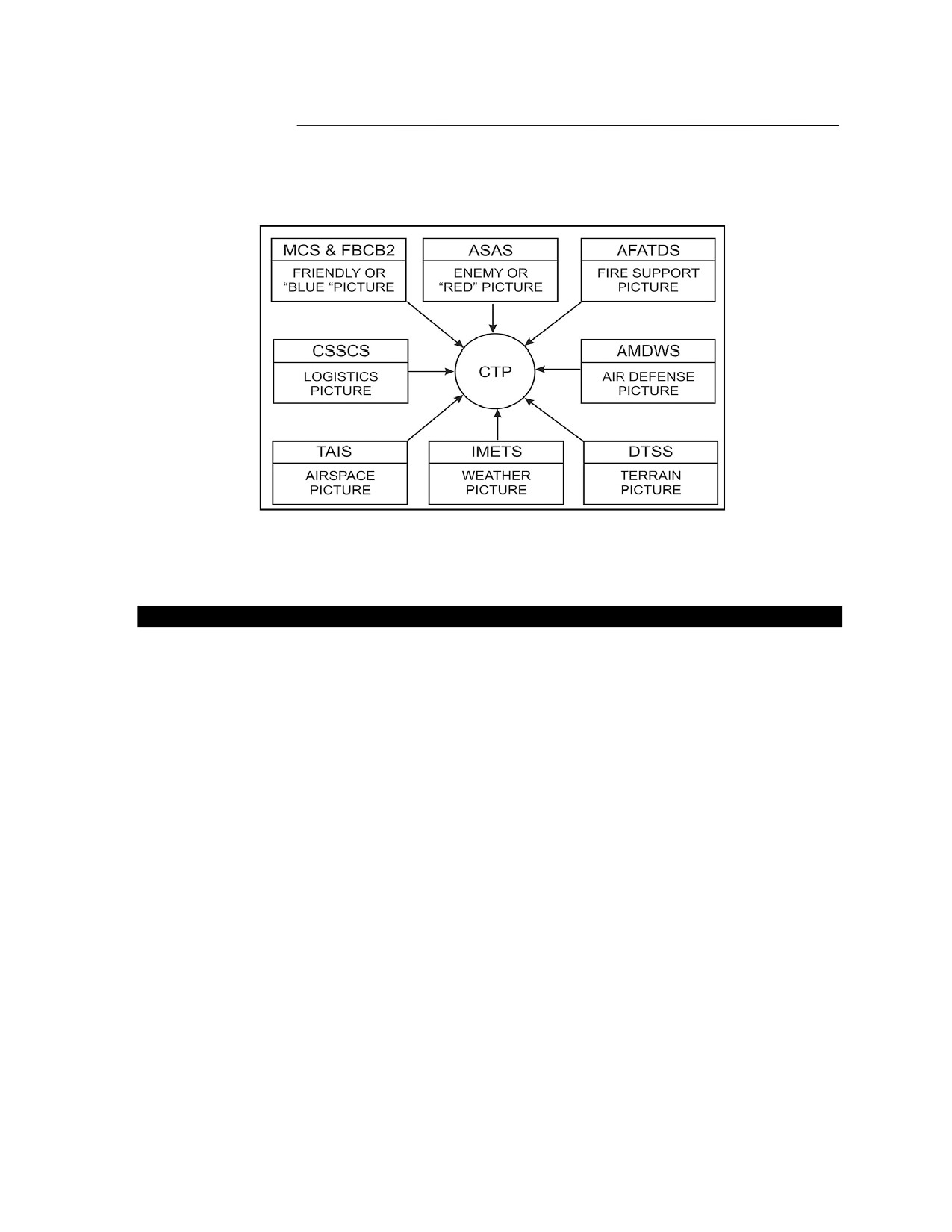
K-75. Figure K-3 shows the ABCS’s input that forms the CTP.
K-13
FM 3-04.111 (FM1-111)
Figure K-3. Common Tactical Picture
SECTION III - NETWORK ARCHITECTURE AND TACTICAL INTERNET
OVERVIEW
K-76. The Army’s network architecture is the Warfighter Information
Network-Tactical
(WIN-T). It is an evolving tactical telecommunications
system consisting of infrastructure and network components from the
maneuver battalion to the theater rear. It comprises multiple systems and
pathways designed to facilitate information distribution and access to
information services.
K-77. The TI is one element of WIN-T. The TI consists of tactical
communications radios, linked by routers, using commercial standards for
addressing and information protocols. It allows digital systems to send and
receive SA and C2 messaging.
K-78. Both SA and C2 pass simultaneously over the TI. The TI’s design
provides capabilities that are mobile, secure, survivable, seamless, and
capable of supporting multimedia tactical information systems. These
capabilities continue despite masking terrain, distance, enemy EW, loss of
key signal elements or CPs, or replacement of individual platforms. The TI
consists of two segments:
• A lower TI that connects echelons brigade and below.
• An upper TI that provides interbrigade and division connections and
above.
K-14
Appendix K
LOWER TACTICAL INTERNET COMMUNICATIONS
K-79. Digital communications connectivity for FBCB2 SA and other lower TI
C2 data for brigade and below has three primary components:
• EPLRS—data-only communication (platform position and network
coordination).
• SINCGARS—voice and data communications.
• Internet controller (INC)—routing and interface capability.
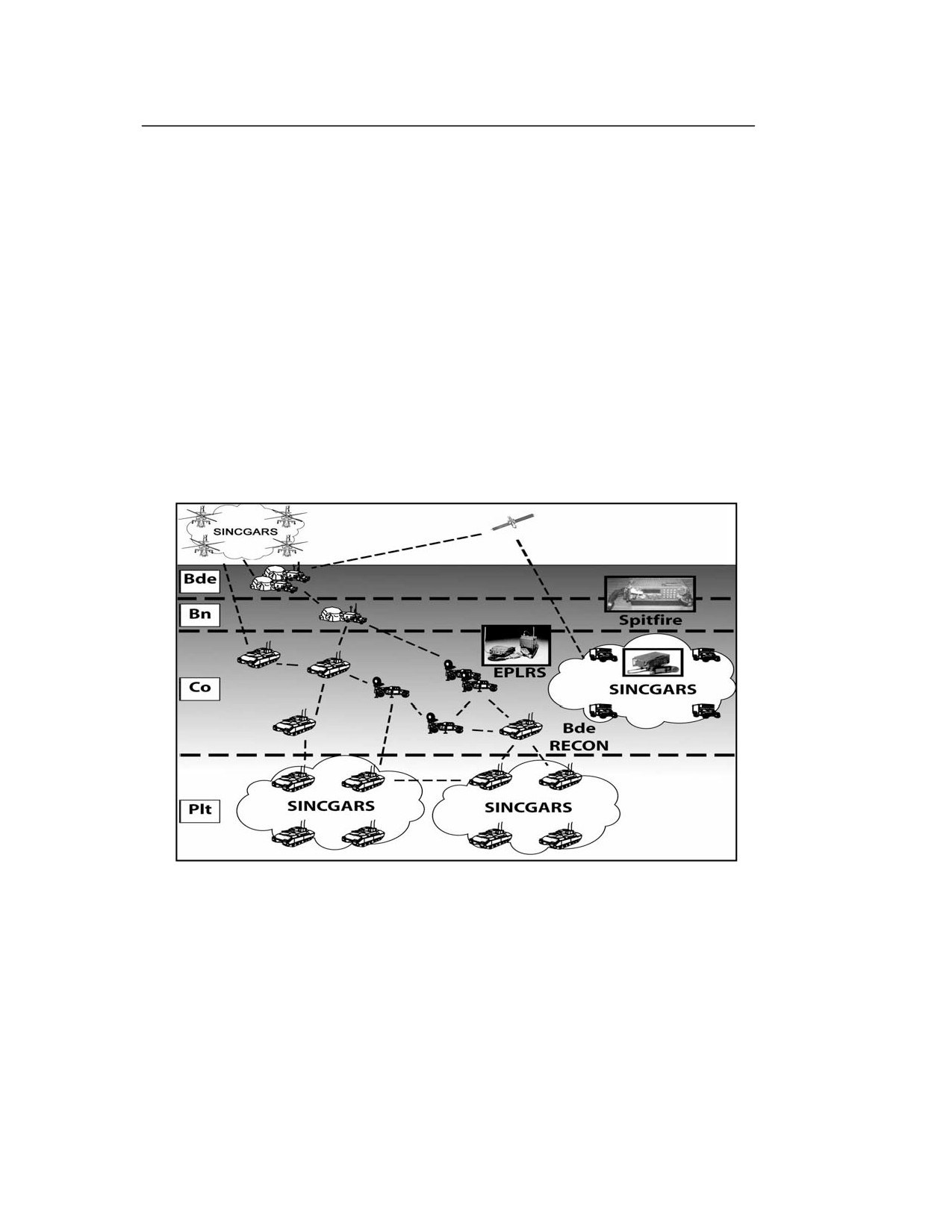
K-80. Not all FBCB2 ground or aviation platforms will be EPLRS equipped.
The non-EPLRS platforms pass FBCB2 data, via the INC, to servers with
SINCGARS and EPLRS. Every platform is associated with an EPLRS server
through which all SA and C2 data are routed. Platforms consistently evaluate
server quality and jump to an alternate server if the primary server output
degrades. Vehicles and aircraft without FBCB2 require verbal reporting and
manual tracking. Vehicles and aircraft with EPLRS and FBCB2 will have
displays showing the COP, tailorable to the needs of that platform (Figure
K-4).
Figure K-4. Lower TI Communications
UPPER TACTICAL INTERNET (WIN-T) COMMUNICATIONS
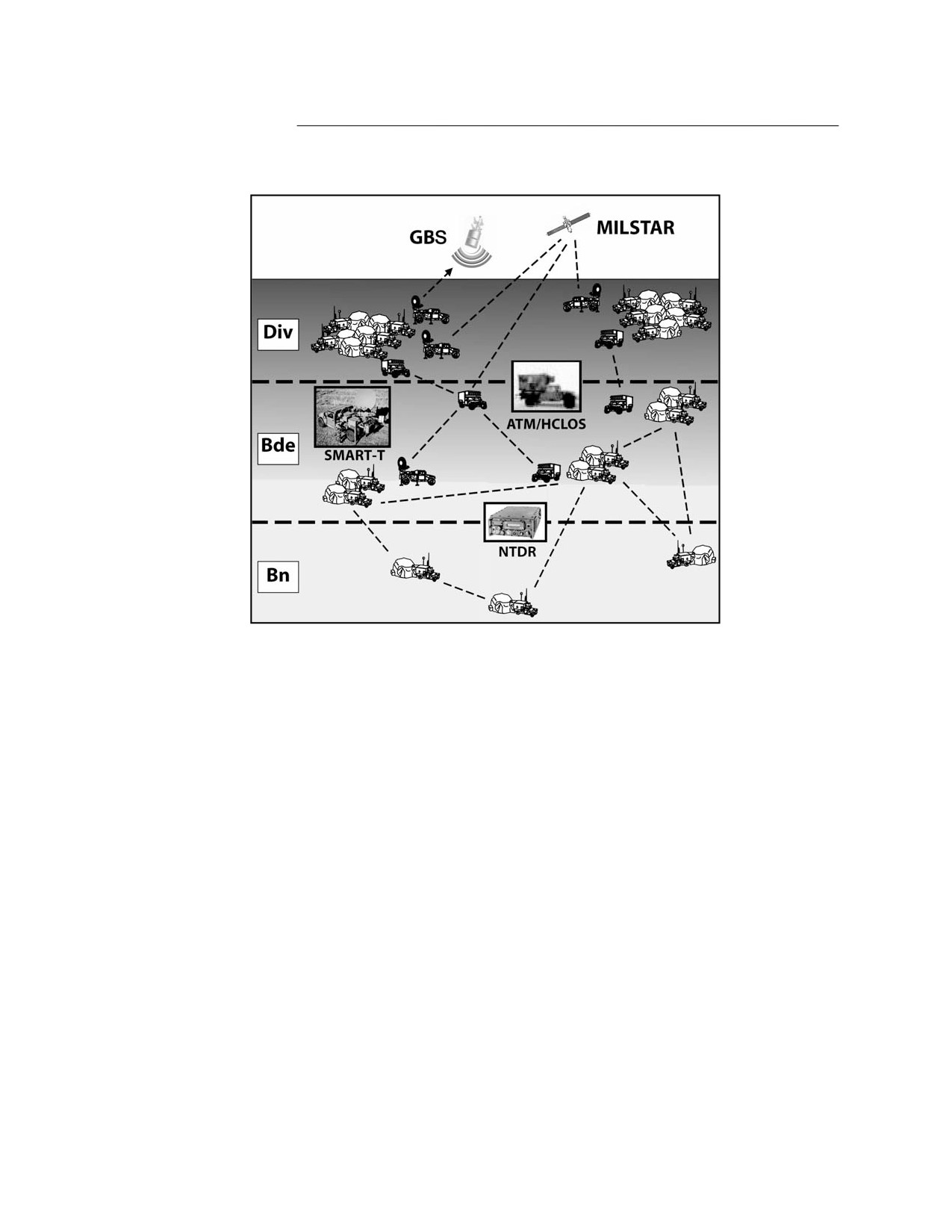
K-81. MSE and NTDR provide upper TI access/interface to the TOCs of the
battalion and brigade CPs. Upward dissemination of the FBCB2 COP SA and
C2 data occurs over the upper TI between the battalion and brigade TOC and
to higher echelons. The upper TI also permits access to the intelligence SA of
the Army Battle C2 System of higher and adjacent headquarters. The NTDR
handles the bulk of data between the battalion and brigade TOCs with
dissemination to and from higher headquarters via MSE (Figure K-5).
K-15
FM 3-04.111 (FM1-111)
Figure K-5. Upper TI Communications
K-82. At the battalion CP, the TOC INC routes the SA and C2 data over the
TOC LAN and NTDR. At the brigade CP, the TOC INC routes the SA and C2
data to other brigades and the division over the TOC LAN, NTDR, and MSE.
K-83. The upper TI is that part of the WIN-T that connects tactical echelons
to distant headquarters and information sources via the GBS, military
SATCOM terminals and satellites, high-capacity LOS transmission, and
high-altitude unmanned aircraft relay.
SEAMLESS TACTICAL INTERNET AND NETWORK ARCHITECTURE
CONNECTIVITY
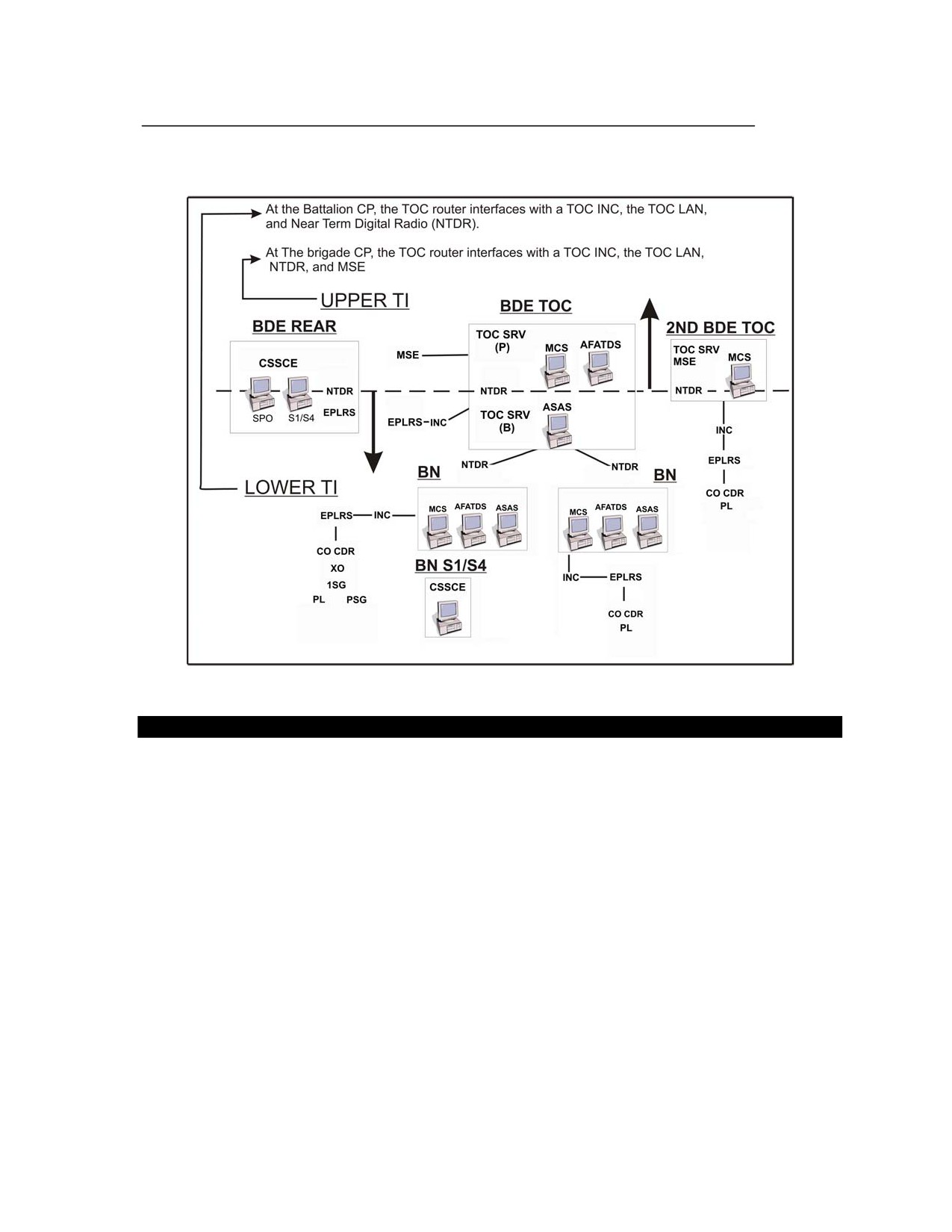
K-84. Both the upper and lower TI permit seamless exchange of SA and C2
data (Figure K-6). Brigade is the echelon where such transfer occurs between
the upper and lower TI. Four elements are essential to sharing SA and C2
messaging all the way down to a vehicle or aircraft platform:
• Appropriate radio waveform
(SINCGARS, EPLRS, NTDR, and
eventually JTRS).
• Application software (FBCB2 and ABCS).
• Network architecture (TI and WIN-T elements).
• Platform processing and display (SA software and display).
K-16
Appendix K
Figure K-6. Upper and Lower TI Interface
SECTION IV - DIGITAL COMMAND POST OPERATIONS
INTRODUCTION
K-85. The Army is making rapid and drastic changes in CP design, taking
full advantage of the newest computer technology. The CPs for digitized units
will be mobile, deployable, and equipped to access, process, and distribute the
information and orders for their echelon. This section outlines the internal
operations of a digital CP. FM 3-91 (FM 71-100), 71-100-2, FM 71-100-3, and
FM 5-0 (FM 101-5) contain detailed discussion.
DATA EXCHANGE
K-86. Central to digital CP operations is the manner in which they exchange
data. ABCSs share information either directly with one another or through
the JCDB. The JCDB resides on all of the ABCS computers in a CP and
provides the data for the common applications that generate the COP.
Battlefield information dynamically flows back and forth between ABCSs and
the JCDB. When data is entered through a BAS, this change is forwarded to
all ABCS subscribers on the CP’s tactical LAN (TACLAN) and posted to the
COP (Figure K-7).
K-17
FM 3-04.111 (FM1-111)
Figure K-7. Data Exchange Within a CP LAN
K-87. Data are also exchanged between CPs. This exchange allows the same
data to be maintained in the JCDBs in different CPs. Data generated by each
BAS flows to its counterpart BAS at adjacent echelons. Each BAS then
transfers this information to the JCDB at that echelon via the TI. Friendly
picture position information flows from FBCB2 upward through the server
located at each echelon. This information is then deposited into that echelon’s
JCDB. This data exchange ensures that all TOCs have JCDBs resembling
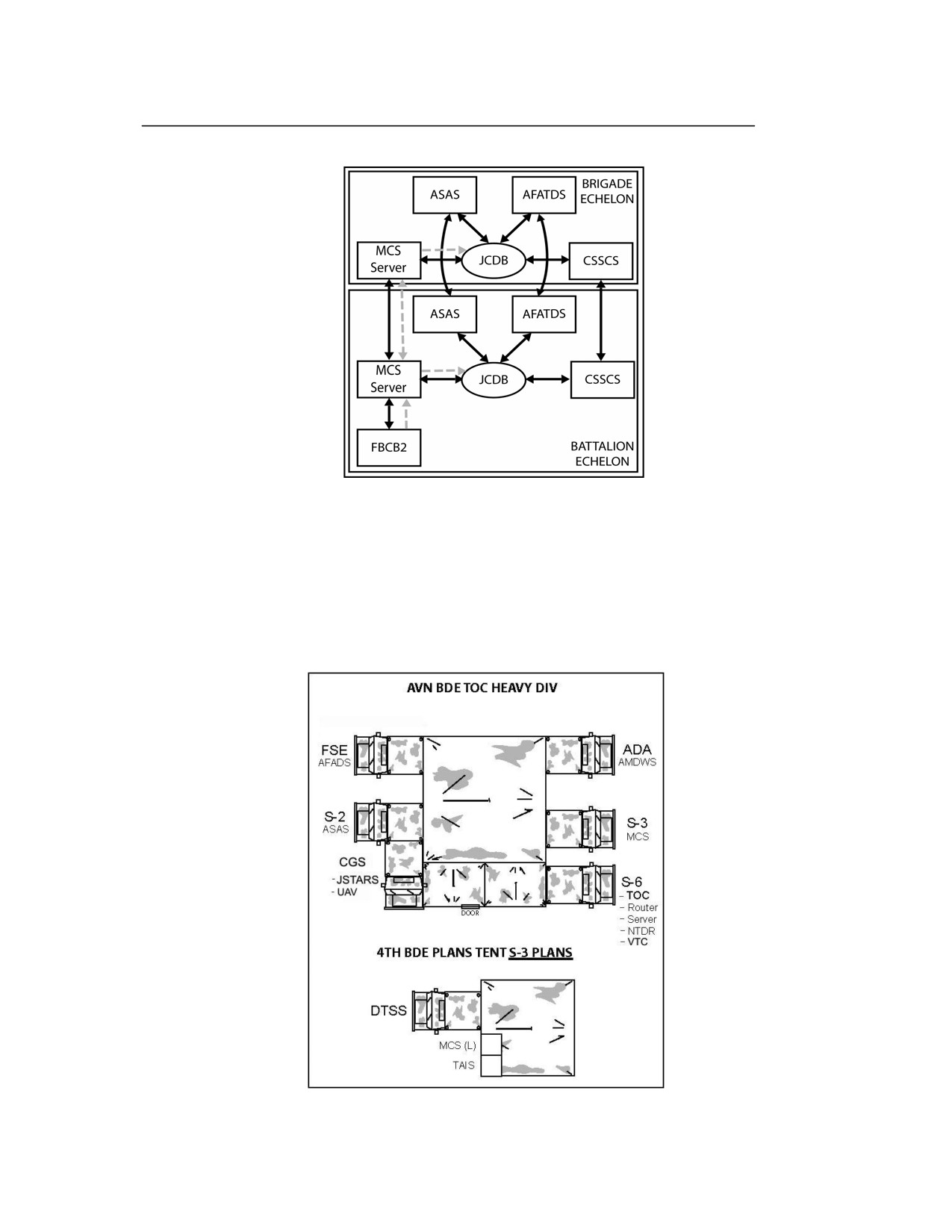
one another. This is key to creating the COP. Figure K-8 shows this data flow
between an example battalion and brigade with their MCS operating as
servers. Note the flow of friendly position information (depicted by dashed
arrows) moving between these echelons and into their JCDBs. Each BAS can,
in turn, access this friendly picture from the JCDB at its echelon. The flow of
data from a BAS to other BASs and the JCDB is shown by solid arrows.
DIGITAL COMMAND POST LAYOUT
K-88. The standardized integrated command post system (SICPS) is the new
generation of CP facility systems to support digitized units. SICPS is a C2
enabler, providing the platform from which to conduct digital CP activities.
Its primary purpose is to support C2 of digitized units by housing their
ABCSs. SICPS is designed to facilitate CP operations by providing the
flexibility, commonality, and operational capabilities needed to enhance unit
mobility and integrate ABCS and associated communication and networking
equipment. It supports the integration of these C4ISR assets into platforms
that can serve as a stand-alone CP or as an integrated element in a larger
digitized CP.
K-89. The SICPS has seven CP variants to include track- and
wheeled-vehicle-mounted vans, tents, and hard shelters. The digital CP will
collocate staff sections and supporting communications systems to facilitate
both face-to-face interaction and digital data exchange.
K-18
Appendix K
Figure K-8. Example of a Data Exchange Between CPs
K-90. Figure K-9 shows one configuration for the aviation brigade digital CP.
Specific unit SOPs may differ from this example. As with the analog CP, the
digital CP’s physical setup must facilitate communication and analysis of
information as well as accommodating computer hardware requirements.
Within the digital CP, information is processed at two locations: individual
workstations and the combat information center (CIC).
Figure K-9. Typical Aviation Brigade Digital CP Layout
K-19
FM 3-04.111 (FM1-111)
INDIVIDUAL WORKSTATIONS
K-91. The focus of the individual workstation is the individual BAS and the
specific BOS that it supports. At his workstation, the staff member inputs
and monitors data within his sphere of responsibility. He also accesses data
posted to web pages and shared files by other staff sections in the LAN and
WAN to carry out his BOS functions and duties.
COMBAT INFORMATION CENTER
K-92. The focus of the CIC is integrated battle monitoring and decision
making. It is a special location within the CP for the display of information.
The CIC is the central area for viewing information for the commander and
his staff to maintain SA.
LARGE SCREEN DISPLAY
K-93. The large screen display (LSD) is the only area in the CP where all key
BAS data can be viewed simultaneously. It is, therefore, the place where
battlefield vision is best supported. The commander uses the CIC to illustrate
his guidance and, with his staff’s assistance, to develop and maintain the
COP. CICs will vary by MTOE. However, the typical CIC has two LSDs, each
capable of displaying nine subscreens. Each subscreen can display the COP
and can be configured in various ways to best support the commander’s
information display preferences. The more subscreens used, the lower the
resolution of the image. It is, therefore, recommended that each LSD screen
use no more than four subscreens. Two LSDs allow the display of eight
subscreens, which should ordinarily be enough. The addition of the engineer
battalion LSD will increase this display capability.
DATA DISPLAY MANAGEMENT
K-94. IO play a key role in a commander and staff’s ability to maintain an
accurate picture of the battlefield in the CIC. With feeds from each ABCS, the
LSD enables them to see more of the battlefield and to receive greater
amounts of real-time battlefield information by BOS than is available with
analog systems.
K-95. More information is not necessarily beneficial to mission planning and
accomplishment. Data must be filtered, fused, and focused to create
meaningful informational displays relevant to the mission. These displays or
tactical pictures must, therefore, be presented in a logical manner on the LSD
to support SU. CP digitization has replaced analog maps, acetate, and wing-
boards with digital overlays and electronic files. Because electronically stored
information is readily available through a minimum number of computer
keystrokes, there is also less need to print paper copies of the information.
However, information saved electronically has a tendency to be “out of sight,
out of mind.” Leaders and staff must, therefore, know what data is available
to them to make decisions about what will be displayed.
K-96. Although the LSD can display any BAS electronic data, the narrative
and static aspects of some information still lend themselves to paper-copy
K-20
Appendix K
posting within the CP. This is especially true for information that is less
likely to change during a mission such as CCIR and the synchronization
matrix. In turn, this optimizes the use of LSD subscreens by freeing them to
depict dynamic ABCS digital content. The commander, XO, S3, and battle
captain must be able to orchestrate BOS coordination through the display of
key information on the LSD. Each staff section must, therefore, maintain
information relating to its BOS using visual graphics that support the COP.
Staff sections and their supporting systems should be arranged around the
LSD to facilitate information control, interaction, coordination, and
information analysis.
K-97. The COP is displayed on the LSD through one ABCS, typically the S3’s
MCS or MCS-L. COP control and manipulation and CP LAN administration
are aided by centrally collocating the CP server and the BAS that projects the
COP. The ability to view the LSD through the BAS controlling the COP also
facilitates communication and navigation through data. During discussions
in the CIC, personnel can focus staff on key portions of the COP. Data will be
displayed on the LSD via the COP using the ABCS COP application or
through overlays provided by individual BASs. To portray the COP
graphically requires METT-TC analysis of information. The COP displays
enemy (shown as red feed and graphics), friendly (shown as blue feed and
graphics), terrain
(shown as characteristics and impact), and civilian
considerations (shown as gray feed and graphics).
K-98. Friendly analysis occurs in the CIC by all BOS sections and systems.
Each BAS provides BOS overlays for subsequent data manipulation and
consolidated viewing in the form of operational pictures that form the COP.
Enemy analysis is especially time-sensitive information.
K-99. The MCS whiteboard or electronic whiteboard equips leaders and
staffs to conduct collaborative sessions. Participants at distributed locations
view the same enemy and friendly COP on an MCS display and are linked
with audio. The telestration feature of whiteboard allows each participant to
use a mouse with a crayon drawing capability to visually depict locations,
graphics, and other coordination measures that can be seen on the
participants’ screens.
DIGITAL STAFF ESTIMATES
K-100. Not all key information can be graphically depicted on the LSD. Such
information must be captured in a readily available, continuous update
format for quick dissemination and assimilation. FM
5-0
(FM 101-5)
emphasizes that each staff section should maintain a staff estimate (in
narrative form, at division and higher and, in graphical form, at brigade and
battalion). In the analog CP, these graphical staff estimates correspond to the
“wing board” and map data.
K-101. Digitization has eliminated the need to post information to wing
boards but has created the need to organize digital data. Units must
capitalize on the TACLAN web pages maintained by each staff section for
organizing and posting critical mission data. By placing digital staff
estimates on a web page, each staff section supports the commander’s and
K-21
FM 3-04.111 (FM1-111)
staff’s need to quickly review, update, and use information for battle
monitoring and planning.
K-102. Establishing a standard staff estimate format facilitates navigation
through the estimate and cross-referencing between estimates. Staff
estimates should also list available BOS overlays by name to better focus
graphical review within the ABCS COP application and to focus all echelons
and staff on the same, most current data. Through digitally equipped LNOs,
analog units should access these digital estimates to obtain current
operational data and to help synchronize their operations with digital units.
INFORMATION MANAGEMENT
K-103. The staff must be organized to support the information management
process of filter-fuse-focus. This process will be guided by doctrine, TTP, and
unit SOPs. The staff must operate according to established procedures that
specify access to common databases, common displays, and report formats.
The staff must be organized to allow the vertical and horizontal flow of
information. This organization should provide links between teams within
staff sections, between staff sections within a CP, and between CPs at the
same, higher, and lower echelons.
K-104. Digitization enables commanders and staff members to focus more on
the execution of combat operations and much less on planning, coordination,
and the processing of information. Commanders and staff will have much
more data upon which to base their decisions. Their challenge, therefore, will
be to manage the flow of vast amounts of data so that the right information
gets to the right person at the right time. These specific challenges are—
• Relevancy: Determine the relevant information from among the vast
amount of data available.
• Responsibility: Ensure that each product is the assigned responsibility
of a specific staff section.
• Accuracy and Currency: Ensure that the data are correct and up-to-
date.
• Dissemination: Ensure that information generated by the staff gets to
the right personnel.
• Evaluation: Ensure that information is appropriately assessed.
RELEVANCY
K-105. Because of the large quantity of data available, the commander needs
to establish information priorities to focus the staff during their data
collection. These priorities must address the relevant information to the
specific operation. The commander provides this focus via CCIR that are—
• Specified by the commander and applicable only to him.
• Situation dependent and linked to present and future operations.
• Based on events or activities that are predictable.
• Time sensitive (answers to CCIR must be reported to the commander
by the most rapid and effective means).
K-106. Table K-1 summarizes the CCIR responsibilities.
K-22

Appendix K
Table K-1. CCIR Responsibilities
Duty
Sample Briefing Items
Position
Establish CCIR
Establish priorities for information collection and distribution
Commander
Assign assets to collection information
Determine display of information throughout his command during an operation
Manage CCIR
Establish TTP for tracking when and how CCIR are answered
Chief of Staff/
Assign responsibilities to personnel within the staff sections and CPs to manage
Executive
information
Officer
Supervise commander’s guidance for collecting, processing, and circulating
information
Manage information within BOS
Staff Leaders
Recommend CCIR based on analyses
Record, evaluate, analyze, and report collected information to answer CCIR
Monitor ABCS traffic
Know what to file, what data to display, what to name/rename files, and where to
Staff Section
store them
Operators
Know what graphics to display
Be alert to CCIR and know how to act on CCIR for these requirements
RESPONSIBILITY
K-107. The diverse products produced using ABCS must each be the
responsibility of specific staff sections. This responsibility will usually be
obvious, being based on doctrine. Unit SOPs/TTP must confirm these
doctrinal responsibilities while ensuring that all other products are the
assigned responsibilities of specific staff sections.
ACCURACY AND CURRENCY
K-108. Because ABCS is automated, it allows information to flow much more
quickly and accurately. However, while ABCS is automated, most of its
information does not flow automatically. Only friendly position data (which
supports the friendly or “blue” picture) flows automatically via FBCB2 and
the TI. For all other data to enter and flow throughout ABCS, each BAS must
be properly initialized and its data maintained. Staff sections will have ready
and routine access to the many products of other staffs and units at varied
echelons. This outside access may take place without a staff section knowing
about it. Staffs must ensure that they continuously post their most up-to-date
products and maintain them on staff web pages or shared folders. CP internal
procedures must specify routines and suspenses for producing and revising
ABCS products and specify where they will be maintained.
DISSEMINATION
K-109. Because of bandwidth limitations, it might not be possible to
routinely send out products through e-mail. On the other hand, it is not
enough to merely post information to a web site or shared folder and expect
others to use it. With the exception of routine, scheduled postings and
updates, the staff must proactively notify users when such changes are made.
When a product is posted or revised, staff sections must notify other staff
sections and units at the same, lower, and higher echelons. This notification
must include instructions on precisely where to find the product and its file
K-23
FM 3-04.111 (FM1-111)
name. Units must establish SOPs that specify file-naming conventions and
file-management procedures. Whether forwarding products or providing
notification of product postings in shared files/web pages, the right personnel
must receive the right information. Correct address information using the
ABCS address books and message handling tables
(MHTs) must be
established to ensure that data will be sent to the correct BASs. Addressees
must be the users employing the individual ABCS rather than generic role
names in the address book. If this is not done correctly, information on one
BAS will not flow to other BASs even in the same TOC. During initialization,
operators must also create and distribute databases, which can be done via
messages in ABCS. These databases will ensure that BASs can share the
right kind of information.
EVALUATION
K-110. Computer data tends to be accepted at face value because it is
computer-based and, therefore, is assumed to always be correct. Users of
digital systems must resist this tendency. Error can be introduced through
failures in BASs, databases, and communications systems; human error in
inputting data; and failing to update information in a timely manner. Data
must therefore be evaluated within the context provided by SU to verify that
they are accurate and current. Users must follow up on discrepancies to
ensure that they have the right information.
SECTION V - DIGITAL DUTIES AND RESPONSIBILITIES
K-111. Staff functions as described in FM
5-0
(FM
101-5) will not
fundamentally change in the digital CP. However, these functions will be
carried out differently using the digital tools that ABCS provides.
Digitization will also require personnel to perform new functions as listed
below. These digital CP tasks should be conducted in addition to and as a
part of standard staff responsibilities.
COMMANDER
K-112. The commander has the following digital duties and responsibilities:
• Provides command guidance for employing ABCS.
• Provides C2 of automation resources.
• Establishes automation support priorities.
• Specifies the unit’s COP.
• Establishes the CCIR and ensures that these requirements are
depicted in ABCS.
• Ensures that subordinate leaders are trained in the employment,
operation, and sustainment of automation.
• Trains subordinate leaders and staff to create, maintain, distribute,
and use the COP.
K-24
Appendix K
EXECUTIVE OFFICER
K-113. The XO has the following digital duties and responsibilities:
• Coordinates the staff to ensure ABCS integration across BAS.
• Ensures that the staff integrates and coordinates its ABCS activities
internally, vertically
(with higher headquarters and subordinate
units), and horizontally (with adjacent units).
• Manages the CCIR; ensures satisfaction of the CCIR.
• Directs the creation and distribution of the COP to include procedures
for updating enemy and friendly SU.
• Monitors the information filters, collection plans, and networks that
distribute the COP.
• Provides guidance for automation support.
• Coordinates the staff to ensure automation support.
• Coordinates procedures for inter-CP VTCs and whiteboard sessions.
• Monitors liaison teams with analog
(nondigitized) units and
joint/allied forces for their contribution to the COP.
S1
K-114. The S1 has the following digital duties and responsibilities:
• Is responsible for personnel functions of CSSCS.
• Employs CSSCS to monitor and report on personnel-related portions
of the commander’s tracked item list (CTIL).
• Manages Standard Installation/Division Personnel System (SIDPERS)
interface with CSSCS.
S2
K-115. The S2 has the following digital duties and responsibilities:
• Acts as staff proponent for ASAS and IMETS.
• Supervises ASAS and IMETS operations and support.
• Provides guidance on employment and support of ASAS and IMETS.
• Supervises the information security program; evaluates security
vulnerabilities.
• Assists the G6/S6 in implementing and enforcing LAN security
policies.
• Provides software application expertise on proponent systems.
S3
K-116. The S3 has the following digital duties and responsibilities:
• Acts as staff proponent for MCS, AFATDS, AMDWS, FBCB2, and
AMPS.
• Plans, integrates, and employs ABCS.
• Develops the ABCS annex for plans and orders.
• Develops ABCS annexes to the garrison and tactical SOPs.
K-25
FM 3-04.111 (FM1-111)
• Oversees offensive IO and defensive IO.
• Provides operational and support guidance regarding network
employment to subordinate units.
• Integrates AMPS and distributed planning data.
• Creates, maintains, and displays the COP; maintains SU of all units.
• Coordinates with G6/S6 for communications connectivity in support of
ABCS.
• Plans and monitors operator digital sustainment training.
• Provides software application expertise on proponent systems.
• Assigns LNOs and coordinates their digital support.
• Collects and distributes postmission results/BDA.
S4
K-117. The S4 has the following digital duties and responsibilities:
• Acts as staff proponent for CSSCS.
• Supervises CSSCS operations and support.
• Provides guidance on employment and support of CSSCS.
• Monitors and reports on the status of all automation equipment.
• Provides software application expertise on proponent systems.
S6
K-118. The S6 has the following digital duties and responsibilities:
• Serves as signal subject matter expert to the commander; advises the
commander and staff on all signal support matters.
• Monitors WAN performance; integrates the CP LAN.
• Is responsible for all automation information systems, automation and
network management, and information security.
• Ensures consistency and compatibility of automation systems.
• Manages the TI; is responsible for network employment, network
configuration, and network status monitoring and reporting.
• Receives planning worksheets with LAN/WAN requirements.
• Ensures unit information network connectivity between unit and
higher/lower echelons.
• Plans, coordinates, and manages network terminals.
• Develops, modifies, and manages network need lines, UTO, and base
configuration files.
• Plans, coordinates, and manages communications links to include
reach-back communications.
• Coordinates with higher echelon signal officers for additional
communications support.
• Develops and coordinates the signal digital support plan.
• Determines system and retransmission requirements for the tactical
situation.
K-26
Appendix K
• Coordinates with higher, adjacent, and subordinate units in
development of the signal digital support plan.
• Manages the release of ABCS software within the unit.
• Provides a focal point for automation support (help desk).
• Implements and enforces LAN security policies.
• Establishes COMSEC accountability, distribution, destruction, and
security procedures within the unit.
MISSION APPLICATION ADMINISTRATOR
K-119. The mission application administrator has the following digital duties
and responsibilities:
• Helps the S6 manage the network.
• Plans and coordinates the linking of BAS to the unit CP.
• Supervises and performs unit-level maintenance and installs and
performs maintenance on multifunctional/multiuser information
processing systems, peripheral equipment, and associated devices in
mobile and fixed facilities.
• Performs analyst functions; constructs, edits, and tests computer
system programs.
• Performs preliminary tasks necessary for CP LAN initialization.
• Assists in troubleshooting digital systems.
• Conducts data system studies and prepares documentation and
specifications for proposals.
• Maintains master copies of software.
• Backs up data for user-owned and -operated automation information
systems.
• Assists in recovery of digital data at the user level.
• Operates and performs PMCS on assigned vehicles and power
generators.
• Monitors BAS PMCS program.
• Coordinates repairs with the S6 section.
BATTLE CAPTAIN/BATTLE STAFF NONCOMMISSIONED OFFICER
K-120. The battle captain/battle staff NCO has the following digital duties
and responsibilities:
• Oversees operations of assigned BAS.
• Controls/directs the initialization of the BAS within the CP LAN
(battle staff NCO).
• Ensures that information flow and coordination take place between
and within each staff section and with higher, adjacent, and lower
headquarters.
• Accesses and employs information through ABCS in support of
operations and planning.
• Ensures that key BAS products are available and current in support
of the mission.
K-27
FM 3-04.111 (FM1-111)
BATTLEFIELD AUTOMATED SYSTEM OPERATORS
K-121. The battlefield automated system operator has the following digital
duties and responsibilities:
• Installs and operates assigned digital hardware and software.
• Establishes connectivity of assigned BAS within LAN/WAN; ensures
that the system interfaces with correct tactical communications.
• Inputs operational data.
• Produces automated reports required by commanders and staff
leaders.
• Performs PMCS on assigned BAS.
• Isolates, identifies, and tracks digital system problems.
• Maintains continuity of digital operations.
• Maintains portions of the COP, as assigned.
• Ensures unit-level information security.
SECTION VI - MANAGEMENT OF DIGITAL COMMAND POST PERSONNEL
BATTLE ROSTERS
K-122. Each section within the CP must maintain a digital battle roster
listing the section operators assigned to each BAS. At a minimum, sections
should plan for three operators per system: two soldiers to man a 12-hour
shift each plus one soldier to serve as a backup and to provide periodic relief.
The roster should list the following:
• Personnel name and rank.
• Assigned BAS.
• Assigned shift.
• Date of most recent training on system.
• Software version of most recent training.
• Estimated date of departure from unit.
K-123. Operators should be managed in a manner similar to unit vehicle
drivers according to the following principles:
• Depth: Have more trained operators than needed to ensure BAS
coverage even when unanticipated losses occur.
• Anticipate: Know when personnel are scheduled to depart the unit,
and train their replacements well in advance.
• Leaders: Section leaders should be prepared to function as operators;
in addition to providing additional coverage, this ability enables
section leaders to better supervise and employ the BASs that they
oversee.
• Currency: Operators must be trained on the most current software
carried on their BAS.
K-28