FM 3-04.111 (FM 1-111) Aviation Brigades (AUGUST 2003) - page 10
Appendix F
• Ceases operations; does not allow personnel in the area until the fuel
is vapor-free.
Large Spill
F-306. For large spills the responsible unit—
• Calls the fire department immediately.
• Stops the flow of fuel; after taking all safety precautions, personnel
may consider removing aircraft, refueling vehicles, and personnel
from the spill area.
• Shuts engines off.
• Blankets large fuel spills with foam.
F-307. The fire chief directs subsequent recovery of fuels. He does not use the
area for operations until it is declared free of fuel and fuel vapors.
ADDITIONAL ACTIONS
F-308. If berms or grated trenches did not contain the spill, the responsible
unit establishes an area of isolation. The area size depends on the spill’s size
and the waste removed.
F-309. If the spill produces a toxic vapor cloud, evacuate the area. If large
quantities of volatile (toxic or combustible) materials spill, the responsible
unit evacuates a downwind area at least 500 feet wide and 1,000 feet long.
Contact the Air Weather Service
(AWS) for ambient wind speeds and
directions. The AWS will assist the fire chief and commander or on-site
coordinator by providing toxic corridor computations. The responsible unit
should—
• Use pumps or tank trucks to collect as much of the material as
possible.
• Use hay or other absorbent material to absorb oil not collected by
pumping.
• Dispose of contaminated earth and absorbent material as directed by
the environmental officer, commander, or on-site coordinator.
RESPONSIBILITIES AND DUTIES OF ON-SITE COORDINATOR
F-310. The on-site coordinator coordinates plans with the response team,
state, and local representatives. He—
• Determines when the area is clean enough for normal service to
return.
• Briefs and dispatches a response force to the accident scene and
determines the need for additional support teams.
• Locates or relocates the mobile CP, if necessary.
• Receives a briefing from the fire chief or other personnel on actions
taken.
• Evacuates and establishes a disaster cordon around the area and
establishes an entry control point, allowing only essential personnel in
the area.
F-75
FM 3-04.111 (FM1-111)
• Secures the accident scene after the area is declared safe and declares
“all clear” following withdrawal, as the situation dictates.
• Coordinates appropriate actions with local civil authorities at the
accident scene.
• Coordinates logistical support, as necessary.
• Informs higher headquarters of the situation and actions taken and
notifies appropriate agencies if unit personnel cannot sufficiently
contain and clean the spill.
RESPONSE TEAM ORGANIZATION AND TRAINING
ORGANIZATION
F-311. Units establish procedures and response teams to manage
environmental emergencies. The installation or major subordinate command
governs organization and provides training.
TRAINING
F-312. Training includes classroom and emergency-response exercises.
Classroom instruction trains response teams in exposure hazards of
substances that they may encounter during a spill response. Training
exercises focus on actual spill-control and cleanup activities. Team members
receive proper hazardous substance response training to—
• Familiarize them with facility layouts and typical oil and hazardous
substances.
• Use and maintain breathing apparatuses and other equipment.
• Classify hazardous substances and their characteristics.
• Retain spills and recover spilled substances.
• Dispose of contaminated soil, absorbent material, and recovered
pollutants.
• Restore the contaminated area to its former condition.
F-313. Individuals who store, transfer, or employ oil or hazardous substances
require some level of hazard training; recommended training includes—
• Spill procedures and safety concerns.
• Reaction and avoidance of exposure to hazardous substance spills.
• Specific safety requirements and procedures of the work assignment.
F-76
Appendix G
Army Airspace Command and Control
The term Army airspace does not signify ownership of any airspace
contiguous to the battlefield or any other geographical dimension.
Airspace is a joint medium for all friendly combatants. Each joint force
component may operate aerial vehicles and weapons systems within the
airspace with maximum freedom consistent with priorities, the degree of
operationally acceptable risk, and the joint force commander’s intent.
SECTION I - AIRSPACE INTERFACE
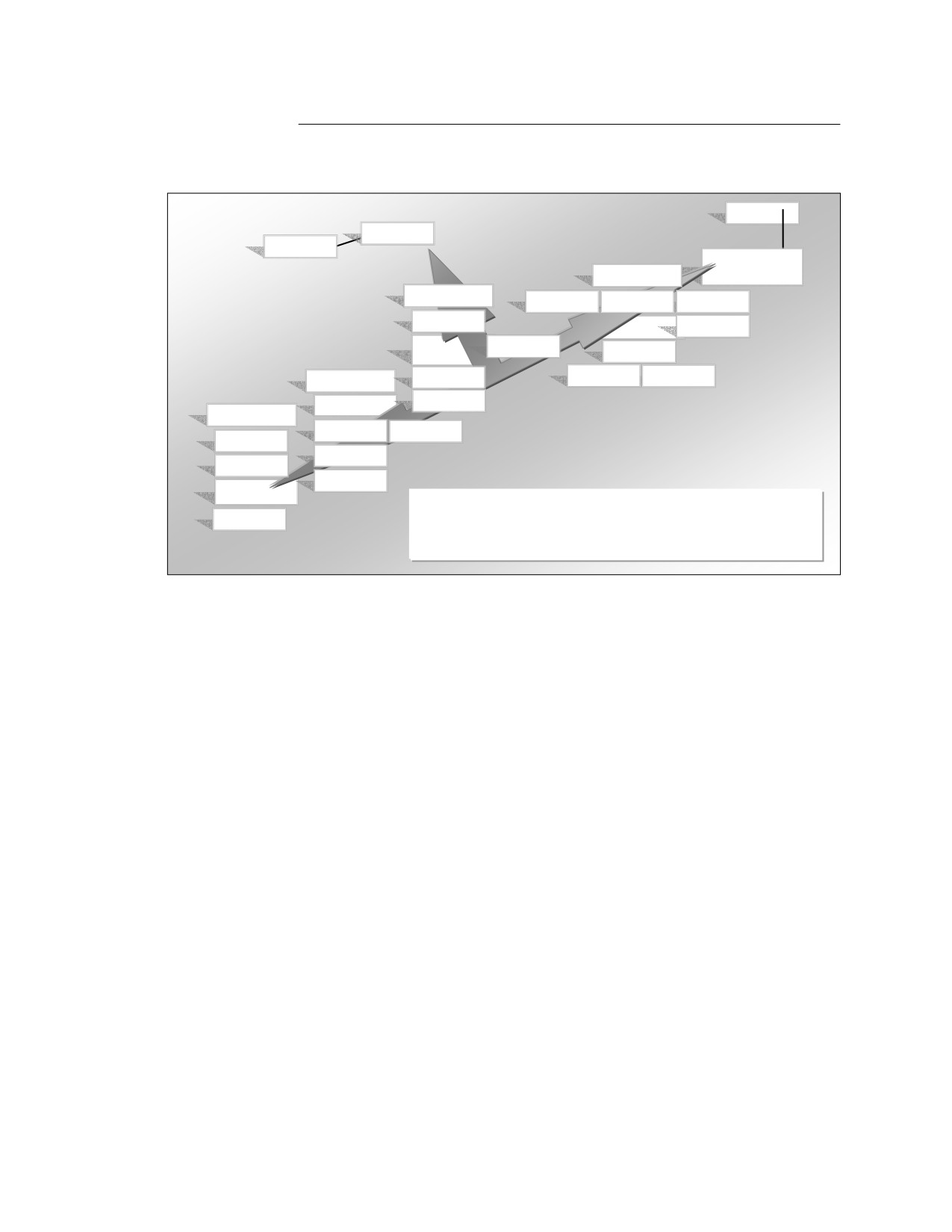
G-1. The A2C2 system is the airspace management component of the Army
Air Ground System (AAGS). It outlines the Army’s integration of airspace
usage and C2 within the framework of the TAGS. These systems, in whole or
in part, are placed in each echelon from maneuver battalion to numbered
army. This appendix summarizes these systems and the communication
mediums used to accelerate the airspace control authority’s objectives. AAGS
is the control system for synchronizing, coordinating, and integrating air
operations. It provides the means to initiate, receive, process, and execute
requests for air support and to disseminate information and intelligence
produced by aerial assets.
G-2. AAGS interfaces with elements from other services to function as a
single entity in planning, coordinating, deconflicting, and integrating air
support operations with ground operations. The Army elements of the AAGS
consist of CPs, FSEs, air defense elements, A2C2, and coordination/liaison
elements (Figure G-1).
SIMULTANEOUS USE
G-3. A2C2 maximizes the simultaneous use of airspace. At decisive moments,
commanders are able to exploit all available combat power—synchronized in
time, space, and purpose. Potential users of the aerial dimension of the
battlefield include not only Army aviation but also AD, MI, FS, and joint and
combined air and ground forces.
FRATRICIDE AVOIDANCE
G-4. Effective airspace management and control minimize the risk of
fratricide and increase overall force effectiveness. The A2C2 system provides
an effective conduit for timely bidirectional communication between the
airspace control authority (ACA) and all friendly airspace users. The air
ATO), published daily by the ACA, directs tactical IFF use and assignments
in each theater, as well as projecting ground combat movements.
G-1
FM 3-04.111 (FM1-111)
ARFOR
AAMDC
XXXX
ADA
XXX
NUMBERED
XX
CORPS
ARMY
DIV
DOCC
CP
SOCCE
AAGS
CP
FSE
NG REP
ANGLIC
FSE
A2C2
X
TACP
ASOC
BDE
A2C2
II
TACP
CP
BN
FSE
ANGPLT
CP
A2C2*
FSE
TACP
A2C2*
A2C2* - ad hoc elements perform A2C2 functions at US Army battalion
TACP
and brigade levels. Currently no formal TOE A2C2 organization exists
at these levels. The proliferation of airspace platforms and users may
compel formal organizational changes.
Figure G-1. Army Air Ground System
ARMY AIRSPACE USERS
G-5. A2C2, AD, and FS coordination functions are interwoven. These
functions involve detailed coordination and integration of CAS, indirect fire,
organic and augmenting AD, and tactical fire and maneuver operations (to
include Army aviation). Brigade, battalion, and company commanders; FS
coordinators; ALOs; and FACs directly involved in localized combat
operations perform A2C2 functions established by higher echelons such as the
division A2C2 element.
AIR DEFENSE
G-6. AD protects the force and selected geopolitical assets from aerial attack,
missile attack, and surveillance. Air defense forces use both positive and
procedural means of fire control. Integration and airspace control are
imperative to ensure safe, unencumbered passage of friendly aircraft while
denying access to enemy aircraft and missiles. AD units require automated
transfer of airspace information via the airspace control order (ACO) and
ATO. AD units provide near-real-time airspace SA using organic and
integrated joint sensors at all echelons.
AVIATION
G-7. Army aviation combat, CS, and CSS operations are generally conducted
in the terrain-flight dimension of the battlefield, which is fundamentally
linked to it at all echelons. A2C2 planning should allow complete flexibility for
Army aviation units operating below the coordination altitude.
G-2
Appendix G
FIELD ARTILLERY
G-8. FA uses airspace to deliver indirect fires through airspace from
extremely low to very high altitudes. Personnel in the FSEs, from company
through corps, have the principal means for deconflicting FS with other
airspace users.
FIRE SUPPORT ELEMENT
G-9. The FSE coordinates planned fires and acts as the focal point for
airspace requests to support immediate fires. It forwards airspace requests,
through higher headquarters, to the corps A2C2 cell for ACO and ATO
inclusion. It also passes immediate airspace requests to the battlefield
coordination detachment (BCD) in the AOC.
MILITARY INTELLIGENCE
G-10. MI aircraft and UAVs conduct intelligence collection and target
acquisition missions. These platforms may use low-altitude airspace normally
allotted to the land component commander (LCC). However, they normally
conduct missions in upper-altitude airspace procedurally allotted to the air
component commander. The ATO and ACO include these upper-altitude
missions. However, commanders often direct these flexible, highly responsive
assets to perform immediate missions not in the ATO or ACO. The A2C2
system must provide a real-time conduit to acquire airspace for immediate
missions. The system must also be capable of displaying real-time, three-
dimensional locations of MI airborne platforms.
AEROMEDICAL SUPPORT
G-11. Aeromedical evacuation units provide 24-hour support within the AO.
To ensure rapid response to evacuation requests, aeromedical units provide a
coordinating element as part of the A2C2 system. This coordinating element
provides the interface necessary to complete time-sensitive airspace requests
with limited aeromedical assets. The A2C2 system provides the
communications means to coordinate with aircraft conducting the mission
because airspace clearance may occur in flight.
SPECIAL OPERATIONS
G-12. By design, SOFs deploy quickly in small, low-profile units to specific
regions or theaters of operations. The presence and number of other U.S.
forces in theater usually dictate the method of airspace deconfliction. Special
operations ground forces often operate beyond normal friendly troop
concentrations. Missions deep within enemy territory demand A2C2 systems
capable of restrictive battle space control measures to avoid fratricide.
AIRBORNE OPERATIONS
G-13. Airborne units require many of the same A2C2 considerations as
aviation and SOFs. They require airspace control measures to provide entry
and exit routes and ROAs to deconflict airspace from aircraft not directly
involved in the operation. The ground phase requires substantial
deconfliction of battle space. Once employed, these forces are often in areas
G-3
FM 3-04.111 (FM1-111)
beyond the normal concentration of forces—near free-fire areas for FA, other
fires, and effects of those fires.
INFANTRY OPERATIONS
G-14. As with FA indirect fires, infantry mortars require battle space
deconfliction.
MOUNTED GROUND OPERATIONS
G-15. Armor and mechanized units often spearhead ground elements in the
close battle. These forces can outpace airspace control measure updates
designed to protect those elements from fratricide. Simultaneous tactical
operations by attack helicopters and mechanized units require continuous
airspace deconfliction.
SECTION II - ARMY AIRSPACE COMMAND AND CONTROL STAFF
RESPONSIBILITIES
G-16. A2C2 requires a coordinated staff effort to accomplish the functional
activity of airspace control. This process—coupled with the near-real-time
collection and dissemination of information—increases combat effectiveness
by promoting the safe, efficient, and flexible use of airspace.
ARMY AIRSPACE COMMAND AND CONTROL RESPONSIBILITIES
G-17. Commanders and staffs must ensure that their assets, systems, and
personnel provide timely, relevant, and accurate information. Current
airspace utilization, gleaned from the ATO, helps C2 elements better
understand the overall intensity and flow of the battle. This information
enhances the A2C2 element’s efforts in coordinating use of airspace and
avoiding undue restrictions.
G-18. The G3/S3 Air has supervisory responsibility for airspace control. ATS
personnel within the A2C2 elements perform the integration function for all
airspace users. A2C2 elements provide the necessary communications to
interface with airspace control functions at each echelon. The A2C2 cell
displays both planned and ongoing use of airspace.
G-19. The A2C2 staff must have backup plans and alternate A2C2 cells to
assume A2C2 functions in case the primary cell is damaged or destroyed.
CORPS AND DIVISION ARMY AIRSPACE COMMAND AND CONTROL
ELEMENTS
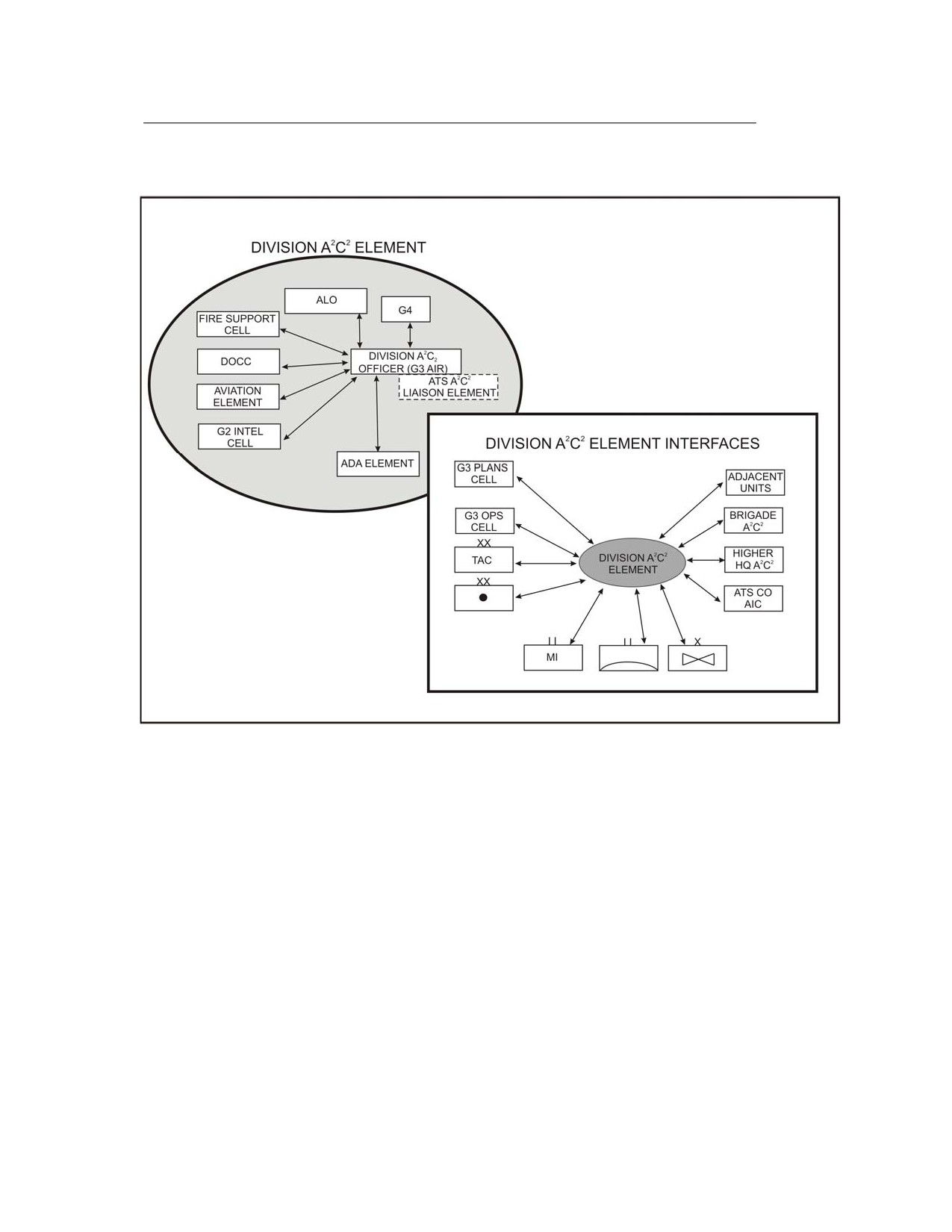
G-20. Corps airspace control elements orient on synchronizing combined
arms team airspace users with supporting sister services (See Figure G-2).
G-21. The division A2C2 focuses primarily on the close battle. It must move
airspace planning data to and from the corps A2C2 element and disseminate
the ATO, ACO, and A2C2 information to subordinate units.
G-4
Appendix G
Figure G-2. Example of Division A2C2 Element
G-22. A2C2 staff representatives include the following:
• G3 operations section (G3 Air).
• AD element.
• Aviation element.
• ATS liaison element.
• Fire support element.
• G2 section (as required).
• G4 section (as required).
• UAV unit commander and LNO/NCO (as required).
• Air Force TACP.
• air and naval gunfire liaison company (ANGLICO).
BRIGADE AND BATTALION A2C2 REQUIREMENTS
G-23. The brigade A2C2 element implements and disseminates the ACOs and
ATOs to the lowest levels. It also submits air-space control means requests to
the division A2C2 element for processing. When deployed as a separate task
G-5
FM 3-04.111 (FM1-111)
force, the brigade may receive TACPs and theater airlift liaison officers
(TALOs) to assist in mission planning.
G-24. Brigades and battalions do not have direct A2C2 support. Therefore,
existing staff personnel, LNOs, and FS representatives must perform the
A2C2 function supervised by the S3 Air.
G-25. The battalion S3 Air submits airspace control means requests to the
brigade A2C2 element for processing and forwarding. ADA, FA, MI, and
aviation battalions must receive and implement ACOs and ATOs.
SECTION III - COMMUNICATIONS CONNECTIVITY
TACTICAL AIRSPACE INTEGRATION SYSTEM
G-26. TAIS is a digitized, integrated airspace management and decision
support system. It automates A2C2 planning and operations and air traffic
services. It also helps planners build Army input for the joint ACO to
distribute the approved A2C2 overlay. TAIS takes input from multiple sources
and combines it into a single picture. Combined with the electronic ground
picture, it helps users visualize both the air and ground battle space. Each
system comes with extensive communications packages that allow operators
to communicate directly with the various airspace users. The system is
designed to automatically notify operators of potential conflicts in airspace
use. TAIS also has interoperability with both the Navy and Air Force
airspace management systems. Appendix K contains additional information.
THEATER BATTLE MANAGEMENT CORE SYSTEM
G-27. The Air Force uses the Theater Battle Management Core System
(TBMCS) to construct, disseminate, and execute the ATO and ACO. The
TBMCS interfaces with Advanced Field Artillery Tactical Data System
(AFATDS), AMDWS, and TAIS to support the production of the ATO, ACO,
and airspace control measures request.
SECTION IV - AIRSPACE CONTROL ORDER, AIR TASKING ORDER, AND
SPECIAL INSTRUCTIONS
G-28. The airspace control plan, ACO, and ATO are the foundations of
airspace operations in the joint environment. Airspace control must
effectively allow combat operations without adding undue restrictions or
adversely affecting the capabilities of any service or functional component.
AIRSPACE CONTROL PLAN
G-29. The airspace control plan is developed by the ACA and approved by the
joint force commander (JFC). It provides specific planning guidance and
procedures for the airspace control system and defines the joint force airspace
control organization. This plan outlines the airspace control process and may
be published either as an annex to the basic OPLAN or OPORD, or as a
separate document. Because the airspace control plan delineates the airspace
G-6
Appendix G
control area, planners must address coordination procedures for all airspace
users. Implementation of the airspace control plan is through the ACO, which
all components must comply with.
AIRSPACE CONTROL ORDER
G-30. The ACO and the airspace control plan are the two most critical
documents pertaining to all airspace control measures within a joint
operations area. The ACO is a jointly approved message implementing the
airspace control plan. It provides specific, detailed information on airspace
control and airspace control measures to all theater airspace users. The ACO
is published on a cyclical basis (normally daily), depending on the theater. It
may be part of the ATO or a stand-alone document. While the airspace
control plan provides general guidance on airspace control, the ACO
institutes airspace control procedures for specified periods. It also contains
modifications to the airspace control plan guidance and procedures, and it
activates or deactivates procedural control measures.
G-31. The ACO notifies appropriate air-ground systems nodes and the
controlling agencies of the effective times, altitudes, and distances for all
airspace control measures. The ACO may also include other pertinent
airspace information—such as FS and air defense control measures—that
deems necessary by the ACA.
G-32. The ACO consolidates input from all organizations involved in the
conflict and presents the final airspace control plan. While coordination and
integration of airspace requirements should be accomplished at the lowest
possible level, much is actually accomplished by senior C2 elements because
most ACMs are approved by the ACA. Regulation of the airspace control
function is decentralized to the maximum extent possible; however,
centralized direction by the ACA does not imply OPCON or TACON over any
air assets.
AIR TASKING ORDER
G-33. The ATO is a highly detailed, daily order that describes and directs the
overall air operation. This order contains mandatory, optional, and
conditional entries used to task and disseminate to components, subordinate
units, and C2 agencies’ projected sorties, capabilities, and forces to targets.
Each order provides specific instructions to include IFF modes and codes,
mission timing, routes of flight, targets, weapons loads, air refueling data,
and call signs, as well as general and SPINS. Overall, the ATO is divided into
three sections: (I) mission, (II) execution, and (III) SPINS. Essentially, the
ATO provides units with all of the guidance and direction that they need to
fly assigned missions.
G-34. Planning and executing of the joint ATO are a continuous process of
accommodating changing tactical situations and JFC guidance as well as
requests for support from component commanders. The joint ATO matches
specific targets, compiled by the joint force air component commander
(JFACC)/JFC staff, with the capabilities/forces made available to the JFACC
for the given joint ATO day. The full joint air tasking order cycle—from JFC
guidance to the start of ATO execution—depends on the JFC’s procedures,
G-7
FM 3-04.111 (FM1-111)
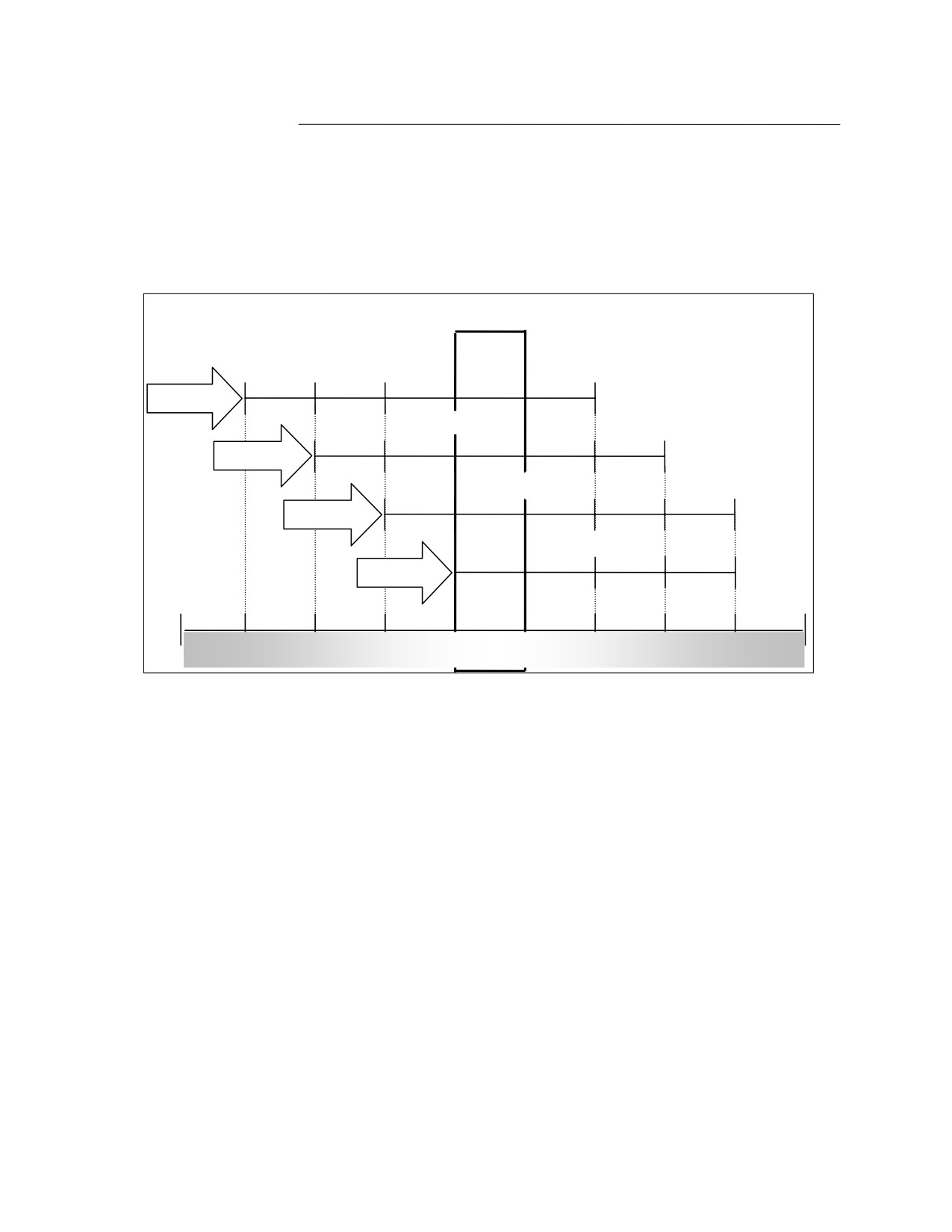
but each ATO period usually covers a 24-hour period. The ATO that is being
built today will refer to past ATOs and project into the future. Any plans or
subplans that were built yesterday will be used as a starting point or
reference point for the plan that is being built for tomorrow. For example, to
build the next airspace control plan, planners will refer to the current
airspace control plan (Figure G-3).
Joint Capability Board (JCB)
Assess V
ATO Cycle
Joint Prioritized Target List (JIPTL)
Master Attack Plan (MAAP)
MAAP A
JCB A
JIPTL A
SEND A
FLY A
ASSESS A
ATO A
MAAP B
JCB B
JIPTL B
SEND B
FLY B
ASSESS B
ATO B
MAAP C
JCB C
JIPTL C
SEND C
FLY C
ASSESS C
ATO C
MAAP D
JCB D
JIPTL D
SEND D
FLY D
ASSESS D
ATO D
JCB E
H-96
H-72
H-48
H-24
H-Hour
H+24
H+48
H+72
H+96
Figure G-3. ATO Cycle
SPECIAL INSTRUCTIONS
G-35. Special instructions are normally included as part of
the
“combined/general unit remarks” in a free text format that highlights,
modifies or supplements mission data contained in other portions of the ATO.
SPINS, includes eclectic supplemental information that will not fit into other
mission formats. As a general rule, SPINS are valid until they are rescinded
or superseded. In some theaters, SPINS are published as a separate message
because of their length.
G-36. ATO and SPINS are formatted using basic United States Message Test
Format (USMTF) procedures and organized using alphanumeric section
designators. Although SPINS are formatted using standardized procedures,
their appearance varies according to the theater requirements and command
directives. Special instructions cover a variety of mission planning
considerations, to include the following:
• Airspace.
• Range times.
• Frequencies.
• Control agencies.
• IFF/selective identification feature (SIF).
G-8
Appendix G
• Mission event numbers.
• CSAR.
AIR TASKING ORDER DEVELOPMENT
G-37. Joint ATO development is a complex, repetitive process in which JFC
and JFACC guidance, target worksheets, and master air attack plan (MAAP)
and component requirements are used to finalize the ATO, SPINS, and ACO.
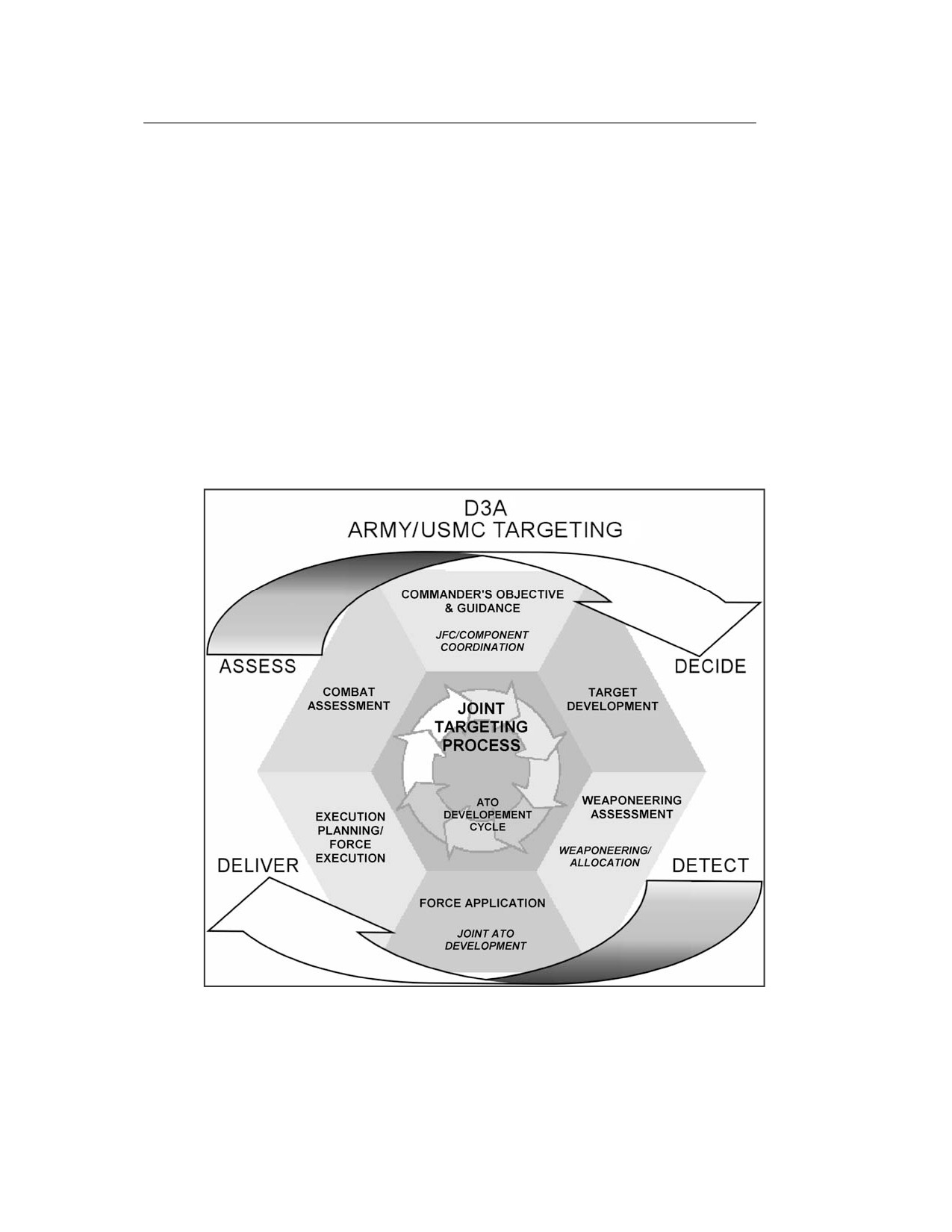
G-38. The objective of the joint targeting process is to ensure an effective and
efficient joint attack against the enemy with all available assets maximized
to achieve the overall objective. This process provides for the planning,
coordination, allocation, and tasking of joint air missions/sorties to
accommodate changing tactical situations and matching the appropriate
response to them. The six steps of the joint targeting process, depicted in
Figure G-4, have been overlaid with the U.S. Army and USMC’s D3A
targeting methodology.
Figure G-4. D3A/Joint Targeting Process
G-39. Although referred to as a “cycle,” the joint targeting process is really a
continuous process of overlapping functions, independent of a particular
sequence.
G-9
FM 3-04.111 (FM1-111)
G-40. Figure G-5 is replicative of an ATO SPINS. FM 3-52.2 (FM 100-103-2),
Appendix B, contains additional information.
SPINS INDEX:
1. RANGE TIMES/MODE 3.
2. PACKAGE COMMANDERS.
3. LIVE ORDNANCE.
4. IFF/SIF.
5. COMMUNICATIONS PLAN.
6. GENERAL.
7. OPERATIONAL RESTRICTIONS.
8. AIRSPACE CONTROL ORDER.
1. RANGE TIMES/MODE 3:
RANGE RESTRICTIONS: ALL TIMES ARE ZULU MODE 3:
CHARACTERS THREE AND FOUR (XX) ARE YOUR CALL SIGN
NUMBER.
A. CAL: 1445-1800
B. RANGE 71 OPEN: 1500-1800
C. RANGE 76 OPEN: 1510-1800
ETC...
2. MISSION COMMANDERS:
MISSION MSN UNIT ROOM PHONE
A29131
INT 31FW
56
22104
A29242
CAS 354FW
51
22103
A29151
OCA 33FW
45
27094
3. LIVE ORDNANCE/AIRLIFT SCHEDULE:
MSN
A/C
TARGET
TOT
ORD
BACKUP TOT
A29391 C-130 POKER DZ
1645-1730 T-BUNDLES
TBD
A29341 A-10
75-8
1642-1647 L8817
TBD
4. IFF/SIF: ALL AIRCRAFT WILL SQUAWK ROTATING MODE 1 FOR FRIENDLY ID
CODES WILL BE CHANGED EVERY TWO HOURS PLUS/MINUS ONE MINUTE. ALL
AIRCRAFT WILL SQUAWK THE SAME MODE 2 AS THE ASSIGNED MODE 3 IF
CAPABLE.
1500 32
1700
5. COMMUNICATION PLAN:
REFER TO AIRCREW AID: DAY 03
BLACKJACK: 377.8
SHOWTIME: 312.8
AAR RENDEZVOUS: 276.4
GCI SAFETY: 308.6
JRCC: 288.0
Figure G-5. ATO SPINS
G-41. The ACO and ATO cycles interrelate. Whatever publication
and
distribution means are used, it is critical to mission success that the airspace
users receive pertinent airspace information as early in the planning cycle as
possible.
G-10
Appendix G
SECTION V - UNITED STATES MESSAGE TEXT FORMAT
G-42. USMTF is the joint standard for message-based information exchange.
The efficient and effective employment of U.S. forces in joint and combined
operations is contingent on efficient and effective communication. USMTF
facilitates communications efficiency by standardizing message formats, data
elements, and information exchange procedures.
G-43. Presently, two instructional USMTF courses are offered to user
organizations. Instruction is provided on the currently implemented USMTF
Standard using the defense information infrastructure communication
message processor (CMP). Certified by the Joint Interoperability Test Center
(JITC), CMP replaces all past versions of MTF message editors and supports
both legacy and Defense Message System (DMS) organizational message
requirements. Attendance at both courses is unit-funded. The FORSCOM e-
mail is USMTF@forscom.army.mil.
• USMTF Automated Course (JT-105) (8 Hours) trains administrative
support personnel and staff officers/NCOs who compose USMTF
reports/messages using microcomputers. This course is procedures
oriented and includes practical applications and hands-on software
training.
• USMTF Managers Course (JT-205) (24 hours/3 days) is designed for
personnel at joint commands who have been designated to implement
a new USMTF program or direct a program already underway. The
goal of the manager’s course is to develop a cadre of trained personnel
at the activity who will be responsible for providing MTF training for
the command. This course is a “train-the-trainer” program.
G-11
Appendix H
Unmanned Aerial Vehicle Considerations
SECTION I - PURPOSE
INTRODUCTION
H-1. UAVs operate anywhere on the battlefield to include forward of the
FLOT. They can operate at night and in limited adverse weather conditions
when equipped with the proper sensors. UAVs are an excellent intelligence
asset that provides the commander with near-real-time reconnaissance and
battlefield surveillance without major risk to personnel. They also give
commanders a dedicated, rapidly taskable asset that can look wide as well as
deep. During a mission, new targets may arise and the commander can
redirect a UAV to a different mission or area in real time. Some models also
can conduct operations other than reconnaissance such as laser designation
and attack.
TACTICAL LOCATION OF ARMY UNMANNED AERIAL VEHICLES
H-2. UAV platoons can launch UAVs from either improved or unimproved
airstrips. Locating the platoon with the aviation brigade generally improves
coordination because the UAV section has immediate access to AD status,
threat graphics, and weather data. UAV elements can operate in single or
split-site configurations.
SINGLE-SITE OPERATIONS
H-3. Single-site operations facilitate command, control, communications (C3),
and logistics support. However, adding the UAV element to a brigade TOC
creates a greater electronic and physical signature.
SPLIT-SITE OPERATIONS
H-4. In split-site operations, the UAV element is split into two distinct sites:
the mission planning and control site (MPCS) and the launch and recovery
(L/R) site.
Mission Planning and Control Site
H-5. The MPCS consists of a ground control station (GCS) along with
associated personnel and supporting equipment. It is normally located with
the supported unit. The MPCS receives the mission, plans and controls the
airborne UAV, and reports information.
H-0
Appendix H
Launch and Recovery Site
H-6. The L/R site consists of the UAVs, maintenance equipment, and GSE
and associated personnel. The L/R site receives the mission plan from the
MPCS. It prepares, launches, and recovers the UAVs. When selecting the site
for the L/R, the following must be considered (Figure H-1):
• Required LOS between the ground terminals and UAVs.
• Avoidance of high-population areas with power lines.
• Proximity of L/R site to forward element to effectively coordinate,
hand off, and receive control of the UAV.
Figure H-1. Split-Site Concept
EMPLOYMENT
H-7. The UAV provides near-real-time reconnaissance, surveillance, and
target acquisition (RSTA). It may be employed forward of the FLOT, on the
flanks, or in rear areas. When employed together, UAVs and aeroscouts
provide excellent reconnaissance resolution. The commander also may use
UAVs to determine the best locations to employ air reconnaissance assets or
to observe selected areas, thus freeing aeroscouts to focus efforts where
contact is most likely. UAVs can be fitted with laser designators that can
mark targets. They can also be armed. The commander can also employ
UAVs to—
• Support in a separate economy-of-force mode or in teamed
arrangements with manned aircraft.
• Support target acquisition efforts and lethal attacks on enemy
reconnaissance and advance forces.
H-1
FM 3-04.111 (FM1-111)
• Assist in route, area, and zone reconnaissance.
• Locate and help determine enemy force composition, disposition, and
activity.
• Maintain contact with enemy forces from initial contact through battle
damage assessment.
• Provide target coordinates with enough accuracy to enable immediate
target handover, as well as first-round fire-for-effect engagements at
artillery’s maximum effective range.
• Transfer combat information by relaying voice and data transmissions
from aircraft and ground vehicles to the brigade and division TOCs.
CAPABILITIES
H-8. UAVs equipped with day television or IR sensor packages can
reconnoiter air routes, LZs, and objectives before and during all types of
tactical operations. UAVs may precede any element, to include vehicle or
aircraft security elements, to provide early warning, reaction time, or target
servicing. Current capabilities allow the UAV to distinguish between
different types of vehicles at about 6,000 feet above ground level (AGL) and to
detect vehicles at altitudes as high as 32,000 feet AGL.
RISK REDUCTION
H-9. The UAV provides an airborne targeting and surveillance asset that
does not expose personnel to risk. UAVs of other services provide additional
support. Those UAVs will sometimes have greater range, altitude, and
endurance capabilities.
SYSTEM INTEGRATION
H-10. The Tactical Control System (TCS) (software, hardware, and extra
ground support hardware) is the data link through which UAVs interface
with the JSTARS and other joint and combined systems.
DETECTION
H-11. Currently, tactical UAVs are extremely difficult for enemy AD systems
to detect and engage. Enemy radars are designed to detect much faster
moving aircraft and tend to skip over these slow-flying platforms. If detected,
the composite airframes provide very small radar cross sections. IR-guided
surface-to-air missile (SAM) systems have difficulty getting a positive lock on
the small power plants and, in most cases, cannot engage them. The low
visual and acoustic signatures of UAVs make them an attractive platform for
stealth reconnaissance. Tactical UAVs have less than a 10-percent chance of
detection by the unaided human eye when operating as low as 3,000 feet
AGL.
SPECIAL CONSIDERATIONS
H-12. Even UAVs with degraded mission packages can disrupt enemy
operations. Enemy concerns about UAV activity cause frequent movement
and tend to lead to increased radio traffic from which intelligence data can be
generated. Frequent movement disrupts the enemy force’s ability to conduct
H-2
Appendix H
coordinated operations, strains its logistical system, and degrades its physical
and mental endurance.
LIMITATIONS
H-13. The UAV is less effective in locating enemy forces that are well
covered or concealed. Tactical UAVs are not well suited for wide area
searches; rather, their capabilities are enhanced when they are employed as
part of an overall collection plan. Like manned aircraft, they are vulnerable
to enemy AD systems and they have weather restrictions.
OPERATIONS
H-14. The UAV provides an airborne targeting, surveillance, and
retransmission asset that does not expose personnel to risk. UAV
employment may include teaming with aviation combat platforms.
INTELLIGENCE, SURVEILLANCE AND RECONNAISSANCE
H-15. The capabilities of the UAV expand the planning horizon for the S2
and S3. Conversely, there is the potential for overreliance on the UAV at the
expense of other collection assets. This overreliance can result in an ISR plan
that is neither comprehensive nor integrated. Traditional intelligence-
gathering assets require as much attention as high-technology equipment.
Both should be focused on the CCIR.
INTELLIGENCE, SURVEILLANCE, AND RECONNAISSANCE EXECUTION
H-16. UAVs contribute to the overall ISR effort. The range and endurance of
UAVs provide commanders with a bird’s-eye perspective where and when
they need it, without risking manned aircraft. UAVs can fly deep into the AO
and are flexible enough to be quickly retasked to provide timely information
on other areas. While RSTA is a primary mission, UAVs also provide
substantial support to intelligence collection in support of the IPB effort and
BDA.
NONLINEAR BATTLEFIELD
H-17. A nonlinear, expanded battlefield may routinely create gaps between
friendly units. Reconnaissance of these gaps is an excellent mission for the
UAV.
COORDINATED UNMANNED AERIAL VEHICLE/AVIATION RECONNAISSANCE
OPERATIONS
H-18. When employed together, UAVs and air cavalry units provide excellent
reconnaissance resolution. The commander also may use UAV data to
determine the best locations to employ air reconnaissance assets. In either
case, UAV support greatly reduces the mission load of the aeroscouts.
Without UAV support, extended operations may require commanders to
rotate aircraft or plan rest and resupply operations to maintain a continuous,
limited reconnaissance effort. Frequent aviation training with UAVs
maximizes the capabilities of this reconnaissance team and assists the
H-3
FM 3-04.111 (FM1-111)
commander in selecting the best method of employment for different tactical
situations.
H-19. Reconnaissance forces performing security operations generally
straddle the lines between decisive and shaping operations. The RSTA
capabilities of UAVs make them ideal to support reconnaissance and security
missions. Locating enemy air defense systems is a critical mission for UAVs.
They can warn of both the presence and location of HPTs. They can jam
acquisition and tracking emissions but otherwise remain in the passive mode.
UAVs can cue forces during screen, guard, and cover missions. Likewise,
during economy of force missions, the UAV’s communications relay
capabilities can alert dispersed forces to mass their effects on a particular
enemy force. UAVs can perform all of the basic tasks of the screen except
clearing an area, thus freeing the helicopters for higher priority actions
within the covering force mission.
SECTION II - UNMANNED AERIAL VEHICLE DESCRIPTIONS
GENERAL
H-20. This section provides general characteristics and capabilities of
currently fielded and developmental models. UAVs generally are categorized
as tactical or endurance, based on capable range.
TACTICAL UNMANNED AERIAL VEHICLE
H-21. Tactical UAVs have an operational capability out to 200 kilometers.
SHADOW 200 UNMANNED AERIAL VEHICLE (UNDER DEVELOPMENT)
H-22. The Shadow 200 UAV is an Army system that provides commanders at
the brigade level with near-real-time RSTA capabilities. The electro-
optical/IR (EO/IR) payload will be a multimode, forward looking infrared
television (FLIR/TV) sensor with enough resolution to detect and recognize
an APC-sized target from operational altitudes (greater than 8,000 feet AGL
during the day and greater than 6,000 feet AGL at night) and at survivable
standoff ranges (3 to 5 kilometers). Imagery will be preprocessed on board
and passed to the GCS. The payload will be capable of autonomous
preplanned operation and instantaneous retasking throughout a mission. The
EO/IR payload will provide continuous zoom capabilities in EO mode and
multiple fields of view (FOVs) in the IR mode. The Army is also considering
use of the Shadow for EW missions such as electronic target location,
communications intercept, and jamming. The system contains the following
subsystems:
• Three air vehicles (wing-12.75 feet, length-11.17 feet, height-3.3 feet,
takeoff weight-328 pounds).
• Two GCSs.
• One portable control station.
• Launch and recovery equipment (hydraulic launcher, arresting gear,
and automatic landing system).
• Ground and logistics support equipment.
H-4
Appendix H
H-23. Key operational factors are the following:
• Has an EO and IR sensor.
• Deploys via two C-130 sorties.
• Attains a maximum altitude of 15,000 feet.
• Has an operational radius of 50 or more kilometers.
• Maintains a cruise/loiter speed of 60 to 85 knots true airspeed (KTAS),
maximum 225 KTAS.
• Requires rail launch (100 meters area) with arrested recovery (100
meters).
• Has operation endurance of more than five hours.
PIONEER UNMANNED AERIAL VEHICLE
H-24. The Pioneer UAV is a Navy system that provides imagery intelligence
(IMINT) for tactical commanders. It is employed as a system and requires
rocket-assisted takeoff (RATO) and an 800-meter runway with arresting gear
for takeoff and landing. This system contains the following subsystems:
• Five air vehicles (wing-17 feet, length-14 feet, height-3.3 feet, takeoff
weight-452 pounds).
• Nine payloads (five day cameras, four IR).
• One ground control shelter.
• One portable control shelter.
• Four remote receiving systems.
• GSE.
H-25. Key operational factors are the following:
• Has an EO and IR sensor.
• Deploys via two C-141s or five C-130 sorties.
• Attains a maximum altitude of 15,000 feet.
• Has an operational radius of 185 kilometers.
• Maintains a cruise and loiter speed of 65 KTAS, 95 KTAS maximum.
• Has operation endurance of five hours.
HUNTER UNMANNED AERIAL VEHICLE
H-26. The Hunter UAV is the only UAV currently in the Army inventory. It
provides near-real-time IMINT within a 200-kilometer radius, expandable to
300 kilometers by using another Hunter as an airborne relay. The Hunter
UAV supports ground tactical forces commanders from a
200-meter
unimproved runway and is employed as a system. This system contains the
following subsystems:
• Eight air vehicles
(wing-29.2 feet, length-23 feet, height-5.4 feet,
takeoff weight-1,600 pounds).
• Four remote video terminals.
• Three ground control/mission planning stations.
• Two ground data terminals.
• One launch recovery system.
H-5
FM 3-04.111 (FM1-111)
• One mobile maintenance facility.
H-27. Key operational factors are the following:
• Has an EO and IR sensor.
• Can be equipped with a laser designator.
• Deploys via 16 C-130 sorties.
• Has a maximum altitude of 15,000 feet.
• Has an operational radius of 267 kilometers.
• Cruises at up to 90 KTAS and loiters at 60 to 75 KTAS, 110 KTAS
maximum.
• Has operation endurance of 12 hours.
ENDURANCE UNMANNED AERIAL VEHICLES
H-28. Endurance UAVs are defined as any vehicle that can operate beyond
200 kilometers.
PREDATOR UNMANNED AERIAL VEHICLE (MEDIUM ALTITUDE)
H-29. The Predator UAV is an Air Force system that provides long-range,
time on station, and near-real-time IMINT to Joint Task Force (JTF) and
theater commanders. The Predator is unique in its ability to collect full-rate
video imagery and transmit information via SATCOM or LOS. The Predator’s
key roles include observing known targets, escorting convoys, monitoring
enemy movements, and providing BDA information. The Predator is most
effective when observing known targets, rather than searching over extended
areas. Its low airspeed makes it ideal for loitering and is lower than most
enemy radars are programmed to detect. It can operate in adverse weather
conditions. The Predator requires an 800-meter runway for takeoff. This
system contains the following:
• Four air vehicles (wing-48.7 feet, length-26.7 feet, height-7.3 feet,
takeoff weight-2,300 pounds).
• One GCS.
• One Trojan Spirit II Dissemination System.
• GSE.
H-30. The Predator can be fitted with a Hellfire missile under each wing.
Other key operational factors are the following:
• Has a synthetic aperture radar and an EO and IR sensor.
• Can be equipped as a laser designator.
• Deploys via five C-130 or two C-141 sorties.
• Attains a maximum altitude of 25,000 feet.
• Has an operational radius of 925 kilometers.
• Maintains a cruise speed of 65 KTAS, 110 KTAS maximum.
• Has operation endurance greater than 20 hours.
GLOBAL HAWK UNMANNED AERIAL VEHICLE (HIGH ALTITUDE)
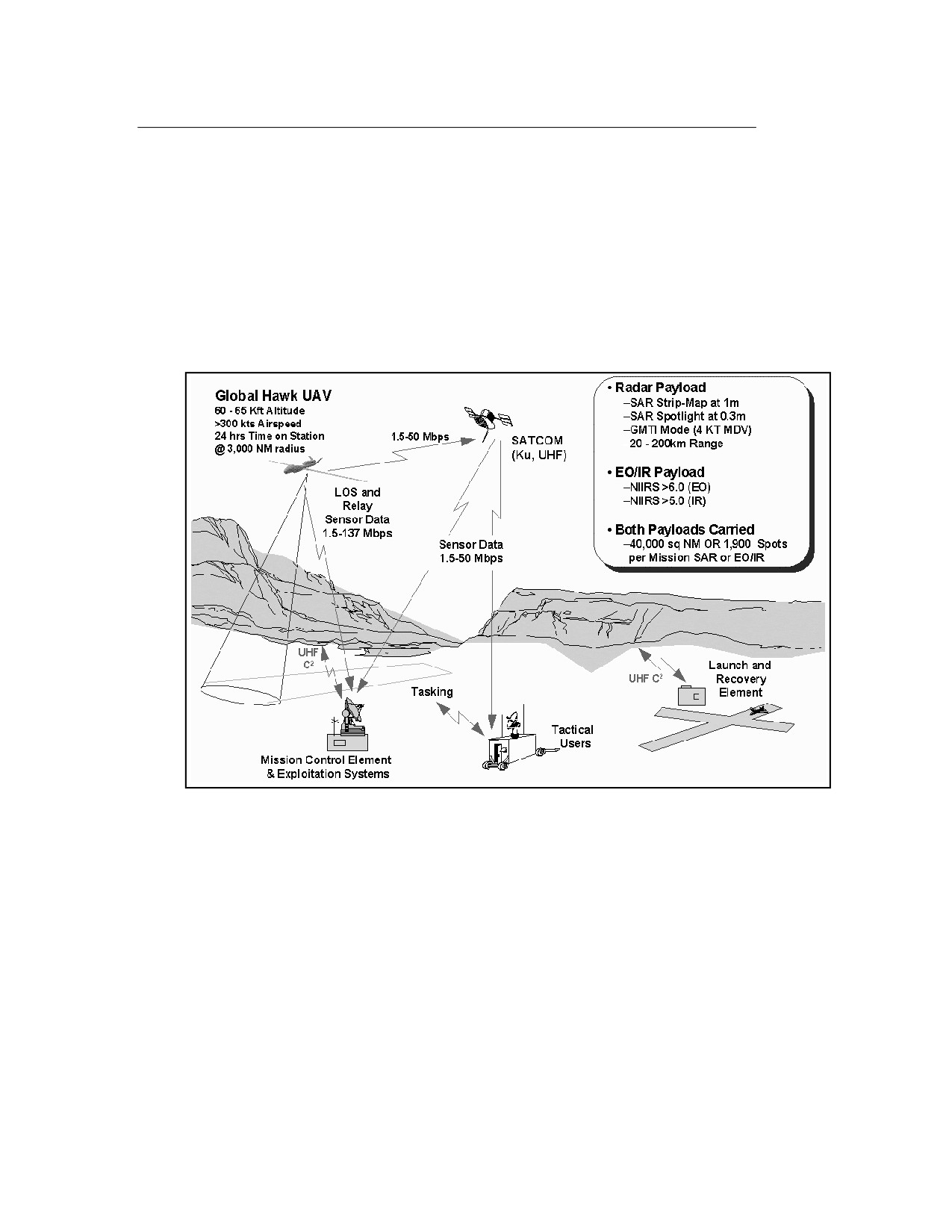
H-31. The Global Hawk UAV is an Air Force system. It provides long-range,
time on station, and wide area surveillance for theater commanders. The
H-6
Appendix H
system will be able to survey, in one day, an area equivalent to the State of
Illinois
(40,000 square miles), while providing imagery with a three-foot
resolution. The large radius gives the commanders much flexibility in
choosing an operating location, to include out-of-theater operations. This
UAV can perform persistent tracking of critical targets, loitering over the
target area for more than 24 hours and providing high-quality images in all
weather conditions. It is employed in low-to-moderate risk areas to look into
high-threat areas. The Global Hawk has a conventional aircraft design that is
easily visible on radar screens; therefore, survivability is derived from its
very high operating altitude and self-defense measures. It is equipped with a
threat warning receiver and a threat deception system, which includes
onboard radar jammers and expendable decoys. Differential GPS and
advanced control technology will allow the UAV to be virtually autonomous,
handling take-offs on its own. It communicates through SATCOM and LOS.
It requires a 5,000-foot runway for takeoff. The dimensions of this UAV are
the following:
• Wing-116.2 feet.
• Length-44.4 feet.
• Height-15.2 feet.
• Takeoff weight-25,600 pounds.
H-32. Key operational factors are the following:
• Has a SAR and an EO and IR sensor.
• Is self-deployable.
• Requires multiple C-141, C-17, or C-5 sorties for GSE.
• Attains a maximum altitude of 65,000 feet.
• Has an operational radius of 5,500 kilometers.
• Maintains a cruise speed of 350 knots.
• Has operation endurance greater than 40 hours.
H-7
Appendix I
Aircraft Characteristics
This appendix provides an overview of the basic characteristics and
capabilities of aircraft organic to the various aviation brigades—or that
may be available in an aviation task force organization.
SECTION I - OH-58D KIOWA WARRIOR
I-1. The primary missions of this aircraft are armed reconnaissance and light
attack. The OH-58D discussed herein is the version addressed with
affectivity code “R” in TM 1-1520-248-10.
DESCRIPTION
I-2. The OH-58D is a single-engine, dual-seat, armed observation aircraft. It
has an improved master controller processing unit (IMCPU) system that
provides highly integrated communication, navigation, aircraft, and mission
equipment subsystems. The VIXL can store compressed images in memory
and enables transmission of video images between aircraft. The mast-
mounted sight contains a suite of sensors that include a high-resolution
television camera, IR thermal imaging, a laser rangefinder, and a laser
designator. It is also equipped with a videotape recorder.
SPECIFICATIONS
I-3. Table I-1 outlines OH-58D aircraft specifications.
Table I-1. OH-58D Specifications
Length
41'2.4”
Height
12'10.6”
Fuselage width (with weapons
9'2”
pylons)
Main rotor diameter
35'
Maximum gross weight
5,500 pounds (5,200 pounds by Interim Statement of Airworthiness
Qualification (ISAQ).
Cruise airspeed
100 knots (varies with environmental/mission conditions)
Combat radius
120 kilometers (varies with environmental/mission conditions)
CAPABILITIES
I-4. The OH-58D provides the following:
• Day, night, battlefield obscurant, and limited adverse-weather
fighting capabilities.
I-0
Appendix I
• Data transfer system that permits upload from AMPS data transfer
cartridge and download of selected postmission data.
• Countermeasure suite of IR jammers, radar warning receivers, and
laser warning detectors.
• Moving map display.
• Video recording and cockpit playback of television and thermal
imagery from the mission.
• Advanced navigation and mission planning equipment; transportable
in the C-130, C-141, C-5, and C-17.
ARMAMENT SYSTEMS
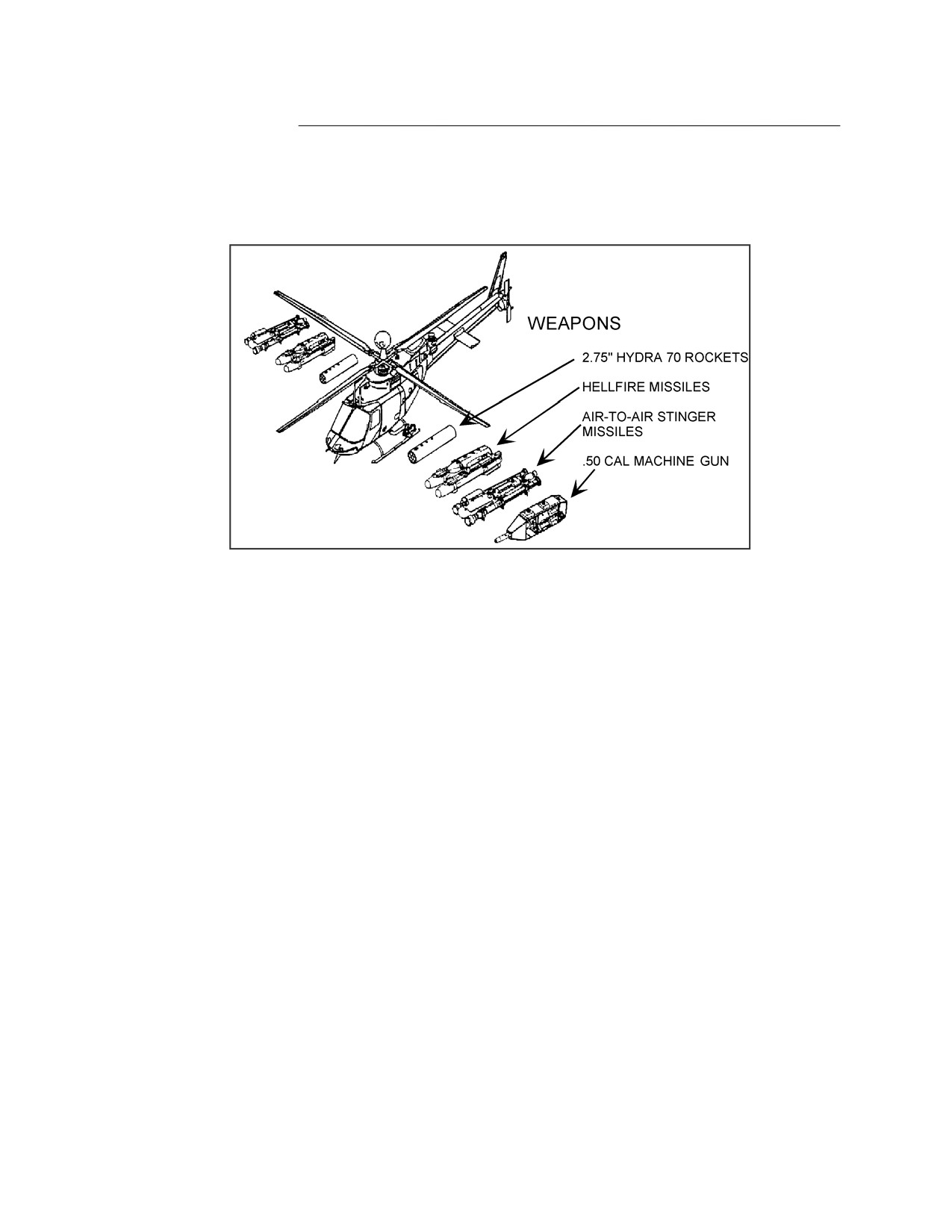
I-5. The OH-58D armament capabilities consist of a .50-caliber machine gun,
2.75-inch rockets, Hellfire missiles, and air-to-air missiles. These systems are
mounted on two universal weapons pylons. The aircraft has a laser
rangefinder/designator used to designate for the weapons system as well as
provide range-to-target information for onboard weapons systems.
.50-CALIBER MACHINE GUN
I-6. This electronically controlled weapon can be mounted in a fixed position
on the left weapons pylon. It is a point system with a maximum effective
range of 2,000 meters. It may be fired in the continuous mode (up to 150
rounds with a one-minute cooling period) or in one-second bursts of 12 to 14
rounds. Ammunition capacity is 500 rounds.
2.75-INCH ROCKET SYSTEM
I-7. The OH-58D can carry two seven-shot rocket pods for a maximum load of
14 rockets for use against enemy personnel, light armored vehicles, and other
soft-skinned targets. This area system can launch multiple rockets with
various warhead mixes to include high explosive, high-explosive
multipurpose submunitions, white phosphorous, illumination, and flechette.
The maximum range is 9,000 meters, with the most effective range being
3,000 to 5,000 meters.
HELLFIRE MISSILE
I-8. The SAL Hellfire is used primarily for the destruction of tanks, armored
vehicles, and other hard-material targets. The OH-58D can carry two
two-missile launchers for a maximum of four missiles. However, weight
restrictions usually restrict the aircraft to just one launcher. The minimum
engagement range is 500 meters; the maximum range is 8,000 meters. Laser
designation may be autonomous or remote.
AIR-TO-AIR STINGER MISSILE SYSTEM
I-9. The ATAS is an IR, heat-seeking, fire-and-forget missile, capable of
engaging airborne targets day or night. The OH-58D can carry two Stinger
missiles per pylon for a maximum of four missiles. The maximum range is
more than 4,000 meters.
I-1
FM 3-04.111 (FM1-111)
ARMAMENT CONFIGURATIONS
I-10. Figure I-1 illustrates an example of mission load configurations. Only
one system at a time may be mounted per side.
Figure I-1. OH-58D Weapons Loading
COMMUNICATIONS
I-11. The OH-58D has the following communications systems:
• Up to three AN/ARC-186 provide VHF-FM 1 (30- to 87.975-megahertz)
and FM 2 (if installed) and VHF-AM (116- to 151.975-megahertz)
secure communication when employed with KY-58.
• The AN/ARC-164 Have Quick II provides antijam frequency-hopping
UHF-AM communications in the 225- to 399.975-megahertz range in
25-kilohertz intervals.
• The OH-58D may have the AN/ARC-201 SINCGARS, which requires
KY-58 interface for secure communications, or 201D SINCGARS with
embedded encryption and data capability; both operate in the 30- to
87.975-megahertz frequency range and have antijam, frequency-
hopping capability.
• The IDM transfers digital messages.
• The KY-58 provides secure communications for SINCGARS, Have
Quick II, and VHF-AM/FM radios.
NAVIGATION SYSTEM
I-12. The Embedded Global Positioning System Inertial Navigation System
(EGI) is a self-contained, all-attitude navigation system that works with the
radar altimeter and laser rangefinder/designator. Its embedded GPS receiver
(EGR) supports the pure GPS and blended GPS/Inertial Navigation System
(INS) solutions. The system is capable of storing waypoint and target
information for making flight plan routes and changing these routes as a
mission may change. EGI also provides target location in longitude and
I-2
Appendix I
latitude or military grid reference system (MGRS) coordinates and altitude in
meters or feet above mean sea level
(MSL) when range, bearing, and
declination to the target are provided to the navigation subsystem for the
mast mounted sight.
AIRCRAFT SURVIVABILITY EQUIPMENT
I-13. Appendix J addresses the OH-58D ASE.
LIMITATIONS
I-14. The following are limitations of the OH-58D:
• IR Crossover. The thermal imaging sensor operates by determining
temperature differentials; when targets and their surroundings reach
the same temperature, target detection degrades.
• Obscurants. Some obscurants (such as dust, rain, haze, or smoke) can
keep laser energy from reaching the target and can hide the target
from the incoming munitions seeker.
• Low Cloud Ceilings. Consideration must be given to cloud ceilings to
determine maximum employment range of the SAL Hellfire.
Depending on the distance to target, trajectory mode selected, and
lasing techniques, the missile may climb into low cloud ceilings,
causing the seeker to break track from the laser spot or preventing the
seeker from acquiring the laser spot.
• Hellfire Remote Designation Constraints. The designating crew may
offset a maximum of 60 degrees from the gun-to-target line and must
not position its aircraft within a +30-degree safety fan from the firing
aircraft.
• IMC. The Kiowa Warrior is not certified for instrument flight rules
(IFR) operations.
SECTION II - AH-64A APACHE
I-15. The AH-64A is a highly stable aerial weapons-delivery platform. Its
primary mission is to destroy HVTs. It can fight close and deep to destroy,
attrite, disrupt, or delay enemy forces. Armed reconnaissance and security
are secondary missions.
DESCRIPTION
I-16. The AH-64A is a twin-engine, tandem-seat, aerial weapons platform. It
is equipped with a target acquisition designation sight (TADS), laser range
finder/designator (LRF/D), and a pilot night vision sensor (PNVS) that allow
the two-man crew to navigate and attack at night and in adverse weather
conditions at extended standoff ranges. The Apache has a full range of
aircraft survivability equipment and can withstand hits from rounds as large
23 millimeters in critical areas.
I-3
FM 3-04.111 (FM1-111)
SPECIFICATIONS
I-17. Section III contains aircraft specifications and comparison to AH-64D
specifications.
CAPABILITIES
I-18. The AH-64A provides the following:
• Precision attacks during the day, at night, or in adverse weather or
when the battlefield is obscured.
• Wide array of firepower options.
• Robust suite of electronic warfare systems.
• Lethal suppression of enemy air defenses.
• Data transfer system to upload from the AMPS data transfer
cartridge and download postmission data.
AH-64A ARMAMENT SYSTEMS
I-19. The AH-64A Apache can carry up to
16 Hellfire laser-designated
missiles. Hellfire is used primarily to destroy tanks, armored vehicles, and
other hard targets. The Apache can also deliver 76 2.75-inch folding fin aerial
rockets for use against enemy personnel, light armor vehicles and other soft-
skinned targets. The
1,200 rounds of ammunition for its area weapons
system 30-millimeter automatic gun round out the Apache’s arsenal.
30-MILLIMETER CHAIN GUN
I-20. The M230E1 is a chain-driven area weapons system mounted to a
hydraulically driven turret, under the helicopter forward fuselage. It fires the
U.S. M789 NATO standard ammunition high explosive dual-purpose (HEDP)
round. Each shell contains 21.5 grams of explosive charge sealed in a shaped-
charge liner. It is capable of penetrating more than 2 inches of armor at 2,500
meters and produces antipersonnel effects within a 4-meter radius. At typical
engagement ranges, HEDP ammunition will defeat BMP-type targets. The
AH-64A can carry 1,200 rounds of 30-millimeter ammunition. It has a rate of
fire of 600 to 650 rounds per minute, with a maximum effective range of
about 1,500 meters against point targets and 3,000 meters against area
targets.
2.75-INCH ROCKET SYSTEM
I-21. The family of 2.75-inch unguided rockets includes M260/M261 light
weight launchers (LWL), MK66 rocket motor, and several warhead and fuze
combinations. Warheads can be categorized into two areas. Unitary warheads
are fitted with impact-detonating warheads. Cargo warheads, with airburst
range settable or fixed standoff fuses, use the wall-in-space concept. This
concept provides a large increase in effectiveness and virtually eliminates
range-to-target errors caused by variations in launcher/helicopter pitch
angles during launch. The Apache can carry a maximum of 76 aerial rockets
for use against enemy personnel, light armored vehicles, and other soft-
skinned targets. The system is capable of launching multiple rockets with
various warhead mixes to include high explosive; high-explosive,
I-4

Appendix I
multipurpose submunitions; white phosphorous; illumination; and flechette.
The maximum fire control computer (FCC) computed range solution is 7,500
meters.
HELLFIRE MISSILE
I-22. The Hellfire is used primarily to destroy tanks, armored vehicles, and
other hard-material targets. The AH-64A is capable of firing only the SAL
Hellfire missile. SAL missiles can defeat any known armor. The minimum
engagement range is 500 meters, and the maximum range is 8,000 meters.
The maximum aircraft load is 16 missiles. Laser target designation may be
autonomous or remote.
MISSION CONFIGURATIONS
I-23. Table I-2 shows AH-64A mission profiles and typical ammunition loads.
Table I-2. AH-64A Mission Profiles/Typical Loads
Mission
Hellfire
30mm
Hydra 2.75
Attack
16
1,200
Movement to
8
1,200
38
Contact
Screen
8
1,200
19
COMMUNICATIONS
I-24. The AH-64A has the following communications systems:
• Radio set AN/ARC-186(V) is a VHF-FM/AM transceiver that provides
clear and secure voice communication capability at frequencies in the
VHF-AM and -FM bands.
• The AN/ARC-164 Have Quick II system is a UHF-AM radio
transmitter-receiver set that provides an antijam, frequency-hopping
capability.
• The AN/ARC-201D is an airborne VHF-FM transceiver and part of the
SINCGARS family of radios; it has an antijam, frequency-hopping
mode of operation. The radio set provides secure or plain voice
communications over the frequency range of 30- to 87.975-megahertz
at
25-kilohertz intervals. When used with the TSEC/KY-58 voice
security system, the radio set can transmit and receive clear voice or
cipher-mode communications.
• The AN/ARC-220 HF radio provides NOE long-range communications
in the 2- to 29.999-megahertz range and secure mode when employed
with the KY-100.
• The TSEC/KY-100 provides secure communications for the AN/ARC-
220 HF radio.
• The TSEC/KY-58 interfaces with the AN/ARC-186 and AN/ARC-201
radios to provide secure voice for these radios.
I-5
FM 3-04.111 (FM1-111)
NAVIGATION SYSTEMS
I-25. The navigation systems of the AH-64A are divided into two major
groupings: stand-alone radio NAVAIDs—a nonintegrated navigation
system—and an integrated navigation system. The stand-alone aids consist
of the AN/ARN-89 or the AN/ARN-149(V)3 automatic direction finder (ADF)
sets. The integrated navigation system consists of the EGI unit, the air data
sensor subsystem
(ADSS), the heading and attitude reference system
(HARS), the AN/ASN-137 DNS, the IP-1552G computer display unit (CDU),
and the navigation software module in the FCC.
AIRCRAFT SURVIVABILITY EQUIPMENT
I-26. Appendix J addresses the AH-64A ASE.
LIMITATIONS
I-27. The following are limitations of the AH-64A:
• Threat Identification. Threat identification through the FLIR system
is extremely difficult; although the crew can easily find the heat
signature of a vehicle, it may not be able to determine whether it is
friend or foe.
• IR Crossover. The thermal imaging sensor and PNVS operate by
determining temperature differentials. When targets and their
surroundings reach the same temperature (normally twice a day),
target detection is degraded; these conditions also make flight while
using the FLIR sensor difficult.
• Obscurants. Some obscurants (such as dust, rain, haze, or smoke) can
prevent laser energy from reaching the target and can hide the target
from the incoming munitions seeker for SAL Hellfire and prevent
effective use of FLIR systems.
• Low Cloud Ceilings. Consideration must be given to cloud ceilings to
determine maximum employment range of the SAL Hellfire.
Depending on the range to target, trajectory mode selected, and lasing
techniques, the missile may climb into low cloud ceilings, causing the
seeker to break track from the laser spot or preventing the seeker
from acquiring the laser spot.
• SAL Hellfire Remote Designation Constraints. The designating crew
may offset a maximum of 60 degrees from the gun-to-target line and
must not position its aircraft within a +30-degree safety fan from the
firing aircraft.
SECTION III - AH-64D APACHE LONGBOW
I-28. The AH-64D is a highly stable aerial weapons-delivery platform. Its
primary mission is attack. It can fight close and deep to destroy, attrite,
disrupt, or delay enemy forces. Armed reconnaissance and security are
secondary missions.
I-6

Appendix I
DESCRIPTION
I-29. The AH-64D is a remanufactured AH-64A (Section II of this appendix).
Its improved navigation system integrates dual INS/GPS and Doppler radar
for acceleration cueing. Some D models are equipped with a millimeter wave
FCR that allows the helicopter to identify, classify, prioritize, and track
targets out to the maximum range of the Hellfire weapon system. (See Table
I-3 below.)
WITH RADAR
I-30. Apaches equipped with the Longbow system are denoted as either AH-
64D with radar, AH-64D Longbow, or LBA. The LBA helicopter is equipped
with FCR, radar frequency interferometer (RFI), and upgraded 701C engines
to compensate for the additional weight of the Longbow system. The Longbow
system is integrated with the TADS to allow simultaneous and autonomous
operation of the TADS and the FCR.
WITHOUT RADAR
I-31. The AH-64D without radar includes all of the above LBA aircraft
upgrades except the FCR and the RFI system and their associated black
boxes. The aircraft may not have the improved 701C engine installed. The
AH-64D without radar can be converted to an AH-64D with radar, with the
installation of the Longbow system and 701C engines. The AH-64D without
radar can fire the RF Hellfire missile autonomously (with LOS to the target)
or by using FCR targeting data handed over from an AH-64D with radar.
SPECIFICATIONS
I-32. Table I-3 compares AH-64A/D specifications.
Table I-3. Comparison of Apache Specifications
AH-64D w/o
AH-64D
Model
AH-64A
Radar
Longbow
Length (feet)
57.67
57.67
57.67
Height (feet)
15.25
13.33
16.08
Width (feet)
17.17
15.50
15.05
Main Rotor Span (feet)
48
48
48
Max Gross Weight
21,000
23,000
23,000
(pounds)
Cruise Speed (knots)
120*
130*
30*
Combat Radius (km)
200*
200
200
Combat Radius With
One 230-Gallon Aux Fuel
350*
350*
350*
Tank (km)
Self-Deployability
Yes
Yes
Yes
* Varies with a multitude of factors such as temperature, wind, gross weight, and mission-specific time requirements.
I-7
FM 3-04.111 (FM1-111)
CAPABILITIES
I-33. The AH-64D provides the following:
• Precision attacks during day or night, in adverse weather, or when the
battlefield is obscured (Longbow).
• Wide array of firepower options.
• Detection, classification, and prioritization of stationary and moving
ground and airborne targets (Longbow).
• Robust suite of electronic warfare systems.
• Lethal destruction of enemy air defenses (DEAD).
• Real-time SA and intelligence of the battlefield to the digitized
aviation/ground commander; data transfer system to upload from the
AMPS data-transfer cartridge and download postmission data.
• High-frequency radio for NOE long-distance NLOS communications.
ARMAMENT SYSTEMS
I-34. The Longbow system enhances the rapid employment of all available
weapons including Hellfire missiles, air-to-air missiles (future capability),
aerial rocket system, and the 30-millimeter cannon. Once the FCR detects,
classifies, and prioritizes targets, the gunner selects the desired weapon for
the attack and the data is automatically transferred to the weapon and
displayed on the selected weapon sight.
30-MILLIMETER CHAIN GUN
I-35. The M230E1 is a chain-driven area weapons system mounted to a
hydraulically driven turret, under the helicopter forward fuselage. It fires the
U.S. M789 NATO standard ammunition HEDP round. Each shell contains
21.5 grams of explosive charge sealed in a shaped-charge liner. It can
penetrate more than
2 inches of armor at
2,500 meters and produces
antipersonnel effects within a 4-meter radius. At typical engagement ranges,
HEDP ammunition will defeat BMP-type targets. The AH-64D can carry
1,200 rounds of 30-millimeter ammunition. It has a rate of fire of 600 to 650
rounds per minute, with a maximum effective range of about 1,500 meters
against point targets and 3,000 meters against area targets. The gunner
selects the desired weapon for the attack, and the data is automatically
transferred to the weapon and displayed on the selected weapon sight.
2.75-INCH ROCKET SYSTEM
I-36. The AH-64D can carry a maximum of 76 folding-fin aerial rockets for
use against enemy personnel, light armored vehicles, and other soft-skinned
targets. The system can launch multiple rockets with various warhead mixes
to include high explosive; high-explosive, multipurpose submunitions; white
phosphorous; illumination; and flechette. Aircrews can select the quantity
and type to be fired. The maximum range is 9,000 meters, with the most
effective range being 3,000 to 5,000 meters.
I-8

Appendix I
HELLFIRE MISSILE
I-37. The Hellfire is used primarily for the destruction of tanks, armored
vehicles, and other hard material targets. The AH-64D retains the capability
to fire SAL Hellfire. Hellfire missiles (SAL and RF) can defeat any known
armor. The minimum engagement range is 500 meters, and the maximum
range is 8,000 meters. The maximum aircraft load is 16 missiles.
SEMIACTIVE LASER HELLFIRE
I-38. Laser target designation may be autonomous or remote.
LONGBOW RADAR FREQUENCY HELLFIRE
I-39. This millimeter wave guided missile is a true fire-and-forget weapon.
The millimeter wave radar and missile can engage targets through weather
and battlefield obscurants. The RF missile receives targeting information—to
include north, east, and down data—from the acquisition source: TADS, FCR,
or another aircraft. Targeting data can be transferred from a Longbow to an
AH-64D without radar as a radar frequency handover (RFHO).
MISSION CONFIGURATIONS
I-40. Table I-4 is a matrix of AH-64D mission profiles and typical
ammunition loads (weight limits may require a reduction in mission loads).
Table I-4. AH-64D Mission Profiles/Typical Loads
Hydra 2.75-
Hellfire
Mission
30mm
inch
Aux Tank
RF/SAL
Rockets
12/4
300
No
Attack
12/4
300
Internal
8/4
300
External
4/4
300
38
No
Movement to
4/4
300
38
Internal
Contact
4/4
300
19
External
8/4
300
19
No
Screen
8/4
300
19
Internal
4/4
300
19
External
FIRE-CONTROL RADAR
I-41. The Longbow system consists of an integrated millimeter wave FCR,
along with an RFI. The FCR enables LBA helicopters to detect, classify,
prioritize, and engage targets with RF Hellfire missiles without visually
acquiring the target. LBA crews may also employ the RF Hellfire missile
during poor visibility when laser, optical, and FLIR sensors are degraded.
The RFI can detect and identify radar systems and display targeting
information on the same screen as the information from the FCR. The FCR
will not identify friend or foe, other than AD weapons, which are identifiable
by their distinctive radar signatures detected by the RFI system.
I-9
FM 3-04.111 (FM1-111)
COMMUNICATIONS
I-42. The AH-64D has the following communication systems:
• The AN/ARC-186 (V) provides VHF-AM/FM communications in the
frequency ranges of
30 to 87.975 megahertz and 116 to 151.975
megahertz; the radio is primarily for administrative communications
with ATS but can function as an FM 3.
• The ARC-164 Have Quick II provides UHF communications and
includes antijam, frequency-hopping capability; it is normally
employed for internal air-to-air and air-to-TOC communications and
for communicating with the air components of other services. When
used with the KY-58, the radio provides secure communications.
• Two AN/ARC-201D radios provide VHF-FM secure communications in
the
30- to
87.975-megahertz frequency range for communications
internally and with ground units.
• The AN/ARC-220 HF provides high-frequency, NOE long-range
communication with the AN/ARC-100 in the TOC and with other HF
receivers.
• The IDM transfers digital messages.
NAVIGATION SYSTEMS
I-43. The navigation subsystem consists of the following major components:
• EGI (primary and backup).
• Doppler radar velocity sensor.
• Radar altimeter.
• ADF.
• High integrated air data computer.
• Flight management computer.
AIRCRAFT SURVIVABILITY EQUIPMENT
I-44. Appendix J addresses the AH-64D ASE.
LIMITATIONS
I-45. The following are limitations of the AH-64D:
• Threat Identification. Threat identification through the FLIR system
is extremely difficult; although the crew can easily find the heat
signature of a vehicle, it may not be able to determine whether it is
friend or foe. In addition, the FCR will not identify friend or foe, other
than radar air defense weapons, which are identifiable by their
distinctive signatures detected by the RFI system.
• IR Crossover. The thermal imaging sensor and PNVS operate by
determining temperature differentials; when targets and their
surroundings reach the same temperature (normally twice a day),
target detection is degraded. These conditions also make flight while
using the FLIR sensor difficult.
I-10
Appendix I
• Obscurants. Some obscurants (such as dust, rain, haze, or smoke) can
prevent laser energy from reaching the target and can hide the target
from the incoming munitions seeker for SAL Hellfire and prevent
effective use of FLIR systems; FCR and RF Hellfire see and shoot
through obscurants.
• Low Cloud Ceilings. Consideration must be given to cloud ceilings to
determine maximum employment range of the SAL Hellfire;
depending on the range to target, trajectory mode selected and lasing
techniques, the missile may climb into low cloud ceilings, causing the
seeker to break track from the laser spot or preventing the seeker
from acquiring the laser spot.
• SAL Hellfire Remote Designation Constraints. These constraints are
identical to those of the AH-64A.
• Instrument Flight Rules. The AH-64D is not currently certified for
IFR operations.
SECTION IV - UH-60A/L BLACK HAWK
I-46. The primary missions of this aircraft are air assault, air movement, C2,
casualty evacuation, and aerial delivery of mines. Other roles include CSAR,
aircraft recovery, parachute operations, disaster relief, and fire fighting.
UH-60A/L DESCRIPTION
I-47. The UH-60A/L is a twin-engine, dual-seat, utility helicopter. The
minimum required crew is a pilot and copilot. It is designed to carry 11
combat-loaded air assault troops
(seats installed). It can move a
105-
millimeter howitzer and
30 rounds of ammunition. The UH-60A/L is
equipped with a full instrument package and is certified for instrument
meteorological conditions as well as day and NVG operations. In addition to
its basic configuration, the UH-60A/L includes kit installations that provide
the capability for rescue hoist, extended-range fuel, and casualty evacuation
operations. The UH-60L is powered by upgraded engines and has an
improved durability gearbox.
SPECIFICATIONS
I-48. Table I-5 gives UH-60A/L aircraft specifications.
I-11

FM 3-04.111 (FM1-111)
Table I-5. UH-60A/L Aircraft Specifications
Length
64'10” rotors turning, 41'4” rotors/pylons folded
Height
12'4” center hub, 16”10” tail rotor
Width
9'8.6” main landing gear, 14'4” stabilator
Width with ESSS installed
21'
Main rotor and tail rotor diameter
53'8” main rotor, 11' tail rotor at 20-degree angle
Cabin floor dimensions
Floor: 73” wide x 151” long
Cabin door dimensions
69” wide x 54.5” high
Maximum gross weight, UH-60A
20,250 pounds
Maximum gross weight, UH-60L
22,000 pounds
Maximum cargo hook load, UH-60A
8,000 pounds
Maximum cargo hook load, UH-60L
9,000 pounds
Cruise airspeed
130 knots (varies with environmental/mission conditions)
Combat radius
225 kilometers (varies with environmental/mission conditions)
CAPABILITIES
I-49. The UH-60A/L provides the following:
• Countermeasure suite of IR jammers, radar warning receivers, and
laser-warning detectors.
• Data-transfer system to upload from the AMPS data-transfer
cartridge and download postmission data.
• Internal transport of 11 combat-loaded troops with seats installed and
16 combat-loaded troops with seats removed.
• MEDEVAC of six litter patients.
• Self-deployable range of
558 NM with the ERFS, with 30-minute
reserve.
• Transportable in the C-5 and C-17 aircraft.
• Shipboard compatibility for joint and combined operations.
ARMAMENT SUBSYSTEMS
I-50. The Black Hawk has provisions for door mounting of two M60D 7.62-
millimeter machine guns. The subsystem is pintle-mounted in each gunner’s
window at the forward end of the cabin section. The two M60D 7.62-
millimeter machine guns are free pointing but limited in traverse, elevation,
and depression.
AIR VOLCANO
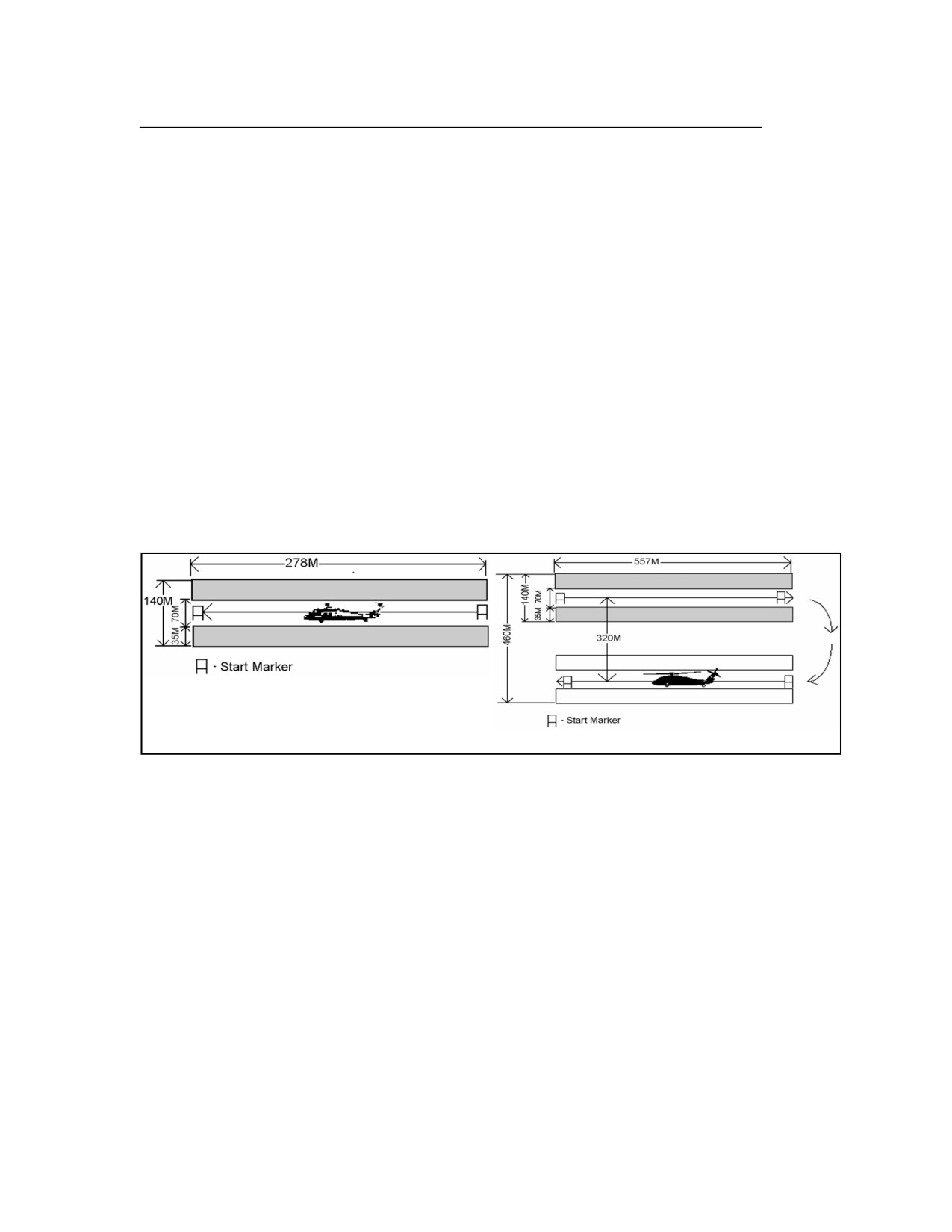
I-51. The air Volcano is a helicopter-mounted, automated, scatterable mine-
delivery system that can deliver mines day or night. The system can dispense
mines during day/night. The system can rapidly emplace a 278-meter, 557-
meter, or 1,115- by 140-meter field at up to 960 mines (800 antitank and 160
antipersonnel) per sortie. The antitank density yields an 80 percent chance of
encounter. Mines can be set to self destruct after 4 hours, 48 hours, or 15
days. FM 3-34.32 (FM 20-32) addresses Volcano operations.
I-12
Appendix I
LIMITATIONS
I-52. The air Volcano system has limitations:
• The UH-60 with air Volcano mounted, a full crew, and one system
operator will be at high gross weight, which reduces range and
maneuverability.
• Minefield emplacement is conducted at low airspeeds (80 knots or
less), making the aircraft more vulnerable to detection and
engagement.
• The crew cannot operate the M60D machine gun with the air Volcano
installed.
• System installation requires about four hours.
• These systems require two five-ton cargo trucks for transport; it is an
engineer responsibility to provide transportation assets to move these
systems.
TYPES OF MINEFIELDS
I-53. Four types of minefields can by emplaced using Volcano—disrupt, fix,
turn, and block. Figure I-2 illustrates emplacement techniques.
Figure I-2. Disrupt and Fix (Left), Turn and Block (Right)
COMMUNICATIONS
I-54. The UH-60D has the following communications systems:
• The AN/ARC-186 provides two-way voice communications in both the
VHF-AM-FM ranges. It provides VHS-AM ATS communications, but
it can function as an FM 2.
• The AN/ARC-164
(V) Have Quick II provides two-way voice
communications in the UHF-AM frequency range of 225 to 399.975
megahertz; the sets provide an antijam frequency-hopping capability.
• The AN/ARC-201
(SINCGARS) is a VHS-FM antijam frequency-
hopping radio, providing communications in the
30-
to
87.975-megahertz frequency range at 25-kilohertz intervals.
• The AN/ARC-220 HF radio provides NOE, long-range communication
with the AN/ARC-100 in the TOC and with other HF receivers.
• The TSEC/KY-58 interfaces with the ARC-186 (V), Have Quick, and
SINCGARS radios to provide secure communications.
I-13
FM 3-04.111 (FM1-111)
NAVIGATION SYSTEMS
I-55. The UH-60A/L has the following navigation systems:
• The ASN-128B Doppler/GPS navigation set provides present position
or destination navigation information in latitude and longitude or
MGRS coordinates.
• The AN/ARN-89 or AN/ARN-149
(V) provides automatic
direction-finding capability for instrument navigation and approach.
• The AN/ARN-123 (V) or AN/ARN-147 (V) VOR/LOC/GS/MB receiving
sets provide instrument navigation and approach.
HEADS-UP DISPLAY AN/AVS-7
I-56. The heads-up display (HUD) system serves as an aid to pilots using the
AN/AVS-6 NVG by providing operational symbology information directly into
the NVG. It always displays airspeed, altitude from MSL, attitude, and
engine torque and can display up to 29 symbols.
AIRCRAFT SURVIVABILITY EQUIPMENT
I-57. Appendix J addresses the UH-60A/L ASE.
LIMITATIONS
I-58. The following are limitations of the UH-60A/L aircraft:
• UH-60A/L aircrews employ AN/AVS-6 NVG that lack the same night
capabilities as FLIR systems in AH-64 aircraft.
• UH-60A/L aircraft are instrument-certified but cannot operate in all
environmental conditions, depending on threat and navigational aid
availability.
• Aircraft equipped with extended-range fuel tanks may not offer the
same accessibility to the aircraft cabin for loading; self-defense
machine guns have a limited range of motion when ERFS kits are
installed.
SECTION V - HH-60L BLACK HAWK
I-59. The HH-60L Black Hawk’s primary mission is aerial MEDEVAC.
Secondary missions include transport of medical teams, delivery of medical
supplies, and support for CSAR missions.
I-60. Air ambulance companies that operate the HH-60L are not organic to
the aviation brigade but are frequently task-organized with it for
maintenance, A2C2, SPINS, ATO, ACO, weather-forecasting, intelligence, and
gunship-escort support. The area support MEDEVAC section leader and the
forward support MEDEVAC are responsible for coordinating with the corps
or division aviation brigade S3 to facilitate support operations. FM 4-02.26
(FM 8-10-26) contains detailed information on air ambulance company
employment and operations.
I-14

Appendix I
DESCRIPTION
I-61. The HH-60L is a twin-engine, dual-seat, utility helicopter. The
minimum required crew is a pilot and copilot. For aerial MEDEVAC
missions, the crew includes up to three medical attendants. The HH-60L is
equipped with a full instrument package and can conduct operations in
day/night/NVG and instrument meteorological conditions. In addition to the
basic configuration, the HH-60L includes a nose-mounted FLIR and kit
installations that allow for rescue hoist, extended range fuel, and MEDEVAC
operations.
SPECIFICATIONS
I-62. Table I-6 outlines HH-60L aircraft specifications.
Table I-6. HH-60L Specifications
Length
64'10” rotors turning, 41'4” rotors/pylon folded
Height
12'4” center hub, 16'10” tail rotor
Width
9'8.6” main landing gear, 14'4” stabilator
Main rotor and tail rotor diameter
53'8” main rotor, 11' tail rotor at 20-degree angle
Cabin floor and door dimensions
73” wide x 151” long, 69” wide x 54.5” high
Maximum gross weight
22,000 pounds.
Rescue hoist/cargo hook max weights
600 pounds rescue hoist; 8,000 pounds, cargo hook
Maximum range with ERFS
630 NM w/400 pound reserve
Patient capacity
6 litter or 6 seated
Crew capacity
2 pilots, 1 crew chief, 3 medical attendants
Fuel capacity
360 gallons and additional 460 gallons. w/ERFS
CAPABILITIES
I-63. The HH-60L provides the following:
• Transport of six litter patients and two medical attendants.
• Transport of six seated patients and two medical attendants.
• Transport of internally and externally loaded medical supplies.
• Transport of medical teams.
ARMAMENT
I-64. The HH-60L is an unarmed aircraft.
COMMUNICATIONS
I-65. The HH-60L has the following communication systems:
• The AN/ARC-201 (SINCGARS) provides VHF-FM communications in
the
30- to
87.975-megahertz frequency range and has antijam,
frequency-hopping capability.
• The AN/ARC-222 provides VHF-AM/FM communications and a
maritime capability.
I-15
FM 3-04.111 (FM1-111)
• The ARC-164 (V) provides UHF-AM communications in the 225- to
399.975-megahertz frequency range and has antijam, frequency-
hopping capability.
• The AN/ARC-220 HF radio provides NOE long-range communications
in the 2- to 29.999-megahertz frequency range.
• The KY-58 provides secure communications for the SINCGARS, Have
Quick II, and AN/ARC-222 radios.
• The KY-100 provides secure communications for the AN/ARC-220
high-frequency radio.
NAVIGATION SYSTEMS
I-66. The HH-60L has the following navigation systems:
• AN/ARN-149 ADF.
• AN-ARN-147 VOR/LOC/GS/MB receiving set.
• AN/ASN 128B Doppler/GPS navigation set.
• AN/ASN 153 (V) TACAN.
AN/ARS-6(V) PILOT HEADS-UP DISPLAY AN/AVS-7
I-67. The HUD system serves as an aid to pilots using the AN/AVS-6 NVG by
providing operational symbology information directly into the NVG. It always
displays airspeed, altitude
(MSL), attitude, and engine torque and can
display up to 29 symbols.
AIRCRAFT SURVIVABILITY EQUIPMENT
I-68. Appendix J covers the HH-60L ASE.
LIMITATIONS
I-69. The following are limitations of the HH-60L aircraft:
• HH-60L aircrews employ AN/AVS-6 NVG that lack the same night
capabilities as FLIR systems in AH-64 aircraft; the HH-60L FLIR is
for mission detection of soldiers to be evacuated. It is not compatible
for flying the aircraft.
• HH-60L aircraft are instrument certified but cannot operate in all
environmental conditions, depending on threat and navigational aid
availability.
• Aircraft equipped with extended-range fuel tanks may not offer the
same accessibility to the aircraft cabin for loading.
SECTION VI - CH-47D CHINOOK
I-70. The primary missions of this aircraft are air assault, artillery raids,
and air movement of troops, cargo, and weapons. Other roles include CSAR,
casualty evacuation, aircraft recovery, parachute operations, disaster relief,
fire fighting, and heavy construction.
I-16

Appendix I
DESCRIPTION
I-71. The CH-47D is a twin-turbine engine, tandem-rotor helicopter. The
minimum crew required to fly it is a pilot, copilot, and flight engineer.
Additional crew members, as required, may be added at the discretion of the
commander. Tactical missions normally require the addition of one or two
crew chiefs.
SPECIFICATIONS
I-72. Table I-7 outlines CH-47D specifications.
Table I-7. CH-47D Specifications
Length
98.9’
Height
18.9’
Fuselage width
12.4’
Main rotor span
60’
Cargo space
1,500 cu ft
Floor space
225 sq ft
Maximum gross weight
50,000 pounds
Max load for forward and aft hooks
17,000 pounds
Max tandem load for forward and aft hooks
25,000 pounds
Max load for center hook
26,000 pounds
Cruise airspeed
130* knots
Max continuous airspeed
170* knots
Combat radius (16,000 lb cargo)
50* NM (90 km)
Combat radius (31 troops)
100* NM (180 km)
* Varies with a multitude of factors such as temperature, wind, gross
weight, internal versus external load, and time in PZ/LZ.
CAPABILITIES
I-73. The CH-47D provides the following:
• Countermeasure suite of IR jammers, radar-warning receivers, and
laser-warning detectors.
• Data-reduction transfer system to upload from the AMPS data-
transfer cartridge and download postmission data.
• Internal transport of two HMMWVs or a HMMWV with a 105-
millimeter howitzer and gun crew.
• MEDEVACs of 24 litter patients and 2 medics.
• Self-deployable range of 1,056 NM with the ERFS, with 30-minute
reserve; transportable in the C-5 aircraft.
• Shipboard compatibility for joint and combined operations.
ARMAMENT SUBSYSTEMS
I-74. The armament subsystems are the M24 and M41 machine-gun systems
installed in the cabin door, cabin escape hatch, and on the ramp. Both
I-17
FM 3-04.111 (FM1-111)
subsystems use the M60D 7.62-millimeter machine gun. The two flexible
7.62-millimeter machine guns are free pointing but limited in traverse,
elevation, and depression.
COMMUNICATIONS
I-75. The CH-47D has the following communications systems:
• The AN/ARC-164 Have Quick II radios provide UHF-AM two-way
communications in the
225- to
399.975-megahertz range in
25-
kilohertz-intervals; they can operate in normal or antijam, frequency-
hopping mode.
• The AN/ARC-201 SINCGARS provides two-way communications in
the VHF-FM range of
30 to
87.975 megahertz in
25-kilohertz
intervals; it employs antijam, frequency-hopping capability, and, when
used with the KY-58, provides secure voice and cipher-mode
communications. Later SINCGARS has embedded encryption and
does not require KY-58 interface.
• One or two AN/ARC-186 VHF-AM-FM radio sets are installed,
providing broad VHF communications on either the number 1 or 3
position on the function control selector of the Controls and Function,
Interphone Control.
• The AN/ARC-220 HF radio supports NOE long-distance
communications from 2 to 29.999 megahertz in 100-hertz steps on 20
preselectable channels, for a total of 280,000 possible frequencies; as
one of the radios available to the commander, it is accessible in the
number 4 position on the function control selector.
• The KY-58 interfaces with the AN/ARC-186 VHF-AM-FM radio in the
FM range to provide secure communications.
• The KY-100 provides secure communications for the AN/ARC-220
high-frequency radio.
NAVIGATION SYSTEMS
I-76. The CH-47 has the following navigation systems:
• The AN/ASN-128B Doppler/GPS navigation set provides present
position or destination navigation information in latitude and
longitude or the MGRS coordinates. In the primary combined mode,
the GPS updates Doppler position at a 1-megahertz rate; other CH-47
aircraft have the AN/ASN-128 Doppler navigation without GPS.
• The AN/ARN-89 ADF provides automatic direction finding for
instrument navigation and approach.
• The AN/ARN-123
(V) VOR/LOC/GS/MB provides instrument
navigation and approach.
HEADS-UP DISPLAY AN/AVS-7
I-77. The HUD system serves as an aid to pilots using the AN/AVS-6 NVG by
providing operational symbology information directly into the NVG. It always
displays airspeed, altitude
(MSL), attitude, and engine torque and can
display up to 29 symbols.
I-18
Appendix I
AIRCRAFT SURVIVABILITY EQUIPMENT
I-78. Appendix J addresses the CH-47D ASE.
LIMITATIONS
I-79. The following are limitations of the CH-47D aircraft:
• CH-47D aircrews employ AN/AVS-6 NVG that lack the same night
capabilities as FLIR systems in AH-64 aircraft.
• CH-47D aircraft are instrument certified but cannot operate in all
environmental conditions depending on threat and navigational aid
availability.
• CH-47D aircraft generate a powerful downwash that may dislodge
tents or other unsecured items in proximity to landing or hover. In
desert and snow conditions, this downwash can disclose friendly
positions; LZs must be chosen that accommodate the aircraft’s size
and signature.
SECTION VII - C-12 (C, D, T1, AND T2 MODELS)
I-80. The C-12 provides higher speed intratheater transport for key
personnel.
DESCRIPTION
I-81. The C-12 is a twin-engine, turboprop, fixed-wing aircraft. Many
different C-12 models are fielded. The C-12C and D1 have PT6A-41 engines;
the C-12D2, T1, and T2 have PT6A-42 engines. Aircraft can normally carry
eight passengers and a crew of two. All models have an aft passenger door,
and all, except the C-12C, have a separate cargo door.
SPECIFICATIONS
I-82. Table I-8 outlines C-12 specifications.
I-19