FM 3-04.111 (FM 1-111) Aviation Brigades (AUGUST 2003) - page 9
FM 3-04.111 (FM1-111)
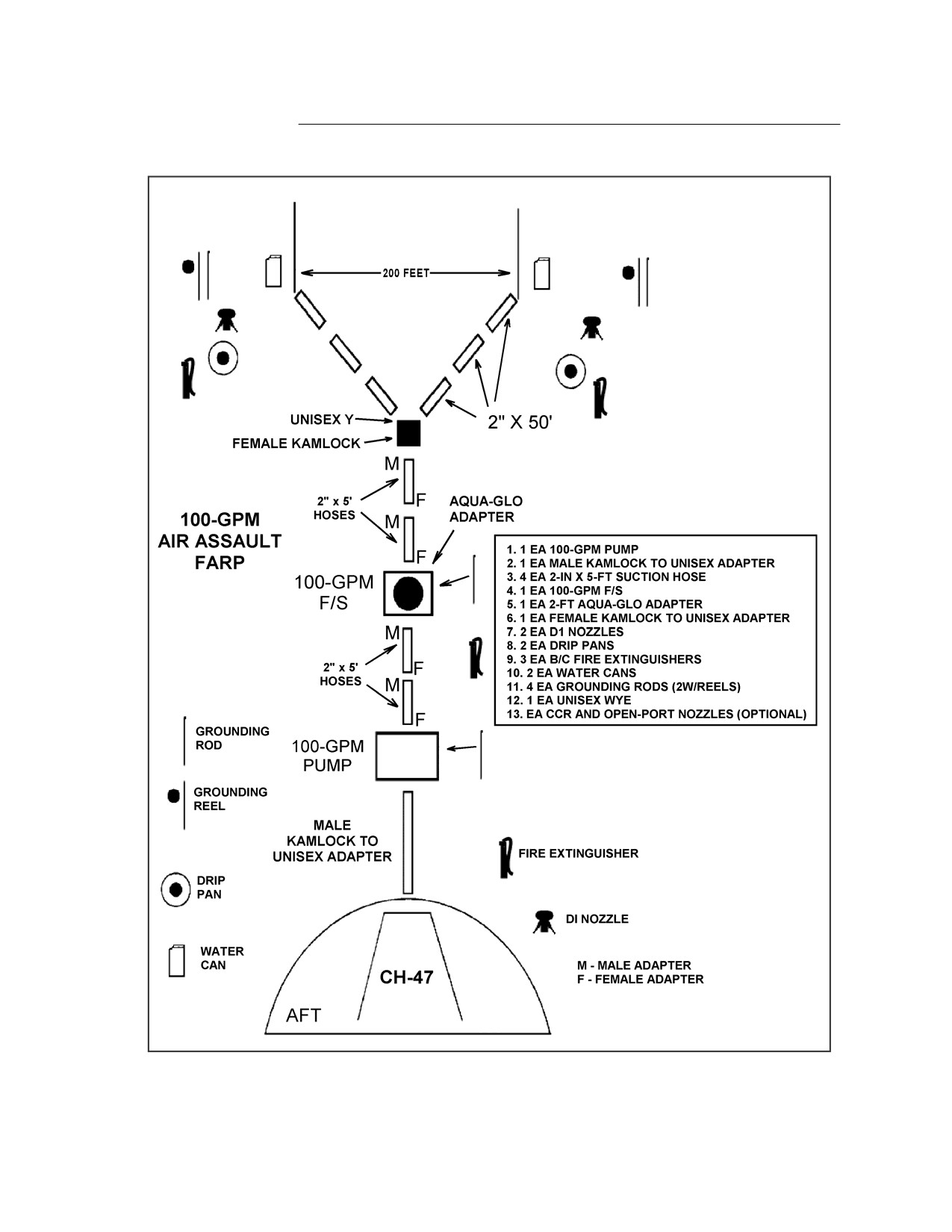
Figure F-15 ERFS Layout Configuration
F-34
Appendix F
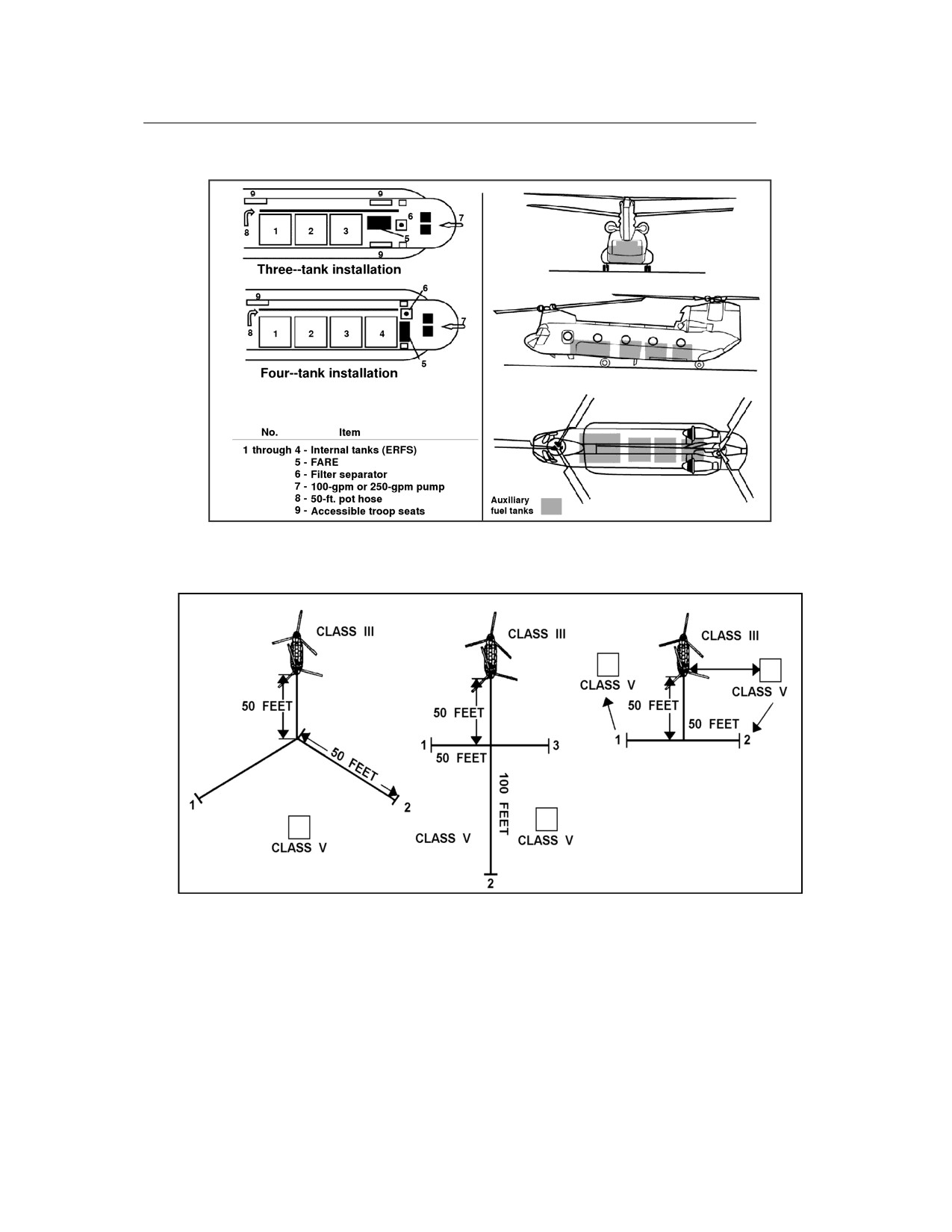
Figure F-16. CH-47 ERFS Equipment and Tank Installation
Figure F-17. Refueling Point Setups
UH-60 WET HAWK/FAT HAWK
F-152. UH-60 aircraft may be more readily available and more survivable for
many operations in deep areas. Units can internally transport FARE systems
and FARP personnel and externally transport 500-gallon fuel drums. (TM 55-
1560-307-13&P contains additional information.)
F-153. A Wet Hawk is a UH-60 that provides fuel to another aircraft from its
own internal or external fuel tanks via a micro-FARE system. A Fat Hawk is
a UH-60 that provides both fuel and ammunition. A Fat Hawk crew can
F-35
FM 3-04.111 (FM1-111)
refuel and rearm four OH-58D aircraft in less than 15 minutes without sling
loading fuel or ammunition. The absence of an external load increases UH-60
survivability, reduces emplacement time, and limits enemy capability to
target the FARP. Normal operations consists of two External Stores Support
System (ESSS)-equipped UH-60 aircraft with full crew, three to four POL
personnel, a combat lifesaver/medic, security personnel, armament personnel,
and armament and refuel equipment to support the mission.
JOINT AIRCRAFT ASSETS AVAILABLE FOR REFUEL/RESUPPLY
F-154. If the brigade or battalion AA is located at an airfield base camp or
forward operating base or if an austere airfield is available, units may be able
to request joint fixed-wing refuel/resupply support.
F-155. Marine Corps CH-53s have a unique refueling capability that can
support supply points, operations in deep areas, and other specialized
mission applications.
MARINE CH-53 TACTICAL BULK FUEL DELIVERY SYSTEM
F-156. Marine Corps CH-53 units are equipped with the tactical bulk fuel
delivery system (TBFDS) that includes one to three 800-gallon internal fuel
tanks and a 120-GPM refueling system, allowing transport of 800, 1,600, or
2,400 gallons of fuel. However, the fuel system is tied into the aircraft’s main
fuel tanks, allowing delivery of additional fuel. Because the CH-53 can air
refuel, it can quickly join with a KC-130 at altitudes as low as 500 feet AGL
to replenish TBFDS tanks and rejoin the ground FARP or fuel supply location
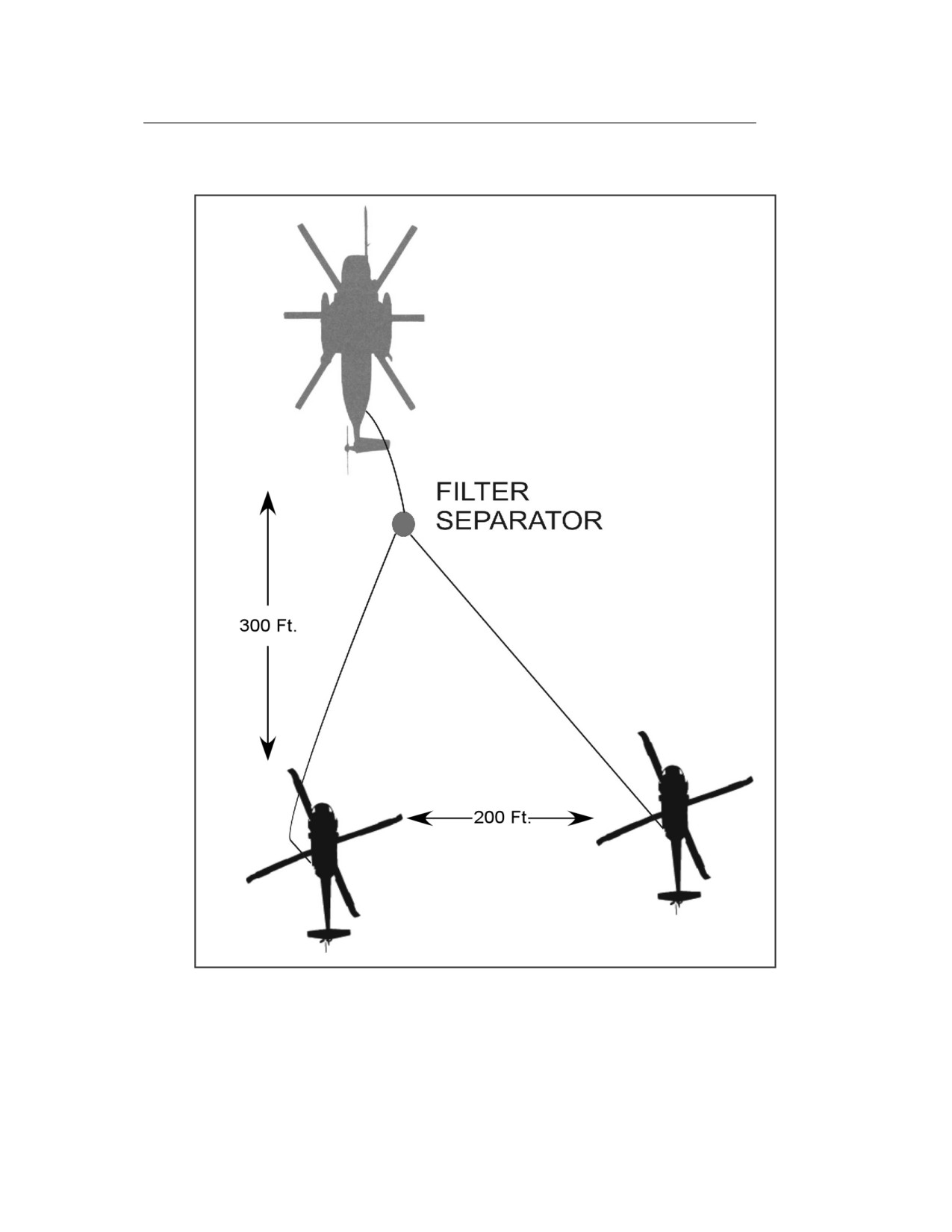
to replenish additional aircraft (Figure F-18).
MARINE KC-130
F-157. The Marine Corps KC-130F/R/T/J models are equipped for airborne
refueling but also rapid ground refueling of Marine or, in this case, Army
helicopters and ground vehicles. Aircraft refuel from wing fuel and pods
mounted under the wings. They also can carry a 3,600-gallon stainless steel
tank inside the cargo compartment for additional fuel delivery. Older model
KC-130s require this cargo compartment tank for refueling and can only
transport 5,588 gallons in wing and wing-pod fuel tanks. The new KC-130J
can deliver up to
8,455 gallons from wing pods and wing fuel and an
additional 3,600 gallons from the cargo compartment tank. It can also refuel
without the cargo compartment tank, allowing palletized ammunition and
other supplies to be transported. It has its own pumps and hoses that can
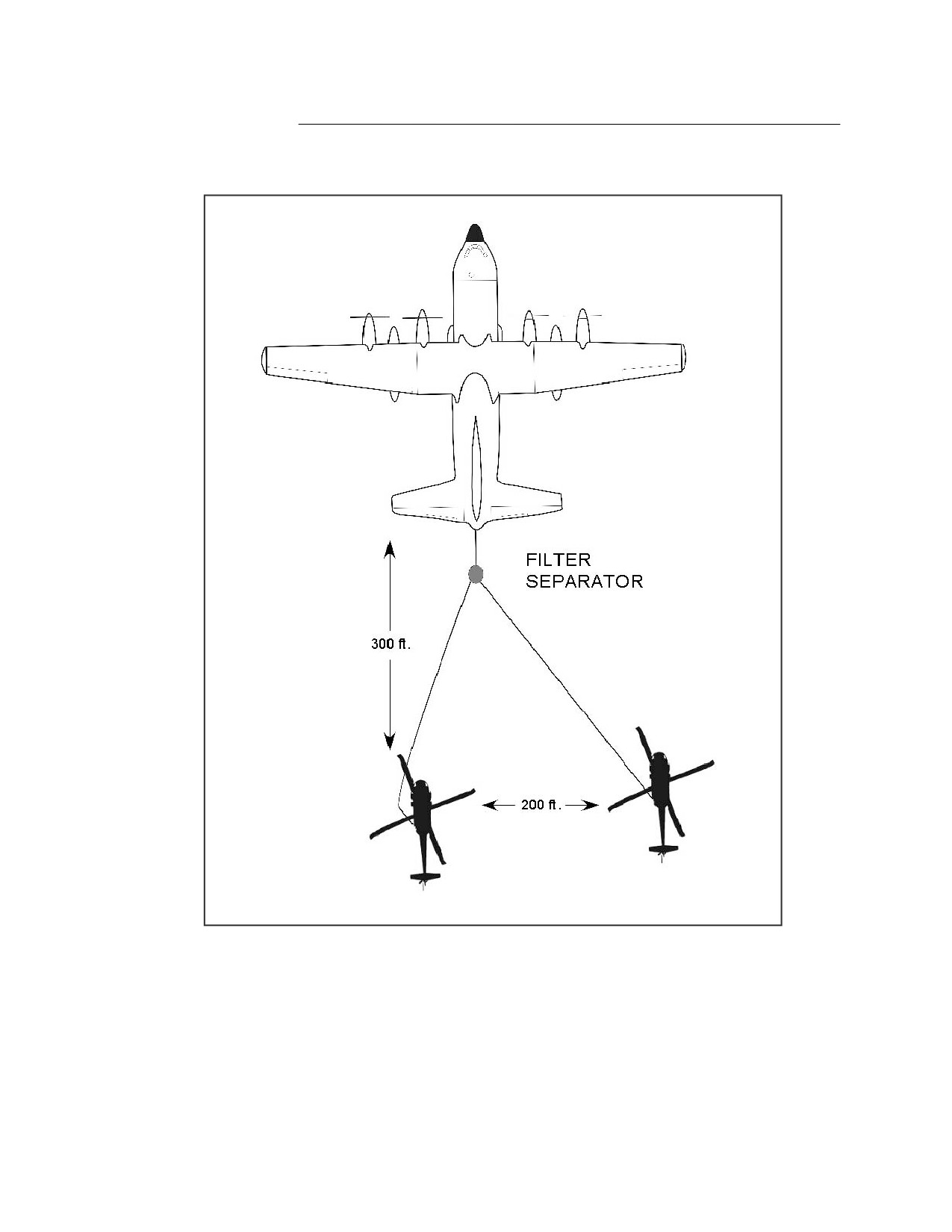
dispense up to 300 GPM from each pod (Figure F-19).
AIR FORCE C-17
F-158. The Air Force C-17 also can function as a tanker providing fuel to
ground receivers using HTARS. The receivers can be Army aircraft, trucks,
bladders, or other equipment. The C-17 can deliver fuel through either one or
both of its single-point receptacles. The C-17 booster pumps defuel the
aircraft using the HTARS and additional Army components. Aircraft can
defuel at a rate of 520 GPM, depending on the number of booster pumps
(Figure F-20).
F-36
Appendix F
Figure F-18. HTARS Configuration and Additional Components for CH-53 FARP
F-37
FM 3-04.111 (FM1-111)
Figure F-19. HTARS Configuration and Additional Components for C-130 FARP
F-38
Appendix F
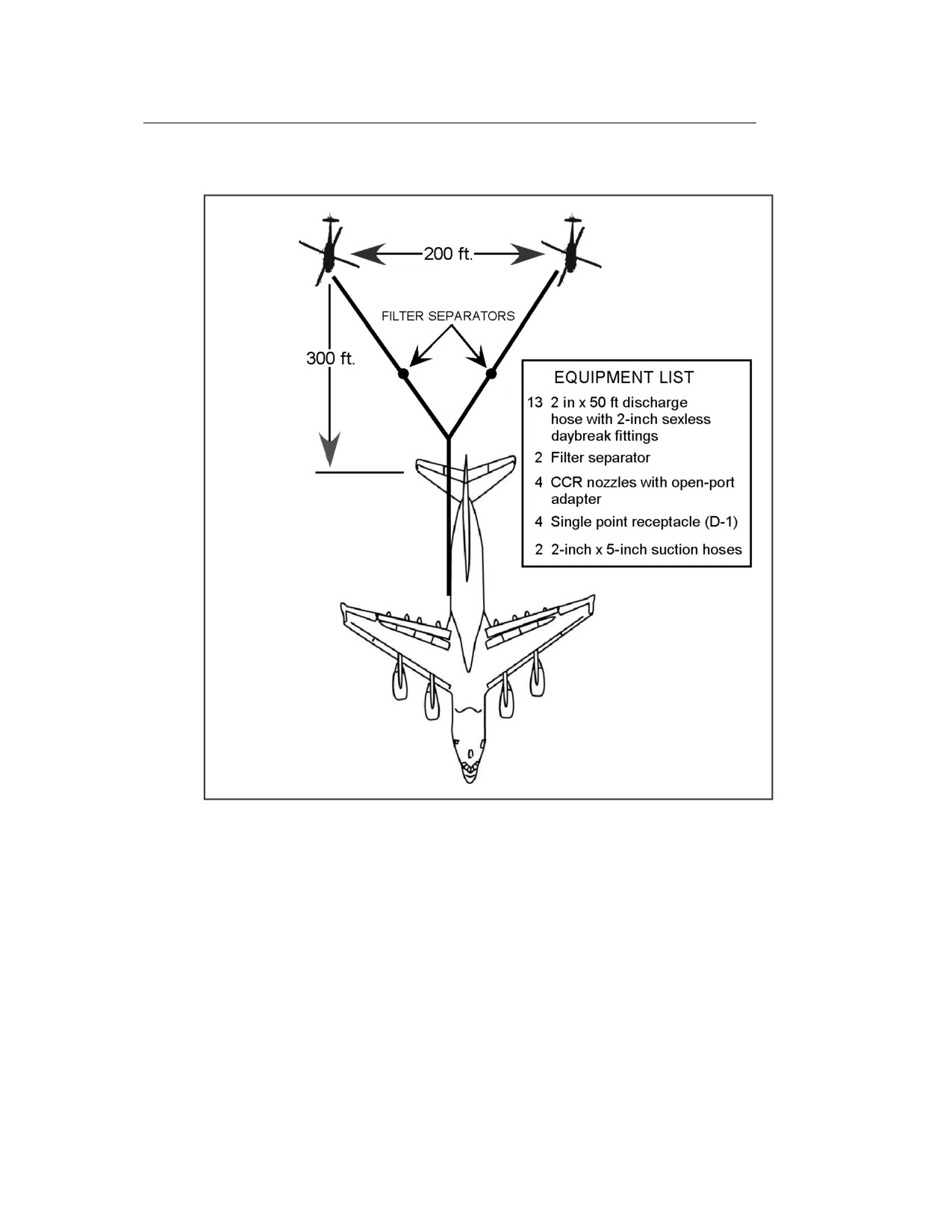
Figure F-20. HTARS Configuration and Additional Components for C-17 FARP
SITE CONSIDERATIONS
F-159. The KC-130 or C-17 can operate from small airfields with limited
supporting infrastructure. The airfield runway must be 3,000- to 5,000-feet
long and 90-feet wide.
F-160. The KC-130 and C-17 do not require paved runways. Graded and
compacted gravel or clay will suffice. However, if KC-130 or C-17 resupply
becomes a primary means of resupply for a forward operating base or base
camp airfield—such as occurred in Afghanistan—runway repair
requirements will increase, dictating engineer augmentation.
F-161. The CH-53 TBFDS does not require a runway but a large relatively
flat area similar in size to that required for CH-47 Fat Cow refueling.
F-39
FM 3-04.111 (FM1-111)
EQUIPMENT LAYOUT
F-162. The CH-53 TBFDS has enough hoses to refuel two aircraft or refuel
vehicles located 200 feet away. Hoses run out of the cargo compartment in
the form of a “V” in the same manner as a CH-47 Fat Cow. The TBFDS uses
the standard D-1 nozzle compatible with Army and other joint aircraft. Army
aircraft must approach Marine Corps refueling points hovering at a 45-
degree angle with the aircraft fuel port facing the nozzle.
F-163. Marine KC-130s have organic refuel equipment and compatible D-1
nozzles as they perform the same ground mission for Marine helicopters and
fixed-wing aircraft. Fuel in the wing-mounted external fuel tanks and
internal 3,600-gallon stainless steel tank (if installed) can be dispensed for
rapid ground refueling. The aircraft external fuel pods use ram-air turbine-
driven fuel boost pumps in each pod.
F-164. For the C-17, required equipment includes the HTARS, two 100-GPM
filter separators, five fire extinguishers, four water cans, and spill containers.
Postoperation evacuation of fuel lines requires a 100-GPM pump. FARP or
FARE personnel configure the HTARS and additional components as Figure
F-20 shows. They lay out the system to achieve minimum safe distance
between aircraft.
CONNECTION OF SYSTEM COMPONENTS FOR THE C-17
F-165. Starting at the supply aircraft, FARP or FARE personnel—
• Connect using a single-point nozzle (D-1 type) and perform a locked
nozzle check.
• Connect a 2-inch by 50-foot discharge hose to the nozzle, using the
sexless dry break fitting.
• Install a T-fitting to the end of the discharge hose.
• Connect a 2-inch by 50-foot discharge hose to both remaining ends of
the T-fitting.
• Connect a 100-GPM filter/separator, after these lengths of hose.
F-166. Lay out the remainder of the HTARS into a modified configuration,
resulting in two refueling points, separated by at least 200 feet between
points and 300 feet from the C-17. At each refueling point, FARP or FARE
personnel—
• Connect the applicable CCR or D-1 nozzle.
• Ensure that the sexless fitting valves are in the open position.
• Attempt to manually disconnect the dry break connection after
opening each valve. Properly assembled hardware will not disconnect;
if it does disconnect, replace the faulty connection.
GROUNDING AND OTHER EQUIPMENT FOR THE C-17, KC-130, OR CH-53
F-167. FARP or FARE personnel—
• Drive a grounding rod into the ground 10 feet from the end of each
dispensing hose.
• Loop the dispensing hose back to the ground rod, and hang the nozzle
on the ground-rod hanger.
F-40
Appendix F
• Connect the clip of the nozzle grounding wire to the ground rod at
each point.
• Place a fire extinguisher, a spill container, and a five-gallon can of
water at each point.
• Place a grounding rod at the filter/separator, and connect using the
filter/separator grounding wire.
• Place a fire extinguisher at the filter/separators.
OPERATION
F-168. One critical aspect of refueling operation with other service aircraft is
that their rules and regulations differ from and supersede the Army’s. For
instance, Marine doctrine prohibits simultaneous arming and refueling and
requires a separation distance of at least 300 feet from separate arming and
refueling activities. In addition, while hot refueling is permissible, hot
refueling with explosive ordnance on board is not authorized unless approved
by Headquarters, U.S. Marine Corps, and Naval Air Systems Command.
F-169. In wartime, attack units may be authorized to refuel while armed. In
peace and lesser contingencies, units must dearm, then refuel, then rearm.
This restriction effectively requires aircraft to shut down after refueling to
preserve onboard fuel. Marine Corps aircraft use JP5 fuel. The Air Force and
Army use JP8. This disparity poses no problem for Army aircraft.
F-170. Unless Marine Corps or Air Force regulations supersede the Army’s,
operate the system in compliance with safety procedures and follow these
steps:
•
The refuelers guide aircraft into position using coordinated signals;
they check with the pilot to ensure that all armaments are on safe.
•
Aircrew members, except the pilot, should assist with refueling or as
fire guards.
•
The refuelers place fire extinguishers near the aircraft and within
reach of fuel fill points.
•
The refuelers ground the aircraft.
•
The refuelers bond the nozzle to the aircraft; they insert the bonding
plug into the aircraft plug receiver or attach the nozzle bonding cable
clip to bare metal on the aircraft.
•
After bonding the nozzle, the refuelers remove the nozzle dust cap and
open the fill port.
•
The refuelers verify that all valves are open.
•
Refuelers signal the refueling supervisor that the point is ready to fuel
and open the nozzle and refuel; they do not leave the nozzle at any
time during the refueling; they stop the flow of fuel if there is any
emergency at the refueling point.
•
After the receiving aircraft is full, refuelers shut off the nozzle;
disconnect the nozzle from the aircraft; and replace the fuel fill port
cover and the nozzle dust cap.
•
Refuelers unplug the nozzle-bonding plug and return the nozzle to the
nozzle hanger.
F-41
FM 3-04.111 (FM1-111)
F-171. For C-17 refueling, refuelers use a FARE pump to evacuate fuel lines
and recover components as follows:
• Close the D-1 nozzle.
• Install the FARE pump 10 feet away from the SPR panel.
• Reverse the flow direction of each filter/separator.
• Start the pump, and run at idle.
• Recover hoses, starting at the refueling point.
• Stop the pump, and disconnect from the tanker aircraft.
ADVANTAGES/DISADVANTAGES
Advantages
F-172. The advantages of the CH-53 TBFDS, KC-130, or C-17 FARP
include—
• Ability to deliver bulk fuel to remote areas using small airfields with
unimproved runways (no runway for CH-53) and little supporting
infrastructure.
• Ability to provide substantial fuel and be set up and operational
quickly.
• Useful for selected operations in deep areas using intermediate
staging bases or forward operating bases.
• Ability of the CH-53 TBFDS to aerial refuel and rapidly return with
additional fuel.
• Ability of joint fixed-wing aircraft can also transport ammunition in
the cargo compartment for substantial resupply capability.
Disadvantages
F-173. The disadvantages of the CH-53 TBFDS, KC-130, or C-17 FARP
include—
• It requires diversion of these aircraft from other valuable missions.
• Because of other priorities and the ACO/ATO process, it may require
substantial time to request and get approval for such missions.
• The KC-130 or C-17 requires a 3,000-foot by 90-foot minimum runway
for landing; engineer requirements can be extensive if the runway is
dirt or clay and the unit anticipates repeated use.
• The aviation unit operating the FARP must transport personnel and
equipment to the FARP site; Marine CH-53s or KC-130s may wish to
provide their own refuelers/operators.
• Marine Corps’ aircraft refueling regulations prohibit simultaneous
arming and refueling activities.
SECTION VIII - VOLCANO ARMING OPERATIONS
F-174. UH-60 aircraft equipped with the Volcano system require arming in a
manner similar to attack helicopters. However, assault battalions and their
F-42
Appendix F
Volcano-owning AVUMs lack the arming personnel organic to attack and
cavalry HHCs. Therefore, units must use crew chiefs, combat engineers, or
other trained personnel to load and arm Volcano canisters. This level of
training is essential for safe arming operations. If the unit forecasts
operations, it should request additional engineer personnel for the duration of
the operation.
ARMING LOCATION AND SITE LAYOUT
F-175. Loading and arming can occur in the unit AA or near the rapid refuel
point. FM 3-34.32 (FM 20-32) specifies that, because of more than 1,200
pounds of explosives in 160 mine canisters on fully loaded Volcano aircraft,
loading aircraft should position at least 1,000 meters from CPs, major routes,
and nonessential personnel. If positioning proves impractical in combat, units
should exercise feasible caution and avoid potential sources of secondary
explosions such as fuel storage areas.
F-176. The total weight of the armed air Volcano system is 2,886 kilograms
(more than 6,350 pounds). Because fully loaded Volcano aircraft approach
maximum gross weight, ground conditions should be firm or steel/wood
planking landing pad should be provided. Armed aircraft should avoid
refueling near (within 375 meters) other aircraft. Simultaneous arming and
refueling is not necessary or recommended. Obstacles should not hinder
takeoff at high gross weight.
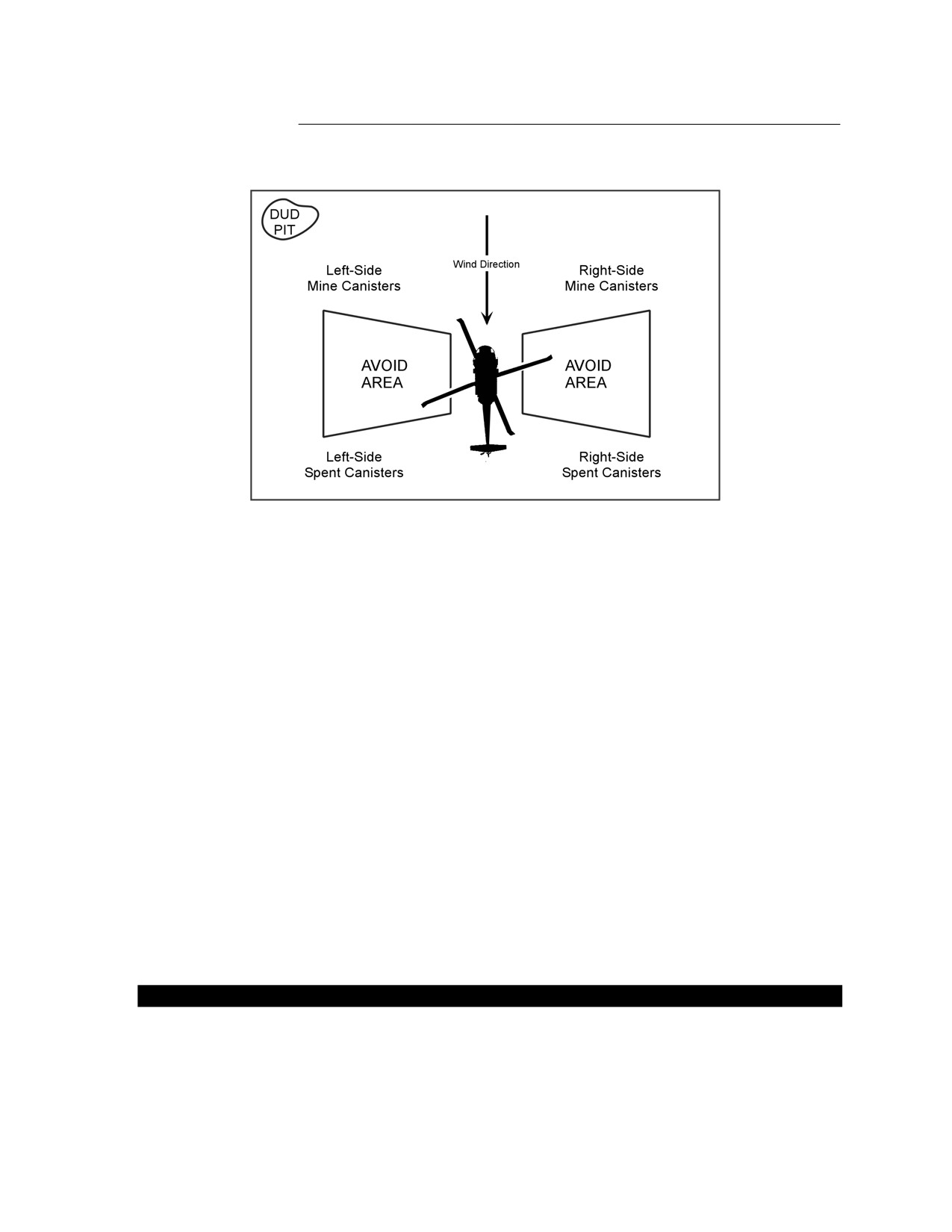
F-177. Figure F-21 shows an example of a site layout for Volcano arming. As
with normal FARP operations, fire extinguishers and grounding rods must be
available at the arming point. Arming personnel dig a dud pit where they
place damaged or misfired canisters. Personnel store live canisters to the
front left and right of the aircraft and spent canisters, to the rear left and
right, taking care to avoid the tail rotor. Personnel and vehicles must avoid
areas directly adjacent to the M139 dispensers; accidental discharge could
strike personnel, and mine arming would occur within 2.5 minutes. If such
discharge occurs, the aircraft and loading personnel should reposition at least
640 meters away and loading personnel should notify EOD personnel. That
distance extends to 1,000 meters if a fire occurs near the live canisters and
personnel are unable to extinguish it in a reasonable time.
F-43
FM 3-04.111 (FM1-111)
Figure F-21. Example of a Site Layout for a Volcano Arming Point
ARMING AND DISARMING OPERATIONS
ARMING
F-178. Each launcher rack functions as a carrier and launcher platform for a
40-mine canister. Aircraft can mount up to four M139 dispenser racks, two on
each side of the UH-60. Loaders insert canisters into the 40 keyholes, rows 1
through 4 from bottom to top and columns 1 through 10 from left to right.
This loading sequence can be important if the rack carries less than a full
load of mines. As loaders insert the mine canisters, a green latch latches the
canister to the rack and a red latch arms the canister. The rack has two
electric receptacles—one for the power connector and one for the launcher
rack cable running to the dispensing control unit.
DISARMING
F-179. After mission completion, aircraft return to the arming point to
dearm. The users—
• Discard spent canisters at least 30 meters to the left or right rear of
the aircraft at the 4- and 8-o'clock positions.
• Return live canisters to ASPs for future use or repackaging.
• Place misfired canisters in the dud pit and contact EOD.
SECTION IX - FORWARD ARMING AND REFUELING POINT OPERATIONS
F-180. The FARP provides forward support for tactical operations. Its
organization includes the POL and ammunition section and a maintenance
contact team.
F-44
Appendix F
EQUIPMENT
HEAVY EXPANDED MOBILITY TACTICAL TRUCK FORWARD ARMING AND
REFUELING POINT
F-181. The FARP personnel place two HEMTT tankers on-line and retain
one in reserve.
FORWARD AREA REFUELING EQUIPMENT/ADVANCED AVIATION FORWARD AREA
REFUELING SYSTEM FORWARD ARMING AND REFUELING POINT
F-182. The FARP personnel configure the FARE or AAFARS FARP similar
to the HEMTT FARP. They use at least eight points or as needed to support
simultaneous refueling of an attack helicopter company or ACT.
FORWARD ARMING AND REFUELING POINT LAYOUT
F-183. The FARP layout for simultaneous rearming and refueling operations
will depend on the terrain.
SITE SELECTION
F-184. FARP personnel use tree lines, vegetation, terrain folds, and reverse
slopes to mask the FARP. Do not collocate the FARP with the TOC or unit
trains. The site must accommodate the number and type of aircraft that need
service. Units maintain the minimum spacing prescribed by FM 4-20.12 (FM
10-67-1). This manual requires 100 feet between refueling points for all
aircraft except the CH-47, which requires 180 feet for aircraft parked side by
side. Sites must allow adequate obstacle clearance for safe takeoff and
landing. Units designate HAs for waiting aircraft in view of the FARP but not
within it.
WORK PRIORITIES
SECURITY
F-185. FARP personnel—
• Establish a perimeter and prepare fighting positions and range cards.
• Set up crew-served and air defense weapons to protect the site.
• Sweep the site for NBC contamination and set up NBC equipment.
• Reconnoiter the site for appropriate refuel and rearm points.
COMMUNICATIONS
F-186. Upon arrival, the FARP NCOIC establishes communications with the
TOC, giving the closing report and anticipated time of operation. If possible,
he communicates on secure FM from a location other than the FARP. FARP
personnel use the FARP radio only under the following circumstances:
• Requesting resupply.
• Reporting that the site is under attack.
• Reporting that the FARP is not operational.
F-45
FM 3-04.111 (FM1-111)
• Reporting a serious FARP incident such as a fire or an aircraft
accident.
F-187. Outbound aircraft can relay critical messages from the FARP to the
TOC. This reduces the chances of enemy detection by radio transmission.
SETUP
F-188. FARP personnel—
• Determine the refuel and rearm point’s positions.
• Break down ammunition into the first standard loads and another
load in the RASA.
• Reposition vehicles into final parking location.
• Perform PMCS on vehicles, radios, NBC equipment, weapons, and
platoon equipment.
• Camouflage vehicles and equipment.
RESUPPLY
F-189. FARP personnel resupply ammunition and fuel as necessary. After
ammunition trucks offload, depending on the FARP’s expected duration of
operation, vehicles may need to depart for resupply of Class V. HEMTT
tankers may transload into other tankers as they become empty or can fill
empty 500-gallon drums. This practice allows these vehicles to go for
additional Class III at distribution points or logistics RPs. In all cases,
personnel diverted to resupply vehicles are not available to assist in arming
and refueling. With a silent FARP prepared to assume the mission, the initial
FARP vehicles can resupply without disrupting the mission.
AIRCRAFT PROCEDURES
F-190. Unit SOP and orders specify procedures. The following provides
recommendations and describes standard signals.
LANDING
F-191. The AMC calls in the blind when 5 kilometers from the FARP. An
example call is “T14 (FARP), this is T56 with five on blue.” The AMC is
telling the FARP that five aircraft are inbound on the Blue route. This alerts
the FARP and other aircraft of his intentions. The FARP does not reply
unless the area is not safe or secure. Personnel do not use terms that violate
OPSEC such as aircraft, inbound, outbound, and FARP.
F-192. Aircraft fly NOE within 3 kilometers of the FARP. Approaching
aircraft maintain visual contact with departing aircraft.
POSITIONING
F-193. FARP personnel use standard hand-and-arm signals to assist pilots in
positioning aircraft into refueling and rearming points.
F-46
Appendix F
STANDARD HAND AND ARM SIGNALS
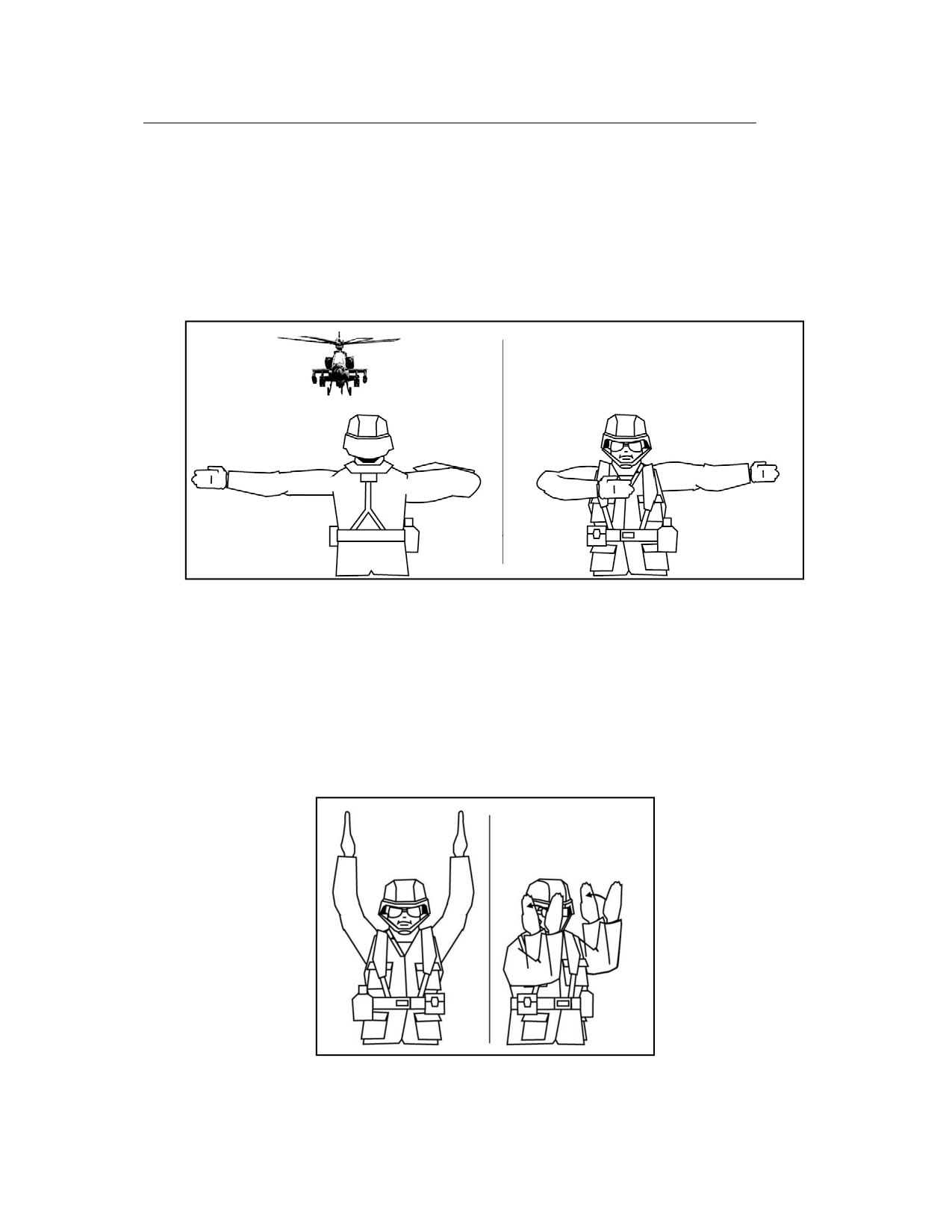
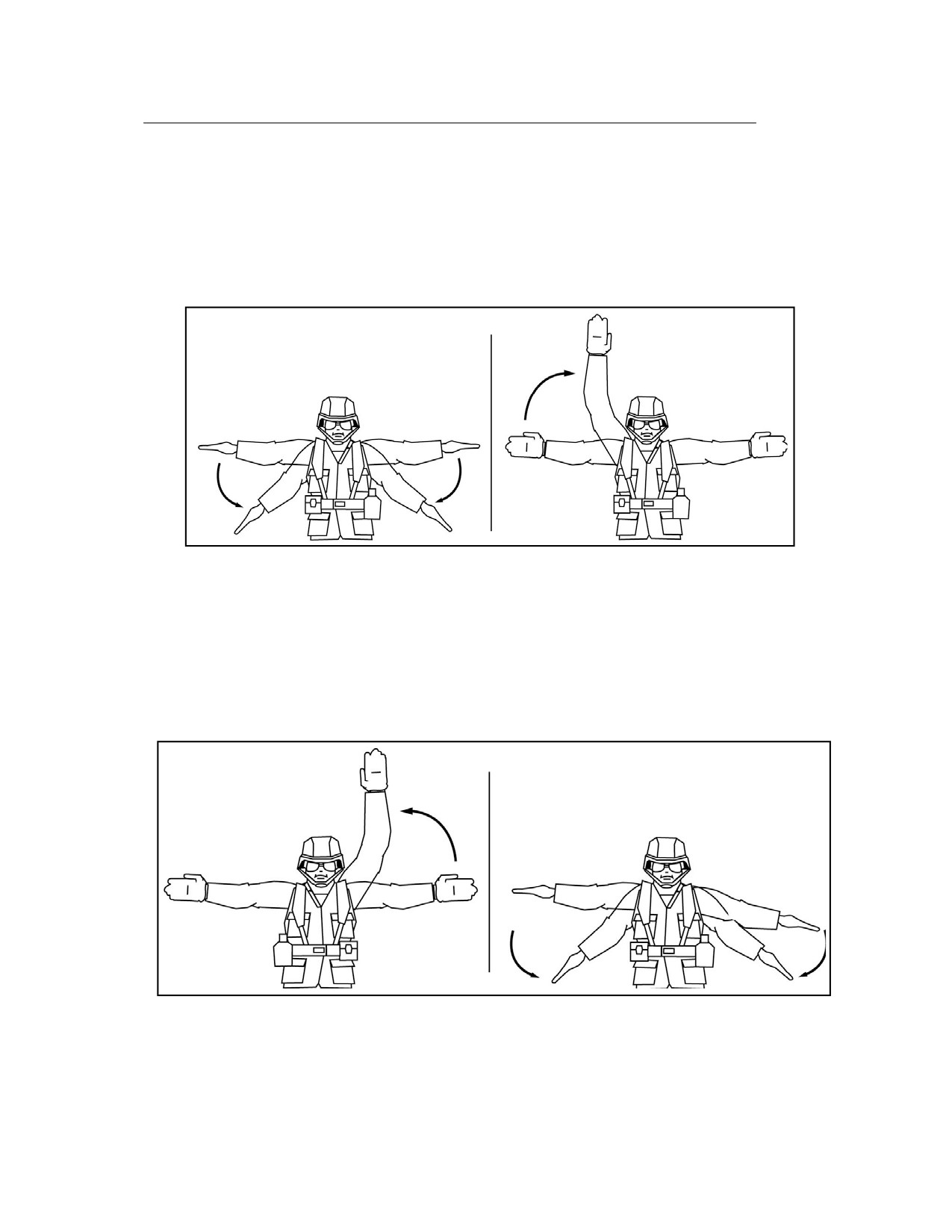
F-194. In Figure F-22, the ground guide—
•
(Left): Stands in direct view of the pilot.
•
(Right): Points to the next guide with one arm, and sweeps the other
arm in the direction in which the pilot is to proceed.
Figure F-22. (Left) Ground Guide Position Relative to Aircraft;
(Right) Proceed To Next Ground Guide
F-195. In Figure F-23, the ground guide—
•
(Left): Places arms above head in vertical position with palms facing
inward.
•
(Right): Places arms out at shoulder height, palms up, repeatedly
motioning upward and backward; and indicates the aircraft speed
desired by rapidity of motions.
Figure F-23. (Left) This Way; (Right) Move Ahead
F-47
FM 3-04.111 (FM1-111)
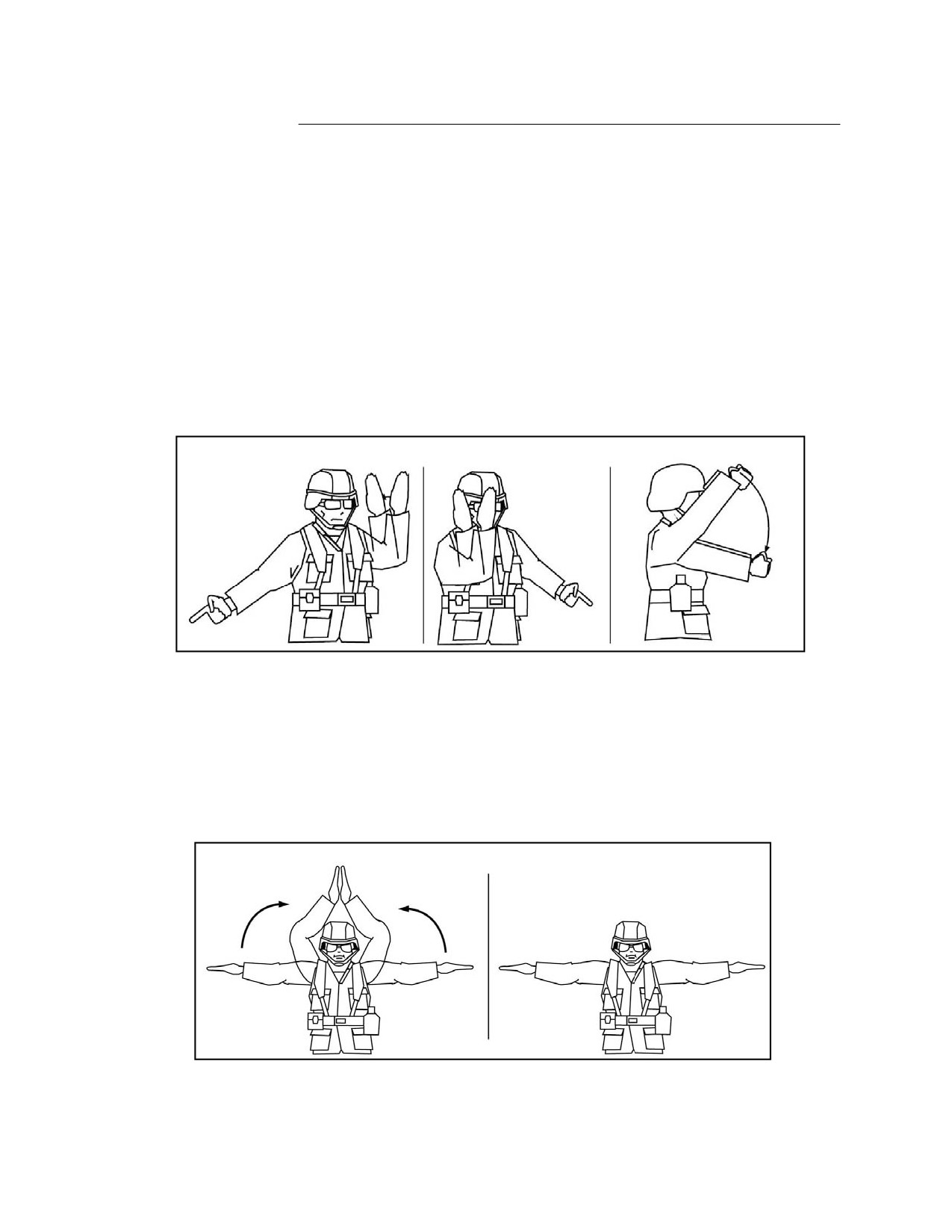
F-196. In Figure F-24, the ground guide—
•
(Left): Positions right arm down, and points to left wheel or skid; lifts
left arm repeatedly from horizontal position toward head (desired
direction of turn); and indicates rate of turn by rapidity of motions.
•
(Center): Positions left arm down, and points to right wheel or skid;
lifts right arm repeatedly from horizontal position toward head
(desired direction of turn); and indicates rate of turn by rapidity of
motions.
•
(Right): Stands with arms raised vertically above head and facing
toward the point where the aircraft is to land; lowers arms repeatedly
from a vertical to a horizontal position, stopping finally in the
horizontal position.
Figure F-24. (Left) Turn to Port; (Center) Turn to Starboard; (Right) Landing Direction
F-197. In Figure F-25, the ground guide—
•
(Left): Extends arms horizontally to the side, palms up; repeatedly
raises arms overhead; and indicates rate of ascent by speed of motion.
•
(Right): Extend arms horizontally sideways with palms down; holds
position to signal hover.
Figure F-25. (Left) Move Upward; (Right) Hover
F-48
Appendix F
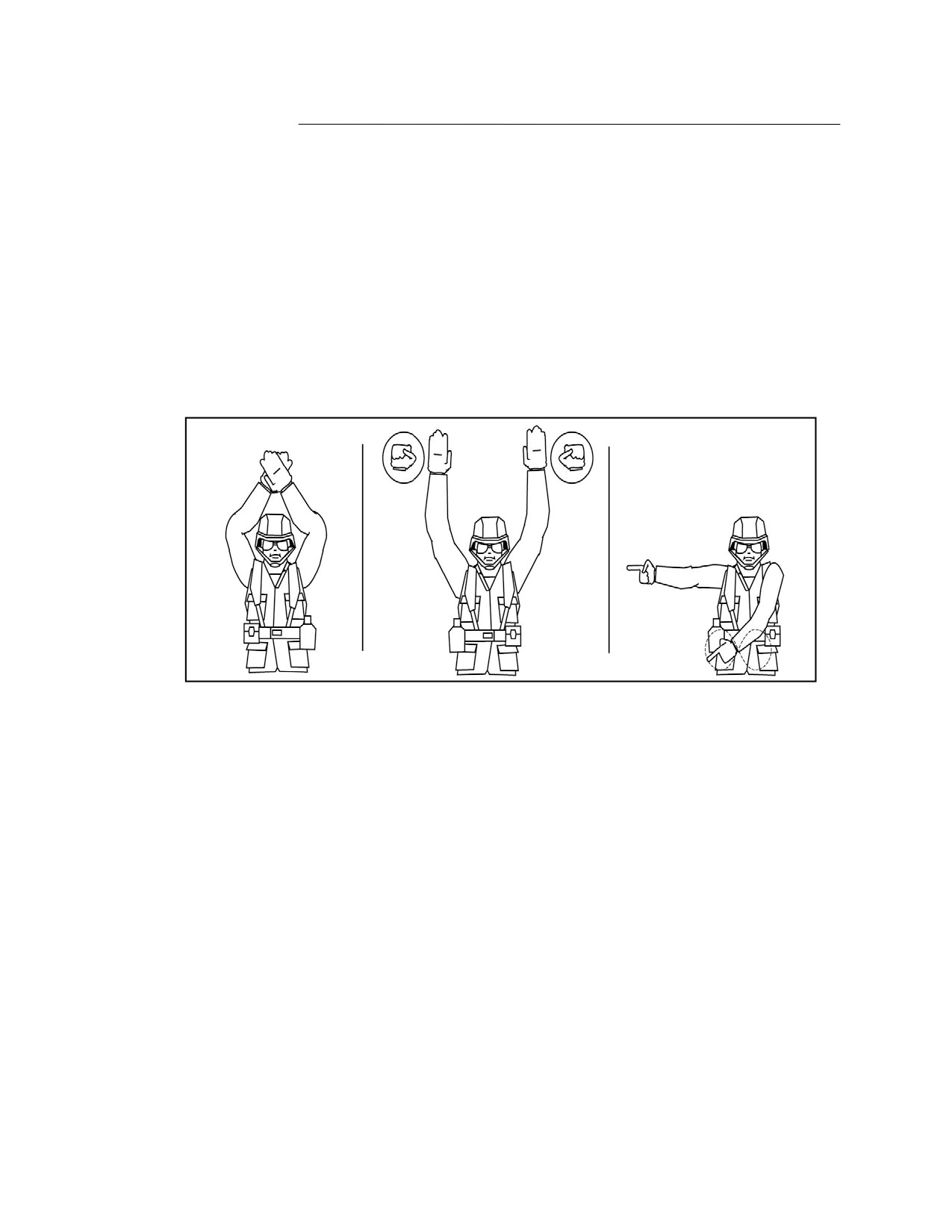
F-198. In Figure F-26 the ground guide—
•
(Left): Extends arms horizontally to the side, palms down; sweeps
arms downward; and indicates rate of descent by rapidity of motion.
•
(Right): Extends left arm horizontally to the side in direction of
movement; repeatedly swings right arm over the head in same
direction.
Figure F-26. (Left) Move Downward; (Right) Move to Right
F-199. In Figure F-27, the ground guide—
•
(Left): Extends right arm horizontally to the side in the direction of
movement; repeatedly swings left arm over the head in same
direction.
•
(Right): Holds arms down, palms toward the ground; arms move up
and down repeatedly.
Figure F-27. (Left) Move to Left; (Right) Slow Down
F-49
FM 3-04.111 (FM1-111)
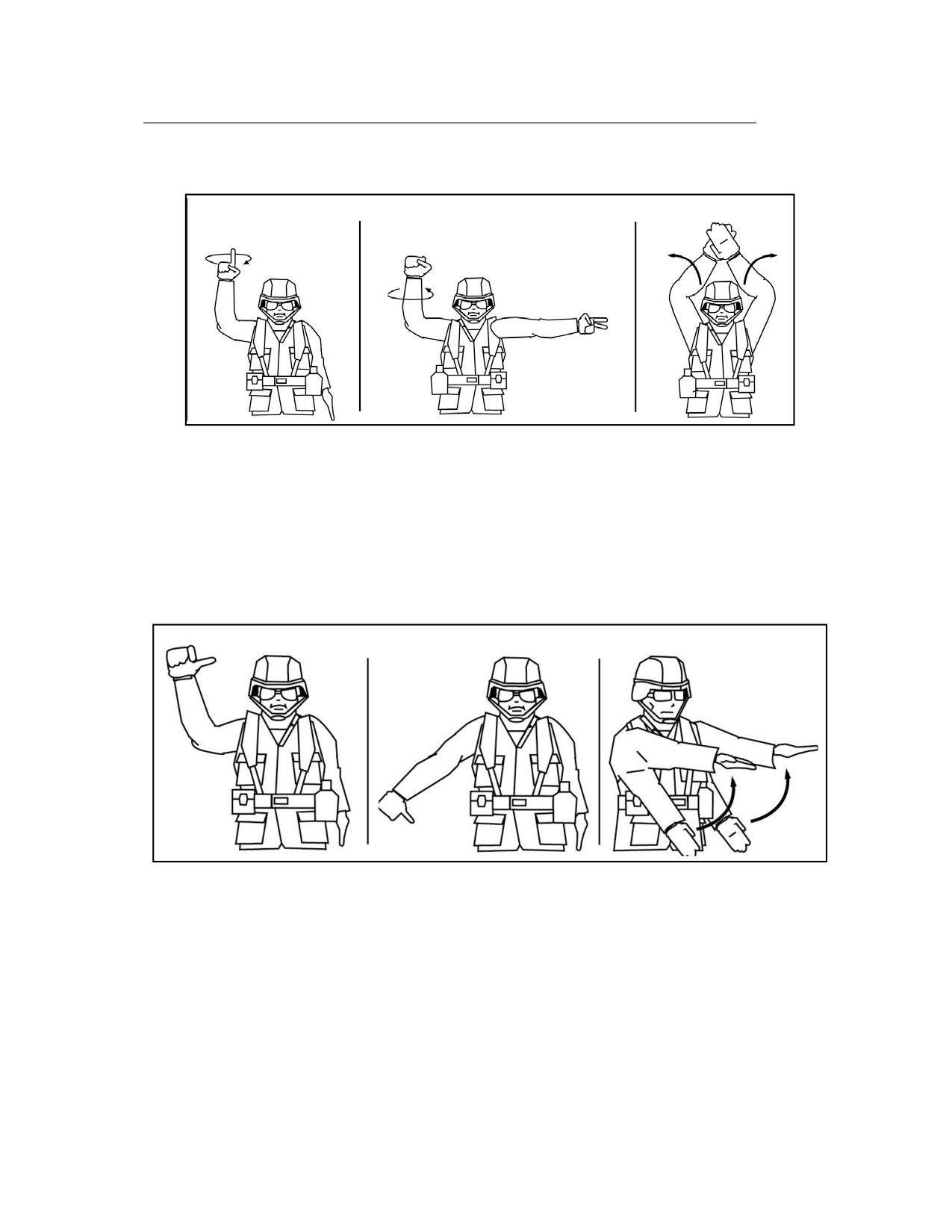
F-200. In Figure F-28, the ground guide—
•
(Left): Crosses arms above head, palms forward.
•
(Center): Apply Brakes, Day Operations: Holds arms above head,
fingers extended, and palms toward aircraft; closes fists. Apply
Brakes, Night Operations: Holds arms above head, wands crossed.
Release Brakes, Day Operations: Holds arms above head, fists closed;
extends fingers, palms toward aircraft. Release Brakes, Night
Operations: Holds arms above head, with wands crossed; uncrosses
wands.
•
(Right): Makes rapid horizontal figure-eight motion at waist level with
one arm; points at fire with the other arm.
Figure F-28. (Left) Stop; (Center) Brakes; (Right) Fire
F-201. In Figure F-29, the ground guide—
•
(Left): Makes circular motion in horizontal plane with right hand
above head.
•
(Center): Day Operations: Holds left hand to the side, extending the
number of fingers that indicate which engine to start; makes a
circular motion with right hand at head level. Night Operations:
Performs movement similar to day signal except for flashing the
ground guide wand in the left hand the number of times that indicate
which engine to start.
•
(Right): Repeatedly crosses and uncrosses arms over the head.
F-50
Appendix F
Figure F-29. (Left) Engage Rotor(s); (Center) Start Engine(s); (Right) Wave Off
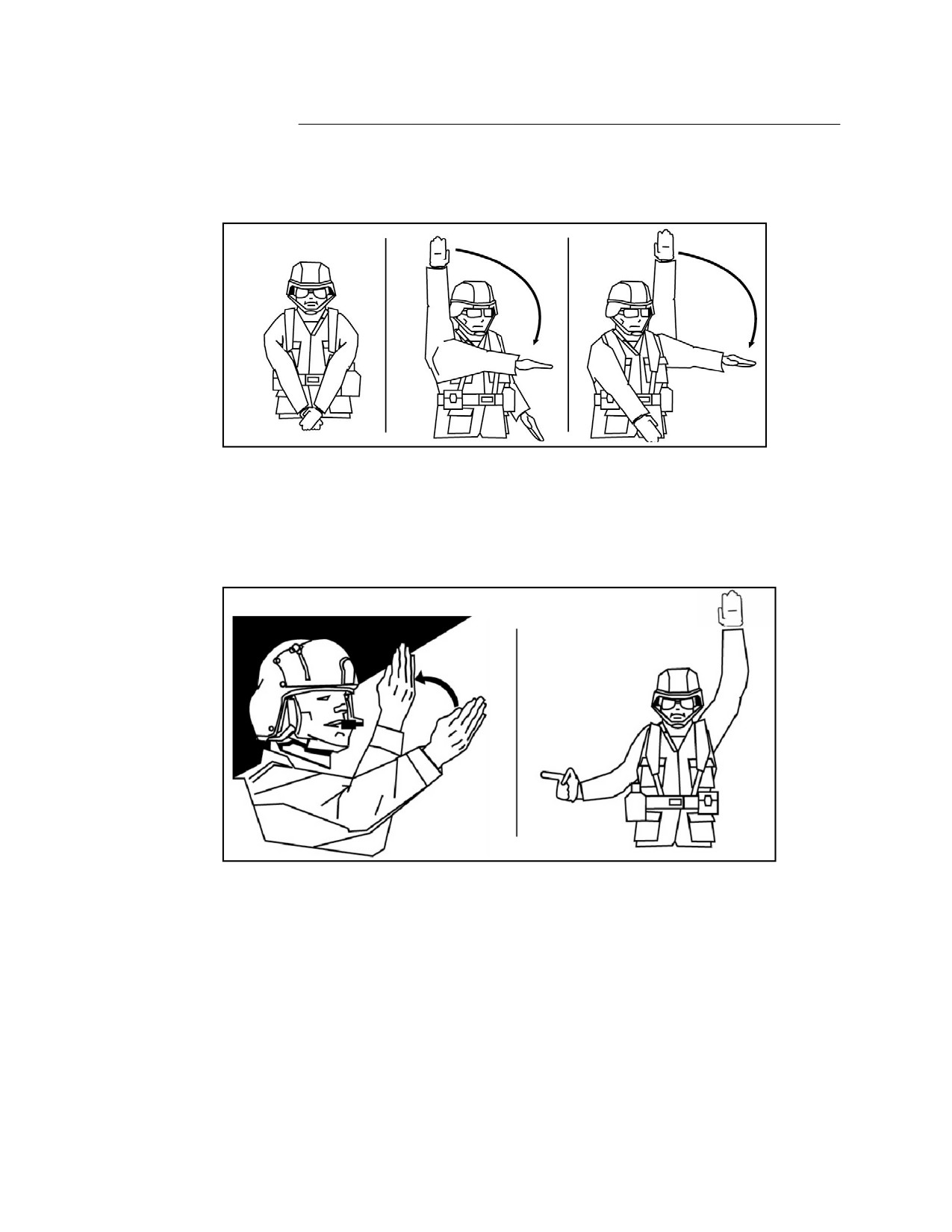
F-202. In Figure F-30, the ground guide—
•
(Left): Holds hand raised with thumb up.
•
(Center): Holds arm out, hand below the waist level, thumb down.
•
(Right): Holds hands down by side, palms forward; with elbows
straight, repeatedly moves arms forward and upward to shoulder
height.
Figure F-30. (Left) Affirmative or All Clear; (Center) Negative or Not Clear; (Right) Move Back
F-203. In Figure F-31, the ground guide—
•
(Left): Crosses hands and extends arms downward in front of the
body.
•
(Center): Points left arm down, and repeatedly moves right arm from
overhead vertical position to horizontal forward position.
•
(Right): Points right arm down, and moves left arm from overhead
vertical position to horizontal forward position; repeats left arm
movement.
F-51
FM 3-04.111 (FM1-111)
Figure F-31. (Left) Land; (Center) Tail to the Right; (Right) Tail to the Left
F-204. In Figure F-32, the pilot—
•
(Left): Makes a beckoning motion with right hand at eye level.
•
(Right): Raises left hand overhead, palm toward aircraft with the right
hand indicating the persons concerned; and gestures toward aircraft.
Figure F-32. (Left) Clearance to Approach Aircraft;
(Right) Personnel Approach Aircraft
F-205. In Figure F-33, the ground guide—
•
(Left): Holds right fist, thumb extended upward, raised suddenly to
meet horizontal palm of left hand.
•
(Center): Holds right fist, thumb extended downward, lowered
suddenly to meet horizontal palm of left hand.
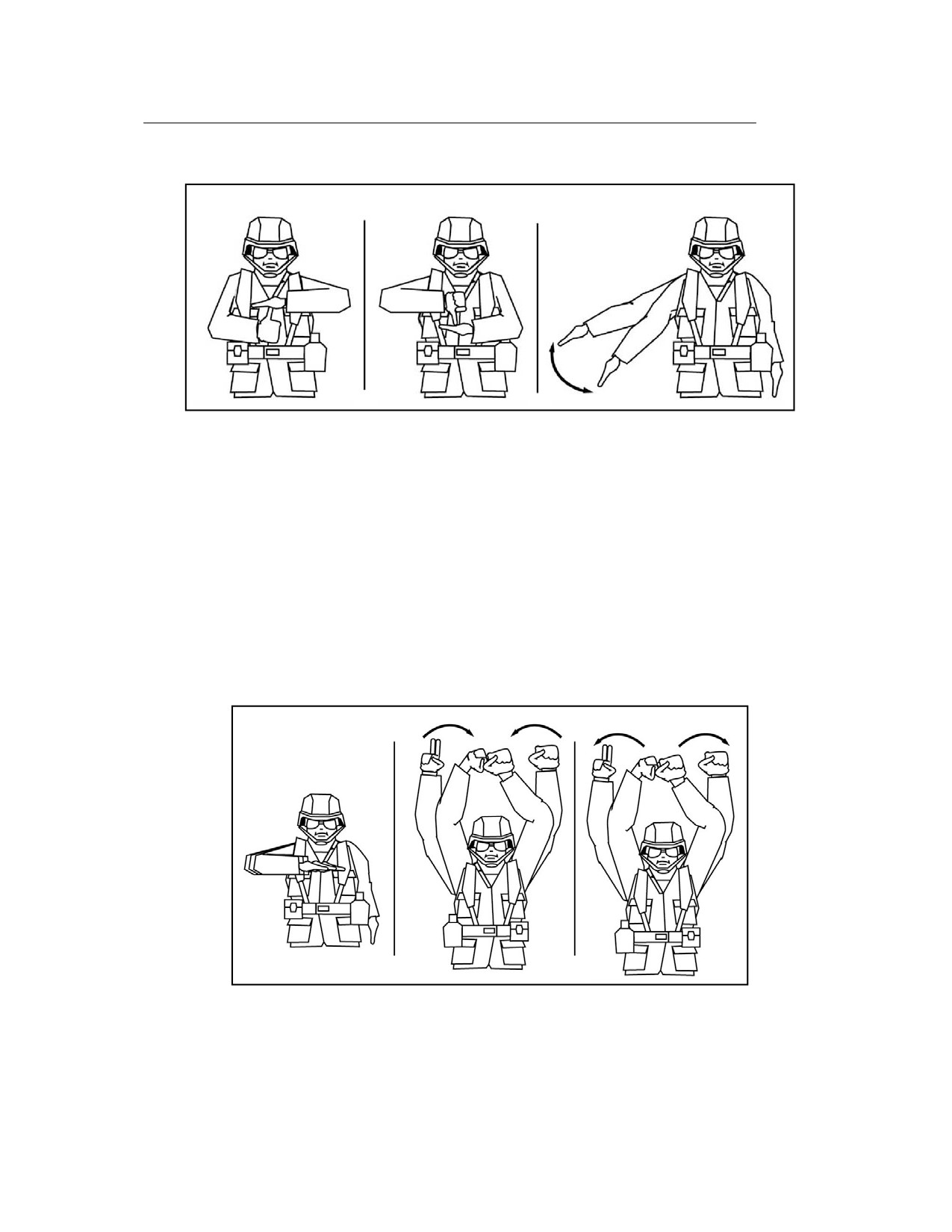
•
(Right): Holds arms down, palms toward ground; waves right or left
arm up and down to indicate that left- or right-side engines,
respectively, should be slowed down.
F-52
Appendix F
Figure F-33. (Left) Tail Hook Up; (Center) Tail Hook Down;
(Right) Slow Engine(s) on Indicated Side
F-206. In Figure F-34, the ground guide—
•
(Left): Holds either arm and hand at shoulder level, palm down; draws
the extended hand across neck in a “throat-cutting” motion.
•
(Center): Day Operations: Extends hands overhead; pushes first two
fingers of right hand into fist of left hand. Night Operations: Makes
same movement with the left-hand wand vertically and the right-hand
wand horizontally.
•
(Right): Day Operations: Extends hands overhead; pulls first two
fingers of right hand away from left fist. Night Operations: Makes
same movement except that left-hand wand is vertical and right-hand
wand is horizontal.
Figure F-34. (Left) Cut Engine(s) or Stop Rotor(s; (Center)
Connect APU; (Right) Disconnect APU
F-207. In Figure F-35, the ground guide—
•
(Left): Holds arms down, fists closed, thumbs extended inward; swings
arms from extended position inward.
F-53
FM 3-04.111 (FM1-111)
•
(Right): Holds arms down, fists closed, thumbs extended outward;
swings arms outward.
Figure F-35. (Left) Insert Chocks; (Right) Remove Chocks
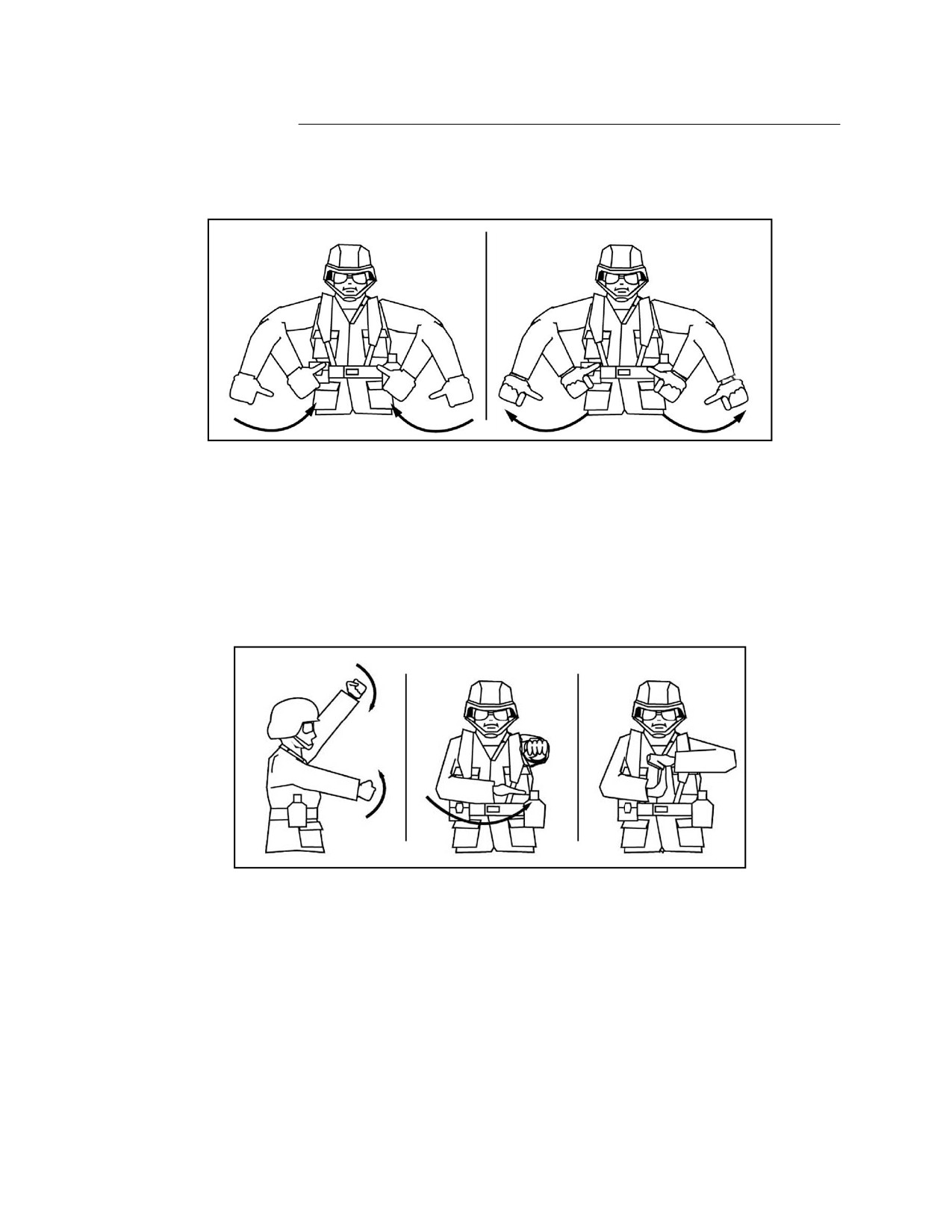
F-208. In Figure 36, the ground guide—
•
(Left): Makes rope-climbing motion with hands.
•
(Center): Holds left arm forward horizontally with fists clenched;
extended right hand makes horizontal slicing motion below left arm,
palm down.
•
(Right): Bends left arm horizontally across chest with fist clenched,
palm down; opens right hand pointed up vertically to center of left fist.
Figure F-36. (Left) Hook Up Load; (Center) Release Load;
(Right) Load Has Not Been Released
F-209. In Figure F-37, the ground guide—
•
(Left): Makes a signal similar to “release load” except that the left
hand has the palm down and not clenched; rapid repetition of right-
hand movement indicates urgency.
•
(Center): Extends left arm horizontally in front of body with fist
clenched; extends right arm forward, palms up; makes an upward
motion.
F-54
Appendix F
•
(Right): Extends left arm horizontally in front of body with fist
clenched; extends right arm forward, palm down, and makes a
downward motion.
Figure F-37. (Left) Cut Cable; (Center) Winch Up; (Right) Winch Down
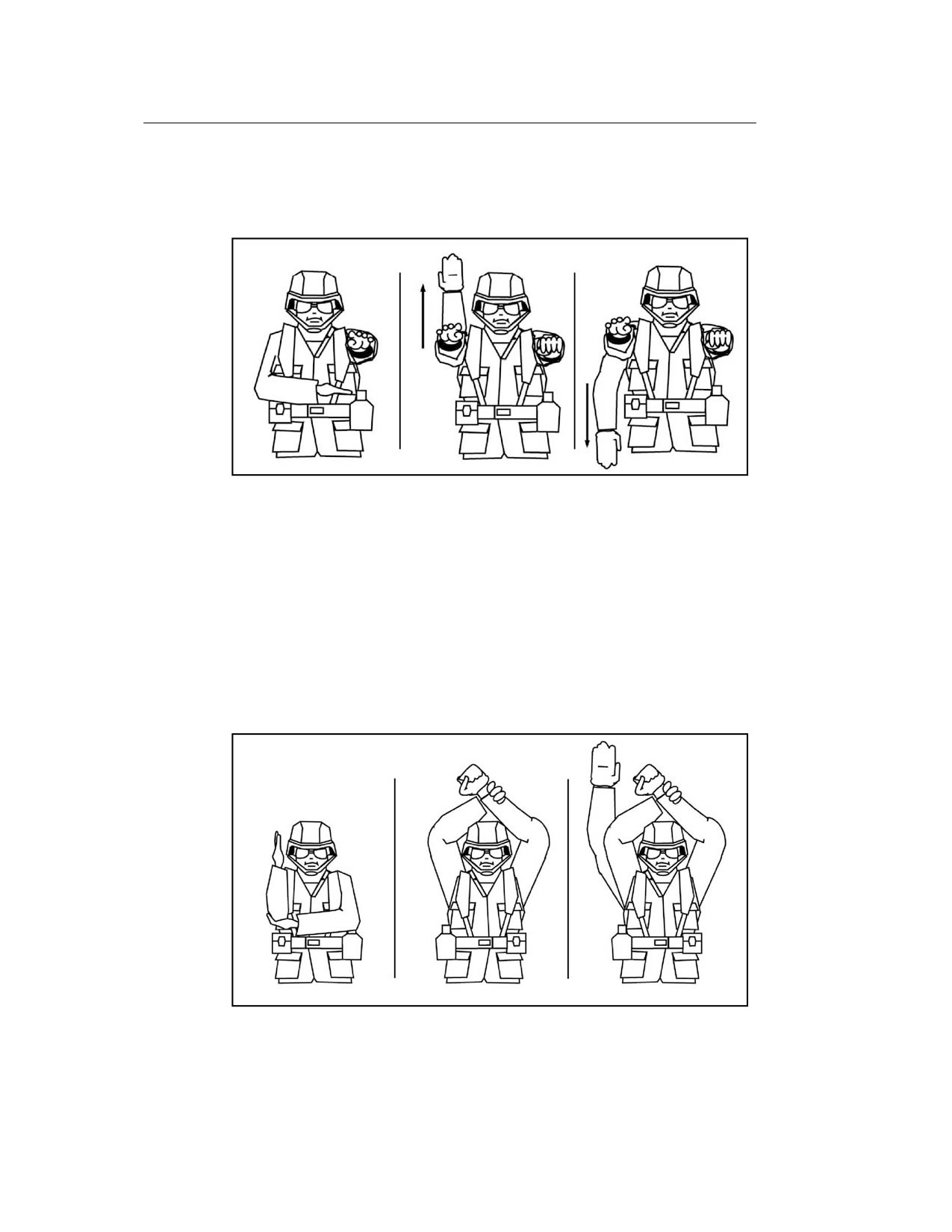
F-210. In Figure F-38, the ground guide—
•
(Left): Hits right elbow with palm of left hand.
•
(Center): Day Operations: With arms above head, clasps left forearm
with right hand and clenches the left fist. Night Operations: Similar to
the day signal except the right wand is placed against the left
forearm; holds wand in the left hand vertically.
•
(Right): Day Operations: With arms and hands in “install-downlocks”
position, the right hand unclasps the left forearm. Night Operations:
Similar to the day signal except the right wand is placed against the
left forearm.
Figure F-38. (Left) Lock Wings/Rotor Blades; (Center) Install Downlocks;
(Right) Remove Downlocks
F-55
FM 3-04.111 (FM1-111)
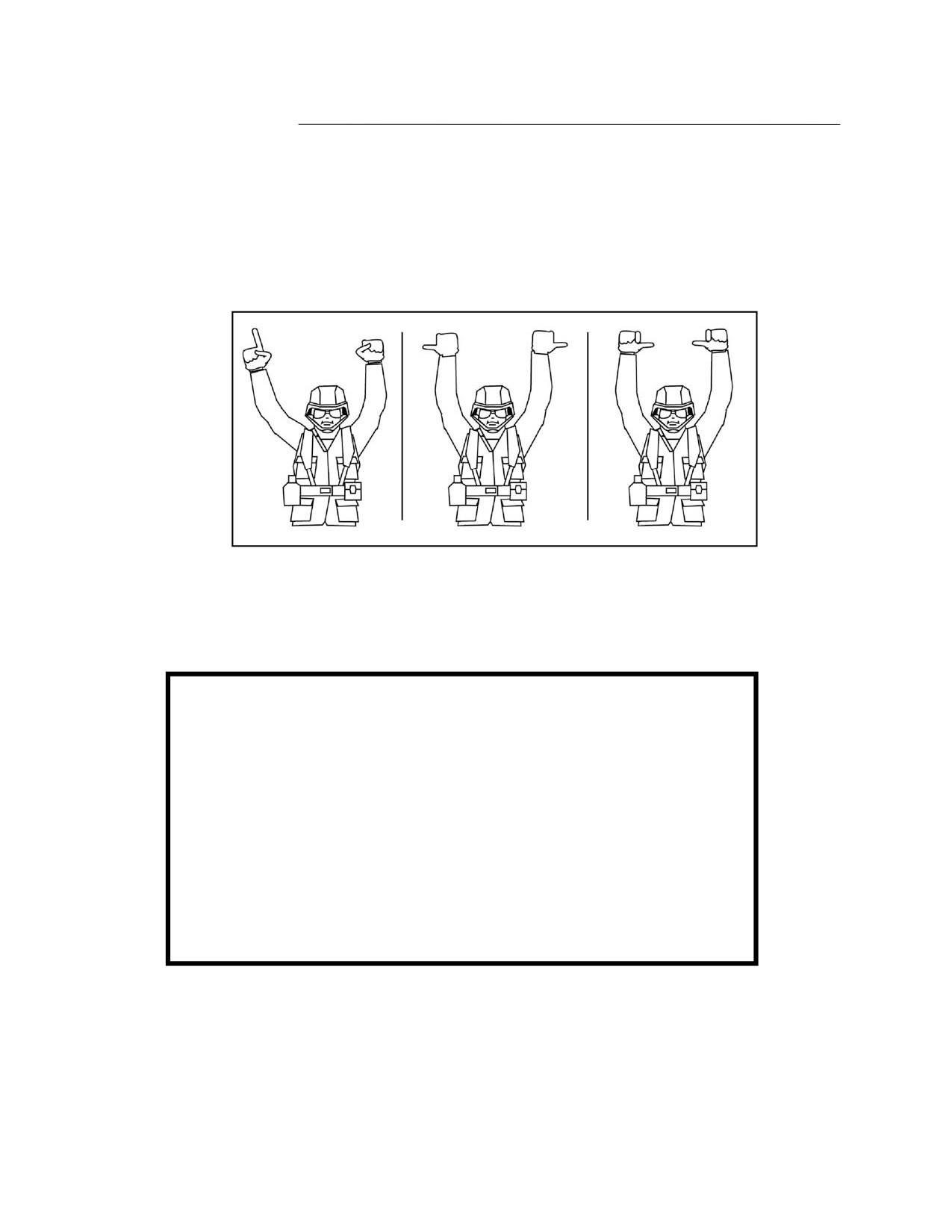
F-211. In Figure F-39, the ground guide—
•
(Left): Holds left hand overhead, right hand pointing to specific boots
for removal.
•
(Center): When the rotor starts to slow, stands with both hands raised
above head, fists closed, and thumbs pointing out.
•
(Right): When droop stops go in, turns thumbs inward.
Figure F-39. (Left) Remove Blade Tie-Downs; (Center)
Droop Stops Out; (Right) Droop Stops In
REFUELING AND REARMING PROCEDURES
WARNING
Exercise the following precautionary measures if wearing the Extended
Cold Weather Clothing System (ECWCS) while performing aircraft
arming and refueling operations:
a. Fuel handlers wearing ECWCS should ground/bond themselves to
the aircraft, truck, or refueling component for several seconds before
fuel/defuel operations.
b. Do not remove ECWCS within 50 feet of fueling operations or near
flammable vapor-air mixture.
c. Rinse fuel-soaked ECWCS with water before removal.
F-212. The standard refueling and rearming line consists of eight points and
a maintenance point. The unit locates the maintenance point where it will
not interfere with normal operations.
F-56
Appendix F
REFUELING
F-213. FARP personnel inspect fuel and equipment according to regulations
and the unit accident prevention program.
F-214. For hot refueling, FARP personnel—
• Ensure that a 100-foot separation exists between refueling points.
• Ground CCR nozzles to grounding rods, and bond to the aircraft.
• Secure fuel caps and disconnect grounding cables before aircraft
takeoff.
F-215. Aircrews ensure that armament systems are on Safe or Off. They
stabilize the aircraft at flat pitch and deplane passengers before conducting
refueling operations. Although no transmissions are permitted except during
an emergency, they monitor all communications. Aircrews turn strobe lights
off before refueling and back on before takeoff (day only).
F-216. FARP personnel and crew chiefs wear protective equipment,
including eye and hearing protection and gloves, while conducting refueling
operations. FARP personnel or crew members man fire extinguishers.
REARMING
Maintenance Point
F-217. Units locate the maintenance point where it will not interfere with
normal operations. This point should be equipped with the following items:
• One fire extinguisher and a ground rod with cable.
• One standard toolbox.
• Two pallets for downloading rockets and 30-millimeter ammunition.
• Special tools as determined by the maintenance officer in charge.
• Spare parts.
Rearm Points
F-218. These points should be equipped with the following items:
• One standard toolbox.
• One metric toolbox (AH-64).
• One fire extinguisher and grounding rod with cable.
• One uploader/downloader (AH-64).
• One wing mike cord.
• Two pallets for rockets.
Personnel Requirements
F-219. Each FARP should include the following personnel:
• One noncommissioned officer.
• One line SO.
• One officer in charge.
• Three armament personnel
(preferred); two armament personnel
(minimum) for each rearm pad.
F-57
FM 3-04.111 (FM1-111)
• A contact team (maintenance point only).
Procedures
F-220. FARP personnel arm/dearm aircraft according to the appropriate
aircraft operator’s manual.
F-221. After turning off all armament switches, the pilot turns off the
anticollision light. The pilot makes no radio transmissions during
loading/downloading operations.
F-222. Once the anticollision light is off, armament personnel ground the
airframe, install the wing-store jettison pins, and chock the wheels, as
applicable. They plug in their headsets and establish communication with the
aircrew. The aircrew assists and monitors armament personnel during
loading/downloading operations.
F-223. Ground crews load subsystems inboard to outboard, remaining clear
of the front of the systems and back-blast areas. When loading is complete,
the ground crew removes all safety pins and moves away from the aircraft.
AIRCRAFT CONTROL AND SAFETY
F-224. Any incident involving a fire or suspected fuel contamination will
close the FARP until the SO investigates the incident and authorizes further
operations.
FORWARD ARMING AND REFUELING POINT PERSONNEL
F-225. FARP personnel mark refuel nozzles with a red/an orange light source
attached to the grounding rod. They mark the landing area with either
beanbag lights or chemical lights. Units may also use heated rocks in cans for
easier FLIR detection.
F-226. Ground guides guide aircraft into and out of refueling points using
white wands or chemical lights other than green. Ground guides do not stand
in front of the aircraft weapon system at any time.
AIRCREWS
F-227. Aircrews make no radio transmissions within 100 feet of refueling or
arming points. While in the FARP, aircrews place aircraft position lights on
steady bright or dim. They turn off lights if required by the tactical situation
or if using NVD.
F-228. Aircrews flash aircraft position lights to alert the ground guide when
ready to refuel or depart. The pilot signals the refueler to stop refueling the
aircraft. Before takeoff, pilots ensure that personnel remove grounding clips
and stand clear.
F-58
Appendix F
EXTENDED RANGE FUEL SYSTEM (FAT COW) OPERATIONS
STORAGE
F-229. FARP personnel—
• Secure and statically ground all 600-gallon tanks on an asphalt or
concrete hardstand that is away from aircraft and ground vehicle
operation.
• Empty the tanks before storage (except residual fuel).
• Store ERFS equipment—such as the pump board, fuel lines, and tie-
down straps—in the ERFS storage cases provided by the shipping
facility.
• Ensure that the storage area is enclosed and well ventilated.
• Drain all fuel supply lines of excess fuel before storage.
INSTALLATION AND OPERATION
F-230. TMs
55-1520-240-10 and
55-1560-307-13&P cover installation,
operation, and PMCS of ERFS. Crew chiefs defuel aircraft according to TM
55-1560-307-13&P and the unit SOP. When the ERFS is installed on the
aircraft, they enter the following statement on the DA Form 2408-13-1
(Aircraft Inspection and Maintenance Record): “Aircraft allowed operating
with ERFS installed according to TM 55-1560-307-13&P.”
F-231. Crew chiefs record all system faults on DA Form 2408-13-3 (Aircraft
Technical Inspection Worksheet). After removing the ERFS, they reenter all
faults on the existing or new DA Form 2404.
MISSION EQUIPMENT
F-232. Equipment requirements are divided between two sections. The unit
assigned the mission supplies the aircraft, the ERFS with FARE
attachments, one 50-foot suction hose (pot hose), one grounding rod with
cable, ground covers, tie-down ropes, and ALSE. The POL section supplies all
of the items shown in Figure F-16, one extra 100-GPM pump, one of each
type of refueling nozzle, and one 50-foot refueling hose.
F-233. The mission unit personnel install the required number of tanks
according to TM 55-1560-307-13&P and Figure F-16. If conducting extended-
range missions, they install the ERFS fuel management control panel:
• Hoses and Fittings. When possible, personnel use unisex fittings to
reduce assembly/disassembly fuel spillage and self-ground
connections.
• Pump System. If using the 250-GPM self-contained pump system,
exclude the filter separator from the equipment list and place the
pump in the 100-GPM mode; the pump’s size precludes loading a
spare pump.
• Nozzles. Mission unit personnel use the D-1 single-point nozzle on
CH-47Ds and CCR nozzles with attachments on other aircraft, unless
the D-1 is specified.
F-59
FM 3-04.111 (FM1-111)
SITE SELECTION
F-234. The LZ must be large enough to accommodate FARP aircraft with no
less than 150 feet between refueling points. Allow at least 300 feet between
each CH-47 conducting ERFS refueling. This layout allows
150-foot
separation between supported aircraft refueling points.
SITE LAYOUT
F-235. For daytime operations, FARP personnel designate landing points
and mark them with standard visual signals and markers. For night
operations, they designate landing points and mark them with chemical
lights or tactical Y. FARP personnel—
• Set up refueling points and equipment as Figure F-14 shows.
• Place the extra 100-GPM pump beside the operating pump; for ease of
replacement, they place all spares so that they are readily accessible.
• Ground each FARP aircraft to its own grounding point; ground pumps
and filter separator.
• Place emergency equipment, such as a 5-gallon water can and fire
extinguisher, at the pump station and refueling points.
FIRE EXTINGUISHERS
F-236. Fire extinguishers must have current inspection tags and seals.
Authorized fire extinguishers include the following:
• Twenty-pound Halon 1211.
• Twenty-pound (KH CO3) Purple K.
• Fifteen-pound CO2.
BLADE ROPES AND TAIL CONE COVERS
Blade Ropes
F-237. Crew chiefs install and secure at least one blade rope per rotor system
on ERFS aircraft.
Tail Cone Covers
F-238. Crew chiefs install engine tail-cone covers to prevent engine foreign-
object damage and keep rotors from turning.
CREW DUTIES
Pilot in Command
F-239. The PC of the supporting aircraft is in charge of FARP operations. He
directs all operations and monitors safety. He ensures that personnel conduct
operations according to the SOP.
F-240. The PC’s station is at the fuel pump. This position enables him to
monitor all phases of the operation and turn off the fuel supply in case of a
mishap or an emergency.
F-60
Appendix F
Copilot
F-241. Copilots assist in marshalling, fire guard, and other duties that the
PC assigns.
Flight Engineer
F-242. The flight engineer is responsible for safely loading the aircraft before
the mission and unloading it after the aircraft is shut down. He controls the
fuel flow from inside the aircraft. In addition, he is responsible for cutting off
the fuel supply from inside the aircraft in case of a mishap or an emergency.
Crew Chief
F-243. The crew chief assists with marshalling and fire-guard duties.
Petroleum, Oils, and Lubricants Refuelers
F-244. Refuelers set up the FARP and conduct refueling operations.
STANDARD FLIGHT EQUIPMENT
F-245. Crew members use standard flight equipment. POL refuelers use
safety equipment and clothing as prescribed in the SOP and regulations.
FORWARD ARMING AND REFUELING POINT OPERATIONS
Aircraft Position
F-246. A marshaller positions arriving aircraft in chalk order at each refuel
point. Aircraft remain in position until all refuel, then reposition together.
Fuel Transfer
F-247. Aircrews transfer fuel from the internal tanks in the same manner as
when aircraft self-deploy. To maintain aircraft center-of-gravity, complete
fuel transfer in the following sequence:
• Four tanks: 4, 1, 3, and 2.
• Three tanks: 3, 1, and 2.
Auxiliary Power Unit
F-248. Aircrews do not operate the aircraft auxiliary power unit during
refueling operations.
EXTENDED-RANGE FUEL SYSTEM OPERATIONAL CHECKLIST
PREFLIGHT INSPECTION
F-249. Before applying electrical power for system operation, aircrews
perform the checks and services listed in the PMCS, Table 2-6, TM 55-1560-
307-13&P.
F-61
FM 3-04.111 (FM1-111)
EXTENDED-RANGE FUEL SYSTEM FUEL TRANSFER CHECKLIST
F-250. Aircrews refer to TM 55-1560-307-13&P for the ERFS fuel transfer
checklist. See www.logsa.army.mil/etms/find_etm.cfm, and enter the TM
number in the applicable place.
AIR ASSAULT FORWARD ARMING AND REFUELING POINT REFERENCE
CHECKLIST
UPON ARRIVAL AT THE SITE
F-251. The FARP personnel follow these procedures:
• Position the CH-47 so that refueling aircraft can land into the wind.
• Start unloading and setting up equipment.
• Check the FARP system under pressure for leaks.
• Take a fuel sample using Aqua-Glo test procedures.
• Record the fuel-sample reading.
• Commence refueling operations.
F-252. The aircrew members may assist with the FARP layout unless the PC
needs them during the shutdown phase. Aircrews—
• Shut down engines.
• Ensure that the PC observes and directs the FARP site layout.
• Use the PC to conduct a safety and equipment installation inspection
of the FARP site.
AQUA-GLO TEST PREPARATION, FUEL SAMPLING, AND FUEL TEST PROCEDURES
F-253. FARP personnel follow the guidance in the most current FM 4-20.12
(FM 10-67-1) for inspecting and testing the fuel and equipment. Do not use
FM 10-68, which has been rescinded.
F-254. Both
documents
are
accessible
on
line.
See
www.logsa.army.mil/etms/find_etm.cfm, and enter the TM number in the
applicable place.
SECTION X - MULTIPLE FORWARD ARMING AND REFUELING POINT
OPERATIONS
F-255. The best way to provide 24-hour support is to employ a two-FARP
sequence. A schedule that rotates two or more FARPs ensures that one FARP
is always active, reduces personnel fatigue, and facilitates efficient resupply.
MISSION
F-256. In this example, the mission is to deploy two FARPs to support
continuous attack, making the transition to phased attack of a different
target. The S3 designates two primary sites and alternates. The scheduled
operational times for FARP 1 are 0800 and 1930. The operational times for
FARP 2 are 1400 and 2000. In this example, the transition to phased attack
F-62

Appendix F
requires one of the FARP teams to further split to allow drivers to travel to
supply points and/or throughput LRP.
SUGGESTED SCHEDULE
F-257. Table F-5 illustrates a suggested FARP schedule. It assumes that
when one FARP is active, a second silent FARP is inactive. This example also
illustrates how a mission change to phased attack would require both FARPs
to operate simultaneously.
Table F-5. Suggested FARP Schedule
Team 1 (Platoon Sgt leads)
Team 2 (Platoon Leader leads) FARP
FARP
0800
FARP 1 ACTIVE, Spts A Co
Shuts down old FARP 2; drives to resupply point
0900
FARP 1 ACTIVE, Spts B Co
Drives to resupply point/LRP
1000
FARP 1 ACTIVE, Spts C Co
Arrives at resupply point/LRP; loads/transloads
1100
FARP 1 ACTIVE, Spts A Co
Drives to FARP 2 location
1200
FARP 1 ACTIVE, Spts B Co
Drives to & arrives at FARP 2 location; sets up
1300
FARP 1 ACTIVE, Spts C Co
Continues setup, priority-of-work tasks
1400
Shuts down FARP; drives to resupply
FARP 2 ACTIVE. Supports A Co.; offloads Class V trucks;
points/LRPs
prepares to go to supply point
1500
Drives to resupply points/LRPs
FARP 2 ACTIVE. Supports B Co; plt ldr prepares to split his
team; transloads fuel into empty tankers/drums
1600
Arrives at resupply points/LRPs,
Team 2A: Supports C Co. in FARP 2; Team 2B: takes offloaded
loads/transloads
trucks/tankers and drives to LRPs
1700
Drives to new FARP 1 location
Team 2A: Supports A Co. in old FARP 2; Team 2B:arrives at
LRPs, loads/transloads
1800
Arrives at new FARP 1 location; off-
Team 2A: Supports B Co. in old FARP 2, Team 2B: loaded
loads/sets up
trucks return to new FARP site
1900
Continues setup, priority of work
Tm 2A: Services C Co. in old FARP 2; tears down, moves to
FARP 1 ACTIVE
new FARP/LRP; Tm 2B: loaded trucks arrive/set up new FARP
2000
FARP 1 ACTIVE, Spts A Co
FARP 2 ACTIVE. Supports B Co. (phased attack)
2100
FARP 1 ACTIVE, Spts C Co
FARP 2 ACTIVE. Continues offload of Class V
2200
FARP 1 ACTIVE, Spts A Co
FARP 2 ACTIVE. Spts B Co. (phased attack)
SECTION XI - EMERGENCY PROCEDURES IN THE FORWARD ARMING AND
REFUELING POINT
EMERGENCY PROCEDURES IN TACTICAL SITUATIONS
F-258. In case of fire, aircrews not directly involved fly to their respective
HAs. FARP personnel take the following actions:
• Shut down the pump immediately.
• Remove nozzle from the aircraft.
• Attempt to put out small fires with fire extinguishers.
• Move the tanker from the scene, if the situation permits.
• Close all FARE butterfly valves and elbow couplers linked to 500-
gallon collapsible drums, if time permits.
• Move to a safe area.
• Notify the TOC at the first opportunity.
F-63
FM 3-04.111 (FM1-111)
F-259. If the FARP site is under attack or under a threat of being overrun,
FARP personnel—
• Stop refueling.
• Evacuate aircraft.
• Disconnect FARP aircraft from the system by disconnecting the 50-
foot pot hose from inside the aircraft and evacuate the aircraft.
• Defend the FARP area or abandon the system and evacuate
as
directed.
EMERGENCY PROCEDURES DURING NONTACTICAL SITUATIONS
FIRE IN THE REFUELING AREA
F-260. FARP personnel stop refueling at all points, then—
• Turn off all pumps.
• Close all valves.
• Evacuate aircraft and unnecessary personnel from the area.
• Attempt to fight the fire.
• Notify the higher command.
AIRCRAFT FIRE
F-261. FARP personnel stop refueling at all points, then—
• Turn off all pumps.
• Close all valves.
• Evacuate personnel from the aircraft.
• Attempt to shut down the aircraft.
• Evacuate all other aircraft from the area.
• Fight the fire.
• Notify the higher command.
FUEL LEAKS
F-262. FARP personnel stop refueling at the affected point, then—
• Turn off all pumps.
• Turn off the valves to the leak.
• Repair or replace the affected pieces.
• Open valves and start the pumps.
• Check for additional leaks.
• Proceed with refueling operations.
SECTION XII - LOAD PLANS
F-263. Three primary ground vehicles support FARP operations: the M978
HEMTT tanker, M977 HEMTT cargo vehicle, and the M989A1 HEMAT.
F-64

Appendix F
HEAVY EXPANDED MOBILITY TACTICAL TRUCK TANKER
F-264. The HEMTT tanker can carry 2,500 gallons, of which 2,250 gallons
are usable. When paired with the HTARS, a HEMTT tanker can
simultaneously refuel four aircraft.
HEAVY EXPANDED MOBILITY TACTICAL TRUCK CARGO VEHICLE
F-265. The HEMTT cargo vehicle is equipped with a materiel-handling crane
with a 2,500-pound load capacity at a 19-foot boom radius. The 18-foot cargo
body can carry 22,000 pounds. When carrying ammunition, this truck will
cube out before it weighs out.
HEAVY EXPANDED MOBILITY AMMUNITION TRAILER
F-266. The HEMTT is the prime mover for the HEMAT. The HEMAT can
carry 22,000 pounds.
SAMPLE LOAD PLANS
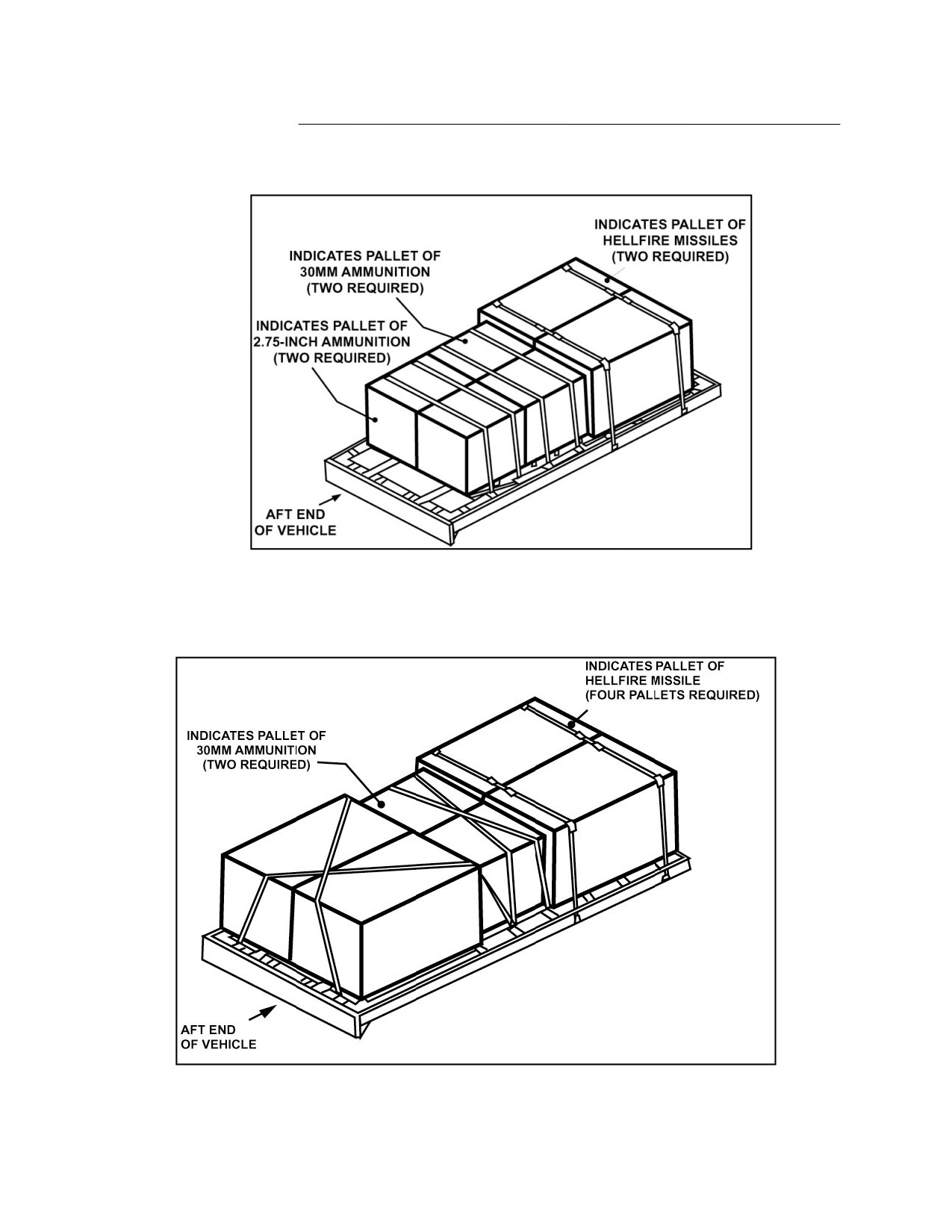
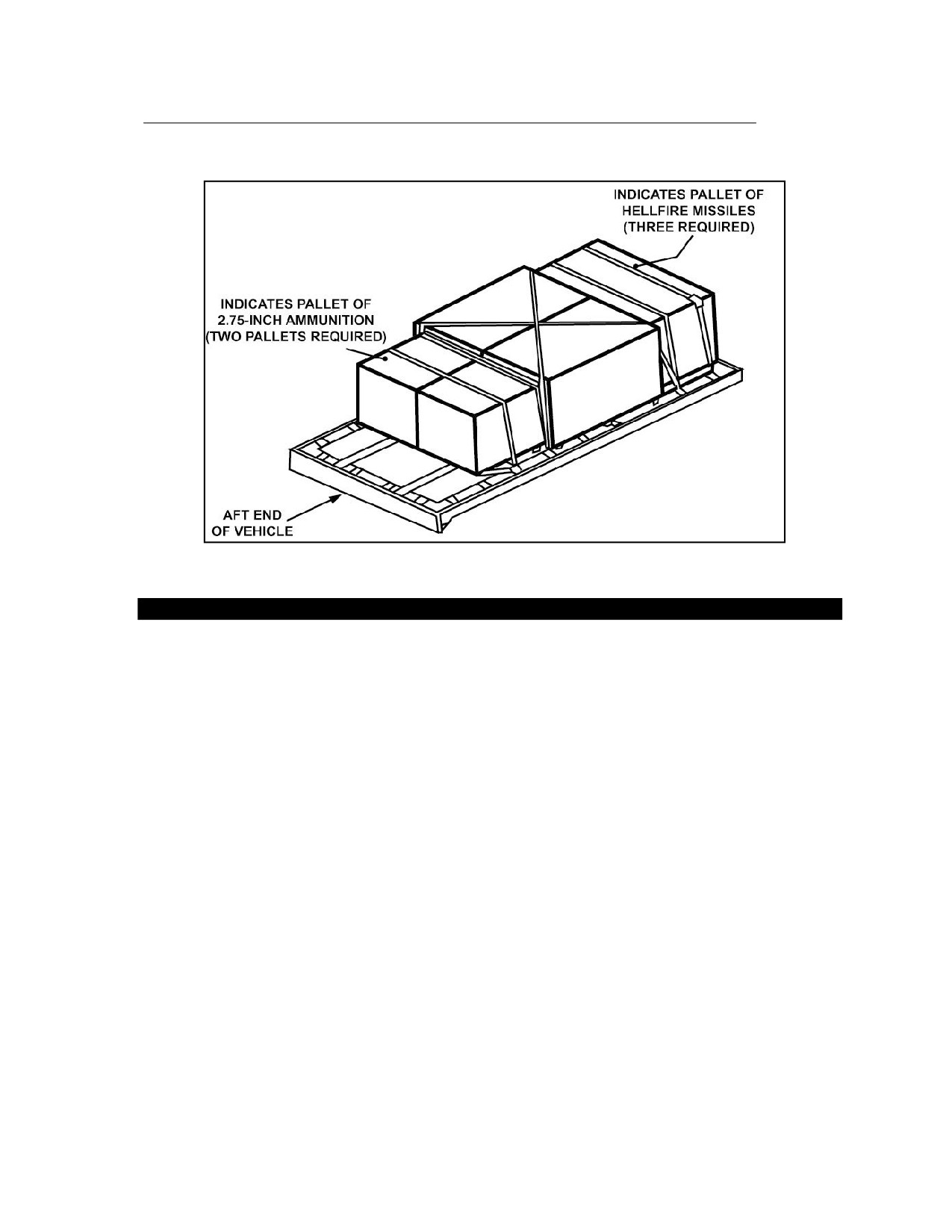
F-267. Figure F-40 is the essential load plan key for Figures F-41 through F-
43.
Load Plan 1
Item
Quantity
Approximated Weight (lbs)
30mm Pallet
2
7,472
RF Hellfire Pallet
4
7,200
Total Weight
14,672
Load Plan 2
Item
Quantity
Approximated Weight (lbs)
2.75” Rocket Pallet
2
5,032
RF Hellfire Pallet
3
5,400
Total Weight
10,432
Load Plan 3
Item
Quantity
Approximated Weight (lbs)
RF Hellfire Pallet
2
3,600
30mm Pallet
2
7,472
2.75” Rocket Pallet
2
5,032
Total Weight
16,104
Figure F-40. Load Plan Key
F-65
FM 3-04.111 (FM1-111)
Figure F-41. Load Plan 1
Figure F-42. Load Plan 2
F-66
Appendix F
Figure F-43. Load Plan 3
SECTION XIII - NIGHT AND SEASONAL OPERATIONS
F-268. This section discusses considerations for night, hot-weather, and
winter FARP operations. FARP operations under varied environmental
conditions require planning and training. Different environments require
different considerations.
NIGHT OPERATIONS
F-269. The establishment of a FARP at night requires special considerations.
Movement must be planned in detail and executed in an orderly manner.
Delays will occur because of low-light levels. Light discipline is extremely
important.
AIRCRAFT INBOUND CALLS
F-270. As with day operations, the AMC contacts the FARP about
5
kilometers out. An example call is “T14 (FARP), this is T56 (AMC) with five
on blue.” The FARP should remain blacked out until aircraft arrive. Aircrews
use a prearranged signal to identify themselves to FARP personnel. Once in
the area, the aircraft could transmit a simple, short message. For example,
using a single word, such as “Bravo,” is sufficient. “Bravo” would alert FARP
personnel that friendly aircraft are nearby and that they can turn on the site-
location markers.
F-67
FM 3-04.111 (FM1-111)
FORWARD ARMING AND REFUELING POINT MARKING
F-271. The FARP can be marked in several ways. If aircrews are equipped
with NVDs, FARP personnel may use a low-level IR light source. Alternate
marking techniques include a flashlight with colored lens, chemical lights, or
colored beanbag lights. If the existing light level is high, such as during a full
moon, engineer tape or other high-contrast materials that are staked to the
ground may suffice.
F-272. During arming and refueling operations, FARP personnel may have
to use artificial lights because of the low natural light level. Color-coded, low-
intensity light sources may be used to indicate direction, takeoff and landing
areas, and pad sites.
NIGHT VISION
F-273. Artificial lights may pose several problems. The FARP will probably
be in total darkness until aircraft arrive. When personnel start working with
lights, their night visual acuity may be impaired. Personnel will be
constantly adjusting from a no-light to a low-light working environment.
Each time that the light level changes, personnel may need time for their
night vision to readapt.
F-274. The glow from a nearby chemical light can disturb a worker’s vision.
Objects may be blurred when looked at closely. Artificial light sources are a
problem because they cannot be placed to adequately illuminate the work and
leave both hands free.
F-275. NVDs may be the best choice for night FARP operations. However,
their use requires extensive training or aircraft turnaround times may
increase.
Advantages of Night Vision Devices
F-276. The advantages of NVDs for night FARP operations are the following:
• Passive lighting greatly reduces the enemy’s ability to detect the
FARP.
• Aircrews and FARP personnel will be using systems that are
compatible, and FARP lighting will not interfere with aircraft night
sight systems.
• The same signals, such as hand-and-arm signals and flags, can be
used during the day and at night.
Disadvantages
F-277. The disadvantages of NVDs for night FARP operations are the
following:
• Objects closer than 10 inches will appear blurred.
• Close workspace around weapon systems may impair the individual’s
efficiency.
• NVDs may not be compatible with current NBC equipment.
• The unit may not have enough NVDs to support both aircrew and
FARP personnel.
F-68
Appendix F
DESERT OPERATIONS
F-278. The desert environment poses many problems for FARP operations.
Adequate water supplies should be available. Aircrews and ground personnel
will perspire profusely. To prevent heat casualties or extensive dehydration,
each individual must drink plenty of water—up to 5 gallons every 24 hours.
Other factors include terrain, mobility, communications, flying techniques,
high-density altitude, and FARE systems.
TERRAIN
F-279. Deserts may consist of many different types of sand. Sand may be as
fine as talcum powder or as coarse as gravel. The type of sand affects off-road
vehicle mobility. In many areas, a crust may form on the surface. If the crust
is dark-colored, the sand is very coarse. In such situations, the light sand has
been blown away, leaving a surface crust that may be hard enough for a
helicopter to land with almost no dust signature.
F-280. The flat terrain and poor relief of the desert create serious
navigational problems. Therefore, FARPs must be established in easily
recognizable positions. The use of offset, low-output NDBs assists in locating
FARP positions. Navigation equipment, such as Doppler, also helps.
F-281. The enemy can observe desert activities from as far away as 10
kilometers. From a vantage point of high ground, the enemy can observe
activity from as far away as 20 kilometers. The FARP will be a target of
opportunity for any enemy pilot who can see it. Without cover and
concealment, the FARP must have AD protection.
MOBILITY
F-282. The best ground vehicles for the desert are the 1-1/4-ton truck, 2-1/2-
ton truck, 5-ton truck, and HEMTT. Most vehicle trailers are unsuitable for
off-road travel except for the HEMAT.
F-283. The easiest and fastest way to establish a FARP in the desert is to
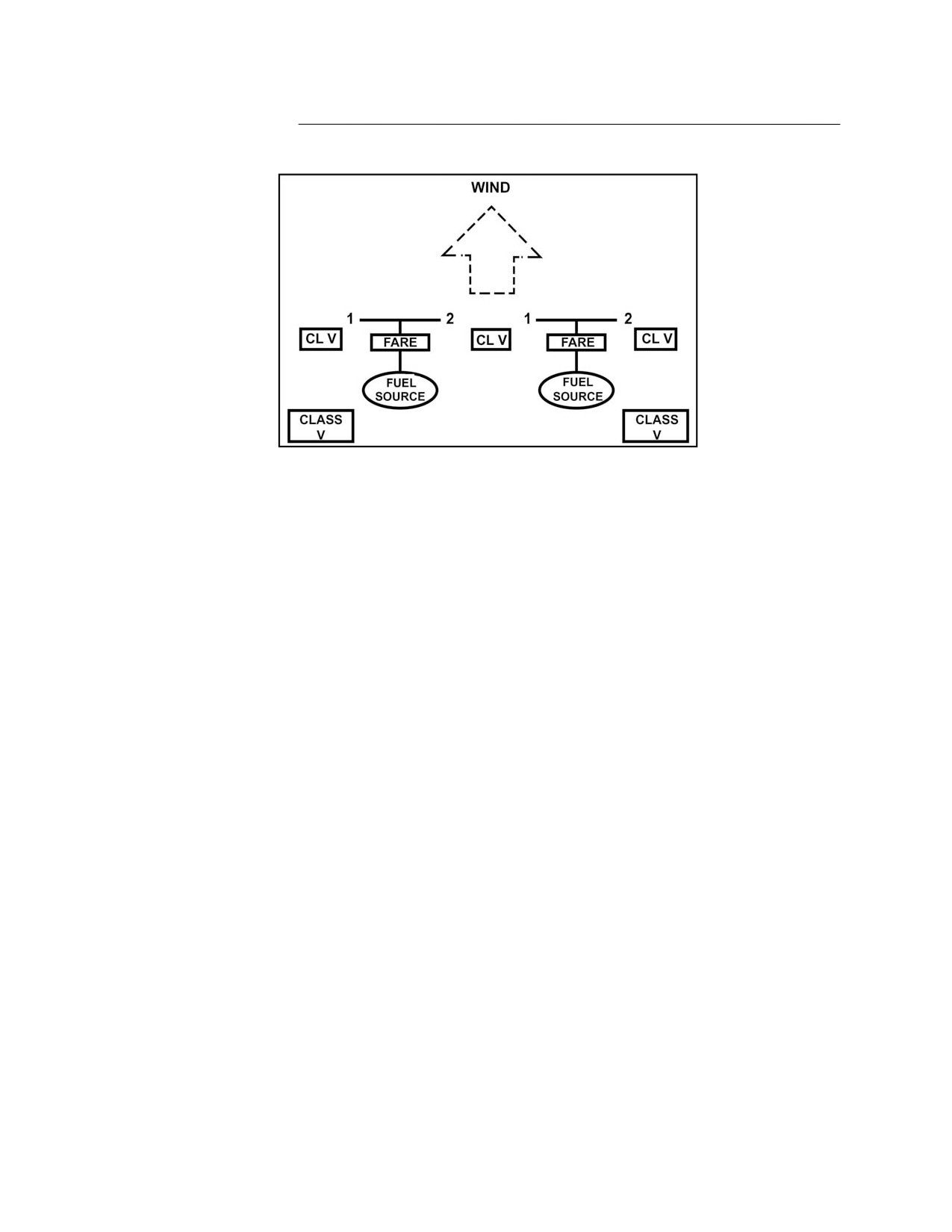
sling load it into position. Two FARE systems oriented into the prevailing
wind and set up in a T-formation (Figure F-44) allow adequate separation
from the turning rotors. This system can support four refueling points. The
FARP should be positioned to facilitate ground vehicle support. This
positioning eases the strain of trying to aerially support the FARP.
F-69
FM 3-04.111 (FM1-111)
Figure F-44. T-Formation FARE Setup
COMMUNICATIONS
F-284. Electronic communication capabilities will vary from day to day.
Communicating with an element more than 25 kilometers away may require
a relay station.
FLYING TECHNIQUES
F-285. Aircraft dust signatures are reduced if airspeed is kept above 40
knots. Aircrews should not attempt in-ground-effect hovering. Aircrews
should plan and execute approaches to the ground. Correct desert flying
techniques help the aircrew to maintain visual contact with the ground.
HIGH-DENSITY ALTITUDE
F-286. High-density altitudes that can degrade aircraft performance will
affect most desert operations. In the early morning, when density altitude is
lowest, the UH-60 may be able to carry two full 500-gallon collapsible fuel
drums. By noon, it may be able to carry only one. An attack helicopter may
have to carry less than a full load of ammunition or fuel. Aircrews will
require more frequent trips to the FARP. The FARP must be logistically
prepared for them.
FORWARD AREA REFUELING EQUIPMENT SYSTEMS
F-287. FARE systems must be dug in or sandbagged. For optimum
performance, the fuel source (500-gallon collapsible drum) should be at a
level equal to or higher than the pump. All small engine-driven equipment
must be protected from blowing sand to prevent mechanical problems. The
procedures listed below will help ensure the continued operation of the FARE
system. FARE personnel must—
• Replace filter separator elements when they fail or when the pressure
differential indicator shows that they must be changed.
• Change or clean oil filters at least every six hours.
F-70
Appendix F
• Clean small-engine air filters daily with compressed air and replace
weekly.
• Run generators continuously for no more than three to six hours
before they replace it.
ADDITIONAL CONDITIONS AND CHARACTERISTICS
F-288. Other conditions and characteristics peculiar to the desert that all
personnel should be aware of are listed below:
• All personnel are susceptible to visual illusions (mirages).
• Dust storms restrict the ability to see and breathe.
• Personnel should perform PMCS twice a day.
• Continued exposure to bright sunlight can cause severe eyestrain or
sun blindness unless personnel take preventive measures.
• Light can be seen for great distances over flat terrain; a pink filter can
be seen more than 5 miles away by someone using an NVD.
• Ground vehicles are easy to identify; silhouettes and shadows are
easily detected because they contrast with the lighter natural
background.
• In sandy areas, turret weapon systems need frequent cleaning and
light lubrication; use of lubricants without proper cleaning causes a
buildup of sand in the gear mechanism. This causes weapons to jam;
optical sights should be protected from blowing sand that could scar
the glass window of the telescopic sight unit.
WINTER OPERATIONS
F-289. The winter battlefield is characterized by low temperatures, fog,
freezing rain, snow, ice, frozen ground, and at times, muddy ground. FARP
operations are difficult under these conditions. Detailed planning and
training are required to overcome them.
DISPLACEMENT
F-290. Snow, ice, and mud reduce vehicle mobility, complicating ground
displacement. Commanders should plan for aerial displacement when
possible. If ground displacement is necessary, leaders should allow more time
for movement. Breakdown and setup of the FARP take more time on the
winter battlefield than in other environments.
PERSONNEL
F-291. Low temperatures make it difficult for personnel to keep warm and
function. Wind chill caused by rotor wash can result in cold injuries even
when air temperatures are not very cold. Fuel spilled on bare skin or soaked
into clothing has a cooling effect as it evaporates, increasing the probability of
cold injury. Personnel handling cold ammunition need mittens or other
protection and a lighter pair of gloves when manual dexterity is needed to
perform delicate operations. Commanders should ensure that personnel are
equipped and trained to function in a cold environment.
F-71
FM 3-04.111 (FM1-111)
FORWARD ARMING AND REFUELING POINT MARKING
F-292. Marking the FARP for aircraft control requires special consideration.
Engineer tape is not effective on snow. Marker panels can quickly become
obscured by falling snow. Hand-and-arm signals, flashlights, or smoke may
be used, depending on weather conditions. Maneuvering aircraft on loose
snow surfaces may cause clouds of blowing snow, which can obscure ground
guides or other control measures. Blowing snow could cause aircrews to
become disoriented and lose aircraft control. Packing the snow or spraying
the snow surface with water to form a crust of ice can reduce these problems.
CAMOUFLAGE
F-293. Camouflage can be difficult, particularly where there is complete
snow cover. The use of white covers and snow as camouflage is a possible
solution. The best solution, however, is to avoid open snowfields when
selecting FARP locations. Instead, the FARP should be located near partially
wooded or urban areas. FM
3-58.1
(FM
20-3) describes camouflage
procedures in detail.
ELECTRICAL GROUNDING
F-294. Electrically grounding equipment and aircraft is another problem.
Frozen ground makes the emplacement of grounding rods difficult and
reduces effectiveness of the electrical ground. To emplace a grounding rod, a
hole must be dug, drilled, blasted, or melted and the rod placed in the hole.
To ensure the proper flow of electricity, paper or other absorbent material is
filled in around the rod and then soaked with salt water.
MAINTENANCE
F-295. Maintenance requirements for aircraft and equipment increase on the
winter battlefield. When aircraft icing occurs, FARP personnel may have to
deice the aircraft. In cases of extremely thick ice, a Herman Nelson heater or
aviation ground power unit may be the only effective deicing equipment
available. At times, ammunition can freeze. Deice caps for the Hellfire
missiles are available. They are fitted over the seeker to prevent it from
freezing. Rocket-pod covers also are available. These covers fit snugly over
the rockets, and the rockets can be fired through them. FARP equipment
must be
“winterized” with additional antifreeze or low-temperature
lubricants.
SECTION XIV - PETROLEUM SPILLS
SPILL DEFINITIONS
F-296. Broadly defined, a spill is the release of any kind of a petroleum
product or hazardous substance into the environment. Three spill types are
small priming spills, small spills, and large spills:
• A small priming spill covers less than 18 inches in all directions.
• A small spill extends less than 10 feet in any direction, covers less
than 50 square feet, and is not continuous.
F-72
Appendix F
• A large spill extends farther than 10 feet in any direction, covers an
area in excess of 50 feet, or is continuous (for example a leaking tank).
F-297. For purposes of reporting to federal, state, and local authorities, an oil
spill is defined as any spill that reaches a stream, creek, river, or any other
body of water in harmful quantities. In addition, units report any spill that
could come into contact with the aqua line of the local water table. Harmful
quantities violate applicable water-quality standards or cause a film or sheen
upon, or discoloration of, the surface of the water or adjoining shorelines.
Harmful quantities also cause a sludge or emulsion to be deposited beneath
the surface of the water or upon adjoining shorelines.
F-298. The information relative to spill size and reportable spills discussed
in this section applies only to oil spills, not to hazardous substances. The
commander or on-site coordinator is the only person authorized to report
spills. He reports all spills of any kind that he deems significant, including
any spill that results in fire or explosion.
SPILL DISCOVERY
F-299. The initial component in the spill-response plan is discovery. The
primary responsibility of a discoverer is to notify proper authorities, who are
trained and equipped to deal with an environmental incident. Upon
discovery, the discoverers—
• Stop the source of the spill if properly trained to do so and it can be
done safely.
• Begin the notification process.
ASSESSMENT
F-300. During every step of the spill-response process, each responding
individual continually assesses the situation. He makes decisions on the next
appropriate action to be taken. Upon initial discovery, he reports—
• Time and type of incident.
• Name and quantity of spilled material and rate of release.
• Direction of the spill, vapor, or smoke release.
• Fire or explosion possibility.
• Coverage area of spill and the intensity of any fire or explosion.
• Extent of injuries, if any.
• Status of cleanup.
• Whether spill team is on-site or en route.
• Whether spill team is adequate.
• Estimated time to completion.
• Name of on-scene commander and how to contact him.
F-301. The commander or on-site coordinator determines the appropriate
response based on potential risks associated with the spill. He determines
whether an imminent or actual threat exists to human health or the
environment. He notifies appropriate authorities. For example, the on-scene
commander may determine that the spill cleanup is beyond the capability of
F-73
FM 3-04.111 (FM1-111)
the functional area activity that created the spill. He then mobilizes the
response team to control, contain, and clean up any spilled material if—
• The spill could result in the release of flammable or combustible
liquids or vapors, thus causing a fire or gas-explosion hazard.
• The spill could cause the release of toxic liquid or fumes.
• The spill is containable on site but the potential exists for ground
contamination.
• The spill cannot be contained on site, resulting in off-site soil or water
contamination.
RESPONSE PHASES FOR OIL SPILLS
F-302. Defensive actions begin as soon as possible. Actions are taken to
prevent or minimize damage to public health and welfare or to the
environment. Some general actions include—
• Eliminating sources of sparks or flames.
• Controlling the source of the discharge.
• Emplacing physical barriers, such as berms or dikes, to deter the
spread of the oil.
• Preventing contaminated water discharge into storm drains or the
sewer system.
• Recovering the oil or minimizing its effects.
• Placing recovered oil and contaminated absorbents, such as rags, in
Department of Transportation (DOT)-approved containers for disposal
as hazardous waste (HW).
OIL SPILL CLEANUP
F-303. The responsible unit takes the following actions for each type of oil
spill.
TYPE OF SPILL
Small Priming Spill
F-304. The responsible unit posts a fireguard at the spill until vapors
dissipate.
Small Spill
F-305. For small spills, the responsible unit—
• Stops operations in the area and posts a fireguard.
• Uses an absorbent cleaning agent; if the fuel spills on concrete or a
similar hard surface, after cleaning, place the absorbent material in a
closed metal container for later burning.
• Does not use rags to absorb the spill—if aircraft fuel spills. Fuel may
spill on the ground or on a hard surface away from operational areas;
if so, rope off the spill area until the fuel evaporates and vapors
disperse.
F-74