FM 3-04.111 (FM 1-111) Aviation Brigades (AUGUST 2003) - page 7

FM 3-04.111 (FM1-111)
Record
A-13. Hazards determined to require risk management are identified to the
SO/NCO, who enters them in Block 5 on the worksheet.
ASSESS HAZARDS
A-14. Once a hazard has been identified, it must be evaluated for control.
Risk Level
A-15. Determine the risk level of each hazard that is not adequately
controlled. Use Figure A-6 and your best judgment to select the risk level.
Risk Level:
E - Extremely High
H - High
HAZARD PROBABILITY
M- Moderate
L-Low
Frequent
Likely
Occasional
Seldom
Unlikely
s
Catastrophic
E
E
H
H
M
e
v
Critical
E
H
H
M
L
e
r
i
Marginal
H
M
M
L
L
t
y
Negligible
M
L
L
L
L
Figure A-6. Risk Assessment—Assess Hazards
Record
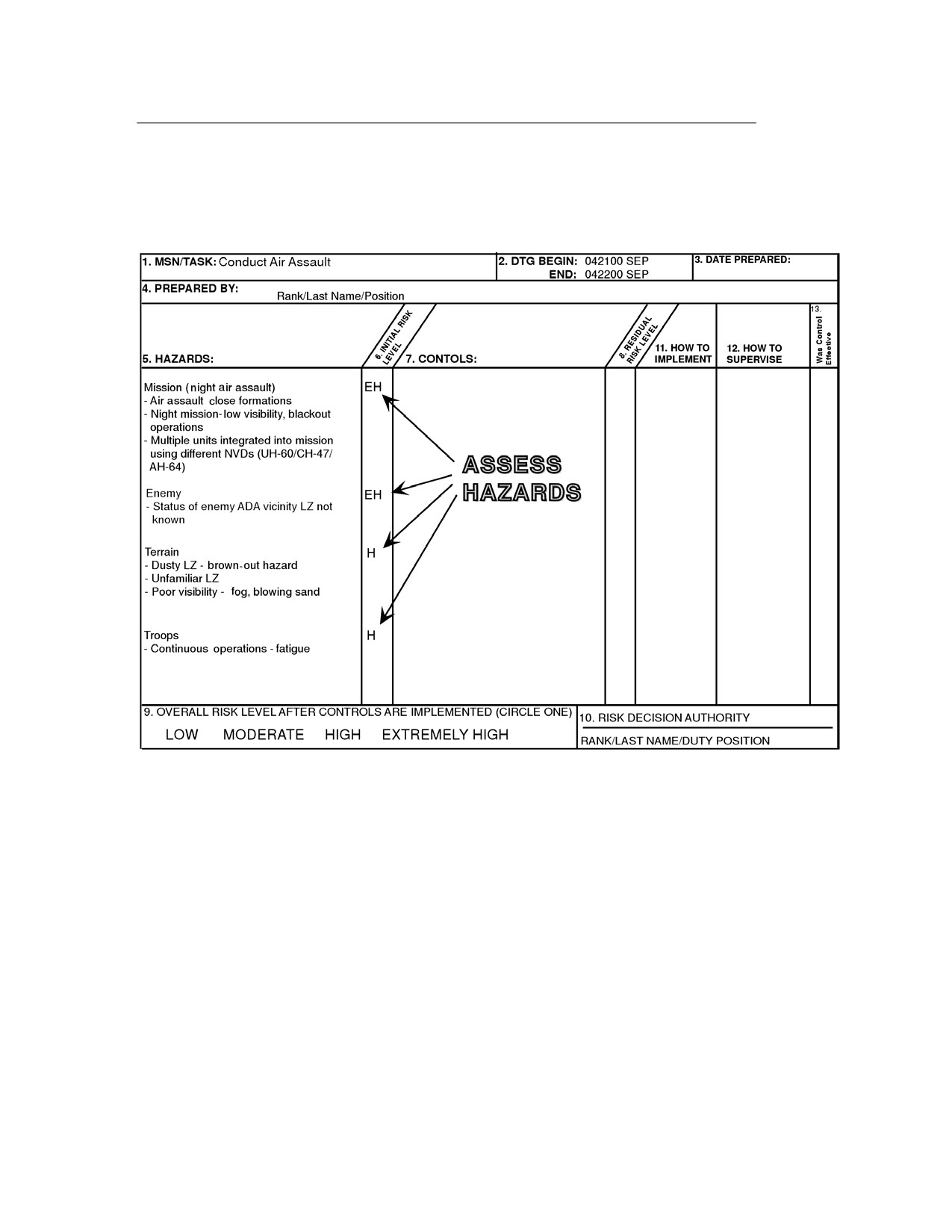
A-16. Provide the risk level for each hazard to the SO/NCO. The SO/NCO
enters this information in Block 6 of the risk management worksheet as the
initial risk level for each hazard (Figure A-7).
DEVELOP CONTROLS
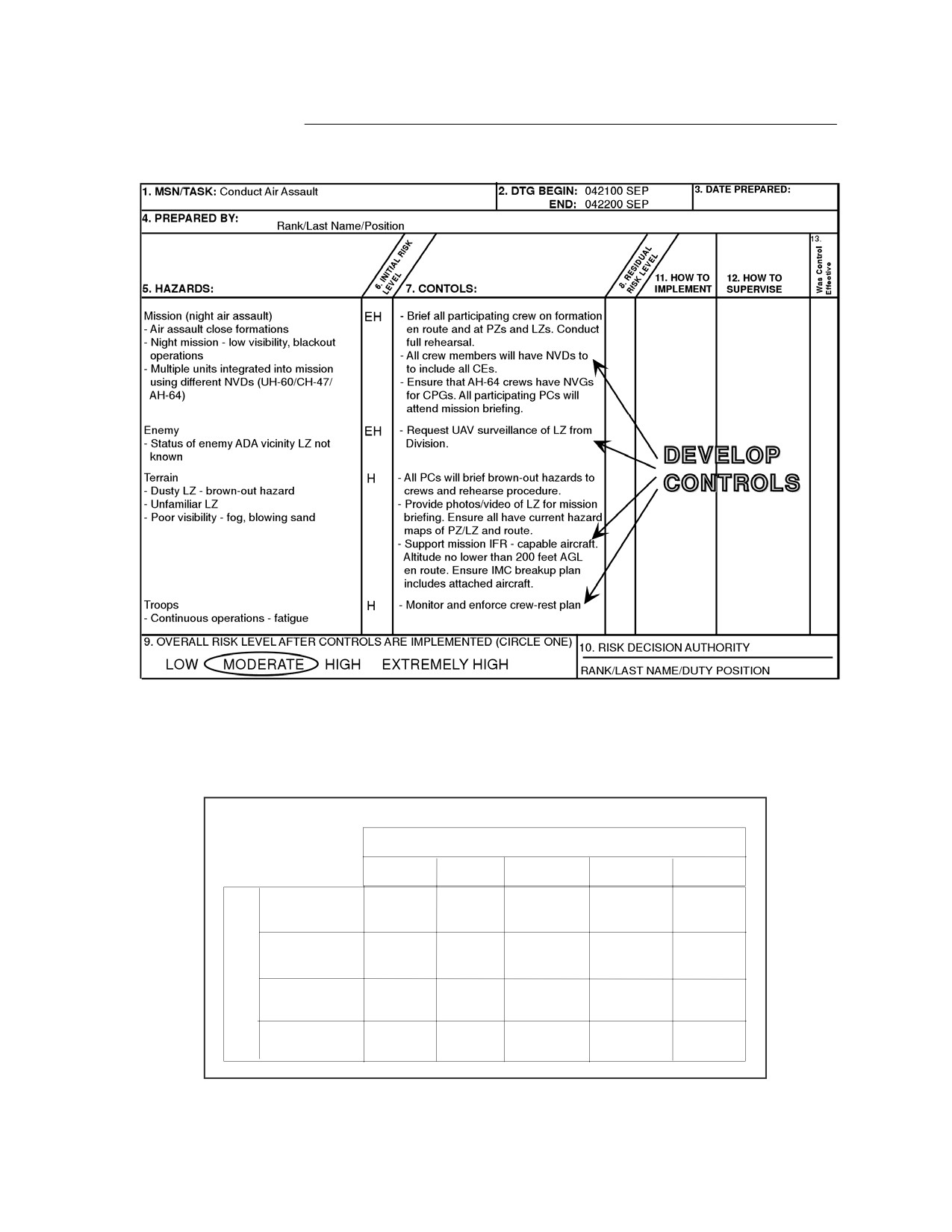
A-17. Develop one or more controls to eliminate each hazard or to reduce its
level of risk. Controls should address the reasons that the hazard needs to be
risk managed. Provide controls to the SO/NCO, who enters them in Block 7 of
the risk management worksheet (Figure A-8).
DETERMINE RESIDUAL RISK
A-18. After controls are developed, a level of risk may remain.
Risk Assessment Matrix
A-19. For each hazard, use the risk assessment matrix (Figure A-9) and best
judgment to determine the level of risk remaining, assuming that the
controls are implemented.
A-6
Appendix A
Record
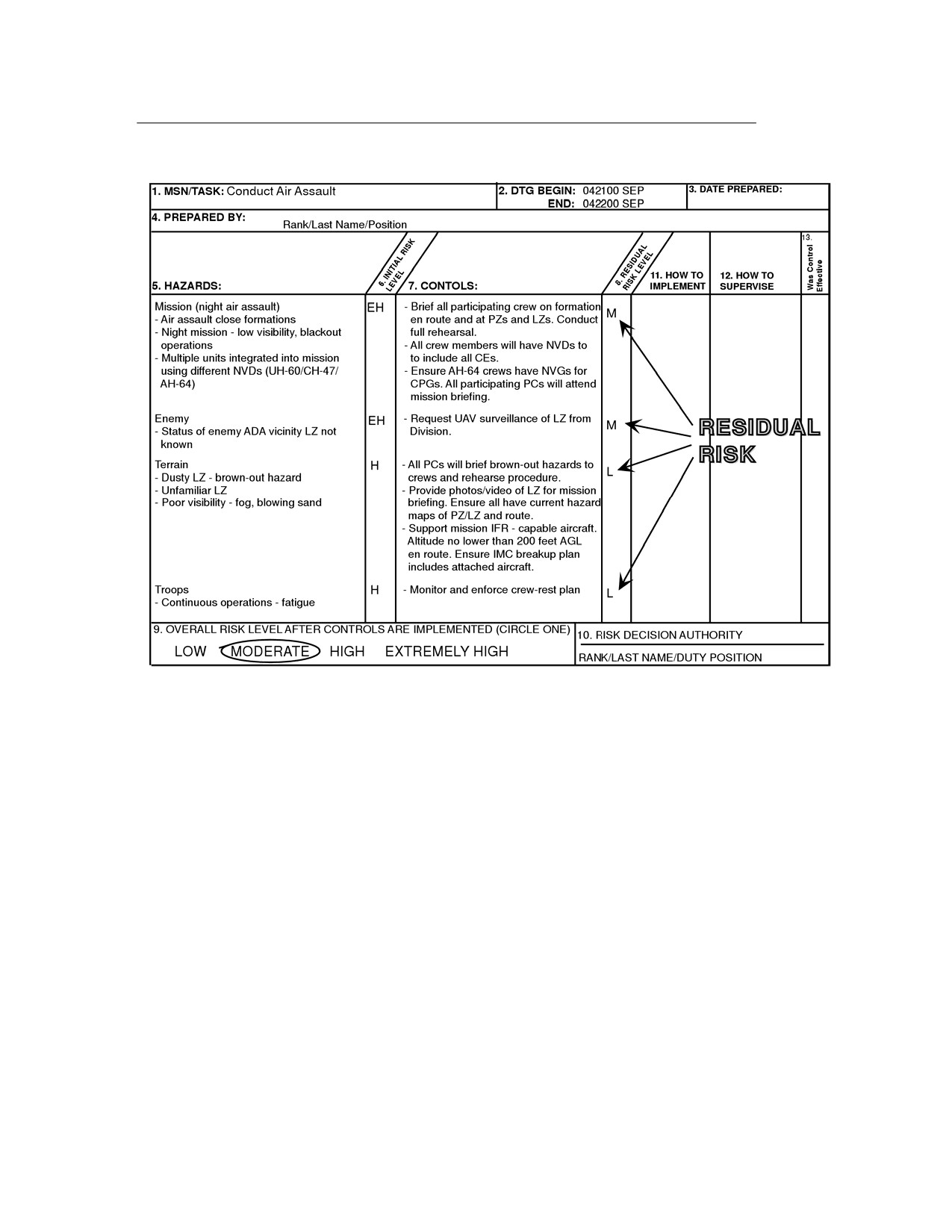
A-20. Provide the residual risk level for each hazard to the SO/NCO, who
enters it in Block 8 of the risk management worksheet (Figure A-10).
Figure A-7. Risk Management Worksheet—Assess Hazards
A-7
FM 3-04.111 (FM1-111)
Figure A-8. Risk Management Worksheet—Develop Controls
Risk Level:
E - Extremely High
H - High
HAZARD PROBABILITY
M- Moderate
L - Low
Frequent
Likely
Occasional
Seldom
Unlikely
s
Catastrophic
E
E
H
H
M
e
v
Critical
E
H
H
M
L
e
r
i
Marginal
H
M
M
L
L
t
y
Negligible
M
L
L
L
L
Figure A-9. Risk Assessment Matrix—Determine Residual Risk
A-8
Appendix A
Figure A-10. Risk Management Worksheet—Residual Risk
DETERMINE COURSE OF ACTION RISK
A-21. SOs/NCOs determine the overall risk level for each COA, assuming
that the commander selects the controls and they are implemented.
Unit Standing Operating Procedure
A-22. SOs/NCOs use procedures in the unit’s SOP when determining overall
risk. If the unit has no such procedures, the COA’s overall risk level is the
same as the hazard with the highest residual risk. They circle the COA’s risk
level in Block 9 (See Figure A-10).
Residual Risk Criterion
A-23. SOs/NCOs analyze the feasibility and acceptability of each COA in
terms of residual risk. They score the residual risk criterion for each COA
using weights determined by the XO and provide these scores for entry on the
decision matrix.
Report
A-24. SOs/NCOs present hazards, controls, and risks during commanders’
decision briefings. Risk management worksheets may be used for this
purpose.
A-9
FM 3-04.111 (FM1-111)
MAKE RISK DECISION
A-25. Commanders make the decisions.
Decision Process
A-26. Commanders select the COA and decide whether to accept the COA’s
risk level. They decide what level of residual risk they will accept and
approve control measures that will result in that level or a lower level of risk.
They obtain the higher commander’s approval to accept any level of residual
risk that might imperil the higher commander’s intent or is not consistent
with risk guidance. In Block 10, SOs/NCOs enter the name, rank, and duty
position of the commander accepting the COA’s risk level (Figure A-11).
Issue Refined Risk Guidance
A-27. The S3 develops and issues a warning order that contains the
commander’s refined risk guidance.
IMPLEMENT CONTROLS
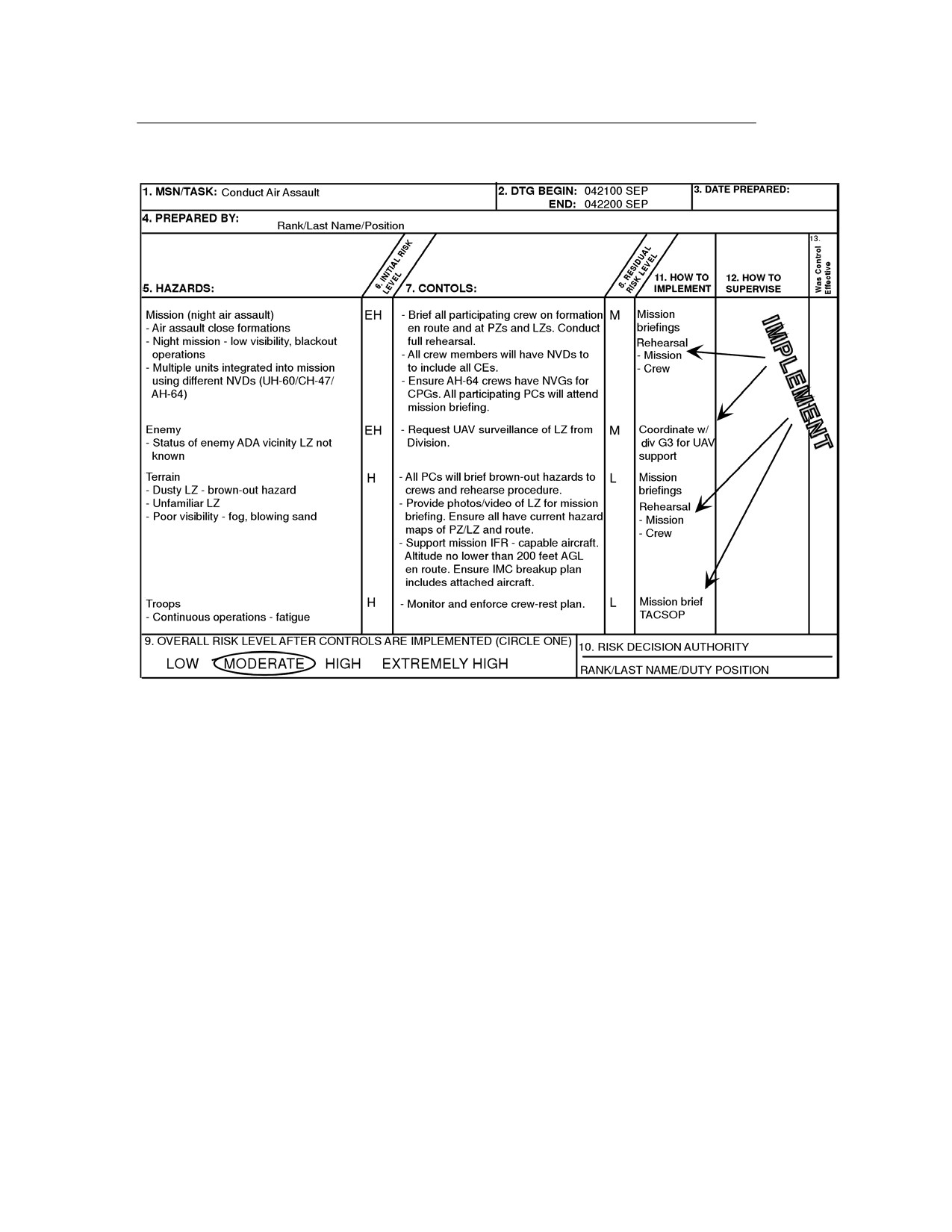
A-28. Based on the commander’s decision and risk guidance, the staff
determines how each control will be put into effect or communicated to the
personnel who will make it happen; for example, FRAGO, OPORD, SOP,
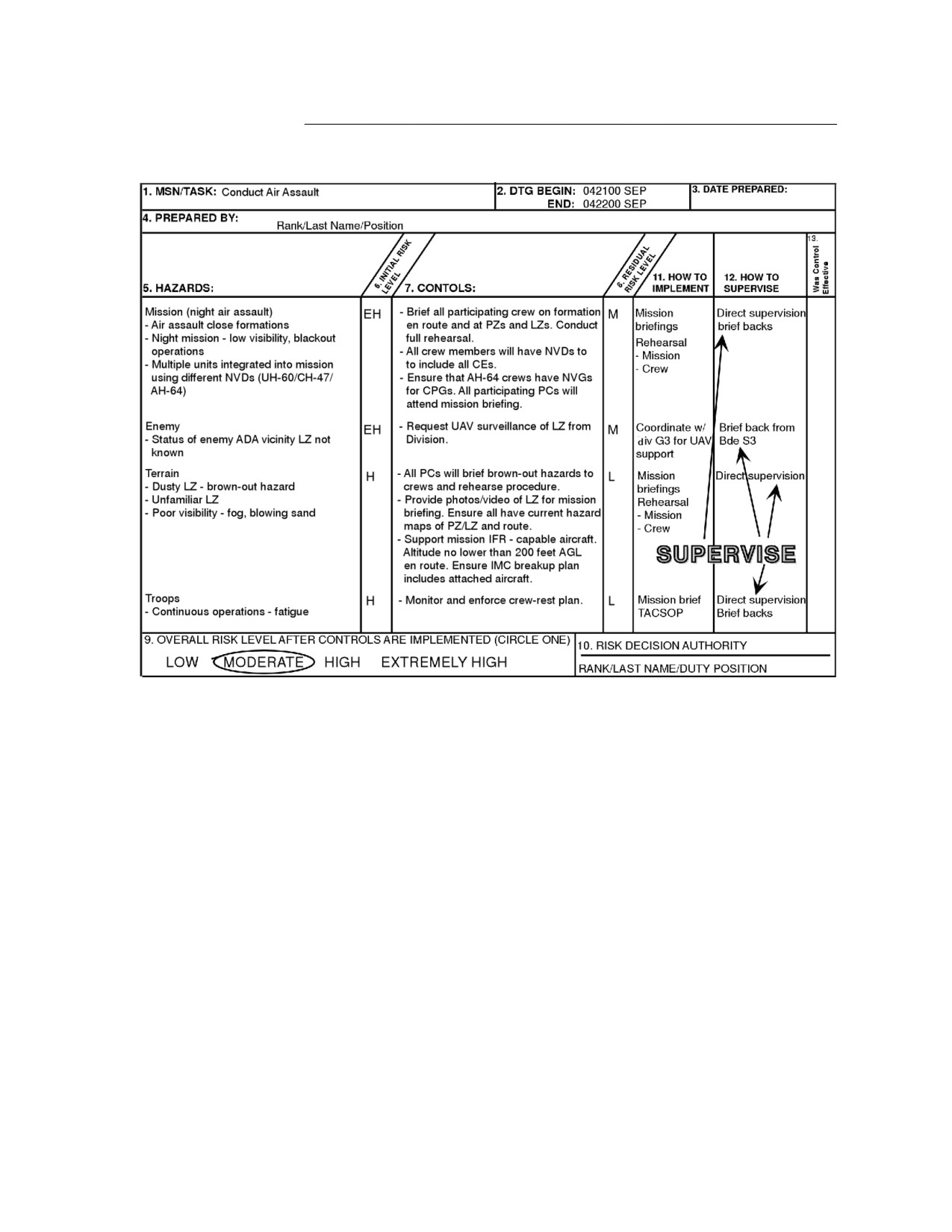
mission briefing, or rehearsals. SOs/NCOs enter this information in Block 11
of the risk management worksheet (Figure A-11). The staff coordinates
controls, integrates them into the FRAGO and/or appropriate paragraphs and
graphics of the OPORD, and confirms understanding by subordinate units
during the rehearsal.
SUPERVISE
A-29. The staff determines how each control will be monitored or enforced to
ensure that it is effectively implemented; for example, command presence,
direct supervision, precombat inspection, precombat checks, SITREP, spot
check, radio net monitoring, cross talk, and back brief. The staff provides
control supervision methods to the SO/NCO, who enters them in Block 12
(Figure A-12).
RISK MANAGEMENT ASSESSMENT
A-30. Evaluation of risks and controls is an ongoing process.
Evaluate Controls
A-31. Staff members evaluate the effectiveness of each control in reducing
the risk of the targeted hazard. They provide a “yes,” if effective, or “no,” if
not, to the SO/NCO, who enters this information in Block 13.
A-10
Appendix A
Figure A-11. Risk Management Worksheet—Implement
A-11
FM 3-04.111 (FM1-111)
Figure A-12. Risk Management Worksheet—Supervise
Ineffective Controls
A-32. For each control judged not effective, staff members determine why it
was not effective and what to do the next time the hazard is identified; for
example, change the control, develop a different control, or change the
method of implementation or supervision. They provide this information to
safety personnel, who report it during the AAR.
Report
A-33. The SO, with the safety NCO, evaluates the unit’s risk management
performance and reports during the AAR. The matrix below (Figure A-13)
may be used for this report.
A-12

Appendix A
GO
NO-GO
Identified the most important hazards.
* Available facts for each METT-TC factor gathered and
considered.
* Hazard (enemy and accident) most likely to result in loss of
combat power identified?
Assessed risk level of each hazard.
* Valid method/tool used to assess initial risk levels?
Developed appropriate control options and determined residual risk.
* Each control addressed hazard reason(s)?
* Residual risk level realistic for each hazard?
* Valid method/tool used to determine the residual risk level
for each COA?
* Residual risk level for each COA entered on decision matrix?
Made risk decision for selected COA.
* Valid procedure/guidance used for determining risk decision
authority?
Hazards and controls clearly communicated to responsible unit/leadership.
* Controls integrated into appropriate paragraphs and graphics
of the OPORD/FRAGO and rehearsals?
Implemented and enforced controls.
* Effective methods used to supervise/enforce controls?
Figure A-13. Risk Management Task Standards and Performance Assessment
DEFINITIONS
A-34. The following terms are defined as they are used in the
risk
management process.
CONDITIONS
A-35. Conditions are the readiness status of personnel and equipment with
respect to the operational environment during mission planning, preparation,
and execution. Readiness that is below standard leads to human error,
material failure, and inadequate precautions for environmental factors,
which may cause accidents, fratricide, and mission degradation.
CONTROLS
A-36. Controls are actions are taken to eliminate hazards or reduce their
risk.
HAZARD
A-37. A hazard is an actual or potential condition that can cause injury,
illness, or death of personnel; damage to or loss of equipment or property; or
mission degradation.
A-13
FM 3-04.111 (FM1-111)
PROBABILITY
A-38. The levels of probability that an event will occur are the following:
• Frequent: Occurs often, continuously experienced.
• Likely: Occurs several times.
• Occasional: Occurs sporadically.
• Seldom: Unlikely, but could occur at some time.
• Unlikely: Can assume it will not occur.
RESIDUAL RISK
A-39. Residual risk is the level of risk remaining after controls have been
selected for hazards. (Controls are identified and selected until residual risk
is at an acceptable level or until it is impractical to reduce further.)
RISK
A-40. Risk level is the probability of exposure to injury or loss from a hazard
expressed in terms of hazard probability and severity.
RISK ASSESSMENT
A-41. Risk assessment is the identification and assessment of hazards (the
first two steps of the risk management process).
SEVERITY
A-42. The level of severity is the expected consequence of an event in terms
of degree of injury, property damage, or other mission-impairing factors.
These levels are the following:
• Catastrophic: Death or permanent total disability, system loss, major
damage, significant property damage, or mission failure.
• Critical: Permanent partial disability, temporary total disability
exceeding three months, major system damage, significant property
damage, or significant mission degradation.
• Marginal: Minor injury, lost workday accident, minor system damage,
minor property damage, or some mission degradation.
• Negligible: First aid or minor medical treatment, minor system
impairment, or little or no impact on mission accomplishment.
A-14
Appendix B
Tactical Standing Operating Procedures Considerations
GENERAL
B-1. SOPs detail how forces execute specific techniques and procedures that
commanders standardize to enhance effectiveness, timeliness, and flexibility.
Commanders use SOPs to standardize routine or recurring actions that
normally do not require their personal involvement. They develop SOPs from
doctrinal sources, applicable portions of the higher headquarters SOPs,
higher commander’s guidance, and techniques and procedures developed
through experience. The tactical SOP must be as complete as necessary but
not so voluminous that new arrivals or newly attached units cannot quickly
become familiar with the routine of their new controlling headquarters.
BENEFITS
B-2. The benefits of SOPs include the following:
• Simplified, concise combat orders.
• Enhanced understanding and teamwork among commanders, staffs,
and units.
• Established, synchronized staff drills.
• Established, abbreviated, or accelerated decision-making techniques.
RESPONSIBILITY
B-3. The S3, with input from other staff sections, is responsible for
preparing, coordinating, authenticating, publishing, and distributing the
command’s tactical SOP.
TACTICAL STANDING OPERATING PROCEDURE PRINCIPLES
B-4. Discussed below are some of the principles common to successful tactical
SOPs.
SIMPLICITY
B-5. Simple, easy-to-read and easy-to-execute procedures are critical to
tactical SOP application. Critical items of procedure should be presented in
as few words and graphics as possible. Task organization changes can occur
rapidly, but effective task organization requires each of the units attached or
placed under OPCON to be able to operate with efficiency. A 200-page SOP is
a daunting document to absorb when the unit is attached in the morning for
an operation that afternoon.
DOCTRINE
B-6. A tactical SOP cannot deviate from doctrine. The more a tactical SOP
parallels doctrine, the easier that it will be to learn and execute.
B-1
FM 3-04.111 (FM1-111)
COMMONALITY
B-7. Standardization of tactical SOPs is essential within a division and
should probably extend to all units within a corps. Attack, assault, air
reconnaissance, GS, heavy helicopter, and even UAV units could have
difficulty operating together unless each unit operates from a common SOP.
That standardization effort should include reinforcing units and, especially,
reserve component units. Just as aviation units today conduct worldwide and
local standardization conferences for flight operations, units within a division
and a corps should consider conducting tactical SOP conferences to ensure
standardization of tactical procedures.
AVAILABILITY
B-8. With the growth of the Internet, SOP sharing and transmission of
tactical SOPs are easy. Many good tactical SOPs are available to provide a
base outline for units. The challenge is to develop and publish a standardized
tactical SOP within the division and the corps.
TRAINING
B-9. No tactical SOP will produce the desired results unless it is constantly
reviewed and tested. The tactical SOP should be a topic in every pilot’s
briefing. The tactical SOP should also be a point of discussion in every
OPORD and plan—and during every tactical exercise after-action review.
Standardized and internalized tactical SOPs make training easier to
supervise and execute while making battles less costly to win.
B-2
Appendix C
Deployment
SECTION I - DEPLOYMENT FUNDAMENTALS
GENERAL
C-1. This appendix addresses deployment of ground vehicles, equipment, and
aircraft. The capability to quickly deploy aviation assets from CONUS or
forward-deployment sites to another theater is an important aspect of U.S.
forces’ rapid deployment. Units that plan, train, and validate their movement
plans greatly increase their chances for success.
C-2. Units may be required to move from any location to railheads, seaports
of embarkation (SPOE), or aerial ports of embarkation (APOE) from which
they will be transported to the theater of operations. Movement to the SPOE
or APOE may involve a combination of modes. Aircraft are generally flown to
the port. Vehicles, depending on distance, may convoy or be shipped via rail.
C-3. Units also must be prepared to self-deploy aircraft, limited personnel,
and selected equipment to almost anywhere in the world.
COMMANDER
C-4. The commander is responsible for unit movement. He directs
preparation of SOPs, movement orders, and load plans. He validates SOPs
and orders through periodic training exercises.
UNIT MOVEMENT PERSONNEL
C-5. Unit movement personnel develop SOPs and load plans. They train
personnel and ensure that equipment is prepared for the move. They inspect
equipment before and after the unit moves. They also request appropriate
support.
SECTION II - PLANNING AND PREPARATION, SEA AND AIR TRANSPORT
C-6. Successful movement depends on detailed planning, SOPs for
deployment by various methods, and the identification, training, and
validation of deployment and load teams. Each team member has specific
duties, from preparation at home station, to clearance of the port of
debarkation (POD), to arrival at destination.
C-7. Upon receiving the warning order and time permitting, advance parties
are sent to both the ports of embarkation (POEs) and PODs to prepare for
embarkation and debarkation and to provide command, control, and
intelligence (C2I).
C-1
FM 3-04.111 (FM1-111)
C-8. The following references discuss deployment actions and considerations:
• Unit Movement Officer (UMO) Deployment Handbook Reference 97-1,
published by the U.S. Army Transportation School. Download from
• Appendix H, Deployment, FM 3-04.500 (FM 1-500). Download FMs
• FM 4-01.011 (FM 55-65).
C-9. Military Traffic Management Command Transportation Engineering
Agency (MTMCTEA) pamphlets provide specific guidance for preparation of
equipment
for
movement.
Download
from
• MTMCTEA Pamphlet 55-19 (Rail).
• MTMCTEA Pamphlet 55-20 (Truck).
• MTMCTEA Pamphlet 55-21 (Helicopter).
• MTMCTEA Pamphlet 55-22 (Lifting and Lashing).
• MTMCTEA Pamphlet 55-23 (Containerization).
• MTMCTEA Pamphlet 55-24 (Air).
C-10. Aircraft preparation, lifting, and tiedown must be according to
appropriate preparation for shipment manuals and specific loading
instructions manuals for military aircraft (fixed-wing air shipments only).
Download from http://www.logsa.army.mil/ etms/online.htm:
• TM 1-1520-Apache/Longbow.
• TM 1-1520-237-S.
• TM 1-1520-238-S.
• TM 1-1520-248-S.
• TM 55-1520-241-S.
• TM 55-1520-242-S.
C-11. Not all contingencies for unit movement can be foreseen because of the
wide range of missions and world events that may occur. Unit staffs should
be aware of battle book plans and war game probable and possible scenarios.
They should establish skeleton plans to cover contingencies.
C-12. Unit movement personnel should be familiar with the POEs available
to their organization and mission requirements. Special needs and
considerations should be addressed as early as possible for each POE. Unit
movement personnel should—
• Establish and periodically update telephone lists, points of contact,
and special requirements for likely POEs.
• Identify advance party personnel and define duties.
• Identify OPSEC requirements during movement and embarkation
activities.
• Plan workspace for personnel during the embarkation phase (empty
offices, borrowed tentage from nondeploying units, and rented or
borrowed trailers).
• Identify communications requirements (commercial lines, wire, radio,
and cellular phone).
C-2
Appendix C
• Determine transportation requirements at POE for movement teams
and key personnel (borrowed vehicles and rental cars).
• Plan
messing,
billeting,
medical
treatment
facilities,
refueling/defueling points, and special requirements for weapons and
ammunition.
SECTION III - SEA OR AIR TRANSPORT DEPLOYMENT
MOVEMENT
C-13. Upon receiving the order, units ferry their aircraft and move ground
vehicles along preselected routes to the POE. Units that can perform depot-
level maintenance normally operate at these embarkation points. As the
units arrive, a dedicated depot support team assists in preparing the vehicles,
equipment, and aircraft for deployment. Preparation includes required
maintenance and installation of ferry equipment.
C-14. Air and sea deployment modes terminate at aerial and sea ports of
debarkation (APOD/SPOD). Depot or AVIM facilities should be available
there or elsewhere in the theater. Personnel at these facilities remove ferry
equipment, install mission equipment, and perform required maintenance
and inspections to prepare the equipment for the mission. They also
coordinate the immediate backhaul of designated support teams and ferry
equipment. On receipt of the deployment order, AVIM commanders dispatch
preselected facility teams. Deployment headquarters staff members should
locate command facilities at each termination site to facilitate the integration
of aircraft, vehicles, and personnel into the theater force structure.
TASK ORGANIZATION
C-15. Arriving elements task organize and reconfigure vehicles and aircraft
as appropriate for the mission. CSS efforts are prioritized to build combat-
capable units and C4I architecture.
FORCE PROTECTION
C-16. Aviation forces are particularly vulnerable during the buildup phase
when the unit is not at full strength and aircraft and vehicles may not be
fully assembled for combat. The security plan must be understood and
executed from the moment that the first unit arrives. This plan should
include passive and active measures to combat air and ground threats.
C-17. Aviation forces often are among the first units to arrive in theater.
They may have to provide reconnaissance, security, and attack operations to
secure a lodgment before more forces arrive in theater. This situation may
require aviation units to conduct immediate and continuous operations from
offshore or remote locations while the main body moves into the lodgment
area.
C-3
FM 3-04.111 (FM1-111)
C-18. To reduce the risk of fratricide, crew members must understand—
• The composition and location of friendly forces and the plan.
• Theater-specific IFF procedures.
TRAINING
C-19. Local area orientations, test flights, or other requirements that could
not be executed in advance may be required. Commanders should attempt to
phase the arrival of personnel—such as instructor pilots, test pilots, and key
leaders—to begin before the entire unit arrives. If units are already present
in country, these key personnel should deploy as early as possible to train
with those units. The advance party should be briefed on these requirements
and the plan for their execution so that they can identify and coordinate
required external support.
C-20. Acclimation training may be required. Many units that move from one
environmental extreme to another need a period of adjustment to the new
climate. The unit commander or S3 should arrange training and conditioning
to accelerate acclimation.
C-21. Most deployments will involve operating in a joint or multinational
environment. Early-arriving units may be able to schedule training with
other services. Liaison elements should be designated to ensure smooth
coordination.
SECTION IV - PLANNING CONSIDERATIONS, SELF-DEPLOYMENT
GENERAL
C-22. Self-deployment is an alternative method to rapidly move aircraft. AH-
64, UH-60, and CH-47D helicopters with auxiliary tanks can carry enough
usable fuel to self-deploy to many locations.
C-23. Commanders should avoid self-deployment over large bodies of water
except in an emergency when other methods are not available. This method is
risky because aircrews face the challenge of a possible ditching at sea.
C-24. Units should not plan to deploy combat troops on self-deploying
aircraft. Available space is typically used to accommodate those supplies,
tools, parts, survival equipment, and limited support personnel necessary to
make the flights self-sustaining during the deployment.
C-25. Configuring some aircraft to self-deploy long distances may require
alternate transport of some weapons systems, equipment, and baggage.
Maintenance and armament personnel must reconfigure these aircraft before
the unit can commit them to combat.
C-26. The commander, with the S3 and SO, develops a preaccident
contingency plan before self-deployment. The S1 identifies available medical
treatment facilities along the route and advises the S3.
C-27. Unit staff members plan procedures for downed aircrew and aircraft
recovery.
C-4
Appendix C
C-28. Staff members conduct risk analysis and consider alternatives. For
extensive legs of flight over water, plans should include Naval assets along
the flight route to provide intermediate fuel stops or SAR.
C-29. Ground support teams should be prepositioned at stopover points along
self-deployment flight routes. Ground support teams include personnel,
equipment, and repair parts to provide limited services. These services
include POL products, supply, health service support, communications,
weather forecasting, and flight planning.
PERSONNEL
C-30. Aircrews and passengers may require passports and visas for each
country of intended landing. The mission may require crew members or other
support personnel with specific foreign language proficiency for those
countries in which refueling or extended stopovers are planned.
C-31. Extensive distances may require aircrews to fly many hours. The
challenge is to ensure that crews are able to fight when they arrive in
theater. Commanders should adjust work and rest schedules before and
during deployment. Commanders must plan to rotate crews through pilot
duties whenever possible. Deploying units could carry backup crews from
nondeploying units on CH-47 and UH-60 aircraft.
INTELLIGENCE
C-32. S2s obtain threat intelligence information about those countries that
are overflown and those where landings are planned. Terrorist threats,
counterintelligence, and specific force protection concerns are important to
aircrews for planned and potential stops.
TRAINING
C-33. Commanders should place emphasis on predeployment training
including sea survival, fuel system management, high gross-weight
operations, route flight checks, International Civil Aviation Organization
(ICAO) flight planning, navigation equipment, communication requirements,
shipboard operations, and rescue operations.
C-34. En route and destination environmental considerations—such as high
altitude, mountainous and jungle terrain, and over-water flight—are
considered. Crews must be trained for survival in the environment and the
use of special equipment required for each environment.
C-35. Theater-specific ROE, status of forces agreements
(SOFAs), local
customs, language training, and OPSEC requirements that can be
anticipated should be performed at home station, if possible.
LOGISTICS
C-36. Self-deploying and supporting units request and coordinate
maintenance and crew-rest facilities, fuel, transportation, security, and
messing for stopover-point teams and self-deploying aircrews. If U.S. ground
support teams are not available, units coordinate with friendly nations to
C-5
FM 3-04.111 (FM1-111)
provide the required services. The S5 is the point of contact for staff officers
who deal with host nations. If no S5 is assigned, the S3 performs this
function.
C-37. When aviation units deploy to destinations lacking fixed-base facilities,
prepositioned ground support teams perform those functions. S4s of self-
deploying and supporting units are responsible for logistics requirements
along the self-deployment route. Aviation maintenance officers organize a
maintenance support operation to prepare aircraft for self-deployment and to
meet maintenance requirements along the route.
C-38. Staff members verify availability and quantity of fuel at en route fuel
stops, rather than depending solely on Department of Defense Flight
Information Publications (DOD FLIP). An appropriate agency verifies fuel
quality at each location before refueling.
C-39. Contracting officers or Class A agents, if required at stopover sites,
should be in the advance party.
C-40. The unit should issue appropriate survival equipment and clothing for
the climate that it expects to encounter.
C-41. To facilitate mission readiness, movement planners, logisticians, and
maintenance personnel carefully war game the arrival of units and
equipment into the theater.
SELF-DEPLOYMENT MISSION PLANNING
C-42. Air defense identification zone
(ADIZ) procedures, as well as
international interception signals, must be clearly understood by all aircrew
members.
C-43. All aircrew members must obtain and understand approved
international clearances before departure.
FLIGHT ORGANIZATION AND AIRCRAFT CONFIGURATION
C-44. Each departing flight of multiple aircraft should be self-sustaining in
terms of food, water, limited maintenance capability, and force protection.
Aircraft with limited cargo capacity—such as AH-64s or OH-58Ds—require
task organization with UH-60s or CH-47s. USAF CSAR or Naval support is
essential for downed aircrew recovery. Ideally, an escort SAR aircraft is
assigned. Without escort, each flight should include at least two aircraft with
rescue hoists.
C-45. Maintenance personnel and a maintenance test pilot are included in
the flights themselves or are prepositioned at various planned stopover
locations.
C-46. Depending on type of aircraft and space available, a maintenance
support package might include an auxiliary fuel system, tow bars, packaged
POL, limited spare parts, a mechanic’s toolbox, and tug or tow vehicle.
C-6
Appendix C
COMMUNICATIONS
C-47. Units—
• Must coordinate frequencies for internal flight following throughout
the trip.
• Must coordinate and verify compatibility of specific frequencies for
supporting Naval vessels and SAR elements.
• Take SATCOM sets if available; SATCOM enables each flight to
communicate its status to home station and the theater of operations.
EQUIPMENT
C-48. Survival vests, rafts, hot-cold-weather survival kits, rescue hoists,
survival radios, food, and water are essential mission equipment.
C-49. Each flight should have multiple aircraft with extra survival
equipment that can be dropped to downed crew members.
WEAPONS
C-50. Individual and crew-served weapons should normally remain out of
sight during flight and ground operations.
C-51. The controlling headquarters issues ROE when deploying units carry
weapons and ammunition.
SECTION V - SELF-DEPLOYMENT ROUTES
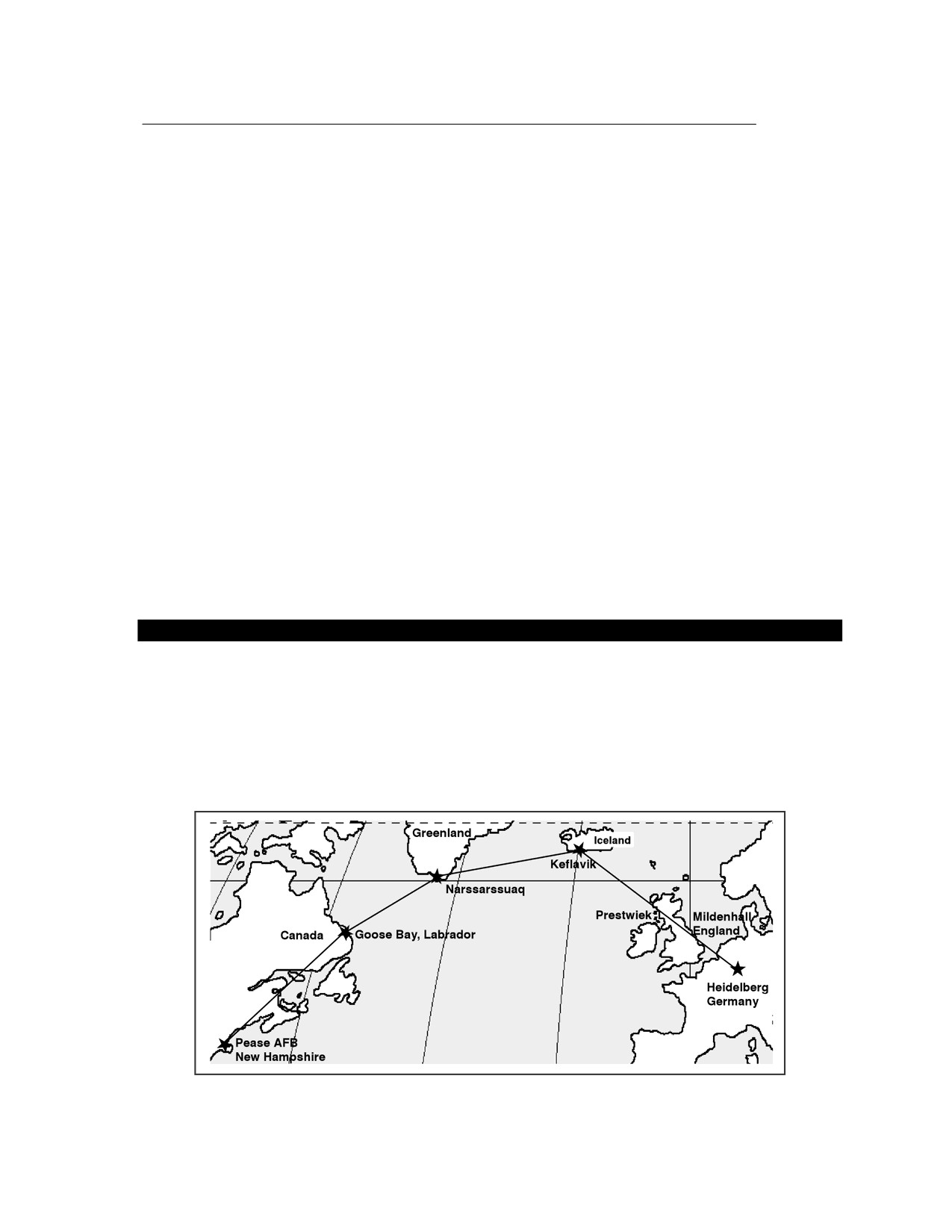
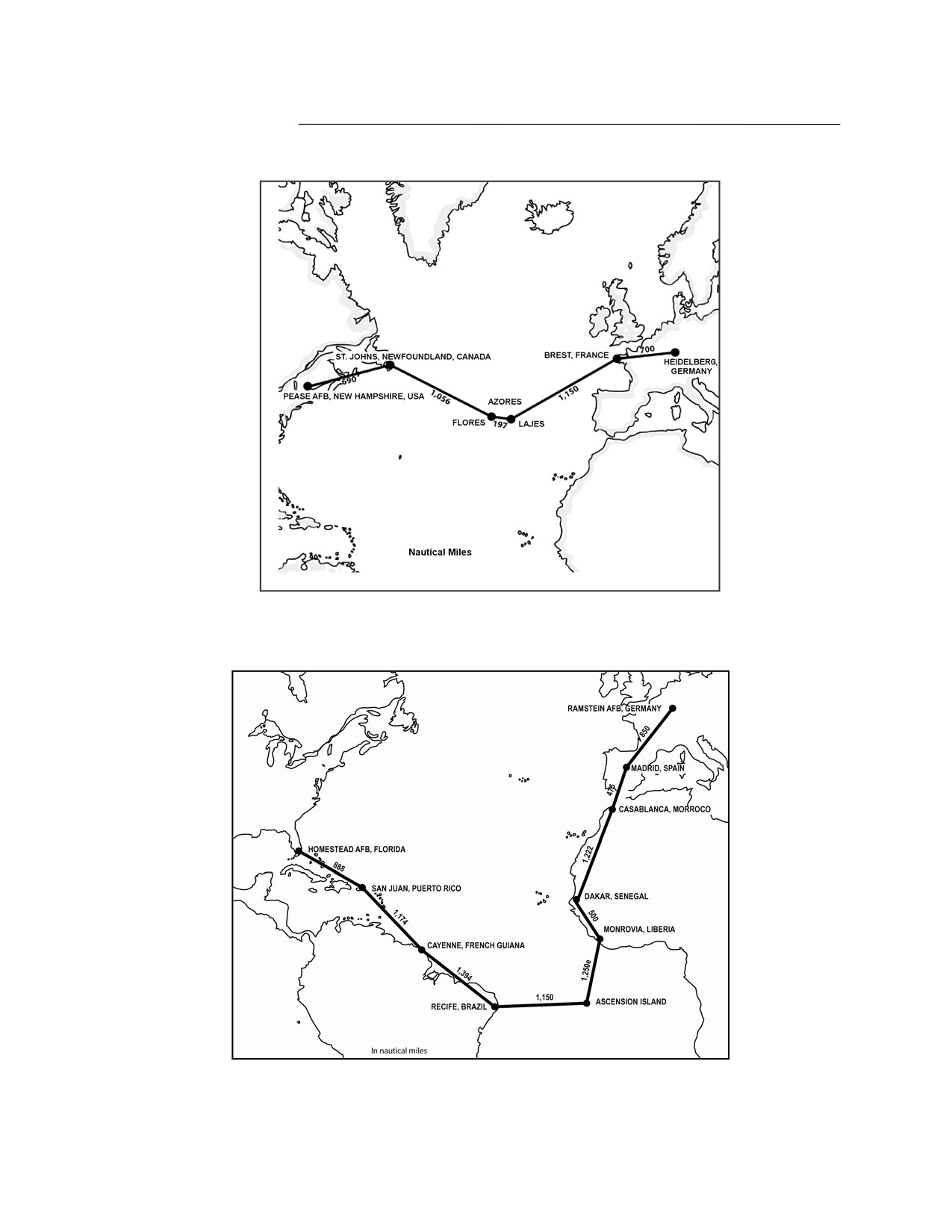
C-52. Aircraft equipped with ferry tanks can self-deploy over long distances.
The following Atlantic routes
(Figures C1 through C3) support general
planning. Additional stopover points, land or sea based, may be required
because of variables. Coordination of friendly ships with landing and
refueling capability may allow less deviation. There are no published Pacific
routes.
Figure C-1. European Route Northern
C-7
FM 3-04.111 (FM1-111)
Figure C-2. European Route Central
Figure C-3. European Route Southern
C-8
Appendix D
Assembly Area Operations/Road March
SECTION I - DESIGNATION OF ASSEMBLY AREAS
GENERAL
D-1. An AA is a location where units prepare for future operations, issue
orders, perform maintenance, and accomplish resupply. Aviation unit AAs
may vary from fixed-base airfields to remote field sites. Regardless of the
type of AA that the unit occupies, the commander and staff adhere to certain
principles to ensure unit survivability. AAs usually locate in the corps or
division rear area or near the higher headquarters AA. Aviation AAs usually
locate out of the range of enemy medium artillery and are large enough to
adequately disperse subordinate units.
ASSEMBLY AREAS
D-2. The AA security and maintenance of OPTEMPO must be balanced. It is
very difficult for aviation units to secure their own AAs and maintain high
OPTEMPOs; therefore, additional security must be requested from higher
headquarters. An AA must provide—
• Security through location, self-defense, and integration into defensive
schemes of adjacent units.
• Concealment for aircraft.
• Cover and concealment for ground elements.
• Accessibility to adequate roads and MSR.
• Proximity to friendly units to assist communications, coordination,
and logistics.
• Suitable ground and aircraft ingress/egress routes.
• Distance from projected enemy avenues of approach.
HEAVY ASSEMBLY AREAS
D-3. Aviation brigades may disperse battalion AAs based on mission and
threat. They may also collocate battalion AAs around the brigade main CP to
form a HAA. This action facilitates better C3I and provides mutual defense
when terrain offers little concealment and air or artillery attacks are
unlikely. This action may also occur during SSC or SASO when an airfield or
base camp is the primary source of supply.
FORWARD ASSEMBLY AREAS
D-4. Units occupy FAAs while awaiting orders to execute missions. FAAs
locate near the controlling headquarters to improve C3I interface and
response times. Limited maintenance personnel, such as contact teams, may
D-1
FM 3-04.111 (FM1-111)
locate in the FAA. Considerations for selecting FAAs are the same as for
selecting AAs. The FAA should locate out of range of enemy medium artillery.
SHARED ASSEMBLY AREAS (BASE CLUSTER DEFENSE)
D-5. Fundamentals that apply to AAs also apply to base cluster defense. The
base cluster commander develops and integrates flexible defense plans to
allow for differing degrees of preparation based on the probability of enemy
activities.
ASSEMBLY AREA RESPONSIBILITIES
D-6. Commanders must designate who is responsible to select, occupy, and
secure unit AAs. Listed below are typical staff responsibilities for the AA
duties. The commander may decide to assign these responsibilities to others.
EXECUTIVE OFFICER
D-7. The XO performs the following AA duties:
• Establishes timelines for AA moves.
• Develops triggers, based upon a DST, that cue the need to displace the
AA.
• Rehearses AA occupation and movement.
OPERATIONS OFFICER
D-8. The S3 performs the following AA duties:
• Selects future main CP sites.
• Selects site for the TOC within the main CP.
• Coordinates ISR plan development with the S2.
• Establishes a jump, or temporary, TOC, if necessary, until the TOC is
established at the main CP site.
• Develops plans and orders for moving to the AA.
• Plans air routes and coordinates A2C2 for air routes to the new AA.
• Plans fires supporting the AA move.
• Develops plans to reconnoiter movement routes and new AA location.
• Plans and requests support, if necessary, for MEDEVAC assets to
assist during the move.
• Coordinates with higher or adjacent units for land to establish the AA
and integrates into their defensive plans.
• Requests engineer support to assist in AA improvement.
• Coordinates and requests AD support for the AA.
INTELLIGENCE OFFICER
D-9. The S2 performs the following AA duties:
• Develops an event template and the DST for the AA, resulting in DPs
necessary to plan and execute AA displacement.
• Develops NAI near the AA.
• Develops the ISR plan, with the S3, for the AA.
D-2
Appendix D
• Tracks enemy movements in relation to the displacement DPs and
informs the commander if the enemy reaches selected DPs.
• Assists the HHC commander and S3 in selecting new AAs by
conducting a threat and terrain analysis of the proposed AA location.
LOGISTICS OFFICER
D-10. The S4 performs the following AA duties:
• Develops march tables for the vehicle convoy to the new AA.
• Selects the location for the ALOC.
COMMUNICATIONS-ELECTRONICS OFFICER
D-11. The S6 performs the following AA duties:
• Analyzes potential AA sites and determines their suitability in terms
of providing communications for the task force.
• Establishes a retransmission site, if required, to assist during unit
moves.
• Analyzes potential AAs for their proximity to MSE nodes.
COMMAND SERGEANT MAJOR
D-12. The CSM, or an NCO designated by the CSM, performs the following
AA duties:
• Assists the S3 and S4 in developing movement orders.
• Supervises the breakdown of the old AA.
• Leads the quartering or advance party in coordination with the HHC
commander and first sergeant.
• Supervises the establishment of the new AA.
HEADQUARTERS AND HEADQUARTERS COMMANDER
D-13. The HHC commander or 1SG performs the following AA duties:
• Organizes the march serials, designates serial commanders, and
conducts convoy briefings.
• Leads the quartering or advance party.
• Selects locations, with the S3, for future AAs.
• Conducts a reconnaissance of proposed AA sites.
• Selects emergency displacement AAs.
ASSEMBLY AREA SELECTION
D-14. The AA is chosen to support projected battalion missions. Before
selection, units conduct a map reconnaissance and a site survey of the
proposed location. After selecting and coordinating an AA site, units occupy it
on order. Units plan and rehearse occupation of the AA. Occupation of an AA
is a four-phase operation:
• Reconnaissance.
• Quartering party and advance party operations.
D-3
FM 3-04.111 (FM1-111)
• Main body arrival (air and ground).
• AA improvement.
ROUTE RECONNAISSANCE
D-15. Units conduct a route reconnaissance of convoy routes before the
quartering party moves to the new AA location. Commanders may conduct
separate reconnaissance using aircraft or vehicles or both or may reconnoiter
concurrently just in front of the convoy. The purpose of this reconnaissance:
• Verifies the suitability of the convoy route.
• Locates areas along the route that could delay the convoy.
• Determines how much traffic is on the route.
• Looks for potential enemy ambush sites along the route or evidence of
enemy activity.
AREA RECONNAISSANCE
D-16. The unit accomplishes an area reconnaissance of the AA location and
the surrounding terrain as soon as possible after selecting the AA site. The
unit conducts this area reconnaissance by air or ground or both. If conducting
the reconnaissance by air, aircrews should land and allow the reconnaissance
party to physically walk and observe the layout of the terrain. Items to look
for include suitability of the area’s size and slope and vehicle accessibility
from a ground stability and drainage standpoint. The commander considers
an NBC survey and examines defensibility of the site to include available
cover and concealment for ground elements, fields of fire, dead zones, and
likely enemy infiltration and attack routes. Look for ground units operating
nearby to ascertain whether ground tracked vehicles may transit through the
area selected.
FORWARD ASSEMBLY AREA
D-17. The FAA is occupied only by the tactical CP, limited aircraft, and a
minimum number of ground vehicles. Companies may also establish
individual FAAs. Planning for the occupation of the FAA is not as detailed as
that required for an AA. However, because the task force may remain in the
FAA for more than several hours, the commander and the staff must consider
security and camouflage. Occupation of the FAA is a three-phase operation:
• Area reconnaissance.
• Main body arrival.
• Security.
AREA RECONNAISSANCE
D-18. The reconnaissance element conducts an initial area reconnaissance
(including NBC survey, if appropriate) of the FAA and the surrounding
terrain. Upon completion, the reconnaissance element briefs the commander
or S3 and keeps the new position under constant observation until the main
body arrives.
D-4
Appendix D
MAIN BODY ARRIVAL
D-19. Each unit arrives separately at the FAA and lands in predetermined
areas. Normally, arrivals are staggered by several minutes to avoid excessive
traffic that could lead to accidents or enemy detection. The FAA should allow
dispersion and observation of all the high-speed avenues of approach into the
FAA.
SECURITY
D-20. Security of the FAA depends on the unit’s capability to detect threats
and move aircraft to another location before being attacked. After
establishing FAA security, aircrews complete thorough aircraft preflight
inspection and prepare for rapid departure by going through checklists
leading up to engine start. The priority of tasks for each unit is to—
• Establish local security.
• Establish wire communications with the tactical CP.
• Prepare aircraft for immediate launch.
• Continue to plan missions.
QUARTERING PARTY AND ADVANCE PARTY OPERATIONS
D-21. The quartering party conducts the initial AA occupation, including an
area reconnaissance for security and an NBC survey if the commander
suspects contamination. It organizes and prepares the site for arrival of the
main body. The quartering and advance parties may move together or at
separate times. If they move together, the advance party will normally stop
at a designated point outside the new AA and wait for the quartering party to
finish operations before moving into the new AA. When time is short, units
may combine and accomplish the functions of both at the same time.
NUCLEAR, BIOLOGICAL, AND CHEMICAL SURVEY
D-22. Units conduct an NBC survey if the commander suspects that NBC
contamination is a possibility. Before movement, the quartering party leader
consults the chemical officer and S2 to determine the likelihood of NBC
contamination in the new AA.
SECURITY
D-23. Initially, security may consist of establishing OPs along likely avenues
of approach in a position to maintain overwatch of the AA. Therefore, the size
of the quartering party must support initial security requirements.
ADVANCE PARTY
D-24. The quartering party guides the advance party into its new locations.
The advance party then—
• Enhances local security.
• Establishes additional OPs and a dismount point.
• Establishes communications with the TOC in the AA.
• Determines locations of the TOC, ALOC, unit elements, and FARP.
D-5
FM 3-04.111 (FM1-111)
• Confirms suitability of the area.
• Clears safety hazards from the area.
• Establishes internal wire communications to the unit areas.
• Clears and marks aircraft parking positions.
• Emplaces chemical alarms.
MAIN BODY ARRIVAL (GROUND AND AIR)
D-25. The main body should arrive in two parts, beginning with ground
vehicles and followed by aircraft.
GROUND ARRIVAL
D-26. Members of the advance party meet the ground vehicles as they arrive.
The advance party guides ground vehicles along selected routes to each unit’s
position. The following are the priority of tasks upon main body closure.
Establish Security
D-27. The type and amount of security depend on the factors of METT-TC
and may range from establishing OPs along most likely avenues of approach
to full perimeter security.
Reestablish the Tactical Operations Center
D-28. TOC personnel establish full communications with higher
headquarters as soon as possible after AA occupation. They maintain
communications, even if limited, with higher headquarters throughout the
breakdown and movement of the TOC.
Coordinate With Adjacent Units
D-29. TOC personnel establish security coordination and communications
with adjacent units if both are within range of each other’s direct fire
weapons systems.
Develop Security Plan
D-30. The S2 develops NAIs for the AA, and the S3 develops a plan to keep
the NAIs under observation. Companies submit sector sketches for
incorporation into the brigade or battalion security plan. In addition, units
should—
• Emplace camouflage.
• Establish individual fighting positions and survivability positions.
• Establish crew-served weapons fighting positions.
• Establish a dismount point.
• Establish a QRF.
• Conduct accountability checks of all personnel and weapons.
AIR ARRIVAL
D-31. Aircraft arrive after the ground segments of the battalion main body.
During AA movement, the brigade maintains communications with
D-6
Appendix D
subordinate battalions. The battalions retain communications with aircraft
still located at previous AA sites. As aircraft arrive, ground guides position
them in predetermined locations selected by the advance party. Aircraft
locations should provide dispersal and the maximum concealment possible.
Upon arrival, aircrews complete a postflight inspection, report any problems
to the commander, and assist in establishing the AA.
ASSEMBLY AREA IMPROVEMENT
D-32. Units continue to improve the AA. Key areas include field sanitation,
ground obstacles, camouflage, maintenance operations, and living conditions.
Units conduct continuous camouflaging to reduce the radar, heat, noise,
electronic, and visual signatures of the brigade.
ASSEMBLY AREA SECURITY
D-33. AA security is difficult for all aviation units. Battalions and
subordinate companies must accomplish AA security basics and continue to
mature the area as time allows. The following measures enhance AA security.
OBSTACLES
D-34. Units block with obstacles and cover with overlapping fields of fire any
nonessential roads leading into the AA. Obstacles may be natural or man-
made. Battalions coordinate with the brigade for engineer assistance in
planning, preparing, executing, and completing tasks in defense of the AA.
Engineer support can construct, repair, and maintain tactical obstacles,
defensive positions, and logistics field sites. Units must exploit naturally
protected positions for CPs, aircraft parking, FARPs, and maintenance
facilities.
FIGHTING POSITIONS
D-35. The battalions and companies establish crew-served weapon fighting
positions to cover most likely enemy avenues of approach. Personnel
occupying these positions have a key role in securing the AA.
OBSERVATIONS POSTS
D-36. The battalions may establish OPs to provide early warning of anyone
approaching the AA. Units place OPs along the most likely enemy avenues of
approach and far enough away from the AA to provide adequate warning of
impending attack. The OP must maintain communications with the TOC.
DISMOUNT POINT
D-37. The battalions establish dismount points to control the flow of traffic
in the AA. The battalions block other roads into the AA with downed trees
and parked vehicles or berms if engineer support is available. The dismount
point controls traffic flow in and out of the AA and makes suspect any vehicle
that approaches on other than established AA routes to the dismount point.
D-7
FM 3-04.111 (FM1-111)
INDIRECT FIRE
D-38. The battalions plan indirect fires near the AA. Units plan final
protective fires to protect the task force during displacements caused by
enemy attack. OPs may also be responsible for FS targets within their area.
When planning AA indirect fires, the commander develops an observer plan.
ASSEMBLY AREA INTELLIGENCE, SURVEILLANCE, AND RECONNAISSANCE PLAN
D-39. The brigade and battalion S2 and S3 work together to establish an ISR
plan. The S2 analyzes the area and develops NAIs. The S3 develops
reconnaissance plans to cover NAIs. The reconnaissance plan may consist of
organic aerial or ground reconnaissance or both.
EMERGENCY DISPLACEMENT PLAN
D-40. The commander establishes displacement criteria and unit
displacement priority to a location developed by the S3 and S2. If the unit
comes under artillery, air, or ground attack, it conducts an emergency
displacement. The two displacement plan types are surprise and early
warning displacements. Displacement plans for each company consist of the
direction and route for leaving the AA, location of rally points, aircraft HAAs,
and alternate AAs. Battalions coordinate, through the brigade, those areas to
which they plan to displace. Units rehearse emergency displacement plans to
ensure that all procedures are understood.
EARLY WARNING DISPLACEMENT
D-41. If the enemy reaches DPs established by the DST, the commander may
direct an early warning displacement.
SURPRISE DISPLACEMENT
D-42. In case of surprise attack, units may conduct immediate displacement.
Aircraft depart individually if the situation allows. For survivability, flight
crews may remain in individual fighting or survivability positions until the
immediate threat passes before executing the displacement. After departing
the AA, aircrews fly to designated HAs or rally points, conduct a
reconnaissance, establish security, establish communications with the TOC
or command group, and transmit a situation report to the commander.
RALLY POINTS AND DISPLACEMENT ASSEMBLY AREAS
D-43. Battalions establish emergency displacement scatter plans to include
rally points and displacement AAs for both vehicles and aircraft. These areas
may not be the same place. After AA arrival, units select rally points. All task
force aircrews and vehicle drivers must know rally point locations and routes
to get to displacement AAs. Units prepare strip maps for each vehicle and
aircraft and place a sketch of the emergency displacement plan in the TOC.
EMERGENCY DISPLACEMENT IN ADVERSE WEATHER CONDITIONS
D-44. Enemy ground forces may attack at night or in adverse weather
conditions. Units rehearse night aircraft evacuation and plan reactions for
heavy fog or other types of severe weather when flight is difficult. Aircraft
D-8
Appendix D
may be able to evacuate in the fog by hovering along known roads. Aircraft
gun systems can defend against the attack if hover in the AA is possible.
FRIENDLY AIR DEFENSE
D-45. Coordinate with friendly AD in the vicinity of the AA. These units may
provide aviation units with area AD coverage of the AA. If not, the brigade
can request AD assets from higher headquarters, depending on availability.
In addition, the brigade coordinates with friendly AD units to ensure they are
aware of the presence of friendly aircraft in the area. AD units can check IFF
equipment by interrogating aircraft arriving and departing the AA.
DISPLACEMENT DECISION SUPPORT TEMPLATE
D-46. During initial AA setup, the S2 develops an event template and a DST
for AA displacement. The DST results in DPs that those commanders can use
to trigger AA displacement. After determining DPs, the S2 and S3 decide the
best means to track enemy movement in relation to selected DPs.
READINESS CONDITION LEVELS
D-47. Based on DPs that the S2 establishes, the commander designates
readiness condition (REDCON) levels for the unit. If the enemy reaches the
initial DP, the unit upgrades its REDCON and conducts sequential
displacement preparation. As enemy forces reach closer DPs, units increase
movement preparations so that if the enemy reaches DPs that call for AA
displacement, the task force is ready to move. Establishing REDCON levels
ensures that units can preload equipment so that it is not left behind during
displacement.
SECTION II - TACTICAL ROAD MARCH
D-48. Aviation units may need to move long distances to position for future
operations. Both brigade and battalions plan this type of movement, called a
road march. The main purpose of the road march is to relocate rapidly. Units
conduct road marches at fixed speeds and timed intervals. This section
examines tactical procedures and considerations for the road march.
ROAD MARCH TECHNIQUES
D-49. The following outlines three primary road-march techniques. The
commander decides on the march formation based on the mission and threat
level along the proposed route.
OPEN COLUMN
D-50. Units use the open column technique for daylight marches and at
night with blackout lights or night-vision devices. Distance between vehicles
varies, normally 50 to 200 meters, depending on light, dust, and weather
conditions.
D-9
FM 3-04.111 (FM1-111)
CLOSE COLUMN
D-51. Units use the close column technique for marches during limited
visibility. Units base the distance between vehicles on the ability to see the
vehicle ahead. This distance is normally less than 50 meters, requiring
slower speeds.
INFILTRATION
D-52. The infiltration technique involves moving small groups of personnel
and vehicles at irregular intervals along multiple routes. Units use this
technique when available time and routes allow units to maximize security,
deception, and dispersion. Of the three road-march techniques, infiltration
provides the best possible passive defense against enemy observation and
detection. It also increases likelihood of lost vehicles and slows closure at new
AAs.
PLANNING CONSIDERATIONS
D-53. Standard tasks that the unit commander (and subordinate leaders, as
necessary) may perform before a tactical road march include the following:
• Designate marshalling areas, as required, to organize the march
column and conduct final inspection/briefing; well-trained units with
good SOPs can move directly from AA positions into march formation.
• Conduct a METT-TC analysis to determine the enemy situation,
including the probability of air or ground attack.
• Establish detailed security measures.
• Designate movement routes, including the start point, required
checkpoints, and the RP; establish additional control measures to
identify critical areas, possible ambush and choke points, and
rest/maintenance stops.
• Organize, brief, and dispatch the quartering party.
• Specify march speed, movement formations, vehicle and serial
intervals, catch-up speed, lighting, and times of critical events.
• Plan indirect FS and contingency actions, and rehearse actions on
contact; contingency plans should cover vehicle breakdowns, lost
vehicles, and accidents.
• Coordinate for CSS, including refueling, mess operations, vehicle
recovery, local police assistance, and medical evacuation.
QUARTERING PARTY
D-54. The unit’s quartering party precedes the unit into a new AA.
Dispatched before the main body departs, the quartering party is responsible
for reconnoitering the route of march. It conducts reconnaissance of the AA
and the feeder route from the RP to the proposed AA. If either the route or
AA proves unsatisfactory, the quartering party recommends changes to the
commander.
D-55. Once the road march begins, quartering party members serve as
guides along the feeder route and in the AA. The unit SOP outlines the
D-10
Appendix D
party’s size and composition, but specific tactical requirements may dictate
changes.
CONTROL MEASURES
D-56. Commanders use road-march control measures to assist unit control.
GRAPHICS
D-57. Road-march graphics show the start point, RP, and route.
Characteristics and other graphics may include the following:
• Marshalling areas are where the quartering party and main body can
organize march columns and conduct final inspections/briefings.
• The start point represents the beginning of the road march route
(easily recognizable man-made or terrain feature).
• The start point is far enough away from the unit’s initial position to
allow individual elements to organize into march formation at the
appropriate speed and interval.
• The time required to move to the start point is in the movement order.
• The route is the path of travel connecting the start point and RP.
• The RP marks the end of the route of march (an easy-to-recognize
man-made or terrain feature). Elements do not halt at the RP; they
continue to their AA with assistance from guides, waypoints, or other
graphic-control measures.
CRITICAL POINTS
D-58. Critical points are established where terrain or other factors may
hinder movement or where timing is critical. The start point, RP, and
checkpoints are critical points.
STRIP MAPS
D-59. Units use strip maps to assist navigation. Units—
• Include the start point, RP, checkpoints, marshalling areas, and
refuel-on-the-move (ROM) sites and distances between these points.
• Use detailed sketches showing marshalling areas, scheduled halt
locations, ROM sites, and other potentially confusing places.
• Include strip maps as an annex to the movement order; if possible,
provide a copy to all vehicle drivers.
VISUAL SIGNALS
D-60. When observing radio listening silence during a road march, units
employ hand-and-arm signals, flags, and lights as primary means of passing
messages between vehicles and between moving units.
TRAFFIC CONTROL
D-61. The headquarters controlling the march may post road guides and
traffic signs at designated traffic control points. At critical points, guides
assist in creating a smooth flow of traffic along the march route. MP or
D-11
FM 3-04.111 (FM1-111)
organic personnel designated from the quartering party may serve as guides.
They should have equipment or markers that allow march elements to
identify them in the dark or other limited-visibility conditions.
RELEASE POINT
D-62. There is normally an RP for every echelon of command conducting the
road march. For instance, there will be a battalion RP, followed by a company
RP. Rehearse actions at the RP to reduce traffic problems.
ACTIONS DURING THE MARCH
D-63. The march leader designates the march order in the march brief or in
march orders. Vehicles usually line up in march order before start point
departure. Trained units may move directly into march order from their AA
positions, if ground guides know the march order and the march leader can
account for all vehicles. Units must arrive at the start point at times
designated in the movement order. To avoid confusion during initial move-
out, leaders may reconnoiter the route to the start point, issue clear
movement instructions, and conduct thorough rehearsals to work out spacing,
signals, and timing.
D-64. The march leader is responsible for maintaining the constant march
speed specified in the march brief and orders, making adjustments for terrain
and traffic. The march leader briefs actions in the event of scheduled and
unscheduled halts based on the tactical situation. Administrative marches
have a higher safety priority and tactical marches, a higher security priority.
The march leader briefs actions to take if attacked en route by air or ground
forces.
HALTS
D-65. While taking part in a road march, battalions prepare to conduct both
scheduled and unscheduled halts.
Scheduled Halts
D-66. Units conduct scheduled halts to permit maintenance, refueling, and
personal relief activities and to allow other traffic to pass. Units establish the
time and duration of scheduled halts in the movement order. The unit SOP
specifies actions to be taken during halts. Units make a
15-minute
maintenance halt after the first hour of the march, with 10-minute halts
every two hours thereafter.
D-67. In combat, the first halt priority is to establish and maintain local
security. March leaders may plan scheduled halts to secure potential ambush
sites if prior reconnaissance and known threat activity cause leaders to
suspect that an ambush could occur at a particular location. This action may
involve actual dismounting to secure overwatching terrain, alerting vehicle
personnel to orient weapons on particular areas as the convoy passes, and
sending vehicles through the area in smaller groups.
D-68. During peacetime administrative marches, the first halt priority is
safety. Even combat marches must consider that accidents may cause more
D-12
Appendix D
casualties than combat action during the march. March leaders plan halt
locations that safeguard personnel and vehicles from traffic and threats.
Refueling Halts
D-69. During long marches, units may conduct ROM operations. The ROM
site composition depends on both OPSEC considerations and refueling
capability of ROM site assets. The OPORD must specify the amount of fuel or
time at the pump for each vehicle. It also outlines instructions for OPSEC at
the ROM site and at staging areas where vehicles move after refueling.
Unscheduled Halts
D-70. Units make unscheduled halts if they encounter unexpected obstacles,
contaminated areas, or disabled vehicles blocking the route. As unscheduled
halts occur in combat, units dismount and establish security and don NBC
protective equipment if applicable. In administrative movements, safety is
paramount. Units train drivers to pull off the road, if possible, and instruct
all but designated personnel to remain in vehicles. Drivers instruct one
messenger to carefully dismount and move to the front of the convoy away
from any traffic. The messenger obtains or provides information on the
reason for the halt and receives directions from the march leader. The march
leader determines and eliminates the cause of the halt.
Disabled Vehicle
D-71. Units must not allow disabled vehicles to obstruct traffic for lengthy
periods. Train drivers to move the vehicle off the road as problems develop.
Trail elements take charge to assist disabled vehicles, report the problem,
establish security, and post guides to direct traffic. If possible, they make
repairs and rejoin the rear of the column later. Vehicles that drop out of the
column return to their original positions only after the column halts. Until
then, they move just ahead of the trail element, which usually comprises the
maintenance team and some type of security. If the crew cannot repair the
vehicle, the trail element wrecker recovers the vehicle.
HALT SECURITY
D-72. Halt security normally involves dispersing vehicles, establishing a
close-in perimeter, and securing terrain that dominates the march halt.
ACTIONS AT THE RELEASE POINT
D-73. Units move through their RP without stopping. Unit guides pick up
the unit there and guide it to the AA dismount point. Each platoon then picks
up its own assigned guide and follows the guide’s signals to its position in the
AA. Depending on terrain and the equipment available, guides and marking
materials may be posted at or near exact vehicle locations.
D-13
Appendix E
Communications
This appendix outlines the communication tools and generalized TTP to
ensure effective C2 of aviation ground and flight operations. Chapter 3
provides additional detail on C2 issues.
SECTION I - AIRCRAFT COMMUNICATIONS
AIRCRAFT COMMUNICATIONS OVERVIEW
E-1. This section discusses the capabilities of the following aircraft radios
and digital modems:
• Single Channel Ground-Airborne Radio System (SINCGARS) (FM).
• Have Quick II (UHF).
• High frequency (HF).
• VHF
• IDM.
• AN/PRC-112 survival radio.
• AN/APR-186 (VHF).
E-2. The section also discusses airborne facilitators—such as the UH-60 C2
aircraft and joint systems—that can aid aviation units in relaying
communications. It further discusses challenges to mission communications.
SINGLE CHANNEL GROUND-AIRBORNE RADIO SYSTEM
E-3. The SINCGARS is the common battlefield radio system employed by
Army ground and aviation forces. It provides secure or plain voice
communications over the VHF-FM frequency range of
30- to
87.975-megahertz at 25-kilohertz intervals. Its frequency-hopping mode of
operation counters enemy jamming efforts. Earlier radio models require the
KY-58 to provide secure communications. The SINCGARS-System
Improvement Program (SIP) has embedded encryption, an automated GPS
interface, and improved data capability for faster data communications.
However, even the airborne SINCGARS-SIP requires KY-58 interface for
cipher text communications. SINCGARS is a LOS system with limited range
at terrain flight altitudes.
E-4. Army aviation’s component of SINCGARS is the AN/ARC-201
compatible with other service SINCGARS radios to include the AN/ARC-210
and AN/ARC-222 radios used by other services and Army HH-60L air
ambulances.
E-5. Aircraft SINCGARS are filled using the automated network control
device (ANCD). The AMPS, when available, provides simplified setup of
E-0
Appendix E
SINCGARS and other radio systems. The combat training centers have noted
common problems with time drift and the need to perform over-the-air
rekeying as missions progress.
HAVE QUICK II
E-6. The AN/ARC-164 is a common UHF-AM radio employed by joint
aircraft. It provides aviation brigade subordinate units with a means of
communicating internally on company battle nets. It also allows interface
with sister-service aircraft during JAAT and other joint flight operations. Its
frequency-hopping mode of operation counters enemy jamming efforts. Like
SINCGARS, it is a LOS system with limited range at terrain flight altitudes.
E-7. The AMPS, when available, provides simplified setup of Have Quick II
time of day (TOD) and word of day (WOD) for AH-64D and OH-58D aircraft.
E-8. Units must use Have Quick II in the frequency-hopping mode during
training to ensure effective communication during actual operations. WOD
loading is not difficult, but TOD can be problematic if aircraft lack a Have
Quick II/GPS interface. Aircraft without GPS interface can request and
accept a GPS TOD from other unit aircraft. In addition, on long operations
beyond four hours, the TOD begins to drift. A single aircraft, such as the UH-
60 C2 aircraft, are then designated as the base point for TOD updates as unit
aircraft begin to drop out of the net because of drifting TOD.
HIGH FREQUENCY RADIO
E-9. The AN/ARC-220 HF radio system is an NOE, long-range radio system
that provides voice and data communication beyond the range of SINCGARS
and Have Quick II systems. It operates in the 2- to 29.999-megahertz
frequency range in 100-hertz steps on 20 preselectable channels, for a total of
280,000 possible frequencies. Aircraft not equipped with a 1553 data bus
have an additional control display unit for operation of the radio.
E-10. The system has an NLOS range of at least 300 kilometers. The 30- to
100-kilometer range often is the most challenging distance in which to
maintain effective communications.
E-11. ALE reduces aircrew workload and improves connectivity. In this
mode, the caller enters the desired radio address and presses the microphone
key. The radio then sounds on the preprogrammed frequency set listening for
the best signal. When found, both radios tune to that optimum frequency and
a connection occurs. One shortcoming of ALE is that third parties do not hear
message traffic. If passive listening is necessary and all parties on the net
need the same information, the net control station (NCS) chooses the manual
or electronic counter-countermeasure frequency-hopping mode. When
stations do not rely on each other’s reports to perform their mission, ALE is
the preferred mode.
E-12. Aircrews can communicate using secure voice or secure data. In data
mode, the system can create, edit, and store up to 10 formatted and free text
messages of up to 500 characters each. It interfaces with the KY-100 to
provide secure communications and with the AN/VRC-100 ground radio in
aviation ground TOCs.
E-1
FM 3-04.111 (FM1-111)
E-13. Secure voice is the primary method of operation for the HF radio in
ALE, manual, and frequency-hopping modes. In poor conditions—such as low
magnetic flux number, night operations when the ionosphere dissipates, and
thunderstorms—aircrews should employ secure data at 300 bits per second.
Data transmission increases aircrew workload during flight; the radio stores
up to
10 messages in memory, allowing the crew to preload a set of
anticipated messages before flight.
E-14. For identical messages with changing location, it often is easier to edit
in the new location in an existing memory message than to initiate a whole
new entry. In addition, a reduced workload results when commanders use the
control display unit’s feature permitting HF transmittal of current position
with one button press.
E-15. If brigade units have not used HF radios habitually in training before
operations, the brigade S3 should direct HF radio exercises before operations
to ensure that units use HF to its best advantage.
VERY HIGH FREQUENCY RADIO
E-16. The AN/ARC-186 is an administrative VHF-AM radio primarily used
to communicate with ATS. Normally, it operates in the 116- to 151.975-VHF-
AM frequency range. In wired and configured aircraft, it can back up the
SINCGARS radio in the same 30- to 89.975-megahertz frequency range. It
generally lacks a KY-58 interface to provide secure FM communications, and
it has no frequency-hopping mode compatible with SINCGARS. The AN/ARC-
186 is a LOS radio system with limited range at terrain-flight altitudes but
greater range at administrative altitudes normally associated with ATS
communication.
IMPROVED DATA MODEM
E-17. The MD-1295/A is a digital transfer modem that allows equipped
aviation forces to exchange complex battlefield information in short, coded
bursts. Digital calls for fire are processed through the IDM. The IDM has a
preplanned product improvement that will incorporate software for
processing JVMF messages, allowing interoperability with ATCCS and
FBCB2.
E-18. A number of joint systems incorporate IDM for data interoperability.
The JSTARS common ground station (CGS), located in brigades and division
CPs, also has IDM capability.
AN/PRC-112 SURVIVAL RADIO
E-19. This small radio, carried in aircrew survival vests, enables downed
aircrews to be located by aircraft equipped with the AN/ARS-6 Pilot Locating
System. It receives short, periodic bursts from the ARS-6 and responds with
its own coded reply to allow secure location of aircrews. An AM voice mode
allows unsecured communication on guard, on 282.2 megahertz, or on two
additional UHF channels. The PRC-112A radio has upgraded voice
communication security that scrambles voice communication for greater
security. Both the PRC-112 and -112A permit voice contact with nearby
aircrews if aircraft radios are damaged on impact.
E-2
Appendix E
UH-60 COMMAND AND CONTROL CONSOLE
E-20. UH-60 aircraft equipped with the AN/ASC-15B C2 console provide
users with in-flight SA and communications access. The modified console
provides SINCGARS, Have Quick II, HF, VHF-AM, and satellite
communication. Systems run off aircraft power and internal aircraft
antennas. The aircraft has just one SINCGARS 201 radio but has three
AN/ARC 210 multimode radios capable of operation on SINCGARS FM,
UHF, or VHF frequencies. This permits the capability to simultaneously
operate the command network and monitor the O&I or higher HQ command
networks. It provides operators with a means of choosing between either
active SINCGARS communication or retransmission. Retransmission of Have
Quick II and VHF-AM is also possible with the system.
E-21. Forward in the aircraft, the console contains radio sets, console
controls, and six internal communication system (ICS) boxes. In the rear, four
additional ICS boxes and a map board allow up to 10 personnel to monitor
the console’s radio systems. The C2 console’s lights are compatible with NVG.
It is the supported unit’s responsibility to provide a trained console operator.
The crew chief is not trained to perform this function.
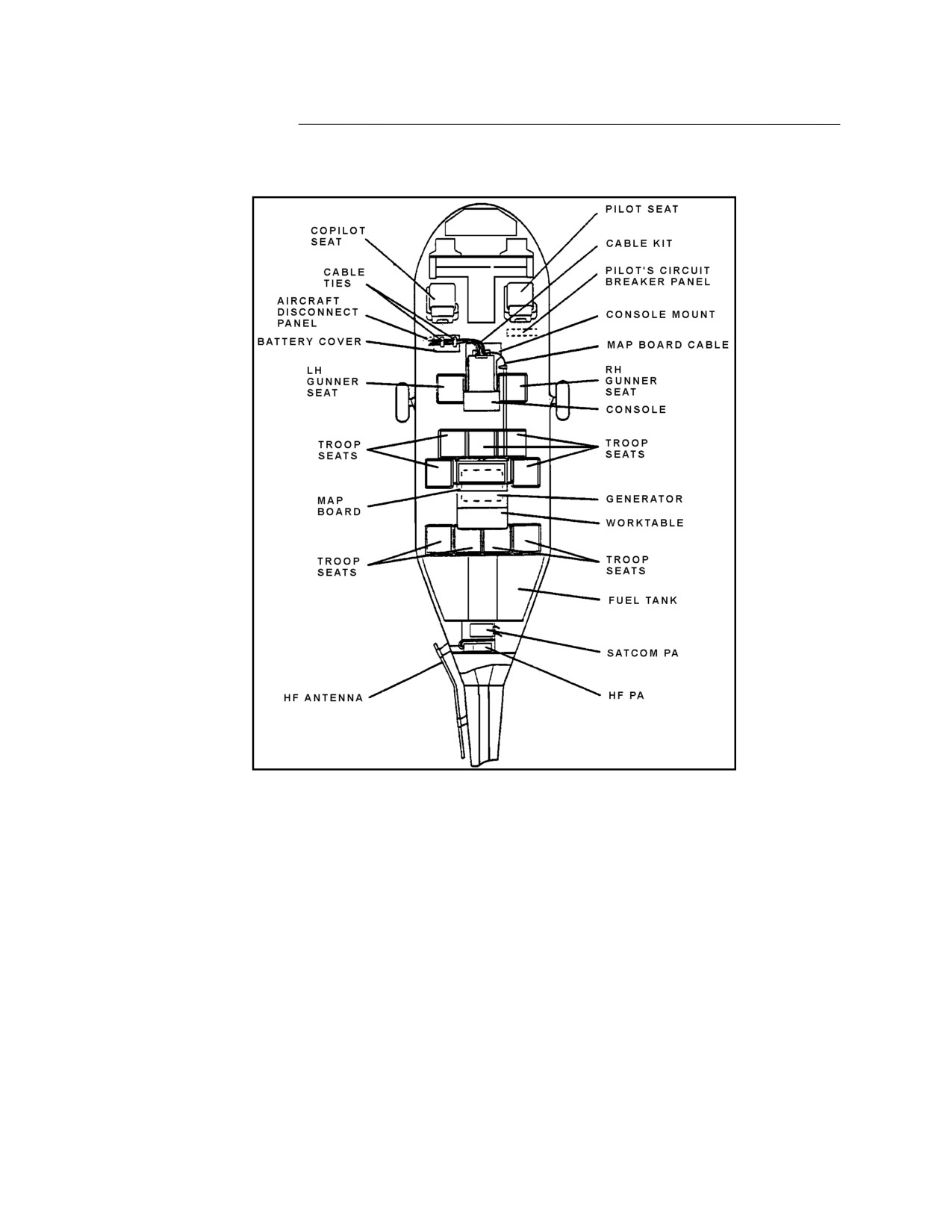
E-22. The C2 console can operate in the ground mode. In this configuration,
the console can remain mounted on the aircraft or can be dismounted. In the
ground mode, the C2 console requires generator power and external antennas.
It requires four trained personnel an hour to remove the console from the
aircraft. Figure E-1 shows the aircraft configuration.
E-3
FM 3-04.111 (FM1-111)
Figure E-1. UH-60 C2 Aircraft Configuration
AIRBORNE RELAY
E-23. Some operations in deep areas have the priority to justify
communications relay as a means of overcoming difficulty in communicating.
If allocated, the C-12 may perform HF relay or even SINCGARS and Have
Quick II relay if the threat permits flight within range of those radio systems.
The AWACS, E-8 JSTARS, C-130 airborne battlefield C2 center, EA-6,
airborne forward air controllers, participating deep JAAT and air
interdiction, or other joint aircraft may be available to relay HF, Have Quick
II, and in some cases, SINCGARS communications. Enhanced Position
Location Reporting System (EPLRS) capabilities on the A2C2S aircraft allow
automated relay of data communications. In addition, future UAVs may have
retransmit mission capabilities for FM command nets. Table E-1 illustrates
the potential for relay with higher-flying aircraft if coordinated by staff
members in advance.
E-4

Appendix E
Table E-1. Joint Aircraft Potentially Interoperable for Communications or Relay
COMMS/
RELAY CAPABLE
SINCGARS
X
X
X
X
X
X
Have Quick II
X
X
X
X
X
X
X
High Frequency
X
X
X
X
X
X
X
X
F16
EPLRS
X
X
X
Block
30
X
Improved Data
X
X
F16C
Modem
F16D
AIRCRAFT COMMUNICATIONS CHALLENGES
E-24. The primary challenge to aircraft communication is the combined
effect of terrain-flight altitudes and operational distances between aircraft
and their CPs. The HF radio is the primary materiel solution to the NOE
communications requirement and the need to communicate over greater
distances. However, for best connectivity, units must employ the HF radio’s
ALE mode that does not permit the normal monitoring of nets by all stations.
In addition, unlike SINCGARS, only a single HF radio is available on most
aircraft. These constraints relegate the role of HF to a secondary
communications system available when other communications are
impossible.
E-25. Army aircraft share common radio systems and have communications
interoperability. One exception is the OH-58D that lacks HF capability
because its small size limits HF antenna effectiveness. The AH-64A and CH-
47D also have just a single SINCGARS radio. This situation prohibits
commanders/staffs from simultaneously monitoring both the command and
O&I nets. It also inhibits routine data communication. Table E-2 compares
Army aircraft communications capabilities.
E-5

FM 3-04.111 (FM1-111)
Table E-2. Aircraft Communications Interoperability
Tactical Aircraft
Communications
X (same
antenna for
AN/ARC-186 VHF-
X
VHF-AM
X
X
X
AM/FM
and FM 2
commo
AN/ARC-201 VHF-
X (2)
X (1)
X (1 or 2)
X (2)
X (1)
X (2)
FM (SINCGARS)
AN/ARC-220 (High
X
X
X
Frequency)
AN/ARC-164 (Have
X
X
X
X
X
X
Quick)
AN/ARC-222 VHF-
X
AM/FM
MD-1295/A
(Improved Data
X
X
X
Modem)
SECTION II - GROUND COMMUNICATIONS
OVERVIEW
E-26. This section discusses means of communicating from ground CPs.
WIRE
E-27. When feasible, wire communication should be the primary means of
communicating within the TOC areas. Subordinate and attached battalion
main CPs should run wire to the aviation brigade main CP. Wire should cross
roads either overhead or through culverts and should be buried as soon as
feasible to hinder enemy tapping.
GROUND SINGLE CHANNEL AIR-GROUND RADIO SYSTEM (AN/VRC-87,
88, 89, 90, 91, 92)
E-28. The ground SINCGARS is the primary C2 network within the brigade
and with corps/division. It is also used for O&I and A&L networks. Some
systems require KY-57 for security. Newer SINCGARS-SIP has data rate
adapters and encryption embedded. On vehicle-mounted SINCGARS, the
user looks for “/A” after the SINCGARS numerical designation to identify
systems with integrated communications security. The ANCD or AMPS
allows loading of SINCGARS and IFF information.
GROUND HAVE QUICK II (AN/VRC-83 OR AN/GRC-240)
E-29. This ground radio allows communications with Have Quick II UHF-
AM airborne radio systems. It includes a portable GPS for aligning TOD and
a KY-57 for secure communications. It is backward compatible with first-
E-6
Appendix E
generation Have Quick systems and with non-Have Quick UHF-AM radios. It
is compatible with Air Force, Navy, and Marine Corps Have Quick II
systems, but LOS constraints may hinder communication with joint systems
from the ground.
MOBILE SUBSCRIBER EQUIPMENT
E-30. The MSE network architecture forms a node grid system capable of
providing alternate communications paths between node centers throughout
the corps AO. Alternate communications paths are provided to ensure a high
degree of system survivability. The secure mobile antijam reliable tactical
terminal (SMART-T), if available, provides satellite range extension for the
MSE network. The aviation brigade ties in throughout the system to
maintain connectivity with dispersed aviation units supporting corps and
division elements.
E-31. Generally, MSE provides a connection between the main CP and the
DMAIN CP, adjacent ground maneuver brigade CPs, the DASB for heavy
divisions, and rear CP if employed. Small extension node and radio access
unit
(RAU) support ensure both telephone and mobile subscriber radio
telephone (MSRT) radio coverage for the aviation brigade and battalion
TOCs.
GROUND HIGH FREQUENCY (AN/VRC-100)
E-32. The AN/VRC-100, coupled to the KY-100, provides secure
communications with airborne HF radios. The VRC-100 and aircraft ARC-
220 have virtually identical components packaged differently.
E-33. Because HF radio waves bounce off the ionosphere, short-range HF is
very difficult to direction find and jam. If jamming does occur in the ALE
mode, ALE simply finds a better frequency. If jamming occurs in manual
mode, the NCS may not be able to announce a mode switch to all stations.
Aircrews that lose HF communications must exhaust other possibilities
before assuming that jamming is the problem and switching to the electronic
counter-countermeasures frequency-hopping mode without net notification.
E-34. Antenna selection and angle are critical to effective communication
using the high-frequency radio. The following table illustrates different
antenna configurations and their applications. Only the FANLITE
near-vertical incident skywave antenna comes standard with the radio
system; other antennas would need to be procured or rigged to create
conditions shown in Table E-3.
E-7

FM 3-04.111 (FM1-111)
Table E-3. Antenna Configuration Effect on Operational Range
Antenna Type
Radiation
Antenna Takeoff
Value to
Pattern
Angle
Operations
32' whip,
Omnidirectional
45 degrees with
Fair at medium range
vertical
ground radials
installed
16' whip,
Omnidirectional
Vertical to 45 degrees
Poor, for mobile use
vertical
only
Standard
Near vertical
45 degrees to
Good at short range
FANLITE
horizontal
sloping or
horizontal
Resonant di-
Bidirectional
45 degrees to
Good at medium
pole, horizontal
horizontal
range
Log periodic
Unidirectional
Where pointed
Very good at long
range when pointed
on the horizon; very
good at short range
when vertical
Yagi
Unidirectional
Where pointed
Good at long range
when pointed on the
horizon; good at
short range when
vertical
E-35. Besides antenna considerations, frequency selection is another critical
variable for effective HF communications. HF radio frequencies for effective
short-range
(30 to
100 kilometers) communications are usually below 8
megahertz. The FANLITE antenna works better and the ground wave is
longer at lower HF frequencies. However, the corps or division signal office
typically assigns frequencies without considering these parameters. The
brigade signal officer must ensure that the higher headquarters signal office
is aware of optimal aviation HF frequencies.
E-36. At night, the ionosphere begins to dissipate, resulting in less reflection
of HF radio waves. When this situation occurs, relay over a longer path may
prove effective. A more distant station may receive the HF signal better than
a closer one. Ground HF operators should have a list of frequencies and call
signs to contact other distant aviation brigades or other stations that can
relay C2 information.
E-37. In the ALE mode, if the radio channel is inactive for a period of time,
the radio reverts to the scan mode and another ALE sequence must occur to
reconnect. To prevent this situation, stations operating in the ALE mode
should sound periodically to retain a good frequency for communication. This
“sounding” will ensure that an ALE connection is already in place, thereby
saving tens of seconds when a message must be sent. Radios can be set up to
automatically sound at a periodic rate. The ground HF radio operator
generally can perform this “sounding” to reduce aircrew workload.
E-8