FM 3-04.111 (FM 1-111) Aviation Brigades (AUGUST 2003) - page 8
Appendix E
AIR TRAFFIC SERVICES COMMUNICATIONS
E-38. Air traffic control radios are available for A2C2, limited flight following,
and localized control of inbound and outbound aircraft. Radios also permit
recovery of aircraft that experience inadvertent IMC. These systems may
provide brigade commanders with a backup means of communicating with
units, although this should not be their primary mission. Commanders must
recognize that these radios emit unique signatures and locating these radios
to the brigade TOC must be balanced with knowledge that some enemies can
identify and target signature location. Another option available to brigade
commanders is employment of better ATS antennas used with other tactical
radios.
E-39. The tactical airspace integration system
(TAIS) provides fully
automated capability to support airspace management at echelons above
corps, corps, and division level. TAIS is fully integrated with ABCS. When
used with other ABCS, TAIS provides automated A2C2 planning and airspace
deconfliction. The tactical terminal control system
(TTCS), AN/TSQ-198,
provides tactical ATS capabilities in more austere environments. It can also
provide backup communications capabilities at aviation TOCs or in deep or
rear areas.
GROUND SATELLITE COMMUNICATION
E-40. Different SATCOM and TACSAT ground systems may be available to
aviation brigades. For effective use, TOC locations must permit LOS between
the dish antenna and the geosynchronous satellites. For instance, a TOC
location next to a mountain or among tall trees may obstruct SATCOM LOS.
To prevent SATCOM bleed-over, at least a
10-megahertz frequency
separation should exist between outgoing and incoming signals.
E-41. Common TACSAT systems include the PSC-5 Spitfire and the
AN/PRC-117F. These systems include SINCGARS and Have Quick
capability. The SMART-T is a larger SATCOM system that interfaces with
military strategic and tactical relay (MILSTAR) satellites for data transfer at
low and medium rates to extend the MSE network range.
E-42. Units should avoid overreliance on SATCOM for longer-range
communications during large-scale conflict because channels can become
oversubscribed. In addition, SATCOM may not be a viable solution in certain
latitudes and areas of the world where geosynchronous satellite coverage is
sparse.
AN/PRC-127 (WALKIE-TALKIE)
E-43. This nontactical walkie-talkie operates in the 138- to 160-megahertz
FM range. The frequency is set from an integral keypad. Fourteen channels
are available. This system provides personnel with a nonsecure low-power
means of localized communication.
COMMERCIAL TELEPHONE LINES AND CELLULAR TELEPHONES
E-44. In many areas, commercial telephone lines and cellular phones can
support nonsecure voice and data logistics communications or prompting
E-9
FM 3-04.111 (FM1-111)
between parties to attempt communications using secure means. If forced to
withdraw and approved by higher headquarters, units should sever sections
of commercial telephone lines and destroy cellular substations to hinder
enemy use.
VISUAL AND SOUND COMMUNICATIONS
E-45. Visual card systems, landing lights, hand-and-arm signals, flags,
pyrotechnics, and other visual cues can provide simplified communications
when radio transmission may not be possible or tactically sound. Visual cues
are especially valuable in FARP, sling-load, and ATS operations near AAs.
Audio cues are another possibility, such as for alert of chemical attacks, but
around operating vehicles and aircraft, audio signals may prove inaudible.
MESSENGER
E-46. Ground and air messengers may transport hard-copy messages and
larger documents as part of a regularly scheduled shuttle between CPs,
trains, and higher and lower headquarters. An alternative to dedicated
messengers is delivery with ground and aerial delivery of supplies such as
meals delivered to a tactical CP. Messengers may deliver combat plans and
orders, written coordination and control measures, graphics, logistics
requests and estimates, or other extensive documents that would consume
excess time to send electronically.
SECTION III - COMMUNICATIONS NETWORKS AND COMMAND POST
RELATIONSHIPS
GENERAL
E-47. Aviation units have more complex communications requirements than
ground forces. Greater distances between brigade CPs and subordinate
battalions and their widely dispersed aircraft require additional radio
systems beyond the normal SINCGARS combat net radio. Communications
systems must support the larger battle space of aviation brigades that may
conduct simultaneous shaping operations, reconnaissance, and UH-60 A2C2S
support in decisive operations and aerial resupply as part of sustaining
operations.
NET CONTROL STATION
E-48. For most tactical nets, the NCS is the aviation brigade or battalion
TOC. Paragraph five of the operations order designates frequencies,
transmission security variables, cryptographic variables, and time to open
the radio net. When the NCS makes the “all” call, stations respond in a
prescribed sequence, usually alphanumeric by call sign or by unit sequence.
The NCS acknowledges all stations entering the net, and stations remain in
the net until receiving permission to leave the net. The NCS tracks which
stations are on the net and maintains a call log. Before changing modes, the
NCS makes a call in the present mode of operation announcing the change.
E-10
Appendix E
BATTALIONS
E-49. Battalions typically operate a C2 network and O&I and A&L networks
all using SINCGARS. Battalions also operate an internal air battle network
using Have Quick II. The high-frequency radio is a secondary means of
secure tactical communication to overcome SINCGARS and Have Quick II
LOS constraints. The AN/ARC-186 VHF-AM radio is normally for
administrative ATS but may function as a platoon internal net. The battalion
TOC may also have access to MSE and SATCOM for communicating with
higher headquarters.
AVIATION BRIGADES
E-50. MSE is the primary means of communications with higher
headquarters, especially in large AOs. Brigades have SINCGARS C2 and O&I
and A&L networks and are Have Quick II-capable. HF radios provide a
secondary means of communication. SATCOM may also be prevalent at
brigade level.
TACTICAL RADIO NETWORKS
E-51. Units establish and monitor the following networks. In addition, lower
echelon commanders and staffs monitor the networks of their next higher
echelon. Battalions monitor brigade nets. Brigades monitor division nets.
Retransmission stations may be needed to extend the range of any or all
tactical radio nets.
COMMAND NETWORK
E-52. The brigade commander, XO, S3, and battalion commanders operate
on the brigade command network. The battalion commander, XO, S3, and
company commanders operate on the battalion command network. Because
SINCGARS may lack the range necessary to control forward operations, a
tactical CP may temporarily operate forward at brigade or battalion level.
Ground retransmission stations may be set up to facilitate command net
communication. The HF radio is a secondary means of command net
communication. Relay of command information is a third option.
OPERATIONS AND INTELLIGENCE NET
E-53. The brigade and battalion S2s control their O&I networks. SINCGARS
is the primary net communications medium. As the Army evolves and
digitizes its force communications, these networks will become more
automated in reaching back to higher echelons for pertinent information and
in forwarding combat information gained by aviation forces.
E-11
FM 3-04.111 (FM1-111)
ADMINISTRATION AND LOGISTICS NET
E-54. The brigade and battalion S1 and S4 control their A&L networks.
Units transmit routine supply requests and personnel actions on this net,
often employing SINCGARS and MSE data communications. FARPs operate
on the A&L network and, if possible, monitor the command network. If the
A&L network is inoperable, the O&I network may serve as an alternative.
COMMAND POST COMMUNICATIONS
E-55. The Army’s standardized CP structure exists to facilitate
communications. Commanders modify this structure to meet unique aviation
mission needs, their personal command-and-control style, and the need for
continuous operations. Personnel and communication systems availability
constraints may not support traditional doctrinal CP structure. Force
digitization and automation will further modify how units C2 in the future.
COMMAND GROUP COMMUNICATIONS
E-56. The command group varies by unit but normally includes the
commander, S3, S2 representative, and the FSO and ALO if available. When
away from the TOC, the command group generally operates on the
SINCGARS command net from a ground vehicle or aircraft but may also
employ HF and SATCOM, as required, to communicate with subordinates
and higher headquarters.
TACTICAL COMMAND POST COMMUNICATIONS
E-57. The tactical CP is a temporary CP established to enhance C2 of current
operations. The brigade tactical CP is often near the division tactical CP.
Aviation battalion tactical CPs may be near supported brigade main CPs. The
tactical CP is the responsibility of the S3 and includes personnel from the S2
and S3 sections and, often, the command group. If the displacing main CP
includes an ALOC, then ALOC S1 and S4 representatives may also be in the
tactical CP. The tactical CP primarily communicates on the command and
O&I SINCGARS nets. HF and TACSAT are secondary means of
communication, and MSE may support ground tactical CPs.
MAIN COMMAND POST COMMUNICATIONS
E-58. The brigade and battalion main CPs include the soldiers, equipment,
and facilities necessary for C2. It is the responsibility of the XO. At a
minimum, the main CP consists of a TOC and necessary signal assets that
satisfy communication requirements. The aviation brigade main CP may be
close enough to the DMAIN CP to run a land line. If a rear CP is not
employed, the main CP also includes the ALOC. The main CP includes
tactical CP personnel when it is not deployed. The NCS for the command and
O&I networks generally is in the TOC at the main CP. The ALOC is the NCS
for the A&L network. The brigade main CP may require the S6 to establish
ground retransmission capability to maintain SINCGARS command and O&I
net communications with battalion tactical CPs. Generally, battalion main
CPs are relatively near the brigade CP so that direct SINCGARS or ground-
line communication is possible. The brigade main CP also employs TACSAT
and HF communications as secondary and long-distance communications
E-12
Appendix E
means. The MSE area common-user network is a primary communication
means with adjacent and higher headquarters and the rear CP if employed.
REAR COMMAND POST COMMUNICATIONS
E-59. The brigade rear CP may locate within the EAC, corps, or DSA. For
brigades in heavy divisions, the rear CP may be close to the DASB’s main CP.
For brigades in light divisions, the rear CP may be close to the AVIM,
division airfield, and MSB main CP. Subordinate lift battalion CPs may also
be nearby. The S1 or S4 is responsible for the rear CP. It is the NCS for the
A&L SINCGARS network, but it also employs MSE and possibly HF to send
data.
ALTERNATE COMMAND POST COMMUNICATIONS
E-60. The commander may designate an alternate CP to ensure operational
continuity during displacements or in case serious damage occurs to the TOC.
The alternate CP may be the tactical CP (including A2C2S when fielded), a
subordinate unit, or the rear CP. Primary communications for an alternate
CP are whatever is organic at that level to maintain a command and O&I net
at a minimum.
SECTION IV - FLIGHT MISSION COMMUNICATIONS
GENERAL
E-61. This section addresses how aircrews communicate internally and
externally with aircraft and ground communication systems.
E-62. SINCGARS is the primary combat net radio. Airborne commanders
operate on the command net. Reports are sent on the O&I network.
Logisticians and FARPs operate on the A&L net. Have Quick II supports
internal communication between aircraft at the company level and provides a
means of communicating with any joint air systems that may be participating
in the mission. HF communications enhance terrain flight communications
with distant CPs. If UH-60 C2 system-equipped or A2C2S aircraft are
available, SATCOM provides another long-distance communication option.
Units minimize voice communications by employing brevity codes and digital
data communications.
ATTACK HELICOPTER BATTALION
E-63. Longbow-equipped units have secure FM1 and FM2 SINCGARS
capability to simultaneously operate on two nets. One radio can habitually
operate for voice and the other for data using the
E-64. . Have Quick II voice mode or IDM data transfer facilitates company
and platoon internal communication. Designated aircrews can make reports
to battalion on the O&I SINCGARS net, while keeping the company
commander aware on an internal Have Quick II O&I net. The HF radio is
available as a secondary means of voice or data communication with the
battalion. AH-64A units have neither dual secure FM radios nor an IDM
E-13
FM 3-04.111 (FM1-111)
capability. These units can employ HF secure data communication as an
alternative to FM2 secure/IDM.
AIR CAVALRY SQUADRON
E-65. Kiowa Warrior aircraft have secure SINCGARS, Have Quick II, and
VHF capability. The following is a preferred means of internal squadron
communications:
• FM1 (secure) squadron command net (squadron commander, XO, S3,
and troop commanders).
• FM1 (secure) platoon command net.
• FM2 (secure) digitized O&I network/supported unit/FS net.
• Have Quick II (secure) troop command net.
• VHF (nonsecure) coordination net for all elements.
E-66. The FM2 may be designated as a digital SA network for IDM-
transmitted spot reports, situation/status reports, and battle damage
assessment reports. These digitized reports are sent via FM2 directly to the
squadron and troop FBCB2-equipped vehicles.
ASSAULT HELICOPTER BATTALION
E-67. Battalion UH-60 aircraft missions range from single ship air
movement to major air assaults involving multiple aircraft. As with other
units, the primary combat net radio is SINCGARS, employed for command,
and O&I and A&L nets. For intraaircraft communication, units use Have
Quick II. In the absence of a SINCGARS/IDM capability and given typical air
assault distances, HF is a secondary and often crucial communications tool
for maintaining contact with distant CPs. To minimize voice traffic on air
assaults, air mission commanders employ HF ALE data transmission with
preloaded short messages for anticipated reports to the rear. These could
include—
• Staging phase: arrival passage points, crossing phase line, arrival PZ,
executing bump plan, PZ unsecured, executing/arrival alternate PZ,
request maintenance, enemy contact, and downed aircraft.
• Air movement phase: arrival start point/RP, reporting airspace control
plan 1, executing bump plan, executing/arrival alternate LZ, request
maintenance, unanticipated enemy contact, downed aircraft, and
request for MEDEVAC.
E-68. Single ship air movements can occur at extended distances. Unit CPs
can communicate changes in pickup and drop-off points and other en route
changes using the HF ALE mode to assure contact.
COMMAND AVIATION BATTALION
E-69. The command aviation battalion has the UH-60 C2-system-equipped
aircraft and eventually will have the A2C2S. Ground brigade commanders and
staffs employ the C2 console or A2C2S, as required, without interference from
aircrews. Aircrews may be asked to monitor certain SINCGARS nets on
aircraft radios and to relay key messages to staff members in the rear. This
E-14
Appendix E
requirement and distances involved may require aircrews to use HF
communication to maintain contact with the command aviation battalion
TOC or to relay messages for supported commanders if C2 system HF radios
are tied up or ineffective.
E-70. A secondary mission of C2-system-equipped and A2C2S aircraft is C2 of
some aviation brigade missions such as operations in deep areas and air
assaults. In these missions, the aviation brigade commander and selected
staff may employ the C2 aircraft as a tactical CP. Relative proximity to
mission aircraft facilitates SINCGARS voice and IDM data transmission
between the brigade and battalion commanders. The availability of HF and
SATCOM ensures long-distance communications with the division or corps
CP.
HEAVY HELICOPTER BATTALION
E-71. These missions are frequently single ship long-distance operations and
require HF for communications with the battalion TOC. Some units employ
multiple CH-47s for air assaults to move artillery, high mobility
multipurpose wheeled vehicle (HMMWV), and other key mission equipment.
These missions require the organic SINCGARS capability to communicate on
assault battalion nets; however, only one SINCGARS is generally available.
Have Quick II provides internal communication between CH-47s.
AVIATION BATTALION TASK FORCE
E-72. An aviation battalion TF forms and deploys for missions that do not
require an entire aviation brigade but must support a broad spectrum of
aviation missions. The AH-64D, OH-58D, and HH-60L have IDM capability
for data communications; the AH-64A, UH-60A/L, and CH-47 aircraft do not.
All aircraft share SINCGARS, HF, and Have Quick II interoperability with
the exception of the OH-58D, which lacks HF capability.
E-73. For some missions requiring extensive digital communications, such as
attack, only IDM-capable OH-58D and AH-64D aircraft may participate. On
the other hand, OH-58D aircraft may be task-organized with non-IDM AH-
64As. During reconnaissance and air assaults, all aircraft may participate.
Task force commanders require cross-trained staff personnel and possibly
A2C2S aircraft to C2 the task force.
E-15
Appendix F
Arming and Refueling Operations
This appendix provides aviation commanders, staff elements, and Class
III and V personnel with a comprehensive view of the purpose,
organization, and operation of the FARP. It also describes planning
considerations for FARP setup and transportation planning for Class III
and V products.
SECTION I - INTRODUCTION
PROPONENCY AND APPLICABLE FIELD AND TECHNICAL MANUALS
F-1. The Combined Arms Support Command is the proponent for operations
and military occupational specialties
(MOSs) related to fueling and
ammunition operations. This appendix specifies unique procedures that
ammunition, arming, and refueling personnel perform in FARP and AA
refuel operations.
F-2. This appendix covers information from the rescinded FM
1-104.
However, units must refer to FM 10-67-1 for greater detail and applicable
checklists. FM 4-20.12 (FM 10-67-1) consolidates and supersedes FMs 10-18,
10-20, 10-68, 10-69, 10-70-1, and 10-71. Units ensure that FARP personnel
have the most current version of FM 4-20.12 (FM 10-67-1) available during
FARP operations.
F-3. For ammunition operations, the user should refer to FM 4-30.13 (FM 9-
13), including its Appendix J.
F-4. Other technical manuals are cited in this appendix, and these are
available at www.logsa.army.mil/etms/find_etm.cfm.
DEFINITION
F-5. A FARP is a temporary arming and refueling facility organized,
equipped, and deployed within the aviation unit’s AO. FARPs are transitory
and support specific mission objectives. Some FARPs do not have cavalry or
attack arming points. However, they do have ammunition for all weapons
carried by utility and heavy helicopters. FARPs are task-organized according
to METT-TC.
PURPOSE
F-6. FARPs promote increased aircraft time on station by reducing
turnaround time associated with refueling and rearming. Units employ
FARPs when flight time to unit trains is excessive and mission demands
require longer time on station. FARPs also support operations in deep areas
F-0
Appendix F
or other operations when mission distances exceed normal aircraft range and
when target size requires rearming. During exploitation and other rapid
advances, FARPs support aviation forces when field trains are unable to keep
pace.
F-7. The key to effective FARP support is simultaneous arming and
refueling. Ideally, FARPs service each company as a unit, with each aircraft
within that unit simultaneously receiving fuel and ammunition.
PERSONNEL
F-8. Personnel allocations for the FARP include MOSs 77F, 89B, 15J, 15X,
and 15Y. Petroleum specialists, MOS 77F, transport Class III and fuels
aircraft. Ammunition specialists, MOS 89B, transport, unpack, maintain, and
account for ammunition. Aircraft armament repairers, MOSs 15J/X/Y, repair
fire control systems and arm OH-58D, AH-64A, and AH-64D aircraft,
respectively. As required, commanders augment the FARP with other
medical, BDA/maintenance teams, and security forces. At division or major
base camp rapid refueling point supporting SASO, the increased operational
tempo or density of traffic may require ATS assets.
PLANNING FACTORS
GENERAL
F-9. The mission and operational tempo determine FARP supply priorities.
Exploiting ATKHBs may expend Class V faster than Class III. Conversely,
reconnoitering air cavalry squadrons expend more Class III than Class V.
DISTANCE
F-10. Units often establish FARPs if distances between the fight and the
logistics trains exceed 30 kilometers. FARPs that are located too far forward
are at risk of artillery engagement and increase turnaround time for slower
supply vehicles. However, flight time to and from FARPs positioned too far in
the rear reduces available time on station. The threat, availability of cover
and concealment, road conditions, availability of higher echelon throughput
of Class III/V, and distance to Class III/V distribution points affect how close
FARPs can locate to the fight for sustained support.
THREAT
F-11. The threat can neutralize aviation force effectiveness by preventing
aircraft from rearming and refueling. Therefore, the FARP may be a high-
priority target for the enemy. Enemy forces may subject FARPs to NBC,
ground, TACAIR, air assault, and artillery attacks. Local sympathizers and
insurgents may harass FARP operations.
F-1
FM 3-04.111 (FM1-111)
DISPLACEMENT
F-12. FARP survivability requires frequent displacement. Few FARP
locations permit rearming and refueling more than three times. A good
planning figure for FARP duration is three to six hours. Units employ more
than one FARP for longer missions with displacing silent FARPs waiting to
assume the mission at preplanned times. Careful site selection, effective
camouflage, and minimum personnel and equipment lead to survivable,
mission-capable FARPs.
SECTION II - COMMAND, CONTROL, AND COMMUNICATIONS
COMMAND AND CONTROL
F-13. One of the most difficult aspects of FARP operations is how to
command, control, and communicate with other elements in the aviation unit
without compromising the FARP.
COMMANDER
F-14. The commander is responsible for overall FARP success. Based on the
factors of METT-TC, he decides how FARPs will support missions.
S3
F-15. The S3 formulates a FARP plan that supports the commander’s
tactical plan. The S3 consults with the S4 and the HHC commander to ensure
that the plan is logistically supportable.
S4
F-16. The S4 calculates mission Class III/V requirements and plans supply
distribution. He coordinates these needs with higher headquarters.
CLASS III/V PLATOON LEADER
F-17. The Class III/V platoon leader is responsible for accomplishing the
FARP mission. He assists the S3 in formulating the FARP plan and
coordinates fuel and ammunition needs with the S4.
AIRCRAFT CONTROL
F-18. Aircraft control within the FARP is critical to safety and efficiency. The
FARP’s proximity to the battlefield restricts use of electronic means for
positive aircraft control. The most effective control mechanism is a thorough
briefing based on a well-written and -rehearsed SOP that outlines FARP
procedures for aircrews and FARP personnel. For rapid refueling points in
rear areas, offset, low-output nondirectional radio beacons (NDBs) may be a
low-risk means to identify refuel points. In addition, units may use various
signaling methods to maintain procedural aircraft control.
F-2
Appendix F
AIR TRAFFIC SERVICES
F-19. ATS use in the FARP is METT-TC dependent. Under some
circumstances, ATS units can provide aviation commanders with an extra
measure of safety and synchronization.
Air Traffic Services Team
F-20. A tactical aviation control team can manage aircraft flow for faster,
safer, and more efficient operations. A team has three soldiers equipped with
an HMMWV-mounted TTCS and an AN/TRN-30(V)1 low-power
nondirectional radio beacon. This equipment can be set up within 30 minutes.
It provides a short-to-medium range NDB and secure-voice VHF and UHF.
The tactical aviation control team deploys from a supporting ATS company,
battalion, or group assigned to the division, corps, or theater.
VISUAL SIGNALS
F-21. Examples of visual signals include hand-and-arm signals, smoke,
signal flags, flash cards, and light signals. Ground guides normally control
aircraft movement within the FARP. Because ground guides may direct allied
aircraft, they must use standard hand-and-arm signals (Section VIII).
Smoke
F-22. Smoke is not a preferred visual signal, but it has some advantages. It
indicates wind direction. Different colors can indicate the current FARP
situation and Class III/V availability. Smoke also has disadvantages; its use
is day restricted, and it can compromise the FARP location.
Lights and Flags
F-23. Flashlights and light wands provide other types of visual signals. Use
flashlights with color-coded disks to relay information. A separate colored
disk, easily seen at night, can indicate the FARP situation or supply
availability. During the day, signal flags of different colors can serve the
same purpose. Sites should be concealed that limit enemy ability to detect
FARP light sources. FARP personnel maintain light discipline until aircraft
arrive. Personnel use light wands with hand-and-arm signals to mark
departure, landing, and arming and refueling points.
F-24. Chemical lights come in several colors, including IR, which only NVDs
can detect. Personnel use these in the same manner as flashlights and light
wands. An effective technique for lighting the landing area is to dig shallow
trenches in the shape of a “Y” and place both chemical and beanbag lights in
the trenches. Landing aircrews will see the “Y” at a certain angle from the
air, but it will not be visible to the enemy from the ground. Lights should be
turned off when not needed.
SIGNALS
F-25. In peacetime, aircrews turn off the anticollision light to signal the
ground crew to begin arming. As an alternate combat signal, aircrews may
employ hand-and-arm signals during the day and cockpit navigation lights at
night to signal the start of arming. Ground personnel can talk via intercom to
F-3
FM 3-04.111 (FM1-111)
the aircrew with the helmet assembly, rearming refueling personnel
(HARRP) (CTA 50-900) with communications (HGU-24/P).
TRAFFIC LAYOUT
F-26. Standard marker panels on departure and arrival points improve the
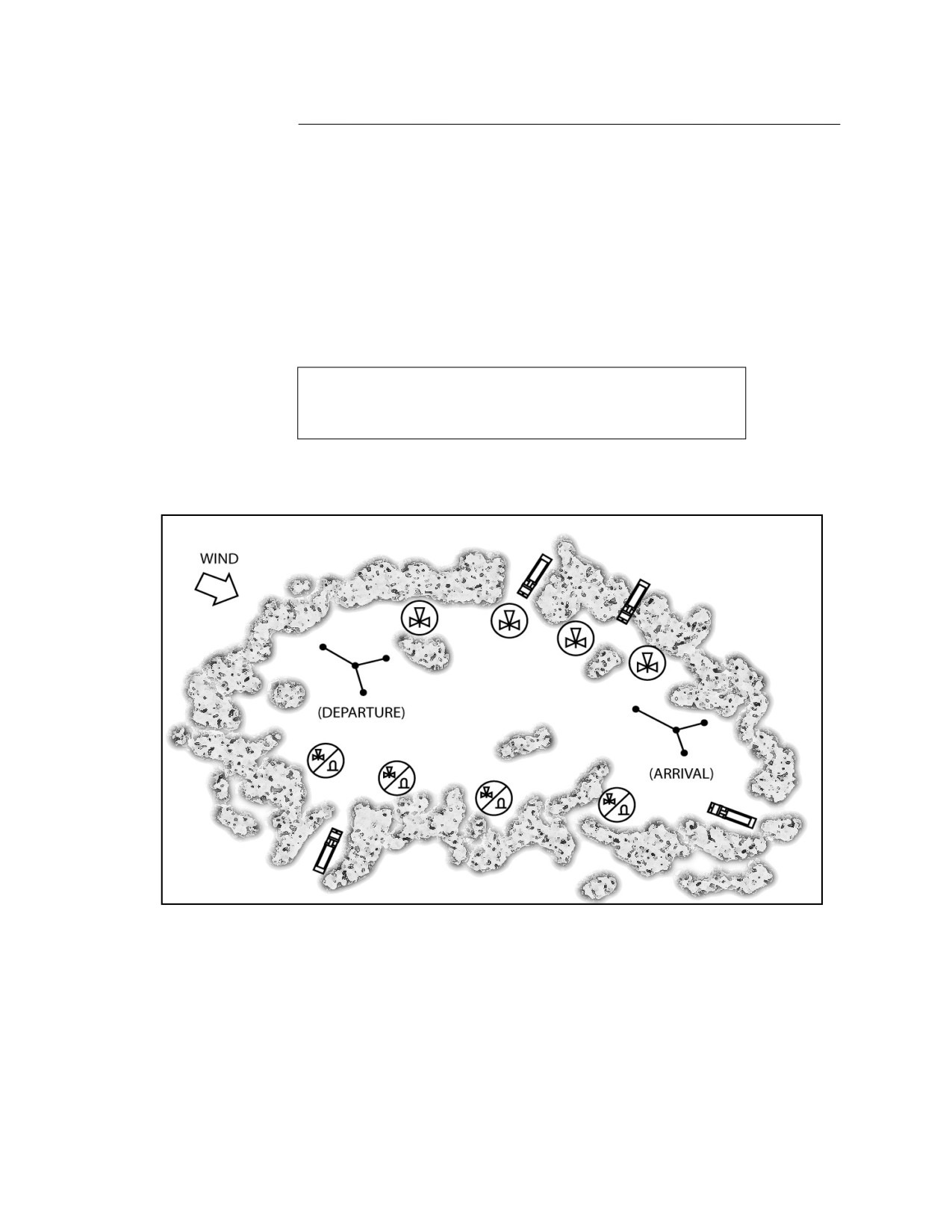
control of aircraft. FARP personnel use secured engineer tape, chemical
lights, or beanbag lights at night to indicate desired aircraft movement or the
location of ground guides. After servicing, the ground guide directs aircraft
toward the departure end of the FARP.
CAUTION
If used, properly secure marker panels and engineer
tape to avoid foreign object damage.
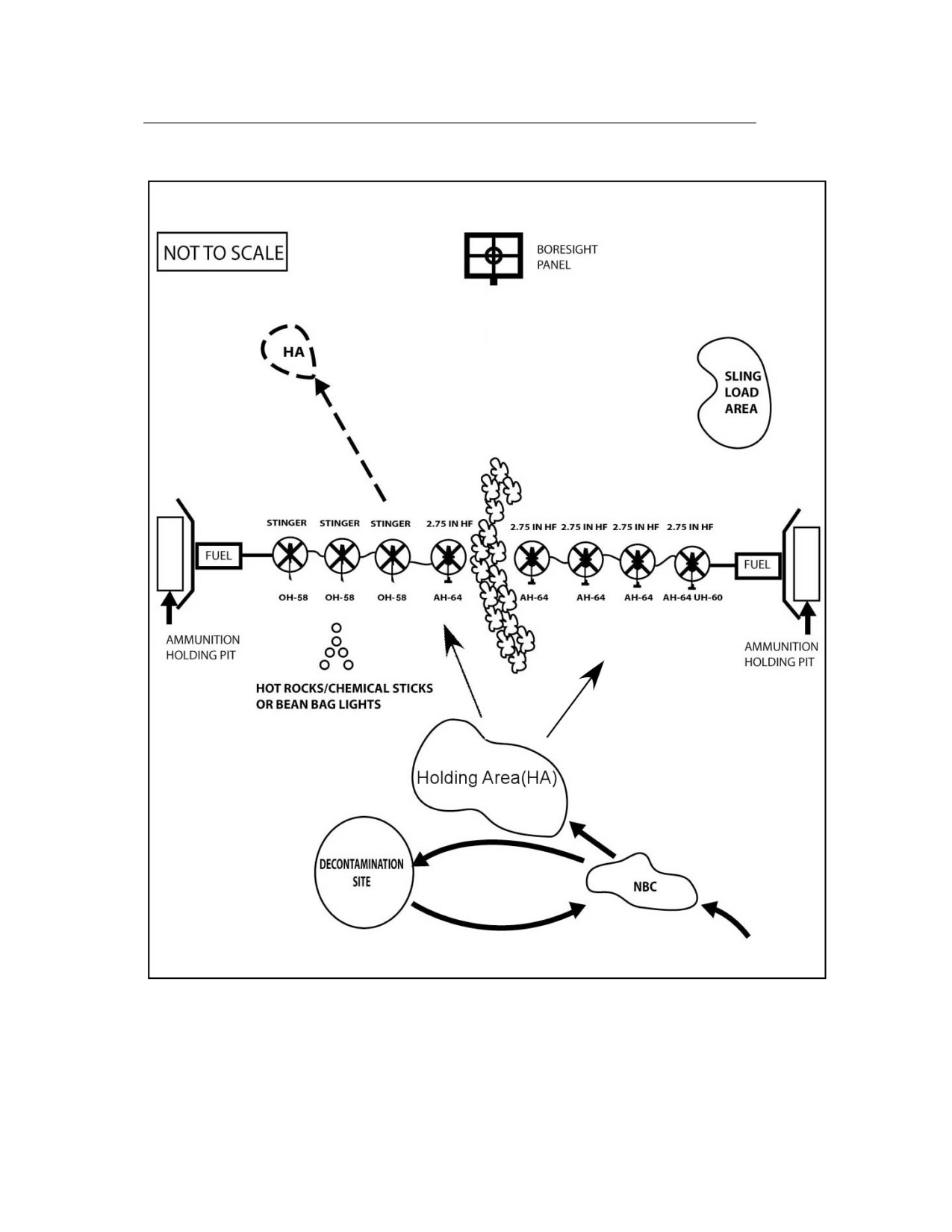
F-27. Figure F-1 shows an example of traffic layout. Figure F-2 shows an
example of layout for simultaneous operations.
Figure F-1. Example of FARP Traffic Layout
F-4
Appendix F
Figure F-2. Example of FARP Layout for Simultaneous Operations
F-28. Maintaining unit integrity during FARP operations improves aircraft
control. Units select HAs, ingress routes, and egress routes to improve
aircraft control. They involve the unit SO in planning routes in and out of the
FARP and establishing checkpoints along the routes.
F-5
FM 3-04.111 (FM1-111)
RADIO COMMUNICATIONS
F-29. FARP personnel avoid radio transmission to reduce enemy capability
to detect and target electronic emissions. However, each FARP (active and
silent) requires at least two FM radios for monitoring. This allows
simultaneous monitoring of both the command and A&L nets. FARP
personnel monitor the command net to determine when units are inbound
and when the FARP needs to displace. FARPs communicate on A&L to
inform the S4 of their own supply needs.
F-30. Because FM radios are limited by LOS and range, the distance or
location of the FARP may prevent FARP personnel from monitoring or
transmitting on the designated command frequency. Aircraft retransmission
or relay is an option. Critical messages that may require airborne relay
include when the FARP—
• Is under attack.
• Relocates or ceases operations.
• Is not operational at the scheduled time.
• Requires resupply.
• Has a change in status.
F-31. Aircrews use radios only after aircraft have left the FARP. This
procedure helps prevent the enemy from electronically pinpointing the
FARP’s location. Aircrews can relay less time-sensitive FARP reports and
other communications in person after mission completion.
SECTION III - EMPLOYMENT FACTORS
LOCATION
F-32. FARPs locate as close to the AO as the tactical situation permits. They
may locate as far forward as 18 to 25 kilometers, dependent upon METT-TC;
behind the FLOT; and within a committed brigade’s AO. This distance
increases aircraft time on station by reducing travel times associated with
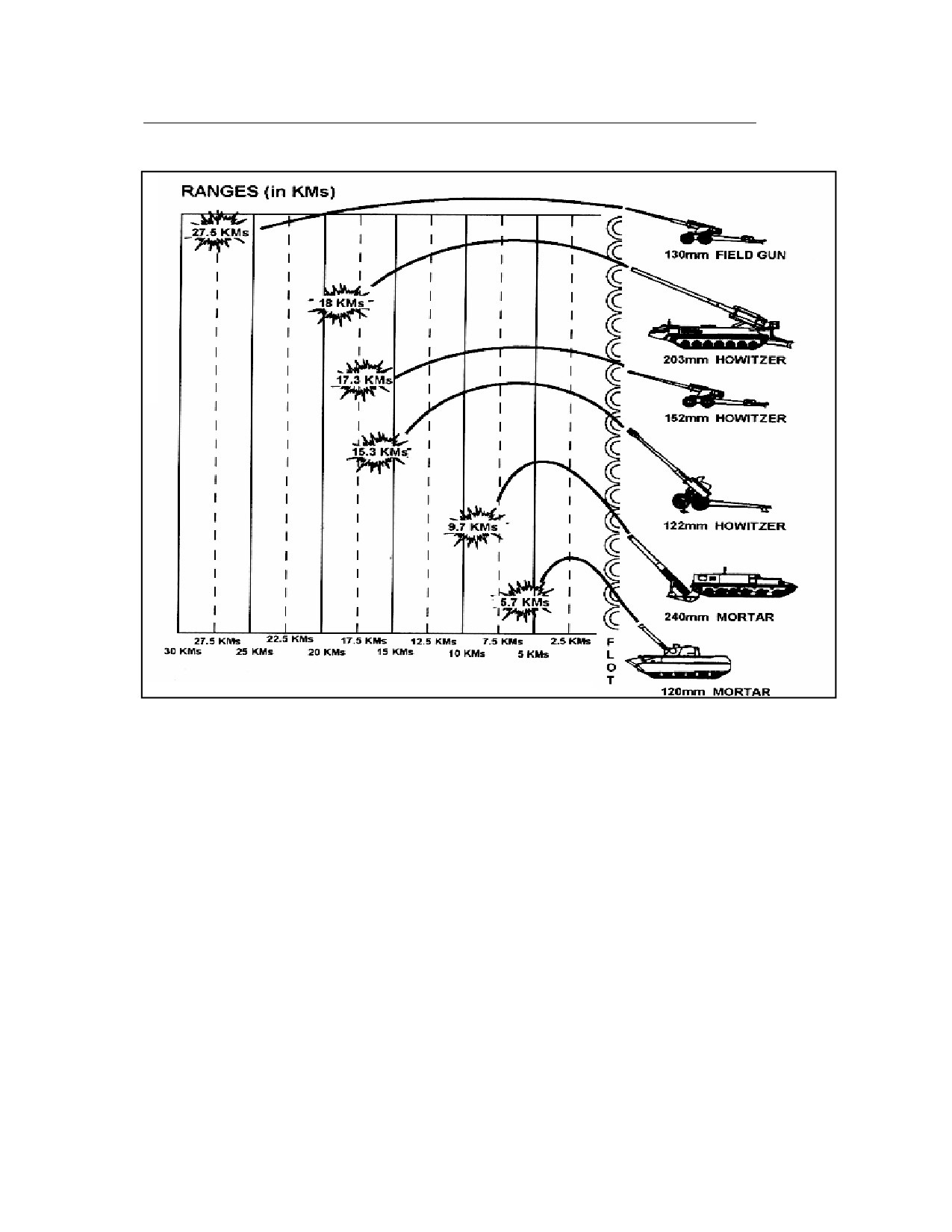
refueling. If possible, the FARP remains outside the threat of medium-range
artillery. Figure F-3 shows typical ranges of threat medium-range artillery.
F-6
Appendix F
Figure F-3. Typical Ranges of Threat Medium Range Artillery
FORWARD ARMING AND REFUELING POINT MISSION SUMMARY
F-33. The tempo and distances of future linear and nonlinear operations will
increase demand for FARPs that support simultaneous operations. Aviation’s
ability to operate in depth and breadth requires equally mobile, austere,
transitory FARPs located near the AO to maintain support. In less-intense
operations and SASO, FARPs may operate out of airheads or centralized base
camps. Such facilities provide the security and hardening that allow FARPs
to remain in place longer. In both linear and nonlinear operations, aircraft
may have greater dependence on extended range fuel systems (ERFSs) that
can rapidly deplete available FARP fuel.
MISSION
F-34. FARPs support deep, close, and rear areas (Chapter 2). In many
circumstances, vehicle-emplaced FARPs within the close area can also
support aircraft returning from deep areas and reaction elements assigned to
counter Level III rear threats. Units also may employ air-emplaceable jump
FARPs to support rear or deep areas or to reinforce FARPs supporting
decisive and shaping operations. The following discussion explains how
F-7
FM 3-04.111 (FM1-111)
FARPs support the three basic mission types in the context of decisive,
shaping, and sustaining operations (Chapter 2).
Decisive Operations
F-35. Ground and air maneuver forces strike decisive blows. Ammunition
palletized loading system (PLS) trucks with mission-configured loads push
supplies down to the close area where FARP elements meet them at logistics
RPs. When possible, the Class III/V platoon leader coordinates for direct
delivery to the silent FARP to avoid transloading. Units travel to supply
points for fuel or receive throughput from higher echelon
5,000-gallon
tankers for transloading. Air-emplaced jump FARPs support limited resupply
behind enemy lines and support mobile strikes involving major air assaults.
Shaping Operations
F-36. Cavalry, operations in deep areas, special operations, and air assaults
characterize these operations. Corps AH-64 aircraft conduct operations in
deep areas using extended-range fuel tanks so that only Class V FARP
support may be necessary behind enemy lines. Special operations aircraft
also may require Class V support. Air assault mission aircraft often employ
extended-range fuel tanks but may need limited Class V support for armed
aircraft providing assault security.
Sustaining Operations
F-37. Air-emplaced jump FARPs support corps and division reaction aviation
forces as they attack Level III rear threats to sustainment. Airheads and
base camps support SASO and initial deployment aviation needs at
intermediate support bases. CH-47D and UH-60A/L aircraft conduct air
movement to supplement ground-emplaced FARP activities and emplace
jump FARPs supporting aerial resupply of ground forces in shaping
operations in deep areas.
ENEMY
F-38. The S2 determines the threat that the FARP is likely to encounter.
This determination includes the enemy’s capabilities, posture, and weapon
systems. For example, a FARP located in the close area may encounter an
enemy reconnaissance element. A FARP in the rear area may be the target of
enemy SOF. The S2 also determines the type of intelligence-gathering
devices and sensors that the enemy has oriented on the proposed FARP
location.
TERRAIN AND WEATHER
F-39. A good FARP location allows for the tactical dispersion of aircraft and
vehicles. Tree lines, vegetation, shadows, and built-up areas can conceal
FARP operations. FARP personnel employ terrain folds and reverse slopes to
mask the FARP from enemy observation. They choose locations with masked
MSR and ingress/egress routes for both ground and air.
F-8
Appendix F
TROOPS AND SUPPORT AVAILABLE
F-40. The Class III/V platoon leader must determine if enough troops are
available to operate the desired size and number of FARPs. An implied task
is the requirement to resupply and set up current and future FARPs. In
addition, the proper personnel skills must be available in the proper
numbers. For example, the 15J, 15X and 15Y personnel are school-trained to
arm and repair weapon systems. Units must cross-train other personnel to
fuel aircraft and load weapon systems but cannot cross-train them to perform
specific repair functions. Depending on FARP location, security requirements
will vary. In most cases, the FARP provides its own security.
TIME AVAILABLE
F-41. Mission duration is a critical planning factor. Longer missions require
either multiple FARPs for different phases of the mission or a midmission
FARP displacement combined with Class III/V throughput to a new FARP
location. Planners must consider driving or flight time to proposed FARP
sites. Planners—
• Allow sufficient time for FARP setup.
• Consider how far the FARP is from the supply points, and either plan
supply throughput or arrange for a second silent FARP to go active to
support the next phase of the mission.
F-42. The FARP supports rearming and refueling operations for a specific
mission. When that mission is complete, the air assets make the transition to
the rear AA to reconfigure ammunition loads, refuel, and perform required
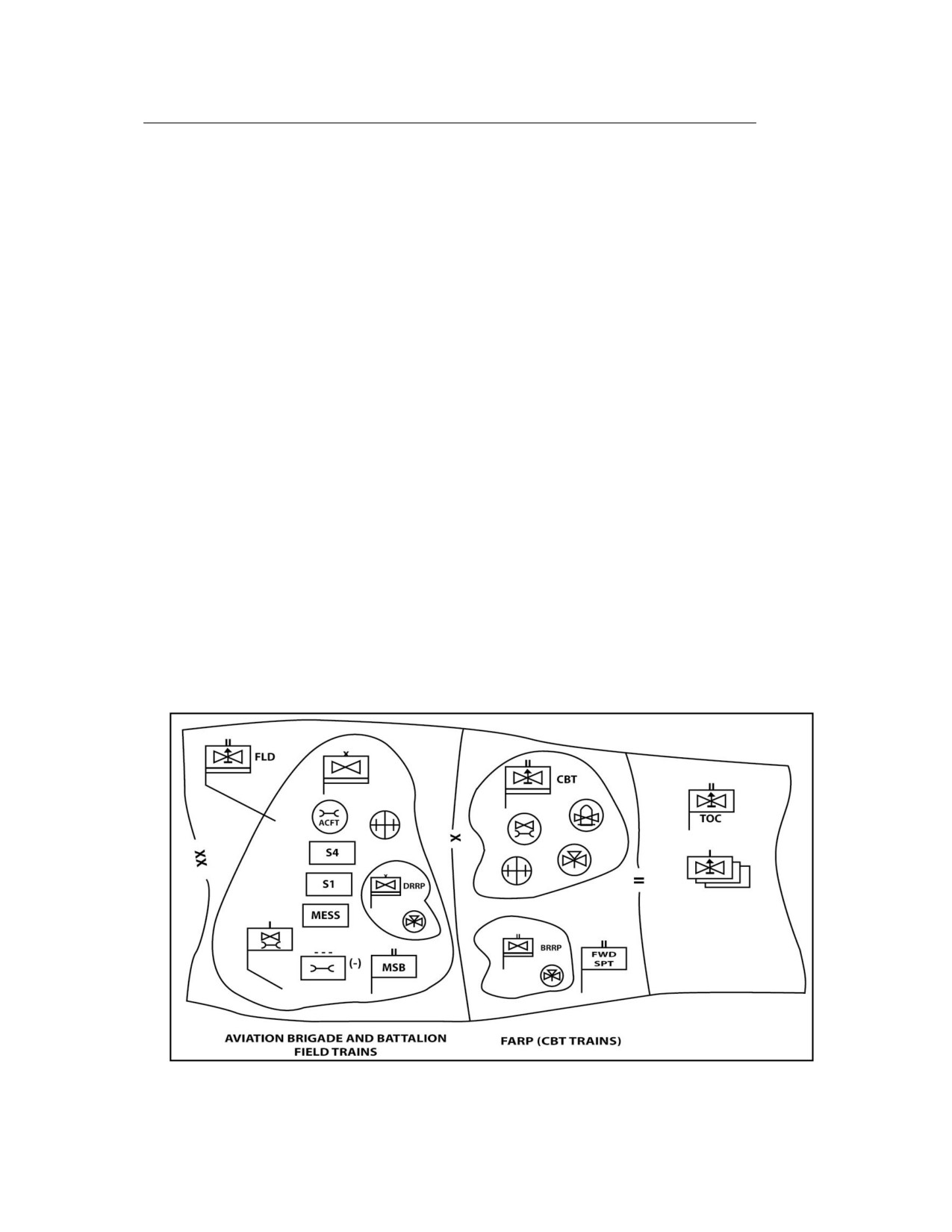
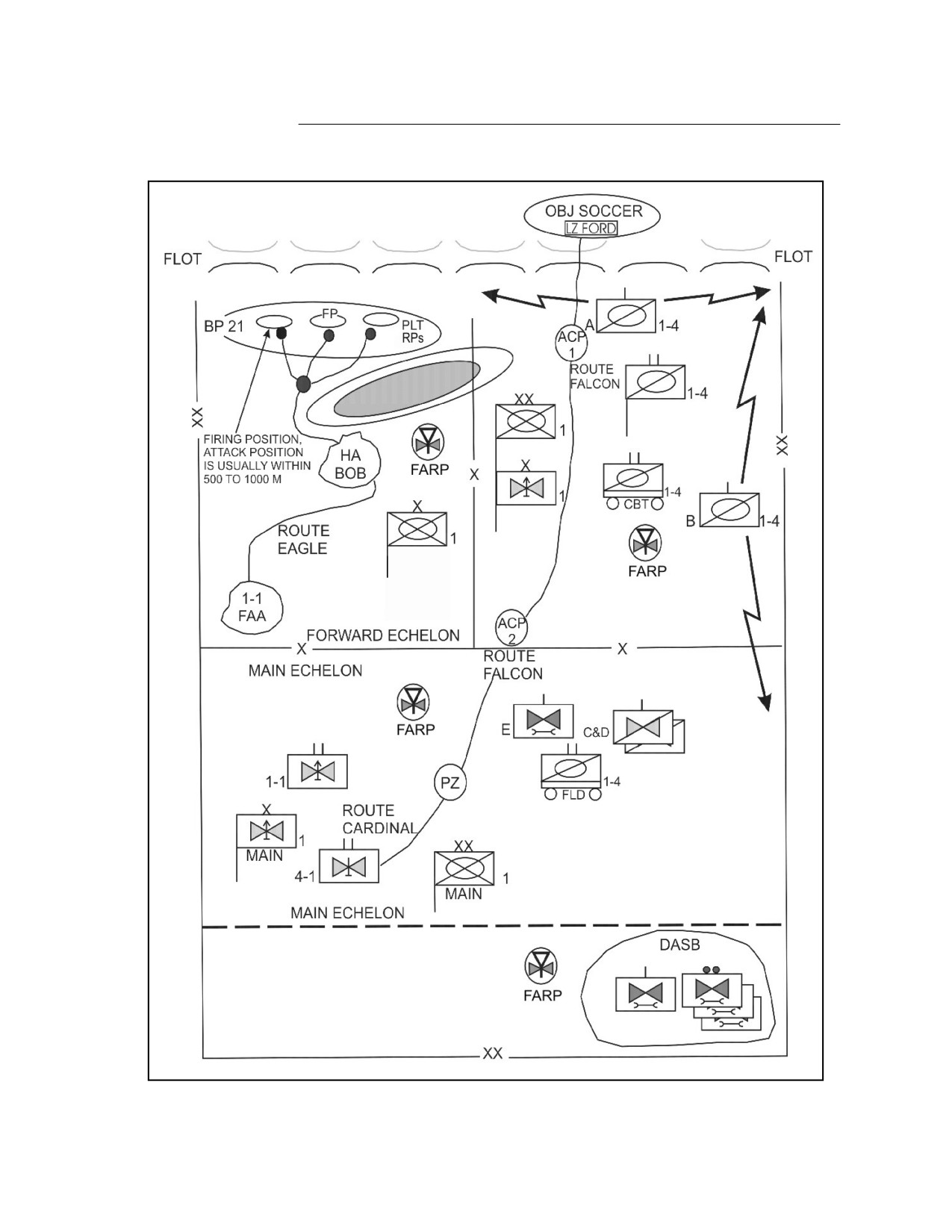
maintenance in preparation for other missions. Figures F-4 and F-5 show
typical dispositions of the division aviation brigade and its support assets.
Figure F-4. Typical Battlefield FARP Layout
F-9
FM 3-04.111 (FM1-111)
Figure F-5. Typical Disposition of the Division Aviation Brigade and Support Assets
F-10
Appendix F
Brigade Rapid Refueling Points
F-43. Brigades employ rapid refueling points to refuel other unit aircraft.
The rapid refueling point services aircraft as quickly as possible, allowing CS
missions to continue. Rearming operations are not conducted at this site
unless a Level III threat requires it. This practice allows more arming assets
forward.
Division Rapid Refueling Points
F-44. Stationary in nature, the division rapid refueling point locates in
protected rear areas of the DSA. It is manned by the aviation support
battalion (ASB) or is task-organized within the aviation brigade. It supports
organic and transient aircraft. The length of rapid refueling point operations
usually depends on the factors of METT-TC. As with the brigade, the division
rapid refueling point does not rearm aircraft.
EMPLACEMENT
F-45. FARPs can be emplaced by ground or air. The means of emplacement
depends on where and when the FARP is to be set up and how much Class
III/V that the mission requires. The FARP should be designed so that a
trained team can quickly place it into operation. This team should be able to
load and move without leaving behind any debris, fuel, ammunition, or
equipment; therefore, the FARP employs only those assets that it needs for
the mission. Section VII covers FARP emplacement.
Ground Vehicle Emplacement
F-46. FARPs normally emplace using ground vehicles carrying bulk
quantities of Class III/V. Ground vehicles also are the primary means of
displacing and resupplying the FARP. However, ground-mobile FARPs have
several disadvantages. Ground vehicles limit the rapid positioning of FARPs
and are subject to road and traffic conditions. Vehicle accessibility limits
where FARPs can locate. At mission completion, empty vehicles must return
to distant supply points before they are available to emplace a new FARP.
Vehicle malfunctions hamper overall mission capability.
Air Emplacement
F-47. Emplacing FARPs by air offers three major advantages. The first is
that a FARP can move about the battlefield much faster by air than by
ground. The second advantage is that nearly every open field becomes a
potential FARP site. Third, it is generally more practical, from a threat
perspective, to air emplace FARPs in support of shaping operations in deep
areas.
F-48. Air-emplaced FARPs also have disadvantages. Aerial emplacement
depends on availability of supporting aircraft. If the enemy is advancing and
no utility or heavy helicopters are available for FARP displacement, the
entire FARP can be lost.
F-49. Aerial resupply of the FARP requires multiple loads to move bulk
quantities of Class III/V. This additional air traffic can compromise the FARP
location, increasing likelihood of enemy attack. Aircraft that sling load
F-11
FM 3-04.111 (FM1-111)
equipment and supplies cannot fly NOE. They are more visible to enemy
sensors and missiles. Although materiel handling equipment (MHE) is often
essential in a FARP, it may be impractical to sling load rough-terrain
forklifts. The absence of MHE can seriously degrade ammunition handling.
Combined Ground Vehicle and Air Emplacement
F-50. The most efficient use of assets combines ground and air capabilities.
When time is critical, the FARE, limited Class III/V, and advance-party
personnel can air emplace. Remaining Class III/V products, MHE, and
support personnel can move to the site via ground transportation. Aerial
resupply of most FARPs occurs only when expenditure rates exceed organic
ground transport capability. Heavy or utility helicopters can temporarily
augment ground vehicles until supply flow returns to normal.
MOVEMENT PLAN
F-51. FARP movement plans should cover advance parties, march tables, a
route reconnaissance, and alternate site locations. Detailed movement
planning improves the accuracy of the FARP’s operational time. Planning
should include load plans for individual vehicles and trailers. Standard load
plans do not exist for current equipment because equipment varies in each
unit’s MTOE. In addition, varying Class V requirements for different
missions greatly affect vehicle load plans.
F-52. An advance party/security team, equipped with NBC detection
equipment, reconnoiters the planned route and proposed FARP site. If the
site is unsuitable, the team explores alternate FARP locations. If the site is
usable, the advance party identifies areas for placing equipment. When
remaining FARP personnel and equipment arrive, the advance party guides
each vehicle to its position.
SECURITY
F-53. FARPs need enough organic security to thwart anticipated threats.
Excess security equipment hinders movement. Inadequate security risks
valuable assets. The advance party may include Stinger assets, NBC teams,
and crew-served weapons. The lead vehicle employs NBC attack monitoring
and warning equipment. Monitoring equipment locates upwind of the FARP
site. Light antitank weapons protect against enemy armored scout vehicles. If
available, FARPs place electronic early warning systems along likely avenues
of approach not covered by listening or OBs. Armed helicopters in or near the
FARP may act as quick-reaction forces. Units also can employ nonflying
soldiers as UH-60-transportable quick-reaction teams.
F-54. The FARP coordinates with the brigade responsible for the sector in
which the FARP locates and integrates into the air and ground security plan
of nearby friendly forces. If a FARP is designated a priority target, division
AD assets may employ near the FARP. These AD assets may cover friendly
ingress and egress routes. Units establish checkpoints that allow positive
identification for friendly aircraft using the FARP.
F-12
Appendix F
F-55. In the event of substantial attack, personnel execute a scatter plan to
include movement to rallying points. These points increase personnel
survivability and allow personnel to regain control of the situation.
RELOCATION
F-56. Several guidelines determine the relocation of a FARP. By definition,
the FARP should be temporary, not staying anywhere longer than three to
six hours unless it is hardened and located in a secure area such as an
airhead. When the battle lines are changing rapidly or when the rear area
threat dictates, the FARP must move often. Where air parity or enemy air
superiority exists, the FARP must move often.
F-57. A FARP may relocate for any of the following reasons:
• It comes under attack.
• It receives the order to relocate.
• A preplanned relocation time has been set.
• A specific event occurs; for example, when the FARP has serviced a
specific unit or a specific number of aircraft.
• A decision or trigger point is reached.
F-58. The message to relocate a FARP is passed in FRAGO format and
should contain, as a minimum—
• Eight-digit grid coordinates of the next site and alternate site.
• Time that the FARP is to be mission ready.
• Fuel and ammunition requirements.
• Passage-of-lines contacts, frequencies, call signs, and ingress and
egress points.
• Enemy situation at the next site.
• March table or movement overlay.
• A logistics release point (LRP) to the FRAGO.
ADVANCE-PARTY ACTIONS
F-59. The advance party breaks down one section, consisting of one heavy
expanded mobility tactical truck (HEMTT) or one FARE. Next, it rolls up and
packs hoses and refuels the tanker if fuel is available. The advance party
then transports, when possible, enough ammunition for two mission loads per
aircraft, rolls up the camouflage nets, and sets up a convoy.
F-60. When the new site is deemed suitable, the advance party—
• Determines landing direction.
• Determines and marks refuel and rearm points, truck emplacements,
and ammunition emplacements.
• Sets up equipment.
F-61. Remaining elements break down the FARP in the same way and
sequence as described above. When personnel arrive at the new site, they
move into new locations, as directed by the advance party, and set up arming
and refueling points.
F-13
FM 3-04.111 (FM1-111)
SITE PREPARATION
F-62. FARP personnel—
• Police the FARP site before operational use.
• Prevent rotor wash from injuring personnel or damaging equipment,
remove sticks, stones, and other potential flying objects.
• Clear scrub brush, small trees, and vegetation from landing and
takeoff areas.
• Predesignate landing, takeoff, and hover areas to minimize accidents
and injuries.
• Clear the areas around the rearming and refueling points and the
pump assemblies, removing dried grass and leaves to avoid fires.
F-63. Aircraft may sink in wet, snow-covered, thawing, or muddy ground.
Reinforce unstable ground with staked, pierced steel planking or other
suitable material.
MULTIPLE FORWARD ARMING AND REFUELING POINT OPERATIONS
F-64. The degree of air superiority and the factors of METT-TC determine
the number of FARPs and the number of points at each FARP. Multiple
FARP operations may be necessary. When feasible, units arrange assets into
two or three independent and mobile FARP operations. The ideal situation
would include an active FARP, a silent or relocating FARP preparing to go
active, and a rapid-reaction air-emplaced jump FARP on standby.
F-65. The active FARP conducts refueling and rearming operations. The
silent FARP has all equipment and personnel at the future site, but it is not
yet operational. The jump FARP deploys for special, short-notice missions
such as rear operations or reinforcement of other FARPs. It is composed of a
FARE, 500-gallon collapsible fuel drums, and/or ammunition (as the mission
dictates). The jump FARP is transported and emplaced by ground or air and
employed when dictated by time or geographical constraints. It allows
uninterrupted support during FARP emergencies.
F-66. When employing multiple FARPs, it is important to coordinate
resupply. If Class III/V throughput occurs at a designated time, active FARPs
stop receiving supplies and silent FARPs start receiving them. If properly
timed, the active FARP expends all of its supplies just as a silent FARP
becomes active. If time permits, FARP personnel transport unused Class
III/V to the new site. Otherwise, they camouflage supplies and pick them up
later. FARP personnel destroy supplies only as a last resort. TM 750-244-3
provides guidance on asset destruction.
F-67. A typical ground-emplaced mobile FARP can rearm and refuel eight
aircraft simultaneously. It consists of eight rearm/refuel points. The silent
FARP is identically configured and prepared to assume operations.
DAMAGED OR DESTROYED ASSETS
F-68. If attacked, FARP personnel vacate the FARP site. The nature of the
compromise determines what can be salvaged. The refueling equipment is
most critical. Without HEMTT tankers or FARE systems, refueling aircraft
F-14
Appendix F
will be difficult. Higher echelon, less-mobile 5,000-gallon semitrailers may
need to replace destroyed HEMTT tankers.
F-69. FARP personnel replace damaged or destroyed equipment quickly to
avoid mission disruption. Report personnel injuries to the HHC commander,
and report damage to vehicles, equipment, and supplies to the S4. If assets
are unavailable in the unit, emergency support may be available from other
brigade sources. This support could range from borrowing equipment to using
another battalion’s FARP. Units inform aviation elements of any changes in
the status of the FARP sites, to include alternate arming and refueling
instructions.
F-70. Planners prioritize essential equipment or products before the mission
starts. Inform all FARP personnel of the priorities. For example, keeping
Hellfire missiles from the enemy would be a high priority because the
missiles are expensive and in short supply.
SECTION IV - REFUELING OPERATIONS
F-71. This section discusses the FARE, the Advanced Aviation Forward Area
Refueling System
(AAFARS), site layout, support equipment, personnel
refueling requirements, and refueling methods.
FORWARD AREA REFUELING EQUIPMENT
F-72. The FARE system
(NSN 4930-00-133-3041) consists of a pump
assembly, a filter/separator, hoses, nozzles, grounding equipment, and valves.
Other support equipment includes fire extinguishers, grounding rods, waste
cans,
5-gallon water cans, absorbent material, fuel source, and the fuel
sampling kit. The pump has two hose connections and is rated at 100 gallons
per minute (GPM). When two hoses are used, the actual flow rate may be
under 50 GPM. The fuel source is usually 500-gallon collapsible drums. Other
fuel sources include 600-gallon pods; 1,200-gallon tank and pump unit (TPU);
3,000- or 10,000-gallon collapsible tanks; 2,500-gallon HEMTT tanker; 5,000-
gallon semitrailer; railroad tank cars; and USAF cargo-plane fuel tanks.
ADVANCED AVIATION FORWARD AREA REFUELING SYSTEM
F-73. AAFARS will replace the FARE system. The AAFARS is a four-point
refuel system providing a minimum of 55 GPM at each refuel point. A
distance of 100 feet separates each refueling point. The primary fuel source is
the 500-gallon collapsible drum although, like the FARE, the system is
compatible with other fuel sources. The key AAFARS function is to
simultaneously refuel four helicopters in tactical locations using center point
refueling
(D-1), closed-circuit refueling
(CCR), or open-port nozzles. The
system interfaces with existing U.S. Army, Air Force, Navy, and Marine
Corps aircraft and is interoperable with NATO and other allied-nation refuel
equipment.
F-15
FM 3-04.111 (FM1-111)
FORWARD AREA REFUELING EQUIPMENT SITE LAYOUT
F-74. Skilled, experienced personnel can set up a FARE within 15 minutes of
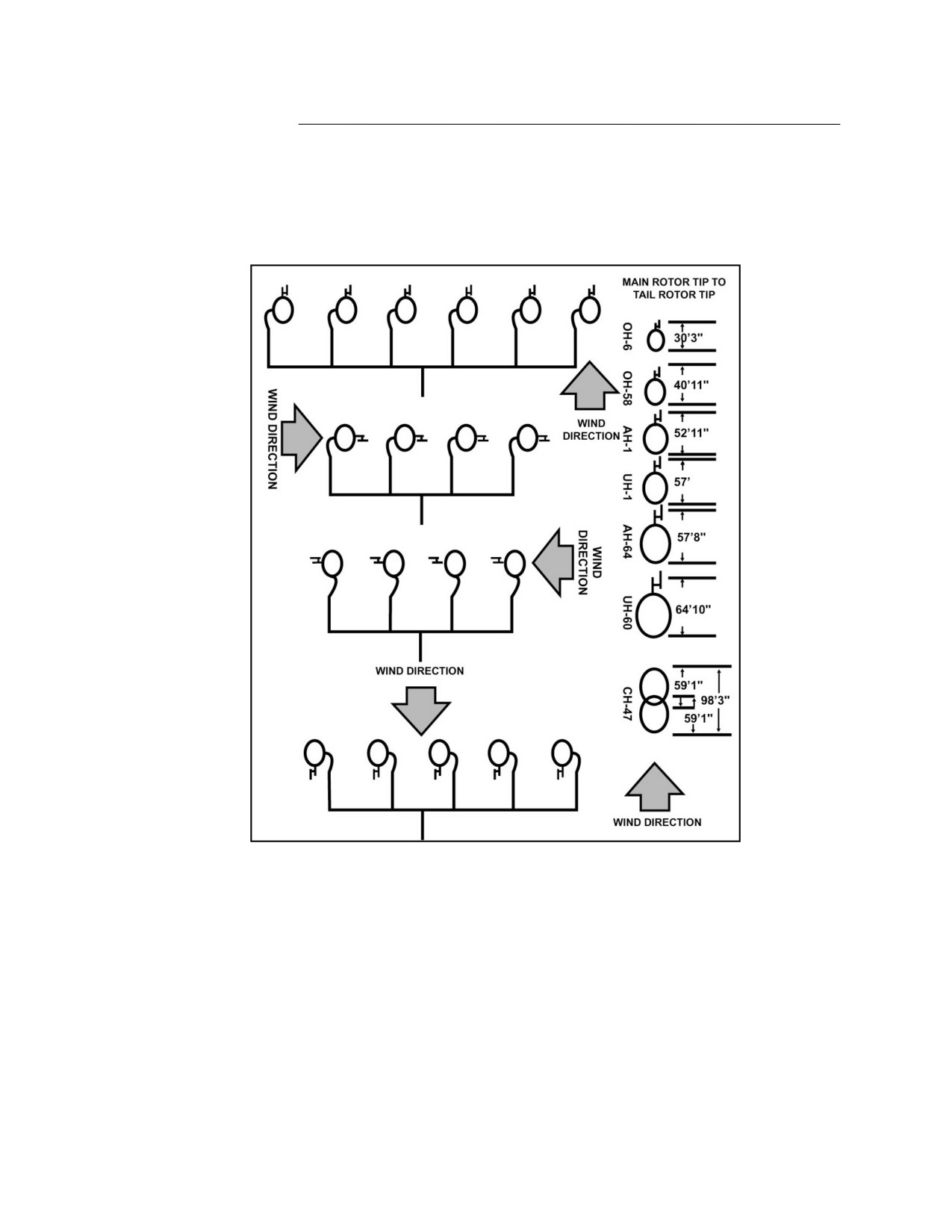
site arrival. Figure F-6 shows a typical site layout.
Figure F-6. Typical FARE Setup
F-75. FARE system setup should exploit terrain features, achieve maximum
dispersion, avoid obstacles, and accommodate the aircraft type that the FARP
will service. When planning the layout, personnel must consider the
minimum spacing required between aircraft during refueling. The spacing
depends on the type of aircraft and rotor sizes. Proper spacing reduces the
possibility of collision and damage caused by rotor wash. The minimum rotor
hub-to-rotor-hub spacing for the CH-47 is
180 feet. Spacing for other
helicopters is 100 feet.
F-76. If the area has a prevailing wind pattern, FARP personnel orient the
refueling system so that helicopters land, refuel, and take off into the wind.
Figure F-6 shows a FARE setup under various wind conditions. Refueling
points should be laid out on the higher portions of sloped sites, not in hollows
F-16
Appendix F
or valleys. Fuel vapors are heavier than air and flow downhill. In addition,
fuel sources should be downwind of the aircraft’s exhaust to reduce explosion
hazard. These considerations apply to any FARP setup with the FARE, 5,000-
gallon tanker, or HEMTT.
F-77. The FARP layout in desert, dust, and snow environments should not
require hovering where wind and rotor wash may cause brownout or
whiteout. Special considerations are necessary when aircrews operate with
night vision devices (NVD).
SUPPORT EQUIPMENT
F-78. FARE or FARP personnel perform the following procedures:
• Locate a fire extinguisher at each refueling nozzle and at the pump
and filter assembly.
• Place a water can at each refueling point; the water enables operators
to wash fuel from skin and clothes and dirt from fuel nozzles.
• Place a waste fuel pan next to each nozzle to contain fuel spillage.
PERSONNEL REFUELING REQUIREMENTS
F-79. During refueling, one person stays next to the main emergency fuel
shut-off valve and monitors refueling. At each refuel point, one person refuels
the aircraft while another remains outside the aircraft’s main rotor disk and
monitors with a suitable fire extinguisher where he can see both the pilot at
the controls and the refueler with the nozzle. Each rearming/refueling point
has one supervisor, one refueler, and two rearming personnel. Additional
personnel may be supplemented from existing assets, depending on METT-
TC.
REFUELING METHODS
F-80. Units conduct hot or rapid refueling while aircraft engines are running
and rotors are turning. Cold refueling occurs when aircraft engines have been
shut down. In a field environment, units normally use the hot refueling
method. There are two types of hot refueling: open-port and CCR.
Open-Port
F-81. Units open-port refuel with an automotive type of nozzle, inserted into
a fill port of larger diameter. It is not as fast or as safe as CCR. The larger
port allows fuel vapors to escape. In addition, dust, dirt, rain, snow, and ice
can enter the fill port during refueling, risking fuel contamination. Spills
from overflowing tanks also are more likely. Units should use the open-port
rapid refueling method only during combat or vital training. In these cases,
the unit commander makes the final decision. Units conduct simultaneous
arming and open-port refueling activities only when the combat situation and
benefits of reduced ground time outweigh the risks.
F-17
FM 3-04.111 (FM1-111)
WARNING
As aircraft move through the air, they build up
static electricity. Static electricity also builds up
on refueling equipment as fuel passes through the
hoses. The refueler must ground the aircraft, fuel
nozzle, and pump assembly to prevent sparks and
explosions. Static electricity buildup is greater in
cool, dry air than in warm, moist air.
Closed-Circuit
F-82. CCR is accomplished with a nozzle that mates with and locks into the
fuel tank. This connection prevents fuel spills and vapors from escaping at
the aircraft fill port and reduces the chances of fuel contamination.
SECTION V - AMMUNITION AND ARMING OPERATIONS AND TRAINING
AMMUNITION OPERATIONS
F-83. This section discusses ammunition and arming operations, aircraft
flow and mix, and training.
AMMUNITION STORAGE
F-84. The ready ammunition storage area (RASA) contains the ammunition
to support aircraft arming. Ready ammunition is that quantity required to
support the mission beyond one load. The RASA requires separate areas for
the assembly and disassembly of rockets, aircraft flares, and malfunctioned
ammunition. AR 385-64 and TM 9-1300-206 contain more information.
F-85. The basic load storage area (BLSA) contains the specific quantity of
ammunition required and authorized to be on hand at the unit to support
three days of combat. A basic load includes a variety of ammunition such as
small arms, grenades, and mines, in addition to aircraft-specific ammunition.
AMMUNITION SAFETY PROCEDURES
F-86. All personnel must observe required safety procedures to prevent the
accidental firing of ammunition or propellants. Improper handling or stray
electricity may cause ammunition to explode and result in loss of life, serious
injury to personnel, or serious damage to equipment.
F-87. Fin protector springs effectively short-circuit igniter leads, preventing
accidental ignition. Armament personnel—
• Install shorting wire clips and fin protectors on all rockets
immediately after unloading aircraft launchers or when rockets are
not in a launcher.
• Ensure a sufficient quantity of clips and protectors are at each rearm
pad; keep them after arming aircraft.
F-18
Appendix F
• Secure these clips and wire protectors to prevent foreign object
damage.
F-88. Armament personnel must assemble rockets according to the
instructions in TM 9-1340-222-20. They retorque unfired rockets remaining
in aircraft launchers after a mission. Dropped complete rockets, rocket
motors, or fuze-warhead combinations may cause the fuze or warhead to
function prematurely. They return dropped crated or uncrated rockets to
supporting ammunition supply points.
F-89. In base camp or semipermanent training facilities, units should build
barricades around the RASA, BLSA, and rearm pads. Barricades should be at
least three-feet thick to effectively reduce hazards from a fire or an explosion.
Rocket motors may go off, so point rockets away from aircraft, personnel, and
built-up areas and towards berms, barricades, and open spaces.
F-90. Armament personnel cover ammunition to protect it from the weather.
In high temperatures, covers must not create excessive ammunition heating.
Dark covers placed directly on ammunition pallets can create temperatures
up to 180 degrees Fahrenheit.. These high temperatures can damage missile
systems. Select light-colored covers to shade ammunition and allow air
circulation.
F-91. Armament personnel should follow these procedures:
• Do not stack rockets; the weight will damage bottom layers. If
unpacked, store rockets on racks built at the site.
• Do not place rockets directly on the ground; place rockets on a drop
cloth or wooden pallet that allows air to circulate.
• Secure rockets to keep them from rolling downhill.
F-92. For maximum safety, armament personnel—
• Minimize the amount of ammunition stored at the RASA and the
rearm pads.
• Limit the RASA to 2,000 pounds of net explosive weight (NEW) per
cubicle.
• Do not exceed the following limits:
Limit each rearm pad to the ammunition required to fully arm one
aircraft plus the rocket quantities for a second load; this practice
facilitates exchanging the missile and rocket launchers if the mission
dictates.
Store ammunition for a second aircraft off the pad, properly
covered—and pointed away from aircraft, personnel, and other
ammunition.
F-93. Table F-1 shows common items used during helicopter rearm
operations. Table F-2 shows minimum safe distances between rearm points,
RASAs, and activities not ammunition-related.
F-19

FM 3-04.111 (FM1-111)
Table F-1. Common Items, Helicopter Rearm Operations
ITEM
NET EXPLOSIVE WEIGHT
Hellfire missile
34.4 pounds
Rocket, 2.75 in, HE (H489 or H490)
10.0 pounds
Rocket, 2.75 in, HE (H488 or H534)
11.0 pounds
Cartridge, 30-mm, HE (B130 or B131)
.058 ounces
Small arms ammunition
None
Table F-2. Minimum Safe Distances (in Feet)
FROM
TO
BARRICADED
UNBARRICADED
Rearm point
100-180*
100-180*
Inhabited buildings
400
800
and unarmed aircraft
Rearm Point
Public highways
240
480
POL storage or refuel
450
800
facilities
Rearm point
75
140
Inhabited buildings
50
1,010
Ready Ammunition
and unarmed aircraft
Storage Area
Public highways
305
610
POL storage or refuel
505
1,010
facilities
* Distance is based on rotor clearance.
ARMING OPERATIONS
ARMAMENT PAD SETUP
F-94. Armament pad setup affects overall aircraft turnaround times. During
combat missions, before aircraft arrive, armament personnel place enough
ammunition on armament pads for at least one arming sequence. They lay
out ammunition in loading order. Armament personnel lay out a full
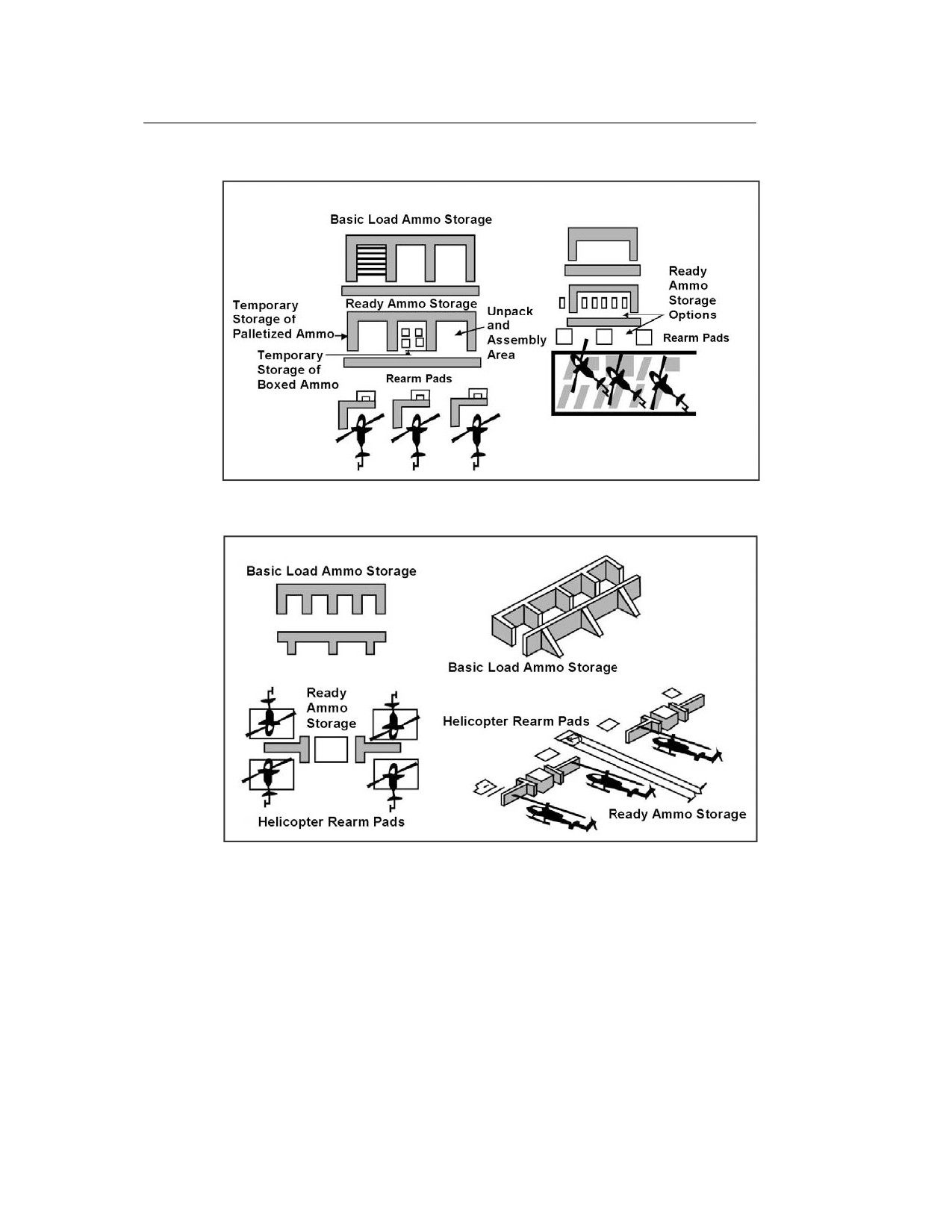
ammunition load in case aircraft expend the entire initial load. Figure F-7
shows two typical layouts for major gunnery training facilities or well-
prepared base camp helicopter rearm points. In combat, such preparation is
impossible. Figure F-8 shows three-dimensional views.
PERSONNEL REQUIREMENTS
F-95. The weight of the ammunition containers and Hellfire missiles
requires that at least two people load each aircraft. Two personnel arm the
turret system to ensure link removal and less jamming during uploads.
Rocket ammunition requires multiple personnel and tools just to remove and
prepare it before loading.
F-20
Appendix F
Figure F-7. Typical Layouts for Rearm Points
Figure F-8. Three-Dimensional View of a Rearm Point Plan
AIRCRAFT FLOW AND MIX
LIMITATIONS
F-96. Several factors can degrade efficiency and increase turnaround times.
These factors include crew size, night operations, NBC environment, weapons
and ordnance mix, attrition, and maintenance problems.
Personnel
F-97. For rapid turnaround times, FARPs need sufficient personnel to
service aircraft. Each point should be staffed by one supervisor, one refueler,
and two armament personnel. Each Class III HEMTT requires one person to
F-21
FM 3-04.111 (FM1-111)
man the emergency shutoff valve. Dividing available personnel and
equipment into multiple FARPs requires careful planning, or none will be
mission capable. Personnel shortages may require aircraft crew members to
assist arming and refueling. Turret and Hellfire ammunition requires at
least two loaders. During the day, under ideal conditions, a well-trained crew
of two can fully arm an AH-64 in 40 minutes. A crew of four reduces time by 3
to 6 minutes.
Night Operations
F-98. When arming turret weapons at night, personnel need NVD or
supplemental lighting such as flashlights. In addition, arming times will be
three to eight minutes longer at night, especially under low-light conditions.
Nuclear, Biological, And Chemical Conditions
F-99. If chemical protective clothing is worn, refueling times increase by two
to four minutes and rearming times by two to six minutes. Fatigue increases
the longer a soldier remains under MOPP conditions. Personnel must drink
more water when in MOPP to reduce the possibility of heat injuries.
Weapons and Ordnance Mix
F-100. Weapons and ordnance mix can be a limiting factor. For example, an
AH-64 may have a weapons load of two Hellfire missile launchers and two
19-tube rocket launchers. A mission change may require that AH-64s be set
up for Hellfire heavy (four Hellfire missile launchers). This change requires
removal of two 19-tube rocket launchers and replacement with Hellfire
missile launchers. While weapons changes and boresighting are better
accomplished in the AA, mission timelines may not permit return to the AA;
therefore, equipment and tools to accomplish this boresighting must be at the
FARP. In addition, the launchers may need boresighting, which requires
special equipment. Such a time-consuming changeover must be in the
commander’s mission-support decision matrix.
Armament Maintenance
F-101. Aircraft with armament maintenance problems may interrupt the
flow of FARP operations. These aircraft should be positioned away from the
arming and refueling area to keep the flow of aircraft constant.
SIMULTANEOUS ARMING AND REFUELING
F-102. Minimizing aircraft ground time in the FARP is important for two
reasons. First, longer aircraft service times mean less time on the battlefield.
Second, aircraft are extremely vulnerable on the ground. Simultaneous
arming and refueling minimizes ground time; however, they carry their own
risk.
F-103. Typically, ATKHBs rotate companies through the FARP to support
the battalion’s continuous or phased attack. Tests show that well-trained
crews require up to 40 minutes to fully arm an AH-64. This means it is
critical to maintain company integrity at the FARP. Otherwise, platoons and
teams waiting for open armament/refuel points may not be able to rejoin
F-22
Appendix F
already serviced aircraft in the battle for another 40 minutes. Meanwhile,
other companies begin to arrive at the FARP creating additional backlog and
less time on station. When possible, all company aircraft must arm and refuel
at the same time.
F-104. Depending on task organization and the number of mission-capable
aircraft, FARPs require eight armament/refuel points. This quantity supports
simultaneous servicing of most company-sized organizations. Each HEMTT
tanker and upcoming AAFARS can service up to four refuel points. Extra
refuel hose capacity allows units to cross-level fuel from HEMTT tankers to
500-gallon drums without interrupting aircraft refueling. With sufficient
drums in place, as fuel gets low, units can transfer tanker fuel to drums,
allowing tankers to go for top off. This practice is a good strategy as the
FARP prepares to displace and needs fuel resupply at the next location. An
alternate strategy is to initially locate all filled drums at the silent FARP,
thereby allowing tankers from the initial location to resupply without a lull
in the next FARP’s mission.
Terrain
F-105. A four-point FARP requires an area larger than a football field.
Finding a single cleared, concealed, level area for eight service points may
prove difficult. If terrain dictates, consider splitting away part of the FARP to
a nearby area.
F-106. FARPs may be divided into two sections, up to one kilometer apart,
supporting two to four points each. This layout imposes C2 and security
challenges and prevents personnel who finish servicing their aircraft from
assisting others a kilometer away. However, it supports company integrity
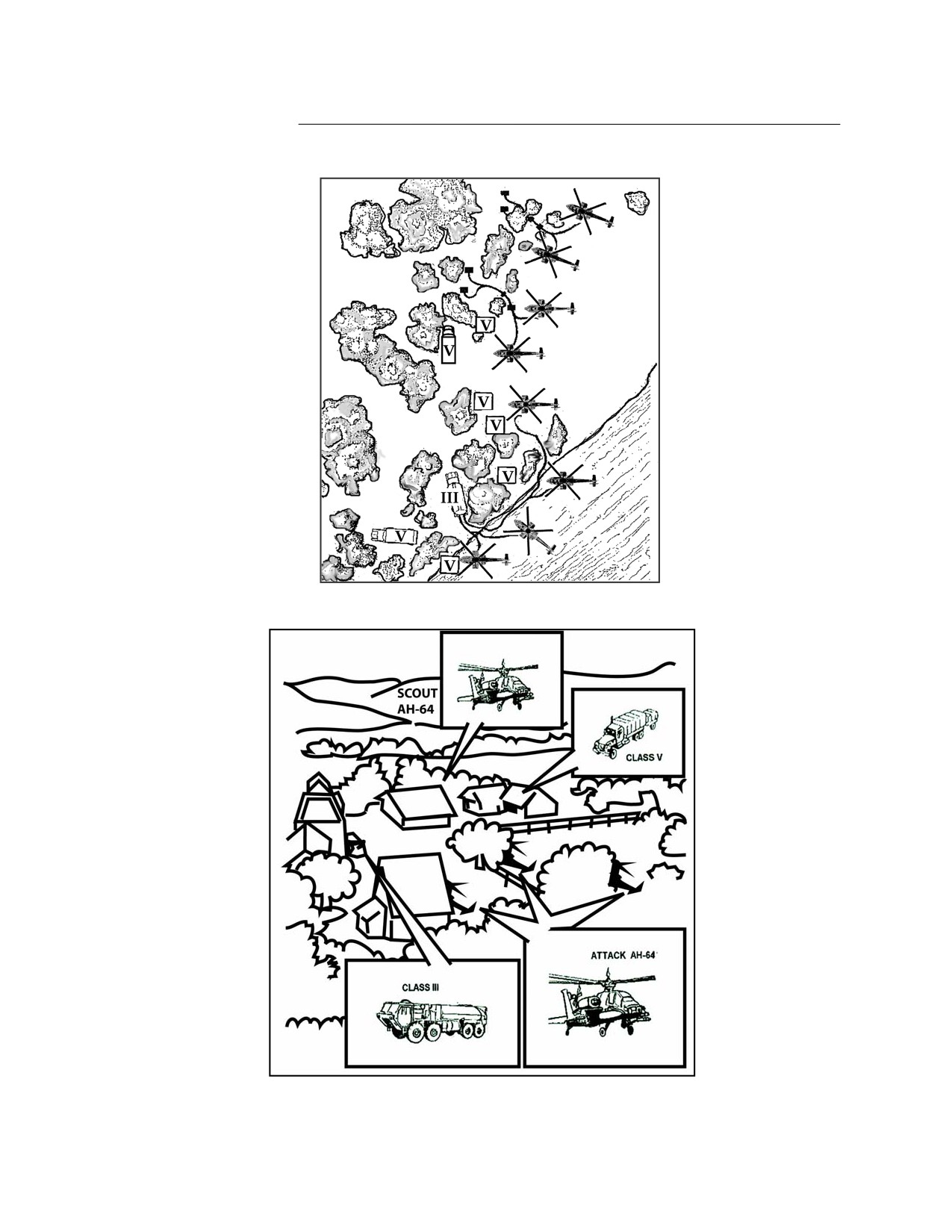
and dispersion, making it harder to target the FARP with artillery. Figure F-
9 depicts a FARP split into two areas for dispersion. Figure F-10 depicts a
FARP concealed in urban terrain.
Personnel
F-107. A FARP with eight service points theoretically requires at least 10
refuelers: 8 to refuel aircraft and 2 manning the emergency shut-off valves. It
also requires 12 arming personnel (2 per service point). This requirement can
overextend the III/V platoon because there is a need for a second silent or
resupplying FARP.
F-108. One solution is cross training personnel to assist in multiple FARP
functions. Units can train
89Bs, 77Fs, and copilots to assist in arming
functions. At a 50-gallon-per-minute rate, a 77F can finish refueling in as
little as six minutes and then assist in arming.
F-109. If in the FARP up to 40 minutes, pilots and copilots may stretch by
alternately leaving the aircraft. They can assist some arming functions such
as lifting Hellfire missiles and loading rockets. Units also can arrange UH-60
transport of FARP personnel, minus drivers, to newly opening FARPs.
F-23
FM 3-04.111 (FM1-111)
Figure F-9. Example of a Tactical FARP Layout
Figure F-10. FARP Operations Concealed in Urban Terrain
F-24
Appendix F
Equipment
F-110. At least one HEMTT tanker and two FAREs or one AAFARS must
support each four-point FARP. More typical would be two HEMTT tankers,
given a less-than-routine availability of UH-60 aircraft to transport 500-
gallon drums. Even greater numbers of HEMTTs and heavy expanded
mobility ammunition trailers (HEMATs) must support each FARP. Again, as
with personnel constraints, it is difficult to operate more than one FARP with
available equipment. In addition, there is the time-consuming challenge of
resupplying HEMTT tankers and HEMATs to support ongoing and future
FARP operations.
F-111. A solution may be coordinated throughput of mission-configured loads
using PLS trucks from supporting ammunition units. These PLSs reduce
MHE needs by hydraulically placing entire pallets onto the ground for
manual access to ammunition. The S4 and III/V platoon leader can
coordinate palletized ammunition throughput directly to silent FARP
locations and near projected future armament pads.
AIRCRAFT MIX
F-112. If a Longbow unit splits into two platoons or three teams, the FCR
aircraft usually is the scout and may have more gun and rocket ammunition.
FARP personnel identify the FCR aircraft and direct it to supply points that
specialize in loading more of that kind of Class V.
F-113. Scout aircraft may expend little ammunition and may primarily need
refueling, which is not as time intensive. They may overwatch until another
aircraft completes servicing and can assume the overwatch role.
ATTACK HELICOPTER BATTALION TECHNIQUES
F-114. ATKHBs have three primary techniques for attacking the enemy:
continuous attack, phased attack, and maximum destruction. FM 3-04.112
(FM 1-112) covers these in detail.
Continuous Attack
F-115. This is a primary driver for maintaining company integrity in the
FARP. In this technique, battalions rotate companies through the FARP.
Units cannot afford to have a backlog waiting on companies before them.
Phased Attack
F-116. To give the commander more time operating with two companies in
the attack, he can operate two FARPs simultaneously. The normal silent
FARP can go active to allow servicing of two companies at the same time.
Maximum Destruction
F-117. Units often employ this technique in a target-rich environment.
Aircraft may employ extended-range tanks to reach the objective area and
return on one fuel load. If the target is large and one ammunition load is
insufficient, given one pylon’s loss to an extended range fuel tank, units may
air emplace a jump FARP with limited Class V only.
F-25
FM 3-04.111 (FM1-111)
F-118. UH-60 aircraft can internally carry at least 15 Hellfire containers in
the cargo compartment doorway area, while externally transporting another
9 palletized Hellfire missiles for a total weight of about 4,800 pounds. This
capability allows each UH-60 to resupply three AH-64Ds with eight missiles
each. Units also can externally transport three Hellfire pallets (1,800 pounds
each) in three separate 10,000-pound slings if UH-60s employ extended-range
fuel tanks that would make internal loading/unloading more difficult.
TRAINING
F-119. A successful FARP operation is the final product of a series of
progressive, skill-building programs to include the cross training of assigned
and attached personnel. Coordinated operations are achieved by integrating
team training with programs that emphasize personal skill development.
Training progresses as individuals integrate into operational teams.
INDIVIDUAL AND COLLECTIVE TRAINING
F-120. Successful FARP operations result when personnel train to operate as
a team. The unit does not limit individual and collective training to just
arming and refueling activities. The unit trains FARP personnel in
firefighting and rescue procedures according to FM 4-20.12 (FM 10-67-1).
Commanders train FARP personnel to prepare Class III/V sling loads (FM 4-
20.197 [FM 10-450-3]).
F-121. Every team member should be proficient in day and night land
navigation. Because night relocation of the FARP is common, units should
emphasize night land navigation skills.
F-122. Team members should have extensive driver training to include
operator maintenance procedures. Delivering products to the FARP is as
critical as operating the FARP. Team members must also be able to check
fuel quality using the visual sample, Aqua Glo, and American Petroleum
Institute gravity-testing methods.
F-123. Commanders train team members in NBC detection and
decontamination. This training must emphasize FARP vulnerability to direct
NBC attack and cross contamination from aircraft. It stresses the need for
FARP operations in MOPP gear to survive and continue the mission.
F-124. Personnel must be able to recognize any aircraft that may use the
FARP. They should be able to identify all Army, Navy, Air Force, Marine, and
allied aircraft and know arming and refueling procedures for each aircraft.
SECTION VI - COMBAT SERVICE SUPPORT
FORWARD ARMING AND REFUELING POINTS SUPPORT MISSION
CONSIDERATIONS
F-125. CSS for FARP missions depends on the echelon of support and its
corresponding tanker/truck/trailer/MHE capacity. The type of corps and its
heavy, light, air assault, or airborne divisions determine how CSS units
support aviation mission needs for Class III/V. The type of aviation unit
F-26

Appendix F
within the corps or division aviation brigade and its relative location on the
battlefield also determine support.
F-126. Some CSS elements employ supply point distribution. FARP tankers
and trucks must drive to separate Class III and V supply points for transload.
Other CSS units employ supply throughput using PLS trucks with mission-
configured combat Class V loads and Class III fuel semitrailers that link up
with FARP elements at more forward logistics RPs. CSS units support
around-the-clock operational capability.
F-127. As missions change, FARP CSS resupply needs change. Transport
and MHE requirements may exceed III/V platoon equipment and personnel
capabilities, especially when units operate multiple FARPs. Transport
vehicles may exceed their cargo-carrying capacity (cube out) before exceeding
their weight limitations. Table F-3 shows cargo capacities for various vehicle
types.
Table F-3. Cargo Capacity Comparison in Rounds
Munition
HEMTT
HEMAT
5-ton short bed
5-ton long bed
1-½-ton trailer
Hellfire
36
36
27
45
9
Stinger
54
72
36
54
9
Hydra 2.75”
240
240
180
300
60
30-mm
10,368
10,368
10,560
10,560
2,640
F-128. Available MHE unloads ammunition. This MHE may be the TOE-
authorized forklift or the HEMTT-mounted crane. Transporting the variable
reach forklift may require a flatbed trailer, an item not readily available to
the unit. Without the forklift or crane, ammunition pallets must be manually
broken down while on the bed of the transport vehicle, which can be a
laborious and time-consuming operation.
RESUPPLY
F-129. Resupply operations must match the pace of battle. The same vehicles
that support active FARPs must periodically return to Class III and V supply
points. Units overcome this lull in FARP capability by operating multiple
FARPs and coordinating throughput to the next projected FARP location.
F-130. The Class III/V platoon leader processes periodic bulk POL status
reports through the S4 to the MMC to forecast user needs. The corps delivers
Class III supplies, using throughput distribution, as far forward as the BSA.
However, delivery may occur to the battalion AA or FARP, in specific
situations. The aviation unit uses its vehicles to transport the fuel from the
transfer point to the FARP. Aviation units in the corps rear area receive
Class III from the corps support area (CSA) transfer point.
F-131. If demand exceeds unit resupply capability, limited aerial resupply
may be available from other division or corps heavy or utility helicopters.
Figure F-11 shows the flow of Class III supplies.
F-27
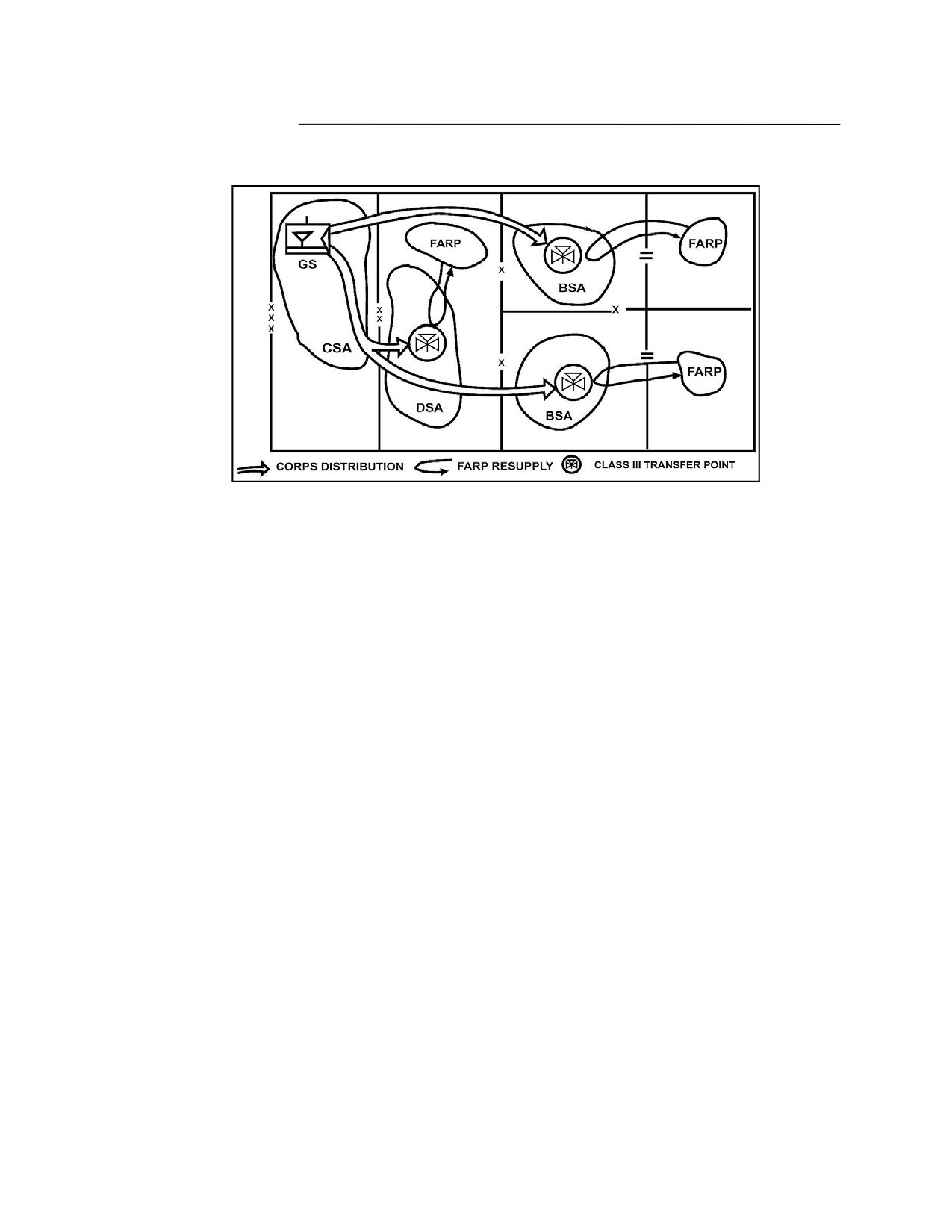
FM 3-04.111 (FM1-111)
Figure F-11. Flow of Class III Supplies
F-132. The battalion S4 forwards ammunition requests to the appropriate
MMC or designated ATP representative. After authenticating requests to
ensure that they are consistent with the controlled supply rate, the supplying
unit issues ammunition to aviation unit trucks via supply point distribution
at either the ATP or the corps ASP.
F-133. Within the division, each forward support battalion can operate one
ATP. The corps direct support ammunition company provides an additional
ATP in the DSA. The ATPs normally are located in the BSA. They contain
high-tonnage, high-usage ammunition to support all of the division units
operating in the brigade area. The ammunition is transported to the ATP via
throughput distribution from the corps. It is then transferred to the battalion
trucks or off loaded for future transfer. All other ammunition is kept in the
ASP in the CSA; this area normally is located directly behind the rear of the
division area. Figure F-12 shows the flow of Class V supplies.
CLASS III REQUIREMENTS
F-134. Two factors determine FARP fuel requirements. The first is the total
number and type of aircraft requiring support. For planning purposes, units
assume
100-percent availability. This assumption provides fuel for
unplanned aircraft that may need support. The second factor is projected
mission duration. Operator’s manuals and SB
710-1-1 contain more
information about fuel-consumption rates.
F-28
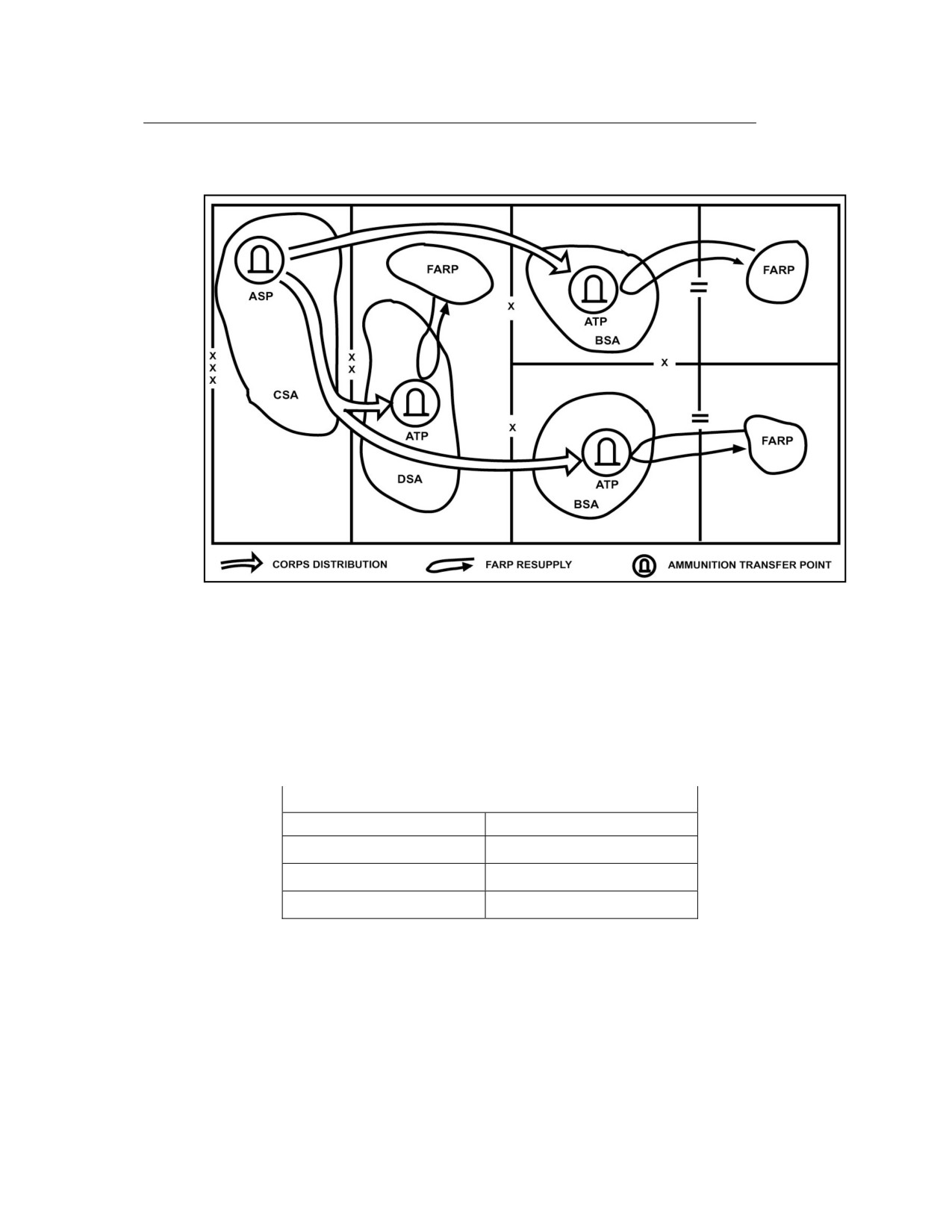
Appendix F
Figure F-12. Flow of Class V Supplies
CLASS V REQUIREMENTS
F-135. The battalion S4 is responsible for calculating the amount of
ammunition needed for the mission. He bases his figures on the S3’s plan.
Table F-4 shows an example of the total Class V requirements needed by an
ATKHB for one day. Generally, one armament HEMTT with HEMAT is
required for every four OH-58D or three AH-64 aircraft.
Table F-4. Example of Munitions Requirements for One Day
AH-64D ATKHB
Weapon
Rounds
Hellfire missiles
576
2.75” rockets
1,512
30mm chain gun
36,000
F-136. A potential solution to Class V transportation shortfalls is PLS
ammunition throughput. Corps and division ammunition units employ PLS
trucks and hydraulically off-loading flat racks. Units can coordinate
throughput to battalion AAs or future FARP locations. An ideal situation
would be to place eight flat racks near the eight armament pads in a silent
FARP location. This act would simplify silent FARP setup with available
personnel.
F-29
FM 3-04.111 (FM1-111)
SECTION VII - EMPLACEMENT METHODS
F-137. This section discusses ways to accomplish the emplacement of the
FARP by ground vehicles, helicopters, and M/arine and Air Force assets.
GROUND VEHICLES
F-138. Small, maneuverable, easy-to-conceal ground vehicles, such as the
HMMWV, can emplace the FARE platform. The disadvantage is that
HMMWVs may not be available or may be needed for other FARP missions.
F-139. The 3/4-ton trailer is an option for FARE transport. Planners should
consider bolting the FARE system (pump and filter/separator) to the trailer
frame. The trailer is light enough to transport by HMMWV or sling load by
UH-60. To complete the FARP package, units can air or ground emplace fuel
and ammunition.
F-140. Another HMMWV or
3/4-ton trailer capability is transport of
ammunition from the cargo truck to the armament pad. It can also move the
500-gallon collapsible fuel drums around the FARP if the collapsible fuel-
drum tow assembly is available.
F-141. The M977 HEMTT and M978 HEMTT tanker are the primary movers
of Class III/V supplies to the FARP (Figure F-13). The M977 can carry 22,000
pounds of cargo. Its onboard crane has a 2,500-pound lift capability. The
crane enables the HEMTT to load and offload ammunition without other
materiel-handling equipment.
F-142. The M978 tanker holds
2,500 gallons of fuel and provides two
refueling points. When paired with the Hot Tactical Aircraft Refueling
System (HTARS), the M978 can simultaneously refuel four aircraft.
F-143. The M977 or M978 are prime movers for the HEMAT (M989). It
carries up to
22,000 pounds of ammunition, four
500-gallon collapsible
drums, or two 600-gallon fuel pods. Generally, one armament HEMTT with
HEMAT can support up to four OH-58D or three AH-64 aircraft.
F-30
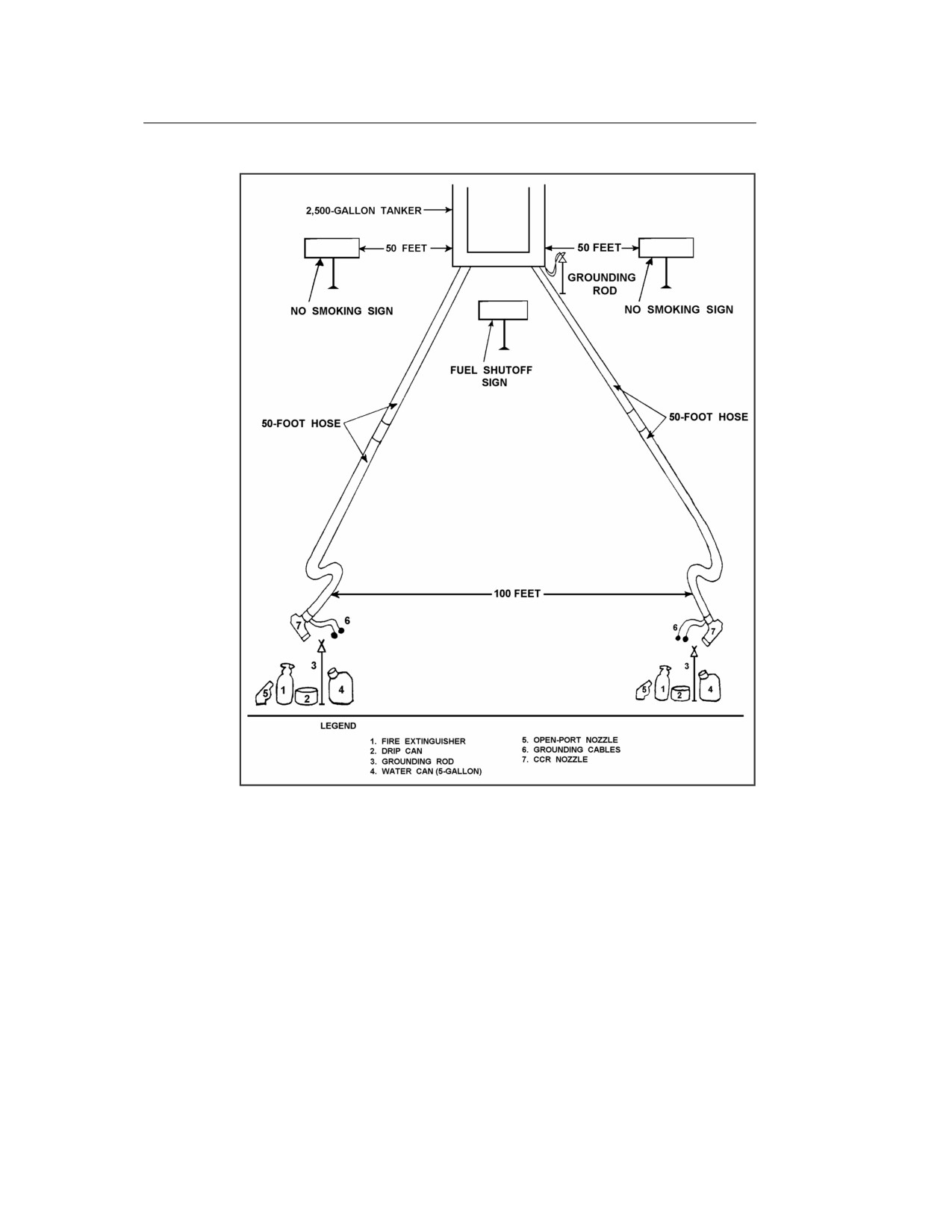
Appendix F
Figure F-13. HEMTT FARP Layout
F-144. The five-ton truck transports either ammunition or fuel. As a fuel
transport, it carries a TPU consisting of two 600-gallon fuel pods and refuel
equipment for two fuel points. The five-ton truck can tow one 1/2-ton trailer
for ammunition, a 600-gallon fuel pod, or a 500-gallon fuel drum.
HELICOPTERS
JUMP FORWARD ARMING AND REFUELING POINT
F-145. Two UH-60Ls can deliver an austere jump FARP to its new location.
One UH-60L can carry up to two 500-gallon collapsible fuel drums and part
of the FARP crew. The other UH-60 internally transports up to 15 Hellfire
missiles and can sling load the FARE or the AAFARS, which may mount to a
3/4-ton trailer. If the FARE or AAFARS is trailer mounted, additional Class
V transport is feasible if trailer sides are built up with wood to include a
F-31
FM 3-04.111 (FM1-111)
cover. In a second lift, the UH-60s can transport two more fuel drums and
additional mission ammunition. Aircraft can sling load three Hellfire pallets
at once for 27 total missiles.
ADVANCED AVIATION FORWARD AREA REFUELING SYSTEM
F-146. The AAFARS is a two-person portable system. Its components include
a 200-GPM diesel-engine pump, a standard element separator, lightweight
suction/discharge hoses, and dry break couplings. It can support up to four
refuel points. The AAFARS and CH-47 ERFS are shown in Figures F-14 and
F-15.
FAT COW
F-147. The CH-47’s ERFS, commonly known as Fat Cow, is a modular,
interconnectable system, composed of up to four 600-gallon noncrashworthy
tanks, four electrically operated fuel pumps, and a vent system. It mounts on
the left side of the aircraft cargo area; exact placement depends on aircraft
center-of-gravity limits. This system provides up to 2,320 gallons to refuel
other aircraft.
F-148. With the ERFS, space for cargo and passengers is extremely limited.
The aircraft can seat four people on each side. Figure F-16 shows the proper
placement for remaining required equipment to include the FARE. With a
MACOM waiver, units can transport additional FARP or security personnel,
as in Task Force Hawk, in which 18 infantrymen provided security.
F-149. After the aircraft lands, FARP personnel can set up two refueling
points quickly. Figure F-17 shows how the refueling points may be set up.
The actual setup depends on the equipment available.
F-150. Advantages of the ERFS are the following:
• The system is ready for refueling within minutes after landing; this
makes Fat Cow especially useful for operations in deep areas.
• The system displaces quickly; after refueling and packing equipment,
the CH-47 takes off, clearing the site within minutes.
• The ERFS may be pressure refueled (a maximum of 35 per square
inch and 150 GPM for faster turnaround missions.
F-151. Disadvantages of the ERFS are the following:
• The ERFS is airworthy when installed, operated, and maintained as
described in TM 55-1560-307-13&P; however, fuel can leak into the
cabin, potentially causing a catastrophic incident during a hard
landing or accident.
• Aircraft can carry only essential personnel; these personnel must be
seated, wearing a lap belt, unless a MACOM waiver is granted.
• CH-47 door guns provide limited protection; planning should consider
escort reconnaissance or attack elements.
• Additional hazards exist if CH-47 rotors turn during refueling.
• Depending on FARP location, the CH-47 may require ERFS fuel.
• CH-47 signature makes operations vulnerable to detection and attack.
F-32
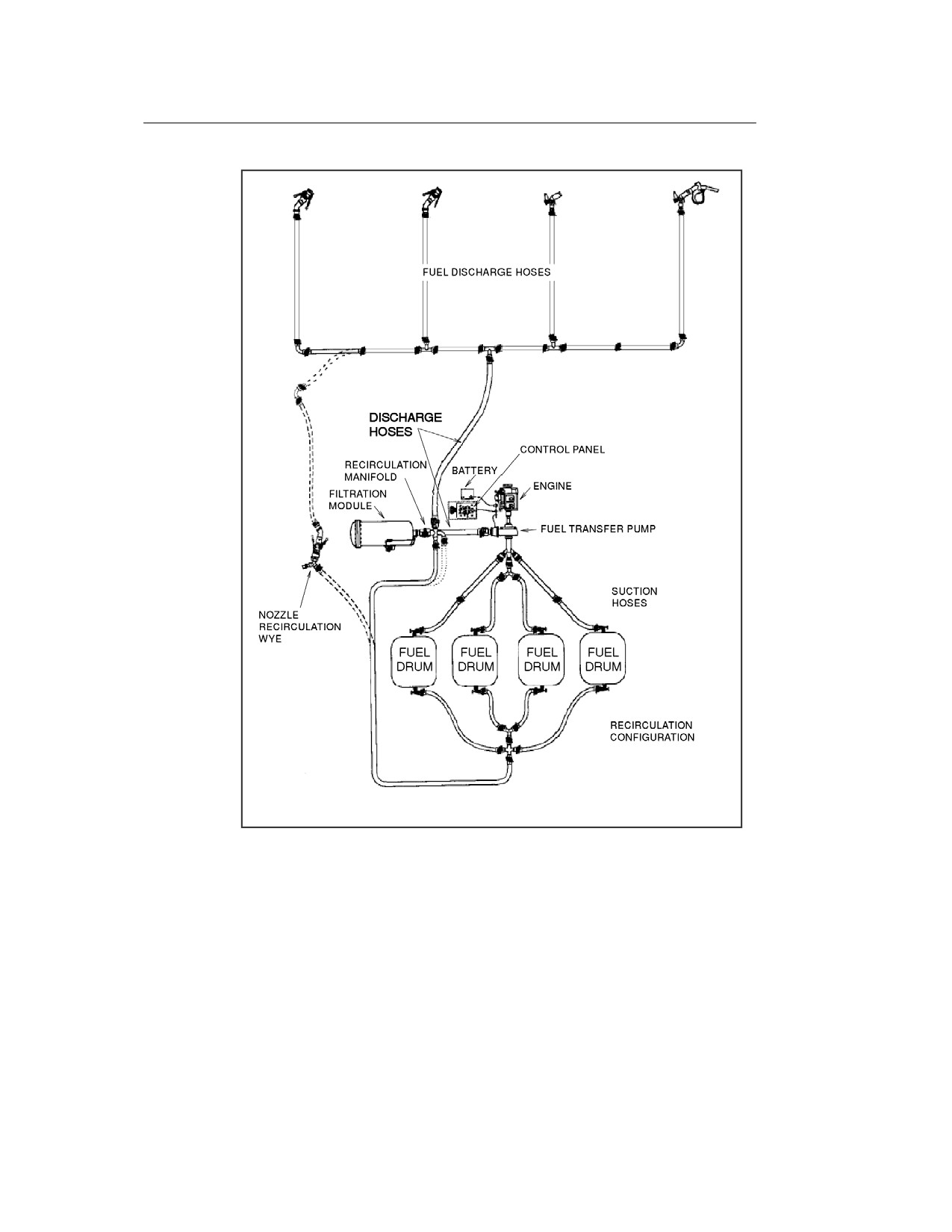
Appendix F
Figure F-14. AAFARS Layout Configuration
F-33