FM 3-04.111 (FM 1-111) Aviation Brigades (AUGUST 2003) - page 5
Chapter Five
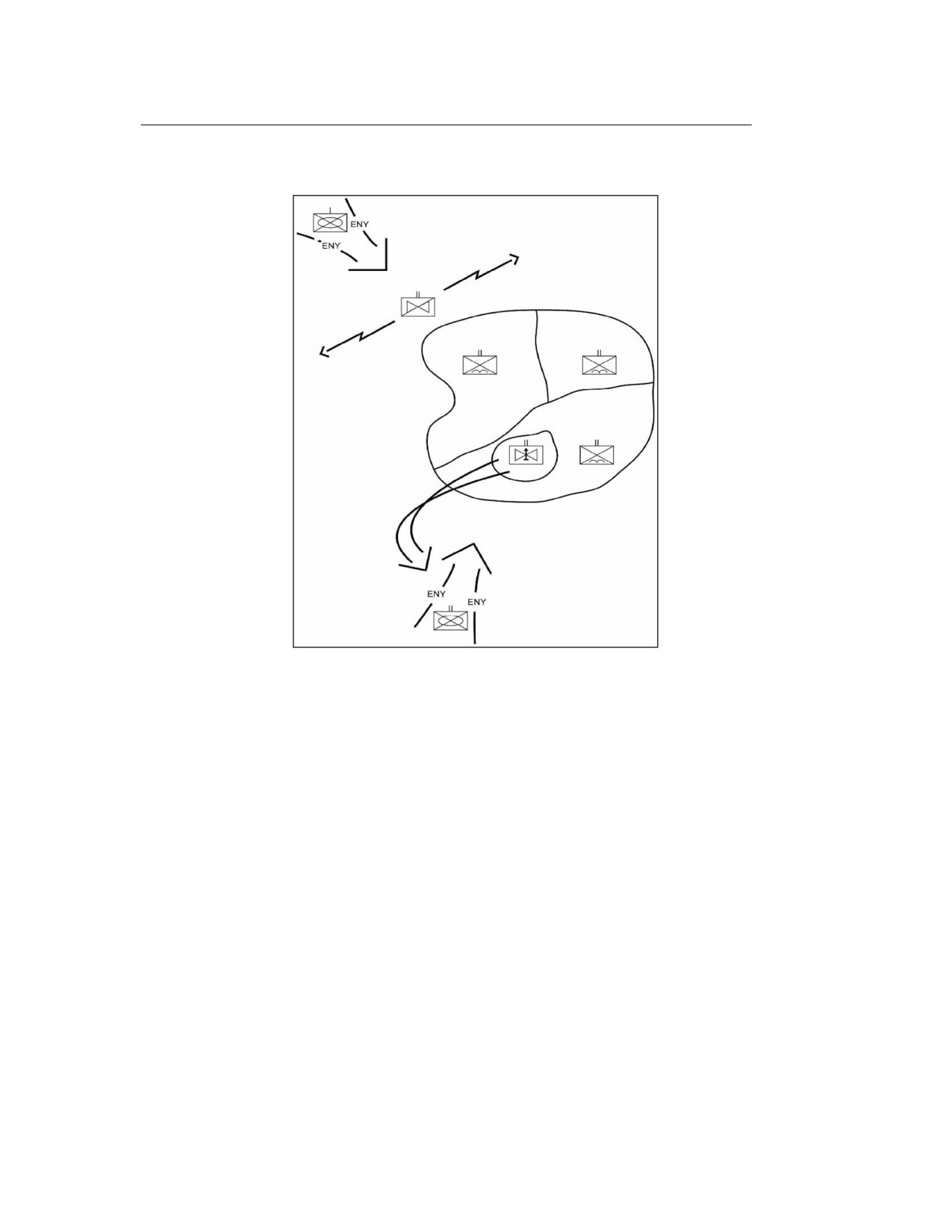
Figure 5-5. Airborne Division Forcible Entry/
Defense of Lodgment
5-141. ATKHBs may support or be OPCON to light maneuver brigades as
part of a guard or covering force. They may also operate in an overwatch and
support-by-fire capacity. Division and ground brigade commanders may
employ aircraft directly on top of or slightly behind ground maneuver forces
to maintain awareness of their location vis-à-vis friendly forces. When
employed in this manner, aviation forces are vulnerable to enemy artillery
attack and direct fires intended to target friendly forces and may reveal
ground force locations. The greater range of Hellfire missiles allows
overwatch and support-by-fire to occur without keeping attack helicopters
directly over ground forces. However, this can lead to confusion with respect
to target priorities.
5-142. Employment of attack aviation with ground forces requires
coordinated force-oriented control measures that allow aviation forces to fix
and weaken the enemy at extended ranges and then to reinforce ground unit
fires with missile, rocket, and .50 cal fires. This type of employment requires
constant practice and very close coordination.
5-143. The cavalry squadron operates under division control or aviation
brigade control. It may operate with the attack battalion as the division
guard. It may also screen a vulnerable flank of the division advance. It also
provides security before, during, and after air assaults. The cavalry squadron
5-25
FM 3-04.111 (FM 1-111)
may provide security at the airhead or port of entry during the deployment
and redeployment phase.
5-144. Attack and cavalry can conduct attacks against enemy artillery that
can devastate light infantry forces. They can also conduct limited overwatch
of bridges along key enemy avenues of approach, and obstacles and
minefields at key chokepoints in mountainous and densely forested, or
swampy terrain.
5-145. The AHB conducts air assaults to support seizure of key terrain or to
allow light forces to gain a maneuver advantage over enemy forces. It can
conduct a battalion-sized air assault without augmentation. For larger air
assaults, the division requires corps or other division augmentation.
Helicopters can transport troops to the objective or rapidly move them after
they infiltrate to it. They can also insert and extract reconnaissance teams
forward of the line of own troops. Aviation units may conduct false insertions
as part of the deception plan. Assault aircraft can drop forces atop ridgelines,
altitude and threat permitting, to allow them to fight down or along the
ridge. The assault battalion emplaces minefields using Volcano to reinforce
natural obstacles or to block chokepoints. It supports the division command
group, other brigades, the cavalry squadron, and the attack battalion with C2
helicopters.
5-146. In an urban environment helicopters can emplace forces on rooftops,
in parks, stadiums, parking areas, and other similar areas. The presence of
wires, poles, antennas, and other obstacles may limit some landing areas.
Attack battalion and cavalry aircraft cover landings by engaging targets
using running fire or from standoff ranges. Helicopters must minimize
ground time and hovering to avoid sniper, grenade and RPG engagement
when inserting or overwatching forces.
5-147. Brigade UH-60, attached UH-60/HH-60L air ambulances, and OH-
58D aircraft may provide assets for CSAR to recover downed joint and Army
aviators.
FIRE SUPPORT
5-148. Aviation brigades ensure JSEAD is planned and coordinated to
include nonlethal means. Utility aircraft externally transport
105 mm
howitzers and Q-36 Firefinder radars. They also transport forward observer
teams. Attack units may need to coordinate closely with artillery Firefinder
units to find and destroy enemy artillery and mortars that threaten light
infantry. OH-58D aircraft in the cavalry squadron and ATKHB are well-
equipped to support on-call fires and laser designate for joint laser-guided
munitions. They also have limited 2.75-inch rocket capability to suppress and
destroy maneuver forces and ADs. Guns can be effective if enemy AD sites
are unexpectedly encountered at close ranges.
5-26
Chapter Five
AIR DEFENSE
5-149. Brigade elements employ both active and passive AD measures.
Active measures include use of Stinger missiles, gun, Hellfire, and rocket
ammunition to conduct defensive air combat. Passive measures include
terrain flight, camouflage, and selection of locations that provide cover and
concealment for CPs, AAs, and FARPs. Air guards for vehicle movements and
road marches provide early warning. Convoy discipline, such as maintaining
proper distances between vehicles, limits damage from air attack. Elements
use IFF codes to avoid fratricide. A2C2 plans, procedures, and orders ensure
AD elements are aware of aircraft AAs and ingress and egress routes.
5-150. In SASO and SSC, an air threat may not exist; however, aircraft may
be required to trail drug smuggling aircraft before handoff to the DEA, Coast
Guard, or host nation air forces. These aircraft may perform evasive
maneuvers or fly at high speeds to avoid capture. Missions such as these
require additional training because they are not normally part of a unit's
METL.
MOBILITY/COUNTERMOBILITY/SURVIVABILITY
5-151. Division aviation brigade aircraft routinely support the mobility and
countermobility efforts of engineers in MTW, SSC and SASO. Road
improvements are major mobility efforts that can require helicopter support
to transport outsize loads such as metal pipes for culverts, bridge materiel,
and personnel. Volcano-equipped aircraft escorted by attack helicopters can
emplace minefields. Helicopters may also transport survivability materiel
such as concertina and sandbags to support security for base camps.
5-152. Division brigade aircraft also conduct air movement of MP reaction
forces and traffic control teams, as well as, movement of chemical
reconnaissance and decontamination teams. They also transport firefighters
and water bucket in support of domestic missions.
COMBAT SERVICE SUPPORT
5-153. OH-58D aircraft can conduct Wet Hawk and Fat Hawk refueling to
increase range or assault assets can air-emplace FARPs. The division can
paradrop 500-gallon drums, which could allow UH-60s to internally transport
ammunition and forward area refueling equipment (FARE) to permit lower
terrrain flight altitudes during deep air assaults. UH-60 aircraft can support
air movement and aerial resupply for airborne forces dropped deep or
conducting forward reconnaissance. Aircraft may also air transport supplies
from ships to lodgements ashore. Aircraft also evacuate casualties to ships in
some cases.
5-154. At the division level, AVIM support is provided by the DISCOM. Unit
OPTEMPO and frequency of displacements could make conducting phase
maintenance inspections at the unit AVUM level very difficult or impossible.
If unit displacements increase, passing these inspections to the DISCOM or
COSCOM, or out of theater, is prudent.
5-27
FM 3-04.111 (FM 1-111)
COMMAND AND CONTROL
5-155. The AHB provides airborne C2 support to the division, the aviation
brigade, the cavalry squadron, the attack battalion, and the DASB. The
aviation brigade allocates resources based on division priorities. A2C2S
aircraft, when fielded, will be well-equipped to provide commanders
communication, transportation, and access to intelligence and other BOS
information while in flight or on the ground.
SECTION VIII - ATTACK HELICOPTER BRIGADE (AIR ASSAULT DIVISION)
OVERVIEW
5-156. The air assault division attack helicopter brigade has three ATKHBs,
one air cavalry squadron, and one CAB. Its AH-64Ds differentiate it from
other light divisions that have OH-58Ds. It also has more attack battalions
than any other division.
5-157. The brigade prepares to deploy within 36 hours of notification.
5-158. It plans, synchronizes, and executes aerial fires as an element of an
air assault combined arms team. Its CAB supports the division C2 mission,
performs Volcano and team insertion missions, and provides an organic
source of FARP and other CSS aerial sustainment.
TASK ORGANIZATION CONSIDERATIONS
5-159. During operations in deep areas, the attack helicopter brigade may
receive a heavy helicopter slice from the division's air assault brigade to
support Fat Cow FARP operations beyond the capabilities of the CAB. Attack
units may be under the OPCON of an air assault task force that includes
ground forces. Attack battalions form habitual relationships with the ground
maneuver brigade they support. During deployments of a single ground
brigade, attack units often task-organize with utility and HvyHC to form a
supporting an aviation task force.
HOW TO FIGHT
5-160. The attack helicopter brigade's primary role is to set the conditions for
success for each of its units. The brigade must prepare to fight as a whole, to
support other units using pure or task-organized units, and to conduct
multiple independent missions requiring pure or task-organized units.
5-161. The attack helicopter brigade conducts division shaping or decisive
operations. It fights as a brigade or as a brigade (minus) with one or all of its
attack battalions operating to support the ground brigades. The air cavalry
squadron fights under brigade or division control, but normally under brigade
control. Its mine delivery capability found in the CAB supports brigade
operation, or operates in DS of a ground brigade. The attack helicopter
brigade is an excellent unit to support guard or covering force operations.
When task-organized with ground units, it can conduct both guard and cover
operations.
5-28
Chapter Five
• During initial entry, the attack helicopter brigade often fights as part of
a joint force. Additionally, they may conduct joint shaping operations as
a matter of necessity to defend the lodgement. These operation may be
conducted from Navy helicopter ships or aircraft carriers. These
operations may be under the command of Army or other service
headquarters.
• The attack helicopter brigade conducts shaping operations for the
ARFOR or division commander. These shaping operations are usually
directed and planned by a DOCC and supported by other services. The
brigade commander and staff routinely participate in DOCC planning
and execution. The combatant commander for the AO may or may not
require missions to appear on the ATO.
• The deep nature of attack brigade operations may require aircraft to fly
with auxiliary fuel tanks. Training to use these tanks and the resultant
reduction in munitions is essential. It must be part of the unit SOP.
Longbow-equipped attack regiments can employ RF missiles with
greater freedom and rapidity of launch because the deep nature of
many missions reduces fratricide risk.
• During the close battle, the attack regiment can OPCON one or more
battalions to one or more brigades while it plans and executes other
operations with its remaining attack battalions and air cavalry
squadron. It also provides air assault security for all air assault
operations with attack helicopter, air cavalry, mine delivery, and
airborne C2 support.
5-162. The CAB provides continuous C2 and mine delivery support to the
division. It also provides C2, mine delivery, and limited sustainment support
to the attack brigade.
INTELLIGENCE
5-163. The S2 prepares intelligence estimates and conducts the IPB process.
Regardless of the nature and intensity of conflict, this involves a time-tested
process. FM 2-01.3
(FM 34-130) contains appropriate checklists and an
aviation-specific section. IPB results are used to develop the products to
support collection management, identify potential enemy COAs, and support
the development of the commander's scheme of maneuver
(to include
branches and sequels).
5-164. Intelligence is provided from many sources; however, the major
intelligence source will be the division G2 section, attached MI assets, and
subordinate unit reports. The brigade S2 is the key intelligence coordinator.
5-165. The attack brigade's size, and early entry mission give it greater
access to JSTARS Ground Station Module and Common Ground Station as
well as other joint and theater intelligence support like Trojan Spirit II. The
CAB, unique to this brigade, has an additional mission of emplacing long
range surveillance team members. The cavalry squadron provides another
robust source of combat information for the brigade. UAVs support cavalry
operations by detecting enemy scouts and advance bodies. Cavalry then
destroy the enemy or maintain contact while UAVs continue to search. UAVs
also support air assaults and operations in deep areas, and must identify
threats en route and at the objective, while allowing brigade, division, and
5-29
FM 3-04.111 (FM 1-111)
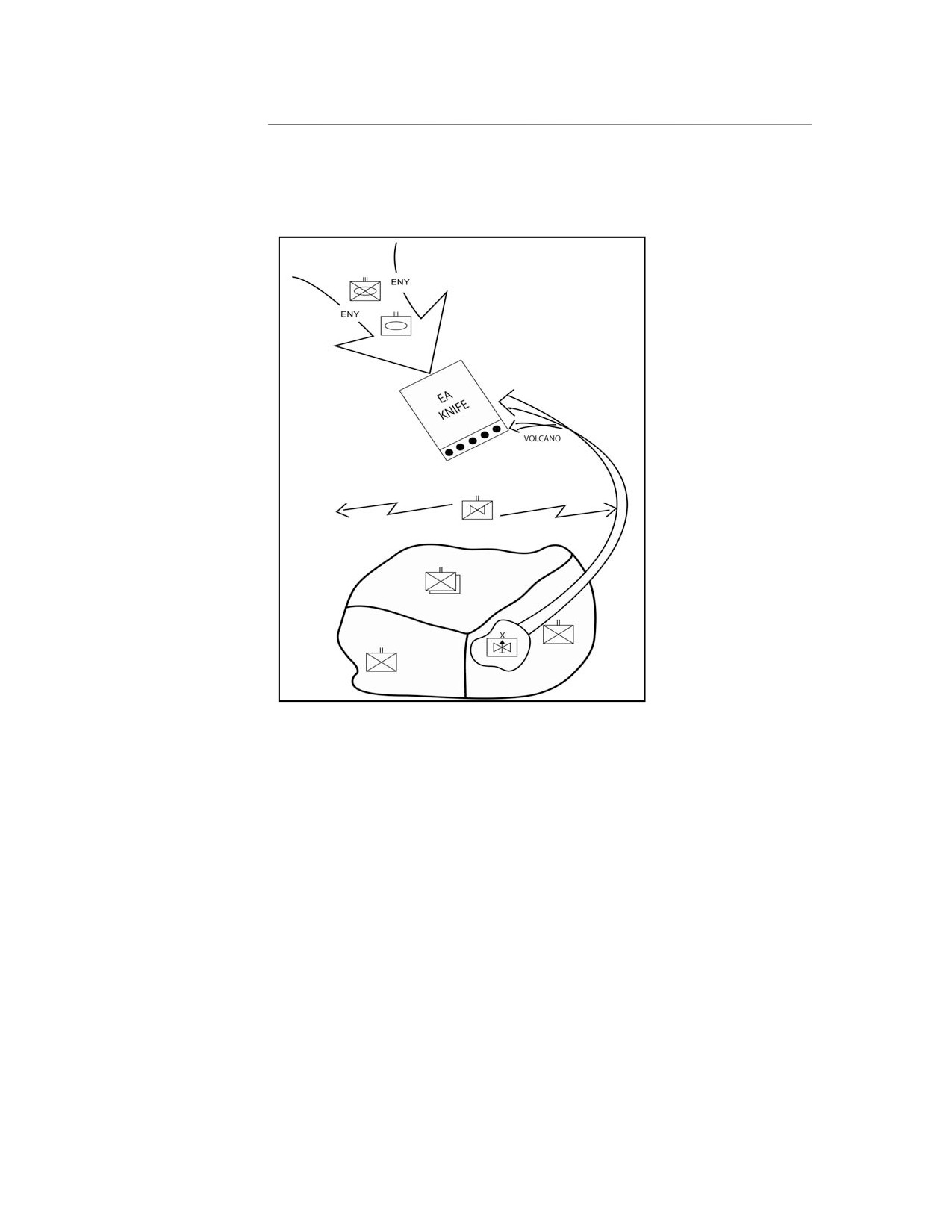
higher commanders/staffs to see the battlefield (Figure 5-6). The brigade's
aircrews are a great source of combat information.
Figure 5-6. Attack Brigade Conducting Deep Operations
From Forward Operating Base
5-166. The division may task the brigade with conducting intelligence liaison
with other elements to gather aviation-specific information. This could be as
simple as flying to the closest Air Force intelligence source, or as complicated
as placing LNOs with allied and joint forces.
MANEUVER
5-167. The air assault division's attack brigade is comparable in size to corps
attack regiments and has more attack aircraft than any other division. This
gives the division a formidable antiarmor capability during independent
attacks or to support air assaults. While assault battalions provide habitual
support to individual infantry brigades, the attack battalions may do the
same or may fight independently depending on the division commander's
priorities for shaping versus decisive operations.
5-168. When providing habitual support for ground air assault brigades, one
battalion supports each brigade with antiarmor and suppressive rocket and
30mm gun fires. Some attack battalion companies provide security during air
5-30
Chapter Five
assaults while others continue attacks on the objective area. The brigade can
accept augmentation from corps attack and utility/heavy helicopter units.
5-169. The brigade conducts independent shaping and decisive operations as
the division commander dictates. It conducts hasty, deliberate, and spoiling
attacks, and counterattacks. It also conducts raids, feints, and
demonstrations. The attack brigade, with ground and assault force
augmentation, conducts movement to contract, pursuit and exploitation.
During initial lodgement and as conditions dictate, the brigade conducts
mobile and area defense, but even in the defense, its actions are offensive.
5-170. Cavalry and attack elements provide initial security and
reconnaissance during initial entry/lodgement. Conduct route, area and zone
reconnaissance and reconnaissance-in-force. The brigade can act as division
guard when augmented with ground units. It conducts flank screens with its
attack or cavalry assets, and provides security for MSRs and rear areas.
5-171. Brigade UH-60, attached UH-60/HH-60L air ambulances, and OH-
58D aircraft may provide assets for CSAR to recover downed joint and Army
aviators.
FIRE SUPPORT
5-172. Aviation brigades ensure JSEAD is planned and coordinated to
include nonlethal means. Brigade aircraft can provide supporting rocket and
gun fires for ground forces, assault elements, and shaping operations.
Aircrews can initiate preplanned and on-call fires from supporting towed
howitzers and MLRS units. Cavalry aircraft in the brigade will habitually
employ FS as part of its security and reconnaissance mission. Longbow and
Kiowa Warrior aircraft are well-equipped to provide on-call FS for air assault
task forces. They also have organic 2.75-inch rockets to provide suppressive
and destructive fires. Finally, they can laser designate for joint laser-guided
bombs.
AIR DEFENSE
5-173. The brigade employs both active and passive AD measures. Active
measures include use of Stinger missiles, gun, Hellfire, and rocket
ammunition to conduct defensive air combat. Passive measures include
terrain flight, camouflage, and selection of locations that provide cover and
concealment for CPs, AAs, and FARPs. Air guards for vehicle movements and
road marches provide early warning. Convoy discipline, such as maintaining
proper distances between vehicles, limits damage from air attack. Elements
use IFF codes to avoid fratricide. A2C2 plans, procedures, and orders ensure
AD elements are aware of aircraft AAs and ingress and egress routes.
5-174. Corps attack units conducting operations in deep areas have a greater
likelihood of encountering enemy rotorcraft and fighters. AH-64D aircraft
with FCR can identify enemy rotorcraft and engage with RF and SAL
missiles, flechette rockets, and guns. JSTARS and AWACS may or may not
provide adequate early warning for joint assets to destroy enemy aircraft
before they engage friendly forces. During deep battle the risk of fratricide
increases from friendly joint assets conducting combat air patrols and from
friendly ADs during the return to friendly lines. IFF procedures are critical.
5-31
FM 3-04.111 (FM 1-111)
IFF systems may be turned off while in enemy territory to avoid emitting, but
leaving them on must be balanced with the fratricide risk from other service
and allied aircraft. IFF must be on before returning to friendly lines.
Brigades may designate and arm aircraft to provide defensive air combat
security for regimental deep strikes and conduct rear area defensive air
combat against infiltrating enemy rotorcraft.
5-175. In SASO and SSC, an air threat may not exist; however, aircraft may
be required to trail drug smuggling aircraft before handoff to the DEA, Coast
Guard, or host nation air forces. These aircraft may perform evasive
maneuvers or fly at high speeds in an attempt to avoid capture. Missions
such as these require additional training because they are not normally part
of a unit's METL.
MOBILITY/COUNTERMOBILITY/SURVIVABILITY
5-176. Aerial delivery of mines can support regimental operations in deep
areas. These operations may be conducted just before or simultaneous to the
regiment's attack. Aerial mining operations must be planned with the same
level of detail as an operation in a deep area to ensure the slow moving mine
delivery aircraft are not interdicted by enemy action.
COMBAT SERVICE SUPPORT
5-177. Aircraft can provide rear area support for CS and CCS units operating
in the rear area. Cavalry and attack aircraft can provide security for vehicles
travelling along MSRs. Brigade aircraft may require group aircraft FARP
emplacement and resupply support.
5-178. At the division level, AVIM support is provided by the DISCOM. Unit
OPTEMPO and frequency of displacements could make conducting phase
maintenance inspections at the unit AVUM level very difficult or impossible.
If unit displacements increase, passing these inspections to the DISCOM or
COSCOM, or out of theater, is prudent.
COMMAND AND CONTROL
5-179. During many missions, brigade attack battalions require C2 system-
equipped aircraft support to facilitate better comunications and intelligence
en route. The presence of the CAB in the brigade simplifies this support. The
A2C2S aircraft, when fielded, will greatly enhance attack operations by
providing en route access to JSTARS, UAV, and other intelligence support.
SECTION IX - AIR ASSAULT BRIGADE (AIR ASSAULT DIVISION)
OVERVIEW
5-180. This unique brigade has three assault battalions, and a HvyHB. The
TOE CAB is permanently attached to the division's attack helicopter brigade.
The brigade prepares to deploy within 36 hours of notification. It plans,
synchronizes and executes air assault, air sustainment, and air movement
operations as an integrated element of an air assault combined arms team.
5-32
Chapter Five
TASK ORGANIZATION CONSIDERATIONS
5-181. During air assaults, attack elements augment brigade assets as part
of a larger air assault brigade or battalion task force. The attack brigade may
receive OPCON of assault and heavy helicopter assets to support FARP
operations. An aviation task force combining utility, heavy helicopter, and
attack assets may form to support an air infantry brigade deployment.
Elements of a DCSA Bde may augment air assault brigade during large
deployments and rotations of forces. DCSA Bde augmentation is essential to
achieve doctrinal lift requirements.
HOW TO FIGHT
5-182. The air assault brigade is the primary integrator of utility and heavy
helicopter assets within the division. Its primary role is to set the conditions
for success for each of its units. The aviation brigade must prepare to fight as
a whole and to support individual ground brigades using pure or task-
organized battalion-sized units. It must prepare to conduct multiple
independent missions requiring pure or task-organized units. The brigade
provides habitual support for air assault infantry brigades for combat, CS,
and CSS missions.
• The brigade should be able to move the assault forces of a ground
brigade and its supporting artillery in one lift. However, emerging force
constraints may reduce that ability to two or three lifts.
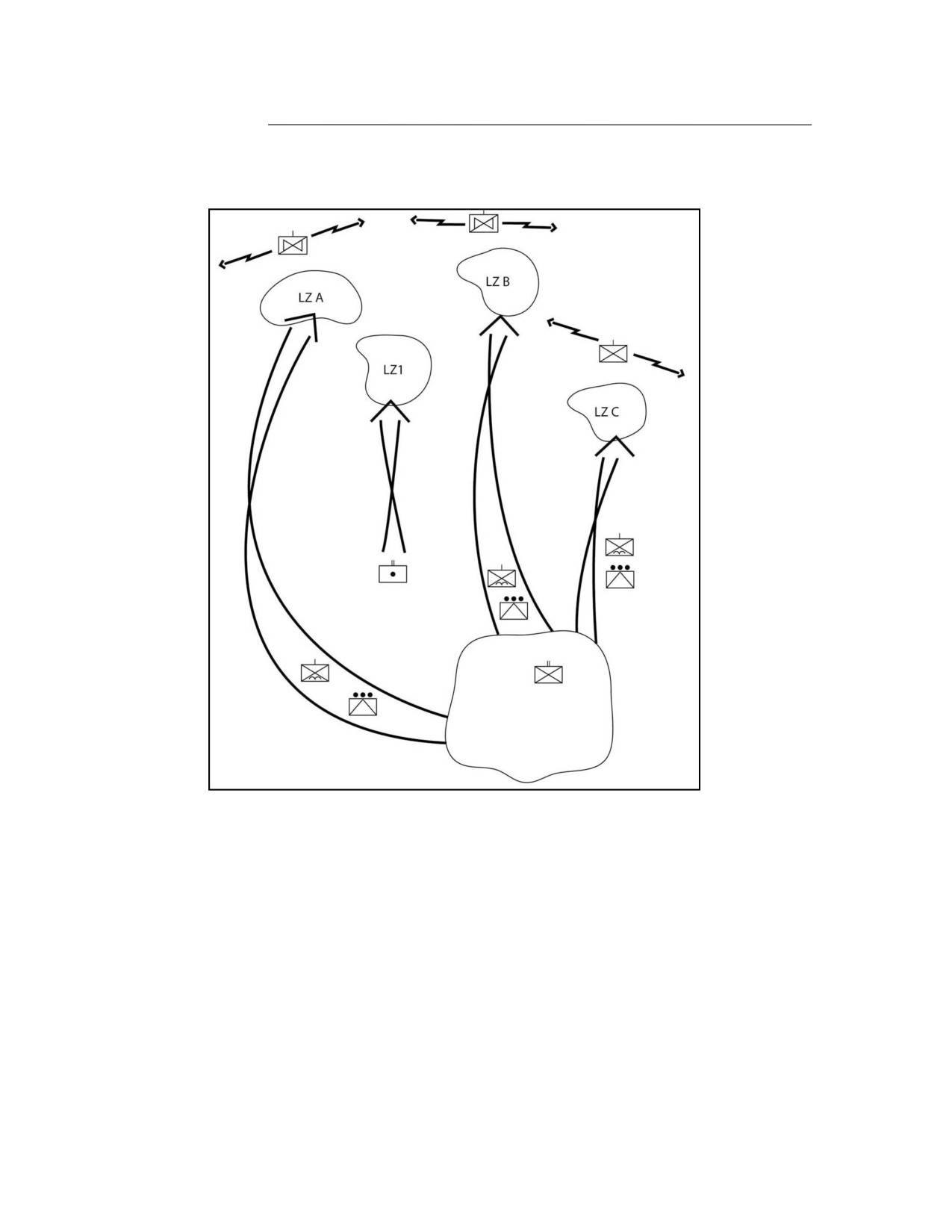
• It can form air assault task forces to support all three brigades and
enable each brigade to move the assault forces of a ground battalion
and an artillery battery in one lift.
• It should be able to form a heavy air assault task force to support one
brigade with the ability to move the assault forces of two ground
battalions and two artillery batteries in one lift. It should be able to
provide an air assault task force to support another brigade with the
ability to move the assault forces of a ground battalion and an artillery
battery in one lift. However, emerging force constraints may reduce
that ability to two or three lifts (Figure 5-7).
• The HvyHB can move large amounts of supplies, equipment, and
troops. It can do that as a battalion or as separate companies and
platoons. HvyHC normally support the ground brigades as part of an
air assault task force.
• The ATS company provides ATS throughout the division.
INTELLIGENCE
5-183. The S2 prepares intelligence estimates and conducts the IPB process.
Regardless of the nature and intensity of conflict, this involves a time-tested
process. FM 2-01.3
(FM 34-130) contains appropriate checklists and an
aviation-specific section. IPB results are used to develop the products to
support collection management, identify potential enemy COAs, and support
the development of the commander's scheme of maneuver
(to include
branches and sequels).
5-33
FM 3-04.111 (FM 1-111)
Figure 5-7. Battalion Air Assault In One Lift
5-184. Intelligence is provided from many sources. However, the major
intelligence source will be the division G2 section, attached MI assets, and
subordinate unit reports. The brigade S2 is the key intelligence coordinator.
5-185. The division may task the brigade with conducting intelligence liaison
with other elements to gather aviation-specific information. This could be as
simple as flying to the closest Air Force intelligence source, or as complicated
as placing LNOs with allied and joint forces.
5-186. Assault elements routinely insert and extract long range surveillance
detachment soldiers from the MI battalion. The division commander may
task-organize this mission and unit to the attack brigade. The brigade
requires detailed intelligence on threats en route during air assaults and
potential threats and terrain and weather considerations at the LZ. A similar
level of intelligence is necessary for false insertions, that may be part of an
air assault or a separate diversionary mission.
5-34
Chapter Five
5-187. The brigade may have access to a JSTARS common ground station
that can provide real-time intelligence access from a variety of sources. UAV
support for aviation missions is essential to identify threats without risking
manned aircraft. The brigade's aircrews are a great source of combat
information.
MANEUVER
5-188. The brigade's UH-60 and CH-47 aircraft are a primary means of
tactical transport for division soldiers. A typical deployment task force
includes an infantry brigade and a towed artillery battalion, an assault
battalion, an attack battalion, a CH-47 company, supporting engineers, and
CS/CSS units. This gives the brigade task force adequate capability to move
infantry forces and much of the supporting artillery in multiple lifts with UH-
60 seats removed and Kevlar blankets installed.
5-189. Such a brigade task force may perform forcible entry from ships or
intermediate staging bases in adjacent allied territory. It may conduct
assisted or unassisted entry as an airlifted force deployed to a lodgement
airfield. It subsequently defends the lodgement and conducts shaping air
assault and operations in deep areas as required to deter attacks on the
lodgement. As more forces deploy or if the brigade force is adequate to attack
the threat, the brigade task force may conduct a movement to contact,
deliberate and hasty attacks, and exploitation and pursuit.
5-190. Brigade aviation assault forces are well-suited to conduct mobile
strikes with infantry and supporting artillery to seize forward operating
bases from which attack aviation elements can conduct sustained operations
in deep areas. Assault elements can lift smaller infantry teams conducting
raids and ambushes to destroy limited objectives. They can conduct false and
brief insertions to deceive the enemy through feints and demonstrations.
5-191. To support SASO and SSC, the brigade deploys elements as part of
mutifunctional battalion task force that may tranport allied soldiers fighting
inurgency forces. Aircraft may operate out of remote base camps supporting
patrolling forces and reaction teams, as well as counterdrug efforts.
5-192. Brigade UH-60, attached UH-60/HH-60L air ambulances, and OH-
58D aircraft may provide assets for CSAR to recover downed joint and Army
aviators.
FIRE SUPPORT
5-193. Aviation brigades ensure JSEAD is planned and coordinated to
include nonlethal means. Utility aircraft transport forward observer teams.
Heavy helicopters transport towed 155mm howitzers and Q-36 Firefinder
radars. Many aircraft are available to resupply artillery units supporting the
ground and aviation brigades. AATFCs preplan JSEAD fires to support
ingress operations and preplan fires near the LZ and objective. Radio systems
aboard assault aircraft can be employed by FSEs to initiate on-call fires as
needed.
5-35
FM 3-04.111 (FM 1-111)
AIR DEFENSE
5-194. Brigade elements employ both active and passive AD measures. When
conducting air assaults and large air movements the brigade can expect to
have AH-64 units in support. Their active measures include use of Stinger
missiles, gun, Hellfire, and rocket ammunition to conduct defensive air
combat. Utility and heavy helicopters organic to the brigade lack self-defense
missiles and guns but their door guns provide limited AD capability. Utility
assets may internally transport Stinger teams and externally transport
Avenger systems. Passive measures include terrain flight, camouflage, and
selection of locations that provide cover and concealment for CPs, AAs, and
FARPs. Air guards for vehicle movements and road marches provide early
warning. Convoy discipline, such as maintaining proper distances between
vehicles, limits damage from air attack. Elements use IFF codes to avoid
fratricide. A2C2 plans, procedures, and orders ensure AD elements are aware
of aircraft AAs and ingress and egress routes.
5-195. In SASO and SSC, an air threat may not exist. However, aircraft may
be required to trail drug smuggling aircraft before handoff to the DEA, Coast
Guard, or host nation air forces. These aircraft may perform evasive
maneuvers or fly at high speeds to avoid capture. Missions such as these
require additional training because they are not normally part of a unit's
METL.
MOBILITY/COUNTERMOBILITY/SURVIVABILITY
5-196. Brigade aircraft routinely support the mobility and countermobility
efforts of engineers in MTW, SSC and SASO. Heavy helicopters can assist
river crossings by lifting ribbon bridge bays into place. Volcano-equipped
aircraft escorted by attack helicopters can emplace minefields. Helicopters
also may transport survivability materiel such as concertina wire and
sandbags to support security for base camps.
5-197. Division brigade aircraft also conduct air movement of MP reaction
forces and traffic control teams, as well as, movement of chemical
reconnaissance and decontamination teams. They also transport firefighters
and water bucket to support domestic missions.
COMBAT SERVICE SUPPORT
5-198. Brigade aircraft to provide CSS air movement and aerial sustainment
for the division are ample. However, an additional assault battalion and
GSAB from the NG DCSA Bde provide habitual augmentation support as
needed. CH-47D aircraft provide aircraft recovery and mass CASEVAC, as
well as external transport of heavier equipment. Both CH-47D and UH-60
aircraft support the extensive FARP requirements of the division.
5-199. At the division level, AVIM support is provided by the DISCOM. Unit
OPTEMPO and frequency of displacements could make conducting phase
maintenance inspections at the unit AVUM level very difficult or impossible.
If unit displacements increase, passing these inspections to the DISCOM or
COSCOM, or out of theater, is prudent.
5-36
Chapter Five
COMMAND AND CONTROL
5-200. The CAB that provides dedicated C2 support for the air assault
division is in the attack brigade. C2 system-equipped aircraft provide
communications support for division leaders. The A2C2S aircraft, when
available, provides additional communications capability and access to other
BOS C2 networks. CH-47 and UH-60 aircraft are also able to air transport
communications equipment, such as that supporting MSE nodes, to enhance
division communication.
SECTION X - THEATER AVIATION BRIGADE
OVERVIEW
5-201. The TAB is the primary aviation headquarters for Army aviation
operations conducted by its parent headquarters. The brigade has a CAB, a
fixed-wing battalion, a HvyHB, and an ATS Group.
TASK ORGANIZATION CONSIDERATIONS
5-202. Normally, even when dispersed to support other organizations,
aviation assets remain under TAB C2. Subordinate elements, however, may
operate under control of other aviation brigades, such as a corps aviation
brigade. Centralized control by the TAB ensures that brigade assets remain
focuses on the higher commander's priorities. In a large theater of war
additional fixed-wing assets could be added to include commercial airframes
appropriate for transport and en route C2 functions.
5-203. When any company from the TAB is sent to operate semi-
independently or independently, it must be augmented from its parent
battalion HHC at a minimum and may require support external to the
brigade. If more than one company is operating independently, support from
outside the brigade is essential.
5-204. If an entire fixed-wing company is required to operate separately,
augmentation from the battalion staff is essential for operations and logistics
planning. Augmentation from the HHC is essential for basic support
requirements such as fuel, mess, and HSS. Additionally, maintenance
support for Army fixed-wing units is accomplished by contract maintenance.
Contract maintenance support, by the terms of the contract, deploy to
support fixed-wing units for both peacetime and combat operations.
AIRFIELDS
5-205. The TAB normally operates its fixed-wing assets from airfields. These
airfields may be part of the host nation infrastructure, a captured enemy
airfield, another service's airfield, or one built by Army or other service
engineers. According to METT-TC, the other assets of the TAB may use
airfields.
5-37
FM 3-04.111 (FM 1-111)
HOW TO FIGHT
5-206. The TAB's primary role is to set the conditions for success for each of
its units. It accomplishes its mission through responsive C2 and logistics
support.
• TAB fixed-wing and C2 helicopter units assist EAC commander and
staff movement within the AO to coordinate and execute warfighting.
• Heavy and utility helicopter assets support critical EAC logistics and
CS.
• The TAB may provide C2 for aviation support operations such as air
assaults against rear area threats.
INTELLIGENCE
5-207. The S2 prepares intelligence estimates and conducts the IPB process.
Regardless of the nature and intensity of conflict, this involves a time-tested
process. FM 2-01.3
(FM 34-130) contains appropriate checklists and an
aviation-specific section. IPB results are used to develop the products to
support collection management, identify potential enemy COAs, and support
the development of the commander's scheme of maneuver
(to include
branches and sequels).
5-208. Many sources provide intelligence for the TAB; however, the major
sources for brigade intelligence will be the EAC intelligence section. For
operations into subordinate unit areas, the brigade S2 contacts the
intelligence sections of corps and division units to gain the latest information
for aircrews moving commanders and staff to and from EAC HQ to
subordinate unit locations.
MANEUVER
5-209. The TAB may C2 maneuver operations; however, this is not its normal
function. The brigade's primary contribution to maneuver is its support of
higher echelon C2 and logistics. One possible brigade maneuver operation
may be support to level III rear area threats. The brigade may either support
or control U.S. ground maneuver forces, allied forces, or MP units in the
reaction to such threats. In some theaters, no AC utility and heavy
helicopters may exist at corps level. In that case, TAB assets play the major
role in assault support until corps assets activate and deploy.
FIRE SUPPORT
5-210. Support for theater level or subordinate unit FS units is a mission for
the TAB. Such support normally includes transport of equipment and
ammunition. Examples include external transport of towed artillery, air
transport of key FS ammunition for the ATACMS and MLRS, and transport
of Q36 Firefinder radars.
AIR DEFENSE
5-211. Brigade elements employ both active and passive AD measures.
Active measures include use of door guns to conduct defensive air combat.
Passive measures include terrain flight, camouflage, and selection of
locations that provide cover and concealment for CPs, AAs, and FARPs. Air
5-38
Chapter Five
guards for vehicle movements and road marches provide early warning.
Convoy discipline, such as maintaining proper distances between vehicles,
limits damage from air attack. Elements use IFF codes to avoid fratricide.
A2C2 plans, procedures, and orders ensure AD elements are aware of aircraft
AAs and ingress and egress routes.
5-212. At theater level, Patriot missile systems have a primary missile
defense mission besides AD functions. Because of their high priority theater
heavy helicopters may support Patriot batteries by transporting missiles.
MOBILITY/COUNTERMOBILITY/SURVIVABILITY
5-213. TAB aircraft routinely support the mobility and countermobility
efforts of engineers in MTW, SSC and SASO. Road construction and
improvement are major mobility efforts that can require helicopter support to
transport outsize loads such as metal pipes for culverts, bridge materiel, and
personnel. Heavy helicopters can assist river crossings by lifting ribbon
bridge bays into place. Helicopters may also transport survivability materiel
such as concertina and sandbags to support security for base camps.
5-214. Theater brigade aircraft also conduct air movement of MP reaction
forces and traffic control teams, as well as, movement of chemical
reconnaissance and decontamination teams. They also transport firefighters
and water bucket to support domestic missions.
COMBAT SERVICE SUPPORT
5-215. The TAB may require Class III support from other forward units, and
also may require Class IX support. Prior coordination is essential for this
support. The TAB supports CSS air movement, aerial resupply, and
CASEVAC, particularly in theaters where corps utility and heavy helicopters
have not activated and deployed.
5-216. At the theater level, AVIM support is provided by the TSC. As theater
units do not displace as often as corps or division units, the TAB may desire
to have its battalions conduct most if not all of their own phase maintenance
inspections. However, if unit displacements increase, passing these
inspections to the TSC, or out of theater, is prudent.
COMMAND AND CONTROL
5-217. Communication is a major challenge for the TAB. Although improved
communications capabilities exist, the brigade will seldom maintain
continuous contact with its aircraft in flight. Old methods such as opening
and closing flight plans via telephone are tried and true methods of
maintaining positive control of unit aircraft.
5-218. For high priority missions supporting EAC commanders and staffs,
the necessary communications must be on board. Some missions require
flying backups to provide relay and ensure timely self-recovery in case of
mechanical problems to C2 aircraft.
5-219. TABs support their own C2 through the CP structure, and
employment of relays for LOS combat net radios. HF radios provide an
alternate NLOS communications means for longer distance missions and
5-39
FM 3-04.111 (FM 1-111)
NOE communications. SATCOM may be available to support both C2 aircraft
customers and the brigade's own C2 needs. C-12 aircraft may also support C2
for corps aviation units.
SECTION XI - DIVISION COMBAT SUPPORT AVIATION BRIGADE
OVERVIEW
5-220. The DCSA Bde is the primary headquarters for Army aviation
operations conducted by its division. The brigade normally includes GSABs,
AHBs, and a HvyHC.
5-221. The fielding of large numbers of UH-60s in the context of a smaller
number of active and RC divisions provides the opportunity to create a new
kind of aviation brigade to support war and military operations other than
war (MOOTW). There are two DCSA Bde equipped exclusively with UH-60
aircraft that provide peacetime C2, training and logistics support and
wartime/MOOTW habitual augmentation of active divisions. Each DCSA Bde
has multiple AHBs that support light, airborne, and air assault divisions and
GSAB that support heavy divisions, and the air assault division. Many of
these batttalions are currently equipped with UH-1H aircraft but will
transition to UH-60s.
TASK ORGANIZATION CONSIDERATIONS
5-222. During wartime deployment and SASO rotations, battalions from the
DCSA Bde can augment the division for which they provide habitual support.
Existing AVIM capability in each active division provides support. Each
DCSA Bde has a DASB for peactime maintenance support, and a slice
element during independent battalion deployments. Elements of the DCSA
Bde could be deployed as part of an aviation task force. They also have
important state disaster-relief missions that may involve task organization
with other units from that state.
HOW TO FIGHT
5-223. Unlike other aviation brigades, the DCSA Bde commander generally
will not fight the subordinate battalions in his command. The subordinate
battalions augment the assault and GS capabilities of the respective divisions
they support. As such they generally operate under the division aviation
brigade commander during major deployments, and whatever task force
commander is in charge during more minor rotation of forces. The same
assault and GS missions performed by division utility battalions also apply to
the DCSA Bde.
INTELLIGENCE
5-224. The S2 prepares intelligence estimates and conducts the IPB process.
Regardless of the nature and intensity of conflict, this involves a time-tested
process. FM 2-01.3
(FM 34-130) contains appropriate checklists and an
aviation-specific section. IPB results are used to develop the products to
support collection management, identify potential enemy COAs, and support
5-40
Chapter Five
the development of the commander's scheme of maneuver
(to include
branches and sequels).
5-225. Battalions of the DCSA Bde receive intelligence support from the
parent division and division aviation brigade. Assault elements may insert
and extract long range surveillance detachment soldiers from the MI
battalion. The brigade requires detailed intelligence of threats en route
during air assaults and potential threats and terrain/weather considerations
at the LZ. A similar level of intelligence is necessary for false insertions, that
may be part of an air assault or a separate diversionary mission.
MANEUVER
5-226. With downsizing of division utility units, DCSA Bde UH-60s will play
an increasing role in air assaults, TACAIR movement, and aerial
sustainment. Extended range fuel tanks give UH-60s extensive range and
endurance for mobile strikes. Light, and airborne divisions are particularly
dependent on DCSA Bde aircraft for larger scale air maneuver of forces.
DCSA Bde GS battalions augment heavy divisions conducting air assaults
with dismounted mechanized infantry to secure the far side during gap-
crossing efforts. Air assault of dismounted infantry may also occur to seize
chokepoints before the arrival of mechanized and armor forces. DCSA Bde
aircraft are also available to insert and extract infantry patrols and SOF
during raids and reconnaissance missions.
5-227. In SASO, DCSA Bde units can expect to transport U.S. and allied
soldiers who may be fighting guerillas. Guerillas may fire small arms, and
RPGs at group aircraft. In SASO and SSC, units may perform a
reconnaissance function or carry civilian or military observers. Urban
operations may be a primary activity requiring group aircraft to exercise
caution from both an enemy sniper and safety perspective given the presence
on noncombatants, wires, and antennas (see Appendix R).
FIRE SUPPORT
5-228. Utility aircraft transport forward observer teams. Aircraft can
externally transport towed 105mm howitzers and resupply artillery units
supporting the ground and aviation brigades. AATFCs preplan JSEAD fires
to support ingress operations, and preplan fires near the LZ and objective.
FSEs aboard assault aircraft can employ aircraft radios to initiate on-call
fires as needed. Aircraft can transport infantry mortar teams and Q-36
Firefinder radars.
AIR DEFENSE
5-229. UH-60 units transport Stinger teams and Avenger systems. During
air assaults, DCSA Bde battalions require attack or reconnaissance unit
security against air attack. Passive measures include terrain flight,
camouflage, and selection of locations that provide cover and concealment for
CPs, AAs, and FARPs. Air guards for vehicle movements and road marches
provide early warning. Convoy discipline, such as maintaining proper
distances between vehicles, limits damage from air attack. Elements use IFF
codes to avoid fratricide. A2C2 plans, procedures, and orders ensure AD
elements are aware of aircraft AAs and ingress and egress routes.
5-41
FM 3-04.111 (FM 1-111)
5-230. In SASO and SSC an air threat may not exist. However, units
involved in drug interdiction may trail drug smuggling aircraft before handoff
to DEA, Coast Guard, or host nation air forces. These aircraft may perform
evasive maneuvers or fly at high speed attempting to avoid capture.
MOBILITY/COUNTERMOBILITY/SURVIVABILITY
5-231. UH-60 aircraft support engineer, MP, and chemical soldiers in their
mobility, countermobility and survivability efforts. Aircraft transport
engineers teams and their equipment during road and obstacle construction.
Utility aircraft can assist engineers in river crossing by lifting security
elements to the far side. Utility aircraft transport MPs performing rear area,
peacekeeping, and mobility missions. Aircraft may transport enemy
prisoners. Chemical teams may require air movement to areas where
suspected chemical attacks have occurred, such as areas hit by tactical
ballistic and cruise missiles.
COMBAT SERVICE SUPPORT
5-232. DCSA Bde utility battalions provide critical aerial sustainment
capability to supported divisions. External and internal transport capabilites
vary dependent on whether battalions have UH-1H, UH-60A, or UH-60L
aircraft. All are capable of effective air movement and aerial resupply in a
variety of environments. The GSAB tends to transport critical supplies in the
heavy divisions it supports. The assault battalions carry a larger variety of
bulk supplies and may be primary means of resupplying many light forces
deployed well forward or deep in terrain lacking roads. During SASO and
disaster relief, aircraft can expect to provide aerial sustainment for both
military forces and civilians.
COMMAND AND CONTROL
5-233. The DCSA Bde GSABs have two GS companies with eight UH-60
aircraft each and can support movement of key division leaders and
communications personnel and equipment. The DCSA Bde assault battalions
may require airborne C2 support during air assaults for the task force
commander's CP aircraft. UH-1H and UH-60 C2 aircraft offer enhanced
airborne communications for all key leaders supported. The DCSA Bde
brigade headquarters has a challenging C2 mission, itself, given the dispersed
nature of brigade assets in the NG. DCSA Bde aircraft can expect to
transport military and civilian leaders during SASO missions and domestic
disaster relief.
SECTION XII - ARMY SPECIAL OPERATIONS AVIATION REGIMENT
5-234. FM 3-05.60 (FM 1-108) addresses employment of the ARSOAR .
5-42
Chapter 6
Other Tactical Operations
SECTION I - PASSAGE OF LINES AND BATTLE HANDOVER
PASSAGE OF LINES
6-1. A passage of lines is an operation in which one force moves through
another force's position, without interference, with the intent of moving into
or out of contact with the enemy. Aviation units can conduct a passage as a
part of reconnaissance, security, attack, or air assault operations. There are
occasions when other units pass through an aviation unit's position. Also, the
aviation unit may facilitate another unit's movement by monitoring its
progress through PPs and contact points.
• Forward Passage. Executed during offensive operations to continue an
attack; to conduct a penetration, envelopment, or a pursuit; or to pass
another unit for any reason. In the defense, a forward passage of lines
may be conducted as part of a counterattack of one unit through
another.
• Lateral Passage. Conducted in the same manner as a forward passage.
• Rearward Passage. Conducted as part of a retrograde operation or
when an aviation or ground unit returns from a cross-FLOT mission.
CONSIDERATIONS
6-2. When the aviation unit is the passing force, it is particularly vulnerable
because aircraft may be overly concentrated, stationary force fires may be
temporarily masked, and the unit passed through may not be positioned to
react to enemy actions. Reconnaissance and coordination ensure passage is
conducted quickly and smoothly.
6-3. Contact points for ground elements should be located along the
designated passage phase line to allow the passed unit to provide
overwatching fires. Contact points normally should be at easily identifiable
terrain features, such as road junctions. For terrain without many
identifiable terrain features, GPS coordinates are an excellent backup.
6-4. Other considerations include—
• Security measures during passage.
• Tactical cover and deception plans to retain secrecy and aid in gaining
or maintaining surprise.
• Priorities for movement control (priority to passing unit).
• Time or circumstances when responsibility for control of the AO will be
transferred.
6-1
FM 3-04.111 (FM 1-111)
• Command relationship between passing and passed units concerning
CS and CSS.
6-5. Graphic control measures should include—
• Battle handover line (BHL).
• Contact points.
• PPs.
• Passage lanes.
• Passage routes.
• RP.
• AA.
• Infiltration points.
COORDINATION
6-6. Timely and specific coordination before the operation is essential. The
most desirable method is a face-to-face exchange of information. As a
minimum, the exchange should include—
• Intelligence information.
• Tactical plans.
• SOPs.
• Period of time required for the passage.
• Locations of PPs and friendly unit locations.
• Disposition and scheme of maneuver of friendly units.
• Enemy situation in sector, including air activity.
• Types and numbers of aircraft to pass.
• Methods of communication, to include frequencies and call signs, visual
signals, and backups.
• Control of friendly supporting fires, including restrictive FS
coordination.
• AD weapon control status.
• Friendly minefields and obstacles.
• Contingency plans for stationary and passing units, if they are attacked
during passage.
PASSAGE PLANNING
6-7. The aviation commander analyzes the higher commander's intent and
provides guidance for the S3 to prepare the plan for the passage of lines. The
following factors are emphasized:
• Organization. When possible, unit integrity is maintained to provide
better C2.
• C2. Techniques of C2 depend on the number of PPs. Ideally, multiple
PPs are established to facilitate decentralized control. Control
measures are developed as required to maintain positive control
throughout the passage. Commanders position themselves where they
can best influence the operation.
6-2
Chapter Six
• Order of Movement. Order of movement is prescribed based on the
number of PPs and degree of security required. The enemy situation
and the terrain also influence the order of movement and the priorities
for who moves when.
• Actions on Contact. Contingency plans are developed for both the
passing unit and stationary unit for actions required if the enemy
attacks during the passage.
Aviation Support of Ground Unit Passage of Lines
6-8. When one ground unit is conducting a passage of lines through another
ground unit, air cavalry or attack units may support by conducting a
reconnaissance of the PPs, initiating and maintaining liaison, or conducting
screening or overwatch operations. Air cavalry and attack assets can help
prepare for a forward passage of lines by reconnaissance of routes to,
through, and beyond the area of passage. They also may reconnoiter existing
unit locations and proposed positions. Care must be taken not to compromise
unit locations and intentions. Air cavalry or attack assets may also assist in a
passage of lines by screening between the enemy and the passing force to
provide early warning and overwatching fires.
BATTLE HANDOVER
6-9. A battle handover (BHO) is a coordinated operation between two units
that transfers responsibility for fighting an enemy force from one element to
another. The BHO maintains continuity of the combined arms fight and
protect the combat potential of both forces. Ground BHOs, such as cavalry
passing back through friendly lines, usually are associated with a passage of
lines. BHO may occur during offensive or defensive operations.
BATTLE HANDOVER LINE
6-10. A BHL is the location where the passing force (forward passage of
lines) or stationary force (rearward passage of lines) assumes control of the
battle. The common commander specifies where the handover occurs and
defines the resulting responsibility for the zone or sector. For rearward
passage, the BHL must enable the stationary force to engage the enemy with
direct fire systems.
PLANNING CONSIDERATIONS
6-11. Clear SOPs enable units to quickly effect the coordination required to
preclude loss of momentum in the attack. Control measures should be simple
and standardized. As a minimum, coordination should include—
• Establishment of communications.
• Exchange of friendly and enemy information.
• Collation of C2.
• Placement of representatives at contact points.
• Status of obstacles and routes.
6-12. In air-ground operations, participating air and ground commanders
often handover an enemy force in contact. BHO governs this process in terms
of close coordination, FS, and mutual understanding of responsibilities.
6-3
FM 3-04.111 (FM 1-111)
6-13. Whenever the situation permits, face-to-face, air-to-ground, and air-to-
air linkups between the units should be made. There is significant benefit to
landing next to the relieving counterpart and showing that person, on a map,
the battlefield situation.
BREAKING CONTACT WITH THE ENEMY
6-14. Technology advances can enable immediate and accurate electronic
handovers; however, not all aircraft have the required equipment. Of those
that do, mechanical failures or other limitations may reduce their
effectiveness. Units ensure proper handover before breaking contact.
6-15. Units in radio contact with the ground force or aviation unit
headquarters maintain contact until a positive handover to other friendly air
or ground units is made. Positive handover means that the relieving unit can
see the targets. Units not in radio contact with the ground force or aviation
unit headquarters have an aircraft temporarily break station to report the
sighting.
SECTION II - AIR COMBAT OPERATIONS
6-16. Deliberate and chance encounters with enemy aircraft may occur
throughout the AO.
PLANNING CONSIDERATIONS
6-17. Generally, air combat between Army helicopters and enemy rotary- or
fixed-wing aircraft is not desired. Although the aviation brigade staff sets the
battle space to minimize the probability of undesired aerial encounters,
commanders must anticipate the possibility of chance air combat operations
and plan accordingly. Priority remains to the assigned mission.
AVOID DETECTION
6-18. During the MDMP, the staff plans the operation to minimize the
enemy's ability to detect Army aircraft. Missions are planned to avoid known
and suspected enemy locations, if feasible. Appropriate maneuver, terrain
masking, cloud cover, obscurants, night operations, and FS are used to
degrade enemy detection capabilities. The tactical operations officer, with the
S2 and S3, recommends ASE settings to thwart the capabilities of known and
suspected threat detection systems.
PROVIDE EARLY WARNING
6-19. The staff coordinates with various intelligence elements, AD units,
UAV units, and AWACS to provide early warning of enemy aircraft that
could affect the operation. Appropriate ASE settings, the OH-58D thermal
imaging system (TIS), and the AH-64D LBA's FCR can help see the enemy
first.
PROVIDE FOR SUPPORT
6-20. The staff coordinates for rapid fighter support. This support protects
Army aircraft if they come under air attack.
6-4
Chapter Six
COORDINATING INSTRUCTIONS
6-21. The brigade OPORD should contain the commander's instructions
regarding subordinate unit action upon contact with enemy aircraft, if his
desires or priorities during the operation vary from actions specified in the
SOP. Actions available to aircrews, in order of preference, are to avoid, evade,
threaten, or engage threat aircraft.
ARMY AIRCRAFT WEAPONS CAPABILITIES IN AIR COMBAT
6-22. Army aircraft weapons systems were not designed for air combat;
however, they have varying degrees of effectiveness in that role. The staff
takes these capabilities into account during the MDMP. Appendix I provides
additional information on aircraft weapons systems.
AIR-TO-AIR STINGER
6-23. Depending on the armament configuration for a particular mission,
this system may be mounted on some or all OH-58Ds. Air-to-air Stinger
(ATAS) on some or all AH-64Ds is a potential future capability. The ATAS
should be used at or near maximum range. Although the ATAS may be used
in short-range firings (under 1,000 meters), the minimum arming range may
affect its lethality. In extended-range firing, the ATAS has a detectable
smoke signature under certain atmospheric conditions.
CANNON (30 MILLIMETER)
6-24. This system is standard on the AH-64A and AH-64D. The projectile's
excellent accuracy, range, penetration, and explosive properties make it
effective against close-range targets. However, its slow rate of fire may make
aerial engagement difficult.
MACHINE GUN (7.62 MILLIMETER)
6-25. Depending on the armament configuration for a particular mission,
7.62 machine guns may be mounted on some or all UH-60s or CH-47s. This
weapon may not be effective against armored areas of enemy aircraft, but it
can cause significant damage to unprotected areas. It should be used only as
a means to break contact or for self-defense at close ranges.
MACHINE GUN (.50 CALIBER)
6-26. Depending on the armament configuration for a particular mission,
this system may be mounted on some or all OH-58Ds. This weapon may be
only marginally effective against armored areas of enemy aircraft, but it will
cause significant damage to unprotected areas. Because this weapon lacks a
flexible firing mode, aircrews must orient their aircraft directly at the target
to engage it. It should be used only as a means to break contact or for self-
defense at close ranges.
FOLDING FIN AERIAL ROCKET (2.75-INCH)
6-27. Depending on the armament configuration for a particular mission,
this system may be mounted on some or all OH-58Ds, AH-64As, or AH-64Ds.
The multipurpose submunition round can be a good weapon for placing
6-5
FM 3-04.111 (FM 1-111)
effective fires on enemy helicopter formations, for breaking contact, or for
firing on helicopters in LZs. Flechette rounds may be the optimal rocket
munitions for air combat.
HELLFIRE MISSILE
6-28. Depending on the armament configuration for a particular mission, the
SAL Hellfire may be mounted on some or all OH-58D, AH-64A, or AH-64D
aircraft. Only the AH-64D has the necessary systems to employ the RF
Hellfire
(see Appendix I). The Hellfire is an effective weapon against
attacking enemy aircraft. It can be used in either the direct or indirect fire
mode. Ideally, aircrews should engage with Hellfire using indirect fire if
terrain masking protects the firing aircraft. In the direct fire mode it can be
used against head-on, tail-on, or slow-flying enemy helicopters.
SECTION III - DECEPTION OPERATIONS
6-29. Deception operations most commonly performed by aviation units are
the feint and the demonstration. Deception operations are almost always
conducted as part of a larger operation.
FEINT
6-30. A feint is a limited attack to divert an enemy's attack or to deceive him
as to the friendly force's intentions. Feints are frequently used for deception
before or during a main attack. To succeed, this feint must appear to be the
main attack. Additional feints are conducted to cause the enemy to reveal its
defensive posture and to disrupt its decision-making cycle. Feints reduce the
resistance that the main attacking force will encounter by holding enemy
units in the area of the feint.
6-31. Aviation brigade elements normally conduct reconnaissance and
security operations to support ground feints. Aviation can also conduct feints
independently. Assault units can assist in feint operations by executing false
or actual air assault operations.
DEMONSTRATION
6-32. A demonstration serves the same purpose as a feint, but does not
involve contact with the enemy. The objective of a demonstration is to deceive
and confuse the enemy as to the real intentions of the attacking force. For a
demonstration to succeed, the enemy must observe the demonstrating force's
operation and be deceived by it, but not actively engage the force. The nature
of a demonstration allows the use of decoys, simulations, and tactically
inoperable equipment to portray additional strength. Demonstrations also
may be used to provide security or to conduct reconnaissance to assess the
enemy reaction.
6-33. Aviation brigade elements normally conduct reconnaissance and
security operations to support a ground demonstration. Aviation can also
conduct demonstrations independently. Assault units may execute false air
assault operations.
6-6
Chapter Six
SECTION IV - SEARCH AND ATTACK OPERATIONS
6-34. The search and attack mission is a variant of the movement to contact
by smaller, light maneuver units and air cavalry or air assault forces in large
areas to destroy enemy forces, or deny area to the enemy. Search and attack
operations may be conducted against a dispersed enemy in close terrain
unsuitable for armored forces, in rear areas against enemy SOF or
infiltrators, or as an area security mission to clear assigned zones.
6-35. The search and attack technique is best used when the enemy is
operating in small teams using hit-and-run tactics over a large area in a
generally decentralized manner. The purpose of this operation is defined as
one or more of the following:
• Destruction of the enemy.
• Area denial.
• Force protection.
AVIATION'S ROLE
6-36. From an aviation perspective, the search and attack mission is
performed like a movement to contact or a force-oriented area security
mission.
ELEMENTS OF SEARCH AND ATTACK
6-37. The major elements of the search and attack are to find, fix, and finish
the enemy.
FIND THE ENEMY
6-38. Aviation finds the enemy by performing a movement to contact or a
force-oriented area security mission. The reconnaissance is specifically
focused on the enemy force location and composition, not on destruction.
Stealth by the reconnaissance force is of great importance. If the
reconnaissance force can locate the enemy without being detected, it allows
the commander time to develop the situation with the fixing and the finishing
elements.
FIX THE ENEMY
6-39. Aviation fixes the enemy by performing attack-by-fire or hasty attack
operations. If aviation is the fixing unit, consideration must be given to
augmentation with engineers, ground cavalry, or light infantry unless the
requirement is to fix by fires. The most common tactic for fixing is to block an
enemy element from moving along its most likely avenue of departure. This
can be accomplished by mounted or dismounted elements, aviation forces,
mines, or obstacles covered by fire. The key is to ensure the fixing unit has
sufficient combat power and can react to the enemy in unanticipated
locations.
FINISH THE ENEMY
6-7
FM 3-04.111 (FM 1-111)
6-40. Any maneuver force with the combat power to destroy the designated
enemy force may accomplish the finishing portion. Aviation finishes the
enemy by massing fires in a hasty or deliberate attack, either independently
or with ground forces. The key to success for this part of the mission is to
bring the finishing force's combat power to bear at the key time when the
fixing force has halted the enemy's movement.
COMMAND AND CONTROL
6-41. The search and attack mission should not be assigned lower than the
battalion level because subordinate headquarters lack adequate assets to C2
the different aspects of this mission. The controlling headquarters must
clearly define the operational roles of subordinate troops, companies, and
attached forces, including bypass and engagement instructions.
COORDINATION
6-42. Effective search and attack operations require a great deal of
coordination between the subordinate elements. SA is extremely important
because of the fluid environment in which this mission is conducted.
Subordinate commanders must keep abreast of current activities and the
locations of other air and ground elements to ensure they have their units in
the proper location and mission posture to deal with enemy contact.
GRAPHIC CONTROL MEASURES
6-43. The controlling headquarters provides graphic control measures that
are sufficient to enable close coordination between subordinate units. The
ground maneuver headquarters boundaries, not its search areas, should
define the zone for aviation operations. Conducting an area or zone
reconnaissance for each of the ground force's smaller search areas restricts
aircraft capabilities and increases the likelihood of aircrews missing the
seams between each area.
SECTION V - RAIDS
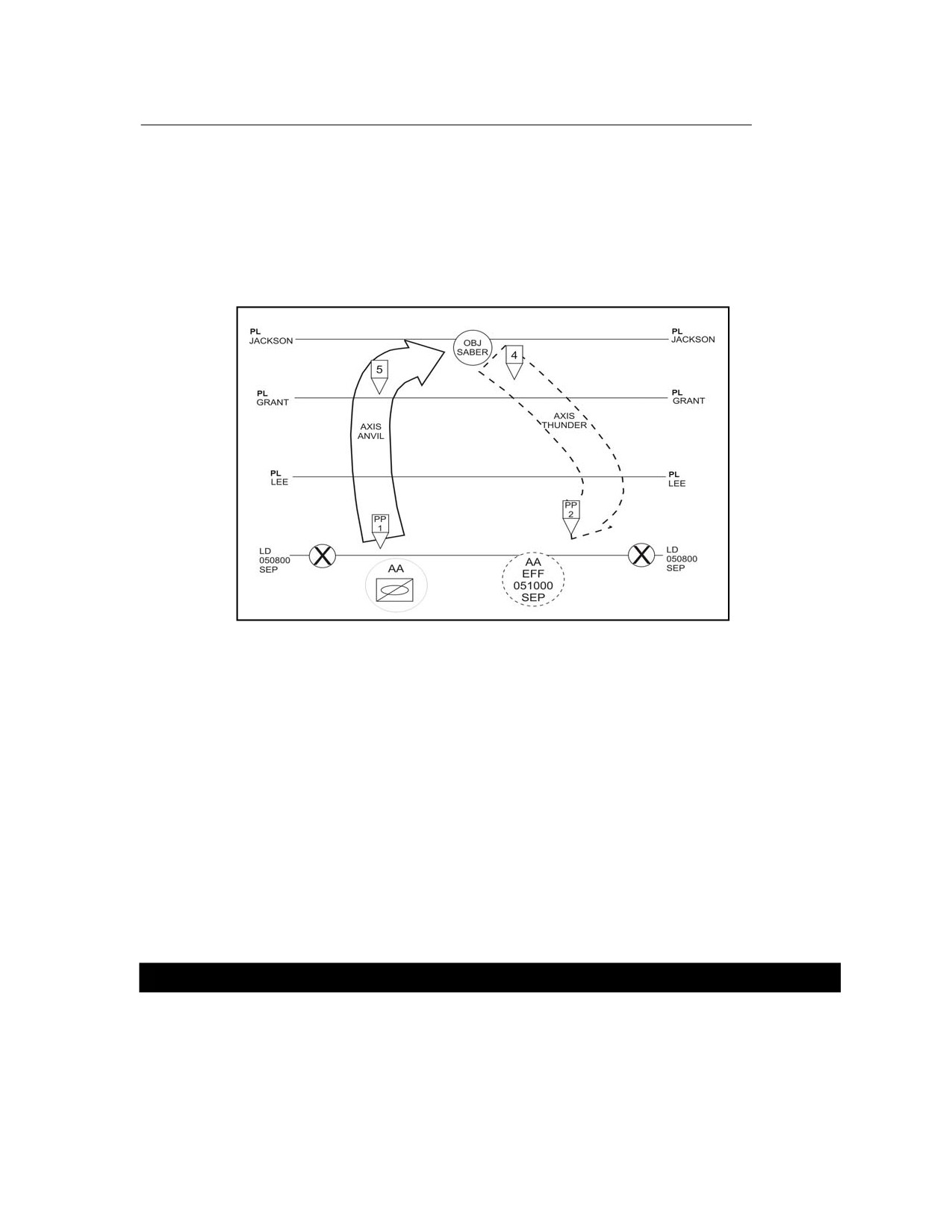
6-44. A raid is an attack into enemy-held territory for a specific purpose
other than gaining and holding ground. It usually ends with a planned
withdrawal after the mission has been accomplished, and before the enemy
can effectively react (Figure 6-1). Typical raid missions include—
• Destruction or capture of enemy materiel, installations, facilities, or
personnel.
• Disruption of enemy C2.
• Rescue of friendly personnel.
• Deception or harassment of enemy forces.
• Collection of specific information about the enemy.
6-45. Aviation assets may provide reconnaissance and security, but usually
do not move with a raiding ground force because of mobility differences. They
may link up with the ground force at the objective to add firepower and
enhance security. Armed helicopters can destroy, confuse, and divert the
6-8
Chapter Six
enemy. They also can deny him reinforcement while the ground force
completes its mission.
6-46. In case of a major enemy reaction, armed helicopters can provide
suppressive fires to cover the ground force's withdrawal. They also can
destroy abandoned friendly vehicles and weapon systems.
Figure 6-1. Raid
6-47. Assault helicopter units can be task-organized under a ground
maneuver headquarters to conduct air assault operations as part of a raid.
They also may be used in the withdrawal or emergency extraction of the
ground force. Waiting aircraft are extremely vulnerable to attack; therefore,
if extraction by helicopter is planned, the ground force should be inserted by
other means.
6-48. A pure armed helicopter force may perform a raid to destroy an enemy
CP, AD site, artillery site, ammunition supply point (ASP), and similar
targets.
SECTION VI - JOINT AIR ATTACK TEAM EMPLOYMENT
6-49. JAAT is an engagement technique used to increase the effectiveness of
offensive or defensive operations by combining the firepower of fixed-wing
aircraft with that of Army rotary-wing aircraft. FA or NSFS fires, along with
direct fires from ground forces, should be employed whenever possible to
increase the synergistic effect. These operations require extensive training to
6-9
FM 3-04.111 (FM 1-111)
reduce planning time and enhance synchronization between the various
members of the JAAT team. Appendix P contains additional information.
SECTION VII - OPERATIONS IN URBANIZED TERRAIN
6-50. Man-made structures and the density of noncombatants in urbanized
terrain affect the tactical options available to commanders and aircrews.
Whether engaged in MTW, SSC, or SASO, the aviation brigade probably will
conduct operations in urbanized terrain. This is partly because of growing
populations, but also results from a potential adversary's tendency to create a
nonlinear battlefield rather than attempt to face U.S. forces directly.
Potential adversaries can be expected to use urbanized terrain for cover and
concealment, and to reduce U.S. combat superiority by taking advantage of
weapons restrictions and reduced options available to commanders under
ROE, ROI, and Law of War. ROE and ROI must be rehearsed, practiced, and
reinforced continually throughout the operation. FM 3-06.1 (FM 1-130) and
Appendix R of this manual contain additional information.
CONDUCTING OPERATIONS IN URBANIZED TERRAIN
6-51. U.S. forces may conduct operations in urbanized terrain for the
following reasons:
• The unit is force-oriented and the enemy occupies a built up area.
• The political importance of the urban area justifies using time and
resources to liberate it.
• The area controls key routes of commerce and provides a tactical
advantage to the commander who controls it.
• The enemy in the urban area, if bypassed, might be able to interdict
LOCs.
• Critical facilities within the urban areas must be retained or protected.
6-52. U.S. forces may avoid operations in urbanized terrain for the following
reasons:
• The enemy, if bypassed, presents no substantial threat to friendly
operations.
• The commander does not have sufficient forces to seize and clear the
area.
• The urban area is declared an open city, making an attack illegal under
the Law of War.
PLANNING AND EXECUTION OF URBAN OPERATIONS
6-53. Operations in urban terrain generally follow the same planning and
execution concepts as in other terrain; however, special planning and
consideration of the characteristics unique to urban terrain is required.
Aircraft must standoff to engage targets in urban areas. Overflight and
engagement of targets within urban areas may require night operations and
special preparation because of possible enemy direct fire at very close range.
6-10
Chapter Six
Hovering in urban areas exposes aircraft to small arms fires and should only
be done if essential to the mission and adequate overwatch fires are
available. Wire, tower, and antenna hazards are especially prevalent and
must be considered in the IPB. Other examples include—
• Demographics of the local population.
• Subterranean, ground level, and above ground terrain analysis.
• Civilian maps and diagrams.
• Airfields, helipads, and rooftops that can be used as LZs.
• Structures and areas protected by the Law of War or restricted by ROE.
• Supplementary electronic and visual signals to differentiate friend from
foe.
• Weapons selection to produce the desired effect while minimizing
collateral damage, and maximizing standoff.
CIVIL CONCERNS
6-54. Operations in urbanized terrain almost always will have significant
impact on noncombatants. Special considerations are required. Units should
maintain liaison with local police, ATS, civil, and military authorities.
Care of Civilians
6-55. Civilians may be removed from the area or protected in their homes. In
some cases, the aviation brigade may be required to arrange for supply,
transportation, medical care, and other support for civilians.
Security
6-56. The threat of espionage, sabotage, and terrorism must be carefully
considered and guarded against.
Civilian Interference with Military Operations
6-57. The aviation brigade must ensure that civilians do not interfere with
the execution of military operations. The aviation brigade relies on MPs, Staff
Judge Advocate (SJA) representatives, and HUMINT teams to liaison with
local law enforcement officials. They gain their aid in controlling displaced
civilian flow while they help identify and interrogate any suspicious displaced
persons moving through the AO.
6-11
FM 3-04.111 (FM 1-111)
SECTION VIII - STABILITY AND SUPPORT OPERATIONS
GENERAL
6-58. SASO are two, separate activities that do not necessarily involve armed
conflict between organized forces.
GOVERNMENT, HOST NATION, AND INTERNATIONAL AUTHORITIES
6-59. During SASO, aviation brigades can expect to work with U.S.
government, host nation, and international agencies. These agencies may not
have the military style chain of command to which U.S. soldiers are
accustomed. Prior coordination and flexibility are keys to mission success.
The chain of command, support responsibility, reporting requirements, and
authority to approve specific actions must be clearly understood by all parties
before initiating the mission. Units must maintain liaison with local police,
ATS, civil, and military authorities.
EMPLOYMENT
6-60. The majority of missions assigned to aviation brigades during SASO
will either conform to or build upon their standard reconnaissance, security,
attack, air assault, and air movement roles. Generally, the major differences
in unit operations during SASO will be in the C2 relationships between the
aviation brigade and its higher headquarters, and the greater requirement
for restraint in potentially hostile situations.
SPECIAL CONSIDERATIONS
6-61. There are several key employment guidelines for the aviation
commander to consider during the planning process. These guidelines are
preparation, specialty personnel augmentation, host nation requirements,
and ROE.
Preparation
6-62. The aviation brigade should expect a wide range in the tempo of
operations and plan accordingly. The staff must be able to adjust rapidly to
many different operational considerations. They must plan ahead and have
contingency plans for many situations not normally addressed in the unit's
METL. These situations can be identified and trained at home station. Some
subjects that should be addressed are civilians on the battlefield, media
relations, public affairs, and defense against terrorism.
Specialty Personnel Augmentation
6-63. The operational conditions of SASO frequently require the integration
of specialty personnel with the aviation unit staff including civil affairs,
PSYOP, SJA, and Special Forces personnel. Besides the specialty staff
personnel, the aviation brigade may be required to operate with infantry,
armor, artillery, engineer, CSS, or a combination of these and other assets.
Whatever the composition, the staff must be fully integrated to coordinate
6-12
Chapter Six
and plan operations. LNOs from the aviation brigade to other units and from
supporting units to the aviation brigade are critical.
Host Nation Requirements
6-64. Airspace restrictions, flight clearances, refueling procedures, civil and
military laws, radio frequency usage, ground convoy clearances, and product
disposal procedures vary from country to country. The aviation brigade
commander must adapt unit procedures to the host nation's operating
environment and procedures. Serious complications can develop when host
nation requirements are not met, with repercussions ranging from mission
restrictions to mission failure. In some situations, aviation units conducting
SASO may be included on the air component commander's ATO to ensure SA
and reduce the possibility of fratricide.
Rules of Engagement
6-65. All commanders must clearly understand the ROE and be prepared for
them to change at any time during an operation. All personnel must be
briefed on the ROE before every mission. For ROE assistance, the
commander should consult with the SJA representative (Appendix N).
CATEGORIES OF OPERATIONS
6-66. During stability operations, the aviation brigade primarily performs its
METL-related tasks and remains prepared for the potential escalation to full
armed conflict. During support operations, it uses the capabilities of its
combat systems to increase the effectiveness of the overall effort. Again, the
aviation brigade must remain prepared for renewed hostilities or civil
disorder. Many of these missions will be performed as an integrated piece of
the overall U.S. military capability—often with forces from other nations,
other U.S. agencies, nongovernmental organizations, and United Nations
forces. Therefore, leaders should familiarize themselves with joint
operational procedures and terms.
STABILITY OPERATIONS
6-67. Combatant commanders employ ARFOR in stability operations outside
the U.S. and its territories to promote and protect U.S. national interests.
Stability operations are designed to influence the threat, political, and
information dimensions of the operational environment. They include
developmental, cooperative activities during peacetime and coercive actions
in response to crisis. Stability operations are normally nonlinear and often
conducted in noncontiguous AOs. There are ten types of stability operations
that have some potential to result in armed conflict. FM 3-0 (FM 100-5)
contains additional information.
PEACE OPERATIONS
6-68. PO encompass peacekeeping operations (PKO) and peace enforcement
operations (PEO) that are conducted to support diplomatic efforts to establish
and maintain peace.
6-13
FM 3-04.111 (FM 1-111)
Peacekeeping Operations
6-69. PKO are undertaken with the consent of all major parties to a dispute.
They are designed to monitor and facilitate implementation of a cease-fire,
truce, or other such agreement, and support diplomatic efforts to reach long-
term political settlements. PKO usually involve observing, monitoring, or
supervising and assisting parties to a dispute. ARFOR use or threaten force
only in self-defense or as a last resort. Air and ground assets are frequently
employed in screening a demilitarized zone.
Peace Enforcement Operations
6-70. PEO apply military force or threaten its use—normally pursuant to
international authorization—to compel compliance with resolutions or
sanctions to maintain or restore peace and order. Unlike PKO, PEO do not
require the consent of all parties. PEO maintain or restore peace and support
diplomatic efforts to reach a long-term political settlement. ARFOR apply
combat power for self-defense and to forcibly accomplish assigned tasks.
Units must also be prepared to transition to PKO. The aviation brigade can
expect to perform all its METL-related missions to protect the U.S. and allied
forces involved, with tightly controlled applications of force.
FOREIGN INTERNAL DEFENSE
6-71. FID is participation by civilian and military agencies of one
government in programs taken by another government to free and protect its
society from subversion, lawlessness, and insurgency. It involves all elements
of national power and can occur across the range of military operations. FID
is a primary program that supports friendly nations operating against or
threatened by hostile elements. Aviation forces provide indirect support, DS
(not involving combat operations), or conduct combat operations to support a
host nation's efforts. In a noncombat environment, the aviation brigade's
missions usually concentrate on air movement, C2 enhancement, and
reconnaissance.
SECURITY ASSISTANCE
6-72. Security assistance refers to a group of programs that support U.S.
national interests and objectives by providing defense articles, military
training, and other defense-related services to foreign nations. Aviation units
may be required to provide transportation, training teams, and maintenance
support personnel. They may be called on to perform or assist in
humanitarian activities.
HUMANITARIAN AND CIVIC ASSISTANCE
6-73. Humanitarian and civic assistance programs consist of assistance
provided with military operations and exercises. They can enhance the
security interests of both the U.S. and the host nation. Aviation support
primarily is in the form of air movement.
SUPPORT TO INSURGENCIES
6-74. When ordered, ARFOR support insurgencies that oppose regimes that
threaten U.S. interests or regional stability. While any ARFOR can be tasked
6-14
Chapter Six
to support an insurgency, SOF usually receive these missions. Forces
supporting insurgencies may provide logistic and training support but
normally do not conduct combat operations.
SUPPORT TO COUNTER-DRUG OPERATIONS
6-75. ARFOR may be employed in various operations to support other
agencies that detect, disrupt, interdict, and destroy illicit drugs and the
infrastructure
(personnel, materiel, and distribution systems) of drug
trafficking entities. ARFOR always conduct counter-drug operations to
support other U.S. government agencies. When conducted outside the U.S.
and its territories, counter-drug operations are considered stability
operations. When conducted inside the U.S. and its territories, they are
domestic support operations (discussed later in this section). Army units do
not engage in direct action during counter-drug operations. Aviation units
may be used to support counter-drug efforts by providing air movement and
reconnaissance. They may also be tasked with monitoring and detecting drug
movements and suspected drug production areas.
COMBATTING TERRORISM
6-76. Terrorism is the calculated use of unlawful violence or threat of
unlawful violence to instill fear. ARFOR routinely conduct operations to deter
or defeat terrorist attacks. Offensively oriented operations are categorized as
counter-terrorism; defensively oriented operations are antiterrorism.
Counter-Terrorism
6-77. Counter-terrorism consists of offensive measures taken to prevent,
deter, or respond to terrorism. Actions include strikes and raids against
terrorist organizations and facilities outside the U.S. and its territories.
Counter-terrorism is a specified mission for selected SOF that operate under
direct control of the NCA or under a combatant command arrangement.
Commanders who employ conventional forces against organized terrorist
forces operating inside their AO are conducting conventional offensive
operations, not counter-terrorism operations.
Antiterrorism
6-78. Antiterrorism consists of defensive measures used to reduce the
vulnerability of individuals and property to terrorist attacks, to include
limited response and containment by local military forces. Antiterrorism is a
consideration for all forces during all types of military operations.
Commanders take the security measures necessary to accomplish the mission
and protect the force against terrorism. Soldiers are most vulnerable during
off-duty periods and in recreational locations. Soldiers and families who
reside outside protected installations are ideal targets for terrorists.
NONCOMBATANT EVACUATION OPERATIONS
6-79. NEO relocate threatened civilian noncombatants from locations in a
foreign nation to secure areas. NEO may take place in permissive, uncertain,
or hostile environments. Normally, these operations involve U.S. citizens
whose lives are in danger either from the threat of hostilities or from a
6-15
FM 3-04.111 (FM 1-111)
natural disaster. They may also include host nation citizens and third
country nationals. A ground or aviation unit may evacuate noncombatants.
The aviation brigade can conduct reconnaissance to help locate
noncombatants, identify clogged routes, and provide security for all stages of
their assembly and movement.
ARMS CONTROL
6-80. ARFOR normally conduct these operations to support arms control
treaties and enforcement agencies. The aviation brigade can help ground
forces in locate, seize, and destroy weapons of mass destruction. Other
actions include escorting deliveries of weapons and materials to preclude loss
or unauthorized use.
SHOW OF FORCE
6-81. Shows of force are conducted to bolster and reassure allies, deter
potential aggressors, and gain or increase influence. They are designed to
demonstrate a credible and specific threat to an aggressor or potential
aggressor. These operations usually involve the deployment or buildup of
forces, an increase in the readiness and activity of designated forces, or a
demonstration of operational capabilities by forces already in the region.
Although actual combat is not desired, shows of force can rapidly and
unexpectedly escalate. Typical aviation missions include area and route
security, screen, air assault rehearsals, and other tactical demonstrations.
SUPPORT OPERATIONS
6-82. Support operations use ARFOR to assist civil authorities, foreign and
domestic, as they prepare for or respond to crises and relieve suffering.
ARFOR provide essential support, services, assets, or specialized resources to
help civil authorities deal with situations beyond their capabilities. The
purpose of support operations is to meet the immediate needs of designated
groups for a limited time, until civil authorities can do so without Army
assistance. In extreme or exceptional cases, ARFOR may provide relief or
assistance directly to those in need. More commonly, they help civil
authorities or nongovernmental organizations provide support. Support
operations usually are nonlinear and noncontiguous. Support operations
within the U.S. and its territories are domestic support operations. Support
operations outside the U.S. and its territories are Foreign Humanitarian
Assistance.
DOMESTIC SUPPORT OPERATIONS
6-83. During declared disasters or emergencies within the U.S., the aviation
brigade may be called upon to supplement the efforts and resources of state
and local governments. Such operations may include responding to natural or
man-made disasters, controlling civil disturbances, conducting counter-drug
activities, combatting terrorism, or aiding law enforcement. The aviation
brigade may be employed to augment C2 requirements, provide air
movement, search for casualties, and assess damage.
6-16
Chapter Six
FOREIGN HUMANITARIAN ASSISTANCE
6-84. These operations are conducted to relieve or reduce the results of
natural or man-made disasters in foreign countries. They also are conducted
to relieve conditions such as pain, disease, hunger, or privation that present a
serious threat to life or loss of property. ARFOR supplement or complement
the efforts of host-nation civil authorities or agencies that provide assistance.
The aviation brigade may be employed to augment C2 requirements, search
for casualties, provide air movement, or assess damage.
STABILITY AND SUPPORT OPERATIONS PLANNING CONSIDERATIONS
6-85. The aviation brigade commander faces challenges that may differ from
those involved in conventional operations. Some of the planning factors that
commanders must consider are discussed below.
MISSION ANALYSIS
6-86. Perhaps the greatest obstacle for the commander to overcome in SASO
is defining the mission for the unit. When he receives the OPLAN, OPORD,
or implementing instruction
(INPIN) mission analysis begins. The
commander must pay particular attention to limitations placed upon him by
the ROE or political considerations.
TASK ORGANIZATION
6-87. Task organization for SASO is METT-TC driven. The commander must
assess the aviation brigade's capabilities to determine if the task organization
can accomplish assigned missions. If not, the commander should modify the
organization.
COMMAND RELATIONSHIPS
6-88. It is critical that the command relationships for SASO be established
early. Elements of the aviation brigade may deploy for SASO without its
parent headquarters. It also is possible that the aircraft may work for
another service or U.S. nonmilitary agency, such as the DEA or the Federal
Bureau of Investigation (FBI). A clear understanding of the C2 relationship
helps reduce confusion and allows the unit to integrate with their controlling
headquarters early.
ADVANCE PARTY OPERATIONS
6-89. Advance party personnel need a comprehensive overview of their unit's
mission, capabilities, requirements, and commander's intent before
deployment. They must coordinate with the gaining or outgoing command,
higher headquarters, and local population. The commander must carefully
select advance party personnel. For example, deploying to another country
with an undeveloped logistics base may require the advance party to be
heavily logistics weighted and contain foreign language specialists, while
other missions such as counter-drug operations can be weighted with
operational personnel. Whichever the commander chooses, the advance party
must receive guidance and focus before deployment. The advance party must
also keep the commander informed about their actions and the current
situation.
6-17
FM 3-04.111 (FM 1-111)
SPLIT-BASED OPERATIONS
6-90. The aviation brigade, or some of its elements, will often deploy on
SASO into a theater that has an immature logistics base. Logistics operations
may be conducted in theater from the unit's home station. This is termed
split-based operations. The commander who deploys on an operation that is
split-based must consider the type of support required from home station. He
must pay special attention to communications between the theater of
operations and the home station, and to the transportation means available
to provide a timely flow of logistics.
FORCE PROTECTION
6-91. Force protection is essential throughout SASO. Coordination for an
external security force should be accomplished before deployment to the AO.
A continually updated intelligence picture, coupled with aggressive local
patrolling, is an essential element of force protection.
RULES OF ENGAGEMENT
6-92. ROE are designed to control the application of force. ROE are prepared
and issued by higher headquarters. Commanders must clearly understand
the ROE and ensure that all the soldiers in the unit understand them. ROE
situations should be rehearsed in detail before deploying or executing a
mission. No situation should occur in which personnel are unsure whether
they should use force, and what types of force—to include deadly force—are
warranted (Appendix N).
HOST NATION CONSIDERATIONS
6-93. Commanders may have to adapt to local procedures to accomplish the
mission. Civil and military laws, airspace procedures, radio frequency usage,
ground convoy clearances, flight restrictions, local customs, and host nation
contracting are all factors the commander must consider prior to executing
SASO.
6-18
Chapter 7
Combat Support
SECTION I - MILITARY INTELLIGENCE
7-1. Intelligence enables the commander to see the battlefield and directly
influence the effectiveness of maneuver, FS, and force protection. The
aviation brigade relies on its higher headquarters for information other than
it receives from its own sources.
ENABLERS
7-2. Ground support radar, remote sensors, UAVs, or other MI assets may be
placed under OPCON or attached to the brigade to enhance reconnaissance
and security capabilities. The S2 incorporates these assets into the ISR plan
and recommends employment methods to the commander.
COUNTER-INTELLIGENCE
7-3. The essence of counter-intelligence (CI) is to support force protection. CI
are those actions that counter the hostile intelligence threat; safeguard the
command from surprise; deceive enemy commanders; and counter sabotage,
subversive, and terrorist activities. FM 2-01.2 (FM 34-60) contains more
information on CI.
ELECTRONIC WARFARE
7-4. EW employs electromagnetic and directed energy to control the
electromagnetic spectrum (EMS) or attack the enemy while retaining its use
for friendly forces. The S2 works with his higher headquarters counterpart to
accomplish offensive and defensive EW tasks. Appendix J addresses aircraft
survivability.
ELECTRONIC WARFARE SUBDIVISIONS
7-5. The three subdivisions of EW are electronic attack, electronic protection
(EP), and electronic support (ES).
Electronic Attack
7-6. Electronic attack
(formerly electronic countermeasures) is to use
jamming, electronic deception, or directed energy to degrade, exploit, or
destroy the enemy's use of the EMS. Electronic attack can attack the enemy
anywhere from their tactical formations to their national infrastructure.
7-1
FM 3-04.111 (FM 1-111)
Electronic Protection
7-7. EP (formerly electronic counter-countermeasures) is protection of the
friendly use of the EMS. EP covers the gamut of personnel, equipment, and
facilities. For example, self- and area-protection systems can interfere with
the enemy's target acquisition and engagement systems to prevent
destruction of friendly systems and forces.
Electronic Support
7-8. ES (formerly electronic support measures) is conflict-related information
that involves actions tasked by or under the direct control of an operational
commander to search for, intercept, identify, and locate sources of intentional
and unintentional radiated electromagnetic energy to detect immediate
threats. ES is the embodiment of combat information and capitalizes on the
timelines of sensor-to shooter systems.
SECTION II - FIRE SUPPORT
PLANNING
7-9. Fires are used to set the conditions for operations. The objective of
effects-based fires is to apply a desired effect to achieve a specified purpose
(shaping, protective, decisive). Fires may be used for many effects,
including—
• Suppression, neutralization, or destruction of forces.
• Isolation of forces.
• Slowing, canalizing, or interdicting enemy maneuver.
• Obscuration of the battlefield.
• Reduction of the effects of enemy artillery with counter-fire.
7-10. Two critical pieces that must be in place to effectively employ FA are
the fire plan and a quick-fire net.
PREPLANNED FIRES
7-11. Preplanned fires are for relatively known situations and target
locations, such as in deliberate attacks and air assaults. This fire plan is
distributed and rehearsed before execution. Preplanned fires use an H-Hour
sequence.
ON-CALL FIRES
7-12. On-call fires are used for unknown situations such as a movement to
contact, screen, and zone reconnaissance. The brigade coordinates fires for
battalions, and establishes priorities. Usually the FSO in the battalion
tactical CP (or S3 if no FSO is available), conducts calls for fire relayed by
scout or attack crews because these helicopters usually operate too low to
establish communication directly with the artillery. When direct
communication can be attained, scout and attack crews may call directly.
Direct contact with the FA must be previously coordinated in the plan or
cleared by the battalion tactical CP.
7-2
Chapter Seven
DIGITAL FIRE SUPPORT NET
7-13. Brigades and battalions equipped with the advanced FA tactical data
system can establish digital FS nets with digitally equipped aircraft. Aircraft
can send digital calls for fire direct to the brigade or battalion FSE over the
FM digital FS net.
QUICK-FIRE NETS
7-14. The aviation brigade often does not have artillery in DS. Quick fire
nets provide a means to request and receive responsive fires. An artillery unit
is assigned the nonstandard mission to answer calls for fires from the
participating unit. The FSO establishes communications with the designated
FA TOC on the appropriate fire net. The artillery TOC monitors the net to
ensure the appropriate FA unit processes requested fire missions or provides
additional fires as required.
GROUPS AND SERIES
7-15. Each target series or group is associated with a templated or known
enemy unit. If that unit moves then the appropriate target, group, or series
moves with it. Identify target groups and series with the same names as the
objectives or targets with which they are associated. If a target is an enemy
unit in Objective Soccer, then the target group is also named Soccer. Figure
7-1 shows this concept.
JOINT PRECISION-GUIDED FIRES
7-16. ARFOR may laser-designate targets for precision-guided munitions
delivered by joint assets; however, there are stringent training requirements
that must be accomplished before Army personnel may perform this function.
Check current regulations before directing Army personnel to designate for
joint assets. See CAS and NSFS paragraphs below.
FIRE SUPPORT COORDINATING MEASURES
7-17. FSCMs are used to facilitate the rapid engagement of targets while
providing safeguards for friendly forces. As a minimum, measures provide—
• A graphic depiction of the control measure.
• An abbreviated name of the control measure.
• The headquarters that established the control measure.
• An effective date-time group and termination date-time group, if
appropriate.
7-3
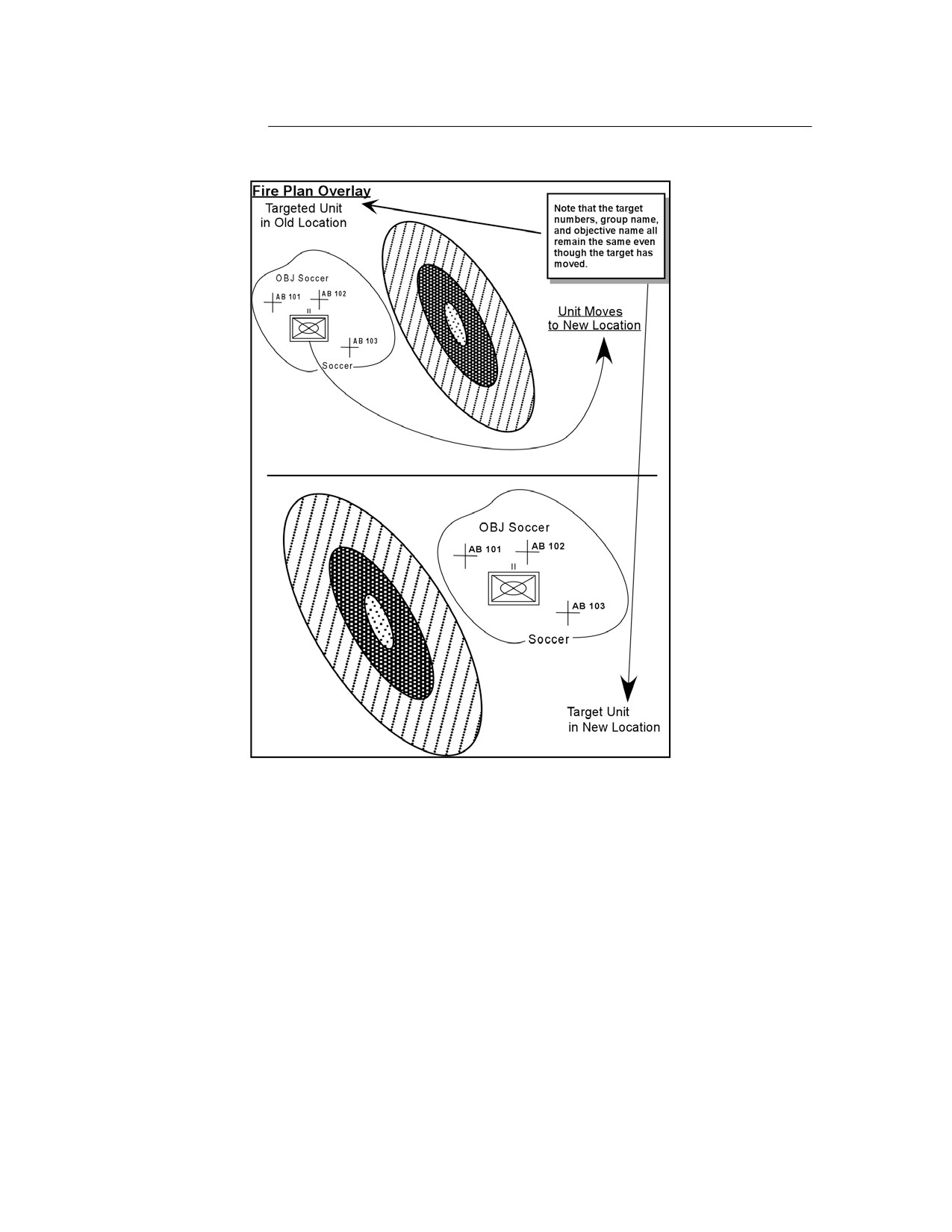
FM 3-04.111 (FM 1-111)
Figure 7-1. Fire Plan Overlay
Coordinated Fire Line
7-18. The coordinated fire line (CFL) is a line beyond which conventional
direct and indirect surface FS means may fire at any time within the
boundaries of the establishing headquarters without additional coordination.
The purpose of the CFL is to expedite the surface-to-surface attack of targets
beyond the CFL without coordination with the ground commander in whose
area the targets are located. Air-to-surface fires on either side of the CFL
require coordination with the ground commander. It usually is established by
brigade or division but may be established by a maneuver battalion (Figure
7-2) (see FM 3-09 [FM 6-20], FM 6-series, and FM 3-21.90 [FM 7-90]).
7-4
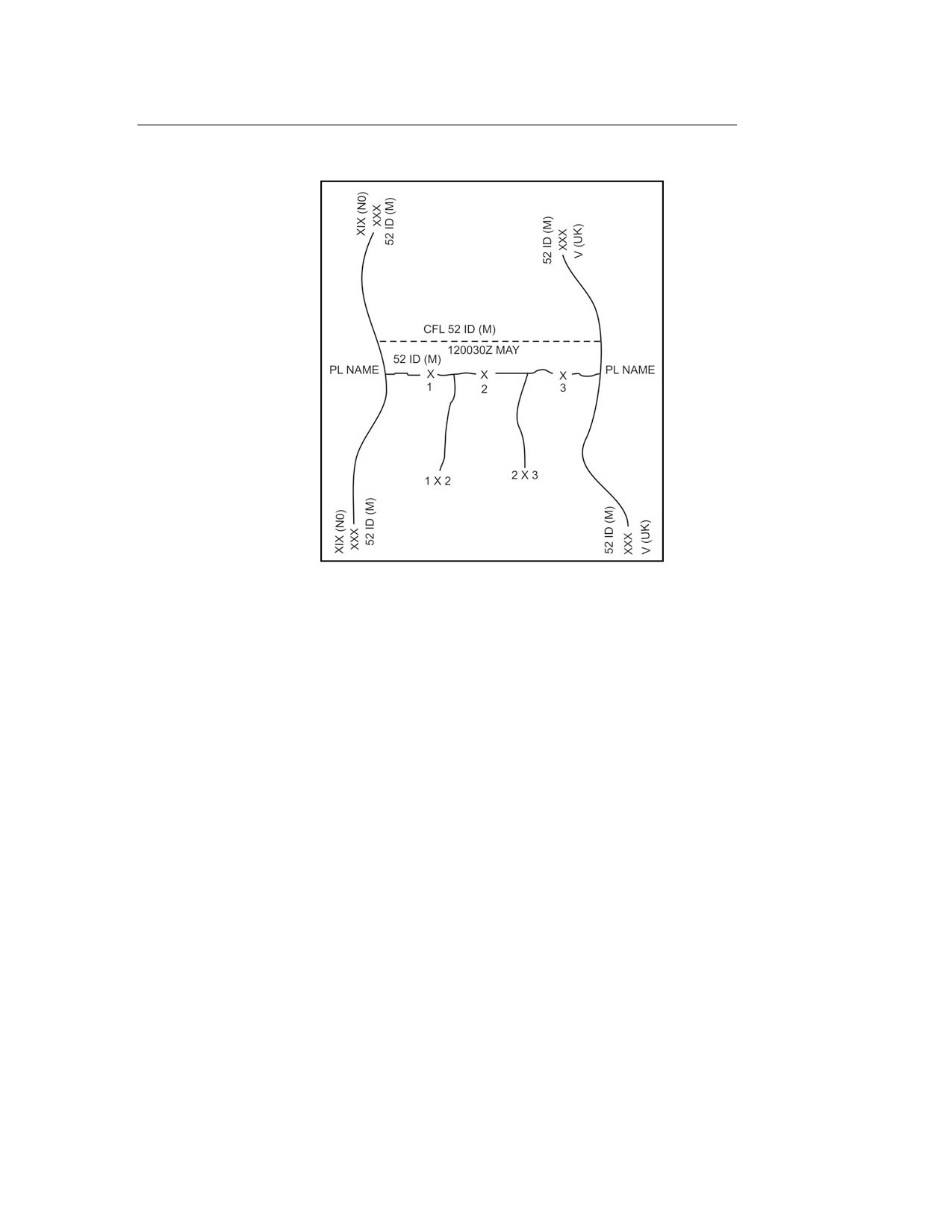
Chapter Seven
Figure 7-2. Coordinated Fire Line
Fire Support Coordination Line
7-19. A fire support coordination line
(FSCL) is established by the
appropriate land or amphibious force commander to ensure coordination of
fire not under the commander's control but which may affect current tactical
operations. The FSCL is used to coordinate fires of air, ground, or sea
weapons systems using any type of ammunition against surface targets. The
FSCL should follow well-defined terrain features. The establishment of the
FSCL must be coordinated with the appropriate TACAIR commander and
other supporting elements. Supporting elements may attack targets forward
of the FSCL without prior coordination with the land or amphibious force
commander provided the attack will not produce adverse surface effects on or
to the rear of the line. Attacks against surface targets behind this line must
be coordinated with the appropriate land or amphibious force commander.
(Army)—A permissive fire control measure established and adjusted by the
ground commander in consultation with superior, subordinate, supporting,
and other affected commanders. It is not a boundary; synchronization of
operations on either side of the FSCL is the responsibility of the establishing
commander out to the limits of the land component forward boundary. It
applies to all fires of air, land, and sea weapon systems using any type of
ammunition against surface targets. Forces attacking targets beyond the
FSCL must inform all affected commanders to allow necessary coordination
to avoid fratricide (Figure 7-3). (See boundary, CFL, and FSCM.) (See FM 6-
20 series, FM 3-21.20 [FM 7-20] , FM 3-21.30 [FM 7-30], FM 3-20.95 [FM 17-
95], FM 3-91 [FM 71-100], FM 3-90.123 [FM 71-123], FM 3-0 [FM 100-5], FM
3-92 [FM 100-15], and Joint Publication [JP] 3-0.)
7-5