FM 3-04.111 (FM 1-111) Aviation Brigades (AUGUST 2003) - page 13
FM 3-04.111 (FM1-111)
COMBINED-SIMULTANEOUS
P-24. During combined-simultaneous attacks, all elements engage targets in
the same sector and attack simultaneously. All elements must coordinate
ordnance fans to reduce the potential for fratricide. Combined-simultaneous
attacks maximize destruction of the enemy and are the simplest to control.
This method is an excellent control method when FA fires are not available or
when elements can use maximum ordnance elevation for deconfliction of
airspace.
COMBINED-SEQUENTIAL
P-25. During combined-sequential attacks, all elements engage targets in the
same sector and attack in a predetermined sequence. This sequence may
range from several seconds to several minutes. This option reduces the
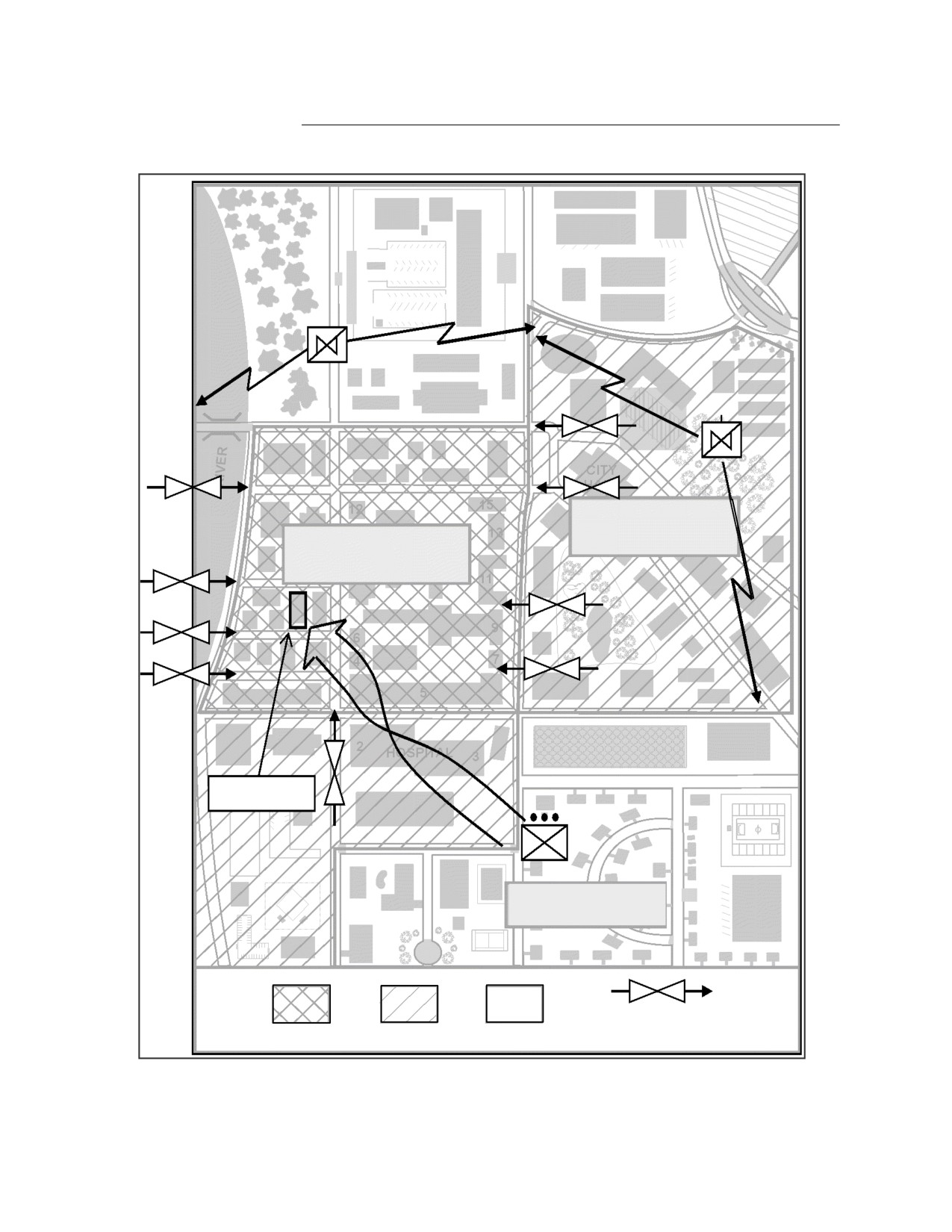
ordnance fan coordination problem and facilitates covering fire for each
preceding element. Use of the JAAT clock method is an example of a
combined sequential.
COMBINED-RANDOM
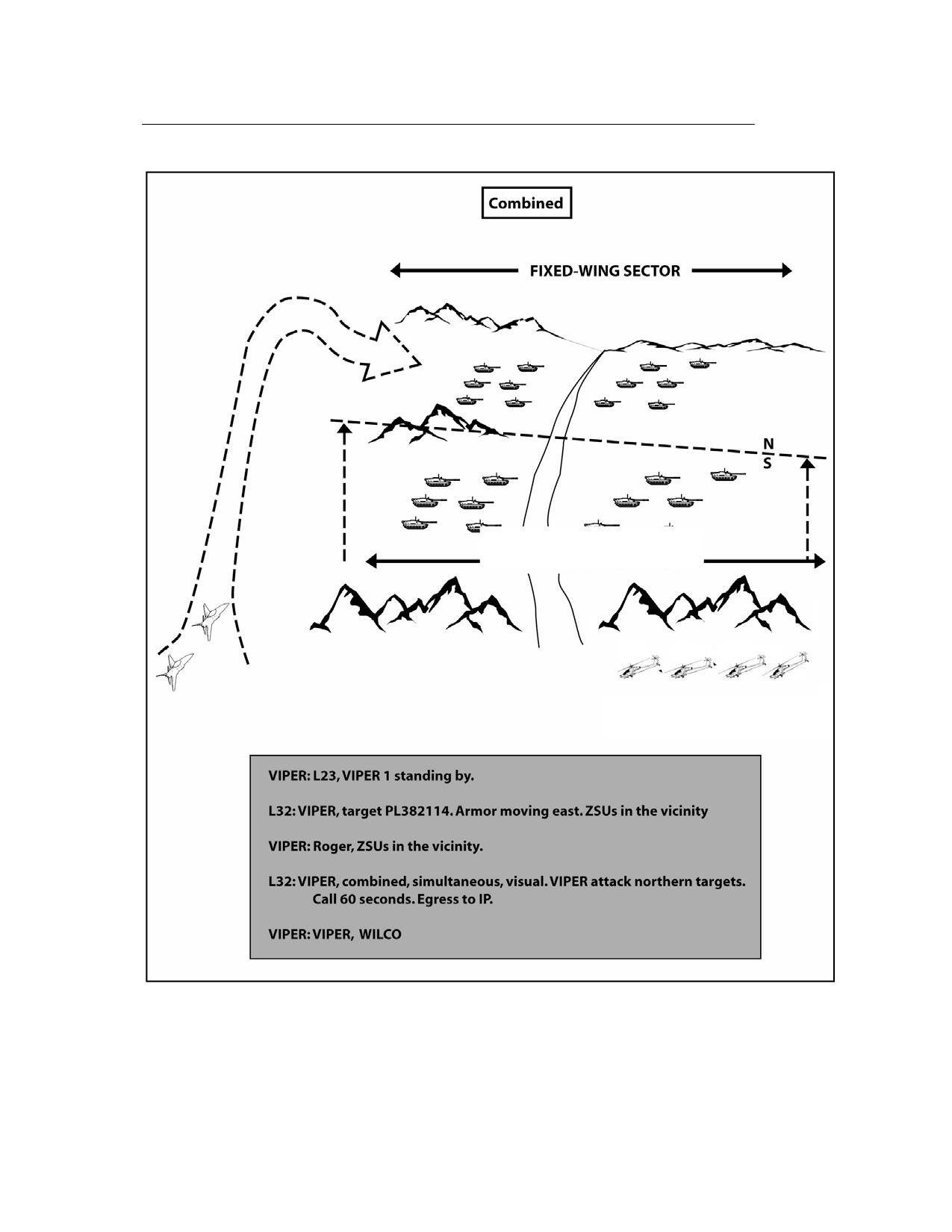
P-26. During combined-random attacks (Figure P-5), all elements engage
targets in the same sector and attack at will. Once again, all elements must
coordinate ordnance fans to reduce the potential for fratricide because
attacks may inadvertently be simultaneous.
SECTION III - OPERATIONS
CONDUCT OF OPERATIONS
P-27. After receiving the mission, the task force conducts mission analysis in
as much detail as time allows. Units conduct planning, coordination,
analysis, and rehearsals to ensure success.
HOLDING AREA TO BATTLE POSITION
P-28. Upon departing the HA, air cavalry or attack teams move forward to
reconnoiter the target area. They verify BPs, avenues of approach, obstacles,
and potential EAs that have not been already identified. If the enemy has
already entered the EAs, the teams maintain contact and attempt to locate
the enemy’s AD systems.
FIRE SUPPORT
P-29. During reconnaissance, the AMC establishes contact with the unit
providing indirect FS. This contact should continue throughout the mission,
with the AMC serving as the FS element on the battlefield. He should
consider using artillery before direct fire engagements. Planners must keep
in mind that obscurants generated by the impacting rounds may interfere
with laser range finders and designators, degrading the effectiveness of
precision-guided munitions.
P-8
Appendix P
ROTARY-WING SECTOR
Figure P-5. Example of a Combined Attack
AT THE BATTLE POSITION
P-30. The AMC must attempt to flow all assets into the battle in various
combinations without piecemealing the force. In preplanned JAAT
operations, the arrival of the armed helicopters in the BP should coincide
P-9
FM 3-04.111 (FM1-111)
with the arrival of the CAS at the initial point. As the armed helicopters
arrive, the teams take up their positions and begin their attack according to
the scheme of maneuver. The attack should begin by engaging AD targets
identified during the reconnaissance. The remainder of the teams attack
enemy forces according to the priorities provided in orders.
CLOSE AIR SUPPORT ARRIVAL AT INITIAL POINT
P-31. CAS usually enters the target area in a flight of two; contacts the ALO
or FAC with call sign, mission number, available ordnance, and loiter time;
receives target information; and then takes a short time to process the
information. If no ALO or FAC is available, the AMC accomplishes ALO or
FAC tasks.
CLOSE AIR SUPPORT DEPARTS INITIAL POINT
P-32. The CAS flight departs the initial point, usually at low-altitude;
contacts the ALO or FAC for an update on friendly and enemy activities; and
gives an inbound call. This call is expressed in units of time; for example, 30
seconds. The AMC uses this call as a signal to lift or shift fires and coordinate
the battle.
CLOSE AIR SUPPORT ATTACK
P-33. The AMC observes CAS attacks and adjusts subsequent attacks, as
required, by using cardinal headings and distances from the last impacts.
The AMC normally uses lasers to designate targets, the center mass of the
target array, or sector boundaries. The use of lasers increases the speed and
security of the attack and reduces the amount of communications needed
between the AMC and the CAS flight.
COMMUNICATIONS
P-34. The communications link between members of the JAAT is critical.
The aviation S3 or S6 must procure and disseminate the needed frequencies
before the CAS arrives at the initial point.
ATTACK HELICOPTER CAPABILITIES
COMMUNICATIONS
P-35. Communications are the key to effective JAAT operations. The Have
Quick radio system on the AH-64, OH-58D, and CAS aircraft allows jam-
resistant, nonsecure, frequency-hopping communications with ALO or FAC
and CAS elements. The armed helicopters and the TACP must coordinate the
frequencies to be used before the CAS arrives at the initial point. Aircrews
use the CAS check-in briefing below (Figure P-6) to coordinate the voice
frequencies, digital data frequencies, and laser codes between the CAS and
armed helicopters.
P-10

Appendix P
Figure P-6. Sample Format of a Tactical Aircraft Check-in Briefing
LASER DESIGNATION
P-36. The AH-64 and OH-58D laser designators can mark sectors, targets,
and enemy positions for CAS equipped with proper sensing devices. The FAC
is responsible for coordinating the laser code used.
CLOSE AIR SUPPORT CAPABILITIES
COMMUNICATIONS
P-37. CAS and FAC aircraft are equipped with jam-resistant, nonsecure,
frequency-hopping communications via the Have Quick II radio. They are
also equipped with other communications systems (VHF-AM and VHF-FM,
additional UHF radio, and data link) depending on the participating aircraft.
PRECISION MUNITIONS
P-38. Precision munitions offer improved effects on the targeted enemy force.
Laser-guided munitions can destroy bridges and other priority targets while
allowing CAS greater survivability. The IR and optically guided versions of
the Maverick missile provide precision hard- and moving-target kill
capability.
FORWARD AIR CONTROLLER
P-39. If the FAC is available to brief the CAS aircraft, the AMC should use
the following attack brief:
• Distance/direction reference.
• Specific target identification.
• Specific threat identification.
• Specific friendly identification.
• Specific attack restrictions.
• FAC position.
• Final clearance.
P-11
FM 3-04.111 (FM1-111)
BRIEFING
P-40. In the absence of the FAC, the AMC briefs the JAAT. AMCs must be
familiar with responsibilities detailed in FM 3-09.33 (FM 90-21).
P-12
Appendix Q
Air-Ground Integration
SECTION I - GENERAL
Q-1. Operations must be integrated so that air and ground forces can
simultaneously work in the battlespace to achieve a common objective.
Integration maximizes combat power through synergy of both forces. The
synchronization of aviation operations into the ground commander's scheme
of maneuver may require the integration of other services or coalition
partners. It may also require integration of air cavalry, attack, assault, and
cargo helicopters.
PLANNING AND TRAINING
Q-2. Integration starts at home station with—
• Development of common SOPs among aviation and ground maneuver
units.
• Habitual combined training, including battle drills, to help all team
elements maintain awareness of the locations and needs of other
elements.
Q-3. Training, procedural standardization, and familiarity of team members
greatly accelerate planning and coordination, especially in unfamiliar
environments. A team built in this manner establishes battle efficiency
sooner and maintains a higher tempo of combat operations. Familiarity and
compliance with joint procedures are essential to allow seamless integration
with other services’ ground and air units.
Q-4. Commanders must insist on a high degree of combined arms training
with habitually supporting units in the way that they are expected to fight—
the whole intention of integration. Air and ground units regularly train and
execute battle drills together to make coordination and reaction in combat
instinctive.
Q-5. Aviation and ground units should be so accustomed to working together
that separate training is considered a deviation from the standard. Lessons
learned at the CTCs reveal that many units had to invent ways to coordinate
because they had not prepared. This situation must not happen in war.
Tested methods of coordination, practiced in training, reduce the difficulty of
unfamiliar situations in new terrain and conditions.
WORKING WITH OTHER TEAMS
Q-6. When units have not been able to create the desired habitual
relationship, the planning and coordination processes will be longer and more
detailed. Rehearsals are essential for success. In-country training exercises
Q-1
FM 3-04.111 (FM1-111)
should also be accomplished whenever possible. The probability of mistakes is
increased unless coordination, planning, rehearsals, and training are
conducted. Commanders must apply risk-management procedures
throughout planning and execution.
SITUATIONAL AWARENESS
Q-7. Attack and air cavalry units often engage targets near friendly forces
and noncombatants. This situation may occur during various types of
operations—shaping, decisive, and sustaining. Aircrews must have
knowledge of friendly force and noncombatant locations. Procedures for
positive identification of enemy forces are required.
SYNCHRONIZATION OF WEAPONS
Q-8. The main reason for using several weapons systems at once is to
overwhelm the enemy with more than it can counter. When possible, units
sequence the employment of CAS, indirect fires, direct fires, and armed
helicopters so closely as to seem simultaneous in fire effects. Fires are lifted
or shifted at the most advantageous time for ground elements to overwhelm
the objective before the enemy can offer effective opposition.
Q-9. Army aviators may be the key in controlling the employment of multiple
weapons systems because of their vantage point on the battlefield and their
ability to quickly relocate. Aviation units must routinely train with ground
units so that they can effectively employ other Army and joint weapons
systems.
SECTION II - EXAMPLES OF INTEGRATED OPERATIONS
GENERAL
Q-10. True integration occurs when the commander effectively uses every
available asset to its fullest extent. The following are some available assets
and capabilities:
• Satellites provide information concerning enemy location and
movements, weather, terrain, and obstacles.
• JSTARS aircraft provide real-time information on enemy formations,
direct TACAIR strikes, and furnish targeting data for other weapons
systems.
• UAVs operate from immediately in front of the ground forces to deep
into the enemy rear; they provide information and targeting data and,
if armed, may attack enemy formations and installations.
• EW systems provide interception, disruption, deception, and targeting
information.
• CAS elements destroy enemy formations and installations.
• Air and ground cavalry units search in front of the ground force,
confirm enemy strengths and weaknesses, protect flanks, and allow
the commander to orient on threats or exploit opportunities.
Q-2
Appendix Q
• Tank, mechanized infantry, light infantry, and air assault units—
accompanied by air defense and engineer elements, as appropriate—
forcibly take and occupy key terrain or deny terrain to the enemy.
• Attack helicopters maneuver to attack enemy forces and deny terrain
for limited periods.
• UH-60 helicopters move troops, light vehicles, light artillery, and
supplies; they also can emplace minefields and augment C2.
• CH-47 helicopters move troops, medium vehicles, medium artillery,
and supplies.
• Artillery provides indirect fires to disrupt and destroy enemy
formations; aviation and ground forces also employ artillery for
immediate suppression of enemy elements until they can maneuver
and eliminate the threat.
OFFENSE
Q-11. Reports from aviation units, UAVs, JSTARS, and satellites provide
valuable tactical information. These systems’ higher vantage points and long-
range sensor devices assist in directing ground vehicles against enemy
elements that ground elements cannot detect. Enemy forces can be identified,
engaged and destroyed, blocked or bypassed, as desired, by the maneuver
commander. Air cavalry and attack helicopters are positioned ahead, behind,
or to the flanks of the ground formation. Ground units in movement to
contact, exploitation, or pursuit can markedly increase movement rates when
preceded by air cavalry or attack helicopters.
DEFENSE
Q-12. A defensive example of integrated operations is a counterpenetration
mission (Chapter 4). In this type of mission, the aviation brigade may be
tasked to coordinate directly with the defending ground brigade to develop
EAs to destroy penetrating enemy forces before they can get to the ground-
BSA. This complex operation requires full understanding by both the ground
and air elements. All ground and air units must know the EAs to reduce the
potential for fratricide. Aviators must positively identify targets to avoid
engaging friendly troops who may not have cleared the area or may have
mistakenly entered. Buffer zones and fire-control measures must be
established.
COMBAT SUPPORT AND COMBAT SERVICE SUPPORT
Q-13. UH-60 and CH-47 aircraft must be integrated into the ground
commander’s scheme of maneuver. Examples include the following:
• Air assault.
• Team insertions.
• CASEVAC.
• Volcano employment.
• Resupply.
Q-3
FM 3-04.111 (FM1-111)
SECTION III - MISSION PLANNING
GENERAL
Q-14. Mission planning encompasses mission training, mission rehearsal,
and mission execution. During planning, the commander and staff visualize
how the battlefield will look at various stages. They war-game the scheme of
maneuver and anticipate enemy COAs at critical points. They plan friendly
integrated aviation-ground COAs necessary to maintain the initiative. They
also determine branches and sequels for the commander to exploit enemy
actions, reactions, and weaknesses.
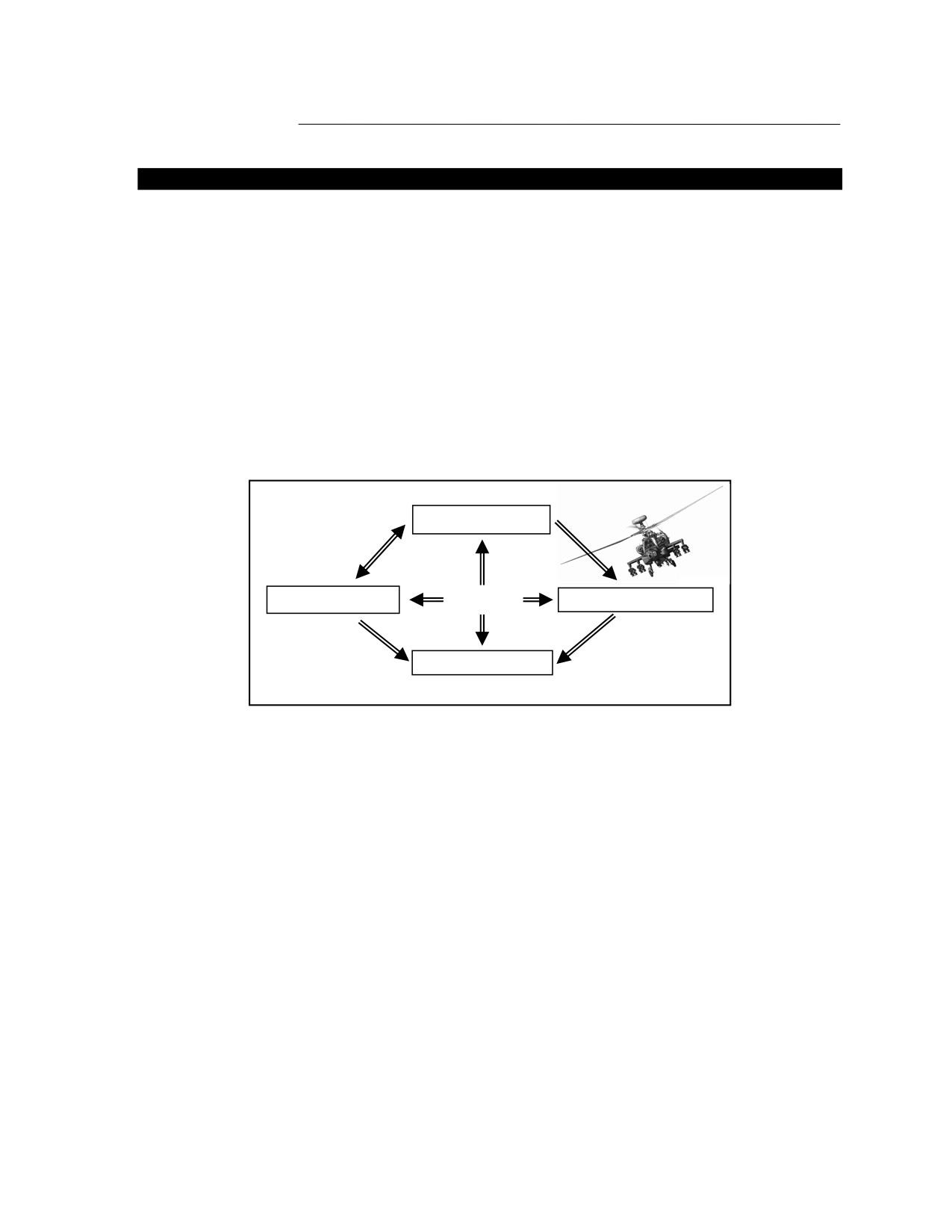
Q-15. Training exercises validate planning, training, and rehearsal. The
outcome of the training exercise tells the commander where to place
emphasis for future training and where to focus sustainment training (Figure
Q-1).
Mission Planning
Mission Training
Validates
Mission Rehearsals
Mission Execution
Figure Q-1. Mission Planning Through Execution Cycle
Q-16. Rehearsal validates planning and training for the mission. Minor
planning adjustments may be made as a result of the validation provided
during mission rehearsal. Optimal rehearsal includes integration of all
mission participants. In combat, this integration allows the organization to
operate as a whole, forming the combined arms or joint teams that will
culminate in a synergistic air-ground effect.
Q-17. All efforts of planning and preparation affect mission execution.
Future training and planning may be altered by lessons learned during the
execution of current missions.
Q-18. Mission recovery ensures readiness for following missions. Recovery
includes munitions reconfiguration, refueling, maintenance, CP movement,
and crew changes.
Q-19. Although integrated missions are conducted with or under the control
of a ground maneuver commander, they usually require direct coordination
between aircrews and ground platoons or squads. Therefore, the aviation
commander, his staff, and subordinate commanders and staffs typically
directly coordinate with the supported unit throughout the planning process.
Q-4
Appendix Q
MINIMUM BRIGADE PLANNING REQUIREMENTS
Q-20. Figure Q-2 shows the minimum information required by the Army
aviation team to ensure accurate and timely support. Digital transmission of
information, such as coordinates, is faster and more accurate, if that method
is available. Voice communications are necessary to verify information and to
clarify needs and intentions.
• Situation including friendly forces’ location, enemy situation highlighting known ADA
threat in the AO, mission request, and tentative EA coordinates.
• Brigade- and battalion-level graphics update via MCS or AMPS or via radio
communications, updating critical items—such as LOA, fire-control measures, and
maneuver graphics—to better integrate into the friendly scheme of maneuver.
• Fire support coordination information: location of DS artillery and organic mortars,
and call signs and frequencies.
• Ingress/egress routes into the AO; this includes passage points into sector or zone
and air routes to the HA or LZ.
• Call signs and frequencies of the battalion in contact, down to the company in
contact; air-ground coordination must be done on command frequencies to provide
SA for all elements involved.
• GPS and SINCGARS time coordination; care must be taken to ensure that all units
are operating on the same time.
Figure Q-2. Minimum Brigade Planning Requirements
LIAISON WITH THE GROUND MANEUVER FORCE
Q-21. In addition to the personal involvement of the aviation commander
and staff, the aviation commander provides an LNO or a liaison team to the
ground commander. The LNO interacts with the ground unit staff and other
units’ LNOs to ensure cross coordination at all levels. LNOs, at a minimum,
should be captain’s career course graduates and current or former PCs. They
should possess a strong knowledge of the capabilities of all aircraft and units
in the brigade. The aviation commander should also ask for a ground LNO
from the maneuver brigade. The aviation battalion commander must
implement an LNO certification program at home station to ensure that
LNOs are proficient in the the full spectrum of operations.
Q-22. LNOs are vital for the coordination and deconfliction of the various
elements that affect the scheme of maneuver. LNOs provide immediate
access for each commander to an officer who has more intimate knowledge of
the corresponding commander and his unit.
Q-23. Home-station training is not possible for all contingencies. Future
alliances and coalition with foreign forces may require coordination without
the opportunity for LNOs to become familiar with those units. As soon as
possible upon deployment notification, the unit must prepare to operate with
nontraditional partners. Units should send advance party personnel to begin
coordination and training with forces in the theater. If U.S. units are already
there, coordination with and lessons learned from them can be invaluable.
Q-5
FM 3-04.111 (FM1-111)
DECONFLICTION
Q-24. Deconfliction is a continual process for ground, aviation, and other
supporting units. During planning and execution, aviation units must
deconflict their operations with friendly units:
• Indirect fires, including mortars.
• CAS.
• UAVs.
• Air defenses.
• Smoke operations.
• Other internal aviation operations.
• Nonorganic aviation operations.
• Other services’ delivery systems such as supply drops.
• Maneuver/movements for combat, CS, and CSS units.
SECTION IV - MISSION EXECUTION
ACTIONS EN ROUTE TO THE OBJECTIVE
Q-25. The ground maneuver headquarters informs its units in contact when
aircraft are inbound. En route to the HA, the AMC contacts the ground
maneuver element on its FM command network for a SITREP on the enemy
and friendly forces.
Q-26. A battalion close fight SITREP consists of the following:
• Type and center of mass of enemy vehicles and equipment position
and direction of movement; if dispersed, provide front line trace.
Ground elements may not have a clear picture of the ADA threat.
• Location of friendly elements in contact, mission assigned to them,
method of marking their position, and location of flanking units.
• Call sign/frequency verification and method of contact.
AVIATION TEAM CHECK-IN
Q-27. It is essential to positively identify locations of friendly units and
supporting aircraft. Aircrews confirm with each other or wingmen their
positive location. Ground elements must be extremely careful to verify any
position information.
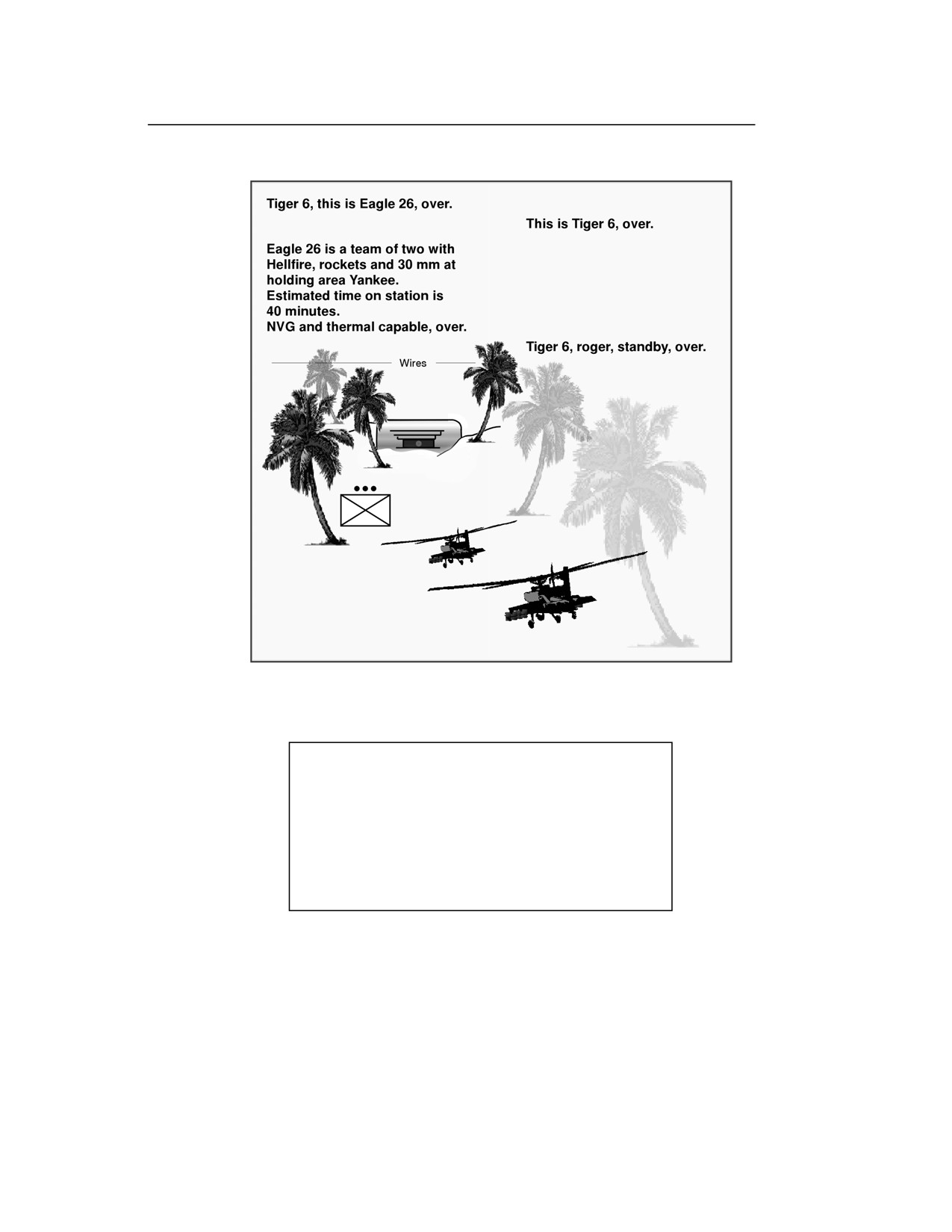
Q-28. The aviation team usually checks in on the command net of the unit
that has the element in contact or as directed in the mission briefing. Upon
initial radio contact, the aviation team leader executes a check-in as depicted
in Figures Q-3 and Q-4. The team's location may be expressed by grid
coordinates or position with respect to a known point or common graphics.
Q-6
Appendix Q
Figure Q-3. Aviation Team Check-In
Aviation Team Check-In
1. Initial contact.
2. Team composition, altitude, and location.
3. Munitions available.
4. Station time.
5. Night vision capabilities and type: image
intensification, thermal, or both.
Figure Q-4. Example of Aviation Team Check-In
Q-29. The aviation team, if required, selects and occupies a holding or orbit
area within FM communications range until required coordination is
complete. High altitudes and high-density altitudes may preclude hovering
by a fully loaded aircraft. The aviation team may need to establish a
racetrack orbit oriented behind the LZ, BP, ABF, or SBF position. The AMC
informs the ground unit leader of the orbiting pattern or the series of
positions that his team will occupy.
Q-30. The BP, ABF, or SBF is normally offset from the flank of the friendly
ground position but close enough to facilitate efficient target handoffs. This
Q-7
FM 3-04.111 (FM1-111)
ensures that rotor wash, backblast, ammunition casing expenditure, and the
general signature of aircraft do not interfere with operations on the ground or
reveal ground unit positions. The offset position also allows aircraft to engage
the enemy on its flanks, rather than its front, and lessens the risk of
fratricide along the helicopter gun-target line. The scout platoon or other
friendly forces must clear any positions over which helicopters may hover or
orbit to preclude engagement by hidden enemy forces.
Q-31. The AMC provides the ground maneuver unit leader with his concept
for the operation. This briefing may be as simple as relaying the direction of
aircraft approach or attack route and time required to move to the
recommended BP. On completion of coordination with the lowest unit in
contact, the flight departs the holding or orbit area.
WEAPONS SELECTION
Q-32. Anything that kills the enemy for the ground force should be used.
Hellfire is the preferred system for armor or hardened targets; however,
Hellfire may be appropriate for use against a machine-gun position, bunker,
or even an individual if that is what is required to assist the ground unit.
Area fire weapons, such as gun systems and 2.75-inch rockets, are preferred
for engaging troops in the open and other soft targets such as trucks and
trenchworks. A Hellfire will usually not destroy the bunker unless it
detonates ammunition or explosives stored in the bunker. It is important to
note that the machine-gun crew may have been killed although the bunker
appears undamaged.
SECTION V - POSITIVE LOCATION/TARGET IDENTIFICATION
COMMAND AND CONTROL TECHNIQUES
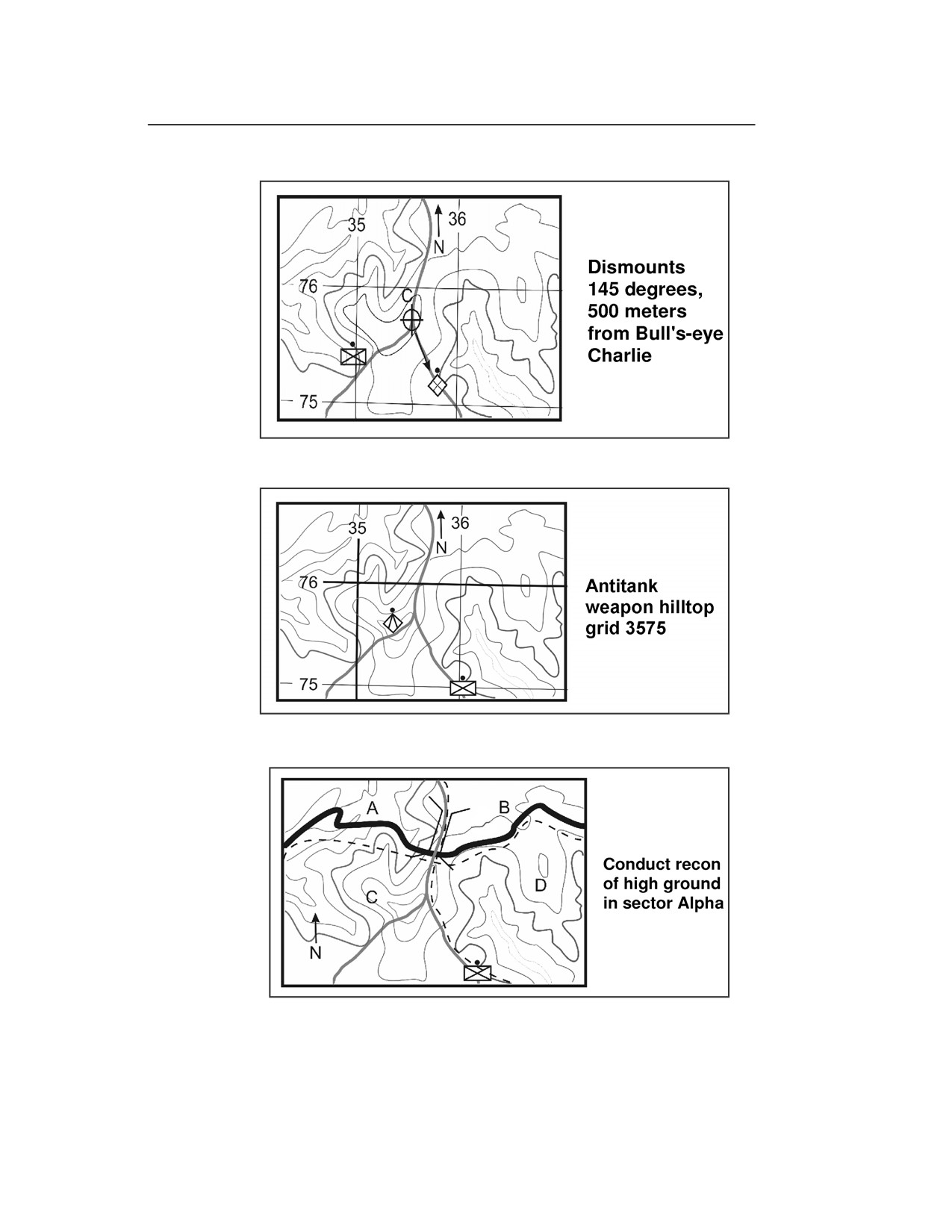
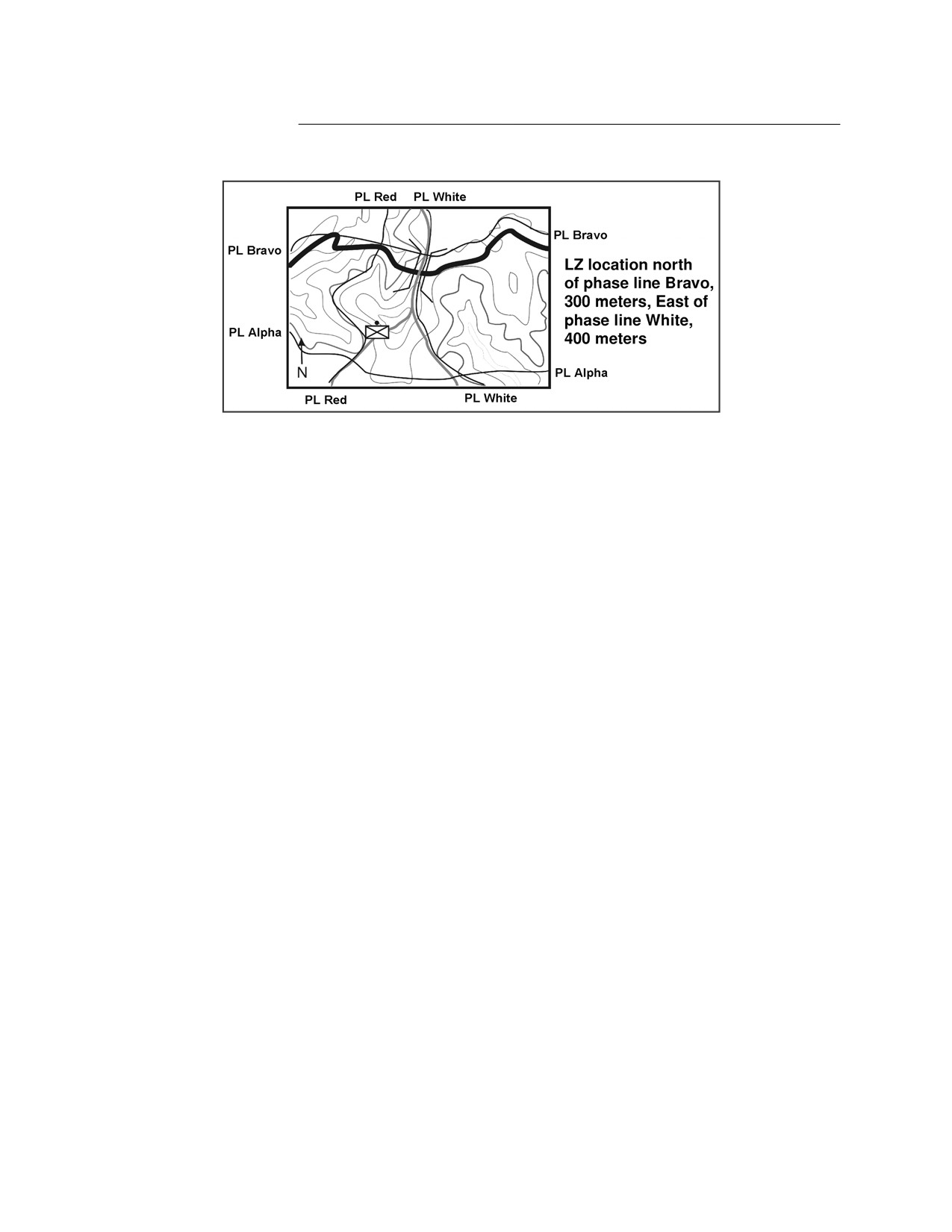
Q-33. Figures Q-5 through Q-8 show some C2 techniques that can be effective
during air-ground operations with Army aircraft:
• Bull’s-eye technique—uses a known point or an easily recognizable
terrain feature.
• Grid technique—uses grid coordinates to define the point.
• Sector/terrain technique—uses terrain and graphics available to both
air and ground units.
• Phase line technique—uses graphics available to both air and ground
units.
Q-8
Appendix Q
Figure Q-5. Bull’s-Eye Technique
Figure Q-6. Grid Technique
Figure Q-7. Sector/Terrain Technique
Q-9
FM 3-04.111 (FM1-111)
Figure Q-8. Phase Line Technique
MARKING
Q-34. There are various ways to mark a location or target. The effectiveness
of vision systems on helicopters compares to those found on ground vehicles.
During the day, the vision systems of the AH-64 and the OH-58D allow
accurate identification of targets. During periods of reduced visibility,
resolution is greatly degraded, requiring additional methods of verification.
This situation requires extra efforts from both the ground unit and aviation
element.
Q-35. Some U.S. weapons can kill targets beyond the ranges that thermal,
optical, and radar acquisition devices can provide positive identification. Both
aviation and ground forces may become overloaded with tasks in the heat of
battle. Simple, positive identification procedures must be established and
known to all.
MARKING FRIENDLY POSITIONS
Q-36. A method of target identification is direction and distance from
friendly forces. Friendly forces can mark their own positions with IR strobes,
IR tape, NVG lights, smoke, signal panels, body position, MRE heaters,
chemical lights, and mirrors. Marking friendly positions is the least desirable
method of target location information and should be used with extreme
caution. Marking friendly positions can be a more time-consuming process
than directly marking a target and can reveal friendly positions to the
enemy.
MARKING ENEMY POSITIONS
Q-37. Target marking aids aircrews in locating the target that the unit in
contact desires them to attack. Ground commanders should provide the
target mark whenever possible. To be effective, the mark must be timely,
accurate, and easily identifiable. Target marks may be confused with other
fires on the battlefield, suppression rounds, detonations, and marks on other
targets. Although a mark is not mandatory, it assists in aircrew accuracy,
enhances SA, and reduces the risk of fratricide.
Q-10
Appendix Q
Marking by Direct Fire
Q-38. Direct-fire weapons can deliver a mark. Although this method may be
more accurate and timely than an indirect fire mark, its use may be limited
by range and the visibility of the weapon’s burst effect. Aircraft may be used
to deliver a mark. The preferred method is for the aircraft to mark with
phosphorous, high-explosive rockets, illumination, or lasers. A burst of
cannon fire or a single rocket fired to the left or right of the target as a
marking round may be an option. This method may alert the enemy but is a
good way to verify the target with reduced risk of friendly casualties. Ground
units may also mark targets with direct fire using tracers or M203 smoke
rounds.
Infrared Marking
Q-39. IR pointers and other IR devices can be used to mark targets at night
for aircrews who are using NVGs; however, aircrews using other NVDs—such
as FLIR or TIS—may not be able to see the mark. Unlike laser designators,
these IR devices cannot be used to guide or improve the accuracy of aircraft
ordnance. IR pointers may expose friendly units to an enemy with night-
vision capability and should be used with caution. Ground units should
initiate IR marks requested by the aircrew and continue until the aircrew
transmits “TERMINATE” or the weapon hits the target.
Marking by Indirect Fire
Q-40. Artillery or mortar fires are effective means of assisting aircrews in
visually acquiring targets. Before choosing to mark by artillery or mortars,
observers should consider the danger of exposing these supporting arms to
enemy indirect-fire acquisition systems and the additional coordination
required. Marking rounds should be delivered as close to the target as
possible, with smoke being the last round. Marking rounds are most effective
when delivered within 100 meters of the target, but those within 300 meters
are generally effective enough to direct armed aircraft. If the situation
requires a precise mark, observers or spotters can adjust marking rounds
early to ensure that an accurate mark is delivered. This action may, however,
alert the enemy to an imminent attack.
Backup Marks
Q-41. Whenever a mark is provided, a plan for a backup mark should be
considered. For example, direct fire may be tasked to deliver the primary
mark, while a mortar may be assigned responsibility for the backup mark.
SUMMARY
Q-42. Table Q-1 suggests methods for identifying friendly forces and enemy
targets.
Q-11

FM 3-04.111 (FM1-111)
Table Q-1. Methods of Marking Friendly and Enemy Positions
FRIENDLY
TARGET
METHOD
DAY
NIGHT
NVG
NVS
REMARKS
MARKS
MARKS
Smoke
Go
No Go
Marginal
No Go
Good
Good
Easy ID. May compromise
friendly position, obscure
target, or warn of FS
employment. Placement
may be difficult because of
terrain, trees, or structures.
Smoke (IR)
Go
Go
Go
No Go
Good
Good
Easy ID. May compromise
friendly position, obscure
target, or warn of FS
employment. Placement
may be difficult because of
terrain, trees, or structures.
Night marking is greatly
enhanced by the use of IR
reflective smoke.
Illumination,
Go
Go
Go
No Go
NA
Good
Easy ID. May wash out
Ground
NVDs.
Burst
Signal Mirror
Go
No Go
No Go
No Go
Good
NA
Avoids compromise of
friendly location. Depends
on weather and available
light. May be lost in
reflections from other
reflective surfaces such as
windshields, windows, or
water.
Spot Light
No
Go
Go
No Go
Good
Marginal
Highly visible to all.
Go
Compromises friendly
position and warns of FS
employment. Effectiveness
depends on the degree of
ambient lighting.
IR Spot
No
No Go
Go
No Go
Good
Marginal
Visible to all NVGs.
Light
Go
Effectiveness depends on
the degree of ambient
lighting.
IR Laser
No
No Go
Go
No Go
Good
Marginal
Effectiveness depends on
Pointer
Go
the degree of ambient
(below .4
lighting.
watts)
IR Laser
No
No Go
Go
No Go
Good
Good
Less affected by ambient
Pointer
Go
light and weather conditions.
(above .4
Highly effective under all but
watts)
the most highly lit or worst
weather conditions. IZLID-2
is the current example.
Visual Laser
No
Go
Go
No Go
Good
Marginal
Highly visible to all. High risk
Go
of compromise. Effective,
depending upon degree of
ambient light.
Laser
Go
Go
No Go
Go
NA
Good
Highly effective with
Designator
precision-guided munitions.
Very restrictive laser-
acquisition cone and
requires LOS to target. May
require precoordination of
laser codes. Requires PGM
or LST equipped.
Q-12

Appendix Q
Table Q-1 Methods of Marking Friendly and Enemy Positions (Concluded)
FRIENDLY
TARGET
METHOD
DAY
NIGHT
NVG
NVS
REMARKS
MARKS
MARKS
Tracers
Go
Go
Go
No Go
No Go
Marginal
May compromise position.
May be difficult to distinguish
mark from other gunfire.
During daytime use, may be
more effective to kick up
dust surrounding target.
VS-17 Panel
Go
No Go
No Go
No Go
Good
NA
Easy to see when visibility is
good. Must be shielded from
the enemy.
IR Paper
No
No Go
No Go
Go
Good
NA
Must be shielded from the
Go
enemy. Affected by ambient
temperature.
AN/PAQ-4C
No
No Go
Go
No Go
NA
Good
Effective to about 600
IR Aiming
Go
meters.
Light
AN/PEQ-2A
No
No Go
Go
No Go
NA
Good
Effective to about 1,300
IR Aiming
Go
meters. Can illuminate the
Light,
target.
Pointer,
Illuminator
Chem Light
No
Go
Go
No Go
Good
NA
Must be shielded from
Go
enemy observation. Affected
by ambient light. Spin to give
unique signature.
IR Chem
No
No Go
Go
No Go
Good
NA
Must be shielded from
Light
Go
enemy observation. Affected
by ambient light. Spin to give
unique signature.
Strobe
No
Go
Go
No Go
Excellent
NA
Visible to all. Affected by
Go
ambient light.
IR Strobe
No
No Go
Go
No Go
Excellent
NA
Effectiveness depends on
Go
ambient light. Coded strobes
aid acquisition. Visible to all
with NVGs.
Flare
Go
Go
Go
Marginal
Excellent
NA
Visible to all. Easily seen by
aircrew.
IR Flare
No
No Go
Go
No Go
Excellent
NA
Easily seen by aircrews with
Go
NVGs.
Glint/IR
No
No Go
No Go
Go
Good
NA
Not readily detected by
Panel
Go
enemy. Effective except in
high ambient light.
Combat ID
Go
No Go
No Go
No Go
Good
NA
Provides temperature
Panel
contrast on vehicles or
building.
Chemical
No
No Go
No Go
Go
Poor
NA
Can be lost in thermal
Heat
Go
clutter. Difficult to acquire.
Sources,
Best to contrast a cold
MRE Heater
background.
Briefing
No
Go
Go
No Go
Fair
Poor
Short range.
Pointer
Go
Electronic
NA
NA
NA
NA
Excellent
Good
Ideal friendly marking for
Beacon
AC-130 and some USAF
CAS. Not compatible with
Navy/Marines. Can be used
as a TRP. Coordination with
aircrew essential.
Hydra 70
Go
Go
Go
Go
NA
Good
Assists with direct fire and
Illumination
adjustment of indirect fire.
Q-13

FM 3-04.111 (FM1-111)
TARGET MARKING BREVITY LIST
Q-43. Table Q-2 lists standard brevity terms.
Table Q-2. Brevity List
TERM
MEANING
Observer is circling an IR pointer around an aircraft to help the aircraft identify the
Rope
friendly ground position.
Visual
Observer is sighting a friendly aircraft or ground position. Opposite of BLIND.
Observer has no visual contact with friendly aircraft or ground position. Opposite
Blind
of VISUAL.
Observer—
Contact
1. Has sensor contact at the stated position.
2. Acknowledges sighting of a specified reference point.
Snake
Aircrew calls to oscillate an IR pointer about a target.
Observer acknowledges—
Sparkle
1. Air-to-surface target marking by IR pointer.
2. Air-to-surface target marking by gunship/FAC-A using incendiary rounds.
Observer acknowledges sighting of a target, nonfriendly aircraft, landmark, or
Tally
enemy position. Opposite of NO JOY.
Steady
Aircrew calls to stop oscillation of IR pointer.
Stop
Aircrew calls to stop IR illumination of a target.
Aircrew does not have visual contact with the target/bandit/landmark. Opposite of
No Joy
TALLY.
SECTION VI - SPECIAL OPERATIONS
Q-44. Training at the home station with SOF may not be practical
or
available. Commanders and staffs must be aware that SOF are probably in
theater, but their activities may not be published. Establishment of a
communications link with special operations units is essential to coordinate
operations.
Q-45. SOF are usually very well trained in the use of all assets. Their
expertise should make the flow of coordination with them simple, but in some
instances, the aviation force leader may have to use emergency coordination
measures.
SECTION VII - OPERATIONS WITH NONTRADITIONAL FORCES
Q-46. Commanders must train their staffs and soldiers to be flexible and
prepared to conduct liaison with and support elements that are not
traditionally included in home-station training. These organizations may
include the CIA, DOS, DEA, domestic and foreign police agencies, and
indigenous forces. General checklists may be developed to address concerns.
Often, these other agencies may not be aware of aviation capabilities. LNOs
must be ready to advise and assist the supported element.
Q-14
Appendix Q
SECTION VIII - CLOSE COMBAT
Q-47. Close combat is inherent in maneuver and has one purpose—to decide
the outcome of battles and engagements. It is carried out with direct-fire
weapons and supported by indirect fire, CAS, and nonlethal engagement
means. Close combat defeats or destroys enemy forces or seizes and retains
ground. The range between combatants may vary from several thousand
meters to hand-to-hand combat. During close combat, attack and cavalry
aircraft may engage targets that are near friendly forces, thereby requiring
detailed integration of fire and maneuver of ground and aviation forces. To
achieve the desired effects and reduce the risk of fratricide, air-ground
integration must take place down to company, platoon, and team levels.
Close-combat engagements also require a higher training standard for aerial
weapons delivery accuracy.
CLOSE COMBAT ATTACK
Q-48. For aviation units, close combat attack (CCA) is defined as a hasty or
deliberate attack in support of units engaged in close combat. During CCA,
armed helicopters engage enemy units with direct fires that impact near
friendly forces. Targets may range from a few hundred meters to a few
thousand meters. CCA is coordinated and directed by a team, platoon, or
company-level ground unit using standardized CCA procedures in unit SOPs.
Q-49. Effective planning, coordination, and training between ground units
and armed aircraft maximize the capabilities of the combined arms team,
while minimizing the risk of fratricide. The key to success for enhancing air-
ground coordination and the subsequent execution of the tasks involved
begins with standardizing techniques and procedures. The end state is a
detailed SOP between air and ground maneuver units that addresses the
CCA situation. This procedure is best suited for units that maintain a
habitual combined arms relationship during training and war.
Q-50. To prepare for close combat, basic tasks—such as how to find a ground
unit’s position at night—must be solved during home-station training.
Operations in unfamiliar terrain must not be hampered by the question of
how to find the unit. It is found by one of the various methods already
practiced in training.
DIRECT FIRES CALLED BY THE GROUND COMMANDER IN CLOSE
COMBAT
Q-51. The AMC and ground unit key leaders must consider the risk to
friendly forces before weapon selection and engagement. If friendly forces
may be in the lethality zone, the ground leader must be precise in describing
the target that he wants aircraft to engage and should warn aircrews of the
proximity of those forces. The aviation leader must be aware of his aircrews’
skills in delivering fires near friendly forces.
Q-15

FM 3-04.111 (FM1-111)
CLOSE COMBAT ATTACK BRIEFING
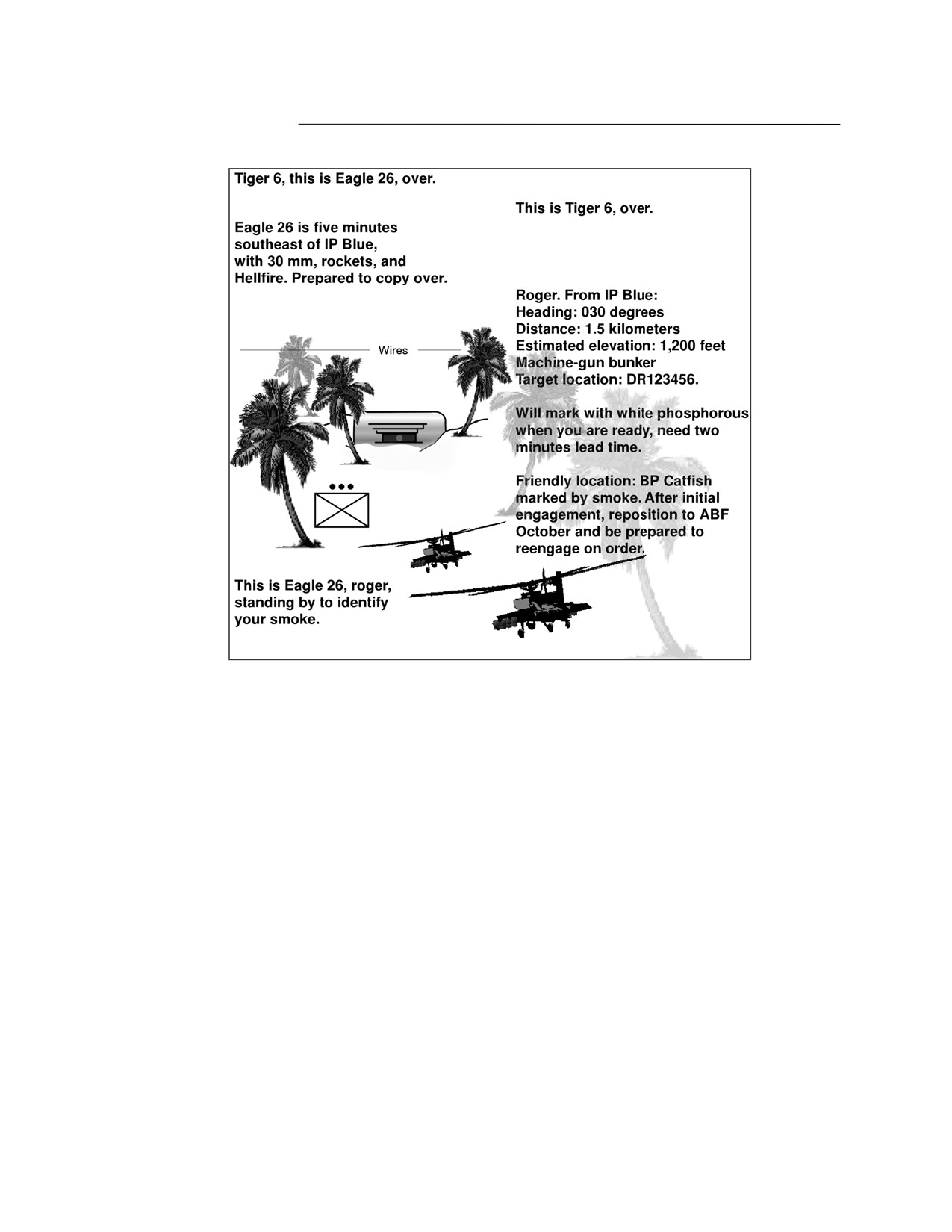
Q-52. The CCA briefing (Figure Q-9) follows the joint standard nine-line
format with minor modifications for Army helicopters. The briefing provides
clear and concise information in a logical sequence that enables aircrews to
employ their weapons systems. It also provides appropriate control to reduce
the risk of fratricide. Figure Q-10 depicts an example of a briefing.
Q-53. Danger close ranges for armed helicopter weapons are in Table Q-3.
FM 3-09.32 (FM 90-20) has additional information. Engagment at ranges
danger close or short of danger close require extreme close coordination and
positive identification. Crews must take special precautions when delivering
direct fires on targets within these ranges but are not prohibited from
delivering at ranges short of danger close. Accurate delivery of munitions is
essential when engaging at danger close ranges and requires higher crew
training standards.
Table Q-3. Danger Close Ranges for Attack Helicopter Engagement
WEAPON
DESCRIPTION
DANGER CLOSE IN
METERS
Rocket with various warheads.
2.75" rockets
200
Area weapon.
Precision-guided.
Hellfire
75
Point weapon.
20 mm
Guns.
25 mm
150
Area weapons.
30 mm
Q-54. Time is a primary constraining factor for coordinating direct fires in
close combat. METT-TC dictates how coordination between the commander
in contact and the AMC is accomplished. Face-to-face coordination is
preferred but is rarely possible in CCA situations.
Q-55. In the hasty CCA—to take advantage of targets of opportunity or
assist ground units under pressure—coordination is usually accomplished by
radio.
ENGAGEMENT
Q-56. A potential target may seem lucrative because of its apparent location
and activity, but visual acquisition and activity do not mean positive
identification. If there is no immediate threat from a specific target and it is
not positively identified, aircrews do not shoot until all possible measures to
identify are taken. Before the armed helicopter team engages, the target
must be confirmed by the aircrew and friendly unit in contact.
Q-57. During engagement, open communication and continuous coordination
with friendly ground elements are required to ensure the desired effect.
Coordination of the direct and indirect fires from all participants produces
the most efficient results in the least amount of time, with the least risk to
all. This coordination includes CAS and any nonlethal methods that may be
employed.
Q-16

Appendix Q
CLOSE COMBAT ATTACK BRIEFING
(Omit data not required. Do not transmit line numbers. Units of measure are standard
unless otherwise specified. *Denotes minimum essential in limited communications
environment. BOLD denotes readback items when requested.)
Terminal controller:
This is
(Aircraft call sign)
(Terminal controller)
*1. IP/BP/ABF or friendly location:
(Grid, known point or terrain feature)
*2. Heading to target:
(magnetic)
(Specify from IP/BP/ABF or friendly location)
*3. Distance to target:
(meters)
(Specify from IP/BP/ABF or friendly location)
4. Target elevation:
(feet mean sea level)
*5. Target description:
*6. Target location:
(Grid, known point or terrain feature)
7. Type of target mark:
Code:
(day/night)
(WP, laser, IR, beacon)
(Actual code)
Laser to Target Line:
degrees
*8. Location of friendlies:
(Omit if previously given--grid, known point, or terrain feature)
Position Marked By:
9. Egress direction:
(Cardinal direction not over threats)
Remarks (as appropriate):
(Threats, restrictions, danger close, attack clearance, SEAD, abort codes, hazards)
Time on target (TOT):
or time to target (TTT): Standby
plus
hack.
Note: When identifying position coordinates for joint operations, include the map datum
data. DESERT STORM operations have shown that simple conversion to latitude/longitude
is not sufficient. The location may be referenced on several different databases;
for example, land-based versus sea-based data.
Figure Q-9. Close Combat Attack Checklist
Q-17
FM 3-04.111 (FM1-111)
Figure Q-10. Example of a Close Combat Attack Brief
BATTLE DAMAGE ASSESSMENT/REATTACK
Q-58. The AMC provides a BDA to the ground commander who determines if
a reattack is required to achieve his desired end state. Support continues
until the desired effect is achieved.
EMERGENCY COORDINATION MEASURES
Q-59. Aviators may be required to assist ground personnel who are not fully
familiar with aviation assets. Key personnel who habitually handle
coordination for aviation support may become casualties or simply not be
available. These situations require close attention, careful communications,
and initiative on the part of the aviator to place fire on targets or deliver
other support as necessary. An assault pilot may be required to coordinate for
an attack mission or call for indirect FS. An attack pilot may have to assist in
extracting personnel.
Q-60. Pilots must ask appropriate questions of the requestor, with emphasis
on positive identification of location. Possibilities include the following
questions:
• Where is ground unit’s position? What are the GPS coordinates? Are
those coordinates verified with another GPS?
Q-18
Appendix Q
• Can the ground unit mark its position with smoke, tracers, or other
methods? (If smoke is used, aircrew verifies color after deployment.)
• What assistance does the ground unit need
(FS, extraction, or
resupply)?
• Where is the target? What are the grid coordinates or the relationship
of the target to a readily identifiable natural or man-made feature?
• How far is the target from the ground unit and in what direction is it?
If the observer is not familiar with meters, aircrews ask the observer
to try football or soccer field lengths to estimate distances.
• What is the target? Is the target personnel, vehicles, equipment, or
buildings? What is the size of the enemy force, and what is it doing?
Q-61. Aviators may have to fly helicopters near friendly troops to deliver
ordnance onto the target. Factors that can reduce the potential for fratricide
include the following:
• Precision-guided munitions.
• Fire support coordination measures.
• Planned or hasty coordination and control measures (Figures Q-5
through Q-8).
• Knowledge of the ground tactical plan.
• Knowledge of the exact location of friendly troops.
• Knowledge of the exact location of aircraft.
• Positive identification of targets.
• Familiarity between the supported unit and the aviation unit.
Q-19
Appendix R
Urban Operations
Like so many urban battles, the battle of Hue was filled with ambiguity
and uncertainty. The North Vietnamese Army (NVA) and Viet Cong
attacked as part of the surprise Tet Offensive in
1968. Two NVA
regiments overran the city, systematically executing thousands of
inhabitants. The U.S. and South Vietnamese response was awkward and
piecemeal. The Americans rapidly shifted three Marine Corps battalions
from ongoing combat missions, and eventually, 13 South Vietnamese
battalions were committed. The Americans followed with the commitment
of the 3rd Brigade, 1st Cavalry, and a battalion task force of the 101st
Airborne as blocking forces to attempt to stop enemy reinforcement and
destroy its C2 and logistical links. There was no clear unity of command
over the various South Vietnamese and American forces, and the city was
never fully isolated by either side. The battle raged for 22 days before the
United States and its South Vietnamese allies achieved victory.
Casualties were high, as is often the case in urban combat: 1,004 United
States, 2,184 ARVN, and more than 5,000 NVA. Throughout the battle,
aviation played a critical role in observation, troop movement, gun
support, and MEDEVAC.
SECTION I - GENERAL
R-1. Operations in urban terrain follow the same basic planning and
execution methodology as in other terrain; however, special planning and
consideration of the characteristics unique to urban terrain are essential. See
Chapter 6. FM 3-06.1 (FM 1-130) and FM 3-06.11 (FM 90-10-1) contain
detailed information.
R-2. Whenever possible, aircrews avoid a fight in urban terrain. The
optimum choice is to surround, isolate, and bypass a city, ensuring that any
troops and resources in that city are rendered ineffective and unavailable to
support other enemy operations.
AVIATION’S ROLE DURING URBAN OPERATIONS
R-3. Aviation enhances urban operations by providing—
• Reconnaissance.
• Speed of resupply.
• Rapid troop movement.
• Evacuation of personnel and equipment.
• Cooperative maneuver.
R-0
Appendix R
• Precision fires in support of ground forces.
• The combined arms team’s ability to quickly and efficiently make the
transition to new missions.
AH-64 UNITS
R-4. AH-64 units attack targets with direct fire to destroy enemy troops and
equipment. They also assist with ISR and communications, using their
advanced suite of sensors and radios.
OH-58D UNITS
R-5. OH-58D units perform the same functions as AH-64 units. They also
perform reconnaissance and security missions in and around urban areas.
UTILITY AND HEAVY HELICOPTER UNITS
R-6. UH-60 and CH-47 units conduct air assaults and transport personnel,
equipment, and supplies. They are configured with machine guns to aid in
the suppression of enemy forces.
ALL HELICOPTERS
R-7. Aircraft can also assist in radio relay and perform as aerial OPs and C2
platforms.
STAGES OF URBAN OPERATIONS
R-8. The four stages of urban operations are assess, shape, dominate, and
transition. They may occur in succession or simultaneously.
ASSESS
R-9. In the assess stage (Figure R-1), the unit identifies the portions of the
urban area essential to mission success.
AVIATION ASSESS MISSIONS
Lift (Utility/Cargo) Helicopter Units
• Provide CASEVAC.
• Conduct air movement of troops and supplies.
• Support C2 operations.
• Support EW operations.
• Support NEO.
Attack/Cavalry Helicopter Units
• Perform reconnaissance of urban peripheral area to establish enemy strength and
disposition.
• Conduct route and area reconnaissance for forces.
• Establish initial security of flanks and rear until relieved by ground forces.
• Perform air security.
• Provide suppressive fires in support of ground reconnaissance and security elements.
Figure R-1. Missions During the Assess Phase
R-1

FM 3-04.111 (FM 1-111)
SHAPE
R-10. In the shape phase, units isolate those areas essential to mission
success in the offense or avoid isolation in the defense. In the offense,
aviation forces attack to isolate the objective, move troops and supplies,
enhance C2, conduct reconnaissance, and augment ground forces. In the
defense, aviation forces help set the conditions for the main battle
and
prevent isolation of friendly units (Figure R-2).
AVIATION SHAPE MISSIONS
Lift (Utility/Cargo) Helicopter Units
• Conduct air assaults to the flanks and rear to deny LOCs from the enemy.
• Provide CASEVAC.
• Perform personnel and equipment recovery.
• Conduct air movement of troops and supplies.
• Emplace logistical resupply points and FARPs.
• Support C2 operations.
• Conduct EW operations.
• Support NEO.
• Conduct countermobility operations/emplace Volcano mines.
Attack/Cavalry Helicopter Units
• Perform reconnaissance of peripheral areas to establish enemy strength and disposition.
• Conduct route and area reconnaissance.
• Establish initial security of flanks and rear until relieved by ground forces.
• Augment ground forces for isolation of urban area.
• Employ indirect fires and CAS.
• Conduct JAAT.
• Perform air assault security.
• Provide suppressive fires in support of ground maneuver and security elements.
• Employ direct fires to destroy key targets and enemy elements attempting to escape or resupply or
reinforce the urban area.
Figure R-2. Missions During the Shape Phase
DOMINATE
R-11. In the dominate phase, units precisely mass the effects of combat
power to rapidly dominate the area (Figure R-3).
AVIATION DOMINATE MISSIONS
Lift (Utility/Cargo) Helicopter Units
In addition to the missions listed under assess and shape, utility and cargo aircraft may—
• Perform air assault.
• Support CA/PSYOP.
Attack/Cavalry Helicopter Units
In addition to the missions listed under assess and shape, attack and cavalry aircraft may—
• Provide security to flanks of advancing ground forces.
• Provide suppressive fires in support of attacking ground forces.
• Engage HPTs influencing point of penetration with precision direct fires.
Figure R-3. Missions During the Dominate Phase
R-2
Appendix R
TRANSITION
R-12. In the transition phase, units transfer control of the urban area to
other agencies and prepare for follow-on operations. Aviation forces facilitate
the transition (Figure R-4).
AVIATION TRANSITION MISSIONS
Lift (Utility/Cargo) Helicopter Units
• Provide CASEVAC.
• Perform personnel and equipment recovery.
• Conduct air movement of troops and supplies.
• Emplace logistical resupply points and FARPs.
• Support C2 operations.
Attack/Cavalry Helicopter Units
• Provide screen or area security.
• Conduct route and area reconnaissance for forces.
• Serve as reserve.
• Conduct operations to set conditions for follow-on missions.
Figure R-4. Missions During the Transition Phase
SHAPE/DOMINATE
R-13. The lines between shape and dominate phases are rarely crisp.
Aviation capabilities allow the commander to more quickly shape the
battlefield and move into the dominate phase. There are always sectors of the
battlefield that will be in different phases than in other sectors, demanding
the application of various techniques by the commander.
R-14. During the operation illustrated in Figure R-5, aviation provides—
• Security by screening the flanks of the operation.
• Reconnaissance of NAIs.
• Direct fire on the enemy from numerous positions.
• Air assault and air movement.
R-15. These actions are conducted in concert with—
• Ground attacks.
• Observation by satellites, UAVs, and other aerial platforms.
• Indirect fires.
• Sister-service CAS.
• Ground elements tasked to control underground avenues of approach
such as sewers and subway tunnels.
• MP and other ground elements tasked to control critical points and to
screen those people departing and entering the sector for combatants.
R-3
FM 3-04.111 (FM 1-111)
X-faction controlled with
mixed options on
Government and business
US presence
district. Y-faction controlled
and anti-US opinions.
Rooftop
Landing Zone
Wealthy neighborhood
very pro-US.
LEGEND:
Potential
helicopter routes
HOSTILE
NEUTRAL
FRIENDLY
Figure R-5. Example of a Typical Shape/Dominate Mission
R-4
Appendix R
SECTION II - SPECIAL CONSIDERATIONS
AVIATION WEAPONS EMPLOYMENT IN URBAN TERRAIN
R-16. When fighting in urban terrain, most targets are fleeting and near the
identifying soldier. Few personnel targets will be visible beyond 50 meters,
and engagements usually occur at 35 meters or less. Armed helicopter
engagements in support of troops that are in such proximity require careful
coordination and execution.
R-17. To reduce the risk of fratricide, aircrews must be familiar with
minimum arming distances and risk-estimate distances. Falling debris from
urban structures can be as deadly as shrapnel. FM 3-09.32 (FM 90-20) and
Chapter 3 of this manual contain additional information regarding danger
close ranges.
R-18. The precision of the Hellfire missile may minimize collateral damage.
Because of its accuracy, the use of a Hellfire missile may be appropriate to
eliminate such targets as a sniper or machine-gun nest. Selection of the
correct type of Hellfire warhead is also critical.
R-19. Though considered an area fire weapon, the 30-millimeter cannon is
very accurate and may be employed against a single person or groups. It can
penetrate the walls of most conventional structures.
R-20. The 50-caliber and 7.62-millimeter machine gun are both area fire
weapons. They penetrate less well than the 30-millimeter, with the 50-caliber
having greater effect than the 7.62-millimeter. Both are good for suppressive
fires and against troops and other soft targets. Door guns on utility and cargo
aircraft provide direct fires to protect the aircraft and crews.
R-21. The
2.75-inch rockets suppress and destroy targets. As currently
configured, these are area fire weapons, the accuracy of which is tied directly
to crew proficiency. Running or diving fire often yields the best results.
Rockets are effective against troops and equipment in open streets and plazas
when enough standoff and maneuver room is available. Flechette rounds are
effective to clear rooftops. Smoke rounds are available.
HELICOPTER WEAPONS ENGAGEMENT
R-22. Armed helicopters are most effective when the standoff advantage of
their weapons systems is employed and vulnerability to ground fires is
reduced. Because of target masking in urban terrain, aircrews may have to
maneuver close to a target to see and hit it. Continuous movement minimizes
exposure time and enhances survivability. If the enemy has established a
stronghold in the urban area, the risk to aviation assets dramatically
increases. The close infantry battle will become increasingly difficult to
support with helicopters.
R-23. As enemy elements seize key features (particularly taller structures),
the air defense threat escalates. Helicopter movement must be swift and
unpredictable. Low slow orbiting or hovering fire is extremely risky in urban
terrain.
R-5
FM 3-04.111 (FM 1-111)
R-24. Urban terrain is canalized and often provides severely limited fields of
fire. Structures tend to limit target views to a narrow corridor along the
street or from high angles over the buildings. Enemy forces may occupy
buildings or “hug” the near sides of buildings, putting them out of view of
armed helicopters. Engagements of rooftop targets can come from all angles.
Expect targets to move rapidly from cover to cover and require quick
engagement.
R-25. The threat to aircraft is lessened when firing from friendly-controlled
areas. Positions should be planned to provide flexibility for aircraft maneuver
to maximize cover and multiple firing positions and angles. When forced to
fight and fly over areas where the enemy has not been cleared, aviation forces
face extremely high risk. Aircrews can expect engagement from the ground
and upper floors of buildings. When these conditions exist, it is better to keep
the aircraft moving rapidly, making it harder to engage. Aircrews normally
conduct running fire engagements from an initial point, engaging the target
and returning to a safe area to regroup for another attack. The lead-wingman
concept is used for this type of attack. The wingman suppresses the target
during and after lead’s engagement and “covers his break.” Ground units
provide suppressive fires to protect the aircraft during their attack.
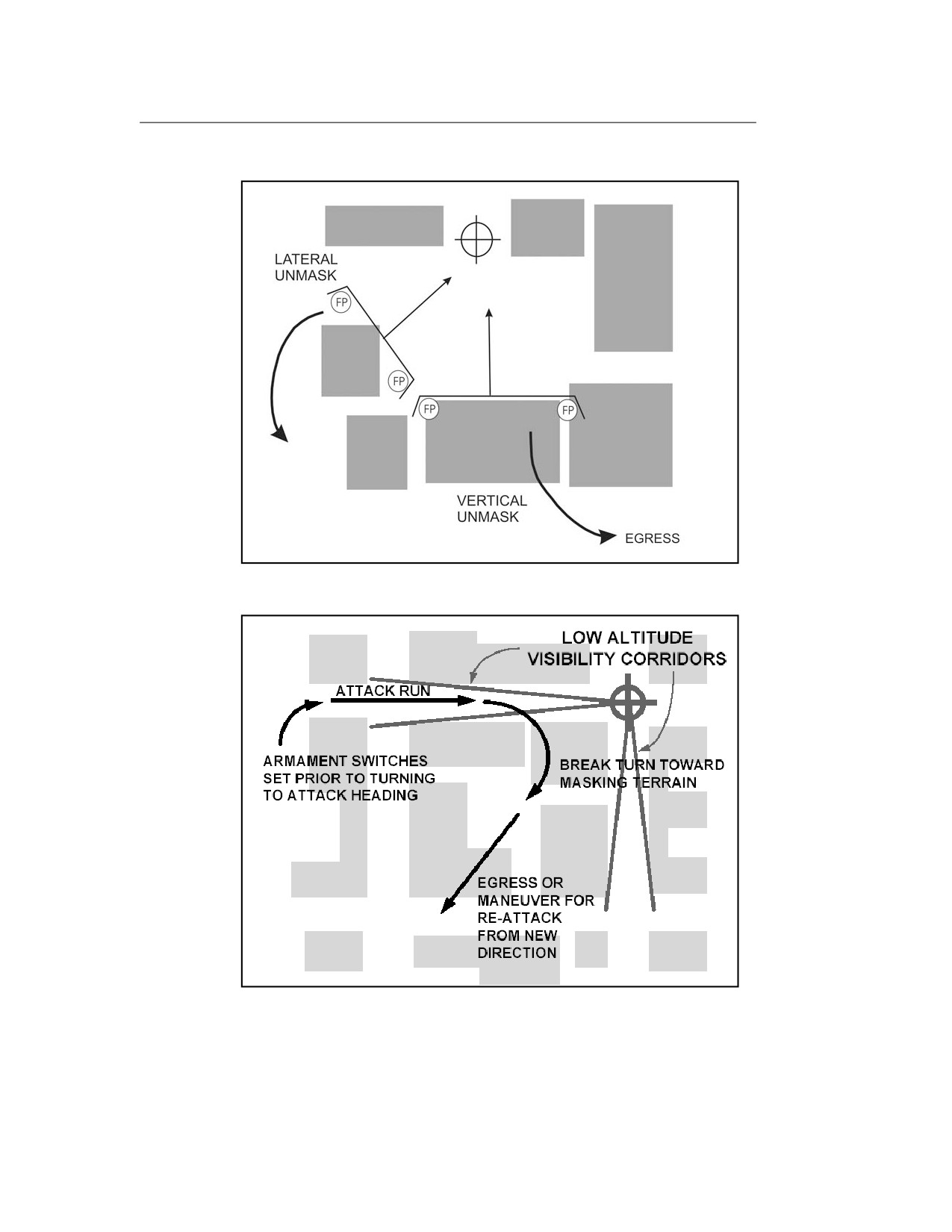
R-26. Aircrews plan for both hovering fire (Figure R-6) and running fire
(Figure R-7). Running fire generally offers better aircraft survivability. If
aircrews use hovering fire, they can unmask laterally or vertically from cover.
GRAPHIC AIDS AND ROUTE PLANNING
R-27. Aircrews have different visual cues and perspectives than do ground
forces, thus potentially causing confusion. Common graphics and sketches
help alleviate these differences.
NAVIGATION
R-28. Navigation over urban terrain can be more difficult than over natural
terrain because most maps do not show the vertical development of urban
terrain. Cities are compartmented, causing small navigational errors to have
significant effect. High density of structures, variety of geographical
references, and similarity of structures can cause confusion. If electrical
power is still available, high ambient light levels can create problems with
NVD.
NAVIGATION TECHNIQUES
R-29. Effective navigation over large towns and cities requires a variety of
navigational systems and techniques. GPS eases the problems associated
with navigation and orientation but does not eliminate the need for other
navigational methods. Navigation systems may be degraded because of
interference induced by buildings and by GPS jammers. Aircrews must
closely monitor and cross-check their positions by all available means.
R-6
Appendix R
Figure R-6. Example of a Hovering Fire Engagement
Figure R-7. Example of a Running Fire Engagement
R-30. Natural terrain features—such as rivers, lakes, and hills—are
preferable landmarks because they are less likely to change, but they may
not be useable during various flight profiles. Man-made features may provide
the majority of available navigation aids. Units choose easily recognizable
features such as cemeteries, stadiums, cathedrals, and major roads.
R-7
FM 3-04.111 (FM 1-111)
Highways, rivers, railways, canals, and coastlines provide easily recognizable
boundaries and references to assist in maintaining orientation. Prominent
rail and highway interchanges are useful as en route checkpoints.
R-31. Selection of key features within an urban area facilitates general
orientation and backup navigation. The most prominent vertical structures,
such as radio towers and distinctive skyscrapers, are visible from almost all
directions in a major city. Use of these features as heading references is an
effective method of navigation. However, prominent man-made objects can be
destroyed and unavailable for reference. Varied flight routes and times
increase survivability by preventing predictability.
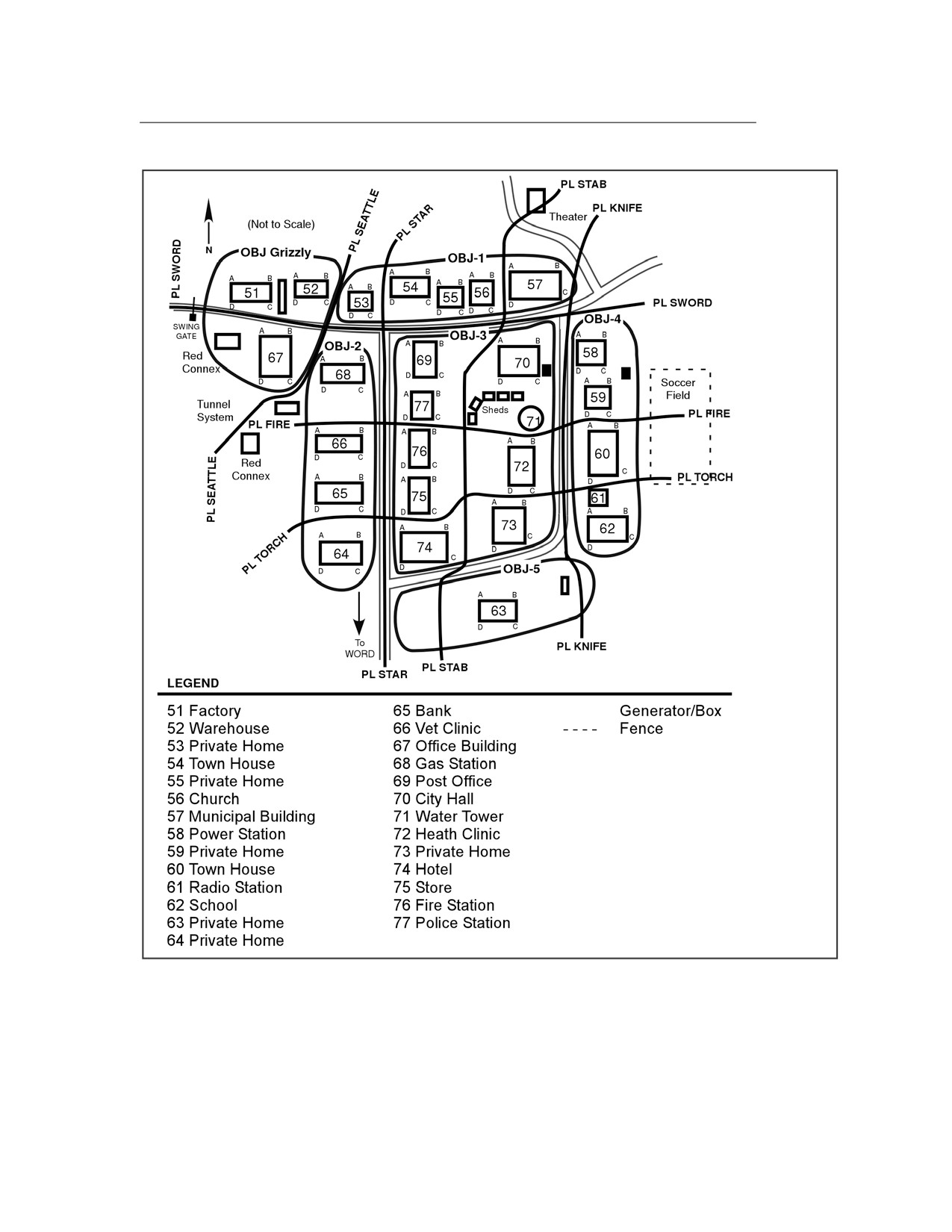
R-32. An area sketch (Figure R-8) offers both the ground commander and the
aircrew a means of identifying friendly and enemy locations. The sketch is an
excellent tool for planning and unit coordination. It is best used for smaller
towns and villages but can be applied to an EA or other specific area of a
larger city. The area sketch captures natural and man-made features and key
terrain in that area and designates a letter or numeral code to each.
Buildings and their corners are coded. This gives aircrews an accurate way to
target specific buildings and identify friendly locations. Units must ensure
that they are using the same area sketch to effect coordination.
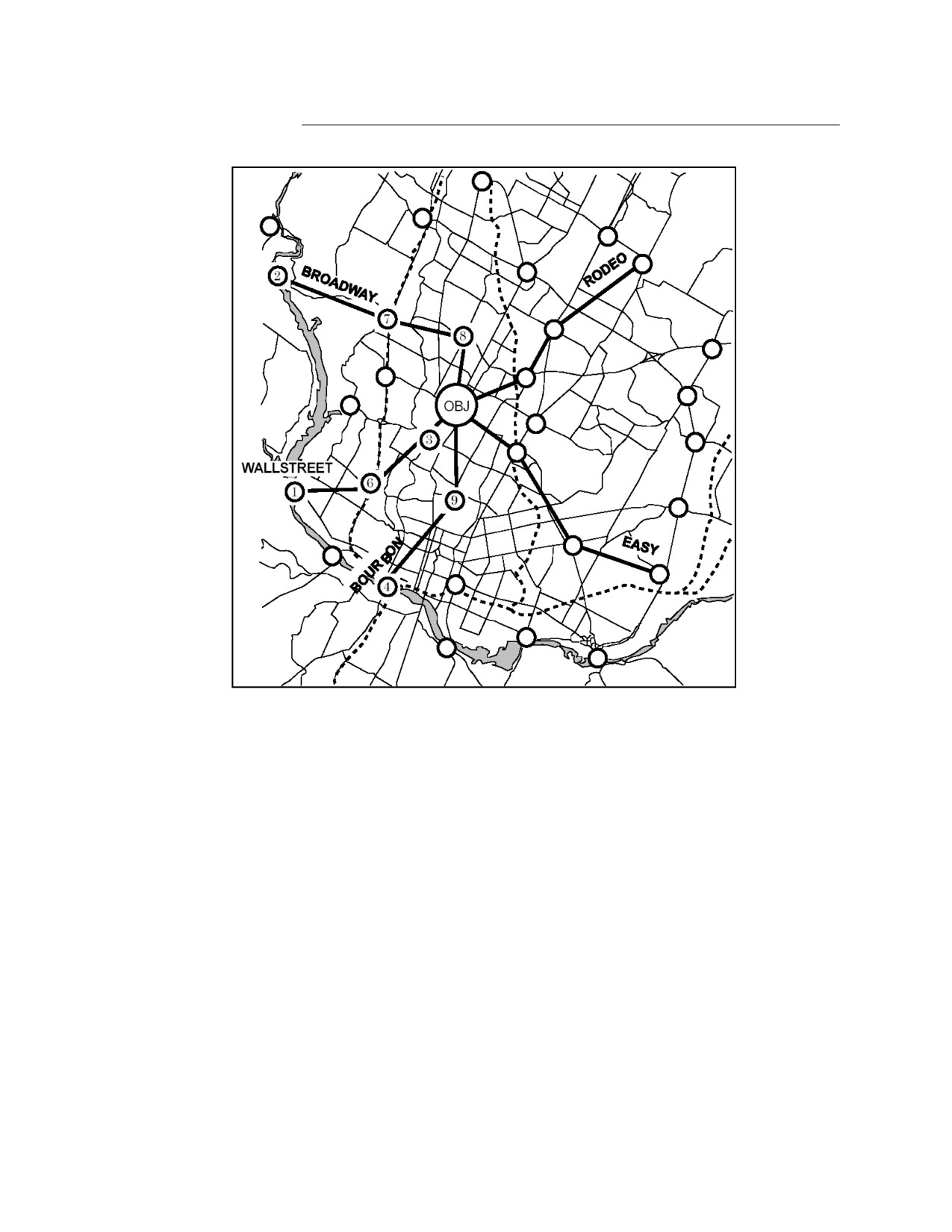
R-33. Units may use a network route structure (Figure R-9) of ACPs and air
routes (preferably surveyed) to facilitate route planning, navigation, and C2.
R-34. Maneuver graphics, FS coordinating measures, and airspace control
measures further allow aircrews and ground elements to better visualize the
urban battle space. It is the responsibility of both the aviation and ground
unit to ensure that they use the same area sketch for accurate coordination.
SELECTION AND PREPARATION OF MAPS AND CHARTS
R-35. Units consider all available government and commercial products—
ranging from paper maps and charts to digital mapping databases.
Commercial maps of a city may be more current and provide better detail
than tactical maps. Larger scale maps provide additional detail for accurate
planning. Photo imagery supports more accurate assessment of key features.
HUMINT sources can provide useful data for map preparation, including
confirmation of locations and conditions of structures.
R-36. Shortcomings of tactical maps are that the urban area data are often
out of date and the scales are too small to show enough urban detail. Maps
with a larger scale than 1:50,000 provide greater detail for mission planning
and execution. Maps should be updated with current terrain and structure
information. This effort may involve drawing new features by hand.
Overhead imagery can be used to update information:
• Some 1:25,000 tactical maps are available.
• Some
1:24,000 and
1:25,000 National Geodetic Survey maps are
available for some countries.
• NIMA produces 1:12,500 maps for specific urban areas, as specified by
the customer.
R-8
Appendix R
Figure R-8. Example of an Area Sketch Flight Planning Aid
R-9
FM 3-04.111 (FM 1-111)
Figure R-9. Example of a Network Route Structure
R-37. Tourist maps are often large scale, depicting the shape of significant
buildings and cultural features. A reference grid is usually overlaid on the
map. Streets and landmarks may be listed in the margin, with reference to
the location within the grid pattern. If military grid coordinates are required
for navigation or targeting, the civilian map must be overlaid with the MGRS
in the proper datum.
R-38. NEO Intelligence Support Handbooks (NISH) is also available for
every American Embassy (classified secret). The NISH augments planning
for NEO or hostage-recovery operations. It contains information such as
presurveyed LZ listings. Planners must consider currency of terrain
information.
TARGETING GRIDS AND REFERENCE TECHNIQUES
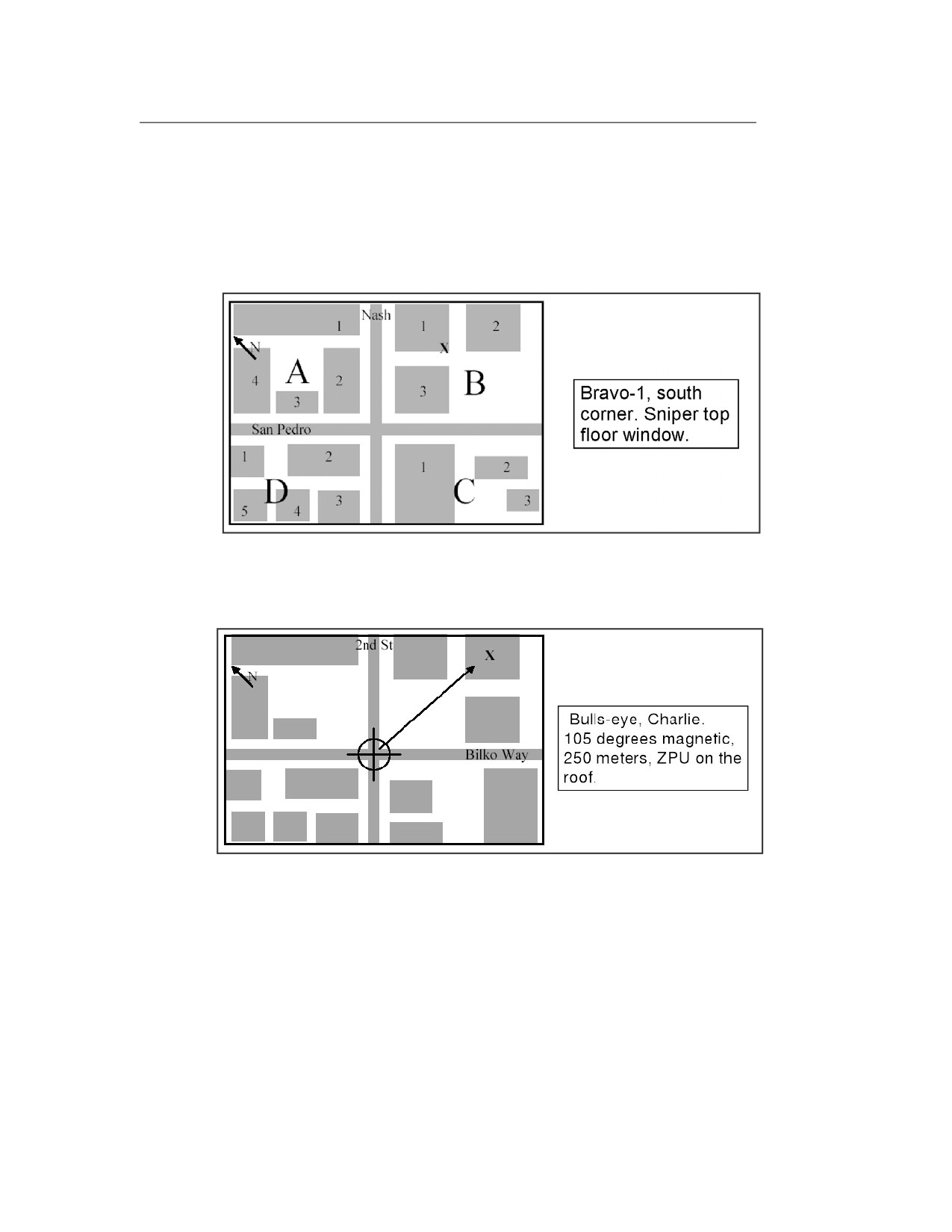
R-39. Ground elements generally use a terrain-based reference system
during urban operations. MGRS coordinates have little meaning at street
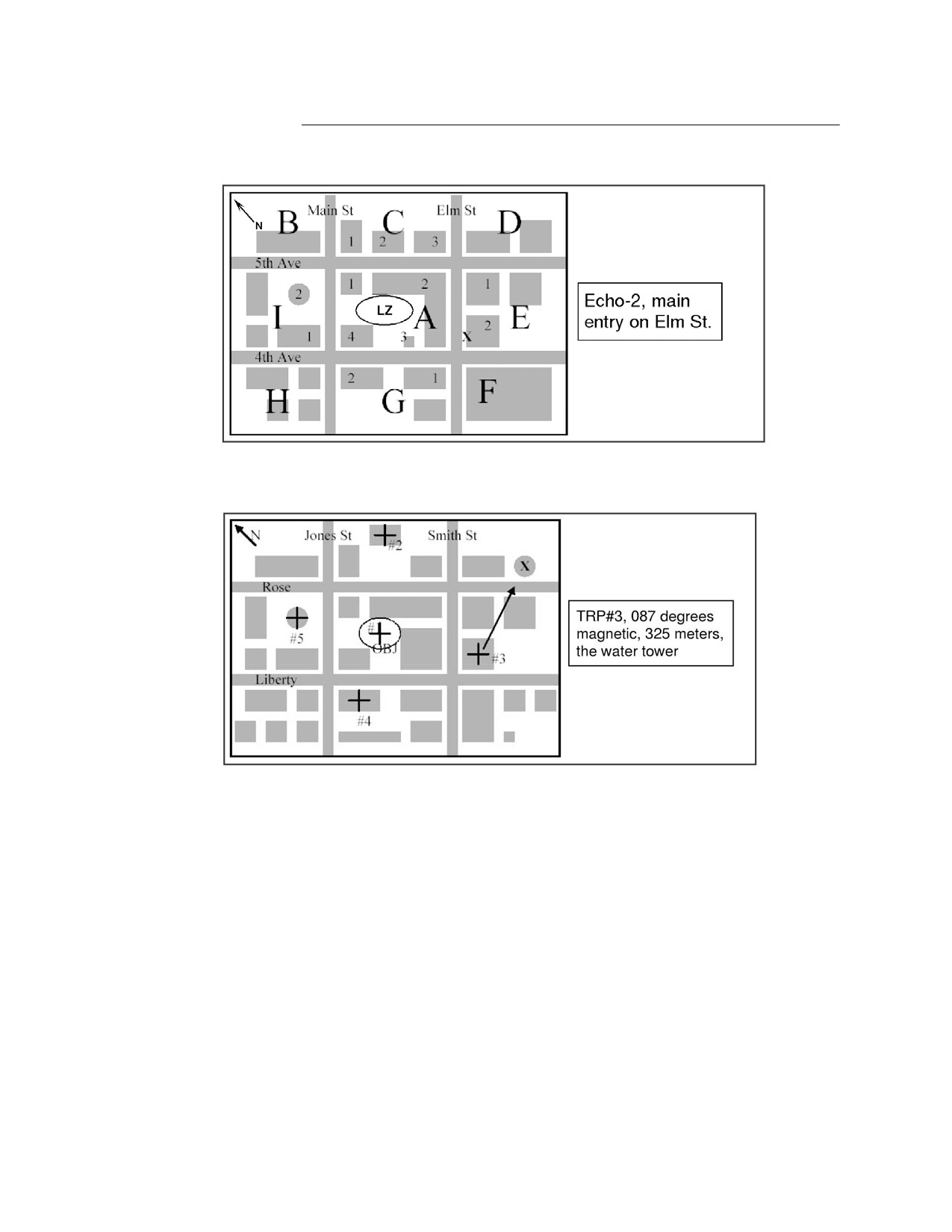
level. Aviation and ground forces must use common control methods. Possible
techniques include urban grid (Figure R-10), checkpoint targeting (Figure R-
11), objective area reference grid (Figure R-12), and target reference points
(Figure R-13). These techniques are based on the street and structure
pattern, without regard to the MGRS. Using common techniques allows
R-10
Appendix R
aircrews to make the transition to the system in use by the ground element
upon arrival in the objective area. For example, references to the objective or
target may include local landmarks such as “The third floor of the Hotel
Caviar, southeast corner.” This transition should be facilitated by using a
“big-to-small” acquisition technique.
Figure R-10. Example of the Urban Grid Technique
Figure R-11. Example of the Checkpoint (Bull’s-Eye) Technique
R-11
FM 3-04.111 (FM 1-111)
Figure R-12. Example of the Objective Area Reference Grid Technique
Figure R-13. Example of a Target Reference Point Technique
CONSIDERATIONS FOR HELICOPTER EMPLOYMENT
R-40. Commanders must identify and assess unique characteristics
associated with aviation urban operations. Appendix A covers risk
management in detail. Some other considerations follow.
FIRES
R-41. Some special considerations for fires in urban operations include the
following:
• Minimum arming range and minimum slant ranges within urban
areas limit the use of some weapons.
• Heavy concentration of precision weapon systems along a narrow front
may cause coordination problems.
• Even precision weapons can cause fratricide if planning is not precise.
R-12
Appendix R
• Multiple flat, polished surfaces in an urban area may degrade laser
use.
• Heavily developed urban centers can limit close air support.
• Direct and indirect suppressive ground fire should augment the escort
suppressive fires as air-assaulting forces approach intended LZs.
• Operations could be in areas with a high potential for significant
civilian injury and collateral damage of property; specific knowledge of
weapons effects is critical.
• Wingmen protect firing aircraft while engaged pilots concentrate on
targets.
THREAT
R-42. Some special considerations for the threat in urban operations include
the following:
• Enemy forces may infiltrate urban terrain and ambush helicopters
from positions inside buildings.
• Cover and concealment of urban terrain enable enemy force
concentration, increasing the risk of effective small-arms fire.
• RPGs provide significant threat, especially to slow-moving helicopters.
• Portable surface-to-air missile systems are difficult to detect in and
among buildings.
• Air defense ambush zones should be emplaced around or near likely
aerial routes, landing sites, or objectives.
• Because LZs may be scarce and, therefore, predictable, air-assault
operations in mass may be vulnerable to enemy fires.
WEATHER
R-43. Some special considerations for weather in urban operations include
the following:
• Smoke and fire in the built-up area cause obscuration.
• Urban areas directly affect weather, especially wind patterns
resulting in gusts and thermals.
• High concentration of man-made materials increases the risk of
exposure to toxic industrial materials.
TERRAIN
R-44. Some special considerations for terrain in urban operations include the
following:
• Obstacles—such as power lines, towers, and guidelines—may be more
numerous and dangerous than in any other environment.
• Buildings limit maneuverability, and engagement ranges are typically
shorter, affecting the ability of attack helicopters to employ weapons
at desired standoff ranges.
• Buildings may be used to mask friendly helicopter operations.
• Urban terrain masks intelligence and electronic warfare acquisition
capabilities.
R-13
FM 3-04.111 (FM 1-111)
• Landing and PZs may be severely limited; operations from unstable
rooftops may be required. The S2 coordinates with the engineer officer
to obtain available architectural plans and blueprints to determine
the weight-bearing capabilities of rooftops for use as LZs.
• Vertical development blocking LOS radio communication can severely
affect air-ground and low-level air-to-air communication.
R-14
Glossary
AADC
area air defense commander
1SG
first sergeant
A&L
administrative and logistics
A2C2
army airspace command and control
A2C2S
army airborne command and control system
AA
assembly area
AAA
antiaircraft artillery
ABCS
army battle command system
AAFARS
advanced aviation forward area refueling system
AAFES
Army and Air Force Exchange Service
AAGS
Army air-ground system
AAMDC
Army Air and Missile Defense Command
AAO
assistant aviation officer
AAR
after-action review
AATFC
air assault task force and air mission commander
ABCCC
airborne battlefield command and control center
ABF
attack by fire
A/C
aircraft
ADA
air defense artillery
ABCS
Army Battle Command System
AC
active component
ACA
airspace coordination area
ACE
analysis and control element
ACM
airspace control measures
ACO
air coordination order
ACP
air control point
ACT
air cavalry troop
AD
air defense
ADF
automatic direction finder
ADIZ
air defense identification zone
Glossary-1
FM 3-04.111 (FM 1-11)
ADSI
air defense system integrator
ADSS
air data sensor subsystem
AFATDS
advanced field artillery tactical data system
AGES
air-ground engagement system
AGL
above ground level
AH
attack helicopter
AHB
assault helicopter battalion
AHC
assault helicopter company
AI
air interdiction
AIC
airspace information center
AIT
automotive information test
ALE
automatic link establishment
ALO
air liaison officer
ALOC
administrative and logistics center
ALSE
aviation life support equipment
ALSO
aviation life support officer
ALSS
aviation life support system
alt
altitude
AM
amplitude modulated
AMC
air mission commander
AMDWS
air and missile defense work station
ammo
ammunition
AMO
aviation maintenance officer
AMPS
aviation mission planning system
AMSS
Army materiel status system
ANCD
automated network control device
ANGLICO
air and naval gunfire liaison company
ANGPLT
air-naval gunfire platoon
AO
area of operations
AOC
air operations center
APC
armored personnel carrier
APOD
aerial port of debarkation
APOE
aerial port of embarkation
APU
auxiliary power unit
Glossary-2