FIELD MANUAL FM 1-112 ATTACK HELICOPTER OPERATIONS (April 1997) - page 7
FM 1-112
b. Signal.
(1) SOI edition.
(2) Frequencies.
(3) Operational nets, net diagrams.
(4) ECCM.
(5) Antijamming procedures.
(6) Secure fills. Procedures and fill in use.
(7) Fixed call-signs.
(8) CVMS for division.
(9) Brevity codes.
(10) Have Quick and Have Quick II procedures.
(11) SINCGARS procedures.
6.
SAFETY
a.
Preaccident Plan.
b. Risk Management Procedures.
Time hack. Is it GPS? Some other time standard?
ANNEXES
A. Acronyms.
B. Reports. Ensure standardization with higher.
C. Alert Time Table.
D. Uniform and Packing List.
E. Precombat Inspections.
F. ASE. Operation and Use.
G. Liaison Officer Checklist.
Figure E-1. Sample format for a TAC SOP (concluded)
E-7
FM 1-112
APPENDIX F
AIR COMBAT
F-1. GENERAL
An increasing number of countries have recognized the helicopter's effectiveness as a
primary tool in destroying armor elements, providing ground maneuver commanders with
a CS capability, and gathering intelligence information. A requirement to destroy
helicopter forces performing these functions will exist from the viewpoint of all opposing
forces, raising the probability of helicopter air combat in future conflicts.
a.
Explanation of Terms. As used in this document, the term "air combat"
describes those actions taken by Army helicopters against airborne threat fixed- and
rotary-wing aircraft. These actions are defined by the key terms, "avoid," "evade," "threat-
en," and "engage," which represent the general philosophy of Army aviation toward the air
threat.
b. Scope. Deliberate and chance encounters with enemy aircraft will occur
throughout the battlefield and must be anticipated to protect the force. The scope of air
combat operations will range from defensive actions that are required to protect an air
assault force to limited offensive actions when aviation forces ambush an inbound enemy
air threat. Commanders at all levels must acknowledge and plan for the possibility of air
combat operations during all types of missions.
c.
Battle Drills.
(1) The air combat battle drills presented in this appendix represent an
evolution of TTP developed from the experiences of field aviation units and the results of
Air-to-Air Combat Test Phase I and II, conducted at Fort Rucker, Alabama in 1993.
(2) The focus of the battle drills is on attack units, although they could
apply to any unit. The drills are designed to provide a platoon of armed helicopters with
immediate action steps to deal effectively with an air threat. Air combat drills are
reactive in nature. Their primary purpose is to preserve the force so that it can accom-
plish the primary mission and return to fight again.
(3) The drills are based on the fire and maneuver concept with emphasis on
C2. The primary objective of the drill is to alert the force so that an immediate response
to the threat may be initiated. This objective includes moving the force from a position of
disadvantage to a more advantageous position.
F-1
FM 1-112
(4) Each battle drill consists of deliberate and standard phraseology and
maneuver. When the force completes these initial standardized steps, the drill is over and
the commander must make a tactical decision regarding the follow-on actions of his force.
d. TTP. The follow-on actions, or TTP, will vary as the commander evaluates
each individual situation. The factors of METT-T affect his decision to avoid, evade,
threaten, or engage the threat.
F-2. THE THREAT
Army aviation will make a decisive contribution to Army operations. Consequently,
friendly aviation forces are considered both crucial combined arms assets and lucrative
targets for threat aviation forces. Enemy attempts to dominate the terrain flight environ-
ment will be a constant threat to the success of combined arms operations.
a.
Threat Overview.
(1) The primary threat to Army aviation within the terrain flight environ-
ment is ground-based AD. The air threat posed by both rotary-wing and fixed-wing
aircraft, however, is increasing.
(2) As third world countries continue to modernize forces, the air threat to
friendly helicopters becomes more significant. Forces committed against the third world
threat are likely to encounter a mix of systems, tactical organizations, and doctrines that
have their origin in the industrial nations of the East and West. A potential air threat
can, therefore, be expected to operate a variety of sophisticated fixed-wing attack/fighter
aircraft and armed helicopters that are available from industrialized nations.
(a) Threat armor forces. Enemy AD weapons, ground forces,
helicopters, and high-performance aircraft are a major threat to Army aviation. Former
Warsaw Pact doctrine calls for priority destruction of our antiarmor capability. With the
improving antitank capability of our forces, that doctrine is expected to remain un-
changed. Therefore, the more damage Army aviation can inflict on the threat's armor
forces, the more the threat will concentrate on destroying Army aviation's antiarmor
capability.
(b) Threat aviation combat capability. The US Army has in-
creased its aviation combat capability; however, former Warsaw Pact member nations
have also increased their capability at higher rates. As our air-to-ground effectiveness
has improved, so has the threat's anti-helicopter efforts. To destroy Army aviation forces,
the threat will use every available asset, to include tactical fighter aircraft and armed
helicopters.
(c) Threat awareness. To defeat the threat, aircrews must under-
stand the threat and its employment of air and ground assets. They must also under-
stand the doctrine, tactics, and techniques of any potential enemy and its employment of
F-2
FM 1-112
weapon systems. To be successful in air combat operations, commanders, tactical
planners, and aircrews must know the capabilities and limitations of threat aircraft, air-
to-air tactics, and air-to-ground tactics.
b. Helicopter Threat.
(1) The increasing numbers of attack helicopters available to potential
hostile forces virtually assures the likelihood of meeting engagements. While the former
Soviet threat has diminished significantly over the past several years, the fact remains
that Russia's military approach to warfare will influence a number of third world
countries, many of which are openly hostile to the United States.
(2) Western tactics have also had their influence on questionably aligned
third world countries. Therefore, the tactics used by a helicopter air threat will vary from
the high-speed slashing attacks typical of Soviet-developed tactics to the masked hovering
engagements typical of western tactics. These engagements are likely to be brief, violent
encounters; the win will go to the side that sees first, engages decisively, and successfully
maneuvers its forces to cover and kill from the terrain flight environment. Our potential
adversaries are offensively oriented forces. At the tactical level, they stress maintaining
the momentum and exploiting penetrations with armor-heavy combat units. Their
primary task at the FLOT is to suppress enemy antitank systems, which points out the
value that the threat places on its armor forces.
(3) A growing concern that most armies have wrestled with for some time is
the increasing threat that attack helicopters represent to armor forces. The technological
advances in lethality, accuracy, and speed of the ATGMs carried by attack helicopters will
amplify the role that attack helicopters play. The use of attack helicopters in the lower
spectrum of conflict is also on the rise with the increasing military growth of third world
countries. Armed helicopters are playing an increasing role in armed reconnaissance,
security operations, and raids. As its tactics and uses are developed, the helicopter will be
employed throughout the entire continuum of operations.
c.
Fixed-Wing Threat.
(1) The high performance fixed-wing threat against helicopters cannot be
dismissed. However, the likelihood of the fixed-wing threat targeting friendly helicopters
as anything other than targets of opportunity is remote. The range of operations, speed,
and operating environment of the helicopter makes it a relatively low priority target for
fixed-wing aircraft. In terms of cost effectiveness, the helicopter is a more suitable target
for ground-based weapon systems or for other helicopters.
(2) Fixed-wing aircraft operate at a significant tactical disadvantage when
attacking helicopters that are operating in the terrain flight environment. These aircraft
are not adequately equipped for specific search-and-destroy helicopter missions. In
addition, they become lucrative targets for increasingly sophisticated helicopter air-to-air
F-3
FM 1-112
weapon systems. For this reason, the battle drills in this appendix are designed primari-
ly for reaction to other helicopters. The high rates of closure of the high performance
fixed-wing threat aircraft and the lack of suitable early warning devices in the cockpits of
friendly helicopters may not allow the pilots time to react.
(3) If terrain permits and the threat has not detected the formation, the
best COA is for the friendly aircraft to disperse and mask. Movement alerts overflying
aircraft to the presence of potential targets. Therefore, any movement over the ground
should be minimized, if not completely eliminated.
(4) If a fixed-wing threat detects a formation of rotary-wing aircraft, the
targeted aircrew should fly toward the attacking aircraft as they perform a series of
jinking maneuvers. Once the threat has overflown the targeted aircraft, the aircrew
should mask. Other aircraft should disperse, mask, and prepare to engage the threat.
(5) Friendly helicopters should avoid prominent features that can be readily
identified from altitude. For example, a sharp bend in a river gives the pilot of the threat
aircraft a RP for additional passes. Downed aircraft are also conspicuous references, and
crews of friendly aircraft trying to assist risk the same fate.
F-3. FUNDAMENTALS
Helicopter air combat doctrine has been developed in the absence of actual combat
experience. The generation of air combat TTP is, therefore, evolutionary. Extensive
testing and training have shown that adherence to various employment considerations,
such as the tenets of Army Operations, the principles of war, and the factors of METT-T,
result in effective air combat tactics. To plan and conduct successful air combat opera-
tions as part of the primary mission, commanders and aircrews must understand and use
these employment considerations.
a.
Purpose. Battle drills and TTP provide Army aviation with the tools needed
to perform its primary mission in an air threat environment.
b. Analysis of the Mission. An analysis of air combat missions (mission
debriefs) further refines tactics and makes them successful techniques and procedures
upon which unit SOPs and battle drills can be based. While keeping their focus on the
objective (commander's intent), leaders at all levels also must ensure that their tactical
decisions enable them to win the small air combat engagements.
(1) Air combat engagements. Air combat operations must be responsive
and effective. The AD early warning net, cues from ground forces, and other combined
arms fires enhance the aviation unit's ability to maneuver to positions of advantage
against threat helicopter forces. Effective massing of fires provides immediate suppres-
sion that enables the aviation unit to disengage from or destroy the air threat by fire and
maneuver and continue the mission.
F-4
FM 1-112
(2) Unity of Command. Unity of command is critical because of the flexi-
ble, dynamic, and fast-paced tempo of air combat operations. In seconds, actions taken or
not taken could determine the outcome of air combat engagements. Aggressive air combat
operations allow the commander to gain the initiative, impose his will on the enemy, set
the terms for battle, and exploit windows of opportunity.
c.
Keys to Success.
(1) Planning, surveillance, and battle drills. Continuous planning,
constant surveillance, and well-rehearsed battle drills are keys to success in an air combat
environment. To succeed in air combat, aviation commanders must--
• Plan for air combat regardless of the assigned mission.
• Always provide security for unarmed aircraft conducting deep operations.
• Attack aggressively at maximum standoff ranges and minimize decisive
engagements, if possible.
• Use fire and maneuver tactics when engaging or delaying against an enemy
aviation force.
• Use terrain and weather effectively.
(2) Maneuverability. Aviation forces should never lose the ability to
maneuver and, normally, they should avoid becoming decisively engaged. Decisive
engagement may be followed by systematic attrition. When this occurs against a
numerically superior aviation force, the element involved must seek to break contact.
Units should use coordinated fire and maneuver with available combined arms team fires
to regain the freedom to maneuver.
F-4. EMPLOYMENT
Army aviation doctrine reflected in air combat operations contributes to the principles of
war. As discussed in this section, the application of the battle drills and TTP support
these principles.
a.
Principles of War.
(1) Objective. The aim of every military operation must be directed toward
a clearly defined, decisive, and attainable objective. The battle drills provide the tools
that permit an organization to react decisively to an air threat. They allow the com-
mander to either avoid or decisively engage the threat to discourage or destroy it so that
the original mission may be accomplished.
F-5
FM 1-112
(2) Offensive action. Offensive action is the most effective and decisive
way to attain a clearly defined common objective. The battle drills give the commander
the flexibility to seize, retain, and exploit the initiative by avoiding, evading, threatening,
or engaging the threat. Although primarily defensive in nature, the focus of the battle
drills is offensive--fire and maneuver to gain the advantage over the threat. The drill is
executed to deter or destroy the threat before it can affect the mission objective.
(3) Mass. The principle of mass dictates that combat power be concentrated
at the decisive place and time to ensure success. The battle drills facilitate both mutual
support and the massing of fires by using the agility and speed of helicopters to concen-
trate forces at the decisive place and time.
(4) Maneuver. Army aviation's inherent agility and speed allow command-
ers to maneuver their elements to place the enemy in a position of disadvantage. The
battle drills capitalize on these characteristics to maneuver aviation forces from a position
of disadvantage to a position of advantage after the threat is first observed.
(5) Economy of force. Economy of force allocates minimum essential
combat power to secondary efforts. To defend the force, the battle drills are executed to
commit quickly the most efficient maneuvering element (platoon or team) when and
where the threat is detected. At the commander's option, additional forces may be
committed against the threat.
(6) Unity of command. This principle specifies that for every objective,
unity of effort is combined under one responsible commander. The battle drills are
initiated by the first aircrew to detect the threat. Although he relinquishes C2 of his orga-
nization for this brief time, the commander automatically regains C2 as he becomes aware
of the tactical situation and maneuvers his unit to gain the advantage over the threat.
(7) Security. This principle requires that tactical security and protective
measures be taken to prevent the enemy from acquiring an unexpected advantage. The
fundamentals of air combat emphasize maintaining a high level of situational awareness
to protect the force from threats that originate from the ground and in the air. Battle
drills provide armed helicopters a way to protect the force in a multidimensional environ-
ment. Timely application of the battle drills keeps the threat from gaining an unexpected
advantage over friendly forces.
(8) Surprise. Surprise can decisively shift the balance of combat power.
By employing surprise, forces can achieve success out of proportion to the effort expended.
The rapid reaction and aggressive execution of the battle drills and the follow-on TTPs
give aviation forces the advantage of surprise. These actions confer initiative, threaten
enemy morale, and reduce friendly casualties.
(9) Simplicity. Simplicity contributes to successful operations. Simple
plans and clear, concise orders minimize misunderstanding and confusion. By definition,
F-6
FM 1-112
a battle drill is a collective action that does not require application of a deliberate
decision-making process. The battle drills are efficient and uncomplicated reactions to a
threat. Practice ensures thorough understanding and instinctive execution.
b. Army Operations Doctrine. Army Operations doctrine describes our
approach to generating and applying combat power at the operational and tactical levels.
It is based on securing or retaining the initiative and then aggressively exercising that
initiative to accomplish the mission. Success on the battlefield depends on the Army's
ability to fight according to five basic tenets. These tenets are initiative, agility, depth,
synchronization, and versatility.
(1) Initiative. Initiative is attained by setting or changing the terms of
battle through aggressive action and, in part, through independent action. This action
allows the force to capitalize on windows of opportunity and enemy vulnerabilities. The
aircrew member that first observes the threat prompts the battle drill. The battle drills
are aggressive responses that allow friendly forces to avoid, evade, threaten, or engage the
threat. Whatever COA or combination of actions that are taken, the battle drills place
friendly forces in a position to capitalize on enemy weaknesses.
(2) Agility. Agility is the ability of friendly forces to act faster than the
enemy. It permits the rapid concentration of friendly strength against enemy vulnerabili-
ties. The time between battle drill initiation and force maneuvering under TTP is
minimal. To take advantage of threat vulnerabilities, the battle drill allows friendly
forces to immediately respond to the threat with a coordinated effort.
(3) Depth. Depth is the extension of combat operations in space, time, and
resources. Depth implies preparedness throughout the spectrum of operations. Successful
air combat operations gain time to plan, arrange, and execute combined arms operations.
The rapid, precise execution of the battle drills emphasizes depth in operations. They
give the commander time to plan and the opportunity to execute follow-on TTPs.
(4) Synchronization. Synchronization is the process of arranging combat
actions in time, space, and purpose to develop maximum combat power from available
resources. The battle drills coordinate a precise set of actions to provide maximum
combat power from a platoon of two to three armed aircraft.
(5) Versatility. Versatility is the ability to shift focus, tailor forces, and
move from one mission to another rapidly and efficiently. The battle drills reflect
versatility in their design and in what they accomplish. Avoiding, evading, threatening,
or engaging enemy forces displays a staged approach based on the level of the threat. The
drills increase the level and degree of involvement as required. This staged approach
quickly commits forces to deal with the immediate threat then allows friendly forces to
continue with the original mission.
F-7
FM 1-112
c.
Air Combat Philosophy. Army aviation's role in air combat is those
defensive and limited offensive actions taken by Army helicopters against airborne rotary-
and fixed-wing threat aircraft. Limited offensive actions are emphasized because of the
potential for offensive actions to detract from the overall support of ground forces.
Limited offensive actions are also emphasized because of the questionable success of
extensive helicopter air combat operations in a terrain flight environment and the current
limited capabilities of friendly attack aircraft in the air-to-air role.
d. Air Combat Tenets. Current US Army air combat philosophy is based on
tenets that serve to alert the force of a potential or impending air encounter, maneuver
the force into a position to provide mutual support, build situational awareness through-
out the unit, and result in the commander's ability to exercise full C2 over his force. On
the other hand, current doctrine reflects a procedural approach of avoiding, evading,
threatening, and engaging threat aircraft. Each of these options incorporates the tenets
that ensure the effective initiation of the battle drill and the smooth transition to the
follow-on TTPs.
(1) Alert. The alert call is critical to the survival of the force. The alert is
transmitted by the aircrew that first observes the threat. The crew who, at the moment
the threat is observed, has the highest level of situational awareness. The alert is a brief
message that instantly raises the situational awareness of the force to the presence of a
threat, to the direction of the threat, and of the response to be taken to avoid, evade,
threaten, or engage the threat. The alert is a command to act.
(2) Maneuver. The battle drill is an instinctive response to the alert call.
It is a preplanned maneuver that coordinates the movements of the friendly elements
from a position of disadvantage to a position of advantage against the threat.
(3) Mutual support. The execution of the battle drill places friendly
aircraft in position to mutually support the movements of each other. If necessary,
friendly forces can fire to support maneuver requirements.
(4) Situational awareness. Operation in the tactical environment
requires that each member of the force maintain a high level of situational awareness.
This is obtained through a continual education on threat tactics and weapon system
capabilities. It is also obtained through the mission briefing, which is enhanced or
updated continuously during the mission through observation and communication with
other members of the force. Most important, situational awareness is provided to other
members of the element through radio calls and updates as changes occur.
(a) Situational awareness obtained through observation must include
all dimensions of the battlefield, both ground and air. Situational awareness obtained
through communication should be as required to relay EEI to the force.
(b) During air combat operations, the aircrew that first observes the
threat calls the battle drill. The drill alerts the remainder of the force and instantly
F-8
FM 1-112
increases its situational awareness of the developing situation. The drill orients the force
so it can avoid, evade, threaten, or engage the threat.
(5) C2. The outcome of an air combat engagement depends on the successful
execution of the correct battle drill and the follow-on TTP. The commander must be able
to make an immediate and accurate assessment of the situation as it unfolds and
maneuver his forces to avoid, evade, threaten, or engage the threat. Activation of the
battle drill by any friendly crew gives the commander the critical seconds he needs to
retain or regain C2 to formulate proper follow-on actions.
e.
Air Combat Doctrine. The Army's defensive air combat doctrine is to avoid,
evade, threaten, and/or engage the threat. The order in which this doctrine is presented
shows an increasing level of involvement with a persistent threat--a best-case to worst-
case scenario. It is the desired, not the mandatory, approach to the threat. Avoidance
may not be an option. For instance, circumstances may require that a threat be engaged
immediately or that a combination of evading and threatening be applied simultaneously.
(1) Avoid. Unless directed by mission orders, friendly
aviation forces should maneuver to avoid being observed by threat aircraft. Avoidance
ensures that friendly forces can continue to accomplish the mission without interruption.
Avoidance may be accomplished either passively or actively. While passive avoidance
stresses effective use of terrain and ASE, active avoidance emphasizes physically avoiding
an observed air threat; for example, changing the route of flight.
(2) Evade. If time and maneuver space permit, friendly forces should use
the terrain flight environment to evade the threat if they are observed. This action
should be used to the advantage of the friendly force to avoid an engagement. Friendly
forces should not attempt to evade if maneuver space is inadequate or if evading the
threat will result in a tail chase.
(3) Threaten. If the threat has initiated aggressive action and avoidance
or evasion is not an option, the friendly forces should execute the appropriate battle drill
to orient their weapons on the threat. The threat may break off and avoid an engagement
at the appearance of a well-coordinated, formidable defense.
(4) Engage. If the threat was avoided, evaded, or threatened and the
action was found to be inappropriate or unsuccessful, the friendly forces must act
immediately and aggressively to engage and destroy the threat.
f.
Air Combat Imperatives. Several air combat maneuvering concepts have
proven to be successful in the air combat environment. Although these principles
originated from fixed-wing experiences, they have specific application to helicopter air
combat operations. A successful engagement depends on effective lookout procedures.
The timely receipt of an attack warning and prompt, accurate communication of the
attack to other aircrew members is critical. Friendly forces must be able to recognize the
threat based on more than the physical characteristics of their aircraft. They must be
F-9
FM 1-112
familiar with threat tactics and be able to recognize the threat's intent quickly. The
mission briefing should address the required actions if friendly aircraft see the threat
first. The mission may require friendly forces to bypass the threat or engage it immedi-
ately. If the threat is bypassed, friendly forces should forward EEI to the next higher
headquarters.
g.
Observation Sectors.
(1) Individual aircrew members should maintain specific lookout sectors
from the cockpits of their aircraft. The unit SOP should address and standardize these
sectors by the type of aircraft and formations. Each aircraft in the formation should also
maintain lookout sectors that the commander assigns. As much as aircraft cockpit design
will permit, the sectors of observation should equal 360 degrees around the aircraft and
formation.
(2) Commanders should analyze the factors of METT-T to determine if other
methods of observation should be employed. For example, if an attack from the rear
sector is possible, friendly forces may find it necessary to perform "S" turns or conduct
frequent check turns to maintain observation in that sector. Utility and cargo aircrew
members/door gunners can also help maintain observation to the rear and flanks of their
aircraft and the formation.
(3) Sectors of observation also must include vertical airspace. Crews should
scan areas out to the maximum effective ranges of the expected threat weapon systems.
(Visual search techniques are discussed in TC 1-201.)
(4) There is no safety in numbers. Aircrew members must not become
complacent and assume that other crew members will detect the threat first. They must
maintain a constant visual watch. Multiple sets of eyes scanning the same sectors
reduces the chances of threat aircraft approaching a formation undetected.
h. Lookout Techniques. A large number of air-to-air kills in World War I,
World War II, Korea, and Vietnam were achieved through complete surprise. Seeing the
enemy first is the key to survival in an air combat environment. In addition to visual
observation, any tool available should be used to "see" the threat. Some of these tools
might include the AWACS, FAAD system, or AH-64D Longbow radar. Lookout techniques
are discussed in the paragraphs that follow.
(1) Avoid detection. If the threat detects friendly aircraft, the friendly
aircraft become targets. Friendly forces must, therefore, employ proper terrain flight
techniques and ECCM to avoid visual and electronic detection.
(2) Recognize the threat. All aircraft should be considered hostile until
they are positively identified. The eastern and western industrialized nations have had a
significant influence on third world military aircraft inventories. Identifying an aircraft
as friend or foe has become increasingly difficult. Aircraft identification based entirely on
F-10
FM 1-112
its physical characteristics is dangerous. Aircrew members must be familiar with the
capabilities, weapons, and tactics of all potential threat aircraft.
(3) Evaluate the threat. Aircrew members must assess the difference
between nonaggressive maneuvering and maneuvering in preparation for attack. The
results of this assessment may be the first indication of whether the threat is searching or
passing through and if it has detected friendly aircraft. If detected, friendly aircraft must
execute the appropriate battle drill and avoid, evade, threaten, or engage the threat as the
situation dictates. A drill may not be necessary to call if detection of the threat is made
with sufficient time to make a tactical decision.
(4) Decide to engage. Once friendly aircraft have been detected or
engaged by the threat, they must act immediately. They must execute the correct battle
drill, become the aggressors, and set the tempo of the engagement. Friendly forces must
fire first to kill or discourage further aggressive actions as they maneuver to deny
weapons employment by the threat. The commander's decision to commit follow-on forces
depends on the factors of METT-T.
(5) Be unpredictable. Repetitive patterns of response by friendly forces
increase the potential for the threat to gain and maintain an advantage. Aircrew
members must maintain situational awareness at all times, especially during an engage-
ment. Timely communication between aircrew members enhances coordination and
situational awareness and allows for distinct, unpredictable maneuvering.
i.
Situational Awareness. A successful air combat engagement is a function
of the preparation and responsiveness of each member of the platoon. The immediacy of
action at the time friendly forces execute the battle drill requires a high degree of
situational awareness. All aircrew members must know the threat, mission profile,
routes, and actions on contact (battle drills). They also must know the ROE, mission
abort criteria, and other elements discussed in the air combat maneuvering concepts.
Each aircrew member must know the position or relative position of the other aircraft in
the platoon or company.
j.
Execution.
(1) The battle drills in paragraph F-7 are to be executed at platoon level and
below. In the drills, the assumption is made that a two-aircraft element is the basic and
most efficient maneuvering element. When a third aircraft is part of the formation, it
maintains a fixed position off an assigned lead. Movements of larger organizations should
be built on this base element. As an example, the commander should organize his
company for movement in two platoons.
(2) Attempting to execute a battle drill with more than one platoon
significantly increases the complexity of the maneuver. It increases both the size of the
target presented to the threat and the chance of fratricide, as it decreases the likelihood of
F-11
FM 1-112
a successful outcome. A larger maneuver element also reduces the commander's ability to
maintain effective C2.
k. Drill Initiation.
(1) The need for immediate response requires that the aircrew who first
detects the threat initiate the battle drill. That aircrew must announce the battle drill
with authority, and the remainder of the friendly elements must decisively execute the
drill.
(2) The battle drill must be a simultaneous movement by multiple aircraft,
and the threat must be destroyed or deterred. To do this, each crew in the platoon must
understand the advantage each drill offers over the other.
(3) Execution of the battle drill meets the immediate requirement to alert
and maneuver the force in response to a threat. The drill itself is complete within the
first few seconds of the meeting engagement. Following the drill, the commander
maneuvers his force to break contact (avoid or evade) or develop the situation (threaten or
engage) as required.
F-5. HELICOPTER AIR COMBAT
While Army aviation units will conduct air combat operations as a unit, the engagement
could scale down to individual helicopter-versus-helicopter engagements. Helicopter air
combat engagements take place in four stages--target acquisition, closure and movement,
weapons employment, and disengagement.
a.
Target Acquisition.
(1) Acquisition of enemy aircraft. Air combat engagements, like other
forms of combat, start with the acquisition of an enemy aircraft. The initial acquisition
range varies with the terrain, altitude, flight profile, and weather. The normal acquisi-
tion range for NOE flight can be from less than 1 kilometer to more than 6 kilometers.
Seeing the enemy first allows time to make decisions and react. Air combat drills also
reduce the time required to act. Once seen, the enemy must be kept in sight; otherwise,
any advantage gained is lost.
(2) Means of acquisition. Enemy aircraft can be acquired visually with
the naked eye, binoculars, night vision devices, TSUs, or other optical systems. Also,
cueing may be provided to aviation units from various battlefield sensors, thus enabling
acquisition at extended ranges.
b. Closure and Movement. Once the enemy aircraft is sighted, the second
phase of air combat begins. During this phase, the commander decides whether to attack
and how to attack. While the basic tactics used will be fire and maneuver, the techniques
will differ for armed and unarmed aircraft.
F-12
FM 1-112
(1) Armed aircraft. Armed helicopters must remain undetected while
their aircrews maneuver to a position where they can effectively engage the enemy air-
craft. During this maneuver, they must be able to observe and place effective direct or
indirect suppressive fires on the enemy aircraft. If armed aircrews cannot rapidly deploy
to a hasty BP, they may have to conduct evasive maneuvers. In any case, maneuvering
must either enhance concealment or gain a tactical advantage. A tactical advantage can
be a superior firing position (ideally a flanking or a 6 o'clock position) relative to the
enemy aircraft. It can also be a BP that uses dominant and protective terrain or the
massing of aircraft fires for a short time on a smaller enemy force.
(a) Ideally, the closure and maneuver stage should end with the
undetected armed helicopter in a concealed BP. It could also end with the armed
helicopter possessing a superior firing position as a result of skillful maneuvering.
Aircrews must be aware that in close and deep operations higher altitudes may subject
them to enemy AD and combined arms engagements.
(b) Armed aircrews should fly and fight from the NOE environment.
Masking terrain provides the best cover and concealment against ground and air threats.
The NOE environment is also the best position from which aircrews can engage enemy
helicopters. However, aircrews may have to gain an advantage by executing various flight
maneuvers when available NOE firing positions are inadequate. Evasive maneuvers may
be the only means of breaking contact when no advantage can be achieved. After
breaking contact, aircrews should again deploy to NOE. When in the NOE environment,
they can engage enemy aircraft from concealed BPs.
(2) Unarmed aircraft.
(a) If undetected and inadequately concealed, aircrews of unarmed
helicopters should remain in the NOE environment and rapidly move to a position that
provides better concealment. From the concealed position, aircrews should observe,
report, and engage enemy aircraft with all available suppressive fires. Unarmed aircrews
should also consider landing their aircraft to avoid detection. However, this sacrifices
maneuverability and significantly increases vulnerability. When enemy aircraft no longer
pose a threat, unarmed aircrews should report and continue with the mission.
(b) If detected, unarmed aircrews must attempt to remain in the NOE
environment and regain cover or concealment. Placing masking terrain between the
enemy aircraft and their aircraft enables them to break contact. Aircrews should also be
prepared to execute evasive maneuvers to break contact, regain concealment, and
continue with the mission. If they are unable to break contact, aircrews must request
supporting fires from other members of the combined arms team to suppress or destroy
enemy aircraft.
c.
Weapons Employment. The third phase of helicopter air combat is the
most decisive. Attack consists of direct and indirect fires on the enemy and logically
follows maneuver. The goal of the attack phase is to fire first and destroy the opposing
F-13
FM 1-112
helicopter using all shock and firepower available. The quicker the enemy is destroyed,
the better. The longer the engagement lasts, the greater the chance of defeat. The ATAS
requires an arming and flight stabilization period that may affect lethality when used
under 1,000 meters. Cannon and machine gun fire may be effective out to 1,700 meters
and 1,100 meters, respectively. The long flight time and limited lateral and vertical
tracking capability of ATGMs limit their use in ATA engagements. However, they can be
employed out to their maximum effective range against helicopters that are not maneu-
vering excessively. Aerial rockets also have limited use in most ATA combat situations.
However, they can be used during the maneuver phase to enhance target acquisition and
to slow an attacker. In all cases, weapons must be selected quickly. For details on
helicopter gunnery, see FM 1-140.
(1) Recommended weapons use.
(a) ATAS. The ATAS should be used at or near maximum range
before the enemy can detect the US aircraft. In extended range firing, where the US
aircraft has not been detected, the aircrew should be aware that the ATAS has a detect-
able smoke signature under certain atmospheric conditions. Although the ATAS may be
used in short-range firings (under 1,000 meters), the minimum arming range may affect
its lethality.
(b) Cannon, 30-millimeter. The maximum effective range of the 30-
millimeter cannon is 1,500 - 1,700 meters. The projectile's excellent penetration, range,
accuracy, and explosive properties make it effective for ATA combat against close-range
and stationary targets. However, its slow rate of fire makes aerial target engagement
difficult.
(c) Cannon, 20-millimeter. The maximum effective range of the 20-
millimeter cannon is 1,500 meters. Although it can be used to engage enemy helicopters
at close range, its slow rate of fire makes aerial target engagement difficult.
(d) Machine gun, 7.62-millimeter. The maximum effective range of
the 7.62-millimeter machine gun is 1,100 meters. Tracer burnout is 900 meters, and
maximum range is 2,500 meters. This weapon may not be effective against certain armor-
protected areas on the Hind; however, it can cause significant damage to unprotected
areas. This weapon can also be used effectively to break contact with enemy helicopters
at close ranges.
(e) Hydra 70 rocket system, 2.75-inch. The maximum effective
range for direct fire of the 2.75-inch Hydra 70 rocket system is 5,500 meters. The Hydra
70 is a good weapon for placing effective fires on enemy helicopter formations, for
breaking contact, or for firing on helicopters in LZs. This MPSM rocket is also effective
against enemy helicopters entering or departing LZs. Flechette rounds may be the
optimum rocket munition for air combat. When employing this munition, aircrews should
know the location of friendly ground elements to avoid fratricide.
F-14
FM 1-112
(f) TOW missile. The effective range for ATA engagement of the
TOW missile is between 500 and 3,750 meters. The time of flight for maximum range is
22 seconds. Since aircrews must allow 5 to 8 seconds for target acquisition and engage-
ment, total exposure time will be from 27 to 30 seconds. Aircrews can use the TOW
missile against head-on, tail-on, or slow-flying enemy helicopters. It is also effective
against helicopters at a hover. However, the TOW missile may not be effective against
fast-flying targets that are moving laterally or vertically.
(g) Hellfire. The maximum effective range of the Hellfire missile is
over 8,000 meters. With an onboard laser designator, aircrews can engage targets out to
maximum effective range. Ideally, aircrews should engage enemy helicopters indirectly
with the Hellfire. The target can be designated by scout or ground lasers. This enables
aircrews to fire the missiles from concealed positions behind masking terrain. The same
considerations for engaging enemy aircraft with the TOW missile apply when engaging
with the Hellfire. However, this missile is not as constrained by velocity as is the TOW
missile.
(2) Suppressive fires. Helicopter crews should use all available suppres-
sive fires to destroy enemy aircraft. These include AD, mortars, armor, FA, and small
arms fire from ground units. Using other combined arms weapon systems conserves
helicopter ATA weapons. It also provides unarmed aircrews with an effective means of
destroying enemy helicopters.
(3) Helicopter engagements. Engaging other helicopters, particularly
armed helicopters, is more complicated than dealing with ground targets. Because speed
and maneuverability differ, fighter aerial combat maneuvers have only limited application
to helicopter engagements. For this reason, it is important to achieve surprise and to fire
first. But aircrews should not fire at an enemy helicopter that has not detected them
unless there is a good P . If they fire and miss, they will only alert the enemy to their
k
position. Proper evaluation of the enemy helicopter is critical for proper weapon selection.
d. Disengagement. Disengagement is the final stage of air combat. It
essentially consists of a rapid, concealed exit. Aviation units can disengage effectively
from enemy helicopters by executing fire and movement tactics. Throughout the history
of fixed-wing ATA combat, more aircraft have been destroyed while disengaging than in
any other phase of air combat. This can be attributed to many factors, but the greatest
danger is when aircrews become relaxed and careless. Disengagements are normally
either free or forced. They may also occur during a surprise attack or chance encounter.
(1) Free disengagement. Free disengagement occurs when the opposing
aircraft has been destroyed or has withdrawn and pursuit is not required. The free
disengagement is at the discretion of the aviation commander.
(2) Forced disengagement. Forced disengagement is dictated by circum-
stances such as low fuel, malfunctioning weapons, depleted ammunition, wounded crew
members, or aircraft damage. The primary way to conduct forced disengagement as a
F-15
FM 1-112
unit is to use fire and maneuver tactics. For example, one element provides a base of fire
while the other element disengages from the enemy. The pilot must use stealth, speed,
and maneuverability to evade the enemy. To help ensure successful disengagement, he
should fly at low altitude, use covered, concealed routes, and exit at high speed.
(3) Surprise attack or chance encounter disengagement. A third form
of disengagement may occur during a surprise attack or chance encounter when round
impact or visual detection occurs at short range and there is no time to execute a battle
drill. The aircrew under attack must immediately seize the initiative. To accomplish
this, the aircrew changes altitude, makes an immediate turn into the enemy aircraft, and
fires its available weapons. The close-range fire should distract the enemy and allow the
aircrew to disengage or gain a superior firing position by maneuvering the aircraft.
F-6. ENGAGEMENTS WITH ENEMY FIGHTERS
Enemy fixed-wing fighters are not Army aviation's most probable air threat. However,
they do possess a great air-to-air capability that aircrews must be aware of and prepared
to counter. Encounters that Army aviation units will have with enemy fighters will be
primarily defensive. As in all tactical employment, effective use of fire and maneuver,
coupled with effective terrain flight techniques, is the key to successful engagements. The
employment considerations discussed earlier apply to potential engagements with the
entire spectrum of the air threat. For example, aviation units that have acquired a fixed-
wing threat may or may not decide to engage after having considered the factors of
METT-T, especially if the mission dictates otherwise.
a.
The enemy fighter may decide not to engage the helicopter if it receives a
higher priority mission. Therefore, the aircrew may never know that it was acquired by
the enemy fighter. Also, the enemy fighter may consider an attack on the helicopter too
risky because of the presence of friendly fighters or the threat posed by local AD weapons.
As a rule, a fighter will execute some telltale maneuvers before it attacks. These
maneuvers include circling, flying toward the helicopter, and suddenly climbing. The
fighter's range and altitude will determine if it is in a position to attack. If it is not in a
favorable position to attack, the fighter will have to turn, climb, or both. Since the
turning radius of modern fighters is quite large, the pilot may lose sight of the helicopter
during a turn. If so, he may have to orient the attack on the last location of the helicop-
ter.
b. The fighter pilot will begin the firing pass and attempt to reacquire the
helicopter. Normally, his reacquisition will occur about halfway down the attack run. If
the helicopter has moved to another concealed location, even as short a distance as 100
meters, the fighter may not be able to engage on that pass.
c.
If the enemy fighter pilot executes a dive, the helicopter may have been
acquired. A fighter pilot prefers to attack from altitude to give himself time to line up the
target in his sights. The steeper his dive angle, the greater the accuracy of his fixed,
forward-firing weapons. He can experience difficulty in a steep, high-speed dive close to
F-16
FM 1-112
the ground. If he is unable to pull out soon enough, his downward momentum could force
him into the ground.
d. Receiving fire is another indication that the helicopter is under attack. Fight-
ers are almost invariably armed with fixed, forward-firing weapons that require the pilots
to line them up on targets. For a well-aimed shot, the pilot must track steadily. Even
though the helicopter is concealed, it can still be hit if the fighter pilot fires in its general
location. Tree bursts and ricochets from exploding projectiles can be as fatal as direct
hits.
F-7. PLANNING CONSIDERATIONS
Commanders must anticipate the employment of Army aviation in air combat operations.
They must consider many factors that may affect the unit's response to an air threat. Air
combat planning fundamentals should include, but not be limited to, analysis of the
factors of METT-T; the ROE; and the most effective formation and maneuvers that
position the force against an anticipated threat. Air combat planning should also include
determining what systems may be available to provide early warning and how the
elements of C3 can be honed to reduce response time.
a.
METT-T. The employment of any force requires an analysis of the factors of
METT-T. The commander must expect deliberate and chance encounters with enemy
aircraft to occur on the battlefield and tailor his forces accordingly. Specific employment
techniques may differ depending on where operations will occur on the battlefield--close,
deep, or rear.
(1) Mission.
(a) The aviation commander must understand his organization's
mission and his commander's intent. Air combat operations may be a specific mission.
The air combat mission may be to protect the overall effectiveness of the combined arms
team or to protect the aviation unit and preserve its effectiveness. Finally, friendly forces
may exercise the battle drills in self- defense. For example, an ATKHC may be assigned
air combat as a specified mission to support an air assault force, while air combat may be
the implied mission of an air cavalry troop conducting a screen operation.
(b) Mission planners should consider all options when the possibility of
encountering an air threat exists. These considerations might include avoiding enemy
aviation forces or employing other combined arms to destroy the threat. They also might
include delaying or destroying the enemy to provide reaction time and maneuver space.
(2) Enemy. The increasing numbers and sophistication of potential threat
aircraft greatly increase the likelihood of planned or accidental meeting engagements
between helicopters. All aircrew members must know the threat's capabilities. Aviation
units should disseminate information on threat aircraft, weapons, and tactics using
F-17
FM 1-112
classified and unclassified sources and mission debriefings. Knowing the threat capabili-
ties enhances the probability of success.
(3) Terrain.
(a) Terrain affects air combat planning and operations. The use of
valleys, draws, or marginal weather to mask the movement of helicopters is not a skill or
capability unique to friendly forces.
(b) The threat helicopter's performance and its ability to conduct
terrain flight operations are improving. The ability of threat aircraft to operate in
marginal weather and at night assures that these are no longer exclusive capabilities of
friendly forces. Realizing this, planners must use some degree of unpredictability to offset
the mutual advantages of terrain and weather.
(4) Troops.
(a) The availability of troops impacts on mission planning and
organization for combat. The types of forces available, such as AD, CAS, Army aviation,
and artillery also will influence mission planning.
(b) Army aviation units may perform specific offensive air combat to
augment the AD mission. These missions, however, will restrict the potential of attack
and reconnaissance units as a maneuver force that is fully integrated into the ground
tactical plan.
(5) Time available. Time may not be available to adequately plan a
mission. To defeat the threat, quick reaction missions require innovation and flexibility.
Preparation for either a planned or an unplanned air combat engagement, however, must
occur well before the mission. All aircrew members must understand threat capabilities
and be able to perform the battle drills in paragraph F-9.
b. Tactical Employment Considerations. Several factors should be consid-
ered when aviation units are employed in air combat operations. These factors include
flight altitudes, the selection of routes and BPs, chance encounters and meeting engage-
ments, and reactions to ambushes. Other factors include security for unarmed aircraft
and the execution of air ambushes or interception of enemy helicopters.
(1) Combat aviation units must fly at terrain flight altitudes. Terrain flight
masks the aircraft from visual and radar systems, hinders IR systems engagement, and
provides some cover from weapons effects.
(2) Selected routes and BPs should allow units to see the enemy first.
Ideally, routes in and out of BPs should provide concealment during ingress and egress.
F-18
FM 1-112
(3) When chance encounters or meeting engagements occur, units must use
fire and maneuver to destroy enemy aircraft or to break contact. At short range, aircrews
may have to use air combat maneuvers to break contact or gain superior firing positions.
Even at close range, aircrews must attempt to use mutually supporting fires and avoid
decisive engagements that result in mutual attrition.
c.
ROE. Depending on the mission, the ROE may change. Every mission
briefing should address the ROE.
(1) The terrain flight environment may provide fleeting glimpses of
maneuvering aircraft sharing the same airspace. All aircrew members should be con-
stantly vigilant and search for other aircraft sharing the same airspace.
(2) Friendly forces should not engage unidentified aircraft unless they
exhibit aggressive behavior. Self-preservation and the protection of the force requires that
all unidentified aircraft be considered a threat until they are positively
identified.
(3) To avoid fratricide, mission briefing considerations for ROE should
include precautionary measures while battle drills or the follow-on TTPs are being
performed.
d. Tactical Movement, Formations, and Maneuvers. Air combat does not
require special techniques of movement or special formations. To maneuver on the
battlefield, friendly forces will use traveling, traveling overwatch, and bounding overwatch
flown in free cruise, combat cruise, and combat spread. As shown in Chapter 3, spacing
guidelines established for combat cruise and spread formations enhance reaction to the
threat and increase survivability.
(1) The assumption is made in the battle drills that a two- to three-aircraft
element is the basic maneuvering element. Movement of greater numbers of aircraft
should build on this base element. Executing a battle drill with more than a platoon
(more than three aircraft) significantly increases the complexity of the maneuver. It
increases both the size of the target presented to the threat and the chances of fratricide
as it decreases the chances of success.
(2) The commander determines the separation between his elements. The
spacing he establishes for the follow-on platoon gives him time to analyze the tactical
situation. It also gives the commander time to decide whether to support or bypass the
engagement that the other platoon initiates.
(3) If the commander must maneuver with three aircraft, the third aircraft
will maintain a position off one of the other aircraft. The crew of the third aircraft
maneuvers with his assigned lead, mimicking the lead's movements. This allows the
platoon to be controlled as if it consisted of only two aircraft.
F-19
FM 1-112
(4) In addition to simplifying the execution of the battle drill, placing the
third aircraft in a fixed position offers other advantages. It allows the commander to
place his least experienced crew with the most experienced crew. It also gives him the
flexibility to place the strong side of the formation toward the threat.
e.
Early Warning. Aircrews of Army helicopters have a limited visual
detection capability from the cockpit. Weather, obscurants, and other factors further
affect this capability. The limited fields of view of the avionics on the AH-64, OH-58D,
and AH-1 helicopters do not provide a suitable self-contained, search and warning
capability.
(1) Actions in the cockpit can distract an aircrew member from his observa-
tion sector. During these brief periods, threat aircraft can move into position to take
advantage of friendly vulnerabilities. This may be more significant when the threat
approaches from the rear.
(2) Commanders should determine the availability of advanced warning
from the FAAD system radar or the AWACS. When the Longbow Apache and Comanche
are available, they will provide an onboard capability to search beyond visual range in all
sectors. The advanced warning provided by these systems increases both survivability
and the commander's options. These systems will give him additional planning and
reaction time so he can avoid, ambush, or take other action he deems appropriate.
f.
C3.
(1) Terminology. A battle drill is an automatic response to a stimulus. It
is intended to reduce confusion and enhance C3. Paragraph F-8 contains specific terms
critical to activating a drill. These terms direct specific action with clear, distinct
terminology.
(2) Use of a common RF. To perform battle drills and execute coordinated
TTPs, all members of the unit, whatever the size, must respond simultaneously. There-
fore, all elements need to monitor a common RF.
(3) Activation of the battle drill. Friendly forces must respond immedi-
ately to an air threat. This requires that the crew that first observes the threat initiate
the battle drill. Until the commander gains situational awareness, he will respond to the
command (the alert call) initiated by the crew that first observed the threat. Once the
commander regains situational awareness, he maneuvers his force with the appropriate
TTP to avoid, evade, threaten, or engage the threat.
(4) Position of the commander. The commander should position himself
where he can maintain situational awareness. Based on the factors of METT-T, the
commander should select a position that gives him time to evaluate the evolving tactical
situation and direct the correct TTP. The commander should not be responsible for
F-20
FM 1-112
primary navigation of the formation or have primary responsibility for rear area security.
He should not assume any task that keeps him from overseeing and directing the mission.
NOTE: Because the factors of METT-T are far too numerous and varied, this appendix
does not designate the commander's position in the formation. However, his position is
important, and it must be given careful consideration.
F-8. TACTICAL OPERATIONS
This paragraph discusses the planning and execution of air combat operations throughout
the spectrum of the battlefield. The tactical scenarios are representative situations. They
provide leaders at all echelons with examples of how to fight air combat. Army aviation
forces will be employed in the close, deep, and rear operational areas of the modern
battlefield. Based on the assessed enemy tactics and the doctrine stated earlier, air-to-air
combat between opposing aviation forces will occur in future conflicts. Therefore, aviation
commanders must plan for air combat. Their aircrews must prepare, using all available
assets, to defeat the enemy air threat. Failure to do so will degrade Army aviation's
ability to accomplish its primary air-to-ground mission. Aviation units will conduct air
combat as an extension of their traditional mission as a maneuver arm of the combined
arms team. When analyzing the factors of METT-T, commanders must consider the air
and ground threat to ensure that the basic principles of doctrine (the tenets of Army
Operations and the principles of war) are best met by the TTP they choose.
a.
Deep Operations/Air Assault Security. Air combat in deep operations will
result primarily from the need to secure air assault or deep attack forces. Air combat in
deep operations may be unavoidable because of meeting engagements or enemy air-to-air
intercepts. However, it should be averted, if possible, because of enemy AD and its
combined arms capabilities. When air combat in deep operations is unavoidable, engage-
ments should be kept short. The objective should be quick destruction of the air threat or
its rapid disengagement.
(1) Air combat should be planned to secure attack forces in the deep battle
area. This planning requires detailed, real-time intelligence and requests for and use of
joint acquisition systems. Planners must also integrate all available close air, indirect
fire, and EW support. Planning and coordination for J-SEAD operations will be critical in
deep operations.
(2) Since there is a potential for air-to-air engagements during deep attacks,
only the time needed to complete the mission should be spent in the deep battle area. If
possible, deep attacks should be conducted at night. Darkness and reduced visibility will
aid aviation commanders in protecting the force.
(3) Planning for combat operations, including deep attack air assault
missions beyond the range of friendly AD coverage, must include the use of attack or air
cavalry units to provide security from enemy air attacks. Attack aircraft must provide
security for unarmed aircraft during deep operations. Also, air threat forces can be
F-21
FM 1-112
expected to hide in ambush positions and attack US deep attack forces from the flanks
and rear. Security of the assault formation may be enhanced by an integrated lookout
plan. Therefore, each aircraft within an assault formation must have assigned overlap-
ping search sectors.
(4) The effects of speed versus stealth must be considered when deep
operations are planned. Higher speed may result in higher altitudes, which result in easy
detection and vulnerability to enemy ADA systems. Conversely, higher speeds decrease
the time spent across the FLOT, which lessens the probability of interception if detected.
Lower airspeeds and NOE altitudes decrease detection but increase the time deep attack
forces are employed in enemy territory.
(5) During combat in deep operations, attack and scout aircraft plan for
enemy air attacks. When used as security forces for an air assault or a ground maneuver
force, they provide local air security, suppressive fires, and reconnaissance. Aviation
forces use onboard ASE, CAS, long-range artillery, and terrain flight techniques to
degrade enemy air attack effectiveness. The security force destroys, neutralizes, or delays
enemy short-range air attacks. During air assaults, attack helicopter or air cavalry units
use fire and maneuver tactics to engage and neutralize the enemy. Security forces
provide screening and suppressive fires en route and during insertions or raids. When
required, they can also provide preparatory fires into landing zones. Their most impor-
tant task, however, is to prevent enemy aircraft or ground forces from jeopardizing the
mission.
(6) The aviation force that provides security must be aggressive and
sufficiently removed from the main body to provide reaction time and maneuver space.
The scout elements of the security force should be employed to gain first sighting and
report the threat so a timely decision can be made. Actions on contact must be briefed to
the security element, directing them to destroy, delay, or avoid contact. The decision cycle
is thus shortened should late acquisition of an air threat occur.
(a) If ordered to destroy the threat, the security element should
engage with the ATAS at maximum effective range. It should also attempt to lure,
deceive, or force the air threat into the attack helicopters' fire. During the engagement,
attack aircraft maneuver into attack positions to counter the anticipated enemy move-
ment. The attack element should be organized into fire and maneuver elements to
provide close mutual support during the attack on the air threat. Fire and maneuver
elements also provide flexibility for an adjustment to the enemy's unexpected actions.
(b) If ordered to delay the threat force so that the mission can be
completed, the security force will attempt to prevent the threat force from closing with the
main body of the assault force. Fighting from subsequent BPs, the fire and maneuver
sections of the attack element trade space for time while avoiding decisive engagement.
F-22
FM 1-112
(c) If ordered to avoid detection and engagement by the threat force,
the security element will mask and continue to report to the assault force commander.
The assault force will then have to maneuver to avoid detection by the threat force.
(7) The decision to engage the threat with insufficient forces or the failure
to gain the first sighting may allow the threat forces to overrun the security forces and
the antitank or assault forces they are securing. This will result in a decisive engagement
in enemy territory and possible heavy attrition of aviation forces. In this situation,
aviation forces must execute prebriefed actions on contact to disengage and reconstitute.
Aviation forces must continue to fight as a unit and provide mutual support during the
engagement.
(8) The security force operation that supports an air assault force will be
planned and executed based upon the factors of METT-T. The security force should be
formed as shown in Appendix C. The location of the subelements of the security force are
positioned to enhance--
• Mutual support between aircraft against air and ground threats.
• Flexibility to maneuver to any area around the air assault or deep attack force.
• Element of surprise by using a small, tightly controlled force to penetrate
enemy forces.
• Massing of timely, decisive combat systems.
• The 360-degree security by integrating all organic firepower into the fire
distribution plan (cannons, rockets, and missiles).
• Simplicity.
(9) Upon reaching the objective, an ATKHC or air cavalry troop may be
responsible for securing the air assault force from both aerial and ground enemy elements
in the area of operations determined by the TF commander. If the objective is beyond the
range of indirect fires, the aviation commander will have to plan to conduct SEAD using
onboard weapon systems, ECM, ECCM, and detection avoidance. The ATKHC or air
cavalry troop screens to provide reaction time and maneuver space for the main force. If
the air assault TF mission requires that only a short time be spent on the objective, the
assault aircraft may hold in an area close by the objective. This may require that the
ATKHC or air cavalry troop protect the assault aircraft or a position or area between the
ground force and screen line may be selected. Then the rear covering force will be the
primary overwatch element during the exit.
b. Close Operations. Air combat in the close operations area will result from
enemy attacks against the combined arms team (primarily air and ground antiarmor
forces). This is particularly true when the enemy attempts to penetrate or flank friendly
F-23
FM 1-112
forces. Therefore, air combat will result as an outgrowth of the aviation units' primary
mission to maneuver and support combined arms operations. While protection of the force
may require air combat operations, air combat may also be the result of a meeting
engagement, which will require the aviation force to engage in self-defense. To counter
the air threat, aviation commanders may have to allocate a portion of their force to
provide area security during close operations. This effort keeps maximum combat power
directed against the ground forces and avoids surprise, disruption, and decisive engage-
ment by the air threat.
(1) In planning the primary mission, the aviation company or troop
commander needs to obtain information about friendly AD positions, WCS, and coverage
areas. He uses this information to plan BPs, reconnaissance areas, security areas, and
routes to and from them. When these positions or areas are covered by friendly ground-
based AD assets, the aviation company commander must know their status and capabili-
ties and task-organize accordingly. In all situations, especially when there are no ground-
based AD assets, the commander plans for area security and uses available attack or air
cavalry forces and preplanned fires throughout the mission.
(2) Mission planning for assault aircraft operating on the friendly side of the
FLOT must also include AD coverage information. The AMC uses this information to
plan flight routes to and from the mission area. He must plan to stay inside the AD-
protected areas of coverage as much as possible and to use weather and terrain to his best
advantage. All aircraft must use flight routes, terrain flight techniques, reduced visibility,
and smoke and ECM to reduce possible detection by enemy aircraft and AD systems.
Detailed planning, reliable intelligence, aircraft early-warning systems, lookout tech-
niques, and terrain flight will maximize US strengths and degrade enemy capabilities.
(3) Attack platoons or scout-weapons teams seek to remain undetected, to
perform their primary missions, and to enhance survivability from direct fire threats.
Commanders select attack and observation positions that provide concealment from
enemy helicopters. The use of shadows and the sun is a prime consideration in site
selection. Observation posts are positioned to give sufficient early warning and to ensure
that the main force has adequate reaction time and maneuver space. To preclude
attracting unnecessary attention, all aircraft moving into, within, and out of BPs must use
covered and
concealed routes.
(4) Air cavalry and attack helicopter units use traveling, traveling over-
watch, and bounding overwatch while flying to and from the mission area. If an air
threat is encountered and subsequently engaged during movement, the overwatch element
immediately suppresses it, depending on the factors of METT-T. The maneuvering
element seeks terrain masking if the air threat is at a distance. If the air threat is within
effective weapons range or if terrain masking is not available, the moving element will
engage the air threat. The overwatch and movement elements continue to engage enemy
aircraft until the primary mission is no longer threatened. Because of the potential
F-24
FM 1-112
density of threat ADA systems and CAS aircraft in close operations, NOE fire and
maneuver will be the primary method of engagement.
(5) While attack aircraft are in BPs, they concentrate on engaging ground
targets. Security aircraft perform the primary mission of aerial security operations by
overwatching the likely air avenues of approach that were determined in the IPB process.
They occupy positions where they can cover enemy air avenues of approach into the
combat area that friendly ground AD does not cover. Should they acquire an enemy
aircraft approaching the BP, they will execute the stated battle drill (Appendix A). Rapid
engagement of the most immediate threat is of greatest importance.
(6) Because of the Army NOE flight profile, aviation forces may have a
considerable advantage in acquiring the air threat. Aircraft operating in an NOE
environment take advantage of terrain masking and ground clutter. Threat aircraft
operating at somewhat higher altitudes may silhouette themselves against the sky. When
the defender capitalizes on first acquisition, he can grasp the initiative and go on the
offense. This tactical flexibility is enhanced by the defender's knowledge of the terrain
and by anticipated air threat actions.
(7) Based on the factors of METT-T, the aviation commander must evaluate
the situation and decide whether to engage to destroy, engage to delay, or to avoid
engagement. The mission of the aviation unit may also dictate this decision. The com-
mander must not allow his forces to be surprised, divided, or decisively engaged.
c.
Rear Operations. Air combat in rear operations occurs when the threat
uses helicopters to disrupt friendly C2, CS, and CSS activities. They will use these
helicopters in both air assault and air attack roles. Army aviation has the necessary
mobility and firepower to defeat rear area incursions. Corps and divisional aviation units
may be given an on-order or primary mission to conduct rear operations. The best tactical
solution for success is to defeat the enemy's air assaults or attacks before they can deliver
troops or ordnance.
(1) Rear operations will be reactive; therefore, they must be aggressively
executed. Aviation forces conducting rear operations must be positioned to react quickly,
intercept, and engage enemy forces. To do this, aviation commanders will need real-time
intelligence and early warning. Information, such as enemy objectives and likely air
avenues of approach, must be derived from the IPB process. Planning and coordination
for rear operations will include a detailed analysis of the area of operations for possible
routes, corridors, and engagement areas.
(2) The rear operations center publishes the corps/division rear operations
plan. The OPLAN contains tactical guidance and task-organization. It assigns missions
to the various elements tasked to protect the rear area. This plan is normally transmitted
in the form of an annex to the corps/division OPLAN or OPORD. This annex will provide
the aviation unit that is tasked to conduct rear operations with the specific information
F-25
FM 1-112
required to develop its respective OPLAN such as unit locations and FS coordination
measures.
(3) Air combat in rear operations will require extensive planning and
coordination. To thoroughly plan for air combat contingencies in conjunction with rear
operations, the aviation commander and his staff must--
• Understand the division/corps commander's priority of protection of critical rear
area assets as stated in the rear operations OPLAN.
• Know the locations of all friendly elements within the rear area to prevent
fratricide.
• Ensure that the aviation scheme of maneuver is integrated into the division/co-
rps rear operations plan.
• Conduct a thorough IPB to determine likely air avenues of approach and
probable threat targets.
• Ensure that C2 functions and facilities that are peculiar to rear operations are
established.
• Ensure that the unit is tied into the division/corps AD early warning network.
Currently, this is the SHORAD warning net; how-ever, in the near-term air threat, data
will be provided by the FAAD C3I network.
• Coordinate with the division or corps A2C2 element for holding areas, engage-
ment areas, air routes, and BPs.
(4) The speed at which enemy helicopters can conduct rear area incursions
will make acquisition distances and the timely flow of early warning information critical.
Aviation forces must be tied into the early warning network with preplanned procedures
and prebriefed actions on contact if effective intercepts or ambushes are to be executed.
(5) Aviation forces diverted from other missions and not already assigned an
on-order air combat mission can be employed against the air threat. Their effectiveness is
degraded because of--
• Possible incompatible weapons mixes.
• Insufficient time to plan and brief the mission.
• Distances to intercept points.
(6) Air combat operations are an implied mission for the attack of an en
route enemy force. When the aviation unit is notified of an impending air assault or air
F-26
FM 1-112
attack, aviation forces are deployed to positions along the likely air avenues of approach.
Once threat aircraft are detected, the aviation commander selects the area of engagement
from previously considered areas. He then moves his attack assets to BPs near the
engagement area and ambushes the enemy air formation. FS is used to further disrupt
enemy plans and to destroy enemy forces or cause the air threat to divert into AD or air
combat engagement areas.
(7) Engagement techniques in rear operations will be consistent with those
of close and deep operations with only a few differences. Aviation forces must ensure the
best use of the combines arms team in the planning and execution of air combat opera-
tions. The effective use of combat multipliers can be decisive. Coordination and planning
within the A2C2 system, specifically the AD assets in the division/corps rear, can enable
aviation forces to make the most of the battlefield air dimension.
F-9. BATTLE DRILLS
This paragraph discusses battle drills and their application to air combat operations.
Battle drills--
• Are collective actions rapidly executed without applying a deliberate decision
making process
• Are standardized to enhance the simplicity and efficiency of the maneuver.
• Are trained responses requiring minimal command direction and are performed
by multiple elements.
• Are learned through academic and hands-on training. Meaningful repetition in
training insures successful battle drills.
• Require minimal leader orders. Battle drills do not require extensive direction.
Normally one or two words are sufficient to initiate key actions required by the drill.
• Apply to platoon or smaller units. The platoon or smaller element performs the
drill as the foundation for follow-on actions that may be performed by a larger unit
(company).
a.
Fundamentals. Battle drills are standardized responses to a ground or air
threat. The assumption is made in the drills that a two-aircraft element is the basic and
most efficient maneuvering element. Movement of larger organizations should build on
this base element.
(1) The drills are initiated by the first element (platoon or smaller unit) to
observe the threat. Each drill is designed to respond to a threat approaching from a given
direction. The primary objective of the drill is to warn the force so that the immediate
response to the threat may be initiated. This objective includes moving the force from a
F-27
FM 1-112
position of disadvantage to a more advantageous position. The intent of the drill is to
insure the survival of the force so that they may continue with and complete the primary
mission.
(2) Army Aviation's immediate response to an air or ground threat consist of
the break (left or right), dig, split, and static battle drills.
(a) The break drill allows friendly forces to respond to a threat
approaching from right or left flank. Friendly aircraft turn to orient on the threat while
maneuvering to avoid, evade, threaten, or engage.
(b) The dig drill is designed for an air threat approaching from +15 to
the formation's general direction of flight. The primary objective of this drill is to
separate friendly elements to avoid the threat or to cause the threat to concentrate on one
element while the other friendly elements maneuver to a superior position.
(c) The split drill allows friendly forces to respond to a threat that
approaches from the rear sector. The drill separates the elements of the platoon and
turns and orients them on a threat that has approached from the rear sector. In most
circumstances, aircraft performing the split drill will be responding from a position of
disadvantage. That is, friendly forces have been seen or engaged by a threat approaching
from the rear.
(d) The static drill is designed for friendly aircraft operating
from a static position, such as a BP, or from a condition in which the platoon has minimal
forward momentum, such as during screening operations.
b. Danger Area. Although not specifically designated as an air combat
battle drill, the template shown in Figure F-1 depicts a danger area that applies to
all drills. This area is representative of those situations where the appropriate drill must
be performed. In some cases the threat may have suddenly appeared from behind a
terrain mass and may preclude execution of a battle drill. In these situations, the only
realistic response may be to deploy to cover or orient on the threat and shoot. Figure F-1
shows the criteria that would cause friendly forces to perform each of the drills.
NOTE: The detailed descriptions of the battle drills that follow include a common
template that highlights when each particular drill is executed. A detailed response for
each aircraft in the platoon is included. Finally, an illustration of the mechanics of each
drill and the follow-on TTPs to demonstrate the movement of the following platoon is
provided to aid in the understanding of the drill.
c.
Alert Format. A critical element of the battle drill is the alert call. The call
is transmitted by the crew first observing the threat. The call initiates a specific drill and
cues a decision making process by the commander for the follow-on actions that will allow
the force to avoid, evade, threaten, or engage the threat.
F-28
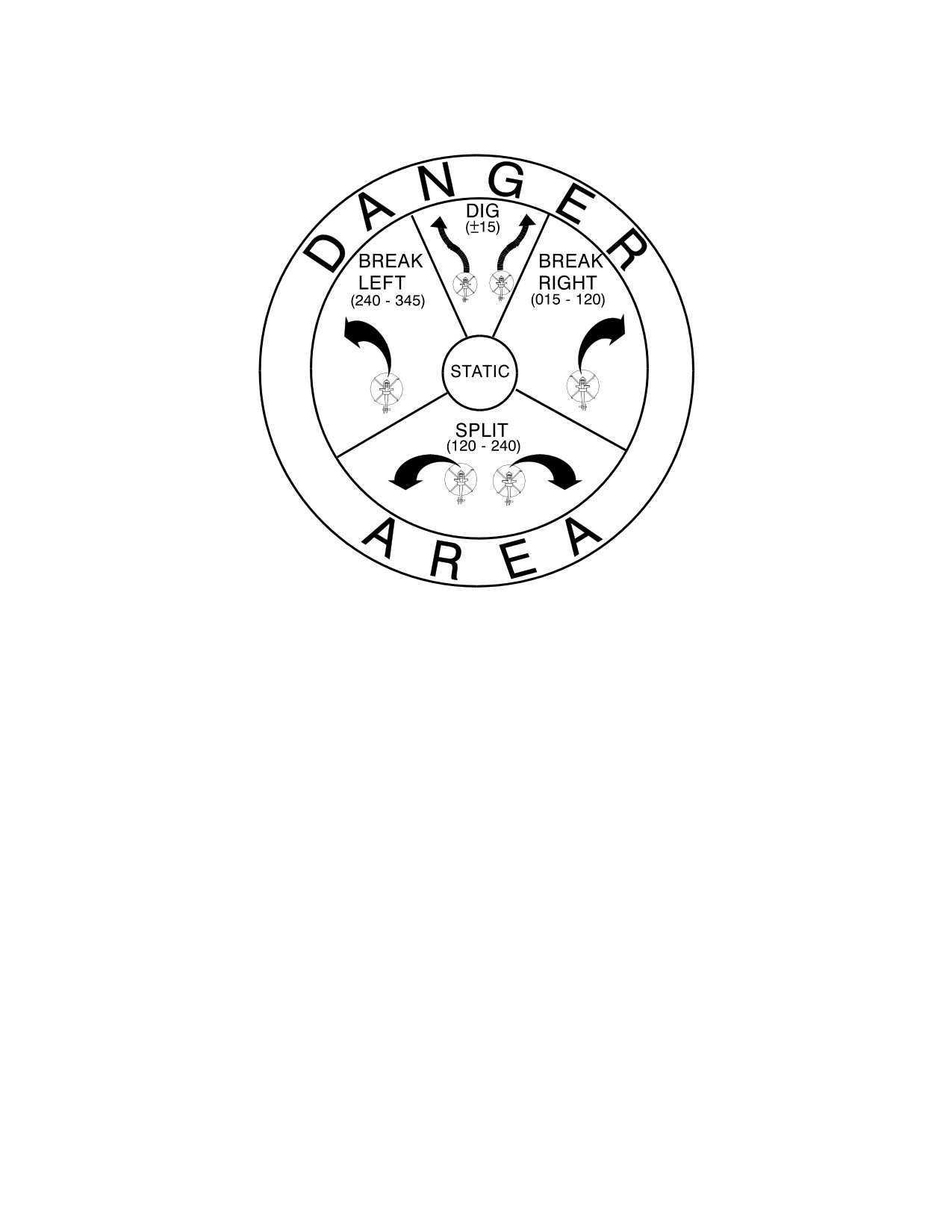
FM 1-112
Figure F-1. Battle drill template
(1) The alert call consists of key words and phrases in a standard sequence
as shown in Figure F-2. The first crew to observe the threat tells the remainder of the
force his identification, what is observed (target, bandit, or bogey), the direction and
distance to the threat, what drill is to be executed, and any other essential information.
(2) The other elements of the platoon respond to the alert and tell the
element initiating the drill that they have either seen or not seen the threat and what
their actions are. The follow-on platoon (if present) will perform the TTP directed by the
commander to support the engaged platoon, bypass the engagement to continue with the
mission, or mask to avoid the threat. Figure F-2 shows a battle drill action template.
d. Break Battle Drill.
(1) The break drill is used when the threat approaches is from the right or
left flank as shown in Figure F-3. The drill orients friendly forces on the threat and
allows them to maintain visual contact while maneuvering to avoid, evade, threaten, or
engage the threat.
F-29
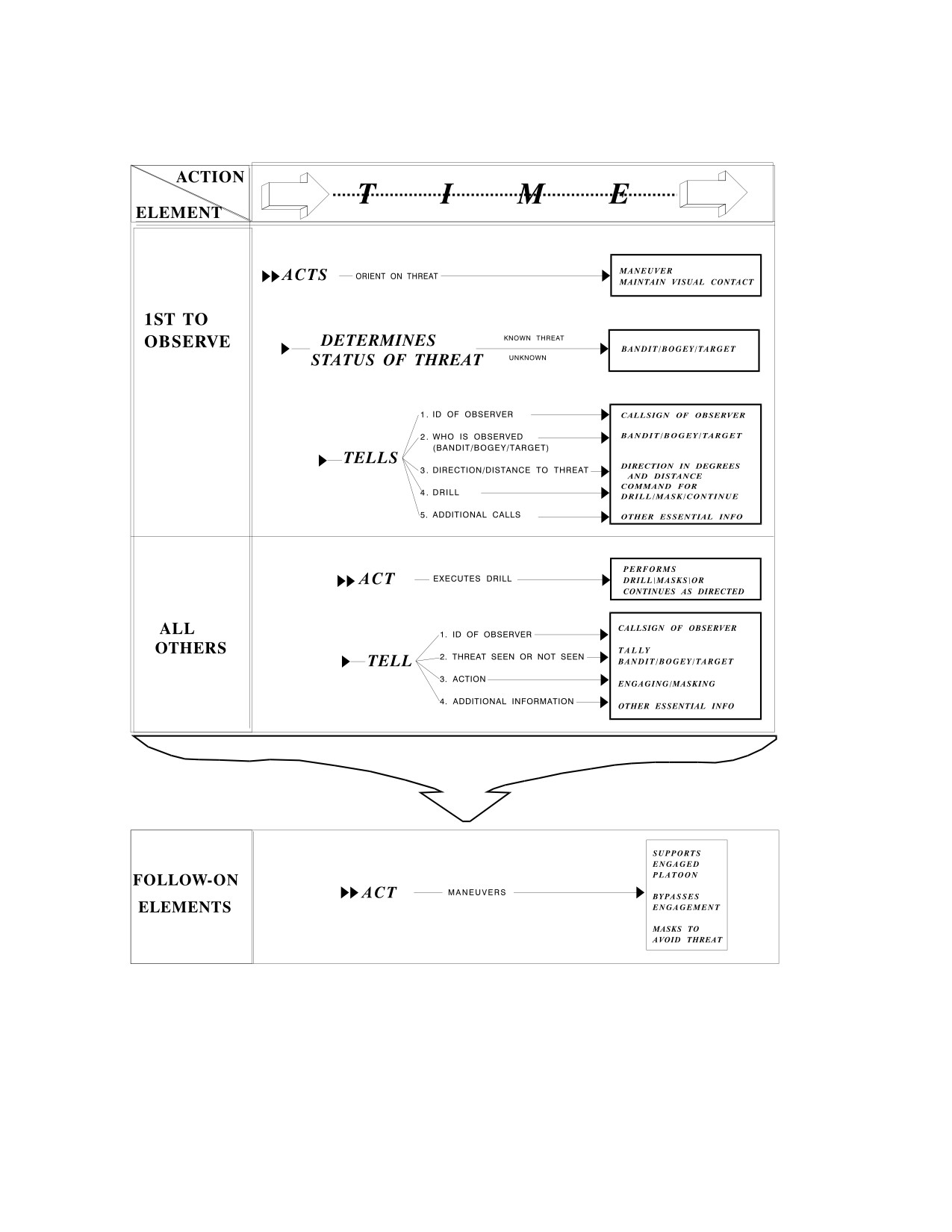
FM 1-112
Figure F-2. Battle drill action template
F-30

FM 1-112
Figure F-3. Break battle drill template
(a) The friendly element that first observes the threat acts immedi-
ately by turning to orient on it. While maneuvering to orient on the threat, the friendly
element will maintain visual contact and determines the risk posed by the threat. The
friendly element determines whether the threat has seen friendly elements and has
hostile intent. If the threat has not seen friendly elements or is not considered hostile,
the desired COA is to avoid or evade the threat by masking or maneuvering away. To
deter or destroy the threat if it is considered hostile, the friendly element first observing
him will threaten or engage.
(b) When the threat is observed, the friendly element first observing
the threat tells (alerts) the remainder of the force. The alert will include the identifica-
tion of the element first observing the threat, what was observed (bandit, bogey, or
target), direction and distance to the threat, action or drill required, and any other
essential information. For example, "Gun 2, targets, 300 meters, break right, engage."
(c) If there is a requirement to execute a break drill, the alert will
include "break right/left." The friendly element that first observed the threat directs the
other friendly elements to perform a turn (break) in a specific direction (right or left) to
either avoid being observed or to evade an attack by the threat. The friendly element
making the call may break right with the other friendly elements or he may break left.
His turn will be based on analysis of the threat's current actions and actions he deter-
mines he must perform to defeat the threat.
F-31
FM 1-112
(d) Other friendly elements will act in response to the command
issued by the element that first observed the threat. While using the information
provided in the alert to locate the threat, they immediately break right/left as com-
manded. When the threat is located, the friendly elements will maintain visual contact
while maneuvering to avoid, evade, threaten, or engage the threat.
(e) As they maneuver, the following elements will tell the element
that initiates the battle drill if the threat has been located, what the friendly elements
action is, and any other essential information. For example "Gun 1, tally 2 targets,
engaging."
(f) Follow-on forces, such as a second platoon, maneuver as directed by
the commander. They support the engaged platoon, bypass the engagement to continue
with the mission, or mask to avoid the threat. Figure F-4 shows the actions of the friend-
ly elements performing the break battle drill and those of the follow-on unit.
(2) Figures F-5a through F-5c show examples of a company of attack heli-
copters task organized into two platoons performing the break battle drill. The sequence
shows the actions of the lead (engaged) platoon and those actions directed by the
commander of the follow-on platoon to support the engagement.
e.
Dig Battle Drill. The dig drill is used when the threat approach is from a
sector +15 degrees to the formation's general direction of flight as shown in Figure F-6. If
the friendly forces have not been observed, this drill allows them to separate to avoid the
threat. If friendly forces have been seen and a threat engagement is imminent, the dig
drill forces the threat to concentrate on one target while other elements in the formation
maneuver.
(1) The friendly element that first observes the threat acts immediately by
turning 30 to 45 degrees to the outside of (away from) the formation's direction of flight.
While maneuvering to increase the separation between the elements of the formation and
attempting to avoid observation, the friendly element maintains visual contact with the
threat and determines the status of the threat. That is, the friendly element deter-
mines if the threat has seen the friendly elements and if the threat is hostile or not
hostile.
(2) When the threat is observed, the friendly element that observed the
threat tells (alerts) the rest of the force. The alert includes the identification of the
element that first observed the threat, what was observed (bandit, bogey, or target),
direction and distance to the threat, the action or drill required, and any other essential
information. For example, "Gun 1, targets 360, 5,000 meters, dig".
(3) If friendly elements have not been seen or if the threat is not considered
hostile, the desired course of action is to avoid or evade the threat by masking or increas-
ing the lateral separation between friendly elements and the threat. Once the drill has
been executed, the formation resumes their original heading. Once clear of the
F-32
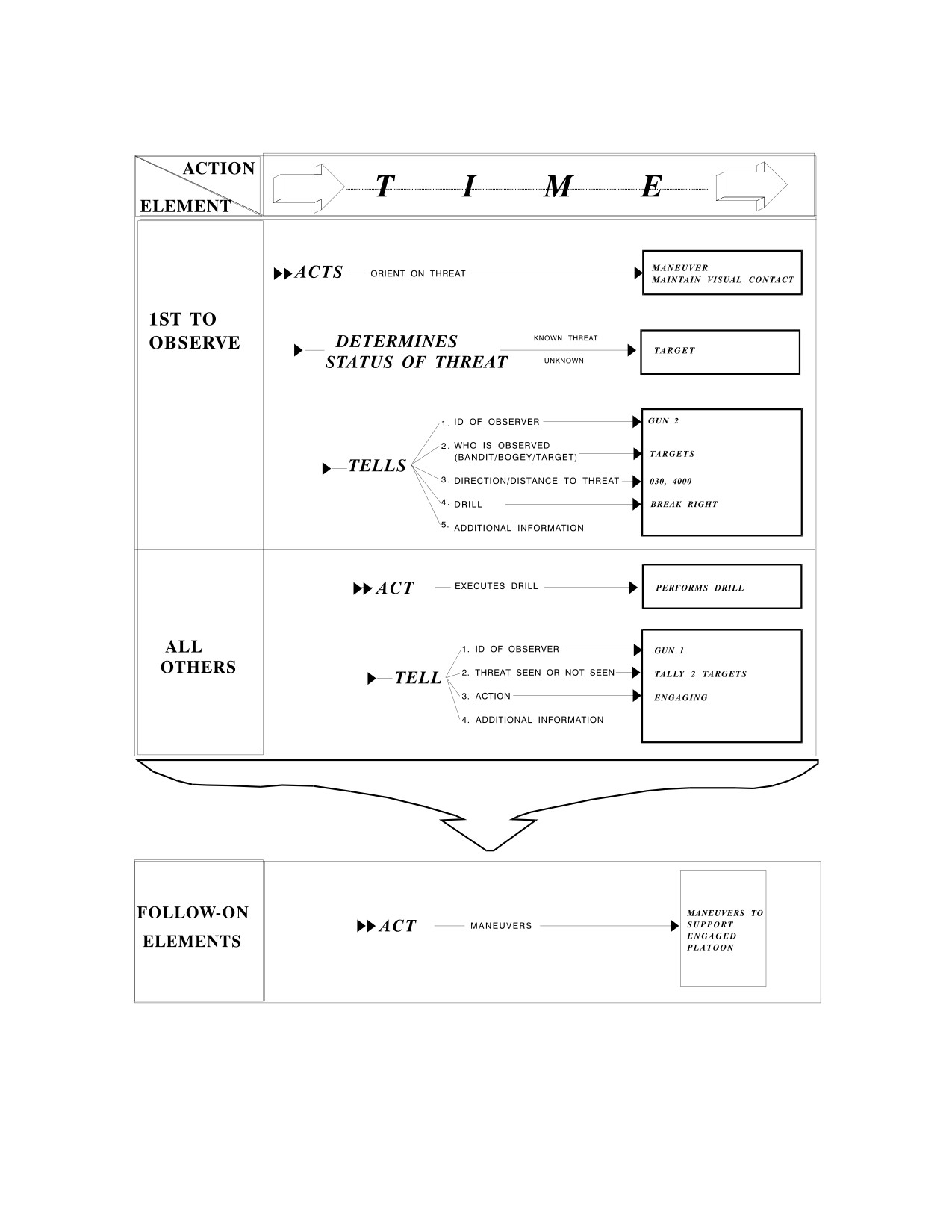
FM 1-112
Figure F-4. Break battle drill action template
F-33
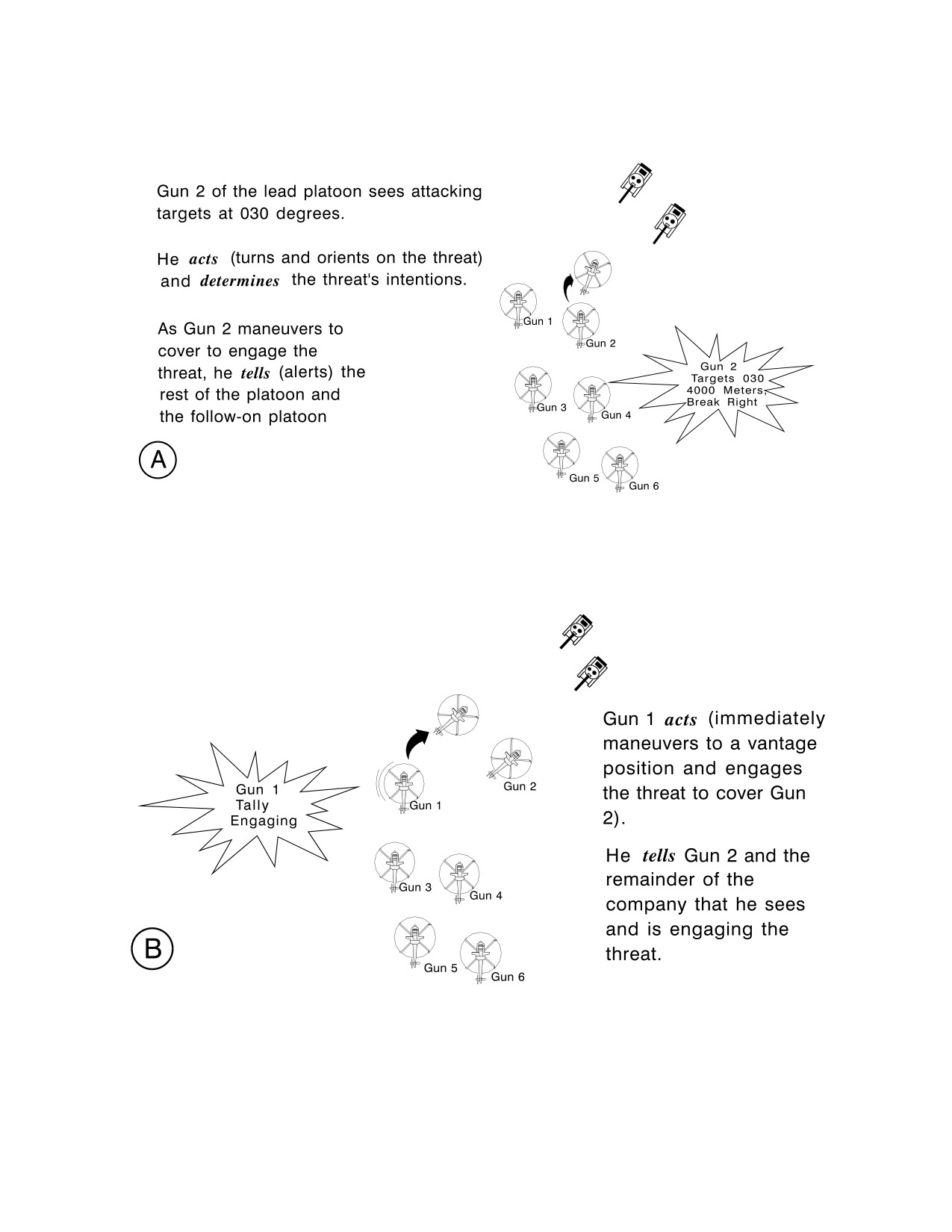
FM 1-112
Figure F-5a. Example break battle drill
Figure F-5b. Example break drill (continued)
F-34
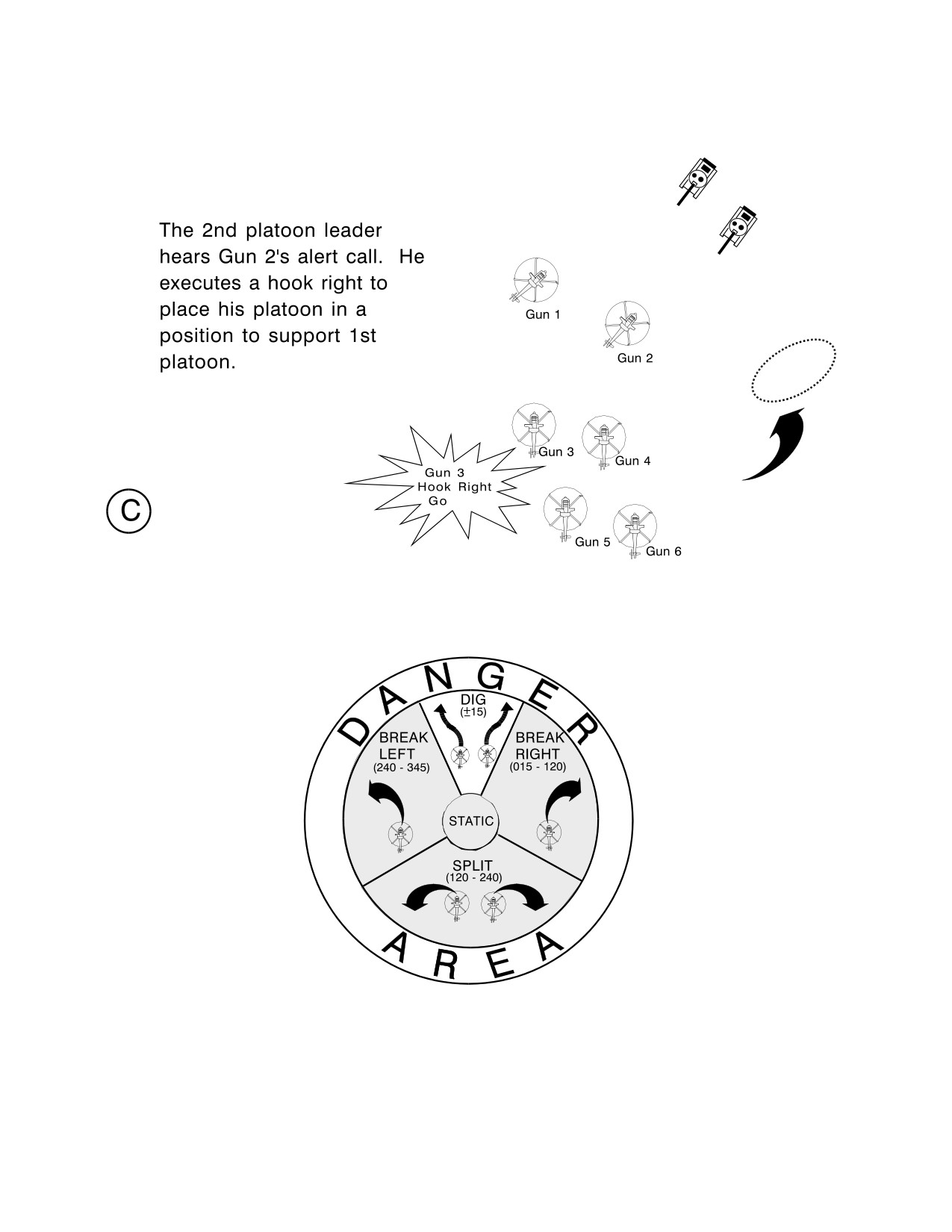
FM 1-112
Figure F-5c. Example break battle drill (concluded)
Figure F-6. Dig battle drill template
F-35
FM 1-112
threat, the formation performs a pinch maneuver to close the lateral separation between
flight elements. Figure F-7 shows how, using dig and resume maneuvers, to increase and
decrease lateral separation between formation elements to avoid being seen by the threat.
(4) If the threat has seen the friendly forces and is maneuvering to engage,
the friendly element under attack turns to orient on the threat and maneuver as it
deploys to cover and engages the threat. Other team elements act in response to the
alert issued by the first element. Team elements turn 30 to 45 degrees to the outside of
(away from) the formation's direction of flight and follow resume and dig commands to
maintain the formation's lateral spacing. Figure F-8 shows friendly elements responding
to hostile threat tanks.
(5) The platoon not engaged responds to the alert of the aircraft that first
observes the threat and maneuvers as directed by the commander. They may dig in an
attempt to increase lateral separation and avoid being observed if the threat is passing
through the forward platoon, they may perform a hook left or hook right maneuver to
support the forward platoon if the forward platoon is engaged. After considering the
factors of METT-T, the commander may perform any other maneuver he considers
appropriate to either engage the threat or bypass depending on the mission. Figures F-9a
and F-9b show the actions of the 2nd Platoon during a dig drill.
(6) The actions of the friendly elements performing the dig battle drill and
those of the follow-on unit are summarized in Figure F-10.
(7) Figures F-11a and F-11b give examples of a company of attack helicop-
ters, task organized into two platoons, performing the dig battle drill. The sequence
shows the actions of the lead platoon engaged by the threat and the actions the com-
mander of the follow-on platoon directs to support the engagement.
f.
Split battle drill. The split drill is used when threat approach is from
approximately 120 to 240 degrees to the formation's direction of flight (Figure F-12). The
drill separates the elements of the platoon and turns and orients them on a threat that
has approached from the rear sector. If friendly forces have been seen and a threat
engagement is imminent, the split drill forces the threat to concentrate on one target
while other elements of the formation maneuver to a flank position to engage the threat.
(1) The friendly element that observes the threat acts immediately by
turning approximately 180 degrees to the outside of (away from) the formation's direction
of flight. While maneuvering to increase the separation between the elements of the
formation and attempting to avoid observation by the threat, the friendly element
maintains visual contact with the threat and determines the status of the threat.
That is, whether the threat has seen the friendly elements and whether the threat is
hostile or not hostile.
F-36
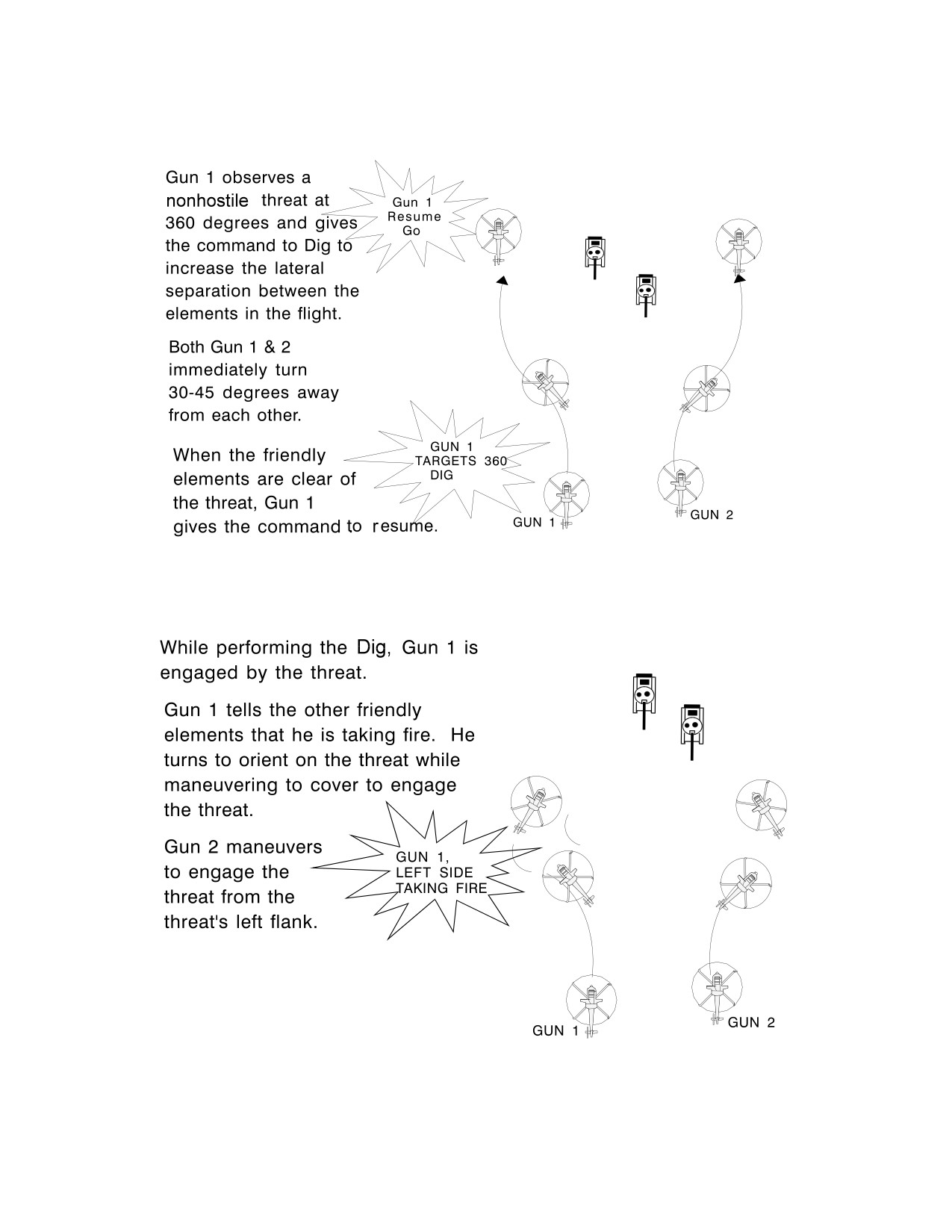
FM 1-112
Figure F-7. Dig and resume used to avoid the threat
Figure F-8. Dig drill used to engage the threat
F-37
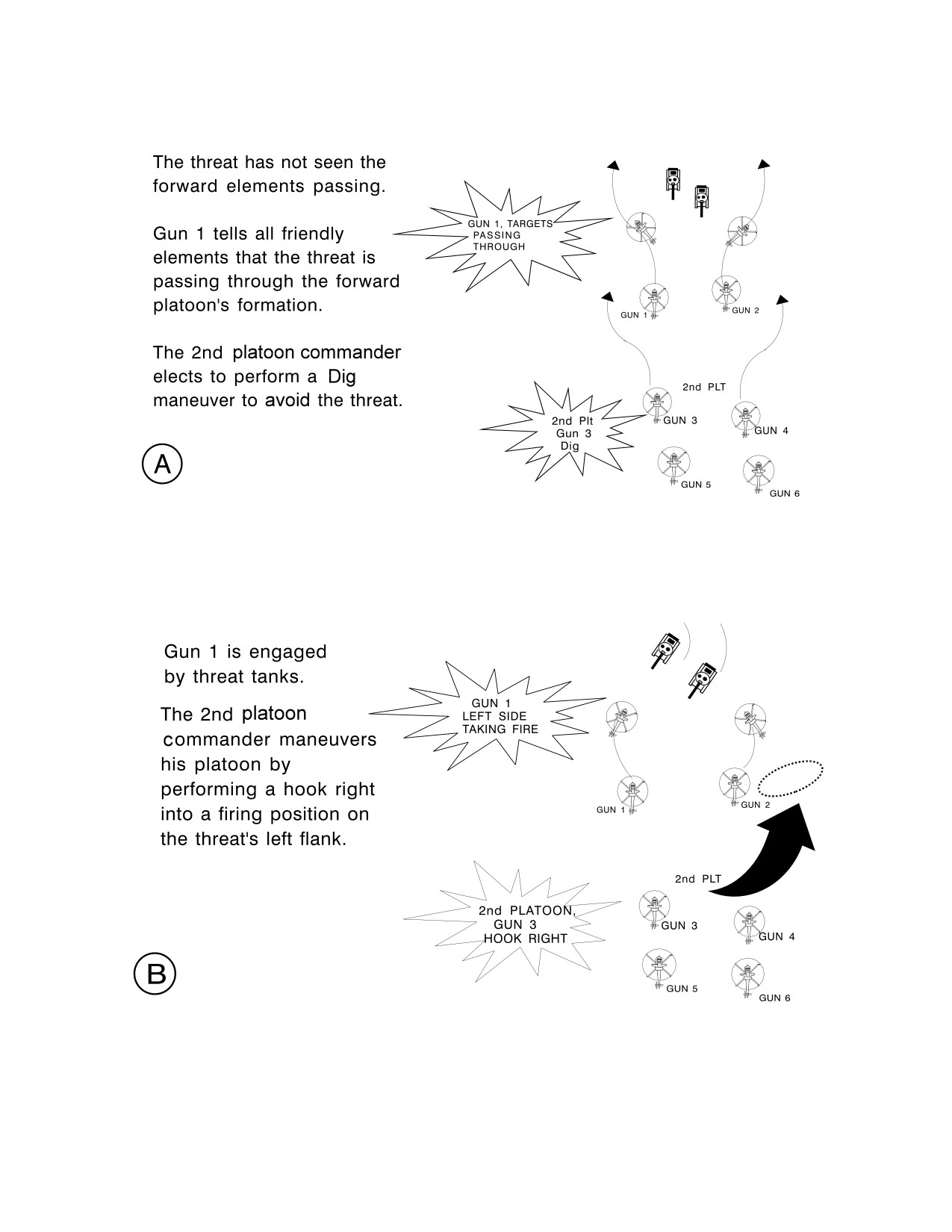
FM 1-112
Figure F-9a. Actions of 2nd platoon (friendly elements not engaged)
Figure F-9b. Actions of 2nd platoon (friendly elements engaged) (concluded)
F-38
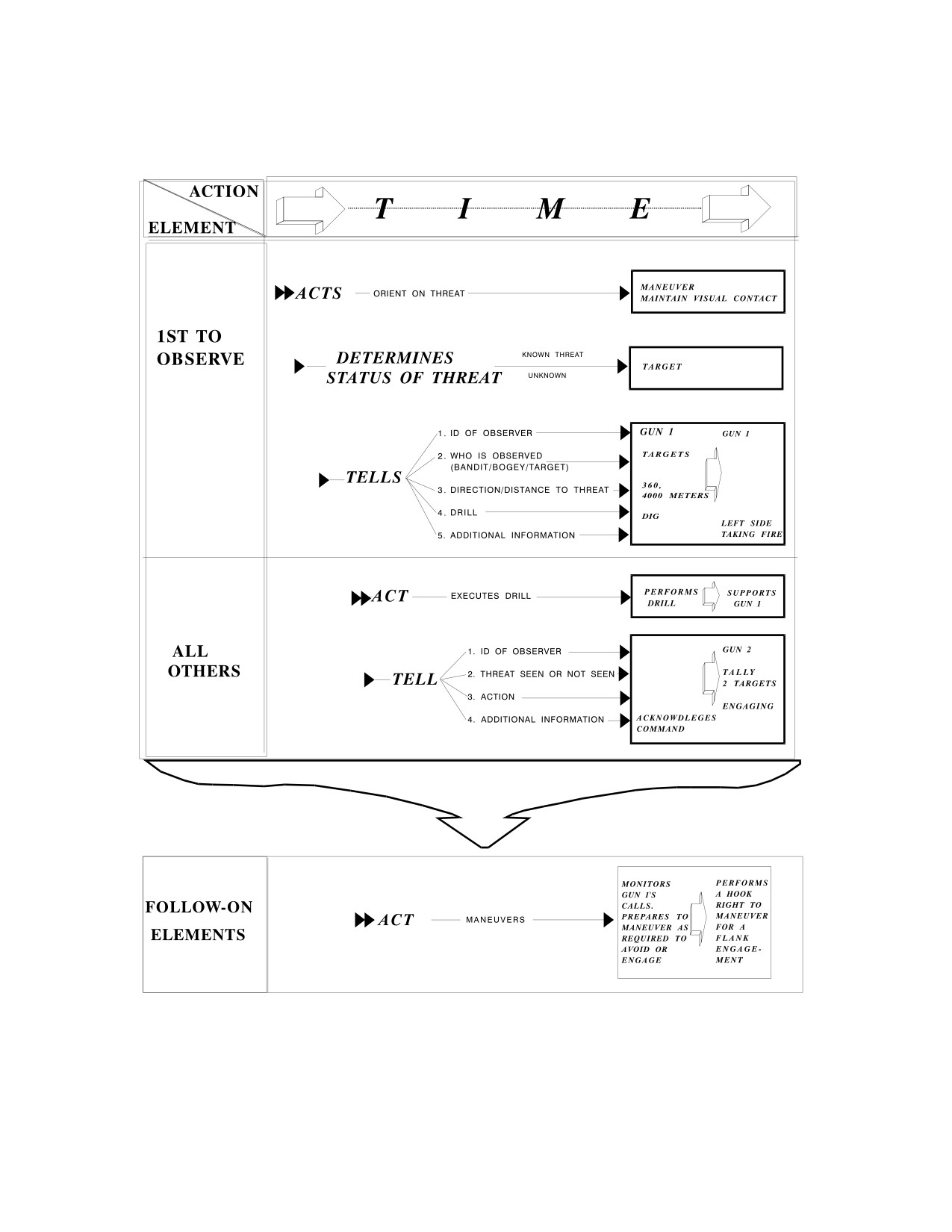
FM 1-112
Figure F-10. Dig drill action template
F-39
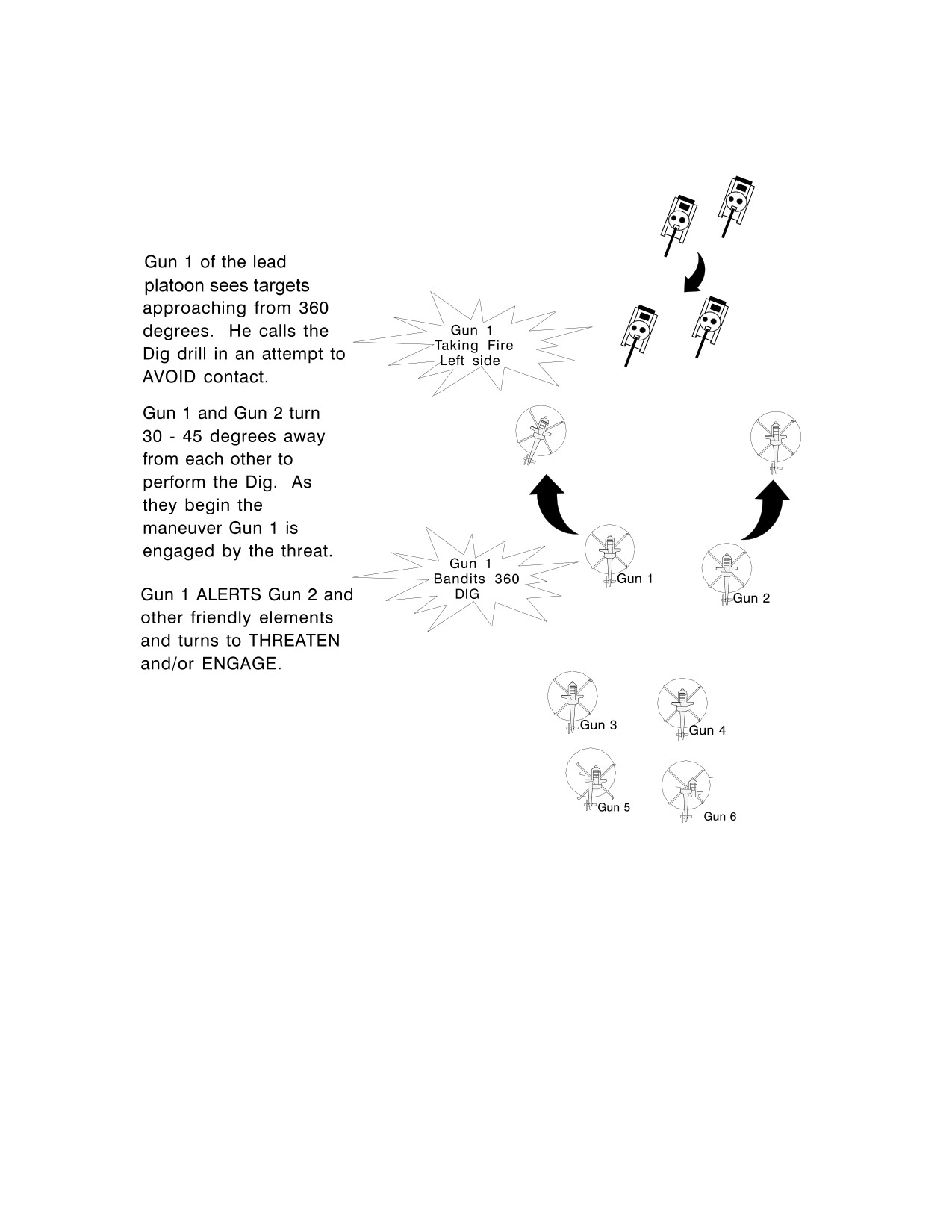
FM 1-112
Figure F-11a. Dig battle drill (company task-organized into two platoons)
F-40