FIELD MANUAL FM 1-112 ATTACK HELICOPTER OPERATIONS (April 1997) - page 6
FM 1-112
(3) Do not repeat tasks otherwise shown on the overlay or stated in sub-subparagraph 3a(1) or in
coordinating instructions.
(4) Do not list tactical tasks that affect two or more units. These should be in coordinating instructions or
3a(1).
c. Task to Combat Support Units.
(1) List specific missions for each subordinate unit, including attached units.
(2) Include organization for combat if not clear in task organization.
d. Coordinating Instructions.
(1) Commander's critical information requirements(CCIR).
(a) PIR.
(b) EEFI.
(c) FFIR.
(2) Target Priority.
(3) Time schedule.
(a) Stand-to, Precombat checks.
(b) Mission/Intel update time and place.
(c) Start.
(d) Communication check.
(e) Lineup.
(f) Takeoff.
(g) LD time.
(h) Inspections and rehearsals.
(4) Flight plan filing.
(5) Ammunition configuration by aircraft and type.
(6) Flight coordination.
(a) Air routes/corridors(primary and alternate), ACPs, SPs, release points, passage points,route
names, rally points, and ASE turn-on/off points.
(b) Traffic patterns: FARPs, battalion tactical CP, other.
(c) Objective, holding areas, FAAs, FARPs, overwatch positions, phase-lines and battle positions
(name, locations, marking and control, and sketch or photo).
(d) Doppler presets.
(e) Mode of flight, airspeed, heading, and altitude for each leg of flight.
Figure C-4. OPORD sample format, security mission (continued)
C-14
FM 1-112
c. Medical and Personnel Services.
(1) Location of Bn aid station.
(2) Air-ground medical evacuation procedures.
(3) Decontamination site.
5. COMMAND and SIGNAL
a. Command.
(1) Chain of command.
(2) Current and proposed locations TAC, main, and rear CPs.
(3) Succession of command.
b. Signal.
(1) Signal operation instructions in effect.
(2) Secure radio codes.
(3) Laser Codes.
(4) Code word or password.
(5) Meaconing, intrusion, jamming, and electronic counter-countermeasures.
(6) Lost communications procedures.
(7) TACAIR, JAAT, and FS frequencies.
(8) Tactical beacons and navigational aids.
(9) Frequencies.
(10) Comm Card/base letter/authentication line.
(11) Hush status.
Acknowledge.
Commanders Signature (optional)
Commanders Last Name
Rank
OFFICIAL:
S3's Name
S3's Rank
Annexes: List all annexes in the order in which they appear alphabetically.
NOTE 1: All aircrews will have complete graphics. Platoon leaders will conduct spot inspections.
NOTE 2: Ensure mission brief is completed before departure. Air mission commander will review form for correct entries.
Figure C-4. OPORD sample format, security mission (concluded)
C-15
FM 1-112
d. Figure C-5 shows a OPORD sample format for an air assault security
operation.
Copy of Copies
Issuing Headquarters
Place(grid), country
DTG
Message Reference No.
OPERATION ORDER
(code name, if used)
REFERENCE(S):
Time zone used throughout the order:
TASK ORGANIZATION
1. Situation:
a. Enemy Forces.
(1) Enemy.
(a) ID of enemy forces.
(b) Activity of enemy forces.
(c) Location.
(d) Disposition.
(e) Strength.
(f) Composition to include equipment.
(g) Previous actions.
(h) Probable courses of action.
(i) Terrorist actions/threat (if applicable).
(2) Weather.
(a) Current weather, IR, and light data/moon illumination.
(b) Forecast weather for operation.
(c) Special environmental considerations or hazards.
(d) Effects of weather on enemy and friendly actions.
(3) Terrain.
(a) Observation.
(b) Cover and Concealment.
(c) Avenues of Approach.
(1) Size of unit supported.
(2) Start/End points.
(3) Objective it leads to.
(d) Engagement Areas.
(e) Effects of terrain on enemy and friendly actions.
Figure C-5. OPORD sample format, AASLT security
C-16
FM 1-112
b. Friendly Forces.
(a) Mission/intent of higher HQ.
(b) AATFC's mission/intent.
(c) Adjacent.
(d) Other aviation elements in area of operations.
c. Attachments and Detachments.
2. MISSION: Who, what, when, where, and why. Analyze the mission and the AATFC's intent to determine the level of
security required for the given mission.
3. EXECUTION:
INTENT:
(a) Purpose of mission.
(b) Method to achieve purpose.
(c) Endstate--Success criteria (specific numbers or percentage of enemy destroyed, etc).
a. Concept of the Operation. Annex
(Operation Overlay).
1. Maneuver.
(a) How all units will be employed to include the Ground Tactical Plan.
(b) Identify main and supporting attacks.
2. Fire Support.
(a) SEAD fires: Who controls, time or event driven.
(b) Priority of fires.
(c) Location of FA units, G/T lines, proposed/priority targets.
(d) Planned fires.
(e) Naval gunfire (if applicable).
3. Counter-air operations.
(a) Concept of counter-air operations.
(b) Weapons control status.
4. Intelligence. Provide priorities of collection.
5. Electronic warfare. Establish priority of collection and jamming.
6. Engineer.
7. Tac Air Support Plan.
(a) Routes and IPs.
(b) Time on Station.
(c) Targets.
8. Deception plan.
9. Extraction plan.
b. Tasks to Maneuver Units.
(1) List all maneuver units (ground and aviation) that report directly to the HQ issuing the order or plan. Use a
separate sub-subparagraph for each maneuver unit. List units in order in which they appear in the task organization.
(2) State missions or tasks and purposes to be accomplished.
Figure C-5. OPORD sample format, AASLT security (continued)
C-17
FM 1-112
(3) Do not repeat tasks otherwise shown on the overlay or stated in sub-subparagraph 3a(1) or in
coordinating instructions.
(4) Do not list tactical tasks that affect two or more units. These should be in coordinating instructions or
3a(1).
c. Task to Combat Support Units.
(1) List specific missions for each subordinate unit, including attached units.
(2) Include organization for combat if not clear in task organization.
d. Coordinating Instructions.
(1) Commander's critical information requirements(CCIR).
(a) PIR.
(b) EEFI.
(c) FFIR.
(2) Target Priority.
(3) Time schedule.
(a) Stand-to, Pre-combat checks.
(b) Mission/Intel update time and place.
(c) Start.
(d) Communication check.
(e) Lineup.
(f) Takeoff.
(g) PZ time.
(h) LZ time
(i) Inspections and rehearsals.
(4) Flight plan filing.
(5) Ammunition configuration by aircraft and type.
(6) Flight coordination.
(a) Air routes/corridors (primary and alternate), ACPs, SPs, LZs, PZs, route names,
rally points, and ASE turn-on points.
(b) Traffic patterns: FARPs, battalion AA,
FAA, PZs/LZs, other.
(c) PZs, LZ,s, FAAs, FARPs, and OPs (name, locations, marking and control, and
sketch or photo).
(d) Doppler presets.
(e) Mode of flight, airspeed, heading, and altitude for each leg of flight.
(f) Movement technique and formation for occupation of BP, ABF, SBF, or OPs.
(g) Direction into positions and scheme of maneuver for occupation.
(h) Coordinating altitude and other airspace procedural control measures.
(i) Aircraft lighting.
(j) IMC breakup procedures.
(k) Under wire/under bridge flight.
(l) Aircraft in-flight emergency procedure to include recovery points/airfields.
(m) Flight following.
Figure C-5. OPORD sample format, AASLT security (continued)
C-18
FM 1-112
(7) Crew endurance.
(8) Electronic counter-countermeasures (ECCM).
(9) MOPP/OEG.
(10) Actions at the PZ/LZ.
(11) Actions on contact.
(12) Link-up with assault aircraft.
(13) Rules of Engagement (ROE).
(14) Authorized mode of operations with degraded weapons/NVD.
(15) IFF on/off line.
(16) Downed aircraft procedures.
(a) Aircraft destruction criteria, authority, and procedures.
(b) Downed aircrew procedures, pickup points, and times.
(17) EEI/required FLASH reports.
(18) Abort Criteria.
(19) Debriefing time and place.
4. SERVICE SUPPORT
a. Supply.
(1) Class I.
(2) Location of FARPs and priority of use.
(3) Configuration of class III and class V resupply areas/# of points (use sketch).
(4) Class IX.
(5) Other classes of supply.
b. Services and Transportation.
(1) Location of AVUM/Contact teams.
(2) Downed aircraft/aircrew recovery procedures.
(3) Road march and convoy procedures.
c. Medical and Personnel Services.
(1) Location of Bn aid station.
(2) Air-ground medical evacuation procedures.
(3) Decontamination site.
Figure C-5. OPORD sample format, AASLT security (continued)
C-19
FM 1-112
5. COMMAND and SIGNAL
a. Command.
(1) Chain of command.
(2) Current and proposed locations TAC, main, and rear CPs.
(3) Succession of command.
b. Signal.
(1) Signal operation instructions in effect.
(2) Secure radio codes.
(3) Laser Codes.
(4) Code word or password.
(5) Meaconing, intrusion, jamming, and electronic counter-countermeasures.
(6) Lost communications procedures.
(7) TACAIR, JAAT, and FS frequencies.
(8) Tactical beacons and navigational aids.
(9) Frequencies.
(10) Comm Card/base letter/authentication line.
(11) Hush status.
Acknowledge.
Commanders Signature (optional)
Commanders Last Name
Rank
OFFICIAL:
S3's Name
S3's Rank
Annexes: List all annexes in the order in which they appear alphabetically.
NOTE 1: All aircrews will have complete graphics. Platoon Leaders will conduct spot inspections.
NOTE 2: Ensure mission brief is completed before departure. Air mission commander will review form for correct entries.
Figure C-5. OPORD sample format, AASLT security (concluded)
C-20

FM 1-112
C-3. COMPANY MISSION BRIEF
a. Figure C-6 shows a sample format for a company mission brief.
ROLL CALL/CREW ASSIGNMENT:
TM
ACFT
CALLSIGN
CREW
______
______
________
_____________
______
______
________
_____________
______
______
_________
____________
I. SITUATION
1. ENEMY:
2. FRIENDLY:
3. ATTCH/DETACH:
4. WX/ILLUM: Void:
Ceiling:
Vis:
Winds:
PA:
DA:
% Illum:
SR:
SS:
MR:
MS:
EENT:
WX Warning:
II. Mission:
III. Execution:
Intent:
1. CONCEPT OF THE OPERATION:
A. MANEUVER:
B. FIRES:
C. FLT FOLLOW:
D. MVMNT INTO BP'S/BP LAYOUT/FIRE DISTRIBUTION:
E.
PP
OPEN
CONTROL/CALLSIGN
FREQ
F. E&E/DPPP INST:
ACTIVE:
TO:
ACTIVE:
TO:
G. LASER CODES:
UNIT LT TM HVY TM UNIT LT TM HVY TM
H. JATT/CAS
Freq's:
IP1:
IP2:
IP3:
CALL SIGN:
I. RELIEF ON STATION:
Figure C-6. Sample format for company mission brief
C-21

FM 1-112
J. FLIGHT MODES:
A/S ALTITUDE FORMATION MVMT TECHNIQUE
1ST CP
HA
LD
RP
BP
RTN
K. RALLY POINTS: 1)
2)
3)
L. ACTIONS ON CONTACT: A)TO HA
B)IN HA
C)TO BP
D)IN BP
E)
M. IMC BREAKUP:
N. TIME LINE: APU:
CRANK:
COMMO:
LINEUP:
T/O:
BP'S:
O. AIRCRAFT LIGHTING: A)IN TAA
B)TO SP
C)TO HA
D)TO BP
P. A/C LOADS:
IV. SERVICE SUPPORT:
A. FARPs
B. MAINT:
C. CREW ENDURANCE:
V. COMMAND AND SIGNAL:
A. SUCCESSION OF COMMAND:
B. FREQS:
UNIT CALL SIGN FREQ
BDE
BN
LT
HVY
F/S
C. COMPANY FREQ'S: A)FM:
B)VHF:
C)UHF:
VI. 1. REHEARSAL:
2. TIME HACK:
Figure C-6. Sample format for company mission brief (concluded)
C-22

FM 1-112
C-4. MISSION DEBRIEF
Figure C-7 shows a sample format for company mission debrief.
1.
SITUATION
a.
Enemy Situation Encountered.
(1) Size: Div Reg Bn Co Plt Sec
Other
(2) Location (grid):
(3) Equipment Observed (type): ADA
ARMOR
, APC
,
ARTILLERY
, OTHER
(4) Enemy aircraft: Rotary-Wing
Fixed-Wing
(5) Enemy Formation(s):
(6) Enemy Actions on Contact:
(7) EW and OPSEC activities: Type
. How
(8) Enemy Vehicles: Destroyed
, Damaged
b.
Weather (significant differences to forecast).
(1) Min/Max Ceiling:
(2) Min/Max Visibility:
(3) Hazards to flight encountered:
(4) Winds:
c.
Terrain (emphasis on engagement area analysis).
(1) Cover
Concealment
(2) Type of Soil
Remarks
d.
Friendly Forces Encountered.
(1) Size: Div Reg Bn Co Plt Sec
Other
(2) Location (grid):
(3) USAF elements employed or encountered: Type
(4) Effectiveness of air strikes and CAS (BDA):
Damaged
Destroyed
2.
MISSION
a.
Mission completed as briefed? Yes No Comments
b.
FRAGOs received: Yes No If yes, how many
Effects/Comments
Figure C-7. Sample format for a company mission debrief
C-23

FM 1-112
3.
EXECUTION
a.
Maneuver (General Overview)
(1) Routes: Enemy activity
Unsuspected hazards/problems
(2) Control measures used:
(3) Commo Check and T/O time:
(4) LD time, Time on-station, Time return
(5) Map corrections:
b.
Fires
(1) Number of Artillery missions called
Fired
(2) Preplanned targets used:
On target:
(3) Effectiveness:
(4) Friendly ADA positions noted:
(5) Comments:
c.
Flight Coordination
(1) Essential elements of information noted:
(2) Friendly aircraft downed: Yes No If yes, location and reason
(3) Crews recovered Yes No If no, probable pilot pickup point
4.
SERVICE SUPPORT
a.
Status of FARPs in the area of operations, if known: Up Down Comment
b.
Hours flown:
c.
Class V consumed: .50cal
30mm
20mm
2.75 HE MPSM
HELLFIRE TOW
d.
Aircraft status: Up Down Refueled Comment
e.
Immediate Maintenance requirements:
f.
Crew status: Injuries
Endurance
g. Location of injured crewmember(s)
5.
COMMAND AND SIGNAL
a.
Chain of command (location)
b.
EW encountered
c.
Aircraft and crew
d.
Instructions for crew
6.
CONCLUSIONS AND RECOMMENDATIONS
Figure C-7. Sample format for a company mission debrief (concluded)
C-24
FM 1-112
APPENDIX D
UNIT MOVEMENT
Before the ATKHB can mass its combat power rapidly at the decisive time and place on
the battlefield, it must move there. Units that plan, train, and validate their movement
plans greatly increase their chances of arriving in theater or on the battlefield ready to
conduct combat operations. The more knowledgeable personnel are of movement plans
and operations, the more efficient the move becomes. This appendix provides basic unit
movement planning considerations and guidelines. Detailed unit movements information
is found in the manuals referenced in paragraph D-10.
D-1. FUNDAMENTALS
a.
An ATKHB begins training for its combat mission from the time the unit is
activated. It deploys to a point where it can best accomplish the mission. Unit deploy-
ment training is necessary so the ATKHB can move in the most efficient manner. If it
cannot move within its operational requirements, whether it deploys from CONUS or 30
kilometers from the battlefield, the success of the mission is jeopardized.
b. The ATKHB is only as effective as its logistics support. With the exception of
the light infantry division ATKHB, equipment used to support and sustain the battalion
is organic to the unit. To facilitate rapid response, effectiveness, and sustained opera-
tions, logistics support must be transported using the battalion's organic equipment.
Therefore, units must be organized with the necessary assets, organic and external, to
transport their logistics support in a single move.
c.
ATKHBs must give careful consideration to prestocking shipping containers
with aircraft components, common use class IX (air) and covers. This ensures that items
are available and precludes delays in unit deployment. Units prepare and on/off-load
aircraft and equipment; therefore, having the required ground-handling equipment, tie-
down and palletizing materials on hand prior to deployment will save time. Fulfilling the
requirement for tools and test equipment at the ports of embarkation and debarkation
also results in more effective unit movements.
D-2. RESPONSIBILITIES
a.
Commanders. Commanders are responsible for the movement of their unit
personnel and equipment. They also--
(1) Appoint a unit movement officer (and get him trained).
(2) Supervise the operations of subordinate units.
D-1
FM 1-112
(3) Establish policies for rail, air, and sea lines of communication.
(4) Ensure compliance with directives, policies, and regulations.
(5) Review and validate movement plans, SOPs, and load plans frequently.
(6) Coordinate with other headquarters for technical data and logistics
support.
b. Staffs. Staffs ensure compliance with the commander's directives and
develop unit movement plans. They also--
(1) Plan and supervise unit movement training.
(2) Make recommendations for improvement to the commander.
(3) Establish training programs for unit movement personnel.
(4) Determine and coordinate logistics support requirements.
(5) Ensure compliance with directives, policies, and regulations.
(6) Ensure that subordinate unit movement plans, load plans, and SOPs are
accurate and current.
c.
Unit Movement Personnel. These personnel plan and conduct unit moves.
They also--
(1) Develop unit movement plans, SOPs, and load plans.
(2) Conduct unit movement training.
(3) Ensure that proper support and logistics requirements are requested.
(4) Validate movement plans.
(5) Inspect and inventory equipment before and after a unit movement.
(6) Ensure proper preparation of personnel and equipment before a unit
movement.
D-3. PLANNING AND PREPARATION
The ATKHB must plan and prepare to arrive at a designated location in the area of
operations and begin battlefield missions. Modes of movement and deployment are
D-2
FM 1-112
designated in orders. These orders are delivered in several formats such as an OPORD, a
FRAGO, or a movement order. Because of the complexity of unit movements, the
movement order is preferable. Movement orders provide detailed information such as
transportation support, movement tables, and clearance numbers. The least preferred
format is the FRAGO. The information below will assist planners in preparing movement
directives and SOPs.
a.
Movement Directive. The movement directive, published by DA, is the
basic document that directs units to prepare to and move from home stations. The two
types of moves are administrative and tactical. In an administrative move, enemy contact
is not likely and units relocate to secure areas and/or ports of embarkation. The S4 has
staff responsibility for administrative movements. A tactical move, however, requires a
combat-ready posture and organization during all phases even though the purpose of the
move is to relocate only. The S3 has staff responsibility for tactical moves. Movements
are categorized as follows:
(1) Category A. A move from a home station with all the equipment
authorized for that unit.
(2) Category B. A move from a home station with essential equipment
only.
(3) Category C. A move from a home station with less than essential
equipment.
(The movement directive will specify what equipment to take.)
b. Movement Instructions. Movement instructions provide details for the
execution of a movement. They are issued to implement the movement program and
represent accepted procedures.
c.
Movement Order. The movement order directs the movement of personnel
and prescribed equipment from one location to another within a stated period.
d. Movement Plan. The movement plan provides up-to-date logistics data.
These data reflect a summary of transportation requirements, priorities, and limiting
factors incident to the movement of one or more units or special grouping of personnel by
highway, marine, rail, or air transportation.
e.
Load Plan. The load plan is a preplanned method for loading personnel and
equipment for transport.
D-4. SELF-DEPLOYMENT
a.
Because airlift and sealift assets are limited, selected ATKHBs (AH-64)
should plan to self-deploy aircraft to the theater or area of operations. Apache aircraft
D-3
FM 1-112
must be equipped with the necessary auxiliary fuel, ALSE, and navigation and communi-
cation systems needed to conduct self-deployment operations prior to deployment.
b. Self-deployment may result in faster arrival in the area of operations,
depending on the availability of strategic airlift assets. An advantage is eliminating the
requirement for disassembly and reassembly. A major disadvantage is the high number
of flight hours put on the aircraft getting to the theater/area of operations. Other
considerations include maintenance impact, extended dispersal of aircraft along the
deployment route due to maintenance, diplomatic clearances for overflight and landing,
terrorist threat, and availability of support upon arrival at the theater/area of operations.
c.
It must be recognized that the entire battalion can not self-deploy. The
commander and staff must coordinate arrival of the rest of the battalion's personnel and
equipment in the theater/area of operations by sea or air transportation, with the self-
deployed aircraft and crews. References for planning self-deployments include FM 1-109,
FM 1-111, and Planning Guide: Army Aviation Deployment for Contingency Operations,
1 February 1993.
D-5. AIRLIFT
a.
An airlift is an operation executed according to prepared plans designed to
ensure air transport of supplies, equipment, and personnel. The global nature of U.S.
forces deployments requires that the ATKHB be able to package, document, on/off load,
and tie-down equipment. Therefore, the ATKHB must be trained not only in mission
accomplishment but also in the skills and execution of airlift deployment. Emergency
situations require rapid response by the armed forces; air movement fulfills that require-
ment.
b. The air mobility command provides the strategic air assets necessary to move
personnel and material during emergencies or for operational necessities. Although AMC
aircraft are located around the world, they are limited in number and availability.
Equipment accepted on AMC aircraft must be within specified space and weight limits.
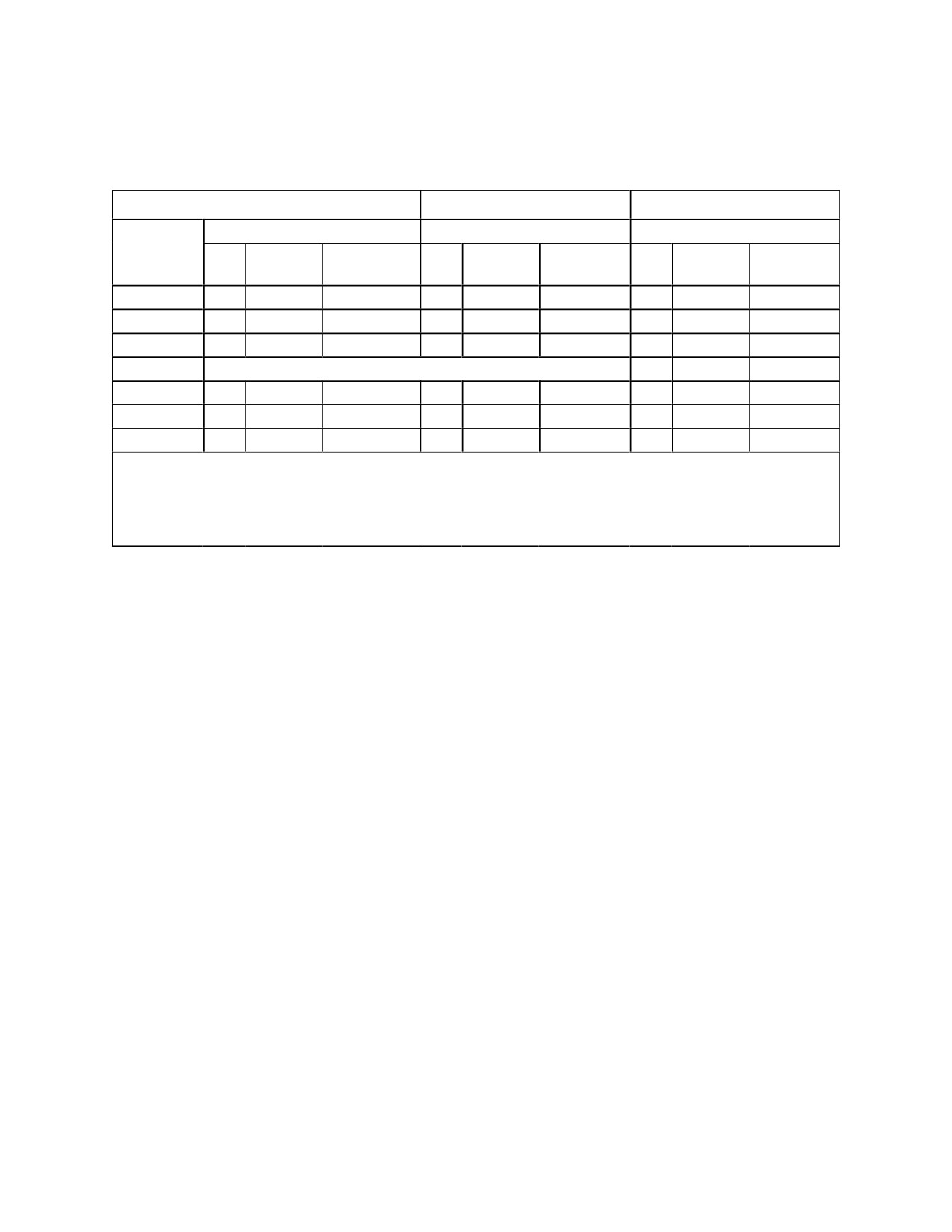
Table D-1 shows an airlift loading table.
c.
The unit movement officer is the key to exercising the unit's air movement
and loading plans. He supervises and conducts training and maintains updated move-
ment data. Because operational requirements may exceed the airlift capacity, the unit
movement officer also plans for the use of other types of transportation to conduct the air
movement. Key references for unit air movement planning include FM 55-12, FM 55-9,
TM 38-250, and Planning Guide: Army Aviation Deployment for Contingency Operations
(see paragraph D-10 for complete titles).
D-4
FM 1-112
Table D-1. Airlift loading table
1
1
C-5
C-141
2
2
MINIMUM DISASSEMBLY
OPTIMUM TRANSPORT
OPTIMUM TRANSPORT
TYPE
N
MAN
ET
N
MAN
ET
N
MAN
ET
O
HOURS
(HOURS)
O
HOURS
(HOURS)
O
HOURS
(HOURS)
AH-1
12
18
3
15
24
4
4
.5
.5
UH-1
8
12
2
11
18
3
4
.5
.5
OH-58C
13
19.5
3.5
22
33
5.5
6
9
1.5
8
12
2
3
AH-64
6
7
1
6
7
1
2
18
3
UH-60
6
2
.75
6
7
1
2
18
3
3
OH-58D
12
18
3
22
36
6
8
15
2.5
NOTES:
1. Numbers based on 6-man loading crews.
2. Number of aircraft that can be transported with further disassembly if flyaway conditions is not
required on arrival.
3. Approximate figures.
d. Specific planning and support requirements for each unit vary. In an
emergency, little time is available for planning. Therefore, the unit movement officer
must identify requirements and develop and validate air movement plans to preclude
difficulties during emergency deployments.
D-6. SEALIFT
Sealift deployment is normally used to move equipment and containerized material when
response time for arriving in the theater/area of operations is not urgent, and/or equip-
ment is too large or heavy for airlift. Although FSS and roll-on, roll-off are preferred,
there are a variety of ships that may transport the unit's equipment. Therefore, planning
and training may be limited to on-site surveys and data about the out-loading installation,
ports of embarkation and debarkation and, to a limited extent, vessels that are likely to
be employed. The deploying unit will have to prepare accurate cargo-loading movement
data. However, higher headquarters should provide guidance and assistance in sealift
planning. Key references for sealift include FM 55-30, FM 55-65, FM 55-312, AR 55-29,
AR 55-113, AR 55-162, and Planning Guide: Army Aviation Deployment for Contingency
Operations (see paragraph D-10 for complete titles).
D-7. RAIL MOVEMENT
a.
Rail deployment of vehicles and equipment is normally selected when the
distance to the SPOE or training site exceeds one day of ground convoy or when
D-5
FM 1-112
nonroadable plus other equipment exceeds 240 short tons. Rail shipment can damage
sensitive aircraft components; therefore, aircraft are normally moved by airlift or sealift.
b. The division or installation transportation officer or DISCOM/COSCOM move-
ment control officer can assist the movement officers with planning and identifying unit
rail-loading requirements. He also should provide training material and current
procedures for transporting equipment as well as other information to minimize planning
time.
c.
As with other forms of movement, the ATKHB is responsible for internal
administration and preparation of unit assets for rail movement. Plans and SOPs will
address all rail requirements such as loading, tie-downs, organization, and specific safety
provisions. Rail movement plans are completed as required by the controlling transporta-
tion agency.
d. Key references for rail movement include FM 55-15, FM 55-65, TM 55-208,
TM 55-625, TM 55-2200-001-12, and Planning Guide: Army Aviation Deployment for
Contingency Operations (see paragraph D-10 for complete titles).
D-8. GROUND CONVOY MOVEMENT
a.
Types. The movement of troops from one location to another is inherent in
any phase of a military operation. A common form of troop movement is the ground
convoy or road march. Road marches may be tactical or administrative, depending on the
enemy situation.
(1) Tactical movement. When contact with the enemy is possible, a unit
will conduct a tactical movement. For example, if troops move forward to participate in
combat operations, the movement is tactical. The S3 plans tactical movements.
(2) Administrative movement. If contact with the enemy is unlikely, a
unit will conduct a nontactical movement. Movement in the communications zone to
reposition laterally or to ease future operations is administrative. The S4 is normally
responsible for planning administrative moves.
b. References. The same references listed in paragraph D-6 apply to ground
convoy movements. FM 55-312 and Planning Guide: Army Aviation Deployment for
Contingency Operations are key references for unit movement officers and convoy
commanders.
c.
Organization.
(1) March columns are organized to maintain unit integrity. In a tactical
march column, all elements use the same route for a single movement and are under the
control of a single commander. A large column may be composed of a number of subdivi-
sions.
D-6
FM 1-112
(a) Serial. A serial is a major subdivision of a march column. For
purposes of planning, regulation, and control, it is organized as a single unit under one
commander. An ATKHB is usually one serial.
(b) March unit. A march unit is a subdivision of a serial and is
normally a squad, section, platoon, or company. It moves and halts under the control of a
single commander, using oral and visual signals. A radio is used only when no other
means of communication can be used. March units of the main body are composed of
individual units, any attachments, the battalion main CP, and the battalion trains. POL
vehicles required for refueling during nontactical marches may move ahead of schedule to
establish a forward refueling point.
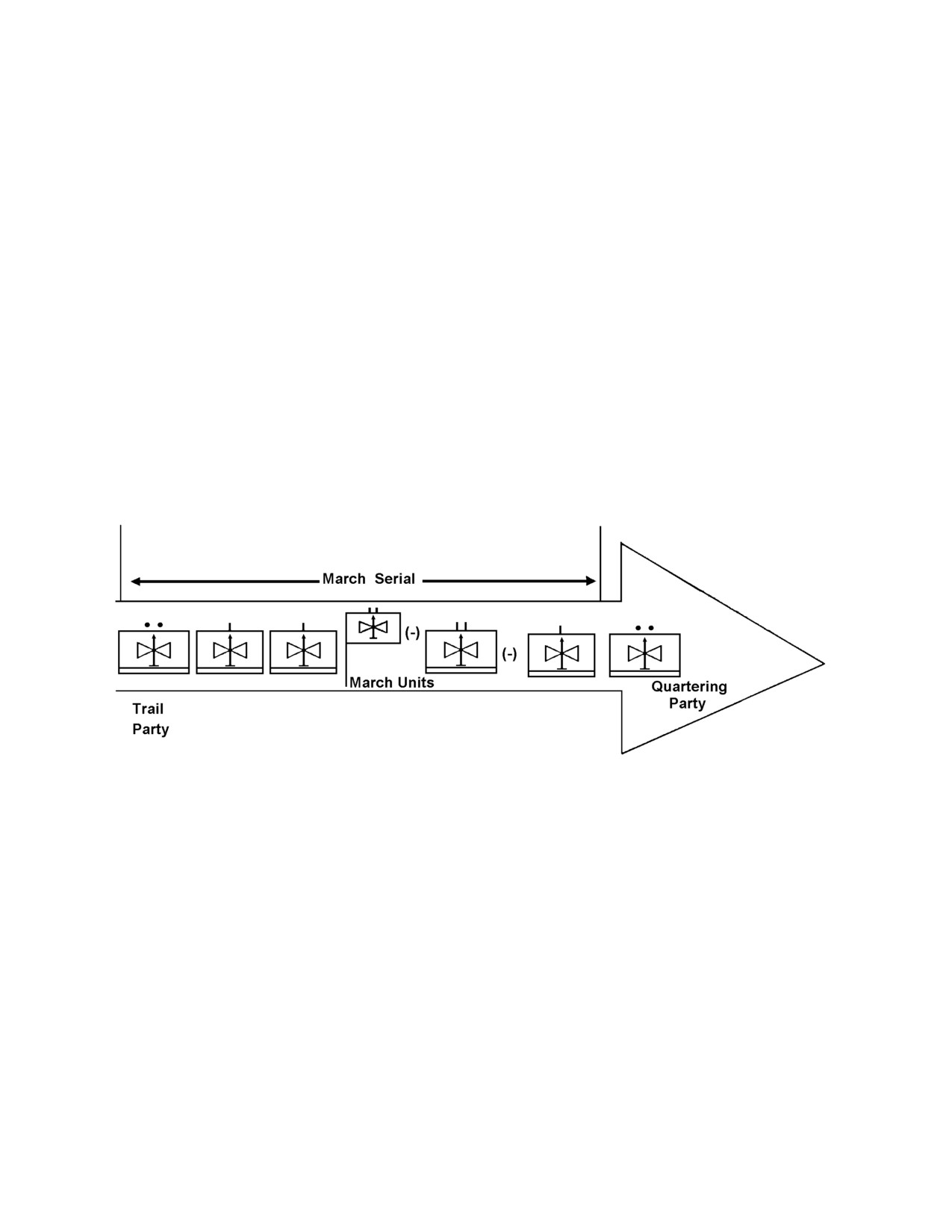
(2) March columns, regardless of size, are composed of four elements. These
elements are the reconnaissance party, the quartering party, the main body, and the trail
party. Figure D-1 shows the organization of a battalion tactical road march.
Figure D-1. Organization of a tactical road march
d. Planning Process.
(1) Tactical road marches require extensive planning. Commanders and
staffs use the estimate process to determine how to best execute a move from one point to
another. Road-march planning consists of three concurrent steps. These steps are to
determine requirements for the move, analyze organic and nonorganic movement
capabilities, and establish unit movement priorities. During movement planning, the
battalion commander and staff must consider the--
(a) Enemy situation and capabilities, terrain conditions, and weather.
D-7
FM 1-112
(b) Organization of the ATKHB.
(c) Security measures to be taken before the movement, during
movement, and at the destination.
(d) Assembly of the march units.
(e) Loading of personnel and equipment.
(f) Actions at the destination.
(2) When the ATKHB prepares for a tactical road march, the sequence of
planning for the march (if time permits) is--
(a) Prepare and issue a warning order as early as possible to allow
subordinates time to prepare for the march.
(b) Prepare an estimate of the situation, analyze routes designated by
the brigade, and specify the organization of the march serial.
(c) Prepare and issue the march order.
(d) Prepare detailed movement plans and assembly area plans.
(e) Organize and dispatch reconnaissance and quartering parties as
required.
e.
Planning Factors. Planners apply movement formulas to known distance,
rate, and time data to derive information necessary to prepare a time schedule. The time
schedule requires departures and arrivals of march elements.
(1) Time and distance relationships. Relationships between time and
distance are the basis for march planning. Planners determine how far the column is to
travel (distance) and how long it will take to make the move (time). They must also know
how much space (length of column) the column will occupy on the route and the distance
(road gap) or time (time gap) that separates march columns and their elements. Each
term used for distance has a corresponding term for time. The length of a column in
kilometers has an equivalent pass time in minutes; the road distance in kilometers or
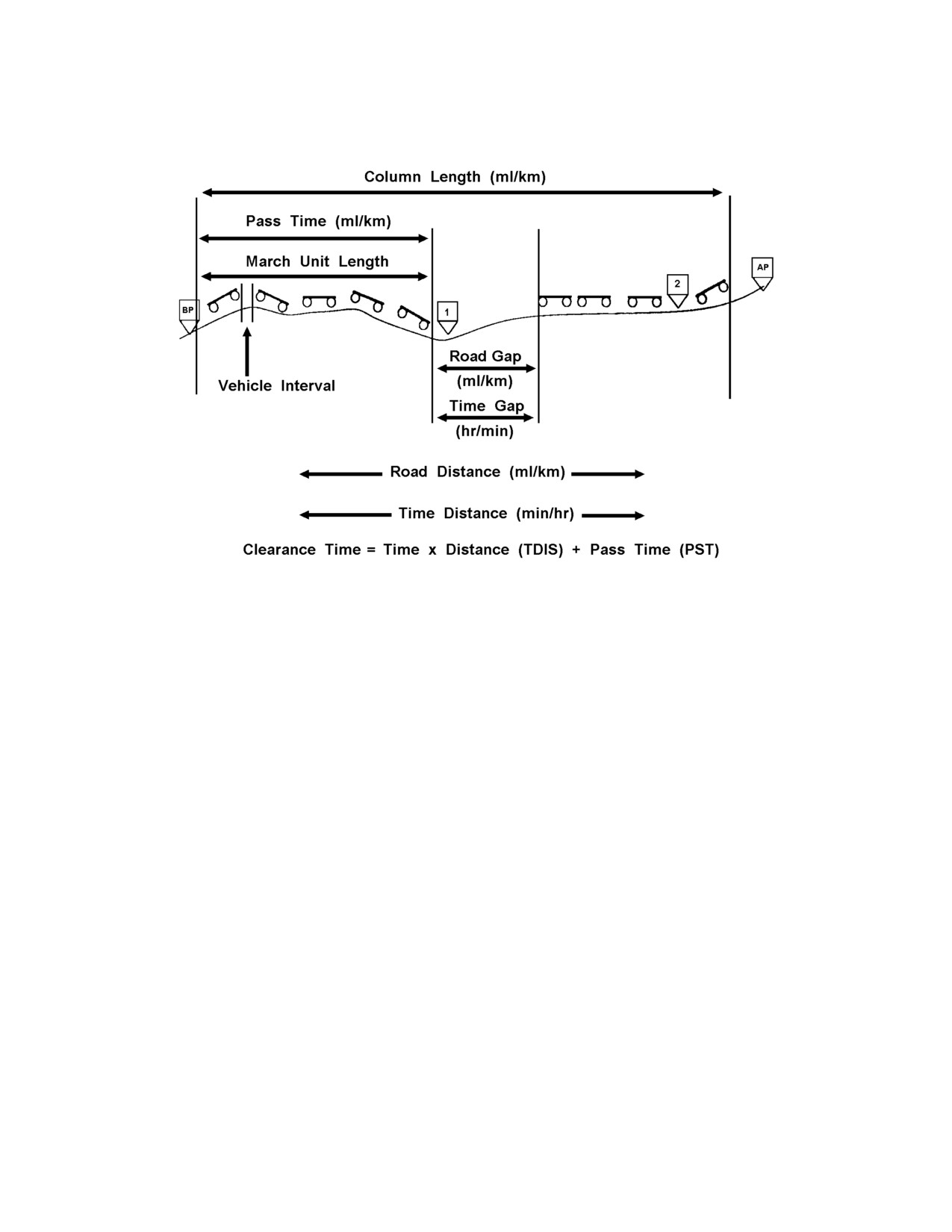
miles has a corresponding time distance. Relationships between time and distance in the
average rate of march are shown in Figure D-2.
(2) Distance factors. Distance factors include vehicle interval, column
gap, traffic density, column length, and road gap. Vehicle interval is the distance between
two consecutive vehicles of an organized element of a column. Column gap is the space
D-8
FM 1-112
Figure D-2. Time and distance relationships
between two organized elements following each other on the same route. It can be
calculated in units of length (road gap) or in units of time (time gap) as measured from
the rear of the leading element to the front of the following element. Traffic density is the
average number of vehicles that occupy 1 mile or 1 kilometer of road space, expressed in
vehicles per mile or vehicles per kilometer. Column length is the length of roadway
occupied by a column, including gaps in the column measured from the first vehicle to the
last vehicle. Road gap is the distance between two march elements. It is the length
aspect of the column gap. Since a road gap is more significant when the column is
moving than when the column is halted, it becomes a factor of time rather than distance.
(3) Rate factors. Speed, pace, and rate of march are rate factors. Speed is
the velocity of a vehicle at a given moment as shown on the speedometer (in kmph or
mph). Pace is the regulated speed of a column or element. It is set by the lead vehicle or
an individual in the lead element to maintain the prescribed average speed. Rate of
march is the average number of miles or kilometers traveled in any given period. It
includes short periodic halts and other short delays. The rate of march is expressed as
miles or kilometers traveled in an hour.
(4) Time factors. Time factors include arrival time, clearance time,
completion time, and pass time. Others are EXTAL, time-distance, road clearance time,
and time gap.
D-9
FM 1-112
(a) Arrival time is the moment when the head of the column arrives at
a designated point or line. Clearance time is the moment when the head of the column
arrives at a designated point or line. Completion time is the moment when the tail of a
column passes the release point. Pass time is the time between the moment the first
element of a column passes a given point and the moment the last element passes the
same point.
(b) Extra time is when the allowance of one minute per 25 vehicles is
always allotted above the calculated pass time within a motor march column moving
under one identification serial number. For a column that has more than 600 vehicles,
the EXTAL is two minutes per 25 vehicles. If a column has less than 25 vehicles, no
extra time is allotted. An EXTAL is equitably added to march unit pass time within a
serial.
(c) Time-distance is the time required to move from one point to
another at a given rate of march. Time-distance normally represents the movement of the
head of the column from the start point to the release point.
(d) Road clearance time is the total time a column requires to travel
over and clear a section of road. Road clearance time equals time distance plus column
pass time.
(e) Time gap is the time measured between the rear and front of
successive elements as they move past any given point. Time gap is the time aspect of
column gap and may also be the conversion of road gap to time. There are no prescribed
standard gaps. Gaps depend on the size of serials and march units, the time available for
the movement, and the tactics required for protection against air and ground attack.
f.
Movement Formula Application.
))))))))))))))))))))))))))))))))))))))))))))))))))))))
This paragraph implements portions of STANAG 2041.
))))))))))))))))))))))))))))))))))))))))))))))))))))))
(1) Distance, rate, and time are the basic factors for movement computa-
tions. If the march planner knows two of these factors, he can easily determine the third
by dividing or multiplying one by the other. The movement formulas are as follows:
(a) Rate is determined by dividing distance by time.
RATE = DISTANCE
TIME
D-10
FM 1-112
(b) Distance is determine by multiplying rate by time.
DISTANCE = RATE x TIME
(c) Time is determine by dividing distance by rate.
TIME = DISTANCE
RATE
(2) The march planner must determine time-distance, pass time, arrival
time, and completion time. The procedures for determining these factors are given below.
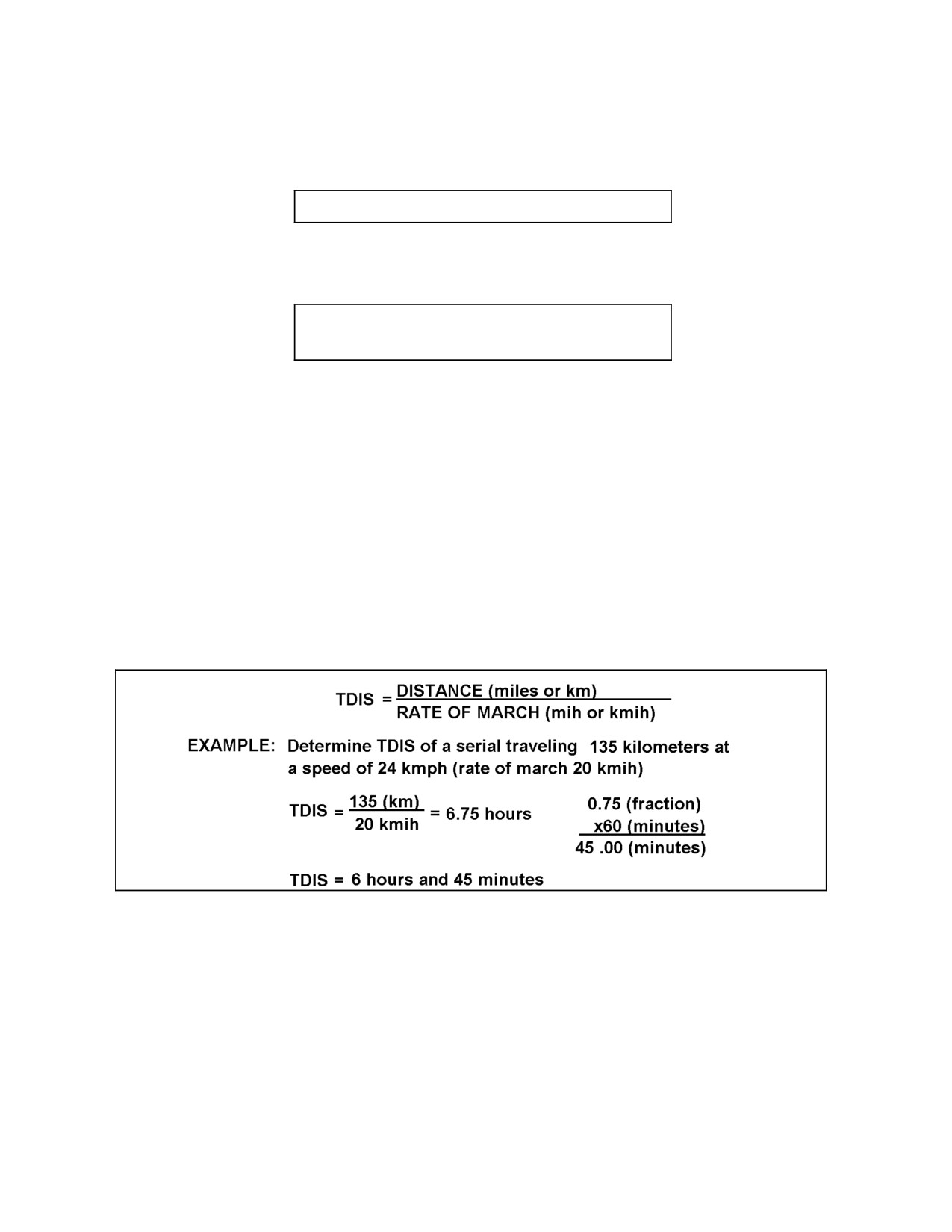
(a) TDIS. TDIS is determined by dividing distance to be traveled by
rate of march (Figure D-3). TDIS does not include time for long delays or extended
scheduled halts. A time-distance table (Table D-2) is a valuable tool to the march
planner. It provides a listing of factors used to calculate the time required to travel
certain distances at specified speeds. Travel rates are expressed in speeds and corre-
sponding rates of march. Travel factors are derived from rate of march, which includes
time for short, periodic halts and other minor delays that might occur.
Figure D-3. TDIS formula
D-11

FM 1-112
Table D-2. TDIS table
MINUTES TO
MINUTES TO
SPEED
RATE OF MARCH
TRAVEL 1
TRAVEL 1
(miles/kmph)
(miles/kmph)
KILOMETER
MILE
10 mph
8 mih
16 kmph
12 kmih
5
7.5
15 mph
12 mih
24 kmph
20 kmih
3
5
20 mph
16 mih
32 kmph
25 kmih
2.4
3.75
25 mph
20 mih
40 kmph
32 kmih
1.84
3
30 mph
25 mih
48 kmph
40 kmih
1.5
2.4
35 mph
30 mih
56 kmph
46 kmih
1.3
2
40 mph
33 mih
65 kmph
53 kmih
1.13
1.8
(b) Pass time. Pass time for a serial is determined by adding march
unit pass times together, including time gaps between march units (Figure D-4).
NO OF VEH x 60
N0. OF VEH
PST =
+
= TIME GAPS (Min)
DENSITY x SPEED
25
EXAMPLE: Determine PST of a serial of 150 vehicles organized into
6 march units of 25 vehicles each, traveling at a speed
of 24 kmph, with a density of 15 VPK, and using a
2-minute time gap between march units.
150 x 60
150
5) = 9,000
5 + 6 + 10
PST =
+
+ (2 x
+ 6 + 10 = 2
15 x 24
25
360
PST = 41 minutes
NOTES 1. Round off fractions of minutes to next higher minute.
2. EXTAL is allocated on the basis of 1 minute per 25
vehicles added to serial pass time. EXTAL is equitably
added to pass time of each march unit in the serial.
Figure D-4. Pass time formula
D-12
FM 1-112
(c) Arrival time. In march planning, the release point is normally
designated as the terminal point of movement. Arrival time at the release point is
determined by adding time-distance and any scheduled halts to the start-point time
(Figure D-5).
HOURS MINUTES
SP TIME
08
00
TIME-DISTANCE
06
45
SCHEDULED HALT
01
00
15
45
ARRIVAL TIME IS 1545 HOURS
Figure D-5. Arrival time formula
(d) Completion time. Completion time is calculated by adding pass
time to the arrival time or by adding to the start-point time the distance, pass time, and
any scheduled halts.
g.
March Order.
(1) The march order format is the same for tactical and nontactical move-
ments. The march order is prepared either as an annex to an OPORD, a separate
OPORD, or a FRAGO. Figure D-6 shows an example of an OPORD for a road march.
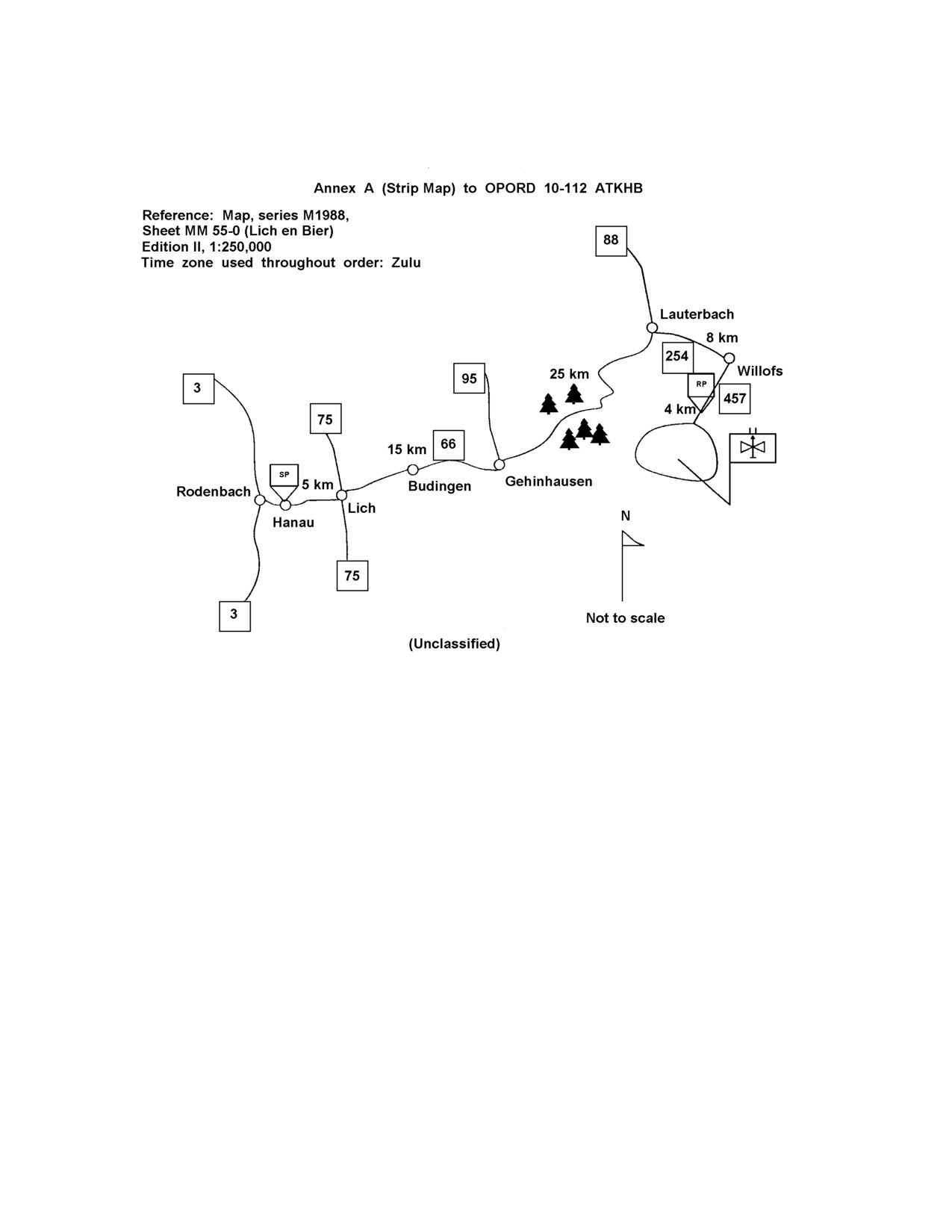
(2) The march order should include, as a minimum, a strip map. A strip
map is a sketch of the route of march. It is normally included as an annex to the march
order. Figure D-7 shows an example of a strip map. The amount of detail on the strip
map depends on its intended purpose and the unit level at which it is prepared. The map
should identify critical points, start-point and release-point times and locations, order of
march, maximum catch-up speed, distances to be maintained between vehicles and units,
assembly area locations, and instructions on future operations. In designating distance
(interval) or density, the planner must know its effect on column length and the time
required to move.
D-13
FM 1-112
Copy no of Copies
112th ATKHB
GAY (GL645745)
211600Z Aug 19xx
EEL
OPORD 31
Reference: Map, JOG, NH 16-2, 1:250,000, 1st Edition.
Time Zone Used Throughout the Order: ZULU
Task Organization: Annex B (Road Movement Table).
1.
SITUATION.
a.
Enemy Forces. Current INTSUM.
b.
Friendly Forces. Aviation Brigade moves 221000 Aug to assembly area vicinity FRAGO (GN7512).
c.
Attachments and Detachments. 2/B/31st AD and 1/A/52d Engr attached effective 220430 Aug.
2.
MISSION. 1-112th ATKHB moves to assembly area vicinity FARGO (GN7512); SP (GL6672) 221159 Aug; closes
on the assembly area by 221930 Aug.
3.
EXECUTION.
a.
Concept of Operation. Annex A (Route Overlay). I intend to close assembly area during daylight. BN
conducts a motor march, in six march units via Route RED, first march unit crossing SP at 221159 Aug and last march unit
clearing the release point, vicinity FARGO, by 221830 Aug.
d.
March Unit 3:
e.
March Unit 4:
f.
March Unit 5:
g.
March Unit 6:
h.
Coordinating Instructions.
(1)
Annex B (Road Movement Table).
(2)
Quartering party assemble at Main CP at 220900 Aug.
(3)
Vehicle density: open column; 12 vehicles per kilometer.
(4)
Rate of march: 24 kmph.
(5)
Time gap: Five minutes between march units.
(6)
Vehicle bumper markings will be covered.
4.
SERVICE SUPPORT.
a.
Supply. Each man draw two MREs at breakfast for noon and evening meals on 22 Aug.
b.
Services. Trail party task force control.
5.
COMMAND AND SIGNAL.
a.
Command.
(1)
Chain of command.
(2)
Location of convoy commander.
(3)
Succession of command.
b.
Signal.
(1)
SOI in effect.
(2)
Convoy frequency, BN CMD frequency.
(3)
Communication check procedures.
(4)
Lost communications procedures.
(5)
Code words or passwords.
Figure D-6. Sample format, road movement order
D-14
FM 1-112
Figure D-7. Sample strip map
(3) The march order also contains a statement of the enemy situation, the
weather, and visibility conditions. It should also contain (if applicable)--
(a) Road restrictions and information derived from route reconnais-
sance.
(b) Actions on enemy contact (ground and air).
(c) Actions at halts and actions for disabled vehicles.
(d) Actions in the assembly area.
(e) Procedures for resupply, maintenance, and feeding.
(f) Location of leaders and a communications plan.
D-15
FM 1-112
(4) Much of the information needed to conduct the march should be in the
unit SOP. Only exceptions to the SOP should be stated in the march order.
h. Road Movement Table.
(1) A road movement table is normally an annex to a movement order as
shown in Figure D-8. It is a convenient means of transmitting to subordinate units time
schedules and other essential details of the move. It is particularly useful when the
inclusion of such details in the operation order would make the order complicated or
unduly long. Road movement tables consist of two parts. The first part contains data
paragraphs that reflect information common to two or more march elements. The second
part contains a list of serials or march units along with all other necessary information
arranged in tabular form.
(Classification)
Annex B (Road Movement Table) to OPORD 31
Reference: Map, JOG, NH 16-2, 1:250,000, 1st Edition.
Time Zone Used Throughout the Order: Zulu.
General Data:
1.
Average Speed: 24 kilometers per hour.
2.
Traffic Density:
12 vehicles per hour.
3.
Halts:
1545-1645, meal and fuel; all others SOP.
4.
Critical Points: Route RED.
a. Start point: BOLL WEEVIL (GL6672).
b. Release point: FRAGO (GN7512).
c. Other critical points: COLUMBIA (GL6979), DURHAM (GL6989), NIAGARA (GL6893), and BOSTON
(GN7106).
d. Route Classification: 10X50.
e. Route Restriction: None.
5.
Main Routes to Start Point: NA.
6.
Main Routes to Release Point: NA.
Figure D-8. Sample format for a road movement table
(2) The march planner must know the times at which serials and march
units arrive at and clear critical points. Other information in the road movement table
includes serial or march unit number, date of move, units involved, number of vehicles,
and load class of the heaviest vehicle to be used. A remarks section should reflect any
details not covered elsewhere.
D-16
FM 1-112
i.
March Procedures.
(1) Reconnaissance party. An ATKHB, augmented by engineer and other
CS assets, conducts a route reconnaissance to determine travel time, capacities of
overpasses and bridges, height of underpasses and tunnels, and locations of ferries and
fords. The aeroscout platoon also identifies critical points, including choke points and
obstacles. Route reconnaissance confirms and supplements data from map studies, higher
headquarters, and air reconnaissance. Instructions to the aeroscout platoon should
include the nature and extent of the required information and the time and place the
report is to be submitted.
(2) Quartering party. The ATKHB quartering party consists of the
quartering parties of each of the companies. The commander dispatches a quartering
party to reconnoiter the new area and guide march elements into position.
(3) Main body.
(a) Before starting a march, each march unit of a serial reconnoiters
its route to the start point and determines the exact time required to reach it. The
movement order states the time that the serial will arrive at and clear its start point.
The serial commander then determines and announces the times for march units of his
serial to arrive at and clear the start point. Arrival time at the start point is critical.
Each march unit must arrive at and clear the start point on time; otherwise, movement of
other elements may be delayed.
(b) During the movement, march units move at the constant speed
designated in the order, maintaining proper interval and column gap. Elements in a
column of any length may simultaneously encounter many different types of routes and
obstacles. As a result, different parts of the column may move at different speeds at the
same time. This can produce an undesirable accordion-like action or "whip effect." The
movement order gives march speed, rate of march, and maximum catch-up speed to
ensure safety and to reduce column whipping. March units report crossing each control
point as directed by the march order. During the move, air and ground security are
maintained.
(4) Trail party. The trail party is normally made up of elements of the
HHC motor maintenance section and is the last unit in a task force serial. The trail party
is led by the battalion movement officer. Its function is to recover disabled vehicles. If a
vehicle cannot be repaired or towed, the vehicle and its crew are moved off the road into a
secure area. Crew members are given sufficient food and water and left with the vehicle.
When vehicles are left behind, the BMO reports their locations and the reason they were
left behind to the task force S4. Once the trail party completes the road march, mainte-
nance priority becomes recovery of disabled vehicles. A tactical road march is not
complete until all march units and vehicles arrive at their destination.
D-17
FM 1-112
j.
March Techniques.
(1) Close column. In a close column, vehicles are spaced about 20 to 25
meters apart during daylight hours. At night, vehicles are spaced so that each driver can
see the two lights in the blackout marker of the vehicle ahead. A close column is
normally used for marches during the hours of darkness under blackout driving condi-
tions. This method of marching takes maximum advantage of the traffic capacity of the
route but provides little dispersion. Normally, vehicle density is about 30 vehicles per
kilometer along the route.
(2) Open column. In an open column, the distance between vehicles is
increased to provide greater dispersion. The distance between vehicles varies from 50 to
100 meters, but may be greater if required. An open column is normally used during
daylight. It may also be used at night using infrared lights, blackout lights, or passive
night-vision equipment. Vehicle density varies from 10 to 15 vehicles per kilometer.
(3) Infiltration. During a move by infiltration, vehicles are dispatched
individually, in small groups, or at irregular intervals at a rate that will keep the traffic
density down and prevent undue massing of vehicles. Infiltration provides the best
possible passive defense against enemy observation and attack. It is suited for tactical
marches when sufficient time and road space are available and when maximum security,
deception, and dispersion are desired.
k. Control Measures.
(1) Critical point. Critical points on a route are those points used for
reference in providing instructions, places where interference with movement might occur,
or places where timing might be a critical factor. The route reconnaissance report or a
map study should provide the march planner with information to designate critical points
along the route of march and distances from one critical point to another. At designated
critical points, guides or signs may be used to ensure the smooth flow of traffic. The
convoy commander may want to be present at the passing of some critical points. The
start point and release point are two critical points that are always designated. Using the
checkpoint symbol, critical points are designated by number, letter, or code word. The
march planner must ensure that designations for critical points do not conflict with those
of checkpoints.
(2) Start point. SPs provide all units of a march column a common point
for starting their movement. When units use more than one route, each route has a start
point. The SP is a place along the route of march that is easily recognizable on the map
and on the ground such as a road intersection. An SP should be far enough from
assembly areas to allow units to organize and move at the prescribed speed and interval
when they reach the SP. No element of a march column should be required to march to
the rear or through another unit to reach the SP.
D-18
FM 1-112
(3) RP. RPs provide all units of the march column a common point at
which to reestablish control of their parent unit. The RP should be on the route of march
and easily recognizable on the map and on the ground. Units do not stay at the release
point. Guides meet units as they arrive at the release point and lead them to the
assembly area. Multiple routes and cross-country movement from the release point to
assembly areas enable units to disperse rapidly. No unit should be required to counter-
march or pass through another unit to reach its new position.
(4) Strip map. Copies of the strip map should be reproduced and distrib-
uted to all key personnel. The strip map should contain the start point and RP, restric-
tions, and critical points and the distances between them.
l.
Security.
(1) During the march, units maintain security through observation, weapons
orientation, dispersion, and camouflage. Commanders assign sectors of observation to
their personnel that will give them a 360-degree observation. Weapons are oriented on
specific sectors throughout the column. The lead elements cover the front, following
elements cover alternate flanks, and the trail element covers the rear. Security is also
maintained during halts.
(a) Scheduled halts are planned along the march route for main-
tenance and rest or to follow higher level movement orders. At scheduled halts, vehicles
and soldiers move to the side of the road while maintaining march dispersion. Local
security is set up immediately, and drivers perform operational maintenance checks.
However, the unit is ready to move at a moment's notice.
(b) Unscheduled halts and actions may be caused by unforeseen
developments such as obstacles, traffic congestion, or equipment failure. If a halt is
necessary, the march column's first priority is to establish security. Each unit forms a
hasty perimeter defense.
(2) To minimize the ATKHB's vulnerability to enemy air attack, AD must
be planned and AD security measures implemented. The convoy commander must
effectively integrate his ADA assets into his fire plans and ensure that all passive and
active AD measures implemented at company level are planned and used.
(3) Each vehicle in a motor march has an air guard to provide air security.
However, specific vehicles may be designated as air guard vehicles to conduct air rather
than ground observation.
(4) Obstacles that are reported by an aeroscout platoon should be bypassed
if possible. If obstacles cannot be bypassed, the lead march unit goes into a hasty defense
to cover and overwatch. If engineers are available to assist, the lead march unit can
D-19
FM 1-112
breach the obstacle. As the lead march unit breaches the obstacle, the other march units
move at decreased speed or move off the road and monitor the battalion command net.
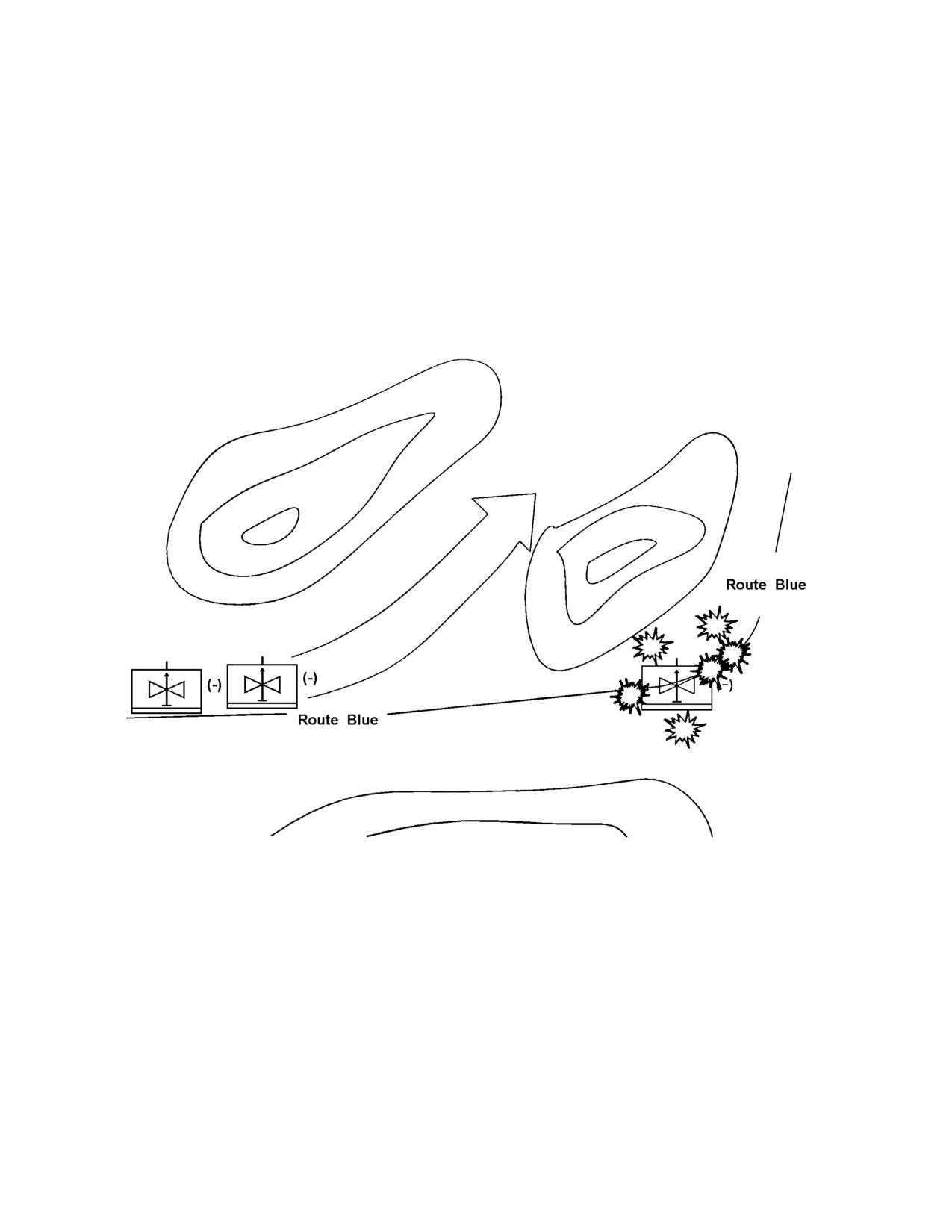
(5) If the task force comes under attack by enemy indirect fire during the
road march, the unit in contact continues to move. The remainder of the task force
attempts to bypass the impact area (Figure D-9).
Figure D-9. Actions under indirect fire
(6) If the task force is attacked by hostile aircraft during the march, the
march unit that is attacked moves off the road into a quick defensive posture and
immediately engages the aircraft with all available automatic weapons. The rest of the
convoy moves to covered and concealed areas until the engagement stops.
D-20
FM 1-112
(7) Ambushes are fought without delay. If the convoy is ambushed, the
march unit in the KZ increases its speed, fights through, and reports the ambush.
(8) Disabled vehicles must not obstruct traffic; they are moved off the road
and their status is reported immediately. Security is established and guides are posted to
direct traffic. If the operator repairs the vehicle, he rejoins the rear of the column. If the
operator cannot repair the vehicle, trail party maintenance elements recover it.
(9) Messengers and visual signals are the preferred means of communica-
tion during road marches. Because the enemy has radio direction-finding equipment, the
radio is used only in emergencies and when no other means of communication can be
used. Road guides can also be used to pass messages from one march unit to a following
march unit. Because of the need for radio silence, road guides are used to control the
speed of march units and the intervals between them.
(10) Restrictions are points along the route of march where movement may
be hindered or obstructed. These points can include bridges, intersections, ferries, and
bypasses. The march planner should stagger start times, adjust speeds to allow for
restrictions, or plan to halt the column en route until the restriction is passed.
(11) Units must be able to operate under limited visibility conditions caused
by darkness, smoke, dust, fog, heavy rain, or heavy snow. Limited visibility decreases the
speed of movement and increases difficulties in navigation, recognizing checkpoints, and
maintaining proper interval between units. To overcome C2 problems caused by limited
visibility, convoy commanders may position themselves just behind lead elements. More
restrictive control measures, such as additional checkpoints, phase lines, and use of a
single route, may become necessary.
(12) The convoy commander also plans for an NBC attack. He--
(a) Ensures that protective and decontamination materials are
properly distributed and their location known to the entire march unit.
(b) Ensures that the proper MOPP level is maintained, based on the
threat and the temperature level. Personnel may start out in MOPP 3 to avoid having to
stop to change into MOPP 3 or MOPP 4.
(c) Ensures that chemically or biologically contaminated areas are
avoided if possible. If contaminated areas must be crossed, personnel--
• Use MOPP 4.
• Cover as much equipment as possible.
• Avoid moving through underbrush.
D-21
FM 1-112
• Stay on hard-surfaced roads.
• Avoid low areas.
• Avoid moving early or late in the day.
• Stagger vehicles in the column.
• Decrease speed to reduce dust or mud.
• Increase vehicle interval.
• Scrape the surfaces of dirt roads to clear them of contamination.
(d) Avoids nuclear contaminated areas, if possible. If nuclear contami-
nated areas must be crossed, personnel--
• Wear regular wet-weather gear with a scarf or handkerchief over the nose and
mouth.
• Avoid stirring up dust as much as possible.
• Ensure that the IM174 radiac meter is used.
• Wash hard-top roads before traveling over them.
• Wet dirt roads to minimize fallout dust.
D-9. TRAINING
There are several specialized training courses that UMOs and UMNCOs should attend.
Commanders/staff officers must ensure that UMOs and UMNCOs have the opportunity to
attend all available movements related training possible. An untrained UMO/UMNCO
will likely translate into uncoordinated and ineffective unit movements and deployments.
a.
Hazardous cargo will be packaged and shipped according to TM 38-250. The
Military Packaging Center, Aberdeen Proving Grounds, Maryland, offers the two-week
Defense Packaging of Hazardous Materials for Transportation Course (Course #:
8B-
F7(JT)). The course trains soldiers to prepare hazardous cargo for transport. Addition-
ally, once certified, personnel must attend the one-week Defense (Refresher) Packaging of
Hazardous Materials for Transportation Course (Course #:
8B-F35(JT)) every two years.
Instruction is provided by mobile training teams a most installations. More information
about the courses may be obtained from the Military Packaging Center, DSN:
298-5185.
b. UMOs/UMNCOs should also attend the US Air Force's AMC Airload Planner
Course, which trains unit movement officers to plan movements using Air Force assets.
D-22
FM 1-112
c.
Finally, units should research the availability of unit movements officers
classes at corps or division level. Additional movement training is listed in AR 351-1.
Commanders should ensure that their UMOs attend as many courses as possible.
D-10. UNIT MOVEMENTS REFERENCES
At a minimum, UMOs should maintain current/updated copies of the following references
for unit movements planning and execution.
Joint Publications
Joint Pub 4-01.3. Joint Tactics, Techniques, and Procedures for Movement Control.
26
January 1994.
Army Field Manuals
FM 1-109. Aviation Self-Deployment Planning. 29 May 1987.
FM 1-111. Aviation Brigades.
27 August 1990.
FM 55-9. Unit Air Movement Planning. 5 April 1993.
FM 55-12. Movement of Units in Air Force Aircraft.
10 November 1989.
FM 55-15. Transportation Reference Data.
9 June 1986.
FM 55-30. Army Motor Transport Units and Operations. 14 March 1980.
FM 55-65. Strategic Deployment.
3 October 1995.
FM 55-312. Military Convoy Operations in the Continental United States.
3 April 1991.
Technical Manuals
TM 38-250. Preparing of Hazardous Materials for Military Air Shipment.
25 November
1994.
TM 55-208. Railway Equipment Characteristics and Data. 5 Oct 76.
TM 55-625. Transportability Criteria and Guidance for Loading and Unloading Multilevel
Railcars at Military Installations in the United States.
15 August 1970.
TM 55-2200-001-12. Transportability Guidance for Application of Blocking, Bracing, and
Tiedown Materiels for Rail Transport.
31 May 1978.
Army Regulations
AR 55-29. Military Convoy Operations in CONUS. 3 September 1971.
AR-55-113. Movement of Units Within Continental United States.
19 July 1973.
AR 55-162. Permits for Oversize, Overweight, or Other special Military Movement on
Public Highways in the United States.
1 January 1979.
Other References
D-23
FM 1-112
Planning Guide: Army Aviation Deployment for Contingency Operations.
1 February
1993.
FM 1-564. Shipboard Operations. Projected publication date: January 1997.
D-24
FM 1-112
APPENDIX E
TACTICAL STANDING OPERATING PROCEDURES
E-1. GENERAL
This appendix is written as an outline for a unit to follow when writing a tactical SOP.
Details discussing exact procedures have been intentionally omitted so the commander
can formulate his SOP.
a.
Formats. Several formats are used throughout the aviation community when
writing Tactical SOPs. The format below follows the five paragraph operations order,
inserting SOP recommendations where appropriate. The goal of this technique is that in
an OPORD, when it states "Per SOP", the soldier can logically turn to the same location
in the SOP and find the information.
b. Recommendations. Everyone in the battalion will be using the SOP, from
the soldier working in the motor pool to the battalion commander. Write the SOP so that
every soldier can understand the sections he is concerned with. When possible, use
diagrams (a picture is worth a thousand words). Leave areas within the SOP blank so
that individuals can put personal notes or changes close to the appropriate area. The
SOP should be sized to fit in either a BDU or flight suit pocket. Finally, keep it func-
tional, not flashy. Substance is much more important than pretty pictures throughout.
E-2. SOP FORMAT
a.
Errata Page. Inserted at the beginning of the document, this page is used to
mark when and where minor changes are to be inserted in the SOP.
b. Purpose Memorandum. After the errata page, a memorandum from the
battalion commander giving the purpose of the SOP, its scope, and how updates/changes
to the SOP should be added. The commander's philosophy, the unit METL, and the
commander's intent for conducting combat operations should also be placed here.
c.
Table of Contents. The table of contents should be an outline of the SOP.
In this case, paragraphs and subparagraph headings of the unit operations order format
are used. The table of contents should be detailed to the point that it becomes the unit
standard for all written or verbal operations orders.
d. Staff Responsibilities. An outline, in bullet form, explaining the principle
duties of each staff member during operations. This should nearly be complete enough
from which to write an evaluation support form.
E-1
FM 1-112
e.
Troop Leading Procedures. Include a checklist for unit leaders to use
when initiating the orders process.
f.
Operations Order Background.
(1) References. Division, Brigade, TF SOPs, and their dates.
(2) Time zone. Time zone used throughout the order.
(3) Task Organization. Configuration of the unit in the field and how the
subordinate units are designed to accomplish the METL.
g.
Figure E-1 is a sample format for a TAC SOP.
1. SITUATION
a. Enemy Forces. If the battalion has defined contingency regions, include key
elements of expected enemy unit organization diagrams, doctrine, tactics, and equip-
ment.
b. Friendly Forces. Include expected habitual relationships in the theater of
operations, and habitual relationships used frequently for training.
c. Attachments/Detachments. If the battalion has any habitual relationship
(such as a team of AD from the divisional ADA battalion) subordinate units, their
structure should be listed here. For nonhabitual, OPCON/attached units, a single card
that fits on a kneeboard should be developed to provide crew members with a quick
reference aid.
d. Weather. What are the weather minimums for battalion operations? What are
the procedures for disseminating weather to the companies? In what format should the
S-2 distribute the weather?
2. MISSION. List the METL to focus training.
3. EXECUTION. Show an example or list of standardized graphics and graphics
names (for operations overlays), consistent with FM 101-5-1.
a. Concept of the Operation.
(1)
Commander's intent.
(2)
Scheme of maneuver.
(a) Ground.
Figure E-1. Sample format for a TAC SOP
E-2
FM 1-112
• Tactical road march procedures.
• Quartering party procedures.
• Assembly area procedures. Include bugout/ERP procedures for both
aircraft and ground vehicles.
(b) Air.
• Define REDCON status.
• Explain radio check procedures.
• Lineup/takeoff procedures.
• Common formations.
• Company-to-company battle handover checklist.
• Company-to-company target handover.
• HA procedures.
• BP procedures.
• Target and engagement priorities.
• Fire distribution procedures.
• Laser codes.
(c) Deep operations.
(d) JAAT operations. Include JAAT brief format(s), etc.
(3) Tasks to subordinate units. Include any operations (quartering party,
etc.) that fall to the same unit every time they are executed.
(4) FS.
(a) Firing units.
(b) Target priorities.
(c) Target attack criteria.
(d) Target reference points. Address reserved TRPs.
Figure E-1. Sample format for a TAC SOP (continued)
E-3
FM 1-112
(e) CAS.
(f) SEAD operations.
(5) ADA
(6) EW/ECM
(7) Obstacles
(8) Deception operations
(9) A2C2
(a) Air routes/corridors, ACPs.
(b) Coordinating altitude. Minimum safe altitude,
SAAFR, MRRs.
(10) NBC operations.
(a) NBC status.
(b) Decontamination operations. Procedures for the conduct of decon-
tamination sites for the decontamination teams, and the flight teams/ sections.
(c) In-flight masking/unmasking procedures.
b. Air Mission Instructions.
(1) Order of movement.
(2) Lighting requirements.
(3) Special mission equipment.
(4) IMC breakup procedures.
(5) IMC recovery airfield.
c.
Coordinating Instructions.
(1) EEFI.
(2) PIR.
Figure E-1. Sample format for a TAC SOP (continued)
E-4
FM 1-112
(3)
MOPP level.
(4)
Times.
(a) Inspections.
(b) Rehearsals.
(c) Preflight.
(d) Crank time.
(e) Communications check.
(f) Lineup.
(g) Takeoff.
(h) SP.
(i) Passage point (ingress).
(j)
Time on target.
(k) Relief on station.
(l)
Passage point (egress).
(m) Debrief time and location.
(5)
Contingencies.
(a) Abort criteria.
(b) Hasty decontamination site.
(c) Downed aviator pickup procedures and points.
4.
SERVICE AND SUPPORT
a.
Supply.
(1) Class I.
(2) Class II/IV.
Figure E-1. Sample format for a TAC SOP (continued)
E-5
FM 1-112
(3) Class III/V.
(a) FARP procedures.
(b) FARP locations.
(c) Class III (P).
(d) Standard loads for different missions.
(4) Class IX.
(a) Ground.
(b) Air.
b.
Transportation.
c.
Services.
(1) MEDEVAC and hospitalization.
(a) Location of battalion aid station.
(b) Location of brigade clearing station.
(c) WIA procedures.
(d) Field sanitation procedures.
(2) GRREG procedures.
(3) EPW handling, disposition, responsibilities.
5.
COMMAND AND SIGNAL
a.
Command.
(1) C2 facilities.
(2) Location and composition of command groups.
(3) Succession of command.
Figure E-1. Sample format for a TAC SOP (continued)
E-6