FIELD MANUAL FM 1-112 ATTACK HELICOPTER OPERATIONS (April 1997) - page 4
FM 1-112
b. Planning.
(1) One of the ATKHB commander's greatest challenges is to synchronize
and concentrate all of his combat power at the critical time and place. There are
potentially a multitude of targets to engage in a short time, and a time lag from when the
decision is made to use supporting fires until the target is hit. The commander alone will
not have the time to integrate all of the weapons available to him to increase his combat
power. The FSO assists the commander by developing the fire support plan concurrently
with the maneuver plan. During the battle, the FSO and fire support section monitor the
execution of fire support to ensure compliance with the commander's intent and to provide
continuous support. When using fire support, the commander must consider the factors
discussed below.
(a) Fire support to complement maneuver. Fires are used to
accomplish missions that the ATKHCs cannot or that would otherwise divert forces from
the main effort. An example is the use of artillery to engage AD systems overwatching
enemy movement.
(b) Surprise. Massed surprise fires are most effective. The
destruction that can be achieved by supporting fire depends on the preparedness of the
enemy.
(c) Most effective roles. To best integrate fire support, the ATKHB
commander must know the capabilities and limitations of all supporting fires and ensure
that fire support is used where and when it will be most effective.
(d) Effects of fire. Effects of fire include suppression, neutralization,
and destruction. Suppression limits the ability of personnel in the target area to perform
their jobs. The effects of suppressive fire last only as long as the fires continue.
Neutralization temporarily knocks the target out of action, producing 10 percent or more
casualties or materiel damage. Most planned missions are neutralization fires.
Destruction renders the target ineffective for a prolonged period of time, producing 30
percent or more casualties or materiel damage. Destruction requires large quantities of
ammunition or special munitions such as COPPERHEAD or ICM.
(2) The planning and coordination process begins when the mission is
received and continues throughout the operation. The commander, X0, S2, S3, and the
supporting FSO interact throughout mission planning and execution to ensure that fire
planning is a continuing process. When the mission is received, the FSO receives the
following guidance from the higher fire support element:
• Fire support asset allocation and status.
• Higher commander's fire support attack guidance.
• Fires planned by higher headquarters in zone.
4-2
FM 1-112
(3) The commander must clearly state his intent/concept for fire support. To
be useful, the commander's intent/concept for fire support must be both understood and
feasible. This requires a mutual effort by both the FSO and battalion commander to
articulate and understand what fire support can and is expected to accomplish during an
operation. The commander's requirements must be within the capabilities of the
resources available. The FSO must know and communicate fire support capabilities,
limitations, and risks during the process of developing the commander's intent/concept for
fire support. The commander's intent/concept must explain--
• The commander's battle space--his vision of lethality projection. It should
answer the question, "What do I want to do to the enemy?", and articulate more than just,
"Defeat him". It should not refer to a specific scheme of maneuver or to specific
organizations.
• What must be accomplished, when, and why.
• How he intends to shape the battle to his advantage in terms of time and space.
• The critical enemy vulnerability (center of gravity) he believes will lead most
directly to mission accomplishment.
• Places and times in the fight that are critical.
• Desired endstate in terms of time, force, enemy, and terrain.
• Which units have priority of fires.
• Preliminary guidance on HVT/HPT.
• His special concerns.
(4) Through the planning process, the commander and staff determine how
fire support will be used (what type of targets will be attacked, where, when, why, and
with what means). The plan is flexible to accommodate the unexpected in combat.
(a) The depth and detail of fire support planning depends on how much
time is available. Many of the fire support actions that occur in response to battle
situations are established in SOPs or directed in FRAGOs. Fire support planning is
continuous and concurrent at all levels.
(b) The fire support plan outlines the way artillery, CAS, and other fire
support systems will be used to complement the scheme of maneuver, and it provides
instruction for executing those fires. It is used to rank targets in priority order, match
them with available fire support systems, eliminate duplication with the targets of the
echelon that the ATKHB is supporting, and allow fires to be executed quickly without
4-3
FM 1-112
specific direction from the commander once the battle starts. An ATKHB fire support
plan may include the following:
• A general concept of how fires will support the attack (Scheme of fires).
• Availability of fire support assets and their status.
• A target list that includes locations where fires are expected or likely to be
used.
(Known enemy locations should be carefully targeted, but too many targets
complicate the fire plan and delay fires.)
• An observation plan that details who is responsible to observe and fire a target
and where the observer must be positioned to see the trigger and the target.
• A priority of fires telling which element will receive fire support in case of
conflicting needs.
• A priority of targets telling which type of mission to fire first.
(HPT list/attack
guidance matrix)
• An allocation of priority targets.
• A fire support execution matrix.
• Clearance of fires procedures.
• Informal airspace coordination areas.
• Requirements, restrictions, and priorities for special munitions (DPICM, smoke,
illumination, FASCAM, COPPERHEAD).
• Coordination measures for providing troop safety and synchronizing supporting
fires.
(c) The fire support plan must explain who will trigger and control
fires, where the observer will position to see the trigger and target, which targets to shoot
(number/type of vehicle, formation, etc.), when and where to shoot them, which type of
indirect weapon and ammunition to shoot at the target, what target effects are desired,
and the purpose of shooting the target.
(d) The battalion fire support plan is disseminated in the OPORD. This
plan is refined as requests from the ATKHCs and new information are received. Updated
fire plans are sent back to the ATKHCs and disseminated to the DS battalion fire
direction center and brigade fire support element.
4-4
FM 1-112
(5) Fire support is an essential part of the ATKHB combined arms rehearsal.
Incorporating fire support in the rehearsal will build confidence and understanding
between all of the battlefield operating systems. Rehearsals at all levels are key to
understanding the concept of the operation, verifying specific responsibilities, timing, and
backup procedures to help synchronize unit operations. Any last minute changes to the
plan after the rehearsal may cause a reduction in the effectiveness of the fire support.
The key fire support points that should be highlighted during the rehearsal are--
• Validation of the fire support plan with the scheme of maneuver, commander's
intent, and attack guidance.
• Positioning and ranges of the supporting artillery and mortar units.
• Obstacle/barrier plan synchronization with the fire support plan.
• Fire and maneuver control measures for protecting and controlling aerial and
ground forces do not disrupt the fire support plan and are not violated by the plan.
• Target grids and trigger points are verified.
• Redundant observers are identified to initiate fires if the primary observers fail
to execute.
• Responsibilities for clearance of fires are clearly spelled out.
• Observers know where to position in order to see the trigger and target.
• Use of primary and alternate communications nets.
c. Specialized Conventional Munitions.
(1) Artillery-delivered smoke. Artillery-delivered smoke is used to
obscure or screen. White phosphorus provides a quick smoke build-up. HC, under the
right weather conditions, provides sustained concealment.
(a) Obscuration fire is placed on or near the enemy to isolate the enemy
and obscure his view of the battlefield. Because smoke is susceptible to changes in wind
direction and the configuration of the terrain, its use must be coordinated with the
ATKHB commander and all other friendly units affected by the operation.
(b) Screening fire is used to mask friendly maneuvering elements in
order to disguise their operations.
(2) Illumination. Illumination is rarely used in current operations due to
wash-out of friendly night sight systems. Under certain situations its use may be
4-5
FM 1-112
necessary, and you must know and use the correct employment procedures. The following
factors should be considered when illumination fires are being employed:
(a) Illumination fires are often necessary to assist aircraft that are not
equipped with night observation devices to acquire and engage targets at night.
(b) Since the amount of illumination in basic loads is often low,
expenditures must be monitored.
(c) Wind and other atmospheric conditions can affect the time it takes
to get effective illumination.
(d) Use of illumination must be coordinated with adjacent units to
ensure friendly operations are not degraded.
(3) Scatterable mines. A wide range of FASCAM assets is available to the
commander. Artillery-delivered FASCAM, Army aviation- and Air Force-delivered
FASCAM, and engineer-emplaced FASCAM can be integrated into the commander's
scheme of maneuver in offensive and defensive operations. Each system has different
characteristics in terms of patterns, self-destruct times, and responsiveness that must be
considered in the planning process. Long self-destruct mines are those that self-destruct
in more than 24 hours. Short self-destruct mines are those that self-destruct in less than
24 hours.
(a) FASCAM provides a rapid and responsive obstacle emplacement
capability to the aviation brigade. The aviation brigade S3 and aviation brigade engineer
plan and coordinate use of FASCAM assets, regardless of the means of delivery. A great
deal of planning is required for FASCAM emplacement. FASCAM minefields, like all
obstacles, must be tied in with terrain and under observation to be effective.
(b) The supported echelon commander may authorize the ATKHB
commander to employ short-duration FASCAM minefields. FASCAM employment is then
planned by the ATKHB commander and the S3 in coordination with the supported
echelon's engineer, S2, and FSO. Scatterable mines are included in the maneuver and
obstacle plan. Upon approval of this plan, the FSO integrates FA delivered scatterable
mines into the ATKHB fire support plan. The scatterable mines are then fired as directed
by the ATKHB commander.
(c) The standard low-density FA delivered scatterable minefield
requires that a total of 30 rounds be fired to form a pattern that is roughly 400 x 400
meters. Employment time is generally 15 minutes (planned) to 30 minutes or longer
(unplanned) from the time of the call for fire. Short-duration mines self-destruct in four
hours. Long-duration mines self-destruct in 48 hours. Authority to employ long-duration,
self-destruct scatterable mines is normally not delegated to battalion level.
4-6
FM 1-112
(d) A FASCAM minefield is observable on the ground. These mines are
most effective when tied into existing or reinforcing obstacles. As with other obstacles,
FASCAM minefields must be covered by observation and direct and indirect fires to
prevent rapid, unhindered breaching.
(e) The unit that emplaces the mines immediately reports the pertinent
information required by the most expeditious and secure means. The report is sent
through operations channels to the headquarters authorizing the minefield. The
supported echelon then informs higher, lower, and adjacent units of its location.
(f) Aerial employment of scatterable mines may be requested from the
aviation brigade. Air VOLCANO can produce two minefields per sortie. The minefields
are up to 1,115 meters long and 35 meters wide. The minefields are dispensed with their
long axis parallel to the route of flight. If the mines are dispensed from both sides of the
UH-60 simultaneously, two minefields will be created, separated by a mine-free strip of
ground approximately 50 meters wide. FM 1-113 contains detailed air VOLCANO
planning information.
(4) Laser-guided projectiles. The COPPERHEAD round is effective
against stationary targets out to 5,000 meters from a ground laser designator. Depending
on the skill of the operator, a COPPERHEAD round can hit moving targets at 3,000 to
4,000 meters. Aircraft tend to be able to designate from a greater distance than
ground/vehicle laser locator designators. However, it takes almost 5 minutes from the
initial call for fire for the round to be fired, which limits the utility of this round for
targets of opportunity. The requirement for the laser designator to "spot" the target for
the final 13 seconds of flight also restricts the utility of this round.
d. NGF. NGF can be an effective fire-support means when operations are
conducted near a coastline with gunfire support ships within range. US Army units have
only a limited organic capability to control naval air or NGF. A US Marine Corps air
NGF liaison company normally provides this capability to a division. There are two
organizations within the ANGLICO. Depending on which organization is available, the
ATKHB will receive either a shore fire-control party or a battalion SALT and firepower
control teams. These ANGLICO elements request, coordinate, and control naval air and
NGF.
e. CAS. CAS is normally planned through FSO channels, to the Air Force TACP
located at a ground maneuver brigade, division, or corps head-quarters. CAS and JAAT
are discussed indepth in paragraph 3-25 of this manual.
f.
Fire Support Coordinating Measures.
(1) Fire support coordinating measures are designed to facilitate the rapid
engagement of targets and at the same time provide safeguards for friendly forces.
Usually, a coordinating measure is recommended by the fire support coordinator,
established by the force commander and graphically portrayed on maps, charts, and
overlays in the FSE. As a minimum, the measures will provide the following information:
4-7
FM 1-112
• A graphic depiction of the measure.
• An abbreviation of the control measure.
• The headquarters that established the measure.
• An effective DTG and termination DTG, if appropriate.
(2) As shown in Table 4-1, fire support coordinating measures fall into two
categories--permissive measures and restrictive measures. With a permissive measure, no
further coordination is required for the engagement of targets affected by that measure.
A restrictive measure imposes certain requirements for specific coordination before
engaging targets affected by that measure. Both permissive and restrictive measures are
noted in black on situation maps.
Table 4-1. Fire support coordinating measures
Permissive measures
- Coordinated fire line
- Fire support coordination line
- Free-fire area
Restrictive measures
- RFL
- RFA
- NFA
- Formal and informal airspace coordination areas
(3) Maneuver boundaries serve as both permissive and restrictive measures.
They are permissive because they allow maneuver and fire support the freedom to operate
without coordination within their limits. However, employment across boundaries
requires coordination. The most commonly used fire support coordinating measures are
discussed in the following paragraphs.
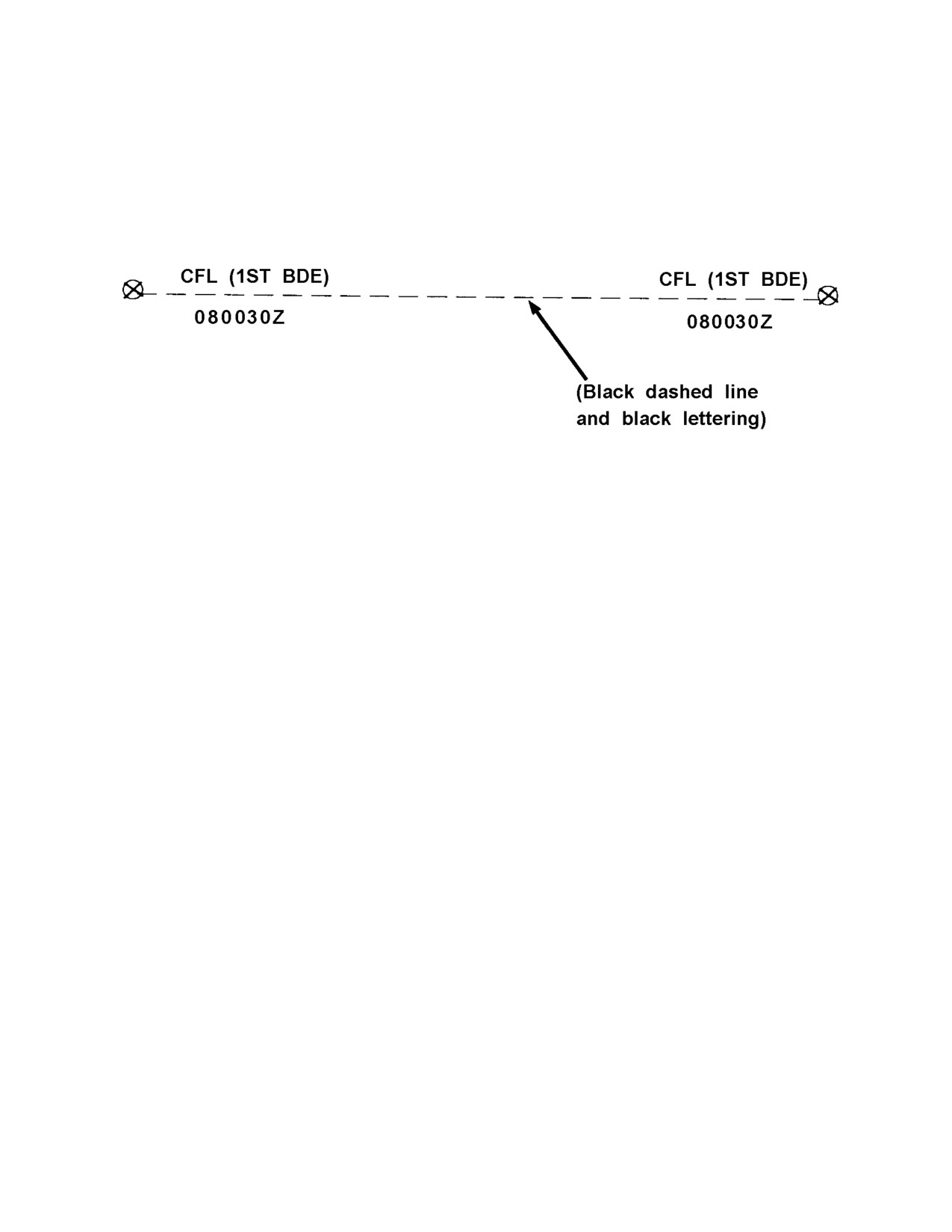
(a) CFL. A CFL is a line beyond which mortars, FA, and NGF may fire
at any time within the zone of the establishing headquarters without additional
coordination. A CFL is established at brigade, independent battalion, or higher
headquarters. Figure 4-1 shows a CFL.
4-8
FM 1-112
Figure 4-1. CFL
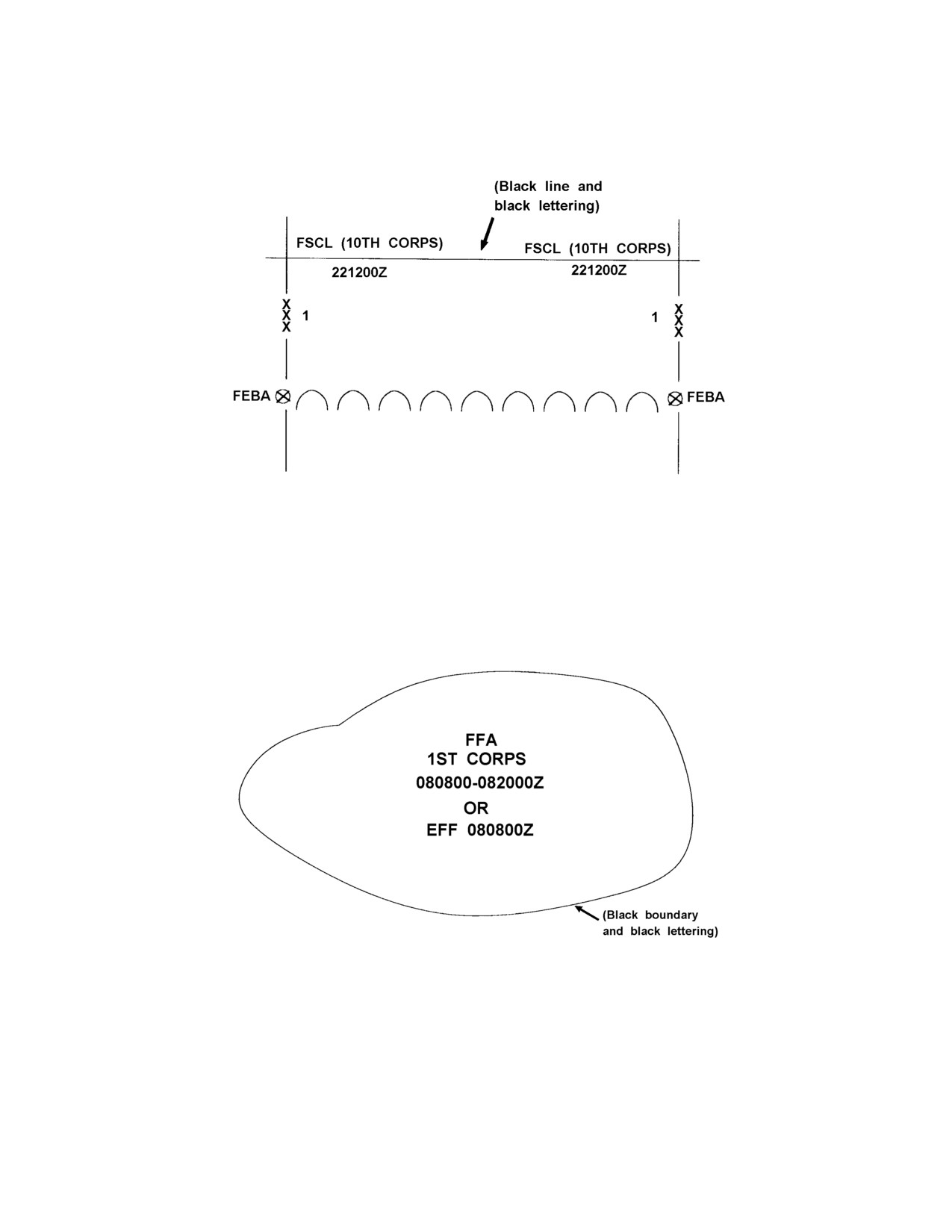
(b) FSCL. An FSCL is a line established by the appropriate ground
commander to ensure coordination of fires not under his control but which may affect
current tactical operations. The FSCL is used to coordinate fires of air, ground, or sea
weapons systems using any type of ammunition against surface targets. The FSCL
should follow well-defined terrain features. The establishment of the FSCL must be
coordinated with the appropriate TACAIR commander and other supporting elements.
Forces attacking targets forward of the FSCL must inform the appropriate TACAIR
commander and other supporting elements. Supporting elements may attack targets
forward of the FSCL, without prior coordination with the ground force commander,
provided the attack will not produce adverse surface effects on, or to the rear of, the line.
Attacks against surface targets behind this line must be coordinated with the appropriate
ground force commander (Figure 4-2).
(c) FFA. An FFA is a designated area into which any fire support
agency may deliver fires without coordination with the establishing force headquarters.
Figure 4-3 shows a free-fire area.
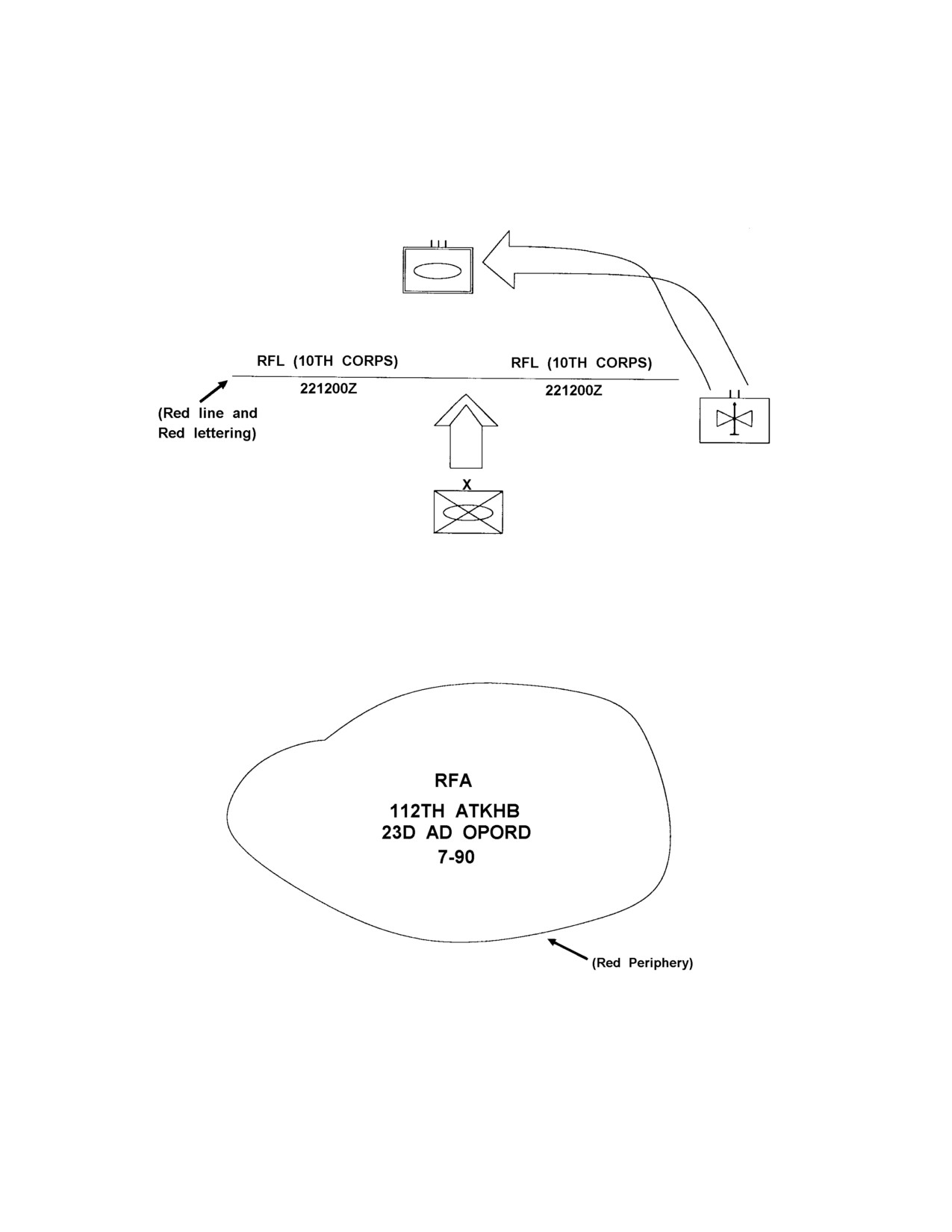
(d) RFL. An RFL is a line between two converging forces across which
fires may not be delivered without coordination between the affected forces. It is
established on identifiable terrain by the common commander of the converging forces.
Figure 4-4 shows a RFL.
(e) RFA. An RFA is a designated area where specific restraints have
been imposed and fires cannot exceed those restraints without approval from the
establishing force headquarters. An RFA is established by battalion or an independent
company or higher headquarters. Figure 4-5 shows a RFA.
4-9
FM 1-112
Figure 4-2. FSCL
Figure 4-3. FFA
4-10
FM 1-112
Figure 4-4. RFL
Figure 4-5. RFA
4-11
FM 1-112
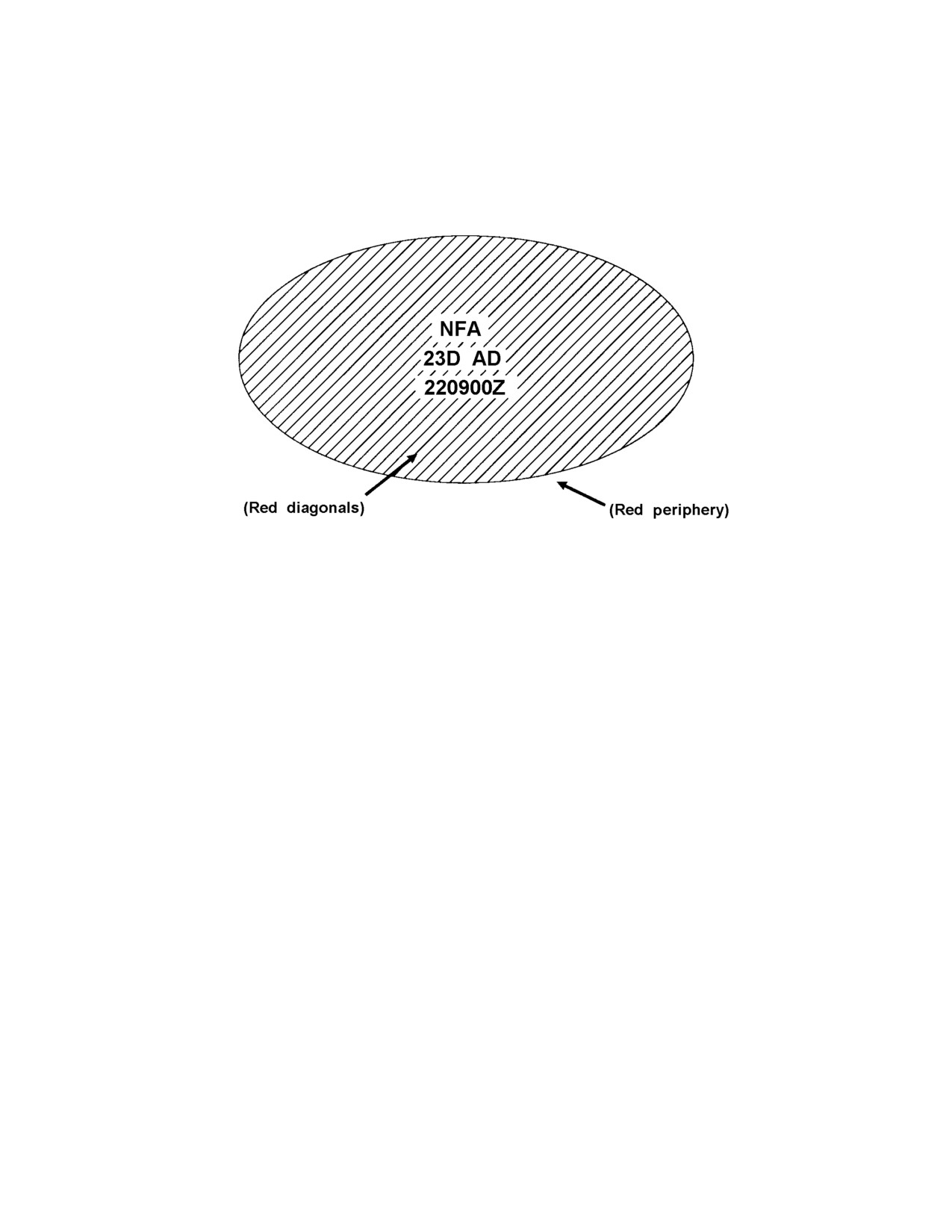
(f) NFA. An NFA is a designated area where no fires or effects from fires
will penetrate. Figure 4-6 shows a NFA.
Figure 4-6. NFA
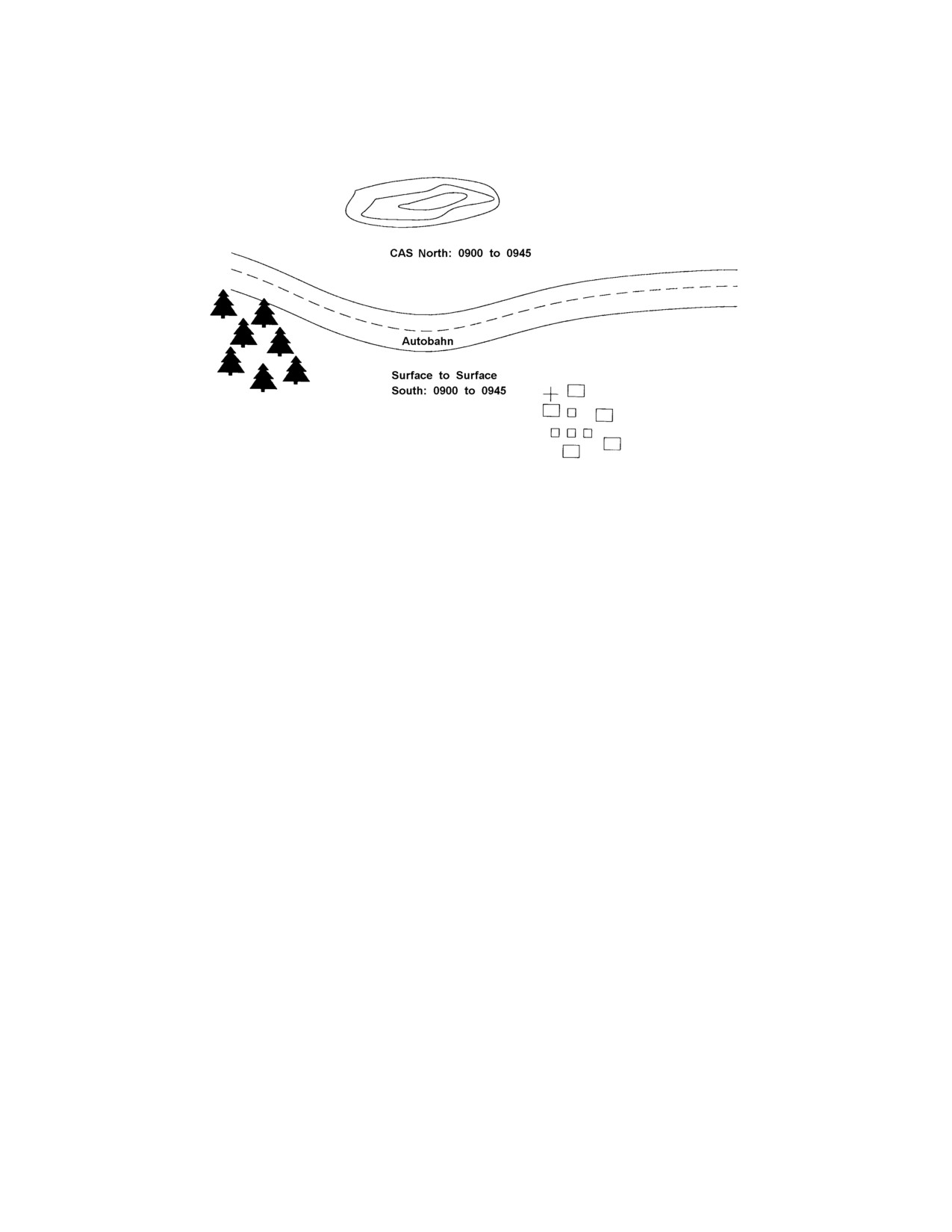
(g) Informal ACA. An informal ACA is most often used and is
preferred. It can be established at battalion or higher level and is normally not depicted
on charts or maps. It can be established by using lateral, altitude, or time separation or
any combination of these separations. An informal ACA is normally in effect for a very
short time. Usually, the period is only long enough to get aircraft into and out of the
target area (3 to 6 minutes). Care must be taken to ensure the temporary ACA does not
hinder the conduct of the mission, by stopping the massing of all available fires on the
target. In Figure 4-7, CAS fires are permitted only north of the highway and surface-to-
surface (for example, FA) fires are allowed only to the south of the highway. The time
restriction is 0900 to 0905 and applies to both fire support means.
(h) Formal ACA The formal airspace coordination area is a three-
dimensional block of airspace in which friendly aircraft can fly without fear of being hit by
friendly fire. It is established by brigade or higher headquarters.
4-2. IEW OPERATIONS
a. General Intelligence. To defeat the enemy, the ATKHB commander must
see the battlefield better than his opponent. He must have a superior knowledge of the
enemy, weather, and terrain. The commander gains that knowledge from good all-source
4-12
FM 1-112
Figure 4-7. Informal ACA
intelligence. For the ATKHB commander to make the most efficient use of his
combat power, he must have information concerning enemy dispositions and probable
courses of action. The ATKHB S-2 must request support from higher headquarters
(HUMINT, SIGINT, ELINT, and overhead photographs) to fill the commander's
intelligence requirements. That intelligence helps him make decisions, issue orders, and
employ his force successfully on the battlefield.
(1) The ATKHB commander obtains information about the battlefield from
higher headquarters and reconnaissance. The ATKHB submits requests for intelligence
through intelligence channels. Once the intelligence requests are filled, the battalion
confirms and supplements that data with reconnaissance information (obtained from
elements in contact, spot reports from ground or air scouts, allied intelligence sources, etc,
or from its own reconnaissance of the area, routes, terrain and enemy).
(2) The S2 is the intelligence coordinator for the ATKHB. The S2 gathers,
processes, interprets, and passes information to higher headquarters where it is
consolidated with intelligence information from other sources and passed to the G2 at
division. The G2 disseminates the results as intelligence summaries to provide an
intelligence update for units in the division. The S2 also obtains weather information for
planning consideration of subordinate units. The S2 and the USAF ALO coordinate the J-
SEAD systems.
(3) Intelligence collection requirements are distributed as essential elements
of information and other intelligence requirements. Based on the mission, command
guidance, and available intelligence, the S2 develops an intelligence COA based on the
4-13
FM 1-112
needs of the battalion and higher headquarters. If the commander approves the COA,
orders and request are issued to collect information for intelligence production.
b. Electronic Warfare Operations. The enemy will attempt to disrupt and
confuse our operations through denial of the electromagnetic spectrum. These operations
not only include disruption of communications and identification of friendly forces but also
the disruption, deception, and damage of weapon systems. Countermeasures must be
used to cope with the enemy's EW capabilities. Further information on electronic warfare
is contained in FMs 34-1 and 34-80. To conceal emitters or deceive the enemy as to their
identities and locations, the ATKHB commander should--
• Change radio frequencies often.
• Operate radios on the lowest power possible.
• Restrict the use of the electromagnetic spectrum.
• Use wire or cable communications whenever possible.
• Use directional antennae and mask emitters with terrain.
• Train subordinates to act independently in support of the mission and the
commander's intent when communications fail.
4-3. AD
The ATKHB has a definite need for protection from enemy air assets. In a mature
conflict environment, friendly counterair assets may be unable to maintain air superiority
at all times over the battlefield. The ATKHB will take active AD measures by engaging
and destroying enemy aircraft with their air-to-air systems, vehicle-mounted weapons,
small arms, and supporting AD systems. The ATKHB must also take measures to avoid
targeting by enemy air assets through passive AD measures. These measures include
camouflage, dispersion, and the reduction of electronic and visual signatures.
a. Active AD. The ATKHB has limited organic AD capability. Although limited
to .50 caliber and M60 machine guns with supporting small arms fire, these weapons can
make a difference during an air attack. Small arms fires may not destroy attacking
enemy aircraft but may distract the pilot enough for him to miss the target. The
techniques for leading aerial targets with small arms are described in the STP 21-1-
SMCT. Active AD may also be taken by ATKHB aircraft during planned attacks against
enemy air assets or through self-protection. FM 1-111 contains additional information on
active AD operations.
b. Passive AD. Target detection from the air is difficult. Enemy pilots must be
able to see and identify a target to attack it. The effectiveness of enemy high-performance
attack aircraft is greatly reduced when the ATKHB takes full advantage of terrain for
cover and concealment. Cover and concealment must also be used to protect the battalion
4-14
FM 1-112
from ground observation. Enemy reconnaissance elements that penetrate friendly lines
will be searching for ATKHB assembly areas for targeting by battlefield missiles, tactical
aircraft, and artillery. Some passive AD measures are discussed in the paragraphs below.
(1) The ATKHB should occupy positions that offer natural cover and
concealment. Coverings should be placed on windshields, mirrors, and headlights of
vehicles and canopies of aircraft. Vehicles and aircraft should be parked in tree lines.
If this is not possible, aircraft and vehicles should be parked parallel to the tree line and
in the shadow of the trees. Cities and small towns offer many areas to hide aircraft and
vehicles. They also make it easier to hide the heat signature of an ATKHB. Inhabited
areas have an inherent heat signature; wooded areas do not. Equipment should be
parked so that it is not silhouetted against the skyline or an area of a different color.
(2) If available, covered, concealed routes should be used when the unit
moves. If the unit is attacked while moving, vehicles should be turned 90 degrees from
the direction of the attack and keep moving because aircraft normally attack parallel to
the movement of the convoy. This countermeasure moves vehicles from the line of fire
quickly.
(3) Communications security should be maintained.
(4) Vehicle track marks should be covered around positions. Also, pilots
should be aware of the rotor wash path that helicopters leave in loose debris and snow.
(5) Vehicles and aircraft should be dispersed. This not only makes detection
more difficult but also ensures that an aircraft making a single pass can attack only one
piece of equipment.
(6) Air guards should be posted on vehicles and in dismounted positions to
provide a warning of approaching aircraft. These air guards should be rotated frequently
because scanning for long periods dulls an individual's ability to spot approaching aircraft.
Although the use of vehicle horns is a standard method of warning for an air attack, both
visual and audible warning signals should be specified in the unit SOP.
c. Early Warning. Accurate and timely early warning allows the supporting AD
unit to maximize weapon system engagement capability against the aerial threat and
provides the ATKHB the alerting and cuing information to enhance the effectiveness of
those active and passive AD measures discussed earlier to protect the force. Early
warning sensors are the AD unit's primary resource for locating aerial targets. Many
methods are used to pass early warning information. Early warning dissemination
requires careful coordination to ensure that the information gets to those who need it, at
the proper place and time, and in the proper terminology. Early warning is produced as
AD warnings, LADWs, and directed early warning.
(1) AD warnings. AD warnings are established by the corps or area AD
commander. Authority to declare ADWs may be delegated to corps commanders. When
received, ADWs (Table 4-2) apply to the entire force or a specific area and must be
4-15

FM 1-112
disseminated to every soldier within the ATKHB. At the brigade level and below, AD
warnings are disseminated over redundant nets along with LADWs.
Table 4-2. AD warnings
WARNING
DESCRIPTION
RED
Attack or surveillance by hostile aerial targets or missiles is imminent or
in progress. Hostile aerial targets or missiles are within a respective area
of operations or in the immediate vicinity of a respective area of
operations with high probability of entry.
YELLOW
Attack or surveillance by hostile aerial targets or missiles is probable.
Hostile aerial targets or missiles are en route toward a respective area of
operations, or unknown aerial targets or missiles suspected to be hostile
are en route towards or are within a respective area of operations.
WHITE
Attack or surveillance by hostile aerial targets or missiles is improbable.
(2) LADW. LADW is designed to alert a particular unit, several units, or an
area of the battlefield. LADW parallels AD warnings and reflects the local aerial threat.
It should be incorporated into SOPs that explain what response is desired by the ATKHB.
For example, when dynamite precedes ADW red, the ATKHB may discontinue increasing
passive AD measures and engage with a combined arms response. The response desired
by the ATKHB is METT-T dependent. (See Table 4-3.)
Table 4-3. LADW
CODEWORD
DESCRIPTION
SNOWMAN
No threatening aerial targets are in the area.
LOOKOUT
Aerial targets may be in the area of interest but are not threatening,
or are inbound but there is time to react.
DYNAMITE
Aerial targets are inbound or are attacking locally now. Response is
immediate.
(3) Directed early warning. Directed early warning must be quick,
simple, and redundant in nature. It is imperative that each unit within the ATKHB
receive early warning. It is especially important when the ATKHB has no AD assets. It
states whether the aerial targets are friendly or unknown, provides a cardinal direction,
4-16
FM 1-112
and if known, identifies the most likely affected asset(s) within the maneuver force. For
example, if an early warning source reports four enemy Hinds inbound from the east, and
the ATKHB is attacking along the eastern axis, the supporting AD officer/NCO with the
ATKHB, aviation brigade, or maneuver brigade in that sector should transmit a LADW
message over the appropriate supported maneuver force command net and AD net:
"Dynamite! Dynamite! HINDs from the east against Axis Blue!" Dynamite is the LADW
that alerts the maneuver force of an attack; the response, according to the local SOP,
should be immediate.
d. AD Planning. The commander establishes priorities for AD within the area
of operations. If augmented by attached AD assets, the senior AD officer or NCO will
provide advice and make recommendations. The commander and S-2 will analyze the
area of operation, the terrain, probable intensity and types of enemy aircraft expected,
and probable air avenues of approach. He must then balance his analysis of the threat
against the available AD weapons supporting his unit. After the commander establishes
the priorities, the AD officer or NCO and the S-3 determine the specifics of AD weapon
allocation and what positions are to be occupied. The S-3 continues to coordinate and
supervise the activities of the supporting AD force throughout the operation. Table 4-4
explains this process.
e. Procedural Control Measures. The procedural control measures governing
the employment of AD assets have an impact on ATKHB operations. Procedural control
measures are developed through established rules and SOPs. Procedural control relies
upon techniques such as segmenting airspace by volume and time, and using weapon
control statuses. Procedural techniques are usually more restrictive than positive
techniques but are less vulnerable to degradation from electronic or physical attack. The
procedural control measures used for AD that affect ATKHB operations include the AD
warnings discussed earlier and ROE. ROE include--
(1) Right of self-defense. This right is never denied. The ADA fire unit
always has the right to defend itself or its protected asset.
(2) Hostile criteria. ADA squad leaders/team chiefs have both
identification and engagement authority. The target must satisfy one or more of the
theater hostile criteria. The exact criteria enabling the fire unit to declare a target hostile
may vary with the tactical situation. Hostile criteria may include--
• Attacking friendly elements.
• Violating airspace control measures.
• Being visually identified as hostile.
• Responding improperly or not at all to IFF interrogation.
Table 4-4. ADA support relationships
QUESTION
DIRECT
GENERAL
REINFORCING
GENERAL
SUPPORT
SUPPORT
SUPPORT
REINFORCING
4-17

FM 1-112
Who establishes
The supported
The ADA CDR
The supported
(1)The supported
ADA priorities?
CDR.
assigning the
CDR through the
CDR
support
reinforced ADA
(2)The supported
relationship,
CDR.
CDR through the
based on the
reinforced ADA
supported CDR's
CDR.
priorities.
Who positions
ADA fire unit
The ADA fire unit
ADA fire unit
The ADA fire unit
ADA fire units?
CDRs with
CDRs in
CDRs with
CDRs in
approval of the
coordination with
approval of the
coordination with
local ground
local ground
reinforced ADA
the local ground
CDR.
CDR.
CDR and local
CDR and
ground CDR.
reinforced ADA
CDR.
Who coordinates
The DS ADA
The CDR
The reinforced
The CDR
terrain on which
CDR (approved
assigning the
ADA CDR with
assigning the
ADA units will
by the supported
support
the supported
mission with the
position fire
CDR).
relationship.
CDR.
supported CDR
units?
and reinforced
ADA CDR.
With who should
With supported
With supported
With supported
With supported
liaison be
unit.
unit.
unit but including
unit but including
established?
reinforced ADA
reinforced ADA
CDR.
CDR.
With whom
With supported
With supported
With supported
With supported
should
unit.
unit.
unit but including
unit but including
communications
reinforced ADA
reinforced ADA
be established
CDR.
CDR.
(1) The term "positions" specifies the selection of the exact placement of individual fire units within the
operating area.
(2) A unit supporting another unit is responsible for establishing communications with the supported
unit.
(3) Weapon control status. WCS describes the degree of control for AD
fires. The degree of control varies depending on the tactical situation. The corps
commander usually has WCS authority for rotary-wing aerial threats. ADA forces must
have the ability to receive and disseminate WCS. Weapon control status include--
• Weapons free. Fire at any aerial threat not positively identified as friendly.
(This is the least restrictive status).
• Weapons tight. Fire only at aerial threats positively identified as hostile.
• Weapons hold. Do not fire except in self- defense. The term self-defense
includes defense of the fire unit, supported unit, and protected asset. This is the most
restrictive status.
4-18
FM 1-112
4-4. ENGINEER SUPPORT
Engineer operations are time and labor intensive. They may not be realistic in ATKHB
operations because of the limited number of engineer assets and the number of tasks to be
performed. However, the ATKHB must take advantage of obstacles and minefields
emplaced for other forces on the battlefield. If engineers are made available to an
ATKHB, they can assist in many ways.
a. Mobility. The ATKHB commander must consider how best to use the
engineers to increase the mobility of an ATKHB. Possibilities include--
• Constructing LZs, FARPs, and forward AVUM sites.
• Constructing or improving roads into and out of assembly areas and FARPs.
b. Countermobility. Engineers can be used to emplace minefields to fix or turn
enemy vehicles in support of the ATKHB attack plan. They also can construct other
obstacles in EAs to delay, disrupt, turn or block the enemy.
c. Survivability. Engineers can increase the survivability of the ATKHB by--
• Preparing buildings to house aircraft and equipment.
• Constructing protective positions for aircraft in the assembly areas.
• Constructing protective positions for fuel and ammunition vehicles in the
FARP.
• Preparing fighting positions, indirect fire protective bunkers, etc., for personnel.
4-5. NBC SUPPORT
a. NBC Avoidance.
(1) Passive measures. Units must take precautions to avoid being targeted
by enemy NBC weapons and to reduce the effect of an NBC attack if one does occur.
These precautions include--
(a) Ensuring plans allow for movement and other activity taking 33
percent longer than normal, and effect of fires decreasing by 50 to 70 percent under NBC
conditions.
(b) Avoiding detection using OPSEC.
(c) Providing warning to subordinate units through emphasis on
detection and rapid reporting.
4-19
FM 1-112
(d) Maintaining discipline after the attack. Units must be conditioned
mentally and physically to stay in MOPP gear until told to reduce the MOPP level. Units
have experienced problems at CTCs when leaders delegate unmasking authority below
battalion level. Even though companies have M256 kits that indicate the area is clear,
only the battalion chemical section has enough information to allow the commander to
assess the risk and make the decision to unmask.
(e) Taking advantage of natural terrain for protection. Ditches,
ravines, wadis, and natural depressions reduce the effect of nuclear attack, but chemical
agents accumulate in these areas. Heavy forests and jungles protect against liquid
chemical agents, but chemical vapors tend to accumulate there.
(f) Dispersing subordinate units as much as tactically feasible. Leaders
should organize support units into bases no larger than company size. When possible,
supplies should be kept at more than one location so they can not all be destroyed at once.
(g) Frequent movement of likely targets (reserves, supply bases, etc.).
(h) Storing supplies and equipment under cover to prevent
contamination. Soldiers can use tarpaulins, plastic sheets, canvas, cardboard, dunnage,
and any other readily available material to protect equipment for a short time or reduce
contamination.
(i) Avoiding operations in contaminated areas when possible. Leaders
often encounter problems when they neglect quick decontamination and continue a
mission in MOPP 4. Leaders must continually balance the trade-off between a short-term
mission degradation for decontamination with more sustained long-term performance, or
continuing to perform the mission by foregoing decontamination with the resulting long-
term ineffectiveness of the unit.
(j)
Preventing the spread of the contamination by limiting the number
of elements moving into the area, and decontaminating units that leave a contaminated
area so they do not spread the contamination into a clean area.
(2) NBC reconnaissance.
(a) Leaders should view contaminated areas as obstacles that, when
possible, should be bypassed. If he does not have a choice and must go through the
contaminated area, the element discovering the contamination should attempt to describe
to him the depth and type of agent. With this information, leaders at all levels can adjust
their plans accordingly.
(b) The technique for reconnoitering a contaminated area is the same as
a minefield. The IPB process determines where the enemy will probably employ chemical
agents and where chemical agents will collect (low spots, small valleys, and sheltered
locations). These are marked as NAI. Units not in a named area of interest conduct tests
for liquids from the ground or vegetation using M8 detector paper every 500 meters. Once
4-20

FM 1-112
in the NAI, units conduct liquid tests as before but also conduct vapor tests with the
M256 kit, or if unavailable or time is not available (it takes 16 minutes to test for all
three types of agent), with the M8A1. When the unit detects chemical agents, they will
report, mark the area, and move back to the spot where they received a clean reading.
They will then move laterally 500 meters and then forward again. Units conduct
radiological reconnaissance in the same fashion using dose rate equipment to identify
areas with high dose rates. Only NBC reconnaissance teams are capable of reconnoitering
for and collecting biological agents.
(3) Detection.
(a) Detection is an essential step of NBC defense when leaders expect
the enemy to use NBC weapons. The battalion has a variety of equipment that can
detect, locate, and measure NBC contamination (see Table 4-5).
Table 4-5. Detection equipment in the ATKHB
WHAT IT DOES
WHAT TYPE OF CONTAMINATION
EQUIPMENT
DETECT
LOCATE
MEASURE
NUCLEAR
NERVE
BLISTER
BLOOD
IM/174-Series Radiac
X
X
X
X
AN/PDR 27-Series
X
X
X
X
Radiac
M8-Series Alarm
X
X
M8 Paper
X
X
X
X
M9 Paper
X
X
X
X
M256 Kit
X
X
X
X
Chem Agent Monitor
X
X
X
X
X
(b) Units must employ M8 alarms, M8 paper, and M9 paper after a
suspected chemical attack. This is especially true when moving from the initial position
to a subsequent position.
(4) Marking. The unit conducting the NBC reconnaissance or that detects
contamination should mark entry points to contaminated areas. Marking is described in
detail in FMs 17-98 and 3-3.
(5) Reporting.
4-21
FM 1-112
(a) Reporting is a critical part of NBC operations. Reports must be
forwarded to the brigade-level headquarters. They must be in proper format and given
widest dissemination and coordination possible.
(b) NBC reports are as time sensitive as spot reports. The SOP for
reporting and dissemination of NBC information must be streamlined and effective. One
technique is for companies to submit only one NBC-1 report to the battalion. All other
companies and stations acknowledge the report and simply indicate whether they are also
under attack. The battalion chemical section then knows the full extent of the attack
without the command net being cluttered by NBC-1 reports from every company and out
station. If a unit is under attack by a different agent, it sends a complete NBC-1 report.
(c) Staff sections and LNOs representing supporting elements are
critical links in the dissemination process. These elements should disseminate reports to
the units they represent and coordinate for if they are not on the command net of the
battalion.
(d) It is difficult if not impossible for pilots to plot NBC-1 reports while
flying. One technique is to identify prominent features such as ridgelines, roads, or rivers
as boundaries to contaminated areas. Another technique is to identify grid squares that
are contaminated.
b. Decontamination.
(1) Decontamination fundamentals.
(a) In the past, Army doctrine dictated that when a unit became
contaminated, soldiers stopped fighting, pulled out of battle, and found a chemical unit for
the cleanup. Current doctrine supports fighting while contaminated and conducting hasty
decontamination along with natural weathering to reduce chemical or biological hazards.
(b) The commander uses the factors of METT-T and some additional
considerations to determine when, where, and how to conduct decontamination. When
planning operations, commanders should ask these questions--
• How long have personnel been operating in MOPP gear?
• What missions are planned in contaminated areas?
• What are the capabilities of NBC personnel and the decontamination team?
• What external support is available from chemical units?
• What decontamination support will the supported unit provide?
(2) Decontamination principles. The four principles of decontamination
are as soon as possible, only what is necessary, as far forward as possible, and prioritized.
4-22
FM 1-112
(a) Decontaminate as soon as possible.
(b) Decontaminate only what is necessary to free assets for immediate
operations.
(c) Decontaminate as far forward as possible.
(d) Decontaminate by priority. Prioritize units based on how critical
that unit is to the mission.
(3) Levels of decontamination. The two levels of decontamination are
partial and complete.
(a) Partial. Partial decontamination is removing or neutralizing just
enough contamination to sustain operations.
(b) Complete. Complete decontamination is reducing contamination to
a level that permits soldiers to operate for extended periods without wearing a mask or
protective gloves.
(4) Types of decontamination. There are three types of decontamination.
Individual soldier skills (aircrew decontamination) and hasty decontamination operations
achieve partial decontamination. Deliberate decontamination operations achieve complete
decontamination.
c. Aircraft Decontamination. The sensitivity of aircraft components to caustic
solutions has driven the development of special decontamination procedures. Com-
manders must combine these special procedures with decontamination principles and
determine where and when to conduct decontamination operations. Spot decontamination
is the most time-effective technique and will limit the spread of agents. Units may find
that aircraft decontamination is not time-effective when aircraft are in great demand.
Because aircrews will be required to fly in MOPP 4, commanders must determine effects
on the mission.
(1) Decontaminants.
(a) Only approved cleaning compounds may be used to decontaminate
aircraft. Caustic decontaminants, such as DS2, STB, bleaches, or sodium hypochlorite,
are not considered safe.
(b) Soap and water, kerosene, JP8, and diesel fuels are approved as
decontaminants on selected parts of aircraft. JP8 is effective in removing some agents
from aircraft skin and components, but will not neutralize the agents. If water is
available, it should be used to rinse off the JP8.
(c) When components are removed from the aircraft for repair, some
caustic chemical may remain. Maintainers must decontaminate these components before
4-23
FM 1-112
cannibalization or overhaul. Once components have been decontaminated, personnel must
rinse the components thoroughly before they are reinstalled on the aircraft.
(d) Actual flight and aeration can help decontaminate external surfaces.
(e) Soldiers must be careful when using pressurized water for
decontamination. Aircraft skin and internal components can be damaged by moderate to
high water pressures.
(2) Decontamination techniques.
(a) Spot decontamination. The goal of spot decontamination is to
limit the spread of contaminants by removing most of them from selected areas of the
aircraft. Fuel and soap and water are the most common decontaminants.
(b) MOPP gear exchange. In a contaminated environment, MOPP
gear exchange and rest and relief operations must be conducted. Every soldier must know
how to change his MOPP gear to survive. When the mission allows, aircrews may return
to a unit decontamination area for the exchange.
(c) Aircraft washdown. Aircraft washdown is the same technique as
vehicle washdown and includes detailed, time-consuming procedures for both exterior and
interior decontamination. Units are encouraged to develop site layouts in conjunction
with chemical units that are appropriate for their specific missions and the terrain.
(d) Decontamination. Decontamination sites are established by
chemical units, usually in the rear areas. The supported units conduct their own
personnel and equipment decontamination. The chemical unit decontaminates vehicles,
provides technical assistance and supervises the entire site. Aviation units must be
thoroughly familiar with their responsibilities at these sites.
(3) Hasty decontamination operations.
(a) Arming and refueling operations. All areas that FARP
personnel touch should be decontaminated.
(b) Entry and exit procedures. During training, commanders should
outline entry and exit procedures for all types of aircraft. FARP personnel must become
familiar with the procedures. Aircrews should signal the FARP personnel if they intend
to exit the aircraft. FARP personnel can then decontaminate most areas that the aircrews
will touch on exiting the aircraft. Aircrews should attempt to limit the amount of
contamination transfer by using contamination avoidance measures. Before entering the
aircraft, aircrews should use an M258A1 kit to decontaminate their gloves and overboots.
(c) Preflight and postflight inspections. When conducting preflight
and postflight inspections on contaminated aircraft, aircrews must try to avoid becoming
4-24
FM 1-112
contaminated themselves. Spot decontamination helps reduce this possibility. Aircrews
may need to wear wet-weather clothing to keep most of the contamination off the
overgarment.
(d) Maintenance inspections. Personnel may conduct maintenance
inspections before or after decontamination of the aircraft. Inspection crews use the
decontamination techniques discussed in paragraphs (2) and (3) above to avoid spreading
contamination.
(e) Repair or recovery. Repair or recovery crews should be aware of
the contamination level before they enter the area. Teams will evaluate the situation to
determine when or if an aircraft component can undergo decontamination. Some items
may be decontaminated before they are returned to the maintenance section if the
maintenance area is clean. However, if the maintenance area is contaminated,
decontamination should occur there.
(f) Cannibalization and overhaul. The same decontamination
considerations of clean versus contaminated aircraft and components also apply to
cannibalization and overhaul maintenance activities.
d. Aircraft Decontamination Stations. Normally, the ATKHB conducts hasty
decontamination, but it may conduct a deliberate decontamination if the situation
requires it and time is available. Decontamination operations are normally conducted at
battalion level and require an area that meets the appropriate criteria.
(1) Site selection requirements. The decontamination site must
accommodate the required aircraft, have a readily available water source, and allow for
adequate drainage. The site should be planned using the guidelines for an FAA.
Tentative decontamination sites must be considered and integrated into the tactical plan
as are tentative CP and FARP sites.
(2) Station layout. Any of several techniques may be used to decontami-
nate aircraft. An effective method is the one-step method. In this method, companies are
sequenced into a particular area, shut down, decontaminated, and returned to duty. The
battalion is responsible for selecting and securing the site as well as augmenting chemical
personnel. The chemical unit is responsible for operating the site. As each company-level
unit is sequenced through the station, the remaining companies provide security. After
aircraft are shut down, the entire aircraft or specific areas are washed with hot, soapy
water and rinsed. If available, hot air may be used to dry the aircraft and decontaminate
the interior or otherwise sensitive areas of the aircraft. This sequence is continued until
all battalion elements have completed the decontamination. The site is then cleared and
the battalion continues its mission.
(3) Safety precautions. Site safety principles are similar to those practiced
in the FARP. The ASO should develop an annex to the safety SOP addressing
decontamination site specific factors.
4-25
FM 1-112
(4) Alternate site layouts. Units must establish their own site procedures
and equipment requirements. Alternate sites should be considered during the planning
phase of battalion operations, particularly decontamination operations. See FM 3-5 for
sample alternate site layouts.
e. FARPs.
(1) Aircrew support. If FARPs are near or collocated with other units that
have NBC support, NBC support for the aviation elements may be arranged with those
units. In a CB environment, clean and contaminated FARPs may be established to
facilitate rapid relief-on-station operations and prevent repetitive contamination. The
mission and temperature will determine how often the crews visit a rest and relief sta-
tion. If additional aircrews are available and the mission allows it, a crew change during
rest and relief could make aircraft available for more missions.
(2) FARP NBC planning. Detailed planning is the key to successful FARP
operations in an NBC environment. Because FARPs are vital to the aviation mission,
commanders should answer the questions below to assist in planning FARP operations.
(a) How will friendly STRIKWARNs be passed to FARPs and to aircraft
being serviced at the FARPs?
(b) Is the use of smoke planned to lessen FARP vulnerability during
site preparation and closure?
(c) Is at least one member of the FARP trained in the two considera-
tions above?
(d) Who estimates the dosage when the FARP is operating in a
radiological contaminated area? How will this dosage estimate affect operational
planning?
(e) Are FARP personnel aware of nuclear damage to aircraft? Can they
identify nuclear damage to armament systems?
(f) Do FARP personnel know how to minimize nuclear blast effects and
thermal damage to fuel blivets and other FARP equipment?
(g) Will the supported or parent unit assist in decontamination?
(h) Who provides guidance to FARP ground personnel concerning the
best routes through or around contaminated areas?
(i) What visual or radio communications can FARP personnel use to
warn an incoming aircraft that a FARP site is contaminated? Also, how does an aircrew
warn FARP personnel that the aircraft is contaminated?
4-26
FM 1-112
(j)
In a chemically contaminated area, who should dismount at the
FARP?
(k) If aircrews dismount, what provision is made for spot decontami-
nation to lessen the transfer of contamination?
(l)
What provision is made to keep contamination out of the cockpit
(especially that carried in on boots) when aircrews enter the aircraft?
(m) During missions, how can FARP personnel wearing MOPP 4 gear
keep up with the work load? What plans are made for rest and relief or assistance?
(n) When JP8 is used as a spot decontaminant, are personnel trained in
its hazards?
(o) Are FARP personnel trained to use covers in a manner that does not
create FOD hazards?
(p) Are FARP personnel prepared to accept supplies that are
contaminated?
(q) What personal needs are provided for aircrews at the FARP?
f.
Aircraft Maintenance. In an NBC environment, maintenance operations
will be affected more by nuclear detonations than by chemical or biological agents.
Nuclear detonations will cause greater structural and component damage than conven-
tional explosions. While CB agents create a lethal environment for personnel, they do not
normally damage aircraft components or airframes.
g. A2C2. A2C2 elements must work closely with NBC elements or control centers.
STRIKWARNs may be passed through A2C2 networks as well as units. Planners must use
NBC contamination information and friendly nuclear minimum safe distances to establish
air corridors.
h. Survivability.
(1) Radiological contamination. Crews surviving a nuclear attack should
be alert for forest fires or other fires caused by thermal radiation. Radiological
contamination, however, will be the aircrew's most significant hazard. If the aircraft goes
down in a fallout area or the crew receives fallout, the dose rates can be high enough to
cause casualties. Each aircraft should have an IM93 or a DT-236 to measure the total
dose received by the aircrew.
4-27
FM 1-112
(2) Radiological particle ingestion. If the situation permits, the crew
should attempt to dig a deep fighting position or find cover such as a cave or an
abandoned armored vehicle. Living off the land will pose long-term hazards from the
ingestion of radiological particles. The best preventive measure for this is to wash the
food. Heat will not reduce any radiological hazard. Running water will dilute radiological
agents and reduce the risk of drinking contaminated water.
(3) Lethal chemical agents. In a lethal chemical environment, surviving
personnel will be faced with many additional hazards. When the situation permits, the
crew should readjust the CB protective gear and take action to find out if the area is
contaminated. If personnel do not have another set of MOPP gear, they should not
remove the gear they are wearing. If a second set of MOPP gear is available and the
situation permits, the crew should change into the new clothing.
i.
Smoke Operations.
(1) Smoke effects.
(a) Smoke is more effective when it is used at night or with natural
obscurants such as fog, rain, natural dust, or battlefield dust and debris. Smoke is the
one obscurant that can be placed, within meteorological constraints, where the user wants
it.
(b) Smoke is a suitable medium for hiding and dispersing CB agents.
These agents may include irritants such as riot control agents, incapacitants, and lethal
CB agents. Smoke will prolong the life of CB agents by reducing the effects of sunlight or
other weather conditions on agent persistency.
(c) Smoke makes it difficult to see the target. The extent of visual
difficulty depends on the type of smoke used and its mixture with natural obscurants.
The enemy may possess smokes that deny visual identification and adversely affect light-
intensifying devices and near-infrared devices. Mid- to far-infrared devices, thermal
imaging, and heat seekers are degraded when the contrast between the target and the
background is reduced. The extent that a laser can be degraded depends on the energy of
the laser; the lower the energy, the more the laser can be degraded. Large dust storms
can adversely affect enemy acquisition systems. Many armored vehicles can employ self-
screening smokes during road movement.
(d) FSU doctrine regarding smoke emphasizes the employment of
smoke with other decoy or deception operations. Smoke draws attention to a general
area, but the observer must determine where the unit or target is in the smoke and
whether the smoke really hides targets.
(2) Smoke employment.
(a) Enemy employment. When an enemy employs smoke against US
maneuver forces, aviation missions must increase to assist with observation and C2.
4-28
FM 1-112
When employed on terrain features, smoke can force aircraft up and into enemy AD
coverage. Smoke denies low-level corridors or possible LZs for air assault operations.
Large area smoke can obscure terrain features that serve as NAVAIDS. Silhouetting air-
craft against smoke increases their vulnerability. Smoke employed on ground-based
aviation support units, such as FARPs and maintenance, will disrupt aviation operations.
(b) United States employment. United States forces can employ
smoke to keep the enemy from observing and acquiring them. FM 3-50 discusses smoke
employment. When U.S. forces employ smoke on enemy forces, their ability to observe
and acquire targets will be affected. Smoke draws attention, so aircrews may tend to
concentrate more on the smoke than on the targets. Aircrews may have difficulty seeing
targets in the smoke or seeing targets leave the smoke. When a ground vehicle leaves a
smoke screen, it is easier to acquire because it is silhouetted against the smoke. Aircrews
must be aware of how smoke affects their ability to see enemy targets.
j.
Aircrew Training for NBC Operations. Aircrew training should be
conducted in two phases--the ground phase and the air phase. The ground phase
acclimatizes aircrews and ground personnel to wearing MOPP gear. The air phase is
more flexible; commanders must determine how much of their units' flight time
they can devote to NBC training. The concepts presented here can be applied to ground
crews as well as aircrews.
(1) Ground phase.
(a) Acclimatization must be accomplished gradually, and once
completed, it must be maintained. Therefore, before aircrews fly in MOPP 4, they should
be able to operate in MOPP 4 on the ground for a minimum of six hours without
interruption. This figure is a guideline for the commander. When aircrews enter into the
ground phase of training, they should understand that the purpose of the training is
twofold. First, it allows them to acclimatize to the protective clothing. Second, it gives
them an idea of their personal limitations. For aircrews to realize their personal
limitations, they must conduct the same activities they normally do in an uncontaminated
4-29
FM 1-112
environment. The commander must stress this, because all activity does not cease when
the unit goes into MOPP 4. Normal operations include--
• Drinking.
• Flight planning.
• Preflight checks.
• Mission briefings.
• Basic personal hygiene.
• Operation overlay construction.
• Routine maintenance such as scheduled or run-up maintenance.
• Cockpit procedures such as tuning radios, adjusting switches, or completing
checklist items.
• As individuals progress through the ground phase, they will identify those
areas that affect them the most.
(b) After determining their limitations, individuals can find new ways
in which to accomplish the task or modify existing procedures.
(2) Air phase. Flight time is a valuable asset to every unit. Although the
air phase can be done during existing training, simulations should be considered to
indoctrinate crews into MOPP 4 operations. General goals are recommended below, but
the actual method to reach these goals is left up to the commander. The recommended
goal for individuals is six continuous hours of operating in MOPP 4 gear. The goal for
units is 48 continuous hours of operating in a simulated NBC environment.
(a) For training to be realistic, commanders must rotate unit personnel,
as they will in combat, through collective protection shelters. If enough shelters are
available, 50 percent of the unit may be participating in rest and relief at any one time.
Accordingly, unit effectiveness and mission accomplishment will be proportionally
degraded. To achieve acceptable performance levels, commanders may have to move all or
part of their units to a clear area.
(b) When implementing training programs, commanders should
gradually increase the time that aircrews fly in MOPP 4 over a given period. However,
the training must be in line with individual crew member capabilities and safety
requirements. Commanders should refer to the scheduling guide in AR 95-1 when
developing crew work and rest schedules.
4-30
FM 1-112
k. Training Considerations. As with all training, the aircrew training
program should be carried out aggressively and consistently in a realistic manner.
However, commanders should remember that safety should never be sacrificed for
realism. With this in mind, unit trainers and commanders must be aware of certain
factors that will affect their units' success in carrying out their training program. Some
factors are described below.
(1) Ambient temperatures and humidity may be very high, thereby
increasing the wet bulb globe temperature. Unit SOPs should specify that every soldier
must be familiar with the symptoms of heat stress and other heat-related injuries. Early
morning and late evening hours are the best times to conduct NBC flight training because
of the lower temperatures and decreased humidity.
(2) AR 95-1 specifies the flight uniform requirements for aircrews. TC 1-210
specifies safety requirements for MOPP training. Aviators not on the controls must recog-
nize when aviators on the controls begin to lose concentration so that they can take
control of the aircraft. Every individual has a different physiological makeup; therefore,
commanders should not expect every crew member to progress at the same rate.
(3) Overall physical conditioning plays an important role in an individual's
ability to perform in MOPP gear. Commanders should ensure that their units pursue an
aggressive and challenging program of physical training along with MOPP training.
4-31
FM 1-112
CHAPTER 5
COMBAT SERVICE SUPPORT
Successful ATKHB operations will depend on close staff coordination. The battalion staff
must anticipate and coordinate ATKHB CSS with higher echelon CSS. Under the
direction of the battalion XO, the S1 and S4 coordinate supply, maintenance, PSS, and
health service activities with the S-3 and S-2 to support combat operations. The ATKHB
depends on CSS from its parent aviation brigade, the DISCOM, and the COSCOM. The
principles and doctrine for CSS planning are described in general terms in FM 100-10.
Corps and division CSS doctrine is contained in FM 63-3 and the FM 63-2 series manuals.
General CSS planning principles as related to aviation operations are discussed in FM 1-
111.
5-1. PLANNING AND COORDINATION
a. Planning. Combat operations and CSS planning must be conducted at the
same time. The ATKHB commander relies on the S3 to employ his unit and the S-1 and
the S4 to support it. Successful ATKHB combat operations require timely reports that
reflect the CSS status of the battalion. Unlike other maneuver forces, the ATKHB can be
employed anywhere within the division's or corps' area of operations. The ATKHB
coordinates its support through the aviation brigade to the DISCOM/COSCOM that
designates the ASB, a FSB or the MSB as the primary support facility. To ensure the
availability of CSS, the DISCOM/COSCOM, aviation brigade, and ATKHB commanders
must maintain close coordination.
b. Coordination. Depending on the environment and the mission, attack
helicopters will require fuel and ammunition resupply after every 1 1/2 to 2 hours of
continuous operations. The battalion staff must forecast support requirements based on
the expected duration of the mission. Requirements are processed through the brigade
staff and then sent to the DISCOM/COSCOM. The DISCOM/COSCOM staff directs
support to the ATKHB from the appropriate DISCOM/COSCOM unit. In divisions
without an ASB, the DISCOM/COSCOM unit or units that support a ground maneuver
brigade FSB and the division main support area must be prepared to support the ATKHB.
Successful ATKHB missions will depend on how well Classes III and V and aircraft main-
tenance, recovery, and evacuation are integrated into the tactical plan.
5-2. FUEL AND AMMUNITION REQUIREMENTS
Fuel (Class III) and ammunition (Class V) are two of the three primary classes of supply
used by the ATKHB for the conduct of combat operations. The planning considerations,
resupply request procedures, and estimation supply and transportation requirements for
both classes of supply are discussed in detail in FM 1-111.
5-1
FM 1-112
a. Fuel. Fuel transportation requirements for a mission are determined by
subtracting the total fuel in mission aircraft fuel cells from the total fuel required to
complete the mission. By comparing these figures to the capacity of available fuel trucks,
the total number of trucks required can be calculated. FM 1-111 provides an example and
the necessary information for calculating fuel transportation requirements for all types of
ATKHBs.
b. Ammunition. FM 1-111 provides an example of the estimation of ammuni-
tion required and transportation requirements for one day of ATKHB operations. The
total transportation requirement will equal the sum of the vehicles required to carry each
type of ammunition. Ammunition shortfalls must be identified early so that the ATKHB
can preposition supplies or request transportation support to ensure a steady flow of
ammunition during the mission.
5-3. FARPs
a. FARPs are the primary means of supplying the ATKHB when it is employed
forward. They allow the commander to position fuel and ammunition forward to support
his unit. The battlefield is nonlinear and constantly changing. Each FARP must be
austere, transitory in nature, and established to support specific mission objectives. Once
committed, the FARP must be able to meet the Class III and V needs of all mission
aircraft and provide limited maintenance and medical capability. It also must be large
enough to rearm and refuel a company of attack helicopters simultaneously. The sole
function of the FARP is to provide the commander with the means to reduce turnaround
times.
b. The staying time of the ATKHB is increased in proportion to the decrease in
turnaround time for Class III and V supplies. Reducing turnaround time enables the
commander to apply continuous pressure on the enemy. Actual and proposed FARP
locations must be on all division and below graphics, and locations must be coordinated to
keep mechanized and armor formations from rolling through them. FM 1-111 provides an
in-depth discussion of the employment of a FARP (or FARPS) on the battlefield.
5-4. VEHICLE AND GSE MAINTENANCE
The HHC maintenance section provides unit-level vehicle maintenance for all ATKHB
vehicles and GSE. The DS maintenance company of the DISCOM or COSCOM provides
vehicle DS maintenance and repair parts support. FM 1-111 discusses these different
levels of support in detail.
5-5. AIRCRAFT SUPPORT
Like fuel and ammunition, maintenance and recovery of aircraft are critical to combat
operations. AVUM and AVIM companies are normally located far enough to the rear of
the division or corps that light sets can be used to facilitate 24-hour maintenance
operations. The location of these companies should facilitate coordination and the receipt
5-2
FM 1-112
of logistics support from other agencies in the theater. When equipment cannot be
repaired on site, it is moved only as far as necessary to affect repair.
a. Maintenance.
(1) AVUM. To repair and return aircraft to a serviceable condition rapidly,
the AVUM company performs unit-level maintenance actions such as repairs by replace-
ment, minor repairs, and adjustments. Today's modern attack helicopters concentrate
system repairs on the use of line replaceable units. This allows the AVUM to isolate a
fault and when possible, change out the identified component and return the aircraft to a
FMC status. AVUM is governed by maintenance allocation charts and limited by GSE,
facilities, and the number and skills of available maintenance personnel. The most
critical area of unit maintenance is line-company crew chief support of the aircraft. The
crew chief is the only maintenance person who has daily contact with the aircraft.
Preventive maintenance and fault detection originate with the crew chief.
(a) Personnel. Aircraft maintenance support personnel in the ATKHB
are located in the three attack companies and the AVUM company. Organization and
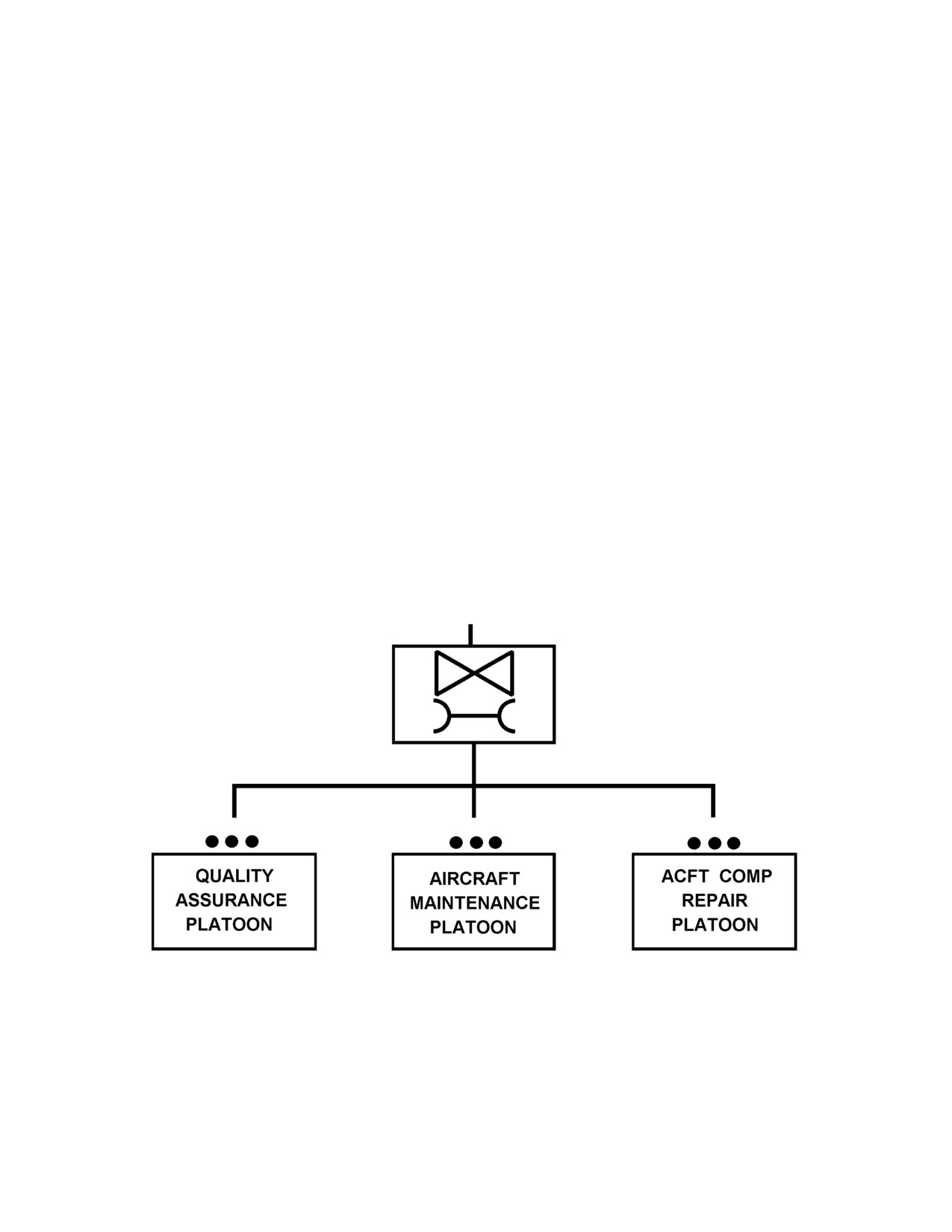
personnel assignments are driven by airframe allocation. Figure 5-1 shows the organiza-
tion of the AVUM company.
Figure 5-1. AVUM company organization
5-3
FM 1-112
(b) Responsibilities. The AVUM company conducts preventive
maintenance, repair, and parts replacement. It also identifies causes of malfunctions and
evacuates unserviceable modules, components, and end items. AVUM operations and
responsibilities are discussed in detail in FM 1-111.
(2) AVIM. The divisional AVIM company is a separate company that is
organic to the DISCOM and structured to support the specific aircraft assigned to the
division. In some divisions, the AVIM company may be organized into the ASB. The
composition of this battalion is highlighted in FM 63-23. The AVIM company is designed
to provide AVIM-level maintenance and backup support of unit maintenance at its base in
the DSA. The AVIM company performs extensive maintenance activities which include
structural and airframe repairs, support of the repairable exchange program, and AVIM-
level maintenance. The AVIM company also maintains division Class IX (air) repair parts
supply and provides supply support to division aviation units. Nondivisional AVIM com-
panies in the corps and theater areas provide support for their area's aviation assets and
backup support for the divisional AVIM companies. Additional information on AVIM
structure and responsibilities are discussed in FM 1-111.
(3) Communications maintenance. The HHC communications section
provides unit-level communications maintenance; the AVUM company provides avionics
maintenance for ATKHB aircraft.
(4) Armament maintenance. The ATKHB aircraft component repair
section performs unit-level armament maintenance. Its capabilities are limited to
detection, fault isolation, and evacuation of major components and LRUs or "black boxes."
AVIM armament support is provided at the DISCOM or the COSCOM, depending on
whether the ATKHB is a division or a corps unit.
b. Recovery.
(1) Aircraft. The AVUM company of the ATKHB conducts aircraft recovery
within the limits of its organic capability. The AVUM company should prepare for
aircraft recovery contingencies by forming an aircraft recovery team. The aircraft
recovery team is composed of personnel and equipment necessary to prepare an aircraft
for recovery. Supporting AVIM units, coordinated through aviation brigade, provide addi-
tional recovery support when recovery is beyond the capabilities of the AVUM company.
The decision to recover downed aircraft will depend on the tactical situation and the
availability of personnel and equipment necessary to recover the aircraft. FM 1-111
discusses aircraft recovery planning and execution in detail.
(2) Ground vehicles. The ATKHB recovers and moves its own ground
vehicles. When unable to do so, it receives assistance from DS maintenance units. FM 1-
111 discusses vehicle recovery in detail.
5-4
FM 1-112
5-6. TRANSPORTATION REQUIREMENTS
The ATKHB is primarily independent of external transportation requirements. The
MTOE of the ATKHB is designed in such a manner as to preclude the necessity for such
assets. The primary user of such assets, the AVUM Company, will only move when the
battlefield increases in depth and requires the entire division support base to extend its
area. The focus of ATKHB operations is to operate as far forward as possible with all
combat power and maintain the security of the AVUM. FM 1-111 discusses aviation unit
transportation preparation and planning in detail.
5-7. PERSONNEL SERVICES
Personnel assigned to the personnel and administrative center perform PSS functions. To
reduce the administrative burden on the ATKHCs, PAC accomplishes as many support
actions as possible. Personnel services support functions fall into two general
categories--critical personnel functions and essential personnel functions. Critical
functions, such as strength accounting, replacement operations, and casualty reporting,
must be performed regardless of combat intensity. On the other hand, essential functions
can be curtailed or suspended at battalion level during intense combat. During combat or
preparation for combat, priority must be given to the critical PSS functions. FMs 1-111
and 100-10 discuss each of these areas.
a. Critical Personnel Functions. To maintain battalion strength, specific
actions must be taken. These actions are discussed in the paragraphs that follow.
(1) Personnel accounting and strength reporting. These actions include
updating the unit battle roster, which is based on duty positions from the unit table of
organization and equipment and preparing and forwarding the personnel status roster.
The personnel status roster is submitted daily and after significant changes in unit
strength.
(2) Replacement operations. These actions include assigning
replacements based on critical leadership and WSRO assignments. They also include per-
forming administrative and personnel actions such as signing in personnel; preparing
SIDPERS transactions; updating battle rosters; and briefing replacements on the tactical
situation, unit SOPs, and facility locations.
(3) Casualty management and casualty operations. These actions
include reviewing casualty feeder reports and witness statements for completeness and
accuracy, checking the battalion aid station casualty treatment log to ensure all casualties
have been reported and forwarding the casualty report.
(4) CHS.
(a) Unit-level HSS elements have the primary mission of preventing
illness, providing emergency and routine medical treatment, and medically evacuating the
5-5
FM 1-112
sick, injured, and wounded. Medical personnel are responsible for supervising the
training of first aid, buddy aid, and combat lifesaver skills. Additionally, medical
personnel provide assistance in preventive medicine measures such as field sanitation and
personal hygiene. CHS resources in the battalion are limited. Additional personnel must
be trained in combat lifesaver skills to assist medical personnel in the initial treatment of
casualties.
(b) Medical aidmen assigned to the HHC medical section accompany
FARP personnel when they move forward; one medical aidman should be stationed at
each FARP location. To augment the treatment capability far forward, one of the flight
surgeons assigned to the aviation brigade can be attached to the battalion for the duration
of the operation. The attachment of the physician completes the battalion treatment
team.
(c) Provisions for a medical planner must be included in the planning
process. The medical planner should consider the--
• Estimated casualty work load.
• Augmentation of medical personnel.
• Preplanned patient collecting points and ambulance exchange points.
• Augmentation of MEDEVAC resources by corps level evacuation assets.
• Use of nonmedical transportation assets for the movement of casualties to
medical treatment facilities.
• Provision for medical personnel on nonmedical transportation assets to provide
en route medical care.
b. Essential Personnel Functions. To sustain the battalion, the personnel/
administration center must provide personnel services, financial services, and postal
services. The PAC also provides or coordinates religious support, legal services, morale
and welfare services, and public affairs support.
NOTE: Financial support for the battalion is coordinated by the S1 section through the
area finance support unit.
(1) Legal services. These actions include processing UCMJ actions,
drafting summaries of violations, and preparing DD Forms 458 (Charge Sheet). They also
include processing Article 32 and 15-6 investigations, assembling investigation reports
and witness statements, and preparing DA Forms 2627 (Record of Proceedings Under
Article 15, UCMJ).
5-6
FM 1-112
(2) Chaplain activities. Comprehensive religious support is provided by
the UMT of the ATKHR or aviation brigade. The UMT consists of at least one chaplain
and one chaplain assistant. Support provided by the UMT includes sacraments, rites,
ordinances, and religious services. The UMT provides pastoral care in keeping with the
overall mission to nurture the living, care for casualties, and to honor the dead. The UMT
advises the command on moral, ethical, and religious issues affecting the unit's mission.
Religious support is covered in FM 16-1.
(3) Finance services. The degree of financial services given the soldier
varies with the tactical situation. In mid- and high-intensity conflicts, regularly estab-
lished paydays are suspended in the theater of operations. When and where a unit is
paid is determined by the unit commander and coordinated with unit finance personnel.
The theater commander determines the maximum amount a soldier can be paid.
Commanders at brigade or equivalent level (06 or above) may establish an amount that is
less than the maximum amount that personnel in their unit who are engaged in a tactical
situation would normally receive. FM 14-7 contains more details on finance operations.
(4) Morale, welfare, and recreation support. These activities include
determining the needs and interests of the soldier, obtaining support from agencies, such
as the division band, and obtaining recreation-related supplies. They also include
providing equal opportunity counseling and drug and alcohol control.
(5) Public affairs. These activities include disseminating information and
published material received from higher headquarters and implementing a hometown
news release program. The hometown news release program will include preparing,
reviewing, and submitting news releases through the local public affairs office.
(6) Postal services. The corps DS postal unit provides postal services for
the ATKHB assigned to the corps ATKHR. Postal services for the ATKHB assigned to the
divisional combat aviation brigade are provided by the corps DS postal unit through the
division and brigade. In the early stages of a conflict, postal services for soldiers will
usually be restricted to personal mail and limited post card and stamp sales. Personal
mail must conform to the weight limitations prescribed by the "free mailing privilege."
Normally, postal money orders will not be available in either contingency or prolonged
operations.
(7) Administrative services. These support actions include initiating
evaluation reports, SIDPERS transactions, awards and decorations, and promotions or
reductions.
5-8. FIELD SERVICES
Field services are supported by specialty units within the division or corps support base.
At the ATKHB level, field services are coordinated through the aviation brigade to the
appropriate support agency or unit. FM 1-111 discusses field services and their avail-
ability in depth.
5-7
FM 1-112
CHAPTER 6
STABILITY AND SUPPORT OPERATIONS
6-1. OPERATIONAL CONCEPT
a. In today's fluid political environment, the army has classified its activities in
peacetime and conflict that do not necessarily involve armed clashes between two
organized forces as SASO. SASO activities are outlined in FMs 100-5, 71-100, 1-100, 1-
111, and 100-20.
b. The ATKHB may deploy as part of the aviation brigade or as the aviation
element of another higher headquarters. These higher headquarters may include another
brigade/division/corps headquarters, an Army force headquarters, or a JTF headquarters.
c. In SASO the majority of missions are focused on the efforts of CS and CSS
units. Because of the attention these type of missions receive during SASO, CS and CSS
units will frequently be the main effort, while combat units become the supporting effort.
6-2. PRINCIPLES OF SASO
a. Army doctrine is based on the principles of war. SASO also have principles
that guide commander's actions. The seven principles of SASO are primacy of the
political instrument, unity of effort, adaptability, legitimacy, patience and perseverance,
restraint, and security.
b. The application of each principle will vary depending on the specific opera-
tions. Commanders must understand these principles, as they may be designated as TF
commanders in an SASO. These principles are explained in depth in FM 100-5.
6-3. EMPLOYMENT GUIDELINES
a. Several key employment guidelines are provided in FM 1-111 for the aviation
commander to consider in the planning process. The current attack helicopter doctrinal
roles and missions as outlined in this manual also apply in an SASO environment. The
attack helicopter unit commander will have to tailor his mission and assets as the
situation requires.
b. The unit should expect a wide variety of missions and fluctuation of operations
and plan accordingly. A staff must be able to adjust rapidly to many different operational
considerations. The unit must plan ahead and have developed contingency plans for
missions not normally addressed in the unit's METL. These missions can be identified
and trained for at home station with situational training exercises.
6-1
FM 1-112
c. The operational conditions of SASO frequently require the integration of
specialty personnel with the aviation unit staff, including civil affairs, psychological
operations, SJA, and special forces personnel. Besides the specialty staff personnel, the
units may be required to operate with infantry, armor, artillery, engineer or a combina-
tion of these assets. Whatever the composition, the unit must have a fully integrated
staff that can coordinate and plan operations. Liaison officers from the ATKHB to other
units and from supporting units to the ATKHB will be critical.
d. The civil and military laws, airspace restrictions, RF usage, ground convoy
clearances, aircraft operating time restrictions, flight clearances, refueling procedures, and
product disposal procedures vary in almost every country in the world. The aviation unit
commander must be prepared to adapt his unit to the host nation operating environment.
Serious complications can develop when host nation requirements are not met by the
force, possibly resulting in restrictions on the unit or even mission failure.
e. The aviation unit commander must clearly understand the ROE and be
prepared for them to change at any time during an operation. All ground and aircrew
personnel should be briefed on the ROE prior to every mission. For ROE assistance, the
unit commander should consult with the SJA representative. The aviation unit com-
mander should plan for an SJA representative to deploy with the force.
6-4. TYPES OF OPERATIONS
There are seven types of operations that have some potential to result in armed conflict,
therefore, involving attack helicopter operations.
a. Show of Force. A show of force is a mission carried out to demonstrate U.S.
resolve in which U.S. forces deploy to diffuse a volatile situation that may be detrimental
to U.S. interests. The deployment may take the form of combined training exercises,
rehearsals, forward deployments of military forces, or introduction and buildup of military
forces in a region. Attack helicopter mobility, flexibility, agility, and firepower makes
them ideal for employment in such operations.
b. NEOs. NEO relocates threatened civilian noncombatants from locations in a
foreign country or host nation. NEO may be conducted in a peaceful, orderly fashion or
may require forcible means. Aviation may be used for the rapid movement of noncomba-
tants. Scout and attack aircraft will provide security for the air movement and prepare to
engage hostile elements that may attempt to interfere.
c. Counter-Drug Operations. Military efforts toward counter-drug operations
support and complement, rather than replace, the efforts of other U.S. agencies. Attack
helicopters may be used to support interdiction efforts by monitoring and detecting drug
movements, locating production facilities, and reconnaissance of suspected drug produc-
tion areas at night under FLIR and night vision devices.
6-2
FM 1-112
d. Support for Insurgencies and Counter-Insurgencies. U.S. forces may
directly support a host nation's counter-insurgency operations. Initially, the support may
be C2 aircraft, eventually it could include air assault units and attack or cavalry units for
reconnaissance and security. Aviation units can expect to be task-organized into a TF of
selected assault, medium lift, attack, and cavalry company/troop size units, depending on
the mission.
e. Combatting Terrorism. Counterterrorism includes the full range of
offensive measures taken to deter, prevent, and respond to terrorism. Although primarily
a SOF mission, attack helicopter firepower may be required to support these type
operations.
f.
Peace Enforcement. These operations are taken in support of diplomatic
efforts to restore peace between hostile factions. Since peace enforcement implies the use
of force or its threat to coerce hostile factions to cease hostilities, attack units assigned to
support these efforts must be prepared to apply combat power to restore order, separate
warring factions, and return civil order and discipline. Attack helicopter units can expect
reconnaissance and surveillance missions and security missions to protect the U.S. and
allied forces involved, in addition to tightly controlled applications of force.
g. Attacks and Raids. The Army conducts attacks and raids to create situa-
tions that permit seizing and maintaining political and military initiative. Attacks by
conventional air, ground, and aviation forces independently or in conjunction with SOF
are used to destroy high value targets or demonstrate U.S. capability or resolve. Aviation
forces will conduct these attacks and raids with attack or assault helicopter units, or both,
often with air cavalry reconnaissance and security elements.
6-5
LESSONS LEARNED
This paragraph was developed from information and after action reviews from the CMTC
and the Operation Joint Endeavor Initial Impressions Report published by the Center for
Army Lessons Learned. It provides some useful TTP for attack helicopter units conduct-
ing SASO. However, as FM 100-20 states:
"No two situations leading to stability and support operations are alike. Each
must be studied and understood for what it is. A course of action must be designed
to fit the peculiarities of the situation." FM 100-20 (final draft, dated April 1996)
a. Sample Aviation TF Mission Statement.
Aviation TF deploys to the former Republic of Danubia NLT (DTG) conducts ZOS
reconnaissance, security, quick response force, utility, and attack operations in
support of United Nations Resolution ###'s peace keeping operations.
Planner's mission analysis of the above statement yields the following critical tasks: first
priority ZOS reconnaissance, 24- hour operations (QRF), air and ground security, the
6-3
FM 1-112
entire range of utility operations, liaison with ground forces, and plans for transition to
conventional attack operations. Although attack helicopters will not participate in all of
the above missions, they will participate in most because of the inherent security
requirements of the unknown and volatile environment.
b. Specific Lessons. The following points may assist planners and commanders
as they develop, wargame, analyze, and determine their COA, policies, and procedures.
(1) Video reconnaissance. The onboard video recording systems on the
AH-64 and OH-58D can provide extremely useful intelligence information if properly used.
Planners must develop NAIs and procedures that focus aircrews where to look and record
and aircrews must be as proficient at operating the VRS as they are with their weapons
systems or hours of useless videotape may result.
(2) Debriefing. Commanders must develop a deliberate debriefing method
that includes necessary staff members. Additionally, the incompatibility of the AH-64's
VRS with standard VRS formats makes this a challenging, but not insurmountable, task.
(3) Situational awareness. Commanders must develop methods to keep
their aircrews constantly aware of the multitude of changes and the possibility of rapid
escalation of hostilities common to SASO. Ground TF Liaison Officers are excellent
sources of current information concerning the disposition and activities of friendly forces
and others.
(4) Spot reports. The standard SALUTE format is a good starting point,
but may require adaptation to pass required information to decision makers in times of
escalating tensions or immanent hostilities. Planners should make available to aircrews
specific guidance for these situations, but aircrews must, as always, "think on their feet"
from the cockpit. The following quote from FM 100-20 illustrates this point.
"In SASO, junior officers and noncommissioned officers often operate at remote
locations and have to make decisions with far-reaching consequences without the
opportunity to consult their superiors." FM 100-20 (final draft, dated April 1996)
(5) Impact of armed helicopters. The capabilities of our armed aircraft
provide commanders a unique ability to impact upon potentially belligerent forces. The
sudden presence of enormous firepower can have a lasting impact and be extremely
persuasive. This power of persuasion, however, carries with it a great responsibility to
avoid provoking hostilities.
(6) GRM. A GRM supplements the ROE by providing specific instructions
for actions in the objective area to aircrews and AMC. A GRM prescribes certain actions
and protection measures based upon the overall situation or situation change. The GRM
is designed to enhance, not replace, the good judgement of crew members, and enable
them to make sound decisions in the heat of the SASO battle. Figure 6-1 depicts a
sample GRM that was developed by the Falcon team at CMTC.
6-4