FIELD MANUAL FM 1-112 ATTACK HELICOPTER OPERATIONS (April 1997) - page 2
FM 1-112
at all echelons to better control forces, synchronize effects, and achieve decisive victory
with minimal casualties.
(3) Integrated digital system networks (command, control, communications,
computers, and intelligence and weapons systems) provide commanders, staffs, sensors,
and shooters with a great technological advantage. Information exchange between
command communications systems includes, or will include, relative positioning,
identification, time, way points, direction, azimuth, targeting, support, coordination, etc.
(4) Some of the key command systems providing for ATKHB's
internal/external communications linkages are as follows:
(a) CNR. ATKHBs will conduct operations over extended distances
using CNR as the primary means of communication. CNR is a system of systems. CNR
consists of a single channel ground airborne radio system, a TACSAT communications
system, and high frequency radios.
(b) MSE. MSE is a compact mobile communications system providing
secure voice, data, and facsimile capabilities. MSE allows the commander to exercise C2
over forces in a rapidly changing environment. The system is interoperable with CNR,
commercial, and NATO standard systems.
(c) HF NOE COM. The HF NOE COMM provides the commander
with uninterrupted NOE communications over extended distances. This radio is equipped
for digital communications, and can adjust input/output to accommodate interference and
path loss.
(d) Have Quick II. Have Quick II helps the commander facilitate
Army and joint services communication. The system is a UHF radio that frequency hops
to reduce its susceptibility to jamming and interference. The radio can be used for digital
target handover and information/intelligence flow between Air Force close air support,
OH-58D (I) Kiowa Warrior, and the AH-64D Apache Longbow.
(e) MCS-P. One element of the Army battle command system, MCS
provides two major functional capabilities; maneuver functional area control (maneuver
unit situational awareness) and force level information (critical sustainment information).
MCS provides commanders and staffs the capability to collect, coordinate, and act on
near-real-time battlefield information. Commanders and staffs can readily access
information and display current situation reports that assess enemy strength and
movement, as well as the status of friendly forces. MCS can then aid the battle staff in
rapidly disseminating the commander's orders.
(f) Aviation mission planning system. The AMPS provides the
commander and staff an automated mission planning and battle synchronization tool.
AMPS functions include tactical C2, mission planning, mission management, and
maintenance management. The AMPS provides an interface to the MCS. This provides
2-16
FM 1-112
the aviation commander with continuous updates of the friendly and enemy situation and
allows the commander to rapidly adjust current and future operational plans.
(5) Other key elements of the Army battle command system that the ATKHB
will have to interface with include:
(a) ASAS. The ASAS provides IPB information used by all echelons for
planning combat operations. The ASAS cell is located at the division and corps TOCs and
the Aviation Brigade will interface with it via the MCS computer through an area
common user system network. During operations, the MCS alone is unable to update the
current intelligence picture frequently enough for Army Aviation operations. Real time
air threat, ground ADA, and SAM locations must be passed to aviation TOCs, both ground
and airborne within seconds of discovery. The commander's tactical terminal hybrid
system will provide the commander with this near real time tactical intelligence. It is a
receiver processor that extracts intelligence broadcasts from several overhead sources.
(b) AFATDS. The AFATDS controls all fire support operations for the
corps and division artillery brigades. The Aviation Brigade and battalion TOCs nominate
targets and submit requests for fire support through the MCS computer via the ACUS.
The fire support element at brigade determines which targets will be serviced by assets
under brigade control. The rest are submitted to division that performs the same filtering
process and sends a consolidated list to the corps FSE. During the conduct of tactical
operations, the ATKHB coordinate directly via SINCGARS and Have Quick radios to fire
support teams and forward air controllers to place ordnance at the right place and time.
These communications are mostly digital, using modems, and the message formats of
AFATDS or the variable message formats.
(c) FAAD. The FAAD provides an overlay of battery coverage areas to
the MCS computer via ACUS. The FAAD system accepts feeds from AWACS and organic
ground based radars to generate a real time air picture. The Aviation brigade will access
this information via EPLRS over a local area users network and pass the critical elements
to its aircraft digitally using HF-NOE-COM radios and modems.
(d) CSSCS. The CSSCS is a computerized system for the control of
most classes of supplies, equipment, and personnel replacements. The CSSCS provides
information on the status of units and equipment to the MCS computer for transmission
to users over the ACUS. The ATKHB uses CSSCS software on a common computer to
perform its administrative and logistics requests and reporting functions.
2-17
FM 1-112
f.
Transmission Limitations.
(1) Because of the ATKHB's mobility and potential for operating throughout
an entire AO, the primary means of communication will be radio. However, some radio
communications are limited by range and line-of-sight restrictions. In these situations,
commanders may lose contact with their aviation units unless radio relays are used.
Radio communications should be kept to an absolute minimum until enemy contact is
made. Other means to communicate should be used until the radio is necessary so that
detection by enemy direction-finding equipment is avoided.
(2) Satellite channel availability may be limited for several reasons,
especially during early entry operations. Factors such as world-wide geographical location
and unit density per satellite ratios may restrict commanders from continuous
transnational/over-the-horizon communications.
2-7. COMMUNICATIONS
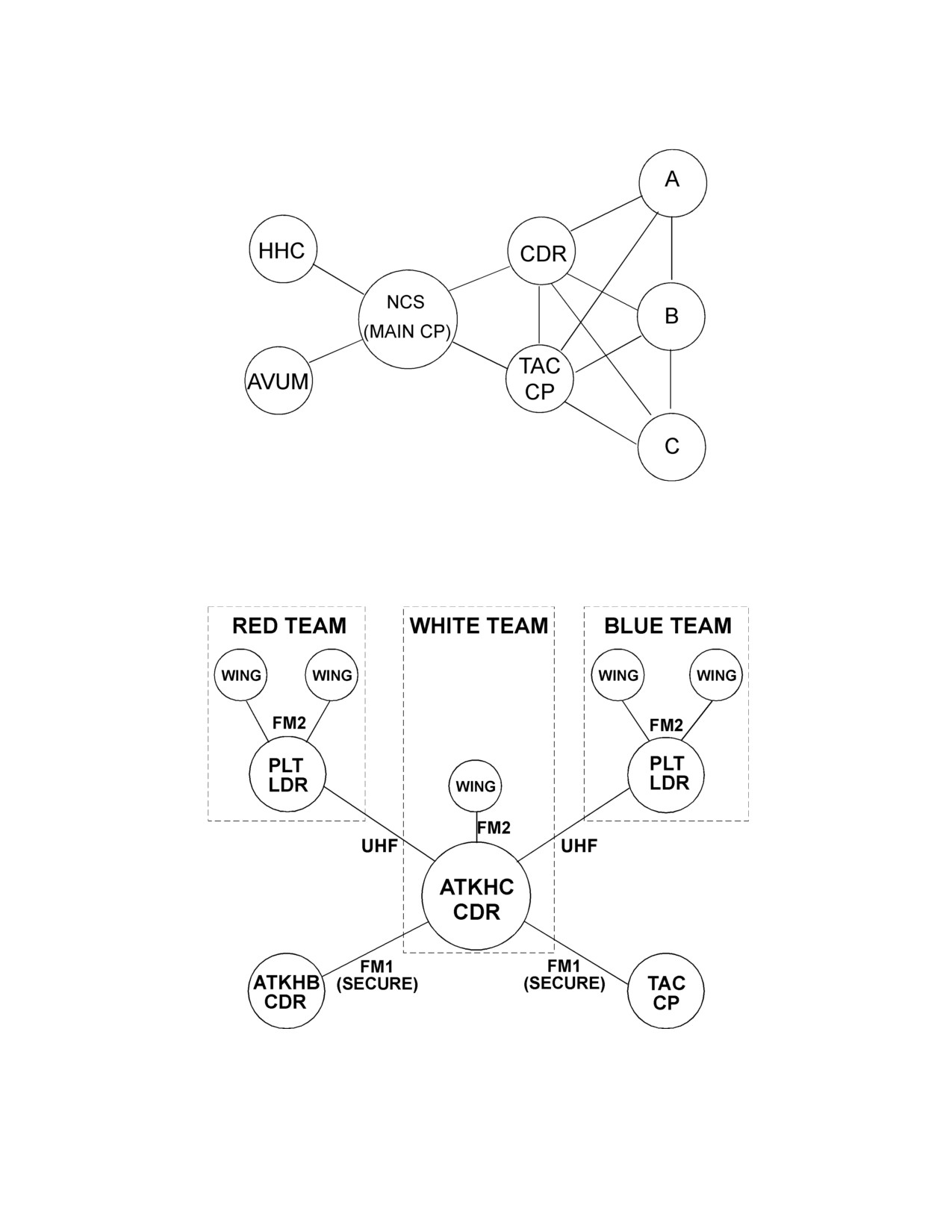
a. Radio Nets. Successful employment of the ATKHB depends on its ability to
communicate with all echelons. The primary means of tactical communications within the
ATKHB is the FM-secure net. The use of UHF and VHF radios in battalion aircraft helps
reduce the load on the FM-secure nets. These radios are primarily used by the ATKHC to
control the platoons. The ATKHB commander normally communicates from his aircraft to
higher headquarters using the FM-secure net. The battalion command net is also FM-
secure; however, this requires that the commander relay messages to higher headquarters
through the main CP, TAC CP, or change frequencies when communications are necessary
with higher headquarters. Figures 2-2 and 2-3 show sample radio nets for an ATKHB.
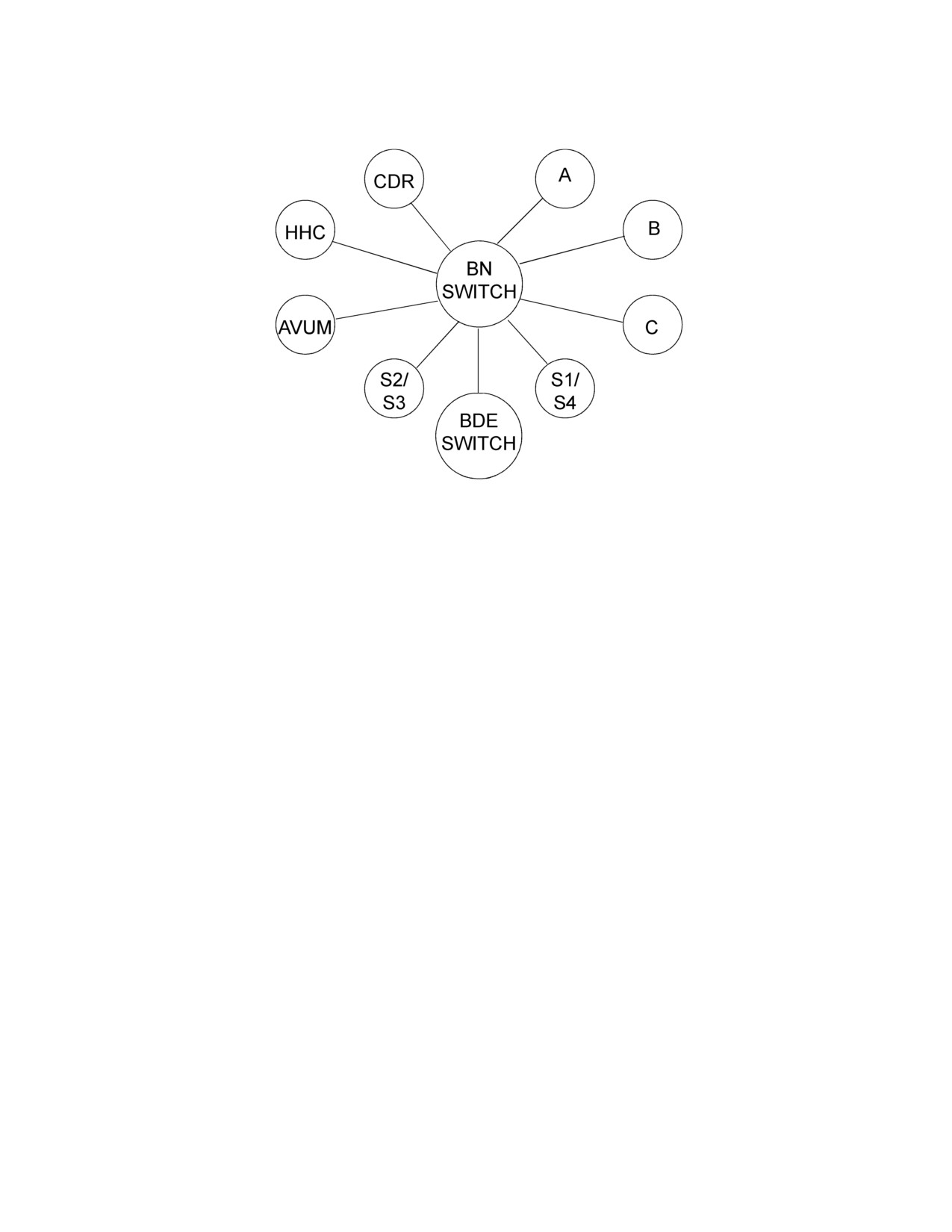
b. Wire. Though its wire laying capability is limited, the ATKHB has the assets
to establish wire communications in the assembly area. This wire network links the main
CP with elements of the HHC, the AVUM company, and ATKHCs. Figure 2-4 shows a
battalion wire net.
2-8. OPSEC
Security measures must be taken during any military operation to deny the enemy infor-
mation about friendly forces. The OPSEC concept includes all security measures that
allow units to surprise or deceive the enemy. OPSEC includes physical security,
information security, SIGSEC, and deception and countersurveillance activities. Because
these categories are interrelated, the ATKHB commander normally chooses to employ
more than one security technique to counter the threat. He may also use SIGSEC pro-
grams such as electronic warfare and SIGINT. By analyzing hostile intelligence efforts
and vulnerability, executing OPSEC countermeasures, and surveying the effectiveness of
countermeasures, the ATKHB commander can counter specific hostile intelligence efforts.
Aviation OPSEC is described in detail in FM 1-111.
2-18
FM 1-112
Figure 2-2. Sample battalion command FM net (Secure)
Figure 2-3. Sample company nets
2-19
FM 1-112
Figure 2-4. Sample battalion wire net
2-20
FM 1-112
CHAPTER 3
EMPLOYMENT
Section I. Organization and Roles
3-1. ORGANIZATION
a. ATKHB. The ATKHB is task-organized according to the factors of METT-T.
As the situation dictates, the aviation brigade commander can organize the ATKHB with
other assets to form TFs to better perform specific missions.
(1) Pure. To take advantage of its speed and mobility against armored
forces, the ATKHB fights pure. When commanders desire to emphasize the shock and
killing effect of massed ATKHBs, they will use the organic structure of the battalion.
(2) TF.
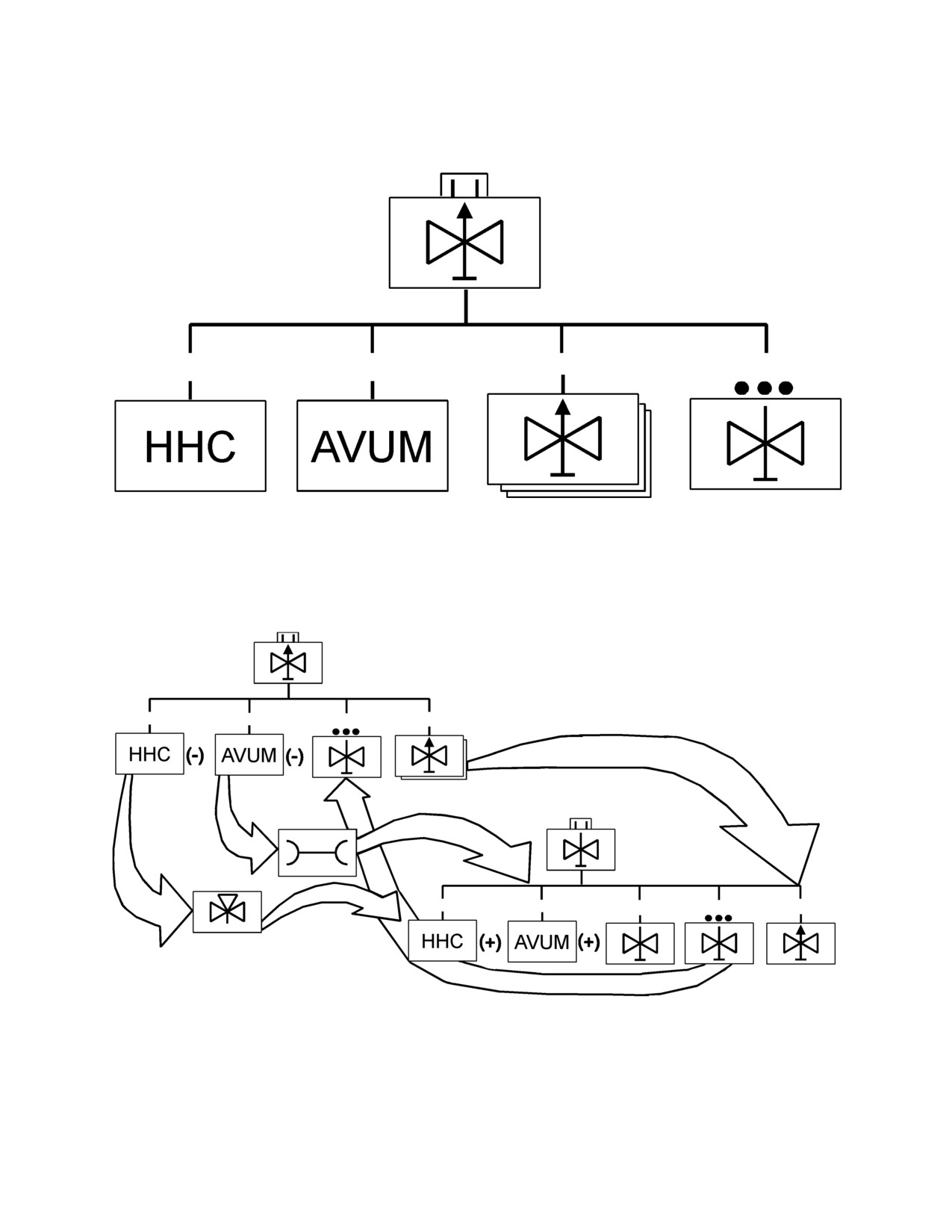
(a) To provide lift capability to an ATKHB, the brigade commander can
attach a platoon of assault helicopters from an assault helicopter company. Figure 3-1
shows additional lift assets attached to an ATKHB. The addition of utility helicopters
allows the ATKHB to move Class III/V supplies by air. ATKHCs may be OPCON or
attached to other aviation units based on the duration of the commitment and
sustainment support capability.
(b) When there is a constant requirement for attack helicopters to
provide security for assault helicopters, the aviation brigade commander may task-
organize both the ATKHB and assault helicopter organizations by moving elements
between the two. Figure 3-2 shows two TFs formed in a heavy division. When creating
two TFs, the aviation brigade commander trades the ability to mass his attack helicopters
for better security for his assault helicopters. When attack helicopter companies are
attached to assault helicopter units to form TFs, sufficient Class V and armament support
must also be attached. ATKHBs may also form TFs with ground forces. Ground maneu-
ver units may be placed under OPCON of the ATKHB to perform specific missions. The
ATKHB may place an ATKHC under OPCON to a ground brigade for limited periods of
time or for a specific mission at the direction of the brigade commander.
3-1
FM 1-112
Figure 3-1. ATKHB with lift assets
Figure 3-2. Two TFs formed in a heavy division
3-2
FM 1-112
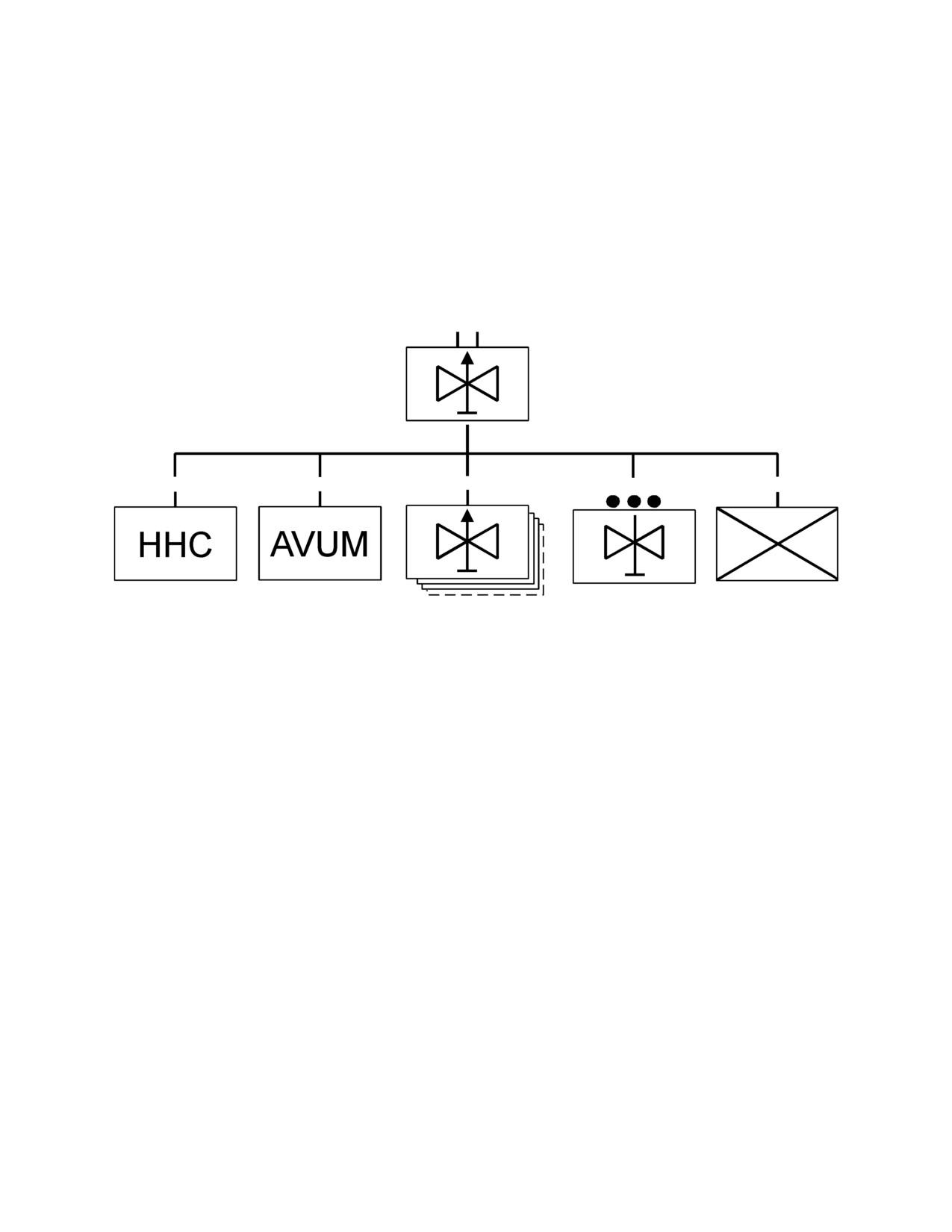
(3) Augmented. At times, an ATKHR or aviation brigade commander may
be required to reinforce an attack battalion with an additional ATKHC (Figure 3-3). An
ATKHB can control up to five maneuver companies; more than five companies will tax the
battalion's capability to support them logistically.
Figure 3-3. Augmented ATKHB
b. ATKHC.
(1) ATKHBs are organized with ATKHCs. These companies are organized
into two platoons. An ATKHC has a standard chain of command that leads and fights the
unit as a company. The chain of command includes a company commander and two
platoon leaders. The battalion assigns the ATKHC specific missions as part of the batta-
lion's plan of attack.
(2) The ATKHC commander task-organizes his company for combat based
upon the factors of METT-T. There is no single method to task-organize an ATKHC.
Company commanders must understand the battlefield and adjust for conditions and the
availability of aircraft when deciding how to organize for combat. The organization of
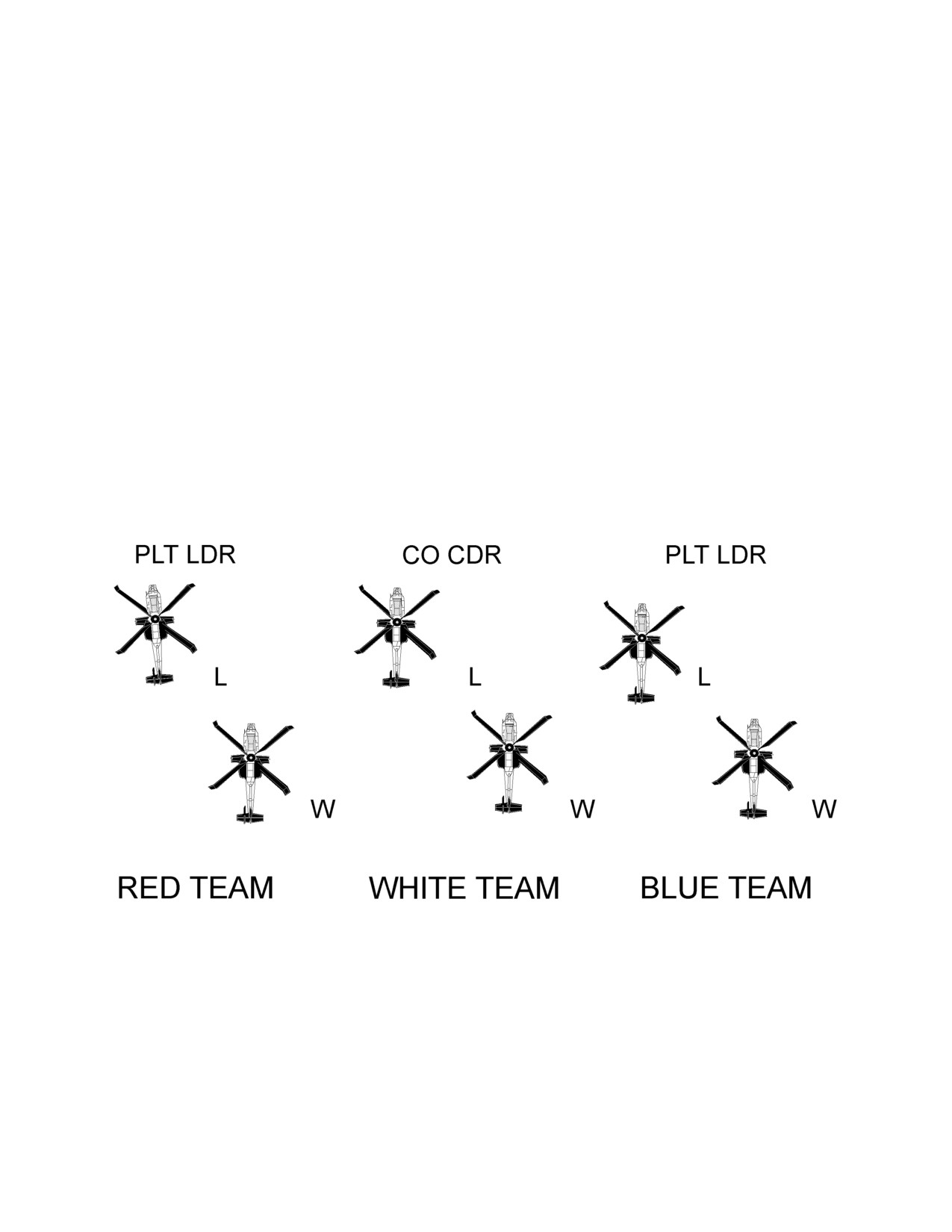
ATKHC assets is based on pairs of aircraft (L/W) known as "teams" operating together to
provide mutual security. If there is an odd number of aircraft, one team will consist of a
lead aircraft and two wingmen. Aircraft without wingmen are vulnerable.
3-3
FM 1-112
(3) When task-organizing the company, the ATKHC commander will always
attempt to create a balance between the combat power necessary to accomplish the
mission and the need to provide security for each aircraft and the company as a whole.
References to "scout" or "attack" aircraft indicate the role of the aircraft, not the aircraft
type. This reflects the pure (ARI) structure of the ATKHC, as well as the "scout" and
"attack" platoons specified by the MTOE. This organization allows flexibility, and aircraft
configurations will vary to perform the scout or attack role. Below are several examples
of how an ATKHC may be task-organized for combat.
(a) L/W teams. The ATKHC commander may organize the company
into L/W teams. For planning purposes, three L/W teams should be available per
company; however, the commander will use the available aircraft as necessary to
accomplish the mission. This organization allows greater freedom of maneuver and
maximum employment flexibility. Each L/W team is made up of two aircraft that can
operate and provide mutual security for each other. Using three L/W teams facilitates C2
by placing a platoon leader in two of the teams and the company commander in the third
team. Figure 3-4 shows an ATKHC task-organized into L/W teams.
Figure 3-4. ATKHC task-organized into L/W teams
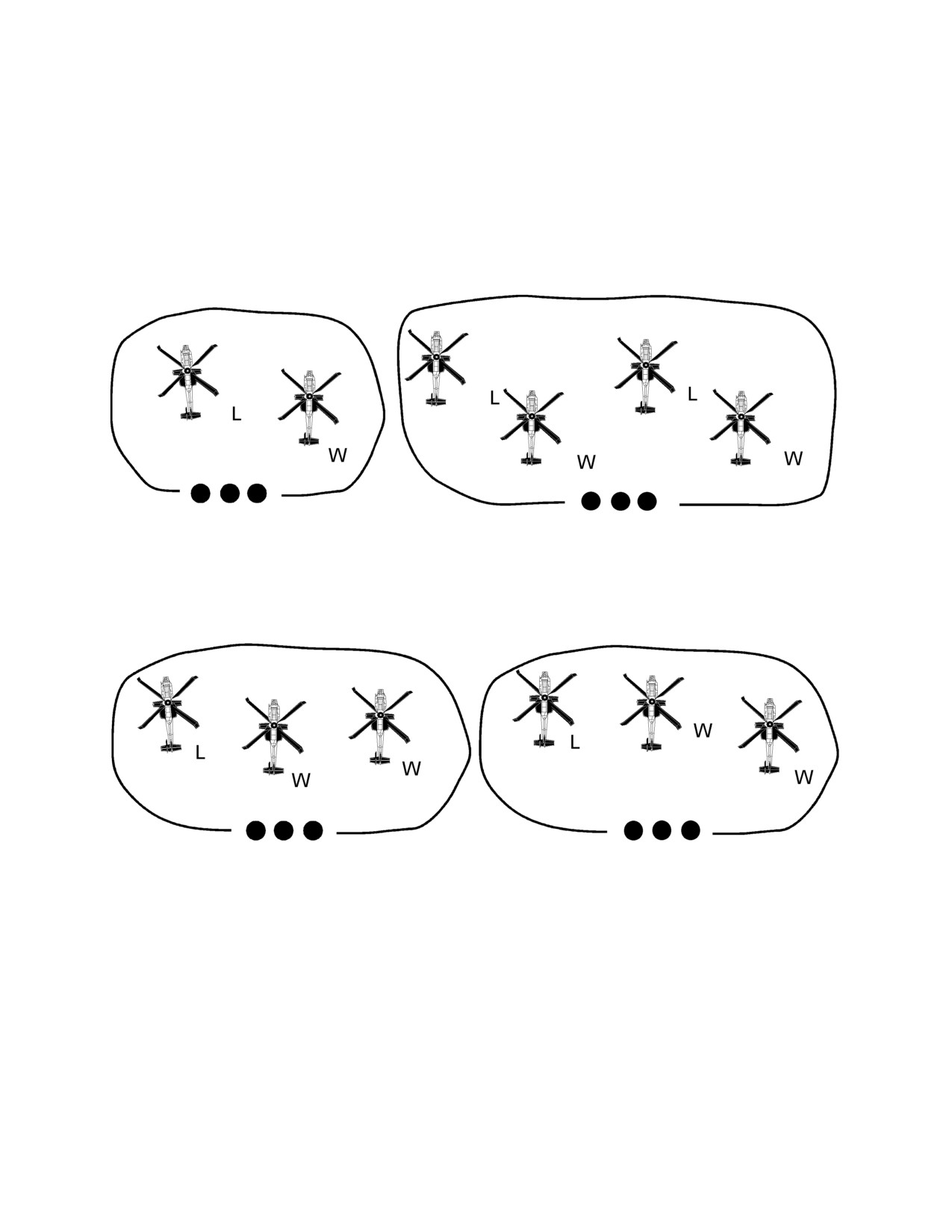
(b) Platoons. L/W teams combine to form platoons that can provide
security, facilitate C2 or be assigned specific tasks or responsibilities (calling for FS,
controlling air assets, etc.). These platoons, based upon the missions and C3
requirements, may be called heavy and light platoons, scout and attack platoon, or a
3-4
FM 1-112
generic name (such as red and blue platoons). The platoon may be made up of L/W teams
that contain either two attack aircraft, two scout aircraft, two scout/attack aircraft, or one
scout and one attack aircraft. Figures 3-5 and 3-6 show an ATKHC task-organized into
platoons.
Figure 3-5. ATKHC task-organized into platoons
Figure 3-6. ATKHC task-organized into two platoons
NOTE: The terms "heavy" and "light" refer to the mission and weapons load of the attack
aircraft, not the number of aircraft. Heavy platoon aircraft will normally be fitted with
more ATGMs and concentrate on heavy armored targets. Light platoon aircraft will
normally be loaded with more rockets and machine gun/cannon ammunition and will
attack targets of opportunity and provide suppressive fires for the heavy platoon.
3-5
FM 1-112
3-2. ROLES AND RESPONSIBILITIES
The ATKHC is a versatile organization that can conduct offensive operations (attack,
movement to contact), defensive operations (area defense, mobile defense), reconnaissance,
and security. In addition, the ATKHC can conduct special purpose operations such as air
assault security (an advance guard that is a combination of attack, reconnaissance, and
security) and raids (commonly referred to as deep attacks).
a. Key Leaders.
(1) ATKHC commander. The ATKHC commander is responsible for
everything that his company does or does not do. He fights the battle. The commander
establishes attack priorities, plans and directs fire distribution, and controls supporting
fires. He normally operates from an attack aircraft and maneuvers attack and scout
assets during an engagement. The ATKHC commander--
(a)
Receives the mission from the battalion.
(b)
Task-organizes the company.
(c)
Provides detailed planning guidance to crews.
(d)
Coordinates with supported ground units.
(e)
Confirms BPs for the company and selects platoon and team BPs.
(f)
Plans routes to the HA and BP.
(g)
Coordinates indirect FS and CAS.
(h)
Keeps the battalion informed through situation, spot, and BDA
reports.
(i)
Plans for local security in the assembly area, the FAA, and HAs en
route and in the BP.
(j)
Plans the engagement from the BP and makes a detailed prepa-
ration of the EA.
(k)
Controls the joint air attack during company-level JAAT operations.
(l)
Controls company fires.
(m)
Coordinates battle handover and receives a briefing from the unit to
be relieved.
3-6
FM 1-112
(n) Briefs the incoming ATKHC commander during relief on station.
(o) Maneuvers the company to the FARP and controls refueling and
rearming operations.
(p) Conducts the debriefing.
(q) Prepares for future operations.
(2) Company first sergeant. The ATKHC first sergeant is the
commander's advisor for all matters concerning enlisted soldiers. Additionally, he is the
key logistician for the company and the leader and mentor to the company's enlisted
soldiers. He--
(a) Assists the commander with the training, maintenance, logistics,
and administration of the company.
(b) Checks soldiers, to ensure they are physically and mentally
prepared for combat.
(c) Conducts precombat inspections.
(d) Normally leads the company quartering party and ground assets to
a new assembly area.
(e) Plans and supervises the company CSS plan, receiving and
processing logistics reports from the platoons and coordinating for supplies, equipment,
and personnel.
(f) Orients new personnel to the company and assigns them to
platoons.
(g) Coordinates company force protection measures.
(3) Platoon leader. ATKHC platoon leaders are responsible for leading
their platoons. The platoon leaders are critical to the successful employment of the
ATKHC. When the platoon is task-organized, the platoon leaders control the task-
organized platoon or a team. Platoon leaders--
(a) Assist in planning company missions.
(b) Control the fire and maneuver of their platoons or teams.
(c) Fight their own aircraft.
(d) Assist the ATKHC commander, at his direction, to execute missions.
3-7
FM 1-112
b. Aircrews.
(1) Scout. The mission of ATKHC scouts is to see the battlefield, find the
enemy, coordinate its destruction, and provide security against ground and air threats.
Normally, scouts in each task-organized platoon accomplish the scouting tasks; however,
both the designated scout and attack aircrews must be able to perform them. Regardless
of which aircrew is performing the mission, the scouting tasks must be performed. These
tasks include:
(a) Requests and adjusts indirect fires and CAS.
(b) Provides early warning and confirms BPs.
(c) Coordinates operations and develops the enemy situation.
(d) Assists the company commander in controlling JAAT operations.
(e) Assists with the movement of attack helicopters to BPs.
(f) Designates targets for acquisition and engagement by laser-guided
munitions.
(g) Hands-over targets verbally or digitally.
(h) Maintains enemy contact as attack helicopters move between BPs.
(i) Acquires, identifies, reports, and designates targets.
(j)
Provides attack helicopters with local security and protection from
air threats while they engage targets.
(k) Assists attack aircraft by confirming or selecting firing positions
that provide concealment and standoff ranges.
(2) Attack. Attack aircrews destroy enemy forces and their supporting
systems. Regardless of which aircrew is performing the mission, the attack crew--
(a) Coordinates with the scout.
(b) Moves to the BP, selects the firing position, and receives the target
handover from the ATKHC commander or scout.
(c) Acquires and engages targets.
(d) Moves to an alternate position and reengages.
3-8
FM 1-112
(e) Moves to a successive or supplementary position or HA or returns to
the FARP.
(3) Scout/attack. Scout/attack is the preferred role for aircraft in ATKHBs.
Scout/attack refers to performing a combination of the scout and attack tasks during the
conduct of a mission. In addition, crews must be prepared for the role of the scout/attack
crew may change during a mission.
(4) Utility aircrews. Utility aircrews and their aircraft will support attack
helicopter operations. Utility aircraft are required for the successful conduct of most
attack missions. Some of their uses include--
(a) Commanding and controlling assets at battalion level.
(b) Conducting CSAR.
(c) Conducting DART operations.
(d) Providing lift capability for logistics operations such as jump FARPs
and jump TOCs.
NOTE: Utility aircrews habitually supporting ATKHB operations must become familiar
with this manual and with the SOPs of the supported attack unit.
Section II. Terms and Missions
3-3. OPERATIONAL TERMS
a. Assembly Area. An assembly area is a location where the ATKHB prepares
for future operations, issues orders, accomplishes routine maintenance, and completes
Class I, III, and V resupply activities. The battalion main CP is located in or near the
assembly area. Assembly areas should be located out of enemy artillery range and be
large enough for dispersion of the unit. Assembly areas are normally located in the corps
or division rear area and in the aviation brigade assembly area. However, corps and
division aviation brigade assets are normally dispersed over large areas to preclude their
becoming lucrative targets. Assembly areas will not be located along an axis of advance.
Other considerations involved in selecting appropriate assembly areas are--
(1) Security.
(2) Concealment.
(3) Accessibility to MSRs.
3-9
FM 1-112
(4) Air avenues of approach.
(5) Location of friendly units.
(6) Suitability of ingress and egress routes.
b. FAA. An ATKHB occupies FAAs for extended periods while awaiting orders to
execute missions. FAAs are located near the controlling headquarters to improve C3I and
response times. The FAA should be located out of range of enemy medium artillery.
Limited maintenance personnel may be located in the FAA as contact teams move forward
to repair aircraft. Considerations for selecting FAAs are the same as those for selecting
assembly areas.
c. HA. A HA is a covered, concealed position that is occupied for short periods.
Occupation of a HA allows for final reconnaissance and coordination of assets by the
ATKHC commander. It is located between the FAA and the objective area. While occupy-
ing a HA, aircraft may be hovered or landed but they will not be shut down. Based on
METT-T, the attack helicopter crews should consider moving to an alternate HA or
returning to the FAA if they have to wait longer than a few minutes. Units that occupy
HAs should ensure that--
(1) Aircraft maintain operating RPM.
(2) Crews maintain radio listening. silence.
(3) Separate HAs are established for each company.
(4) Aircraft remain at NOE altitudes at and near the HA.
(5) Aircraft establish positions that provide 360-degree security.
(6) The HA is terrain-masked and free of sources of rotor wash signature.
(7) Copilot-gunners dismount for face-to-face coordination with the ATKHC
commander and scouts.
(8) Aircraft are dispersed and maintain platoon integrity while keeping
intervisibility for security.
d. Attack Route. Attack helicopters move from the HA to the BP over attack
routes. Properly selected attack routes allow attack helicopters to move undetected,
ensuring initial surprise in the attack. Scouts select attack routes that provide cover and
concealment and have prominent terrain features to assist in navigation. When used
properly, vegetation and various terrain features can reduce helicopter noise and decrease
the possibility of detection. ATKHCs may have multiple ingress and egress routes.
3-10
FM 1-112
e. BP.
(1) The ATKHC may engage targets from concealed BPs designated in the
OPORD or FRAGO. BPs are ideally suited for close-coordination attacks, such as those
conducted in the ground unit's sector in the defense or deep attacks where there is
extensive intelligence or operational reason mandating the specific place in the
battlespace from which the attack must be made.
(2) The ATKHC commander uses information from the scouts to confirm BPs
and assign platoon BPs and sectors of fire. The ATKHC disperses in the BP based on
terrain. Scouts maintain contact with the targets and call up attack helicopters as enemy
forces come into range, which reduces the exposure time of the attack helicopters. As the
attack helicopters engage targets, scouts provide security and early warning by observing
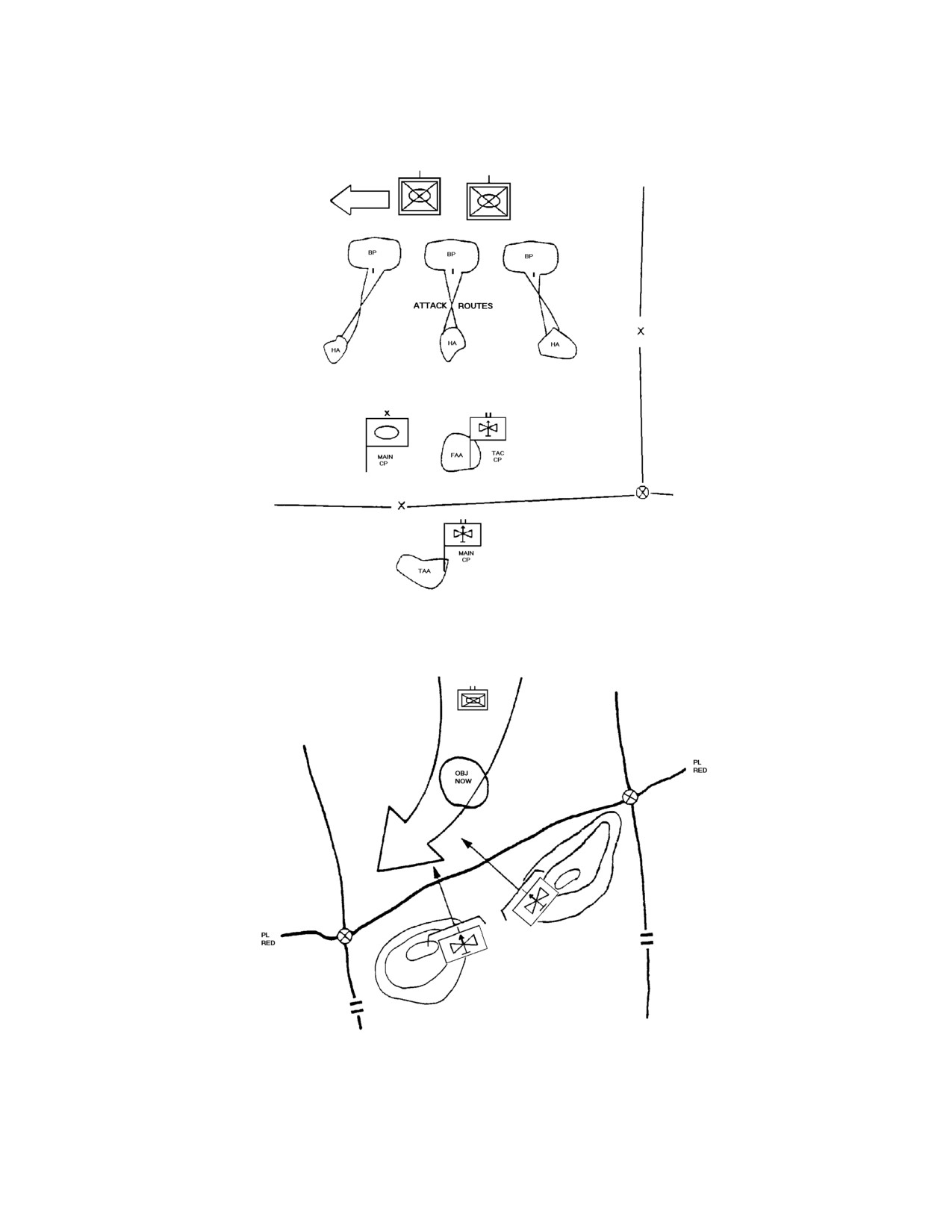
ground and air avenues of approach into the BP. BPs and their preparation are described
in paragraph 3-8. Figure 3-7 shows the layout of the battlefield.
f.
ABF Position. If the enemy situation is vague, as in a movement to contact,
and the ATKHB commander has been assigned his own sector, ABF positions may be
used. An ABF position is one from which a unit will engage a target, but not maneuver
over it, with the intent of inflicting some level of damage. ABF positions are less
restrictive than BPs, and better suited to a fluid battlefield. The commander must,
however, control all indirect fires into his sector and know the locations of all his ATKHCs
to clear those fires. See figure 3-8.
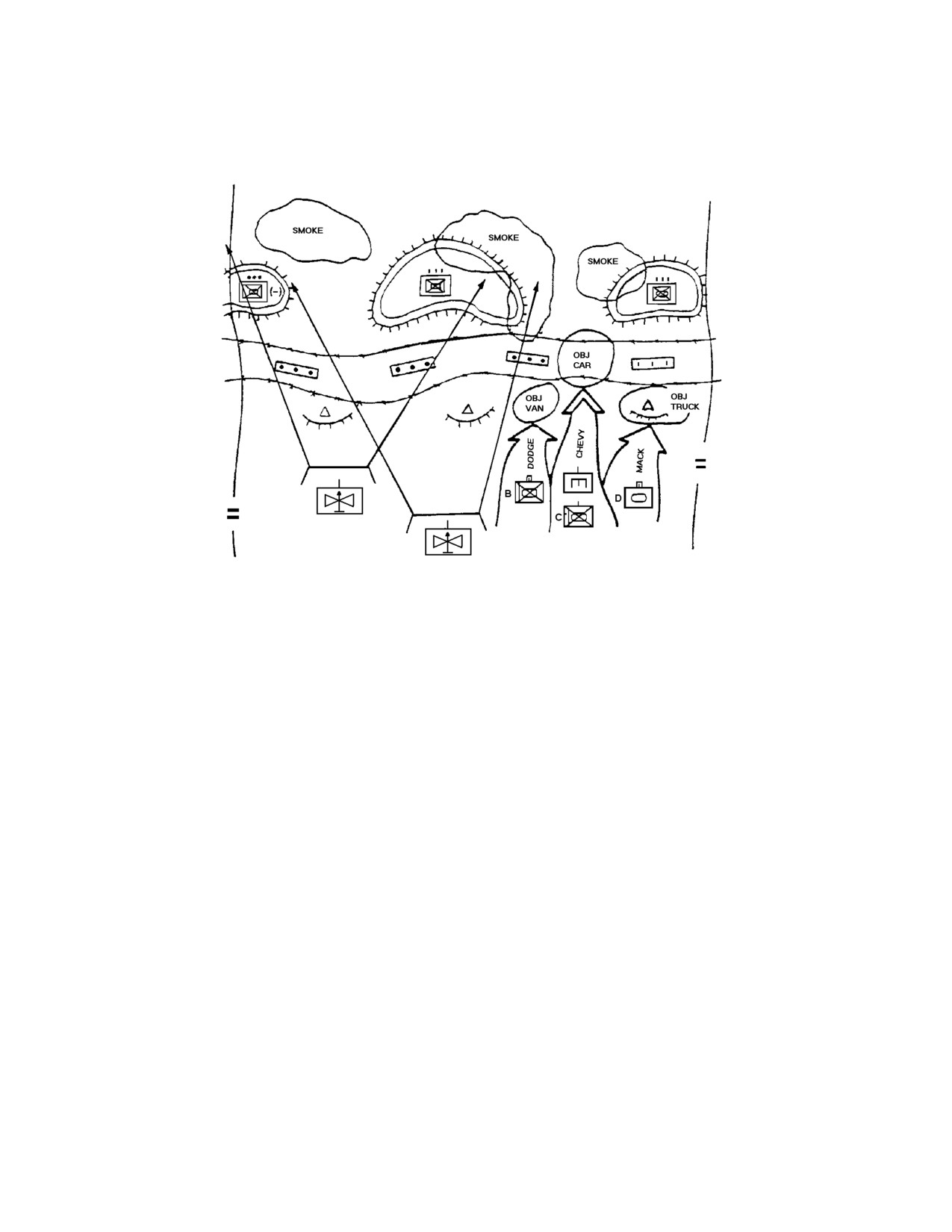
g. SBF Position. The SBF position will normally be used in conjunction with
the ABF position, as a base of fire or overwatch position. It can be used to engage a
target while ground or air assets move to or around it. Engagements from the SBF
position may range from suppression to destruction of the target, but the primary mission
is to fix the target so another force may maneuver. See figure 3-9.
h. Firing Position. Attack helicopter PCs select the actual firing positions that
provide standoff ranges and good fields of fire within their BP, ABF, or SBF. Ingress and
egress routes should be well-concealed, and the background of the firing position should
reduce the risk of visual acquisition by the enemy. Selected firing positions must also
allow freedom of movement for the attack helicopters and permit them to be hovered
without raising dust or debris. To increase aircraft survivability, attack helicopter
aircrews should limit the number of engagements from a single firing position and move
before they receive effective counterfire.
3-11
FM 1-112
Figure 3-7. Battlefield layout
Figure 3-8. ABF as part of a movement to contact
3-12
FM 1-112
Figure 3-9. SBF used to overwatch ground maneuver
i.
EA. The EA is an area in which the commander intends to trap and destroy
an enemy force with the massed fires of all available weapons. Commanders must use
obstacles, FS, fire distribution plans, and a thorough IPB to coordinate both combined and
joint fires and mass them against the enemy force as it arrives in the EA. To exploit
enemy weaknesses and maximize the advantages of terrain, battle and firing positions are
selected in relation to EAs. A good EA should have at least the four characteristics listed
below.
(1) BPs. The EA should have several BPs for attacking the enemy from
various directions.
(2) Obstacles to movement. Obstacles, either natural or man-made, are
desirable in the EA to slow target movement and permit the effective use of direct and
indirect fires.
(3) Long-range fires. To enhance aircraft survivability, an EA should allow
aircrews to engage targets at the maximum range that permits a high P .
k
3-13
FM 1-112
(4) Continuous target visibility. Long-range engagements require that
the target be in view during terminal guidance. As a rule, EAs should provide an
unobstructed view of the target from firing or designating positions. Planning should
concentrate on sensor ranges, not weapon maximum standoff ranges, for EAs.
j.
Rally Point. A rally point is a designated area where separated or dispersed
elements of the ATKHC reassemble. It may be used to reform the light and heavy
platoons after an attack or to regroup a team, platoon, or company after a hasty
withdrawal from untenable BPs.
3-4. EMPLOYMENT METHODS.
The ATKHB commander employs the battalion through the coordination of his ATKHCs,
CS, and CSS. He uses his attack companies to destroy enemy forces. To do this, he
applies one of three methods of employment--continuous attack, phased attack, or
maximum destruction. Timing is critical in the employment of the ATKHB. Employed
too early, it may have to be disengaged before mission completion because of low fuel.
Employed too late, it may miss part or all of the targeted unit and fail to destroy the
enemy forces at the critical time and place. The ATKHB should be employed when a
lucrative target has been identified and selected for engagement.
a. Continuous Attack. To exert constant pressure on the enemy force, the
ATKHB commander employs the ATKHCs using the continuous attack method. This
method ensures that at least one company will be in the battle at all times. While one
company is in the battle, the other two prepare to relieve the engaged company as they
remain in HAs or the FARP or move between the FARP and the battle. Many times dur-
ing a continuous attack the ATKHC commander on station may send only the attack
helicopters to rearm and refuel. This allows the scouts to remain in enemy contact,
coordinate with the relieving ATKHC commander, and reconnoiter successive BPs.
Multiple BPs, ABF positions, or SBF positions selected during mission planning provide
the flexibility needed for a coordinated battle handover between companies. The con-
tinuous attack method provides the most flexibility and the most efficient FARP
operations. It also provides sustained fires over long periods. Figure 3-10 shows the con-
tinuous attack method.
b. Phased Attack. The phased attack method is a modification of the
continuous attack method and is used to increase the initial firepower of the battalion.
Using this method, the commander initially employs one company to begin the attack. He
then quickly phases in the second company from a different BP. The third attack
company is phased into the fight when either of the other companies is low on fuel or
ammunition. The phased attack method may be reversed, or the commander may vary
how the phased attack is conducted. For example, he may employ one company to set
upthe fight and then exploit the attack with his other two companies. If the phased
attack method is used, aircraft turnaround time in the FARP must be kept as short as
3-14
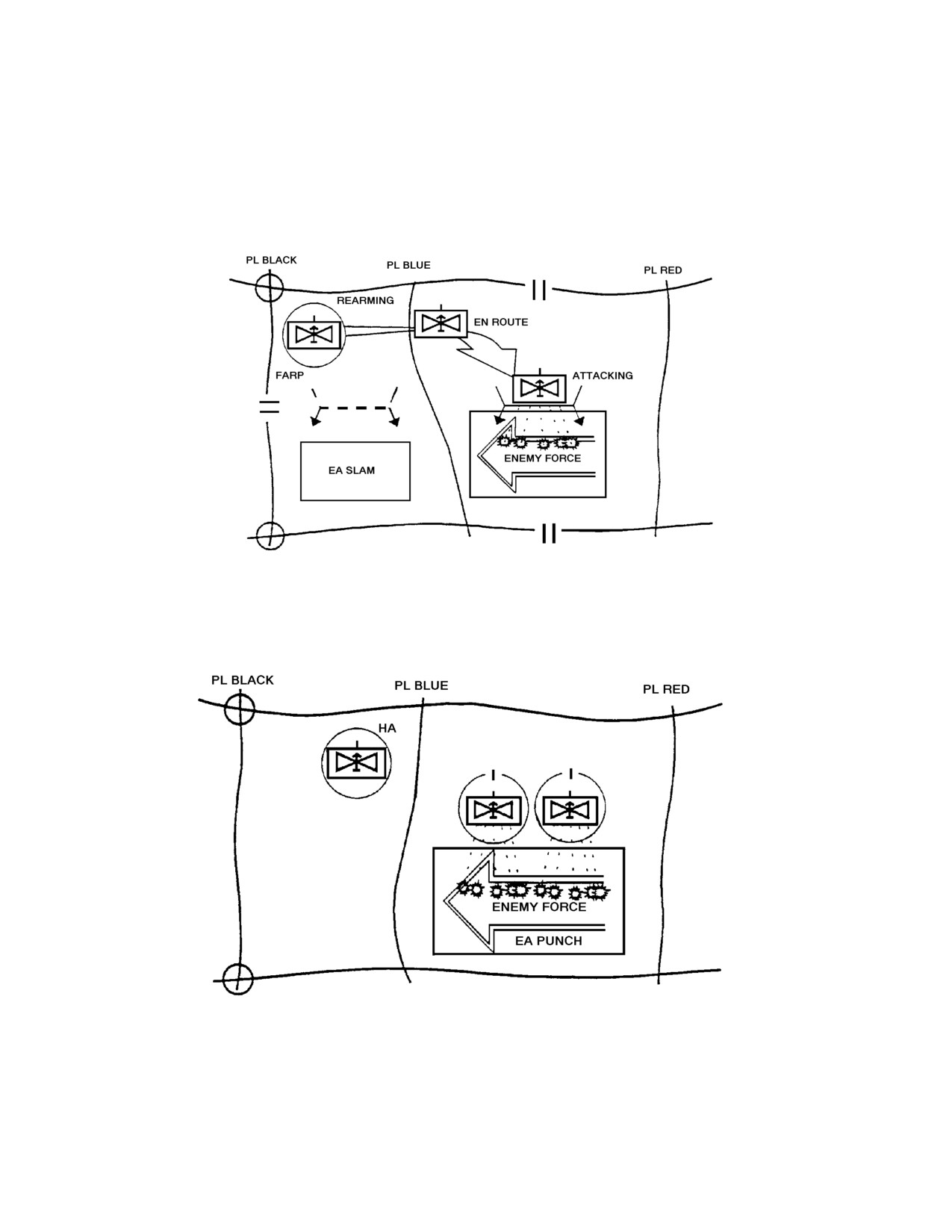
FM 1-112
possible. Because of FARP limitations, eventually the phased attack method reverts to
the continuous attack method. Figure 3-11 shows the phased attack method.
Figure 3-10. Continuous attack method
Figure 3-11. Phased attack method
3-15
FM 1-112
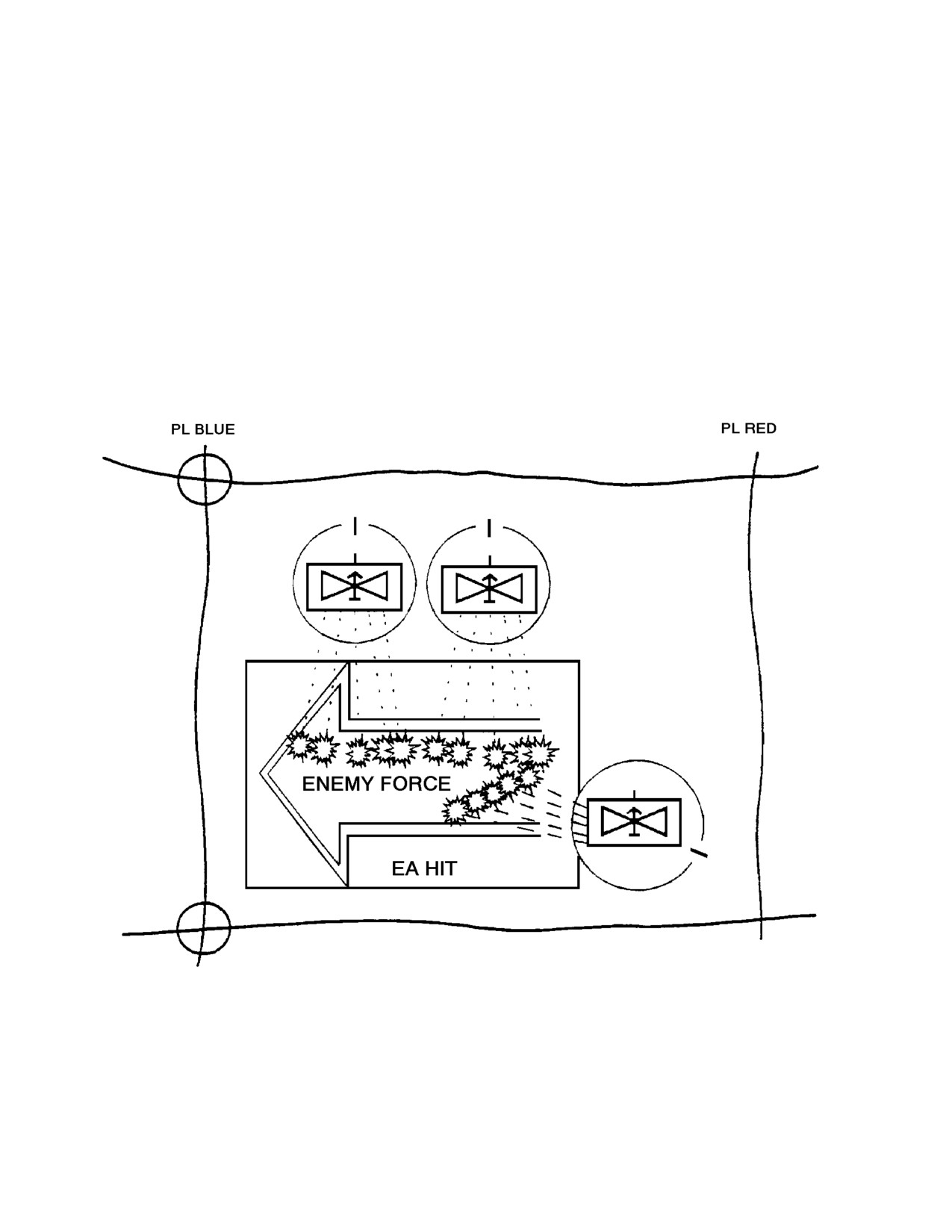
c. Maximum Destruction. If the ATKHB commander wishes to place as much
combat power as possible into the battle, he uses the maximum destruction method. To
overwhelm the enemy with massed fires, the battalion deploys with all three companies in
contact from different positions. In this situation, the supported commander must realize
that the ATKHB will be out of the fight for 20 to 90 minutes at the completion of its
initial attack. The exact time depends upon the distance to the FARP and the time it
takes to replenish fuel and ammunition after the initial engagement. Figure 3-12 shows
the maximum destruction method.
Figure 3-12. Maximum destruction method
3-16
FM 1-112
Section III. Environmental Considerations
3-5. ENVIRONMENTAL FACTORS.
On the battlefield, each belligerent will attempt to use the environment to his advantage.
The environment includes what we can see (terrain, visible light, weather, and
obscurants) and what we cannot see (electromagnetic measures, CB pollution, and
battlefield stress). As part of the planning process, commanders must consider these
environmental factors and attempt to use either the environment in their favor or negate
its effects as much as possible.
a. Weather and Visibility. Weather and visibility create advantages and
disadvantages for opposing forces. To fight effectively, commanders must know how they
are limited by poor weather and visibility. At times, the ATKHB may not be able to
execute a mission because of the weather. Therefore, the ATKHB commander must
advise the force commander of the restrictions that bad weather and visibility place on the
ATKHB.
(1) Weather. Weather affects soldiers, equipment, operations, and terrain.
Cloud cover, wind, rain, snow, fog, dust, light conditions, and temperature extremes
combine in various ways to affect human efficiency and limit the use of weapons and
equipment. ATKHB assets are greatly influenced by the effects of weather, but so are
enemy assets. Rain can degrade the FLIR systems used on AH-64s and OH-58Ds for
piloting the aircraft and targeting. However, rain also inhibits the cross-country
maneuverability of enemy mechanized forces, causing their movement to slow or
channelize on roads. High winds makes gunnery for attack helicopters more difficult, but
it also makes enemy obscurants less effective. Each system used on the battlefield has its
strong and weak points in relation to the environment. Commanders must know the
strengths of each system and use them to attack the weaknesses of enemy systems.
(2) Visibility. Limited visibility affects operations and favors the attacker
by masking his maneuver. However, darkness, fog, and smoke reduce the useful ranges
of most weapons, including enemy AD weapons. During periods of limited visibility,
attack helicopters must maneuver closer to the enemy for successful engagements. The
winner of an engagement will usually be the soldier or aircrew that gains surprise,
acquires the target, and accurately fires the fastest. ATKHC commanders must maneuver
their forces to a positional advantage using the terrain and concealment afforded by the
limited-visibility environment. Once in position, crew members will have to acquire the
target, fire rapidly, and then move. At close range, any delay in effectively engaging the
enemy and repositioning gives the enemy time to react and return fire.
b. Terrain. "Geography and ground can affect military operations in three
ways--as an obstacle to the approach, as an impediment to visibility, and as cover from
fire." Clausewitz, On War.
3-17
FM 1-112
(1) Analysis. Terrain analysis is a critical skill; all members of the ATKHB
must develop an understanding of the limitations and opportunities that terrain affords.
ATKHB commanders and their staffs perform terrain analysis in light of their units'
missions. Whether using the advanced capabilities of the AMPS and ASAS or paper
maps, they evaluate the terrain's potential for cover and concealment, its impact on their
maneuver and the enemy's movements, and its use for observation and direct fire effect.
The key elements of terrain analysis are summarized in the mnemonic OCOKA--
(a) Observation and fields of fire.
(b) Cover and concealment.
(c) Obstacles to movement.
(d) Key terrain.
(e) Avenues of approach.
(2) Reinforcement. The proper use of natural obstacles and the re-
inforcement of terrain must be an integral part of the ATKHB commander's plan.
Artillery fires, direct fire EAs, and obstacles must all be combined in the tactical plan.
Engineers use obstacles to disrupt, fix, turn, or block the enemy. Disruptive obstacles
cause enemy formations to separate or bunch up, which disrupts their maneuver and
attack. Fixing obstacles slow enemy progress and allow friendly artillery and direct fires
the opportunity to mass. Turning obstacles drive the enemy toward friendly EAs and
massed fires or force them to expose their flanks, allowing friendly gunners to achieve a
positional advantage. Blocking obstacles deny the enemy access to a given area or
prevent his advance in a given direction. Although the ATKHB will seldom have engineer
support to establish obstacles, the ATKHB commander must understand the force
commander's obstacle plan and use it to the battalion's advantage.
(3) Intelligence. The commander must be familiar with the terrain before
combat. Because maps are sometimes inaccurate or incomplete, commanders should
conduct a detailed, personal reconnaissance. Company commanders should ensure that
their aircrews are familiar with the terrain and scheme of maneuver. If possible, crews
should visit battle and firing positions, perform a map reconnaissance, and conduct sand
table exercises before executing a mission. These actions will help them to understand
the scheme of maneuver, commander's intent, and terrain and quicken their reactions
during the chaos of battle. All sources of intelligence must be considered. Aerial
photographs, satellite imagery, HUMINT, SIGINT, and ELINT can each be critical assets.
c. Special Environments. The ATKHB operates best over open, rolling terrain,
which is also favored by mechanized forces. It is least effective against enemy forces that
are stationary, well-camouflaged, and in prepared positions. The ATKHB will be called
upon to execute its mission in a variety of environments. The following paragraphs cover
specialized environments in which the ATKHB may be expected to operate.
3-18
FM 1-112
(1) Urbanized terrain.
(a) Commanders can employ attack helicopters in urban terrain.
However, there are special planning considerations for this type of employment. In urban
areas, fields of fire are restricted and buildings provide cover for enemy light forces to
engage attack helicopters with near impunity. This type of terrain can negate the
effectiveness of the long-range, precision munitions of the attack helicopter. Rockets and
cannons can be used against light structures; however, they may not have sufficient
explosive power to be used against well-constructed buildings of reinforced brick and
concrete. While there are challenges for commanders employing attack helicopters in
urban environments, experience has shown that attack helicopters are much more
effective and flexible than mortars and artillery in urban operations.
(b) The ATKHB is well-suited for employment on the outskirts of an
urban area, attacking forces that are attempting to bypass, envelop, or reinforce the built-
up area. If employed in urban terrain, special consideration should be given to the
munitions selected. Collateral damage near targets engaged by Hellfire ATGMs will be
higher than near those engaged by 30 mm TP rounds. Consideration should also be given
to high-energy, high-altitude tactics, such as diving fire, to overcome the vertical
restrictions of built-up terrain. For planning, the commander must keep in mind the
following challenges of MOUT:
• Flight routes in urbanized terrain may increase employment times and fuel
consumption.
• Buildings limit maneuverability and engagement range, as do mountains.
• Urbanized terrain may limit FARP size, location and response times.
• Extensive urban sprawl and high buildings degrade communications and may
require extensive relay and retransmission sites.
• Urbanized terrain masks IEW acquisition capabilities.
• The numerous buildings and streets and few map references complicate
navigation in built-up areas.
• Urban areas directly affect weather, especially wind patterns.
• Landing and pickup zones may be severely limited; operations from rooftops
may be required.
(2) Mountains. Mountainous areas provide unique challenges for attack
helicopters. While high altitude limits the load-carrying capability of the attack
helicopter, the terrain is compartmentalized, allowing for rapid movement to the flanks
and rear of an isolated enemy force. Enemy mechanized forces will be slowed and
3-19
FM 1-112
channelized as they move up steep grades and down narrow valleys or are restricted to
roads and trails. Mountains provide excellent terrain-masking and allow easy avoidance
of radar and visual acquisition. However, high ridges also provide effective firing
positions for AD guns and hand-held missiles. The nature of the terrain and the dis-
tances that must be traversed to get into position to attack may require that the ATKHB
engage the enemy force without the support of other combined arms.
(3) Jungles. Dense jungles and wooded areas severely limit the capability of
the ATKHB to effectively employ precision-guided munitions. Heavily wooded areas
degrade fields of fire and target identification. Although the capability of the ATKHB to
employ precision-guided munitions is degraded, it can still provide supporting fires for
other members of the combined arms team. Attack helicopters can carry large loads of
nonprecision guided munitions, such as rockets and cannon. When directed by scouts or
ground forces, they can place heavy fires on the enemy. These fires can suppress the
enemy, block his withdrawal, or destroy massed light forces. ATKHB fires should be
maximized against enemy targets that oppose the friendly main effort. Some things to
remember when operating in a jungle environment include the following:
(a) Aircraft should not overfly the target.
(b) Humid tropical air decreases aircraft lift capabilities, decreasing
payload.
(c) Thunderstorms can cause rapid and violent changes in the weather.
(d) Attacks should be made simultaneously from more than one
direction to confuse the enemy.
(e) Attacks should be made along the length of the enemy force, not
perpendicular to it.
(f) The location of friendly forces should be marked and easily
identified from the air.
(g) Constant communications and liaison are needed between the
attacking ATKHB and the element of the supported ground force in contact.
(h) Attacks should not be made over the heads of friendly ground forces.
(Expended shells falling from the attack aircraft may cause confusion among friendly
troops, leading to possible fratricide. This is true for all types of terrain.)
(4) Deserts. The ATKHB can effectively operate in the desert or in open
terrain. However, it is vulnerable to enemy long-range observation, acquisition, and
harsh environmental conditions. Shifting sand dunes make maps obsolete quickly, and
the lack of any NAVAIDS, man-made or natural, make navigation extremely difficult
without GPS or Doppler navigation assistance. Heat limits weapon and fuel loads that
3-20
FM 1-112
each attack aircraft can carry, and sand and dust can cause damage and increased
maintenance requirement for the aircraft. Attack aircraft flying low and slow may
produce large dust clouds. Clouds of dust are easily detected and obscure aircraft
acquisition systems. These severe conditions require proper maintenance, engagement
techniques, and positioning of Class III/V resources. Extra maintenance will help correct
the problems of heat, sand, and dust. Both air and ground crews must be aware that
engines have to be cleaned and filters changed more often during desert operations.
Firing while flying above ETL airspeed diminishes the dust signature and aids in surviv-
ability. The loss of load capabilities is overcome by placing FARPs closer to the objective
areas. When operating above ETL, attack aircraft can operate at higher gross weights
than when hovering fire is used.
d. NBC Weapons.
(1) Because of the world-wide proliferation of NBC weapons since the end of
the Cold War, potential enemies of the United States may be expected to use NBC
weapons. Weapons of mass destruction may be the enemy's alternative to conventional
warfare. Nuclear and chemical weapons could have a devastating effect if friendly forces
are unprepared for their use.
(2) The ATKHB commander must take the exposure guidance of his higher
headquarters, the enemy's intent and capability, and the mission and condition of the unit
into account when setting the battalion mission oriented protective posture level. If the
enemy can use or has used chemical weapons any-where on the battlefield, commanders
must immediately take precautionary measures to protect their battalions. This will
normally mean that the ATKHB will conduct operations in MOPP 2 before chemical
weapons are used and go to MOPP 4 when their use is imminent or after they are used.
The ATKHB will survive by anticipating nuclear or chemical attacks. To avoid becoming
lucrative targets, commanders must--
(a) Avoid detection.
(b) Retain mobility.
(c) Plan for rapid reorganization and be prepared to continue
operations.
(d) Seek terrain shielding by carefully selecting assembly areas and
preparing shelters/fighting positions.
(e) Be aware of flying debris in a nuclear environment.
(f) Be alert to the possibility of a nuclear or chemical attack and adjust
the MOPP level and unit dispersion according to the threat.
3-21
FM 1-112
(g) Instill discipline and physical conditioning to prepare troops for the
confusion and physical demands of a nuclear/chemical environment.
e. EW. EW is an essential element of combat power. Its contribution lies in
exploiting enemy weaknesses, protecting friendly freedom of action, and reducing security
and communication vulnerabilities. Modern military forces depend on electronics for C2 of
forces and employment of weapon systems. Friendly and enemy forces are vulnerable to
actions that can reduce the effectiveness of their electronics. Properly applied EW can
locate, identify, target, deceive, delay, disorganize, and destroy the enemy when
integrated into the overall concept of the operation. FMs 34-1, 34-7, and 34-10 provide
detailed information on EW.
(1) ES. ES involves actions to intercept, locate, and identify threat sources.
ES provides combat information for the S2 to meet the commander's IR/PIR. The S2,
following the commander's guidance, must establish priorities for ES orders and requests,
continuously update ongoing ES operations, and anticipate future ES operations by
tasking organic ES assets and coordinating with the IEW support element within the
ACE.
(2) EA. EA involves actions taken to prevent or reduce the use of the
electromagnetic spectrum by hostile forces. The aviation S3 has staff responsibility for
overall planning and coordination of EW operations. He primarily directs the EA in
jamming and deception roles. With the S2, FSO, and IEW support element, the S3 will
establish priorities for targets. EA is directed against targets to degrade the enemy's
ability to respond quickly and effectively.
(3) EP. EP involves actions taken to retain friendly use of the
electromagnetic spectrum. The S3 will coordinate with the signal officer to establish EP
to protect friendly signal operations. Training in the correct employment of the signal
emitters and emitter capabilities and design is necessary for successful EP. Equally
important is training in the correct use of Signal Operating Instructions, communications
discipline, and proper radio/telephone operating procedures.
f.
Smoke and Obscurants.
(1) Smoke and obscurants are integral to the former-Soviet Union's doctrine,
tactics, equipment, and training. The threat will use smoke to increase its effectiveness
and reduce its vulnerability. Specifically, smoke can--
(a) Deny information.
(b) Mask the use of chemical weapons.
(c) Disrupt movement, operations, and C2.
(d) Restrict NOE and contour approaches to EAs.
3-22
FM 1-112
(e) Reduce the effectiveness of sensors, range finders, and target
designators.
(2) The ATKHB can also use smoke to enhance its survivability. Through
the use of artillery-fired smoke or 2.75-inch FFAR white phosphorus rounds, the ATKHB
can achieve the same results as the enemy. Additional benefits of the use of smoke by
ATKHBs are--
(a) To suppress visually sighted enemy ADA systems and small arms.
(b) To sector portions of the EAs, isolating part of the enemy force.
(c) To screen the displacement of the ATKHCs while they move to new
firing or BPs or break contact.
g. Battlefield Stress.
(1) As they plan and conduct operations, commanders must remember the
effects of combat stress and minimize adverse consequences. While ground forces will
carry the brunt of the fighting, the enemy's main effort will not always affect the same
units. Because the ATKHB can maneuver quickly and mass combat power at the critical
time and place, it can expect to engage in direct combat more often than other maneuver
units. Therefore, minimizing the adverse effects of battlefield stress is an important
factor in ATKHB combat effectiveness.
(2) The adverse effects of battlefield stress may occur as--
(a) Physical and mental fatigue from sleep loss.
(b) Continual physical/mental effort under high work load and time
pressures.
(c) Physiological stress from extreme temperatures; noise; vibration;
blasts, flashes and radiation; battlefield air pollution; all degrees of effects from chemical
weapons and their antidotes; and other-than-fatigue effects from the factors listed above.
(d) A generally incapacitating, long-term (days, months, or sometimes
years) psychological stress casualty syndrome (combat fatigue).
(e) Transient, severe degradation or breakdowns in mental capabilities
(and physical capabilities under some extreme situations) during the extreme fear of
actual combat and anticipation of actual combat.
(3) A combination of all these effects exists in some degree (usually a
substantial degree) in every individual in every combat situation. This combination of
stress effects will initially reduce the combat effectiveness of individuals and units below
3-23
FM 1-112
that demonstrated during peacetime training. As their combat experience increases, most
individuals will learn to cope with the adverse effects of battlefield stress on their combat
performance. However, even a combat-experienced unit's performance can be expected to
remain below that demonstrated during peacetime training.
(4) Leaders at all levels must be able to recognize the signs of fatigue and
battlefield stress. Fatigue and battlefield stress will cause noncombat-related accidents
that will diminish the combat power of the ATKHB, risking lives, aircraft, and a highly
trained crew. Fatigue can be controlled through rest; aircrews that fight all day cannot
expect to fight well all night. Prompt treatment of stress casualties in forward areas can
return most soldiers to duty rapidly. Both ATKHB and ATKHC commanders must make
a realistic evaluation of the condition of their soldiers and then make recommendations to
the force commander about their capability to continue the fight.
Section IV. Movement to the Objective Area
3-6. PREPARATION FOR MOVEMENT
a. General. Fighting the battle involves taking the plan that has been
formulated and shaping it to fit the situation. To plan the battle, the ATKHC commander
selects routes, flight modes, and platoon BPs; coordinates fire control measures; devises a
plan that considers the factors of METT-T; and accomplishes the mission. The ATKHC
commander's plan must be flexible enough to allow for rapid deviation to meet the actual
situation. When deciding his courses of action, the ATKHC commander must consider the
mission, threat, movement, occupation of the BP, actions in the BP, egress and
restoration. He must also consider when to begin the engagement and when to maneuver.
(1) Mission. The mission of the ATKHC is a subset of the mission assigned
to the ATKHB. The success or failure of the ATKHB directly relates to the success or
failure of its companies. ATKHC commanders use the ATKHB commander's intent and
mission statement to decide how to accomplish the company's mission. However, it is
possible that the ATKHC will have a mission that is different from that of the battalion.
An example is an ATKHC that is supporting the attack of its parent battalion. The
ATKHB has the mission to disrupt an enemy TR, and one of the ATKHCs has the mission
to screen in the ATKHB's sector.
(2) Threat. Just as the ATKHB conducts an IPB during planning, so must
the ATKHC. The ATKHC IPB is based upon the IPB that is prepared by the ATKHB,
and is oriented toward confirming the battalion's IPB. It involves plotting the routes
through the EA where groups of vehicles will maneuver and determining the location of
priority targets and AD systems. With this information, the ATKHC commander will be
better prepared to select BPs for his platoons or teams and designate their sectors of fire.
3-24
FM 1-112
b. Precombat Checks.
(1) Commanders conduct precombat checks to ensure the unit is prepared for
the mission. Aircrews and aircraft require extensive precombat checks to ensure mission
readiness.
(2) Precombat checks are a part of all missions and are included in this
manual to increase the probability of successful completion of all operations. The
following paragraphs contain a suggested format for the aircrew precombat checks.
c. Before Mission Receipt Checks.
(1) Aircraft should be preflighted per appropriate checklist with PPC in
progress. Aircraft logbook should be in a known location, preferably in the aircraft.
(2) Aircraft should be full of fuel and loaded with ammunition (if applicable).
Weight and balance should be computed for aircraft load.
(3) Aircrew on appropriate crew rest schedule should be tracked by
commander and ASO.
d. Upon Mission Receipt. The commander and company planners provide the
following information. This information is gathered from the various unit staff sections:
*(1) Assessment of the enemy capability.
*(2) Mission graphics.
(3) Navigation/air route planning according to posted A2C2 plan.
(4) FS and fire distribution on the objective.
*(5) Actions on contact.
*(6) Communication card or SOIs.
*(7) COMSEC/IFF codes for aircraft.
*(8) Weather, light data, and fuel requirements
(9) Tactical FPLN preparation and filing.
(10) Risk assessment.
3-25
FM 1-112
*NOTE: Much of this information may be developed concurrently with the staff. The
items marked with the asterisk contain information that can be continuously tracked and
updated prior to mission receipt.
e. Preparing for the Mission. Following receipt of the mission briefing (either
written or oral), the ATKHC executes the following:
(1) The commander conducts a briefing to cover more detailed flight and
tactical procedures for the mission aircrews. A mission briefing format can be found in
Appendix C.
(2) The company planners receive updates from the staff, continuously
updating the friendly and enemy situation, as well as weather and environmental
considerations.
(3) By backward planning from the EA to the assembly area, the commander
and company planners determine the mission's time sequence.
(4) A FPLN or field strip is filed at flight operations with a current risk
assessment for the mission.
f.
Final Checks. Before the crews move to the aircraft, the following checks
should take place:
(1) Graphics. The commander or a designated platoon leader should inspect
the mission graphics of the mission crews for completeness and accuracy. Use a known,
properly prepared map as a baseline. This technique can be ongoing through the
planning process, but a quick check prior to the mission is critical.
(2) Communication card. If the crews had to copy their own frequencies
and call signs, designate a crew member to read the card aloud to the crews to check
accuracy. Ensure crews know the proper frequencies for conduct of communication check.
(3) Mission statement and commander's intent. The commander will
read the mission statement and the commander's intent to the crews.
(4) Chain of command. Restate the chain of command and reiterate the
downed pilot points and the SERE plan. Ask for questions, and send the crews to their
aircraft.
g. Crew Checks. Crews should check the following items before getting into the
aircraft:
(1) Crew members within limits of crew endurance policy.
(2) Aircraft ignition key is present.
3-26
FM 1-112
(3) ALSE, both personal and crew, present.
(4) Checklist, -10 manual, and all mission-related publications available.
(5) At least one canteen and one MRE available per crew member.
(6) Special mission equipment (such as NVGs and sidearms) available and
function check complete.
(7) COMSEC and IFF codes loaded in appropriate equipment.
h. Run-Up Checks.
(1) Crews must complete start sequence according to the appropriate -10
checklist.
(2) Crews must complete weapons system initialization according to the
appropriate aircraft aircrew training manual. For armed helicopters, weapons checks and
boresights are considered one of the most critical precombat checks.
i.
Communications Check. The communication check described below may
not be compatible with all communications packages in armed helicopters. The
commander may use this technique for SOP development.
(1) Chalk 1 starts the check on FM, selects UHF and transmits, and then
selects VHF and transmits. For example, "This is (call sign) on 1 (FM internal frequency
nonsecure), 2 (UHF internal frequency), and 3 (VHF internal frequency)."
(2) This process continues through the chalk order until all aircraft in the
flight have checked. All aircraft will monitor to determine which radios work on which
aircraft.
(3) Chalk 1 announces "This is (call sign), go secure on 1." This instructs the
flight to select the secure mode for their FM radio. The check progresses as (1) above, but
only the FM is used.
(4) Once FM secure is checked, the flight can go active on Have Quick, with
a designated aircraft in the flight sending the time.
(a) If crews use this procedure during all training missions,
communication checks become quick and routine. The commander may need to readjust
radio nets due to nonfunctioning radios in the flight. It is very important to let all crews
know which radios the nets are on before takeoff.
(b) Once all checks are complete and the commander is satisfied the
flight can communicate, he will call "execute card." This will tell the crews to tune their
3-27
FM 1-112
radios to the predetermined nets for the mission, and will most likely be the last radio
transmission until takeoff.
j.
Conclusion. When the commander or AMC calls for takeoff, he must assume
that the crews in his flight have conducted all weapons systems checks. Units must
practice precombat checks prior to all training missions. When practiced regularly, these
checks will become routine and easily accomplished.
3-7. MOVEMENT
a. Principles of Overwatch. ATKHCs maneuver to fight the enemy in much
the same way as mechanized maneuver forces. The major difference is that terrain does
not hinder helicopter movement. The maneuvering force's use of terrain as an ally
applies equally to both ground vehicles and attack helicopters. Therefore, the ATKHC
must adapt its flight mode and technique of movement to maintain security. The
principles of overwatch that apply to attack helicopter units are discussed below.
(1) Find the enemy with a minimum of forces. Scouts move ahead of
attack elements to assist in locating the enemy and reconnoiter the BP. During the move,
scouts should provide rear security and reconnoiter frequently to locate enemy ground and
air threats.
(2) Use all available cover and concealment. The ATKHC must use
stealth to maneuver into position to engage the enemy. The use of the surrounding
terrain and vegetation will allow the company to arrive undetected at the BP.
(3) Overwatch lead elements and be prepared to fire and maneuver.
This principle applies when the company approaches a BP, attacks in sector, or takes part
in an exploitation or a pursuit. The battlefield has no secure positions.
(4) Adjust the movement technique and type of terrain flight to the
factors of METT-T. The ATKHC will use traveling, traveling overwatch, or bounding
overwatch techniques depending on the likelihood of enemy contact. Low-level, contour,
or NOE flight will be used as appropriate.
b. Movement Techniques.
(1) Traveling. Traveling is used when speed is important and contact with
the enemy is not likely. Traveling is used to move rapidly in relatively secure areas; for
example, in a corps or division rear area. The ATKHC can use traveling with both
platoons in one flight or separate platoons in multiple flights. In either case, the company
moves at a constant airspeed using the appropriate type of terrain flight.
(2) Traveling overwatch. Traveling overwatch is used when enemy
contact is possible. Precautionary measures are justified, but speed is desirable. The
ATKHC leads with its light platoon, which moves at a constant rate; the heavy platoon
3-28
FM 1-112
trails and moves as necessary to provide overwatch of the light platoon. The
overwatching platoon observes the terrain where the enemy might be positioned to fire on
the lead platoon.
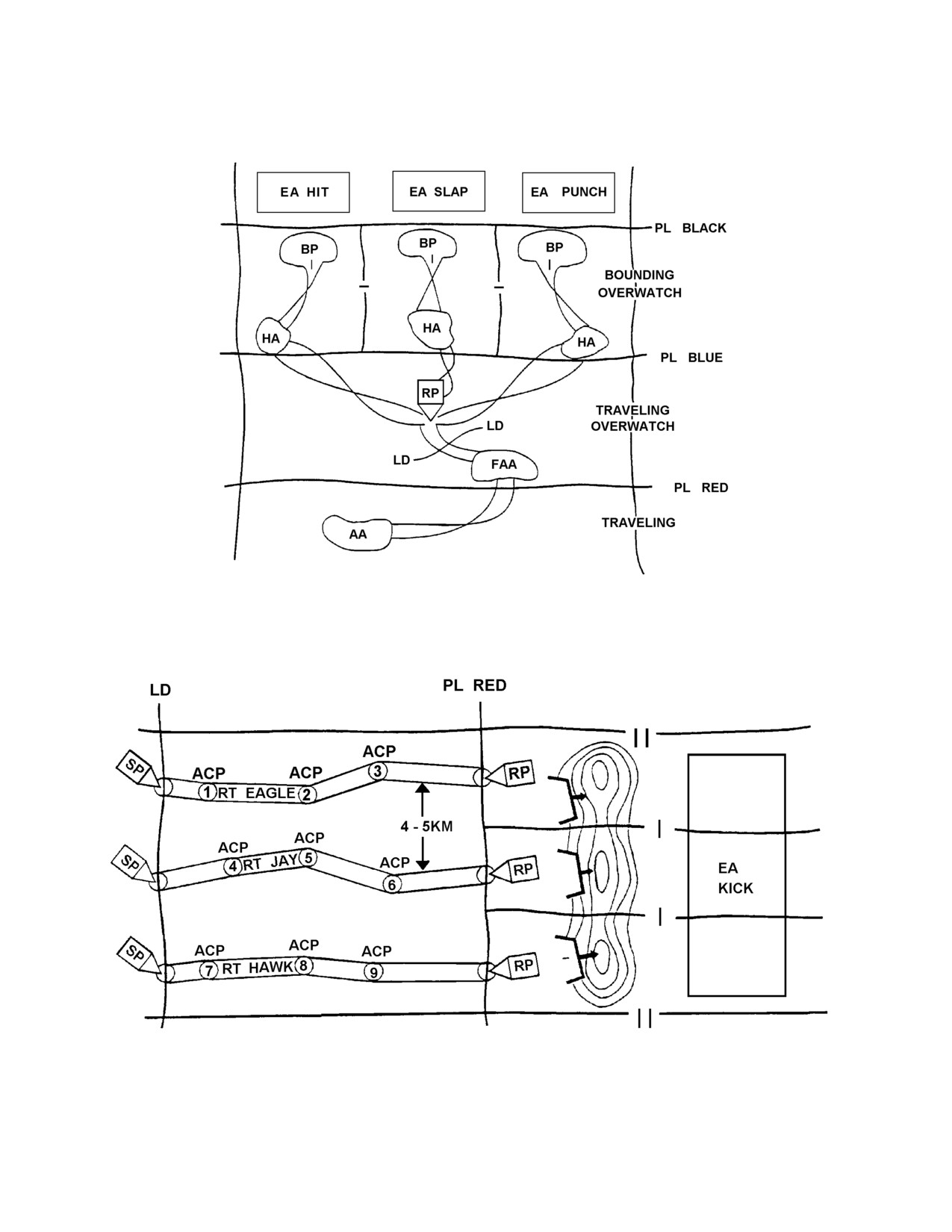
(3) Bounding overwatch. Bounding overwatch is used when enemy
contact is expected. From a covered, concealed position, the overwatching platoon
monitors the progress of the bounding platoon. Each platoon may bound or overwatch in
turn; however, the movement may also be executed with the light platoon always
bounding and the heavy platoon always overwatching. The overwatch position should
offer observation and fields of fire against potential enemy positions. Table 3-1 lists the
techniques of movement, and Figure 3-13 shows the techniques of movement in relation to
the battlefield.
Table 3-1. Techniques of movement
Technique
Contact
Terrain Flight
Traveling
Not likely
Low-level or contour
Traveling overwatch
Possible
Contour or NOE
Bounding overwatch
Expected
NOE
c. Axis of Advance. The effective movement of ATKHCs throughout the
battlefield is one of the keys to mission success. The ATKHB uses an axis of advance, a
general direction of movement, which is divided into routes for each ATKHC, between the
FAA and the battalion sector. It is planned and plotted to correspond with the A2C2 plan,
avoid known enemy concentrations, and take advantage of the terrain. The ATKHC
routes within the axis are wide enough to allow for maneuver (approximately 1 kilometer
wide or 500 meters either side of the centerline). Each company route is 4 to 5 kilometers
apart (centerline to centerline) and uses the standard control measures of an LD or SP,
ACP, and RP. The SPs, ACPs, and RPs are located along the centerline to orient the
ATKHCs as they maneuver toward their sectors and HAs. Figure 3-14 shows three
separate routes (one for each company). A2C2 is discussed in-depth in FMs 100-103 and 1-
111.
3-29
FM 1-112
Figure 3-13. Techniques of movement on the battlefield
Figure 3-14. ATKHB axis of advance broken down into company routes
3-30
FM 1-112
d. Multihelicopter Operations. Commanders designate formations for the
company to establish the relationship of one platoon to another in the air, establish the
concept of where the enemy will be and how the company will react to contact, and
establish the degree of security desired. The basic attack aviation tactical unit is the two-
aircraft, L/W team.
(1) L/W team movement. Three team techniques of movement are free
cruise, combat cruise, and combat spread. These techniques are designed to provide
team security and flexibility, and they are the building blocks of platoon and company
formations. In each case, the lead aircraft designates the primary direction of travel and
the wingman maintains his position in relation to the lead aircraft. The general rule for
the L/W relationship is "follow me and do as I do". Teams are purposely spread out; a
spread-out team allows the wingman to spend most of his effort searching for threats and
less time watching the lead aircraft.
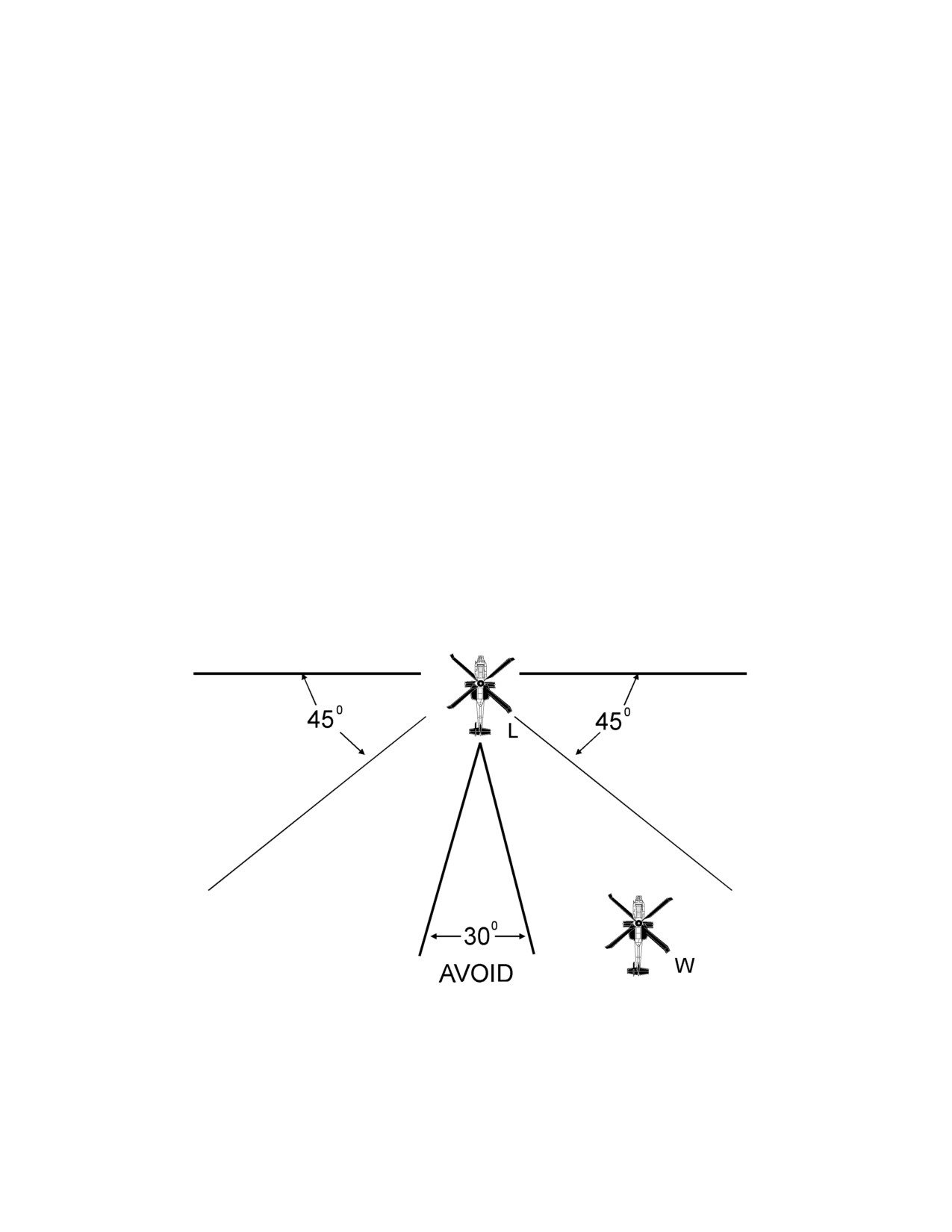
(a) Free cruise. Free cruise is used when teams desire to move
quickly and maximize the use of terrain for masking. It gives the team freedom to
maneuver and allows the wingman to provide security for his lead. Free cruise permits
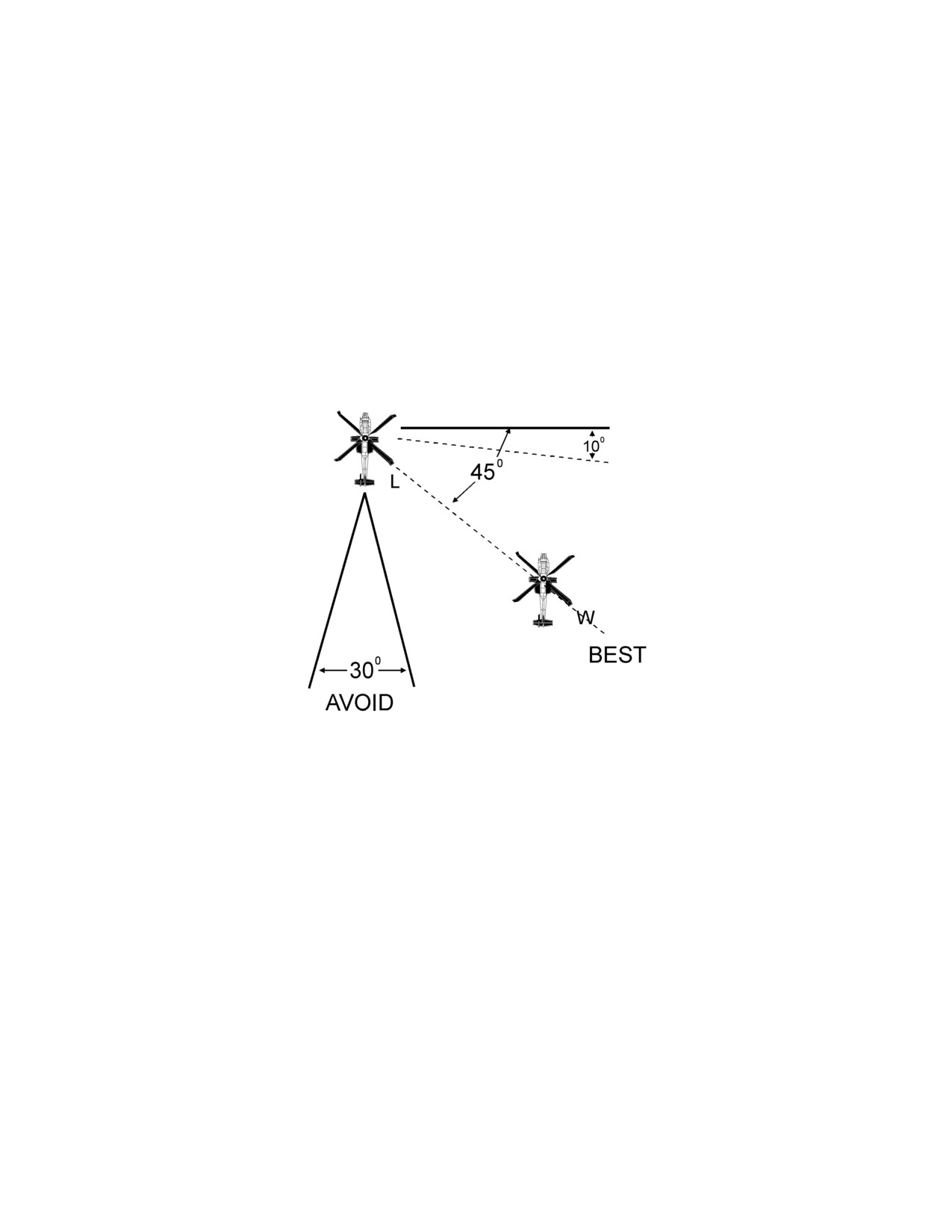
the wingman to maneuver in the zone extending 45 degrees on either side and to the rear
of the leader's tail. The wingman should avoid the area directly behind the lead (6 o'clock
position) because of his inability to provide suppressive fires for lead, his limited forward
observation, and the possibility that his lead's presence alerted the enemy in his flight
path. Figure 3-15 shows an example of a free cruise formation.
Figure 3-15. Example of a free cruise formation
3-31
FM 1-112
(b) Combat cruise. Unlike free cruise, combat cruise requires the
wingman to remain in either right or left cruise and change sides only after being directed
to do so by the lead aircraft or after he communicates to the lead aircraft his intentions to
change sides. Using combat cruise, the wingman should fly an arc from 10 to 75 degrees
aft the lead aircraft (right cruise) or the same approximate location on the other side of
the lead aircraft (left cruise). The optimum position for the wingman is 45 degrees aft the
lead aircraft. For planning, the wingman should maintain an approximately 10-rotor
diameter (rotor tip to rotor tip) separation from his lead. The wingman should avoid the
area directly behind the lead, as in free cruise. Figure 3-16 shows an example of a
combat cruise formation.
Figure 3-16. Example of a combat-cruise formation
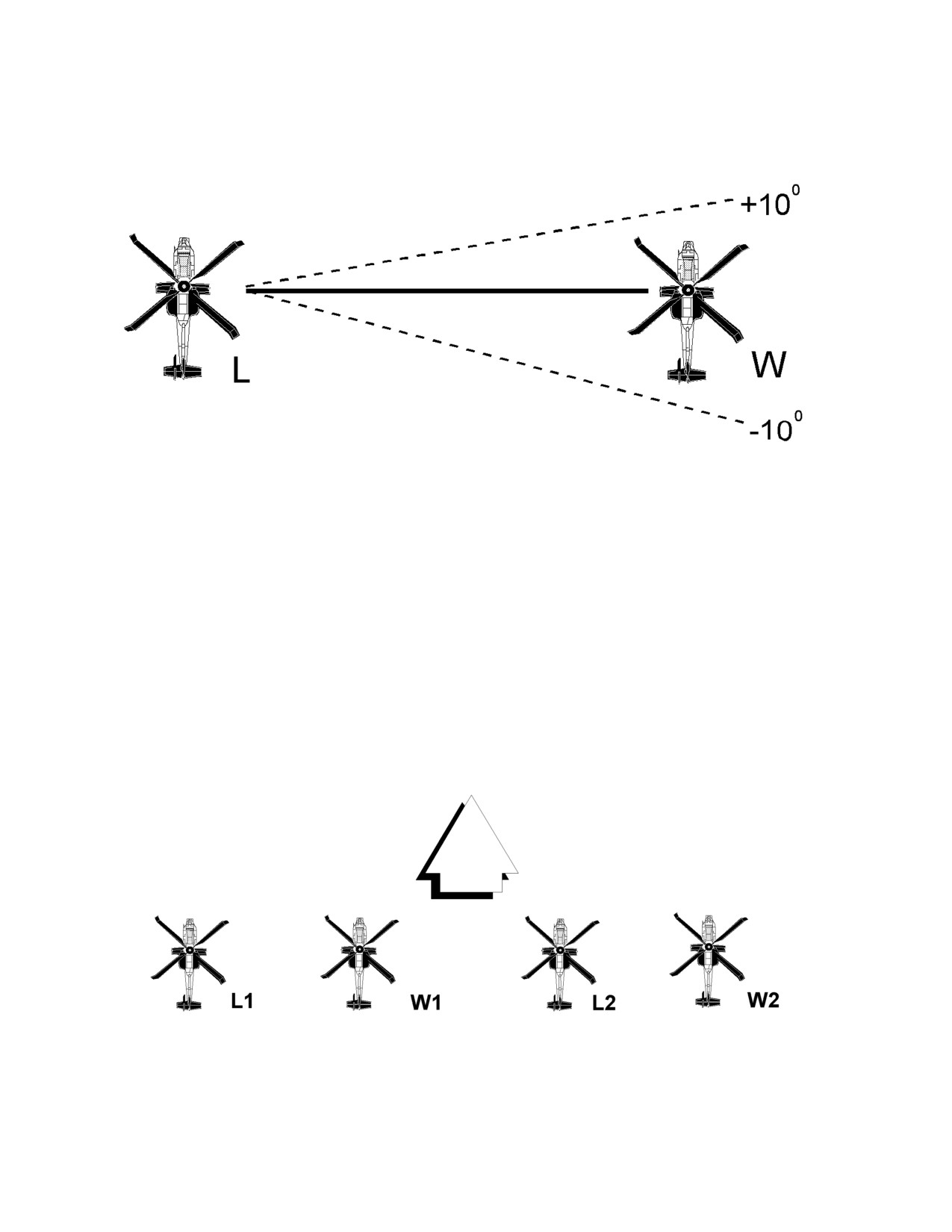
(c) Combat spread. The combat-spread is used when enemy contact is
imminent. This formation promotes security by providing maximum firepower forward
and overlapping fields of view. It is flown with the wingman in a plus or minus 10-degree
abeam position on either the left or right side (spread left or spread right) of the
lead aircraft. For planning, the wingman should maintain an approximately 10-rotor
diameter (rotor tip to rotor tip) separation from his lead. Commanders may vary the
maximum lateral separation between aircraft based on visibility, maneuver space
available, and expected enemy weapon ranges. Figure 3-17 shows an example of a
combat-spread formation.
3-32
FM 1-112
Figure 3-17. Example of a combat-spread formation
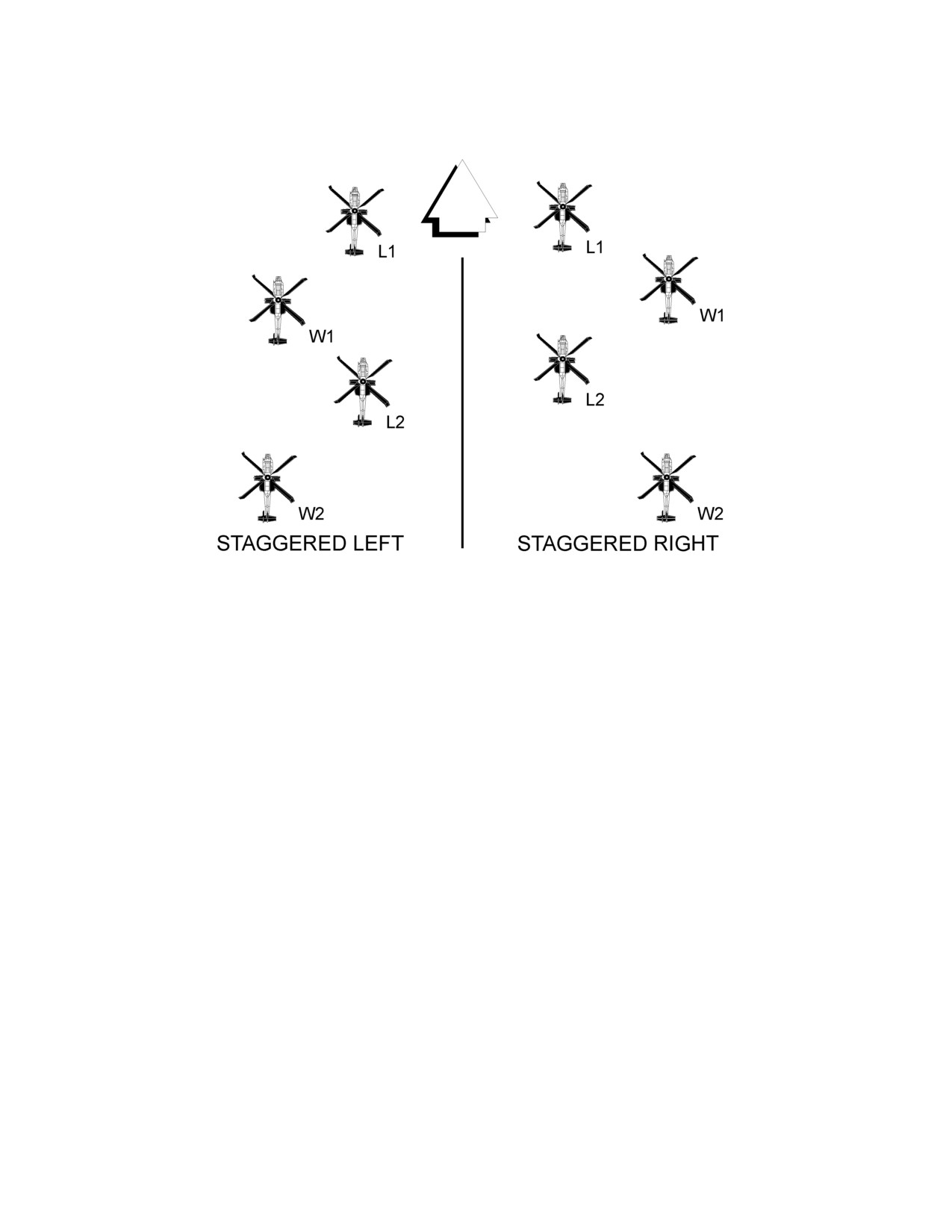
(d) Line formation. A variation on the combat-spread is the line
formation. It may be used to facilitate movement into BPs, SBF positions, and ABF
positions. The line formation is formed by placing two teams using the combat-spread
formation side-by-side. This technique is also known as "stacking right" or "stacking left."
The line formation has advantages. It provides excellent firepower forward. It provides a
wide area of protection to ground elements if used during an overwatch. It also allows the
maximum number of helicopters to close on an objective in the shortest time. The line
formation has disadvantages. It provides minimum fires to flanks. It is less secure than
regular combat spreads because of the lack of depth. It is more difficult to control than
team combat spreads. It also decreases freedom of maneuver. An example of a line
formation is shown in Figure 3-18.
Figure 3-18. Example of a line formation
3-33
FM 1-112
(3) Platoon/company formations.
(a) There is normally little tactical advantage for using tight, rigid
formations for attack helicopters. Commanders lose their maneuver advantage, and they
may jeopardize weapons effectiveness by trying to maintain tight formations during
terrain flight near the objective area. In addition, a team's ability to properly execute
actions on contact is contingent upon maneuver space and may be significantly hindered
by helicopters flying too closely.
(b) Platoon and company formations are built from L/W teams. The
commander does not normally employ rigid formations, but he does employ techniques
such as travelling overwatch or bounding overwatch during contour and NOE flight.
However, the commander may choose to employ the formations listed in the paragraph
below during low-level flight or during nonterrain flight modes, based on METT-T. These
formations are normally used when enemy contact is not expected, speed of movement is
desired, or to cross a specific point quickly (for example, a FLOT passage point).
e. Tactical Formations. The following are example formations for attack
helicopter platoons and companies. When using these formations, the commander should
plan to separate teams by no less than approximately 10 rotor diameters (rotor tip to
rotor tip). Individual aircraft should move in the same relative position within the
formation. This will ensure that each crew knows where to move, who is behind them,
and where to observe and direct fires. The four basic formations are staggered column,
wedge, combat trail, and echelon.
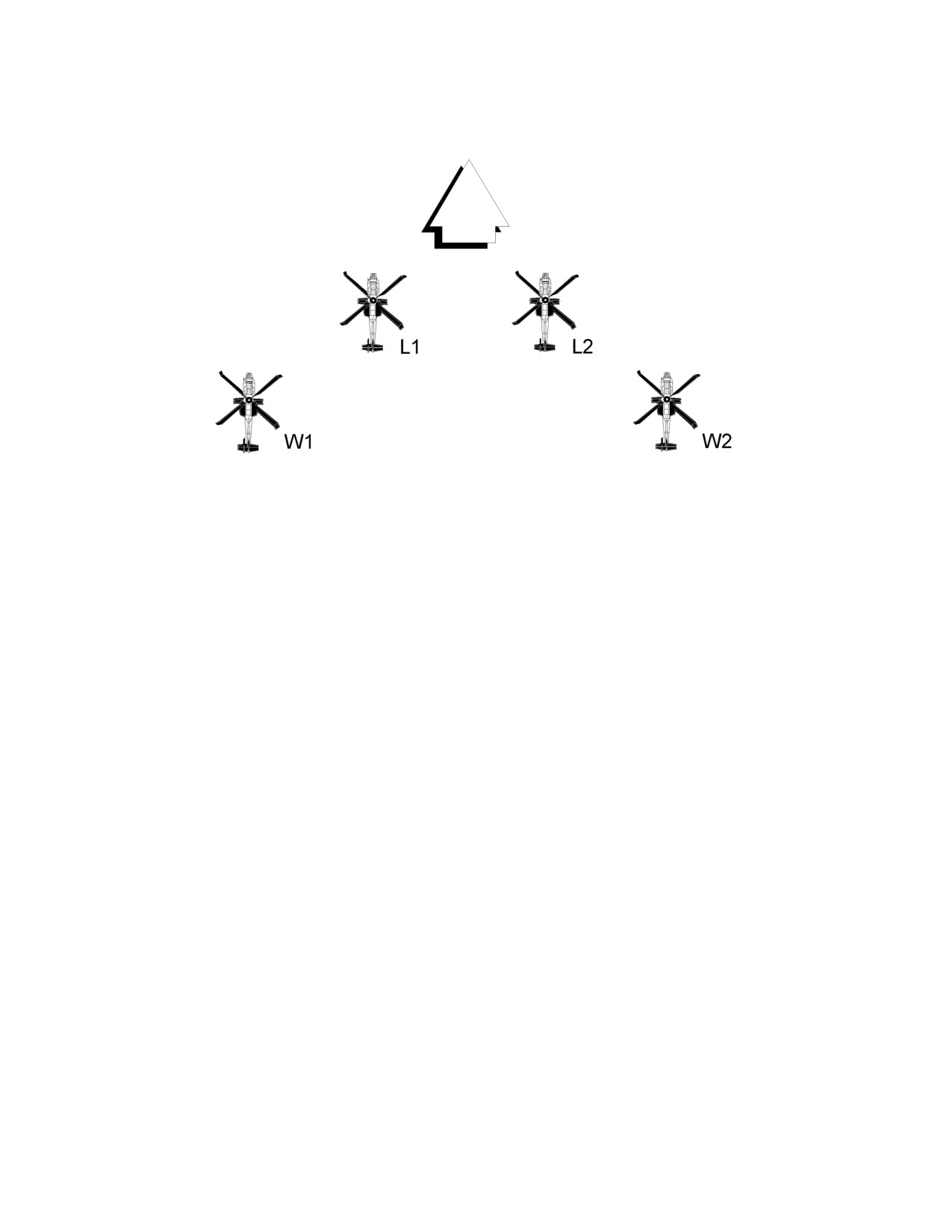
(1) Staggered. The staggered column is normally the formation of choice for
movement in the attack helicopter platoon and company. This formation allows team
integrity, while maintaining separation between elements. The staggered column is used
as a general purpose travelling and travelling overwatch formation when the terrain
allows for dispersion and allows the commander to array his aircraft to the left of right of
the lead aircraft, also known as "staggered right" and "staggered left". (NOTE: Staggered
right is particularly well-suited for AH-64s conducting night system flight. It allows the
pilot's unaided (left) eye to watch the lead aircraft's position lights while the aided (right)
eye focuses on the night system display.)
(a) The staggered column formation has advantages. It provides
excellent control. It provides excellent firepower to the flanks. It facilitates rapid
deployment to other formations. It also facilitates rapid movement. The dispersion and
depth increases security against enemy air and ground attacks.
(b) The staggered column formation has disadvantages. It provides
limited firepower forward. C2 is difficult as the formation elongates.
(c) An example of a staggered formation is shown in Figure 3-19.
3-34
FM 1-112
Figure 3-19. Example of a staggered formation
(2) Wedge. The wedge formation may be used when a platoon or company is
providing overwatch for another element (for example, acting as an advanced guard for an
air movement) and the terrain is open or rolling. The wedge formation is formed by two
combat-cruise formations (a left cruise on the left and a right cruise on the right).
(a) The wedge has advantages. It permits excellent fire to the front and
good fire to each flank when leading ground maneuver formations, other aviation
elements, and convoys. It allows the platoon leader excellent observation up front while
being covered by a wingman.
(b) The wedge has disadvantages. It requires lateral space for
movement; therefore, it is difficult to use in closed terrain. It may expose the entire
platoon to enemy fire simultaneously.
(c) An example of a wedge formation is shown in Figure 3-20.
3-35
FM 1-112
Figure 3-20. Example of a wedge formation
(3) Combat trail. The combat trail formation is used most often when
passing through defiles or close terrain, during air movements, and during movements
whenspeed is required. The combat trail formation is formed by two free-cruise
formations (one behind the other).
(a) The combat trail formation has advantages. It provides good C2 and
speed when closing a large number of helicopters on an objective in a short period of time.
It allows rapid movement through rugged, closed terrain. It provides ample maneuver
room for actions on contact. It also is less fatiguing to crews because they do not have to
concentrate on rigid aircraft orientation, particularly in poor weather.
(b) The combat trail has disadvantages. It provides minimal firepower
forward. It is less secure than other formations because of the lack of depth. It may
cause disorientation during night flights due to the lack of depth of field in NVDs. In
addition, this is a very difficult formation to maintain during night landings because rate
of closure is difficult to judge.
(c) An example of a combat trail formation is shown in Figure 3-21.
(4) Echelon. The echelon formation is normally used during travelling
overwatch, when speed is required. The echelon formation allows the platoon leader to
array his aircraft to the left of right of the lead aircraft. Normally, the platoon leader and
his wingman lead, followed by the team leader and wingman. This formation is used in
situations the tactical situation does not favor a trail formation, and firepower must be
focused forward.
3-36