FIELD MANUAL FM 1-112 ATTACK HELICOPTER OPERATIONS (April 1997) - page 1
FM 1-112
ATTACK HELICOPTER
OPERATIONS
DISTRIBUTION RESTRICTION: Approved for public release; distribution unlimited.
HEADQUARTERS, DEPARTMENT OF THE ARMY
*FM 1-112
FIELD MANUAL
HEADQUARTERS
No. 1-112
DEPARTMENT OF THE ARMY
Washington, DC, 2 April 1997
ATTACK HELICOPTER OPERATIONS
CONTENTS
Paragraph
Page
Preface
v
Chapter 1
ATTACK HELICOPTER FUNDAMENTALS
Roles of the ATKHB
1-1
1-1
Organization
1-2
1-8
Missions, Organizational Capabilities, and
Limitations
1-3
1-12
Chapter 2 BATTLE COMMAND
Command and Control Duties and Responsibilities
2-1
2-1
Command Relationships
2-2
2-7
IPB Process
2-3
2-7
Command and Control Process
2-4
2-9
Command Posts
2-5
2-12
Command Communications Systems
2-6
2-14
Communications
2-7
2-18
OPSEC
2-8
2-18
Chapter 3 EMPLOYMENT
Section I. Organization and Roles
Organization
3-1
3-1
Roles and Responsibilities
3-2
3-6
Section II. Terms and Missions
Operational Terms
3-3
3-9
Employment Methods
3-4
3-14
DISTRIBUTION RESTRICTION: Approved for public release; .distribution is unlimited.
*This publication supersedes FM 1-112, 21 February 1991.
i
FM 1-112
Paragraph
Page
Section III. Environmental Considerations
Environmental Factors
3-5
3-17
Section IV. Movement to the Objective Area
Preparation For Movement
3-6
3-24
Movement
3-7
3-28
Occupation of the BP/SBF Position and ABF
Position
3-8
3-41
Section V. Objective Area Overview
EA Planning
3-9
3-44
Principles of Direct Fire
3-10
3-45
Principles of Fire Control
3-11
3-46
Section VI. EA Development
Step 1. IPB
3-12
3-48
Step 2. Select the Ground for the Attack
3-13
3-49
Step 3. Integration of the EA
3-14
3-50
Section VII. Direct Fire Planning
Step 4. Planning the Direct Fire Fight
3-15
3-55
Step 5. Fire Commands
3-16
3-56
Step 6. Reviewing the Plan
3-17
3-61
Step 7. Rehearsing the Plan
3-18
3-62
Step 8. Executing the Plan
3-19
3-62
EA Development/Direct Fire Summary
3-20
3-63
Section VIII. Completing the Engagement
Breaking Contact
3-21
3-64
Egress Operations
3-22
3-66
Restoration
3-23
3-67
Section IX. Other Operations
Reconnaissance and Security
3-24
3-68
JAAT
3-25
3-71
ii
FM 1-112
Paragraph
Page
Chapter 4
COMBAT SUPPORT
Fire Support
4-1
4-1
IEW Operations
4-2
4-12
AD
4-3
4-14
Engineer Support
4-4
4-19
NBC Support
4-5
4-19
Chapter 5
COMBAT SERVICE SUPPORT
Planning and Coordination
5-1
5-1
Fuel and Ammunition Requirements
5-2
5-2
FARPs
5-3
5-2
Vehicle and GSE Maintenance
5-4
5-2
Aircraft Support
5-5
5-2
Transportation Requirements
5-6
5-5
Personnel Services
5-7
5-5
Field Services
5-8
5-7
Chapter 6
STABILITY AND SUPPORT OPERATIONS
Operational Concept
6-1
6-1
Principles of SASO
6-2
6-1
Employment Guidelines
6-3
6-1
Types of Operations
6-4
6-2
Lessons Learned
6-5
6-3
Appendix A.
ATTACK AIRCRAFT CHARACTERISTICS
A-1
Appendix B.
AIR ASSAULT SECURITY
B-1
Appendix C.
SAMPLE ORDER AND MISSION BRIEFING
FORMATS
C-1
Appendix D.
UNIT MOVEMENT
D-1
Appendix E.
TACTICAL STANDING OPERATING
PROCEDURES
E-1
Appendix F.
AIR COMBAT
F-1
Appendix G.
ASSEMBLY AREA OPERATIONS
G-1
iii
FM 1-112
Appendix H. DEEP OPERATIONS BY KIOWA WARRIOR ATTACK
HELICOPTER BATTALIONS
H-1
APPENDIX I. THEATER MISSILE DEFENSE--SEARCH AND ATTACK
I-1
Glossary
Glossary-1
References
References-1
Index
Index-1
iv
FM 1-112
PREFACE
This manual is the Army's doctrinal manual for attack helicopter operations. It is
designed to assist attack helicopter commanders, their staffs, and subordinate company
commanders in the conduct of training and combat operations. It also serves as a guide
for corps, division, and brigade commanders and their staffs. This manual discusses the
organization, capabilities, and employment of attack helicopter units.
This manual incorporates current Army doctrine based on FM 100-5. It describes the ARI
force structure and the associated TTP based on currently fielded systems. It is
recognized that the fielding of the Army's planned digital information systems and
modern aircraft, such as the AH-64D, will alter the TTP in this manual. During this
transition to the future, lessons learned, equipment upgrades, and digital TTP will be
captured and incorporated into the next edition of this manual.
This manual sets forth doctrinal principles that guide the conduct of light and heavy
attack helicopter operations. It addresses specific TTP to clarify or emphasize these
principles. Users must apply this doctrine within the capabilities and limitations of their
units and develop SOPs that address specific techniques and procedures.
The proponent of this publication is HQ TRADOC. Send comments and recommendations
on DA Form 2028 (Recommended Changes to Publications and Blank Forms) to the
Commander, United States Army Aviation Center and Fort Rucker, ATTN: ATZQ-TDS-D
(FM 1-112), Fort Rucker, AL 36362-5092.
Unless stated otherwise, masculine nouns and pronouns do not refer exclusively to
men.
This publication has been reviewed for OPSEC considerations.
v
FM 1-112
This publication implements the following international agreements:
STANAG 2019 (Edition Three)
Military Symbols for Land Based
and QSTAG 509
Systems--APP-6
STANAG 2041 (Edition Four)
Operations Orders, Tables and
and QSTAG 520
Graphics for Road Movement
STANAG 2404
Joint Anti-Armor Operations
(Draft)
STANAG 2868 (Edition Four)
Land Force Tactical Doctrine--
ATP-35(A)
STANAG 2889 (Edition Three)
Marking of Hazardous Areas and
and QSTAG 742
Routes Through Them
STANAG 2999 (Edition One)
Use of Helicopters in Land
Operations--ATP-49
STANAG 3497 (Edition One)
Aeromedical Training of Aircrew in
Aircrew NBC Equipment and
Procedures
QSTAG 277 (Edition Three)
Procedures for the Employment of
Helicopters in the Antiarmor Role
vi
FM 1-112
CHAPTER 1
ATTACK HELICOPTER FUNDAMENTALS
Attack helicopter battalions are assigned to divisional aviation brigades and corps
ATKHRs (in corps aviation brigades). They provide the supported commander a highly
mobile and lethal armor, personnel, and materiel destruction capability during the day
and night. This chapter explains what an ATKHB is, how it is organized for the different
types of divisions and the corps ATKHRs, and its organizational capabilities and
limitations.
1-1. ROLES OF THE ATKHB
a. General.
(1) The ATKHB is an aerial maneuver unit usually employed as a battalion.
It conducts attack, reconnaissance, and security operations that complement other
maneuver forces. The ATKHB enables the supported commander to mass combat power
rapidly at the decisive time and place to affect a battle's outcome. The commander must
integrate the ATKHB into his tactical maneuver plan with other maneuver units. When
employed with other combat assets, the ATKHB can strike the enemy where and when it
is most vulnerable.
(2) An ATKHB never fights alone. Attacks are coordinated with other
maneuver, combat support, CSS, and joint forces to form a combined arms team. This
team surprises and overwhelms the enemy at the point of attack. Attacks may be
conducted out of physical contact with other friendly forces but synchronized with their
scheme of maneuver, or they may be in direct contact with friendly forces.
b. Tenets of Army Operations. Success on future battlefields depends on how
well the tenets of Army operations doctrine are applied. These tenets are initiative,
depth, agility, synchronization, and versatility. General aviation employment principles
as related to these tenets are discussed in depth in FM 1-111, Aviation Brigade
Operations, Chapter 1. Application of these tenets as related to the ATKHB are discussed
below.
(1) Initiative. Attack helicopters are offensive weapon systems. They
provide commanders the means to deliver massed firepower rapidly and accurately, thus
disorganizing enemy forces and allowing the friendly force to gain or maintain the
initiative. To be successful, the ATKHB must be integrated into the ground commander's
scheme of maneuver. This requires that commanders analyze the battlefield and decide
early where the ATKHB will be employed.
1-1
FM 1-112
(2) Depth. The ATKHB can attack the enemy forces anywhere on the
battlefield. Commanders must see and use the entire battlefield to strike the enemy and
prevent it from concentrating forces at a point of its choice. The speed with which attack
helicopters can mass combat power at chosen points in the battle area allows the force
commander to influence the battle to a depth that would otherwise be beyond his reach.
(3) Agility. The mobility and flexibility of attack helicopters expand the
reach of commanders to all areas of the battlefield. Terrain provides cover and
concealment for attack helicopters just as it does for armor and infantry; however, it does
not limit the mobility of the helicopter. The ATKHB can attack the enemy's flanks and
rear, thus providing ground forces the time to maneuver and engage enemy forces from
directions where they are most vulnerable.
(4) Synchronization. To survive and succeed on the battlefield, the
ATKHB must fight as an integrated member of the combined arms team. In combat, the
fires of other attacking weapons enhance the firepower of the attack helicopter. This
combined attack strengthens the total force by overcoming limitations found in each
weapon system. As a result, total combat power is increased and survivability is
improved. When the enemy is simultaneously faced with an array of armor, infantry, FA,
TACAIR, and attack helicopter units, it can no longer concentrate on countering a single
set of weapons from one direction at a time. Rather, it is attacked throughout its depth
with a variety of weapons.
(5) Versatility. On today's and tomorrow's battlefields, the tempo of the
fight is rapid, violent, and extremely fluid. The ATKHB's primary mission is the
destruction of enemy armor or mechanized forces. The ATKHB, however, must be
prepared to conduct reconnaissance and security operations. Additionally, in OOTW, a
subversive or less distinguishable enemy may require the ATKHB to provide direct or
indirect fires in DS of friendly ground forces operating in an urban environment. The
ability of the ATKHB to transition smoothly and rapidly is the result of well-led, well-
trained, and well-equipped forces; high standards; and detailed planning. While the
ATKHB can react quickly, it requires as much mission planning time as other maneuver
battalions.
c. Framework of the Battlefield. The Army's warfighting doctrine specifies
that deep, close, and rear operations occur simultaneously. An ATKHB can conduct all
three during offensive and defensive operations. An ATKHB conducting deep operations
allows corps and division commanders to influence close operations before the enemy
closes with friendly forces. During the conduct of close operations, an ATKHB allows
corps and division commanders to weigh their main effort and brigade commanders to
attack the enemy in depth. An ATKHB also gives corps and division commanders the
ability to mass combat power rapidly against enemy ground penetrations and large air-
borne or heliborne assaults into the corps or divisional rear area.
1-2
FM 1-112
d. Attack Helicopters in Combat Operations. The force commander's
assessment of the factors of METT-T influence the missions that are assigned to the
ATKHB. With the ATKHB commander's assistance, the force commander determines
where the ATKHB will be used. From the force commander's mission and intent, the
ATKHB commander determines how the battalion will be employed. Some of the force
commander's options for employing the ATKHB are--
(1) To attack massed armored or light forces.
(2) To attack in depth to extend the influence of the force.
(3) To dominate avenues of approach.
(4) To reinforce ground forces by fire.
(5) To mass to defeat enemy penetrations.
(6) To attack to protect the flanks of a moving or halted friendly main body.
(7) To provide security for the movement and passage of lines by ground
forces.
(8) To conduct reconnaissance.
(9) To perform search and attack missions.
e. Role in the Offense.
(1) Destroying the enemy's fighting force is the only sure way of winning any
future conflict. The operational concepts of offensive operations are concentration,
surprise, speed, flexibility, and audacity. The ATKHB gives the maneuver commander,
who conducts offensive operations, a viable force that can rapidly concentrate firepower at
the decisive time and place.
(2) Corps and divisions use five complementary elements in fighting offen-
sive battles. These elements are--
(a) Main and supporting attacks.
(b) A reserve in support of an attack.
(c) Reconnaissance and security operations forward, to the flanks, and
to the rear of attacks.
(d) Deep operations.
1-3
FM 1-112
(e) Rear operations.
(3) ATKHBs can operate as part of each of these elements by conducting
attacks, reconnaissance, and security operations. As part of the five elements, they can
act as part of the main attack force by conducting deliberate attacks. The ATKHB can
also conduct supporting attacks by cutting off enemy reinforcements and acting as part of
the reserves, ready to weigh the main effort and to exploit success.
f.
Forms of the Offense.
(1) Movement to contact. A movement to contact is used to gain or
reestablish contact with the enemy. It may be used when contact with the enemy has
been temporarily lost, or it may be used to initiate an attack. A movement to contact
helps develop the situation and maintain the commander's freedom of action. During a
movement to contact, the ATKHB operates with ground forces and is critical to the
success of the advance forces and the main body. A movement to contact often results in
a meeting engagement; that is, forces engage each other by chance rather than by design.
As part of the covering force or advance guard, the ATKHB can destroy forward enemy
elements identified by reconnaissance, air cavalry or ground forces. The mobility and fire-
power of the ATKHB will permit the main body commander to overwhelm the enemy and
maintain the initiative. This means that the commander will not have to pause and
marshal the necessary ground combat power to attack.
(a) As part of the advance guard, the ATKHB is used to attack enemy
forces that are attempting to disrupt friendly operations. The ATKHB will operate from
successive FAAs located along the axis of advance. As lucrative targets of opportunity are
identified by other members of the advance guard, the ATKHB maneuvers to conduct
hasty attacks to destroy or disrupt them. The battalion plans these hasty attacks using
the IPB process. The ATKHB may also perform search and attack missions during a
movement to contact. This technique is used when the enemy situation is vague and the
area of operations is large.
(b) When the ATKHB is employed as part of the main body, it will
exploit enemy weaknesses and attack counter-attacking forces, and operate from
successive FAAs. The ATKHB then will maneuver to reinforce attacking ground forces or
attack advancing or withdrawing enemy forces.
(c) When planning to operate as part of a movement to contact, the
ATKHB commander looks at possible EAs along the entire axis of advance and their
associated holding areas, attack routes, and attack by fire positions.
(2) Attack. The two types of attacks for attack helicopters are the hasty
attack and the deliberate attack. Each is discussed in the paragraphs that follow.
(a) Hasty attack. A hasty attack is an operation for which a unit has
not made extensive preparations. It is conducted with the resources immediately
1-4
FM 1-112
available to maintain momentum or take advantage of the enemy situation. Hasty
attacks are normally conducted as a branch to a deliberate attack or a reconnaissance or
security operation. For attack helicopters, a hasty attack is made on an enemy force to
retain the momentum of the entire force. Hasty attacks conducted by the ATKHB are
made with the foreknowledge of where the EAs and battle positions are located. The
exact time, EA, and the threat to be encountered during the attack, however, are not
known until shortly before the mission.
(b) Deliberate attack. A deliberate attack is conducted against an
enemy that is well-organized and cannot be turned or bypassed. It is planned and
carefully coordinated with all concerned elements. The deliberate attack is based on a
thorough reconnaissance, an evaluation of all available intelligence and relative combat
strength, an analysis of various courses of action, and other factors affecting the situation.
To conduct a successful deliberate attack, the ATKHB is integrated with the overall force
scheme of maneuver. The ATKHB provides a mobile and flexible combat capability and
can execute contingency plans as well as attacks that support the main effort. During a
deliberate attack, the ATKHB can conduct attacks on enemy C2 facilities and on
counterattacking or withdrawing enemy forces.
(3) Exploitation. An exploitation usually follows a successful attack and is
made to take advantage of weakened or collapsed enemy defenses. It prevents the enemy
from reorganizing a defensive system or conducting an orderly withdrawal. An
exploitation also is conducted to secure deep objectives. During an exploitation, an
ATKHB is employed as part of a larger force. The ATKHB strikes the enemy's flanks and
rear areas disrupting its withdrawal and attempts to reorganize. The ATKHB operates as
in a movement to contact by following the ground forces and is prepared to conduct hasty
attacks on counterattacking and withdrawing enemy forces. The ATKHB can also conduct
deep attacks to further disrupt the enemy.
(4) Pursuit. A pursuit is an offensive operation taken after a successful
attack or developed during an exploitation. The pursuit takes advantage of enemy
weaknesses and its inability to establish an organized defense. As the enemy attempts to
disengage, friendly forces maintain relentless pressure in an attempt to destroy enemy
forces completely. A pursuit requires unrelenting pressure, speed, mobility, and firepower
to complete the enemy's destruction. The ATKHB is an essential element in the pursuit.
As ground forces attempt to maintain contact and flank the enemy, the ATKHB and air
assault forces can maneuver deep to cut off the enemy as it attempts to withdraw. The
ATKHB and air assault forces also can block entry to relieving enemy forces and can
attack retreating enemy forces, which further deteriorates their situation. Repeated
attacks by the ATKHB will quicken the disintegration of enemy forces and will destroy
their will to fight. C2 during a pursuit is critical. Commanders must coordinate the
pursuit by ground forces and the ATKHB to ensure success during a rapidly changing
combat environment. Communications may become difficult or be broken. When this
occurs, commanders must act quickly to reestablish communications and ensure
coordination between air and ground maneuvers.
1-5
FM 1-112
g. Forms of the Defense.
(1) A successful defense requires active and passive elements working
together to regain the initiative. The objective of a defensive operation is to cause the
enemy attack to fail; preserve the force, facilities, and installations; control key terrain;
gain time; or concentrate forces elsewhere. Other objectives may be to retain captured
terrain and degrade enemy forces so that offensive operations can be resumed. Successful
defensive operations depend on--
(a) Synchronizing all available combat capabilities.
(b) Seizing the tactical initiative locally and then generally as the entire
force shifts from defense to offense.
(c) Fighting the enemy throughout the depth of its formations to delay
and disorganize it and create opportunities for offensive actions.
(2) The ATKHB normally participates in two types of defense--the mobile
defense and the area defense. The ATKHB uses its mobility and long range observation
and engagement capabilities to deny terrain to the enemy, as well as support the ground
defense with direct fires.
(a) Area defense. ATKHBs normally conduct an area defense when
directed to defend specified terrain, when the enemy enjoys a mobility advantage over the
defending force, when well-defined avenues of approach exist, and the defending force has
sufficient combat power to cover the likely enemy avenues of approach in sector. The
orientation of the area defense is to deny the enemy designated terrain. Maneuver within
an area defense usually consists of repositioning between defensive positions or within
sectors and counterattacks. A perimeter defense is a form of area defense, oriented in all
directions.
(b) Mobile defense. ATKHBs conduct a mobile defense by allowing
the enemy force to advance to a point where it is exposed to a decisive attack by a striking
force. The end state of the mobile defense is destruction of the enemy force. The
commander conducts a mobile defense by organizing his force into two subunits: a fixing
force and a striking force. The fixing force shapes the penetration or contains the enemy
advance, while the striking force conducts the decisive attack.
h. Deep Operations.
(1) Deep operations, or raids, are activities directed against enemy forces
that currently are not engaged but that could influence division or corps close operations
within the next 24 to 72 hours. The ATKHB will conduct deep operations at corps and
divisional levels. Deep attacks by corps ATKHBs help the corps commander to shape the
battlefield and set the terms for close operations. Deep attacks conducted by divisional
ATKHBs help the division commander to shape the battlefield and are used to allow
1-6
FM 1-112
defending maneuver brigades to engage the enemy throughout its depth. Deep operations
will occur during both friendly offensive and defensive operations.
(2) Deep operations are high-risk, high-payoff operations that must be
executed with the utmost care. Planning and IPB must be detailed and as precise as
possible to allow the ATKHB to accomplish its mission with the least amount of risk. The
ATKHB itself is a high value/high payoff target (HVT/HPT). To send it deep requires the
recognition that the target is worth the expenditure of the ATKHB and the combat
support elements that it takes to accomplish the mission.
i.
Close Operations.
(1) The ATKHB may be part of the larger force's security operation as a
member of a covering force. The ATKHB is the primary force that ensures that the
covering force commander can retain the spirit of the offense. Because of the speed and
flexibility of the ATKHB, it can rapidly concentrate combat power throughout the covering
force area. The ATKHB attacks to accomplish the objectives of the covering force
commander. Employed well forward, it operates out of FAAs in the rear of the covering
force area. At corps level, the ATKHB may be attached or placed under the OPCON of
armored cavalry regiments to increase their long-range antiarmor fires. At divisional
level, the ATKHB is the primary long-range armor killer.
(2) Once the fight has moved into the main battle area, the commander
should use the ATKHB against the enemy's main effort. To take decisive offensive action,
supported commanders can retain their ATKHBs as part of their reserve. An ATKHB
should not be held in reserve to redeem failure. The commander commits the ATKHB at
a decisive place to exploit success or ensure accomplishment of the mission. Using an
ATKHB during the defense often comes as part of a counterattack. The ATKHB
counterattacks along with other maneuver forces to strike the enemy throughout the
depth of the battlefield and help the force seize the initiative.
(a) Attacking enemy second echelon battalions and regiments.
While ground units engage the enemy from battle positions where they can range the
leading elements of the enemy attack, the ATKHB maneuvers to attack the enemy's
follow-on battalions and regiments simultaneously. Thus they attack the enemy
throughout its depth.
(b) Massing to defeat enemy penetrations. ATKHBs attack enemy
penetrations along with other maneuver forces to defeat them and restore the FLOT.
While other maneuver forces attack the head of the penetration, the ATKHB attacks the
penetration in depth, denying the enemy commander the opportunity to mass, bypass, or
withdraw. Once the enemy is encircled, the ATKHB can attack enemy breakouts or any
other forces that may attempt to relieve the encircled enemy force.
(c) Attacking to defeat enemy flanking forces. The ATKHB can be
used to dominate avenues of approach into the rear and flanks of friendly forces. The
1-7
FM 1-112
ATKHB will reinforce the flank screen or guard to defeat the threat to the flanks of the
main body.
j.
Rear Operations.
(1) Rear operations are conducted to assure freedom of maneuver and
operational continuity from the corps rear boundary forward to the rear boundaries of
committed maneuver units. ATKHBs, along with ground forces, may be given on-order
missions to act as rapid reaction forces for Level II or III incursions into brigade, division,
or corps rear areas. The ATKHB can rapidly react to enemy heliborne or airborne
operations into the friendly force's rear area. The ATKHB should attempt to attack the
enemy force in its assembly area or just as it arrives in its LZ. The ATKHB is especially
valuable in rear operations when the enemy has air-landed or air-dropped light armored
vehicles.
(2) Once the enemy force has dispersed, the ATKHB becomes less effective in
the fight. Major mechanized incursions into the rear area are attacked in the same
manner as they are during close or deep operations. The ATKHB attacks until the force
commander can respond with additional forces to defeat the penetration. During rear
operations, coordination between artillery, ADA, CAS, and ATKHBs must be accomplished
by liaison officers working in the divisional and corps rear operations cell of the rear
command post.
(3) Care must be taken to ensure the targets the ATKHB will attack are
positively identified. Rear area commanders must coordinate closely with the supporting
ATKHB to identify the locations of the enemy forces and provide control measures to
deconflict friendly fires. Target handovers to elements of the ATKHB should be made by
friendly forces in contact with the enemy.
1-2. ORGANIZATION
a. Heavy Division. The aviation restructure initiative allocates two ATKHBs
per heavy division, one active duty and one Reserve or National Guard. Each battalion is
pure AH-64 or AH-1, equipped with 24 attack helicopters in three companies of eight
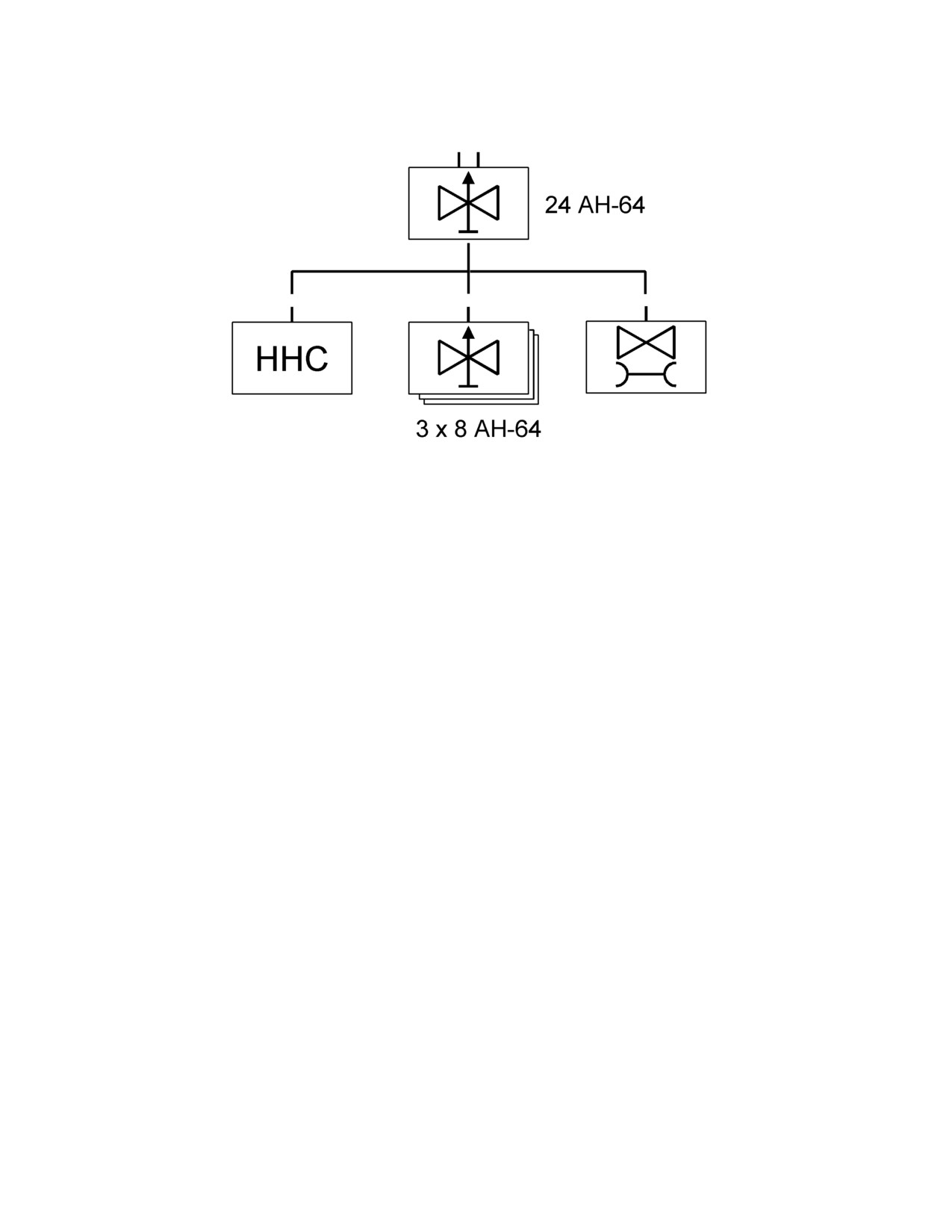
each. The battalion also includes a HHC and AVUM company. (See Figure 1-1).
(1) The HHC provides C2, logistics support, and ground maintenance support
for the battalion. The headquarters section consists of the battalion commander, his staff,
and staff sections. The HHC consists of a company headquarters, a supply section, an
automotive maintenance section, a mess section, a battalion communications section, a
medical treatment section, and a Class III/V platoon. To exercise C2 during the mission,
the battalion commander (or S3) may fly an AH-64, fly in the back of a UH-60, or C2 from
a ground TAC. The aviation brigade general support
1-8
FM 1-112
Figure 1-1. Heavy division ATKHB
aviation battalion will provide utility aircraft for the ATKHB's C2, CS, CSS, and combat
search and rescue requirements as directed by the brigade commander.
(2) The AVUM company provides unit-level maintenance for battalion
aircraft. The company consists of a company headquarters, a quality assurance section,
an aircraft maintenance section, and an aircraft component repair section.
(3) The three ATKHCs provide the ATKHB with an antiarmor, antipersonnel
and antimateriel capability. Each company consists of a headquarters section, a scout
platoon with three aircraft, and an attack platoon with five aircraft. The commander may
task organize his company as he sees fit to accomplish the mission. With eight aircraft
per ATKHC, commanders should plan for six aircraft available (75-percent FMC rate) for
missions. The two-ship "lead-wingman" team provides a high degree of task organization
options, mission flexibility, and mutual support between teams. This also simplifies C2 for
the ATKHC commander by putting a platoon leader in each team while the company
commander flies as a member of the third team, positioning himself as he sees fit to
employ his company and fight the battle.
b. Light Division.
(1) The light division has one ATKHB organized the same as the heavy
division (HHC, AVUM, and three ATKHCs) except the light division is equipped with OH-
58D Kiowa Warriors or AH-1s. In the HHC, mess (Class I), fuel (Class III), and
ammunition (Class V) are provided by the aviation brigade HHC.
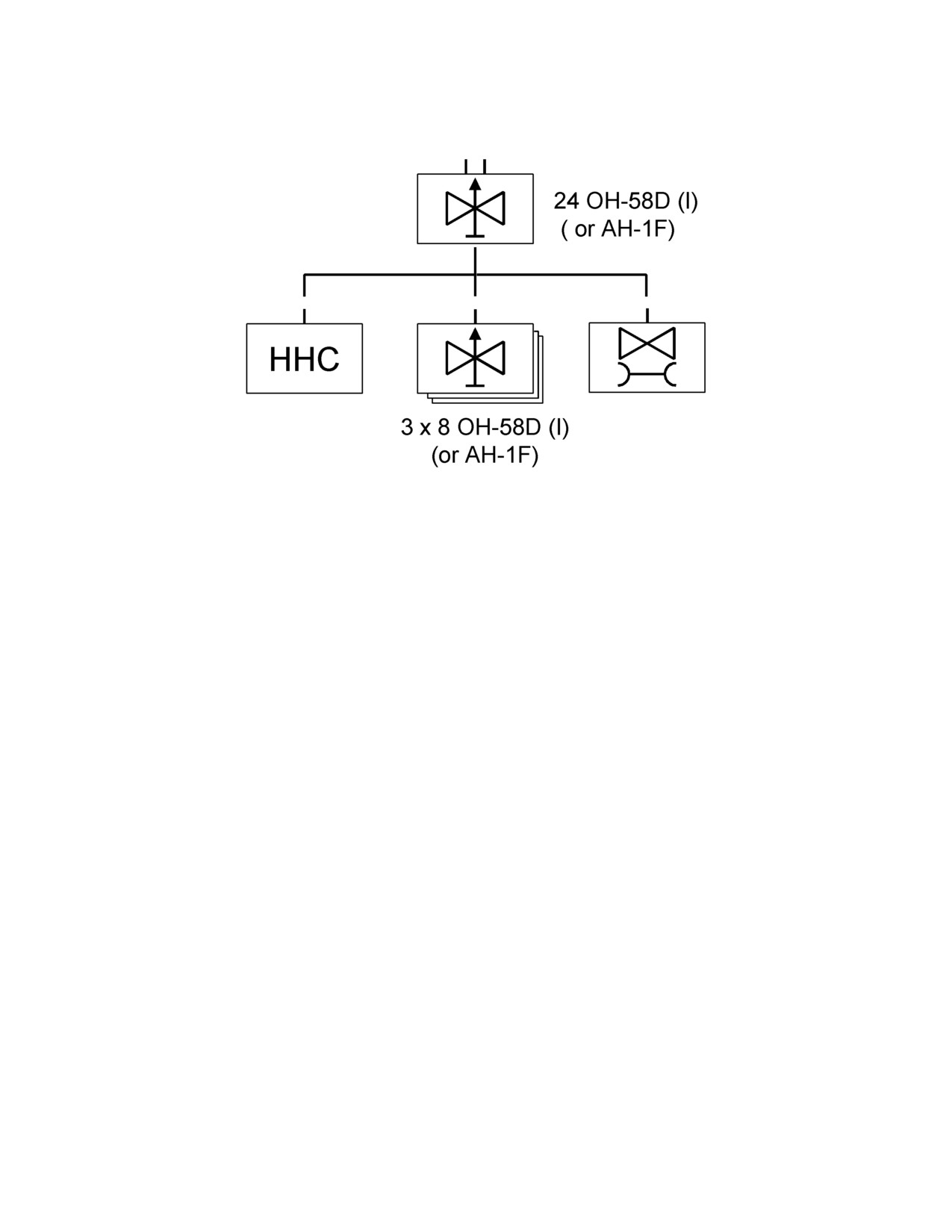
(See Figure 1-2).
1-9
FM 1-112
Figure 1-2. Light division ATKHB
(2) The brigade must support the aerial movement of all classes of supply
since there are no utility aircraft in the ATKHB. C2 issues are the same as in the heavy
division. The aviation brigade's AHB will provide utility aircraft, C2, CS, CSS, and CSAR
for the ATKHB's requirements as directed by the brigade commander.
c. Air Assault Division.
(1) The air assault division is authorized three ATKHBs equipped with AH-
64s. The battalion organization is the same as the heavy division (HHC, AVUM, and
three attack companies).
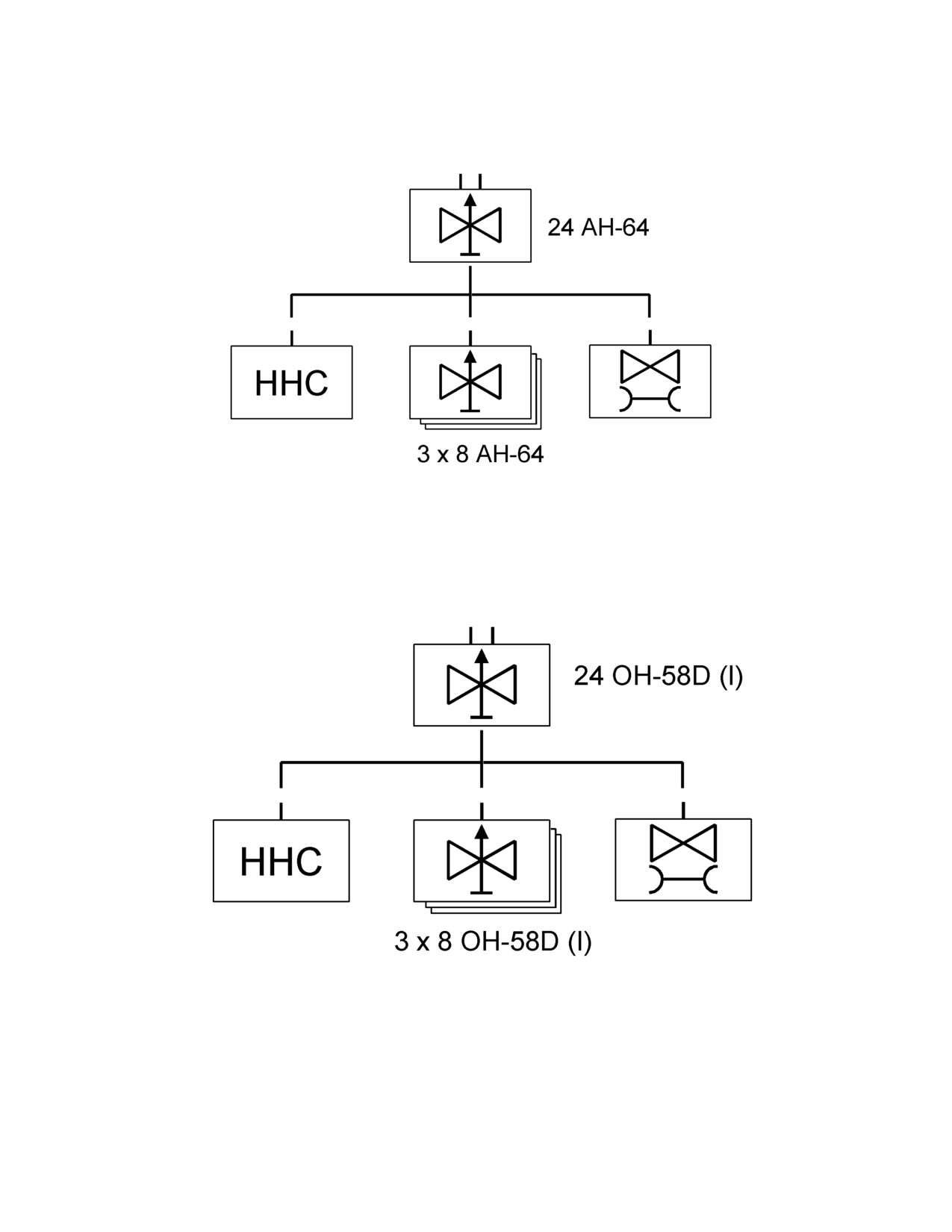
(See Figure 1-3).
(2) To exercise C2 during the mission, the ATKHB commander (or S3) may
fly an AH-64, fly in the back of a UH-60 or command from a ground TAC. The aviation
brigade CAB will provide utility aircraft for the attack battalion's C2, CS, CSS, and CSAR
requirements as directed by the brigade commander.
d. Airborne Division.
(1) The airborne division has one ATKHB organized the same as the light
division (HHC, AVUM, and three attack companies), equipped with OH-58D Kiowa
Warriors. In the HHC, mess (Class I), fuel (Class III), and ammunition (Class V) are
provided by the aviation brigade HHC.
(See Figure 1-4).
1-10
FM 1-112
Figure 1-3. Air assault division ATKHB
Figure 1-4. Airborne division ATKHB
1-11
FM 1-112
(2) The brigade must support the aerial movement of all classes of supply
since there are no utility aircraft in the ATKHB. C2 issues are the same as in the heavy
division. The aviation brigade's AHB will provide utility aircraft, C2, CS, CSS, and CSAR
for the ATKHB's requirements as directed by the brigade commander.
e. Corps Attack Regiment.
(1) The ATKHR of the corps aviation brigade is normally allocated three AH-
64 equipped battalions. The battalion organization is the same as the heavy division
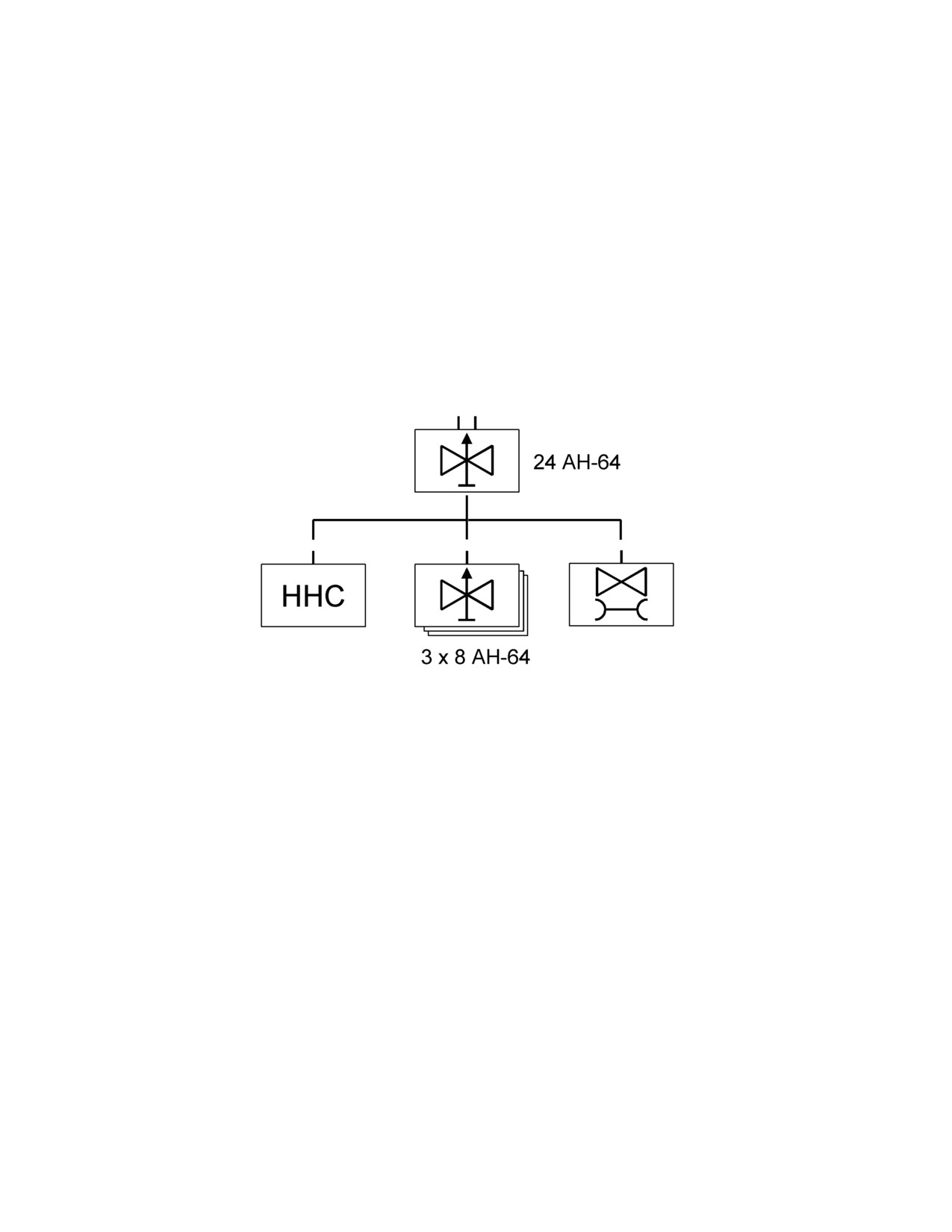
(HHC, AVUM, and three attack companies). (See Figure 1-5).
Figure 1-5. Corps ATKHB
(2) The brigade must support the aerial movement of all classes of supply
since there are no utility aircraft in the ATKHB. C2 issues are the same as in the heavy
division. The aviation brigade's CAB will provide utility aircraft for the attack battalion's
C2requirements while the combat support aviation battalion will provide utility aircraft
for CS, CSS and CSAR.
1-3. MISSIONS, ORGANIZATIONAL CAPABILITIES, AND LIMITATIONS
a. Missions.
(1) The primary mission of an ATKHB is to destroy enemy forces using fire,
maneuver, and shock effect. To accomplish this mission the ATKHB attacks the enemy to
destroy, attrit, disrupt, or delay. It may also conduct other offensive operations, as well
as reconnaissance, security, and defensive operations.
1-12
FM 1-112
(2) The ATKHB is most effective against massed, moving targets and least
effective against enemy forces in prepared, well-camouflaged positions. Without the
support of ground maneuver forces, the ATKHB cannot conduct missions that require the
occupation of terrain. They can, however, deny the enemy terrain for a limited time by
dominating it with direct and indirect fires.
(3) The ATKHB mission is the same for all ATKHBs, regardless of the type
of division or corps to which assigned. However, depending upon the type of division or
level or assignment, employment criteria, mission priorities, and target priorities may
vary greatly.
(4) The mission and the commander's intent specifies the mission success
criteria. This criteria allows subordinate commanders to assess whether or not the
mission has been accomplished at the completion of the engagement. An example of a
mission statement is:
At 221700Z MAR 96, 1-112th ATKHB occupies FAA ROOSEVELT (QS 12341234).
On order, attack to attrit the 25th TR in EA THUNDER (RS 987123, RS 123456,
RS 234567, RS 567890) to delay the enemy's advance east of the Silver River
crossing.
(5) The mission statement must include a concise "why" to fully define
success. Given the wide variety of potential enemies and potential theaters of operations,
the ATKHB commander must base his unit's mission statement and his intent's end state
on a thorough IPB. Based on the IPB, the commander must also articulate an endstate
that is understandable and can be quantified on the battlefield. For example, "of the 30
trucks identified in the convoy,
20 must be destroyed for mission success."
(6) The following are examples of the "what" in the ATKHBs mission
statement. Included is the risk assumed by the ATKHB in accomplishing each attack
mission. Also included is planning guidance for quantifying the attack mission
statement's "why" and, based on the desired effect on the enemy, the end state portion of
the commander's intent.
(a) Attack to destroy. This is a high-risk mission for the ATKHB.
When given the mission to attack to destroy, the ATKHB uses direct and indirect fires to
physically render an enemy force combat-ineffective unless it is reconstituted. The
ATKHB must attack the enemy force with enough combat power to accomplish the
mission and meet the commander's intent. To accomplish this mission, the ATKHB must
accept a substantial risk that may cause it to become combat ineffective at the completion
of the attack.
(b) Attack to attrit. This is a high- to medium-risk mission for the
ATKHB. When given the mission to attack to attrit, the ATKHB uses direct and indirect
fires to reduce the effectiveness of an enemy force caused by loss of personnel and
materiel. The ATKHB must attack the enemy force with enough combat power to
1-13
FM 1-112
accomplish the mission and meet the commander's intent. The greater the enemy force
that the ATKHB must attrit, the greater the risk the commander must accept.
(c) Attack to delay. This is a medium- to high-risk mission for the
ATKHB. When given the mission to attack to delay, the ATKHB uses direct and indirect
fires to engage the enemy, understanding that the destruction of the enemy force is
secondary to slowing his advance to gain time. The ATKHB must attack the enemy force
with enough combat power to accomplish the mission and meet the commander's intent.
The ATKHB attacks to delay the enemy's use of a geographic area (maneuver corridor,
river crossing site) for a specific period of time. The risk that the battalion accepts is
determined by the amount of time that the ATKHB must delay, location of the enemy,
and the enemy force that is encountered.
(d) Attack to disrupt. This is a medium- to low-risk mission for the
ATKHB. When given the mission to attack to disrupt, the ATKHB uses direct and
indirect fires to break apart an enemy's formation and tempo, interrupt the enemy's time
table, cause premature commitment of forces, and/or piecemeal their attack. The ATKHB
must attack the enemy force with enough combat power to achieve the desired results
with one mass attack or sustain the attack until the desired results are achieved. The
commander sets the amount of risk based on the friendly loss he is willing to accept, the
location of the attack, or the number of attacks that will be made.
NOTE: These attack criteria also apply to mission statements issued for other offensive
operations (exploitations, pursuits, or counterattacks). To the ATKHB, these missions will
most likely be conducted as attack missions, with the operation not specifically referred to
by name.
(e) Conduct reconnaissance. The ATKHB may be tasked to conduct
reconnaissance operations (zone, route, area, force oriented, or RIF). More information on
reconnaissance operations may be found in Chapter 3 and FMs 1-114 and 17-95.
(f) Provide security. The ATKHB provides security to friendly forces
as they conduct passages of lines, river crossings, air assaults, and as they maneuver in a
movement to contact. The types of security it may provide are screen, guard, cover (if
augmented), area security, and air assault security (a form of guard). It will position
itself where it can make a hasty attack to assist friendly forces to disengage or brush
aside enemy forces attempting to disrupt the operation. More information on security
operations may be found in Chapter 3 and FMs 1-114 and 17-95.
(g) Defend. The ATKHB may be tasked to conduct an area or mobile
defense in coordination with a ground force. The ATKHB will control its assets to force
the enemy to attack under unfavorable circumstances and retain decisive terrain or deny
a vital area to the enemy. More information on defensive operations may be found in
Chapter 3 and FM 17-95.
1-14
FM 1-112
(7) Figure 1-6 shows the operations and their forms that the ATKHB may
perform.
b. Capabilities. The ATKHB and other aviation assets dominate the third
dimension of the battlespace. This provides an invaluable maneuver capability to the
ground force commander. The capabilities of an ATKHB are as follows:
(1) Mobility. The ATKHB fully exploits the vertical dimension of the
battlefield. Aggressive terrain flight techniques allow the commander to rapidly place the
ATKHB at the decisive place at the optimum time. Typically, the area of operations for
an ATKHB is the entire corps or divisional sector.
(2) Speed. Attack helicopters move across the battlefield at speeds in excess
of 3 kilometers per minute. Although METT-T dependent, typical planning airspeeds are
100 to 120 knots during daylight and 80 to 100 knots at night. Speeds during marginal
weather are reduced commensurate with prevailing conditions.
(3) Range. The ATKHB can attack targets up to 150 km across the FLOT.
If greater depth is required, the addition of ERFS tanks can further extend the AH-64's
range with a corresponding reduction in Hellfire missile carrying capacity (four fewer
Hellfire missiles for each ERFS tank installed).
(4) Versatility. Under the ARI, the firepower available to the force
commander is increased but the employment concepts of the ATKHB remain the same. In
a pure attack helicopter ATKHB, the traditional scout and attack missions are no longer
aircraft dependent. During the combat decision making process, the ATKHC commander
task organizes his assets and designates specific aircraft mission responsibilities based on
METT-T. He has the flexibility to maintain the traditional scout-weapon team
employment concept or focus his assets as a pure attack force. The dual role of the
airframe, coupled with the cross training of the attack helicopter crew provide the force
commander, the ATKHB commander and the ATKHC commander a combat force which is
diverse and can meet the mission requirements in any environment, day or night, with
advanced forward looking infrared and night vision systems.
(5) Lethality. Commanders may vary the weapons carried on attack
helicopters to meet specific mission requirements. The AH-64 Apache, OH-58D Kiowa
Warrior, and the AH-1 Cobra are each capable of carrying a variety of armament into
combat for employment in day or night environments. As with any weapon system, the
proper mix and mass of ammunition is critical for mission success. More information on
attack helicopter capabilities may be found in Appendix A.
(a) AH-64. The AH-64 is capable of carrying up to 16 laser-guided
Hellfire missiles, giving the battalion the capability to engage a total of 288 enemy targets
at ranges of up to 8 km. The AH-64 also can carry up to 1,200 rounds of 30 mm for the
1-15

FM 1-112
OPERATION
FORM
DESCRIPTION
OFFENSE
ATTACK
An offensive operation characterized by movement supported by fire. The
purpose is to destroy, delay, disrupt, or attrit the enemy.
- HASTY ATTACK
An offensive operation in which preparation time is traded for speed to exploit an
opportunity.
- DELIBERATE
An offensive action characterized by preplanned coordinated, employment of
ATTACK
fires, and movement to close with and destroy the enemy.
- RAID
An operation involving swift penetration of hostile territory to secure information,
confuse the enemy, or destroy installations or forces.
MOVEMENT TO
Used to develop the situation, establish, or regain contact with the enemy.
CONTACT
PURSUIT
An offensive action against a retreating enemy force.
EXPLOITATION
The following-up of gains to take full advantage of success in battle.
DEFENSE
MOBILE
Orients on the defeat or destruction of the enemy force by allowing it to advance
to a point where it is exposed to a decisive attack by a striking force.
AREA
Orients on denying the enemy designated terrain. Conducted to defend
specified terrain, when the enemy enjoys a mobility advantage over the
defending force, when well-defined avenues of approach exist, and the
defending force has sufficient combat power to cover the likely enemy avenues
of approach in sector.
RECONNAISSANCE
ZONE
A directed effort to obtain detailed information concerning all routes, obstacles,
terrain, and enemy forces within a zone defined by boundaries.
AREA
A directed effort to obtain detailed information concerning the terrain or enemy
activity within a prescribed area such as a ridge line, woods, or other feature.
ROUTE
A directed effort to obtain detailed information of a specified route.
RECON IN
Conducted when commanders cannot obtain adequate intelligence by other
FORCE
means. An aggressive form of reconnaissance.
SECURITY
SCREEN
A form of security that provides early warning.
COVER
A covering force operates independent of the main body to deceive, disorganize,
and engage the enemy. The cover may operate forward, behind, or on the
flanks of the main body.
GUARD
A form of security in which a unit is tasked to protect the main body by
preventing the enemy from being able to engage main body forces with direct
fire weapons.
AREA
Conducted when a force is given the mission to secure a specific area. Convoy
and route security are applications of area security.
AIR ASSAULT
A form of guard unique to aviation. Conducted during air assault operations to
SECURITY
protect the assaulting force.
RETROGRADE
DELAY
Mission that trades space for time while retaining flexibility and freedom of
action.
WITHDRAWAL
A planned, voluntary disengagement that anticipates enemy interference.
Figure 1-6. Operations and their forms for the ATKHB
1-16
FM 1-112
destruction of thin-skinned and air defense targets at ranges of up to 3,000 meters. Each
of the four Hellfire missile racks may be replaced with 7 or 19 shot, 2.75-inch rocket pods.
(b) OH-58D (I). The OH-58D (I) Kiowa Warrior is capable of carrying
up to 4 Hellfire missiles. It can carry a .50 caliber machine gun and 500 rounds of
ammunition on the left pylon for self-protection or anti-personnel operations. It can carry
any combination of a 7-shot rocket pod, a 2-missile Hellfire launcher or a 2-missile air-to-
air stinger launcher on either side of the aircraft.
(c) AH-1F. The AH-1 is capable of carrying up to 8 tube launched,
optically tracked, wire guided missiles. The AH-1 also can carry up to 750 rounds of 20
mm for the destruction of thin-skinned and air defense targets at ranges of up to 2,000
meters. Each wing has two weapons hardpoints that may carry a 7 or 19 shot, 2.75-inch
rocket pods each. Due to power limitations, the AH-1 must trade off fuel for ammunition.
Planners must know and understand this limitation to capitalize on the effectiveness of
the AH-1. In addition, the AH-1 is primarily a day-only weapon system. However,
modified AH-1Fs equipped with C-NITE telescopic sight units can engage targets with
TOW missiles and cannon during both daylight and darkness.
(6) Video reconnaissance.
(a) The video recorder systems on the AH-64 and OH-58D (I) provide
near real-time intelligence on the terrain or enemy forces for commanders to use at
critical decision points. This "birds-eye view" is an invaluable asset for current and future
operations planning.
(b) Video recorder operations can be highly successful with prior
planning. Units should develop an SOP for video recorder operations to assist in video
reconnaissance and BDA. This SOP should include procedures explaining when to record
(considering limited recording time), how to properly scan a target area, and how the crew
narrates the tape during recording, keying on aircraft location and descriptions of the
target.
c. Limitations.
(1) General. Time for planning is critical for every mission. If a unit
receives a short-notice mission or a major change in the original mission then time must
be allowed to plan and clear routes, and to brief aircrews. Follow-on units may be
committed along different routes with other combat multipliers, but the same battalion
should not be considered for reattack across the FLOT until resupplied and reequipped as
necessary.
(2) Weather. Although fully capable of operating in marginal weather,
attack helicopter capabilities are seriously degraded in conditions below a 500-foot ceiling
and visibility less than 3 km. Because of the Hellfire missile's trajectory, ceilings below
500 feet require the attack aircraft to get too close to the intended target to avoid missile
1-17
FM 1-112
loss. Below 3 km visibility, the attack aircraft is vulnerable to enemy ADA systems.
Except for C-NITE equipped aircraft, the AH-1 is not equipped with a night vision or
target designation system for periods of darkness.
(3) CSS. Helicopters consume large amounts of fuel, ammunition, and
repair parts and require a CSS distribution system across the entire battlefield. An
ATKHB will normally employ two FARPs; one active for that specific mission, the other
moving to or setting up in a new location for future operations. A FARP will normally
have four refuel or rearm points. Planning time for a complete battalion turnaround is
approximately two hours. Total time in the FARP is a factor of the amount of fuel and
ammunition which is received by the aircraft. Depending on the situation, quicker
turnarounds are feasible.
1-18
FM 1-112
CHAPTER 2
BATTLE COMMAND
Command, control, and communications are the most significant and difficult portions of
the employment of the ATKHB. FM 1-111 describes each of these concepts in detail. This
chapter discusses the duties and responsibilities of the ATKHB commander and his staff,
relevant command relationships, the C2 process, the IPB process, command posts, and
communications.
2-1. COMMAND AND CONTROL DUTIES AND RESPONSIBILITIES
a. Commander. The ATKHB commander is responsible for the overall success
of attack helicopter operations. He receives the mission from higher headquarters,
decides how battalion assets are to be used, and directs the execution of plans. The
commander must position himself during both planning and execution phases to ensure
the success of the mission. During mission execution, the commander will normally
position himself forward with committed assets to ensure unity of effort in accomplishing
the mission. Attack helicopter battalions perform a wide range of missions. The
commander maintains control and directs the action by--
(1) Issuing specific orders.
(2) Allocating available resources to accomplish the tasks.
(3) Issuing a concept to the staff that specifies and assigns essential tasks.
(4) Developing an estimate based on METT-T.
(5) Establishing standing operating procedures to ensure personnel
accomplish routine tasks and operations.
b. Staff. Through the staff, the battalion commander must assess the continuous
flow of information, make timely decisions, and issue concise orders. The primary function
of the staff, therefore, is to present essential information to the commander with a
recommendation so that he will be able to make the best decision. The staff must have
the latitude and flexibility to make recommendations or decisions when appropriate in
response to rapidly changing situations on the battlefield. The staff must also deal with
routine matters associated with running the battalion so that the commander may remain
focused on combat operations. FM 101-5 describes the general duties and responsibilities
of each staff officer. Additional, specific duties and responsibilities of attack helicopter
battalion staffs are discussed in the following paragraphs.
2-1
FM 1-112
(1) Executive officer. The executive officer is the principal assistant to the
commander. Although the XO may assume command in the absence of the commander,
he is not in the chain of command. As the coordinator and supervisor of the staff, the XO
is responsible for the execution of staff tasks and for coordinating the staff's efforts. He
ensures that the staff performs as a team and not as separate staff sections. The XO
assigns responsibilities and issues the commander's decisions to the staff and subordinate
commanders on the commander's behalf. The XO-staff relationship does not preclude the
staff from working directly with the commander. However, a staff officer is obligated to
inform the XO of instructions or requirements received from the commander. During the
commander's absence, the XO represents him and directs actions according to the
commander's policies. The XO must be prepared to assume command at any time.
Additionally, the XO is normally responsible for controlling the main command post
during the battle. This allows the XO to keep abreast of the current situation (should he
have to move forward and take the battle) and move the ATKHCs and support assets in
the AO to support the mission. He also ensures that coordination between the main CP,
the TAC CP, and other subordinate CPs is maintained.
(2) S1. The S1 normally operates from the main CP. He is responsible for
all matters and issues relating to personnel in the battalion. The S1 and S4 must cross-
train to facilitate the conduct of continuous operations. The S1--
(a) Supervises postal services.
(b) Prepares the personnel estimate.
(c) Assesses and enhances unit morale.
(d) Administers the prisoner-of-war program.
(e) Determines individual replacement requirements.
(f) Plans and supervises the use of civilian labor.
(g) Monitors unit strength and estimates personnel losses.
(h) Coordinates the development of a health services plan.
(i) Plans and supervises logistic and administrative services.
(j)
Coordinates religious, legal, finance, and public affairs services.
(k) Prepares and coordinates medical and casualty evacuation plans.
2-2
FM 1-112
(3) S2. The S2 normally remains at the main CP where communication
assets are available for coordinating surveillance and reconnaissance activities and
updating the current situation. The S2--
(a) Provides weather information.
(b) Prepares intelligence training materials.
(c) Prepares analysis of the area of operations and area of influence.
(d) Computes enemy strength and determines the order of battle.
(e) Prepares intelligence and counterintelligence estimates.
(f) Develops the IPB, priority intelligence requests, and reconnaissance
and surveillance plans.
(g) Is the primary battle tracker and forecaster of enemy intentions.
(h) Provides input into the brigade and division reconnaissance and
surveillance collection plan.
(4) S3. The operations officer is the commander's principal assistant for
coordinating and planning operations. He monitors current and future operations,
ensuring essential combat assets are provided when and where required, and anticipates
developing situations and missions. The S3 and his staff section must be constantly
aware of the changing situation. They must be responsive to the directives of higher
headquarters as well as to the needs of subordinate commanders. Specifically, the S3
must be closely tied into the S2 and S4 to remain updated on the intelligence and logistics
situation. Depending upon mission execution, the S3 may locate forward with the
commander or may position himself as required to facilitate C2. Additionally, the S3
controls the TAC if employed. The S3--
(a) Maintains troop lists.
(b) Integrates fire support.
(c) Prepares operations estimates.
(d) Predicts the effects of NBC weapons.
(e) Establishes communications priorities.
(f) Coordinates and controls civil-military operations.
2-3
FM 1-112
(g) Coordinates and publishes operations plans, operations orders, and
fragmentary orders .
(h) Selects the general locations of the main CP, TAC, and other
subordinate CPs.
(i) Coordinates and supervises OPSEC and rear operations.
(j)
Coordinates unit replacements, attachments, and detachments.
(k) Prepares tactical movement plan and supervises movement in
concert with the XO and CSM.
(l)
Plans and supervises electronic warfare activities and psychological
operations.
(m) Monitors and controls battalion and company tactical operations.
(n) Develops and supervises training programs.
(o) Develops deception plans and requirements.
(p) Advises the commander on combat operations.
(5) S4. The S4 must thoroughly understand the commander's intent and
initiate timely actions to support that intent. The S4 usually collocates with the S1 in the
main CP. Depending on the succession of command, the S4 may assume the duties of the
XO or S3. He must monitor the tactical situation closely to initiate timely resupply and
direct support. His duties also entail providing the commander with information on all
logistics matters. The S4 coordinates with the Brigade S4 on the status of equipment,
supplies, and future requirements. The S4--
(a) Prepares logistics estimate.
(b) Recommends main supply routes.
(c) Maintains supply and maintenance status.
(d) Plans and controls administrative movements.
(e) Plans for supply and maintenance requirements.
(f) Plans for transportation requirements and services.
(g) Procures, receives, stores, and distributes supplies.
2-4
FM 1-112
(h) Establishes combat service support priorities with the S3.
(i) Determines requirements for civilian labor for logistics support.
(j)
Collects and disposes of excess property, salvage, and captured
material.
(k) Designates lines of movement and locations of combat service
support elements.
(l)
Prepares logistics orders, plans, annexes, and paragraph 4 of
operations orders or operations plans.
(6) Liaison officer. Liaison with other maneuver units is vital to ensuring
that the ATKHB is properly employed and synchronized into the battle. The ATKHB
commander is the unit's most effective liaison officer. When the commander is not
available, he must designate a liaison officer. This officer must understand the
commander's intent, must be proficient in attack helicopter operations, must know the
unit's capabilities and limitations, and must ensure that the following tasks are
accomplished:
(a) Know the status and availability of aircraft.
(b) Advise the supported commander on all matters concerning the
employment of attack helicopter assets.
(c) Ensure proper integration of the battalion within the scheme of
maneuver, recommending courses of action that are within the capabilities of the ATKHB.
(d) Keep the ATKHB commander abreast of the current situation and
any intelligence information that projects the enemy's likely courses of action.
(e) Coordinate with the force army airspace command and control
element on the status of tactical operations, the location and status of ATKHB assets, and
all other information that effects the use of airspace.
(f) Effectively represent the ATKHB commander.
(7) Command sergeant major. The CSM advises the battalion commander
on matters concerning soldiers of the battalion. He is not an administrator, however, he
must understand the administration, logistics, and operational requirements of the
battalion. The CSM will focus on any function critical to the success of the operation. AR
600-20 and FM 101-5 describe specific duties of the CSM. The following duties are
included:
2-5
FM 1-112
(a) Focuses on soldier and soldier support matters; may monitor unit
morale.
(b) May act as liaison, lead advance or quartering parties, and monitor
key defensive preparations.
(c) Assists the XO in coordinating the battalion CSS effort.
(d) Executes established policies and standards on performance,
training, appearance, and conduct of enlisted personnel.
(e) Maintains communications and provides counsel and guidance to
NCOs and other enlisted personnel.
(f) Performs other duties as assigned by the commander, such as
reception of new soldiers, inspection of command activities, and president/member of NCO
selection boards.
(8) Special staff. Special staff officers assist the battalion commander in
professional, technical, and other functional areas. The specific number of special staff
officers will vary with the TOE authorization and the commander's desires. Special staff
officers are assigned to the HHC; however, some are representatives of organizations
providing support to, or receiving support from, the attack helicopter battalion. FM 101-5
describes the duties and responsibilities of special staff in detail. In the attack helicopter
battalion, the special staff may include--
• S3 (air).
• A2C2 personnel.
• Communications personnel.
• Chemical officer.
• Safety officer.
• Chaplain.
• Flight surgeon.
• Fire support officer.
• Engineer officer.
• Air defense artillery officer.
• Forward air controller.
2-6

FM 1-112
2-2. COMMAND RELATIONSHIPS
The command relationships of the ATKHB are organic, assigned, attached, and OPCON.
ATKHBs are assigned to aviation brigades at division level and to corps ATKHRs or corps
aviation brigades. When the mission dictates, an ATKHB may be attached to a unit that
can support its logistics needs. The ATKHB will be placed under OPCON of the gaining
unit when the battalion is to be used for a specific mission, the effective time of the
relationship is short, or the gaining unit is unable to provide logistics support. Normally,
control of the ATKHB remains with the aviation brigade or ATKHR and shifts to other
brigades as an allocation of combat power by division and corps headquarters. When the
mission is completed, the ATKHB returns to the control of its parent brigade or ATKHR.
Table 2-1 shows the types of command relationships that can be established between an
ATKHB and other units.
Table 2-1. Possible ATKHB command relationships
GAINING UNIT
ORGANIC
ASSIGNED
ATTACHED
OPCON
Theater Army
No
No
Yes
Yes
Corps
Yes
No
Yes
Yes
Division
Yes
No
Yes
Yes
Aviation Brigade
Yes
Yes
Yes
Yes
Ground Brigade
No
No
No
Yes
ACR
No
No
Yes
Yes
ATKHR
Yes
Yes
Yes
Yes
Battalion/Squadron/TF
No
No
No
No
2-3. IPB PROCESS
a. Definition. FM 34-130 defines IPB as a systematic, continuous process of
analyzing the threat and environment in a specific geographic area. IPB is an essential
part of staff planning designed to support staff estimates and military decision making.
Applying the IPB process helps the commander selectively apply and maximize his combat
power at critical points in time and space by--
(1) Determining the threat's likely courses of action.
(2) Describing the environment the friendly unit is operating within and the
effects of the environme nt on the unit.
2-7
FM 1-112
b. Doctrinal Principles. The doctrinal principles of IPB call for--
(1) Evaluating the battlefield's effects on friendly and threat operations.
(2) Determining the threat's possible courses of action and arranging them in
order of probability of adoption.
(3) Identifying assets the threat needs to make each COA successful (high
value targets) and where they can be expected to appear on the battlefield (target areas of
interest).
(4) Identifying the activities, or lack thereof, and the locations where they
will occur that will identify the COA the threat has adopted.
c. IPB Process. Each level of command provides its subordinate units with IPB
support and products such as overlays, templates, and enemy estimates. Corps ATKHBs
will use IPB products provided by corps, corps aviation brigade, and the ATKHR.
Divisional ATKHBs use IPB products provided by corps, division, and the aviation brigade
or ground maneuver brigade. Using these IPB products as a basis, the ATKHB S2
conducts an IPB. At each unit level, IPB is continuous and is assisted by the aviation
mission planning system. The process consists of four steps that will be performed each
time the IPB process is conducted. These four steps are as follows:
(1) Define the battlefield environment. In this step, the S2 identifies the
characteristics of the battlefield that will influence friendly and threat operations,
establishes the limits of the area of interest, and identifies gaps in current intelligence
holdings. This focuses the command's initial intelligence collection efforts and the
remaining steps of the IPB process.
(2) Describe The battlefield's effects. Step 2 evaluates the environment
with which both sides must contend. The S2 identifies the limitations and opportunities
the environment offers on the potential operations of friendly and threat forces. This
evaluation focuses on the general capability of each force until COAs are developed in
later steps of the IPB process. This assessment of the environment always includes an
examination of terrain and weather. It may also include discussions of the characteristics
of geography (MCOO) and infrastructure (politics, civilian press, local population, and
demographics) and their effects on friendly and threat operations. Products developed in
this step may include, but are not limited to--
(a) Population status overlay.
(b) Overlays depicting the military aspects and effects of terrain.
(c) Weather analysis matrix..
(d) Integrated products, including MCOO.
2-8
FM 1-112
(3) Evaluate the threat. In step 3, the S2 and his staff analyze the
command's intelligence holdings to determine how the threat normally organizes for
combat and conducts operations. When facing a well-known threat, the S2 may use
historical data bases and well-developed threat models. When operating against a new or
less-known threat, the S2 may need to develop his intelligence data bases and threat
models concurrently. The S2's evaluation is portrayed in a threat model that includes
doctrinal templates that depict how the threat operates when unconstrained by the effects
of the battlefield environment. Although graphic depiction is normally emphasized
(doctrinal templates), threat models sometimes emphasize matrices or simple narratives.
(4) Determine threat courses of action. Step 4 integrates the results of
the previous steps into a meaningful conclusion. Given what the threat normally prefers
to do, and the effects of the specific environment in which the threat is operating, this
step determines the threat's likely objectives and the COAs available to him. In step 4,
the S2 develops likely COA models that depict the threat's available COAs. The S2 also
prepares event templates and matrices that focus intelligence collection on identifying
which COA the threat will execute.
d. IPB Results. IPB identifies facts and assumptions about the battlefield
environment and the threat. This enables staff planning by focusing the development of
both enemy and friendly COAs. IPB also provides the basis for intelligence direction and
synchronization. IPB is vital to the commander's estimate and his tactical decision
regarding the concept of the operation. It helps the commander to compare friendly and
enemy vulnerabilities and opportunities accurately. It also helps him to determine where,
when, and how to employ the ATKHB to ensure success. Finally, IPB contributes to
complete staff synchronization and focuses the decision making process. Additional
information on the IPB process is found in FM 34-130.
2-4. COMMAND AND CONTROL PROCESS
At any level of command, the C2 process provides the commander with the structure and
the means to make, convey, and evaluate decisions continuously. These decisions and the
higher commander's intent are translated into productive actions. Upon receipt of the
mission, the ATKHB uses the decision-making process to evaluate, plan, and accomplish
the mission.
a. Decision Making. Decision making requires an organized effort by the
ATKHB commander, his staff, and liaison officers to reach an effective solution that
supports the friendly force commander's intent. The decision-making process begins when
the mission is received from higher headquarters and continues until the mission is
accomplished. The decision-making process is a multi-step approach which may be
abbreviated if the situation dictates. If time or situation do not permit a formal decision-
making process, parts of it may be done mentally by the commander and staff.
2-9
FM 1-112
(1) Mission analysis. Mission analysis is the first major step of the tactical
decision-making process. It consists of command and staff actions related to:
(a) Gathering facts (current status or conditions), including risk
assessment.
(b) Making assumptions (a substitute for facts if the information is not
known).
(c) Analyzing higher mission and intent (tasks required to accomplish
the mission).
(d) Issuing commander's guidance (focus for subsequent staff planning).
(2) COA development. To develop COAs, the staff must focus on key
information necessary to make decisions and assimilate the data obtained in mission
analysis. Each possible enemy COA should have at least one corresponding friendly COA
to counter it. The ATKHB will often be given its COA by higher headquarters, but this
should not stop the commander and staff from considering possible actions of an
uncooperative enemy and planning for branches, sequels, and contingencies. While
developing COAs, the staff goes through several steps--
(a) Analyze relative force ratios.
(b) Develop a scheme of maneuver.
(c) Determine C2 means and minimum required maneuver control
measures.
(d) Prepare COA statement(s) and sketches.
The COA may be revised, modified, or changed during wargaming. COAs are developed
for all staff members to analyze.
(3) COA analysis and comparison. Staff analysis identifies the best COA
for recommendation to the commander. Analysis begins when the ATKHB S3 briefs the
staff about each COA. At this time, a quick analysis of each COA by the other staff
members is conducted to determine any COAs that are not feasible. Those COAs should
be eliminated immediately. During this analysis, information identified by any staff
member that might effect another's analysis must be shared immediately. Subsequently,
each staff member conducts detailed analysis of each COA. Analysis evaluates each COA
against time, space, and means. If a COA is deemed inadequate in terms of feasibility the
staff must modify or eliminate the COA and restart the analysis process. Once a COA
passes the feasibility analysis, the planners can analyze it for acceptability. Each staff
member must analyze the COA using wargaming techniques. The COAs should be
2-10
FM 1-112
wargamed independently of one another. Once wargaming is completed, a comparison of
the COAs determines which COA best accomplishes the mission.
(4) Decision and execution. After completing COA analysis, the staff
conducts a decision brief, with a COA recommendation, to the commander. Each COA is
outlined to the commander along with the advantages and disadvantages of each. The
briefing will also contain the branches and sequels identified during the wargaming. The
commander announces his decision at the conclusion of the decision brief. After receiving
the commander's decision, the staff prepares the order or plan to implement the selected
COA. During execution of the plan, the commander and staff respond to the changing
situation through actions and orders while supervising the operation.
b. Planning. ATKHB operations must be planned in detail. Plans are based on
specific conditions or assumptions and are not static. As a result of continuing estimates
and studies, plans must be changed, refined, and updated. The ATKHB may have many
on-order missions that cover the depth and breadth of the battlefield; therefore, planning
is a challenging and never-ending process. Once a COA has been decided by the
commander, planning must begin in earnest. Concurrent planning at all levels in the
ATKHB is made possible with the AMPS. Chapter 3 contains specific information on
planning attack helicopter operations from mission receipt to target attack.
c. Orders. Orders are written or oral communications that convey information
governing the action. Some of the characteristics of a good combat order are clarity,
completeness, brevity, and timeliness. Orders are covered in FM 101-5. A sample format
for an operations order is contained in Appendix C of this manual.
d. Risk Management.
(1) Commanders are responsible for effectively managing risk. They must
determine the proper balance to achieve optimum performance from their command, select
the best risk-reduction options from those that the staff provides, and accept or reject
residual risk based on perceived benefits.
(2) The XO ensures integration of risk management in all aspects of staff
planning. In the risk management process, each staff officer must recommend
appropriate control measures to reduce or eliminate risk, use risk management to assess
his or her functional area, and integrate risk control into plans and orders.
(3) Troop leaders review control measures for feasibility and report risk
issues beyond their control or authority to their seniors for resolution. In addition, they
recommend changes to improve synchronization of their operations and use the risk
management process to identify, assess, and control hazards for their mission.
(4) Risk-assessment procedures are organized into a five step risk
management process.
2-11
FM 1-112
(a) Step 1. Identify. Identify the hazards with the major events that
are expected to occur.
(b) Step 2. Assess hazards. Determine the level of risk associated with
a given hazard and select appropriate control measures.
(c) Step 3. Develop controls. Balance a COA's benefits with its
potential risks.
(d) Step 4. Decide. Implement and integrate selected controls into
plans, OPORDs, SOPs, and rehearsals.
(e) Step 5. Supervise. The commander must enforce controls.
(5) FM 1-111 contains more specific information on risk management.
2-5. COMMAND POSTS
a. Main Command Post. The ATKHB main CP is the control, coordination,
and communications center for combat operations. The main CP is located in or near the
battalion assembly area and is composed of the S1, S2, S3, and S4 sections, the FSE
(when present), representatives from other attached elements, and the tactical CP (when
it is not forward). Main CP vehicles and personnel must be kept to a minimum to allow
for rapid displacement; however, a sufficient number must be retained to perform C2
functions in support of the commander. The battalion XO is overall responsible for the
main CP.
(1) Functions. The main CP monitors and assists in C2 by maintaining
contact and coordination with higher and adjacent units and continuously updating the
enemy situation. It also plans operations, analyzes and disseminates tactical information,
maintains situation maps, and requests and synchronizes additional CS and CSS for the
battle. Factors that have immediate operational impact must be monitored by the main
CP and communicated to the commander.
(2) Operations. The primary considerations in positioning the main CP are
communications, accessibility, and survivability. Personnel who operate the main CP
must be organized to maintain the main CP functions and provide security on a
continuous basis. A sleep plan must be enforced to preserve the ability of main CP
personnel to perform continuous operations. Coordination between the S3 and the S1/S4
must be continuous to ensure that CSS is integrated into the mission effort, and the S1/S4
must continuously monitor the CSS status of the battalion and keep the XO informed.
The security of the main CP is enhanced by its capability to displace rapidly and maintain
a small electronic signature. Displacements are planned to ensure that the main CP is
stationary during critical phases of the battle.
2-12
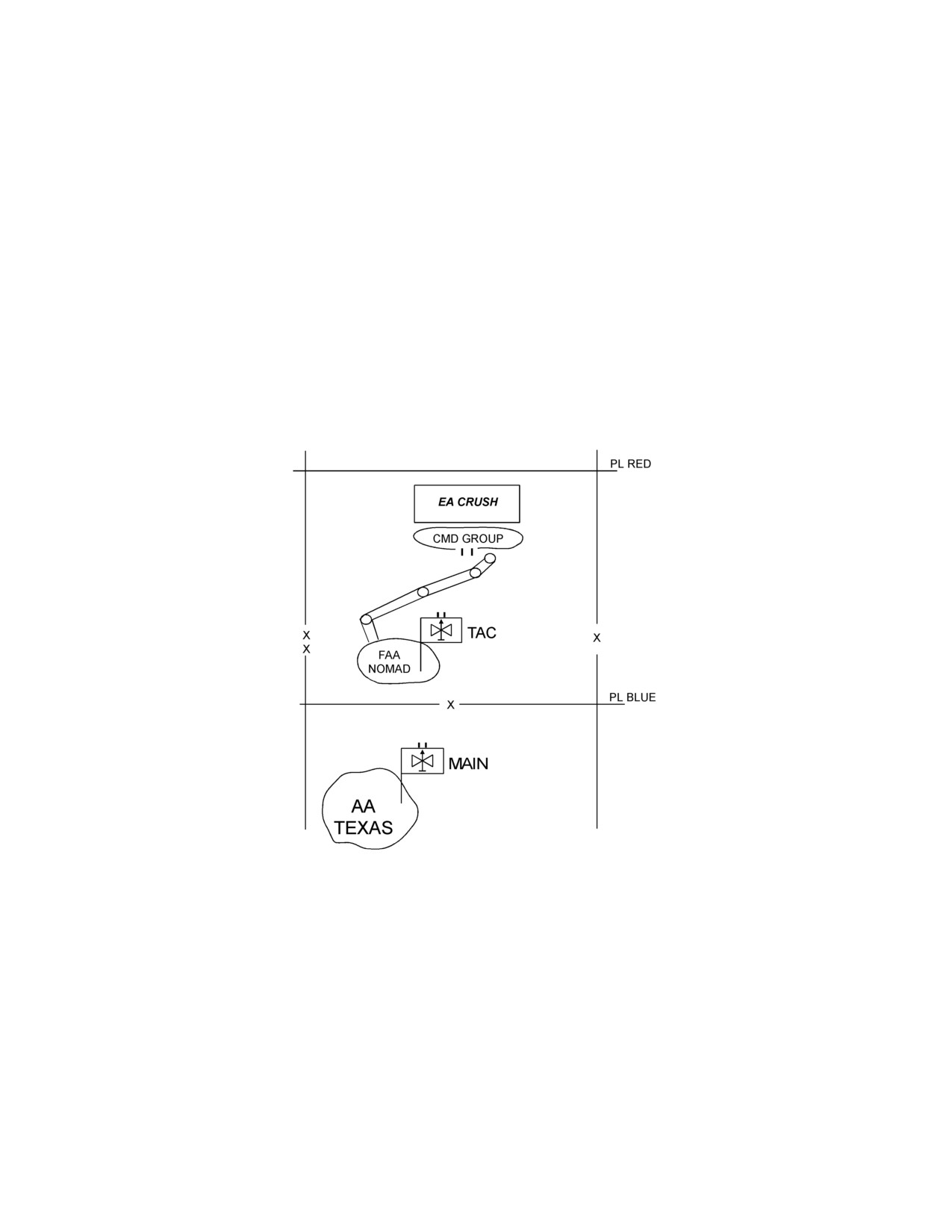
FM 1-112
b. TAC CP. When established, the TAC CP is the forward echelon of the
ATKHB headquarters. It usually consists of staff elements from the S2, S3, and any fire
support control elements attached to the battalion. The S3 is usually located at, and has
overall responsibility for, the TAC CP. The TAC CP is located well forward on the battle-
field so the commander is near his subordinate units and can lead the battalion. The
TAC CP is established in or near the forward assembly area. Once the ATKHB has
crossed the LD and begun operations, the commander moves to a position from which he
can coordinate operations. While the battalion is in the forward assembly area, the S3's
and commander's vehicles normally compose the tactical CP. Upon execution of the
mission, the command group moves to wherever the commander deems as the best place
to C2. This could be from an aircraft or from a ground vehicle. Figure 2-1 shows the TAC
CP organization and its approximate position on the battlefield.
Figure 2-1. CP organization and location
c. Command Group. The command group consists of the commander and those
personnel he selects to go forward to assist him in controlling maneuver and fires during
the battle. The command group normally includes the FSO (if attached), FAC (if
attached), and S3. There is no requirement for these people to collocate. For example,
the commander and the S3 may fly in different aircraft so that during a continuous
mission the S3 will remain on station to control the battle when the commander's aircraft
must return to the forward arming and refuel point. To permit optimum C2 of his unit
2-13
FM 1-112
during battle, the commander determines the composition, nature, and tasks of the
command group.
2-6. COMMAND COMMUNICATIONS SYSTEMS
a. Attack helicopters play a key role in each of the functional areas of
information operations. These functional areas are--
(1) Gathering intelligence.
(2) Attacking enemy C2.
(3) Protecting friendly C2.
(4) Construction of the information battlespace.
Attack helicopter operations in support of these functions may be conducted for
commanders at the tactical to strategic level in every combat environment.
b. Command Responsibilities. The command transmits and receives
information and orders through command communications systems. The commander
must understand the capabilities, limitations, and vulnerabilities of his communication
systems. Enemy radar, radios, and lasers may operate in the same electromagnetic
spectrum as friendly equipment. The commander must expect unintentional interference
from friendly units as well as interference from enemy units. Transmissions may also be
hindered by terrain, atmospheric conditions, or electromagnetic pulse from nuclear blasts.
To compensate for these, the commander should--
(1) Provide for redundancy in the means of communication.
(2) Ensure that subordinates understand his intent so that they will know
what to do when communications are interrupted.
(3) Avoid overloading the communication systems by using them only when
necessary.
(4) Use wire or messenger when possible instead of radio.
(5) Ensure proper signals security practices are followed.
c. Signal Support. Maintaining communications with higher and subordinate
headquarters presents a challenge for the battalion's communications section. Assets
available to the ATKHB are limited, particularly for FM(s) sets. In addition to the FM
radios on battalion vehicles and aircraft, communications support for the ATKHB
headquarters is provided by two organizations--the communications section in the
battalion HHC and the signal platoon in the brigade HHC. The communications section
2-14
FM 1-112
provides primarily FM and wire communications. The brigade's signal platoon assists in
providing MSE and SATCOM as required.
d. Unit/Staff Responsibilities. All levels of command and staff must gain and
maintain communications with the necessary headquarters and personnel. The
traditional communications responsibilities of ATKHBs are covered below.
(1) Higher to subordinate. The battalion headquarters must ensure that
its radio nets (command, O&I, administrative and logistics, and fire support) are con-
tinually operational. The RETRANS system must be dedicated to on-call restoration of
communications on any net. Possible RETRANS locations must be identified and checked
before starting operations. All key personnel must understand the operation of the
RETRANS system.
(2) Subordinate units. Subordinate units within the battalion must
continually monitor key battalion level radio nets. At a minimum, subordinate units must
monitor the battalion command and O&I nets.
(3) Supporting to supported. Liaison elements supporting the battalion
must maintain communications between their organization providing the support and the
ATKHB. Once located at the tactical CP, main CP, or rear CP, these units will be con-
trolled by the battalion staff and the headquarters commander.
(4) Lateral communications. Responsibility for establishing
communications between adjacent units may be fixed by the next higher commander. If
responsibility is not fixed by orders, the commander of the unit on the left is responsible
for establishing communications with the unit on the right. The commander of a unit
positioned behind another unit establishes communications with the forward unit.
(5) Restoration. Regardless of the responsibility, all units act promptly to
restore lost communications.
e. Command Communications Systems Architecture.
(1) Army aviation is required to deploy anywhere in the world and operate
under most types of environmental conditions. Mission parameters, therefore, require a
C2system designed to support the commander's needs throughout every phase of the
force-projection cycle. The Army has selected battlefield digitization to support the
commander's communications requirements.
(2) Digitizing the battlefield is the application of technologies to acquire,
exchange, and employ timely digital information throughout the battlespace, tailored to
the needs of each decider, shooter, and supporter. Digitization allows each soldier to
maintain a clear and accurate vision of the common battlespace necessary to support
planning and execution. This common picture/situational awareness permits commanders
2-15
///////////////////////////////////////