FIELD MANUAL FM 1-112 ATTACK HELICOPTER OPERATIONS (April 1997) - page 3
FM 1-112
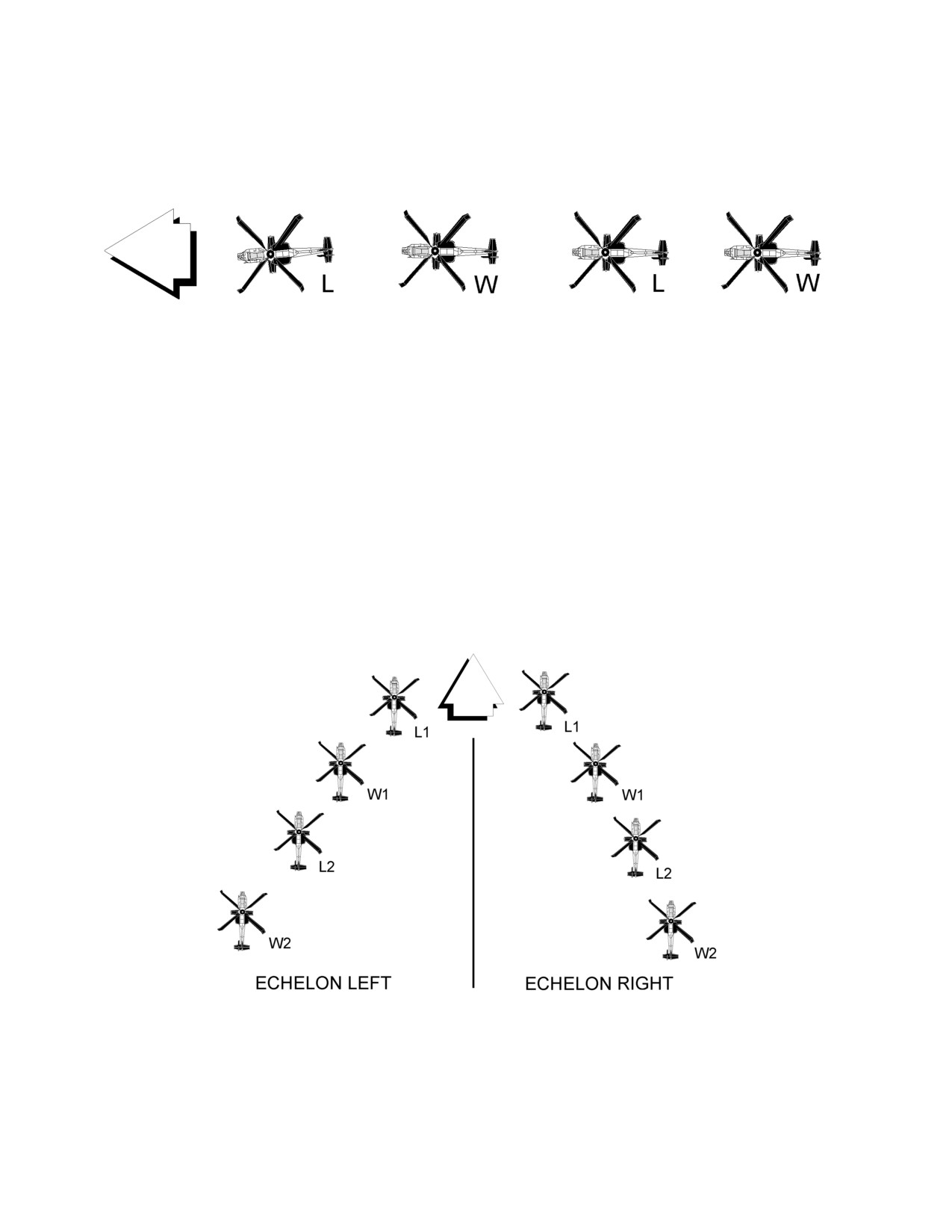
Figure 3-21. Example of a combat trail formation
(a) The echelon formation has advantages. It provides excellent fires
to the front. It allows the speed of a combat trail formation with a wider front. It also
facilitates rapid deployment to other formations.
(b) The echelon formation has disadvantages. It limits fires to the
front. It is more difficult to maintain orientation than in a combat trail. It also provides
less control in restricted terrain.
(c) An example of an echelon formation is shown in Figure 3-22.
Figure 3-22. Example of an echelon formation
3-37
FM 1-112
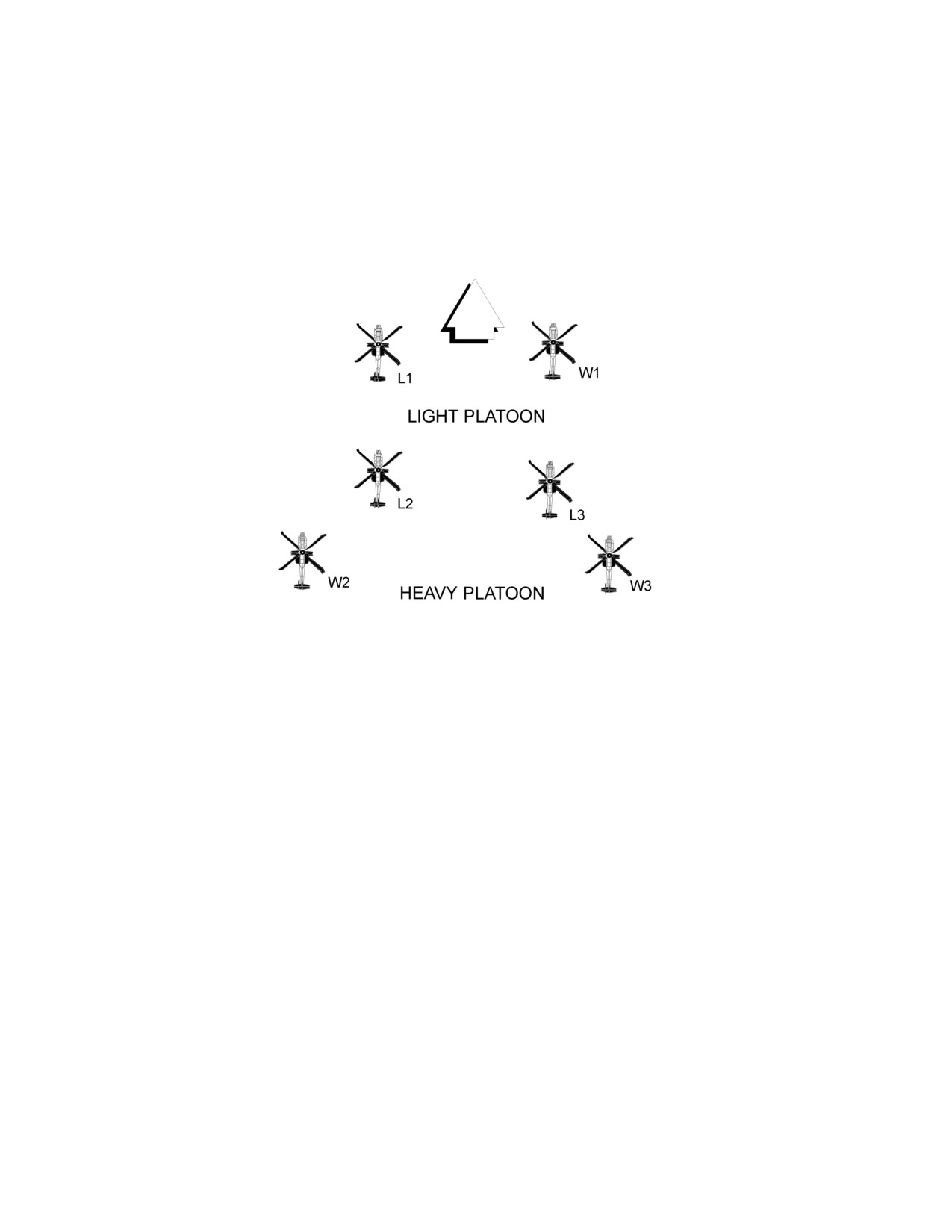
(d) ATKHC commanders may use a combination of formations to
maneuver his company, mixing techniques between platoons or teams, based on METT-T.
As an example of mixed formations, Figure 3-23 shows a heavy platoon using a wedge
formation and a light platoon using the combat-spread formation.
Figure 3-23. Heavy platoon using a wedge formation;
light platoon using a combat-spread formation
f.
Passage of Lines. A passage of lines is an operation in which one unit is
passed through the position of another. The ATKHB does not pass through a unit in the
same sense as a ground maneuver unit. The ATKHB will, however, pass through the
airspace of other units' positions, which can be equally as dangerous. Up to the
coordinating altitude, this airspace is controlled by the ground commander. When it is
unable to bypass a ground unit, the ATKHB must coordinate its movements over the
ground unit through the use of the various echelons of A2C2. However, when the ATKHB
crosses forward of friendly lines, it should establish liaison with those units that will be
passed, especially during a rearward passage of lines.
(1) A passage of lines is necessary when one unit cannot bypass another.
The ATKHB may conduct a passage of lines to--
(a) Counterattack.
(b) Conduct a raid.
(c) Envelop an enemy force.
3-38
FM 1-112
(d) Pursue a fleeing enemy.
(e) Exploit an attack by ground forces.
(f) Withdraw from a covering force mission.
(2) The ATKHB commander must ensure that liaison is established with the
stationary force. Early liaison ensures coordination and security for the execution of the
passage of lines. The liaison officer is responsible for ensuring that ground commanders
(down to company level) know the time and place of the passage of lines and the route
that the ATKHB will be using. The liaison officer should be at the passage point when
the ATKHB conducts its passage of lines. Because of the nature of attack helicopter
operations, this will mean that the liaison officer may be at the ground unit's location for
several hours.
(3) Direct and indirect fires of the stationary unit can be integrated into the
SEAD plan of the passing ATKHB. Liaison will ensure coordinated and responsive
support.
(4) A thorough reconnaissance should be executed prior to the passage of
lines. The reconnaissance should note existing and proposed troop locations. A technique
to help ensure deception during a passage of lines is to limit the number and size of
reconnaissance parties and use the vehicles of the stationary unit.
(5) During the planning process, commanders and staffs of the units involved
must coordinate--
(a) Exchange of intelligence.
(b) Exchange of SOI information.
(c) Exchange of liaison personnel.
(d) Arrangements for reconnaissance.
(e) Tactical cover and deception plans.
(f) Security measures during the passage.
(g) Fires and other CS to be provided by the unit in contact.
(h) AD weapons status during the passage, which should be weapons
hold.
(6) For a passage of lines, the commander will normally try to pass all of his
helicopters through the passage point as quickly as possible. Based on the threat and the
terrain, the commander should use a staggered formation, while exercising the option of
3-39
FM 1-112
reducing the gaps between the teams to less than 10 rotor diameters (rotor tip to rotor
tip). This formation will allow the teams to maintain orientation, while leaving maneuver
space.
g. Actions on Contact.
(1) Appendix F describes detailed TTP for performing actions on contact.
This appendix establishes the battle drill doctrine of "avoid, evade, threaten, and engage,"
and applies it to air and ground threats.
(2) Air movement during an attack may result in a meeting engagement.
Such engagements occur when contact with the enemy is made suddenly, with little or no
prior information concerning its size, location, and disposition. For example, on a raid,
the mission may become unhinged by one encounter with a threat. The intent is to avoid
the threat, report its position, maneuver to destroy it, if possible, and continue the
mission.
(3) During movement, a stationary or moving enemy force may be
encountered. When contact is made, the reactions of leaders in the first few seconds or
minutes may determine the fight. Generally, the platoon under fire moves aggressively
using fire and maneuver to suppress the enemy, seeks covered and concealed fighting
positions, and establishes a base of fire. These actions will be accomplished through
battle drills executed by the platoon and team. The platoon leader will send a contact
report, and the company commander will determine whether to develop the situation or
bypass and continue the mission.
(4) The element in contact continues the fight and gains information. The
density and type of enemy fire and other terrain information helps to assess enemy
capabilities. The platoon in contact reports all information to the commander. If the
platoon in contact is unable to maneuver, the commander may use another platoon(s)
and/or indirect fire to put pressure on the enemy in an effort to develop the situation.
(5) Based on the estimate of the situation, the commander should choose one
of the following courses of action:
(a) Continue to develop the situation.
(b) Conduct a hasty attack.
(c) Fix the enemy while the remainder of the unit bypasses or conducts
a hasty attack.
(d) Bypass.
3-40
FM 1-112
3-8. OCCUPATION OF THE BP/SBF POSITION AND ABF POSITION
Occupation of the BP and SBF are very similar. Occupation of the ABF, while deliberate,
is normally characterized by greater freedom of movement than the occupation of the
BP/SBF. The paragraphs below will describe, while making distinctions between the
actions during occupation of these positions. Except where noted otherwise, the
paragraphs below discuss an ATKHC task organization of heavy/attack and light/scout
platoons, as discussed earlier in this chapter.
a. ABF Position/SBF Position/BP Identification. To keep confusion to a
minimum in the objective area, each company should have its own numbering or lettering
scheme to identify its positions. For example, Charlie Company's BPs are always
numbered in the "30s" (such as BP 31, 32, and 33) while Bravo Company's BPs are always
numbered in the "20s." This will also help prevent confusion when copying graphics.
b. Battle Handover.
(1) Procedures for battle handover are similar for BP/SBF and ABF
positions. The major difference is in the time available for coordination. Generally,
occupation of the ABF is more time constrained than a BP/SBF.
(2) If a battle handover is being accepted from another company or troop, the
ATKHC commander and scouts may move to a HA to meet face-to-face with the ATKHC
or reconnaissance troop whom they are relieving. This technique may not always be
practical, particularly during raids. Once the situation has been briefed, the ATKHC
scouts relieve the on-station scouts and begin continuous observation. The ATKHC
commander briefs the heavy and light platoons then orders them to move forward to the
selected position using appropriate movement techniques, understanding the scouts have
already cleared the route. If the movement requires bounding overwatch, the light
platoon leads and the heavy platoon overwatches. At the BP, each platoon takes up its
assigned position and receives a target handover from the scouts.
(3) When time is critical, such as when the enemy is already in the EA when
scouts arrive in the selected position, the commander may elect to order holding platoons
forward as the scouts clear the position. These platoons move as quickly as tactically
possible along the attack route and meet their scouts behind the BPs. The scouts direct
the platoons to their positions and give them a target handover.
c. Preparation.
(1) BP/SBF position. The occupation of a BP or SBF begins when the
scouts reconnoiter the attack route from the HA to the position. Once in the position, the
scouts deploy to clear the position, confirm map or previous physical reconnaissance
information, and determine if the EA is occupied. Further ATKHC action depends upon
the enemy situation.
3-41
FM 1-112
(a) If the enemy has not yet arrived in the EA, the scouts will continue
to observe. The scout sends the ATKHC commander a spot report on the enemy situation
and the suitability of platoon BPs. Before the enemy arrives in the EA, a scout sends the
ATKHC commander a spot report. The commander then orders his elements to move
forward to the position using appropriate movement techniques, understanding the scout
has already cleared the route.
(b) When occupying an SBF in conjunction with a ground attack, the
ATKHC commander must maintain constant communications with the ground
commander. This communication will allow the ATKHC to synchronize his occupation of
the SBF with the approach or assault of the ground maneuver unit.
(2) ABF position. Because the ABF is a force-oriented control measure, the
ATKHC will normally establish multiple ABFs in a sector during mission planning. If
conducting a movement to contact, the ATKHC will likely move his company by teams
using bounding overwatch. Unlike BP and SBF occupation, the process of clearing the
route and position will occur during the course of the movement of the entire ATKHC, not
just the scouts.
d. Occupation.
(1) BP/SBF position. Once the commander issues the order to move to the
BP/SBF, the light platoon leads as the heavy platoon overwatches during movement along
the attack route. The light platoon will normally occupy the most forward position
affording the best view of the target area while exposing the fewest number of helicopters.
At the BP/SBF, each platoon takes up its assigned position and receives a target handover
from the scouts. If all indications are that the enemy is in the EA and cannot be seen, the
ATKHC may have to move forward to get the enemy within sensor range. Sensor range,
not weapon range, is the key planning factor when selecting a BP/SBF.
(2) ABF position.
(a) When enemy contact has been gained, the commander issues the
order for the company to move into the ABF. Based on the positions of the platoons in
relation to the enemy and the selected ABF, the platoon nearest the ABF generally
occupies first and secures the position to accept the other platoon. The scouts lead into
the ABF, keeping the enemy under observation while clearing the route into the ABF.
(b) The commander may elect to set both platoons in one ABF or use
separate ABFs for each platoon. Based on METT-T, the commander may choose one ABF
for the entire company or separate platoon ABFs. Whichever method is used, once both
platoons are set in the ABF, the commander can begin engagement of the enemy. If the
enemy is out of sensor range, the commander may decide to move forward for the
engagement.
3-42
FM 1-112
e. Aircraft Positioning.
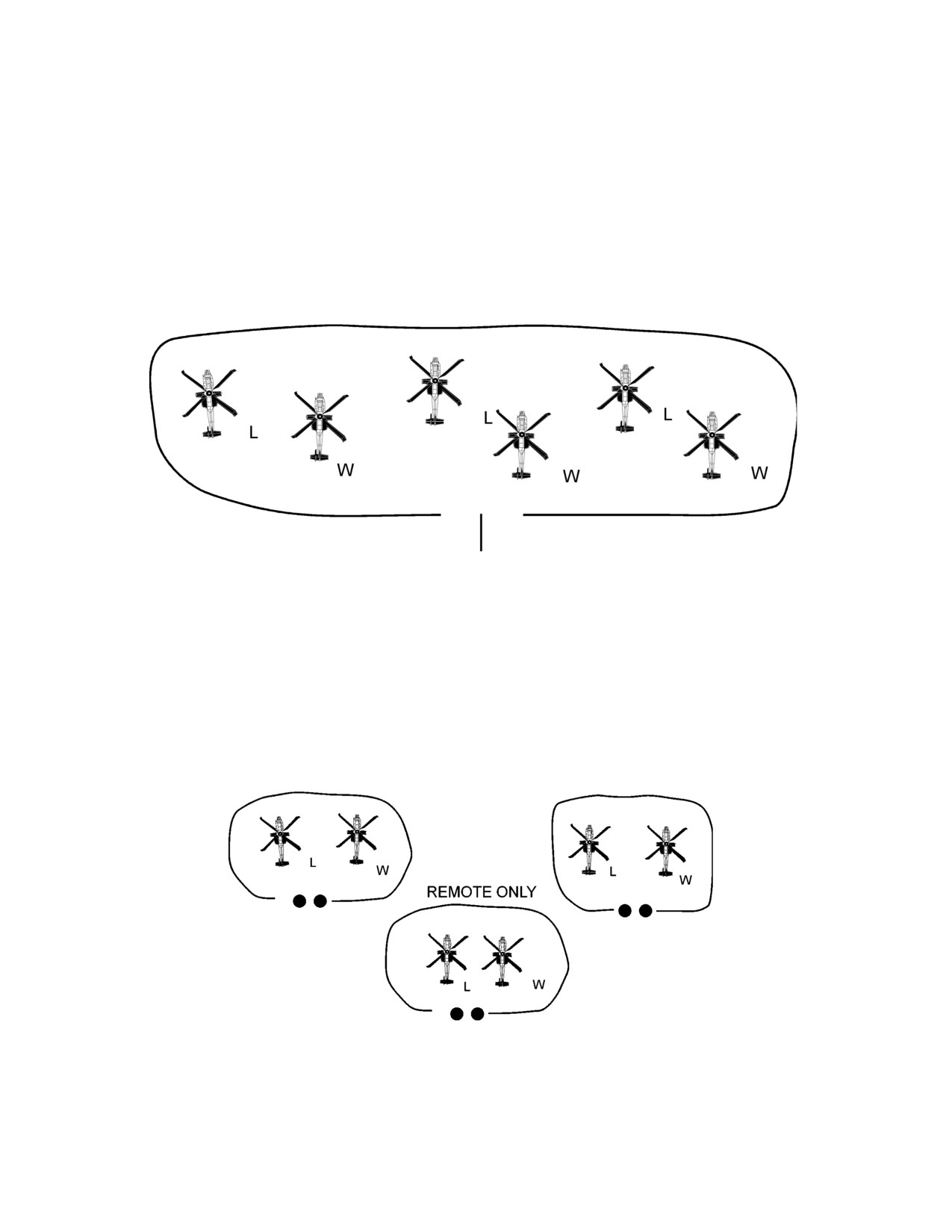
(1) Standard set. All aircraft key off the lead aircraft and begin occupying
firing positions to the right of the lead aircraft, in chalk order. This formation may be
used unless the commander declares a nonstandard set. Figure 3-24 shows an example of
a standard set.
Figure 3-24. Standard set
(2) Nonstandard set. All aircraft key off the lead aircraft and begin
occupying firing positions to the left of the lead aircraft, in chalk order. Figure 3-25
shows an example of a nonstandard set.
Figure 3-25. Nonstandard set
3-43
FM 1-112
f.
Security.
(1) Both scouts and attack aircraft provide security for the position, whether
an ABF, SBF, or BP. After the target handover to the attack aircraft, the scouts move to
a position to observe avenues of approach into the position. If a scout makes contact with
the enemy, he may engage with his organic weapons or FS, or the ATKHC commander
may maneuver one of the platoons into a supplemental BP to meet the threat. The
commander may position one of his platoons or teams in an overwatch position to engage
enemy air or ground threats.
(2) The commander may choose to position his team to the rear of the other
two teams to facilitate C2, as well as security. In addition, the commander's aircraft may
launch remote missiles for the lead teams without interfering with the commander's C2 of
the battle.
Section V. Objective Area Overview
The following paragraphs contain detail on EA and direct fire planning. Based on the
nature of the mission, commanders must ensure that staffs and aircrews understand
these procedures. Effective EA planning and direct fire employment are the essence of
attack helicopter operations.
3-9. EA PLANNING
a. Detailed planning is the cornerstone of successful attack helicopter operations.
As part of the deliberate decision-making process, this section will concentrate on
planning and executing actions on the objective. This planning includes building EAs and
executing direct fire in those EAs.
b. The goal of attack helicopter operations is to destroy targets. To destroy
targets effectively, without overkill, takes the focusing and massing of fires. Crews must
be able to engage targets throughout the depth and length of the EA, killing those targets
quickly and efficiently without wasting a single round on a target already destroyed.
c. Attack helicopter units participate in many diverse missions. This diversity
can present challenges to unit planners developing EAs and planning direct fire
employment. With this in mind, planners must be aware of the differences between attack
and reconnaissance and security (reconnaissance) missions. These differences are as
follows:
(1) Attack missions normally include massing effects of the unit in a single
specified EA. Reconnaissance missions include numerous EAs spread over a wide
geographic area using teams of aircraft, rather than the entire unit to engage the enemy.
3-44
FM 1-112
(2) Attack missions mass precision guided munitions on a readily identifiable
enemy. Reconnaissance missions may employ nonprecision munitions such as rockets and
artillery to develop the situation and to find the enemy's disposition.
(3) Prior to launching an attack mission, crews normally have a well-
developed picture of the enemy situation, and they have high confidence that the enemy
force will be in the EA. Reconnaissance missions, like a "search and attack", may not
have a well developed enemy situation before commitment of aviation forces.
(4) Weapons loads on attack missions will normally favor precision-guided
missiles. Reconnaissance missions, particularly during movement to contact and search
and attack will normally include heavier reliance on rockets and cannon.
(5) C2 headquarters for attack missions are normally the attack battalion
and aviation brigade. Security missions are normally controlled by a ground maneuver
TF headquarters.
d. While there are differences in attack and reconnaissance missions, attack
mission planning factors vary between close and deep operations. These differences
include the following:
(1) Graphics for close operations will normally include restrictive control
measures to prevent fratricide during engagements in close proximity to friendly
elements.
(2) Actions on the objective: what if the enemy is not in the EA? In a close
fight, the attack unit would maneuver to establish contact with the enemy force. In deep
operations, units normally lead with one company, whose mission is to develop the
situation. Upon making contact with the enemy force, the remaining companies close to
mass fires in the EA.
(3) Weapons loads for AH-64s may vary as auxiliary fuel tanks may be added
for long-duration deep attacks. In addition, commanders may choose to include auxiliary
fuel tanks on aircraft in close fights to increase station time in the objective area.
(4) C2 headquarters for close fights are normally the ground element in
contact. Deep attacks are normally controlled at the aviation brigade level, with
additional guidance from the division or corps DOCC.
3-10. PRINCIPLES OF DIRECT FIRE
a. Mass Fires. Commanders must mass the effects of organic onboard weapons
in the EA. Additionally, they should use complimentary systems, such as artillery, CAS,
mortars, and other available systems to overwhelm the enemy at the decisive place and
time.
3-45
FM 1-112
b. Leaders Control Fires. Piecemeal fires limit the capability of the attack
helicopter unit. There must always be two methods of executing the fires. One method
can be voice, but there has to be a backup.
c. Focus Fires. Fires must be focused on the critical point, at the critical time
as identified by the IPB. The three key elements to successful massing of direct fires
against any target are--
(1) Clearly conveying instructions to fire elements.
(2) Using recognizable control measures, whether friendly, enemy, or terrain-
based.
(3) Detailed training, SOPs, and planning for the engagement.
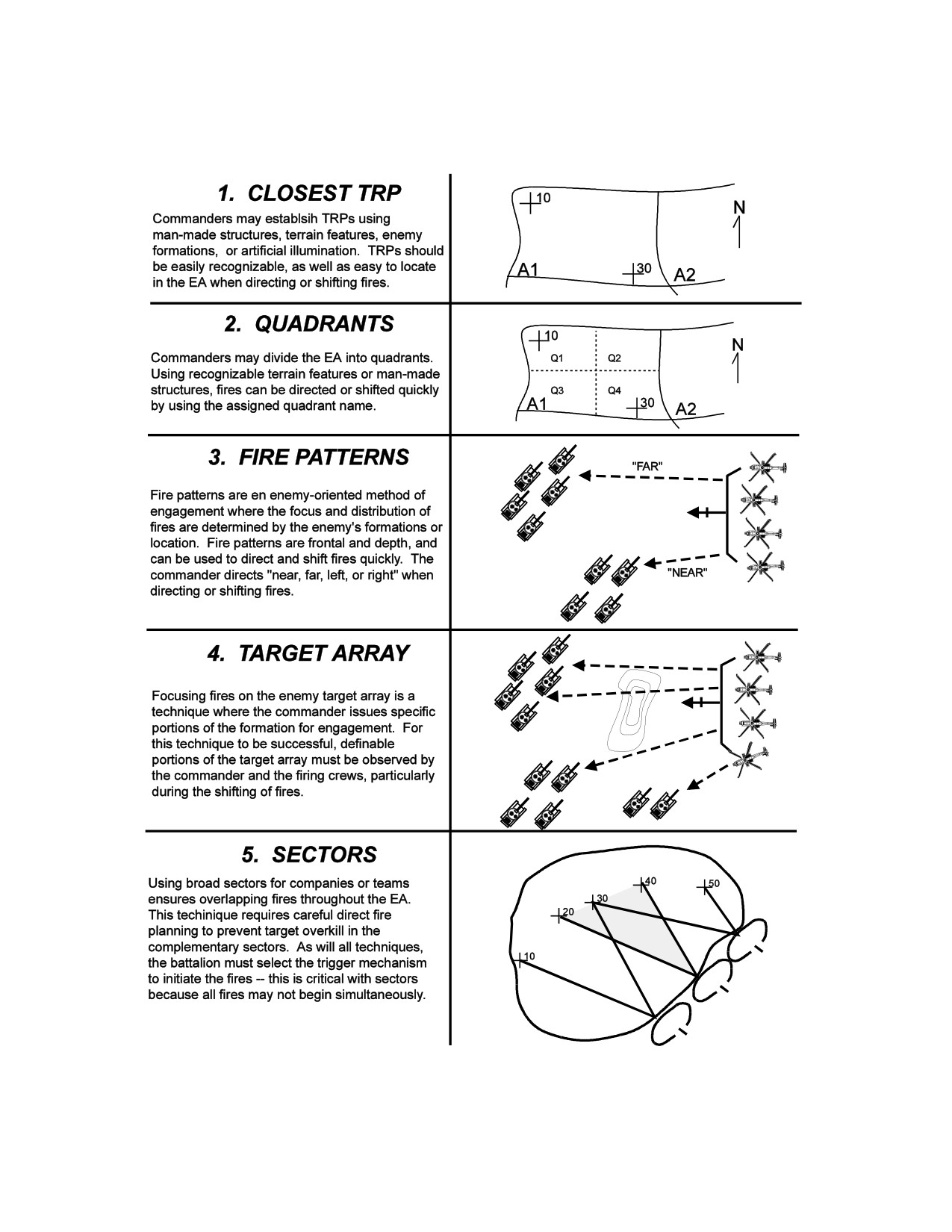
d. Distribute Fires. Figure 3-26 shows the methods for distributing direct fires
in the EA. Principles for distributing fires are as follows:
(1) Critical targets are engaged first.
(2) Engagements are conducted laterally and in depth simultaneously.
(3) Which weapons will engage which targets is decided beforehand.
(4) The order in which to engage targets has been decided.
e. Shift Fires. Fires must be controlled and shifted to react to the enemy's
actions. The shifting should be planned and rehearsed.
f.
Fire Plan. All crew must understand the fire plan. This includes
understanding the mission and the commander's intent.
g. Rehearse the Fire Plan. The fire plan rehearsal will allow every crew to
understand it and point out any shortcoming in the plan before execution.
3-11. PRINCIPLES OF FIRE CONTROL
a. Avoid Target Overkill. More than any other factor, this will increase a
weapon's P . In a target-rich environment, a unit may expend its ammunition and still
k
not meet the defeat criteria stated in the commander's intent. For example, fire discipline
will prevent crews from firing 10 ATGMs simultaneously at only two vehicles.
3-46
FM 1-112
Figure 3-26. Techniques of fire distribution and control
3-47
FM 1-112
b. Use Each Weapon System in its Best Role. If all ATGMs have been
expended against the trucks in a formation, and a tank battalion enters the EA, the
attack helicopter unit may not be able to accomplish its mission. A complete IPB will
help the commander decide which targets should be serviced by which weapon.
c. Destroy the Most Dangerous Targets First. These targets pose the
greatest threat to the force, and must be destroyed to expose the more lucrative targets.
Commanders must ensure engagement priorities are understood by all crews.
d. Concentrate on Long-Range Targets. This principle will provide standoff,
and allow the commander time and maneuver space should the enemy maneuver toward
his position. The commander must understand, however, the limitations of his crews,
weapons, and sensors to make the determination at what ranges targets can be engaged
while retaining a high P . Environmental conditions may reduce the useable range of
k
ATGMs. For example, a Hellfire missile can be used to engage targets at ranges in excess
of 8 kilometers. However, environmental conditions may affect the tracking sensor,
reducing the useable range to half of the maximum range.
e. Take the Best Shots. The last principle of fire control is to take the best
shots and expose only those aircraft. This principle maximizes the P and P . It also
h
k
protects the aircraft as long as possible and will lead to confusion among the enemy as to
the size and disposition of your force.
Section VI. EA Development
Battalions plan EAs and companies conduct direct fire planning. The following
paragraphs, divided into three steps, explain the process of EA development.
3-12. STEP 1: IPB. (See Figure 3-27.)
a. Once the battalion receives its mission, the S2 begins the IPB process. This
process consists of several steps--
(1) Battlefield area evaluation.
(2) Terrain analysis.
(3) Weather analysis.
(4) Enemy evaluation.
(5) Enemy integration.
b. This process gives the commander possible enemy courses of action. The S2
lists these courses (most probable through most dangerous) in descending probability and
3-48
FM 1-112
selects areas or points along enemy mobility corridors that confirm or deny a particular
enemy COA. These areas or points are called NAI. Enemy activity, or lack of activity, in
an NAI assists the S2 in further refining his estimate of the enemy courses of action.
c. The S2, in conjunction with the S3, selects areas or points along these enemy
mobility corridors where interdiction of enemy forces by maneuver, fires, or jamming will
deprive the enemy of a particular capability. These areas or points are called target areas
of interest.
d. Further points are selected, based on time and space, where critical events will
occur which will necessitate a decision. These points are called decision points. For
example, the commander may designate the enemy's crossing of DP1 as the event that
requires his decision whether or not to launch the attack.
e. The IPB process drives the formulation of subunit plans. When the company
commander receives the OPORD, he performs the IPB process on his piece of the
battlefield. At a minimum, the S2 should have answered the following questions:
(1) Where is the enemy currently located?
(2) Where is the enemy going?
(3) Where can we best engage the enemy?
(4) When will the enemy be there?
(5) What weapons systems does the enemy have that can affect the unit?
f.
Answering these five questions will yield the enemy's "most probable" COA.
After the plan is complete, the S2 shows how the enemy action can unhinge the unit plan.
These enemy actions constitute the "most dangerous" COA.
3-13. STEP 2: SELECT THE GROUND FOR THE ATTACK (See Figure 3-27)
a. Once the S2 identifies the enemy's most probable COA, the battalion
commander picks the point on the ground where he wants to kill the enemy. This point is
where the commander intends to mass his combat power.
b. During this step, the commander issues or reconfirms his nine elements of
commander's guidance. These nine elements are listed below.
(1) Guidance on enemy COA. This element lets the staff know which
actions to focus on and which actions to dismiss.
(2) The restated mission. This element is the approved mission by the
commander that includes all specified and implied tasks.
3-49
FM 1-112
(3) The commander's intent. This element is the purpose, method, and
end state of the mission. It clearly states what is to be done.
(4) The concept of operation. This element features the where, when, and
how the commander expects to accomplish the mission.
(5) The deception objective. This element is the deception (if applicable)
tied into the higher commander's plan. This may include "deception SEAD" .
(6) Priorities. These elements are the commander's CS and CSS priorities.
Focus on the fueling, fixing, and rearming functions for the fight.
(7) The time plan. This element focuses the staff on the amount of time
available to the battalion for EA planning, as well as the time available to the companies
for direct fire planning.
(8) The type of order to issue. This element gives the staff guidance on
the type of order to issue to the companies so they can complete their plan.
(9) The type of rehearsal to conduct. This element is critical prior to
execution.
3-14. STEP 3: INTEGRATION OF THE EA (Figures 3-28 through 3-30.)
The EA is an area in which the commander intends to trap and destroy an enemy force
with the massed fires of all available weapons. EAs are terrain-oriented control measures
that focus the fires, but normally will not help to distribute them throughout the target
without additional direct fire planning by the companies. The commander and staff must
consider the following when integrating the BOSs in the EA.
a. The staff picks preliminary BPs for the engagement area. These locations are
based on the commander's guidance, the terrain, and a sensor range that will produce a
75-percent P for the helicopter's primary precision guided weapon.
(An AH-64 night
k
missile engagement using FLIR at a range of 8,000 meters does not meet these criteria.)
Integration of direct fire must also consider the following:
(1) Enemy avenues of approach.
3-50
FM 1-112
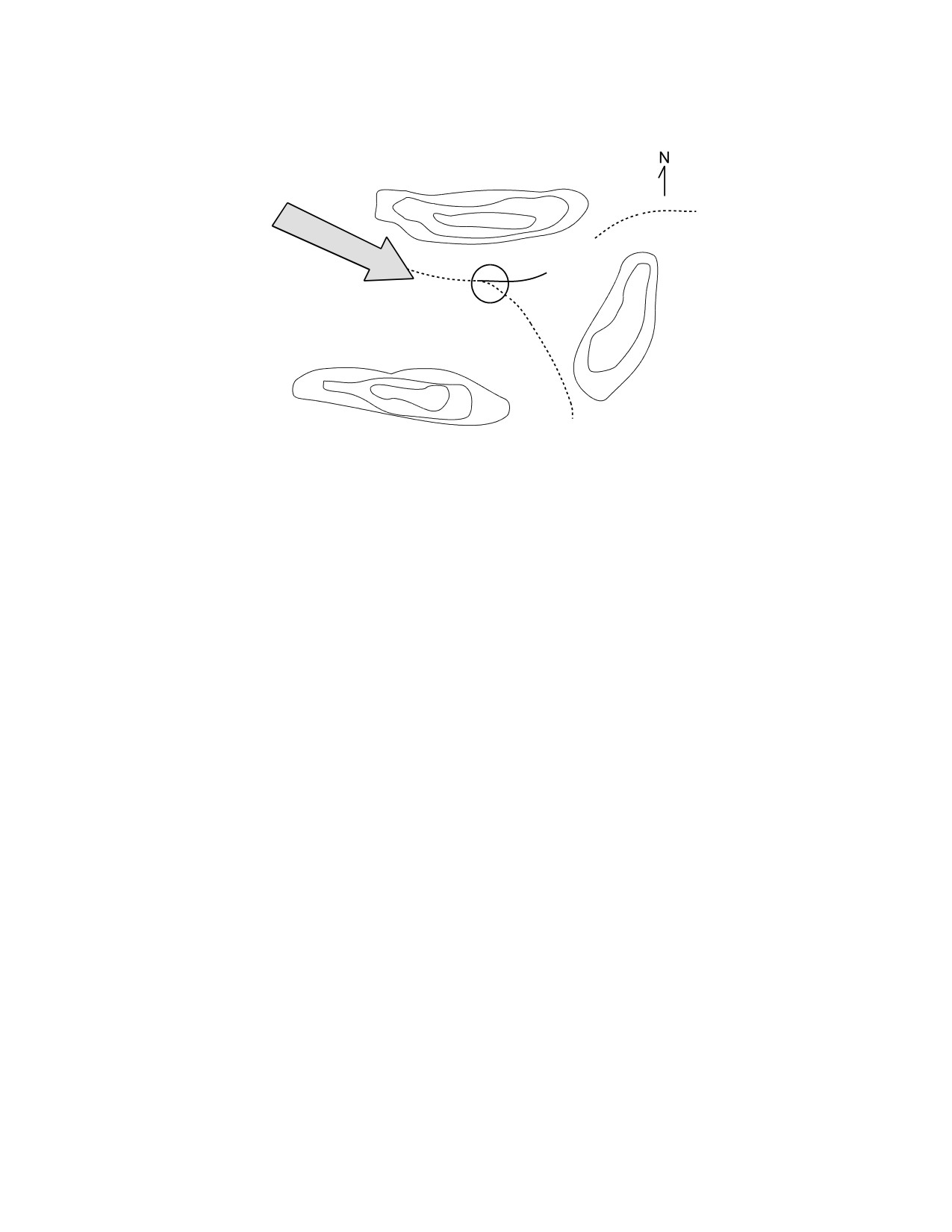
Figure 3-27. Steps 1 and 2
Step 1. The S2 determines where the enemy is currently located, where the enemy is going, where
can we best engage the enemy, when the enemy will be there, the weapons systems the enemy
hasEA that can affect the unit.
(Enemy mobility corridor is depicted by arrow, entering objective
area from NW).
Step 2. The commander selects the spot on the ground where he wants to mass combat power and
kill the enemy. (Circle at road junction indicates commander's designated area.)
(2) Enemy rate of march.
(3) Key terrain that will give the advantage for specific avenues of approach.
(4) What formation(s) the enemy will use, and at what point he is likely to
change formation.
(5) Expected range of engagement.
(6) When the enemy will begin counter-engagements.
(7) Effect of enemy indirect fires.
(8) Where deadspace is in the EA, and how it may be covered.
3-51
FM 1-112
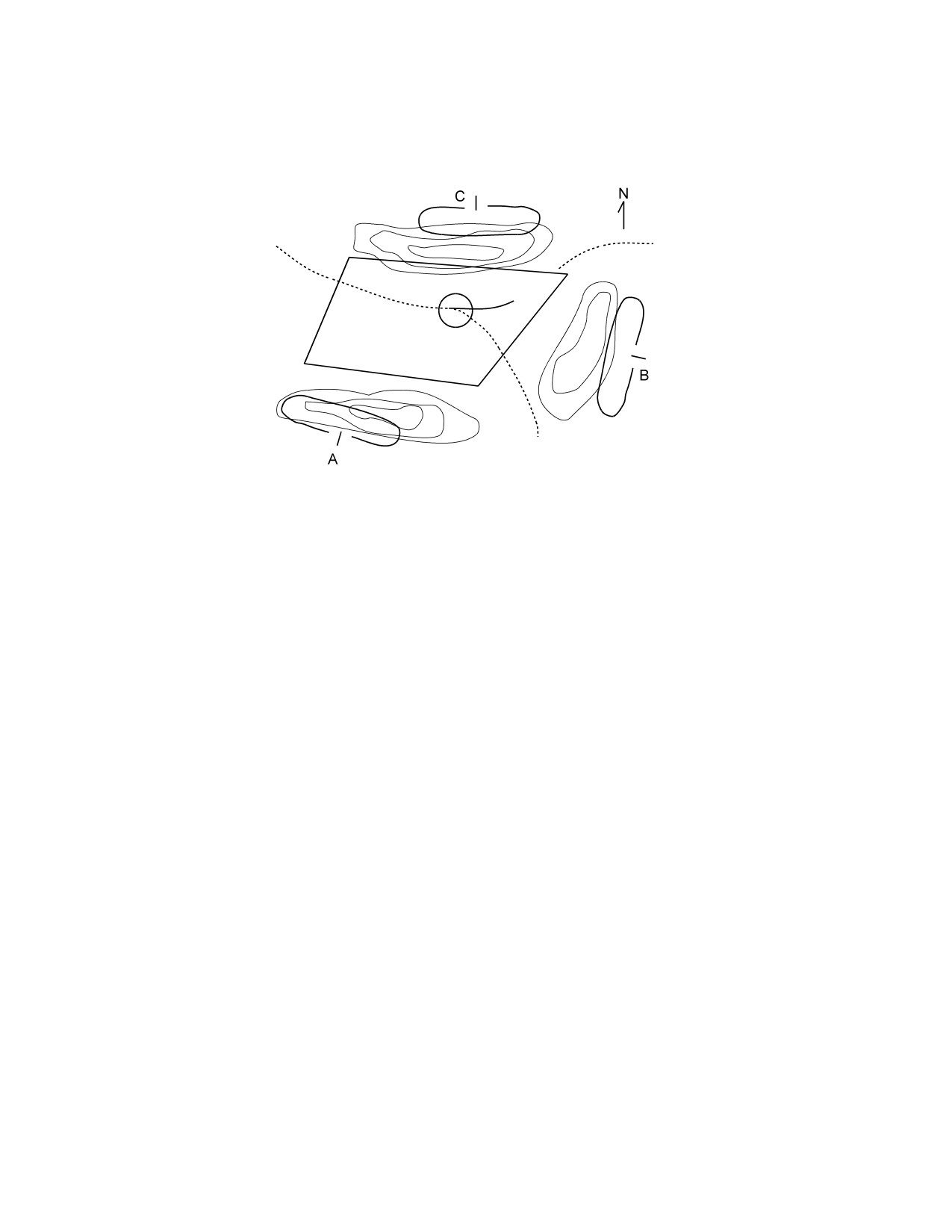
Figure 3-28. Step 3, part 1
Step 3 (Part 1). The S3 decides on the general dimensions of the EA based on the commander's
guidance on where he wants to mass the combat power. The S3 picks initial battle positions based
on terrain and 75 percent P for the helicopter's primary weapon system. In this example, the S3
k
picks BPs for three companies.
b. During EA integration, the staff will wargame enemy and friendly actions on
the objective. The S2 must portray an uncooperative enemy during wargaming to prevent
the staff from drawing false conclusions. Specifically,--
(1) How do we expect the enemy to react upon entering the EA? What
tactics will the enemy use?
(2) What will he do when we start firing at him?
(3) Where the enemy is likely to dismount and assault?
c. Based on the outcome of the wargame, the FSO, S3, and S2 will integrate the
use of artillery, CAS, and mortars to shape the battlespace for the direct fire fight. This
integration is based on the commander's intent for fires on the objective. The following
questions must be answered:
(1) What is the end state of the indirect fire plan?
3-52
FM 1-112
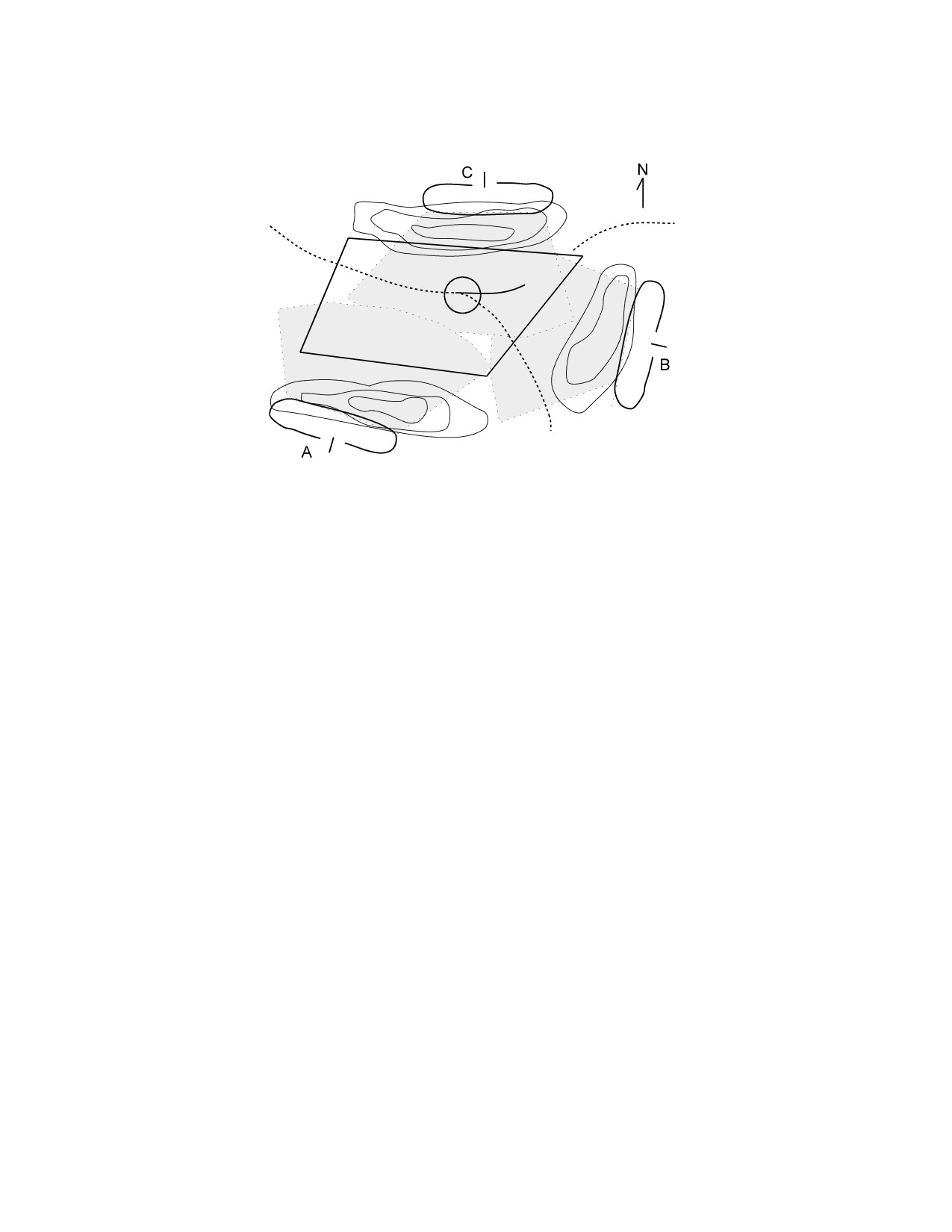
Figure 3-29. Step 3, part 2
Step 3 (Part 2). The S3 further refines the EA, and determines that A Company's BP must be
moved to ensure complementary direct fires. In this example, fans are added to the BP to
represent direct fire sensor ranges of the helicopters.
(2) How much artillery/CAS/mortars is available for employment in the EA?
(3) Who will initiate the fires?
(4) How will the unit shift fires?
(5) Who will clear fires once the direct fire fight begins.
d. One area of concern that rarely receives proper planning is the obscured EA.
While the EA may be perfectly clear when the first rounds are fired, burning vehicles and
munition impacts may quickly obscure the view from the planned battle positions. The
staff must consider the following during planning:
(1) Prevailing/forecast winds. The wind direction in the EA is very
important. During the planning process, forecast winds in the EA that will obscure either
the BP or the EA must be considered for engagement priorities and techniques. Smoke
and dust in the EA or BP may cause laser ranging and designation to be unreliable.
3-53
FM 1-112
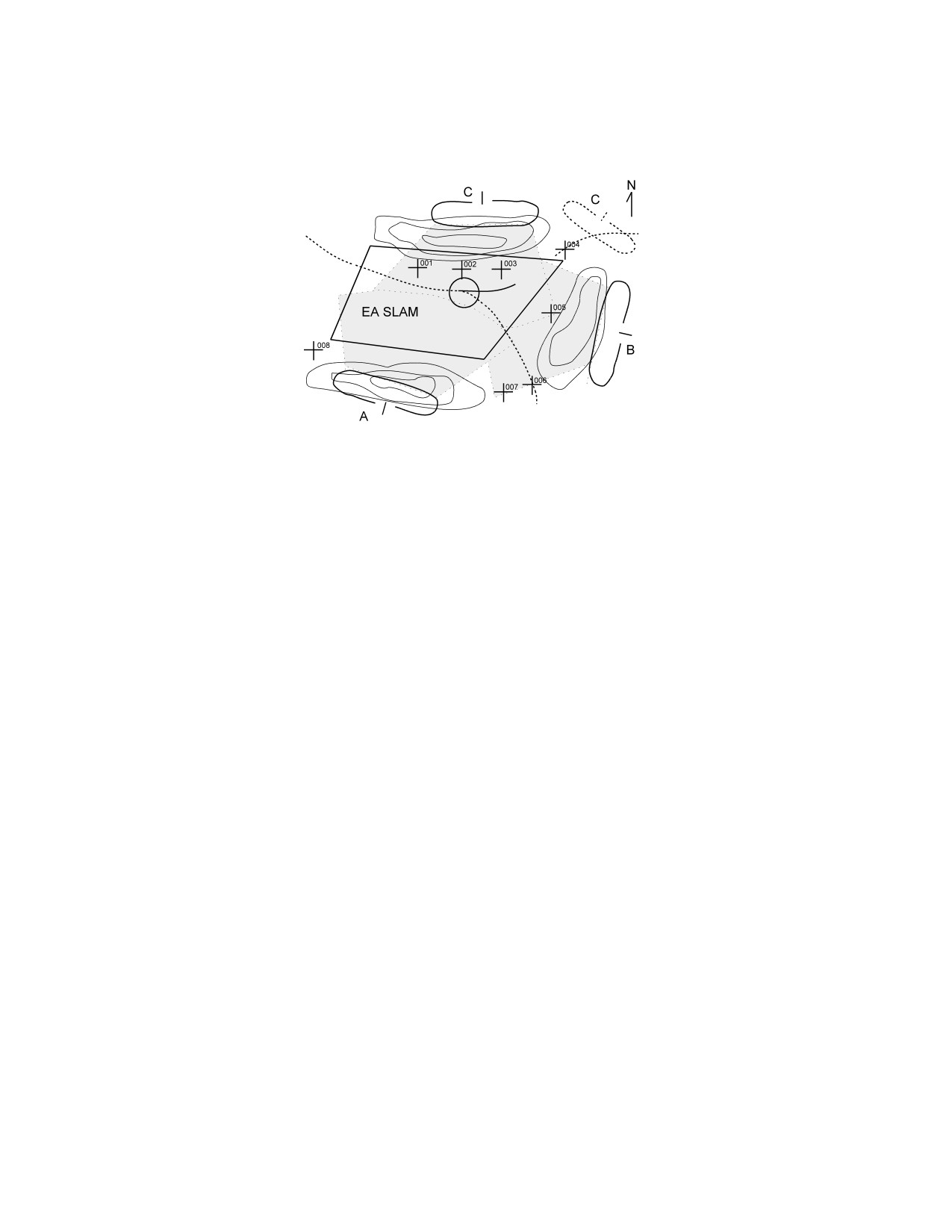
Figure 3-30. Step 3, part 3
Step 3 (Part 3). Based on the wargame, the S3, S2, and FSO further refine the EA, integrating FS
into the EA. In this example, TRPs are added to cover possible escape routes in the northeast and
southeast, as well as covering dead space near C Company's BP in the north.
(2) Nature of the target. If the targets to be engaged have the propensity
to burn after being hit, thought must be given to engagement priorities. For example, a
brightly burning light skinned vehicle near the battle position may obscure heavier, more
dangerous vehicles in the EA.
(3) Number of targets. If the plan specifies killing a large number of
targets with direct fire, consider engaging targets across the depth of the formation
simultaneously. This will tend to disorganize the formation quickly, and allow
engagements throughout the EA with rockets and indirect fire.
(4) Terrain. Cover deadspace with indirect fire or rockets. Also be aware
that smoke tends to cling in the low ground during hours of darkness. This may allow
vehicles to move undetected. If they are detected, it is difficult, if not impossible, to
engage vehicles in smoke with laser-guided weapons.
(5) Planned obscurants. FLIR sights may be required during daylight
operations for target engagement to see through deliberate enemy, and possibly friendly
obscurants, such as smoke screens. Aircrews must complete boresights and operational
checks of all sights, whether or not the crew expects to use them during the mission.
e. Once the staff planning is complete, the commander should be able to answer
yes to each of the questions in EA checklist (Figure 3-31). Once the staff planning
identifies the EA and FS plan, the staff should integrate company direct fire planning.
3-54

FM 1-112
DOES THE PLAN --
YES
NO
AVOID OVERKILL (CONSERVE AMMUNITION, COMBAT POWER)?
CONCENTRATE ON LONG RANGE TARGETS?
ENGAGE TARGETS WITH HIGH P ?
H
TAKE BEST SHOTS?
MINIMIZE RISK?
DESTROY MOST DANGEROUS FIRST?
MAXIMIZE EACH WEAPON SYSTEM?
Figure 3-31. EA checklist
Section VII. Direct Fire Planning
3-15. STEP 4: PLANNING THE DIRECT FIRE FIGHT (See Figures 3-32 and 3-33.)
The staff identifies the EA and integrates FS on the terrain to engage the templated
enemy force. This plan supports the commander's intent for the EA, but more detailed
planning is required. The staff passes the EA information to the companies for more
detailed planning. This information may be passed for concurrent planning with the
battalion staff, or in the form of an OPORD or plan for subsequent planning.
a. The company commander gathers his crews or designated planners initially to
get a view of the battalion's plan. Using the overlay and any additional information
provided by the staff, he ensures that everyone can identify the TRPs, obstacles, avenues
of approach, prominent terrain features, and dead space present in the EA.
b. Using TRPs, terrain features, or man-made obstacles, the company commander
sectors the EA by ensuring each crew has a well-defined and understood responsibility.
An individual helicopter sector should be wide enough to allow some overlap with adjacent
helicopters, but narrow enough to prevent overkill. This reduces the scanning required by
the gunner and the potential for overkill; it also ensures the entire EA or sector is covered
by direct fire.
c. Based on the commander's guidance, the company commander establishes
control measures for the direct-fire fight and other actions that are time or space
dependent. Ninety-nine percent of the time the battalion commander establishes a trigger
line for the direct fire fight, but the company commander initiates it. Further
visualization will help the commander decide whether to have all his crews orient on the
TRPs assigned by the battalion, or to have a leader and wingman or individual helicopters
orient in slightly different areas. For example, if the platoon leader is told to orient on
3-55
FM 1-112
TRP 0006, he might decide on one of the following missions for his subordinates, based on
the enemy and terrain:
(1) All crews orient on TRP 0006.
(2) The platoon leader's team orients to the left of TRP 0006, while the other
team orients to the right (designating targets 0006A and 0006B).
d. When the company commander decides how to use his helicopters to best meet
the battalion commander's intent, he ensures sectors of fire provide full mutual support
between helicopters and integrates FS. This planning includes the following:
(1) The commander must plan for rear and flank security in the BP. One to
two of the attack helicopters in the company may be designated to provide this security
during the engagement.
(2) The direct fire plan will designate responsibilities for long range direct
fires. However, the commander must also define the areas designated for engagement
with rockets and cannon, and how those fires are initiated. For planning purposes, "fans,"
or arcs should be drawn on the sector sketch to represent weapons ranges and when they
should be employed. This planning factor helps the crews to select the proper weapon for
the target at certain ranges.
(3) Crews must also be ready to repel dismounted infantry and other vehicles
in the battle position. They must also know the positions of friendly elements in the area.
e. The commander must ensure that supplementary battle positions integrate the
same level of planning and FS as the primary positions. Each crew must have a thorough
understanding of the criteria for movement from the primary to the supplemental battle
positions.
f.
Last, the company commander must devise a method to determine if his
company accomplished its mission. Because the destruction criteria and end state is in
the commander's intent, the commander must be sure the engagement does not conclude
until the destruction criteria is met.
3-16. STEP 5: FIRE COMMANDS
a. The commander uses two processes to control fires and always has a primary
and alternate method in effect: fire planning (triggers) and fire commands (radio
messages). He decides how to control fires based on the situation and the time available
to plan and prepare.
3-56
FM 1-112
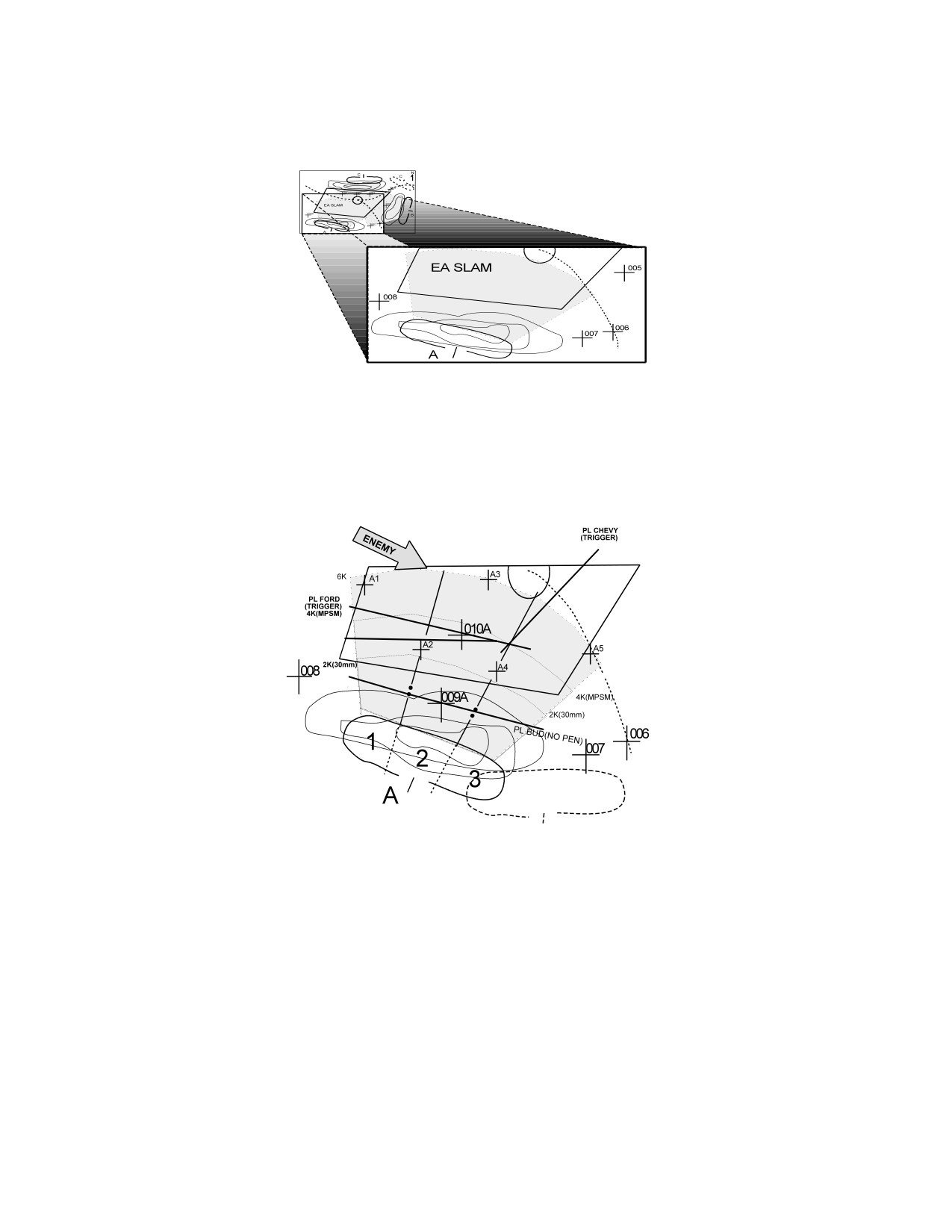
Figure 3-32. Step 4, part 1
Step 4, Part 1. The company commander and his planners examine the EA and start development
of their assigned terrain. This example shows A Company's assigned sector of the EA.
Figure 3-33. Step 4, part 2
Step 4, Part 2. The company commander and his planners further refine the battalion's plan for
the EA. In this example, the commander divides the EA into three team-size sectors (Teams 1, 2,
and 3). The battalion coordinates PL CHEVY and PL FORD as triggers for A Company to
commence the direct fire fight.
(The battalion S2 predicts the enemy will move generally eastward
through the EA. PLs CHEVY and FORD are designed so A Company has flank shots on the
enemy. They also allow synchronization of fires with B and C Companies.) Company TRPs (A1
through A5) are placed to allow for rapid shifting of fires. Two registered artillery TRPs (009A and
010A) are placed in the EA to allow rapid adjustment of indirect fires (Team 2 is responsible for
artillery calls). PL BUD, a "no penetration" (NO PEN) line, is placed near the BP. If enemy
elements cross PL BUD, crews are instructed to move to the alternate battle position.
3-57
FM 1-112
(1) In a meeting engagement or in a movement to contact when time to plan
is limited, the commander initiates fires with a fire command. During the fight, fires are
controlled by fire patterns (See figure 3-34) as specified in the SOP.
"BLUE -- THIS IS BLUE SIX --
Alert
THREE TANKS, MULTIPLE BMPs
Description
VICINITY TRP ZERO ONE SIX --
Orientation
AT MY COMMAND -- FIRE"
Execution
Figure 3-34. Unit fire command
(2) In a deliberate attack with prior planning time available, the commander
initiates the fight with a fire command or an event (enemy crossing a trigger line). He
relies on detailed planning and preparation to distribute fires during the fight. Further
fire commands may be required, but the object of the planning phase is to anticipate
events and coordinate fires before the fight starts.
(3) A coordinated fire plan requires minimum radio traffic over the net
during execution; trigger points, priority of engagements, and targets are established in
advance. A trigger point, in concert with a fire command should be used to initiate fires.
This assures that direct fires are placed on the enemy even if communications are
interrupted or the unit leadership is disabled.
REMEMBER: The use of fire commands is based on knowledge of enemy and time
available to plan, prepare, and rehearse.
b. Standardized fire commands are established in the unit SOP and should be
practiced by the chain of command. Using a standard format for a fire command ensures
that all essential information and control measures are given quickly and accurately.
Even under the most adverse conditions, this causes positive reaction by the unit. Brevity
and clarity are essential. Abbreviated methods for identifying target locations are
encouraged, but they must be familiar and understandable.
c. Coordinating instructions for additional information may be given by the
commander to individual aircraft; this information is not part of the fire command. When
a crew renders a contact or spot report and it is reasonable to believe all other aircraft in
the company received it, the commander issues only the elements needed to complete a
3-58
FM 1-112
fire command. In all cases, a crew has the freedom to engage a target without a company
fire command if he is under immediate threat.
d. A standard unit fire command may include as many as five elements in the
following order:
• Alert.
• Weapon or ammunition.
• Target description.
• Orientation.
• Execution.
The paragraphs below describe each element in detail.
(1) Alert. The alert element addresses the crew to fire and does not require
the individual initiating the fire command to identify himself. When time is not vital, the
individual giving the alert may identify himself. SOP code words may be used as the
alert element. The fire command examples in this chapter use the following code words:
• BLUE --Entire company prepare to fire (This assumes the other platoons use
"RED" or "WHITE" as identification)
• ALPHA --Platoon leader and his wingman(Team 1) prepare to fire
• BRAVO -- Team 2 prepare to fire
NOTE: When the commander is controlling the fire commands, he may designate his
teams separately. For example, Charlie Company is "BLUE" (with Alpha Company
"RED" and Bravo Company "WHITE"), and his four teams designated ALPHA through
DELTA.
(2) Weapon or ammunition. The PC and CPG select the ammunition
based on the fire distribution plan, the enemy targets, and the status of ammunition (How
many PD rockets? MPSM?). The PC decides with which weapon to engage and what type
and number of rounds to expend.
(3) Target description. The target description briefly describes the target
and must contain number, type, and activity ("THREE TANKS MOVING EAST TO
WEST, EA SLAM, Sector A"). If the target is stationary, the activity may be omitted.
(4) Orientation. The commander orients the company on the EA and
targets using one of the techniques shown in Figure 3-26.
3-59
FM 1-112
(5) Execution. The execution element indicates when firing will begin.
Normally, this is simply the command "FIRE." If surprise and simultaneous fire are
desired, or if the company's fire is to be coordinated with other direct or indirect fires, the
execution element "AT MY COMMAND" will be given first. This slight delay allows the
coordination of all fires to be completed while the individual crews selects their targets,
issue crew fire commands, and prepare to engage. If, for any reason, a crew is not
prepared to fire (equipment malfunction), the PC informs the platoon leader and his L/W
immediately. The PC also estimates and reports the time required for the crew to get the
helicopter ready to fight.
e. Control.
(1) The nature of the target will dictate the type of fire pattern used. During
premission planning, each crew must have a thorough understanding of how the threat
will "look" in the EA and what effects the engagement is expected to have. Whether the
company is engaging massed armor formations, or a fixed target such as a radar site, the
way each crew executes his fires must be understood. While this is not an element of the
fire command, crews will consider their unit fire pattern when engaging.
(2) Crews must be trained on and thoroughly understand the two basic fire
patterns--frontal and depth. Each crew member must understand its responsibilities for
target engagement by SOP. These two fire patterns cover most situations and promote
rapid, effective fire distribution. Regardless of which fire pattern is used, the goal is to
engage far and flank targets first, then shift fires to near and center targets. Crews
should engage targets, most dangerous to least dangerous, in their sector. The
commander may make exceptions to engage most dangerous to least dangerous targets or
to engage a designated priority target (C2 vehicles).
(a) The frontal pattern is used when all engaging helicopters have
unobstructed fields of fire to their front. Flank helicopters engage targets to the front
(right helicopter shoots right target, left helicopter shoots left target) and shift fires
toward the center as targets are destroyed. The frontal engagement rule is "near to far --
flank to center." Frontal will normally be the initial fire pattern used if neither is
specified.
(b) The depth fire pattern is used when targets are exposed in depth.
This is position and formation dependent. The whole company may be required to fire on
a column formation in depth, or individual helicopters engaging in their sector may have
to fire in depth. If the whole company is firing, it may be possible for each helicopter to
fire in depth on a portion of the enemy formation. The far left helicopter engages the far
target and shifts fire toward the center of the formation as targets are destroyed. The
right center helicopter engages the closest (front) target and shifts fire to the rear as
targets are destroyed; the far right helicopter engages the center target and shifts fire to
the front as targets are destroyed. All helicopters normally fire simultaneously. If the
commander wishes to use something other than simultaneous fire, he specifies which
crews will fire in the alert element of the fire command.
3-60
FM 1-112
(c) While these fire patterns will work during most situations, the
commander must ask the question: "What effects do I want my fires to have on the
enemy?" The goal should be for the enemy to stay in the EA until it is at the level of
strength directed in the commander's intent. The commander must consider that if near
targets are always engaged with long-range fires, the enemy force may halt movement
and leave the EA prior to the mission being completed.
f.
Termination of Engagements. The engagement may be terminated in one
of two ways--
(1) The platoon leader or commander announces "CEASE FIRE."
(2) All targets are destroyed.
3-17. STEP 6: REVIEWING THE PLAN
To determine if planning is complete before execution, the aircrews and staff should be
able to answer the following questions:
a. What are the mission and endstate?
b. Where is the enemy and how will he enter the AO? What does his IPB say?
c. Where are his key weapons? What are their capabilities?
d. Where are we going to kill the enemy?
e. Where will we engage him from? Are the ranges realistic? Are the positions
too restrictive?
f.
Which enemy systems do we want to engage first?
g. How will we initiate fires?
h. Which weapon systems will fire first? On what signal?
i.
What is the desired effect of fires from each system?
j.
How will fires be distributed (laterally and in depth)?
k. Where will each element focus fires?
l.
How will we mass fires? Do we have the required volume? Do we have the
time and assets to do the job in the space given?
m. Where will C2 be? Can the commander see the battlefield?
3-61
FM 1-112
n. How do we shift fires? How do we refocus fires? Why do we shift? Does
everybody know the "key event" to cause shifting?
o. How do we deal with enemy reactions to our fires?
p. Have we planned for flank and rear security in the BP?
q. Does the plan follow the principles of direct fire?
3-18. STEP 7: REHEARSING THE PLAN
a. Once the commander is satisfied that his crews understand the concept of
operation, specifically fire distribution, they are ready to rehearse the plan. The rehearsal
should address actions in the EA, as well as planning for contact drills en route and
contingencies.
b. A good rehearsal starts at the assembly area with communication checks,
progresses to line-up for take-off, follows the route, and into the battle position or
objective area. While individual air route rehearsals can be conducted using the AMPS,
the participating aircrews must be included in a collective rehearsal. Critical questions
that must be asked during the rehearsal include: Who is responsible for initiating the
secure communications check? Artillery calls? Rear security? Collecting and sending
company spot reports? Initiating fires for the attack? Sending the time for Have Quick?
Talking to the Air Force for JAAT? Coordinating with the ground force commander?
What radio calls are required during the conduct of the operation? What is the success
criteria, and how do we know if we have met it?
c. Conflicts in these areas may come to light during the rehearsal. However, the
most important aspect is ensuring that the crew members know and understand the
commander's intent and how it will be executed.
3-19. STEP 8: EXECUTING THE PLAN
a. The plan and rehearsal are complete, the decision to commit has been made,
and the unit departs on its assigned routes. Once the unit has occupied the BP/ABF/SBF,
crews prepare for their engagement. When the targets are identified, a contact or spot
report is sent to the commander. The optimal solution is for the commander to issue a
fire command with "AT MY COMMAND" as a control element, based on good
communications between elements and situational awareness of the commander. At this
time, each crew will --
(1) Observe the target array and select the target(s) to engage based on the
preplanned fire pattern.
(2) The PC will issue a fire command to the CPG/CPO using the target
description indicated by the platoon fire command.
3-62
FM 1-112
(3) Allow the CPG/CPO to acquire and range his first target.
b. While the individual crews select targets and determine their ranges, the
company commander prepares to engage the targets in the EA with artillery according to
the battalion commander's intent for fires. Knowing the time of flight for artillery allows
the crews to coordinate fires so the indirect fire arrives at the proper time, not during
engagements with the direct fires of the helicopters. If the indirect fire arrives too soon, it
will obscure the battle area, make direct fire engagements difficult or impossible.
c. On the command "FIRE", or when the enemy reaches the predetermined
trigger point, each helicopter begins to engage. If the command to fire is received before a
crew has completed all its preparations, the crew must complete preparations and fire as
soon as possible. The PC adjusts fire and switches targets according to the fire command
or SOP. For example, target engagement priorities may be --
• Most dangerous targets (ADA).
• Tanks, ATGMs.
• C2 assets.
• Dangerous targets.
• Least dangerous targets.
Commanders should assign engagement priorities according to the mission.
c. The time a helicopter can safely remain unmasked will depend on the enemy.
If the enemy has ADA and tanks in overwatch, or if the enemy is stationary, a crew
should complete no more than two engagements from the same firing position. When the
crew is not engaging, the helicopter should remask and provide observations or assistance
to other crews (for example, remote missile firing).
d. After direct fire has been initiated, fire commands will be referenced on the
fire distribution plan chosen.
e. When the engagements are complete, the company commander consolidates
the BDA and the FARM report. Based on these reports, the company commander must
make the determination whether to continue the attack or to break station. This decision
is critical because he has to decide whether or not the mission was accomplished. The
report sent to the battalion commander is based on the company commander's assessment
of the situation.
3-20. EA DEVELOPMENT/DIRECT FIRE SUMMARY
a. Battalions plan EAs. Companies conduct direct fire planning.
3-63
FM 1-112
b. Standardized fire commands must be established by unit SOP and practiced by
all leaders and air crews.
c. All air crews must understand the basic fire patterns and each crew's
responsibilities for target engagement by SOP. These patterns cover most situations and
promote rapid, effective fire distribution.
d. A well-planned engagement requires minimum radio traffic during execution;
trigger points, priority of engagements, and targets are established in advance.
e. P of the helicopters munitions is reduced as the helicopter to target range
h
increases. Leaders must plan engagements within the "useable range" of the sensor, not
merely "maximum range."
f.
All crew members must understand the mission and the commander's intent.
Section VIII. Completing the Engagement
3-21. BREAKING CONTACT
a. Breaking Contact. Breaking contact with the enemy is as important to the
ATKHC as beginning the engagement. The break in contact should be swift, decisive, and
leave the enemy in doubt as to whether it is still being engaged. The company may break
contact by platoon or simultaneously. This may also occur after or during a battle
handover.
(1) By platoon or team. Breaking contact by platoon is conducted the
same as maneuvering by platoon. Rather than moving to another battle position, the
platoon moves to a HA, rally point, or FARP. When the company breaks contact, one
platoon continues to engage the enemy while the other begins to egress. After the first
platoon has cleared the area, the platoon still in contact uses artillery fires to suppress
the enemy, breaks contact, and maneuvers as directed by the company commander. In
addition to artillery fires used to cover the break of the platoon, fires from another
ATKHC, ground forces, or CAS may cover the break of the platoon in contact.
(2) Simultaneously. The ATKHC may break contact with the simultaneous
departure of both platoons. On order, artillery fires are used to suppress the enemy and
the ATKHC breaks contact and maneuvers to a HA, rally point, or FARP. In addition to
artillery fires used to cover the break of the ATKHC, fires from another ATKHC, ground
forces, or CAS may cover the break of the company in contact.
b. Battle Handover. A battle handover between ATKHCs is accomplished at
the direction of the ATKHB and is used during continuous and phased employment of the
3-64
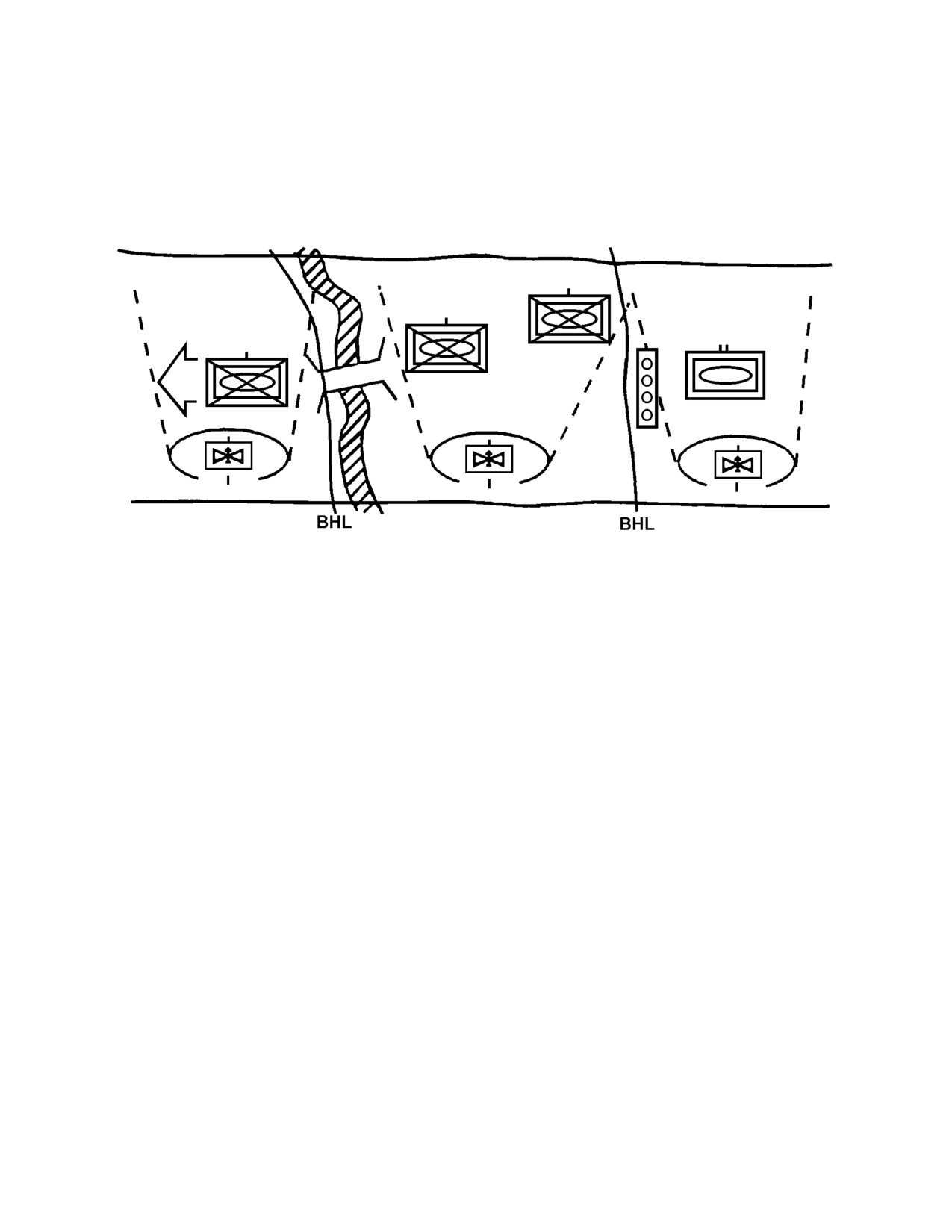
FM 1-112
battalion. By designating a phase line as the BHL, the ATKHB directs the ATKHC to
prepare for a battle handover when issuing the OPORD or FRAGO (see Figure 3-35).
Figure 3-35. Battle handover
(1) Briefing. As the time for the battle handover draws near, the scouts of the
ATKHC in contact brief the relieving ATKHC on the situation. As a minimum, the
briefing should include a description of the enemy force, its location, and direction of
movement. If possible, the ATKHC commander in contact briefs the relieving commander
face-to-face. If the ATKHC in contact cannot give a face-to-face briefing, then the
relieving commander may receive an update briefing by radio or digital message.
(2) Execution. The enemy must not be allowed to recover and gain fire
superiority through a break in battalion fires. Throughout the battle handover, constant
pressure must be exerted on the enemy using direct and indirect fires. After receiving the
handover briefing, the relieving ATKHC commander maneuvers his company into the
battle positions. When the enemy force reaches the BHL, the ATKHC commander in
contact signals the relieving commander by radio, message or another prearranged signal
(smoke, rockets, laser, or cannon fire) to begin his engagement. The relieving ATKHC
then begins its attack while it covers the withdrawal of the relieved ATKHC. If the
company in contact must depart before the relieving company occupies its battle position,
the relieved company scouts must maintain contact until the enemy has reached the BHL
and a positive handover has been accomplished. The scouts direct artillery fires on the
enemy until the handover has been completed.
3-65
FM 1-112
3-22. EGRESS OPERATIONS
a. General. Whether conducting operations during the deep, close, or rear fight,
egress begins immediately after "actions at the objective" are completed and the attacking
unit has broken contact. Considerations for the egress closely parallel those for ingress,
and planning must include the following:
(1) Route selection. While the attack unit engages the target, intelligence
collection begins to shift to the egress route. Location of enemy radar and AD sites that
were illuminated during the ingress and attack phase must be passed to the FSE to
update and adjust the SEAD plan. Any new concentration of enemy AD will be reported
to the attacking unit.
(2) Penetration of the FLOT (raids). When the ATKHB is returning from
a cross-FLOT attack, the division or corps must coordinate the passage of lines by
changing the AD weapons status of the ground maneuver units. ASE will be employed to
defeat all possible threat AD systems during the penetration of the EFLT. Even under
the best of circumstances it is difficult to know with accuracy when the aircraft will
return across the FLOT, but it is important to plan for egress SEAD. Immediately after
crossing the FLOT, companies assemble at designated HAs for sequencing into the FARP.
There are two options for point of penetration of the EFLT during deep operations:
(a) Cross the EFLT and FLOT at the same point as the penetration.
This can be an effective method if the initial crossing SEAD was effective and ADA
systems were destroyed on ingress. Reconsolidation of enemy forces may not have
occurred by the time the aircraft return. The enemy unit may still be in some state of
disarray, and if the enemy is in contact with friendly ground forces, it will be otherwise
occupied. When the friendly aircraft return over the same terrain the enemy will have a
difficult time responding to the fast-moving target from their rear.
(b) Cross the EFLT and FLOT at one or several points other than the
ingress route. The threat orientation will most likely be toward the friendly forces. The
aircraft coming from deep within enemy territory can maintain stealth as they penetrate
the EFLT. If each company moves along a separate route then maximum stealth can be
maintained. The enemy may not have been alerted or notified of an enemy force
penetrating their terrain earlier, or their communications may be jammed or limited to
begin with. They will most likely have no idea where the aircraft will recross the EFLT.
b. BDA.
(1) Based on the commander's intent and specified attack criteria, the
commander controlling the battle must determine whether or not the mission has been
accomplished. For example, if the commander specified that 60 percent of the vehicles in
a convoy must be destroyed, the commander controlling the battle must be able to decide
whether or not the criteria was met before disengaging. A plan must exist to quantify the
BDA.
3-66
FM 1-112
(2) For close operations, the commander may elect to rotate companies
through a FARP to reload and reattack the target. However, for cross-FLOT operations,
the commander may have a narrow time window to engage the enemy. Because of this
compressed schedule, as well as the lack of rearm capability cross-FLOT, the commander
may be unable to quantify a BDA upon egress.
(3) For deep operations cross-FLOT, the LRSU and other division/corps
reconnaissance assets begin BDA as soon as the egress begins. Sensors obtain
intelligence for the division and corps to estimate the enemy's combat effectiveness. They
also provide probable courses of action and a window of opportunity for friendly maneuver
deep fires.
3-23. RESTORATION
The restoration phase begins when the attacking unit has completed recrossing the FLOT.
The restoration phase is broken down into four separate tasks.
a. Refueling/Rearming. Refueling will occur at either an active Jump FARP or
at the Base FARP. The aircrews may not be familiar with the location of a new FARP,
and will be fatigued from the mission. A procedure to guide the returning aircraft into
the FARP and then to the AA should be considered.
b. Occupation of the Assembly Area. When the aircraft return to the AA
each company must have a designated recovery team standing by. Aircraft status and any
battle damage is reported to the commander. Each member of the crew must be familiar
with recovery procedures, especially for night recovery. Crews should secure gun camera
videos and conduct a hasty company AAR in preparation for the battalion AAR. Mission
crews may then be expected to participate in at least a battalion level AAR. If all crews
are not required at the AAR, commanders and platoon leaders must have consolidated
data and information. After crews are debriefed by the S-2, they begin preparation for
follow on operations or begin crew rest.
c. Maintenance. Initial maintenance and documentation is started immediately
after shut down and postflight. Aircraft status is reported to the AVUM. If battalion
AVUM maintenance is required, the decision is made to dispatch contact teams or fly the
aircraft to the AVUM's location.
d. Transition to Future Operations. When the AAR is complete and all
aircrews are debriefed, the entire battalion then turns its attention to getting ready for
follow on operations. Close operations may be conducted immediately following a raid
depending on the assets used during the previous operations. Battalion level preparation
should focus on mission analysis of future operations, logistics, and maintenance
requirements for future operations, and orders dissemination and rehearsals. Company
level preparation for future operations should focus on aircraft maintenance, fighter
management, and planning cell development of future operations.
3-67
FM 1-112
Section IX. Other Operations
3-24. RECONNAISSANCE AND SECURITY
Although primarily associated with cavalry units, reconnaissance and security operations
are implied requirements of ATKHBs. Because of where and how they operate on the
battlefield and their aircraft capabilities, attack helicopter units may be tasked to conduct
reconnaissance and security missions. These missions may be conducted autonomously
or as part of a larger force. Because of this possibility, it is imperative that attack crews
and units be proficient in the missions and fundamentals associated with reconnaissance
and security.
a. Reconnaissance. The primary purpose of reconnaissance is to gain
information of tactical importance upon which commanders will make plans and issue
orders for the conduct of future combat operations. Combat information is a by-product of
all operations acquired continuously as they progress. Attack helicopter crews invariably
gather information as they fly and are particularly well suited for aerial reconnaissance.
In fact, if it is not stated specifically in mission orders, reconnaissance is always an
implied task during all phases of attack helicopter operations.
(1) Reconnaissance operations vary with every situation. Whether conducted
alone or with ground elements, attack helicopters task organize according to METT-T.
Normally scout-weapons teams are formed. The designated "scout" focuses primarily on
the reconnaissance effort and the other team member maintains a protective overwatch
position oriented on the scout. The purpose of the "scout" team member is aerial
observation (terrain and enemy oriented) and the primary purpose of the "attack" team
member is to protect the scout and provide suppressive fires (enemy oriented) and help
develop the situation.
(2) Reconnaissance operations are conducted according to the following six
principles:
(a) Orient on the reconnaissance objective.
(b) Maximum reconnaissance power forward.
(c) Report all information rapidly and accurately.
(d) Retain freedom to maneuver.
(e) Gain and maintain enemy contact.
(f) Develop the situation rapidly.
(3) There are four forms of reconnaissance the ATKHB can conduct. These
forms include route, zone, area, and RIF.
3-68
FM 1-112
(a) Route reconnaissance. A route reconnaissance is a
reconnaissance effort along a specific line of communications, such as a road, railway, or
waterway. It provides new or updated information on route conditions and activities
along a specific route.
(b) Zone reconnaissance. A zone reconnaissance is a directed effort
to obtain detailed information within a zone defined by boundaries. A zone
reconnaissance provides data concerning all routes, obstacles (to include chemical or
radiological contamination), terrain, and enemy forces within the zone of action.
(c) Area reconnaissance. An area reconnaissance provides detailed
information concerning the terrain or enemy activity within a prescribed area, such as a
town, ridge line, woods, or other feature critical to operations. Areas are smaller than
zones.
(A zone reconnaissance may include several area reconnaissances). At its most
basic level, an area reconnaissance could be made of a single point, such as a bridge or an
installation.
(d) RIF. RIF is a limited purpose form of reconnaissance conducted to
obtain information and test enemy dispositions, strengths, and reactions. It is conducted
to aggressively develop the situation. A RIF is conducted when the enemy is known to be
operating in strength within a given area and sufficient intelligence cannot be developed
by another means.
(e) A detailed discussion of these missions and their TTP can be found
in FMs 100-40, 1-114, and 17-95.
b. Security. Security operations are designed to provide reaction, maneuver
space, and protection for the force as a whole. They are characterized by aggressive
reconnaissance to reduce unknowns, gain and maintain contact with the enemy and
provide early and accurate warning to the main body. The primary orientation of the
ATKHB during a security mission is the protection of the main body as opposed to a
terrain or enemy objective. An ATKHB may be assigned a security mission to protect the
command against surprise attack and observation by hostile air and ground forces. They
maintain freedom of maneuver for the command by providing reaction time and maneuver
space.
(1) Security forces may operate at varying distance from the main body and
to any flank based on conditions of METT-T. They employ the minimum combat power
necessary to cover extended frontages and provide the commander early warning.
(2) Security operations include screen, guard, cover, and area security. An
aviation specific mission, air assault security, is a form of a guard operation.
(a) Screen. A screen is a form of security that primarily provides early
warning. It observes, identifies, and reports information. It generally fights only in self-
defense, but does engage enemy reconnaissance elements within its capabilities.
Commanders generally establish screens on an extended flank, to the rear, or to the front
3-69
FM 1-112
of a stationary force. A screen is not conducted forward of a moving force; the security
element forward of a moving force must conduct either a guard or cover. A screen is
essentially an outpost line, consisting of OPs that may reposition laterally along the
outpost line (a designated phase line).
(b) Guard. Guard is a form of security in which a unit is tasked to
protect the main body by preventing the enemy from being able to engage main body
forces with direct fire weapons. The guard force accomplished its task by reconnoitering,
attacking, defending, and delaying enemy forces to provide time for the main body
commander to counter enemy actions. A guard force operates within supporting range of
the main body. A guard differs from a screen in that it contains greater combat
capabilities and is employed to engage enemy forces as opposed to a screen that only
provides early warning and destroys enemy reconnaissance. The commander may use a
guard to the front of his main forces (advance guard), to the rear (rear guard) especially
during retrograde, or to the flank (flank guard) when there is a threat of significant
enemy contact. Also, a screening mission may transition to a guard mission upon the
approach of a sizable enemy force.
(c) Cover. A covering force may be used during offensive or defensive
operations. It operates independently of the main body to deceive, disorganized, and
engage the enemy. While a cover normally operates forward of the main body, it may also
operate to the rear or flanks. Although a covering force aggressively develops the
situation independent of the main body, a fundamental orientation remains on preventing
the surprise and untimely engagement of the main body. A cover differs from a screen or
guard in that it is a significant combat force that develops the situation at a considerable
distance from the main body. The width of the covering force area will normally be the
same size as the zone or sector of the main body, while its depth is METT-T dependent.
(d) Area security. Area security is conducted when the ATKHB is
given the mission to secure a specific area. Area security actions could include
reconnaissance, rear OPSEC, and security of designated personnel, equipment, facilities,
and critical points. Convoy and route security are applications of the area security
mission.
(3) Fundamentals of security include--
• Providing early warning and reaction time.
• Orienting on the force or facility to secure.
• Performing continuous reconnaissance.
• Maintaining enemy contact.
d. For a detailed discussion of security operations refer to FMs 1-114 and 17-95.
Air assault security is covered in Appendix B.
3-70
FM 1-112
3-25. JAAT
Army CS elements are not the only resources available to the ATKHB commander for
target attack. Joint and combined arms assets such as TACAIR and FA can join the
ATKHB to form a JAAT. A JAAT operation is a synchronized, simultaneous attack by
attack helicopters, CAS, and FA against an enemy force. The attack may be against a
single enemy element or against several enemy elements within a specified area. An
ATKHB is frequently called upon to perform a JAAT while conducting its assigned
missions. For an ATKHB, a JAAT is a normal mission with the additional CS of CAS.
The addition of CAS gives both the ATKHB and CAS team greater survivability while it
increases their firepower and complicates the enemy's countering attack. The JAAT may
operate either as an integrated member of the combined arms team that reinforces ground
maneuver units or as an independent force. In either case, the JAAT is used to support
the commander's ground maneuver plan throughout the battlefield.
a. Composition.
(1) The commander. The commander (normally brigade or higher) is
responsible for the ground and airspace below the coordinating altitude where JAAT
operations take place. The commander must synchronize the JAAT into the battle and
bring its combined fires into play at the decisive moment. The commander uses the JAAT
to attack targets that he would use the ATKHB against. The JAAT, however, has greater
combat power; therefore, it can overwhelm an enemy force or attack a larger enemy force.
To plan and coordinate the JAAT, the force commander uses his S3, TACP, FSO, and the
ATKHB commander or his liaison officer.
(2) Attack helicopters. The attack helicopter portion of the JAAT consists
of ATKHB aircraft. Except for the additional planning and coordination necessary for a
joint operation, the ATKHB will conduct the JAAT operation as they would a normal
mission. During the JAAT operation, the ATKHB will plan the operation, coordinate the
attacks in the EA, and provide SEAD for attacking CAS aircraft and attack helicopters.
Although the ATKHB will provide suppressive fires against enemy AD, the primary armor
killers are ATKHB aircraft. The size of the JAAT depends upon the ATKHB commander's
analysis of the factors of METT-T and the number of CAS sorties allocated. The JAAT
may be composed of one ATKHC with two sorties of CAS, the entire ATKHB with only
one ATKHC attacking with CAS, or any number of other combinations.
(3) TACAIR. TACAIR consists of tactical aircraft capable of performing
CAS. Primarily, these aircraft are the U.S. Air Force A-7, A-10, and F-16; U.S. Navy A-7,
and FA-18; and U.S. Marine Corps AV-8 and FA-18, although other tactical aircraft may
be employed. JAATs will normally be formed with US Air Force participants. However,
US Navy and US Marine Corps assets may be available in some cases. The use of
TACAIR significantly increases the combat power of the ATKHB or ATKHC by virtue of
the large and varied ordnance payloads available.
(a) The Air Force A-10 provides the most flexible support to JAATs and
has several advantages over other tactical aircraft. A-10s were specifically designed and
3-71
FM 1-112
dedicated to the CAS mission, their pilots have trained extensively with Army units in
JAAT employment, and their communications are compatible. The A-10 has extensive
loiter and multipass capabilities and can react quickly to a changing attack plan.
(b) Fielding of advanced aircraft, such as the AH-64D and OH-58D(I),
along with other factors such as current and projected improvements in enemy ADs, has
caused the Air Force and Army to consider the employment of faster, more survivable
TACAIR assets in JAAT missions. TACAIR assets will not normally possess either the
extended loiter capability or the capability to visually acquire targets unaided as well as
A-10 pilots and aircraft. However, advanced avionics and munitions enable F-16
(LANTIRN) pilots to work effectively with advanced helicopter crews to destroy enemy
armor formations safely and effectively. The use of aircraft other than A-10s may require
more coordination between the FAC and the ATKHC commander.
(4) FAC. The FAC may be an ALO assigned to the supported echelon TACP
or an airborne FAC operating in a fixed-wing aircraft outside of the enemy AD envelop to
coordinate and control TACAIR in the JAAT. In the absence of a FAC for the operation,
the ATKHC commander may coordinate directly with TACAIR. The TACAIR flight leader
will control employment of the fighter aircraft.
(5) JAAT FS.
(a) Indirect FS is an important part of the JAAT. FS is normally used
to begin the attack, suppress or destroy enemy AD, force armored vehicles to deploy, and
create confusion within the C2 of the element under fire. The JAAT will obtain FA
support from the FA battalion in DS of the ground maneuver brigade. It will also obtain
FA support from the GS FA unit supporting the forces as a whole when the JAAT is oper-
ating for the division or corps.
(b) If the ATKHB does not have an FSO, FS planning will come from
the echelon that plans and coordinates the JAAT. Normally, the DS FA battalion will
provide an FSO. The FSO must work closely with the Air Force TACP located at a
ground maneuver brigade, division, or corps headquarters so that FS will fit smoothly into
the plan. Once the JAAT mission begins, the ATKHC commander or scout works directly
with the FSO to coordinate continuous FS. When the ATKHC commander cannot contact
the FSO directly, he can--
• Request an OH-58D (I) team from the cavalry squadron or light attack
battalion be attached to the JAAT TF to act as the FSO.
• Call or communicate digitally directly to a FA unit that is dedicated to the
JAAT mission.
• Use a ground company's FIST team chief to control artillery fires and add
ground unit mortar fires if the battalion is conducting operations with a ground force.
3-72
FM 1-112
b. Mission Planning. Because each member of the JAAT retains his own C2
system, mission planning must be a coordinated effort. Constant coordination is required
between the ground maneuver commander, aviation commander, TACAIR flight
leader/ALO, and FSO. As elements of the mission change, all members must be informed
so that they can adjust their plans accordingly. Success of the JAAT operation depends
on the proper synchronization of assets and how well each member of the JAAT
understands the operation. JAAT operations may be either preplanned, immediate, or
spontaneous.
(1) Preplanned. A preplanned JAAT operation is used when time is
available to request TACAIR in the normal planning cycle (usually 36 hours). The
preplanned request is drafted by the FSO in coordination with the TACP and processed
through Army channels to the TACC at the tactical Air Force headquarters. The TACC
then processes the request according to priorities selected by the joint force commander.
(2) Immediate. An immediate request for TACAIR is used when time is not
available to process the request within the normal planning cycle. The request is
transmitted by the appropriate echelon TACP over the Air Force air request net directly
to the ASO collocated at the corps TOC. Intermediate level-TACPs monitor these requests
and advise their respective commanders. Intermediate echelon commanders may direct
their assigned TACP to disapprove the request using the air request net if other assets
are available or they otherwise do not support the request. Silence by intermediate-level
TACPs for a specified amount of time (normally 15 minutes) is considered approval.
Following approval by the corps FSE, the ASOC coordinates with the TACC to fulfill the
requirement for TACAIR.
(3) Spontaneous. A spontaneous JAAT operation occurs when all members
of the team are available but no time is available to plan and coordinate. To be
successful, spontaneous JAAT operations depend on unit SOPs, training, and communica-
tions. A successful JAAT operation is possible anytime pilots are able to coordinate
actions by talking with each other. A common JAAT frequency that can be used by the
team members is a critical portion of a spontaneous JAAT operation and should be
included in CEOIs and Air Force ATOs. A common JAAT frequency will allow the
ATKHC to communicate and coordinate its attacks with the CAS in a minimal amount of
time.
c. Employment. Employment of the JAAT depends on the factors of METT-T.
The method of employment is decided as early as possible so that attacking assets can be
coordinated. The two basic employment methods are sector attacks, which allow each
element of the JAAT to attack within a specified sector, and combined attacks, which
occur when JAAT elements mass their fires by attacking in the same sector.
(1) Sector attacks. The three types of sector attacks are sector-
simultaneous, sector-sequential, and sector-random.
3-73
FM 1-112
(a) Sector-simultaneous. During sector-simultaneous attacks, each
element maneuvers to attack within its assigned sector to engage targets simultaneously
with other JAAT elements. All aircraft must coordinate ordnance fans to avoid fratricide.
(b) Sector-sequential. During sector-sequential attacks, each element
maneuvers to attack within its assigned sector to attack in a predetermined sequence.
This sequence may range from several seconds to several minutes. This option reduces
the ordnance fan coordination problem and facilitates covering fire for each preceding
element.
(c) Sector-random. During sector-random attacks, each element
maneuvers to attack within its assigned sector and engages targets at will. All elements
must coordinate ordnance fans and ensure fratricide avoidance.
(2) Combined attacks. The three types of combined attacks are combined-
simultaneous, combined-sequential, and combined-random.
(a) Combined-simultaneous. During combined-simultaneous attacks,
all elements engage targets in the same sector and attack simultaneously. All elements
must coordinate ordnance fans and ensure fratricide avoidance.
(b) Combined-sequential. During combined-sequential attacks, all
elements engage targets in the same sector and attack in a predetermined sequence. This
sequence may range from several seconds to several minutes. This option reduces the
ordnance fan coordination problem and facilitates covering fire for each preceding
element.
(c) Combined-random. During combined-random attacks, all
elements engage targets in the same sector and attack at will. Once again, all elements
must coordinate ordnance fans and ensure fratricide avoidance because attacks may
inadvertently be simultaneous.
d. Conduct of Operations. After receiving the mission, the ATKHB will
conduct mission analysis in as much detail as time allows. All planning, coordinating,
analyzing, and rehearsing are conducted to ensure success.
(1) Upon departing the HA, scouts move forward to reconnoiter the target
area. Scouts verify battle positions, avenues of approach, obstacles, and potential EAs
that have not been already identified. If the enemy has already entered the EAs, scouts
maintain contact and attempt to locate its AD systems.
(2) Scouts should establish contact with the unit providing indirect FS
during reconnaissance. This contact should continue throughout the mission, with the
scouts serving as the FSE on the battlefield during the JAAT. Careful consideration
should be given to using artillery prior to direct fire engagements with attack helicopter
and CAS. Obscurants generated by the impacting rounds may interfere with laser range
finders and designators, degrading the effectiveness of precision guided munitions.
3-74
FM 1-112
(3) The arrival of the attack helicopters should coincide with the arrival of
the CAS at the IP. This is the most difficult part of a JAAT operation. The aviation
commander must attempt to flow all the assets into the battle in various combinations
without piecemealing the force. As the ATKHC arrives in the battle position, the platoons
take up their positions and begin their attack according to the commander's scheme of
maneuver. A portion of the ATKHC will most likely begin the attack by engaging AD
targets identified by the scouts during their reconnaissance. The platoon (or the number
of aircraft) that is assigned to SEAD and security is determined by the local threat. The
remainder of the company attacks in sector according to company attack priorities.
(4) When the CAS flight leader arrives in the battle area, he contacts the
ALO. He gives the ALO his call sign, mission number, available ordnance, and loiter
time. The ALO or the ATKHC commander, if the ALO is not available, passes the target
information to the CAS flight leader. The ATKHC commander, the ALO, and the CAS
flight leader must have good communications. If the ALO is not in direct contact with the
ATKHC commander and cannot communicate quickly with both the ATKHC commander
and the CAS flight leader, he should hand over the CAS flight to the ATKHC commander
and allow him to control the CAS.
(5) CAS aircraft usually enter the target area in a flight of two. The flight
leaves the IP using low-altitude tactical navigation, which maximizes terrain-masking.
The flight leader contacts the ALO or the ATKHC commander for an update on friendly
and enemy activities. In addition to receiving an update on the situation, the CAS leader
should also give an inbound call. This call is expressed in units of time; for example,
30 seconds. The ATKHC commander uses this call to shift fires and coordinate the battle.
(6) As CAS aircraft attack, the ATKHC commander observes their attack.
Then directly or through the ALO, the ATKHC commander adjusts the CAS attack by
using cardinal headings and distances from the last point of attack. If the ATKHC and
CAS aircraft are equipped with lasers and laser-detection devices, the attack helicopters
can mark targets, the center mass of the target array, and boundaries of the sector or
designate targets for Air Force-delivered, laser-guided precision munitions. The use of
lasers increases the speed and security of the attack and reduces the amount of
communications necessary between the ATKHC and the CAS flight.
e. Communications. The communications link between members of the JAAT
is critical. The ATKHC and the TACP must coordinate the frequencies to be used before
CAS aircraft arrive at the IP.
f.
Advanced Aircraft Equipped JAAT.
(1) Communications. Communications are the key to effective JAAT
operations. The Have Quick radio system on the AH-64, OH-58D (I), AH-1F, and Air
Force CAS aircraft allow jam-resistant, nonsecure frequency hopping communications
with ALO and CAS elements.
3-75
FM 1-112
(2) Laser designation. The AH-64 and OH-58D(I) laser designator can
mark sectors, targets, and enemy positions for CAS aircraft equipped with proper sensing
devices. The FAC is responsible for coordinating the laser code used.
(3) LGB. The LGB offers improved effects on the targeted enemy force.
Laser-guided munitions can destroy bridges and other attack priority targets while
allowing CAS aircraft greater survivability.
g. Briefing. When briefing the JAAT in the absence of the FAC, the AMC will
provide the 9-line brief shown in Figure 3-35 to the CAS aircraft. If the FAC is available
to brief the CAS aircraft, the attack brief shown in Figure 3-36 will be used by the AMC.
1.
INITIAL POINT.
2.
HEADING (MAG).
3.
DISTANCE (NM).
4.
TARGET ELEVATION (FT).
5.
TARGET DESCRIPTION.
6.
TARGET COORDINATES.
7.
TARGET MARKS (laser code if applicable).
8.
FRIENDLY LOCATION.
9.
EGRESS DIRECTION (MAG).
REMARKS AS NECESSARY
A. HAZARDS.
B. ATTACK RESTRICTIONS.
C. THREATS.
D. ABORT CODE.
E. CLEARANCE.
Figure 3-35. Nine-line brief to eh CAS aircraft
1. DISTANCE/DIRECTION REFERENCE.
2. SPECIFIC TARGET IDENTIFICATION.
3. SPECIFIC THREAT IDENTIFICATION.
4. SPECIFIC FRIENDLY IDENTIFICATION.
5. SPECIFIC ATTACK RESTRICTIONS.
6. FAC POSITION.
7. FINAL CLEARANCE.
Figure 3-36. Attack brief
3-76
FM 1-112
CHAPTER 4
COMBAT SUPPORT
The ATKHB commander uses combat support elements as combat multipliers to enhance
the combat power of the ATKHB. Combat support for the ATKHB is provided by corps
and division assets. The ATKHB may receive combat support from direct support, general
support, OPCON, or units attached for specific missions. If the ATKHB is placed under
OPCON of a ground maneuver brigade, it may receive combat support from units
supporting that brigade. Combat support assets include FA, CAS, intelligence, AD,
engineers, and chemical units. Knowing combat support capabilities, employing them
appropriately, and synchronizing their operations are essential to applying superior
combat power at the decisive time and place. This chapter covers the roles of combat
support in assisting the ATKHB accomplish its mission.
4-1. FIRE SUPPORT
a. General. Fire support is critical to the success of the ATKHB in combat. The
ATKHB commander should use fire support to shape the battlespace to free his attack
companies to mass at the critical place and time. The commander should not think of fire
support as an afterthought to the scheme of maneuver. Fire support should be used as a
combat multiplier capable of negating the enemy's ability to influence a COA. The
commander should look for targeting opportunities for fires to replace or supplement
direct fire. Fire support enhances the ATKHB commander's combat power by--
(1) Suppression, neutralization, or destruction of targets.
(2) Obscuring the vision of enemy forces.
(3) Isolating enemy forces and positions.
(4) Slowing and canalizing enemy movements.
(5) Killing or disabling the enemy at ranges greater than direct fire weapons.
(6) Screening with smoke or isolating areas with scatterable mines.
(7) Reducing the effect of enemy artillery with counterfire.
(8) Interdiction of following enemy formations.
4-1