FIELD MANUAL FM 1-112 ATTACK HELICOPTER OPERATIONS (April 1997) - page 5
FM 1-112
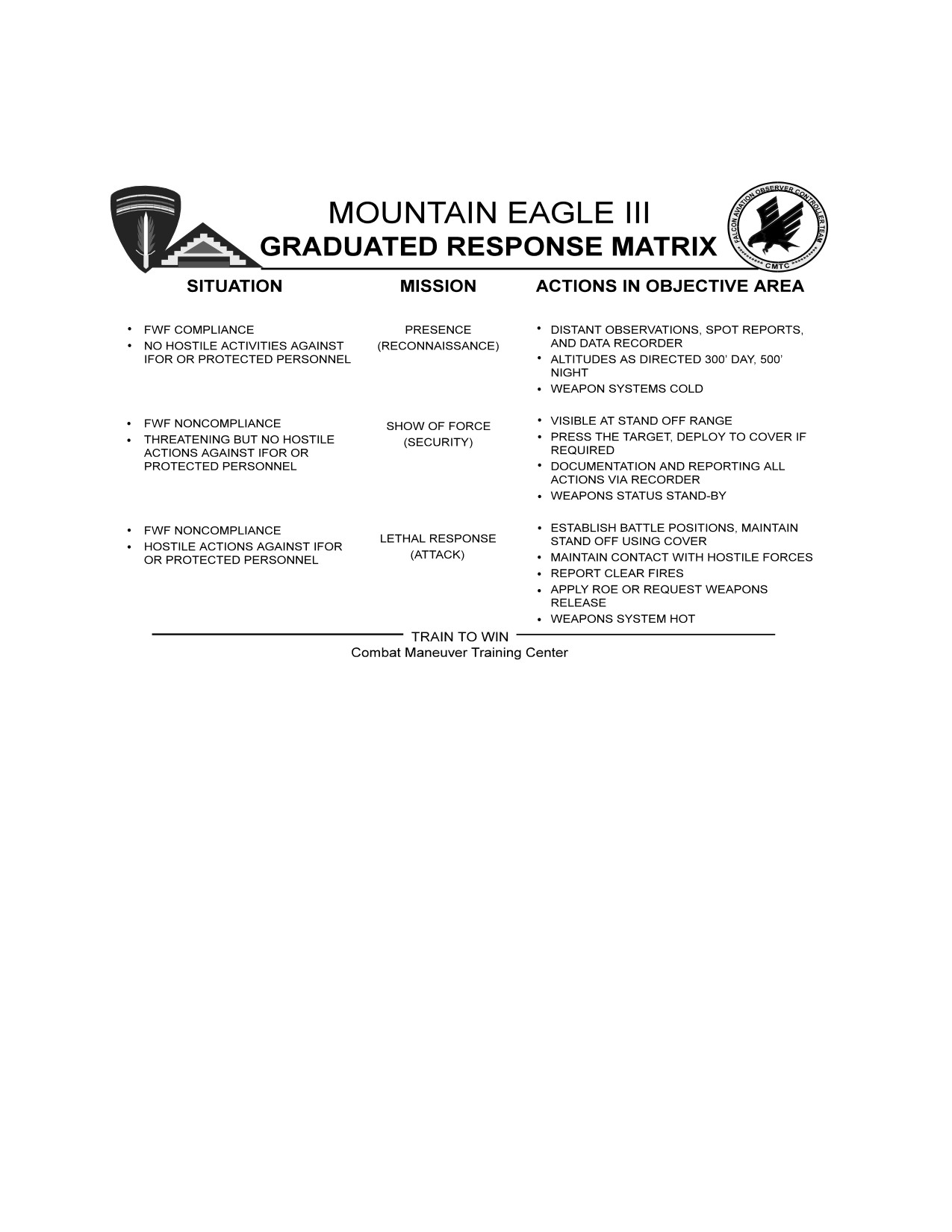
Figure 6-1. Example of a GRM
6-5
FM 1-112
APPENDIX A
ATTACK AIRCRAFT CHARACTERISTICS
A-1. AH-64A
This paragraph discusses aircraft characteristics, capabilities, and limitations of the AH-
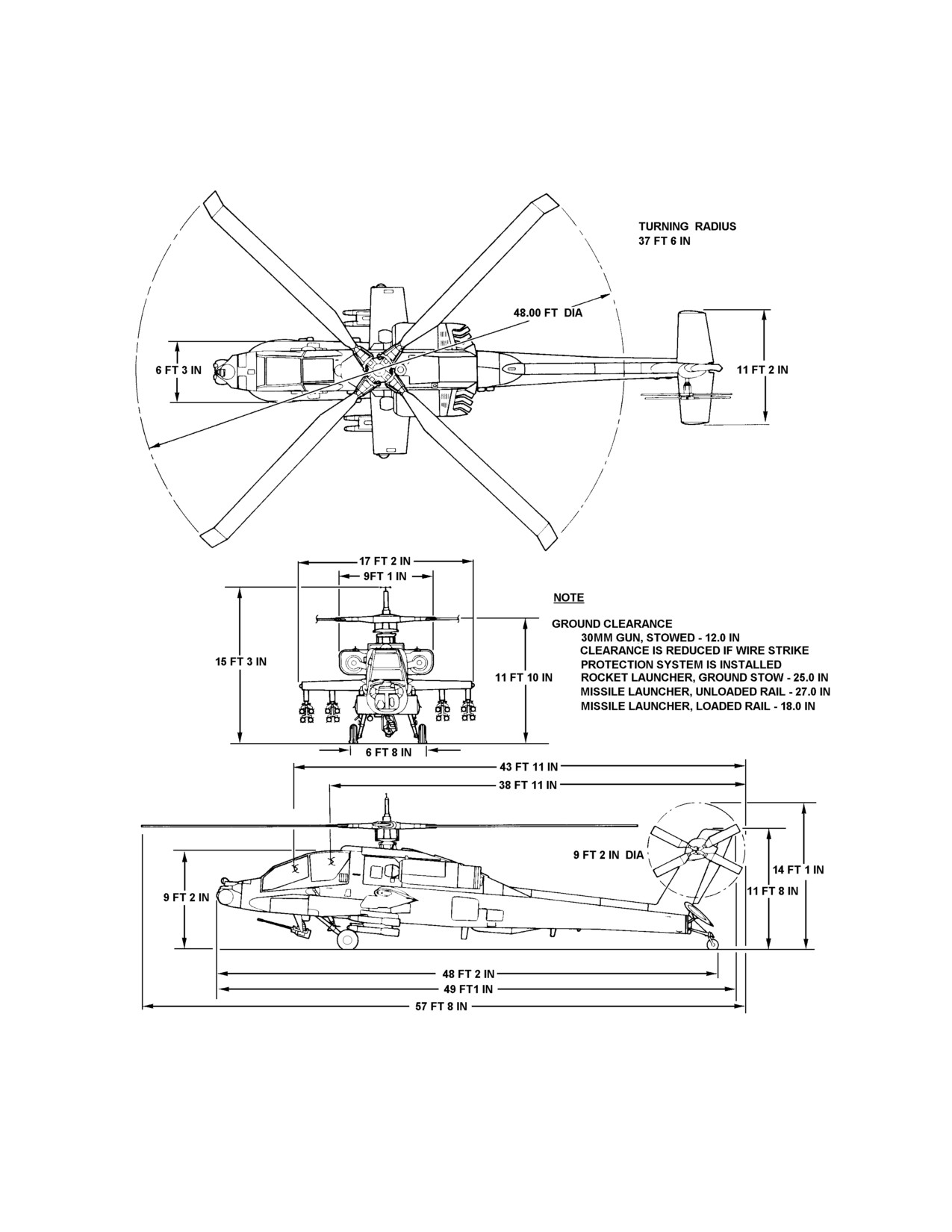
64A Apache (see Figure A-1).
a.
Description.
(1) The AH-64A is a twin-engine, tandem-seat, four-blade attack helicopter.
With its crew of two rated aviators, the pilot occupies the rear station and a copilot/
gunner occupies the front station.
(2) The aircraft is approximately 57 feet long with a 48-foot main rotor
span.
(3) Maximum gross weight 21,000 pounds.
(4) Maximum airspeed (level) is 164 knots; normal cruise speed is 100 - 120
knots.
b. Capabilities. The AH-64 provides commanders the following advanced
capabilities:
(1) The AH-64 has day, night, and limited adverse weather fighting
capabilities.
(2) It has improved combat survivability.
(3) It has twin engine performance and reliability.
(4) It has a wide array of firepower options.
(5) It also has advanced crashworthy design features.
(6) The AH-64 can be configured with an external 230-gallon fuel tank to
extend its range on attack missions, or it can be configured with up to four 230-gallon fuel
tanks for ferrying/self-deployment missions.
(a) The combat radius of the AH-64 is approximately 150 kilometers.
A-1
FM 1-112
Figure A-1. General dimensions, AH-64A
A-2
FM 1-112
(b) The combat radius with one external 230-gallon fuel tank installed
is approximately 300 kilometers.
NOTE: Both radii are temperature, PA, fuel burn rate and airspeed dependent.
(7) The AH-64 is air transportable in the C-5, C-141 and C-17.
(8) An on-board video recorder has the capability of recording up to 72
minutes of either the pilot or CPG selected video. It is an invaluable tool for damage
assessment and reconnaissance.
(9) The Apache's navigation equipment consists of a doppler navigation
system, and most aircraft are equipped with a GPS receiver.
(10) The Apache has state of the art optics that provide the capability to
select from three different target acquisition sensors. These sensors are--
• Day TV. Views images during day and low light levels, black and white.
• TADS FLIR. Views thermal images, real world and magnified, during day,
night and adverse weather.
• DVO. Views real world, full color, and magnified images during daylight and
dusk conditions.
c.
Apache Armament Systems. The Apache has four articulating weapons
pylons, two on either side of the aircraft, on which weapons or external fuel tanks can be
mounted. The aircraft has a LRF/D. This is used to designate for the Hellfire missile
system as well as provide range to target information for the fire control computer's
calculations of ballistic solutions.
(1) M230A1 "Chaingun" 30mm cannon.
• Used primarily against soft-skinned and lightly armored targets, and for self
protection.
• Single barrel, externally powered, hydraulically driven turret.
• Maximum capacity: 1200 rounds; rate of fire:
600 - 650 rounds/minute.
• Maximum range: 4,000 meters; maximum effective range: 1500 - 1700 meters.
• Ordnance: M789 HE, dual purpose ammunition.
A-3

FM 1-112
(2) FFAR system, 70mm.
• Maximum range: 9,000 meters; most effective range:
3,000 - 4,000 meters.
• Ordnance: HE, HE MPSM, white phosphorus, illumination, and flechette.
• Maximum load: 76 rockets.
(3) Hellfire missile system.
(a) The Hellfire is a laser guided missile capable of defeating any
known armor.
(b) There are two types of engagements. The first type of engagement
is autonomous. The aircraft that fires the missile also provides the laser energy for the
missile. The second type of engagement is remote. The missile is fired from one aircraft,
but the required laser designation is provided by another AH-64, a ground laser designa-
tor, or an OH-58D (I).
(c) The minimum range is 500 meters. The maximum range is 8,000
meters. The maximum load is 16 missiles.
(4) Armament configuration. The Apache's battlefield performance
allows it to fully support several different mission profiles with a wide armament array.
Table A-1 shows the various armament configurations available.
Table A-1. AH-64 mission profiles
RATE OF
ENDURANCE
MISSION
HELLFIRE
30MM
FFAR
SPEED
CLIMB(F/M)
(HRS)
ANTI-
16
1200
148
990
2.5
ARMOR
COVERING
8
1200
38
150
860
2.5
FORCE
ESCORT
1200
76
153
800
2.5
(5) Standard weapons configurations. Commanders can use the
standard weapons configurations listed in Table A-2 or modify them as desired:
A-4

FM 1-112
Table A-2. AH-64 Mission configurations
LOAD
L/O PYLON
L/I PYLON
R/I PYLON
R/O PYLON
ROLE
A
4 Hellfire
19 Rockets
19 Rockets
4 Hellfire
Sct/Atk
B
4 Hellfire
230 gal ext
19 Rockets
4 Hellfire
Sct/Atk
tank
C
4 Hellfire
4 Hellfire
4 Hellfire
4 Hellfire
Attack
D
4 Hellfire
4 Hellfire
230 gal ext
4 Hellfire
Attack
tank
E
19 Rockets
19 Rockets
19 Rockets
19 Rockets
Sct/Atk
F
19 Rockets
230 gal ext
19 Rockets
19 Rockets
Sct/Atk
tank
G
4 Hellfire
19 Rockets
230 gal ext
19 Rockets
Scout
tank
NOTE: All loads include 1200 rounds 30mm ammunition
d. Apache limitations.
(1) Threat identification. Threat identification through the FLIR system
is extremely difficult. Although the AH-64 crew can easily find the heat signature of a
vehicle, it may not be able to determine friend or foe.
(2) Infrared crossover. Forward looking infrared detects the difference in
the emission of heat in objects. On a hot day, the ground may reflect or emit more heat
than the suspected target. In this case, the environment will be "hot" and the target will
be "cool". As the air cools at night, the target may lose or emit heat at a lower rate than
the surrounding environment. At some point the emission of heat from both the target
and the surrounding environment may be equal. This is IR crossover and makes target
acquisition/detection difficult to impossible. IR crossover occurs most often when the
environment is wet. This is because the water in the air creates a buffer in the emissivity
of objects. This limitation is present in all systems that use FLIR for target acquisition.
(3) Low cloud ceilings. Low cloud ceilings may not allow the Hellfire
seeker enough time to lock onto its target or may cause it to break lock after acquisition.
At extended ranges, the pilot may have to consider the ceiling to allow time for the seeker
to steer the weapon onto the target.
(4) Overwater Operations. Overwater operations severely degrade
navigation systems not upgraded with embedded GPS.
A-5
FM 1-112
(5) PNVS. Pilot night vision sensor cannot detect wires or other small
obstacles.
(6) Obscurants. Some obscurants can prevent the laser energy from
reaching the target; they can also hide the target from the incoming munitions seeker.
Dust, haze, rain, snow and other particulate matter may limit visibility and affect sensors.
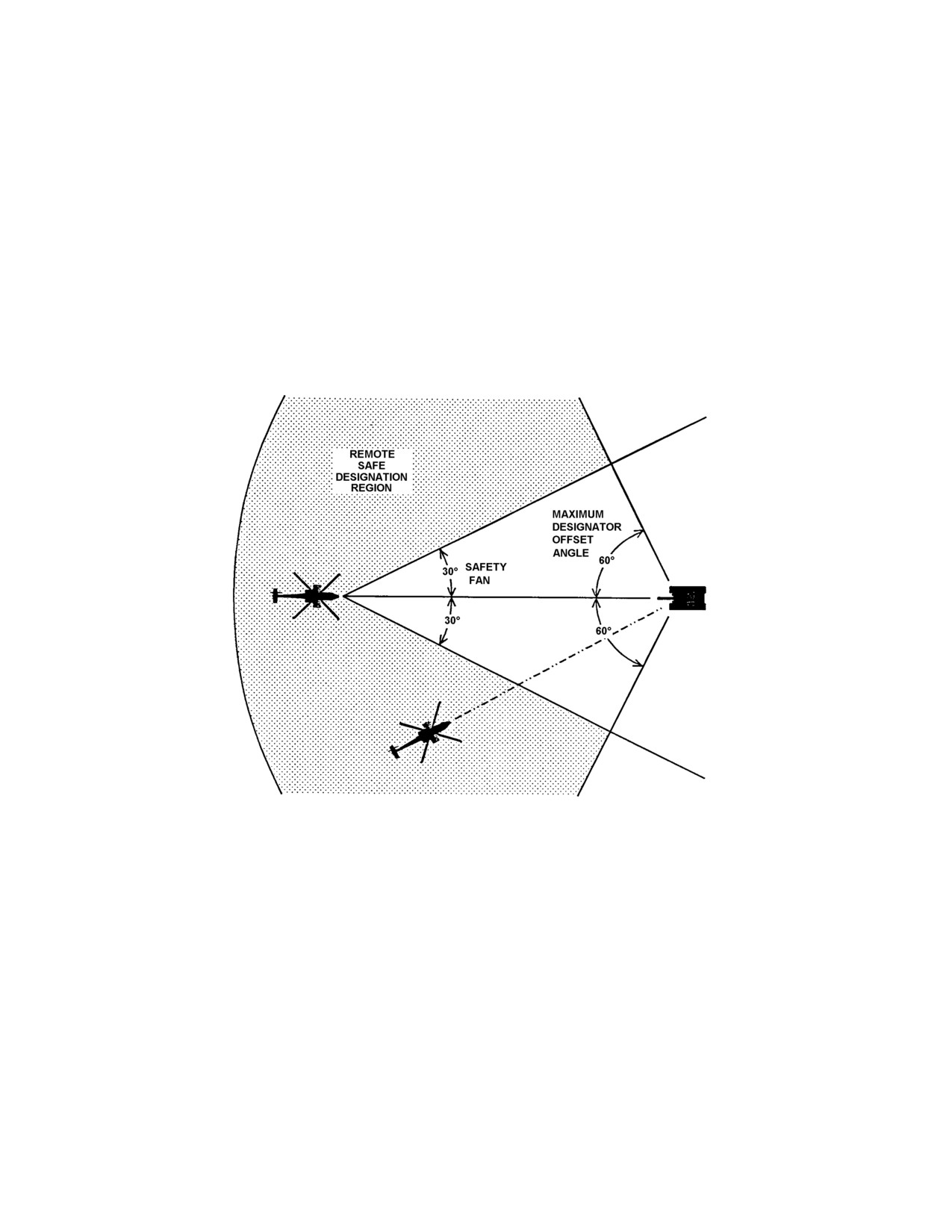
(7) Hellfire remote designation constraints. The designating crew may
offset a maximum of 60 degrees from the gun to target line and must not position their
aircraft within a +30-degree safety fan from the firing aircraft (see Figure A-2).
Figure A-2. AH-64 Hellfire remote designation
A-2. AH-1
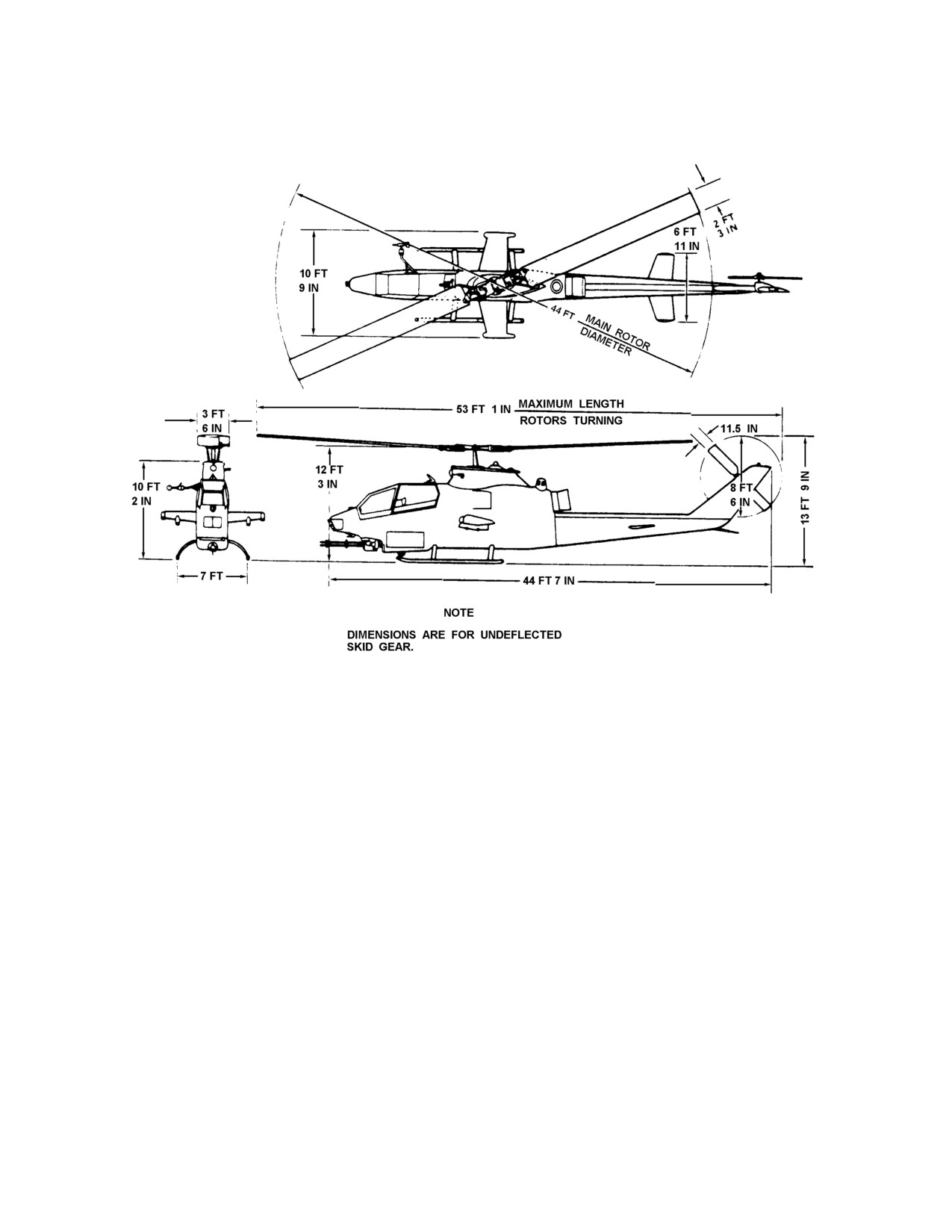
This paragraph discusses aircraft characteristics, capabilities and limitations for the AH-1
Cobra (see Figure A-3).
A-6
FM 1-112
Figure A-3. General dimensions, AH-1F Cobra
a.
Description.
(1) The AH-1 Cobra is a single-engine, tandem-seat, two-blade attack
helicopter. With its crew of two rated aviators, the pilot occupies the rear station and the
copilot/ gunner occupies the front station.
(2) The Cobra is essentially a daytime weapons platform due to the inability
to fire and track the TOW missile at night. Some Cobras have been modified with a
terminal night sight called C-NITE. This system allows the gunner to thermally track the
TOW missile at night through the TSU.
(3) The maximum airspeed is 120 - 140 knots. Normal cruise speed is 100
knots.
(4) The maximum gross weight is 10,000 pounds.
A-7
FM 1-112
b. Capabilities.
(1) AH-1 combat radius is approximately 100 km.
(2) The AH-1 is equipped with a doppler navigation system.
(3) It is air transportable in the Air Force C-5, C-141 and C-17.
c.
AH-1 Armament Systems. The AH-1 Cobra is equipped with TOW missile
launchers on wingtip articulating pylons, a chin-mounted uncoweled turret, a laser range
finder, heads-up display, and a fire control computer. Either 7 or 19 shot rocket pods are
normally mounted on each of the inboard wing mounting points.
(1) M197 20mm cannon.
• Used primarily against soft-skinned and lightly armored targets and for self-
protection.
• Three-barreled, externally powered, hydraulically driven turret.
• Maximum capacity: 750 rounds; rate of fire:
730 rounds/minute.
• Maximum range: 2,000 meters; maximum effective range: 1,500-1,700 meters.
• Ordnance: M789 HE, dual purpose ammunition.
(2) FFAR system, 70mm.
• Maximum range: 9,000 meters; most effective range:
3,000 - 4,000 meters.
• Ordnance: HE, HE MPSM, white phosphorus, illumination, and flechette.
• Maximum load: 76 rockets. The rockets can be loaded into either a 7-shot
(M260) or a 19-shot (M261) rocket launcher that can be mounted on each wing store in
the inboard or outboard position.
(3) TOW missile system. The TOW missile is an antiarmor precision
guided weapon, which is tube launched, optically tracked and wire guided. Maximum
range is 3,750 meters. An AH-1 can carry a maximum of 8 TOW missiles.
d. Limitations.
(1) The AH-1 is limited to 10,000 pounds gross weight. Most airframes
weigh over 9,000 pounds with crew and a full load of fuel. Cobra crews will always have
to figure the ammunition needed for the mission and trade fuel weight for ammunition
A-8

FM 1-112
weight as needed to complete the mission (Table A-3). In doing this the crew will also be
reducing airframe station time.
Table A-3. Basic loads and weapons configurations
MISSION
ROCKETS
20mm
TOW
FUEL
Antiarmor
14(MPSM)
300
4
1,200
Antipersonnel
38(MPSM)
100
0
900
NOTE: The above planning profiles will vary based on the operating environment, ammunition,
and the gross weight of the aircraft. Both examples will take the airframe to 10,000 pounds.
(2) Operations in areas with high PA or high temperatures will greatly
reduce the effectiveness of the aircraft due to the low gross weight to power ratio of the
airframe. The effectiveness of the weapons systems is greatly reduced during night
operations.
A-3. OH-58D (I) KIOWA WARRIOR
This paragraph discusses characteristics, capabilities and limitations for the OH-58D (I)
Kiowa Warrior (see Figure A-4).
a.
Description.
(1) The OH-58D Kiowa Warrior is a single-engine, dual-seated, four-blade
armed observation helicopter. With its crew of two, the pilot occupies the right seat and
the copilot occupies the left seat.
(2) The maximum gross weight is 5,500 pounds.
(3) The maximum airspeed is 125 knots. Normal cruise speed is 100 knots.
b. Capabilities.
(1) The OH-58D is air transportable in the Air Force C-130, C-141, C-5 and
the C-17.
(2) It is equipped with advanced navigation and mission planning equip-
ment.
(3) The combat radius is approximately 120 kilometers.
A-9
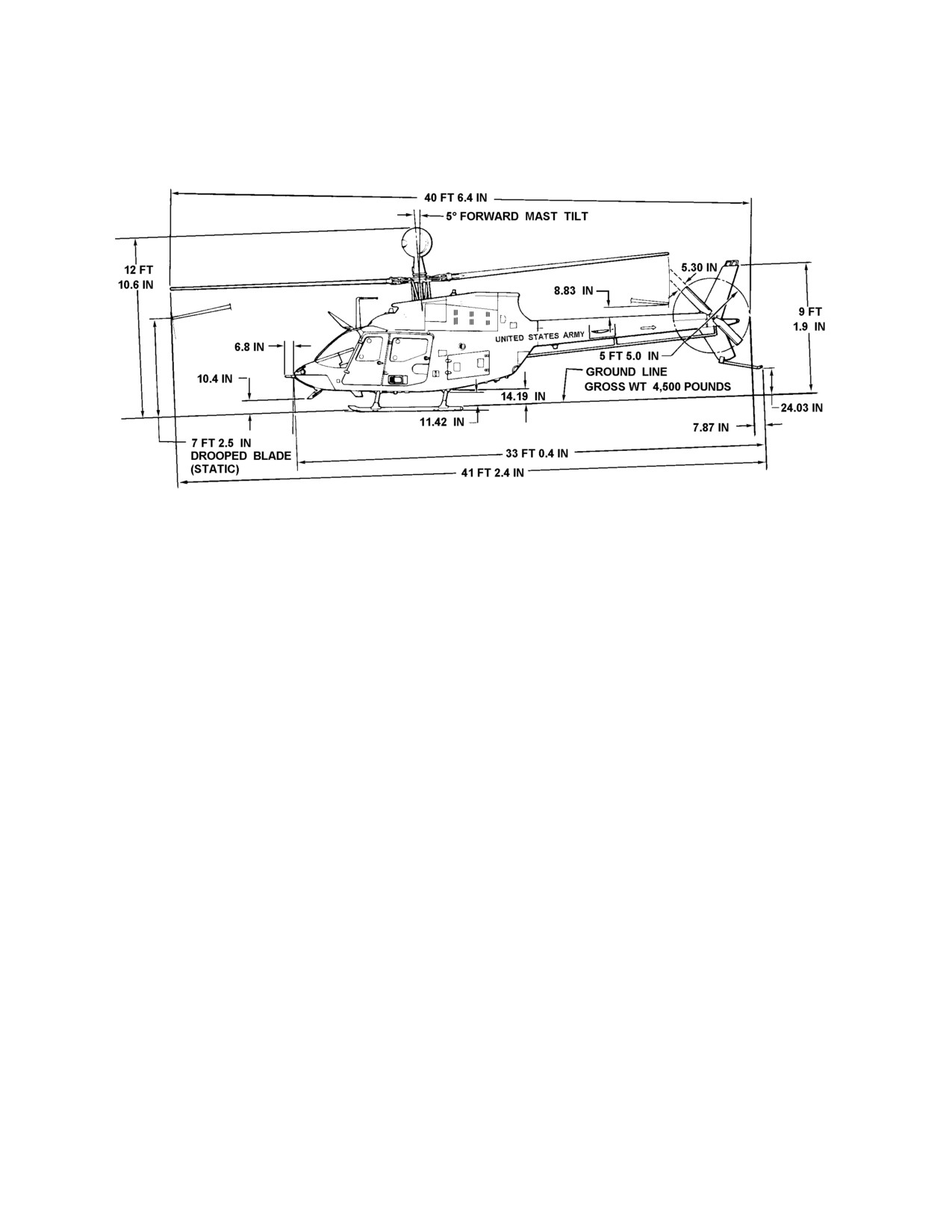
FM 1-112
Figure A-4. General dimensions, OH-58D (I)
c.
Armament Systems. The Kiowa Warrior has two universal weapons pylons,
one located on either side of the aircraft, on which several weapons can be mounted. The
aircraft has a LRF/D. This is used to designate for the weapons system as well as provide
range to target information for the ATHS and on-board weapons systems (see Figures A-5
and A-6).
(1) Machine gun, .50 caliber. This machine gun is an air cooled, belt fed,
electronically controlled weapon that can be mounted on the left weapons pylon. The
weapon holds 500 rounds with a duty cycle of 150 rounds with a one-minute cooling
period. The weapon fires either in the continuous mode or the burst can be limited to
one-second burst of 12 to 14 rounds. The .50 caliber has a maximum range of 2,000
meters and a maximum effective range of approximately 1,000 meters.
(2) FFAR system, 70mm.
(a) The maximum range is 9,000 meters. The most effective range is
3,000 - 4,000 meters.
(b) The ordnance consists of HE, HE MPSM, white phosphorus,
illumination, and flechette.
(c) The maximum load is 14 rockets. The OH-58D can carry two, 7-
shot M260 rocket pods.
A-10
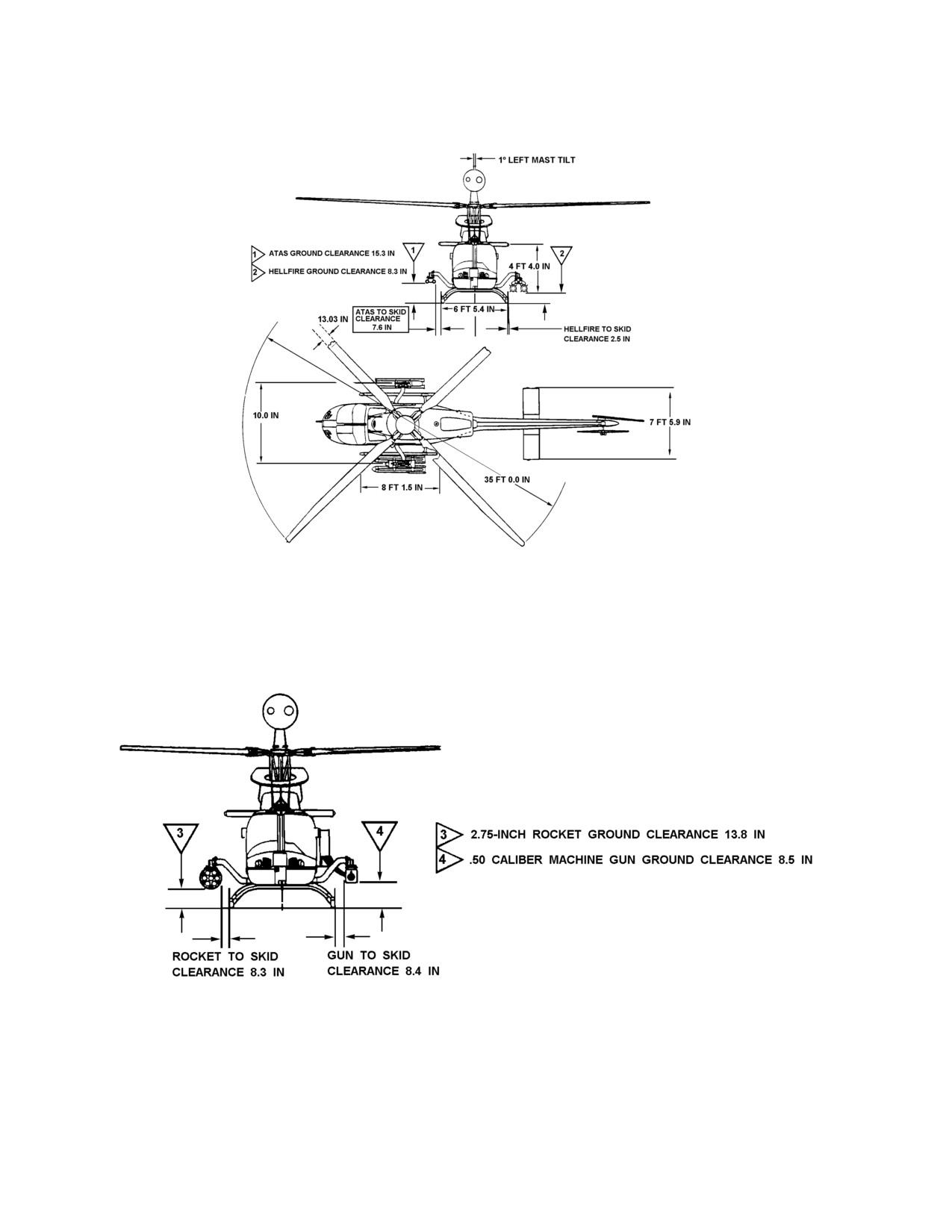
FM 1-112
Figure A-5. Dimensions, missile configuration and
rotor system, OH-58D (I)
Figure A-6. Dimensions, OH-58D (I) scout configuration
A-11
FM 1-112
(3) Hellfire missile system.
(a) The Hellfire is a laser-guided missile capable of defeating any
known armor.
(b) There are two types of engagements. The first type of engagement
is autonomous. The aircraft that fires the missile also provides the laser energy for the
missile. The second type of engagement is remote. The missile is fired from one aircraft,
but the required laser designation is provided by another OH-58D (I), a ground laser
designator, or an AH-64.
(c) The minimum range is 500 meters. The maximum range is 8,000
meters. The maximum load is 4 missiles.
(4) ATAS. The ATAS is an ATA heat seeking missile with fire and forget
capability. The OH-58D can carry 2 ATAS per pylon. The ATAS has a minimum range of
less than 1,000 meters and a maximum engagement range of more than 4,000 meters.
d. Limitations.
(1) Infrared crossover. The TIS operates on determining temperature
differentials. There are times when the temperature of objects and their surroundings
reach the same temperature, and target detection is degraded.
(2) Obscurants. Dust, rain, haze, and smoke can reflect the laser energy
so it would prevent it from reaching the target. Fog and haze will also effect the duration
and the effect of IR crossover.
(3) Low clouds/ceilings. Low ceilings may not allow the HELLFIRE
seeker enough time to lock onto its target, or the missile may break lock after acquisition.
(4) IMC. The aircraft is not certified for IMC flight. It does not have any
navigation receivers on board.
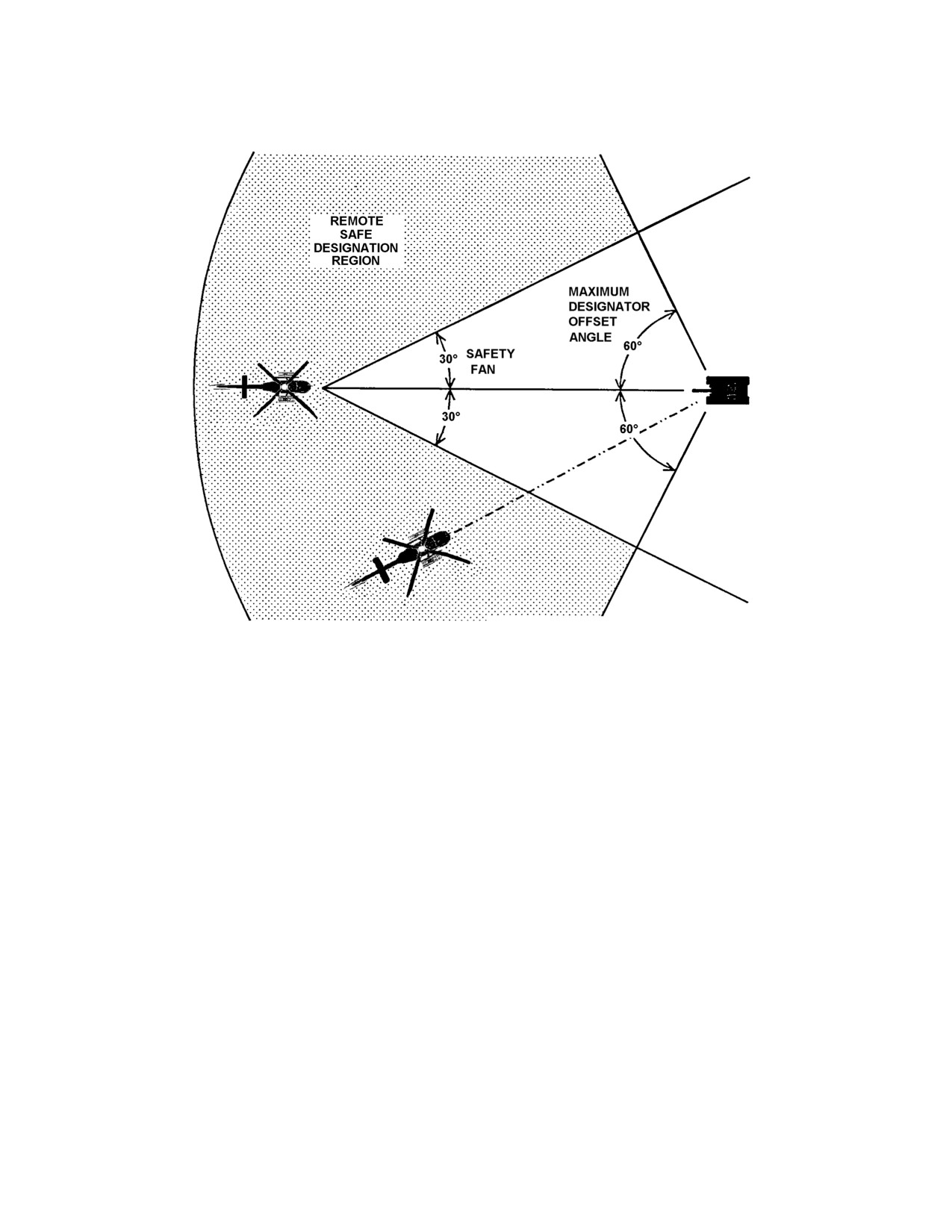
(5) Hellfire remote designation constraints. The designating crew may
offset a maximum of 60 degrees from the gun to target line and must not position their
aircraft within a +30-degree safety fan from the firing aircraft (see Figure A-7).
A-12
FM 1-112
Figure A-7. OH-58D (I) Hellfire remote designation
A-13
FM 1-112
APPENDIX B
AIR ASSAULT SECURITY
B-1. INTRODUCTION TO AIR ASSAULT
a.
As defined in FM 101-5-1, air assault operations are "operations in which air
assault forces (combat, combat support [CS], and combat service support [CSS]), using the
firepower, mobility, and total integration of helicopter assets in their ground or air roles,
maneuver on the battlefield under the control of the ground or air maneuver commander
to engage and destroy enemy forces or to seize and hold key terrain."
b. Air assault operations are inherently complex, fully synchronized combat
operations. They are a form of maneuver particularly important for light forces as they
are the primary means of rapid deployment. In some cases, they are the only means of
employment directly into combat. Air assault operations are occasionally used by heavy
forces to assist in overcoming obstacles in the seizure of critical terrain.
c.
The level of precision required to successfully conduct air assault operations
requires deliberate planning and the detailed synchronization of all BOS. Air assault
security is provided by air cavalry and attack units in coordination with conventional FS
to set conditions prior to the air assault and to continue to provide supporting fires once
the air assault force is established on the ground.
B-2. AIR ASSAULT SECURITY
a.
Air assault security operations provide force protection for air assault
operations. Air assault security encompasses the entire range of planning and operations
conducted to protect the air assault TF as it moves from PZs to LZs, accomplishes its
ground tactical mission, and returns. It is planned and executed as an integral part of
the air assault operation and is planned at the air assault TF level.
(1) Like most other operations involving aviation assets, air assault security
requires centralized planning and decentralized execution. In its most complex form, air
assault security is a highly synchronized operation often involving many different types of
units executing reconnaissance, security, EW, SEAD, FS, and other missions in support of
the air assault TF. The complexity of air assault security operations will often be greatest
for deep operations and lower for close and rear operations. Generally, once a route is
secured, it will remain secure for some time. This allows a security force (based on
METT-T) to precede the assault force along a route.
(2) Historically, most air assault operations conducted during low intensity
conflicts have faced a light infantry threat. However, during mid- to high-intensity
conflicts, the AATF can expect its greatest threat to be enemy artillery. In both cases,
B-1
FM 1-112
attack helicopters can provide accurate, responsive fires for the AATF. This is particu-
larly important during operations when the AATF is outside of friendly artillery range.
b. Units Participating in Air Assault Security.
(1) Cavalry/reconnaissance units. Reconnaissance and security are vital
components of air assault security operations. Air cavalry/reconnaissance units play
major roles in these operations. Missions for these units include screening and reconnoi-
tering air axes or routes, PZs and LZs, providing suppressive fires, and conducting
passage of lines. METT-T determines how these units are actually employed. When
attack helicopter units are not available, air cavalry/reconnaissance units may be required
to perform attack missions within the limits of their capability. Ground cavalry forma-
tions may also be employed in the security role. Probable missions for ground cavalry
include PZ security, reconnaissance of routes, and LZs.
(2) Attack helicopter units. Attack helicopter battalions or companies are
capable of performing the missions of air cavalry/reconnaissance units, and conduct these
missions when air cavalry units are not available. The attack helicopter units also
conduct overwatch and screening of the air assault force during movement along the air
axes from PZ to LZ, providing protection against enemy ground fire or attacks by armed
helicopters. They provide suppressive fires, SEAD, and may be used as a reserve force to
counterattack threats to the AATF. Attack helicopters may also be integrated into the
scheme of maneuver for the ground tactical phase, where they may be used to conduct
screen or guard missions, hasty attacks, or other doctrinal missions in support of the
AATF.
(3) MI units.
(a) Corps and division MI units equipped with short range unmanned
aerial vehicles can provide reconnaissance and surveillance for air assault operations.
Divisional and corps LRSD teams and pathfinder units can provide similar intelligence
products. UAVs equipped with day television or FLIR sensor packages are capable of
reconnoitering air routes, LZs, and objectives before and during air assault operations.
(b) UAVs operating at medium altitude provide battlefield information
that may be used in planning and conducting air assault security operations. Information
may include suitability of air axes, obstacles, enemy force dispositions, and other perti-
nent information. During air assault security operations, UAVs precede cavalry, attack,
or transport helicopter units of the air assault force, and provide early warning to allow
the air assault TF to defeat or bypass enemy forces. UAVs may then be employed to
maintain surveillance of the LZs, objective, enemy avenues of approach into the objective
area, alternate and return flight axes, or other critical locations.
(c) LRSD/pathfinder teams can provide the same information, but are
susceptible to interception or interdiction and are not nearly as mobile. On the plus side,
the LRSD/Pathfinder teams allow flexibility and the ability to inject human judgement
B-2
FM 1-112
into the intelligence products. MI units also have the capacity to provide EW support to
air assault security operations.
(4) FS systems. Lethal and nonlethal FS systems are often integral
participants in the air assault security effort. FS systems are used to destroy, neutralize,
deceive, or suppress enemy forces that pose a threat to the AATF. These systems are
employed according to the commander's intent for fires.
(a) Lethal FS systems. Systems available for air assault security
may include mortars, FA (cannon, missiles, rockets), NGF, and CAS. In cases where FS
systems are limited by range or availability, attack helicopters may also be employed to
maneuver against enemy targets in support of the AATF. Specific missions include
engaging enemy ground forces, indirect FS systems, and AD systems to prevent or disrupt
attacks on the AATF.
(b) Nonlethal FS systems. These FS means include EW systems and
smoke delivered by mortars, NGF, or FA systems. EW is employed to disrupt enemy C3,
degrade enemy FS and AD radio nets, and inhibit other enemy intelligence systems.
Smoke is used to screen movement of the AATF or obscure enemy direct fire weapon
systems.
B-3. AIR ASSAULT SECURITY PLANNING
a.
General.
(1) Planning for air assault security is based on METT-T. Corps or division
assets are often involved in planning and executing air assault security for deep opera-
tions. Air assault security is planned early and continuously as an integral part of the air
assault mission reverse planning process. Though some units tasked with air assault
security may be company/troop size, planning for their employment should be executed no
lower than battalion/squadron level. Actions taken during the planning process enhance
security and reduce the chances of disruption or defeat of the air assault TF during
mission execution.
(2) Air assault security will vary based on the mission of the AATF. During
mission planning, the AATFC and AMC determine the likelihood of enemy contact and
capabilities of enemy forces to threaten the AATF during each phase of the air assault
operation. The composition, size, and employment of the air assault security force during
deep operations for the air movement, landing, and ground tactical phases will be
determined in part by this analysis. During operations on a nonlinear battlefield, contact
could be possible during every phase. For close and rear operations, enemy contact might
be expected only during the landing and ground tactical phases.
b. Planning Considerations for Air Assault Security.
B-3
FM 1-112
(1) IPB. IPB provides information that will identify actual or likely enemy
dispositions and capabilities in the vicinity of LZs and along flight routes. Planners use
this information to select flight routes that avoid the enemy and provide maximum cover
and concealment to the air assault TF.
(2) Reconnaissance. Thorough air or ground reconnaissance of PZs,
routes, key terrain, and LZs conducted prior to mission execution provides planners with
valuable information. When OPSEC considerations preclude Army Aviation systems from
overflying these areas in advance of the air assault operation, reconnaissance may be
conducted with other systems including SEMA, UAVs, J-STARS, and other intelligence
assets.
(3) Terrain and environmental considerations. Terrain can be used to
enhance the security of air assault forces. Air routes should be planned to take advantage
of masking terrain or cover. Aircraft performing high speed contour flight over forests or
jungles minimize their exposure to ground fire, which reduces the need for security forces.
Conversely, when operating over terrain that provides the enemy long range observation
and fields of fire, air assault forces will normally require a larger security force. Night
operations, though more complex, reduce the possibility of the air assault force being
detected and engaged. Alternate flight routes allow air assault forces to avoid enemy
units discovered during the execution of the air assault. Attack helicopters and FS assets
can be planned to dominate key terrain and deny its use to enemy forces that might
threaten the AATF.
(4) Aviation units. Although air assault security is normally performed by
cavalry/reconnaissance or attack helicopter units, the assault helicopter unit commander
is normally assigned the role of AMC. Aviation unit commanders and operations officers
participate directly in air assault security planning at the earliest possible time. Cav-
alry/reconnaissance and attack helicopter units are task organized to provide air assault
security. The type, number, weapons configuration and employment of these units vary
with METT-T. Cargo and assault helicopter units plan for the use of door guns to engage
enemy forces along air routes and LZs. All units should plan detailed actions on contact
including procedures for reacting to ground fire, attack by armed helicopters or high
performance aircraft, downed aircraft, and procedures for moving to alternate air routes,
PZs and LZs.
(5) Ground tactical plan. All members of the air assault TF must know
and understand the ground tactical plan. Additionally, all members of the TF must have
the ground commander's control measures and scheme of maneuver on their maps. This
will allow responsive support and reduce the possibility of fratricide in the objective area,
especially at night.
(6) FS. Artillery and mortar fires, CAS, and NGF are planned to provide
SEAD, obscuration, and suppressive fires along routes and in LZs. The element responsi-
ble for security of the AATF should control the fires until the ground force commander
has sufficient combat power in the objective area to assume the battle. Once he does have
that sufficient combat power in the objective area, the FS plan that is part of the ground
B-4
FM 1-112
tactical plan is also important to consider. If there will be multiple lifts into an objective
area, the ground tactical force may be able to provide fires for the later lifts. These fires
are not always responsive enough to destroy immediate threats to air assault forces
moving along flight routes, but may be used to suppress or obscure known or suspected
enemy units before they can engage the AATF or following lifts/serials. These systems
may also be used to deceive the enemy by firing preparations into false LZs and passage
points (deceptive SEAD). Nonlethal FS that includes EW, smoke and deceptive fires,
provide security by degrading observation, jamming enemy communications nets, FS nets,
and AD radars, and deceiving the enemy as to the location of the objective areas. Just as
all members of the AATF need to have the ground tactical plan scheme of maneuver on
their maps, they must also have the scheme of fires and control measures to provide
responsive support and prevent fratricide.
(7) Control measures. Maneuver and airspace control measures are
planned in a manner that enhances security for the air assault force. Primary and
alternate air axes or routes provide more freedom of maneuver, allowing the AATF to
bypass enemy concentrations or attacks. Attack helicopter battle positions are planned to
support PZs, LZs, and flight routes. ROZs are planned over PZs, LZs, and FARPS to
protect the force from airspace conflicts. During deep operations, a coordinating altitude
should be established forward of the FLOT if none exists. FS coordinating measures such
as ACAs are planned to allow attack of targets by multiple FS assets while providing
protected airspace for AATF aircraft.
(8) CSAR/downed aircraft procedures. Rescue of downed aircrews and
personnel, and recovery of aircraft is planned as part of the air assault security effort.
Pickup of downed aircrews and personnel is usually accomplished by an assault helicopter
operating independently of the assault elements. During large operations conducted
across the FLOT or on a nonlinear battlefield, the AATFC and AMC may decide to form a
dedicated CSAR element. This element may consist of a MEDEVAC/CASEVAC aircraft,
an assault helicopter with a small ground security force, and an attack helicopter element.
The AMC plans for the employment of this force to extract personnel and secure and
recover downed aircraft. This force also destroys downed aircraft when ordered by the
approving authority.
(9) Rehearsals. The air assault security operation is rehearsed as an
integral part of the AATF rehearsal. The AMC ensures that all subordinate commanders
including cavalry, attack, assault, cargo, and CSAR attend the rehearsal. These com-
manders then return to their units and in turn conduct detailed rehearsals for each of
their key leaders and aircrews.
B-4. RESPONSIBILITIES
a.
AATFC. The AATFC ensures that air assault security is integrated into the
planning and execution of the air assault operation. The AATFC and his staff plan and
coordinate the use of all available assets to provide air assault security.
B-5
FM 1-112
b. AMC. The AMC formulates the air assault security plan based on the
AATFC's guidance. He works closely with the AATF staff and aviation unit commanders
to plan the employment of cavalry and attack units for air assault security operations
from the PZ to LZ. As a minimum, the AMC should be assisted in planning by an
aviation battalion-level staff. The AATF FSCOORD works closely with the AMC to plan
responsive FS for the air assault security operation. To ensure unity of effort, the AMC
controls aviation units and FS operations from PZ to LZ. When cavalry or attack units
are integrated into the scheme of maneuver for the ground tactical plan, the AMC ensures
that a seamless transition to those roles is planned. He must direct the subordinate
aviation unit commander to conduct face to face coordination with the ground maneuver
commander/S-3 to get the commander's intent, scheme of maneuver, FS plan, graphics,
frequencies, and call signs. Additionally, the subordinate commander must attend and be
a part of the ground force's rehearsals. The AMC also plans for CSAR operations as part
of the security effort.
c.
Attack Helicopter Unit Commander. The attack helicopter unit com-
mander works with the AMC to plan security operations for the AATF. Planning
considerations include SEAD, overwatching the front, flank, and rear of AATF serials
moving along air routes to protect against air or ground threats, providing overwatch or
suppressive fires in and around the PZs/LZs, blocking enemy forces attempting to attack
the AATF, and security for CSAR or MEDEVAC/CASEVAC operations. Relief on station
operations may have to be planned to provide continuous security for large air assault
operations. When cavalry assets are unavailable, the attack helicopter unit commander
may also be required to plan for reconnaissance/security operations in support the AATF.
d. Air Cavalry/Reconnaissance Unit Commander. The air cavalry unit
commander plans support for passage of lines, screening of PZs and LZs, reconnaissance
of routes in advance of the AATF, and security for CSAR or MEDEVAC/CASEVAC
operations. Relief on station operations may have to be planned to provide continuous
security for large air assault operations. If attack helicopter units are unavailable, the air
cavalry unit commander may be required to plan attack operations in support of the
AATF.
e.
CSAR Element Commander. The CSAR element commander, when
appointed, plans for the employment of his force to recover downed personnel, and secure,
recover, repair, or destroy downed aircraft. First priority in planning goes to recovery of
downed personnel using assault, cargo or MEDEVAC/CASEVAC aircraft. Planning
includes employment of attack helicopters to provide security during personnel extractions
and aircraft recoveries. The CSAR element commander also plans for employment of the
ground security force to secure downed aircraft while maintenance personnel perform
repairs or rig it for recovery. His assets provide security for aircraft recovery operations
and destroy downed aircraft when directed by proper authority.
B-5. BATTLE COMMAND
B-6
FM 1-112
a.
Command. The AATFC commands and controls the air assault operation.
During the air assault operation, air cavalry/reconnaissance and attack units are under
OPCON of the AATFC. However, during the movement of the AATF between PZ and LZ,
the AATFC normally places these forces under OPCON of the AMC to ensure unity of
effort for all aviation assets.
b. Control. The AMC fights the battle during movement of the AATF from PZ
to LZ. In this role, the AMC controls all aviation units and supporting fires to ensure
unity of the air assault security effort. To accomplish this task, the AMC normally
positions himself where he can best control all aviation forces. In a small operation, he
may be part of the assault element. However, with a larger AATF comprised of several
different serials and a large security force, the AMC may position himself apart from the
assault elements to control the operation more effectively. The AMC makes this determi-
nation in conjunction with the AATFC. He is normally located aboard the same aircraft
as the AATF commander or AATF S3. Control of the operation is aided by the use of
execution check lists or matrices with brevity code words. Communications between the
AMC and other aviation elements normally include early warning and required situation
reports. These reports should be passed using the brevity codes to reduce communications
traffic.
c.
Communications Nets. The AMC maintains communication with the
AATFC and all aviation elements dedicated to the air assault and security operations.
Figure B-1 shows the radio nets used for air assault security operations.
(1) Air assault TF command net. This is a secure FM net used by the
AATFC to control the air assault operation. The AMC, if not actually located with the
AATFC, communicates with him on this net. Commanders of assault, cargo,
cavalry/reconnaissance, and attack units monitor this net.
(2) ABN. The AMC uses the ABN as his primary net for controlling
security operations between PZ and LZ. The ABN is normally a UHF air-to-air net
dedicated to communications between the AMC and all other aviation element command-
ers. This net is normally operated on the AMC's UHF command frequency. The AATFC
may elect to operate on this net while he is airborne.
(3) Aviation internal net. These are normally VHF plain voice or FM
secure nets used by each subordinate aviation element commander to control his individ-
ual aircraft.
(4) FS net. This is an FM secure net operated by the AATFC FSCOORD.
Aviation elements do not normally monitor this net, but may enter it to transmit calls for
fire during movements, insertions, and extractions. AFSOs and the security element
supporting air assault security operations monitor this net continuously.
B-7
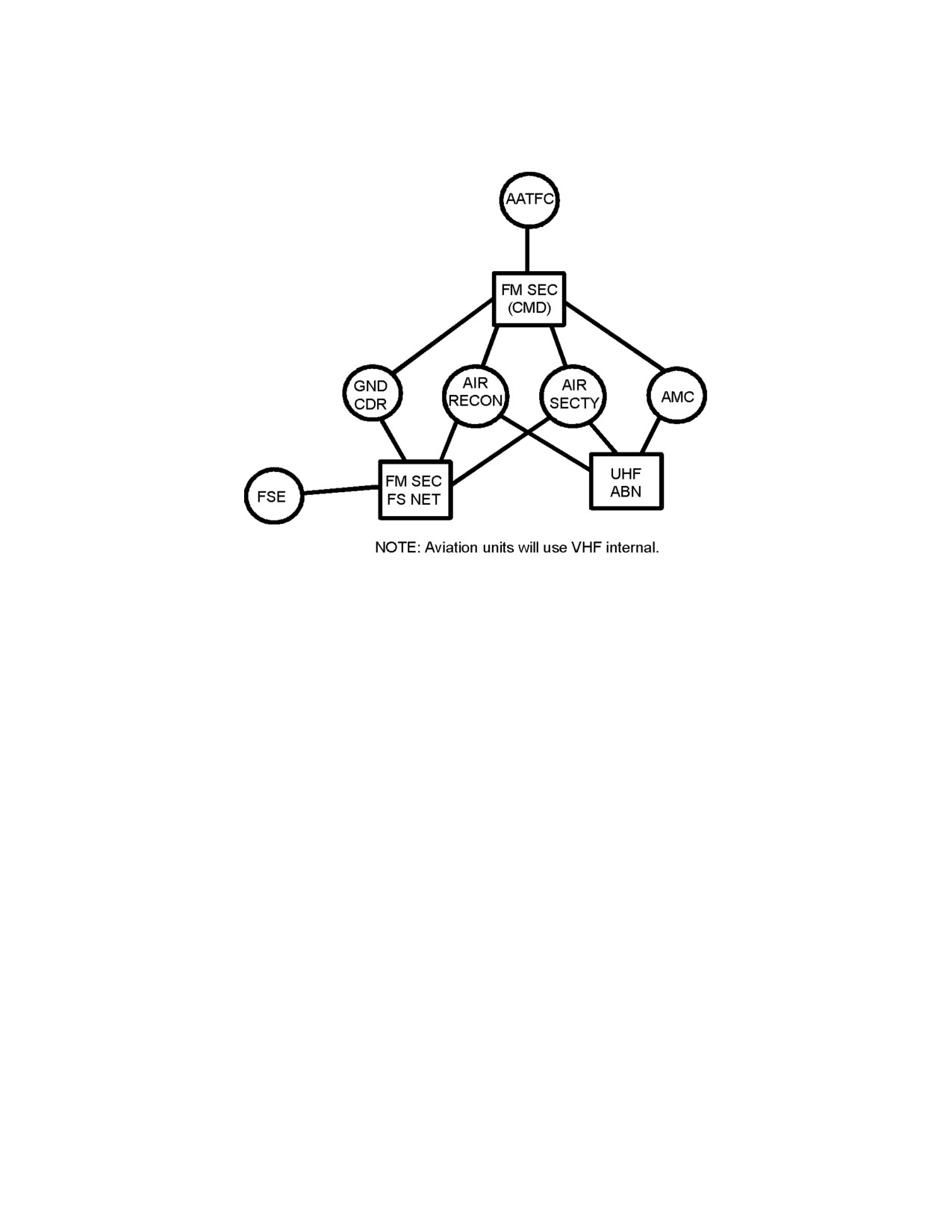
FM 1-112
Figure B-1. Air assault communications nets
(5) CAN. Although this net is not specifically used for air assault security
operations, it may be when attack or cavalry assets are used to support the ground
tactical plan. This is an FM secure net dedicated to air-to-ground coordination during air
assault operations. Though it may be used as an alternate TF command net, it is
dedicated primarily for communications between supporting aircraft and the lifted ground
units. Aviation security element commanders may monitor this net within the limits of
their capabilities during pickup and LZ operations.
B-6. AIR ASSAULT SECURITY TTP
a.
General. The air assault security force is normally composed of a reconnais-
sance element and a security element. Air assault operations consist of five plans or
phases; staging, loading, air movement, landing, and ground tactical plans. A phase may
be conducted more than once during an operation. An example of this would be a multi-
lift operation or the extraction of the assaulting force. Each phase may require various
levels of air assault security for the AATF. The level of security for each phase is
determined by METT-T. During the planning phase the AMC plans the synchronization
of the aviation assets and various electronic and FS systems to suppress any threat.
B-8
FM 1-112
b. Staging Phase. Air assault security for the staging plan encompasses aerial
reconnaissance and screening operations. During or prior to this phase, the reconnais-
sance element may conduct reconnaissance of air axes or routes, LZ/PZs, and laager sites.
Ideally the reconnaissance should be conducted early enough to provide input during the
planning process. The reconnaissance can be conducted from key observation points along
the route, thus avoiding activity directly on the intended route. If the reconnaissance
elements spot the enemy, the mission may switch to surveillance to help develop the
situation. It is imperative that the element remains undetected because it is crucial that
the air assault operation's element of surprise is not compromised. The use of UAVs will
enhance intelligence collection and OPSEC. If cavalry or attack assets are available, they
can screen the ground unit's movement from their present location to a staging location
and on to the PZ area.
c.
Loading Phase.
(1) Security of the PZ is of critical importance. The air assault TF is
vulnerable during this stage due to the massing of troops and aircraft. Security opera-
tions preclude enemy forces from attacking the TF during one of its most vulnerable
times. PZs located in the rear are generally secure and may not require aviation security
elements integrated with the ground security force. PZs beyond the FLOT must be
regarded as not secure. The AATFC determines the security requirements for the PZ.
Aviation security elements may augment and support the ground security elements
around the PZ by screening a vulnerable flank or likely avenues of approach.
(2) If enemy contact is likely during this stage, the ground cavalry/ recon-
naissance troops are well suited to provide additional security. The reconnaissance
element may precede the arrival of the assault aircraft to the PZ; however, all measures
should be taken to avoid creating a signature around the PZ. Coordination between the
ground and aviation security elements is necessary when they collectively provide security
for the ground forces in the PZ. The AMC and the PZ control officer must delineate fire
control measures, sectors of responsibility, and C3 between the ground and air security
elements. If attack aircraft are used during this phase of the air assault, they may need
to conduct relief on station or FARP operations to ensure they have sufficient station time
to conduct follow on missions.
d. Air Movement Phase.
(1) Air assault security for the air movement plan is finalized prior to the
AMB. The AMC "fights the battle" from the PZ to the LZ while keeping the AATFC
informed. The AMC employs artillery, attack, and reconnaissance elements according to
the AATFC's intent. The AMC determines the tactical flight formations of the assault
aircraft and the placement of the security and reconnaissance elements. The air assault
security force must be aggressive and sufficiently removed from the main body to provide
reaction time and maneuver space.
B-9
FM 1-112
(2) Normally, security elements do not "escort" the assault and cargo
aircraft from the PZ to the LZ. Based on METT-T, AATF planners may decide to employ
a portion of the aircraft in the security force to move along the air route with the assault
aircraft. Particularly during escorts, air assault security force elements must be briefed
about actions on contact. The security element may not always react to suppress each
enemy target, especially if they do not pose a threat to the AATF. Assault/cargo helicop-
ters may suppress using overlapping fires with their door guns, perform evasive maneu-
vers, and report to subsequent serials to avoid that area. These actions must be planned
from PZ departure, along the route or axis, landing into the LZ, departing the LZ, and the
route back so they can destroy, attrit, disrupt, or avoid contact with the threat according
to the AATFC's intent.
(3) When developing actions on contact, consideration must be given to the
type of formation to be flown, location of the attack helicopters, commands or code words
to deconflict evasive maneuvers and suppressive fires from both attack helicopters and
assault/cargo helicopter door gunners, and link-up procedures. Consideration must also
be given to equipping the security force with adequate direct and indirect FS.
(4) The reconnaissance element precedes the departure of the flight from
the PZ to perform a route reconnaissance or confirm a previous UAV reconnaissance of
the route or axis. Additionally, the reconnaissance element can assist passage of lines for
cross-FLOT air assault operations. Following the route reconnaissance, the recon-
naissance element will perform an area reconnaissance of the primary and alternate LZs
and possibly the objective depending on METT-T and the OPSEC intent of the AATF
commander. Reconnaissance elements should spend minimal time (one pass) near
selected primary and alternate LZs to prevent compromise and retain surprise. The time
separation between the reconnaissance element and the flight is determined by the
reconnaissance's level of detail and the mission tasks given to the reconnaissance element.
For example, the AATFC may want the reconnaissance element in place several minutes
in advance of the lead serials to ensure a smooth battle handover to the security elements
and to observe and adjust FS for the LZ. The time sequence between the reconnaissance
element and the lead serials must be carefully planned to prevent the main body from
over-flying the reconnaissance element. Additional tasks for the reconnaissance element
may include LZ suppression, screening the LZ and/or performing reconnaissance of the
return route.
(5) The security element provides early warning of the enemy's
approach and engages the enemy with organic fires under the ROE established by the
AATFC and AMC. As the AATF departs the PZ, the security element maintains over-
watch of the main body to deny observation, attack, or attrition of friendly units. The
security element performs a moving screen or provides overwatch from successive battle
positions of the main body from the PZ to the LZ and back. Again, the timing of this
operation must be planned in detail to ensure that the assault elements do not outrun the
security element. The security element may be positioned on the flanks of the main body
and far enough to the front and rear to provide early warning, reaction time, and
maneuver space. The distance between the flight and the security element is driven by
B-10
FM 1-112
terrain and the range of enemy direct fire weapons systems. Screen operations may
transition to guard operations for short durations to deny the enemy direct observation
and/or fire against the AATF. Air combat operations are an implied task for the security
element. The AMC determines type and/or combinations of the moving screen and
overwatch based on METT-T and the AATFC's intent.
e.
Landing Phase. The AATF is almost always in close proximity to the
enemy, flying slow, and in a tight formation as they land in the LZ. When it is time to
lift or shift indirect fires, attack helicopters and/or door gunners on board the assault
helicopters may provide suppressive fires in and around the LZ. FS plans and coordinat-
ing measures must be thoroughly planned and coordinated among all members of the
AATF.
(1) AMC responsibilities. The AMC must take into account air routes, go-
around procedures, mission abort criteria, laager sites, and alternate LZ criteria and
procedures. False insertions may enhance the overall security of the air assault operation
particularly during the landing phase.
(2) Reconnaissance element. The reconnaissance element will complete
an area reconnaissance of the primary and alternate LZs and relay results to the AMC
and AATFC on the command net prior to the arrival of the AATF. The information
provided by the reconnaissance element may drive certain contingencies built in the air
assault OPLAN such as alternate LZ utilization. The reconnaissance element may control
LZ preparatory fires, suppress targets on or near the LZ, and generally perform the same
tasks of screening and overwatch as it did during the loading phase. The security
element may screen or provide overwatch of the LZs in conjunction with the reconnais-
sance element, accept a battle handover, or continue the moving screen and/or overwatch
of the return flight.
(3) Security element. The security element must use its maximum
standoff capability from the LZ/objective area to reduce the risk of midair collisions. This
standoff will make it harder to identify friend or foe on the ground so the plan must
include fratricide reduction measures. The planner must consider the amount of ammuni-
tion that the en route security element may expend when deciding which element is going
to provide security in the objective area. The AMC and the AATFC must establish sectors
of responsibility among the air assault security force elements and the ground forces on
the LZ.
f.
Ground Tactical Phase. The transition from landing plan to ground
tactical plan is important. Air assault security forces may depart with the assault
helicopters to secure the return route, continue to provide screening operations for the
ground force, screen an assault helicopter laager site or any combination of the three.
Some consideration should be given to the possible emergency extraction of the ground
force. The AMC must coordinate a smooth transfer of C2 of aviation assets to the ground
force commander if the security element is employed to support the ground scheme of
maneuver.
B-11
FM 1-112
g.
CS/CSS. The decision to use MEDEVAC aircraft to evacuate the wounded is
based on the level of threat and the anticipated need for immediate medical treatment. If
the duration of the mission exceeds the endurance of the aviation assets, consideration
must be given to FARP operations, FARP security and relief on station requirements.
B-6. AIR ASSAULT SECURITY PLANNING CHECKLIST
Air Assault Security Planning Checklist
1.
SITUATION
a.
Analyze enemy, terrain and weather in area of operations, security forces
available, and time available to plan security operations
(1)
Known or potential enemy AD and maneuver unit locations.
(2)
Potential threat from armed helicopters or high performance aircraft.
(3)
Aerial reconnaissance of PZs, LZs and air routes including ground
avenues of approach, obstacles to flight, key terrain, observation and fields of fire, and
cover and concealment.
(4)
Weather reports to determine effects of weather on terrain and security
operations.
b. Assemble security elements, and begin planning for operation.
(1)
Attack helicopter unit.
(2)
Air cavalry/reconnaissance unit.
(3)
CSAR TF.
(4)
FSCOORD.
(5)
ALO.
2.
MISSION
a.
Analyze the mission and the AATFC's intent to determine the level of security
required for the given mission.
b. Issue a WARNORD and preliminary planning time guidance to all subordinate
elements.
B-12
FM 1-112
3.
EXECUTION
a.
Develop own commander's intent/guidance for the mission.
b.
Develop scheme of maneuver for reconnaissance and security elements.
(1)
Plan flight routes, battle positions, overwatch positions, screen traces.
(2)
Coordinate/deconflict direct fire control measures.
c.
Develop specific tasks for subordinate units.
(1)
Reconnaissance elements.
(a) Example missions.
• Route reconnaissance.
• Area reconnaissance of PZ/LZ/objective areas.
(b) Assets.
• Air cavalry units.
• Ground cavalry units.
• Attack helicopter units.
• UAVs.
(2)
Security elements.
(a) Example Missions.
• Screen staging area/PZ.
• Screen/overwatch flight routes.
• Screen/overwatch LZ/objective areas.
• Conduct hasty attacks in support of the ground tactical plan.
• Control FS for the operation.
B-13
FM 1-112
(b) Assets.
• Attack Helicopter units.
• Air Cavalry units.
• Ground Cavalry units.
(3)
FS.
• Plan SEAD at the passage point.
• Plan deceptive SEAD/obscuration.
• Plan suppression of known enemy positions en route and in the
objective area.
(4)
EW.
• Plan ECM (Jam enemy FS, ADA, C2 nets).
• Plan ESM (Target enemy FS, ADA, C2 communication sites).
4.
SERVICE SUPPORT
a.
FARP locations.
b. Relief on station requirements.
c.
Ammunition loads.
d. CSAR/DART.
5.
COMMAND AND SIGNAL
a.
AMC Location.
b. Ground force commander location.
c.
Frequencies and call signs.
d. Brevity code words.
e.
Transition from AMC control to ground force control if required.
B-14
FM 1-112
APPENDIX C
SAMPLE ORDER AND MISSION BRIEFING FORMATS
C-1. WARNORD
Figure C-1 shows a sample format for a WARNORD.
1.
SITUATION
a. Brief statement about the enemy and friendly situation.
b. Attachments and detachments.
2.
MISSION (Who, What, When, Where, and Why)
3.
COORDINATING INSTRUCTIONS
a. Number of aircraft and crew required.
b. Aircraft load,ammunition, fuel, and cargo or passengers.
c. Special-mission equipment.
d. Mission-oriented protective posture.
e. Earliest time of movement (crank-up and load-up).
f.
Changes to SOP.
4.
SPECIFIC INSTRUCTIONS
a. Chain of command.
b. Weather (who gets it).
c. Flight plan (who files it and when).
d. Coordination, liaison, or special individual tasks.
5.
TIME AND PLACE FOR ISSUANCE OF THE OPERATION ORDER
a. Location.
b. Time.
c. Personnel to attend.
6.
OTHER
a. Time is now
b. What are your questions?
Figure C-1. WARNORD sample format
C-1
FM 1-112
C-2. OPORDs
a. Figure C-2 shows a OPORD sample format for attack operations.
Copy of Copies
Issuing Headquarters
Place(grid), country
DTG
Message Reference No.
OPERATION ORDER
(code name, if used)
REFERENCE(S):
Time zone used throughout the order:
TASK ORGANIZATION
1. Situation:
a. Enemy Forces.
(1) Enemy.
(a) ID of enemy forces.
(b) Activity of enemy forces.
(c) Location.
(d) Disposition.
(e) Strength.
(f) Composition to include equipment
(g) Previous actions.
(h) Probable courses of action.
(i) Terrorist actions/threat (if applicable).
(2) Weather.
(a) Current weather, IR, and light data/moon illumination.
(b) Forecast weather for operation.
(c) Special environmental considerations or hazards.
(d) Effects of weather on enemy and friendly actions
(3) Terrain.
(a) Observation.
(b) Cover and Concealment.
(c) Avenues of Approach.
(1) Size of unit supported.
(2) Start/End points.
(3) Objective it leads to.
(d) Engagement Areas.
(e) Effects of terrain on enemy and friendly actions.
Figure C-2. OPORD sample format
C-2
FM 1-112
b. Friendly Forces.
(a) Mission/intent of higher HQ.
(b) Adjacent units.
(c) Supported and supporting units.
(d) Other aviation elements in area of operations.
c. Attachments and Detachments.
2. MISSION: Who, what, when, where, and why.
3. EXECUTION:
INTENT:
(a) Purpose of mission.
(b) Method to achieve purpose.
(c) Endstate--Success criteria (specific numbers or percentage of enemy destroyed, etc).
a. Concept of the Operation. Annex
(Operation Overlay).
1. Maneuver.
(a) How all units will be employed.
(b) Identify main and supporting attacks.
2. Fire Support.
(a) SEAD fires: Who controls, time or event driven.
(b) Priority of fires.
(c) Location of FA units, G/T lines, proposed/priority targets.
(d) Planned fires.
(e) Naval gunfire (if applicable).
3. Counter-air operations.
(a) Concept of counter-air operations.
(b) Weapons control status.
4. Intelligence. Provide priorities of collection.
5. Electronic warfare. Establish priority of collection and jamming.
6. Engineer.
7. Tac Air Support Plan.
(a) Routes and IPs.
(b) Time on Station.
(c) Targets.
b. Tasks to Maneuver Units.
(1) List all maneuver units (ground and aviation) that report directly to the HQ issuing the order
or plan. Use a separate sub-subparagraph for each maneuver unit. List units in order in which they appear in
the task organization.
(2) State missions or tasks and purposes to be accomplished.
Figure C-2. OPORD sample format (continued)
C-3
FM 1-112
(3) Do not repeat tasks otherwise shown on the overlay or stated in sub-subparagraph 3a(1) or in
coordinating instructions.
(4) Do not list tactical tasks that affect two or more units. These should be in coordinating instructions or
3a(1).
c. Tasks to Combat Support Units.
(1) List specific missions for each subordinate unit, including attached units.
(2) Include organization for combat if not clear in task organization.
d. Coordinating Instructions.
(1) Commander's critical information requirements.
(a) PIR.
(b) EEFI.
(c) FFIR.
(2) Target Priority.
(3) Time schedule.
(a) Stand-to, Precombat checks.
(b) Mission/Intel update time and place.
(c) Start.
(d) Communication check.
(e) Lineup.
(f) Takeoff.
(g) On-station time.
(h) Relief-on-station time
(i) Inspections and rehearsals.
(4) Flight plan filing.
(5) Ammunition configuration by aircraft and type.
(6) Flight coordination.
(a) Air routes/corridors(primary and alternate), ACPs, SPs, route names, rally points, and ASE
turn-on/off points.
(b) Traffic patterns: FARPs, battalion AA, FAA, other.
(c) Holding areas, FAAs, FARPs, and battle positions (name, locations, marking and control, and
sketch or photo).
(d) Doppler presets.
(e) Mode of flight, airspeed, heading, and altitude for each leg of flight.
(f) Movement technique and formation for occupation of HA/BP/ABF/SBF.
(g) Direction into BP/ABF/SBF and scheme of maneuver for occupation (light/heavy
section).
(h) Coordinating altitude and other airspace procedural control measures.
(i) Aircraft lighting.
(j) IMC breakup procedures.
(k) Underwire/under bridge flight.
(l) Aircraft in-flight emergency procedure to include recovery points/airfields.
(m) Flight following.
Figure C-2. OPORD sample format (continued)
C-4
FM 1-112
(7) Crew endurance.
(8) Electronic counter-countermeasures (ECCM).
(9) MOPP.
(10) OEG.
(11) Actions on contact.
(12) Rules of Engagement (ROE).
(13) Authorized mode of operations with degraded weapons/NVD.
(14) IFF on/off line.
(15) Downed aircraft procedures.
(a) Aircraft destruction criteria, authority, and procedures.
(b) Downed aircrew procedures, pickup points, and times.
(16) EEI/required FLASH reports.
(17) Abort Criteria.
(18) Debriefing time and place.
4. SERVICE SUPPORT
a. Supply.
(1) Class I.
(2) Location of FARPs and priority of use.
(3) Configuration of class III and class V resupply areas/# of points (use sketch).
(4) Class IX.
(5) Other classes of supply.
b. Services and Transportation.
(1) Location of AVUM/Contact teams.
(2) Downed aircraft/aircrew recovery procedures.
(3) Road march and convoy procedures.
c. Medical and Personnel Services.
(1) Location of Bn aid station.
(2) Air-ground medical evacuation procedures.
(3) Decontamination site.
Figure C-2. OPORD sample format (continued)
C-5
FM 1-112
5. COMMAND and SIGNAL
a. Command.
(1) Chain of command.
(2) Current and proposed locations TAC, main, and rear CPs.
(3) Succession of command.
b. Signal.
(1) Signal operation instructions in effect.
(2) Secure radio codes.
(3) Laser Codes.
(4) Code word or password.
(5) Meaconing, intrusion, jamming, and electronic counter-countermeasures.
(6) Lost communications procedures.
(7) TACAIR, JAAT, and FS frequencies.
(8) Tactical beacons and navigational aids.
(9) Frequencies.
(10) Comm Card/base letter/authentication line.
(11) Hush status.
Acknowledge.
Commanders Signature (optional)
Commanders Last Name
Rank
OFFICIAL:
S3's Name
S3's Rank
Annexes: List all annexes in the order in which they appear alphabetically (See FM 101-5 for proper designation).
NOTE 1: All aircrews will have complete graphics. Platoon Leaders will conduct spot inspections.
NOTE 2: Ensure mission brief is completed before departure. Air mission commander will review form for correct entries.
Figure C-2. OPORD sample format (concluded)
C-6
FM 1-112
b. Figure C-3 shows a OPORD sample format for reconnaissance operations.
Copy of Copies
Issuing Headquarters
Place(grid), country
DTG
Message Reference No.
OPERATION ORDER
(code name, if used)
REFERENCE(S):
Time zone used throughout the order:
TASK ORGANIZATION
1. Situation:
a. Enemy Forces.
(1) Enemy.
(a) ID of enemy forces.
(b) Activity of enemy forces.
(c) Location.
(d) Disposition.
(e) Strength.
(f) Composition to include equipment.
(g) Previous actions.
(h) Probable courses of action.
(i) Terrorist actions/threat (if applicable).
(2) Weather.
(a) Current weather, IR, and light data/moon illumination.
(b) Forecast weather for operation.
(c) Special environmental considerations or hazards.
(d) Effects of weather on enemy and friendly actions.
(3) Terrain.
(a) Observation.
(b) Cover and Concealment.
(c) Avenues of Approach.
(1) Size unit supported.
(2) Start/End points.
(3) Objective it leads to.
(d) Objective.
(e) Effects of terrain on enemy and friendly actions.
Figure C-3. OPORD sample format, reconnaissance mission
C-7
FM 1-112
b. Friendly Forces.
(a) Mission/intent of higher HQ.
(b) Adjacent units.
(c) Supported and supporting units.
(d) Other aviation elements in area of operations.
c. Attachments and Detachments.
2. MISSION: Who, what (route, zone, area), when, where, and why.
3. EXECUTION:
INTENT:
(a) Purpose of mission.
(b) Method to achieve purpose.
(c) Endstate--Success criteria (specific numbers or percentage of enemy destroyed, etc).
a. Concept of the Operation. Annex
(Operation Overlay).
1. Maneuver.
(a) How all units will be employed.
(b) Identify main and supporting attacks.
2. Fire Support.
(a) Priority of fires.
(b) Location of FA units, G/T lines, proposed/priority targets.
(c) Planned fires.
(d) Naval gunfire (if applicable).
3. Counter-air operations.
(a) Concept of counter-air operations.
(b) Weapons control status.
4. Intelligence. Provide priorities of collection.
5. Electronic warfare. Establish priority of collection and jamming.
6. Engineer.
7. Tac Air Support Plan.
(a) Routes and IPs.
(b) Time on Station.
(c) Targets.
b. Tasks to Maneuver Units.
(1) List all maneuver units (ground and aviation) that report directly to the HQ issuing the order or plan. Use
a separate sub-subparagraph for each maneuver unit. List units in order in which they appear in the task organization.
(2) State missions or tasks and purposes to be accomplished.
Figure C-3. OPORD sample format, reconnaissance mission (continued)
C-8
FM 1-112
(3) Do not repeat tasks otherwise shown on the overlay or stated in sub-subparagraph 3a(1) or in
coordinating instructions.
(4) Do not list tactical tasks that affect two or more units. These should be in coordinating instructions or
3a(1).
c. Task to Combat Support Units.
(1) List specific missions for each subordinate unit, including attached units.
(2) Include organization for combat if not clear in task organization.
d. Coordinating Instructions.
(1) Commander's critical information requirements.
(a) PIR.
(b) EEFI.
(c) FFIR.
(2) Target Priority.
(3) Time schedule.
(a) Stand-to, Pre-combat checks.
(b) Mission/Intel update time and place.
(c) Start.
(d) Communication check.
(e) Lineup.
(f) Takeoff.
(g) LD time.
(h) Inspections and rehearsals.
(4) Flight plan filing.
(5) Ammunition configuration by aircraft and type.
(6) Flight coordination.
(a) Air routes/corridors(primary and alternate), ACPs, SPs, release points, passage points,route
names, rally points, and ASE turn-on/off points.
(b) Traffic patterns: FARPs, battalion tactical CP, other.
(c) Objective, holding areas, FAAs, FARPs, overwatch positions, phase-lines and battle positions
(name, locations, marking and control, and sketch or photo).
(d) Doppler presets.
(e) Mode of flight, airspeed, heading, and altitude for each leg of flight.
Figure C-3. OPORD sample format, reconnaissance mission (continued)
C-9
FM 1-112
(f) Movement technique and formation for occupation of HA/BP/OPs.
(g) Direction into BP/OPs and scheme of maneuver for occupation (light/heavy section).
(h) Coordinating altitude and other airspace procedural control measures.
(i) Aircraft lighting.
(j) IMC breakup procedures.
(k) Underwire/under bridge flight.
(l) Aircraft in-flight emergency procedure to include recovery points/airfields.
(m) Flight following.
(7) Crew endurance.
(8) Electronic counter-countermeasures).
(9) MOPP.
(10) OEG.
(11) Actions on contact.
(12) Actions at the objective.
(13) Rules of Engagement.
(14) Authorized mode of operations with degraded weapons/NVD.
(15) IFF on/off line.
(16) Downed aircraft procedures.
(a) Aircraft destruction criteria, authority, and procedures.
(b) Downed aircrew procedures, pickup points, and times.
(17) EEI/required FLASH reports.
(18) Abort Criteria.
(19) Debriefing time and place.
4. SERVICE SUPPORT
a. Supply.
(1) Class I.
(2) Location of FARPs and priority of use.
(3) Configuration of class III and class V resupply areas/# of points (use sketch).
(4) Class IX.
(5) Other classes of supply.
b. Services and Transportation.
(1) Location of AVUM/Contact teams.
(2) Downed aircraft/aircrew recovery procedures.
(3) Road march and convoy procedures.
Figure C-3. OPORD sample format, reconnaissance mission (continued)
C-10
FM 1-112
c. Medical and Personnel Services.
(1) Location of Bn aid station.
(2) Air-ground medical evacuation procedures.
(3) Decontamination site.
5. COMMAND and SIGNAL
a. Command.
(1) Chain of command.
(2) Current and proposed locations TAC, main, and rear CPs.
(3) Succession of command.
b. Signal
(1) Signal operation instructions in effect.
(2) Secure radio codes.
(3) Laser Codes.
(4) Code word or password.
(5) Meaconing, intrusion, jamming, and electronic counter-countermeasures.
(6) Lost communications procedures.
(7) TACAIR, JAAT, and FS frequencies.
(8) Tactical beacons and navigational aids.
(9) Frequencies.
(10) Comm Card/base letter/authentication line.
(11) Hush status.
Acknowledge.
Commanders Signature (optional)
Commanders Last Name
Rank
OFFICIAL:
S3's Name
S3's Rank
Annexes: List all annexes in the order in which they appear alphabetically.
NOTE 1: All aircrews will have complete graphics. Platoon Leaders will conduct spot inspections.
NOTE 2: Ensure mission brief is completed before departure. Air mission commander will review form for correct entries.
Figure C-3. OPORD sample format, reconnaissance mission (continued)
C-11
FM 1-112
c. Figure C-4. shows a OPORD sample format for security operations.
Copy of Copies
Issuing Headquarters
Place(grid), country
DTG
Message Reference No.
OPERATION ORDER
(code name, if used)
REFERENCE(S):
Time zone used throughout the order:
TASK ORGANIZATION
1. Situation:
a. Enemy Forces.
(1) Enemy.
(a) ID of enemy forces.
(b) Activity of enemy forces.
(c) Location.
(d) Disposition.
(e) Strength.
(f) Composition to include equipment.
(g) Previous actions.
(h) Probable courses of action.
(i) Terrorist actions/threat (if applicable).
(2) Weather.
(a) Current weather, IR, and light data/moon illumination.
(b) Forecast weather for operation.
(c) Special environmental considerations or hazards.
(d) Effects of weather on enemy and friendly actions.
(3) Terrain.
(a) Observation.
(b) Cover and Concealment.
(c) Avenues of Approach.
(1) Size unit supported.
(2) Start/End points.
(3) Objective it leads to.
(d) Engagement Areas.
(e) Effects of terrain on enemy and friendly actions.
Figure C-4. OPORD sample format, security missions
C-12
FM 1-112
b. Friendly Forces.
(a) Mission/intent of higher HQ.
(b) Adjacent units.
(c) Supported and supporting units.
(d) Other aviation elements in area of operations.
c. Attachments and Detachments.
2. MISSION: Who, what (screen, guard, cover), when, where, and why.
3. EXECUTION:
INTENT:
(a) Purpose of mission.
(b) Method to achieve purpose.
(c) Endstate--Success criteria (specific numbers or percentage of enemy destroyed, etc).
a. Concept of the Operation. Annex
(Operation Overlay).
1. Maneuver.
(a) How all units will be employed.
(b) Identify main and supporting efforts.
2. Fire Support (normally not available for cover missions).
(a) Priority of fires.
(b) Location of FA units, G/T lines, proposed/priority targets.
(c) Planned fires.
(d) Naval gunfire (if applicable).
3. Counter-air operations.
(a) Concept of counter-air operations.
(b) Weapons control status.
4. Intelligence. Provide priorities of collection.
5. Electronic warfare. Establish priority of collection and jamming.
6. Engineer.
7. Tac Air Support Plan.
(a) Routes and IPs.
(b) Time on Station.
(c) Targets.
b. Tasks to Maneuver Units.
(1) List all maneuver units (ground and aviation) that report directly to the HQ issuing the order or plan. Use a
separate sub-subparagraph for each maneuver unit. List units in order in which they appear in the task organization.
(2) State missions or tasks and purposes to be accomplished.
Figure C-4. OPORD sample format, security mission (continued)
C-13