FIELD MANUAL FM 1-112 ATTACK HELICOPTER OPERATIONS (April 1997) - page 8
FM 1-112
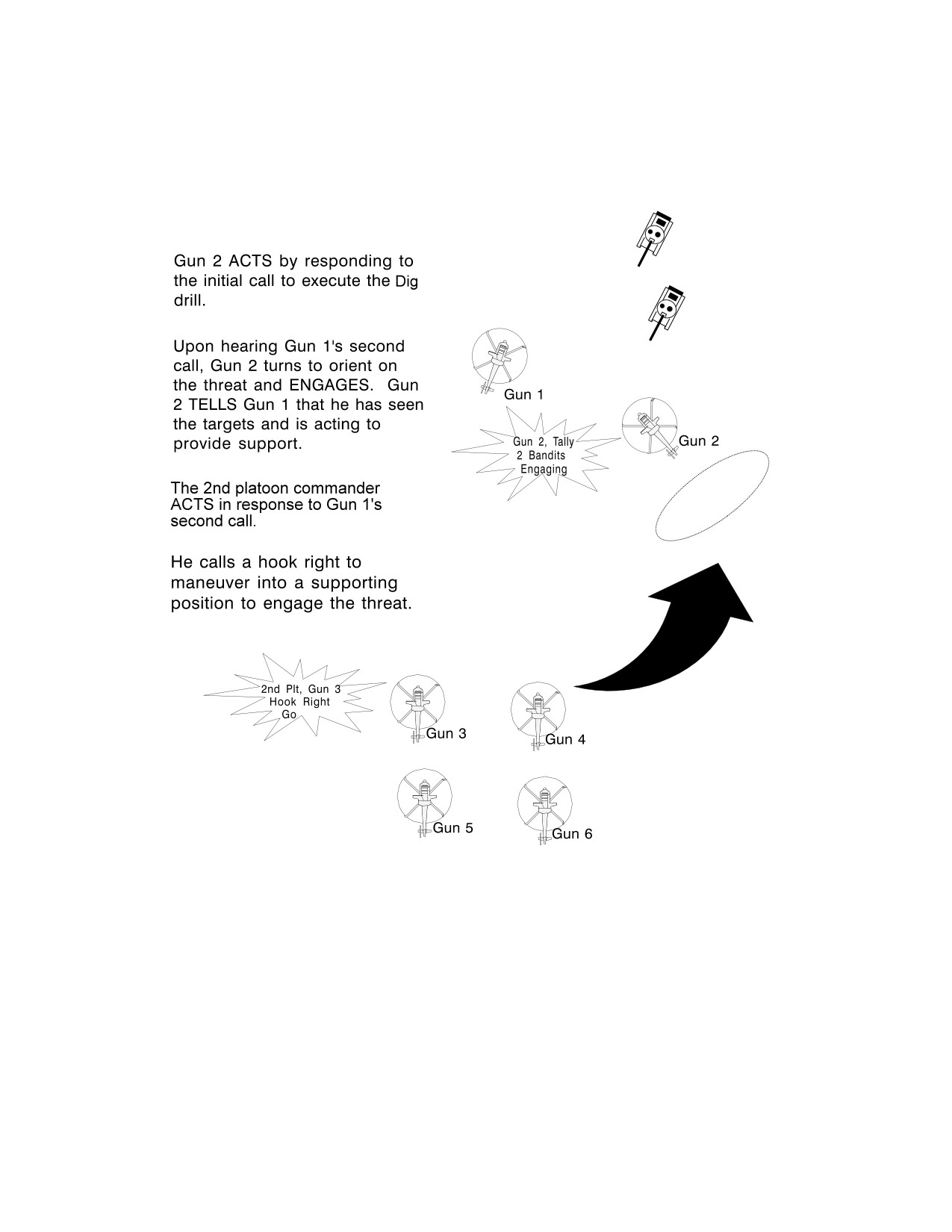
Figure F-11b. Dig battle drill (company task organized into two platoons)
(concluded)
F-41

FM 1-112
Figure F-12. Split drill template
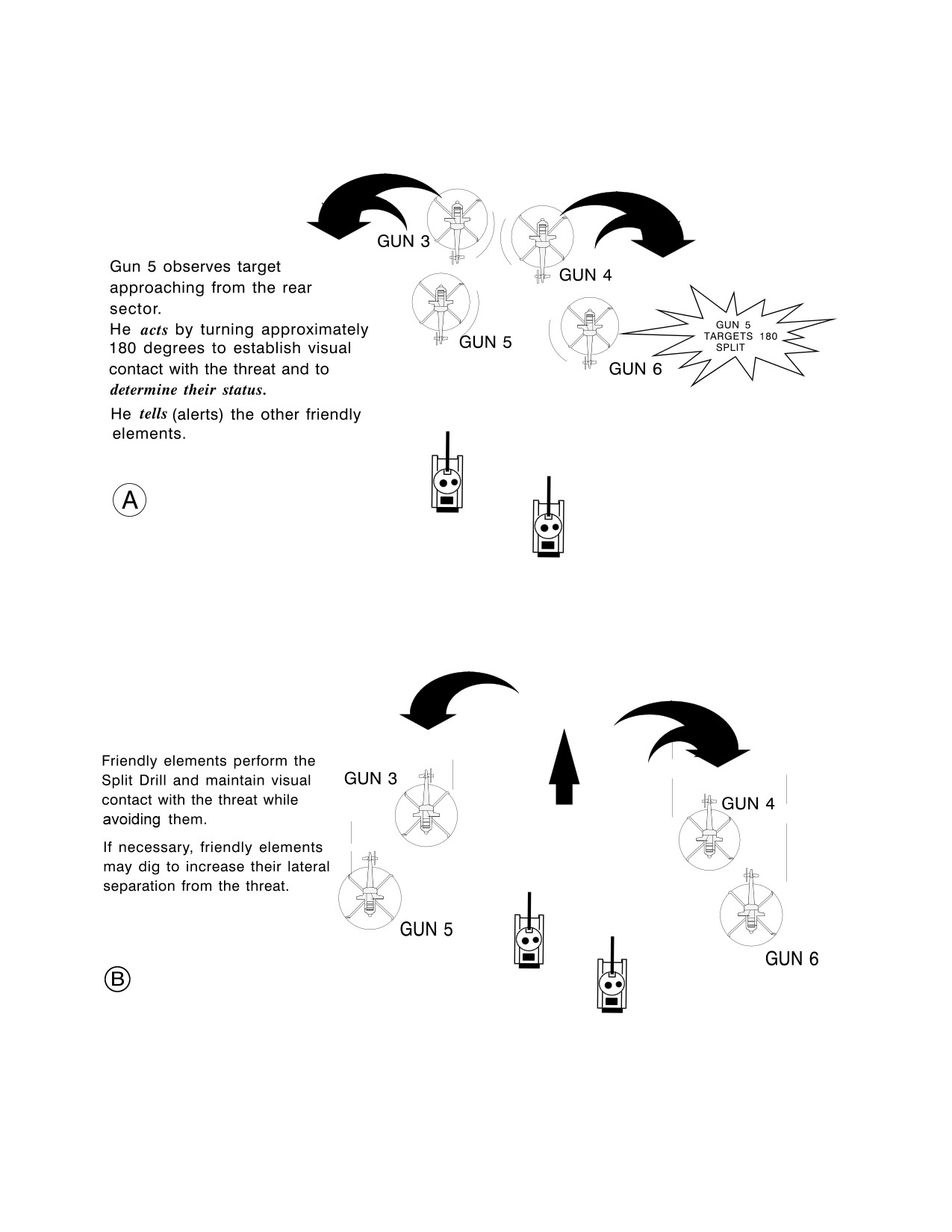
(2) The friendly element first observing the threat will TELL (alert) the
remainder of the force. The alert will include the identification of the element that first
observed the threat, what was observed (bandit, bogey, and target), the direction and
distance to the threat, action or drill required, and any other essential information consid-
ered essential. For example, "Gun 1, targets 180, 4,000 meters, split."
(3) If the threat has not seen friendly elements or is not considered hostile,
the desired COA is to avoid or evade the threat by masking or bypassing the threat, if
possible, while keeping visual contact with the threat. The dig maneuver may be used in
this case to increase lateral separation between friendly elements and/or the threat until
the friendly element is clear of the threat.
(4) Other friendly aircraft in the formation act in response to the command
issued by the element that first observed the threat. They immediately turn approxi-
mately 180 degrees to the outside of (away from) the formation's direction of flight and
establish visual contact with the threat (Figure F-13a and F-13b).
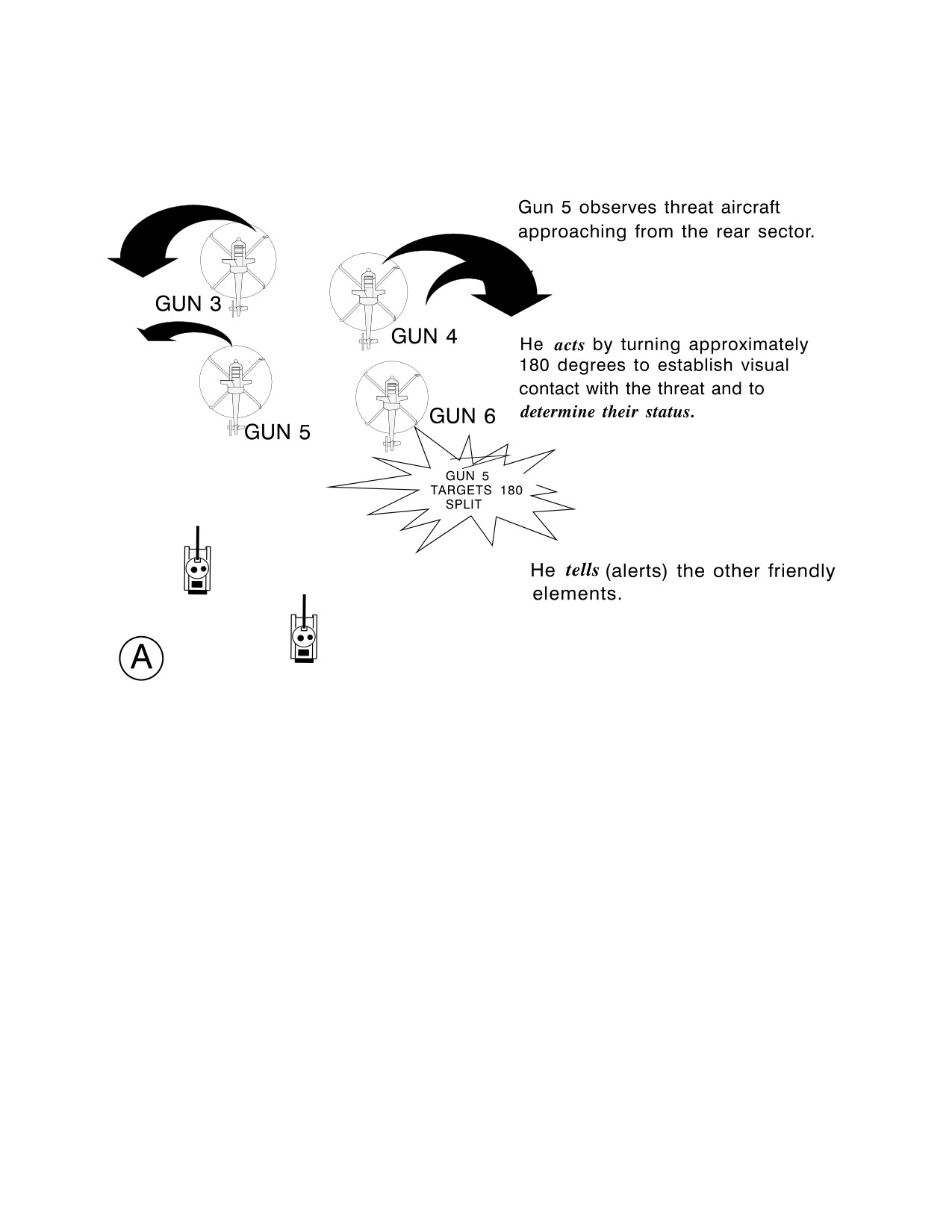
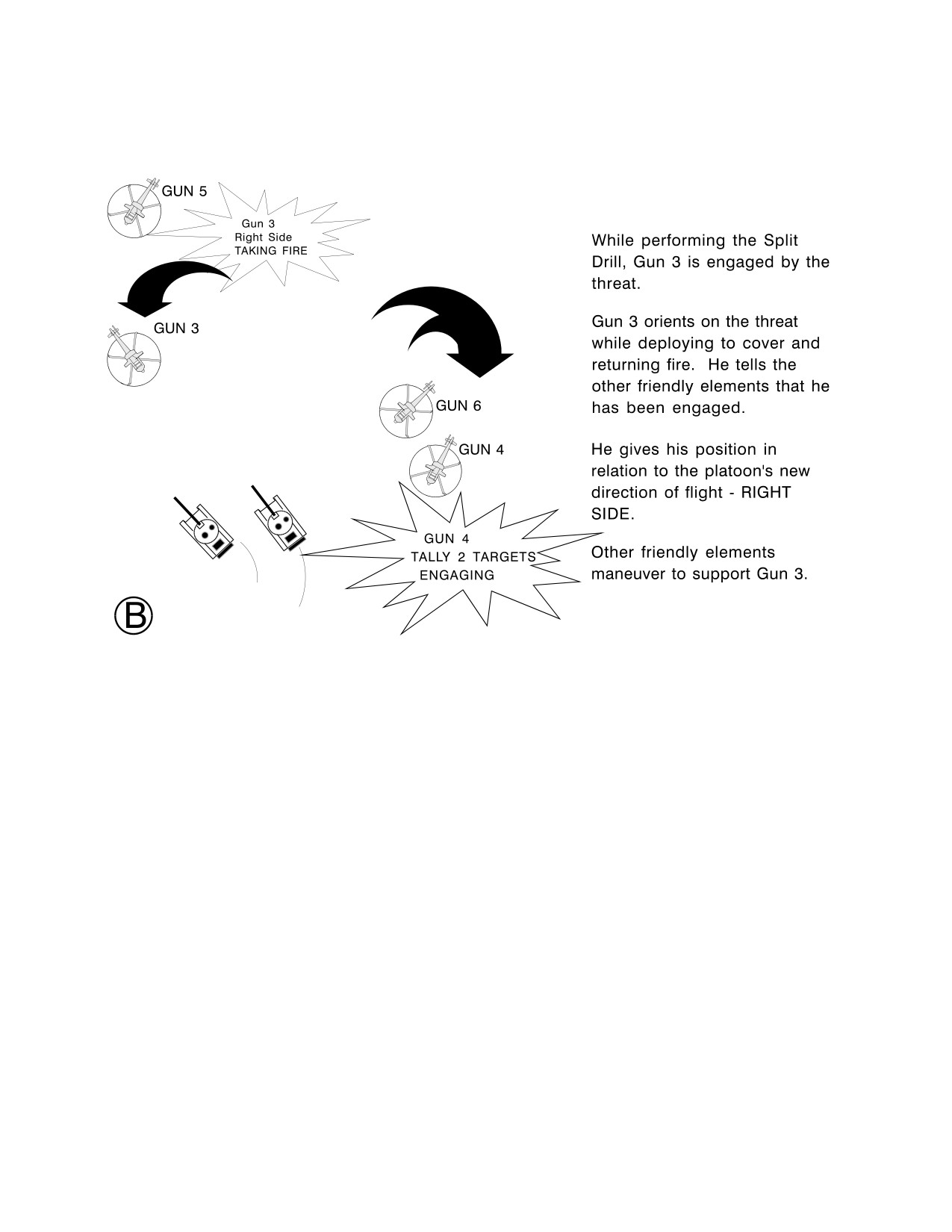
(5) If the threat has seen the friendly forces and is maneuvering to
engage, the aircraft under attack turns to orient on the threat, maneuvers as he deploys
to cover, and engage the threat. Other friendly elements in the formation maneuver as
required to engage the threat. Figures F-14a and F-14b show friendly elements engaged
by the threat while performing the split drill.
F-42
FM 1-112
Figure F-13a. Friendly elements not observed while performing the split drill
Figure F-13b. Friendly elements not observed while performing
the split drill, (concluded)
F-43
FM 1-112
Figure F-14a. Friendly elements engaged while performing the split drill
F-44
FM 1-112
Figure F-14b. Friendly elements engaged while performing the
split drill (concluded)
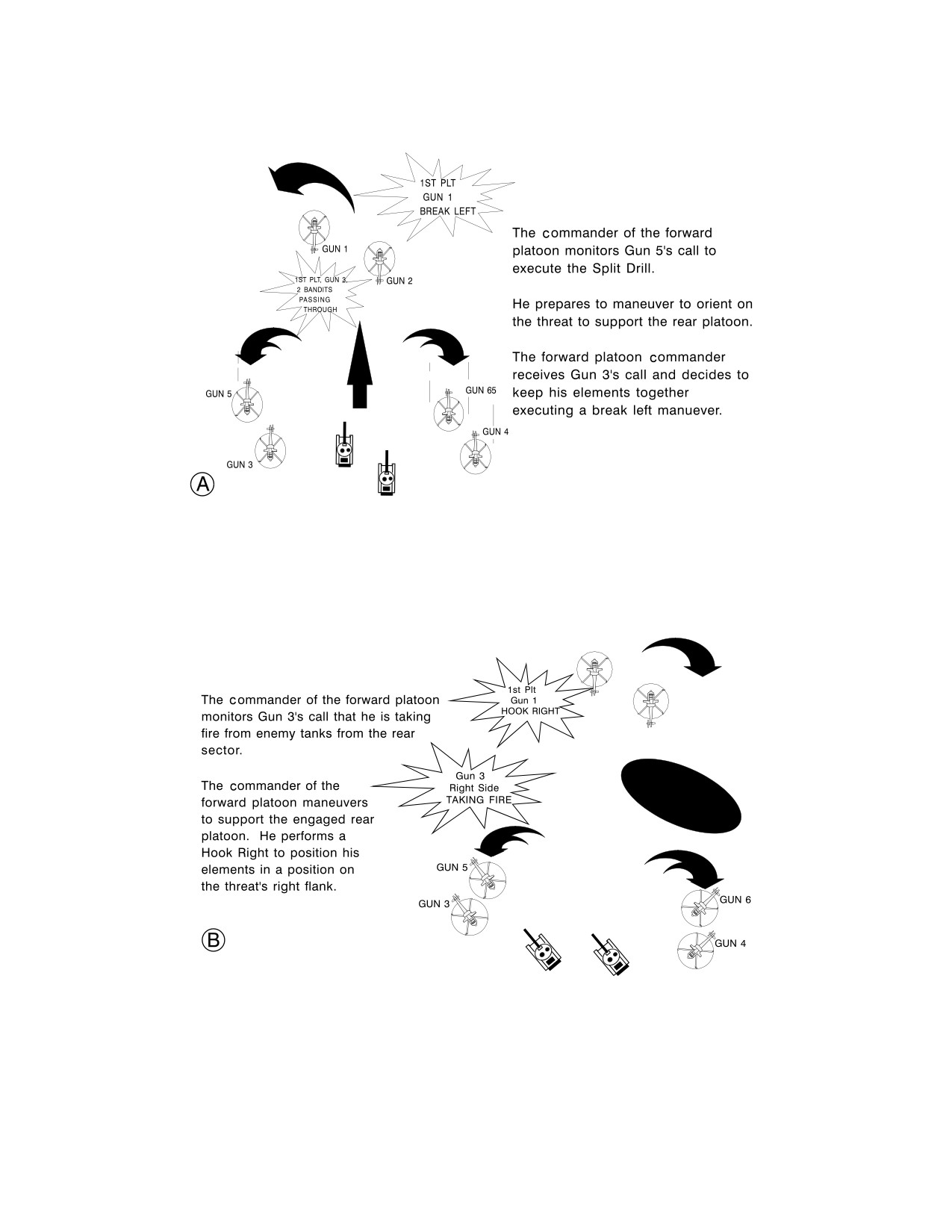
(6) The platoon not engaged responds to the alert of the aircraft that first
observed the threat and maneuvers as directed by the commander. The commander may
elect any appropriate maneuver that allows him to orient his elements on the threat or,
as a minimum, establish visual contact with the threat and provide support as dictated by
METT-T. Figures F-15a and F-15b show the actions of the 2nd platoon during a split
drill.
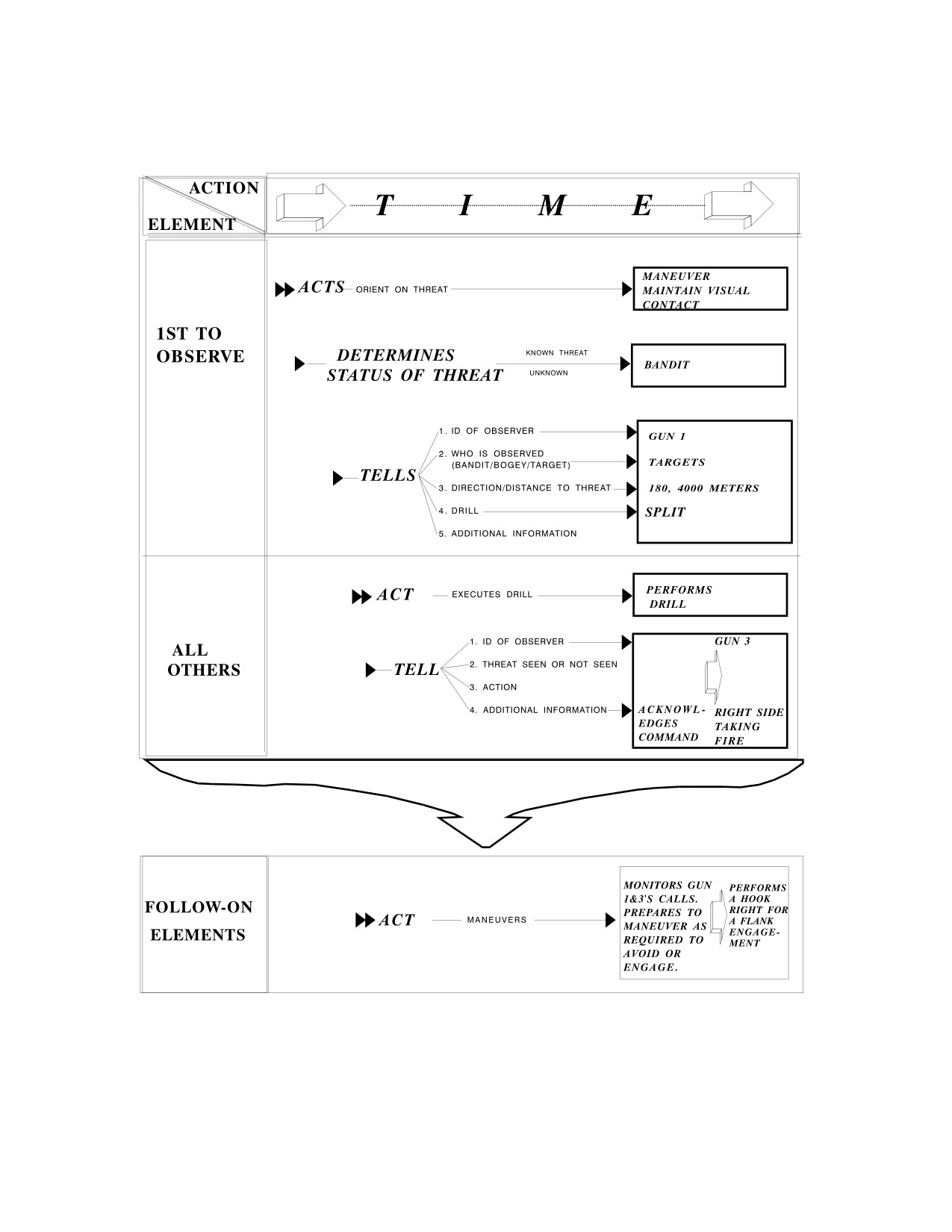
(7) The actions of the friendly elements performing the split battle drill and
those of the follow-on unit are shown in Figure F-16.
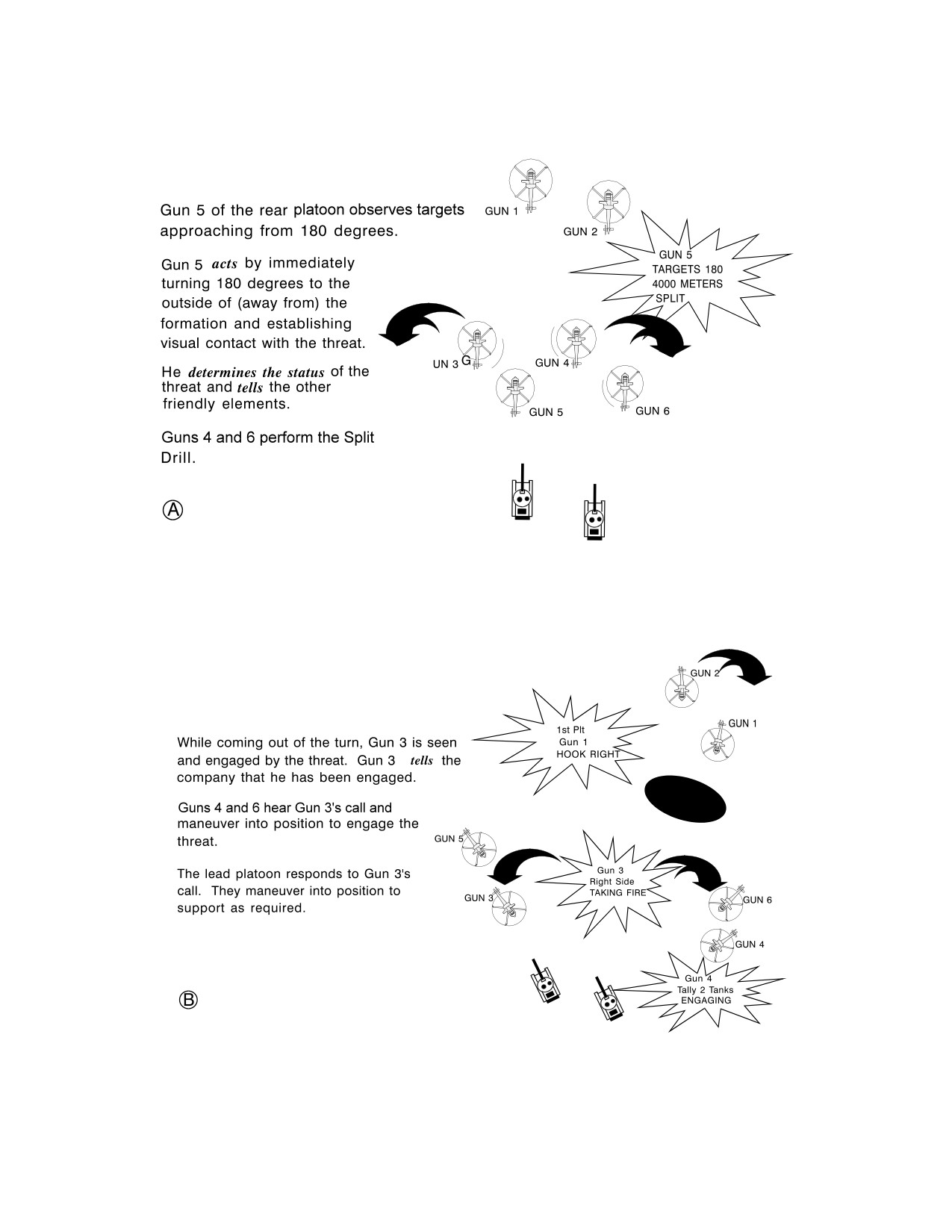
(8) Figures F-17a and F-17b show an example of a company of attack
helicopters, task organized into two platoons, performing the split battle drill. The
sequence shows the actions of the rear platoon engaged by the threat and the actions
directed by the commander of the lead platoon to support the engaged platoon.
F-45
FM 1-112
Figure F-15a. Actions of 2nd platoon during split drill
(friendly elements not observed)
Figure F-15b. Actions of 2nd platoon during split drill
(friendly elements engaged) (concluded)
F-46
FM 1-112
Figure F-16. Split drill action template
F-47
FM 1-112
Figure F-17a. Example of a split battle drill
Figure F-17b. Example of a split battle drill (concluded)
F-48
FM 1-112
g.
Static Battle Drill. The static drill is used when friendly forces are not
moving. For example, when conducting HA operations. It may also be used when the
force is moving with relatively slow forward movement such as when conducting bounding
overwatch or screening operations. The drill will allow friendly forces to respond to a
threat approach from any direction primarily because of the deployment of forces to
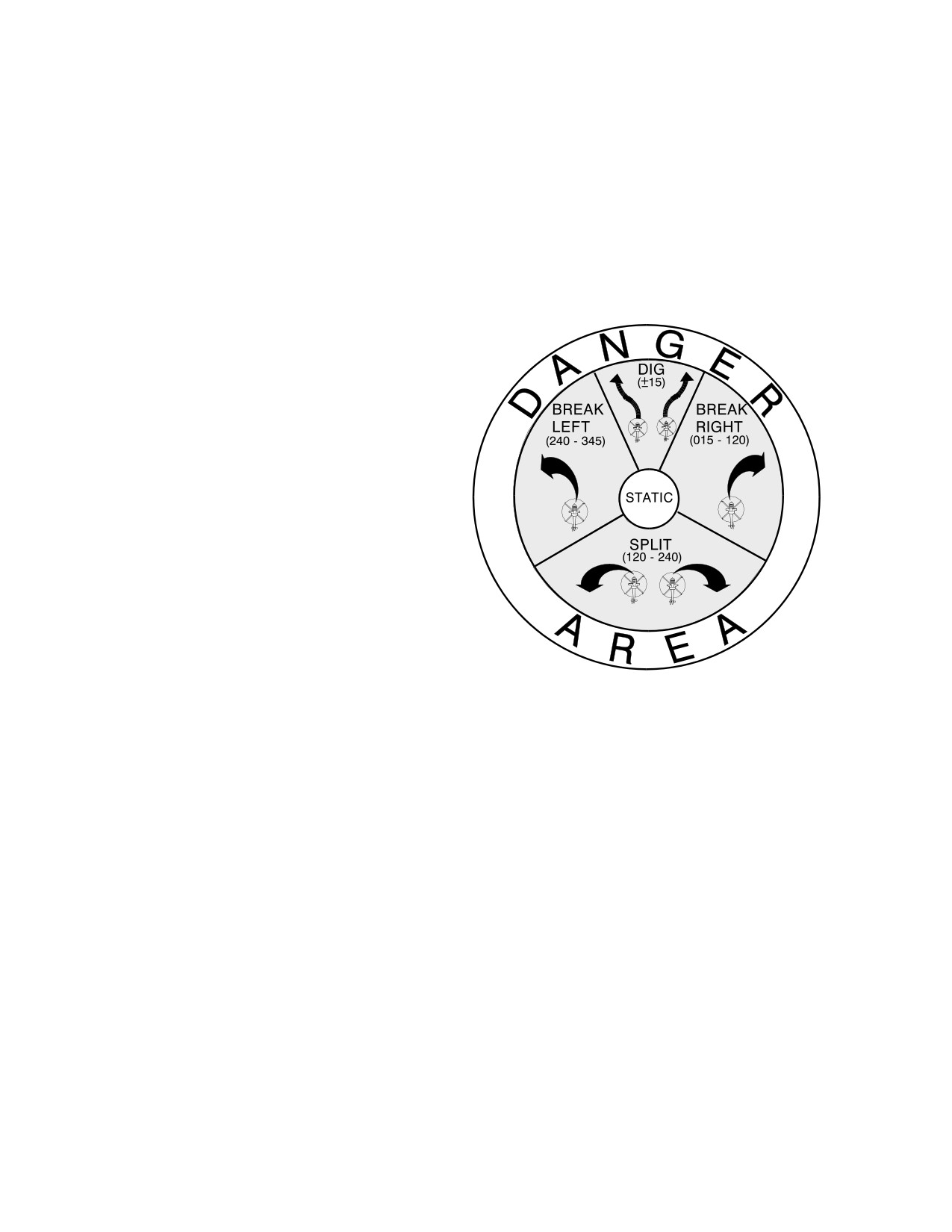
maintain local security. Figure F-18 shows the static drill in relation to the other drills.
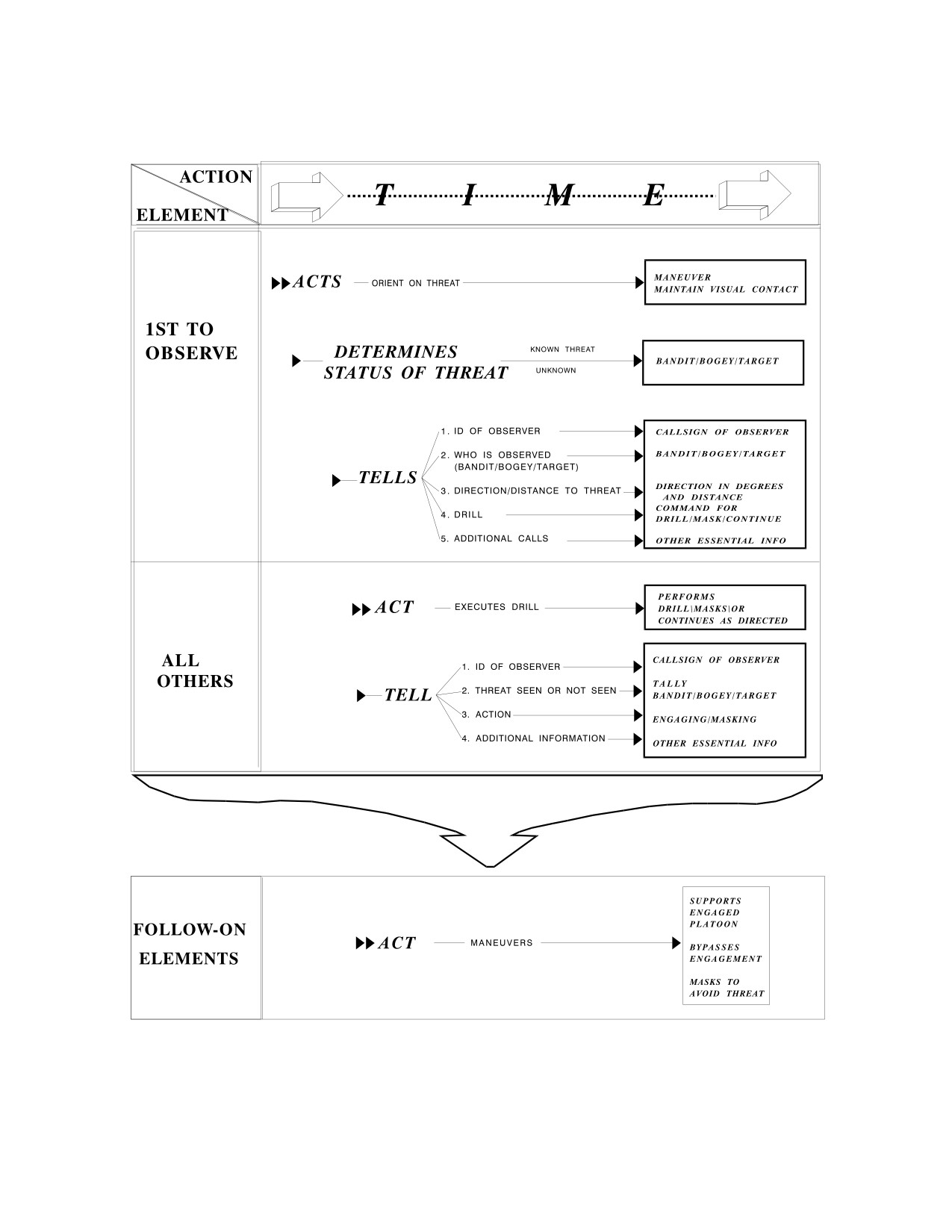
(1) The security element
that first observes the threat acts im-
mediately by turning to orient on the
threat. It maintains visual contact,
determines the status of the threat,
and tells (alerts) the rest of the force.
The alert includes the identification of
the element that first observed the
threat, what was observed, the direction
and distance to the threat, and any other
essential information. For example,
"Gun 2, targets 010, 5,000 meters,
engaging."
(2) Other friendly aircraft
act in response to the alert issued by the
first element to see the threat and at-
tempt to establish visual contact with
the threat. The second element to see
the threat orients on the threat and pre-
pares to engage to protect the remainder
of the force. This element tells other
Figure F-18. Static drill template
friendly elements that it
has established visual contact with the
threat and what its actions are. As the situation develops, the commander may designate
additional friendly elements to protect the force. Other friendly elements assess their
vulnerability to the threat and either continue engaging enemy ground forces, engage the
threat in self defense, or reposition and deploy to cover. The actions of the friendly
elements performing the static drill are shown in Figure F-19.
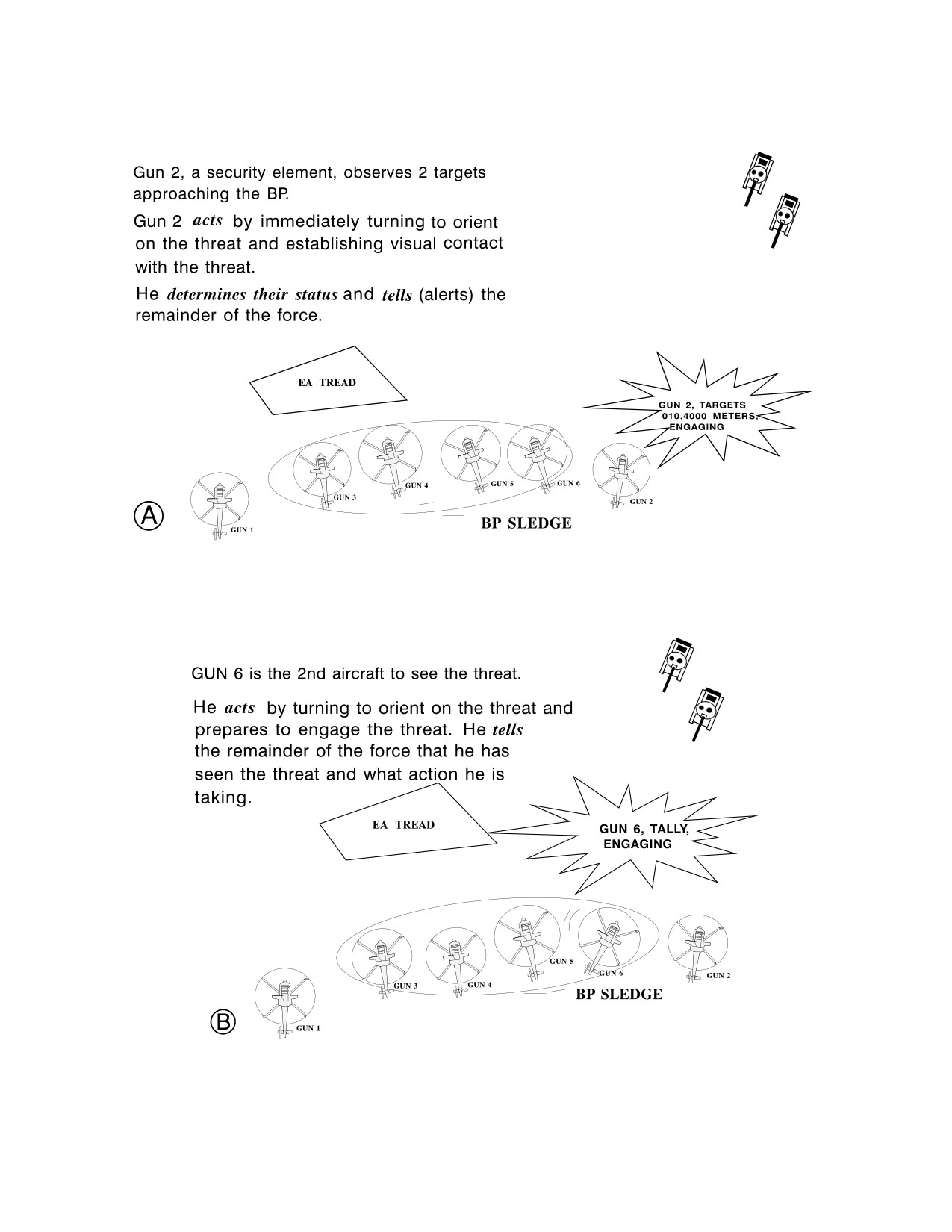
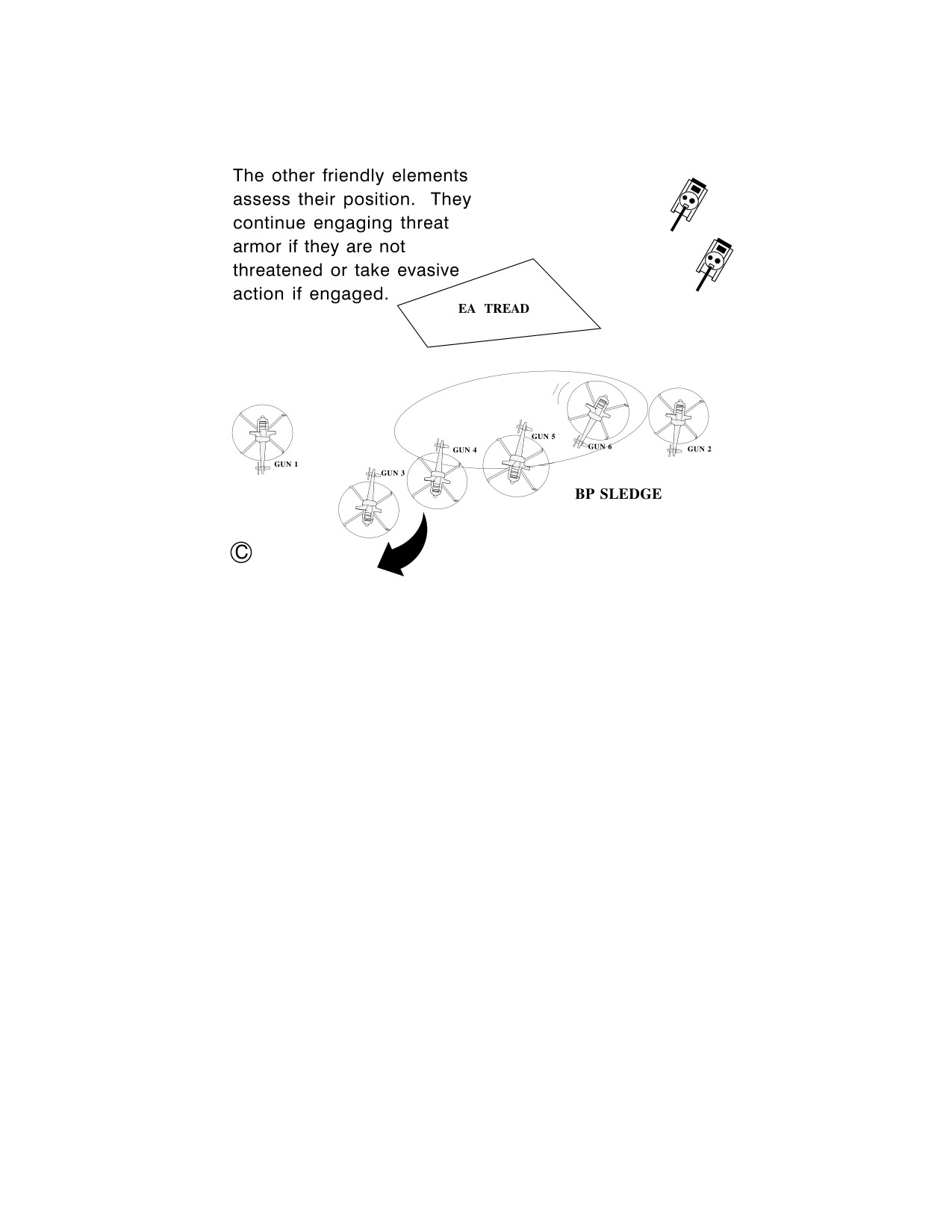
(3) Figures F-20a through F-20c show examples of a company of attack heli-
copters executing a static battle drill while performing BP operations. The sequence
shows the company engaging targets in EA TREAD from BP SLEDGE, a security element
alerting the force, and other attack elements repositioning to reengage the ground threat.
F-49
FM 1-112
Figure F-19. Static drill action template
F-50
FM 1-112
F-51
FM 1-112
Figure F-20a. Example static battle drill
Figure F-20b. Example static battle drill (continued)
F-52
FM 1-112
Figure F-20c. Example static battle drill (concluded)
F-10. TERMS
avoid
A stated intent to maneuver away from a potential engagement
with threat aircraft.
bandit
An identified enemy aircraft.
bogey
An unidentified aircraft that is assumed to be the enemy.
break
An action command (normally preceded by the term bandit or
bogey) to perform an immediate maneuver to deviate from the
present ground track. Will be followed by "right" or "left" in re-
sponse to a threat approaching from 015 to 120 degrees or 345 to
240 degrees of the direction of flight.
center turn
An inward turning maneuver that results in a heading change of
120 to 240 degrees.
F-53
FM 1-112
check turn
A crossing maneuver that incorporates 30 to 60 degrees of heading
change and repositions the wingman to the opposite side of the lead
and vice versa.
dig
A maneuver that increases the lateral separation of a formation by
simultaneously changing the headings of the aircraft 30 to 45
degrees away from each other or the axis of advance. When dig is
preceded by the term "bandit" or "bogey," it becomes an action
command to perform an immediate maneuver in which the mem-
bers of the flight turn 30 to 45 degrees from each other in response
to a threat approaching from ±15 degrees of the direction of flight.
friendly
A contact positively identified as friendly. Is followed by the word
"air" or "ground."
hook
A turning maneuver of an unspecified number of degrees to orient
on an enemy aircraft for a flanking engagement. Is followed by the
word "left" or "right."
in-place turn
A turning maneuver that turns a formation a designated number of
degrees while each aircraft maintains its position in the flight.
no joy
A target (bandit or bogey) not observed.
padlock
A command issued to an aircraft or aircrew member to maintain
visual contact with an enemy.
pinch
A maneuver used to decrease the lateral separation of a formation
by simultaneously changing the aircraft heading 30 to 45 degrees
toward each other.
resume
A command to resume or return to the original heading. Is nor-
mally used with dig and\or pinch.
splashed
Enemy aircraft shot down. Is followed by the number of enemy
aircraft; for example, "Splashed two bandits."
split
A maneuver that turns the aircraft in a formation away from each
other using a heading change of 120 to 240 degrees. Also, when
split is preceded by the term "bandit" or "bogey," it becomes an
action command to perform an immediate maneuver in which the
members of the flight turn 120 to 240 degrees from each other in
response to a threat approaching from 120 to
240 degrees of the
direction of flight.
F-54
FM 1-112
tac turn
A maneuver that turns a formation 60 to 120 degrees and results
in a change of relative position. Is followed by the word "left" or
"right."
tally
Target visually sighted. Is followed by the number of targets
observed.
taking fire
A member of the platoon or company is engaged by the threat.
visual(no visual)
Visual or no visual contact with other members of the platoon or
company. Term may be used with other terminology to indicate a
visual on other friendly aircraft not in your platoon or company;
(for example, visual or no visual friendly).
F-55
FM 1-112
APPENDIX G
ASSEMBLY AREA OPERATIONS
G-1. DESIGNATION OF ASSEMBLY AREAS
a.
Assembly Areas. An assembly area is the location where the ATKHB
prepares for future operations, issues orders, accomplishes routine maintenance and
completes resupply activities. The assembly area must be out of range of enemy artillery
and be large enough for dispersion of the unit. Assembly areas are normally located in
the corps or division rear area and in or near the aviation brigade assembly area.
However, corps and division aviation brigade assets may be dispersed over large areas to
avoid becoming lucrative nuclear or chemical targets. Assembly areas must not be located
along the enemy's axis of advance. An assembly area must also provide--
• Security.
• Concealment.
• Accessibility to MSRs.
• Air avenue of approach.
• Proximity to friendly units.
• Suitable ingress and egress routes.
b. FAAs. An ATKHB occupies FAAs for extended periods while awaiting orders
to execute missions. FAAs are located near the controlling headquarters to improve C3I
and response times. The FAA should be located out of range of enemy medium artillery.
Limited maintenance personnel may be located in the FAA as contact teams jump forward
to repair aircraft. Considerations for selecting FAAs are the same as those for selecting
assembly areas.
G-2. OCCUPATION OF ASSEMBLY AREAS
a.
Assembly Area. The assembly area is a battalion position. It is chosen
based upon the mission of the battalion, the characteristics mentioned above, a map
reconnaissance, and a physical reconnaissance of the selected area. Once an assembly
area has been selected and coordinated, it is occupied when the mission for which it was
selected is assumed. Occupation of the assembly area should be well planned and
rehearsed. It is a four-phase operation. The phases are reconnaissance, quartering party
arrival, main body arrival (ground and air), and position improvement.
G-1
FM 1-112
(1) Reconnaissance. An area reconnaissance of the assembly area and the
surrounding terrain should be accomplished as soon as possible. Items to be looked for on
the reconnaissance include suitability of the area, NBC contamination, and signs of enemy
activity. Upon completion of the area reconnaissance, observation must be maintained
until the arrival of the quartering party.
(2) Quartering party arrival. The battalion CSM, HHC commander, or
HHC first sergeant command the quartering party, which should consist of at least two
persons from each company and representatives of the battalion headquarters. Before
entering the assembly area, the quartering party conducts a ground reconnaissance to
confirm the air reconnaissance, selects ground routes into each company position and
establishes initial area security. When the ground reconnaissance is completed, quarter-
ing party vehicles enter the assembly area. The priority of tasks for the quartering party
is to--
• Conduct reconnaissance (including NBC reconnaissance).
• Establish security.
• Install M-8 chemical alarms.
• Establish wire communications between the main CP location and company
positions.
• Verify communications with higher headquarters.
• Initiate the local area defense plan.
• Select aircraft and ground vehicle locations.
• Prepare to meet and guide the main body.
(3) Main body arrival.
(a) Ground. The main body of the battalion will arrive in two parts
beginning with the ground portion. When ground vehicles arrive, they are met by
members of the quartering party who guide them along the selected routes to each
company's position. The priority of tasks upon the closure of the main body is to--
• Establish security.
• Place observation posts on air and ground avenues of approach.
• Reestablish the main CP.
• Camouflage.
G-2
FM 1-112
• Block high speed avenues of approach that are not being used by the battalion.
• Begin operations.
(b) Air. Battalion aircraft should arrive after the ground portion of
the main body. When the aircraft arrive they should be positioned in predetermined
locations selected by the advance party. The location of the aircraft should provide the
maximum concealment that is available. Aircraft should not be congested or lined up.
Aircrews should complete a postflight or through-flight inspection of their aircraft, report
aircraft status and then assist with the establishment of the assembly area.
(4) Position improvement. The assembly area is continuously improved
as time allows. Some key areas that require continuous improvements are field sanita-
tion, ground obstacles, camouflage, maintenance, and living conditions. Continuous
camouflaging must be conducted to reduce the radar, heat, noise, electronic, and visual
signatures of the battalion.
b. FAA. The FAA is a battalion position occupied by battalion aircraft, the
battalion TAC, and a minimum number of ground vehicles. Planning for the occupation of
the FAA is not as detailed as that required for the occupation of an assembly area.
However, because the battalion may remain in the FAA for several hours, the commander
and his staff must consider security and camouflage. Occupation of the FAA is a three-
phase operation. These phases are reconnaissance, main body arrival, and security.
(1) Reconnaissance. An initial area reconnaissance (including NBC) of
the FAA and the surrounding terrain is conducted. Upon completion of the area recon-
naissance, a brief to the ATKHB commander or S-3 is conducted. The new position is
kept under constant observation until the main body arrives.
(2) Main body arrival. Each company arrives at the FAA as a separate
unit and lands in its predetermined area. Normally, the battalion staggers the arrival of
its companies by allowing several minutes to elapse between each arrival. The FAA is
designed to disperse the battalion while at the same time allowing the battalion to
observe all of the avenues of the high-speed approach into the FAA.
(3) Security. Security of the FAA is based on the ability of the battalion to
detect threats and react to them by moving the aircraft to another location. Crews will
complete a through-flight inspection of their aircraft immediately after the FAA security
has been established. Battalion aircraft must be prepared for rapid departure. The
priority of tasks for each company is to--
• Establish local security.
• Establish wire communications with the tactical CP.
• Complete through-flights of aircraft.
G-3
FM 1-112
• Continue to plan missions.
G-3. EMERGENCY DISPLACEMENTS
a.
General. An ATKHB is most vulnerable while occupying assembly areas and
FAAs. If an ATKHB comes under an artillery, ground, or air attack while it occupies an
assembly area or FAA, it must conduct emergency displacement actions. The two types of
plans for emergency displacements are the early warning and the surprise displacement
plans. A displacement plan enables the battalion to displace rapidly. It is a part of the
security for the assembly area or FAA and must be established before the aircrews arrive.
Displacement plans for each company will include the direction and route for leaving an
area, the location of HAs, alternate assembly areas, or FAAs and battle positions. Areas
to which the ATKHB will displace must be coordinated through the aviation brigade and
the ground commander who controls the area.
b. Early Warning. When an enemy attack is imminent, the ATKHC will
initiate the battalion displacement plan. On order, aircraft depart the assembly area or
FAA using preselected routes and flight modes. Companies maintain platoon or section
integrity, occupy their selected HAs and await further instructions from the ATKHB
headquarters.
c.
Surprise. In the event of a surprise attack, the ATKHC will displace from
its position without orders. Aircraft will depart individually and use the preplanned
routes to the HAs. The first aircraft to arrive at the HA conducts a reconnaissance and
secures the area. Upon arrival at the HA, The ATKHC commander establishes control of
the company, transmits a SITREP to the battalion and awaits further instruction.
Aircraft systems' alignment and warm-up will be accomplished en route or at the HA.
G-4. FORCE PROTECTION
a.
Defense of an assembly area is a difficult task for all aviation units, not just
ATKHBs. The personnel austerity of the ATKHB makes this an especially challenging,
but not impossible, task. The ATKHB can accomplish the basics of force protection.
(1) All roads that are not absolutely necessary to the operation of the
assembly area should be blocked and covered with fire.
(2) The ATKHB requests engineer support to dig fighting positions and
block avenues of approach.
(3) The ATKHB makes maximum use of booby-trap and command-detonated
munitions.
(4) High speed avenues of approach should be blocked and covered by the
fire of the ATKHB's organic crew served weapons.
G-4
FM 1-112
(5) The ATKHB establishes a QRF and begins rehearsals as soon as
possible.
(6) The ATKHB rehearses emergency displacement to each company
position both day and night to react to a threat.
b. Considerations. A strong, responsive QRF can make up for limitations of
the large area needed by an aviation unit as well as the lack of soldiers available to
defend it. Observation posts and fighting positions should use night vision devices. All
aviation units have night vision devices that can be used during the hours of darkness for
perimeter defense. Each company commander will be made responsible for a sector of the
perimeter. Insure that they know what they are responsible for and that the units are
tied in with the units on the left and right. The perimeter should be patrolled several
times each day and night.
G-5
FM 1-112
APPENDIX H
DEEP OPERATIONS BY KIOWA WARRIOR
ATTACK HELICOPTER BATTALIONS
H-1. PURPOSE
The purpose of this appendix is to provide a discussion of some of the capabilities and
limitations of the OH-58D KW ATKHB with respect to deep operations.
H-2. BACKGROUND
a. The question of whether or not KW ATKHB conduct deep operations is
answered after proper consideration of METT-T.
b. FM 101-5-1 (final draft dated 15 July 1995) defines deep operations as, "Those
operations directed against enemy forces and functions which are not in contact at the
forward line of troops (FLOT), line of departure (LD), or friendly perimeter and are
between the FLOT/perimeter and the forward boundary of the unit conducting the
operation. These operations employ long range fires, air and ground maneuver, and C2W
to defeat the enemy by denying him freedom of action and disrupting his preparation for
battle, his support structure, and/or disrupting/destroying the coherence and tempo of his
operations."
H-3. PURPOSE OF DEEP OPERATIONS
The purpose of deep operations is to support the commander's overall scheme of maneuver
by--
a.
Influencing the conditions under which current/future close operations are
occurring/will occur by delaying, disrupting, or destroying enemy forces, facilities, or other
high pay-off targets.
b. Shaping the battlefield for future operations such as creating opportunities for
offensive exploitation or to seize the initiative.
c.
Targeting the enemy's freedom of action, coherence, and tempo of operations.
H-1
FM 1-112
H-4. METT-T
Deep attacks to destroy armored and other forces are feasible missions for KW ATKHBs
given the circumstances of the mission. The following discussion of METT-T provides
useful information to KW ATKHB mission planners that should aid their selection of
realistic targets.
a.
Mission. The circumstances where a light division commander would need to
conduct deep operations against enemy forces as stated in the above definition is very
probable. What the commander must consider, however, is the desired effect that he
wishes to impart on the enemy and the KW ATKHB's combat power.
b. Enemy. Consideration of the enemy unit's size, strength, location, disposi-
tion, activity, equipment, and probable COA is made by planners within the decide,
detect, deliver, and assess process. Planners must consider the following factors when
targeting:
(1) Potential. Enemy force's/unit's current or future contribution to the
close battle (Division: next 12 to 24 hours, Corps: next 24 to 48 hours).
(2) Criticality. Attacking this force/unit will impede the enemy's ability to
concentrate forces, control operations, or support his operations at critical times.
(3) Size and success criteria. As you will see after reading the troops
discussion below, a feasible destroy mission for a KW ATKHB is an armored battalion. If
the mission is to attrit, delay, or disrupt, a larger force could be the target.
c.
Terrain. Planners must consider the enemy force's/unit's present or future
location and timing in that location in order to determine its vulnerability to attack
helicopters during targeting.
Note: The conditions that maximize effectiveness and minimize risk for deep operations
are terrain that supports engagements from stand-off ranges and darkness.
d. Troops. Unlike Appendix A, which discusses a single KW's capabilities and
limitations, this section will discuss collective capabilities and limitations of KW units.
(1) Firepower. Figure H-1 depicts the TOE authorized quantities of
weapons systems components for KW ATKHBs.
H-2
FM 1-112
LIN
NOUN
QTY/Co QTY/Bn No. of Rnds
L44830
Launcher, guided missile
8
24
48
aircraft (Hellfire)
L45199
Launcher, rocket aircraft
8
24
168
2.75-inch 7-tube M260
L67246
Launcher, guided missile
4
12
48
aircraft XM292 (ATAS)
Z40354
Machine gun caliber .50: XM296
6
18
9,000
Note: Given that the KW has two weapons mounting points, the number of rounds
indicated above are battalion maximums for that particular weapon system. While
each battalion has 78 weapons system components only 48 mounting points are
available.
Figure H-1. Authorized weapons system components
As you can see, a "heavy missile" (two launchers/aircraft) configuration for all 24 aircraft
is not possible. As a result, the greatest number of Hellfire missiles that a KW ATKHB
can bring at one time to the battle is 48 as compared to an Apache battalion's 384
(aircraft availability not considered). A TOE change to increase the number of Hellfire
launchers from 24 to 48 has been requested by some KW units. If approved, this would
permit the KW Attack Battalion to increase the number of missiles available for an
attack, but self-protection, as discussed below, must not be overlooked by planners.
(2) Self-protection. KW aircrews use their 2.75-inch rockets or caliber .50
machine gun to engage close in targets and unexpected contacts for self-protection of
themselves or their wingman. The crew of a "heavy missile" KW relies upon its wingman
solely for this critical support. As a result, a "mix" of rockets and caliber .50 should
always be used by KW ATKHB when conducting deep operations where such instances of
close in enemy targets and unexpected contacts are likely.
(3) Survivability. Figure H-2 compares and contrasts survivability aspects
between the AH-64 Apache and KW.
(4) SEAD. KW ATKHB are organic to light divisions which possess 105
millimeters towed howitzers as their primary delivery system of interdicting fires for
lethal SEAD. Deep attacks beyond the supporting range of these weapon systems require
direct supporting fires from outside the division (such as Corps) if lethal SEAD is
necessary to minimize risks to aircrews en route and in objective area.
H-3
FM 1-112
Factor
KW to Apache
Aircraft Survivability
Less robust package
Equipment
Signature (radar, IR, visual)
Smaller (mast mounted sight
great advantage)
Systems
Fewer redundant
Speed
Slower
Ballistic Protection
Less for aircraft systems and
crew
Figure H-2. Survivability: KW to Apache
e.
Time. The only difference between KW and Apache ATKHB in this respect is
time available to execute the deep operation. Unlike the Apache, the KW can not "hang"
an external fuel tank to extend its mission duration--time on station or combat radius for
the attack. As stated in Appendix A, the planning airspeed for a KW is 100 knots, which
yields a combat radius of approximately 120 kilometers with approximately 20 minutes
station time on a full tank of fuel.
H-5. COMBINED KW AND APACHE DEEP OPERATIONS
A technique of task organizing KWs and Apaches for a deep operation provides command-
ers with an extremely flexible, robust, and comprehensive attack package. KWs are well
suited for target acquisition, designation, security, and final engagement/BDA augmenting
the Apache's destruction capability in the engagement area significantly.
H-4
FM 1-112
APPENDIX I
THEATER MISSILE DEFENSE--SEARCH AND ATTACK
I-1.
PURPOSE
FM 1-111 describes the two methods in which Army Aviation assets attack TMD targets
as a deliberate attack on a precise location and a more probable Search and Attack in a
specified area. The purpose of this appendix is to provide specific TTP for TMD search
and attack missions. Lessons learned from and TTP used during Roving Sands '95--an
advanced warfighting experiment where an AH-64A ATKHB executed live TMD attack
operations missions, were used as a basis for discussion of this emerging doctrine.
I-2.
TMD OPERATIONS
TMD is inherently a joint mission. It is composed of four operational elements: passive
defense, active defense, attack operations, and C4I. TMD operations are characterized by
centralized planning at EAC level by the TAADE and at Corps level by the DOCC, and
decentralized execution by joint, maneuver, and FS units. A wide variety of national and
theater assets are employed to detect and service TMD targets. For more information on
TMD refer to FMs 100-12 and 90-36.
I-3.
TMD ATTACK OPERATIONS
TMD attack operations are both preemptive and reactive. Detection and destruction of
TBMs prior to launch is the preferred method of attack. However, although they are not
impossible to locate prior to launch, TBMs are extremely difficult to detect until after they
have compromised their location with their missile launch signature.
I-4.
THREAT TTP
An enemy that possesses and employs TBMs will most likely move his TELs between
hide, load, and launch sites. He will use a "shoot and scoot" method of employment
because the probability of detection of his TELs increases greatly after a TBM launch.
Depending upon the system, an average TBM crew can egress a firing location in 1.5 to 10
minutes and can travel at speeds up to 70 kph depending upon the availability of roads
and road conditions. Specific, classified threat information can be found in Defense
Intelligence Agency publications DST-1040S-559-91, June 1991 and DST-1040S-529-91,
September 1991.
I-5.
TCT
Based upon the above threat TTP, the essence of TMD is TCT where an attack system
decision process is used at EAC/Corps level based upon the launch sight, detection sensor
I-1
FM 1-112
accuracy, time to deliver ordnance, and available delivery systems at the time of the
detection. Under certain circumstances, attack helicopters are the weapon of choice for
TMD attack operations.
I-6.
SEARCH AND ATTACK TTP
A search and attack mission is a variation of the movement to contact. For attack
helicopters, it is planned, prepared for, and executed in a similar manner to a movement
to contact.
movement to contact-- "A form of the offense designed to develop the situation
and to establish or regain contact." FM 101-5-1
(drag draft dated 31 July 1996)
search and attack-- "To find and destroy enemy forces or to
collect information." FM 100-40
(initial daft dated 15 March
1996)
The objective of a search and attack mission is to locate and destroy specified enemy
targets within a certain area.
a.
Planning. The speed with which attack helicopter units can execute given
missions is not to be confused with the amount of time that it takes them to plan and
prepare for missions. Attack helicopter units are extremely capable, as discussed in
Chapter 1, but require the same amount of planning and preparation time as ground
forces. Therefore, commanders must ensure that sufficient time is allocated to planning
and preparing for all missions, especially a high risk mission to search for and attack
TBMs behind enemy lines.
Note: There are currently two methods for employing attack helicopters in TMD attack
operations. They are as a dedicated force for TMD (unit's sole mission is TMD attack),
and as a result of a divert from other ongoing missions (such as deep attack or raid).
Commanders must ensure that the attack helicopter unit has sufficiently planned and
prepared for both of these methods. In the instance of a divert, an essential require-
ment is a B/P or O/O mission statement that will result in critical planning and
preparation by the attack helicopter unit.
Figure I-1 is a list of critical planning considerations for TMD search and attack missions
with references to the element that completes this planning.
I-2
FM 1-112
-Control Measures--TMD Template
Attack Battalion
-NAI
TAADE/DOCC selected and observed
-Routes and SEAD Packages
TAADE/DOCC developed and coordinated
-C3I
TAADE/DOCC coordinated attack battalion
executed
Figure I-1. Critical planning considerations
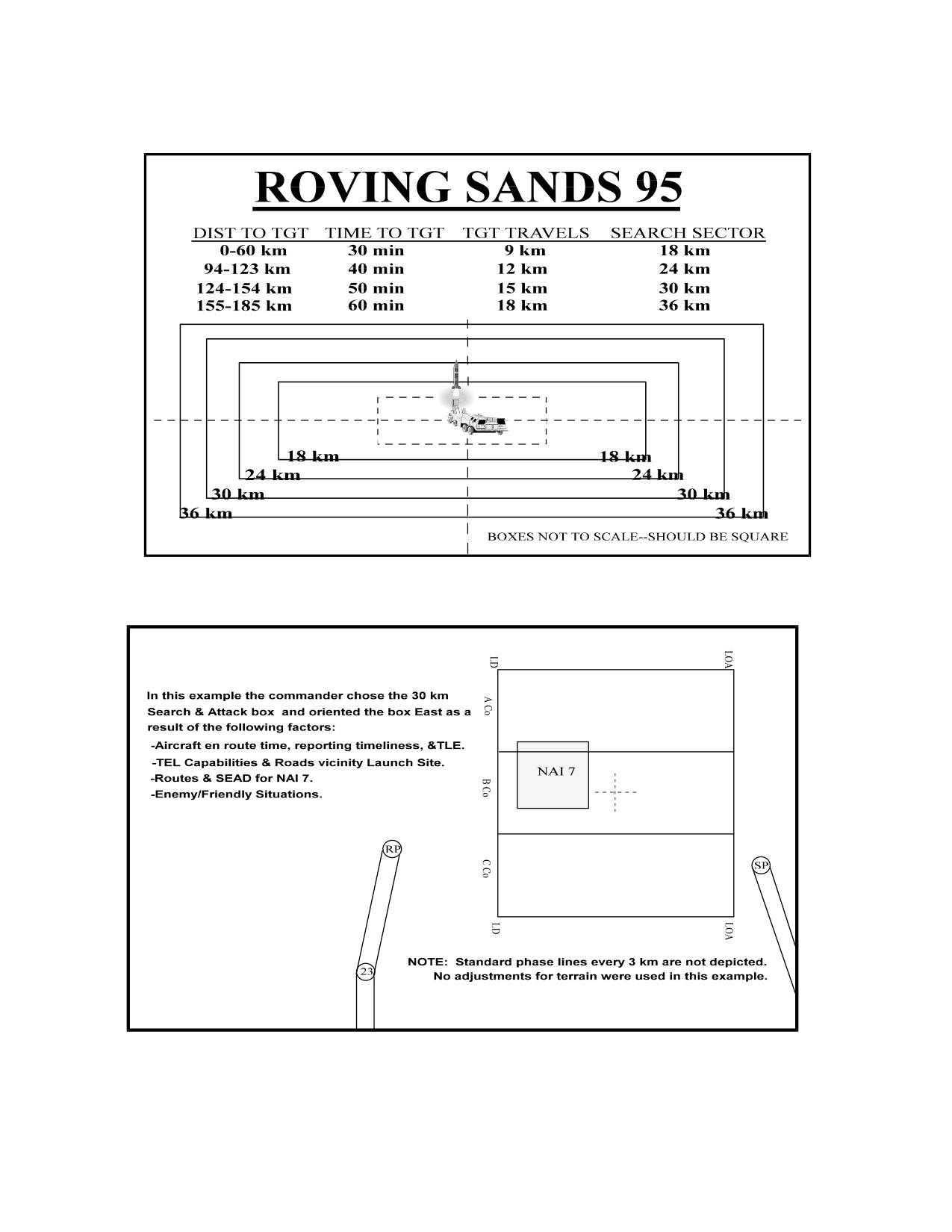
(1) Control measures--TMD template. Whether attack helicopters are
employed for TMD as a dedicated force or diverted from other operations, minimizing the
time from TBM detection to friendly engagement is critical to mission success. A
technique that the ATKHB experienced great success with during Roving Sands '95 was
the use of a TMD Template. Figure I-2 depicts their TMD template and Figure I-3
depicts an example use of a TMD Template. A TMD template is placed upon a map on
the coordinates of the TBM launch site. It depicts various search areas for selection based
upon the en route time of the attack aircraft to the launch site, TLE, timeliness of TMD
launch detection, and predicted TEL egress speeds. It provides standard graphic control
measures--boundaries, phase lines, LD, and LOA, for the attack helicopter teams/
companies executing the search and attack mission. Commanders should make and use
several templates by varying the size of the search areas based upon terrain dependent
TEL egress speeds. Commanders orient the template after considering the friendly and
enemy situations in the area, ingress and egress routes, and SEAD packages. Command-
ers should also adjust the template, if necessary, to better fit the terrain in the search
area by shifting the entire template or slightly modifying some of the standard bound-
aries/phase lines. They must be cognizant, however, to not modify too much of the
template as they will lose the ability to quickly convey standard mission graphics.
(2) NAI. Planners should consider launch location trends and their IPB to
designate NAIs for TMD attack operations. As is the case with all NAIs, they must then
develop a R&S plan to observe each NAI to detect the TBM or TEL.
(3) Routes and SEAD packages. To minimize detection to engagement
times, planners should develop routes and SEAD packages to support each TMD NAI.
These preplanned routes and SEAD packages can be executed in total or fragmented
based upon the target location and position of aircraft at the time of the execution order.
I-3
FM 1-112
Figure I-2. Example TMD template
Figure I-3. Example use of TMD template
I-4
FM 1-112
I-5
FM 1-112
(4) C3I. C3I for TMD attack operations poses some significant challenges.
Commanders must develop means to communicate mission specifics, their intent, enemy
and friendly SITREPS, and any required changes to subordinates quickly to facilitate a
rapid response to TBM targets by their forces. Additionally, FS communications methods
and coordination methods must not be overlooked. Over-the-horizon communications or
extended range communications techniques must be employed to enable the passing of
critical information to attack mission executors. Techniques used during Roving Sands
'95 are depicted in Figure I-4. The divert mission presents the most significant communi-
cations challenge because of its inherent uncertainty and distance between planners and
executors..
3
Roving Sands '95 C
I
Cdr AH-64A
XO Airborne Command and Control
Center
S-3
Airborne TAC (UH-60) with SATCOM
A/S-3
Airborne Warning and Control
System
Figure I-4. Techniques used during
Roving Sands '95
b. Preparation--Training and SOPs. Training and SOPs are the facilitators
of rapid response by attack units to TBM threats. Unlike an O/O deep attack mission at a
specified location, a TMD search and attack mission's location is unknown until the time
of execution. A comprehensive, understood, and thoroughly rehearsed SOP is necessary to
minimize risk and increase the probability of mission accomplishment.
c.
Execution. As stated above, a search and attack mission for attack helicop-
ters is executed in the same manner as a movement to contact. Depending upon the
search area, the battalion commander may decide to use one, two, or all of his companies.
Commanders must consider the factors of METT-T to choose the appropriate force to
execute TMD search and attack missions.
"Key considerations in any movement to contact include focusing
all efforts on finding the enemy and initiating contact with the
I-6
FM 1-112
smallest element possible." FM 100-40 (initial draft dated 15
March 1996)
(1) Company level. With regard to the above discussion and because
speed, security, and detailed reconnaissance are essential, the best way for a company to
execute this mission is with three two ship scout-attack teams abreast in the company
sector. This method balances the principles of economy of force and orienting on the
reconnaissance objective. If the remaining company aircraft are available, they can be
incorporated into a fourth sector or used as a trailing reaction or C2 element.
(2) Mission briefing. Conveying mission specific control measures in as
rapid a manner as possible is essential to facilitate successful TCT. A standard mission
briefing enables the battalion commander to effectively and rapidly communicate essential
mission information to executing aircrews. Figure I-5 depicts a sample TBM mission
briefing. A mission briefing format similar to this was used during Roving Sands '95 with
great success.
TBM Mission Briefing
1. TBM Launch Site Grid
2. Template
3. Direction of Search and Attack
4. Ingress Route
5. Tentative Egress Route
6. Friendly and Enemy SITREPs
Figure I-5. Sample TBM mission
briefing
I-7.
HIGH PAY-OFF TARGETS
While the destruction of TELs will degrade the enemy's ability to shoot TBMs, a target
with a higher pay-off is a TBM reload site. A technique for finding these sites is one of
tracking the TEL from its launch site to its hide site and further tracking to a reload site.
TMD attacks on these sites have the possibility of destroying the original TEL, other
TELs, TBMs, and TBM personnel. This surveillance could take considerable time and is
most likely a SOF or UAV surveillance mission. In this manner, attack assets can use
reactive measures to conduct preemptive strikes.
I-7
FM 1-112
REFERENCES
SOURCES USED
These are the sources quoted or paraphrased in this publication.
Army Regulations
AR 55-29. Military Convoy Operations in CONUS. 3 September 1971.
AR 55-113. Movement of Units Within Continental United States.
19 July 1973.
AR 55-162. Permits for Oversize, Overweight, or Other Special Military Movements on
Public Highways in the United States.
1 January 1979.
AR 95-1. Army Aviation: Flight Regulations.
30 May 1990.
AR 351-1. Individual Military Education and Training.
15 October 1987
AR 600-20. Army Command Policy. 30 March 1988.
Field Manuals
FM 1-100. Doctrinal Principles for Army Aviation in Combat Operations.
28 February
1989.
FM 1-109. Aviation Self-Deployment Planning.
29 May 1987.
FM 1-111. Aviation Brigades.
27 August 1990.
FM 1-114. Tactics, Techniques, and Procedures for the Regimental Aviation Squadron.
20 February 1991.
FM 1-140. Helicopter Gunnery. 29 March 1996.
FM 3-3. Chemical and Biological Contamination Avoidance.
16 November 1992.
FM 3-5. NBC Decontamination. 17 November 1993.
FM 3-50. Smoke Operations. 4 December 1990.
FM 14-7. Finance Operations. 17 August 1994.
FM 16-1. Religious Support.
26 May 1995.
FM 17-95. Cavalry Operations. 19 September 1991.
FM 17-98. Scout Platoon. 9 September 1994.
FM 34-1. Intelligence and Electronic Warfare Operations.
27 September 1994.
FM 34-7. Intelligence and Electronic Warfare Support to Low-intensity Conflict
Operations.
18 May 1993.
FM 34-10. Division Intelligence and Electronics Warfare Operations.
25 November 1986.
FM 34-80. Brigade and Battalion Intelligence and Electronic Warfare Operations.
15
April 1986.
FM 34-130. Intelligence Preparation of the Battlefield.
8 July 1994.
FM 55-9. Unit Air Movement Planning. 5 April 1993.
FM 55-12. Movement of Units in Air Force Aircraft.
10 November 1989.
FM 55-15. Transportation Reference Data.
9 June 1986.
References-1
FM 1-112
FM 55-30. Army Motor Transport Units and Operations. 14 March 1980.
FM 55-65. Strategic Deployment.
3 October 1995.
FM 55-312. Military Convoy Operations in the Continental United States.
3 April 1991.
FM 63-2. Division Support Command, Armored, Infantry, and Mechanized Infantry
Divisions.
20 May 1991.
FM 63-3. Corps Support Command. 30 September 1993.
FM 63-23. Aviation Support Battalion.
6 June 1996.
FM 71-100. Division Operations.
28 August 1996.
FM 100-5. Operations. 14 June 1993.
FM 100-10. Combat Service Support. 3 October 1995.
FM 101-5. Staff Organization and Operations.
25 May 1984.
FM 101-5-1. Operational Terms and Symbols. 21 October 1985.
Department of the Army Forms
DA Form 2028. Recommended Changes to Publications and Blank Forms. 1 February
1974.
DA Form 2627. Record of Proceedings Under Article 15, UCMJ. August 1984.
Department of Defense Forms
DD Form 458. Charge Sheet. August 1984.
Soldier Training Publication
STP 21-1-SMCT. Soldiers Manual of Common Tasks Skill Level 1. 1 October 1994.
Technical Manuals
TM 38-250. Preparing Hazardous Materials for Military Air Shipments.
25 November
1994.
TM 55-208. Railway Equipment Characteristics and Data. 5 October 1976.
TM 55-625. Transportability Criteria and Guidance for Loading and Unloading Multilevel
Railcars at Military Installations in the United States.
15 August 1970.
TM 55-2200-001-12. Transportability Guidance for Application of Blocking, Bracing, and
Tiedown Materials for Rail Transport.
31 may 1978.
Training Circular
TC 1-210. Aircrew Training Program Commander's Guide to Individual and Crew
Standardization.
3 October 1995.
TC 1-201. Tactical Flight Procedures.
20 January 1984.
References-2
FM 1-112
DOCUMENTS NEEDED
These document must be available to the intended user of this publication.
Army Regulations
AR 5-9. Intraservice Support Installation Area Coordination.
1 March 1984.
AR 25-400-2. The Modern Army Recordkeeping System (MARKS). 26 February 1993.
AR 55-4. CONUS Military Installation Materiel Outloading and Receiving Capability
Report.
15 December 1984.
AR 55-9. Overseas Ocean Terminal Handling and Inland Line-Haul Cargo Cost Report.
28 November 1975.
AR 55-23. Submission of Dry Cargo Requirements and the Assignment and Allocation of
Sea Transportation Space.
27 March 1978.
AR 55-36. DOD Use of Domestic Civil Transportation Under Emergency Conditions. 1
April 1980.
AR 55-60. Official Table of Distances (Continental United States, Alaska, Hawaii,
Canada, Canal Zone, Central America, Mexico, and Puerto Rico).
1 December 1981.
AR 55-71. Transportation of Personal Property and Related Services.
1 June 1983.
AR 55-355. Defense Traffic Management Regulation.
31 July 1986.
AR 59-18. Management of System 463L Pallets, Nets, and Tie-Down Equipment. 25
March 1988.
AR 70-47. Engineering for Transportability.
19 August 1985.
AR 71-31. Management System for Tables of Organization and Equipment. 20 July
1989.
AR 190-11. Physical Security of Arms, Ammunition, and Explosives.
30 September 1993.
AR 220-10. Preparation for Oversea Movement of Units (POM). 15 June 1973.
AR 220-15. Journals and Journal Files.
1 December 1983
AR 310-25. Dictionary of United States Army Terms.
15 October 1983.
AR 310-49. The Army Authorization Documents System (TAADS). 15 December 1980.
AR 380-5. Department of the Army Information Security Program. 25 February 1988.
AR 385-10. Army Safety Program. 23 May 1988
AR 700-15. Packaging of Materiel.
25 October 1990.
AR 740-32. Responsibilities for Technical Escort of Dangerous Materials.
5 June 1975.
AR 746-1. Packaging of Army Materiel for Shipment and Storage.
8 October 1985.
Department of the Army Forms
DA Form 581. Request for Issue and Turn-In of Ammunition. August 1989.
DA Form 1594. Daily Staff Journal or Duty Officer's Log.
1 November 1962.
DA Form 2404. Equipment Inspection and Maintenance Worksheet. 1 April 1979.
DA Form 4004. Message Book M-210-B. 1 February 1977.
References-3
FM 1-112
DA Pamphlets
DA PAM 25-30. Consolidated Index of Army Publications and Blank Forms. 1 October
1996.
DA PAM 746-1. Pallets and Storage Aids for Army Use. 28 October 1988.
Field Manuals
FM 1-102. Army Aviation in an NBC Environment. 30 September 1985.
FM 1-104. Tactics, Techniques, and Procedures for Forward Arming and Refueling
Points.
12 September 1994.
FM 1-116. Tactics, Techniques, and Procedures for the Air Cavalry/Reconnaissance
Troop.
20 February 1991.
FM 1-117. Air Reconnaissance Squadron. 30 May 1989.
FM 1-202. Environmental Flight. 23 February 1983.
FM 1-301. Aeromedical Training for Flight Personnel.
29 May 1987.
FM 3-4. NBC Protection. 29 May 1992.
FM 3-6. Field Behavior of NBC Agents (Including Smoke and Incendiaries).
3 November
1986.
FM 3-7. NBC Field Handbook. 29 September 1994.
FM 3-100. Chemical Operations Principles and Fundamentals. 8 May 1996.
FM 5-33. Terrain Analysis.
11 July 1990.
FM 5-36. Route Reconnaissance and Classification.
10 May 1985.
FM 6-20. Fire Support in the AirLand Battle.
17 May 1988.
FM 8-9. NATO Handbook on the Medical Aspects of NBC Defensive Operations. 1
February 1996..
FM 8-285. Treatment of Chemical Agent Casualties and Conventional Military
Chemical Injuries.
22 December 1995.
FM 10-27. General Supply in Theaters of Operations.
20 April 1993.
FM 12-6. Personnel Doctrine.
9 September 1994.
FM 21-11. First Aid for Soldiers.
27 October 1988.
FM 34-1. Intelligence and Electronic Warfare Operations.
27 September 1994.
FM 34-3. Intelligence Analysis.
15 March 1990.
FM 34-40. (S)Electronic Warfare Operations(U).
9 October 1987.
FM 34-81. Weather Support for Army Tactical Operations. 31 August 1989.
FM 44-8. Small Unit Self-Defense Against Air Attack.
30 December 1981.
FM 55-10. Movement Control in a Theater of Operations. 8 December 1992.
FM 55-20. Army Rail Transport Units and Operations. 31 October 1986.
FM 71-3. The Armored and Mechanized Infantry Brigade. 8 January 1996.
FM 90-21. JAAT Multi-service Procedures for Joint Air Attack Team Operations.
16
October 1991.
FM 100-15. Corps Operations. 13 September 1989.
FM 100-103. Army Airspace Command and Control in a Combat Zone. 7 October 1987.
References-4
FM 1-112
Technical Bulletins
TB 55-45. Certification of Military Equipment for Transport in MCA/CRAF Aircraft.
15
January 1995.
TB 55-46-1. Standard Characteristics (Dimensions, Weight, and Cube) for
Transportability of Military Vehicles and Other Outsize/Overweight Equipment.
1
January 1996.
TB 55-46-2. Standard Transportability Characteristics (Dimensions, Weight, and Cube)
for Military Vehicles and Equipment.
15 January 1996.
Technical Manuals
TM 3-4240-280-10. Operations Manual for Mask, Chemical-Biological: Aircraft,
ABC-M24 and Accessories and Mask, Chemical-Biological, Tank, M25A1 and
Accessories.
15 March 1988.
TM 38-230-1. Packaging of Materiel: Preservation (Vol I).
1 August 1982.
TM 38-230-2. Packaging of Materiel: Preservation (Vol II).
15 June 1977.
TM 55-603. Movement of Military Impediments by Commercial Carriers. 28 October
1977.
READINGS RECOMMENDED
These readings contain relevant supplemental information.
Command publications cannot be obtained through Armywide resupply channels.
Availability may be determined by contacting the address shown.
TRADOC Training Texts
TRADOC Training Text 34-3. Joint Laser Designator Procedures, December 1985
TRADOC Training Text 100-44-1. Joint Suppression of Enemy Air Defense (J-SEAD),
June 1982
TRADOC Training Text 525-45. General Operating Procedures for Joint Attack of the
Second Echelon (J-SAK), December 1984
Commander
US Army Training and Doctrine Command
ATTN: ATCD-ALFA
Langley AFB, VA 23665
References-5
FM 1-112
PROJECTED PUBLICATIONS
Projected publications are sources of information that are scheduled for printing but are
not yet available. Upon print, they will be distributed automatically via pinpoint
distribution. They may not be obtained from the US Army Publications Distribution
Center, 2800 Eastern Boulevard, Baltimore, Maryland 21220-2896, until indexed in DA
Pamphlet 25-30.
Field Manuals
FM 1-546. Shipboard Operations. Projected Publication Date: June 1997.
FM 1-140-1. Master Gunner Handbook. Projected Publication Date: June 1997.
FM 90-36. Targeting. (Final Signature Draft dated May 1996) Project Publication Date:
June 1977
FM 100-20. Stability and Support Operations.
(Final draft dated April 1996) Projected
Publication Date: June 1997.
FM 100-40. Tactics.
(Initial draft dated 15 March 1996) Projected Publication Date:
June 1997.
FM 101-5-1. Operational Terms and Symbols. (Drag edition dated 31 July 1996)
Projected Publication Date: July 1997.
References-6
FM 1-112
GLOSSARY
ACRONYMS AND ABBREVIATIONS
2
A2C
Army airspace command and control
AA
avenue of approach
AADC
area air defense commander
AAR
aircraft accident report/after-action report
AARS
Advanced airborne radius system
AAST
Army aerial scout test
AATF
assault aircraft task force
AATFC
assault aircraft task force commander
ABCCC
airborne command and control center
ABF
attack by fire
ABMOC
air battle management operations center
ABN
air battle net
ACA
airspace coordination area
acft
aircraft
ACP
air control point
ACR
armored cavalry regiment
ACUS
area common user system
AD
air defense
ADA
air defense artillery
ADSS
ANVIS display symbology system
AFATDS
advanced field artillery tactical data system
AFSO
Aviation fire support officer
AH
attack helicopter
AHB
assault helicopter battalion
AHRS
attitude and heading reference system
AHT
assault helicopter troop
AI
air interdiction
A&L
administrative and logistics
AL
Alabama
ALB-F
AirLand battle-future
ALFGL*
automatic low frequency gain limiting
ALO
air liaison officer
ALSE
aviation life support equipment
alt
altitude
ALT
airborne laser tracker
AO
area of operation
AM
amplitude modulated
)))))))))))))))))))))
*Control display subsystem nomenclature.
Glossary-1
FM 1-112
AMB
air mission brief
AMC
air mission commander
ammo
ammunition
AMO
aviation maintenance officer
AMPS
aviation mission planning system
ANGLICO
air and naval gunfire liaison company
ANVIS
aviator's night vision imaging system
AP
ammunition point
APC
armored personnel carrier
APU
auxiliary power unit
AR
Army regulation
ARI
Aviation Research Initiative
ARFOR
Army forces
ART
air reconnaissance troop
ARTEP
Army training and evaluation program
arty
artillery
ARTY*
artillery
ASARS
advanced synthetic aperture radar system
ASAS
all source analysis system
ASB
aviation support battalion
ASE
aircraft survivability equipment
ASO
aviation safety officer
ASOC
air support operations center
ASP
aerial supply point
ASPS
all-source production section
asst
assistant
ATA
air-to-air
ATACMS
Army tactical missile system
ATAS
air-to-air Stinger
ATGM
antitank guided missile
ATHS
airborne target handover system
atk
attack
ATKHB
attack helicopter battalion
ATKHC
attack helicopter company
ATKHR
attack helicopter regiment
ATO
air-tasking order
ATP
Allied Tactical Publication or ammunition transfer point
ATS
air traffic services
attn
attention
AVGAS
aviation gasoline
AVIM
aviation intermediate maintenance avn
aviation
)))))))))))))))))))))
*Control display subsystem nomenclature.
Glossary-2
FM 1-112
AVUM
aviation unit maintenance
AWACS
Airborne Warning and Control System
BAI
battlefield air interdiction
BCE
battlefield coordination element
BCS
battery computer system
BDA
battle damage assessment
bde
brigade
BH*
black-hot
BHL
battle handover line
BMNT
beginning of morning nautical twilight
BMO
battalion maintenance officer
bn
battalion
BOS
battlefield operating systems
BP
battle position
B/P
be prepared
BRASSCRAF
background, range to target, altitude, sun, shadows, cover
and concealment, rotor wash, adequate maneuver area, fields
of fire BRT*brightness
BSA
brigade support area
2
C
command and control
3
C
command, control, and communications
C2I
command, control, and intelligence
C3I
command, control, communications, and intelligence
C4I
command, control, communications, computers, and
intelligence
CAA
combined arms armies (Soviet)
CAB
command aviation battalion
cal
caliber
CAN
combat aviation net
CAS
close air support
CB
chemical and biological
cdr
commander
CE
Corps of Engineers
CEOI
Communications-Electronics Operation Instruction
CFL
coordinated firing line
CFS
close-in fire support
cGy
centigray
CH*
channel
CHEMWARN
chemical strike warning
CHS
combat health support
CI
combat ineffective
)))))))))))))))))))))
*Control display subsystem nomenclature.
Glossary-3
FM 1-112
CM
centimeter
CM&D
collection, management, and dissemination
cmd
command
CMTC
Combined Maneuver Training Center
CNR
combat net radio
co
company
COA
course of action
COMINT
communications intelligence
COMJAM
communications jamming
COMM*
communications
comp
component
COMSEC
communications security
CONEX
container express
CONT*
contrast
CONUS
continental United States
COSCOM
corps support command
CP
command post
CPG
copilot-gunner
CPO
copilot-observer
CPX
command post exercise
CS
combat support
CSA
corps storage area
CSAR
combat search and rescue
CSM
command sergeant major
CSS
combat service support
CSSCS
combat service support control system
CTOC
corps tactical operations center
CTT
commander's tactical terminal
CTT-H
commander's tactical terminal-Hybrid
CUCV
commercial utility cargo vehicle
CVMS
combat vehicle marking system
DA
Department of the Army or density altitude
DAO
division ammunition officer
DART
downed aircraft/aircrews recovery team
DD
Department of Defense
DEA
Drug Enforcement Agency
decon
decontamination
DEK
data entry keyboard
DF
direction finder
DIR WPT*
direct way point
DISCOM
division support command
)))))))))))))))))))))
*Control display subsystem nomenclature.
Glossary-4