FM 2-22.3 (FM 34-52) HUMAN INTELLIGENCE COLLECTOR OPERATIONS (September 2006) - page 5
_________________________________________________________________________________ FM 2-22.3
Repeat Questions
9-9. Repeat questions ask the source for the same information obtained in
response to earlier questions. They are a method to confirm accuracy of
important details such as place names, dates, and component parts of
technical equipment and to test truthfulness. Repeat questions should not be
exact repetitions of an earlier question. The HUMINT collector must
rephrase or otherwise disguise the previous question. The repeat question
also needs to be separated in time from the original question so that the
source cannot easily remember what he said. Repeat questions may also be
used to develop a topic the source had refused to talk about earlier.
Control Questions
9-10. Control questions are developed from recently confirmed information
from other sources that is not likely to have changed. They are used to check
the truthfulness of the source's responses and should be mixed in with other
questions throughout the questioning. If a source fails to answer a control
question as expected, it may be an indicator that he is lying. However, there
are other possible explanations. The source—
• Could have misunderstood the question.
• Could be making up information in order to please the questioner
and/or receive a promised incentive.
• Could have answered the question truthfully to the best of his ability,
but his information could be wrong or outdated.
• May be correct and the information that the control question was
based on is no longer true.
9-11. It is the responsibility of the HUMINT collector to determine, through
follow-up questions, which of the possibilities is the case. The HUMINT
collector should also consult with the HAT for assistance in verifying the
source reporting through all-source analysis.
Prepared Questions
9-12. Prepared questions are questions developed by the HUMINT collector,
normally in writing, prior to the questioning. Prepared questions are used
primarily when dealing with information of a technical nature or specific
topic, which requires the HUMINT collector to formulate precise and detailed
questions beforehand. The HUMINT collector may have to research
analytical or technical material or contact SMEs to assist him in preparing
questions. HUMINT collectors must not allow the use of prepared questions
or any limitations to their education or training to restrict the scope and
flexibility of their questioning. In many instances, the HUMINT collector
should have an analyst or technical expert “sit in” on the questioning as well.
9-13. The HUMINT collector must be able to use the different types of
questions effectively. Active listening and maximum eye-to-eye contact with
the source will provide excellent indicators for when to use follow-up, repeat,
control, and nonpertinent questions. The HUMINT collector must use direct
and follow-up questions to fully exploit subjects pertinent to his interrogation
objectives. He should periodically include control, repeat, and nonpertinent
6 September 2006
9-3
FM 2-22.3 _________________________________________________________________________________
questions in order to check the truthfulness and consistency of the source's
responses and to strengthen rapport.
TYPES OF QUESTIONS TO AVOID
9-14. When using the questioning methodologies of interrogation, HUMINT
collectors should avoid using negative, compound, or vague questions.
Leading questions are usually to be avoided, but some special questioning
techniques, such as use of a polygraph, require the use of leading questions.
Leading Questions
9-15. Leading questions are questions that are constructed so as to require a
yes or no answer rather than a narrative response. They generally begin with
a form of the verb “to be” (such as “is,” “was,” “were,” “will,” “are”). For
example, “Is the mayor working with the insurgents?” Leading questions
should generally be avoided for the following reasons:
• They make it easier for the source to lie since the source only provides
minimal information.
• It takes longer to acquire information.
• A source, particularly one that is frightened or trying to get an
incentive, will tend to answer in the way that he thinks the HUMINT
collector wants him to answer.
9-16. Although normally avoided during questioning, an experienced
HUMINT collector may use leading questions when the technical nature of
the subject matter or the specific information needed leaves no alternatives.
Leading questions can be used to—
• Verify specific facts.
• Pinpoint map locations.
• Confirm information obtained during map tracking.
• Transition from one topic area to another.
Negative Questions
9-17. Negative questions are questions that contain a negative word in the
question itself such as, "Didn’t you go to the pick-up point?” If the source
says “yes,” the HUMINT collector is faced with the question of whether he
means “yes, I went to the pick-up point” or “yes, I didn’t go to the pick-up
point.” When the source answers, the HUMINT collector cannot be sure
what the answer means; therefore, he must ask additional questions. This
can be particularly confusing when working with an interpreter. Other
cultures may interpret a negative question in a way other than what the
HUMINT collector meant. Negative questions should never be used during
questioning unless they are being used deliberately during the approach to
make the source appear to contradict himself. In other instances, the
insertion of negative words within the question makes them impossibly open-
ended. For example, “Who didn’t attend the meeting?”
9-4
6 September 2006
_________________________________________________________________________________ FM 2-22.3
Compound Questions
9-18. Compound questions consist of two questions asked at the same time;
for example, "Before you were captured today, were you traveling north or
south?" Or “Where were you going after work and who were you to meet
there?” They are easily misunderstood and may confuse the source or force
him to give an ambiguous answer. Compound questions allow the source to
evade a part of the question or to give an incomplete answer.
Vague Questions
9-19. Vague questions do not have enough information for the source to
understand exactly what the HUMINT collector is asking. They may be
incomplete, general, or otherwise nonspecific and create doubt in the source's
mind. Vague questions confuse the source, waste time, and are easily evaded.
They result in answers that may confuse or mislead the HUMINT collector
and require further follow-up questions.
ELICITATION
9-20. Elicitation is the gaining of information through direct interaction with
a human source where the source is not aware of the specific purpose for the
conversation. Elicitation is a sophisticated technique used when conventional
questioning techniques cannot be used effectively. Of all the collection
methods, this one is the least obvious. However, it is important to note that
elicitation is a planned, systematic process that requires careful preparation.
Elicitation is always applied with a specific objective in mind and normally
directed toward a specific source.
LEADS
9-20. A lead is a statement made by a source spontaneously or in response to
questioning that leads the questioner to believe that the source has
information on a topic other than the one currently under discussion.
Documents captured with or on the source may also be exploited as sources of
leads. Leads are referred to as either “hot” or “cold.”
HOT LEADS
9-21. A hot lead is a statement made by a source either spontaneously or in
response to questioning that indicates he has information that could answer
intelligence requirements on a topic other than the one currently under
discussion. The lead could also be on a topic that although not listed as a
requirement is, based on the HUMINT collector’s experience, of critical
importance. Information on WMD and information on US personnel being
held by threat forces are normally considered hot leads even if not listed as
requirements. The HUMINT collector will normally question the source
immediately on a hot lead, unless he is already asking questions on another
topic. In this case, he completes questioning and reports the information on
the priority topic, as appropriate, and then immediately questions on the hot
lead. As soon as the HUMINT collector is sure he has obtained and recorded
all the details known to the source, he reports the hot lead information by the
6 September 2006
9-5
FM 2-22.3 _________________________________________________________________________________
most expedient means available, normally in SALUTE report format. The
HUMINT collector then resumes his questioning of the source at the point
where the hot lead was obtained.
COLD LEADS
9-22. A cold lead is a statement made by a source either spontaneously or in
response to questioning that indicates he has information on a topic of
interest other than the one currently under discussion but that would not
answer PIRs. The HUMINT collector makes note of the cold lead and exploits
it after the planned questioning objectives have been satisfied or at the
appropriate time during the questioning sequence.
DETECTING DECEIT
9-23. HUMINT information often has the capability to be more accurate and
reliable than other disciplines. SIGINT information, for example, is not
always able to return to the original source of the information to determine
the reliability of the information, and interpretation of IMINT information
may be uncertain. However, while HUMINT can be reviewed for reliability,
determining the reliability of human sources is a continuous process
accomplished by carefully assessing not only the sources of information but
also assessing the information itself.
9-24. Detection of deception is not a simple process, and it normally takes
years of experience before a HUMINT collector can readily identify deliberate
deceit. Inconsistencies in the source’s actions or words do not necessarily
indicate a lie, just as consistency is not necessarily a guarantee of the truth.
However, a pattern of inconsistencies or unexplainable inconsistencies
normally indicate deceit.
TECHNIQUES FOR IDENTIFYING DECEIT
9-25. Techniques for identifying deceit include but are not limited to the
following:
• Repeat and control questions (see paras 9-9 and 9-10).
• Internal inconsistencies. Frequently when a source is lying, the
HUMINT collector will be able to identify inconsistencies in the
timeline, the circumstances surrounding key events, or other areas
within the questioning. For example, the source may spend a long time
explaining something that took a short time to happen, or a short time
telling of an event that took a relatively long time to happen. These
internal inconsistencies often indicate deception.
• Body language does not match verbal message. An extreme example of
this would be the source relating a harrowing experience while sitting
back in a relaxed position. The HUMINT collector must be careful in
using this clue since body language is culturally dependent. Failing to
make eye contact in the US is considered a sign of deceit while in some
Asian countries it is considered polite.
• Knowledge does not match duty position or access. Based on the
source’s job, duty position, or access the HUMINT collector should have
9-6
6 September 2006
_________________________________________________________________________________ FM 2-22.3
developed a basic idea of the type and degree of information that an
individual source should know. When the source’s answers show that
he does not have the expected level of information (too much or too
little or different information than expected), this may be an indicator
of deceit. The HUMINT collector needs to determine the source of
unexpected information.
•
Information is self-serving. Reporting of information that is self-
serving to an individual or his group should be suspect. For example, a
member of one ethnic group reporting generic atrocities by an opposing
ethnic group or a source reporting exactly the right information needed
to receive a promised incentive should be suspect. That is not to say
that the information is necessarily false, just that the HUMINT
collector needs to be sure to verify the information.
•
Lack of extraneous detail. Often false information will lack the detail
of truthful information, especially when the lie is spontaneous. The
HUMINT collector needs to ask follow-up questions to obtain the
detail. When the source is unable to provide the details that they
should know, it is an indicator of deceit. If the source does provide this
additional information, it needs to be checked for internal
inconsistencies and verified by repeat questions.
•
Repeated answers with exact wording and details. Often if a source
plans on lying about a topic, he will memorize what he is going to say.
If the source always relates an incident using exactly the same
wording or answers repeat questions identically (word for word) to the
original question, it may be an indicator of deceit. In an extreme case,
if the source is interrupted in the middle of a statement on a given
topic, he will have to start at the beginning in order to “get his story
straight.”
•
Source appearance does not match story. If the source’s physical
appearance does not match his story, it may be an indication of deceit.
Examples of this include the source who says he is a farmer but lacks
calluses on his hands or the supposed private who has a tailored
uniform.
•
Source’s language usage does not match story. If the type of language,
including sentence structure and vocabulary, does not match the
source’s story, this may be an indicator of deceit. Examples of this
include a farmer using university level language or a civilian using
military slang.
•
Lack of technical vocabulary. Every occupation has its own jargon and
technical vocabulary. If the source does not use the proper technical
vocabulary to match his story, this may be an indictor of deceit. The
HUMINT collector may require the support of an analyst or technical
expert to identify this type of deceit.
•
Physical cues. The source may display physical signs of nervousness
such as sweating or nervous movement. These signs may be indicators
of deceit. The fact that an individual is being questioned may in itself
be cause for some individuals to display nervousness. The HUMINT
collector must be able to distinguish between this type of activity and
nervous activity related to a particular topic. Physical reaction to a
6 September 2006
9-7
FM 2-22.3 _________________________________________________________________________________
particular topic may simply indicate a strong emotional response
rather than lying, but it should key the HUMINT collector to look for
other indicators of deceit.
• Failure to answer the question asked. When a source wishes to evade a
topic, he will often provide an answer that is evasive and not in
response to the question asked. For example, if the source is asked,
"Are you a member of the insurgent organization?” and he replies, “I
support the opposition party in the legislature,” he has truthfully
answered a question, but not the question that was asked. This is a
subtle form of deceit since the source is seemingly cooperative but is in
fact evading providing complete answers.
ACTIONS UPON IDENTIFYING INDICATORS OF DECEIT
9-26. The exact actions by the HUMINT collector when identifying possible
deceit are dependent on the type of collection, the circumstances of the
collection, the specific sign of deceit observed, the type of approach used, and
cultural factors. The HUMINT collector may—
•
Question the topic in more detail looking for additional indicators.
•
Reinforce the approach.
•
Move to another topic and revisit the original topic later with repeat
questions. Ask control questions
(confirmed by known data) and
questions to which the source should know the answer to see if he
answers honestly.
•
Point out the inconsistency to the source and ask for an explanation.
•
Seek assistance from a more experienced HUMINT collector, analyst,
or a technical expert on the culture or the topic being questioned.
•
Conduct continuous assessments of source (see FM 34-5 (S//NF)).
•
Research established databases.
•
Ask yourself if the information makes sense; if not, conduct more
research.
•
Consider how the information was obtained.
•
Compare the information provided to the source’s placement and
access.
•
Compare answers with other sources with similar placement and
access. Be aware that this method is merely a rough tool to check
veracity and should not be used by the collector to confirm intelligence.
•
Use the polygraph.
•
Consider that a source motivated primarily by money will likely be
tempted to fabricate information in order to get paid.
•
Be aware that a source may read the local newspaper to report
information that is already known or may also be providing
information to another agency.
9-27. The one thing that the HUMINT collector cannot do is to ignore signs
of deceit.
9-8
6 September 2006
_________________________________________________________________________________ FM 2-22.3
HUMINT COLLECTION AIDS
9-28. There are numerous procedural and recording aids that can assist the
HUMINT collector in conducting rapid, accurate, yet systematic questioning.
They include--
•
HUMINT Collector’s Guide. This guide is a pamphlet or notebook
designed to guide the HUMINT collector through the questioning. The
HUMINT team leader should ensure that team members prepare a
HUMINT collector’s guide, which could be included in the unit's SOP.
The guide is made based on the AO and supported command
intelligence requirements. The HUMINT collector and available
intelligence analysts should jointly prepare the guide. Appendix G
provides the basic topics and example questions that can be adapted to
construct a HUMINT collector’s guide. The guide must be updated for
each interrogation as part of planning and preparation. The guide
should contain information such as—
Intelligence requirements and ISR tasks.
Topical questioning sequence format.
Actual prepared questions to be used during questioning.
Guidelines for employing the various approach techniques.
Formats or samples of completed reports used by HUMINT
collectors.
•
Time Event Chart. A timeline, or event chart, is a graphic display upon
which the HUMINT collector enters chronological information as it is
collected. This facilitates the HUMINT collector in understanding and
organizing the collected information. It also enables the HUMINT
collector to identify gaps in information, to sequence events properly to
facilitate follow-up questions, and to identify deception. The HUMINT
collector can develop a basic timeline prior to questioning. The source
should not be able to observe the timeline since doing so will help a
deceptive source “keep his story straight.” See Chapter 12 for how to
create and use a time event chart.
•
Organizational Chart. An organizational chart is a graphic
representation of an organization. It is the equivalent of a military
line-and-block chart. This is used to facilitate the questioning of
organizations and in establishing their hierarchical and lateral
linkages. A basic chart can be developed prior to the questioning based
on the expected organizational questioning.
RECORDING TECHNIQUES
9-29. Accuracy and completeness are vital principles to reporting. However,
it is usually not possible to completely record all information in a questioning
session. Recording techniques may involve memory, handwritten or typed
notes, tape recordings, and video recordings. Each has its advantage and
corresponding disadvantage.
• Memory: Relying on one’s memory has certain advantages. It does not
require any equipment or extra time, and is the least intrusive method
of recording information. It allows maximum interaction with the
source and projects sincerity. An individual can train himself to
6 September 2006
9-9
FM 2-22.3 _________________________________________________________________________________
remember highly detailed information. Often in elicitation, memory is
the only viable recording method. However, in general, using the
memory exclusively to record information is the most inaccurate
methodology. Particularly in a long questioning session, details are
forgotten and information tends to be generalized.
•
Handwritten notes: Handwritten notes require minimal equipment (a
pad and pencil), are not intimidating to most sources, and can be as
detailed as the HUMINT collector desires. If an analyst or second
interrogator is present, he should also take notes. This second set of
notes can aid in report writing. The interrogator should not rely solely
on an analyst’s notes unless absolutely necessary. However, writing
notes while questioning an individual often interferes with the rapport
between the collector and the source. The collector loses eye contact
and can easily miss subtle body language that might indicate lying.
Detailed note taking can be extremely time consuming and many
sources will, over time, begin to limit their responses so they do not
have to repeat information or wait for the collector to write it down. It
is somewhat intrusive and inhibiting to the source and is totally
inappropriate in certain situations such as liaison and most casual
source contacts. Handwritten notes can also be inaccurate, have
limited details, and can be hard to read after the fact.
•
Computer notes: With the proliferation of computer equipment,
particularly laptops and handheld devices, note taking on computers is
increasingly commonplace. A computer can provide access to data-
based information that may support questioning such as foreign
language dictionaries or technical support manuals, either through the
Internet (if connected) or on its harddrive. If the computer is linked to
a communications system, it also allows the HUMINT collector to
transmit data, including SALUTE reports, during the course of the
questioning. Notes taken on a computer, however, have many of the
same disadvantages as handwritten notes. In addition, computer
notetaking requires more equipment and technological support and
access to either electricity or a plentiful supply of batteries. Computers
may be intimidating to some sources and the fact that what the source
says is being entered into a computer may cause the source to alter the
information he is providing. Computers tend to isolate the collector
from the source by dividing the collector’s attention between the
computer and the source, and again may cause the collector to miss
critical body language clues. Finally, the computer is even more
inappropriate to casual and controlled source operations than are
handwritten notes.
•
Audiotapes: If recording equipment is discrete and functioning
properly, audiotapes can be extremely accurate. Use of tapes also
allows the HUMINT collector to place his entire attention on the
source. This not only enhances rapport but also allows the HUMINT
collector to observe the source’s body language. Taping a questioning
session, if done overtly though, tends to be extremely inhibiting to the
source and may seriously curtail the information obtained.
Surreptitious taping can be illegal in some situations and dangerous in
some situations as well. Consult your legal advisor to determine if
9-10
6 September 2006
_________________________________________________________________________________ FM 2-22.3
taping is legal. Taped information can also be seriously affected by
ambient noise and the relative positioning of the source and collector to
the microphone. Writing a report based on a taped session can be
extremely time consuming, since it takes as long to listen to a tape as it
took to record it. This drawback can be reduced somewhat through the
use of voice activated recording devices. Exclusive dependence on
audiotapes tends to make the collector less attentive and more likely to
miss follow-up questions. Also, if the tape is lost or damaged or does
not function properly, the collector has no backup.
• Video recording: Video recording is possibly the most accurate method
of recording a questioning session since it records not only the voices
but also can be examined for details of body language and source and
collector interaction. It is also the most resource intensive requiring
proper lighting, cameras, viewing equipment, and possibly trained
operators. If done overtly, video recording can be by far the most
inhibiting to the source. Even if the source is willing to be videotaped,
there is a tendency for both the source and the collector to “play to the
camera,” creating an artificiality to the questioning. Consult your legal
advisor to determine the legality of overt or covert videotaping.
QUESTIONING WITH AN ANALYST OR A TECHNICAL EXPERT
9-30. The HUMINT collector may often find himself in the position where he
needs to use an analyst or a technical expert, or both, in order to conduct
questioning. Many of the techniques involved in using an analyst or technical
expert are the same as those with using an interpreter (see Chapter 11). The
HUMINT collector must pre-brief these supporting personnel. The degree to
which the analyst or technical expert is involved in the actual questioning is
dependent on the established relationship between the analyst or technical
expert and the HUMINT collector. The HUMINT collector will always
remain in charge of the questioning, be present throughout the questioning,
and ensure that the questioning follows his questioning plan. He must
ensure that the supporting analyst or technical expert has the proper
security clearance.
9-31. An analyst or technical expert can participate in the questioning to
various degrees listed below from least intrusive to most intrusive. As the
degree of participation by the analyst or technical expert increases, the
technical fidelity of the information collected usually increases but the
rapport between the HUMINT collector and the source decreases as does the
HUMINT collector’s ability to control the content and judge the truthfulness
of the information. The analyst or technical expert may provide—
• Advice Only: The HUMINT collector does the questioning. The expert
provides information prior to the meeting and may review the collected
information after the meeting. The technical expert is not present at
the actual questioning.
• Remote Support: The HUMINT collector does the questioning. In
addition to the above, the expert monitors the questioning and
provides input to the HUMINT collector after the questioning as
required. Based on the technological support, this can involve the
expert sitting in on, but not participating in the questioning (which
6 September 2006
9-11
FM 2-22.3 _________________________________________________________________________________
may make the source uncomfortable), or the expert viewing and
listening to the questioning through a remote video and sound hook-
up.
• Local Support: The HUMINT collector does the questioning. The expert
sits in on the questioning and provides input to the HUMINT collector
during the course of the questioning. This can break both the source’s
and the HUMINT collector’s trains of thought and confuse the lines of
control in the questioning.
• Expert Participation: The HUMINT collector initiates the questioning,
but the expert participates throughout the questioning, asking for
clarification and additional information as required. Unless properly
trained, the expert can seriously taint the quality of the information
through the use of poor questioning techniques. The HUMINT collector
can lose rapport and control.
• Trained Expert Questioning: In rare instances, with particularly
difficult technical topics or those areas of questioning that require a
high degree of technical expertise, it may be easier to train the expert
in basic questioning techniques than it is to train the HUMINT
collector on the technical topic. In this instance, the HUMINT collector
sits in on the questioning to ensure proper procedures and techniques
are used and to advise the technical expert. The technical expert does
most of the questioning.
9-32. In any case, if the source is to receive compensation for his time, it
must come from the HUMINT collector, not the analyst or technical expert.
This continues to reinforce that the HUMINT collector is in charge, and does
not transfer the source’s trust to the expert.
THIRD-PARTY OFFICIAL AND HEARSAY INFORMATION
9-33. The source may have information that he did not observe firsthand.
While this information is not as reliable as firsthand knowledge, it is often
significant enough to report. The HUMINT collector must be careful to
identify this information as to its origin, type, and the time and manner that
the information was obtained by the source. This information will be entered
into the report as a source comment or a collector comment. This will
include—
• The origin of the information. This may be the name, rank, and duty
position or job of an individual or may be an official or unofficial
document such as an OPORD, official memorandum, or party
newspaper.
• The complete organization to which the person who provided the
information belongs or the identity of the organization that produced
the official or unofficial document from which the source obtained the
information.
• Date-time group (DTG) when the source obtained the information.
• The circumstances under which the source obtained the information.
9-34. Comparing the details of the hearsay information, such as DTG, where
the information was obtained and the circumstances under which the source
9-12
6 September 2006
_________________________________________________________________________________ FM 2-22.3
claimed to have received it, to the source’s known activities, may provide
indications of truthfulness or deception on the part of the source.
CONDUCTING MAP TRACKING
9-35. Map tracking is a specific questioning skill that the HUMINT collector
uses in all operations. It is a vital skill in supporting targeting and
operational planning. Map tracking identifies and verifies key information by
tracking the source's movement and activities within a specific area over a
fixed period using a map or similar graphic aid. The area and the time
involved are dependent on the collection requirements and the source’s
knowledge level. Map tracking can occur at any point in the questioning
process. Normally, the HUMINT collector begins map tracking as soon as his
questioning identifies a priority disposition or activity that the source’s
information can locate on the map.
9-36. Map-tracking techniques, if properly applied, can extract information
from friendly, neutral, or threat sources and can be used with individuals
ranging from those with detailed map skills to illiterates, and those who have
never seen a map. Through map tracking, the HUMINT collector pinpoints
locations of any threat activity, threat dispositions, or any other priority
terrain-related information, such as trafficability, known to the source.
9-37. The HUMINT collector will determine these locations with the degree
of fidelity needed to support operational requirements. The degree of detail
needed may range from an 8-digit grid coordinate for unit locations to
locations of specific buildings, rooms, or even items within a room. The
HUMINT collector uses a variety of map-tracking aids including standard
military maps, aerial photographs, commercial imagery, building blueprints
and diagrams, and commercial road maps. Some advantages to map-tracking
techniques include—
• The source is led through his memory in a logical manner.
• Discrepancies in the source's statements are easier to detect.
• Locations are identified to support targeting and battlefield
visualization.
• Map tracking is a four-step process:
Step 1: Determine the source’s map-reading skills.
Step 2: Establish and exploit common points of reference (CPRs).
Step 3: Establish routes of travel.
Step 4: Identify and exploit key dispositions.
DETERMINE THE SOURCE’S MAP-READING SKILLS
9-38. The first step in the map-tracking process is to determine the specific
map-reading skills of the source. This step only occurs the first time that the
HUMINT collector map tracks a particular source. This information will
determine what methodology will be used for the rest of the process. In this
step the HUMINT collector is determining existing skills; he should not
attempt to teach the source additional map skills at this time. The HUMINT
collector can use prior knowledge, such as the fact that the source is illiterate
or cannot read a map, to skip some of the specific parts of the process. Below
6 September 2006
9-13
FM 2-22.3 _________________________________________________________________________________
is a detailed description of the process to establish the map-reading skills of
the source.
•
The HUMINT collector asks the source if he can read the map being
used. If the source answers in the affirmative, the HUMINT collector
asks some key questions to verify this.
•
If the source cannot read the map being used, the HUMINT collector
determines if the source can read another type of available map or
graphic representation. For example, a source may not be able to read
a military map but might be able to use a commercial map or an
imagery product.
•
The HUMINT collector then establishes the method that will be used
to describe movement (direction and distance) on the map. If the source
knows how to use compass directions, that may be the most expedient
method for determining direction. Again, the HUMINT collector must
verify that the source knows how to use compass directions. This can
be done best by having the source tell the compass directions between
known points. Distance is normally determined by using the standard
units of measurement with which the source is familiar, such as
kilometers or miles. This can cause some problems, for example, if the
map is measured in kilometers and the source normally expresses
distance in miles. The HUMINT collector must make the adjustment
rather than trying to teach the source the unfamiliar system.
•
Compass directions and standard units of measure are not the only
method or necessarily even the best method of indicating direction and
distance in all circumstances. When using an urban map, direction and
distance can often be described by indicating blocks traveled and turns
made (right or left) at intersections. Direction of travel can be indicated
in reference to key features such as going toward the downtown area or
moving toward the river. When describing the interior of a building,
references may be to upstairs, downstairs, floor number, or other
descriptive terms. When map tracking in rural areas, especially when
questioning someone who does not know how to use compass
directions, terrain association is normally the best method of
establishing direction of travel and distance. Questions such as “Were
you traveling uphill at that time?”
“What prominent terrain features
could you see from that location?” “What was the nearest town?” or
“Was the sun behind you?” help to identify locations on the map. The
HUMINT collector should allow the source to use his own frames of
reference. However, the HUMINT collector must ensure he
understands the source.
ESTABLISH AND EXPLOIT COMMON POINTS OF REFERENCE
9-39. The second step of map tracking is to establish CPRs. It is important in
accurate map tracking to talk the source through his past activities in the
sequence in which they occurred and his movements in the direction in which
they were traveled. Attempting to track a source backward in time and space
is time consuming, inaccurate, and is often confusing to both the source and
the HUMINT collector. Future activities should be tracked in the direction in
9-14
6 September 2006
_________________________________________________________________________________ FM 2-22.3
which they are planned to occur. The HUMINT collector will normally
establish various CPRs throughout the questioning of the source.
9-40. For certain sources such as friendly forces, tasked sources, or other
instances where the starting and ending points of the mission being
questioned are easily established, the first point of reference is normally
where that source began the mission. For other sources such as detainees,
line crossers, informers, and refugees, it is often more difficult to establish a
“starting point.” In these instances the HUMINT collector uses a sequential
approach to the map tracking. He establishes a point of reference that is a
logical end point for the subject being discussed. This may be, for example,
the point of capture for a detainee, the point where a line crosser entered the
friendly force area, or where a refugee left the area of intelligence interest.
Second and subsequent points of reference are established during
questioning when the source mentions a disposition, activity, or location of
interest that can be located on the map. The HUMINT collector locates the
reference point on the map through direct questioning and terrain
association. He uses leading questions as necessary to establish an exact
location. He then establishes the route of travel.
ESTABLISH ROUTES OF TRAVEL
9-41. Once the CPR is established, the HUMINT collector questions the
source until he has extracted all pertinent information on the CPR and its
immediate surroundings. For past missions and activities, the HUMINT
collector then establishes the route the source traveled between the newly
established CPR and a previously established CPR and exploits the route.
For future missions or activities, the route is established from the previously
established CPR toward the future mission CPR.
9-42. The HUMINT collector should establish the route traveled by
determining the source’s direction and physical description of the route of
travel. The description should include details such as surface on which the
source traveled and prominent terrain features along the route of travel and
the distance the source traveled or, in the case of future locations, would
travel. The HUMINT collector should also identify any pertinent dispositions
or any activities of military significance, belonging to the opposition forces,
along or in the vicinity of the route of travel. For longer routes, the HUMINT
collector may divide the route into segments for ease of questioning.
IDENTIFY AND EXPLOIT KEY DISPOSITIONS
9-43. The HUMINT collector must obtain the exact location and description
of every pertinent disposition known to the source. This includes the
locations established as CPRs and any other pertinent disposition
established during map tracking. At a minimum, the collector should--
• Establish a physical description of the disposition. The degree of
fidelity will depend on the collection requirements. This may be as
detailed as the physical layout of a room to the general description of a
training area. This will include security measures and modus operandi
at the location as appropriate.
6 September 2006
9-15
FM 2-22.3 _________________________________________________________________________________
• Identify and describe the significance of the disposition in terms of
ongoing and future threat operations.
• Identify and describe key activities, equipment, or organizations at the
location, as well as people and leaders.
• Identify and describe all pertinent collocated activities, locations, or
organizations, as well as people and leaders.
• Identify the basis (hearsay or personal experience) and DTG of the
source’s knowledge of each disposition.
SPECIAL SOURCE CATEGORIES
9-44. Questioning of every source is unique and requires specific preparation.
Special consideration and preparation must be made for some specific
categories of sources. Some examples of special source categories include but
are not limited to wounded or injured sources or illiterates.
WOUNDED OR INJURED SOURCES
9-45. HUMINT collectors may question
(interrogate, debrief, or elicit
information from) a wounded or injured source provided that they obtain
certification from a competent medical authority that the questioning will not
delay or hinder medical treatment or cause a worsening of the condition of
the source. The HUMINT collector can question the source before, after, or
during medical treatment. The HUMINT collector cannot at any time
represent himself as being a doctor or any other type of medical personnel or
member of the ICRC. Nor can he state, imply, or otherwise give the
impression that any type of medical treatment is conditional on the source’s
cooperation in answering questions.
ILLITERATES
9-46. HUMINT collectors should never make the mistake of equating
illiteracy with a lack of intelligence or an inability to provide meaningful
information. In fact, many illiterates have developed extremely good
memories to compensate for their inability to rely on the written word. An
illiterate’s frame of reference does not include street signs, mile markers, and
calendars. It also will probably not include conventional time and distance
measurements. The HUMINT collector must compensate for these
differences. Map tracking, for example, must normally be accomplished by
terrain association. If the source cannot tell time, time of day can be
determined by the position of the sun.
9-16
6 September 2006
FM 2-22.3
Chapter 10
Reporting
10-1. Reporting is the final and in many cases the most vital phase in
HUMINT collection. If the collected information is not reported accurately, in
a timely manner, in the proper format, and to the correct recipient, it cannot
become part of the all-source intelligence product or tip in time to affect
operational decisions. Information that would support targeting must be
reported by the fastest means possible.
REPORTING PRINCIPLES
10-2. The HUMINT collector must be able, in a written report, to convey to
the user the information obtained from a source. Therefore, the following
principles of good report writing are to be followed:
•
Accuracy. Accurately reflect the information obtained from the source.
Reporter comments and conclusions must be clearly identified as such.
•
Brevity. Report all relevant information; however, the report should be
brief, to the point, and avoid unnecessary words.
•
Clarity. Use simple sentences and understandable language. Proper
grammar and punctuation are a must. Another team member, if
possible, should read the reports to ensure clarity.
•
Coherence. Present the information in a logical pattern based on
standard reporting formats.
•
Completeness. Report all information collected. The collector should
not filter information since all information is of interest to an analyst.
Report negative responses to pertinent topics to prevent a
misunderstanding or duplication of effort in subsequent questioning
based on SDRs.
•
Timeliness. Report information as soon as operationally feasible. Most
collection requirements contain a LTIOV as part of the requirement.
While written reports are preferable, critical or time-sensitive
information is passed by the most expedient means available.
•
Releasability. Include only releasable information in reports that are to
be shared with multinational units. When possible, reports to be
shared with multinational units should be kept to the appropriate
classification to ensure the widest dissemination of the reported
information.
REPORT TYPES
10-3. There are two major categories for reporting information: operational
reports and source administrative reports. Figure 10-1 shows the HUMINT
6 September 2006
10-1
FM 2-22.3 _________________________________________________________________________________
reporting channels. Refer to DIAM 58-11 (S//NF) and DIAM 58-12 (S//NF) for
specific guidance in using these reports.
OPERATIONAL REPORTS
10-4. Operational reports is a broad category that encompasses all reports
that do not contain information collected in response to intelligence
requirements or the reporting of the technical, and usually sensitive, aspects
of HUMINT collection. It includes but is not limited to all administrative and
logistical reports. Unit SOPs and directives from higher headquarters
establish operational reporting requirements, formats, and procedures.
Operational reporting--
• Tells the commander where and when assets are conducting missions.
• Describes unit mission capability.
• Responds to administrative and logistical requirements.
• Describes support requirements.
• Includes but is not limited to unit status reports, mission planning
reports, mission status reports, and equipment status.
• Reports ICF usage at any echelon where the use of ICFs is authorized.
SOURCE ADMINISTRATIVE REPORTS
10-5. Source administrative reports include intelligence reports that are used
to pass or request information in order to answer intelligence requirements,
and reports that address the HUMINT collector’s contacts with the source.
Intelligence reports include but are not limited to IIRs and SALUTE reports.
Intelligence Information Reports
10-6. The IIR is used to report all HUMINT information in response to
collection requirements. It is used to expand on information previously
reported by a SALUTE report or to report information that is either too
extensive or not critical enough for SALUTE reporting. IIRs are written at
any echelon and “released” by the appropriate authority before they enter the
general Intelligence Community. Normally the G2X will be the release
authority for IIRs.
10-7. At the tactical level, the HUMINT collectors will fill out the complete
IIR; however, the requirements section may link the information collected
against a unit requirement rather than against national requirements. In
any case, the report will be forwarded to the OMT.
10-8. The team leader will review the IIR, place a copy of the IIR in the
detainee’s or source’s local file and forward the IIR to the OMT. (When a
detainee is transferred to another facility or evacuated to a higher echelon, a
copy of each IIR written from interrogations of that detainee is forwarded
with him.) The OMT reviews the report, requests additional information as
necessary from the originator, adds additional administrative detail, and
forwards the report to the HOC of the supporting C/J/G/S2X. The HOC and
the 2X review the report, request additional information as required, add any
10-2
6 September 2006
_________________________________________________________________________________ FM 2-22.3
final required information including linking it to national requirements, and
then the 2X releases the report.
10-9. In addition to the above, the text information from the IIR can be
forwarded to the unit’s analytical elements and when it contains critical time-
sensitive information, such as an impending attack, it is sent to units which
may be affected by the information; however, it must be clearly marked
“unevaluated information, not finally evaluated intelligence.” The use of IIRs
and the formats are covered in DIAM 58-12 (S//NF).
SALUTE Reports
10-10. The SALUTE report is a standard Army format used to report
information of immediate interest by individuals at any echelon.
(See
Appendix H for a SALUTE report format.) The SALUTE report is the
primary means used to report combat information to units that could be
affected by that information. After review by the team leader, SALUTE
reports are sent simultaneously to the supported unit S2, to the OMT in
control of the HCT, and to the intelligence staff officer of any other tactical
unit that may be affected by the information contained in the SALUTE
report.
10-11. The OMT reviews the report and forwards it to the supporting HAT
and supporting J/G/S2X for inclusion in the analysis picture. The supported
S2 will--
• Review the information.
• Incorporate it into his unit intelligence products, as applicable.
• Forward the information to his higher echelon intelligence staff officer.
• Ensure that all affected units are notified.
10-12. Units must develop SOPs for the passing of information and
intelligence to multinational units. Report writers and editors must ensure
that reports that are to be shared with multinational units contain only
releasable information. This will enable reports to have the widest
dissemination. Arrangements are made through the C/J2X/LNO for
distribution. When possible, reports to be shared with multinational units
should be kept to the appropriate classification to ensure the widest
dissemination of the reported information.
Basic Source Data Reports
10-13. The basic source data (BSD) reports provide the HUMINT chain with
biographic and operational information related to a source. BSDs are used at
all echelons to collect biographic information on all contacts. The use of BSDs
and BSD formats are covered in DIAM 58-11 (S//NF).
Contact Reports
10-14. Collectors use contact reports to inform their technical chain (from
OMT through J/G/S2X) of all relevant information concerning specific
meetings with HUMINT sources. Information typically includes the
circumstances of the contact
(purpose, locations, time), the operational
6 September 2006
10-3
FM 2-22.3 _________________________________________________________________________________
matters relative to the contact (topics discussed, taskings given), reports
produced as a result of the contact, and logistics expended.
Other Reports
10-15. HUMINT collectors also use a number of other reports to administer
source contacts and to report information. Copies of the following reports
should be maintained in the detainee’s permanent file for future reference.
HUMINT collectors will review these reports when planning additional
collection activities; release committees or tribunals can use the reports to
help evaluate if a detainee can be released or not. These reports include--
•
Screening Reports. Screening reports are used to report BSDs,
knowledge areas and levels, cooperation, vulnerabilities to approaches,
and other relevant source information between HUMINT collectors. It
is normally filled out either electronically or manually by the initial
HUMINT collector to speak to a source. The screening report is
normally forwarded electronically to higher echelon HUMINT
collection organizations and other MI organizations that might have
interest in the source. Higher echelon organizations may add
information to the screening sheet extracted through subsequent
screenings. Available digital screening reports contained in the
HUMINT collector’s mission support software (for example, BAT or
CI/HUMINT Automated Management System [CHAMS]) should be
used whenever possible to ensure rapid transfer of data. If screening
reports have to be handwritten, the information collected should
conform to theater requirements and local SOPs.
•
Knowledgeability Briefs. The KB is used to inform the Intelligence
Community of a source’s full identity, past history, and areas of
knowledge, as well as to set a suspense date for the submission of
intelligence requirements. It is normally only used at the strategic and
operational echelons. When completed, a KB will be classified at least
Confidential in accordance with the DIA Classification Guide to protect
the identity of the source. The use of KBs and the formats are covered
in DIAM 58-11 (S//NF). See Figure 10-2 for an example of a short
form KB that can be used for screening at all echelons, and can also
be prepared and published like the full KB. This allows the entire
intelligence community to see who is either in custody or to whom US
intelligence has access so that SDRs can be issued to help focus the
intelligence collection effort.
•
Notice of Intelligence Potential (NIP). A NIP is used to inform the US
Intelligence Community of the availability of a source of potential
interest and to notify them of what agency has responsibility for
questioning that source and where to forward questions and requests
for information from that agency. The use of NIPs and the formats
are covered in DIAM 58-11 (S//NF).
•
Lead Development Report (LDR). The LDR is used to inform the
HUMINT chain of ongoing operations directed toward a specific source.
It notifies them as to what element spotted the potential source, the
10-4
6 September 2006
_________________________________________________________________________________ FM 2-22.3
current steps in assessing of the source, and the general information on
the potential source.
•
Interrogation Summary. An interrogation summary may be written to
record relevant facts concerning the interrogation. The summary may
include the attitude of the source; approach techniques that were tried
and which ones were effective; incentives promised and whether or not
they were delivered yet; recommended topics for further exploitation;
and any other topics the HUMINT collector considers relevant. Local
SOPs will dictate the use of the interrogation summary.
•
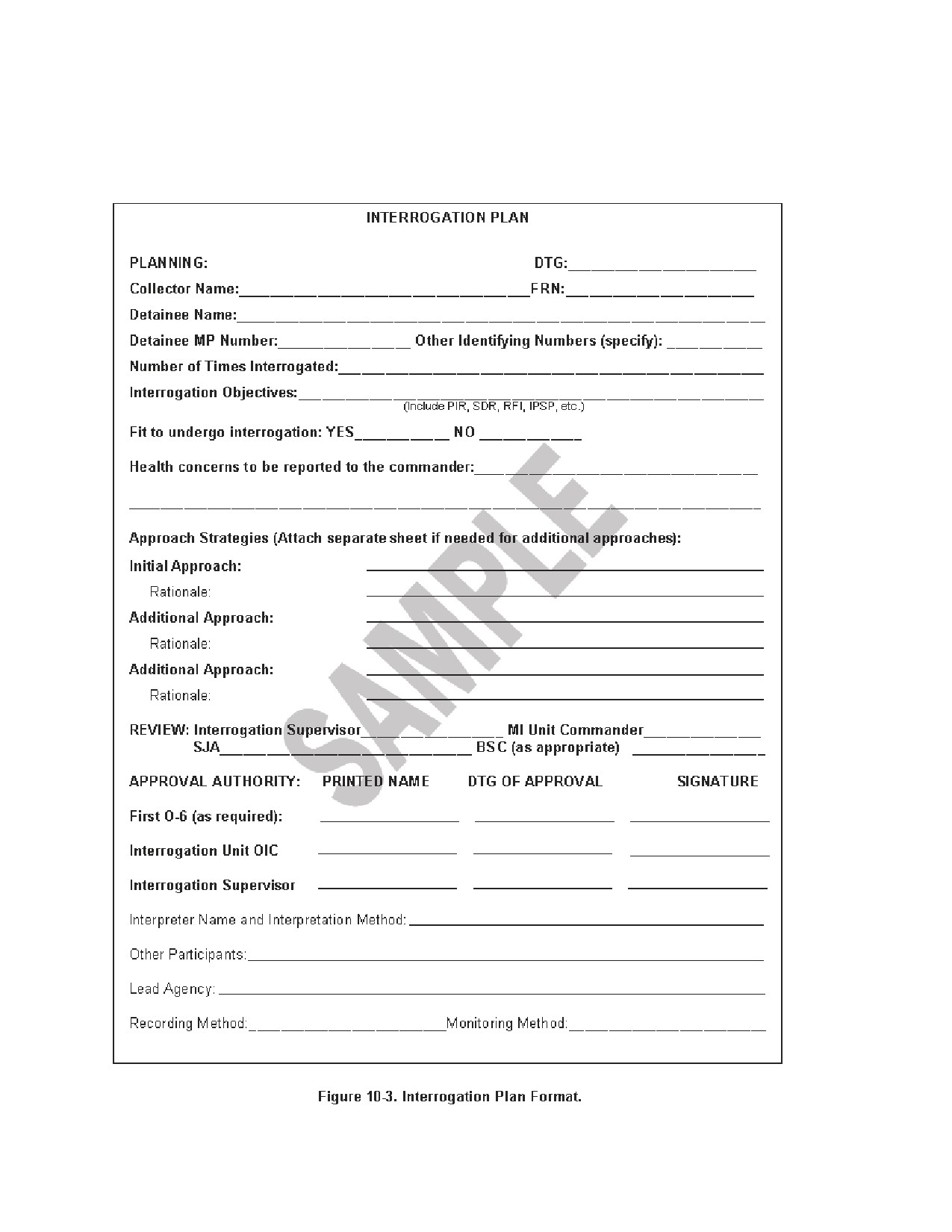
Interrogation Plan. The interrogation plan is a report prepared by the
HUMINT collector to organize his plan to approach and question a
source. It lists collection objectives, approach techniques, preparation
and liaison tasks, and interpreter usage plan. The interrogation plan
also has approval blocks for interrogation supervisor approval of
selected approaches and medical release for questioning. The last part
of the form has termination, approach effectiveness, recommendations
for further exploitation, and a summary of information obtained and
reports expected to be published. Figure 10-3 is an example of an
interrogation plan format.
•
Termination Report. The termination report is used at all echelons to
inform the technical chain of the termination of a contact relationship
between a HUMINT collector and a source.
•
Biographic Report. The biographic report is a formatted IIR used at all
echelons to report information collected from one human source about
another individual of actual or potential intelligence interest. The
biographic report format is found in DIAM 58-11 (S//NF).
REPORTING ARCHITECTURE
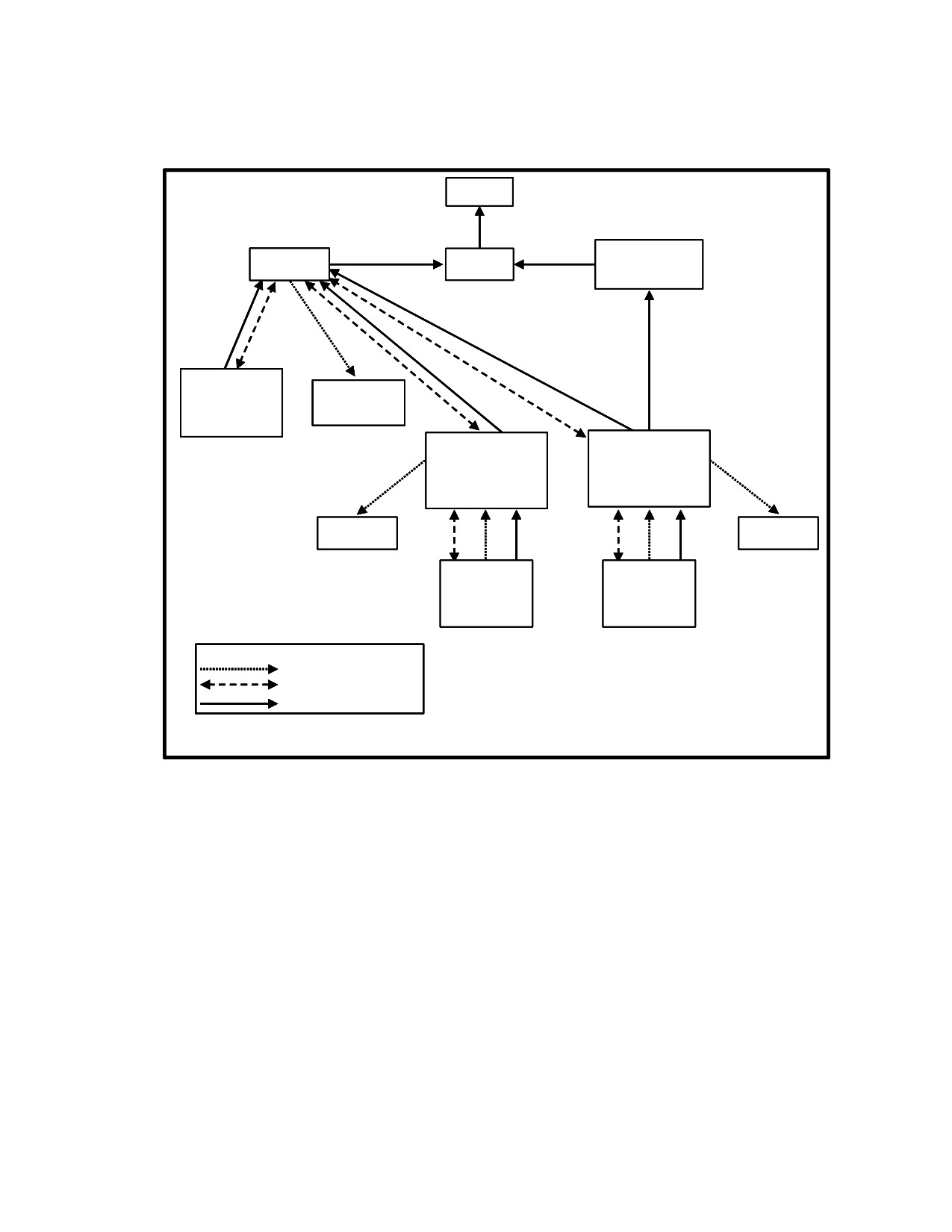
10-16. There are three basic reporting channels (see Figure 10-1):
• The operational reporting chain consists of primarily the C2 elements
for the HUMINT collection element. It includes the OMTs, unit
commanders, and unit S3 and operation sections.
• The technical chain includes the OMTs, HOC, and the C/J/G/S2X, and
in certain circumstances, the unit G2/S2s.
• The intelligence reporting chain includes the OMTs, HATS,
C/J/G/S2Xs, and unit G2/S2s.
10-17. Many elements serve multiple and overlapping functions within the
reporting architecture. Each element must be aware of its function within the
architecture to ensure that information is disseminated expeditiously to the
right place in the right format. This architecture should be established and
published prior to implementation in order to avoid confusion.
OPERATIONAL REPORTING
10-18. Operational reporting is sent via the organic communications
architecture (see Chapter 13). Operational reports are normally sent per unit
SOP or based on direction from higher headquarters. HCTs normally send all
6 September 2006
10-5
FM 2-22.3 _________________________________________________________________________________
operational reports through their OMT to the command element of the unit to
which they are assigned. If an HCT is attached, it will normally send its
operational reports to the unit to which it is attached with courtesy copies to
their assigned unit as required. If there is an administrative or logistics
relationship established with the supported unit, HCTs that are in DS send
the principal copy of all related administrative and logistic reports to the
supported unit with a courtesy copy to their parent unit. If the HCT is
operating in GS, a courtesy copy of operational reports should be forwarded to
all affected unit commanders in the supported AO.
TECHNICAL REPORTING
10-19. Technical reporting includes the forwarding of source information and
technical parameters of collection operations from lower to higher and the
passing of tasking specifics, source information, technical control measures,
and other information from higher to lower. Technical reporting is conducted
through the technical chain that extends from the HCT through the OMT and
Operations Section (if one exists) to the C/J/G/S2X.
INTELLIGENCE REPORTING
10-20. The key to intelligence reporting is to balance the need for accurate
reporting with the need to inform affected units as quickly as possible. The
J/G/S2 and MI commander are key to ensuring the right balance.
10-6
6 September 2006
_________________________________________________________________________________ FM 2-22.3
J/G2
Supported
J/G2X
ACE
S2
Other
Military
Government
Assets
Agencies
Operational
Operational
Management
Management
Team (GS)
Team (DS)
GS CO
DS CO
HUMINT
HUMINT
Collector
Collector
Team(s)
Team(s)
Legend:
Operational Reporting
Technical Reporting
Intelligence Reporting
NOTE: In addition to the standard HUMINT reporting channels, GS teams will simultaneously
send SALUTE reports to any units in their AOR that may be affected by the reported information.
Figure 10-1. HUMINT Reporting Channels.
6 September 2006
10-7
FM 2-22.3 _________________________________________________________________________________
KB-EZ WORKSHEET
1. PERSONAL DATA:
1A. Name:
1B. Source Number (Capturing Unit):
1C. Source Number (MPs):
1D. Source Number (Other):
1E. Source Number (MI):
1F. Country of Citizenship:
1G. Birth City:
1H. Birth Country:
1I. Birth Date:
1K. Date Departed Country of Origin/Date of
Capture:
1N. Last County of Residence:
1O. Language Competency:
2. Education: (Most Recent
to Oldest)
2A. Military or Civilian:
2B. Dates of Attendance:
2C. Name of Institution:
2D. City Location of Institution:
2E. Country Location of Institution:
2F: Completion Status/Degree Type:
3. EMPLOYMENT: (Most Recent to Oldest)
3A. Dates of Employment:
3B. Name of Place of Employment:
3C. City Location of Place of Employment:
3D. Country of Place of Employment:
3E. Employment Duty Position:
3F. Security Clearance:
Figure 10-2. KB-EZ Worksheet.
10-8
6 September 2006

_________________________________________________________________________________ FM 2-22.3
4. MILITARY SERVICE: (Most Recent to Oldest)
4A. Dates of Service:
4B. Name of Post/Base:
4C. Armed Service Component:
4D. Rank of Equivalent:
4E. Name of Unit/Group:
4F. City Location of Unit/Group:
4G. Country Location of Unit/Group:
4H. Military/Group Duty Position/Title:
4I. Security Clearance:
5. Comments: (Character, intelligence, motivation, personality, cooperativeness)
5A. CIRCUMSTANCES OF CAPTURE: Capture date, capturing unit, circumstances, documents,
weapons, and equipment.
5B. ASSESSMENT: Physical condition, mental condition, intelligence, cooperation (1, 2, 3),
knowledgeability (A, B, C), personality.
5C. ADDITIONAL PERSONAL INFORMATION: (Skills,
experience, marital status, other).
6. NAME OF SCREENER:
Theater-specific collection requirements may require modification of the KB-EZ format.
Consider adding entries for:
• Race
• Ethnicity
• Tribal Affiliation
• Religion and Sect
• Language and Dialect Spoken
Entries for “Location” may need to include a village or even neighborhood.
Figure 10-2. KB-EZ Worksheet (continued).
6 September 2006
10-9
FM 2-22.3 _________________________________________________________________________________
10-10
6 September 2006

_________________________________________________________________________________ FM 2-22.3
PREPARATION:
Coordinate with MP for access to the detainee.
Prepare for exploitation topics:
Obtain appropriate map sheet(s)
Obtain references
Review previous reports, detainee correspondence
Research collection topics
Prepare questions
Prepare interrogation site (furnishings, lighting, climate, security, monitoring).
Ask Guard Questions.
Review Detainee Documentation:
ID Card
Capture Tag
Documents captured with the detainee
Post-Interrogation Report
Effectiveness of Approaches:
Attitude and Behavior of Detainee:
Summary of Topics Exploited:
Expected Reports Producti
to Requirements:
on in Response
Termination:
Reason:
Approach Reinforced:
Incentive Promised:
Delivered:
Recommendation for Further Interrogation and Rationale:
Recommended Approach(es):
Topics for Further Exploitation (Leads):
Disposition of Source:_______________________________________________________________
Additional Comments:_______________________________________________________________
Figure 10-3. Interrogation Plan Format (continued).
6 September 2006
10-11
This page intentionally left blank.
FM 2-22.3
Chapter 11
HUMINT Collection With An Interpreter
11-1. The use of interpreters is an integral part of the HUMINT collection
effort. It is vital that the HUMINT collection skills be paired up with a
qualified interpreter. Use of an interpreter is time consuming and potentially
confusing. Proper use and control of an interpreter is a skill that must be
learned and practiced to maximize the potential of HUMINT collection. It is
also vital for the HUMINT collector to confirm that the interpreter he
intends to use holds the required clearance for the level of information that
will be discussed or potentially collected, and is authorized access to the
detainee. This chapter deals strictly with the use of interpreters to support
HUMINT collection; it is not intended to be applied to more routine uses of
interpreters in support of administrative, logistical, or other operational
requirements.
ADVANTAGES AND DISADVANTAGES OF INTERPRETER USE
ADVANTAGES
11-2. Interpreters are frequently a necessary aid to HUMINT collection.
There are certain advantages to using an interpreter. The most obvious is
that without an interpreter, a HUMINT collector without the proper
language or necessary proficiency in that language is severely limited.
Furthermore, if properly trained, briefed, and assessed, the interpreter can
be a valuable assistant to the HUMINT collector. The interpreter--
• Probably has a greater knowledge of the local culture and language
usage than could be developed by the HUMINT collector.
• Can identify language and culturally based clues that can help the
HUMINT collector confirm or refute the veracity of the source’s
statements.
• Can interpret not only the literal meaning of a statement but also the
intent and emotion of a sentence.
DISADVANTAGES
11-3. There are, however, several significant disadvantages to using
interpreters. Disadvantages may include—
• A significant increase in time to conduct the collection. Since the
interpreter must repeat each phrase, the time for a given questioning
session or meeting is normally at least doubled.
• Since there is now a third person in the communications loop, the
potential for confusion or misunderstanding increases significantly.
This is especially true when the interpreter is deficient in his command
of either language.
6 September 2006
11-1
FM 2-22.3 _________________________________________________________________________________
• The establishment of rapport and the use of some approach techniques
(see Chapter 8) are made difficult or even impossible when working
through an interpreter.
• The ability of the HUMINT collector to interpret the source’s veracity
through the analysis of word usage, nuances of speech, and body
language is curtailed.
• The interpreter will have his own set of biases that could influence the
manner in which the dialogue is interpreted.
• The source may be culturally biased against the interpreter. This is
especially possible if the interpreter was locally hired and is of a
different ethnic, social, or religious group than the source.
• The interpreter may be culturally biased against the source and
intentionally misinterpret the meaning to obtain a desired effect.
• There may be mission or subject matter classification problems
involved.
CAUTIONS
11-4. Be careful of comments made in the presence of your interpreter.
Although you plan comprehensively with your interpreter, you should only
share information with your interpreter on a need-to-know basis. Obviously
the exchange of information concerning the “what, where, when, with whom,
and how” of each meeting must be discussed with your interpreter, but
sometimes the “real why” is none of his business! You may be meeting with a
source or contact because the commander believes this individual has lied.
The real purpose (the why) of the meeting is to pose control questions and to
determine whether the source or contact lied in the past or whether there
was simply a miscommunication.
11-5. Be careful of sensitive or personal conversations when the interpreter
is present. This applies to conversations en route to or from meetings,
conversations over lunch or dinner in the operational area, and conversations
in the team area. It is easy to get used to the presence of the interpreter and
to overlook his presence. An interpreter is a necessary tool but we must
remember that most are only very lightly screened for the sensitive access
they have. If your interpreter turned out to be working for the other side,
what information beyond “the necessary” could he provide?
METHODS OF INTERPRETER USE
11-6. There is a basic method and advanced method of interaction between
the HUMINT collector and the interpreter. As the collector and the
interpreter become experienced at working together and gain confidence in
each other’s abilities, they may use more advanced interactive techniques. It
is the HUMINT collector’s decision whether or not to use more advanced
techniques.
11-2
6 September 2006
_________________________________________________________________________________ FM 2-22.3
BASIC METHOD
11-7. The basic method of interaction is used when--
• The interpreter and HUMINT collectors have not worked together
extensively.
• The interpreter has language skills but no interpreter training or
experience.
• The interpreter’s skill in English or the target language is suspect.
• The HUMINT collector has limited experience using an interpreter.
• The interpreter’s capabilities, loyalty, or cultural knowledge are not
known or suspect.
11-8. Using the basic method, the interpreter is used solely as an
interpretation device. When initial contact is made, the interpreter instructs
the source to maintain eye contact with the HUMINT collector. The
interpreter is briefed on the general course of the collection but usually is not
advised of the specific purpose or collection goals. While the interpreter will
be instructed to reflect the attitude, behavior, and tone of voice of both the
collector and the source, he is told to not interpose comments or personal
opinions at all in the conversation.
11-9. The questioning phase is conducted in the same way it would be if no
interpreter were used with the obvious increase in time due to the
interpretation. The interpreter uses the same person and tense as the
HUMINT collector or source and neither adds nor subtracts anything from
the dialogue. He does his best to fade into the background. When reports are
written, the interpreter will only be asked questions based on the actual
translation of the dialogue.
ADVANCED METHOD
11-10. The advanced method of interaction requires additional training on
the part of the HUMINT collector and the interpreter, extensive experience
working together, and a rapport between the HUMINT collector and the
interpreter. The HUMINT collector must trust both the capabilities and the
judgment of the interpreter. At this level of interaction, the interpreter
becomes a more active participant in the HUMINT activities. The HUMINT
collector remains in charge and makes it clear to the interpreter that he (the
HUMINT collector) is responsible for the substance and direction of the
questioning. The interpreter is normally briefed as to the specific goals of the
collection.
11-11. The interpreter becomes a more active participant in the approach
and termination phases to the point of even making planned comments to the
source supportive of the HUMINT collector’s approach. For example, if the
HUMINT collector is using an incentive approach, the interpreter in an aside
to the source can tell him that the HUMINT collector always keeps his
promises. This type of technique should only be used if both planned and
rehearsed.
11-12. During the questioning phase, the interpreter supports the collector
by not only translating the word of the source but also cueing the collector
when there are language or culturally based nuances to what the source is
6 September 2006
11-3
FM 2-22.3 _________________________________________________________________________________
saying that might add credence or doubt as to the veracity of the statements.
For example, the interpreter could point out that although the source claims
to be a factory worker, his language use indicates that the source has a
university education. In another example, the interpreter could indicate that
the dialect or pronunciation that the source is using does not match the area
that he claims to be from. During report writing, the interpreter supports the
HUMINT collector by not only answering questions on the literal
interpretation but also adds, when appropriate, comments on the significance
of both what was said and how it was said.
SOURCES OF INTERPRETERS
11-13. There are almost never sufficient interpreters to meet all unit mission
requirements. Interpreters in support of HUMINT collection require a
security clearance and knowledge of the operational situation. While any
qualified interpreter can be used to support HUMINT collection, the
HUMINT collectors maximize the collection potential if the interpreter has
received specific training. The number of interpreters needed to support a
HUMINT collection mission is METT-TC driven based primarily on the
number of HUMINT collectors, the dispersion of the HUMINT collectors in
the AO, and the number of sources. Normally one interpreter for every two
non-language qualified HUMINT collectors is sufficient; however, in
situations where a large number of high-value sources must be questioned in
a limited time, a ratio of 1 to 1 may be required. Interpreters are obtained
from within the military and from the US and local civilian populations or
other English-speaking countries.
MILITARY
11-14. There are many soldiers, including non-US citizens, who have native
language abilities due to their upbringing. Their parent unit may identify
these language abilities, or these soldiers may volunteer their abilities when
a contingency arises. The ARNG, USAR, other US military services, and even
coalition militaries, have language-trained and certified personnel in
Military Intelligence MOSs, such as 98G or 09L, who may be called upon to
serve as interpreters for the HUMINT collection effort.
CIVILIAN
11-15. Civilian corporations may be contracted by the military to provide
interpreters for an operation. These interpreters are divided into three
categories:
• CAT I Linguists - Locally hired personnel with an understanding of the
English language. These personnel undergo a limited screening and
are hired in-theater. They do not possess a security clearance and are
used for unclassified work. During most operations, CAT I linguists are
required to be re-screened on a scheduled basis. CAT I linguists should
not be used for HUMINT collection operations.
• CAT II Linguists - US citizens who have native command of the target
language and near-native command of the English language. These
personnel undergo a screening process, which includes a national
11-4
6 September 2006
_________________________________________________________________________________ FM 2-22.3
agency check (NAC). Upon favorable findings, these personnel are
granted an equivalent of a Secret collateral clearance. This is the
category of linguist most used by HUMINT collectors.
• CAT III Linguists - US citizens who have native command of the target
language and native command of the English language. These
personnel undergo a screening process, which includes a special
background investigation
(SBI). Upon favorable findings, these
personnel are granted an equivalent of a Top Secret (TS) clearance.
CAT III linguists are used mostly for high-ranking official meetings
and by strategic collectors.
INTERPRETATION TECHNIQUES
11-16. During the planning and preparation phase, the HUMINT collector, in
collaboration with the interpreter, selects a method of interpretation. There
are two methods:
• Alternate Interpretation. The interpreter listens to the entire phrase,
sentence, or paragraph. The interpreter then translates it during
natural pauses in speech.
• Simultaneous Interpretation. The interpreter listens to the source and
translates what he says, just a phrase or a few words behind. The
HUMINT collector should select the simultaneous method only if all
the following criteria are met:
The sentence structure of the target language is parallel to English.
The interpreter can understand and speak English as well as the
target language with ease.
The interpreter has special vocabulary skills for the topics to be
covered.
The interpreter can easily imitate the HUMINT collector’s tone of
voice and attitude for the approaches and questioning technique
selected.
Neither the collector nor the interpreter tends to get confused when
using the simultaneous method of interpretation.
11-17. If any of the above-mentioned criteria in the simultaneous method
cannot be met, the HUMINT collector should use the alternate method. The
alternate method should also be used when a high degree of precision is
required.
TRAINING AND BRIEFING THE INTERPRETER
11-18. The HUMINT collector will need to train an individual who has no
interpreter experience as well as remind a trained and certified interpreter of
the basic interpreter requirements. The requirements include—
• Statements made by the interpreter and the source should be
interpreted in the first person, using the same content, tone of voice,
inflection, and intent. The interpreter must not interject his or her own
personality, ideas, or questions into the interview.
6 September 2006
11-5
FM 2-22.3 _________________________________________________________________________________
• The interpreter should inform the HUMINT collector if there are any
inconsistencies in the language used by the source. The HUMINT
collector will use this information in his assessment of the source.
• The interpreter needs to assist with the preparation of reports and
administrative documents relevant to the source and meeting.
11-19. Once the HUMINT collector has chosen a method of interpretation, he
must brief the interpreter. This briefing must cover—
• The current situation.
• Background information on the source (if available).
• The administrative particulars of the meeting such as where it will be
held, the room setup, how long it will last.
• The specific positioning of the interpreter, collector, and source.
• The general or (if advanced method of interaction is being used) the
specific collection objectives.
• The selected approach and possible alternate approaches that the
HUMINT collector plans on using. If time allows, the collector and
interpreter should rehearse the approaches.
• Any special topic or technical language that is anticipated. If time
allows, the interpreter should research any anticipated technical
vocabulary with which he is unfamiliar.
11-20. Throughout the briefing, the HUMINT collector fully and clearly
answers questions the interpreter may have. This helps ensure the
interpreter completely understands his role in the HUMINT collection
process. With a more advanced interaction plan, the HUMINT collector and
the interpreter should “wargame” their plan and rehearse their actions as
necessary.
PLACEMENT OF THE INTERPRETER
11-21. The interpreter should be placed in a position that enhances the mood
or general impression that the HUMINT collector wants to establish. When
dealing with detainees or EPWs, the HUMINT collector generally wants to
establish a dominant position, maintain a direct relationship with the source,
and increase or at least maintain the anxiety level of the source. Having the
HUMINT collector and the source facing each other with the interpreter
located behind the source normally facilitates this. It allows the HUMINT
collector to maximize control of both the source and interpreter. If desired,
having the interpreter enter the room after the source, so the source never
sees the interpreter, can further heighten the anxiety of the source.
11-22. Having the interpreter sit to the side of the HUMINT collector creates
a more relaxed atmosphere. This is the norm for debriefings and official
meetings. Having the interpreter at his side also facilities
“off line”
exchanges between the HUMINT collector and the interpreter. The collector
should avoid having the interpreter sit beside the source since this has a
tendency of establishing a stronger bond between the source and the
interpreter and makes “off line” comments between the collector and the
interpreter more difficult.
11-6
6 September 2006
_________________________________________________________________________________ FM 2-22.3
11-23. When conducting source meetings in a public setting, a more natural
appearance is desirable. The seating needs to conform to the norm at the
location where the meeting is taking place. For example, if meeting at a
restaurant, the HUMINT collector, interpreter, and source will sit naturally
around the table.
INTERACTIONS WITH AND CORRECTION OF THE INTERPRETER
11-24. The HUMINT collector must control the interpreter. He must be
professional but firm and establish that he is in charge. During a questioning
session, the HUMINT collector corrects the interpreter if he violates any
standards that the pre-mission briefing covered. For example, if the
interpreter interjects his own ideas into the meeting, he must be corrected.
Corrections should be made in a low-key manner as to not alienate the
interpreter, interrupt the flow of the questioning, or give the source the
impression that there is an exploitable difference of opinion between the
HUMINT collector and the interpreter. At no time should the HUMINT
collector rebuke the interpreter sternly or loudly while they are with the
source. The HUMINT collector should never argue with the interpreter in the
presence of the source. If a major correction must be made, the HUMINT
collector should temporarily terminate the meeting and leave the site
temporarily to make the correction. The HUMINT collector needs to
document any difficulties as part of his interpreter evaluation. The HUMINT
collector must always ensure that the conduct and actions of the interpreter
are within the bounds of applicable law and policy. Applicable law and policy
include US law; the law of war; relevant international law; relevant
directives including DOD Directive
3115.09,
“DOD Intelligence
Interrogations, Detainee Debriefings, and Tactical Questioning”; DOD
Directive 2310.1E, “The Department of Defense Detainee Program”; DOD
instructions; and military execute orders including FRAGOs.
11-25. The HUMINT collector must be alert for any signs that the
interpreter is not performing as required. The following are some indicators
of possible problems.
• Long-to-short. If you take
20 seconds to express yourself and the
interpreter reduces it to a 3-second translation, it may indicate that
something has been omitted, and you should not proceed until you
have resolved the issue. There is nothing wrong with stating that you
would “prefer” the interpreter translate everything that was just said.
If you have trained your interpreter properly, this should not be an
issue. If it arises even with the training you have given the interpreter,
then it has significance and you must not let it pass.
• Short-to-long. If you take
5 seconds to express yourself and the
interpreter expands it to a 30-second translation, it may indicate that
something has been added, and you should not proceed until you have
resolved the issue.
• Body-language shift. If the interpreter’s body language suddenly has a
significant shift from his normal behavior, you should look for the
reason. (It is advisable for you to determine a base line of behavior for
your interpreter to facilitate recognition of the changes.) Perhaps he is
reluctant to translate what you just said. Be aware that the body shift
6 September 2006
11-7
FM 2-22.3 _________________________________________________________________________________
means that something is happening--your task is to find out what it
means.
• Unusual pauses. Look for a longer delay than usual before the
translation begins. Unless it is a vocabulary or concept issue, the long
delay means that the interpreter is “thinking” before he translates.
Any thinking beyond what is needed to translate, as closely as possible,
what was just said represents a potential problem. Again, you should
establish a base line of behavior for your interpreter so you can
recognize these unusual pauses.
•
“Wrong” reactions. If you say something humorous that should provoke
a positive response from the source, and you do not get that response,
then you should wonder if the message got through. If the source
becomes upset in response to something (positive) you said, then you
should begin to wonder what message was passed by the interpreter.
Did you fail to express yourself clearly, or was it an accidental or
deliberate mistranslation?
11-26. A trusted linguist should periodically review the accuracy of the
interpreter’s translations by monitoring an interrogation or debriefing and
critiquing the monitored interpreter’s performance.
INTERPRETER SUPPORT IN REPORT WRITING
11-27. The interpreter assists the HUMINT collector in preparing all
required reports. He may be able to fill gaps and unclear details in the
HUMINT collector’s notes. He may also assist in transliterating, translating,
and explaining foreign terms.
EVALUATING THE INTERPRETER
11-28. After submitting all reports, the HUMINT collector evaluates the
performance of his interpreter. This should be done in writing, and copies
should be given to the interpreter and placed on file with the individual
managing the HUMINT collection portion of the interpreter program. The
interpreter program manager needs to develop a standard evaluation format
for inclusion in the unit SOP. The evaluation forms should note at a
minimum:
• Administrative data (for example, date, time, interpreter’s name).
• Strengths and weaknesses of the interpreter with any problems and
corrective actions taken.
• Type of interpretation used (simultaneous or alternate).
• Type of HUMINT operation the interpretation was supporting (that is,
an interrogation, a debriefing, a liaison meeting).
• Ability or lack of ability of the interpreter to use specific technical
language that may have been required.
• Name or collector number of the HUMINT collector.
11-29. The interpreter program manager uses these forms to decide on future
use of the interpreters, to develop training programs for the interpreters, and
to assign interpreters to make maximum use of their specific capabilities.
11-8
6 September 2006
_________________________________________________________________________________ FM 2-22.3
The HUMINT collector should also review these files before using an
unfamiliar interpreter.
MANAGING AN INTERPRETER PROGRAM
11-30. Units requiring interpretation support need to identify an individual
or individuals to manage the interpreter program. In most units, this will be
someone in the G3/S3 section. Division and Corps-level units will have a
language manager. In MI units whose specific function is HUMINT
collection, it will normally be a senior Warrant Officer within that unit. The
functions of the interpreter program manager include but are not limited
to—
• Consolidating and prioritizing interpreter requirements.
• Coordinating with G2 or INSCOM to contract for qualified
interpreters.
• Coordinating with the G1/S1 to identify personnel in the unit with
language skills who can be used as interpreters.
• Coordinating with the G1/S1 and G5 to obtain qualified local-hire
interpreters.
• Coordinating with G2/S2 for clearances.
• Coordinating with the G3/S3 to establish training for both the
interpreters and those that will be using interpreters.
• Coordinating with the G3/S3 for language testing of the interpreters in
both English and the target language as required.
• Coordinating with the G1/S1 and G4/S4 to ensure that all
administrative and logistical requirements for the interpreters are
met.
• Establishing and maintaining the administrative, operational, and
evaluation files on the interpreters.
• Assigning or recommending the assignment of interpreters to
operational missions based on their specific capabilities.
6 September 2006
11-9
This page intentionally left blank.
FM 2-22.3
PART FOUR
Analysis and Tools
Part Four discusses HUMINT analysis and the automation and communication tools
needed to support the HUMINT collection effort.
HUMINT analysis supports operational planning and provides direction to HUMINT
collection operations. Analysts determine if information from a single human source
is internally consistent based on factors such as placement and access of source,
prior information from the source, and existing holdings. Source analysis is used to
determine if the information from a source is complete, truthful, and responsive to
collection requirements. Operational analysis consists of those actions taken to
determine how to best meet requirements.
Modern automation and communications systems are vital to HUMINT collection.
Real-time collaboration, detailed operational planning and ISR integration, as well as
enhanced collection and source exploitation tools, must support team efforts.
Emerging technology continues to allow the entire HUMINT collection system to
operate more effectively. Commanders must be prepared to supply their HUMINT
collection assets with the best possible technology.
_________________________________________________________________________
Chapter 12
HUMINT Analysis and Production
12-1. Analytical processes provide information to support the commander,
his staff, and his unit. Analysis is an integral part of HUMINT collection.
Analysis occurs throughout the HUMINT collection process but can be
divided into four primary categories: analytical support to operational
planning and targeting, operational analysis and assessment, source
analysis, and single-discipline HUMINT analysis and production.
ANALYTICAL SUPPORT TO OPERATIONAL PLANNING
12-2. Several elements provide analytical support at various echelons,
including the following:
• The HAT is subordinate to the G2 ACE. The HAT supports the G2 in
developing IPB products and in developing and tailoring SIRs to
match HUMINT collection capabilities.
6 September 2006
12-1
FM 2-22.3 _________________________________________________________________________________
• The HAC is subordinate to the C/J/G/S2X and functions in the same
capacity for the C/J/G/S2X as the HAT does for the ACE.
• The HOC of the C/J/G/S2X supports the C/J/G/S2 and C/J/G/S2X in
the identification of HUMINT collection opportunities, the
development of taskings and RFIs for HUMINT collection assets, as
well as the development of a HUMINT database.
INTELLIGENCE PREPARATION OF THE BATTLEFIELD
12-3. The HAT assists the G2 in the identification and characterization of
the human component of operations and its effects on friendly and enemy
operations. As part of its assistance to the G2, the HAT compiles and
analyzes data about the local civilian population including its political,
ethnic, religious, cultural, tribal, economic, and other social components. It
carefully examines the various component groups and their predicted
reaction to friendly force operations.
12-4. The HAT also provides input to all-source analysis by identifying
specific actions and motivational factors that should strengthen the local
population’s support of the US or at least weaken its support of the enemy
and by providing information on transient (refugees, DPs, third-country
nationals) population and its effects on friendly and enemy operations. In
addition to the above, the HAT--
• Closely examines the current and potential threat to identify all
factors, such as morale, motivation, training, and beliefs that would
affect both positively and negatively on enemy and opposing force
capabilities.
• Identifies formal and informal leaders of hostile, neutral, and
friendly groups and how their influence is likely to affect operations.
• Develops overlays, databases, and matrices, as required, to support
IPB. These overlays may represent a wide variety of intelligence
issues, including battlefield infrastructure
(for example, electrical
power grid), population density, ethnic, religious, or tribal affiliation,
and no-strike or collateral damage.
• Provides its products to the C/J/G/S2, the all-source analysts and CI
analysts of the ACE, the HOC, the C/J/G/S2X, and HUMINT
collection units as required.
ISR TASK DEVELOPMENT
12-5. The HAT and the C/J/G/S2X support the C/J/G/S2 by expanding the
PIRs that can be answered through HUMINT collection into ISR tasks that
can be answered by a human source and that can be tasked to a specific
collection entity. The HAT and the C/J/G/S2X provide this information to
support the development of the HUMINT collection plan and its integration
into the overarching ISR plan. The HAT normally establishes a list of
prioritized standing indicators, and supplements this with ISR tasks
developed to answer specific PIRs. The standing indicators are incorporated
into the ACE’s all-source analysis team’s list of indicators that point to a
pattern or COA. Each standing indicator is integrated with other indicators
12-2
6 September 2006
________________________________________________________________________________ FM 2-22.3
and factors so that analysts can detect patterns and establish threat
intentions.
SUPPORT TO HUMINT TASKING
12-6. The C/J/G/S2X supports the C/J/G/S2 and the C/J/G/S2 requirements
manager by developing tasking for specific organic or attached HUMINT
collection assets and by developing requests and coordinating for support
from higher and lateral echelon HUMINT collection elements. The C/J/G/S2X
matches specific collection requirements to collection units and sources. If
current sources cannot answer the requirement, he develops profiles for new
sources that guide the collection teams in the development of new sources.
The C/J/G/S2X also determines the best method to achieve collection
requirements. The C/J/G/S2X supplies any required technical support to the
HUMINT operations section, OMTs, and HCTs.
HUMINT DATABASE DEVELOPMENT
12-7. The C/J/G/S2X maintains the source database, which receives input
from HUMINT collection and CI operations. The C/J/G2X is responsible for
maintaining the source database.
OPERATIONAL ANALYSIS AND ASSESSMENT
12-8. Operational analysis consists of those actions taken to determine how
to best meet requirements. Assessment evaluates the effectiveness of the
requirement effort. Operational analysis begins with the C/J/G/S2X when he
determines the best collection assets and sources needed to answer collection
requirements. For analysis, the C/J/G/S2X section and specifically the
HOC—
• Provides higher echelon coordination and deconfliction for collection
operations.
• Provides required technical support to the HUMINT operations
sections, OMTs, and HCTs.
• Facilitates feedback and evaluations.
12-9. For assessment, the C/J/G/S2X section and specifically the HOC—
• Monitors all HUMINT reporting to ensure that requirements are
being met.
• Refocuses efforts of assigned assets as needed.
12-10. The HUMINT operations section (if one exists) and the OMTs of
tasked collection units determine which HCTs are best suited to meet specific
collection requirements. They also conduct operational coordination for the
HCT, provide technical support, and monitor all reporting to ensure that
reports are properly formatted and support collection requirements. The
team leader of the tasked HCT selects the specific collectors and sources to
meet collection requirements, reviews the collection plan, provides technical
support to the collectors, coordinates with the supported unit, and monitors
all team reporting for format and content. He identifies additional lines of
questioning and approaches required to fulfill collection requirements.
6 September 2006
12-3
FM 2-22.3 _________________________________________________________________________________
SOURCE ANALYSIS
12-11. Source analysis involves the actions taken to determine if information
from a single human source is internally consistent based on factors such as
placement and access of source, prior information from the source, and
existing holdings. Source analysis is used to determine if the information
from a source is complete, truthful, and responsive to collection
requirements. Preliminarily source analysis is the responsibility of the
individual HUMINT collector.
12-12. The HUMINT collector evaluates all source statements within the
context of the information known about the source and the current situation
to determine both the veracity and the validity of source statements. That is
not to say that the HUMINT collector ignores any information that does not
fit into expected pattern; rather that he treats that information with
skepticism and uses appropriate questioning methodology to validate the
statements (see Chapter 9). Source analysis is supported by the HCT leader,
the OMTs, and the HOC. Each echelon reviews the intelligence and
operational reports, identifies inconsistencies, evaluates veracity, and recom-
mends additional lines of questioning as appropriate.
12-13. Analysts can assign an alphanumeric designator to collected
information based on an analyst’s determination of the reliability of the
source and the probable accuracy of the information reported. A letter from A
to F is assigned reflecting the level of reliability, with A representing the
highest degree of reliability. The letter designation is then coupled with a
number from 1 to 6. The number 1 represents confirmed intelligence and the
numbers 2 through 6 represent increasing degrees of uncertainty as to the
veracity of the information. A complete explanation if this rating system is
contained in Appendix B. [NOTE: This system of labeling the reliability of
sources and their reported information should not be confused with the
alphanumeric rating scheme for source-screening operations as described in
Chapter 6.]
SINGLE-DISCIPLINE HUMINT ANALYSIS AND PRODUCTION
12-14. Single-discipline HUMINT analysis involves the actions taken to
evaluate the information provided by all HUMINT sources at a given echelon
to determine interrelationships, trends, and contextual meaning. While
called “single discipline," the analyst reviews and incorporates, as necessary,
information from other disciplines and all-source analysis to provide a
contextual basis for the HUMINT analysis. Single-discipline HUMINT
analysis is conducted primarily by the HAT of the ACE. HUMINT operations
sections and OMTs also conduct analysis to a lesser degree, based on the
information from HUMINT sources at their echelon.
12-15. Analysis does more than simply restate facts. The analyst formulates
a hypothesis based on available data, assesses the situation, and explains
what the data means in logical terms that the user can understand. There
are two basic thought processes used by analysts to study problems and
reach conclusions: induction and deduction.
12-4
6 September 2006
________________________________________________________________________________ FM 2-22.3
• Induction is the process of formulating hypotheses on the basis of
observation or other evidence. It can best be characterized as a
process of discovery when the analyst is able to establish a
relationship between events under observation or study. Induction,
or plausible reasoning, normally precedes deduction and is the type
of reasoning analysts are required to perform most frequently.
• Deduction is the process of reasoning from general rules to particular
cases. The analyst must draw out, or analyze, the premises to form a
conclusion. Deductive reasoning is sometimes referred to as
demonstrative reasoning because it is used to demonstrate the truth
or validity of a conclusion based on certain premises.
ANALYTICAL TECHNIQUES AND TOOLS
12-16. There are three basic analytical techniques and automated tools that
are particularly useful to single-discipline HUMINT analysis. Each of these
tools takes fragmented bits of information and organizes them to create a
chart or graph that can easily be read. They are the time event chart,
matrices, and the link analysis diagram. HUMINT collectors and analysts
can use automated computer programs such as Analyst Notebook or Crime
Link to produce these tools or they can create them on paper. Computer
programs are faster to use than previous methods and have the added
advantage of producing a product that can be shared easily and rapidly over
networks and portals. The diagrams in this chapter represent the tools that
can be produced using automated programs.
Time Event Chart
12-17. A time event chart is a method for placing and representing individual
or group actions in chronological form. It uses symbols to represent events,
dates, and the flow of time. Normally, triangles are used to depict the
beginning and end of the chart and may be used within the chart to indicate
particularly critical events such as an ideological shift or change. Rectangles,
used as event nodes, store administrative data and indicate significant
events or activities. Drawing an “X” through the event node may highlight
noteworthy or important events. Each of these symbols contains a sequence
number, date (day, month, and year of the event), and may, if desired,
contain a file reference number. The incident description written below the
event node is a brief explanation of the incident and may include team size
and type of incident. Arrows indicate time flow. By using these symbols and
brief descriptions, it is possible to analyze the group's activities, transitions,
trends, and particularly operational patterns in both time and activity. If
desired, the event nodes may be color coded to indicate a particular event or
type of event to aid in pattern recognition. The time event chart is the best
analytical tool for pattern analysis. The example at Figure 12-1 depicts the
history of the group, including most major players, which carried out the
World Trade Center bombing in February 1993.
6 September 2006
12-5