FM 6-40 TTP for Field Artillery Manual Cannon Battery U.S. - page 17
FM 6-40
d. Terrain. The terrain in the target area has a direct effect on the vulnerability of the
target. Rugged terrain affords considerable natural cover and makes target location difficult.
Certain terrain provides complete protection from some angles of approach but not others and
thus influences the unit and munitions to be employed. The nature of the vegetation in the target
area should be considered when selecting ammunition.
e. Weather. Weather is of little consequence in evaluating a target to attack with fuze
quick or time. However, precipitation and wind are of particular importance in evaluating a
target to attack with ICM, smoke, FASCAM, or illum projectiles. Low clouds, thick fog, surface
water, and rain degrade the effectiveness of VT fuze.
C-3. Determining Most Suitable Weapon and Ammunition
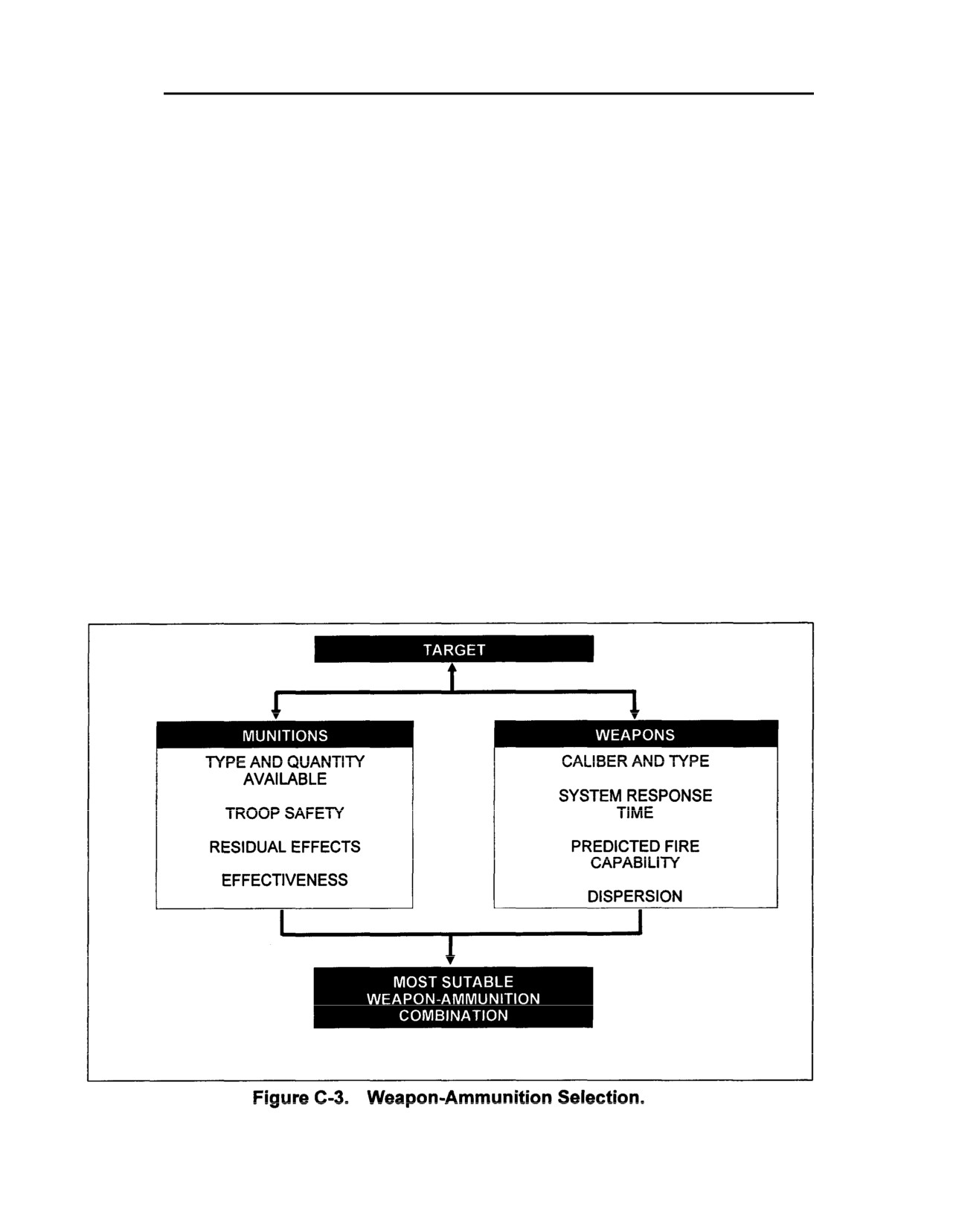
When an FDO decides to attack a target, he selects a weapon-ammunition combination
that achieves the desired effect with a minimum expenditure of available ammo. Figure C-3
depicts weapon-ammunition selection.
a. Munitions.
(1) Type and quantity available. The nature of the target, its surroundings, and
the desired effects dictate the type and amount of ammo to use. For a detailed discussion of
ammo and fuzes, refer to FM 6-141-1 and (C)FM 6-141-2. The ammo resupply system
sometimes rules out the best ammo selection. For example, extensive smoke fires may be needed
to screen maneuver movement, but such fires may cause a resupply problem. Some fires require
more ammo than others. Suppression and neutralization fires normally use less ammo than
destruction fires.
C-6
FM 6-40
(2) Troop safety. Troop safety is a major concern in considering the
weapon-ammunition selection for firing close-in targets. The FDO must ensure that fires do not
endanger friendly troops, equipment, and facilities.
(3) Residual effects in target area. The supported unit must be advised of the
residual effects from certain munitions. For example, the self-destruct times from FASCAM
munitions may preclude the desired movement of supported units through a particular area.
Weather changes may alter choices of certain munitions (smoke, illumination, and white
phosphorous). The incendiary effects of certain munitions may make areas untenable for
supported forces. However, these effects can also deny the enemy use of selected terrain.
(4) Effectiveness. When properly delivered against appropriate targets, artillery fire
support can be the decisive factor in a battle. The FDO must ensure that the desired result is
attained from every mission. To match a munition to a target, the FDO must know what damage
a munition can produce and the damage required to defeat the target. The lethality of a munition
must be matched to the specific vulnerability of the target. Thus, the FDO must understand the
damage potential (blast, cratering, fragmentation, incendiary, and penetration) of specific
munitions. Specific information regarding the effects of various munitions is found in the
appropriate JMEM, FM 6-141-1, and (C) FM 6-141-2. For details on predicting weapon effects,
see paragraphs C-5 through C-8.
b. Weapons.
(1) Caliber and type available. In certain instances, an FDO may control the fires
of reinforcing (R) or general support reinforcing (GSR) units that fire a different caliber. The
FDO must have a thorough knowledge of the characteristics, capabilities, and vulnerabilities of
each weapon system. Weapons with slow rates of fire and poor delivery accuracy are best suited
for long-range fires. Weapons with rapid rates of fire and good delivery accuracy are suited for
close fires.
(2) System response time. An FDO must ascertain the urgency of each fire
mission. Small and medium weapons have a quicker firing response time than heavy weapons.
Fire missions sent by the direct support (DS) battalion to reinforcing or GSR units require more
processing time than those sent directly to the firing batteries of the battalion.
(3) Predicted fire capability. The FDO must know the current survey,
registration, and met status of all firing units under his control. FFE missions should be assigned
to units that have the best predicted fire capability.
C-4. Determining the Method of Attack
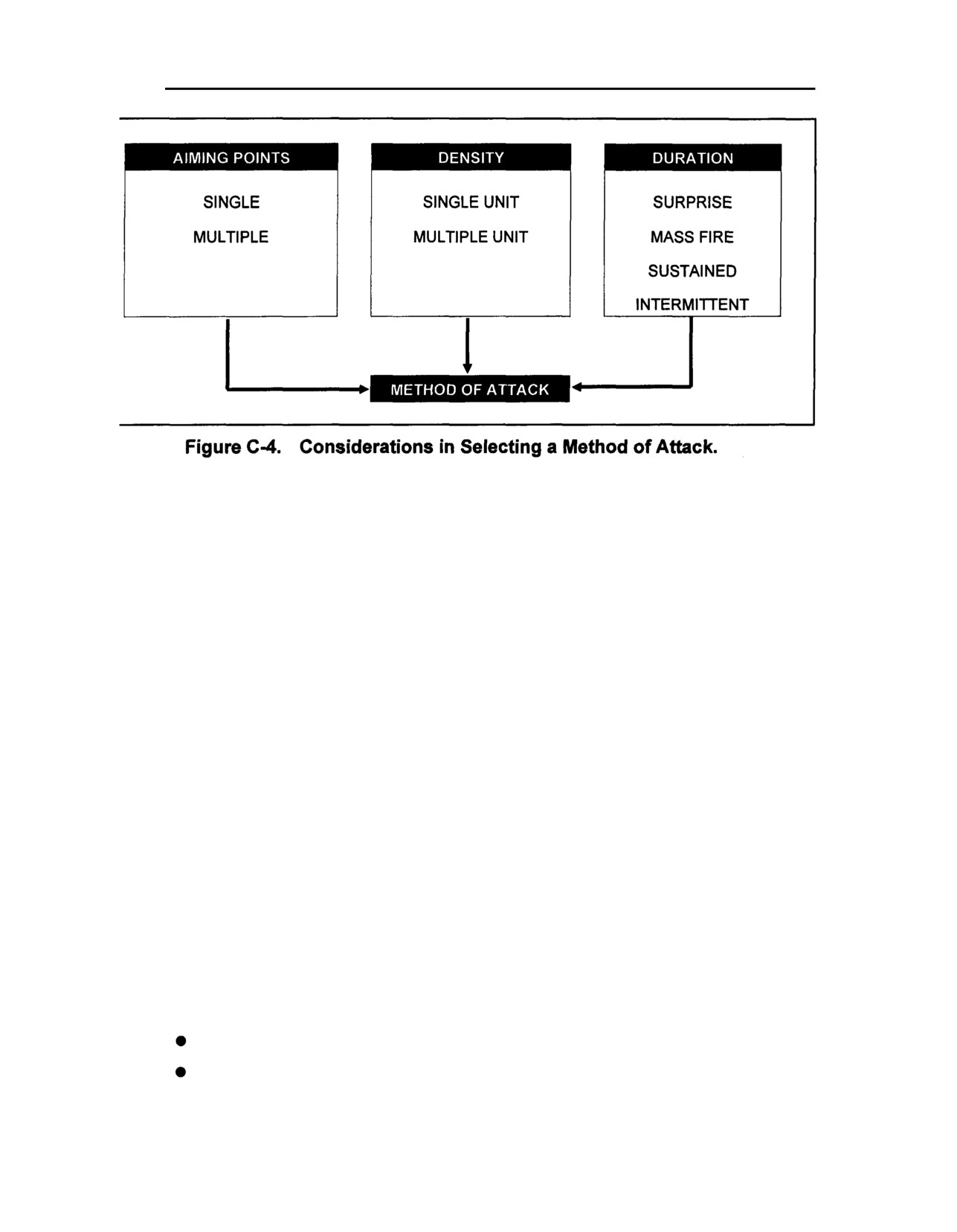
The final step in the FDO’s target analysis is the selection of a method of attack. The
FDO selects a method of attack that ensures target area coverage and desired target effects. To
determine the best method of attack, the FDO must consider aimpoints, density, and duration of
fire, Figure C-4 shows the method-of-attack selection considerations.
C-7
FM 6-40
a. Aimpoints. Normally, the size of the area to be attacked depends on the size of the
target or the size of the area in which the target location is known or suspected. A single aiming
point in the center of the target is used to attack small targets. For attacking large targets,
multiple aimpoints are designated to distribute the fires and ensure adequate coverage. Appendix
E gives procedures for establishing multiple aimpoints.
b. Density. For most targets, uniform density of fires is needed. Several techniques for
indirect fire weapons produce such results. These include zone and sweep fires either from a
single unit or simultaneous attack by multiple units on different portions of the target.
c. Duration. Accurate surprise fires produce the most effective results. Time on target
procedures place initial rounds from all units on the target at the same time and achieve the
greatest surprise. While intense fires of short duration generally produce the best results, the
tactical situation may require that fires be continued over a longer period of time. Some examples
are harassing and interdiction fires, screening smoke, continuous illumination, and suppressive
fires supporting a maneuver final assault on an objective.
C-5. Predicting Weapons and Munitions Effects
a. The most important step in performing target analysis is determining the number and
type of rounds required to produce the desired effects on a target. The time available to perform
the target analysis largely determines the tools used to predict effects. An analyst at the division
fire support level can use the JMEMs for guidance while the FDO at battalion or battery level,
because of time constraints, can used the GMET.
b. A JMEM for world artillery and mortar systems will be distributed in fiscal year 1997
on a compact disk (CD). It will be a single source of information on US and foreign weapon
systems and their effectiveness and the data and methodologies used to generate these effects.
Information will be provided on the following:
US and foreign artillery and mortar weapon systems characteristics.
Damage mechanisms.
C-8
FM 6-40
Delivery accuracy.
Reliability.
Mission planning.
Target acquisition.
Target characteristics.
Target environments.
How weapon effectiveness is determined.
Additionally, expected fractional damage and casualties can be generated for user-selected
weapon-target-engagement condition combinations. This JMEM on a CD can be used as a
training tool and a source of combat effectiveness information.
A-6. Joint Munitions Effectiveness Manuals
Effectiveness tables published in JMEMs for surface-to-surface weapons (JMEM/SS)
provide guidance for determining the expected fraction of casualties to personnel targets or
damage to materiel targets. The JMEM/SS are published as field manuals. The current manuals
are as follows:
FM 101-60-25, Change 3, Effectiveness Data for Howitzer, 155-mm M198 and
M109A2/A3 (23 Oct 94). Revision 1 is scheduled for distribution in fiscal year 1996.
It will be titled Effectiveness Data for Howitzer,
155-mm, M109A6, M198, and
M109A2/A3/A4 (1 Sep 84).
FM 101-60-35, Effectiveness Data for the Army
Tactical Missile System: M39
(Army-TACMS Block I) (S) (18 Nov 94).
FM 101-60-28, Effectiveness Data for the Multiple
Launch Rocket System (MLRS):
227-mm, M270 (3 May 94).
Each of these manuals contains a personal computer (PC) program and associated database to
compute weapon effectiveness for conditions not displayed in the manual. Effectiveness data in
these manuals are listed for the following targets and conditions.
a. Personnel Targets. Square target sizes of 100,250,500, and (for MLRS only) 1,000
meters on a side are given. Data are listed for standing, prone, prone protected, and fighting
position postures.
b. Materiel Targets. A short description of the following targets and their
vulnerabilities are included:
T-62, medium tank.
T-72Ml/T-80, medium tank.
BMP-1, armored infantry combat vehicle.
BDRM-2, armored amphibious reconnaissance vehicle.
BTR-60pB, armored personnel carrier.
122-mm and 152-mm self-propelled howitzers.
C-9
FM 640
122-mm and 152-mm towed howitzers.
122-mm multiple rocket launcher.
ZSU-23-4, antiaircraft gun.
ZIL-157, medium truck.
KrAZ-214, heavy truck.
FROG-7B, rocket and launcher.
Scud-B, missile and transporter-erector-launcher.
SA-8, missile system.
SA-13, missile system.
Straight Flush radar.
The JMEM/SS are constantly updated, and other materiel targets will be added to the above list
as data become available.
c. Environment. Data for personnel targets are listed for open terrain, marsh grass,
temperate forrest, coniferous forest, and several urban environments. Data for materiel targets
are listed for open terrain and a limited set of targets for several urban environments.
d. Methods of Delivery. Data are given for observer-adjusted and BCS techniques.
e. Aim Policy. Data are given for BCS aimpoint techniques for howitzers, MLRS
aiming policy for MLRS, and a single aimpoint for the Army tactical missile system (ATACMS).
f. Ammunition. Data are given for HE and DPICM (M483A1 and M864).
CAUTION
There is no assurance that the expected fraction of damage or casualties will be provided by any
number of volleys in a given situation. Although not precisely within the mathematical definition, the
method of averaging data used for the tables will result in less damage being realized for approximately
50 percent of the rounds and, conversely, greater damage for the other 50 percent of the rounds.
C-7. Graphical Munitions Effects Tables (GMETs)
a. Purpose. Although the JMEMs provide excellent effectiveness data, the usefulness
of these publications to the FDO during field operations is limited by their volume and difficulty
of easily cross-referencing information. The GMETs overcome these limitations by providing
quick access to munitions effectiveness data. The effectiveness data found on a GMET is not as
accurate as the JMEM, but the compromise in accuracy is offset by the speed of obtaining
information.
b. Table Description.
(1) The GMET consists of a loose-leaf binder with introductory text and
instructions for use followed by the tabulated data. The tabulated data allows the user to
determine the number of battery or battalion volleys needed to achieve the desired fractional
damage. The number of volleys determined is a function of the following:
Weapon system.
Environment.
C-10
FM 6-40
Delivery accuracy.
Target location error (TLE).
Size of target.
Target posture.
Ammunition selected.
The following assumptions were made when compiling data for the GMET:
(a) Targets are engaged by using BCS aimpoint techniques. The GMETs for
the M102/M119 and M198 assume that you are engaging targets with a six-gun battery. The
GMETs for the Ml09-series howitzer assume you are engaging targets with a four-gun platoon.
(b) To maintain a constant probable error, all volleys are considered to be fired
at two-thirds of the maximum range of the specific weapon system.
(c) The GMETs use a center-of-battery to center-of-target solution for effects.
(d) If the number of rounds needed to achieve the desired results exceeds 30
battery or 10 battalion volleys, the letter “P” (prohibited) is listed because any additional volleys
will not achieve a significant increase in casualties. The letter “E” (excessive) indicates that the
casualties obtained would be in excess of the specified casualty level.
(e) The percentage of casualties (%CAS) is expressed as the average expected
fraction of casualties. Against personnel targets in an offensive posture, the assumed desired
average expected fraction of casualties are 30, 20, and 10 percent (.30, .20, and .10). For targets
in a defensive posture, the assumed casualties are 10, 5, and 2 percent. The casualty percentages
for the defense are lower than those for the offense because of greater shielding of targets. Also
shown is the average expected fraction of casualties for one battalion and one battery volley. The
number of expected casualties is the product of the average expected fraction of casualties and
the number of personnel in the target area.
(f) The target posture for personnel in an offensive posture is assumed to be
one half standing and one half prone for the first volley and all prone for sustaining volleys. For
personnel in the defensive posture, one half are assumed to be prone and one half are in foxholes
for the initial volley, and all personnel are assumed to be in foxholes for subsequent volleys.
(g) ICM is APICM. The ICM reflected on the GMET are only for APICM.
(h) The effects listed are based on targets located by observer adjustment
(observer adjusted) and met + VE delivery techniques. If the FDO is confident of target location,
he may select TLE O, or if the FDO’s confidence of the accuracy of target location is suspect,
TLE + 75 can be selected.
(i) The target size for various targets is listed on each table of the GMET.
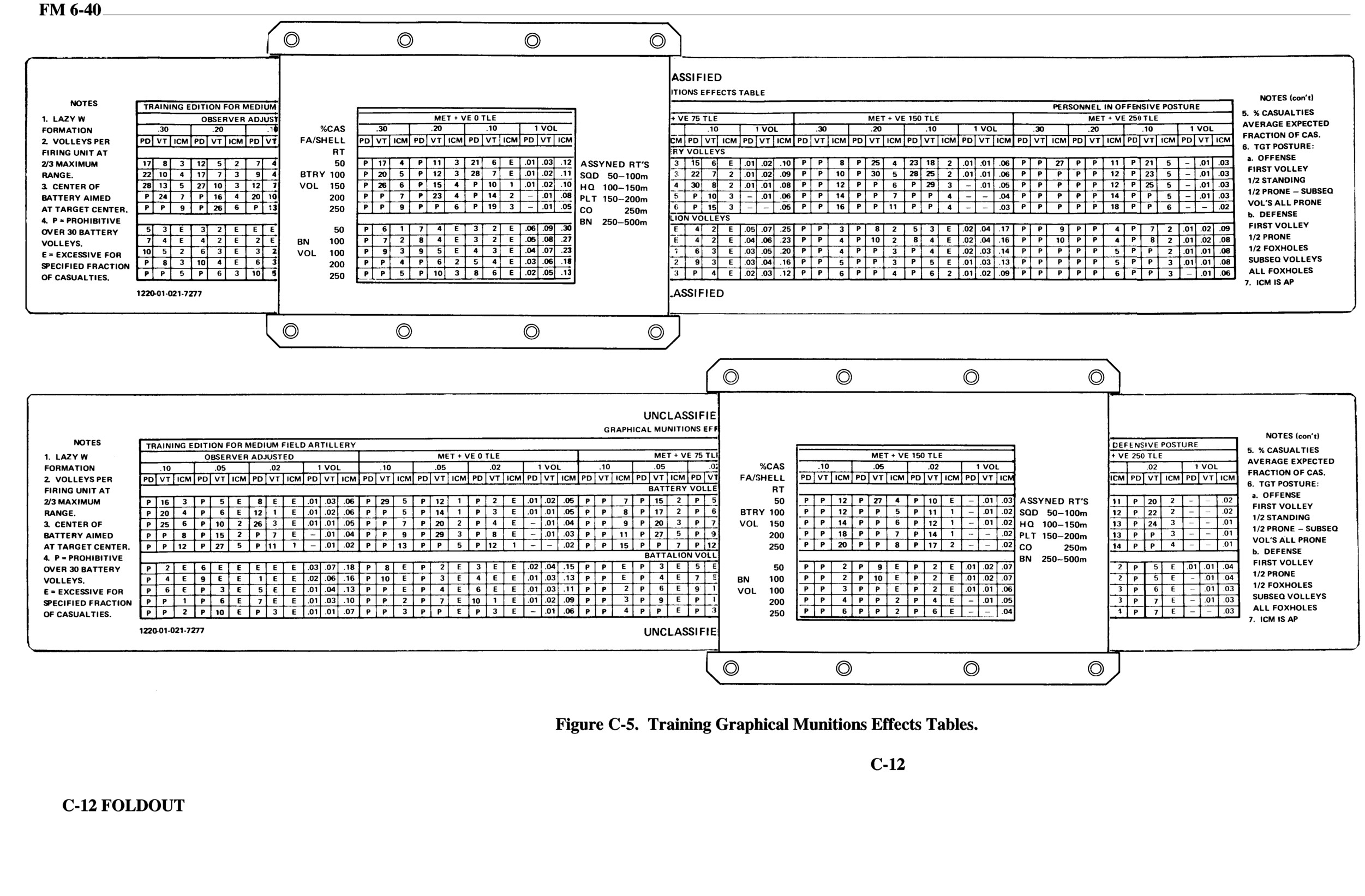
(2) The current GMETs were produced in fiscal year 1996 and represent a
significant improvement over previous GMETs. Previous GMETs consisted of a body and
cursor similar to GFTs and used aimpoint techniques used for a six-gun battery firing a parallel
sheaf. Also, there were no data for the DPICM family of projectiles. Unclassified versions of the
previous editions of the GMETs (with body and cursor) are available and can be used for training
purposes only. See Figure C-5.
C-11
FM 6-40
C-8. Quick Reference Tables
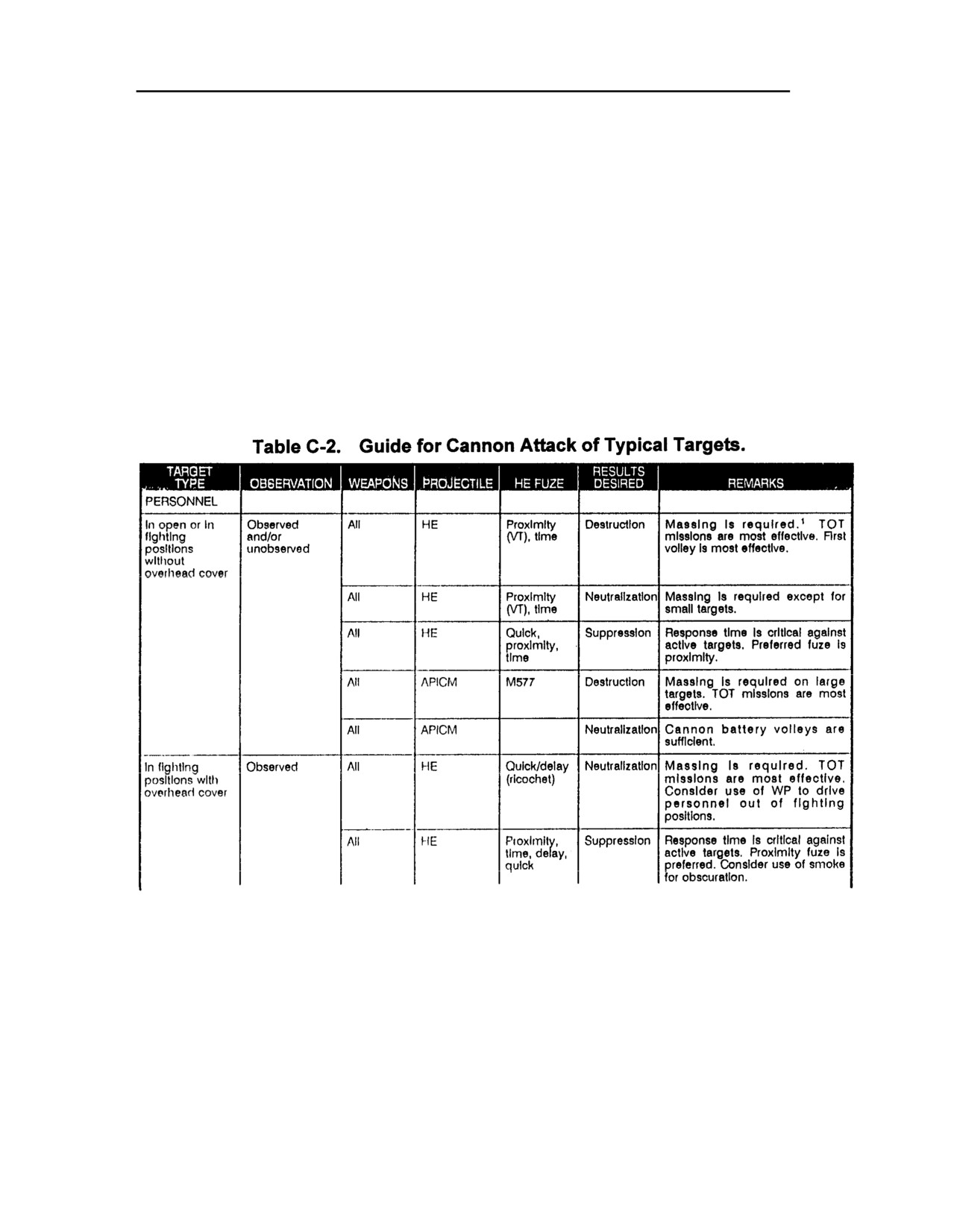
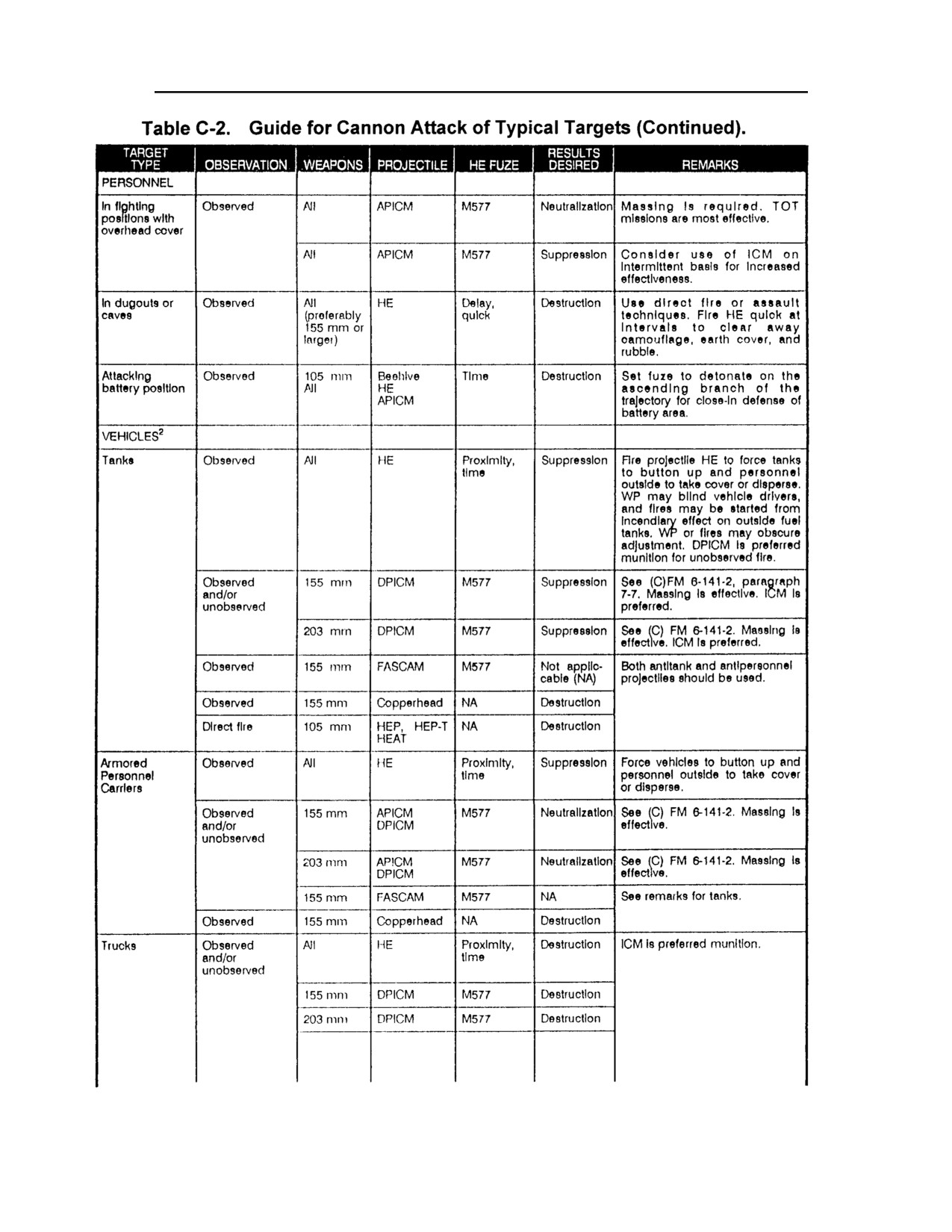
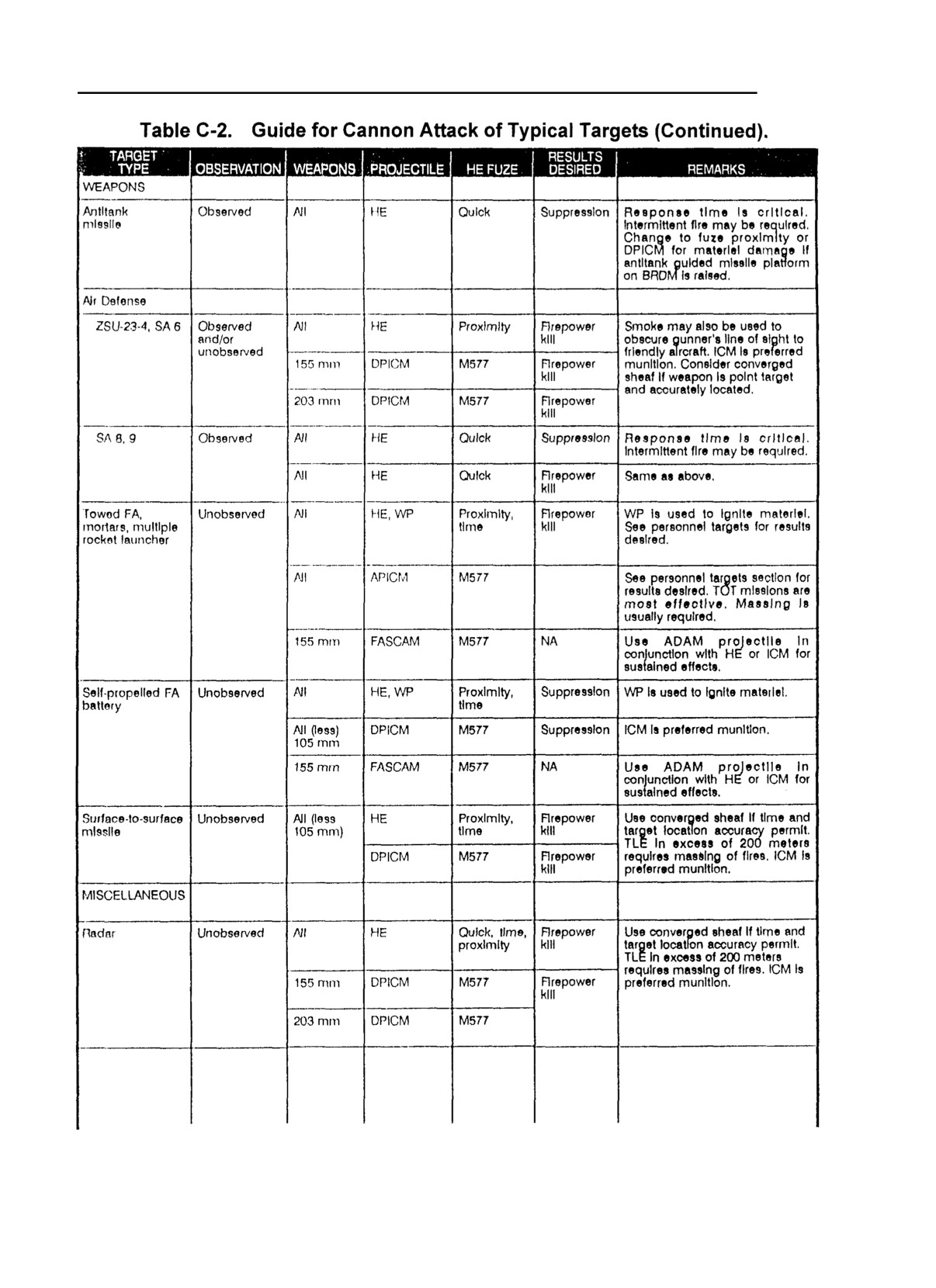
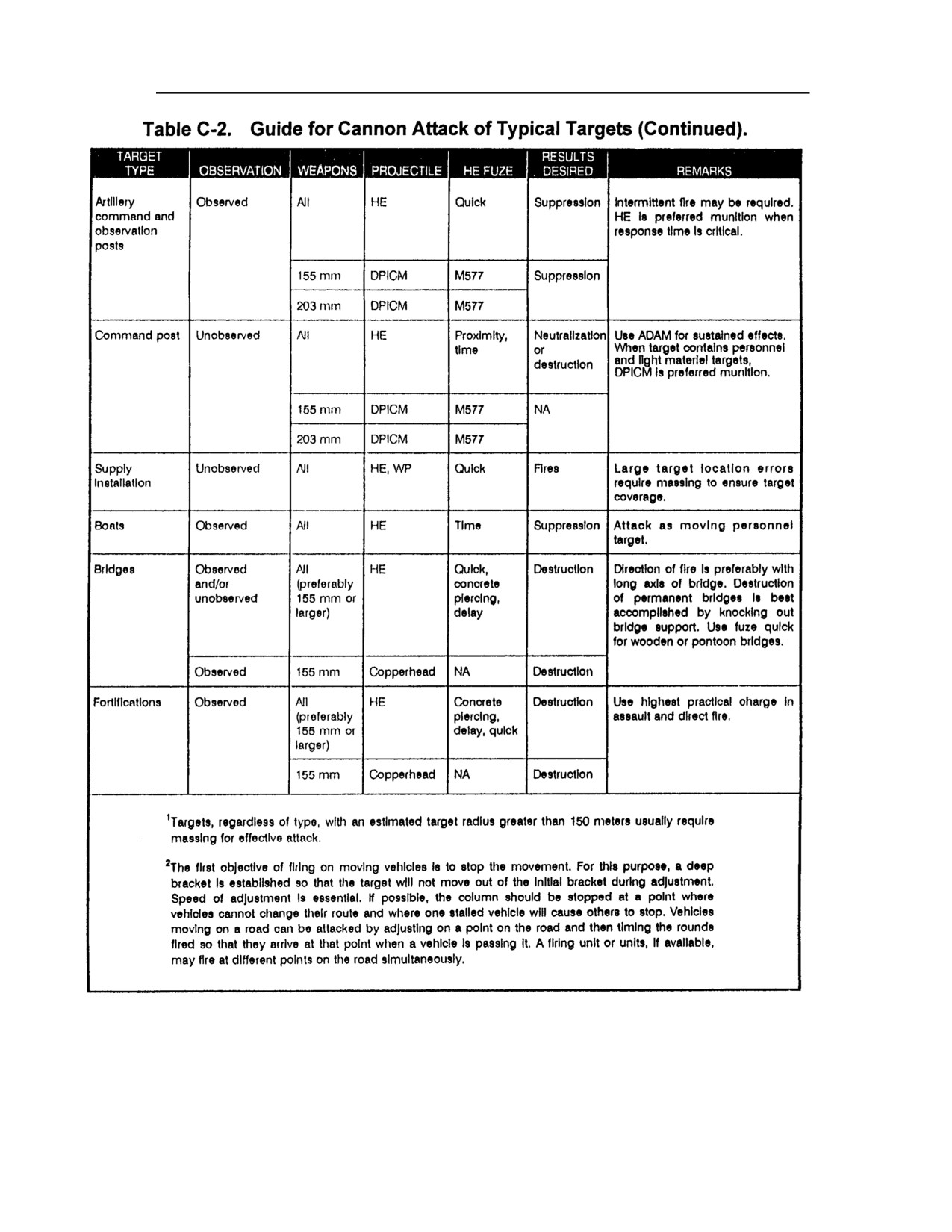
a. If JMEMs or GMETs are not available, the FDO can use the guide for cannon attack
of typical targets (Table C-2). The table lists selected personnel and materiel targets and
indicates the order of effectiveness for each shell-fuze combination. Targets not indicted should
be equated to targets that are listed. The table can be used for all calibers.
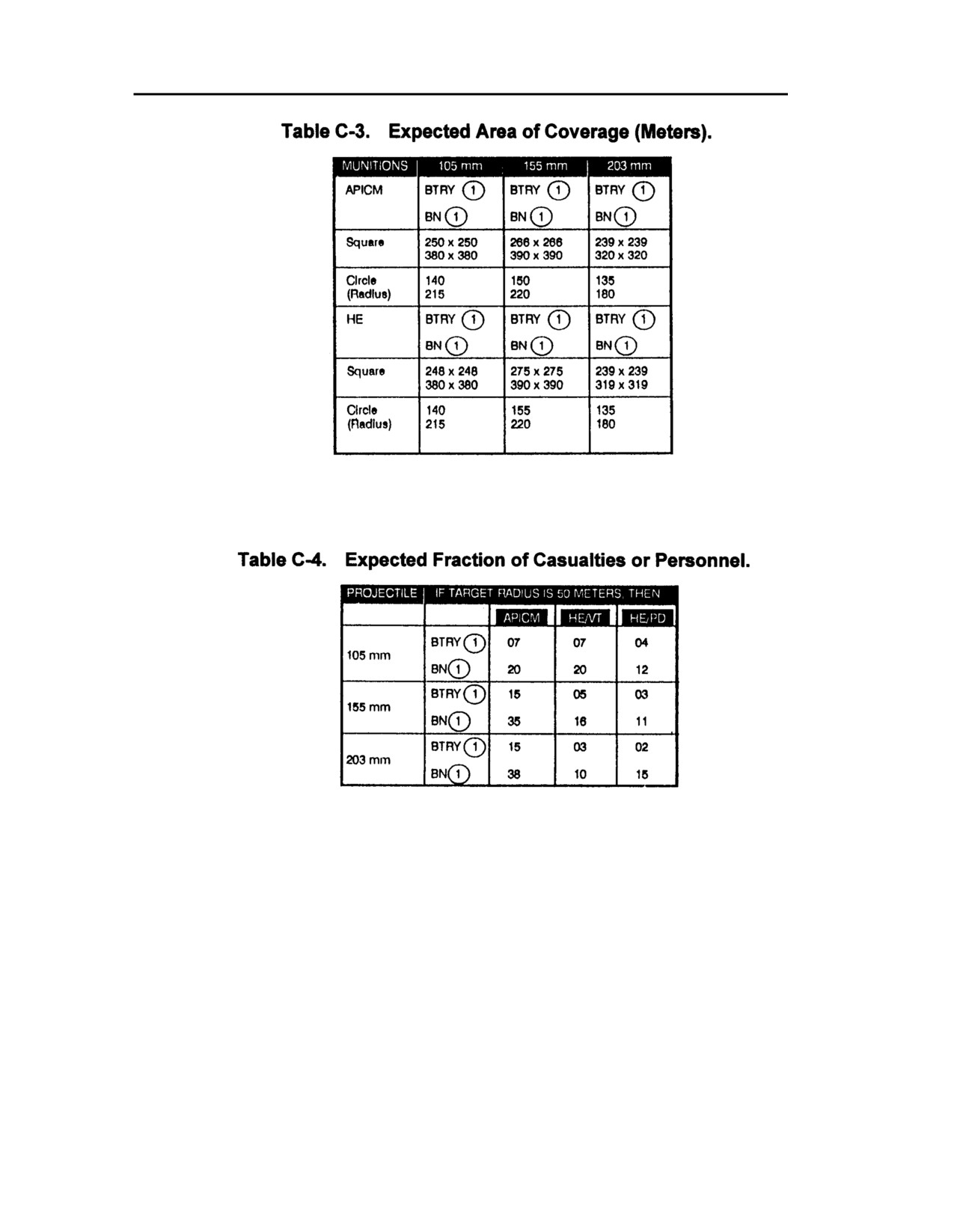
b. The expected area of coverage table (Table C-3) can be used to determine the
appropriate size of a battery one volley or battalion one volley of both HE and ICM for the
various caliber weapon systems. The FDO can use Table C-3 to determine the size target that
can be attacked by use of battery or battalion volleys. The density of coverage is not considered,
but the density of coverage of ICM is much greater than that of HE.
c. The expected fraction of casualties or personnel table (Table C-4) can be used to
determine the optimum method of attacking a personnel target of 50 meters radius to achieve the
commander’s criteria. Table C-4 cannot be used for material targets.
C-13
FM 6-40
C-14
FM 6-40
C-15
FM 6-40
C-16
FM 6-40
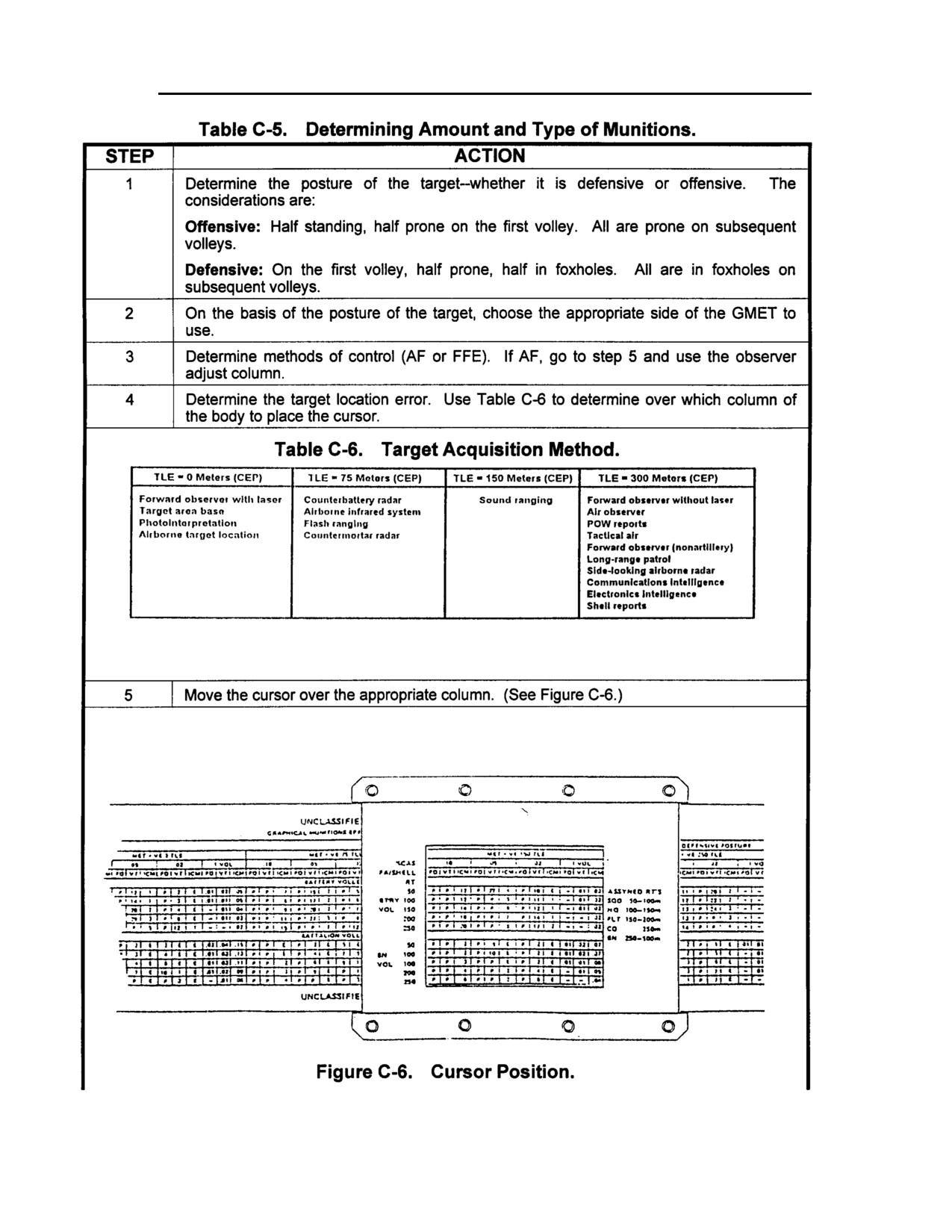
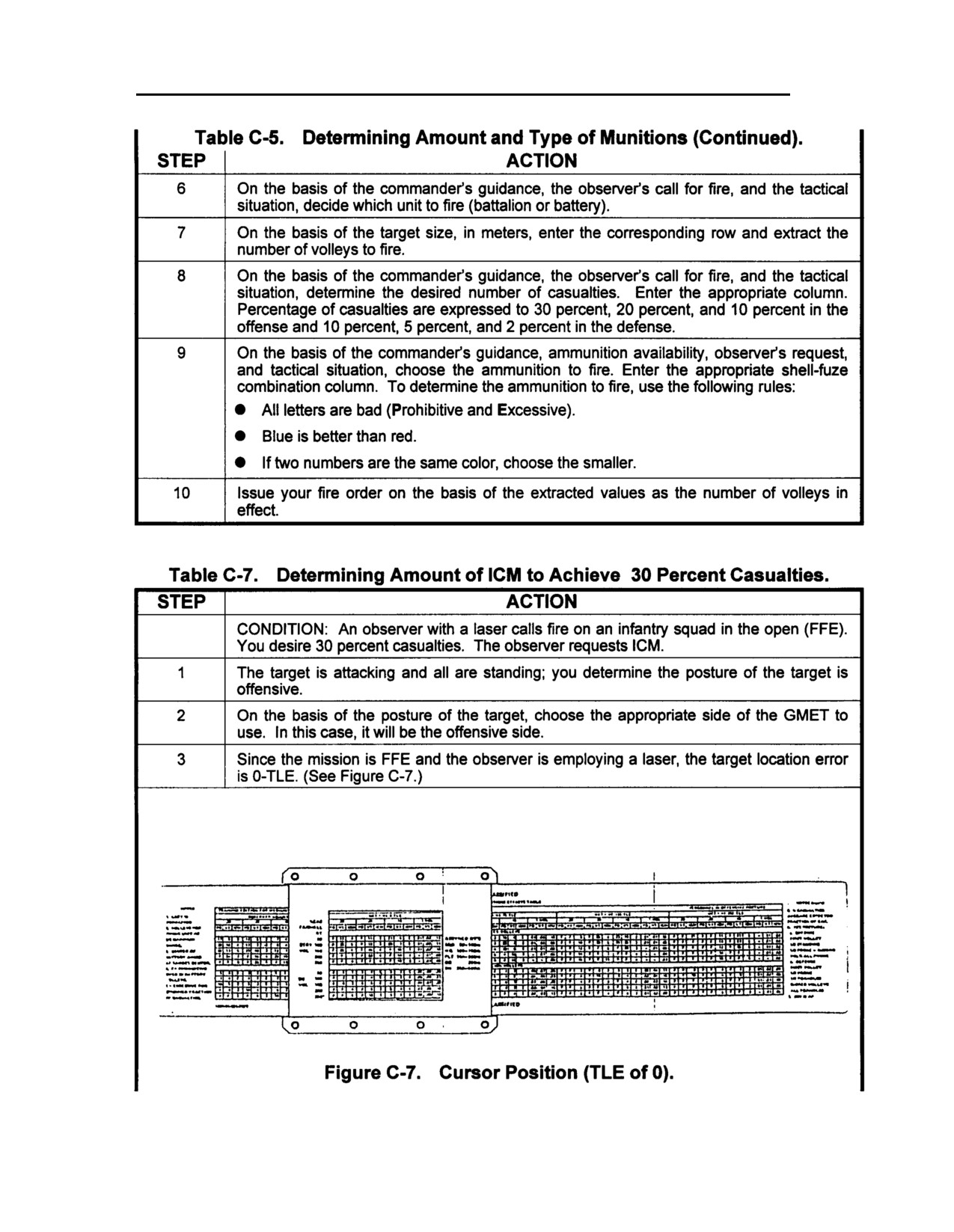
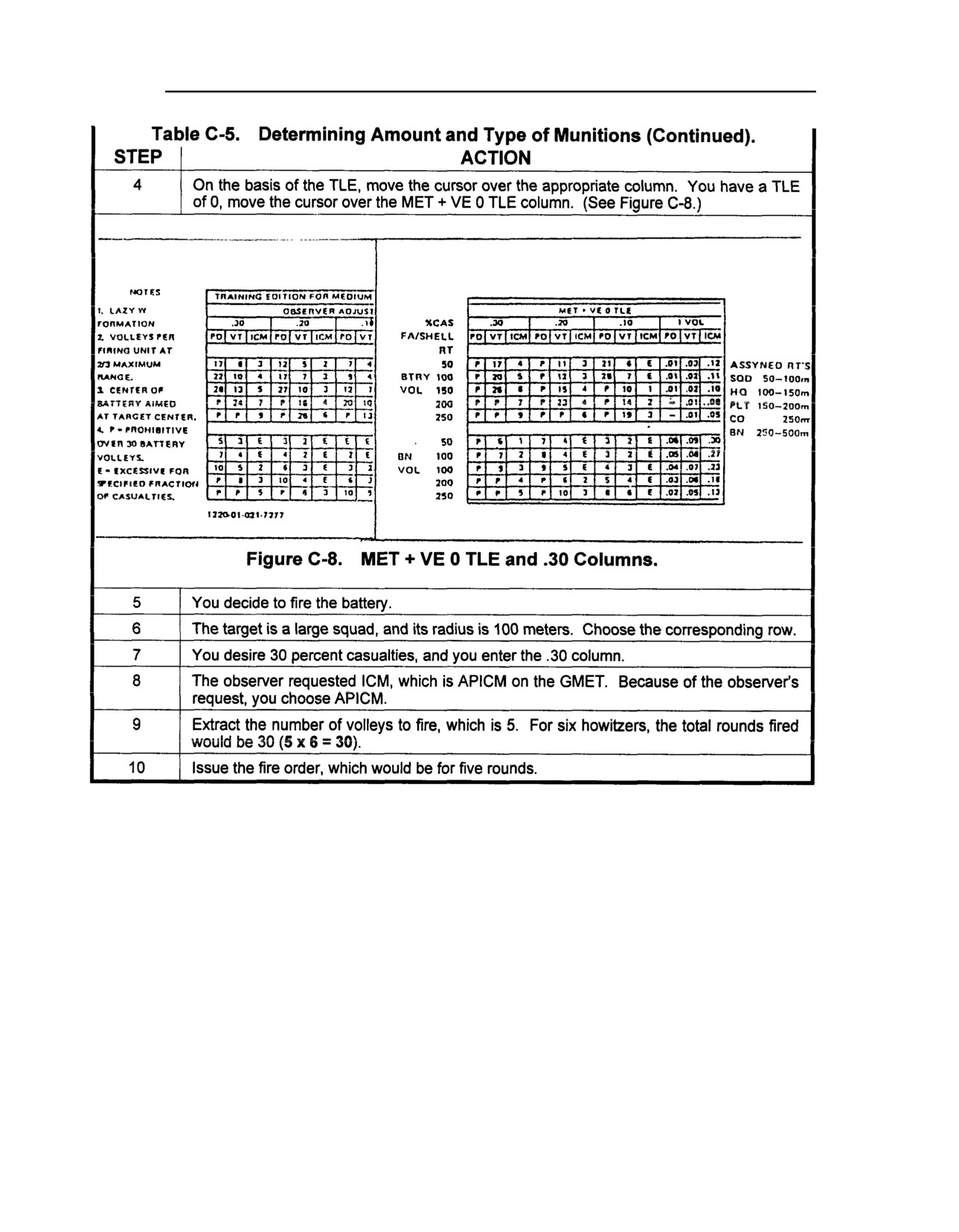
C-9. EXAMPLES
The following examples are to be used for training only. They are based on previous
versions (Figure C-5) of the GMET that are still available. To determine the amount and type of
munitions needed to achieve suppression, neutralization, and destruction of targets, use the
procedures in Tables C-5 and C-7.
C-17
FM 6-40
C-18
FM 6-40
C-19
FM 6-40
C-10. Terminal Ballistics
Terminal ballistics may be defined as the study of the effects of projectiles on a target.
The theory of terminal ballistics is relatively new compared to the theory of internal and external
ballistics. The techniques of investigation for impact on solid targets consist primarily of
empirical relations (based on experiments), analytical models, and computer simulations. In
terminal ballistics, we are dealing with the shock caused by the detonation of the HE filler. The
effects are most pronounced if the shell penetrates the surface of a target before detonation.
C-11. Munitions Effects
a. High Explosive. The use of the HE with its many different fuze combinations
(PD-Superquick or Delay, Ti, or VT) is very effective against personnel targets except when they
have a high degree of protection. The HE projectile is available for the 105-mm and 155-mm
howitzers.
C-20
FM 6-40
b. HERA Projectile. This projectile has two distinct advantages over normal
HE--increased range and fragmentation. The RAP round is primarily used against antipersonnel
and material targets at increased ranges. The RAP round is available for the 105-mm and
155-mm howitzers.
c. Smoke. There are four different types of smoke in our inventory: HC smoke,
colored smoke, white phosphorus, and M825/M825A smoke. The hexachloroethane, or HC
smoke, and the colored smoke are used for screening, marking, and obscuring targets with no
casualty-producing effect. The WP projectile is primarily used for incendiary purposes; that is,
POL sites and equipment. White phosphorus may also be used as a screening or marking round.
The M825/M825Al, new smoke, is a WP projectile which dispenses 116 WP impregnated felt
wedges. The build-up time is much quicker, and the duration (5 to 10 minutes) is longer than
normal HC or WP. The smoke projectile (HC, colored, and WP) are available for the 105-mm
and 155-mm howitzers. The M825/M825A1 is only available for the 155-mm howitzer.
d. Chemical (Gas). This munition incapacitates the enemy either by choking, blistering
exposed tissue, or attacking the nervous system. The chemical projectile is most effective when
deployed with other types of munitions. The chemical projectile is available for the 105-mm and
155-mm howitzers.
e. Illumination. The illum projectile is primarily used for night attack or defense, as a
ground marking round for a particular target, and for harassment. The illum projectile is
available for the 105-mrn and 155-mm howitzers.
f. Antipersonnel (Beehive). The Beehive projectile was designed for direct fire battery
defense. The projectile acquired its name because of the 8,000 flechettes, or “steel darts,” housed
within the body. The projectile is available for the 105-mm howitzer only and comes fuzed with
the M563 fuze set on muzzle action.
g. Antipersonnel Improved Conventional Munitions. This projectile contains
antipersonnel grenades (the number varies depending on the caliber of the weapon) which are
extremely effective on antipersonnel targets. APICM is available for 105-mm and 155-mm
howitzers.
h. Dual-Purpose Improved Conventional Munitions. This projectile contains
antipersonnel and antimaterial grenades. As with APICM, the number of each type of
submunition depends on the caliber of the weapon. This projectile was designed for use against
equipment, lightly armored vehicles, and personnel. DPICM is available for the 155-mm
howitzer.
i. Family of Scatterable Mines. There are two types of artillery delivered mines:
ADAM and RAAMS. The ADAM was developed for use against personnel targets, to deny
terrain, and to block avenues of approach. RAAMS was developed for use against armored
targets. Both the ADAM and RAAMS have preset self-destruct times of either short (within 4
hours) or long (within 48 hours). FASCAM is available for the 155-mm howitzer only.
j. Copperhead. The CLGP, or Copperhead projectile, was designed for high-payoff
targets such as enemy armor or command bunkers. The projectile has three distinct sections:
guidance, warhead, and control. The round is loaded and fired the same as with other projectiles
but with a special switch setting placed on the projectile before firing. It is laser-guided to the
target. The Copperhead projectile is only available for the 155-mm howitzer.
C-21
FM 6-40
k. M864 Base Burn DPICM. This projectile is a 155-mm projectile that extends the
maximum range of DPICM to 22.2 km for the Ml09A2/A3 and 28.4 km for the M109A5/A6
M198 howitzers. The projectile contains 72 dual-purpose grenades. A base burner assembly
containing 2.6 pounds of HTPB-AP propellant is assembled to the base of the projectile body.
When the weapon is fired, the propelling charge ignites the propellant in the base burner
assembly. The gases expelled from the base burner unit greatly reduce drag behind the base, thus
increasing projectile range. The projectile will not be used for training; all assets will become war
reserve. Data may be computed manually by using FT 155-AU-PAD and FT 155-ADD-U-PAD.
Automated procedures will become available with the fielding of version 10 software for the
battery computer system.
C-12. New Experimental Projectiles
a. M898 Sense and Destroy Armor. M898 SADARM artillery munitions are in
engineering and manufacturing development for the 155-mm howitzer delivery systems. The
SADARM submunitions are delivered by a DPICM-family projectile and are dispensed over the
target area. The submunitions will orient, stabilize, and descend by parachute over the target
area. When a target is identified within the submunition scan area by millimeter wave or infrared
sensors, an explosively formed penetrator will fire from the submunition into the target.
b. XM915/916 105-mm DPICM. The XM915 cartridge is a semifixed 105-mm
DPICM projectile which is compatible with the Ml19 howitzer. It uses the M229 zone 8
propelling charge. The maximum range is 14 km. The XM916 cartridge is a semifixed 105-mm
DPICM projectile which is compatible with the M101A1, M102, and M119 howitzers. It uses the
standard M67 propelling charge. The maximum range is 11 km. Both projectiles contain a
submunition payload of 42 dual-purpose XM80 submunitions, which will be approximately twice
as effective as the current M444 APICM projectile.
c. M913 105-mm RAP. The M913 cartridge is a semifixed 105-mm RAP which is
compatible with the M119 howitzer. It uses the M229 zone 8 propelling charge. The maximum
range is 19.5 km. The M913 will be produced for all M119 units Armywide and will be held in
war reserve.
C-22
FM 6-40
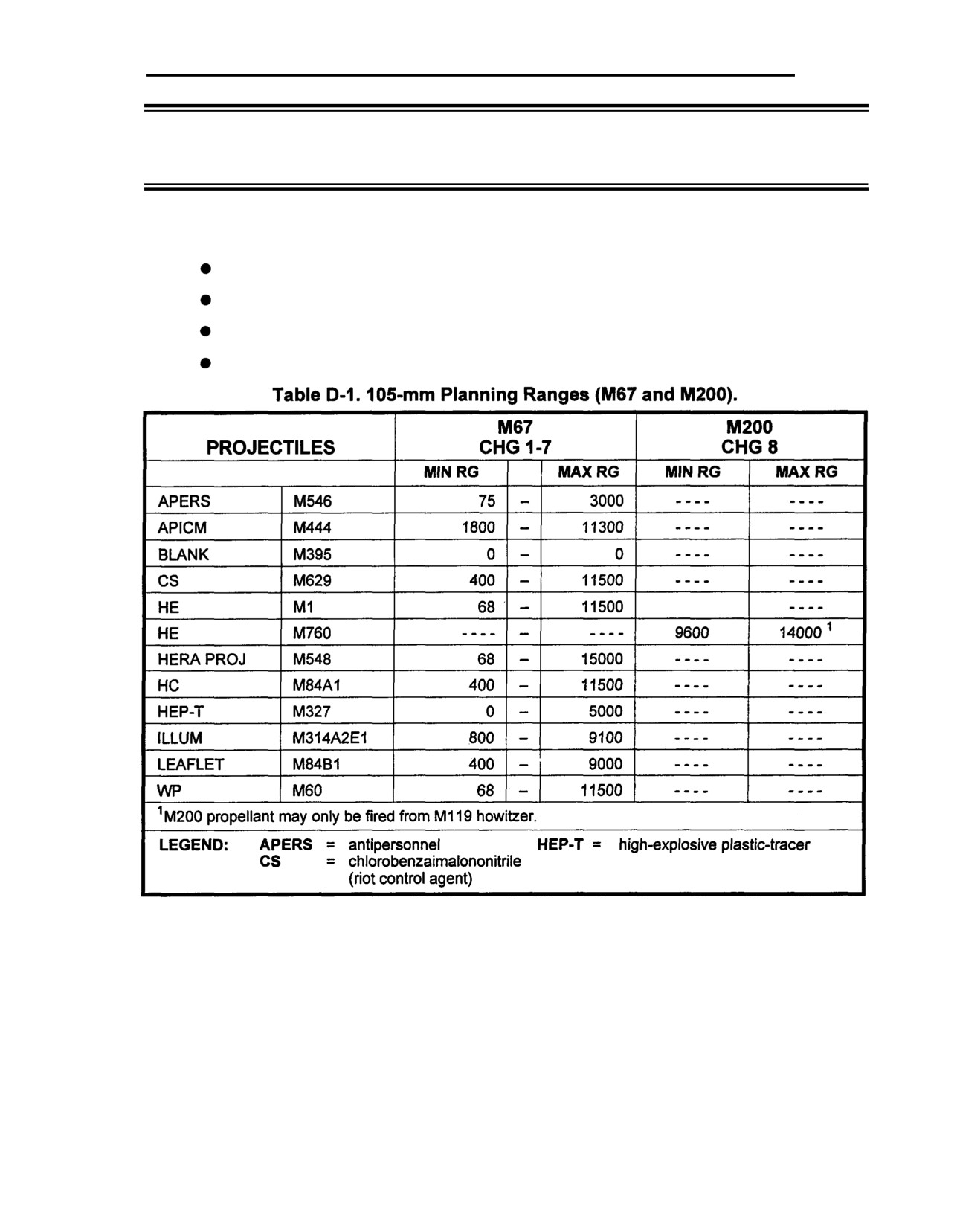
Appendix D
PLANNING RANGES
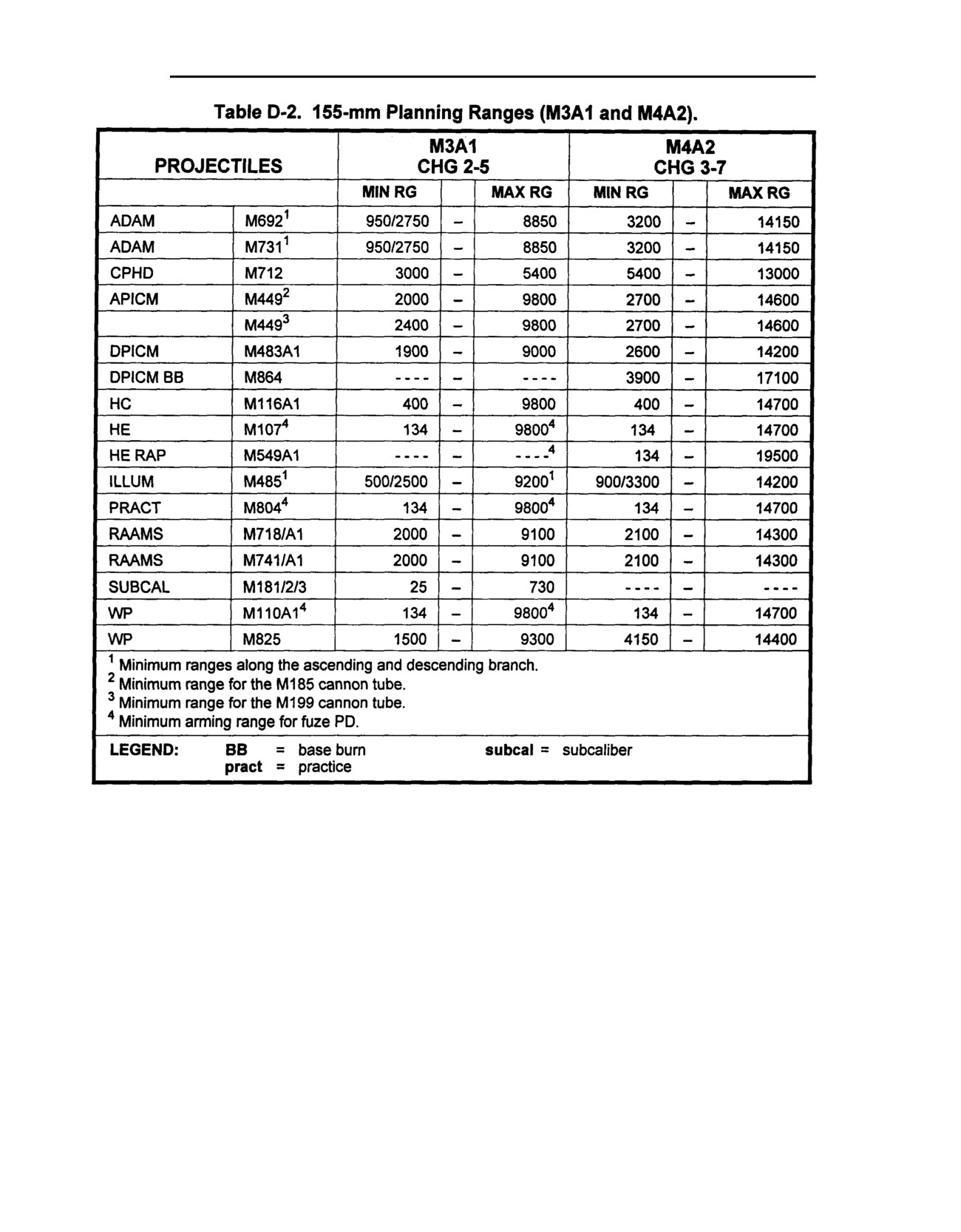
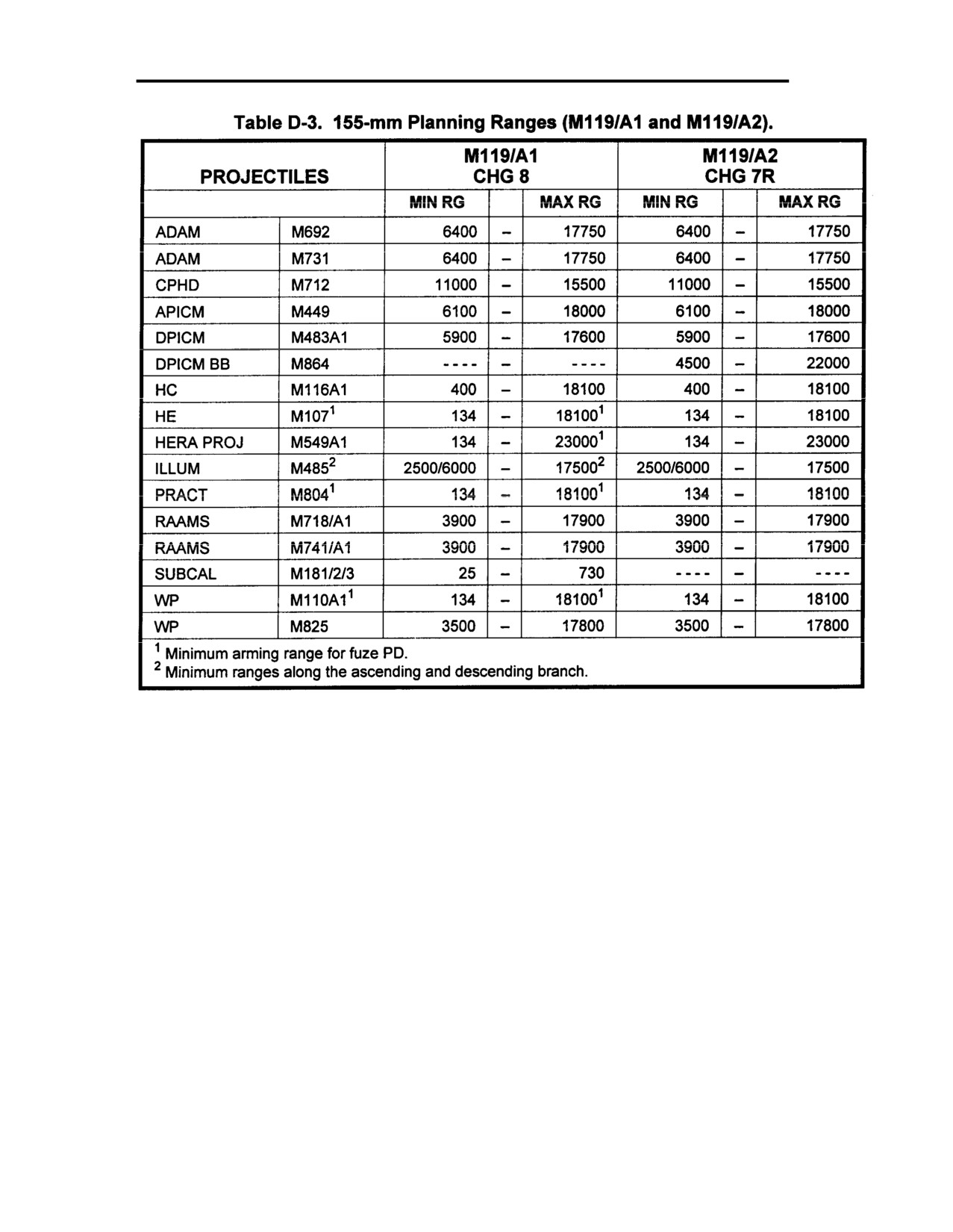
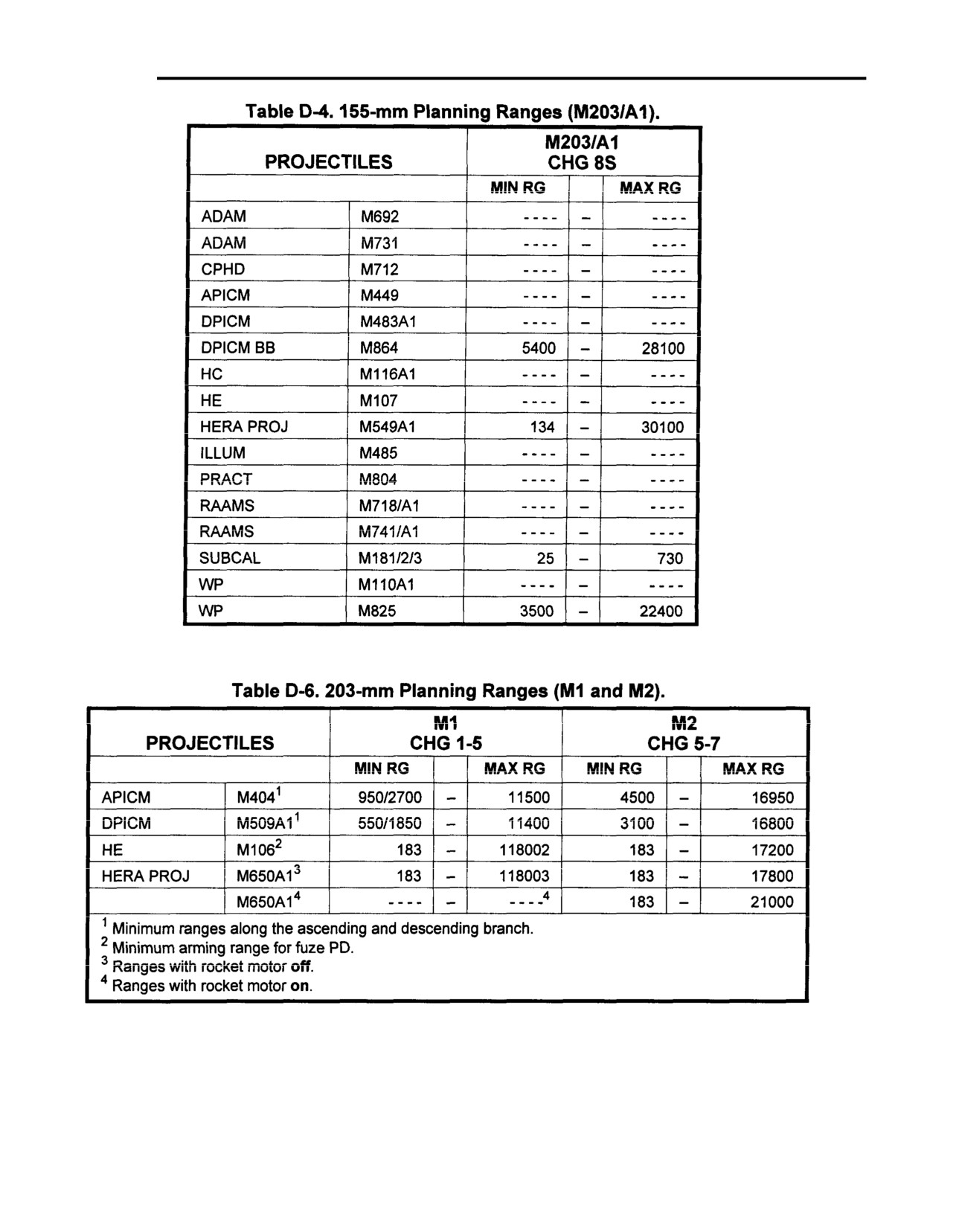
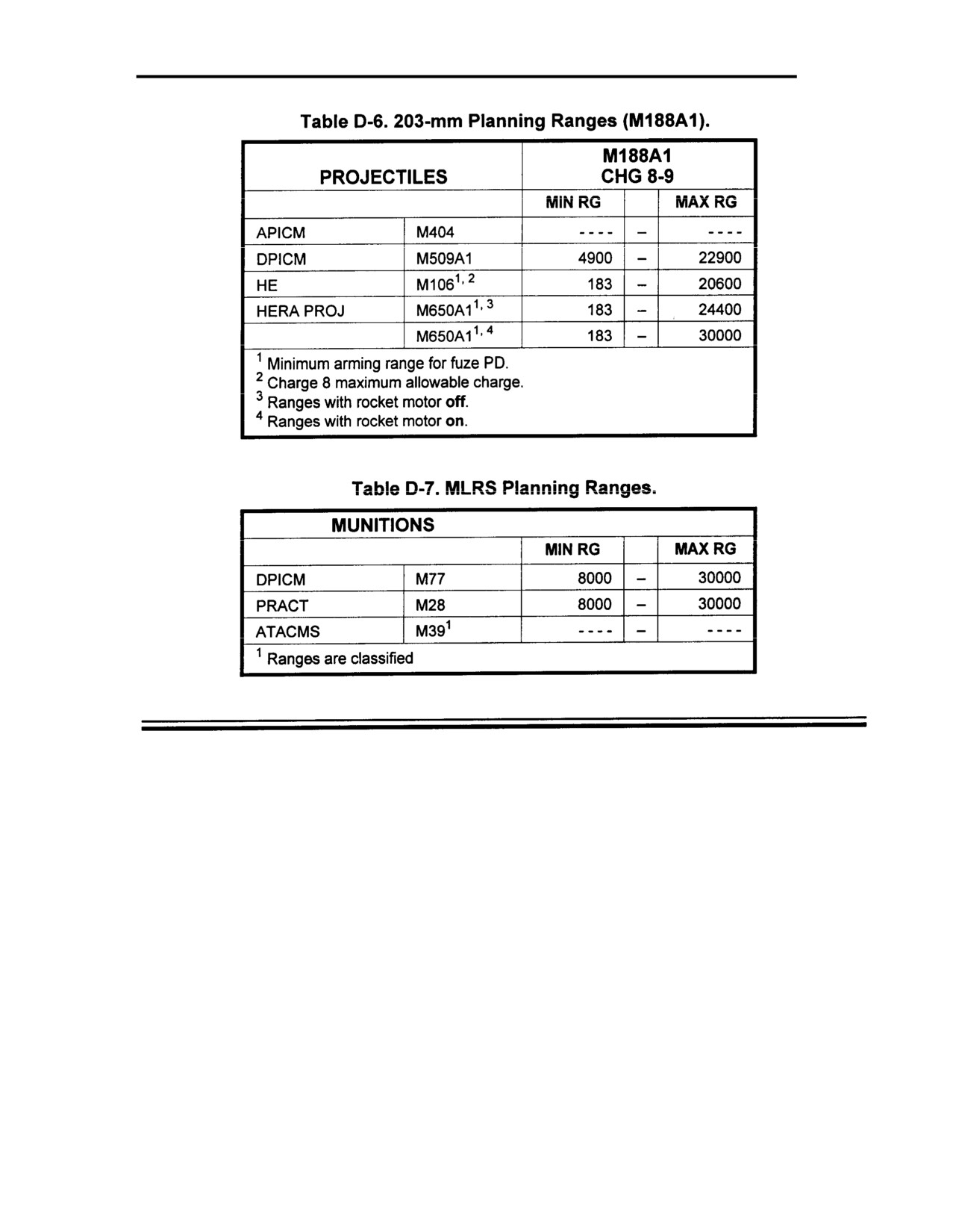
This appendix provides information on the minimum and maximum ranges for planning
purposes for the following weapon systems:
105 mm (Table D-1).
155 mm (Tables D-2,
D-3, and D-4).
203 mm.
MLRS.
D-1
FM 6-40
D-2
FM 6-40
D-3
FM 6-40
D-4
FM 6-40
D-5
FM 6-40
Appendix E
REPLOT PROCEDURES
In many instances, the refinement data transmitted by the observer after the FFE phase
may not reflect the actual location of the target as defined by its grid coordinates and altitude.
This inaccuracy results from errors in initial target location and errors in determining the initial
site fired in an adjust-fire mission. For other units to mass fires on the same point and for the
observer to accurately shift from a known point located by firing, the actual target location and
altitude must be determined as accurately as possible. The replot process is used for this
purpose. Targets are replotted on request of the observer or when directed by the FDO. Replot
gives a deflection and range with which the target location can be polar plotted from the location
of the firing unit. The manual replot procedures are the same for PD and VT fuzes. The
procedures for the time fuze are somewhat different.
NOTE: The resulting target location reflects any errors that exist in the firing data
and unit location. The replot grid and altitude may differ from the survey location of
the same target for this reason.
E-1. Reasons for Replot
a. Inaccurate target location by the observer may result in an inaccurate altitude and an
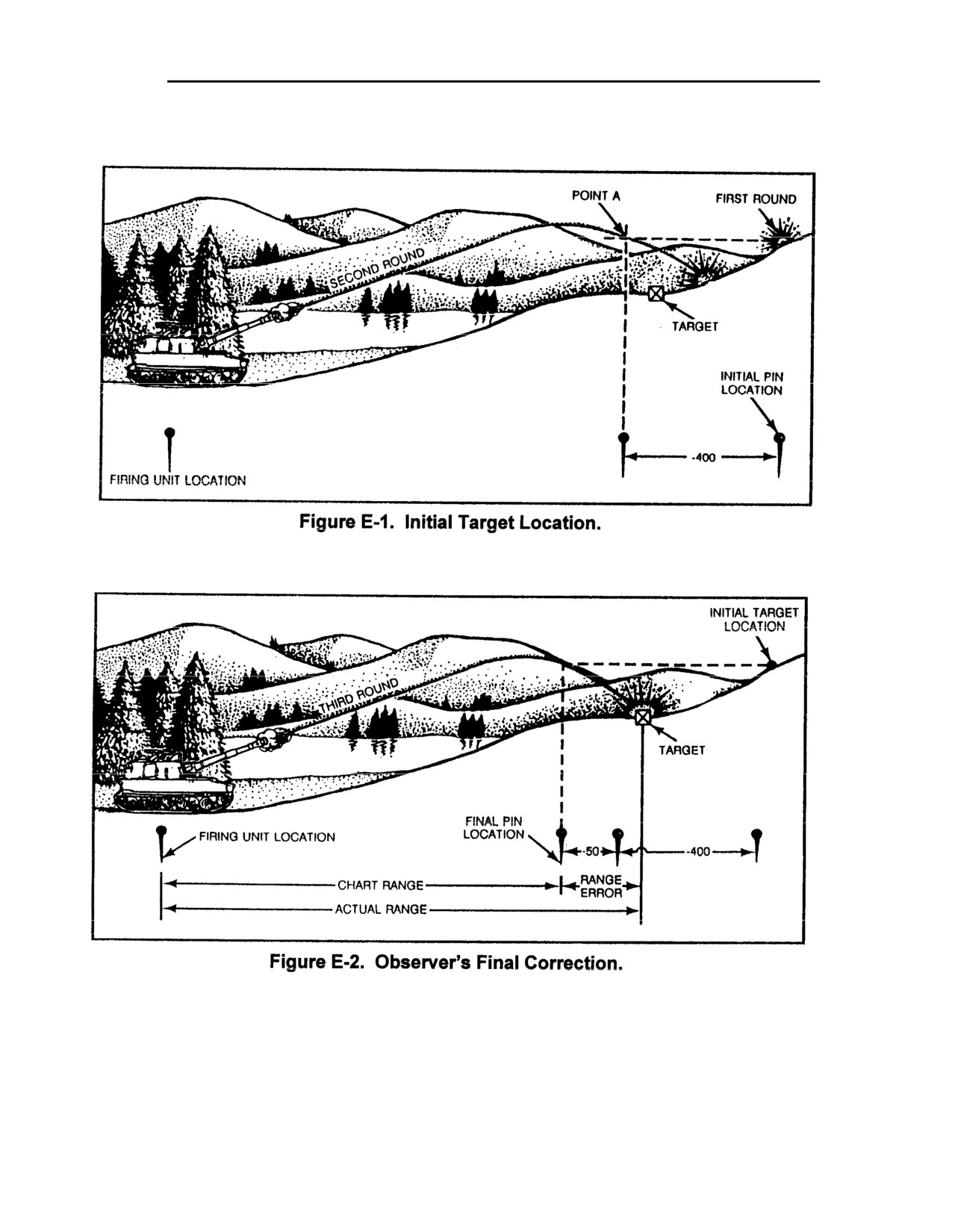
inaccurate site being determined by the FDC. For example, in Figure E-1, the observer’s
inaccurate target location included an altitude greater than the actual target altitude. On the basis
of the inaccurate target altitude, a false site is determined and used. The observer sends a
subsequent correction of DROP 400. The firing data computed reflect the data needed to cause
the round to impact at Point A. Because no adjustment has been made to altitude, the projectile
continues beyond Point A and impacts over the target. As shown in Figure E-2, the observer’s
next correction (DROP 50) results in accurate fire for effect. Figure E-2 also shows that there is
a difference between the final pin location on the firing chart and the actual target location.
Target replot is required to correct for this error. Replot procedures use successive
approximation to determine the true site and the actual (replot) range and deflection to the target.
b. Requirements for replot are as follows:
A map.
Accurate refinement data from the observer.
Valid GFT setting that accurately accounts for the nonstandard conditions
existing at the time of firing.
These elements will ensure that the replot procedure is as accurate as possible. Should the GFT
setting or firing chart be later corrected to more accurately reflect the conditions that existed
when the mission was fired, the replot should be recomputed with the more accurate data.
E-1
FM 6-40
E-2. Replot With PD and VT Fuzes
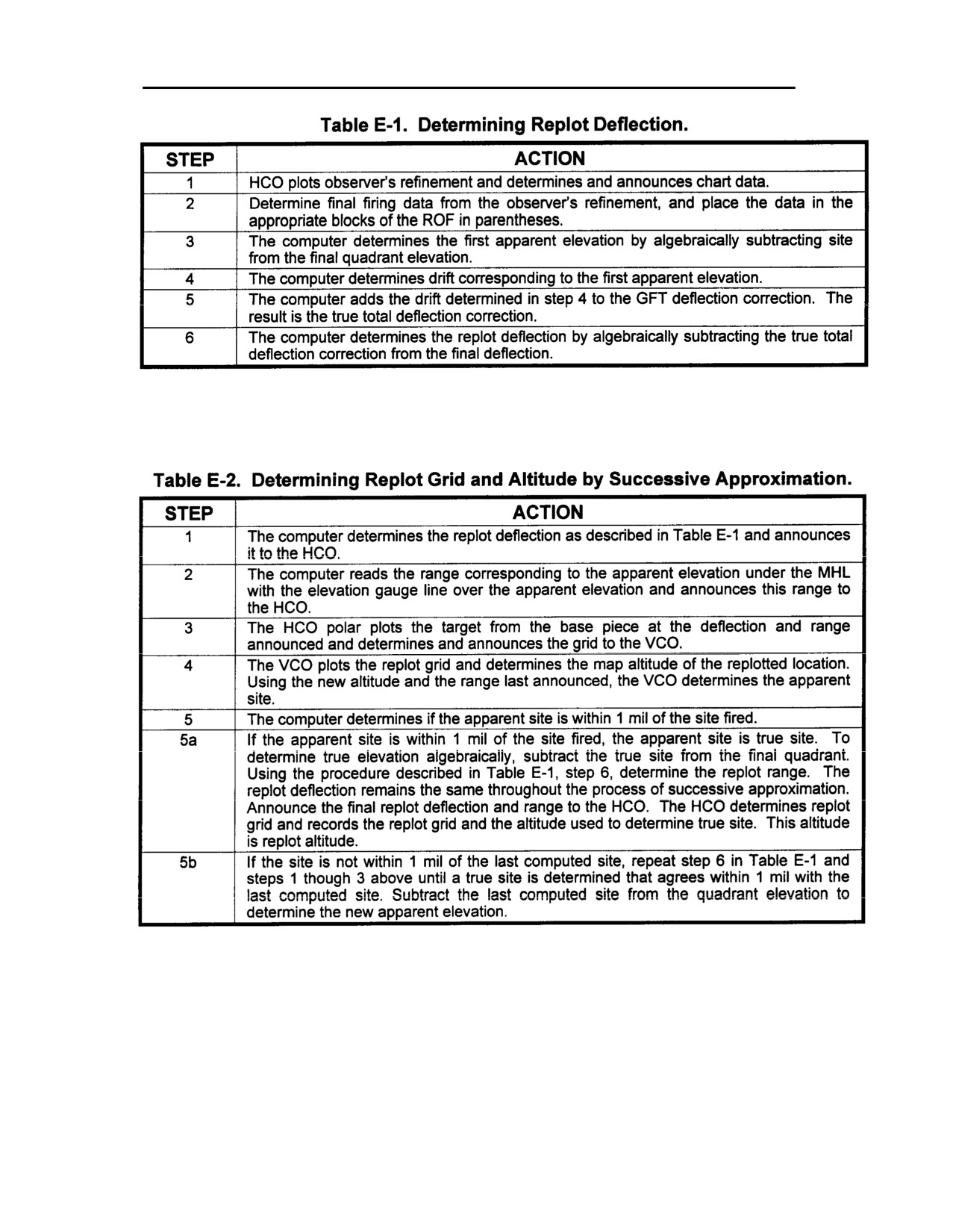
a. Replot Deflection. The replot (true) deflection to the target may or may not be the
final piece deflection. Because drift may have changed during the conduct of the adjustment,
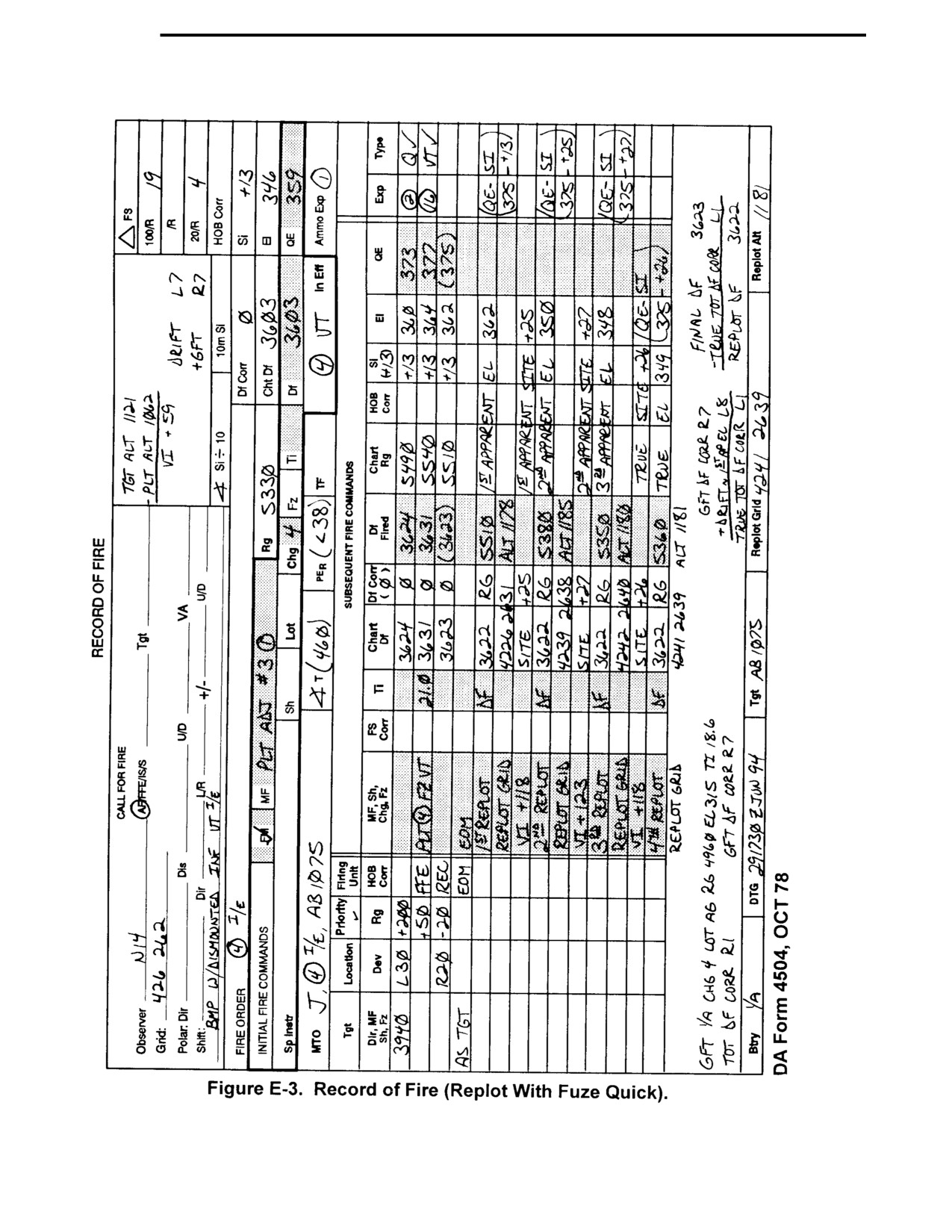
determine the true total deflection correction as shown in Table E-1. (See Figure E-3.)
E-2
FM 6-40
b. Replot Grid and Altitude. Determine the replot grid and altitude by successive
approximation: The procedures are described in Table E-2.
E-3
FM 6-40
E- 4
FM 6-40
E-3. Time Refinement
To accurately replot targets when firing fuze time, determine refinement data to correct
for inaccurate HOB.
a. During the adjustment phase of the mission, the observer usually adjusts the
trajectory to within 50 meters of the target before requesting FFE rounds. Upon completion of
the FFE phase, the observer sends refinement data to the FDC. Elements of refinement may
include deviation, range, and/or HOB. These refinement data place the mean point of the FFE
bursts over the actual target location, thereby allowing the FDC to compute accurate data to the
target if future fires are required. Application of refinement is a requirement for replot of targets,
which allows for transfer and massing of fires.
b. Fuze time procedures are slightly different. During the time adjustment phase of the
mission, the FDC applies ▲ FS to the fuze setting to correct for the difference in the height of
burst above the target. Therefore, when he requests fire for effect, we assume the observer
has
adjusted the height of burst to 20 meters.
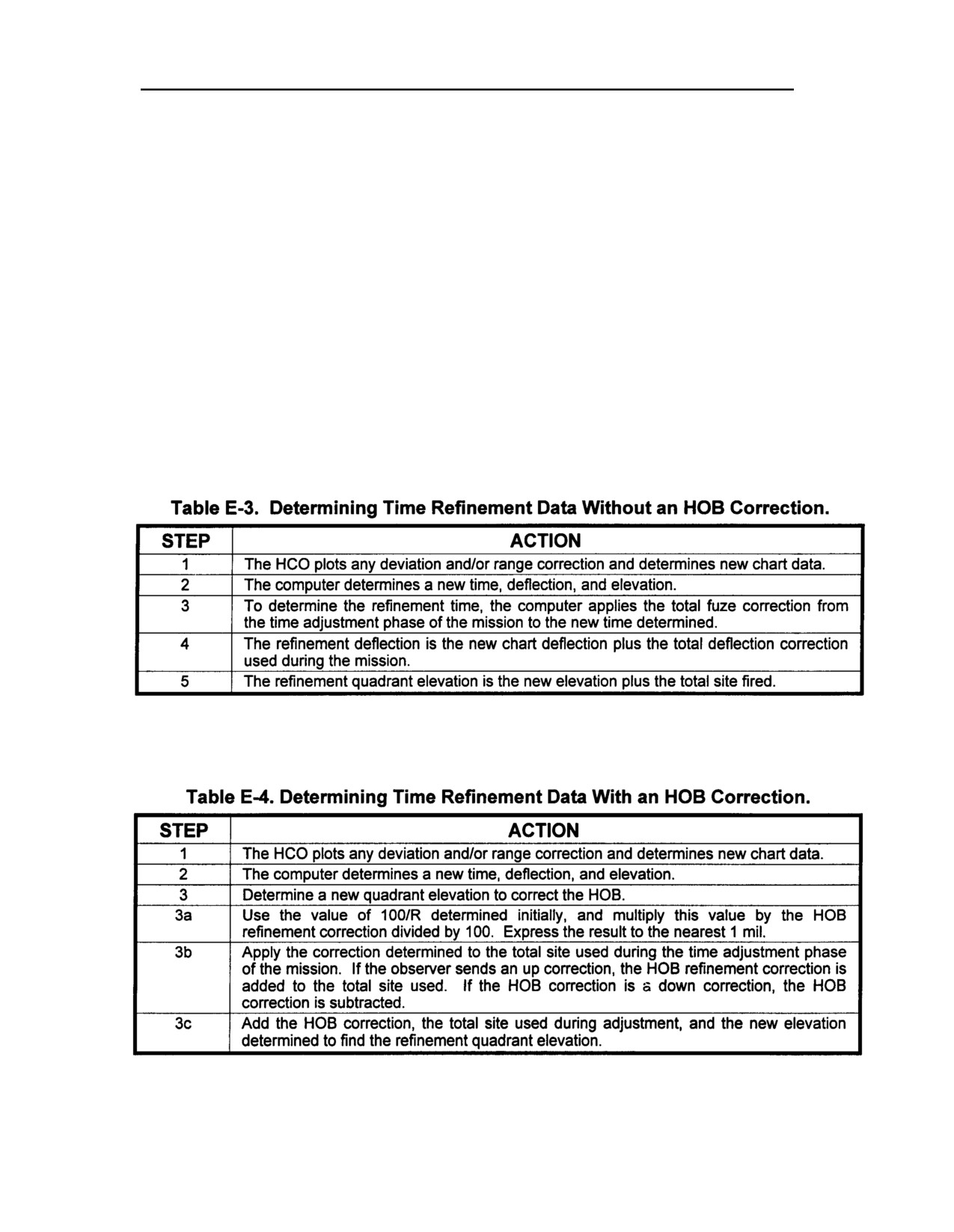
c. Time refinement procedures without an HOB correction are shown in Table E-3.
e. Time refinement procedures with an HOB correction are shown in Table E-4.
E-5
FM 6-40
E-4. Replot With Time Fuze
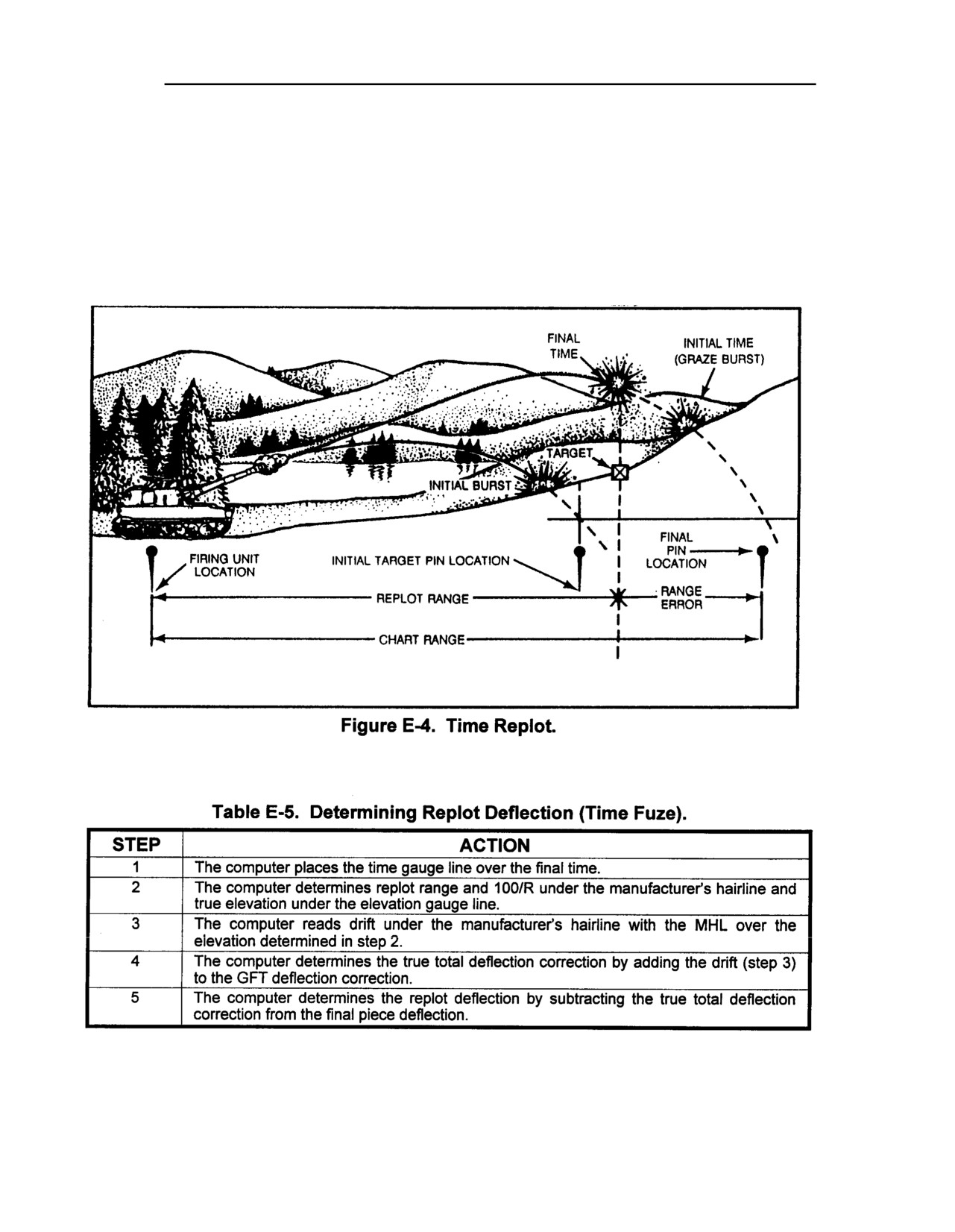
a. When a target is attacked with a mechanical time fuze, the observer adjusts the height
of burst to 20 meters above the target. The final fuze setting provides an accurate representation
of the target location and the altitude of a point 20 meters above the target. Consequently, when
the time gauge line is placed over the final time, the range and 100/R (read under the MHL) and
the elevation and drift correction (read under the elevation gauge line as a function of elevation)
are true. The replot grid and altitude can then be determined (See Figure E-4.)
b. Replot deflection procedures are shown in Table E-5.
(See Figure E-5 on page E-8.)
E-6
FM 6-40
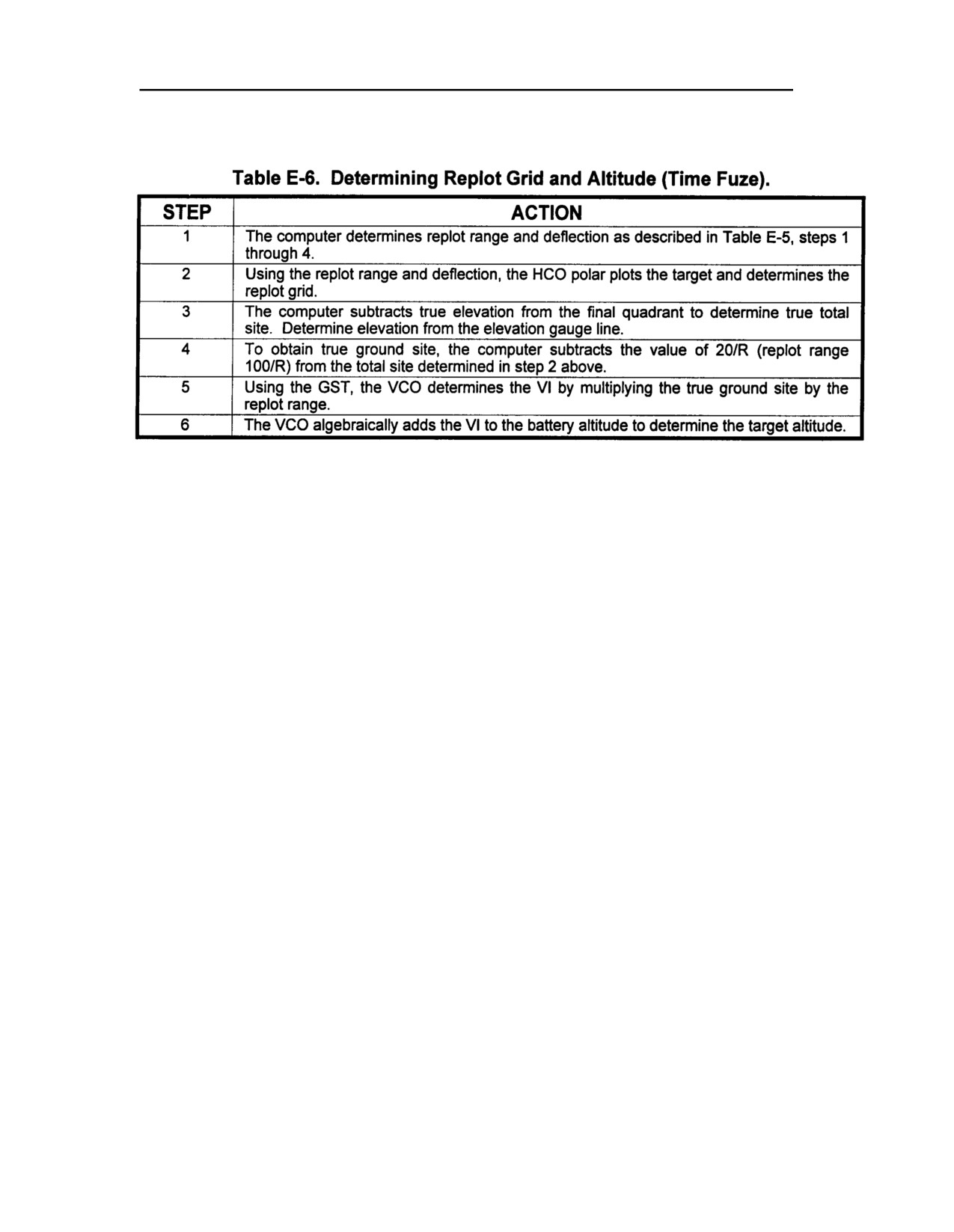
c. The procedures for determining replot grid and altitude are shown in Table E-6.
E-5. Attack of Large Targets
In a manual FDC or one equipped with the BCS operating autonomously, the FDO
decides how to attack a target. In determining the volume of fire to place on a target, he uses the
GMET and the JMEM as guides. Calls for fire may include targets too large to be considered
with the GMET, since the largest target radius considered in the GMET is 250 meters. Large or
irregularly shaped targets require special fire distribution techniques to ensure proper coverage
with the most effective use of the ammunition available. The following paragraphs describe
various methods of attacking large targets that have proved successful. The FDO and S3 should
use the technique that best accomplishes the mission.
a. Target Division Method. Targets that exceed the firing capability of one battery
should be sent to battalion FDC for additional fires. There are times, however, when the battery
is forced to fire on targets that exceed its capability. When this occurs, the battery FDO may
divide the target into several targets to distribute his fires effectively.
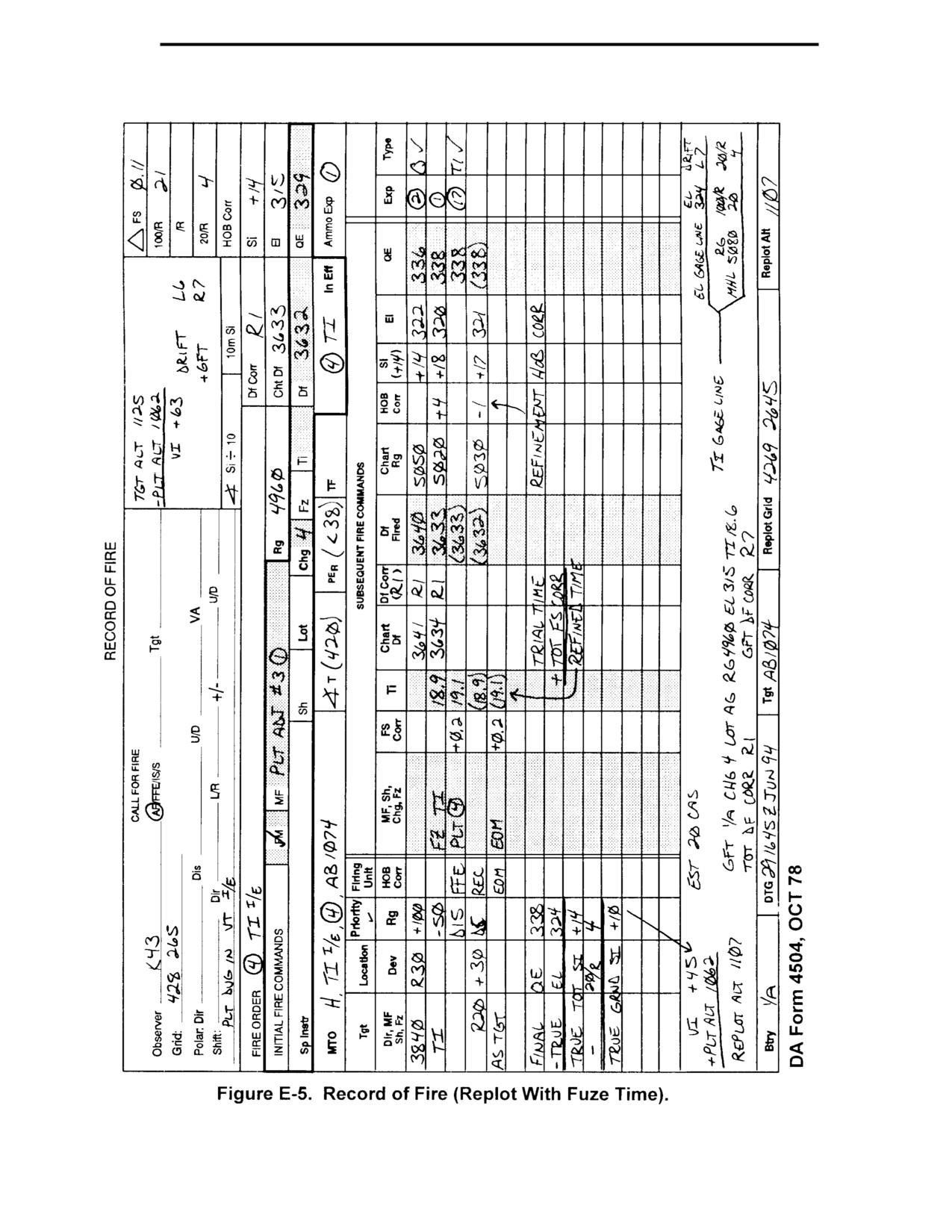
(1) Determining aimpoints for a linear target. Because the basic linear sheaf for
a four-gun 155-mm platoon is 200 meters, a linear target must be segmented into 200-meter
lengths. For a six-gun 155-mm platoon, the length is 300 meters; 8-inch six-gun platoon, 480
meters; and 105-mm four-gun platoon, 120 meters. The procedures for determining aimpoints
for a linear target are shown in Table E-7.
E-7
FM 6-40
E - 8
FM 6-40
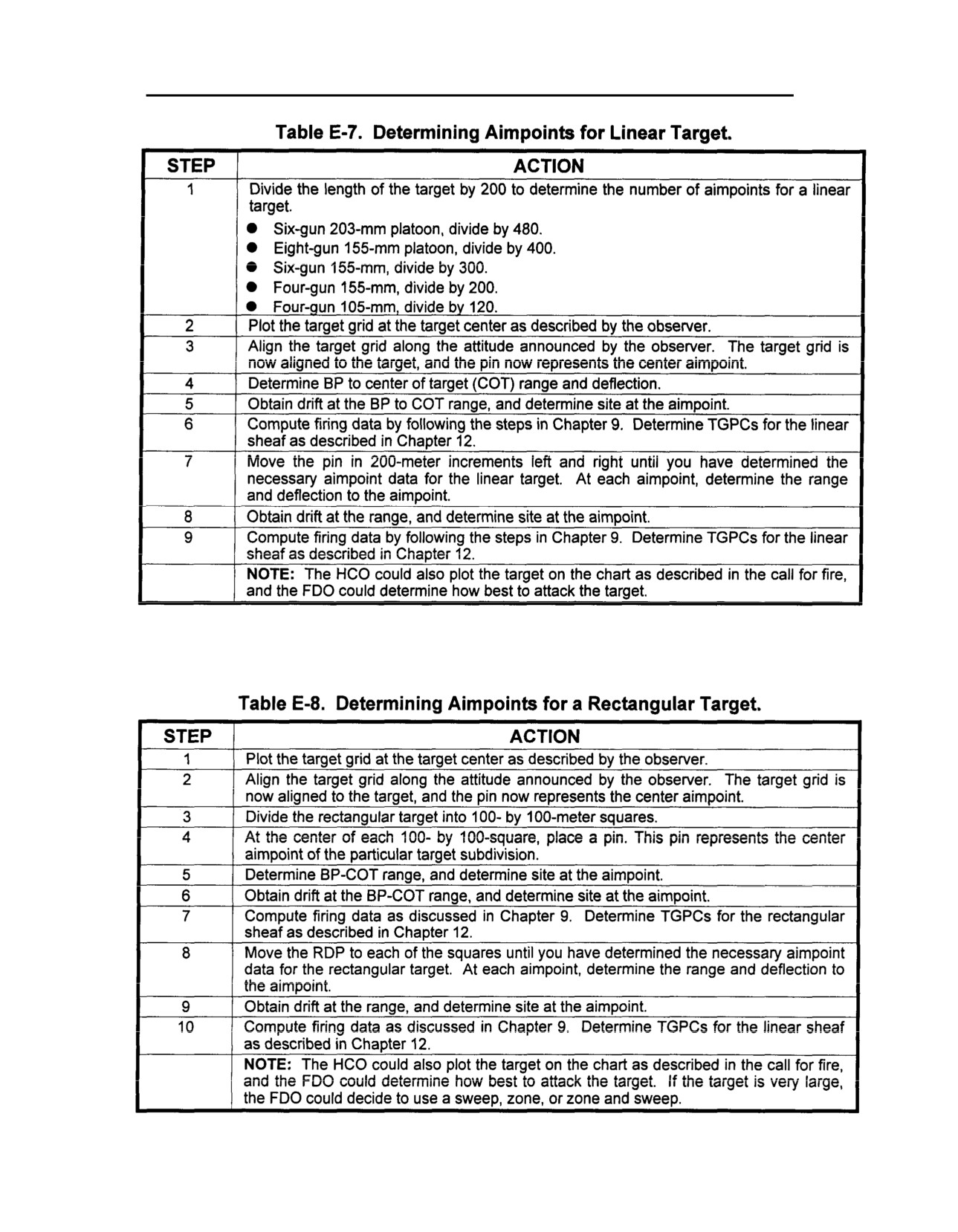
(2) Determining aimpoints for a rectangular target. Because the four-gun platoon
optimum rectangular sheaf is a 100- by 100-meter sheaf, the target must be broken into 100- by
100-meter boxes to effectively engage a large rectangular target.
E-9
FM 6-40
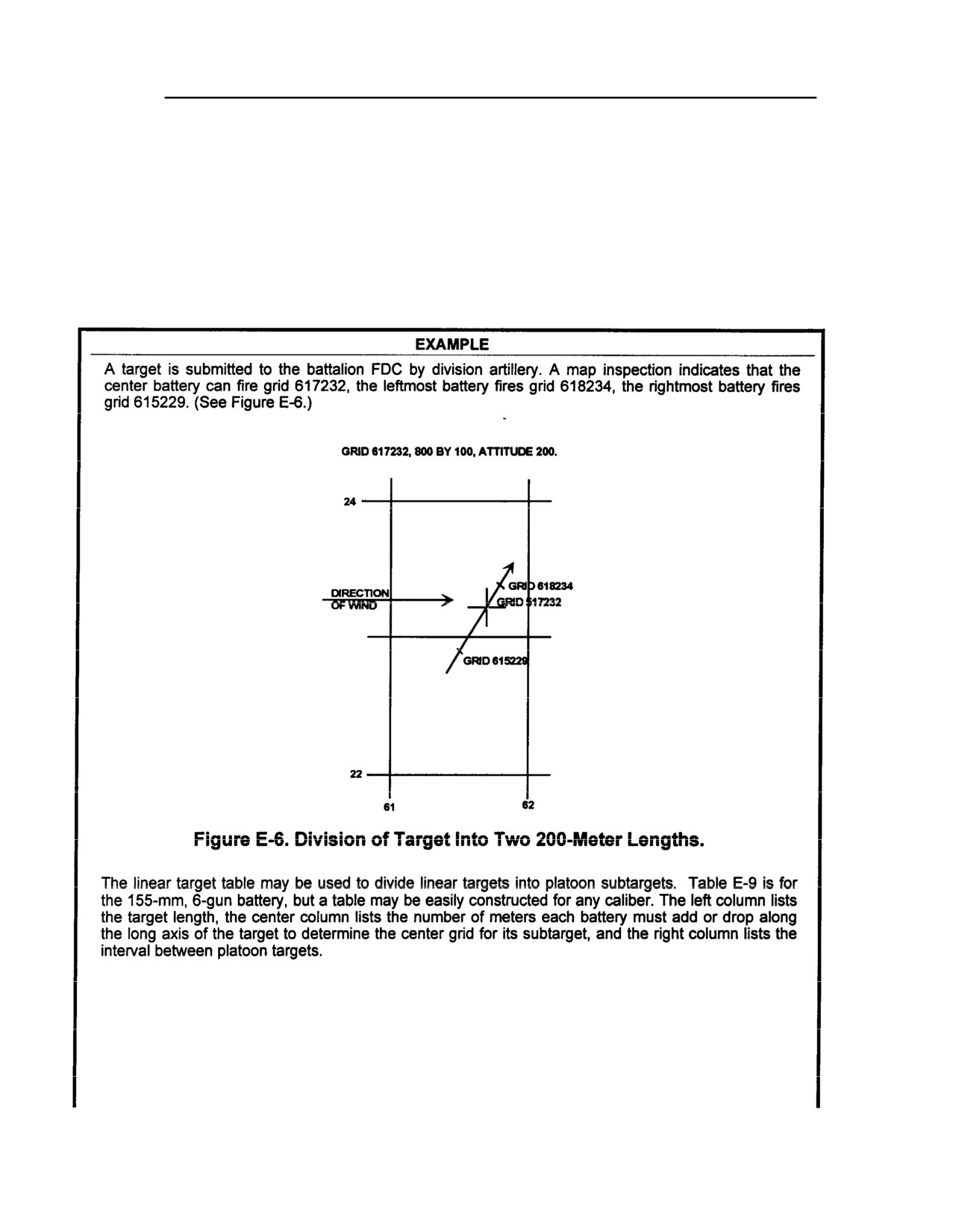
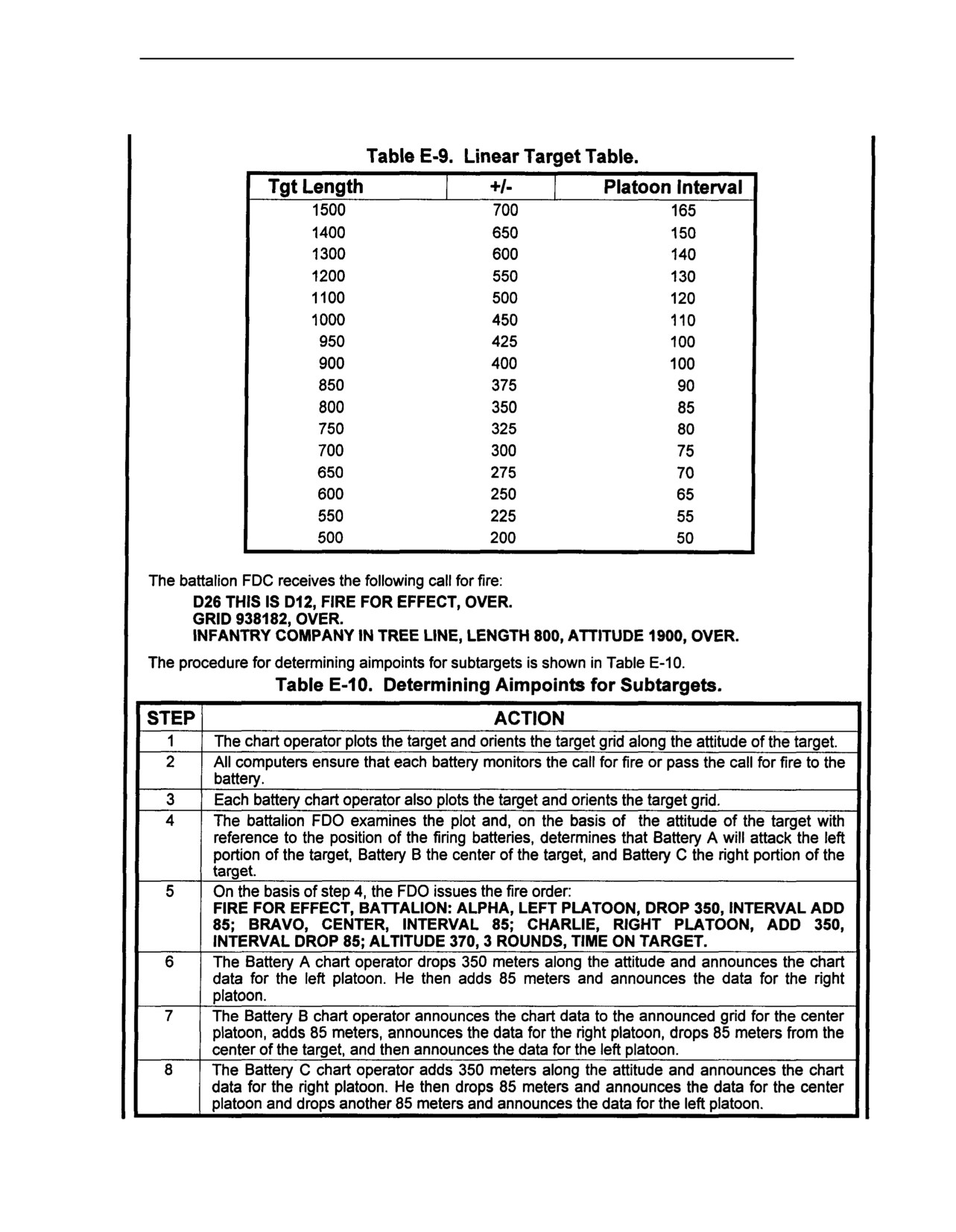
c. Determining Aimpoints for Subtargets. The battalion could receive a call for fire for
a large target, or if a battery receives a call for fire and requests reinforcing fires, the battalion FDO
must also be able to attack a large target. He uses the firing elements of his battalion to attack the large
target, and must be able to determine aimpoints for each firing unit. The battalion FDO will normally
divide large or irregularly shaped targets into subtargets for each firing unit. The appropriate
subtargets are announced for each unit in the battalion fire order. The fire order should include the
center grid and if necessary the attitude. The battalion FDO can also issue guidance in the fire order as
to how the subtargets should be subdivided. To determine the aimpoints for the subtargets, the FDO
can use the same techniques discussed in paragraphs a and b.
E-10
FM 6-40
E-11
FM 6-40
If the subtargets described above had required further subdivision (for example, sweep and zone), the
battalion FDO could have designated how the batteries were to attack the target:
FIRE FOR EFFECT, BATTALION, ALPHA GRID 618234, BRAVO GRID 617232, CHARLIE
GRID 615229, ALTITUDE 380, VT, EIGHT ROUNDS, SWEEP AND ZONE, TIME ON TARGET.
As an alternate method, the FDO could have said:
FIRE FOR EFFECT, BAITALION, ALPHA GRID 618234, BRAVO GRID 617232, CHARLIE
GRID 615229, ALTITUDE 380, AITITUDE 200, PLACE BURSTS 60 METERS APART, VT,
EIGHT ROUNDS, TIME ON TARGET.
This indicates to each battery not only center grid, but also the type of sheaf they are to fire.
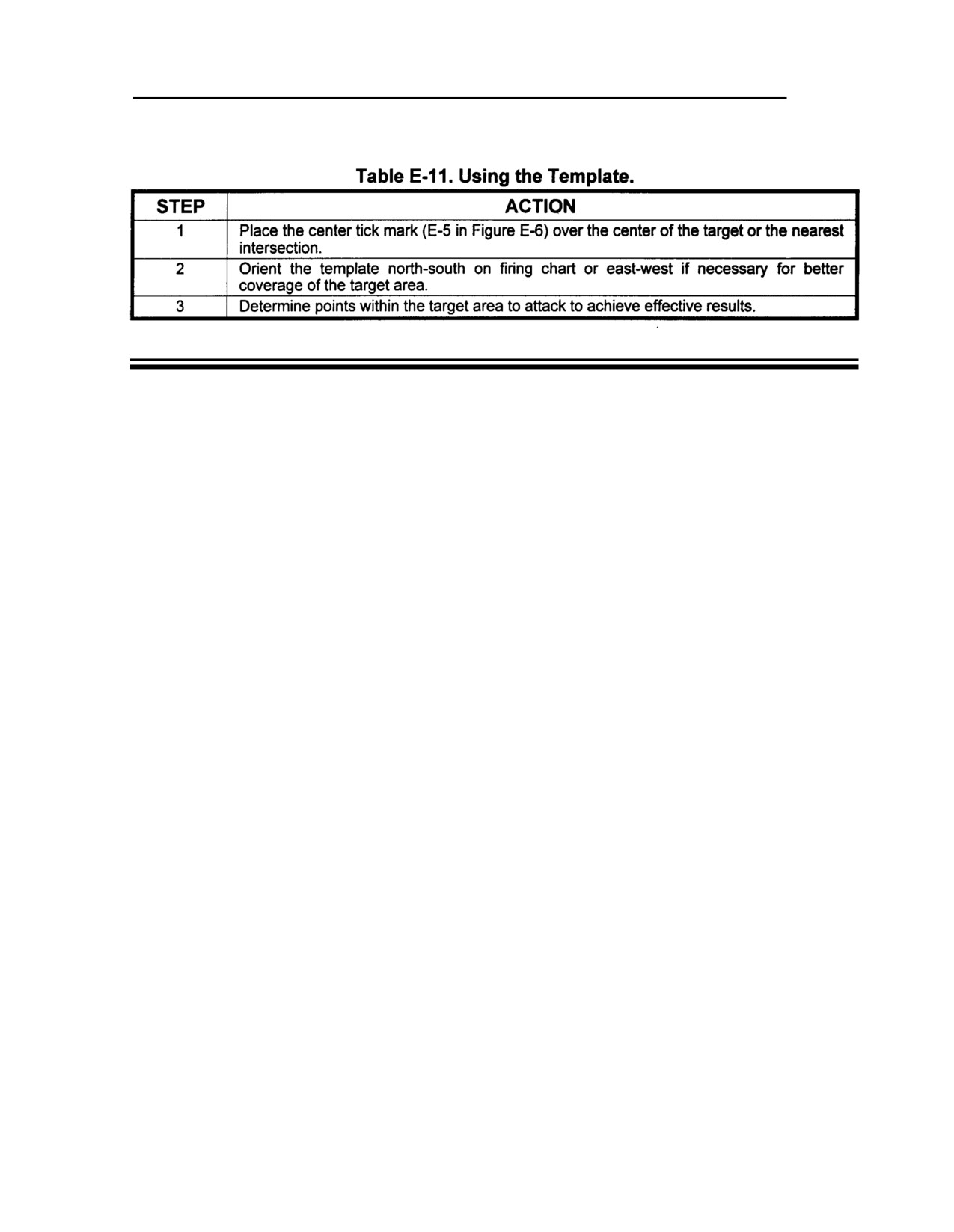
c. Massed Fire Distribution Template.In this method, the large or irregularly shaped
target is plotted on the firing chart. A locally constructed massed fire distribution template drawn
to scale for the firing chart is placed over the plotted target to allow the user to determine the
optimum aimpoints for the required number of firing elements to mass fires.
(1) Constructing the Template. Overlay paper is the best material for
constructing the template. Each tick mark placed on the template represents an aimpoint for a
firing element (Figure E-6). A separate template is required for each caliber, munition type, and
size of firing element (one gun, platoon, or battery). (Refer to the appropriate JMEM for this
information.) Distance between tick marks is based on the radius of effects of the particular
weapon system and munitions to be fired. (Refer to (C) FM 101-60-25.)
E-12
FM 6-40
(2) Using the Template. Table E-11 discusses how to use the template.
E-13
FM 6-40
Appendix F
AUTOMATED FDC
While the means of technical fire direction is different, the basic operation of an
automated FDC is similar to that of a manual FDC.
F-1. Personnel
Duties of the FDO and chief fire direction specialist are the same as in a manual FDC.
The equivalent USMC billet description is operations chief.
a. Senior Fire Direction Specialist. The senior fire direction specialist (computer)
operates the computer that is the primary means of determining firing data. He is responsible for
the transmission of fire commands (voice or digital) to the howitzer sections. The equivalent
USMC billet description is operations assistant.
b. Fire Direction Specialist (USMC--Fire Control Man).
(1) Recorder. The recorder maintains the record of fire, recording information as
directed by the FDO. The recorder may also be required to operate the computer that is the
backup means of determining firing data.
(2) HCO and VCO. The HCO and VCO maintain a firing chart and follow each
mission. The HCO and VCO check the coordinates on the firing chart and provide target altitude
as required. The HCO and VCO maybe required to operate the backup computer as well.
F-2. Fire Order
The FDO considers the same factors when determining a fire order in an automated or
manual FDC. The order in which the fire order is announced and the elements of the fire order
are also the same. The biggest difference between the fire order for an automated FDC and for a
manual FDC is the SOP. On the basis of the computer’s ability to determine individual piece
firing data and the computer programs, certain elements would be standardized differently.
a. Adjusting Element/Method of Fire of the Adjusting Element. On the basis of the
computer’s ability to compute firing data based on individual piece locations, muzzle velocities,
and aimpoints, the use of base piece is not necessary (a base piece should be selected for ease of
transition from automated to manual). Depending on the computer’s programming, it may
automatically select an adjusting piece in sequential order, or the operator may have to input an
adjusting piece. Method of fire of the adjusting element would be included in the SOP, which
may or may not be a programmed computer default.
b. Basis for Corrections. The SOP for this element should reflect the primary means of
computing firing data.
c. Distribution. As in a manual FDC, the observer or FDO will announce the sheaf to
fire. In a manual FDC, the normal sheaf is parallel. In an automated FDC, the normal or default
sheaf will be the default sheaf programmed into the computer.
F-1
FM 6-40
d. Ammunition Lot and Charge. The SOP for this element will allow the computer to
select the lot and charge to fire on the basis of its programmed selection routines. Safety
constraints, availability of registration corrections, and muzzle velocity information, are
additional considerations when determining the SOP.
e. Target Number. The SOP for this element is normally the next available, as in
manual gunnery. The computer may or may not be programmed to automatically assign a target
number.
F-3. Fire Commands
Fire commands for automated gunnery are exactly the same as for manual gunnery.
Depending on the computer systems in use, fire commands may be transmitted by voice or
digitally.
F-4. Establish a Manual Backup for Automated Operations
a. Concept. The manual backup should be set up to allow the automated (BCS and
BUCS primary) FDC to continue operations should the computers fail. Manual backup should be
established as a form of “position improvement” and should not impede setup or processing with
automated means. The manual backup also serves as a basis of rapidly “checking” the automated
solution. The basis for the manual backup is that a piece will be designated as the base piece.
The location of this piece is plotted on the firing chart. GFT settings are derived by using this
piece and reflect its muzzle velocity and TGPCs. Once the FDC converts from automated to
manual operations, all adjustments are conducted with the base piece. All ranges are measured
from base piece to the center of the target and all data computed reflects base piece muzzle
velocity and location. When the observer requests fire for effect, the adjusted data from base
piece is converted to data for the remaining pieces by applying special corrections, or terrain
gun position corrections. These corrections take into account the differences in piece locations
(displacement) and the differences in shooting strength (comparative VEs). TGPCs can be
determined by using automated means or the Ml 7 plotting board.
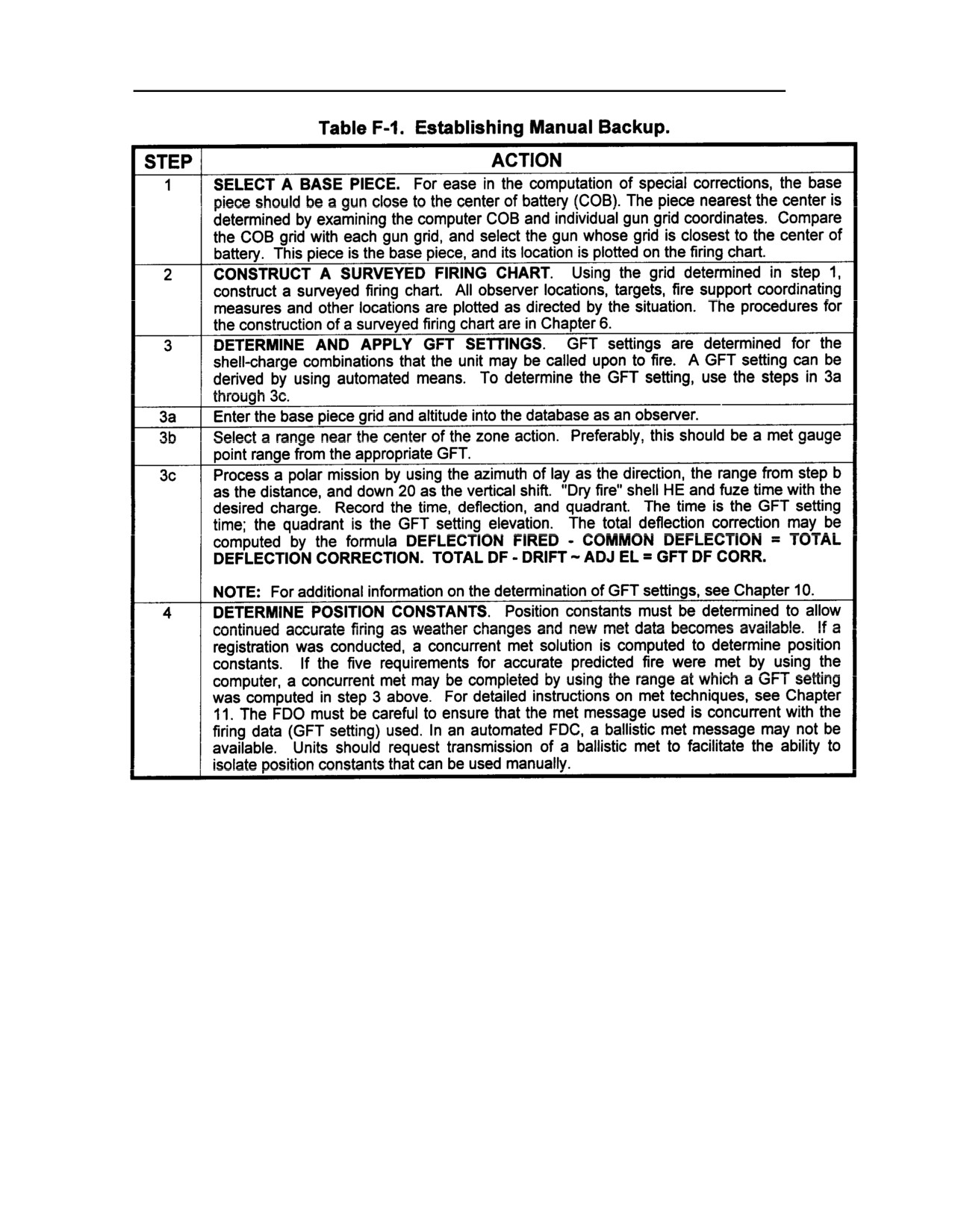
b. Establishment of the Manual Backup. The manual backup is established in five
steps as follows:
Select a base piece.
Construct a surveyed firing chart.
Determine and apply GFT settings.
Determine comparative velocity errors for the remainder of the guns.
Determine position constants.
Table F-1 elaborates on these steps.
F-2
FM 6-40
F-5. Convert a Mission in Progress From Automated to Manual Processing
a. General. Should automated means fail, a battery must continue to process fire
missions. With a manual backup established, the FDC continues operations with minimal delay.
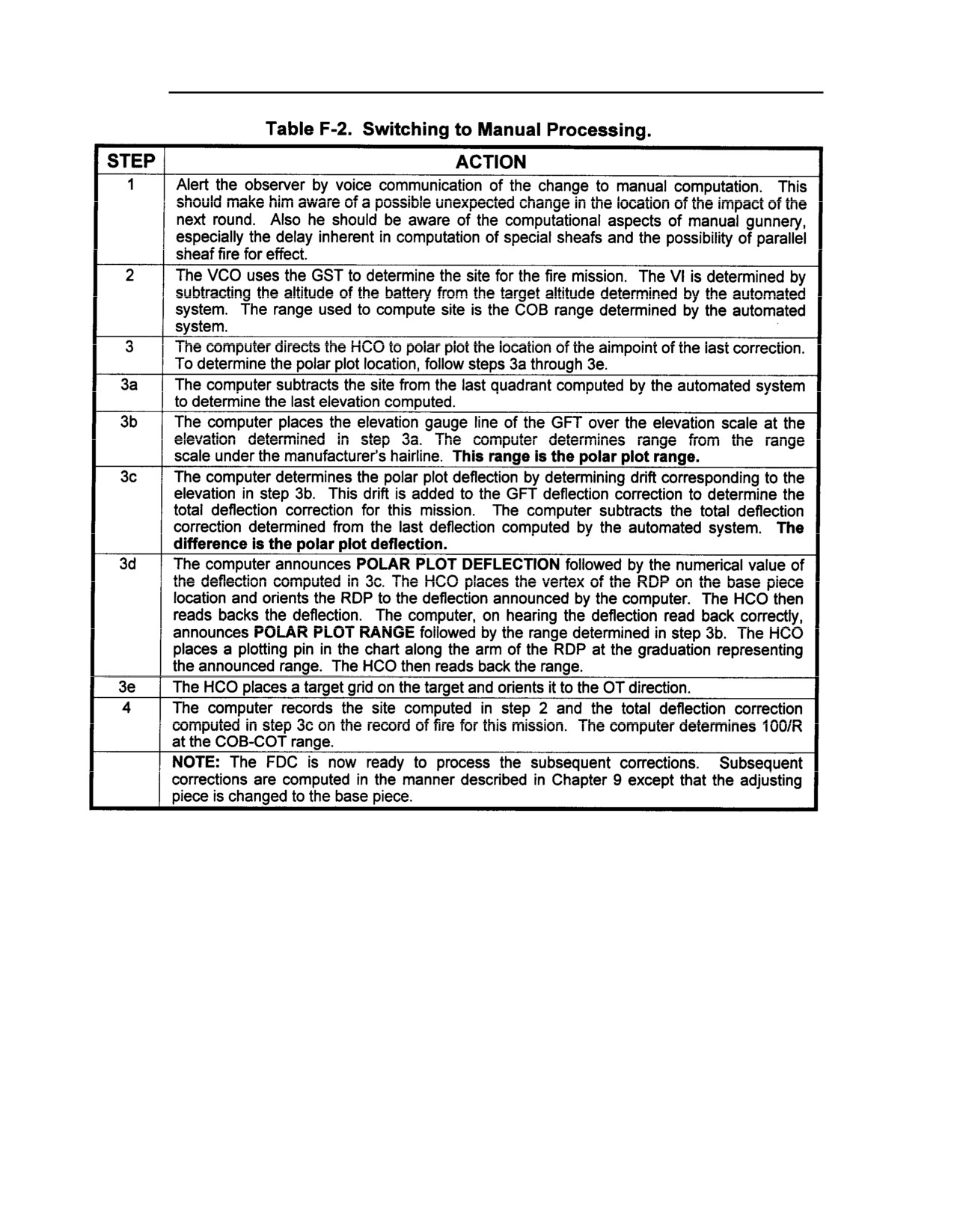
b. Procedure. If during the processing of a fire mission the computer fails, the mission
is switched to manual processing. If the observer’s total corrections are applied to the firing
chart, a significant difference in point of impact in the target area may be noticed because of the
difference in automated accuracy. To make the transition as smooth as possible, the steps in
Table F-2 are used.
F-3
FM 6-40
F-6. Range K and Fuze K
a. The proportion of correction to range and fuze setting that results from a registration
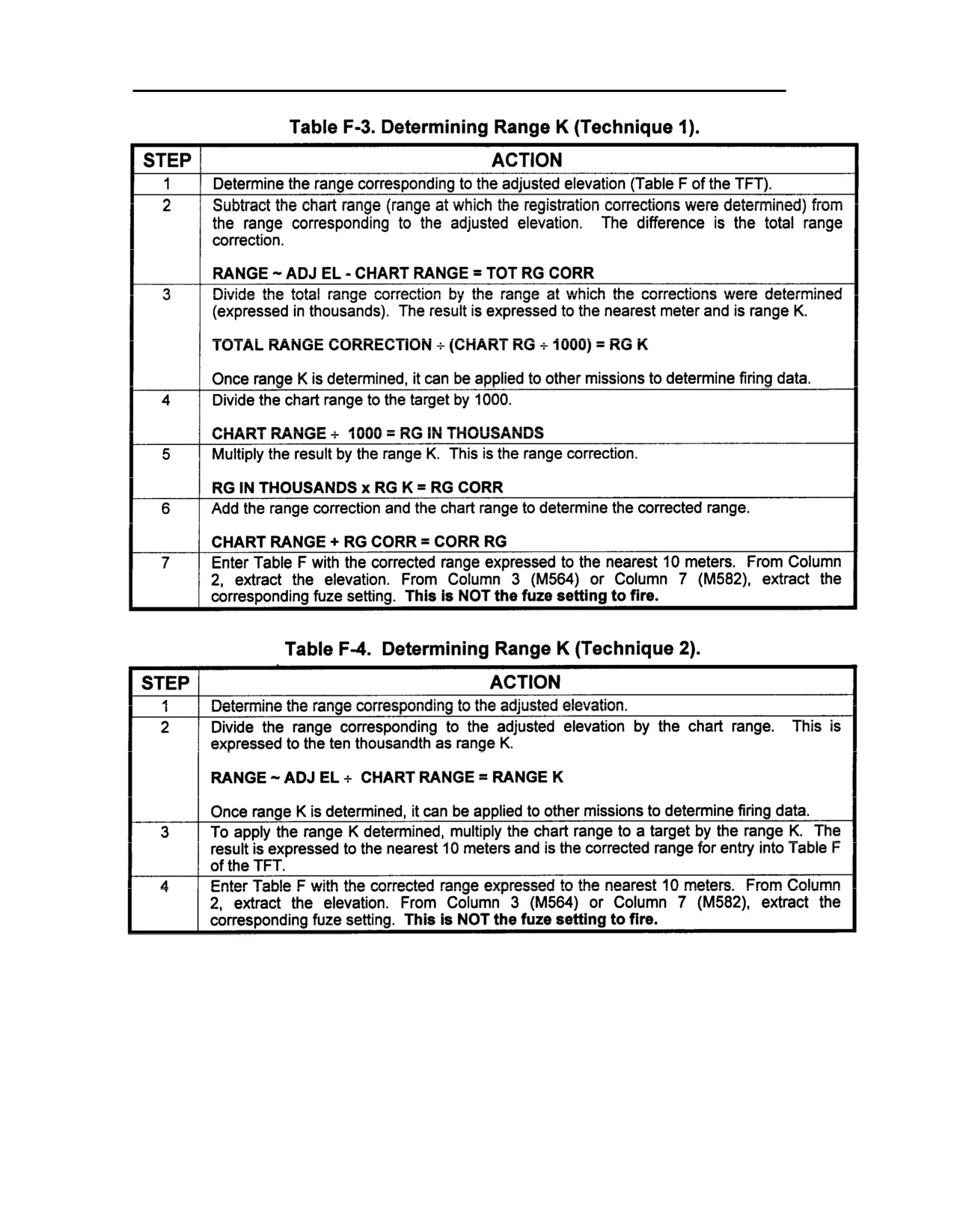
or the solution of a met message is referred to as range K or fuze K. Once determined, range K
and fuze K may be used to apply the determined corrections at lesser or greater ranges than that
at which the corrections are determined. This procedure allows the application of a "GFT
setting" to a TFT.
b. Range K can be determined and applied by using two techniques. These techniques
are discussed in Tables F-3 and F-4.
F-4
FM 6-40
c. Fuze K can be determined and applied by using two techniques. These techniques are
discussed in Tables F-5 and F-6.
F-5