FM 6-40 TTP for Field Artillery Manual Cannon Battery U.S. - page 18
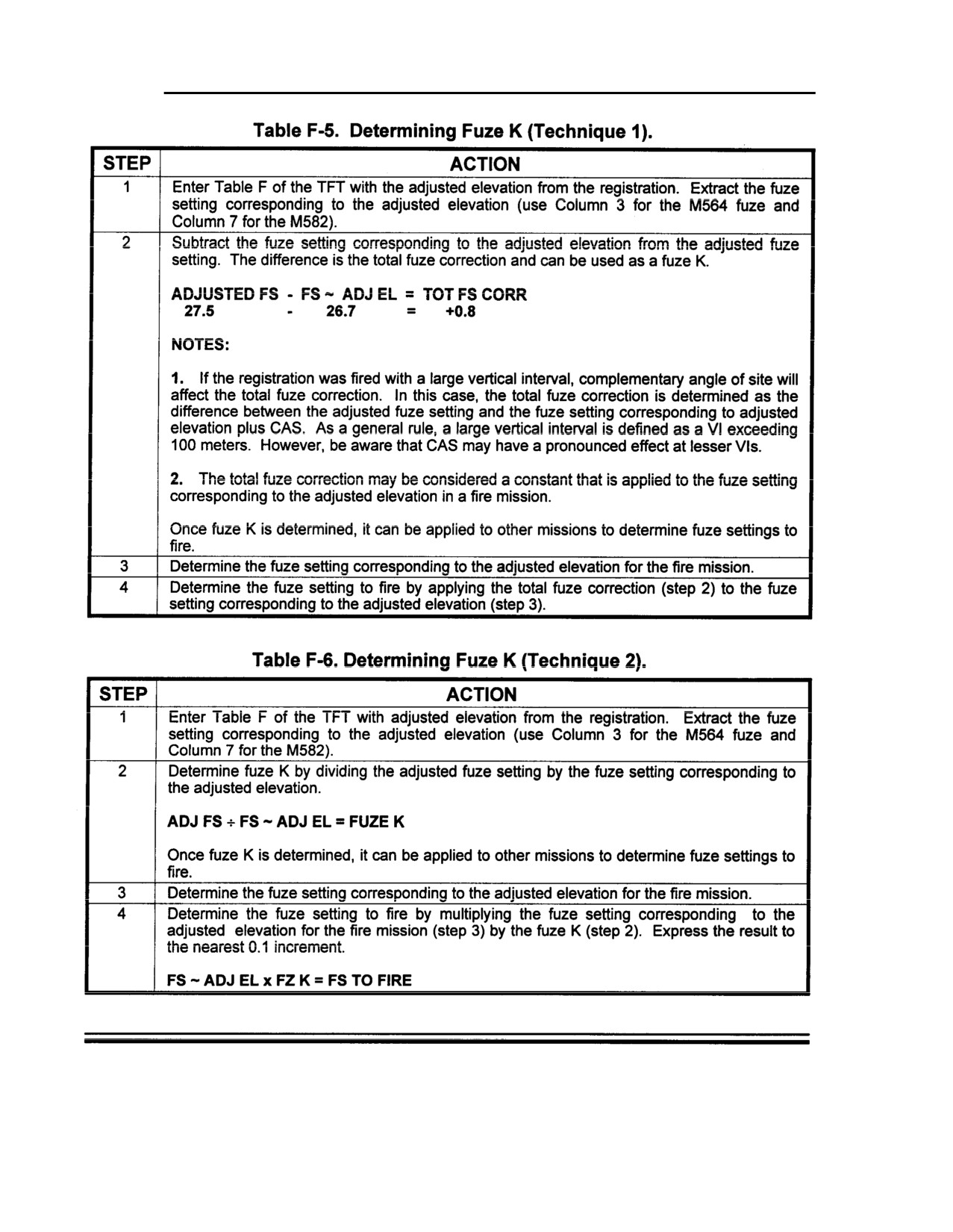
FM 6-40
F-6
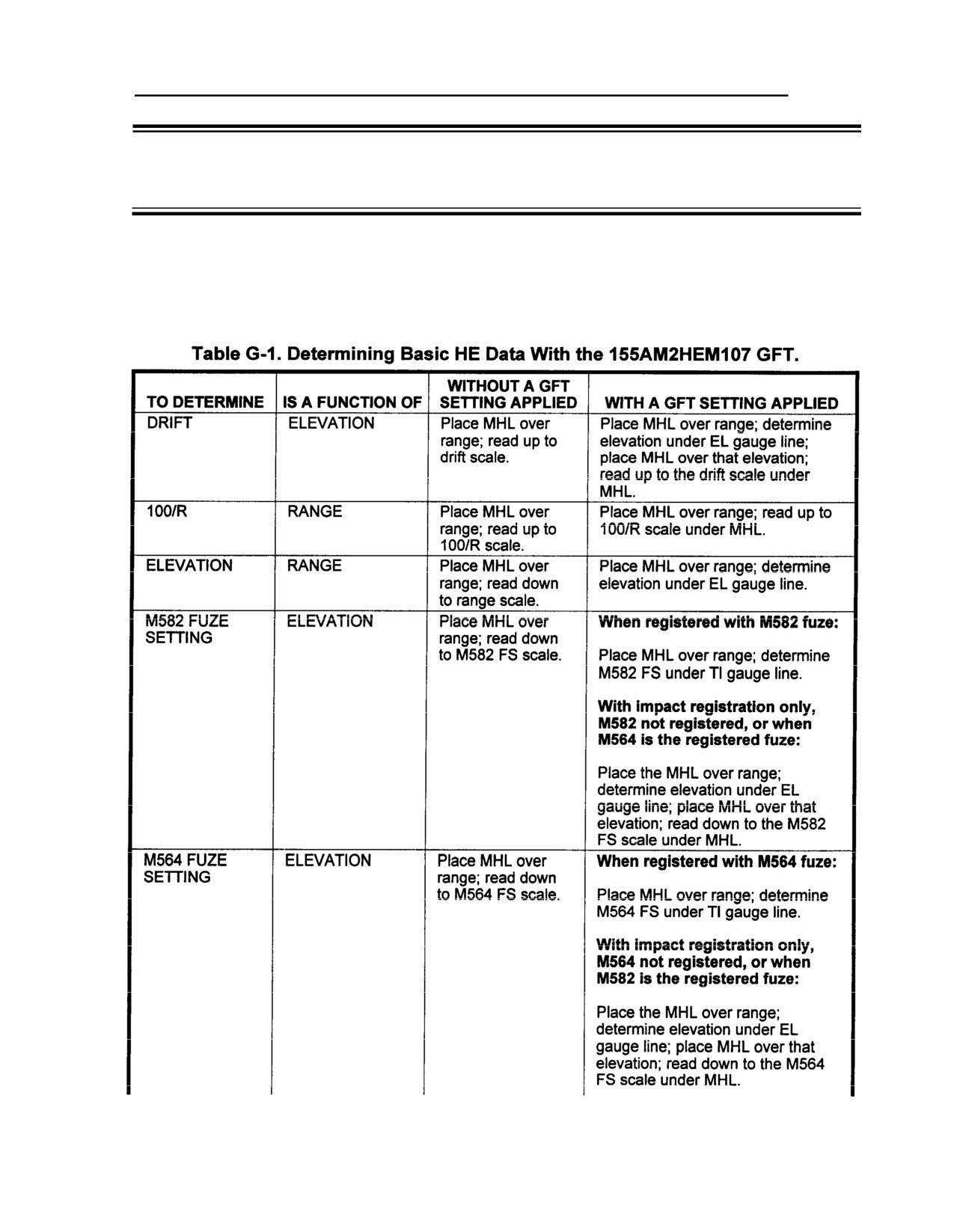
FM 6-40
Appendix G
DETERMINING DATA
The purpose of this appendix is to assist in determining data with a GFT.
G-1. Basic HE Data (155AM2HEMI07 GFT)
The procedures for using the 155AM2HEM107 GFT are discussed in Table G-1.
G-1
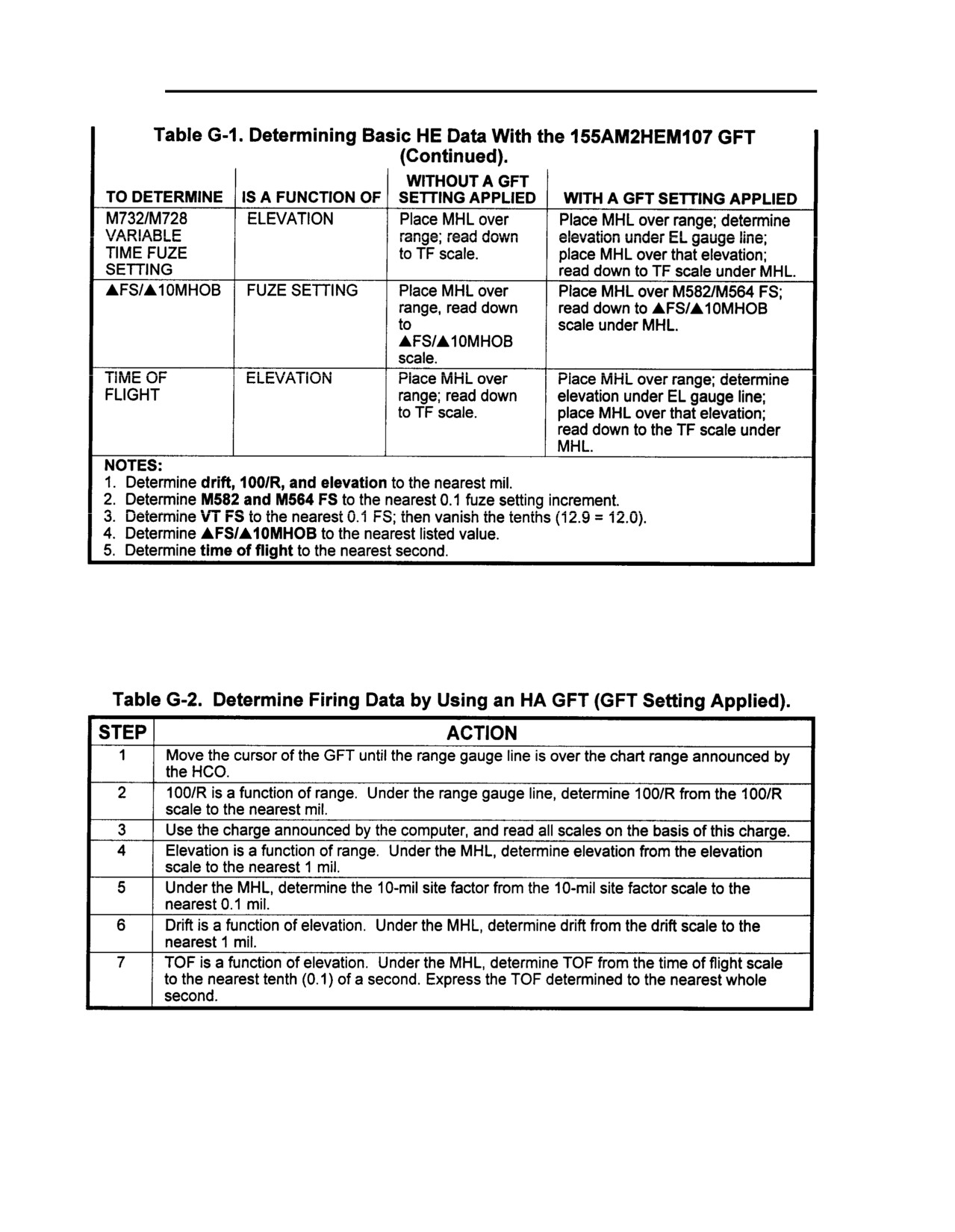
FM 6-40
G-2. Determine Firing Data From an HA GFT (GFT Setting Applied)
Table G-2 shows the procedures used to determine firing data from a high-angle GFT
with the GFT setting applied.
G-2
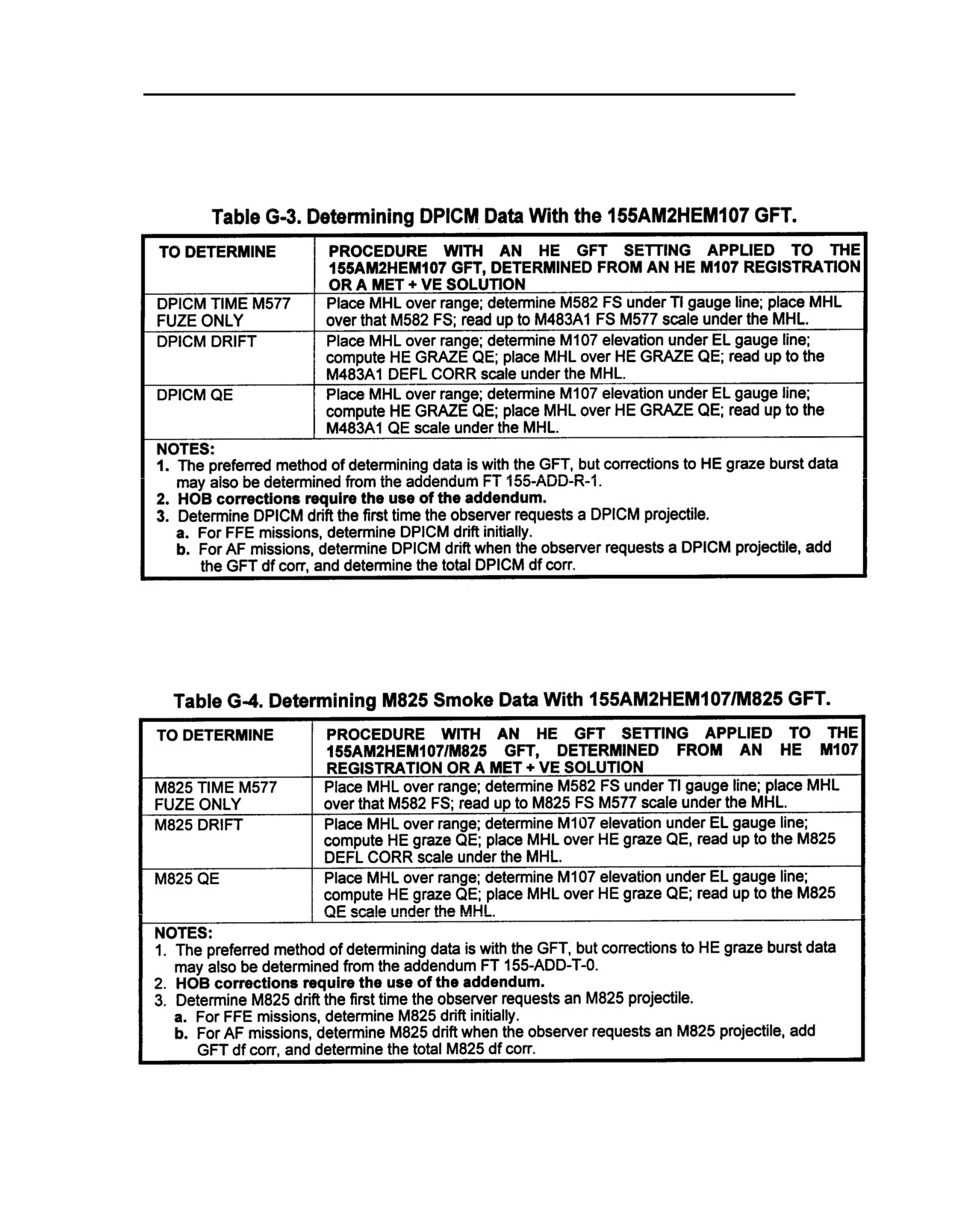
FM 6-40
G-3. DPICM Data (155AM2HEM107 GFT)
The procedures for using the 155AM2HEM107 GFT to determine DPICM data are
discussed in Table G-3.
G-4. M825 Smoke Data (155AM2HEM 107/M825 GFT)
The procedures for using the 155AM2HEM107M4825 GFT to determine smoke data are
-
discussed in Table G-4.
G-3
FM 6-40
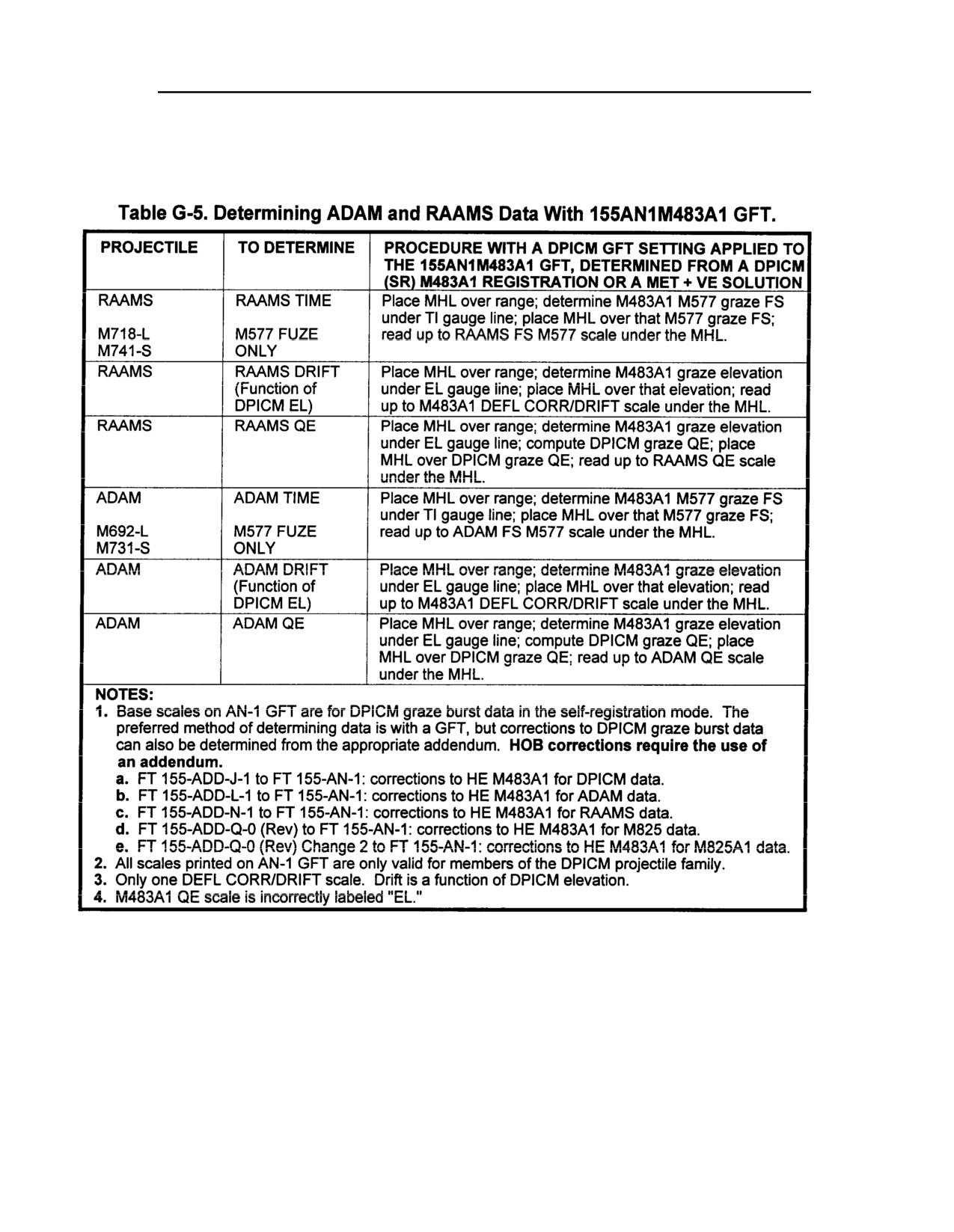
G-5. ADAM and RAAMS Data (155ANIM483A1 GFT)
The procedures for using the 155AN1M483A1 GFT to determine ADAM and RAAMS
are discussed in Table G-5.
G-4
FM 6-40
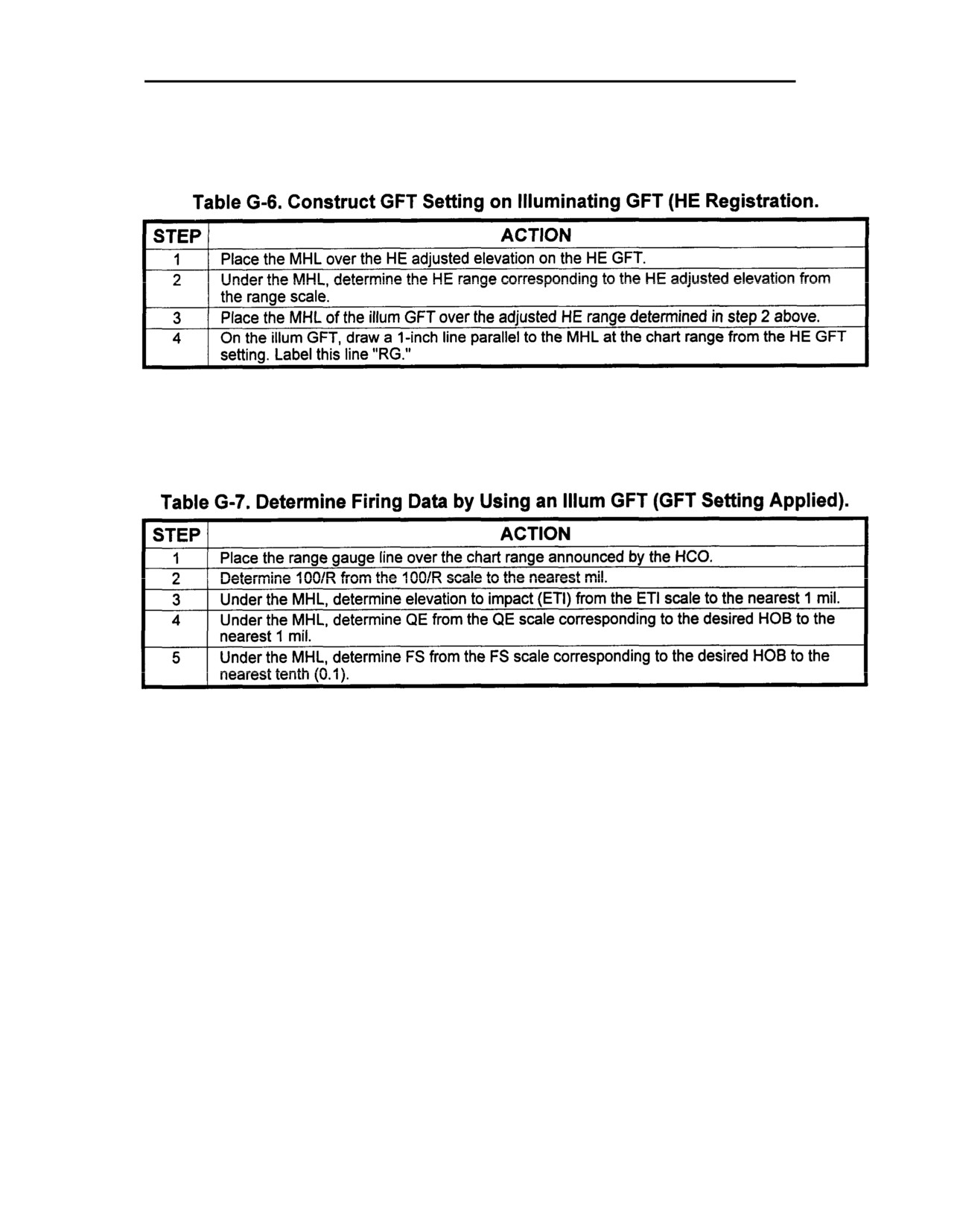
G-6. Construct a GFT Setting From an HE Registration on an Illuminating GFT
Table G-6 shows the procedure for constructing a GFT setting from an HE registration on
an illum GFT.
G-7. Determine Firing Data From an Illuminating GFT (GFT Setting Applied)
Table G-7 shows the procedures for determining firing data from an illuminating GFT
with a GFT setting applied.
G-8. Examples
a. Table G-8 shows the procedures for determining firing data from a low-angle HE
GFT (GFT setting applied) for an HE adjust fire mission with fuze VT in effect. The GFT setting
determined from the registration is:
GFT I/A: Chg 4, Lot AG, Rg 4960, El 315, Ti 18.6
Tot Df Corr RIGFT Df Corr R7
Apply the GFT setting to the appropriate GFT. The HCO announces the following chart data:
ONE ALPHA, RANGE 6220, DEFLECTION 3214.
The VCO announces SITE -6.
G-5
FM 6-40
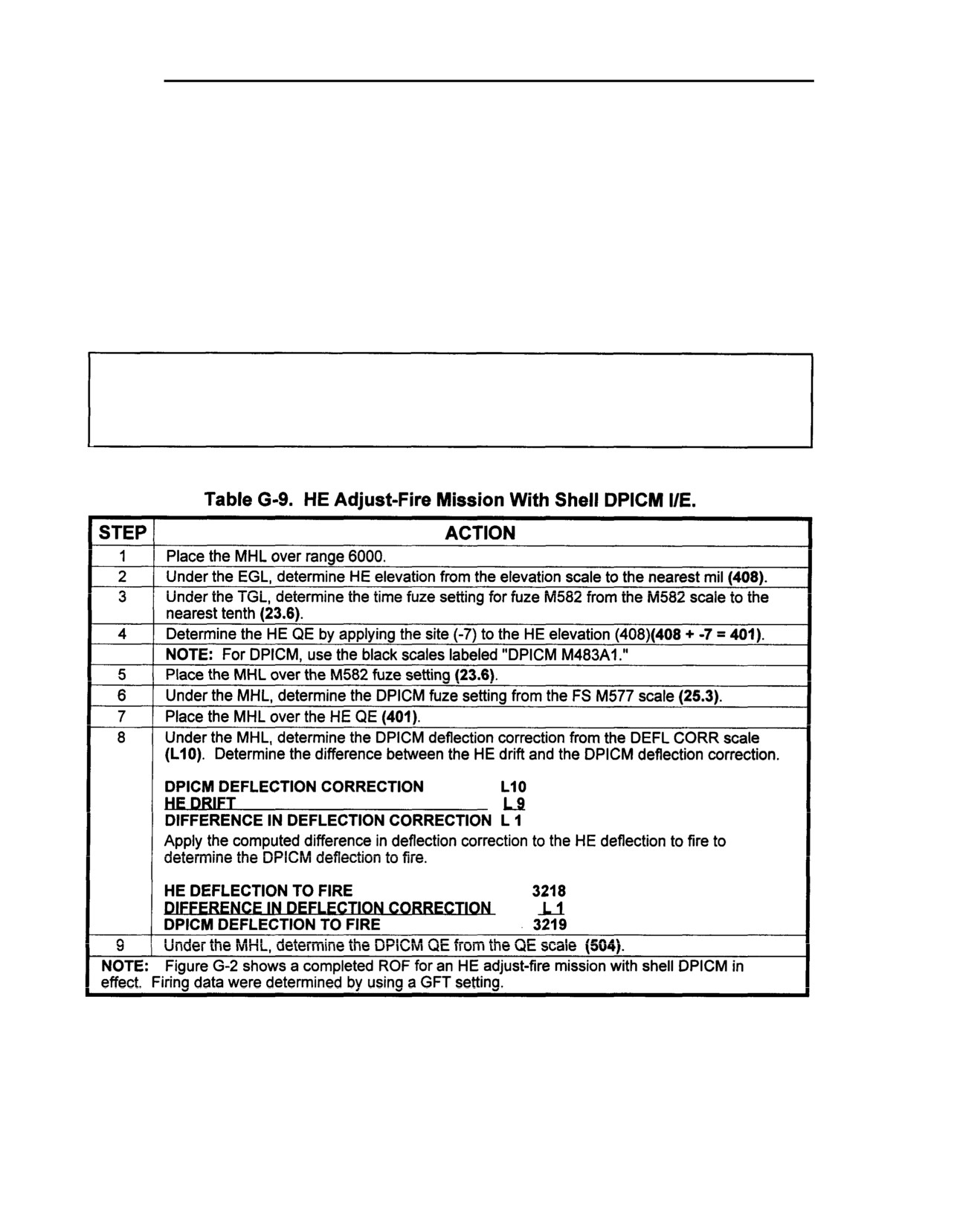
b. Table G-9 shows the procedures for determining firing data from a low-angle HE
GFT (GFT setting applied) for an HE adjust-fire mission with shell DPICM in effect. The GFT
setting determined from the registration is:
GFT I/A: Chg 4, Lot AG, Rg 4960, El 315, Ti 18.6
Tot Df Corr RI GFT Df Corr R7
Apply the GFT setting to the appropriate GFT. The HCO announces the following chart data:
ONE ALPHA, RANGE 6220, DEFLECTION 3214.
The VCO announces SITE -7.
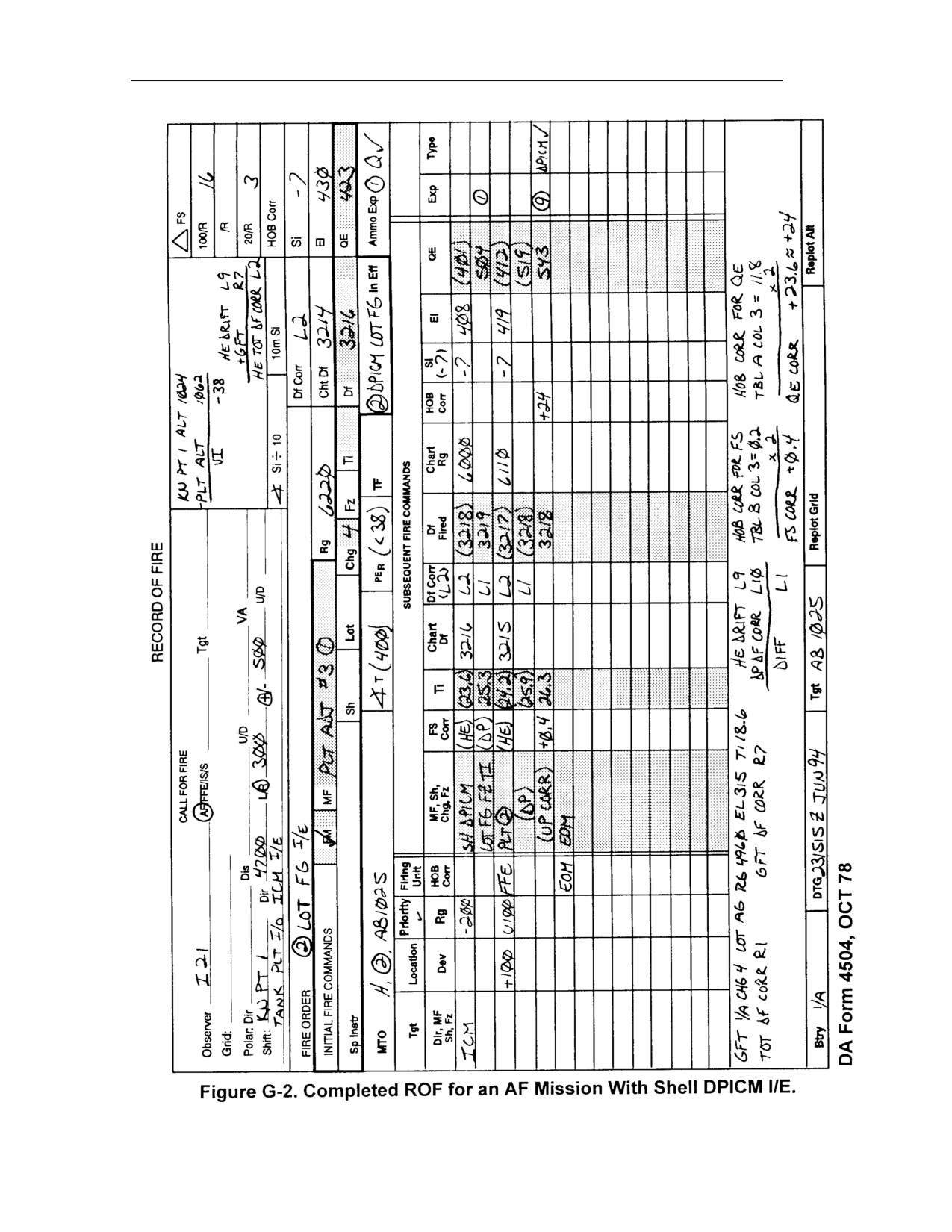
NOTE: The steps in Table G-9 are for determining DPICM firing data once the HE
rounds have been adjusted. The steps for determining HE firing data are the same
as shown earlier.
G-8
FM 6-40
G-9
FM 6-40
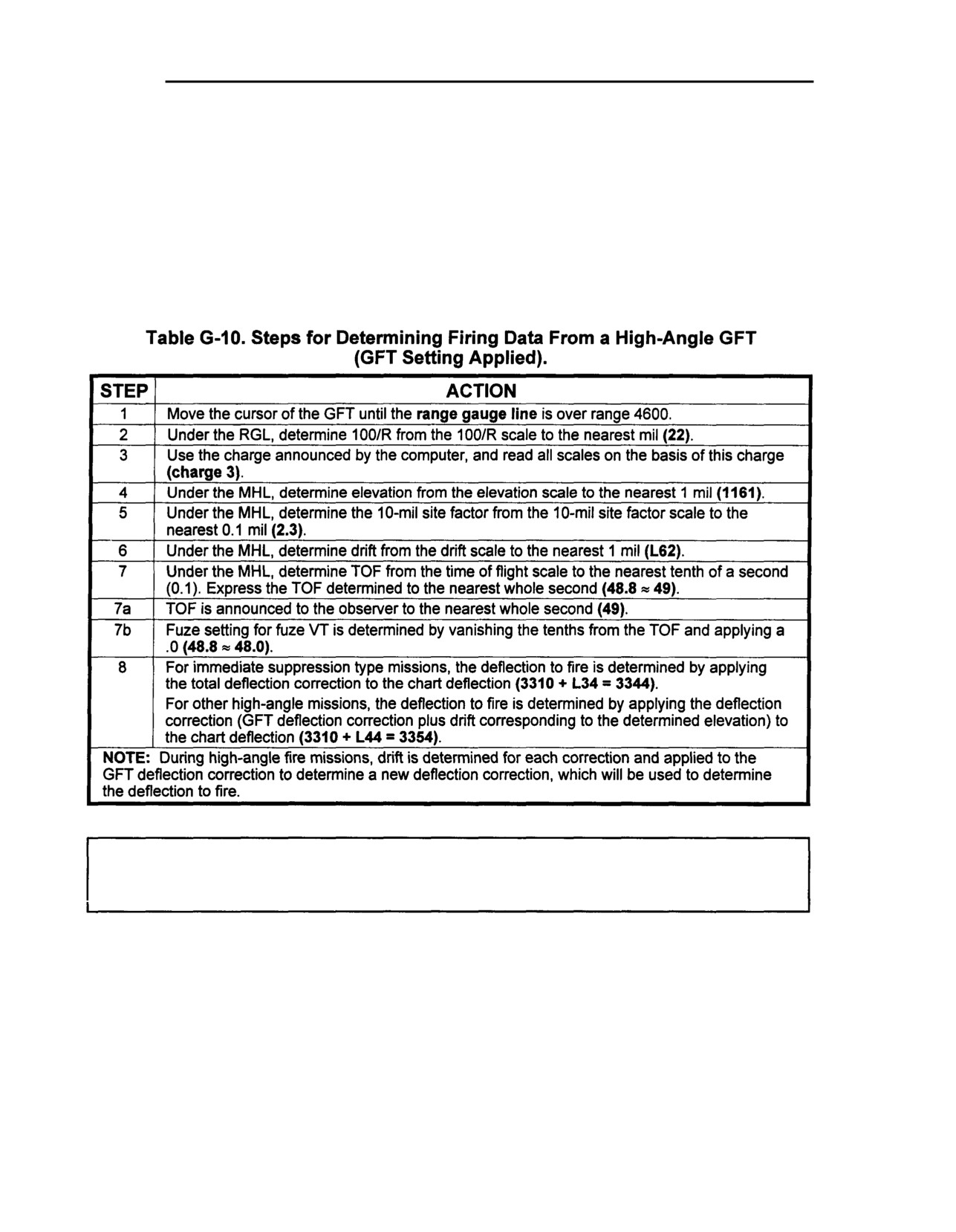
c. Table G-10 shows the procedures for determining firing data from a h
-
-
(GFT setting applied). The GFT setting determined from the registration is:
GFT I/A: Chg 3, Lot AG, Rg 4960, El 1114
Tot Df Corr L34 GFT Df Corr R18
Apply the GFT setting to the appropriate GFT. The HCO announces the following chart data:
ONE ALPHA, RANGE 4600, DEFLECTION 3310.
The VCO announces ANGLE OF SITE -9.
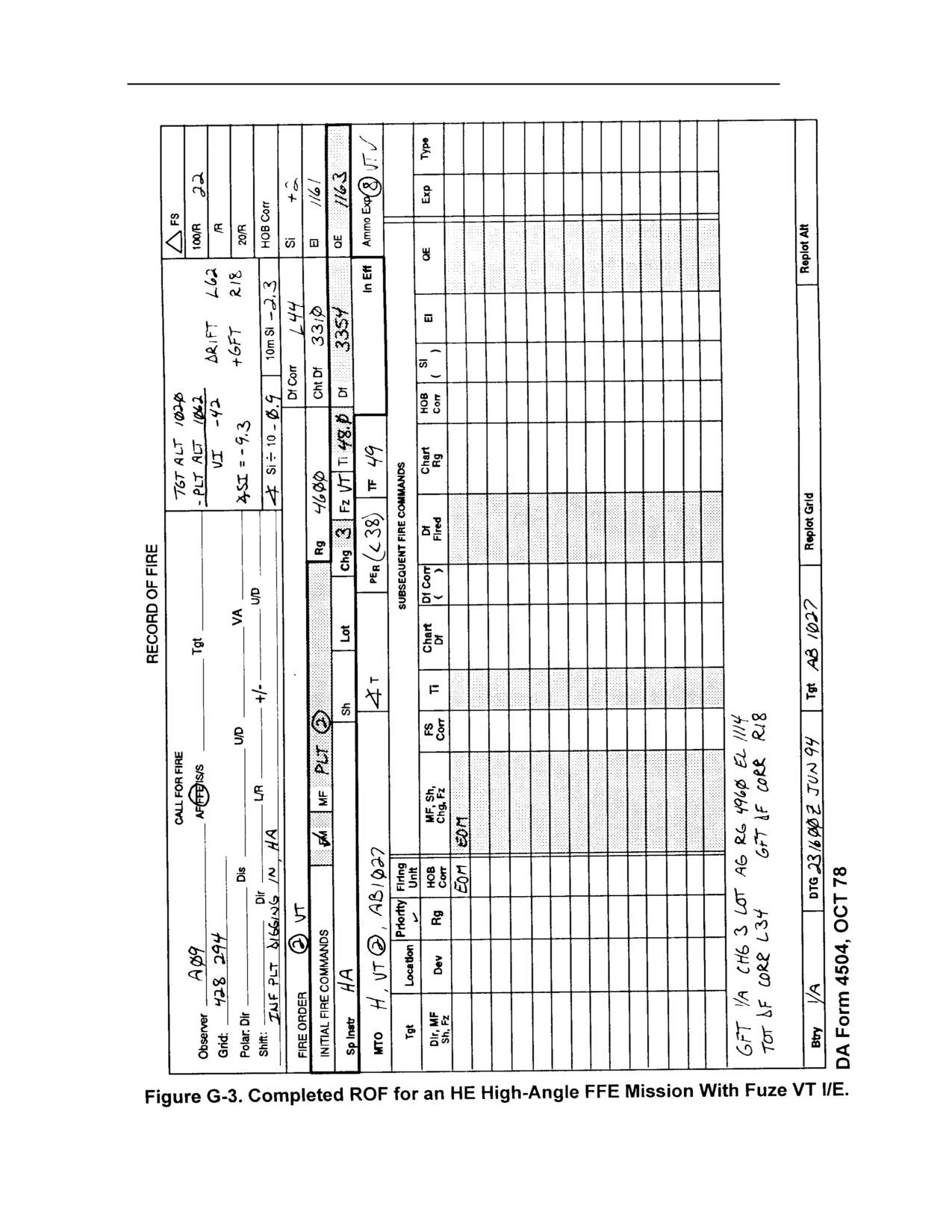
NOTE: Figure G-3 shows a completed ROF for an HE high-angle FFE mission with
fuze VT in effect. Firing data were determined by using a GFT setting.
G-10
FM 6-40
G-11
FM 6-40
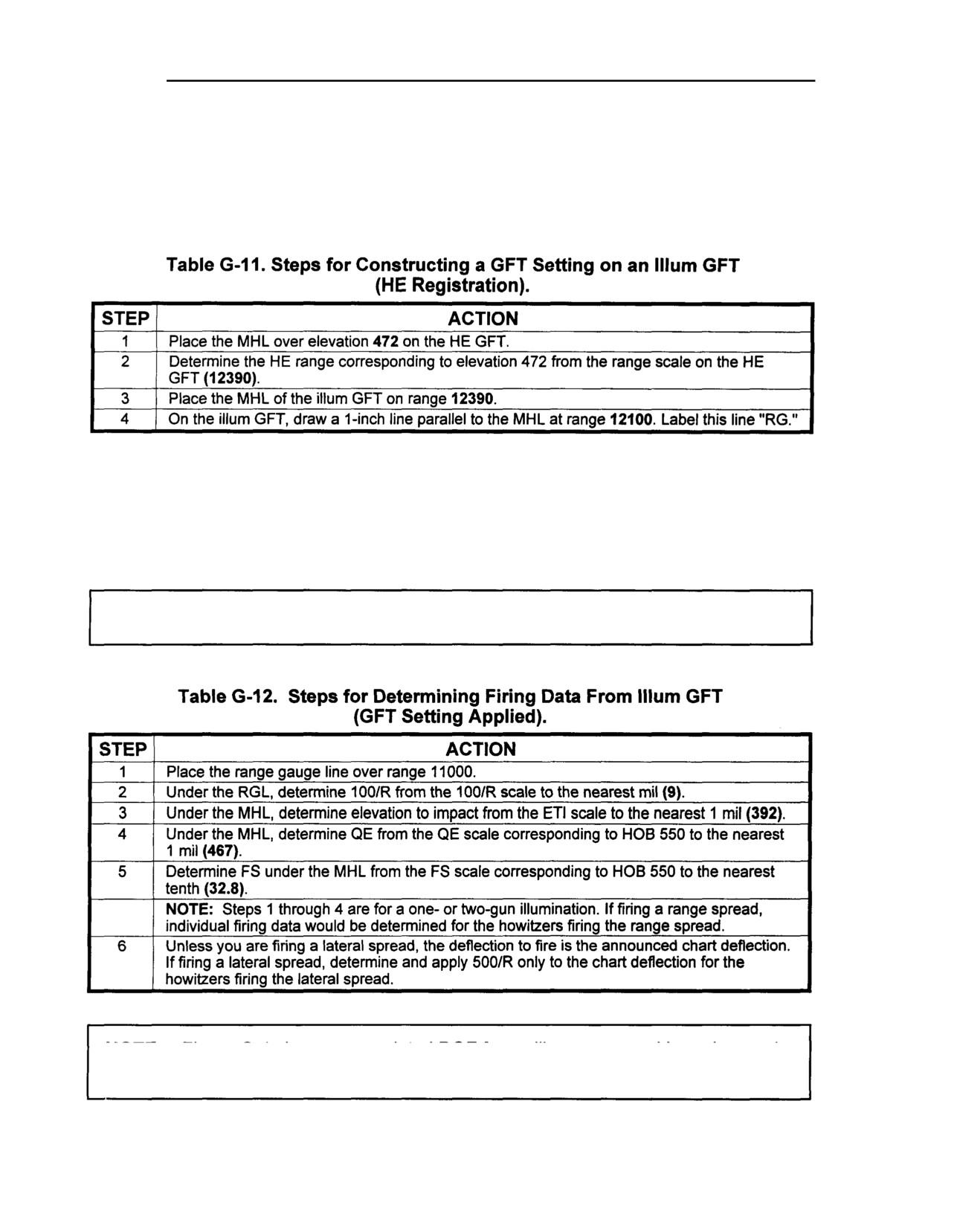
d. Table G-11 shows the procedures for constructing a GFT setting on an illum GFT
(HE registration). The GFT setting determined from the registration is:
GFT I/A: Chg 7, LOT AW, Rg 12100, El 472, Ti 38.8
Tot Df Corr LO GFT Df Corr L14
Apply the GFT setting to the appropriate illum GFT.
e. Table G-12 shows the procedure for determining firing data from an illum GFT with
a GFT setting applied. Use the GFT setting shown in paragraph d to determine firing data.
The HCO announces the following chart data:
ONE ALPHA, RANGE 11000, DEFLECTION 3310.
NOTE: Use the 550 HOB scale to determine firing data.
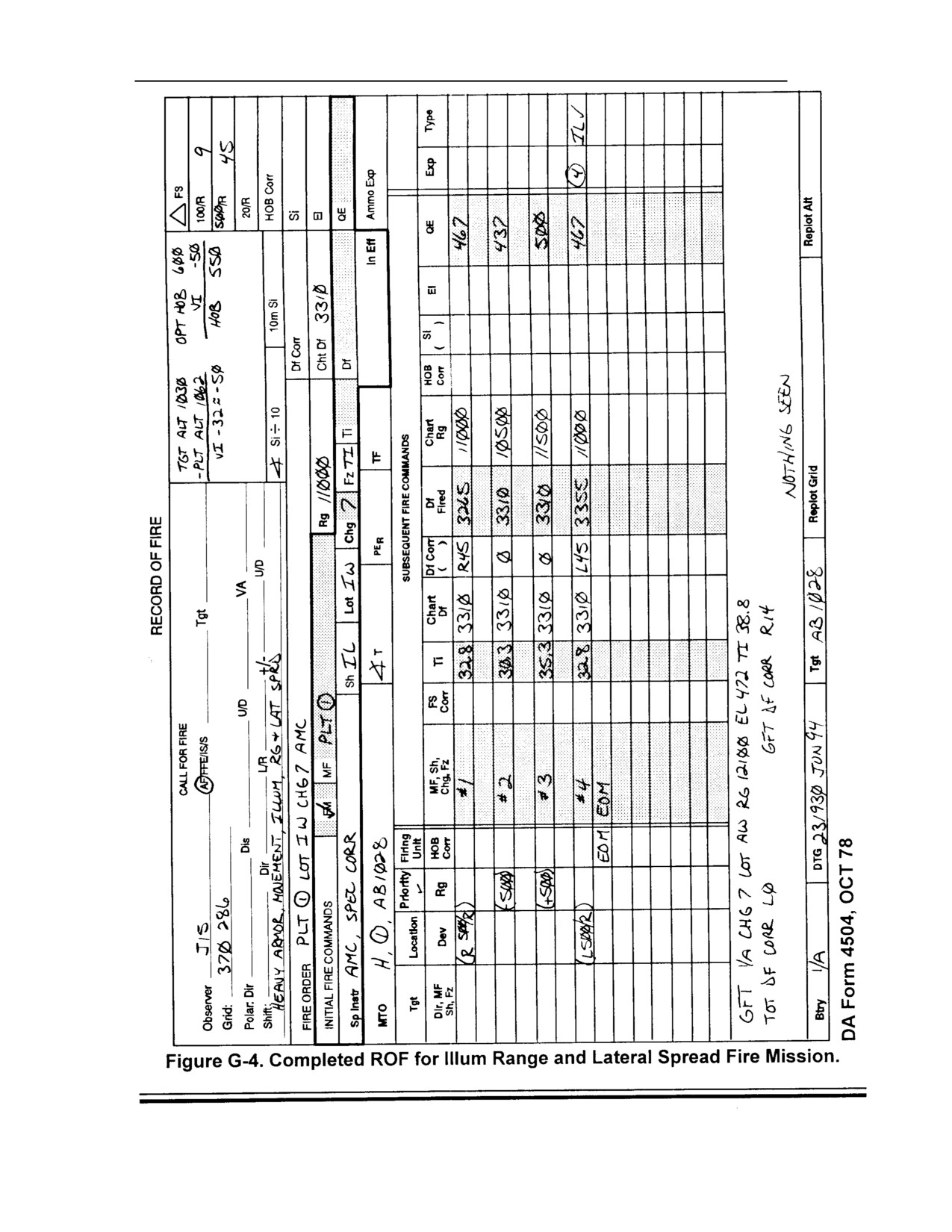
NOTE: Figure G-4 shows a completed ROF for an illum range and lateral spread
fire mission. Firing data were determined by using a GFT setting.
G-12
FM 6-40
G-13
FM 6-40
Appendix H
SPECIAL SITUATIONS
This appendix is a supplement to Chapter 13, which details the more common “special
situations” missions.
H-1. Final Protective Fires
A final protective fire is an immediately available prearranged barrier of fire designed to
protect friendly troops and installations by impeding enemy movements across defensive lines or
areas. The normal use of an FPF is to establish prearranged close-in defensive fires, which
include other artillery fires, minefield, obstacles, final protective machine gun lines and
small-arms fire, and final protective fire of mortars. Each battery is assigned one FPF and
normally is laid on that FPF when not firing other missions. The FPF may be fired on
prearranged signal or on call from the supported unit. The firing of an FPF maybe repeated on
call as often as necessary. When time and ammunition permit, the FPF can be adjusted or check
rounds fired. A battery FPF may be fired either individually or in coordination with those of
other batteries.
a. Width of FPF. The width (or length) of the FPF that can be covered by a single
battery without shifting its fire should not exceed the width of an open sheaf for the battery
concerned. When necessary, the width (length) of the FPF may be increased by agreement
between the commanders of the artillery and the supported unit. However, the effectiveness of
fire will be decreased.
b. Preparation of Data. The actual map location of the FPF is reported by the
supported unit through the various fire support channels. The FPF is assigned to an artillery unit,
which is responsible for computing the firing data. Since the FPF usually is located within a very
short distance of positions occupied by friendly troops, precise computational procedures must be
employed and all available corrections must be applied. Special corrections in the form of
calibration corrections and position corrections, obtained by use of the M17 plotting board, are
determined and applied as individual piece corrections. When the axis of the FPF is other than
perpendicular to the direction of fire, additional
computations must be made to bring each burst
to a desired point on the FPF line.
c. Call for Fire. The call for fire for
final protective fires is as outlined in FM 6-30,
Chapter 7.
H-2. Computational Procedures
There are two techniques for determining FPF data: observer-adjusted FPF and
nonadjusted FPF. Both techniques will result in the determination of firing data that are
announced to the howitzers and that are used to lay the howitzers when they are not involved in
other fire missions.
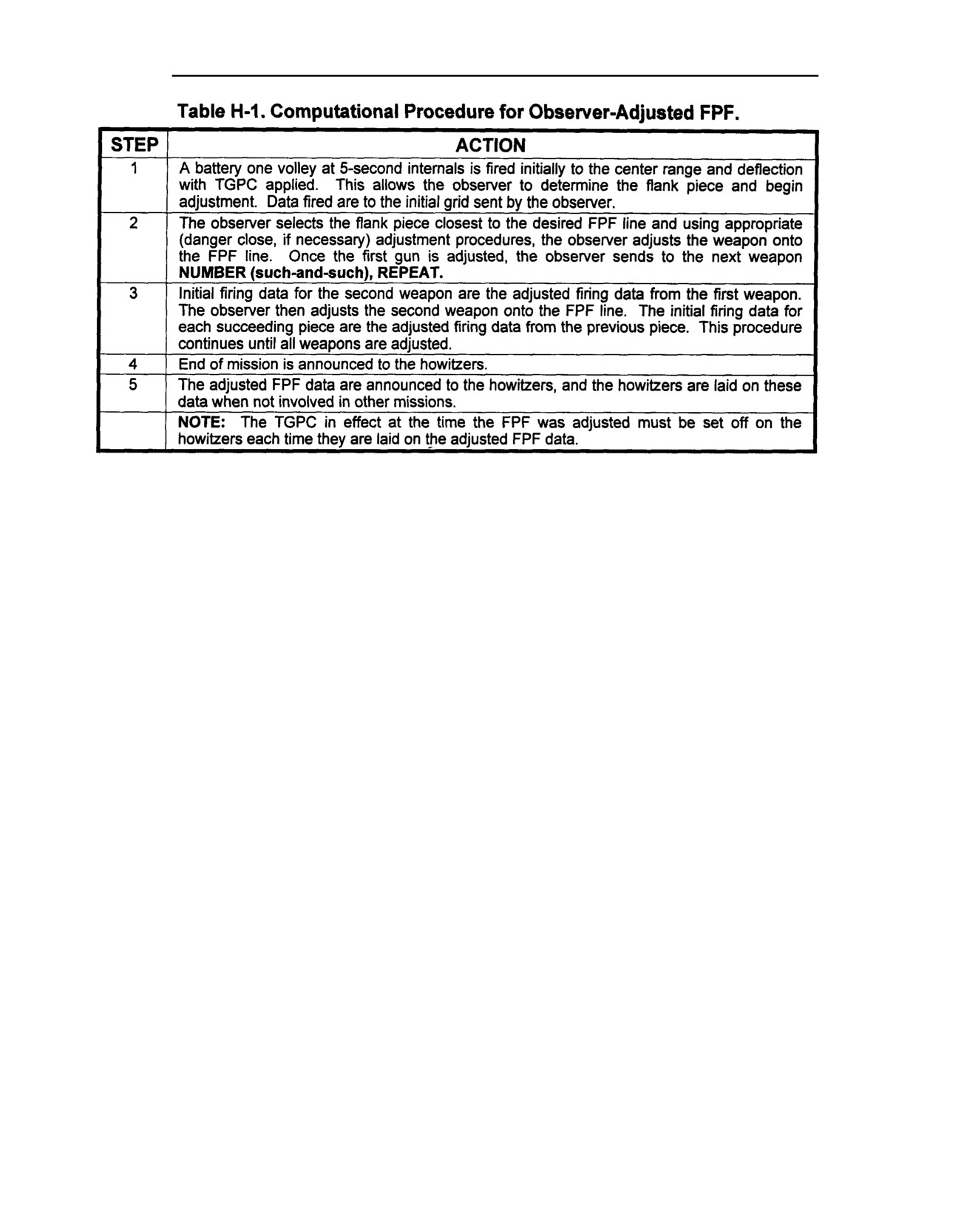
b. Observer Adjusted FPF. The observer will adjust the burst of each round to its
desired location on the FPF sheaf. He starts with the flank round that impacts to the location of
the desired sheaf and continues the adjustment until all howitzers have been adjusted. (See Table
H-1.)
H-1
FM 6-40
c. Nonadjusted FPF. When the situation does not permit the adjustment of each burst
to its location on the FPF sheaf, the FDC determines firing data by using standard FFE
techniques, In the call for fire, the observer should include the altitude of FPF and the length, if
different from that of an open sheaf. The FDC will compute special corrections with the M17 for
a linear sheaf and determine the FPF firing data. The FPF firing data will be announced to the
howitzers and, as in observer adjusted FPFs, the howitzers will lay on the FPF data when not
involved in other fire missions.
H-3. Laser Adjust Missions
a. An observer equipped with a laser can determine accurate target locations if the laser
is accurately located. If the observer has directional control and his accurate location has been
recorded at the FDC, he should request first-round fire for effect. If the observer does not feel he
can achieve first-round fire for effect on the target, he should request an adjust-fire mission, The
FDO may also decide to fire an adjustment if the FDC cannot account for some of the
requirements for accurate fire. This may occur even if the observer requests first-round fire for
effect.
b. Most laser missions, if not fire for effect initially, should require only one adjusting
round. Fire for effect should be requested by the observer unless he determines the lasing of the
burst is not satisfactory. Many variables could cause an unsatisfactory lase. For example, an
observed burst partially obscured by trees or intermediate hill mass would yield inaccurate land
distance to the burst. The total deviation between the target and the adjusting burst does not
generally determine if fire for effect is requested. Rather, the observer need only determine if an
accurate lase to the burst has been obtained.
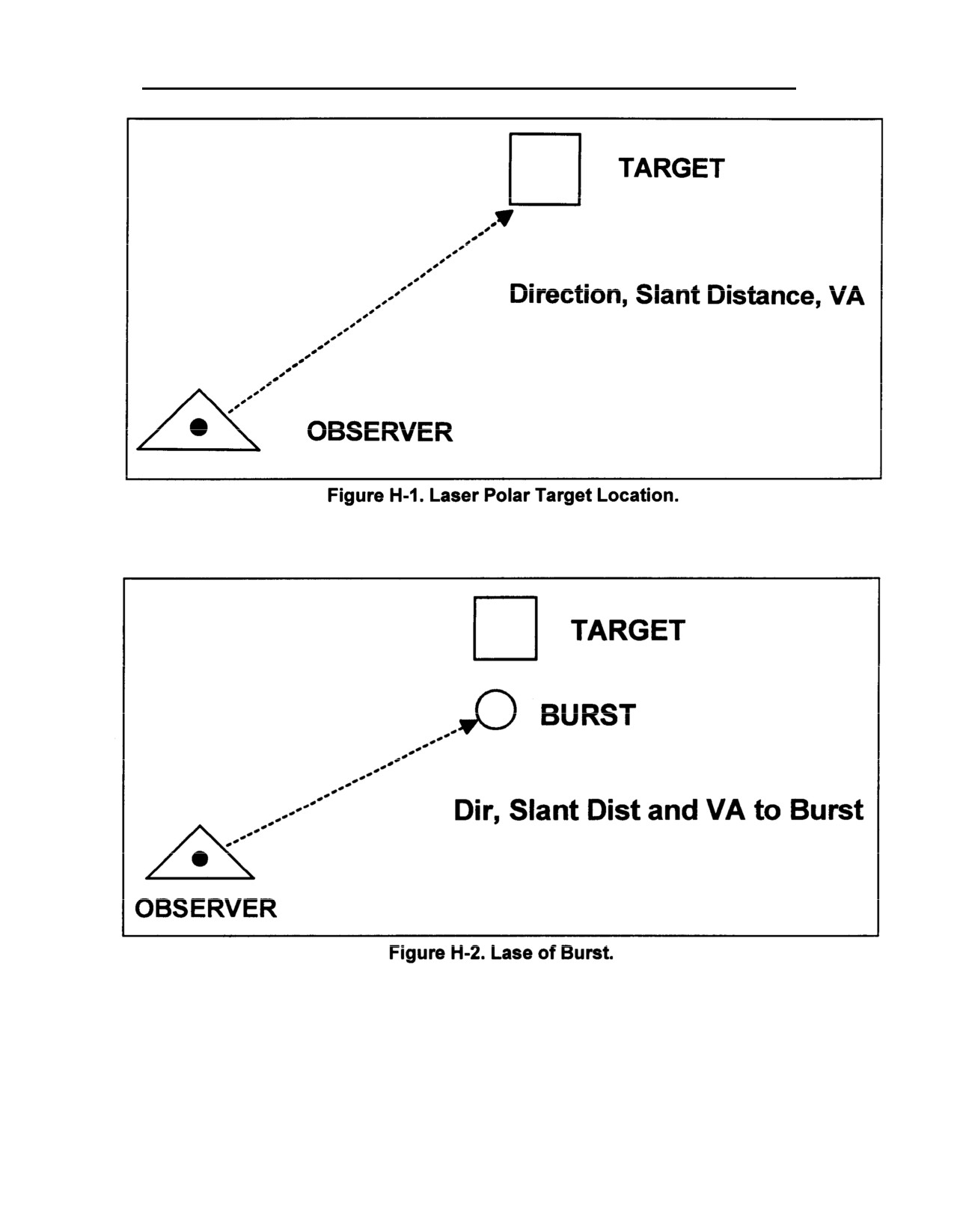
c. The observer uses the polar method of target location to determine the target location.
He transmits the target location in his call for fire. (See Figure H-1.)
H-2
FM 6-40
d. The adjusting round is fired and the observer reports the direction, slant distance, and
VA to the burst. (See Figure H-2.)
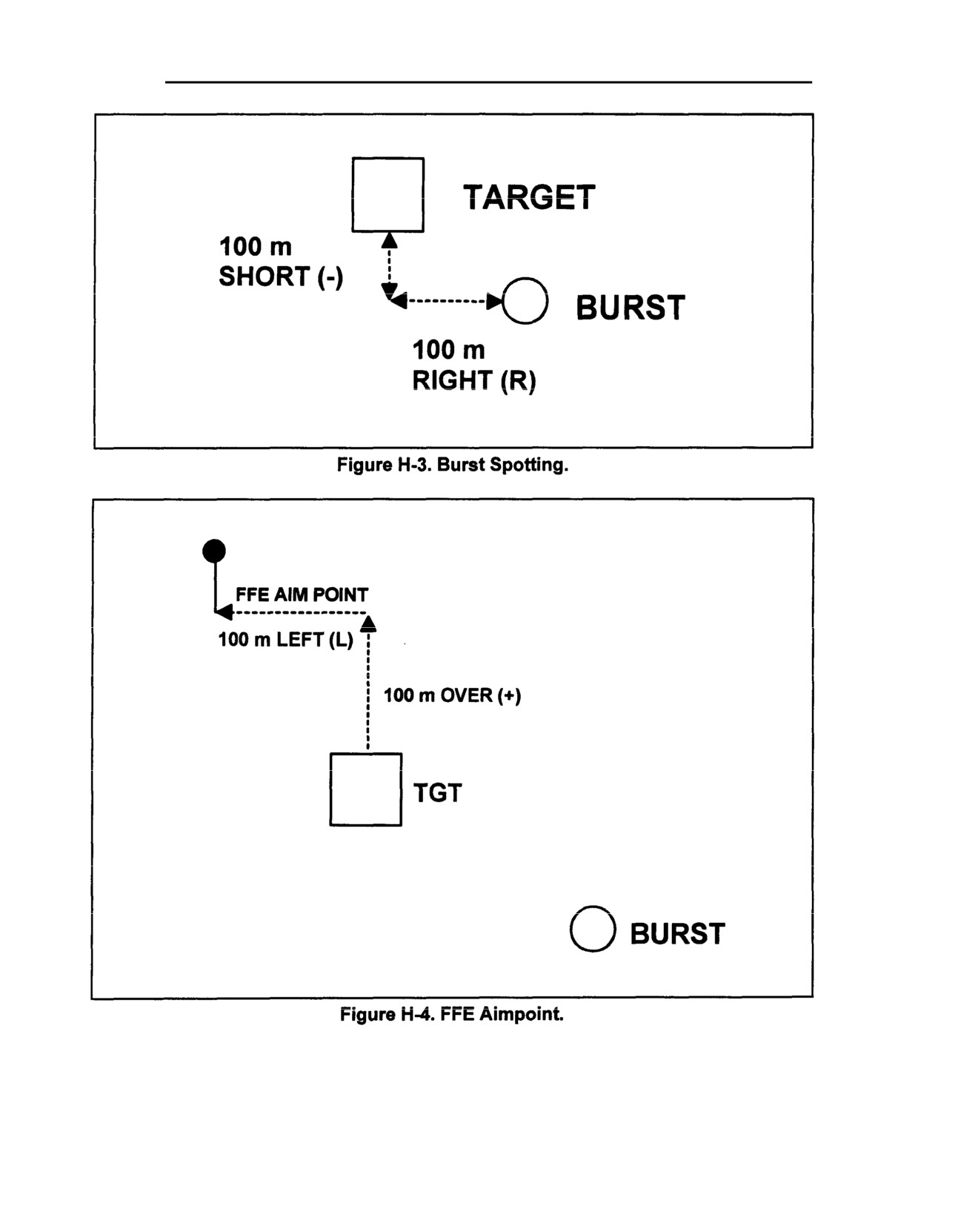
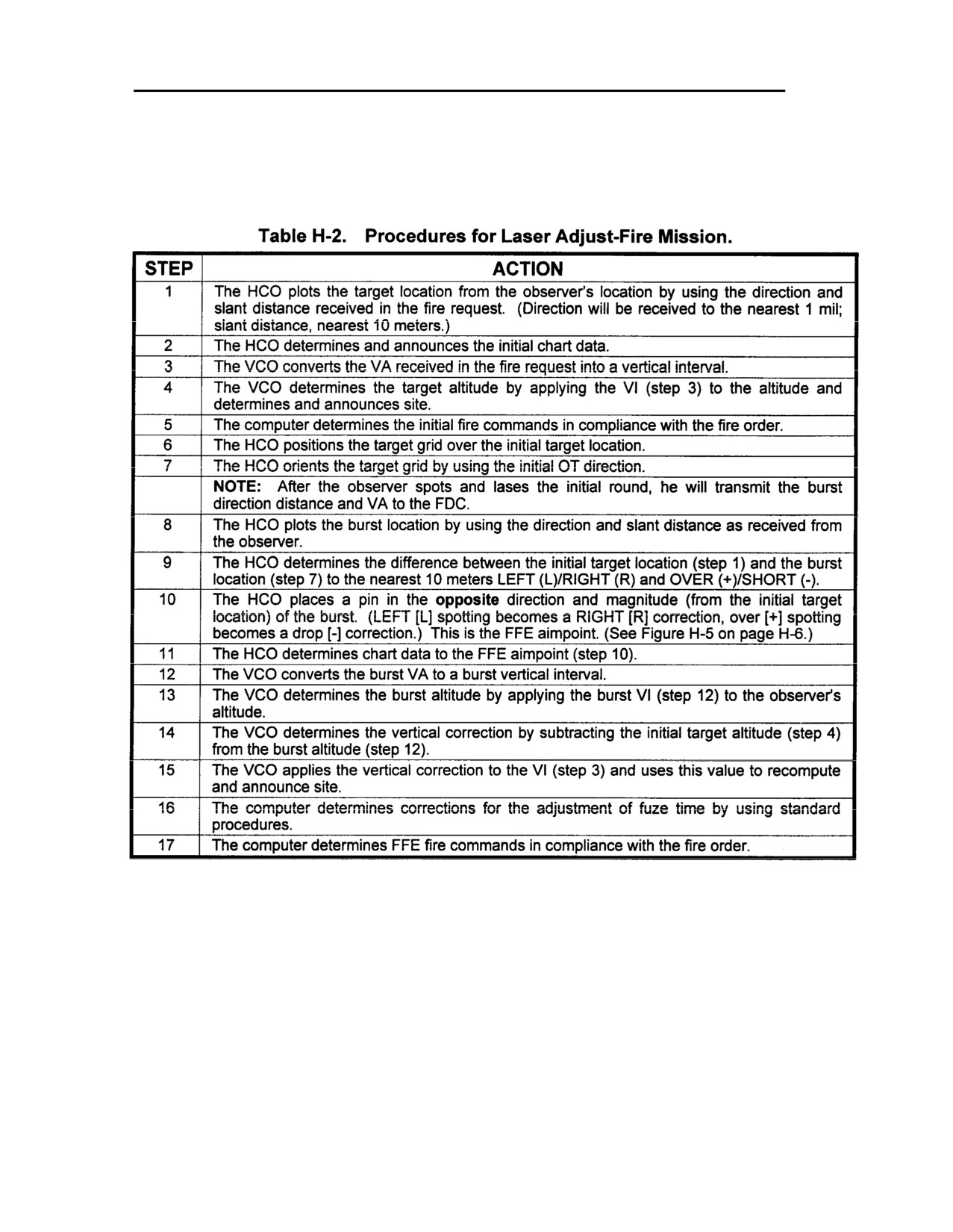
e. The FDC determines the fire for effect aimpoint from the total corrections necessary
to engage the target. (See Figures H-3 and H-4 on page H-4.)
H-3
FM 6-40
f. If additional adjustment is required, continue to plot the burst locations and compare
each to the initial target location. Apply each correction determined to the previous aimpoint
location not the initial target location.
H-4
FM 6-40
g. The M17 plotting board may also be used to determine corrections (see Chapter 12).
H-4. Laser Adjust-Fire Mission
Table H-2 shows the procedures for a laser adjust-fire mission.
H-5. Radar Adjust-Fire Missions
a. The AN/TPQ-36 and -37 radars are used as counterbattery radars. They have survey
capability, which allows them to determine accurate locations of enemy firing bursts. If used in
the friendly mode, the radars are capable of determining burst locations of rounds fired by
friendly units.
H-5
FM 6-40
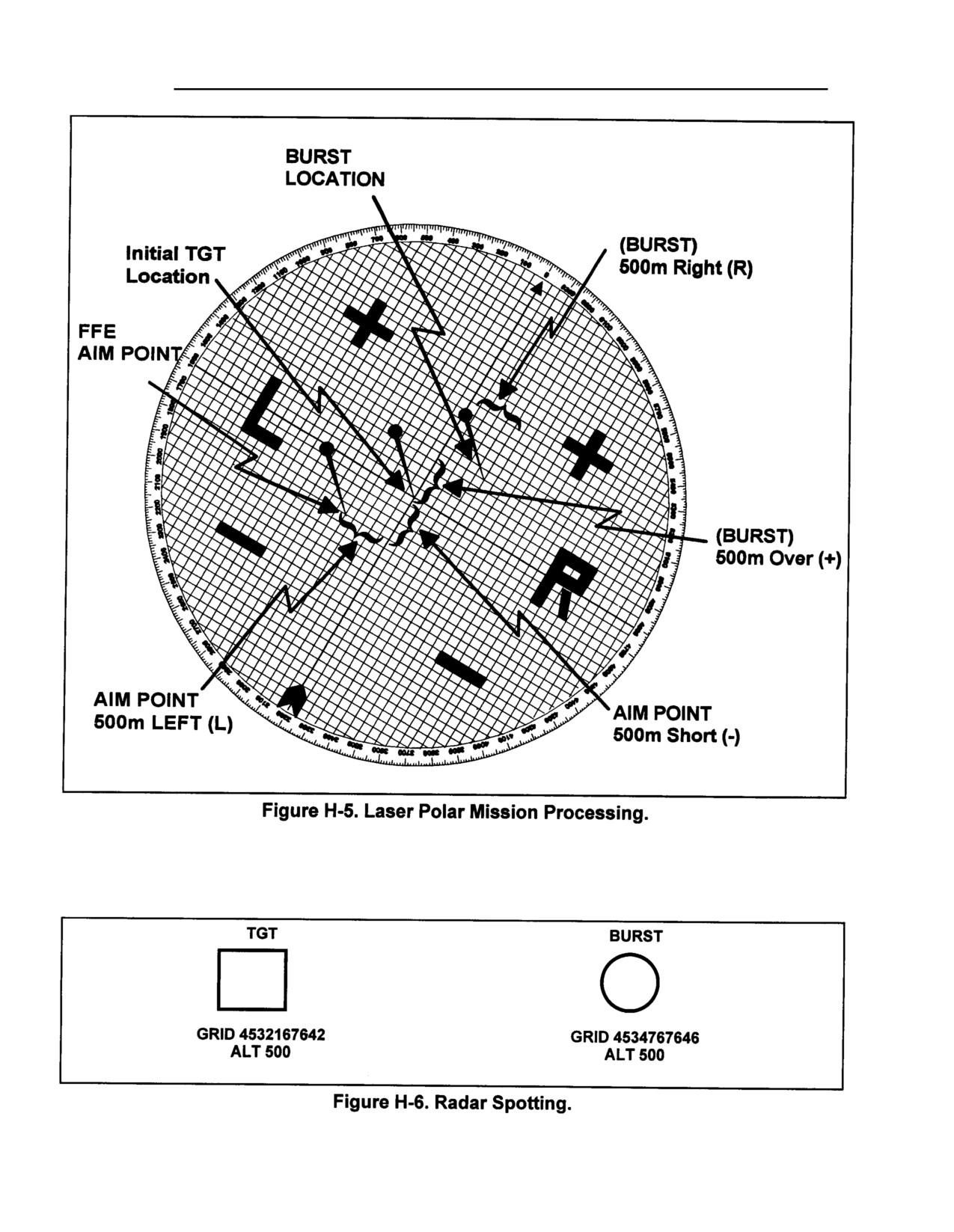
b. The initial target location for a radar adjust-fire mission can be determined by radar in
the case of enemy firing units or by another observer. Once the initial target location is
established and the initial round is fired, the radar will trace the round and report the spotting of
the burst by grid coordinates and altitude. (See Figure H-6.)
H-6
FM 6-40
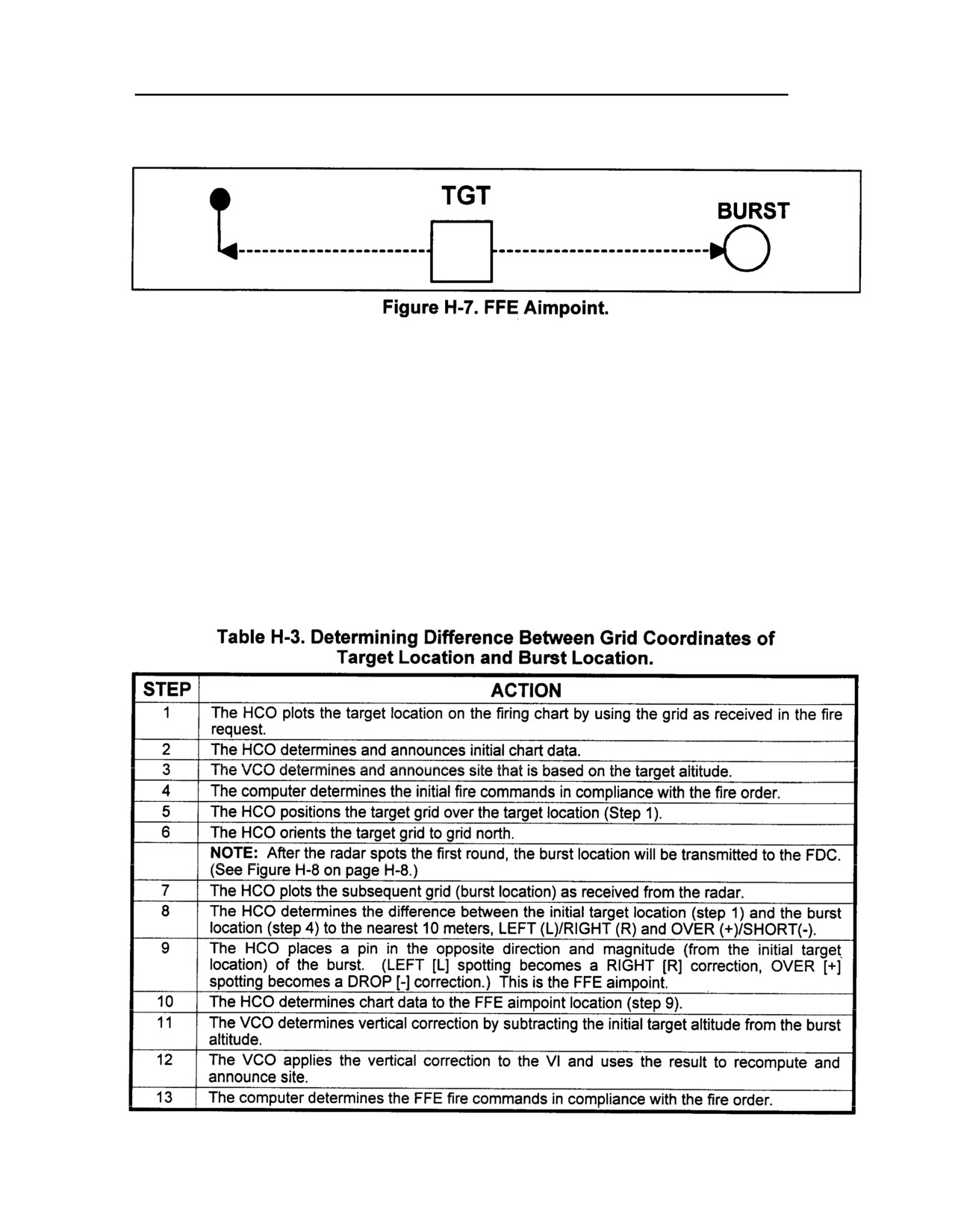
c. The FDC then determines the corrections needed to move the burst to the target and
determines the FFE aimpoint. (See Figure H-7.)
d. Once the FFE aimpoint location is established, FFE fire commands can be
determined.
e. If additional adjustment is required, continue to plot the burst locations and compare
each to the initial target location. Apply each correction determined to the previous aimpoint
location, not the initial target location. When orienting the target grid for direction, any direction
will produce the desired results. Each burst location will be reported by using grid coordinates.
The target grid is used only to determine the magnitude of the correction needed and the direction
of the corrections relative to the orientation (direction) of the target grid that has been chosen.
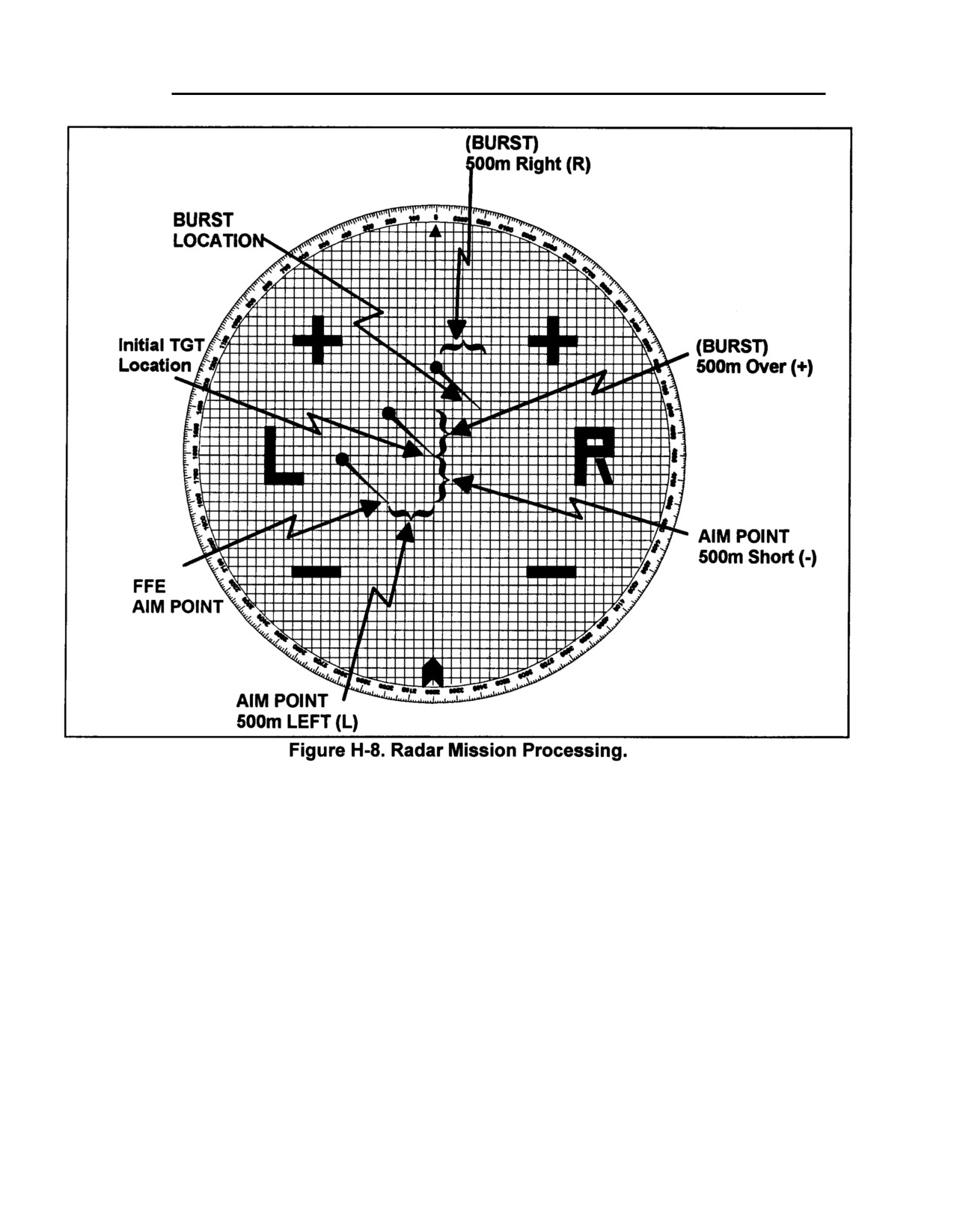
f. Another way to determine the corrections would be to mathematically determine the
difference between the grid coordinates of the target location and burst location (Table H-3). The
corrections would be applied by using a target grid oriented to grid north (0000). Continued
adjustment would be performed by determining the difference between each burst location and
the initial target location. Each correction would be applied to the previous aimpoint.
H-7
FM 6-40
H-6. Destruction Mission
a. General. The purpose of the destruction mission is, as the name implies, to destroy
the target. This requires a target hit. The mission is conducted with a single gun and closely
parallels precision registration procedures. Given the dispersion suffered by indirect fire
weapons and the requirement for a target hit, the great expenditure of ammunition required
becomes apparent. This requirement for ammunition and the ensuing possible disclosure of the
firing unit make a destruction mission a less desirable method of engaging targets. Whenever
possible, other methods or other means of attack should be considered.
b. Conduct of the Destruction Mission. The destruction mission follows the same
procedures as a precision registration until the observer establishes a 25-meter bracket. Once it is
established, the observer will split the 25-meter bracket by adding or dropping 10 meters and will
continue to fire additional rounds. After every third round, additional corrections are announced
if necessary. The observer may make corrections after each round. This will continue until the
target is destroyed or the observer or FDO chooses to end the mission. At intervals, the observer
may request a change of fuze from delay or concrete-piercing to fuze quick to clear rubble and
debris around the target.
H-8
FM 6-40
H-7. Sweep and Zone
Sweep and zone fires provide a method for the attack of large or irregularly shaped
targets. The advantage of sweep and zone fires is the ease with which they may be computed in
comparison to attacking the target by using special corrections. The disadvantages are the great
quantity of ammunition that must be expended and the time required to do so. The resulting loss
of surprise and potential for disclosing the firing unit location make sweep and zone fires a less
appealing alternative. The FDO should weigh these considerations before attacking targets by
using sweep and zone techniques. Possible alternatives are the use of special corrections or
dividing the target among a number of firing units.
a. Computation of Sweep.
(1) Sweep fires are used to cover a wide target with fire. (Wide target is described
as a target whose long axis lies perpendicular or nearly perpendicular to the GT line.) Sweep fire
is similar to traversing fire applied with direct fire weapons. The purpose of the sweep is to cause
the guns to fire a number of deflections (at the same quadrant elevation) to place a number of
sheafs side by side over the target.
(2) Chart data are computed as with any area target.
(3) The number of deflections to fire is determined on the basis of the width of the
target and by the sheaf front.
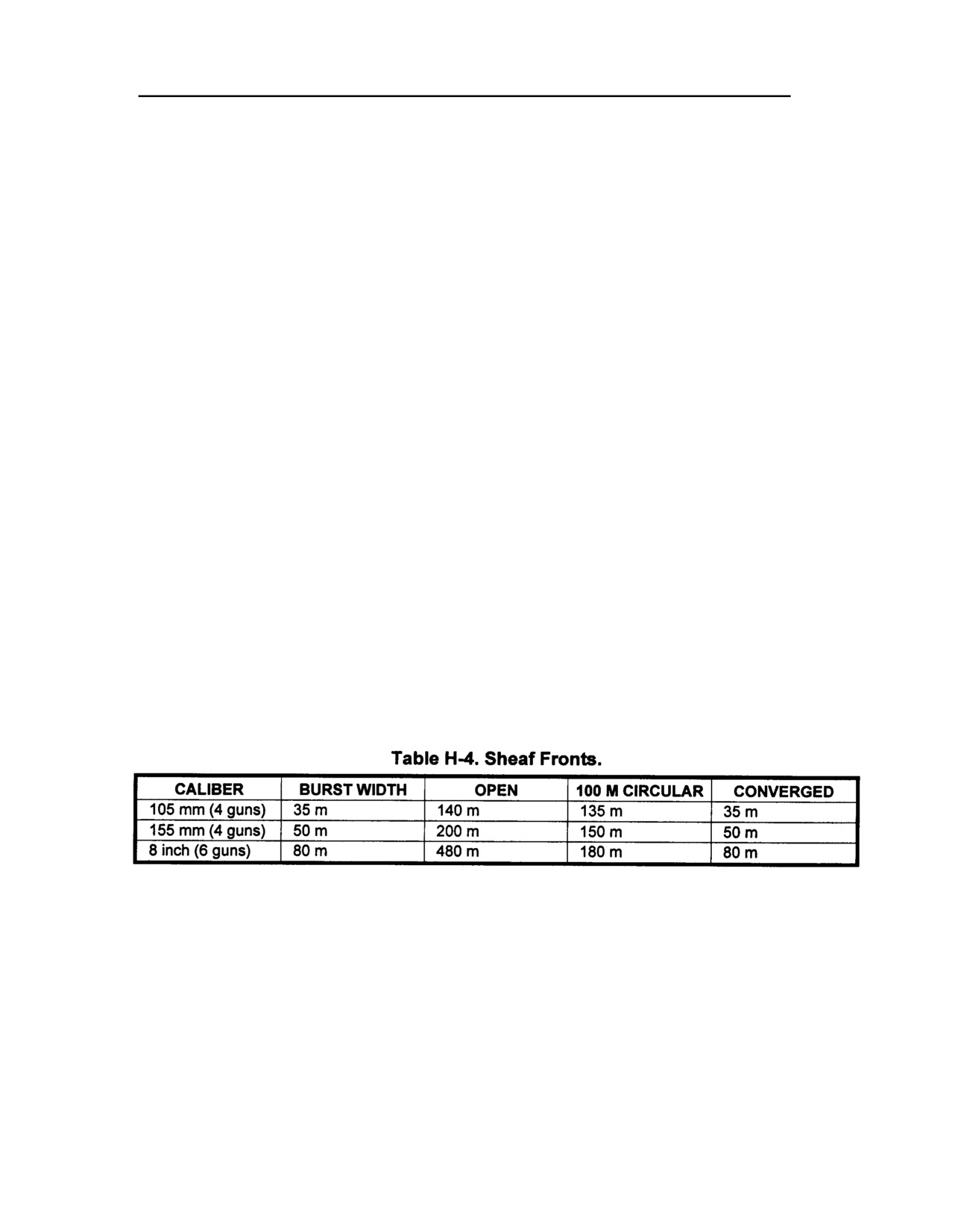
(a) Determination of sheaf front. The sheaf front is the lateral distance
between the center of the flank bursts, plus one effective burst width. The size of the sheaf front
depends on the type of sheaf fired and the burst width of the projectile. For an open sheaf, the
sheaf front is computed as number of bursts multiplied by the burst width for the projectile. The
sheaf front for a circular sheaf is the distance across the center of the circle from burst to burst
plus one burst width. If special corrections or TGPCs are being used, the size of the sheaf front
will correspond with the sheaf front used to determine those corrections. Converged sheaf should
not be used as the concentration of fire on a single point. This is contrary to the purpose for
sweep fire. The front for a converged sheaf is one burst width. (See Table H-4.)
H-9
FM 6-40
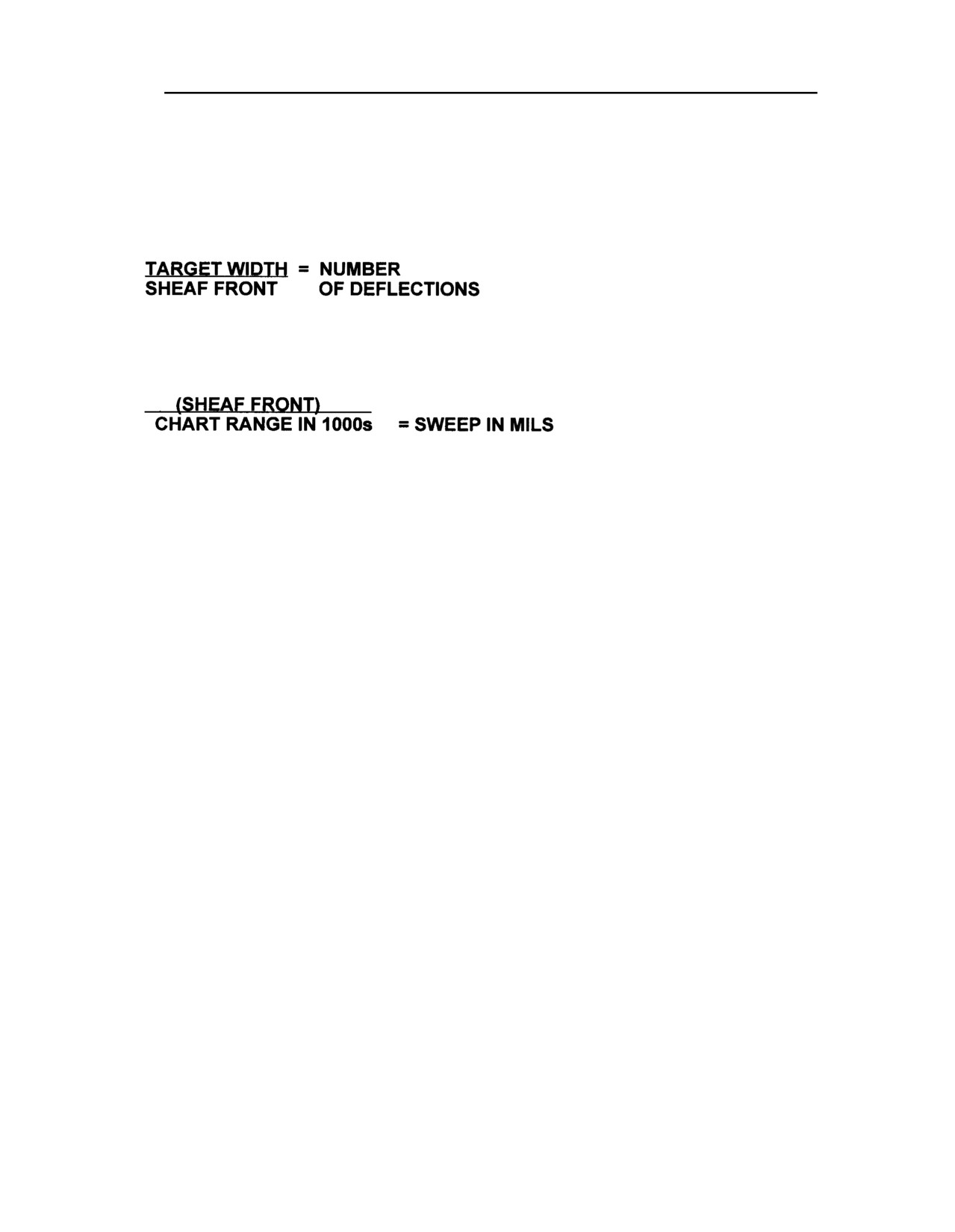
(b) Determination of the number of deflections to fire. To determine the
number of deflections to fire, divide the target width by the sheaf front. If the result is an even
number, the result must be expressed UP to the next higher odd number. Because fire commands
will be sent to the guns with the center data and special instructions addressing the size and
number of shifts, a center sheaf and equal number of sheafs on either side require that an odd
number of deflections be fired.
(4) The number of mils by which the guns must change the center deflection in
order to fire the sheafs is the deflection shift. The deflection shift is computed as the sheaf front
divided by chart range in thousands.
(5) Fire commands are sent as with any area fire mission. The time, deflection and
quadrant to the center are announced. The special instruction SWEEP, (the value of the
deflection shift) MILS, (the number of deflections) DEFLECTIONS is announced. The
number of rounds announced in the method of fire for effect is the number of rounds to be fired
at each deflection.
c. Computation of Zone.
(1) Zone fires are used to cover a deep target with fire. (Deep target is described as
a target whose long axis lies parallel or nearly parallel to the GT line.) Zone fire is similar to
searching fire applied with direct fire weapons. The purpose of the zone is to cause the guns to
fire a number of quadrants (at the same deflection) to place a number of sheafs “stacked” over the
target.
(2) Chart data are computed as with any area target.
(3) The number of quadrants to fire is determined by dividing the depth of the
target by the sheaf depth.
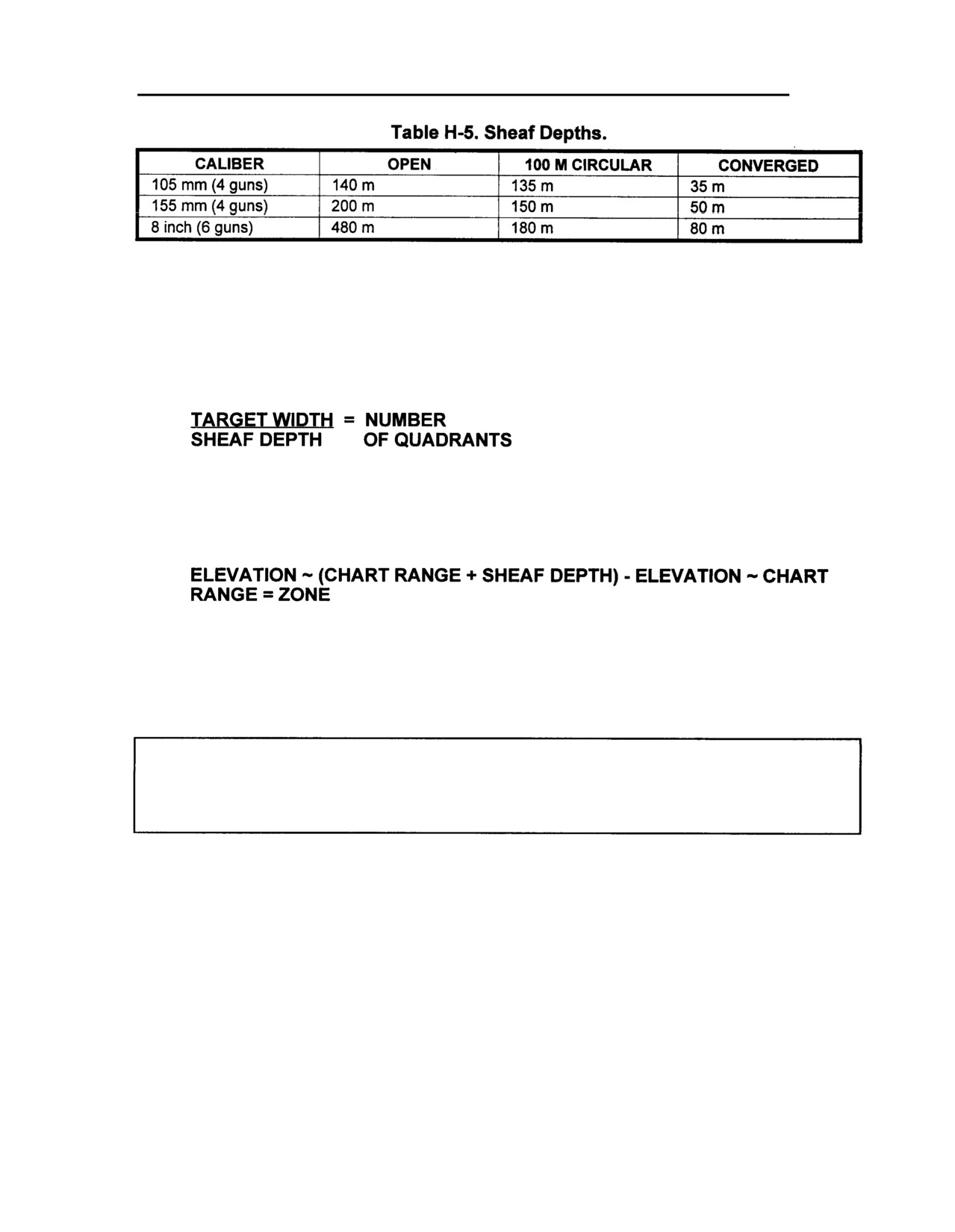
(a) Determination of sheaf depth. The sheaf depth is the distance between the
center of the foremost and rearmost burst. The size of the sheaf depth depends on the type of
sheaf fired and the burst width of the projectile. For an open sheaf, the sheaf depth is computed
as the burst width for the projectile. The sheaf depth for a circular sheaf is the distance across the
center of the circle from burst to burst plus one burst width. If special corrections or TGPCs are
being used, the size of the sheaf depth will correspond with the sheaf depth used to determine
those corrections. Converged sheaf should not be used as the concentration of fire on a single
point. This is contrary to the purpose of zone fire. The depth for a converged sheaf is one burst
width. (See Table H-5.)
H-10
FM 6-40
(b) Determination of the number of quadrants to fire. To determine the
number of quadrants to fire, divide the target depth by the sheaf depth. If the result is an even
number, the result must be expressed UP to the next higher odd number. (Because fire
commands will be sent to the guns with the center data and special instructions addressing the
size and number of shifts, a center sheaf and equal number of sheafs on either side require that an
odd number of quadrants be fired.)
(4) The number of mils by which the guns must change the center quadrant to fire
the sheafs is the quadrant shift. The quadrant shift is computed by comparing the elevation
corresponding to the range to the center of the target to the elevation corresponding to the center
range plus the sheaf depth. The difference is the quadrant shift.
(5) Fire commands are sent as with any area fire mission is announced. The time,
deflection, and quadrant to the center are announced. The special instruction ZONE, (the value
of the quadrant shift) MILS, (the number of quadrants) QUADRANTS is announced. The
number of rounds announced in the method of fire for fire for effect is the number of rounds to be
fired at each quadrant.
NOTE: Zone fires are less effective when fired with HE/ti. Since an FS correction
is not applied, the chance of graze or high airburst increases as the zone moves
from the center. VT is the preferred airburst fuze for shell HE.
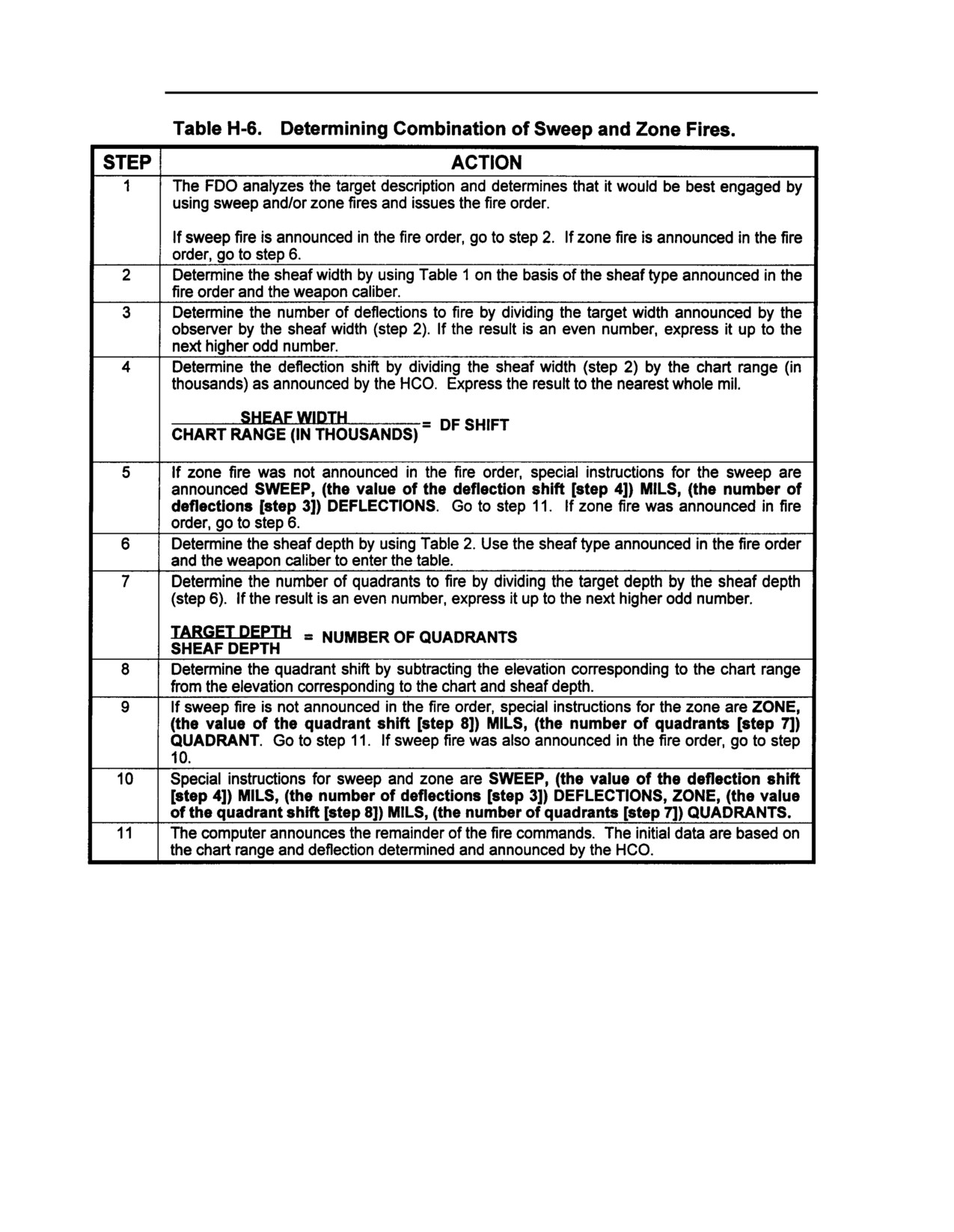
d. Sweep and Zone Fires Combined. Sweep and zone fires are used to attack targets
that are both wider and deeper than the sheaf covers. The procedures used are the same as when
firing sweep or zone fires individually. The special instructions announced in the fire commands
are SWEEP, (the value of the deflection shift) MILS, (the number of deflections)
DEFLECTIONS, ZONE, (the value of the quadrant shift) MILS, (the number of
quadrants) QUADRANTS. (See Table H-6 on page H-12.)
H-11
FM 6-40
H-12
FM 6-40
H-8. Zone-To-Zone Transformation
a. Zone-to-zone transformation is the technique of converting the coordinates and/or
azimuths as expressed in one grid zone to coordinates and/or azimuths of an adjacent grid zone.
When operating near a grid zone boundary, one of the grid zones will be designated as the
primary, or base, grid zone. The other will be referred to as a secondary, or adjacent, grid zone.
The decision as to which zone will be primary zone is based on the tactical situation, unit SOP,
the directives of the commander, or anticipated location of future operations.
b. Maps printed by the Army Map Service show the differences between universal
transverse mercator (UTM) grid zones. Maps that cover an area within 40 kilometers of a UTM
zone junction are printed along the border with two sets of grid line numbers (one set for each
zone). One set is printed in black. The other set is printed in blue and corresponds to the
adjacent grid zone. Marginal information on the maps also indicates the color that applies to each
zone.
c. There are two methods of performing zone-to-zone transformation--the two grid
sheets method and the graphic method. The two grid sheets method is considered the fastest and
simplest.
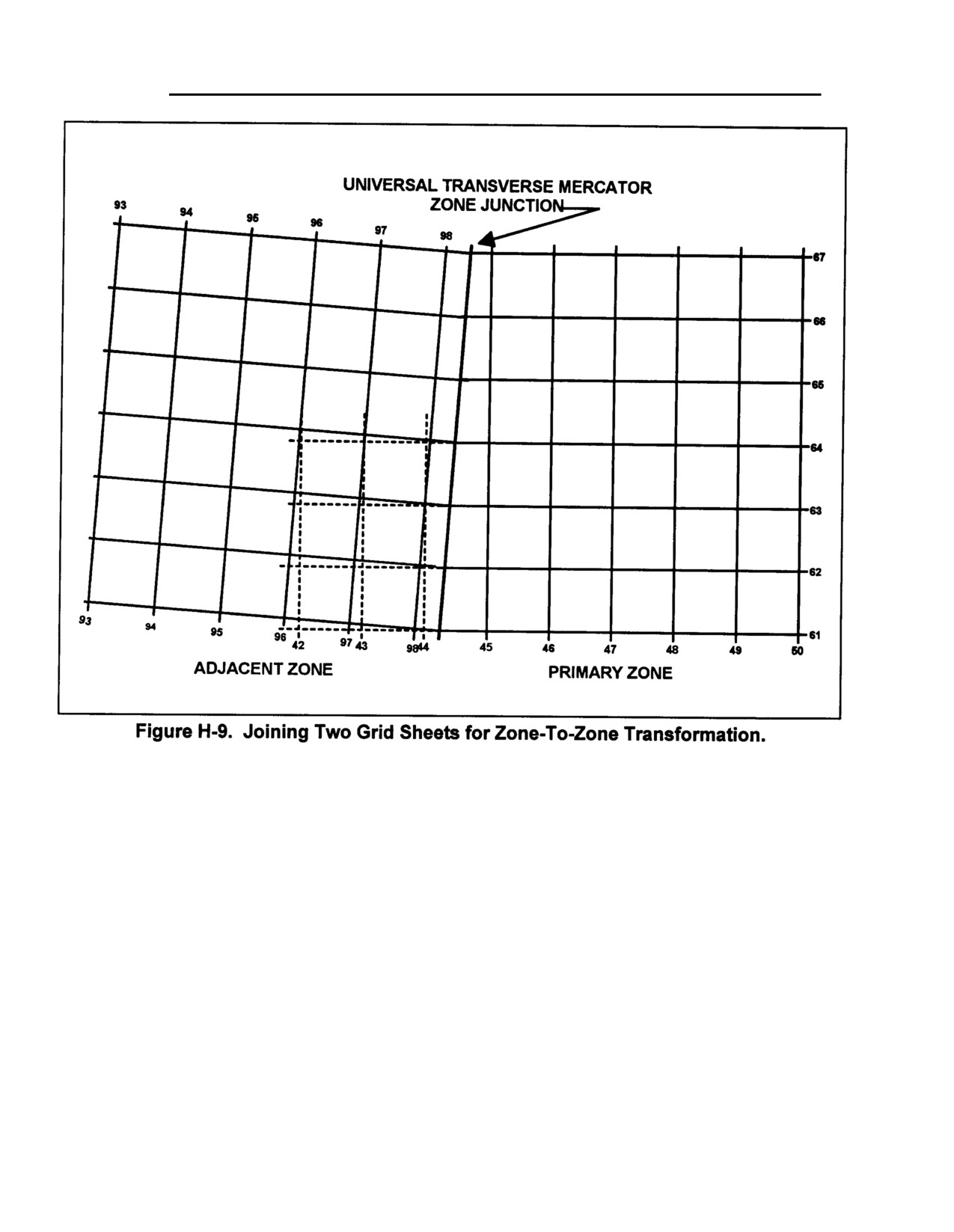
(1) Two grid sheets method. For this technique, two grid sheets are prepared and
joined to form a large chart (a constructed grid sheet) from which chart data across the zone
junction can be determined automatically. (See Figure H-9 on page H-14.)
(a) Preparing the grid sheets. The HCO prepares a piece of chart paper (a
grid sheet) for each zone involved. Using a plotting scale and a sharp pencil, the HCO
reproduces on the grid sheets the exact orientation of the zone junction longitudinal and
latitudinal lines as they appear on the map of the area of overlap. The HCO marks the edges to
be joined with a fine line that is based on accurate measurements taken from the map. He takes
care in cutting and taping so that, when the sheets are put together to form one large chart,
measurements from the large chart can be made accurately.
(b) Using the constructed grid sheet. No transformation or computation is
needed when firing data are determined from a constructed grid sheet. The coordinates are
measured and plotted from the grid lines for the respective area. The observer’s azimuth is used
as announced, and the target grid is emplaced by using grid north of the observer’s zone.
H-13
FM 6-40
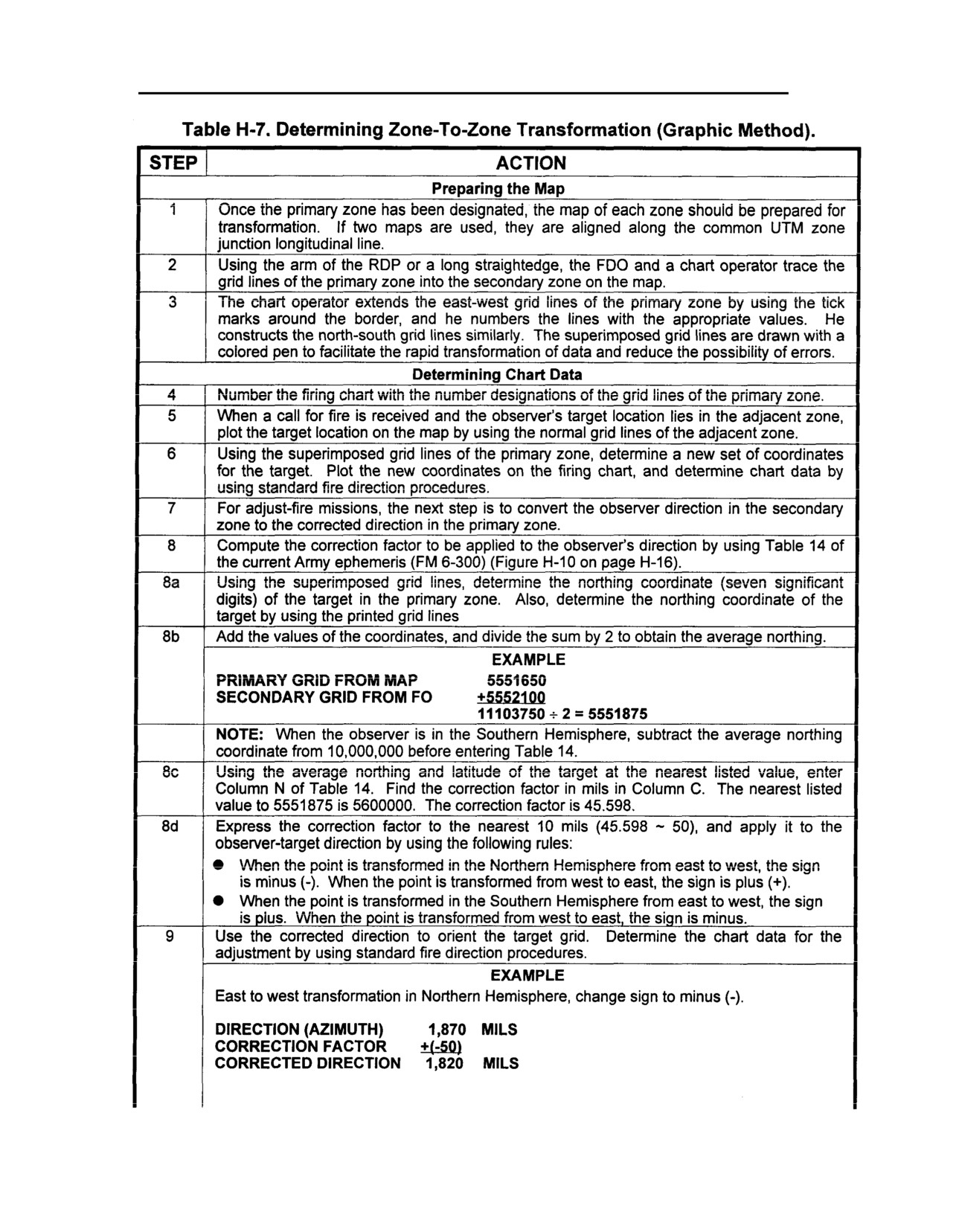
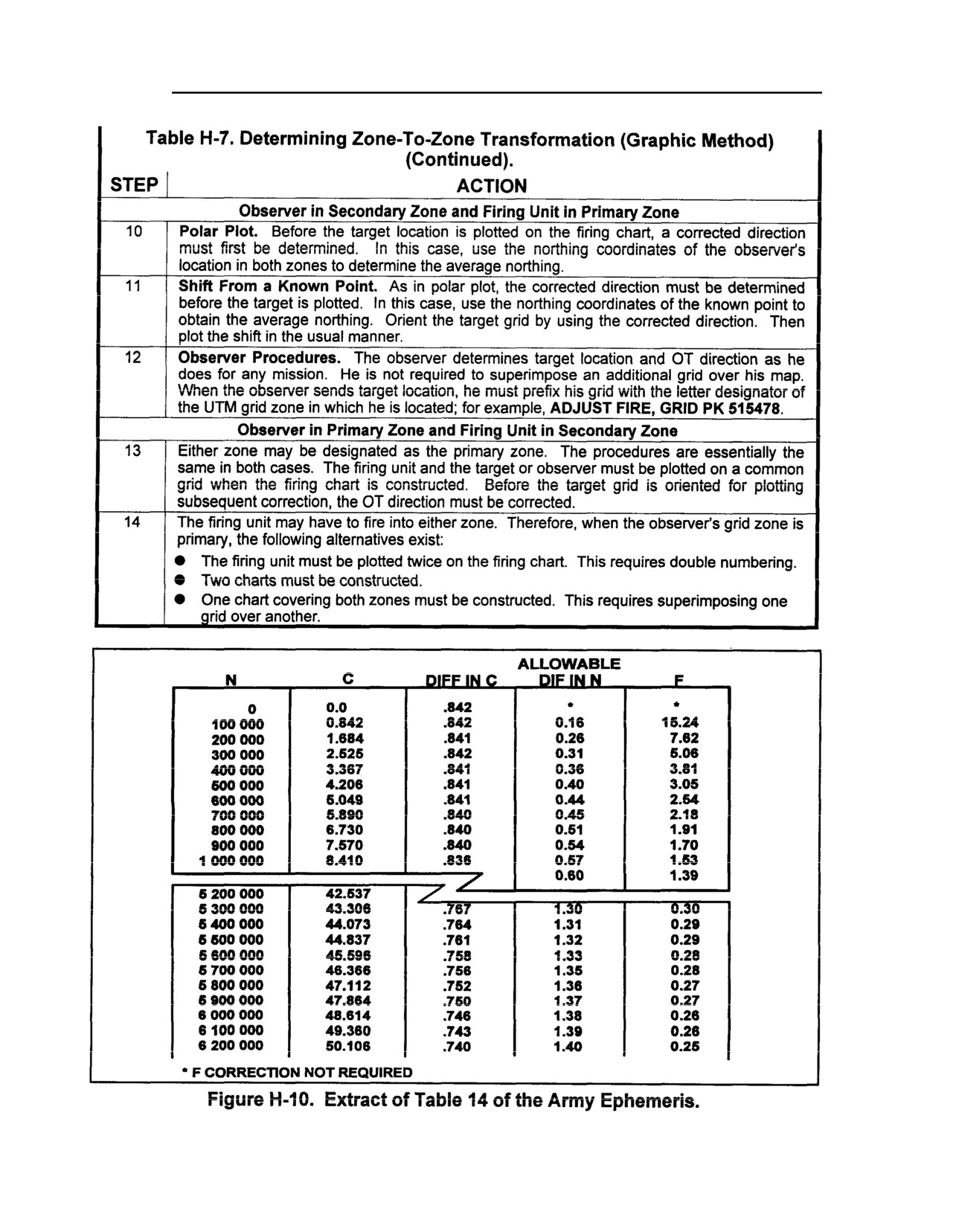
(2) Graphic method (battery in primary zone). The procedures for this method are
discussed in Table H-7.
H-14
FM 6-40
H-15
FM 6-40
H-16
FM 6-40
H-9. Aerial Observers
a. Problems Requiring FDC Assistance. Aerial observers may encounter three
problems that require special assistance from the fire direction center:
(1) The AO has no fixed direction to the target. Normally, he is moving in relation
to the target area. Hence, FDC personnel must be prepared for unusual and changing observer
directions or spotting lines. Each adjustment may have a different observer direction (that is,
different magnetic or cardinal direction).
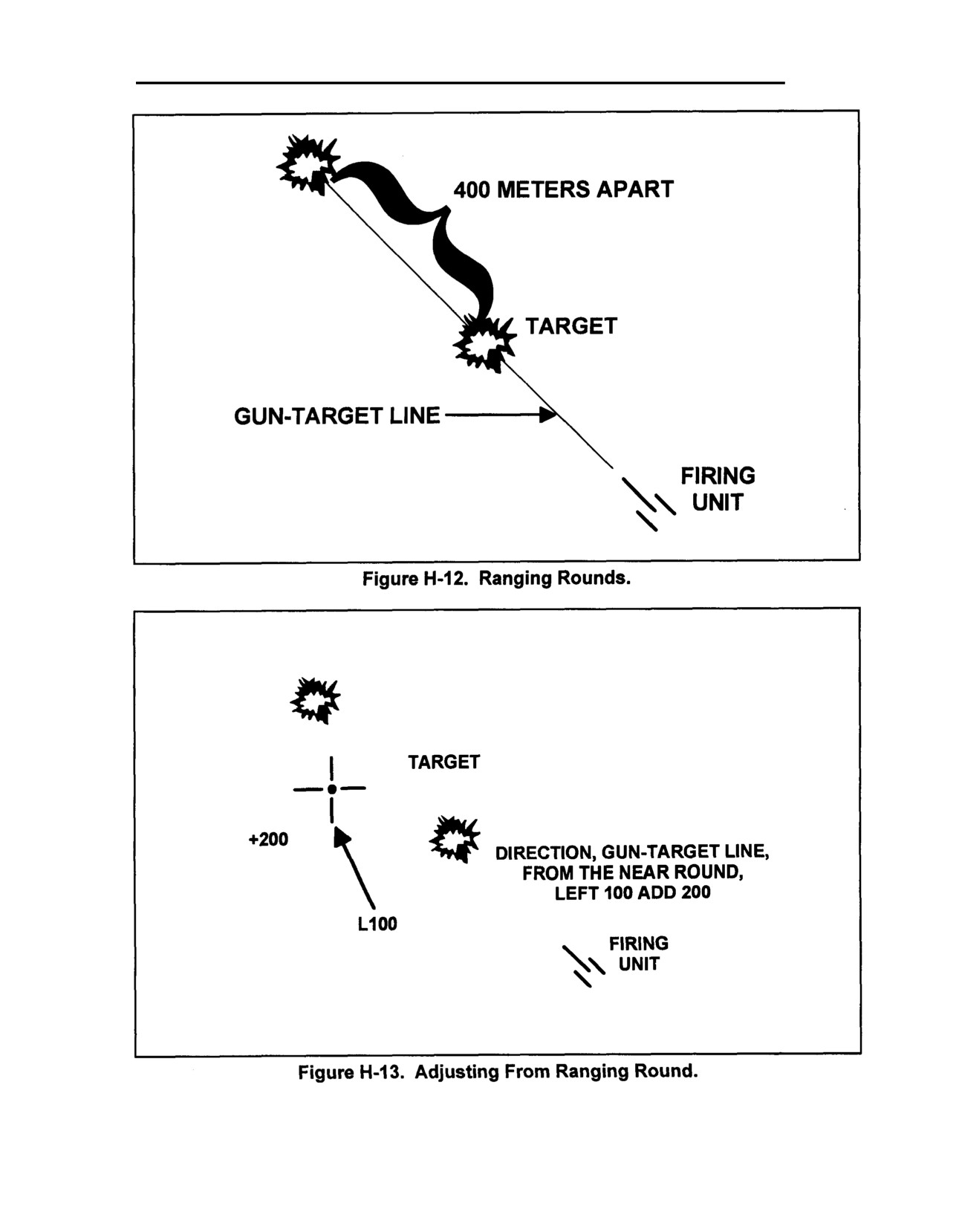
(2) While in the air, the AO may lose his perception of distance and direction. He
may request ranging rounds (two rounds impacting 400 meters apart) to help visualize distance
and direction in the target area. The observer and FDC personnel must realize that ranging
rounds fired along the GT line may disclose to the enemy the general location of the firing unit.
(3) The AO must minimize the time he is exposed to enemy detection. In forward
areas, the pilot must fly close to the earth and behind cover as much as possible. Therefore, the
AO and his pilot require from the FDC very accurate time of flight, SHOT, and SPLASH so that
the pilot can unmask the aircraft 2 to 3 seconds before the round impacts.
b. Observer Direction and/or Spotting Line.
(1) Using GT line adjustment. If the AO knows the location of the firing unit
with respect to the target, he may choose to adjust along the GT line. When the AO announces
DIRECTION, GUN-TARGET LINE, the HCO plots the target and centers the target grid over
the plot with the 0-3200 line (the center arrow) parallel to the GT line.
(2) Using a shift from a known point along the GT line. The AO may announce
DIRECTION, GUN-TARGET LINE for a shift from a known point. In this instance, the HCO
plots the known point, centers the target grid, and orients it parallel to the gun-target line. He
then plots the observer’s shift and determines chart data. He then rotates the target grid around
the new pinhole so that the arrow is parallel to the GT line.
(3) Using helicopter instrument readings for direction. When the AO’s aircraft
is moving in relation to the target area, the AO may use an aircraft instrument reading for his
observer direction. As this direction is expressed in degrees, FDC personnel must convert the
reading to mils by using the following formula:
DIRECTION IN DEGREES X 17.8 = DIRECTION IN MILS
For example, if the direction is 250°, the direction in mils is 4,450 (250° x 17.8 mils= 4,450 mils).
NOTE: In preparing for AO missions, the VCO (recorder) should mark a target grid
in degrees or prepare a conversion chart for quick conversion from degrees to mils.
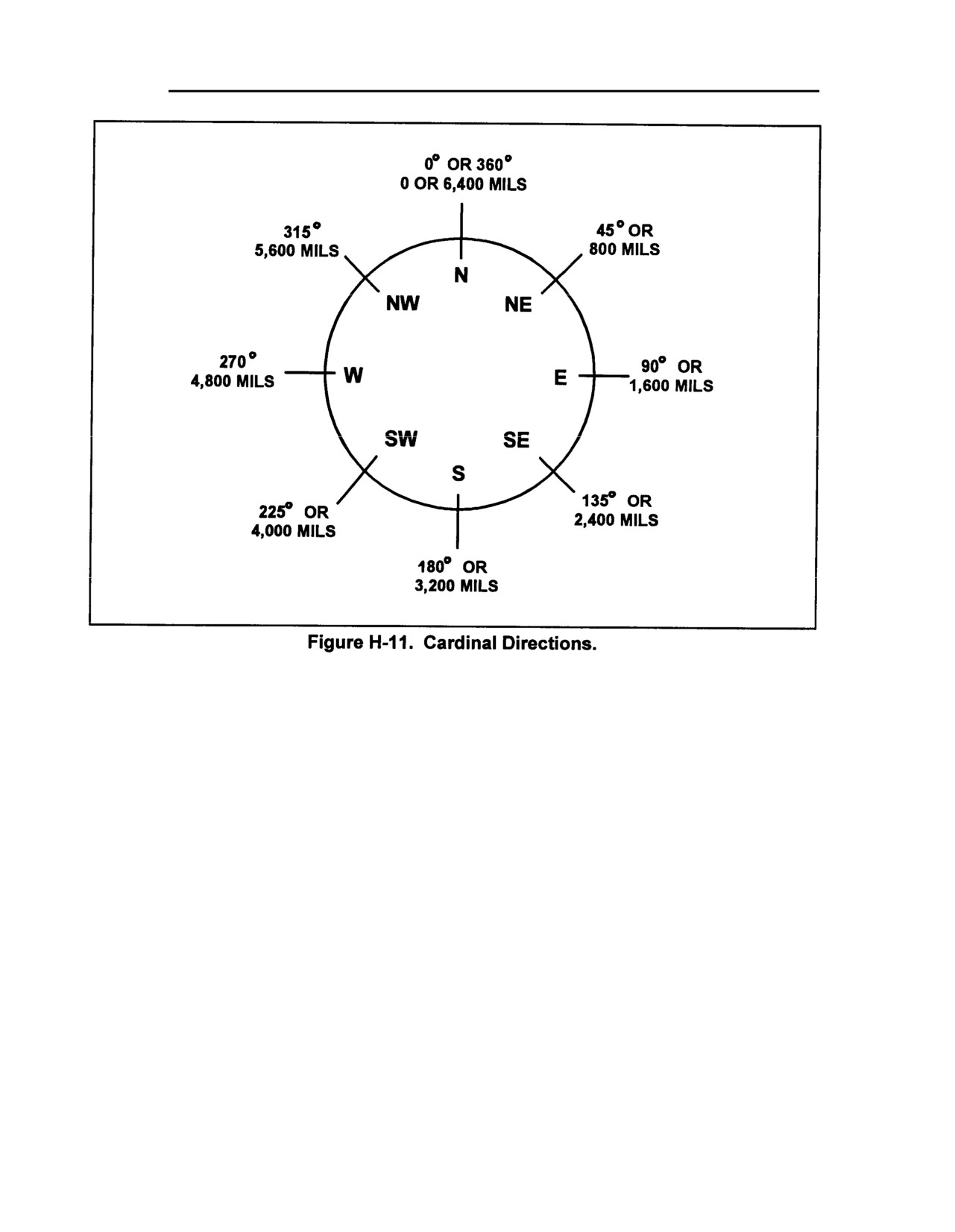
(4) Using a cardinal direction. The AO may choose to adjust along a cardinal
direction (one of the eight principal points of the compass) (Figure H-11, page H-18). When the
observer announces a cardinal direction, the HCO converts the direction to mils and orients the
target grid to that direction. For example, FDC personnel would convert direction southwest
(SW) to direction 4,000 mils. The observer may also shift from a known point by using a
cardinal direction. The preferred method for sending direction to the FDC is to send it in degrees
if possible.
H-17
FM 6-40
(5) Using a spotting line. The AO may adjust along a spotting line formed by natural
or man-made terrain features, such as roads, railroads, canals, or ridge lines. Before flight, if possible,
the AO selects the line, determines the direction, and notifies the fire direction center. While in flight,
he may select a line that is more readily identifiable and convenient. The AO may describe the feature
in detail and have FDC personnel use a protractor to determine the direction from a map. The HCO
orients the target grid over the target location on this new direction.
H-10. Ranging Rounds
In his call for fire, the AO may announce REQUEST RANGING ROUNDS. This
indicates that he wants to see a volley of two rounds that impact 400 meters apart at relatively the
same time. Ranging rounds (Figure H-12) are fired only as a last resort, since they reveal the
general location of the firing position. These rounds are fired along the GT line. The HCO
determines initial chart data, and the computer determines initial firing data for the adjusting
piece. The computer then adds 400 meters to the announced chart range. Using the new range
and the initial chart deflection, the computer determines firing data for the second piece to fire in
the volley (usually the other piece in the center platoon). Ranging rounds are fired at the same
time by firing AT MY COMMAND. The AO observes the impact of the round and determines
the corrections necessary to hit the target. He bases his corrections on the round that lands
nearest the target. He bases his corrections on the round that lands nearest the target. He must
specify to the FDC from which round he is adjusting, and the HCO plots the shift accordingly
(Figure H-13).
H-18
FM 6-40
H-19
FM 6-40
H-11. Time of Flight, Shot, and Splash
In the message to observer, the FDC must specify the time of flight. On all volleys, the
FDC must promptly announce SHOT and SPLASH. The FDC should report changes in the time
of flight as the mission progresses.
H-12. Untrained Observers
a. Calls for fire from untrained personnel acting as ground observers require close
attention and initiative from every member of the fire direction center. The FDC personnel must
be prepared to assist the untrained observer in his call for fire and adjustment of artillery.
b. FDC personnel must take the initiative if the observer is hesitant or confused in his
request for fire support. They must ask leading questions, such as the following:
(1) Where is the target?
(a) What are the grid coordinates of the target?
(b) Where is the target in relation to a readily identifiable natural or man-made
feature?
(c) Where are you? How far is the target from you and in what direction is it?
(2) What is the target?
(a) Is the target personnel, vehicles, installations, or equipment?
(b) What is the size of the enemy force?
(c) What is the enemy force doing at present?
(d) If the enemy force is moving, in what direction is it moving? How fast is
the force moving?
(3) How close is the target to you? If the target is within 600 meters or closer to
other friendly troops, the observer may need to “creep” the rounds to the target.
(4) What is your direction to the target?
(a) What is the azimuth to the target in degrees or mils?
(b) What is the cardinal direction to the target (N, NE, E, SE, S, SW, W,
NW)?
(c) Is the direction along a natural or man-made feature?
(5) What effect do you need on target?
(a) Is the target shooting at you?
(b) Is it necessary to obscure vision of the target?
(c) Do we need to neutralize or destroy the target?
c. The FDC personnel must explain to the observer what artillery fire he is getting. If
necessary, the FDC members must educate or inform the observer as follows:
H-20
FM 6-40
(1) You will see one round that will look like a cloud of dust. You will get more
rounds when you move the burst within 50 meters of the target.
(2) The round is now on the way and will impact in (so many) seconds.
d. The FDC personnel must help the observer in making corrections. They must help
the observer move the rounds to the target and must be prepared for unusual shifts. To obtain
corrections, they should ask leading questions such as the following:
(1) Where did the round land in relation to the target?
(a) Did it land left or right? How far?
(b) Did it land over or short? How far? Ask for distances in meters or in the
number of football field lengths.
(2) Did the round land closer than the previous round?
NOTE: The FDO should consider using shell WP to help the observer locate initial
rounds.
e. The FDC personnel must use sound judgment. They must decide whether to require
the observer to authenticate. They must watch for possible observer misorientation. Also, FDC
personnel must help the observer determine when satisfactory effects on the target have been
achieved. In all cases, the FDC personnel must take the initiative.
H-13. Example Problems
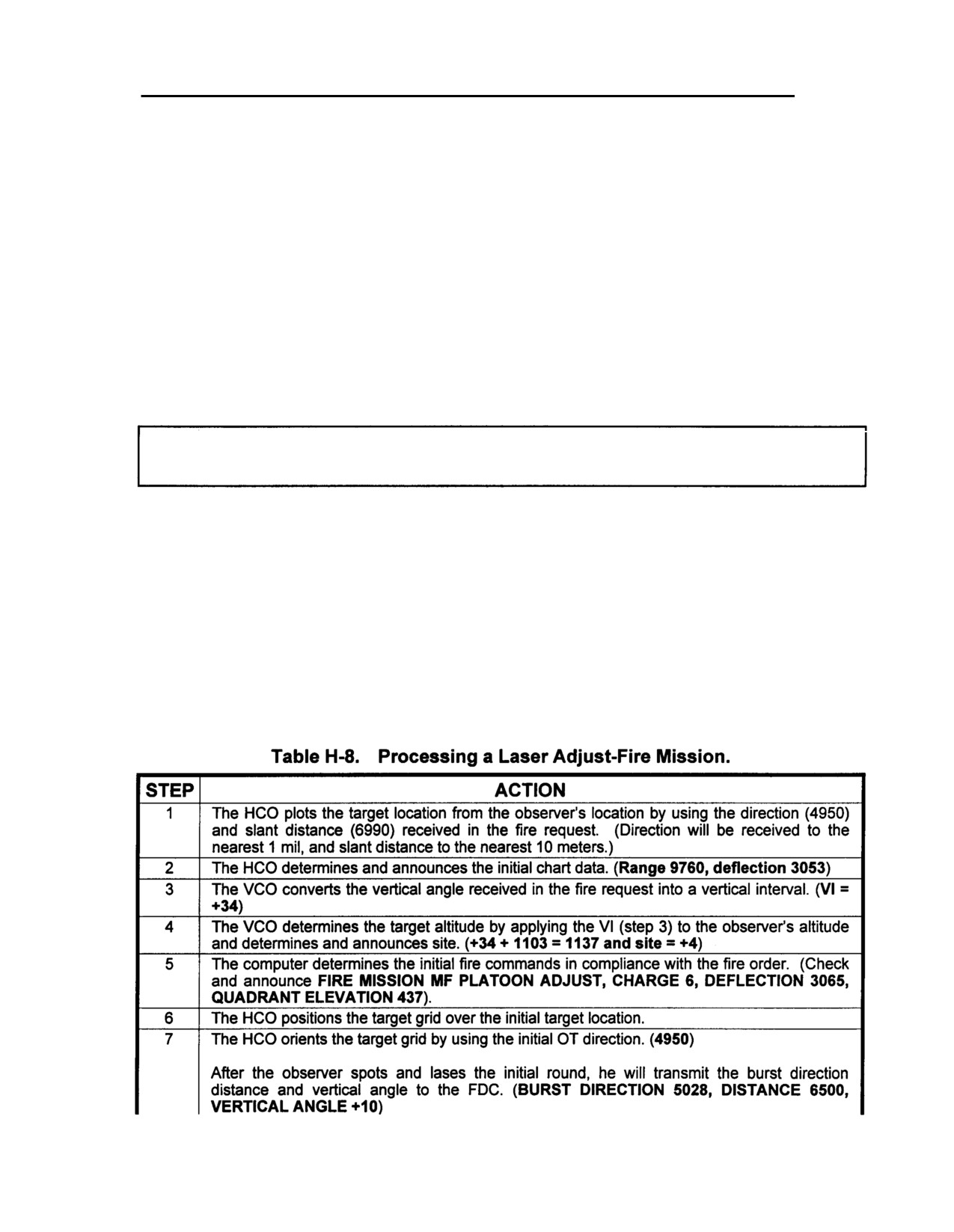
a. Process a Laser Adjust-Fire Mission.The observer transmits the following call for fire:
H57 THIS IS C19, AF POLAR, OVER.
DIRECTION 4950, DISTANCE 6990, VA PLUS 5, OVER.
BMP WITH DISMOUNTED INFANTRY, ICM IN EFFECT, OVER.
The procedures for processing a laser adjust-fire mission are discussed in Table H-8.
H-21
FM 6-40/MCWP 3-1.6.19
GLOSSARY
air a spotting or observation by an observer or spotter
A
indicating that a burst or group of bursts occurred
before impact.
A as acquired (attack guidance matrix)
airburst (1) An explosion of a bomb or projectile above the
AA artillery airburst (Firefinder mission type)
surface as distinguished from an explosion on impact
or after penetration of the surface. (2) A nuclear
AC aiming circle
detonation in the air at a height of burst greater than
the maximum radius of the fireball.
AD artillery datum plane (Firefinder mission type)
alt altitude
ADA air defense artillery
AMC at my command
ADAM area denial artillery munitions
ammo ammuniton
add a correction used by an observer or spotter to indicate
that an increase in range along the observer-target
ammunition lot number the code number that identifies a
line is desired.
particular quantity of ammunition from one
manufacturer. The number is assigned to each lot
adj adjust
when it is manufactured.
adjust fire command that specifies all howitzer sections to
SI angle of site
follow the adjusting phase of a fire mission.
angle of departure the vertical angle between the tangent to
adjusted deflection a deflection based on firing and
the trajectory at the origin and the horizontal or base
computed to place the center of impact of a round on
of the trajectory.
target. This deflection can differ from chart deflection
because of nonstandard conditions.
angle of elevation the smaller angle at the origin in a vertical
plane from the line of site to the line of elevation.
adjusted elevation an elevation based on firing and
computed to place the center of impact of a round on
angle of fall the vertical angle at the level point between the
target. This elevation can differ from TFT elevation
line of fall and the base of the trajectory.
because of nonstandard condtions.
angle of site the vertical angle between the level base of the
adjust fire (1) An order or request to initiate an adjustment.
trajectory anchor horizontal and the line of site.
(2) A method of control transmitted in the call for fire
by the observer or spotter that indicates he will control
angle T the interior angle formed at the target by the
the adjustment of the rounds to the target.
intersection of the observer-target and the gun-target
lines.
adjustment (1) A process used in artillery and naval gunfire
to obtain correct direction, range, and height of burst
ANGLICO air and naval gunfire liaison company
(if time fuzes are used) in engaging a target with
observed fire. (2) The actual subsequent correction
AO aerial observer
sent by the forward observer or spotter that is
AOL azimuth of lay
expressed in a LEFT/RIGHT, ADD/DROP, or
UP/DOWN format in relation to the actual impact
APERS antipersonnel
versus the desired impact of a round versus the target.
APICM antipersonnel improved conventional munitions
admin administrative
approx approximate
AF adjust fire
arg argument
AFDO-AXO assistant fire direction ofiicer-assistant executive
officer
ARTEP Army training and evaluation program
AI artillery impact prediction (Firefinder mission type)
ATACMS Army tactical missile system
aimpoint (1) A point or points on the ground in relation to the
AT MY COMMAND (1) Restrictive command used to control
target that firing data for munitions are calculated for
time of delivery of fire that prohibits the battery or
in order to achieve the desired effects on target. (2) A
battalion from firing until directed to do so by the fire
point on the ground where employment of nuclear
direction center. (2) Restrictive method of control
weapon(s) achieves the desired target effects without
used by the observer that prohibits the battery or
violating the commander’s guidance. (3) A point on
battalion from firing until directed to do so by the
the ground where FASCAM projectiles are delivered.
observer.
aimpt aimpoint
avg average
Glossary-1
FM 6-40/MCWP
3-1.6.19
axis of tube an imaginary straight line through the center of
BPAMC by piece at my command
the bore at the breech end and the center of the bore
BPBRAMC by piece, by round, at my command
at the muzzle end.
bracketing a method of adjusting fire in which a bracket is
AZIMUTH a command announced to alert the sections to a
established by obtaining an OVER and a SHORT
large shift in the direction of fire.
along the spotting line and then successively splitting
this bracket until a target HIT or desired bracket is
obtained.
BRAMC by round at my command
B
breechblock a movable steel block that doses the breech of
B behind (DA Form 4757)
a cannon.
ballistic density the computed constant air density that
breach ring the breechblock housing that is screwed or
would have the same total effect on a projectile during
shrunk onto the rear of a cannon tube in which the
its flight as the varying densities actually encountered.
breechblock engages.
ballistics the science or art that deals with the motion,
btry battery
behavior, appearance, or modification of missiles or
other vehicles acted upon by propellants, wind,
burster an explosive charge used to break open and spread
gravity, temperature, or any other modifying
the contents of chemical projectiles, bombs, or mines.
substance, condition, or force.
BUCS backup computer system
barrel a metal tube through which ammunition is fired, which
controls the initial direction of the projectile.
base of trajectory a line extending from the muzzle of the
C
tube that intersects the trajectory at the same altitude
C3 command, control, and communications
as the muzzle.
CA Canada
BATTERY (PLATOON) ADJUST a fire command given to
alert all elements of a fire unit to follow the mission to
caliber (1) The inside diameter of the tube as measured
participate in the FFE phase of an adjust-fire mission.
between opposite lands. A .45 caliber pistol has a
barrel with a diameter of 45/100 of an inch. (2) The
battery center a point materialized on the ground at the
diamater of a projectile. (3) An expression of the
approximate geometric center of the battery position;
length of the tube obtained by dividing the length from
the chart location of the battery.
the breach face to the muzzle by the inside diameter
BATTERY (PLATOON or TROOP) LEFT (RIGHT) a
of its bore. A gun tube with a bore 40 feet long (480
method of fire in which weapons are discharged from
inches) and 12 inches in diameter is 40 calibers long.
the flank designated in a 5-second interval.
calibration measuring the muzzle velocity of a weapon and
BATTERY (BATTALION or PLATOON) 1 (or more)
then performing a comparison between the muzzle
velocity achieved by a given piece and accepted
ROUND(S) a fire order command indicating an FFE
mission and directing all pieces to fire the designated
standard performance.
number of rounds at the data announced in the initial
call for fire a request for fire containing data necessary for
fire command.
obtaining the required fire on a target.
BB base bum
cancel when coupled with an order other than quantity or
BCS battery computer system
type of ammunition, rescinds that order.
cannon a complete assembly consisting of an artillery tube, a
BE base ejection (fuze), Belgium
breech mechanism, a firing mechanism, and a
beehive (ammunition) a type of antipersonnel ammunition
sighting system mounted on a carriage.
designed for use in defending a position against
massed personnel attack.
cannoneer a member of an artillery gun or howitzer crew
whose primary duty is servicing the piece.
BMA battery-minefield angle
CANNOT OBSERVE a method of control in the call for fire
boattail the conical section of a ballistic body that
from the observer in which the observer or spotter
progressively decreases in diameter toward the tail to
believes a target exists at the given location that is
reduce overall aerodynamic drag through increasing
important enough to engage; however, the observer
its ballistic coefficient.
is unable to adjust fire onto the target because of
obscuration, mask, and soon.
BOC battery operations center
CAS complementary angle of site
bourrelet the widest part of the projectile located immediately
to the rear of the ogive.
CD compact disk
BP base piece
CDNL cancel do not load
Glossary-2
FM 6-40/MCWP 3-1.6.19
centrifugal force the force acting on a rotating body that
CONTINUOUS FIRE a command causing the howitzer crew
forces its parts outward and away from the center of
to continue firing as rapidly as possible, consistent
rotation.
with accuracy and the prescribed rate of fire for the
weapon, until the commands CHECK FIRING,
CEOI communications-electronics operation instructions
CEASE LOADING, or END OF MISSION are given.
CF command/fire direction (redo net)
continuous illumination (1) A method of fire in which
illumination rounds are fired at specific time intervals
CFF call for fire
to provide uninterrupted lighting of the target. (2) A
request from the observer in the call for fire for
chap chapter
continuous illumination.
charge the propellant of semifixed and separate-loading
CONVERGED (1) A request from the observer for all rounds
ammunition.
to impact at the center of the target. (2) A command in
charge group the charges within the propellant type
the fire order specifying a special sheaf in which all
associated with a projectile family, within which MVVs
planes of fire intersect at the same point on the
can be transferred.
ground (see converged sheaf).
check firing a command used to cause a temporary halt in
converged sheaf a special sheaf in which each piece fires a
firing.
unique time, deflection, and quadrant elevation to
cause the rounds to impact at the same point on the
chemical agent a chemical compound which produces
ground.
incapacitating, lethal, or damaging affects on man,
animals, plants, or materials.
cook off the functioning of a chambered round initiated by the
heat of the weapon.
chg charge
coordinated fire line a line beyond which conventional fire
cld cloud
support means (FA, mortars, naval gunfire) may fire
at any time without additional coordination within the
CLGP cannon-launched guided projectile
zone of the establishing headquarters. A CFL is
designated to expedite fires across boundaries and
COB center of battery
speed fire support reaction to targets in those areas.
col column
coordinated illumination (1) The firing of illumination rounds
to illuminate a target only at the time required for
cold stick firing data computed from a graphical firing table
with no GFT setting applied.
spiting and adjusting HE fires. (2) A request from the
observer in the call for fire for continuous illumination.
COLT combat observation/lasing team
coppering metal fouling left in the bore of a weapon by the
comp comparative, complementary
rotating band or jacket of a projectile.
complementary angle of site the correction to compensate
Coriolis effect the change in range or azimuth caused by the
for the error made in assuming rigidity of trajectory.
rotational effects of the earth.
complementary range range confections corresponding to
corr correction
the complementary angle of site. These corrections
are tabulated in the TFT and are a function of chart
correcton (1) Any change in firing data to bring the mean
range and height above or below the gun.
point of impact of a round closer to the target. (2) A
communications proword announcing that an error in
complete round a term applied to an assemblage of
data has been announced and that corrected data will
components designed to perform a specific function
follow.
at the time and conditions desired to complete the
cos cosine
firing chain. Examples of these rounds are separate
loading, consisting of a primer, a propelling charge, a
COS center of sector
projectile, and a fuze; and fixed or semifixed,
consisting of a primer, a propelling charge, a cartridge
cot cotangent
case, a projectile, and a fuze.
COT center of target
computer (1) A mechanical or electromechanical device for
solving mathematical problems associated with the
CP concrete-piercing (fuze)
development of the gunnery solution (for example,
BCS). (2) A fire direction center operator who
Cphd Copperhead
operates an FDC computer or manually computes
crest a terrain feature of such altitude that it restricts
data for laying and firing artiliery.
observation of an area or fires into an area on either
concurrent met a concurrent mat is solved to separate the
the ascending or descending branch of the trajectory,
total corrections determined from a registration into
resulting in dead space or limitation to the minimum
two parts: met corrections and position constants.
elevation, or both.
Glossary-3
FM 6-40/MCWP 3-1.6.19
CRESTED a report indicating engagement, or observation, of
dispersion rectangle a table that shows the probable
a target is not possible because of an obstacle or
distribution of a series of shots fired with the same
intervening crest.
firing data. This table is a rectangle made into 64
zones. The table shows the percentage of shots
CS chlorobenzaimalononitrile (riot control agent)
expected to fall within each zone.
CSF complementary site factor
displ displacement
CSR controlled supply rate
div arty division artillery
CTGPC cancel terrain gun position correction
DNL do not load
DOWN (1) A term used in a call for fire to indicate that the
D
target is at a lower altitude than the observation post
or reference point used in locating the target. (2) A
D decrease, down (ROF), destroy (attack guidance matrix)
correction used by the observer to indicate a
decrease in the height of burst of a round is needed.
DA Denmark
DPICM dual-purpose improved conventional munitions
dec decrease
drag the resistance of the atmosphere to a projectile moving
defection (1) The setting on the scale of a weapon sight to
through it. It is directly proportional to the diameter
place the line of fire in the desired direction. (2) The
and velocity of the projectile and air density.
horizontal clockwise angle between the axis of the
tube and the line of sight.
drift the lateral deviation of the trajectory from the plane of
departure as caused by the rotation of the earth. As a
deflection index a fine line constructed on a firing chart and
result, the horizontal projection of trajectory is a
used to measure deflection with the range-deflection
curved, rather than a straight line. The deviation is
protractor.
always to the right with a projectile having a
right-hand spin.
deflection limits the right and left traverse limits that establish
the lateral limits of a designated impact area.
DROP a correction used by an observer to indicate that a
decrease in range along the observer-target line is
deflection probable error the directional error caused by
needed.
dispersion that will be exceeded as often as not by an
infinite number of rounds fired at the same deflection.
droop the algebraic sum of barrel curvature, untrueness of
This value is given in the TFT.
the breech quadrant seats, and untrueness in
assembling the tube to the breach.
delay action the predetermined delayed explosion of
ammunition after the activation of the fuze.
DS direct support
description of target an element in the call for fire in which
DTG date-time group
the observer describes the personnel, equipment,
activity, or installation to be taken under fire.
E
destruction fire (1) An element of the method of
engagement potion of the call for fire requesting
E east, easting
destruction fire. (2) Fire delivered for the sole purpse
of destroying materiel.
ed edition
deviation (1) The distance by which the burst misses the
EFC equivalent full charge
target. (2) The angular difference between the
magnetic and compass headings.
EGL elevatiom gauge line
df deflection
elevate to raise the muzzle or warhead end of the weapon.
DHD did hit data
elevation the vertical angle between horizontal and the axis
of the bore or rail of the weapon required for a
did hit data are data fired under nonstandard conditions that
projectile to reach a prescribed range.
will cause the round to impact at a point of known
location.
emplacement (1) A prepared position for one or more
weapons or pieces of equipment for protection from
diff difference
hostile fire and from which they can execute their
tasks. (2) The act of fixing a gun in a prepared
direction a term used by the observer to indicate the bearing
position from which it may be fired.
of the observer-target line.
END OF MISSION an order given to terminate firing on a
dispersion pattern the dispersion of a series of rounds fired
specific target.
from one weapon or group of weapons under
conditions as nearly identical as possible. The points
engr engineer
of bursts or impacts are distributed around a point
called the mean point of impact.
EOL end of orienting line
Glossary-4
FM 6-40/MCWP 3-1.6.19
EOM end of mission
fire support coordination line a line beyond which all
targets may be attacked by any weapon systems
ERDPICM extended range dual-purpose improved
(including aircraft or special weapons) without
conventional munitions
additional coordination with the establishing
headquarters or endangering friendly troops.
erosion the wear in a howitzer tube which is the result of
firing rounds.
fire support team a group of FA observers with the required
equipment to plan, request, coordinate, and direct fire
ET electronic time (fuze)
support efforts for a company-sized maneuver force.
ETI elevation to impact
firing data all data necessary for firing an artillery piece eta
given objectve.
exterior ballistics the study of the phenomena associated
with the aerodynamic performance of missiles or
firing table a table or chart giving the data needed firing a
projectiles.
particular weapon and ammunition accurately on a
target under standard conditions. It also gives the
corrections needed to compensate for the existence
F
of nonstandard conditions or special conditions such
as variations in temperature.
F Fahrenheit, forward (DA Form 4757)
FIST fire support team
FA field artillery
fixed ammunition ammunition in which the cartridge case is
fac factor
permanently attached to the projectile.
FASCAM family of scatterable mines
FLOT forward line of own troops
FCI fire control information
FM field manual
FCT firepower control team
FO fire order
FDC fire direction center
FO forward observer
FDO fire direction officer
fork the change in the angle of elevation necessary to
FFE fire for effect
produce a change in range at the level point
equivalent to four probable errors in range.
final protective fire an immediately available, prearranged
barrier of fire designed to impede enemy movement
forward line of own troops a line that indicates the most
across defensive lines.
forward location of friendly maneuver forces. The line
is designated from left to right, facing the enemy.
fins aerodynamic surfaces that are attached to missiles or
projectiles and are designed to provide stability and
forward observer an observer who can observe targets or
control during flight (for example, Copperhead).
the burst of attillery shells.
FIRE the fire command given to discharge a weapon.
FP firing point
fire control all operations connected with the planning,
FPF final protective fire
preparation, and actual application of fire on a target.
fire direction (1) The tactical employment of firepower
FR France
exercising the tactical command of one or more units
in the selection of targets, the concentration and
free fire area an area into which any fire support means may
distribution of fire, and the allocation of ammunition for
deliver fires or aircraft can jettison munitions without
each mission. (2) The methods and techniques used
additional coordination with the establishing
to convert target information into the appropriate fire
headquarters. It can be used for an area where
commands.
neutralization of the enemy by fire support is preferred
over the use of maneuver forces.
fire direction center the element of a commend post
consisting of gunnery and/or communications
FS fuze setting
personnel and equipment which receives target
Intelligence and requests for fire and converts it into
FS fire support
appropriate fire direction and by which the
commander exercises fire direction or fire control.
FSCM fire support coordinating measure
FIRE FOR EFFECT (1) A command to indicate that fire for
FSO fire support officer
effect is desired. (2) Fire that is intended to achieve
the desired result on target.
FT firing tables
FIRE MISSION (1) An order used to sled the weapon or
fuze a device used in munitions to initiate detonation.
battery area that the message following is firing data.
(2) A specific assignment given to a fire unit as part of
fuze delay a fuze that has a delay element incorporated into
the fuze train.
a definite plan.
Glossary-5
FM 6-40/MCWP 3-1.6.19
fuze superquick a fuze that functions immediately upon
measured east to west from grid north. This is
impact of the projectile with the target.
sometimes called the gravitation grid variation.
fuze time (fuze mechanical time superquick) a fuze
grid north the northerly or zero direction indicated by the grid
containing a graduated time element which regulates
datum of directional reference.
the time interval after which the fuze will function.
grid system imaginary lines dividing the earth into sectors to
fuze VT see proximity fuze.
aid in the location of points.
fz fuze
grooves the spiral channels cut in the bore of a gun making
up part of the rifling.
GSR general support reinforcing
GST graphical site table
G
GT gun to target
G/VLLD ground/vehicular laser locator designator
gun-target line (GT line) an imaginary straight line from the
gas check seat on weapons firing separate-loading
gun to the target.
ammunition, the tapered surface in the rear interior of
the tube.
GB green bag
H
GE Germany
H blister agent (mustard)
geometry the control lines, boundaries, and other areas used
to coordinate fire and maneuver (battlefield graphics
HA high angle
are sometimes called battlefield geometry).
HB high burst
GFT graphical firing table
HB/MPI high burst/mean point of impact
gm/m3 grams per cubic meter
HC hexachlorothane (smoke)
GMET graphical munitions effectiveness table
HCO horizontal control operator
GMT Greenwich mean time
HD blister agent (distilled mustard)
graphical munitions effectiveness table provides guidance
for determining the expected fraction of casualities to
HE high explosive
personnel targets or damage to material targets in a
height of burst (1) The vertical distance from the surface of
graphical format.
the earth to the point of burst for a round. (2) The
graze a spotting by an observer that indicates that a round or
optimum height of burst for a particular target where a
group of rounds detonated upon impact versus in the
nuclear weapon of a specific yield will produce the
air.
estimated energy needed to achieve the desired
affects on target over the maximum possible area.
grid (1) Two sets of parallel lines intersecting at right angles
and forming squares. The grid is accurately
HEP-T high-explosive plastic-tracer
superimposed on maps, charts, and other similar
high-angle fire fire delivered at elevations greater then the
representations of the surface of the earth to permit
elevation of maximum range of the gun and
identification of ground locations and permit the
ammunition concerned. Range decreases as the
computation of direction and distance to other points.
angle of elevation increases.
(2) A term used in giving the location of a geographic
point by grid coordinates. (3) A fire mission in which
high-burst (mean-point-of-impact) registration a
target location is sent in grid coordinates.
registration technique used to determine the mean
burnt location of a group of rounds fired with a single
grid convergence the angular difference in direction
set of firing data.
between grid north and true north measured from
east to west from true north.
high-order detonation complete and instantaneous
explosion.
grid coordinates numbers and letters of a coordinate system
that designate a point on a gridded map, photograph,
HIP howitzer improvement program
or chart.
HMMWV high-mobility multipurpose wheeled vehicle
grid line one of the lines in the grid system used to divide the
map into squares. East-west lines are X lines and
HOB height of burst
north-south lines are Y lines.
HQ headquarters
grid magnetic angle (GM angle) the angular difference in
direction between grid north and magnetic north
ht height
Glossary-6
FM 6-40/MCWP 3-1.6.19
lateral spread (1) An element of the fire order directing that
I
firing data be calculated to place the mean point of
impact of two or more guns 1,000 (155 mm) meters
I increase (DA Form 4200), immediate (attack guidance
apart on a line perpendicular to the gun-target line.
matrix)
(This technique is used with illumination.) (2) An
element of the call for fire requesting that the target be
I/E in effect
engaged with a lateral spread sheaf.
IAW in accordance with
lay (1) To direct or adjust the aim of a weapon. (2) Setting of a
weapon for a given range, deflection, or both.
ICAO International Civil Aviation Organization
level point point on the descending branch of the trajectory
ICM improved conventional munitions
which is at the same altitude as the origin. This is
IFSAS initial fire support automated system
sometimes referred to as the point of fall.
illum illumination
lb pound
inc increase
LCU lightweight computer unit
index a scribed mark on an instrument indicating the number
LIN line item number
to read.
LINE a spotting used to indicate that the burst occurred along
indirect fire (1) Fire delivered at a target not visible to the
the observer-target line.
firing unit. (2) Fire delivered to a target that is not
line of departure a line designated to coordinate the jump-off
used as the point of aim for the weapon or director.
point for an attack or for scouting elements.
interior ballistics the study of the phenomena associated
line of elevation the axis of the bore prolonged.
with imparting kinetic energy to missiles.
line of sight (1) A straight line joining the origin and a point,
intervening crest a crest tying between the firing point and
usually the target. (2) Line of vision. (3) A straight line
the FLOT that is not visible from the firing point that
between two radio antennas.
has the capability of affecting target engagement on
either the ascending or descending branches of the
link general term used to indicate the existence of
trajectory. The minimum quadrant elevation needed
communications facilities between two points.
to dear this crest is the intermediate or intervening
crest quadrant elevation.
LLHC lower left-hand corner
IS immediate suppression
LMDIRT length (of smokescreen), maneuver target line
direction, direction (of wind), time smoke is required
IT Italy
(duration) (memory aid)
log logarithm
J
log logistics
JMEM joint munitions effectiveness manual
LOS line of site
joint munitions effectiveness manuals these tables
LOST a spotting used to indicate that the round(s) fired was
provide guidance for determining the expected
fraction of casualties to personnel targets or damage
not observed.
to materiel targets.
low-angle fire fire delivered at or below the elevation of
maximum range for the gun and ammunition
jump the displacement of the line of departure from the line of
concerned.
elevation that exists at the instant the projectile leaves
the tube.
LTD laser target designator
K
M
K Kelvin
m/s meters per second
km kilometer
man maneuver (attack guidance matrix)
kn pt known point
maximum ordinate the difference in altitude between the
origin and the summit.
maximum quadrant elevation the greatest vertical angle of
L
the tube for a specific charge which, when fired, will
ensure that the rounds impact within the physical
L left
boundaries of a predesignated impact area for safety
lands the raised portion between grooves in the bore of a gun
reasons. This angle is generally limited by the
making up part of the rifling.
mechanical structure of the piece.
Glossary-7