FM 6-40 TTP for Field Artillery Manual Cannon Battery U.S. - page 15
FM 6-40
weapon to ensure that the safety limits are not exceeded. All key personnel must be thoroughly
familiar with six references:
AR 385-63 (MCOP3570.1A).
FM 6-40.
FM 6-50.
TM 43-0001-28.
Appropriate TM for the weapon.
Local range regulations.
In case of conflict, the most restrictive, usually local range regulations, takes precedence.
NOTE: The following are guidelines that can help units develop SOPs.
a. Specific duties of safety personnel before firing are, but are not limited to, the
following:
(1) Verify that the data the range officer gives the OIC apply to the unit firing, that
the unit is in the correct location, and that the data are correct. (OIC and safety officer)
(2) Compute and verify the safety diagram (at least two safety-certified personnel.
(normally XO or platoon leader and FDO)
(3) Check DA Form 581 (Request for Issue and Turn-in of Ammunition) and the
range safety card to ensure that only authorized ammunition is fired. (XO or platoon leader or
platoon sergeant)
(4) Ensure that no safety violations occur at or near the weapon(s). (all members of
the firing unit)
(5) Check the weapons for correct boresighting. (section chief)
(6) Verify the lay of the battery. (XO, platoon leader, or platoon sergeant)
(7) Compute and verify minimum QE. (XO, platoon leader, or FDO)
(8) Compare minimum QE with the QE for minimum range shown on the safety
diagram. Use the larger of the two as the minimum QE. (XO, platoon leader, or FDO)
(9) Verify that the section chief has safety data (safety T). (XO, platoon leader, or
platoon sergeant)
(10) Supervise and check the emplacement of safety aids (stakes, tape, and other
devices). (XO, platoon leader, platoon sergeant, or gunnery sergeant)
(11) Verify that range clearance has been obtained. (XO, platoon leader, or FDO)
b. Specific duties of safety personnel during firing are, but are not limited to, the
following:
(1) Verify the serviceability of ammunition. (section chief)
15-3
FM 6-40
(2) Supervise key safety personnel in the performance of their duties. (OIC or
safety officer)
(3) Verify that the charges, projectiles, and fuzes being fired are only those
prescribed on the safety card. (section chief, XO, platoon leader, or platoon sergeant)
(4) Verify that rounds are not fired below the minimum QE or above the maximum
QE. (section chief, XO, platoon leader, or platoon sergeant)
(5) Verify that rounds are not fired outside the lateral (deflection) safety limits
specified on the safety card. (section chief, XO, platoon leader, or platoon sergeant)
(6) Verify that time-fuzed rounds are not fired with fuze settings that are less than
the minimum time prescribed on the safety T. (section chief, XO, platoon leader, or platoon
sergeant)
(7) On all commands that are unsafe to fire, command CHECK FIRING and give
the reason(s) why the command(s) is(are) unsafe. (any person)
(8) Recompute and issue updated safety Ts under the following conditions: (FDO
or chief computer)
When a registration is completed.
When met conditions change.
(9) Suspend firing when any unsafe condition exists. (Any person who sees an
unsafe act) Examples of unsafe conditions areas follows:
Powder bags exposed to fire.
Personnel smoking near pieces or ammunition.
Improper handling of ammunition.
Time fuze previously set and not reset to safe.
Personnel or aircraft directly in front of the weapon.
Primer inserted into the firing assembly before the breech is closed
(separate-loading ammunition).
Failure to inspect the powder chamber and bore after each round is fired.
Failure to swab powder chamber after each round of separate-loading
ammunition is fired.
c. All safety personnel will perform their duties in a manner that ensures compliance
with all safety regulations and limits.
15-3. Safety Aids
From the range safety card, the FDO prepares a safety diagram, computes safety data, and
safety Ts for use by the safety-certified personnel. Safety aids are used to ensure that only safe
data are fired from the position. The most common safety aids are the safety stakes and safety
tape. These aids are then used as a visual check to ensure that the howitzer is laid within safety
limits.
15-4
FM 6-40
a. Emplace safety aids for the M102 howitzer as follows:
(1) For deflection safety aids--
Set off the left deflection limit on the pantel by using the deflection counter.
Traverse the tube to establish the proper sight picture on the aiming point.
Emplace the safety stake against the right side of the lunette, and drive it
firmly into the ground.
Mark the right deflection limit in the same manner, but emplace the safety
stake on the left side of the lunette.
(2) For QE safety aids--
Use the cam follower as an index mark.
Set off the maximum QE on the fire control quadrant. Elevate the tube until
the bubbles center in the elevation level vials.
Mark the cam with apiece of tape in line with the cam follower.
Mark the minimum QE in the same manner.
b. Emplace safety aids on the M119 howitzer as follows:
(1) For deflection safety aids--
Determine the left deflection limit. Set off the left deflection limit on the
pantel by using the deflection counter.
Traverse the tube to the left as much as possible.
Traverse the carriage (shift trails) until the correct left deflection limit sight
picture on the aiming point is established.
Place a left limit safety stake against the right side of the spade.
Mark the right deflection limit in the same manner, but emplace the safety
stake on the left side of the spade.
(2) For quadrant elevation aids--
Use the stationary bracket on the elevation gear box as an index mark.
Set off the maximum QE on the fire control quadrant. Elevate the tube until
the bubbles center in the elevation level vials.
Mark the elevation arc with a piece of tape in line with the stationary
bracket on the elevation gear box.
Mark the minimum QE in the same manner.
c. Emplace safety tape on the Ml98 howitzer as follows:
(1) For deflection safety aids--
With the tube parallel to the azimuth of lay, place a piece of tape over the
azimuth counter (bottom carriage).
15-5
FM 6-40
Set off the left deflection limit on the pantel by using the deflection counter.
Traverse the tube to establish the proper sight picture on the aiming point.
Using a straight edge, draw a line on the tape placed on the bottom carriage
directly below the azimuth counter index mark found on the upper carriage.
Record the left deflection limit next to that line.
Mark the right deflection limit in the same manner.
(2) For quadrant elevation safety aids--
With the tube elevated to 0 mils, place a piece of tape on the trunnion
support and draw a straight line as an index.
Set off the minimum QE on the fire control quadrant. Elevate the tube until
the bubble centers in the elevation level vial.
Place a piece of tape on the quadrant mount, and draw a line across from the
index line established on the trunnion support. Record the minimum QE
next to that line.
Mark the maximum QE in the same manner.
d. Emplace safety aids on the Ml09A3, A4, or A5 howitzer as follows:
(1) Deflection safety aids. These may be marked on the exterior and/or interior of
the hull.
Make an index mark on the top carriage with a piece of tape.
Set off the left deflection limit on the pantel by using the reset counter.
Traverse the tube to establish a proper sight picture on the aiming point.
Place a piece of tape on the bottom of the carriage directly under the index
mark.
Mark the right deflection limit in the same manner.
(2) Quadrant elevation safety aids. These may be marked on the exterior or the
interior of the weapon. To emplace the safety aids on the interior of the weapon, follow the steps
in paragraph c(2) above. To mark the exterior of the weapon, perform the following steps:
Mark an index on the tube with a piece of tape.
Set off the maximum QE on the fire control quadrant. Elevate the tube until
the bubble centers in the elevation level vial.
Place a mark on the top carriage in line with the index mark.
Mark the minimum QE in the same manner.
15-6
FM 6-40
Section II
Manual Computation of Low-Angle Safety Data
Minimum and maximum quadrants, deflection limits, and minimum fuze
settings must be computed to ensure that all rounds fired impact or function in the
target area. These data are presented and arranged in a logical manner on a
safety T. This section describes the manual computation of safety data by use of
tabular and graphical equipment. As stated earlier, the range officer gives the
OIC the lateral safety limits and the minimum and maximum ranges of the target
areas. These data must be converted to fuze settings, deflections, and quadrants.
The computations discussed in this section should be done by two safety-certified
personnel working independently.
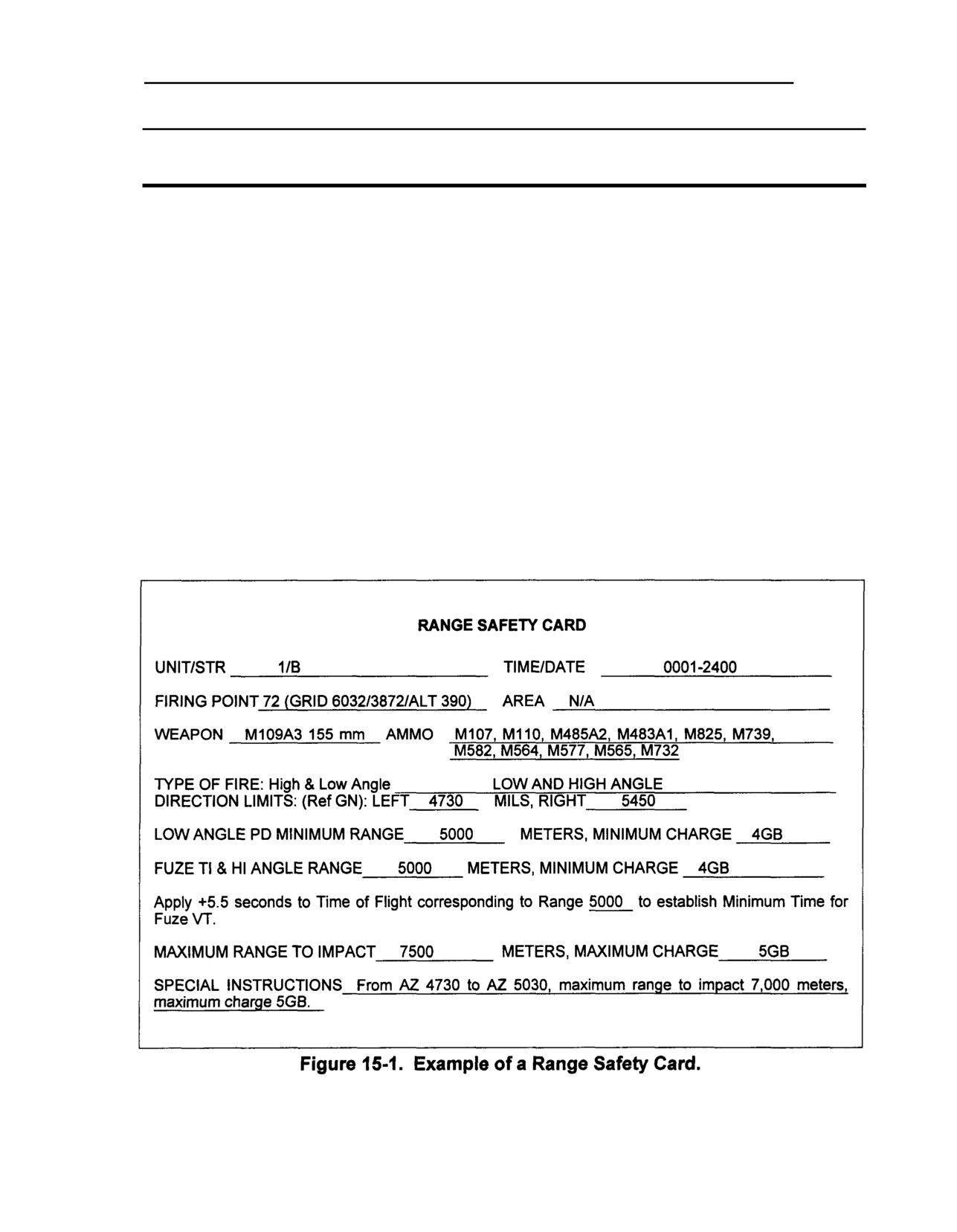
15-4. Safety Card
A safety card (Figure 15-1), which prescribes hours of firing, the area where the firing
will take place, the location of the firing position, limits of the target area (in accordance with AR
385-63), and other pertinent data is approved by the range officer and sent to the OIC of firing.
The OIC of firing gives a copy of the safety card to the position safety officer, who constructs a
safety diagram based on the prescribed limits.
15-7
FM 6-40
15-5. Basic Safety Diagram
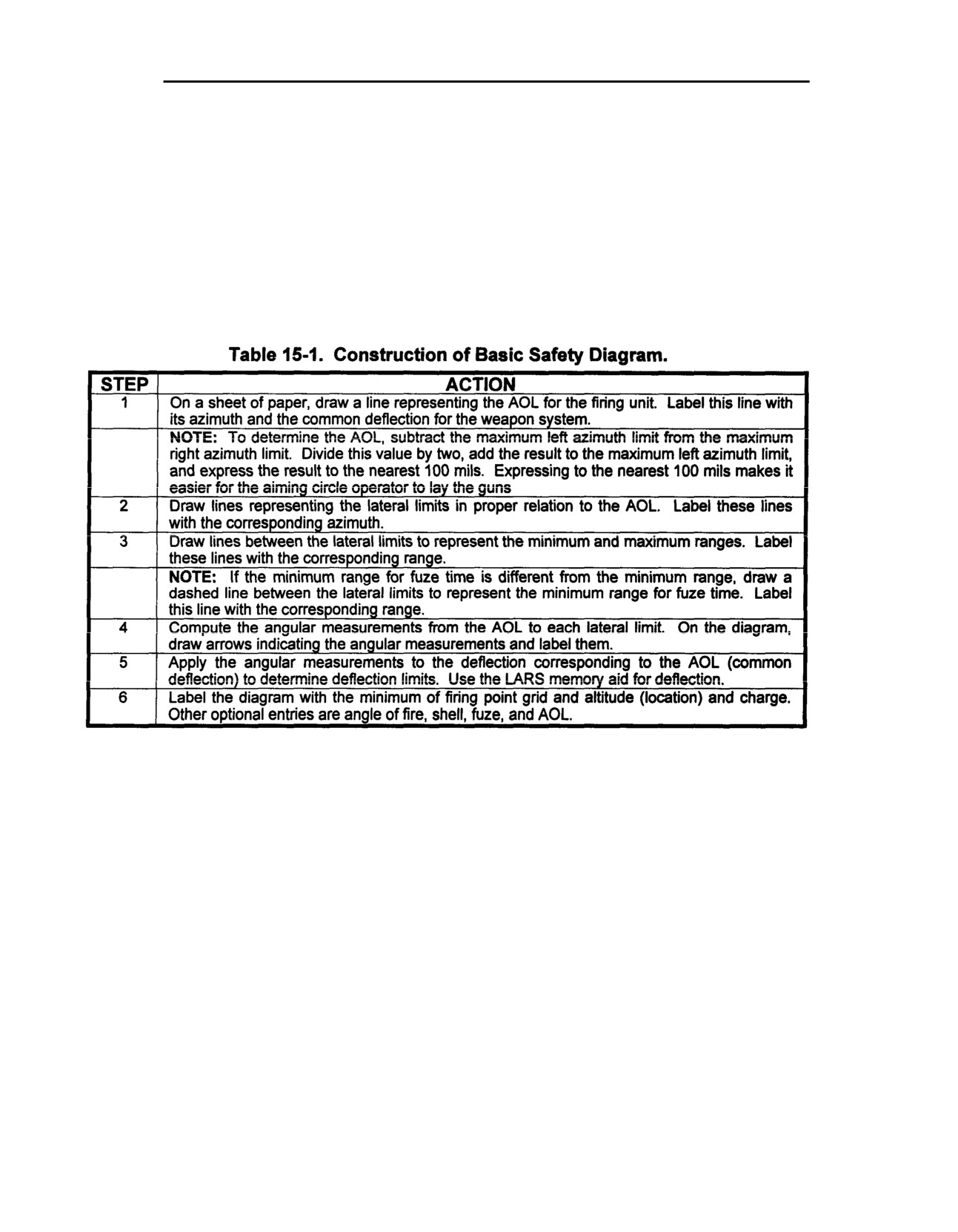
a. The FDO, on receipt of the safety card, constructs a basic safety diagram. The basic
safety diagram is a graphical portrayal of the data on the safety card or is determined from the
surface danger zone (AR 385-63, Chapter 11) and need not be drawn to scale. Shown on the
basic safety diagram are the minimum and maximum range lines the left, right, and intermediate
(if any) azimuth limits; the deflections corresponding to the azimuth limits; and the azimuth of
lay. The safety diagram header is labeled with a minimum of firing point grid and altitude
(location) and charge. Other optional entries are angle of fire, shell, fuze and azimuth of lay.
b. The steps for constructing a basic safety diagram are shown in Table 15-1. An
example of a completed safety diagram is shown in Figure 15-2.
c. When the basic safety diagram is complete, it will be constructed to scale, in red, on
the firing chart. Plot the firing point location as listed on the range safety card. Using temporary
azimuth indexes, an RDP, and a red pencil to draw the outline of the basic safety diagram. To do
this, first draw the azimuth limits to include doglegs. Then, by holding the red pencil firmly
against the RDP at the appropriate ranges, connect the azimuth limits.
d. Only after drawing the basic safety diagram on the firing chart may the base piece location
be plotted and deflection indexes be constructed. Should the diagram be drawn from the base piece
location, it would be invalid unless the base piece was located over the firing point marker.
e. After the basic safety diagram has been drawn on a sheet of paper and on the firing chart
it is drawn on a map of the impact area by using an RDP and a pencil. These limits must be drawn
accurately, because they will be used to determine altitudes for vertical intervals. Determine the
maximum altitude along the minimum range line. This is used to ensure that the quadrant fired will
cause the round to clear the highest point along the minimum range line and impact (function) within
the impact area. At the maximum range, select the minimum altitude to ensure that the round will not
clear the lowest point along the maximum range. Once the altitudes have been selected, label the basic
safety diagram with the appropriate altitudes for the given ranges.
15-8
FM 6-40
NOTE: The rule for determining the correct altitude for safety purposes is called the
mini-max rule. At the minimum range, select the maximum altitude; at the maximum
range, select the minimum altitude. If the contour interval is in feet, use either the
GST or a feet-to-meters conversion table to convert the altitude to meters. This rule
applies to both manual and automated procedures.
15-6. Computation of Low-Angle Safety Data for Shell HE,
Standard Square Weight (No GFT Setting Available)
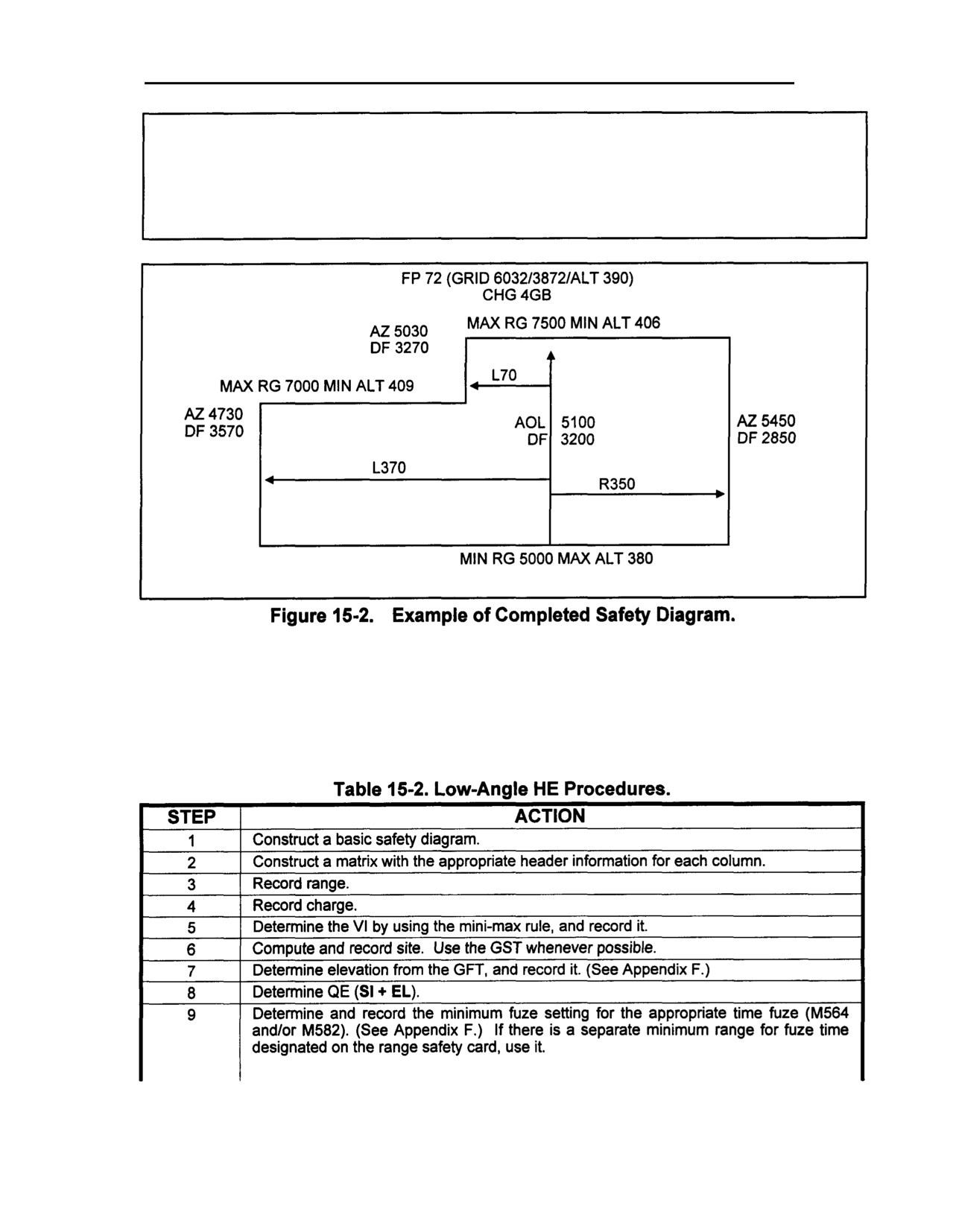
Use the steps outlined in Table 15-2 and the matrix in Figure 15-3 as examples for
organizing computations. Only charge 4GB is shown. Use artillery expression for all
computations except where noted.
15-9
FM 6-40
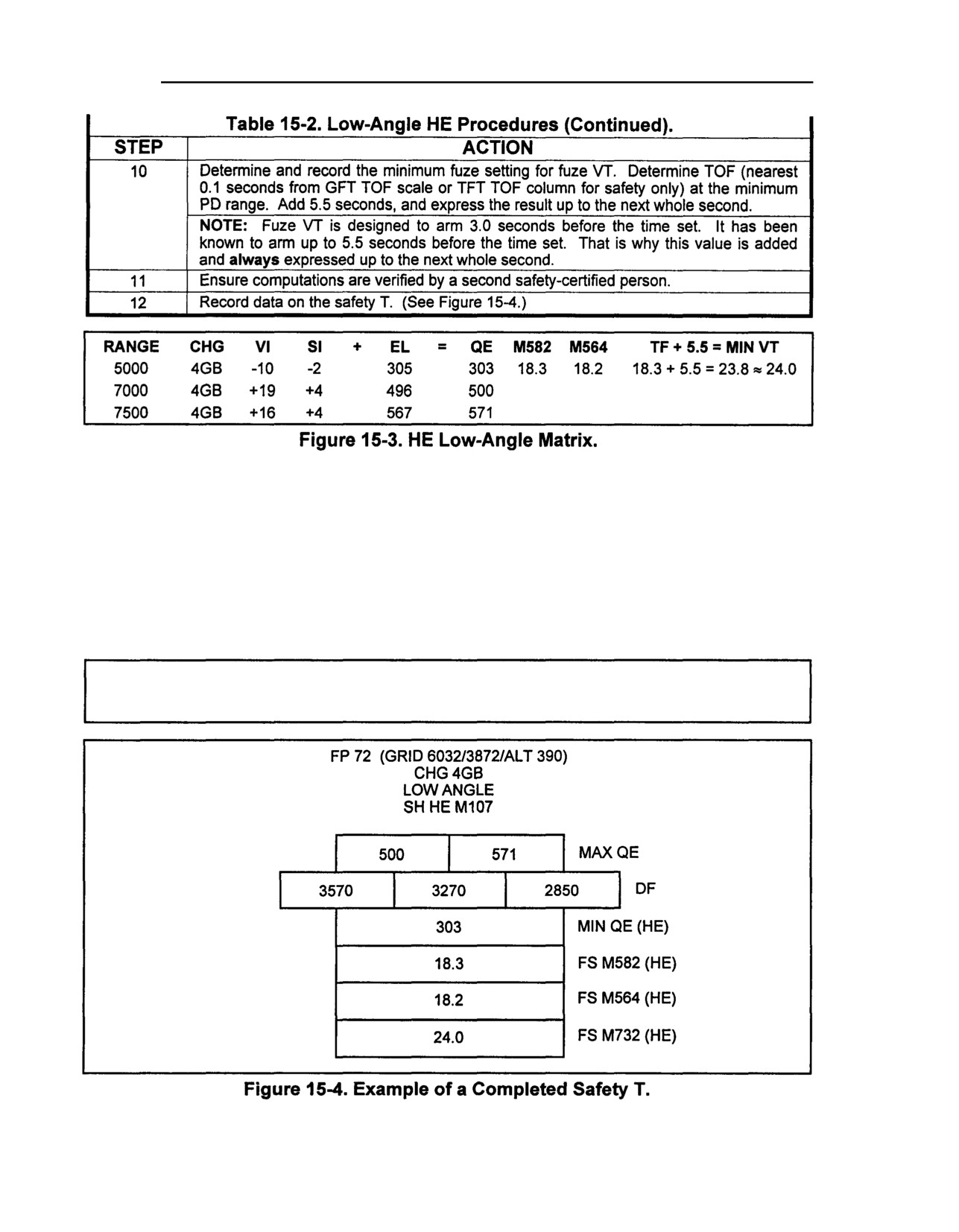
15-7. Safety T
The safety T is a convenient method of arranging safety data and is used to verify the
safety of fire commands (Figure 15-4). The information needed by the FDO, XO or platoon
leader, and section chief is organized in an easy-to-read format. The safety T is labeled with a
minimum of firing point location, charge, and projectile(s). Other optional entries are angle of
fire and effective DTG. Anytime new safety data are determined, new safety Ts are constructed
and issued only after the old safety Ts have been collected (that is, after a move or after a
registration). Use only one charge per safety T.
NOTE: A reproducible copy of DA Form 7353-R (Universal Safety T) is included at
the back of this book.
15-10
FM 6-40
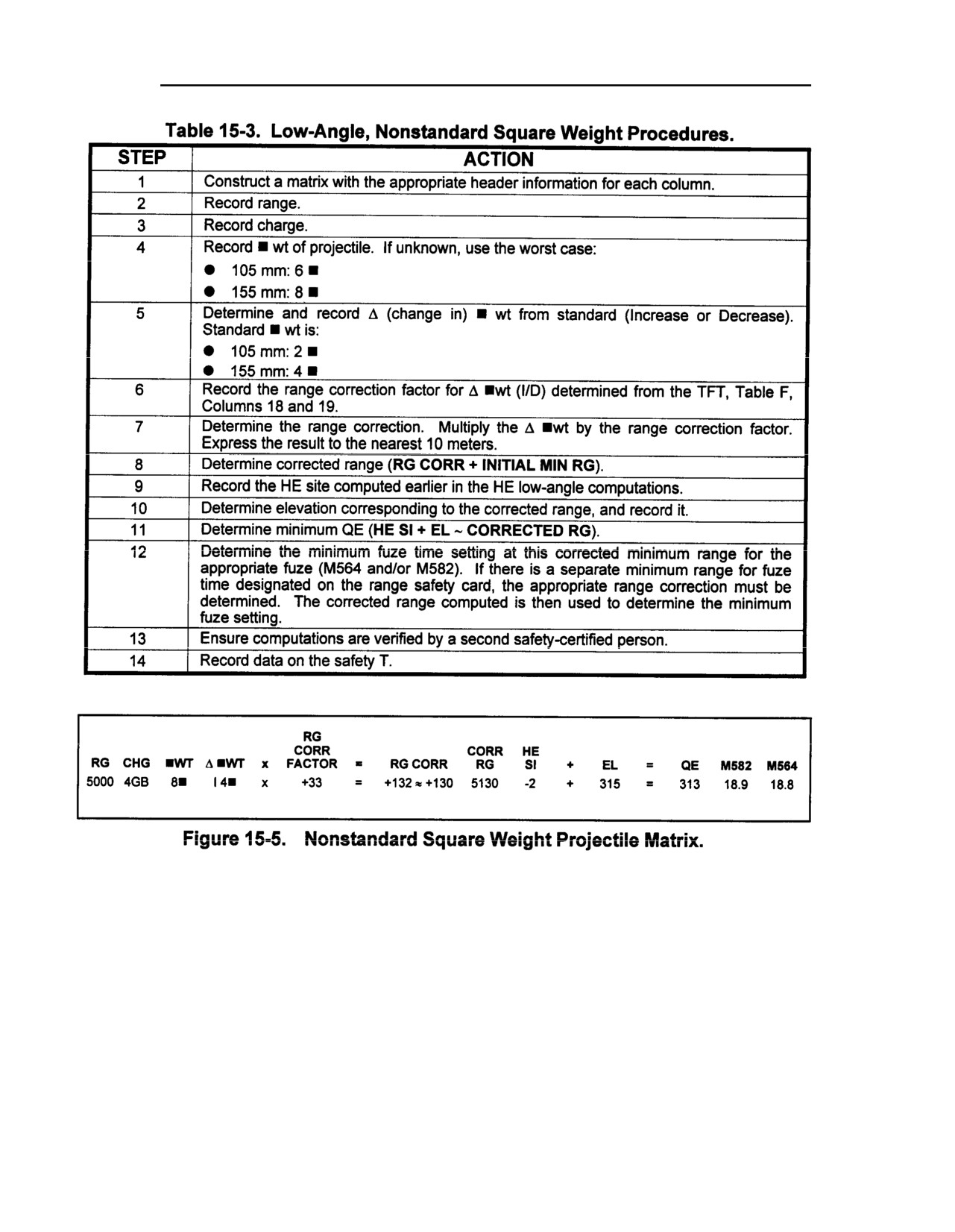
15-8. Computation of Low-Angle Safety Data for Nonstandard
Square Weight (Shell HE, WP, or HC) (No GFT Setting Available)
Use the steps outlined in Table 15-3 and the matrix in Figure 15-5 as examples for
organizing computations.
a. WP and HC smoke are ballistically similar to HE but often differ in weight. The
deflection limits and site computed for HE are accurate for different weight projectiles, but
corrections must be applied to determine QEs and minimum FS.
b. At most charges and ranges, heavier projectiles fall short. This phenomenon is a
safety concern with all projectiles, especially with shell WP, since WP will never weigh the same
as a standard HE square weight ( ■ wt) projectile.
NOTES:
1. The following example uses WP (always heavier than standard square weight
HE), since it is the most common nonstandard square weight projectile fired.
2. If the square weight is unknown, assume the worst case (heaviest) for minimum
range.
3. Generally, a range correction is not determined for the maximum range, since
the QE determined for a standard square weight projectile will cause the heavier
square weight projectile to impact short of the maximum range. If a unit wants to
maximize the safety box, compute maximum QE by applying the range correction
corresponding to the known square weight (if unknown, use lightest possible square
weight).
WARNING
For range 9100, M119A1 charge 8, the opposite is true. A heavier than standard
projectile actually travels farther than a lighter projectile.
4. For lighter than standard square weight projectiles, compute a maximum QE,
since a lighter projectile will generally travel farther than a standard square weight
projectile.
5. The easiest way to remember which weight to use at a specific range is
minimum range, maximum weight; maximum range, minimum weight.
15-11
FM 6-40
15-9. Updating Safety Data After Registration
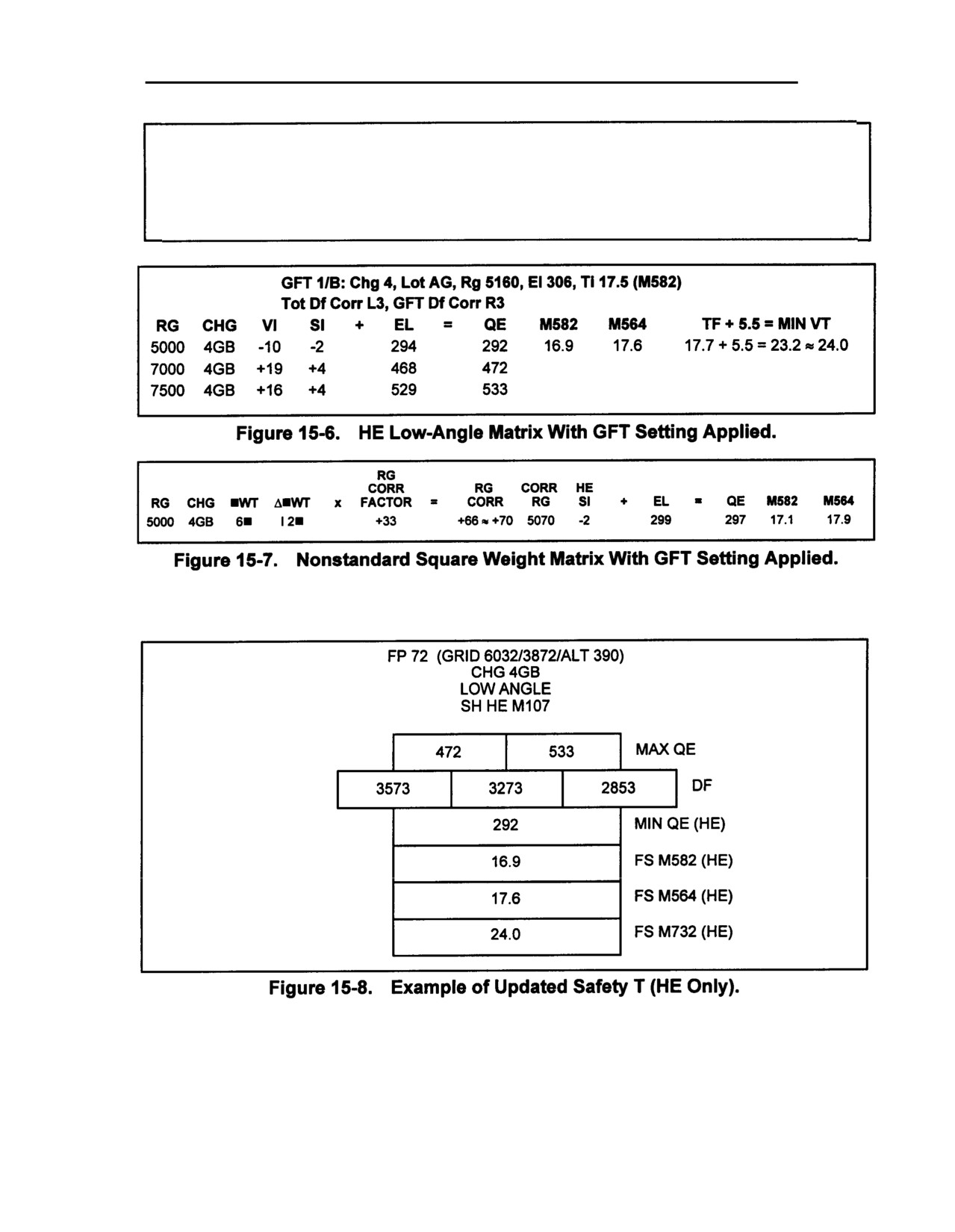
a. After a GFT setting is determined (result of registration or met+ VE technique), the
FDO must compute new safety data by using the GFT setting. New elevations are determined
which correspond to the minimum and maximum ranges (using the elevation gauge line).
Deflections are modified by applying the total deflection correction to each lateral limit.
Minimum fuze settings are recomputed (using the time gauge line, if applicable). The basic
safety diagram drawn in red on the firing chart does not change. It was drawn on the basis of
azimuths and ranges, and it represents the actual limits.
15-12
FM 6-40
NOTE: The basic low-angle HE and nonstandard square weight projectile matrixes
are shown in Figures 15-6 and 15-7 after applying the following GFT setting. WP
square weight is now known. It is 6 squares. Use Appendix F for help with
determining data with a GFT setting.
b. Determine and issue new safety Ts with the corrected data. Figure 15-8 shows the
updated safety T for HE only.
15-10. Low-Angle Illumination
a. The illuminating GFT is the preferred method for computing low-angle illum safety
data. However, illum GFTs do not exist for all charges. Therefore, units may have to use the
15-13
FM 6-40
TFT method for computing safety in some situations. A basic safety diagram is constructed in
the same manner as for low angle HE safety. The purpose of computing illum safety is to
determine the minimum and maximum QE at which a nonfunctioning (dud) projectile would
impact. It is not to determine the minimum and maximum QE that will keep the spent cannister
of a functioning projectile in the impact area. There is no way to compute the trajectory of a
spent cannister because it becomes ballistically unstable after fuze fiction.
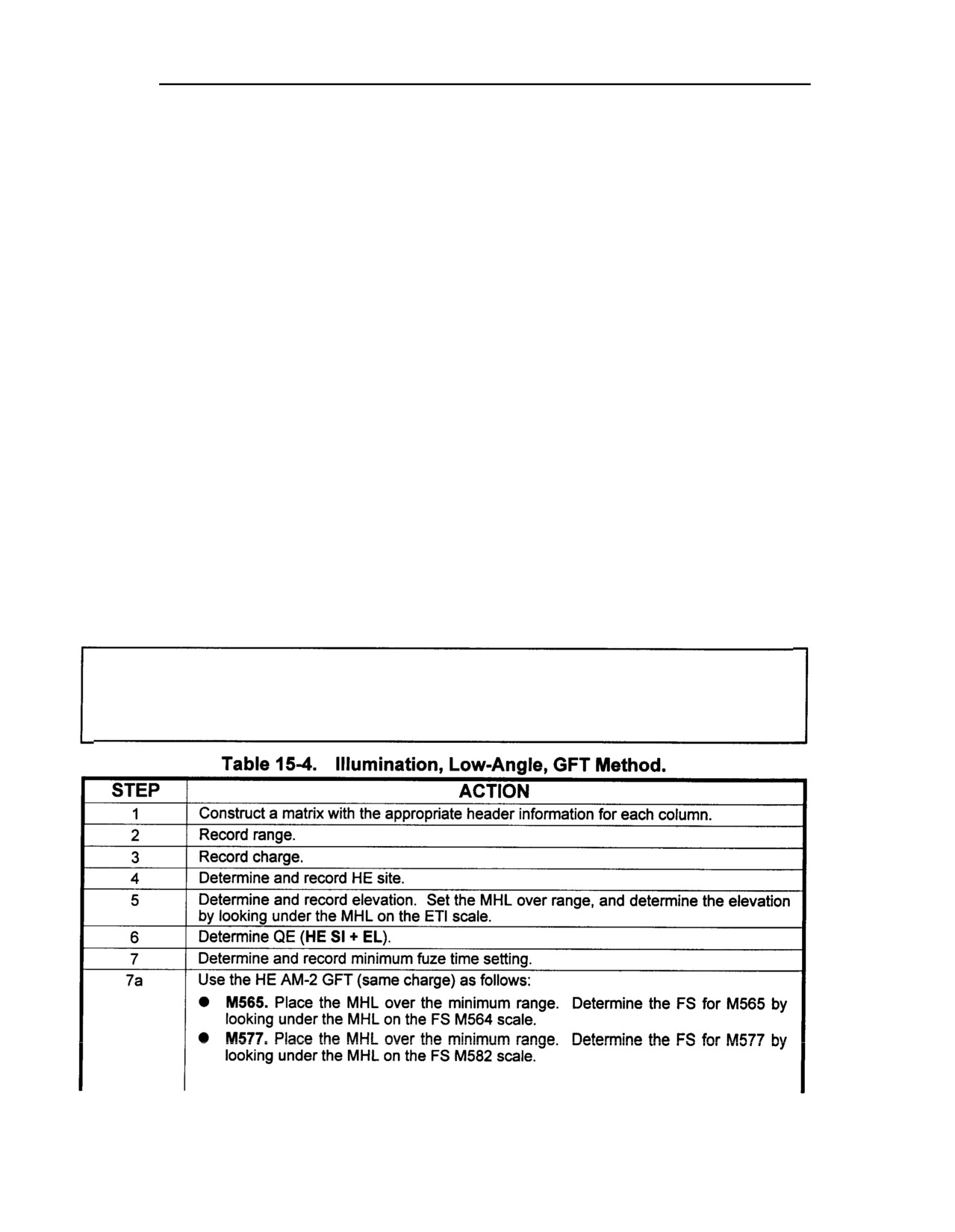
b. The GFT method uses the elevation determined from the illum GFT
elevation-to-impact (ETI) scale at the minimum and maximum ranges. HE site is added to
account for the vertical interval.
c. The TFT method uses the range-to-impact (RTI) column of Part 2 of the TFT to
extract an elevation (column 2). These data approximate what is obtained from the ETI scale of
the GFT. HE site is added to account for the vertical interval. However, this method does not
always work at each minimum range for which safety is computed because the RTI may not be
listed. Therefore, it is necessary to use a method that tries to approximate the value for elevation
corresponding to the RTI column. This method assumes an average HOB of 750 meters for the
105-mm illumination and 600 meters for the 155-mm illumination. The QE from Column 2 is
adjusted to ground level in 50-meter increments by use of the factor in Column 4 (change in QE
for a 50-meter change in HOB).
d. The GFT ETI method is always preferred over the TFT method. When the situation
allows, units should try to fire charges for which an illum GFT exists. When a GFT is not
available, using the RTI column of the TFT is preferred over the HOB method mentioned above.
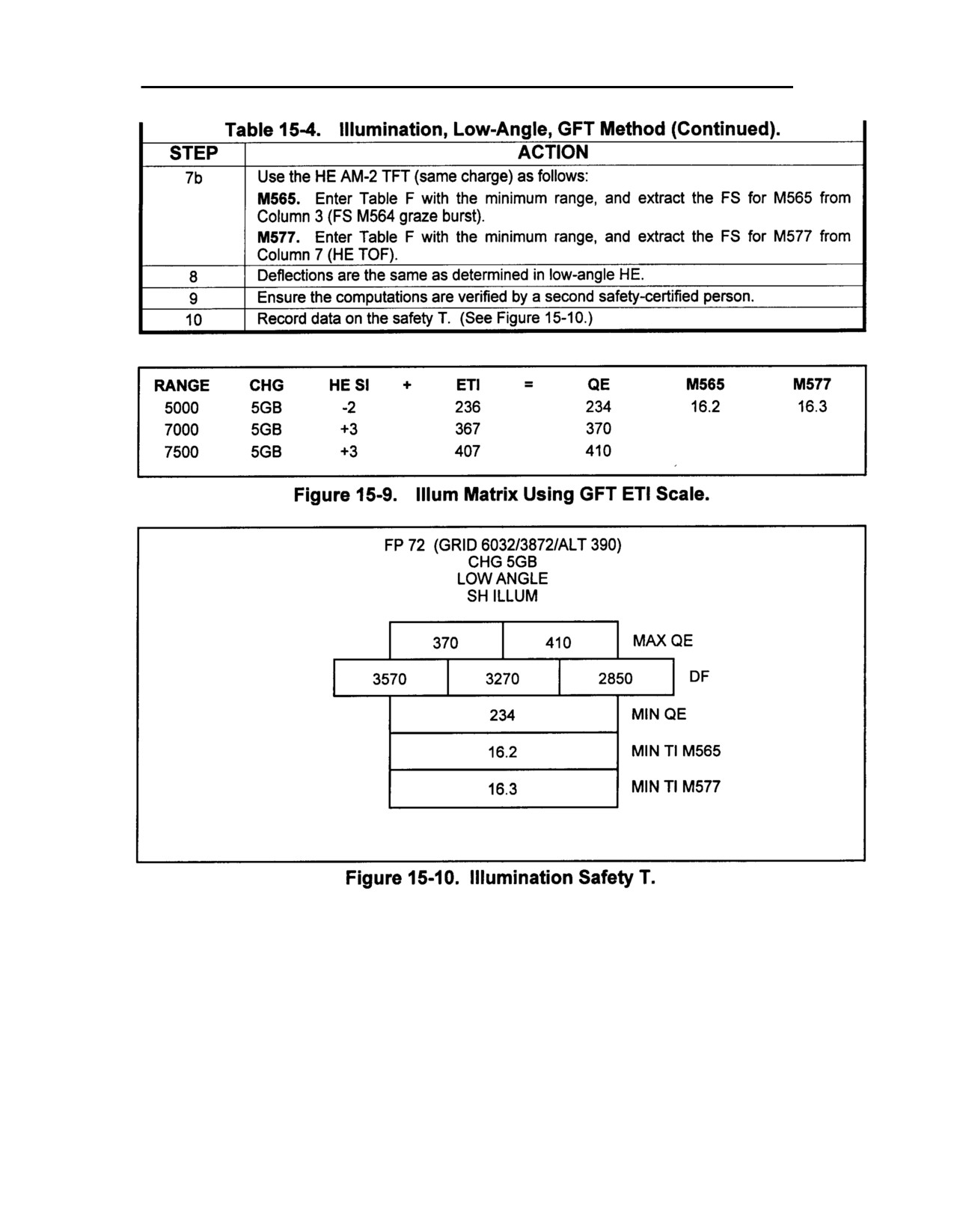
15-11. Computation of Safety Data for Illumination,
GFT Method, Low Angle (No GFT Setting Available)
NOTE: Use the steps outlined in Table 15-4 and the matrix in Figure 15-9 for
organizing computations. The same range safety card and safety diagram as
above are used.
15-14
.M 6-40
15-12. Computation of Safety Data for Illumination, TFT Method, Low Angle
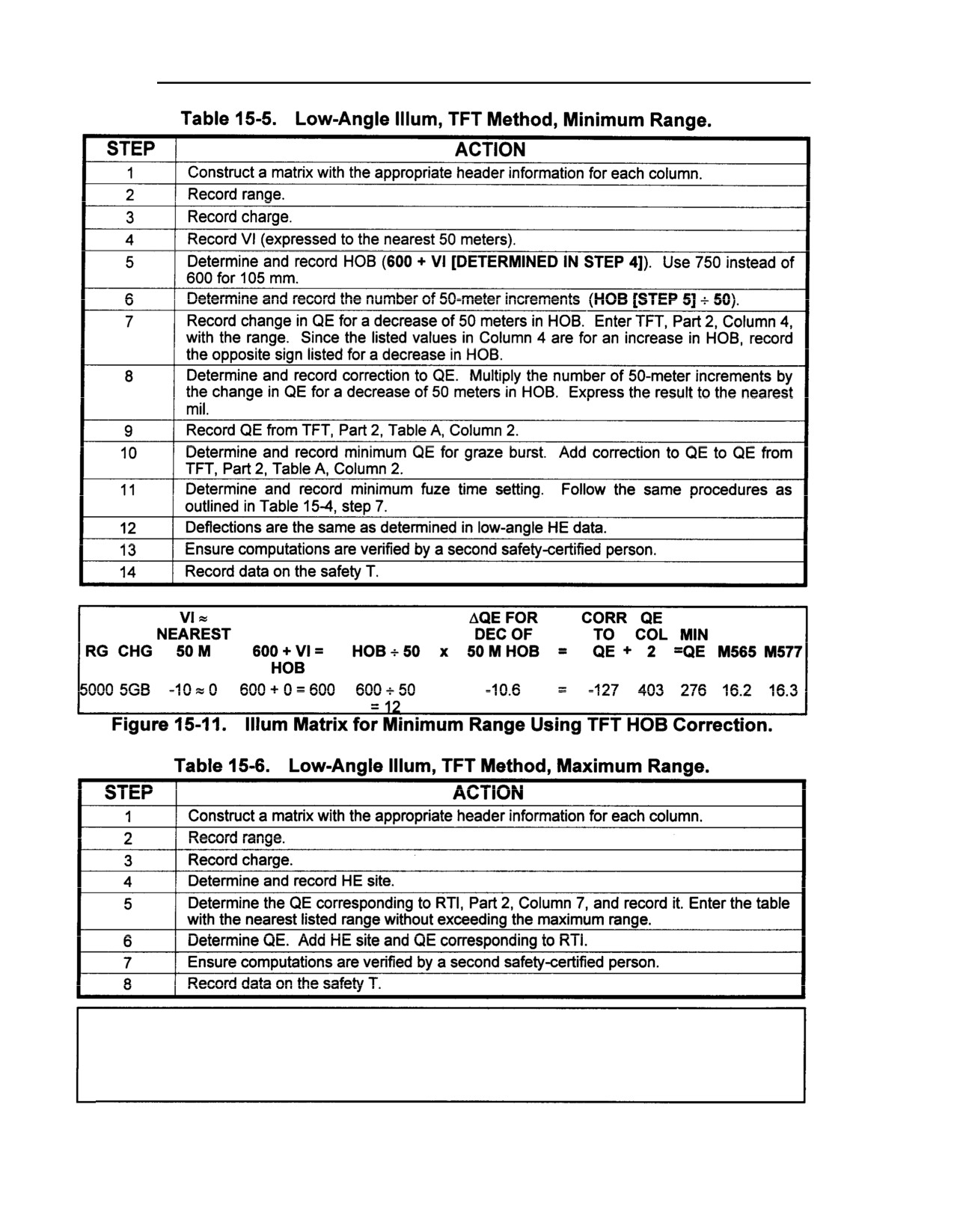
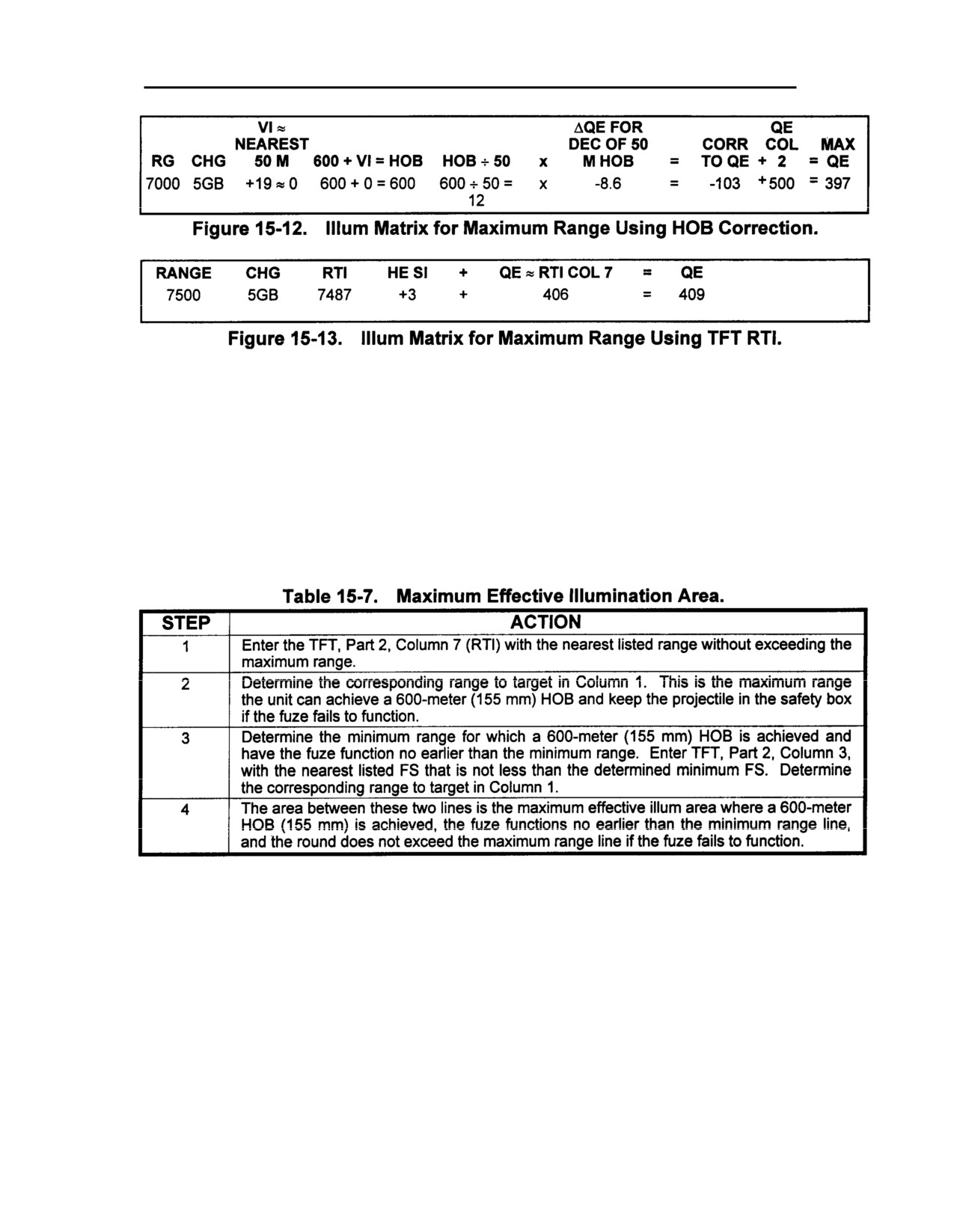
Use the steps outlined in Tables 15-5 and 15-6 and the matrixes in Figures 15-11, 15-12,
and 15-13 for organizing computations. The same range safety card and safety diagram as above
are used.
15-15
FM 6-40
NOTE: Since the maximum range of 7000 is not listed in RTI, Column 7, the
maximum QE is determined by using the HOB correction method outlined in Table
15-5. See Figure 15-12.
15-16
FM 6-40
15-13. Determination of Maximum Effective Illumination Area
All illum safety data are for a graze burst. Therefore, when illurn fire mission data are
computed, the QE determined includes the appropriate HOB. This will prevent achieving a
600-meter HOB (750-meter HOB for 105 mm) at the minimum range and maximum range lines.
Before processing illum fire missions, it is beneficial to determine the maximum effective illum
area for the current range safety card. This area should be plotted on the chart to help determine
if illum can be fired and to let the FOs know where they can fire illum effectively. This area will
always be significantly smaller than the HE safety area. See Table 15-7 for steps outlining the
general procedure. To increase this area, determine HA illum safety data (paragraph 15-22).
15-14. Low-Angle Safety Data for Shell 155 mm M483A1 DPICM,
M825 Smoke, M692/M731 ADAM, M718/M741 RAAM, and
M449 APICM (TFT Method, No GFT Setting Available)
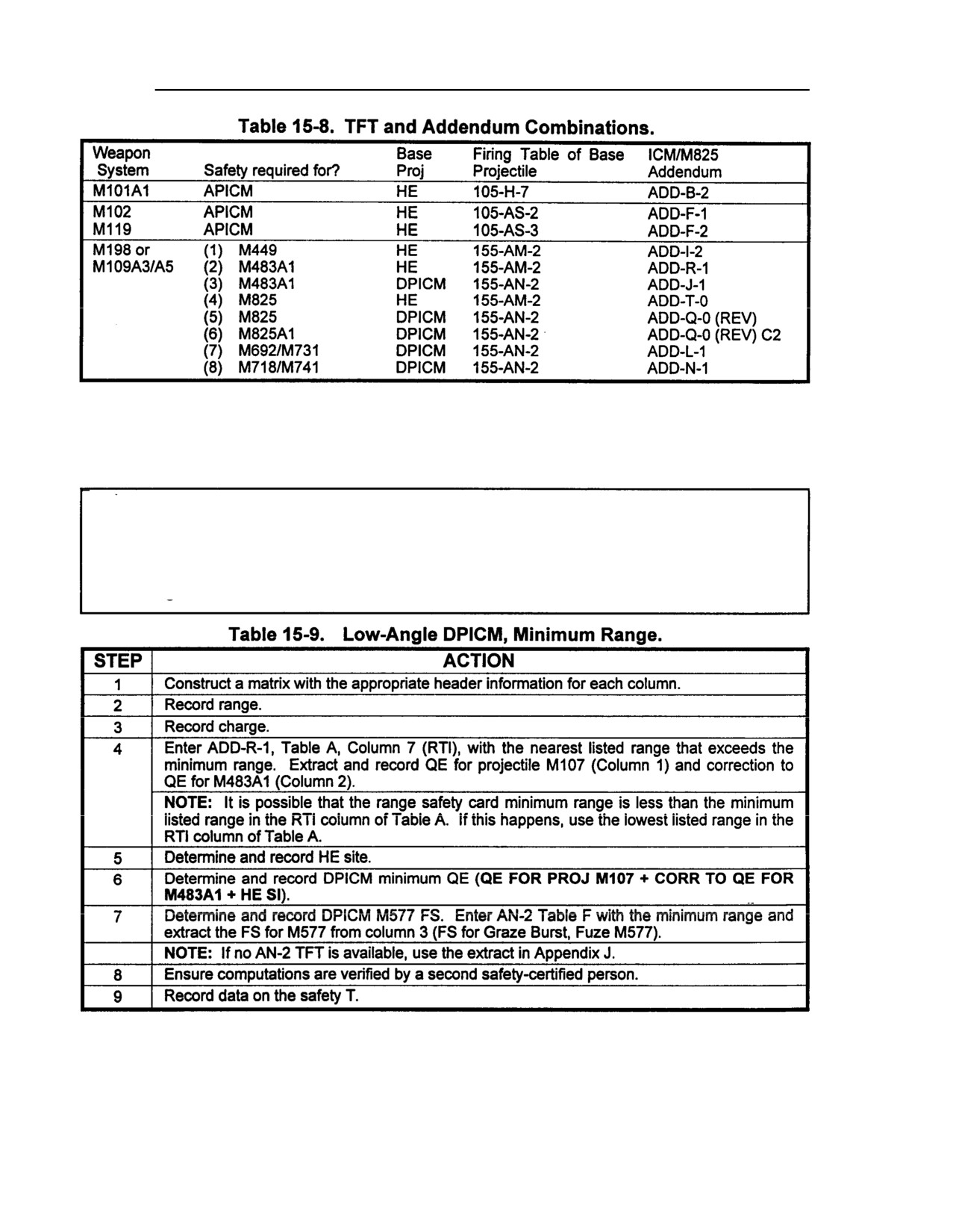
a. The procedures for determining safety data for DPICM, M825, FASCAM, and
APICM depend on the weapon system and the availability of TFTs and firing table addendums.
See Table 15-8.
15-17
FM 6-40
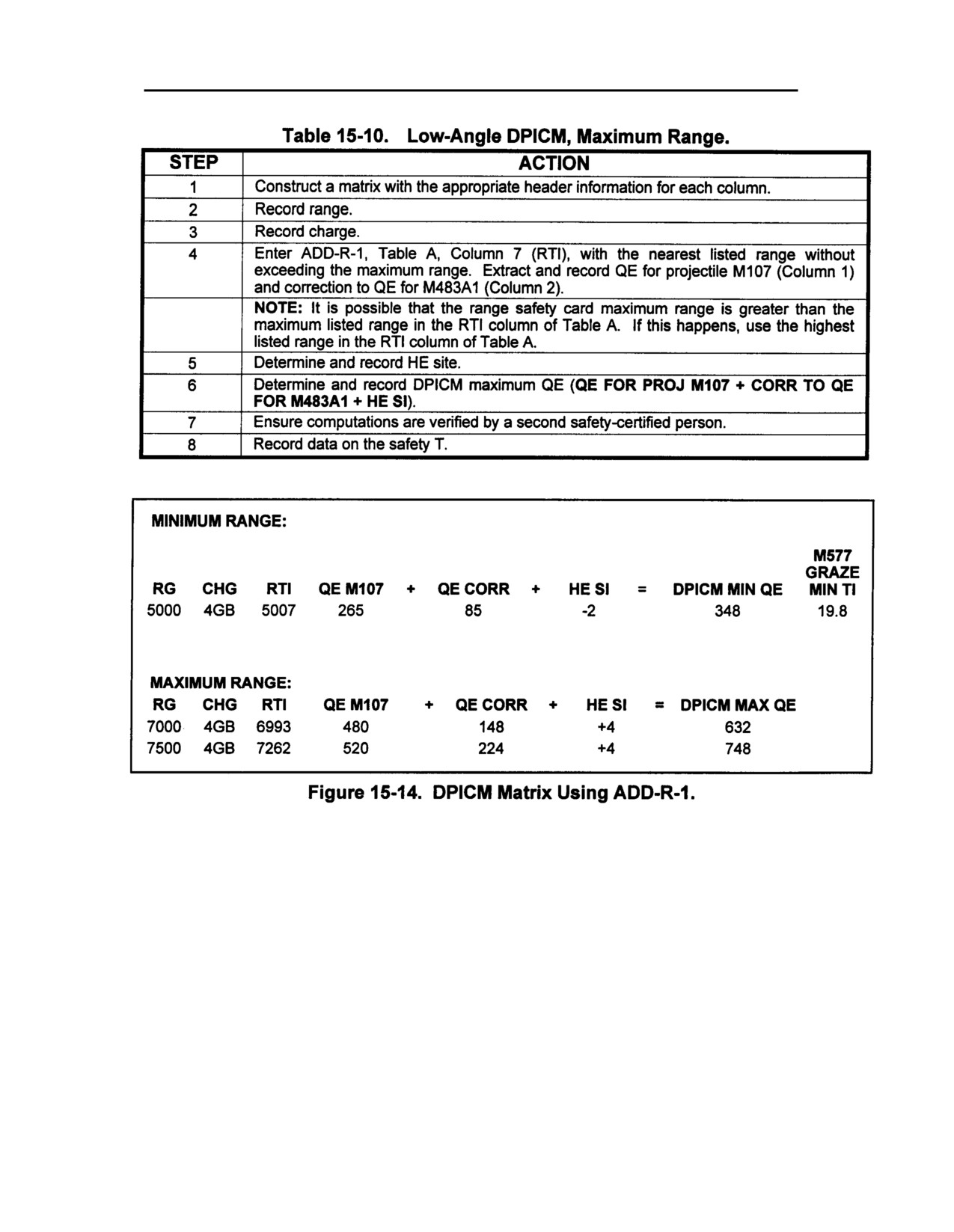
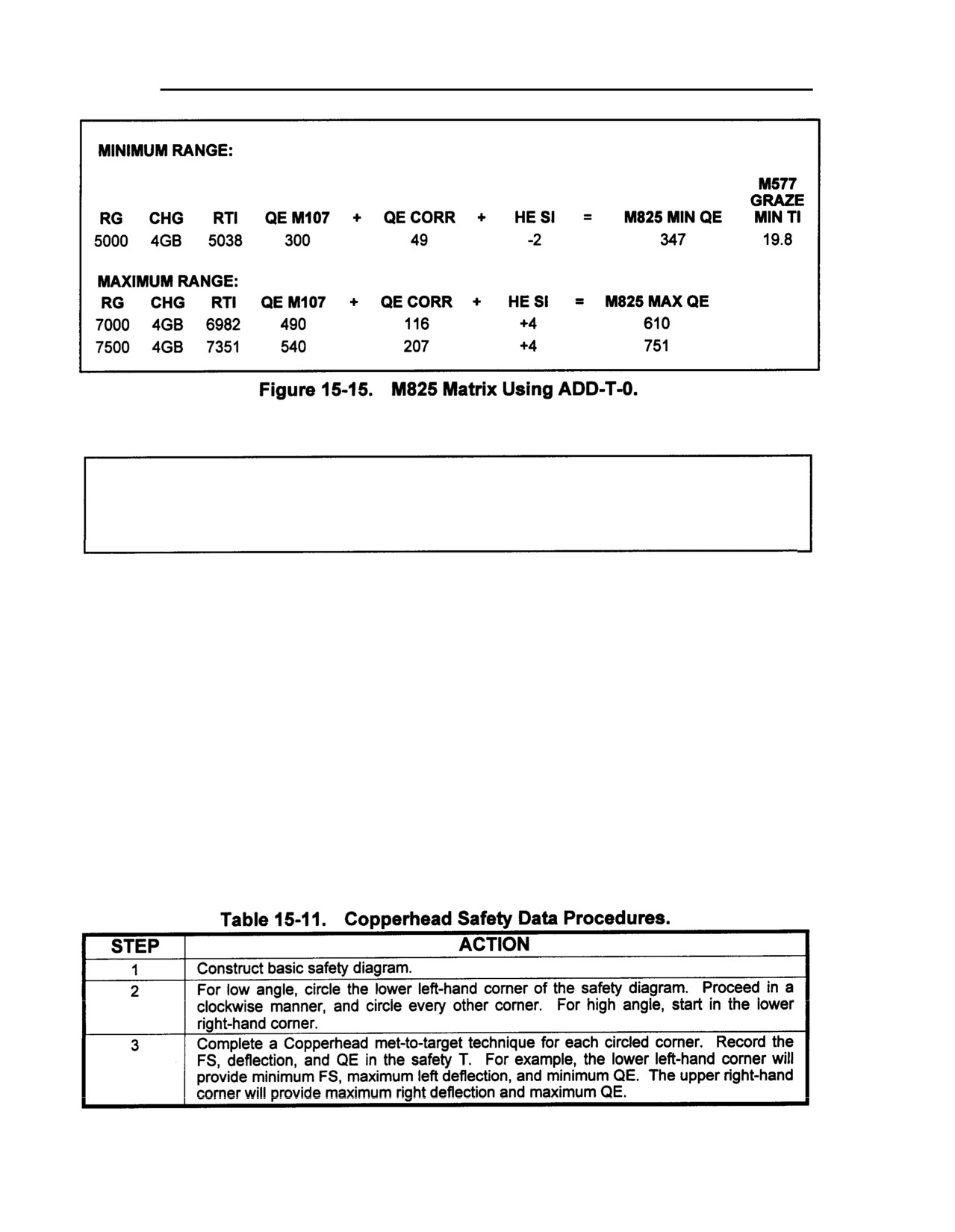
b. The steps in Tables 15-9 and 15-10 outline the procedures for determining safety for
DPICM. To determine safety data for the other projectiles listed in Table 15-8, replace ADD-R-1
with the appropriate addendum. Use the matrixes in Figures 15-14 and 15-15 for organizing
computations.
NOTE: In accordance with AR 385-63 (MCOP3570.1A), Chapter 11, ICM must be
fired into a dedicated impact area and the submissive drift factors must be accounted
for in safety computations. Refer to the above manual for specific guidance
concerning your situation. This does not apply to M825 computations. The example
below is generic and does not include a submissive drift factor.
15-18
FM 6-40
15-19
FM 6-40
NOTE: The above matrixes and procedures can also be used to determine
ICM/M825 using the AN-2 TFT and appropriate addendum. Replace HE elevation,
HE site, HE FS, and HE QE with DPICM graze burst data.
15-15. Safety Procedures for M712 Copperhead
a. Copperhead safety data are determined from ballistic data developed specifically for
the Copperhead. Computations are much like those for normal HE safety data. The Copperhead
round should not be fired with cold stick data. Therefore, the computation of safety data requires
the solving of a Copperhead met-to-target technique for each listed range by using TFT AS-1, as
covered in Chapter 13, Section 1. See Table 15-11 for steps to compute Copperhead safety.
Surface danger zones (SDZs) for shell Copperhead are significantly different than normal indirect
fire SDZs. AR 385-63 (MCO P3570.1A), Chapter 11, contains SDZs for Copperhead fired in
both ballistic and glide mode.
b. All ranges listed on the range safety card may not fall within the ranges listed in the
TFT charge selection table for that charge and mode. Therefore, additional safety computations
may be required for additional charge(s) and mode(s) to adequately cover the impact area. If
ranges listed on the range safety card overlap charge and mode range limitations in the charge
selection table, then safety for both affected charges and modes must be computed.
15-20
FM 6-40
15-16. Safety Procedures for M549A1 RAP
RAP safety data are computed in the same manner as Copperhead safety data. Use the FT
155 AO-0. Complete a RAP met-to-target technique for each listed range. Follow the same steps
as listed in Table 15-11. Minimum FS is not determined. An additional safety buffer of 6,000
meters is constructed short of the minimum range line in case the rocket motor does not ignite.
No personnel are allowed in this safety buffer.
15-17. Safety Procedures for M864 Base Burn DPICM
a. M864 safety data are computed in the same manner as DPICM safety data (paragraph
15-14) by using one of the following methods:
(1) Use the FT 155-AU-PAD and FT ADD-U-PAD. Solve a met-to-target
technique by following the steps in Table 15-11.
(2) Use the FT 155-AO-0 and provisional aiming data addendum to FT 155-AO-0
for projectile HE M864. Use registration data for projectile HE M549A1, low-angle fire only (no
short title has been established).
b. An additional safety buffer of 5,000 meters is constructed short of the minimum
range line in case the base burner element fails to function. No personnel are allowed in this
safety buffer.
c. In accordance with AR 385-63 (MCOP3570.1A), Chapter 11, ICM must be fired into
a dedicated impact area and the submissive drift factors must be accounted for in safety
computations. Refer to the above manual for specific guidance concerning your situation.
Section III
Manual Computation of High-Angle Safety Data
The safety data for high-angle fire is computed in much the same manner
as that for low-angle fire except for the variations caused by the trajectory of
high-angle fire.
15-18. Safety Data for High-Angle Fire
NOTE: The same range safety card (Figure 15-1) used during low-angle HE safety
computations is used in this section.
a. Deflection.
(1) Before registration. The deflection limits for HA fire are computed in the
same manner as those for low-angle fire except that the limits are modified by the large amount
of drift characteristic to HA fire. The left deflection limits are moved to the left by the amount of
the minimum drift for the charge to be fired within the range limits. The right deflection limits
are moved to the left by the amount of maximum drift for the charge to be fired, within the range
limits. The values for drift are determined from either the HA GFT or the HA portion of the
appropriate TFT.
15-21
FM 6-40
(2) After high-angle registration. The deflection limits for HA fire are further
modified. Since the elevation changes after registration deflection limits are modified by
redetermining new drifts and adding GFT deflection correction.
b. Quadrant Elevation.
(1) Before registration. The minimum and maximum quadrants for HA fire are
computed in the same manner as those for low-angle fire except for the computation of site
SI÷10 x
10-MIL SITE FACTOR). The 10-mil site factor is determined from the GFT. Angle of site is
computed from the GST by use of the C and D scales. If a 10-mil site factor is not available, HA site
is computed manually (Table 15-13, step 5) by using the procedures in Chapter 8.
(2) After high-angle registration. An HA registration is valid for all charges in
that charge group. Fire missions throughout safety limits usually require that more than one
charge be used. Minimum and maximum QEs are computed for each charge by using corrections
determined from the registration. The minimum and maximum elevations are read under the
MHL when a GFT setting has been applied. Site must be recomputed.
c. Fuze Setting. Minimum fuze settings are not computed for HA fire. Mechanical
time and/or superquick fuzes (M564 and M582) should not be used because of large probable
errors in height of burst. The FDO must verify that VT fuze settings are determined to
correspond to the appropriate target range.
15-19. Construction of Basic Safety Diagram
a. Initially compute the deflection limits in the same manner as low angle. Then modify
the limits by the large amount of drift that is peculiar to HA fire.
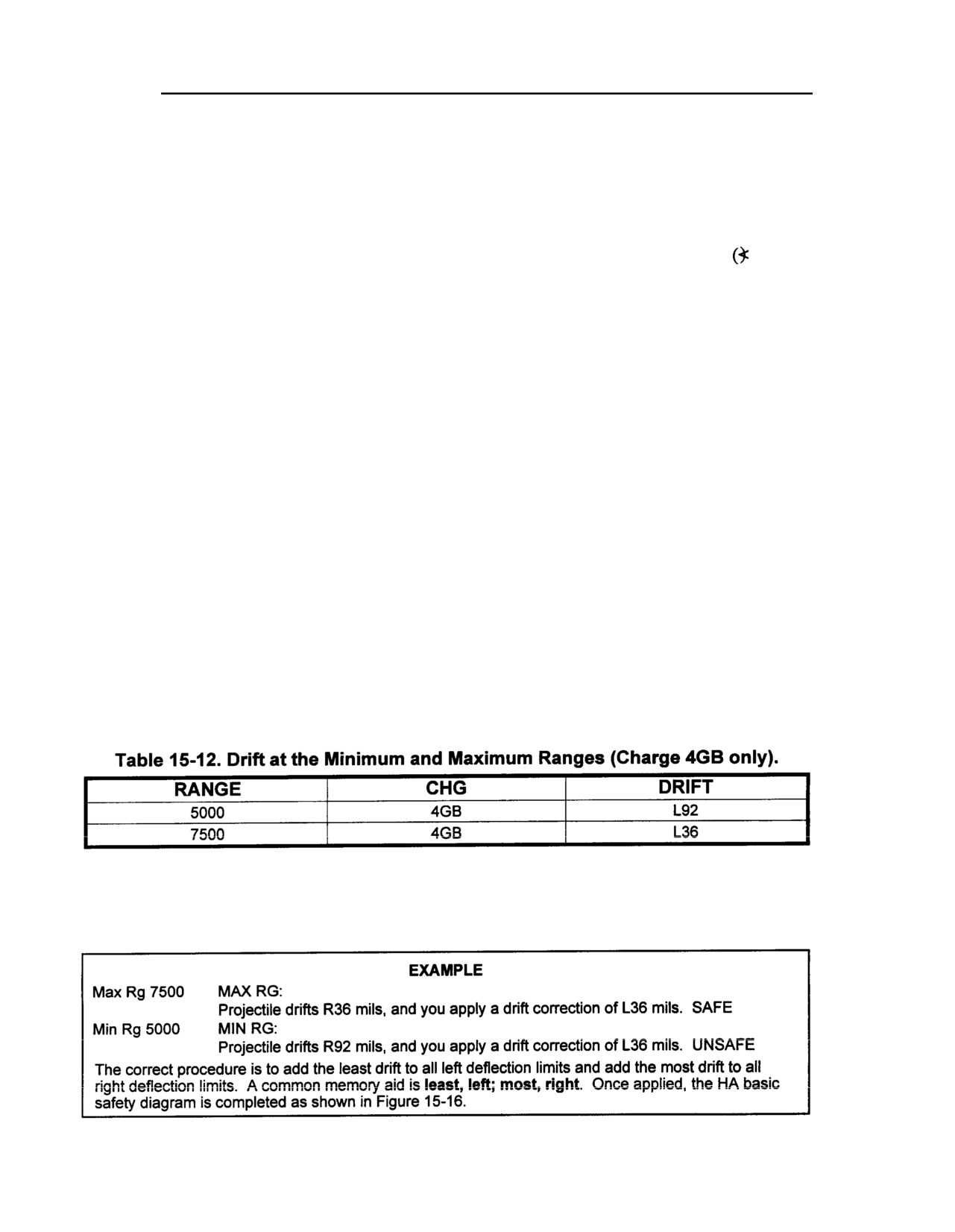
b. For the charges listed on the range safety card, extract from the TFT (or GFT) the HA
drifts corresponding to the elevations appropriate to the minimum and maximum ranges. When
extracting from the TFT, express the value to the nearest 1 mil. If the range desired is not
attainable for the particular charge, locate the nearest listed range and extract the corresponding
value for drift. See Table 15-12.
c. As seen in Table 15-12, the minimum drift is L36 and the maximum drift is L92.
Each deflection limit is now modified by the appropriate drift correction. The example below
shows the effect of using the least drift at a right limit.
15-22
FM 6-40
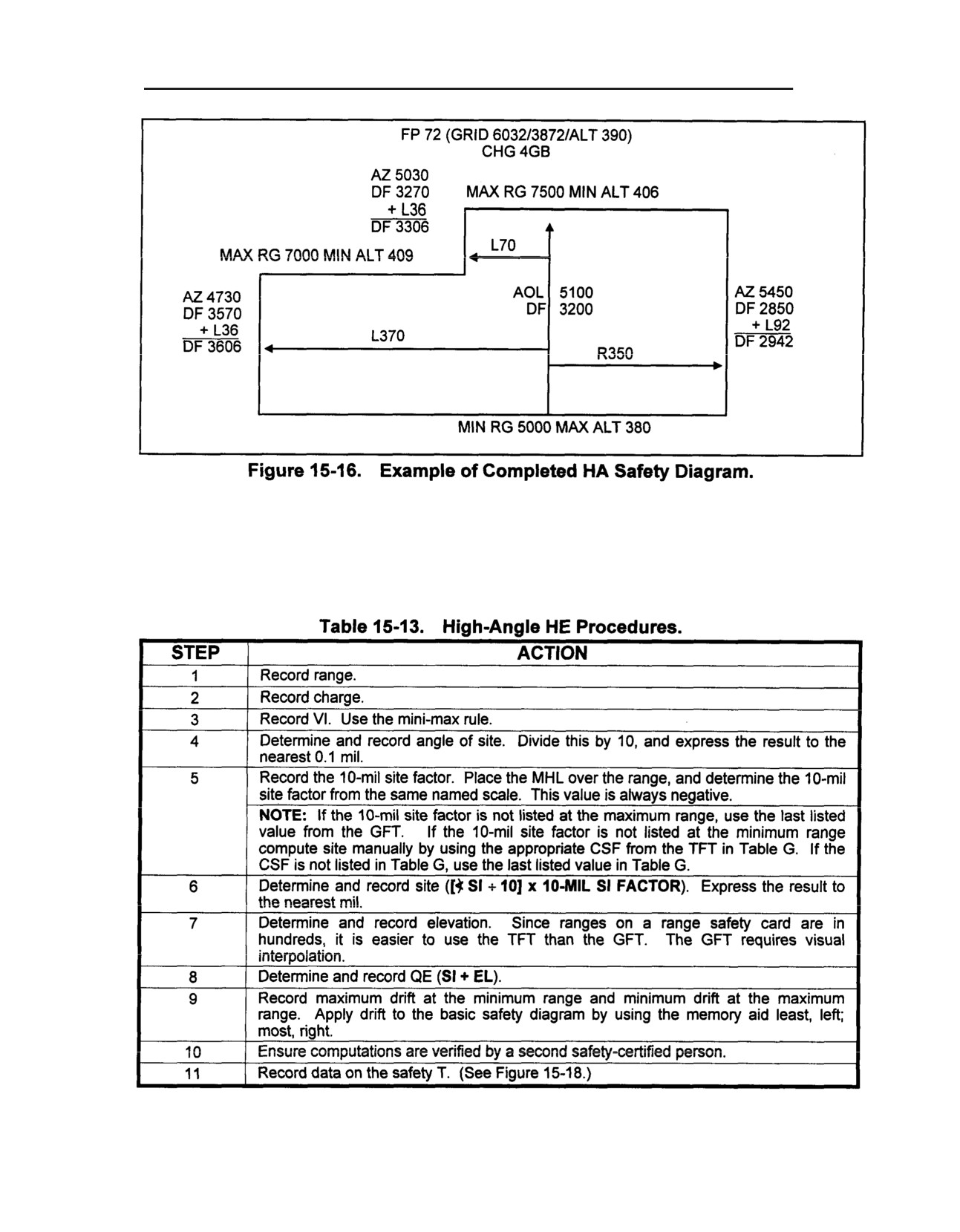
15-20. Computation of Safety Data for HA (No GFT Setting Available)
Use the steps outlined in Table 15-13 and the matrix in Figure 15-17 as examples for
organizing computations. Only charge 4GB is shown. Use artillery expression for all
computations except where noted.
15-23
FM 6-40
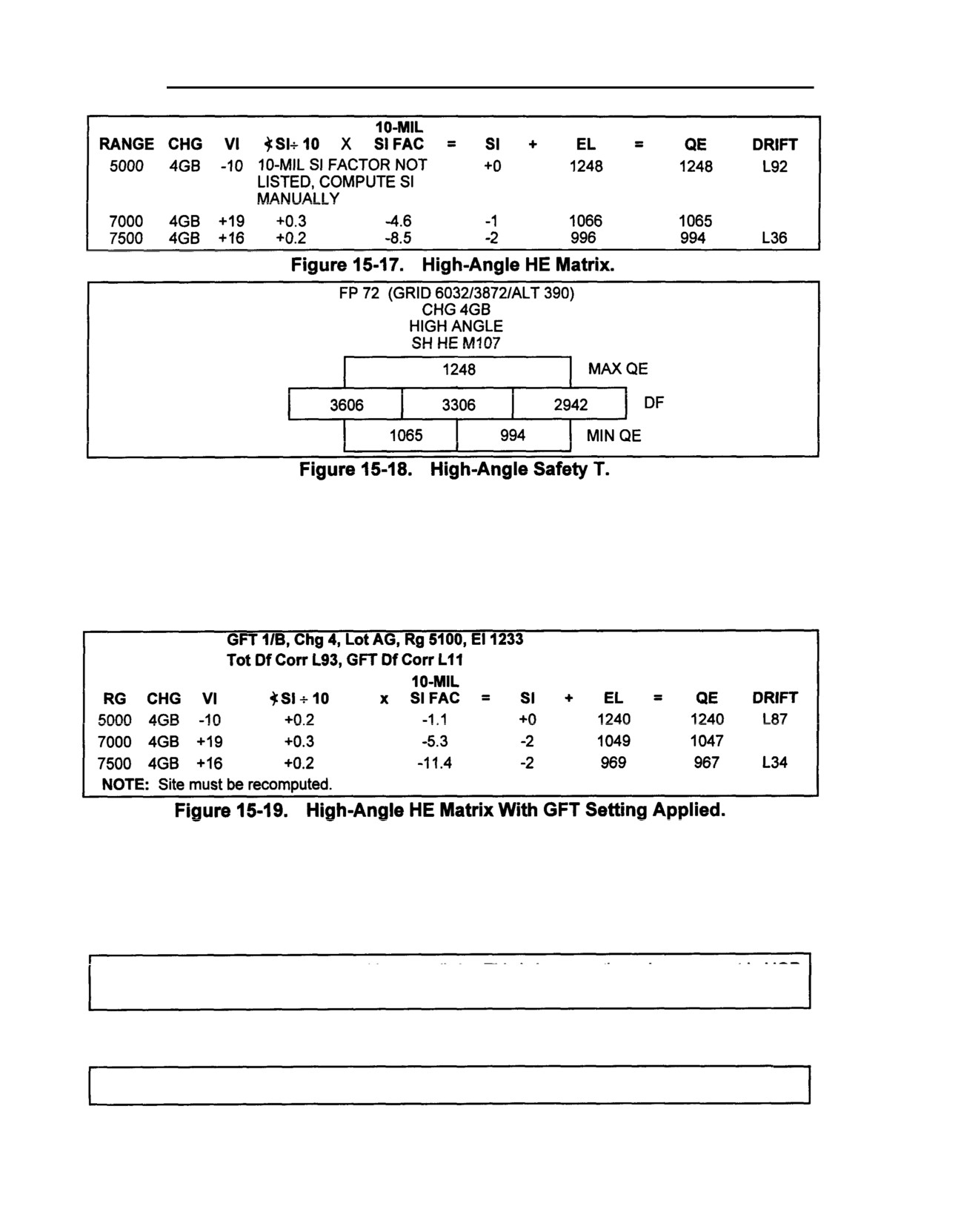
15-21. Computation of Safety Data for HA Fire (GFT Setting Available)
Like low-angle safety data, HA safety data are updatd a GFT setting is determined. See Chapter 10
for the application of a GFT setting to the HA GFT. Follow the same steps outlined in Table 15-13. Use the matrix
in Figure 15-19 to organize computations. Use Appendix F for help with for help with determining data with an HA GFT setting
applied. To determine new deflection limits, add the appropriate drift and GFT deflection correction to the
low-angle deflection limit. Use the following GFT setting to update HA safety data.
15-22. Computation of Safety Data for HA Illumination (TFT Method)
Some impact areas are so small that low-angle illumination safety procedures can restrict firing this round.
High-angle illumination will significantly increase the maximum effective illum area for a range safety card or
enable a unit to fire illumination when low angle is not practical. Therefore, it is necessary to compute safety data
for HA illumination.
NOTE: The adjustments of HOB will be unrealistic. This is because the only movement in HOB
will parallel a change in QE fired.
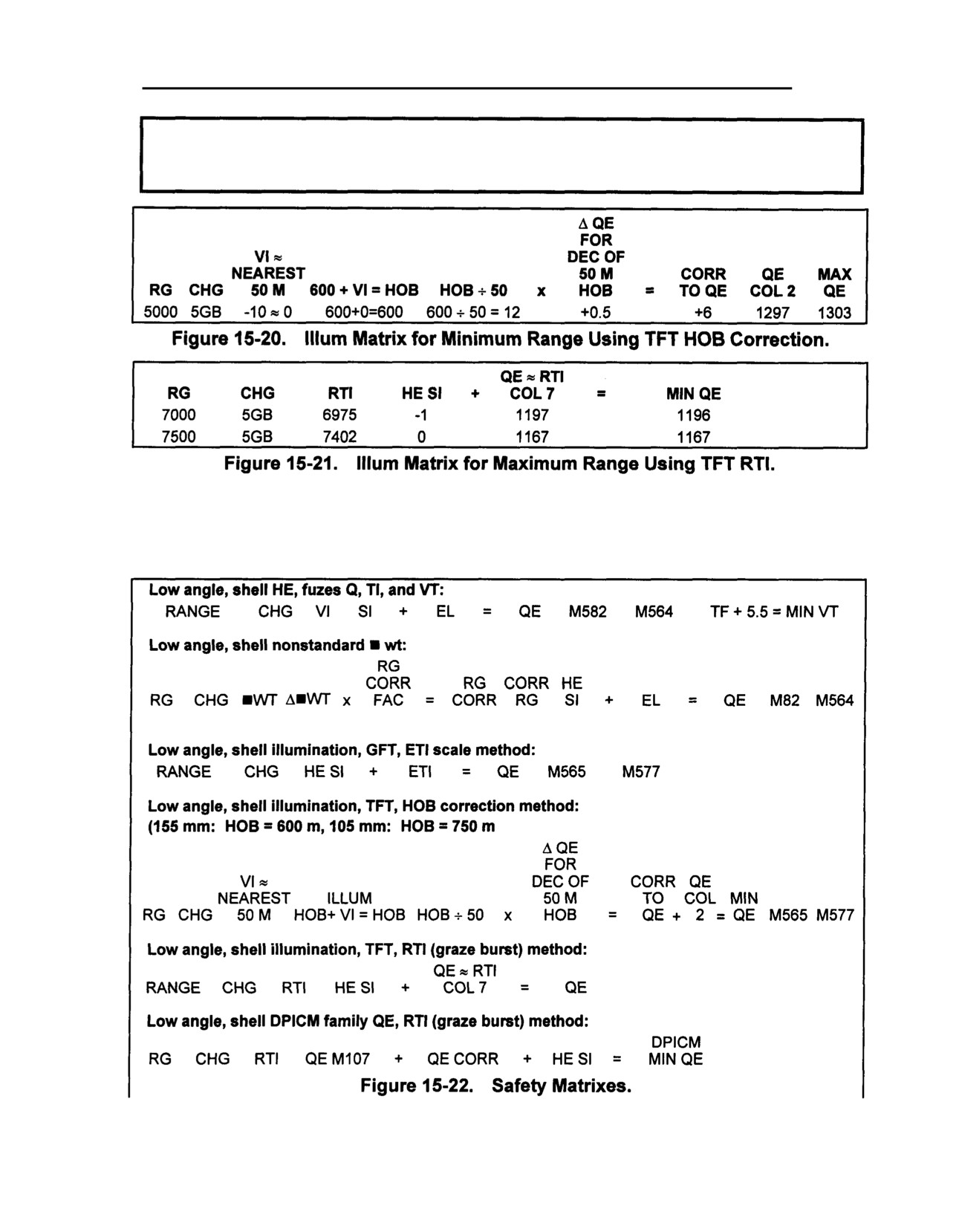
Use the matrixes in Figure 15-20 and 15-21 to organize computations. The same steps are followed as
listed in Tables 15-5 and 15-6. Minimum FS is not determined for HA illumination.
NOTE: Minimum FS is not determined because this FS must then be used with all QEs fired.
15-24
FM 6-40
WARNING
The FDC is responsible for ensuring that the FS computed and announced will not function short of the minimum
range line.
15-23. Safety Computations Matrixes
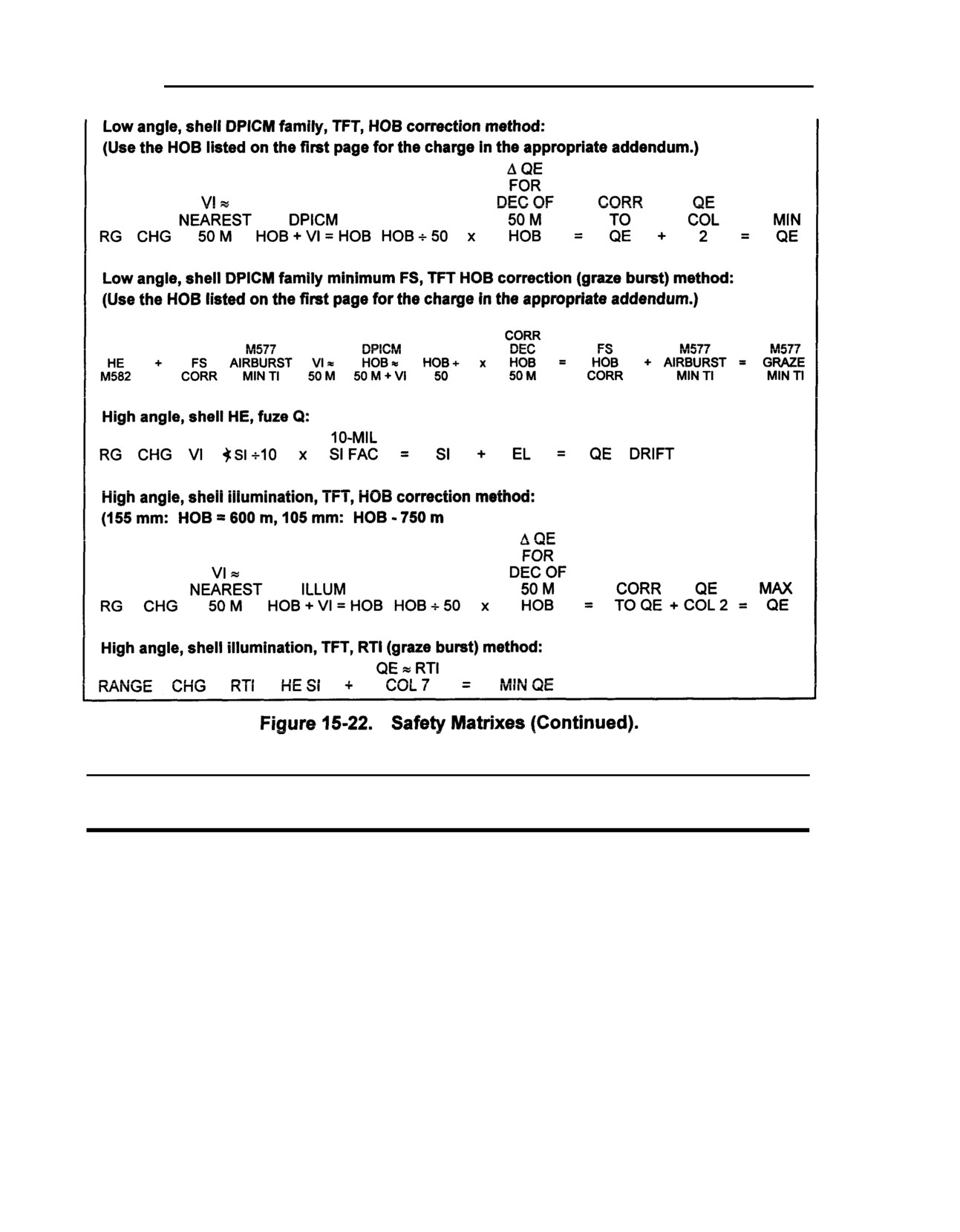
There are many different ways to organize safety computations for the different projectile and fuze
combinations. Figure 15-22 shows all the matrixes used throughout this chapter. These are recomeded because
they follow a logical flow.
15-25
FM 6-40
Section IV
Minimum Quadrant Elevation
The XO or platoon leader is responsible for determining the lowest QE
that can be safely fired from his position that will ensure projectiles clear all
visible crests (minimum QE).
15-24. Elements of Computation
A minimum quadrant for EACH howitzer is ALWAYS determined. The maximum
of these minimum quadrants is the XO’s minimum quadrant. Use of the rapid fire tables in
ST 6-50-20 is the fastest method of computing minimum QE. The QE determined from ST
6-50-20 is always equal to or greater than (more safe) than manual computations. Manual
computations are more accurate than the rapid fire tables and are used if the sum of the site to
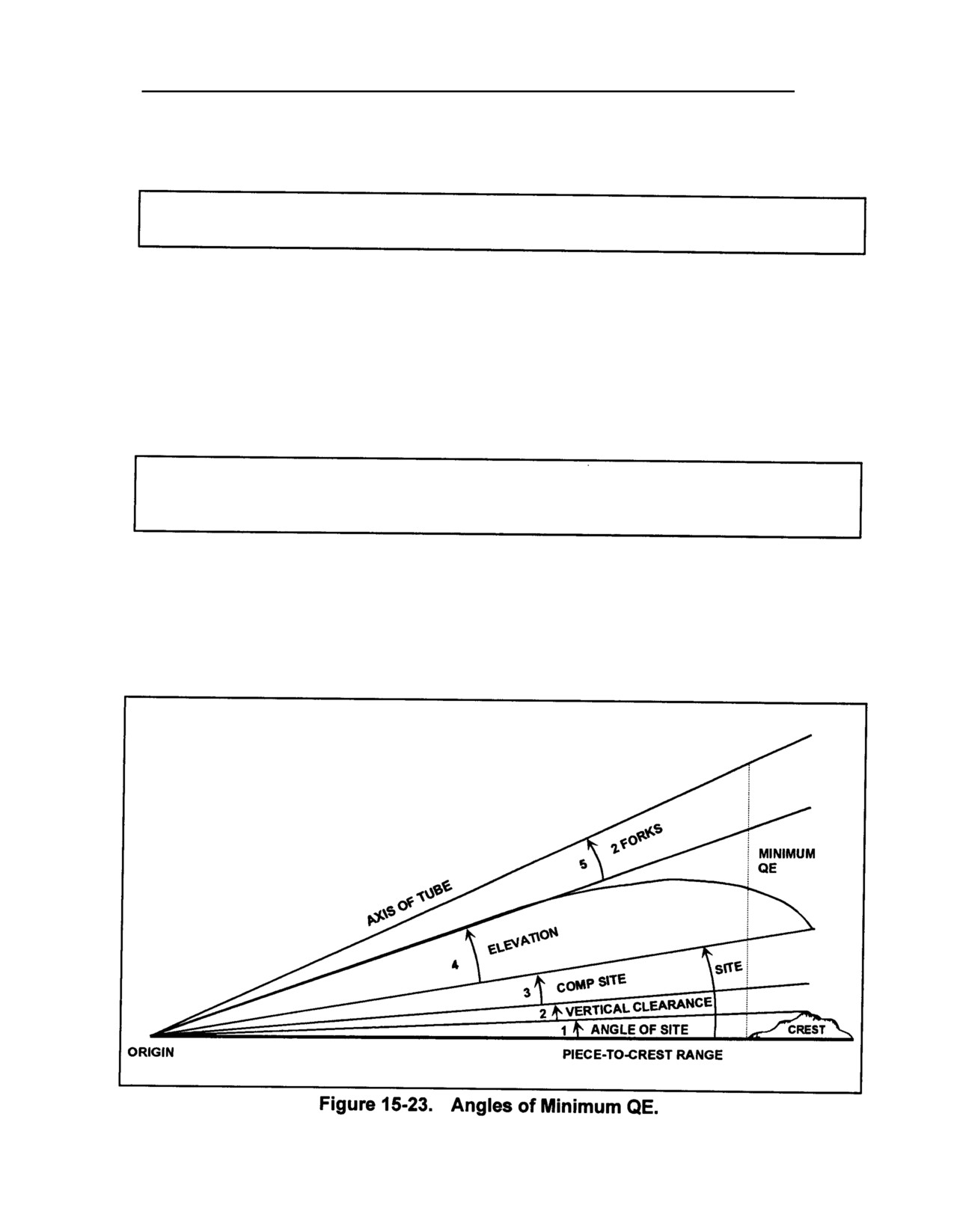
crest and the angle needed for a 5-meter vertical clearance is greater than 300 mils. Figure 15-23
shows the elements of minimum QE.
15-26
FM 6-40
a. Piece-to-crest range (PCR) is the horizontal distance between the piece and the crest,
expressed to the nearest 100 meters. Procedures for measurement are discussed in paragraph
15-26.
NOTE: All angles are determined and expressed to the next higher mil.
b. Angle 1 (Figure 15-23) is the angle of site to crest measured by the weapons. See
paragraph 15-25 for procedures.
c. Angle 2 (Figure 15-23) is the vertical angle required to clear the top of the crest. For
quick, time, and unarmed proximity (VT) fuzes, a vertical clearance of 5 meters is used. For
armed VT fuzes, see paragraph 15-28.
d. Angle 3 (Figure 15-23) is the complementary angle of site. It is the complementary
site factor (TFT, Table G) for the appropriate charge at the piece-to-crest range multiplied by the
sum of angles 1 and 2. Site is the sum of angles 1, 2, and 3.
NOTE: The entry argument for Table G is PCR. If it is not listed, do not interpolate,
use the next higher listed value.
e. Angle 4 (Figure 15-23) is the elevation (TFT, Table F) for the appropriate charge
corresponding to the PCR.
f. Angle 5 (Figure 15-23) is a safety factor equivalent to the value of 2 forks (TFT,
Table F) for the appropriate charge at the PCR.
g. The sum of angles 1 through 5 (Figure 15-23) is the minimum QE for the weapon and
the charge computed.
15-27
FM 6-40
15-25. Measuring Angle of Site to Crest
As soon as the piece is “safed,” prefire checks conducted, and ammunition prepared,
position improvement begins with verification of site to crest as measured by the advance party.
The advance party measures site to crest with an M2 compass or aiming circle. The section chief
measures the angle of site to crest and reports it to the XO or platoon leader. To measure the
angle of site to crest, the section chief sights along the bottom edge of the bore, has the tube
traversed across the probable field of fire, and has the tube elevated until the line of sight clears
the crest at the highest point. He then centers all bubbles on the elevation mount and reads the
angle of site to the crest from the elevation counter. This angle of site and the PCR are reported
as part of the section chief’s report.
15-26. Measuring Piece-To-Crest Range
a. There are five methods that can be used to measure piece-to-crest range:
(1) Taping. This is the most accurate method; however, it is normally too
time-consuming.
(2) Subtense. This method is fast and accurate.
(3) Map Measurement. This method is fast and accurate if the obstacle can be
accurately located (for example, a lone tree will not appear on a map).
(4) Pacing. This method is time-consuming and depends on the distance and
accessibility to the crest.
(5) Estimation. This method is least accurate, but it is used when other methods are
not feasible.
b. Regardless of the method used to measure PCR, the XO or platoon leader must verify
PCR before he computes QE. He can do this by using any of the five methods.
15-27. Computation for Fuzes Other Than Armed VT
a. The XO or platoon leader does the computations indicated in this section if the sum
of angles 1 and 2 (Figure 15-23) exceeds 300 mils or if the rapid fire tables (RFTs) are not
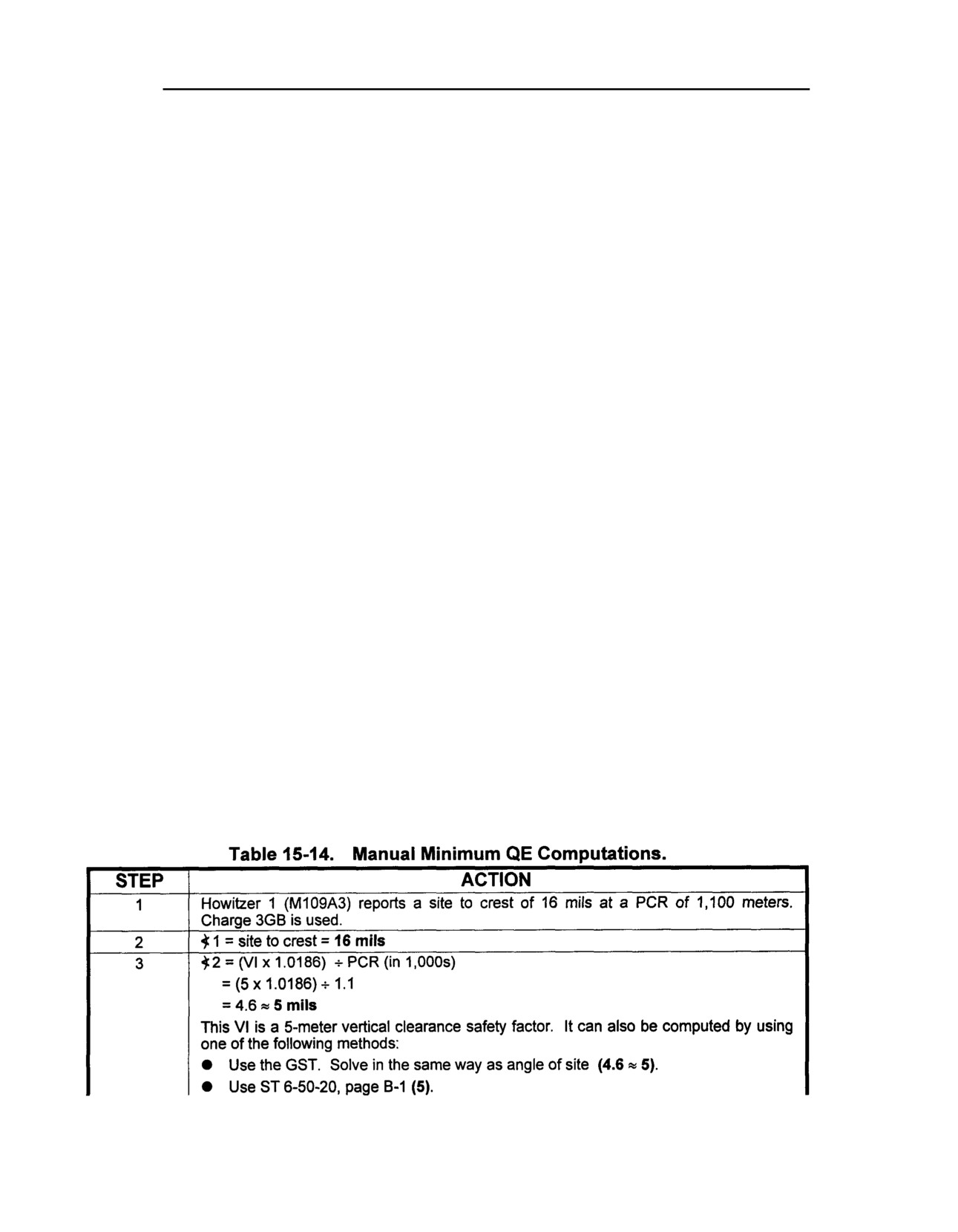
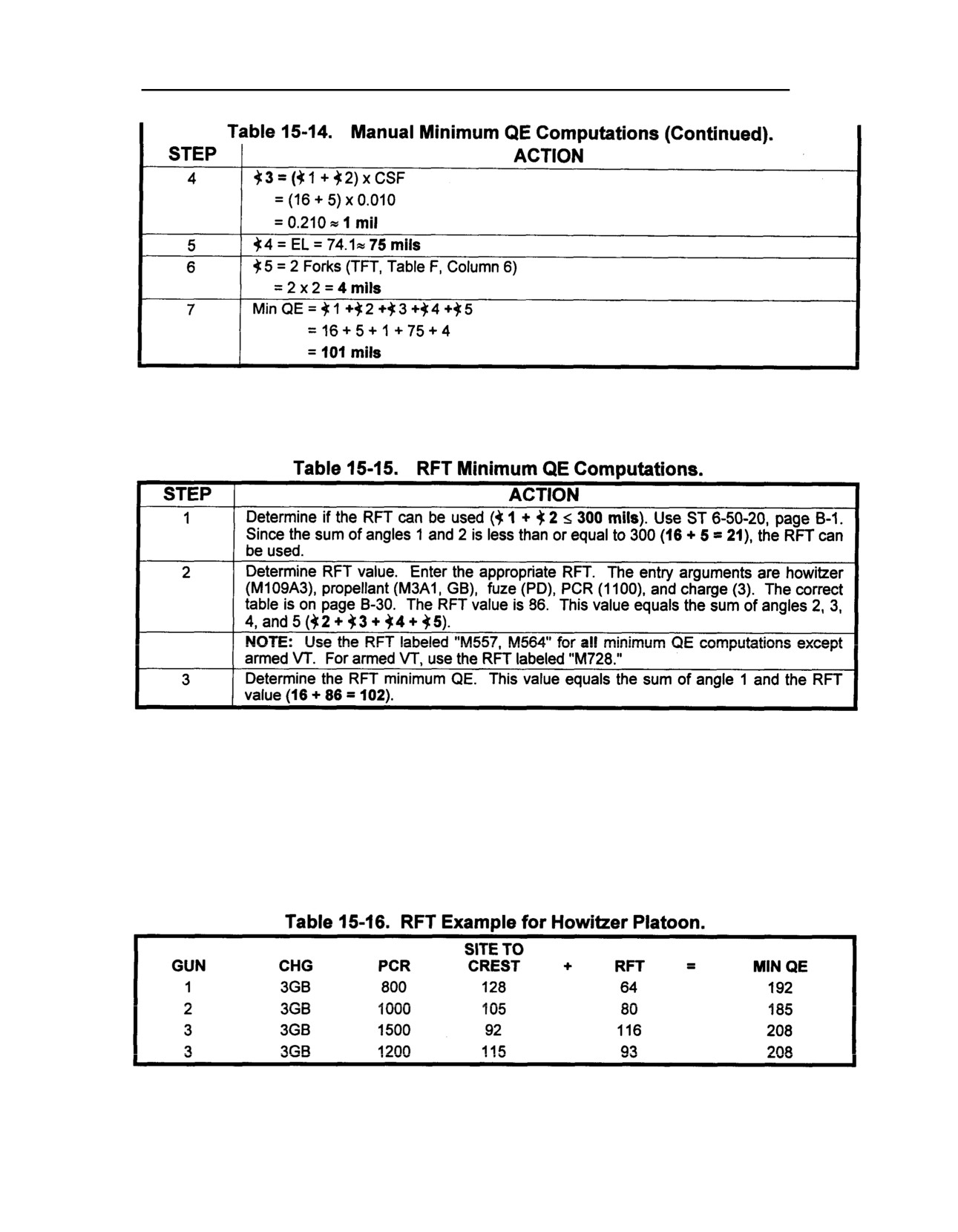
available. All angles are determined and expressed to the next higher mil. Table 15-14 lists
the steps and solves an example of an XO’s or platoon leader’s manual computations.
15-28
FM 6-40
b. The same example is solved in Table 15-15 by using the RFTs in ST 6-50-20,
Appendix B.
c. One howitzer section may report a site to crest that is unusually high. If the XO or
platoon leader determines that it is the result of a single narrow obstruction (such as a tree), the
piece can be called out of action when firing a deflection that would engage the obstruction. This
would enable the platoon to use the next lower site to crest. Other alternatives are to remove the
obstruction or move the weapon.
d. Table 15-16 illustrates why minimum QE is computed for all guns, regardless of
which has the largest site to crest.
15-29
FM 6-40
15-28. Computations for Armed VT Fuze (Low-Angle Fire)
a. The method of computing the XO’s minimum QE for firing a projectile fuzed with an
M728 or M732 fuze depends on the method in which the fuze is used. The proximity (VT) fuze
is designed to arm 3 seconds before the time set on the fuze; however, some VT fuzes have
armed as early as 5.5 seconds before the time set on the fuze. Because of the probability of
premature arming, a safety factor of 5.5 seconds is added to the time of flight to the PCR. Since
time on the setting ring is set to the whole second, the time determined in computing minimum
safe time is expressed up to the nearest whole second. A VT fuze is designed so that it will not
arm earlier than 2 seconds into time of flight, which makes it a bore-safe fuze.
b. In noncombat situations, the XO or platoon leader determines the minimum safe time
by adding 5.5 seconds to the time of flight to the minimum range line as shown on the range
safety card. The minimum QE determined for fuzes quick and time is also valid for fuze VT.
c. In combat situations, the XO or platoon leader determines the minimum QE and a
minimum safe time for fuze VT. The minimum QE determined for PD fuzes is safe for VT fuzes
if the fuze setting to be fired equals or is greater than the minimum safe time determined in
paragraph a above. If the XO or platoon leader finds it necessary to fire a VT fuze with a time
less than the minimum safe time, he must modify the minimum QE. He does this by increasing
the vertical clearance to ensure that the fuze will not function as it passes over the crest.
d. If the projectile is to be fired with the VT fuze set at a time less than the minimum
safe time, allowance must be made for vertical clearance of the crest. Vertical crest clearances for
armed M728 and M732 VT fuzes fired over ordinary terrain for all howitzer systems is 70
meters.
e. If the projectile is to be fired over marshy or wet terrain, the average height of burst
will increase. The vertical clearance is increased to 105 meters. If the projectile is fired over
water, snow, or ice, the vertical clearance is 140 meters.
f. The minimum QE for armed fuze VT when a fuze setting less than the minimum safe
time is fired is based on the piece-to-crest range and a vertical clearance as indicated in
paragraphs d and e above.
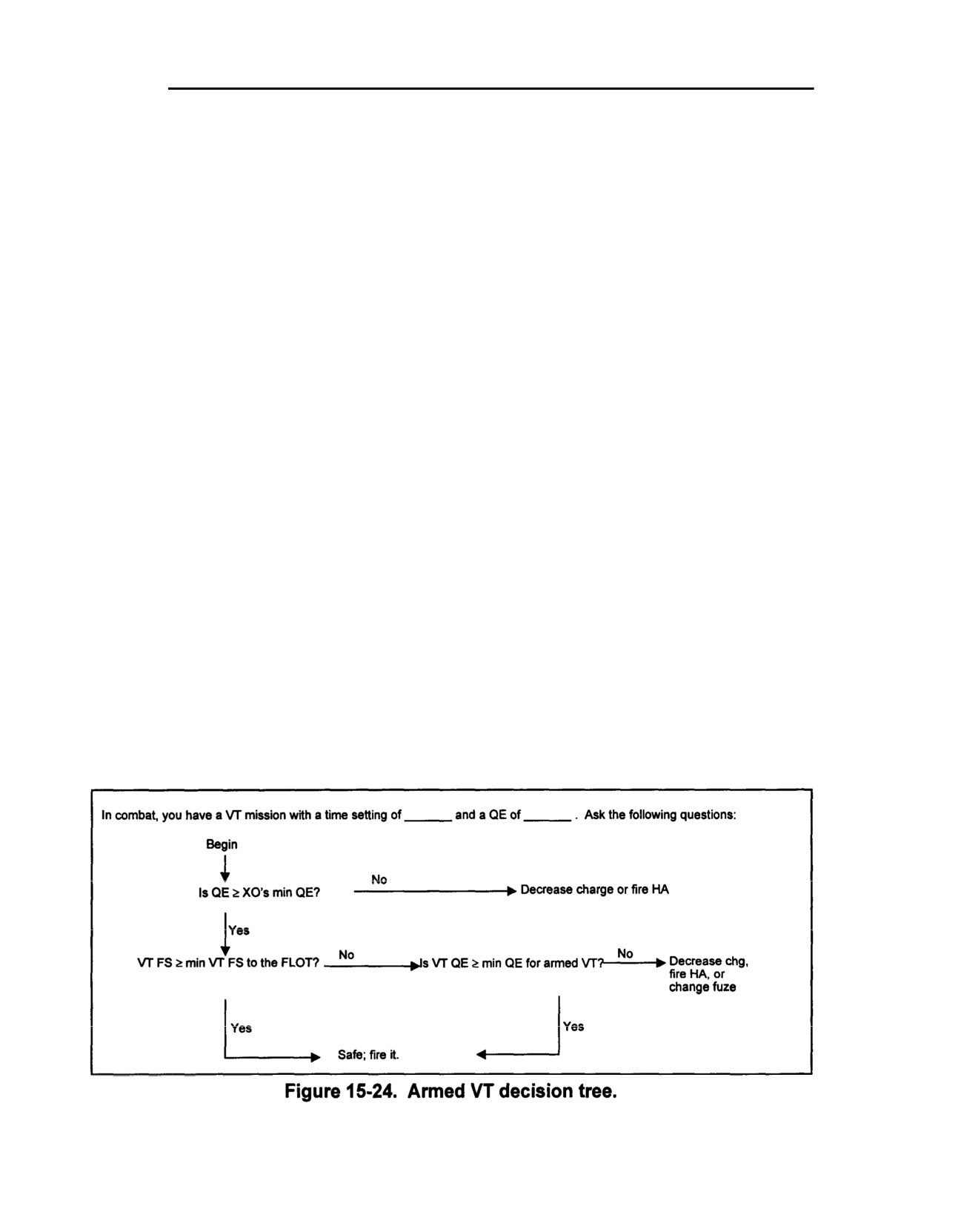
g. Figure 15-24 shows a decision tree for application of armed VT minimum QE.
15-30
FM 6-40
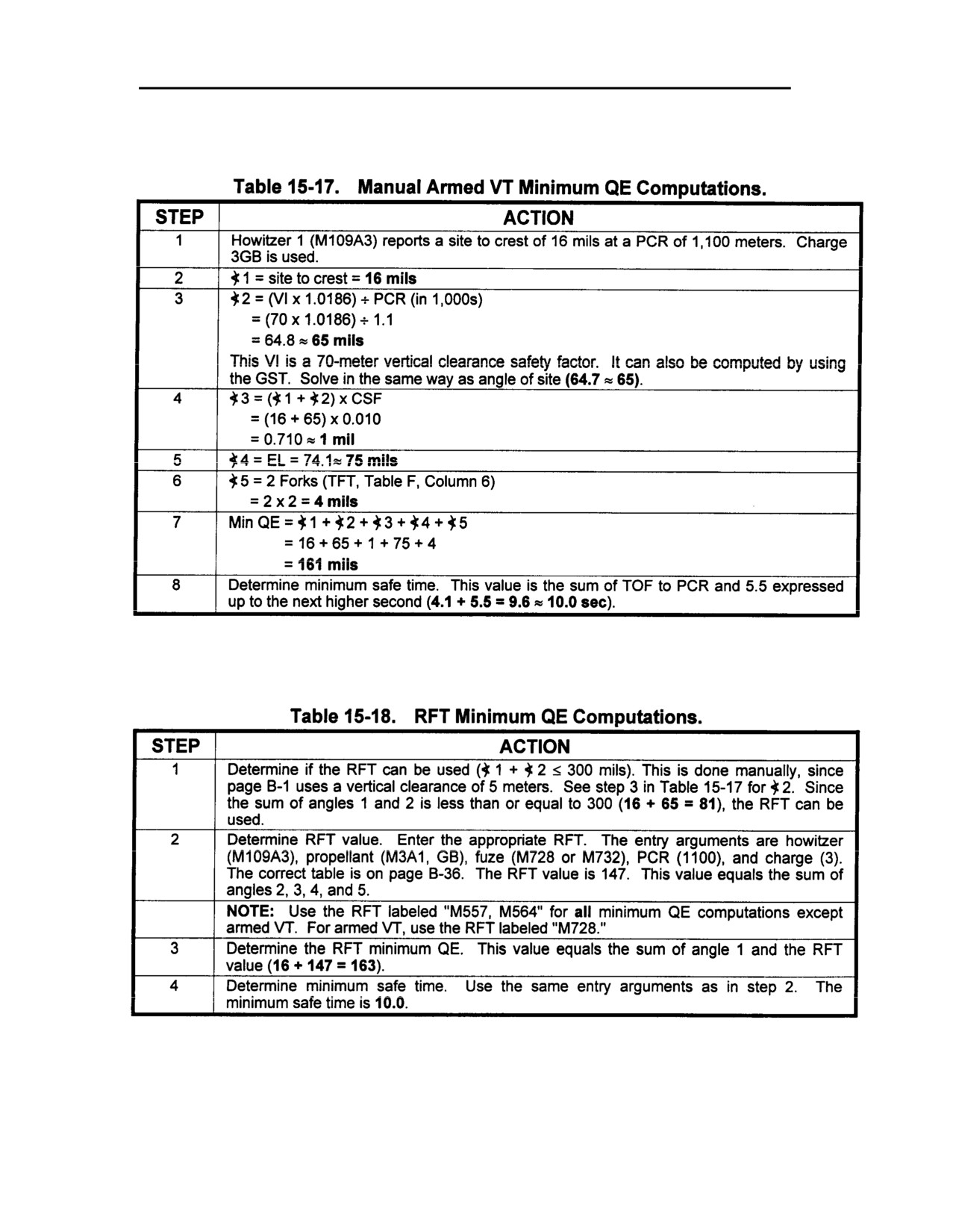
h. Table 15-17 is an example of computations to determine minimum OE for an armed
VT fuze.
i. The same example is solved in Table 15-18 by using the RFT in ST 6-50-20,
Appendix B.
j. If the fuze setting to be fired is equal to or greater than the minimum safe time, the
minimum QE for fuzes quick and time applies. If the fuze setting to be fired is less than the
minimum safe time, the minimum QE determined for armed VT applies.
15-31
FM 6-40
15-29. Using Minimum Quadrant Elevation
After computing minimum QE for each charge authorized, the XO or platoon leader must
compare the minimum QE to the QE required to clear the minimum range line. The XO must
then select the highest quadrant for each charge to be used as the minimum QE to be fired from
that position.
15-30. Intervening Crest
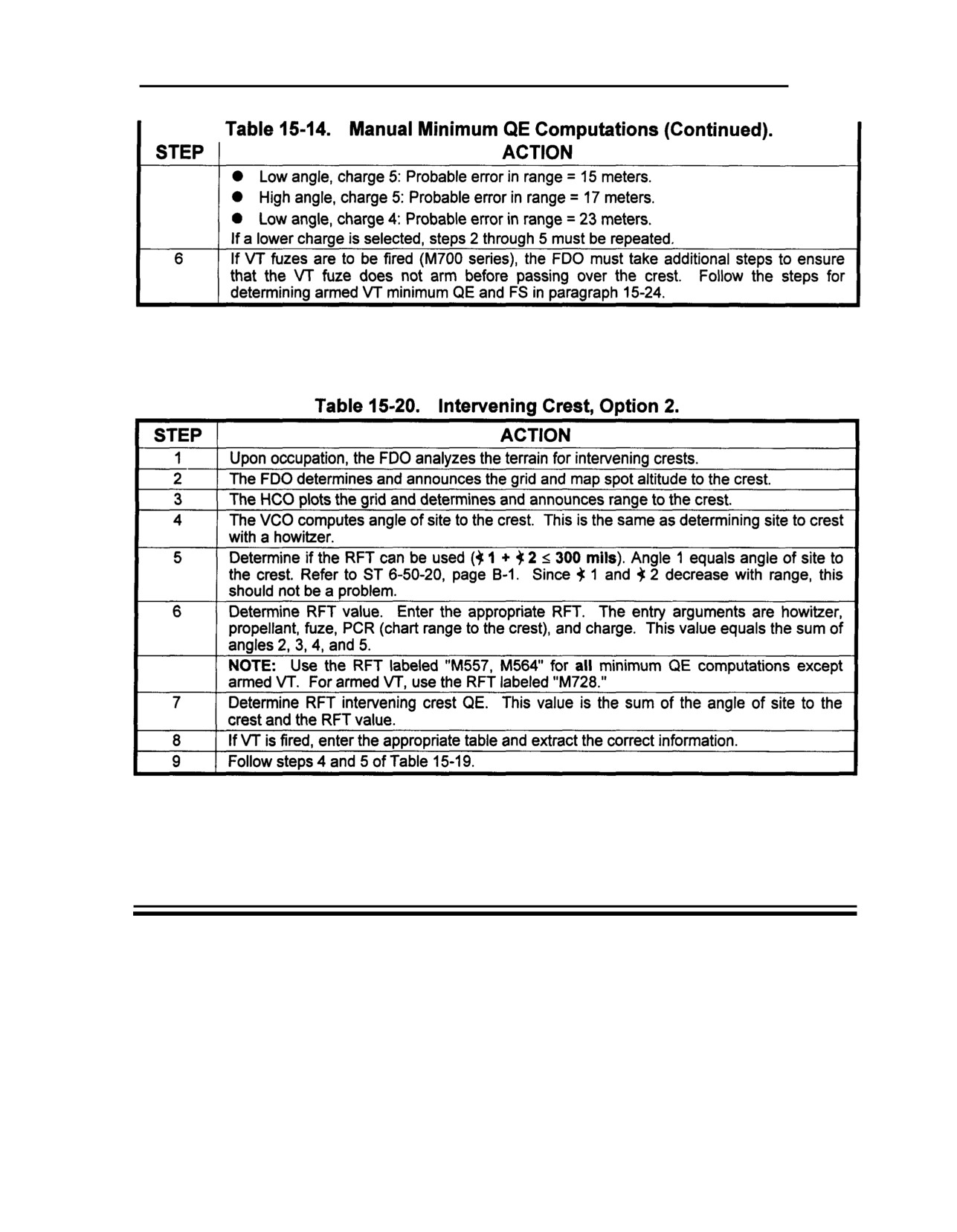
a. FDOs must ensure that artillery fires clear intervening crests. Intervening crests are
defined as any obstruction between the firing unit and the target not visible from the firing unit.
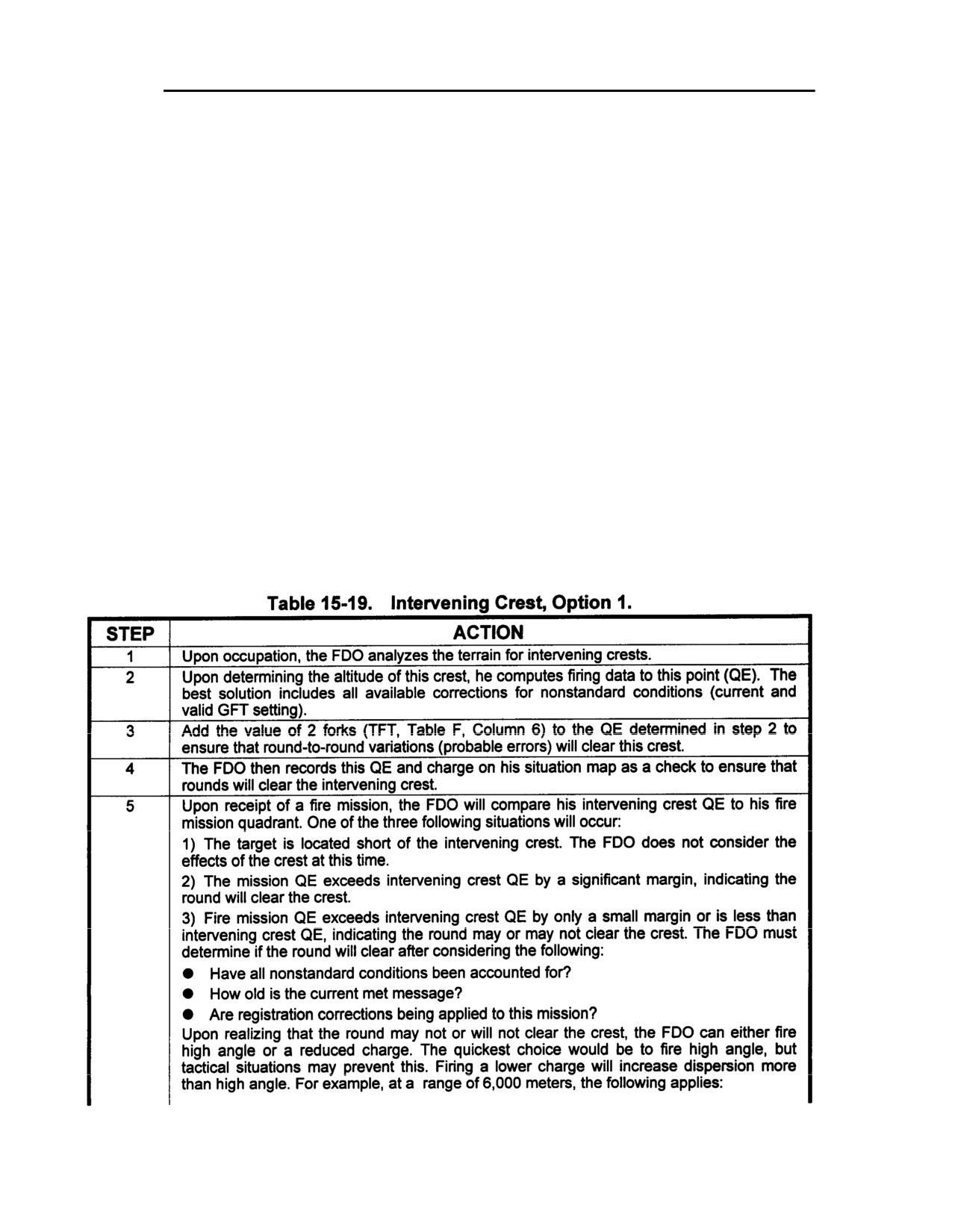
The following are the possible options, listed in order of preference:
(1) Determine firing data to the crest (include all nonstandard conditions) and add 2
forks (Table 15-19).
(2) Determine a minimum QE in a similar manner as XO’s minimum QE (Table
15-20).
(3) Use the trajectory tables in the appendix of the TFT.
b. Option 1 is preferred because it incorporates all current nonstandard conditions that
will affect the projectile along the trajectory. The FDO has the responsibility to determine on
the basis of availability of corrections for nonstandard conditions if this really is the best
option. Table 15-19 lists the steps.
15-32
FM 6-40
c. Option 2 does not include current corrections for all nonstandard conditions. Table
15-20 lists the steps.
d. The least preferred option is using the trajectory charts in the appendix of the TFT.
This offers a quicker but less accurate method to clear the intervening crest. The FDO must make
a judgment call when to use these charts. The FDO must use caution when making this
decision.
15-33
FM 6-40
Appendix A
BATTERY OR PLATOON FIRE DIRECTION CENTER SOP
NOTE: The following SOP is to be used only as a guideline to help the FDO or fire
direction section chief in developing an SOP for their unit.
The organization of the FDC generally is standard throughout the Field Artillery. The
actual organization will vary depending upon unit size and their particular mission. However,
the FDC in any unit must meet certain standards and be able to function on a continuous
24-hour basis. This requires that each individual within the FDC be cross-trained in every job in
the FDC and understand that their primary function is to process all fire missions received with
the maximum speed consistent with safety by using the most accurate data available, while
ensuring necessary checks to preclude errors which might endanger friendlypersonnel. The FDC
also receives operational and intelligence information for the platoon. In autonomous
operations, the FDC will communicate directly with the observer in receiving the
above-mentioned information.
A-1. Operational Concepts
The organization of the FDC must allow for the following goals to be accomplished:
Continuous, accurate, timely, and safe artillery fire support under all weather
conditions and terrain.
Ability to engage all types of targets over a wide area.
Massing of fires of all available units within range.
Processing simultaneous missions.
Disemmination of pertinent information.
Efficient division of duties.
Adherence to standard techniques and procedures.
Teamwork and adherence to a definite specified sequence of operations to aviod and
elimiante errors and to save time.
Efficient use of communications.
A-2. Duties and Responsibilities Within the FDC
a. Fire Direction Officer.
(1) Establishes, coordinates, and supervises the operations of the FDC.
(2) Issues the fire order.
(3) Ensures that the computer processes all fire missions with technically correct
procedures.
A-1
FM 6-40
(4) Reviews and approves the solution on all fire missions, to include any violations
of safety data.
(5) Develops and enforces fire command standards and ensures that proper fire
commands are transmitted to the cannon sections.
(6) Ensures that ammo distribution is maintained correctly within the platoon and
notifies the platoon leader if an ammo shift becomes necessary.
(7) Ensures that the FDC maintains current tactical data on maps and charts.
(8) Ensures that firing unit and ammo status are reported to the battalion FDC.
(9) Supervises the preparation for and execution of prearranged fires.
(10) Computes all safety data, to include verification of the platoon leader’s
minimum quadrant elevation.
(11) Analyzes intervening crests.
(12) Establishes and maintains communications.
b. Chief Fire Direction Computer (USMC--Operations Chief).
(1) Responsible for the training of all personnel within the FDC.
(2) Ensures that the FDC is prepared within Army training and evaluation program
(ARTEP) (Marine Corps combat readiness evaluation system [MCRES]) standards to fire
missions with the most accurate data available.
(3) Supervises the preparation of the firing chart(s). Ensures that chart checks are
performed and are within tolerances between both the horizontal and vertical control operators’
charts.
(4) Determines center range and charge for the computation of TGPCs. Ensures
that TGPCs are correctly computed.
(5) Ensures that the safety box is correctly constructed.
(6) Supervises the installation of equipment in the FDC.
(7) Assumes the duties of the FDO in his absence.
c. Senior Fire Direction Specialist (USMC--Operations Assistant).
(1) Prepares the primary means for computing firing data and processes and records
all missions fired on DA Form 4504.
(2) Transmits all firing commands to the howitzer sections in accordance with
prepared fire command standards.
(3) Reports current firing unit and ammo status to the battalion FDC.
(4) Ensures that accurate information is maintained within the FDC.
(5) Ensures that all required equipment for processing missions is present and keeps
the FDO and section chief informed of any shortages.
A-2
FM 6-40
d. Fire Direciton Specialist (HCO)(USMC--Fire Control Man).
(1) Prepares the primary chart for operation. The HCO will determine range,
deflection, and angle-T.
(2) Assists the fire direction computer in manual fire direction procedures
when
necessary.
(3) Updates the primary firing chart in accordance with the tactical situation.
(4) Assists the section chief in installation of section equipment when necessary.
e. Fire Direction Specialist (VCO) (USMC--Fire Control Man).
(1) Plots known data as directed by the assistant chief computer.
(2) Plots the initial target location and subsequent corrections when received.
(3) Checks chart data with the HCO.
(4) Plots the initial target location on the situation map and determines and
announces site for the appropriate battery.
f. RATELO/Driver (USMC--Fire Control Man/Driver).
(1) Maintains the section vehicle.
(2) Maintains the generator(s).
(3) Helps the fire direction specialist in posting the current tactical situation on the
situation map. Also, helps in maintaining in a current status all charts and records.
(4) Operates and maintains the FDC radios.
g. Advance Party Man. Not mentioned above are the additional duties of the advance
party man. This individual is normally selected and trained by the section chief. His duties areas
follows:
Prepares the position for the arrival of the FDC.
Establishes wire communications with the aiming circle and the gun guides.
Sets up the OE-254 antenna.
Receives initial data from the aiming circle and inputs it into the BUCS computer.
Establishes position voice communication with battalion.
Guides the FDC vehicle into position.
Helps set up camouflage nets.
Ensures wire and radio communications are functioning properly. If they are not,
he troubleshoots them.
Sets up the second 0E-254 as needed.
A-3
FM 6-40
NOTE: Successful accomplishment of the battery fire direction mission depends on
the fully coordinated efforts of all members of the FDC.
A-3. FIRE DIRECTION CENTER OPERATIONS CHECKLIST
The following checklists are provided to help the FDO or section chief in preparation and
sustainment during any major field exercise.
a. Actions Before Departing Garrison.
(1) Design physical setup of the FDC to allow the FDO and section chief to observe
the work of all personnel with a minimum amount of movement and provide each individual
ready access to the equipment, forms, and information necessary to perform his duties.
(2) Ensure all necessary supplies and equipment are located within the FDC. (For a
complete list of required equipment in a standard FDC, refer to the end of this appendix.)
(3) Ensure muzzle velocity logbook is present.
(4) Ensure adequate supply of expendable forms is on hand. The following forms
are used in all FA units:
DA Form 4982-R, Muzzle Velocity Record.
DA Form 4982-1-R, M90 Velocimeter Work Sheet.
DA Form 4504, Record of Fire.
DA Form 4200, Met Data Correction Sheet.
DA Form 3677, Computer Met Message.
DA Form 3675, Ballistic Met Message.
DA Form 5338-R, Computer Checklist.
DA Form 4757, Registration and Special Correction Work Sheet,
DA Form 4201, High Burst (Mean Point of Impact) Registration.
DA Form 7353-R, Universal Safety T.
DA Form 7352-R, Copperhead Met + VE Work Sheet.
DA Form 4655-R, Target List Work Sheet.
NOTE: The following forms are only for use in 155-mm units:
DA Form 5032-R, Field Artillery Delivered Minefield Planning Sheet.
DA Form 5711-R, Copperhead Planned Target List Work Sheet.
(5) Ensure that the fire direction vehicle is loaded in accordance with your unit load
plan. The load plan located at the end of this appendix maybe used as a guideline.
(6) Ensure the communications system has been verified as operational.
A-4
FM 6-40
b. Actions Upon Occupation of a Position. These actions are not listed in any
particular order and are as follows:
(1) Establish voice communications with battalion operations center and the FDC,
guns, and other subscribers; that is, observers and range control.
(2) Verify the azimuth of lay with the platoon leader.
(3) Transmit current update to battalion on firing unit and ammo status.
(4) Establish fire order and fire command standards, and transmit them to the
howitzer sections.
(5) Maintain the muzzle velocity logbook.
(6) Request observer locations.
(7) Complete average site map.
(8) Request current met.
(9) Verify howitzer ammo count and whether or not the ammo status is readily
available to the FDO and section chief.
(10) Perform all necessary chart checks.
(11) Compute safety and have a verification check completed as well.
(12) Verify the platoon leader’s minimum QE.
(13) Verify the safety computed does not violate the platoon leader’s minimum QE.
(14) Ensure safety data have been posted within the FDC and distributed to all
howitzer sections and leadership within the platoon.
(15) Ensure the VCO’s map is color-coded and marked for average site and
altitude.
(16) Compute TGPCs and special correcitons.
(17) Verify that all sensitive items are accounted for.
(18) Verify GFT settings are applied to the GFTs.
(19) Obtain an accurate propellant temperature and projectile weight.
(20) Ensure situation map is readily available and posted with the current tactical
situation and fire support coordinating measures.
(21) Ensure the generator has been serviced and started.
(22) Ensure after-operation checks have been completed on the FDC vehicle.
(23) Ensure all howitzers have reported safe and in order.
(24) Check for intervening crests.
A-5
FM 6-40
(25) Check the following to ensure that they are plotted correctly on the firing
chart:
Center of battery location or base piece and altitude.
Azimuth of fire.
Azimuth and deflection indexes,
Safety box.
Observer locations.
Fire support coordinating measures.
Frontline of troops.
Radar.
Other batteries within the battalion.
TGPC sectors if applicable.
(26) Ensure the firing chart is neat and clean.
(27) Ensure the chart is prepared for 6,400-mil operation, if necessary.
(28) Ensure the five requirements for accurate predicted fire have been met.
(29) Ensure a wet code has been requested for live fire from range control.
(30) Ensure the FDC is neat and orderly with equipment readily available but stored
so as not to interfere with the FDC operations.
(31) Ensure fire order and fire command standards are visible to all personnel.
(32) Ensure the following information is easily accessible.
Laying data.
Piece distribution.
MV information.
Call signs.
Residuals.
GFT settings.
Propellant temperature.
Projectile weight.
Terrain gun position corrections.
c. Actions Upon Receipt of a Fire Mission. Upon receipt of a fire mission, the FDC
does the following:
RATELO: Records CFF and announces FIRE MISSION to the FDC.
ALL: Announce FIRE MISSION.
COMPUTER: Announces FIRE MISSION to gun line.
A-6
FM 6-40
RATELO: Announces (or records on mission board) the CFF to the FDC (loud readback
to FO).
HCO: Reads back target location, plots target, and determines chart range and deflection.
VCO: Plots target and determines chart range and deflection.
FDO AND SECTION CHIEF:
1) Plot the target on the situation map and verify it is safe and does not violate any
FSCMs.
2) Determine the fire order and issue it to the computer.
COMPUTER:
1) Reads back the fire order and records it on ROF.
2) Records initial fire commands up to and including fuze on the basis of the FDO’s
fire order.
3) Announces initial fire commands to the guns. (FDO and section chief monitor.)
RATELO: Composes and transmits the MTO on the basis of the fire order. (FDO and
section chief monitor.)
COMPUTER: Requests range; for example, RANGE, ONE ALPHA.
HCO: Announces chart range to the computer; for example, ONE ALPHA, RANGE
5980.
VCO: Announces CHECK or HOLD (±30 meters) to HCO.
COMPUTER:
1) If the VCO announces CHECK, places announced range under MHL on
appropriate GFT. If the VCO announces HOLD, has the section chief verify charts and
determine which range to use.
2) Records and reads back range placed on GFT; for example, RANGE 5980.
3) Requests deflection; for example, DEFLECTION.
HCO: Announces chart deflection to computer; for example, DEFLECTION 3286.
VCO: Announces CHECK or HOLD (±3 mils) to HCO.
COMPUTER:
1) Records chart deflection on ROF and reads back chart deflection.
2) Records elevation on ROF.
3) If time or VT fuze is used, determines time setting.
4) If time or VT fuze is used, announces FZ TI (or VT), TIME (such-and-such) to
gun line and records on ROF.
5) Determines deflection correction and records it on ROF.
A-7
FM 6-40
6) Determines deflection to fire.
7) Announces deflection to fire as DEFLECTION (so much) to the gun line and
records it on ROF.
FDO AND SECTION CHIEF: Ensure all data determined by computer are correct.
(May follow with TFT and GFT or BUCS.)
VCO: Determines and announces site. (FDO and section chief perform common-sense
check [VI/RG in thousands].)
COMPUTER:
1) Records site on ROF.
2) Determines QE and records it on ROF.
3) Announces data to FDO and section chief for safety verification.
FDO AND SECTION CHIEF: Verify the data from the safety T are safe. If the data are
safe, announce SAFE. If the data are unsafe, announce UNSAFE and state the reason why; for
example, UNSAFE, QE 3 MILS BELOW MIN SAFE QE.
COMPUTER:
1) If data are safe, announces QE to the gun line.
2) Records MOF I/E, if applicable, as announced in the fire order.
3) Maintains the ROF.
HCO AND VCO: Orient target grid on firing charts and await any subsequent
corrections from the observer.
VCO: Updates ammo board as time permits.
d. Actions During Fire Missions. These actions areas follows:
(1) Verify the met was valid with registration.
(2) Ensure safety data have been updated after the registration mission.
(3) Ensure situation map has been checked for occupation of intervening crests by
friendly elements.
(4) Verify fire order has been issued.
(5) Ensure the fire mission is from a valid subscriber.
(6) Authenticate the call for fire, if necessary.
(7) Ensure the current communications-electronics operation instructions (CEOI) are
available.
(8) Ensure the MTO is transmitted promptly and in accordance with the fire order.
(9) Ensure fire commands are being transmitted as soon as individual items are
determined and that they are in the correct format.
(10) Ensure ammo count has been updated after every mission by piece.
A-8
FM 6-40
(11)
Verify how old met data are.
(12)
Complete a chart-to-chart check on firing data for each mission.
(13)
Check safety on each and every mission.
(14)
Determine angle T and, if necessary, transmit it to the observer.
(15)
Properly update safety.
(16)
Ensure proper reports are given to the battalion FDC and tactical operations
center (TOC).
(17) Ensure current situation map has been updated lately to reflect the current
tactical situation.
(18) Ensure the record of fire is legible and complete.
(19) Ensure propellant temperature has been updated within the last hour.
(20) Ensure the communications system allows all personnel to hear the call for free.
e. Actions Before Displacement.These actions areas follows:
(1)
Ensure FDC is set up for emergency missions.
(2)
Clean off old GFT settings from GFT.
(3)
Ensure start point has been reported to battalion.
(4)
Ensure communications check has been performed with battalion while moving.
(5)
Ensure all sensitive items have been accounted for.
(6)
Ensure chart has been prepared for the next position.
(7)
Ensure checkout information has been obtained from range control.
(8)
Always keep copies of ROFs and safety computations for permanent records.
(9) File forms in an orderly manner.
A-4. Fire Direction Center Journal (Logbook)
To maintain a record of FDC activities during field operations, it is recommended that a
journal be kept of each day’s activities. This journal, or logbook, will reflect all significant events
that have occured during all field operations. These significant events include, but are not limited
to, the following:
Check firings.
Reports.
All range control information.
Receipt of all messages (date, time, and content).
Met messages.
The journal should be closed out every 24 hours so as to prevent any unnecessary
confusion.
A-9