FM 6-40 TTP for Field Artillery Manual Cannon Battery U.S. - page 14
FM 6-40
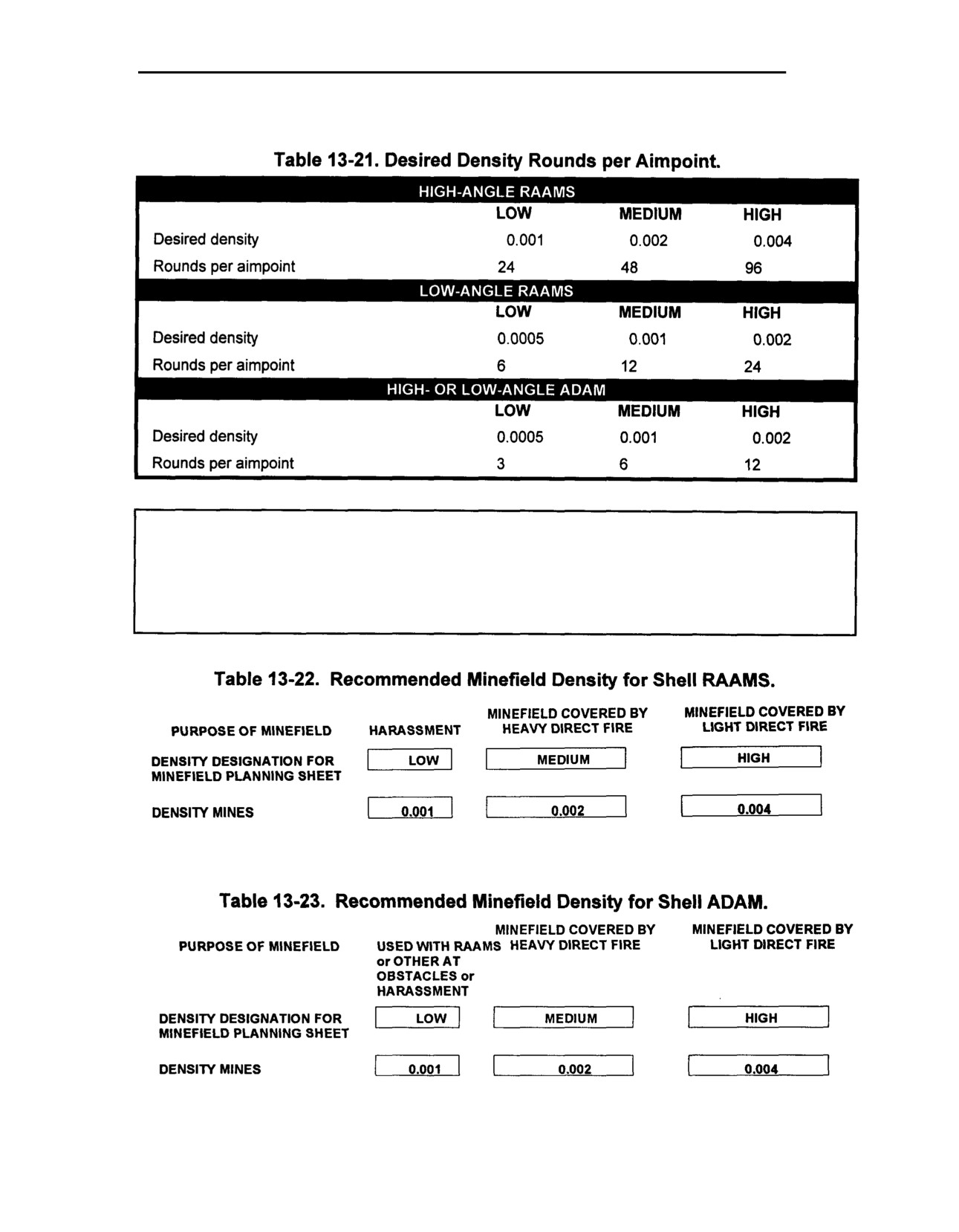
(10) On the basis of the desired density, enter Table 13-21 below to determine the
number of rounds needed to achieve that density.
NOTE: A density of .001 means that there will be approximately one mine every
1,000 square meters. In other words, there will be one mine in every 32-x 32-meter
area. These density numbers are used for planning purposes only. Dispersion of the
projectiles in the target area will dictate the actual pattern of mines. Tables 13-22
and 13-23 show recommended minefield densities.
13-55
FM 6-40
(11) Now, using all available information, the FDO issues the fire order and the
computer records it on the ROF.
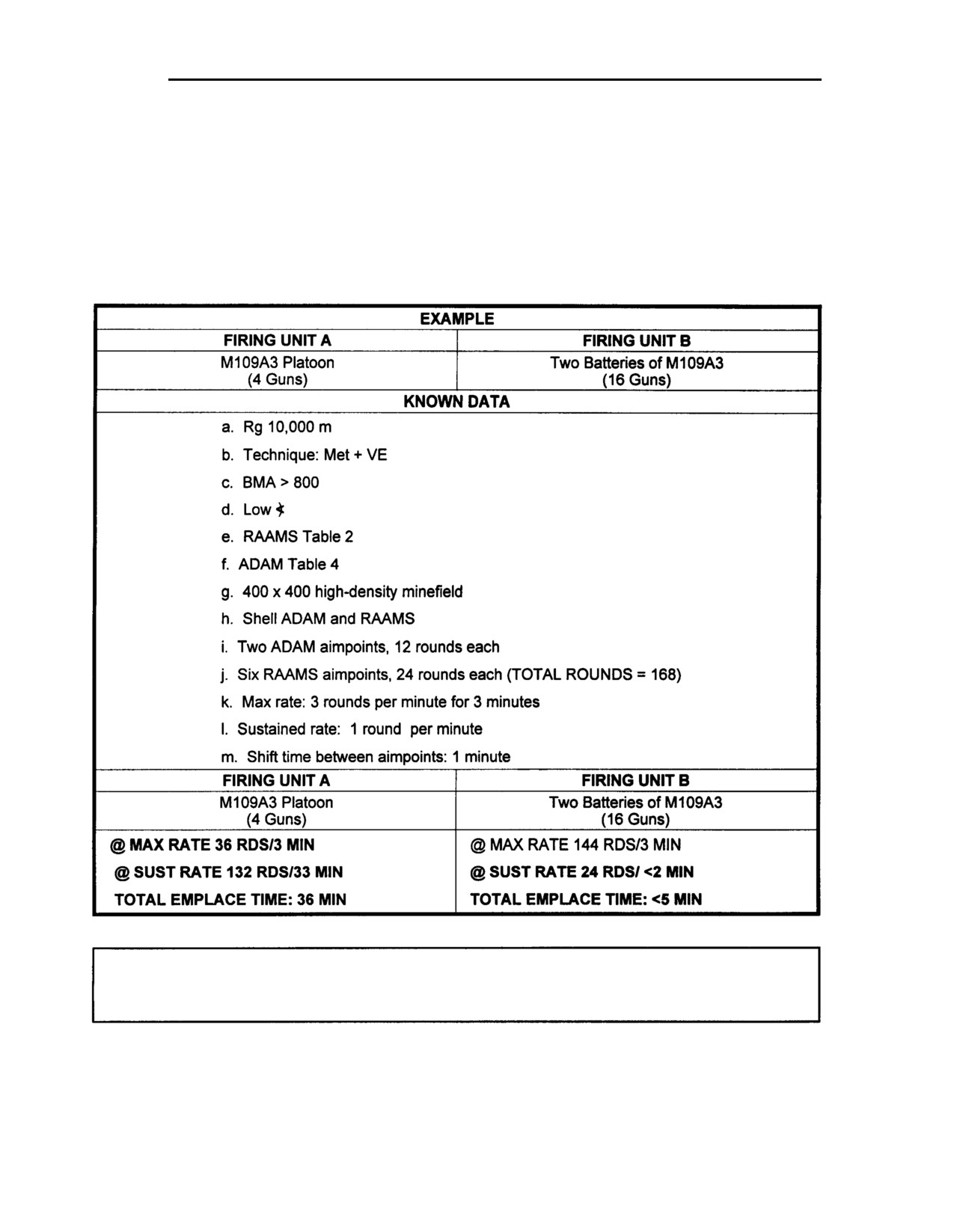
(12) There are some additional tactical considerations to consider when determining
which firing unit(s) will deliver the mines on target. The FDO must consider the total
emplacement time, the BMA angles of the firing units, the units available, distribution of
FASCAM ammunition, and distribution of aimpoints. When firing a minefield containing both
ADAM and RAAMS mines, RAAMS should be fired first to
ADAM mines.
NOTE: The above example is for illustrative purposes only and does not include
the time required to shift between aimpoints.
13-56

FM 6-40
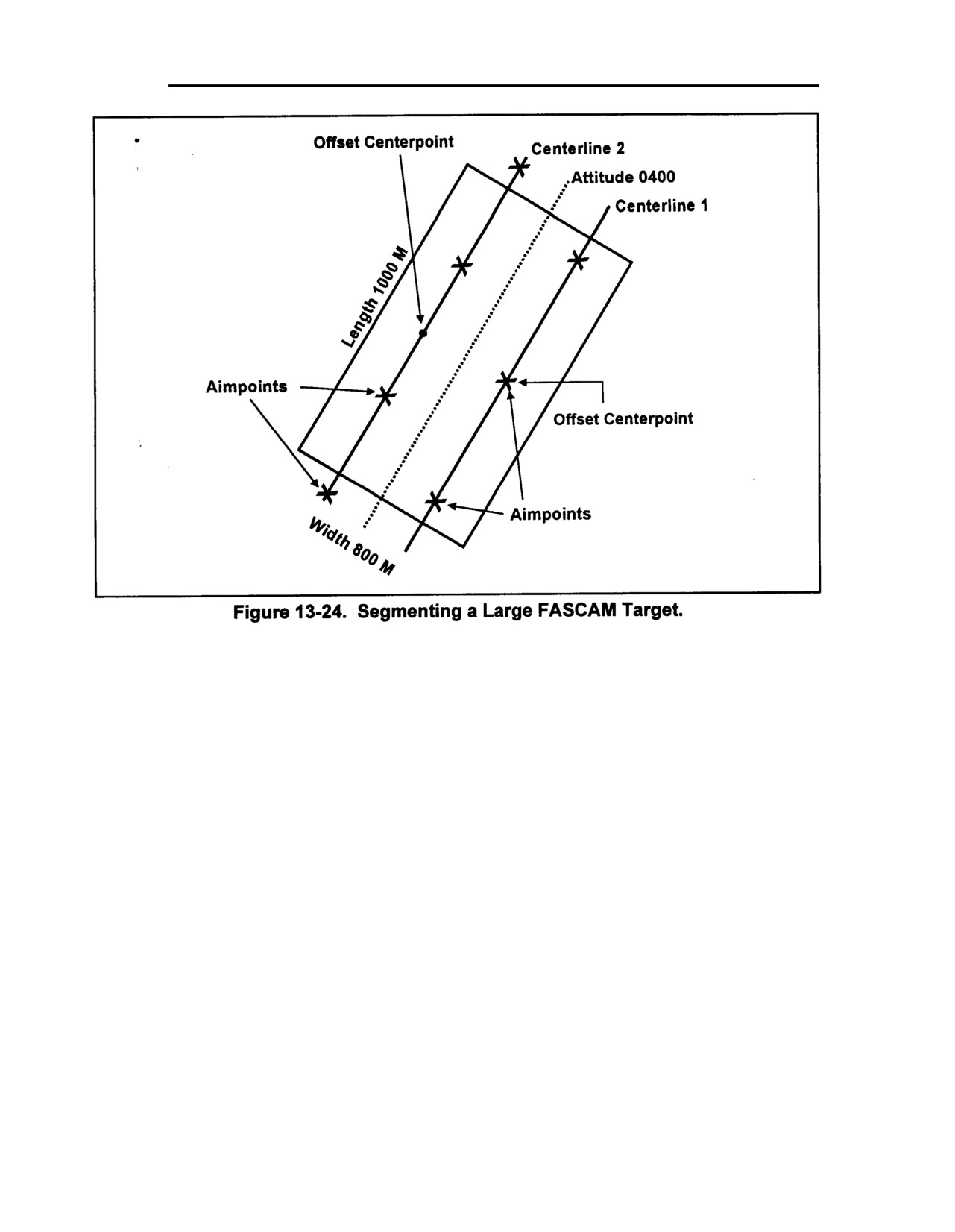
(13) The FDO must also consider how to segment a target that is larger than the
established planning modules. Segmenting a large target may require the FDO to establish two
or more linear sheafs in the target area. The tactical considerations discussed in paragraph (12)
are considered for each linear sheaf as if it were a separate fire mission. This decision to segment
a large target is normally the responsibility of the battalion FDO.
(a) To illustrate this concept, consider the following situation:
Weapon: M109A3
Minefield size: 1,000 x 800
Attitude: 0400
Munitions: RAAMS
Angle of fire: High angle
Module size: 400 x 400
(b) Since the width of the minefield is a multiple of the planning module
(800/400 = 2), the FDO can continue with the fire order process. If the establishing agency
requests a minefield width that is not a multiple of the planning module, this must be resolved
before the FDO can properly segment the target to achieve the desired density. In this example,
the FDO will segment the minefield into two targets of 1,000 x 400 each. On the firing chart, the
FDO will establish a centerline along each separate minefield. The easiest way to do this is to
place the target grid over the center of the grid to the minefield and orient along the attitude.
Next, place plotting pins left and right of the attitude (200 meters) to establish the offset center
points.
(c) The FDO will use the offset center points to determine chart range and the
BMA. In some cases, this may cause the number of aimpoints to be different for each centerline,
In this example, the chart operator determined the following data:
Centerline 1: 1/A RG 10,930, BMA 1150
Centerline 2: 1/A RG 11,350, BMA 1170
(d) The FDO will enter the appropriate minefield employment table and
determine the number of aimpoints for each centerline. Finally, he will determine the aimpoint
spacing along each centerline. In this example, the FDO determined the following data
(e) The remainder of the tactical considerations are performed as described in
the steps from paragraph 13-27b(l3). Figure 13-23 depicts the results achieved from the above
situation.
13-57
FM 6-40
13-28. Technical Fire Direction Procedures
a. Now that the fire order is issued, technical fire direction must be determined by using
DPICM graze burst data and then converting these DPICM data to either RAAMS or ADAM
data. To convert these DPICM data, use the FT 155-ADD-L-1 (for ADAM) or FT 155-ADD-N-1
(for RAAMS). The preferred technique is to conduct a DPICM registration and transfer the GFT
setting. Other techniques used are met + VE or met to target. The computer records the initial
fire commands through the Fz block and the MTO block on the ROF.
b. Now plot the aimpoints on the (target grid) firing chart (placing plotting pins left and
right along the centerline arrow, representing the attitude) and determine chart data to the
aimpoints. These are aimpoints where you want the rounds to impact. For ADAM, these chart
data are not recorded on the ROF but are used to determine VI and site (we determine site to the
actual impact of the rounds, not to an offset aimpoint location). For future use, record the chart
range, VI, and site in the computational space of the ROF. For RAAMS, record the chart data,
VI, and site for each aimpoint.
c. Since low-level winds will cause ADAM mines to be blown away from the intended
aimpoint, a modification in meters must be made to the location of the aimpoints. This will allow
the mines to impact at the intended location. Low-level wind corrections are not computed for
RAAMS. For RAAMS, go to paragraph f(3).
d. The computer must enter FT 155-ADD-L-1, Table A, Column 1, with the DPICM
graze burst quadrant determined to the center point grid (paragraph 13-27b(3)) and extract the
13-58
FM 6-40
correction for low-level winds from Column 5. This offset correction allows the delivered
ADAM mines to be on target for a wind speed of 1 knot. The Low-level wind correction is
recorded in the subsequent fire commands portion of the ROF.
(1) Since ADAM has a 600-meter HOB, line 02 from a current met message is used
to determine the wind speed and direction. Line 02 is used because 00 = 0 to 250 meters, 01 =
250 to 500 meters, and line 02= 500 to 1,000 meters.
(2) The computer multiplies the correction factor in paragraph d by the wind speed
in paragraph d(1) to determine the total distance, in meters, needed to offset each aimpoint to
compensate for low-level winds. Express this value to the nearest 10 meters, and record it on the
ROF. This distance in meters, in conjunction with the direction of the wind, will be used to
offset the aimpoints.
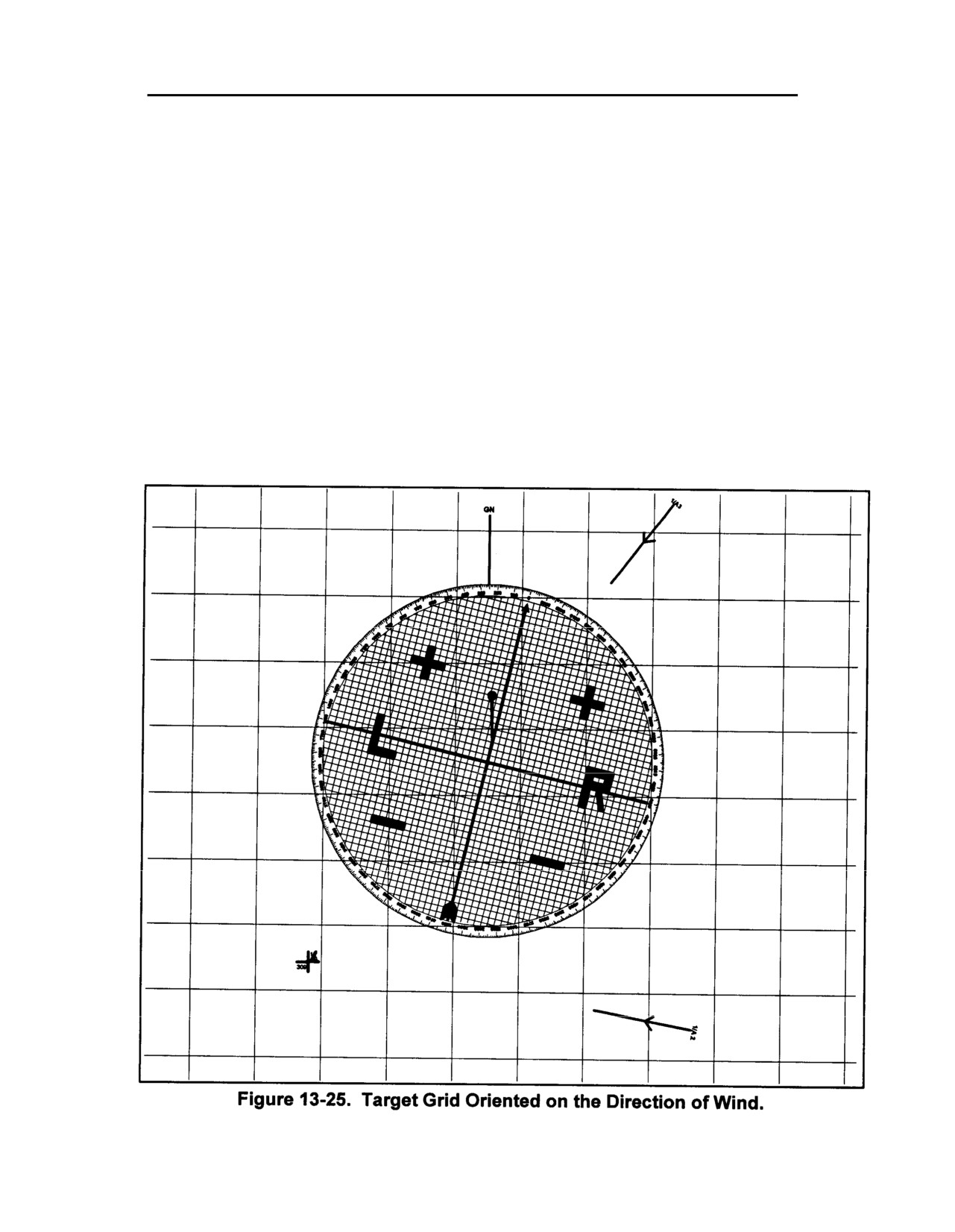
e. The HCO uses the target grid to offset the aimpoints.
(1) The HCO places the target grid over the center point and sets off the direction of
wind. Remember, this is the direction from which the wind is blowing. The HCO then offsets
the center point into the wind by the distance determined in step d(2). (See Figure 13-25.)
13-59
FM 6-40
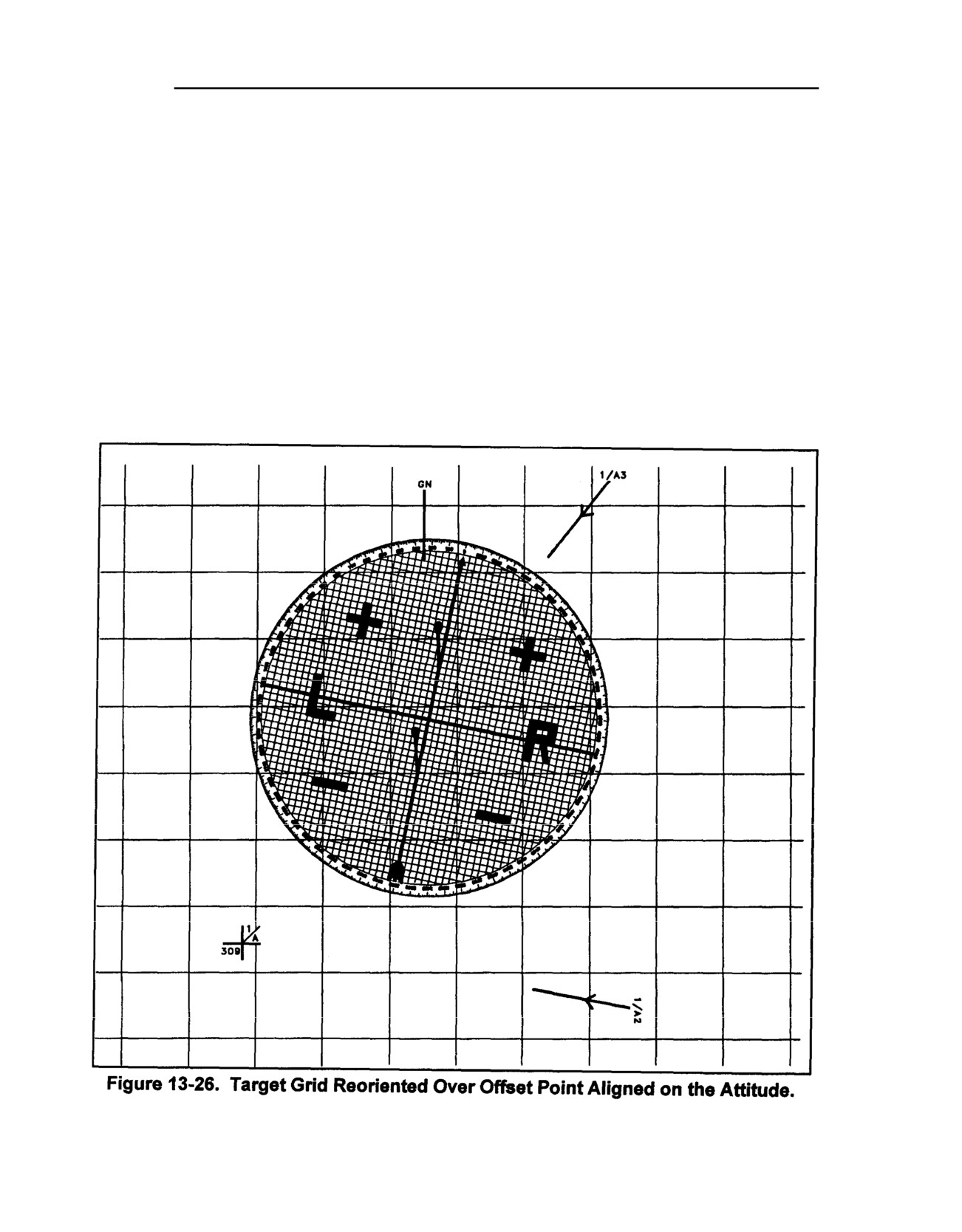
(2) The HCO reorients the target grid over this point, resets the minefield attitude
off, and places plotting pins left and right of the center point as determined in step (9) above,
using the target grid centerline (arrow). Note that the “head and tail” of the target grid
represents the attitude. (See Figure 13-26.)
f. The computer determines FASCAM firing data to each offset aimpoint.
(1) The HCO determines and announces chart range and deflection to the two
aimpoints.
(2) The VCO determines site. Using the location and range to the original
aimpoints which are recorded in the computational space of the ROF, the VCO determines VI
and site.
(3) The computer determines DPICM graze burst time, deflection, elevation, and
quadrant elevation to each aimpoint. Since these are not the data to be fired, place the time,
deflection, and quadrant in parentheses.
13-60
FM 6-40
(4) The computer determines and records FASCAM firing data by placing the MHL
over the DPICM graze burst time and quadrant. The deflection to fire is the chart deflection to
the aimpoint plus the total deflection correction (GFT DF CORR + DPICM DRIFT).
(5) The preliminary FT 155-AN-2 and FT 155-AN-1 TFTs can be used to
determine graze burst data for DPICM. The FT 155-AN-2 supersedes the FT 155-AN-1 and is
the preferred source of firing data.
(6) The firing table addendums are used in conjunction with the firing tables to
determine the firing data FASCAM.
13-29. ADAM
a. Firing Table Addendum L-1 is used in conjunction with the AN-l/AN-2 base TFT to
determine firing data for shell ADAM.
b. Table A, Column 1, is entered with the graze burst QE that was determined by using
the AN-1/AN-2 TFT. The correction to quadrant is found in Column 2 and is added to the graze
burst data.
c. Table B, Column 1, is entered with the graze burst fuze setting that was determined
by using the AN-1/AN-2 TFT. The correction to fuze setting is found in Column 2 and is added
to the graze burst data.
d. Subsequent corrections for quadrant are determined from Table A, Columns 3 and 4;
for fuze setting, Table B, Columns 3 and 4.
13-30. RAAMS
a. Firing Table Addendum N-1 is used in conjunction with the AN-1/AN-2 base TFT to
determine firing data for shell RAAMS.
b. Table A, Column 1, is entered with the graze burst QE that was determined by using
the AN-1/AN-2 TFT. The correction to quadrant is found in Column 2 and is added to the graze
burst data.
c. Table B, Column 1, is entered with the graze burst fuze setting that was determined by
using the AN-1/AN-2 TFT. The correction to fuze setting is found in Column 2 and is added to
the graze burst data.
d. Subsequent corrections for quadrant are determined from Table A, Columns 3 and 4;
for fuze setting, Table B, Columns 3 and 4.
13-31. DA Form 5032-R
a. DA Form 5032-R (Figure 13-27) is used for planned FA-delivered barrier or obstacle
minefields, target of opportunity minefields, and minefields established in conjunction with other
munitions.
b. The sections shown on this sheet are completed at different levels during the planning
and execution sequence. The purpose of the planning sheet is as follows:
(1) Provide a standard procedure for placing planned minefield data into fire
support channels.
13-61
FM 6-40
(2) Provide data for computation and dissemination of a safety zone after minefield
emplacement.
13-32. Planned Minefields
The planning sequence starts with the G3, S3, and engineer with guidance from the
FSCOORD.
a. Section A is completed by the G3, S3, and/or engineer when requesting an
FA-delivered scatterable minefield to support a barrier or obstacle plan.
b. Section B is completed by the G3, S3, and/or engineer to record dissemination of
safety zones.
c. Section C is completed by the FSE.
d. Section D is completed by the firing unit FDO.
13-33. Target of Opportunity Minefields and Minefields
Established in Conjunction With Other Munitions
These minefields are initiated over fire support channels directly to the firing units.
Therefore, the use of the planning sheet starts in reverse sequence.
a. Section D is completed by the firing unit FDO.
b. Section C is completed by the FSE.
c. Section B is completed by the G3, S3, and/or engineer to record dissemination of
safety zones.
d. Section A is not applicable.
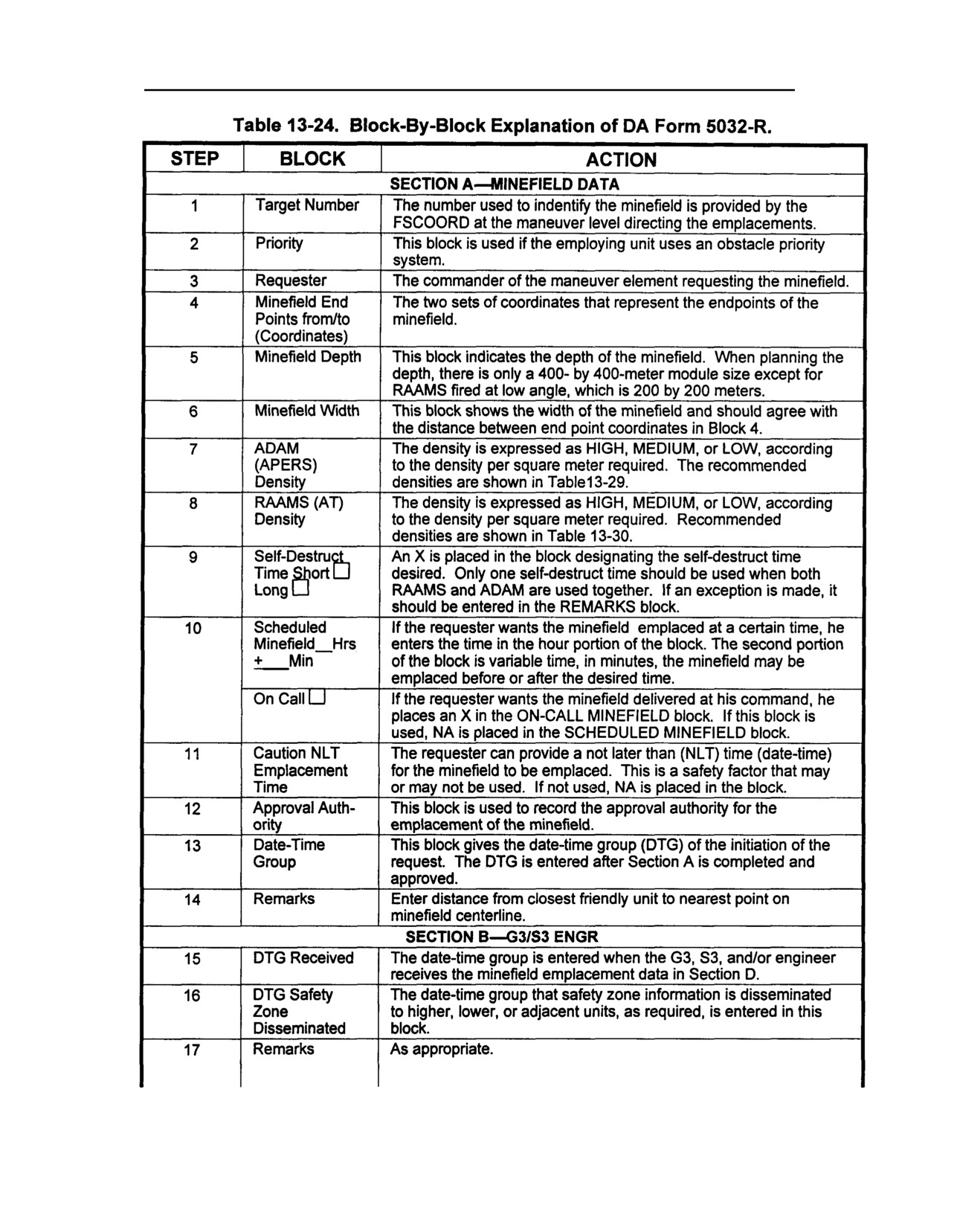
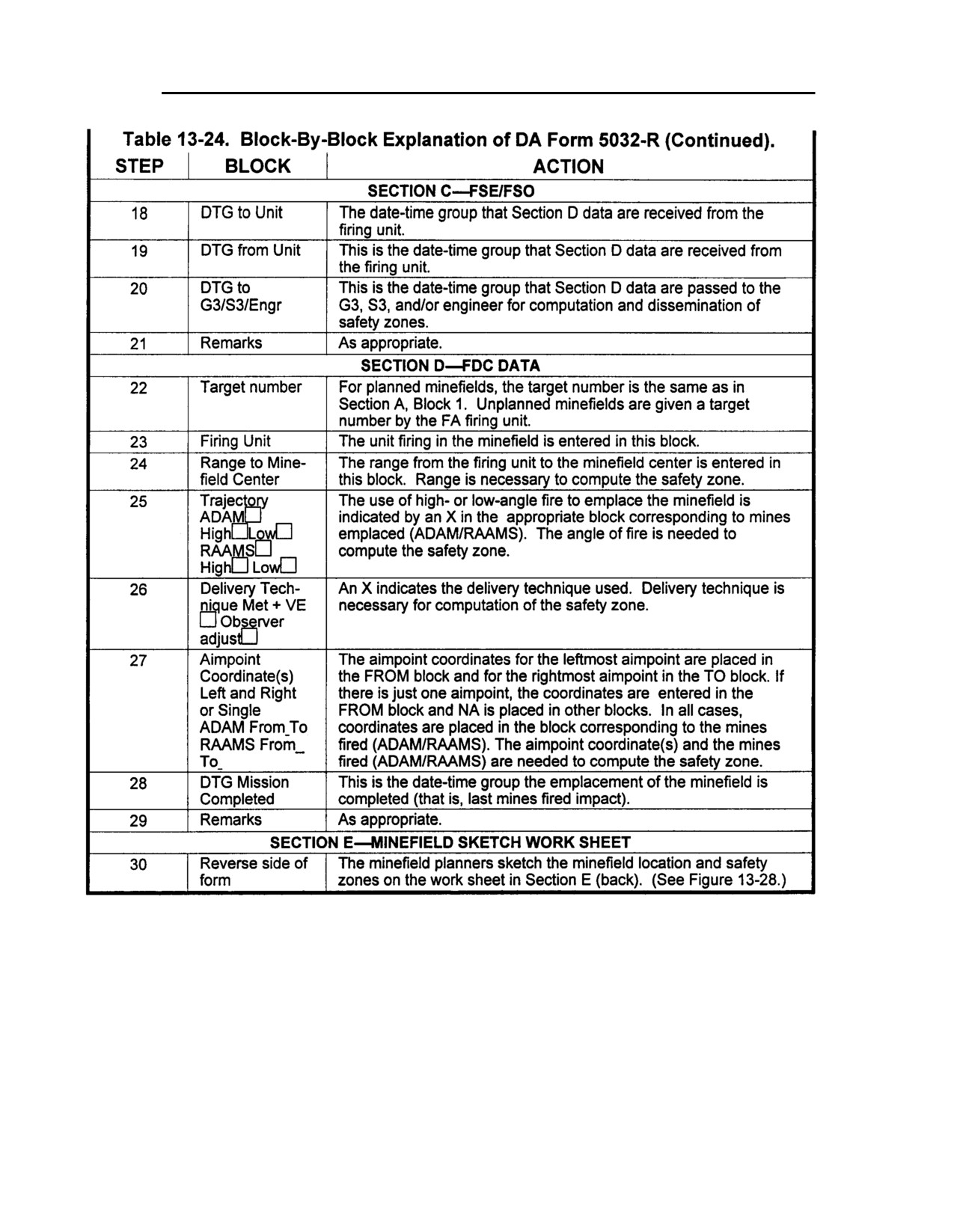
NOTE: A blank DA Form 5032-R is shown in Figures 13-27 and 13-28, and a
description of each block is shown in Table 13-24.
13-62
FM 6-40
13-63
FM 6-40
13-64
FM 6-40
13-65
FM 6-40
13-34. Safety Zone Determination
a. The G3, S3, and/or engineers are normally responsible for determining the safety
zones for FASCAM and disseminating them to the appropriate higher, lower, and adjacent units.
The FSCOORD at any level can also determine safety zones for minefields that are fired into the
maneuver area for which he is providing support. This would only be done for expediency to
support maneuver operations.
13-66
FM 6-40
b. As a safety check, the FDO should also determine the safety zone before firing
FASCAM. The determined safety zone should be compared to the situation map to ensure there
are no units within the safety zones for FA-delivered scatterable minefields. The two techniques
used to determine the safety zone are as follows:
Safety zone tables.
Safety zone templates.
NOTE: About 99 percent of all mine delivery missions will result in the entire
minefield (minefield modules) being inside the safety squares.
For both techniques, the following information is required:
Type of projectile (ADAM or RAAMS).
Trajectory (high angle or low angle).
Range to center of the minefield.
Aimpoint coordinates.
Delivery technique (met+ VE, or observer adjust).
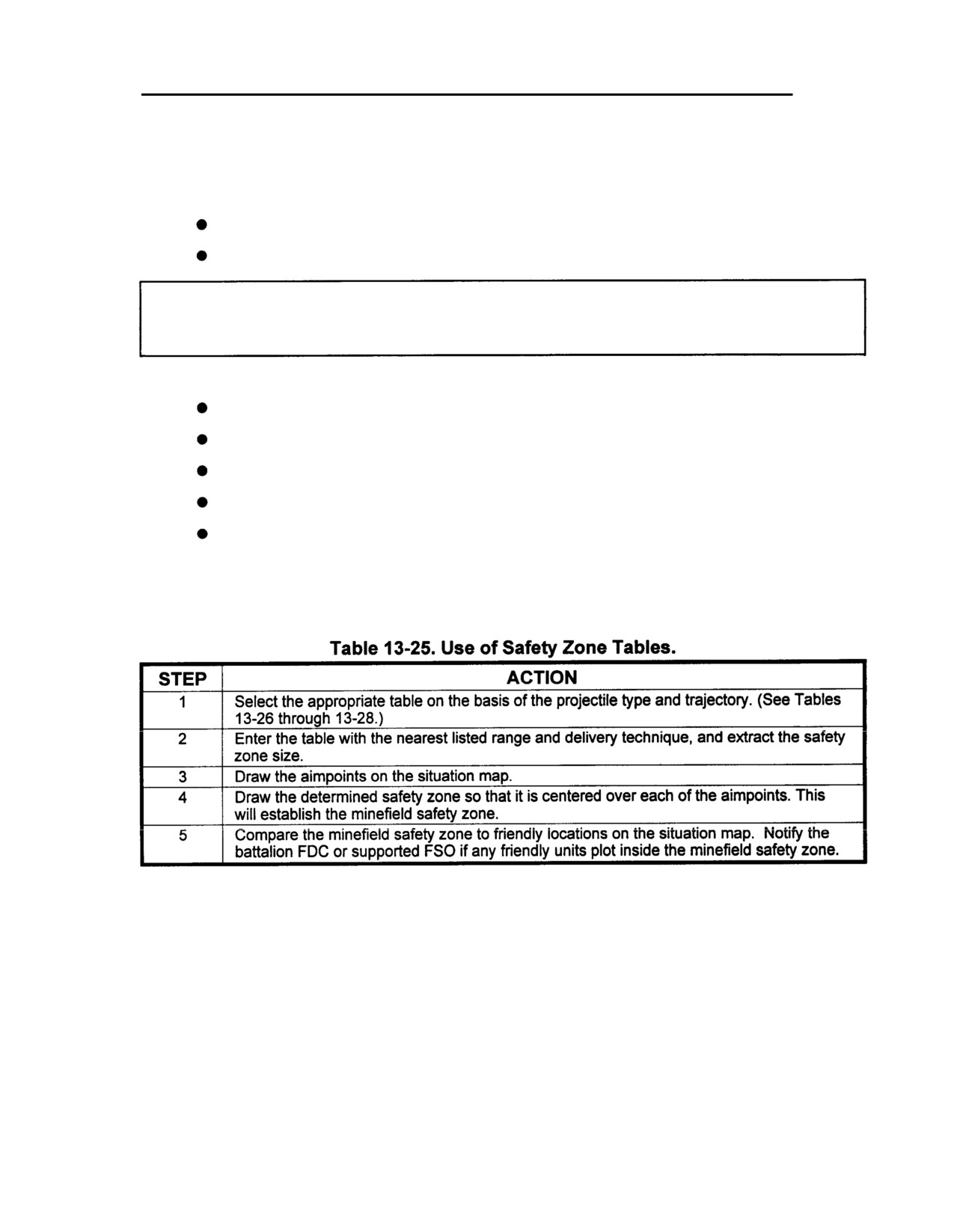
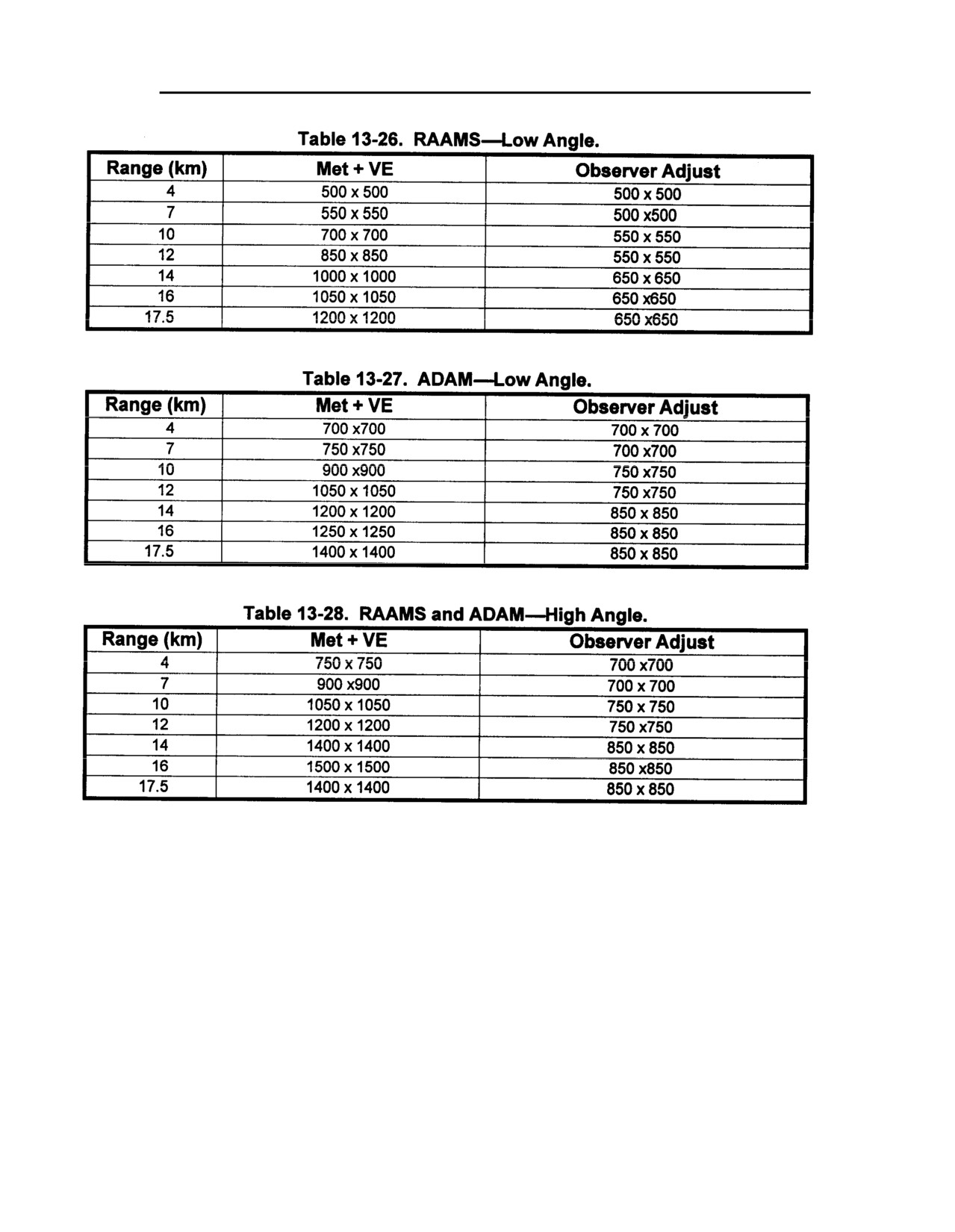
13-35. Safety Zone Tables
The steps for using the safety zone tables are shown in Table 13-25.
13-67
FM 6-40
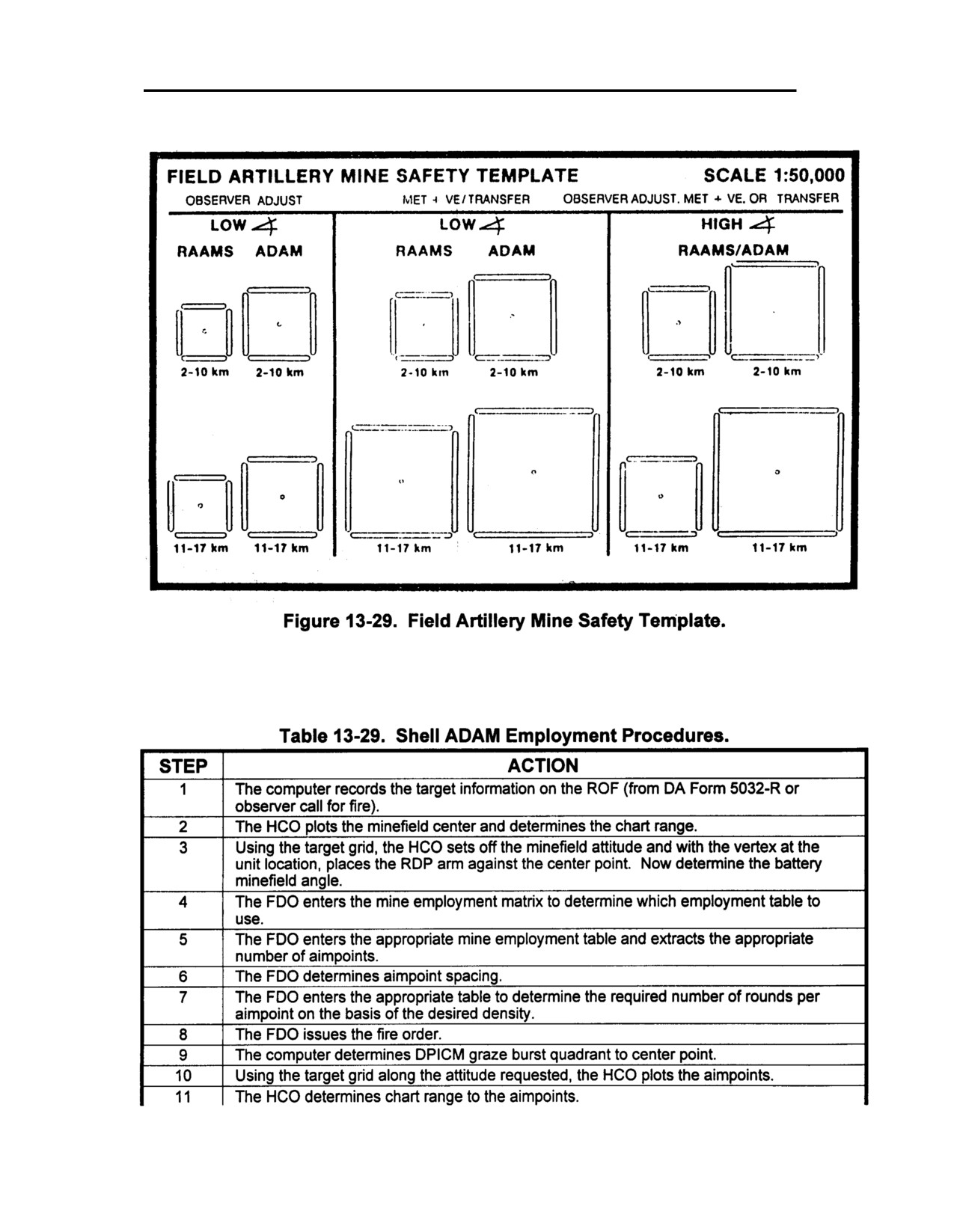
13-36. Safety Zone Templates
If safety zone templates are available, the steps are basically the same as the safety zone
tables. The selected template is centered over the aimpoint locations and the safety zone is traced
onto the situation map. The field artillery mine safety template is shown in Figure 13-28.
13-68
FM 6-40
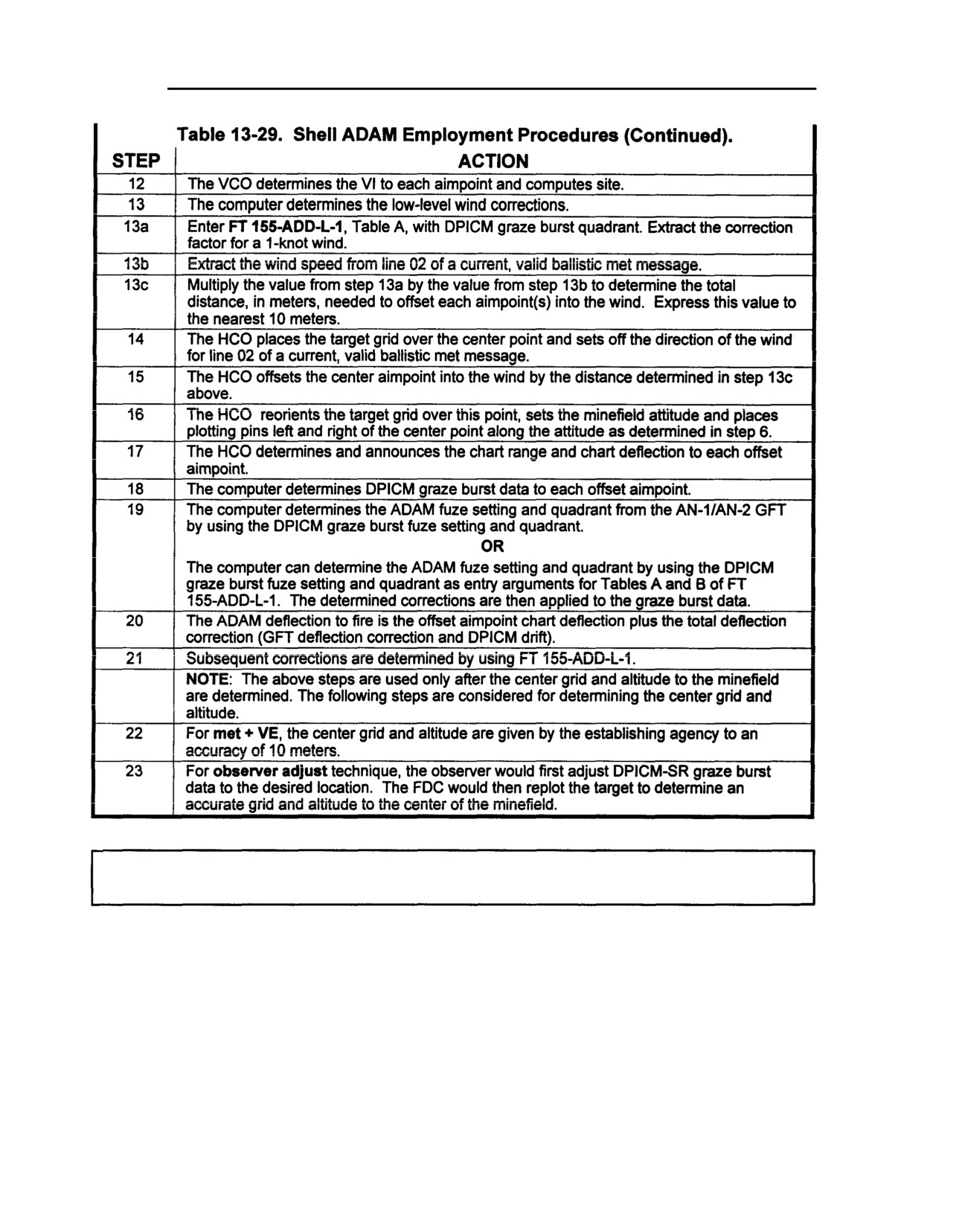
13-37. FASCAM Employment Steps
a. Table 13-29 shows the employment procedures for shell ADAM.
13-69
FM 6-40
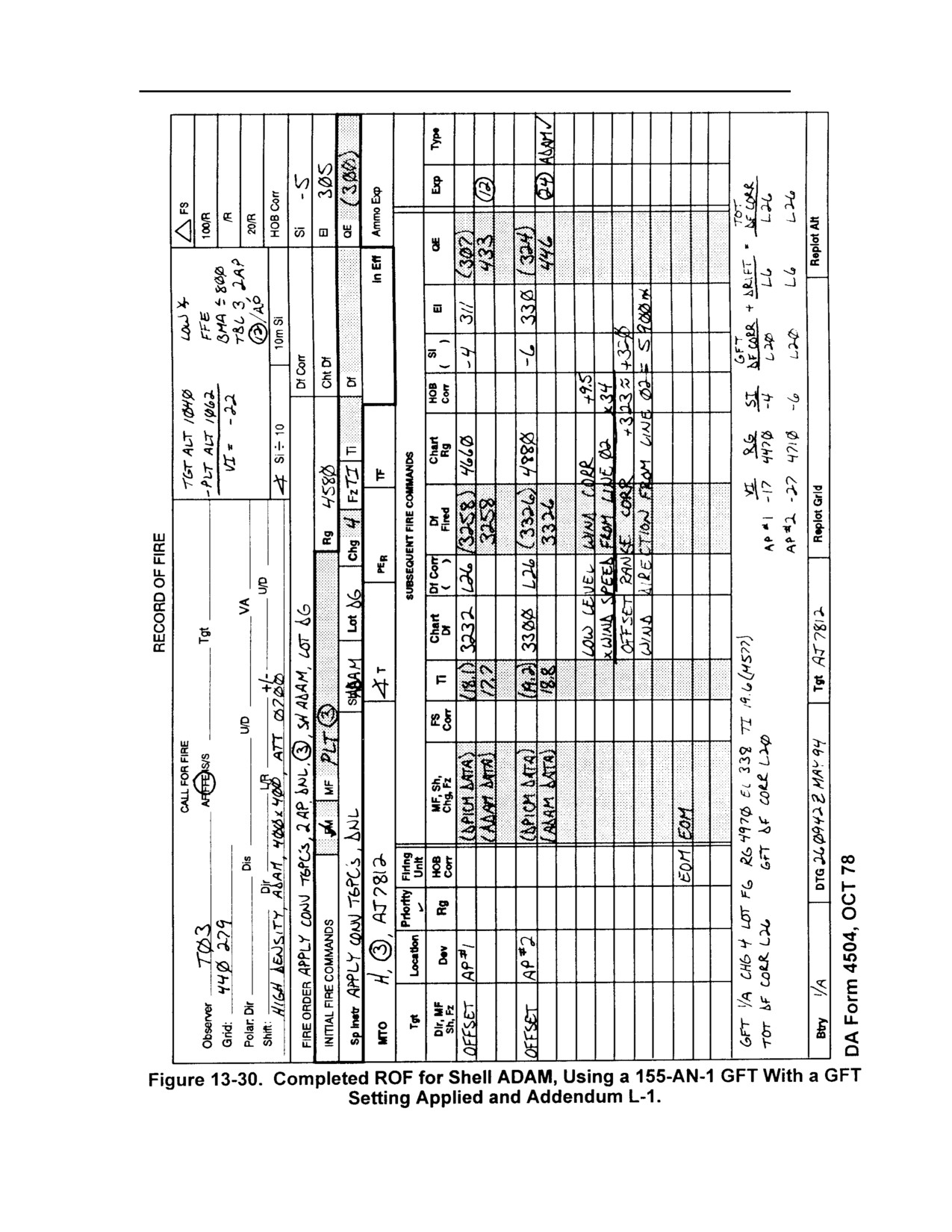
NOTE: Figure 13-30 shows a completed ROF for shell ADAM.
13-70
FM 6-40
13-71
FM 6-40
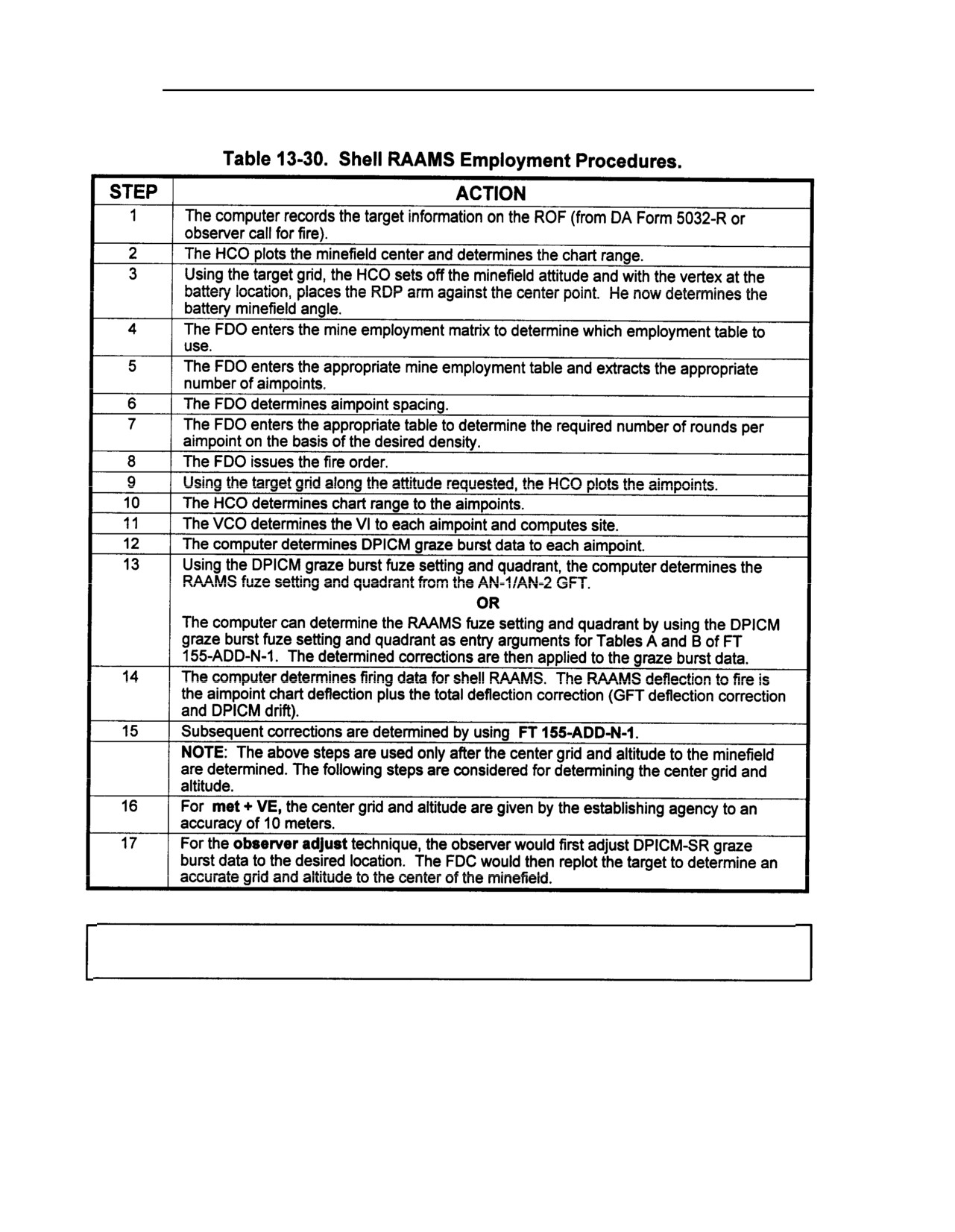
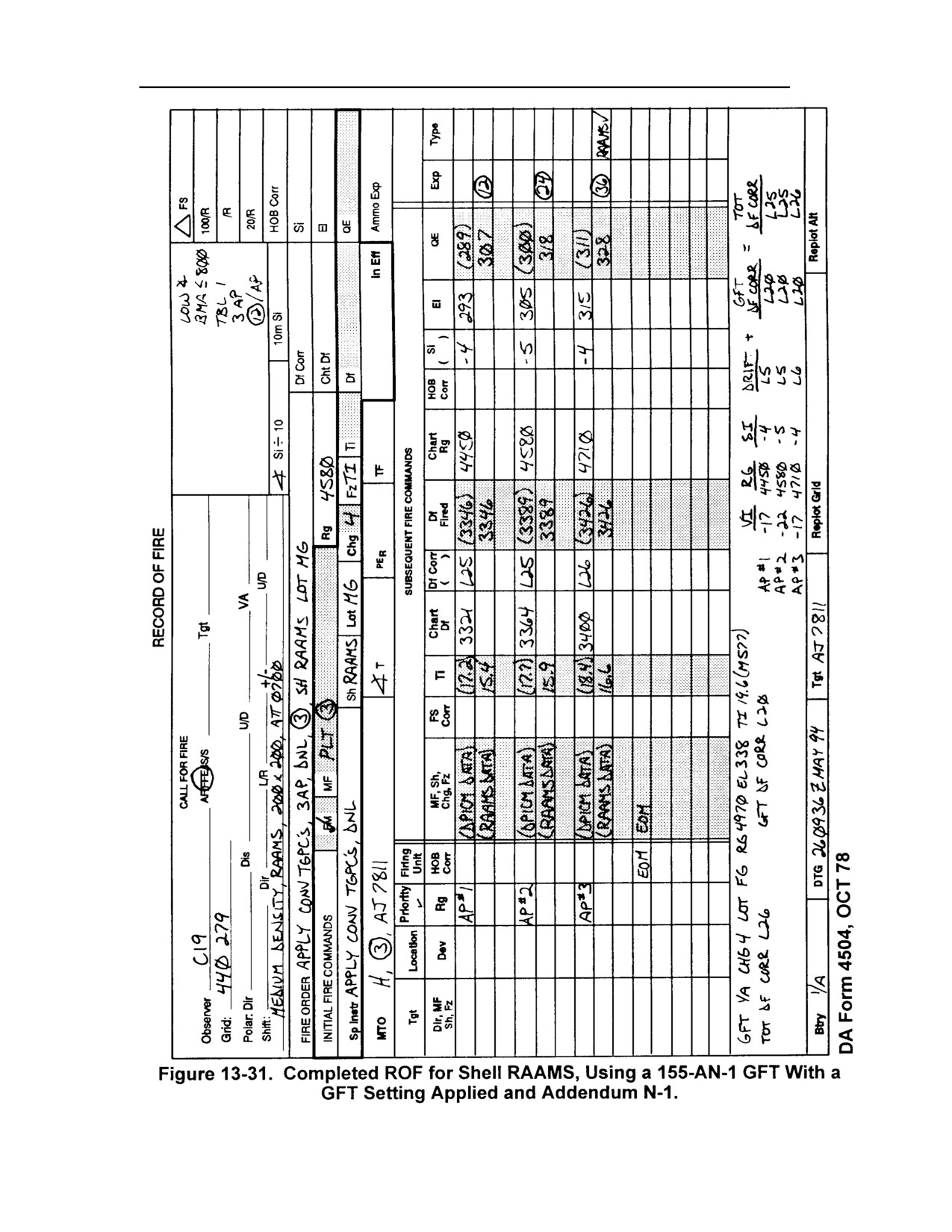
b. Table 13-30 shows the employment procedures for shell RAAMS.
NOTE: Figure 13-31 shows a completed ROF for shell RAAMS.
13-72
FM 6-40
13-73
FM 6-40
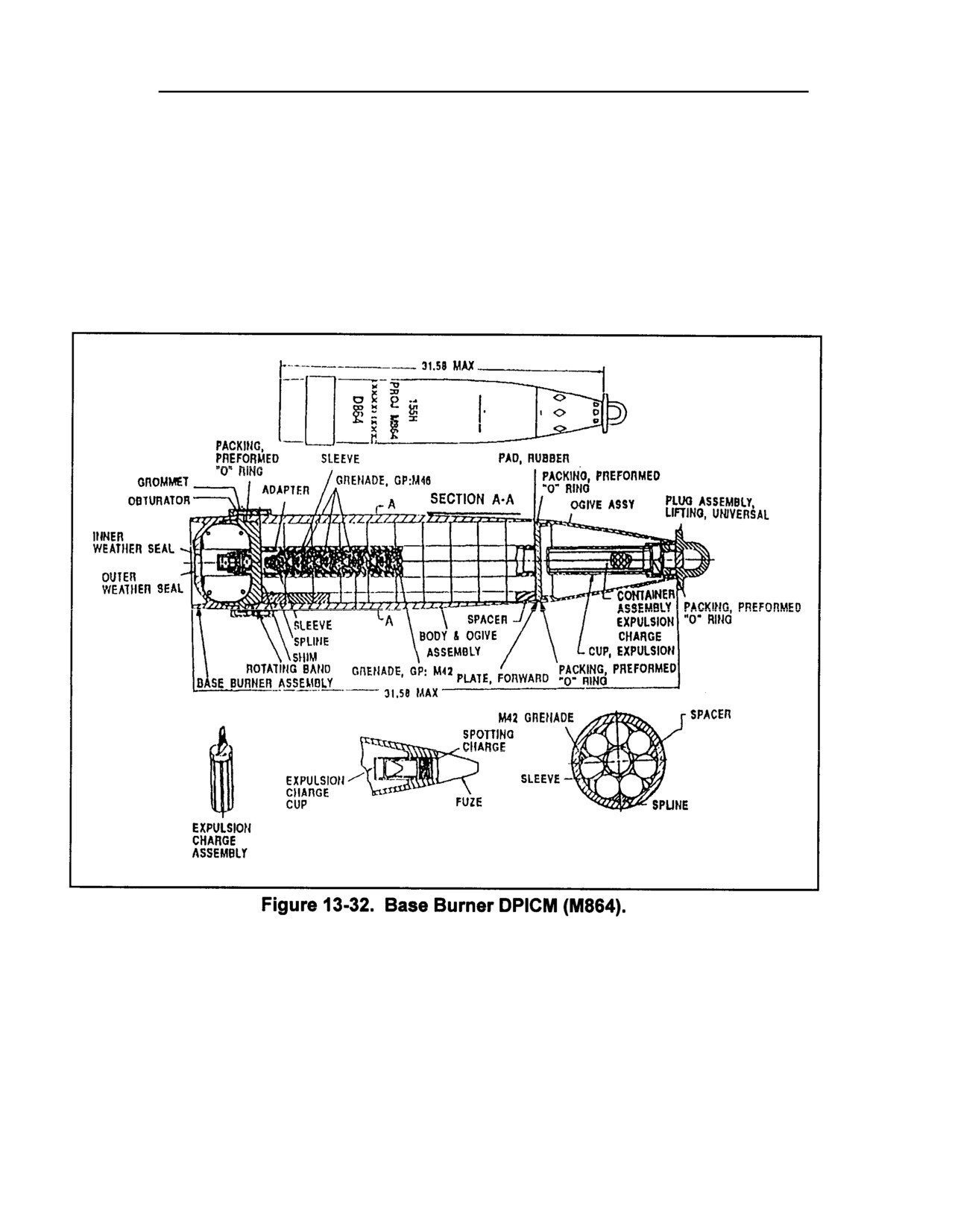
13-38. Base Burn DPICM (M864)
The M864 projectile is a dual-purpose ICM projectile that incorporates base burn
technology to increase its range. Base burn technology was developed to reduce the amount of
base drag on a projectile, thereby increasing the achieved range. The drag is reduced by a (base)
burner unit located on the base of the projectile. Once ignited, the base burner unit bleeds hot gas
which causes the flow of air at the base to be less turbulent. The decrease in turbulence causes
less base drag. (Base drag accounts for about 50 percent of total drag.) The amount of thrust
produced by the base burner unit is negligible and does not serve the same function as the rocket
motor on RAP. (See Figure 13-32.)
13-39. M864 Firing Data Computations
.—
155-ADD-U-PAD. There is also an M864 addendum to the FT 155-AO-0 (RAP). This is an
unnamed provisional aiming data (PAD) addendum that is authorized for combat use only. It is
used much in the same manner as the FT 155-ADD-R-1 is used to determine M483A1 firing data
from M107 firing data.
13-74
FM 6-40
b. The M864 projectile is not ballistically matched to any projectile currently in the
inventory, but because of the similarity of the trajectories, firing data for the M864 can be
determined from the M549A1 firing data. Once accurate M549A1 data are determined,
corrections for the ballistic difference can be determined from a PAD addendum. The M549A1
QE, which is used to enter Table A of the addendum, can be no higher than 450 mils for charge
7WB (M4A2) or 500 mils for charges 7R (Ml19A2) and 8S (M203). These are the maximum
quadrants for which data in the addendum were determined. The quadrant limitations do not
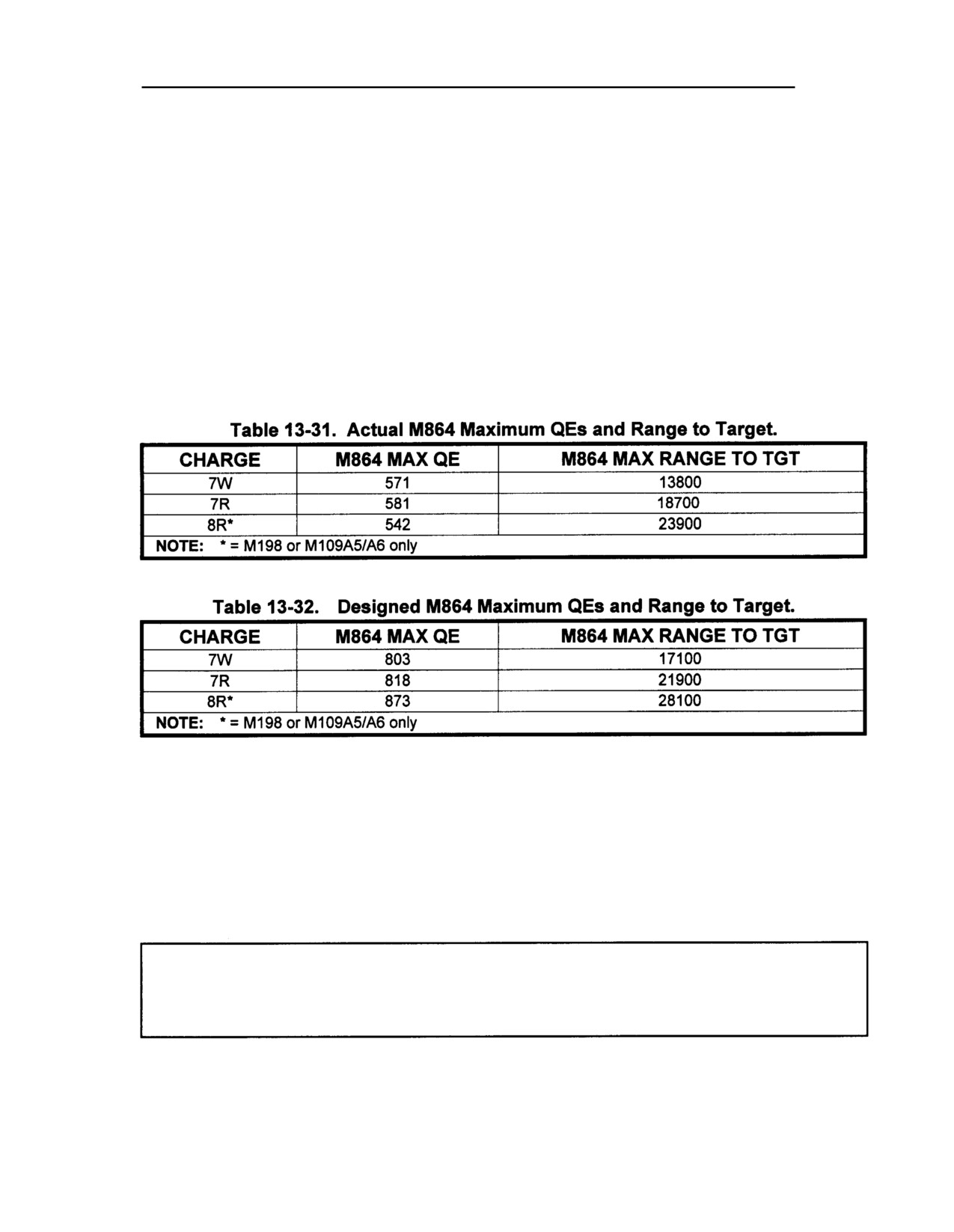
allow the maximum range of M864 to be achieved with this technique. Table 13-31 shows the
M864 maximum QE and Range to a target (including the desired HOB) that can be determined
from M549A1 data. Table 13-32 depicts the designed M864 maximum QE and ranges. This
technique can be used for both FFE missions and adjust-fire missions in which RAP is the
adjusting projectile. While this technique of applying ballistic corrections to accurate M549A1
firing data has limitations in range, it represents the most accurate technique. The accuracy of
this technique will be increased if used in conjunction with a RAP GFT setting.
13-40. Met to a Target
Because of the amount of time needed to work a met to a target, this technique would be
best employed for planned targets. The FT 155-AU-PAD is designed in the same basic format as
the FT 155-AN-2 TFT for DPICM and provides graze burst data. Once the graze burst data are
determined, corrections from the FT 155-ADD-U-PAD are applied to the fuze setting deflection
and quadrant to determine data to yield the appropriate HOB. If MV information has been
determined with the M90 chronograph, the MVV is used as the velocity error.
NOTE: An MVV for M864 determined by calibration may not be available. The loss
in muzzle velocity because of tube erosion (as determined from a recent pullover
gauge reading and/or from EFC rounds) can be used as the position VE.
13-75
FM 6-40
13-41. M864 Registrations
M864 projectiles can be fired in the SR mode by using the same procedures as for the
M483A1. Because of the increased range, registrations may be difficult. Observers may have
difficulty determining spottings and corrections, and radar, in the friendly fire mode, has an
effective range of 14.7 kilometers.
NOTE: If a registration is conducted with the extended range dual-purpose
improved conventional munitions (ERDPICM) projectile, the values for range K and
fuze K would be computed in the same manner as conventional techniques.
13-76
FM 6-40
Chapter 14
EMERGENCY FDC PROCEDURES
Field artillery units must be capable of delivering fire at all times. Requests for
immediate fires may be received when the unit is moving or when the FDC is not yet set up. The
loss of personnel or equipment may cause the battery to rely on some type of emergency backup
procedures. The firing battery executing an emergency fire mission has two priority technical
fire direction tasks:
Determine initial firing data to the target.
Prepare for determination of subsequent data on the basis of the observer’s
corrections.
14-1. Methods of Determining Initial Data
The first priority is to compute initial data, announce it to the piece, and fire a round.
Depending on the call for fire, the XO or FDC may accomplish this by using one of several methods:
a. Adjust Fire. The platoon leader determines direction and range to the target grid
location from the map-spotted platoon location. This is done most rapidly by using a map and a
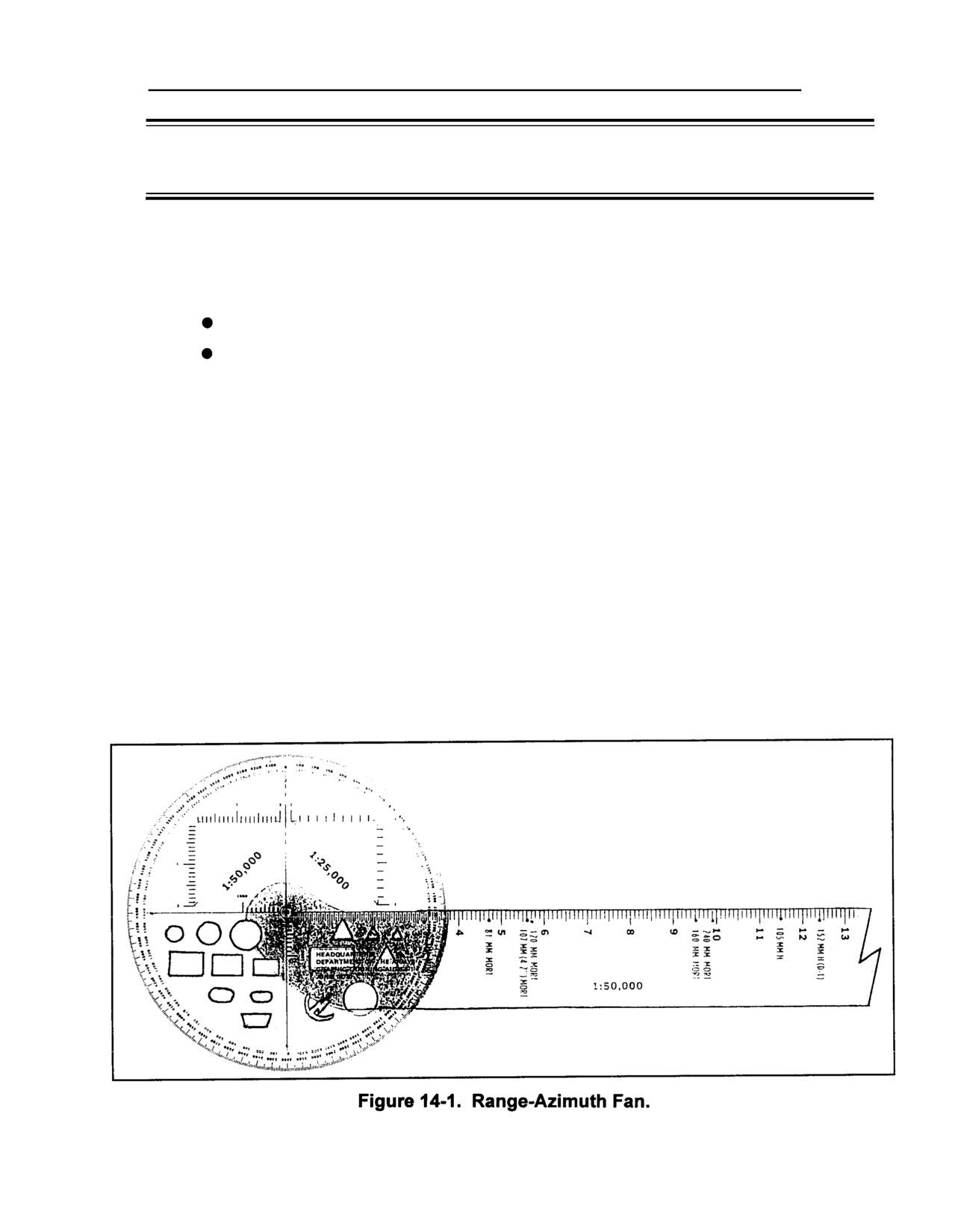
range-azimuth fan of the correct scale (Figure 14-1). The platoon leader directs that the platoon
be laid on the azimuth to the target, or he may orient the base piece himself by using the howitzer
backlay method or a distant aiming point. If he has time, the platoon leader should lay the base
piece with an aiming circle. The platoon leader selects a charge, or uses the standard charge, and
converts the range to an elevation. The initial firing data are announced to the piece(s).
(1) Deflection equals the common deflection for the weapon system in use.
(2) QE equals elevation corresponding to range to target (GFT, TFT, and so on). Site is
ignored unless it is excessively large. The FDO or platoon leader is responsible for analyzing the
terrain in the target area and checking intervening crests to determine if he should include site.
14-1
FM 6-40
b. Mark Center of Sector. This is requested when the observer is not oriented to the
terrain. The platoon leader determines direction and range to the center of the supported unit’s
zone of action from the map-spotted battery location.If the platoon leader is not sure of the
situation or the location of the sector center or if he feels a center of sector round may be unsafe,
a white phosphorus with fuze time for an airburst should be fired. The platoon leader directs that
the platoon be laid on the azimuth he determines to the sector center. The platoon leader
determines the elevation corresponding to the range and charge. The initial firing data are
announced to the piece.
(1) For a WP or an HE high airburst, the trajectory is raised to a 200-meter HOB by
using the100/R factor. The FS corresponding to the initial elevation is used. The error
introduced by a vertical interval greater than 100 meters is ignored.
(2) If shell HC smoke or WP is requested, HE data are fired without making
corrections for projectile weight. For shell HC smoke, the time fuze setting to fire is determined
by subtracting 2 seconds from the FS corresponding to the HE elevation.
NOTE: A grid location is preferred over mark center of sector because the first
round fired engages the target directly.
14-2. Methods of Determining Subsequent Data
After the initial fire commands are announced, emergency equipment must be prepared to
convert the observer’s corrections into subsequent fire commands. There are several expedient
means of obtaining subsequent data that are available to the XO. He or the FDO must be able to
quickly convert observer corrections into firing data.
a. Emergency Firing Chart. Use of the emergency firing chart to adjust fire is
discussed in paragraph 14-3.
b. M10 or M17 Plotting Board. Use of the Ml 0 or Ml 7 plotting board to adjust fire is
discussed in paragraph 14-4.
c. Black Magic. If no other means of adjusting fire is available, the Black Magic
technique may be used as a last resort. Certain information must be available, as detailed in
paragraph 14-5.
14-3. Emergency Firing Chart
a. The emergency firing chart employs the same basic techniques as observed firing
charts. Establish location and direction by using the relationship between the firing unit and its
targets. The relationship is determined by firing and will contain errors. The emergency chart is
only a temporary expedient to be used until a surveyed chart can be constructed.
b. The emergency chart may be constructed on any surface suitable for plotting (can
accommodate an RDP and plotting pins).
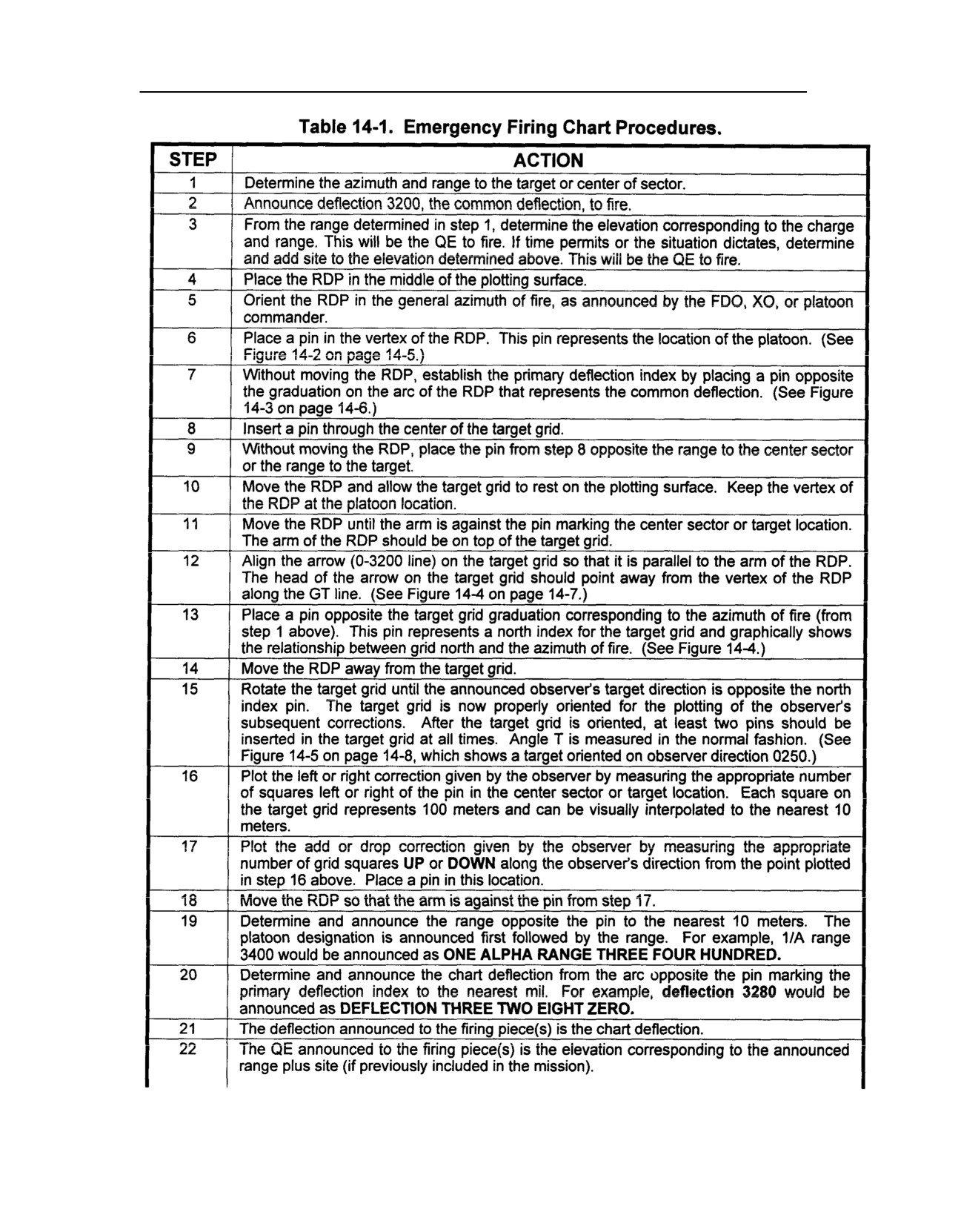
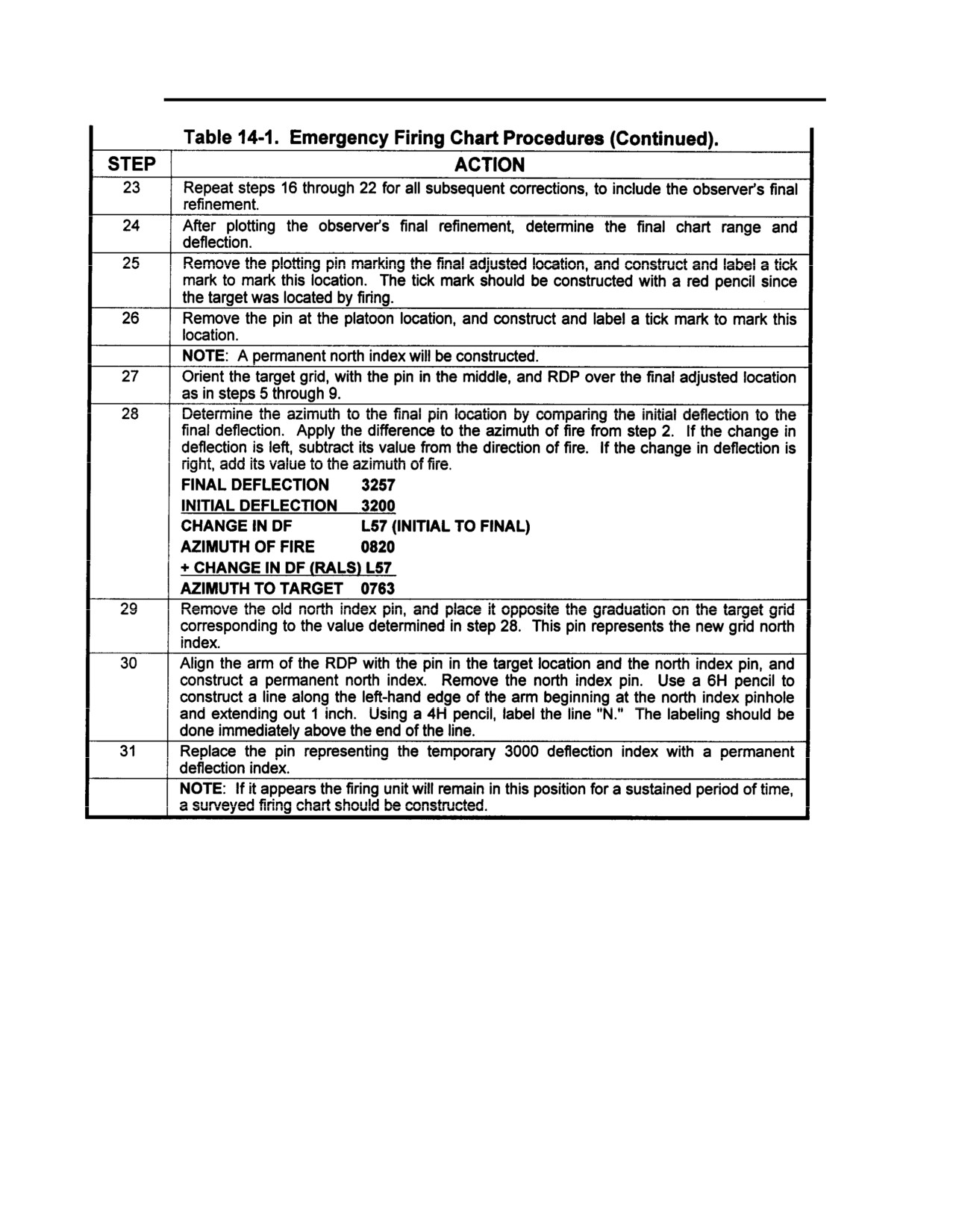
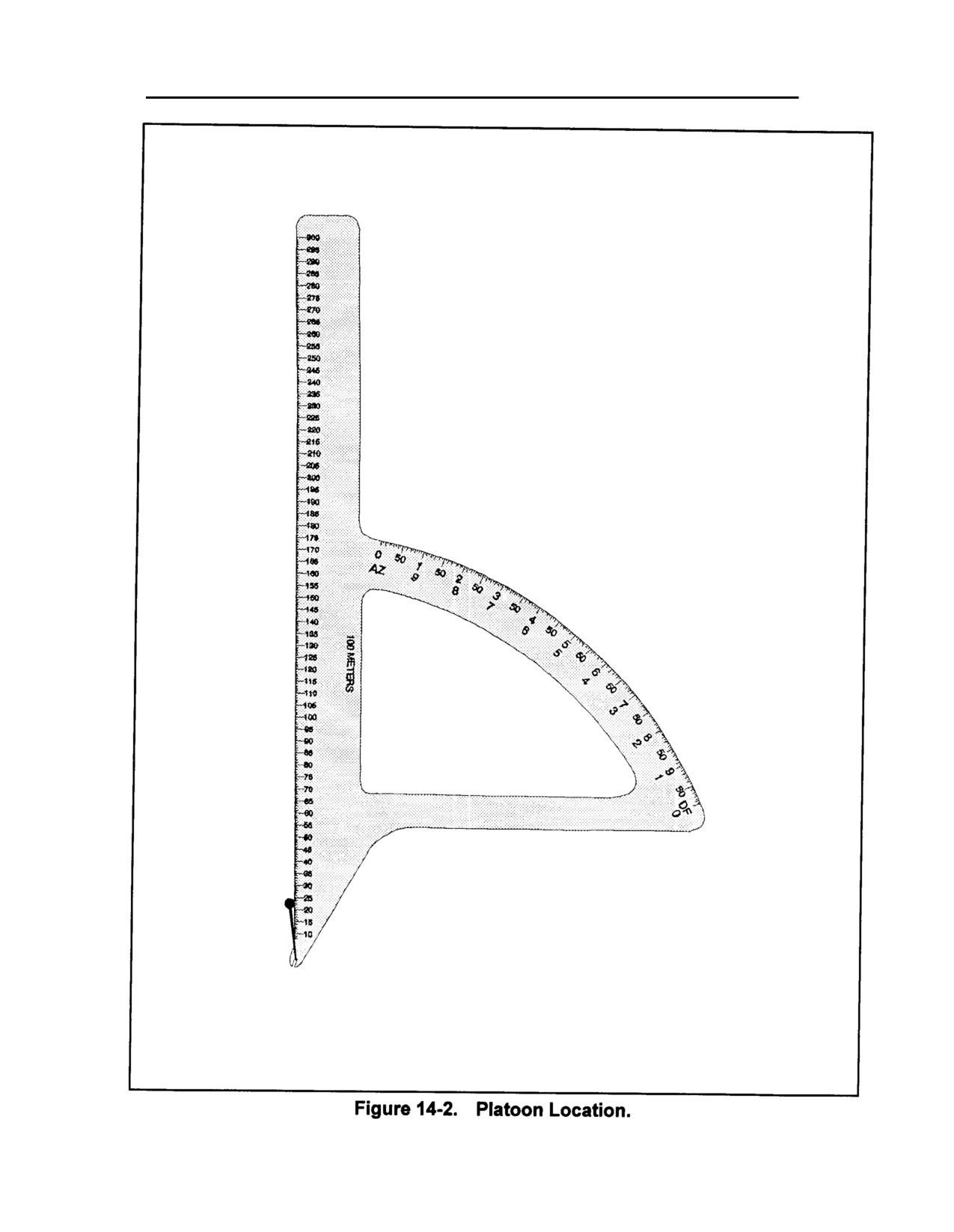
c. Use Table 14-1 to construct an emergency firing chart.
14-2
FM 6-40
14-3
FM 6-40
14-4
FM 6-40
14-5
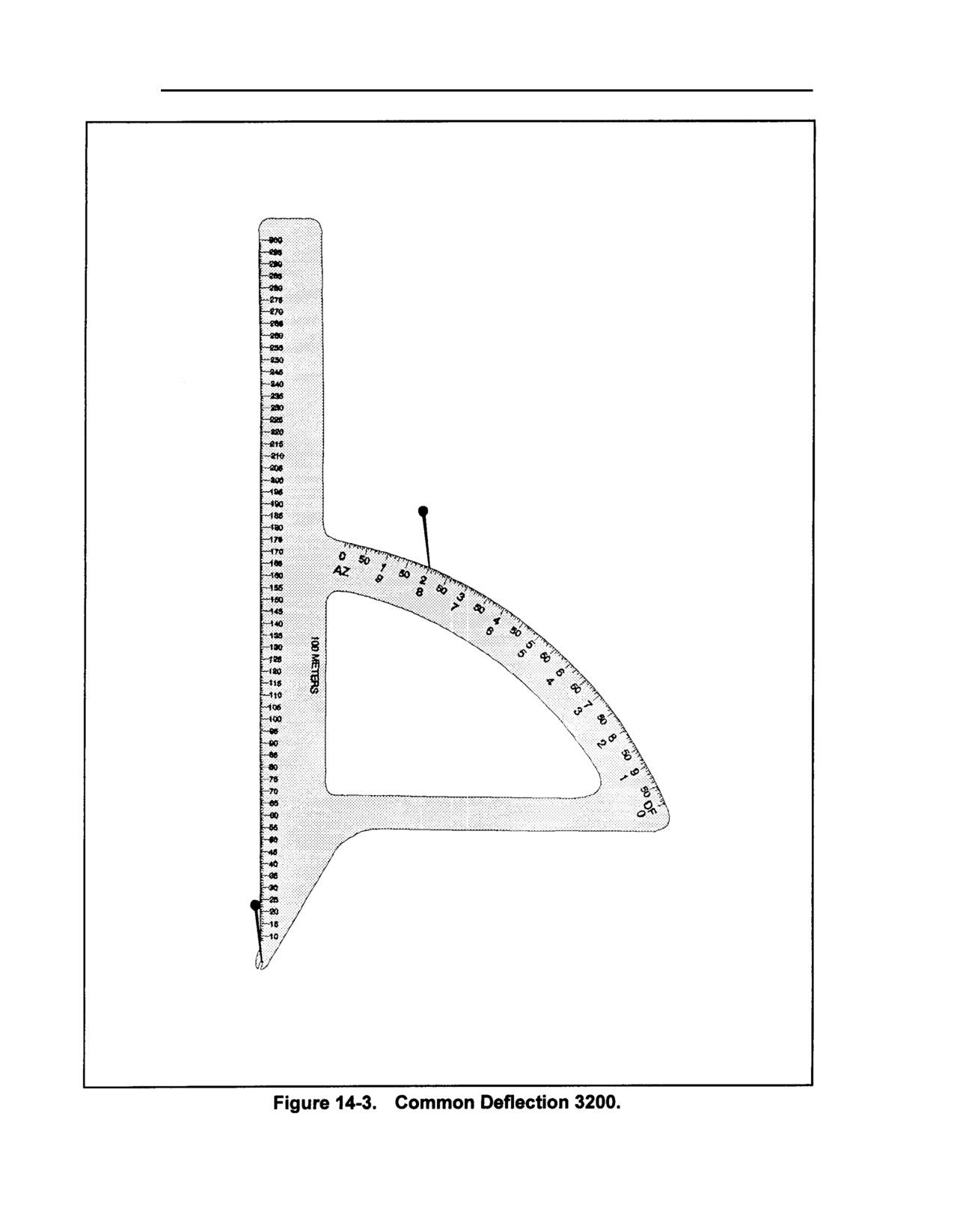
FM 6-40
14-6
FM 6-40
14-7
FM 6-40
14-8
FM 6-40
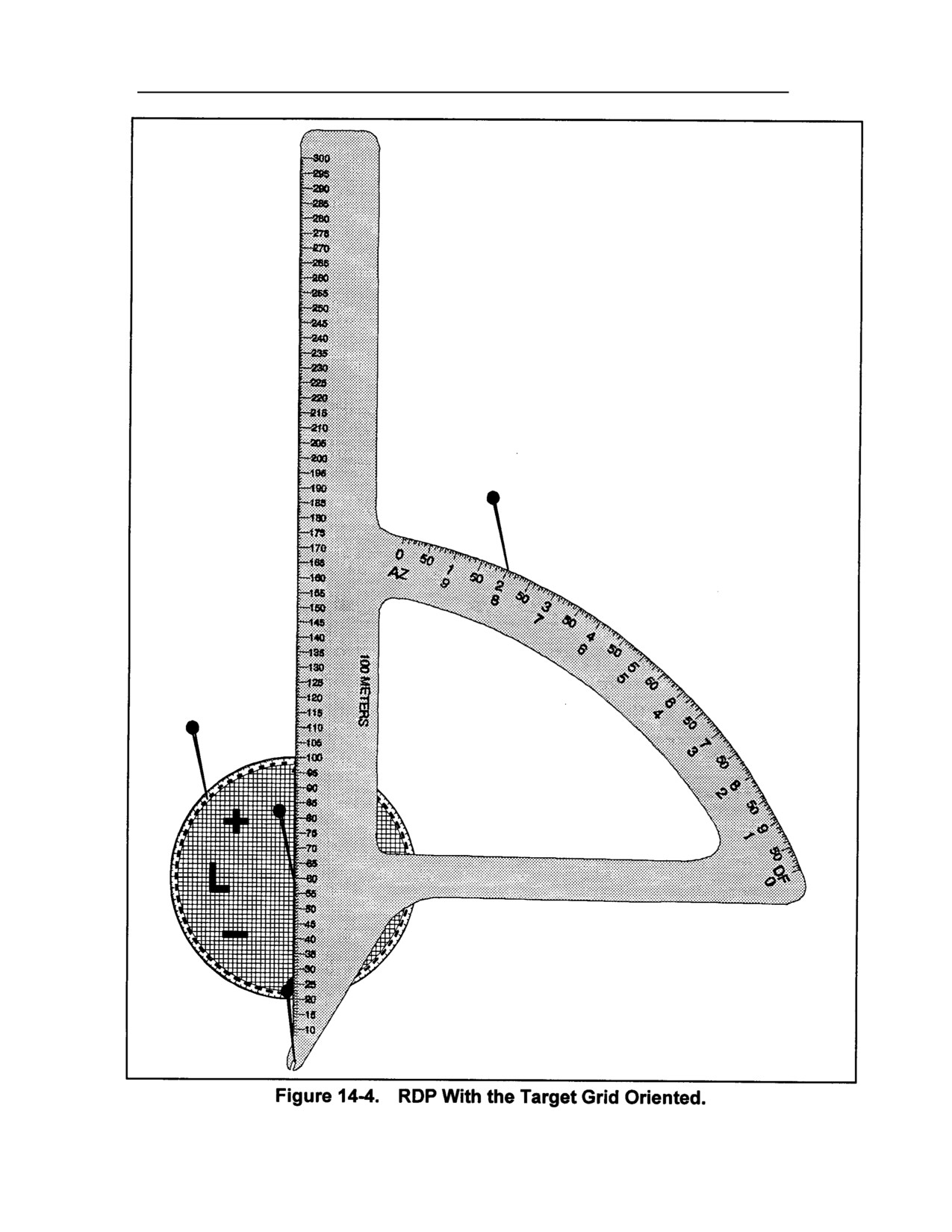
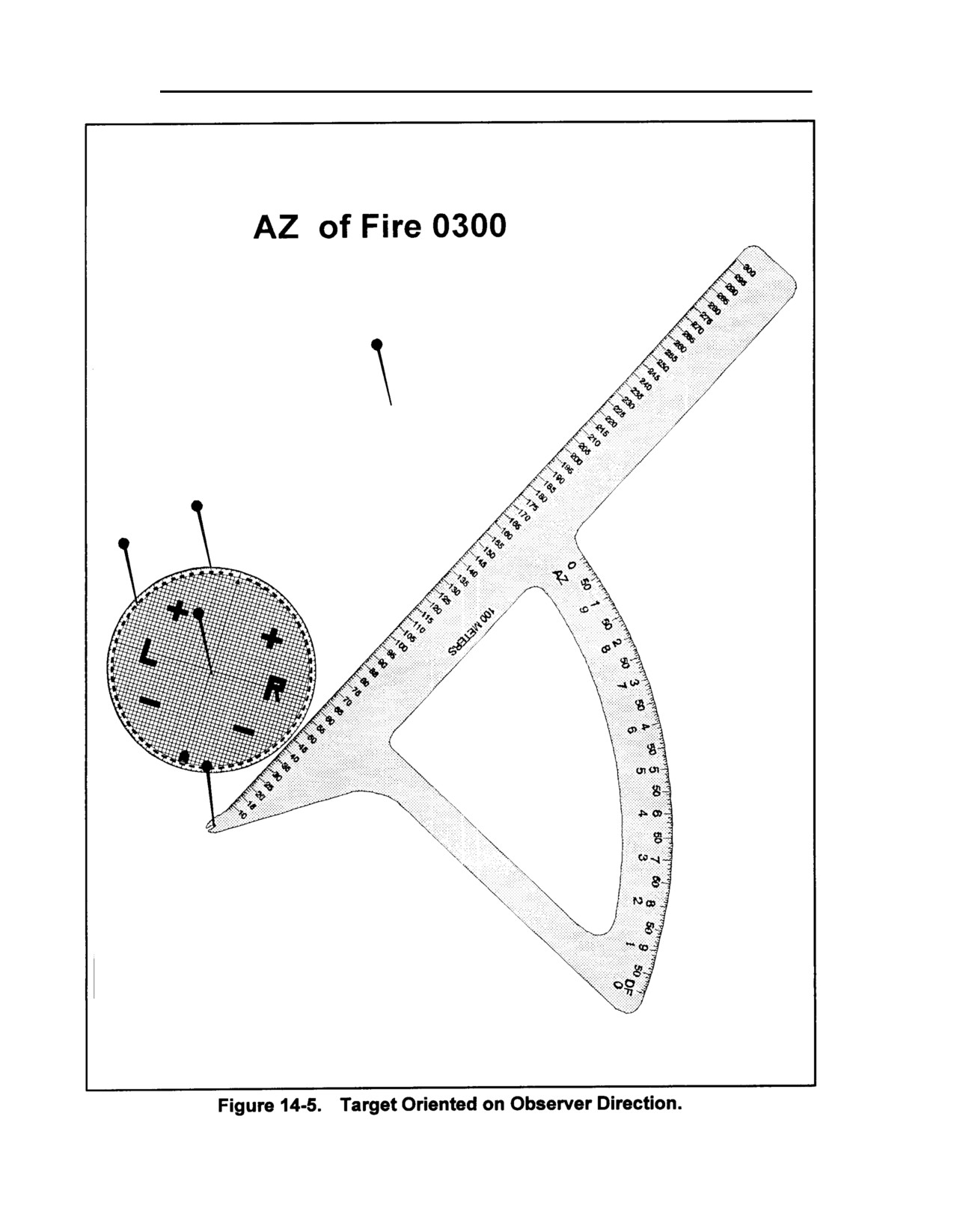
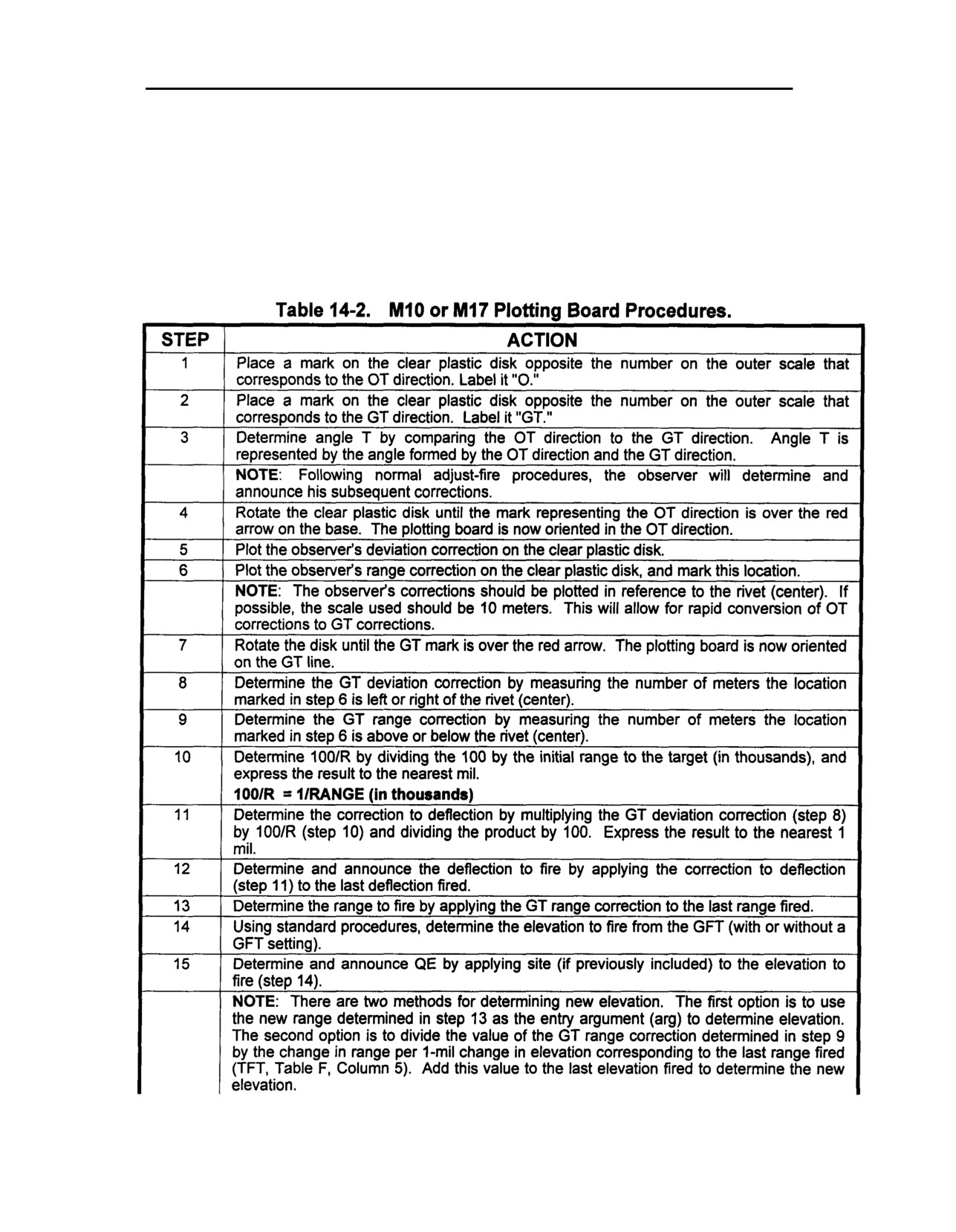
14-4. M10 or M17 PLOTTING BOARD
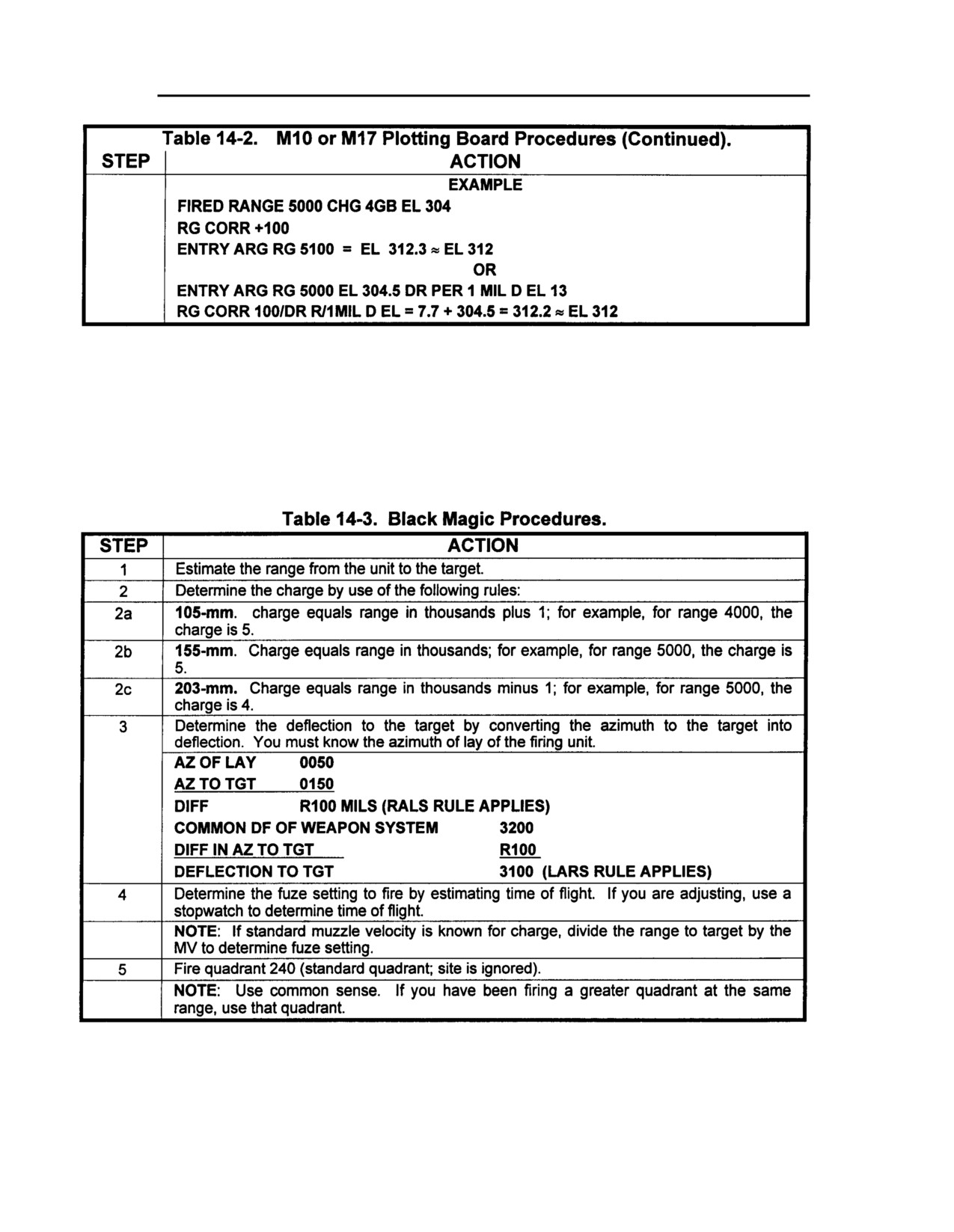
a. The M10 or M17 plotting board may be used for determining data for subsequent
corrections in place of an emergency firing chart. Once prepared, observer corrections along the
OT line can be converted to corrections along the GT line. For this procedure, the rivet (center)
of the plotting board represents the location of the last burst.
b. Use Table 14-2 to determine data for subsequent corrections in place of an
emergency firing chart.
14-9
FM 6-40
14-5. Black Magic
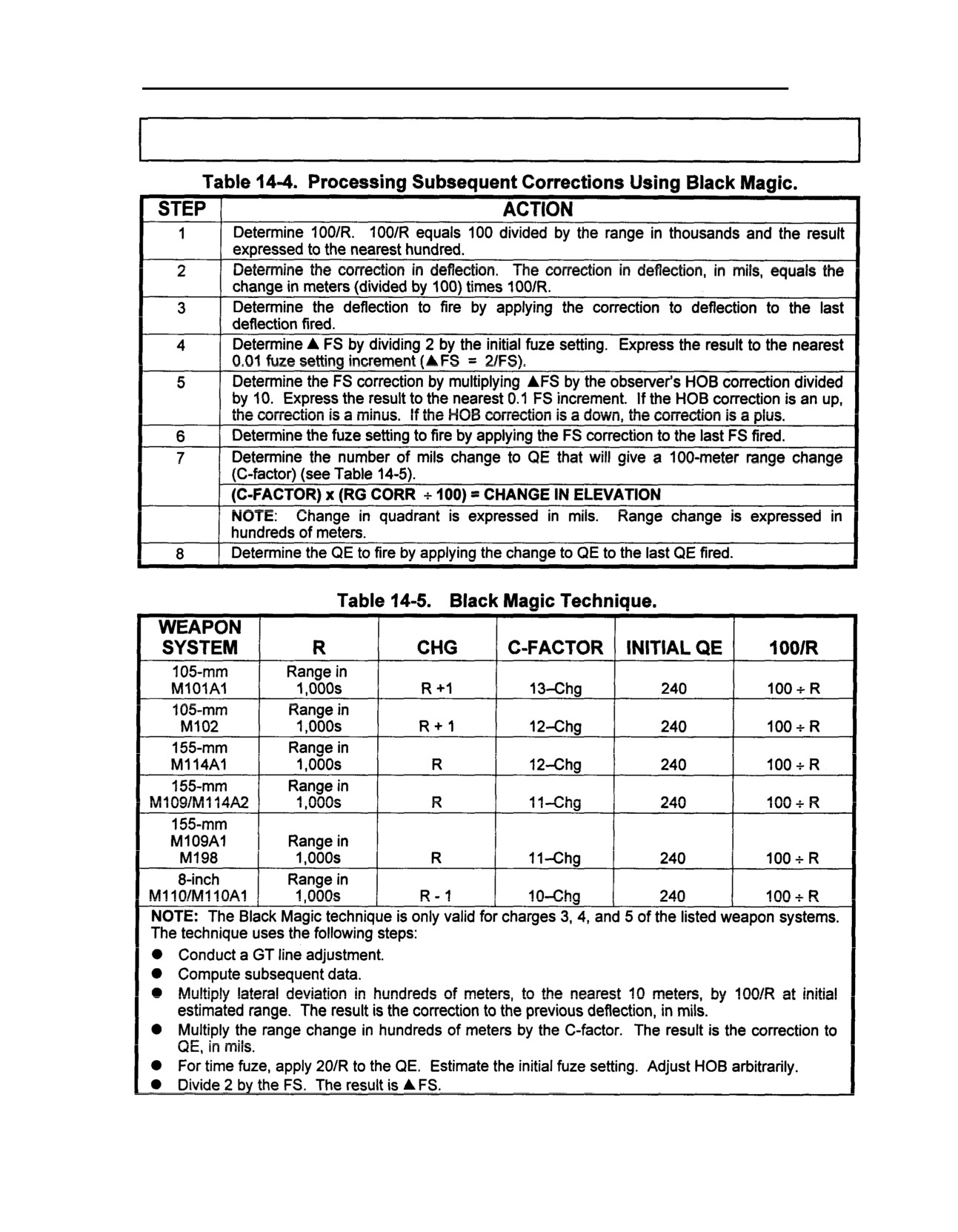
a. Black magic can be used to determine both initial firing data and firing data that are
based on subsequent corrections. This technique can be done by FDC personnel or the observer
and should only be used as a last resort.
b. Table 14-3 gives the steps for the Black Magic procedure.
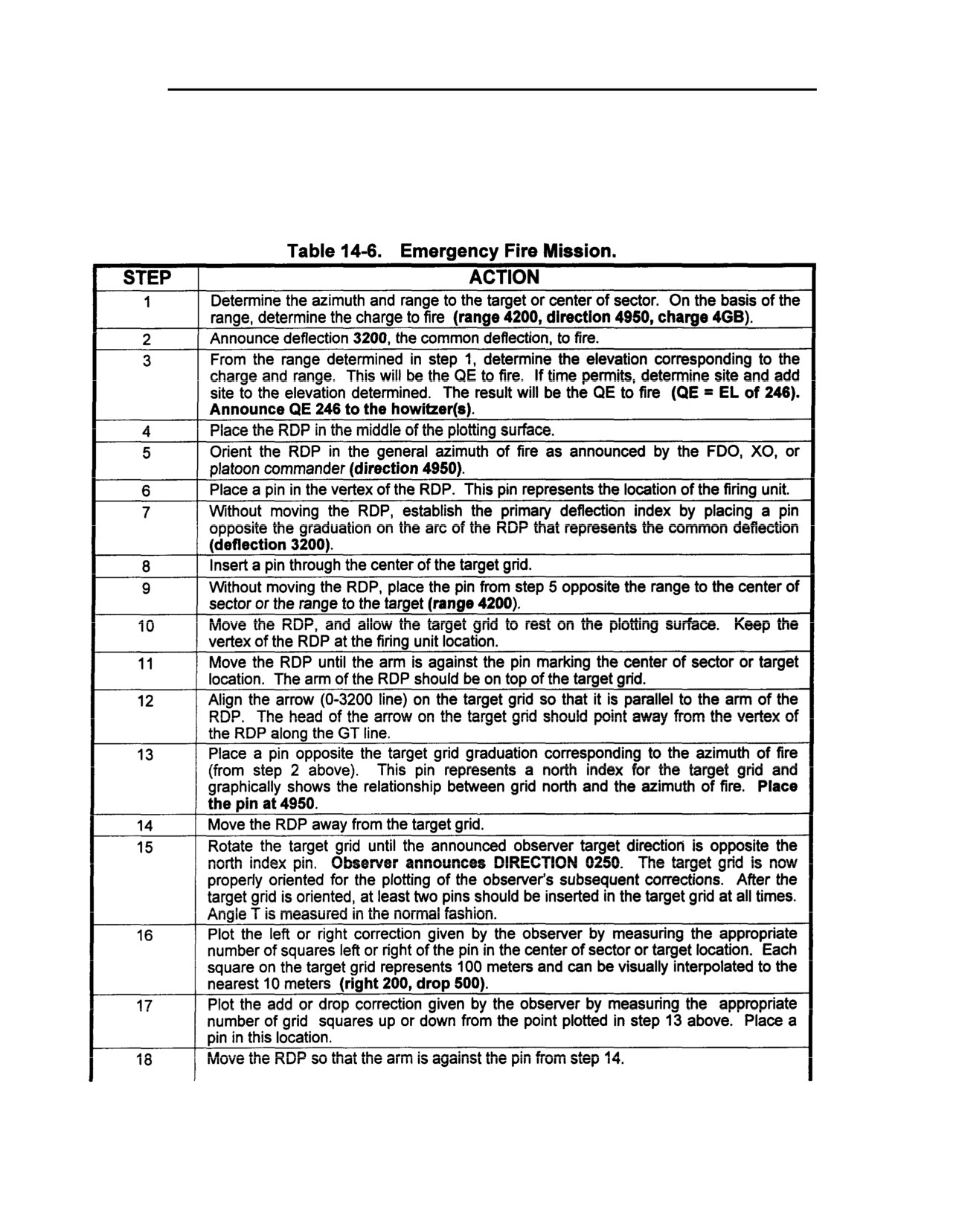
c. Subsequent corrections are processed by using the steps in Table 14-4.
14-10
FM 6-40
NOTE: Subsequent corrections are made with respect to the GT line.
14-11
FM 6-40
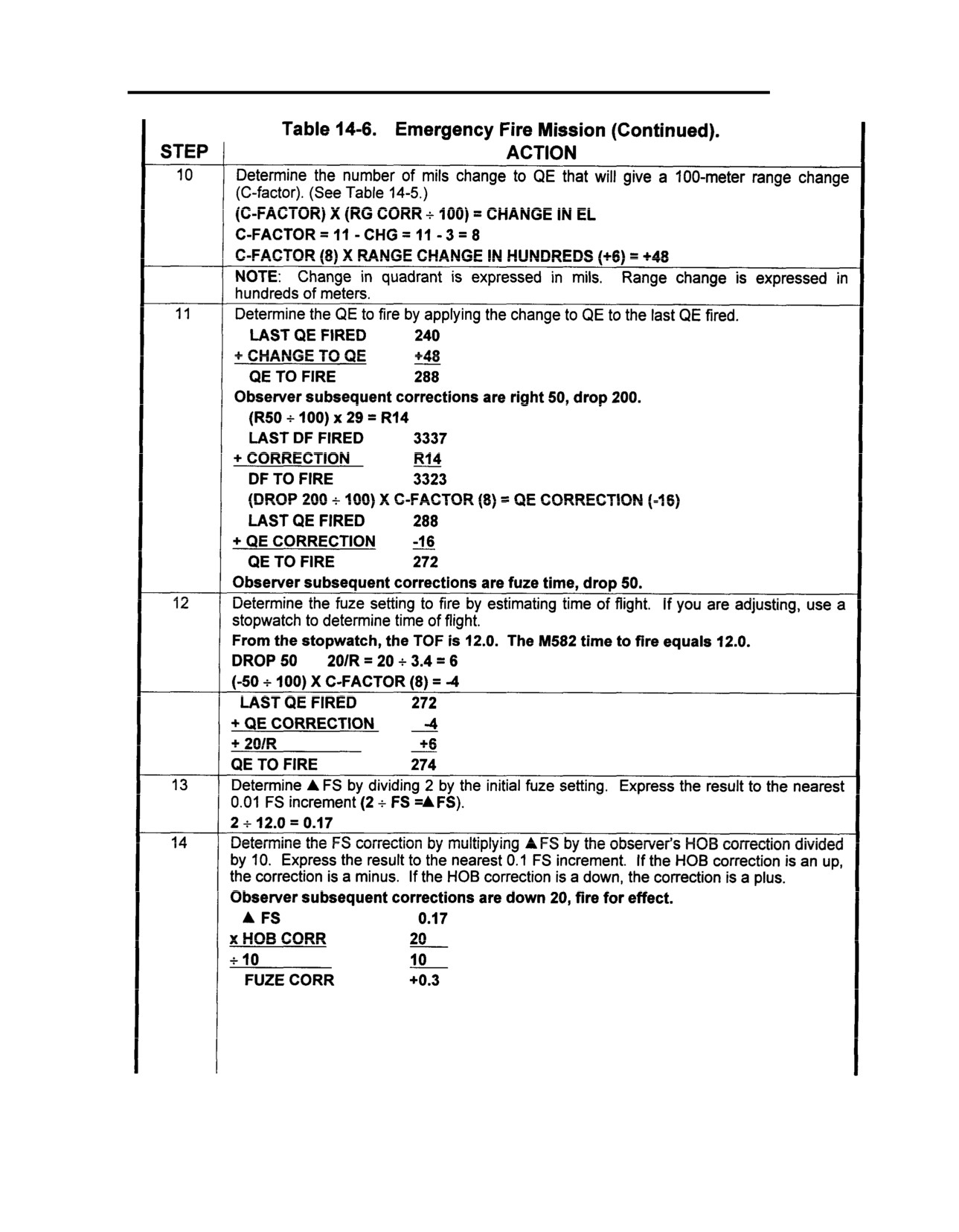
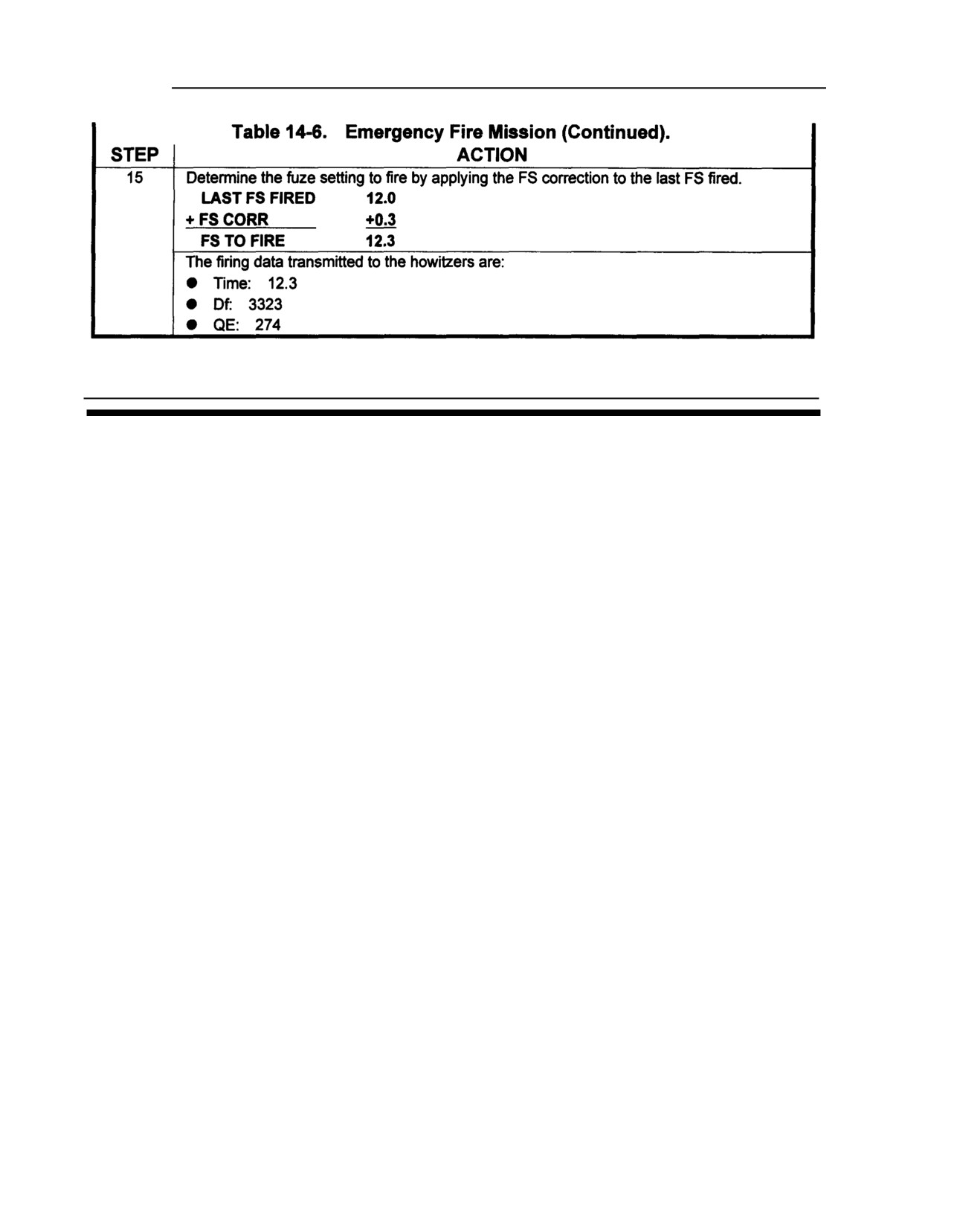
14-6. Emergency Firing Chart Example
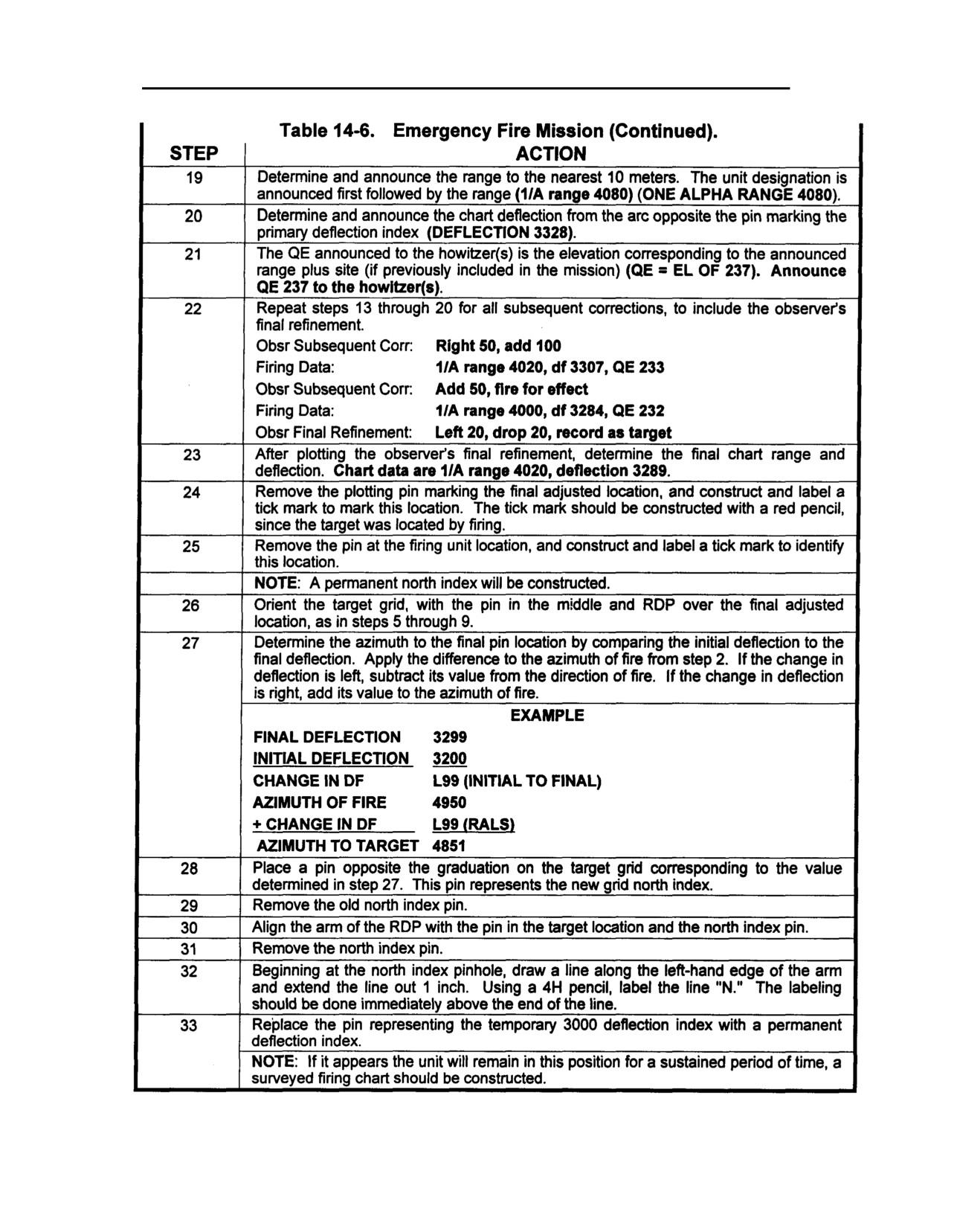
a. You receive a call for fire while traveling to your next position. From a map spot,
you determine the range to the target to be 4200 and the direction to be 4950.
b. Use Table 14-6 to process the mission.
14-12
FM 6-40
14-13
FM 6-40
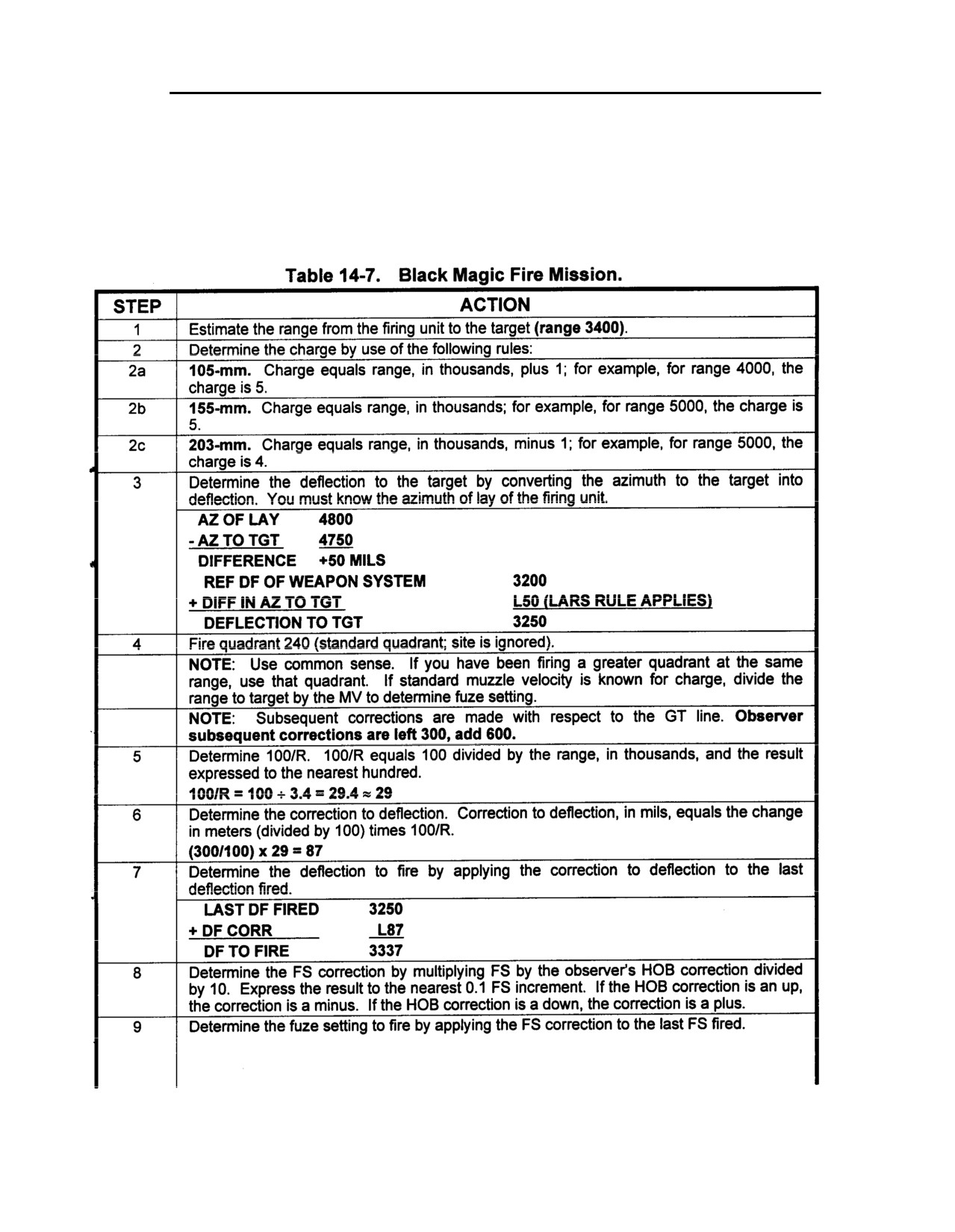
14-7. Black Magic Example
a. You receive a call for fire against a platoon of infantry in a trench line. You estimate
the range to be 3,400 meters and the direction of fire to be 4750. The observer requests time in
effect.
b. Use Table 14-7 to process the mission.
14-14
FM 6-40
14-15
FM 6-40
14-16
FM 6-40
Chapter 15
SAFETY
AR 385-63 (MCOP3570.1A), Chapter 11, implements the chain-of command safety
concept. Under this concept, the firing battery chain of command is responsible for safety during
firing, training, and combat. This chapter reinforces AR 385-63. However, if local range
regulations are more restrictive than the material in this chapter, the local range regulations
must be followed.
Section I
Responsibilities and Duties
This section describes safety responsibilities, the duties of safety
personnel, and the safety aids used by those personnel.
15-1. Responsibilities
a. Commanders of Field Artillery Units. Commanders establish and maintain a safety
training and certification program for their personnel. The purpose of this program is to train and
qualify personnel of the firing battery in the safety procedures for their specific areas of
responsibility. When the commander is satisfied that the personnel are qualified to perform the
safety duties as required, he certifies them.
b. Battalion Commander. The FA battalion commander is responsible for safety
during all phases of a firing exercise under his control. He selects, trains, and certifies the
personnel needed to help him discharge this responsibility. These personnel include, but are not
limited to, the following:
Battery commander.
Executive officer.
Fire direction officer.
XO or platoon leader.
Chief of firing battery.
Gunnery sergeant.
FDC chief computer.
Howitzer section chief.
If any position is not filled by a command safety-certified individual, another individual who is
certified and qualified to fill that position performs the safety checks.
c. Officer in Charge. The officer in charge (OIC) is the battery commander or his
command safety-certified representative. The OIC is responsible for all aspects of safety in the
15-1
FM 6-40
firing unit and on the assigned firing range. Before the firing exercise, the range officer provides
the OIC with the required safety data and any firing limitations. The OIC verifies that the unit is
in the proper firing position. He supervises the conversion of the safety data into a safety diagram
and ensures that this diagram is verified by another command safety-certified individual. The
safety data determined from the safety diagram provide right and left deflection limits, minimum
and maximum quadrant elevations for authorized charges, and minimum safe fuze times. The
safety T, modified as needed by the XO’s minimum QE, is given to the appropriate members of
the firing battery.
d. XO or Platoon Leader. The XO or platoon leader is responsible for the safety
practices of the firing element. He ensures that the section chiefs have safety data. He is
responsible for determining the lowest QE that can be fired safely from his firing position and
will ensure that projectiles clear all immediate crests (XO’s minimum QE). He is assisted by the
FDO, the platoon sergeant, and/or the gunnery sergeant.
e. Fire Direction Officer. The FDO has primary responsibility for computing safety
data and for ensuring that all safety data are updated after registrations and receipt of current met
data. He is responsible for plotting the impact area on a map or chart in the FDC. He is assisted in
his duties by the chief computer. He ensures that all firing data are within prescribed safety limits
before they are sent to the firing sections. He is responsible for adjusting minimum QE for
intervening crests.
f. Platoon Sergeant. The platoon sergeant helps the XO or platoon leader in his duties
and must be prepared to perform many of the duties in his absence. His main responsibilities are
laying the battery, performing the duties of the XO or platoon leader, and working in shifts with
the XO or platoon leader.
g. Howitzer Section Chief. The section chief is responsible for supervising all
practices that take place at or near his weapon. These include verifying that the announced safety
data are applied to his weapon and that the proper charge, fuze, and projectiles are fired. He has
the final responsibility for the firing of his weapon.
h. Range Officer. The range officer gives the OIC of the firing unit the following
safety data:
Grid coordinates of the firing position.
Lateral safety limits.
Minimum and maximum ranges.
Authorized ammunition to be fired (fuze, projectile, and charge).
Maximum ordinate (high angle or low angle).
Hours during which firing is conducted.
15-2. Duties of Safety Personnel
In accordance with AR 385-63 (MCOP3470.1A), a separate battery safety officer is not
required during the firing of field artillery. Normally, the XO or platoon leader perforrns this
function. The XO or platoon leader is not required to verify all data placed on the on-carriage fire
control equipment. He may rely on safety stakes, safety tape, or physical constraints on the
15-2