FM 6-40 TTP for Field Artillery Manual Cannon Battery U.S. - page 12
FM 6-40
12-22
FM 6-40
12-23
FM 6-40
12-24
FM 6-40
12-25
FM 6-40
12-26
FM 6-40
12-27
FM 6-40
12-28
FM 6-40
12-29
FM 6-40
Section IV
Special Corrections
The corrections determined by using TGPCs are valid only within the
specified transfer limits and produce the sheaf for which they were computed. If a
target falls outside the transfer limits or is irregularly shaped, it is necessary to
compute special corrections.
12-13. Definitions and Use
Special corrections are individual piece corrections applied to time, deflection, and
quadrant elevation to place FFE bursts in precise location on a target. Special corrections are
used for:
Individual piece locations (position correction).
Shooting strength of each piece (calculated correction).
Target shape and size.
a. Knowing when to compute special corrections is as important as knowing how to
compute them. Some factors that influence the use of special corrections are:
Time available for computation.
Target size, shape, and proximity to friendly troops.
Accuracy of target location.
b. Special corrections should be applied when and where they will increase the
effectiveness of fires on the target. Because of the time required for computation, they are used
only for FFE missions.
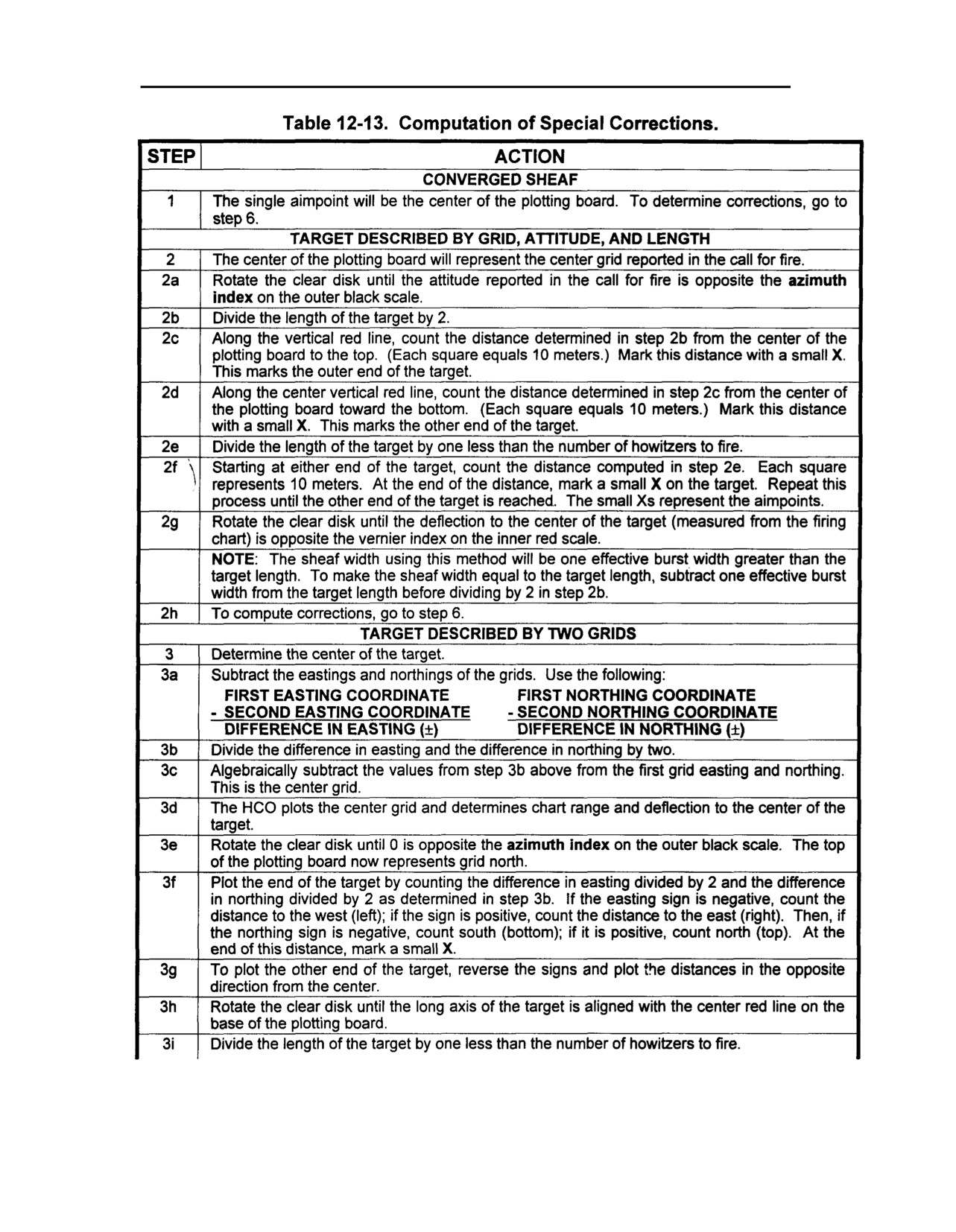
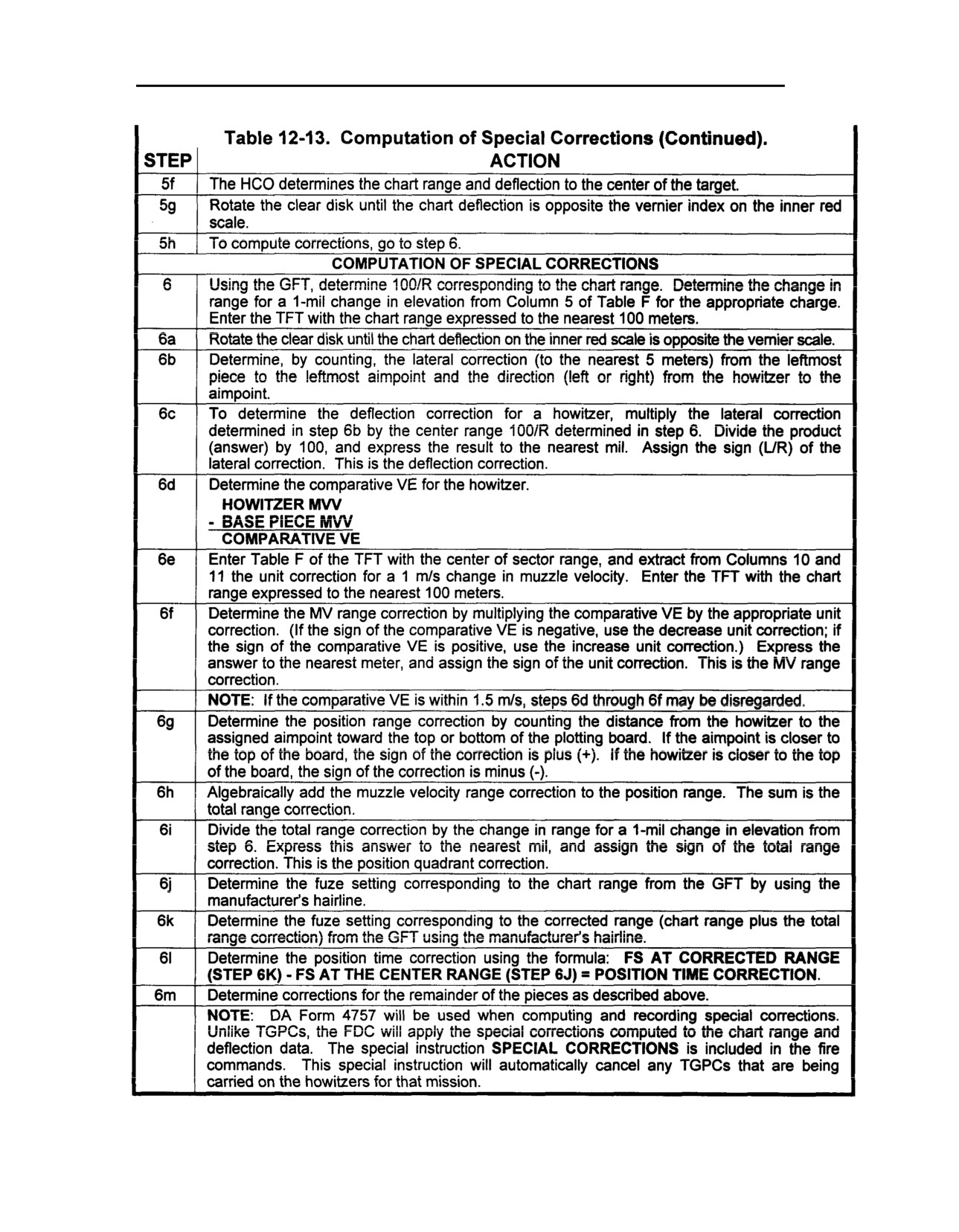
c. The special corrections are computed in a similar manner to TGPCs, the major
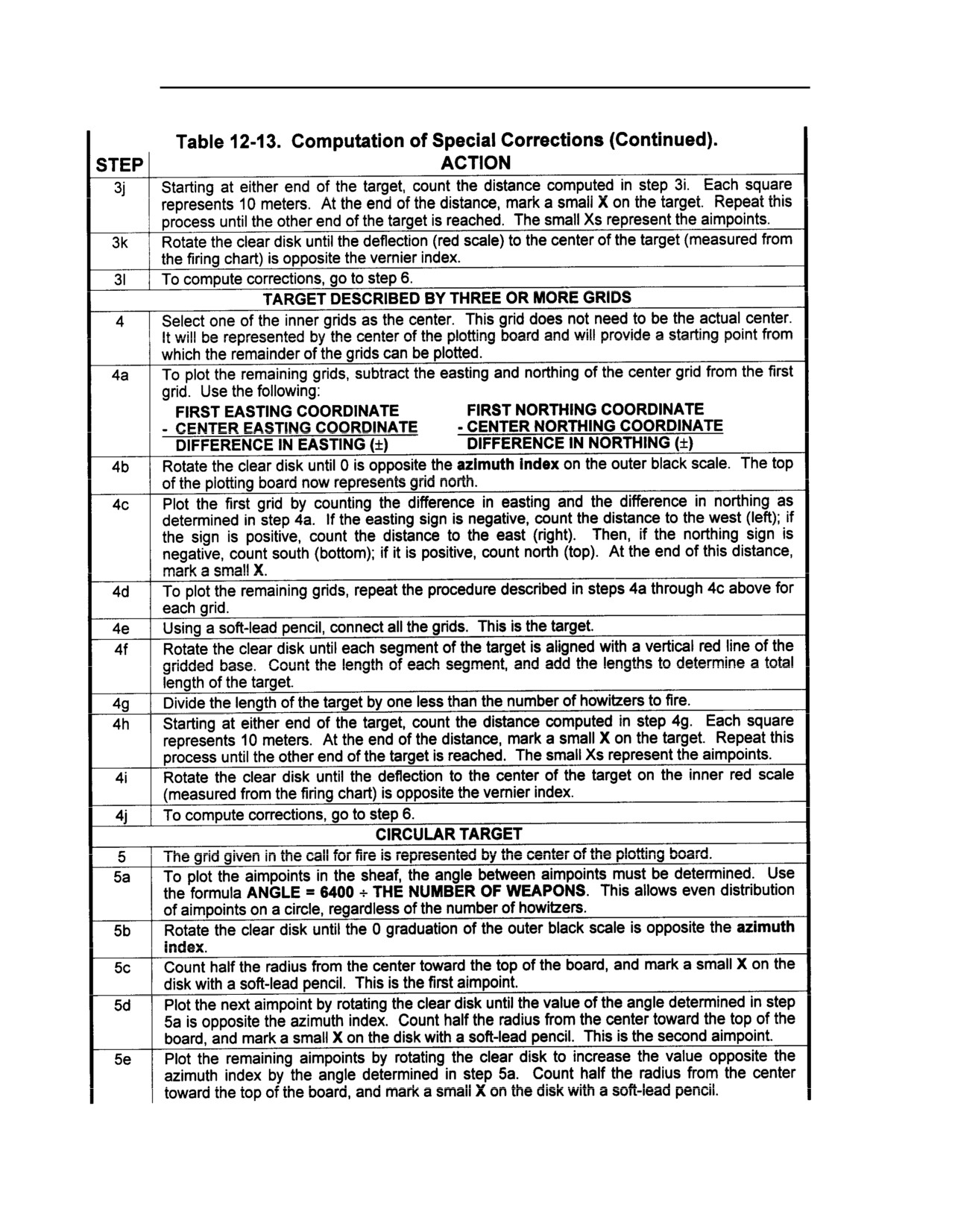
difference being the plotting of the target. The following types of sheafs may be computed:
Converged sheaf.
A target described by grid, length, and attitude.
A target described by two grids.
A target described by three or more grids.
A circular target.
12-14. Computation of Special Corrections
Table 12-13 provides the steps and procedures for the computation of special corrections.
12-30
FM 6-40
12-31
FM 6-40
12-32
FM 6-40
12-33
FM 6-40
Section IV
Use of Plotting Board for Fire Mission Processing
When the use of a firing chart is not possible, the M10 or M17 plotting
board and GFT or TFT may be used to compute firing data. The observer
transmits the call for fire to the firing unit and describes the target location by
using any of the methods of target location.
12-15. M17 Plotting Board
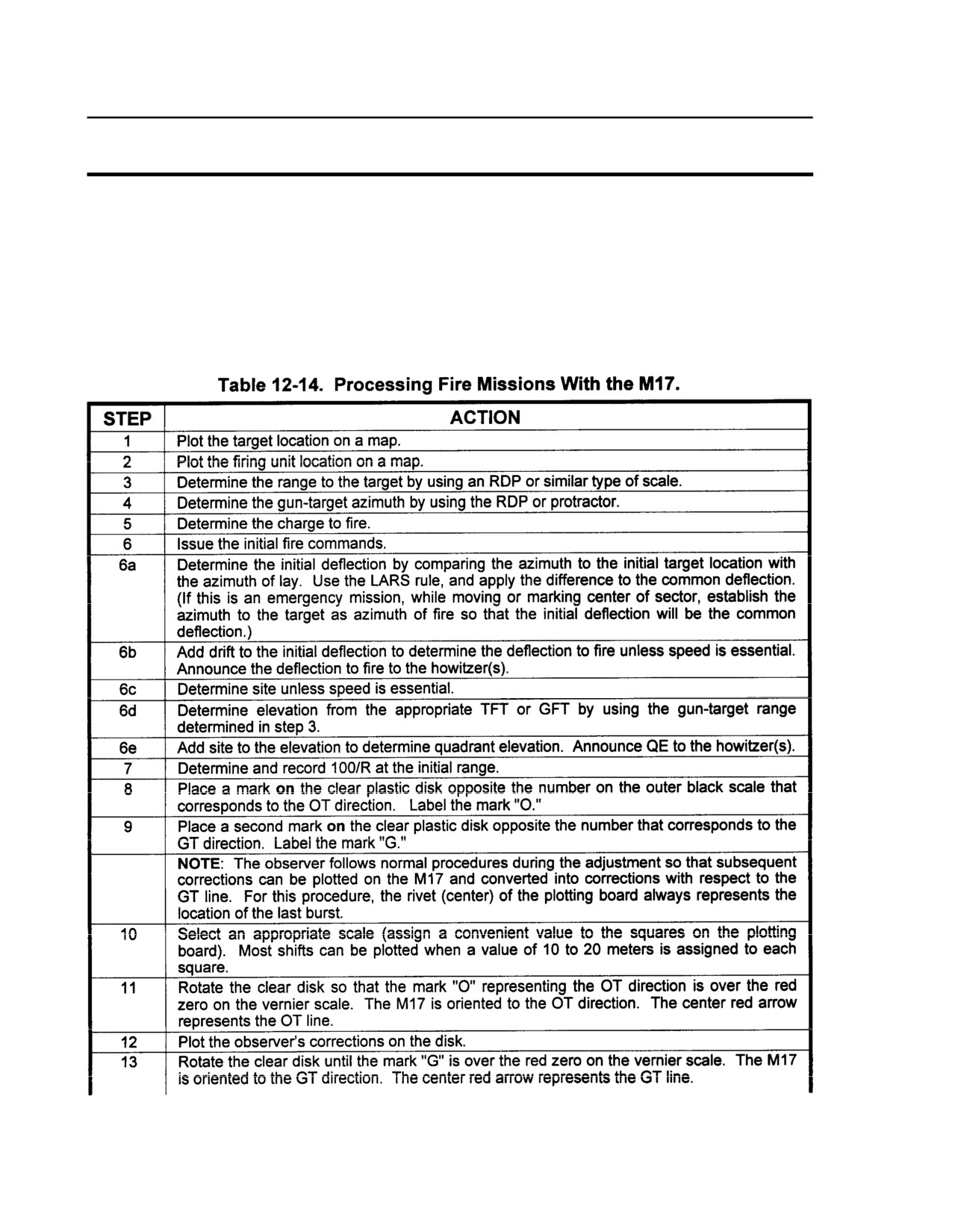
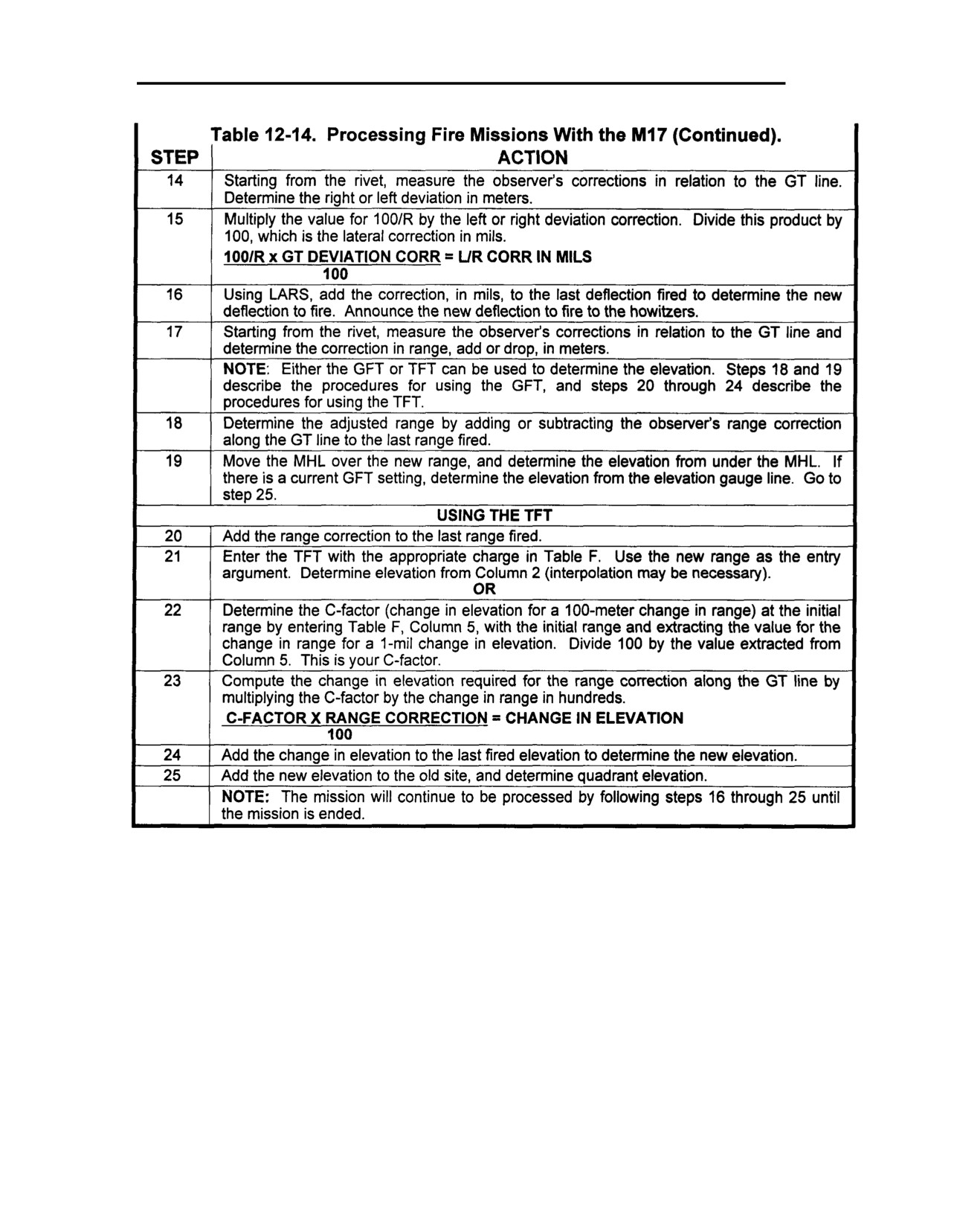
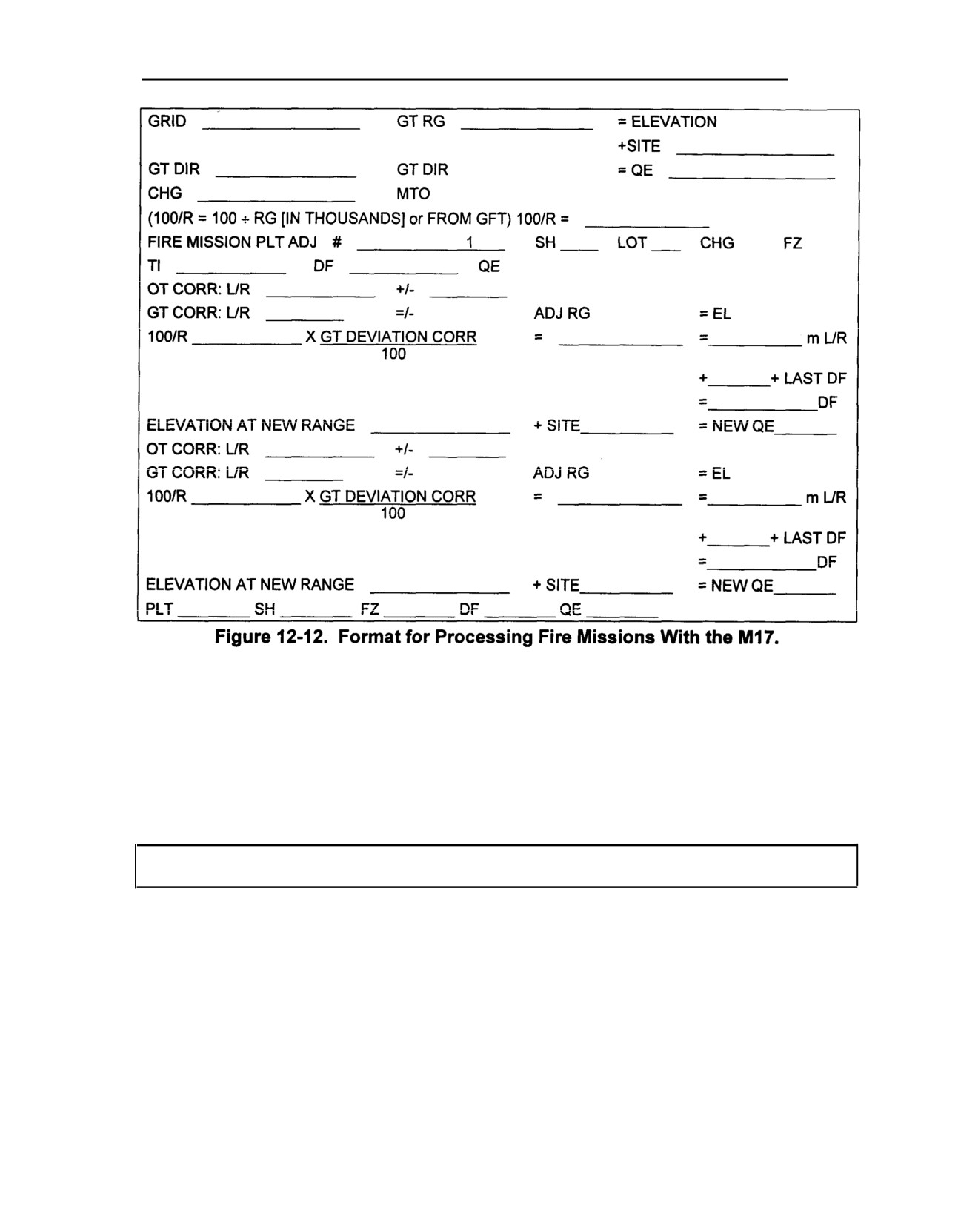
The steps in Table 12-14 are used to process fire missions with the Ml 7 plotting board.
See Figure 12-12 for the Ml 7 format for processing fire missions.
12-34
FM 6-40
12-35
FM 6-40
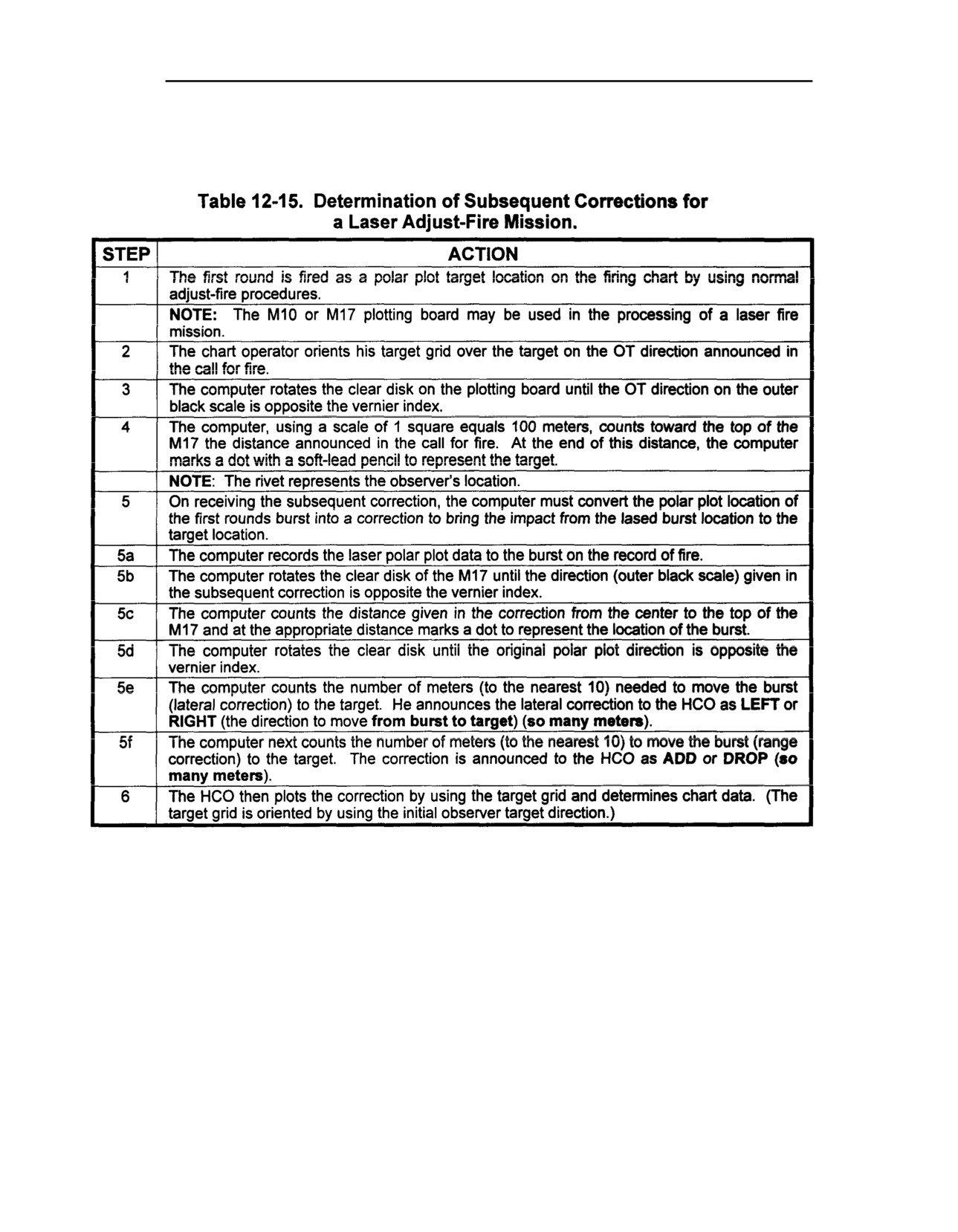
12-16. Determination of Subsequent Corrections for a Laser Adjust-Fire Mission
Table 12-15 shows the steps and procedures to determine subsequent corrections for a
laser adjust-fire mission.
12-36
FM 6-40
12-17. Examples of TGPCs
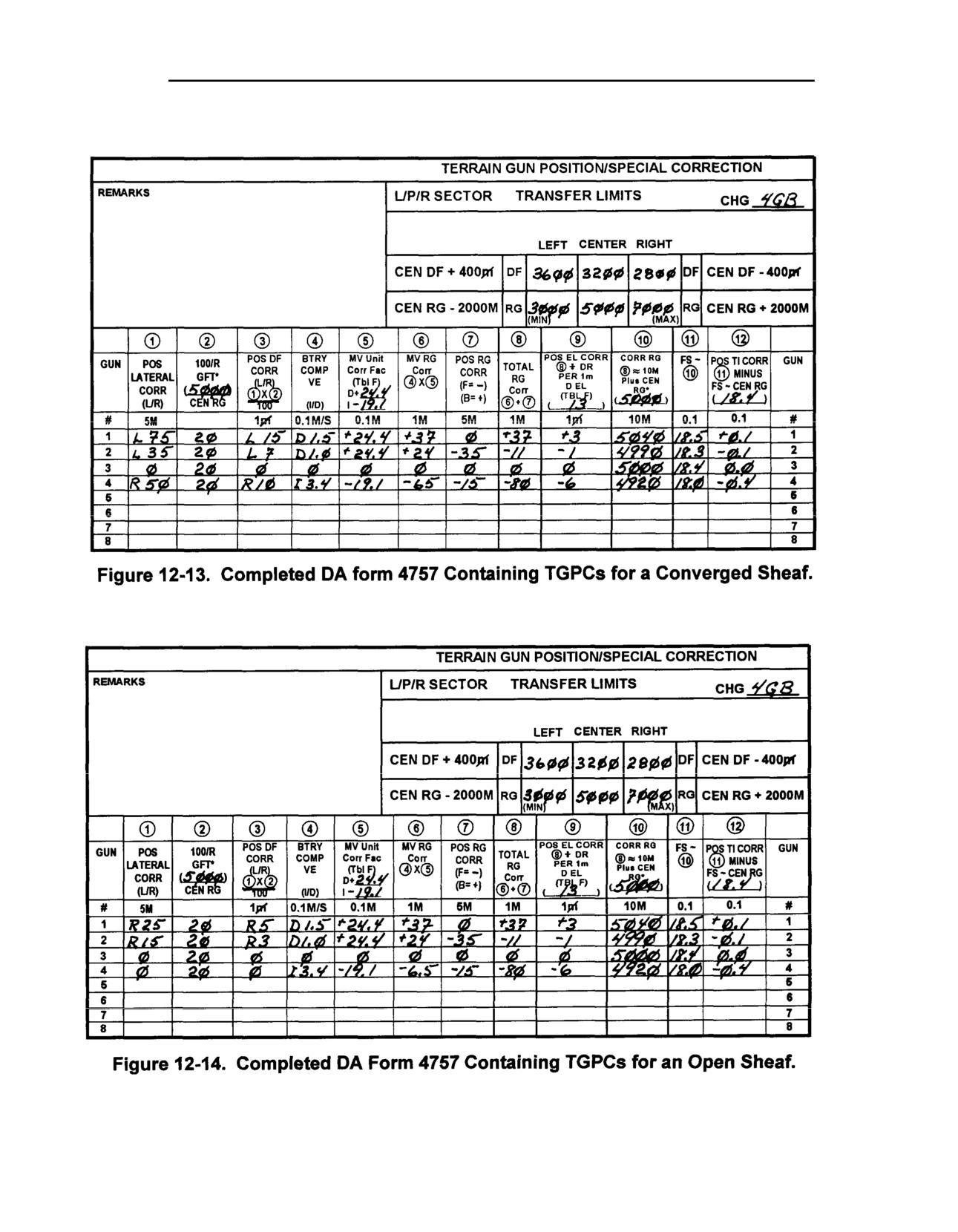
a. The following is an example of the platoon leader’s report for the Ml00-series sight:
HOWITZER
LAID FROM LAY DEFLECTION DISTANCE
VA
1
AC
2595
105
+3
2
AC
2910
55
+1
3 (BP)
AC
3405
90
-2
4
AC
3950
100
-5
NOTE: Howitzer Number 3 is the base piece.
b. The following is an example of piece displacement.
HOWITZER
LATERAL DISPLACEMENT
RANGE DISPLACEMENT
1
R75
0
2
R35
+35
3
0
0
4
L50
+15
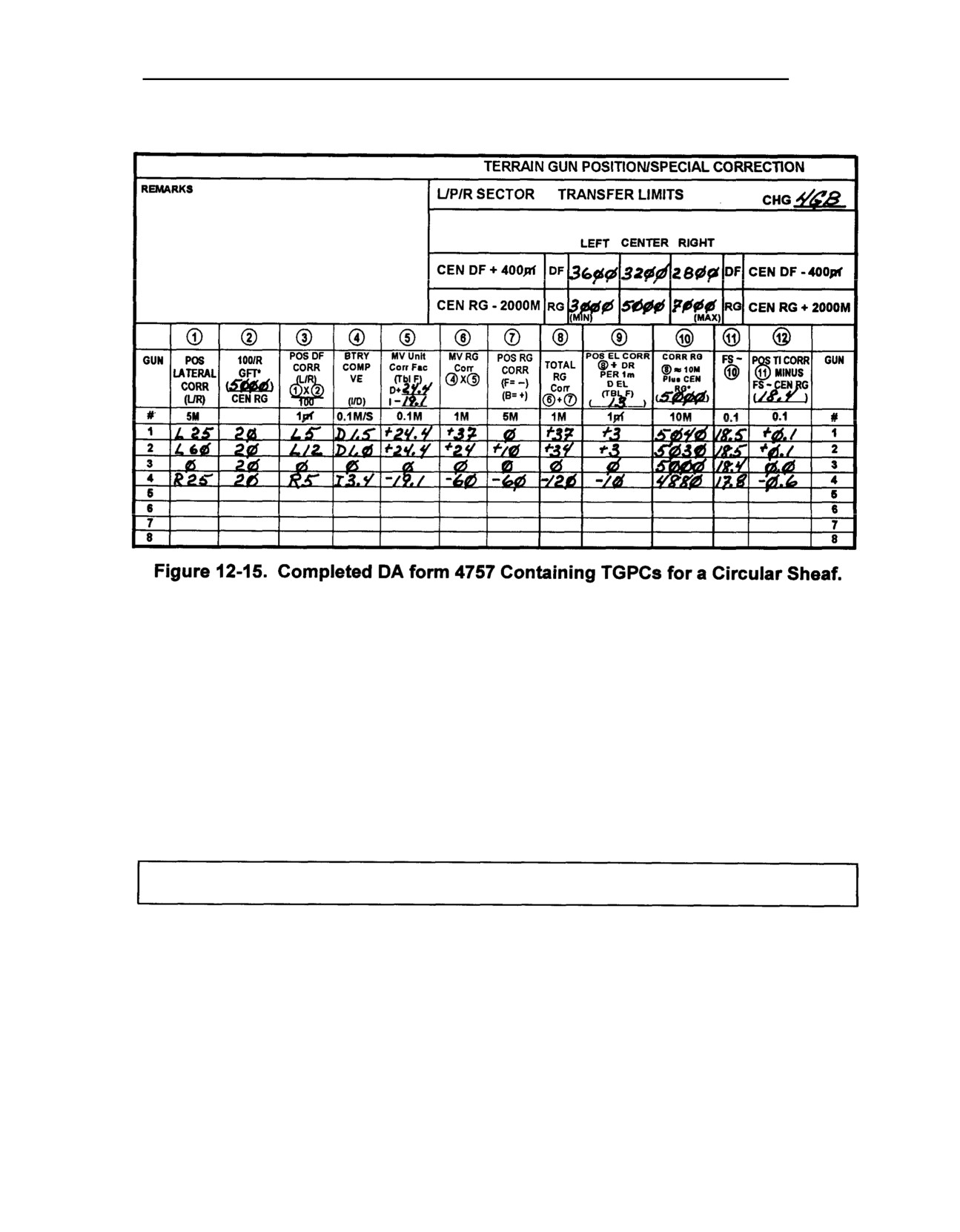
c. A completed DA Form 4757 for each sheaf (converged, open, and circular)
containing TGPCs using the data listed above are shown in Figures 12-13 through 12-15.
12-37
FM 6-40
12-38
FM 6-40
12-18. Examples of Special Corrections
a. Using the data listed below, determine special corrections for a linear target described
by a grid, length, and attitude.
GIVEN:
(1) Example of the platoon leader’s report for the M1OO-series sight:
HOWITZER LAID FROM LAY DEFLECTION DISTANCE
VA
1
AC
2595
105
+3
2
AC
2910
55
+1
3 (BP)
AC
3405
90
-2
4
AC
3950
100
-5
NOTE: Howitzer Number 3 is the base piece.
(2) Example of piece displacement.
HOWITZER
LATERAL DISPLACEMENT RANGE DISPLACEMENT
1
R75
0
2
R35
+35
3
0
0
4
L50
+15
12-39
FM 6-40
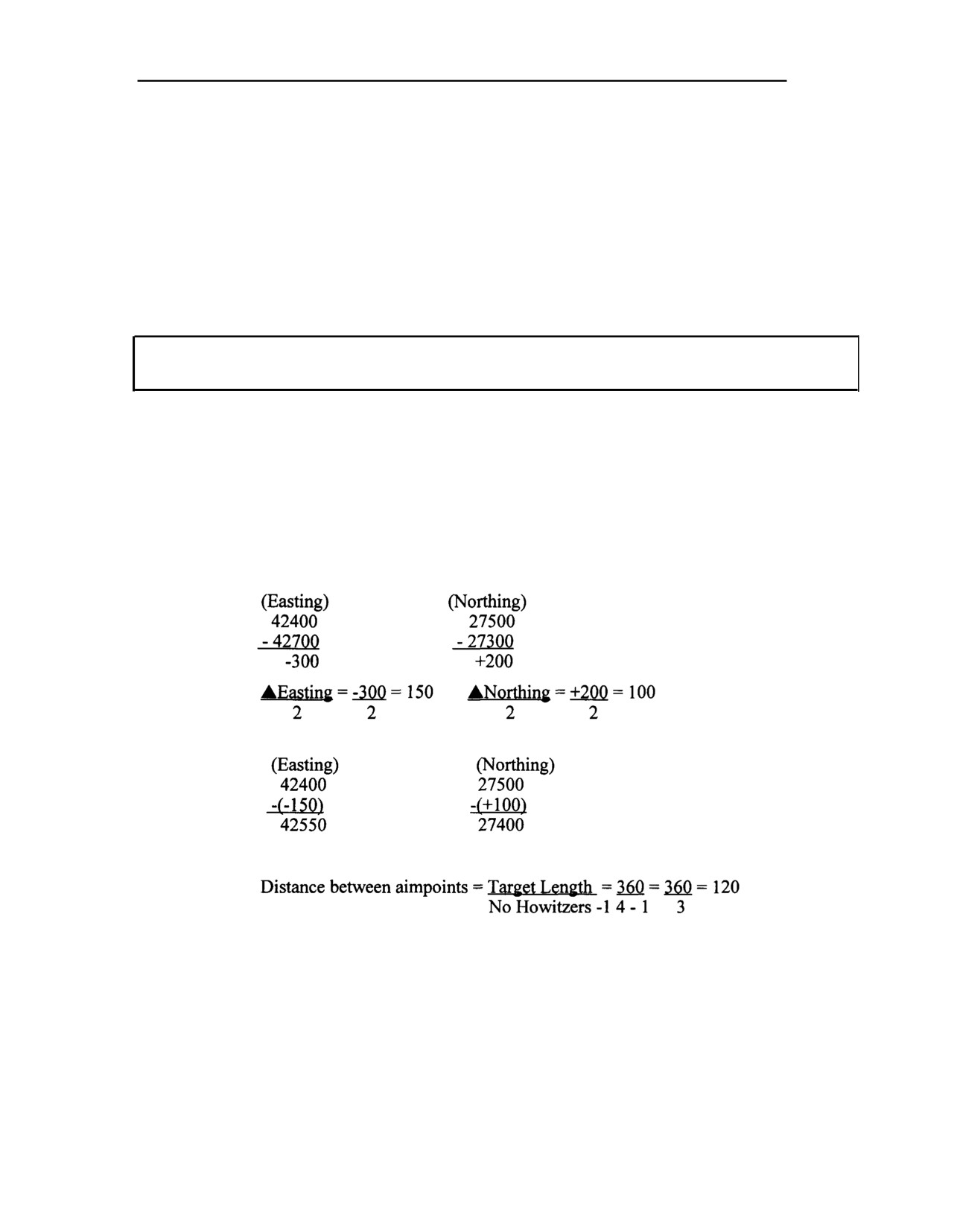
(3)
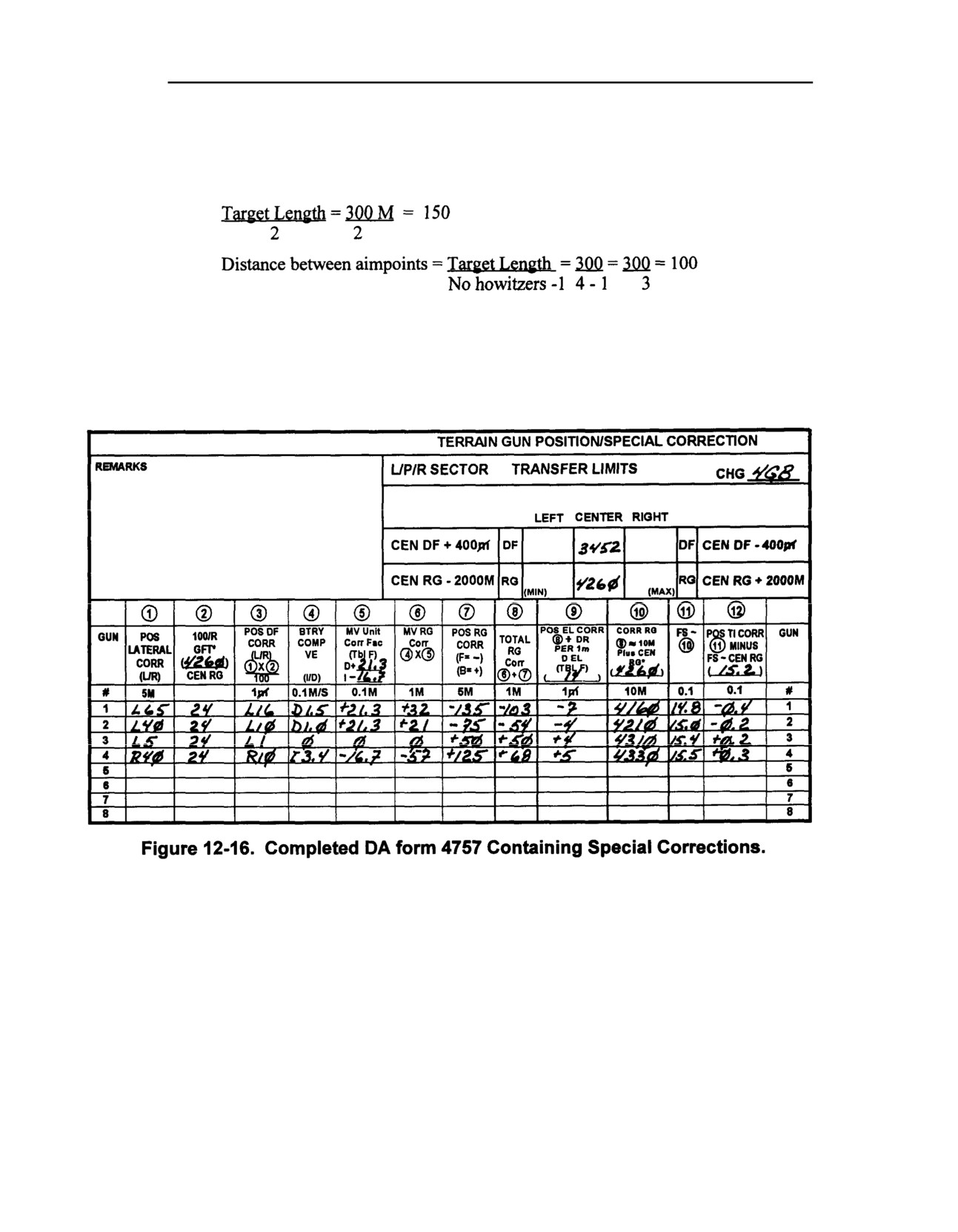
Target Grid: 432275
(4)
Length: 300 M
(5)
Attitude: 1,300
(6)
(7)
(8) Chart data to the center grid: Chart range 4260 Chart deflection 3452
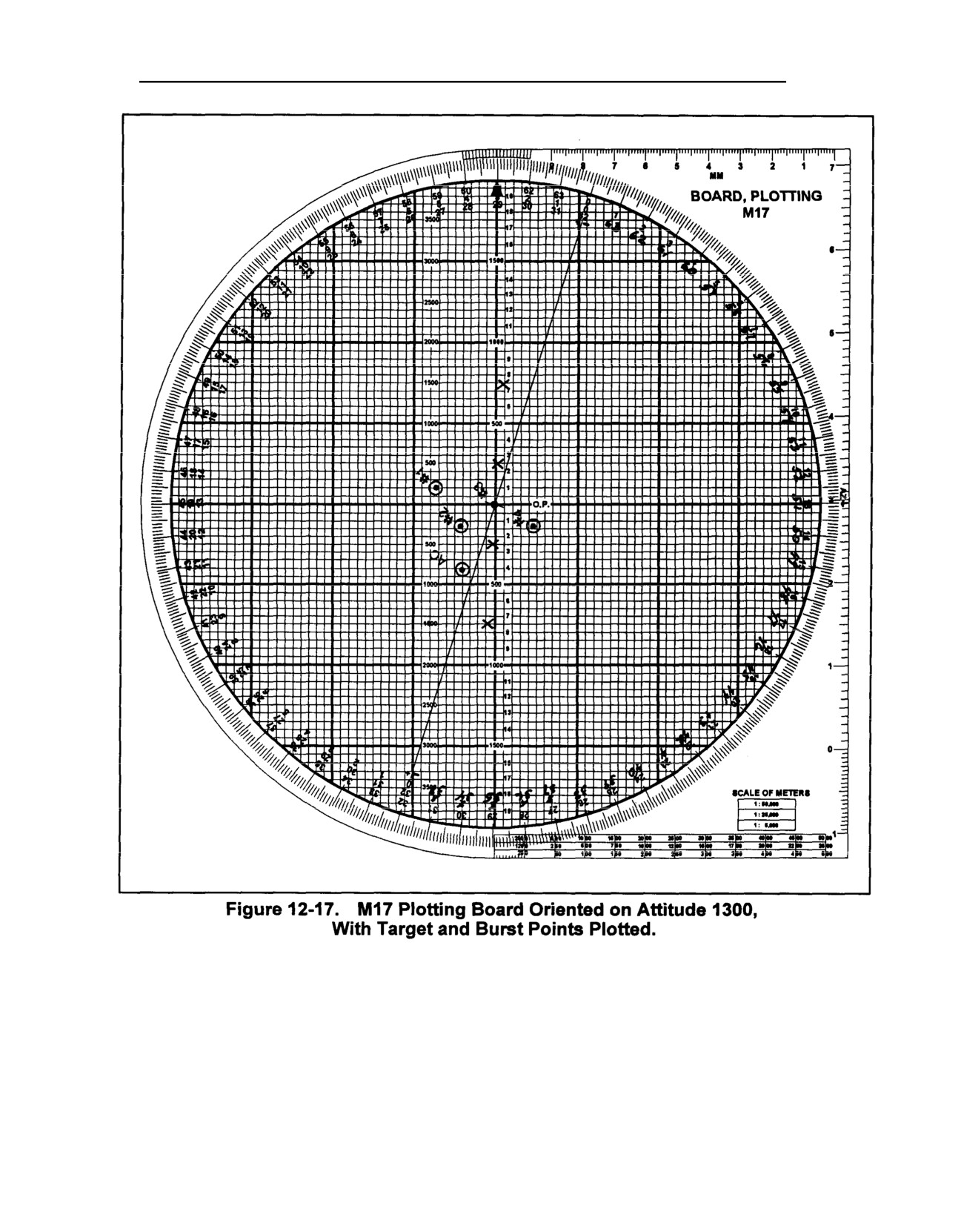
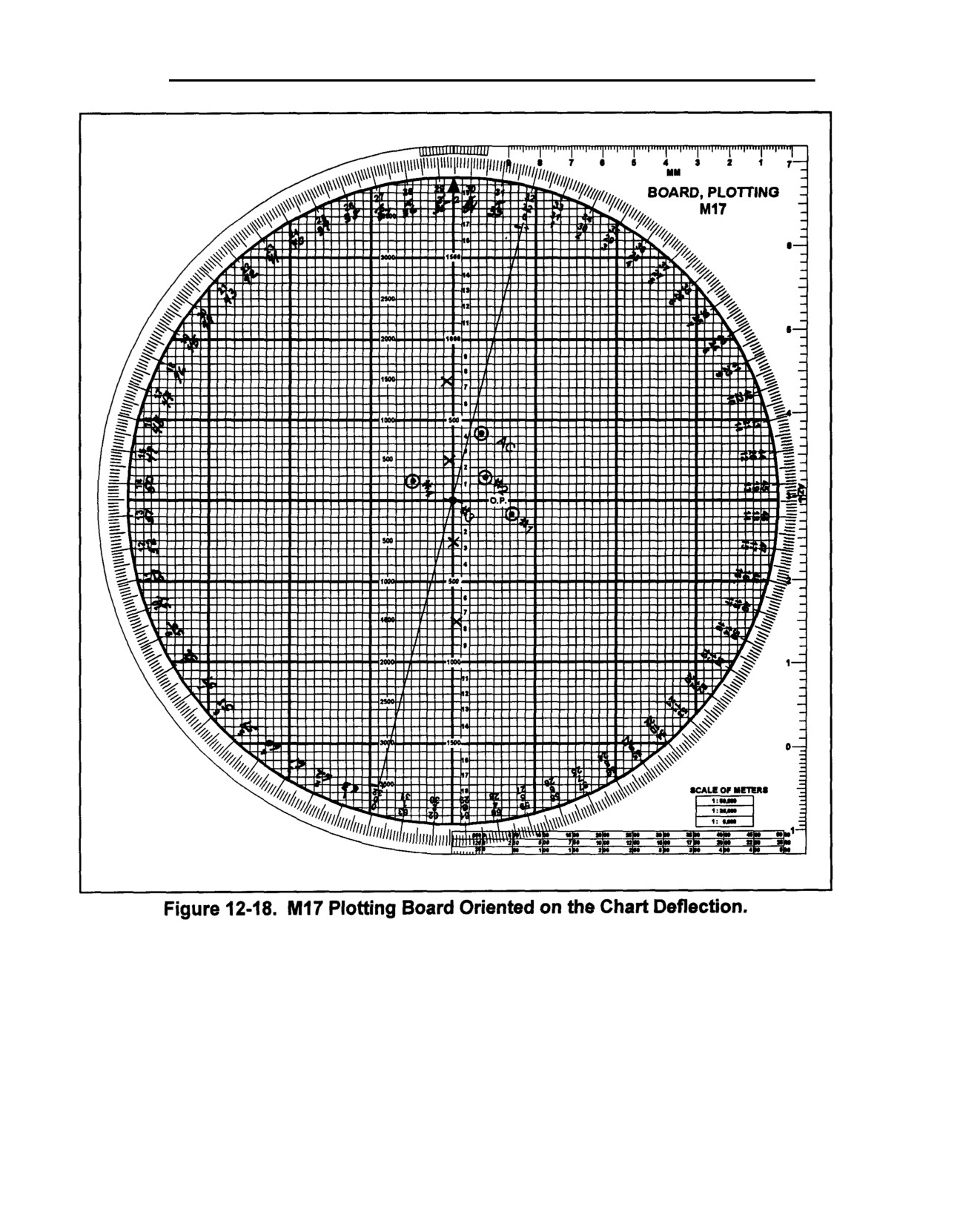
b. A completed DA Form 4757 for the special corrections and the Ml7 plotting board
are shown in Figures 12-16 through 12-18.
12-40
FM 6-40
12-41
FM 6-40
12-42
FM 6-40
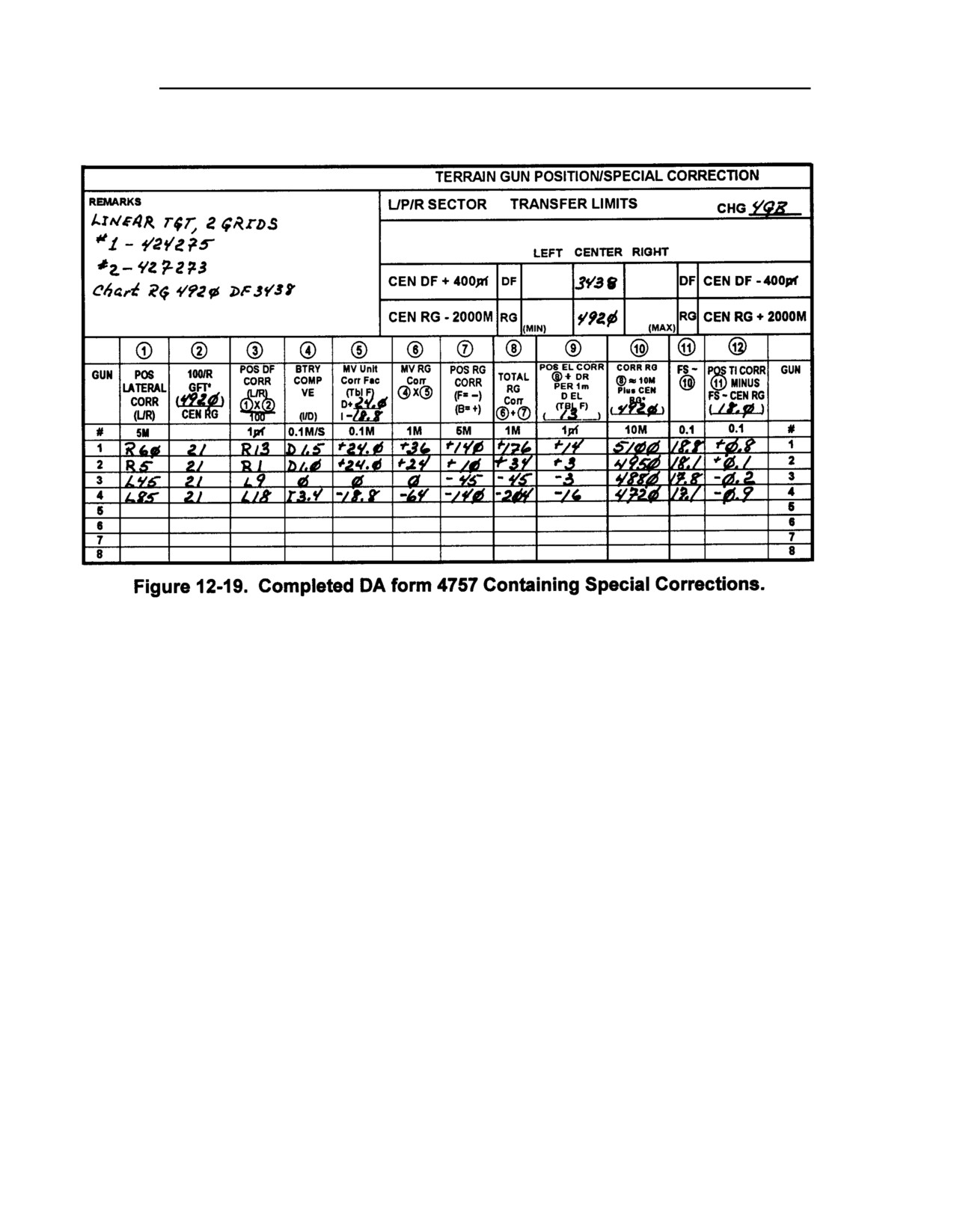
c. Using the data listed below, determine special corrections for a linear target described
by two grids.
GIVEN:
(1) Example of the platoon leader's report for the M1OO-series sight:
HOWITZER
LAID FROM LAY DEFLECTION DISTANCE
VA
1
AC
2595
105
+3
2
AC
2910
55
+1
3 (BP)
AC
3405
90
-2
4
AC
3950
100
-5
NOTE: Howitzer Number 3 is the base piece.
(2) Example of piece displacement.
HOWITZER
LATERAL DISPLACEMENT RANGE DISPLACEMENT
1
R75
0
2
R35
+35
3
0
0
4
L50
+15
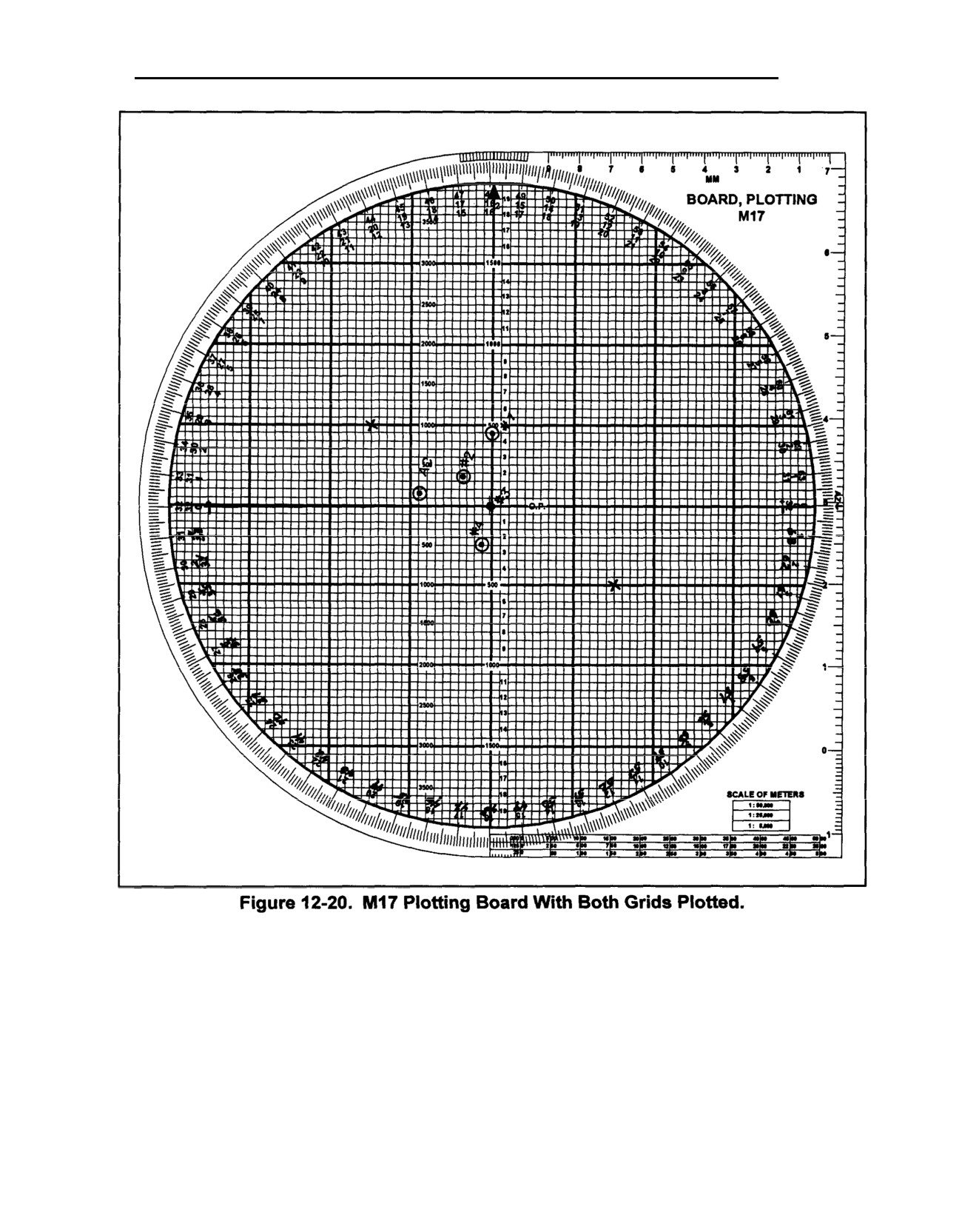
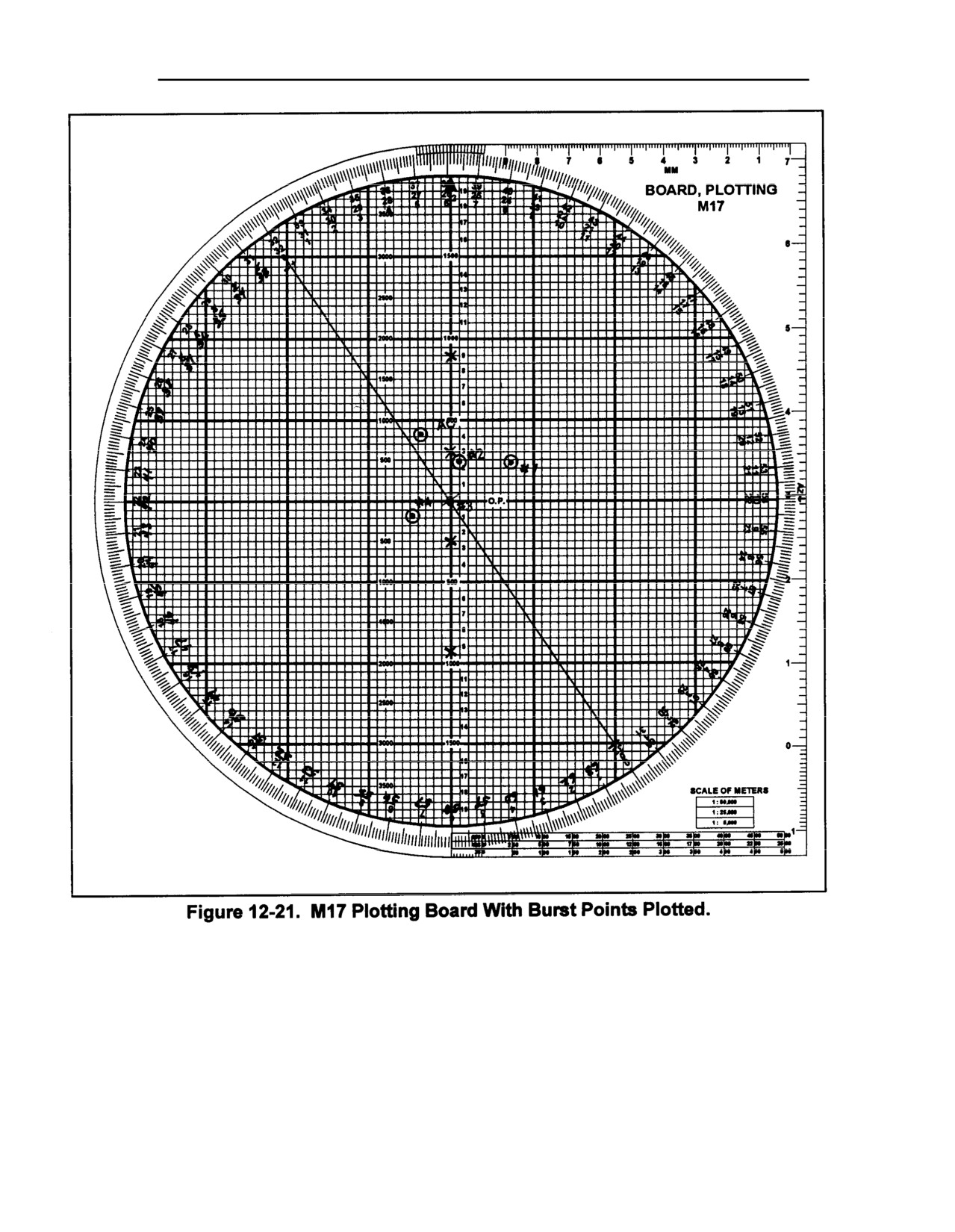
(3) Target Grids: 424275 and 427273
(4)
(5)
(6) Center Grid:
(7) Target Length: 360
(8)
(9) Chart data to the center grid: Chart range 4920 Chart deflection 3438
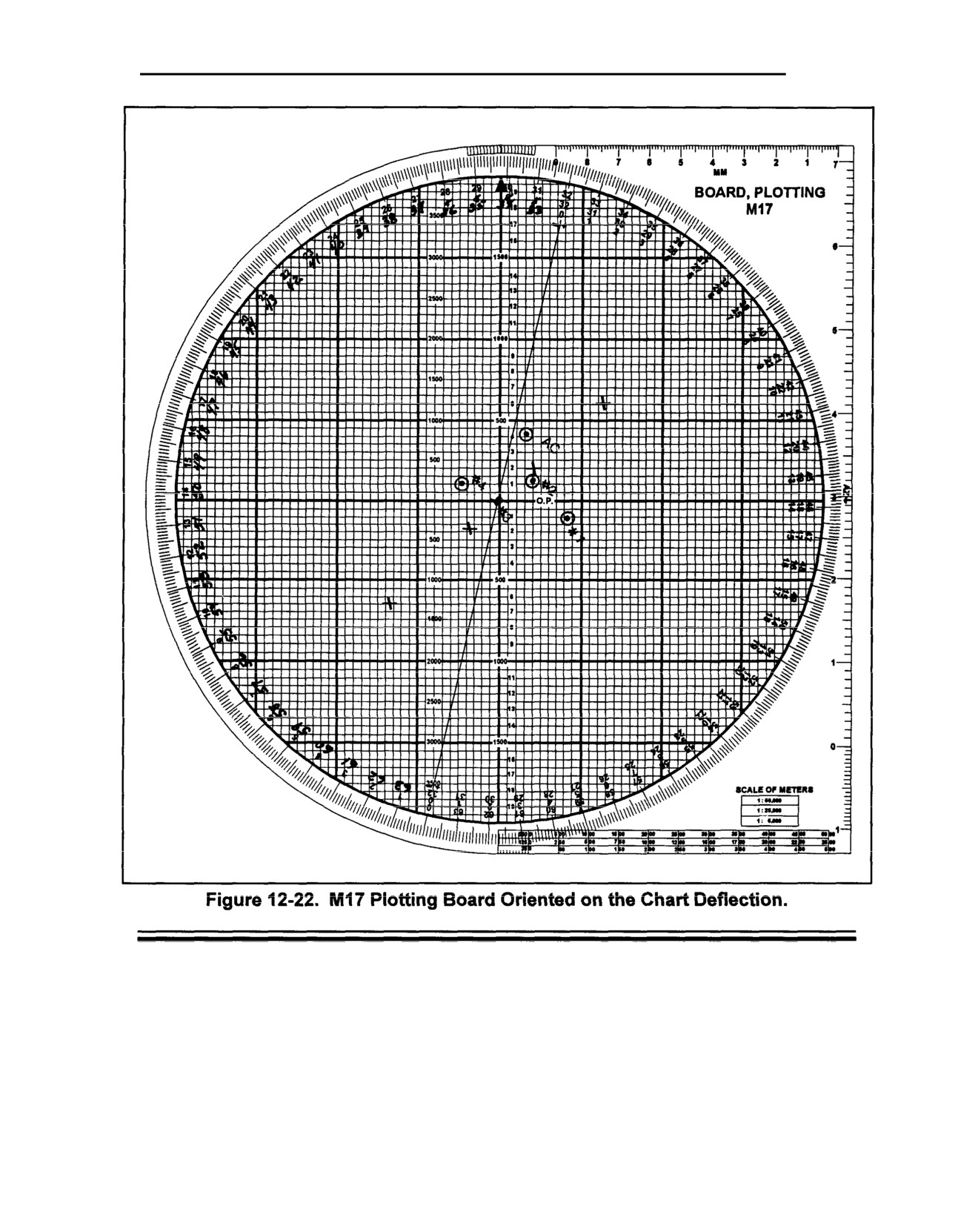
d. A completed DA Form 4757 for the special corrections and the Ml 7 plotting board
are shown in Figures 12-19 through 12-22.
12-43
FM 6-40
12-44
FM 6-40
12-45
FM 6-40
12-46
FM 6-40
12-47

FM 6-40
Chapter 13
SPECIAL MUNITIONS
This chapter describes procedures for special munition employment. Appendix H
provides further information on special mission processing.
Section I
Copperhead
The cannon-launched guided projectile (CLGP) M712 (Copperhead) is a
155-mm, separate-loading, laser-guided HE projectile. It is heavier (137.6
pounds) and longer (54 inches) than the standard 155-mm projectile. The A4712
projectile consists of three main sections: a guidance section (forward), warhead
section (center), and control section (rear). The guidance section contains the
seeker head assembly and the electronics assembly. The nose of the projectile
houses a laser seeker in a plastic cone. The warhead section contains an HE
antitank warhead consisting of 14.75 pounds of composition B. The control
section includes the fins and wings that deploy- in flight and allow the round
limited maneuverability.
13-1. Description
a. The Copperhead projectile is shipped and stored in a sealed container. The projectile
requires no assembly or testing at the firing site.
b. The FDC can compute firing data for shell Copperhead by using either a shaped
trajectory or a ballistic trajectory.
NOTE: The shaped trajectory is based on a revised targeting logic that was first
introduced with FT 155-AS-0 (Rev 1) and continued with FT 155-AS-1. The change
essentially results in firing higher charges at lower quadrant elevations, resulting in
flatter trajectories. This was done to maximize the employment of Copperhead
projectiles under low cloud ceilings. Many of the tables in FT 155-AS-1 refer to
ballistic or “glide” mode (for example, Table F). In this current FT, the terms glide
and shaped are used synonymously, even though they are different trajectories. A
true glide mode is only achieved when computing data by using FT 155-AS-0.
However, this method is not recommended because it will produce poor results
under low cloud ceilings.
(1) The trajectory of the Copperhead projectile is similar to that of a conventional
round. Only when the projectile reaches a point on the descending branch of the trajectory does
it differ. At that point, on the basis of the two-digit timer setting included in the fire commands,
the guidance and control systems are activated. This enables the projectile to alter the remainder
of its trajectory.
13-1
FM 6-40
(2) At 20 seconds from impact, the FDC cues the laser designator operator,
who begins designating the target. The ground laser operator may use a G/VLLD, a
laser target designator (LTD), or modular universal laser equipment (MULE). Airborne
systems include the AH-64, OH-58D, and unmanned aerial vehicles. The Copperhead
projectile acquires the reflected laser energy and initiates internal guidance and control,
allowing it to maneuver to the target. If the time of flight of the projectile is less than
20 seconds, the FDC will inform the observer to designate the target concurrent with
the shot message (that is, LASER ON, SHOT, OVER).
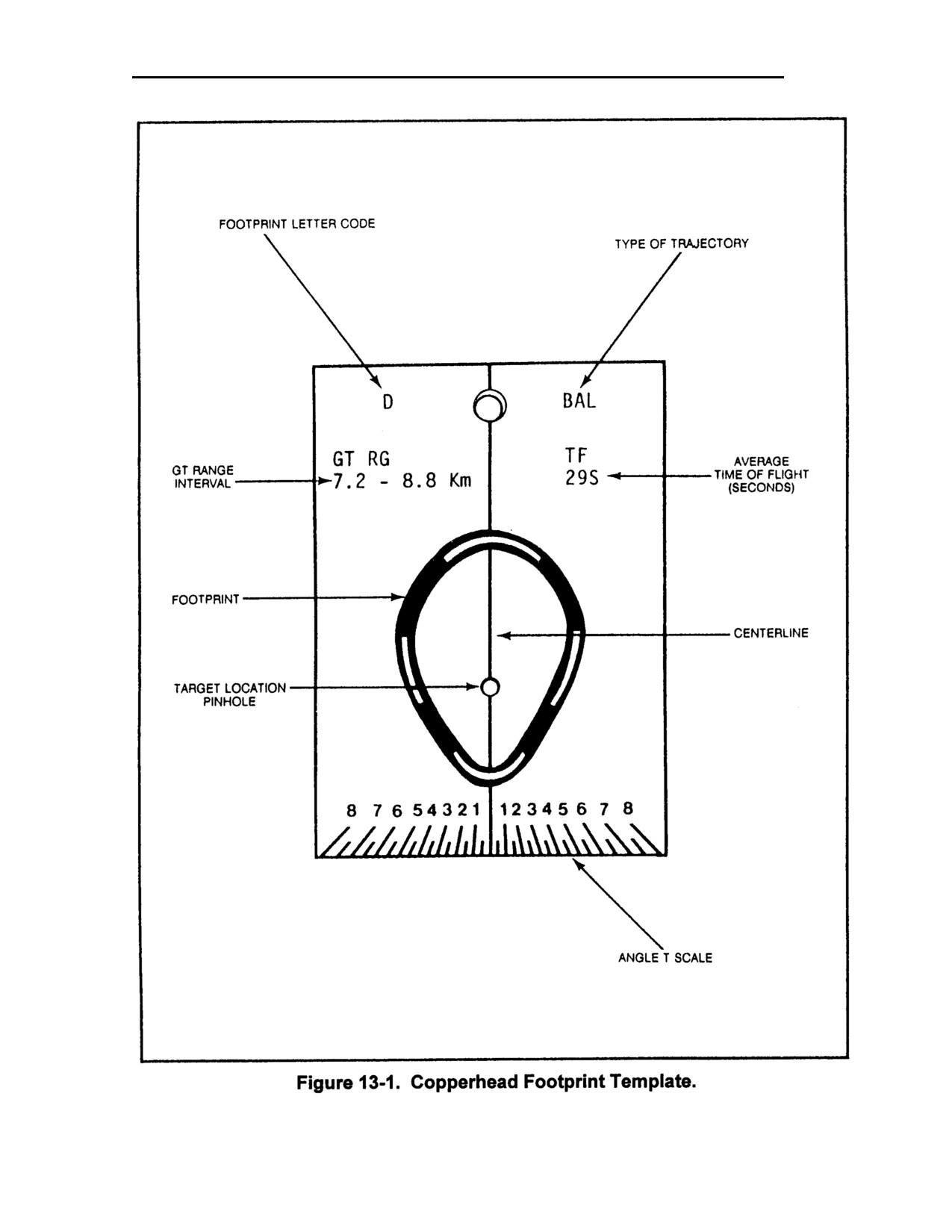
c. The ground surface area in which the round can maneuver is limited. The
optimum limits of maneuverability of the Copperhead round is called a footprint
(Figure 13-l). The size of the footprint is determined by the GT range and the shape of
the trajectory, but it can also be affected by cloud height. The ballistic aimpoint is on
the GT line, usually short of the target location sent by the laser designator operator.
The distance that the ballistic aimpoint is short of the target location varies and is
called the offset correction. This offset distance is used to ensure that the maximum
probability of hit occurs at the original target location sent by the observer. The larger
the target location error, the lower the probability of hitting the target.
d. Copperhead missions, like conventional missions, can be fired on either
planned targets or targets of opportunity. Planned targets are priority targets or on-call
targets.
(1) Because of its relatively short response time, the Copperhead planned
target is the preferred method for employing Copperhead. Unless otherwise specified
on the target list, two Copperhead rounds are prepared in advance for each Copperhead
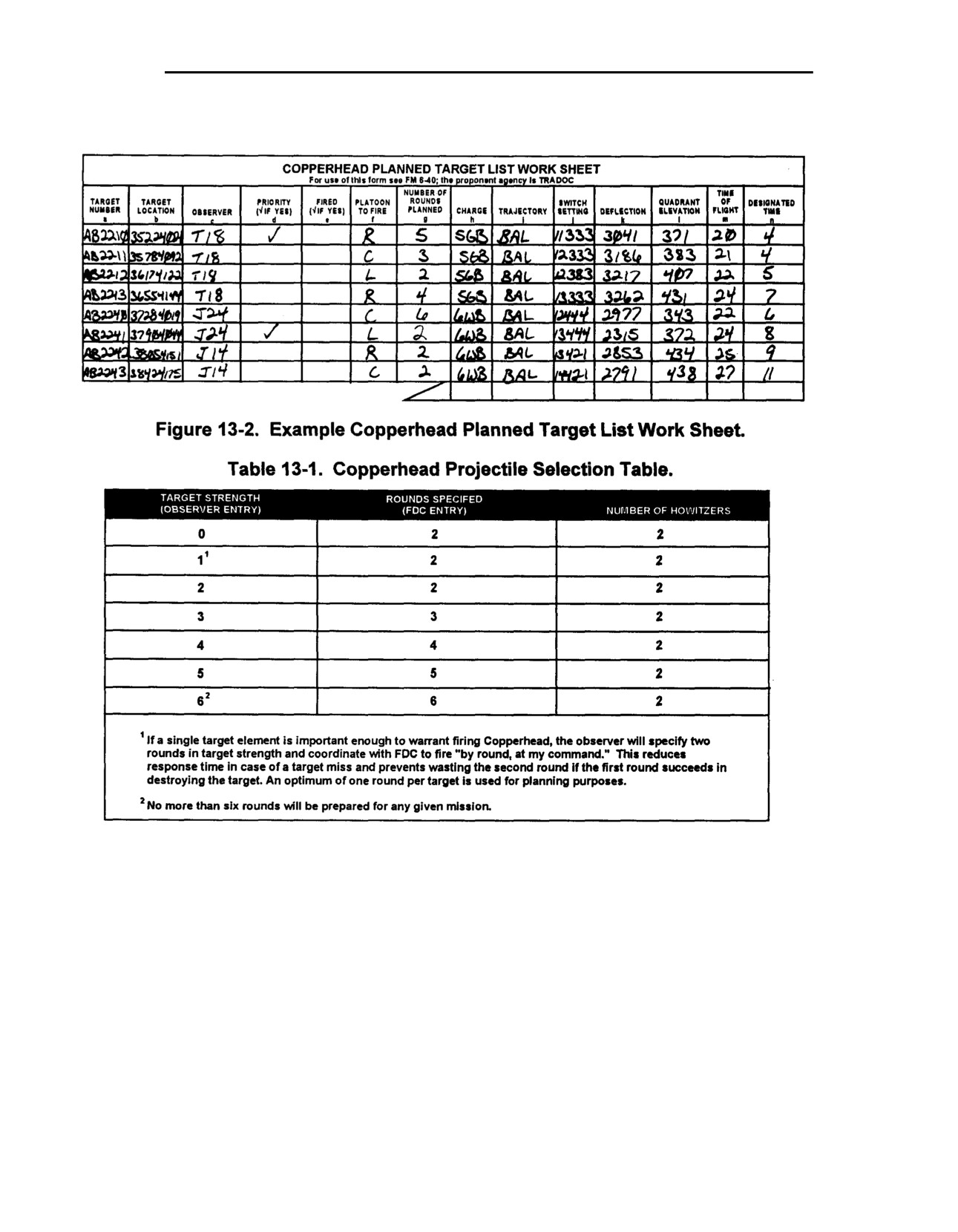
priority target. DA Form 5711-R (Copperhead Planned Target List Work Sheet) may
be used to quickly update data for planned Copperhead targets. These data can then be
transferred to DA Form 4504 when the mission is fired. Figure 13-2 shows an example
Copperhead planned target list work sheet.
NOTE: A reproducible copy of DA Form 571 I-R is provided at the back of this
publication.
(2) On-call target procedures for Copperhead are the same as those for
conventional on-call missions.
NOTE: FDC personnel must ensure that at least two howitzers and two
Copperhead rounds are prepared for any mission. This action increases firing unit
responsiveness if a round or howitzer malfunctions. The criteria in Table 13-1 are
used for all Copperhead missions.
13-2
FM 6-40
13-3
FM 6-40
13-2. Computations for Shell Copperhead
a. When a target list is received from the battalion FDC, Copperhead priority
targets are processed first. Battery or platoon FDC personnel must know how to use
the Copperhead footprint templates and must be aware of the maximum 800-mil angle T
requirement. Priority target firing data usually are sent to two adjacent howitzers. The
FDC transmits the message to observer and informs the observer when the unit is
prepared to fire the priority target. Response time is excessive if the Copperhead
rounds and the howitzers are not prepared in advance. Firing data for the rest of the
targets on the target list are then computed and recorded by target number in the FDC.
b. As the situation changes, recomputation may be required and is done by the FDC.
13-4
FM 6-40
13-3. Copperhead SOP
a. Unit SOPs dealing with Copperhead (Cphd) missions are helpful in rapidly
disseminating mission-essential information with a minimum of discussion. When used with
extensive training, a unit SOP can result in more responsive fires.
(1) An observer requesting Copperhead fires on planned targets and targets of
opportunity will send a call for fire to the battery or platoon FDC over an established fire net.
(2) The standard target list is used to initiate a planned target.
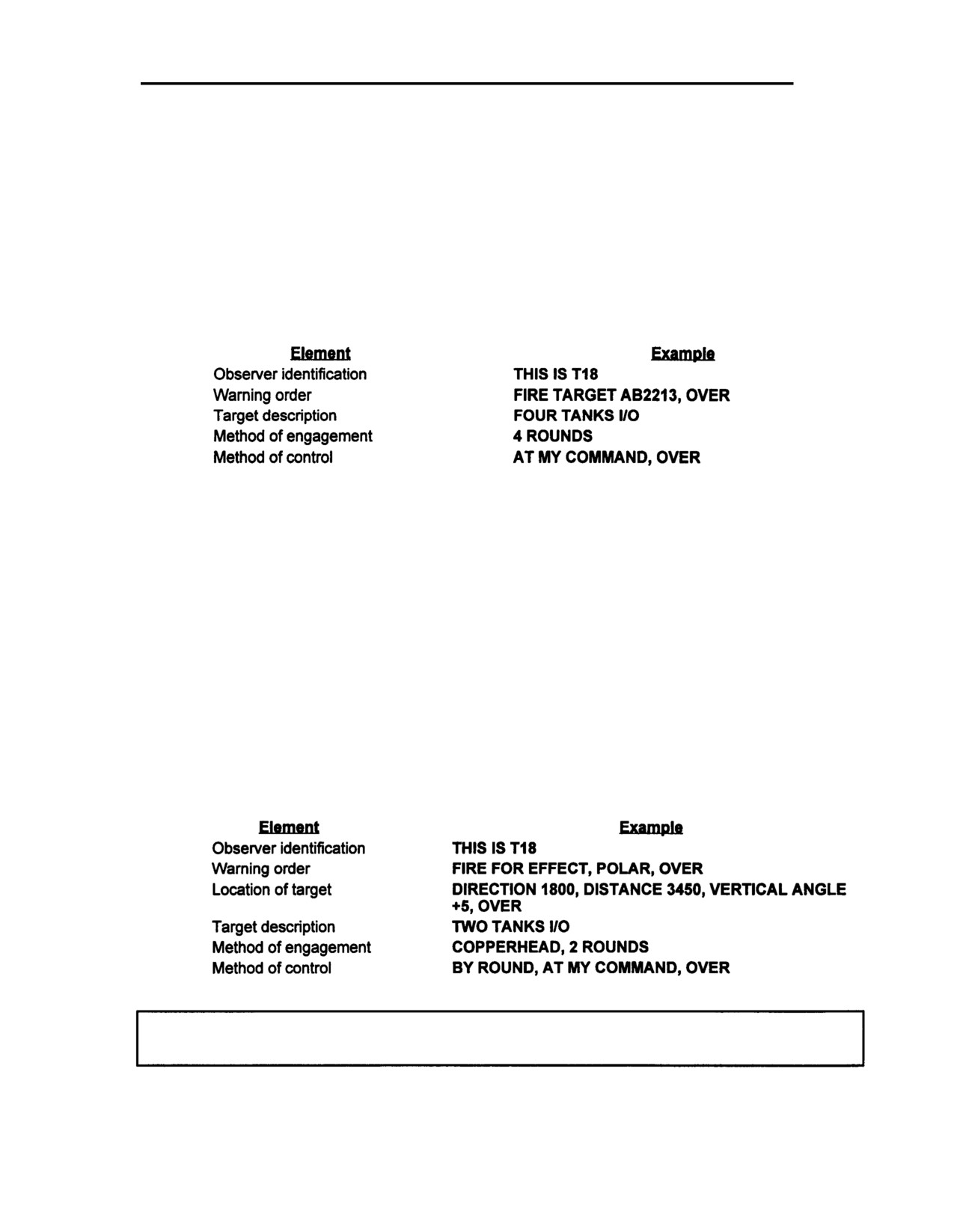
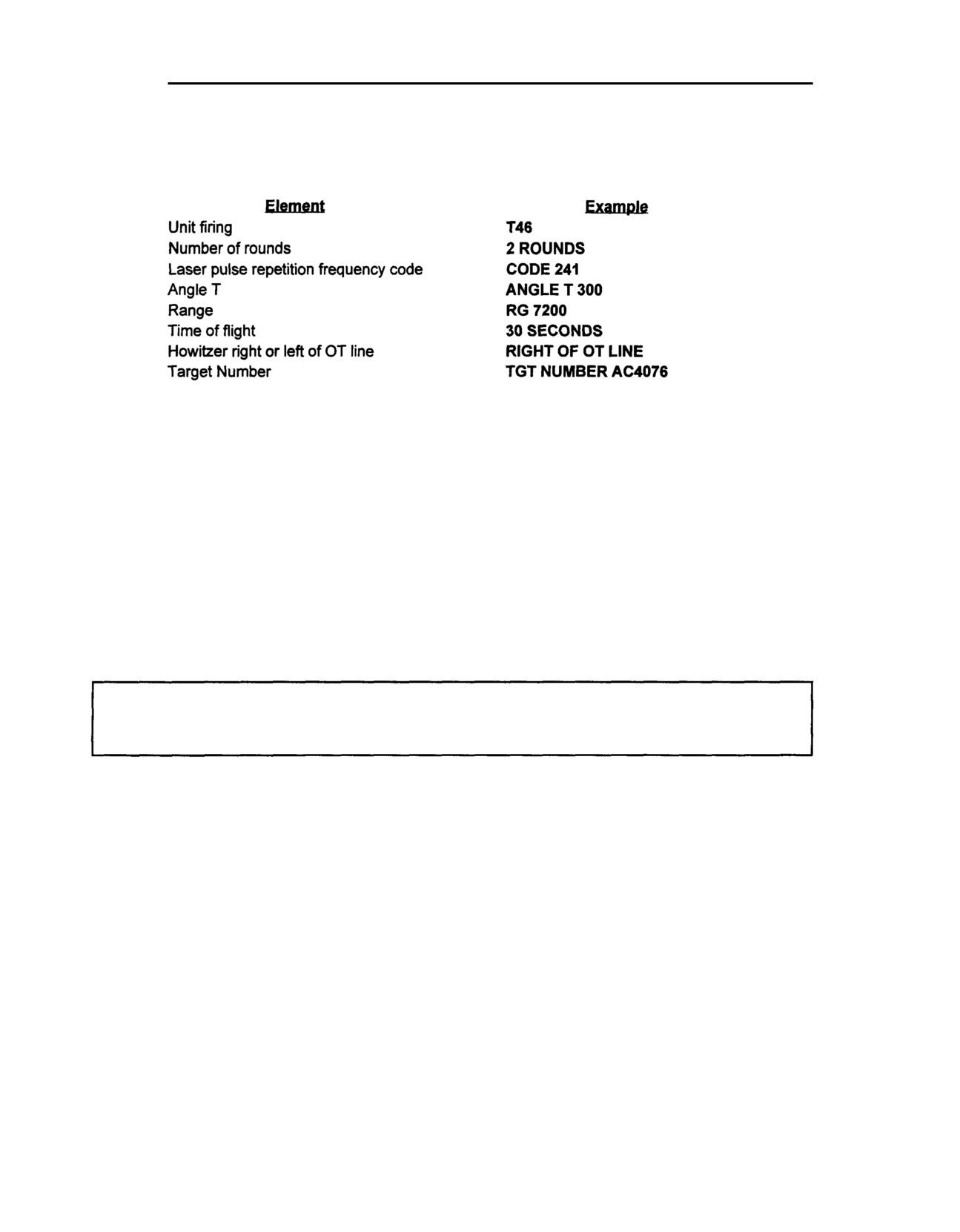
(3) To fire on a planned target, the observer transmits a call for fire that includes the
following elements:
(4) To enhance mission responsiveness when engaging priority targets, the observer
may omit the target description, method of engagement, and method of control; for example, T46
THIS IS T18, FIRE TARGET AB2213, OVER.
(5) If the number of rounds to be fired is not specified in the call for fire, the FDC
will fire the number of rounds specified for that target on the Copperhead target list. If the
number of rounds is not specified on the target list, the FDC will fire one round at the target and
direct the howitzer(s) to prepare, but DO NOT LOAD, a second round. The MTO will reflect 1
round.
(6) When the observer requests AT MY COMMAND, the Copperhead rounds will
be freed at intervals of at least 30 seconds when the observer gives the initial command to fire.
When BY ROUND AT MY COMMAND is requested, the observer will control the firing of
each Copperhead round. The observer must understand this and act accordingly so as not to
waste rounds.
b. For targets of opportunity, the call for fire includes the following elements:
NOTE: For a target of opportunity, the call for fire must specify Copperhead.
13-5
FM 6-40
13-4. Message to Observer
a. After a call for fire is processed, an MTO is sent as soon as possible before firing.
b. The MTO for Copperhead missions includes the following elements:
c. For a Copperhead mission to be successful, the three-digit pulse repetition frequency
(PRF) code set on the Copperhead round must match the PRF code set on the observer’s
designator. The FDC should have a list of all observer PRF codes by call sign. The FDC selects
the proper PRF code on the basis of the identification of the observer sending the call for fire.
The PRF code is then sent to the howitzers in the fire commands and is placed on the Copperhead
round. The observer verifies the PRF code announced in the MTO.
13-5. Fire Order
The elements established as standard are not addressed unless a change in the standard is
desired. Two howitzers will support a given Copperhead fire mission.
13-6. Computation of Firing Data
NOTE: FT 155-AS-1 is used to compute firing data for Copperhead. There are no
GFTs for FT 155-AS-1. FT 155-AS-1 supersedes FT 155-AS-0 (Rev 1) firing tables.
a. Initial Chart Data. The computation of firing data for Copperhead begins with the
determination of chart data. This applies to both planned targets (target locations taken from the
Copperhead target list) and targets of opportunity (target location provided in the call for fire).
The initial chart data required for Copperhead missions is chart range, chart deflection, and angle
T. Chart data are determined and announced by the HCO.
b. Trajectory and Charge Selection. Given the chart range to the target, observer
visibility, and target cloud height, the FDO enters the Copperhead charge selection table in the
Copperhead TFT. Determine the charge to fire by entering the table with the visibility followed
by cloud height. Identify the range interval that includes the chart range. To determine the
visibility and cloud height to use, see the table on page xxx in the introduction of the TFT. For
example, for an Ml09A3 unit with nominal visibility, cloud height of 900, and chart range of
6300, the unit would use the ballistic mode and fire charge 6 white bag.
c. Computations. Met corrections have a large impact on the Copperhead projectile;
therefore, firing data should not be determined without compensating for nonstandard conditions.
13-6
FM 6-40
(1) Priority or planned targets. Firing data for planned targets is based on the
solving of a met to target with the AS-1 TFT.
(2) Targets of opportunity. Because of the decreased response time for targets of
opportunity, solving a met to a target is not practical. The following procedures can be used to
determine firing data for targets of opportunity.
(a) FDO selects charge(s) to cover area of operations. FDO must also
consider expected visibility and cloud height.
(b) Solve a met + VE for selected charge(s) by using the center range of the
range interval for the charge(s).
(c) Use the total range correction determined as a “range K“ to be applied to
other missions with that charge.
(d) When the observer requests a Copperhead target of opportunity, apply the
range K to the chart range to determine the entry argument for Table F, Column 1.
(3) Manual met to target. The following guidelines apply when a met to target for
Copperhead is solved manually:
(a) Use a position deflection correction of zero.
(b) Use MVV calibration data determined from the M90 velocimeter and
corrected for nonstandard conditions as the velocity error.
NOTE: In most situations, an MVV for shell Copperhead will be unavailable. The
loss in muzzle velocity due to tube erosion (as determined from a recent pullover
gauge reading and/or from EFC rounds) can be used as the position VE. Be sure
to use the AS-1 TFT to determine an estimated loss in MV base on the current
pullover gauge reading. Refer to Chapter 4 for further information on predictive
MVV techniques.
(c) No fuze setting correction is determined.
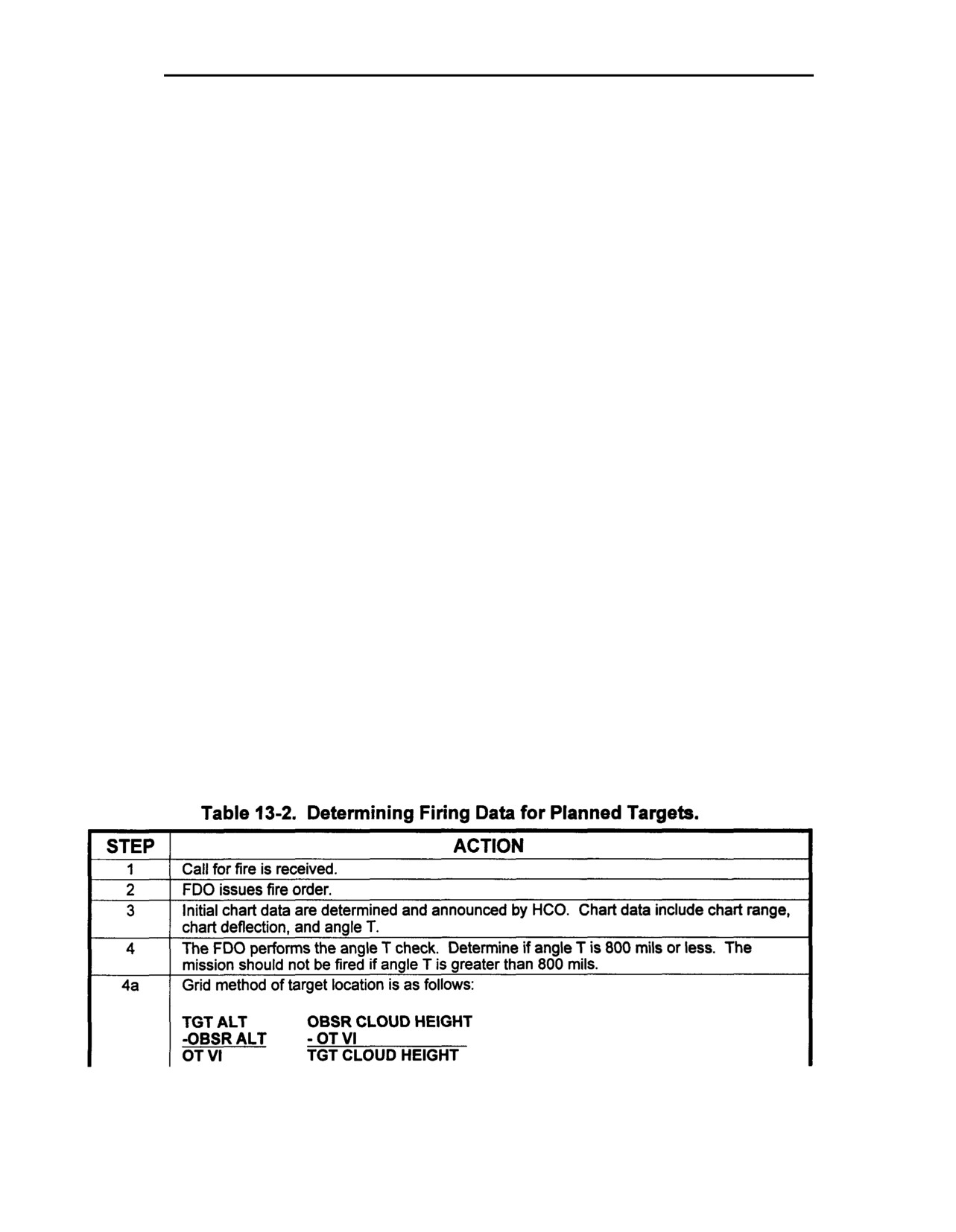
13-7. Angle T and Target Cloud Height Checks
a. The FDO makes the angle T check by listening to the announced angle T and
determining if it meets the angle T requirement for Copperhead (800 mils or less). Copperhead
should not be fired when the angle T is greater than 800 mils. An angle T of this magnitude may
seriously degrade the ability of the round to successfully acquire and engage its intended target.
The FDO should also check the observer location to ensure he is not located “long” along the GT
line. If this were the situation, the Copperhead projectile may not be able to seek the reflected
laser energy.
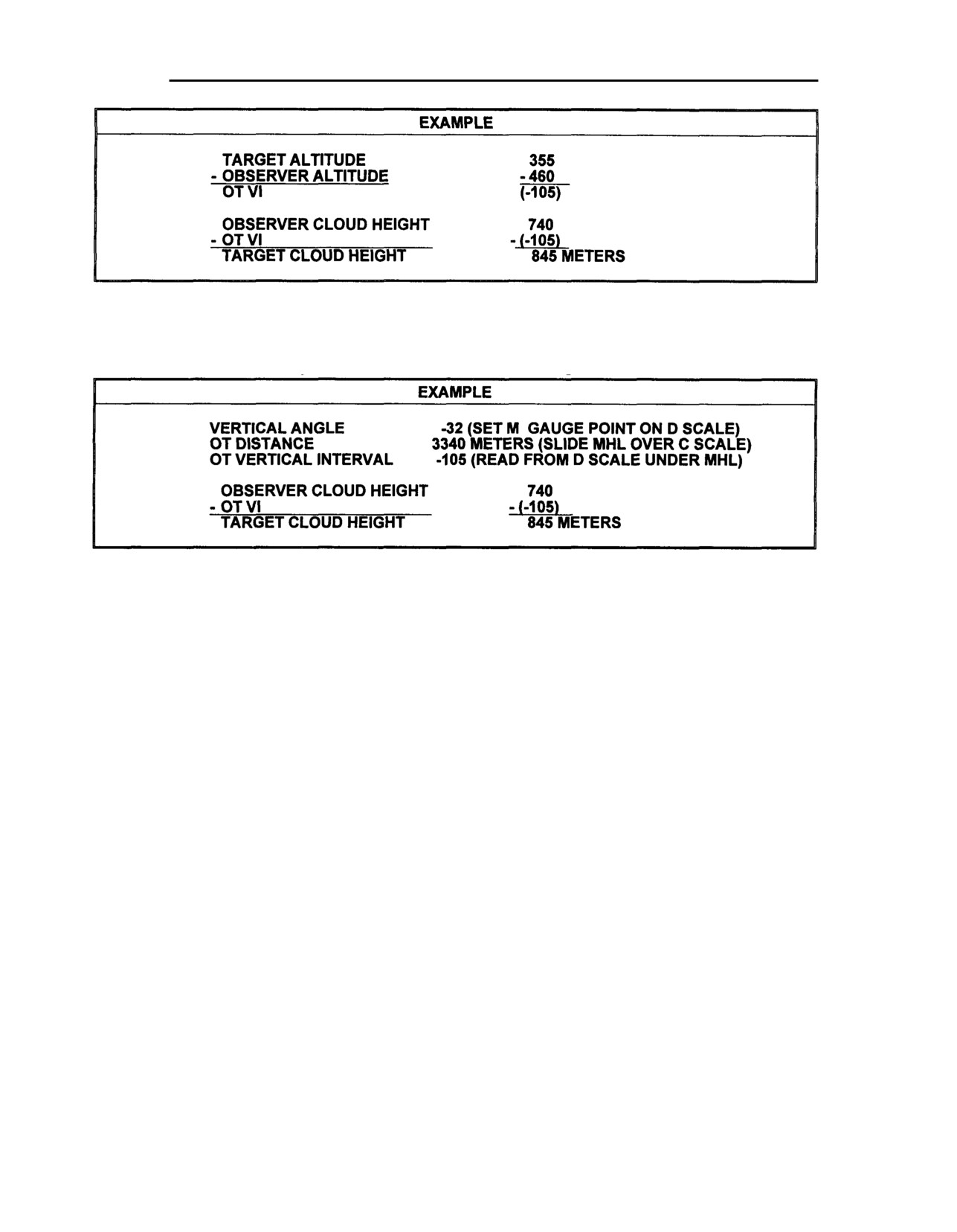
b. Depending on the method used to locate the target, the target cloud height can be
computed in one of two ways.
(1) If the target is located by grid coordinates, subtract the OT VI from the observer
cloud height to determine the target cloud height.
13-7
FM 6-40
(2) If the target is located by laser polar plot, as targets of opportunity nomally are,
compute the target cloud height as follows: First, use the OT distance and the VA reportedly
the observer to compute the OT VI with the C and D scales of the GST. Then subtract the OT VI
from the observer cloud height to determine the target cloud height.
c. The VCO computes the target cloud height and reports it to the FDO. The FDO
enters the table with the target cloud height to determine the cloud ceiling.
d. An OT vertical interval of less than 30 meters can be ignored for targets of
opportunity. In such cases, target cloud height equals observer cloud height.
e. Insufficient target cloud height will adversely affect the accuracy of the Copperhead
round.
13-8. Trajectories
a. The Copperhead projectile travels in a trajectory determined by the switch setting
applied. The trajectory used is dependent on the chart range to the target observer visibility, and
target cloud height. The targeting logic used in the FT 155-AS-1 allows the FDC to select from
one of two trajectories--ballistic or shaped.
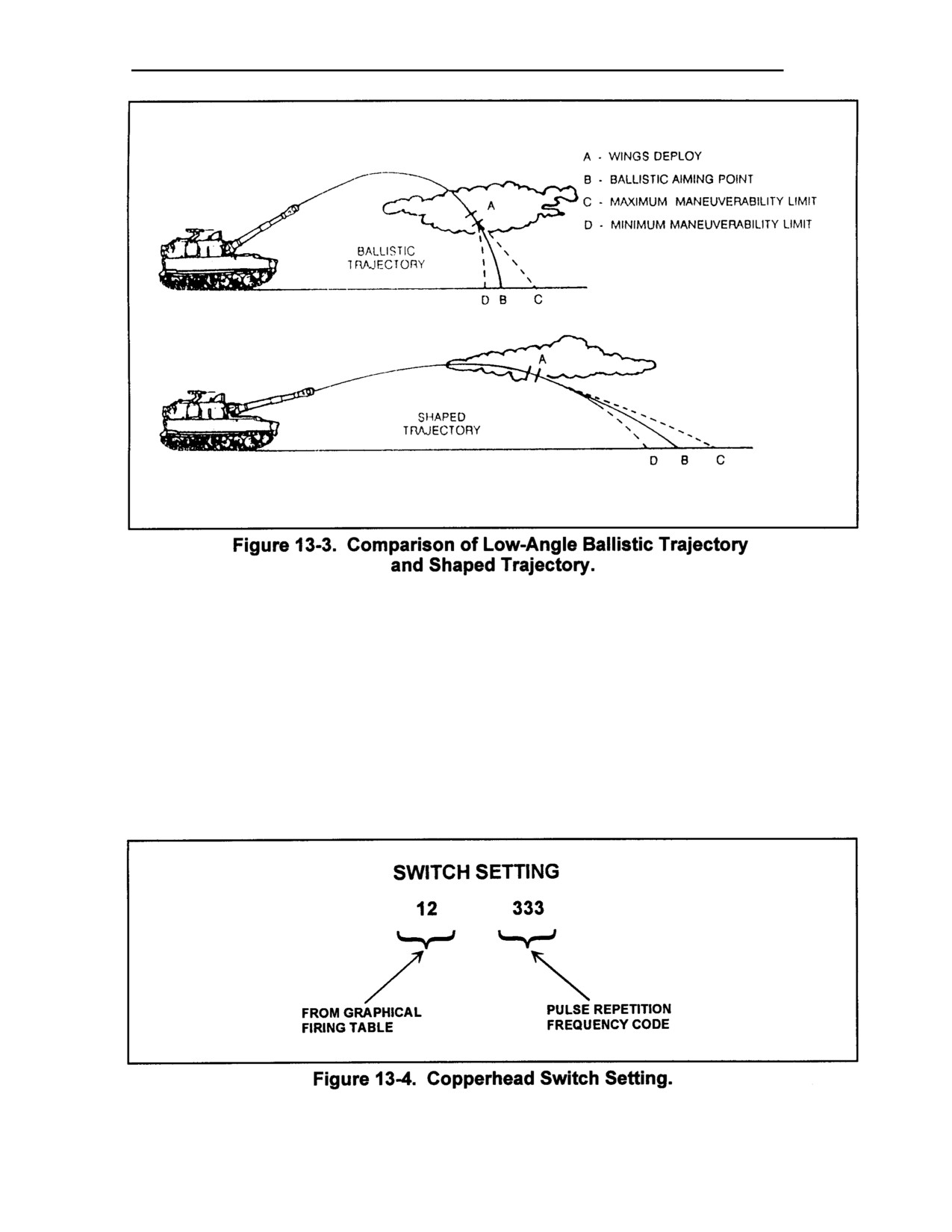
b. The ballistic trajectory has a greater angle of fall, resulting in greater target area
effects. In the ballistic mode, the projectile travels in a ballistic trajectory. This trajectory is only
affected near the end of the descending branch when the projectile acquires and homes in on the
reflected laser energy. If the projectile fails to acquire the designator, the projectile would
continue to follow the ballistic trajectory to the ballistic aimpoint. The ballistic aimpoint is the
point to which the fining data are computed, usually offset along the GT line by 0 to 500 meters.
c. The angle of fall generated by the ballistic solution is so steep as to limit the time that
the projectile has, after exiting the cloud cover, to acquire the laser energy. The shaped trajectory
allows the projectile to approach the target at a shallow angle and thus stay below cloud cover.
The projectile may be caused to glide at a constant angle in the descending branch of the
trajectory, allowing longer exposure of the projectile to the reflected laser energy and thereby
enhancing acquisition probability. (See Figure 13-3.)
13-8
FM 6-40
13-9. Switch Setting
The Copperhead switch setting consists of five digits. (See Figure 13-4.) The first two
numbers are the time setting determined by the FDC. The first digit programs the projectile for a
specific trajectory. A first digit of 1 or 2 results in a ballistic trajectory, while a first digit of 3
through 8 results in a shaped trajectory. The second digit programs a time delay based on the
duration of flight and type of trajectory. The program delay digits of 1 through 8 will result in a
delay of 0 to 45 seconds for the ballistic mode and 0 to 48 seconds for the shaped trajectory.
After the time delay has expired, the main portion of the battery will activate, providing power to
the electronic circuits and deploying the wings. The last three digits are the PRF code for the
G/VLLD or MULE operator. This setting establishes a common laser frequency between the
projectile and the G/VLLD or MULE.
13-9
FM 6-40
13-10. Computing Site
The VCO manually computes site for Copperhead by using the ballistic aimpoint.
13-11. Computing Deflection Correction
The Copperhead round has no correction for drift. Therefore, the total deflection
correction equals the GFT deflection correction and is applied without modification throughout
that charge and mode.
13-12. Limits of the Base Piece Solution
a. Firing data for Copperhead is initially computed from the base piece location. If the
center of the two howitzers firing the Copperhead mission is within 100 meters of the base piece,
the firing data computed at the base piece may be used. If the two howitzers are located father
than 100 meters from the base piece, deflection and elevation corrections from the two-howitzer
subelement should be computed and applied to the base piece solution.
b. When time for computing data is limited, as is normally the case for targets of
opportunity, and the two howitzers are located further than 100 meters from the base piece, the
FDC should compute at least a deflection correction. The Copperhead round can compensate for
errors in range easier than it can for errors in deflection.
13-13. Target Attack Contingencies
a. If the Copperhead round cannot be fired on a target because of insufficient target
cloud height, the FDC must inform the observer requesting the mission. Coordination between
the observer and the FDC can then be made to fire other types of munitions on the target.
b. If the Copperhead round cannot be fired on a target because the angle T is greater
than 800 mils, the battery or platoon FDC should contact the battalion FDC to see if the mission
can be taken by another unit having an angle T of 800 mils or less. If another unit is available,
the original battery or platoon FDC tells the observer to contact the FDC of the unit taking the
mission. If no other units are available, the observer and the FDC can coordinate to fire other
types of munitions on the target.
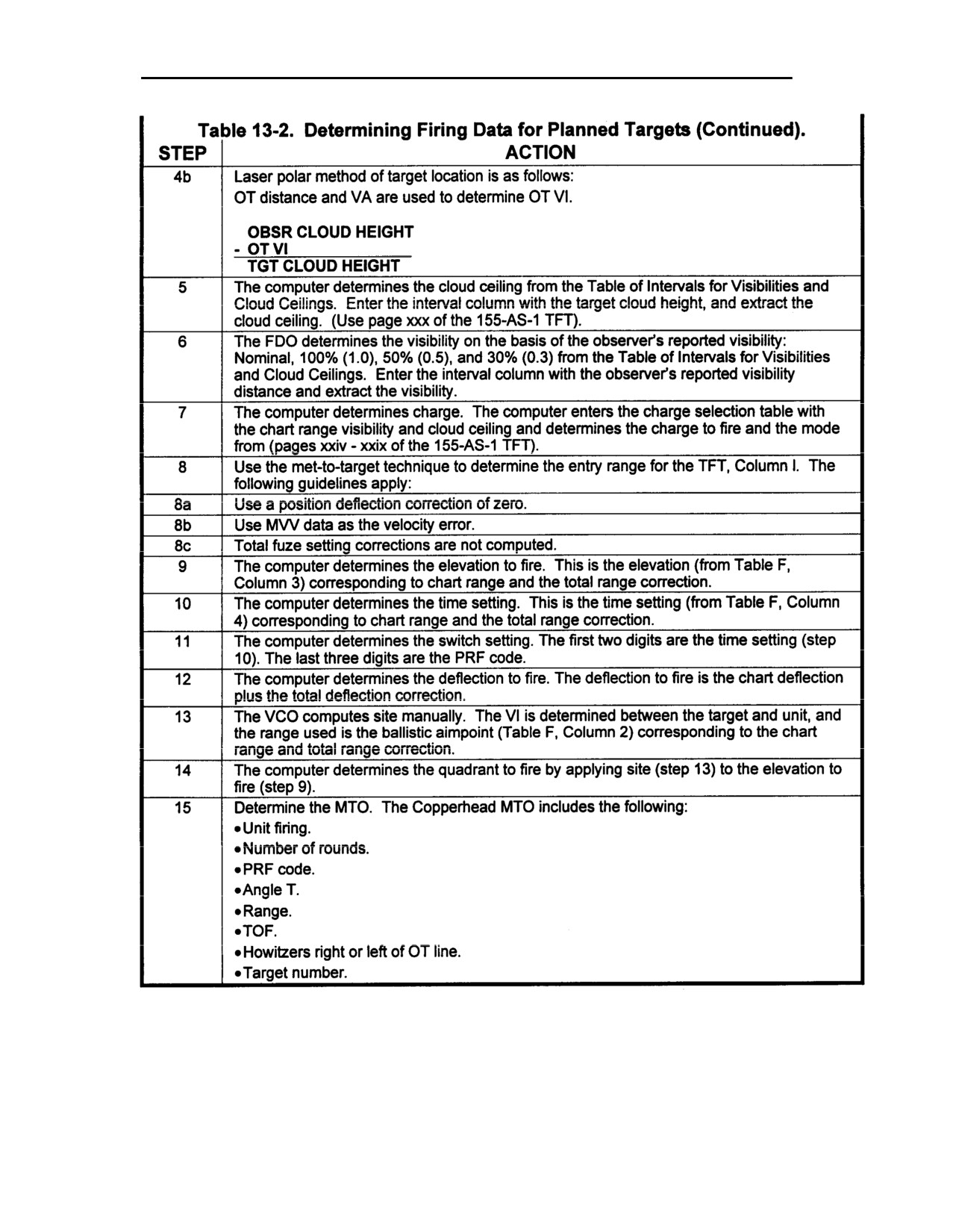
c. The steps in Table 13-2 are used to determine firing data for planned targets.
13-10
FM 6-40
13-11
FM 6-40
NOTE: Receipt of the CopperheadMTO by the observer indicates that the unit is
ready to fire.
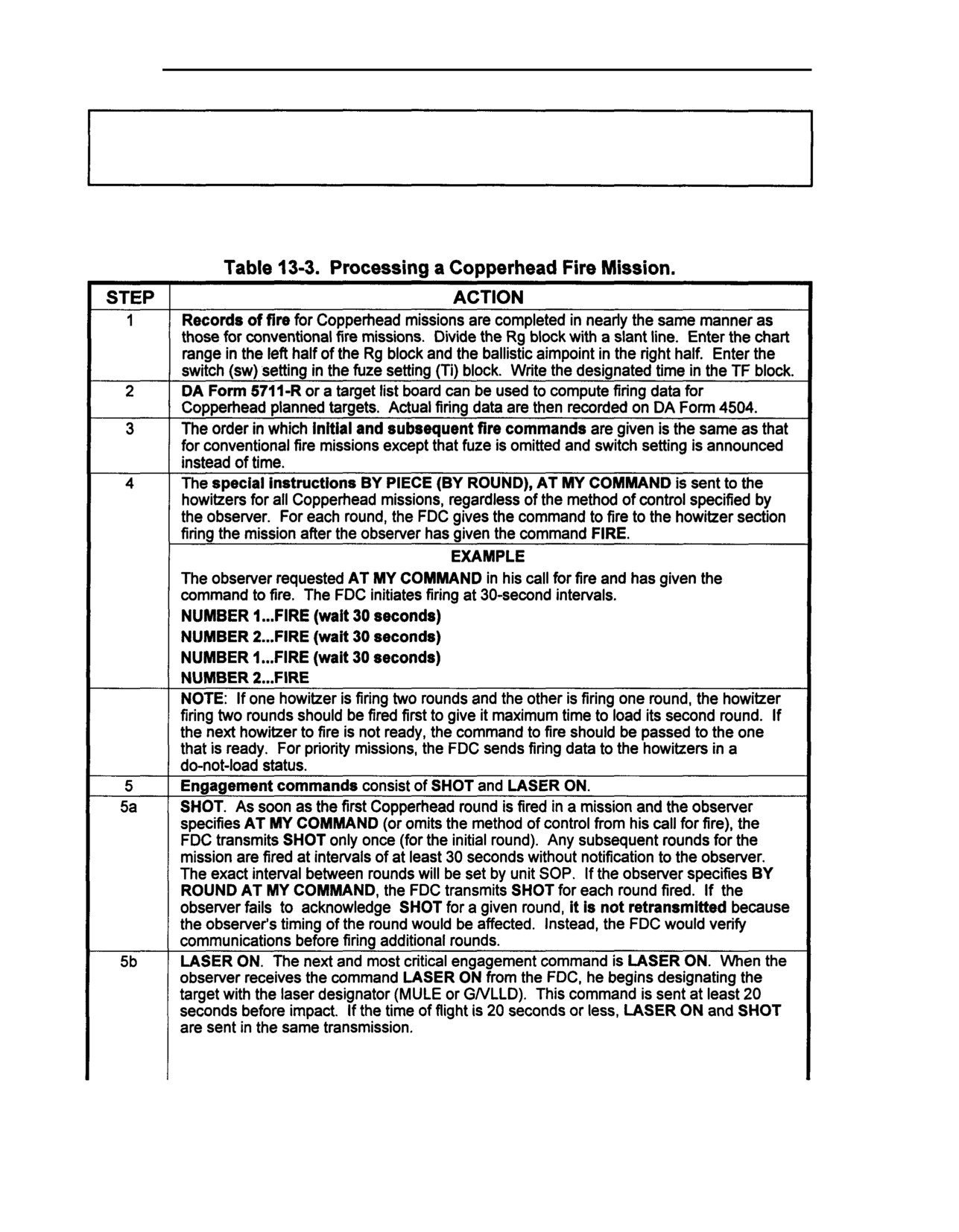
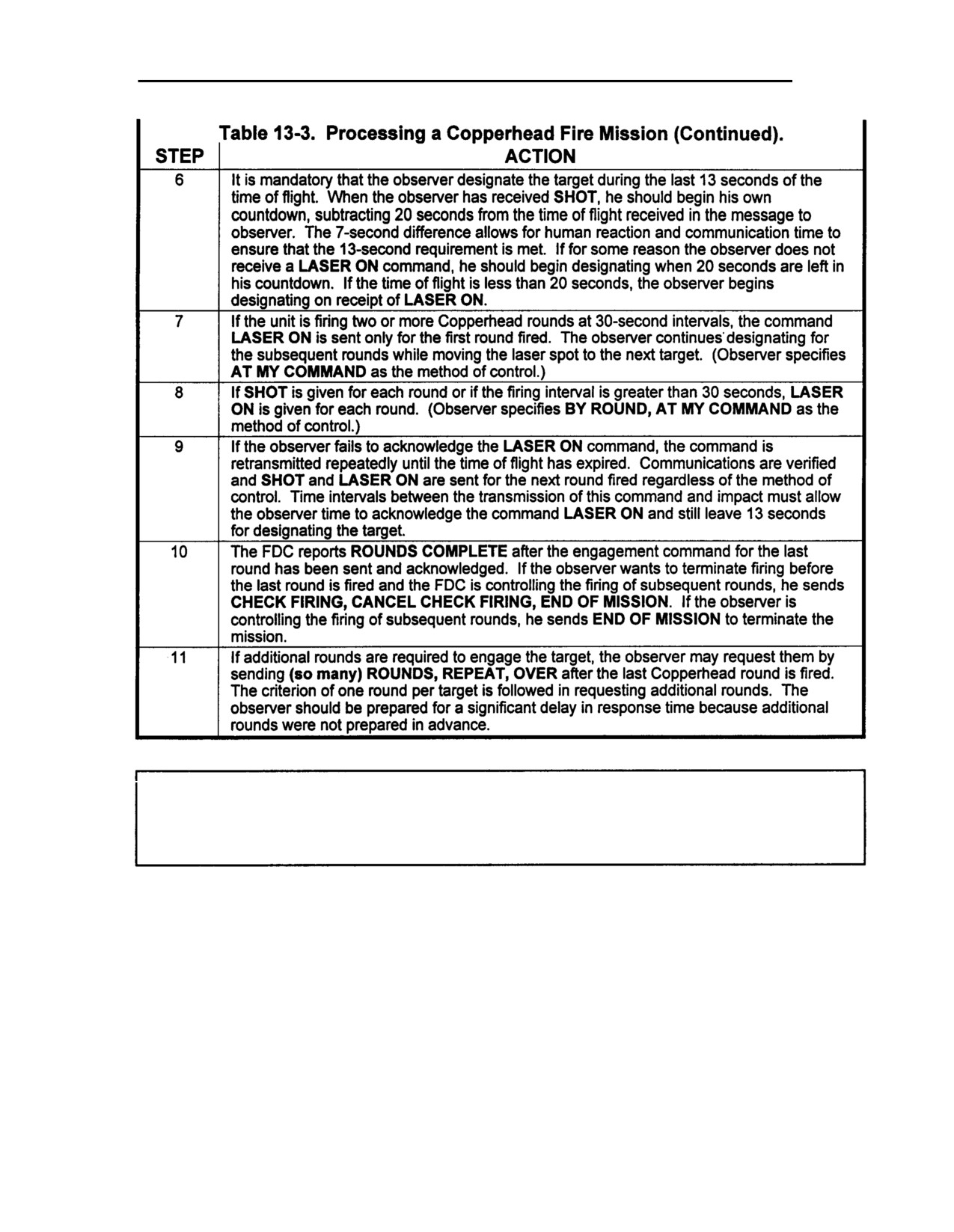
d. The steps in Table 13-3 are used to process a Copperhead mission with a record of
fire.
13-12
FM 6-40
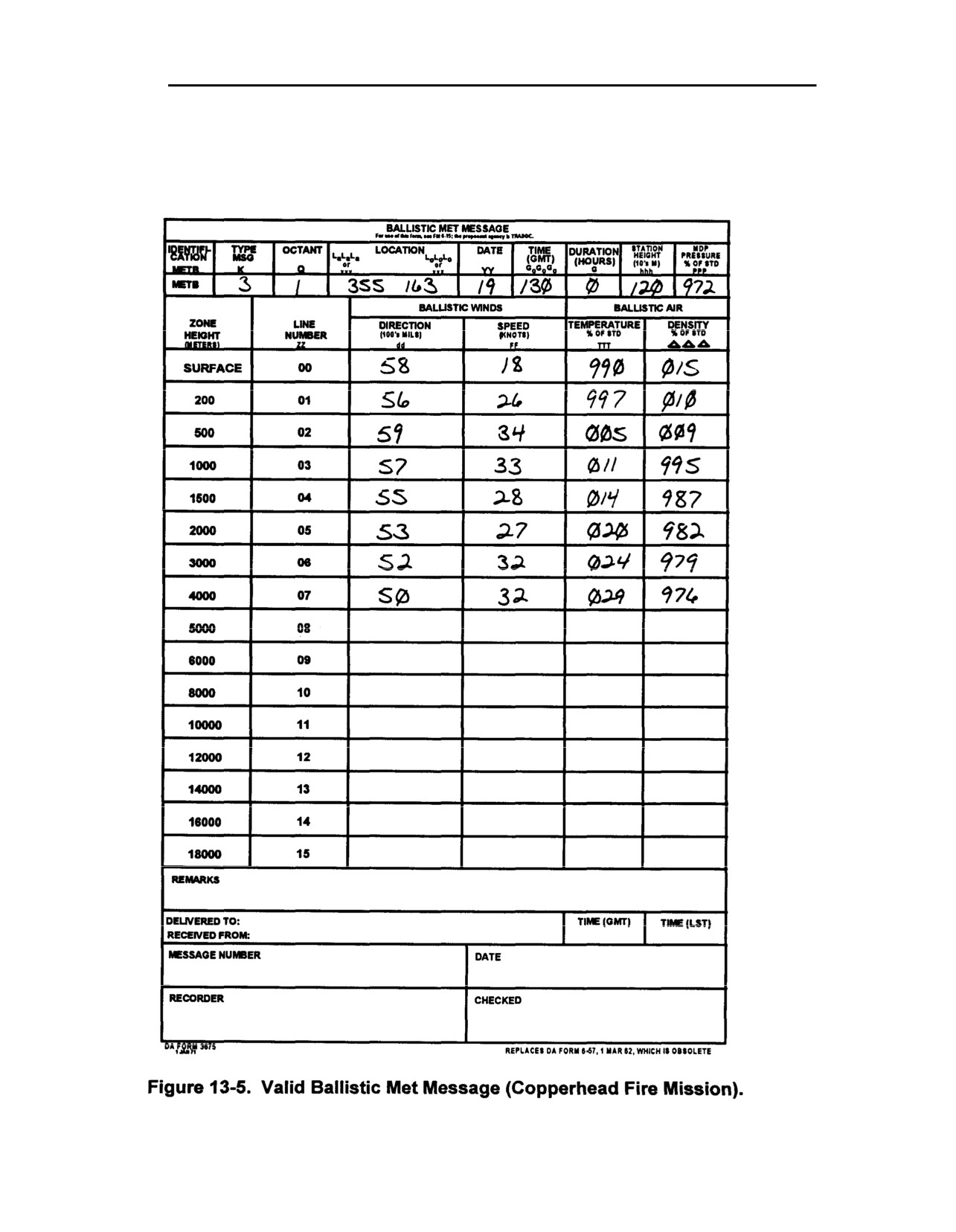
NOTE: Figures 13-5 through 13-7 show a completed Copperhead fire mission
using the 155-AS-1 TFT. The Met + VE Worksheet (DA Form 7352-R) is a new
reproducible form located at the back of this book.
13-13
FM 6-40
13-14