FM 6-40 TTP for Field Artillery Manual Cannon Battery U.S. - page 11
FM 6-40
11-52
FM 6-40
11-53
FM 6-40
11-54
FM 6-40
11-55
FM 6-40
11-56
FM 6-40
11-57
FM 6-40
11-58
FM 6-40
11-59
FM 6-40
11-14. Met to a Target
a. Because of the restrictions of transfer limits for the total corrections represented by a
GFT setting, there are areas beyond 10,000 meters that are not covered by normal eight-direction
met techniques. If a target that requires accurate surprise fires appears in one of the areas, a met
to the target is solved. A met to target may also be solved for situations when the unit needs to
fire a projectile that they did not register with (for example, M549A1 RAP). Because of the time
needed to solve a met to a target, this technique is usually reserved for those situations requiring
FFE fires against a “high-payoff” target.
b. The met-to-target technique consists of the two steps below.
(1) Solution of a concurrent met to determine the position VE, position deflection
correction, and position fuze correction. If position constants are not available, use zero for these
values.
(2) Solving for met corrections by using the chart range and direction to the target
and the position constants to determine a GFT setting. The chart range used is the range to the
target. The direction of fire is determined on the basis of the chart direction to the target. The
met line number and complementary range are determined from Table B on the basis of the chart
range to the target and the height of target above gun.
11-15. Solution of a Met-to-Target Technique
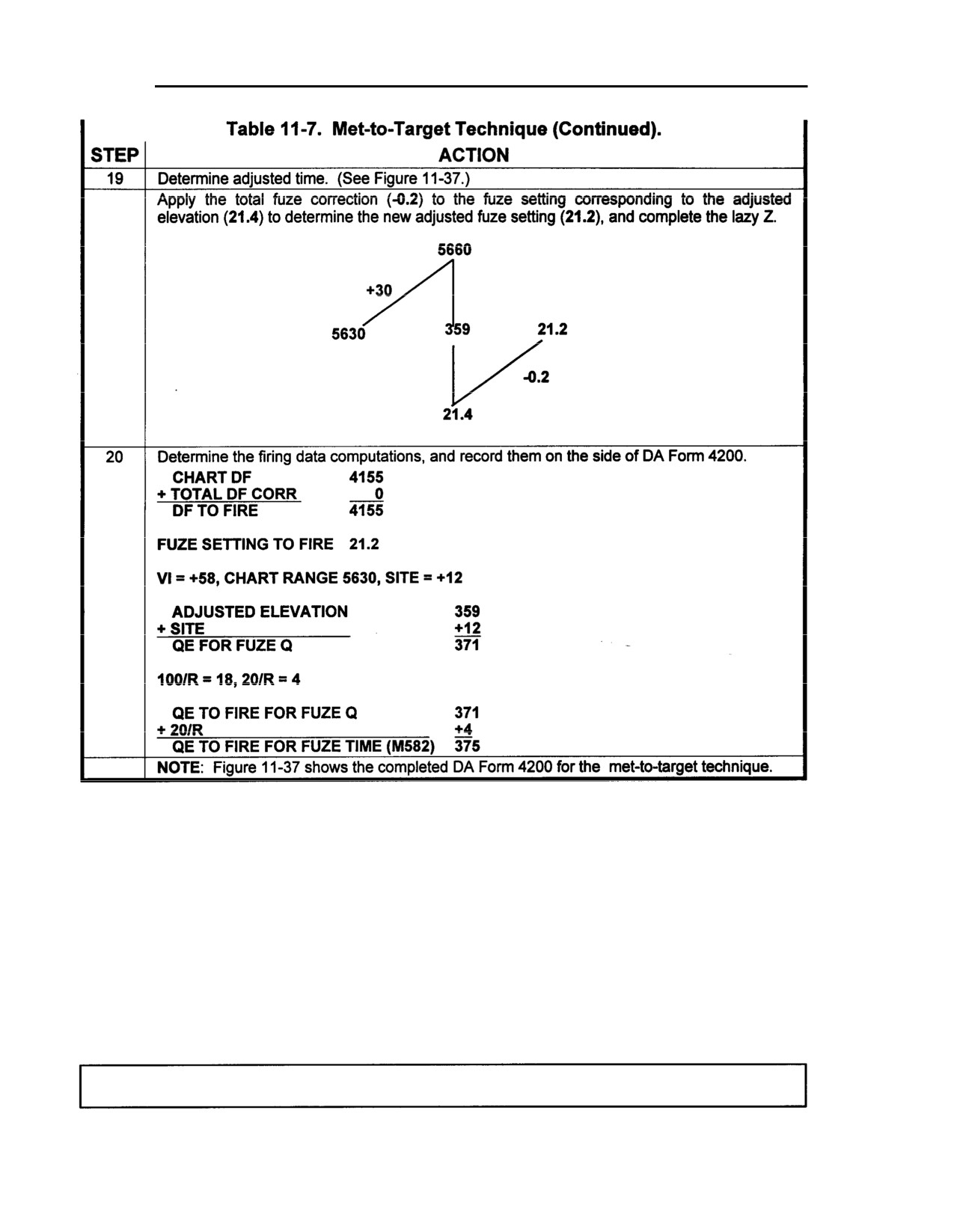
a. Target AB7450 is located outside the octants for which the GFT settings have been
determined.
b. All known data remain the same as those for the concurrent met except for the following:
Target AB7450 is located at grid 440240, altitude 1120.
Chart deflection to the target is df 4155.
Chart range to the target is rg 5630.
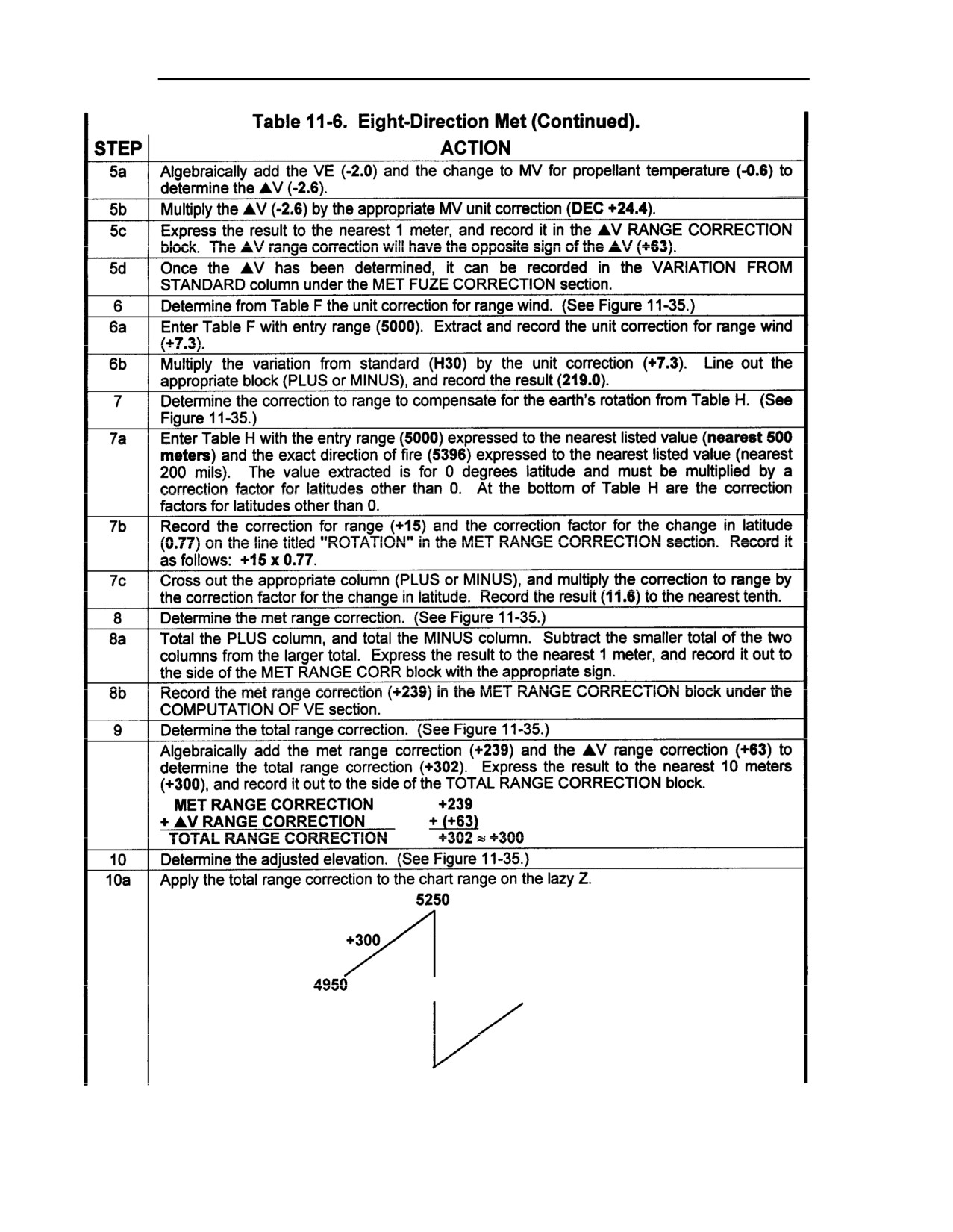
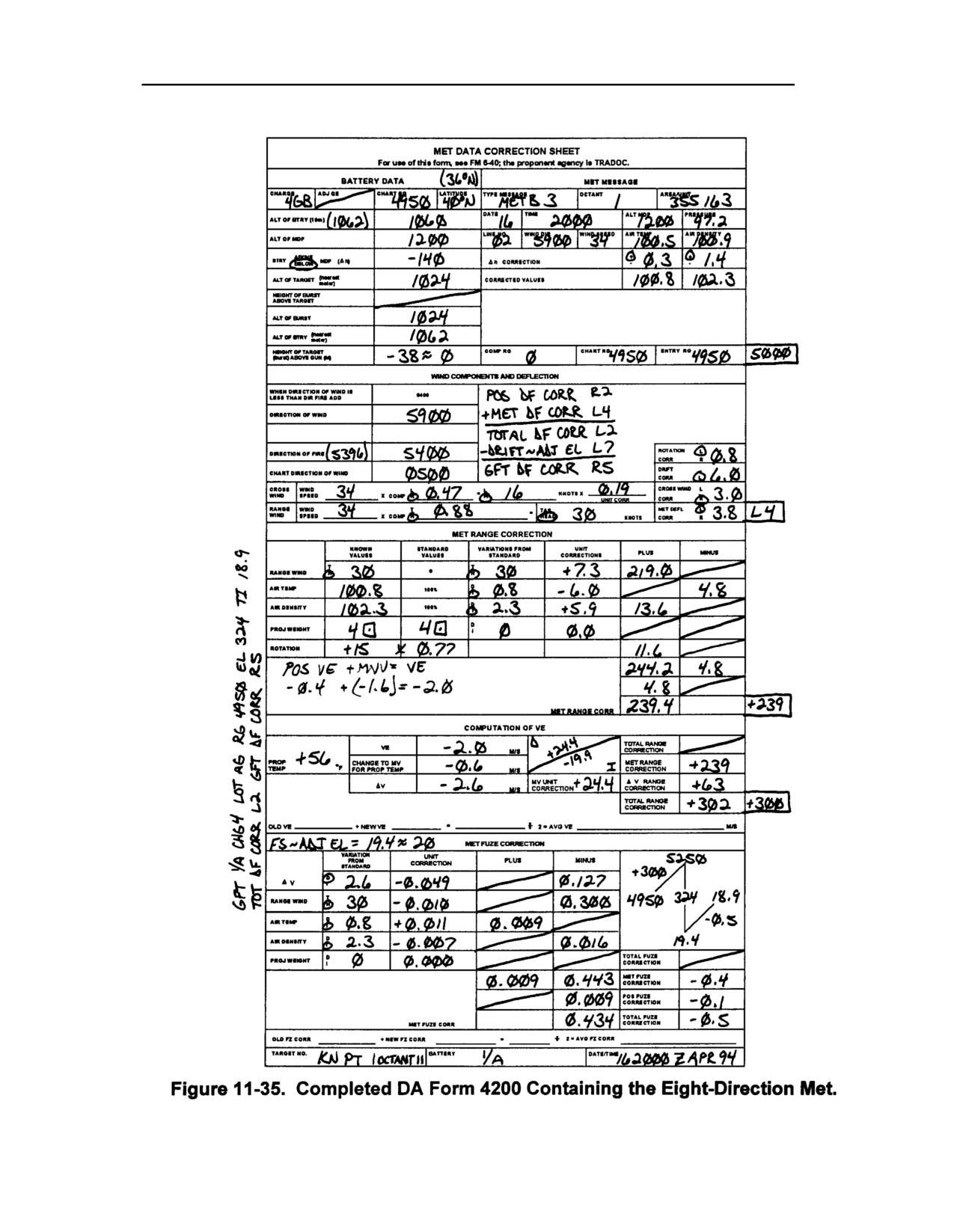
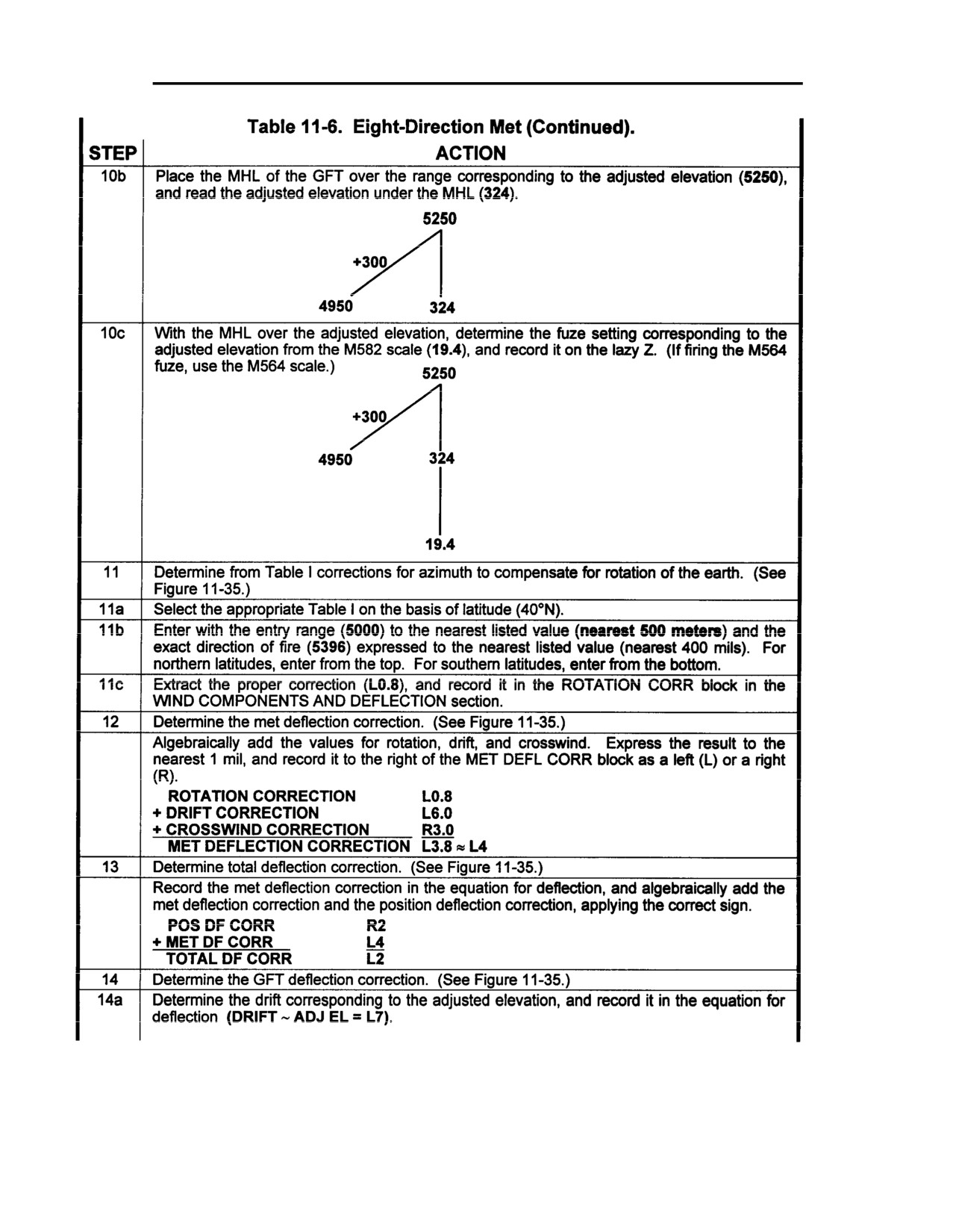
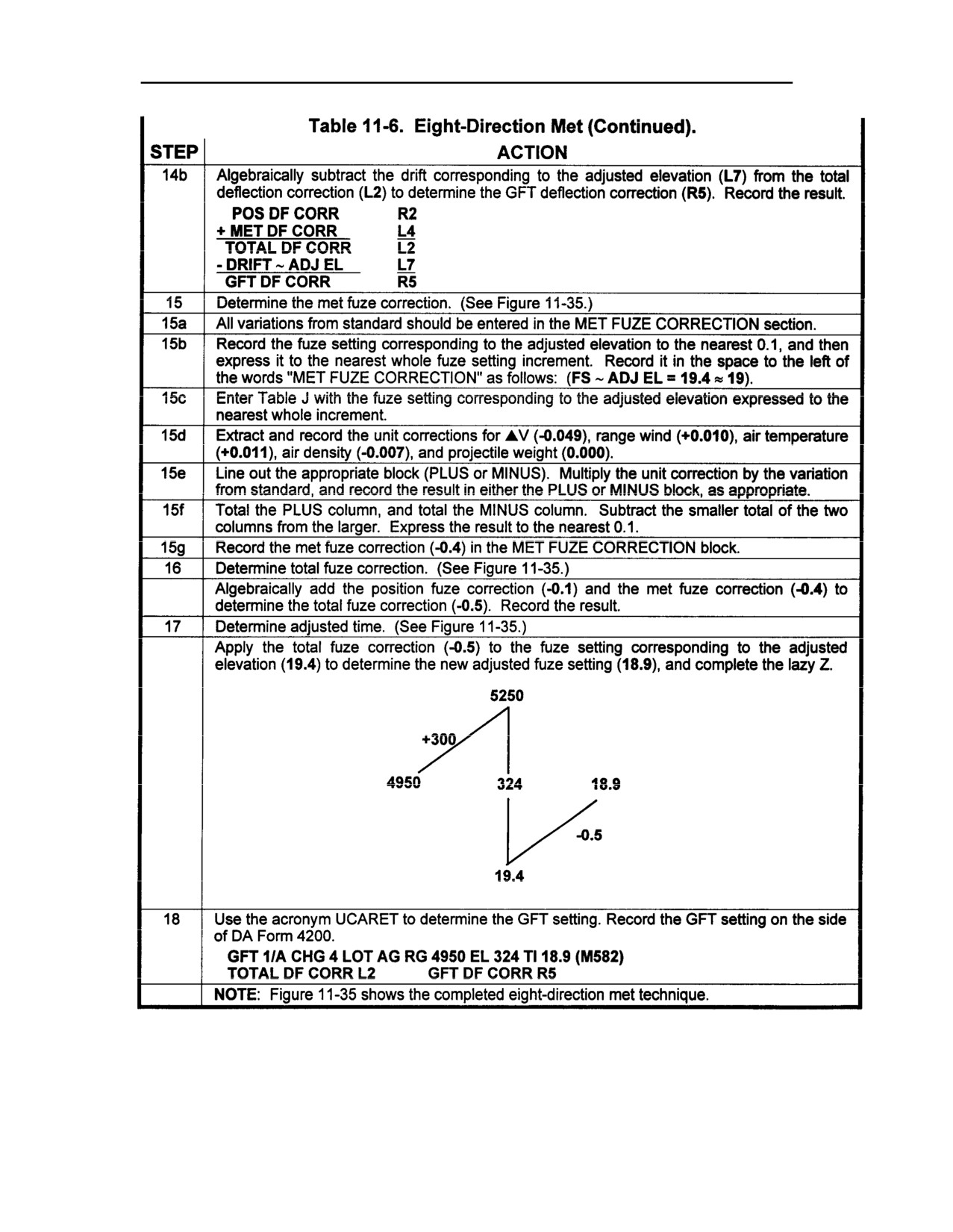
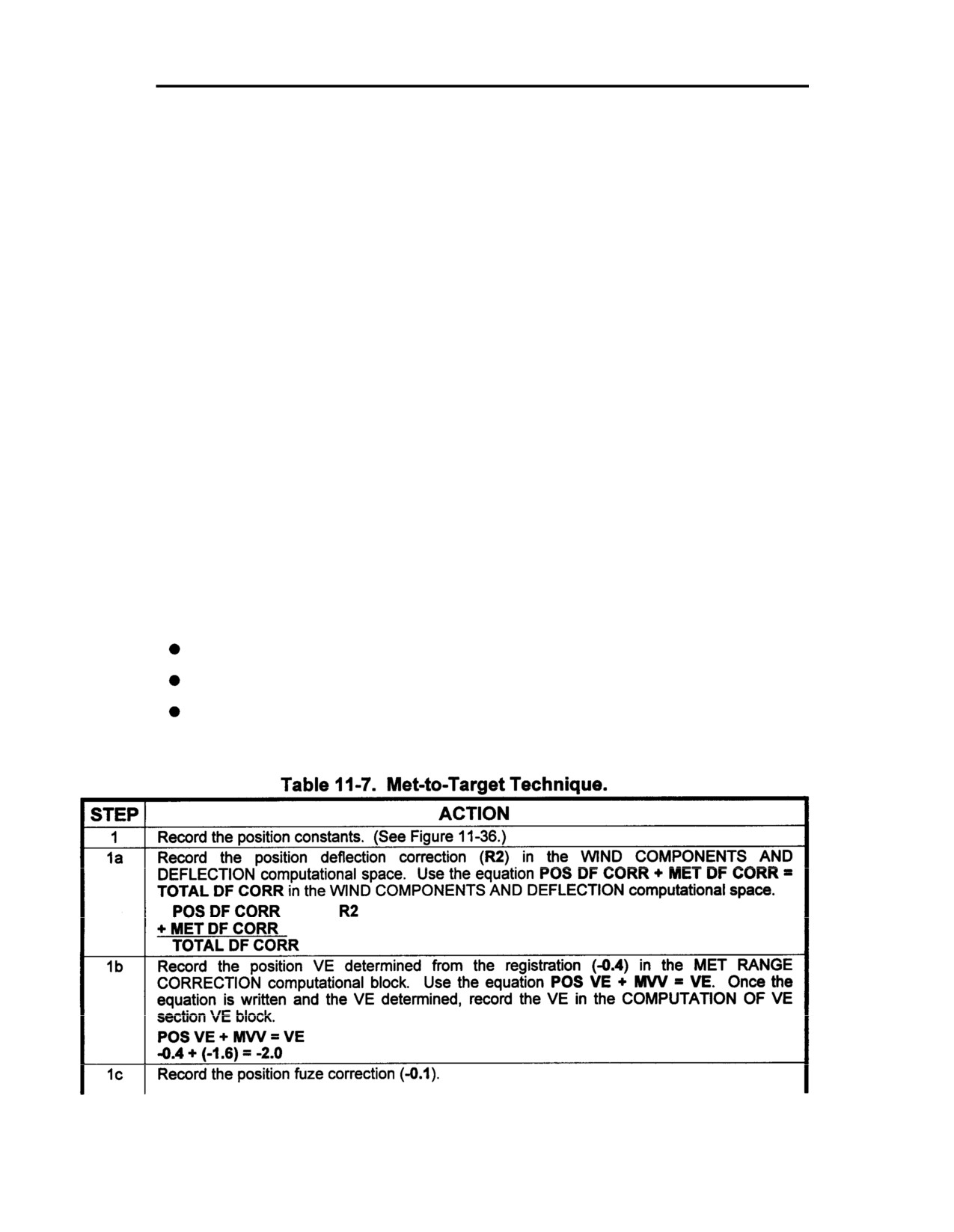
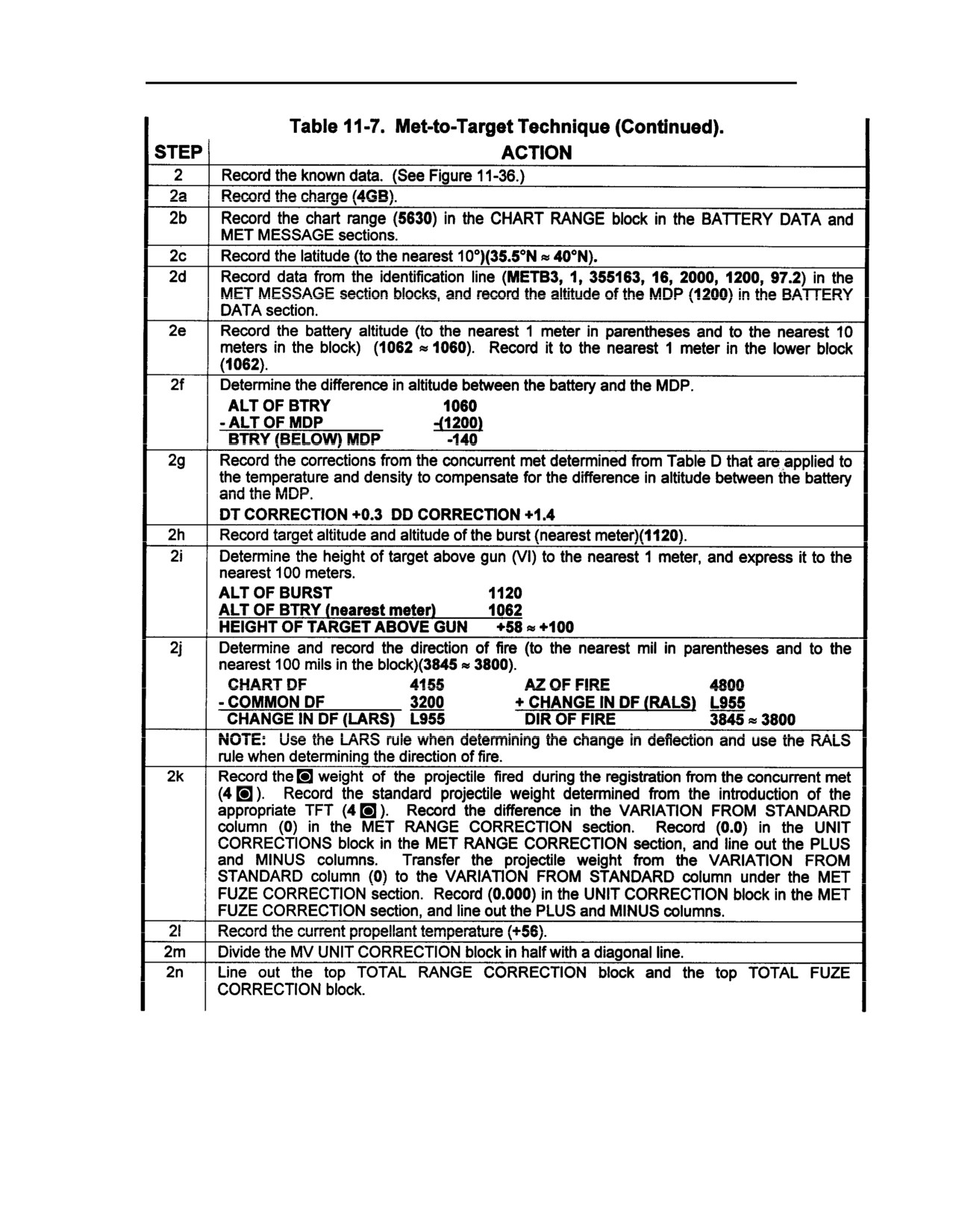
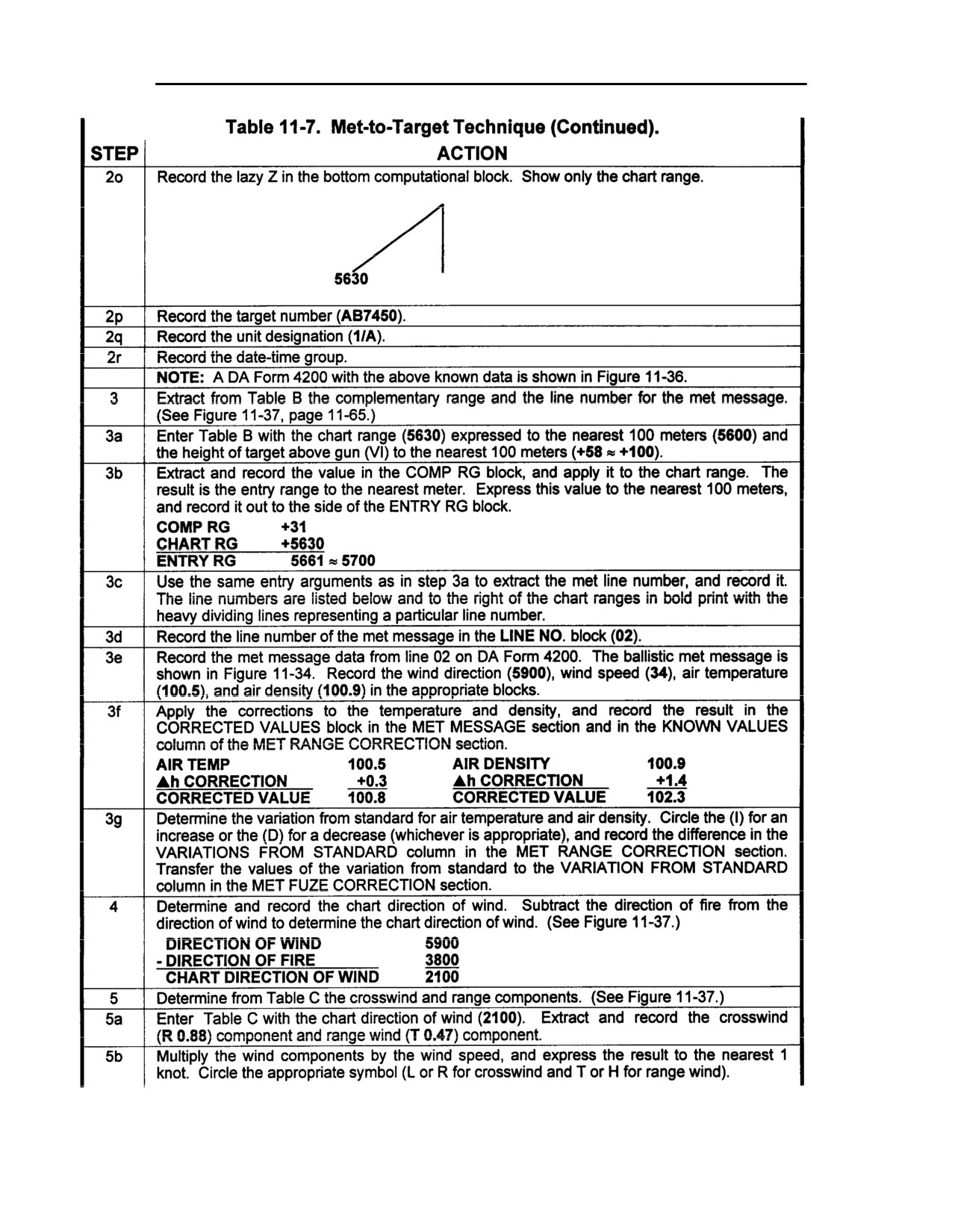
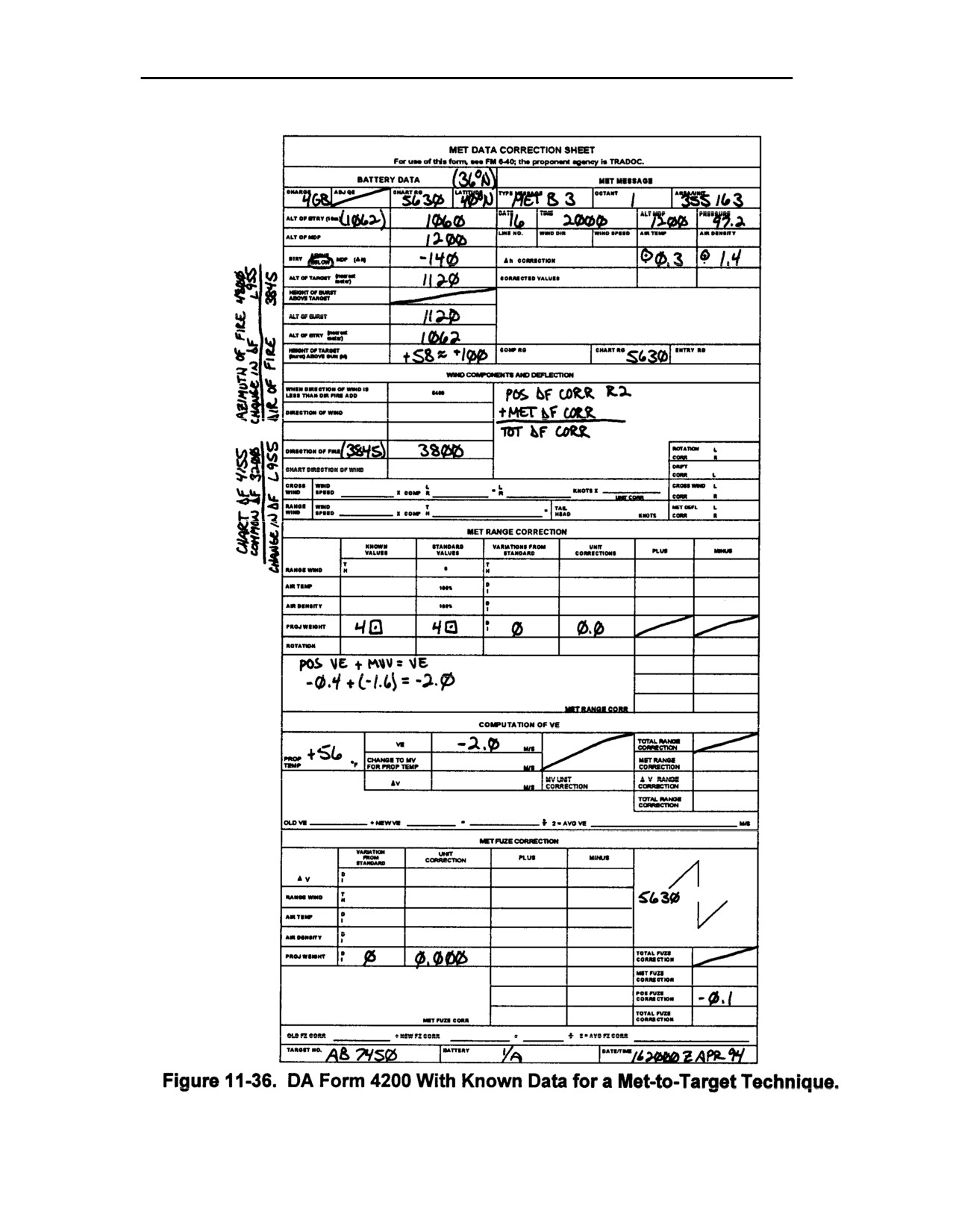
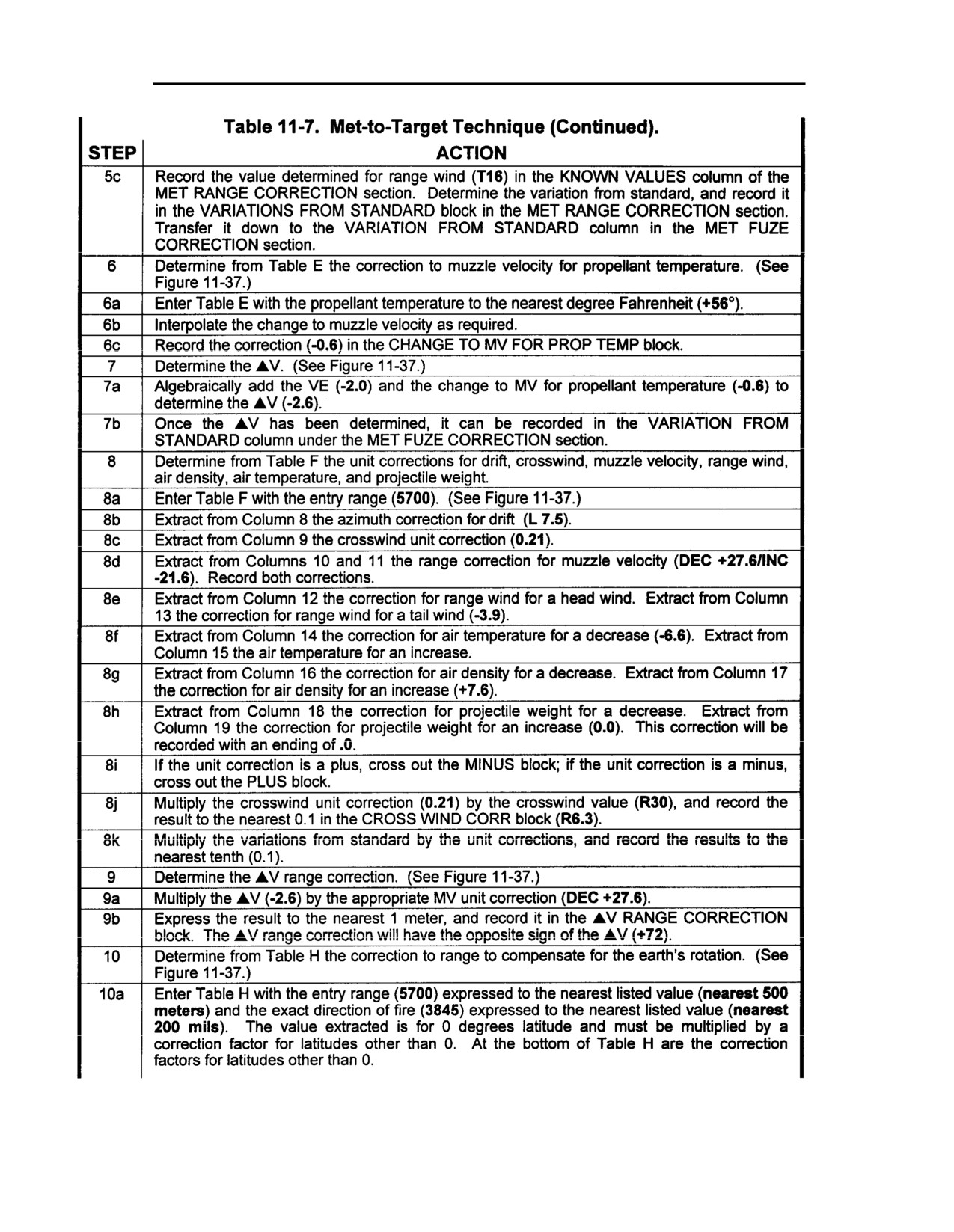
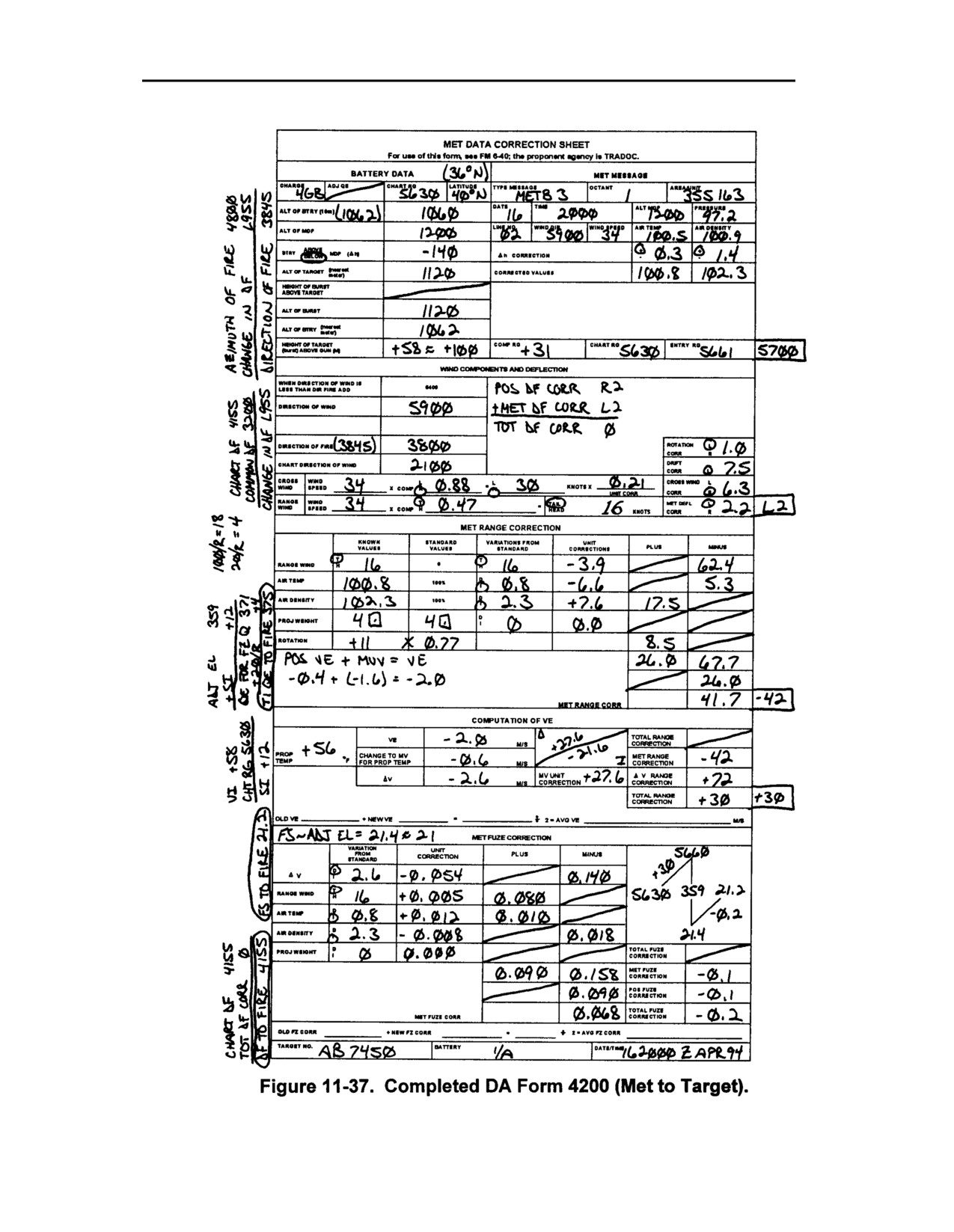
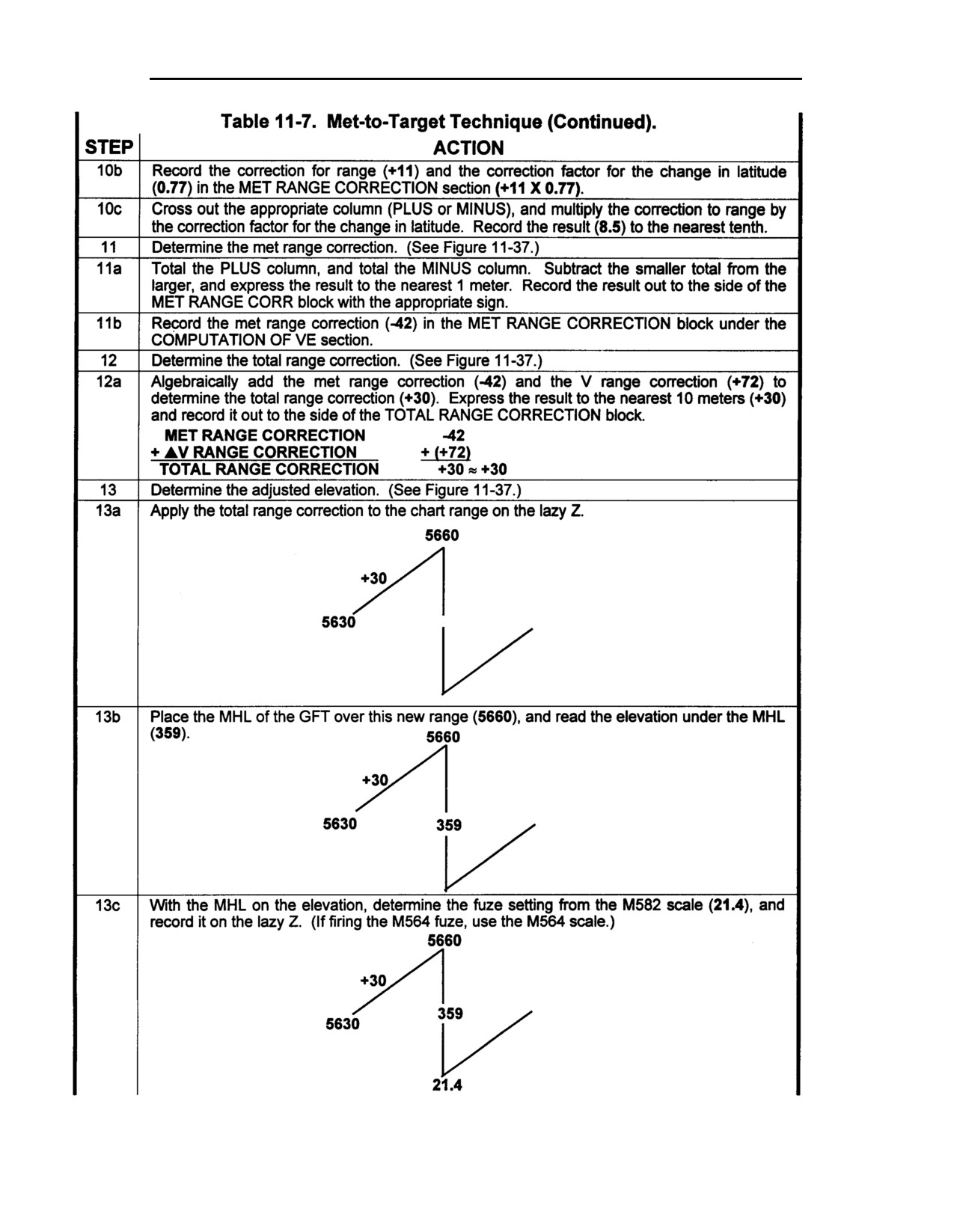
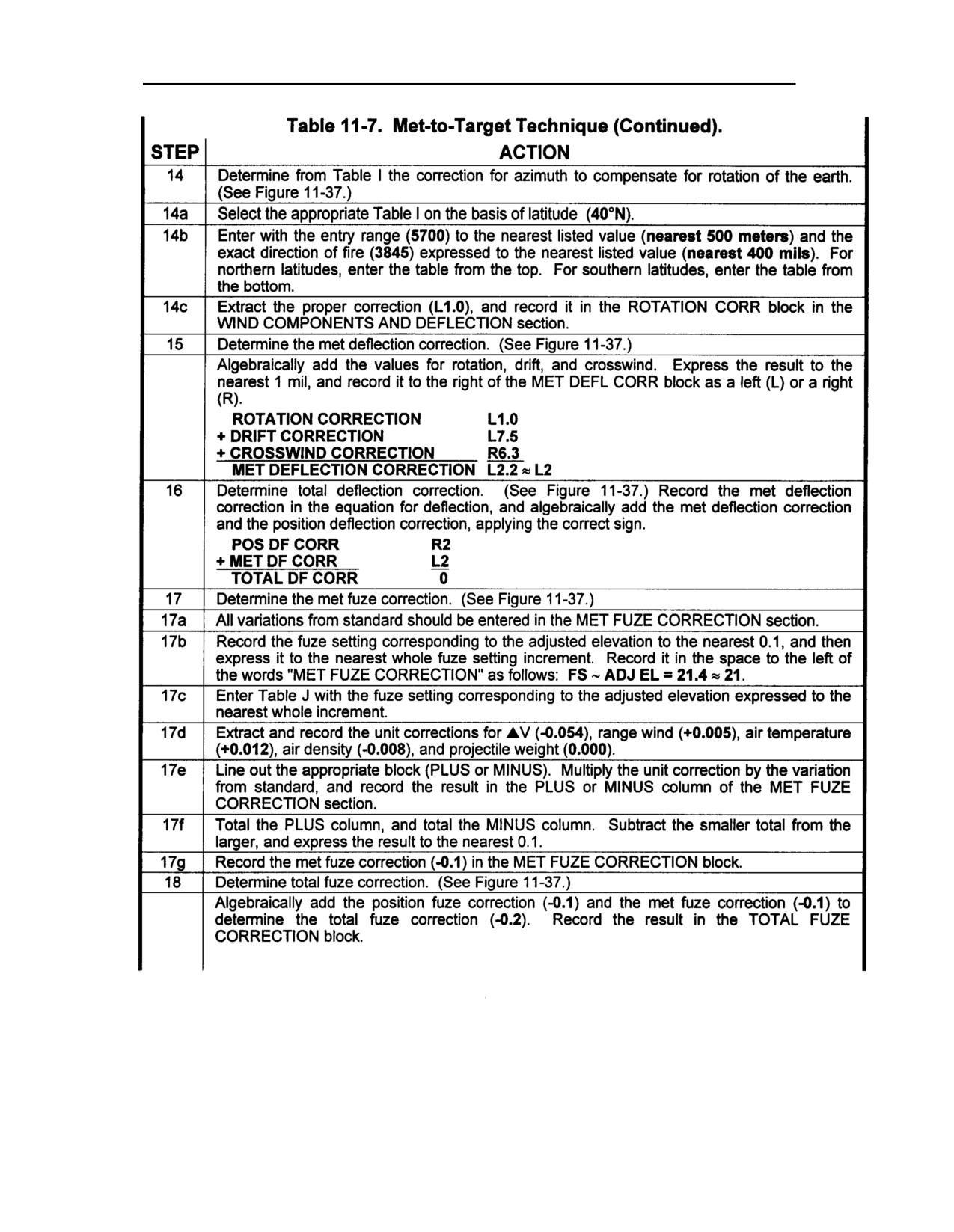
c. Table 11-7 shows a detailed example of the solution of a met-to-target technique.
11-60
FM 6-40
11-61
FM 6-40
11-62
FM 6-40
11-63
FM 6-40
11-64
FM 6-40
11-65
FM 6-40
11-66
FM 6-40
11-67
FM 6-40
11-16. Computing a GFT Setting for an Unregistered Charge
a. When data from a registration and concurrent met are known, the FDC can derive a
GFT setting for an unregistered charge.
b. Total corrections for the unregistered charge are determined by applying the position
constants determined for the registered charge to the met corrections for the unregistered charge.
This is done by using the following steps:
(1) Determine the range to a met check gauge point on the GFT for the unregistered
charge. This will be used as the chart range on the met data correction sheet. The entry range
will be the met check gauge point range expressed to the nearest 100 meters. The altitude of the
target is the same as the battery altitude.
NOTE: All corrections from the TFT are based on the unregistered charge.
11-68

FM 6-40
(2) Compute the total deflection correction as follows:
(a) Compute the met deflection correction by use of the met data correction sheet.
(b) Add the position deflection correction determined from the registered
charge to the newly computed met deflection correction for the unregistered charge. The sum is
- -
the total deflection-correction for the unregistered charge.
NOTE: The position deflection correction generally accounts for errors in survey and
chart construction. These errors are independent of charge in that they remain
constant regardless of the charge fired. Therefore, it is valid to apply a position
deflection correction determined for one charge to other charges.
(3) Compute total range correction and adjusted elevation as follows:
(a) Add the position velocity error for the registered charge
to the MVV to
determine the VE.
(b) Add the MVV correction for propellant temperature
to the VE to
determine the ▲ V for the unregistered charge.
(c) Multiply the ▲ V by the appropriate MV unit correction to determine the
▲ V range correction.
(d) Add the ▲ V range correction to the met range correction for the
unregistered charge to determine the total range correction.
(e) Add the total range correction to the chart range (range to the met check
gauge point) to determine the range corresponding to adjusted elevations.
(f) Set the adjusted range under the MHL of the GFT, and read the adjusted
elevation for the unregistered charge.
NOTE: Position velocity errors caused by survey and chart errors are charge
independent and, therefore, can be transferred to other charges. Muzzle velocity
variations can be transferred to all preferred charges within the same charge group
and lot.
(4) Compute the total fuze correction as follows:
(a) Determine the fuze setting corresponding to the adjusted elevation.
(b) Compute the met fuze correction.
(c) Add the met fuze correction to the position fuze correction determined for
the registered charge. The sum is the total fuze correction. Apply this correction to the fuze
setting corresponding the adjusted elevation to determine the adjusted fuze setting for the
unregistered charge.
NOTE: The position fuze correction is a constant fuze characteristic. Fuze
characteristics are independent of the charge fired. The position fuze correction is
similar to a known fuze setting correction, which is determined historically by
observing the performance of a particular lot of fuzes.
11-69
.FM 6-40
(5) Compute the GFT deflection correction by subtracting the drift correction
corresponding to the adjusted elevation for the unregistered charge from the total deflection
correction. The remainder is the GFT deflection correction for the unregistered charge.
11-17. Met to Met Check Gauge Point
a. The one-plot GFT setting determined by registering has limited range transfer limits.
A more accurate GFT setting can be determined by using the data from a registration and one or
more met + VE computations to met check gauge points. Solution of a met to met check gauge
point using subsequent met techniques will yield total corrections at each met check gauge point
range. The met check gauge points selected should be the ones farthest away, in range, from the
registration chart range.
b. The met to met check gauge point technique consists of the following steps:
Solution of a concurrent met to determine the position VE, position deflection
correction, and position fuze correction.
Solving for met corrections to the selected met check gauge points and adding the
position constants to determine GFT settings for these ranges. The chart ranges
will be the ranges to the selected met check gauge points and the line number of
the met message will be determined on the basis of that range and a height of
target above gun of O. The altitude of target used will be the same as the battery
altitude.
c. Combine the data from the registration and the met(s) to met check gauge points to
determine a two-plot or multiplot GFT setting.
11-18. Met + VE
a. Registrations may not always be practical or necessary on the basis of the current
situation and the factors of METT-T. If a battery is meeting the five requirements for accurate
predicted fire (less accurate target location), there is still a need to improve the data read from the
GFT. A GFT setting can be determined by solving a subsequent met by using the met + VE
technique. The steps for working a met+ VE are similar to the subsequent met technique. Since
no registration has been conducted and position constants were not isolated, position constants
are not considered (use zero for these values).
b. For accuracy, the chart ranges used for the met+ VE technique should correspond to
met check gauge points, unless the met-to-target technique is being used. The altitude of target
will be the same as the battery altitude unless the met-to-target technique is used.
c. The direction of fire will correspond to the chart direction to the center of the zone of
responsibility or the target.
d. The values for position deflection correction, position velocity error, and position
fuze setting will be recorded as zeros (0).
11-70
FM 6-40
Chapter 12
TERRAIN GUN POSITION CORRECTIONS
AND SPECIAL CORRECTIONS
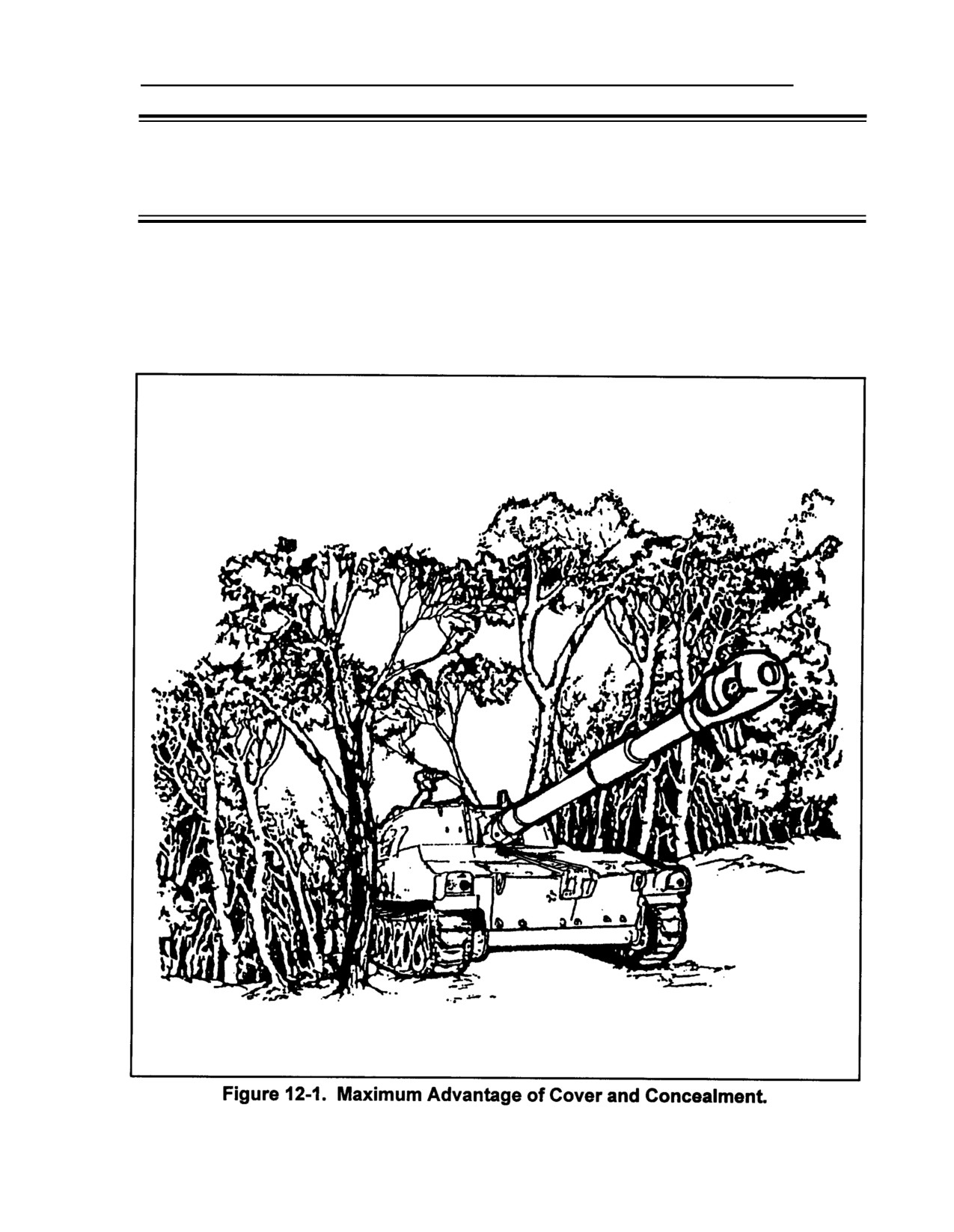
To enhance survivability on the battlefield a unit must take maximum advantage of the
natural cover and concealment offered by the terrain and vegetation (Figure 12-1). When pieces
are so positioned corrections may be required to obtain an acceptable burst pattern (sheaf) in
the target area. These corrections compensate for the differences in muzzle velocity between
pieces and terrain positioning of the weapons. When FFE rounds impact in the target area. the
results, to a large extent, depend on how well the sheaf fits the size and shape of the target.
12-1
FM 6-40
Section I
Types of Corrections
Artillery fires can be computed to fit the size and shape of the target by
computing corrections for the following:
Individual piece displacements (position corrections).
Shooting strength of each piece (muzzle velocity corrections).
Target size, shape, and attitude (irregularly shaped targets).
12-1. Overview
a. Terrain gun position corrections (TGPCs) are individual piece corrections applied to
the gunner’s aid on the panoramic telescope (pantel), the correction counter on the range
quadrant, and the fuze setting of each piece.
b. Special corrections are individual piece corrections applied to fuze settings,
deflection, and quadrant elevation to place the FFE bursts in a precise pattern on the target.
c. Special corrections and TGPCs include corrections for the location of each weapon in
the firing unit area (position corrections) and for the shooting strength of each weapon (muzzle
velocity corrections).
(1) The goal of TGPCs is to compute corrections to obtain an acceptable sheaf in the
target area.
(2) The goal of special corrections is to compute aimpoints tailored to fit the target
size, shape, and attitude.
12-2. Piece Displacement
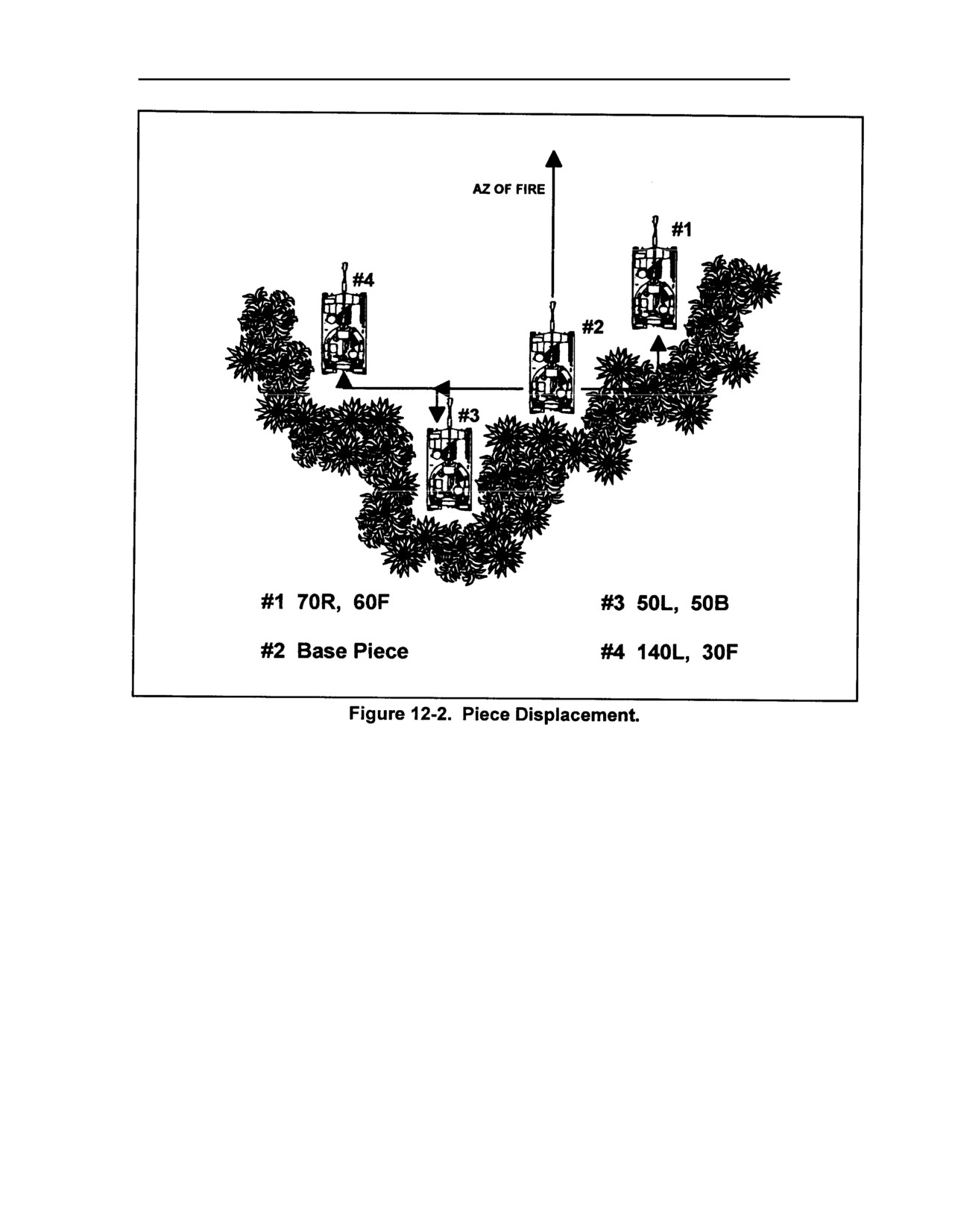
a. To determine position corrections, the relative position of pieces in the firing unit area
must be known (piece displacement). Piece displacement is the number of meters the piece is
forward or behind and right or left of the base piece. It is measured on lines parallel (forward or
behind) and perpendicular to (right or left) the azimuth of fire. (See Figure 12-2.)
b. Piece displacement (Figure 12-2) can be determined by estimation and/or pacing, by
hasty traverse, or by survey. Usually, estimation and pacing are not accurate enough for the large
displacement distances involved in firing unit positions. The hasty traverse technique is a quick,
accurate means of determining piece displacement by using the M10 or M17 plotting board. The
survey technique provides grid coordinates for each weapon location.
(1) Estimation is the least desirable method to determine piece displacement. Using
this technique, the XO or platoon leader estimates the displacement of the pieces from the base
piece both parallel and perpendicular to the azimuth of lay. The pacing technique is fairly
accurate in small open areas, but it is time consuming. The XO or platoon leader uses this
technique to determine displacement by pacing from the base piece both parallel and
perpendicular to the azimuth of lay.
12-2
FM 6-40
(2) The hasty traverse technique is a graphic solution of piece displacement that
uses the M10 or M17 plotting board. The advance party provides the FDC with the initial lay
deflection, distance and vertical angle to each howitzer position from the aiming circle (AC).
(3) The survey method is the most accurate method. Field artillery survey crews
provide a surveyed grid and altitude to each weapon position. Piece displacement is computed by
determining the difference between the grid coordinates from the base piece to each weapon
position.
12-3. Sheafs
a. A target is covered by fire through controlling the pattern of bursts (sheaf) on the
target.
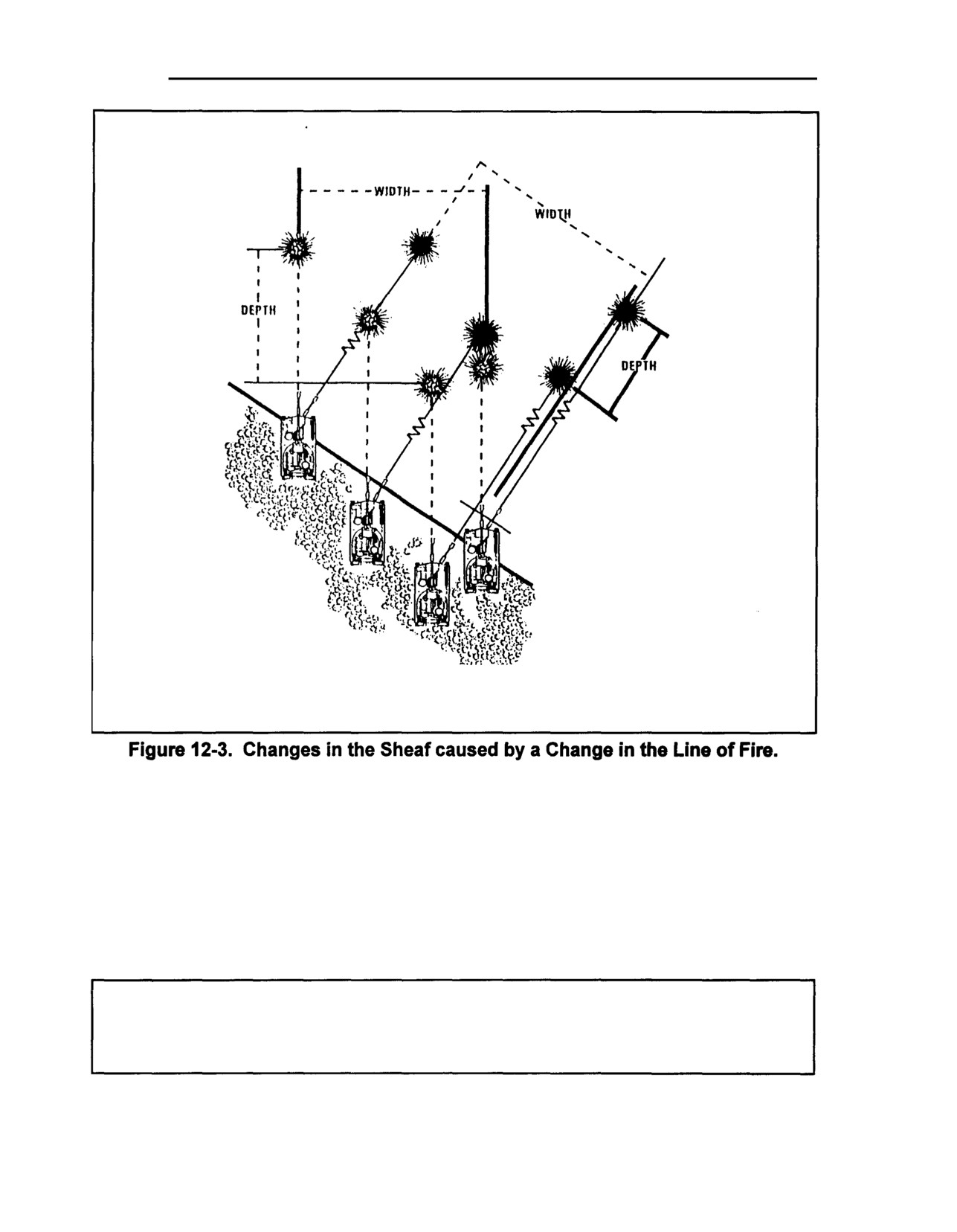
b. When firing a parallel sheaf, the rounds impact at the target in generally the same
pattern formed by the howitzers in the firing unit area. The width and depth of the unit’s sheaf
are always measured on a line perpendicular to the line of fire. As the line of fire changes, so
does the width and depth of the unit’s sheaf. (See Figure 12-3.)
12-3
FM 6-40
c. A parallel sheaf does not require TGPCs or special corrections. All weapons fire the
same deflection and quadrant.
d. There are three basic types of sheafs that may be obtained with TGPCs and special
corrections.
(1) Converged sheaf. All weapons have the same aimpoint.
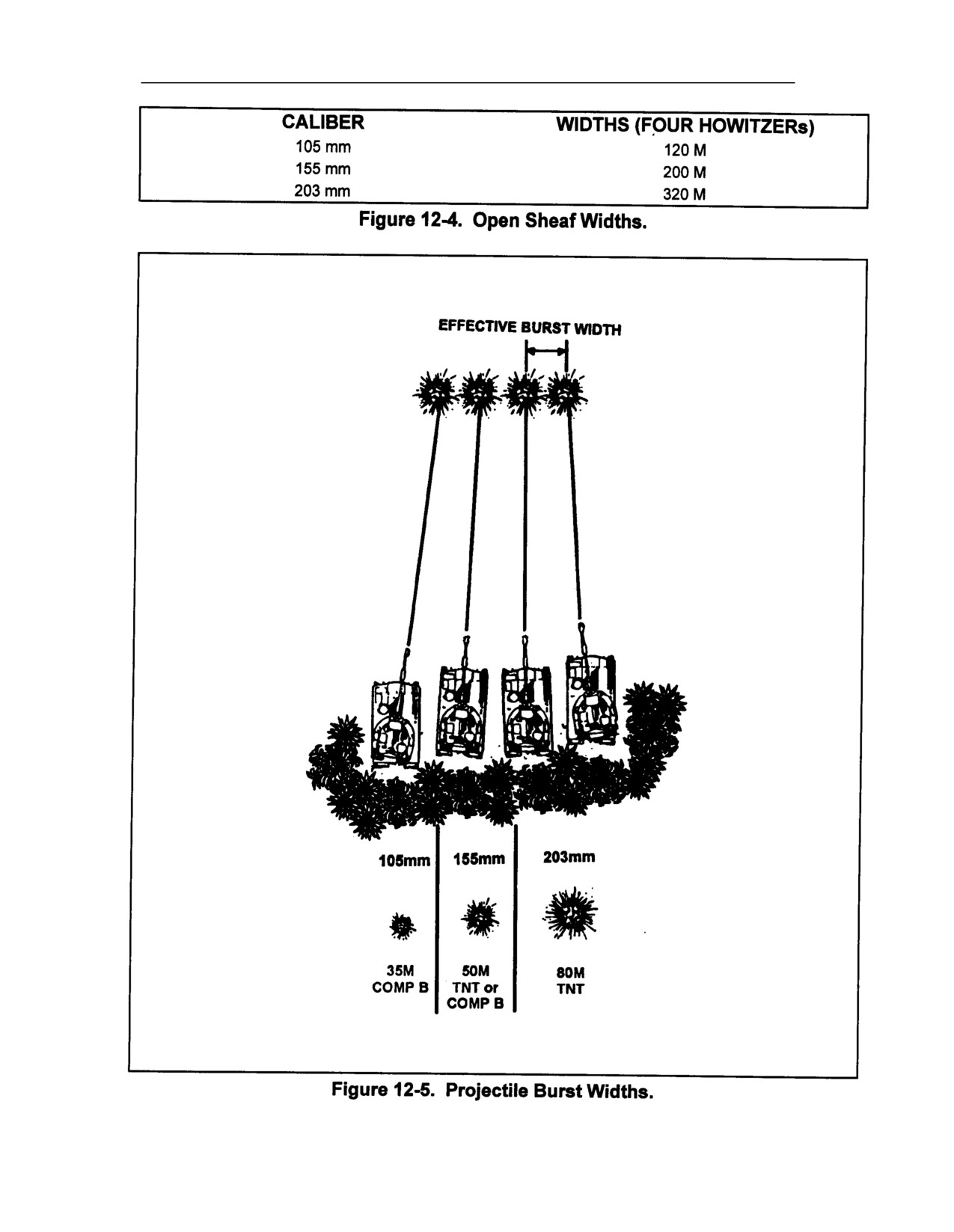
(2) Open sheaf. Aimpoints are separated by one effective burst width. Figure 12-4
shows sheaf widths for an open sheaf. The open sheaf width equals the number of howitzers
multiplied by the projectile effective burst width. See Figure 12-5 for burst widths.
NOTE: For manual computations of TGPCs and special corrections with an M17
plotting board, a width of 30 meters is used for the 105-mm howitzer for ease of
computation.
12-4
FM 6-40
12-5
FM 6-40
(3) Special sheafs. Special sheafs are sheafs other than parallel, converged, or
open.
(a) Linear. The sheaf is described by a length, and attitude or by two grids.
Aimpoints are evenly distributed along the length of the sheaf along the attitude specified.
(b) Rectangular. The sheaf is described by a length, width, and attitude.
Aimpoints are evenly distributed along two lines equal to the length and parallel to the attitude
specified.
(c) Circular. The sheaf is described by a grid and a radius. Aimpoints are
evenly distributed on a concentric circle half the radius specified.
(d) Irregular. The sheaf is described by a series of grids. Aimpoints are evenly
distributed along the length of the sheaf.
Section II
The M17/M10 Plotting Board
The M17 and M10 plotting boards are versatile pieces of the fire direction
set. The M17 and M10 plotting boards are similar and used to determine TGPCs
and special corrections. The differences are as follows:
The M17 has a snap-type pivot in the center; the M10 uses a small screw.
The M17 has a map scale graduated in metric measure; the M10 scale is graduated in
both meters and yards.
NOTE: In further discussions, the term “M17” will refer to the M17 and M10 plotting
boards.
12-4. Description
The M17 plotting board consists of two parts--the gridded base and the clear disk.
a. The gridded base is a white plastic board. The center area of the board is a circular
gridded area called the target area.
The grid pattern divides the target area into squares. The
scale assigned to the grid pattern is
at the discretion of the user, but most common scales for
various operations are as follows:
OPERATION
SCALE
Terrain Gun Position Correction
1 Square
= 10 meters
Special Corrections
1 Square
= 10 meters
Laser Adjustment of Fire
1 Square
= 100 meters
Target Location
1 Square
= 100 meters
b. A red arrow is printed from the bottom to the top of the target area. This arrow
represents the direction of fire. The arrow points to a vernier scale. The center graduation forms
the vernier index, which is used to determine direction from the scales on the clear disk. The
12-6
FM 6-40
vernier scale may be used to determine directions to an accuracy of 1 mil. Along the top edge of
the plotting board is a measuring scale graduated in millimeters. On the bottom is a scale in
meters. On the right side there is a scale in inches.
c. The clear disk is a transparent circular plastic board that snaps or screws into a center
pivot on the gridded base. A single black line is engraved in the clear disk, This line represents
the 0-3200 line when weapons are plotted.
d. The edge of the disk is engraved with scales that are graduated every 10 mils. The
outermost scale is a black numbered scale (the outer black scale). The scale is numbered every
100 mils starting at 0 and ending at 63. The outer black scale is used to represent azimuth and
lay deflection. Immediately inside the outer black scale is a red numbered scale (the red scale).
This scale is numbered every 100 mils from 0 to 32. Past the 32 graduation the numbering
continues from 1 to 5. This scale is used to orient the disk on chart deflection. The innermost
scale is a black numbered scale (the inner black scale). This scale is numbered every 100 mils
from 0 to 3200 and is used to orient the disk for lay deflection for the M12-series pantel when lay
deflection is measured from the line of fire.
e. The screw or rivet secures the disk to the base and maybe used to represent one of the
following:
Base piece.
Target.
Observer location.
Location of the last burst.
NOTE: In the following sample problems, the Ml 7 plotting board is viewed with the
curved edge to the operator’s left and the description “top of the plotting board”
refers to the side of the plotting board with the vernier scale.
12-5. Plotting Piece Locations for Weapons Equipped With the M100-Series Sight
a. The following is an example of the platoon leader’s report for the M100-series sight:
HOWITZER
LAID FROM LAY DEFLECTION DISTANCE
VA
1
AC
2595
105
+3
2
AC
2910
55
+1
3 (BP)
AC
3405
90
-2
4
AC
3950
100
-5
NOTE: Howitzer Number 3 is the base piece. The azimuth of lay is 4,800 mils.
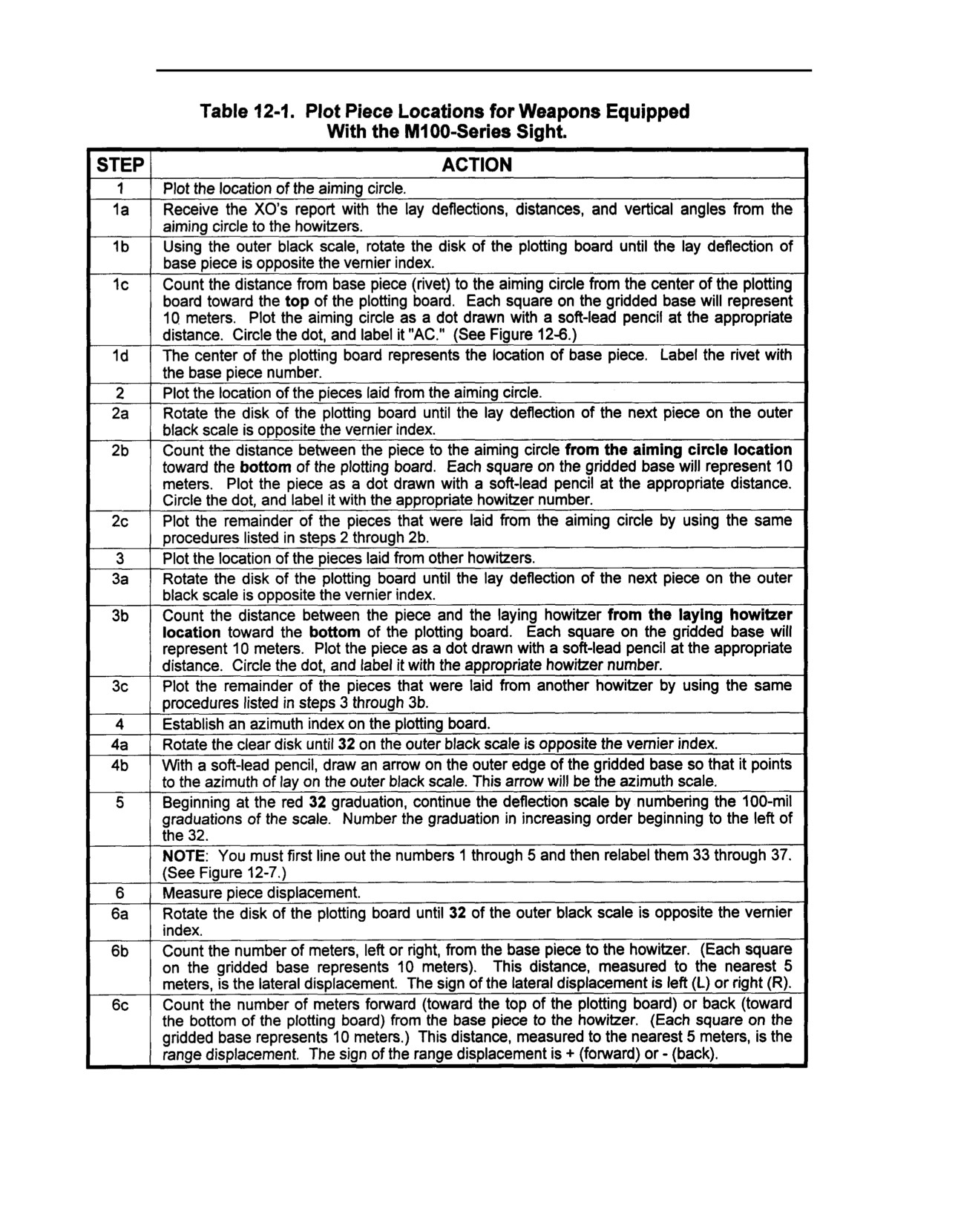
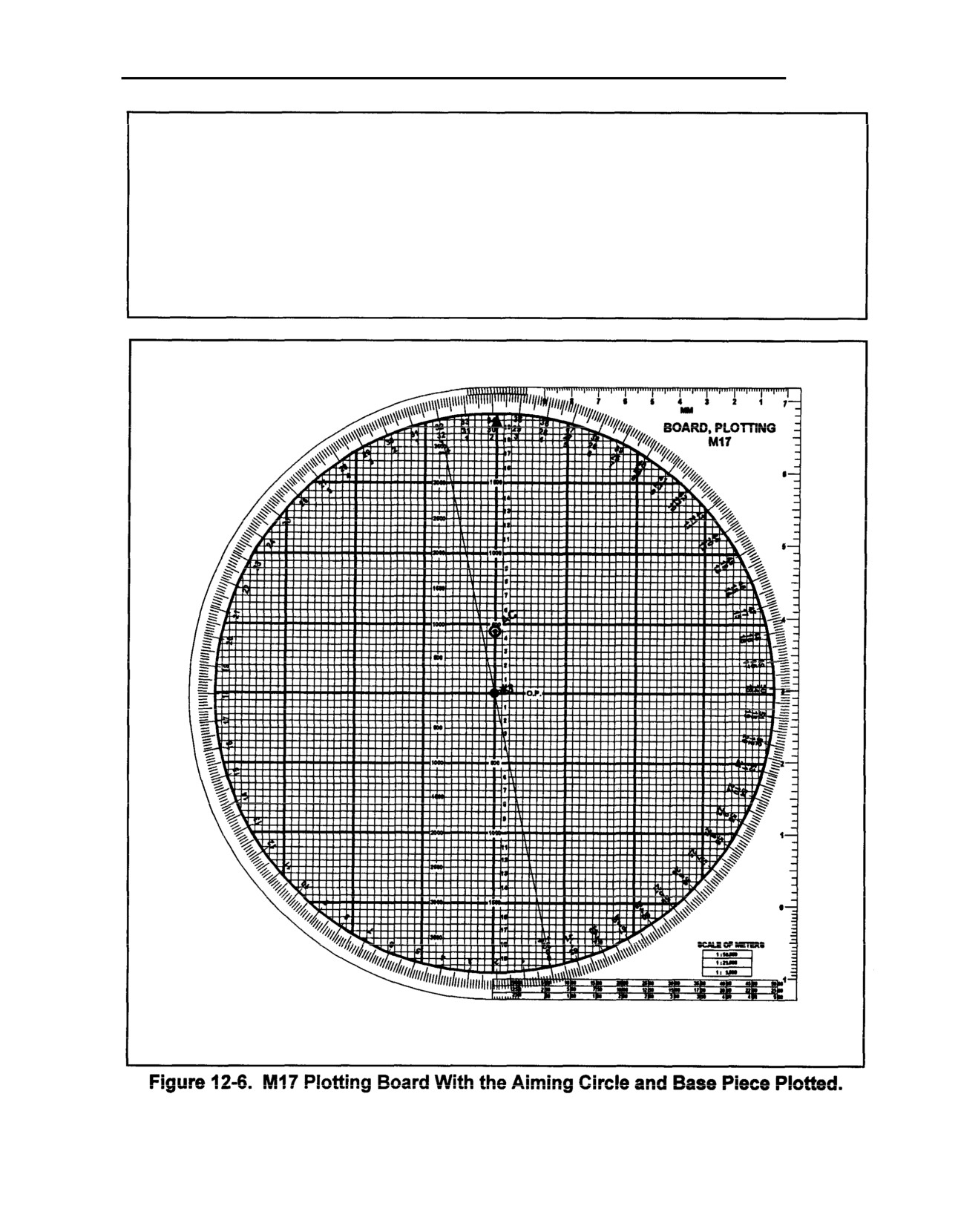
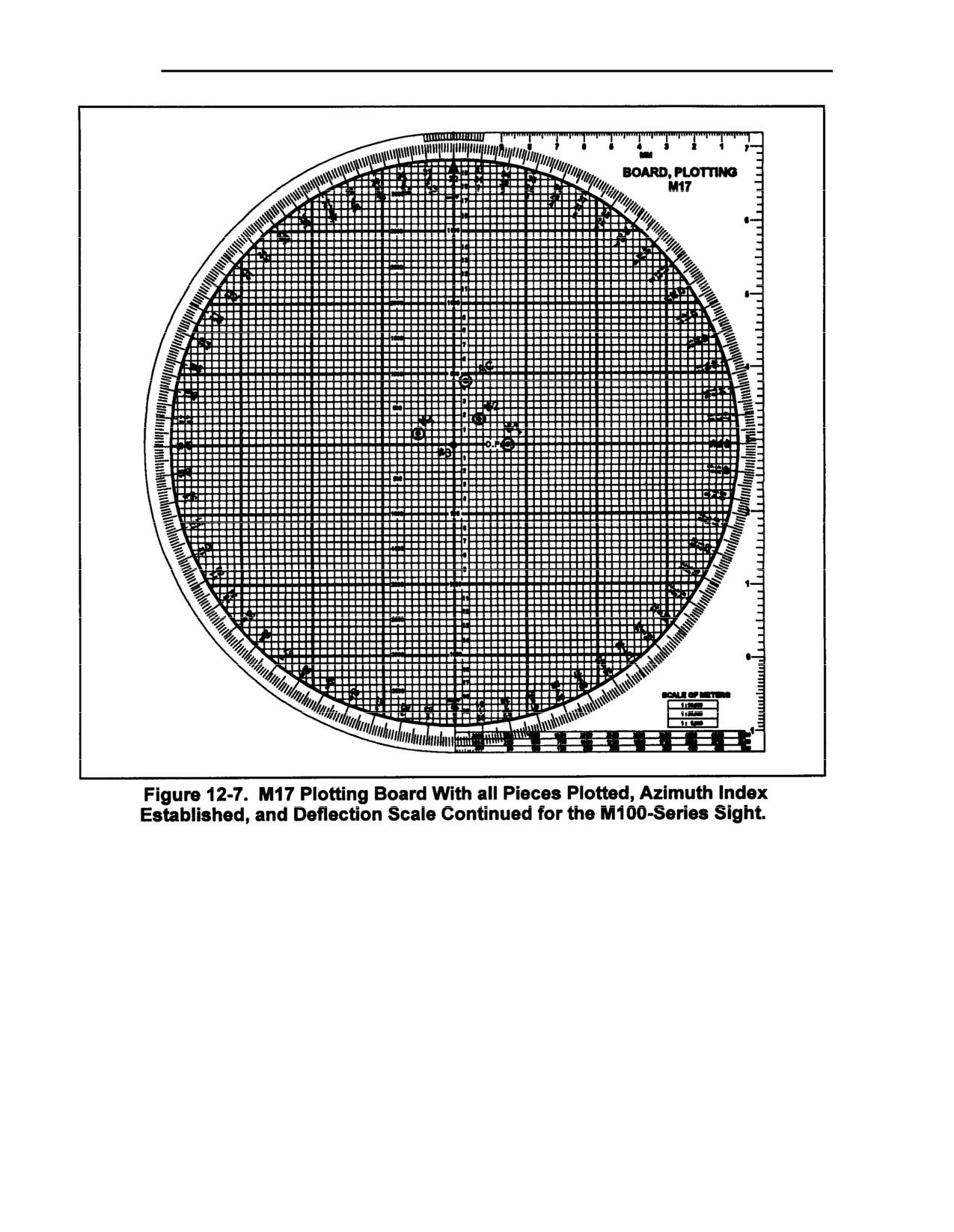
b. Table 12-1 shows the steps required to plot piece locations for weapons equipped
with the M100-series sight.
12-7
FM 6-40
12-8
FM 6-40
NOTE: The following data are an example of piece displacement as shown in step 6.
HOWITZER
LATERAL DISPLACEMENT
RANGE DISPLACEMENT
1
R75
0
2
R35
+35
3
0
0
4
L50
+15
12-9
FM 6-40
12-6. Plotting Piece Locations for Weapons Equipped With the M12-Series Sight
a. The M12-series sight is capable of determining deflection to a maximum value of 3,200
mils. The sight is graduated from 1 to 3200 twice to form a full circle. Consequently, every deflection
has a “back deflection” of equal value in the opposite direction. This arrangement is indicated on the
plotting board by the inner black scale. This scale is a lay deflection scale graduated from 0 to 3200.
Care must be taken when setting up the plotting board to prevent the use of the wrong scale and
thereby creating a “mirror image” of the battery. The use of the scales is dictated by the location of
the howitzers in relationship to the position of the aiming circle. In the XO’s report, the XO must
indicate whether each piece is to the left or right of the aiming circle in respect to the azimuth of lay.
If the lay deflection for a howitzer is exactly 3200, the XO’s report must indicate whether that piece is
forward (down range) or behind (the aiming circle is down range) in comparison to the aiming circle.
The rules for the use of the scales areas follows:
12-10
FM 6-40
(1) If the piece is left of the 0-3200 line as viewed from the aiming circle, use the
inner black scale.
(2) If the piece is right of the 0-3200 line as viewed from the aiming circle, use the
outer black scale.
(3) If the piece is on the 0-3200 line (lay deflection 3200) and behind as viewed
from the aiming circle, use the inner black scale,
(4) If the piece is on the 0-3200 line (lay deflection 3200) and forward as viewed
from the aiming circle, use the outer black scale.
b. For ease in determining whether a piece is left or right and forward or back, the XO
need only realize that if the piece is laid using the red graduations on the aiming circle it is to
the left or forward of the aiming circle as you face the azimuth of fire.
c. A simple alternative to the use of these rules is to have the XO report all lay
deflections as they would be determined by using values read from the black numbered
graduations of the aiming circle. It is recommended that this method be unit SOP in an
attempt to avoid confusion with the plotting board.
d. The plotting of the pieces and establishment of an azimuth index are done by using
the same procedures as described for the M100-series sight.
e. Piece displacement is determined by using the same procedures as described for the
M100-series sight.
f. The following is an example of the platoon leader’s report for the M12-series sight:
HOWITZER
LAID FROM LAY DEFLECTION DISTANCE
VA
1
AC
2595
105
+3
2
AC
2910
55
+1
3 (BP)
AC
0205
90
-2
4
AC
0750
100
-5
NOTE: Howitzers 3 and 4 are left of the aiming circle. Azimuth of lay (AOL) equals
4800.
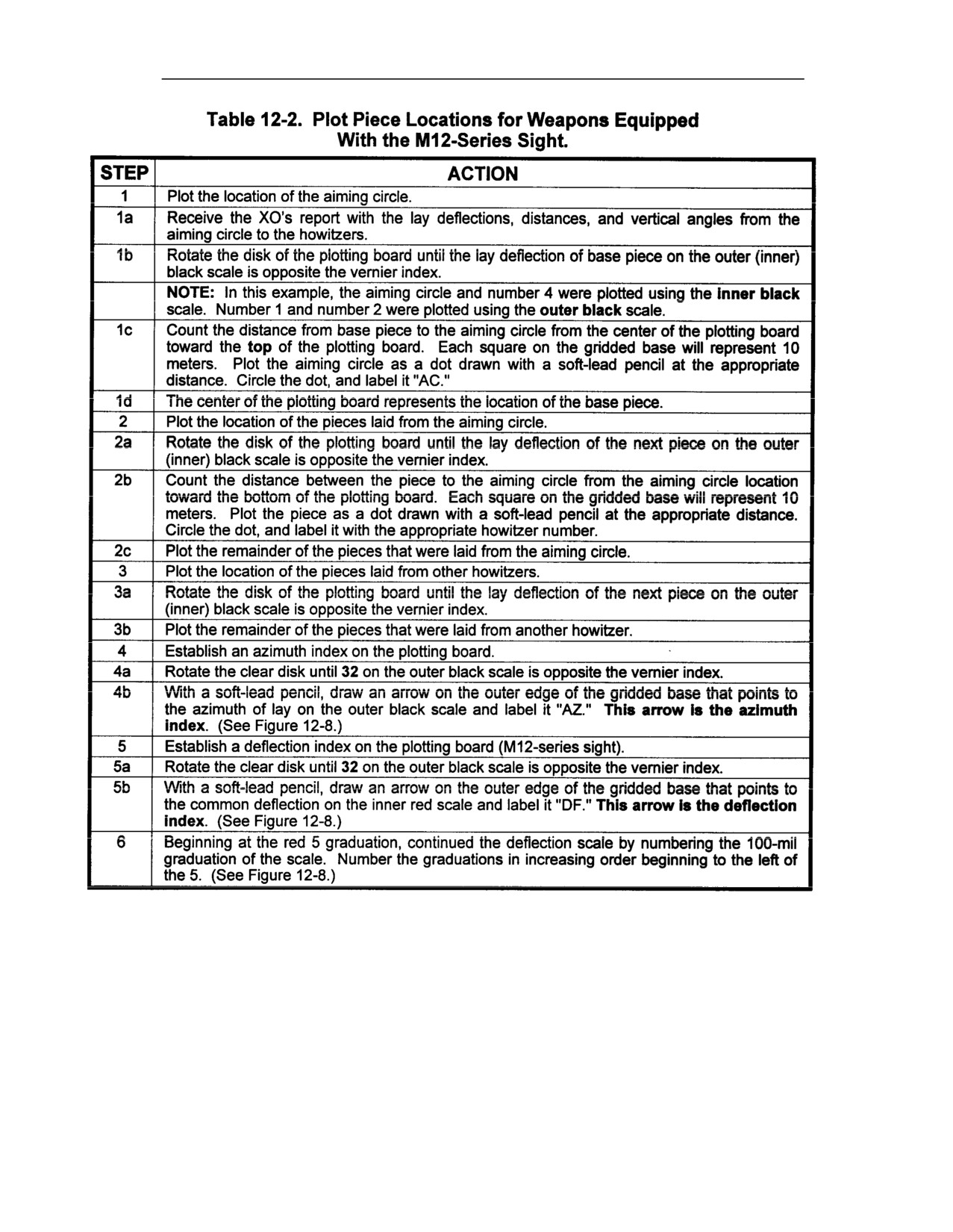
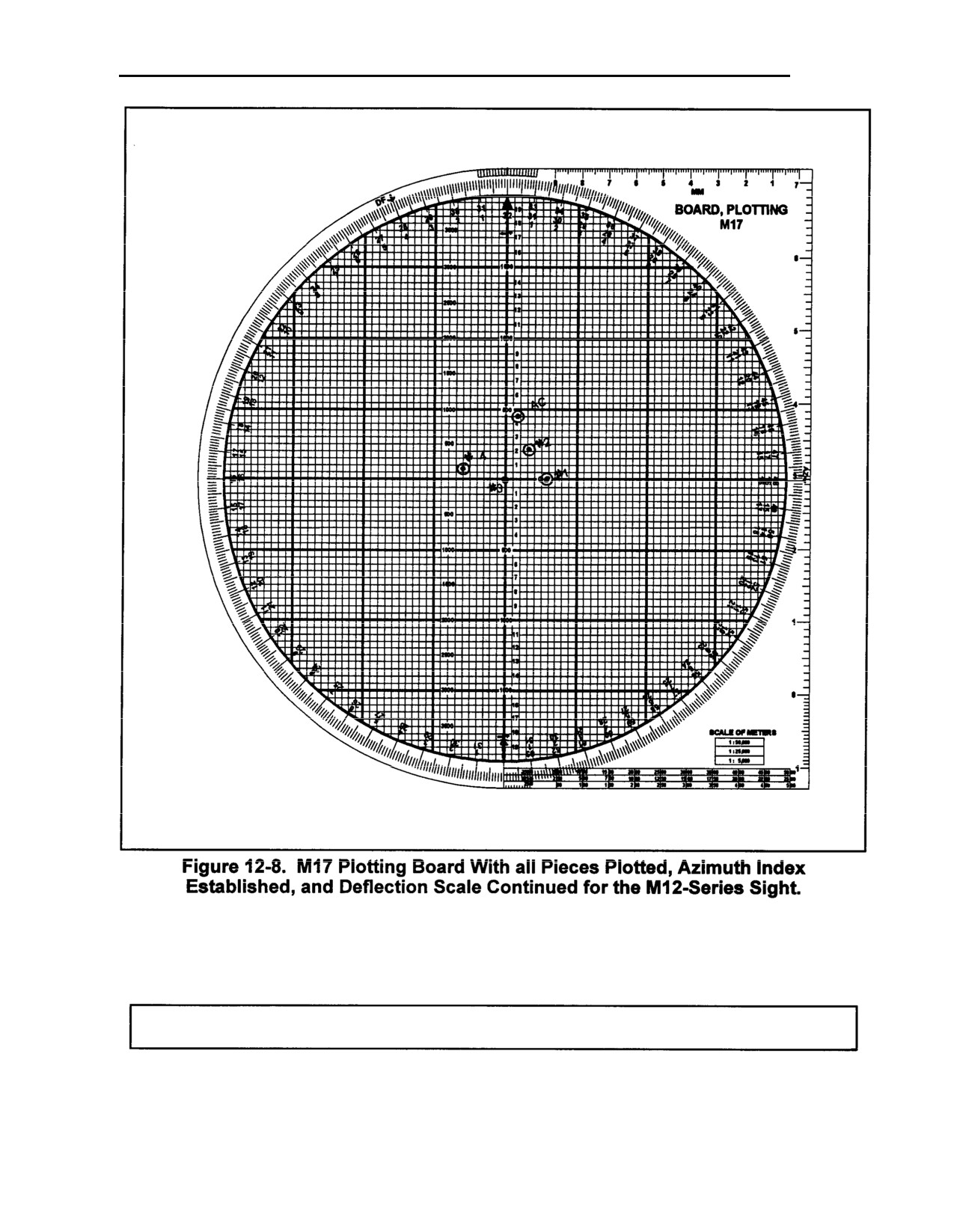
g. Use the steps in Table 12-2 to plot piece locations for weapons equipped with the
M12-series sight.
12-11
FM 6-40
12-12
FM 6-40
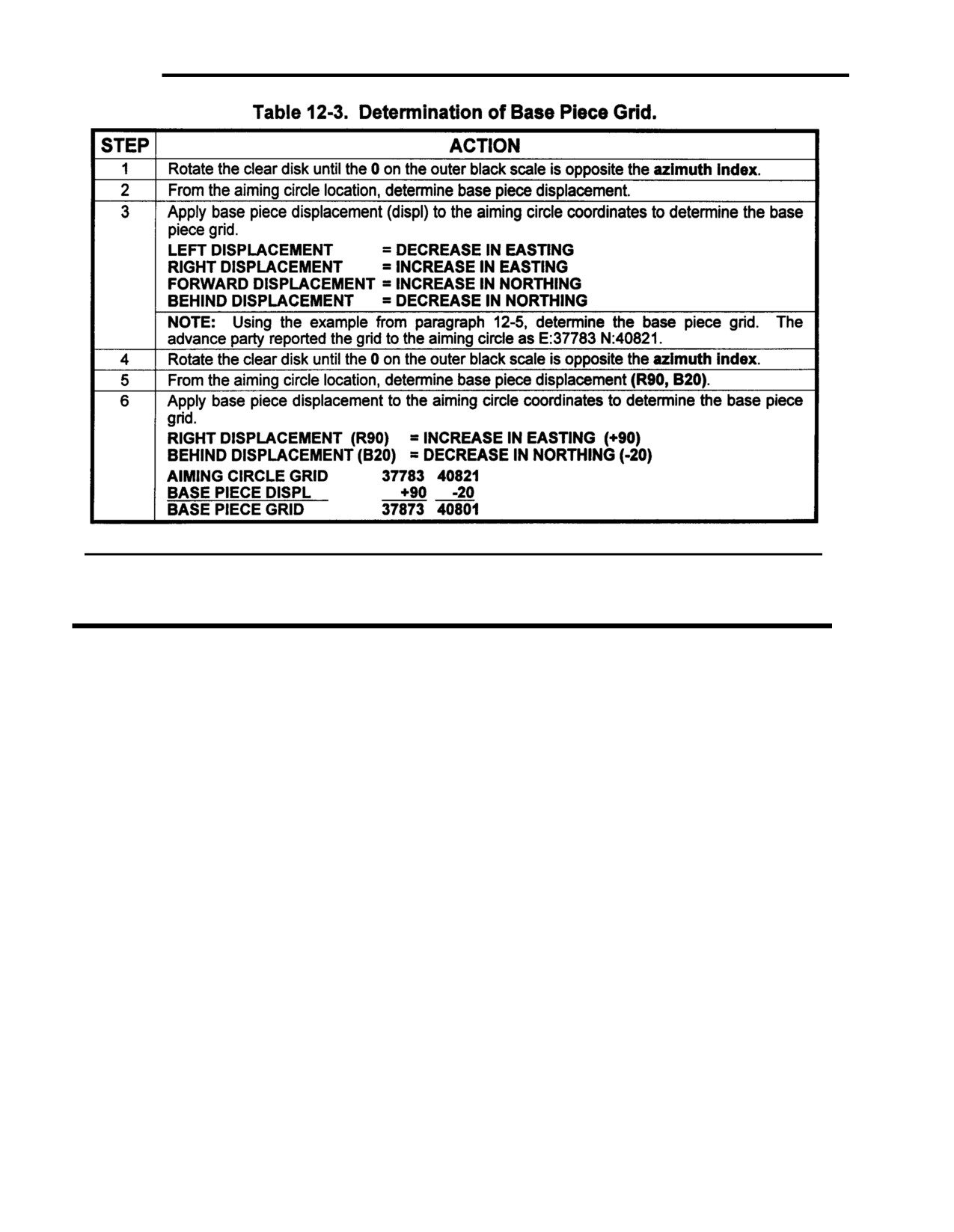
12-7. Determination of Base Piece Grid Coordinates
After the pieces have been plotted on the M17, the base piece grid can be determined by
using the steps in Table 12-3.
NOTE: The grid determined can be used to plot the base piece on the firing chart.
12-13
FM 6-40
Section III
Terrain Gun Position Corrections
Terrain gun position corrections are the precomputed corrections carried
on the howitzers to compensate for terrain positioning and muzzle velocity
differences to achieve acceptable results in the target area. TGPCs should be
computed each time the firing unit occupies a position. The use of TGPCs will
allow the unit to effectively engage targets whose size and orientation requires a
sheaf other than a parallel sheaf.
12-8. Transfer Limits and Sectors of Fire
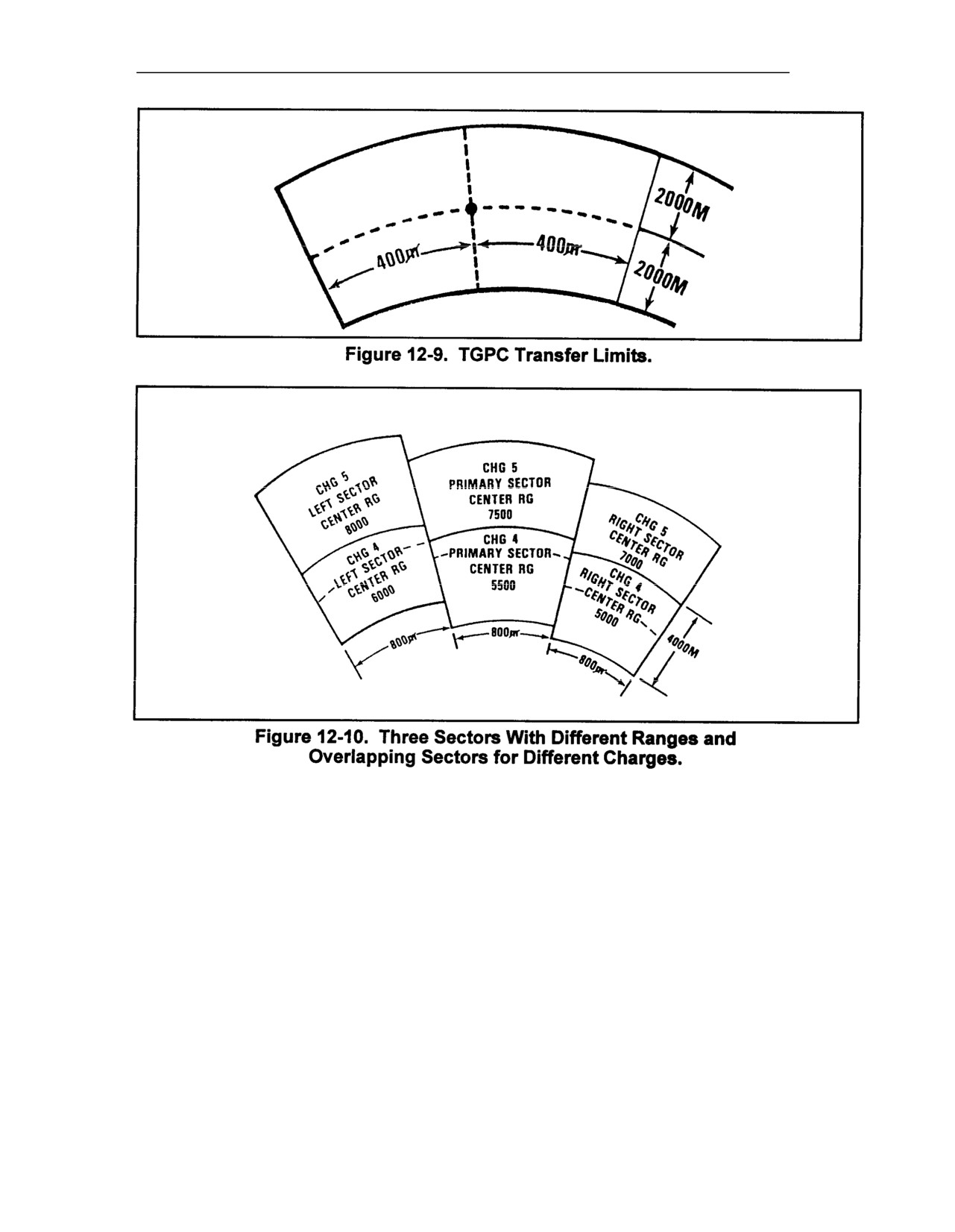
a. Terrain gun position corrections are most accurate at the range and direction for
which they are computed. They are considered valid 2,000 meters over and short of the center
range and 400 mils right and left of the center azimuth of the sector. (See Figure 12-9.)
b. Terrain gun position corrections will provide an acceptable effect on the target
provided the firing unit’s position is within a box 400 meters wide and 200 meters deep. This
box is centered over the firing unit center and oriented perpendicular to the azimuth of lay. If the
firing unit is spread out more than 400 meters by 200 meters, a degradation in effectiveness of
sheafs can be expected as fires are shifted throughout the sector for which they were computed.
c. If a firing unit’s area of responsibility covers an area larger than the TGPC transfer
limits, the unit should compute TGPCs for other sectors. Ranges to the centers of the other
sectors may be different. Overlapping sectors for different charges may be necessary. (See
Figure 12-10.)
12-14
FM 6-40
12-9. Fire Order and Fire Commands
a. The FDO must establish a fire order SOP that indicates the corrections for the
primary sector are standard. This is done in the special instructions section of the fire order SOP.
b. Fire command standards should direct that the primary TGPCs sector is used unless
otherwise specified. The special instructions block of the fire commands will indicate which
TGPC sector will be used for a mission if other than the primary sector. The absence of any
instructions in the initial fire commands indicates that corrections for the primary sector will be
fired. The command LEFT (RIGHT) SECTOR in the special instructions block of the initial
fire commands indicates that the corrections for the left (right) sector are to be set on the
howitzers. The command CANCEL TERRAIN GUN POSITION CORRECTIONSindicates
that all TGPCs are to be zeroed for the mission. After end of mission is announced, the primary
sector TGPCs are reapplied to the howitzers.
12-15
FM 6-40
12-10. Determination of Terrain Gun Position Corrections
a. It is recommended that TGPCs be computed for a converged sheaf. This will
generally provide an acceptable sheaf within the transfer limits. TGPCs can be computed by
using other sheafs, but the dispersion of bursts can be expected to increase as the target range
varies from the range to the center of the sector. It is preferred that base piece carry no
corrections. To do otherwise causes the base piece to “zero” the corrections on adjustment and
reapply them during fire for effect, which may lead to error. Therefore, the aimpoint of the base
piece should be the center pivot when computing TGPCs.
NOTE: DA Form 4757 (Registration/Special Corrections Work Sheet) is completed
regardless of the sheaf used. Before computing any TGPCs, plot the howitzers on
the M17.
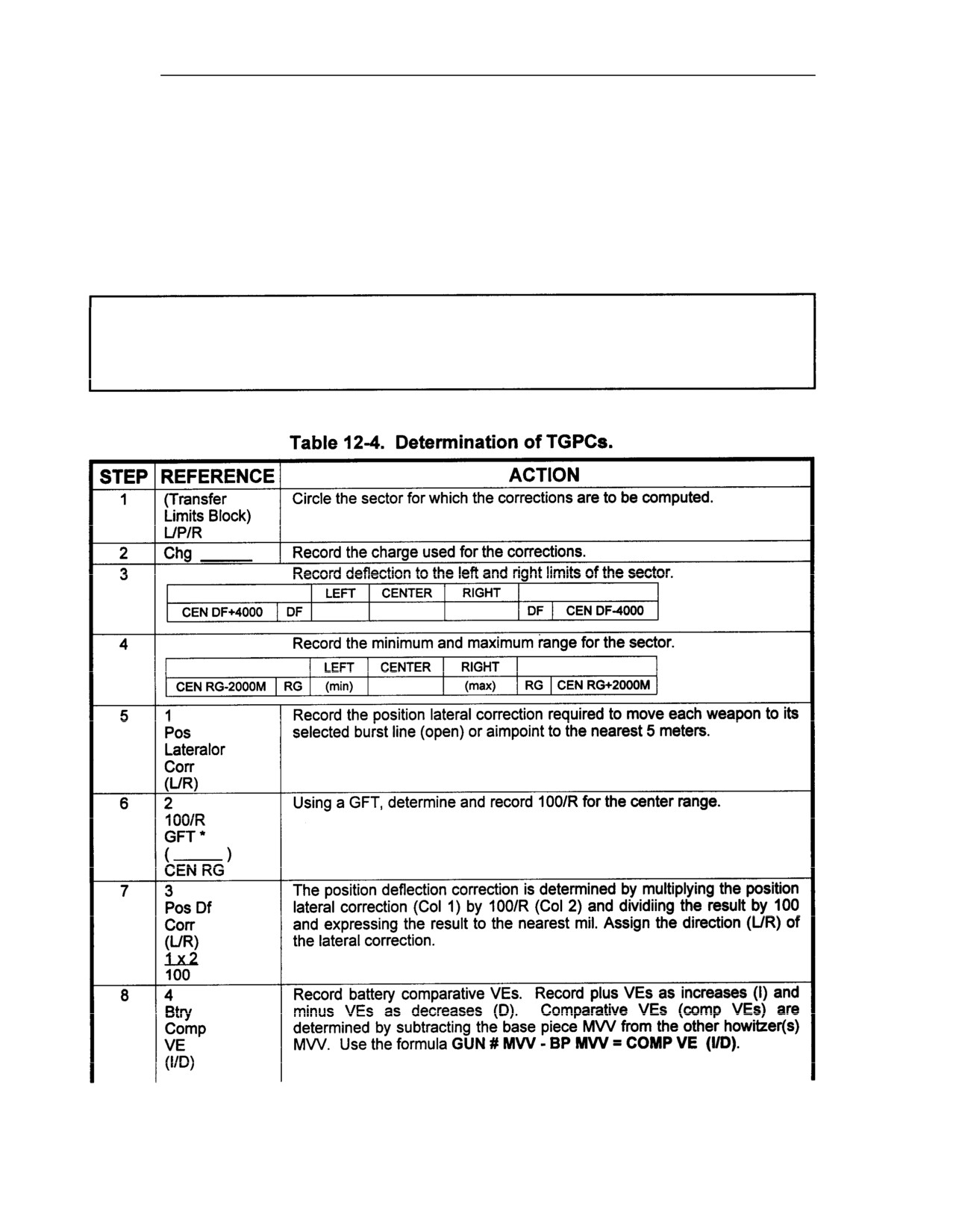
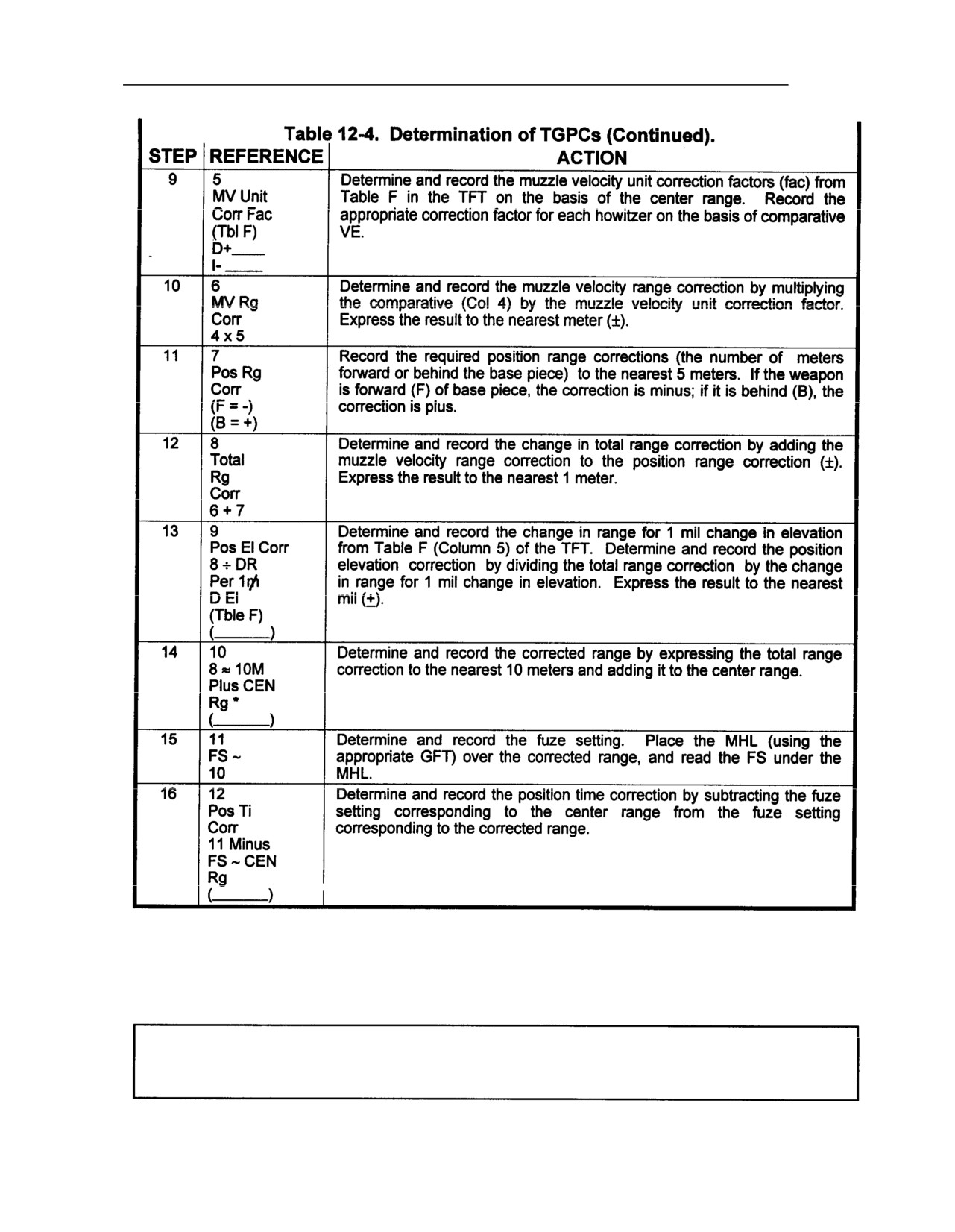
b. Table 12-4 lists the steps for determining TGPCs and completing DA Form 4757.
12-16
FM 6-40
c. The note on the bottom of DA Form 4757 lets you know to use the chart range to
target wherever there is an * displayed.
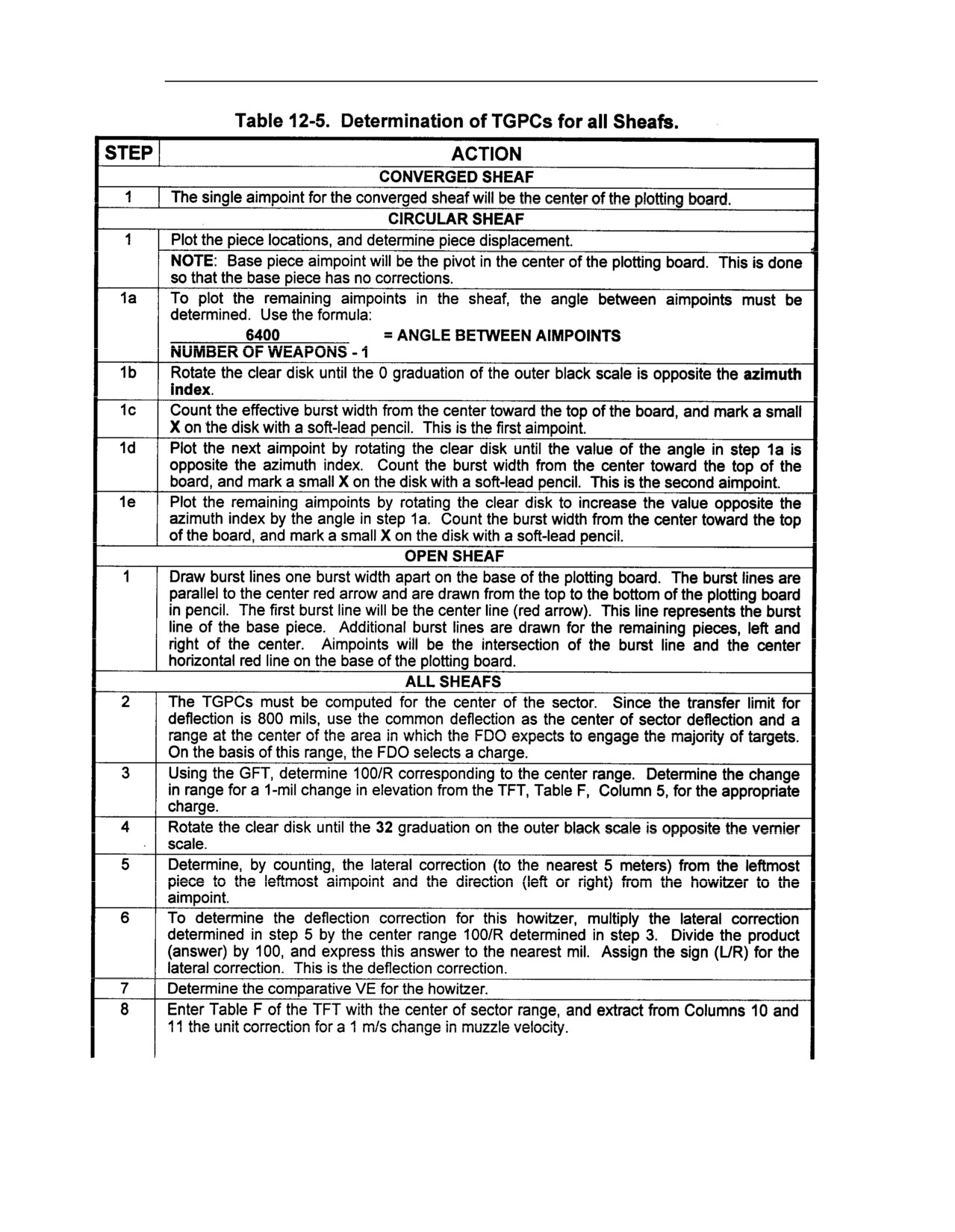
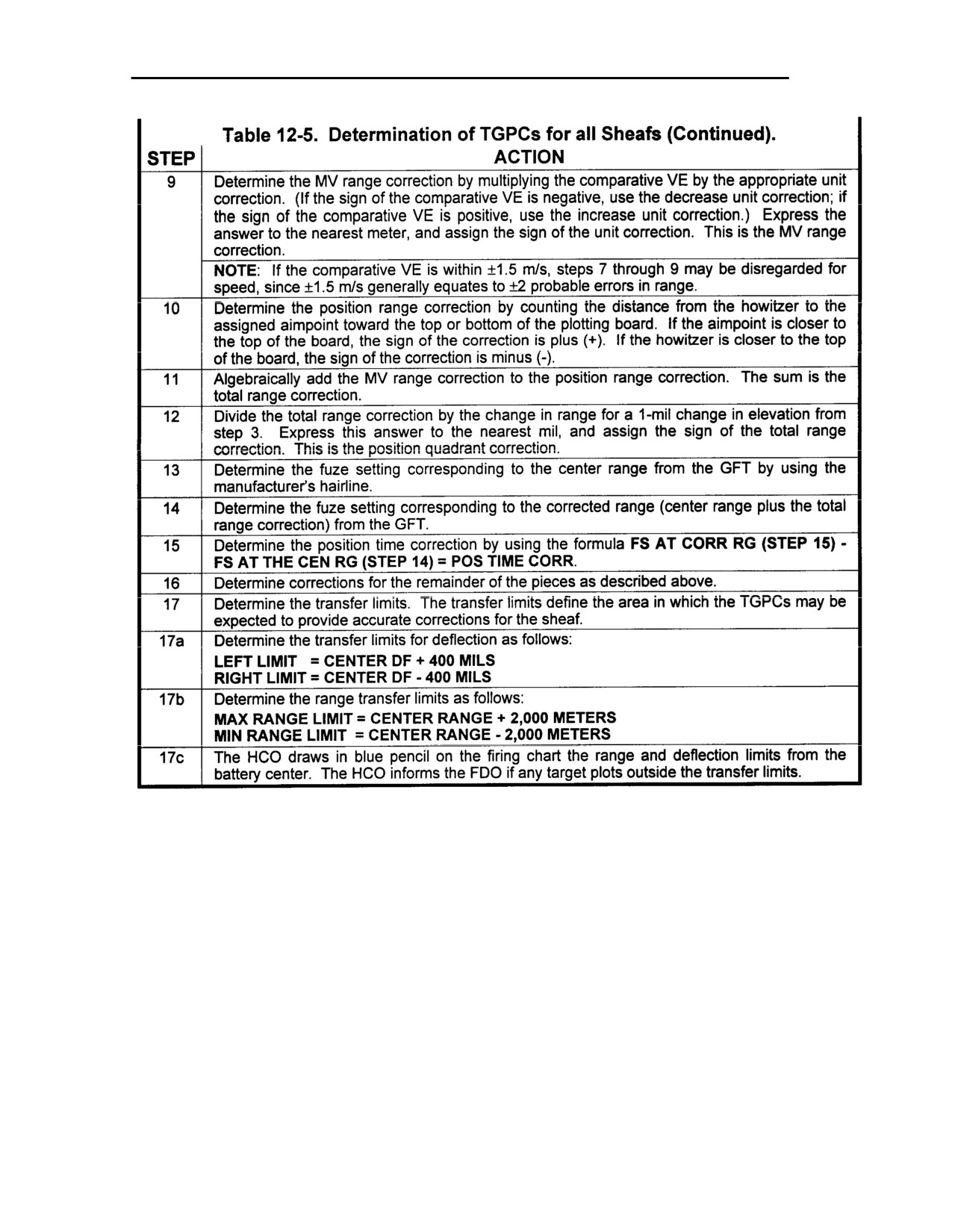
d. The steps in Table 12-5 are used to determine TGPCs for all sheafs.
NOTE: Step 1 will be different for each type of sheaf. Steps 2 through 17 are
common to all sheafs.
12-17
FM 6-40
12-18
FM 6-40
12-11. Hasty Terrain Gun Position Corrections
a. Even with well-trained FDC personnel, computing TGPCs is time-consuming.
Corrections are required for firing shortly after occupation of a position. If the advance party has
determined displacement and computed TGPCs, corrections will be available immediately. If the
advance party has not been able to do
this, hasty TGPCs must be determined and used until
accurate TGPCs are computed. For the
hasty solution, piece displacement is estimated and fuze
corrections are ignored.
b. Hasty TGPCs computations
are designed to provide a converged sheaf at the center
range of the TGPCs sector.
12-19
FM 6-40
c. Tables 12-8 through 12-13 show data for hasty TGPCs and special corrections. The
data presented in these tables are:
Range in 1,000-meter increments.
Charge most likely to be fired at the listed range.
Deflection correction, in mils, to compensate for lateral piece displacement.
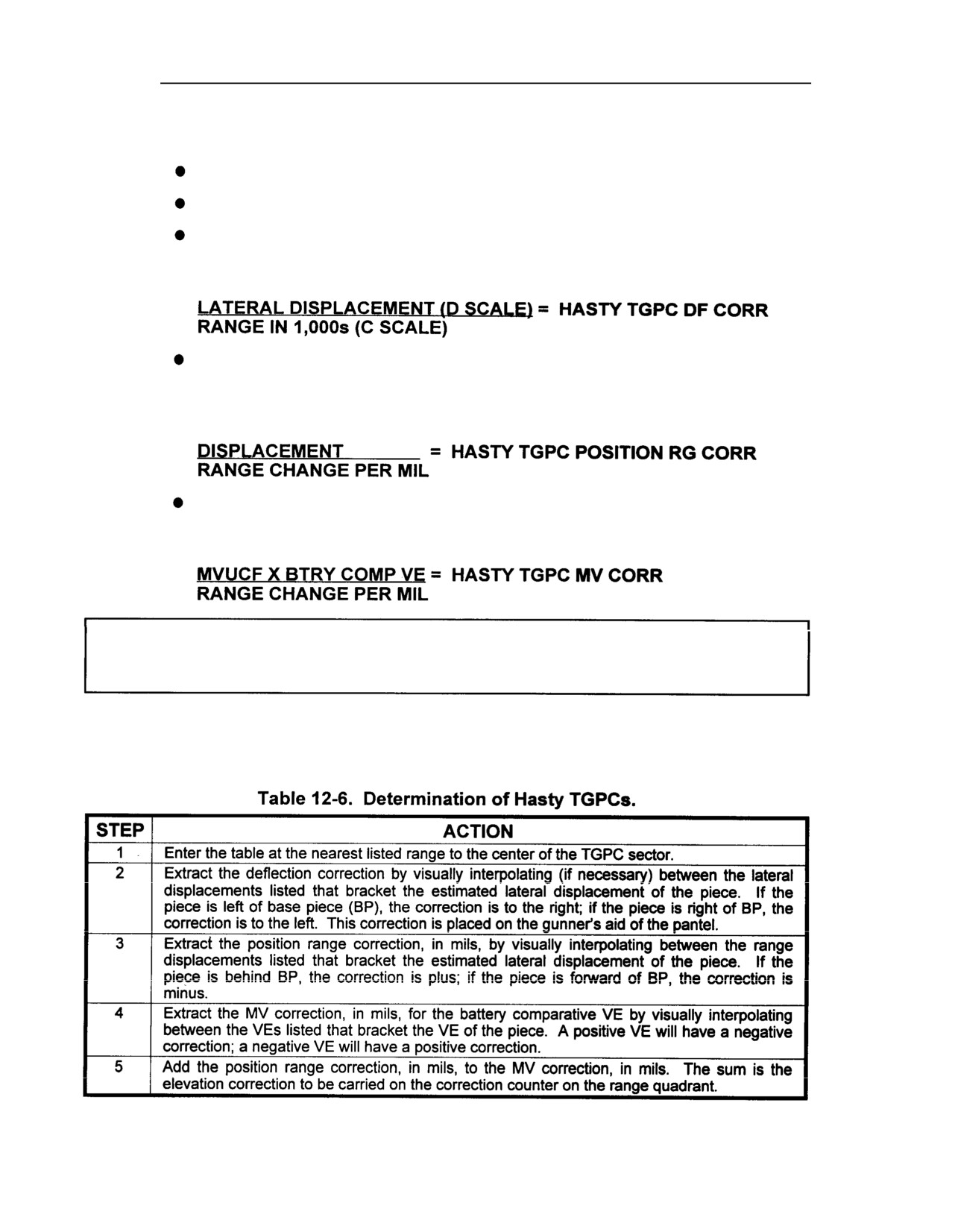
These values have been determined to the nearest mil with the GST for each 20
meters of lateral displacement (20 to 200 meters).
Position range correction, in mils, to compensate for piece displacement in range.
QE corrections to the nearest mil for each 20 meters of front or rear displacement
(20 to 100 meters) were computed by using the range change per mil for the listed
ranges.
MV correction in mils to compensate for the difference in shooting strengths
(battery comparative VEs). MV corrections were determined by using the
following formula.
NOTE: MVUCF is the muzzle velocity unit correction factor from the TFT, Table F,
Columns 10 and 11.
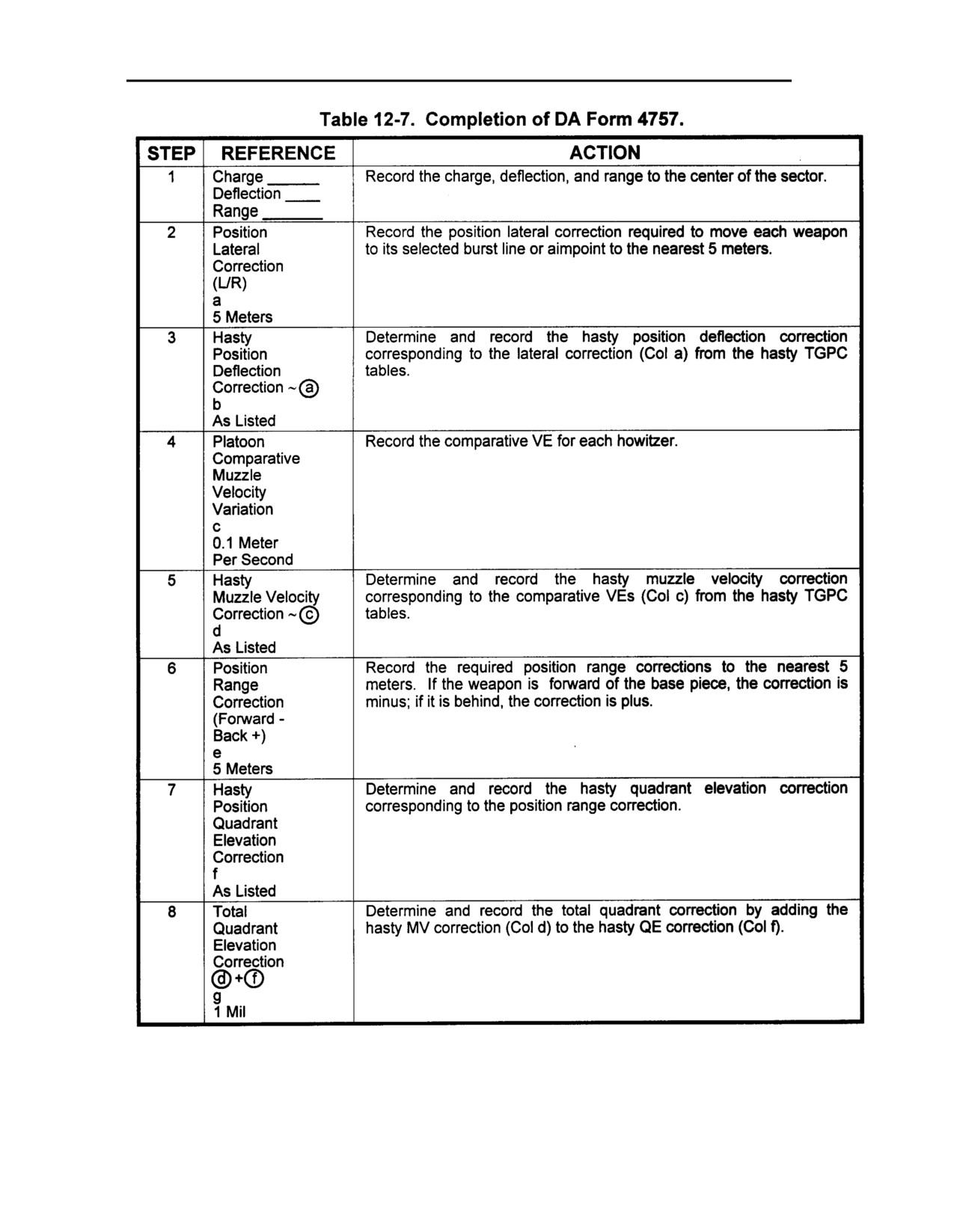
12-12. Determination of Hasty TGPCs
Table 12-6 gives the procedures for determining hasty TGPCs, and Table 12-7 gives the
procedures for completing DA Form 4757. Figure 12-11 shows recorded hasty TGPCs.
12-20
FM 6-40
12-21