FM 6-40 TTP for Field Artillery Manual Cannon Battery U.S. - page 9
FM 6-40
10-31
FM 6-40
10-25. Determine Chart Data and Registration Corrections
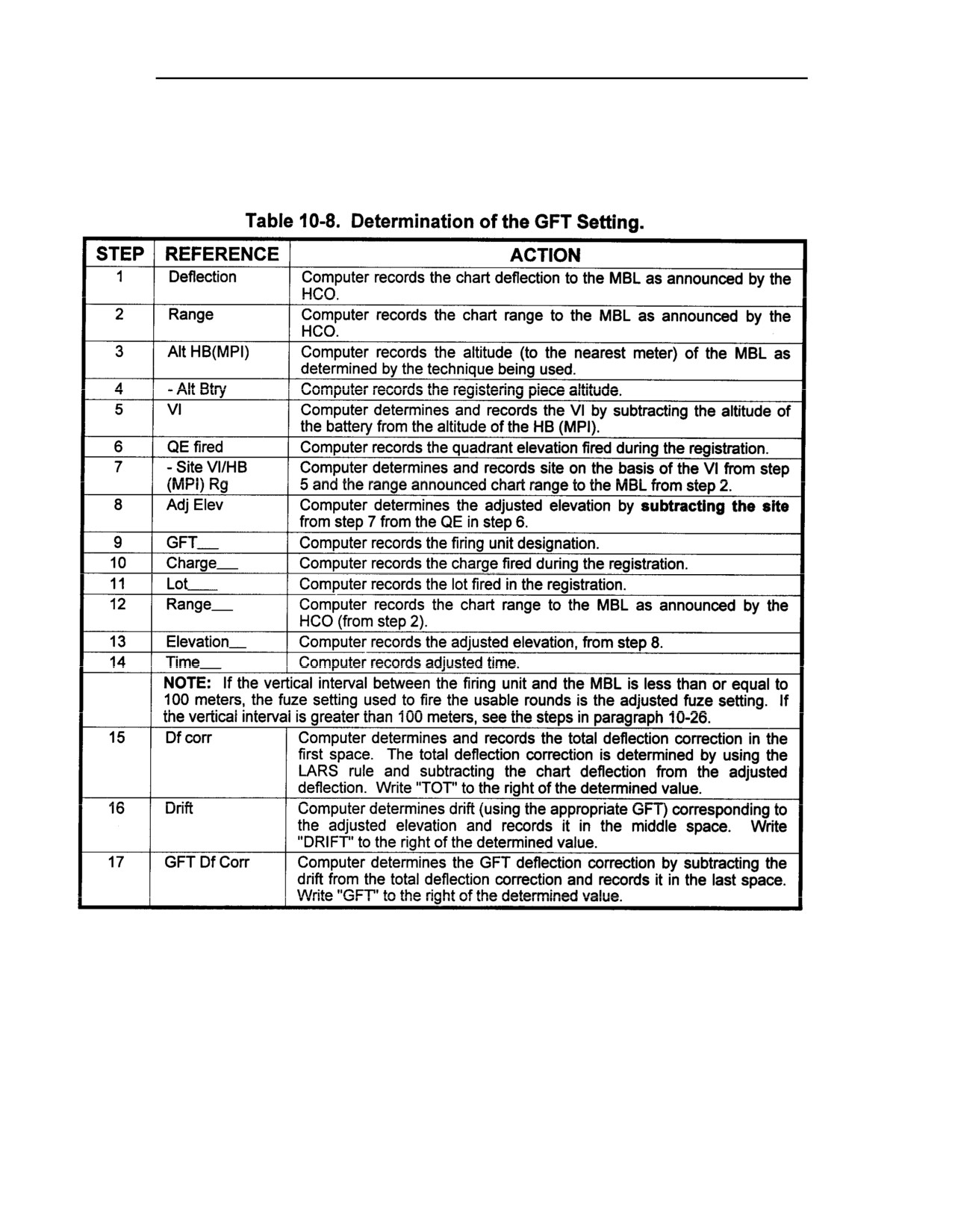
After plotting the MBL on the firing chart, the HCO determines and announces the chart
range and deflection from the firing unit to the MBL. Use Table 10-8 to determine the GFT
setting.
10-26. Effect of Complementary Angle of Site on Adjusted Fuze Setting
a. Fuze setting is determined as a function of elevation and complementary angle of site.
When the vertical interval is equal to or less than 100 meters, the CAS is generally so small that it
has little effect on the quadrant and fuze setting fired and is disregarded. If the vertical interval is
greater than 100 meters, the value of the CAS becomes increasingly large and begins to affect the
fuze setting. In this case, the CAS must be added to the elevation to determine the proper fuze
setting.
10-32
FM 6-40
b. As the CAS increases, the the setting also must be increased to reach the desired
burst location. If the effect of CAS is not included in the fuze setting, the fuze will function
before it reaches the desired location.
c. If the vertical interval is greater than 100 meters, modify the adjusted the setting to
correct for the inaccuracy introduced by the large complementary angle of site. The 100-meter
VI is only a rule of thumb; CAS may affect the adjusted fuze setting at vertical intervals of less
than 100 meters. The FDO should check the effects of CAS anytime he feels it will affect the
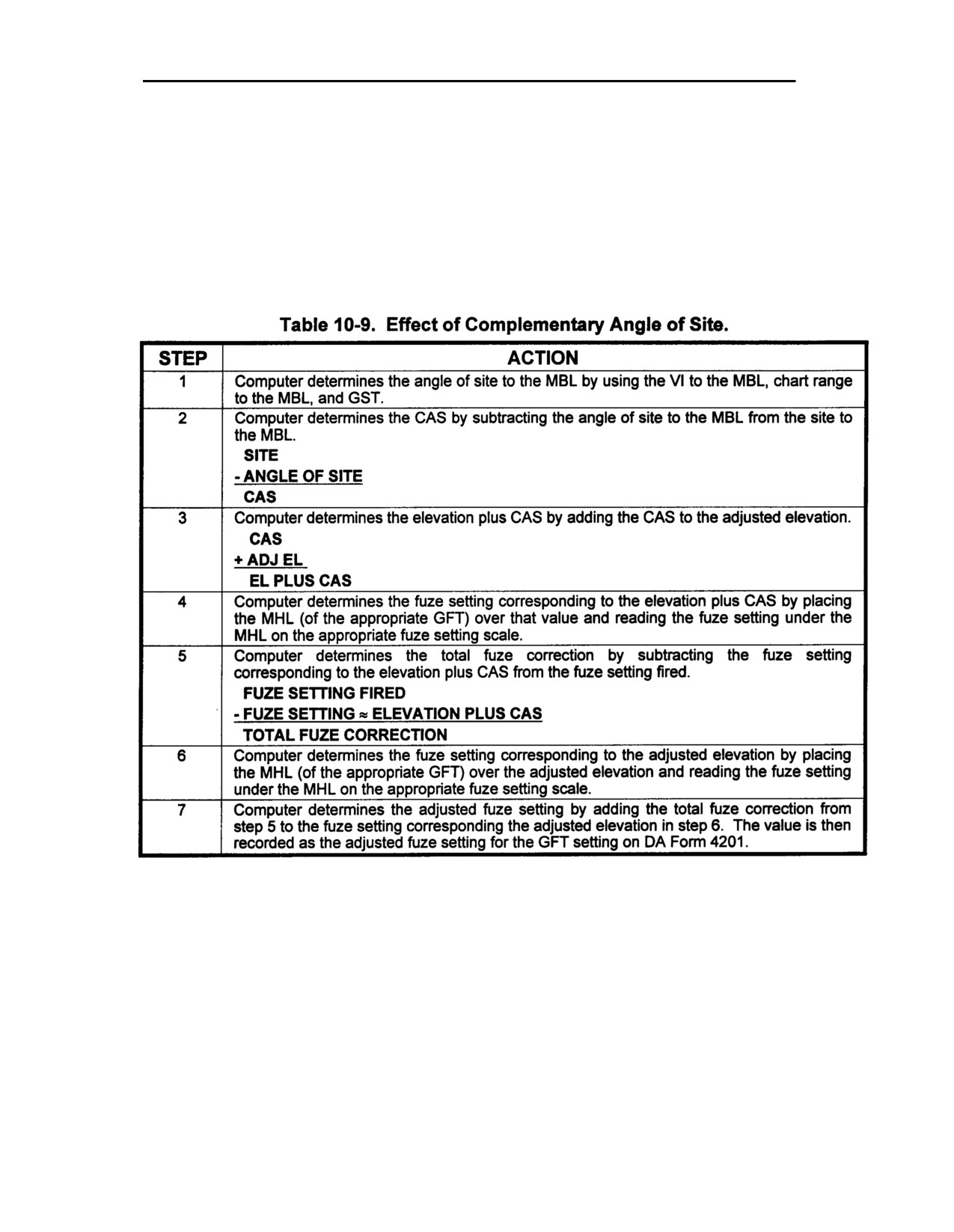
adjusted fuze setting. Use Table 10-9 to correct the effect of complementary angle of site on
adjusted fuze setting when VI is greater than 100 meters.
10-33
FM 6-40
Section IV
Process an AN/TPQ-36 or AN/TPQ-37 Radar Registration
Field artillery radars can be used to observe registrations. The conduct of
a radar-observed registration (commonly known as a radar registration) is
similar to that of other HB or MPI registrations. This section outlines the unique
procedures and requirements for the AN/TPQ-36 (Q-36) and AN/TPQ-37 (Q-37)
radar systems.
10-27. Characteristics
a. The Firefinder radar has two separate modes of operation. The first mode of
operation is the friendly fire mode, which is used by friendly artillery and mortar units for
adjust-fire missions and registrations. The second is the hostile mode, which tracks incoming
projectiles and is used to locate enemy indirect-fire systems.
b. A peculiarity of the two separate modes of operation is how the radar operator inputs
data into his computer to orient the radar. Data can only be input while the radar is in the hostile
fire mode. Once the operator has input all the data into the computer, he switches from hostile to
friendly mode, and a delay is experienced while the radar orients itself. If a problem is
encountered during the registration, such as around being unobserved, the first thing the operator
does is verify his data. This requires him to switch back to the hostile mode, verify his data, then
return to the friendly fire mode. Each time he changes modes, the radar physically reorients
itself, taking from 20 to 30 seconds.
c. The radar has three different mission buffers, and they are used to store all the data needed
to conduct a friendly fire mission. The radar also has the capability to store the spottings for six
rounds. When the friendly fire storage cues are full and another round is tracked, it will replace the
oldest spotting with the new one. Unless an observed round is recorded by the radar operator or
transmitted to the FDC, these old data are lost when they are automatically replaced by the radar
computer. Therefore, the operator needs to monitor the mission and either transmit each individual
spotting to the FDC or clear the buffer by deleting erroneously captured information.
d. A danger area exists to the front of the radar. Theoretically, VT fuzes can function
prematurely within the danger area or as a result of passing through the danger area. For the
Q-36, the danger area is 107 meters out from the radar; for the Q-37, it is 141 meters.
(1) The radar takes 9 seconds to warm up before operation.
(2) Minimum observing distance for the Q-36 is 750 meters; for the Q-37, 3,000 meters.
(3) The friendly fire mode has five different mission types that the radar can
conduct. They are as follows:
Mortar datum plane (MD).
Mortar impact prediction (MI).
Artillery airburst (AA).
Artillery datum plane (AD).
Artillery impact prediction (AI).
10-34
FM 6-40
e. The two types most commonly used by artillery are the artillery airburst (HB
registration) and the artillery impact prediction (adjust-fire missions and MPI registrations). One
of the problems occasionally encountered between the FDC and the radar section is the use of
different technical language. For example, in the message to observer, you might announce
OBSERVE HIGH BURST REGISTRATION to orient the radar. An inexperienced radar
operator unfamiliar with artillery terminology may have selected an incorrect mission type, which
will result in rounds unobserved or unsuitable data. By understanding the different mission type
requirements for radar, mistakes are prevented.
f. The advantages of a radar registration include the following:
Requires only one observation post--the radar.
Requires less survey, fewer communications facilities, and less coordination than
other HB or MPI registrations.
Can be conducted quickly.
Can be conducted in periods of poor visibility.
Produces the MBL/MPI grid and altitude or the grid and altitude of each round.
g. The disadvantages of a radar registration include the following:
Exposes radar to detection from the enemy.
Keeps radar sections from performing their primary mission.
May need to reposition radar to conduct the registration.
10-28. Conduct of a Radar Registration
The six steps in conducting a radar registration areas follows:
Select an orienting point.
Orient the radar.
Determine firing data to the orienting point.
Fire the HB or MPI registration.
Determine the mean burst location.
Determine chart data and registration corrections.
10-29. Selection of an Orienting Point
a. The radar must be properly sighted in relation to friendly units to fully use its
capabilities. There are three areas that significantly impact the ability of the radar to track
friendly fire. They are as follows:
Electrical line of sight.
Range from the radar to the target.
Aspect angle ( T).
10-35
FM 6-40
(1) A radar must have electrical line of sight to the point along the descending
branch of the trajectory of the round where the burst will occur (HB), or it must be able to track
the projectile for enough time to predict its point of impact (MPI). Doctrine calls for radar to be
sited in defilade to increase its survivability. This means that there are intervening crests
(screening crests) between the radar and the area where the rounds are being fired.
(2) If these crests interfere with the radar’s electrical line of sight, then the radar
search fence must be oriented high enough so that these crests will not mask the emissions.
However, if the radar is oriented above the altitude that the time fuzes are set to function, then
ROUND UNOBSERVED will very likely be received from the radar. The easiest way to
counteract this problem is to modify the procedures normally used to select a height of burst for
HB registrations so that the radar is sure to “see” the burst.
(3) Aspect angle is the angle that is formed by the intersection of the gun-target line
and the radar-target line, with the vertex of the angle at the target (
T). The aspect angle should
be less than 1,200 mils, with 800 mils being the optimum. A less than optimum aspect angle is
going to decrease the probability of tracking each round. (From 1,300 to 1,600 mils, the tracking
picture becomes fuzzy with the probability of track decreasing significantly.) These factors must
be considered when determining whereto site your radars to optimize their performance.
b. A high-burst registration conducted with the Q-36 or Q-37 radar requires only an
electrical line of sight to the selected point. The on-board computer controls the radar to enable it
to intersect the trajectory above the screening crest. The radar tracks the round until the airburst
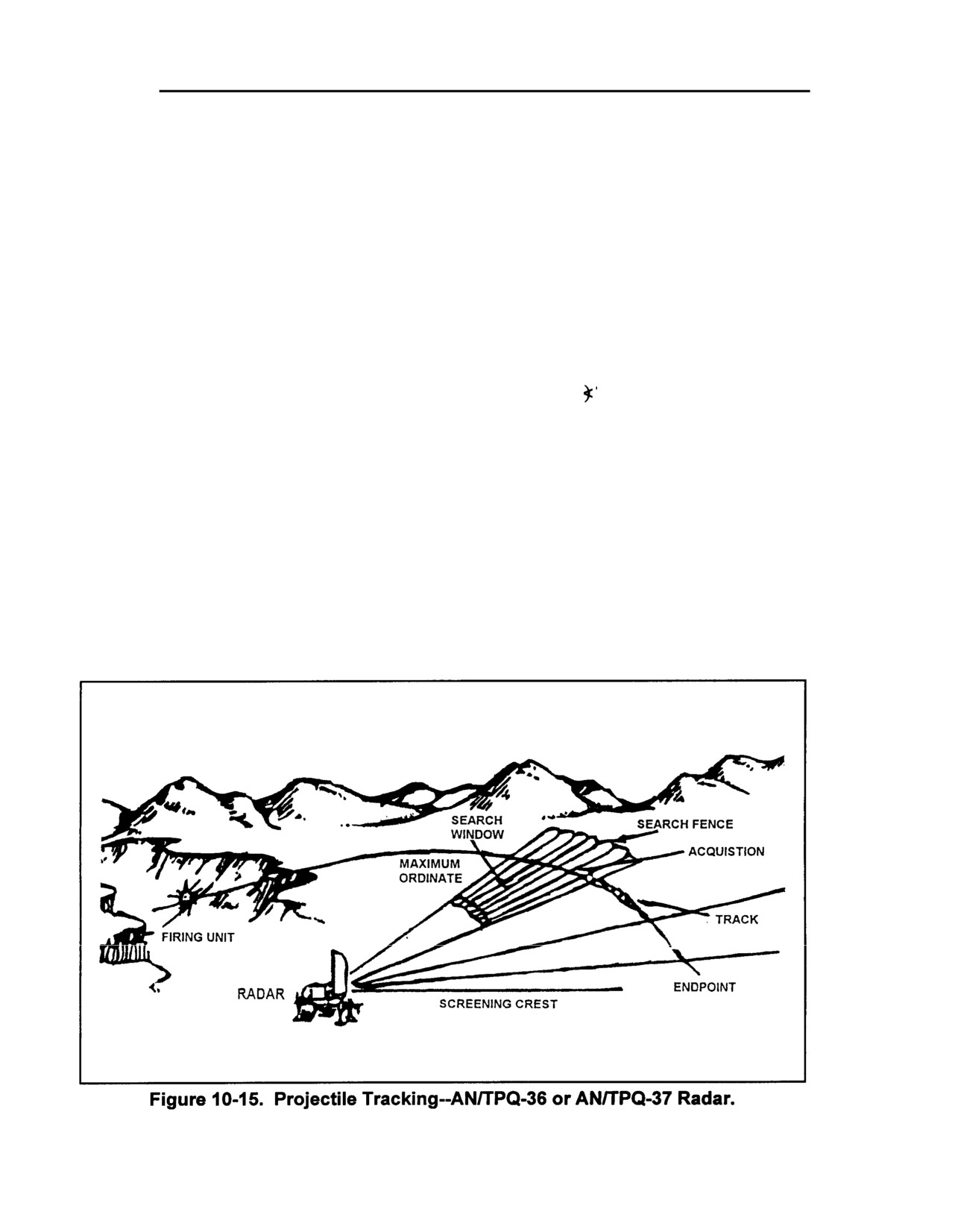
is detected. The Q-36 and Q-37 radar systems set up a “window” through which the projectile
will pass. The window is referred to as the friendly fire search fence (Figure 10-15). The search
fence allows for the best probability of detection. Because of the size of the radar memory queue,
no more than six rounds should be fired without coordination with the radar section. Rounds
should be fired at 30-second intervals with an angle T of less than 1,000 mils.
10-36
FM 6-40
c. MPI Registration. A characteristic of the radar MPI registration is that the rounds
usually cannot be observed at impact because the radar usually is positioned behind masking
terrain with a screening crest. The projectile is tracked until it reaches the datum plane height.
The radar section reports the grid and altitude of the impact location as predicted by the radar.
10-30. Orienting the Radar
a. After selecting the orienting point, the FDO issues his fire order and the FDC
computes orienting data. The registration is initiated by transmitting an MTO. The purpose of
this message is to inform the radar section of the mission and to provide the information required
to prepare the radar.
b. The message to observer must always include the warning order. It is OBSERVE
HIGH-BURST (or MPI) REGISTRATION FOR (unit call sign). This informs the radar
section of the type of registration to be fired and for whom the registration is conducted. Observe
communications security procedures in transmitting information.
c. To orient the AN/TPQ-36 or -37 radar, send the radar the following:
Grid and altitude of the orienting point.
Grid and altitude of the firing unit.
Quadrant elevation.
Maximum ordinate (to the nearest meter) from the appropriate TFT. Entry
argument is quadrant elevation (interpolate). Special if it is meters or feet and
above sea level or above gun.
Time of flight.
Target number.
Angle of fall. (Determined by interpolation from Table G by using quadrant
elevation as the entry argument.) This is optional.
d. Regardless of the radar system used, the message to observer must include the report
order. It is REPORT WHEN READY TO OBSERVE.
10-31. Determination of Firing Data to the Orienting Point
The determination of firing data for a radar registration is the same as that for a regular
HB or MPI registration.
10-32. Firing the HB or MPI Registration
The radar on-board computer uses the orienting data to check the trajectory and determine
whether it fits the capabilities of the radar. Before firing, the radar operator determines whether
the data are acceptable, marginal, or unacceptable. The radar section reports when it is ready to
observe (for example, AT MY COMMAND, REQUEST SPLASH, READY TO OBSERVE,
OVER). Since the radar operator checks the acceptability of the orienting data before firing
begins, all rounds fired should be acquired by radar. If the first round is not visible, an error has
occurred. The radar operator informs the FDC that the round was unobserved. The FDC should
10-37
FM 6-40
verify firing data, If no errors are found and the next round is unobserved, the FDC should
compute new orienting data and send the new data to the radar operator.
10-33. Determination of the Mean Burst Location
The radar operator normally reports the grid location and altitude of each burst. The grids
may be recorded in the observer reading columns of DA Form 4201. The FDO determines which
rounds are usable. Once the FDO determines the usable rounds, he averages the grids and
altitudes of the usable rounds to compute the mean burst location. The grid and altitude are then
recorded in the Location of HB (MPI) block near the bottom of DA Form 4201.
10-34. Determination of Chart Data and Registration Corrections
After determining the MBL and altitude, the procedures for computing chart data and
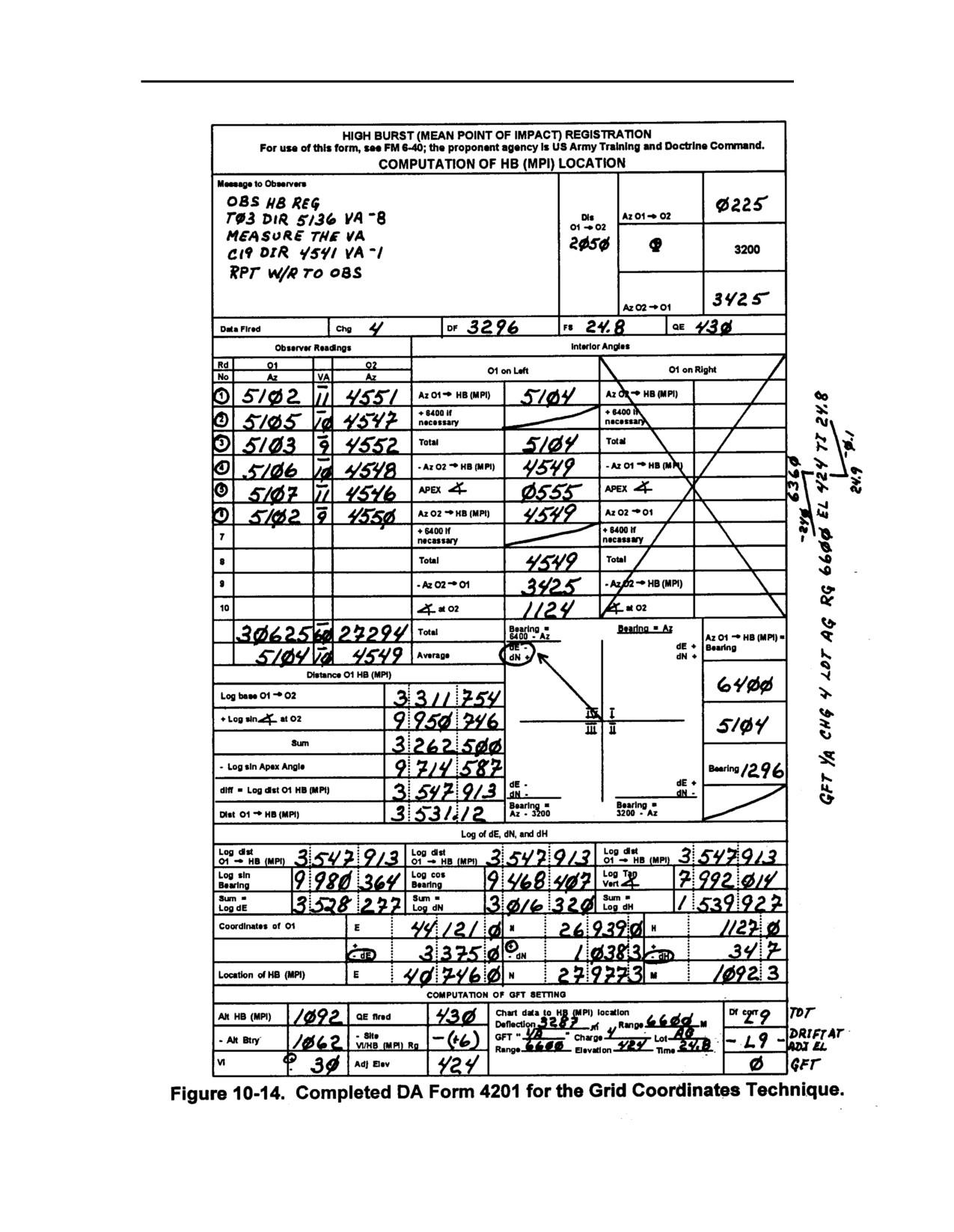
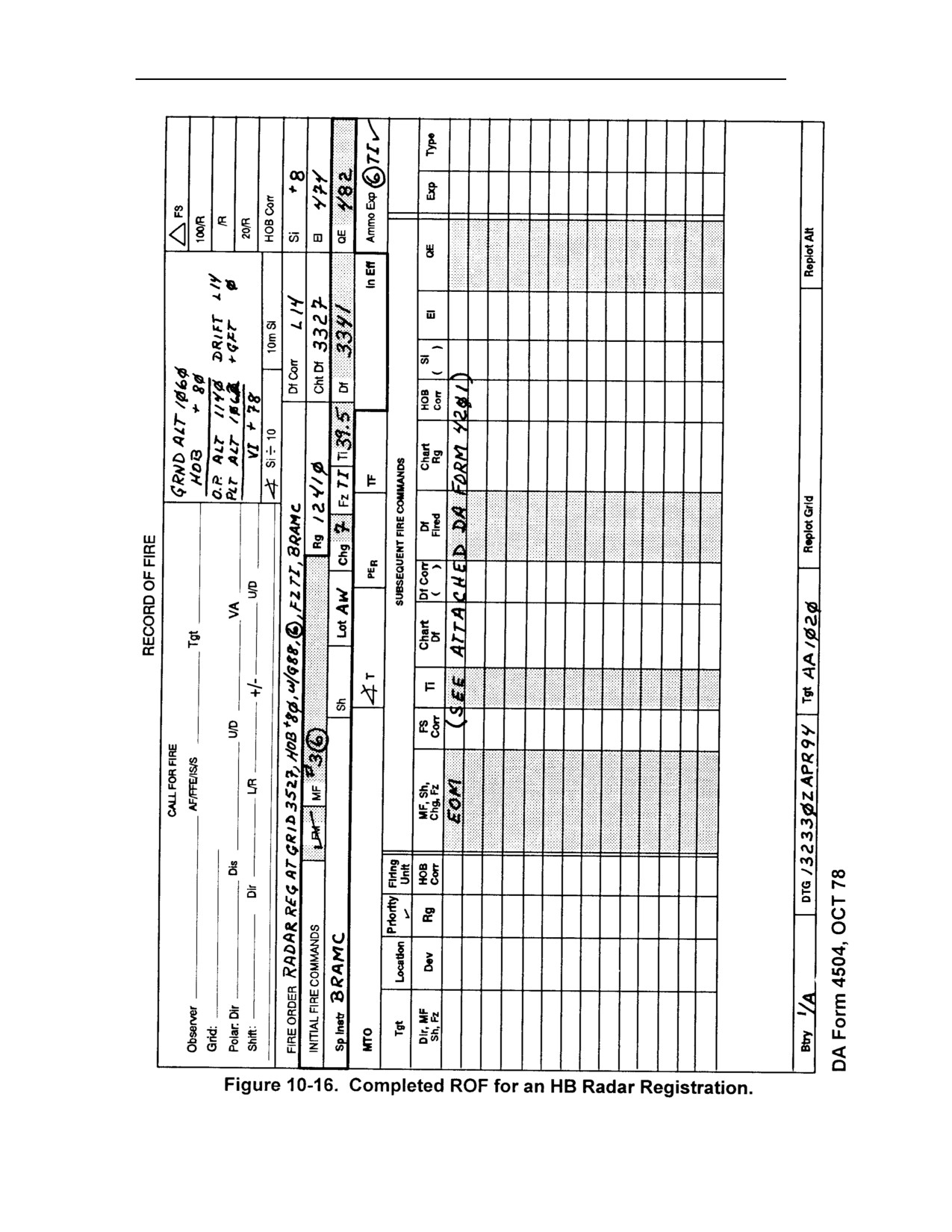
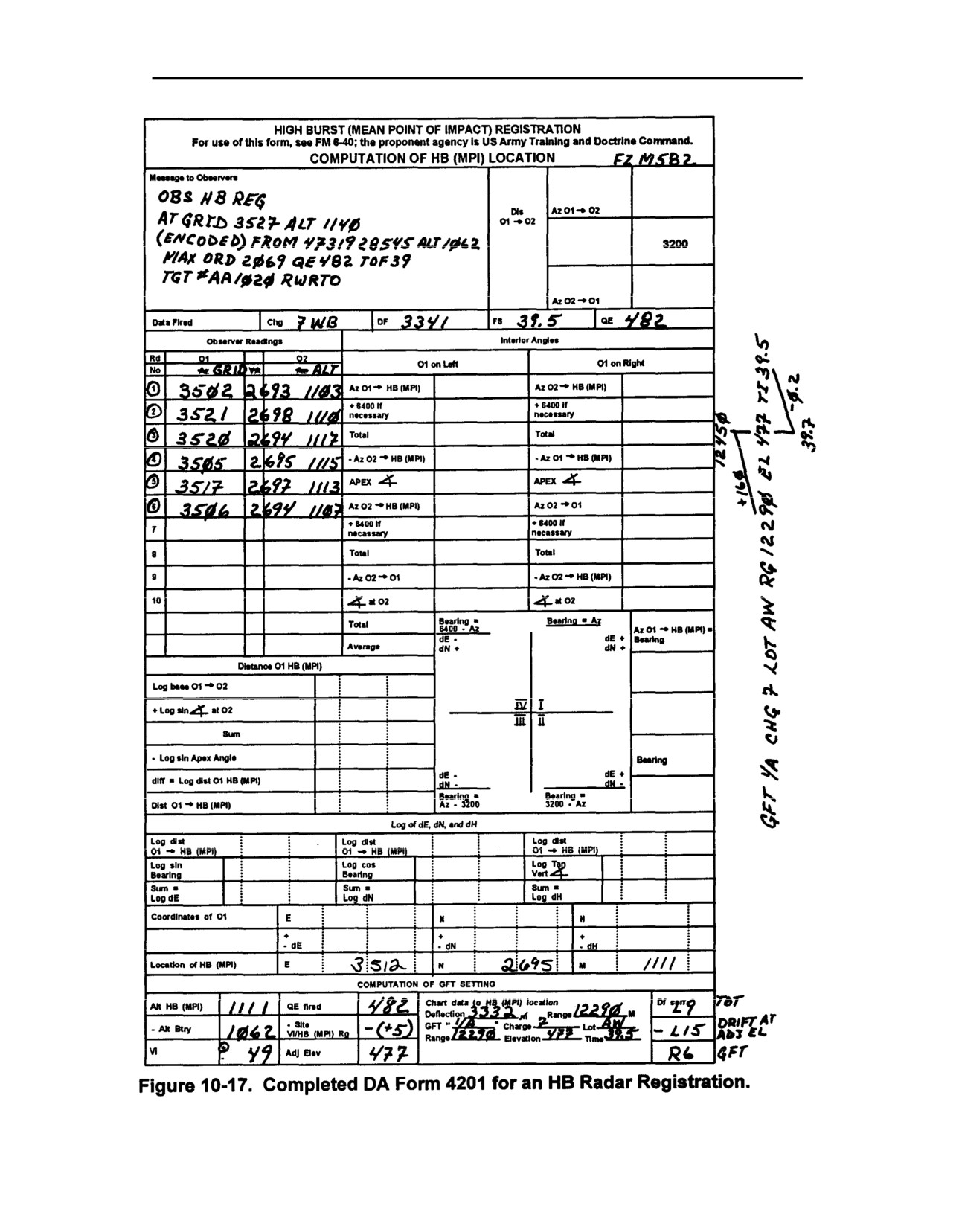
registration corrections are the same as those for regular HB/MPI registrations. Figure 10-16
shows an example of a completed ROF for an HB radar registration. Figure 10-17 shows an
example of a completed DA Form 4201 for an HB radar registration.
10-35. DPICM Registrations (M483A1/M509E1)
a. The DPICM projectile may be fired in the self-registration mode to provide
corrections for other munitions like the area denial artillery munitions (ADAM) or remote
antiarmor mine system (RAAMS). The round can be registered by using either the precision or
the HB/MPI method. Normally, the HB/MPI method would be selected to conserve ammunition.
b. Firing data should be computed by using the most current firing table.
c. If point-detonating action is desired for an impact registration, the M577 fuze must be
set for PD action. An impact registration is not recommended, since no fuze setting correction is
determined.
d. In all cases when the round is used in registrations, it must be prepared for the SR
mode (expelling charge removed and booster attached to fuze). In the SR mode, the entire round
will detonate and destroy the submunitions.
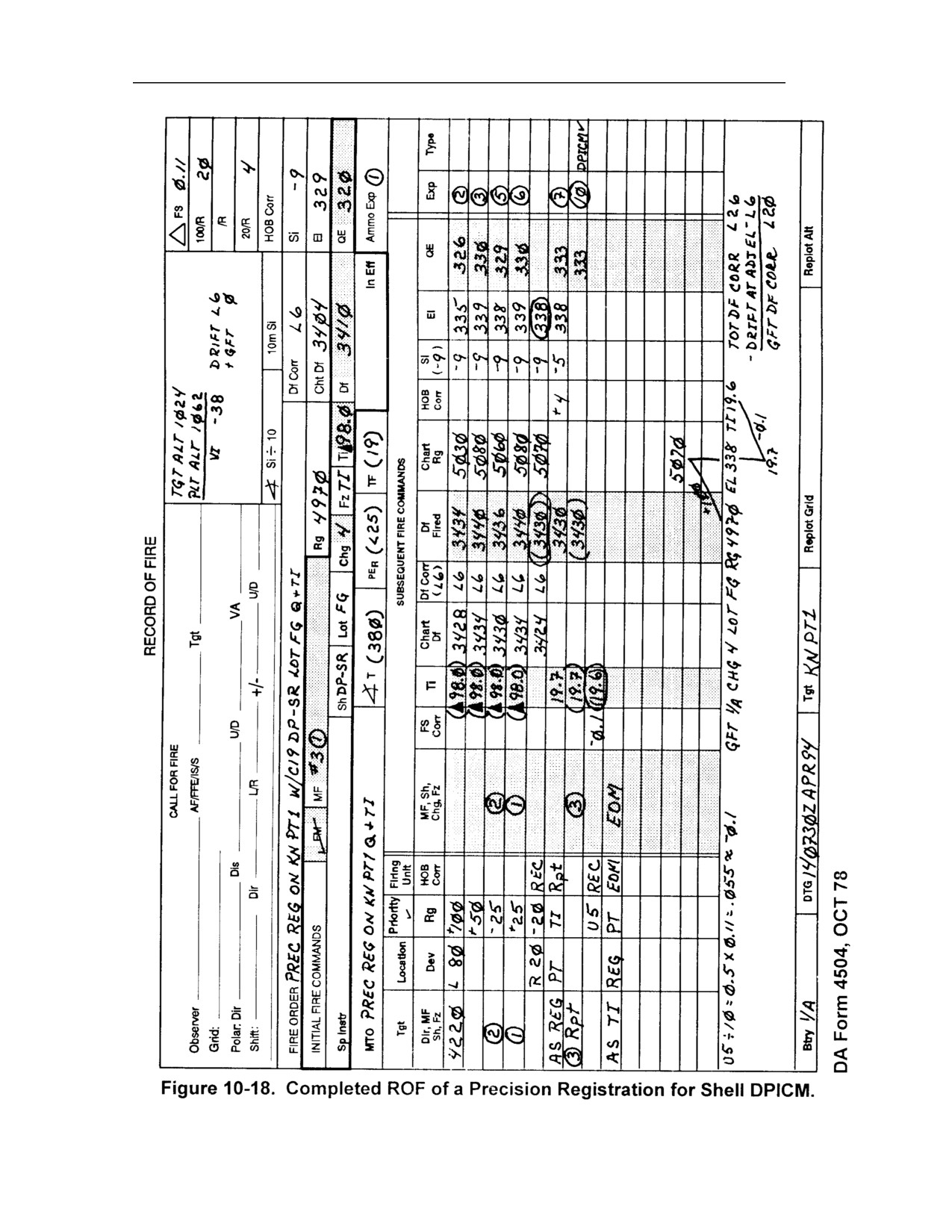
e. The GFT setting is constructed and total corrections are determined as per precision
and HB/MPI instructions. An example ROF for a completed precision registration for shell
DPICM is shown in Figure 10-18. The HOW 155mm 155AN1M483A1 GFT was used for the
registration.
10-38
FM 6-40
10-39
FM 6-40
I
10-40
FM 6-40
10-41
FM 6-40
Section V
High-Angle Registration
On the basis of the tactical considerations, it may become necessary to use
high-angle fire instead of low-angle fire. In this situation, a high-angle impact
registration can be conducted to improve the accuracy of initial rounds. The use
of time fuzes to conduct a time registration is impractical because the height of
burst probable error is so large.
10-36. High-Angle GFT
When conducting a high-angle impact registration, it is common for the range probable
error to be equal to or greater than 25 meters. Since current high-angle GFTs do not have a
probable error in range gauge point, the computer must check Table G of the TFT to determine if
the probable error in range is equal to or greater than 25 meters. A probable error in range gauge
point may be constructed on the high-angle GFT for each charge. The gauge point is constructed
on the TF scale.
10-37. Procedures for High-Angle Impact Registration
Procedures for high-angle impact registrations are the same as low-angle impact
registrations with the following three exceptions:
a. Because of the large CAS in high-angle fire, special procedures must be used to
determine the adjusted elevation.
b. The high-angle GFT setting is applied differently to the high-angle GFT.
c. High-angle transfer limits are different from low-angle transfer limits because ranges
of various charges are smaller.
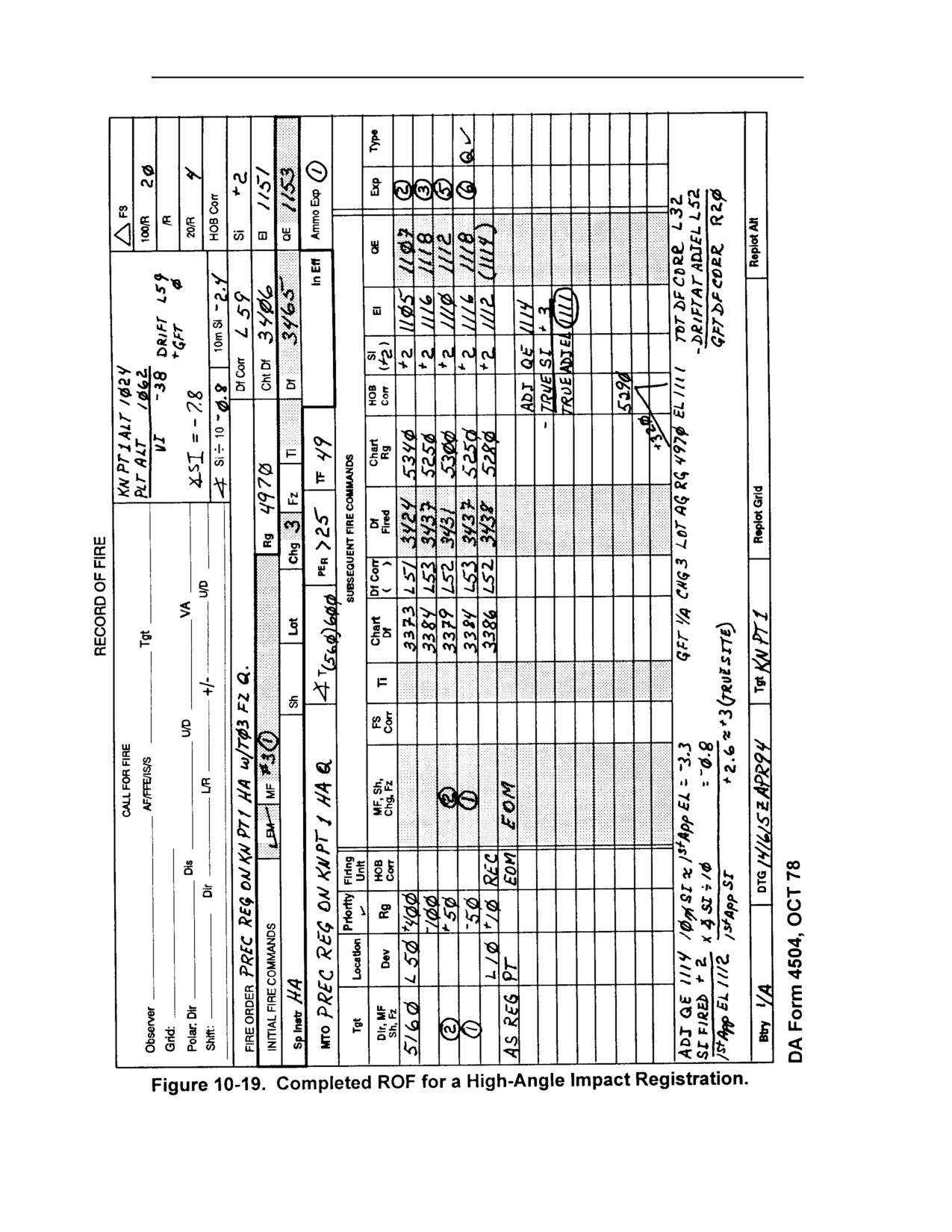
10-38. Computation of the Adjusted Elevation
a. The adjusted elevation, determined from an HA impact registration, often includes a
false site. This false site is caused by the relationship of the CAS to total site. The CAS is a
fiction of elevation. In low-angle fire, small changes in elevation will cause small changes in
CAS. On the other hand, in high-angle fire, small changes in elevation will cause large changes
in CAS. In a high-angle registration, the CAS determined at the initial elevation and applied
throughout the mission will often differ substantially from the CAS corresponding to the adjusted
elevation. This false CAS, when added to the angle of site, will produce a false site. To provide
accurate data, the FDC must determine the true site and subtract it from the adjusted QE to
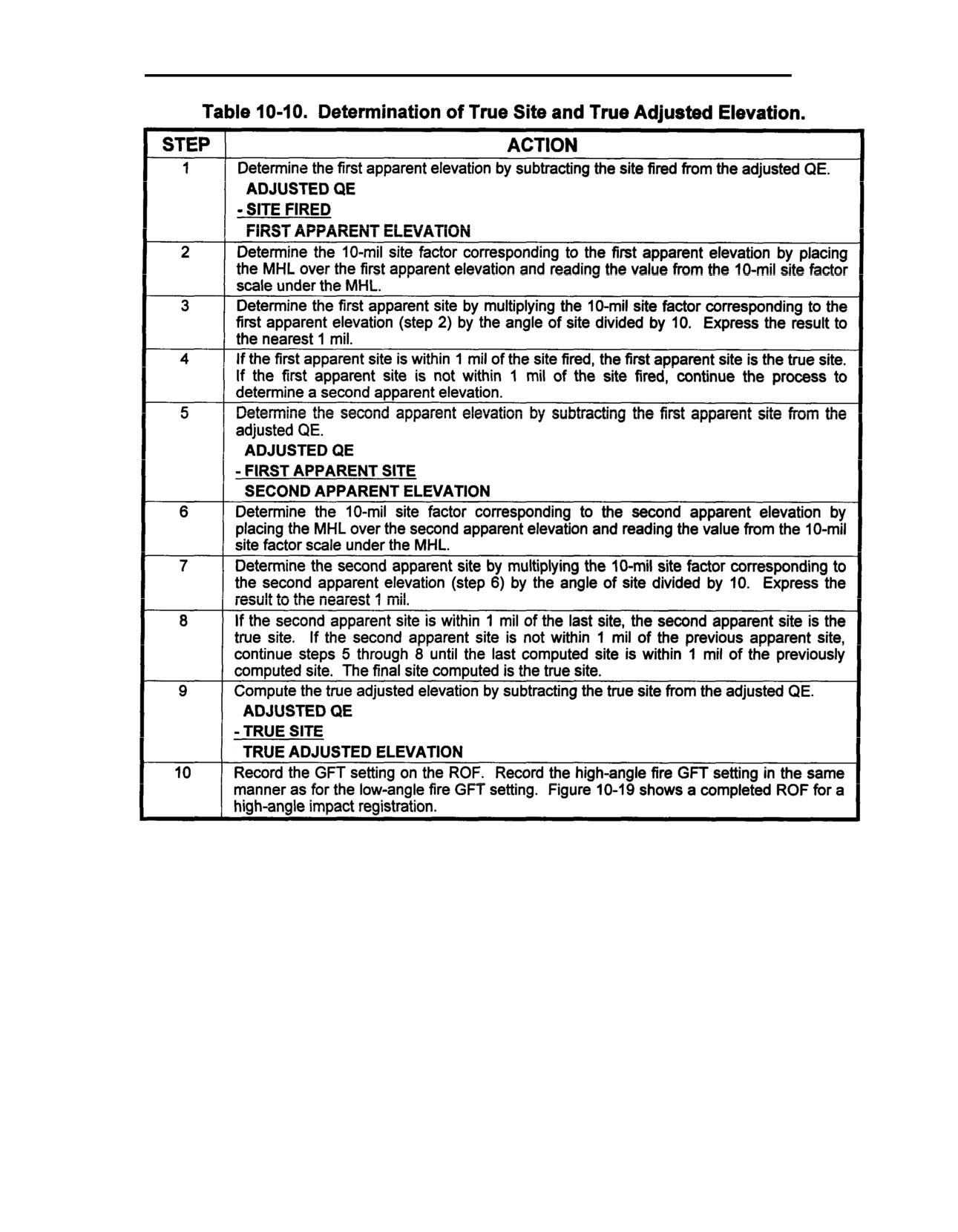
compute the true adjusted elevation. To determine the true site, successive approximation is
used.
b. The steps in Table 10-10 are used to determine the true site and true adjusted
elevation.
10-42
FM 6-40
10-43
FM 6-40
10-44
FM 640
10-39. DPICM High-Angle Registration
a. Conduct a registration with DPICM (M483A1) in the self-registration mode. This
destroys the submunitions and causes the round to detonate like an HE round.
b. If terrain in the target and/or firing unit area requires using high-angle fire, a
high-angle high-burst registration using the M577 time fuze can be conducted. (The M577 has a
small probable error in height of burst in relation to the M564/M565 time fuze family. This type
of registration is conducted with the DPICM projectile in the SR mode. The procedures are the
same as for those in low-angle HB registration with the following exceptions:
(1) Add a minimum of 4 PE
(DPICM TFT, Table G, Column 5) to the altitude of
HB
the orienting point.
(2) The fuze setting to fire in an HB high-angle registration is the fuze setting
corresponding to elevation plus CAS. The CAS in high-angle fire is usually a relatively large
negative number. To determine CAS, enter Table G of the TFT with the range to the nearest 500
meters and extract from Column 12 or 13 the CSF for a 1-mil angle of site. Multiply the angle of
site by the CSF to determine CAS. Apply the CAS to the elevation determined from the
high-angle GFT. Move the MHL over the value of elevation plus CAS, and read from the TF
scale to the nearest 0.1 fuze setting increment.
(3) Determine drift and elevation from the high-angle GFT.
(4) Determine site by multiplying the 10-mil site factor corresponding to the
adjusted elevation by the angle of site divided by 10.
c. Determine the adjusted elevation for a high-angle HB registration in the same manner
as for a low-angle HB registration. Site is based on the altitude of the mean burst location.
d. Determine the adjusted time in the same manner as in a low-angle HB registration.
To determine the total fuze correction, subtract the time corresponding to elevation plus CAS
from the adjusted time. When firing with a GFT setting, apply the total fuze correction to the
fuze setting corresponding to the adjusted elevation to determine the fuze setting to fire.
Section VI
Offset Registrations or Registrations to the Rear
The tactical situation may make registering from the unit location or along
the primary azimuth of fire impractical. The offset registration or registration to
the rear should reduce the vulnerability of the firing unit to detection by enemy
counterbattery assets. Both of these registrations may require coordination for
firingpositions or known points. The registrations are conducted by using normal
precision or HB/MPI registration procedures.
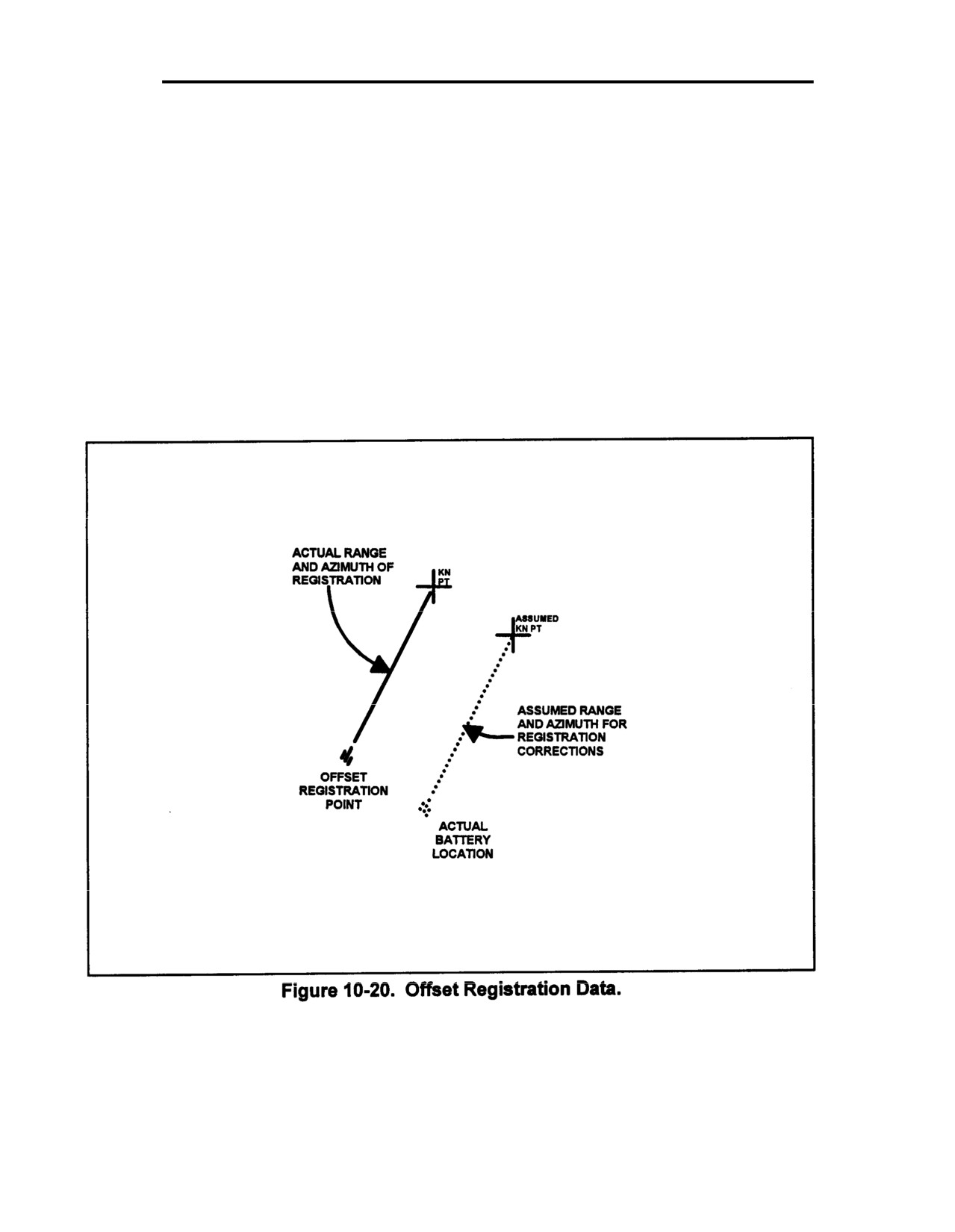
10-40. Offset Registration
a. An offset registration is conducted by one howitzer from a position away from the
rest of the unit. The offset position must be coordinated to ensure there are no other friendly
units in the area as the registration may draw enemy counterbattery fire. The offset position must
be on common survey with the firing unit to ensure that any corrections for survey errors in the
offset position are valid in the firing unit position.
10-45
FM 6-40
b. Adjusted data and resulting corrections determined from the offset position are valid
for that position within normal range and deflection transfer limits.
c. The registration corrections are based on the azimuth and range from the offset
position to the known point. It is assumed that if a registration were conducted from the firing
unit area by using the same range and azimuth (as from the offset position), the adjusted data and
resulting corrections would be the same as those obtained in the offset position. (See Figure
10-20).
10-41. Registrations to the Rear
A registration to the rear (or along some other azimuth significantly different from the
primary azimuth of fire) may be either a precision or an HB/MPI registration. The registration
will result in corrections, but these corrections must be modified for the primary zone of fire by
using the eight-direction- met technique (Chapter 11). The actual area where the rounds will be
bursting must be coordinated to ensure there are no friendly units in the area.
10-46
FM 6-40
Section VII
Determination and Application of Registration Corrections
Registration corrections consist of a total range, total fuze, and total
deflection correction. FDC personnel compute these corrections by comparing
the chart or should hit data (the data that when fired under standard conditions
will cause the round to burst at a point of known location) with the adjusted or did
hit data (the data that when fired under nonstandard conditions will cause the
round to burst at a point of known location).
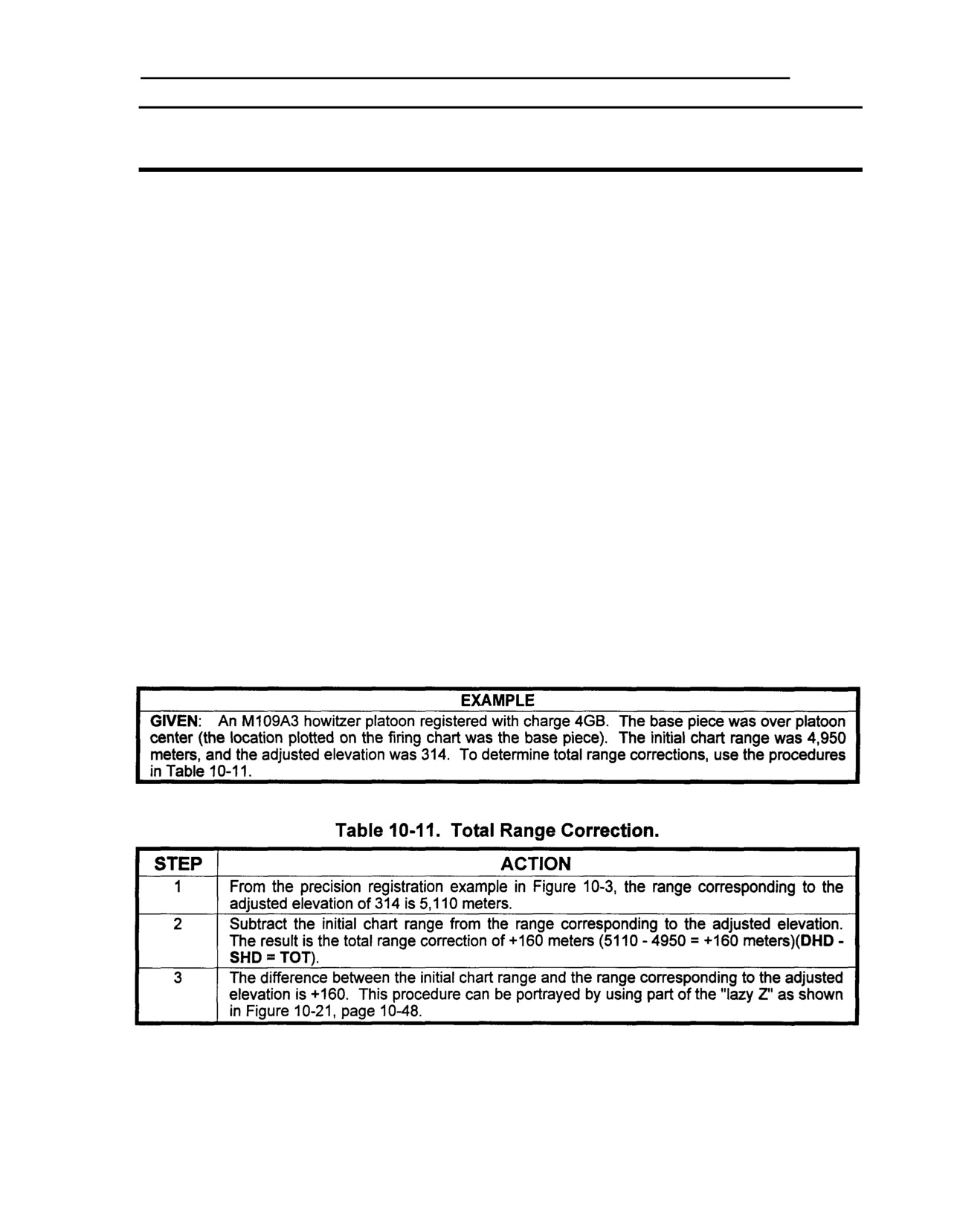
10-42. Computation of Total Range Correction
a. If standard conditions existed, the elevation fired to achieve the chart range would be
the elevation listed in the firing tables for that chart range, When nonstandard conditions exist
the range that is achieved by firing a certain elevation is greater or less than the range listed in the
firing tables by an amount equal to all of the effects caused by the nonstandard conditions. The
difference is the total range correction.
b. The total range correction is the difference in meters between the initial chart range
and the firing table range corresponding to the adjusted elevation. Determine the total range
correction as follows:
(1) From the TFT or GFT, determine the range (to the nearest 10 meters)
corresponding to the adjusted elevation.
(2) Subtract the initial chart range (or achieved range) from the range corresponding
to the adjusted elevation. The result is the total range correction. The total range correction is
10-47
FM 6-40
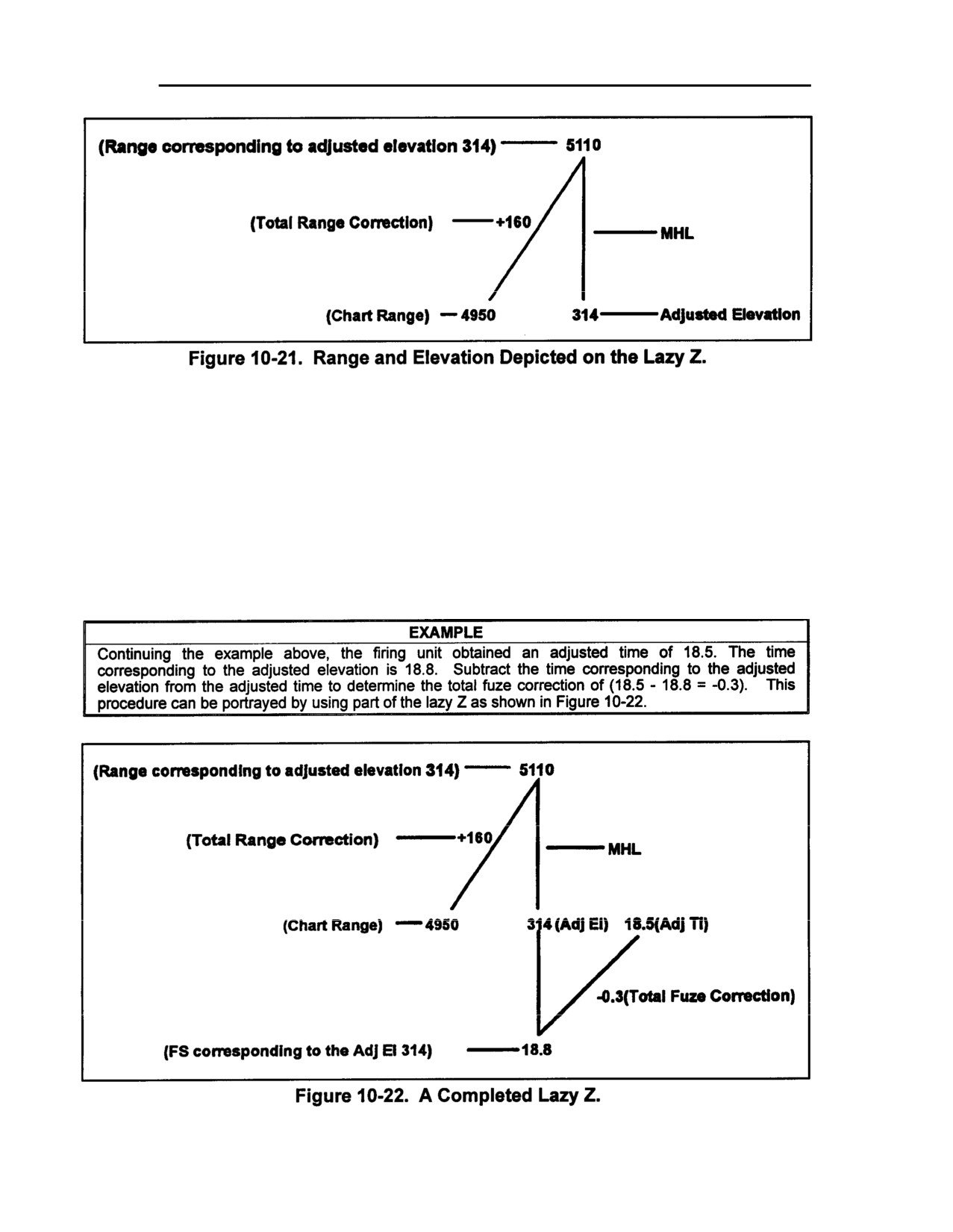
10-43. Computation of Total Fuze Correction
a. The time portion of a precision or high-burst registration will result in an adjusted or
did hit time (fuze setting). The time corresponding to the adjusted elevation is the should hit time
that must be compared to the actual adjusted time determined by firing. The difference between
the time corresponding to the adjusted elevation and the adjusted time is the total fuze correction
(DHD - SHD = TOT).
b. To determine the total fuze correction, subtract the time corresponding to the adjusted
elevation (or elevation plus CAS if the VI is greater than 100) from the adjusted time. The total
fuze correction is always a signed value and is used in solving a concurrent met. See the
following example.
10-48
FM 6-40
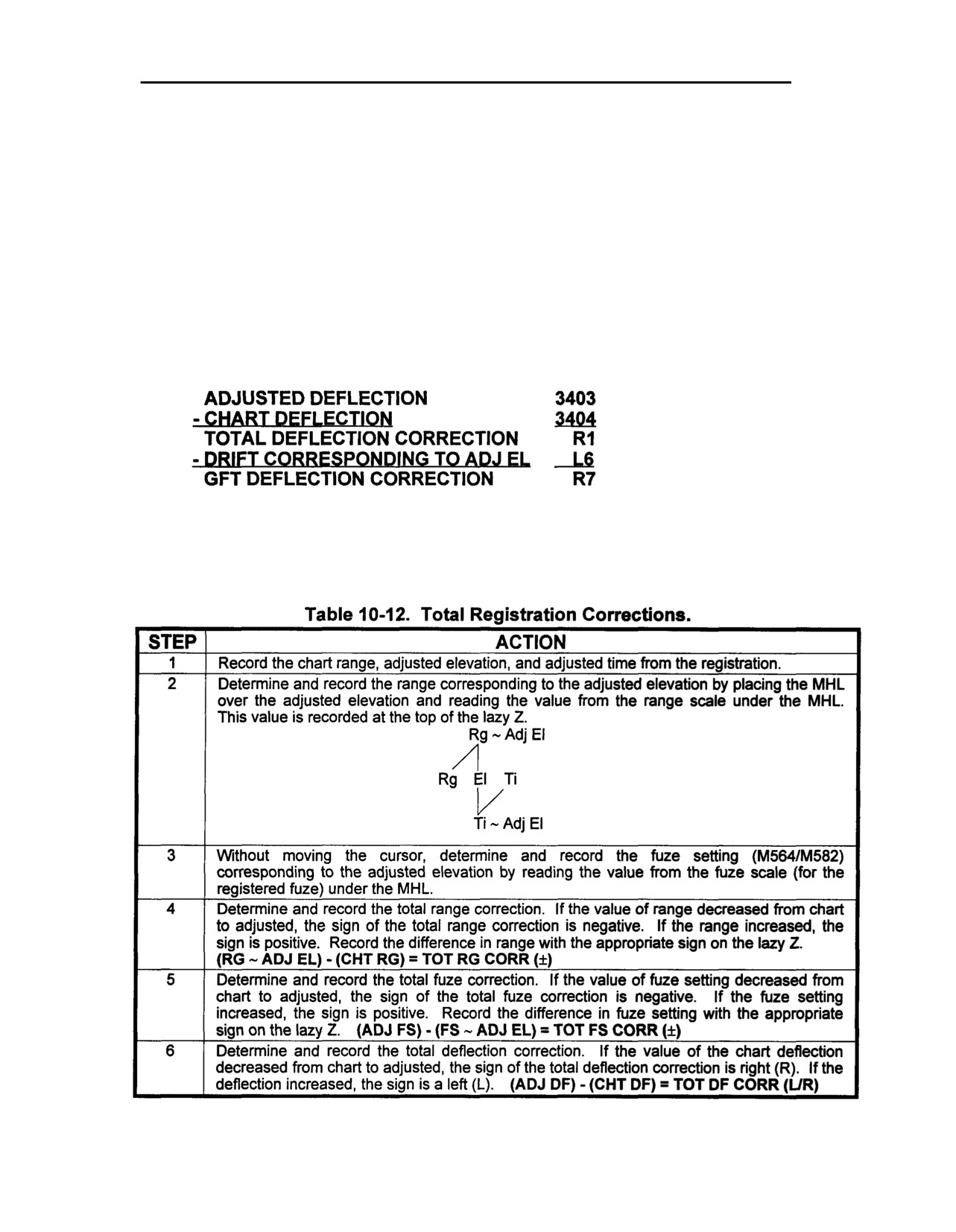
10-44. Computation of Total Deflection Correction
a. The total deflection correction is the correction, in mils, that must be added to the
chart deflection to correct for all nonstandard conditions.
b. To determine the total deflection correction, subtract the chart deflection from the adjusted
deflection. The total deflection correction is used in solving the concurrent met technique, in
processing immediate type fire missions, and for updating manual safety computations after a
registration. For all other missions, the GFT DF correction plus drift is used.
c. A GFT deflection correction is determined by subtracting the drift corresponding to the
adjusted elevation from the total deflection correction. The GFT deflection correction remains the
same for all elevations fired with the registered charge. The drift is applied to the GFT deflection
correction to determine the deflection correction to be used for that mission. Using the precision
registration example in Figure 10-3, determine the total deflection correction as follows:
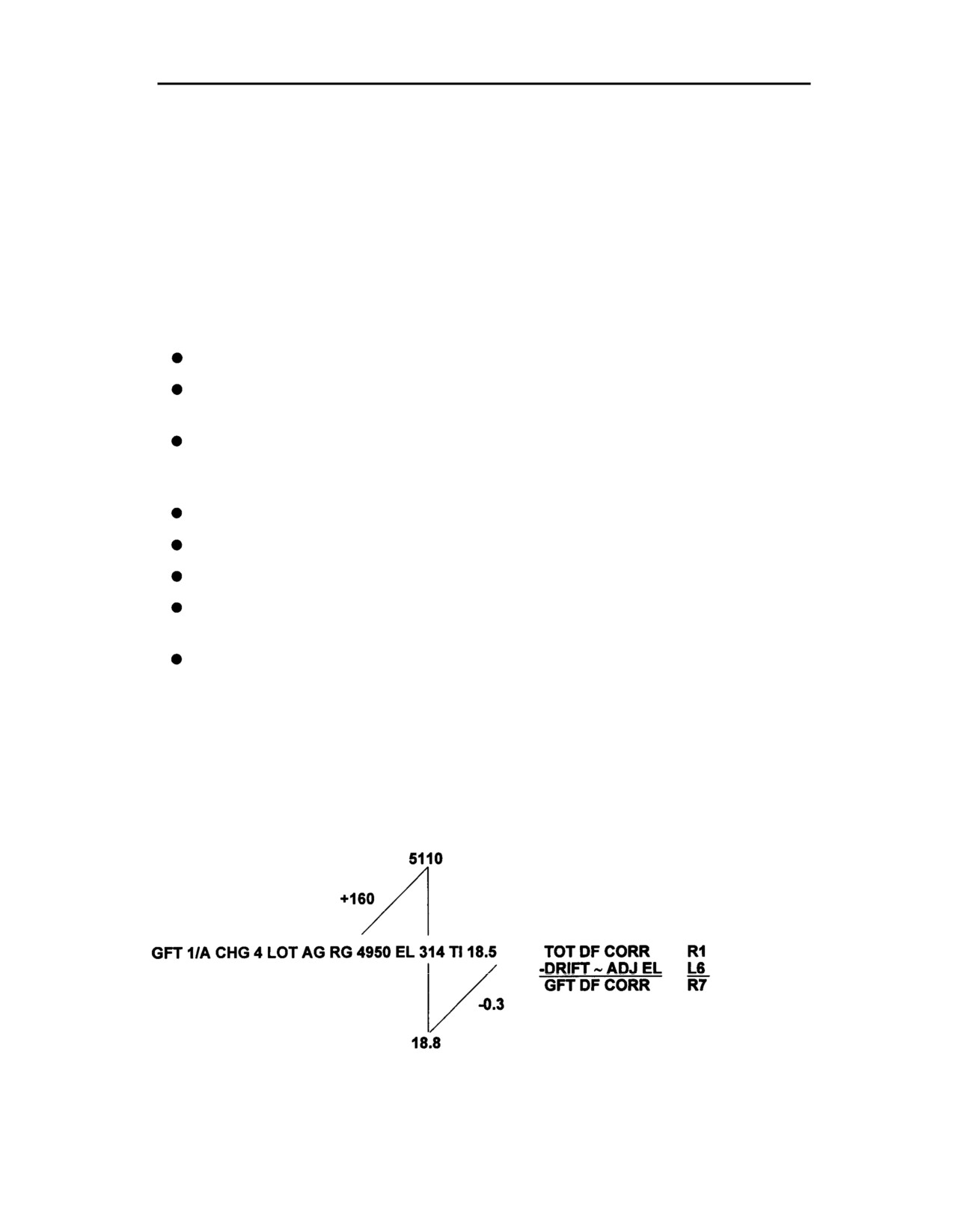
10-45. Determination of Total Registration Corrections
The computational space on DA Form 4757-R (Registration/Special Corrections Work
Sheet) will be used to determine the total corrections. Use Table 10-12 to determine total
registration corrections,
10-49
FM 6-40
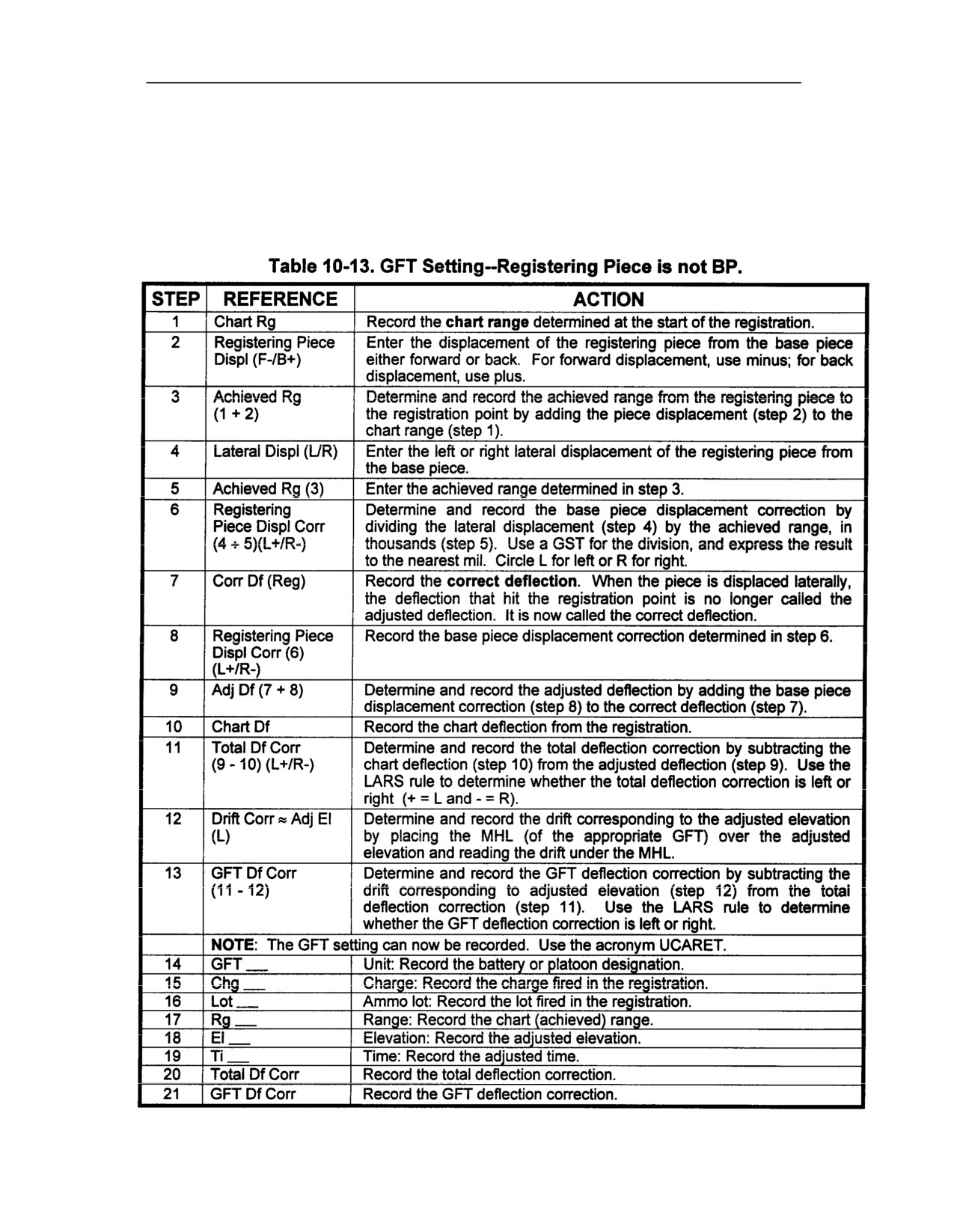
10-46. Low-Angle GFT Settings
a. The data determined from a registration must be applied to FDC graphical equipment.
This will enable the unit to attack accurately located targets without adjustment (first round fire
for effect) within transfer limits.
b. Listed below are the elements of a GFT setting. These elements are recorded in the
lower computational space of the record of fire used to process the registration. Additionally,
they may also be recorded on DA Form 4757-R and on the record of fire of a mission in which
they are being used. For the HB/MPI registration, the GFT setting is recorded on DA Form
4201. The acronym UCARET is used as an aid in recording the GFT setting. It is used to keep
the GFT setting preceding the total and GFT deflection corrections in order.
Unit that fired the registration.
Charge fired during the registration and the charge for which the GFT setting
applies.
Ammunition lot used in the registration. With separate-loading ammunition, the
first letter designates the projectile lot used during the registration. The second
letter designates the propellant lot used during the registration.
Range (chart or achieved) from the howitzer to the point of known location.
Elevation (adjusted or did hit).
Time (adjusted or did hit fuze setting).
Total deflection correction (the difference between the adjusted deflection and the
chart deflection).
GFT deflection correction (the difference between the total deflection correction
and the drift corresponding to the adjusted elevation).
c. The following is an example of a completed GFT setting as it is written.
GFT 1/A CHG 4 LOT AG RG 4950 EL 314 TI 18.5
TOT DF CORR R1 GFT DF CORR R7
d. The following is an example of a completed GFT setting as it is written with total
corrections.
10-50
FM 6-40
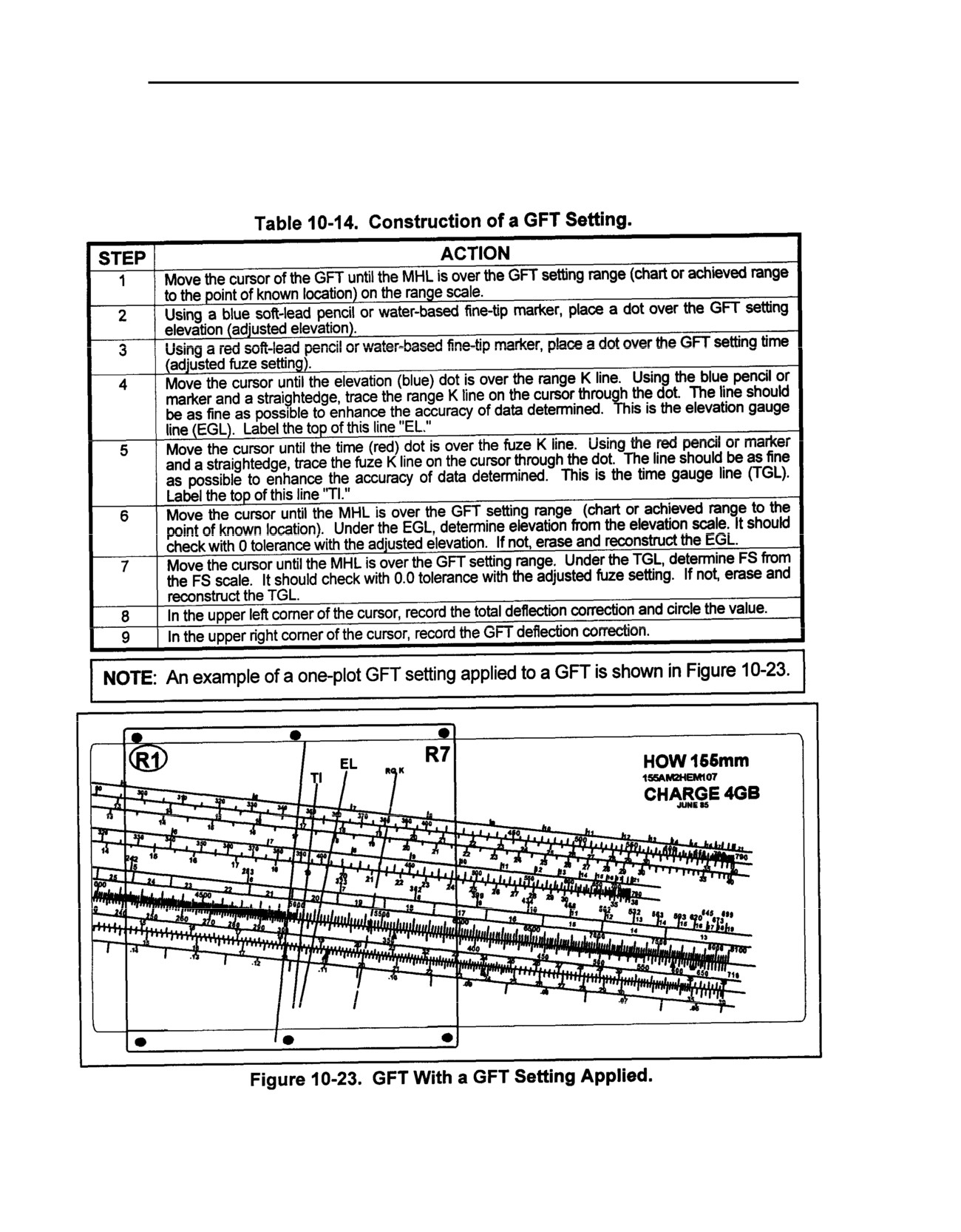
10-47. Determination of a GFT Setting When the
Registering Piece is not the Base Piece
It may not always be possible to register with the base piece. When a howitzer other than
the base piece is used to register, corrections must be made to compensate for the displacement of
the registering piece from the base piece. Use a DA Form 4757-R and the steps in Table 10-13 to
determine the necessary corrections.
10-51
FM 6-40
10-48. Construction of a GFT Setting
Once the information for the GFT setting has been determined and recorded on DA Form
4757-R, the GFT setting can be constructed on the GFT. Use the steps in Table 10-14 to
construct a GFT setting on the GFT.
10-52
FM 6-40
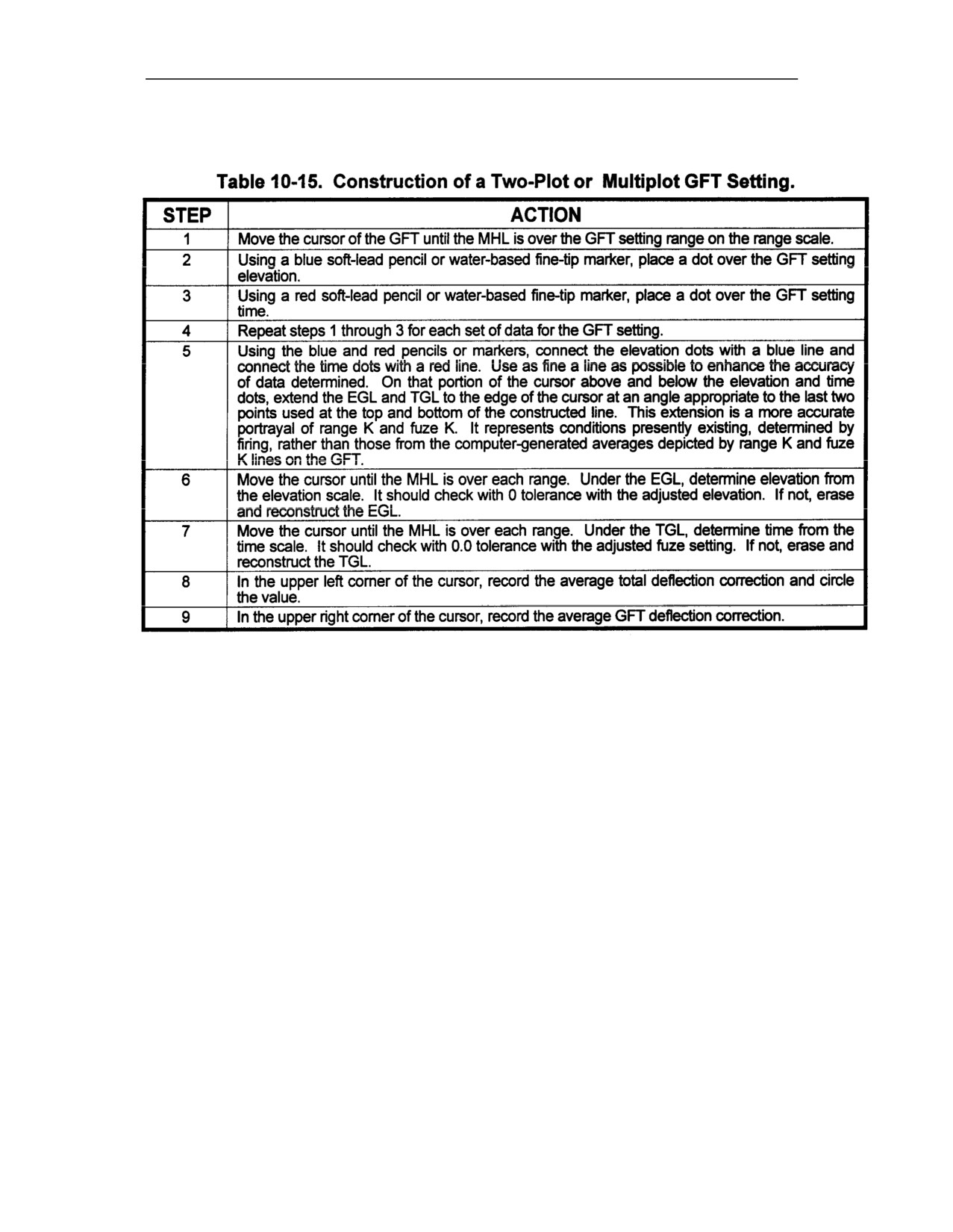
10-49. Construction of a Two-Plot or Multiplot GFT Setting
The steps in Table 10-15 are used to construct a two-plot or multiplot GFT setting.
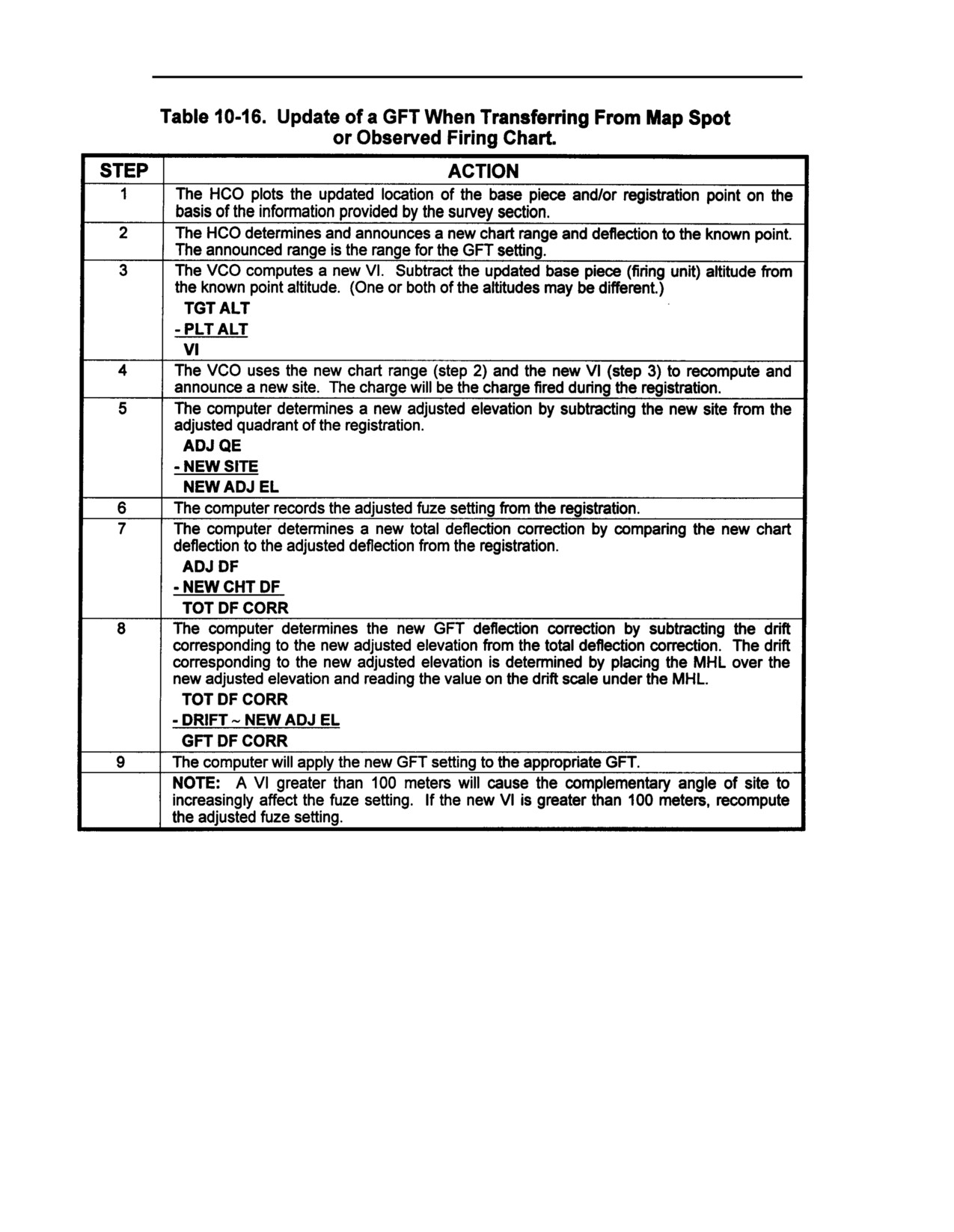
10-50. Update of a GFT Setting When Transferring
From a Map Spot or Observed Firing Chart
a. Field artillery units must be able to deliver responsive, accurate fires immediately
upon occupation of a new position. Firing must not be delayed because of lack of survey or
suitable maps. An initial firing chart may be based on a map spot or an observed firing chart.
Once the actual survey is brought into the unit’s area, the firing charts must be reconstructed on
the basis of the firing unit’s true location and true azimuth. GFT settings based on map spot or
observed fire charts are accurate but must be updated.
b. When a registration is conducted on the basis of the map spot data for the registration
point and/or firing unit location, the corrections determined will include corrections for map spot
errors and possible human errors in plotting the locations. Once survey data are available, the
GFT setting(s) determined must be updated to account for the initial inaccuracies.
c. Once survey data become available, the HCO will construct and plot the locations on
a surveyed firing chart. He will determine a new chart range and deflection to the known point.
The new chart range will be the range for the GFT setting. The VCO will use the new chart
range and an updated VI to recompute site. The computer will recompute the adjusted elevation
and new total and GFT deflection corrections. The adjusted fuze setting was determined by
firing and will not change. Use Table 10-16 to update a GFT setting when transferring from a
map spot or observed firing chart to a surveyed firing chart.
10-53
FM 6-40
10-51. Registration Transfer Limits
a. In manual gunnery techniques, the total corrections determined from a registration are
valid only within certain range and deflection transfer limits. Transfer limits define the ranges
and deflections within which the GFT setting is expected to produce accurate firing data. The
total corrections for nonstandard conditions are valid only when the weapons are firing toward
the known point. For example, when weapons are firing on a different azimuth than that of the
known point, the wind will not affect the round in the same manner as it did along the azimuth to
the known point.
10-54
FM 6-40
b. Range Transfer Limits.
(1) The range transfer limits for a one-plot GFT setting are shown on the GFT
corresponding to the red numbered elevations.
(2) The range transfer limits for a two-plot GFT setting are between the two ranges
used to apply the GFT setting(s). This type of GFT setting becomes less accurate outside these
two ranges.
(3) The range transfer limits for a multiplot GFT setting are eliminated when three
or more sets of corrections are available for the same charge. The optimum multiplot GFT
setting reflects a plot for each met line number that the charge may cause the projectile to pass
through (met check gauge points).
c. Deflection Transfer Limits.
(1) The total registration corrections are valid only within certain deflection transfer
limits.
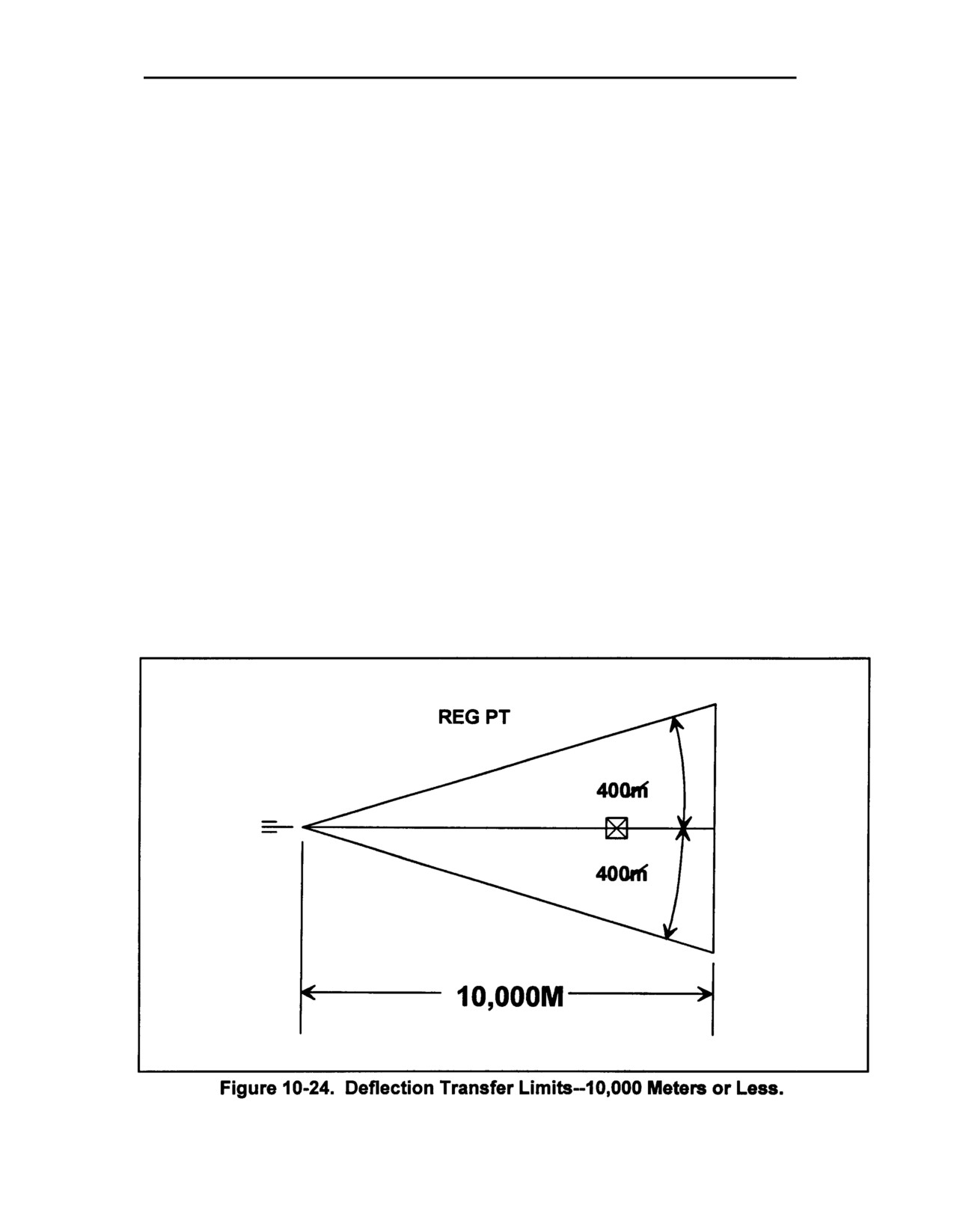
(2) When the chart range to a target is 10,000 meters or less, the total corrections
are valid within an area 400 mils left and 400 mils right of a line between the unit and the known
point (mean burst location) (Figure 10-24).
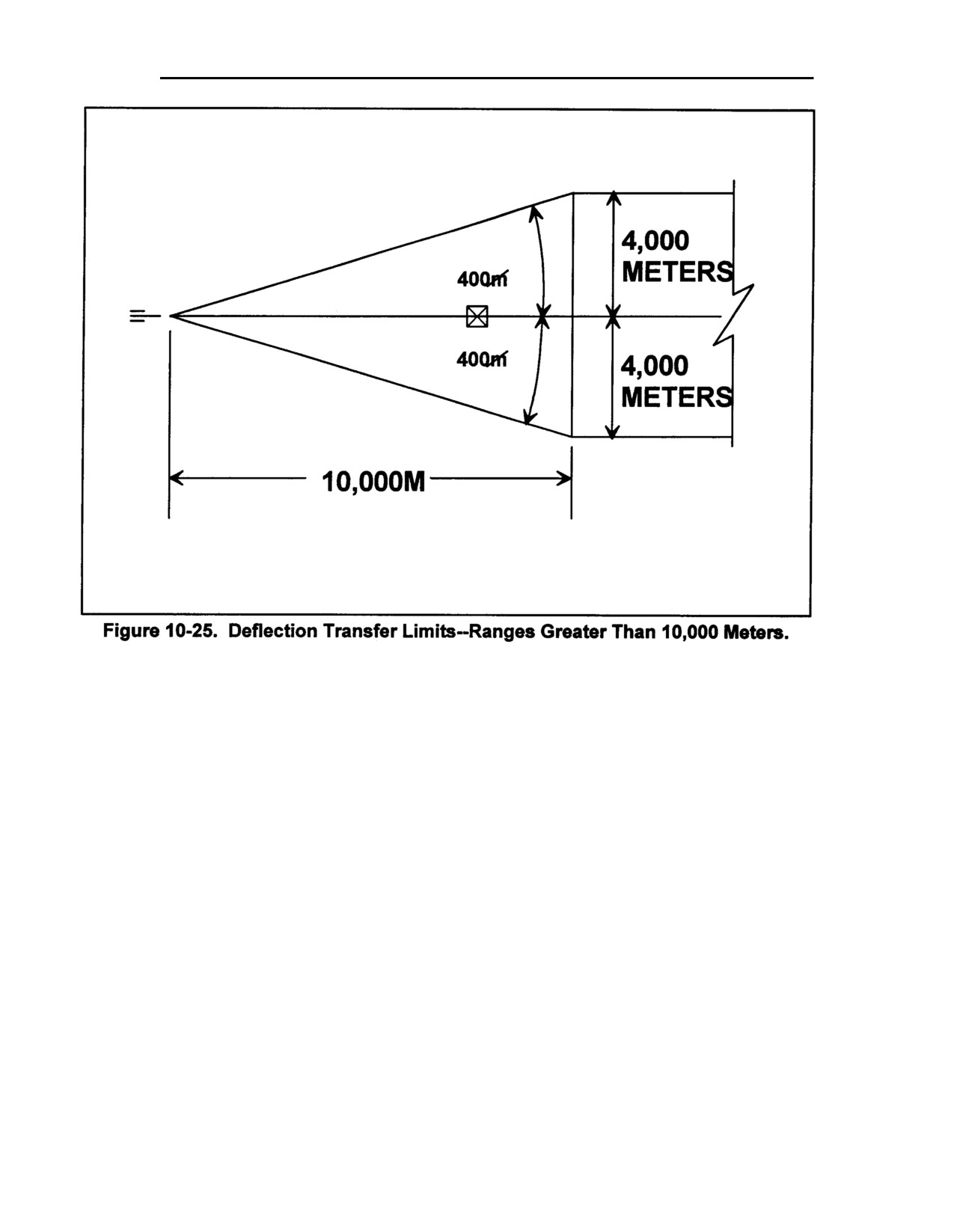
(3) When the chart range to a target is less than 10,000 meters, the total corrections
are valid within an area 400 mils left and 400 mils right of a line between the unit and the known
point (mean burst location) out to 10,000 meters, and 4,000 meters left and 4,000 meters right of
the line for ranges beyond 10,000 meters. (See Figure 10-25.)
(4) Total registration corrections may be determined throughout the entire 6,400
mils around the firing unit by using the eight-direction met technique (Chapter 11).
10-55
FM 6-40
10-52. High-Angie GFT Settings
a. GFT settings for high-angle fire are written in the same manner as those for low-angle
fire. An example is shown below.
GFT 1/A, Chg 3, Lot AG, Rg 4970, EI 1111
Tot Df Corr L32 GFT Df Corr R20
b. The high-angle GFT setting is constructed on the GFT by placing the MHL over the
adjusted elevation for the charge fired and drawing a range gauge line through the GFT setting
range on the range scale parallel to the MHL. The MHL becomes the elevation gauge line, and
all data except for range and 100/R are read under the MHL. The GFT deflection correction and
charge are recorded on the cursor.
10-53. High-Angle Transfer Limits
Standard range transfer limits are not applicable to high-angle fire because the range
span of each charge is so short. Corrections in the form of GFT settings and GFT deflection
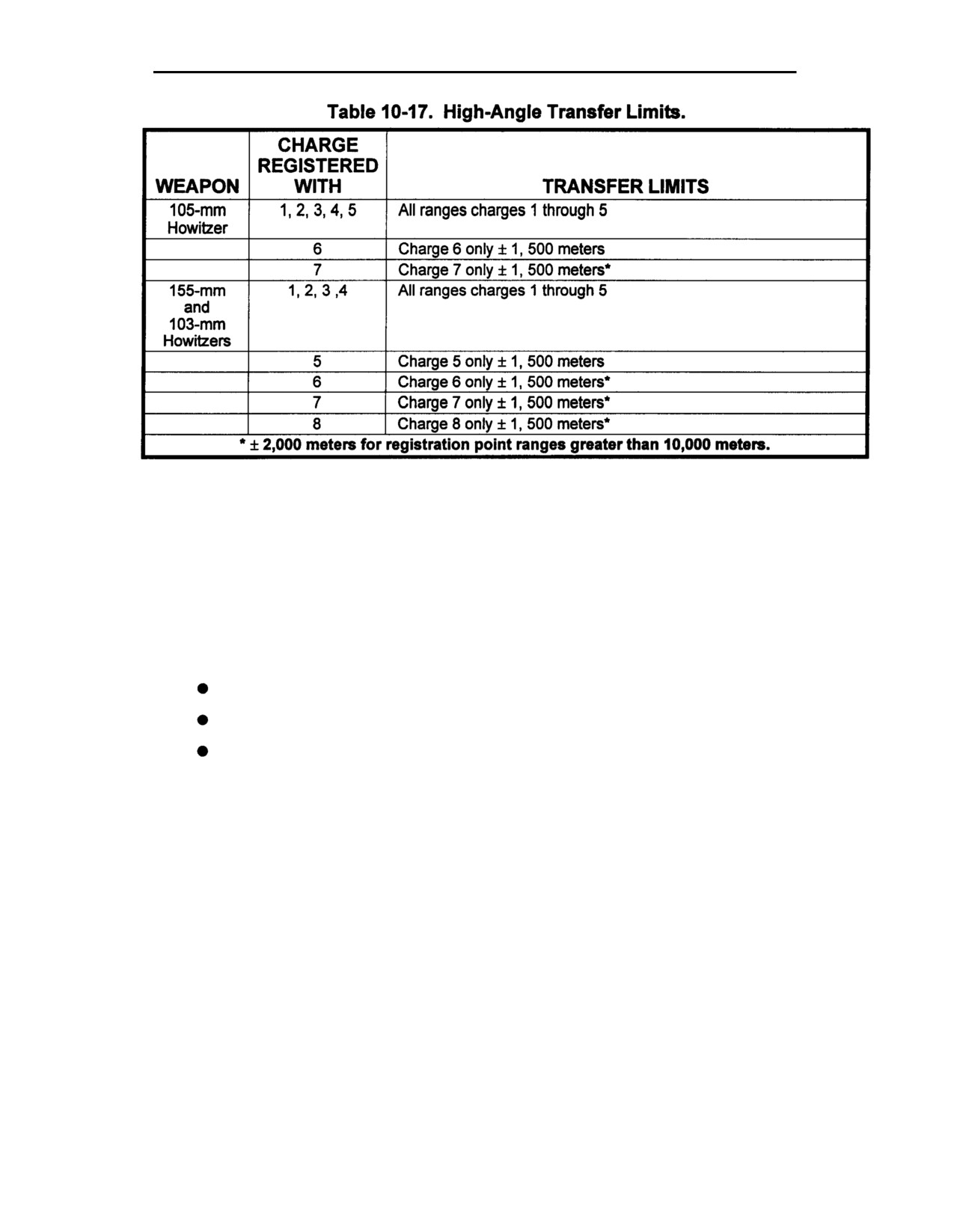
corrections are considered valid for the charge used in determining the corrections and are also
considered valid for other charges as shown in Table 10-17.
10-56
FM 6-40
10-54. Transfer of GFT Settings
a. When only one unit of a battalion equipped with weapons for which the same firing
tables are used is allowed to register, the GFT setting determined by the registering unit maybe
transferred to the nonregistering units in the absence of better information.
b. Transferring of GFT settings should only occur if a concurrent met technique cannot
be performed and position constants cannot be isolated (Chapter 11). To transfer a GFT setting,
certain conditions must exist as follows:
Common survey between positions.
Azimuth of fire (octant) are the same.
Ability to correct for MVVs for the registered lot.
c. The distance over which the GFT settings are transferred should be monitored
closely. The further from the registration point the GFT setting is transferred, the less accurate
the GFT setting will be. This is due to the different effects of the met (weather) conditions. The
guidance given in chapter 11 on the validity of met messages should be used when transferring
GFT settings.
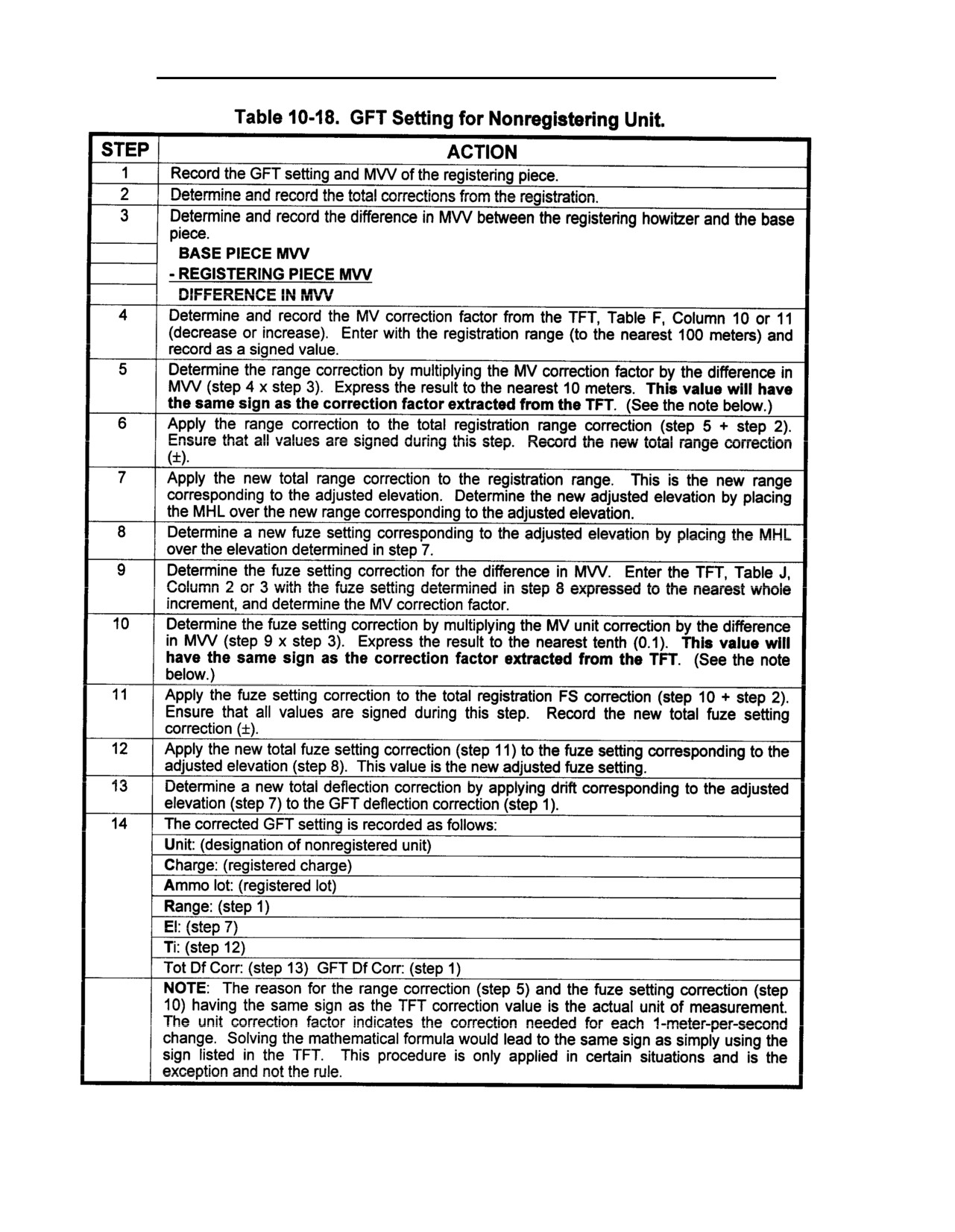
d. The procedures for determining a GFT
setting for a nonregistering unit is listed in
Table 10-18 below. The registering unit must send
the GFT setting and registering piece MVV
to the nonregistering unit.
10-57
FM 6-40
10-58
FM 6-40
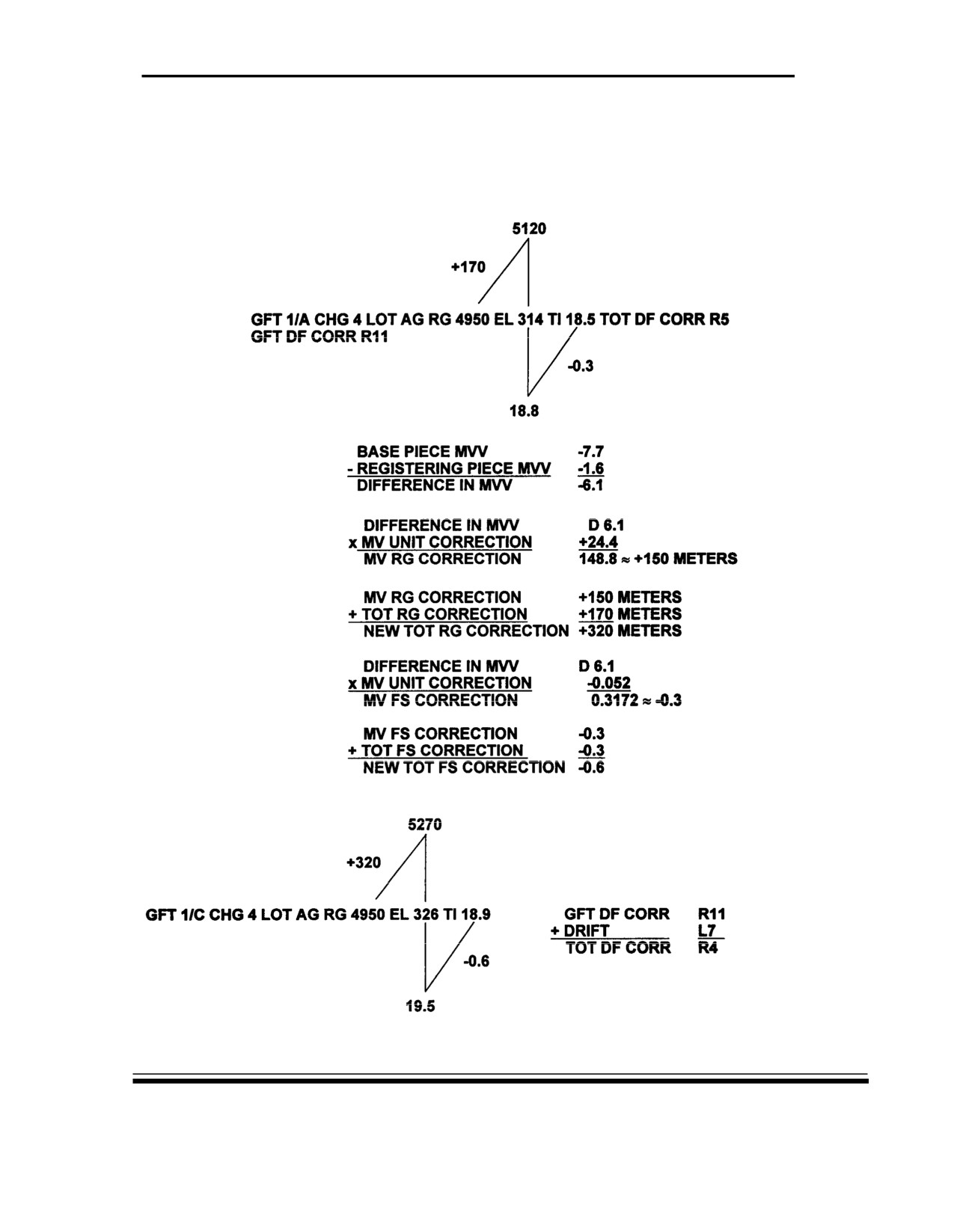
10-55. Example of Transferring a GFT Setting
Battery A, 1st Platoon registered, and Battery C, 1st Platoon wants the GFT setting
transferred to their unit. Battery A, 1st Platoon registered with their base piece which has an
MVV of -1.6 M/s. The base piece for Battery C, 1st Platoon has an MVV of -7.7 m/s.
10-59
FM 6-40
Chapter 11
Meteorological Techniques
Met techniques described in this chapter allow a unit to account for the effects of
nonstandard conditions and achieve first round fire for effect.
Section I
Principles
Understanding the applications of met techniques requires basic
knowledge of registration and met principles.
11-1. Purpose and Use of Met Techniques
a. Nonstandard Conditions
(1) Accurate fires can be placed on targets of known location without adjustments.
Under standard conditions, the firing table data would achieve the desired results. However, it is
valid to assume that standard conditions will not exist. Corrections need to be applied to firing
table data to compensate for the nonstandard conditions of weather, position, and material. The
most accurate means of determining these corrections is by registering. Registration corrections
are only valid within transfer limits and for a specified period of time. However, conducting a
registration may not be an option. Therefore, techniques are needed to mathematically determine
corrections and compensate for changing nonstandard conditions. The met techniques are used
to measure deviations from standard conditions and to compute corrections for them.
(2) The firing tables used to determine firing data for artillery weapons are based on an
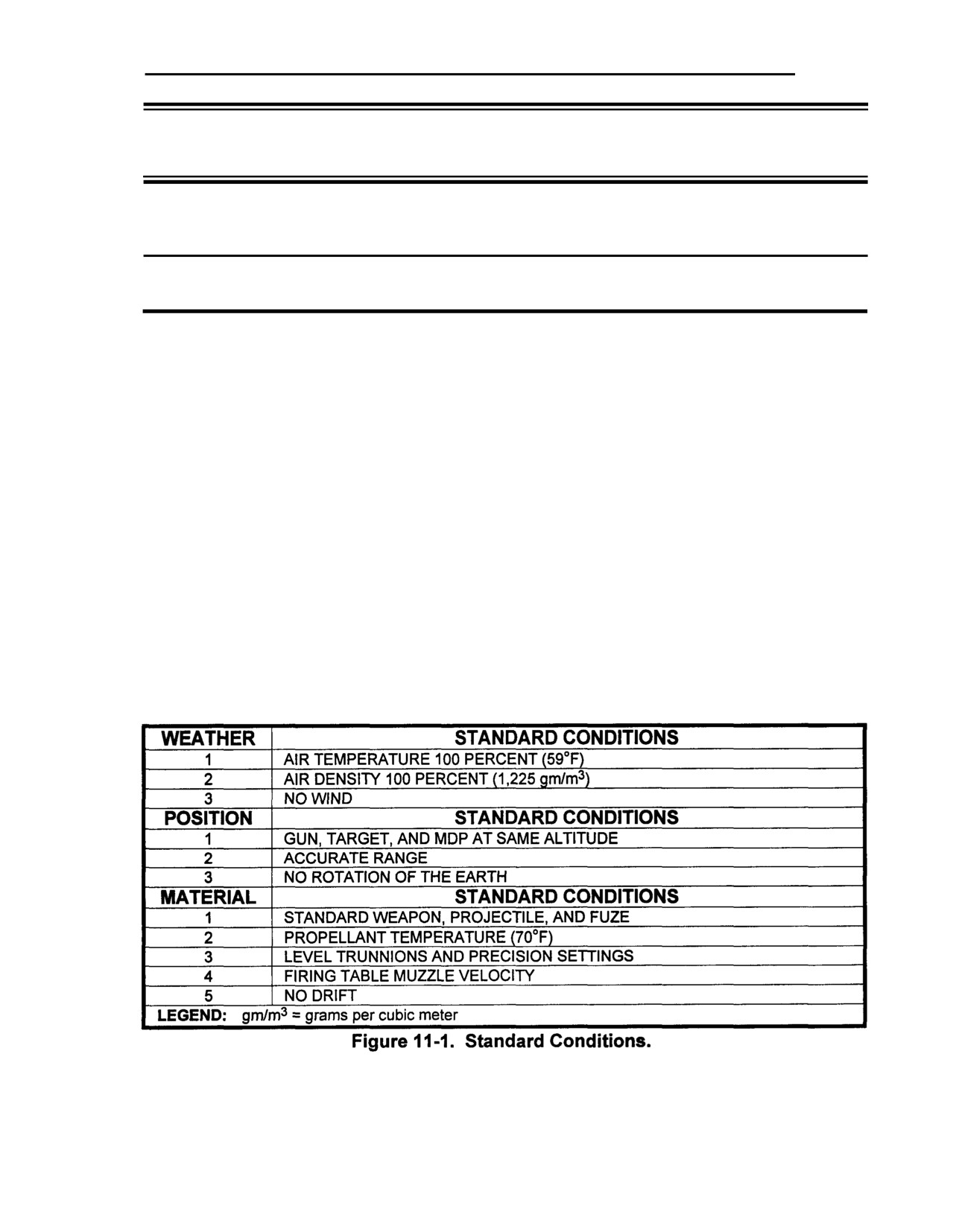
arbitrary set of standard conditions of weather, position, and material. The standards for weather
are established by the ICAO (International Civil Aviation organization). (See Figure 11-1.)
11-1
FM 6-40
(3) The first seven columns of Table F of the TFT are based on one of two
conditions occurring:
Standard conditions are in effect.
The sum of the corrections for all nonstandard conditions in effect equals
zero.
It is obvious that the first will never occur and the second has a minimal chance of occurring.
Therefore, if a unit wants to provide surprise and massed fires, it must consider the effects of
nonstandard conditions in some way. The best solution to correct for all nonstandard conditions
in effect is to register. This allows a unit to achieve first round FFE on an accurately located
target. To correctly determine registration corrections and the effects of nonstandard conditions
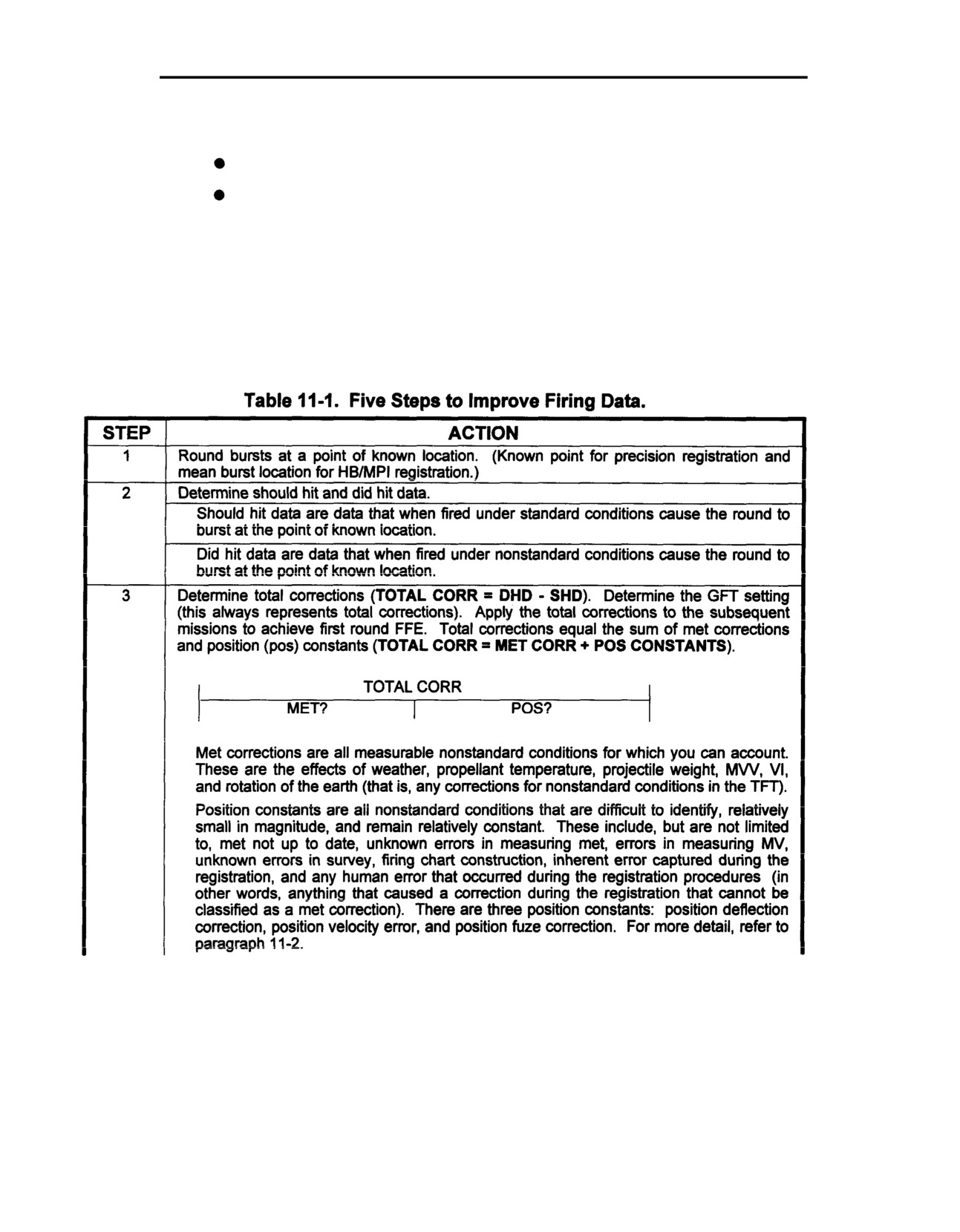
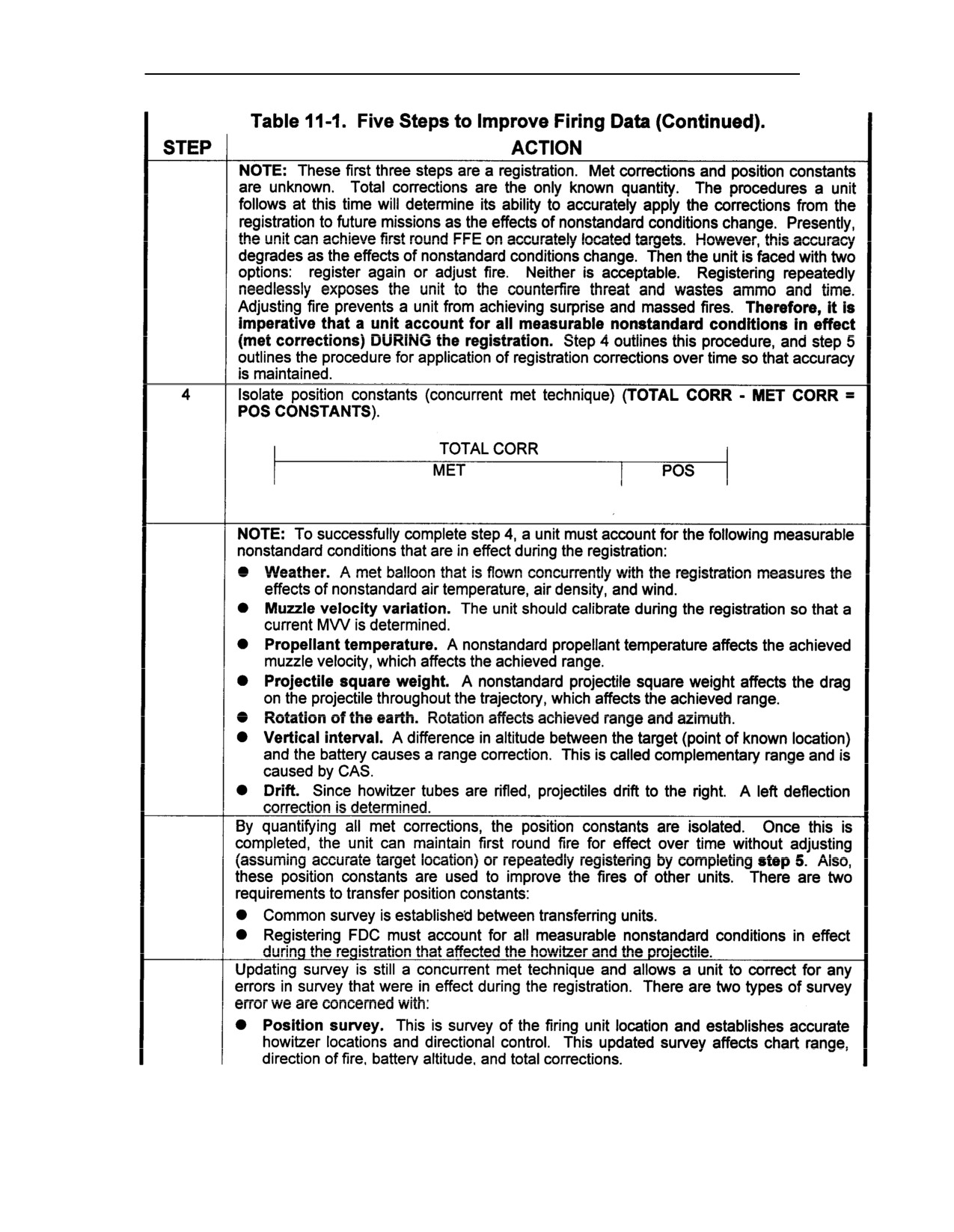
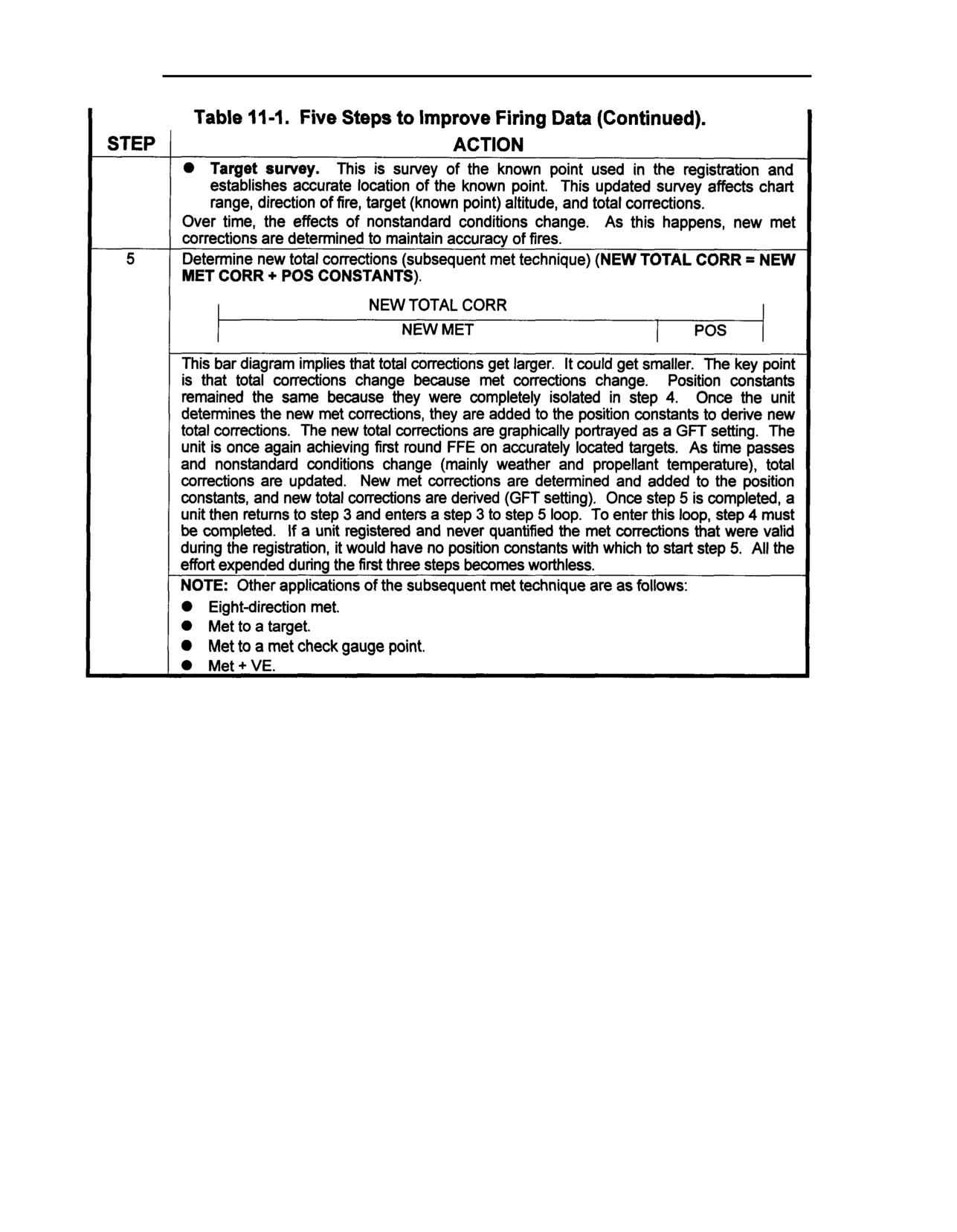
as they change over time, a unit must follow the five steps to improve firing data. (See Table
11-1.)
11-2
FM 6-40
11-3
FM 6-40
11-2. Position Constants
a. When a unit displaces to a new position and cannot register, the position constants from
the last position may be used as a basis for determining a GFT setting by solving a subsequent met.
The use of this technique may cause slight inaccuracies, but it will produce the most accurate data
possible until the unit can conduct another registration or met + VE with a check round. Once new
position constants are determined, the old position constants are not used.
b. The position deflection correction generally accounts for errors in survey and chart
construction. The position deflection correction should only be transferred if common survey
exists between positions.
c. The position fuze correction should be considered a fuze characteristic and not a
correction for existing weather conditions. The position fuze correction should only be applied to
the same lot of fuzes.
d. The position velocity error is expressed in meters per second. It is the position
constant which accounts for all range errors not accounted for by met data, muzzle velocity
variation, and propellant temperature. Therefore, it will include any errors in survey and should
only be transferred if common survey exists. However, the position VE is a constant for
projectiles within the registering projectile family.
11-4
FM 6-40
e. Part of the position VE and position deflection correction are charge independent,
specifically errors in the firing chart and survey. The position fuze correction is charge
independent because it is a fuze characteristic. Since position constants are relatively small and a
portion of the position constants are charge independent, it is possible to compute a GFT setting
for other charges and lots. The GFT setting will not be as accurate as a GFT setting derived from
a registration, but it will be more accurate than firing with no GFT setting.
11-3. Met Messages
a. Among the nonstandard conditions that affect the projectile after it leaves the tube is
the atmosphere (weather conditions) through which the projectile passes. The three properties of
the atmosphere that the artillery considers in its gunnery computations are wind (both direction
and speed), air temperature, and air density.
(1) Wind. The effects of wind on a projectile are easy to understand. A tail wind
causes an increase in range and a head wind causes a decrease in range. A crosswind blows the
projectile to the right or left, which causes a deflection error. The FDC converts ballistic wind
measurements into range and deflection components and applies corrections to the deflection and
elevation of the howitzer.
(2) Temperature. Variations in air temperature cause two separate effects on a
projectile. One effect is caused by the inverse relationship between density and temperature.
This effect is compensated for when density effects are considered. The second effect is regarded
as the true temperature. It is the result of the relationship between the speed of the projectile and
the speed of the air compression waves that form in front of or behind the projectile. These air
compression waves move with the speed of sound, which is directly proportional to the air
temperature. The relationship between the variation in air temperature and the drag on the
projectile is difficult to determine. This is particularly true for supersonic projectiles, since they
break through the air compression waves after they are formed. As firing tables indicate, an
increase in air temperature may increase, decrease, or have no effect on achieved range,
depending on the initial elevation and muzzle velocity of the weapon.
(3) Air density. Density of the air through which a projectile passes creates
fiction, which affects the forward movement of the projectile. This affects the distance a
projectile travels. The density effect is inversely proportional to the projectile ranges; that is, an
increase in density causes a decrease in range.
b. The met section is responsible for sampling the weather conditions at various
altitudes. Data determined by these samples are converted, manually or by computer, to provide
specific weather information at specific altitudes. These weather data are transmitted to artillery
units in fixed formats called met messages. The field artillery uses the following four types of
met messages:
(1) Ballistic met message. This message is used by cannon units, rocket units,
mortar units, and air defense artillery.
(2) Computer met message. This message is used by artillery computer systems.
(3) Fallout met message. This message is used in nuclear and chemical fallout
predictions.
(4) Target acquisition met message. This message is used by radar platoons of
the target acquisition battery (TAB).
11-5
FM 6-40
NOTE: Only the ballistic and computer met messages will be described in the
following paragraphs.
11-4. Ballistic Met Message
The ballistic met message is a coded message containing information about current
atmospheric conditions. There are two types of ballistic met messages provided for artillery.
Type 2 messages (surface to air) are used in air defense artillery and type 3 messages (surface to
surface) are used by FA cannon and rocket units. Type 3 messages are used in solving DA Form
4200 (Met Data Correction Sheet). Type 3 messages are used for all elevations, for all charges,
and for all howitzers in manual FDC operations. The ballistic met message is recorded on DA
Form 3675 (Ballistic Met Message) and is divided into an introduction and a body.
a. The introduction of the ballistic met message consists of four six-character groups.
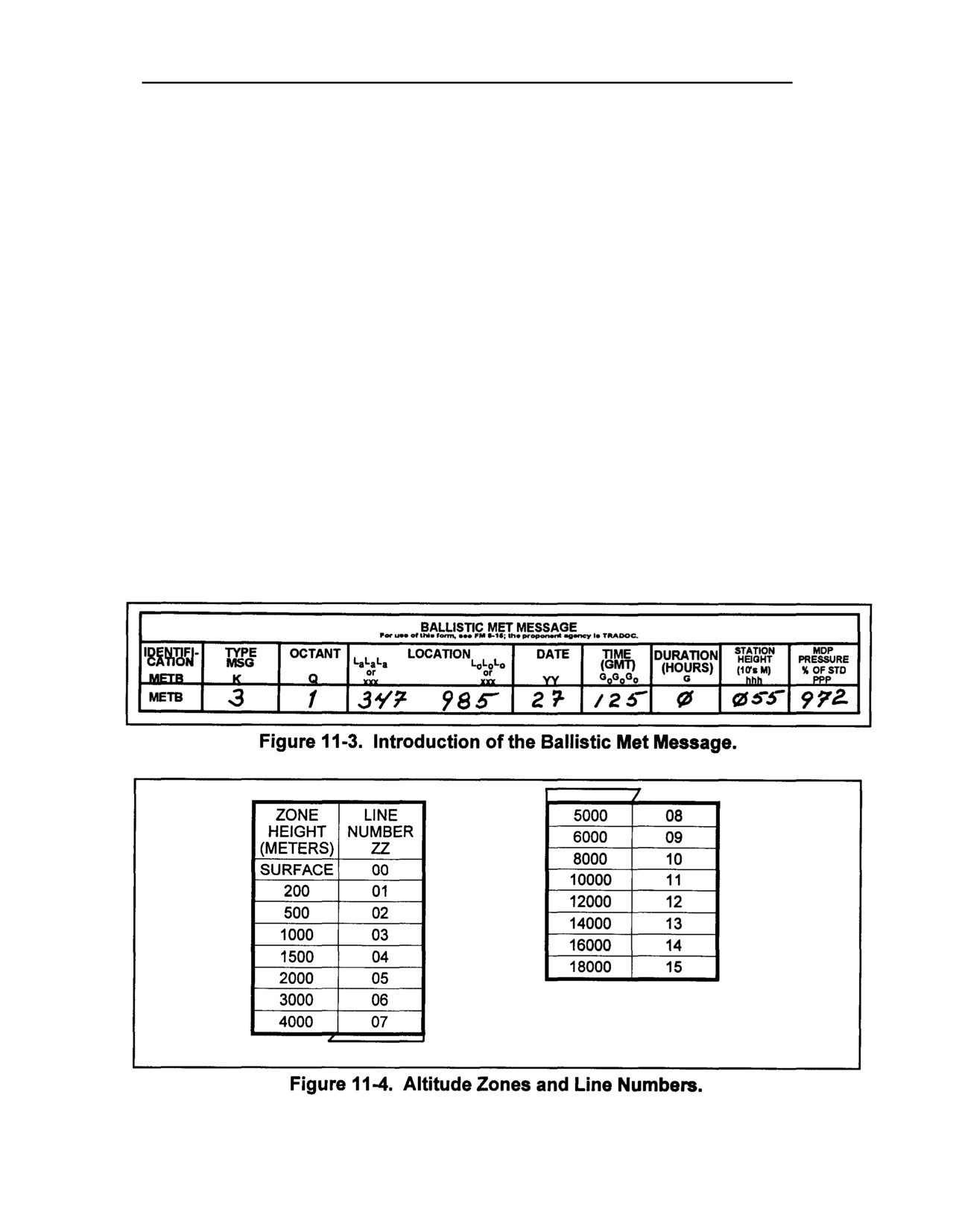
(1) Group 1. The first three letters (MET) in group 1 identify the transmission as a met
message. The next letter (B) indicates that it is a ballistic met message. The next digit (3) indicates
the type of met message (surface to surface). The last digit (1) designates the octant of the earth in
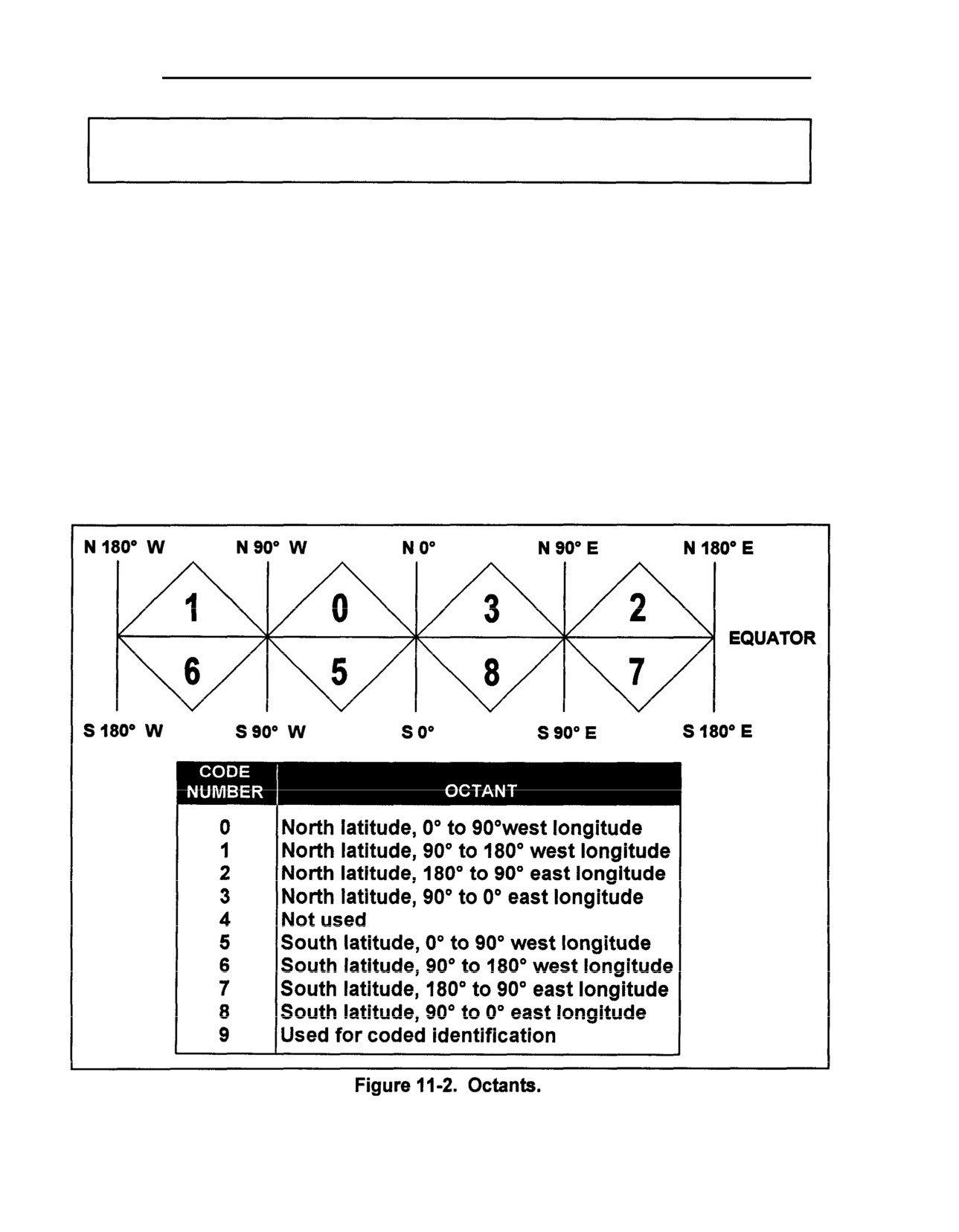
which the met station is located. (See Figures 11-2 and 11-3.) In Figure 11-3, octant 1 indicates that
the met station is located between 90°W and 180°W longitude and is north of the equator.
11-6
FM 6-40
(2) Group 2. This group designates the center of the area in which the met message is
valid. This is expressed in tens, units, and tenths of degrees of latitude and longitude (347= 34.7 and
985 = 98.5°). When the longitude is 100 or greater, the initial digit (1) is omitted. If the number 9 is
used to designate the octant, the six digits or letters represent the coded location (in latitude and
longitude) of the met station that produced the message. (See Figure 11-3.)
(3) Group 3. The first two digits (27) in group 3 represent the day of the month
that the met message is valid. The next three digits (125) indicate the hour in tens, units, and
tenths of hours (125 = 12.5 hours = time 1230) the met message is valid. The hours refer to
Greenwich Mean Time (GMT). The last digit (0) in group 3 indicates the number of hours the
message will remain valid. The US does not try to predict the length of time a met message will
remain valid. Therefore, the last digit in group 3 of a ballistic met message will always be 0.
Some allied nations predict the length of time a met message will remain valid. These
predictions vary from 1 to 8 hours. Code 9 indicates 12 hours. (See Figure 11-3.)
(4) Group 4. The first three digits (055) in group 4 indicate the altitude of the met
station (MDP) above mean sea level in multiples of 10 meters (055 = 550 meters). The next three
digits (972) indicate the atmospheric pressure at the MDP (972 = 97.2 percent). When a value is equal
to or greater than 100 percent the initial digit (1) is omitted (012= 101.2 percent). (See Figure 11-3.)
b. The body of the met message can consist of 16 met message lines (00-15). Each line
consists of two six-number groups. Each line contains the ballistic data for a particular altitude zone.
Ballistic data are the weighted average of the conditions that exist from the surface up through the
altitude zone, indicated by the line number, and back to the surface. (See Figure 11-4.)
11-7
FM 6-40
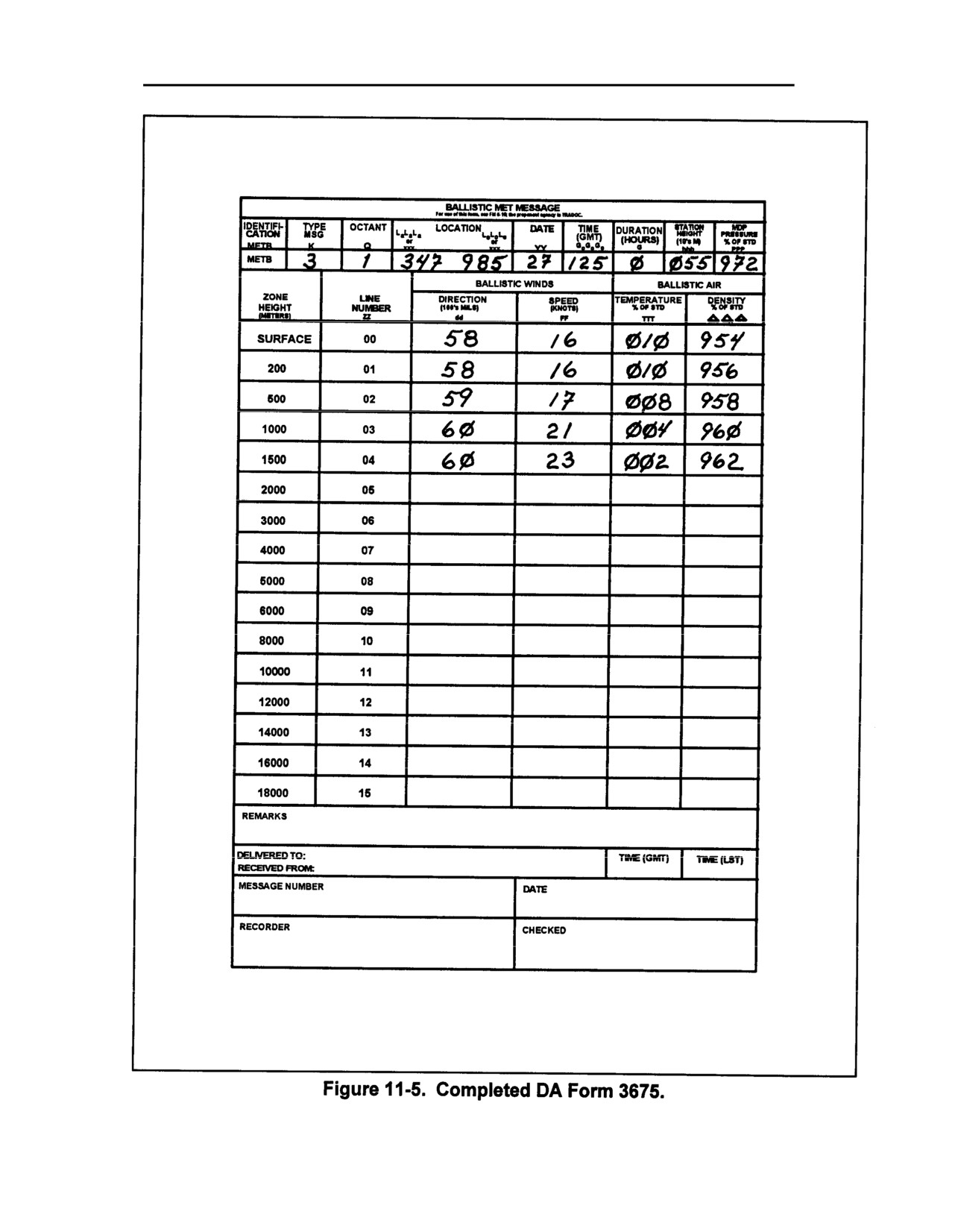
(1) The first two digits in the first group on each line identifies the altitude
zone (00 [surface] through 15 [18,000 meters]). (See Figure 11-4.) Line 02 is used as
an example. (See Figure 11-5.)
(2) The next two digits in the first group (59) indicate the direction from
which the ballistic wind is blowing. It is expressed in hundreds of mils true azimuth
(59 = 5900). (See Figure 11-5.)
(3) The last two digits of the first group (17) indicate the wind speed of the
ballistic wind in knots (17= 17 knots). (See Figure 11-5.)
(4) The first three digits of the second group (008) indicate the ballistic air
temperature expressed as a percentage (to the nearest 0.1 percent) of the ICAO standard
(008 = 100.8). (See Figure 11-5.)
(5) The last three digits of the second group (958) indicate the ballistic air
density expressed as a percentage (to the nearest 0.1 percent) of the ICAO standard
density (958 = 95.8). (See Figure 11-5.)
NOTE: When the air temperature or air density is equal to or greater than 100
percent, the initial digit (1) is omitted. A completed ballistic met message recorded
on DA Form 3675 is shown in Figure 11-5.
11-8
FM 6-40
11-9
FM 6-40
11-5. Computer Met Message
Like the ballistic met message, the computer met message is a coded message that reports
the atmospheric conditions in selected layers starting at the surface and extending to an altitude
that will normally include the maximum ordinate of field artillery weapons that use these data.
Unlike the ballistic met message used in manual computations (in which the weather conditions
existing in one layer or zone are weighted against the conditions in lower layers and reported as
percentages of standard), the computer met message reports actual average wind direction, wind
speed, air temperature, and pressure in each layer. The computer met message is used by the
battery computer system (BCS) in the computation of the equations of motion used in the
computer program. The computer met message is recorded on DA Form 3677 (Computer Met
Message) and is divided into two parts--an introduction and a body.
a. The introduction of the computer met message consists of four six-character
groups.
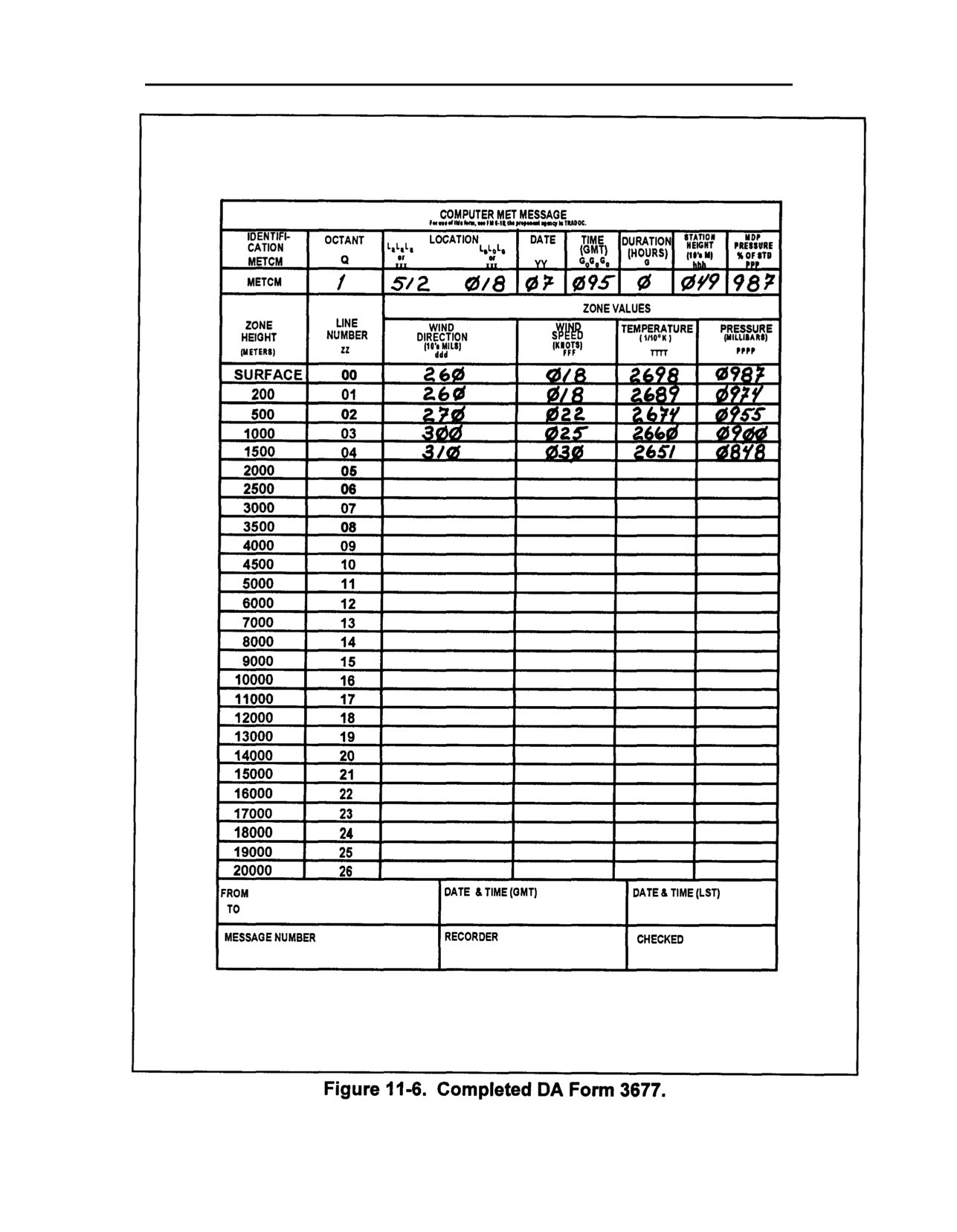
(1) Group 1. The first five letters (METCM) identify the transmission as a
computer met. The last digit (1) designates the octant of the earth in which the met station is
located. The octant code key is the same as that for the ballistic met message. (See Figure 11-6.)
(2) Group 2. This is the same as group 2 of the ballistic met message. (See Figure
11-6.)
(3) Group 3. This is the same as group 3 of the ballistic met message. (See Figure
11-6.)
(4) Group 4. The first three digits (049) of group 4 indicate the altitude of the met
station MDP above sea level in tens of meters (049 = 490). The last three digits (987) indicate
the atmospheric pressure, in millibars, at the met station. When the pressure value is greater than
999, the first digit (1) is omitted. (For example, 009= 1009). (See Figure 11-6.)
b. The body of the met message can consist of 27 met message lines (00-26). Each line
consists of two eight-number groups. Each line contains the actual average weather data for a
particular zone. (See Figure 11-6.)
(1) The first two digits in the first group on each line identifies the altitude zone (00
[surface] through 26 [20,000 meters]). Line 00 is used as an example. (See Figure 11-6.)
(2) The next three digits in the first group (260) indicates the direction from which
the wind is blowing. It is expressed in tens of mils true azimuth (260= 2600). (See Figure 11-6.)
(3) The last three digits of the first group (018) indicate the wind speed expressed in
knots (01 8 =18 knots). (See Figure 11-6.)
(4) The first four digits of the second group (2698) indicate the actual air
temperature expressed in degrees Kelvin (K) to the nearest tenth of a degree (269.8°K). (See
Figure 11-6.)
(5) The last four digits of the second group (0987), indicate the actual air pressure,
in millibars, to the nearest millibar (987 millibars). (See Figure 11-6.)
11-10
FM 6-40
11-11