FM 6-40 TTP for Field Artillery Manual Cannon Battery U.S. - page 8
FM 6-40
9-45
FM 6-40
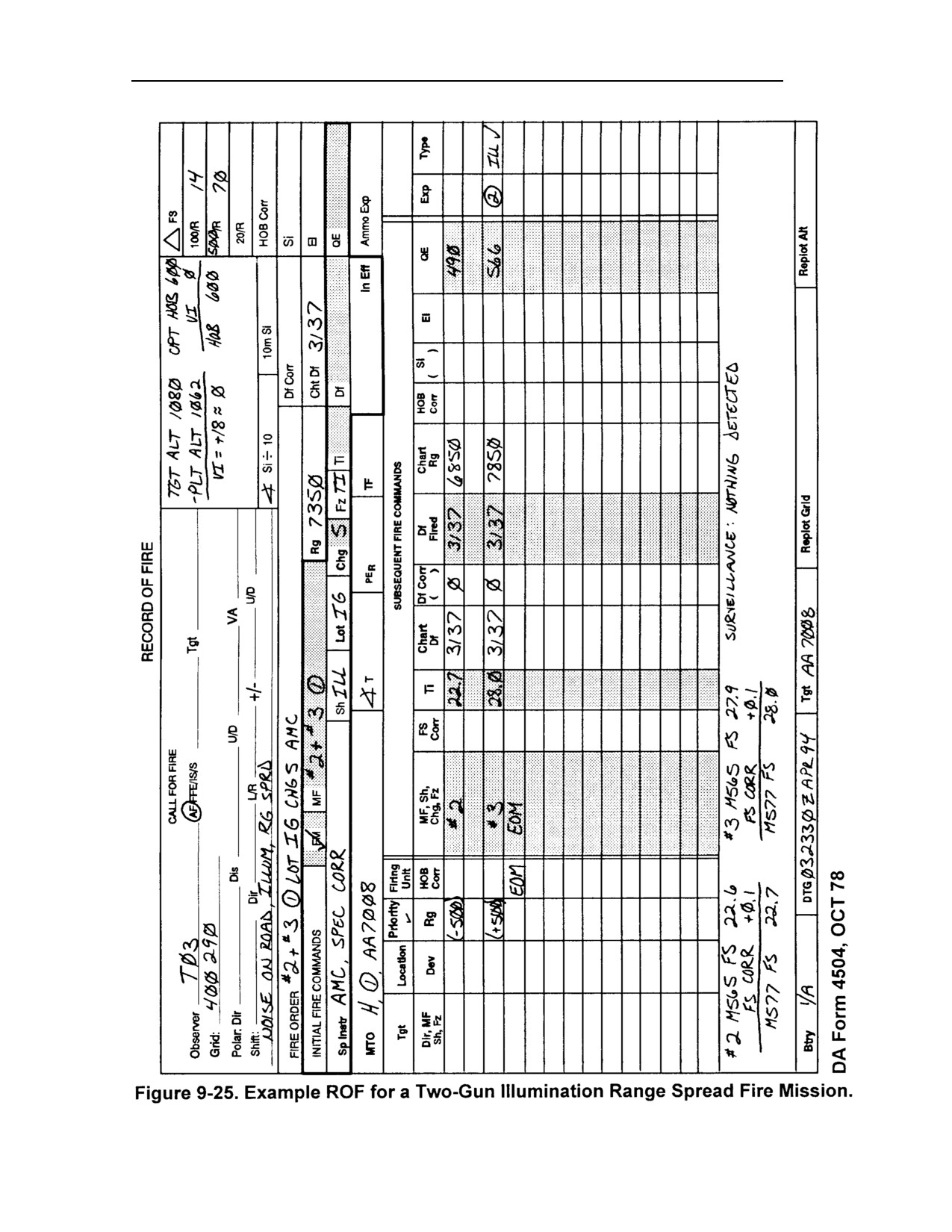
9-17. Two-Gun Illumination Lateral Spread
a. A two-gun lateral spread requires two illuminating projectiles to be fired perpendicular to
the GT line to allow for the maximum lateral coverage. The projectiles are fired one effective illum
diameter apart (refer to Figure 9-23). To determine the aimpoints, the computer must determine a
multiple of 100/R (400/R for 105 mm and 500/R for 155 mm). The computer will add and subtract
this value from the chart deflection to the aimpoint. The range will be the same for both projectiles.
Therefore, the FS and QE for both projectiles will be the same.
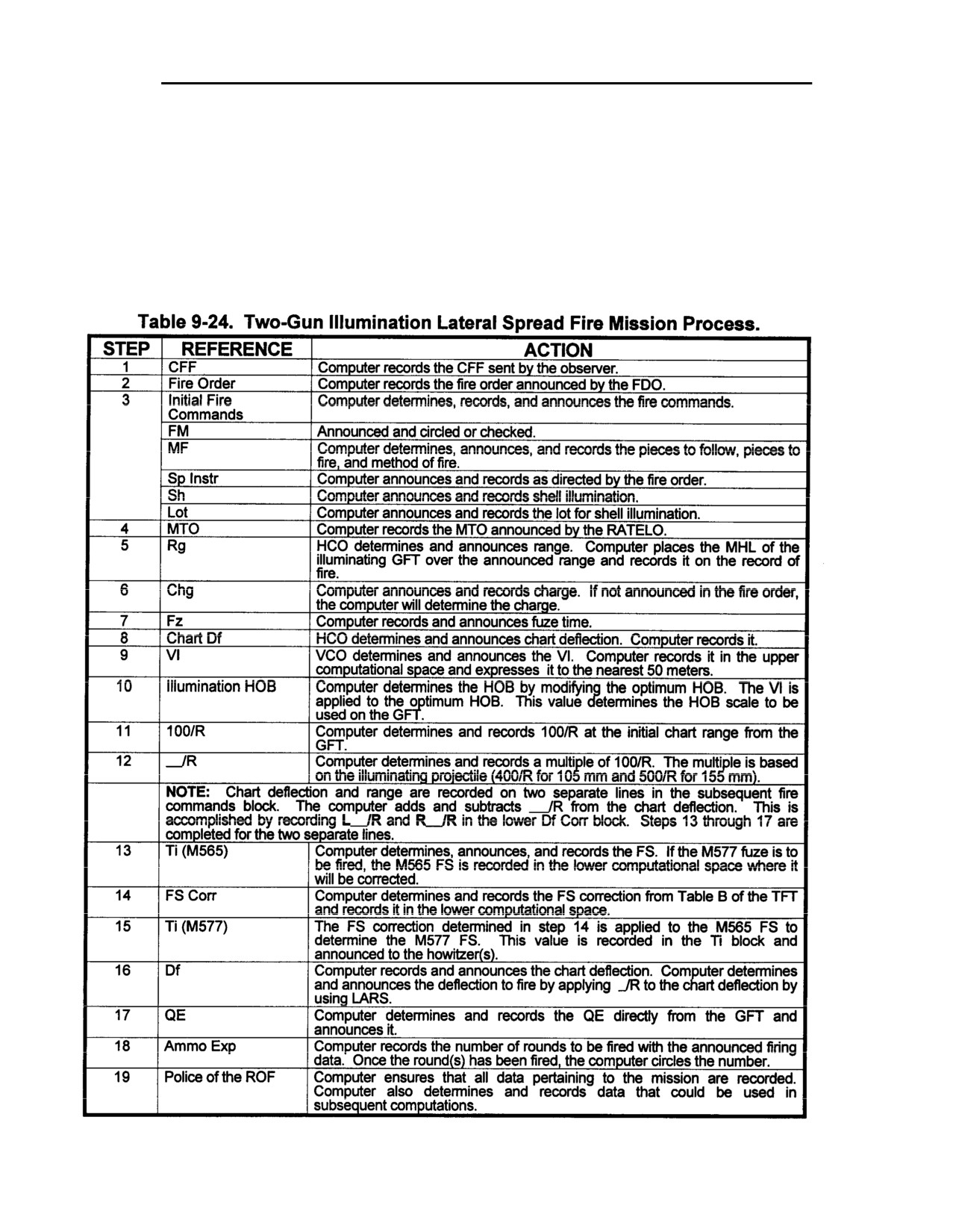
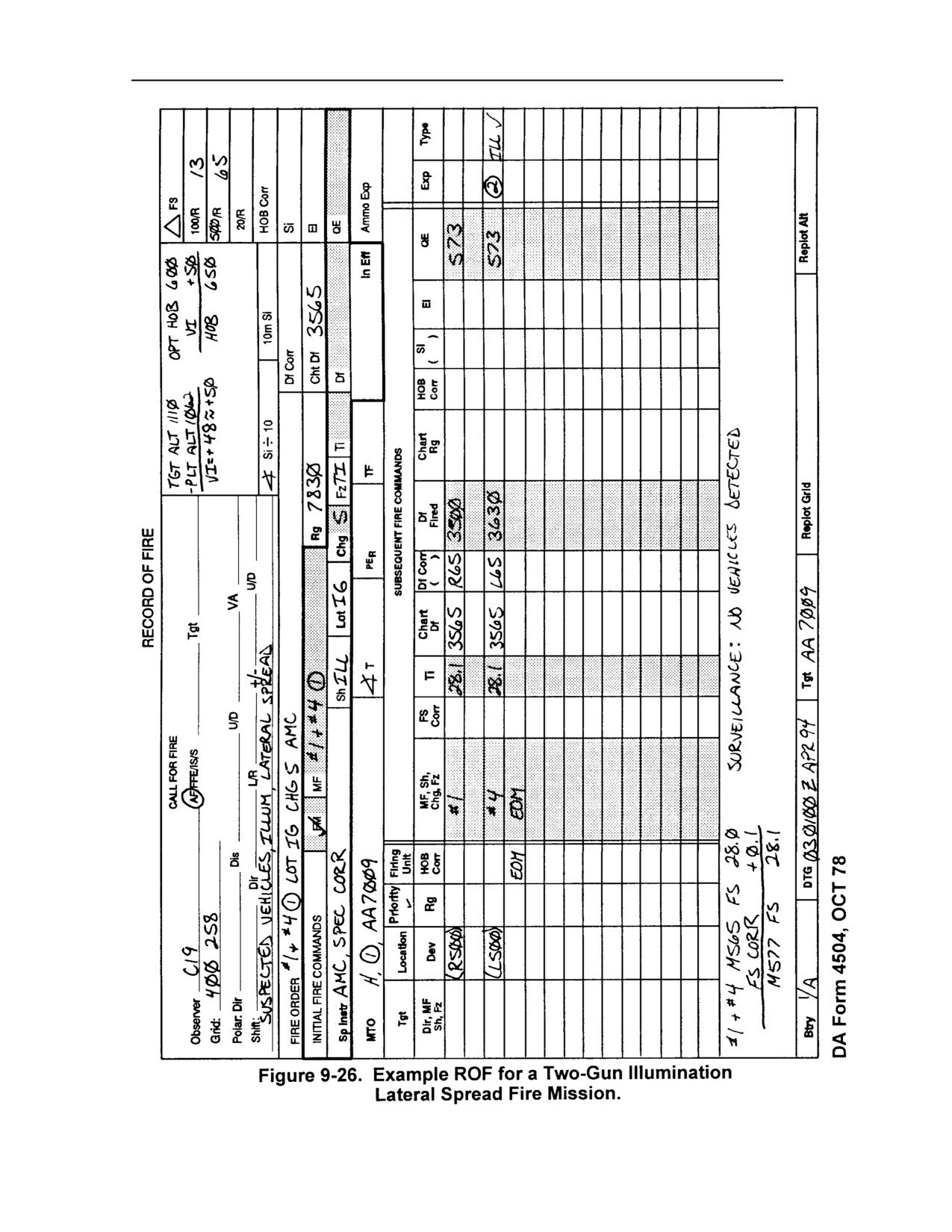
b. Use Table 9-24 to process a two-gun illumination lateral spread fire mission. An example
ROF for this entire mission is shown in Figure 9-26. The time fuze being fired is the M577.
9-46
FM 6-40
9-47
FM 6-40
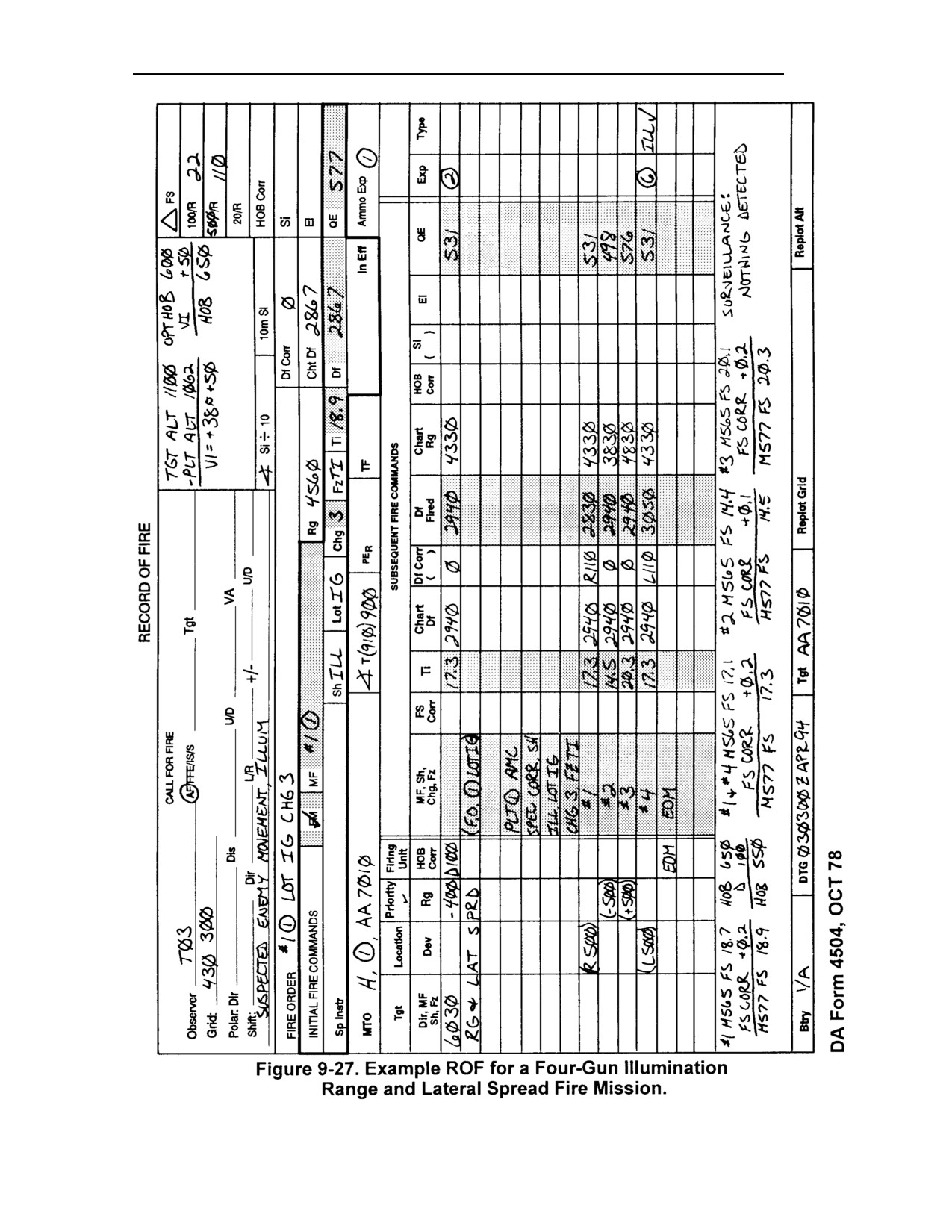
9-18. Four-Gun Illumination--Range and Lateral Spread
a. The four-gun illum pattern is used to illuminate a large area in width and depth. Four
rounds are fired at the same time by using the range and lateral spread patterns. The observer
may request a range and lateral spread in the initial CFF or may request this pattern during a
subsequent correction as part of a one-gun or two-gun (range or lateral spread) illum mission.
b. To process a four-gun illum mission, combine the procedures for the two-gun range
spread and the two-gun lateral spread illum missions. The flank howitzers will fire the two-gun
lateral spread while the interior howitzers will fire the two-gun range spread.
c. If the four-gun illum mission is requested during a subsequent correction, the FDO
must initiate a new fire order and the computer will announce new initial fire commands.
NOTE: An example ROF for this type of mission is shown in Figure 9-27. The time
fuze being fired is the M577.
9-19. Coordinated Illumination
a. A coordinated illum mission is a combination of an illum mission (one-gun, two-gun,
two-gun range or lateral spread, or four-gun range and lateral spread) and another fire mission
(normally HE). The illumination is adjusted by the observer until the target is illuminated. When
the best target illumination is achieved, the observer will command the FDC to MARK the
illumination.
Once the observer has marked the illum round, he will request coordinated
illumination and transmit another call for fire. The FDC will process both missions following
normal procedures. The rounds will be fired at a predetermined interval that will ensure the
rounds of the second mission function when the target is best illuminated. This allows the
observer to make the needed corrections and observe the effects. The firing interval may be
controlled by either the FDC or observer. The preferred method is for the FDC to control the
firing interval.
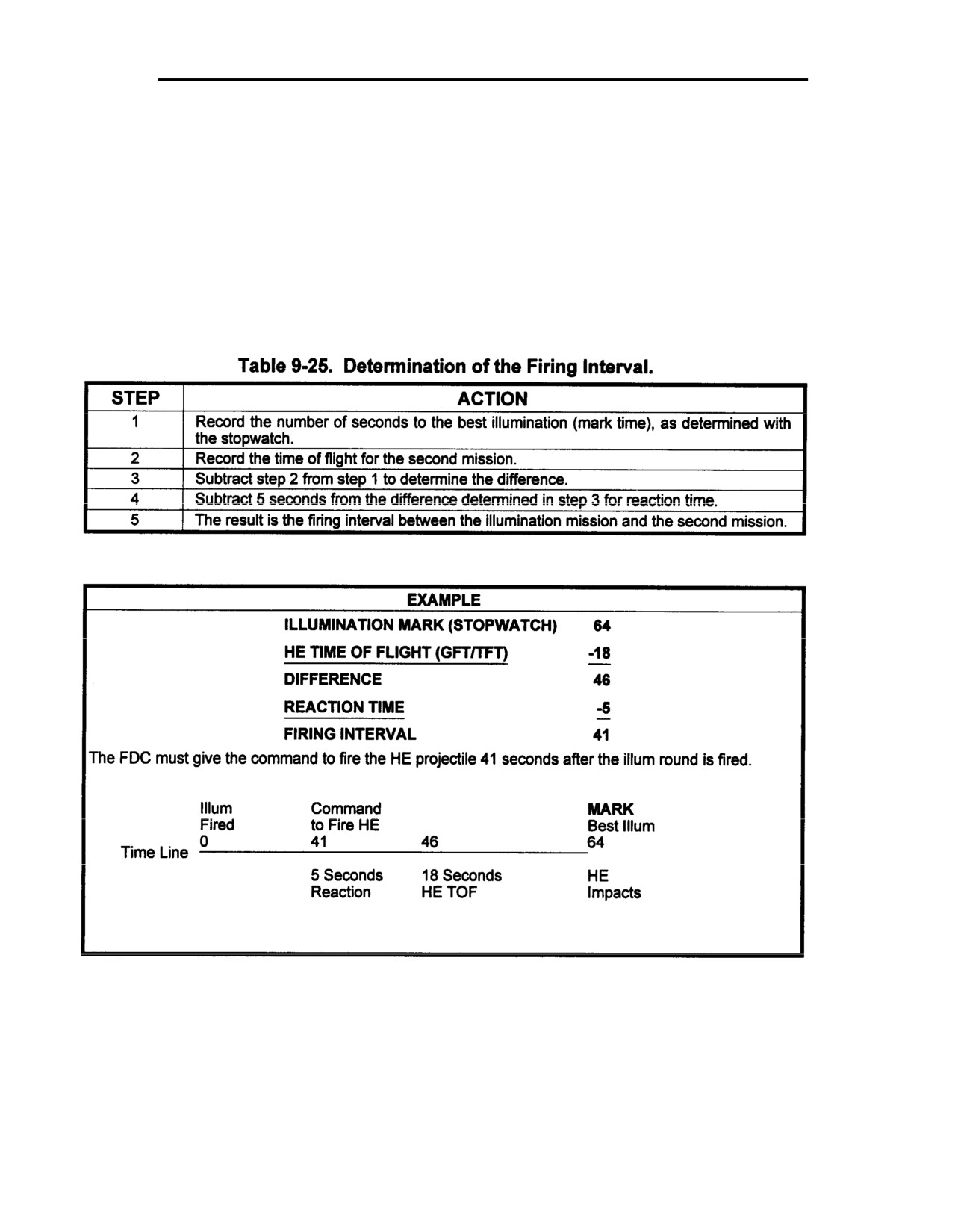
b. Every time an illum round is fired, the FDC will start a stopwatch. When the target
receives the best illumination, the observer will announce ILLUMINATION MARK. The FDC
will stop the stopwatch. This time interval is known as the illumination mark time and this value
is recorded. When the second call for fire is received, the FDC must compute the TF for the
second mission. This TF plus a five-second reaction time is subtracted from the illum mark time
and the difference is the firing interval (ILLUM MARK TIME - (TF + 5 SECONDS) =
FIRING INTERVAL). At this point, the FDC must ensure both missions are AMC. The FDC
commands the howitzer(s) firing the illum mission to fire. The stopwatch is started as the illum
mission is fired. When the firing interval is reached, the FDC commands the howitzer(s) firing
the second mission to fire.
c. The observer may request by round at my command. In this situation, the observer
wishes to control the firing of both missions. The FDC will compute data, ensuring both
missions are AMC. The FDC must also transmit the TOF of the second mission to the observer.
When the howitzers for both missions report READY, the FDC will relay this information to the
observer. The observer commands the firing of the ilhum mission. After determining the firing
interval, the observer commands the firing of the second mission at the appropriate time.
9-48
FM 6-40
9-49
FM 6-40
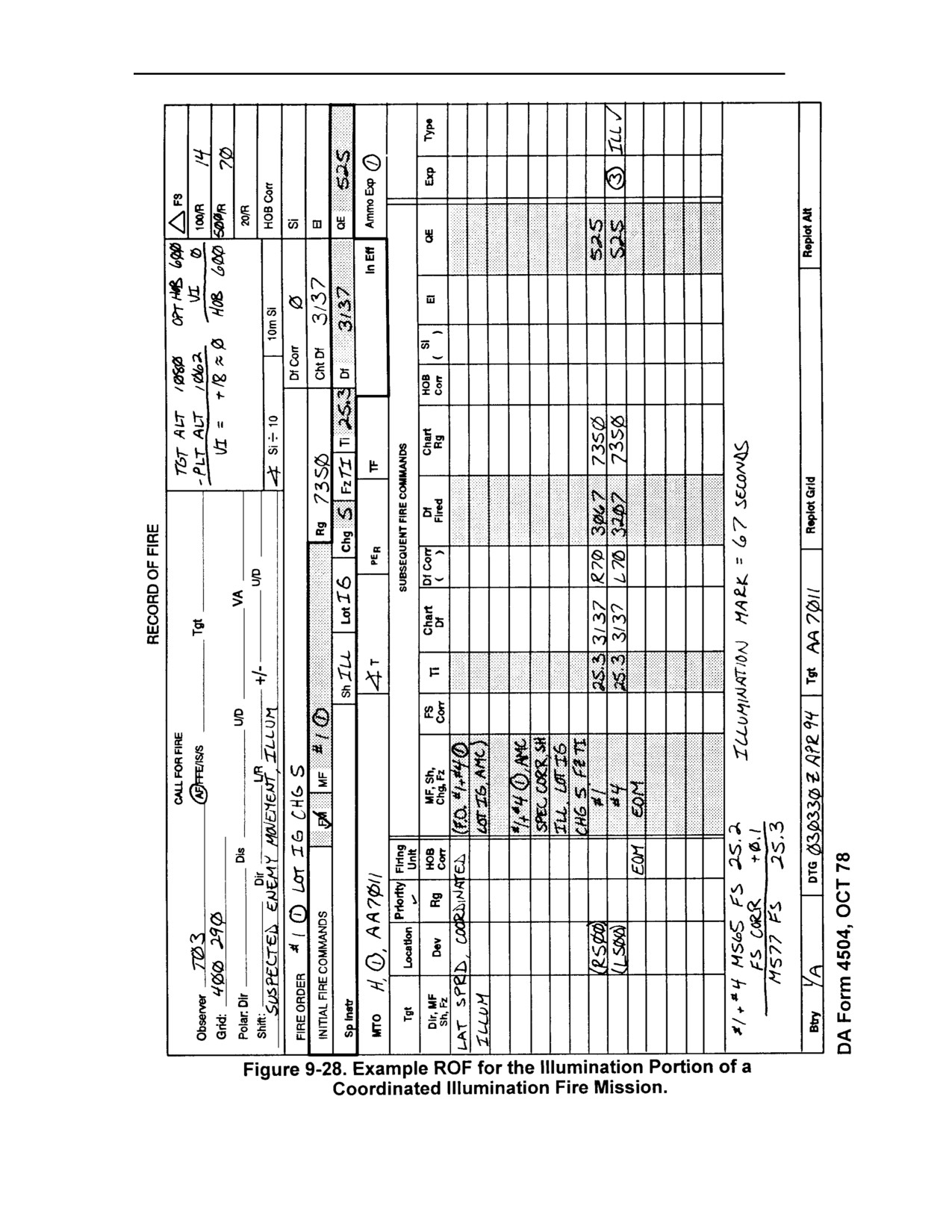
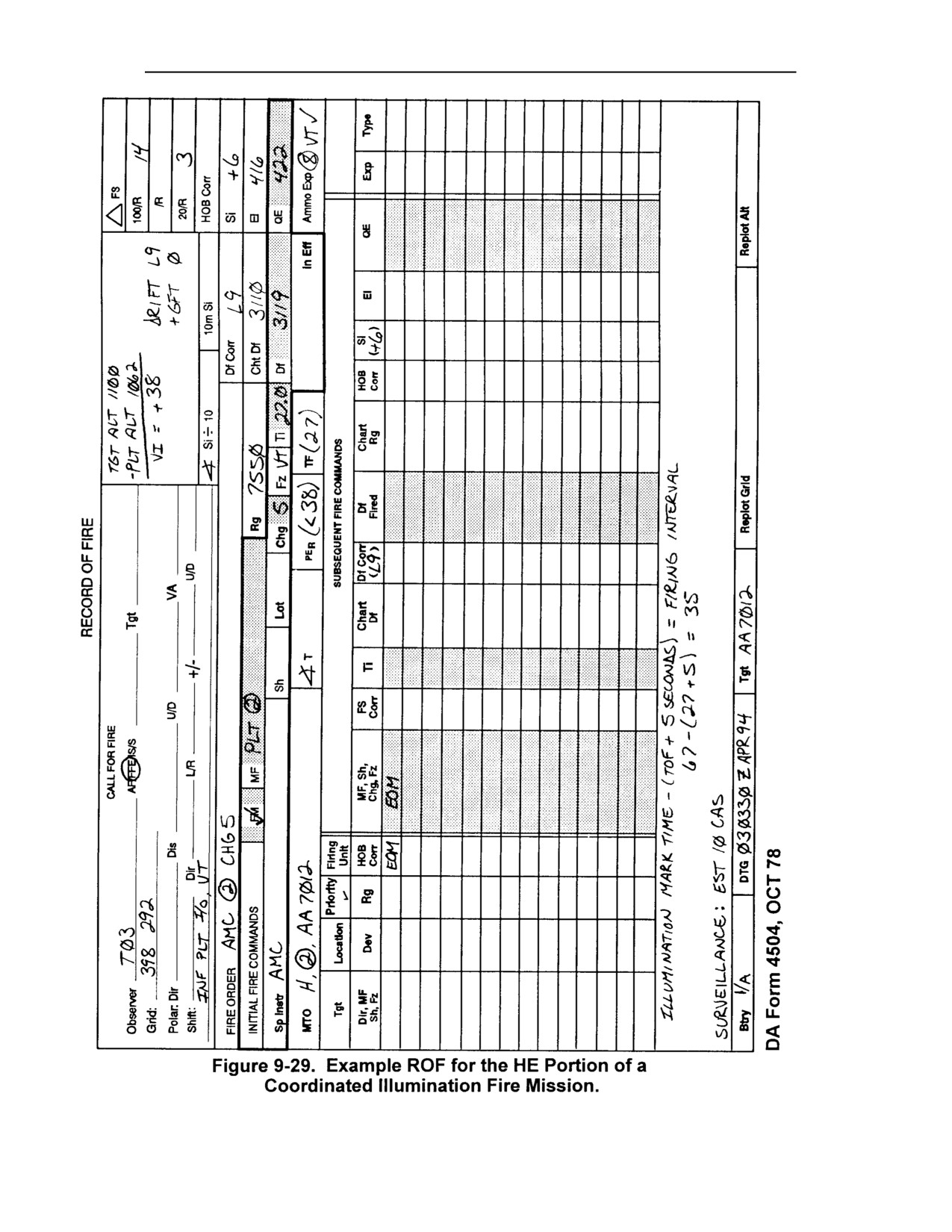
d. Use the steps in Table 9-25 to determine the firing interval. Example ROFs for this
type of mission are shown in Figures 9-28 and 9-29. The illum time fuze being fired is the
M577.
e. An example of determining the firing interval is shown below.
f. When coordinated illumination is requested, the FDO must initiate a new fire order
for the second mission and the computer will announce new initial fire commands. If the
howitzers that are firing the illumination are also included in the second mission, the FDC must
ensure those howitzer sections understand they are firing both missions and inforrn them of the
firing interval between missions.
9-50
FM 6-40
9-51
FM 6-40
9-52
FM 6-40
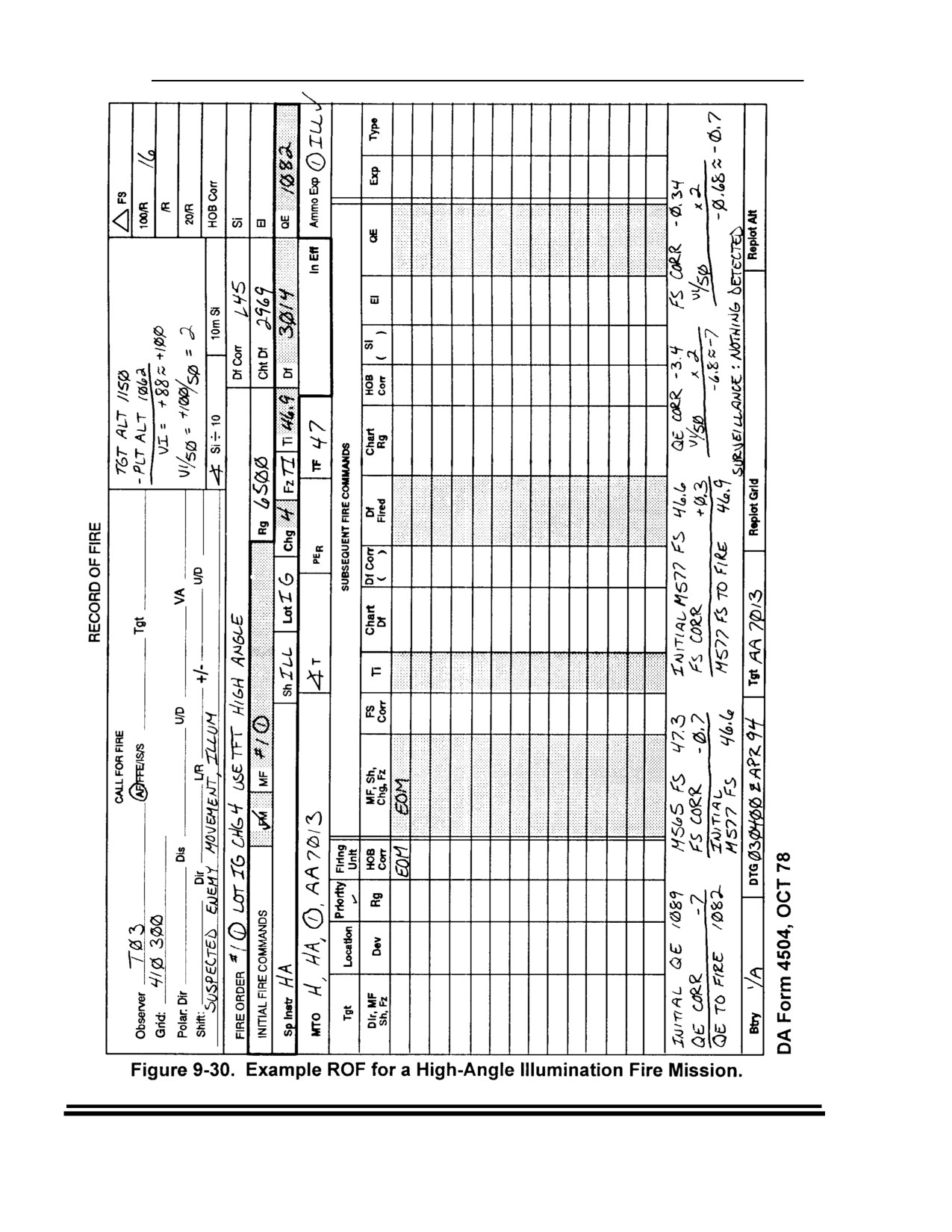
9-20. High-Angle Illumination
a. Some impact areas are so small that firing low-angle illumination severely restricts or
prohibits the firing of the round because of range-to-impact concerns with the projectile body.
To compensate for this, fire high-angle illumination and use the TFT (Part 2, Illumination). This
is not the preferred method of firing illumination.
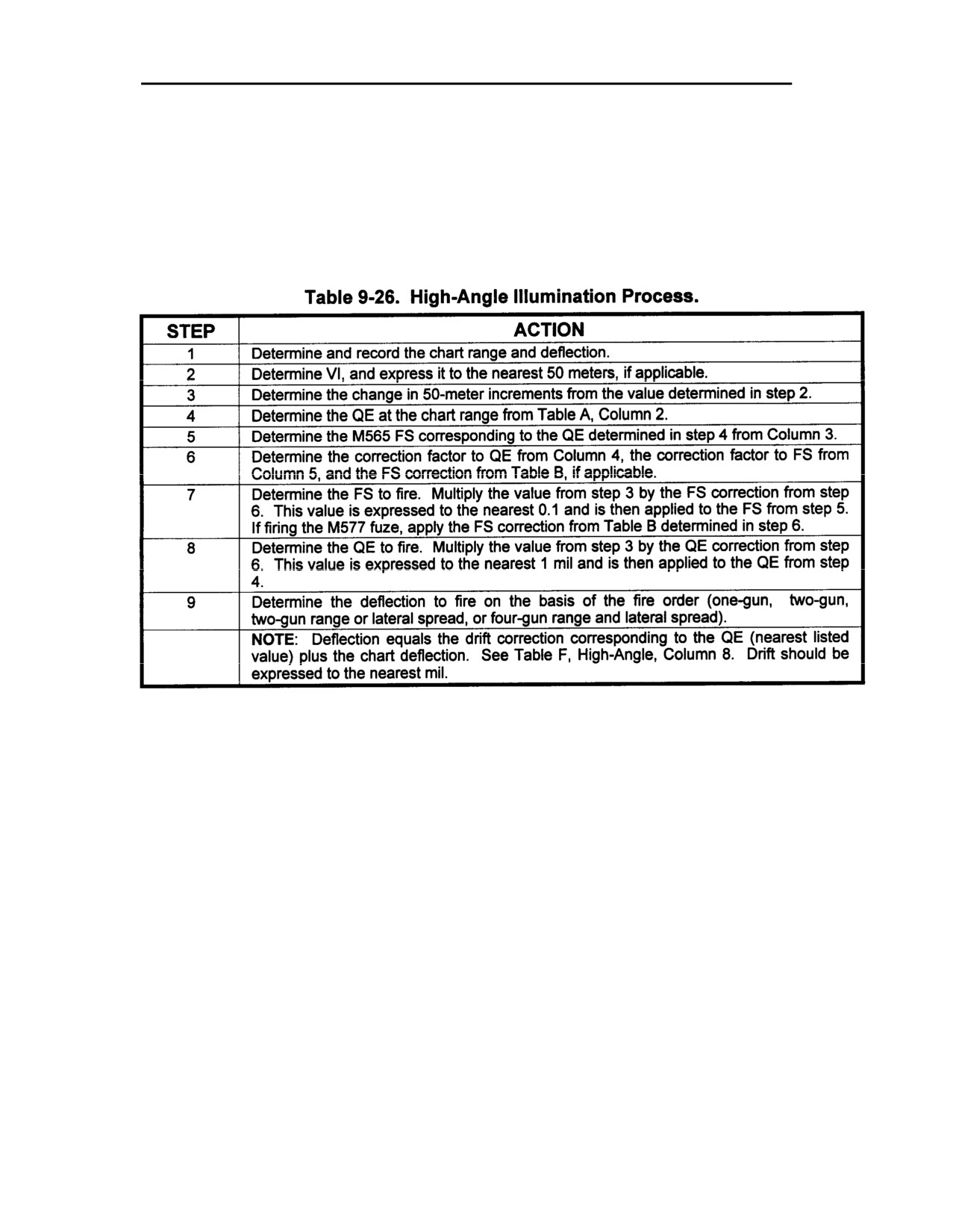
b. Use Table 9-26 to process a high-angle illumination mission. An example ROF for
this type of mission is shown in Figure 9-30. The time fuze being fired is M577.
9-53
FM 6-40
9-54
FM 6-40
Chapter 10
Registrations
Registration is a means of determining cumulative errors and the corrections for those
errors. The purpose of this chapter is to explain registrations and their application to the
gunnery problem.
Section I
Reasons for Registrations
Registrations should not be needed if the firing unit can meet their portion
of the five requirements for accurate predicted fire (minus target location). If the
observer cannot provide an accurate target location, the battalion S3 needs to
consider providing a survey team to extend survey into the target area and
providing common survey to the observers.
If all conditions of weather, position, and material were standard, a
cannon firing at a particular elevation and deflection would cause the projectile
to travel the range shown in the firing table corresponding to that elevation and
charge. Since all standard conditions will never exist at the same time, firing
table data must be corrected.
The purpose of a registration is to determine firing data corrections that
will correct for the cumulative effects of all nonstandard conditions. With these
corrections applied to firing data, a unit can rapidly and successfully engage any
accurately located target within the range of their cannons and have a first round
FFE capability.
10-1. Accurate Firing Unit Location
Accurate range and deflection from the firing unit to the target also require that the
weapons be located accurately and that the FDC knows this location. The battalion survey
section uses PADS to provide accurate survey information on the unit location. Survey
techniques available to the firing unit can also help in determining the location of each weapon.
The FDC can determine the grid location of each piece by using the reported direction and
distance from the aiming circle used to lay the battery or platoon.
10-2. Accurate Weapon and Ammunition Information
The actual performance of the weapon is measured by the weapon muzzle velocity for a
projectile family-propellant combination. The firing unit can measure the muzzle velocity of a
weapon and correct for nonstandard projectile weight and propellant temperature. This is done
by using the M90 velocimeter and MVCT M90-2 for each charge, propellant type, and projectile
family. Calibration should be conducted continuously by using the M90. Firing tables and
technical gunnery procedures allow the unit to consider specific ammunition information (weight,
fuze type, and propellant temperature); thus, accurate firing data are possible.
10-1
FM 6-40
10-3. Accurate Meteorological Information
The effects of weather on the projectile in flight must be considered, and firing data must
compensate for those effects. Firing tables and technical gunnery procedures allow the unit to
take into account specific met information (air temperature, air density, wind direction, and wind
speed) in the determination of accurate firing data.
10-4. Accurate Computational Procedures
The computation of firing data must be accurate. If the five requirements for accurate
predicted fire (minus target location) cannot be met, registrations can be conducted to compute
data that will compensate for nonstandard conditions. Applying these corrections to other fire
missions will allow the unit to determine accurate firing data.
NOTE: If the unit is able to meet the five requirements for accurate predicted fire, it
will still be necessary to improve the firing data derived from the GFT. The unit will
not be able to fire accurately (first round fire for effect capability) by firing “cold stick”
data. Therefore, the use of a met + VE technique will allow the unit to take all
measurable nonstandard conditions into account, and derive a GFT setting. Met +
VE techniques are discussed in Chapter 11.
10-5. When to Conduct Registrations
a. The FDO must consider the following:
Mission.
Equipment.
Troops.
Time.
Terrain and weather.
Commander’s guidance.
Tactical situation.
Enemy target acquisition assets.
Availability and location of observers.
Availability, location, and survey accuracy of known points.
Type of registration.
Assurance of registration validity.
b. A mission conducted only for the purpose of registering does not cause any damage
to the enemy. It does, however, expose the firing unit to enemy TA devices. Also, missions
conducted solely for the purpose of registering require additional ammunition and time.
Therefore, when possible, registration missions should be integrated into other missions,
especially when the observer is equipped with a laser.
10-2
FM 6-40
c. Met + VE GFT settings should be used when accurate MVVS, met data, and survey
are available. The amount of corrections needed to adjust onto a target will be minimal. Firing
two check rounds from an inferred GFT setting can be an abbreviated registration. Any
refinement sent by the observer should be used to adjust the GFT setting.
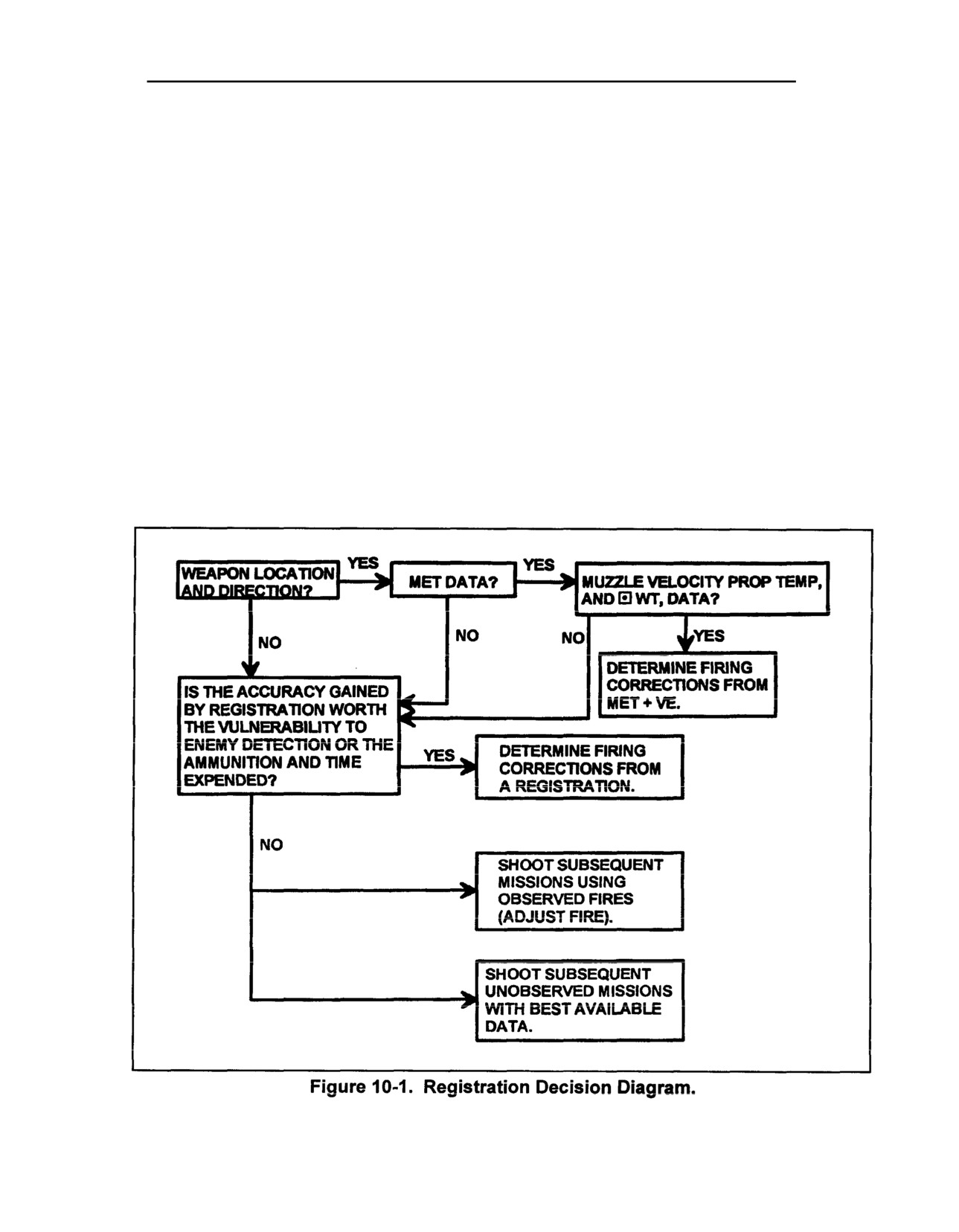
d. The flow chart shown in Figure 10-1 can be used to help you decide whether or not to
conduct a registration.
10-6. Types of Registrations
a. There are two types of registrations: precision registration and high-burst and/or
mean-point-of-impact (HB/MPI) registration. Within the two categories are alternate methods of
registering that may be more suitable for use in a particular tactical situation.
(1) Precision registration.
The precision registration is a technique for
determining, by adjustment, firing data that will place the MPI of a group of rounds on a point of
known location. The point of known location is called a known point.
(2) High-burst and/or mean point-of-impact registration. The HB/MPI
registration determines the mean burst location of a group of rounds fired with a single set of
firing data. When the mean burst location (or MPI) has been determined, the chart data (should
hit data) are determined and compared to the data that were fired (adjusted-data [did hit data]).
10-3
FM 6-40
b. Alternate registration types are discussed below.
(1) Radar-observed registration. The radar-observed registration is a form of the
HB/MPI registration and is thoroughly discussed later in this chapter.
(2) Abbreviated registration. Any registration that is conducted by using fewer
usable rounds than recommended for the precision or HB/MPI techniques is an abbreviated
registration. The use of fewer rounds degrades the results of total corrections. However, the use
of fewer rounds to determine the mean burst location (MBL) or the use of a larger “acceptance
box” (for example, 2 PEs rather than 1 PE from the MPI) is acceptable if the decreased assurance
is acceptable to the commander.
(a) Abbreviated HB/MPI registration. An abbreviated HB/MPI registration is
conducted exactly like an HB/MPI registration, except fewer rounds are fired.
(b) Met + VE and check round(s). This form of abbreviated registration
requires the solution of a subsequent met to an accurately located target and determines adjusted
data by adjusting a round(s) fired by use of the met + VE firing data. Final corrections are
determined on the basis of observer refinement.
(c) Abbreviated laser registration.
The abbreviated laser registration
determines total corrections by comparing the data fired to the chart data determined to the burst
location.
(d) Adjust-fire missions. Any adjust-fire mission conducted on an accurately
located target can be used to improve firing data by determining total corrections on the basis of
the observer adjustments. In this case, refinement data must be sent by the observer. The
validity of the GFT setting is directly proportional to the accuracy of the target location.
NOTE: Use of the laser with common directional control enables an observer to
accurately locate a target to registration-required accuracy.
(3) Offset registration. A platoon or offset position as much as 1,000 to 2,000
meters away from the firing unit center can be used to conduct a registration. The GFT setting
determined from the offset position is assumed to be valid for the primary position if common
survey and common direction exist between the two positions. A registration from a flank
platoon may reduce the vulnerability of the firing unit.
(4) Registration to the rear.
(a) Registering to the rear (or at some azimuth significantly different from the
primary azimuth of fire) results in a GFT setting that does not include the primary azimuth of fire
within its deflection transfer limits.
(b) To derive a GFT setting for the primary azimuth of lay, apply
eight-direction met techniques as follows:
Determine position constants by working a concurrent met for the
registration azimuth.
Using subsequent met techniques, determine the total corrections (in
the direction of the azimuth of lay) by reworking the met.
10-4
FM 6-40
NOTE: The eight-direction met technique is discussed later in this chapter and in
detail in Chapter 11.
10-7. Assurance Tables
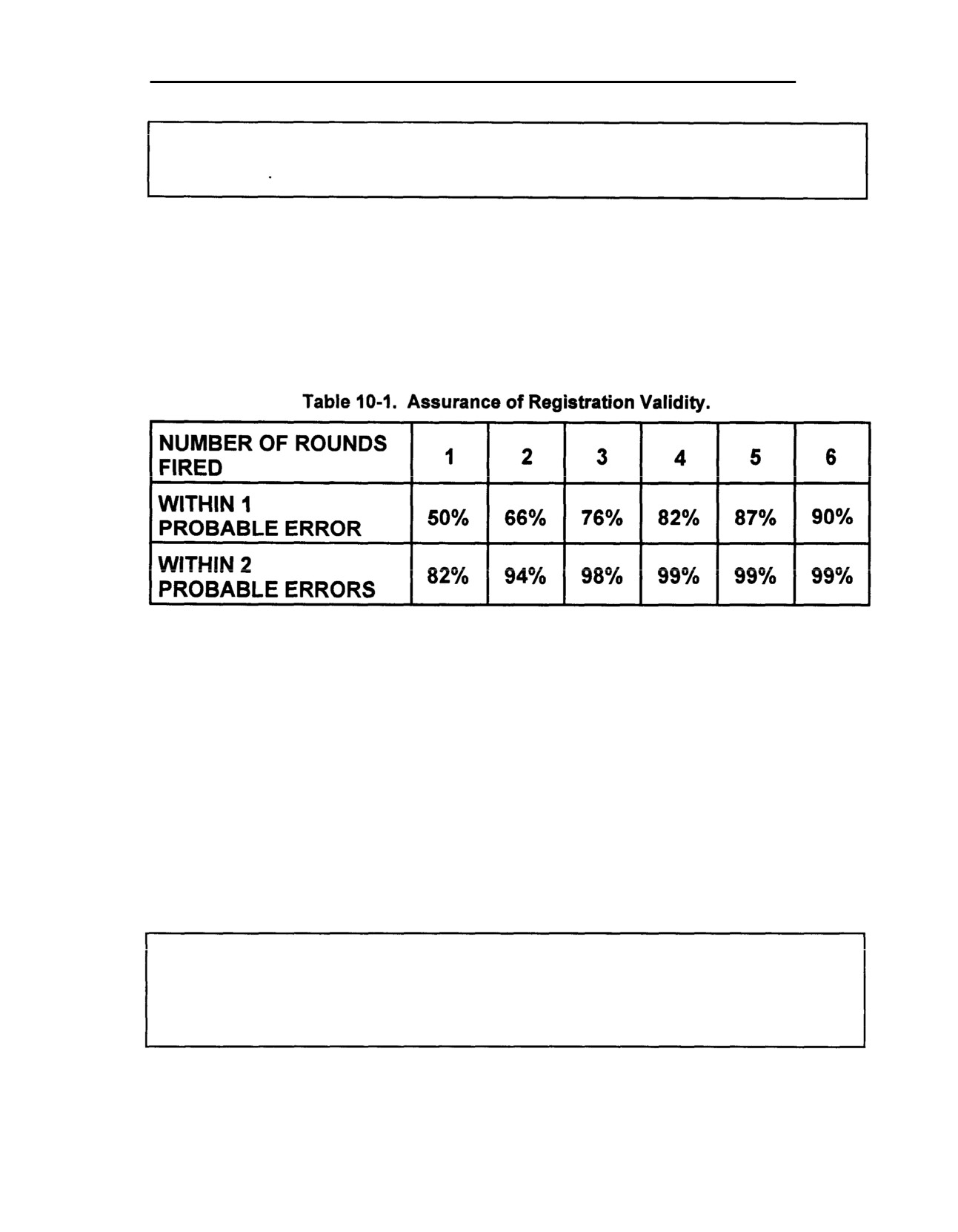
A registration conducted with fewer rounds than recommended will degrade the accuracy
of the determined corrections. Table 10-1 lists the percentage of probability that the mean
location of a particular number of rounds is within 1 or 2 probable errors of the actual mean point
of impact achieved by firing an infinite number of rounds. As more rounds are fired, the
assurance of validity of the MPI is increased. If the tactical situation dictates, the lesser assurance
from an abbreviated registration may have to be accepted.
10-8. Registration Corrections and GFT Settings
a. The final step in every registration is the determination and application of registration
corrections. Registration corrections consist of total range, total fuze, and total deflection
corrections. The total corrections are determined by comparing the chart data (should hit data) to
the adjusted data (did hit data) resulting from a registration. When it is impractical to conduct a
registration, corrections can be obtained mathematically by use of a met technique. (See Chapter
11.)
b. The total corrections are then used as the basis for a GFT setting. This allows the
FDC personnel to apply total corrections to the GFT. With the GFT setting properly applied, it is
possible to fire for effect without an adjustment phase on accurately located targets within
transfer limits. Total corrections, GFT settings, and transfer limits will be discussed in greater
detail later in this chapter. It is important to remember that no registration is complete until
registration corrections-are determined and a GFT setting is applied. -
NOTE: Should hit data (SHD) are data fired under standard conditions that will
cause the round to impact at a point of known location. Did hit data (DHD) are data
fired under nonstandard conditions that will cause the round to impact at a point of
known location.
10-5
FM 6-40
Section II
Precision Registrations
Precision registration is a technique that requires an observer to adjust a
group of rounds fired from the same howitzer so that their mean point of impact
occurs at a point of known location (that is, a known point). The point of
registration is accurately located (8-digit grid, 10-meter accuracy or 10-digit
grid 1-meter accuracy). It can be determined from survey, can be an easily
recognized map spotted terrain feature, or it can be any identifiable point located
by a laser and should be on common survey with the firing unit, Corrections are
determined by comparing the data that actually did hit the target (adjusted data)
to the data that should have hit the target (chart data) if standard conditions had
existed at the time of firing.
10-9. Objective
The observer’s objective in the impact phase of a precision registration is to obtain
spottings of two OVERS and two SHORTS along the OT line from rounds fired with the same
data or from rounds fired with data 25 meters apart (50 meters apart when PER is greater than or
equal to 25 meters). This normally requires the spottings of four separate rounds. Four spottings
achieved by firing projectiles with the same data or data 25 meters apart is critical. This critical
bracket must be formed by the observer making only range corrections since a deviation
correction will introduce a difference in firing data greater than the 25-meter requirement. The
observer should not make any deviation corrections after establishing the 200-meter bracket. If
he does, then any previous rounds cannot be used as part of the 25-meter bracket. However, a
TARGET HIT or RANGE CORRECT will be spotted by the observer as an OVER and a
SHORT. The objective of the time portion of the registration is to correct the mean height of
burst of four rounds fired with the same data to 20 meters above the target point. The FDC’s
objective in a precision registration is to determine corrections to firing data on the basis of the
observer’s corrections and to determine whether or not the objectives were achieved.
10-10. Initiation of a Precision Registration
a. The decision to register is based on the considerations in Section I. After the decision
to register has been made, the FDO announces a fire order.
(1) Fire order. When the FDO announces his fire order, he addresses four
questions:
(a) What are we going to do? (for example, precision registration)
(b) Where are we going to do it? (for example, known point 1)
(c) With whom? (for example, with T03)
(d) With what fire order considerations? (The FDO does not address fire
order SOP items unless he feels that it is necessary to avoid confusion.)
10-6
FM 6-40
(2) Registering piece. Use only one weapon to fire the registration. It is best to
select the piece that is plotted on the firing chart and for which we have accurate MVV
information for the registering charge (for example, the BASE PIECE).
(3) Lot. Register the largest calibrated lot of propellant. This lot is used for
first-round FFE missions.
(4) Charge selection. Listed below are a few of the factors an FDO should
consider when selecting the charge to register.
(a) At what range will most targets be engaged?
(b) If the enemy has a sophisticated sound ranging capability, a lower charge
is preferred.
(c) If the enemy has a sophisticated counterbattery radar capability, a higher
charge is preferred.
(d) Which charge has the smallest PER for a given range (see the charge
selection table in the TFT).
(e) Lower charges produce less tube wear, residue, and noise. They also have
better terminal effects with shell HE.
b. When the RATELO hears the fire order, he will announce a message to observer to
alert the observer.
(1) MTO. The MTO includes the information from the fire order that pertains to
the observer; for example, type of registration, the known point, and fuzes to be registered. If
there is no known point, the FDO will direct the observer to select one in a specified area, and
the observer will send the location to that point. The FDO will then designate the number of the
known point. Because of the possibility of introducing a target location error, this option is least
preferred.
(2) Observer’s response. After the observer has received the MTO, he will report
direction. If the observer is directed to select a known point, he will report the eight-digit grid
location and direction. In either case, the report of direction indicates the observer is ready to
conduct the registration.
10-11. Conduct of the Impact Phase of a Precision Registration
a. Fire direction procedures for an impact phase of a registration are identical to those
used in the conduct of any adjust-fire mission. All observer corrections are plotted on the firing
chart and chart data are announced. The computer sends fire commands to the registering piece.
Although care should be taken during all computational steps, extraordinary measures should not
be used for the conduct of a registration.
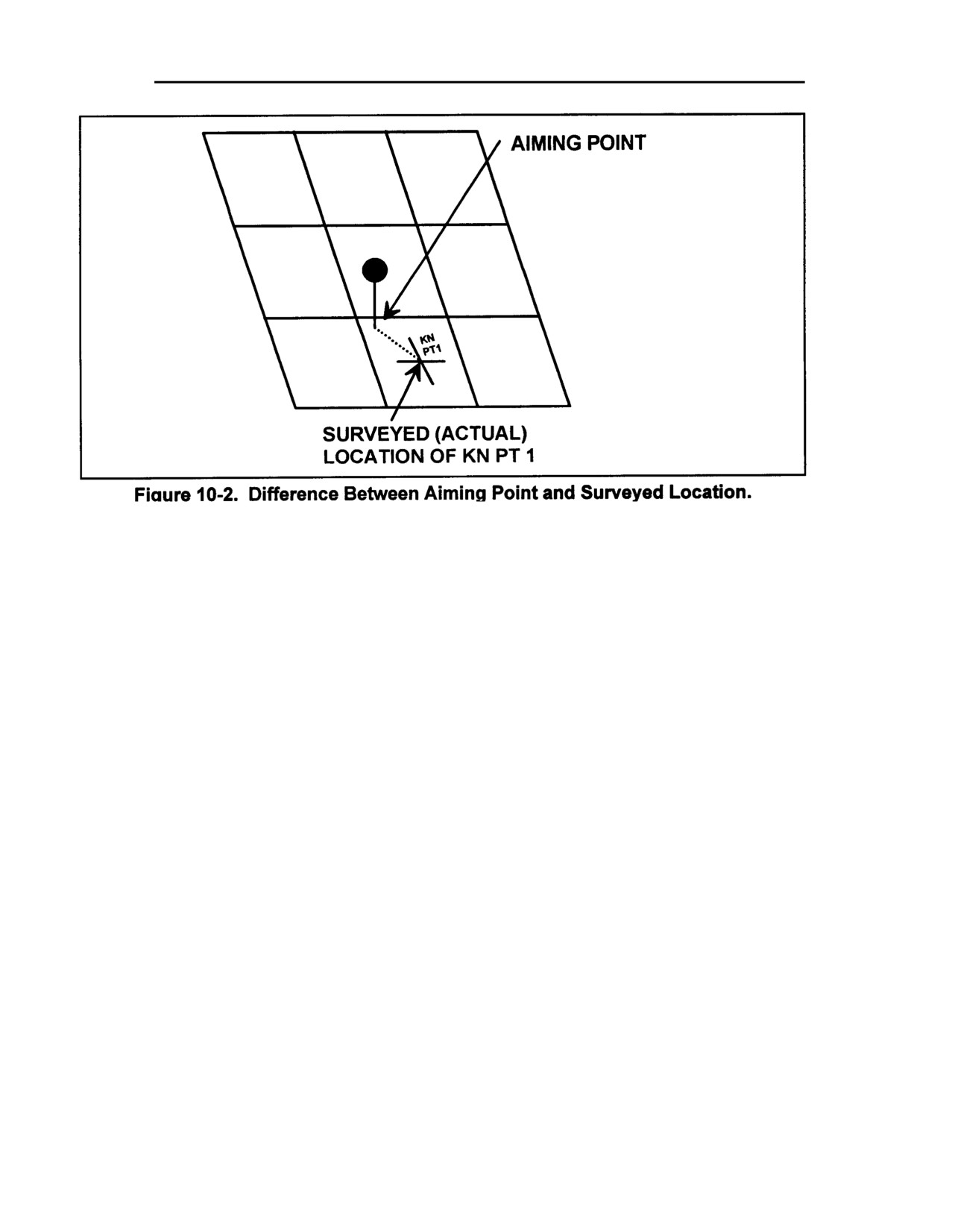
b. The final location of the plotting pin on the chart represents the point where the
howitzer had to be aimed to have rounds impact on the known point (Figure 10-2). It is not the
actual location of the known point. The difference between these locations depicts the effects
that all nonstandard conditions had during firing.
10-7
FM 6-40
c. The data announced after the observer’s final impact refinement shows the range and
deflection to the point where the howitzers must aim to have rounds impact on the known point.
At this point, no projectile is fired and the time phase of the registration begins. The deflection
and elevation corresponding to the data measured to the final pin location is called the adjusted
data--the data that did hit the known point. Adjusted data will be circled on the record of fire.
10-12. Conduct of the Time Phase of a Precision Registration
a. When the impact phase of the registration is complete, the time phase can be started.
The observer’s refinement data moved the mean point of impact of the rounds to the known
point. At this point, an adjusted deflection and elevation are determined. The adjusted deflection
and elevation are did hit data for the known point and the most accurate data with which to begin
the time portion.
b. The first fuze setting fired corresponds to the adjusted elevation. The initial fuze
setting to fire is determined by placing the MHL over the adjusted elevation and reading a fuze
setting corresponding to that adjusted elevation. At the same time, the computer determines ▲ FS
corresponding to the first fuze setting fired.
c. As with other fuze time missions, an HOB correction (20/R) is added to the ground
site to determine a total site. The total site is added to the adjusted elevation to determine the
quadrant to fire for the rest of the mission. The adjusted deflection is fired for the rest of the
mission.
d. Normal procedures for application of ▲ FS for up or down corrections are followed to
meet the objective of the time phase of the mission, which is to correct the mean height of burst
of four rounds fired with the same data to 20 meters above the known point.
e. The adjusted time is determined after the observer’s HOB refinement is applied. The
adjusted time is circled. With the observer’s correction applied, the adjusted time will produce an
airburst 20 meters above the known point. The adjusted time is not fired.
10-8
FM 6-40
10-13. Second Lot Registrations
a. The use of the second lot registration technique has become obsolete with the use of
the M90 chronograph and the ability to account for muzzle velocity differences in propellant lots.
The GFT settings for subsequent lots can be determined by using the subsequent met techniques
if muzzle velocity information is available.
b. Conduct second lot registrations in the same manner as single lot registrations with
the following exceptions:
(1) Fire order. The fire order informs the FDC that corrections are needed for two
different lots (of the same charge and propellant type).
(2) MTO. The radio operator transmits the MTO notifying the FO to observe two
lots by announcing TWO LOTS after the fuze or fuzes to be fired.
10-14. Initiation of the Second Lot Registration
a. After completing the first lot time registration, begin firing the first round of the
second lot registration with the adjusted deflection and the adjusted quadrant elevation (adjusted
elevation plus ground site) determined for the first lot. Fire fuze quick only. To notify the
observer that a second lot registration is going to be conducted, the FDC announces: OBSERVE
SECOND LOT, OVER.
b. In the appropriate columns on the ROF, enter the firing data determined from the first
lot registration. These data include the following:
Adjusted deflection.
Adjusted chart range.
Value of ground site.
Adjusted elevation.
c. The adjusting piece must be given commands to change the method of fire, lot and
fuze. The objective of the second lot registration is the same as that of the first lot. Once the
observer has met the objective, he will announce (any refinement) and RECORD AS SECOND
LOT REGISTRATION POINT, END OF MISSION.
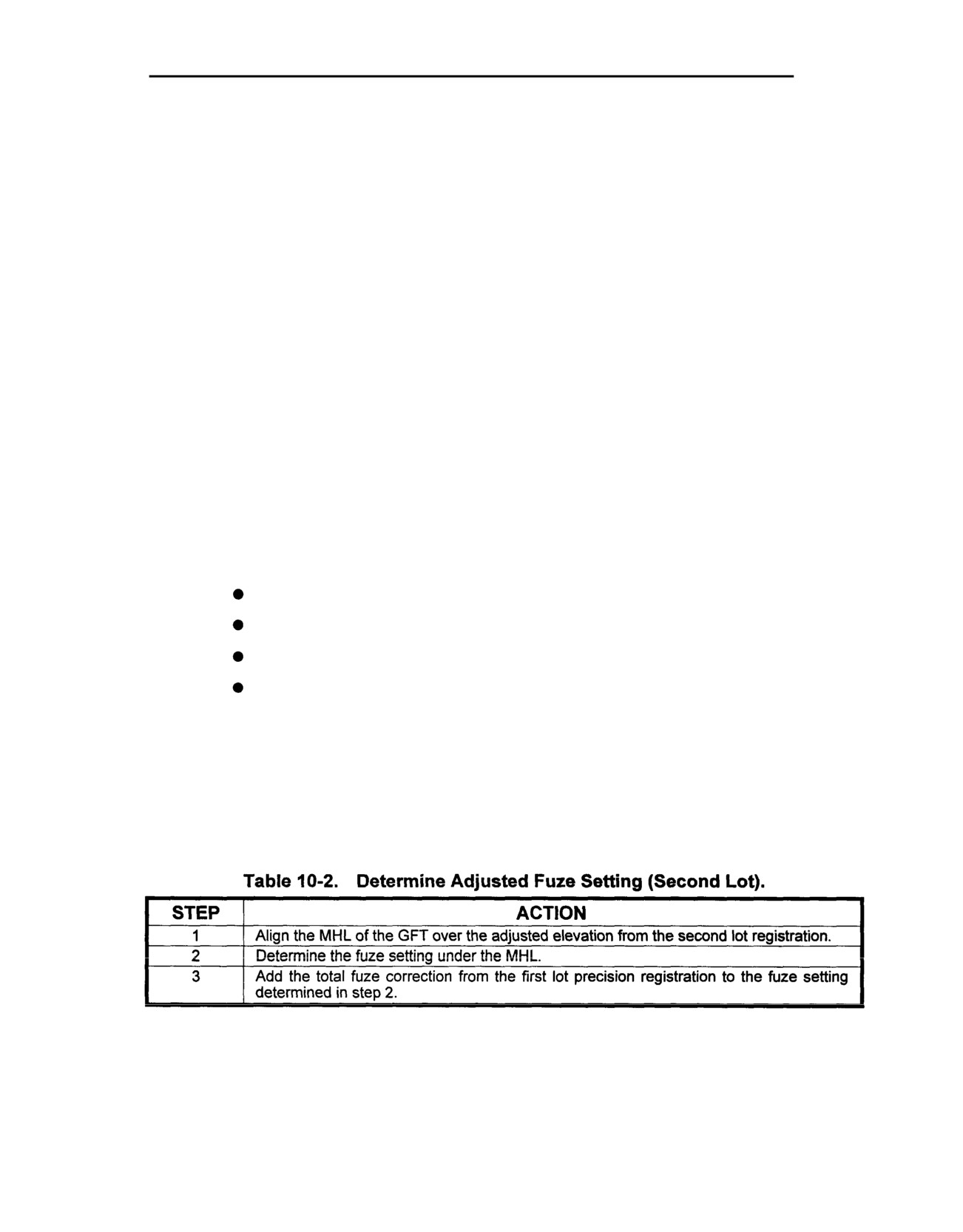
d. To determine the adjusted fuze setting, add the fuze correction from the first lot to the
fuze setting corresponding to the subsequent lot adjusted elevation. To determine the adjusted
fuze setting for the second lot registration, follow the steps in Table 10-2.
e. The second lot GFT setting will be constructed in the same manner as the first lot
GFT setting.
10-9
FM 6-40
NOTE: To minimize confusion, the second lot GFT setting should be placed on a
different cursor and labeled with the appropriate lot.
f. Determine the total deflection correction by using the following formula:
2D LOT ADJ DF - CHART DF = TOT DF CORR
g. Determine the GFT deflection correction by placing the MHL over the second lot
adjusted elevation and reading the value under the MHL on the drift scale. This value is
subtracted from the total deflection correction, and the LARS rule is used to determine whether
the GFT deflection correction is a L or an R.
TOT DF CORR - DRIFT ~ 2D LOT ADJ EL = GFT DF CORR
10-15. Example of a Completed Precision Registration
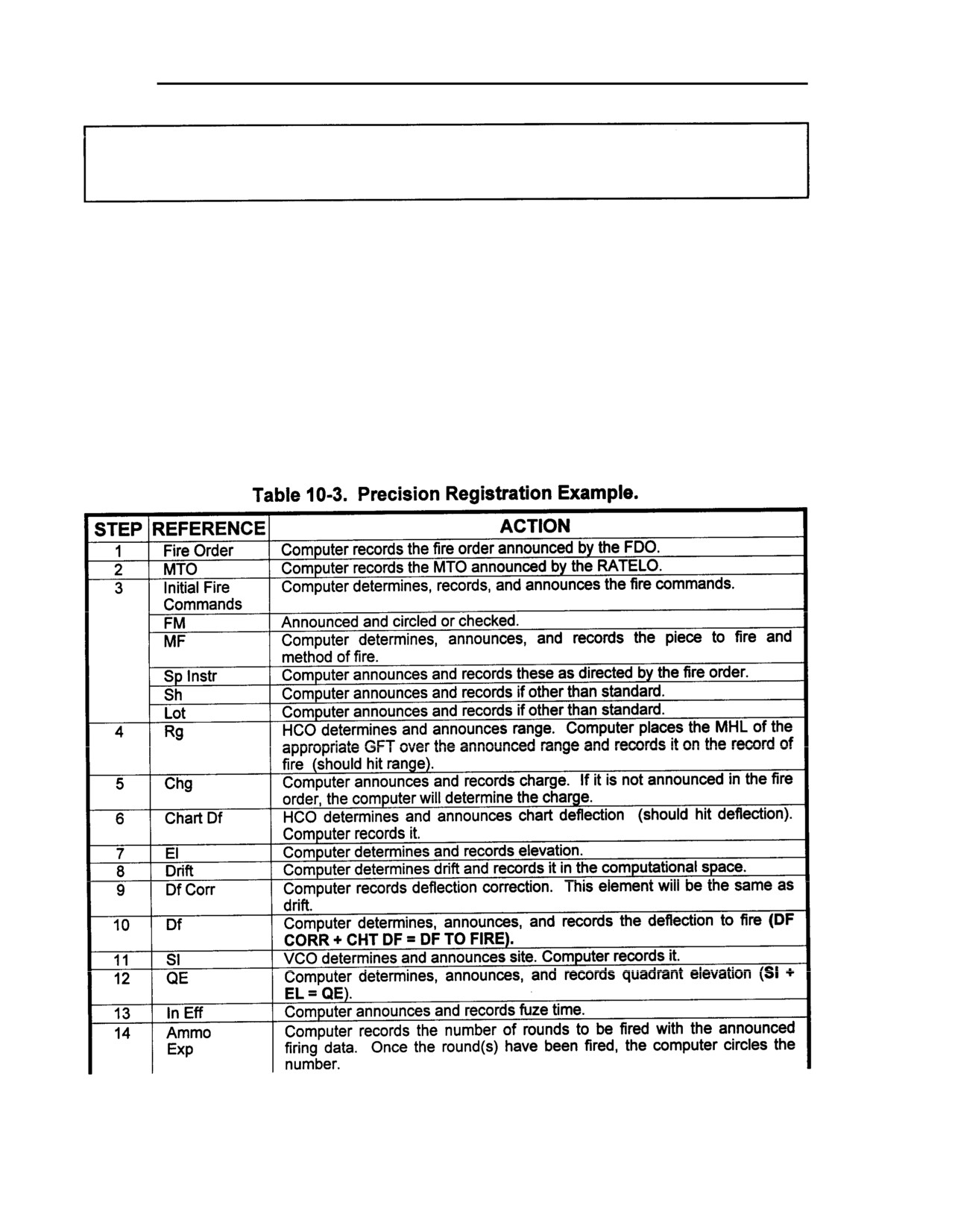
a. Use Table 10-3 to process a precision registration with fuzes quick and time.
10-10
FM 6-40
b. The observer ends the impact phase of the registration by providing refinement data
and requesting RECORD AS REGISTRATION POINT (announces the number of the
registration point), TIME REPEAT. Record this transmission on two lines of the ROF. The
first line is used to determine the adjusted elevation and adjusted deflection. The adjusted data
are determined by processing the refinement data. These adjusted data are referred to as DHD
and are recorded and circled on the record of fire for quick reference. The adjusted data are not
sent to the howitzer(s).
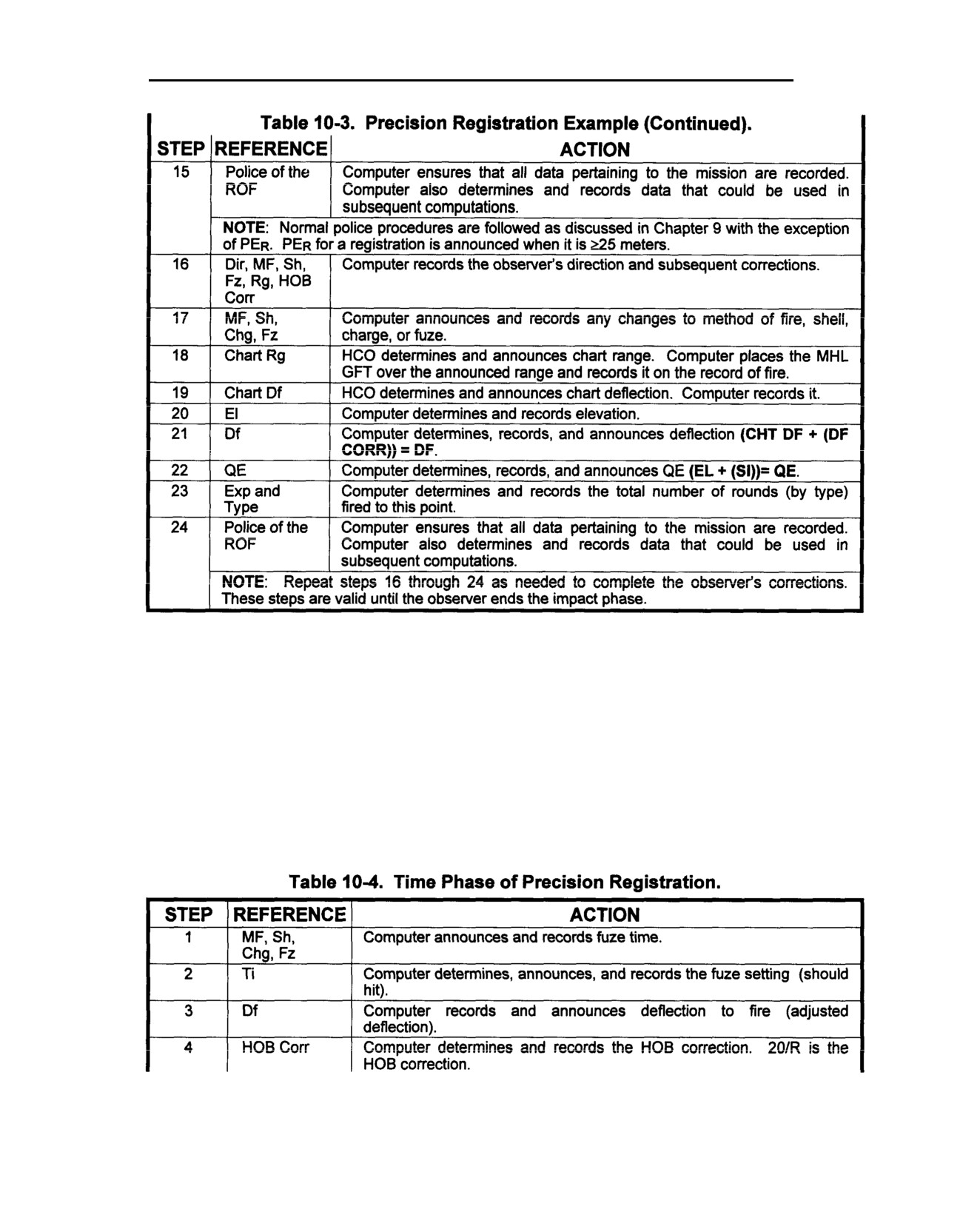
c. Once the refinement data have been processed, the time phase is initiated. The chart
data, deflection to fire (adjusted deflection), and elevation (adjusted elevation) have already been
determined. The only data that needs to be computed are the time fuze setting (should hit) and
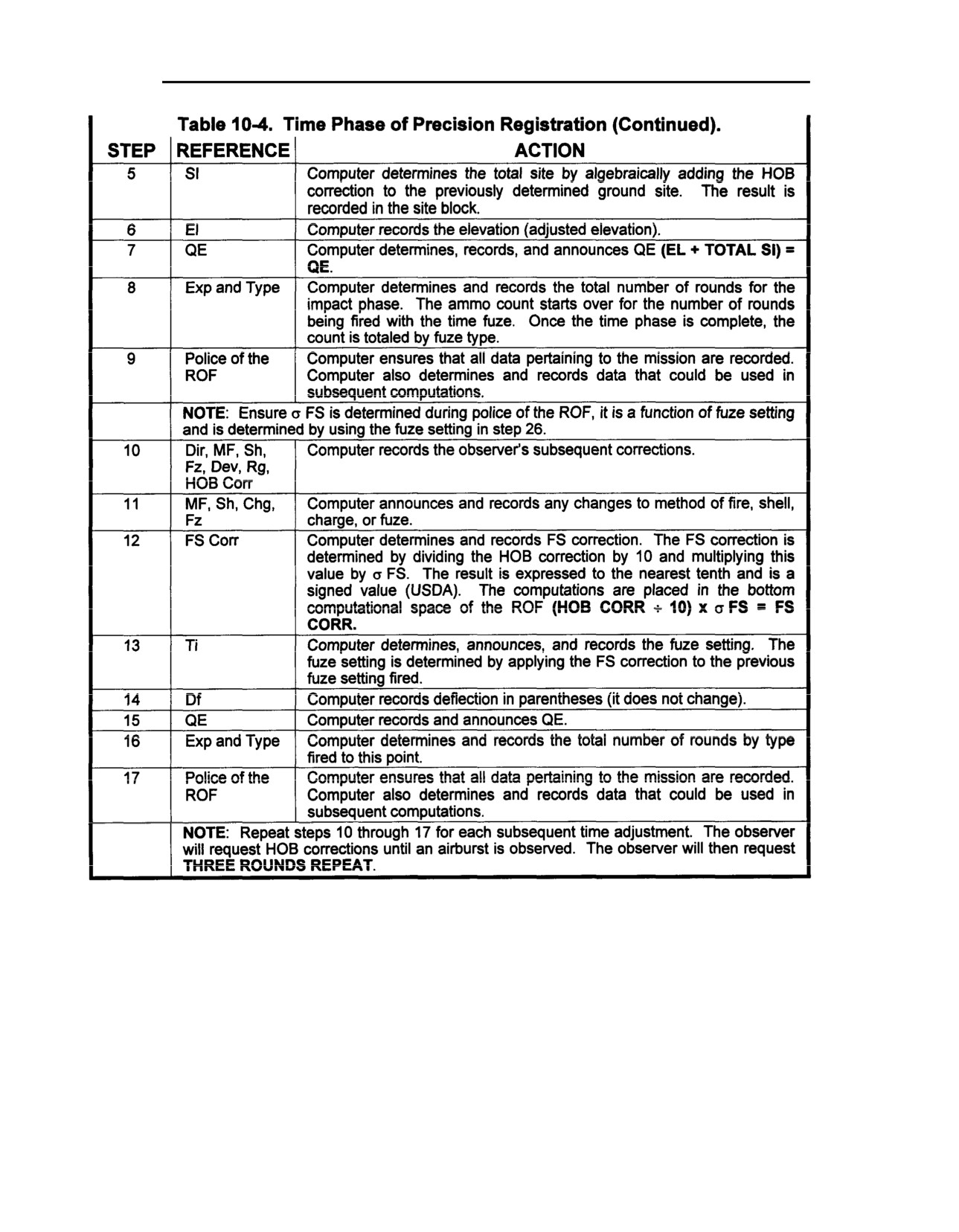
the quadrant elevation. Use the steps in Table 10-4 to process the time phase of the registration.
10-11
FM 6-40
d. After spotting the last round, the observer will provide final refinement data to adjust
the mean height of burst to 20 meters. The observer will also direct RECORD AS TIME
REGISTRATION POINT, END OF MISSION.Record this transmission on two lines of the
ROF. The first line is used to process the final HOB correction and determine the adjusted time
(did hit). The adjusted time is recorded and circled on the record of fire for quick reference.
These data are not sent to the howitzer(s). The second line is used to record end of mission,
which is sent to the howitzer(s). Once EOM is sent to the howitzer(s), a final police of the ROF
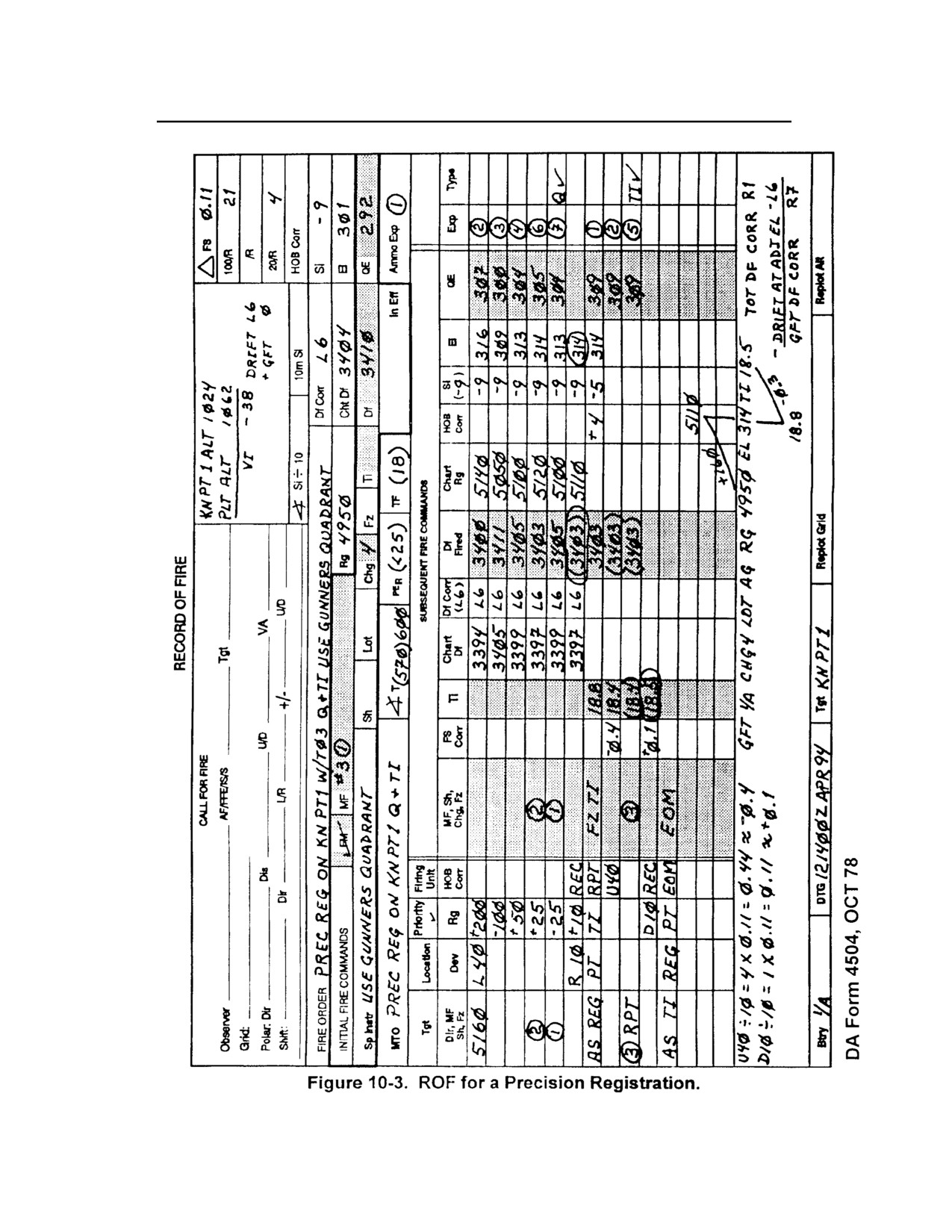
is conducted. A completed ROF for a precision registration using the M582 time fuze is shown
in Figure 10-3.
10-12
FM 6-40
10-13
FM 6-40
10-16. Abbreviated Precision Registration
a. The tactical situation or ammo restraints may prohibit conducting a full-scale
registration. In such cases, the FDO may conduct an abbreviated precision registration.
Although having a lower assurance of validity, an abbreviated precision registration often
provides adequate compensation for the effects of nonstandard conditions. The observer ends the
registration when he believes that his next correction will put the next round on the registration
point. The advantages of this type of registration are fewer rounds are fired so less ammunition is
consumed and the registration takes less time so the unit is exposed to enemy TA devices for a
shorter period of time.
b. After making the decision to register, the FDO announces a fire order. Once the
RATELO hears the fire order, he transmits an MTO to alert the forward observer. After the
observer has received the MTO, he sends a direction, which signifies he is ready to observe, to
the FDC.
c. The observer procedures for an abbreviated precision registration
are different than
those used for a normal precision registration.
(1) The observer will use normal adjust-fire procedures until the
100-meter bracket
is split.
(2) The correction then sent is an add (or drop) 50 meters FFE or time repeat or
time add or drop 50 meters.
(3) The burst which is a result of an add (or drop) 50 meters is spotted. Minor
corrections for both deviation and range are sent to the FDC in the following format:
(a) For both a quick and time registration: L10, -40, RECORD AS
REGISTRATION POINT, TIME REPEAT.
(b) For an impact only registration: R30,
-10, RECORD AS
REGISTRATION POINT, END OF MISSION.
(c) Normal time adjustment procedures are followed in the time portion.
(d) Once an airburst is obtained, a correction for a 20-meter HOB is
determined.
(e) Instead of firing for effect, refinement is sent to the FDC in the following
format: U5, RECORD AS TIME REGISTRATION POINT, END OF MISSION.
NOTE: If the abbreviated registration is conducted as part of a normal adjust-fire
mission, steps c(2) and c(3)(e) are modified to allow the observer to request FFE.
d. The GFT setting and total corrections are determined in the same manner as in a
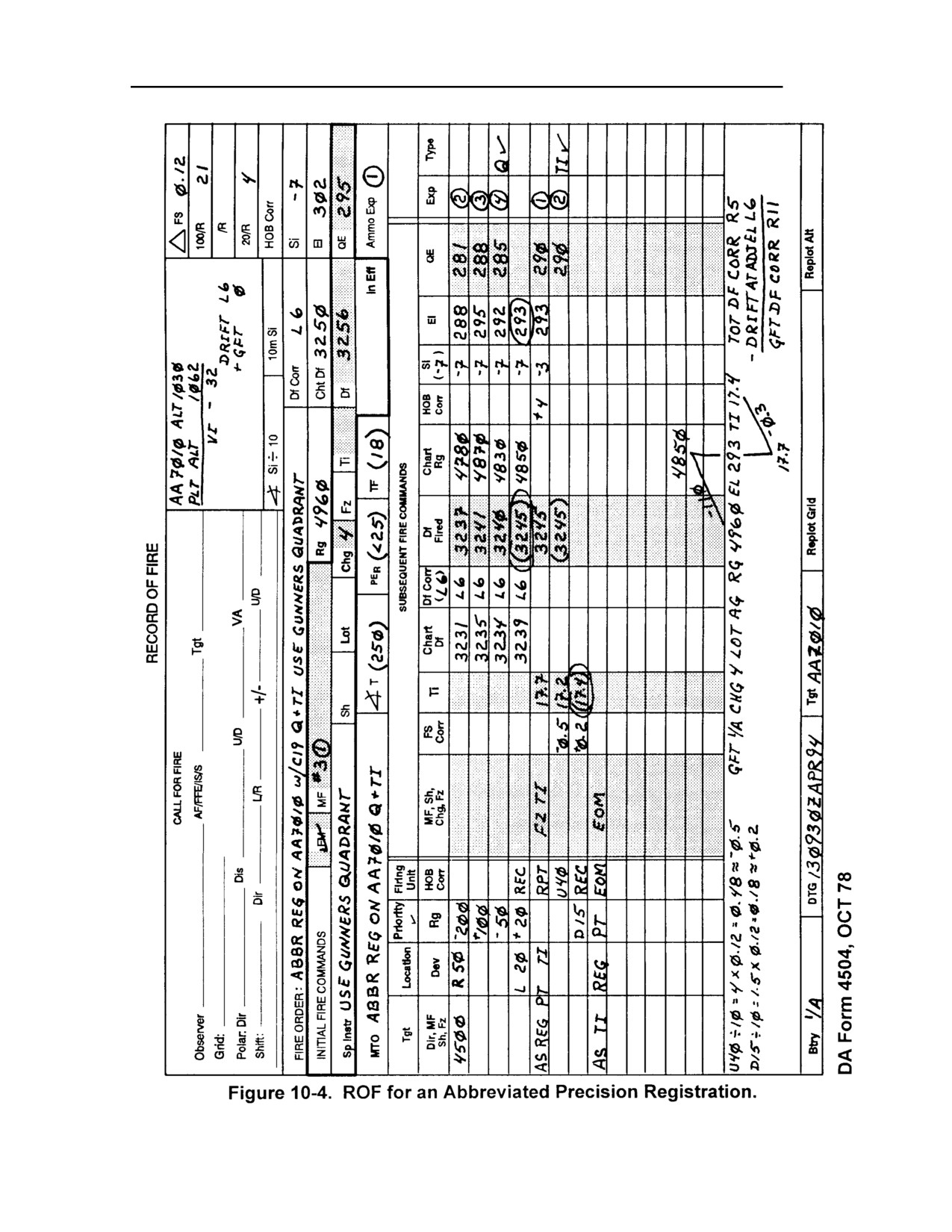
normal precision registration. A completed ROF for an abbreviated registration using the M582
time fuze is shown in Figure 10-4.
10-14
FM 6-40
10-15
FM 6-40
Section III
High-Burst/Mean Point of Impact Registrations
When registration is necessary, clearly defined and accurately located
registration points may be limited or not available. Dense vegetation or ground
fog may prevent the observers from seeing the ground. At night, adjustment of fire
on a registration point is impossible without some type of illumination. The
tactical situation may not allow the firing of numerous rounds required for a
precision registration. The HB/MPI registration can overcome these problems.
This section describes HB and MPI registrations.
10-17. Description
a. In HB and MPI registrations, the unit fires a number of rounds (ideally six) with the
same set of firing data. These rounds are observed by two observers in surveyed positions,
usually designated 01 and 02, who can measure the direction to each bursting round. One
observer measures the VA to each round. On the basis of the observers’ average directions and
the average VA from one observer, determine and plot the MBL or the mean point of impact.
Lastly, determine chart data and compare them to the adjusted data that were fired.
b. An MPI registration is fired with fuze quick. The HB registration is freed with
time-tied rounds. The HB offers an advantage over the MPI registration by allowing the FDC
to determine a fuze correction. The HB registration is also easier to observe, especially at night,
and registration corrections can be determined in areas where the observers cannot see the
ground.
c. The requirement for surveyed observer locations with directional control is the
primary limitation of HB and MPI registrations.
d. The six basic steps to an HB or MPI registration are as follows:
Select an orienting point.
Orient the observers.
Determine firing data to the orienting point.
Fire the HB or MPI registrations.
Determine the mean burst location.
Determine chart data and registration corrections.
10-18. Selecting an Orienting Point
a. The S3 or FDO selects an orienting point at which all of the rounds will be fried.
This point may be located at a grid intersection for convenience. The orienting point is only a
temporary point on the firing chart. After computing firing data, the orienting point is no longer
needed.
10-16
FM 6-40
b. The orienting point for either an HB or MPI registration point should meet the
following criteria.
(1) It must be visible to both observers.
(2) It should be close to the center of the area of responsibility (unless an
eight-directional met technique is to be used to determine a valid GFT setting).
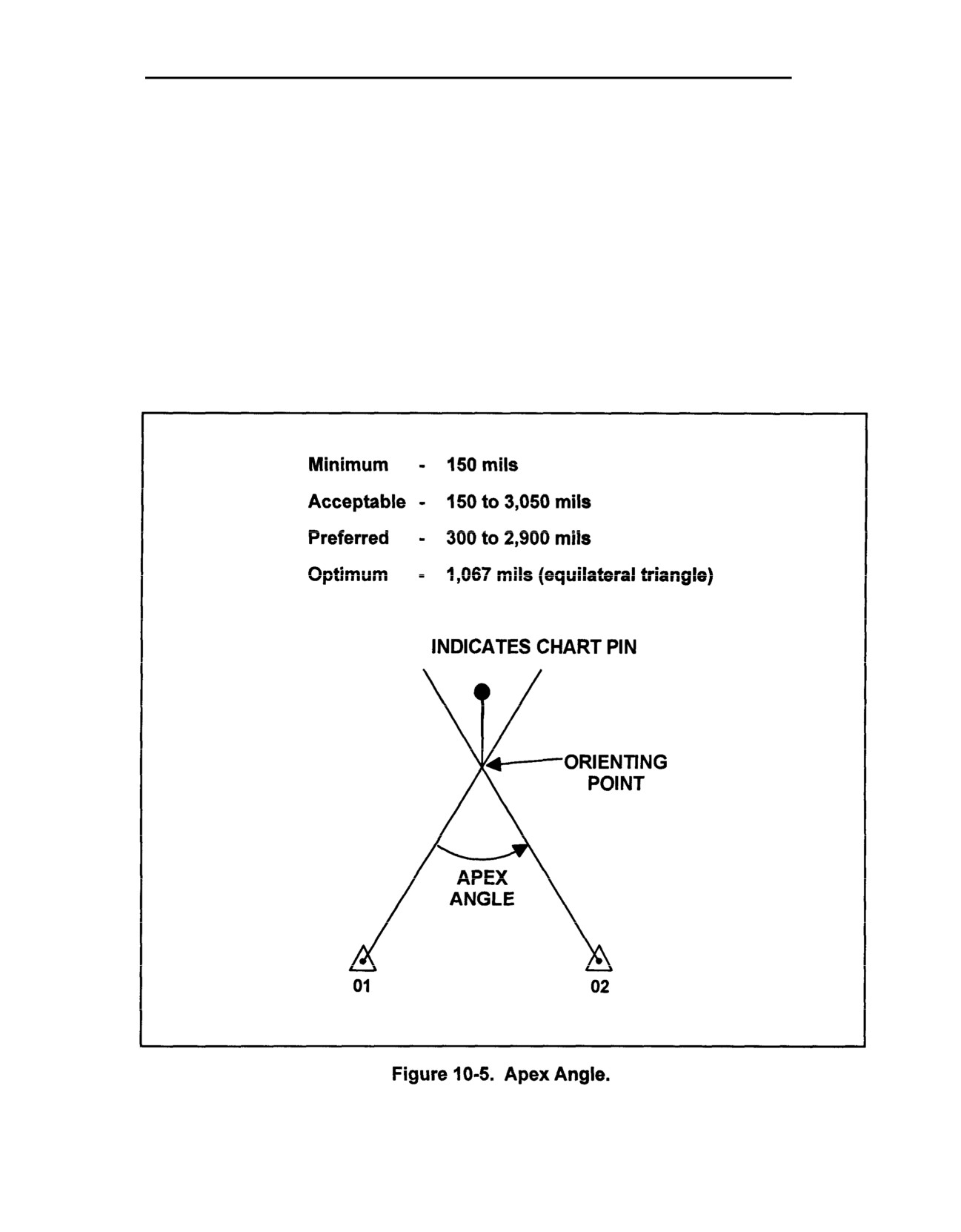
(3) It should ensure an acceptable apex angle (Figure 10-5). (The apex angle is the
angle formed by the lines from each observer to the orienting point.) Since two of the methods
used to determine the MBL involve the use of trigonometry (polar plot and grid coordinate), a
strong apex angle is needed to minimize the effects of small measurement errors. More
information can be found in FM 6-2.
(4) For an MPI registration, the orienting point should be in a relatively flat (level)
area to eliminate the need to replot the MBL.
10-17
FM 6-40
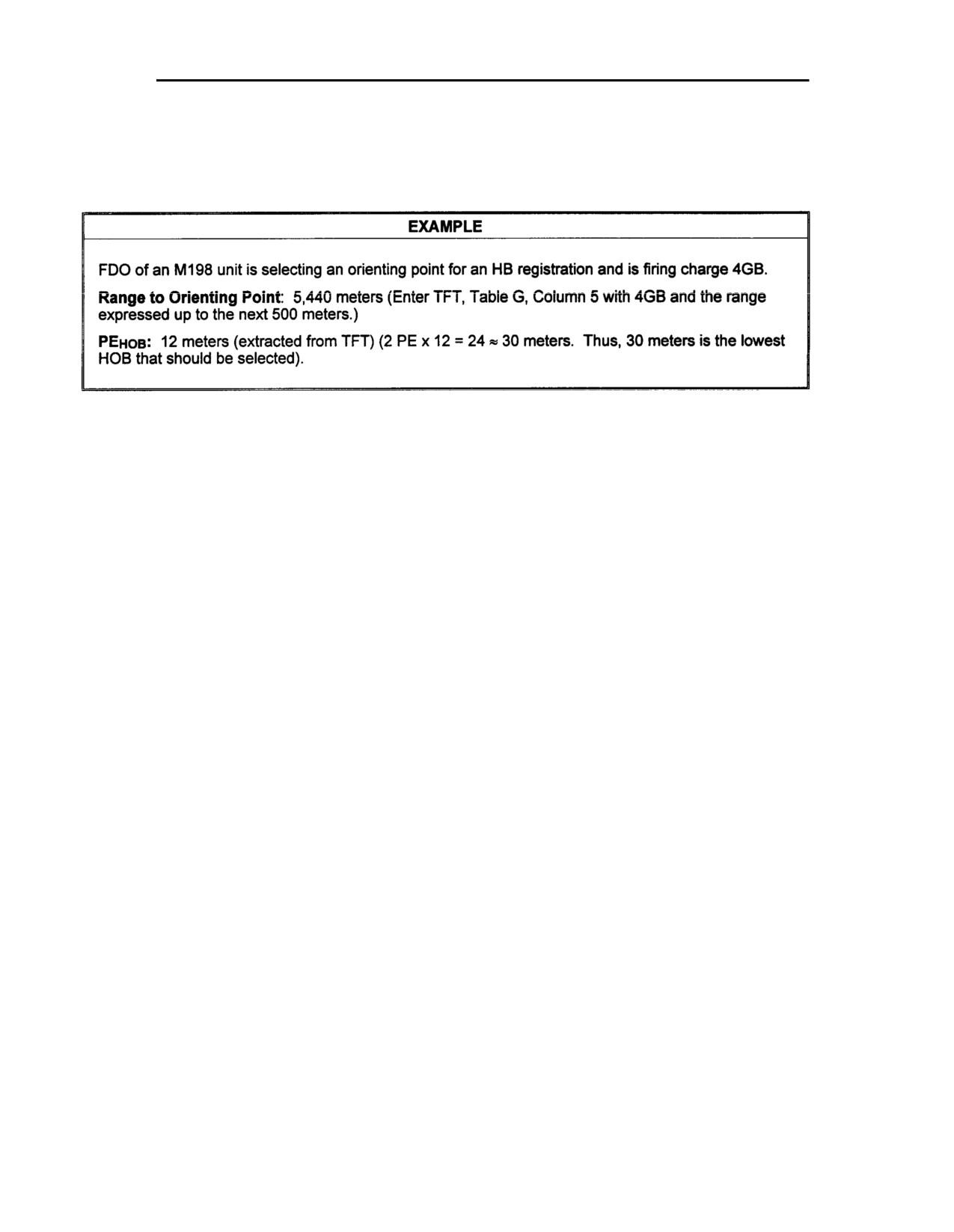
(5) For an HB registration, the orienting point must be high enough to ensure an
airburst. The selected height of burst must be at least 2 FE in height of burst above the ground
expressed up to the next 10 meters. The FDO can increase the HOB as long as it exceeds the
minimum selected HOB. An example of this is below.
c. The FDO initiates the HB/MPI registration with a fire order; for example,
HIGH-BURST REGISTRATION AT GRID 4128, HEIGHT OF BURST PLUS 30, WITH
T03 AND C19, 6 ROUNDS, FUZE TIME, BY ROUND AT MY COMMAND. As with any
registration fire order, this one specifies what will be done, where it is to be done, with whom,
and with what fire order considerations (see paragraph 10-10). The FDO has specified BRAMC
to be sure that the observers have enough time to spot each round fired and transmit spottings
before the next round is fired.
10-19. Orienting the Observers
a. After selecting the orienting point and issuing the fire order, the two observers must
be told whereto look to observe the rounds. Plot the observers’ locations on the firing chart (if
not already done), and measure the direction and distance from each observer to the orienting
point. The VCO uses the distances and the VI between each observer location and the orienting
point to determine the VA for each observer. Determine the VA by use of the C and D scales of
the GST.
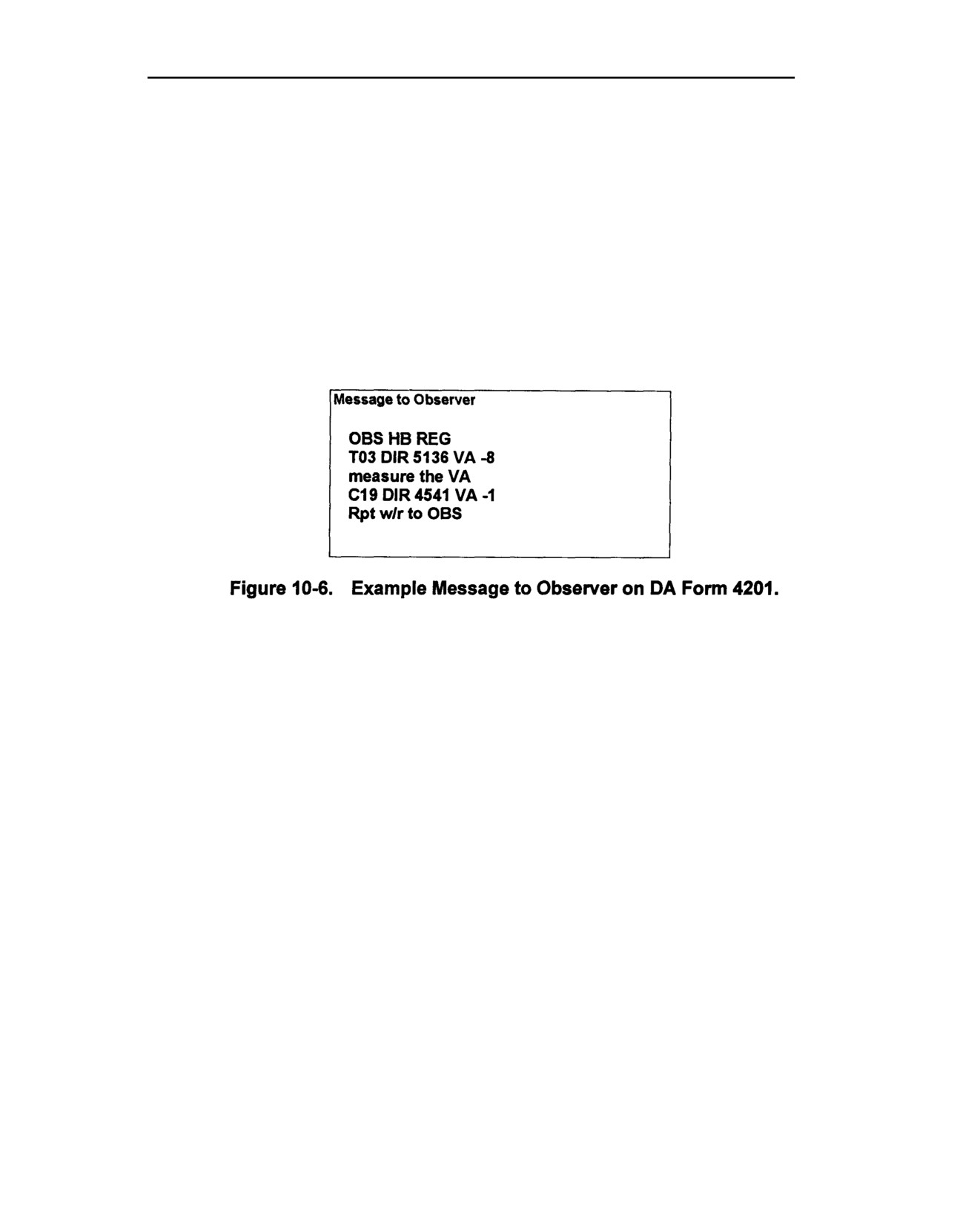
b. Send a message to each observer. The MTO contains the information the observers
need to orient their instruments. Record the MTO on DA Form 4201. (See Figure 10-6, page
10-19.) The message contains the following elements:
(1) A warning order
(for example, OBSERVE HIGH-BURST
REGISTRATION). The warning order informs the observers for what type of registration they
are preparing.
(2) Orienting data for 01 (T03). The HCO measures the chart data from 01 to
the orienting point. The direction reported to the observer is the direction determined on the
firing chart. The VCO determines the ground altitude of the orienting point and then adds the
HOB to determine the altitude of the orienting point. The VCO subtracts the altitude of the
observer from the altitude of the orienting point to determine the vertical interval. The VCO uses
the C and D scales of the GST, the vertical interval, and the distance measured by the HCO to
determine 01’s vertical angle. The vertical angle and direction reported to 01 will enable him to
orient on the orienting point.
10-18
FM 6-40
(3) A directive to 01 to measure the vertical angle. Normally, 01 is the more
experienced observer and will measure the VA. Observer 01 measures the vertical angles that
will be used to compute the altitude of the mean burst location. Only one observer reports the
vertical angle.
(4) Orienting data for 02 (C19). The HCO measures the chart data from 02 to
the orienting point. The VCO subtracts the altitude of the observer from the altitude of the
orienting point to determine the vertical interval. The VCO uses the C and D scales of the GST,
the vertical interval, and the distance measured by the HCO to determine 02’s vertical angle.
The vertical angle and direction reported to 02 will enable him to orient on the orienting point.
(5) A directive to the observers to report when they are ready to observe.
When the observers report that they are ready to observe, the FDC can begin the registration.
c. Each observer orients his instrument on the direction and vertical angle announced to
him and announces when he is ready to observe the registration.
10-20. Determining Firing Data
a. The HCO determines the range and deflection from the firing unit to the orienting
point and announces the data to the computer.
b. The VCO subtracts the altitude of the firing unit from the orienting point altitude to
determine the vertical interval. He then uses the D scale and the site-range scale of the GST, the
vertical interval, and the range announced by the HCO to determine site. The VCO announces
site to the computer.
c. The computer records the site on the ROF and determines and announces the fire
commands to the howitzer(s). The HOB correction (20/R) is not used for the HB registration
since the HOB was already accounted for in the orienting point altitude. The data fired are the
adjusted (did hit) data.
10-21. Firing the HB or MPI Registration
a. After both observers and the registering piece have reported ready, the FDO directs
FIRE THE REGISTRATION. The first round that is fired may not be observed by either of
the observers. There may be cases in which the nonstandard conditions cause the round to
impact behind a hill or in a ravine, out of sight of one or both of the observers. Sometimes graze
bursts occur at the start of an HB registration. The observers’ data for these rounds cannot be
10-19
FM 6-40
used to determine the mean burst location. If this happens, change the firing data to the orienting
point by increasing the HOB by at least 2 additional probable errors in HOB (Table G of the
TFT) until both observers can see the bursting rounds (see paragraph 10-18). Remember, if the
orienting point is changed, new orienting data must be sent to the observers (that is, a new MTO)
so that they can orient on the new location.
b. Once both observers have spotted the round, the firing data are not changed. All
rounds used to determine the MBL and/or MPI must be fired with the same set of firing data.
These firing data are adjusted (did hit) data.
c. When both observers have reported that they have observed the bursting round, the
computer transfers the firing data from the ROF to DA Form 4201 and writes "SEE ATTACHED
DA FORM 4201" on the ROF. Record all information for the rest of the registration on DA
Form 4201.
d. After observing each round, each observer reports the direction to the round and 01
reports the vertical angle. The computer records the data on DA Form 421 as it is sent by the
observers. The FDO must determine if any rounds fired were erratic and their spotting discarded.
There are no exact rules for determining which rounds are erratic. The following are methods in
which erratic rounds may be determined.
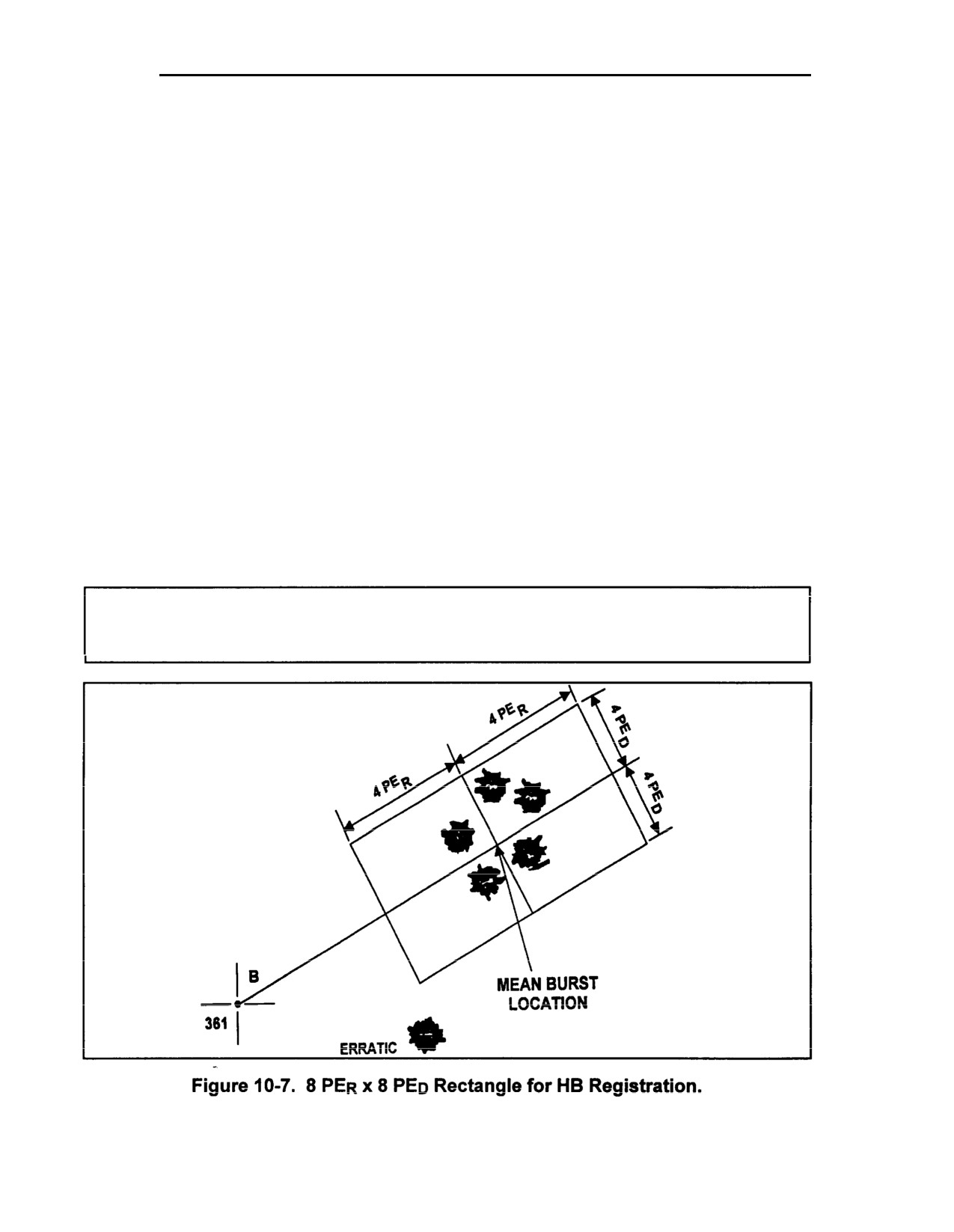
(1) Determine the MBL by using graphic intersection (see paragraph 10-22). Using
the range to the MBL (expressed to the nearest 100 meters and interpolated), determine the PER
and PED and construct a rectangle (8 PER x 8 PED) centered over the MBL and along the GT
line. Reject any rounds that plot outside this rectangle. (See Figure 10-7.)
NOTE: All rounds should have functioned within the 100 percent rectangle defined
by ±4 PER and ±4 PED. Any rounds outside of the rectangle are considered erratic.
10-20
FM 6-40
(2) At the range to the MBL, expressed to the nearest 500 meters, determine the PEHB.
Using 01’s reported vertical angles, the measured distance from 01 to the MBL, and the ground
altitude, determine the MBL altitude. Determine the altitude of each round, and compare this altitude
with the average altitude. Reject any round that falls outside the average altitude ±4 PEHB.
(3) The FDO may use his judgement and experience in determining if a round should be
rejected. Care must be taken to ensure that erratic rounds are not used or that usable rounds are not
rejected. If a round is considered erratic because of the reported direction from 01 or 02 or because
of an incorrect vertical angle, the data from the other observer must also be discarded.
10-22. Determine the Mean Burst Location
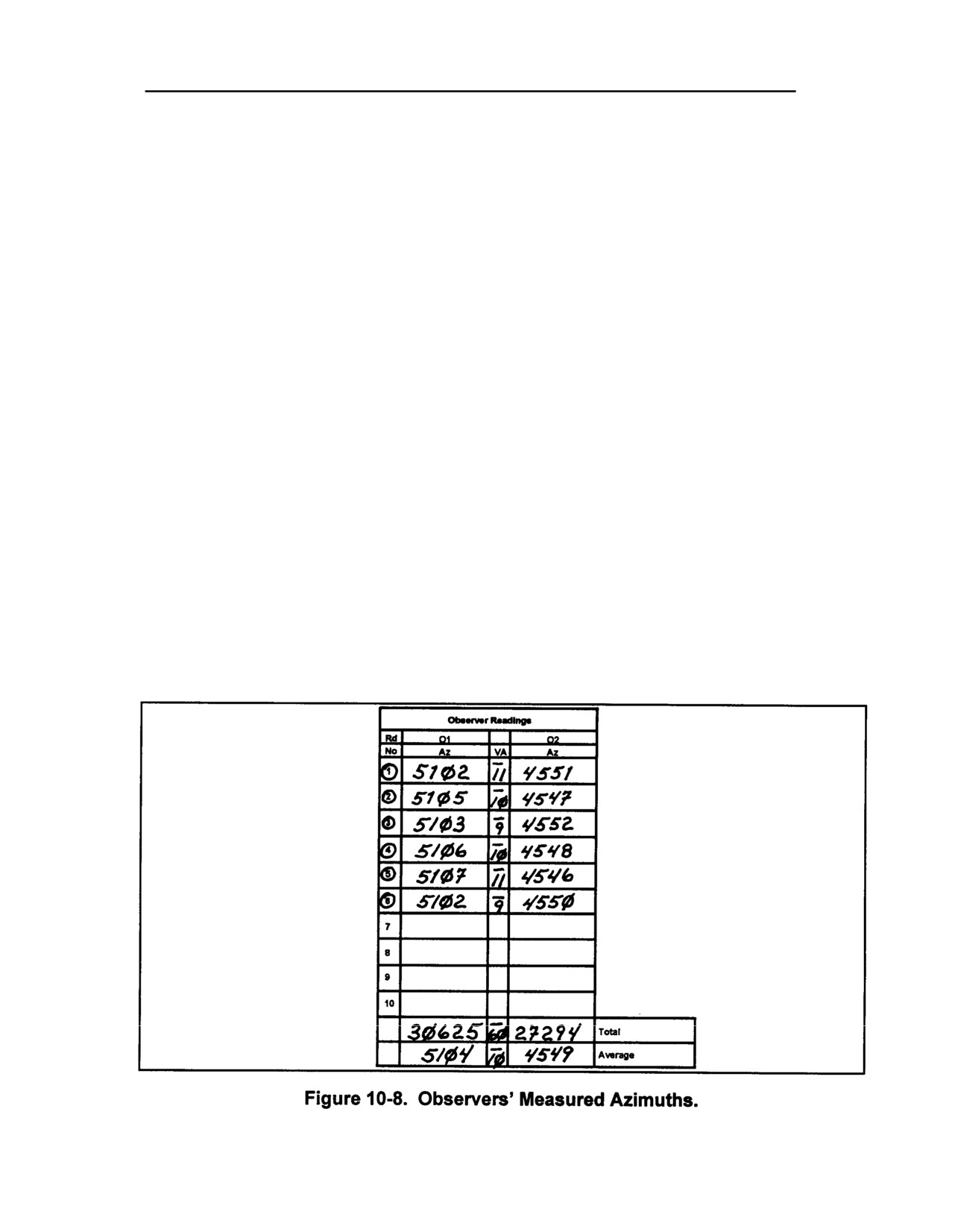
a. List the observers’ measured azimuths (spottings) on DA Form 4201 (Figure 10-8) as
they are sent by the observers. As the rounds are fired, circle the round number to record the
expenditure of rounds during the registration. Some rounds may be considered erratic. Erratic
rounds are crossed out, and additional rounds may be fired to replace them.
b. Once the data from the usable rounds are recorded, the FDC determines the MBL.
Determine the location by one of three methods. The methods are listed below in increasing order of
accuracy and time of computation. The method used by the FDC will depend on the tactical situation.
Usually, the graphic intersection method is acceptable. However, when increased accuracy is needed,
use one of the other methods if time permits. See paragraph 10-24 for specific steps.
(1) Graphic intersection. Draw the observers’ average directions on the firing
chart. The point at which the lines intersect is the mean burst location.
(2) Polar plot. Determine the direction and distance from 01 to the mean burst
location, and polar plot the MBL on the firing chart.
(3) Grid coordinates. Compute the actual grid coordinates of the MBL, and plot
the coordinates on the firing chart.
10-21
FM 6-40
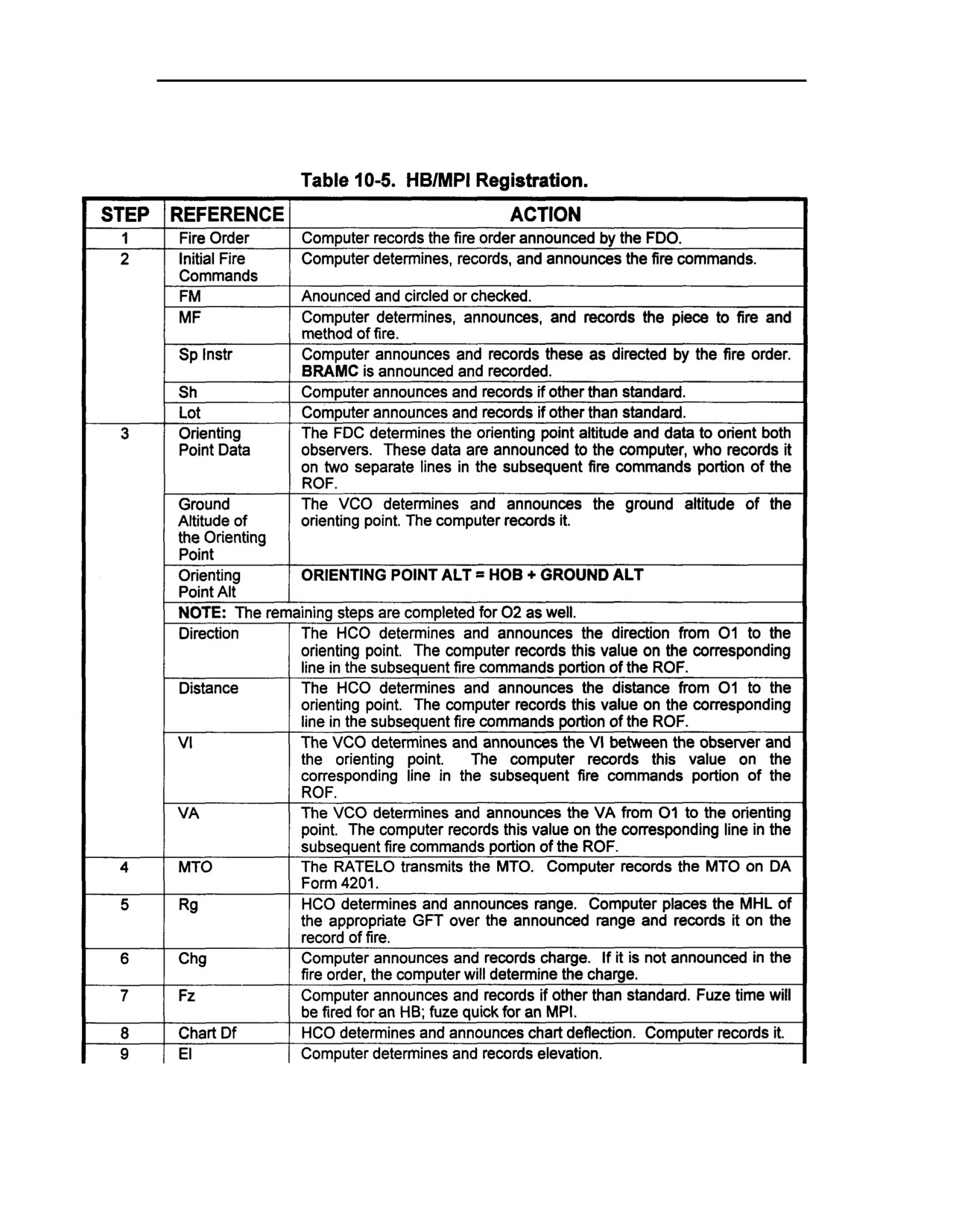
10-23. Example of an HB/MPI Registration
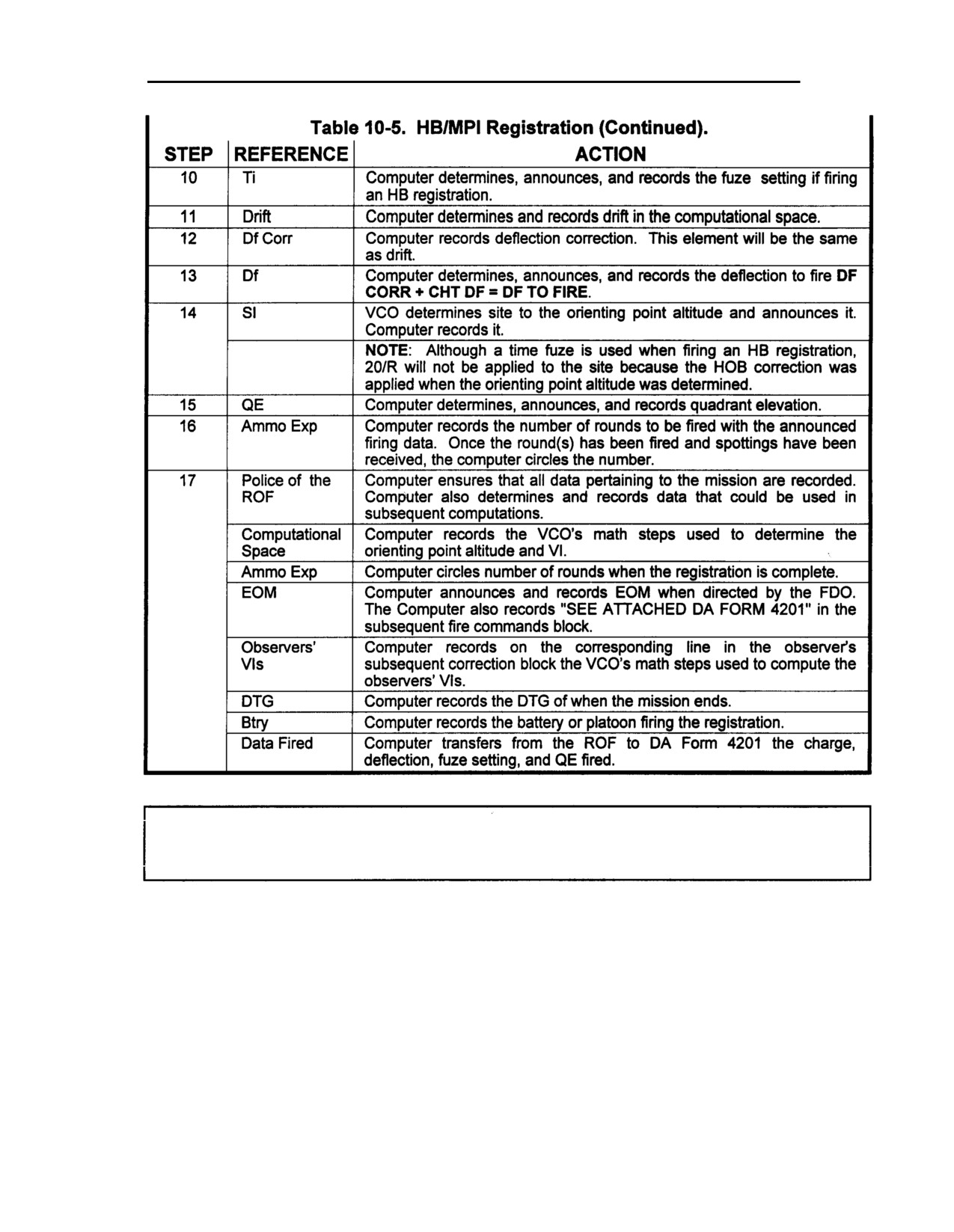
a. The steps in Table 10-5 are used to process an HB/MPI registration.
10-22
FM 6-40
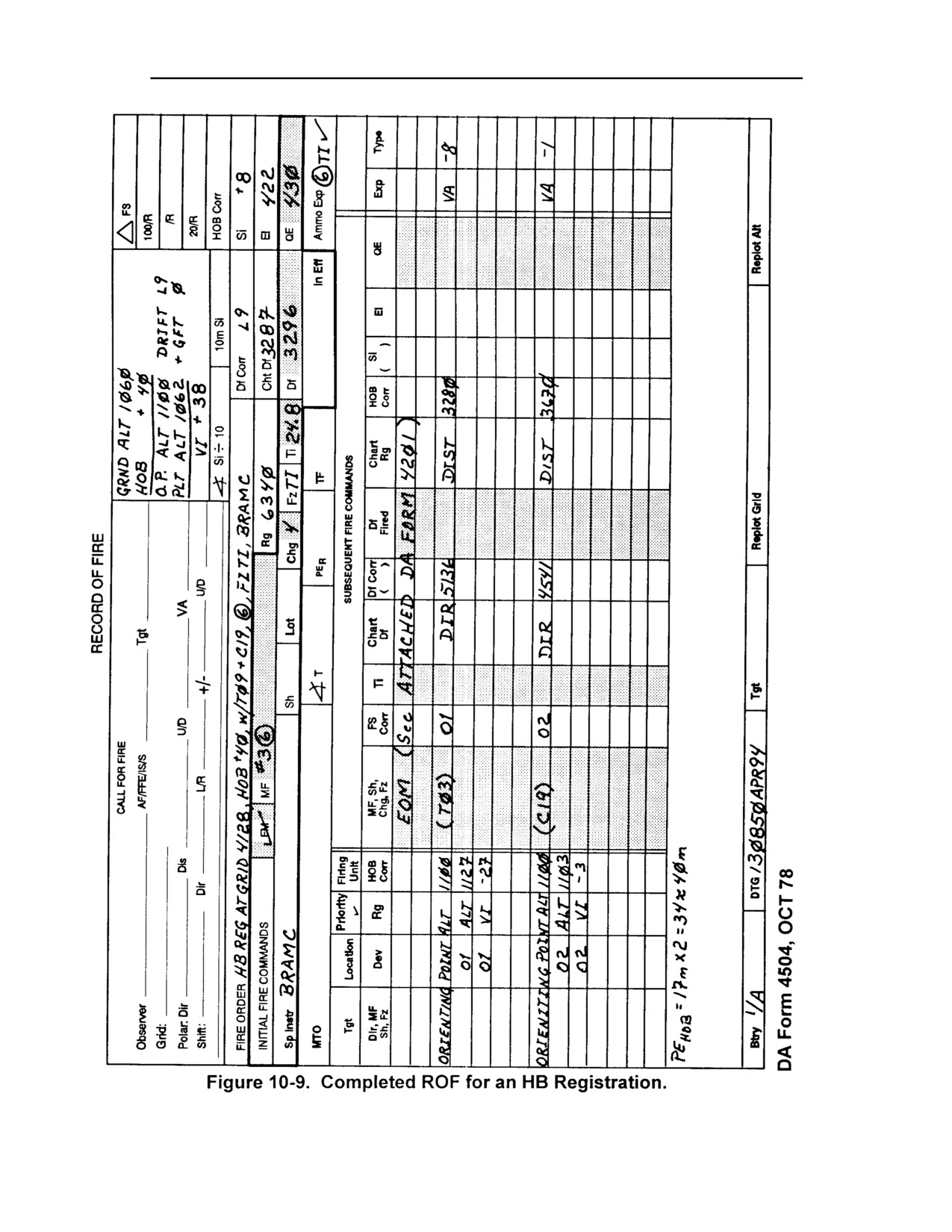
NOTE: A completed ROF for an HB registration using fuze M582 is shown in
Figure 10-9.
10-23
FM 6-40
10-24
FM 6-40
10-24. Determination of the MBL
a. After all rounds have been fired and the observer spottings recorded, the FDO will
determine if any rounds fired were erratic and should be discarded. If any round(s) are discarded,
the FDO may decide to fire more rounds. If more rounds are to be fired, the method of fire and
QE will be recorded on the ROF and announced to the registering piece. Use the procedures in
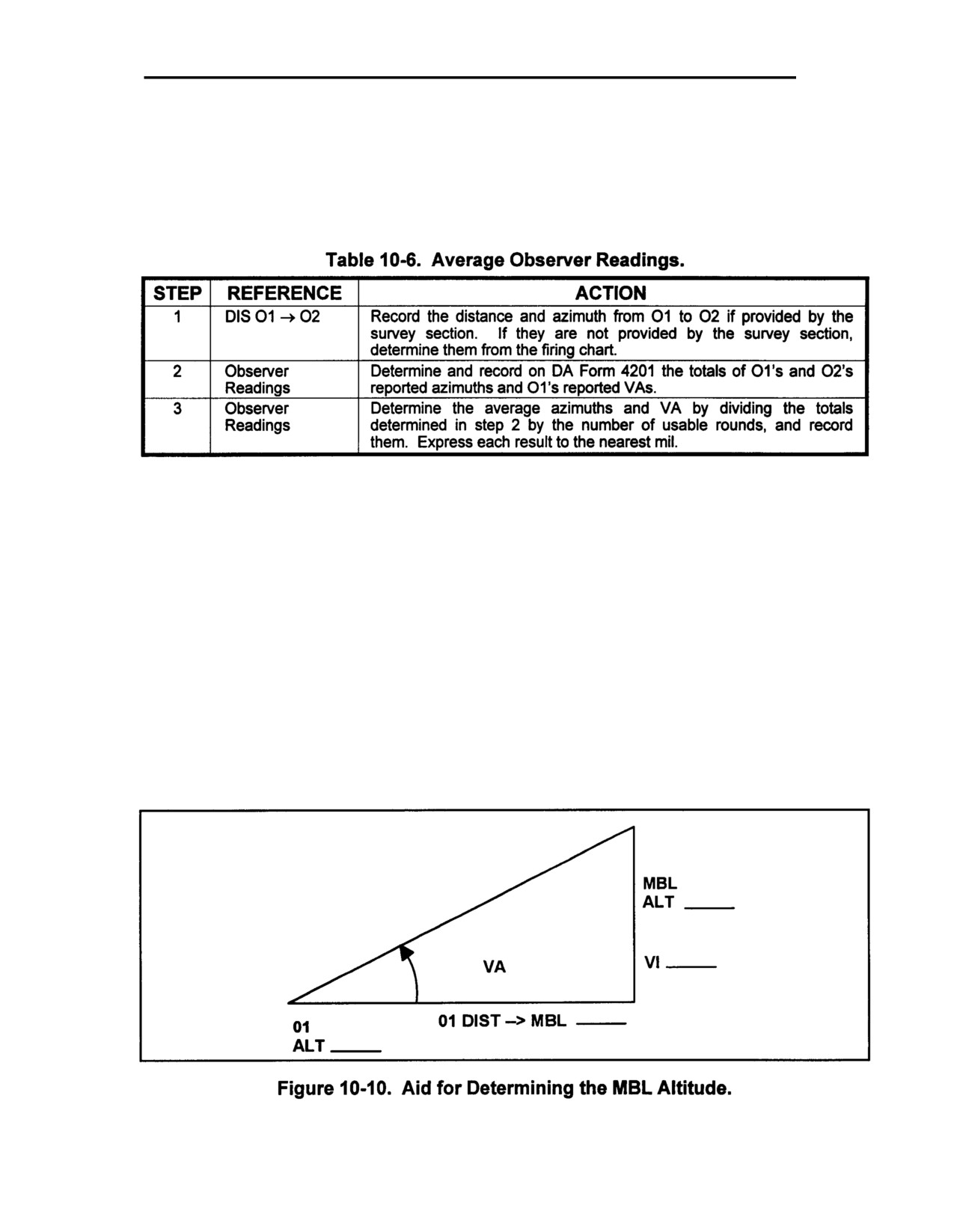
Table 10-6 to determine the average observer readings.
b. The MBL is determined by using one of the methods below.
(1) Graphic intersection. The HCO orients the RDP by using the average
direction of 01. Once the RDP is oriented, a line is drawn along the arm of the RDP by using a
6-H pencil. He repeats the same procedure from 02 by using 02’s average direction. The point
at which the two lines intersect is the mean burst location. The HCO places a plotting pin at the
MBL and determines and announces the distance from 01 to the MBL. The VCO uses the
average vertical angle of 01, the 01 distance to the MBL, and the GST to determine and
announce the vertical interval between 01 and the MBL. The computer adds the vertical interval
to 01’s altitude to determine the altitude of the MBL (01 ALT + VI = MBL ALT). Figure
10-10 can be used to aid in the determination of the MBL altitude. If this aid is used, it is
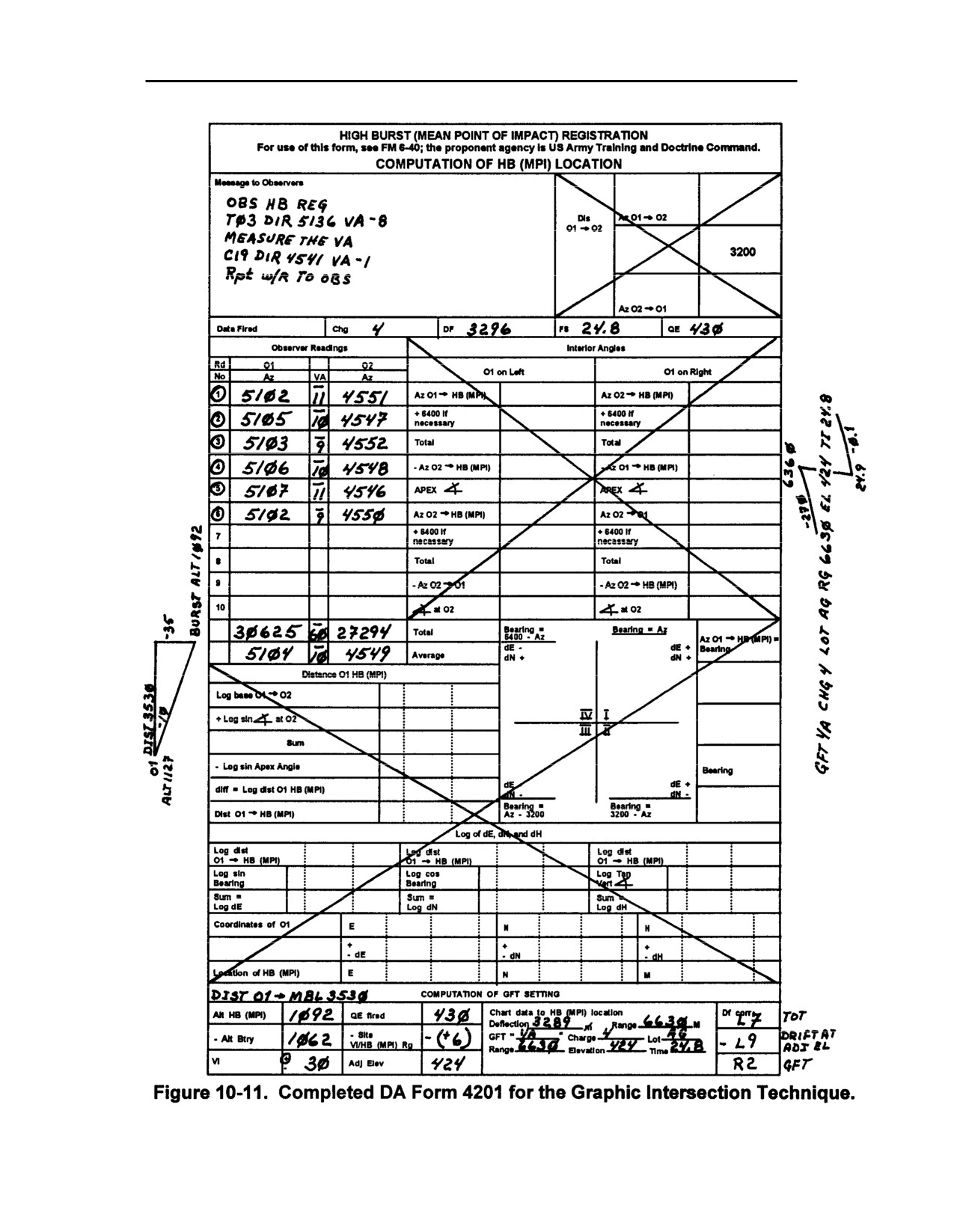
recorded in the margin of DA Form 4201. A completed DA Form 4201 is shown in Figure 10-11
for the graphic intersection technique.
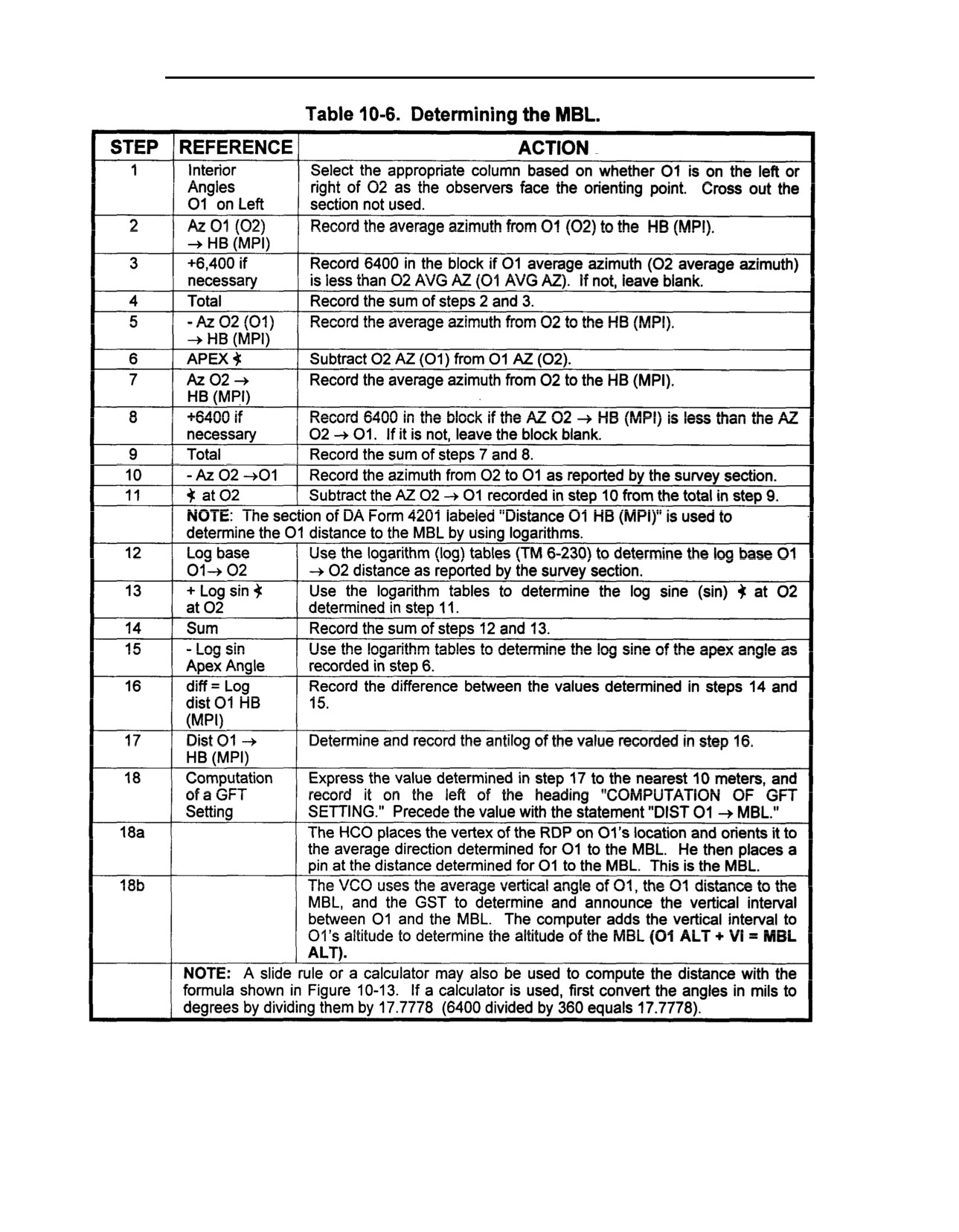
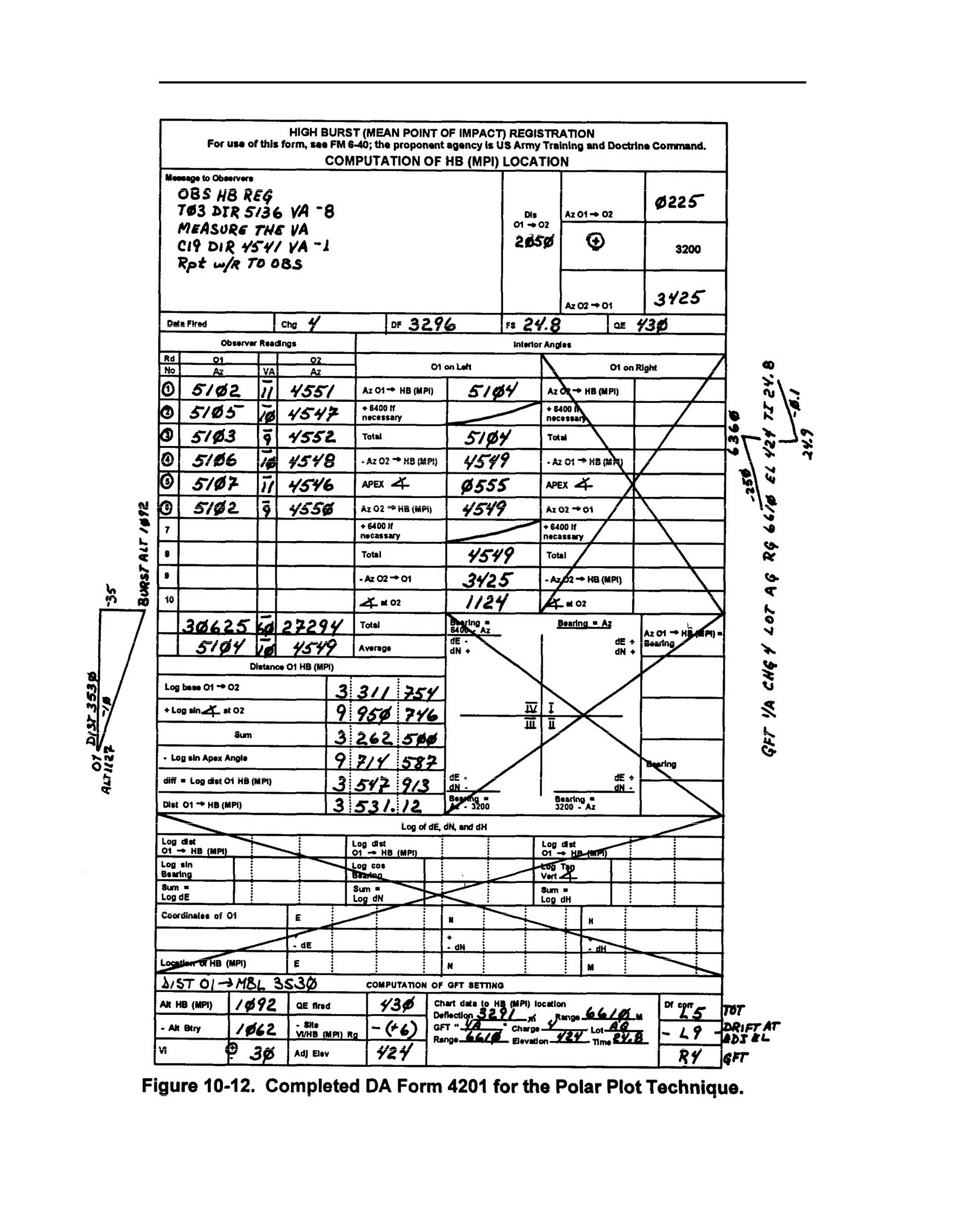
(2) Polar plot. Use the procedures in Table 10-6 and DA Form 4201 (Figure
10-12) to determine the MBL.
10-25
FM 6-40
10-26
FM 6-40
10-27
FM 6-40
10-28
FM 6-40
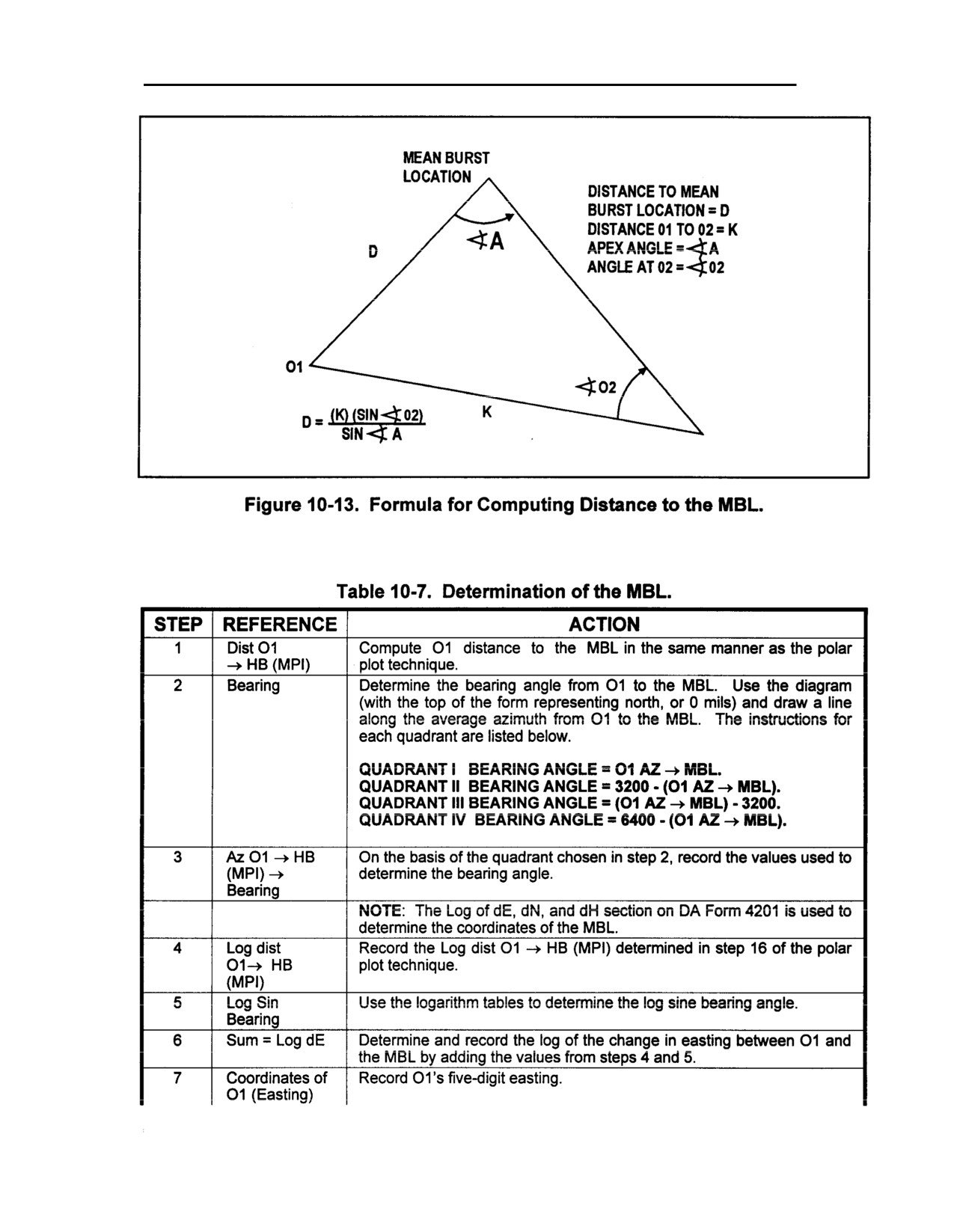
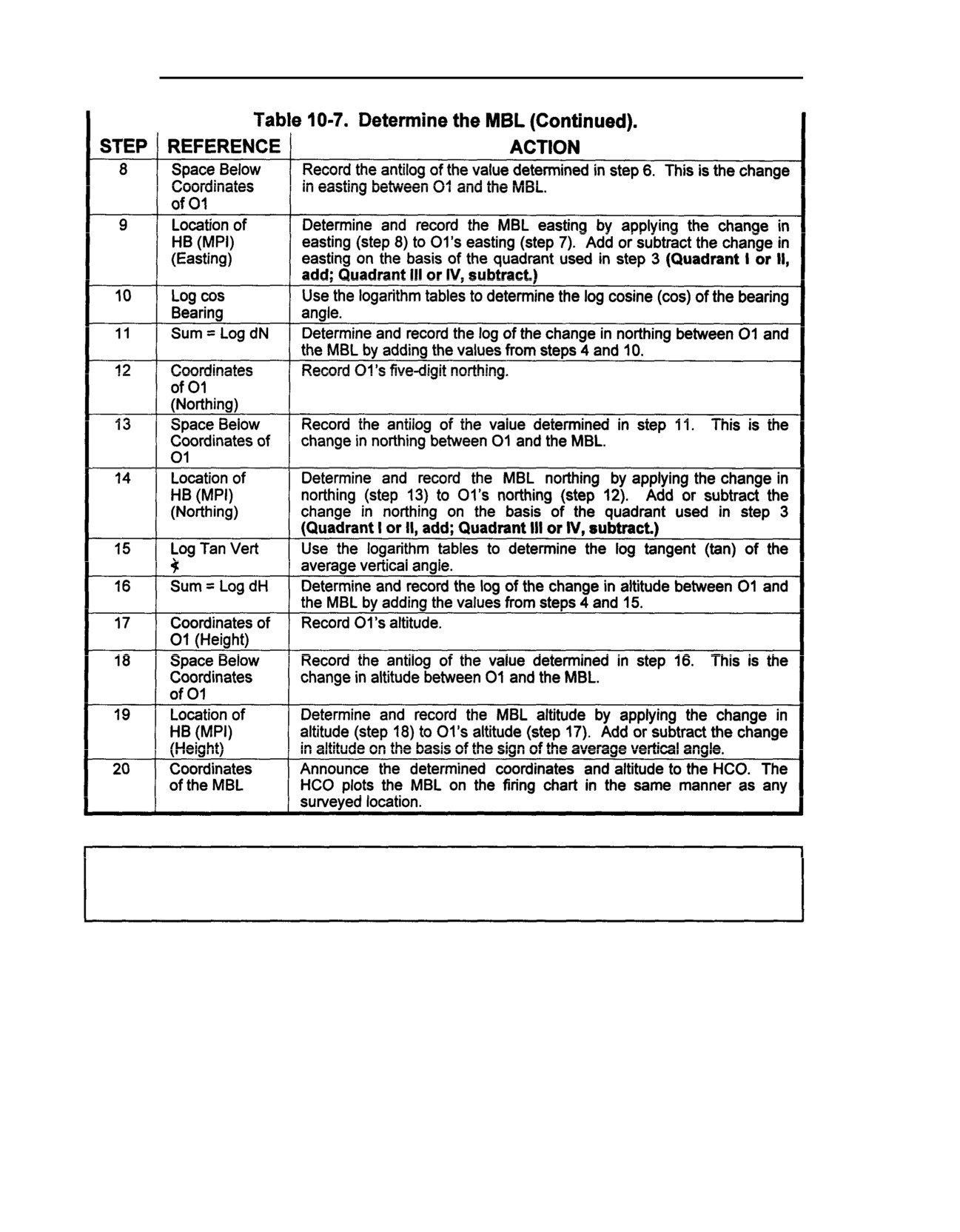
(3) Grid coordinate. The steps in Table 10-7 and a DA Form 4201 (see Figure
10-14) are used to determine the MBL.
10-29
FM 6-40
NOTE: A completed DA Form 4201 for the grid coordinates technique is shown in
Figure 10-14.
10-30