FM 6-40 TTP for Field Artillery Manual Cannon Battery U.S. - page 7
FM 6-40
9-5
FM 6-40
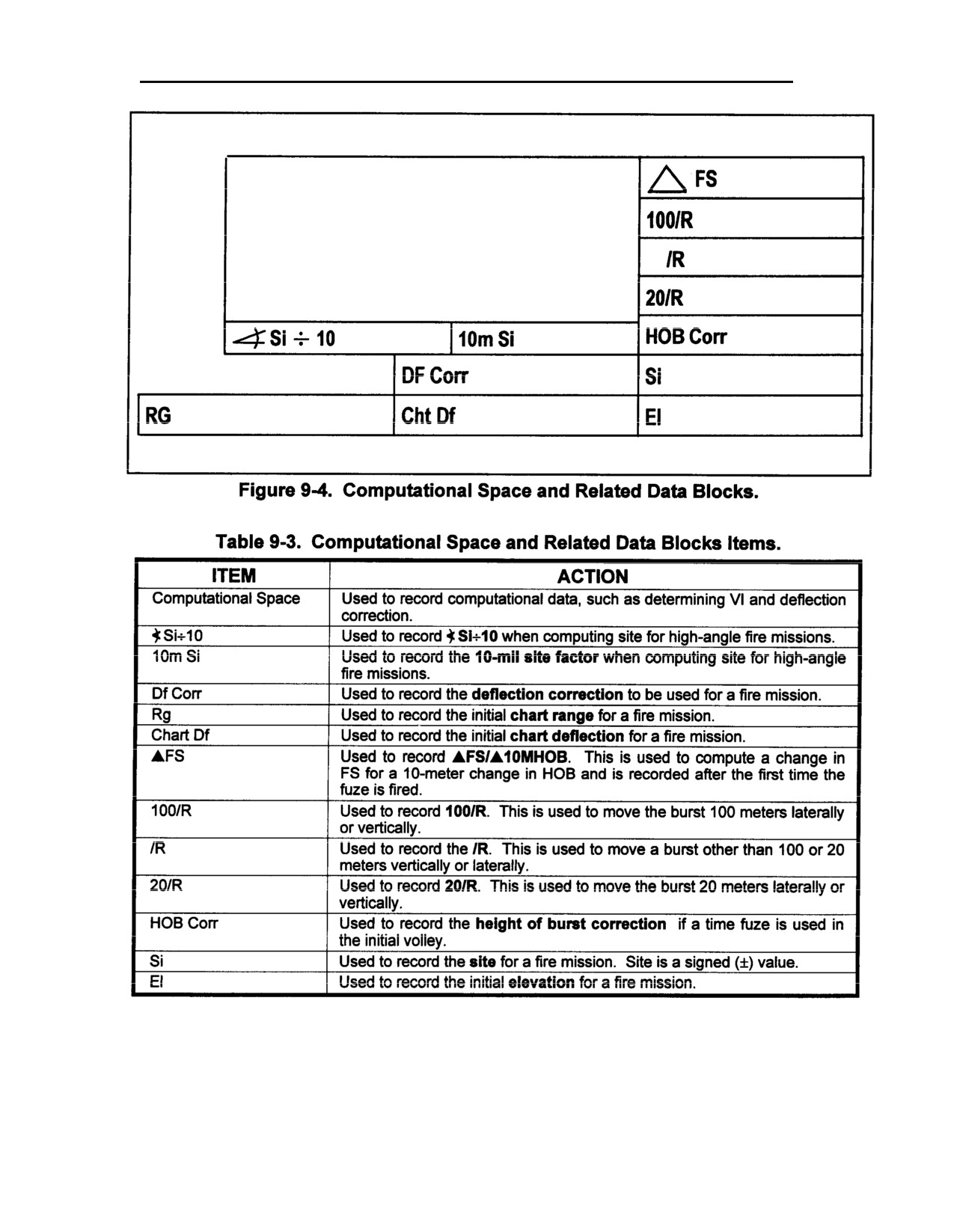
(2) Computational space and related data blocks. These blocks are used to
compute and record data used in determining firing data. (See Figure 9-4.) Table 9-3 explains
each item and its use.
9-6
FM 6-40
9-7
FM 6-40
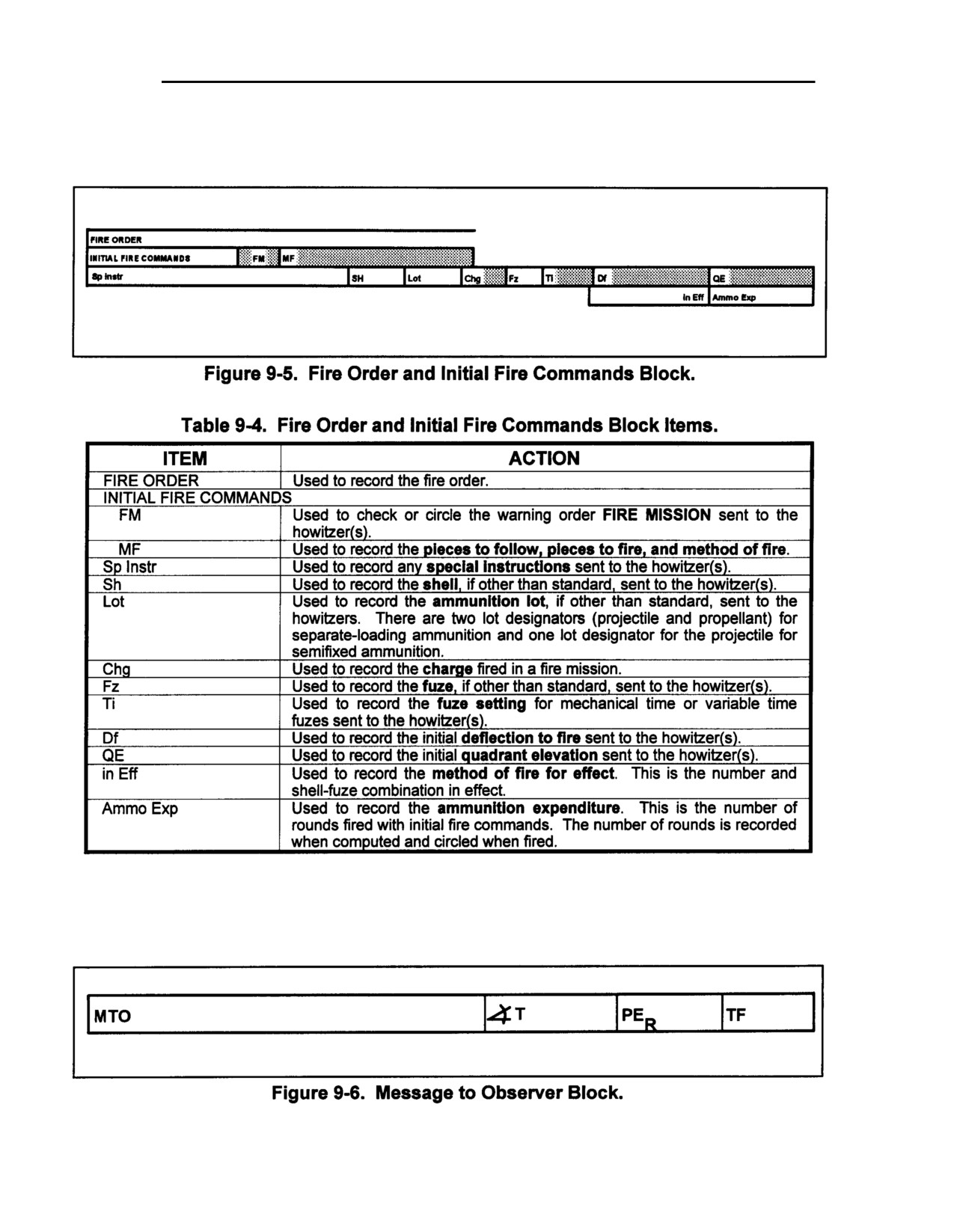
(3) Fire order and initial fire commands block. The fire order announced by the
FDO and the initial fire commands transmitted to the howitzers are recorded in this block. (See
Figure 9-5.) Table 9-4 explains each item and its use.
(4) Message to observer block. The message to observer, angle T, probable error
in range, and time of flight are recorded in this block. (See Figure 9-6.) Data determined but not
sent are recorded in parentheses. Table 9-5 explains each item and its use.
9-8
FM 6-40
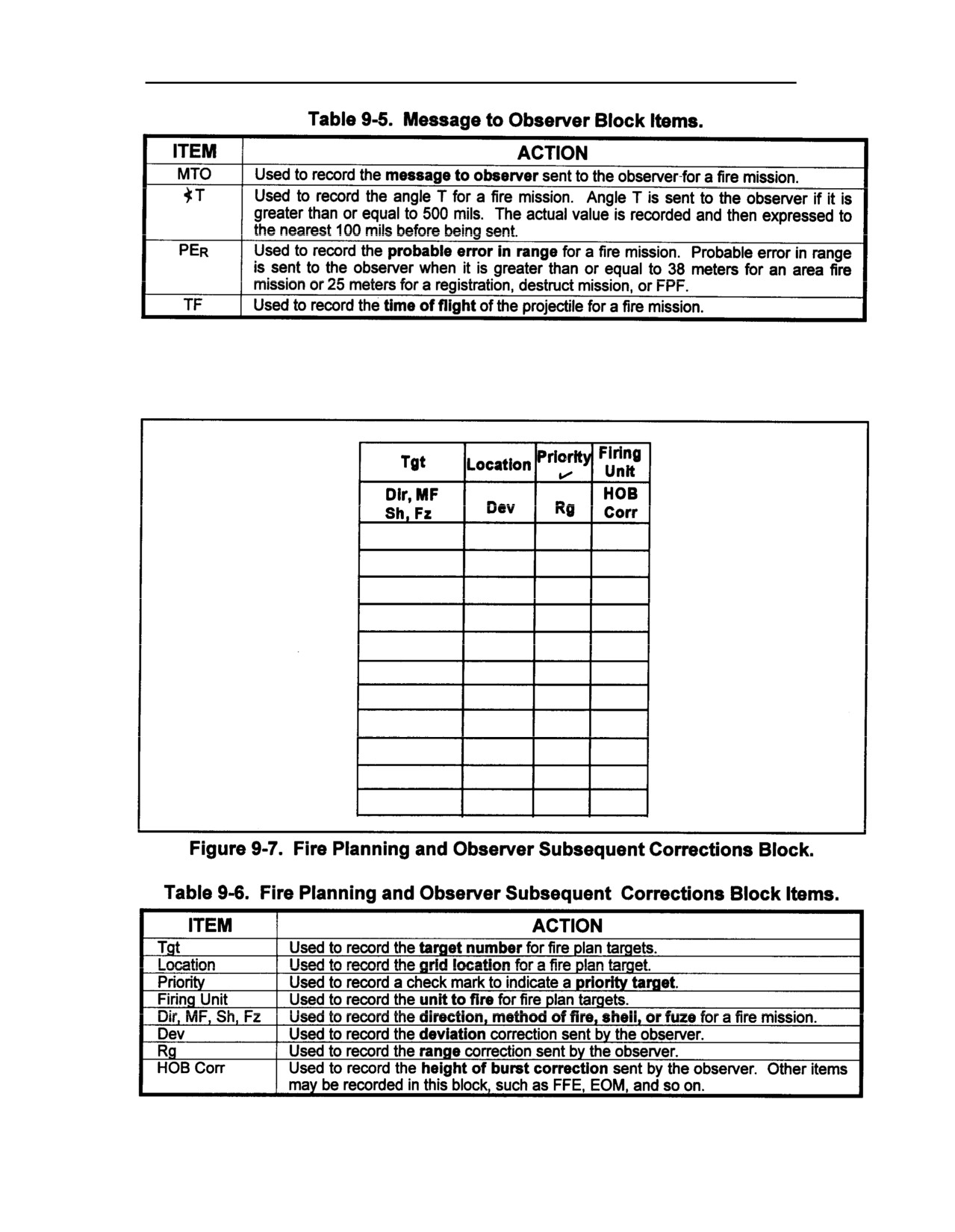
(5) Fire planning and observer subsequent corrections block.Fire plans or
subsequent corrections transmitted by the observer are recorded in this block. (See Figure 9-7.)
Table 9-6 explains each item and its use.
9-9
FM 6-40
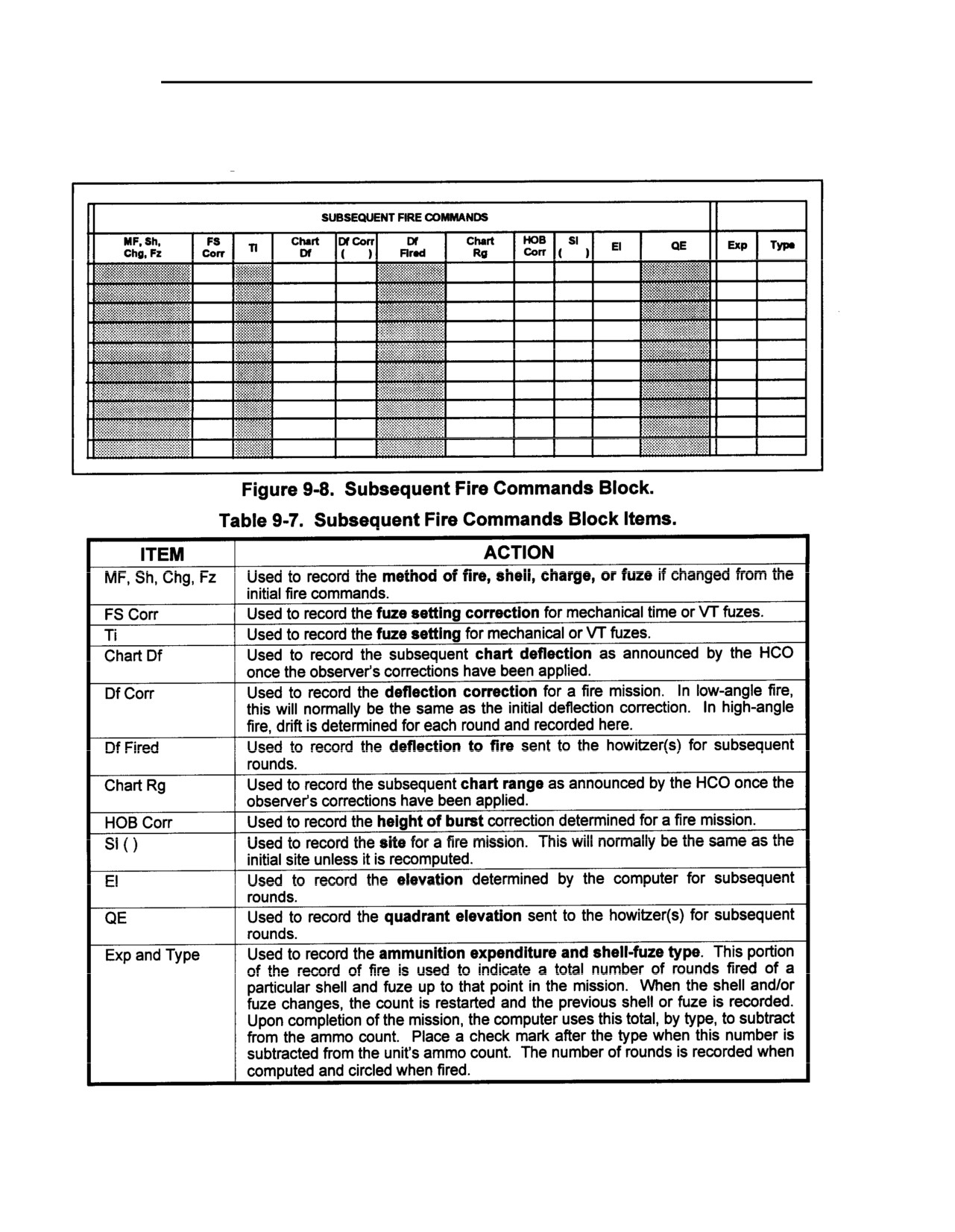
(6) Subsequent fire commands block. Fire commands are recorded in this block.
(See Figure 9-8.) Data placed in parentheses indicate data that were determined but not sent
because of no change. Table 9-7 explains each item and its use.
9-10
FM 6-40
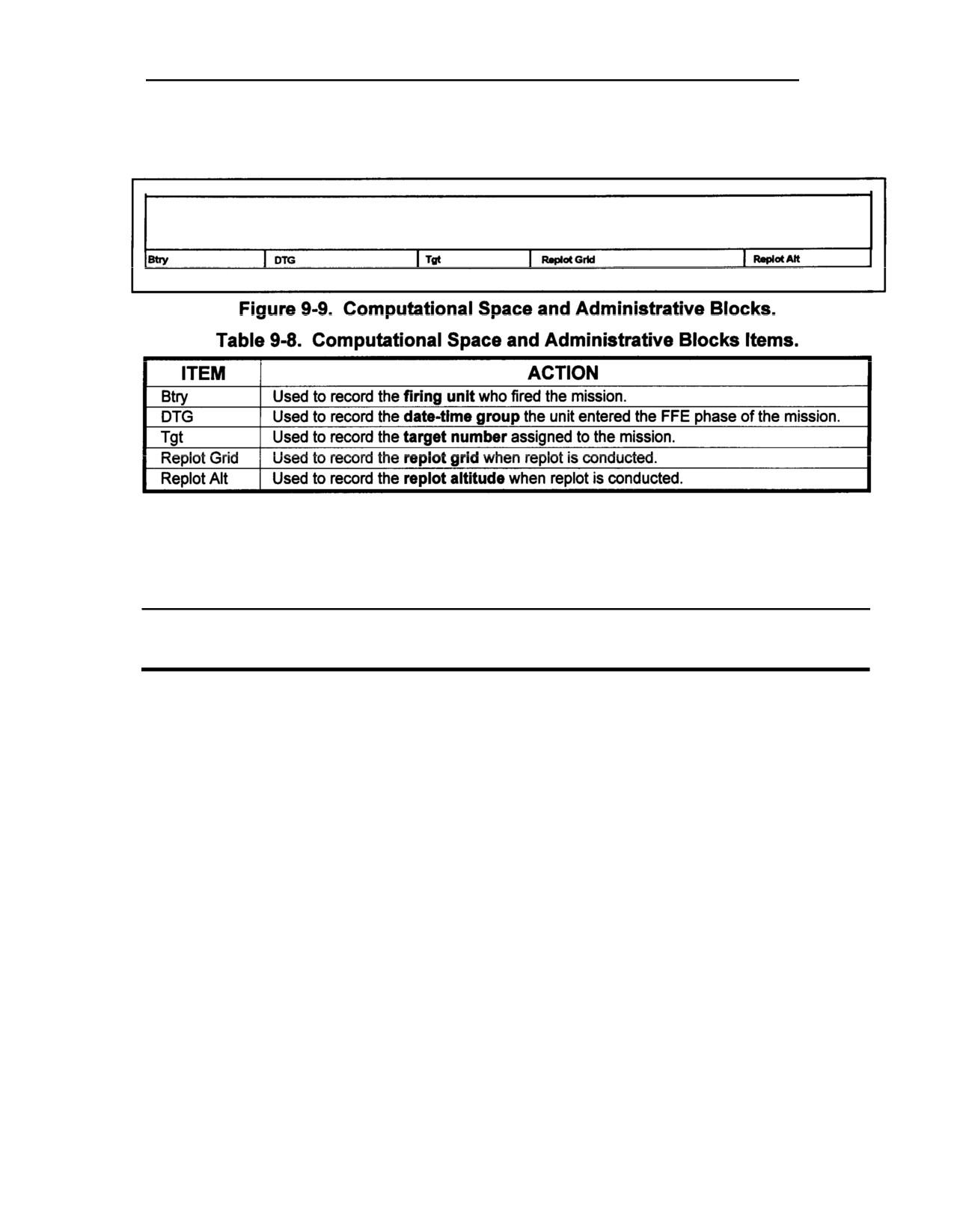
(7) Computational space and administrative blocks.These are the lower
computational areas used to record required data or conduct computations. (See Figure 9-9.)
Table 9-8 explains each item and its use.
Section II
HIGH EXPLOSIVES
The HE projectile is the base round for the HE family ofprojectiles. The
HE projectile is available in all cannon weapon systems (105 mm, 155 mm). The
HE ballistic family includes the antipersonnel improved conventional munitions,
illumination, chemical, and smoke.
9-4. Overview
a. HE projectiles are hollow steel cases filled with explosives (trinitrotoluene [TNT] or
composition B). They can be fuzed for air, surface, or subsurface burst. HE projectiles are used
against personnel and material objects because of blast and fragmentation effects.
b. Determination of firing data for a point-detonating (Q), mechanical time super quick,
time, or variable time fuze mated to an HE projectile is almost identical. Only minor procedural
differences exist. Data are determined from the GFT, GST, and TFT.
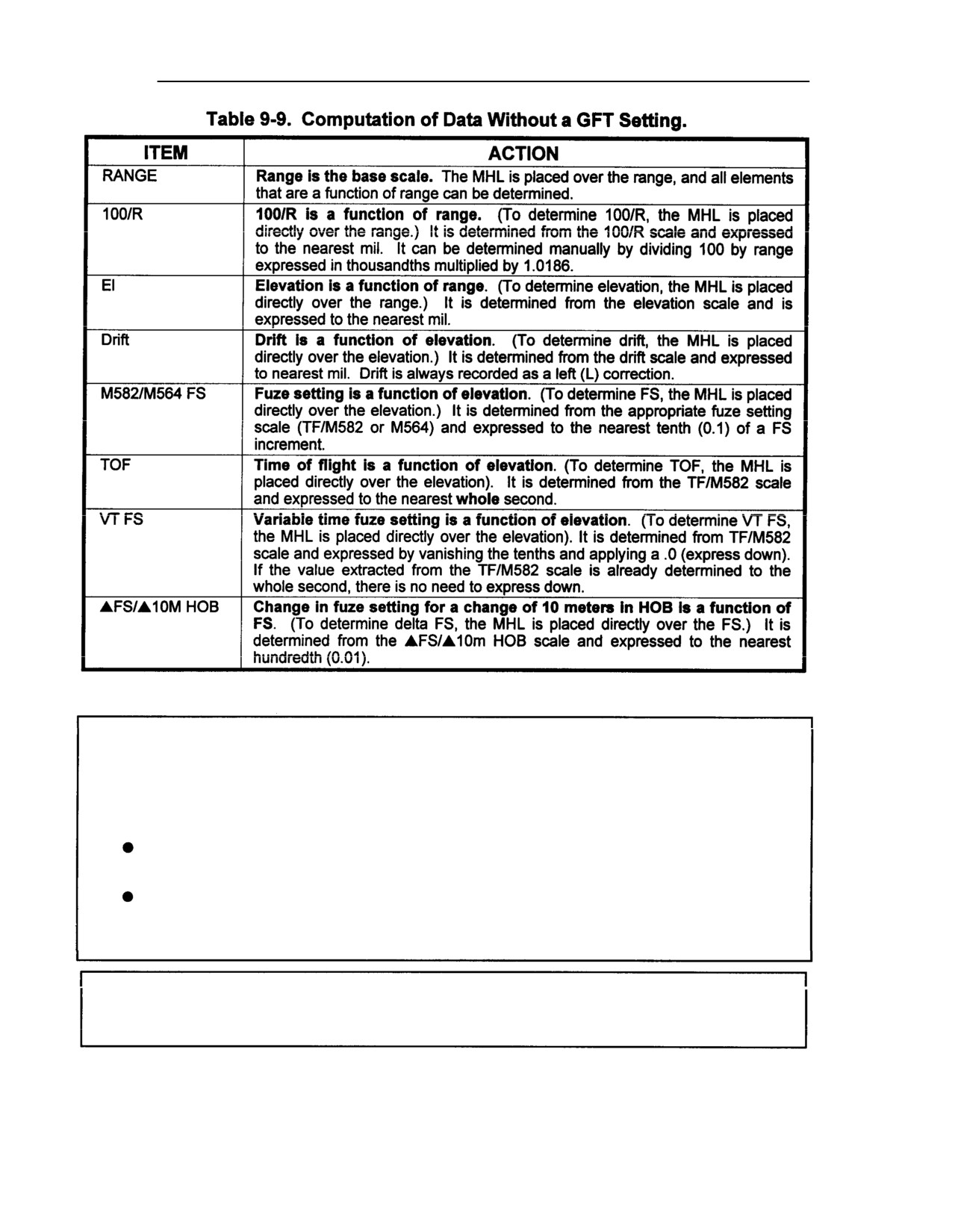
c. The HE-quick shell-tie combination is the ammunition used for the basic fire
mission. Chart data are determined to the target. The computer determines data with the GFT.
The procedures for computing data without a GFT setting areas outlined in Table 9-9.
9-11
FM 6-40
NOTE: Under normal circumstances, FDC personnel will be able to determine a
GFT setting. The determination and explanation of a GFT setting is covered in
Chapter 10. When a GFT setting is applied, certain elements of data will be
determined as described below.
EI--Elevation is determined by placing the MHL over the range and reading the
elevation scale directly under the elevation gauge line (EGL).
FS--Fuze setting is determined by placing the MHL over the range and reading
the appropriate fuze scale directly under the time gauge line (TGL). The TGL
is valid only for the registering fuze.
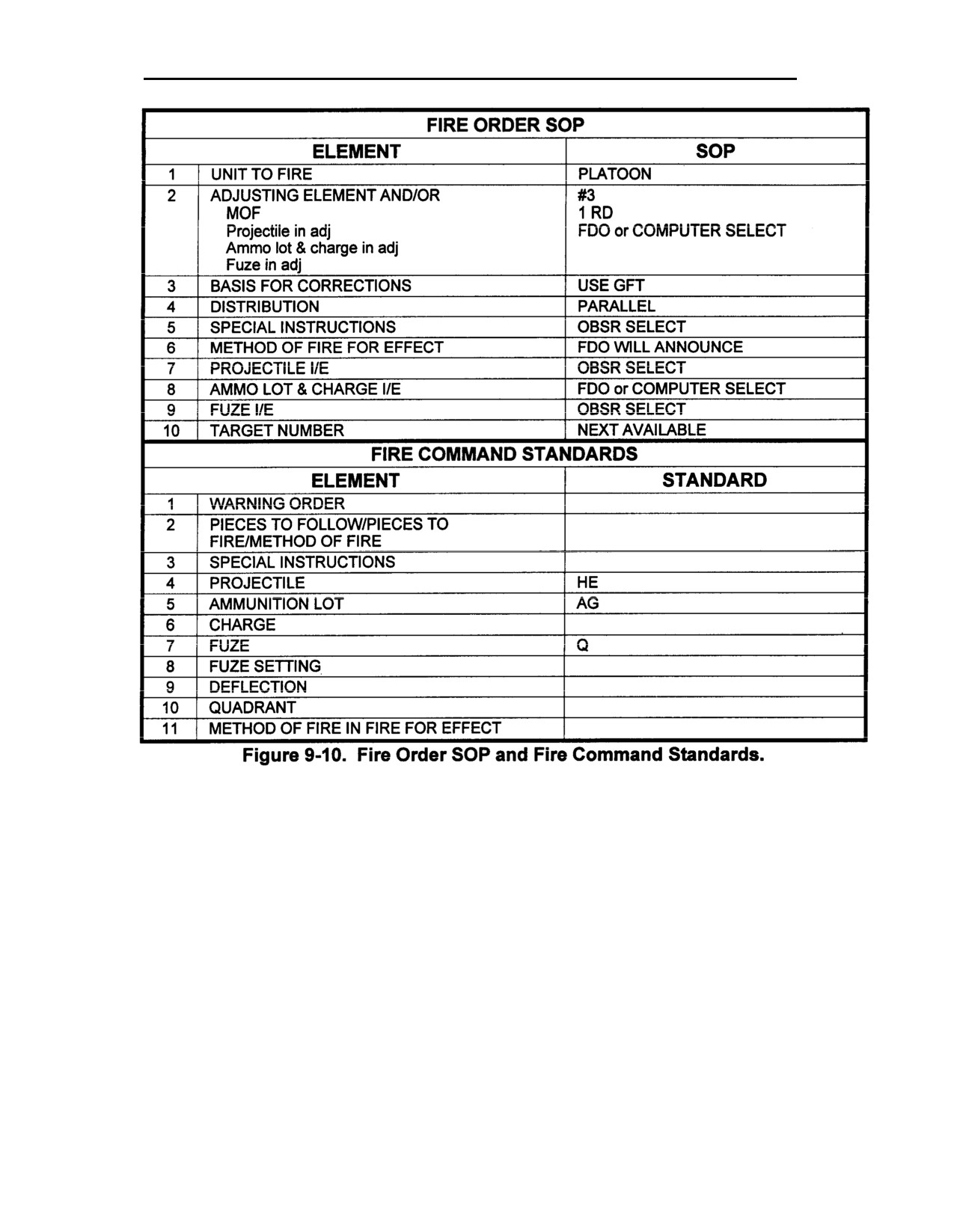
NOTE: The fire order SOP and fire command standards in Figure 9-10 are used
for all the examples found in this chapter.
9-12
FM 6-40
9-13
FM 6-40
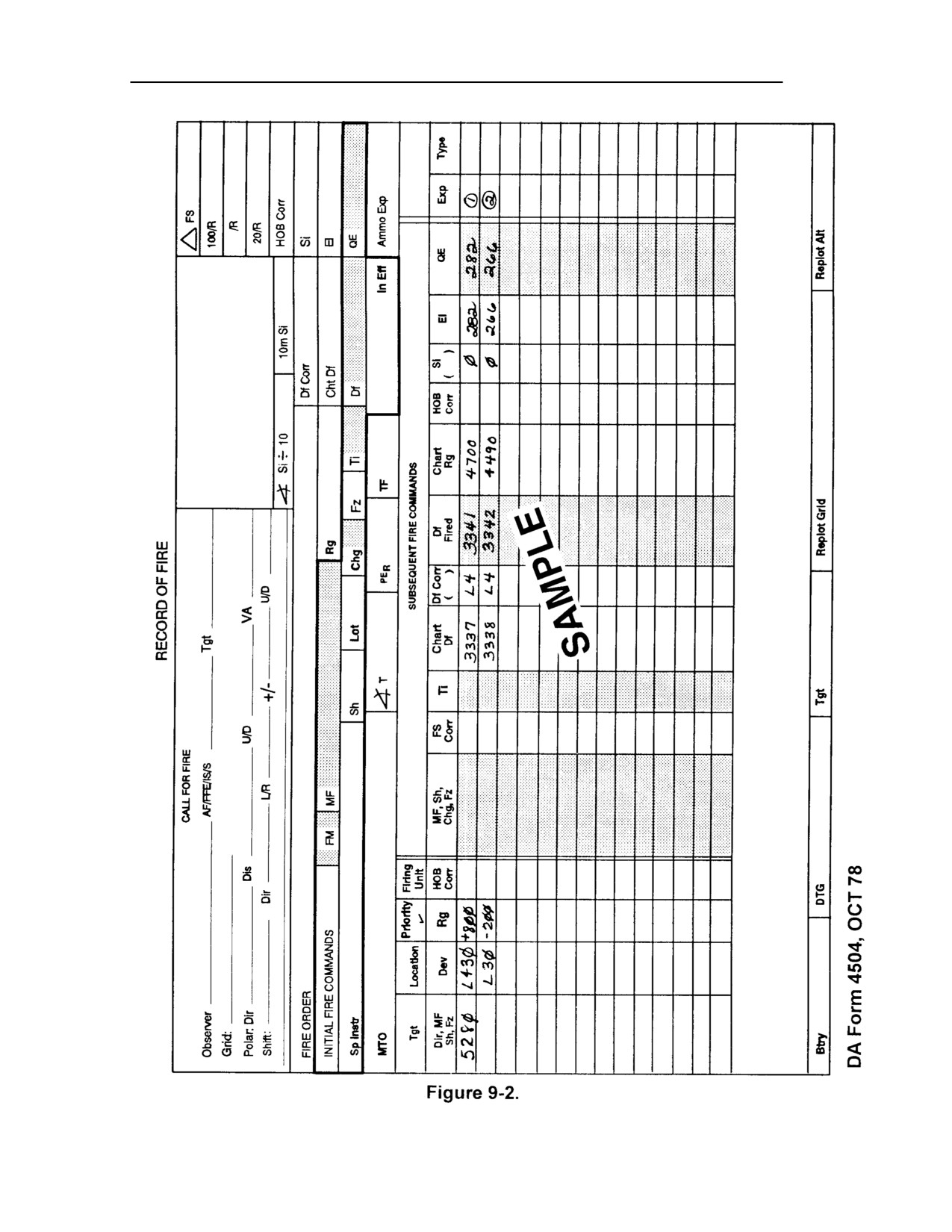
9-5. Examples of Completing the Record of Fire for HE Fire Missions
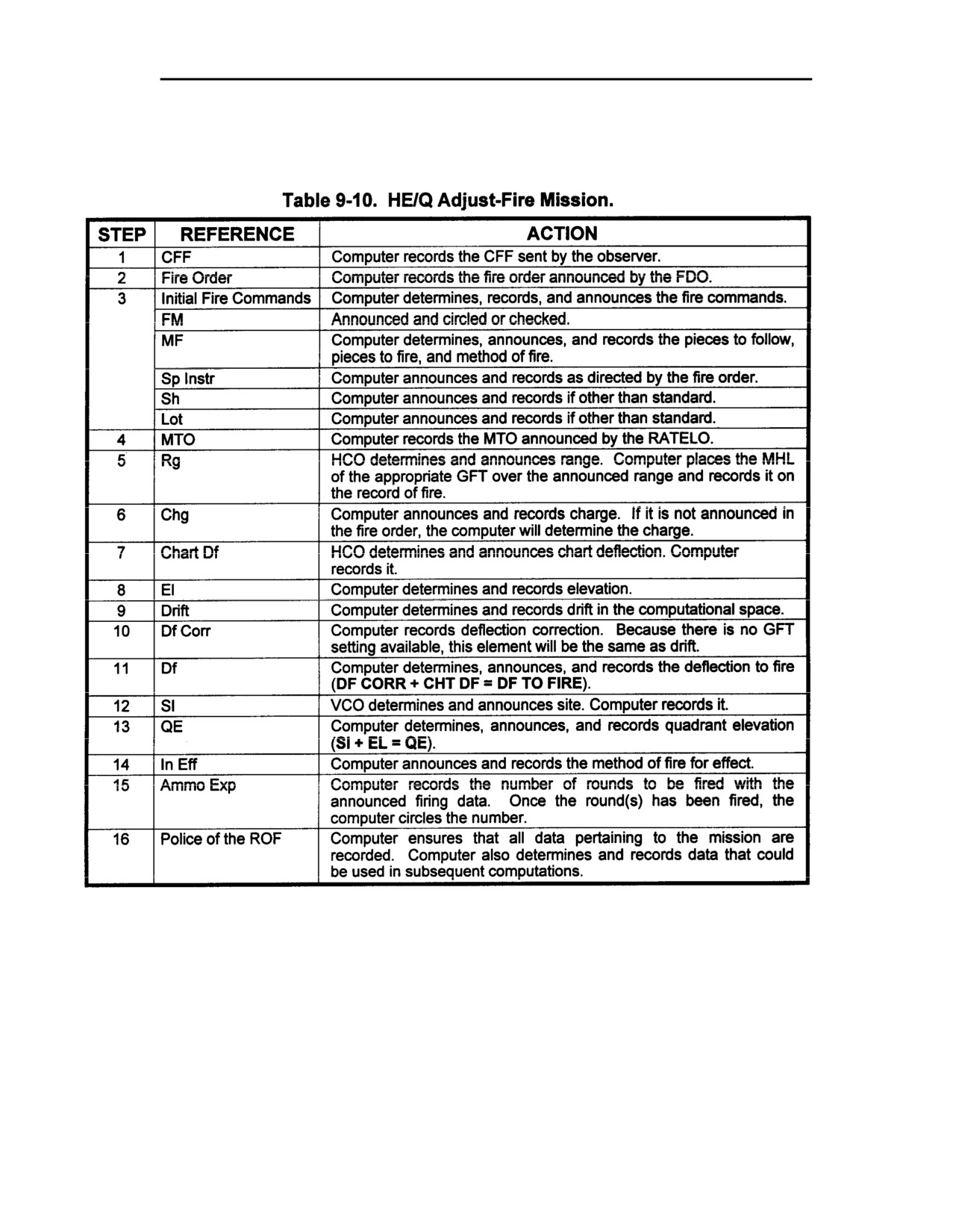
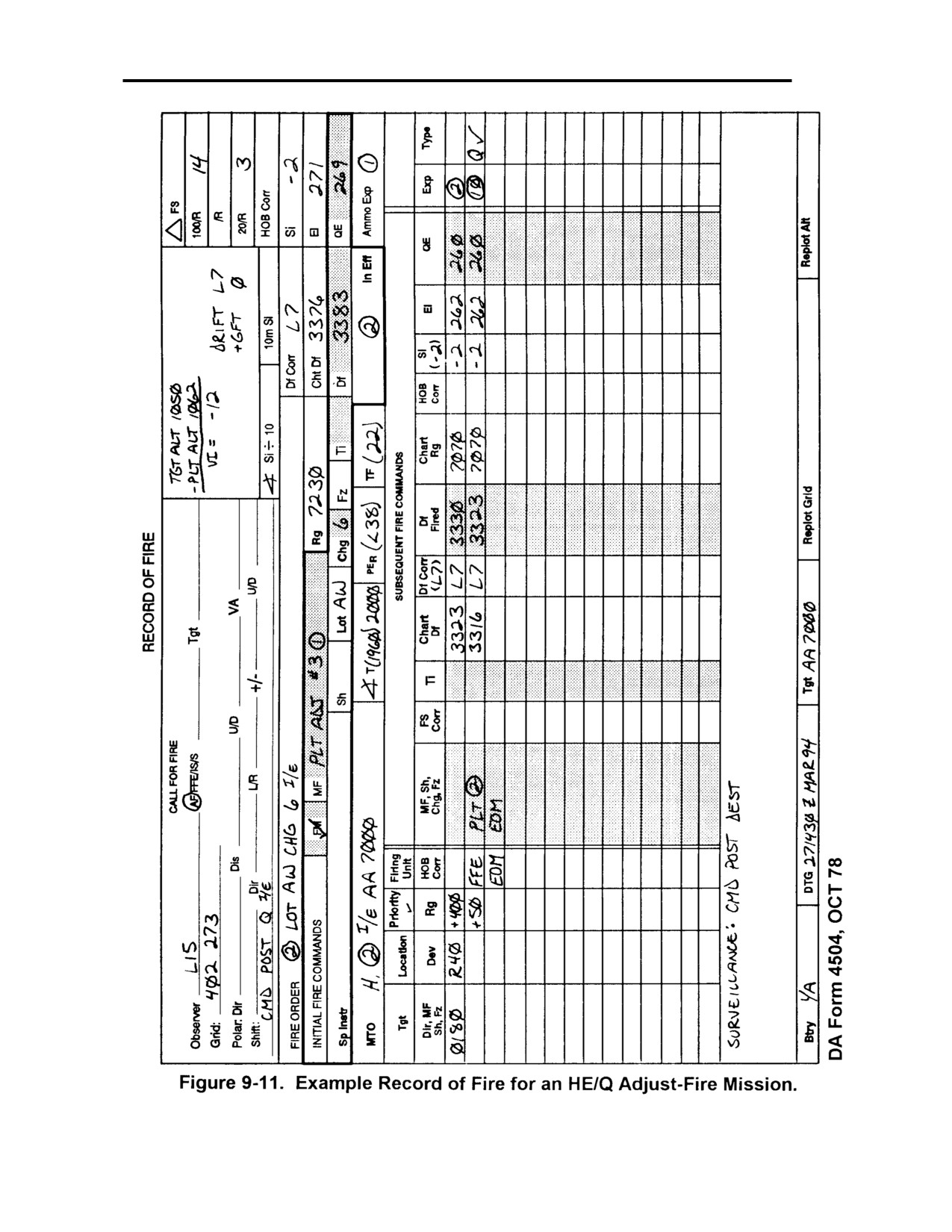
a. HE/Q Adjust-Fire Mission. Use the steps in Table 9-10 to process an HE/Q
adjust-fire mission. Figure 9-11 shows an example ROF for this type of mission.
9-14
FM 6-40
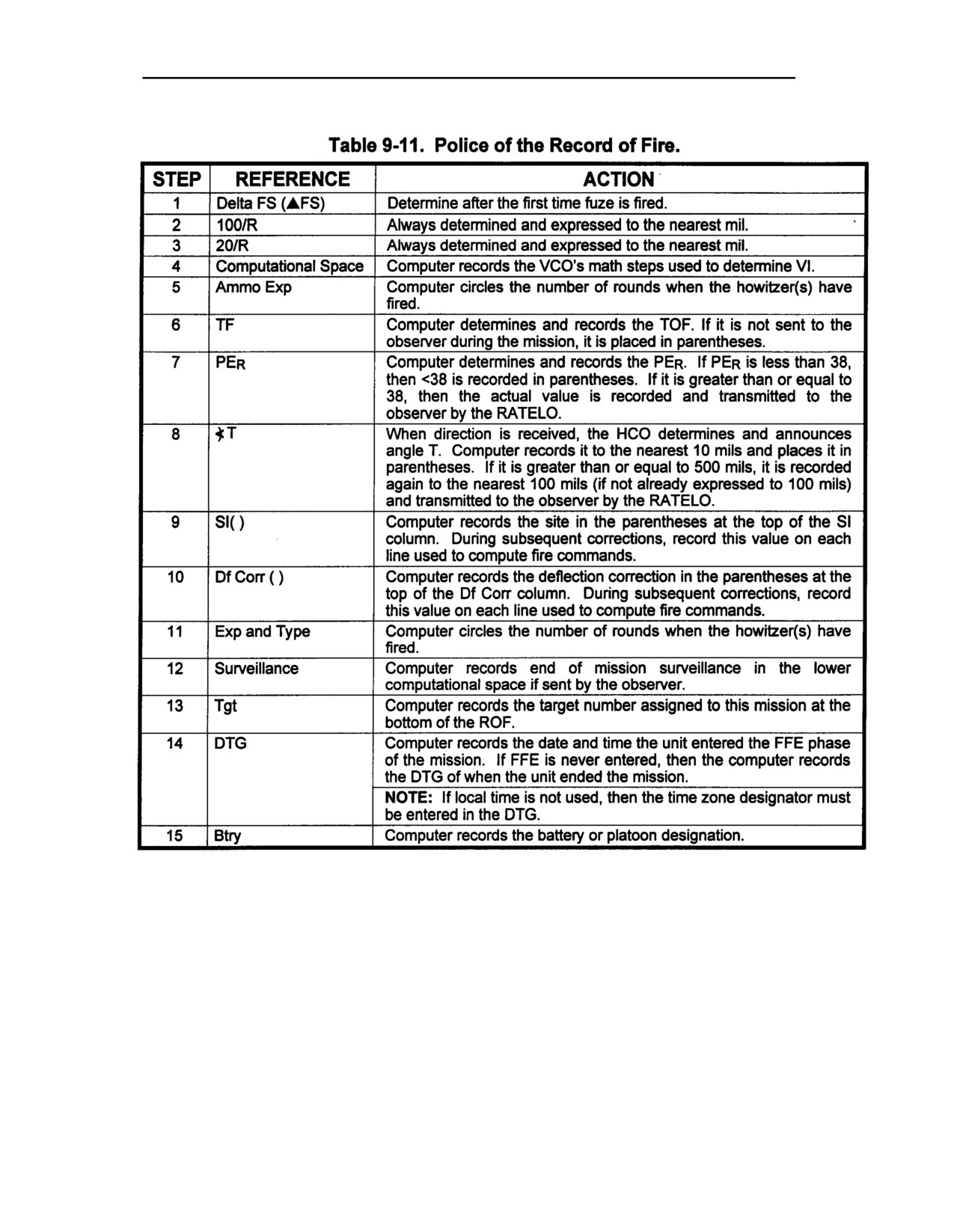
b. Police of Record of Fire. Use the steps in Table 9-11 to police the record of fire.
9-15
FM 6-40
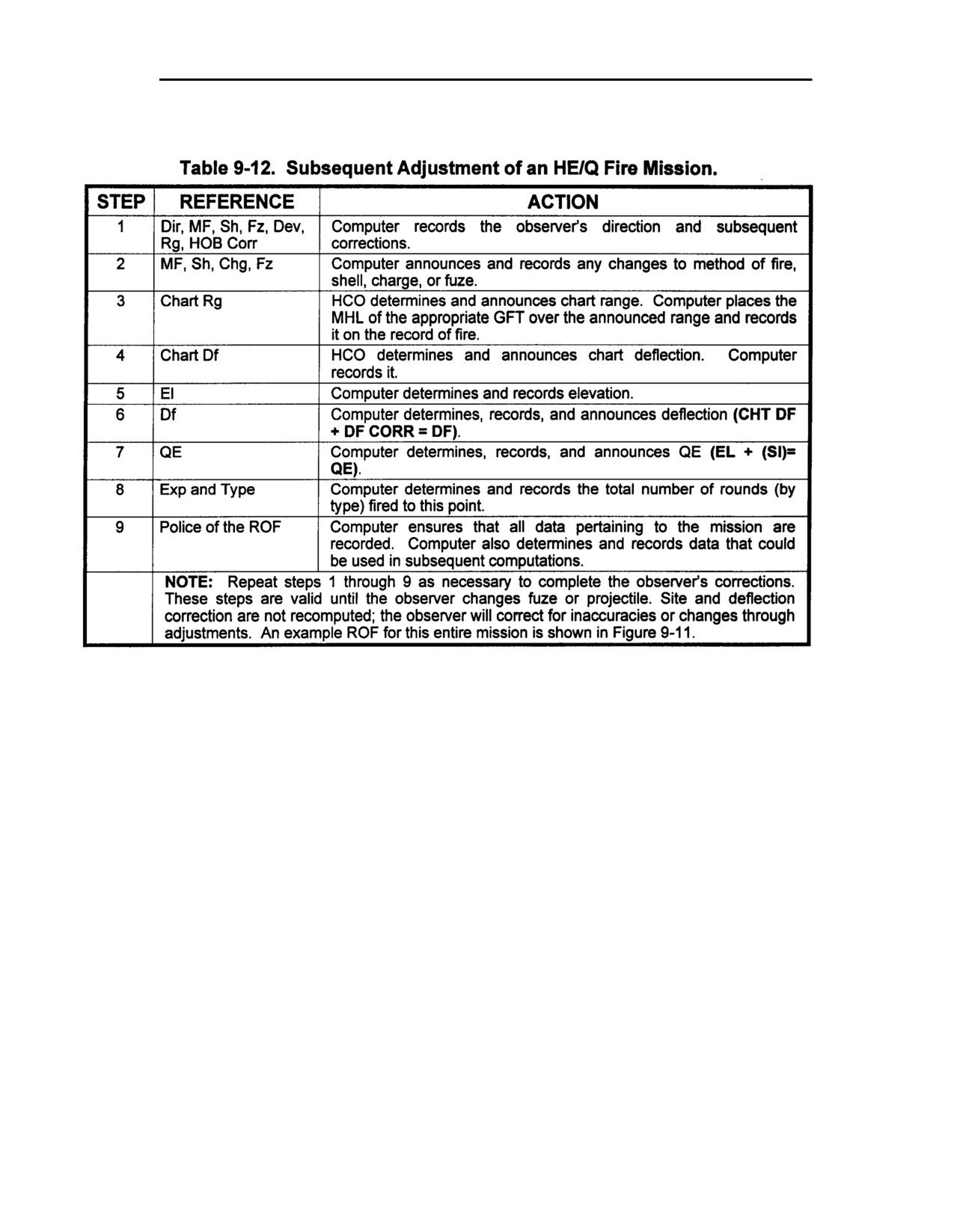
c. HE/Q Fire Mission. Use the steps in Table 9-12 for a subsequent adjustment of an
HE/Q fire mission. An example ROF for this entire mission is shown in Figure 9-ll.
d. High-explosive With Mechanical Time (M582).
(1) Determining data for an HE/ti round is exactly the same as HE/Q except for the
HOB correction and the fuze setting correction.
(2) A time fuze achieves the best effects on the target when it functions at a
20-meter HOB. To achieve the 20-meter HOB, the trajectory of the projectile must be altered to
cause the projectile to pass 20 meters above the target. By applying the mil-relation formula in a
vertical plane, the amount of mils the trajectory needs to be altered at any range is 20/R. When
the value of 20/R is used as the HOB correction, it will always be a positive value. The HOB
correction is included in the computation of QE. The HOB correction is added to the site (ground
site), and a total site is determined. This total site is applied to elevation to determine QE. The
HOB correction is applied only to the initial time QE.
9-16
FM 6-40
9-17
FM 6-40
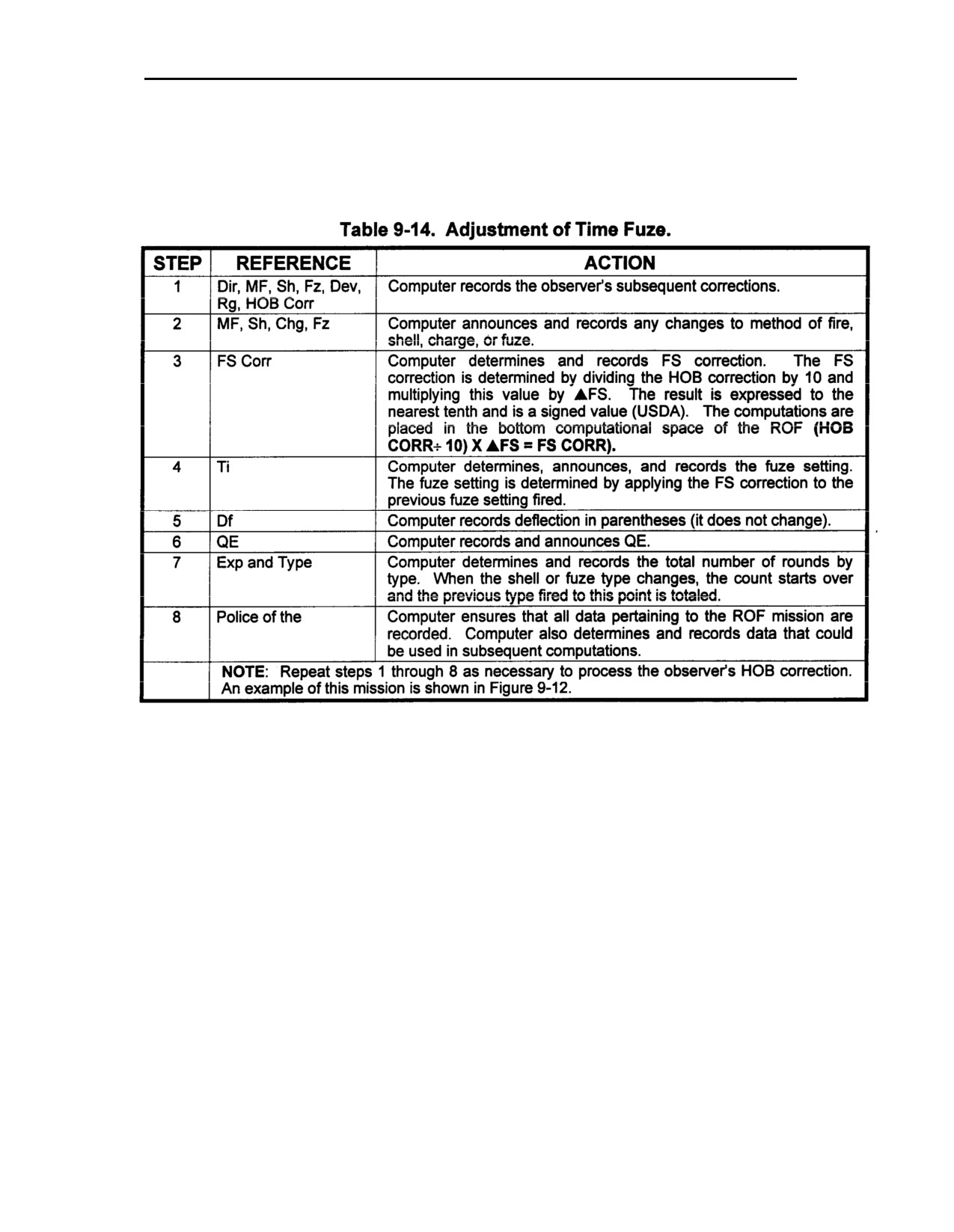
(3) If subsequent adjustments for the HOB are necessary, then the FS is the only
element of firing data that is recomputed. Deflection and QE will remain the same. A FS
correction will be applied to the previous fuze setting. The FS correction will be a multiple of
▲ FS/ ▲ 10M HOB. The ▲ FS moves the functioning of the fuze along the trajectory by
increments of 10 meters. The observer will adjust the HOB by transmitting HOB corrections (up
or down) to the nearest 5 meters. The observer’s corrections in meters must be converted to
corrections in FS. The observer’s HOB correction is divided by 10 and then multiplied by
▲ FS/ ▲ l0M HOB. This value is expressed to the nearest tenth (0.1) of a FS increment. Before
this can be applied as a FS correction, it must have a sign (±). The sign is based on the direction
(up or down) of the observer’s correction. If the correction is up, then the fuze functioned late
and the FS correction must be subtracted. If the correction is down, then the fuze functioned
early and the FS correction must be added. Simply stated, for an up correction, the FS correction
is negative; for a down correction, the FS correction is positive. An easy rule to remember is
USDA (up, subtract; down, add).
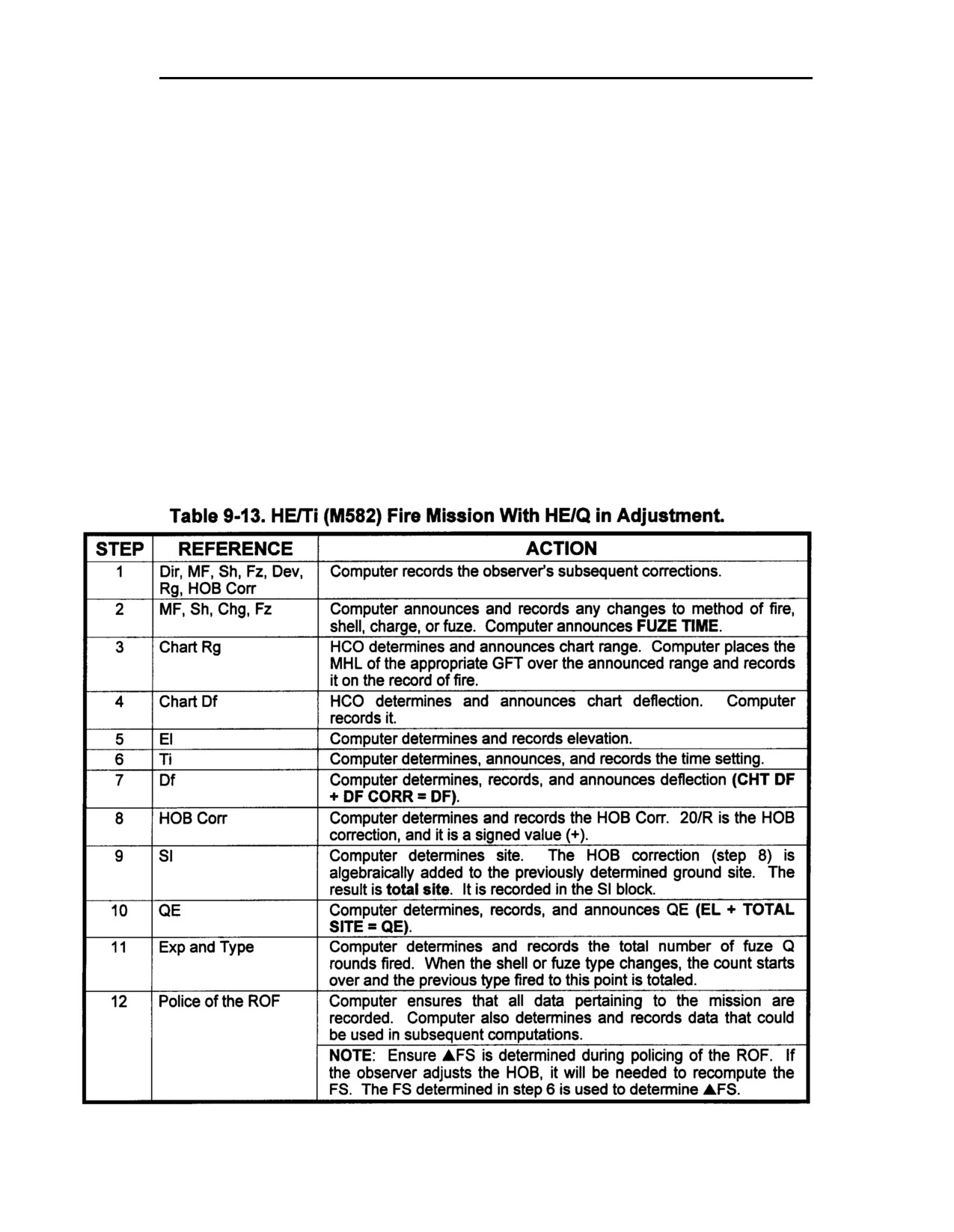
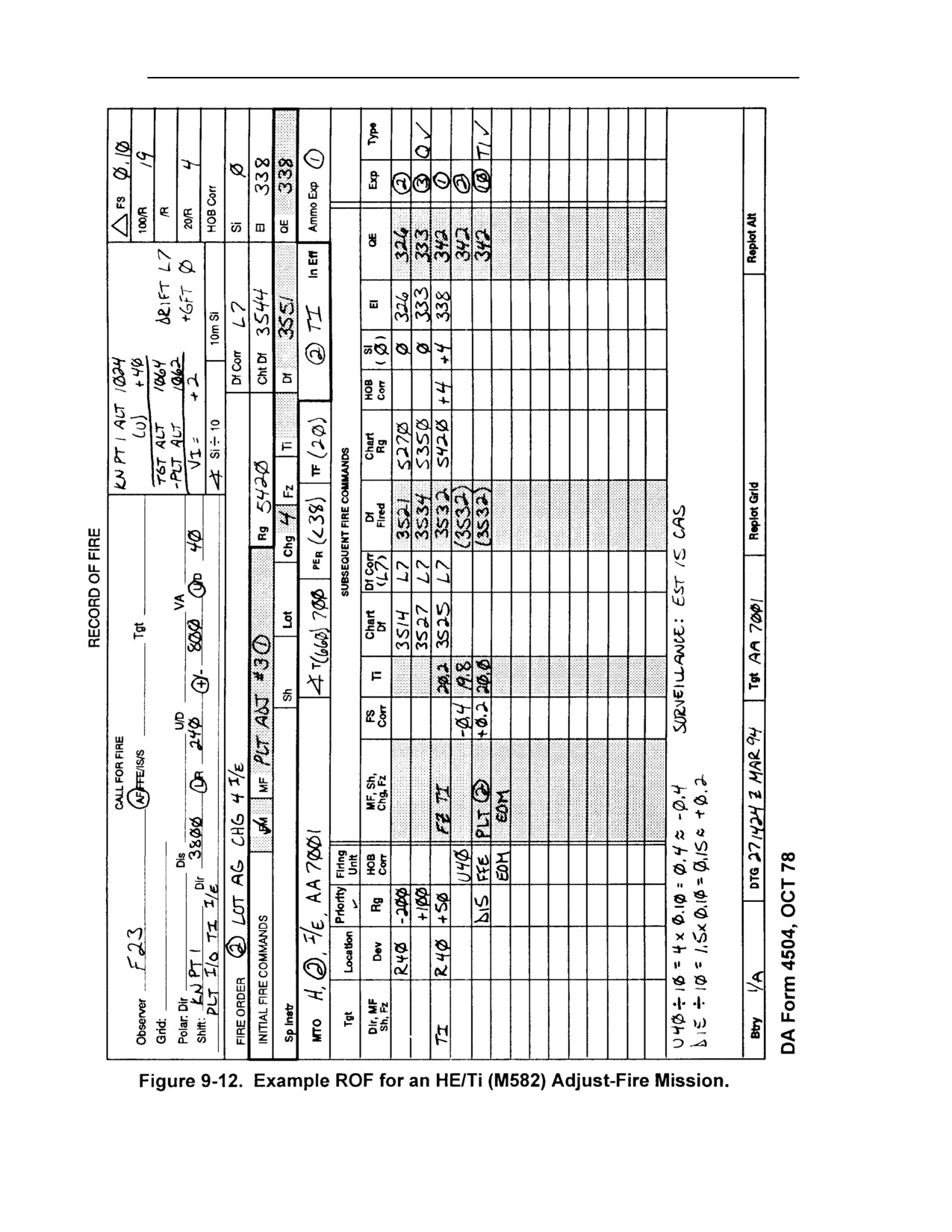
e. HE/Ti (M582) Fire Mission With HE/Q in Adjustment.
(1) Process the HE/Q adjustment as outlined in paragraph 9-5. Once the observer
has requested a change in fuze type to a mechanical time fuze, process the request as described in
Table 9-13. Figure 9-12 shows an example ROF for this type of mission.
9-18
FM 6-40
(2) If a 20-meter HOB was not achieved, the fuze setting must be adjusted. At this
point in the mission, the observer does not make any range or deviation corrections. The only
corrections are for HOB. Therefore, the only firing data that will change are the fuze setting.
Use the steps in Table 9-14 to adjust the fuze setting, Figure 9-12 shows an example ROF for
this type of mission.
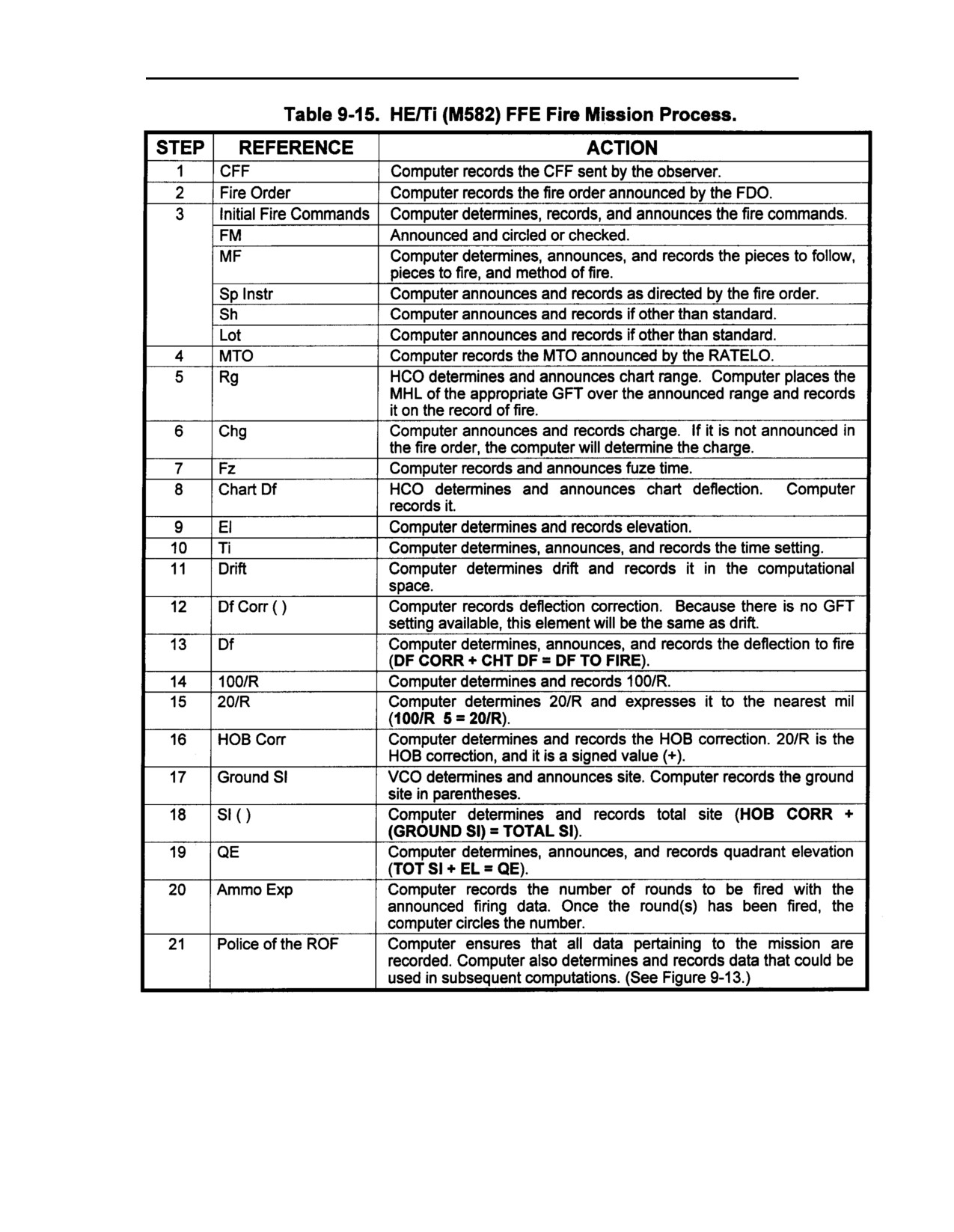
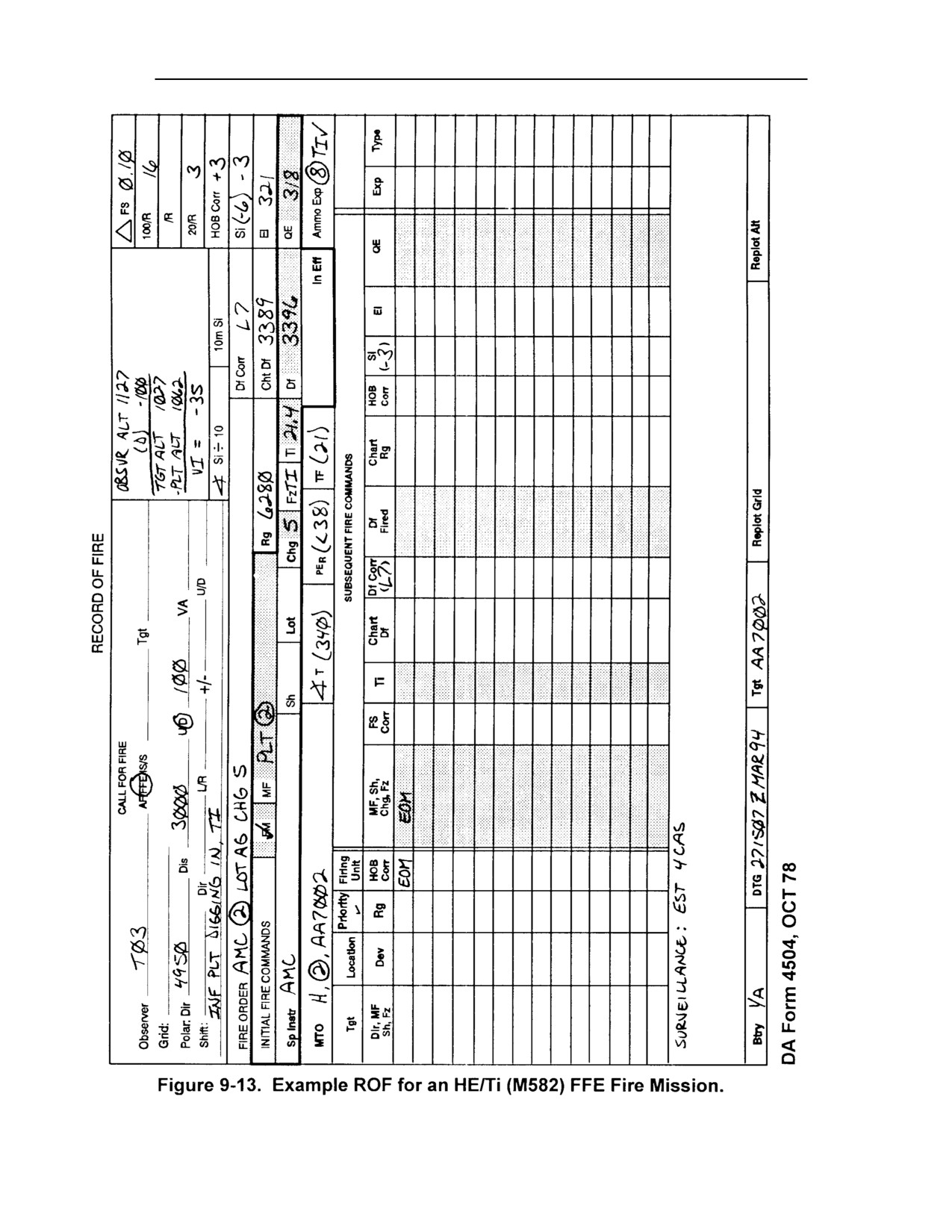
f. HE/Ti (M582) FFE Mission. Use Table 9-15 for processing an HE/Ti (M582) FFE
fire mission. Figure 9-13 shows an example ROF for this type of mission.
9-19
FM 6-40
9-20
FM 6-40
9-21
FM 6-40
9-22
FM 6-40
g. High-Explosive With Variable Time (M732/M728).
(1) The variable time, or proximity fuze, is designed to function at a predetermined
HOB (7 meters for M728/732). No HOB correction is needed because of the low HOB. The VT
has a built-in radio transmitter-receiver. The fuze transmits a signal. When the reflected signal
reaches a certain strength, the fuze will function.
(2) The VT fuze setting is determined from the time of flight of the projectile. The
TOF is determined to the nearest tenth of a second (0.1). However, a VT fuze cannot physically
be set to the nearest tenth. The scales are graduated in whole seconds; therefore, the TOF must be
expressed down to the whole second. If the TOF extracted is already determined to the whole
second, there is no need to express down. The VT memory aid “vanish tenths” will help you
understand the determination of the VT FS. Expressing down provides a greater assurance of an
airburst. About 3 seconds before the fuze is set, the fuze is armed and the radio transmitter is
activated. Whenever a VT FS is determined, recorded, or announced, it will always end in point
zero.
NOTE: If the observer transmits a graze repeat, the automatic correction to the
VT FS is to subtract 1.0 seconds.
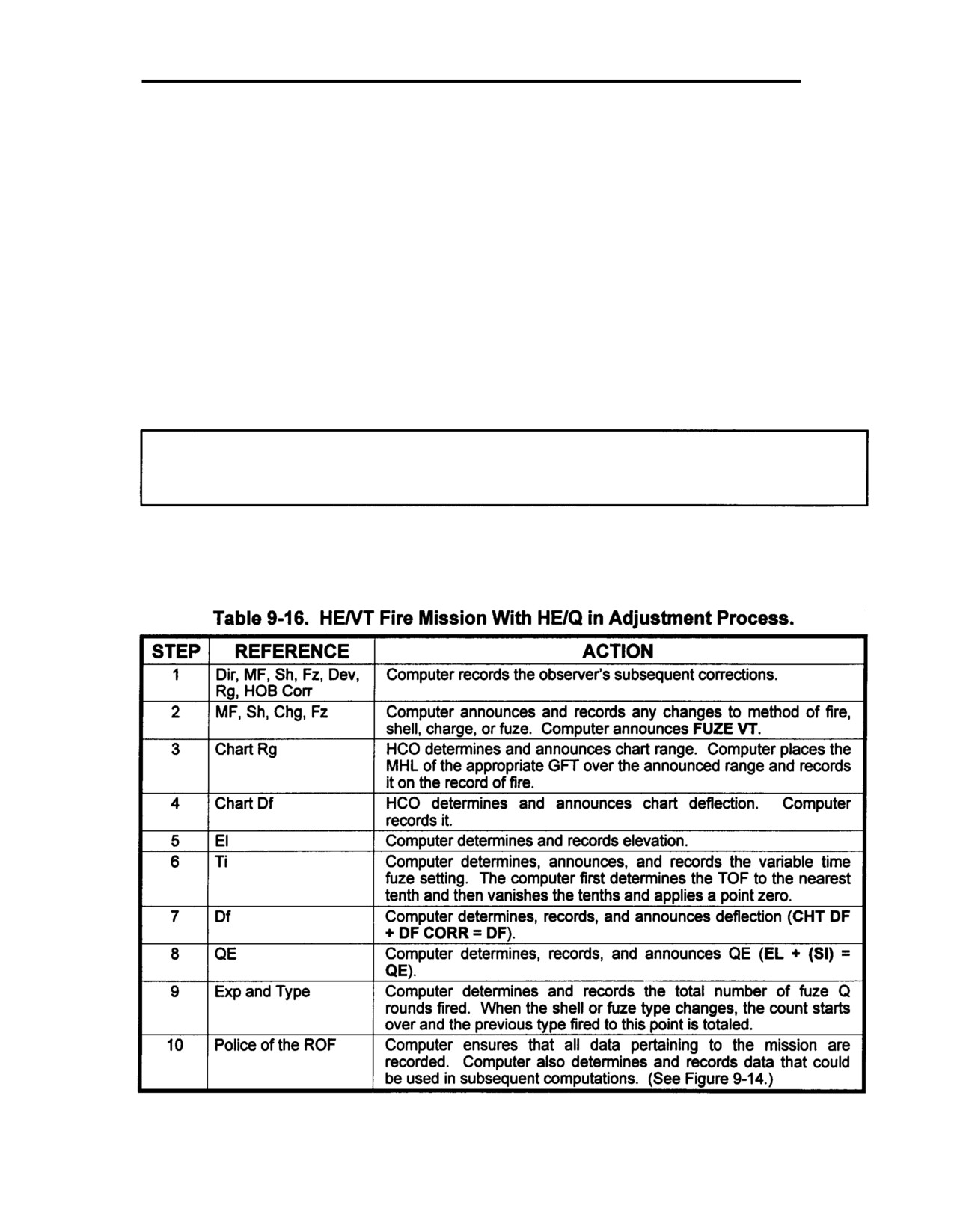
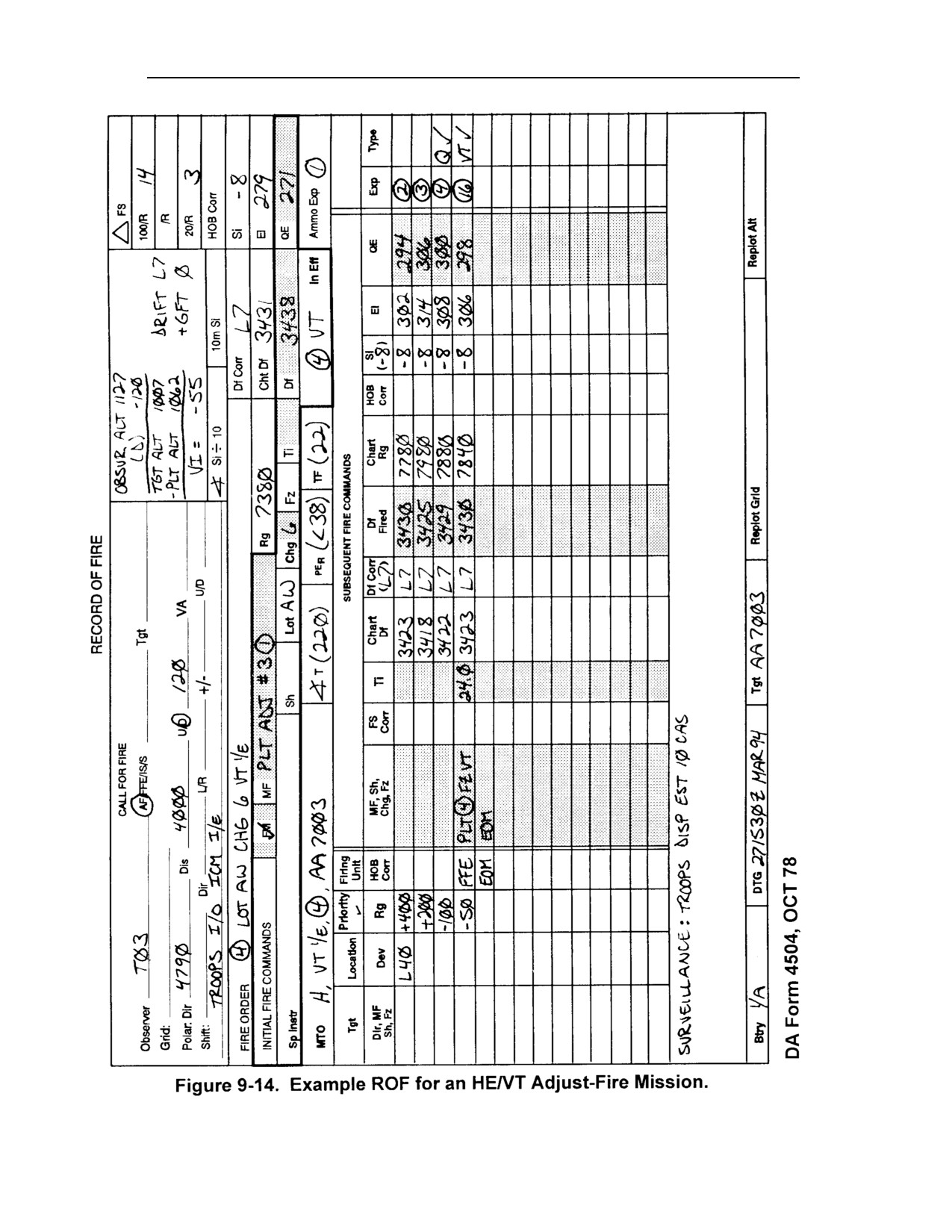
h. HE/VT Fire Mission With HE/Q in Adjustment. Process the HE/Q adjustment as
outlined in paragraph 9-5. Once the observer has requested a change in fuze type to a variable
time fire, process the request as described in Table 9-16. Figure 9-14 shows an example ROF
for this type of mission.
9-23
FM 6-40
9-24
FM 6-40
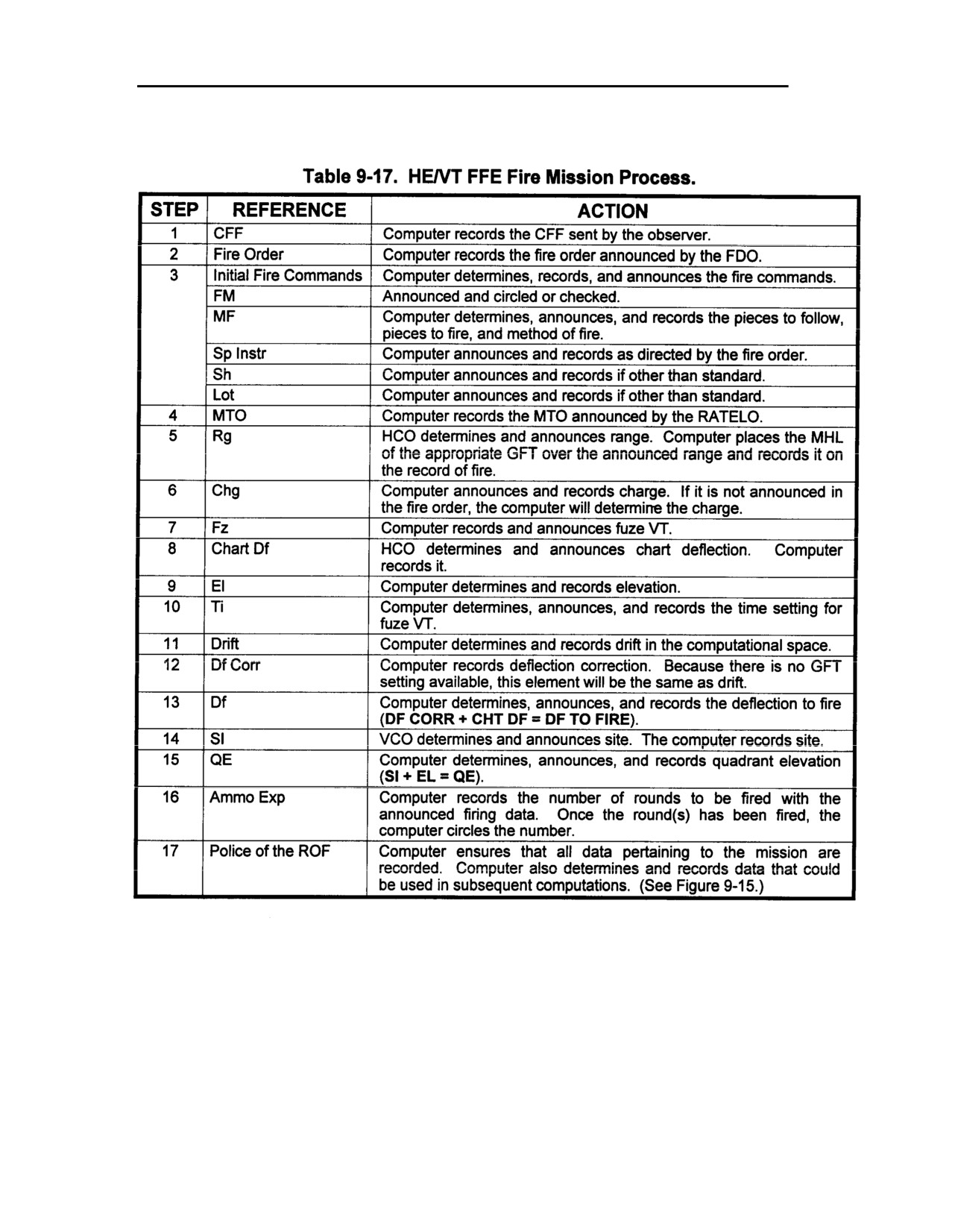
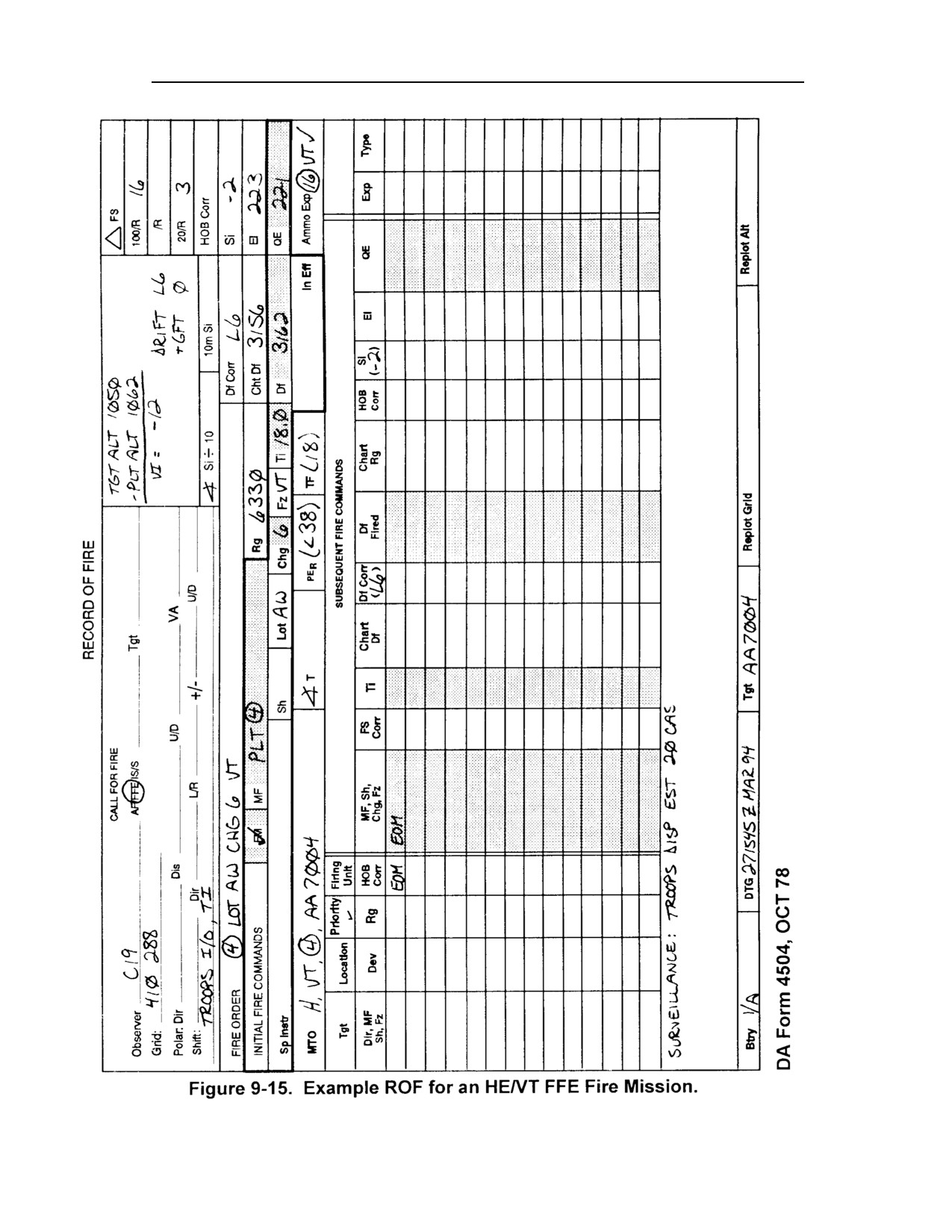
i. HE/VT FFE Fire Mission. Use Table 9-17 for pr.cessing an HE/VT FFE fire
mission. Figure 9-15 shows an example ROF for this type of mission.
9-25
FM 6-40
9-26
FM 6-40
9-6. Example of Completing the Record of
Fire for a Nonstandard Square Weight WP or HE Projectile
a. Several projectiles require corrections to firing data because of variations in square weight.
The determination of firing data incorporates the use of the GFT and the TFT. The basic HE mission
procedures must be altered to compensate for a deviation from the standard square weight from which
the firing tables were developed. The TFTs have tables that correct for nonstandard conditions, one of
which is weight. The computer must enter the appropriate TFT with the chart range to the target and
the difference in square weight (increase or decrease). The difference in weight is determined by
subtracting the standard square weight (or registration square weight) from the actual square weight of
the projectile to be fired. The range correction factor is extracted and multiplied by the change in
square weight. The result is expressed to the nearest 10 meters and is a signed value (±). This value is
algebraically added to the chart range. This new range is known as the adjusted range and is used to
compute elevation and all elements that are a function of elevation. The following steps apply to
nonstandard square weight WP and HE projectiles.
NOTE: Normal HE procedures are followed until the observer requests the nonstandard
square weight projectile.
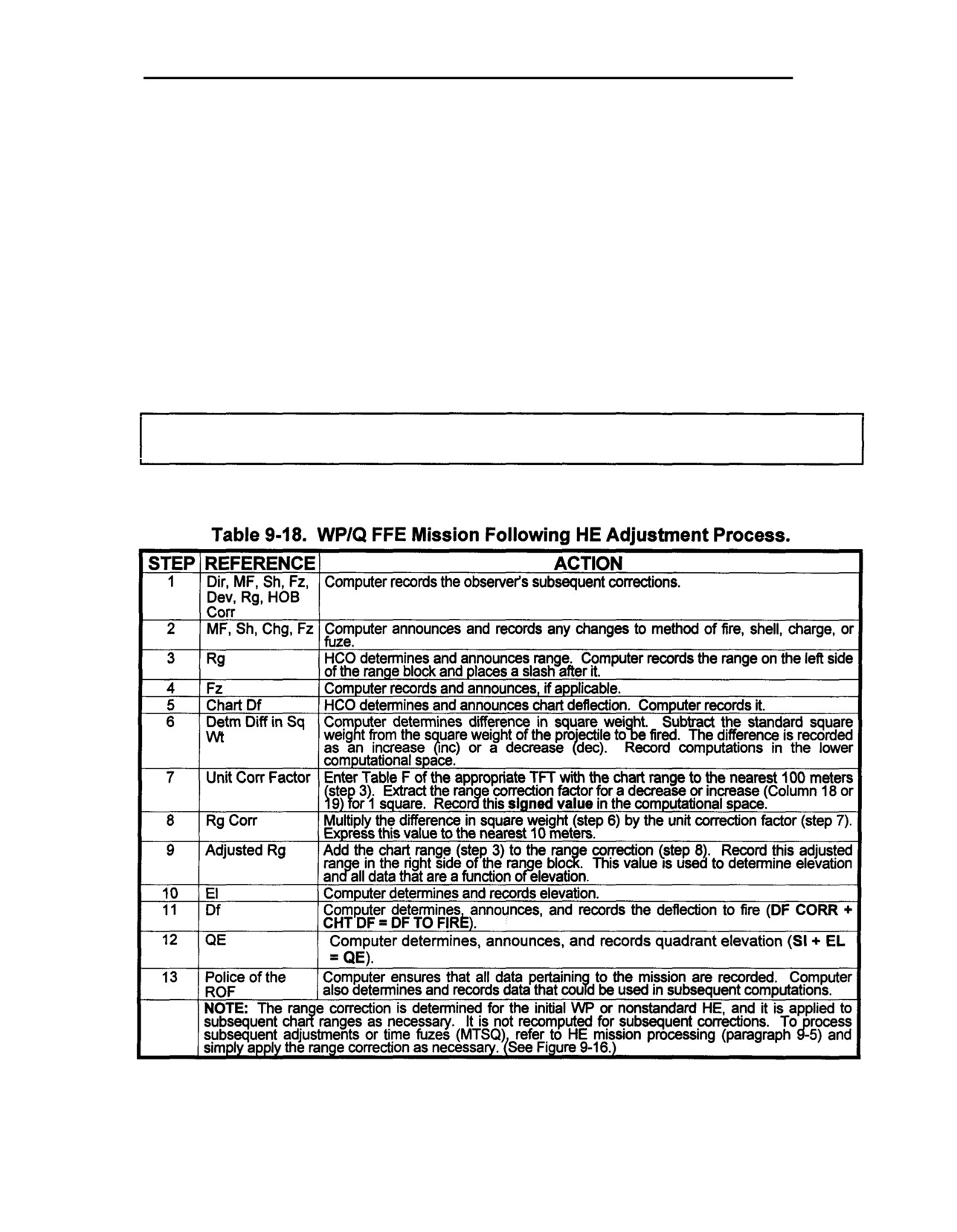
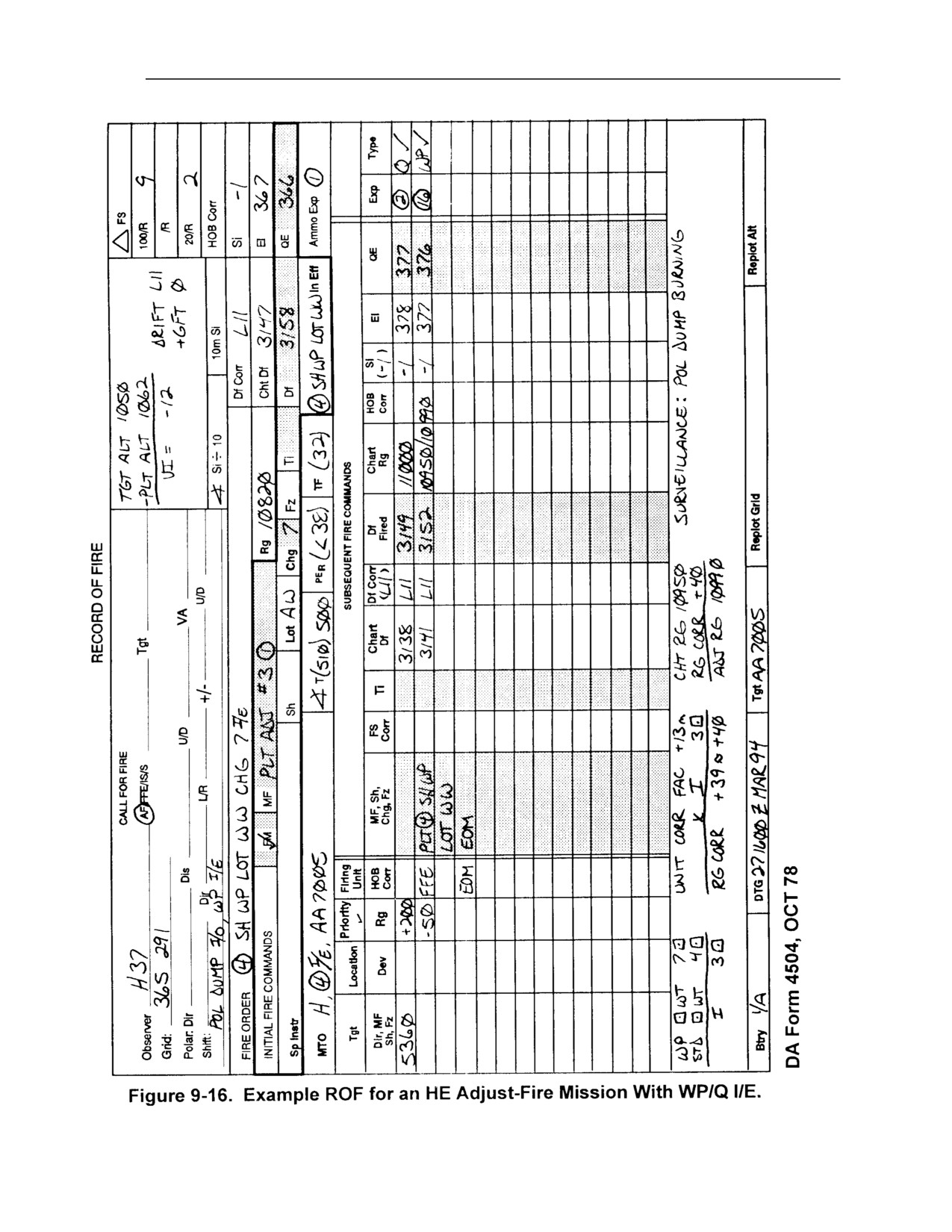
b. Table 9-18 lists the procedures for processing a WP/Q FFE mission following HE
adjustment. Figure 9-16 shows an example ROF for this type of mission.
9-27
FM 6-40
9-28
FM 6-40
Section III
High-Angle Fire
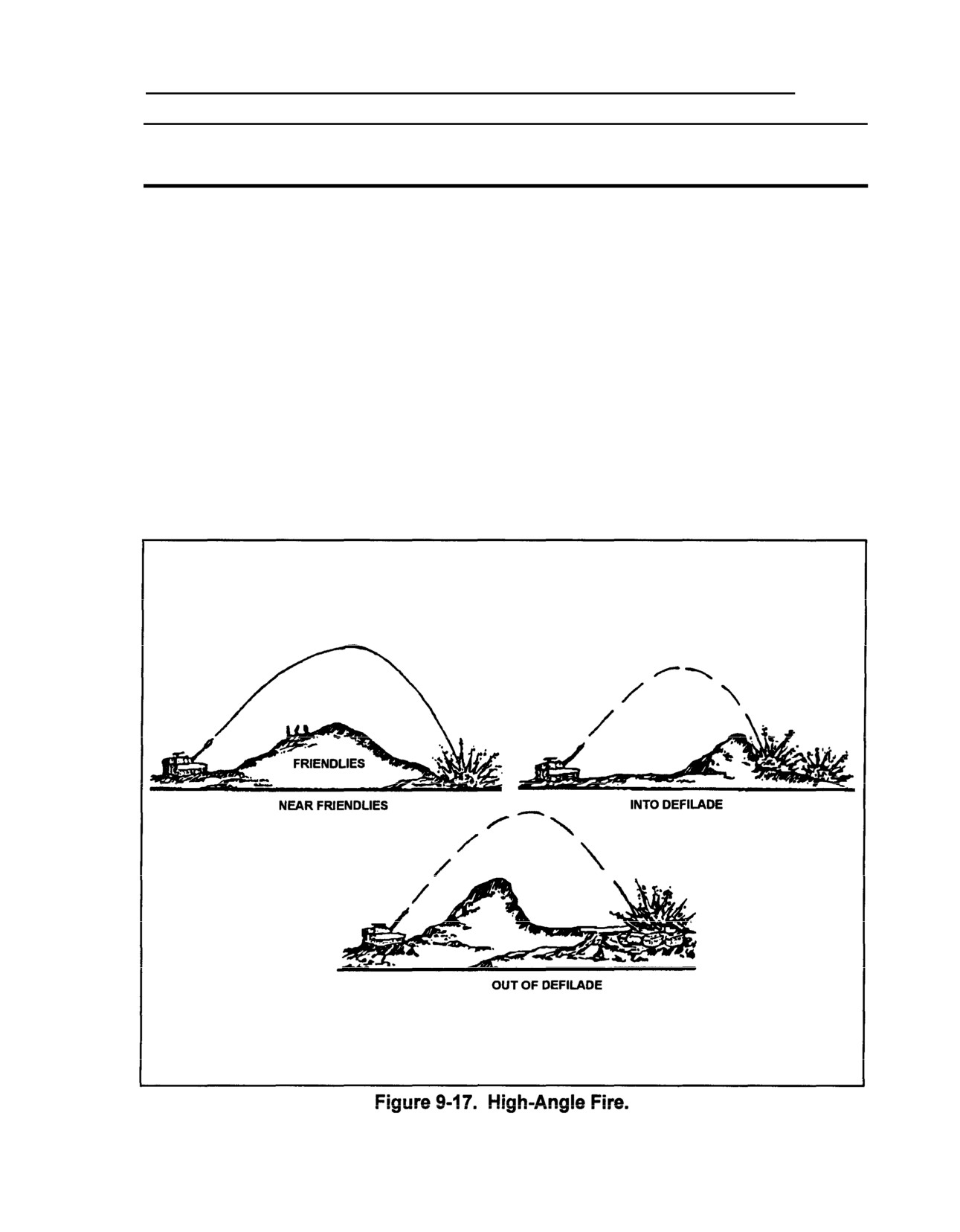
High-angle fire is used for firing into or out of deep defilade such as that
found in heavily wooded, mountainous, and urban areas. It is also used to fire
over high terrain features near friendly troops (Figure 9-17). The observer may
request high-angle fire on the basis of terrain in the target area. The FDO also
may order high-angle fire on the basis of a terrain analysis from the firing unit
position to the target area. The primary characteristic of high-angle fire is that
an increase in elevation causes a decrease in range.
Because high-angle fire involves large quadrant elevations and long times
of flight, it will not be as responsive as low-angle fire to the immediate needs of a
maneuver force. Trajectories are vulnerable to enemy detection. The long time of
flight makes it difficult for the observer to identify his round, and corrections may
change drastically from round to round. To help the observer, FDC personnel
will announce SPLASH 5 seconds before each round impacts. To further help the
observer, the FDC announces time of flight in the MTO.
9-29
FM 6-40
9-8. High-Angle GFT
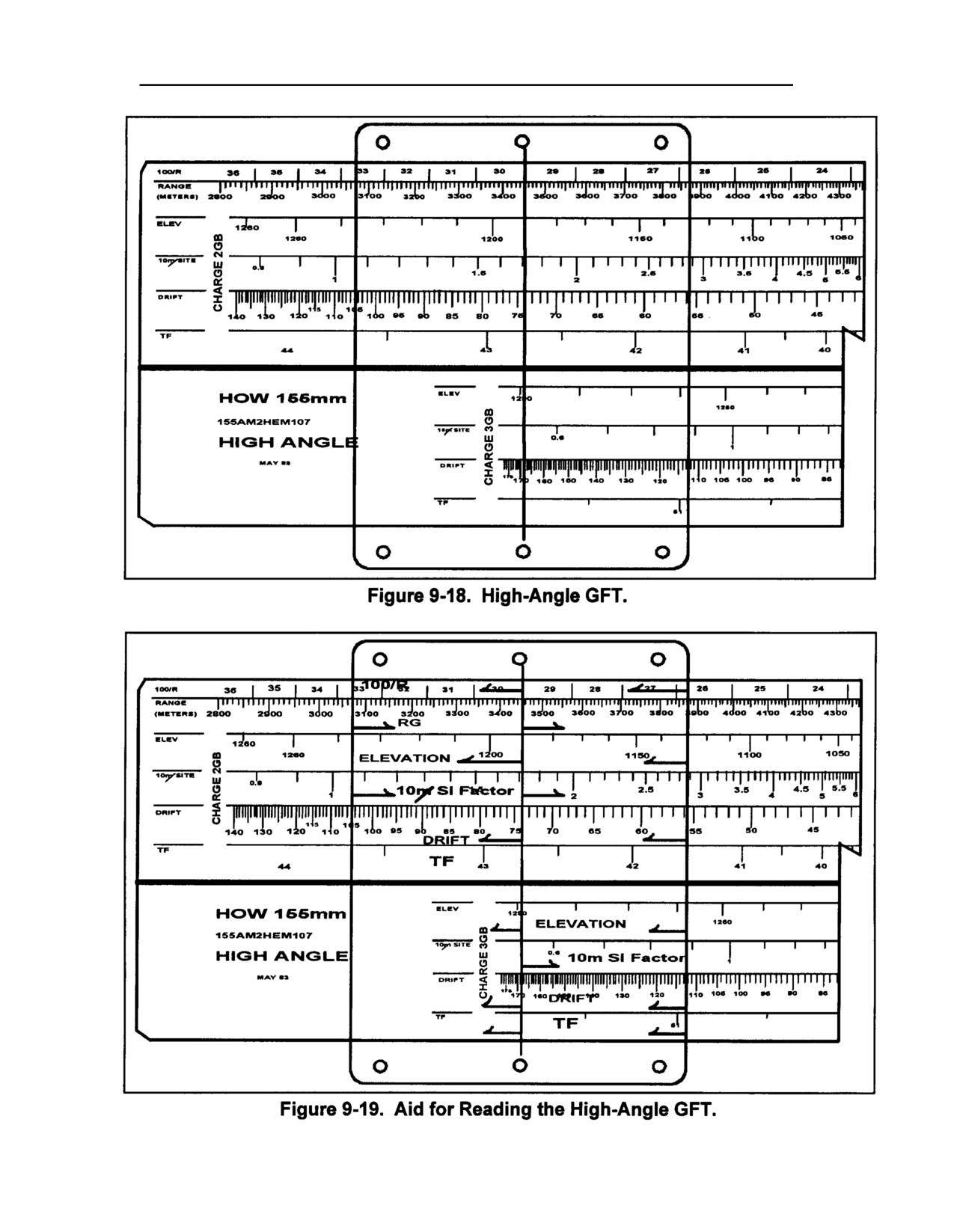
The high-angle GFT (Figure 9-18, page 9-31) consists of one rule with ballistic data for
multiple charges on each side. The scales on the high-angle GFT from top to bottom are as
follows:
a. 100/R. This scale shows the number of mils needed to move the burst 100 meters
laterally or vertically. The scale increases from right to left and is read to the nearest mil.
b. Range. This scale is expressed logarithmically in meters and applies to all charges
appearing on that side of the GFT. Range increases from left to right and is read to the nearest 10
meters.
c. Elevation. This scale is expressed in mils and increases from right to left. It is
interpolated to the nearest mil.
d. 10-m Site Factor. The values on this scale denote the site for each 10 mils angle of
site. The numbers are printed in red and are negative values. The scale increases from left to
right and is visually interpolated to the nearest tenth (0.1) of a mil.
e. Drift. The values on this scale are in mils. The scale increases from right to left and
is interpolated to the nearest mil.
f. TF. This scale is graduated in seconds and is used to determine both time of flight (to
the nearest whole second) and VT fuze setting. The TF scale increases from right to left.
NOTE: Figure 9-19, page 9-31 shows an aid that can be used when reading the
high-angle GFT.
9-30
FM 6-40
9-31
FM 6-40
9-8.
Duties of Personnel in High-Angle Fire
a. Except for differences noted in this section, the procedures for high-angle fire are the
same as low-angle fire. Duties of FDC personnel in high-angle fire differ in several ways as
described below.
b. The FDO does the following:
(1) Includes the command HIGH ANGLE in his fire order.
(2) Considers high-angle fire characteristics in selecting the shell and fuze to fire.
(a) Antipersonnel improved conventional munitions (APICM) and DPICM
can be used in high-angle fire for the same types of targets as in low-angle fire.
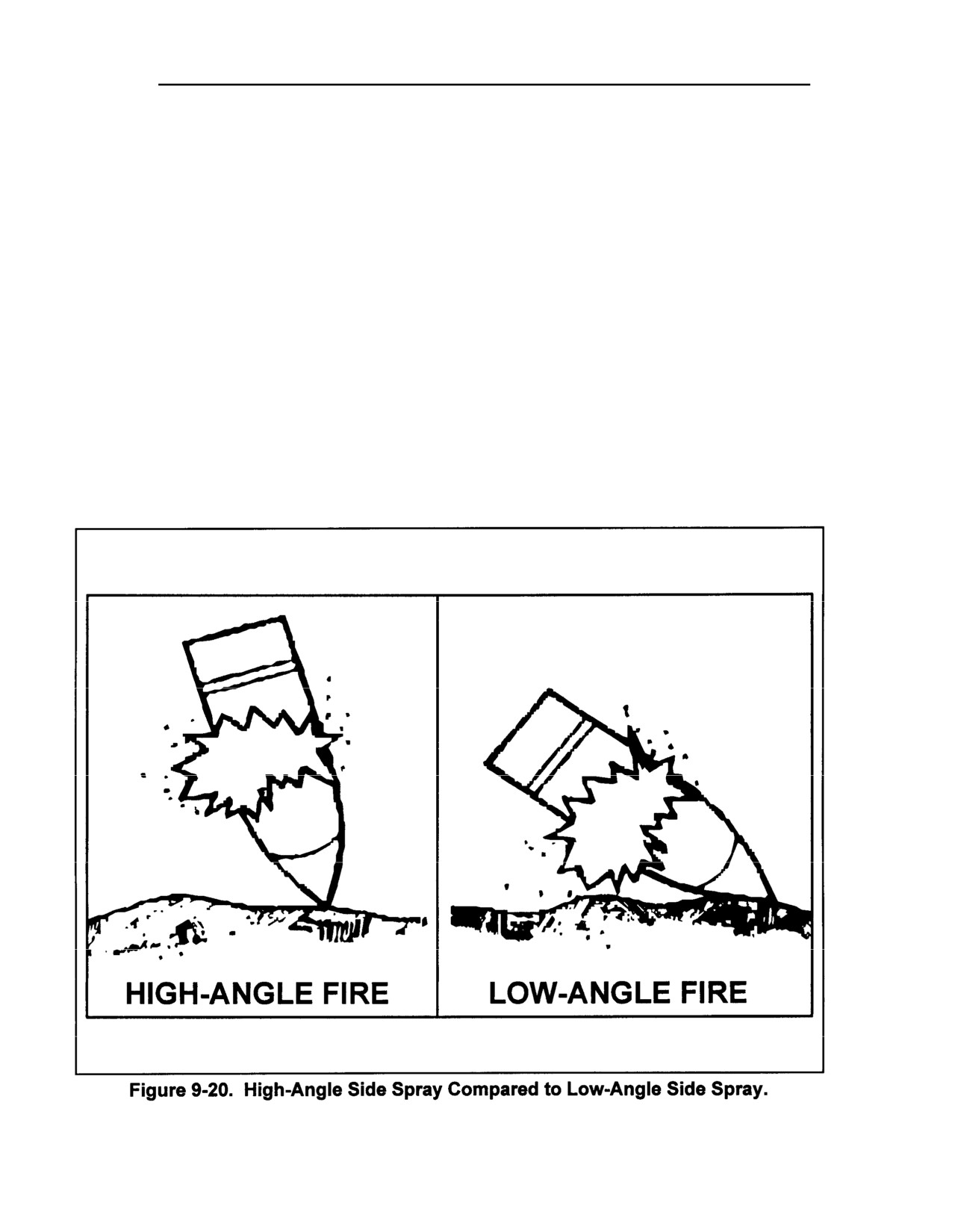
(b) The high-angle trajectory has two inherent characteristics that affect
munitions selection: a steep angle of fall and large probable errors. The steep angle of fall means
the projectile is almost vertical as it approaches the ground. When the HE projectile bursts, the
side spray contains most of the fragmentation. Since the projectile is nearly vertical, side spray is
in all directions and nearly parallel to the ground (Figure 9-20). Thus, shell HE with fuze quick
or fuze VT is very effective when fired high angle. The large probable error in height of burst
makes the use of MTSQ time fuzes impractical in high-angle fire.
9-32
FM 6-40
c. The VCO computes and announces angle of site rather than site.
d. The computer does the following:
(1) Selects the charge to be fired (if it is not announced in the fire order).
High-angle fire has two characteristics that affect the selection of charge: a shorter range span for
each charge and a range overlap between charges. The range span within which accurate fire can
be delivered by a particular charge is less for high-angle fire than for low-angle fire. This may
cause a problem during a high-angle fire mission, because a large observer correction may move
the round outside the capabilities of the initial charge fired. This, in turn, will necessitate
changing charges. Changing charges in a high-angle fire mission is sometimes unavoidable,
although it is not desirable. For this reason, the computer initially selects the charge that is least
likely to require changing. As a guideline, he selects the lowest charge that allows for a range
shift of at least 500 meters short of and 500 meters beyond the initial chart range.
(2) Includes drift correction. Drift is appreciably greater in high-angle fire than in
low-angle fire. Because drift changes a great amount for a relatively small elevation change, the
computer determines drift (recorded as the deflection correction) for each elevation. The
correction is always applied to the left. If a GFT setting is available for the high-angle GFT, the
computer will determine drift and algebraically add it to the GFT deflection correction. The sum
is the deflection correction to be applied to the chart deflection.
(3) Includes site in the computation of QE unless the FDO directs otherwise. Site is
included when the angle of site is large or when a high-angle registration or a mass mission is
being fired. When several firing units are to mass on a target and only one firing unit is to adjust,
site is computed at the initial range for each unit. Site for the nonadjusting units may be
recomputed before FFE (for example, when the adjusting unit changes charge or when the
adjusting unit conducted a target replot). When adjustment is required before massing and only
one unit is to adjust, the unit that is most centrally located should be designated as the adjusting
unit to minimize large differences in range for the nonadjusting units. If site is to be ignored, the
FDO announces IGNORE SITE in the fire order. Since one of the criteria for ignoring site is a
small angle of site, the FDO may have to wait for the VCO to compute and announce angle of
site. In this situation, the FDO issues a fire order and later supplements it with the command
IGNORE SITE.
(4) Announces HIGH ANGLE as a special instruction when sending initial fire
commands to the howitzers.
(5) The RATELO announces the time of flight in the message to observer and
announces SPLASH for each round.
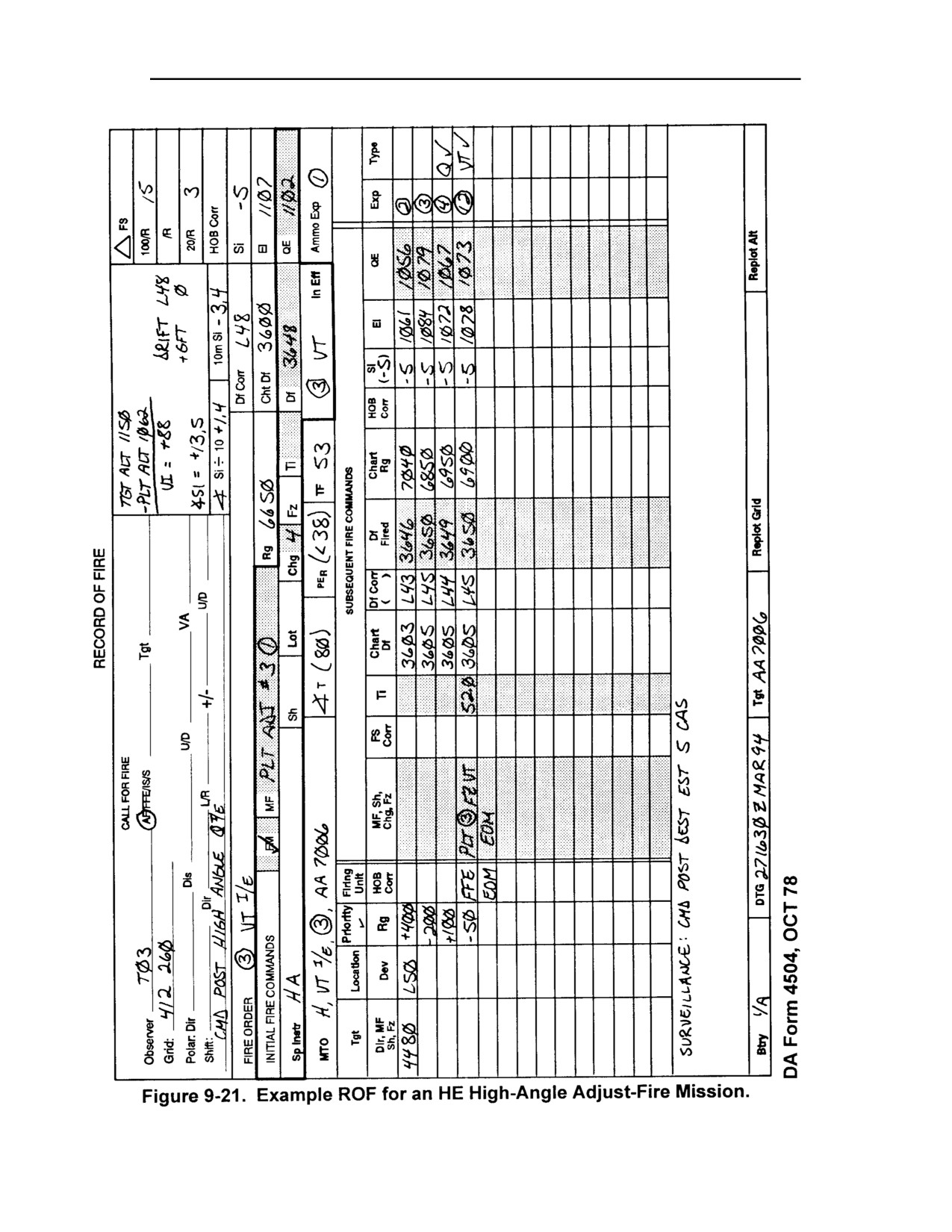
9-9. Example of Completing the ROF for an HE High-Angle Adjust-Fire Mission
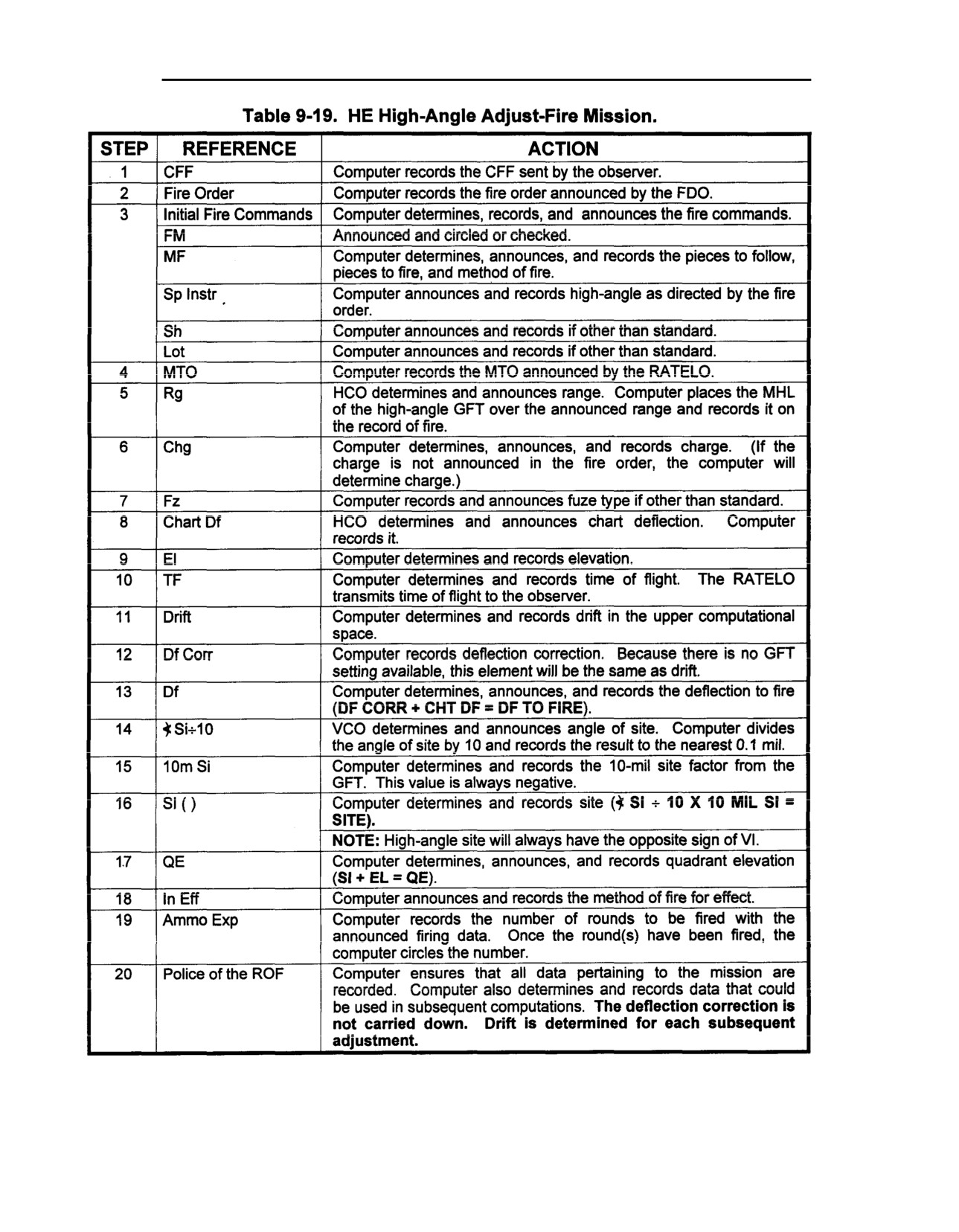
a. The steps in Table 9-19 are used to process an HE high-angle adjust-fire mission.
Figure 9-21 shows an example ROF for this type of mission.
9-33
FM 6-40
9-34
FM 6-40
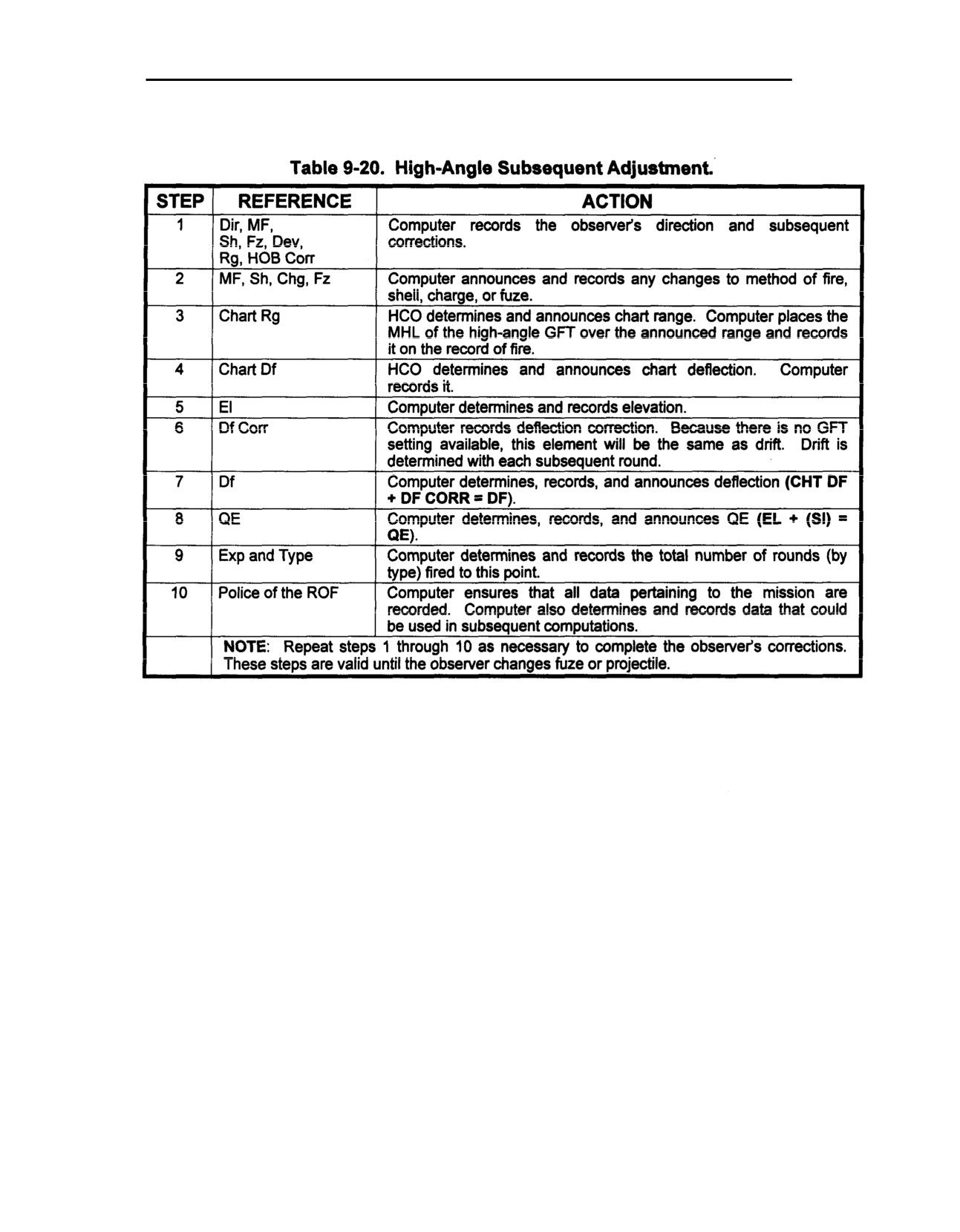
b. The steps in Table 9-20 are used to process a high-angle subsequent adjustment. An
example ROF for this entire mission is shown in Figure 9-21.
9-35
FM 6-40
9-36
FM 6-40
Section IV
Illumination
This section implements STANAG 2088 and QSTAG 182.
Illuminating projectiles are available for the 105-mm and the 155-mm
howitzers. They are used to illuminate a designated area for observing enemy
night operations, for adjusting artillery fires at night, for marking locations, for
friendly direction, or in ground/vehicular laser locator designator (G/VLLD)
missions.
Illuminating projectiles are base-ejection projectiles fired with mechanical
time fuzes. The filler consists of an illuminating canister and a parachute
assembly. The FDO should select the lowest practical charge to prevent a
malfunction caused by the parachute ripping when the flare is ejected from the
projectile.
9-10. Overview
Illumination is conducted by using one of the following techniques.
a. The one-gun illumination pattern is used when effective illumination can be
achieved by firing one round at a time.
b. The two-gun illumination pattern is used when an area requires more illumination
than one gun can furnish. This is commonly used for aerial observers.
(1) The two-gun illumination range spread pattern is fired along the GT line. It
is used when the area to be illuminated has greater depth than width.
(2) The two-gun illumination lateral spread pattern is fired perpendicular to the
GT line. It is used when the area to be illuminated has greater width than depth.
c. The four-gun illumination pattern is used to illuminate a large area. Four rounds
are fired at the same time by using both the lateral and range spread patterns. This is more
commonly referred to as the four-gun illumination range and lateral spread.
9-37
FM 6-40
NOTE: The decision to use the GT line or observer-target (OT) line for illumination
missions should be based on unit SOP and mission, enemy, terrain, troops, and time
available (METT-T). When using the OT line, the FDC will use the target grid to plot
individual aimpoints. Use of the GT line may be more responsive to the observer’s
needs, but may not always provide the exact illumination coverage desired. The
arguments for using the OT line are:
The observer may not be able to visualize the GT line, but he can always
visualize the OT line.
The observer may not know which firing unit will fire his mission, especially if
the mission is passed to a reinforcing FA unit. Therefore, he may not have
the information needed to visualize the GT line.
The terrain may restrict effective illumination of the target area if the observer
desires illumination in respect to his OT direction, but the firing unit computes
data by using the GT line.
However, for illustrative purposes with the example fire missions, our unit SOP is to use the GT
line for all illum range spreads, lateral spreads, or combination.
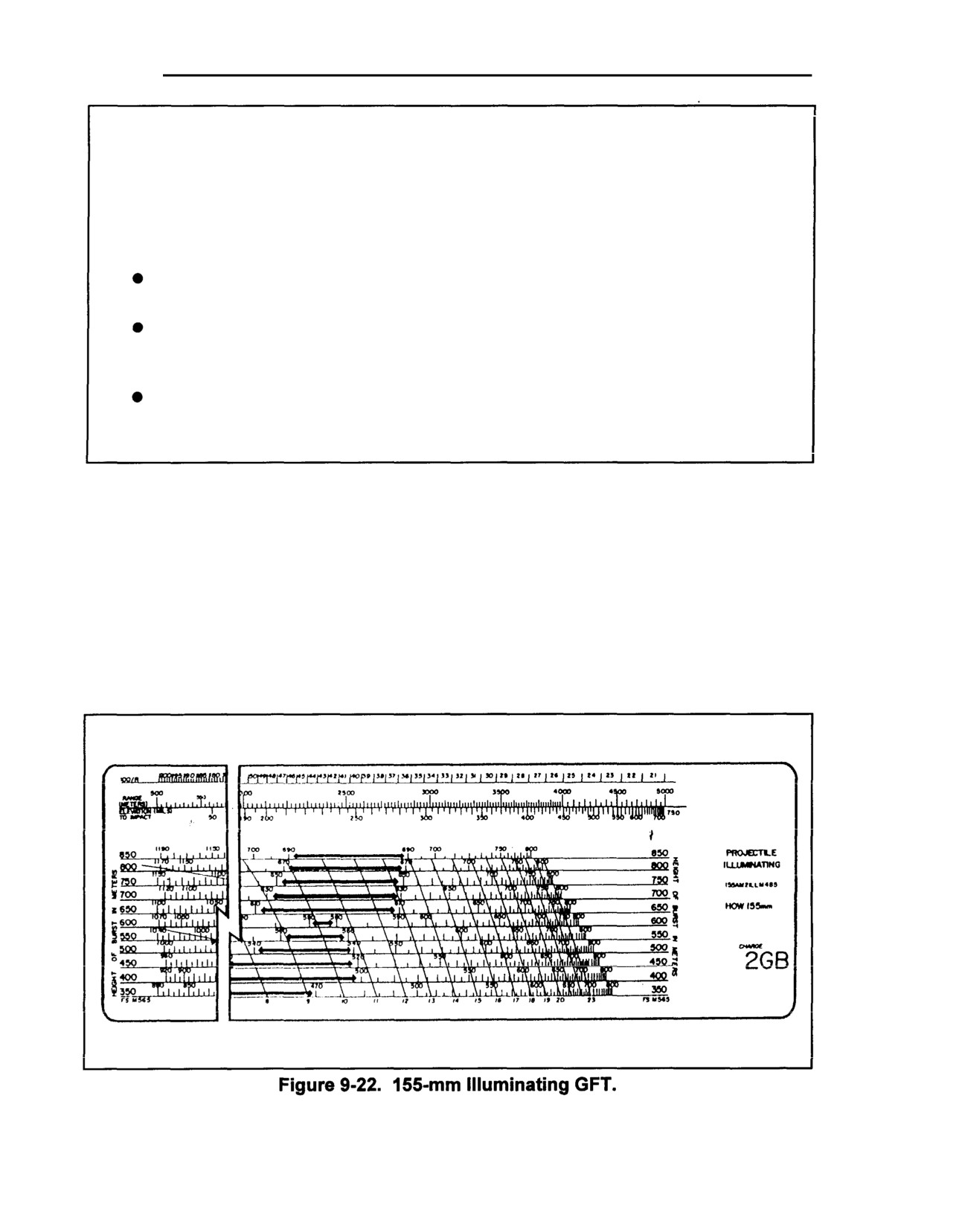
9-11. Illuminating Projectile GFT
a. There are two manual computational methods for the illuminating projectile. One
method uses a special illuminating projectile GFT, and the other method uses Part 2 of the base
HE TFT. Graphical firing tables have been developed for use with all 155-mm M485A1 and A2
illuminating projectiles and with the 105-mm M314A1 and A2 and M314A2E1 projectiles.
Figure 9-22 shows a GFT for the illuminating projectile.
9-38
FM 6-40
b. The scales of the illuminating GFT, from top to bottom, are described below:
(1) The 100/R scale is printed in red along the top edge of the rule. For a given
range, the 100/R scale denotes the number of mils needed to shift the burst 100 meters laterally or
vertically. 100/R is read to the nearest mil.
(2) The range scale is the base scale of the illuminating GFT. All other scales are
plotted with reference to the range scale. Range is read to the nearest 10 meters.
(3) The elevation-to-impact scale is graduated in mils. The elevation-to-impact scale is
used to determine the range (on the range scale) to which a nonfunctioning projectile will impact.
(4) The HOB scales, labeled from 350 to 850 meters, are at the left and right edge
of the QE scales. The HOB scales are graduated in 50-meter increments.
(5) The QE scale shown for each listed HOB gives the QE needed to achieve that
HOB at the desired range. The QE scale is graduated in mils and is visually interpolated to the
nearest mil.
(6) The FS scale consists of a series of red arcs. The scale includes a red line for
each whole FS increment for the M565 MT fuze. The value of each line is printed in red at the
bottom of the scale. The fuze setting is read for the desired range and HOB to an accuracy of 0.1
FS increment by visual interpolation.
NOTE: The heavy black arrows along the QE scale denote when the trajectory is
near or at the summit and does not exceed by 50 meters the HOB it represents.
9-12. Illumination Firing Data
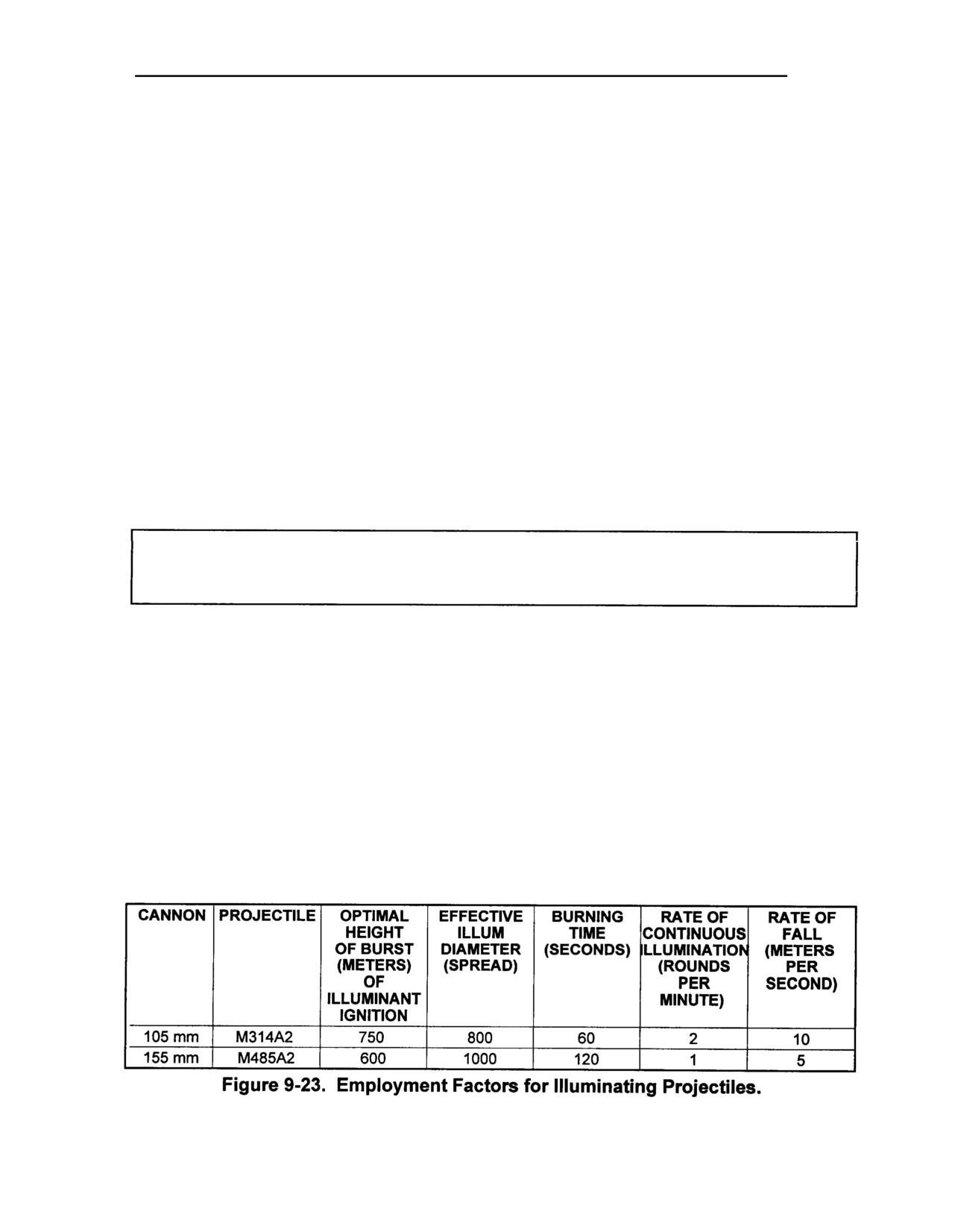
a. The illum projectile is not weight-zoned. It is designed to illuminate a large area
(Figure 9-23). The minimum corrections from the observer are 200 meters for range and
deviation and 50 meters for HOB. All subsequent HOB corrections are always given in multiples
of 50 meters. Because of these characteristics, the determination of firing data is significantly
different from HE. Drift, site, elevation, and FS are not determined. However, an illum HOB is
determined. The HOB is used in conjunction with range to determine QE and FS. Therefore,
any HOB correction sent by the observer will cause both the FS and QE to change.
b. The HCO determines chart data in the same manner as in an HE mission. The VCO
determines VI in the same manner as in an HE mission. The computer will express the VI
determined by the VCO to the nearest 50 meters.
9-39
FM 6-40
9-13. Determination of Illumination Firing Data With the GFT
a. The appropriate HOB scale is determined by applying the VI determined by the
computer to the optimum HOB for the illuminating projectile being fired. During subsequent
adjustments, the observer’s HOB correction is applied to the previous HOB determined.
b. QE is determined by placing the MHL over the chart range. The QE is determined
by visually interpolating the point of intersection of the MHL and the appropriate HOB scale.
Determine QE to the nearest mil.
c. Fuze setting is determined in the same manner as QE; that is, by placing the MHL
over the chart range. Fuze setting is determined by visually interpolating between the red fuze
setting arcs along the selected HOB scale. To determine the value of the arcs, follow the arcs to
the bottom of the GFT. This fuze setting is for the M565 MT fuze. To determine a fuze setting
for MT M577, enter Table B, Part 2, of the TFT and apply the FS correction to the MT M565
value. Determine FS to the nearest tenth.
9-14. Determination of Illumination Firing Data With the TFT
a. Part 2 of the TFT deals exclusively with illum data. Each charge has two tables,
Tables A and B. Table A lists basic data, and Table B lists corrections to fuze setting.
b. FS and QE are determined by entering Table A with the chart range (expressed to the
nearest 100 meters). QE is extracted from Column 2 (QUAD ELEV) and M565 FS from Column
3 (FS). These values are for the optimum HOB and must be corrected for VI.
c. HOB corrections are made in 50-meter increments. Columns 4 and 5 of Table A list
the corrections to QE and FS for an increase of 50 meters in HOB. The VI is expressed to the
nearest 50 meters. Once the VI is expressed, it is divided by 50 to determine the number of
50-meter increments that are needed. The number of 50-meter increments are multiplied by the
value in Column 4 (QE) and Column 5 (FS). These values are applied to QE and FS. For a
positive VI, the values are added; for a negative VI, the values are subtracted. These corrected
values are the FS and QE that should be fired.
d. To process HOB corrections, divide the observer’s HOB correction by 50. This will
provide the number of 50-meter increments. Multiply the number of 50-meter increments by the
values in Columns 4 and 5. Apply this correction value as described above.
e. 100/R can be determined manually by using the mil relation formula by dividing 100
by the range in thousands and multiplying that value by 1.0186. The result is expressed to the
nearest mil.
NOTE: The FS determined from the illuminating GFT or from Table A, Part 2,
Column 3 of the TFT is for the M565 fuze. A correction value must be applied to
determine a fuze setting for the M577 fuze. Table B of the TFT lists the correction
values. To determine the correction value, enter Table B with the FS for the M565
fuze. Apply this FS correction to the FS for the M565 fuze. The resulting value is
the FS for the M577 fuze.
9-40
FM 6-40
9-15. Processing a One-Gun Illumination Fire Mission
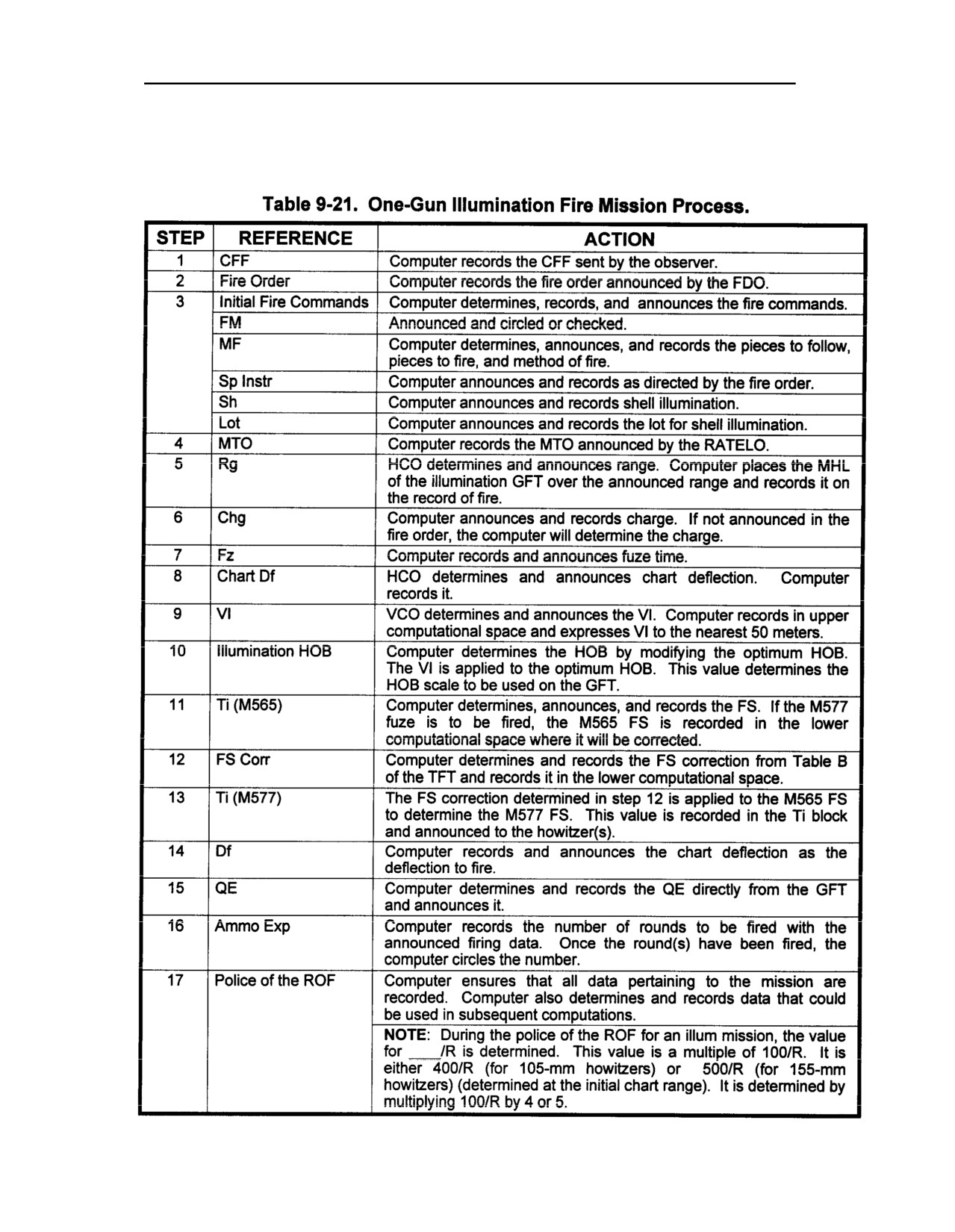
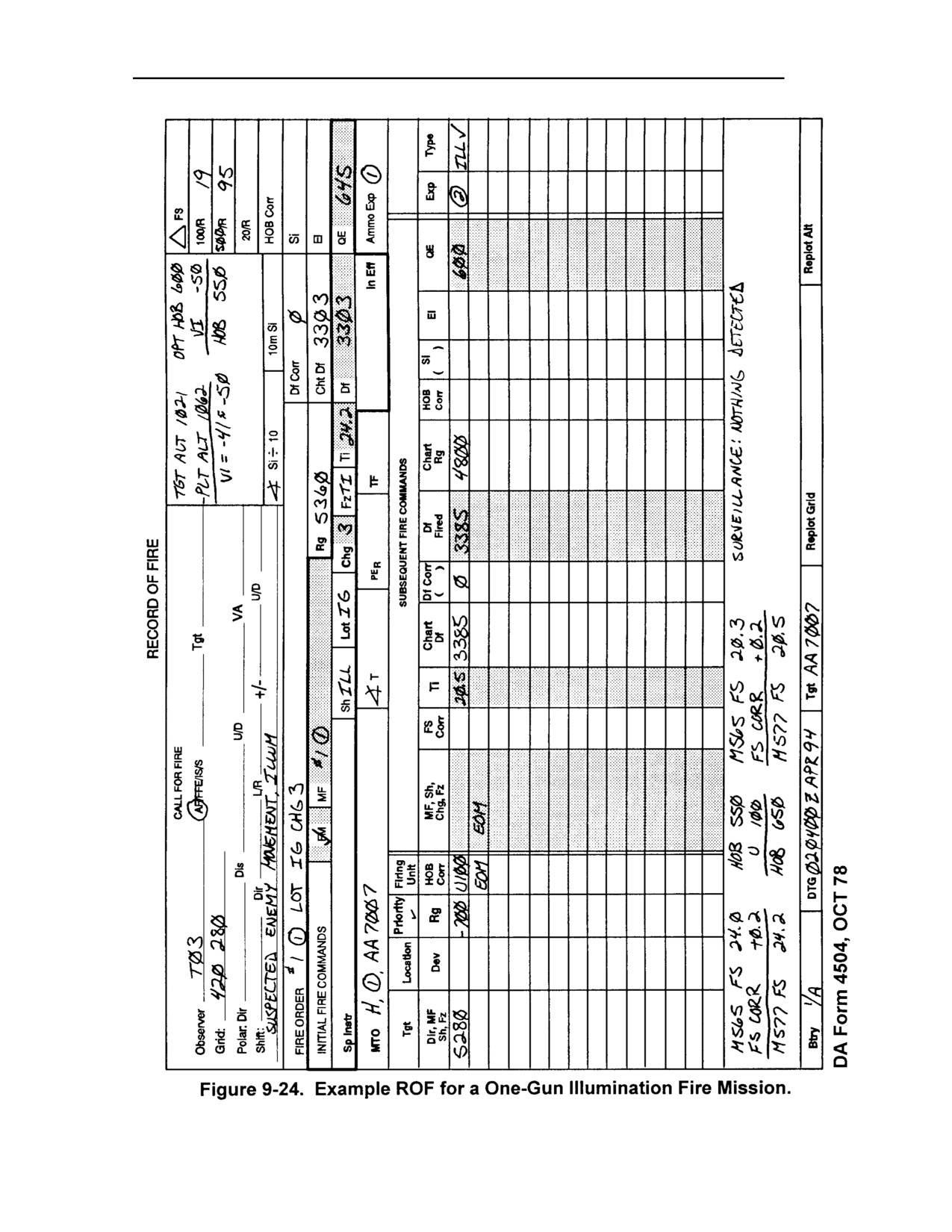
a. The steps in Table 9-21 are used to process a one-gun illum mission. Figure 9-24
shows an example ROF for this type of mission. The time fuze being fired is M577.
9-41
FM 6-40
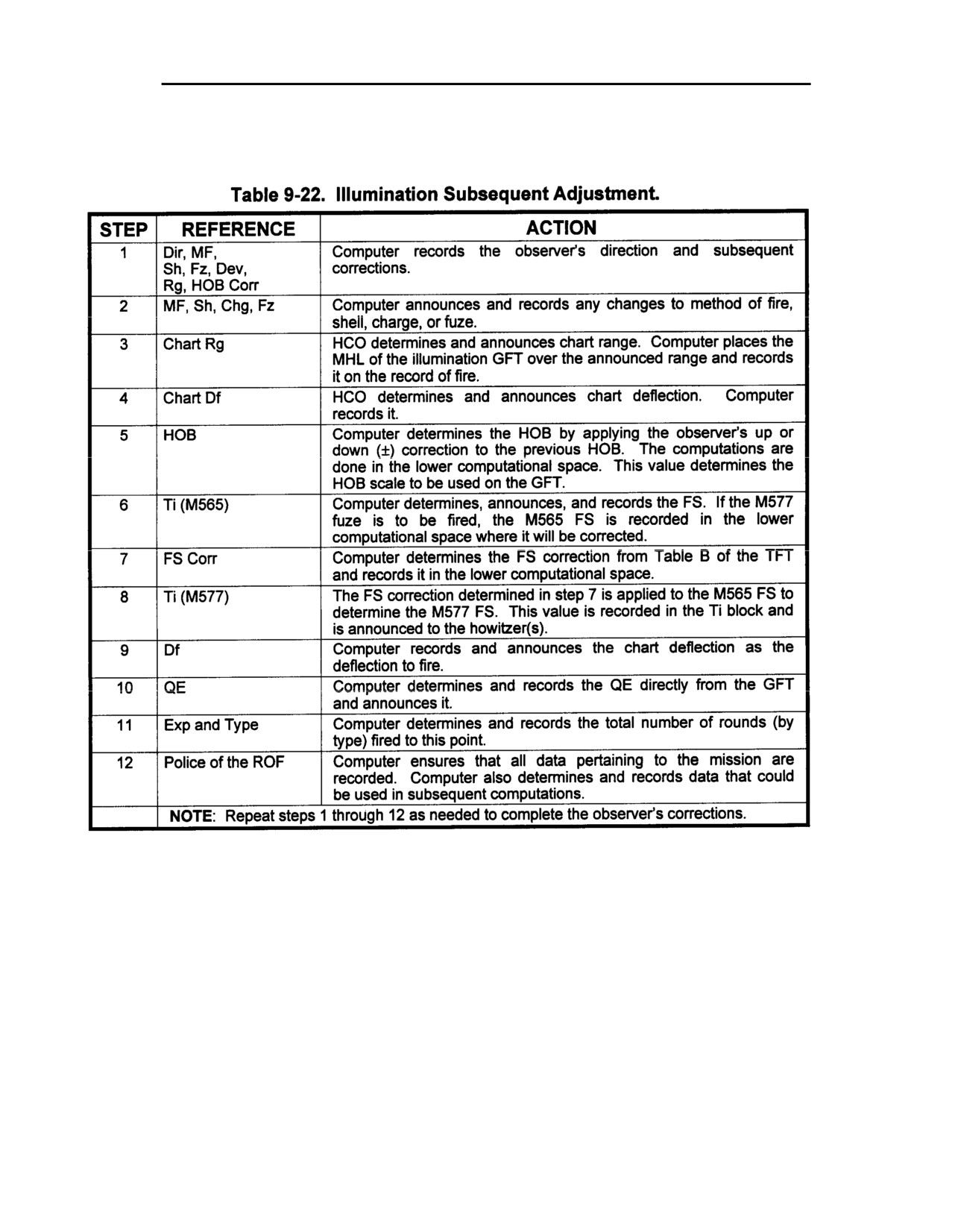
b. The steps in Table 9-22 are used to process an illumination subsequent adjustment.
An example ROF for this entire mission is shown in Figure 9-24. The time fuze being fired is the
M577.
9-42
FM 6-40
9-43
FM 6-40
9-16. Two-Gun Illumination Range Spread
a. A two-gun range spread requires two illuminating projectiles to be fired along the GT line
to provide the maximum range coverage. The projectiles are fired one effective illum diameter apart
(refer to Figure 9-23). To determine the aimpoints, the computer will add and subtract one-half the
illum diameter to the chart range of the aimpoint. The computer will then determine firing data at the
adjusted ranges. The chart deflection will remain the same and both illumination rounds are fired with
the same deflection.
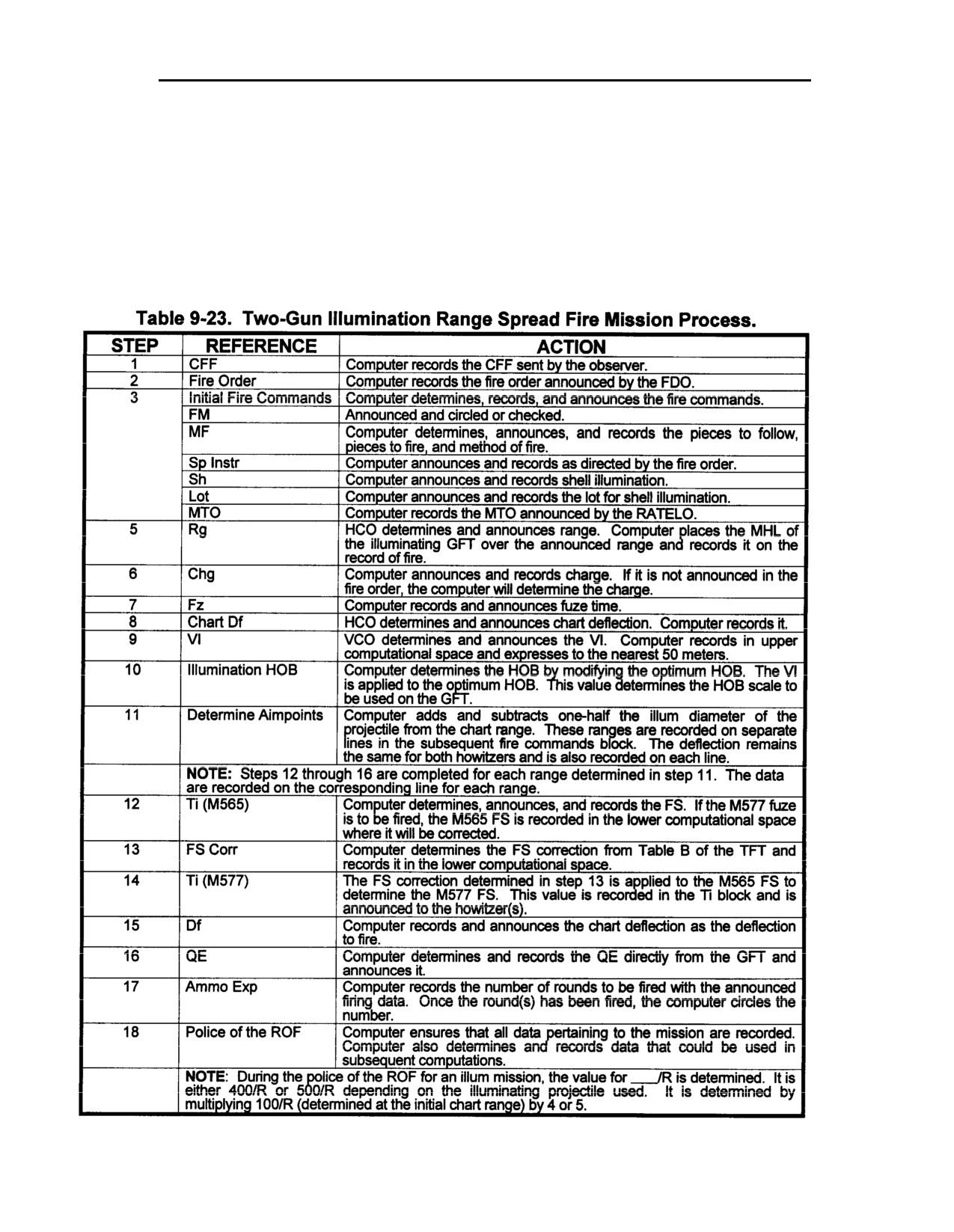
b. Use Table 9-23 to process a two-gun illumination range spread fire mission. An example
ROF for this entire mission is shown in Figure 9-25. The time fuze being fired is fuze M577.
9-44