FM 6-40 TTP for Field Artillery Manual Cannon Battery U.S. - page 5
FM 6-40
6-19
FM 6-40
6-20
FM 6-40
6-21
FM 6-40
6-22
FM 6-40
6-14. Plotting Targets
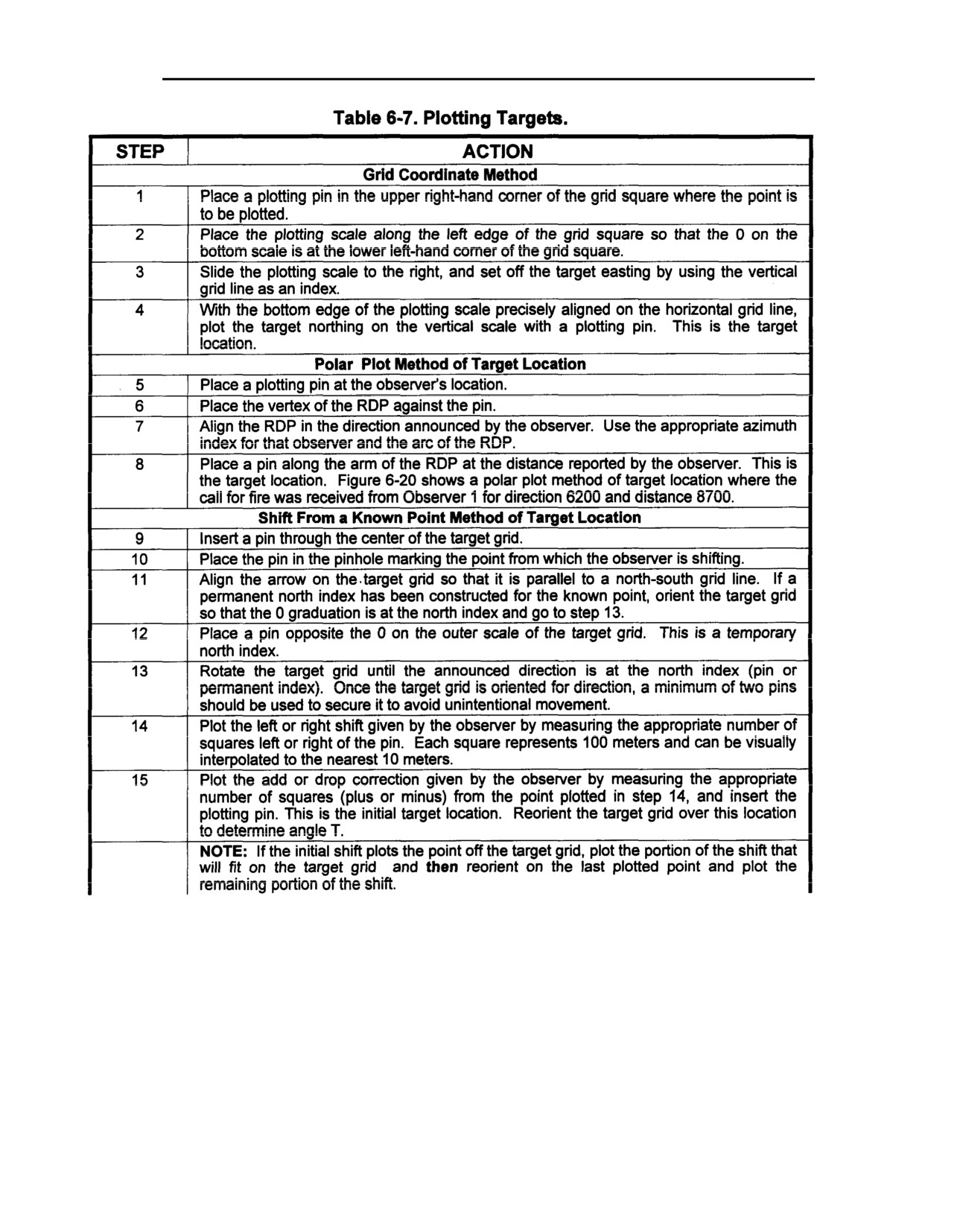
The observer can use three methods of target location: grid coordinate, polar plot, and
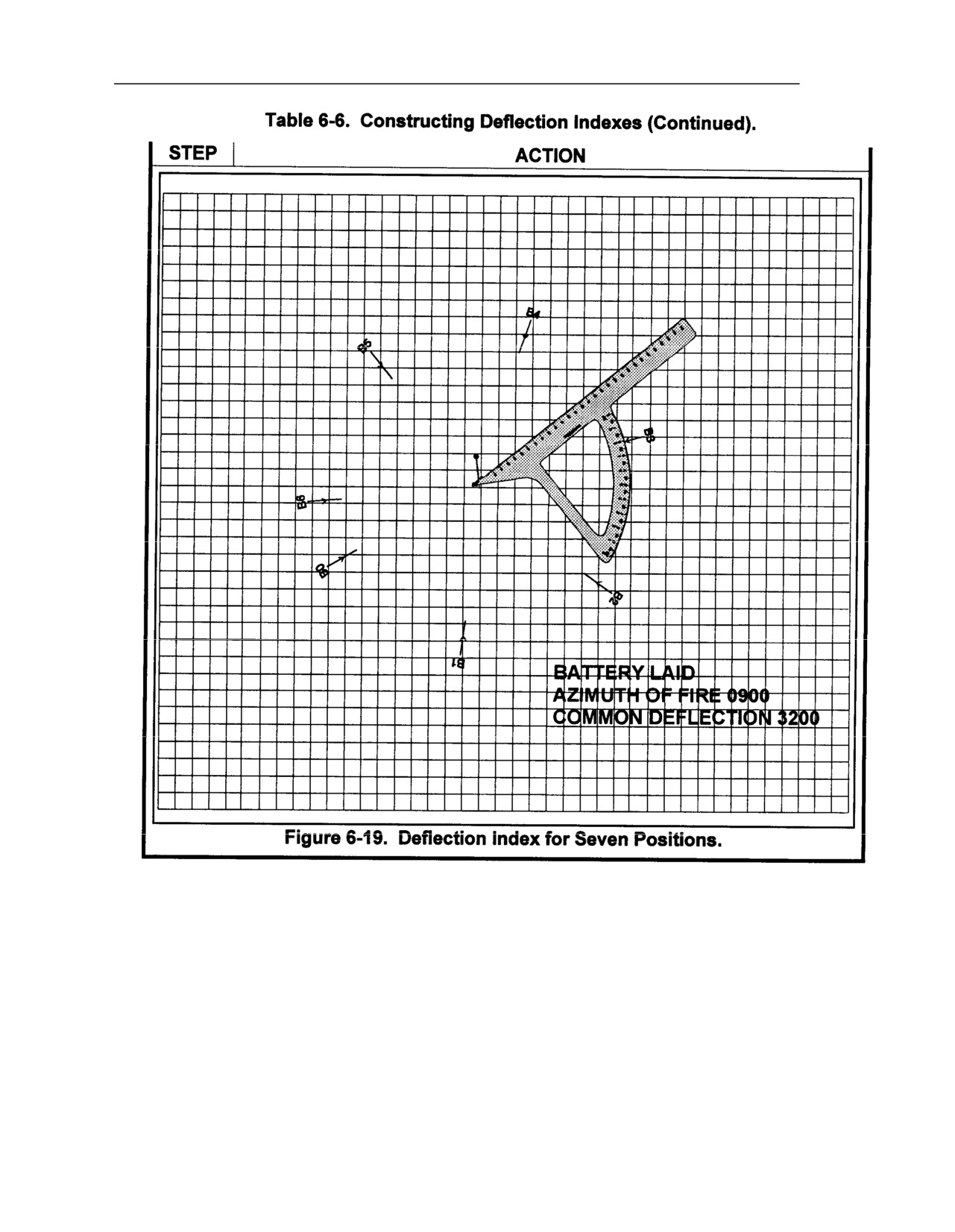
shift from a known point. The steps for plotting targets on a firing chart are listed in Table 6-7.
6-23
FM 6-40
6-24
FM 6-40
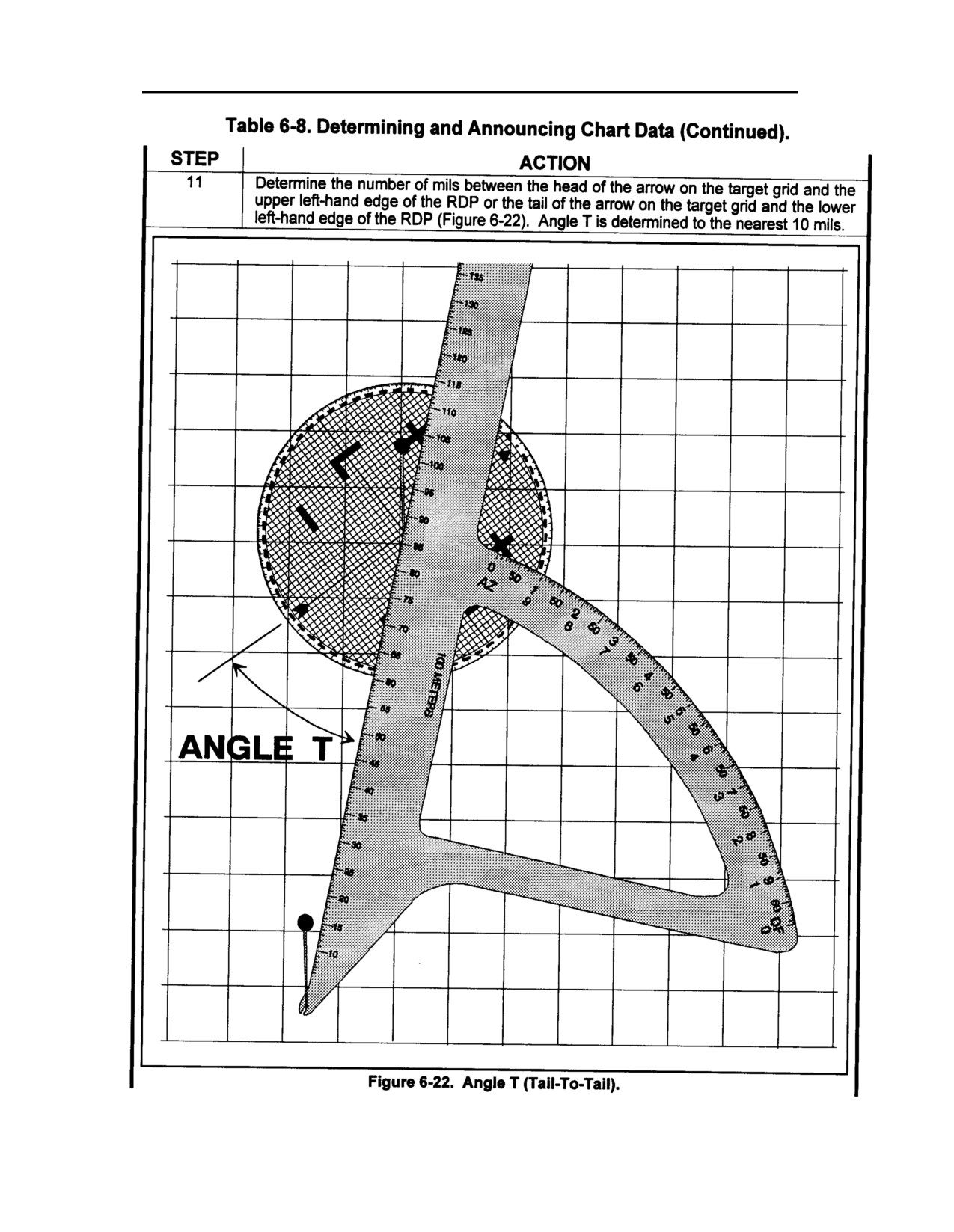
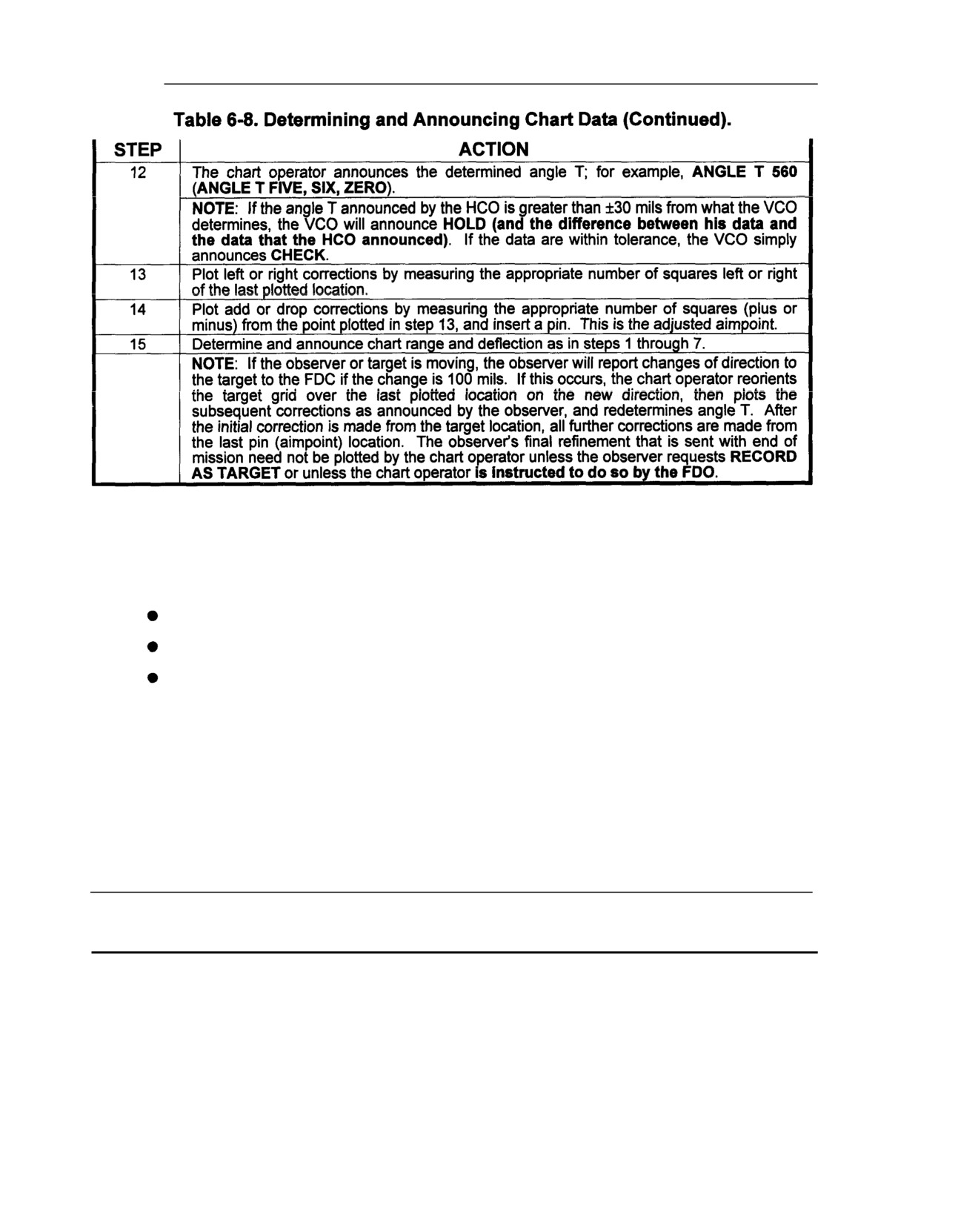
6-15. Determining and Announcing Chart Data
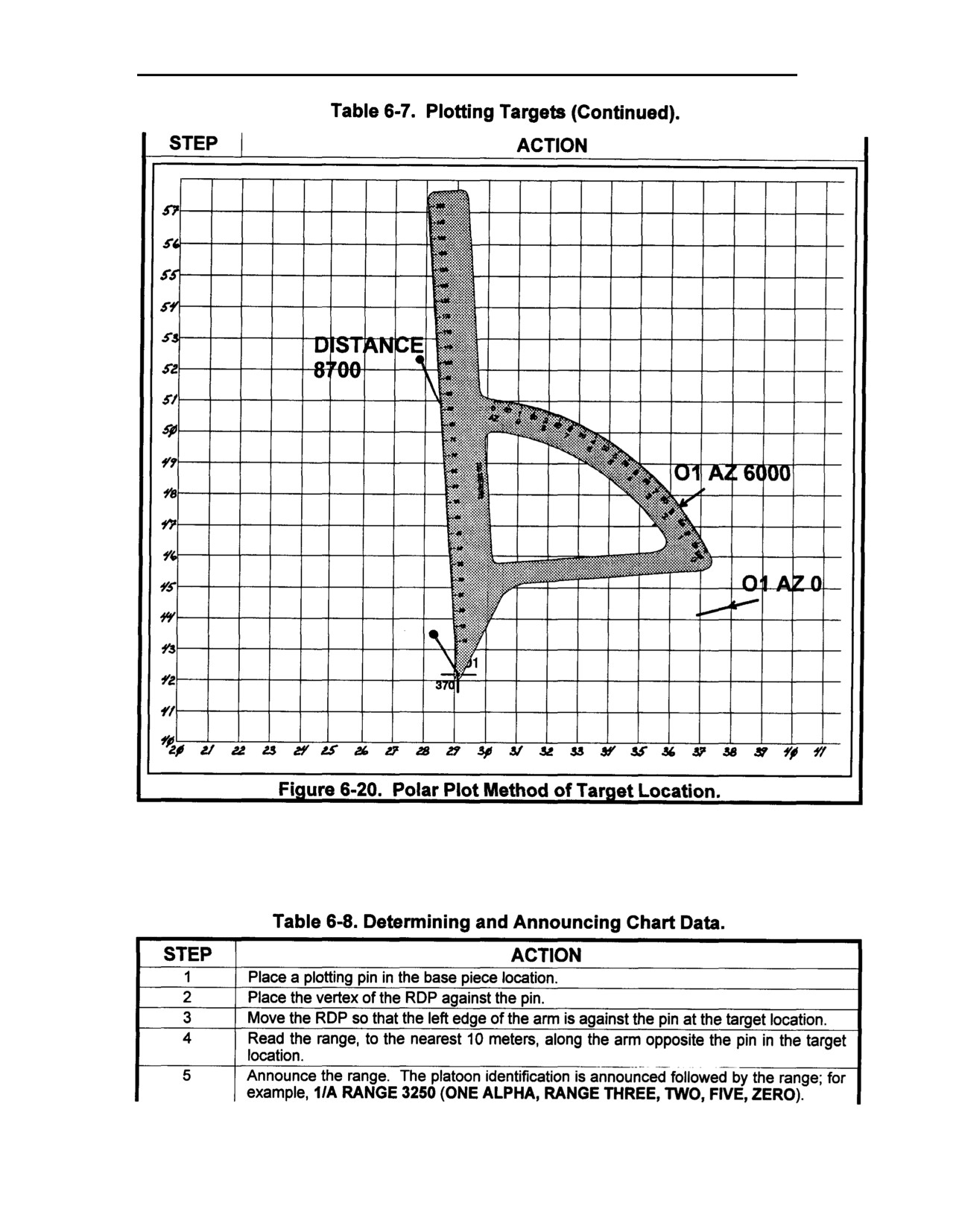
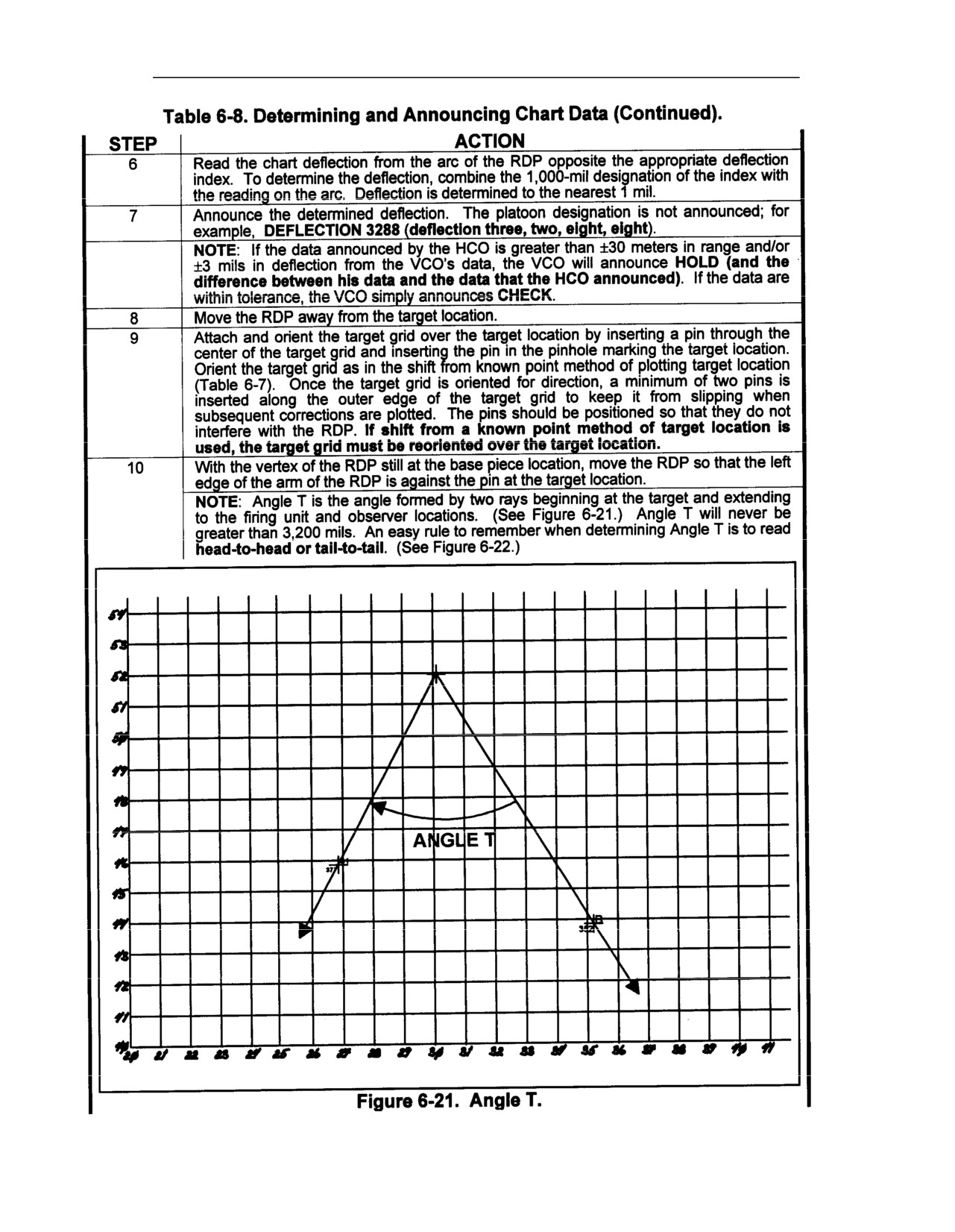
Chart data consist of chart range and chart deflection from the firing unit to the target and
angle T. In a manual FDC, two firing charts will be constructed and will be used to check each
other. Use the steps in Table 6-8 to determine chart data.
6-25
FM 6-40
6-26
FM 6-40
6-27
FM 6-40
6-16. Chart-to-Chart Checks
a. One chart may differ slightly from another because of small differences in construction
caused by human limitations in reading the graphical equipment. Because of these differences, the
following tolerances between charts are permissible:
Range and/or distance ±30 meters.
Azimuth and/or deflection ±3 mils.
Angle T ±30 mils.
b. All firing unit locations must be checked for accuracy. For checking the accuracy of two
or more charts, plot the same grid intersection on all charts. Determine range and deflection to that
grid intersection. If all ranges agree within ±30 meters in range and ±3 mils in deflection, the charts are
accurate for that firing unit location. If not, all charts must be checked for errors.
c. To ensure accuracy, enough points in the zone of operation of a firing unit should be
checked. For example, an error in plotting the unit location on one chart could compensate for an
error in constructing the deflection index on the other chart. Checking at least two points will reveal
the error. This should be done as a matter of unit SOP.
Section IV
Observed Firing Charts
When survey control and maps are not available, delivery of indirect fires is
possible by using observed firing charts. An observed firing (OF) chart is a firing
chart on which all units and targets are plotted relative to each other from data
determined by firing a registration. Observed firing charts are an expedient method
that should only be use under emergency conditions and every attempt should be
made to construct a surveyed firing chart as soon as possible. Since all locations are
based upon firing data, observed firing charts contain errors because of nonstandard
conditions.
6-28
FM 6-40
6-17. Overview
a. All observed firing charts are based on a registration. Once a registration is complete, the
unit location is polar plotted from the point of registration (normally assumed to be a grid intersection)
by using the direction that is based on the back azimuth to the point and a range corresponding to the
adjusted elevation, or more preferably, a range corresponding to the adjusted time.
b. Because maps and survey are not available, altitudes cannot be accurately
determined. When vertical interval and site are assumed to be zero, a false range is introduced
into the polar plot range. This inaccuracy can be reduced by trying to determine site. Site may
be determined by estimating vertical interval or by conducting an XO’s high burst.
c. The general procedures for constructing an OF chart are listed below:
(1) Mark the center of sector for observers.
(2) The observer selects a point in the center of the sector of fire that can be
identified on the ground.
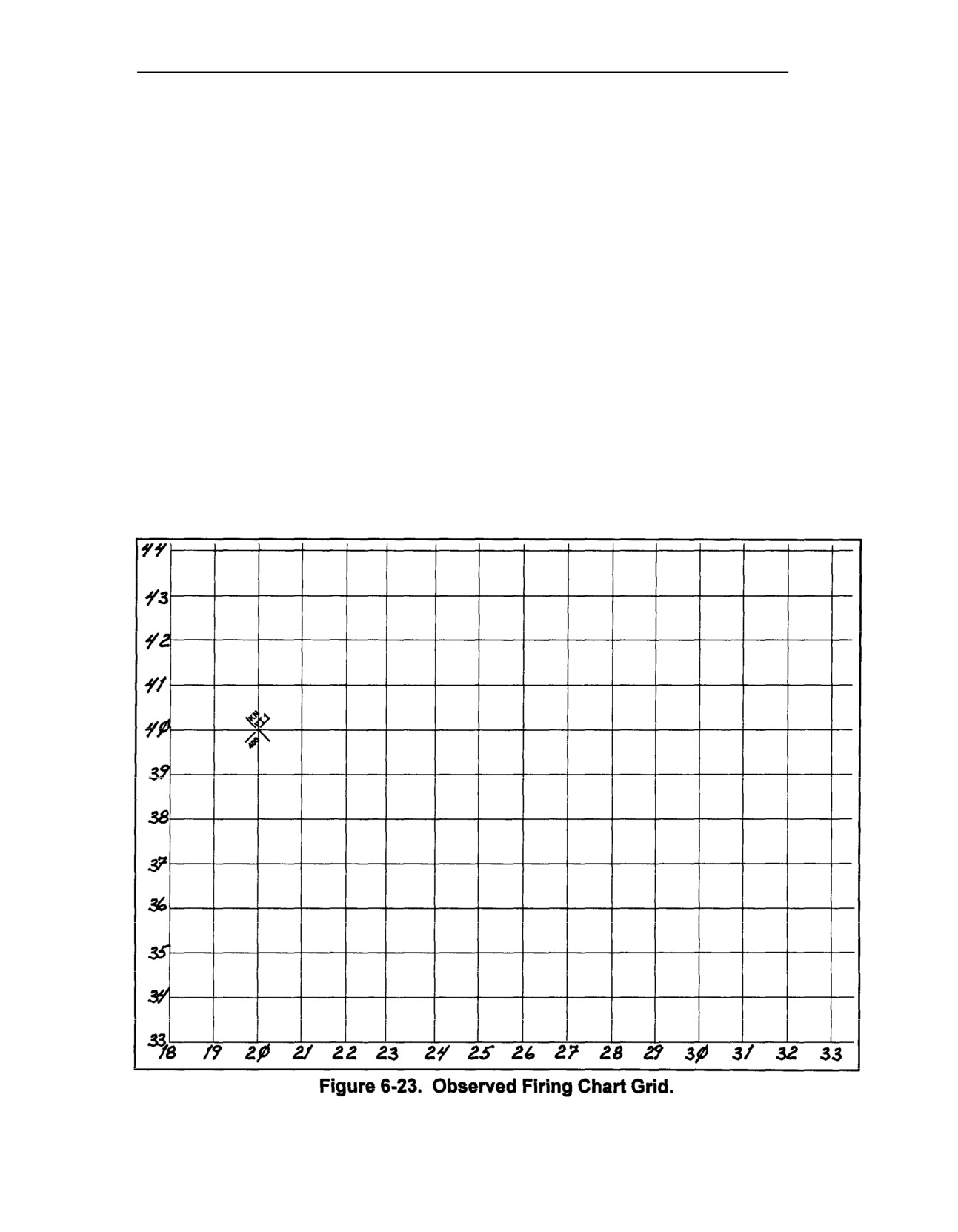
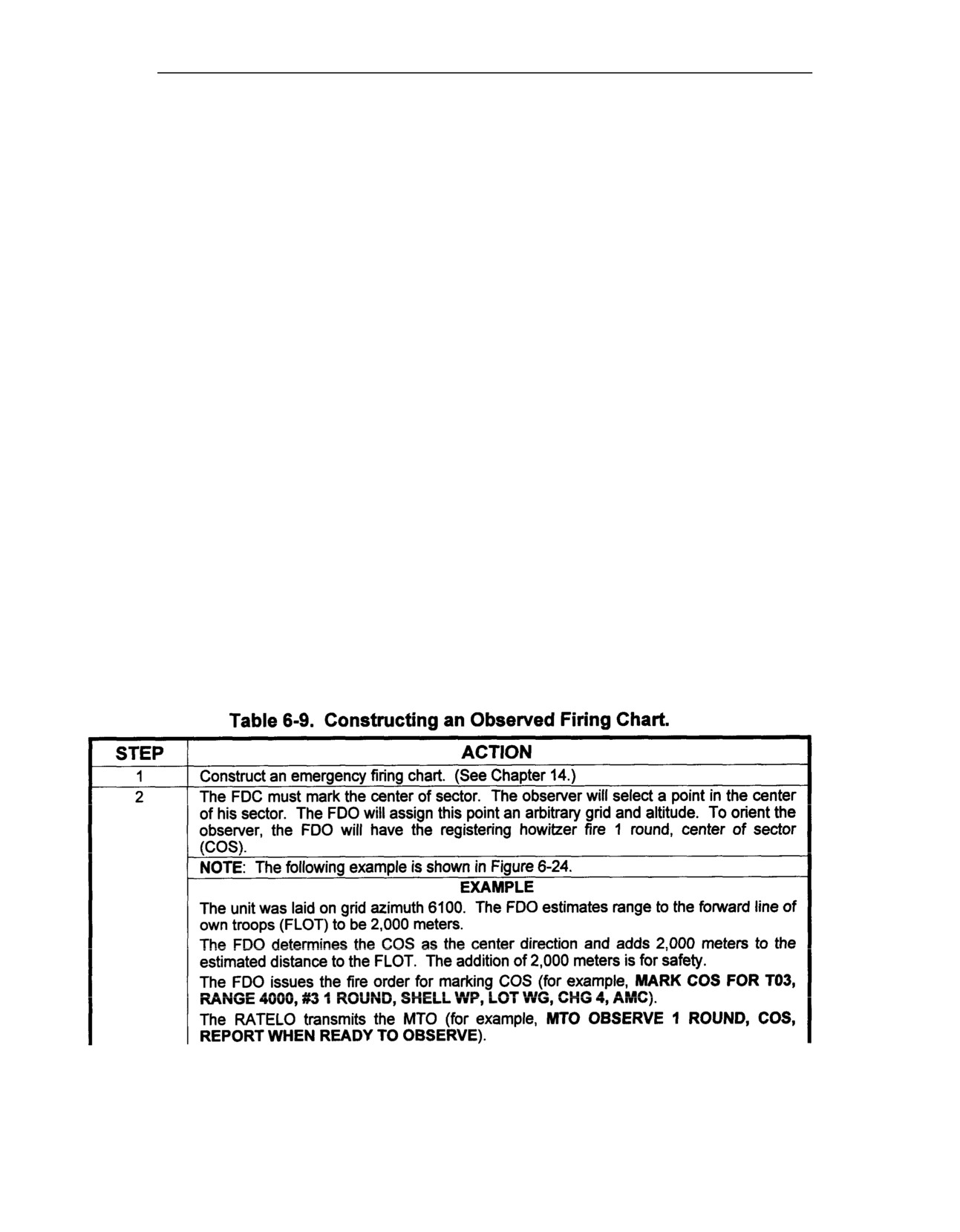
(3) Assign the point an arbitrary grid coordinate and altitude. Plot this location on
the firing chart. The grid coordinates assigned to the point are completely arbitrary. A grid
intersection is preferred for simplicity. The grid coordinates of the known point will serve as the
basis for establishing a common grid system. For example, the point could be assigned the grid
coordinates of easting (E):20000 northing (N):40000, altitude 400 meters. (See Figure 6-23.)
6-29
FM 6-40
(4) Conduct a precision registration (fuze time, if possible) on the point by using
emergency firing chart procedures. (See Chapter 14.)
(5) Determine the adjusted data (to include orienting angle, if possible).
(6) From the adjusted data, determine direction (azimuth) and distance (range) from
the point to the unit.
(7) Polar plot the base piece from the point.
6-18. Methods of Determining Polar Plot Data
a. All observed firing charts are constructed by using polar plot data. The method for
obtaining these data depends on the type of registration conducted and whether site can be
estimated or whether it is unknown.
b. Percussion plot is used when an impact registration has been conducted.
(1) When VI is not known and cannot be estimated, the method is known as
percussion plot, VI unknown.
(2) When vertical interval can be estimated, a site can be determined and
inaccuracies reduced. This method is known as percussion plot, VI estimated.
c. Time plot is used when a time registration has been conducted.
(1) When VI is not known, the method is known as time plot, VI unknown.
(2) When VI can be determined by using an XO’s high-burst registration, the
method is known as time plot, VI known.
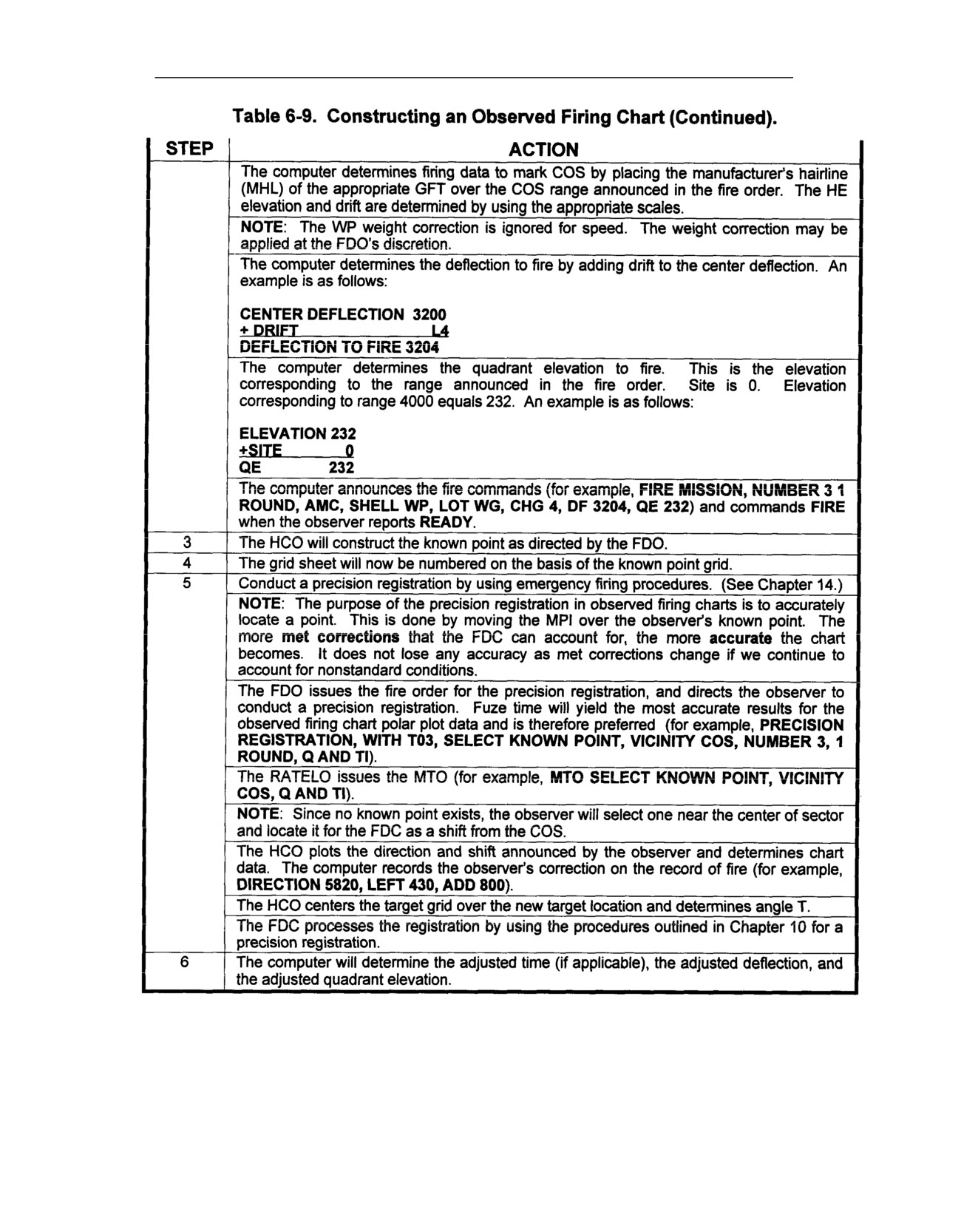
6-19. Constructing Observed Firing Charts
The step-by-step procedures for construction of an observed firing chart are listed in
Table 6-9.
6-30
FM 6-40
6-31
FM 6-40
6-20. Determination of Direction for Polar Plotting
a. Once the registration has been completed, the azimuth of the line of fire must be
determined. No matter what technique (percussion or time plot) is used, the direction (azimuth)
of the firing unit from the known point is computed in the same manner.
b. There are two methods to determine the azimuth of the line of fire. They are as
follows:
(1) The XO or platoon leader will determine the azimuth of the line of fire in
accordance with FM 6-50 and report it to the FDC.
(2) The drift corresponding to the adjusted elevation is stripped out of the adjusted
deflection; the result is the chart deflection. The chart deflection is then converted to an azimuth.
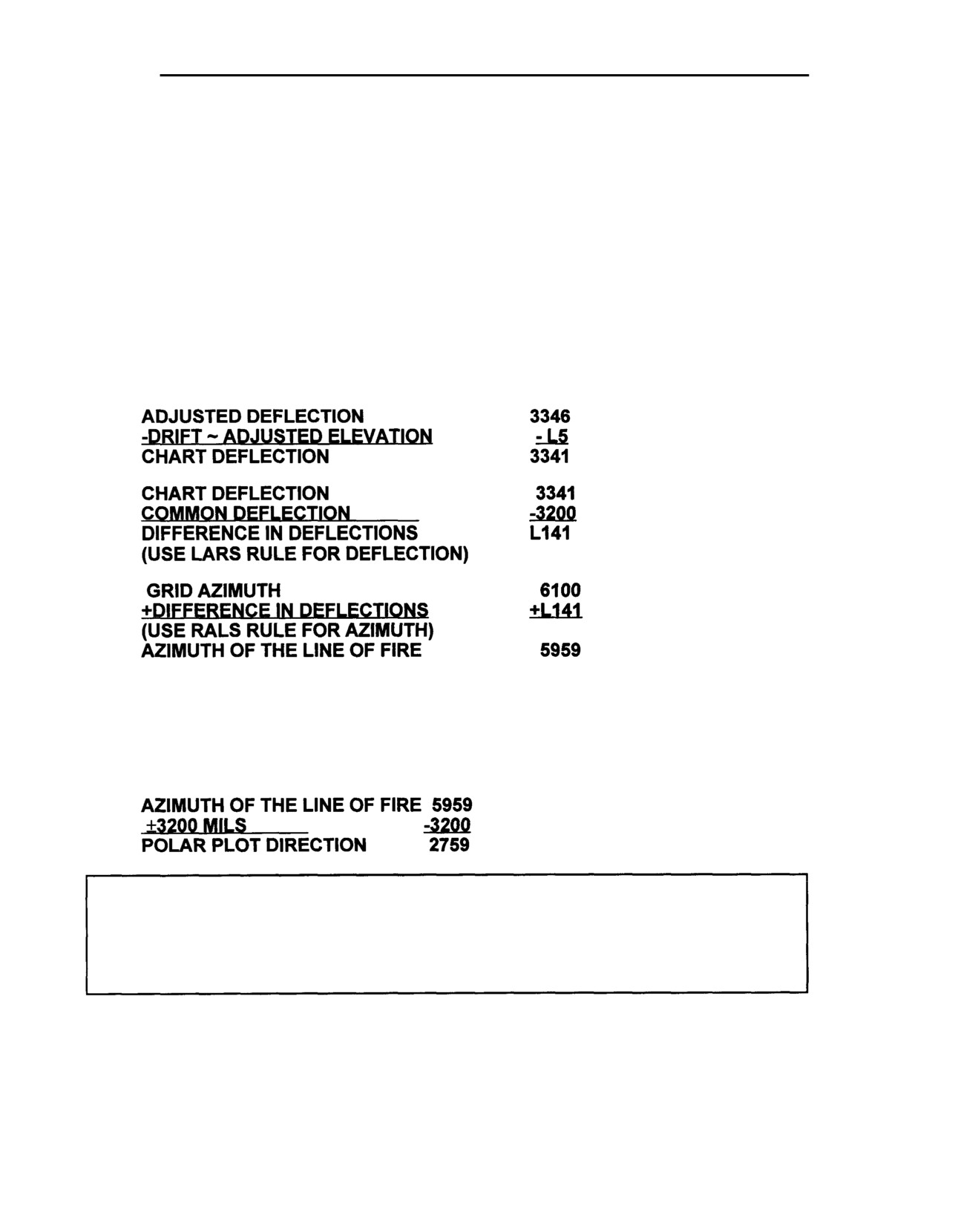
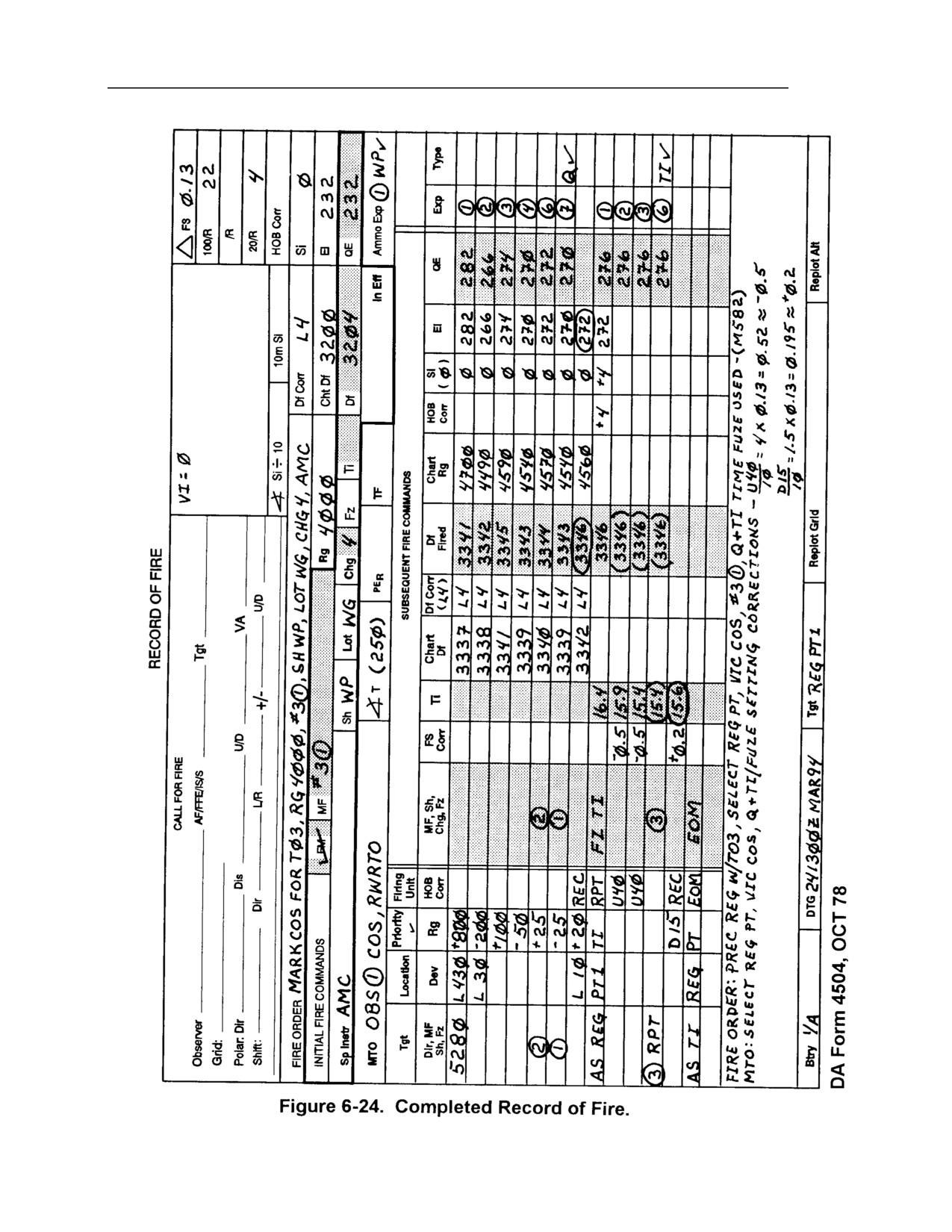
For example in Figure 6-24, the firing unit was laid on grid azimuth 6100; common deflection
3200. The adjusted deflection was 3346, and the adjusted elevation was 272.
c. Because the firing unit will be polar plotted from the known point, the FDC must
convert the azimuth of the line fire to a back azimuth. The polar plot direction is simply the back
azimuth of fire to the known point. The polar plot direction equals the azimuth of the line of fire
±3,200 mils. If the adjusted (adj) azimuth of fire is less than 3,200 mils, add 3,200 mils to it. If
the adjusted azimuth of fire is greater than 3,200 mils, subtract 3,200 mils from it.
NOTE: When the azimuth of the line of fire is measured, the howitzer is aimed
with the adjusted deflection. This will result in a polar plot azimuth that
compensates for drift. If the drift corresponding to the adjusted elevation is
removed and a chart deflection is determined, all nonstandard conditions (other
than drift) affecting the deflection are accounted for in the plot of the known point.
d. Once the polar plot direction has been computed, the remaining polar plot data must
be computed by using one of the methods listed below.
(1) If the impact registration was conducted and VI is not known and cannot be
estimated, use the percussion plot, VI unknown method, as shown in paragraph 6-21.
6-32
FM 6-40
6-33
FM 6-40
(2) If the impact registration was conducted and VI can be estimated, use the
percussion plot, VI estimated method, as shown in paragraph 6-22.
(3) If time registration was conducted and VI is unknown, use the time plot, VI
unknown method, as shown in paragraph 6-23.
(4) If time registration was conducted and VI is to be determined by using the XO’s
high burst, use the time plot, VI known method, as shown in paragraph 6-24.
6-21. Percussion Plot, VI Unknown
Percussion plot is used when an impact registration has been conducted. When VI is not
known and cannot be estimated, the method is known as percussion plot, VI unknown. The
percussion plot technique assumes that site is zero. The range used to polar plot is the range
corresponding to the adjusted elevation. Since site is zero, the adjusted quadrant elevation is the
same as the adjusted elevation.
UNIT ALTITUDE = KNOWN POINT ALTITUDE
POLAR PLOT RANGE = RANGE CORRESPONDING
TO ADJUSTED ELEVATION
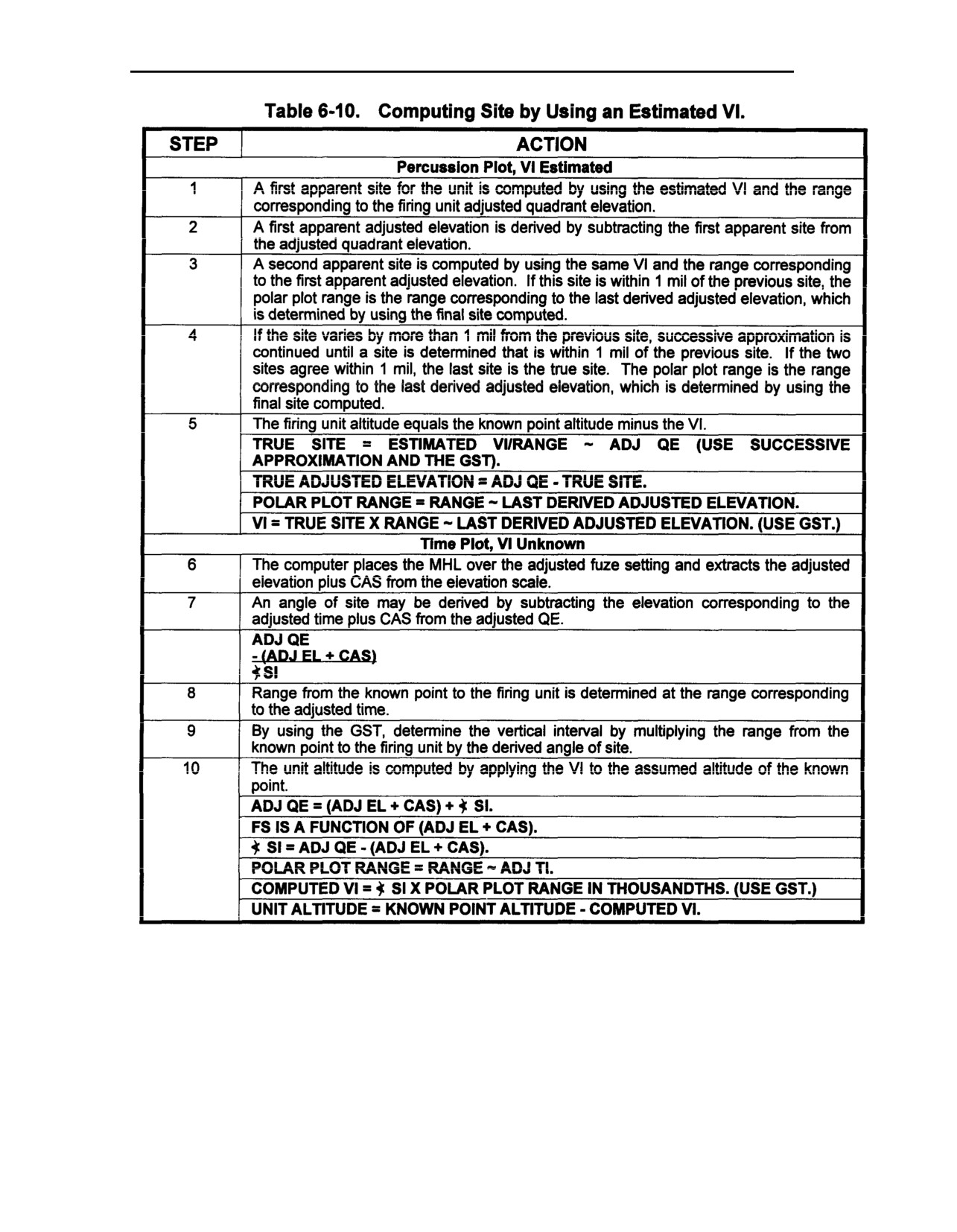
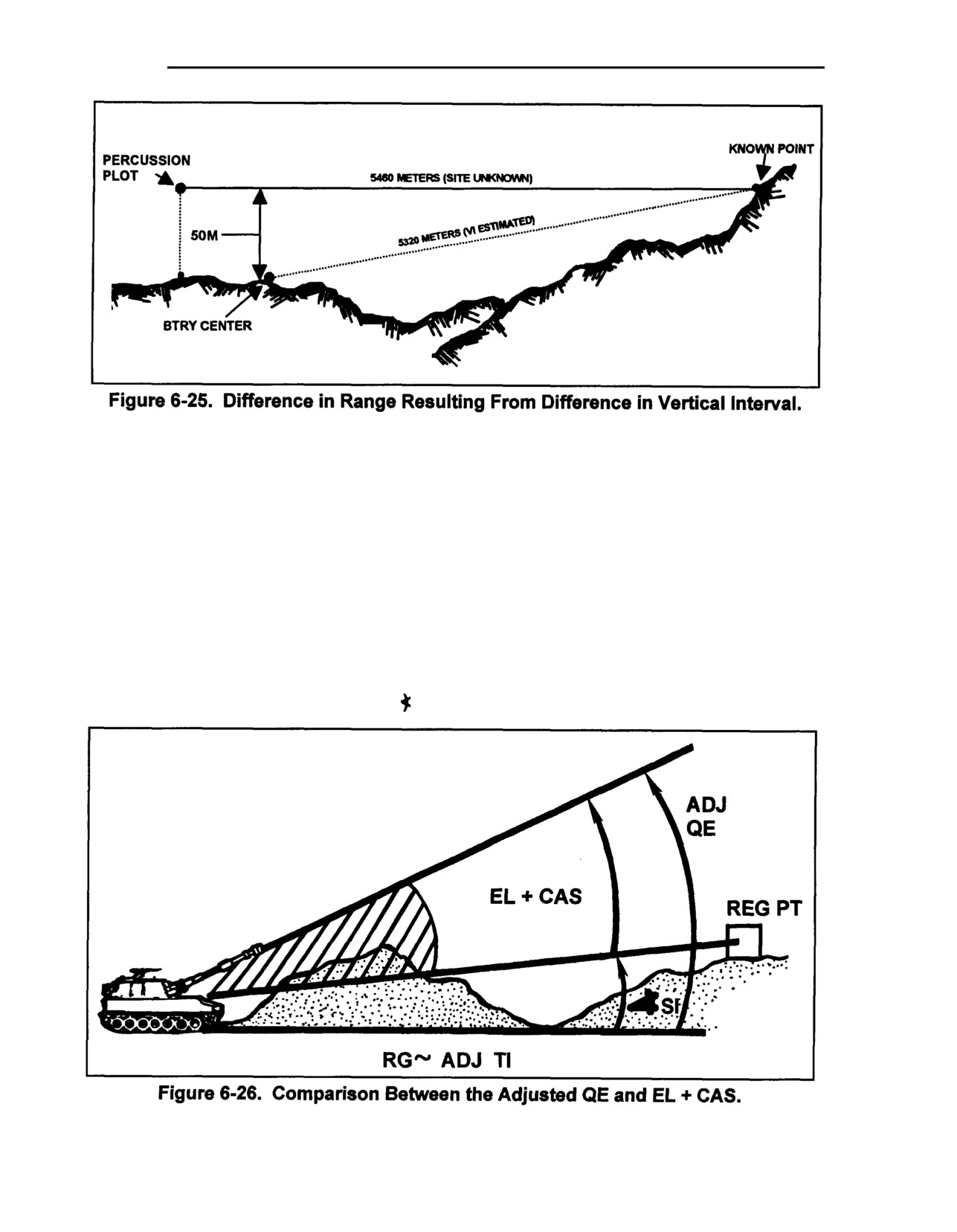
6-22. Percussion Plot, VI Estimated
When site is assumed to be zero, a large error can be introduced into the computation of
range by using the percussion plot technique. This error can be minimized and the accuracy of
the chart improved by estimating a vertical interval between the firing unit and the known point.
The firing unit altitude is then determined by applying the estimated VI from the assumed
altitude of the known point to the firing unit altitude. (See Figure 6-25.) The estimated VI is
used to compute site as shown in Table 6-10.
6-23. Time Plot, VI Unknown
a. The lack of an accurate site and nonstandard conditions are the major sources of error
in range on an observed firing chart. If the site is unknown or incorrect, the derived adjusted
elevation is in error by the amount of error in site. Determining the polar plot range from the
false elevation produces a false range. However, the effect of site on fuze settings is usually
small. Therefore, the adjusted time can be used as a good indicator of the adjusted elevation and
the polar plot range. Because the adjusted fuze setting is a function of elevation and
complementary angle of site (CAS), the angle of site ( SI) and hence the VI may be determined
after the firing of fuze time.
b. To derive angle of site, subtract the elevation corresponding to the adjusted time plus
the CAS from the adjusted quadrant elevation. Using the GST, determine the VI by multiplying
the polar plot range by the derived angle of site. To determine range, place the MHL of the GFT
over the adjusted time and read range under the MHL from the range scale. Determine altitude of
the firing unit by applying the VI to the assumed altitude of the known point.
ADJ QE = (ADJUSTED ELEVATION + CAS) + SI.
6-34
FM 6-40
6-35
FM 6-40
6-24. Time Plot, VI Known (Preferred Technique)
a. When site can be determined by using an XO’s high-burst (HB) registration, the
method is known as time plot, VI known. This provides an even more accurate relative location.
(1) This technique is based on a rough approximation of site. This approximation
can be refined to an accuracy approaching survey accuracy by the firing of a modified HB
registration after the completion of a precision registration with fuze time.
(2) The objective of an XO’s HB registration is to determine precisely what portion
of the adjusted QE is angle of site and what portion is elevation plus CAS. (See Figure 6-26.)
The vertical interval and site to the known point can be computed by using the angle of site and
range corresponding to the adjusted time.
ADJ QE = (ADJ EL + CAS) + SI
6-36
FM 6-40
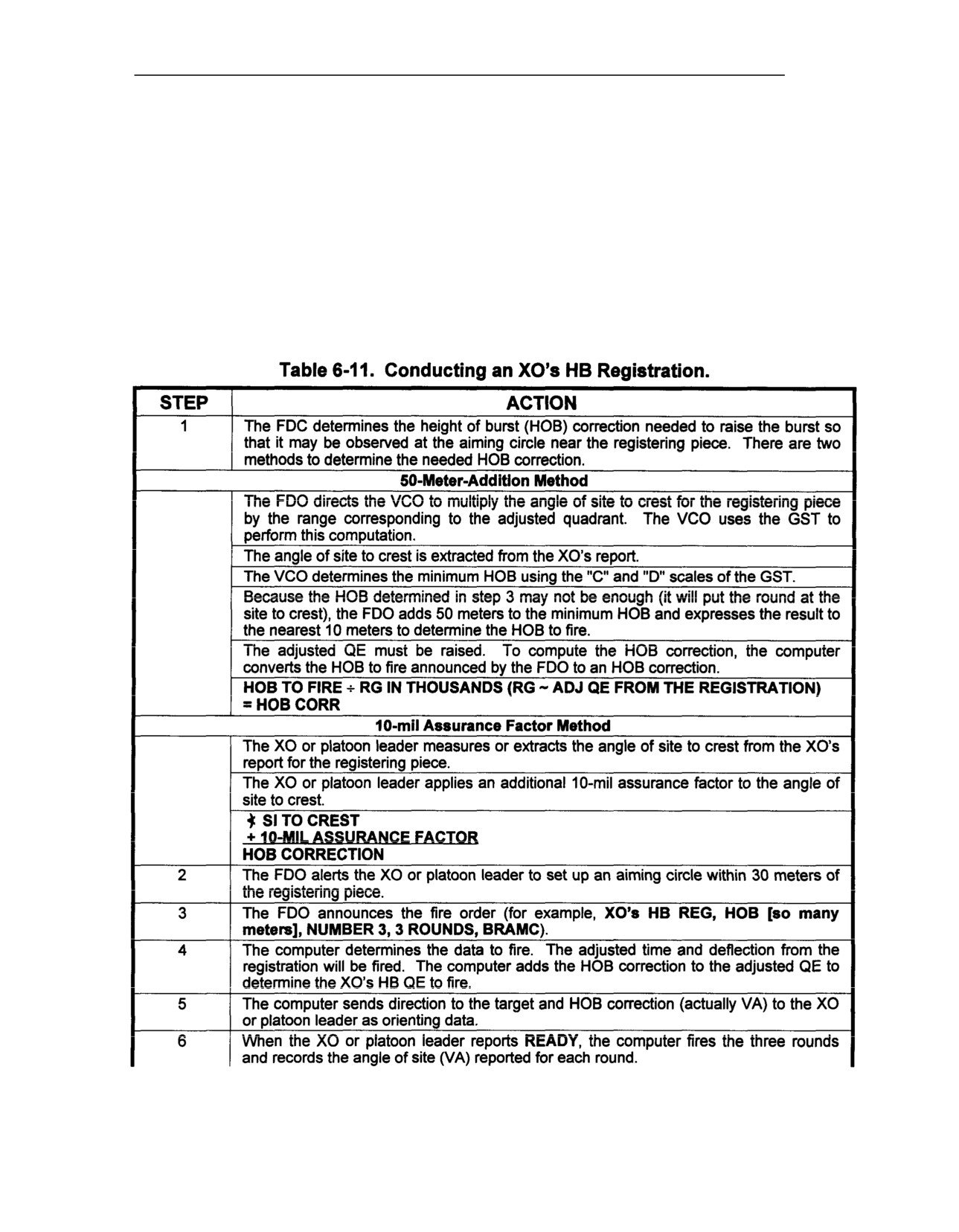
(3) This XO’s HB registration is based on the principle that fuze setting is a
fiction of elevation plus CAS. The XO’s HB registration is fired immediately after the time
portion of the registration is completed. The firing of three such high airbursts is specifically
what is called XO’s HB registration. The height of burst is raised vertically by an amount
sufficient to enable the burst to be seen by an aiming circle located within 30 meters of the
registering piece. The burst is raised by increasing quadrant. Three rounds are fired with the
adjusted time. The XO measures the angle of site to each burst and determines the average angle
of site. Because the fuze setting was not changed (the adjusted time was freed), the elevation plus
CAS determined is the true elevation plus CAS. This value is then subtracted from the adjusted
QE, yielding a true angle of site. Site is then computed.
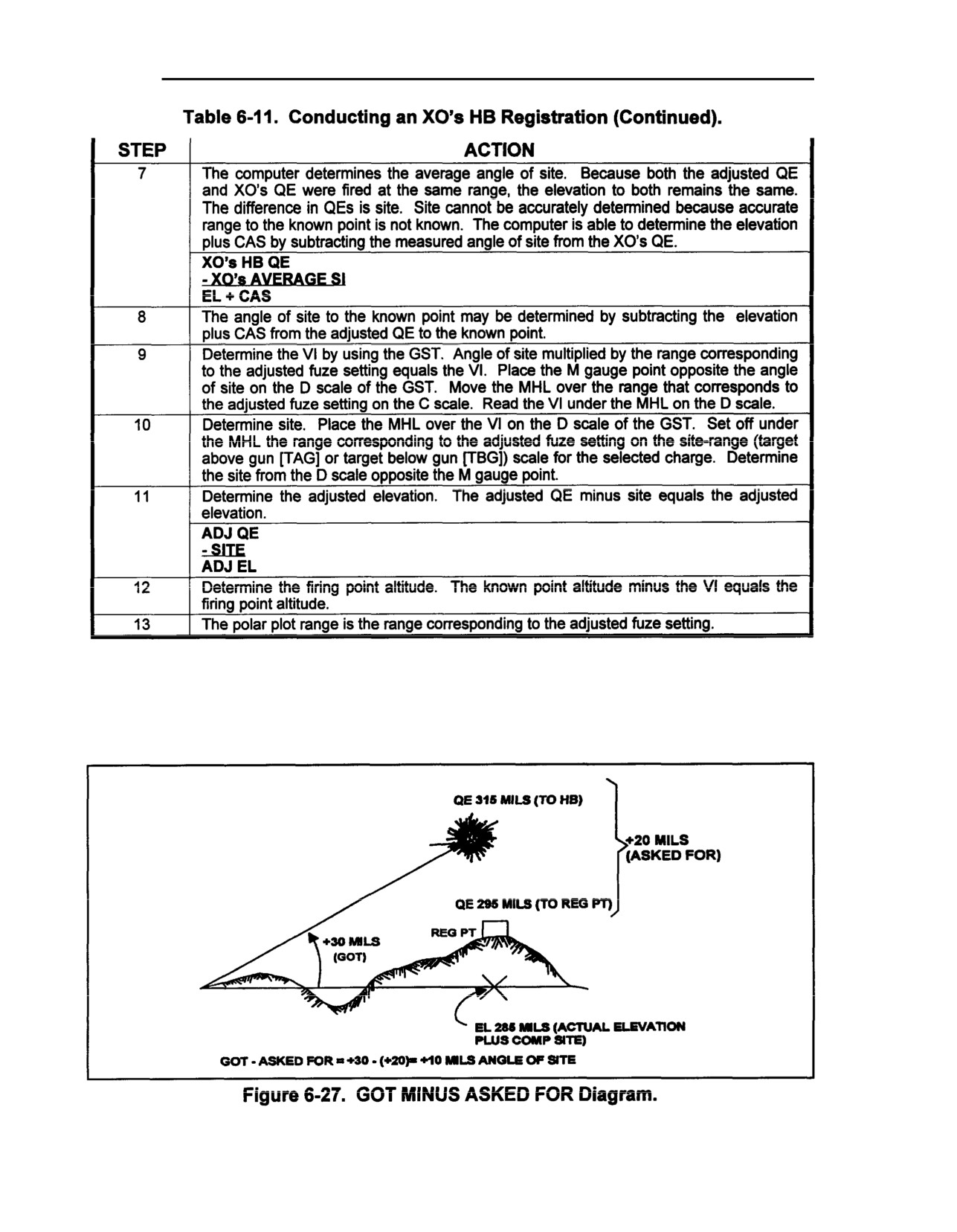
b. The procedures for conducting an XO’s HB registration are outlined in Table 6-11.
6-37
FM 6-40
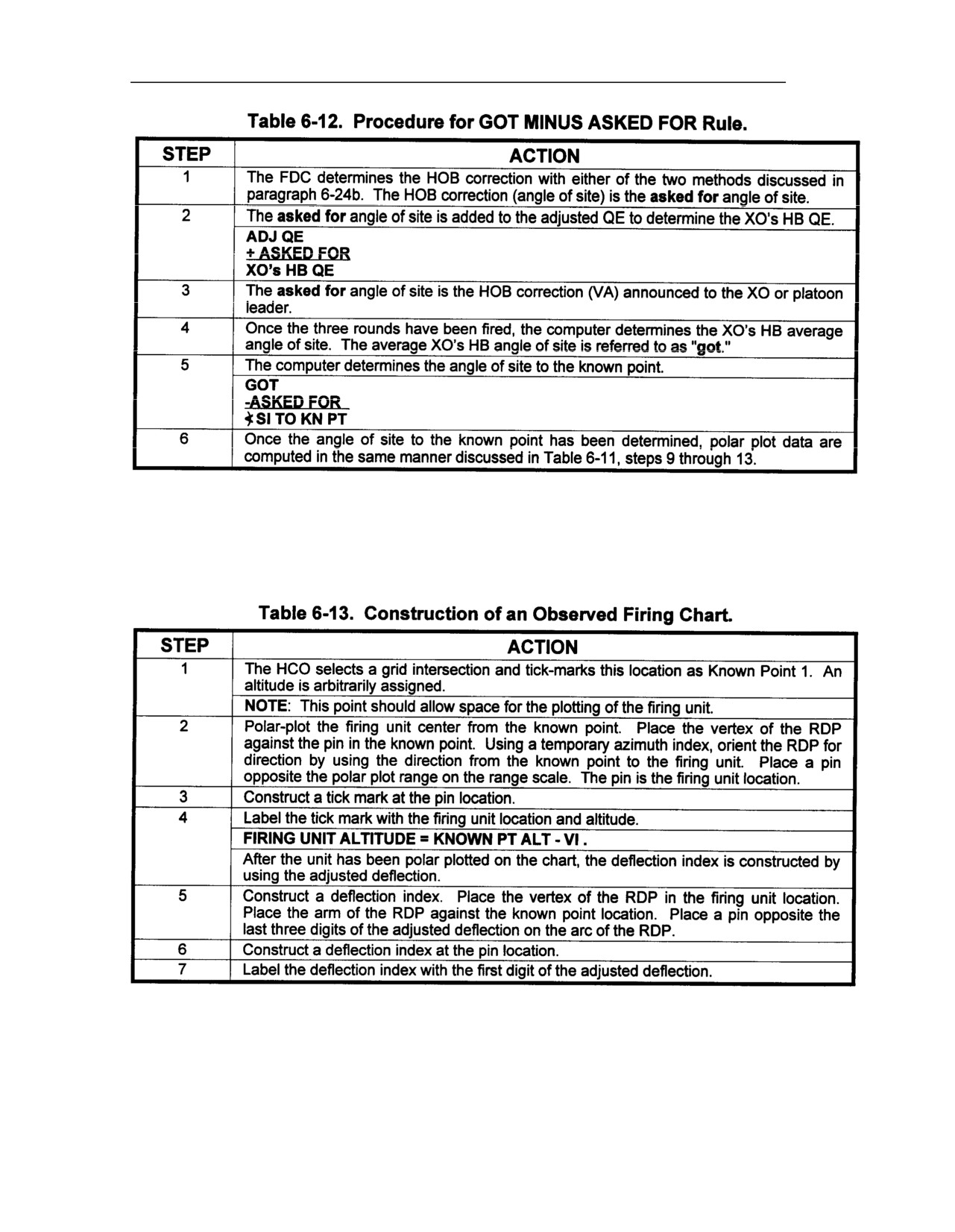
c. After understanding the theory on which the determination of site by firing is based, it
may be easier to use the GOT MINUS ASKED FOR rule to determine the angle of site. As
shown in Figure 6-27, the angle of site to the known point equals got minus(-) asked for. The
procedures for the GOT MINUS ASKED FOR rule are in Table 6-12.
6-38
FM 6-40
6-25. Setting Up the Observed Firing Chart
At the completion of any of the four techniques demonstrated, the HCO will construct an
observed firing chart by using the steps in Table 6-13.
6-39
FM 6-40
6-26. Example of Percussion Plot, VI Unknown.
A registration was conducted with shell HE, charge 4GB. The site and firing unit altitude
are unknown.
a. The following data are known:
Adjusted quadrant elevation:
272
Azimuth of the line of fire
reported by the XO or
platoon leader:
5959
Adjusted deflection:
3346
Assumed altitude of the
known point:
400
b. Determine the direction, altitude, and range from the known point to the firing unit.
(1) Determine the polar plot direction. The azimuth of the line of fire ±3200 equals
polar plot direction.
5959-3200 = 2759 (BACK AZ OF FIRE)
(2) Determine the firing unit altitude. The firing unit altitude equals the known
point altitude.
FIRING UNIT ALTITUDE = 400 METERS
(3) Determine the polar plot range. The polar plot range equals the range that
corresponds to the adjusted QE.
POLAR PLOT RG = 4560 TO ADJ QE (272)
6-27. Example of Percussion Plot, VI Estimated
The observer passes the firing unit position on his way to his location and estimates the
VI to be +60 meters. Use the known data from paragraph 6-26.
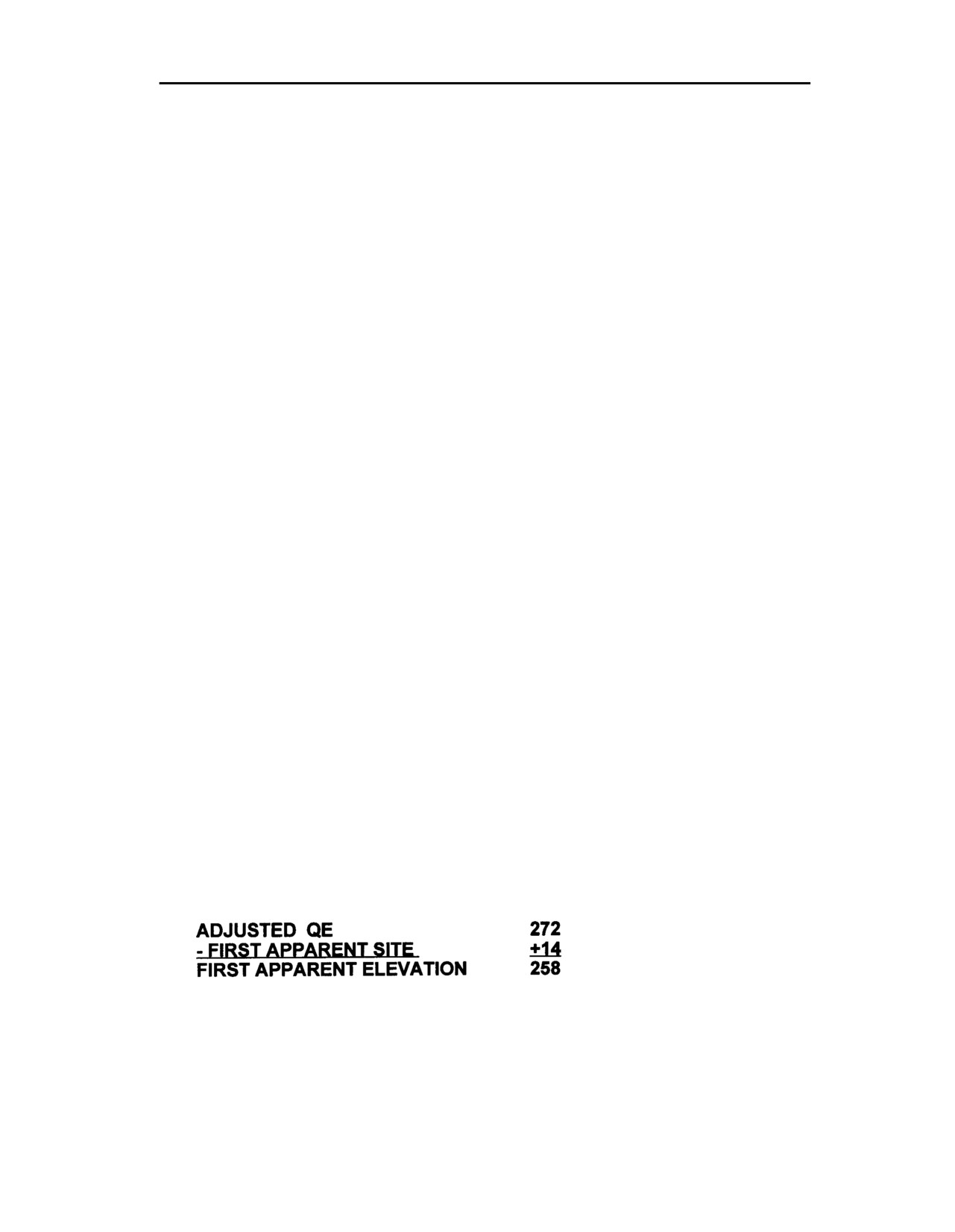
a. Determine the first apparent site. RG ~ ADJ QE = 4560 METERS. Using the GST,
set +60 underneath the MHL on the D scale. Move the site-range scale for charge 4GB TAG until
range 4560 is underneath the MHL. Read site underneath the M gauge point on the D scale.
FIRST APPARENT SITE = +14 MILS
b. Determine the first apparent elevation.
RG ~ FIRST APPARENT EL = 4,370 METERS
6-40
FM 6-40
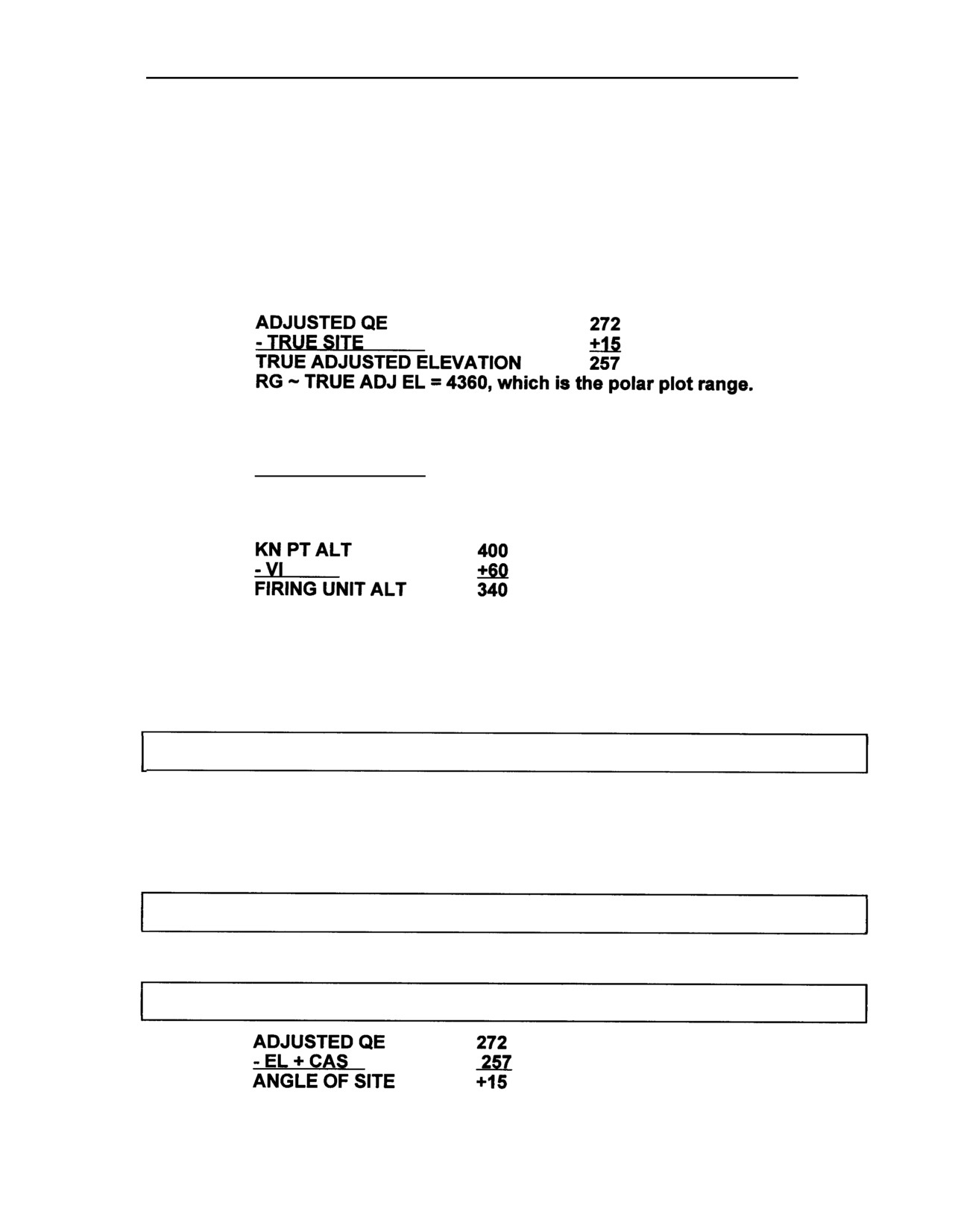
c. Determine the second apparent site. RG ~ FIRST APPARENT EL = 4,370
METERS. Using the GST, set +60 underneath the MHL on the D scale. Move the site-range
scale for charge 4GB TAG until range 4370 is underneath the MHL. Read site underneath the M
gauge point on the D scale.
SECOND APPARENT SITE = +15
Because the first and second apparent sites are within 1 mil, the last site determined, +15 mils, is
the true site.
d. Determine the true adjusted elevation.
e. Using the GST, determine the VI.
POLAR PLOT RANGE 4360
x TRUE SITE
+15
VI
+60
f. Determine the firing unit altitude.
The introduction of an estimated VI of +60 meters changes the polar plot range from the firing
unit to the known point by 200 meters (4560 to 4360). The polar plot direction is determined as
shown in paragraph 6-20.
6-28. Example of Time Plot, VI Unknown
NOTE: Use the known data from paragraph 6-26.
a. At the completion of the registration, the adjusted data areas follows:
Adjusted time (M582):
15.6
Adjusted deflection:
3346
Adjusted quadrant:
272
NOTE: The adjusted data come from the example shown in Figure 6-24.
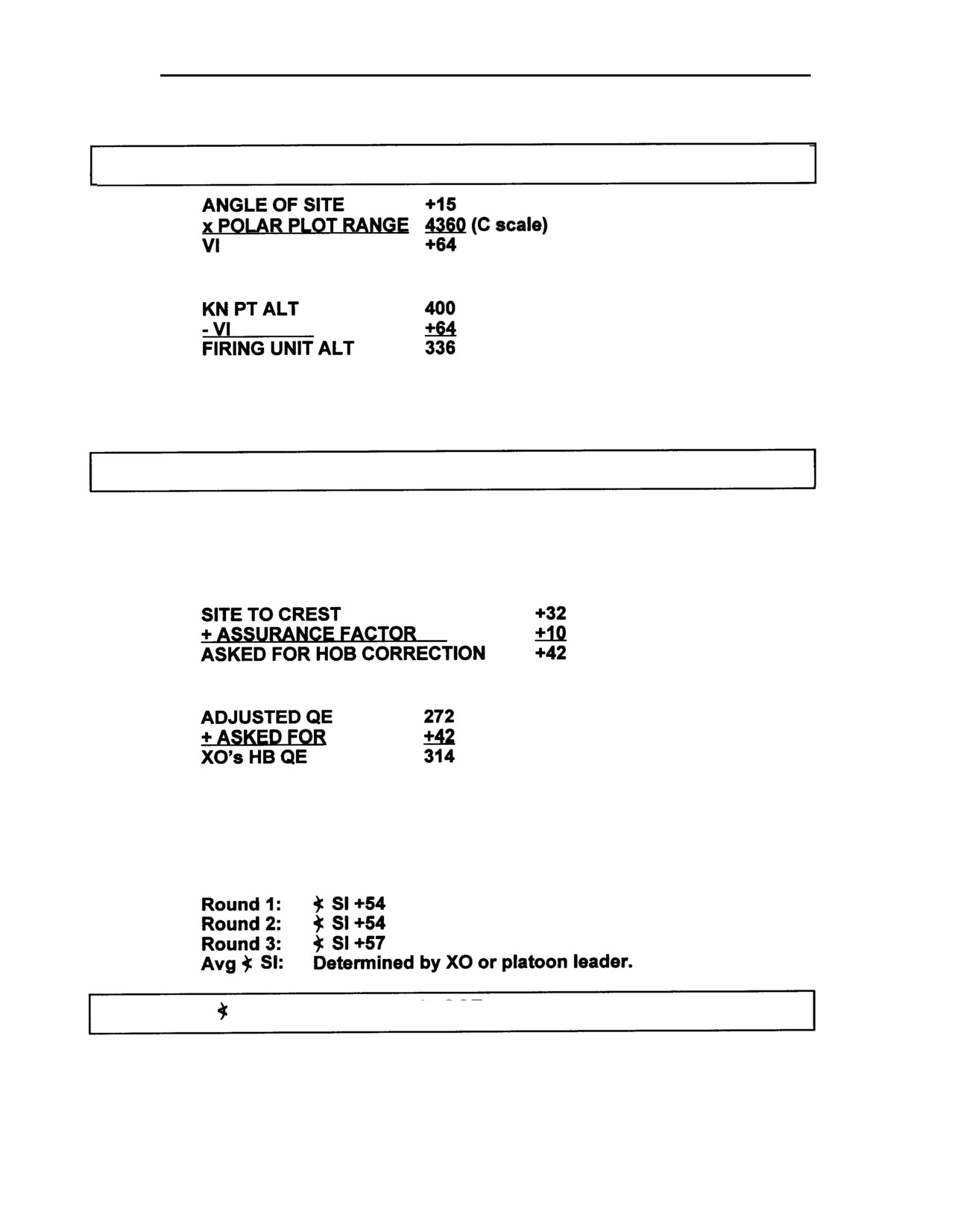
b. Determine the angle of site.
NOTE: EL+ CAS ~ TO ADJ FS = 257.
6-41
FM 6-40
c. Using the GST, determine the VI.
NOTE: RG ~ ADJ FS = 4360, which is the polar plot range.
d. Determine the firing unit altitude.
e. Determine the polar plot direction as discussed in paragraph 6-20.
6-29. Example of Time Plot, VI Known, XO’s High Burst
NOTE: Use the known data from paragraph 6-26.
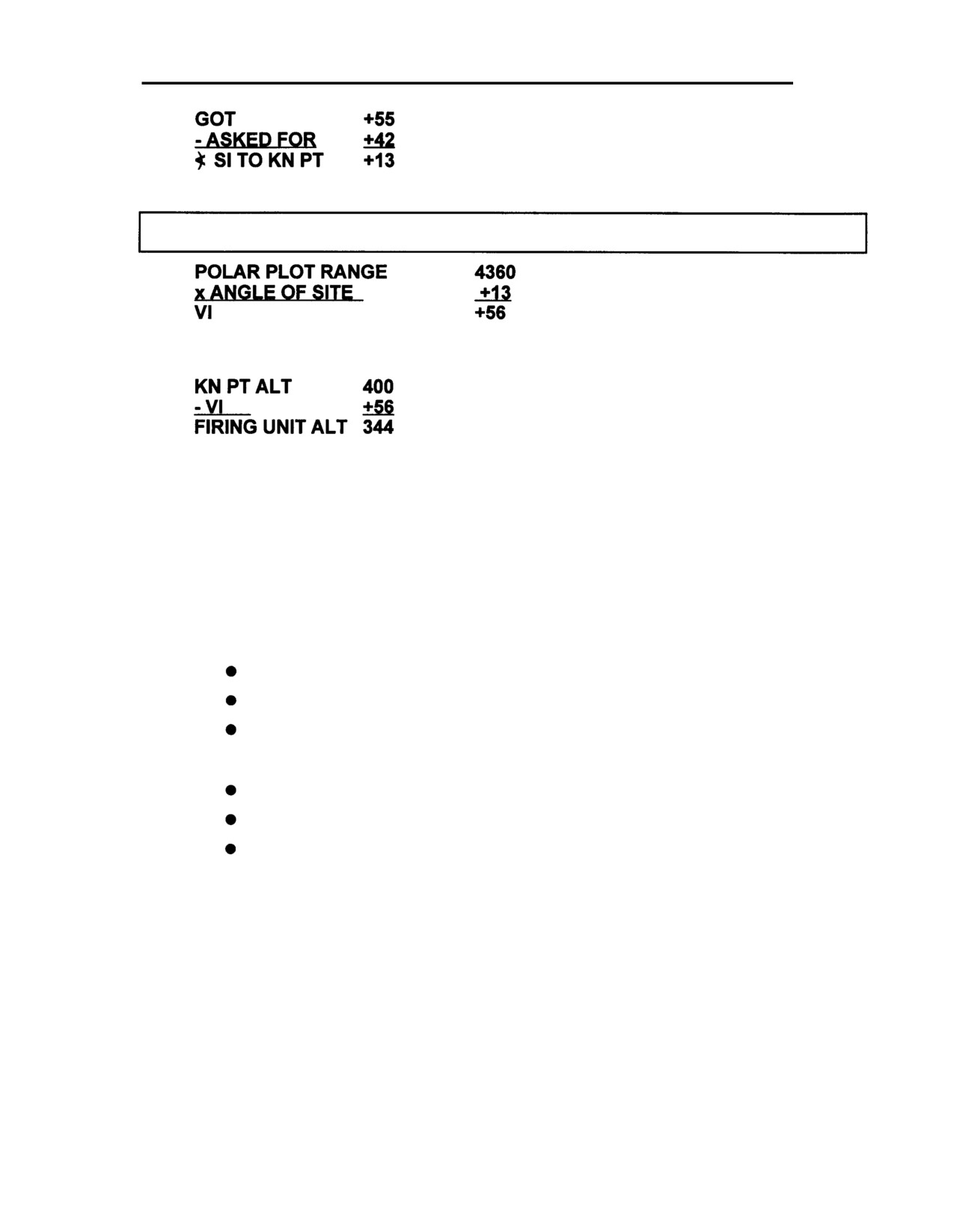
a. The site to crest from the XO’s report is +32 mils for the registering piece. This
example will demonstrate how to determine the HOB correction by using the 10-mil assurance
factor.
b. Determine the asked for HOB correction.
c. Determine the XO’s high-burst QE.
d. The computer announces orienting data to the XO or platoon leader.
DIRECTION 5959, VERTICAL ANGLE +42.
e. Three rounds are fired, and the following angles of site are reported by the XO or
platoon leader.
NOTE: AVG SI = +55, which equals GOT.
f. Determine the angle of site to the known point.
6-42
FM 6-40
g. Using the GST, determine the VI.
NOTE: RG ~ ADJ FS = 4360, which is the polar plot range.
h. Determine the firing unit altitude.
i. Determine the polar plot direction as discussed in paragraph 6-20.
6-30. Locate an Observer
If the observer is equipped with a laser, his location maybe established by resection. The
procedures are listed below.
a. The observer lases the known point and determines a direction, distance, and a
vertical angle. These are reported to the FDC.
b. The HCO determines the observer location as follows:
Polar plots the back azimuth to the known point.
Inserts a plotting pin along the back azimuth at the announced distance.
Constructs a tick mark and labels it with the observer’s call sign.
c. Using the GST, the VCO determines the observer’s VI as follows:
Places the M gauge point opposite the VA on the D scale.
Moves the MHL over the distance on the C scale.
Reads the VI under the MHL from the D scale.
d. To determine the observer’s altitude, subtract the VI from the known point altitude.
6-31. Battalion Observed Firing Charts
a. Battalion observed firing charts are based on the concept that if any two points can be
located by reference to a third point, the two points can be located in reference to each other. All
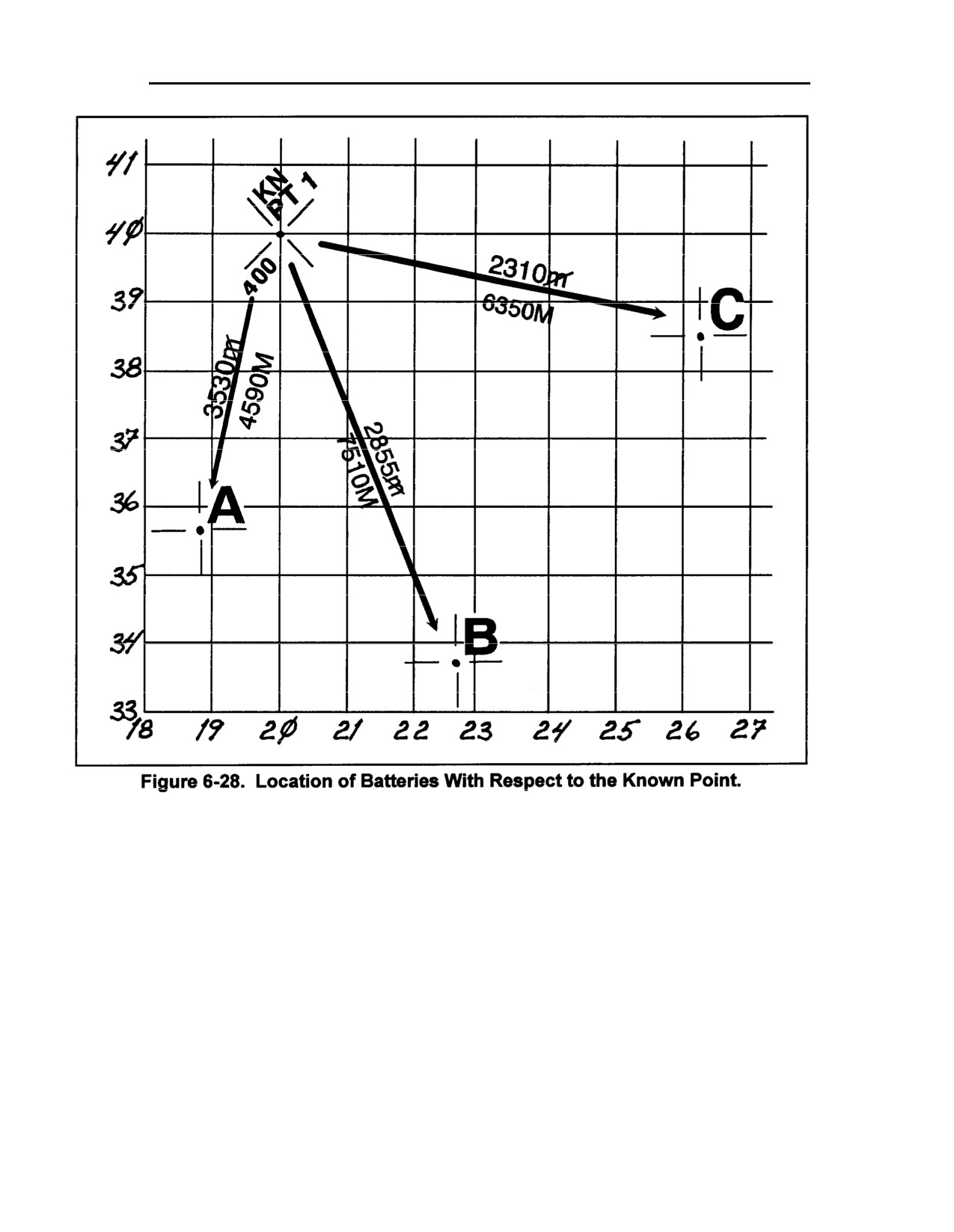
batteries register on the same known point. For example, using the techniques for battery or platoon
observed firing charts discussed in Section II of this chapter, firing units can be located in relation to
the known point. After all the firing unit locations are plotted on a single firing chart in relation to the
known point, the firing chart provides an accurate graphical representation of the location of the firing
units in relation to each other. (See Figure 6-28.) This accurate portrayal of the relationship among the
firing unit locations allows for the accurate massing of fires within the battalion on any target located
by adjustment of one of the firing units, or by a shift from a known point (known to all firing units).
6-43
FM 6-40
b. The techniques used in the construction of a battalion observed firing chart are very
similar to those used for the construction of a single firing unit observed firing chart. The
direction used for polar plotting each firing unit is determined by using the same procedures as
the battery or platoon observed firing chart.
(1) Percussion Plot, VI Unknown. Range and altitude may be determined for
each firing unit by using the procedures in paragraph 6-21. The accurate massing of fires is not
possible when this method is used.
(2) Percussion Plot, VI Estimated. Range and altitude for each firing unit maybe
determined by using the same procedures listed in Table 6-10. If the relative altitude of the firing
units can be estimated, the accuracy of the firing chart can be improved. One firing unit is
selected as a reference unit and is assigned the same altitude as the known point. The vertical
intervals of the other units are estimated and compared with the altitude of the reference firing
unit to obtain their altitudes.
6-44
FM 6-40
(3) Time Plot. Range and altitude for each firing unit may be determined by using
the same procedures listed in paragraphs 6-23 and 6-24. This provides a more accurate means of
determining relative location. One firing unit is selected as a reference unit. The vertical
intervals of the other firing units are estimated and compared with the altitude of the reference
firing unit to obtain their altitudes.
6-32. Observed Firing Chart With Incomplete Survey
a. A position area survey maybe used in conjunction with the observed firing chart until
the surveyed firing chart is available. The part of the chart established by firing must be plotted
to the same scale as the part obtained by survey.
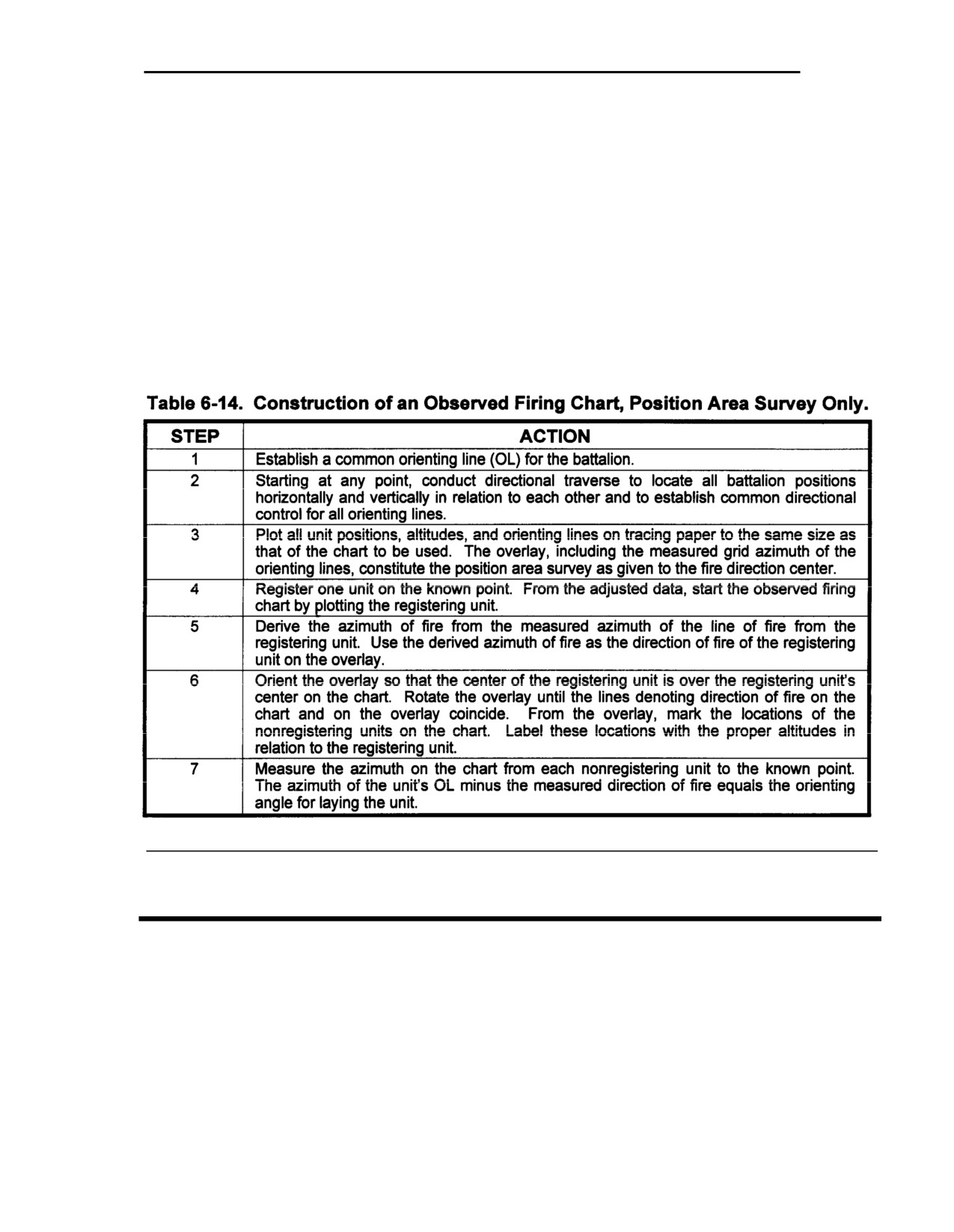
b. The procedure for constructing a battalion observed firing chart that is based on the
registration of one unit and that has position area survey is listed in Table 6-14.
Section V
Using Map Spot Data to Construct Firing Charts
The surveyed location and azimuth of lay should be established as soon as
possible. Surveyed locations can be determined by map spot survey or by normal
survey procedures. Map spot is less accurate than actual survey.If survey teams
cannot immediately provide the needed data, the firing unit conducts a map spot
survey to establish the unit center and azimuth of lay. For a map spot survey, fire
direction personnel use hasty survey methods to associate terrain features with the
locations of those features on a map and to locate the unit’s center in relation to the
terrain features.
6-45
FM 6-40
6-33. Map Spot Survey
a. Map spot survey is the application of basic map and terrain association. It should be
as accurate as possible. Three-point resection is the preferred technique for establishing the unit
center by map spot survey. The map spotted location of the unit center will include an eight-digit
grid coordinate and an altitude in meters.
b. Directional control (an orienting station and the direction to the end of the orienting
line [EOL]) also must be provided. Common directional control should be established as soon as
possible, preferably by simultaneous observation or directional traverse during daylight or by
Polaris-Kochab method at night. If none of these procedures can be done quickly, the firing unit
must be laid magnetically.
NOTE: FM 6-50 includes a detailed discussion of hasty survey techniques.
6-34. Constructing a Firing Chart From Map Spot Survey
a. To construct a firing chart based on map spot survey, the FDC must have three items
of information:
Assumed grid coordinates of the firing unit center.
Assumed altitude of the firing unit.
Assumed azimuth of lay.
b. When met + VE techniques cannot be used, the firing unit will register as the
situation permits.
c. A firing chart based on map spot survey is only as accurate as the following:
The map spotted location of the unit center and the known point.
The azimuth of lay.
The construction of the chart.
d. When a firing chart based on map spot survey is used, the orienting angle must be
recorded when the firing unit is laid. This orienting angle is used to determine the actual azimuth
of lay when directional control is provided.
e. The FDC replots all fired targets.
6-35. Transferring to a Surveyed Firing Chart
a. When the position and target area surveys are completed, the FDC is provided the
following information:
Firing unit center grid coordinates and altitude to the nearest 0.1 meter and
azimuth to the EOL to the nearest 0.1 mil.
Known point coordinates and altitude to the nearest 0.1 meter.
b. The surveyed firing chart is constructed to show the accurate locations of the firing
unit center, the known point, and the actual azimuth of lay.
6-46
FM 6-40
c. The firing unit was initially laid, and the orienting angle was recorded. When the
surveyed azimuth to the EOL is determined, the actual azimuth of lay is computed by using the
following formula:
SURVEYED AZ TO EOL - ORIENTING ANGLE = AZ OF THE LINE OF FIRE.
d. The initial (map spot) azimuth of lay may be inaccurate. The actual azimuth of the
line of fire may differ from the surveyed azimuth of lay. When survey data are provided, the
FDC must--
Construct a surveyed firing chart.
Compute GFT settings.
6-47
FM 6-40
Chapter 7
Firing Tables
This chapter implements a portion of QSTAG 224.
Field artillery firing data are determined by use of various firing tables and equipment. These
tables contain the fire control information (FCI) under standard conditions and data correcting for
nonstanadard conditions. These tables and equipment include the tabular firing tables, graphical firing
tables, and graphical site tables. The tabular firing tables are the basic source of firing data. They
present fire control information in a tabular format. The data listed are based on standard conditions.
The GFTs and GSTs are graphical representations of the tabular firing tables.
Section I
Tabular Firing Tables
This section implements STANAGs 4119 and 4425 and QSTAG 220.
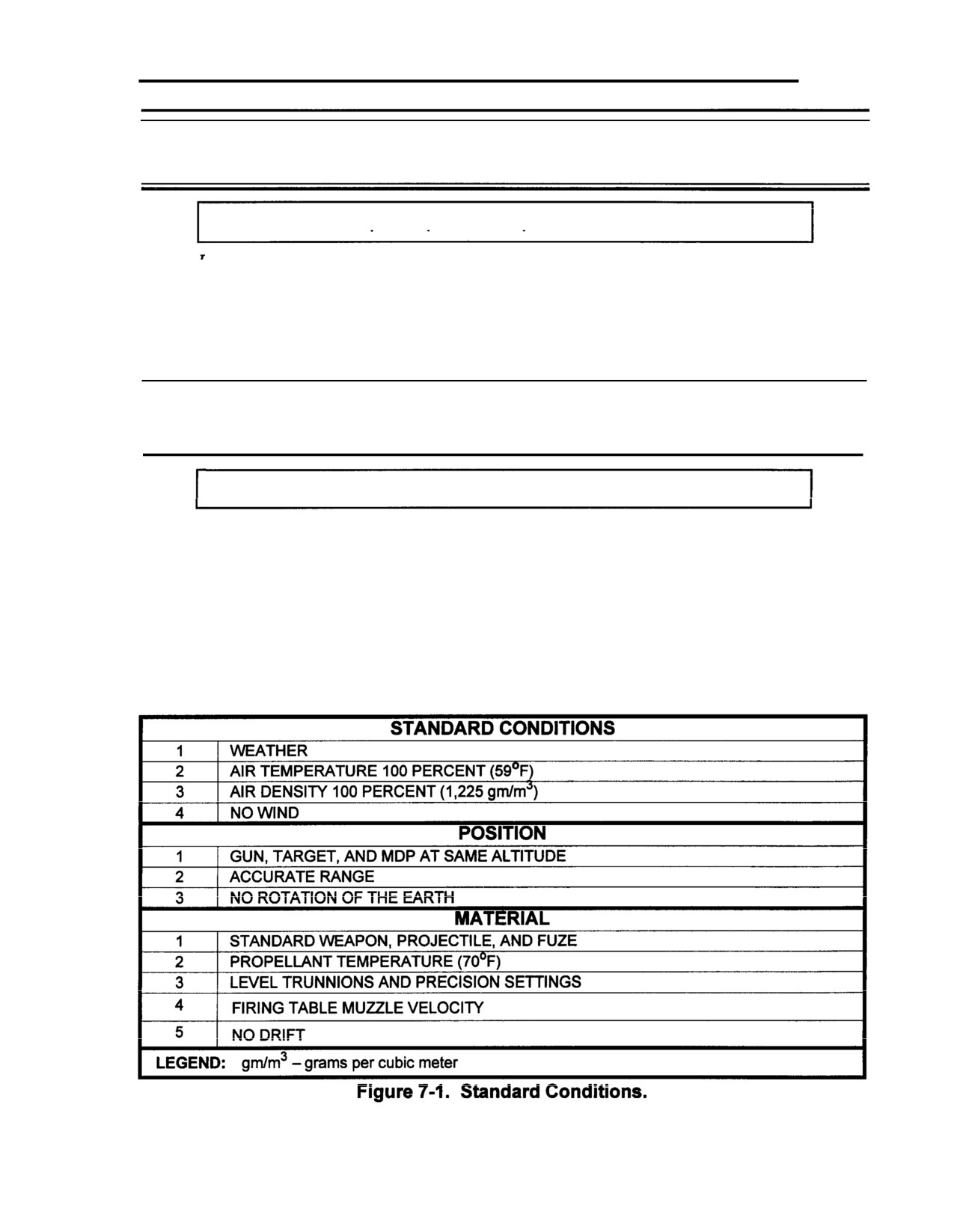
Tabular firing tables are based on test firings and computer simulations of a
weapon and its ammunition correlated to a set of conditions that are defined and
accepted as standard (See Figure 7-1.) These standard condition are points of
departure. Corrections are used to compensate for variables in the
weather-weapon-ammunition combination that are known to exist at a given instant
and location. The atmospheric standard accepted in US firing tables reflect the mean
annual condition in the North Temperate Zone. TFTs are developed for weapons
ranging from crew-served to heavy artillery. The format of artillery firing tables are
based on standardized agreements, and with small exceptions, are very similar.
7-1
FM 6-40
7-1. Elements and Purpose
a. The principal elements measured in experimental firings include the following:
Angle of elevation.
Angle of departure.
Muzzle velocity.
Achieved range.
Drift.
Concurrent atmospheric conditions.
b. The main purpose of the TFT is to provide the data to bring effective fire on a target
under any set of conditions. Data for firing tables are obtained from firings of a weapon
conducted at various quadrant elevations. Computed trajectories are based on the equations of
motion and are compared with the data obtained in the firings. The computed trajectories are
adjusted to the measured results and data are tabulated. Data for elevations not fired are
determined by interpolation. Firing table data define the performance of a projectile of known
properties under standard conditions.
7-2. Cover Information
The cover of the TFT provides information concerning the weapon system(s) and
projectiles to which data in the TFT apply. Projectiles listed on the cover are in the same
projectile family because of ballistic similarity.
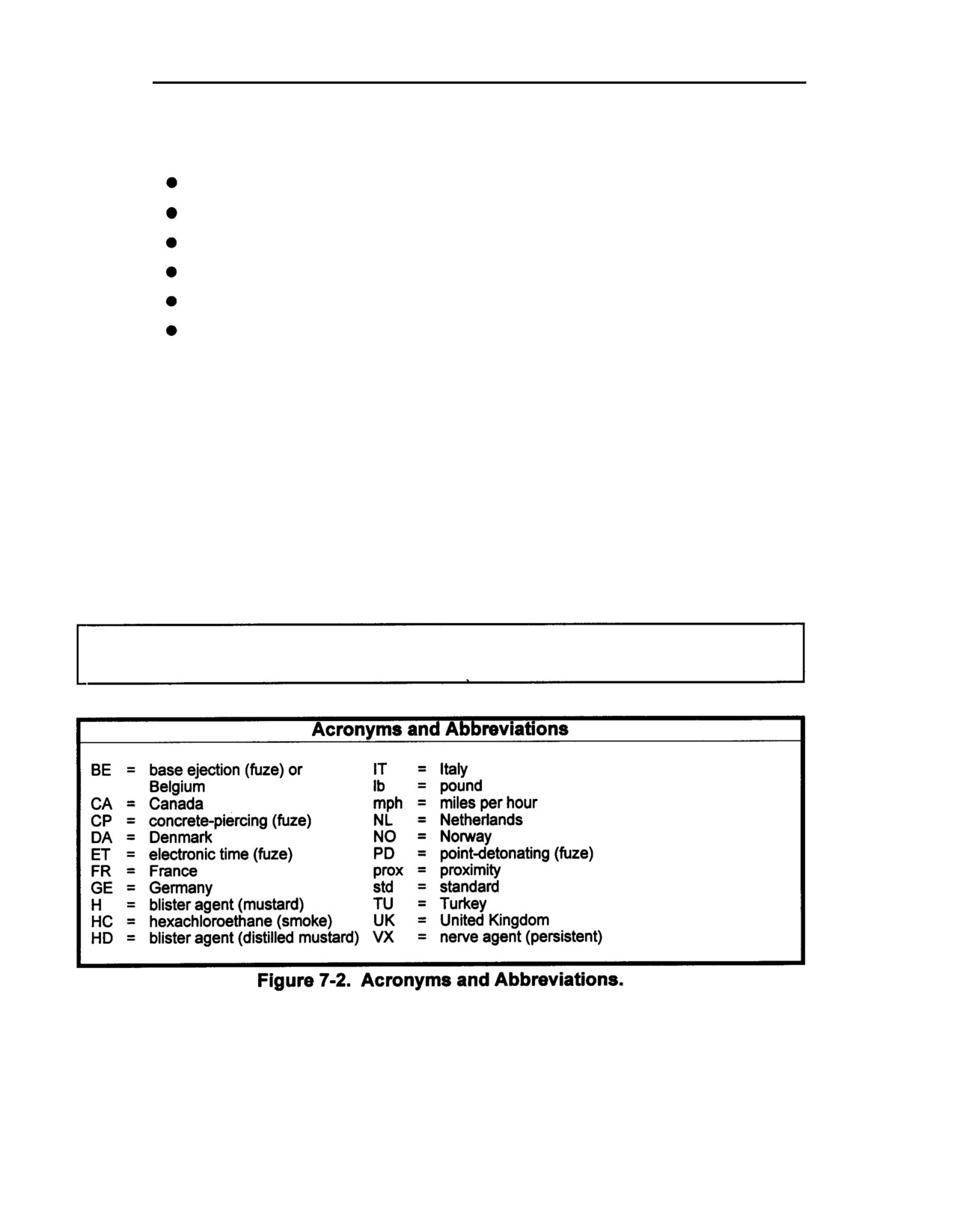
NOTE: The 155-AM-2 TFT is used as the example throughout this section. Figure 7-2
identifies acronyms and abbreviations for the TFT shown in this section.
7-2
FM 6-40
a. Introduction. The introduction contains general information about the weapon,
ammunition, and the TFT. This information specifically includes the items below.
(1) Table of contents.
(2) Table of symbols and abbreviations (used in the TFT).
(3) General information.
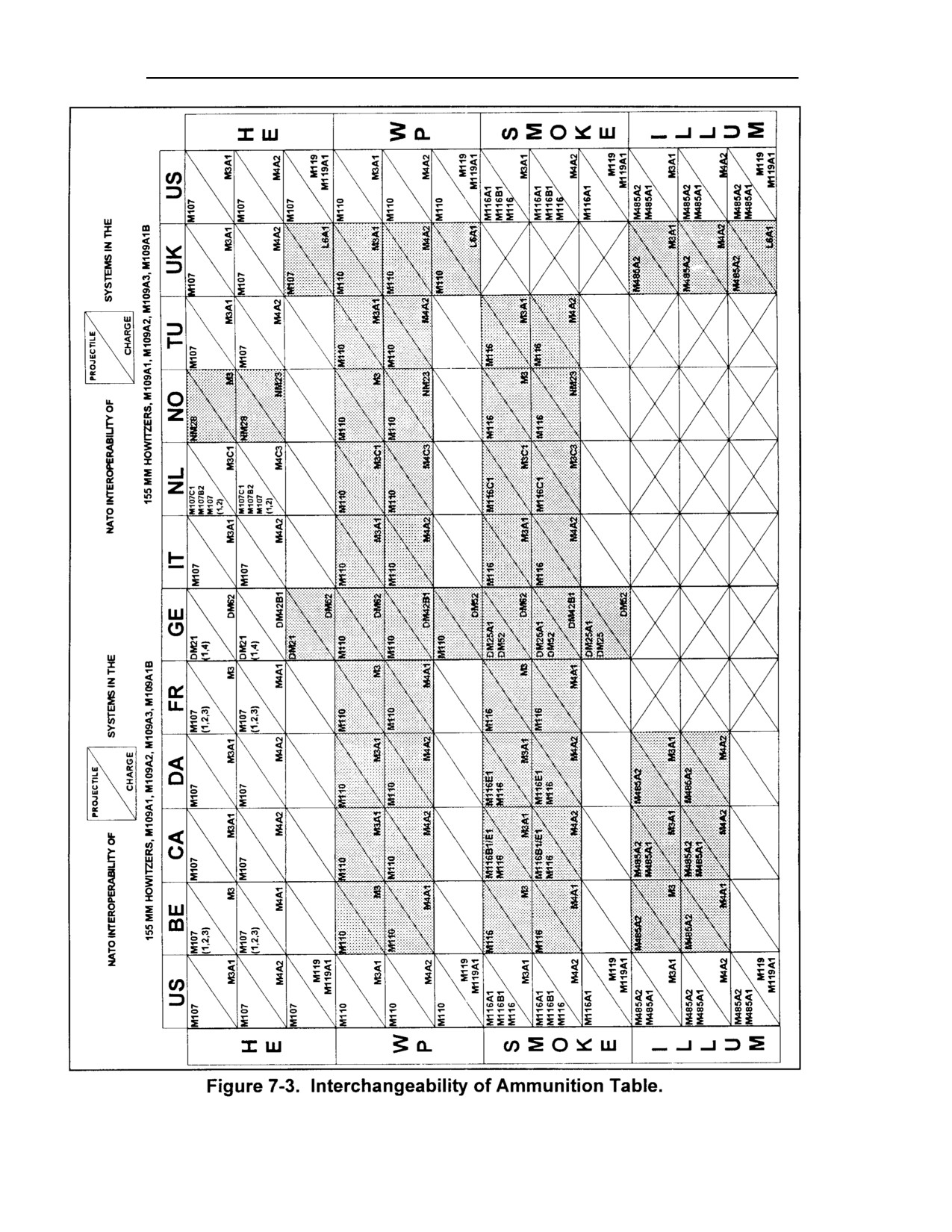
(4) Interchangeability of ammunition. This table shows the ammunition
combination held in stock by other NATO nations for a particular weapon caliber that can be
used by the US during combined operations, to include training exercises. Because of safety, the
ammunition listed in the shaded portions may only be used in combat operations. (See Figure
7-3.)
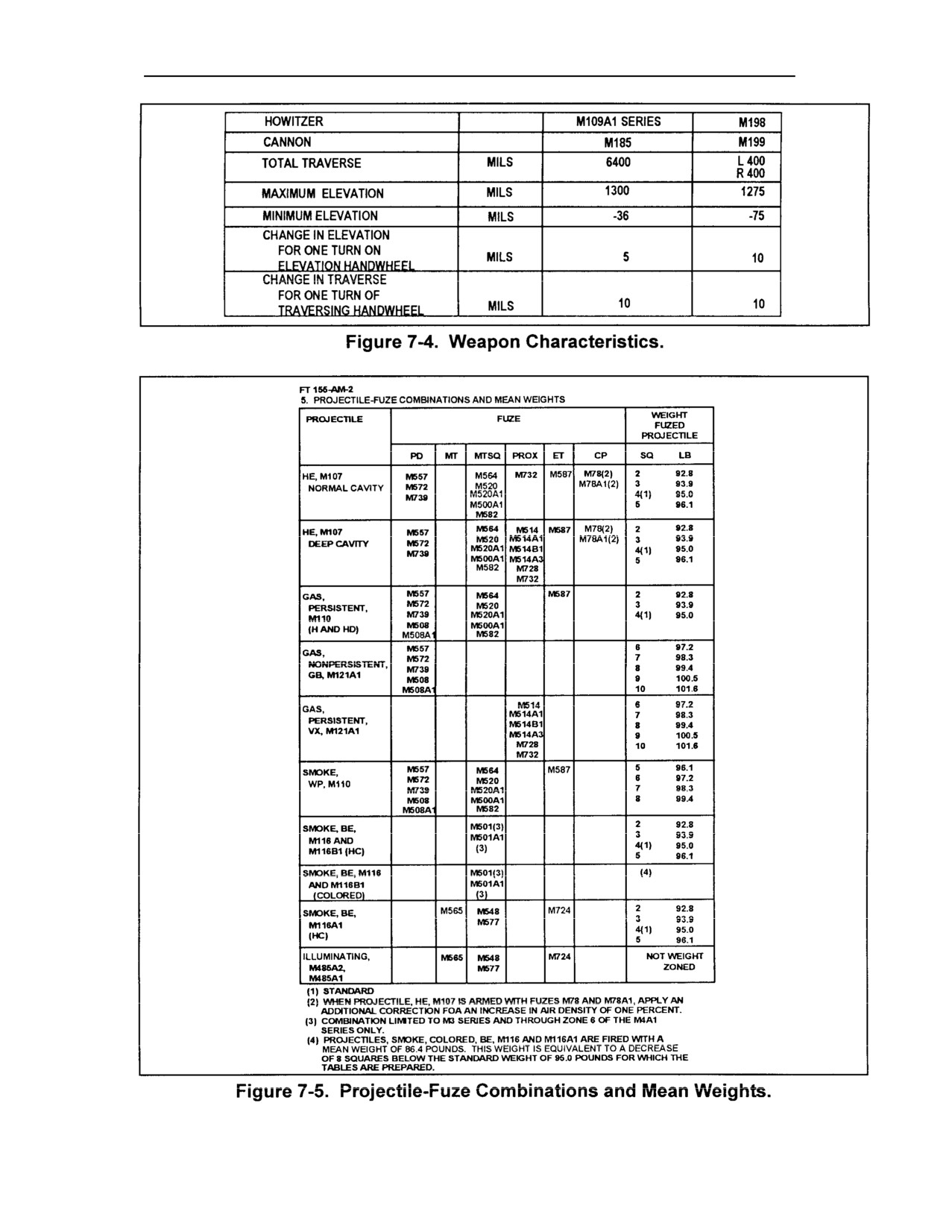
(5) Weapon characteristics. (See Figure 7-4.)
(6) Projectile-fuze combinations and mean weights. (See Figure 7-5.)
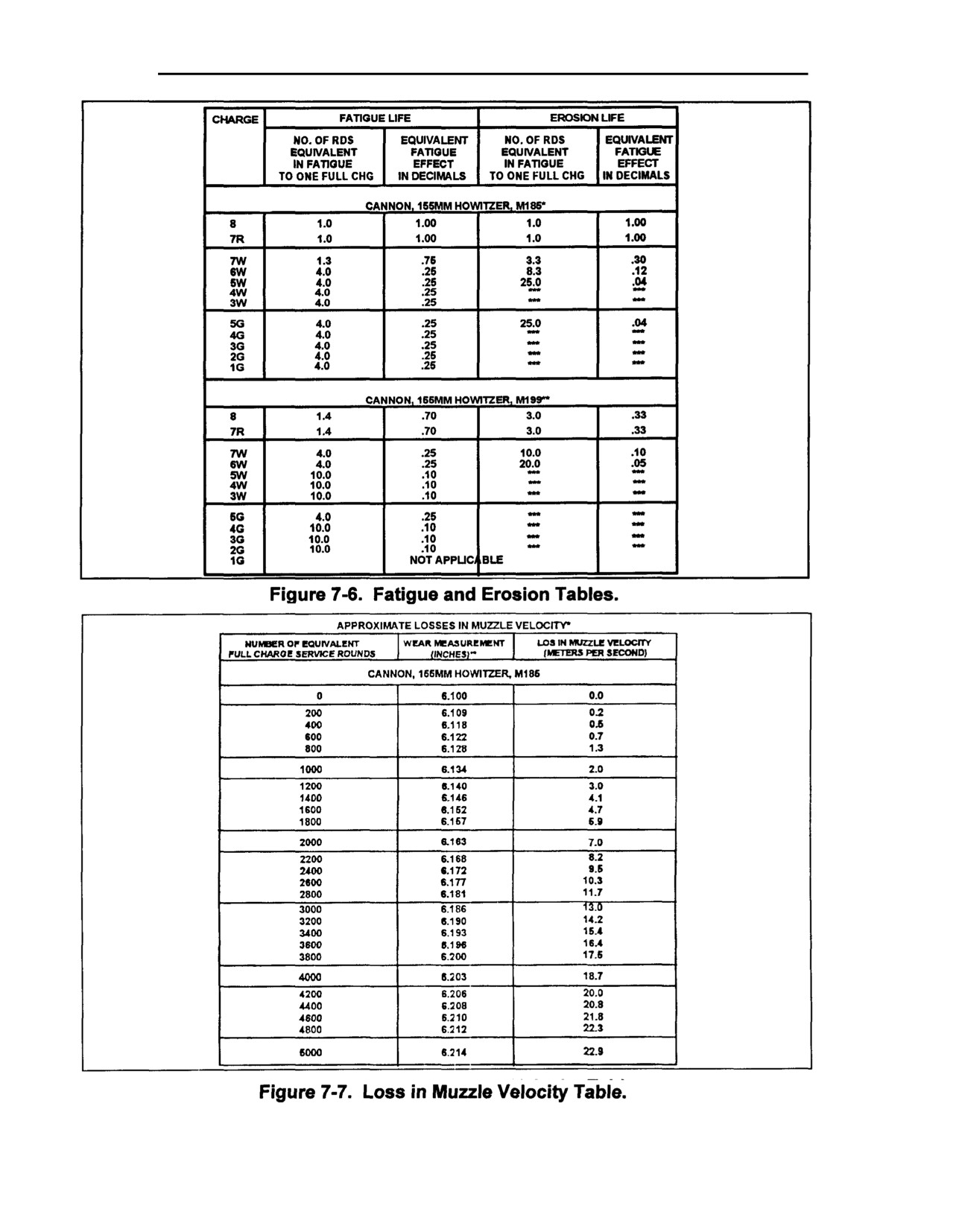
(7) Equivalent full service rounds. These tables provide information on tube wear
and erosion. These data are used to determine the number of equivalent full service rounds fired
and the expected muzzle velocity loss due to wear. The values listed in these tables are based on
firings of the highest charge used by that weapon system. (See Figure 7-6.)
(8) Approximate losses in muzzle velocity. The tables maybe used as a guide in
estimating muzzle velocity variations from the firing table standard that are due to uniform wear
in the M185 and the M199 cannon tubes. (See Figure 7-7.)
NOTE: The M199 cannon tube needs to be corrected for certain increases in muzzle
velocity, see FT 155-AM-2, page V.
(9) Explanation of tables.
(10) Example of met message and sample problems.
(11) Explanation of the probability table.
(12) Table of natural trigonometric functions.
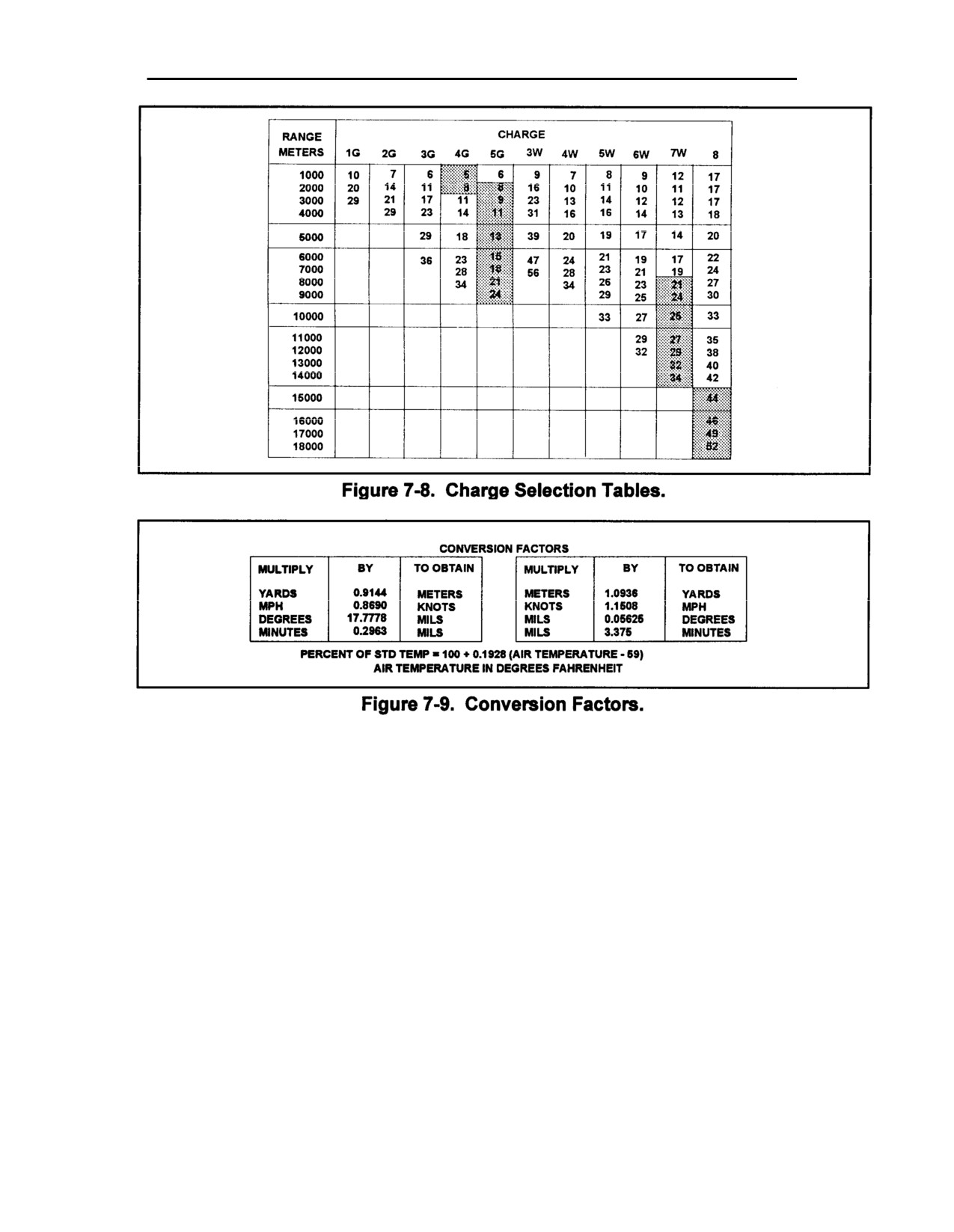
(13) Charge selection table. This table provides guidance to the FDO on the
selection of the charge to fire based on range and probable error. Enter the table with the range to
target expressed to the nearest listed value, and choose the charge to fire. The gray shaded area
shows those charges with the lowest probable error in range and thereby the charge that should be
selected given no other considerations. (See Figure 7-8.)
(14) Table of conversion factors. (See Figure 7-9.)
7-3
FM 6-40
7-4
FM 6-40
7-5
FM 6-40
7-6
FM 6-40
b. Part 1. Part 1 of the TFT contains firing data and corrections for the base projectile.
It is divided into Tables A through J. Additional Tables K through M may be provided in some
TFTs, but the format and content vary.
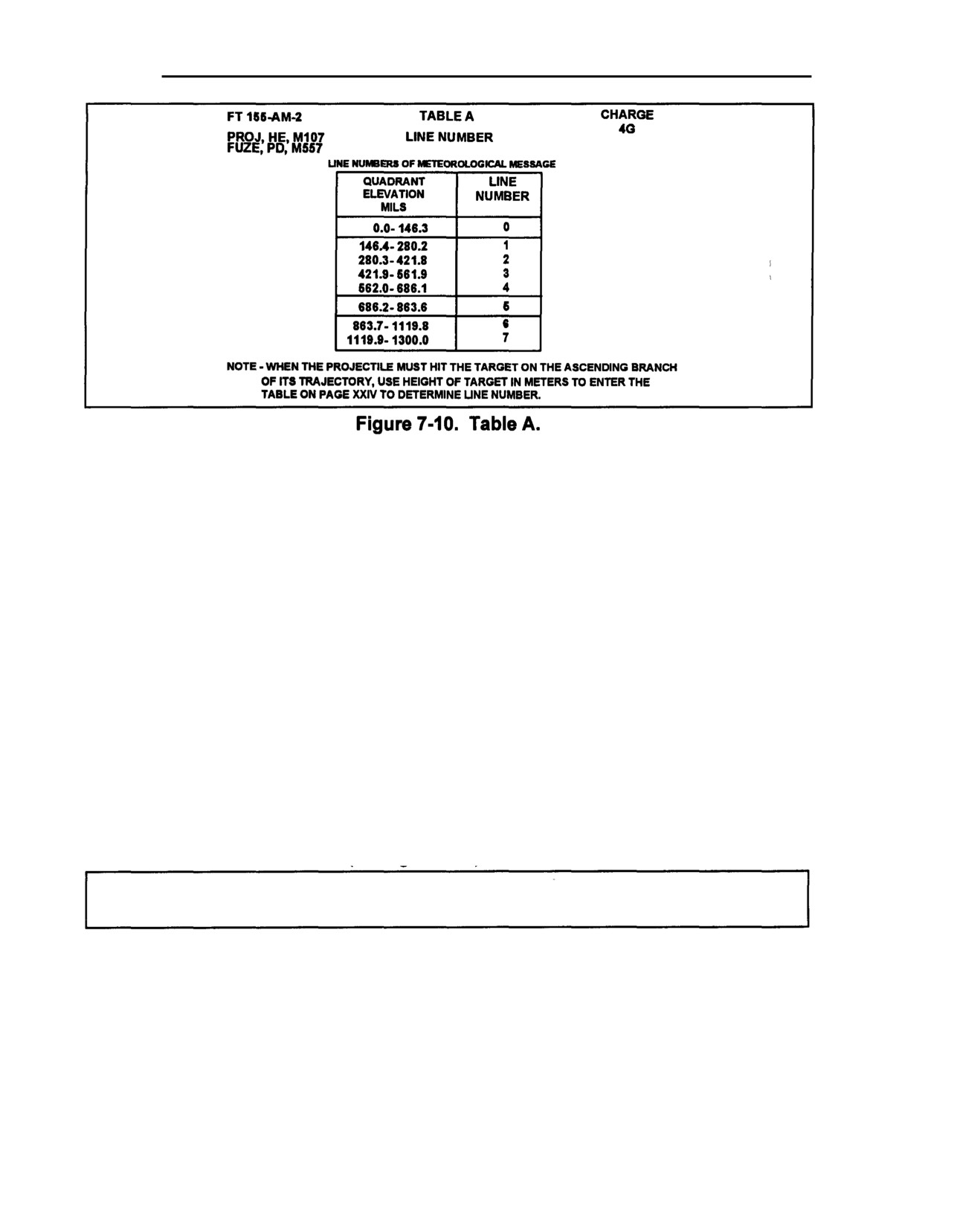
7-3. Table A
a. Table A is used for the solution of a concurrent met. It is used to select the line
number of the met message. The entry argument for this table is quadrant elevation. The QE
best describes the maximum ordinate of the trajectory and, thus, the portion of the atmosphere
through which the projectile will pass. The height of the trajectory is determined by computer
simulation using equations of motion. Table A also assumes that the target is at the level point of
the trajectory. If there is a large vertical interval (either positive or negative), the met message
line number selected will not exactly describe the atmosphere through which the projectile
passes. This will cause only a small error in manual computations.
b. Enter Table A by using the left column with the adjusted quadrant elevation to a
target. Extract the line number of the met message from the right column. (See Figure 7-10.)
7-7
FM 6-40
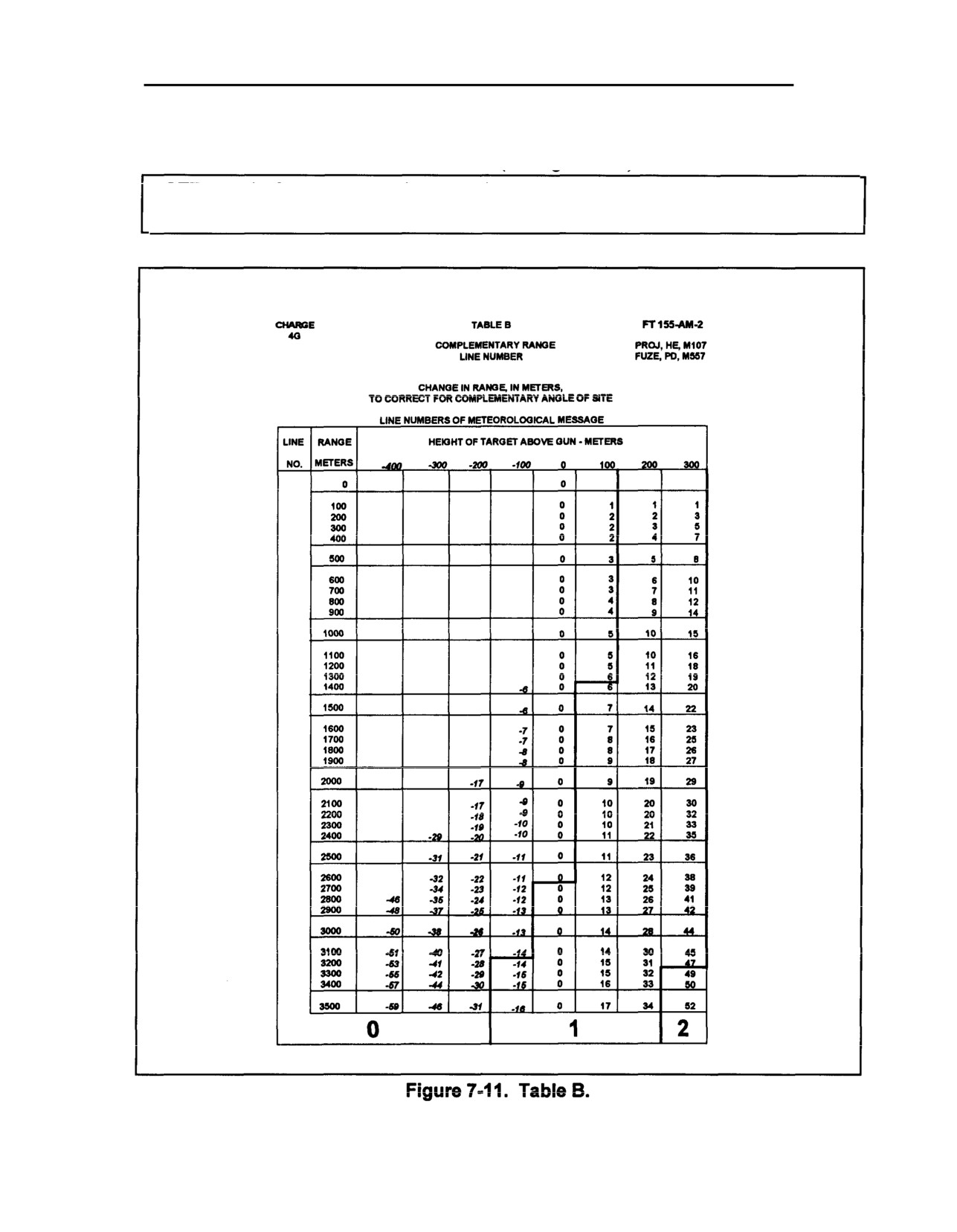
7-4. Table B.
a. Table B is used in the solution of concurrent and subsequent met. This table is used
to determine the value of complementary range (change in range) to correct for the effects of
complementary angle of site. Complementary ranges were determined by computer simulations
of the trajectory at each listed range and vertical interval. Table B has two entry arguments; they
are chart range to a target expressed to the nearest 100 meters and the height of target above gun
(vertical interval) expressed to the nearest 100 meters. Table B is entered from the range column
along the left side, with the chart range to a target; and along the top of the table with the height
of target above gun (vertical interval). Extract the value of complementary range where the two
columns intersect. The complementary range is the number of meters of range correction that
corresponds to the complementary angle of site. This range correction is measured at the base of
the trajectory. The sum of the complementary range and the chart range, expressed to the nearest
10 meters, equals the entry range. This is the most accurate range for entry into Table F to
extract firing data and range corrections.
b. Table B is also used to determine the line number from a ballistic met message for
use in subsequent met applications. The table is divided by heavy black lines. These lines form
the boundaries of the met zone. The line number may be determined by following the lines
between which the complementary range is extracted to the outer edge of the table. The bold
number in the margin is the met line number. The met message line numbers were determined by
the same method used in Table A. (See Figure 7-11.)
NOTE: Table A is more accurate in the determination of the met message line number
to be used in the solution of concurrent met.
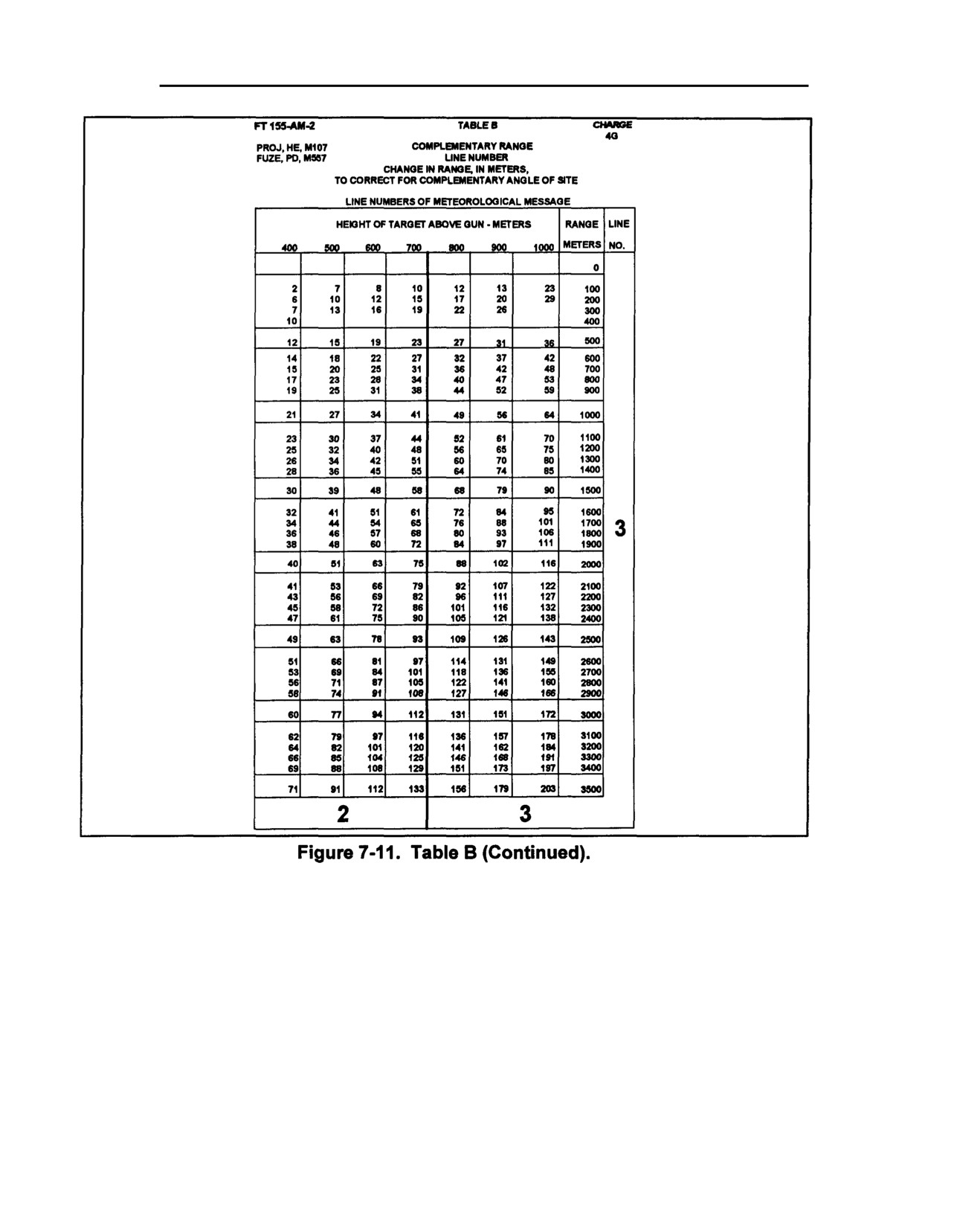
7-5. Table C
Table C is used in the solution of concurrent and subsequent met. It is entered with the
chart direction of wind. The chart direction of wind is the angle formed by the intersection of the
direction of the wind from the met message and the direction of fire (that is, the horizontal
clockwise angle from the direction of fire to the direction of the wind). This table divides a
1-knot wind into crosswind and range wind components. Components for crosswind and range
wind are then extracted. The extracted values are described as the components of a 1-knot wind.
7-8
FM 6-40
The range wind component is the percentage of the wind speed that acted as a range factor. The
crosswind component is the percentage of the wind force that acts to blow the projectile laterally
and is translated into a lateral correction factor. (See Figure 7-12.)
NOTE: Table C is based on chart direction of wind only and, thus, is the same for all
charges and all weapons.
7-9
FM 6-40
7-6. Table D
a. Table D is used in the solution of concurrent and subsequent met. The values extracted
from the table are standard departure of air temperature and density as a function of height. They
have been converted to a percentage of standard. This table provides a correction based on a standard
departure to correct the temperature and density in the met message (which is measured at the altitude
beginning at the meteorological datum plane [MDP]) to values as if they would be measured initially
from the unit altitude.
b. Table D is entered with the height of the unit above or below the MDP or met station.
The difference in height is entered on the left side in hundreds of meters and along the top of the table
in tens of meters. Extract the corrections to density and temperature from the intersection of the two
columns. (See Figure 7-13.)
7-10
FM 6-40
7-11