FM 6-40 TTP for Field Artillery Manual Cannon Battery U.S. - page 3
FM 6-40
The centering slope is the tapered portion at or near the forward end of
the chamber that causes the projectile to center itself in the bore during
loading.
(d) The forcing cone is the tapered portion near the rear of the bore that allows the
rotating band to be gradually engaged by the rifling, thereby centering the projectile in the bore.
(e) The bore is the rifled portion of the tube (lands and grooves). It extends
from the forcing cone to the muzzle. The rifled portion of the tube imparts spin to the projectile
increasing stability in flight. The grooves are the depressions in the rifling. The lands are the
raised portions. These parts engrave the rotating band. All United States (US) howitzers have a
right-hand twist in rifling.
(f) The bore evacuator is located on enclosed, self-propelled howitzers with
semiautomatic breech mechanisms. It prevents contamination of the crew compartment by
removing propellant gases from the bore after firing. The bore evacuator forces the gases to flow
outward through the bore from a series of valves enclosed on the tube.
(g) The counterbore is the portion at the front of the bore from which the lands
have been removed to relieve stress and prevents the tube from cracking.
(h) The muzzle brake is located at the end of the tube on some howitzers. As
the projectile leaves the muzzle, the high-velocity gases strike the baffles of the muzzle brake and
are deflected rearward and sideways. When striking the baffles, the gases exert a forward force
on the baffles that partially counteracts and reduces the force of recoil.
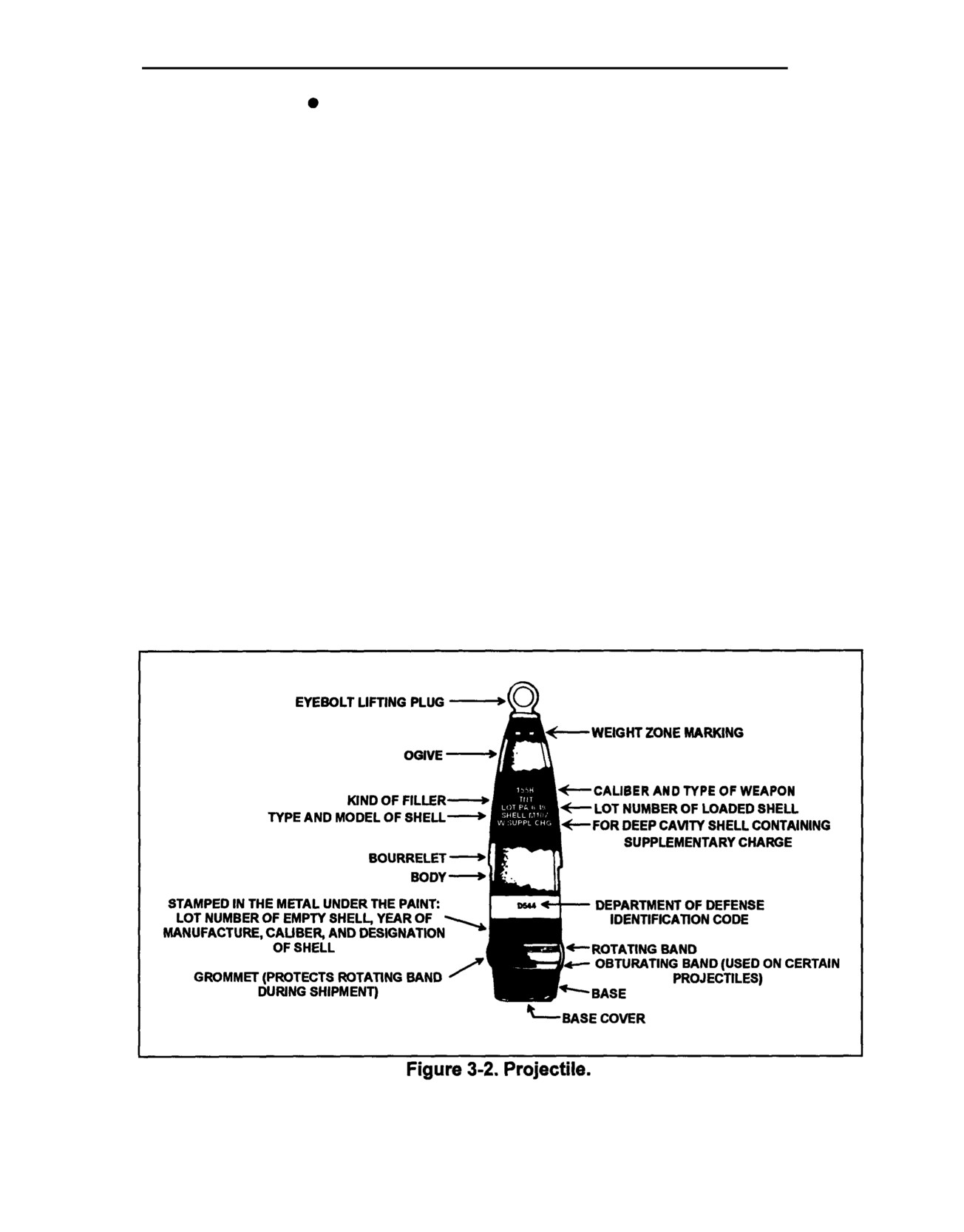
(3) The projectile body has several components that affect ballistics. (See Figure 3-2.)
Three of these affect interior ballistics--the bourrelet the rotating band and the obturating band.
3-3
FM 6-40
(a) The bourrelet is the widest part of the projectile and is located immediately
to the rear of the ogive. The bourrelet centers the forward part of the projectile in the tube and
bears on the lands of the tube. When the projectile is fired, only the bourrelet and rotating band
bear on the lands of the tube.
(b) The rotating band is a band of soft metal (copper alloy) that is securely
seated around the body of the projectile. It provides forward obturation (the forward gas-tight
seal required to develop pressure inside the tube). The rotating band prevents the escape of gas
pressure from around the projectile. When the weapon is fired, the rotating band contacts the
lands and grooves and is pressed between them. As the projectile travels the length of the cannon
tube, over the lands and grooves, spin is imparted. The rifling for the entire length of the tube
must be smooth and free of burrs and scars. This permits uniform seating of the projectile and
gives a more uniform muzzle velocity.
(c) The obturating band is a plastic band on certain projectiles. It provides
forward obturation by preventing the escape of gas pressure from around the projectile.
(4) The sequence that occurs within the cannon tube is described below.
(a) The projectile is rammed into the cannon tube and rests on the bourrelet.
The rotating band contacts the lands and grooves at the forcing cone.
(b) The propellant is inserted into the chamber.
(c) The propellant explosive train is initiated by the ignition of the primer.
This causes the primer, consisting of hot gases and incandescent particles, to be injected into the
igniter. The igniter burns and creates hot gases that flow between the propellant granules and
ignite the granule surfaces; the igniter and propellant combustion products then act together,
perpetuating the flame spread until all the propellant granules are ignited.
(d) The chamber is sealed, in the rear by the breech and obturator spindle
group and forward by the projectile, so the gases and energy created by the primer, igniter, and
propellant cannot escape. This results in a dramatic increase in the pressure and temperature
within the chamber. The burning rate of the propellant is roughly proportional to the pressure, so
the increase in pressure is accompanied by an increase in the rate at which further gas is
produced.
(e) The rising pressure is moderated by the motion of the projectile along the
barrel. The pressure at which this motion begins is the shot-start pressure. The projectile will
then almost immediately encounter the rifling, and the projectile will slow or stop again until the
pressure has increased enough to overcome the resistance in the bore. The rotating band and
obturating band (if present) or the surface of the projectile itself, depending on design, will be
engraved to the shape of the rifling. The resistance decreases, thereby allowing the rapidly
increasing pressure to accelerate the projectile.
(f) As the projectile moves forward, it leaves behind an increasing volume to
be filled by the high-pressure propellant gases. the propellant is still burning, producing high-
pressure gases so rapidly that the motion of the projectile cannot fully compensate. As a result,
the pressure continues to rise until the peak pressure is reached. The peak pressure is attained
when the projectile has traveled about one-tenth of the total length of a full length howitzer tube.
3-4
FM 6-40
(g) The rate at which extra space is being created behind the rapidly
accelerating projectile then exceeds the rate at which high-pressure gas is being produced;
thus the pressure begins to fall. The next stage is the all-burnt position at which the burning
of the propellant is completed. However, there is still considerable pressure in the tube;
therefore, for the remaining motion along the bore, the projectile continues to accelerate. As
it approaches the muzzle, the propellant gases expand, the pressure falls, and so the
acceleration lessens. At the moment the projectile leaves the howitzer, the pressure will
have been reduced to about one sixth of the peak pressure. Only about one-third of the
energy developed pushes the projectile. The other two-thirds is absorbed by the recoiling
parts or it is lost because of heat and metal expansion.
(h) The flow of gases following the projectile out of the muzzle provides
additional acceleration for a short distance (transitional ballistics), so that the full muzzle
velocity is not reached until the projectile is some distance beyond the muzzle. The noise
and shock of firing are caused by the jet action of the projectile as it escapes the flow of
gases and encounters the atmosphere. After this, the projectile breaks away from the
influence of the gun and begins independent flight.
(i) This entire sequence, from primer firing to muzzle exit, typically occurs
within 15 milliseconds but perhaps as much as 25 milliseconds for a large artillery howitzer.
(5) Pressure travel curves are discussed below.
(a) Once the propellant ignites, gases are generated that develop enough
pressure to overcome initial bore resistance, thereby moving the projectile. Two opposing
forces act on a projectile within the howitzer. The first is a propelling force caused by the
high-pressure propellant gases pushing on the base of the projectile. The second is a
frictional force between the projectile and bore, which includes the high resistance during
the engraving process, that opposes the motion of the projectile. The peak pressure, together
with the travel of the projectile in the bore (pressure travel curve), determines the velocity at
which the projectile leaves the tube.
(b) To analyze the desired development of pressure within the tube, we
identify three types of pressure travel curves:
An elastic strength pressure travel curve represents the greatest
interior pressure that the construction of the tube (thickness of the
wall of the powder chamber, thickness of the tube, composition of
the tube or chamber, and so on) will allow. It decreases as the
projectile travels toward the muzzle because the thickness of the
tube decreases.
A permissible pressure travel curve mirrors the elastic strength
pressure travel curve and accounts for a certain factor of safety. It also
decreases as the projectile travels through the tube because tube
thickness decreases.
3-5
FM 6-40
An actual pressure travel curve represents the actual pressure
developed during firing within the tube. Initially, pressure increases
dramatically as the repelling charge explosive train initiated and the
initial resistance of the rammed projectile is overcome. After that
resistance is overcome, the actual pressure gradually decreases because
of the concepts explained by Boyle’s Law. (Generally, as volume
increases, pressure decreases.) The actual pressure should never exceed
the permissible pressure.
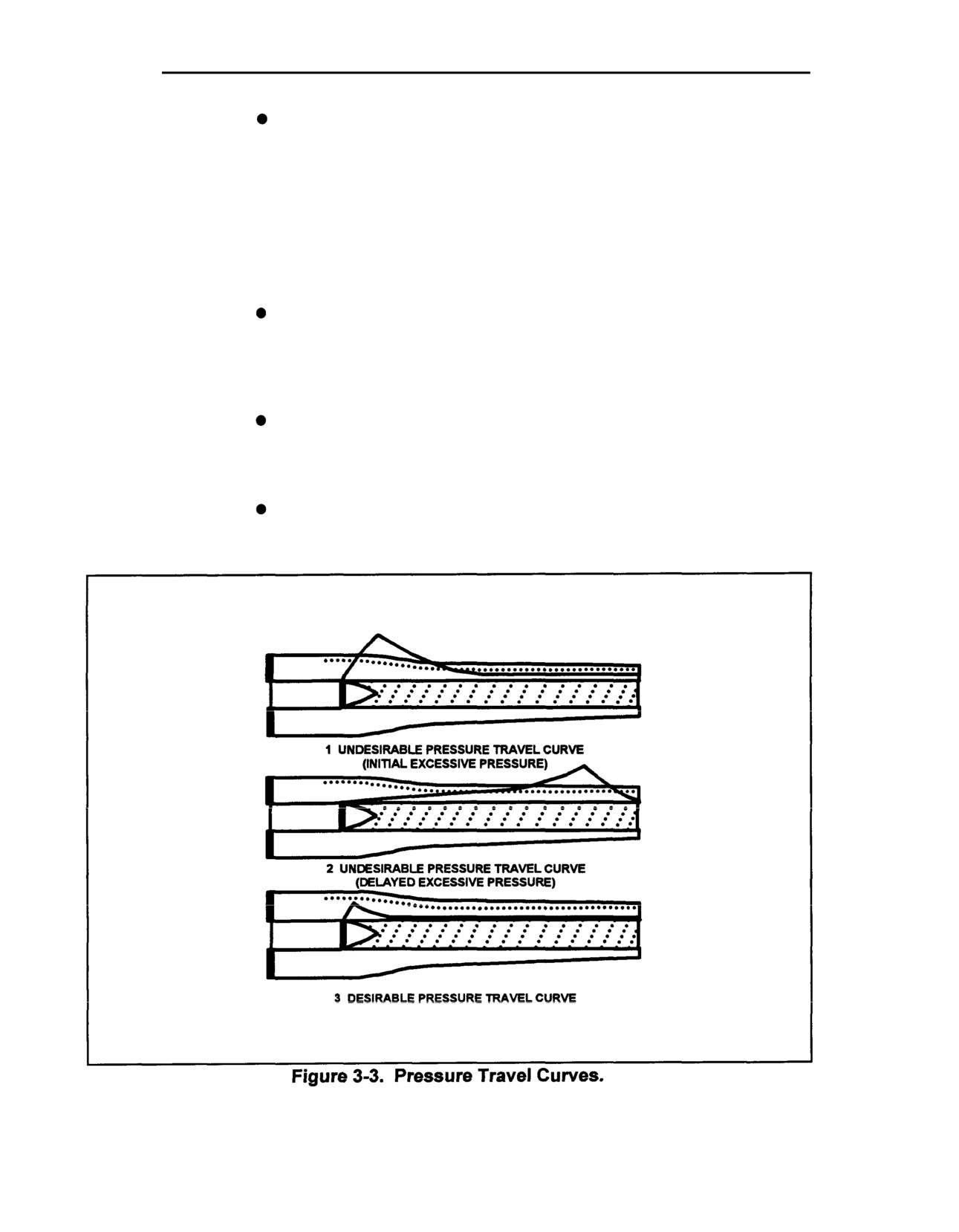
Figure 3-3 depicts different actual pressure travel curves that are discussed below.
Initial Excessive Pressure. This is undesirable pressure travel
curve. It exceeds the elastic strength pressure and permissible pressure.
Causes of this travel curve would be an obstruction in the tube, a dirty
tube, an “extra” propellant placed in the chamber, an unfuzed
projectile, or a crack
ed projectile.
Delayed Excessive Pressure. This is an undesirable pressure travel
curve. It exceeds the elastic strength pressure and remissible
pressure. Causes that would result in this travel curve would be using
wet powder or powder reversed.
Desirable Pressure Travel Curve. This curve does not exceed
permissible pressure. It develops peak pressure at about one-tenth the
length of the tube.
3-6
FM 6-40
(6) The following general rules show how various factors tiect the velocity
performance of a weapon projectile family-propellant type-charge combination
(a) An increase in the rate of propellant burning increases the resulting gas
pressure developed within the chamber. An example of this is the performance of the
multiperforated propellant grains used in white bag (WB) propellants. The result is that more
gases are produced, gas pressure is increased, and the projectile develops a greater muzzle
velocity. Damage to propellant grains, such as cracking and splitting from improper handling,
also affect the rate of burn and thus the muzzle velocity.
(b) An increase in the size of the chamber without a corresponding increase in the
amount of propellant decreases gas pressure; as a result, muzzle velocity will be less (Boyles Law).
(c) Gas escaping around the projectile decreases chamber pressure.
(d) An increase in bore resistance to projectile movement before peak pressure
increases the pressure developed within the tube. Generally, this results in a dragging effect on
the projectile, with a corresponding decrease in the developed muzzle velocity. Temporary
variations in bore resistance can be caused by excessive deposits of residue within the cannon
tube and on projectiles and by temperature differences between the inner and outer surfaces of the
cannon tube.
b. Standard Muzzle Velocity.
(1) Applicable firing tables list the standard value of muzzle velocity for each
charge. These standard values are based on an assumed set of standard conditions. These values
are points of departure and not absolute standards. Essentially, we cannot assume that a given
weapon projectile family-propellant type-charge combination when fired will produce the
standard muzzle velocity.
(2) Velocities for each charge are indirectly established by the characteristics of the
weapons. Cannons capable of high-angle fire (howitzers) require a greater choice in the number
of charges than cannons capable of only low-angle fire (guns). This choice is necessary to
achieve range overlap between charges in high-angle fire and the desired range-trajectory
combination in low-angle fire. Other factors considered are the maximum range specified for the
weapon, the maximum elevation and charge, and the maximum permissible pressure that the
weapon can accommodate.
(3) Manufacturing specifications for ammunition include a requirement for velocity
performance to meet certain tolerances. Ammunition lots are subjected to test firings, which
include measuring the performance of a tested lot and comparing it to the performance of a
control (reference) lot that is tested concurrently with the same weapon. An assumption built into
the testing procedure is that both lots of ammunition will be influenced in the same manner by
the performance of the tube. This assumption, although accurate in most instances, allows some
error to be introduced in the assessment of the performance of the tested lot of propellant. In field
conditions, variations in the performance of different projectile or propellant lots can be expected
even though quality control has been exercised during manufacturing and testing of lots. In other
words, although a howitzer develops a muzzle velocity that is 3 meters per second greater (or
less) than standard with propellant lot G, it will not necessarily be the same with any other
propellant lot. The optimum method for determining ammunition performance is to measure the
3-7
FM 6-40
performance of a particular projectile family-propellant lot-charge combination (calibration).
However, predictions of the performance of a projectile family-propellant lot-charge group
combination may be inferred with the understanding that they will not be as accurate as actual
performance measurements.
c. Factors Causing Nonstandard Velocities.Nonstandard muzzle velocity is
expressed as a variation (plus or minus so many meters per second) from the accepted standard.
Round-to-round corrections for dispersion cannot be made. Each of the following factors that
cause nonstandard conditions is treated as a single entity assuming no influence from related
factors.
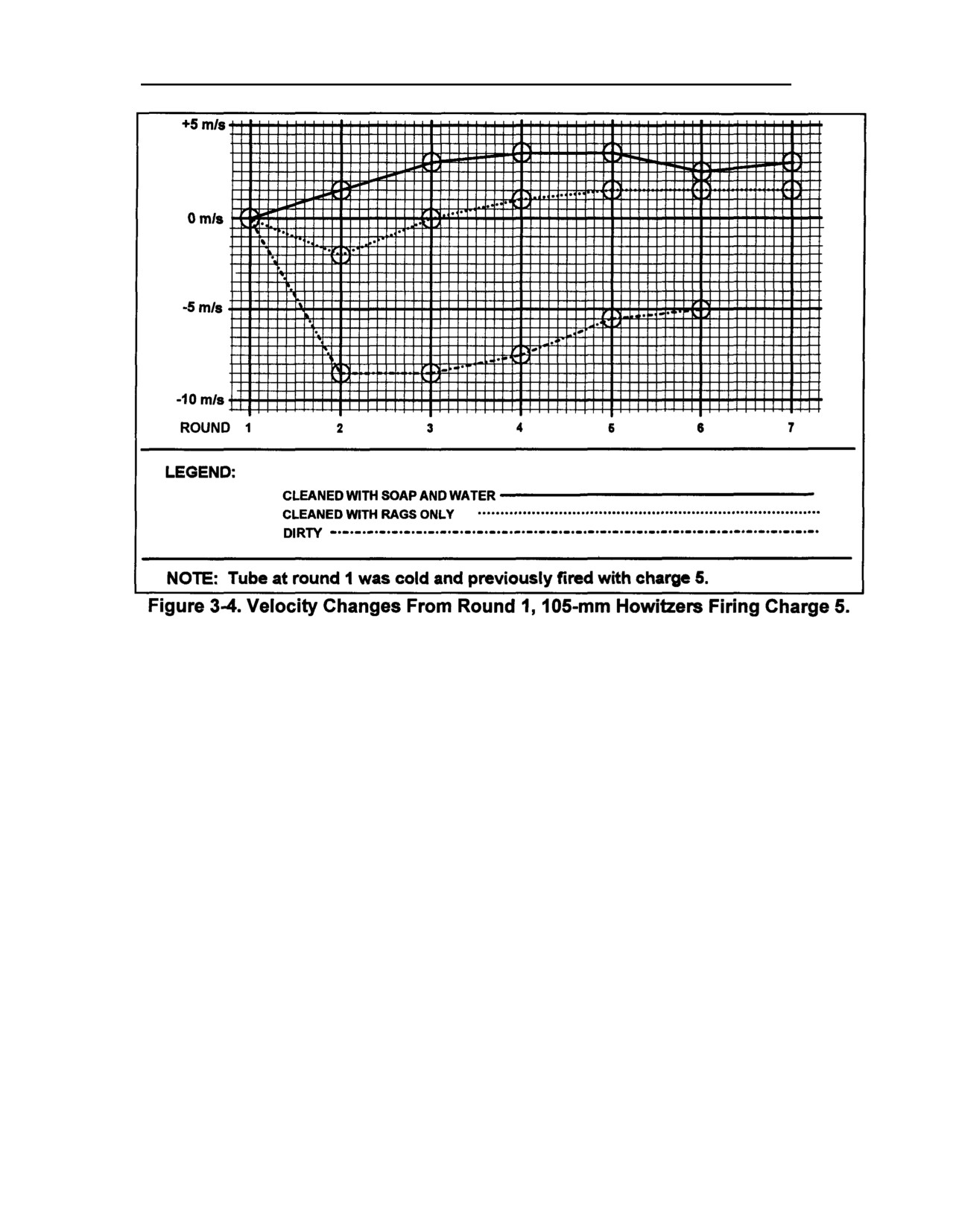
(1) Velocity trends. Not all rounds of a series fired from the same weapon and using
the same ammunition lot will develop the same muzzle velocity. Under most conditions, the first few
rounds follow a somewhat regular pattern rather than the random pattern associated with normal
dispersion. This phenomenon is called velocity trends (or velocity dispersion), and the magnitude
varies with the cannon, charge, and tube condition at the time each round is fired. Velocity trends
cannot be accurately predicted; thus, any attempt to correct for the effects of velocity trends is
impractical. Generally, the magnitude and duration of velocity trends can be minimized when firing is
started with a tube that is clean and completely free of oil. (See Figure 3-4.)
(2) Ammunition lots. Each ammunition, projectile, and propellant lot has its own
mean performance level in relation to a common weapon. Although the round-to-round
variations within a given lot of the same ammunition (ammo) types are similar, the mean velocity
developed by one lot may differ significantly in comparison to that of another lot. With
separate-loading ammunition, both the projectile and propellant lots must be identified.
Projectile lots allow for rapid identification of weight differences. Although other projectile
factors affect achieved muzzle velocity (such as, diameter and hardness of rotating band), the
cumulative effect of these elements generally does not exceed 1.5 rids. As a matter of
convenience and speed, they are ignored in the computation of firing data.
(3) Tolerances in new weapons. All new cannons of a given caliber and model will
not necessarily develop the same muzzle velocity. In a new tube, the mean factors affecting muzzle
velocity are variations in the size of the powder chamber and the interior dimensions of the bore. If a
battalion equipped with new cannons fired all of them with a common lot of ammunition a variation
of 4 meters per second between the cannon developing the greatest muzzle velocity and the cannon
developing the lowest muzzle velocity would not be unusual. Calibration of all cannons allows the
firing unit to compensate for small variations in the manufacture of cannon tubes and the resulting
variation in developed muzzle velocity. The MVV caused by inconsistencies in tube manufacture
remains constant and is valid for the life of the tube.
(4) Tube wear. Continued firing of a cannon wears away portions of the bore by
the actions of hot gases and chemicals and movement of the projectile within the tube. These
erosive actions are more pronounced when higher charges are fired. The greater the tube wear,
the more the muzzle velocity decreases. Normal wear can be minimized by careful selection of
the charge and by proper cleaning of both the tube and the ammunition.
3-8
FM 6-40
(5) Nonuniform ramming. Weak ramming decreases the volume of the chamber and
thereby theoretically increases the pressure imparted to the projectile. This occurs because the
pressure of a gas varies inversely with volume. Therefore, only a partial gain in muzzle velocity might
be achieved. Of greater note is the improper seating of the projectile within the tube. Improper
seating can allow some of the expanding gases to escape around the rotating band of the projectile and
thus result in decreased muzzle velocity. The combined effects of a smaller chamber and escaping
gases are difficult to predict. Weak, nonuniform ramming results in an unnecessary and
preventable increase in the size of the dispersion pattern. Hard, uniform ramming is desired for all
rounds. When semifixed ammunition is fired, the principles of varying the size of the chamber and
escape of gases still apply, particularly when ammunition is fired through worn tubes. When firing
semifixed ammunition, rearward obturation is obtained by the expansion of the cartridge case against
the walls of the powder chamber. Proper seating of the cartridge case is important in reducing the
escape of gases.
(6) Rotating bands. The ideal rotating band permits proper seating of the projectile
within the cannon tube. Proper seating of the projectile allows forward obturation, uniform pressure
buildup, and initial resistance to projectile movement within the tube. The rotating band is also
designed to provide a minimum drag effect on the projectile once the projectile overcomes the
resistance to movement and starts to move. Dirt or burrs on the rotating band may cause improper
seating. This increases tube wear and contributes to velocity dispersion. If excessively worn, the
lands may not engage the rotating band well enough to impart the proper spin to the projectile.
Insufficient spin reduces projectile stability in flight and can result in dangerously erratic round
performance. When erratic rounds occur or excessive tube wear is noted, ordnance teams should be
requested to determine the serviceability of the tube.
3-9
FM 6-40
(7) Propellant and projectile temperatures. Any combustible material burns more
rapidly when heated before ignition. When a propellant burns more rapidly than would be expected
under standard conditions, gases are produced more rapidly and the pressure imparted to the projectile
is greater. As a result, the muzzle velocity will be greater than standard and the projectile will travel
farther. Table E in the tabular firing tables lists the magnitude of change in muzzle velocity resulting
from a propellant temperature that is greater or less than standard. Appropriate corrections can be
extracted from that table; however, such corrections are valid only if they are determined relative to
the true propellant temperature. The temperature of propellant in sealed containers remains fairly
uniform though not necessarily at the standard propellant temperature (70 degrees Fahrenheit [F}).
Once propellant has been unpacked, its temperature more rapidly approaches the air temperature. The
time and type of exposure to the weather result in temperature variations from round to round and
within the firing unit. It is currently impractical to measure propellant temperature and apply
corrections for each round fired by each cannon. Positive action must be taken to maintain uniform
projectile and propellant temperatures. Failure to do this results in erratic firing. The effect of an
extreme change in projectile or propellant temperature can invalidate even the most recent corrections
determined from a registration.
(a) Ready ammunition should be kept off the ground and protected from dirt,
moisture, and direct rays of the sun. At least 6 inches of airspace should be between the ammunition
and protective covering on the sides, 6 inches of dunnage should be on the bottom, and the roof
should be 18 inches from the top of the stack. These precautions will allow propellant and projectile
temperatures to approach the air temperature at a uniform rate throughout the firing unit.
(b) Propellant should be prepared in advance so that it is never necessary to
fire freshly unpacked ammunition with ammunition that has been exposed to weather during a
fire mission.
(c) Ammunition should be fired in the order in which it was unpacked.
(d) Propellant temperature should be determined from ready ammunition on a
periodic basis, particularly if there has been a change in the air temperature.
(8) Moisture content of propellant. Changes in the moisture content of propellant are
caused by improper protection from the elements or improper handling of the propellant. These
changes can affect muzzle velocity. Since the moisture content cannot be measured or corrected for,
the propellant must be provided maximum protection from the elements and improper
handling.
(9) Position of propellant in the chamber. In fixed and semifixed ammunition the
propellant has a relatively fixed position with respect to the chamber, which is formed by the cartridge
case. In separate-loading ammunition, however, the rate at which the propellant burns and the
developed muzzle velocity depends on how the cannoneer inserts the charge. To ensure proper
ignition of the propellant he must insert the charge so that the base of the propellant bag is flush
against the obturator spindle when the breech is closed. The cannoneer ensures this by placing the
propellant flush against the Swiss groove (the cutaway portion in the powder chamber). The farther
forward the charge is inserted, the slower the burning rate and the lower the subsequent muzzle
velocity. An increase in the diameter of the propellant charge can also cause an increase in muzzle
velocity. Loose tie straps or wrappings have the effect of increasing the diameter of the propellant
charge. Propellant charge wrappings should always be checked for tightness, even when the full
propellant charge is used.
3-10
FM 6-40
(10) Weight of projectile. The weights of like projectiles vary within certain zones
(normally termed square weight). The appropriate weight zone is stenciled on the projectile (in
terms of so many squares). Some projectiles are marked with the weight in pounds. In general
terms, a heavier-than-standard projectile normally experiences a decrease in muzzle
velocity. This is because more of the force generated by the gases is used to overcome the initial
resistance to movement. A lighter-than-standard projectile generally experiences an increase in
velocity.
NOTE: Copperhead projectiles are not marked with weight in pounds. The
precision manufacturing process used guarantees a weight of 137.6 pounds.
(11) Coppering. When the projectile velocity within the bore is great, sufficient
friction and heat are developed to remove the outer surface of the rotating band. Material left is a
thin film of copper within the bore and is known as coppering. This phenomenon occurs in
weapons that develop a high muzzle velocity and when high charges are fired. The amount of
copper deposited varies with velocity. Firing higher charges increases the amount of copper
deposited on the bore surfaces, whereas firing lower charges reduces the effects of coppering.
Slight coppering resulting from firing a small sample of rounds at higher charges tends to
increase muzzle velocity. Erratic velocity performance is a result of excessive coppering
whereby the resistance of the bore to projectile movement is affected. Excessive coppering must
be removed by ordnance personnel.
(12) Propellant residue. Residue from burned propellant and certain chemical
agents mixed with the expanding gases are deposited on the bore surface in a manner similar to
coppering. Unless the tube is properly cleaned and cared for, this residue will accelerate tube
wear by causing pitting and augmenting the abrasive action of the projectile.
(13) Tube conditioning. The temperature of the tube has a direct bearing on the
developed muzzle velocity. A cold tube offers a different resistance to projectile movement and
is less susceptible to coppering, even at high velocities. In general, a cold tube yields more
range dispersion; a hot tube, less range dispersion.
(14) Additional effects in interior ballistics. The additional effects include tube
memory and tube jump.
(a) Tube memory is a physical phenomenon of the cannon tube tending to
react to the firing stress in the same manner for each round, even after changing charges. It seems
to “remember” the muzzle velocity of the last charge fired. For example, if a fire mission with
charge 6 M4A2 is followed by a fire mission with charge 4 M4A2, the muzzle velocity of the
first round of charge 4 may be unpredictably higher. The inverse is also true.
(b) Tube jump occurs as the projectile tries to maintain a straight line when
exiting the muzzle. This phenomenon causes the tube to jump up when fired and may cause tube
displacement.
3-11
FM 6-40
3-2. Transitional Ballistics
Sometimes referred to as intermediate ballistics, this is the study of the transition from
interior to exterior ballistics. Transitional ballistics is a complex science that involves a number
of variables that are not fully understood; therefore, it is not an exact science. What is understood
is that when the projectile leaves the muzzle, it receives a slight increase in MV from the
escaping gases. Immediately after that, its MV begins to decrease because of drag.
3-3. Exterior Ballistics
Exterior ballistics is the science that deals with the factors affecting the motion of a
projectile after it leaves the muzzle of a piece. At that instant, the total effects of interior
ballistics in terms of developed muzzle velocity and spin have been imparted to the projectile.
Were it not for gravity and the effects of the atmosphere, the projectile would continue
indefinitely at a constant velocity along the infinite extension of the cannon tube. The discussion
of exterior ballistics in the following paragraphs addresses elements of the trajectory, the
trajectory in a vacuum, the trajectory within a standard atmosphere, and the factors that affect the
flight of the projectile.
a. Trajectory Elements. The trajectory is the path traced by the center of gravity of
the projectile from the origin to the level point. The elements of a trajectory are classified into
three groups--intrinsic, initial, and terminal elements.
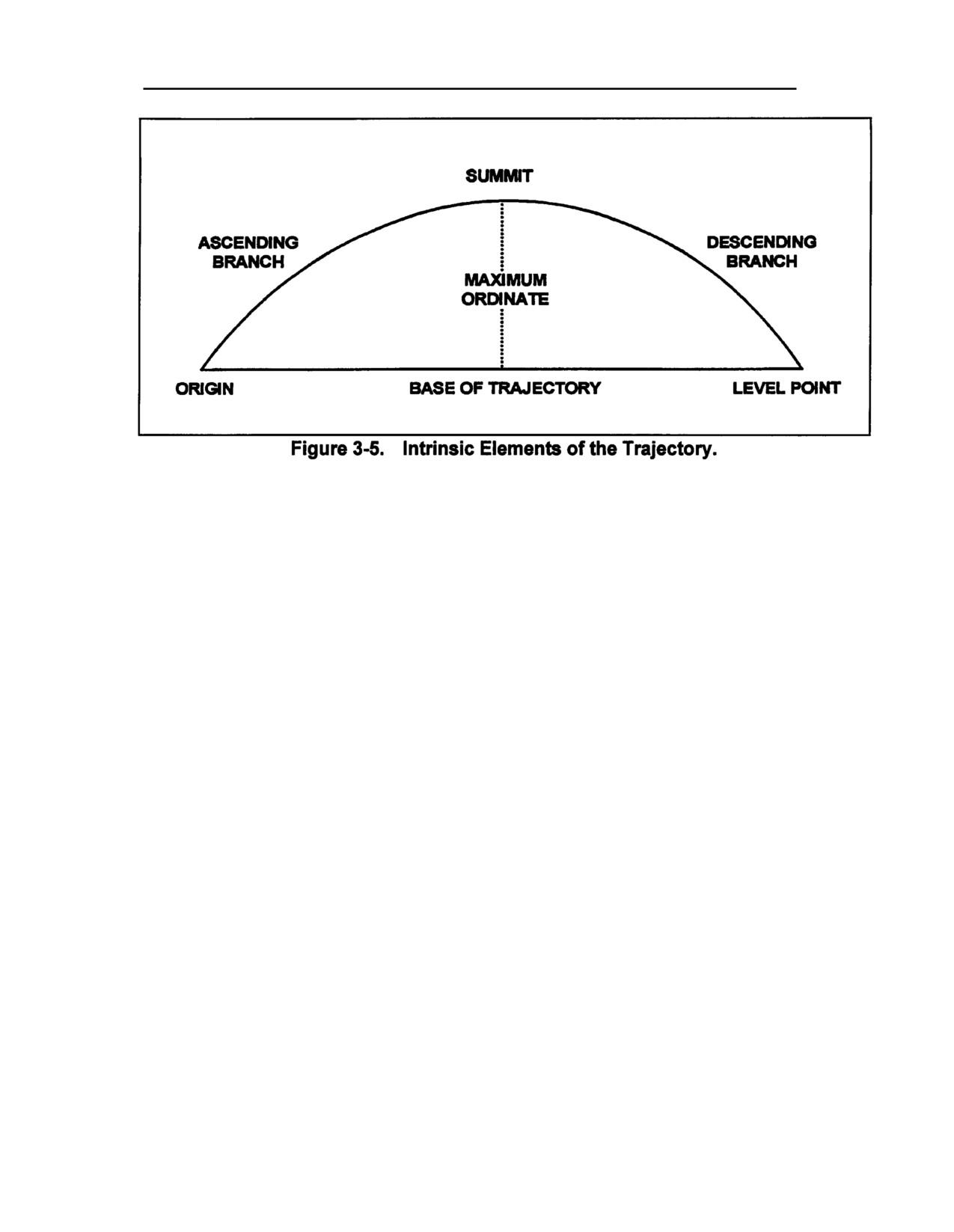
(1) Intrinsic elements. Elements that are characteristic of any trajectory, by
definition, are intrinsic elements. (See Figure 3-5.)
(a) The origin is the location of the center of gravity of the projectile when it
leaves the muzzle. It also denotes the center of the muzzle when the piece has been laid.
(b) The ascending branch is the part of the trajectory that is traced as the
projectile rises from the origin.
(c) The summit is the highest point of the trajectory.
(d) The maximum ordinate is the difference in altitude (alt) between the origin
and the summit.
(e) The descending branch is the part of the trajectory that is traced as the
projectile is falling.
(f) The level point is the point on the descending branch that is the same
altitude as the origin.
(g) The base of the trajectory is the straight line from the origin to the level
point.
3-12
FM 6-40
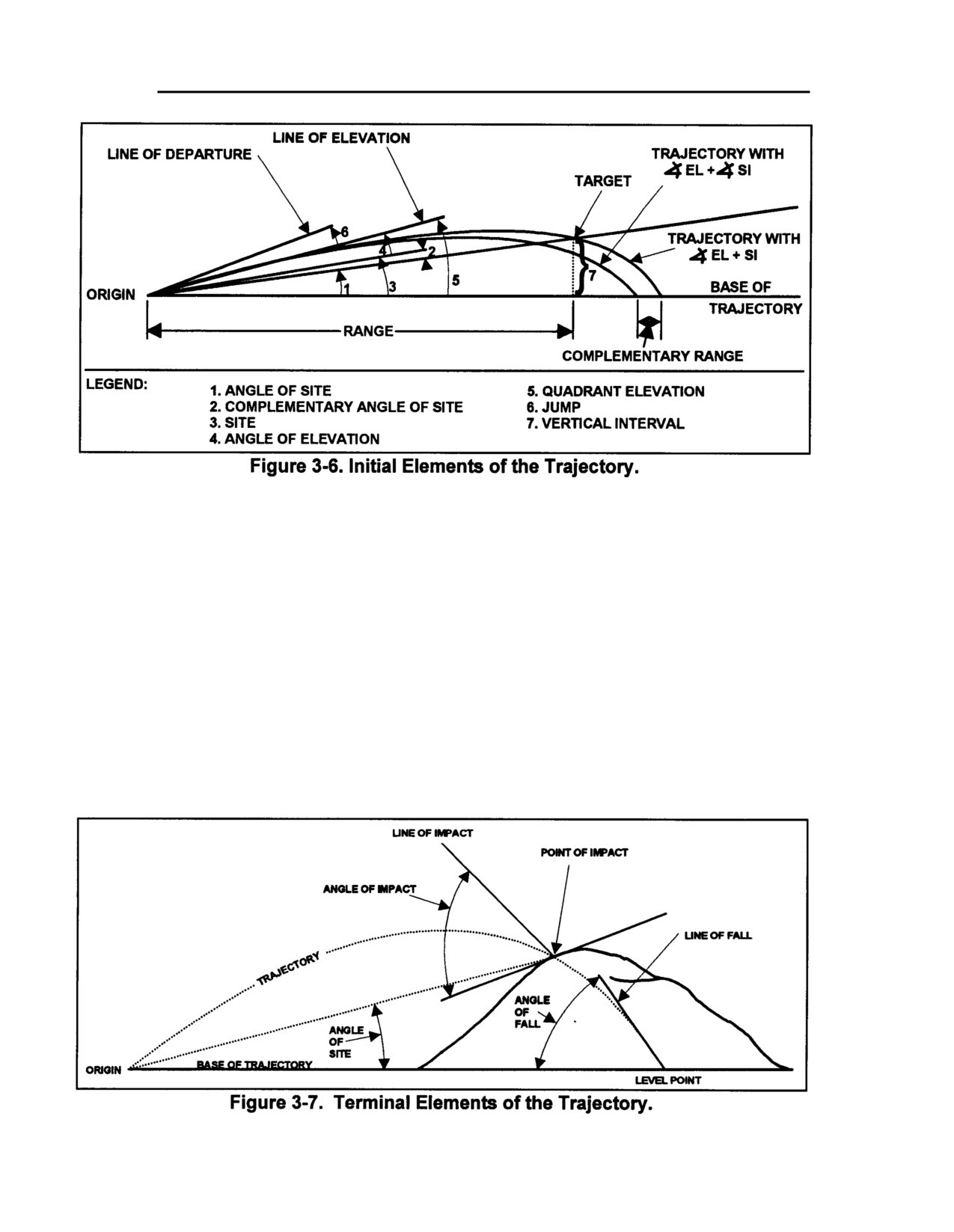
(2) Initial elements. Elements that are characteristic at the origin of the trajectory
are initial elements. (See Figure 3-6.)
(a) When the piece is laid, the line of elevation is the axis of the tube
extended.
(b) The line of departure is a line tangent to the trajectory at the instant the
projectile leaves the tube.
(c) Jump is the displacement of the line of departure from the line of elevation
that exists at the instant the projectile leaves the tube.
(d) The angle of site is the smaller angle in a vertical plane from the base of
the trajectory to a straight line joining the origin and the target. Vertical interval is the difference
in altitude between the target and the origin.
(e) The complementary angle of site is an angle that is algebraically added to
the angle of site to compensate for the nonrigidity of the trajectory.
(f) Site is the algebraic sum of the angle of site and the complementary angle
of site. Site is computed to compensate for situations in which the target is not at the same
altitude as the battery.
(g) Complementary range is the number of meters (range correction)
equivalent to the number of mils of complementary angle of site.
(h) The angle of elevation is the vertical angle between the base of the
trajectory and the axis of the bore required for a projectile to achieve a prescribed range under
standard conditions.
(i) The quadrant elevation is the angle at the origin measured from the base of
the trajectory to the line of elevation. It is the algebraic sum of site and the angle of elevation.
3-13
FM 6-40
(3) Terminal elements. Elements that are characteristic at the point of impact are
terminal elements. (See Figure 3-7.)
(a) The point of impact is the point at which the projectile strikes the target area.
(The point of burst is the point at which the projectile bursts in the air.)
(b) The line of fall is the line tangent to the trajectory at the level point.
(c) The angle of fall is the vertical angle at the level point between the line of fall
and the base of the trajectory.
(d) The line of impact is a line tangent to the trajectory at the point of impact.
(e) The angle of impact is the acute angle at the point of impact between the line of
impact and a plane tangent to the surface at the point of impact. This term should not be confused
with angle of fall.
3-14
FM 6-40
b. Trajectory in a Vacuum.
(1) If a round were fired in a vacuum, gravity would cause the projectile to return to
the surface of the earth. The path or trajectory of the projectile would be simple to trace. All
projectiles, regardless of size, shape, or weight, would follow paths of the same shape and would
achieve the same range for a given muzzle velocity and quadrant elevation.
(2) The factors used to determine the data needed to construct a firing table for
firing in a vacuum are the angle of departure, muzzle velocity, and acceleration caused by the
force of gravity. The initial velocity imparted to a round has two components--horizontal
velocity and vertical velocity. The relative magnitudes of horizontal and vertical components
vary with the angle of elevation. For example, if the elevation were zero, the initial velocity
imparted to the round would be horizontal in nature and there would be no vertical component.
If, on the other hand, the elevation were 1,600 mils (disregarding the effects of rotation of the
earth), the initial velocity would be vertical and there would be no horizontal component.
(3) Gravity causes a projectile in flight to fall to the earth. Because of gravity, the
height of the projectile at any instant is less than it would be if no such force were acting on it. In
a vacuum, the vertical velocity would decrease from the initial velocity to zero on the ascending
branch of the trajectory and increase from zero to the initial velocity on the descending branch,
Zero vertical velocity would occur at the summit of the trajectory. For every vertical velocity
value on the upward leg of the ascending branch there is an equal vertical velocity value
downward on the descending branch. Since there would be no resistance to the forward motion
of the projectile in a vacuum, the horizontal velocity component would be a constant. The
acceleration caused by the force of gravity (9.81 m/s) affects only the vertical velocity.
c. Trajectory in a Standard Atmosphere.
(1) The resistance of the air to projectile movement depends on the air movement,
density, and temperature. As a point of departure for computing firing tables, assumed
conditions of air density and air temperature with no wind are used. The air structure is called the
standard atmosphere.
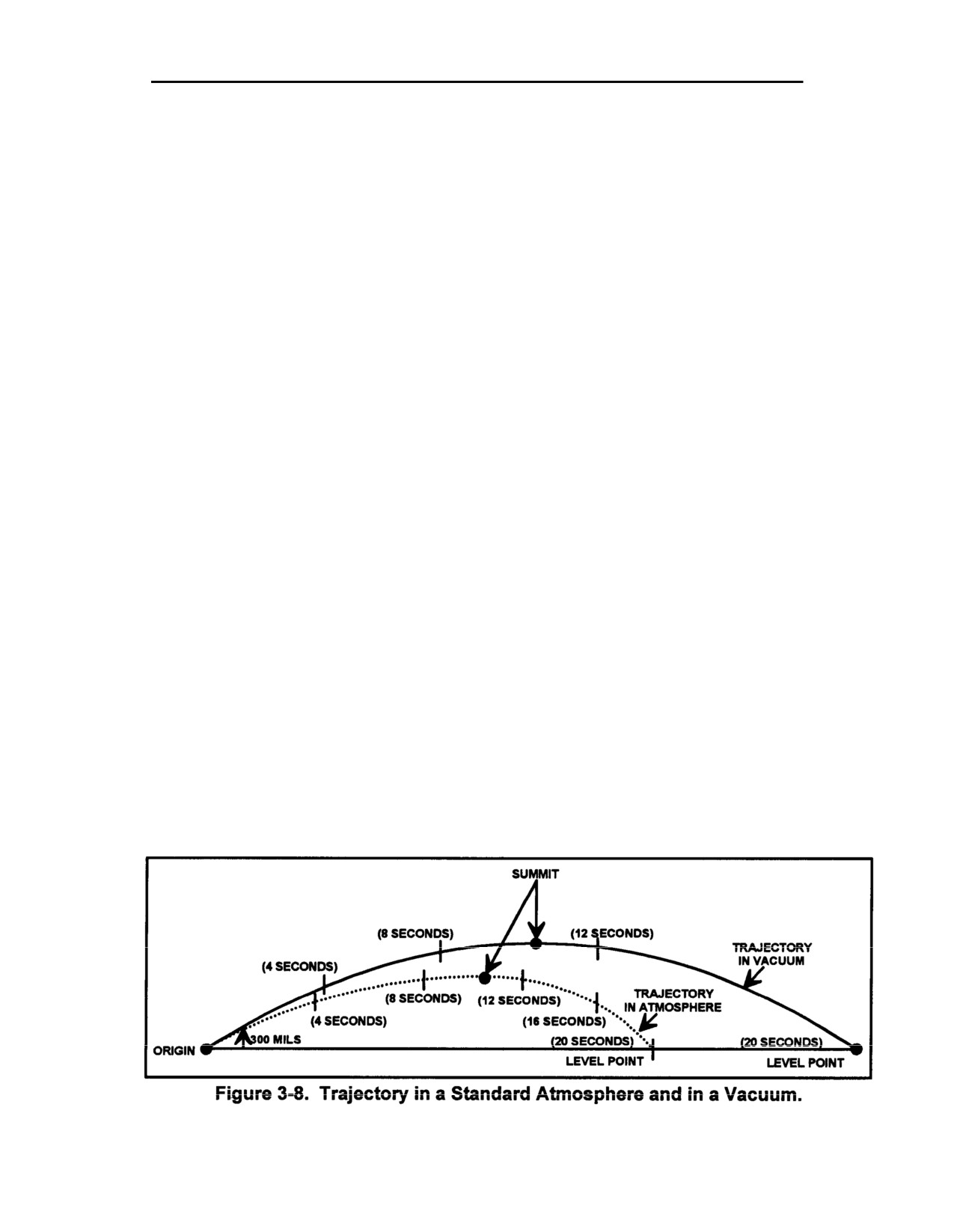
(2) The most apparent difference between the trajectory in a vacuum and the
trajectory in the standard atmosphere is a net reduction in the range achieved by the projectile. A
comparison of the flight of the projectile in a vacuum and in the standard atmosphere is shown in
Figure 3-8.
3-15
FM 6-40
(3) The difference in range is due to the horizontal velocity component in the
standard atmosphere no longer being a constant value. The horizontal velocity component is
continually decreased by the retarding effect of the air. The vertical velocity component is also
afected by air resistance. The trajectory in the standard atmosphere has the following
characteristic differences from the trajectory in a vacuum:
(a) The velocity at the level point is less than the velocity at the origin.
(b) The mean horizontal velocity of the projectile beyond the summit is less
than the mean velocity before the projectile reaches the summit; therefore, the projectile travels a
shorter horizontal distance. Hence, the descending branch is shorter than the ascending branch.
The angle of fall is greater than the angle of elevation.
(c) The spin (rotational motion) initially imparted to the projectile causes it to
respond differently in the standard atmosphere because of air resistance. A trajectory in the
standard atmosphere, compared to a trajectory in a vacuum, will be shorter and lower at any
specific point along the trajectory for the following reasons:
Horizontal velocity is not a constant value; it decreases with each
succeeding time interval.
Vertical velocity is affected by both gravity and the effects of the
atmosphere on the projectile.
The summit in a vacuum is midway between the origin and the level
point; in the standard atmosphere, it is actually nearer the level point.
The angle of fall in a vacuum is equal to the angle of elevation; in the
standard atmosphere, it is greater.
d. Relation of Air Resistance and Projectile Efficiency to Standard Range.
(1) This paragraph concerns only those factors that establish the relationship
between the standard range, elevation, and achieved range.
(a) The standard (chart) range is the range opposite a given elevation in the
firing tables. It is assumed to have been measured along the surface of a sphere concentric with
the earth and passing through the muzzle of a weapon. For all practical purposes, standard range
is the horizontal distance from the origin of the trajectory to the level point.
(b) The achieved range is the range attained as a result of firing the cannon at
a particular elevation. If actual firing conditions duplicate the ballistic properties and met
conditions on which the firing tables are based, then the achieved range and the standard range
will be equal.
(c) The corrected range is the range corresponding to the elevation that must
be fired to reach the target.
(2) Air resistance affects the flight of the projectile both in range and in direction.
The component of air resistance in the direction opposite that of the forward motion of the
projectile is called drag. Because of drag, both the horizontal and vertical components of velocity
are less at any given time along the trajectory than they would be if drag was zero (as it would be
3-16
FM 6-40
in a vacuum). This decrease in velocity varies directly in magnitude with drag and inversely with
the mass of the projectile. Several factors considered in the computation of drag areas follows:
(a) Air density. The drag of a given projectile is proportional to the density of
the air through which it passes. For example, an increase in air density by a given percentage
increases drag by the same percentage. Since the air density at a specific place, time, and altitude
varies widely, the standard trajectories reflected in the firing tables were computed with a fixed
relationship between air density and altitude.
(b) Velocity. The faster a projectile moves, the more the air resists its motion.
Examination of a set of firing tables reveals that given a constant elevation, the effect of a 1
percent change in air density (and corresponding 1 percent increase in drag) increases with an
increase in charge (with the greater muzzle velocity). The drag is approximately proportional to
the square of the velocity except when velocity approaches the speed of sound. At the speed of
sound, drag increases more rapidly because of the increase in pressure behind the sound wave.
(c) Projectile diameter. Two projectiles of identical shape but of different size
will not experience the same drag. For example, a large projectile will offer a larger area for the
air to act upon; thus, its drag will be increased by this factor. The drag of projectiles of the same
shape is assumed to be proportional to the square of the projectile diameter.
(d) Ballistic coefficient. The ballistic coefficient of a projectile is a measure of
its relative efficiency in overcoming air resistance. An increase in the ballistic coefficient reduces
the effect of drag and consequently increases range. The reverse is true for a decrease in the
ballistic coefficient. The ballistic coefficient can be increased by increasing the ratio of the
weight of the projectile to the square of its diameter. It can also be increased by improving the
shape of the projectile.
(e) Drag coefficient. The drag coefficient combines several ballistic properties
of typical projectiles. These properties include yaw (the angle between the direction of motion
and the axis of the projectile) and the ratio of the velocity of the projectile to the speed of sound.
Drag coefficients, which have been computed for many projectile types, simplify the work of
ballisticians. When a projectile varies slightly in shape from one of the typical projectile types,
the drag coefficient can be determined by computing a form factor for the projectile and
multiplying the drag coefficient of a typical projectile type by the form factor.
e. Deviations From Standard Conditions. Firing tables are based on actual firings of
a piece and its ammunition correlated to a set of standard conditions. Actual firing conditions,
however, will never equate to standard conditions. These deviations from standard conditions, if
not corrected for when computing firing data will cause the projectile to impact at a point other
than the desired location. Corrections for nonstandard conditions are made to improve accuracy.
(1) Range effects. Some of the deviations from standard conditions affecting range are:
Muzzle velocity.
Projectile weight.
3-17
FM 6-40
Range wind.
Air temperature.
Air density.
Rotation of the earth.
(2) Deflection effects. Some of the deviations from the standard conditions
affecting deflection are:
Drift.
Crosswind.
Rotation of the earth.
3-4. Dispersion and Probability
If a number of rounds of ammunition of the same caliber, lot, and charge are fired from
the same position with identical settings used for deflection and quadrant elevation, the rounds
will not all impact on a single point but will fall in a scattered pattern. In discussions of artillery
fire, this phenomenon is called dispersion, and the array of bursts on the ground is called the
dispersion pattern.
3-5. Causes of Dispersion
a. The points of impact of the projectiles will be scattered both in deflection and in
range. Dispersion is caused by inherent (systemic) errors. It should never be confused with
round-to-round variations caused by either human or constant errors. Human errors can be
minimized through training and supervision. Corrections to compensate for the effects of
constant errors can be determined from the TFT. Inherent errors are beyond control or are
impractical to measure. Examples of inherent errors are as follows:
(1) Conditions in the bore. The muzzle velocity achieved by a given projectile is
affected by the following:
Minor variations in the weight of the projectile, form of the rotating band,
and moisture content and temperature of the propellant grains.
Differences in the rate of ignition of the propellant.
Variations in the arrangement of the propellant grains.
Differences in the rate of ignition of the propellant.
Variations in the ramming of the projectile.
Variations in the temperature of the bore from round to round.
For example, variations in the bourrelet and rotating band may cause inaccurate centering of the
projectile, which can result in a loss in achieved range because of instability in flight.
3-18
FM 6-40
(2) Conditions in the carriage. Deflection and elevation are affected by the
following:
Play (looseness) in the mechanisms of the carriage.
Physical limitations of precision in setting values of deflection and quadrant
elevation on the respective scales.
Nonuniform reactions to firing stress.
(3) Conditions during flight. The flight of the projectile may be affected by the
difference in air resistance created by variations in the weight, achieved muzzle velocity, and
projectile. Also, the projectile may be affected by minor variations in wind, air
density or air pressure, and air temperature from round to round.
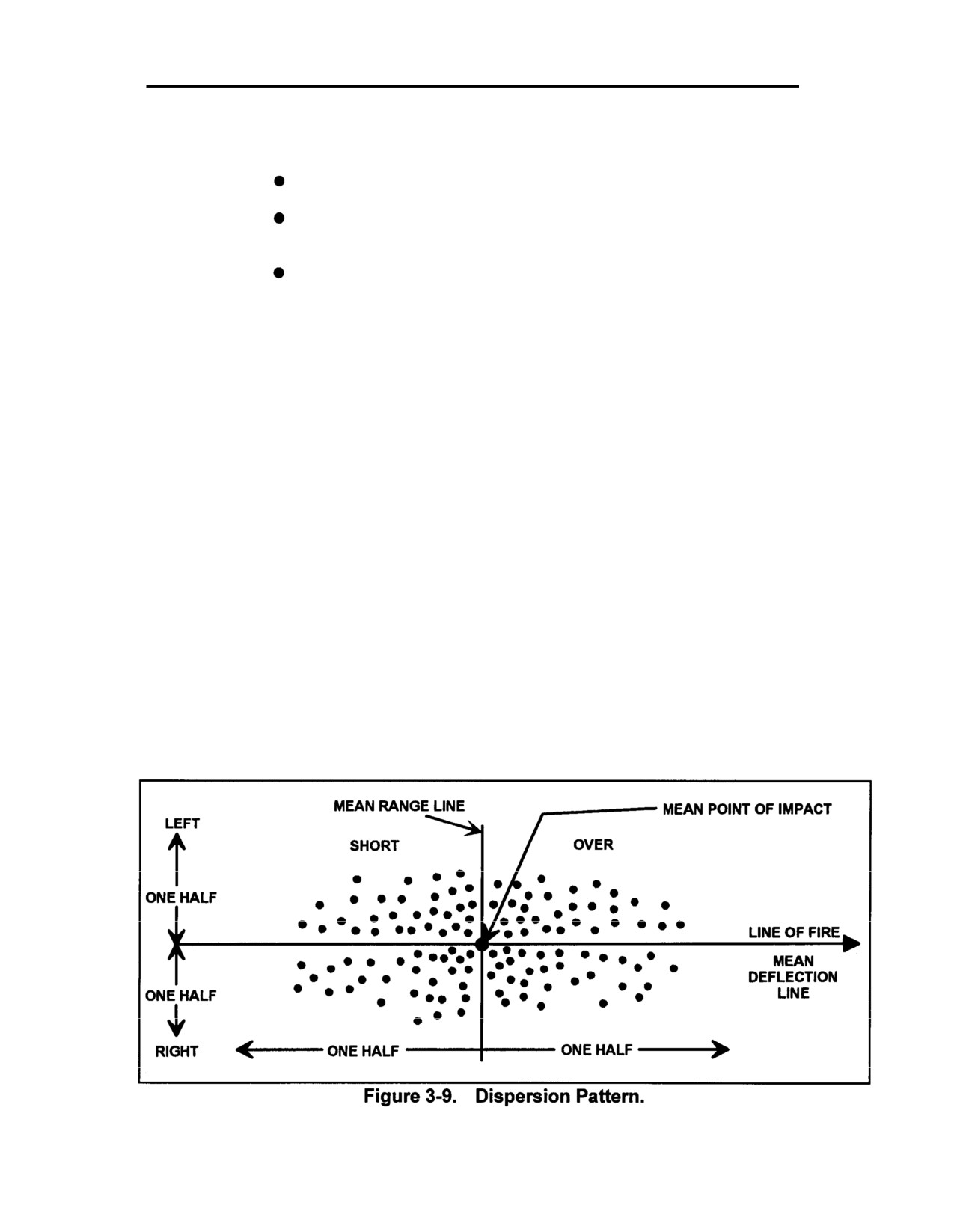
b. The distribution of bursts (dispersion pattern) in a given sample of rounds is roughly
elliptical (Figure 3-9) in relation to the line of fire.
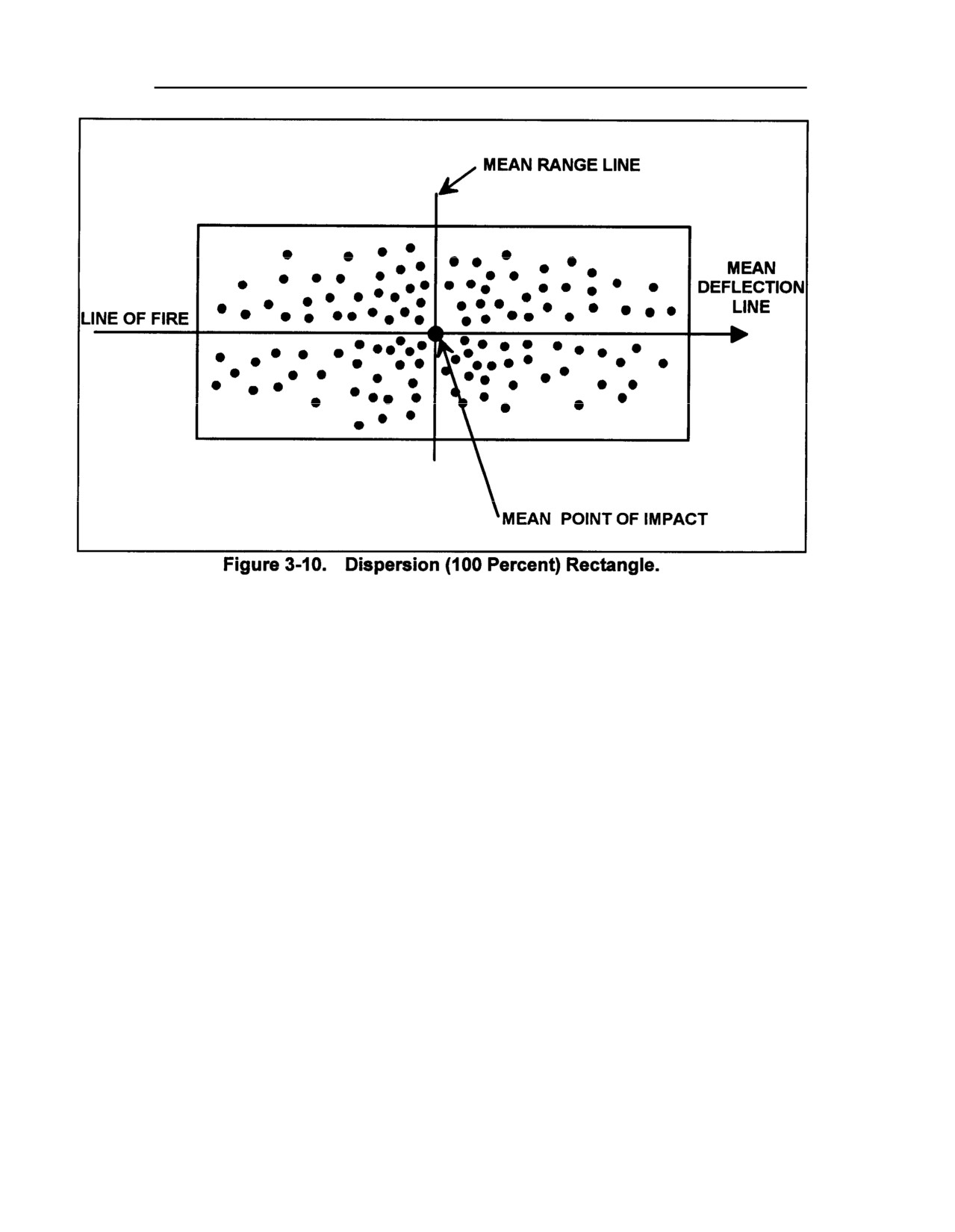
c. A rectangle constructed around the dispersion area (excluding any erratic rounds) is
called the dispersion rectangle, or 100 percent rectangle. (See Figure 3-10.)
3-6. Mean Point of Impact
For any large number of rounds fired, the average (or mean) location of impact can be
determined by drawing a diagram of the pattern of bursts as they appear on the ground. A line
drawn perpendicular to the line of fire can be used to divide the sample rounds into two equal
groups. Therefore, half of the rounds will be over this line when considered in relation to the
weapon. The other half of the rounds will be short of this line in relation to the weapon. This
dividing line represents the mean range of the sample and is called the mean range line. A
second line can be drawn parallel to the line of fire, again dividing the sample into two equal
groups. Half of the rounds will be to the right of this line, and half will be to the left. This line
represents the mean deflection of the sample and is called the mean deflection line. (See Figure
3-9.) The intersection of the two lines is the mean point of impact (MPI). (See Figure 3-10.) -
3-19
FM 6-40
3-7. Probable Error
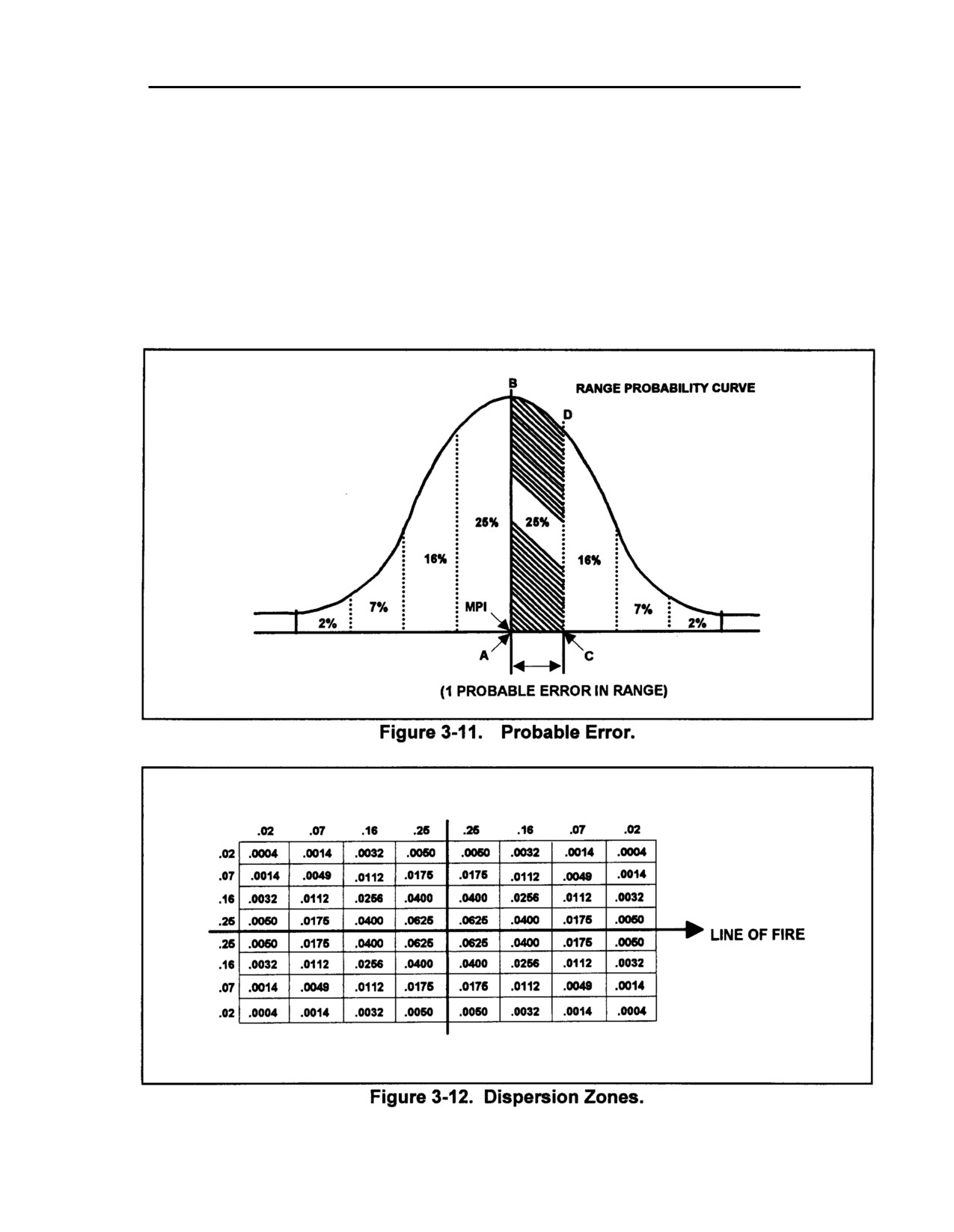
Probable error is nothing more than an error that is exceeded as often as it is not exceeded. For
example, in Figure 3-11, consider only those rounds that have impacted over the mean range line (line AB).
These rounds all manifest errors in range, since they all impacted over the mean range line. Some of the
rounds are more in error than others. At a point beyond the MPI, a second line can be drawn perpendicular to
the line of fire to divide the "ovens" into two equal groups (line CD, Figure 3-11). When the distance from the
MPI to line CD is used as a measure of probable error, it is obvious that half of the overs show greater
magnitude of error than the other half. This distance is one probable error in range. The range probability
curve expresses the following:
a. In a large number of samples, errors in excess and errors in deficiency are equally
frequent (probable) as shown by the symmetry of the curve.
b. The errors are not uniformly distributed. Small errors occur more frequently than
large errors as shown by the greater number of occurrences near the mean point of impact.
3-8. Dispersion Zones
If the dispersion rectangle is divided evenly into eight zones in range with the value for 1
probable error in range (PER) used as the unit of measure, the percentage of rounds impacting
within each zone is as indicated in Figure 3-12. The percentage of rounds impacting within each
zone has been determined through experimentation. By definition of probable error, 50 percent
of all rounds will impact within 1 probable error in range or deflection of the mean point of
impact (25 percent over and 25 percent short or 25 percent left and 25 percent right).
3-20
FM 6-40
3-9. Range Probable Error
The values for range probable error at various ranges are given in Table G of the tabular
firing tables (TFT). These values may be used as an index of the precision of the piece at a
particular charge and range. The values for range probable error are listed in meters. Firing
Table (FT) values have been determined on the basis of actual firing of ammunition under
controlled conditions. For example, FT 155-AM-2 shows that the value of range probable error
for charge 5 green bag (GB) at a range of 6,000 meters is 15 meters. On the basis of the 100
percent rectangle, 50 percent of the rounds will impact within 15 meters (over and short) of the
mean range line, 82 percent will impact within 30 meters (over and short), 96 percent will impact
within 45-meters (over and short), and 100 percent will impact within 60 meters.
3-21
FM 6-40
3-10. Fork
The term fork is used to express the change in elevation (in mils) needed to move the
mean point of impact 4 probable errors in range. The values of fork are listed in Table F of the
firing tables. For example, FT 155-AM-2 shows that the value of fork for a howitzer firing
charge 5GB at a range of 6,000 meters is 4 mils. On the basis of the value for probable error in
range (paragraph 3-9), adding 4 mils to the quadrant elevation would cause the MPI to move 60
meters. Fork is used in the computation of safety data (executive officer’s minimum QE).
3-11. Deflection Probable Error
The values for probable error in deflection (PED) are listed in Table G of the
firing tables. For artillery cannons, the deflection probable error is considerably
smaller than the range probable error. Values for PED are listed in meters. With the
same parameters as those used in paragraph 3-9, the deflection probable error is 4
meters. Therefore, 50 percent of the rounds will impact within 4 meters of the mean
deflection line (left and right); 82 percent, within 8 meters (left and right); 96 percent,
within 12 meters (left and right); and 100 percent, within 16 meters.
3-12. Time-To-Burst Probable Error
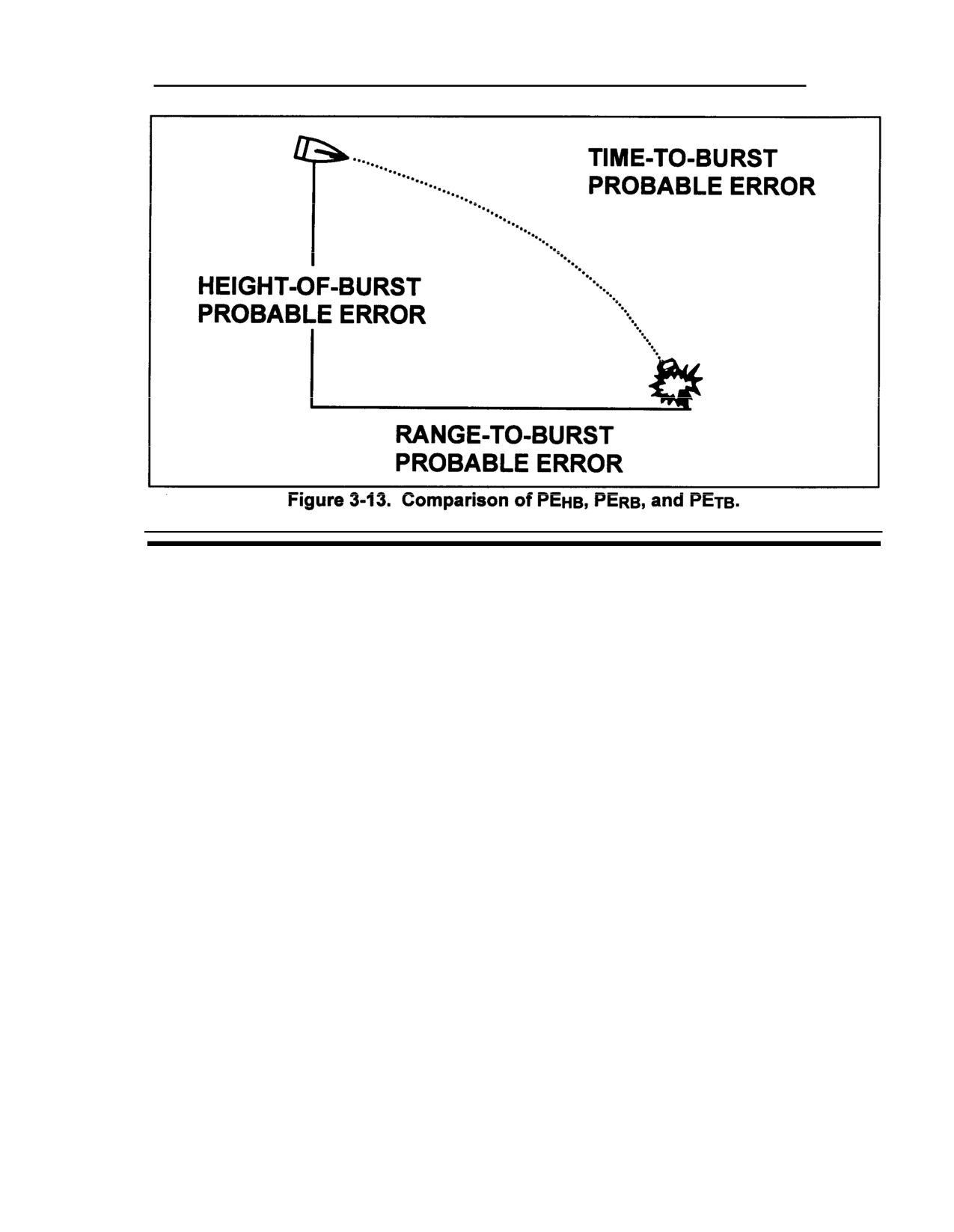
The values of time-to-burst probable error (PETB) (Figure 3-13) are listed in
Table G of the firing tables. Each of these values is the weighted average of the
precision of a time fuze timing mechanism in relation to the actual time of flight of the
projectile. For example, if a 155-mm howitzer fires charge 5GB at a range of 6,000
meters, the value for probable error in time to burst is 0.11 second. As in any other
dispersion pattern, 50 percent of the rounds will function within 0.11 second; 82
percent, within 0.22 second; 96 percent, within 0.33 second; and 100 percent within
0.44 second of the mean fuze setting.
3-13. Height-Of-Burst Probable Error
With the projectile fuzed to burst in the air, the height-of-burst probable error
(PEHB) (Figure 3-13) is the vertical component of 1 time-to-burst probable error. The
height-of-burst probable error reflects the combined effects of dispersion caused by
variations in the functioning of the time fuze and dispersion caused by the conditions
described in paragraph 3-5(a). The values listed (in meters) follow the same pattern of
distribution as for those discussed for range dispersion. These values are listed in
Table G of the firing tables.
3-14. Range-To-Burst Probable Error
Range-to-burst probable error (PERB) (Figure 3-13) is the horizontal component
of 1 time-to-burst probable error. When this value is added to or subtracted from the
expected range to burst, it will produce an interval along the line of fire that should
contain 50 percent of the rounds fired. These values are listed in Table G of the firing
tables.
3-22
FM 6-40
3-23
FM 6-40
Chapter 4
MUZZLE VELOCITY MANAGEMENT
The achieved muzzle velocity is the result of forces acting on the projectile. To obtain
accurate artillery fire, the performance of the weapon projectile family-propellant type-charge
combination must be known. If it is not known, the result can be reduced effects on the target or
friendly casualties (for example, danger close, final protective fire [FPF], converged sheafs, and
so on). Firing tables give standard muzzle velocities for a standard weapon firing standard
ammunition under standard conditions. However, muzzle velocities achieved in actual firing may
differ from the standard muzzle velocities because of variations in the manufacture of the weapon
and ammunition, wear in the weapon tube, projectile weight, propellant temperature, propellant
lot efficiency, or a combination of these factors. The M90 velocimeter enables a firing unit to
continually update muzzle velocity data. This chapter describes muzzle velocity management
with the M90 velocimeter.
4-1. Muzzle Velocity Terms
The following terms are associated with muzzle velocity management.
a. Muzzle velocity-- the velocity achieved by a projectile as it leaves the muzzle of the
weapon (measured in meters per second).
b. Standard muzzle velocity-- An established muzzle velocity used for comparison. It
is dependent upon the weapon system, propellant type, charge, and projectile. It is also referred
to as reference muzzle velocity.
c. Muzzle velocity variation-- the change in muzzle velocity of a weapon (expressed in
meters per second) from the standard muzzle velocity.
d. Projectile family-- a group of projectiles that have exact or very similar ballistic
characteristics. Projectile types within the family are identified by model number.
e. Propellant type-- the nomenclature of the propellant used for a particular charge.
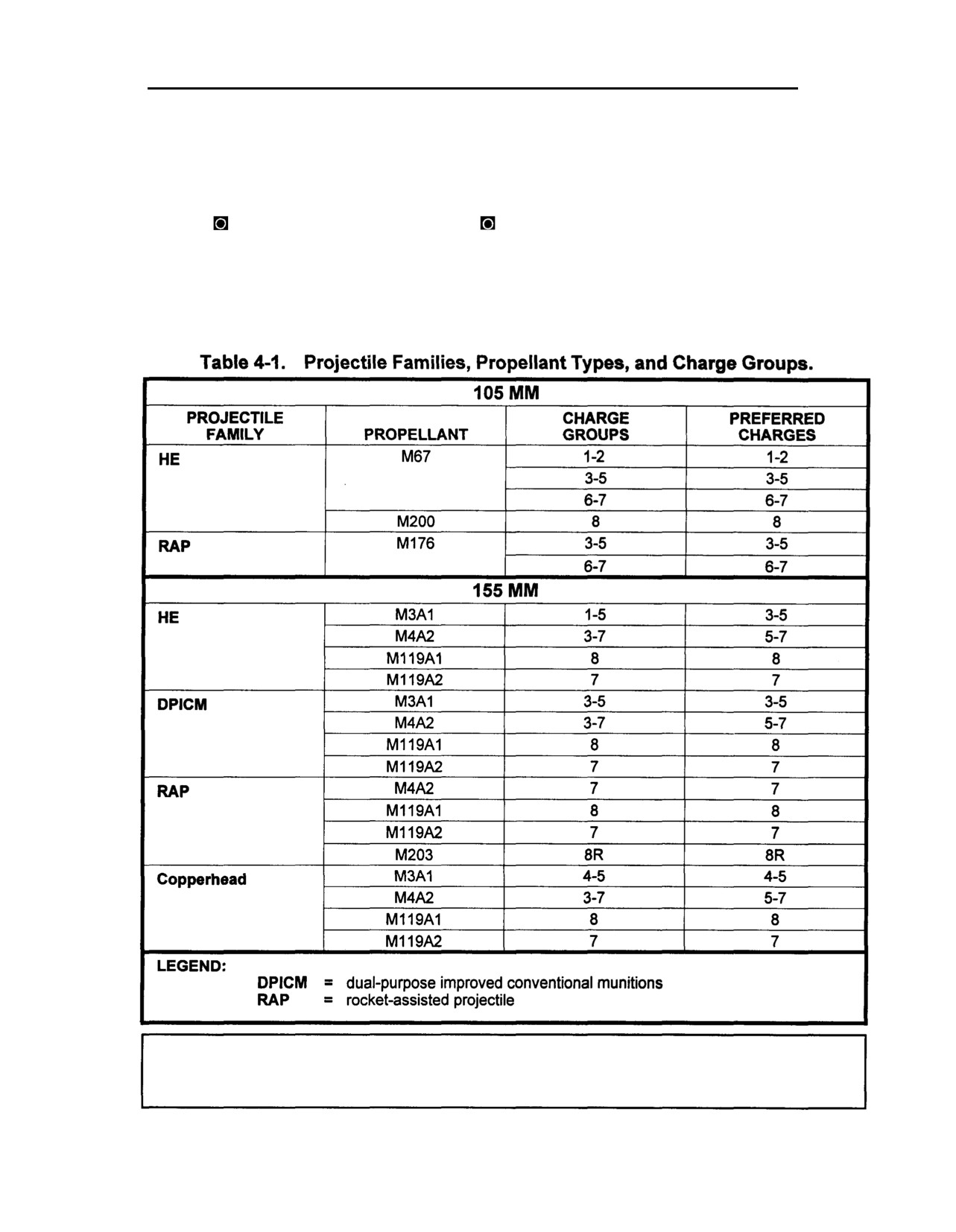
f. Charge group-- the charges within the propellant type associated with a projectile
family, within which MVVs can be transferred. (See Table 4-1.) This has been referred to as
propellant model or powder model in the past and in other references. In separate-loading
ammunition (155 mm) these terms are synonymous, but in 105-mm ammunition, three charge
groups are within a propellant type.
g. Preferred charges-- the charges preferred for measuring and transferring muzzle
velocities. These charges produce consistent predictable muzzle velocities. The MVVs they
produce should not vary more than 1.5 meters per second for the same charge or other charges of
the same charge group. Therefore, the MVV determined for one charge of a propellant type will
be similar (1.5 rids) to another charge of the same propellant type and lot. Preferred charges are
identified in Table 4-1.
4-1
FM 6-40
NOTE: The principle of MWs not varying by more than 1.5 m/s generally holds
true within preferred subsonic charges of a propellant type. However, the
convenience gained by this assumption more than offsets losses in accuracy, and it
is sufficiently valid to allow for accurate massing.
h. Restricted charges-- those charges within a charge group to which it is not preferred
to transfer measured MVVs or for which it is not authorized to fire (is based on the weapon TM).
The performance of a restricted charge is not indicative of the performance of other charges
within the charge group.
i. Adjacent charge-- charges within a charge group which are 1 charge increment
greater or less than the charge calibrated. Used in the conduct of a calibration and subsequent lot
inference techniques.
j. Propellant lot-- a group of propellants made by the same manufacturer at the same
location with the same ingredients.
k. Calibration-- measuring the muzzle velocity of a weapon and then performing a
comparison between the muzzle velocity achieved by a given piece and the accepted standard.
There are two types of calibration--absolute and comparative.
(1) In absolute calibration, the weapon muzzle velocity is compared to the firing
table reference muzzle velocity.
(2) In a comparative calibration, the achieved muzzle velocities of two weapons are
compared.
l. M90 Readout average-- the average MV measured by the M90 which has not been
corrected to standard projectile weight and standard propellant temperature.
m. Calibrated muzzle velocity-- an M90 readout average that has been corrected to
standard projectile weight and propellant temperature.
n. Historical muzzle velocity-- a calibrated muzzle velocity which has been recorded in
a muzzle velocity logbook.
o. Inferred calibration-- the MV of a weapon is determined through mathematical
procedures by using data from a first lot calibration (baseline data) and the relative efficiency of a
second lot of propellant.
p. Erosion-- the wear in a howitzer tube that is the result of firing rounds. It is measured
from a pullover gauge reading, which is described in inches, or estimated by computing the
equivalent full charges (EFCs) for erosion. This is determined by multiplying the number of
rounds fired with a given charge and the number of EFCs per round for that charge and projectile.
q. Shooting strength-- the change in the achieved muzzle velocity of a howitzer over
time caused by erosion, which is a function of erosion and projectile family ballistics.
4-2
FM 6-40
r. Ammunition efficiency-- the change in velocity which is the sum of the projectile
efficiency and propellant efficiency.
s. Projectile efficiency-- known deviations from the standard for a particular projectile
which effect the achieved velocity. For example, a high-explosive (HE) Ml 07 projectile which
weighs 3 , 93.9 pounds, vice the standard 4
, 95.0 pounds, would have a predictable change in
velocity, depending on the charge fired.
t. Propellant efficiency-- known deviations from the standard for a particular propellant
which effects the velocity of the projectile. For example, a lot of M3A1 propellant may perform
differently than the standard for that propellant type but is still acceptable for firing.
NOTE: Refer to ST 6-40-16 for information on the chare group and preferred
charges for the 8-inch (203-mm) howitzer.
4-3
FM 6-40
4-2. Calibration
Three techniques can be used to determine calibration data. The accuracy and complexity
of these different techniques varies greatly. Each of the techniques must be understood and
applied correctly to the tactical situation. The following order of preference can be used as a
guideline. The techniques are listed in order of decreasing preference.
M90 chronograph calibration or baseline calibration.
Subsequent lot inferred calibration.
Predictive muzzle velocity techniques.
a. M90 Chronograph Calibration.
(1) Determine calibration data. The howitzer section installs the M90
velocimeter and records the administrative (admin) data at the top of the M90 Velocimeter Work
Sheet (DA Form 4982-l-R). The M90 readout values are recorded in the center portion of the
form. Normally, data from six usable rounds, all preferably fired within 20 minutes, are used to
ensure the most accurate calibration data. These six rounds can be from any fire mission
conducted by the firing unit. Specially conducted calibration missions are not required. If the
howitzer tube is cold (that is, has not been engaged in firing or in low air temperatures) the firing
of warm-up rounds is recommended. Fewer than six rounds can be used. In these situations, the
calibration validity is reduced in the same way that the validity of a registration is reduced when
the number of rounds fired is less than normal. In these situations, refer to Chapter 10, Table
10-1 for validity information and the effect of reduced rounds on the calibration data. Powder
temperature differences between rounds decrease the validity of the calibration. To reduce
powder temperature changes from round to round, use proper propellant handling and storing
procedures in the firing unit and fire all rounds measured for a calibration within a 20-minute
period. Follow these procedures in the calibration of all weapons. When the admin data and the
M90 velocimeter readout data are entered on DA Form 4982- l-R for all weapons, the form is
given to the fire direction center.
(2) Determine M90 readout average. The FDO inspects the readout values for all
rounds and deletes any invalid readout values, those exceeding the readout average by ±3.0 m/s.
This ±3.O m/s approximates 4 PER in the target area for the given charge. The FDC personnel
then determine the new readout average for the usable rounds by adding all usable readout values
and dividing the sum by the number of usable rounds. This value includes the effects of
nonstandard propellant temperature and projectile weight.
(3) Correct to standard. The M90 velocimeter readout average is not used in its
original form because it includes the effects of projectile weight and propellant temperature on
the muzzle velocity. The MV can be used when the corrections for projectile weight and
propellant temperature are applied by extracting the value from the appropriate table in the
MVCT M90-2 manual and applying that value to the readout average. The correction tables
contain data to correct the readout average to what it would have been if the reading had been
determined with a standard square-weight projectile and a standard propellant temperature of
70ºF. Enter MVCT M90-2 for the appropriate weapon system and projectile family.
Locate the page containing the table for the same charge fired in the calibration. Enter the
table with the average propellant temperature and the weight of the projectile fired. Interpolate
4-4
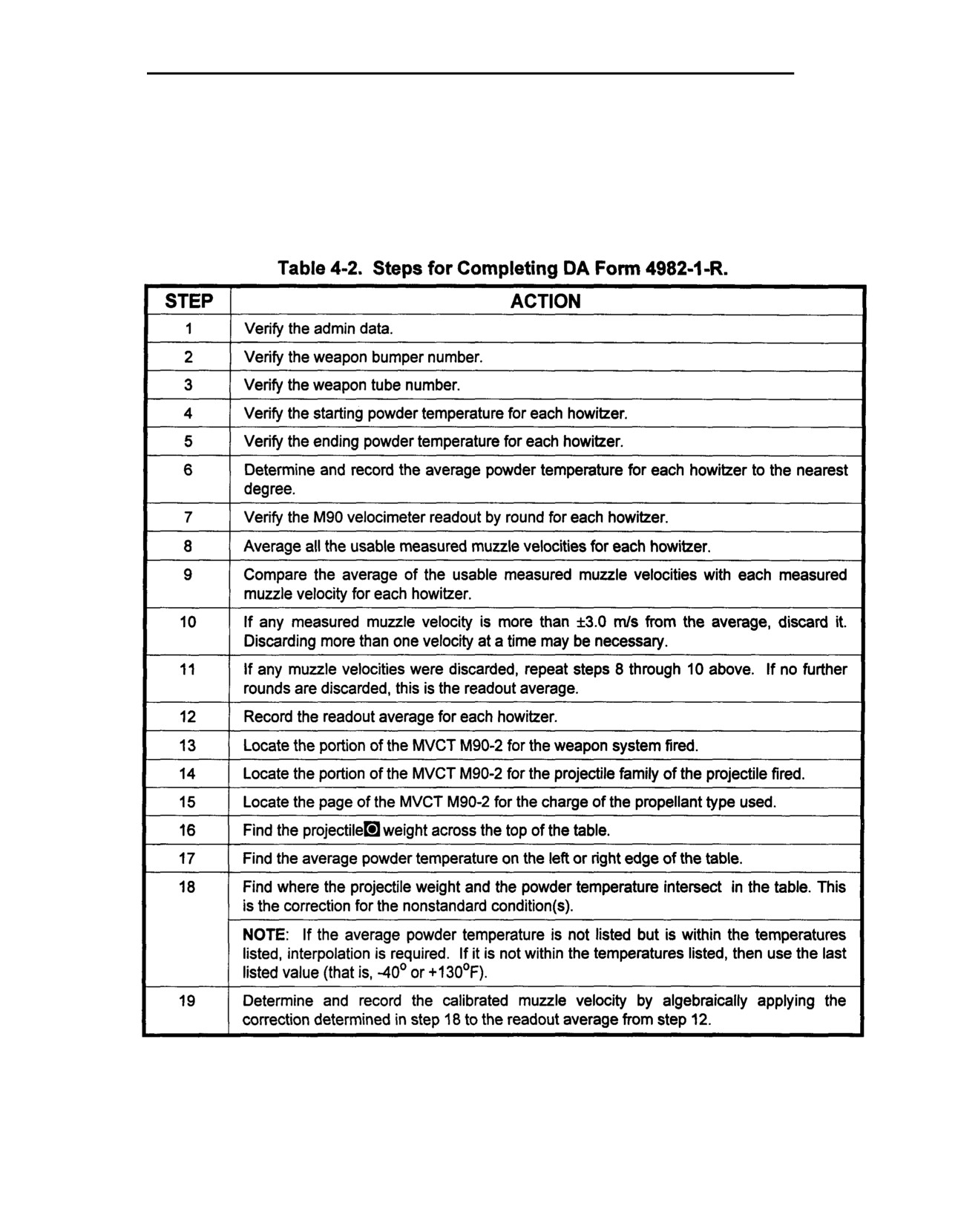
FM 6-40
the value to correct the readout average to standard, and apply that value to the readout average.
The result is the calibrated muzzle velocity for the weapon.
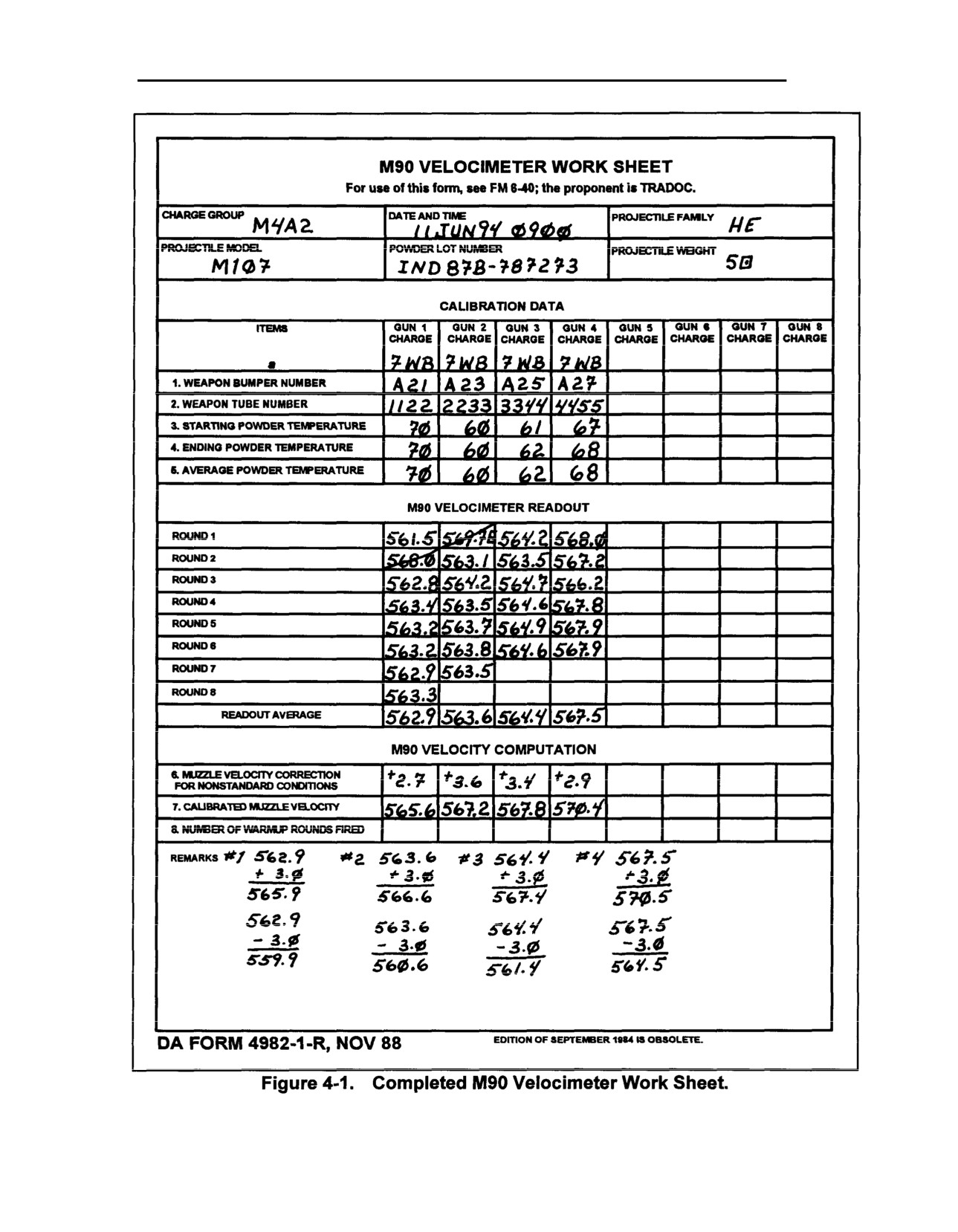
(4) Complete HE M90 velocimeter worksheet.Once the velocity of the rounds
fired has been determined, FDC personnel are responsible for verifying and completing the DA
Form 4982-l-R. This will include the ste
shown in Figure 4-1.
4-5
FM 6-40
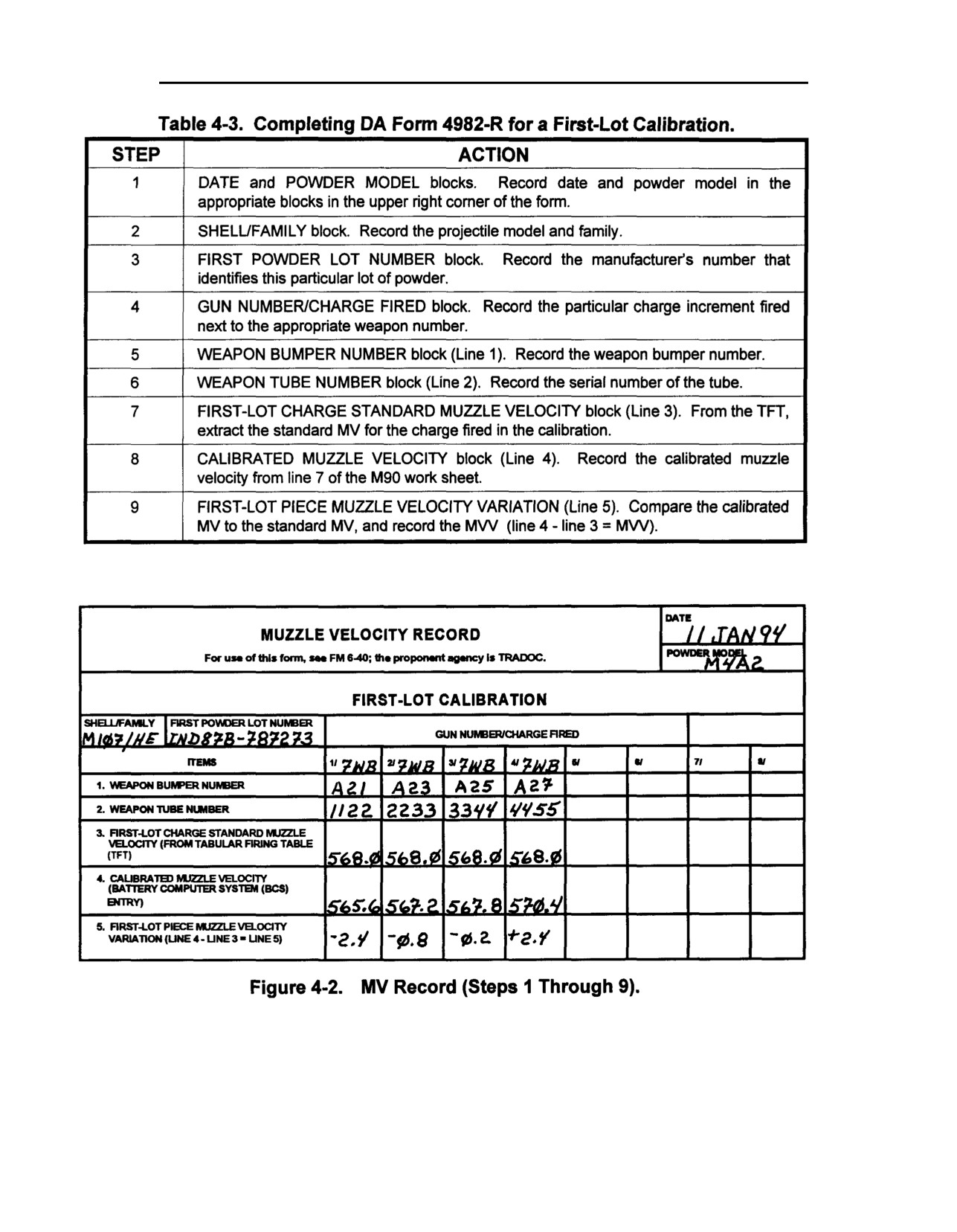
(5) Complete the Muzzle Velocity Record (DA FORM 4982-R).
(a) DA Form 4982-R is the record of a calibration kept in the battery
or platoon muzzle velocity log book. The top part of the form (FIRST-LOT
CALIBRATION) is used to determine the weapon MVV for a specific charge, when
corrected to standard. For future reference, place the completed muzzle velocity record
into the unit muzzle velocity logbook under the appropriate weapon projectile
family-propellant type-charge group. Ensure this information is given to the platoon
leader or XO for entry on DA Form 2408-4 (Weapon Record Data) or NAVMC 10558
(Weapon Record Book, Part 1) and 10558A (Weapon Record Book, Part H) for the
weapon.
(b) The determined MVV is used in the solution of concurrent and
subsequent met techniques and terrain gun position corrections. The lower part of the
form (SECOND-LOT CALIBRATION AND SECOND-LOT INFERENCE) is used to
infer muzzle velocity data for a second lot of propellant and/or ammunition.
(c) Table 4-3 provides the steps for completing DA Form 4982-R, and
Figure 4-2 shows the form completed through the first nine steps.
b. Subsequent Lot Inferred Calibration.
(1) Inferred subsequent lot calibration techniques allow a firing unit to
quickly update muzzle velocity information for a given projectile family-propellant
type combination, when firing a new lot of propellant. Subsequent lot calibration is
used to isolate the difference in efficiency between two propellant lots for one howitzer
firing the same projectile family. This difference is applied to the first lot calibration
data for the other howitzers to determine calibration data for the second lot. This
technique can be used when the situation does not permit the calibration of the new lot
with all guns.
(2) To accomplish this technique, the following requirements must be met:
Calibration of the first lot must be completed for the entire unit.
Calibration of a second lot must be completed for one gun.
(3) A calibration should be completed with all howitzers as soon as the
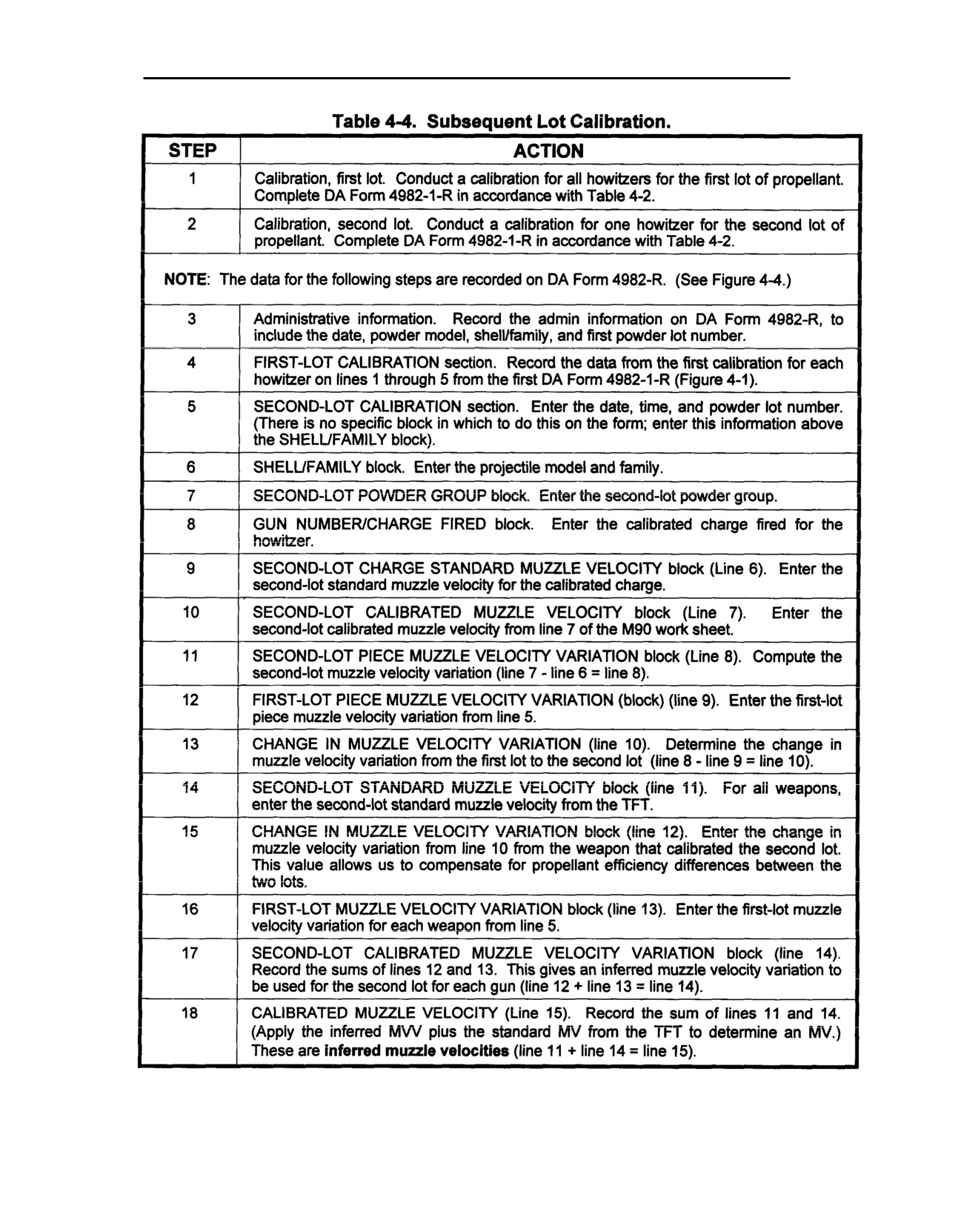
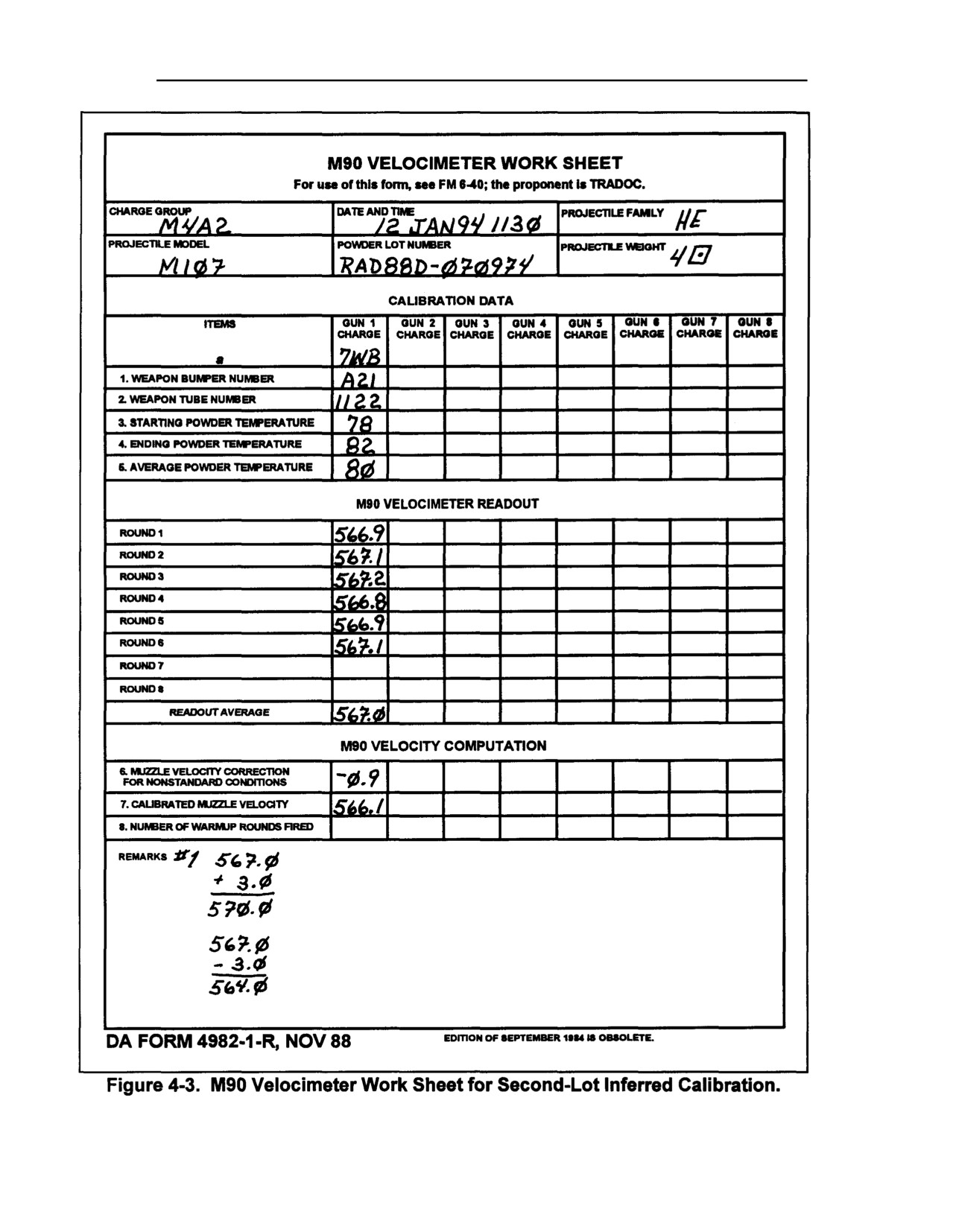
situation allows. Table 4-4 provides the steps for conducting a subsequent lot
calibration. Figure 4-3 shows DA Form 4982- 1-R completed for a second-lot inferred
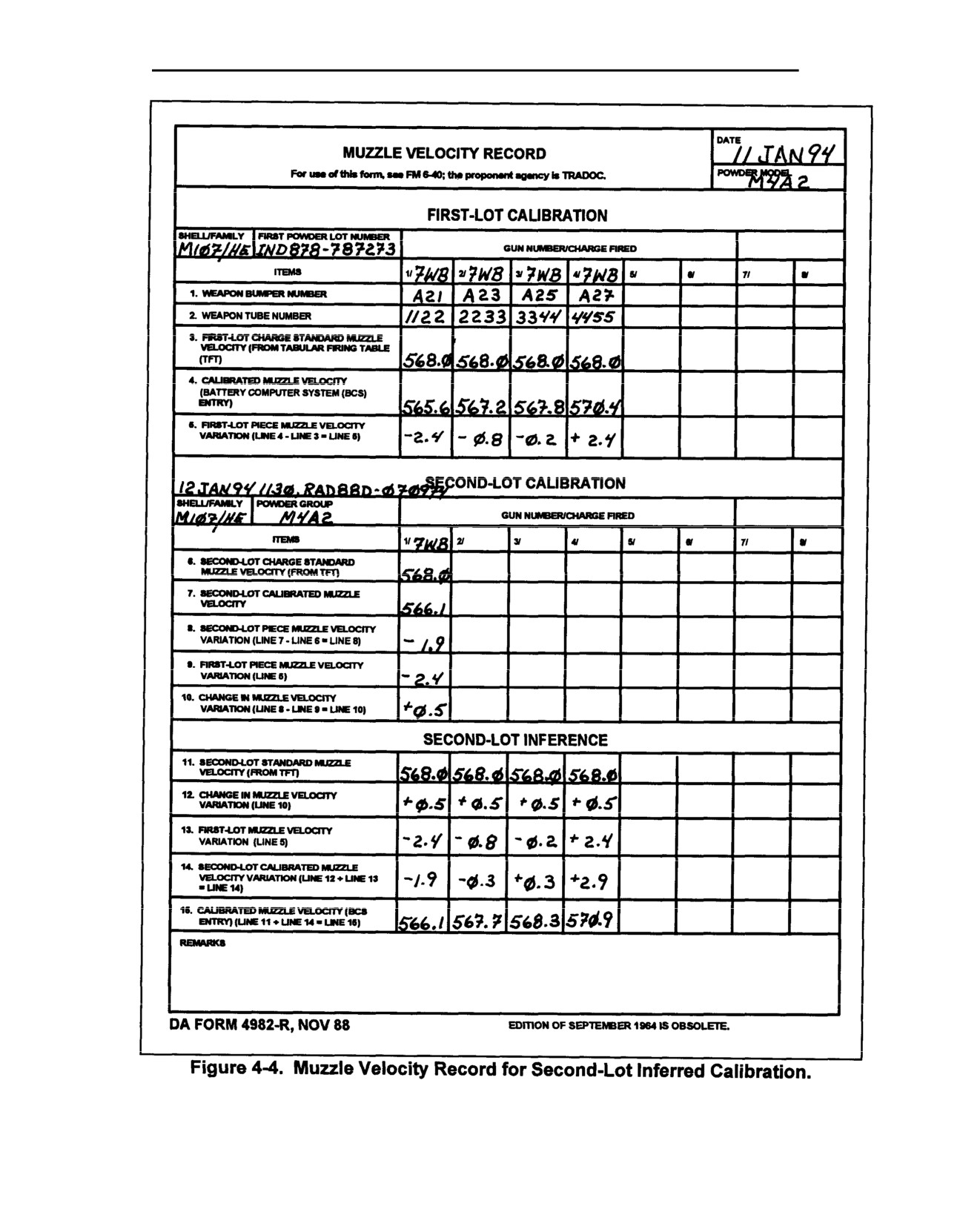
calibration. Figure 4-4 shows DA Form 4982-R completed for a second-lot inferred
calibration.
4-6
FM 6-40
4-7
FM 6-40
4-8
FM 6-40
4-9
FM 6-40
4-10
FM 6-40
4-11
FM 6-40
c. Predictive Muzzle Velocity Technique. While it is not practical to predict (within
0.1 m/s) the velocity of every round, it is possible to approximate velocities to within 1 or 2 m/s
with current available information. This may be useful when calibration is not possible, when
updating calibration data, or when trying to increase the accuracy of inferred MV techniques.
(1) When calibration is not possible, the shooting strength of the howitzer can be
used as the MVV. While this may be enough when no other data are available, it is important to
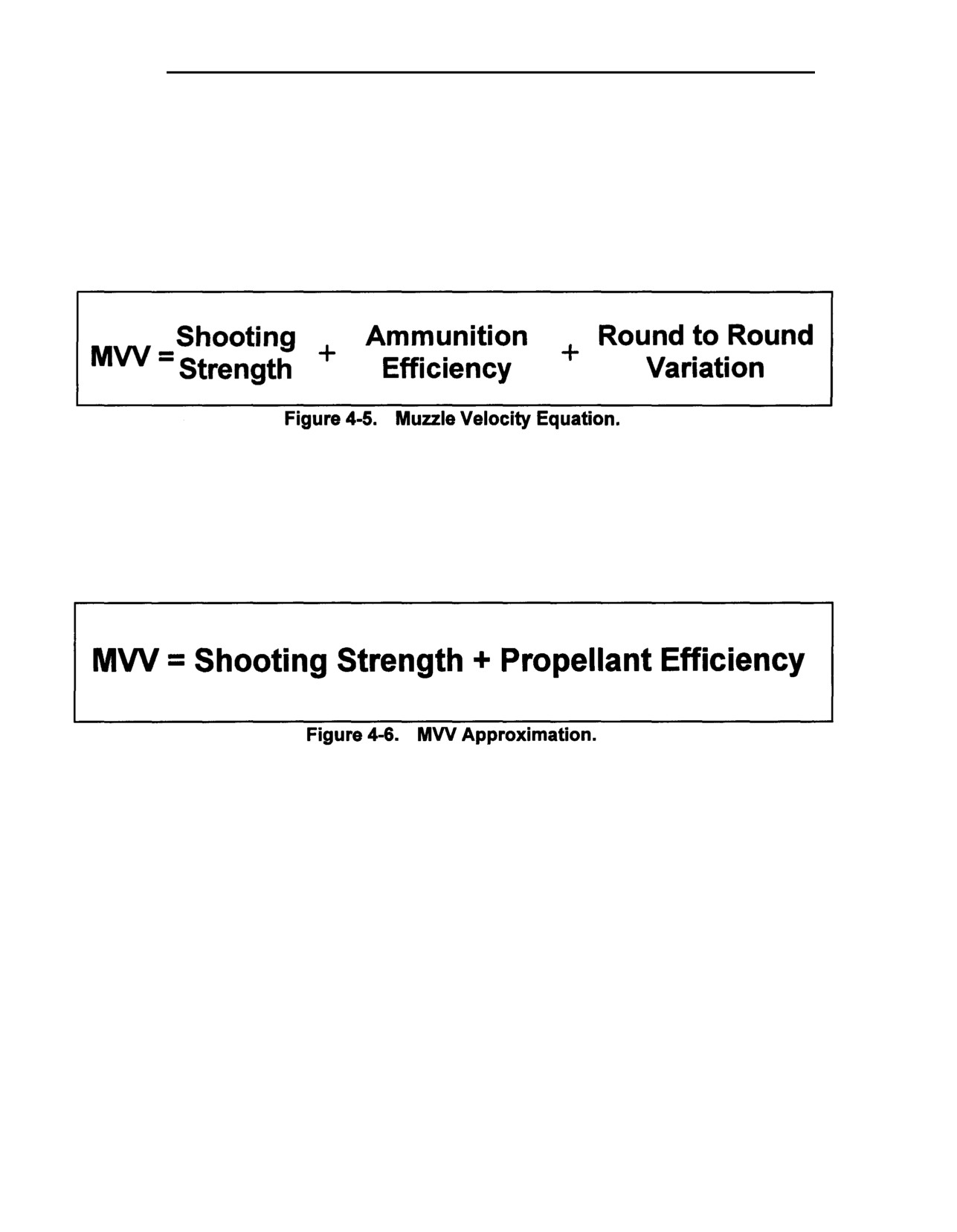
understand that an MVV consists of more than just shooting strength. An equation can be
created for determining an MVV by using its basic parts. (See Figure 4-5.)
(2) If all three elements are known, it is possible to determine a value for MVV. It
is neither practical nor necessary to quantify round-to-round variation. This element is usually
small and subject to rapid change. Projectile efficiency, as a part of ammunition efficiency, is
accounted for in solving the concurrent and subsequent met techniques. Therefore, if the
round-to-round variation and the projectile efficiency are eliminated from the equation, the
howitzer shooting strength and the propellant efficiency of the propellant lot to be fired can
approximate the MVV. (See Figure 4-6.)
(3) If calibration is not possible, adding the propellant efficiency to the shooting
strength will result in a more accurate MVV for determining firing data than if the shooting
strength is considered alone. This MVV can be used as the MVV for manual fire missions. Each
howitzer has a value for shooting strength for each projectile family. Also, the value of
propellant efficiency applies to any projectile family with which the propellant lot is fired.
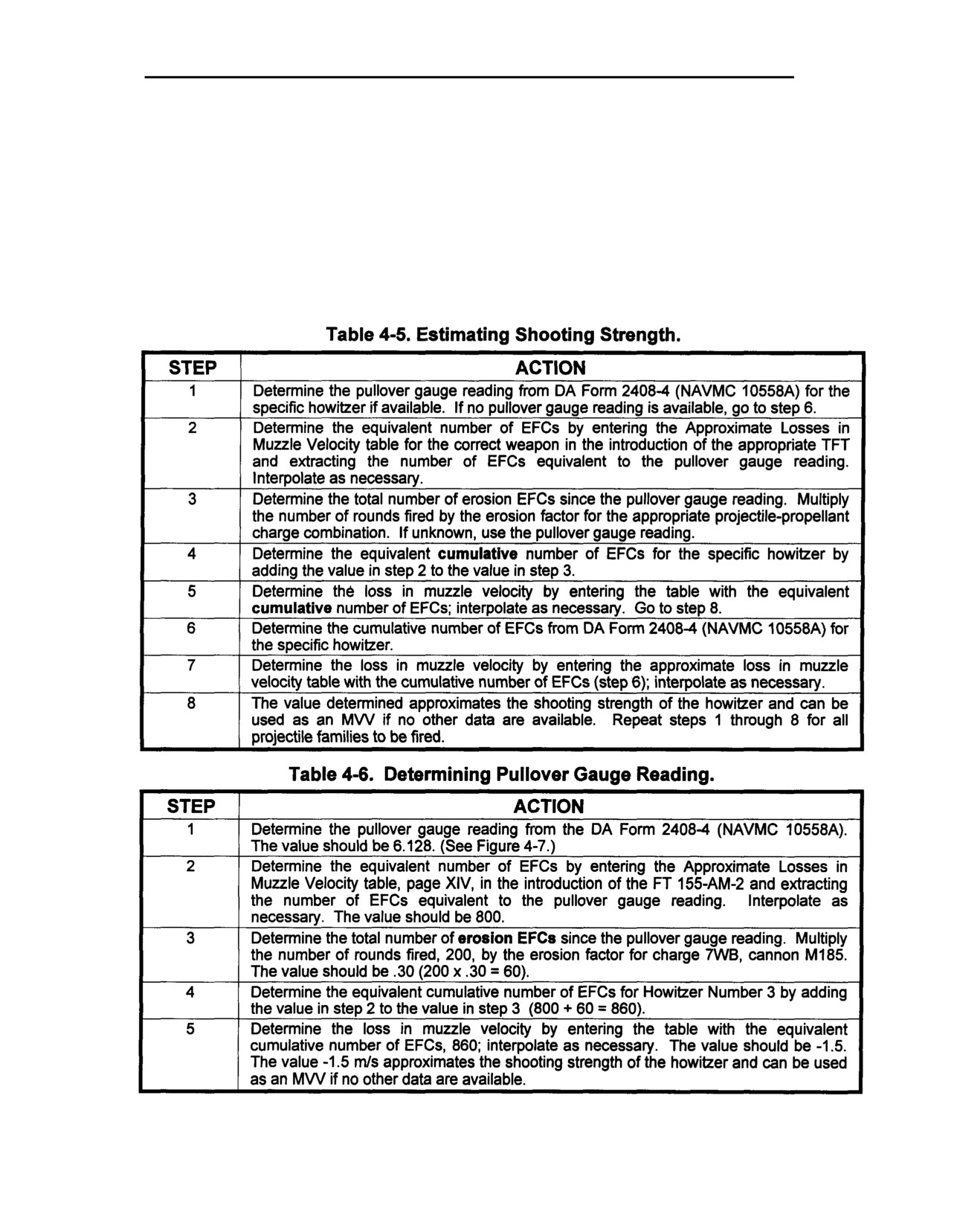
4-3. Estimating Shooting Strength
a. There may be times when calibration is not possible. If the M90 is not available or
there is not time to conduct a calibration, it may be necessary to determine the shooting strength
of the howitzer by other means. The shooting strength of a howitzer can be determined by using
pullover gauge readings and/or erosion EFC service round effects with the appropriate TFT for
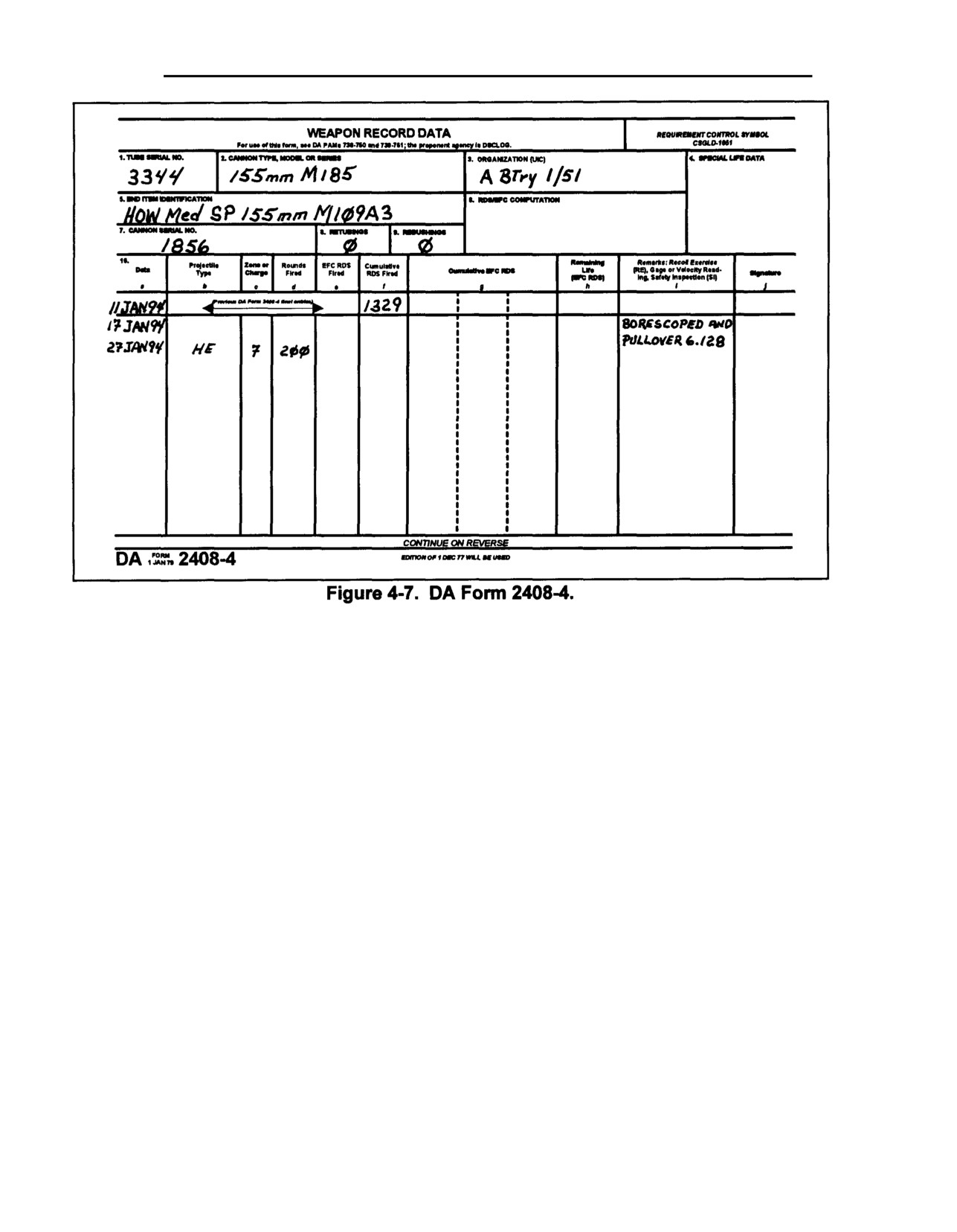
the weapon-projectile combination to be fired. (See Table 4-5.) DA Form 2408-4 provides the
information to determine the shooting strength of each howitzer. (See Figure 4-7.)
4-12
FM 6-40
b. The number of EFCs is determined by multiplying the number of rounds fired for a
specific projectile and propellant by the equivalent erosion effect in decimals for the charge fired
listed in the introduction of the TFT. Different projectile families have different TFTs and
consequently different values for equivalent erosion effect in decimals. Pullover gauge readings
can be determined regularly by the maintenance section in conjunction with borescoping the
howitzer. The most accurate technique is to combine the pullover gauge reading and the erosion
EFCs fired after the pullover gauge reading to determine an expected loss in muzzle velocity.
The most recent pullover gauge reading or total erosion EFCs may be used to determine the
approximate loss in muzzle velocity. Table 4-6 provides the steps for determining the pullover
gauge reading.
4-13
FM 6-40
4-4. Updating MVV Data
Once determined, the calibration data represent the best indicator of the expected MVV.
But the MVV is not valid forever since the howitzer shooting strength changes as more rounds
are fired. Calibration data can be made indefinitely valid if the shooting strength is continually
updated. If the shooting strength of the howitzer is determined at the time of calibration, the
changes in shooting strength can be added to the calibrated MVV over time. The current
shooting strength can be determined from the Approximate Losses in Muzzle Velocity table in
the TFT introduction on the basis of the pullover gauge readings and/or EFCs. The change in
shooting strength is determined by subtracting the shooting strength at the time of calibration
from the current shooting strength. This difference is then applied to the calibrated MVV to
determine a current or updated MVV.
4-5. Other Applications
a. The possible applications of the basic equation, Figure 4-6, provide enough flexibility
to determine any of the three parts of the equation (MVV, shooting strength, and propellant
efficiency). If any two parts are known, the third can be determined. For example, if a
replacement howitzer is received without its DA Form 2408-4, its shooting strength would be
unknown. However, if it was calibrated and the propellant efficiency of the calibrated propellant
lot is known, the shooting strength can be approximated (a modification of the formula found in
Figure 4-6). This approximated shooting strength could then be applied by using the techniques
described in paragraphs 4-2 and 4-3.
4-14
FM 6-40
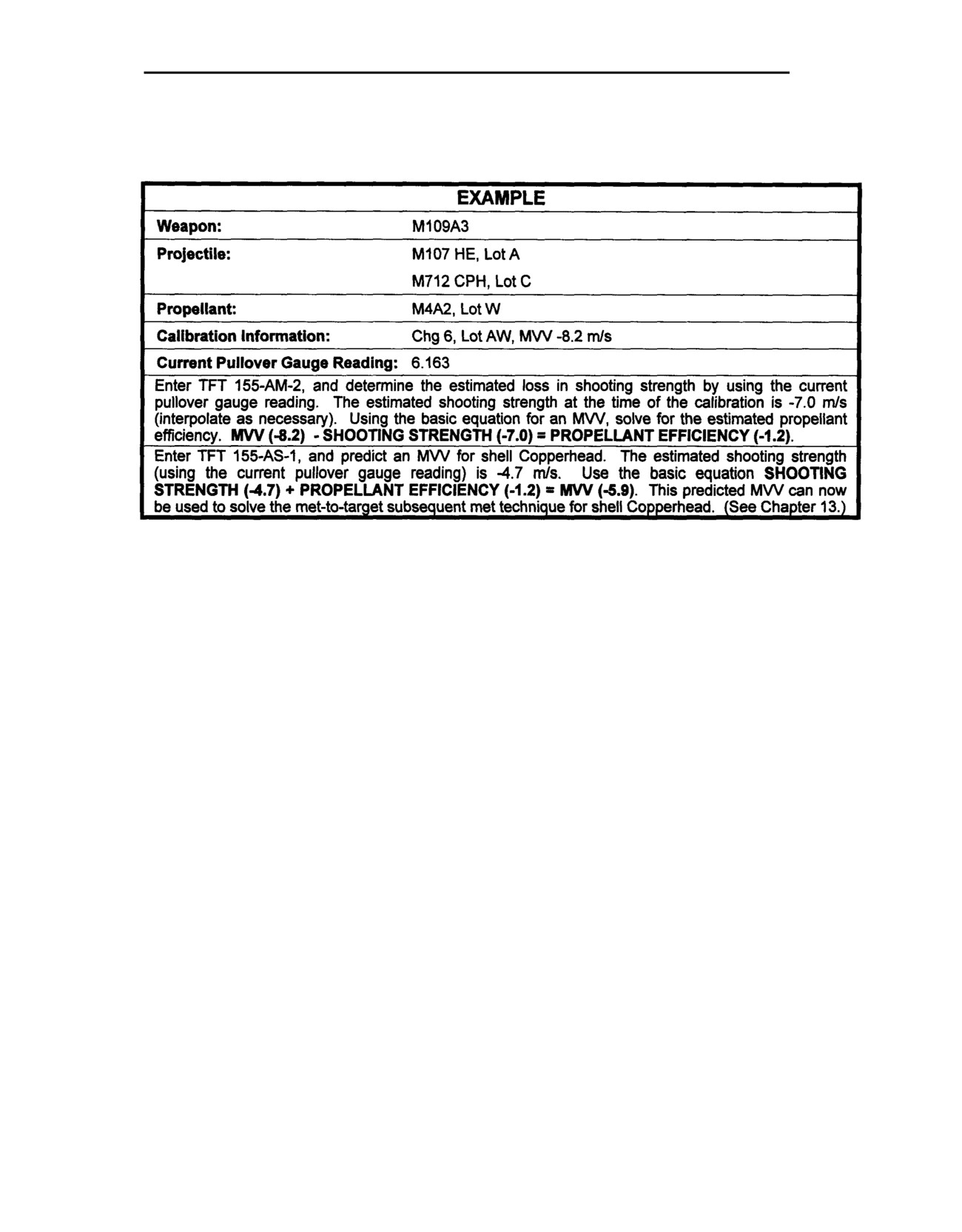
b. A useful application of the basic equation is the ability to solve for the propellant
efficiency of a given propellant lot. The propellant efficiency could then be used to predict an
MVV for a different projectile family. (See the example below.)
4-6. MVV Logbook
Once MV data have been determined, these data are used for numerous techniques. MV
data must be recorded on DA Form 4982-R which is then filed in an MV logbook. The MV
logbook allows for quick referencing of howitzer performance when firing a particular projectile
family-propellant lot-charge combination. The major sections in the MV logbook are for the
projectile families. Each one of the sections should be tabbed for each authorized propellant
type-charge group for the projectile family.
4-7. Frequency of Calibration
Ideally, calibration occurs continuously. If that is impractical or impossible, the
following methods identify when to consider calibrating.
a. Initial Receipt or Retubing. All new pieces of a given caliber and model will not
necessarily develop the same muzzle velocity because of the tolerances that are allowed in the
size of the powder chamber and in the dimensions of the bore. Therefore, pieces should be
calibrated as soon as possible after receipt or when retubed. Muzzle velocities should be
recorded on DA Form 2408-4.
b. Change in Propellant Lot. Calibration should be conducted as soon as possible
after an uncalibrated propellant lot is received.
c. New Projectile Family. Calibration should be conducted if a new projectile; for
example, M825 smoke (projectile family DPICM), is received for which there are no previous
MV records for that projectile family.
4-15
FM 6-40
d. Annually. Any piece in service should be recalibrated at least annually. The
primary factor contributing to the loss in muzzle velocity for a piece is the number of rounds that
have been fired through the tube and the charges used in firing them. Higher charges increase
tube wear, which, in turn, tends to decrease muzzle velocity. Guns, because of their higher
velocities, tend to display tube wear more quickly than howitzers. If a great deal of firing takes
place, recalibration will be needed more often than annually. Methods of determining when
recalibration may be needed are outlined below. The following situations assume that firing
takes place with a previously calibrated projectile family-propellant lot.
e. Changes in VE. If an accurate record of the changes in VE determined from
concurrent met solutions is maintained, it may be used as a guide for determining the need for
recalibration. When the velocity loss since the last calibration is equivalent to 2 range probable
errors, the need for recalibration is indicated. (An indicator of this is a loss of 1.5 m/s, which
generally approximates 2 probable errors in range.)
f. Tube Wear. The extent of tube wear near the beginning of the rifling of the bore
indicates the loss in muzzle velocity and the remaining tube life. Precise measurement of the
distance between the lands in the bore near the start of the rifling can be made with a pullover
gauge. Organizational or direct support maintenance has this gauge and makes the measurement.
The wear measurement, when compared with the data in the “wear” table (Approximate Losses in
Muzzle Velocity table) in the introduction of each firing table, can be used in estimating the loss
in muzzle velocity.
g. EFCs. A change in the number of erosion EFC service rounds as depicted in the
weapon record book may also indicate a need for recalibration. (Refer to paragraph 4-3 for more
information about EFCs.) The change in erosion EFC rounds compared with data in the
Approximate Losses in Muzzle Velocity table (in the introduction of each TFT) that corresponds
to a loss of 1.5 m/s in muzzle velocity may indicate a need for recalibration. A loss of 1.5 m/sin
MV generally equates to the effects of 2 probable errors in range (2 PER).
4-8. Transferring MVVs
a. Ideally, every charge should be calibrated. However, this may not always be feasible.
Therefore, the calibration of a few charges, one within each charge group that results in an MVV
applicable to other charges within a charge group, is imperative. For calibration purposes, there
are two categories of charges within a charge group. These are preferred charges and restricted
charges. The following guidance is established as an order of preference when selecting a charge
to calibrate:
(1) If you know the charge you will be firing calibrate that charge.
(2) If the charge you will be shooting is unknown, calibrate the middle charge of
the preferred charge group.
b. Calibration data determined should only be applied to a subsequent fire mission when
the mission meets the following requirement: It is the same calibrated howitzer firing the same
calibrated projectile family-propelant lot combination. Once calibration data are determined for
a particular charge, these data can be transferred to other charges in the same lot. The order of
preference for transferring is as follows:
4-16

FM 6-40
(1) Transfer down 1 charge.
(2) Transfer up 1 charge.
NOTE: Shooting strength and ammo efficiency make up the achieved MV. With
higher charges, there is more erosion but less variance in ammo efficiency. For
lower charges, there is less erosion but more variance in ammo efficiency.
Therefore, the general overall effect is less variance when transferring down as
opposed to up.
(3) Transfer down 2 charges within the preferred charges.
(4) Transfer up 2 charges within the preferred charges.
(5) Transfer from a preferred charge to a restricted charge.
NOTE: MWs should not be transferred from a restricted charge to any other
charge on the basis of the nature (large round-to-round variances) of restricted
charges.
4-17
FM 6-40
Chapter 5
FIRE MISSION MESSAGES
The processing of a fire mission involves three essential messages. These are the fire
order, message to observer, and fire commands. These messages contain the necessary
information to tactically engage the target, control the mission, and transmit technical fire
direction to the howitzers.
Section I
Fire Order
This section implements STANAG 2934, Chapter 7, and QSTAG 221.
In the fire order, the FDO specifies how the target will be attacked. This is
tactical fire direction.
5-1. Overview
When the FDC receives a call for fire (CFF), the FDO must determine if and how the
target will be attacked. This decision (part of tactical fire direction) may be made at the battalion
or battery or platoon FDC. In battalion missions, the battalion FDO is responsible for issuing the
fire order. In autonomous operations, the battery or platoon FDO is responsible for issuing the
fire order. A fire order is the FDO’s decision on what unit(s) will fire and how much and what
type of ammunition will be fired. It is based on the FDO’s analysis of the target.
5-2. Target Attack Considerations
In determining how, if at all, to attack a target, the FDO must consider several factors.
a. Location of the Target. The FDO must check the location relative to friendly
forces, fire support coordinating measures, and zones of responsibility. Target location accuracy
must also be considered. The range to the target will affect the choice of unit(s) to fire and
charge. The terrain around the target may influence ammunition selection and type of trajectory.
High intermediate crests may require selection of a lower charge or high-angle fire.
b. Nature of the Target. The size and type of target (for example, troops, vehicles,
hard, soft, and so on) will affect the following:
Number of units to fire.
Type of sheaf.
Selection of ammunition.
Number of rounds in fire for effect.
Priority.
Whether surprise fire (for example, time on target [TOT]) is possible.
5-1
FM 6-40
c. Ammunition Available. The FDO must consider the amount and type of
ammunition available and the controlled supply rate (CSR).
d. Units Available. The number of units available will not only affect which units will
be used, but also the type of attack. Sweep and/or zone fire or other techniques may be needed to
cover large targets when enough units are not available.
e. Commander’s Guidance or Standing Operating Procedures. Restrictions on
ammunition, the operations order, and SOPs may govern the selection of units and ammunition,
target priority, and method of attack.
f. Call for Fire. The FDO must consider the observer’s request carefully since he is
observing the target and talks directly to the maneuver commander. The observer’s request
should be honored when possible.
g. Munitions Effects. The FDO may use the joint munitions effectiveness manual
(JMEM) to determine the type munition and volume of fire to be delivered. The FDO will rely
most often on the graphical munitions effectiveness table (GMET), attack guidance matrixes,
commander’s guidance, and/or experience.
h. Availability of Corrections. The availability of corrections to firing data for
nonstandard conditions is a guiding factor in the choice of charge and munitions, since it directly
affects accuracy.
i. Enemy Target Acquisition Capability. Knowledge of the current enemy
counterbattery radar and sound-ranging capabilities allows the FDO to attack the target in a
manner most likely to avoid detection of the unit’s location.
NOTE: For a more detailed discussion, refer to Appendix B.
5-3. Fire Order Elements
In autonomous operations, the battery or platoon FDO must issue a fire order. The fire
order will address all information needed to conduct the mission. The fire order is issued in a
prescribed sequence. It consists of 10 elements:
Unit to fire.
Adjusting element and/or method of fire (MOF) of adjusting element.
Basis for corrections.
Distribution.
Special instructions.
Method of FFE.
Projectile in effect (I/E).
Ammunition lot and charge in effect.
Fuze in effect.
Target number.
5-2