FM 6-40 TTP for Field Artillery Manual Cannon Battery U.S. - page 2
Chg 1 FM 6-40/MCWP 3-16.4_____________________________________________
FP 185 (GRID 6026 4110 ALT 370)
HIGH ANGLE, ILLUM, CHG 3GB, AOF 1600
Max Rg 6200
AZ 1500
Min Alt 345
DF 3300
+ L36
=
3336
Max Rg 5700
L 100
Min Alt 355
AZ 1900
AOF
1600
DF 2900
L 260
DF
3200
R 300
+ L105
AZ 1340
=
3005
DF 3460
Min TI Rg 4000
+
L36
=
3496
Min Rg 3900
Max Alt 393
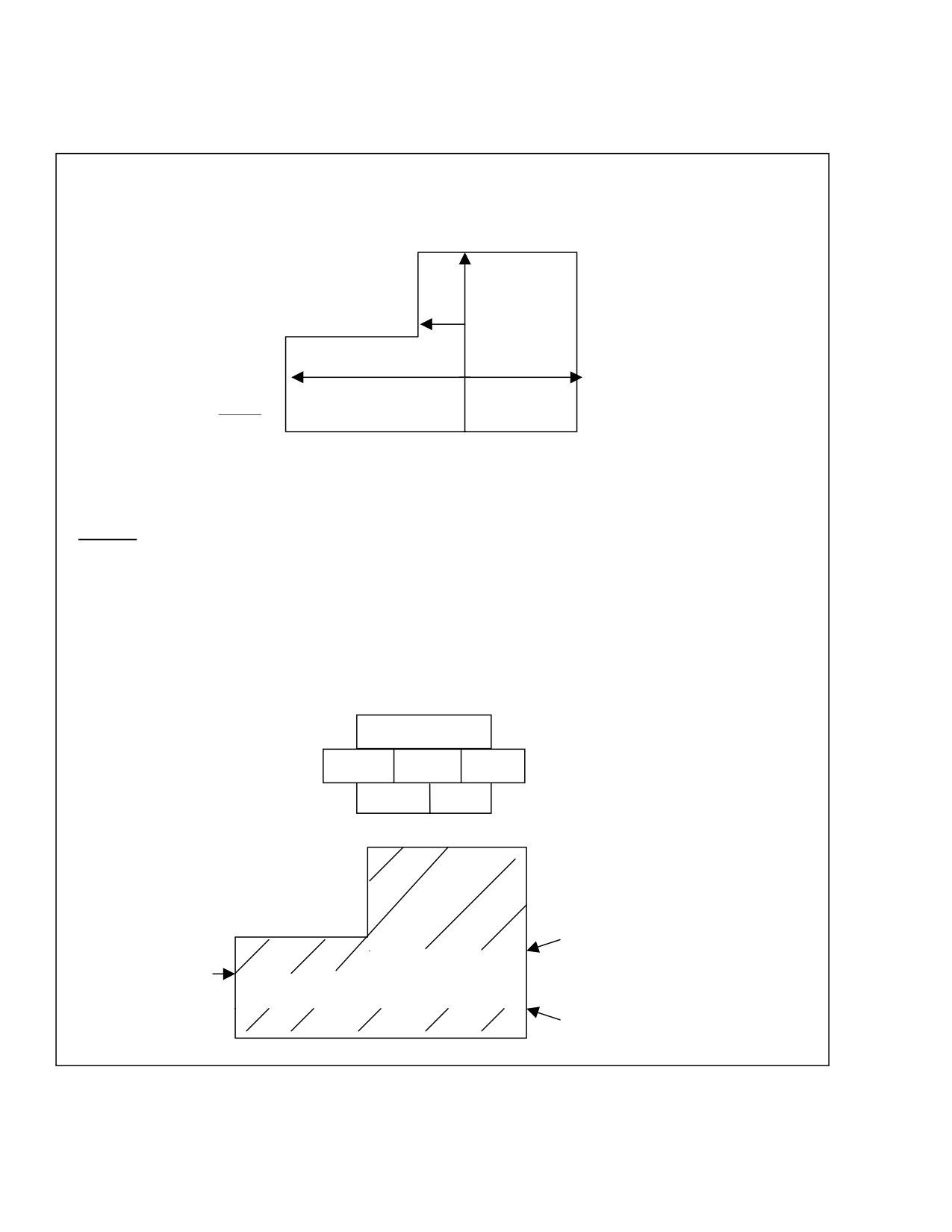
ILLUM HIGH ANGLE CHG 3GB
DIAGRAM RANGE TOTAL RANGE ENTRY
RANGE
+ CORR
= RANGE X __k__
= RANGE CHG VI
<SI/10 X 10mil Si Fac = SI + EL
= QE DRIFT
4000
+
0
=
4000 x
1.0000 =
4000
3GB
+23
+0.6 x
-1.0
=
-1
+ 1253 =
1252
L105
5700
+
0
=
5700 x
1.0000 =
5700
3GB
-15
-0.3
x
-5.3
=
+2 + 1066 =
1068
--
6200
+
0
=
6200 x
1.0000 =
6200
3GB
-25
-0.4
x
-15.0
=
+6 + 977
=
983
L36
FP 185, ILLUM
HIGH ANGLE, CHG 3GB, AOL 1600
1252
MAX QE
3496
3336
3005
DF
1068
983
MIN QE
38.3 M565
+0.3 CORR for M577
38.6 SEC
40.8
+0.3
Range to Fuze Function
41.1
44.2
+0.3
44.5 SEC
Figure 15-15. Example of High Angle Safety, Shell Illum
15-34

_____________________________________________Chg 1 FM 6-40/MCWP 3-16.4
FIGURE 15-16: LOW ANGLE SAFETY COMPUTATIONS
Safety Diagram
Location (Grid/Alt):
Charge:
Shell(s):
Fuze(s):
Angle of Fire:
AOL:
AOF
DF
Low Angle Safety Matrix
Chg:_____ Shell(s):__________ Fuze(s):__________ Projectile Family:__________
DIAGRAM
RG
TOT RG ENTRY
M564/ M582
M728/
RG
+ CORR
= RG x K
= RG
CHG VI SI + EL = QE M565 M577 TOF
+ 5.5 = M732 DFT
Safety T
Location:____________Charge: _____Shell(s):___________Fuze(s):__________Angle of Fire:___ AOL: ____
15-35

Chg 1 FM 6-40/MCWP 3-16.4_____________________________________________
FIGURE 15-17: HIGH ANGLE SAFETY COMPUTATIONS
Safety Diagram
Location (Grid/Alt):
Charge:
Shell(s):
Angle of Fire:
AOL:
AOF
DF
High Angle Safety Matrix
Chg:_____ Shell(s):__________ Projectile Family:__________
DIAGRAM RG
TOT
RG
ENTRY
RG
+ CORR = RG x K
= RG
CHG VI <SI/10 x 10 mil Si Fac = SI + EL = QE DFT
Safety T
Location:_________________Charge: _____Shell(s):__________Angle of Fire:_____AOL:________
15-36
_____________________________________________Chg 1 FM 6-40/MCWP 3-16.4
Section III
Minimum Quadrant Elevation
The XO or platoon leader is responsible for determining the lowest QE
that can be safely fired from his position that will ensure projectiles clear all
visible crests (minimum QE).
15-15. Elements of Computation
A minimum quadrant for EACH howitzer is ALWAYS determined. The maximum
of these minimum quadrants is the XO’s minimum quadrant. Use of the rapid fire tables in
ST 6-50-20 is the fastest method of computing minimum QE. The QE determined from ST 6-50-
20 is always equal to or greater than
(more safe) than manual computations. Manual
computations are more accurate than the rapid fire tables and are used if the sum of the site to
crest and the angle needed for a 5-meter vertical clearance is greater than 300 mils. Figure 15-18
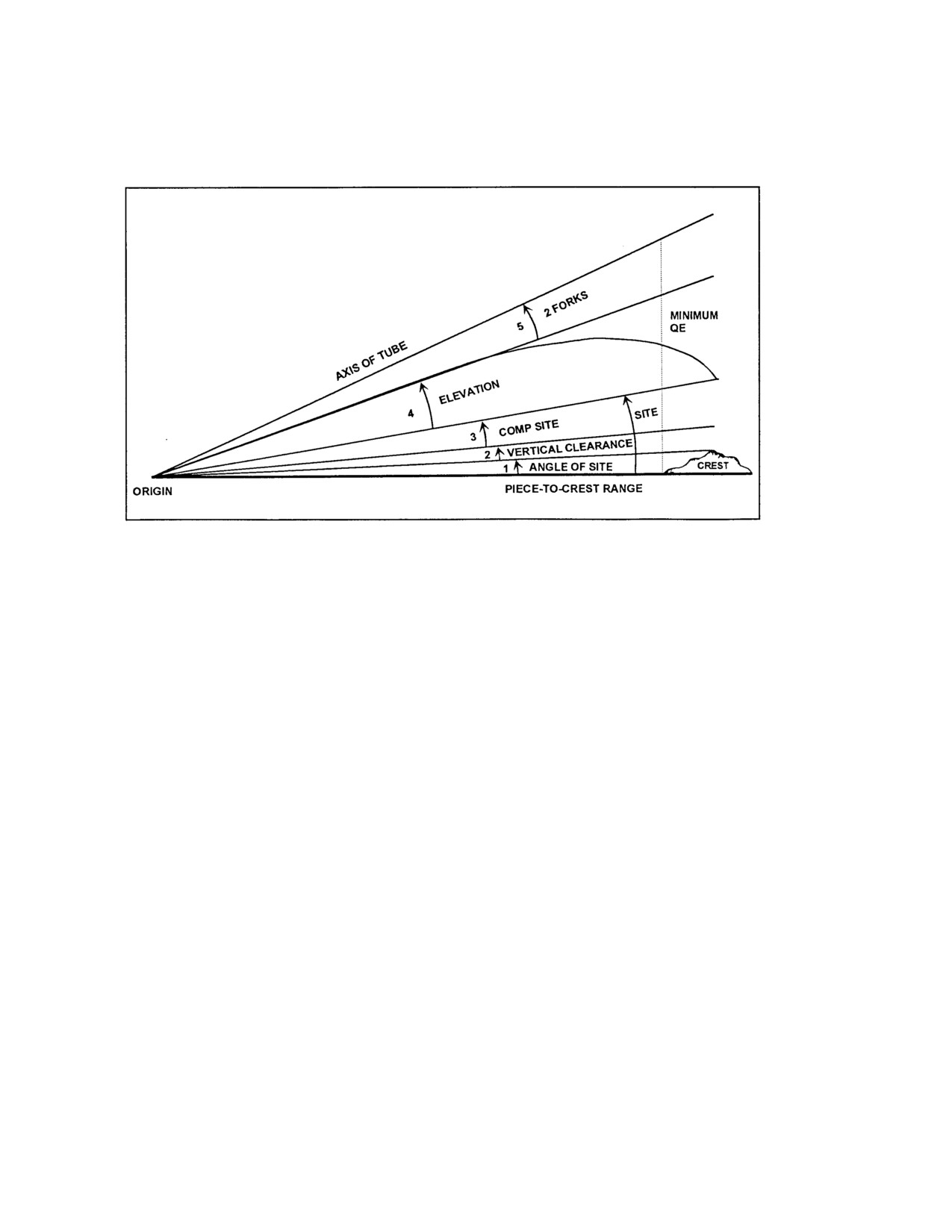
shows the elements of minimum QE.
a. Piece-to-crest range (PCR) is the horizontal distance between the piece and the crest,
expressed to the nearest 100 meters. Procedures for measurement are discussed in paragraph
15-16.
NOTE: All angles are determined and expressed to the next higher mil.
b. Angle 1 (Figure 15-18) is the angle of site to crest measured by the weapons. See
paragraph 15-16 for procedures.
c. Angle 2 (Figure 15-18) is the vertical angle required to clear the top of the crest. For
quick, time, and unarmed proximity (VT) fuzes, a vertical clearance of 5 meters is used. For
armed VT fuzes, see paragraph 15-19.
d. Angle 3 (Figure 15-18) is the complementary angle of site. It is the complementary
site factor (TFT, Table G) for the appropriate charge at the piece to crest range mulitiplied by the
sum of angles 1 and 2. Site is the sum of angles 1, 2, and 3.
NOTE: The entry argument for Table G is PCR. If it is not listed, do not interpolate,
use the next higher listed value.
e. Angle 4 (Figure 15-18) is the elevation (TFT, Table F) for the appropriate charge
corresponding to the PCR.
f. Angle 5 (Figure 15-18) is a safety factor equivalent to the value of 2 forks (TFT, Table
F) for the appropriate charge at the PCR.
15-37
Chg 1 FM 6-40/MCWP 3-16.4_____________________________________________
g. The sum of angles 1 through 5 (Figure 15-18) is the minimum QE for the weapon and
the charge computed.
Figure 15-18. Angles of Minimum QE
15-16. Measuring Angle of Site to Crest
As soon as the piece is “safed”, prefire checks conducted, and ammunition prepared ,
position improvement begins with verification of site to crest as measured by the advance party.
The advance party measures site to crest with an M2 compass or aiming circle. The section chief
measures the angle of site to crest and reports it to the XO or platoon leader. To measure the
angle of site to crest, the section chief sights along the bottom edge of the bore, has the tube
traversed across the probable field of fire, and has the tube elevated until the line of sight clears
the crest at the highest point. He then centers all bubbles on the elevation mount and reads the
angle of site to the crest from the elevation counter. This angle of site and the PCR are reported
as part of the section chief’s report.
15-17. Measuring Piece-To-Crest Range
a. There are five methods that can be used to measure piece-to-crest range:
(1) Taping. This is the most accurate method; however, it is normally too time-
consuming.
(2) Subtense. This method is fast and accurate.
(3) Map Measurement. This method is fast and accurate if the obstacle can be
accurately located (for example, a lone tree will not appear on a map).
(4) Pacing. This method is time-consuming and depends on the distance and
accessibility to the crest.
15-38

_____________________________________________Chg 1 FM 6-40/MCWP 3-16.4
(5) Estimation. This method is least accurate, but it is used when other methods are
not feasible.
b. Regarless of the method used to measure PCR, the XO or platoon leader must verify
PCR before he computes QE. He can do this by using any of the five methods.
15-18. Computation of Fuzes Other Than Armed VT
a. The XO or platoon leader does the computations indicated in this section if the sum of
angles 1 and 2 (Figure 15-18) exceeds 300 mils or if the rapid firing tables (RFTs) are not
available. All angles are determined and expressed to the next higher mil. Table 15-9 lists
the steps and solves an example of an XO’s or platoon leader’s manual computations.
Table 15-9. Manual Minimum QE Computations.
STEP
ACTION
1
Howitzer 1 (M109A3) reports a site to crest of 16 mils at a PCR of 1,100 meters. Charge
3GB is used.
2
∋1 = site to crest = 16 mils
3
∋2 = (VI x 1.0186) + PCR (in 1,000s)
= (5 x 1.0186) + 1.1
= 4.6 λ 5 mils
This VI is a 5-meter vertical clearance safety factor. It can also be computed using one of the
following methods:
• Use the GST. Solve in the same way as angle of site (4.6 λ 5).
• Use ST 6-50-20, page 2-7 (5).
4
∋3 = (∋1 + ∋2) x CSF
= (16 + 5) x 0.010
= (0.210) λ 1 mil
5
∋4 = EL = 74.1 λ 75 mils
6
∋5 = 2 Forks (TFT, Table F, Column 6)
= 2 x 2 = 4 mils
7
Min QE = ∋1 + ∋2 + ∋3 + ∋4 + ∋5
= 16 + 5 + 1 + 75 + 4
= 101 mils
b. The same example is solved in Table 15-10 by using RFTs in the ST 6-50-20,
Appendix B.
15-39

Chg 1 FM 6-40/MCWP 3-16.4_____________________________________________
Table 15-10. RFT Minimum QE Computations.
STEP
ACTION
1
Determine if the RFT can be used (∋1 + ∋2 [ 300 mils). Use the ST 6-50-20, page A-1.
Since the sum of angles 1 and 2 is less than or equal to 300 (16 +5 = 21), the RFT can be
used.
2
Determine RFT value. Enter the appropriate RFT. The entry arguments are howitzer
(M109A3), propellant (M3A1, GB), fuze (PD), PCR (1100), and charge (3). The correct
table is on page A-7. The RFT value is 86. This value equals the sum of angles 2, 3, 4,
and 5 (∋2 + ∋3 + ∋4 + ∋5).
NOTE: Use the RFT labeled “M557, M564” for all minimum QE computations except
armed VT. For armed VT, use the RFT labeled “M728.”
3
Determine the RFT minimum QE. This value equals the sum of angle 1 and the RFT
value (16 + 86 = 102).
c. One howitzer section may report a site to crest that is unusually high. If the XO or
platoon leader determines that it is the result of a single narrow obstruction (such as a tree), the
piece can be called out of action when firing a deflection that would engage the obstruction. This
would enable the platoon to use the next lower site to crest. Other alternatives are to remove the
obstruction or move the weapon.
d. Table 15-11 illustrates why minimum QE is computed for all guns, regardless of
which has the largest site to crest.
Table 15-11. RFT Example for Howitzer Platoon.
SITE TO
GUN
CHG
PCR CREST
+
RFT
=
MIN QE
1
3GB
800
128
64
192
2
3GB
1000
105
80
185
3
3GB
1500
92
116
208
4
3GB
1200
115
93
208
15-19. Computations for Armed VT Fuze (Low-Angle Fire)
a. The method of computing the XO’s minimum QE for firing a projectile fuzed with an
M728 or M732 fuze depends on the method in which the fuze is used. The proximity (VT) fuze
is designed to arm 3 seconds before the time set on the fuze; however, some VT fuzes have
armed as early as 5.5 seconds before the time set on the fuze. Because of the probability of
premature arming, a safety factor of 5.5 seconds is added to the time of flight to the PCR.
Since time on the setting ring is set to the whole second, the time determined in computing
minimum safe time is expressed up to the nearest whole second. A VT fuze is designed so that it
will not arm earlier than 2 seconds into its time of flight, which makes it a bore-safe fuze.
b. In noncombat situations, the XO or platoon leader determines the minimum safe time
by adding 5.5 seconds to the time of flight to the minimum range line as shown on the range
safety card. The minimum QE determined for fuzes quick and time is also valid for fuze VT.
c. In combat situations, the XO or platoon leader determines the minimum QE and a
minimum safe time for fuze VT. The minimum QE determined for PD fuzes is safe for VT fuzes
15-40
_____________________________________________Chg 1 FM 6-40/MCWP 3-16.4
if the fuze setting to be fired equals or is greater than the minimum safe time determined in
paragraph a above. If the XO or platoon leader finds it necessary to fire a VT fuze with a time
less than the minimum safe time, he must modify the minimum QE. He does this by increasing
the vertical clearance to ensure that the fuze will not function as it passes over the crest. In
addition, he must ensure the fuze will not function over any intervening crests along the gun-
target line (See paragraph 15-21).
d. If the projectile is to be fired with the VT fuze set at a time less than the minimum safe
time, allowance must be made for vertical clearance of the crest. Vertical crest clearances for
armed M728 and M732 VT fuzes fired over ordinary terrain for all howitzer systems is 70
meters.
e. If the projectile is to be fired over marshy or wet terrain, the average height of burst
will increase. The vertical clearance is increased to 105 meters. If the projectile is fired over
water, snow, or ice, the vertical clearance is 140 meters.
f. The minimum QE for armed fuze VT when a fuze setting less than the minimum safe
time is fired is based on the piece-to-crest range and a vertical clearance as indicated in
paragraphs d and e above.
g. Figure 15-19 shows a decision tree for application of armed VT minimum QE.
In combat, you have a VT mission with a time setting of ________ and a QE of ________. Ask the following questions:
Begin
No
Is QE > XO’s min QE?
Decrease charge or fire HA
No
No
VT FS > min VT FS to the FLOT?
Is VT QE > min QE for armed VT?
Decrease Chg,
fire HA, or
change fuze
Safe; fire it.
15-41
Chg 1 FM 6-40/MCWP 3-16.4_____________________________________________
Figure 15-19. Armed VT Decision Tree.
h. Table 15-12 is an example of computations to determine minimum QE for an armed
VT fuze.
15-42

_____________________________________________Chg 1 FM 6-40/MCWP 3-16.4
Table 15-12. Manual Armed VT Minimum QE Computations.
STEP
ACTION
1
Howitzer 1 (M109A3) reports a site to crest of 16 mils at a PCR of 1,100 meters. Charge
3GB is used.
2
∋1 = site to crest = 16 mils
3
∋2 = (VI x 1.0186) + PCR (in 1,000s)
=(70 x 1.0186) + 1.1
= 64.8 λ 65 mils
This VI is a 70-meter vertical clearance safety factor. It can also be computed by using the
GST. Solve in the same way as angle of site (64.7 λ 65).
4
∋3 = (∋1 + ∋2) x CSF (TFT, Table G)
= (16 + 65) x 0.010
= 0.710 λ 1 mil
5
∋4 = EL = 74.1 λ 75 mils
6
∋5 = 2 Forks (TFT, Table F, Column 6)
= 2 x 2 = 4 mils
7
Min QE = ∋1 + ∋2 + ∋3 + ∋4 + ∋5
= 16 + 65 + 1 + 75 + 4
= 161 mils
8
Determine minimum safe time. This value is the sum of TOF to PCR and 5.5 expressed up
to the next higher second (4.1 + 5.5 = 9.6 λ 10.0 sec).
i. The same example is solved in Table 15-13 by using the RFT in the ST 6-50-20,
Appendix A.
Table 15-13 RFT Minimum QE Computations.
STEP
ACTION
1
Determine if the RFT can be used (∋1 + ∋3 [ 300 mils). This is done manually, since page A-
1 uses a vertical clearance of 5 meters. See step 3 in table 15-12 for ∋2. Since the sum of
angles 1 and 2 is less than or equal to 300 (16 +65 = 81), the RFT can be used.
2
Determine RFT value. Enter the appropriate RFT. The entry arguments are howitzer
(M109A3), propellant (M3A1, GB), fuze (M728 or M732), PCR (1100) and charge (3). The
correct table is on page A-13. The RFT value is 147. This value equals the sum of angles 2,
3, 4, and 5.
NOTE: Use the RFT labeled “M557, M564” for all minimum QE computations except armed
VT. For armed VT, use the RFT labeled “M728.”
3
Determine the RFT minimum QE. This value equals the sum of angle 1 and the RFT value
(16 + 147 = 163).
4
Determine the minimum safe time. Use the same entry arguments as in step 2. The
minimum safe time is 10.0.
j. If the VT fuze setting to be fired is equal to or greater than the minimum safe VT time,
the minimum QE for fuzes quick and time applies. If the VT fuze setting to be fired is less than
the minimum safe VT time, the minimum QE determined for armed VT applies.
15-20. Using Minimum Quadrant Elevation
After computing minimum QE for each charge authorized, the XO or platoon leader must
compare the minimum QE to the QE required to clear the minimum range line. The XO must
then select the highest quadrant for each charge to be used as the minimum QE to be fired from
that position.
15-43

Chg 1 FM 6-40/MCWP 3-16.4_____________________________________________
15-21. Intervening Crest
a. FDOs must ensure that artillery fires clear intervening crests. Intervening crests are
defined as any obstruction between the firing unit and the target not visible from the firing unit.
The following are the possible options, listed in order of preference.
(1) Determine firing data to the crest (include all nonstandard conditions) and add 2
forks (Table 15-12).
(2) Determine a minimum QE in a similar manner as XO’s minimum QE (Table
15-13).
(3) Use the trajectory tables in the appendix of the TFT.
b. Option 1 is preferred because it incorporates all current nonstandard conditions that
will affect the projectile along the trajectory. The FDO has the responsibility to determine on
the basis of availability of corrections for nonstandard conditions if this really is the best
option. Table 15-12 lists the steps.
Table 15-14. Intervening Crest, Option 1.
STEP
ACTION
1
Upon occupation, the FDO analyzes the terrain for intervening crests.
2
Upon determining the altitude of this crest, he computes firing data to this point (QE). The
best solution includes all available corrections for nonstandard conditions (current and valid
GFT setting).
3
Add the value of 2 forks (TFT, Table F, Column 6) to the QE determined in step 2 to ensure
that round-to-round variations (probable errors) will clear the crest.
4
The FDO then records this QE and charge on his situation map as a check to ensure that
rounds will clear the intervening crest.
5
Upon receipt of a fire mission, the FDO will compare his intervening crest QE to his fire
mission quadrant. One of the three following situations will occur:
1) The target is located short of the intervening crest. The FDO does not consider the effects
of the crest at this time.
2) The mission QE exceeds intervening crest QE by a significant margin, indicating the
rounds will clear the crest.
3) Fire mission QE exceeds intervening crest QE by only a small margin or is less than
intervening crest QE, indicating the round may or may not clear the crest. The FDO must
determine if the round will clear after considering the following:
15-44

_____________________________________________Chg 1 FM 6-40/MCWP 3-16.4
Table 15-14. Intervening Crest, Option 1 (Continued).
STEP
ACTION
• Have all nonstandard conditions been accounted for?
• How old is the current met message?
• Are registration corrections being applied to this mission?
Upon realizing that the round may not or will not clear the crest, the FDO can either fire high
angle or a reduced charge. The quickest choice would be to fire high angle, but tactical
situations may prevent this. Firing a lower charge will increase dispersion more than high
angle. For example, at a range of 6,000 meters, the following applies:
• Low angle, charge 5: Probable error in range = 15 meters.
• High angle, charge 5: Probable error in range = 17 meters.
• Low angle, charge 4: Probable error in range = 23 meters.
If a lower charge is selected, steps 2 through 5 must be repeated.
6
If VT fuzes are to be fired (M700 series), the FDO must take additional steps to ensure that
the VT fuze does not arm before passing over the crest. Follow the steps for determining
armed VT minimum QE and FS in paragraph 15-15.
c. Option 2 does not include current conditions for all nonstandard conditions. Table 15-
20 lists the steps.
Table 15-15. Intervening Crest, Option 2.
STEP
ACTION
1
Upon occupation, the FDO analyzes the terrain for intervening crests.
2
The FDO determines and announces the grid and map spot altitude to the crest.
3
The HCO plots the grid and determines and announces range to crest.
4
The VCO computes angle of site to the crest. This is the same as determining site to crest
with a howitzer
5
Determine if RFT can be used (∋1 + ∋2 [ 300 mils). Angle 1 equals angle of site to the crest.
Refer to ST 6-50-20, page A-1. Since ∋1 and ∋2 decrease with range, this should not be a
problem.
6
Determine RFT value. Enter the appropriate RFT. The entry arguments are howitzer,
propellant, fuze, PCR (chart range to the crest), and charge. This value equals the sum of
angles 2, 3, 4, and 5.
NOTE: Use the RFT labeled “M557, M564” for all minimum QE computations except armed
VT. For armed VT, use the RFT labeled “M728.”
7
Determine RFT intervening crest QE. This value is the sum of the angle of site to the crest
and the RFT value.
8
If VT is fired, enter the appropriate table and extract the correct information.
9
Follow steps 4 and 5 of table 15-14.
d. The least preferred option is using the trajectory charts in the appendix of the TFT.
This offers a quicker but less accurate method to clear the intervening crest since it is based off
of standard conditions. The FDO must make a judgment call when to use these charts. The
FDO must use caution when making this decision.
15-45
*FM 6-40/MCWP 3-1.6.19
i
FM 6-40/MCWP 3-1.6.19
ii
FM 6-40/MCWP 3-1.6.19
iii
FM 6-40/MCWP 3-1.6.19
iv
FM 6-40/MCWP 3-1.6.19
v
FM 6-40/MCWP 3-1.6.19
vi
FM 6-40/MCWP 3-1.6.19
vii
FM 6-40/MCWP 3-1.6.19
viii
FM 6-40/MCWP 3-1.6.19
ix
FM 6-40/MCWP 3-1.6.19
x
FM 6-40/MCWP 3-1.6.19
xi
FM 6-40/MCWP 3-1.6.19
xii
FM 6-40/MCWP 3-1.6.19
xiii
FM 6-40/MCWP 3-1.6.19
xiv
FM 6-40/MCWP 3-1.6.19
xv
FM 6-40/MCWP 3-1.6.19
xvi
FM 6-40/MCWP 3-1.6.19
xvii
FM 6-40
Chapter 1
THE GUNNERY PROBLEM AND THE GUNNERY TEAM
The mission of the Field Artillery is to destroy, neutralize, or suppress the enemy by
cannon, rocket, and missile fires and to help integrate all fire support assets into combined arms
operations. Field artillery weapons are normally employed in masked or defilade positions to
conceal them from the enemy. Placing the firing platoon in defilade precludes direct fire on most
targets. Consequently, indirect fire must be used when FA weapons fire on targets that are not
visible from the weapons. The gunnery problem is an indirect fire problem. Solving the problem
requires weapon and ammunition settings that, when applied to the weapon and ammunition, will
cause the projectile to achieve the desired effects on the target.
1-1. Gunnery Problem Solution
a. The steps in solving the gunnery problem areas follows:
(1) Know the location of the firing unit, and determine the location of the target.
(2) Determine chart (map) data (deflection, range from the weapons to the target,
and altitude of the target).
(3)
Determine vertical interval (VI) and site (si).
(4)
Compensate for nonstandard conditions that would affect firing data
(meteorological
[met] procedures).
(5) Convert chart data to firing data (shell, charge, fuze, fuze setting, deflection, and
quadrant elevation).
(6) Apply the firing data to the weapon and ammunition.
b. The solution to the problem provides weapon and ammunition settings that will cause
the projectile to function on or at a predetermined height above the target. This is necessary so
the desired effects will be achieved.
1-2. Field Artillery Gunnery Team
The coordinated efforts of the field artillery gunnery team are required to accomplish the
solution of the gunnery problem outlined in paragraph 1-2. The elements of the team must be
linked by an adequate communications system.
NOTE: The terms battery and platoon used throughout this manual are
synonymous, unless otherwise stated.
1-1
FM 6-40
a. Observer. The observer and/or target acquisition assets serve as the “eyes and ears”
of all indirect fire systems. The mission of the forward observer is to detect and locate suitable
indirect fire targets within his zone of observation and bring fires on them. When a target (tgt) is
to be attacked, the observer transmits a call for fire and adjusts the fires onto the target as
necessary. An observer provides surveillance data of his own fires and any other fires in his zone
of observation. Field artillery observers include the following:
Aerial observers (AOs).
Forward observers (F0s).
Fire support teams (FISTs).
Combat observation/lasing teams (COLTs).
Air and naval gunfire liaison company (ANGLICO).
Firepower control teams (FCTs).
Any other friendly battlefield personnel.
b. Target Acquisition. Target acquisition assets also function as observers. They
provide accurate and timely detection, identification, and location of ground targets, collect
combat and/or target information, orient and/or cue intelligence sources, and permit immediate
attack on specific areas. Field artillery target acquisition (TA) assets include the following:
Weapons-locating radar sections.
Aircraft radar systems.
NOTE: See FM 6-121 for a discussion of TA assets. See FMs 100-2-1, 100-2-2,
and 100-2-3 for information on target characteristics.
c. Fire Direction Center. The fire direction center (FDC) serves as the “brains” of the
gunnery team. It is the control center for the gunnery team and is part of the firing battery
headquarters. The FDC personnel receive calls for fire directly from an observer or they maybe
relayed through the initial fire support automated system (IFSAS) at battalion level. The FDC
will then process that information by using tactical and technical fire direction procedures.
Tactical fire direction includes processing calls for fire and determining
(1)
appropriate method of fire, ammunition expenditure, unit(s) to fire, and time of attack. The fire
direction officer’s decision on how to engage the target is concisely stated as a FIRE ORDER.
(2) Technical fire direction is the process of converting weapon and ammunition
characteristics (muzzle velocity, propellant temperature, and projectile weight), weapon and
target locations, and met information into firing data. Firing data consist of shell (sh), charge
(chg), fuze (fz), fuze setting (FS), deflection (df), and quadrant elevation (QE). The FDC
transmits firing data to the guns as fire commands.
1-2
FM 6-40
d. Firing Battery. The firing battery serves as the “muscle” of the gunnery team. The
firing battery includes the battery HQ, the howitzer sections, the ammunition section, and the
FDC. The howitzer sections apply the technical firing data to the weapon and ammunition.
Organization and employment considerations of the firing sections are discussed in FM 6-50.
1-3. Five Requirement for Accurate Predicted Fire
To achieve accurate first-round fire for effect (FFE) on a target, an artillery unit must
compensate for nonstandard conditions as completely as time and the tactical situation permit.
There are five requirements for achieving accurate first-round fire for effect. These requirements
are accurate target location and size, firing unit location, weapon and ammunition information,
met information, and computational procedures. If these requirements are met, the firing unit
will be able to deliver accurate and timely fires in support of the ground-gaining arms. If the
requirements for accurate predicted fire cannot be met completely, the firing unit maybe required
to use adjust-fire missions to engage targets. Adjust-fire missions can result in less effect on the
target, increased ammunition expenditure, and greater possibility that the firing unit will be
detected by hostile TA assets.
a. Target Location and Size. Establishing the range (rg) from the weapons to the
target requires accurate and timely detection, identification, and location of ground targets.
Determining their size and disposition on the ground is also necessary so that accurate firing data
can be computed. Determining the appropriate time and type of attack requires that the target
size (radius or other dimensions) and the direction and speed of movement be considered. Target
location is determined by using the TA assets mentioned in paragraph 1-2.
b. Firing Unit Location. Accurate range and deflection from the firing unit to the
target requires accurate weapon locations and that the FDC knows this location. The battalion
survey section uses the position and azimuth determining system (PADS) to provide accurate
survey information for the battery location. Survey techniques available to the firing battery may
also help in determining the location of each weapon. The FDC can determine the grid location
of each piece by using the reported direction, distance, and vertical angle for each piece from the
aiming circle used to lay the battery.
c. Weapon and Ammunition Information. The actual performance of the weapon is
measured by the weapon muzzle velocity (velocity with which the projectile leaves the muzzle of
the tube) for a projectile-propellant combination. The firing battery can measure the achieved
muzzle velocity of a weapon and correct it for nonstandard projectile weight and propellant
temperature. This is done by using the M90 velocimeter and muzzle velocity correction tables
(MVCT M90-2) for each type of charge and projectile family. Calibration should be conducted
continuously by using the M90 velocimeter. Firing tables and technical gunnery procedures
allow the unit to consider specific ammunition information (weight, fuze type, and propellant
temperature); thus, accurate firing data are possible.
d. Meteorological Information. The effects of weather on the projectile in flight must
be considered, and firing data must compensate for those effects. Firing tables and technical
gunnery procedures allow the unit to consider specific met information (air temperature, air
density, wind direction, and wind speed) in determining accurate firing data.
1-3
FM 6-40
e. Computational Procedures. The computation of firing data must be accurate.
Manual and automated techniques are designed to achieve accurate and timely delivery of fire.
The balance between accuracy, speed, and the other requirements discussed in this chapter should
be included in the computational procedures.
f. Nonstandard Conditions. If the five requirements for accurate predicted fire cannot
be met, registrations can be conducted or a met + VE technique can be completed to compute
data that will compensate for nonstandard conditions. Applying these corrections to subsequent
fire missions will allow the unit to determine accurate firing data. Accuracy of these fires will be
a direct function of the observer’s target location.
1-4
FM 6-40
Chapter 2
FIRING BATTERY AND BATTERY FDC ORGANIZATION
The FA cannon battery is firing unit within the cannon battalion and is organized in one
of two ways: a battery-based unit (3 x 6 organization) or a platoon-based unit (3 x 8
organization). In either case, they have the personnel and equipment needed to shoot, move, and
communicate. This chapter describes the organization of the firing battery and the battery FDC.
2-1. Firing Battery Organization
a. The organization of all cannon batteries is basically the same. Differences in
organization stem from differences in weapon caliber, whether the weapon is towed or
self-propelled (SP), and whether the battery is in a divisional or nondivisional battalion. The
cannon battery is organized as follows:
(1) Battery-based unit--consists of a battery headquarters and a firing battery.
(a) The battery HQ has the personnel and equipment to perform command and
control; food service; supply; communications; nuclear, biological, chemical (NBC), and
maintenance functions. (In some units, food service, communications, and maintenance may be
consolidated at battalion level.)
(b) The firing battery has the personnel and equipment to determine firing
data, fire the howitzers, and resupply ammunition. (In some units, ammunition assets may be
consolidated at battalion level.)
(2) Platoon-based unit--consists of a battery HQ and two firing platoons.
(a) The battery HQ has the personnel and equipment to perform command and
control, food service, supply, communications, NBC, and maintenance functions. (In some units,
food service, communications, and maintenance may be consolidated at battalion level.)
(b) Each firing platoon has the personnel and equipment to determine firing
data, fire the howitzers, and resupply ammunition. (In some units, ammunition assets maybe
consolidated at battalion level.)
2-2. Battery or Platoon FDC
a. The battery or platoon FDC is the control center, or brains, of the gunnery team. The
FDC personnel receive fire orders from the battalion FDC or calls for fire from observers and
process that information by using tactical and technical fire direction procedures (Chapter 1). The
battery FDC performs the technical fire direction, while the battalion FDC performs tactical fire
direction. If the FDC is operating without a battalion FDC, the battery FDC conducts both tactical
and technical fire direction. The battery FDC receives the call for fire and converts the request into
firing data. The firing data are then sent to the howitzer sections as fire commands. In addition to
an FDC, USMC batteries have a battery operations center (BOC), which is organized and equipped
to perform technical fire direction. BOCs enhance unit survivability, simplify displacements, and
enable split-battery operations. In battery positions, BOC personnel may augment the FDC to
facilitate 24-hour operations.
2-1
FM 6-40
b. The FDC is organized to facilitate 24-hour operations (Appendix A). Duties of
manual FDC personnel are described below
(1) Fire direction officer. The FDO is responsible for all FDC operations. He is
responsible for the training of all FDC personnel, supervises the operation of the FDC,
establishes standing operating procedure (SOP), checks target location, announces fire order, and
ensures accuracy of firing data sent to the guns. USMC batteries also include an assistant fire
direction officer-assistant executive officer (AFDO-AXO). The AFDO-AXO leads the BOC,
assists the battery commander during displacement and stands duty in the FDC to enable 24-hour
operations.
(2) Chief fire direction computer. The chief fire direction computer is the
technical expert and trainer in the FDC. He ensures that all equipment is on hand and
operational, supervises computation of all data, ensures that all appropriate records are
maintained, and helps the FDO as needed. He ensures smooth peformance of the FDC in
24-hour operations and functions as the FDO in the FDO’s absence. The equivalent USMC billet
description is operations chief.
(3) Fire direction computer. The fire direction computer operates the primary
means of computing firing data. He determines and announces fire commands. He also records
mission-related data and other information as directed. The equivalent USMC billet description
is operations assistant. There is an operations assistant in both the FDC and the BOC.
(4) Fire direction specialist. There are two fire direction specialists per FDC to
facilitate 24-hour operations. In a manual FDC, they serve alternately as horizontal control
operator (HCO) and vertical control operator (VCO). The equivalent USMC billet description is
fire control man. There are five fire control men in a USMC FDC and three more in a BOC to
facilitate 24-hour operations. These fire control men may perform the duties of the HCO, VCO,
radio operator, or driver as needed in either the FDC or BOC.
(a)
The HCO constructs and maintains the primary firing chart and determines
and announces chart data.
(b)
The VCO constructs the secondary firing chart checks chart data, plots
initial target location on the situation map, and determines and announces site.
(c)
The radiotelephone operator (RATELO) or driver is normally the operator
of the FDC vehicle. He maintains the vehicle and the FDC-associated generators.
In a manual
FDC, he may also act as the recorder.
2-3. Definitions
a. Fire direction is the employment of firepower. The objectives of fire direction are to
provide continuous, accurate, and responsive fire support under all conditions. Flexibility must
be maintained to engage all types of targets over wide frontages, to mass the fires of all available
units quickly, and to engage a number and variety of targets simultaneously.
2-2
FM 6-40
b. The fire direction center is the element of the gunnery team with which the
commander directs artillery firepower. The accuracy, flexibility, and speed in the execution of
fire missions depend on the following:
Rapid and clear transmission of calls for free.
Rapid and accurate computations.
Rapid and clear transmission of fire commands.
Integration of automated and manual equipment into an efficient mutually
supporting system.
Efficient use of communications equipment.
2-4. Relationship Between Battery or Platoon and Battalion FDC
There are two modes of operation under which fire direction can be conducted: battalion
directed and autonomous.
a. Battalion Directed. In battalion-directed operations, calls for fire are transmitted
from the observer to the battalion FDC. The battalion FDO is responsible for tactical fire
direction and selects the unit(s) to fire. A fire order is transmitted to the firing units that are
responsible for technical fire direction. The battalion FDC is responsible for transmitting all fire
mission related messages (that is, message to observer, ready [if applicable], shot, splash, and
rounds complete) to the observer. The firing units are responsible for transmitting all fire mission
related messages to the battalion FDC.
b. Autonomous. In autonomous operations, calls for fire are transmitted from the
observer to the firing unit FDC. The firing unit FDC is responsible for tactical and technical fire
direction. The firing unit is responsible for transmitting the message to observer, ready (if
applicable), shot, splash, and rounds complete to the observer. The battalion FDC and the
battalion fire support officer (FSO) monitor the calls for fire. The equivalent USMC billet
description for FSO is artillery liaison officer. The battalion FDC may take over control of the
mission if the target warrants the massing of two or more batteries. The battalion FDC monitors
the battery’s message to observer (MTO) to ensure that the battery has selected the appropriate
ammunition and method of fire. The battalion FDC may change the battery’s plan of attack. If
the target requires battalion fire, the firing unit FDO can request reinforcing fires from the
battalion FDC.
2-5. Battalion FDC Personnel
A battalion FDC is composed of a fire direction officer, a chief computer, an assistant
chief computer, three computers, a horizontal control operator, a vertical control operator, and a
radiotelephone operator. USMC battalion FDCs are composed of a fire direction officer,
operations chief, two operations assistants, and 10 fire control men to facilitate 24-hour
operations. The operations chief is the equivalent of the chief computer, and the operations
assistants are the equivalent of the assistant chief computer. The fire control men may perform
the duties of computer, HCO, VCO, radio operator, or driver as needed.
2-3
FM 6-40
a. Fire Direction Officer’s Duties. The FDO’s duties areas follows:
(1) Is responsible for the overall organization and functioning of the battalion FDC.
(2) Coordinates with the battalion S3 to ensure that all information regarding the
tactical situation, unit mission, ammunition status, and commander’s guidance on the method of
engagement of targets and control of ammunition expenditures is known and ensures that all
information is passed to battery FDOs.
(3) Ensures that all communications are properly established.
(4) Coordinates with the chief computer concerning data input, chart verification,
transfer of registration corrections, average site or altitude, terrain gun position corrections
(TGPCs) sectors, and any other special instructions.
(5) Inspects target locations and monitors messages to observer when a mission is
received by a battery FDC and intercedes when necessary.
(6) Controls all battalion missions.
b. Chief Computer’s Duties. The chief computer’s duties areas follows:
(1) Serves as the battalion FDO’s technical expert (the actual supervisor and/or
trainer of battalion FDC personnel) and assumes the duties of the battalion FDO in his absence.
(2) Ensures that all battalion FDC equipment is operational and emplaced correctly.
(3) Ensures coordination of all data throughout the battalion, to include current
registration settings.
(4) Ensures that the HCO’s and VCO’s charts include all pertinent known data.
(5) Ensures that the situation map is properly posted, to include fire support
coordinating measures and the current tactical situation.
c. Assistant Chief Computer’s Duties. The assistant chief computer’s duties are as
follows:
(1) Monitors all operations performed by the HCO.
(2) Supervises maintenance and care of the generators.
(3) Assumes the duties of the chief computer when he is absent.
d. Battery Computers’ Duties. The battery computers’ duties areas follows:
(1) Provide communications link with the battery FDCs.
(2) Monitor the appropriate fire direction net for their battery.
(3) Exchange information with the battery FDCs and pass battalion fire orders to
the battery.
2-4
FM 6-40
(4) Record all data pertinent to fire missions that are sent to their battery.
(5) Compute data for their battery when directed by the chief computer.
(6) Use their fire direction net to communicate with the observer when battalion
missions are conducted.
(7) Assume the duties of the assistant chief computer when he is absent.
e. Horizontal Control Operator’s Duties. The HCO’s duties areas follows:
(1) Plots known data as directed by the assistant chief computer.
(2) Determines chart data as appropriate.
(3) Maintains equipment and associated generators.
(4) Plots the initial target location when a mission is received.
f. Vertical Control Operator’s Duties. The VCO’s duties areas follows:
(1) Plots known data as directed by the assistant chief computer.
(2) Plots the initial target location when a mission is received.
(3) Checks chart data with the HCO.
(4) Plots the initial target location on the situation map and determines and
announces site for the appropriate battery.
g. Radiotelephone Operator’s Duties. The RTO’s duties areas follows:
(1) Establishes and maintains communications on the battalion command/fue
direction (CF) net.
(2) Determines and transmits the messages to observer when battalion missions are
conducted on the battalion CF net.
(3) Encodes and decodes messages, target lists, and fire plans.
(4) Ensures proper authentication of appropriate messages and all fire missions.
2-5
FM 6-40
Chapter 3
BALLISTICS
Ballistics is the study of the firing, flight, and effect of ammunition. A fundamental
understanding of ballistics is necessary to comprehend the factors that influence precision and
accuracy and how to account for them in the determination of firing data. Gunnery is the
practical application of ballistics so that the desired ejects are obtained by fire. To ensure
accurate predicted fire, we must strive to account for and minimize those factors that cause
round-to-round variations, particularly muzzle velocity. Ballistics can be broken down into four
areas: interior, transitional, exterior, and terminal. Interior, transitional, and exterior ballistics
directly affect the accuracy of artillery fire and are discussed in this chapter. Terminal ballistics
are discussed in Appendix B.
3-1. Interior Ballistics
Interior ballistics is the science that deals with the factors that affect the motion of the
projectile within the tube. The total effect of all interior ballistic factors determines the velocity
at which the projectile leaves the muzzle of the tube, which directly influences the range achieved
by the projectile. This velocity, called muzzle velocity (MV), is expressed in meters per second
(m/s). Actual measurements of the muzzle velocities of a sample of rounds corrected for the
effects of nonstandard projectile weight and propellant temperature show the performance of a
specific weapon for that projectile family-propellant type-charge combination. The resulting
measurement(s) are compared to the standard muzzle velocity shown in the firing table(s). This
comparison gives the variation from standard, called muzzle velocity variation (MVV), for that
weapon and projectile family-propellant type-charge combination. Application of corrections to
compensate for the effects of nonstandard muzzle velocity is an important element in computing
accurate firing data. (For futher discussion of muzzle velocity, see Chapter 4.) The following
equation for muzzle velocity is valid for our purposes:
MVV (m/s) = SHOOTING STRENGTH OF WPN + AMMUNITION EFFICIENCY
Tube wear, propellant efficiency, and projectile weight are the items normally accounted
for in determination of a muzzle velocity. Other elements in the equation above generally have
an effect not exceeding 1.5 m/s. As a matter of convenience, the other elements listed below are
not individually measured, but their effects are realized to exist under the broader headings of
shooting strength and ammunition efficiency.
SHOOTINGSTRENGTHOFWEAPONS
AMMUNITIONEFFICIENCY
1. Tube wear
1. Propellant efficiency
2. Manufacturer tolerances
2. Projectile efficiency
3. Reaction to recoil
a. Projectile weight (fuzed)
b. Construction of
(1) Rotating band
(2) Bourrelet
(3) Obturating band
3-1
FM 6-40
a. Nature of Propellant and Projectile Movement.
(1) A propellant is a low-order explosive that burns rather than detonates. In
artillery weapons using separate-loading ammunition, the propellant burns within a chamber
formed by the obturator spindle assembly, powder chamber, rotating band, and base of the
projectile. For cannons using semifixed ammunition, the chamber is formed by the shell casing
and the base of the projectile. When the propellant is ignited by the primer, the burning
propellant generates gases. When these gases develop enough pressure to overcome initial bore
resistance, the projectile begins its forward motion.
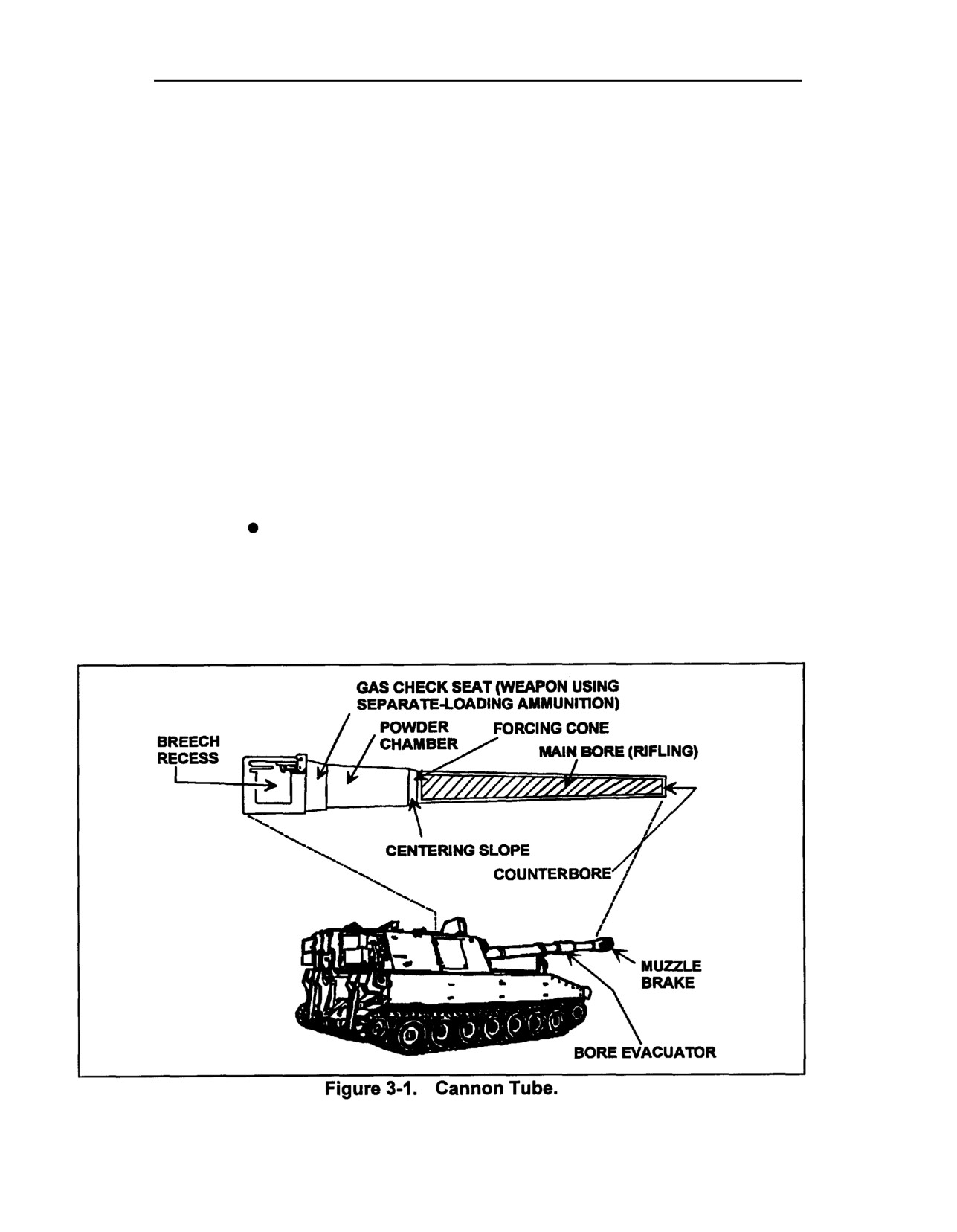
(2) Several parts of the cannon tube affect interior ballistics. (See Figure 3-l.)
(a) The caliber of a tube is the inside diameter of the tube as measured
between opposite lands.
(b) The breech recess receives the breechblock. The breech permits loading
the howitzer from the rear.
(c) The powder chamber receives the complete round of ammunition. It is the
portion of the tube between the gas check seat and the centering slope.
The gas check seat is the tapered surface in the rear interior of the tube on
weapons firing separate-loading ammunition. It seats the split rings of the
obturating mechanism when they expand under pressure in firing. This
expansion creates a metal-to-metal seal and prevents the escape of gases
through the rear or the breech. Weapons firing semifixed ammunition do
not have gas check seats since the expansion of the ease against the walls
of the chamber provides a gas seal for-the breech.
3-2