FM 6-40 TTP for Field Artillery Manual Cannon Battery U.S. - page 1

MCWP 3-16.4
FM 6-40
TTP for Field Artillery
Manual Cannon Battery
U.S. Marine Corps
PCN 143 000003 00
FOREWARD
This publication may be used by the US Army and US Marine Corps forces during training, exercises, and contingency
operations.
General, USA
Lieutenant General, USMC
Commanding
Commanding General
Training and Doctrine Command
Marine Corps Combat Development Command

FM 6-40/MCWP 3-1.6.19
PREFACE
This field manual (FM) explains all aspects of the cannon gunnery problem and presents a practical application of the
science of ballistics. It includes step-by-step instructions for manually solving the gunnery problem and applies to units
organized under tables of organization and equipment (TOE) of the L series. The material concerns nonnuclear solutions
to the gunnery problem. Automated procedures are covered in ST 6-40-2, ST 6-40-31, and ST 6-50-60.
This publication is a guide for field artillery (FA) officers (commanders and fire direction officers [FDOs]), FA
noncommissioned officers (NCOs), and enlisted personnel in the military occupational specialty (MOS) of cannon
gunnery (MOS 13E; United States Marine Corps [USMC] MOS 0844/48).
This publication implements the following North Atlantic Treaty Organization (NATO) Standardization Agreements
(STANAGs)/Quadripartite Standardization Agreements (QSTAGs):
STANAG
QSTAG
TITE
2934 (Chap 10) (Ed 1)
182 (Ed 2)
Artillery Procedures,
Battlefield Illumination
2934 (Chap 6) (Ed 1)
255 (Ed 3)
Artillery Procedures,
Call for Fire Procedures
2934 (Chap 7) (Ed 1)
221 (Ed 2)
Artillery Procedures,
Target Numbering System (Nonnuclear)
2934 (Chap 5) (Ed 1)
246 (Ed 3)
Artillery Procedures,
Radio Telephone Procedures for the Conduct
of Artillery Fire
2934 (Chap 3) (Ed 1)
217 (Ed 2)
Artillery Procedures, Tactical Tasks and Responsibilities for Control
of Artillery
2963 (Ed 1)
802 (Ed 1)
Coordination of Field Artillery Delivered Scatterable Mines
4119 (Ed 1)
220 (Ed 2)
Adoption of a Standard (Cannon) Artillery Firing Table Format
none
224 (Ed 2)
Manual Fire Direction Equipment, Target Classification, and
Methods of Engagement for Post-1970
4425 (Ed 1)
none
Procedure to Determine the Degree of Interchangeability of NATO
Indirect Fire Ammunition-APO-29
The proponent of this publication is Headquarters (I-IQ), US Army Training and Doctrine Command (TRADOC). Send
comments and recommendations on DA Form 2028 (Recommended Changes to Publications and Blank Forms) directly
to Commandant, US Army Field Artillery School (USAFAS), ATTN: ATSF-GD, Fort Sill, OK 73503-5600.
Unless this publication states otherwise, masculine nouns and pronouns do not refer
exclusively to men.
xviii

C1, FM 6-40/MCWP 3-16.4
Change
HEADQUARTERS
No.1
DEPARTMENT OF THE ARMY
Washington, DC, 1 October 1999
Tactics, Techniques, and Procedures for
FIELD ARTILLERY
MANUAL CANNON GUNNERY
FM 6-40/MCWP 3-16.4, April 1996, is changed as follows:
1. Change the following paragraphs or sections (changes are in bold type):
Replace Paragraph 6-1, Page 6-1 with the following:
6-1. Description
A firing chart is a graphic representation of a portion of the earth's surface used for determining
distance (or range) and direction (azimuth or deflection). The chart may be constructed by using a
map, a photomap, a gridsheet, or other material on which the relative locations of batteries, known
points, targets, and observers can be plotted. Additional positions, fire support coordinating measures,
and other data needed for the safe and accurate conduct of fire may also be recorded.
Replace Step 5, Table 6-6, Page 6-19 with the following:
5
Place a plotting pin opposite the number on the azimuth scale (blue numbers) on the arc of the
RDP corresponding to the last three digits of the azimuth in which the arm of the RDP is
oriented. The location of the pin represents a temporary index and will not be replaced with a
permanent index. The value of the pin is the value of the first digit of the azimuth in which the
arm o f the RDP is oriented. Use the rules outlined in step 4 of Table 6-5 to determine where
the pin should be placed. In Figure 6-15, the azimuth of lay is 1850, so the RDP has been
oriented east (1600 mils).
Replace Figure 7-1, Page 7-1 with the following:
STANDARD CONDITIONS
WEATHER
1
AIR TEMPERATURE 100 PERCENT (59° F)
2
AIR DENSITY 100 PERCENT (1,225 gm/m3)
3
NO WIND
POSITION
1
GUN, TARGET AND MDP AT SAME ALTITUDE
2
ACCURATE RANGE
3
NO ROTATION OF THE EARTH
MATERIAL
1
STANDARD WEAPON, PROJECTILE, AND FUZE
2
PROPELLANT TEMPERATURE (70° F)
3
LEVEL TRUNNIONS AND PRECISION SETTINGS
4
FIRING TABLE MUZZLE VELOCITY
5
NO DRIFT
LEGEND: gm/m3 - grams per cubic meter
Replace Table C-6, page C-18, with the following
Table C-6. Target Acquisition Method.
TLE = 0 Meters (CEP)
TLE = 75 Meters (CEP)
TLE = 150 Meters (CEP)
TLE = 250 Meters (CEP)
Forward observer with laser
Counterbattery Radar
Sound ranging
Forward observer w/o laser
Target area base
Airborne infrared system
Air observer
Photointerpretation
Flash ranging
Tactical air
Airborne target location
Countermortar radar
Forward observer (non FA)
Long-range patrol
Side-looking airborne radar
Communications intel
Shell reports
2.
Remove old pages and insert new pages indicated below:
REMOVE PAGES
INSERT PAGES
8-16
8-16
15-7 TO 15-25
15-7 TO 15-45
(Including Figure 15-22
on page 15-26)
3.
Insert new pages as indicated below:
INSERT PAGES
13-77 to 13-82
4.
File this transmittal sheet in the front of the publication for reference.
DISTRIBUTION RESTRICTION: Approved for public release; distribution is unlimited.
FM 6-40 ______________________________________________________________________
8-15. Determination of 10-Mil Site Factor Without a High-Angle GFT
The 10-mil site factor is the value of high angle site for every 10 mils of angle
of site. The 10-mil site factor can be determined manually by solving two equal
equations for the 10-mil site factor.
SI = < SI + CAS (FOR LOW AND HIGH ANGLE)
SI = < SI + ( | < SI | X CSF)
FOR POSITIVE ANGLES OF SITE:
HIGH ANGLE SITE = < SI ( 1 + CSF )
FOR NEGATIVE ANGLES OF SITE:
HIGH ANGLE SITE = < SI ( 1 - CSF )
USING THE HIGH ANGLE GFT:
HIGH ANGLE SITE = (< SI / 10) X 10-MIL SI FACTOR
HOW TO DETERMINE 10-MIL SI FACTOR WITHOUT A GFT:
FOR POSITIVE ANGLES OF SITE: 10-MIL SI FACTOR = 10 ( 1 + CSF )
FOR NEGATIVE ANGLES OF SITE: 10-MIL SI FACTOR = 10 ( 1 - CSF )
NOTE: If the 10-mil site factor is not listed on the high angle GFT, use the last listed value or change
charges
The FDC can compute high angle site by manually determining the 10-mil site factor
for those situations when a high angle GFT is not available. The 10-mil site factor
from the GFT actually reflects the complementary angle of site for a positive VI.
Therefore, this method will introduce a slight inaccuracy when estimating for negative
VI's
8-16
______________________________________________Chg 1 FM 6-40/MCWP 3-16.4
13-42.
Sense And Destroy Armor (SADARM M898)
The M898 SADARM projectile is a base ejecting munition carrying a payload of
two target sensing submunitions. The projectile is a member of the DPICM family, and is
ballistically similar to the M483A1. The technical fire direction computations are similar to
those used for the ADAM projectile, in that low level wind corrections must be applied to the
firing solution (because of the high Height of Burst) in order to place the payload at the optimal
location over the target area.
13-43.
M898 Firing Data Computations
Firing data are computed for SADARM by using the FT 155 ADD-W-0 or FT 155 ADD-
W-1 in conjunction with the FT 155 AN-2. The difference between the ADD-W-0 and ADD-
W-1 is the Height of Burst of the projectile. The ADD-W-1 increases the HOB to correct for
changes in the operational parameters of the projectile. The ADD-W-1 is the preferred method
of producing data, although the ADD-W-0 procedure may be used in lieu of the FT ADD 155-
W-1 if it is unavailable.
(Note: BCS Version 11 will incorporate the ADD-W-1 solution. BCS
Version 10 has the incorrect HOB, and automated firings must also incorporate the change in
HOB discussed in the ADD-W-0 method).
13-44.
Technical Fire Direction Procedures
Technical fire direction procedures consist of four steps (following the Fire Order):
a. Determine chart data to the target location. Chart range, chart deflection, and angle
"T" are recorded on the DA-4504 (Record of Fire) in the Initial Fire Commands portion of the
form. AN-2 site, elevation, QE, and angle "T" are determined to this target location. Fire
commands are not determined from this data!
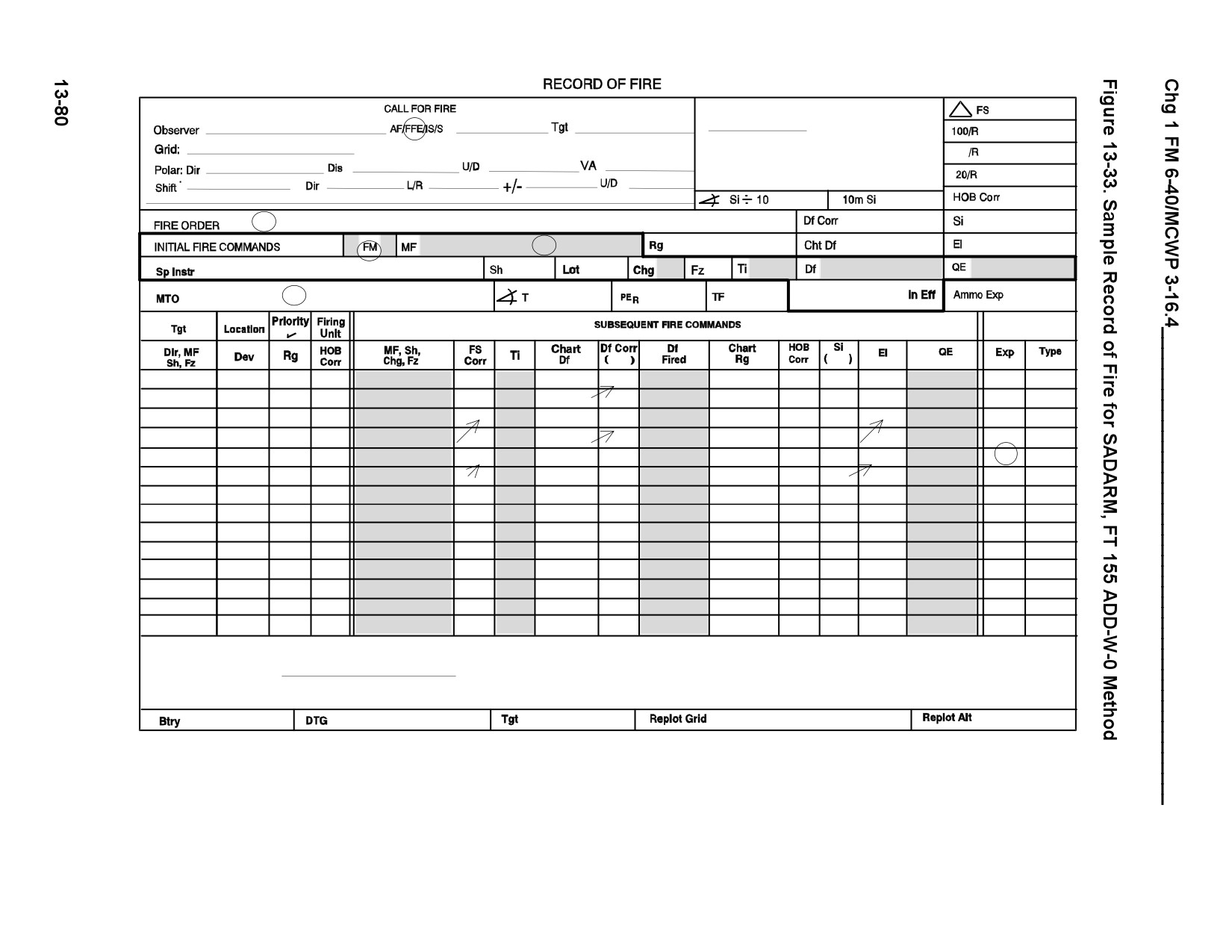
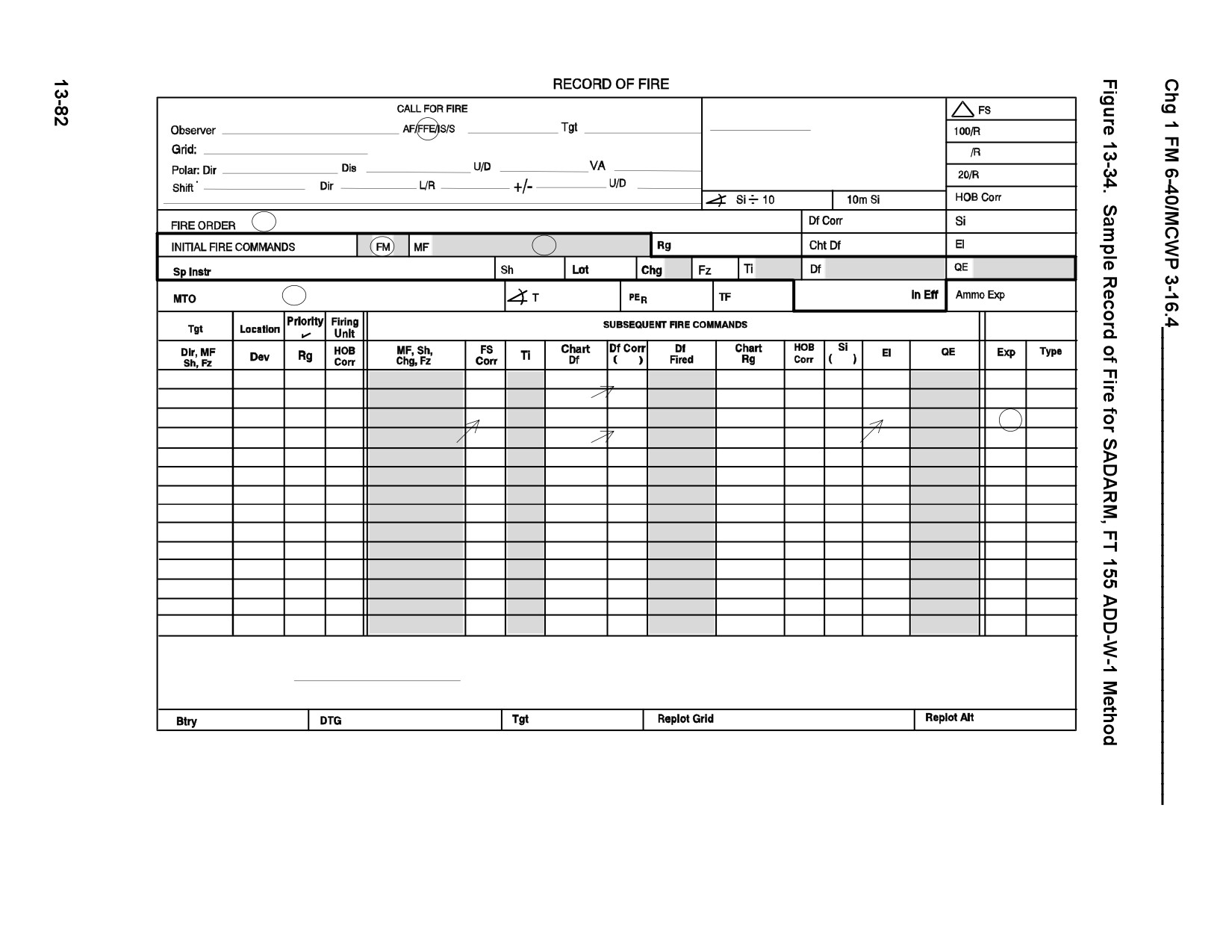
(See Figures 13-33 and 13-34, Sample
Records of Fire for SADARM)
b. Offset aimpoint for low level winds. The HCO places a target grid over the target
location from step 1. He then applies the Direction of Wind from the Meteorological Message
(Extracted from Line 3) and offsets the aimpoint by the distance determined by multiplying the
Wind Speed (Extracted from Line 3) times the correction factor from Table "A", Column 5,
expressed to the nearest 10 meters. This is the offset aimpoint which is used to determine firing
data for SADARM.
c. Determine AN-2 graze burst data to the corrected aimpoint. The HCO announces
chart range and deflection to the corrected aimpoint from step 2. These values are recorded in
the Subsequent Fire Commands portion of the DA-4504. AN-2 graze burst data are determined
to this offset aimpoint, to include Fuze Setting, Deflection to fire, and Quadrant Elevation (Site
and angle "T" were determined in step (a.)).
d. Determine SADARM firing data from the ADD-W-0 or ADD-W-1. If data are being
determined with the ADD-W-0, use paragraph (1.) below. If data are being determined with the
ADD-W-1, then use paragraph (2.) below.
13-77

Chg 1 FM 6-40/MCWP 3-16.4______________________________________________
(1) ADD-W-0. First determine SADARM firing data from the ADD-W-
0. Then the Height of Burst correction must be applied. Table 13-33 contains the HOB
corrections by charge and AN-2 Quadrant Elevation. To extract values from the table, enter with
Charge on the left, and with the AN-2 graze burst Quadrant Elevation on the top. If your
Quadrant Elevation is less than or equal to the QE listed in Column 2, then use the up correction
in Column 2. If it is greater than the value listed in column 3 and less than 800 mils, apply the
up correction from column 3. If it is greater than 800 mils, apply the up correction from column
4. The extracted up correction is used to determine the change in Quadrant Elevation (from
Table "A", Column 3) and change in Fuze Setting (from Table "B", Column 3) for the change in
HOB. These values are then algebraically added to the ADD-W-0 data to determine the data to
fire. The FT 155 ADD-W-0 use the following formulas:
DEFLECTION TO FIRE
AIMPT CHT DF+ADD-W-0 DF CORR+GFT DF CORR+AN-2 DFT=M898 DF
FUZE SETTING TO FIRE
AN-2 FS+ADD-W-0 FS CORRECTION+HOB FS CORRECTION=M898 FS
QUADRANT ELEVATION TO FIRE
AN-2 QE+ADD-W-0 QE CORRECTION+HOB QE CORRECTION=M898 QE
Table 13-33, FT 155 ADD-W-0 HOB Corrections
Column 1
Column 2
Column 3
Column 4
CHARGE
AN-2 QE <=
AN-2 QE> and <800
AN-2 QE >800
3G (M3A1)
QE<=498, U200
QE>498, U200
U250
4G (M3A1)
QE<=430, U100
QE>430, U150
U250
5G (M3A1)
QE<=366, U100
QE>366, U150
U250
3W (M4A2)
QE<=434, U100
QE>434, U200
U250
4W (M4A2)
QE<=388, U150
QE>388, U150
U250
5W (M4A2)
QE<=343, U150
QE>343, U150
U250
6W (M4A2)
QE<=305, U100
QE>305, U200
U300
7W (M4A2)
QE<=251, U100
QE>251, U200
U300
7R/8W (M119/A1/A2)
QE<=205, U100
QE>205, U200
U300
8S (M203/A1)
QE<=173, U100
QE>173, U200
U300
Table 13-34 contains the specific step action drill required to compute SADARM firing
data using the ADD-W-0 method.
13-78

______________________________________________Chg 1 FM 6-40/MCWP 3-16.4
Table 13-34. SADARM employment procedures (FT 155 ADD-W-0)
STEP
ACTION
1
The call for fire is received
2
FDO issues Fire Order
3
The computer records the target information on the Record of Fire.
(Note: All fire commands are announced as they are determined)
4
The HCO plots the target location on the firing chart and determines
chart range, chart deflection, and angle "T" to the target.
5
The VCO determines and announces AN-2 site to the target location.
6
The Computer determines and announces the data for the offset
aimpoint by extracting the Wind Direction and Wind Speed from line 3
of the meteorological message. The Wind Direction is announced in
hundreds of mils. The aimpoint shift correction is determined by
multiplying the windspeed times the value from column 5, Table "A" of
the Firing Table Addendum. (Note, the entry argument for the
addendum is the AN-2 data determined to the target location)
7
The HCO places a target grid over the target location and applies the
Wind Direction announced by the Computer in step 5. The aimpoint
shift correction is applied into the wind.
(Note: the Wind Direction
from the MET MSG is the direction the wind is blowing from.)
8
The HCO determines and announces chart range and chart deflection
to the offset aimpoint. The target grid is then reoriented to the OT
direction announced by the observer, as all corrections will be based
on this aimpoint. Angle "T", however, is determined to the actual
target location in step 4.
9
The computer determines AN-2 data to the corrected aimpoint.
10
The computer uses the data from step 9 to determine SADARM data.
11
The computer determines the FS HOB correction necessary by
dividing the HOB correction from table 13-33 by 50. This value is then
multiplied times the correction factor from Table "B", Column 3 of the
ADD-W-0 addendum to determine the HOB FS CORRECTION.
12
The computer determines fuze setting to fire. The fuze setting to fire is
determined with the following formula: AN-2 FS+ADD-W-0 FS
CORR+HOB FS CORR=M898 FS
13
The computer determines the deflection to fire. The deflection to fire is
determined with the following formula: AIMPT CHT DF+ADD-W-0 DF
CORR+GFT DF CORR+AN-2 DFT=M898 DF
14
The computer determines the QE HOB correction necessary by
dividing the HOB correction from table 13-33 by 50. This value is then
multiplied times the correction factor from Table "A", Column 3 of the
ADD-W-0 addendum to determine the HOB QE CORRECTION.
15
The computer determines the Quadrant Elevation to fire. The QE to
fire is determined with the following formula: AN-2 QE+ADD-W-0 QE
CORR+HOB QE CORR =M898 QE
13-79
FDC: K36
LAST TGT # AA72Ø1
SADARM FT 155 ADD-W-0
BTRY ALT 4Ø5
TGT ALT
445
H42
-BTRT ALT 4Ø5
23
VI
+4Ø
442 783
5
T-72 Platoon i/o, SADARM
2
+ 9
BTRY
2
45ØØ
327Ø
232
SAD
S/G
5
(241)
K,
2 TGT # AA72Ø2
(2ØØ)
(< 38)
(15)
+9
AN-2 AIMPOINT DATA
(15.3)
326Ø
L9
(3269)
464Ø
+9
241
(250)
DRIFT (L4) + GFT (L5) =
SADARM AIMPOINT DATA
-2.Ø
(13.3)
LØ
(3269)
+ 129
(379)
ADD-W-Ø, TBL B, COL 2
TBL
A, COL 8
TBL A, COL 2
HOB CORRECTION DATA (U1ØØ/5Ø =2 INC)
+Ø.2
13.5
3269
+32
411
12
SAD
ADD-W- Ø
TBL B, COL
3 X INC (Ø.1 X 2) =
TBL A COL 3 X INC
(16.1 X 2) =
EOM
EOM
MET MSG LINE Ø3
19 KTS
(From Met Msg)
AN-2 GFT SETTING: GFT B, CHG5, LOT D/G, RG 5ØØØ, EL 264, TI 16.7 (M577)
Wind Dir 24ØØ Mils X 9.9 M/KT
(TBL A, Col 5)
GFT DF CORR L5
Wind Speed 19 Knots = 188.1~19Ø Meter Aimpt shift
B
241022SFEB98
AA72Ø2

______________________________________________Chg 1 FM 6-40/MCWP 3-16.4
(2) ADD-W-1. No corrections to the Height of Burst are required. The AN-2
graze burst data are used as entry arguments into the ADD-W-1 and the corrections to DF, FS,
and QE are and applied. The FT 155 ADD-W-1 use the following formulas:
FUZE SETTING TO FIRE
AN-2 FS+ADD-W-1 FS CORRECTION=M898 FS
DEFLECTION TO FIRE
AIMPT CHT DF+ADD-W-1 DF CORR+GFT DF CORR+AN-2 DFT=M898 DF
QUADRANT ELEVATION TO FIRE
AN-2 QE+ADD-W-1 QE CORRECTION=M898 QE
Table 13-35. SADARM employment procedures (FT 155 ADD-W-1)
STEP
ACTION
1
The call for fire is received
2
FDO issues Fire Order
3
The computer records the target information on the Record of Fire.
(Note: All fire commands are announced as they are determined)
4
The HCO plots the target location on the firing chart and determines
chart range, chart deflection, and angle "T" to the target.
5
The VCO determines and announces AN-2 site to the target location.
6
The Computer determines and announces the data for the offset
aimpoint by extracting the Wind Direction and Wind Speed from line 3
of the meteorological message. The Wind Direction is announced in
hundreds of mils. The aimpoint shift correction is determined by
multiplying the windspeed times the value from column 5, Table "A" of
the Firing Table Addendum. (Note, the entry argument for the
addendum is the AN-2 data determined to the target location)
7
The HCO places a target grid over the target location and applies the
Wind Direction announced by the Computer in step 5. The aimpoint
shift correction is applied into the wind.
(Remember, the Wind
Direction from the Meteorological Message is the direction the wind is
blowing from.)
8
The HCO determines and announces chart range and chart deflection
to the offset aimpoint. The target grid is then reoriented to the OT
direction announced by the observer, as all corrections will be based
on this aimpoint. Angle "T", however, is determined to the actual
target location in step 4.
9
The computer determines the FS to fire. The FS to fire is determined
with the following formula: AN-2 FS+ADD-W-1 FS CORR = M898 FS
10
The computer determines the DF to fire. The DF to fire is determined
with the following formula: AIMPT CHT DF+ADD-W-1 DF CORR+GFT
DF CORR+AN-2 DFT=M898 DF
11
The computer determines the QE to fire. The QE to fire is determined
with the following formula: AN-2 QE+ADD-W-1 QE CORR=M898 QE
13-81
FDC: K36
LAST TGT # AA72Ø1
SADARM FT 155 ADD-W-1 METHOD BTRY ALT 4Ø5
TGT ALT
445
H42
-BTRT ALT 4Ø5
23
VI
+4Ø
442 783
5
T-72 Platoon i/o, SADARM
2
+ 9
BTRY
2
45ØØ
327Ø
232
SAD
S/G
5
(241)
K,
2 TGT # AA72Ø2
(2ØØ)
(< 38)
(15)
+9
AN-2 AIMPOINT DATA
(15.3)
326Ø
L9
(3269)
464Ø
+9
241
(250)
DRIFT (L4)
+ GFT
(L5) =
SADARM
AIMPOINT DATA
-1.8
13.5
LØ
3269
+ 161
411
12
SAD
ADD-W-1,
TBL B, COL 2
TBL A, COL 8
TBL A, COL 2
EOM
EOM
MET MSG LINE Ø3
19 KTS
(From Met Msg)
AN-2 GFT SETTING: GFT B, CHG5, LOT D/G, RG 5ØØØ, EL 264, TI 16.7
(M577)
Wind Dir 24ØØ Mils X 9.9 M/KT
(TBL A, Col 5)
GFT DF CORR L5
Wind Speed 19 Knots
= 188.1~19Ø Meter Aimpt shift
B
241022SFEB98
AA72Ø2

_____________________________________________Chg 1 FM 6-40/MCWP 3-16.4
Section II
Manual Computation of Safety Data
Minimum and maximum quadrant elevations, deflection limits, and minimum fuze settings
must be computed to ensure that all rounds fired impact or function in the target area. These
data are presented and arranged in a logical manner on a safety T. This section describes the
manual computation of safety data by use of tabular and graphical equipment. As stated earlier,
the range officer gives the OIC the lateral safety limits and the minimum and maximum ranges of
the target areas. These data must be converted to fuze settings, deflections, and quadrants. The
computations discussed in this section should be done by two safety-certified personnel working
independently.
15-4. Manual Computational Procedures
Manual safety computations are accomplished in four steps, beginning with receipt of the
range safety card and ultimately ending with the production of the safety T. These steps are
listed in Table 15-1.
Table 15-1. Four Steps of Manual Safety Production.
STEP
ACTION
1
Receive the Range Safety Card (Produced by unit or from Range Control).
2
Construct the Safety Diagram in accordance with Table 15-2.
3
Construct and complete the computation matrix using Figure 15-3 for Low Angle
Safety and Figure 15-12 for High Angle Safety.
4
Construct the Safety T and disseminate in accordance with unit SOP
NOTE: Figures 15-16 and 15-17 are reproducible safety computation forms
15-5. Safety Card
A Range Safety Card (Figure 15-1), which prescribes the hours of firing, the area where
the firing will take place, the location of the firing position, limits of the target area
(in
accordance with AR 385-63/MCO P3570) and other pertinent data is approved by the range
officer and sent to the OIC of firing. The OIC of firing gives a copy of the safety card to the
position safety officer, who constructs the safety diagram based on the prescribed limits.
15-7
Chg 1 FM 6-40/MCWP 3-16.4_____________________________________________
NOTE: The range safety card depicted in Figure 15-1 is used for all safety computation
examples in this chapter.
Range Safety Card
Unit/STR K 3/11
ScheduledDateIn Ø5/30/98
ScheduledDate Out Ø5/30/98
TimeIn
Ø7:ØØ TimeOut
23:59
Firing Point 185
(6Ø26
411Ø) HT
37Ø.Ø
Impact Area S. CARLTON AREA
Weapon
M198
(155)
Ammunition M1Ø7, M11Ø, M116, M825, M485, M557, M582, M732,M577
Type of Fire LOW ANGLE: HE, WP, M825, ILA, M116
Type of Fire HIGH ANGLE: HE, M825, ILA
Direction Limits: (Ref GN):
Left
134Ø MILS
Right
19ØØ MILS
Low Angle PD Minimum Range
39ØØ METERS
Min Charge 3GB
Fuze TI and High Angle Minimum Range
4ØØØ METERS
Min Charge 3GB
To Establish MIN Time for Fuze VT Apply +5.5 seconds to the Low Angle PD Min Rg
Maximum Range to Impact
62ØØ METERS
Max Charge 4GB
COMMENTS
From AZ 134Ø TO AZ 15ØØ MAXIMUM RANGE IS 57ØØ
SPECIAL INSTRUCTIONS
1. SHELL ILLUMINATION (ALL CALIBERS)
A. MAX QE WILL NOT EXCEED QE FOR MAXIMUM RANGE TO IMPACT
B. ONE INITIAL ILLUMINATION CHECK ROUND WILL BE FIRED TO INSURE
ILLUMINATION FLARE REMAINS IN IMPACT AREA
C. IF INITIAL ILLUMINATION FLARE DOES NOT LAND IN IMPACT AREA, NO
FURTHER ILLUMINATION WILL BE FIRED AT THAT DF AND QE.
D. INSURE THAT ALL SUCCEEDING ROUNDS ARE FIRED AT A HOB
SUFFICIENT TO PROVIDE COMPLETE BURNOUT BEFORE REACHING THE
GROUND.
E. FOR 155MM HOWITZER, CHARGE 7 NOT AUTHORIZED WHEN FIRING
PROJ ILLUM , M485.
UNCLEARED AMMUNITION(FUZES, PROJECTILES, POWDER) WILL NOT BE USED
Figure 15-1. Example of a Range Safety Card
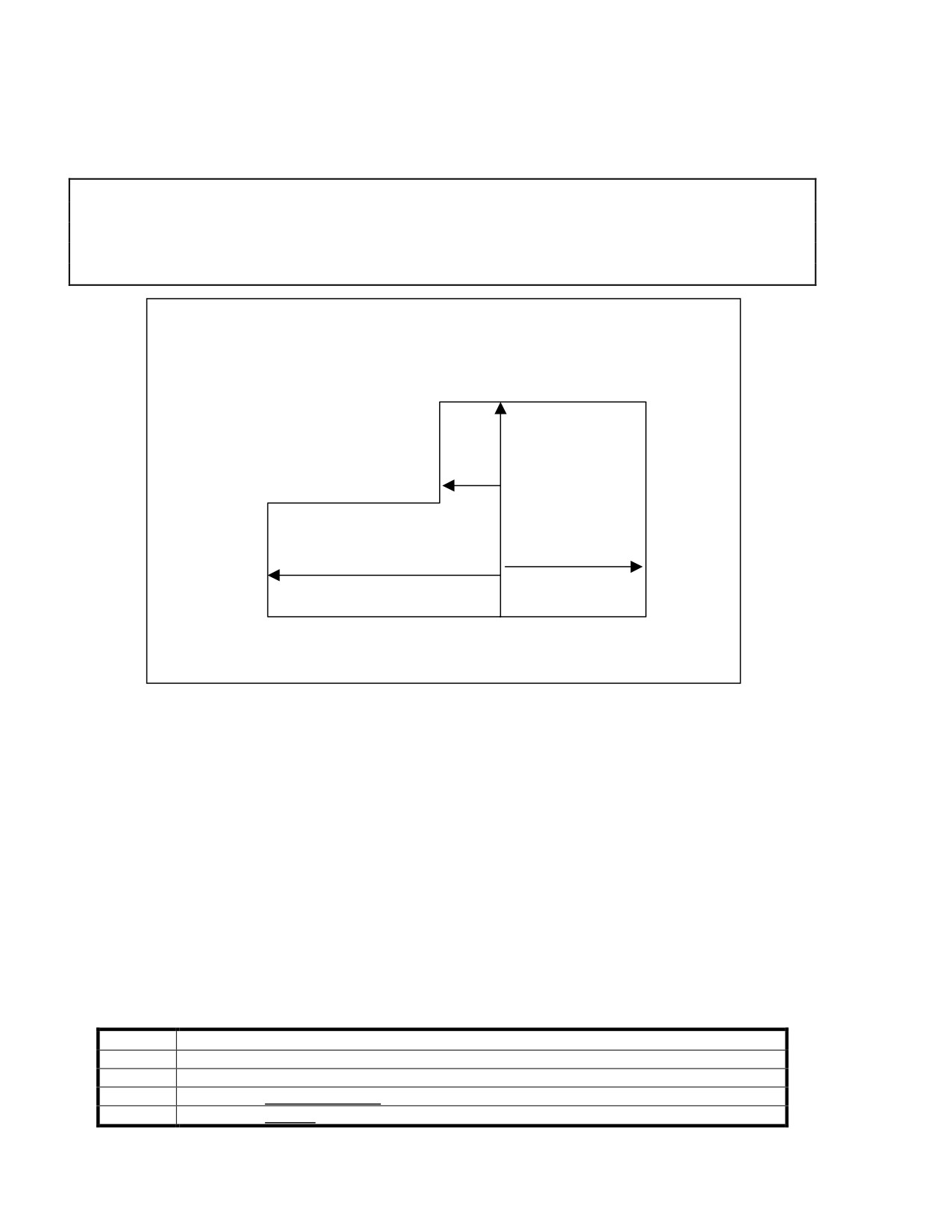
15-6. Basic Safety Diagram
a. The FDO, on receipt of the safety card, constructs a basic safety diagram. The basic
safety diagram is a graphical portrayal of the data on the safety card or is determined from the
surface danger zone (AR 385-63, Chapter 11) and need not be drawn to scale. Shown on the
basic safety diagram are the minimum and maximum range lines; the left, right, and intermediate
(if any) azimuth limits; the deflections corresponding to the azimuth limits; and the azimuth of
lay.
b. The steps for constructing a basic safety diagram are shown in table 15-2. An example
of a completed safety diagram is shown in Figure 15-2.
15-8

_____________________________________________Chg 1 FM 6-40/MCWP 3-16.4
Table 15-2. Construction of a Basic Safety Diagram.
STEP
ACTION
1
On the top third of a sheet of paper, draw a line representing the AOL for the firing
unit. Label this line with its azimuth and the common deflection for the weapon
system.
NOTE: If the AOL is not provided, use the following procedures to determine it:
Subtract the maximum left azimuth limit from the maximum right azimuth limit. Divide
this value by two, add the result to the maximum left azimuth limit, and express the
result to the nearest 100 mils. Expressing to the nearest 100 mils makes it easier for
the aiming circle operator to lay the howitzers.
2
Draw lines representing the lateral limits in proper relation to the AOL. Label these
lines with the corresponding azimuth from the range safety card.
3
Draw lines between these lateral limits to represent the minimum and maximum
ranges. Label these lines with the corresponding ranges from the range safety card.
These are the Diagram Ranges.
NOTE: If the minimum range for fuze time is different from the minimum range, draw
a dashed line between the lateral limits to represent the minimum range for fuze time.
Label this line with the corresponding range from the range safety card. This is the
minimum time Diagram Range.
4
Compute the angular measurements from the AOL to each lateral limit. On the
diagram, draw arrows indicating the angular measurements and label them.
5
Apply the angular measurements to the deflection corresponding to the AOL
(Common Deflection) and record the result. This will be added to the Drift and GFT
Deflection Correction determined in the Safety Matrices to produce the Deflection
Limits on the Safety T.
(Note: If no GFT Deflection Correction has been
determined, then the Deflection Limits = Drift + Diagram Deflection. If a GFT
setting has been determined, then the Deflection Limits = Drift + GFT Deflection
Correction + Diagram Deflection). Drift is applied to the Basic Safety Diagram by
following the "least left, most right" rule. The lowest (least) drift is applied to all left
deflection limits, and the highest (greatest) drift is applied to all right deflection limits.
6
Label the diagram with the following information from the range safety card: firing
point location (grid and altitude), charge, shell, fuze, angle of fire, and azimuth of lay.
c. When the basic safety diagram is complete, it will be constructed to scale, in red, on the
firing chart. Plot the firing point location as listed on the range safety card. Using temporary
azimuth indexes, an RDP, and a red pencil to draw the outline of the basic safety diagram. To do
this, first draw the azimuth limits to include doglegs. Then, by holding the red pencil firmly
against the RDP at the appropriate ranges, connect the azimuth lines.
d. Only after drawing the basic safety diagram on the firing chart may the base piece
location be plotted and deflection indexes be constructed. Should the diagram be drawn from the
base piece location, it would be invalid unless the base piece was located over the firing point
marker.
e. After the basic safety diagram has been drawn on a sheet of paper and on the firing
chart, it is drawn on a map of the impact area using an RDP and a pencil. These limits must be
drawn accurately, because they will be used to determine altitudes for vertical intervals.
Determine the maximum altitude along the minimum range line. This is used to ensure that the
quadrant fired will cause the round to clear the highest point along the minimum range line and
impact (function) within the impact area. At the maximum range, select the minimum altitude to
15-9
Chg 1 FM 6-40/MCWP 3-16.4_____________________________________________
ensure that the round will not clear the lowest point along the maximum range. Once the
altitudes have been selected, label the basic safety diagram with the altitudes for the given ranges.
NOTE: The rule for determining the correct altitude for safety purposes is called the mini-max
rule. At the minimum range, select the maximum altitude; at the maximum range, select the
minimum altitude. If the contour interval is in feet, use either the GST or divide feet by 3.28 to
determine the altitude in meters.
(Feet ÷ 3.28 = Meters) This rule applies to both manual and
automated procedures.
FP 185 (GRID 6026 4110 ALT 370)
LOW ANGLE, HE/WP/SMK, CHG 4GB, AOF 1600
Max Rg 6200
Min Alt 345
AZ 1500
DF 3300
+ L4
=
3304
L 100
Max Rg 5700
Min Alt 355
AZ 1900
AOF 1600
DF 2900
DF
3200
+ L9
=
2909
AZ 1340
R 300
DF 3460
L 260
+ L4
=
3464
Min TI Rg 4000
Min Rg 3900
Max Alt 393
Figure 15-2. Example of a Completed Safety Diagram, HE/WP/SMK
15-7. Computation of Low Angle Safety Data
Use the steps outlined in Table 15-3 and in the matrix in Figure 15-3 as examples for
organizing computations. The Low Angle Safety Matrix is used for all munitions except M712
CLGP (Copperhead). Paragraph 15-13 describes M712 safety computations. The data are
determined by either graphical or tabular firing tables. In the case of expelling charge munitions,
the Safety Table located in the Firing Tables or Firing Table Addendums is utilized to determine
Elevation, Time of Flight, Fuze Setting, and Drift.
(Note: the Safey Tables used for computing
the examples in this chapter are located after the Illum and M825 Low Angle examples). Use
artillery expression for all computations except where noted.
Table 15-3: Low Angle Procedures
STEP
ACTION
1
On the top third of a blank sheet of paper, construct the basic safety diagram
2
In the middle third of the sheet of paper, construct the Low Angle Safety Matrix
3
Record the Diagram Ranges from the basic safety diagram.
4
Record the Charge from the range safety card.
15-10

_____________________________________________Chg 1 FM 6-40/MCWP 3-16.4
5
Enter the Range Correction, if required. This range correction is only necessary if a
nonstandard condition exists and is not already accounted for in a GFT setting, such
as correcting for the always heavier than standard White Phosphorous projectile.
See figure 2, paragraph (b) to determine range correction. If a range correction is
required, it is expressed to the nearest 10 meters. If no range correction is
required, enter 0 (zero).
6
Determine the Total Range. Total range is the sum of the Diagram Range and the
Range Correction. Total Range is expressed to the nearest 10 meters.
7
Enter the Range K. Range K is only required if a GFT setting has been obtained but
cannot be applied to a GFT (i.e., determining Illumination safety with a HE GFT
setting). Range K is simply the Total Range Correction from the GFT setting
expressed as a percentage. This percentage, when multiplied by the Total Range,
produces the Entry Range. If no GFT setting is available (i.e., pre-occupation
safety), then enter 1.0000 as the Range K. If a GFT setting is available, (i.e., post
occupation safety), then enter the Range K expressed to four decimal places
(i.e., 1.1234). Step 7a demonstrates how to compute Range K.
7a
Divide Range ~ Adjusted Elevation by the Achieved Range from the GFT setting to
determine Range K:
Range ~ Adjusted Elevation
= Range K, expressed to four decimal places.
Achieved Range
8
Determine the Entry Range. Multiply the Total Range times Range K to determine the
Entry Range. If Range K is 1.0000, then the Entry Range will be identical to the Total
Range. Entry Range is expressed to the nearest 10 meters.
9
Following the Mini-Max rule, determine the Vertical Interval by subtracting the unit
altitude from the altitude corresponding to the Diagram Range, and record it. (Note:
Diagram Range is used for computations of VI and Site because this is the actual
location of the minimum range line. VI is not computed for minimum time range lines.
The Range Correction, Total Range, and Range K are used to compensate for
nonstandard conditions, and represent the aimpoint which must be used to cause the
round to cross the Diagram Range.) VI is expressed to the nearest whole meter.
10
Compute and record Site to the Diagram Range. Use the GST from the head of the
projectile family whenever possible. Site is expressed to the nearest whole mil.
11
Determine the Elevation from Table C (base ejecting) or TFT/GFT (bursting), and
record it.
(Note: GFT Settings are not used to determine Elevation, as Range K
represents total corrections, and to use a GFT setting would double the effects of
those corrections). Elevation is expressed to the nearest whole mil.
12
Compute the Quadrant Elevation and record it. Quadrant Elevation is the sum of
Elevation and Site. Quadrant Elevation is expressed to the nearest whole mil.
13
Determine and record the minimum fuze setting for M564/M565 fuzes. These fuze
settings correspond to the Entry Range and are extracted from Table C (base ejecting)
or TFT/GFT. (Note: Minimum Fuze Settings are only determined for minimum range
lines, and may be computed for separate minimum fuze range lines). Fuze Settings
are expressed to the nearest tenth of a fuze setting increment.
14
Determine and record the minimum fuze setting for M582/M577 fuzes. These fuze
settings correspond to the Entry Range and are extracted from Table C (base ejecting)
or TFT/GFT. (Note: Minimum Fuze Settings are only determined for minimum range
lines, and may be computed for separate minimum fuze range lines). Fuze Settings
are expressed to the nearest tenth of a second.
15
Determine and record the Time of Flight corresponding to the entry range from Table
C, (base ejecting) or TFT/GFT. Time of Flight is expressed to the nearest tenth of
a second.
16
Determine the minimum fuze setting for M728/M732 fuzes. Add 5.5 seconds to the
time of flight, and express to the next higher whole second. The VT fuze is designed to
arm 3.0 seconds before the time set. They have been known to arm up to 5.5
seconds before the time set. That is why this value is added and always expressed up
to the next whole second. (Note: Minimum Fuze Settings are only determined for
15-11

Chg 1 FM 6-40/MCWP 3-16.4_____________________________________________
minimum range lines, and may be computed for separate minimum fuze range lines).
VT Fuze Settings are expressed up to the next higher whole second.
17
Determine and record Drift corresponding to the Entry Range from Table C (base
ejecting) or TFT/GFT. Drift is applied to the Basic Safety Diagram by following the
"least left, most right" rule. The lowest (least) drift is applied to all left deflection limits,
and the highest (greatest) drift is applied to all right deflection limits. Drift is
expressed to the nearest whole mil.
18
Ensure computations are verified by a second safety-certified person.
19
On the bottom third of the sheet of paper, record the data on the safety T.
(a)
(b)
(c)
(d)
(e)
(f)
(g)
(h)
(i)
(j)
(k)
(l)
(m)
(n)
(o)
(p)
DIAGRAM
RG
TOT
RG ENTRY
M564/ M582
M728/
RG
+ CORR
= RG x K
= RG
CHG VI SI + EL = QE M565 M577 TOF
+ 5.5 = M732 DFT
(a) This is the minimum or maximum range from the range safety diagram.
(b) This is the range correction for nonstandard conditions from Table F, if required. This is typically for preoccupation safety or
corrections for nonstandard conditions not included in the Range K factor in column (d), such as WP [] weight. Examples of
nonstandard conditions accounted for in (b) include, but are not limited to, difference in projectile square weight, difference in
muzzle velocity, or any nonstandard condition accounted for prior to determining a Range K factor. If there is no change from
standard, or all nonstandard conditions are accounted for in the Range K factor, this value is zero (0).
To determine a range correction from Table F, use the following formula:
NONSTANDARD STANDARD
CHANGE IN RG CORR RANGE
RANGE CHG CONDITION
- CONDITION
= STANDARD x FACTOR = CORRECTION
(c)
This is the sum of the Diagram Range and the Range Correction. If there is no range correction, then the Total
Range will be the same as the Diagram Range.
(d) This is the Range K factor determined by using Technique 2, Appendix F, Page F-5 in the FM 6-40/MCWP 3-16.4. This is for
post occupation safety.
It represents total corrections for a registration, MET + VE, or other subsequent MET technique. It represents all
nonstandard conditions (unless a separate nonstandard condition such as change in square weight for WP is listed
separately in column (b)). It is multiplied times the Total Range to determine Entry Range. If there is no Range K, enter
1.0000.
(e) This is the sum of the Total Range times the Range K factor. If there is no Range K factor, then the Entry
Range will be the same as the Total Range. Entry Range is the range to which Elevation is determined.
(f)
This is the charge from the range safety card for this set of safety computations.
(g) This is the Vertical Interval from the range safety diagram.
(h) This is the site determined to the Diagram Range by using the GST or TFT from the head of the projectile family; e.g., site for
the M110 WP projectile is determined with the AM-2, M825 site is computed using the AN-2. Site is computed to the
Diagram Range, as that is where the Vertical Intervals are determined.*
(i)
This is the elevation from Table C (base ejecting), or GFT/TFT (bursting).*
(j)
This is the sum of Elevation and Site. It is the minimum or maximum Quadrant Elevation corresponding to the Minimum or
Maximum Range.
(k)
This is the Minimum Fuze Setting for the M564/565 fuze from Table C (base ejecting), or GFT/TFT (bursting), corresponding
to the Entry Range. */**
(l)
This is the Minimum Fuze Setting for the M582/M577 fuze from Table C (base ejecting), or GFT/TFT (bursting), corresponding
to the Entry range. */** (Note, this also applies to the M762, M767, and MOFA fuzes)
(m) This is the Time Of Flight from Table C (base ejecting), or GFT/TFT (bursting), corresponding to the Entry Range. */**
(n) This is the safety factor applied to the Time of Flight to determine VT fuze data.
**
(o) This is the sum of TOF + 5.5. It is the Minimum Fuze Setting for M728/M732 VT fuzes. **
(p) This is the Drift corresponding to the Entry Range from Table C (base ejecting), or GFT/TFT (bursting). Drift is applied to the
range safety diagram by using the "Least, Left; Most Right, “ rule. The "least" or lowest drift is applied to all left deflection
limits, and the "Most" or greatest drift is applied to all right deflection limits.
15-12
_____________________________________________Chg 1 FM 6-40/MCWP 3-16.4
* - See Table 15-4 to determine the correct source table or addendum for computations.
** - Computed only for minimum Entry Ranges, and only if applicable to the ammunition and the range safety card.
Figure 15-3. Low Angle Safety Matrix
4[] HE/SMK (M116) LOW ANGLE CHG 4GB
DIAGRAM
RG
TOT
RG ENTRY
M564/ M582
M728/
RG
+ CORR = RG x K
= RG CHG VI SI
+ EL = QE M565 M577 TOF
+ 5.5 = M732 DFT
3900
+
0
= 3900 x 1.0000 = 3900
4GB +23 +6
+ 225 = 231
--
13.7
/
19.2
~ 20.0
L4
4000
+
0
= 4000 x 1.0000 = 4000
4GB
--
--
--
--
--
14.1
--
--
--
5700
+
0
= 5700 x 1.0000 = 5700
4GB -15 -3
+ 362 = 359
--
--
--
--
--
6200
+
0
= 6200 x 1.0000 = 6200
4GB -25 -5
+ 408 = 403
--
--
--
--
L9
WP (M110, Weight Unknown) Low Angle Chg 4GB
Determining Range Correction for [] Weight Unknown Projectile
NONSTANDARD STANDARD CHANGE IN
RG CORR RANGE
RANGE CHG CONDITION
- CONDITION = STANDARD
x
FACTOR = CORRECTION
3900
4GB
8[]
-
4[]
= I 4[]
x
+28
= +112 ~ +110
4000
4GB
8[]
-
4[]
= I 4[]
x
+28
= +112 ~ +110
DIAGRAM
RG
TOT
RG ENTRY
M564/ M582
M728/
RG
+ CORR = RG x K
= RG CHG VI SI
+ EL = QE M565 M577 TOF
+ 5.5 = M732 DFT
3900
+ (+110)
= 4010 x 1.0000
= 4010
4GB +23 (+6) + 232 = 238
--
--
--
--
--
4000
+ (+110)
= 4110 x 1.0000
= 4110
4GB
--
--
--
--
--
14.6
--
--
--
Figure 15-4. Completed Low Angle Safety Matrix, HE/WP/SMK
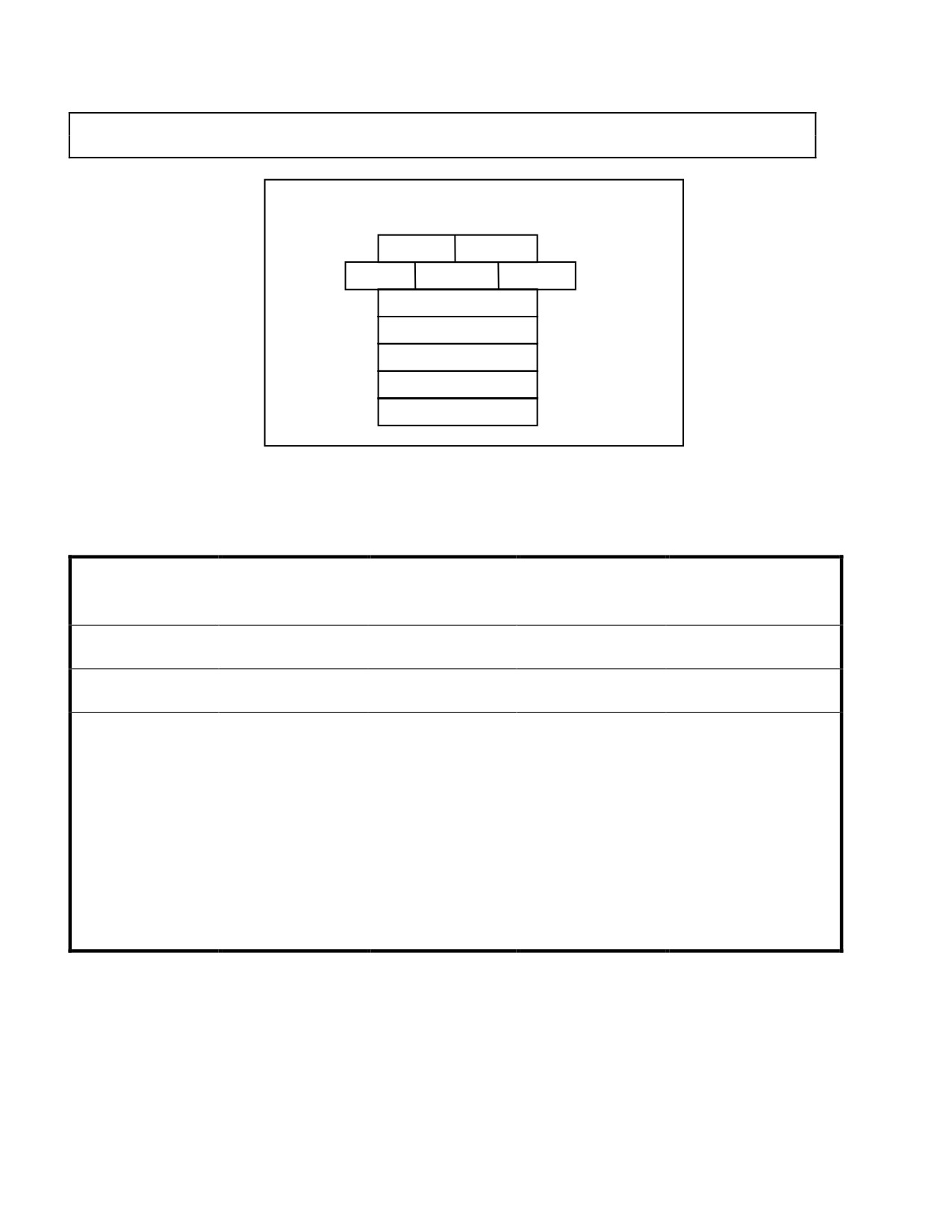
15-8. Safety T
a. The safety T is a convenient method of arranging safety data and is used to verify the
safety of fire commands (Figure 15-5). The information needed by the FDO, XO, or platoon
leader, and section chief is organized in an easy to read format. The safety T is labeled with a
minimum of firing point location, charge, projectiles(s), fuze(s), angle of fire, and AOL. Other
optional entries are subject to unit SOP. Any time new safety data are determined, new safety Ts
are constructed and issued only after the old safety Ts have been collected (that is, after a move
or after a registration or MET + VE). Use only one charge per Safety T. (Note: The examples
in this demonstrate which data is transferred from the Safety Matrix to the Safety Tee. This data
is in bold type in the matrix and the associated safety T).
b. It is the FDO’s responsibility to ensure that all data transmitted from the FDC is within
the limits of the safety T. It is the section chief’s responsibility to ensure that all data applied to
the ammunition or howitzer is within the limits of the safety T. The FDO must ensure that
deflection to fire is between the deflections listed on the safety T. He then must determine if the
quadrant elevation corresponding to that deflection is between the minimum and maximum QE
on the safety T. Finally, he must ensure that the fuze setting is equal to or greater than the
minimum fuze setting listed on the safety T for the specific fuze type.
15-13
Chg 1 FM 6-40/MCWP 3-16.4_____________________________________________
NOTE: A reproducible copy of DA Form 7353-R (Universal Safety T) is included at the end of
this manual, in the reproducible forms section.
FP 185, HE/WP/SMK
LOW ANGLE, CHG 4GB, AOL 1600
359
403
MAX QE
3464
3304
2909
DF
231
MIN QE HE
238
MIN QE WP
14.1
MIN HE TI M582
14.6
MIN WP TI M582
20.0
MIN VT M732
Figure 15-5. Example of a Completed Safety T.
Table 15-4. Tables and Addendums required for Safety Computations
Weapon
Safety
Base
Firing Table
Firing Table
System
Required for:
Projectile
for Base
Addendum
Projectile
M101A1
M314
HE
105-H-7
N/A
M444
HE
105-H-7
ADD-B-2
M102/
M314
HE
105-AS-3
N/A
M119
M444
HE
105-AS-3
ADD-F-1
M198 or
M485
HE
155-AM-2
N/A
M109A3/A5/A6
M449
HE
155-AM-2
ADD-I-2
M483A1
HE
155-AM-2
ADD-R-1
M483A1
DPICM
155-AN-2
ADD-J-2
M825
HE
155-AM-2
ADD-T-0 w/ch1
M825
DPICM
155-AN-2
ADD-Q-O w/ch1,2
M825A1
HE
155-AN-2
ADD-T-0 w/ch1
M825A1
DPICM
155-AN-2
ADD-Q-0 w/ch1,2
M692/M731
DPICM
155-AN-2
ADD-L-1 w/ch1,2
M718/M741
DPICM
155-AN-2
ADD-N-1 w/ch1
M898
DPICM
155-AN-2
ADD-W-0
15-9. Updating Safety Data after Determining a GFT Setting
a. After a GFT setting is determined (result of registration or MET + VE technique), the
FDO must compute new safety data. The GFT setting represents all nonstandard conditions in
effect at the time the GFT setting was determined (Chapter 10 and 11 discuss Total Corrections
in detail). The effect on safety is that the data determined before the GFT setting was determined
no longer represent the safety box, and could result in an unsafe condition if not applied to safety
15-14
_____________________________________________Chg 1 FM 6-40/MCWP 3-16.4
computations. In order to update safety, new elevations are determined which correspond to the
minimum and maximum ranges. Deflections are modified by applying the GFT deflection
correction to each lateral limit. Minimum fuze settings are also recomputed. The basic safety
diagram drawn in red on the firing chart does not change. It was drawn on the basis of azimuths
and ranges, and it represents the actual limits.
b. There are two techniques which can be used to update safety computations: The
Range K Method and Applying a GFT setting to a GFT. Both methods use the same safety
matrices, and apply to both low and high angle fire. The preferred technique for updating safety
is to apply a GFT setting to the appropriate GFT. Unfortunately, not all munitions have
associated GFTs. Application of Total Corrections is the same as for normal mission processing.
The Total Corrections, in the form of a GFT setting or Range K, must be applied in accordance
with the data on which they were determined (i.e., the GFT setting for a HE registration applies
to all projectiles in the HE family, while a MET + VE for DPICM would apply to all projectiles
in the DPICM family). If automation is available a false registration with M795 graze burst data
may be used to determine total corrections for all projectiles in the DPICM family (see ST 6-40-2
for procedures). The principle difference between the two techniques is the manner in which
minimum fuze setting is determined.
(1) Determining Minimum Fuze Setting with a GFT with a GFT Setting Applied:
When a GFT setting is applied and a fuze setting is to be determined, it is extracted opposite the
Time Gage Line (if it is the fuze listed on the GFT setting) or as a function of elevation (for all
others). Use the procedures in Table 15-5 to update safety using a GFT with a GFT setting
applied.
(2) Determining Fuze Setting using the Range K Technique: In order to simplify
updating safety, the Range K technique determines all fuze settings as a function of
elevation. The difference between registered fuze settings and fuze settings determined using the
Range K technique in actual firings and computer simulations varies by only zero to two tenths
(0.0 - 0.2) of a Fuze Setting Increment/Second. The safety requirements in the AR 385-63 and
incorporation of Minimum Fuze Setting Range Lines adequately compensate for the difference in
computational techniques. Figure 15-7 demonstrates how to update safety when no GFT is
available, utilizing the Range K technique. Use the procedures in Table 15-3 (Low Angle) or
Table 15-8 (High Angle) to update safety using the Range K method.
Table 15-5: Low Angle Procedures using a GFT with GFT Setting applied
STEP
ACTION
1
On the top third of a blank sheet of paper, construct the basic safety diagram in
accordance with the range safety card. (See Table 15-1 for procedures)
2
In the middle third of the sheet of paper, construct the Low Angle Safety Matrix (Figure
1).
3
Record the Diagram Ranges from the basic safety diagram.
4
Record the Charge from the range safety card.
5
Enter the Range Correction, if required. This range correction is only necessary if a
nonstandard condition exists which requires a change in aimpoint and is not already
accounted for in a GFT setting, such as correcting for the always heavier than
standard White Phosphorous projectile.
See figure 2, paragraph (b) to determine
range correction. If a range correction is required, it is artillery expressed to the
nearest 10 meters. If no range correction is required, enter 0 (zero).
15-15

Chg 1 FM 6-40/MCWP 3-16.4_____________________________________________
6
Determine the Total Range. Total range is the sum of the Diagram Range and the
Range Correction. Total Range is expressed to the nearest 10 meters.
7
Range K. This is not used when determining data with a GFT with a GFT setting
applied, as the Elevation Gage line represents Range K.
8
Entry Range. This value is the same as the Total Range. Entry Range is artillery
expressed to the nearest 10 meters.
9
Following the Mini-Max rule, determine the Vertical Interval by subtracting the unit
altitude from the altitude corresponding to the Diagram Range, and record it.
(Note:
Diagram Range is used for computations of VI and Site because this is the actual
location of the minimum range line. VI is not determined for minimum fuze range
lines. The Range Correction, Total Range, and Range K are used to compensate for
nonstandard conditions, and represent the aimpoint which must be used to cause the
round to cross the Diagram Range). VI is artillery expressed to the nearest whole
meter.
10
Compute and record Site to the Diagram Range. Use the GST from the head of the
projectile family whenever possible. Site is artillery expressed to the nearest whole
mil.
11
Place the MHL on the Entry Range and determine the Elevation from the Elevation
Gage Line on the GFT and record it.
Elevation is artillery expressed to the
nearest whole mil.
12
Compute the Quadrant Elevation and record it. Quadrant Elevation is the sum of
Elevation and Site. Quadrant Elevation is artillery expressed to the nearest whole
mil.
13
Using the procedures from Appendix G, determine and record the minimum fuze
setting for M564/M565 fuzes. These fuze settings correspond to the Entry Range. If
the GFT Setting was determined using the M564/M565 fuze, then determine the fuze
setting opposite the Time Gage Line. If the GFT setting was not determined using the
M564/M565 fuze, then extract the fuze setting corresponding to adjusted elevation.
(Note: Minimum Fuze Settings are only determined for minimum range lines, and may
be computed for separate minimum fuze range lines). Fuze Settings are artillery
expressed to the nearest tenth of a fuze setting increment.
14
Using the procedures from Appendix G, determine and record the minimum fuze
setting for M582/M577 fuzes. These fuze settings correspond to the Entry Range. If
the GFT Setting was determined using the M582/M577 fuze, then determine the fuze
setting opposite the Time Gage Line. If the GFT setting was not determined using the
M582/M577 fuze, then extract the fuze setting corresponding to adjusted elevation.
(Note: Minimum Fuze Settings are only determined for minimum range lines, and may
be computed for separate minimum fuze range lines). Fuze Settings are artillery
expressed to the nearest tenth of a second.
15
Using the procedures from Appendix G, determine and record the Time of Flight
corresponding to the Entry Range. Extract the Time of Flight corresponding to
adjusted elevation from the TOF scale. Time of Flight is artillery expressed to the
nearest tenth of a second.
16
Using the procedures in Appendix G, determine the minimum fuze setting for
M728/M732 fuzes. Add 5.5 seconds to the time of flight, and express to the next
higher whole second.
(Note: Minimum Fuze Settings are only determined for
minimum range lines, and may be computed for separate minimum fuze range lines).
VT Fuze Settings are expressed up to the next higher whole second.
17
Determine and record Drift corresponding to adjusted elevation. Drift is applied to the
Basic Safety Diagram by following the "least left, most right" rule. The smallest (least)
drift is applied to all left deflection limits, and the greatest (most) drift is applied to all
right deflection limits. Drift is artillery expressed to the nearest whole mil.
18
Ensure computations are verified by a second safety-certified person.
19
On the bottom third of the sheet of paper, record the data on the safety T.
15-16
_____________________________________________Chg 1 FM 6-40/MCWP 3-16.4
FP 185 (GRID 6026 4110 ALT 370)
Max Rg 6200
LOW ANGLE, HE/WP/SMK, CHG 4GB, AOF 1600
Min Alt 345
AZ 1500
4650
DF 3300
L 100
+ L9
=
3309
GFT K, CHG 4GB, LOT A/G, RG 4450, EL 278, TI 16.3 (M582)
Max Rg 5700
TOT DF CORR L10
Min Alt 355
AOF
1600
GFT DF CORR L5
DF
3200
R 300
AZ 1340
L 260
16.8
DF 3460
AZ 1900
+ L9
DF 2900
RG K = 4650/4450
Min TI Rg 4000
=
3469
+ L15
~ 1.0449
=
2915
Min Rg 3900
Max Alt 393
4[] HE/SMK (M116) Low Angle Chg 4GB
DIAGRAM
RG
TOT
RG ENTRY
M564/ M582
M728/
RG
+ CORR = RG x K
= RG CHG VI SI
+ EL = QE M565 M577 TOF
+ 5.5 = M732 DFT
3900
+
0
= 3900 x 1.0449 = 4080
4GB +23 +6
+ 238 = 244
--
14.5
/
20.0 ~ 20.0
L4
4000
+
0
= 4000 x 1.0449 = 4180
4GB
--
--
--
--
--
14.8
--
--
--
5700
+
0
= 5700 x 1.0449 = 5960
4GB -15
-3
+ 386 =
383
--
--
--
--
--
6200
+
0
= 6200 x 1.0449 = 6480
4GB -25
-5
+ 436 =
431
--
--
--
--
L10
WP (M110, Weight Unknown) LOW ANGLE CHG 4GB
Determining Range Correction for [] Weight Unknown Projectile
NONSTANDARD STANDARD CHANGE IN
RG CORR RANGE
RANGE CHG CONDITION
- CONDITION = STANDARD x
FACTOR = CORRECTION
3900
4GB
8[]
-
4[]
= I 4[]
x
+28
= +112 ~ +110
4000
4GB
8[]
-
4[]
= I 4[]
x
+28
= +112 ~ +110
DIAGRAM
RG
TOT
RG ENTRY
M564/ M582
M728/
RG
+ CORR = RG x K
= RG CHG VI SI
+ EL = QE M565 M577 TOF
+ 5.5 = M732 DFT
3900
+
(+110)
= 4010 x 1.0449 = 4190
4GB +23 (+6) + 245 = 251
--
--
--
--
--
4000
+
(+110)
= 4110 x 1.0449 = 4290
4GB
--
--
--
--
--
15.3
--
--
--
FP 185, HE/WP/SMK LOW ANGLE, CHG 4GB, AOL 1600
GFT K, CHG 4GB, LOT A/G, RG 4450, EL 278, TI 16.3 (M582)
TOT DF CORR L10 GFT DF CORR L5
383
431
MAX QE
3469
3309
2915
DF
244
MIN QE HE
251
MIN QE WP
14.8
MIN HE TI (M582)
15.3
MIN WP TI (M582)
20.0
MIN VT (M732)
Figure 15-6. Post Occupation Low Angle Safety, Range K Method, HE/WP/SMK
15-17
Chg 1 FM 6-40/MCWP 3-16.4_____________________________________________
FP 185 (GRID 6026 4110 ALT 370)
LOW ANGLE, M825, CHG 4GB, AOF 1600
Max Rg 6200
Min Alt 345
AZ 1500
DF 3300
+ L4
L 100
=
3304
AZ 1900
Max Rg 5700
AOF
1600
DF 2900
Min Alt 355
DF
3200
+ L9
AZ 1340
L 260
R 300
=
2909
DF 3460
+ L4
Min TI Rg 4000
=
3464
Min Rg 3900
Max Alt 393
M825 LOW ANGLE CHG 4GB
DIAGRAM
RG
TOT
RG ENTRY
M564/ M582
M728/
RG
+ CORR = RG x K
= RG CHG VI SI
+ EL = QE M565 M577 TOF
+ 5.5 = M732 DFT
3900
+
0
= 3900 x 1.0000 = 3900
4GB +23
+6 + 254 =
260
--
--
--
--
L4
4000
+
0
= 4000 x 1.0000 = 4000
4GB
--
--
--
--
--
15.1
--
--
--
5700
+
0
= 5700 x 1.0000 = 5700
4GB
-15
-3
+ 423 = 420
--
--
--
--
--
6200
+
0
= 6200 x 1.0000 = 6200
4GB
-25
-6
+ 486 = 480
--
--
--
--
L9
FP 185, M825
LOW ANGLE, CHG 4GB, AOL 1600
420
480
MAX QE
3464
3304
2909
DF
260
MIN QE M825
15.1
MIN M825 TI (M577)
Figure 15-7. Example of Low Angle Safety Shell M825
15-18
_____________________________________________Chg 1 FM 6-40/MCWP 3-16.4
Ballistic Data for Safety Computations
FT ADD-T-0 Projectile Improved Smoke M825
Projectile Family = DPICM
EXPLANATION:
These tables contain ballistic data for safety computations. They are not to be used for computation of
firing data, as they do not account for submunition/payload delivery. These tables are to be used in conjunction with
Chapter 15 of the FM 6-40 for safety computations only.
TABLE DATA:
The tables are arranged by charge, as follows:
CHARGE:
PAGE:
3G = Charge 3, M3A1
2
4G = Charge 4, M3A1
5
5G = Charge 5, M3A1
8
3W = Charge 3, M4A2
12
4W = Charge 4, M4A2
15
5W = Charge 5, M4A2
19
6W = Charge 6, M4A2
23
7W = Charge 7, M4A2
28
7R = Charge 7, M119A2
34
COLUMNAR DATA:
COLUMN:
1.
Range - The distance, measured on the surface of a sphere concentric with the earth, from
the muzzle to a target at the level point.
2.
Elevation - The angle of the gun in the vertical plane required to reach the range
tabulated in column 1. The maximum elevation shown represents the highest angle at
which predictable projectile flight is possible under standard conditions of met and
material.
3.
Fuze Setting M577 - Fuze setting for a graze burst - numbers to be set on the fuze,
MTSQ, M577 or ET, M762 that will produce a graze burst at the level point when firing
under standard conditions. This setting will produce a graze burst at the time of flight
listed in column 4.
4.
Time of Flight - The projectile travel time, under standard conditions, from the muzzle to
the level point at the range in column 1. Time of flight is used as fuze setting for fuze
MTSQ M577 and fuze ET M762.
5.
Azimuth correction to compensate for Drift - Because of the right hand twist of the
tube, the drift of the projectile is to the right of the vertical plane of fire. This drift must
be compensated for by a correction to the left.
Figure 15-8. Safety Table Data for M825 Example
15-19
Chg 1 FM 6-40/MCWP 3-16.4_____________________________________________
Ballistic Data for Safety Computations
FT ADD-T-0 Projectile Improved Smoke M825
Projectile Family = DPICM
Charge 4G
Range
Elevation
Fuze Setting
Time of Flight
Drift
m
mil
M577
sec
mil
0
0.0
0.0
0.0
3800
246.4
14.2
14.2
3.9
3900
254.3
14.6
14.6
4.0
4000
262.3
15.1
15.1
4.2
4100
270.4
15.5
15.5
4.3
4200
278.6
16.0
16.0
4.4
4300
287.0
16.4
16.4
4.6
4400
295.5
16.9
16.9
4.8
4500
304.1
17.3
17.3
4.9
4600
312.9
17.8
17.8
5.1
4700
321.8
18.3
18.3
5.2
4800
330.9
18.8
18.8
5.4
4900
340.2
19.3
19.3
5.6
5000
349.7
19.8
19.8
5.8
5100
359.4
20.3
20.3
6.0
5200
369.3
20.8
20.8
6.2
5300
379.5
21.3
21.3
6.4
5400
389.9
21.9
21.9
6.6
5500
400.5
22.4
22.4
6.8
5600
411.5
23.0
23.0
7.0
5700
422.8
23.5
23.5
7.3
5800
434.5
24.1
24.1
7.5
5900
446.5
24.7
24.7
7.8
6000
459.0
25.4
25.4
8.1
6100
472.0
26.0
26.0
8.4
6200
485.5
26.7
26.7
8.7
6300
499.7
27.3
27.3
9.0
6400
514.6
28.1
28.1
9.4
6500
530.4
28.8
28.8
9.8
6600
547.3
29.6
29.6
10.2
6700
565.4
30.5
30.5
10.7
6800
585.2
31.4
31.4
11.2
6900
607.3
32.4
32.4
11.8
Figure 15-8. Safety Table Data for M825 Example (Cont’d)
15-20
_____________________________________________Chg 1 FM 6-40/MCWP 3-16.4
Ballistic Data for Safety Computations
FT ADD-T-0 Projectile Improved Smoke M825
Projectile Family = DPICM
7000
632.5
33.5
33.5
12.5
7100
663.2
34.9
34.9
13.5
7200
705.5
36.7
36.7
14.9
**************
************
***************
****************
************
7200
852.1
42.4
42.4
21.0
7100
894.3
44.0
44.0
23.2
7000
924.8
45.0
45.0
25.0
6900
950.0
45.9
45.9
26.6
6800
971.9
46.6
46.6
28.2
6700
991.6
47.2
47.2
29.7
6600
1009.7
47.8
47.8
31.2
6500
1026.4
48.3
48.3
32.6
6400
1042.1
48.7
48.7
34.1
6300
1056.9
49.2
49.2
35.6
6200
1071.0
49.6
49.6
37.2
6100
1084.4
49.9
49.9
38.7
6000
1097.3
50.3
50.3
40.3
5900
1109.7
50.6
50.6
42.0
5800
1121.6
50.9
50.9
43.7
5700
1133.2
51.2
51.2
45.6
5600
1144.3
51.5
51.5
47.5
5500
1155.2
51.8
51.8
49.5
5400
1165.7
52.1
52.1
51.7
5300
1175.9
52.3
52.3
54.0
5200
1185.9
52.5
52.5
56.6
5100
1195.6
52.8
52.8
59.3
5000
1205.1
53.0
53.0
62.3
4900
1214.3
53.2
53.2
65.6
4800
1223.3
53.4
53.4
69.3
4700
1232.1
53.6
53.6
73.4
4600
1240.7
53.8
53.8
78.1
4500
1249.1
54.0
54.0
83.4
4400
1257.2
54.2
54.2
89.4
4300
1265.2
54.4
54.4
96.4
4200
1272.9
54.6
54.6
104.5
4100
1280.4
54.8
54.8
113.9
4000
1287.7
55.0
55.0
124.9
3900
1294.7
55.2
55.2
138.0
3800
1301.5
55.4
55.4
153.3
3700
1308.0
55.6
55.6
171.2
3669
1310.0
Figure 15-8. Safety Table Data for M825 Example (Cont’d)
15-21
Chg 1 FM 6-40/MCWP 3-16.4_____________________________________________
FP 185 (GRID 6026 4110 ALT 370)
LOW ANGLE, M825, CHG 4GB, AOF 1600
Max Rg 6200
Min Alt 345
AZ 1500
4650
DF 3300
+ L9
=
3309
Max Rg 5700
L 100
GFT K, CHG 4GB, LOT A/G, RG 4450, EL 278, TI 16.3 (M582)
Min Alt 355
TOT DF CORR L10
GFT DF CORR L5
AOF
1600
DF
3200
16.8
AZ 1340
L 260
AZ 1900
DF 3460
R 300
DF 2900
RG K = 4650/4450
+ L9
Min TI Rg 4000
+ L15
~ 1.0449
=
3469
=
2915
Min Rg 3900
Max Alt 393
M825 LOW ANGLE CHG 4GB
DIAGRAM
RG
TOT
RG ENTRY
M564/ M582
M728/
RG
+ CORR = RG x K
= RG CHG VI SI
+ EL = QE M565 M577 TOF
+ 5.5 = M732
DFT
3900
+
0
= 3900 x 1.0449 = 4080
4GB +23 +6
+ 269 = 275
--
--
--
--
L4
4000
+
0
= 4000 x 1.0449 = 4180
4GB
--
--
--
--
--
15.9
--
--
--
5700
+
0
= 5700 x 1.0449 = 5960
4GB -15
-3
+ 454 = 451
--
--
--
--
--
6200
+
0
= 6200 x 1.0449 = 6480
4GB -25
-6
+ 527 = 521
--
--
--
--
L10
FP 185, M825
LOW ANGLE, CHG 4GB, AOL 1600
451
521
MAX QE
3469
3309
2915
DF
275
MIN QE M825
15.9
MIN M825 TI (M577)
Figure 15-9. Example of Post Occupation Low Angle Safety with Range K
applied, Shell M825
15-22
_____________________________________________Chg 1 FM 6-40/MCWP 3-16.4
FP 185 (GRID 6026 4110 ALT 370)
LOW ANGLE, ILLUM, CHG 3GB, AOF 1600
Max Rg 6200
Min Alt 345
AZ 1500
DF 3300
+ L7
=
3307
L 100
Max Rg 5700
Min Alt 355
AZ 1900
AOF
1600
DF 2900
DF
3200
+ L16
AZ 1340
=
2916
DF 3460
L 260
R 300
+ L7
Min TI Rg 4000
=
3467
Min Rg 3900
Max Alt 393
ILLUM LOW ANGLE CHG 3GB
DIAGRAM
RG
TOT
RG ENTRY
M564/ M582
M728/
RG
+ CORR = RG x K
= RG CHG VI SI
+ EL = QE M565 M577 TOF
+ 5.5 = M732 DFT
3900
+
0
= 3900 x 1.0000 = 3900
3GB +23 +7
+ 290 = 297
--
--
--
--
L7
4000
+
0
= 4000 x 1.0000 = 4000
3GB
--
--
+
--
=
--
--
16.2
--
--
--
5700
+
0
= 5700 x 1.0000 = 5700
3GB -15
-4
+ 497 = 493
--
--
--
--
--
6200
+
0
= 6200 x 1.0000 = 6200
3GB -25
-7
+ 587 = 580
--
--
--
--
L16
FP 185, ILLUM
LOW ANGLE, CHG 3GB AOL 1600
Rg 4800 Col 7 (Max Rg) RTI ~ 6196
493
580
MAX QE
3467
3307
2916
DF
EFFECTIVE
ILLUMINATION
297
MIN QE HE
BOX
----
16.2
MIN Illum TI M577
----
----
Col 3 (FS) 16.0 M565 ~ RTI 4120
Entry for Col 3 is really 16.0 after converting to
M565.
FDOs Call!
Figure 15-10. Example of Low Angle Safety, Shell Illum
15-23
Chg 1 FM 6-40/MCWP 3-16.4_____________________________________________
Ballistic Data for Safety Computations
FT 155-AM-2 Projectile Illumination M485/M485A1/M485A2
Projectile Family = HE
EXPLANATION:
These tables contain ballistic data for safety computations. They are not to be used for computation of
firing data, as they do not account for submunition/payload delivery. These tables are to be used in conjunction with
Chapter 15 of the FM 6-40 for safety computations only.
TABLE DATA:
The tables are arranged by charge, as follows:
CHARGE:
PAGE:
1G = Charge 1, M3A1
2 (Not applicable M198 howitzer)
2G = Charge 2, M3A1
4
3G = Charge 3, M3A1
6
4G = Charge 4, M3A1
9
5G = Charge 5, M3A1
12
3W = Charge 3, M4A2
16
4W = Charge 4, M4A2
19
5W = Charge 5, M4A2
23
6W = Charge 6, M4A2
27
7W = Charge 7, M4A2
32
8 = Charge 8, M119, M119A1
38
COLUMNAR DATA:
COLUMN:
1.
Range - The distance, measured on the surface of a sphere concentric with the earth, from
the muzzle to a target at the level point.
2.
Elevation - The angle of the gun in the vertical plane required to reach the range
tabulated in column 1. The maximum elevation shown represents the highest angle at
which predictable projectile flight is possible under standard conditions of met and
material.
3.
Fuze Setting M565 - Fuze setting for a graze burst - numbers to be set on the fuze MT,
M565 that will produce a graze burst at the level point when firing under standard
conditions. This setting will produce a graze burst at the time of flight listed in column 4.
4.
Time of Flight - The projectile travel time, under standard conditions, from the muzzle to
the level point at the range in column 1. Time of flight is used as fuze setting for fuzes
MTSQ M577 and fuze ET M762.
5.
Azimuth correction to compensate for Drift - Because of the right hand twist of the
tube, the drift of the projectile is to the right of the vertical plane of fire. This drift must
be compensated for by a correction to the left.
Figure 15-11. Safety Table Data for M485 Illumination Example
15-24
_____________________________________________Chg 1 FM 6-40/MCWP 3-16.4
15-25
Chg 1 FM 6-40/MCWP 3-16.4_____________________________________________
Ballistic Data for Safety Computations
FT 155-AM-2 Projectile Illumination M485/M485A1/M485A2
Projectile Family = HE
Charge 3G
Range
Elevation
Fuze Setting
Time of Flight
Drift
m
mil
M565
sec
mil
0
0.0
0.0
0.0
100
6.4
0.4
0.1
3800
280.9
15.1
15.2
6.5
3900
290.0
15.5
15.7
6.7
4000
299.4
16.0
16.2
7.0
4100
308.8
16.5
16.6
7.2
4200
318.5
17.0
17.1
7.5
4300
328.3
17.5
17.6
7.7
4400
338.4
18.0
18.1
8.0
4500
348.6
18.5
18.7
8.3
4600
359.1
19.0
19.2
8.6
4700
369.8
19.5
19.7
8.9
4800
380.8
20.1
20.3
9.2
4900
392.0
20.6
20.8
9.5
5000
403.6
21.2
21.4
9.8
5100
415.5
21.8
21.9
10.1
5200
427.8
22.3
22.5
10.5
5300
440.5
23.0
23.2
10.9
5400
453.7
23.6
23.8
11.3
5500
467.4
24.2
24.4
11.7
5600
481.7
24.9
25.1
12.1
5700
496.7
25.6
25.8
12.6
5800
512.4
26.3
26.5
13.1
5900
529.1
27.1
27.3
13.6
6000
547.0
27.9
28.1
14.2
6100
566.2
28.7
28.9
14.9
6200
587.3
29.6
29.9
15.6
6300
610.9
30.6
30.9
16.5
6400
638.3
31.8
32.1
17.5
Figure 15-11. Safety Table Data for M485 Illumination Example (Cont’d)
15-26
_____________________________________________Chg 1 FM 6-40/MCWP 3-16.4
Ballistic Data for Safety Computations
FT 155-AM-2 Projectile Illumination M485/M485A1/M485A2
Projectile Family = HE
Charge 3G
Range
Elevation
Fuze Setting
Time of Flight
Drift
m
mil
M565
sec
mil
6500
672.1
33.2
33.5
18.8
6600
722.3
35.2
35.5
21.0
*************
************
*****************
****************
************
6600
842.7
39.7
40.0
27.1
6500
892.6
41.4
41.7
30.2
6400
926.2
42.5
42.8
32.5
6300
953.2
43.4
43.7
34.5
6200
976.6
44.1
44.4
36.5
6100
997.4
44.7
45.0
38.3
6000
1016.4
45.2
45.6
40.1
5900
1033.9
45.7
46.1
42.0
5800
1050.3
46.2
46.5
43.8
5700
1065.8
46.6
47.0
45.6
5600
1080.4
47.0
47.3
47.5
5500
1094.4
47.4
47.7
49.5
5400
1107.7
47.7
48.0
51.5
5300
1120.6
48.0
48.4
53.6
5200
1132.9
48.3
48.7
55.8
5100
1144.8
48.6
48.9
58.2
5000
1156.2
48.9
49.2
60.7
4900
1167.3
49.1
49.5
63.4
4800
1178.1
49.3
49.7
66.3
4700
1188.5
49.6
49.9
69.4
4600
1198.6
49.8
50.2
72.9
4500
1208.4
50.0
50.4
76.7
4400
1217.9
50.2
50.6
81.0
4300
1227.1
50.4
50.8
85.8
4200
1236.0
50.6
51.0
91.3
4100
1244.7
50.8
51.2
97.5
4000
1253.0
51.0
51.3
104.8
3900
1261.1
51.2
51.5
113.1
3800
1268.8
51.3
51.7
123.0
Figure 15-11. Safety Table Data for M485 Illumination Example (Cont’d)
15-27
Chg 1 FM 6-40/MCWP 3-16.4_____________________________________________
15-10. Determination of Maximum Effective Illumination Area
All illumination safety data are for graze burst. Therefore, when illumination fire
mission data are computed, the QE determined includes the appropriate HOB. This will prevent
achieving a 600 meter HOB (750 meter HOB for 105 mm) at the minimum and maximum range
lines. Before processing illumination fire mission, it is beneficial to determine the maximum
effective illumination area for the current range safety card. This area should be plotted on the
firing chart to help determine if illumination can be fired and to let the Forward Observers know
where they can fire illumination effectively. This area will always be significantly smaller than
the HE safety area. See Table 15-6 for steps outlining the general procedure. This area can be
increased by computing High Angle data.
NOTE: The procedures used to determine the Maximum Effective Illumination Area
can be used to for all expelling charge munitions to depict their Maximum Effective
Engagement Area.
Table 15-6. Procedures to Determine Maximum Effective Illumination Area
STEP
ACTION
1
Enter the TFT, Part 2, Column 7 (RTI) with the nearest range listed without exceeding the
maximum range.
2
Determine the corresponding range to target in column 1. This is the maximum range the
unit can achieve a 600 meter (155mm) HOB and keep the projectile in the safety box if the
fuze fails to function.
3
Determine the minimum range for which a 600 meter (155 mm) HOB is achieved and have
the fuze function no earlier than the minimum range line. Enter the TFT, Part 2, Column 3,
with the nearest listed FS that is not less than the determined minimum FS. Column 3 is the
Fuze Setting for the M565 Fuze, so if M577 is to be used, the fuze setting must be corrected
by using Table B. Determine the corresponding range to target in Column 1.
4
The area between these two lines is the maximum effective illumination area where a 600
meter HOB (155mm) is achieved, the fuze functions no earlier than the minimum range line,
and the round does not exceed the maximum range line if the fuze fails to function.
Note: High Angle fire produces a much greater effective illumination area. The FDO must
use Column 6, Range to Fuze Function, to determine the minimum effective illumination
range line. The maximum effective illumination range line is determined by using fuze setting
corresponding to Column 7, Range to Impact.
15-11. Safety Considerations for M549/M549A1 RAP
RAP safety data are computed using the Low Angle Safety or High Angle Safety matrix,
as appropriate. The only difference is that a safety buffer must be incorporated for rocket failure
or rocket cap burn through. For firing in the Rocket-Off Mode, a 6000 meter buffer must be
constructed beyond the maximum range line to preclude the projectile exceeding the maximum
range line. For firing in the Rocket-On Mode, a 6000 meter buffer must be constructed short of
the minimum range line to preclude the projectile falling short of the minimum range line.
15-28
_____________________________________________Chg 1 FM 6-40/MCWP 3-16.4
15-12. Safety Considerations for M864 Base Burn DPICM/M795A1 Base Burn HE
Base Burn safety data are computed using the Low Angle Safety or High Angle Safety
matrix, as appropriate. The only difference is that a safety buffer must be incorporated for Base
Burn Element Failure. A 5000 meter buffer must be constructed short of the minimum range line
to preclude the projectile falling short of the minimum range line.
15-13. Safety Procedures for M712 Copperhead
a. Copperhead safety data are determined from ballistic data developed specifically for
the Copperhead projectile. Computations are much like those for normal projectiles. The
Copperhead round should never be fired with standard data. Therefore, the computation of safety
data requires the solving of a Copperhead Met to Target technique for each listed range using the
FT 155-AS-1, as covered in Chapter 13, Section 1. See Table 15-7 for steps to compute
Copperhead safety. Surface Danger Zones
(SDZs) for shell Copperhead are significantly
different than normal indirect fire SDZs. AR 385-63 (MCO P3570), chapter 11, contains the
SDZs for Copperhead.
b. All ranges listed on the range safety card may not fall within the ranges listed in the
TFT charge selection table for that charge and mode. Therefore, additional safety computations
may be required for additional charge(s) and mode(s) to adequately cover the impact area. If
ranges listed on the range safety card overlap charge and mode range limitations in the charge
selection table, then safety for both affected charges and modes must be computed.
Table 15-7. Copperhead Safety Data Procedures
STEP
ACTION
1
Construct the basic safety diagram.
2
For low angle, circle the lower left hand corner of the safety diagram. Proceed in a clockwise
manner, and circle every other corner. For high angle, start in the lower right hand corner
and circle every other corner in a clockwise manner.
3
Complete a Copperhead Met to Target technique for each circled corner. Record the FS,
deflection, and QE in the safety T. The lower left hand corner will provide the minimum FS,
maximum left deflection, and minimum QE. The upper right hand corner will provide the
maximum right deflection and maximum QE. Intermediate deflections and ranges will
provide intermediate deflection limits.
15-14. Computation of High Angle Safety
a. The safety data for high angle fire is computed in much the same manner as that for
low angle fire except for the ballistic variations caused by the high trajectory. Site is computed
differently (by using the 10 mil Site Factor and the Angle of Site/10), and mechanical or
electronic fuze settings are not determined.
(Note: It is the FDO’s responsibility to ensure that
all High Angle Fuze Settings will cause the fuze to function within the safety box). Table 15-8
contains the steps required for computation of High Angle Safety.
b. Use the steps outlined in Table 15-8 and in the matrix in Figure 15-12 as examples for
organizing computations. The High Angle Safety Matrix is used for all munitions except M712
15-29
Chg 1 FM 6-40/MCWP 3-16.4_____________________________________________
CLGP (Copperhead). The data are determined by either graphical or tabular firing tables. In the
case of expelling charge munitions, the Safety Table located in the Firing Tables or Firing Table
Addendums is utilized to determine Elevation, Time of Flight, Fuze Setting, and Drift.
(Note:
The Safety Tables which are used to compute the High Angle examples are located after the Low
Angle Safety examples). Use artillery expression for all computations except where noted.
Table 15-8. High Angle Procedures
STEP
ACTION
1
On the top third of a blank sheet of paper, construct the basic safety diagram in
accordance with the range safety card. (See Table 15-1 for procedures)
2
In the middle third of the sheet of paper, construct the High Angle Safety Matrix
(Figure 2)
3
Record the Diagram Ranges from the basic safety diagram.
4
Record the Charge from the range safety card.
5
Enter the Range Correction, if required. This range correction is only necessary if a
nonstandard condition exists which requires a change in aimpoint and is not already
accounted for in a GFT setting, such as correcting for the always heavier than
standard White Phosphorous projectile. See figure 2, paragraph (b) to determine
range correction. If a range correction is required, it is artillery expressed to
the nearest 10 meters. If no range correction is required, enter 0 (zero).
6
Determine the Total Range. Total range is the sum of the Diagram Range and the
Range Correction. Total Range is expressed to the nearest 10 meters.
7
Enter the Range K. Range K is only required if a GFT setting has been obtained but
cannot be applied to a GFT (i.e., determining Illumination safety with a HE GFT
setting). Range K is simply the Total Range Correction from the GFT setting
expressed as a percentage. This percentage, when multiplied by the Total Range,
produces the Entry Range. If no GFT setting is available (i.e., pre-occupation
safety), then enter 1.000 as the Range K. If a GFT setting is available, (i.e.,
post occupation safety), then enter the Range K expressed to four decimal
places (i.e., 1.1234). Step 7a demonstrates how to compute Range K.
7a
Divide Range ~ Adjusted Elevation by the Achieved Range from the GFT setting to
determine Range K:
Range ~ Adjusted Elevation
= Range K, expressed to four decimal places.
Achieved Range
8
Determine the Entry Range. Multiply the Total Range times Range K to determine
the Entry Range. If Range K is 1.0000, then the Entry Range will be identical to the
Total Range. Entry Range is artillery expressed to the nearest 10 meters.
9
Following the Mini-Max rule, determine the Vertical Interval by subtracting the unit
altitude from the altitude corresponding to the Diagram Range, and record it.
(Note: Diagram Range is used for computations of VI and Site because this is the
actual location of the minimum range line. The Range Correction, Total Range, and
Range K are used to compensate for nonstandard conditions, and represent the
aimpoint which must be used to cause the round to cross the Diagram Range). VI
is artillery expressed to the nearest whole meter.
10
Determine and record the Angle of Site divided by 10 to the Diagram Range. This
is performed by dividing the Angle of Site (use the appropriate GST, if possible) by
10. <SI/10 is artillery expressed to the nearest tenth of a mil, and has the same
sign as the VI.
11
Determine and record the 10 mil Site Factor from the GFT or TFT which heads the
projectile family. (Note: Remember to use the Diagram Range to compute 10 mil
Si Fac). 10 mil Si Fac is artillery expressed to the nearest tenth of a mil and is always negative.
12
Compute and record Site. Site is the product of <SI/10 times 10 mil Si Fac. Site is
artillery expressed to the nearest whole mil.
13
Determine the Elevation from Table C (base ejecting) or TFT/GFT (bursting), and
15-30
_____________________________________________Chg 1 FM 6-40/MCWP 3-16.4
record it.
(Note: GFT Settings are not used to determine Elevation, as Range K
represents total corrections, and to use a GFT setting would double the effects of
those corrections). Elevation is artillery expressed to the nearest whole mil.
14
Compute the Quadrant Elevation and record it. Quadrant Elevation is the sum of
Elevation and Site. Quadrant Elevation is artillery expressed to the nearest
whole mil.
15
Determine and record Drift corresponding to the Entry Range from Table C (base
ejecting) or TFT/GFT. Drift is applied to the Basic Safety Diagram by following the
"left least, right most" rule. The lowest (least) drift is applied to all left deflection
limits, and the highest (greatest) drift is applied to all right deflection limits. Drift is
artillery expressed to the nearest whole mil.
16
Ensure computations are verified by a second safety-certified person.
17
On the bottom third of the sheet of paper, record the data on the safety T.
NOTE: Minimum fuze settings are not computed for High Angle safety. It is the FDO's
responsibility to ensure that all fuze settings will cause the projectile to function in the
impact area.
(a)
(b)
(c)
(d)
(e)
(f)
(g)
(h)
(I)
(j)
(k)
(l)
(m)
DIAGRAM RG
TOT RG ENTRY
RG
+ CORR
= RG x K
= RG
CHG VI
<SI/10 X10mil Si Fac = SI
+ EL = QE DRIFT
(a)
This is the minimum or maximum range from the range safety diagram.
(b)
This is the range correction for nonstandard conditions from Table F, if required. This is typically for reoccupation
safety or corrections for nonstandard conditions not included in the Range K factor in column (d), such as WP []
weight. Examples of nonstandard conditions accounted for in (b) include, but are not limited to, difference in
projectile square weight, difference in muzzle velocity, or any nonstandard condition accounted for prior to
determining a Range K factor. If there is no change from standard, or all nonstandard conditions are accounted
for in the Range K factor, this value is zero (0).
To determine a range correction from Table F, use the following formula:
NONSTANDARD STANDARD
CHANGE IN RG CORR RANGE
RANGE CHG CONDITION
- CONDITION
= STANDARD x FACTOR = CORRECTION
(c)
This is the sum of the Diagram Range and the Range Correction. If there is no range correction, then the Total
Range will be the same as the Diagram Range.
(d)
This is the Range K factor determined by using technique 2 in the FM 6-40/MCWP 3-16.6. This is for post
occupation safety. It represents total corrections for a registration, MET + VE, or other subsequent MET
technique. It represents all nonstandard conditions (unless a separate nonstandard condition such as change in
square weight for WP is listed separately in column (b)). It is multiplied times the Total Range to determine Entry
Range. If there is no Range K, enter 1.0000
(e)
This is the sum of the Total Range times the Range K factor. If there is no Range K factor, then the Entry
Range will be the same as the Total Range. Entry Range is the range to which Elevation is determined.
(f)
This is the charge from the range safety card for this set of safety computations.
(g). This is the Vertical Interval from the range safety diagram.
(h). This is the Angle of Site divided by 10, determined by dividing Vertical Interval by Entry Range in Thousands.
(i).
This is the 10 mil Site Factor, determined from the GFT or TFT from the head of the projectile family; e.g., 10 mil
Site Factor for the M110 WP projectile would be determined with the AM-2, M825 10 mil Site Factor would be
computed using the AN-2. *
(j).
This is Site, the product of <Site/10 X 10 Mil Site Factor (Note: Site is determined for the Diagram Range). *
(k). This is the elevation to impact from Table C (base ejecting), or GFT/TFT (bursting). *
(l).
This is the sum of Elevation and Site. It is the minimum or maximum Quadrant Elevation corresponding to
15-31
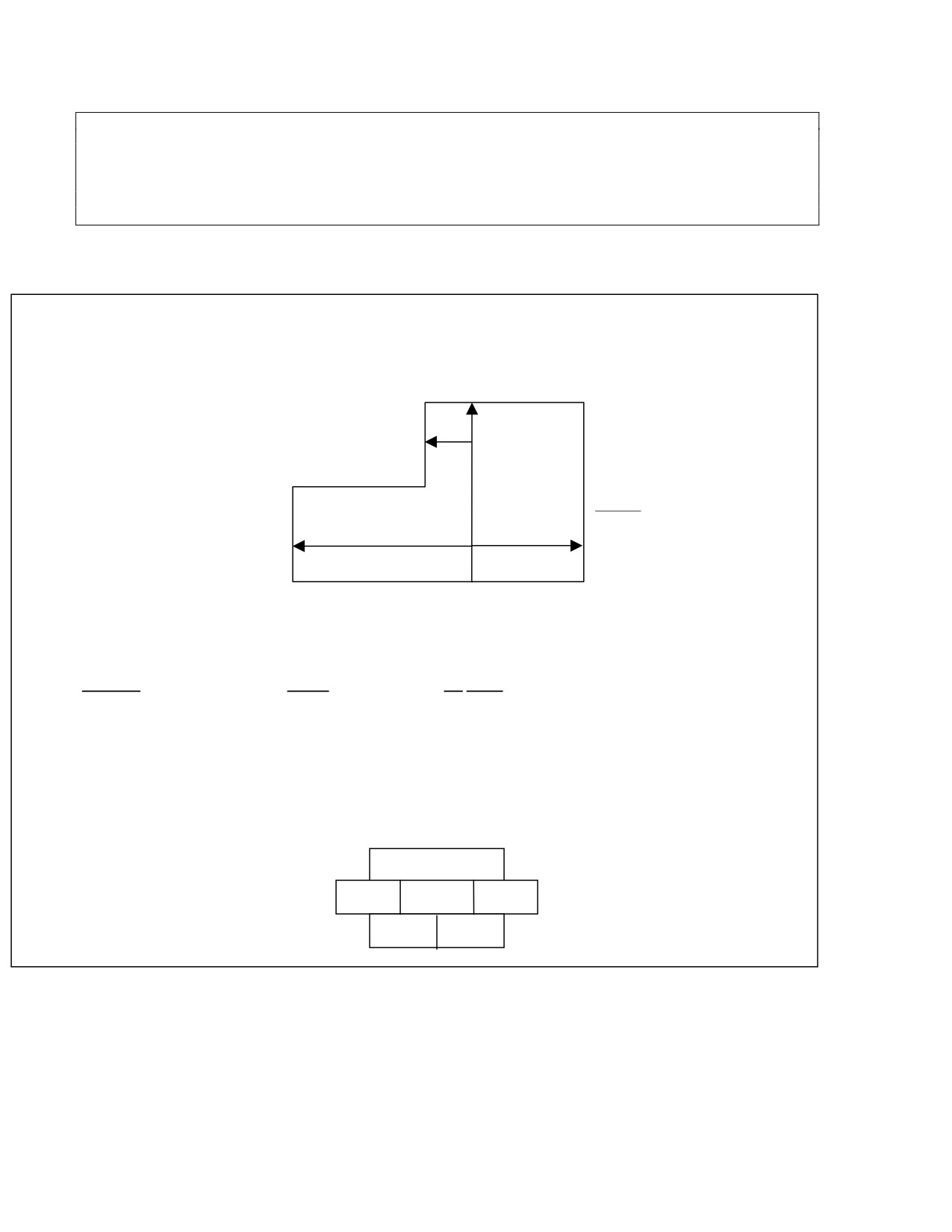
Chg 1 FM 6-40/MCWP 3-16.4_____________________________________________
maximum or minimum range.
(m). This is the Drift corresponding to Table C (base ejecting), or GFT/TFT (bursting), Drift is applied to the range
safety diagram by using the "Least, Left; Most, Right;" rule. The "least" or lowest drift is applied to all left
deflection limits, and the "most" or greatest drift is applied to all right deflection limits.
* - see Table 15-8 to determine the correct source table or addendum for computations/
Figure 15-12. High Angle Safety Matrix
FP 185 (GRID 6026 4110 ALT 370)
HIGH ANGLE, HE, CHG 3GB, AOF 1600
Max Rg 6200
Min Alt 345
AZ 1500
DF 3300
L 100
+ L34
=
3334
Max Rg 5700
Min Alt 355
AZ 1900
AOF
1600
DF 2900
AZ 1340
DF
3200
+
L101
DF 3460
=
3001
+ L34
L 260
R 300
=
3494
Min Rg 4000
Max Alt 393
4[] HE HIGH ANGLE CHG 3GB
DIAGRAM RANGE TOTAL RANGE ENTRY
RANGE
+ CORR
= RANGE X k__
= RANGE CHG VI
<SI/10 X 10mil Si Fac = SI + EL
= QE DRIFT
4000
+
0
=
4000
x 1.0000
= 4000
3GB +23 +0.6 x
-1.0
= -1
+ 1247 =
1246
L101
5700
+
0
=
5700
x 1.0000
= 5700
3GB
-15 -0.3
x
-5.2
= +2
+ 1052 =
1054
--
6200
+
0
=
6200
x 1.0000
= 6200
3GB
-25 -0.4
x
-15.0
= +6
+ 954
=
960
L34
FP 185, HE
HIGH ANGLE, CHG 3GB, AOL 1600
1246
MAX QE
3494
3334
3001
DF
1054
960
MIN QE
Figure 15-13. Example of High Angle Safety, Shell HE
15-32
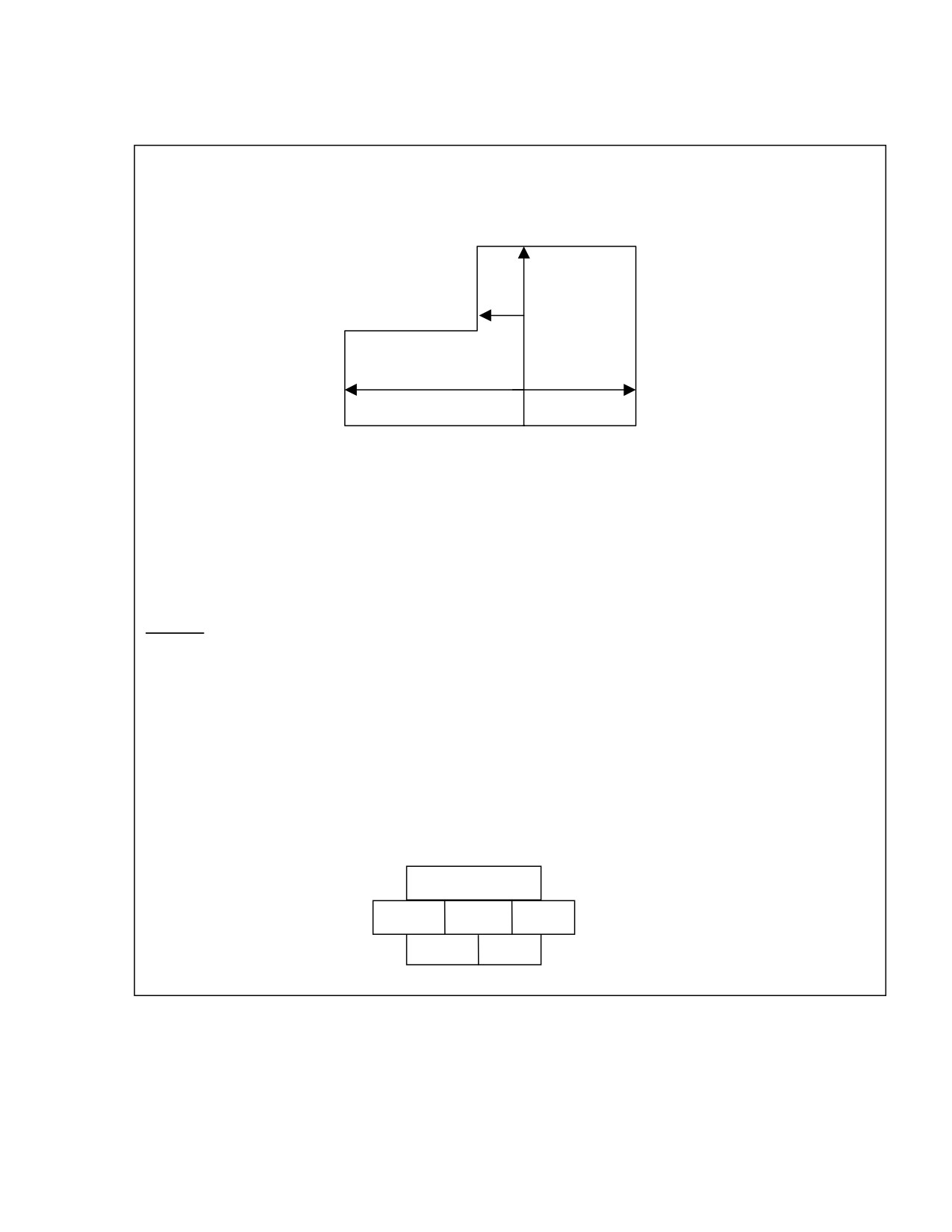
_____________________________________________Chg 1 FM 6-40/MCWP 3-16.4
FP 185 (GRID 6026 4110 ALT 370)
HIGH ANGLE, M825, CHG 4GB, AOF 1600
Max Rg 6200
Min Alt 345
AZ 1500
DF 3300
+ L37
=
3337
Max Rg 5700
L 100
Min Alt 355
AZ 1900
AOF
1600
DF 2900
DF
3200
+ L125
AZ 1340
=
3025
DF 3460
L 260
R 300
+ L37
Min TI Rg 4000
=
3497
Min Rg 3900
Max Alt 393
M825 HIGH ANGLE CHG 4GB
DIAGRAM RANGE TOTAL RANGE ENTRY
RANGE
+ CORR
= RANGE X __k__ = RANGE CHG VI
<SI/10 X 10mil Si Fac = SI + EL
= QE DRIFT
4000
+
0
=
4000
x
1.0000 =
4000
4GB
+23
+0.6 x
-0.7
=
0 + 1288 =
1288
L125
5700
+
0
=
5700 x
1.0000 =
5700
4GB
-15
-0.3
x
-2.8
= +1 + 1133 =
1134
--
6200
+
0
=
6200 x
1.0000 =
6200
4GB
-25
-0.4
x
-4.4
= +2 + 1071 =
1073
L37
FP 185, M825
HIGH ANGLE, CHG 4GB, AOL 1600
MAX QE
1288
3497
3337
3025
DF
1134
1073
MIN QE
Figure 15-14. Example of High Angle Safety, Shell M825
15-33
///////////////////////////////////////