FM 6-40 TTP for Field Artillery Manual Cannon Battery U.S. - page 4
FM 6-40
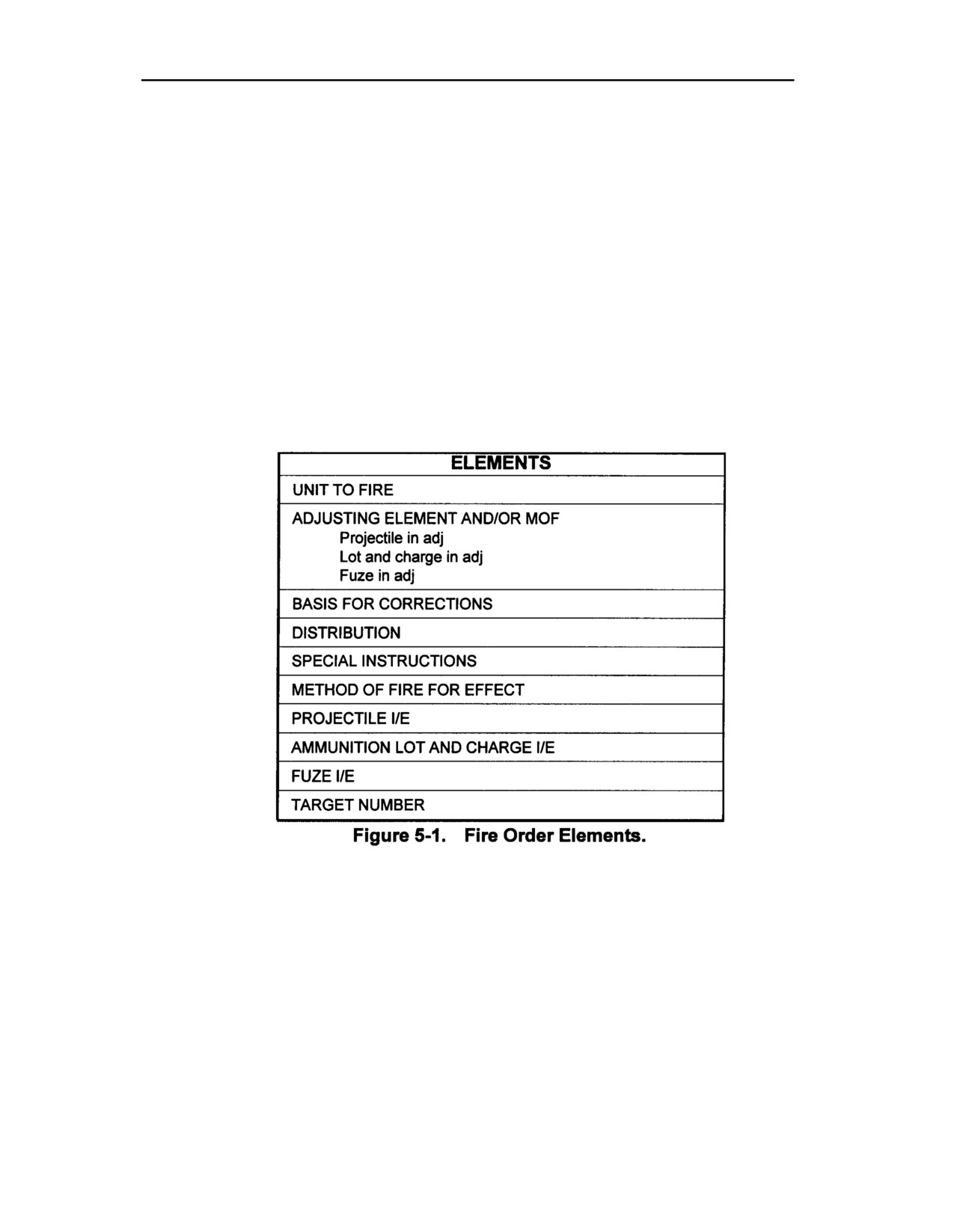
If not standardized by unit SOP, the elements in Figure 5-1 will be addressed in the fire
order.
a. UNIT TO FIRE. Indicates the units to follow the mission and to fire for effect.
Normally, BATTERY or PLATOON is announced as the unit to fire.
b. ADJUSTING ELEMENT AND/OR METHOD OF FIRE OF THE ADJUSTING
ELEMENT (if applicable). Indicates the weapon(s) that will adjust. Normally, the base piece
is selected and will fire one round in adjustment.
(1) Projectile in adjustment. This is the type of shell to be fired by the adjusting
piece in an adjust-fire mission.
(2) Lot and charge in adjustment. This is the ammunition lot (for the shell and
propellant) and the charge to be fired by the adjusting piece in an adjust-fire mission.
(3) Fuze in adjustment. This is the type of fuze to be fired by the adjusting piece
in an adjust-fire mission.
c. BASIS FOR CORRECTIONS. This element dictates how data will be determined.
Normally, the fastest method is designated.
d. DISTRIBUTION. This element describes the pattern of bursts (sheaf) in or around
the target area. The assumed sheaf is a parallel sheaf, which resembles the arrangement of the
pieces in the firing position. The sheaf computed may vary from the assumed sheaf on the basis
of the number of howitzers available, target size, attitude, and description received from the
observer (obsr). If the FDO desires a sheaf other than the assumed sheaf, he will announce it
here.
e. SPECIAL INSTRUCTIONS. This element is any method of control or
coordinating instructions deemed appropriate by the FDO.
5-3
FM 6-40
f. METHOD OF FIRE FOR EFFECT. This element indicates the number of rounds
in the fire for effect phase of a mission. This element will always be announced by the FDO.
g. PROJECTILE IN EFFECT. This element is the projectile to be freed in effect.
h. AMMUNITION LOT AND CHARGE I/E. This element is the ammunition lot(s)
and charge used in fire for effect.
i. FUZE I/E. This element is the fuze to be fired in effect.
j. TARGET NUMBER. This element is the specific target number assigned to a fire
mission.
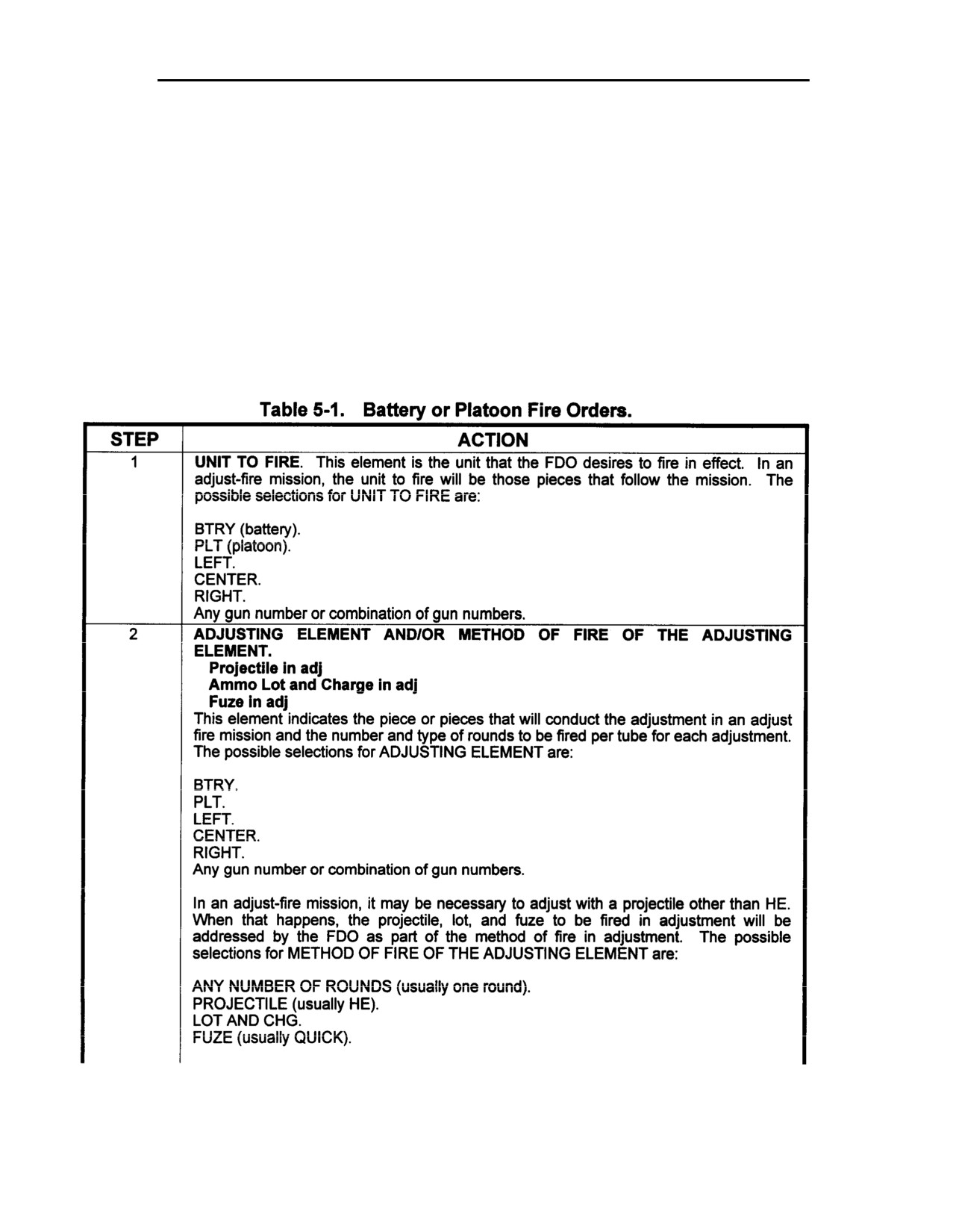
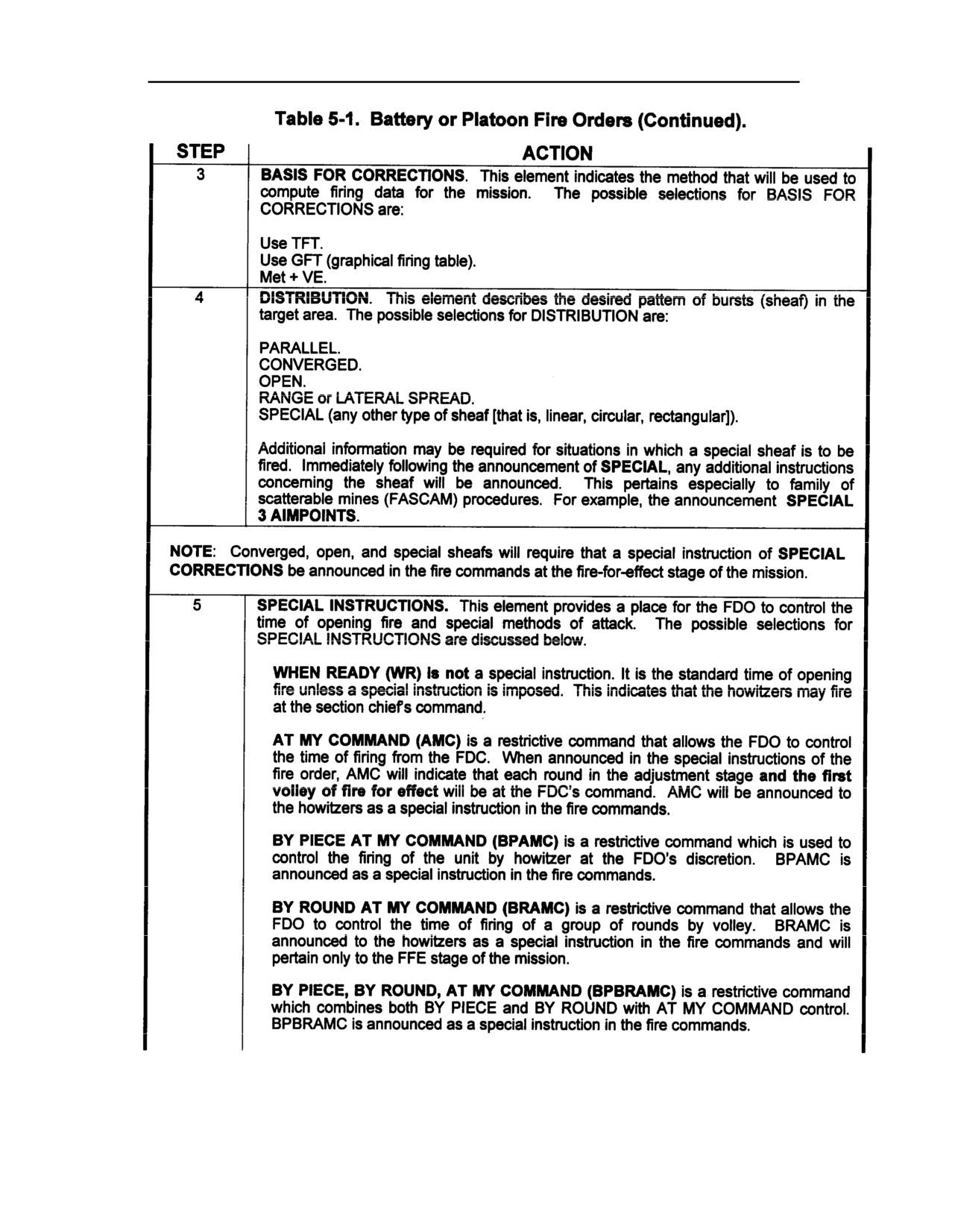
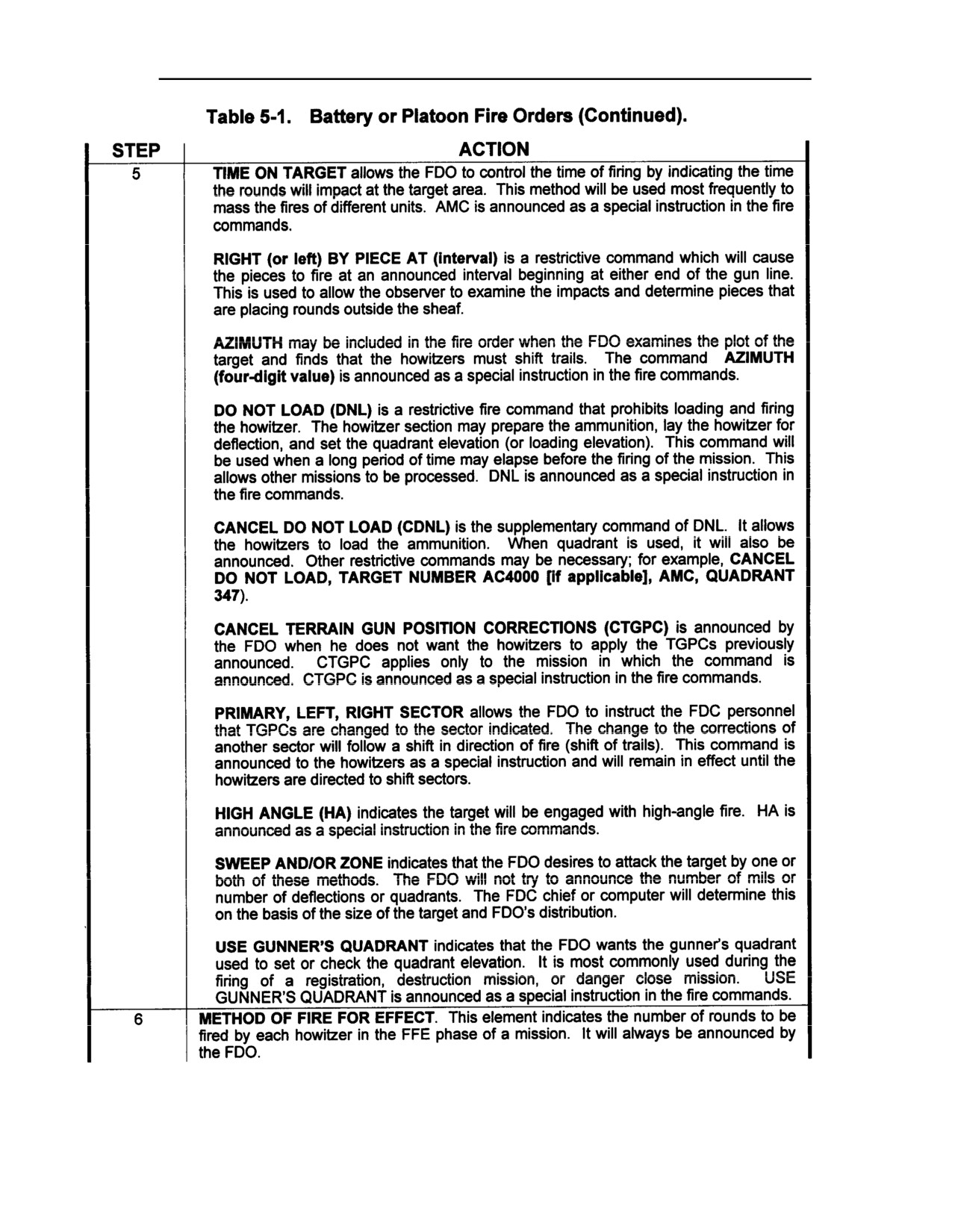
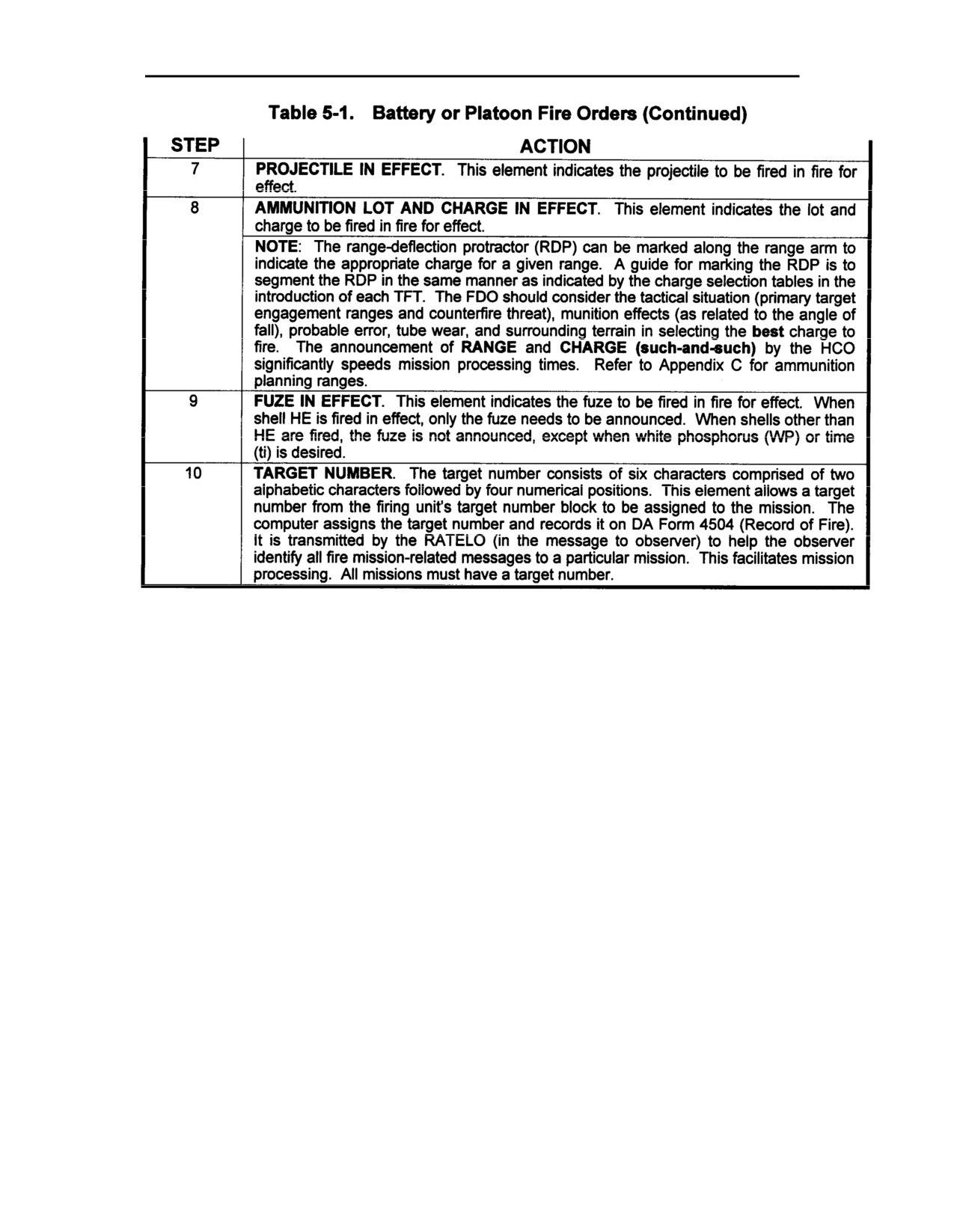
5-4. Battery or Platoon Fire Orders
The guidance in Table 5-1 will be used in issuing the fire order.
5-4
FM 6-40
5-5
FM 6-40
5-6
FM 640
5-5. Fire Order Standing Operating Procedures
a. In most cases, a particular element of the fire order may remain the same from one
mission to the next. On the basis of the tactical situation, type and amount of ammunition
available, and commander’s guidance, the FDO establishes an SOP for each element, which
should be displayed in the FDC. When the FDO does not address an element in his fire order, the
standard for that element will apply. The FDO need only announce what has changed from the
standard. However, the method of fire for effect must be announced.
b. The FDO must ensure that the fire order is clear, concise, and in the proper format.
The fire order format is designed to disseminate information clearly and rapidly with minimal
discussion. It is impossible to provide a textbook solution for every conceivable situation, but a
combination of technical knowledge and common sense should be enough to avoid confusion. It
is better, if any confusion exists, to be redundant rather than too brief.
c. The use of a good SOP to clarify certain missions is essential. Immediate
suppression, immediate smoke, illumination (illum), and mixed shell missions (HE and WP, for
instance), can be handled more responsively when governed by an SOP. For example, an FDO
needs only to say IMMEDIATE SUPPRESSION to mean a platoon will fire two volleys of
HE/variable time (VT).
5-7
FM 6-40
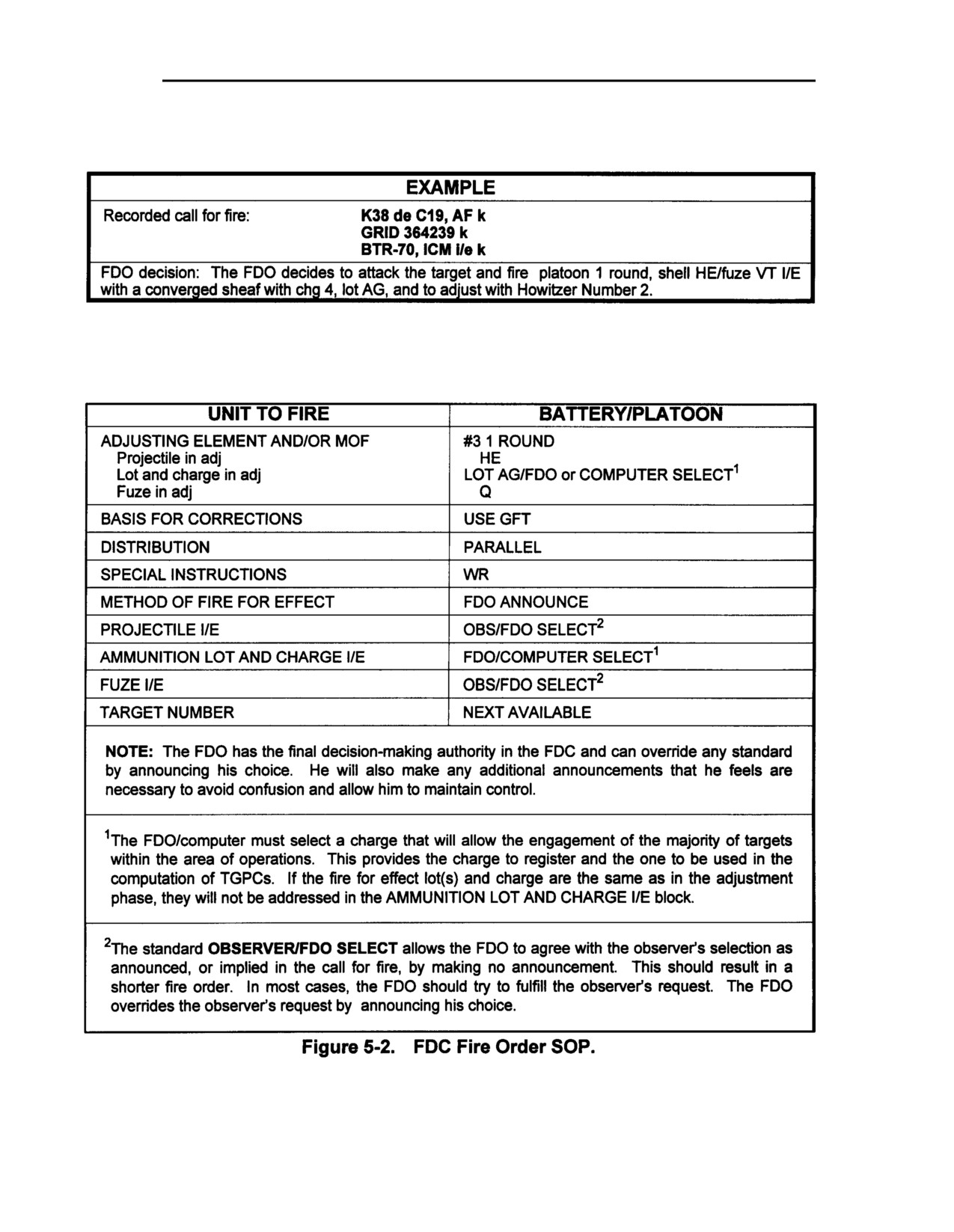
d. The example below shows the fire order elements and the fire order SOP for a
four-howitzer platoon.- (See Figure 5-2.)
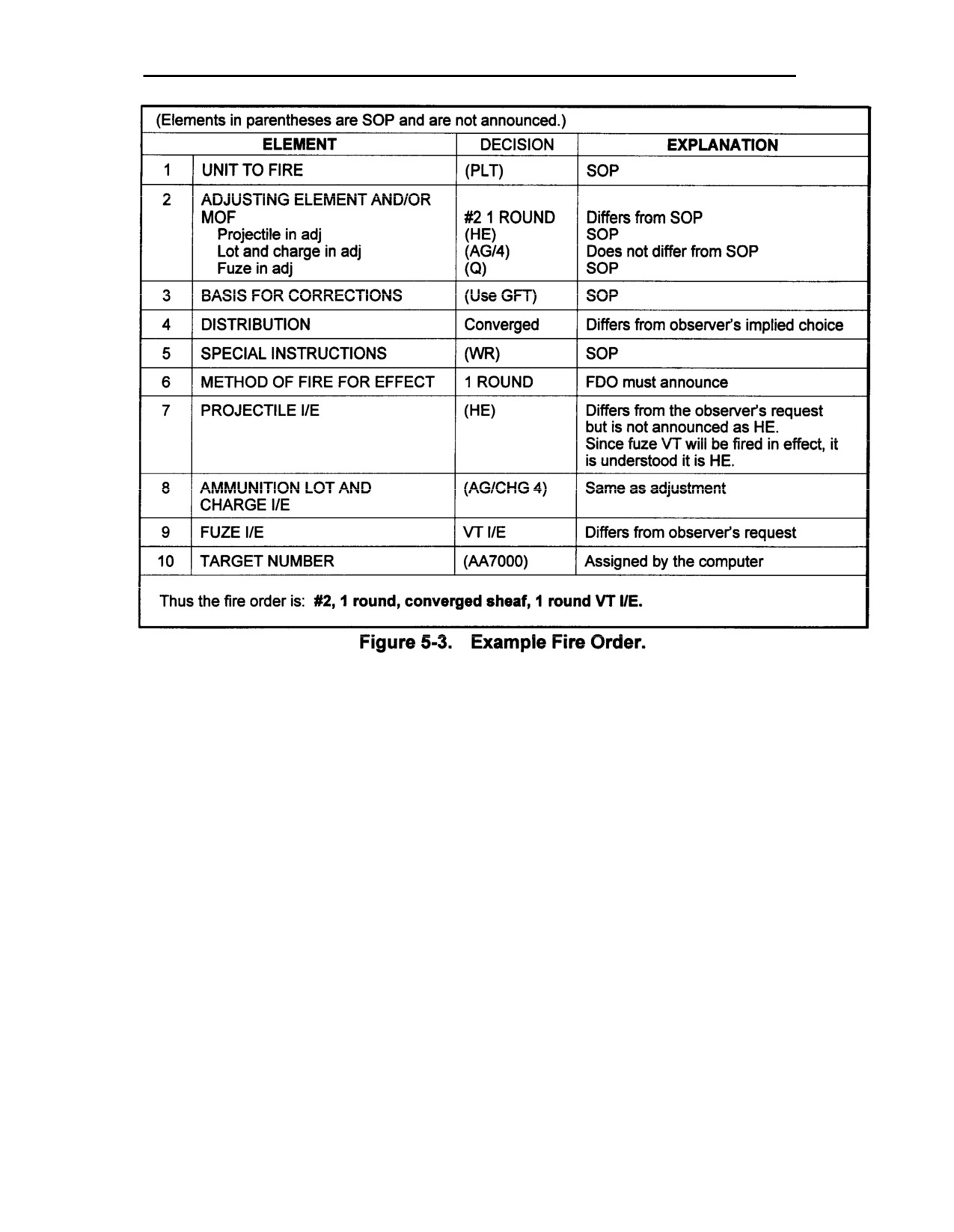
(See Figure 5-3, which shows all elements addressed in the previous example.
5-8
FM 6-40
5-6. Battalion Fire Order
Battalion fire orders must be issued to mass the fires of the battalion on a single target.
The battalion fire order differs from the battery or platoon fire order since all the units of the
battalion may not be able to receive the call for fire. The battalion fire order must be able to
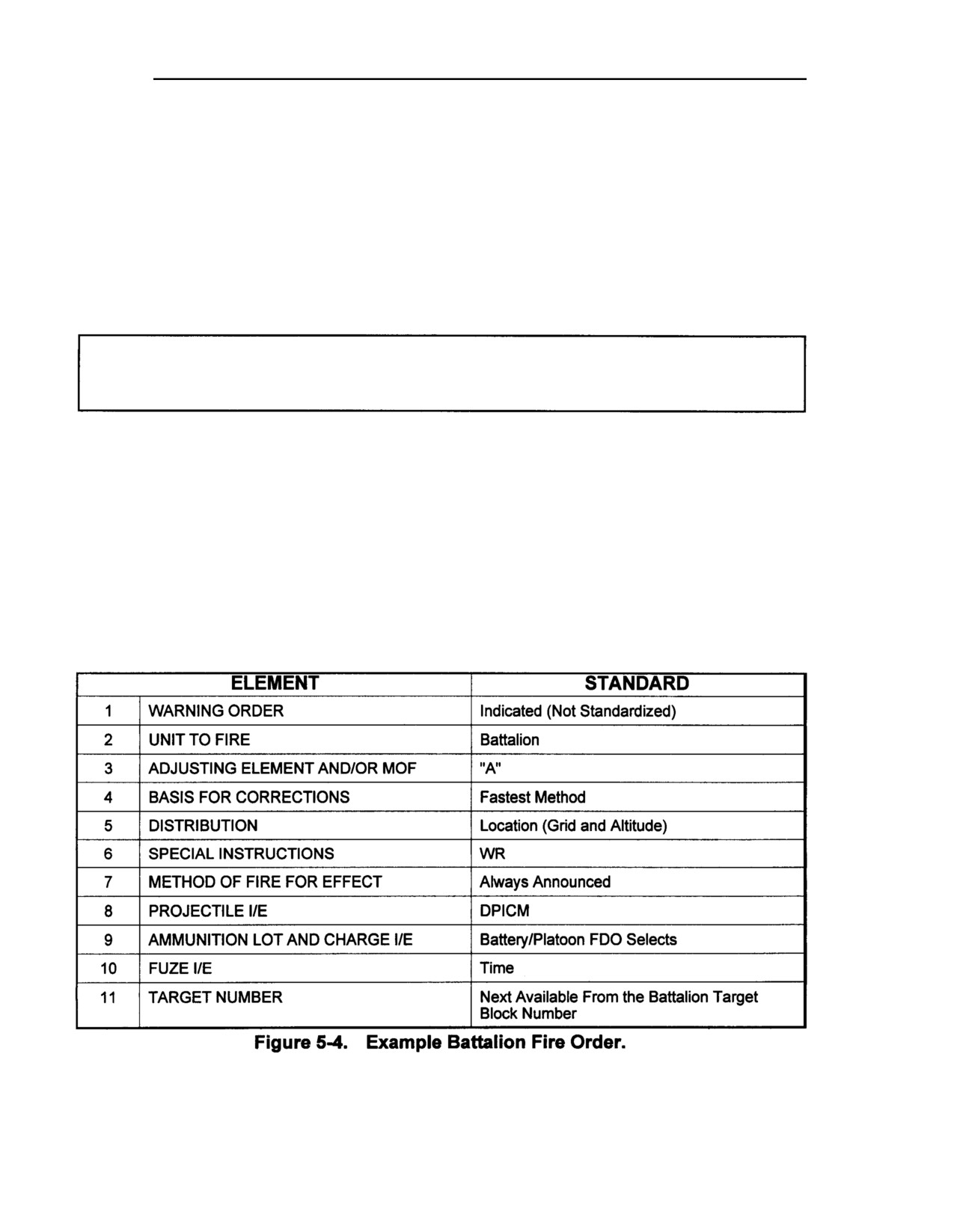
convey all information to cause the units to engage the target. A battalion fire order (Figure 5-4)
follows the same basic format as a battery or platoon fire order except for the following:
a. WARNING ORDER. A warning order is issued to indicate the type of mission (AF
or FFE) to be fired (not standardized).
b. UNIT TO FIRE. This is the unit to fire for effect. If the fire order originates at the
battalion FDC and the FDO decides to fire the entire battalion, the element is announced as
BATTALION. To designate less than the entire battalion, the individual elements are
announced (for example, ALPHA and CHARLIE). When the designation of the unit to fire is
transmitted outside the FDC, the unit call sign should be used.
c. UNIT TO ADJUST or METHOD OF FIRE OF THE ADJUSTING UNIT. This
is the battery that conducts the adjustment. The battalion FDC will not try to direct a specific
piece to adjust; however, the adjusting battery’s base piece should be the adjusting piece. When
the battalion fire order is transmitted, the last letter of the unit call sign will be used (can be
standardized). The battalion may specify the number of rounds, projectile type, lot, charge, and
fuze to use in the adjustment by the adjusting unit.
5-9
FM 6-40
d. BASIS FOR CORRECTIONS. This is the same as the battery-or platoon-level fire
order (can be standardized).
e. DISTRIBUTION or TARGET LOCATION. This is the FO’s target location, to
include target altitude, from the call for fire. If adjustment is necessary, the nonadjusting units
will follow the adjustment and fire for effect on the adjusted grid. In adjust-fire missions, the
battalion FDO may direct the adjusting unit to transmit the replot location and altitude to the
battalion FDC after the completion of the adjustment. The battalion FDC may choose to segment
the target, sending aimpoints to the units of the battalion, before fire for effect or direct the units
to mass on the adjusted grid by sending the adjusted or replot grid (not standardized).
NOTE: The remaining elements of the battalion fire order are similar to the battery
or platoon fire order except for standards.
f. SPECIAL INSTRUCTIONS. This element can be standardized.
g. METHOD OF FIRE FOR EFFECT. This element is not standardized.
h. PROJECTILE I/E. This element can be standardized.
i. AMMUNITION LOT AND CHARGE I/E. This element can be standardized;
however, normally the battery or platoon FDO will select it.
j. FUZE I/E. This element can be standardized.
k. TARGET NUMBER. This element is not standardized.
5-10
FM 6-40
5-7. Massing of Fires
a. Massing. What does an artilleryman mean when he uses the word massing? By
definition, it means simultaneous execution of two or more firing elements to achieve maximum
effects on a critical target. The 3 x 8 battery bringing its two platoons to bear on a single target, a
battalion massing on one point, and even a division artillery (divarty) or corps artillery
commander bringing all his battalions onto a single target are all examples of massing.
Regardless of the level of command, certain fundamental requirements must be met for two or
more units to engage targets effectively together.
(1) The first requirement for massing is that all firing units must be on a common
location and azimuth system; that is, common survey. This includes all platoons, radars, met
stations, and observers. The survey control should extend into the target area as well.
(2) The second requirement is accurate MV information for each weapon. Manual
corrections for MVVs will occur during concurrent and subsequent met procedures and through
determining TGPCs with the Ml 7 plotting board.
(3) The third requirement is valid met corrections considered by each of the firing
platoons. This includes the met message valid for the firing platoon, propellent temperature,
projectile weight, vertical interval, and corrections for earth rotation.
(4) The final requirement is accurate location. This is the reason the target-locating
assets must be on common survey with the firing units. Ensure the target location determined by
the observer is the same location plotted by the FDC.
(5) If the target is accurately located and the first three requirements are satisfied,
then you can mass without having to adjust each unit onto the target. However, if it is an
adjust-fire mission, the adjusting unit must determine the accurate target location and then
announce it to the other units. To determine the accurate target location, the adjusting FDC must
perform replot procedures discussed in Appendix D. The FDC must then announce the replot
grid. The controlling FDC is responsible for the fire order and control of the mission.
b. Control of Battalion Mass Missions.
(1) When massing the fires of more than one battery either firing for effect or
adjusting, AT MY COMMAND, TIME ON TARGET, or WHEN READY can be used. The
most effective technique is TIME ON TARGET, which achieves the greatest surprise to the
enemy.
(2) Control of FFE mass missions on stationary targets can best be affected by
using TOT techniques. Accurate time coordination is essential to ensure the simultaneous impact
of all initial rounds; lengthy countdowns are unnecessary.
(a) The TOT may be announced as a specific time (for example, TOT 0915).
The battalion would announce a time check to synchronize the units designated to fire. This is
done by using the following procedure:
The battalion FDC will announce the time (for example, AT MY
MARK THE TIME WILL BE 0908).
The battalion FDC will give a short countdown starting 5 seconds
before the mark (for example, 5, 4, 3, 2, 1, MARK).
Each FDC would start its clock at MARK. From that moment, each
FDC would control its own firing.
5-11
FM 6-40
Each FDC would respond to the battalion FDC with ROGER OUT if
they received a good mark.
If a good mark was not received, the unit FDC will request a new mark
and the previous four steps will be done again.
(b) Another technique to execute a TOT is to specify the amount of time
before it is to occur (for example, TOT 5 MINUTES FROM MY MARK). Each FDC would
start its stopwatch at MARK. From that moment, each FDC would control its own firing.
(c) The preferred technique is the short countdown TOT (for example, TOT
40 SECONDS FROM MY MARK). The short countdown allows the FDO to decrease the
amount of time between receiving a call for fire and massing on the target. The FDO will
announce as part of the special instructions in his fire order SHORT COUNT TOT
FOLLOWS. This alerts the firing units that the mission is AT MY COMMAND and that they
will report READY, TOF to the battalion FDC. The battalion FDO will add 10 seconds
(reaction time) to the longest time of flight reported. If the longest TOF is 30 seconds, he will
announce TOT 40 SECONDS FROM MY MARK, 5, 4, 3, 2, 1 MARK. The firing units will
quickly subtract their TOF from the number of seconds the battalion FDO announced. The result
is the number of seconds after MARK until they command FIRE.
(3) Control of an FFE mass mission on moving targets is best achieved by using
AT MY COMMAND or WHEN READY. The time consumed during a TOT countdown may
result in the rounds missing the target.
(a) AT MY COMMAND. All units will fire at the same time. The battalion
FDO will select this technique if he is willing to accept some loss of surprise caused by varying
times of flight to get the rounds on the target quickly. This technique is particularly effective
when the unit’s times of flight as reported by each FDC are similar.
(b) WHEN READY. Unless otherwise specified, each battery will fire when
ready. This technique is used more often with adjust-fire missions (particularly those with
lengthy adjustment phases) than with fire-for-effect missions. (When surprise has been lost, the
difference in reaction times and times of flight between units is less significant.)
(4) Control of the FFE phase in an adjust-fire mass mission can be achieved by the
same means as an FFE mass mission.
(a) TIME ON TARGET. If the observer is able to enter the FFE phase with
one correction and he judges that the target has not been warned, a TIME ON TARGET
(paragraph (2) above) may be used to control time of firing in effect. If the battalion FDO
decides a TOT is unsuitable (for example, loss of time outweighs simultaneous impacting of all
initial FFE rounds), he will direct use of AT MY COMMAND or WHEN READY. It is rare,
however, that a target would not be warned during adjustment. Therefore, TOT to control time
of firing in effect after adjustment is not normally used.
(b) AT MY COMMAND. The considerations for the selection of this
technique are the same as in paragraph (3)(a) above. In addition, it is useful if the observer is
able to enter the FFE phase with a large correction.
(c) WHEN READY. In most adjust-fire mass missions, no control of time of
firing in effect will be used. Since most targets would be warned during adjustment, the battalion
FDO would allow units to fire when ready.
5-12
FM 6-40
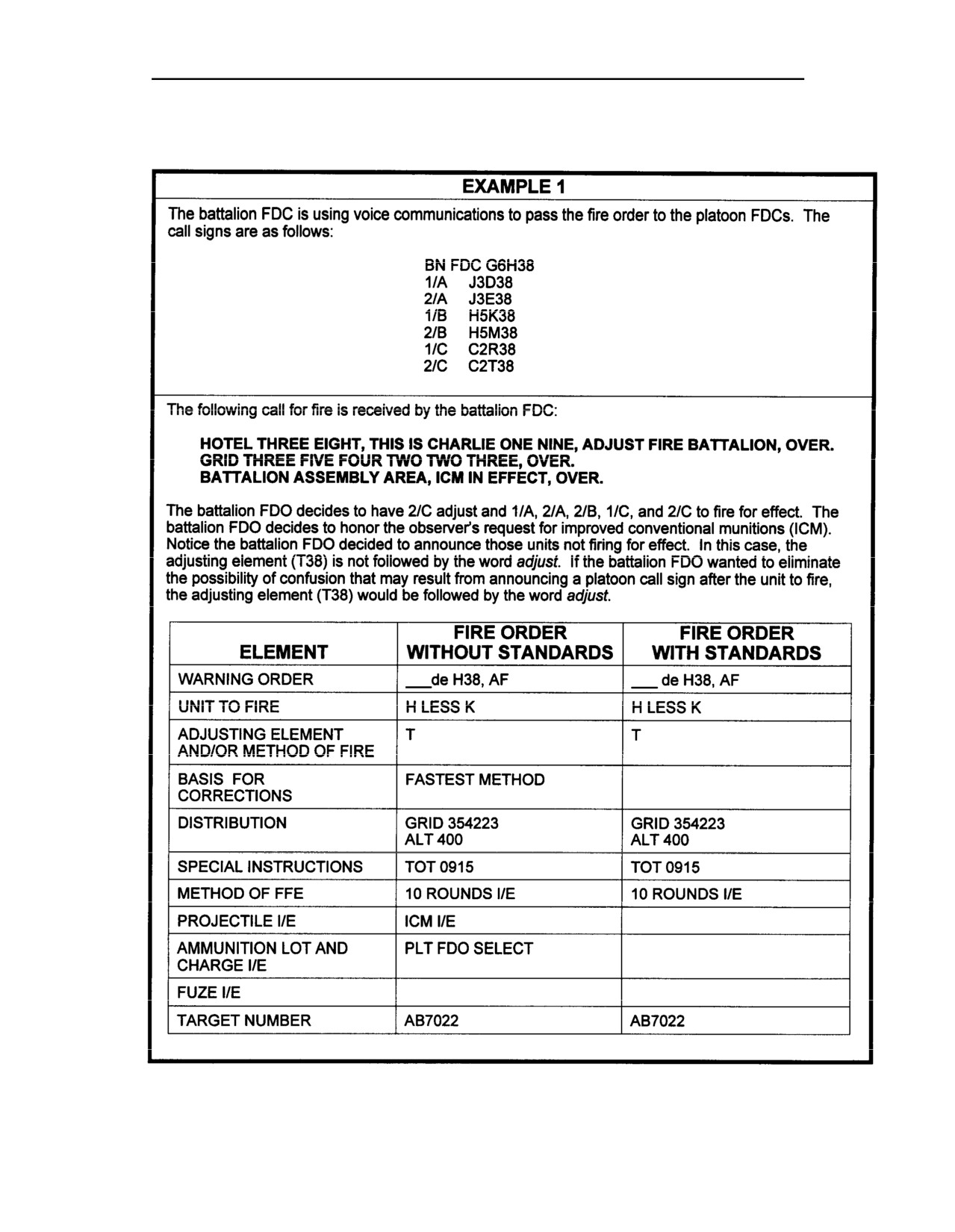
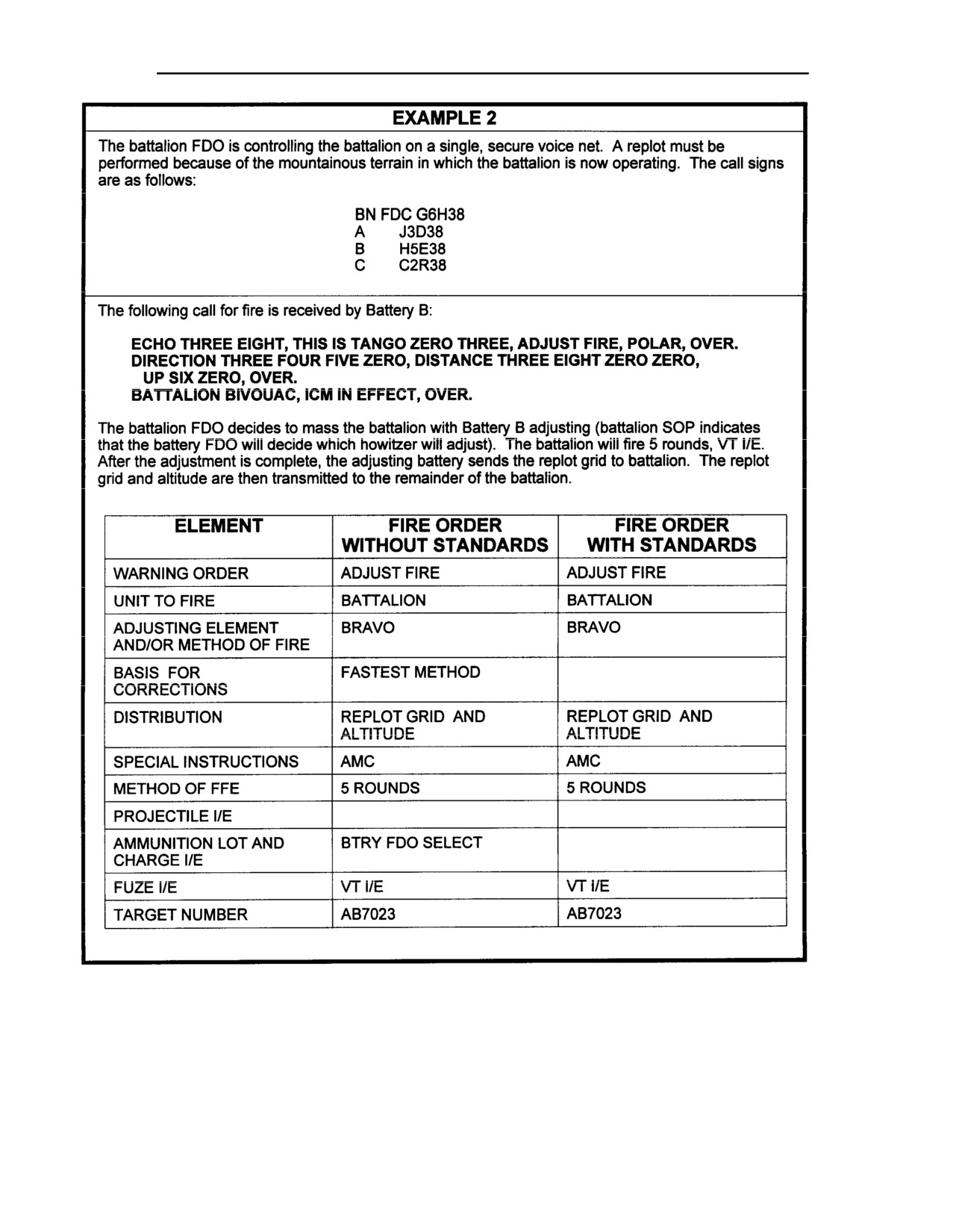
c. Examples of Battalion Fire Orders. Examples of battalion fire orders are shown
below.
5-13
FM 6-40
5-14
FM 6-40
Section II
Message to Observer
This section implements STANAG 2934, Chapter 5, and QSTAG 246.
After the FDC receives the call for fire, the FDO analyzes the target. If
the target is to be attacked the FDO issues the fire order as his decision on how
the target will be attacked. The observer is informed of this decision through the
message to observer.
5-8. Description
The message to observer consists of four elements and is composed by the RATELO.
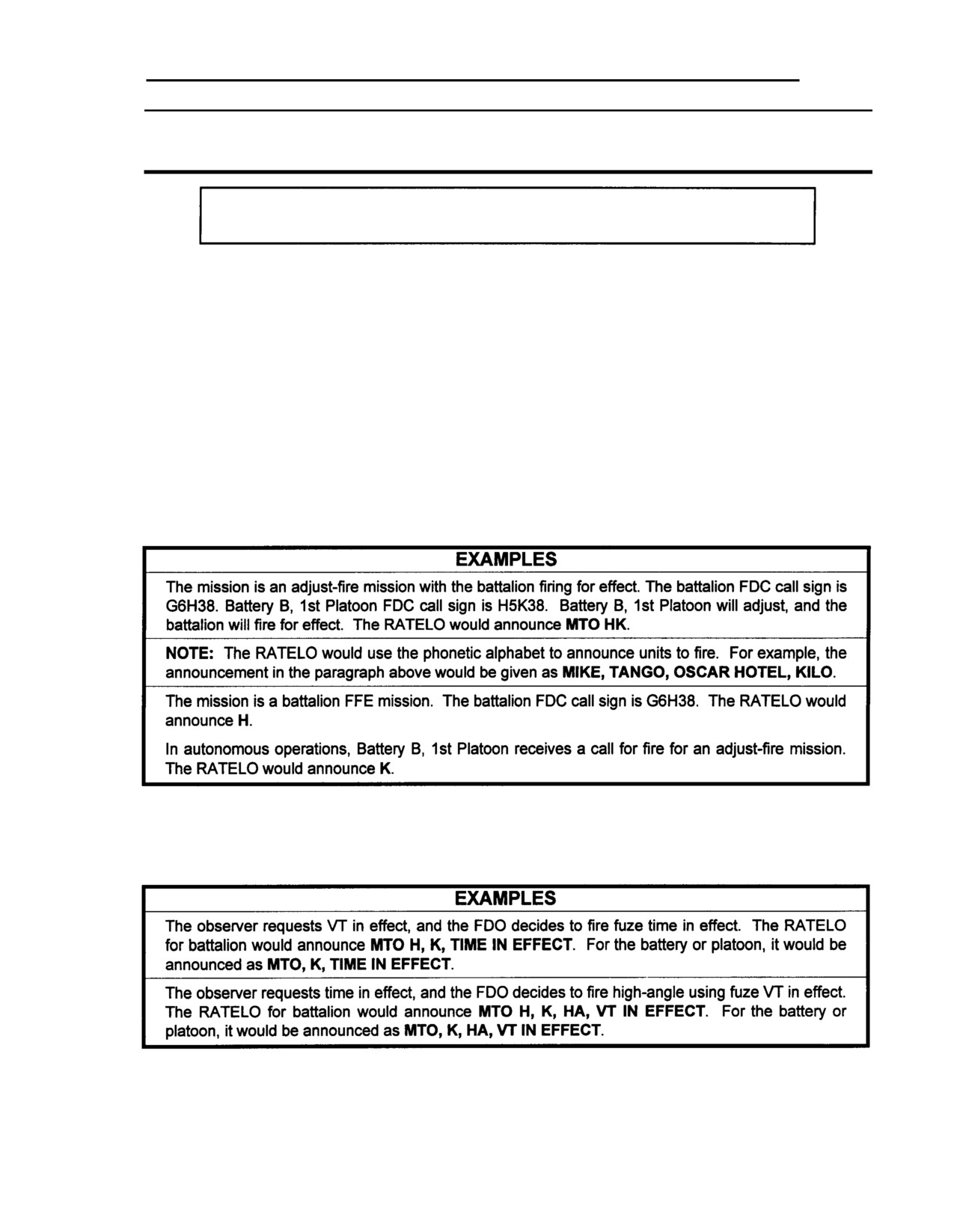
a. Units to Fire. The first element is the unit(s) that will fire the mission. It is always
announced. If a battalion is firing in effect with one battery or platoon adjusting, the MTO will
designate the FFE unit (battalion) and the adjusting unit (battery or platoon). The units to fire are
identified by their radio call signs, using long call signs, short call signs, or the first letter of the
short call sign. Some examples are listed below.
b. Changes or Additions to the Call for Fire. The second element of the MTO allows
the FDC to inform the observer of changes and/or additions made by the FDO to the call for fire.
If high-angle fire is to be used, HIGH ANGLE must be included in the MTO if the observer did
not request it. The following examples use the previously stated call signs.
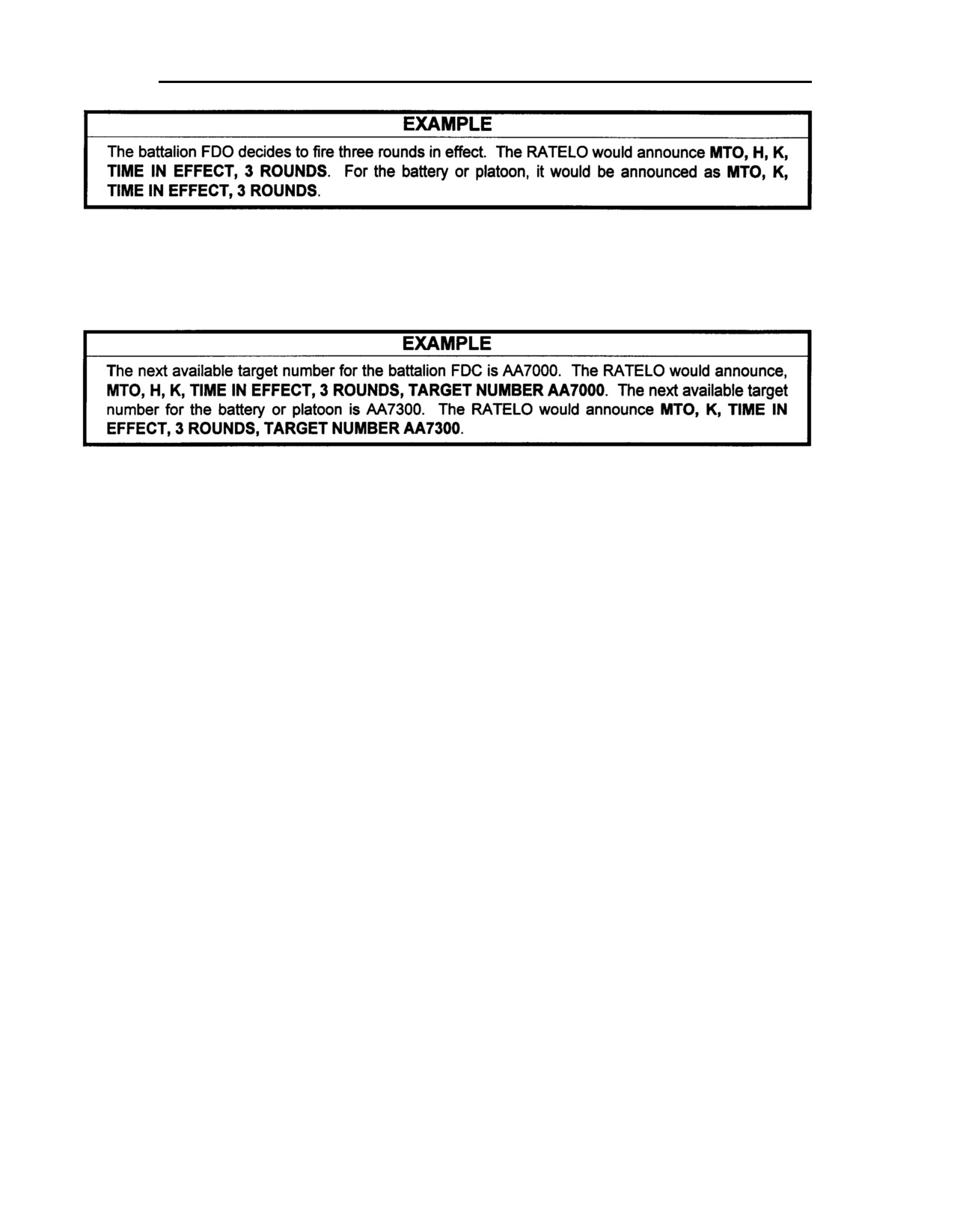
c. Number of Rounds. The third element is the number of volleys in fire for effect.
The number of rounds to be fired in effect is always announced. The following example uses the
previously stated call signs and change to the call for fire.
5-15
FM 6-40
d. Target Number. The last element is the target number assigned to the mission for
reference purposes, it is always announced. This is done to avoid confusion if multiple missions
are being fired or if more than one observer is operating on the radio net. Target numbers are
used in sequential order based on the units target block. The following example uses the
previously stated call signs, change(s) to the call for fire, and number of rounds.
5-9. Additional Information
The following additional information may be announced with or after the message to
observer.
a. Probable Error in Range. If the probable error in range for an area fire mission is
equal to or greater than 38 meters, the FDC will inform the observer. For precision fire, the FDC
will inform the observer if the probable error in range is equal to or greater than 25 meters. The
actual value is not announced. For example, the RATELO would announce PROBABLE
ERROR IN RANGE GREATER THAN 38 METERS.
b. Angle T. Angle T is sent to the observer when it is equal to or greater than 500 mils
or if the observer requests it. It is announced to the nearest 100 mils. For example, if angle T is
580 mils, it is expressed and announced as ANGLE T 600.
c. Pulse Repetition Frequency Code. The pulse repetition frequency (PRF) code for a
Copperhead mission is transmitted in voice operations; for example, the RATELO will announce
PRF CODE 241. The range and direction of approach (left or right of the observer-target line)
are needed to orient the footprint.
d. Time of Flight. Time of flight (TOF) is announced to the nearest whole second. It is
announced to observers when targets are engaged with Copperhead, when moving targets are
engaged, when conducting high-angle missions, when using an aerial observer, or when requested by
the observer. For example, the RATELO would announce TIME OF FLIGHT 34 SECONDS.
e. Splash. Splash informs the observer that the round(s) fired will impact in 5 seconds.
It must be sent to aerial observers and during high-angle fire missions. It can also be sent at the
observer’s request.
f. Shot and Rounds Complete. SHOT is announced to the observer to report when a round
has been fired. Rounds complete is announced to the observer when all rounds for a particular mission
have been fired. During an adjust-fire mission SHOT is announced after each round. Once the FFE
phase is initiated, SHOT is announced only on the initial round. Once all rounds have been fired,
rounds complete is announced to the observer. For an FFE mission, SHOT is announced only on the
initial round; once all rounds have been fired, rounds complete is announced to the observer.
5-16
FM 6-40
Section III
Fire Commands
Fire commands are used by the FDC to give the howitzer sections all the
information needed to conduct a fire mission. Initial fire command include all
elements needed for orienting, loading, and firing the howitzer. Subsequent fire
commands include only those elements that have changed from the previous
command(s), except quadrant elevation. Quadrant elevation is announced in every set
of fire commands and allows the howitzer section to fire if in a WR status.
5-10. Fire Command Elements
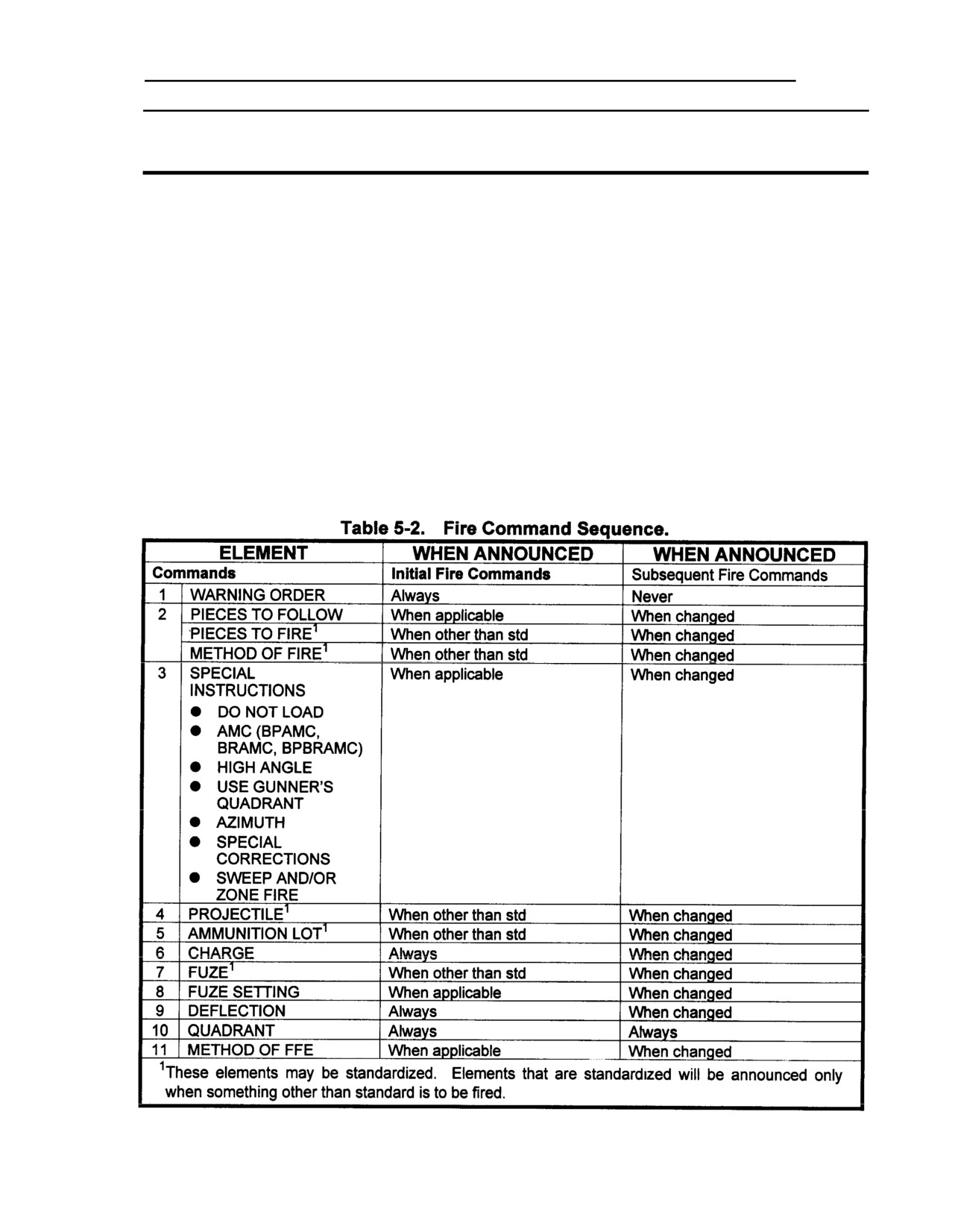
a. The elements of fire commands are always announced in the same sequence (Table
5-2). This saves time and eliminates confusion; each member of the howitzer section knows the
sequence and should be ready for the next command.
b. Certain elements of the fire commands may be standardized. Once the standards are
established and announced to the howitzer sections, the standard (std) elements will not be announced.
Quadrant elevation may never be standardized. It is announced in-each set of fire commands.
5-17
FM 6-40
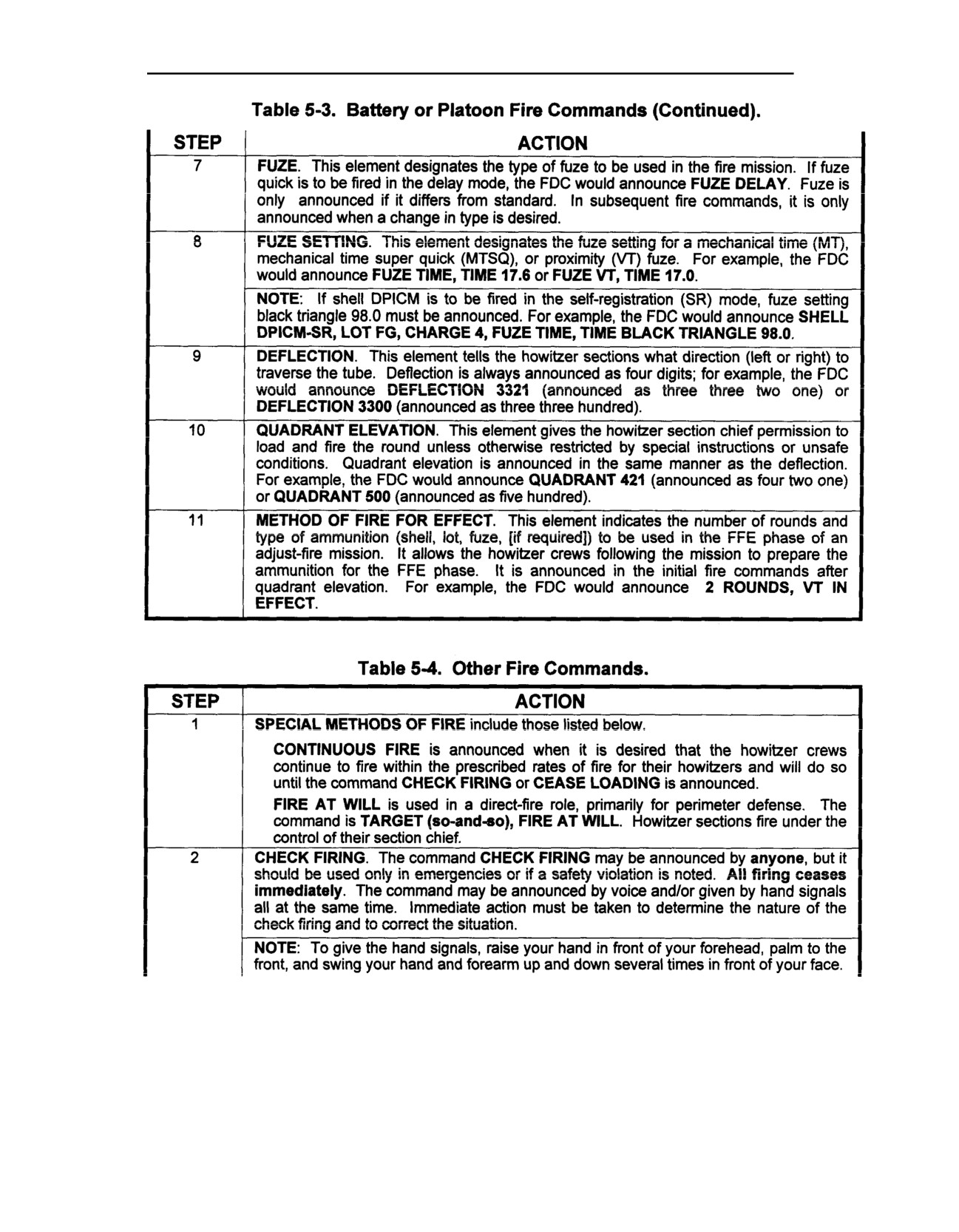
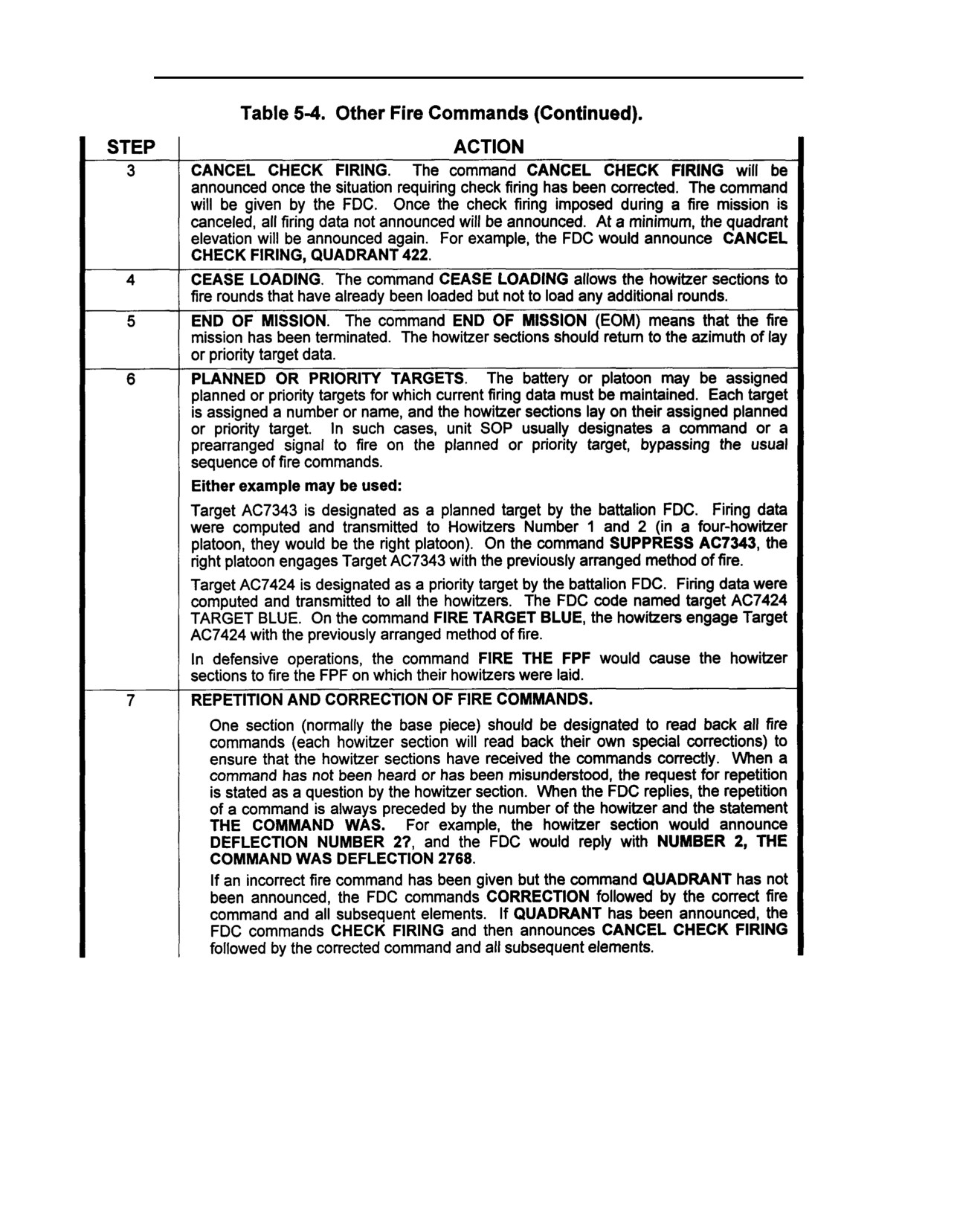
5-11. Battery or Platoon Fire Commands
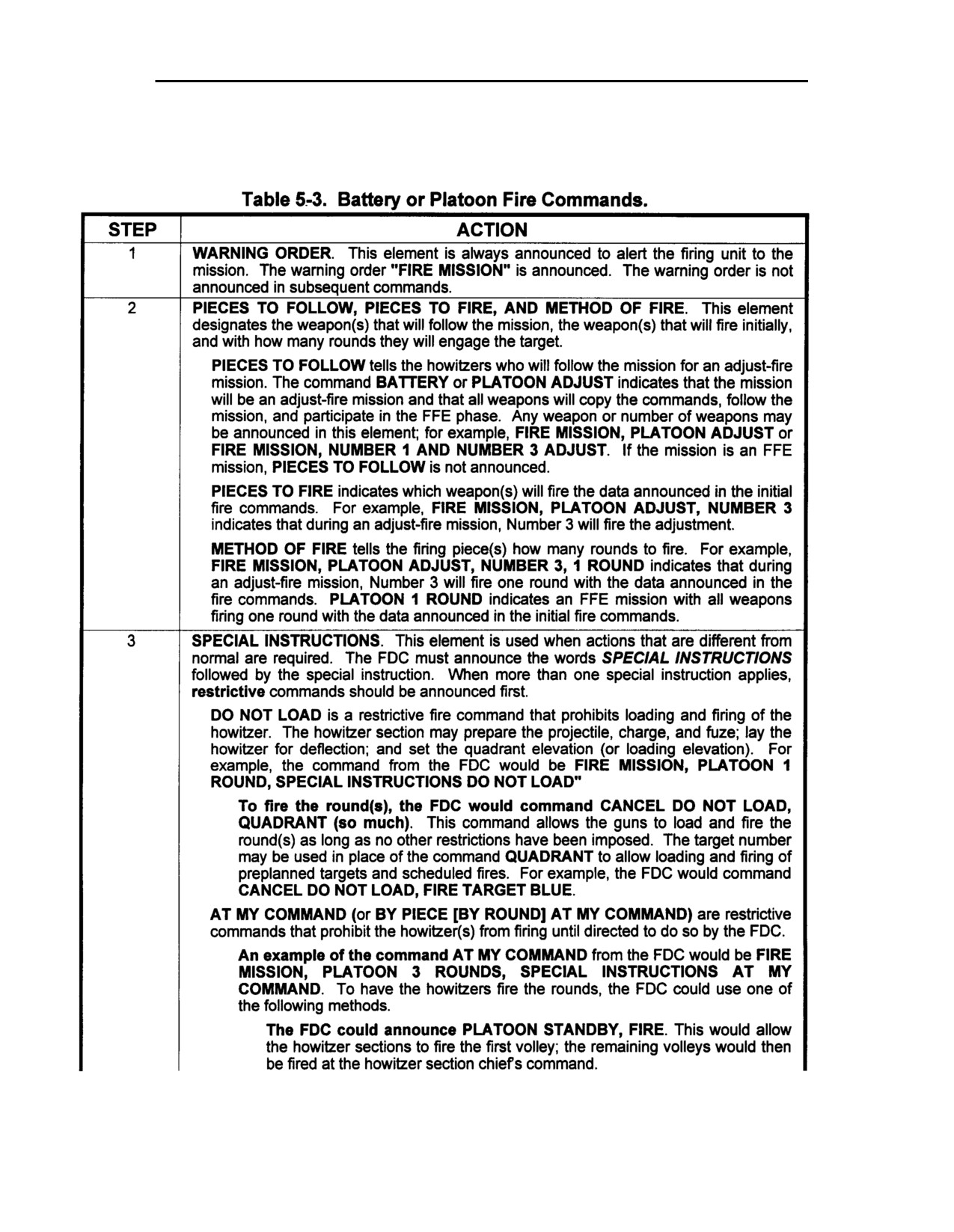
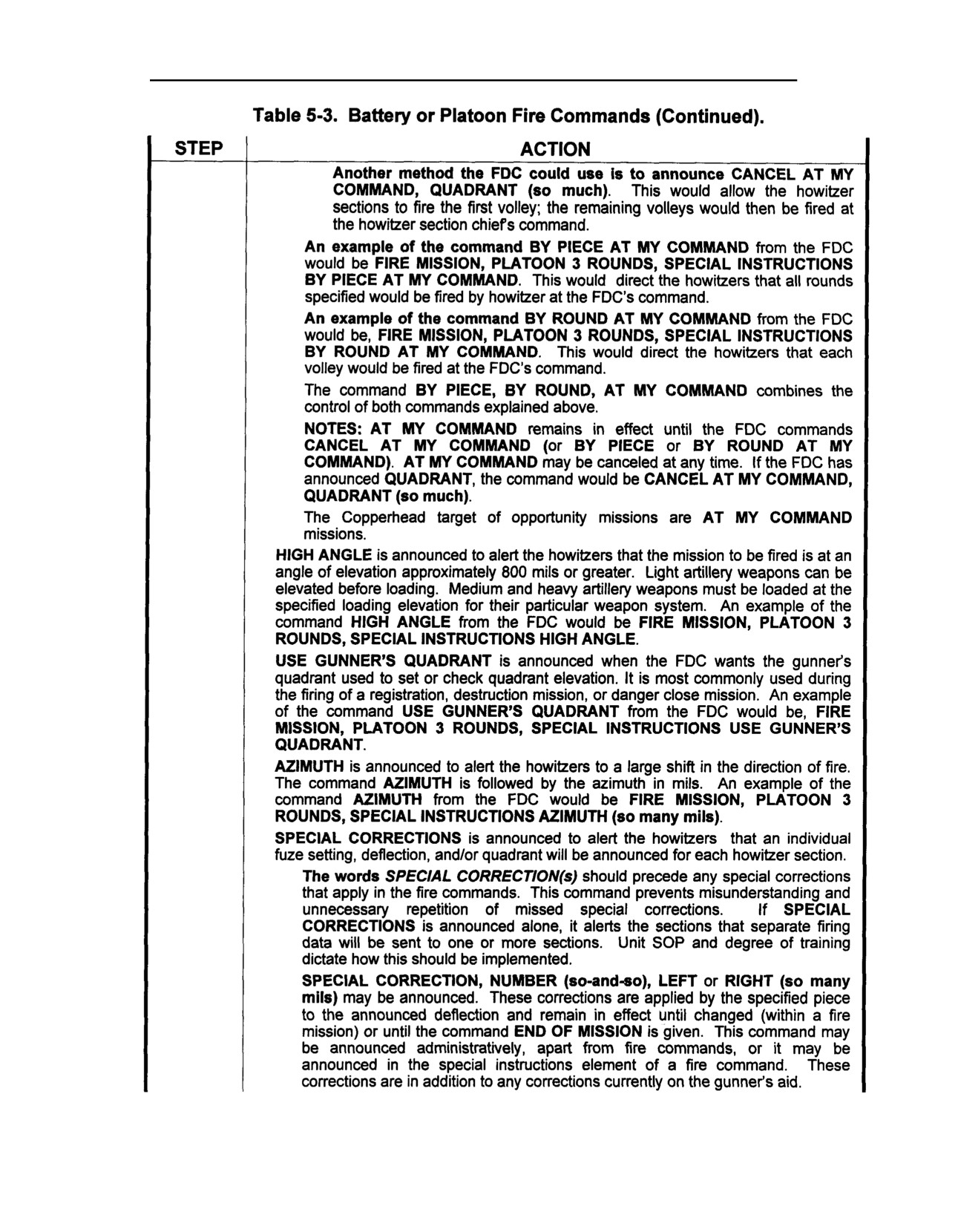
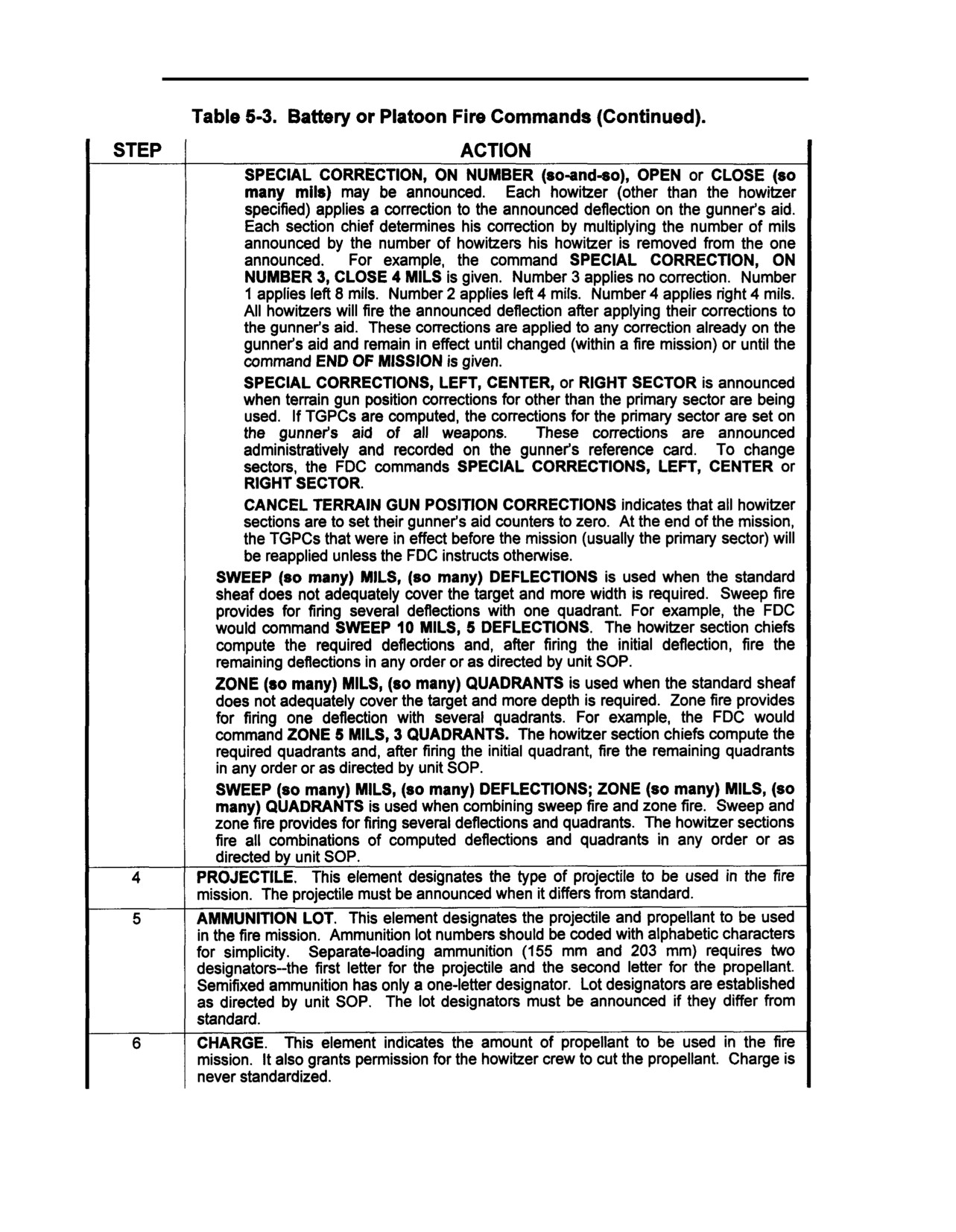
The procedures and sequence for announcing fire commands are in Table 5-3; all other
fire commands are in Table 5-4.
5-18
FM 6-40
5-19
FM 6-40
5-20
FM 6-40
5-21
FM 6-40
5-22
FM 6-40
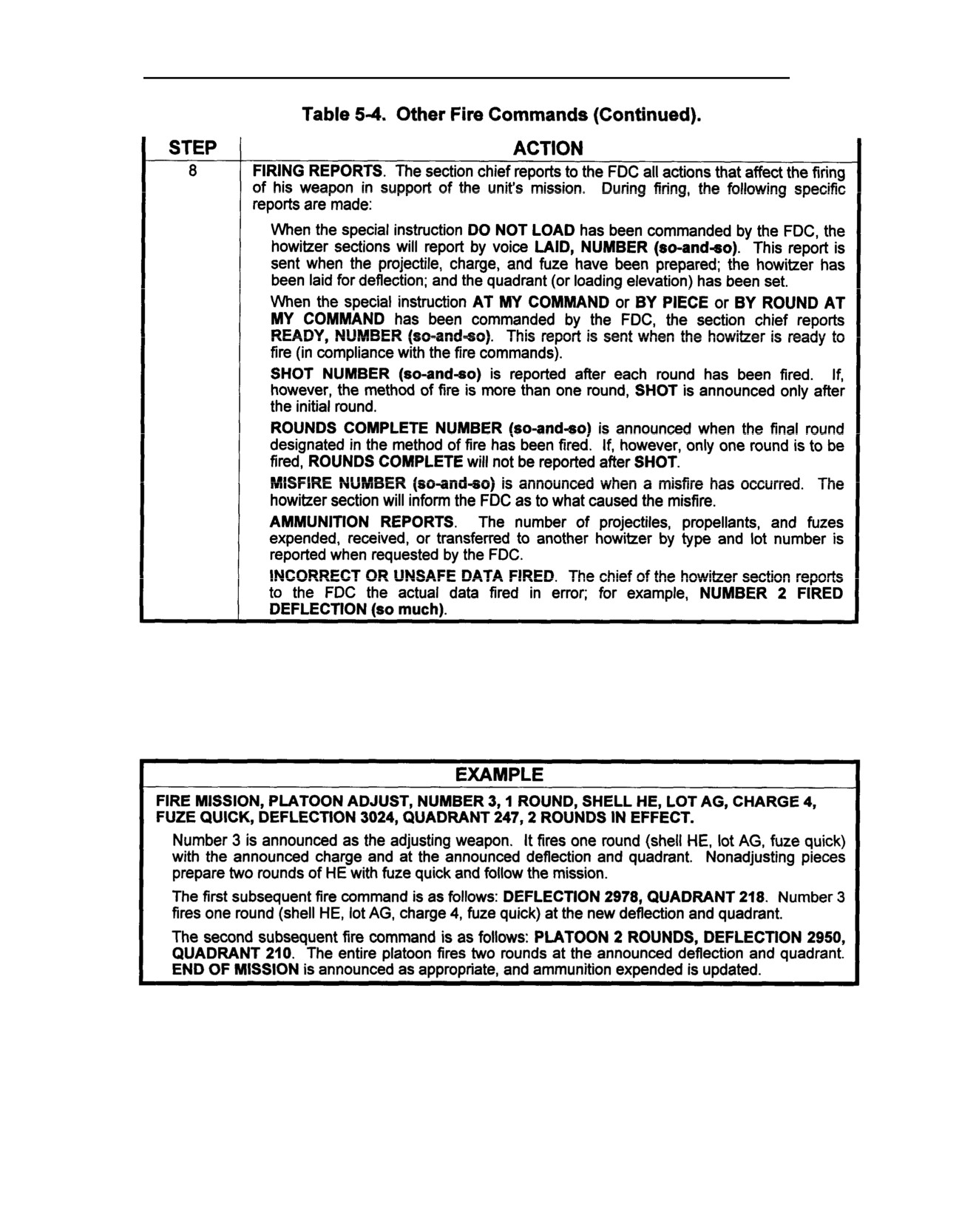
5-12. Examples of Fire Commands
a. Following is an example of an adjust-fire mission without fire command standards
applied for a four-howitzer platoon.
5-23
FM 6-40
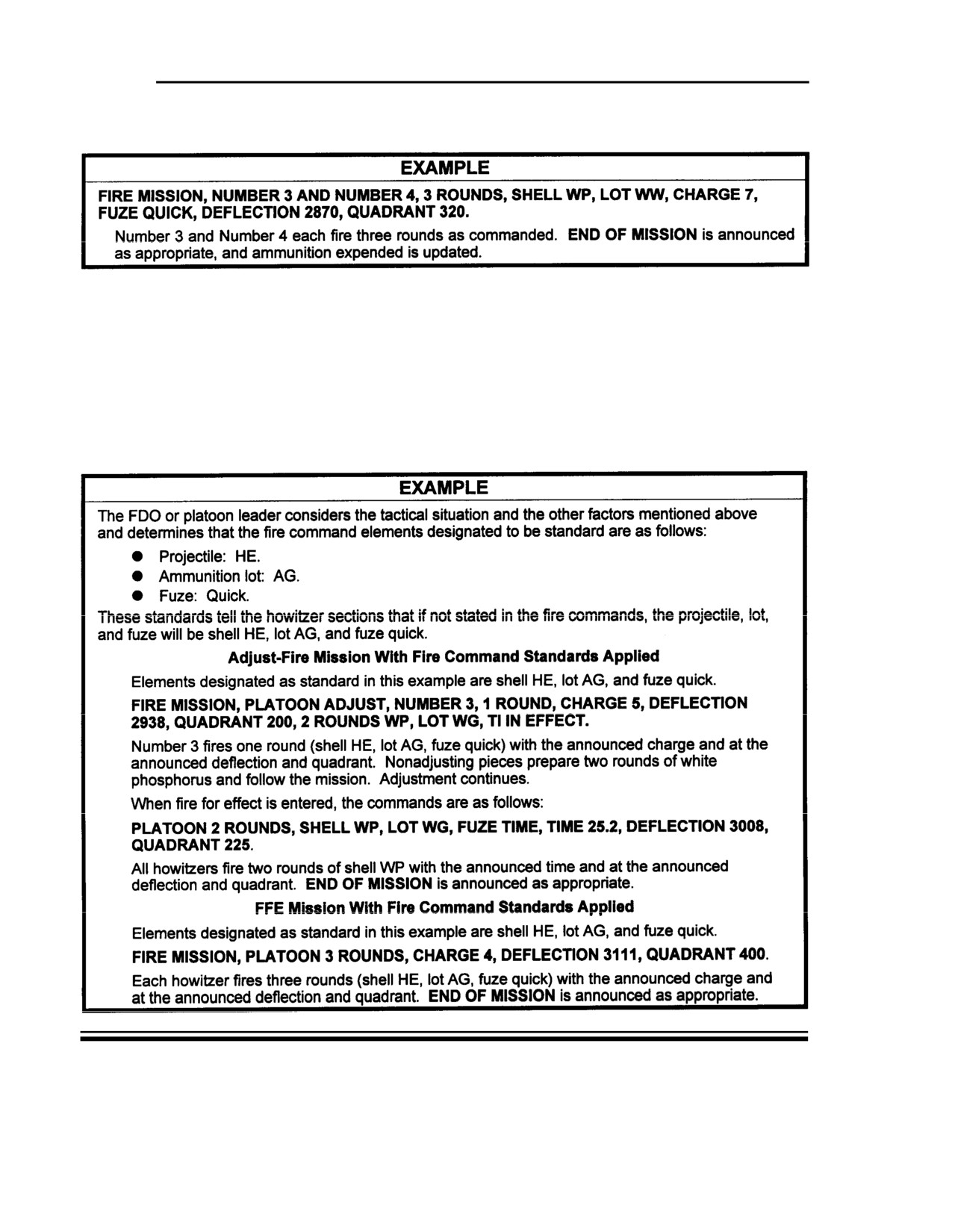
b. Following is an example of an FFE mission without fire command standards applied.
5-13. Standardizing Elements of the Fire Commands.
Certain elements of the fire commands may be standardized after the tactical situation,
weapon and personnel capabilities, ammunition status, and enemy counterfire threat have been
considered. As shown in Table 5-2, the following elements of the fire commands may be
designated as standard: pieces to fire, method of fire, projectile, ammunition lot, and fuze. Only
one set of standards can be in effect at any particular time. Once standards are placed in effect,
the unit will fire the standard data unless the fire commands specify something different.
5-24
DFM 6-40
Chapter 6
FIRING CHARTS
One of the elements to the solution of the gunnery problem is the determination of chart
data. Chart data consist of chart range, chart deflection, and angle T. The determination of
chart data requires the construction and operation of firing chart.
Section I
Types of Firing Charts
This section implements a portion of QSTAG 224.
Two types of firing charts may be constructed in the FDC. They are surveyed
firing charts and observed firing charts. Regardless of the type constructed two firing
charts are maintained in a manual FDC. The horizontal control operator (HCO)
maintains the primary firing chart, and the vertical control operator (VCO) maintains
a backup, or check, chart and a 1:50,000-scale situation map with tactical overlay(s).
6-1. Description
A firing chart is a graphic representation of a portion of the earth’s surface used for
determining distance and direction. The chart may be constructed by using a map, a photomap, a
grid sheet, or other material on which the relative locations of batteries, known points, targets,
and observers can be plotted. Additional positions, fire support coordinating measures, and other
data needed for the safe and accurate conduct of fire may also be recorded.
6-2. Firing Chart Construction
The most commonly used materials for constructing firing charts are as follows:
a. Grid Sheet. A grid sheet is a plain sheet of paper or plastic (mylar) on which equally
spaced horizontal and vertical lines, called grid lines, are printed. The intervals between these
grid lines will create 1,000-meter grid squares on a scale of 1:25,000. This scale provides the
best compromise between accuracy and convenience and is therefore the scale for which standard
plotting equipment is graduated. The locations of all points plotted on the grid sheet must be
determined either by survey data, map inspection, or firing. The grid sheet is numbered to
correspond to the map area of the zone of operation of the supported force. The FDO assigns the
lower left-hand corner casting and northing coordinates, and the direction of the long axis
(east-west or north-south) also is specified. The rightmost and topmost grid lines are not labeled
because data are not determined from these grid lines.
b. Map. A map is a graphic representation, drawn to scale, of a portion of the earth’s
surface. Only maps based on accurate ground survey should be used for constructing firing
charts. If the map scale is other than 1:25,000, the range readings obtained from plotting
equipment must be adjusted. For example, if a 1:50,000-scale map is used, the ranges
determined with the RDP must be doubled. Deflections and azimuths are not affected. If a map
is not based on accurate and adequate ground survey control, it should be used only to obtain
approximate locations and vertical control to supplement a grid sheet firing chart.
6-1
FM 6-40
c. Photomap. A photomap is a reproduction of an aerial photograph or a mosaic of
aerial photographs on which grid lines, marginal information, and place names are superimposed.
A photomap must not be considered exact until its accuracy has been verified. Photomaps may
include errors caused by tilt, distortion caused by relief, and errors caused by poor assembly, If
points cannot be located on the photomap by inspection, the photomap scale must be determined
before points can be located on the photomap survey. Normally, vertical control can be
established by estimation only. Determination of the scale of vertical control of photographs is
discussed in FM 21-26. Some photomaps have spot altitudes, but interpolation for altitude is
difficult and inaccurate.
Section II
Plotting Equipment and Firing Chart Preparation
To ensure the accuracy of the data shown on the firing chart, FDC personnel
should construct and plot from a standing position directly above the chart. Plotting
pins must be kept perpendicular to the firing chart. Personnel, equipment and the
firing chart should be kept as clean as possible at all times. If two charts are present
in the FDC, they must be checked against each other for accuracy. If one chart is a
backup for another system, it should be verified against that system for accuracy.
(Refer to Appendix E for automated FDC procedures.)
6-3. Pencils
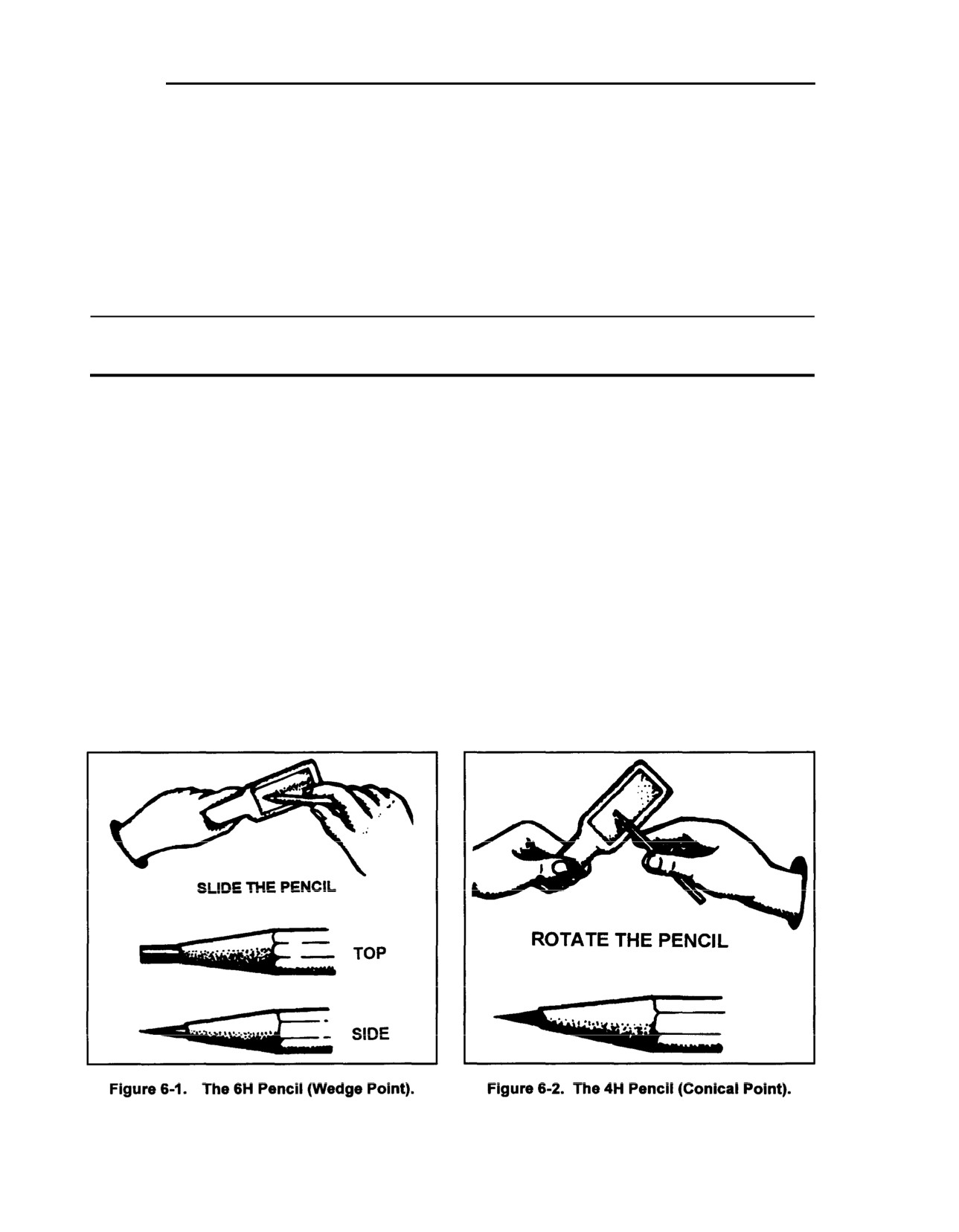
a. 6H Pencil. The 6H (hard lead) pencil is sharpened to a wedge point and is used to
draw fine index lines from which measurements are made. If a 6H pencil is not available, a 5H
pencil is an acceptable substitute. (See Figure 6-1.) Place a 1-inch piece of tape on the end to
differentiate between a 4H pencil.
b. 4H Pencil. The 4H pencil is sharpened to a conical point and is used to label and
construct tick marks and to label azimuth and deflection indexes. If a 4H pencil is not available,
a 3H pencil is an acceptable substitute. (See Figure 6-2.)
6-2
FM 6-40
c. Red and Blue Pencil. The red and blue pencil is sharpened to a conical point and is
used to label and construct tick marks and label deflection indexes, as required by the color code.
(See Figure 6-2.)
d. Orange Pencil. The orange pencil is sharpened to a conical point and is used to label
tick marks and deflection indexes, as required by the color code. (See Figure 6-2.)
e. Green Pencil. The green pencil is sharpened to a conical point and is used to label
tick marks for radars, as required by the color code. (See Figure 6-2.)
6-4. Plotting Pins
Plotting pins are used to mark indexes and temporary positions on the firing chart. On a
1:25,000-scale chart, the thickness of the plotting pin shaft equals 20 meters.
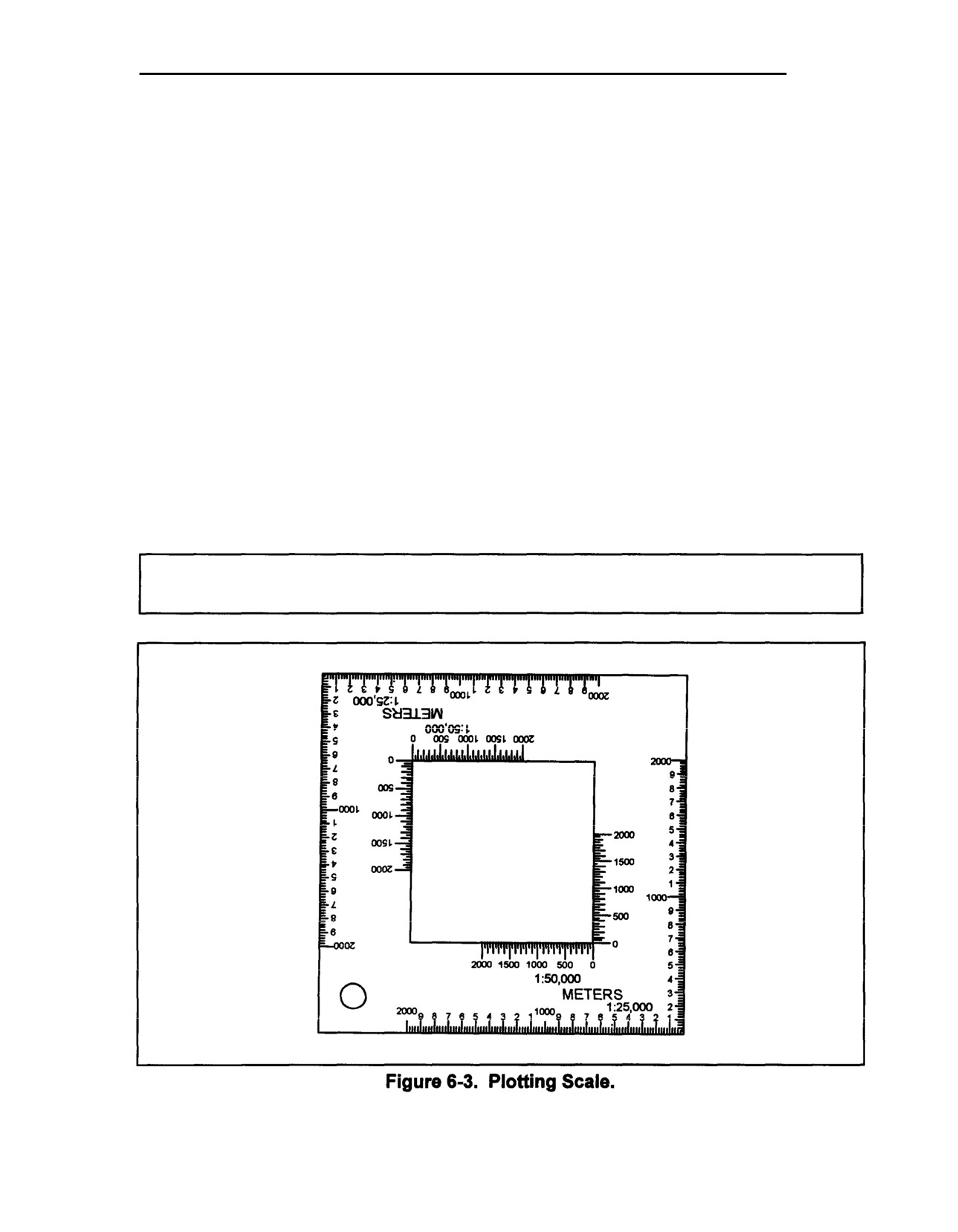
6-5. Plotting Scale
The plotting scale is a square-shaped scale used to plot or determine grid coordinates.
The scale is graduated in meters and yards at scales of 1:25,000 and 1:50,000. Using the
four-step plotting method, locations are normally plotted to an accuracy of 10 meters with the
plotting scale. Personnel must be careful not to confuse the meter and yard scales on this
instrument (newer plotting scales only have meter scales on them). (See Figure 6-3.) If there is a
yard scale, tape over it so this scale is not accidentally used.
NOTE: Ten-digit grid coordinates are expressed to an 8-digit grid coordinate
when plotting because of the limitations of the plotting scale.
6-3
FM 6-40
6-4
FM 6-40
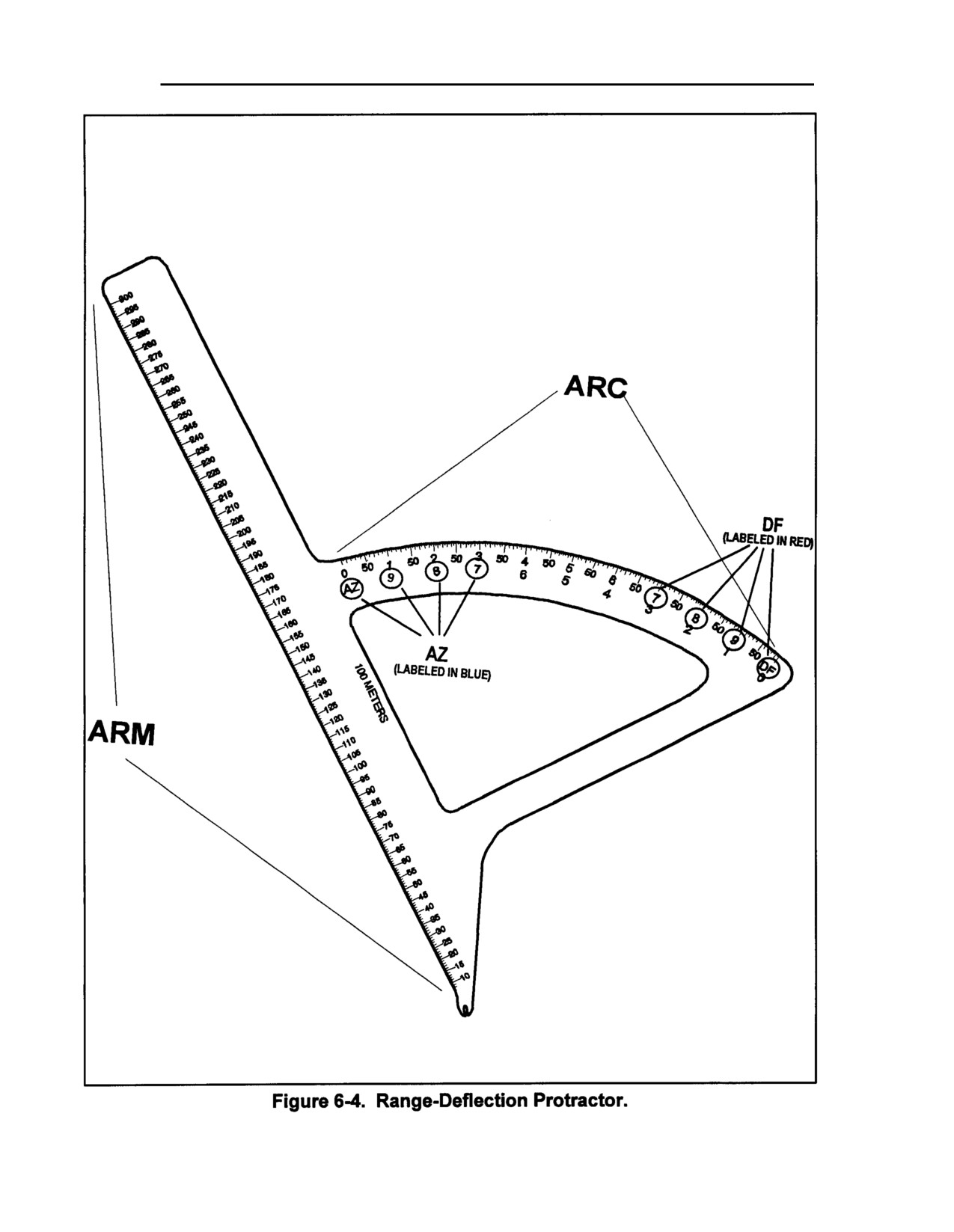
6-6. Range-Deflection Protractor
The RDP is used to measure angles in mils and distances in meters. Range and deflection
are measured from a firing unit to a target. Direction and distance are measured from an observer
to a target. (See Figure 6-4.)
a. The left edge of the instrument is the arm and is used to measure range or distance. It
is graduated in 50-meter increments and labeled every 500 meters on a scale of 1:25,000. Ranges
and distances are visually interpolated to an accuracy of 10 meters. The arm can be labeled to
represent charge or range spans and other pertinent data to aid the FDO.
b. The 1,000-mil arc of the RDP is graduated in 5-mil increments. The 50-mil
increments are indicated by longer graduations and are permanently numbered. The are is
visually interpolated to an accuracy of 1 mil.
c. The vertex, the slotted portion of the RDP, is placed against a plotting pinto properly
position the RDP for determining data.
d. There are four different RDP models. They differ by the maximum range of the arm
(12,000, 15,000,25,000, and 30,000 meters).
e. RDPs are also available on a 1:50,000 scale.
NOTE: When labeling the RDP, label azimuth values in blue and deflection
values in red.
6-5
FM 6-40
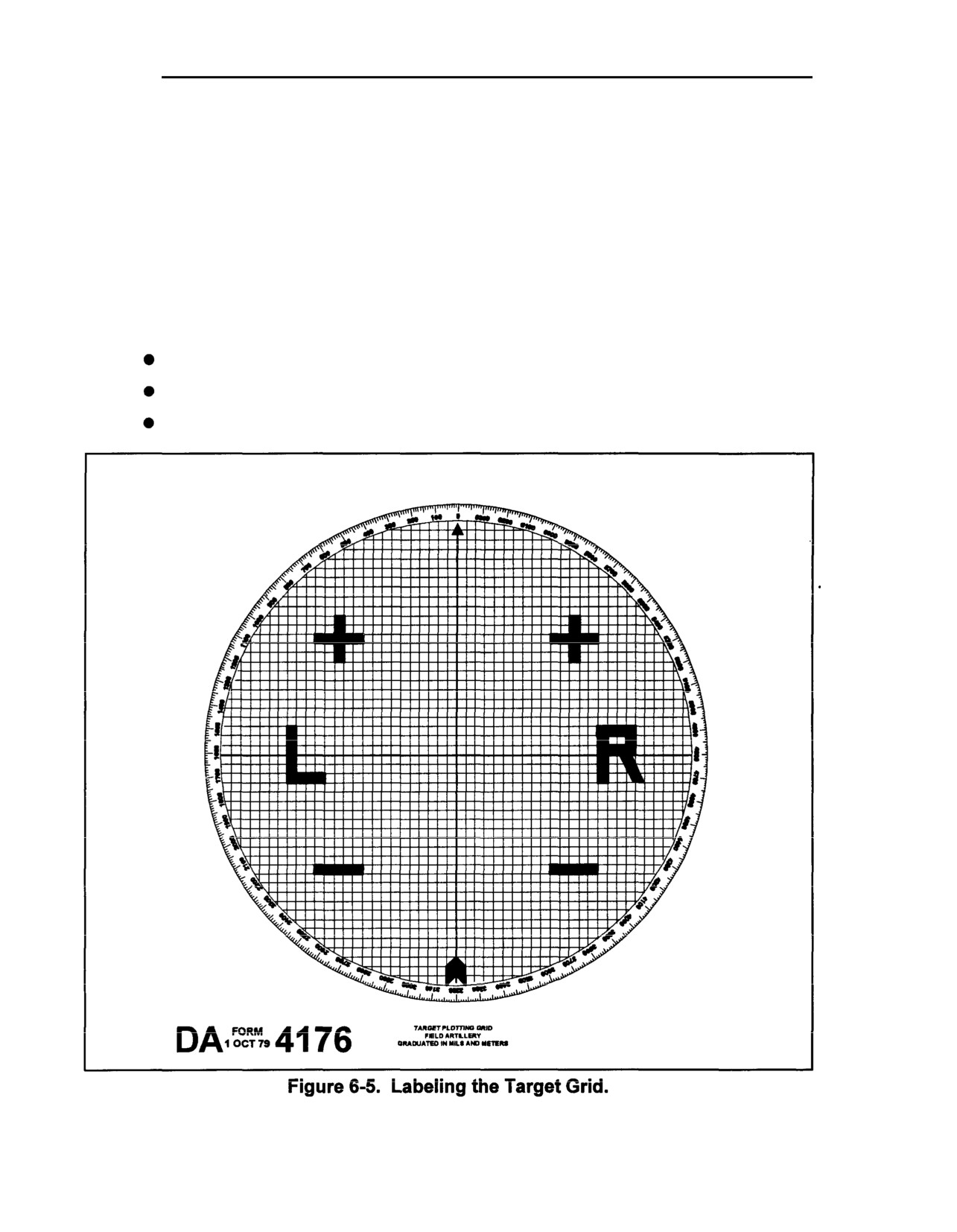
6-7. Target Grid
The target grid is a circular paper device on which grid lines are printed. Normally, the
target grid used is DA Form 4176 (Target Plotting Grid, Field Artillery). Grid lines on the target
grid match the scale of the 1:25,000 firing chart, dividing a 1,000-meter grid square into
100-meter squares. An azimuth scale is printed around the outer edge of the target grid. It is
graduated in 10-mil increments and is numbered every 100 mils. An arrow extends across the
center of the target grid and is used to indicate the observer-target line (or other line of known
direction). The target grid should be labeled as shown in Figure 6-5. (The L and - are written
in blue pencil; the R and +, in red.) Transparent tape should be applied to the reverse side of
the target grid to prevent the center hole from becoming enlarged. The target grid is used for
three distinct operations:
Plotting the position of targets located by a shift from a known point.
Plotting observer subsequent corrections.
Determing angle T.
6-6
FM 6-40
Section III
Surveyed Firing Chart
A surveyed firing chart is a chart on which the location of all required points
(battery or platoon positions, known points, and OPs) are plotted. These locations
can be based on survey or map inspection. All plotted points are in correct relations
to one another and reflect actual map coordinates.
6-8. Selection of Lower Left-Hand Corner and Azimuth of Lay
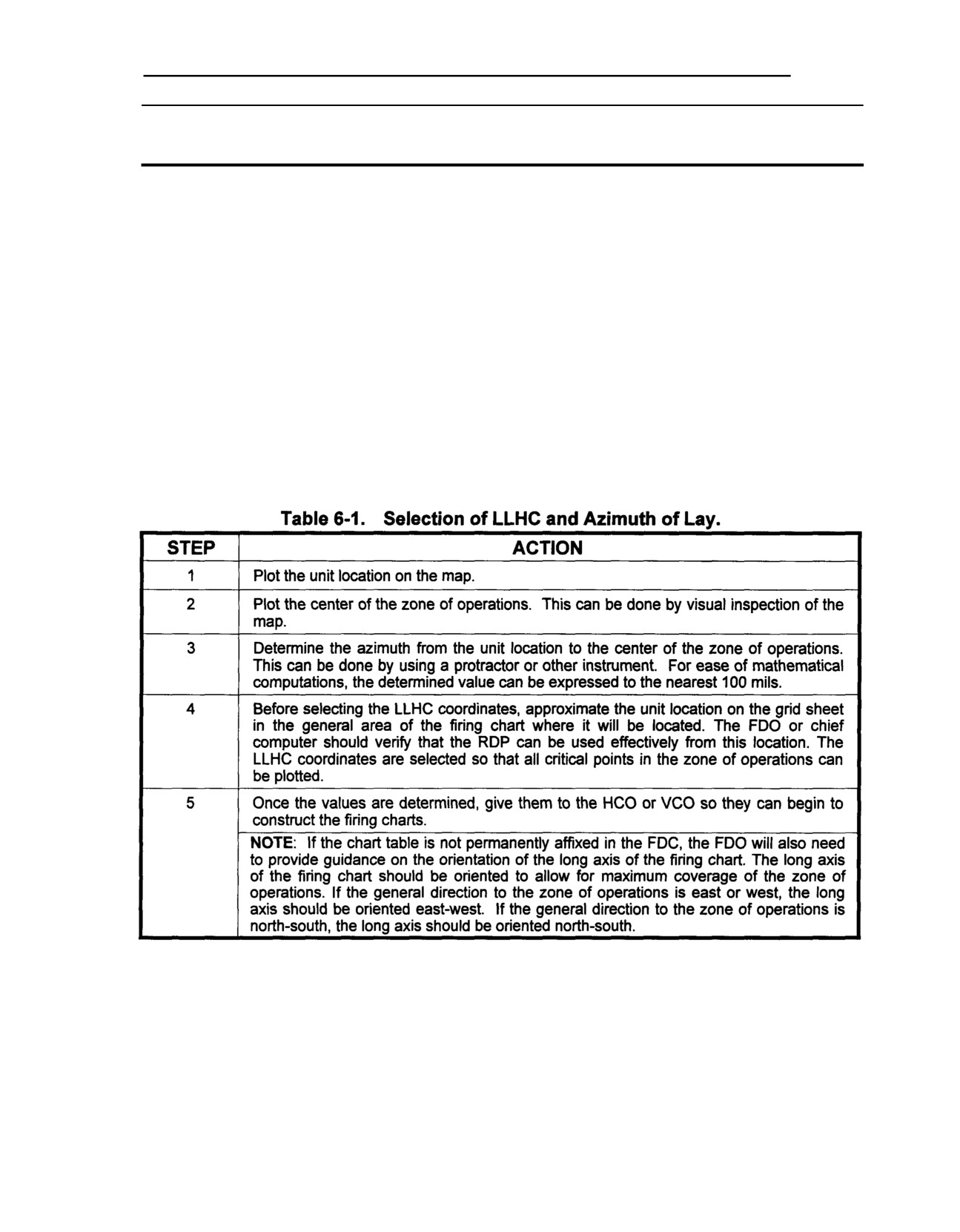
For the chart operator to construct a firing chart correctly, he needs to be provided
guidance on what coordinates to assign to the lower left-hand comer (LLHC) of the grid sheet
and the azimuth of lay. The FDO is responsible for providing this information. The azimuth of
lay can be determined on the basis of the zone of operations or the guidance from the battery
commander or higher HQ. After the azimuth of lay is determined, the LLHC coordinates need to
be carefully selected. The selected LLHC coordinates should include all critical points on the
firing chart and allow full use of the RDP. The steps in Table 6-1 will help to serve as a guide in
determining the LLHC and azimuth of lay.
6-7
FM 6-40
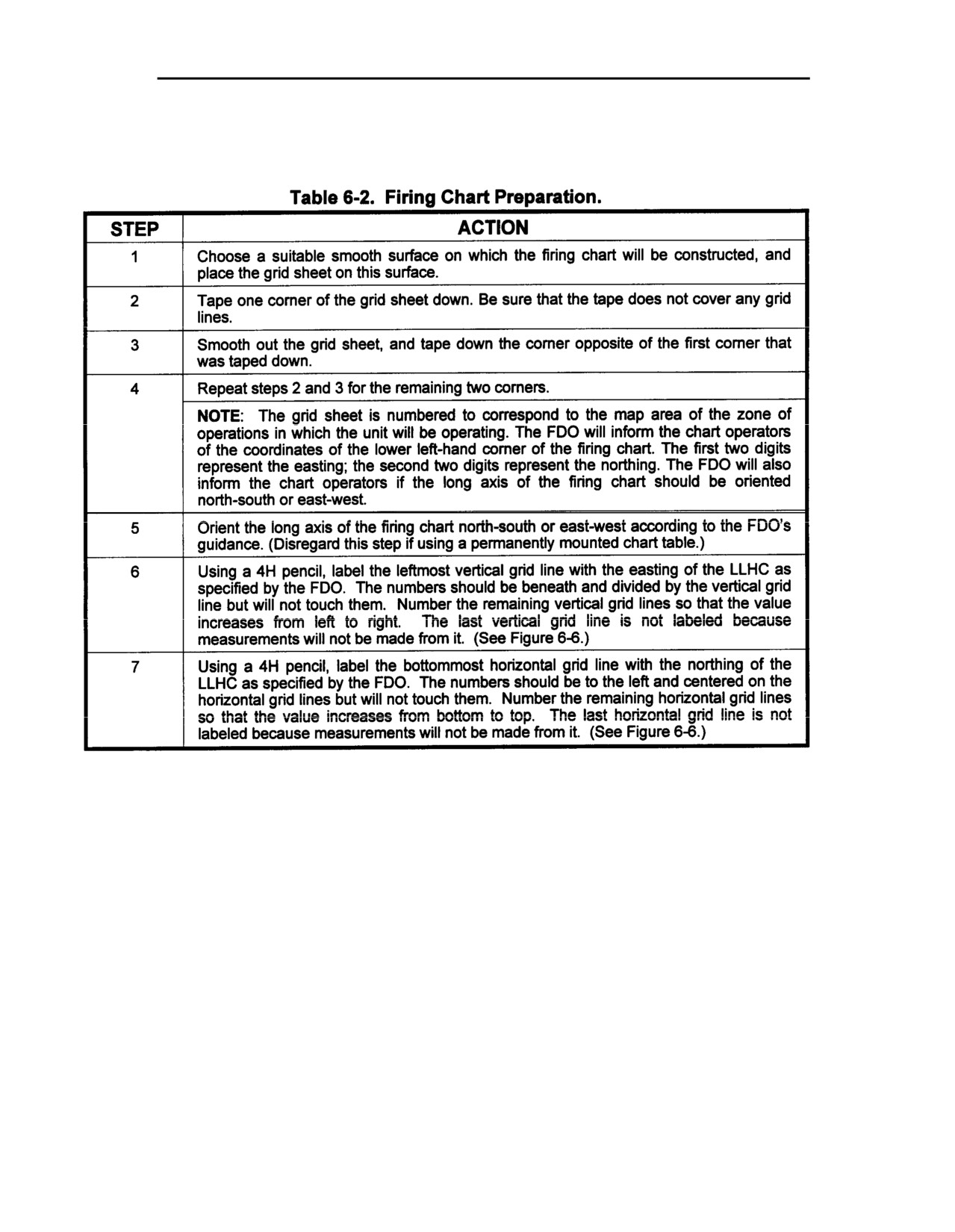
6-9. Firing Chart Preparation
The steps in Table 6-2 are the recommended sequence for the preparation of a firing chart.
6-8
FM 6-40
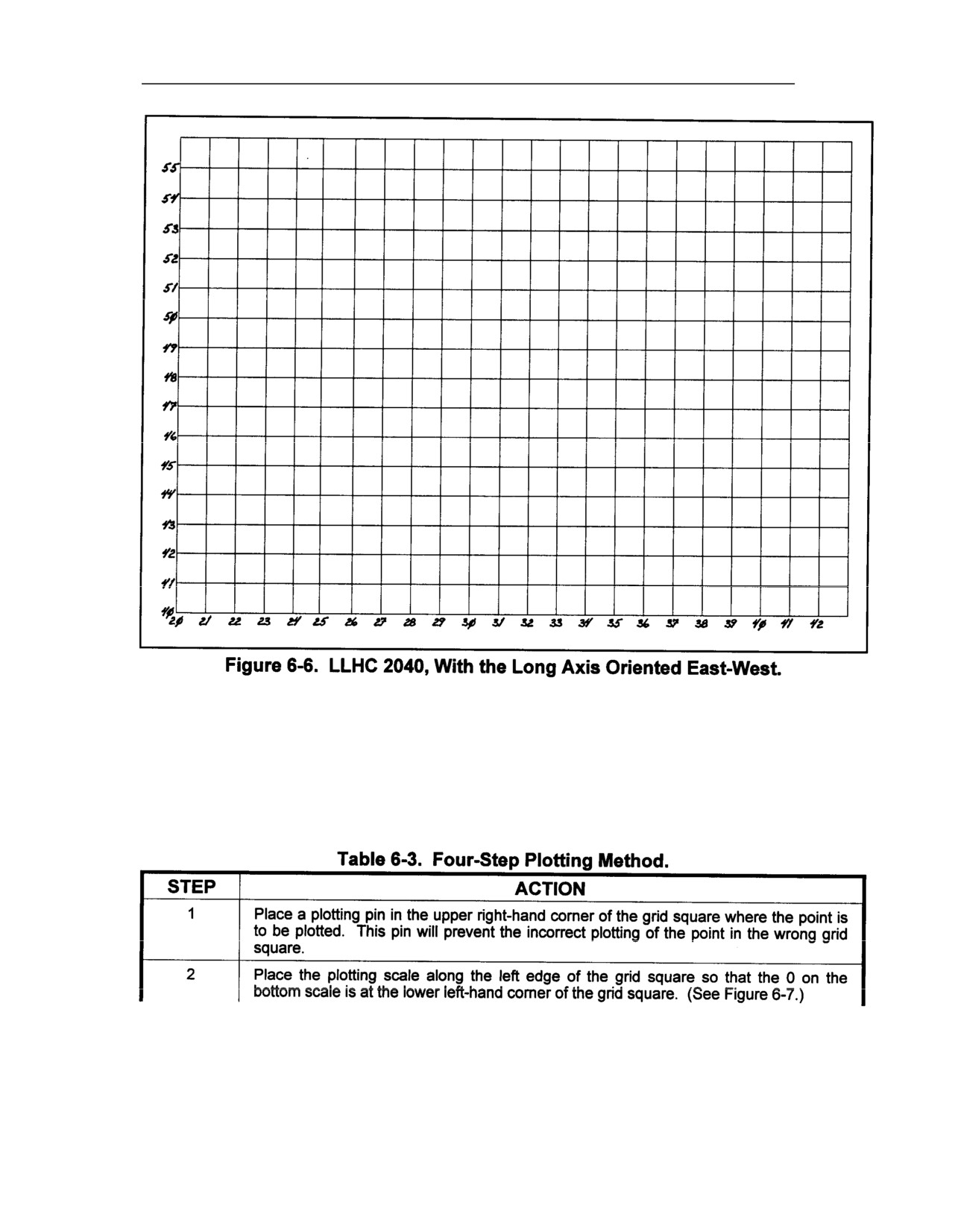
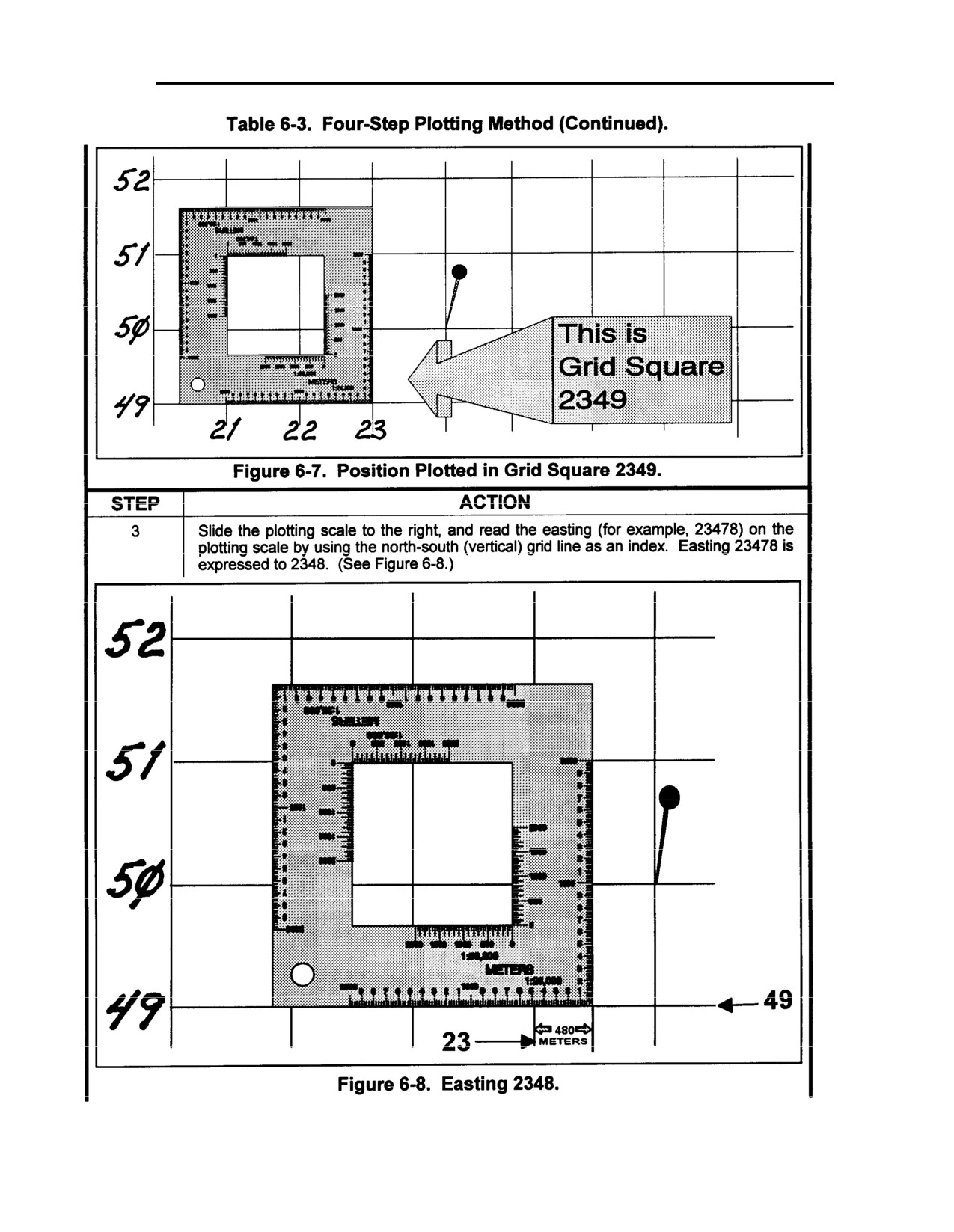
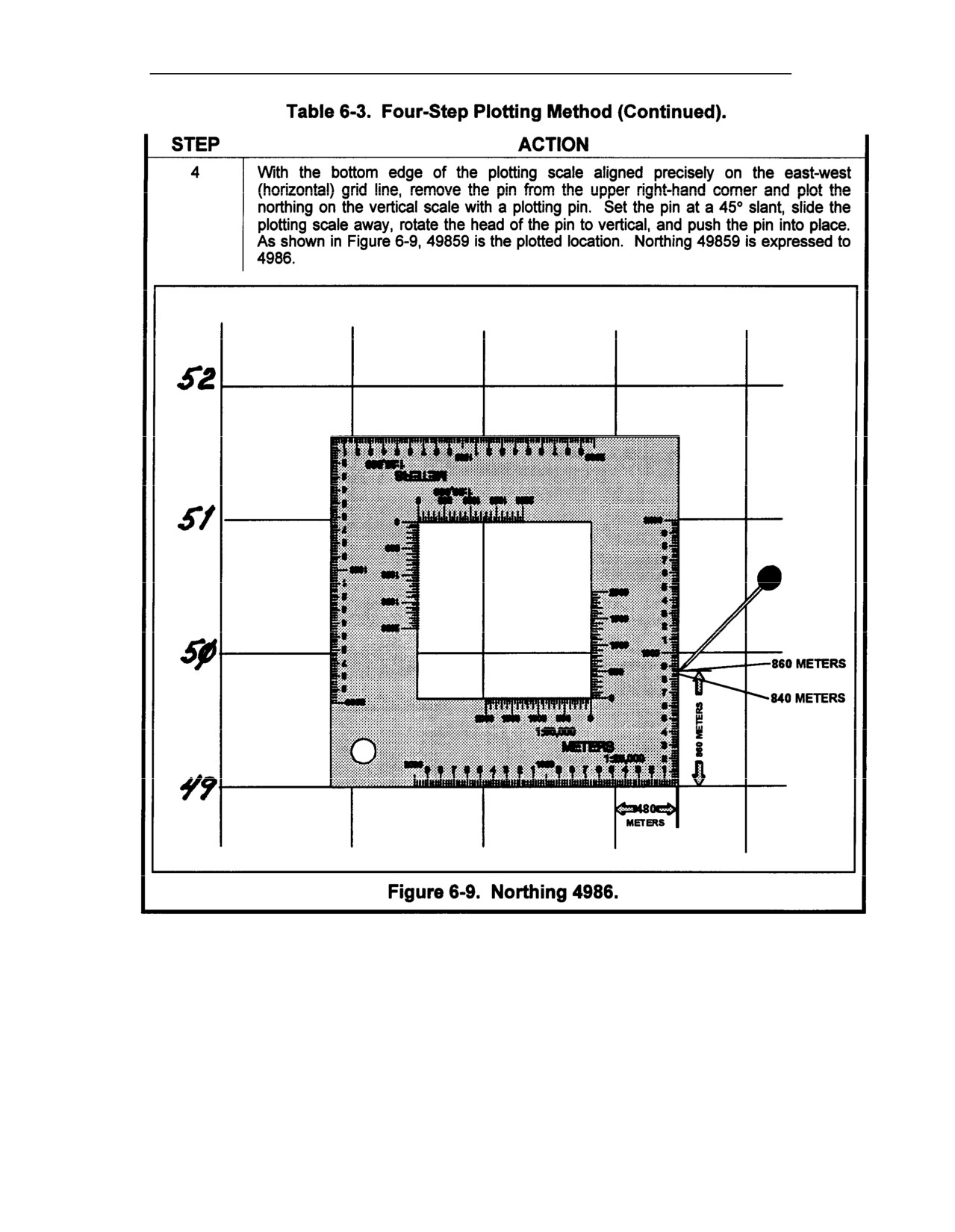
6-10. Four-Step Plotting Method
Points commonly plotted on a firing chart include battery or platoon base piece locations,
known points, targets, observer locations, and maneuver checkpoints. Base piece locations can
be determined by using the M17 plotting board and protractor. To plot points located by grid
coordinates, use the steps in Table 6-3.
6-9
FM 6-40
6-10
FM 6-40
6-11
FM 6-40
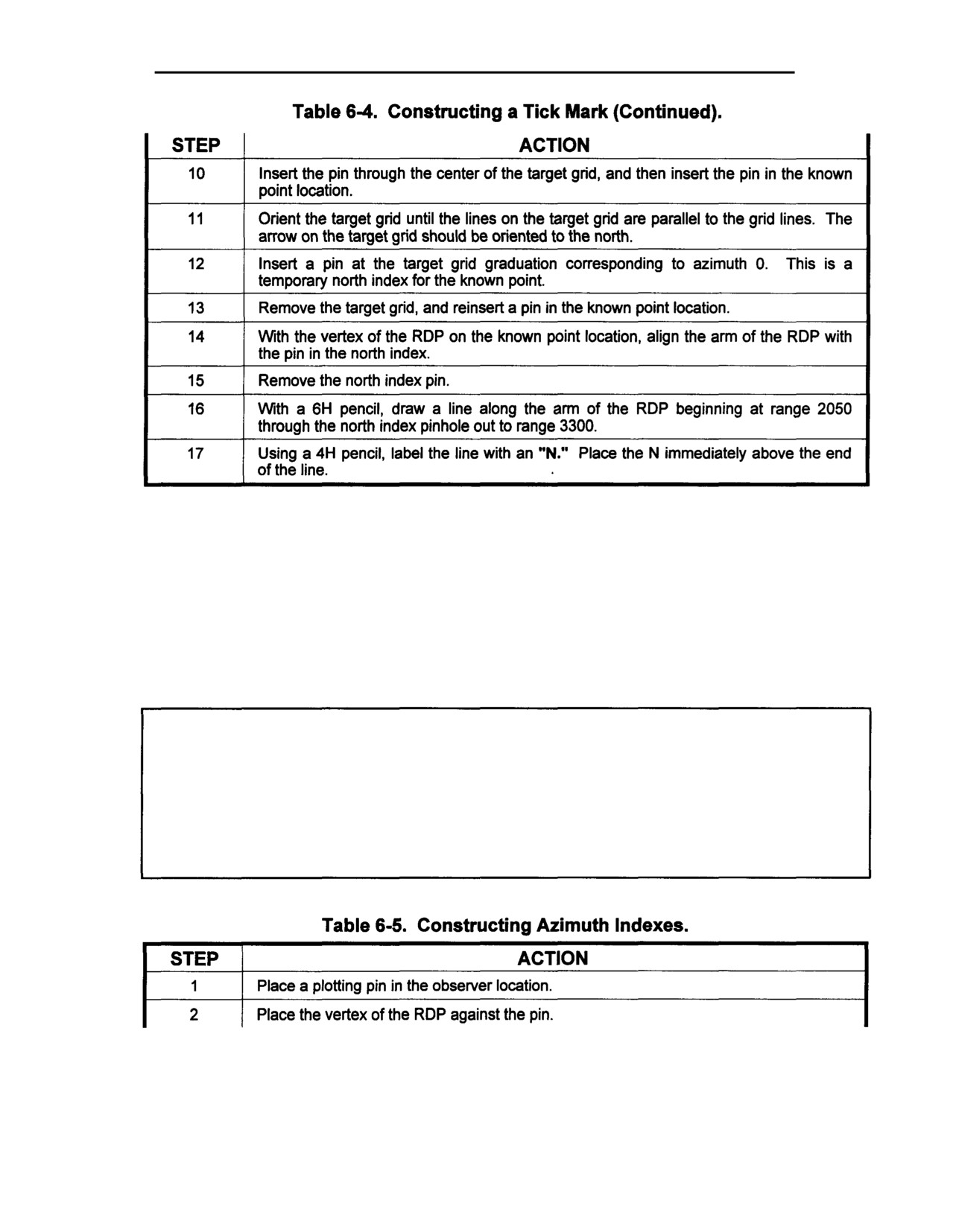
6-11. Tick Marks
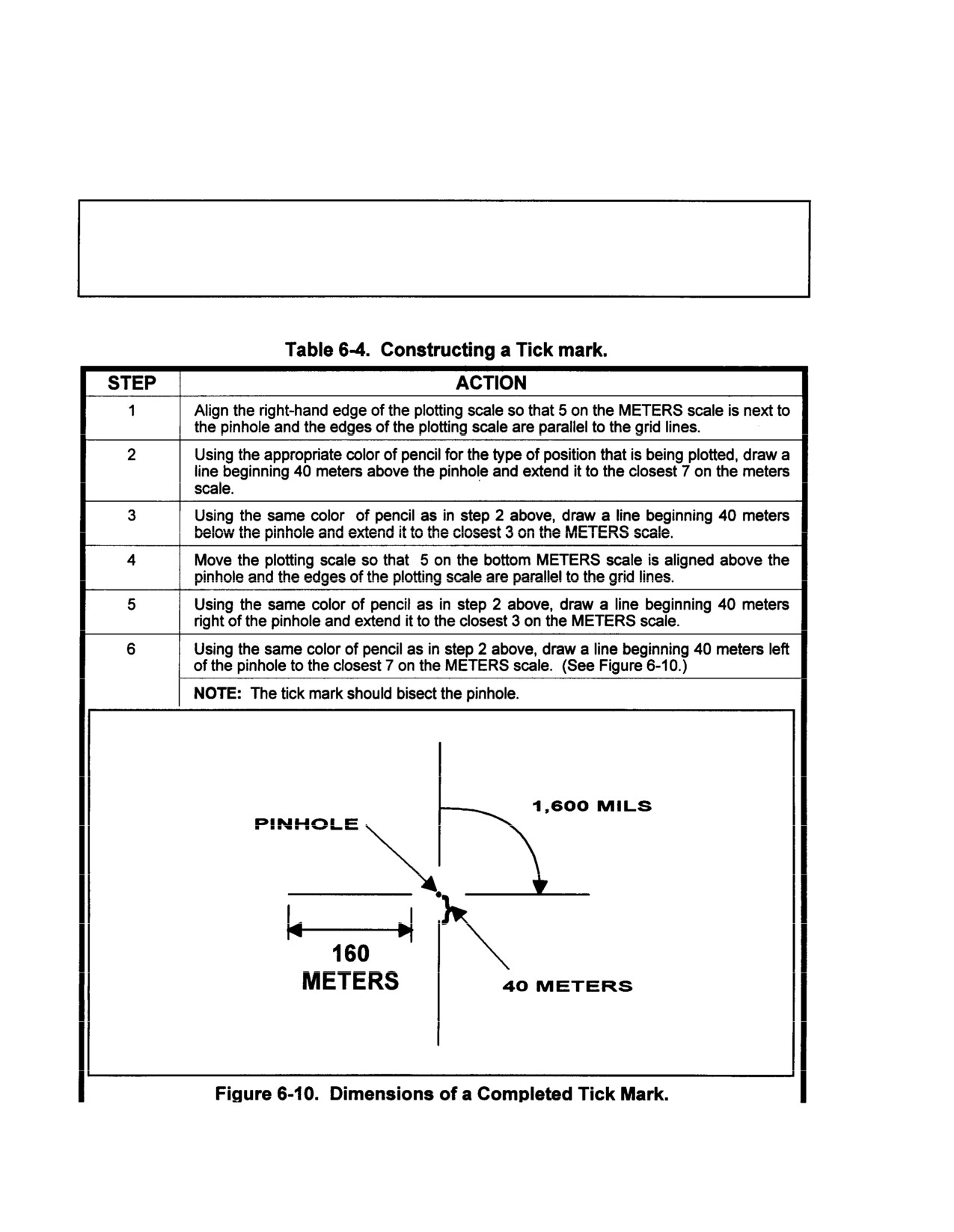
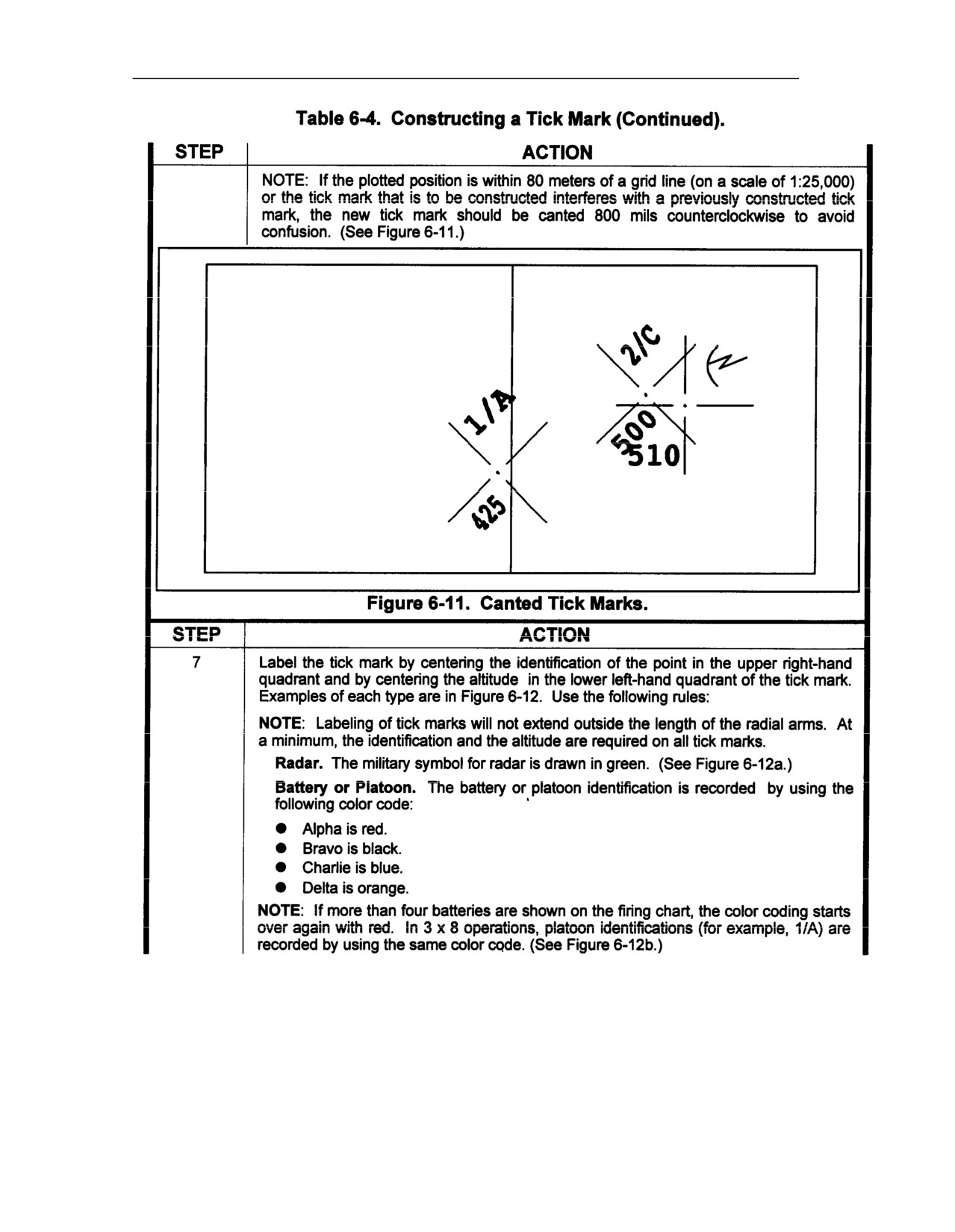
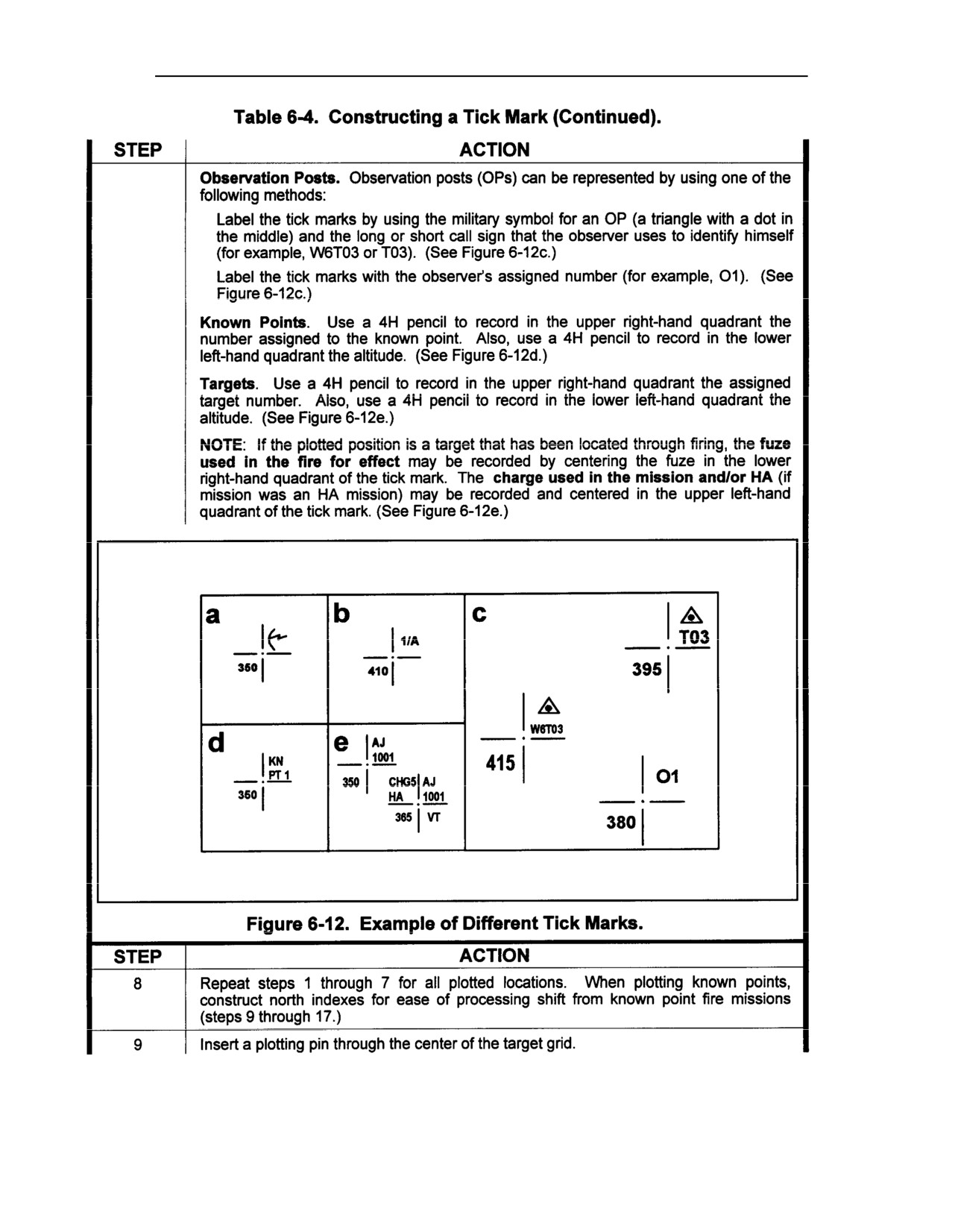
The tick mark is the symbol used to mark and identify the location of a point plotted on a
firing chart. The tick mark is constructed in the form of a cross with each arm beginning 40
meters from the pinhole on the chart and extending 160 meters in length (1:25,000 scale).
NOTE: Tick marks will be constructed with a 4H pencil with the following
exception: To construct a tick mark for a target that has been located through
firing, use a red pencil.
Table 6-4 uses the 3,5,7, method to construct a tick mark.
6-12
FM 6-40
6-13
FM 6-40
6-14
FM 6-40
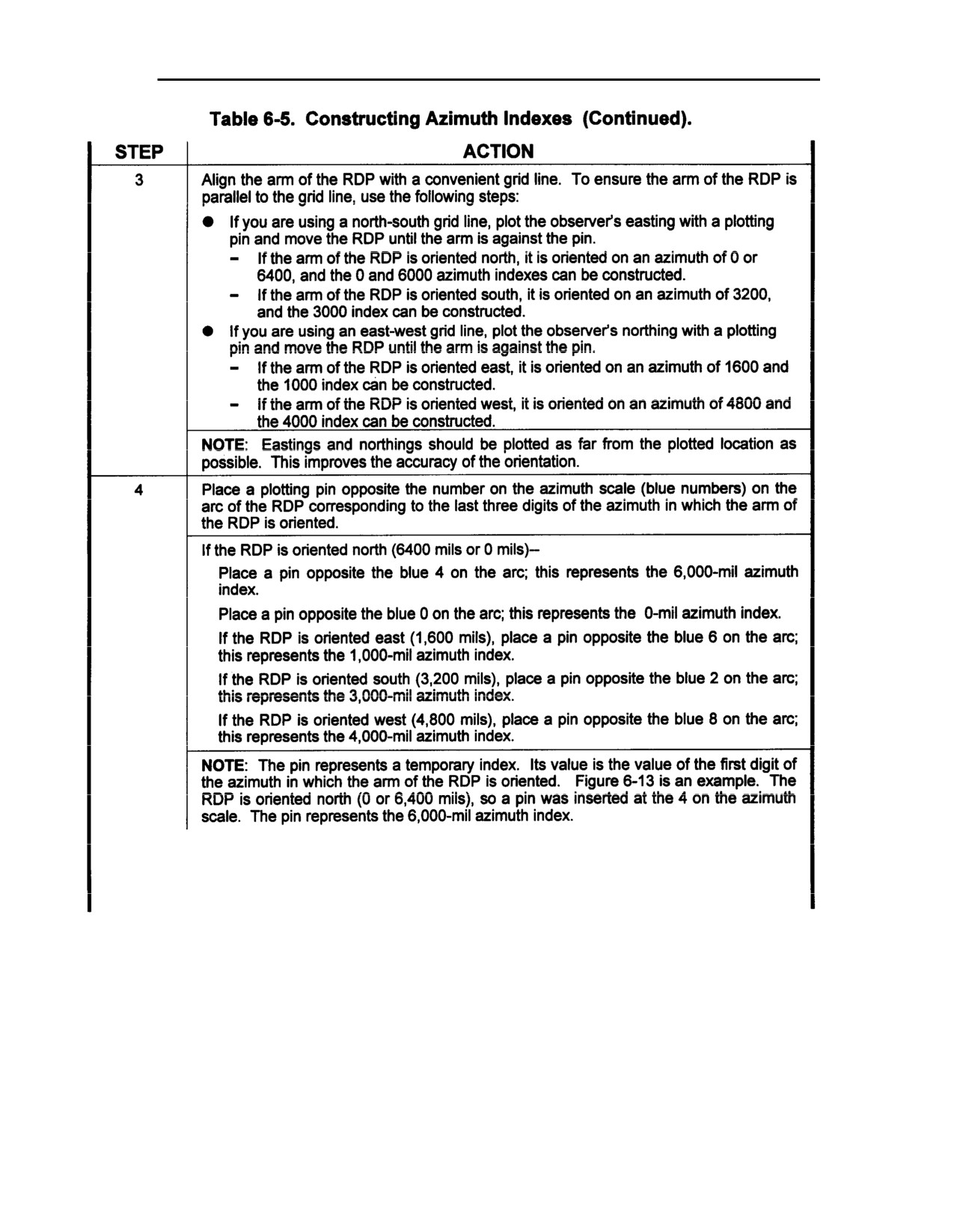
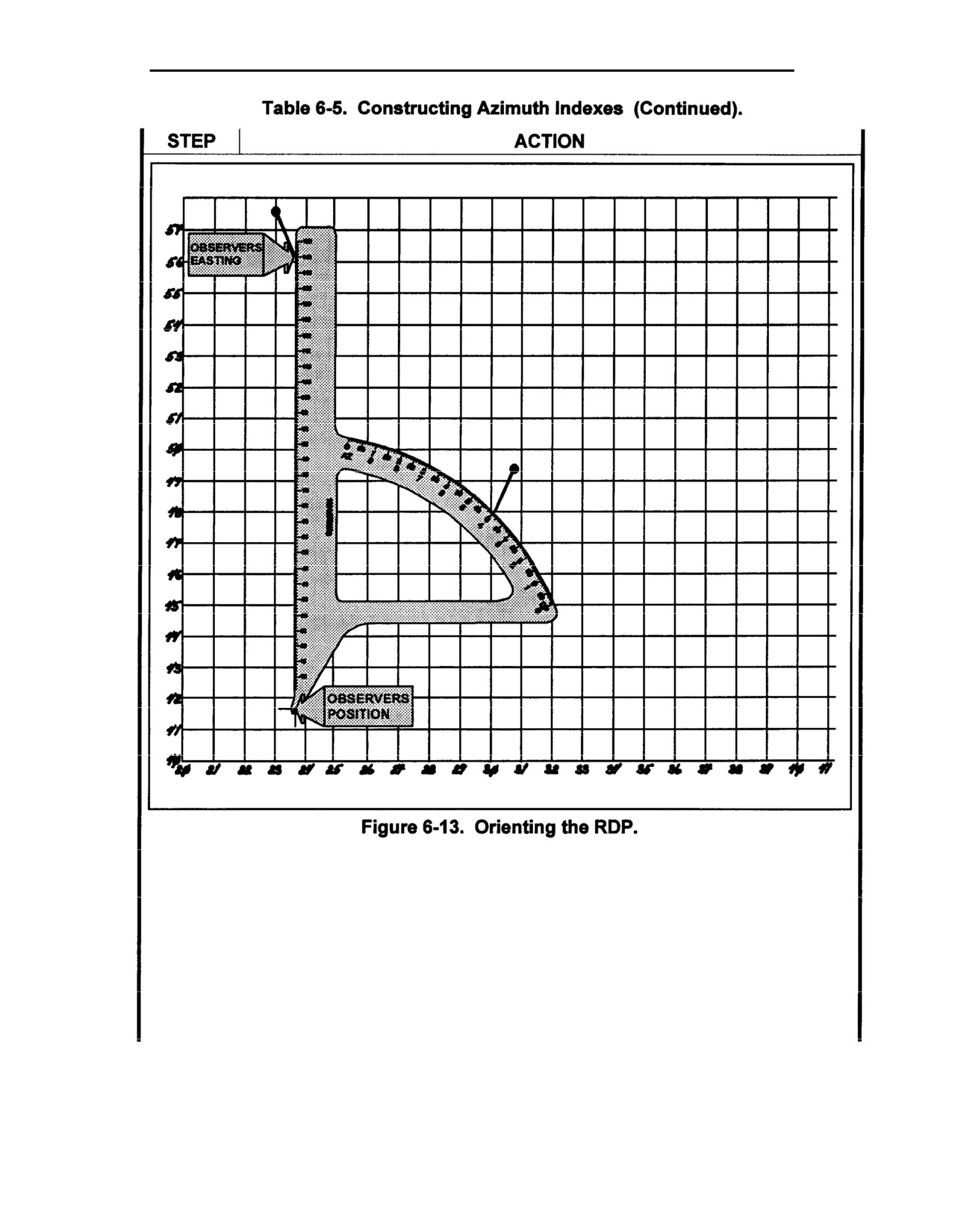
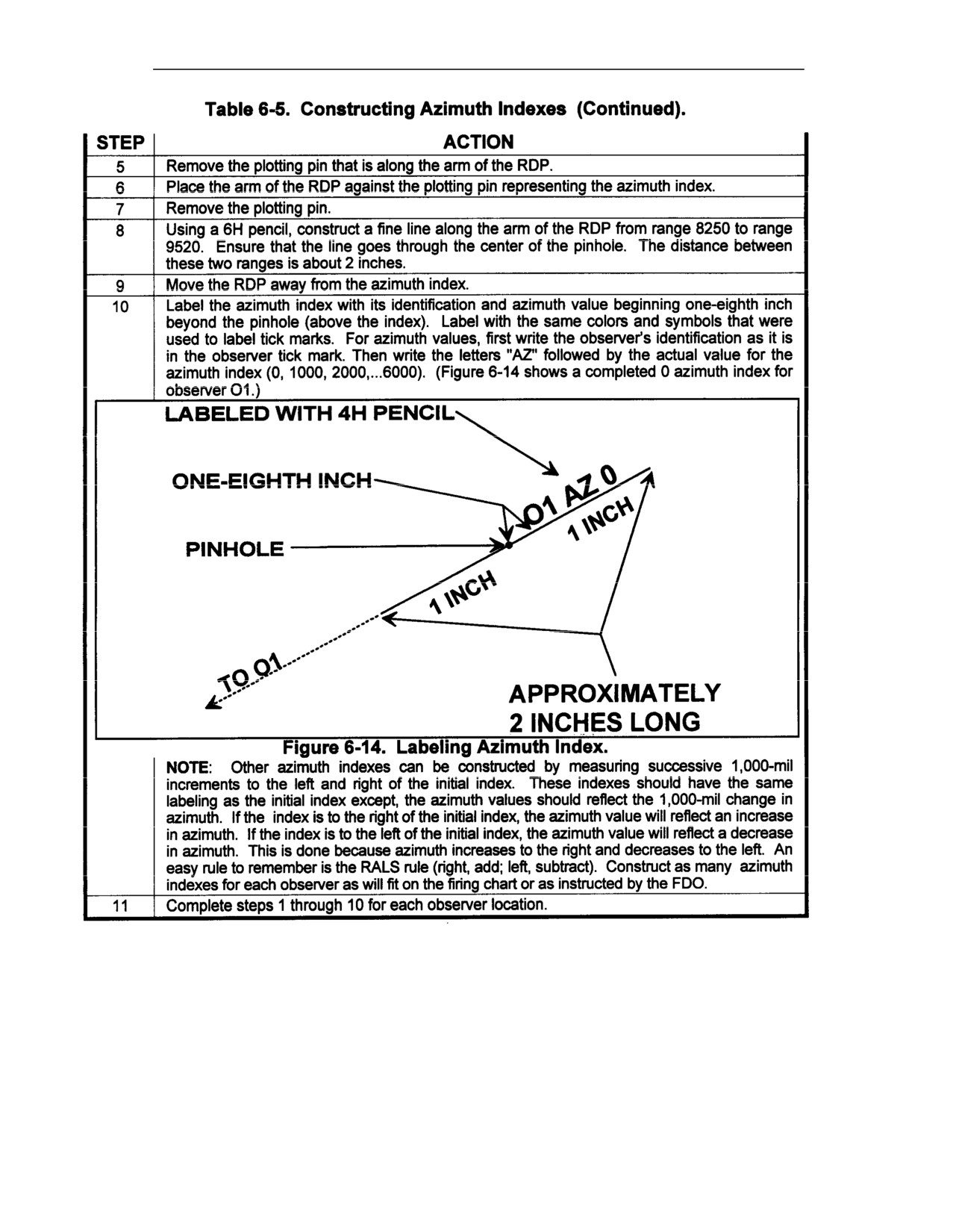
6-12. Construction of Azimuth Indexes
Azimuth indexes are constructed for points located on the firing chart from which the
polar method of target location may be expected. The RDP is prepared by numbering the
100-mil azimuth graduations in blue as shown in Figure 6-4. Azimuths are always read as four
digits. The first digit (thousands of mils) is read from an index that is constructed on the firing
chart. The last three digits are read from the arc of the RDP. Azimuth indexes are constructed on
the firing chart in 1,000-mil intervals throughout the target area, except the 6000 and 0 indexes,
which are 400 mils apart. The steps for constructing azimuth indexes can be found in Table 6-5.
NOTE: To help determine the four digits of a deflection or azimuth, use the
memory aid CLUE.
C - Chart index/pin is first digit.
L - Label on RDP arc is second digit.
U - Unit graduation is third digit.
E - Estimate (visually) to nearest mil is fourth digit.
6-15
FM 6-40
6-16
FM 6-40
6-17
FM 6-40
6-13. Construction of Deflection Indexes
Direction from a battery or platoon to a target normally is measured and announced in terms of
deflection. Deflection is the horizontal clockwise angle from the line of fire, or the rearward extension of the
line of fire, to the line of a designated aiming point with the vertex of the angle at the sight. In
addition to the deflection as a fire command, the firing battery is concerned with common deflection. The
RDP will be used to measure deflection so it must be prepared by numbering the graduations of the arc in
red as shown in Figure 6-4. Orient the RDP on the azimuth of fire, and place a pin opposite the common
deflection for that weapon system. Table 6-6 contains the steps required for constructing deflection indexes.
6-18