FM 6-40 TTP for Field Artillery Manual Cannon Battery U.S. - page 6
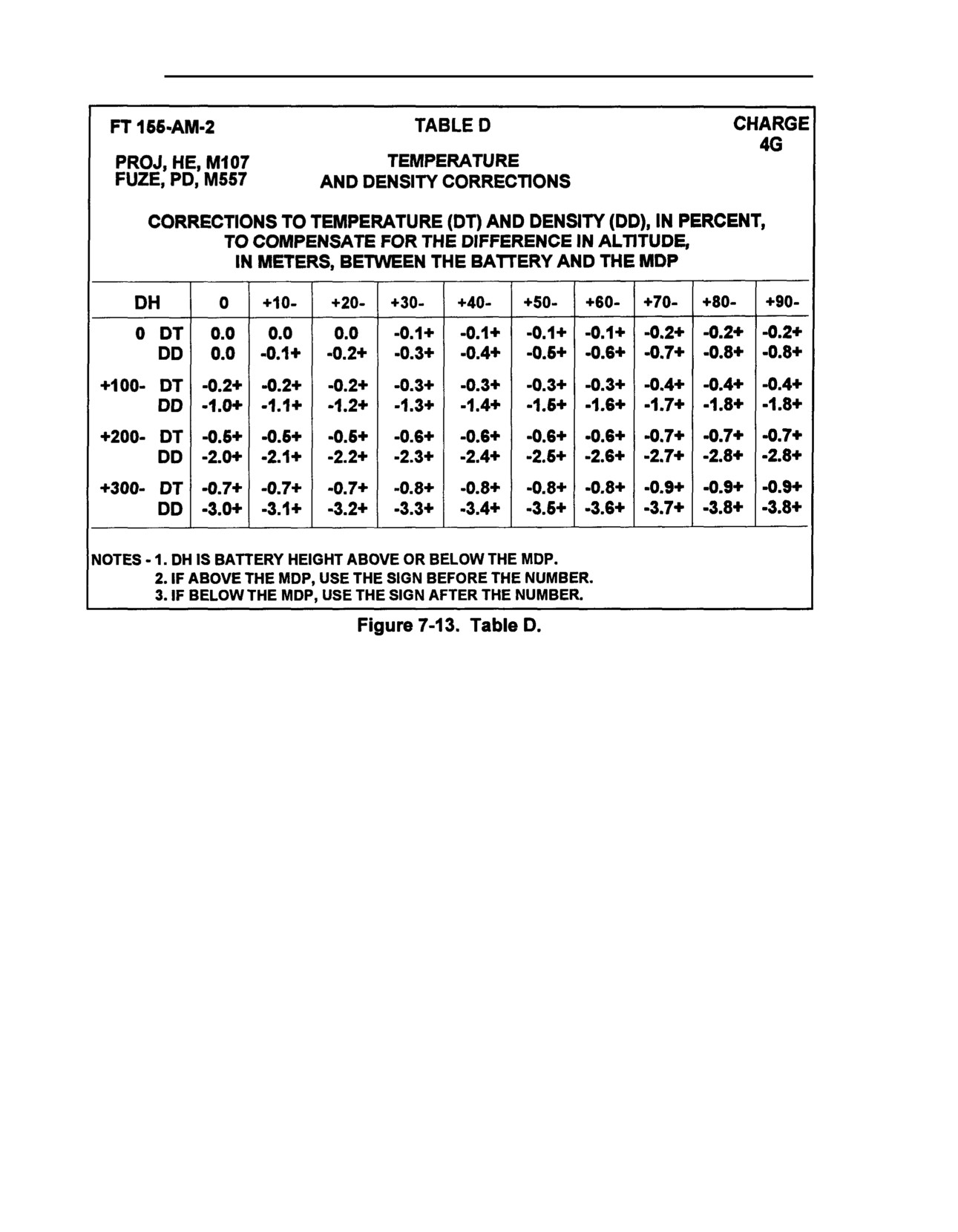
FM 6-40
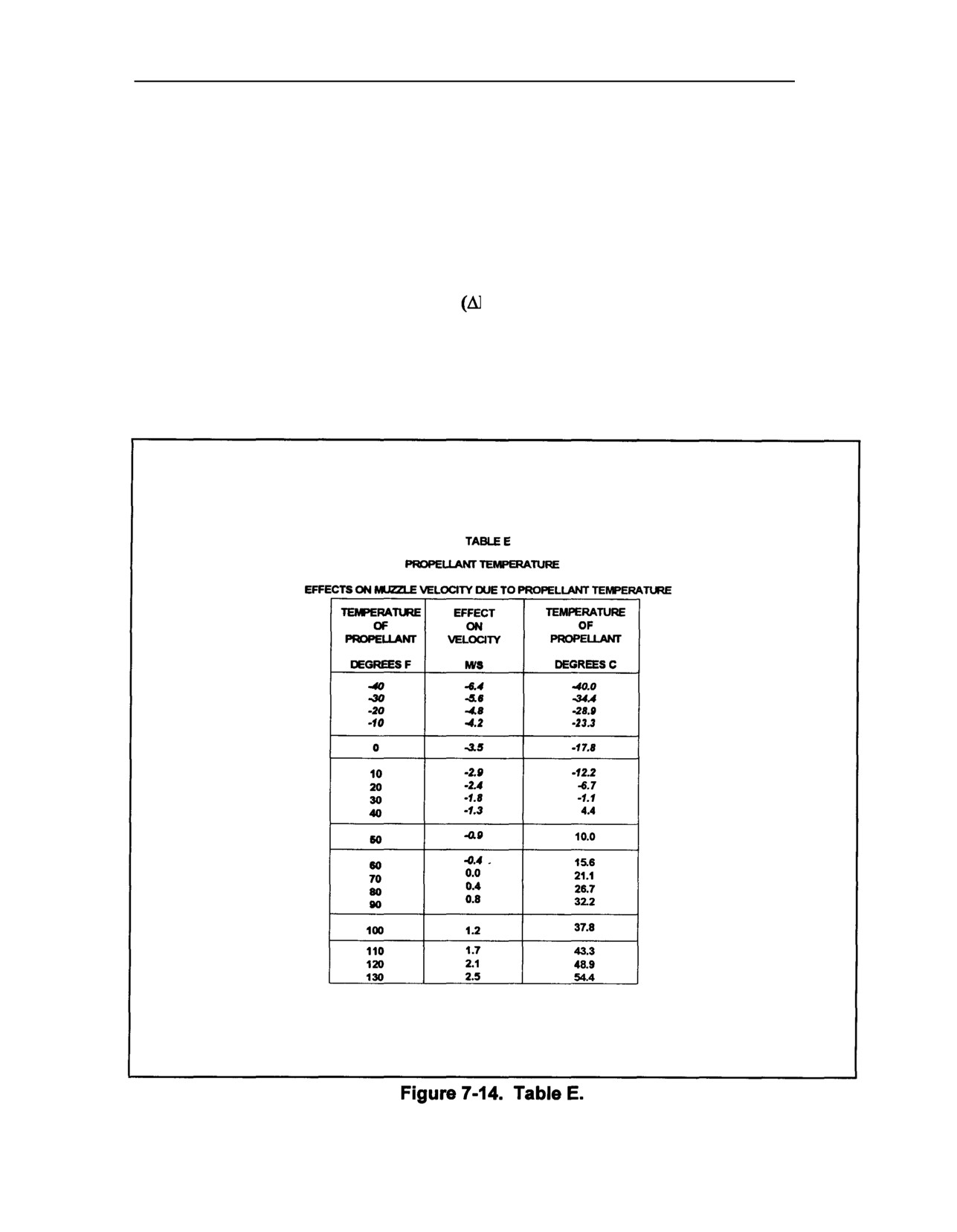
7-7. Table E
a. Table E is used in the solution of concurrent and subsequent met. The extracted
values list the effect on muzzle velocity (in meters per second) of nonstandard propellant
temperatures.
b. Table E is entered with the temperature of the propellant in degrees Fahrenheit by
using the left column or Celsius by using the right column. An effect in meters per second is
extracted from the center column. This is the change in muzzle velocity because of the
temperature of the propellant. Interpolation is needed to determine precise values from this table.
(See Figure 7-14.)
7-8. Table F
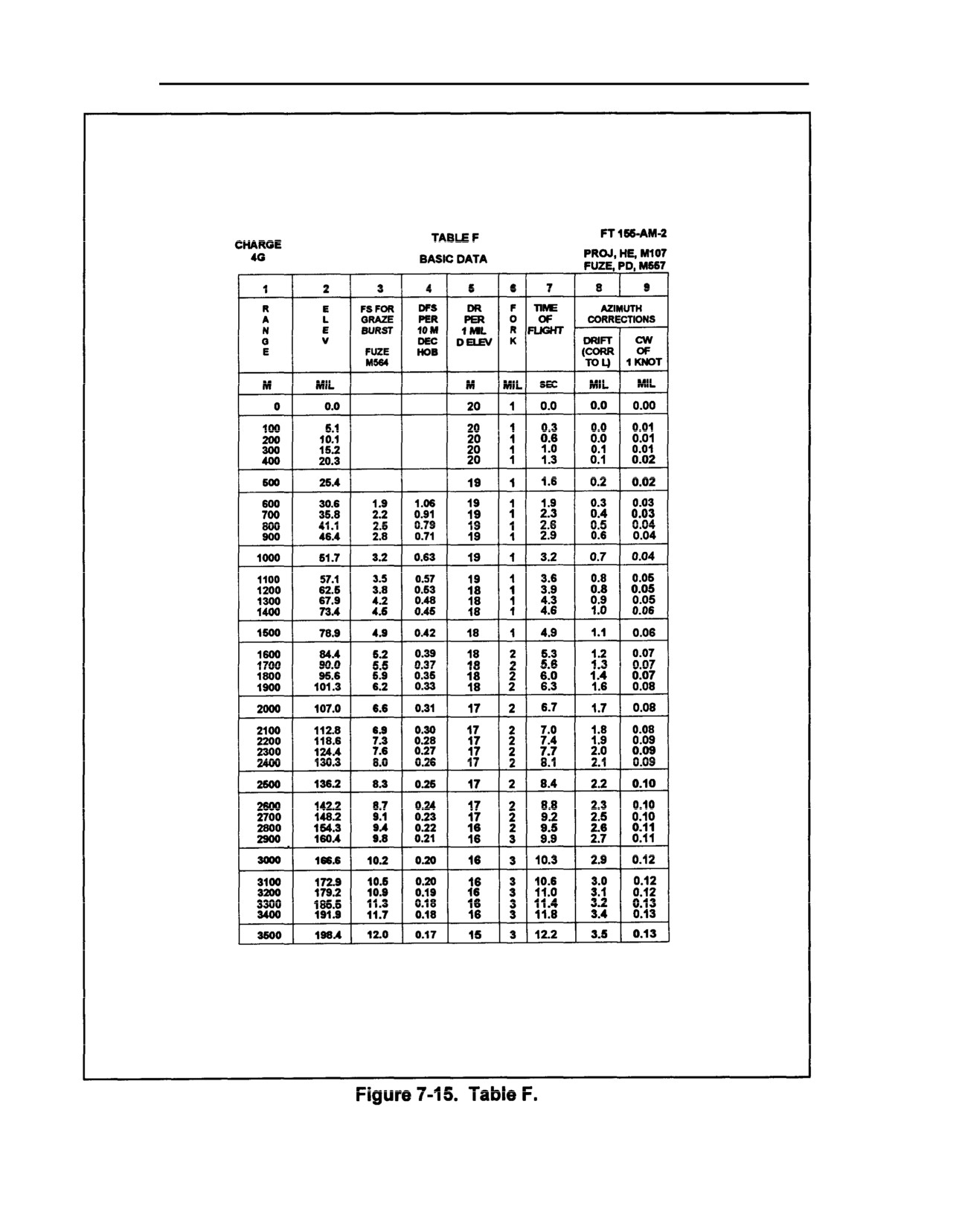
a. Table F lists information needed to determine firing data to attack a target and for
solving concurrent and subsequent met. Table F is comprised of 19 columns. Columns 2
through 7 provide information for the computation of basic firing data and are based on a set of
standard conditions. The remaining columns provide corrections to range and deflection for
nonstandard conditions. The asterisks extending across the table denote the changeover point
from low-angle to high-angle fire. (See Figure 7-15.)
(1) Range (Column 1). This is the distance measured from the muzzle to the target
on the surface of a sphere concentric with the earth. When range is used as the entry argument
for this table, it is expressed to the nearest 10 meters. Interpolation is necessary.
7-12
FM 6-40
(2) Elevation (Column 2). This is the angle that the cannon tube is elevated from
the horizontal plane (base of trajectory) to cause the round to impact at the level point for a given
range. The elevations listed are the elevations required under standard conditions to achieve the
ranges listed in column 1.
(3) Fuze setting for a graze burst (M564) (Column 3). This is the number of
fuze setting increments necessary to cause the fuze to function at the level point at the given
range under standard conditions. The values listed are for fuzes M564 and M565. The values are
expressed in fuze setting increments.
(4) Change in fuze setting FS) per 10-meter decrease in height of burst
(Column 4). This is the adjustment to fuze setting required to decrease the height of burst 10
meters along the trajectory. To increase the HOB, change the sign of the value given in the table.
(5) Change in range per 1-mil change in elevation (Column 5). This is the
number of meters change in range, along the gun target line, that would result from a 1-mil
change in elevation.
7-13
FM 6-40
7-14
FM 6-40
7-15
FM 6-40
(6) Fork (Column 6). This is the change in the angle of elevation needed to
produce a change in range, at the level point, equivalent to 4 probable errors in range.
(7) Time of flight (Column 7). This is the number of seconds needed for the round
to travel from the muzzle to the level point at the given elevation. This column is also used to
determine the fuze setting for mechanical time fuzes M582 and M577 and variable time fuzes
M728 and M732.
(8) Azimuth correction for drift (Column 8). This is the number of mils added to
deflection to compensate for the drift of the projectile. Because projectiles drift right when fired,
the drift correction will be to the left.
(9) Azimuth correction for a crosswind of 1 knot (Column 9).This is the
correction, in mils, needed to correct for a 1-knot crosswind.
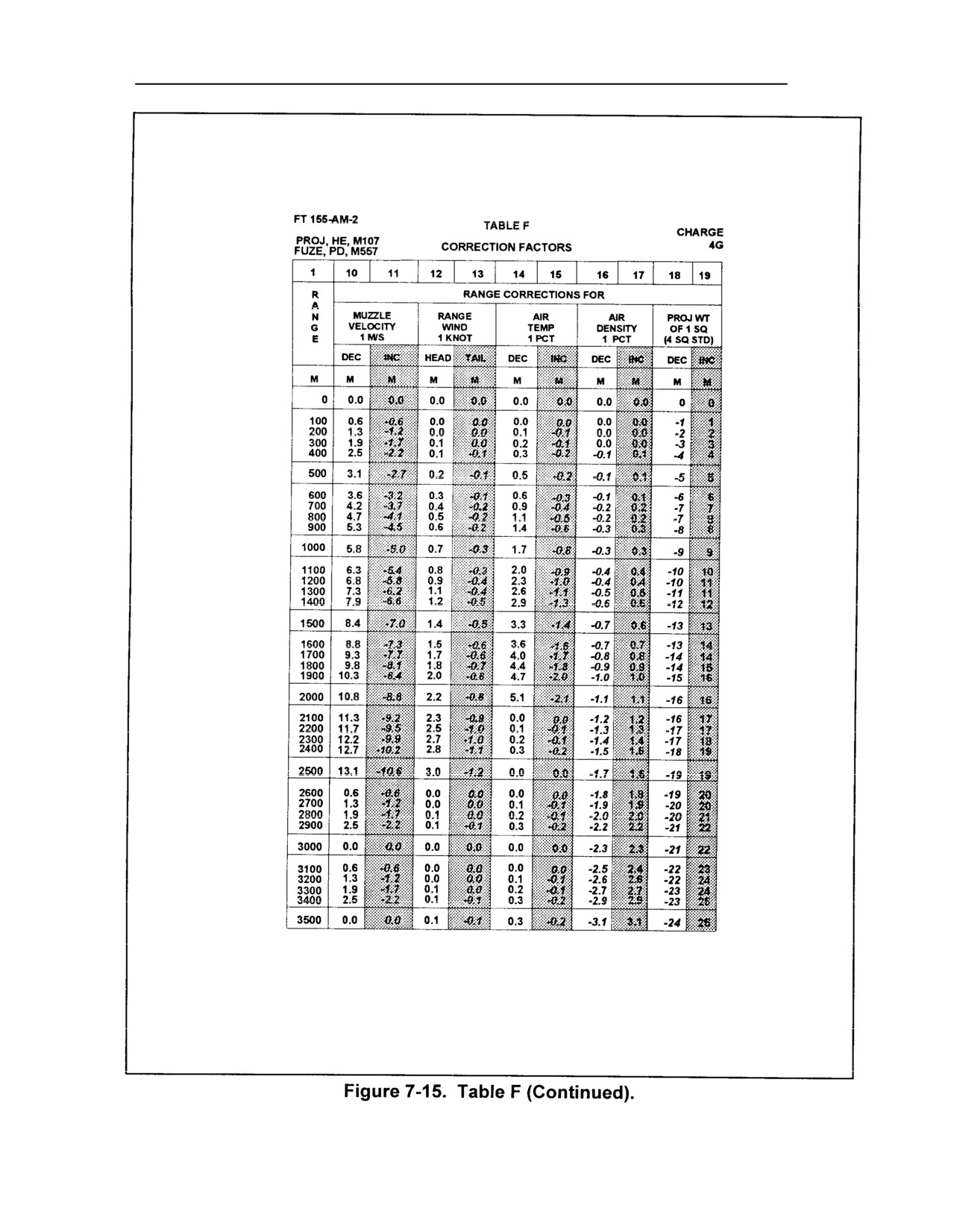
b. Columns 10 through 19 list range corrections for muzzle velocity, range wind, air
temperature, air density, and projectile weight. These corrections are used in the solution of
concurrent and subsequent met. Correction factors correspond to increases or decreases in
relation to standard values for muzzle velocity, air temperature, air density, and projectile weight,
except the correction factors for range wind. The correction factors for range wind are listed for
both head and tail winds. The factors listed assume that all other conditions are standard.
(1) Correction for a 1 meter-per-second decrease or increase in muzzle velocity
(Columns 10 and 11). This is a correction to range to compensate for a 1 meter-per-second
decrease or increase in muzzle velocity.
(2) Correction for a head wind or tail wind of 1 knot (Columns 12 and 13).
This is a correction to range to compensate for a head wind or tail wind of 1 knot.
(3) Correction for a 1 percent decrease or increase in air temperature
(Columns 14 and 15). This is a correction to range to compensate for a decrease or increase in
air temperature of 1 percent of standard.
(4) Correction for a 1 percent decrease or increase in air density (Columns 16
and 17). This is a correction to range to compensate for a decrease or increase in air density of 1
percent of standard.
(5) Correction for a 1 square decrease or increase in projectile weight
(Columns 18 and 19). This is a correction to range to compensate for a decrease or increase of 1
square in projectile weight.
7-9. Extracting Basic HE Data From Table F
Data may be extracted from Columns 1 through 8 of Table F to compute firing data. It is
necessary to relate the data extracted to an entry argument. An element of data is said to be a
fiction of another element when changes in one of the elements will cause a change in the other.
a. Elevation is a Function of Range. Enter Column 1 with range expressed to the
nearest 10 meters, and extract the elevation to the nearest 1 mil from Column 2.
b. Fuze Setting is a Function of Elevation. Enter Column 2 with the elevation
expressed to the nearest mil, and extract the fuze setting expressed to the nearest 0.1 of an
increment from Column 3 for fuzes M564 and M565. Extract the fuze setting expressed to the
nearest 0.1 of a second from Column 7 for fuzes M582 and M577.
7-16
FM 6-40
c.
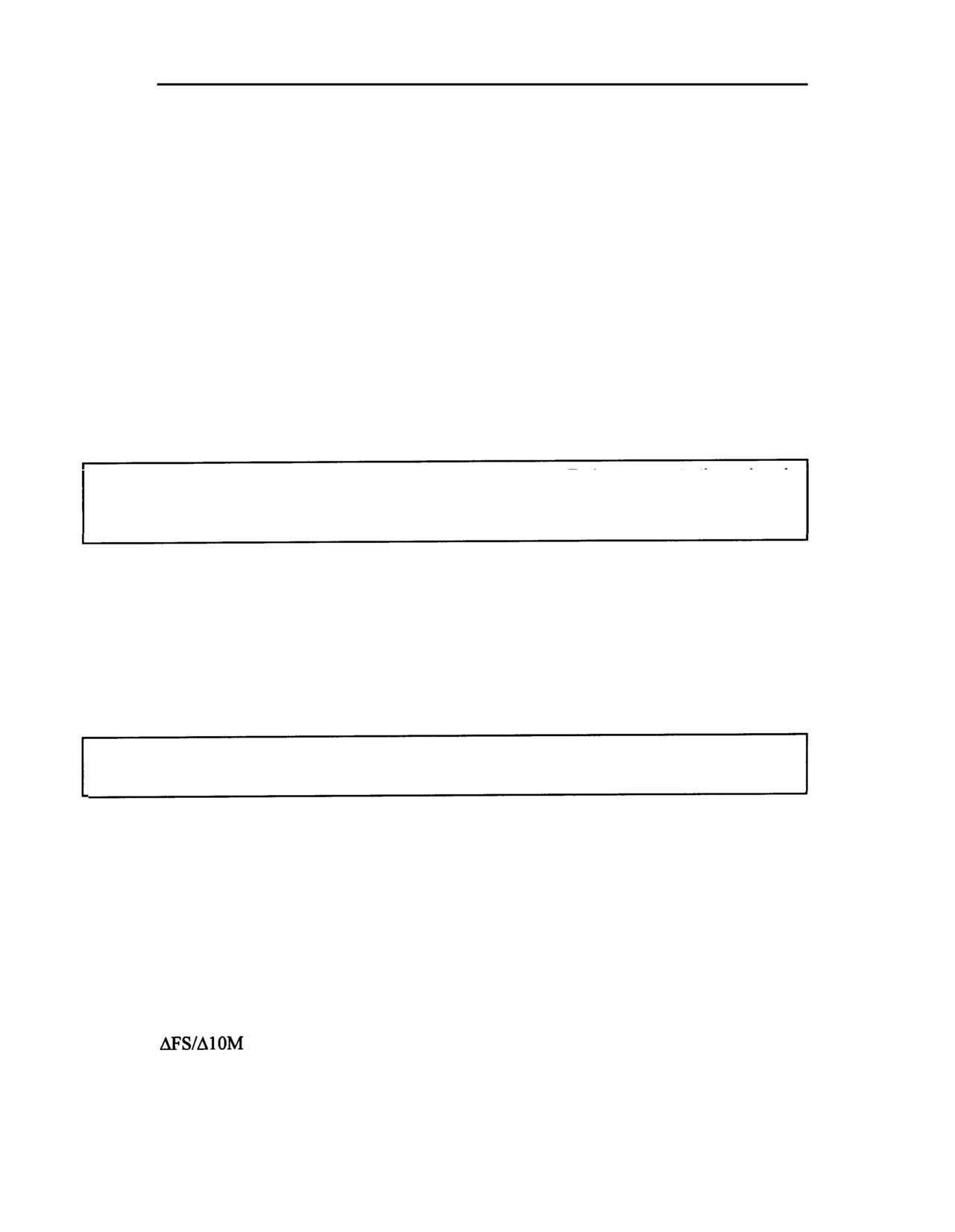
FS for 10-Meter Decrease in HOB is a Function of Fuze Setting. Enter Column
3 for fuzes M564 and M565 or Column 7 for fuzes M582 and M577 with the fuze setting
expressed to the nearest 0.1. Extract the
FS expressed to the nearest 0.01 from Column 4.
d. D Range for a 1-Mil D Elevation is a Function of Elevation. Enter Column 2 with
the elevation expressed to the nearest mil, and extract the change in range for a 1-mil change in
elevation expressed to the nearest meter.
e. Time of Flight is a Function of Elevation. Enter Column 2 with the elevation
expressed to the nearest mil, and extract the time of flight expressed to the nearest whole second
from Column 7.
f. Variable Time Fuze Setting is a Function of Elevation. Enter Column 2 with the
elevation expressed to the nearest mil, and extract the time of flight expressed to the nearest 0.1
second from Column 7. Express down to the whole second,
g. Drift is a Function of Elevation. Enter Column 2 with the elevation expressed to
the nearest mil, and extract the drift expressed to the nearest 1 mil from Column 8.
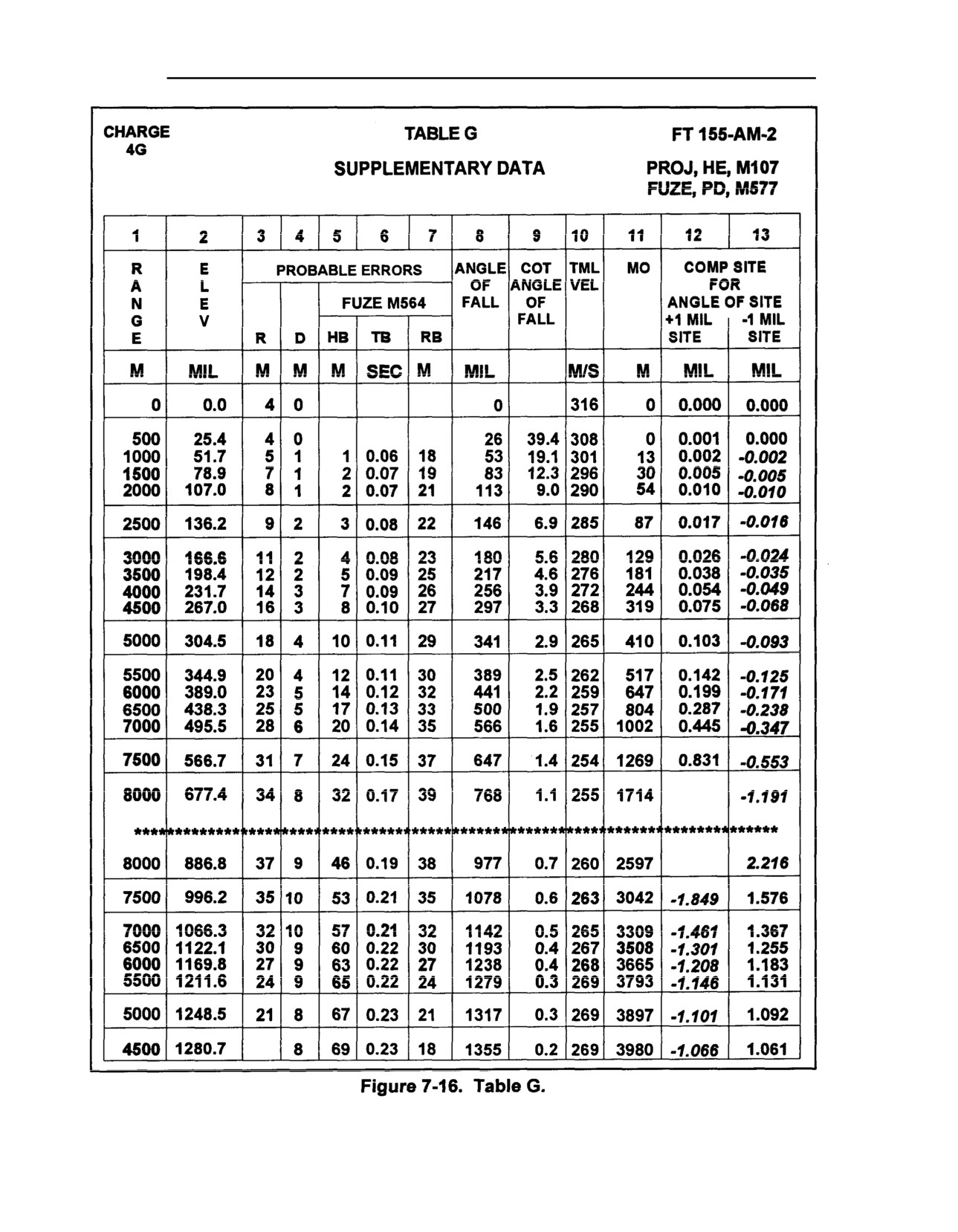
7-10. Table G
Table G is the table of supplementary data containing probable error information and
certain trajectory elements. For ranges not listed, data can be determined through interpolation.
The entry argument for this table is range (Column 1). Elevation corresponding to that range is
listed in Column 2 for quick reference. The asterisks extending across the table denote the
changeover point from low-angle to high-angle fire. (See Figure 7-16.)
a. Probable Error (Columns 3 through 7). Probable error is defined as the error for a
particular charge, and range or elevation that is exceeded as often as it is not exceeded. These
errors are based on the standard probability curve and are explained in more detail in Chapter 3.
b. Probable Error in Range to Impact (Column 3). Probable error in range is a value
in meters that, when added to and subtracted from the range at the mean point of impact along the
gun-target (GT) line, will produce an interval that should contain 50 percent of all rounds fired.
PER will vary according to the charge and range.
c. Probable Error in Deflection at Impact (Column 4). Probable error in deflection is
a value in meters when applied to the right and left of the mean point of impact, will produce an
interval parallel to the line of fire that should contain 50 percent of the rounds fired. PED will
vary based on charge and range.
d. Probable Error in Height of Burst (Column 5). Probable error in height of burst is
a value in meters which, when added to and subtracted from the expected height of burst, will
define an area that should contain 50 percent of the rounds freed. The factors that contribute to
PEHB include variations in the functioning of the time fuze.
e. Probable Error in Time to Burst (Column 6). Probable error in time to burst is a
value in seconds, which when added to and subtracted from the expected time to burst, will
produce a time interval that should contain 50 percent of the rounds fired.
7-17
FM 6-40
7-18
FM 6-40
f. Probable Error in Range to Burst (Column 7). Probable error in range to burst is a
value in meters which, when added to and subtracted from the expected range to burst, will
produce an interval along the line of fire that should contain 50 percent of the rounds fired.
g. Angle of Fall (Column 8). The angle of fall is the value in mils of the least angle
measured clockwise from the horizontal to a line tangent to the trajectory at the level point.
h. Cotangent of Angle of Fall (Column 9). The cotangent (cot) angle of fall is the
trigonometric function of the angle of fall. When the probable error in range is divided by this
factor, the quotient is the vertical probable error. The vertical probable error is the height
expected to contain 25 percent of the impacts when firing onto a vertical face.
i. Terminal Velocity (Column 10). The terminal velocity (tml vel) is the speed of the
projectile at the level point under standard conditions.
j. Maximum Ordinate (Column 11). The maximum ordinate (MO) is the height of the
summit above the origin in meters. This is the height of the trajectory above the howitzer
expressed in meters under standard conditions.
k. Complementary Angle of Site for Each Mil of Angle of Site (Columns 12 and
13). This is the correction termed the complementary site factor (CSF) which must be
algebraically added to each mil of angle of site to compensate for the nonrigidity of the trajectory.
When the CSF is multiplied by the absolute value of the angle of site, the product is the
complementary angle of site.
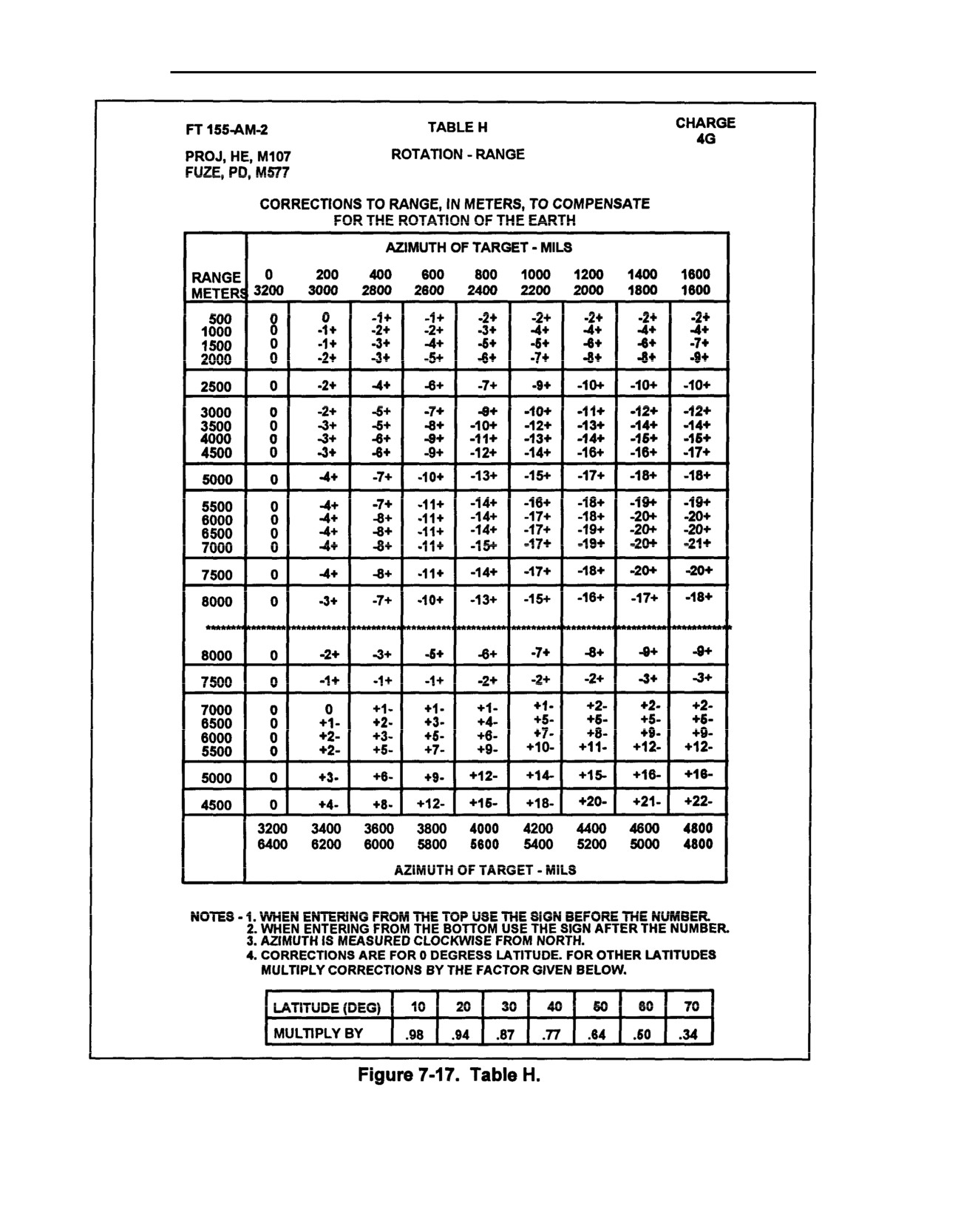
7-11. Table H
a. Table H is used in the solution of concurrent and subsequent met. The extracted
value is the correction to range in meters for the rotation of the earth at 0° latitude. A correction
for any other latitude is extracted from the small table at the bottom of Table H and is multiplied
by the correction from the table. The asterisks extending across the table denote the changeover
point from low-angle to high-angle fire.
b. Table H is entered along the left side with the entry range expressed to the nearest 500
meters and along the top or bottom with the exact azimuth (to the nearest mil) to the target (direction
of fire) expressed to the nearest listed value. For example, if the azimuth to the target is 1,499 mils,
enter Table H with 1400. Whenever the solution determined is exactly halfway between two entry
arguments for azimuth to the target use the next higher value. (See Figure 7-17.)
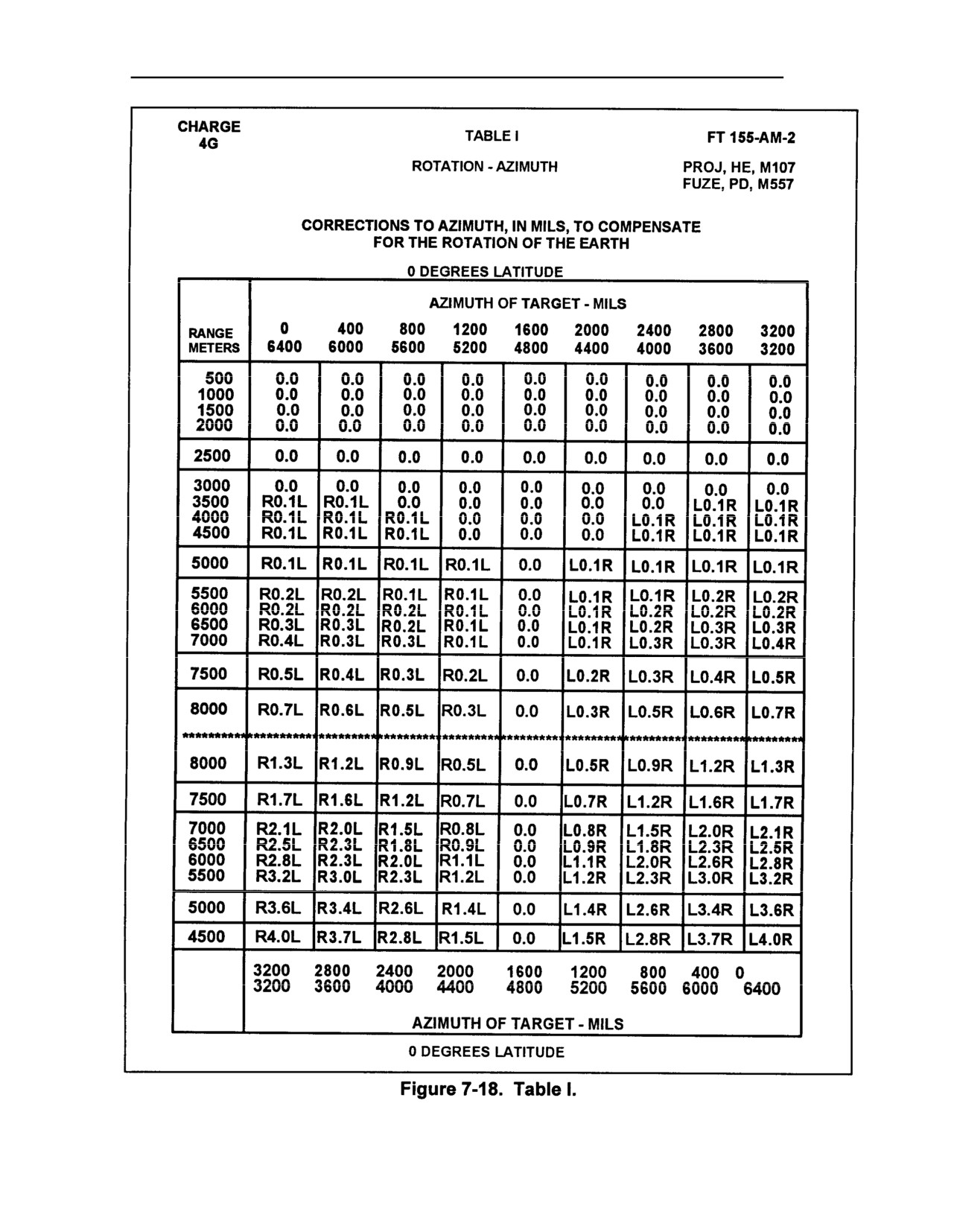
7-12. Table I
a. Table I is used in the solution of concurrent and subsequent met. There are tables for
every 10° latitude starting from 0° north or south latitude to 70° north or south latitude. The
extracted value is the correction to deflection in mils, for the rotation of the earth. The asterisks
extending across the table denote the changeover point from low-angle to high-angle free.
b. Table I is entered along the left side with the entry range expressed to the nearest 500
meters and along the top (for northern latitudes), with the exact azimuth (to the nearest mil) to
the target (direction of fire) expressed to the nearest listed value. For example, if the azimuth to
the target is 1,499 mils, enter Table I with 1600. For southern latitudes, you enter from the
bottom with the exact azimuth (to the nearest mil) to the target (direction of fire) expressed to
the nearest listed value. Whenever the solution determined is exactly halfway between two entry
arguments for azimuth to the target, use the next higher value. (See Figure 7- 18.)
7-19
FM 6--40
7-20
FM 6-40
7-21
FM 6-40
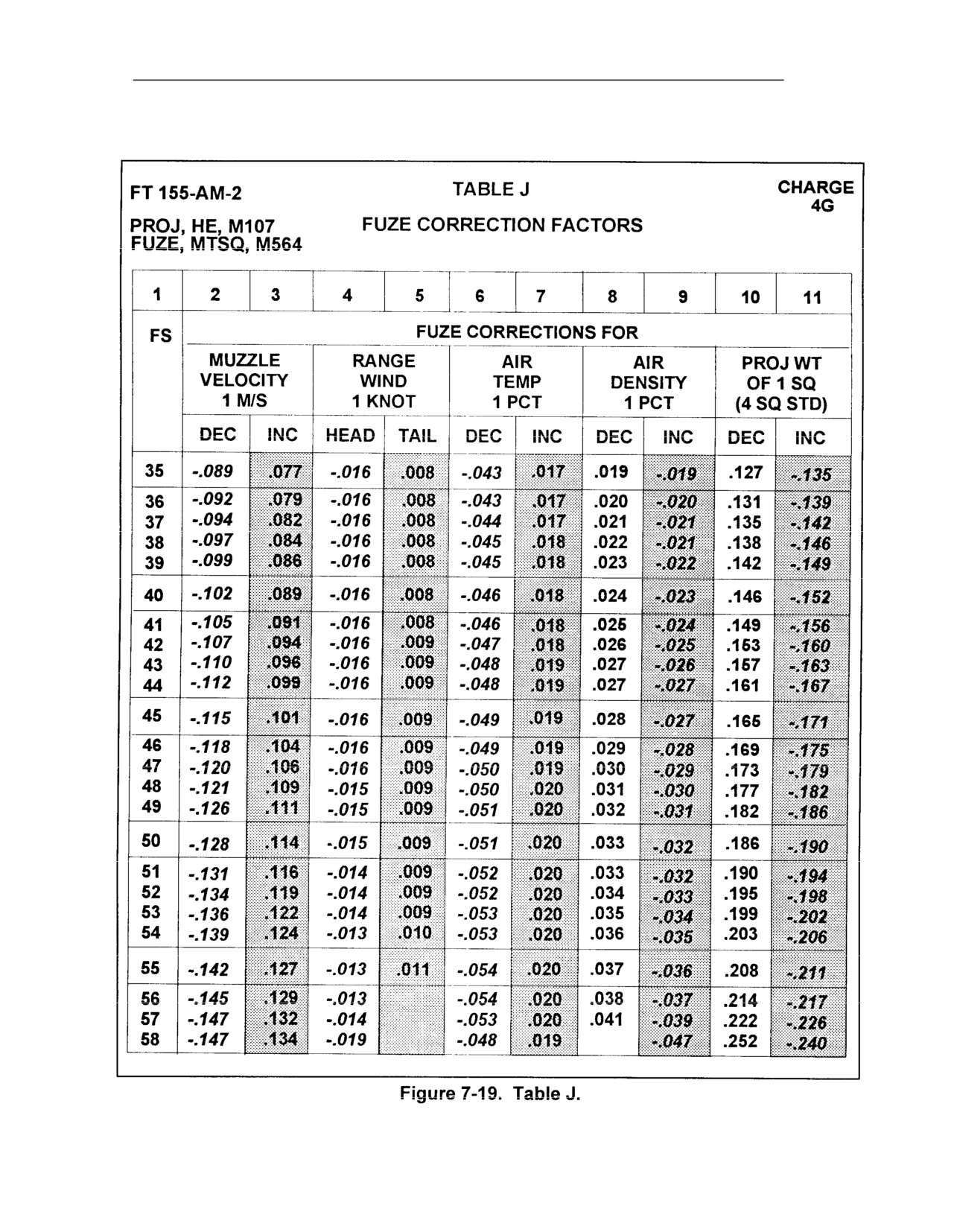
7-13. Table J
a. Table J is used in the solution of concurrent and subsequent met. Data in this table
are arranged in 11 columns. Each column lists a fuze setting correction needed to compensate for
the effects of nonstandard conditions.
b. The fuze setting used as an entry argument corresponds to the adjusted elevation from
a registration (concurrent met) or corresponds to the elevation determined in the solution of a
subsequent met. (See Figure 7-19.)
(1) Fuze setting (Column 1). The FS corresponding to the adjusted elevation
expressed to the nearest whole increment is the entry argument for Table J.
(2) Correction for a 1 meter-per-second decrease or increase in muzzle velocity
(Columns 2 and 3). This is the correction for the FS to compensate for a 1 meter-per-second decrease
or increase in muzzle velocity.
(3) Correction for ahead wind or tail wind of 1 knot (Columns 4 and 5). This is the
correction to FS to compensate for a head wind or tail wind of 1 knot.
(4) Correction for a 1 percent decrease or increase in air temp (Columns 6 and 7).
This is the correction to FS to compensate for a decrease or increase in air temperature of 1 percent of
standard.
(5) Correction for a 1 percent decrease or increase in air density (Columns 8 and
9). This is the correction to FS to compensate for a decrease or increase in air density of 1 percent of
standard.
(6) Correction for a 1 square decrease or increase in projectile weight (Columns 10
and 11). This is the correction to FS to compensate for a decrease or increase of 1 square in projectile
weight.
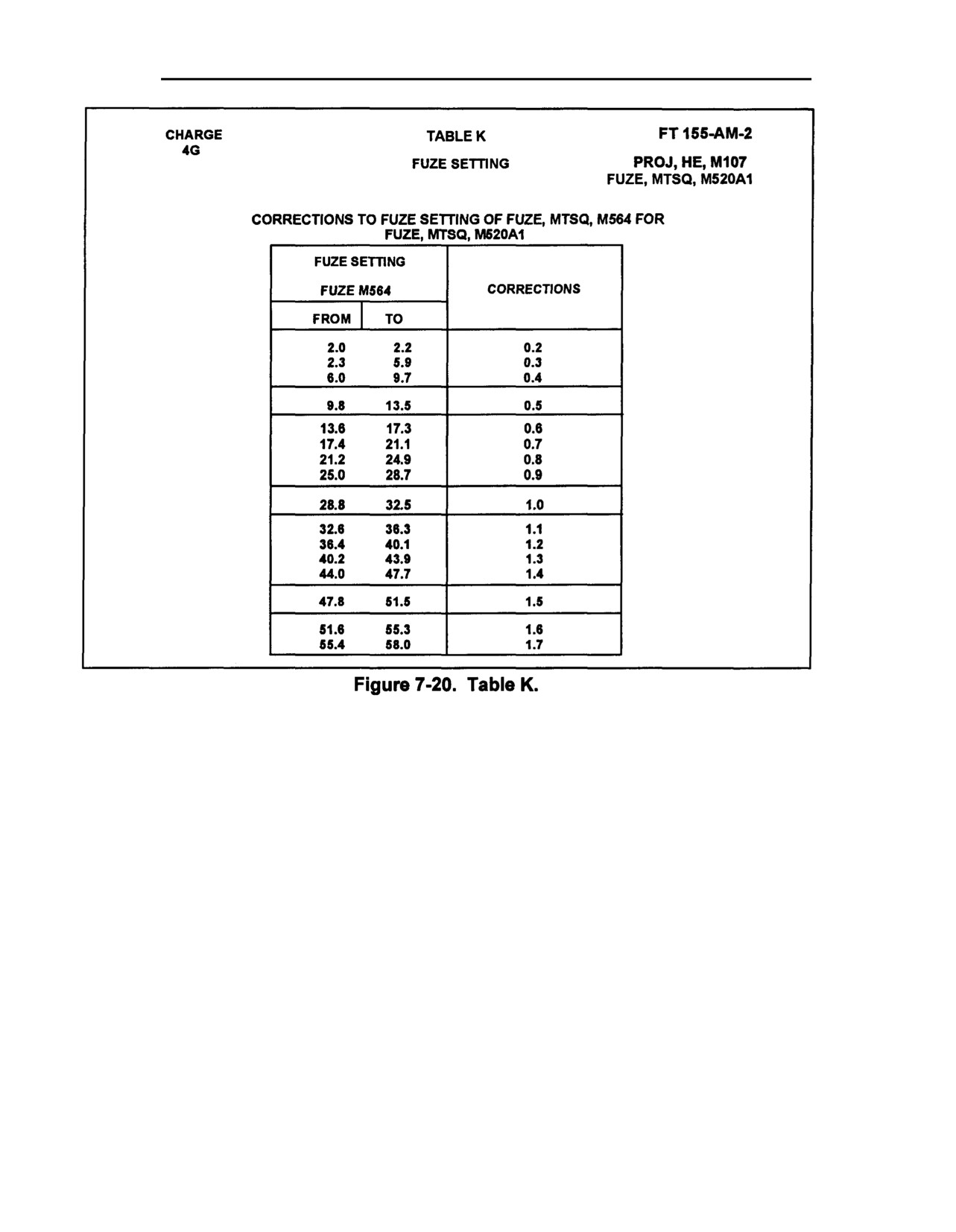
7-14. Table K
Table K provides corrections to be applied to M564 fuze settings when time fuze
M520A1 is being fired. (See Figure 7-20.)
7-15. Illuminating Projectiles
a. Illuminating projectiles are available for the 105-mm and the 155-mm howitzers.
They are used to illuminate a designated area for observing enemy night operations, for adjusting
artillery fires at night, for marking locations, or for harassment purposes.
b. Illuminating projectiles are base-ejecting projectiles fired with mechanical time fuzes.
The filler consists of an illuminating canister and a parachute assembly. The FDO selects the
charge to fire, selecting the lowest practical charge to prevent a malfunction caused by the
parachute ripping when the flare is ejected from the projectile. The two models of illuminating
projectiles for the 105-mm howitzer are the M314A2 and the newer M314A3, which has a
slightly longer burning time. The 155-mm howitzer also has two models of illuminating
projectiles. These models are the M118 and the newer M485A2, which has a significant increase
in illumination time.
NOTE: Data are no longer provided for the M118 projectile. Part 2 of the 155-AM-2 TFT applies
to the M485 series only).
c. Part 2 of the 105-mm and 155-mm HE TFT provide data for the illuminating
projectile. Most illumination data are provided in a single table. However, TFT may contain
additional tables to provide corrections for mechanical time fuzes other than that tabulated in the
7-22
FM 6-40
first table. When more than one table is provided, the tables are identified by letters. The shaded
portion of Columns 1 and 2 indicate function during the ascending branch.
7-23
FM 6-40
(1) Table A. Table A provides firing data and corrections to firing data for
illuminating projectiles.
(a) Range to target (Column 1). This is the distance measured from the
muzzle to the target on the surface of a sphere concentric with the earth. When range is used as
the entry argument for this table, it is expressed to the nearest 10 meters.
(b) Quadrant elevation (Column 2). This is the angle of the tube in the
vertical plane. This QE, when used in conjunction with the fuze setting given in Column 3,
produces an airburst such that the ignition of the illuminant occurs 600 meters (105-mm is 750
meters) above the level point at the given range.
(c) Fuze setting (Column 3). This is the fuze setting for the M565 fuze. When
used in conjunction with the QE given in Column 2, it produces an airburst such that the ignition
of the illuminant occurs 600 meters above the level point at the range (105-mm is 750 meters).
(d) Change in QE and FS for an increase of 50 meters in HOB (Columns 4
and 5). These corrections are added to the QE and FS to increase the height of burst by 50
meters. By changing the sign of the correction, the factor is used to lower the height of burst.
This factor is also used to correct the QE and FS from Columns 2 and 3 for the VI. These factors
must be applied in conjunction with each other.
7-24
FM 6-40
(e) Range to fuze function (Column 6). This is the horizontal distance from
the gun to the point at which the fuze functions.
(f) Range to impact (Column 7). This is the horizontal distance from the gun
to the point at which a nonfunctioning projectile will impact.
(2) Table B. Table B provides corrections to fuze setting for mechanical time
(MT), M565 to obtain a fuze setting for fuze MTSQ, M577. The corrections are either added to
or subtracted from the fuze setting of the MT, M565 fuze to obtain the fuze setting for fuze
MTSQ, M577.
7-16. TFT Part 3 and Part 4
Certain TFTs (for example, FT 105-H-7) provide data in two additional parts. Part 3
contains firing data for cartridge, HEP-T, M327 and consists of one table for a single charge.
Part 4 contains firing data for cartridge APERS, M546 and consists of one table for a single
charge.
7-17. Appendixes
The last portion of the TFT are the appendixes. They contain trajectory charts for HE
projectile. Altitude in meters above the origin is plotted against range in meters for every 100
mils of elevation. Time of flight, by 5-second intervals, is marked on the trajectory.
Section II
Graphical Firing Tables
To eliminate the difficulties in computing firing data that result from the need
to interpolate, the graphical firing table was created. The GFT provides all the
information needed to compute firing data in a slide rule form.
7-18. Overview
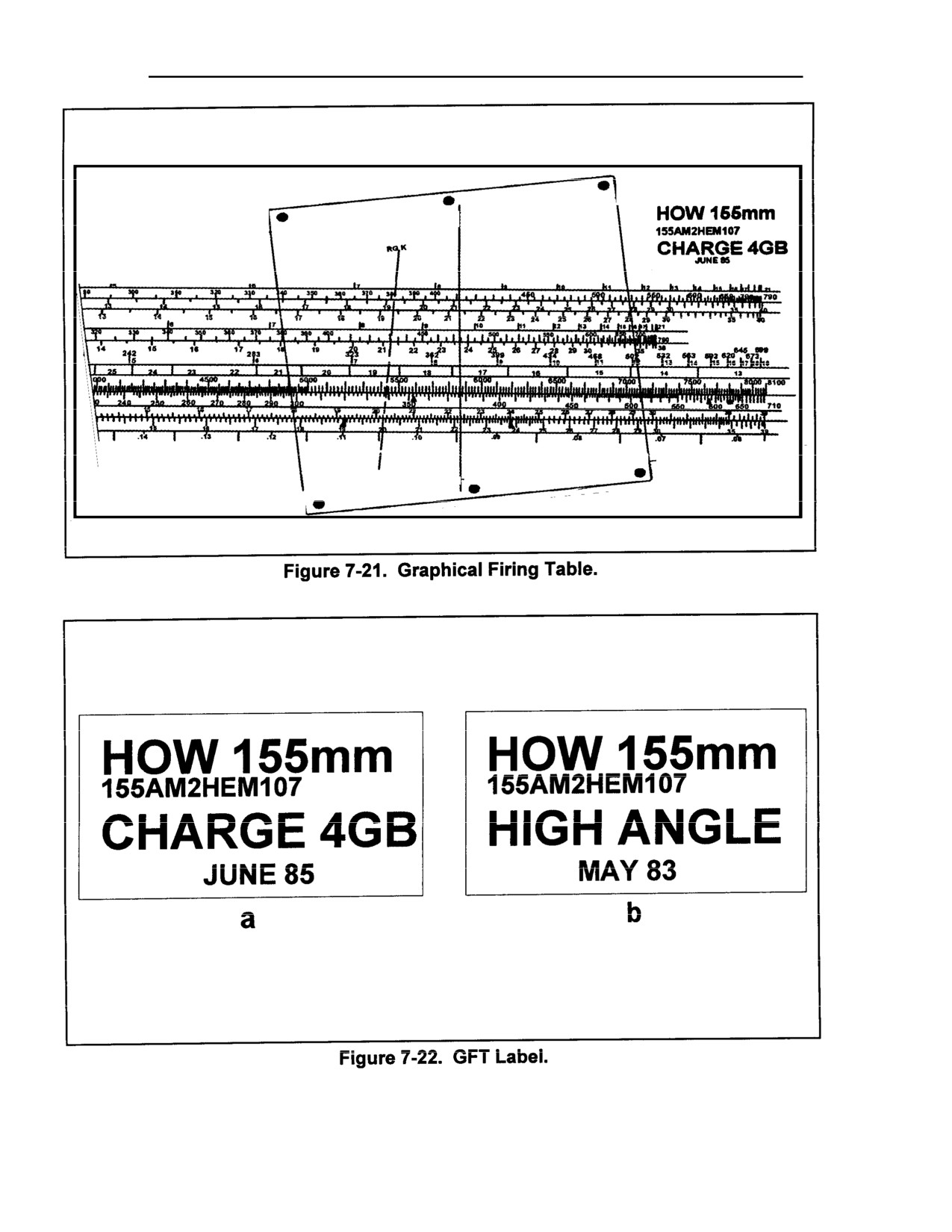
a. Parts. All GFTs are made in two parts (Figure 7-21). The rule is a rectangular
wooden base on which is printed one or more sets of scales. With a few exceptions, GFTs are
printed on both sides. The second part of the GFT is the cursor. This is a transparent plastic
square that slides on the rule. Engraved in the plastic of the cursor is a manufacturer’s hairline
used to determine values from the scales.
c. Types. The basic GFT format is the same for all weapons. These formats may be
divided into three types: low-angle GFTs, high-angle GFTs, and shell illuminating GFTs.
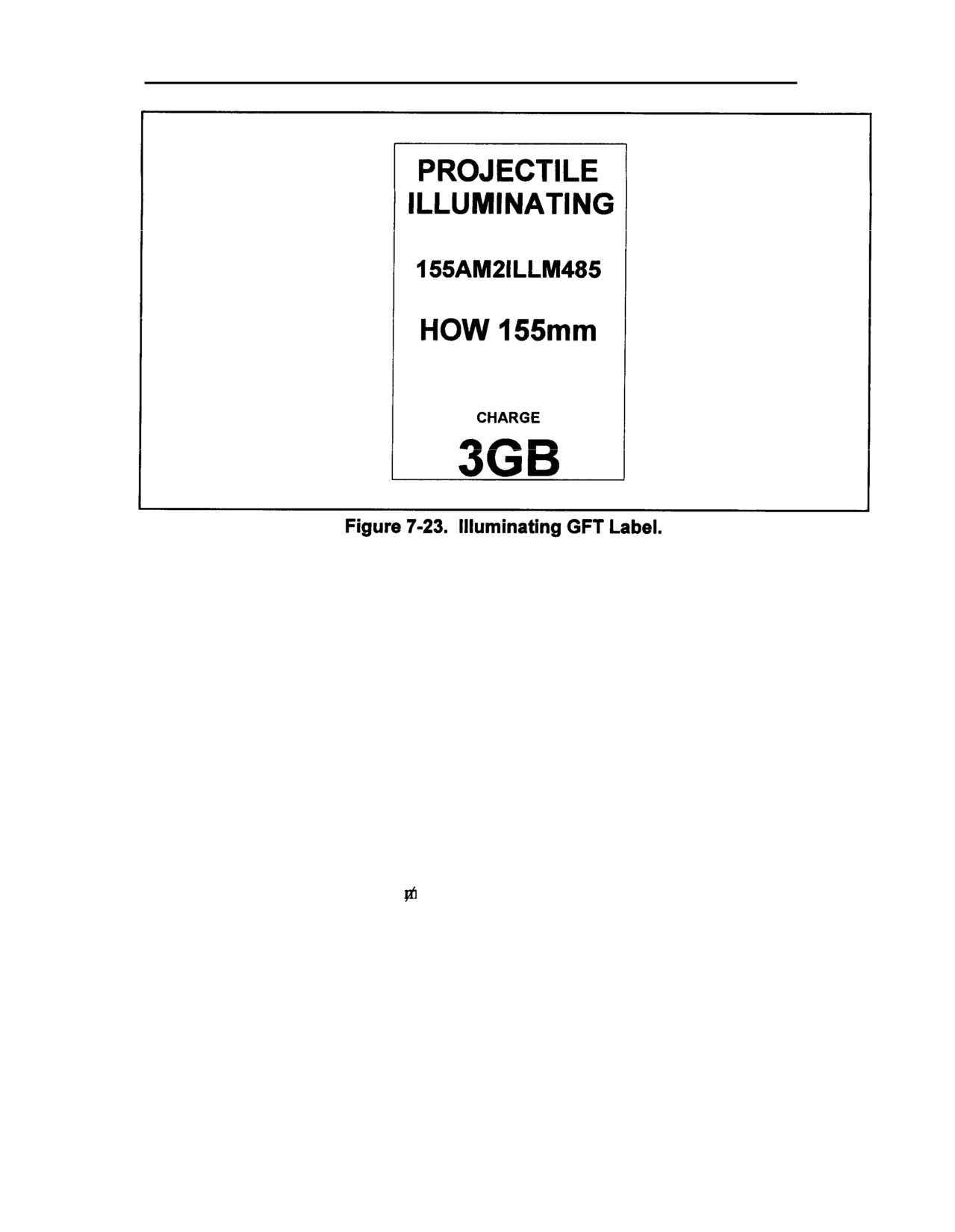
d. Identification. All GFTs are labeled (Figure 7-22) for identification. The first line
of the label on low- and high-angle GFTs indicates the type weapon in bold type; that is, HOW
155mm. Immediately below the weapon type, in smaller print, is the identification of the TFT on
which the GFT is based; for example, “155AM2.” This is followed by the projectile type and
nomenclature, such as “HEM107.” The last line of identification of low-angle GFTs tells the
charge for which the GFT may be used, such as “CHARGE 4.” High-angle GFTs indicate the
trajectory “HIGH ANGLE.” Shell illuminating GFTs (Figure 7-23) reverse the label with
“PROJECTILE ILLUMINATING” on the top and the weapon type on the bottom.
7-25
FM 6-40
7-26
FM 6-40
7-19. Low-Angle GFTs
Low-angle GFTs are available for all weapon systems and were developed from the data
contained in the TFT of the weapon and projectile. All GFTs are printed with a base scale which
represents the data for the base projectile as indicated on the label; that is, “HEM107.” One or
more ICM/M825 scales may be provided above or below the base scale. The scales are as
follows:
a. Drift Scale. This scale, which is printed in black, gives the projectile drift in mils.
Since the projectile drifts to the right, the drift correction is always made to the left. Each
elevation at which the drift is exactly halfway between the values is printed in red. Artillery
expression is applied to determine the value of drift at each of these elevations. In determining
drift, it is important to note that drift is a function of elevation. The corresponding portion of the
TFT is Table F, Column 8.
b. 100/R Scale. This scale lists the number of mils needed to move the burst laterally or
vertically 100 meters at a given range. The numbers on this scale are printed in red. The scale is
based on the mil relation formula
= W/R x 1.0186). 100/R is a function of range. There is no
corresponding table in the TFT for 100/R.
c. Range Scale. This scale is the base scale, and all other scales are plotted in relation
to it. Range is expressed in meters, The range scale was developed to give as large a range
spread as possible, and still permit graduations large enough for accurate readings. Range is read
to the nearest 10 meters. The corresponding portion of the TFT is Table F, Column 1.
d. Elevation Scale. This scale is graduated in mils and is read to the nearest mil. The
numbers on this scale are printed in red and black. The red numbers denote elevations that are
within range transfer limits for a one-plot GFT setting. The corresponding portion of the TFT is
Table F, Column 2.
7-27
FM 6-40
e. Time of Flight/Fuze Setting M582 Scale. This scale lists the time of flight and the
fuze settings for time fuzes M582, M577, M728, and M732 corresponding to a given elevation.
Time of flight is determined to the nearest whole second. Fuze settings for time fuzes M582 and
M577 are determined to the nearest 0.1 fuze setting increment. Fuze setting for fuze VT is
determined from the TF/M582 scale by vanishing the tenths and applying a .0. Time of flight and
the fuze settings for M582, M577, M728, and M732 are functions of elevation. The
corresponding portion of the TFT is Table F, Column 7.
f. Fuze Setting M564 Scale. This scale lists the&e settings for time fuzes M564 and
M565. The values are read to the nearest 0.1 fuze setting increment. Fuze settings for M564
and M565 are functions of elevation. The corresponding portion of the TFT is Table F, Column
3.
g. FS/10M HOB Scale. This scale lists the corrections to fuze setting for fuzes M582
or M564 that are needed to raise or lower the HOB 10 meters along the trajectory. FS/10M HOB
is a function of fuze setting. The corresponding portion of the TFT- is Table F, Column 4.
NOTE: GFTs produced before 1983 include a fork scale. Fork represents the value, in
mils, of the change in the angle of elevation needed to produce a change in range of 4
PER at the level point. The corresponding potion of the TFT is Table F, Column 6.
h. Met Check Gauge Points. These are red equilateral triangles above the TF/M582
fuze setting scale. The apex of each triangle points to the QE that under standard conditions
results in the maximum ordinate of the trajectory passing through a whole line number of a met
message. The range and QE at the met check gauge points are preferred for registration aiming
points, for met plus velocity error (met + VE) computations, and for determining GFT settings.
There is no corresponding table in the TFT.
NOTE: Chapter 10 explains registrations and determining GFT settings, and Chapter 11
explains met + VE computations.
i. Height-of-Burst Probable Error Gauge Points. These gauge points appear on some
GFTs above the fork scale or on the M564 fuze setting scale. They are red right triangles and
indicate the range and fuze settings at which the PEHB is 15 meters. Larger HOB dispersion
must be expected when time fuzes are used with a particular charge at ranges exceeding the
gauge point. Some charges have two such gauge points. The one on the left of the GFT indicates
the range at which the PEHB for the next lower charge is 15 meters. The PEHB can be
determined from Table G, Column 5, of the TFT.
j. Range Probable Error Gauge Point. This is a black equilateral triangle located
above the
HOB scale. It indicates the range at which the range probable error equals
25 meters. Ranges to the left of the gauge point have a PER of less than 25; ranges to the right of
the gauge point have a PER of greater than 25. The PER can be determined from Table G,
Column 3, of the TFT.
7-28
FM 6-40
k. Range K and Fuze K Lines. These are based on data derived from computer
simulations of artillery firing. The computer program uses 50 sets of weighted nonstandard conditions
of temperature, density, range wind, and muzzle velocity. Firing simulations were made by using
these 50 sets of nonstandard conditions for each of a number of ranges within the range limits for each
charge. Every group of 50 firings for each range provided data to calculate a total average range
correction (range K) and total average fuze correction (fuze K) for that particular range. These values
of range K and fuze K were graphically plotted versus the corresponding range for all simulated
ranges for each charge. These curves were simplified as tight line approximations and were used to
create the data to construct the range K and fuze K lines on the GFT. These approximations were
considered to be acceptable, up to the point where no more than 1 PER was introduced. This
acceptable range area is denoted on the GFT by the elevation numbers printed in red. Those numbers
corresponding to an error larger than 1 PER are printed in black. From this is derived the range
transfer limits for a one-plot GFT setting. The range K and fuze K lines are ignored for multiplot GFT
settings.
l. Improved Conventional Munitions Scales. These scales are on some graphical
firing tables. They are located above the DEFL CORR/DRIFT scale. The scales apply to a
specific type of ammunition as indicated by the model number at the left end of the scale.
(1) DEFL CORR. This is the top scale on GFT ICM scales. This scale
incorporates base scale drift and the ballistic correction as tabulated in Table A of the appropriate
addendum.
(2) QE. The next scale (the top scale on older GFTs) is the quadrant scale. This
scale provides the quadrant to fire for the ICM projectile. The ICM quadrant is read to the
nearest mil by placing the manufacturer’s hairline over the base scale quadrant and reading up
under the MHL to the appropriate ICM quadrant scale. This QE incorporates the ballistic
correction given in Table A of the appropriate addendum.
(3) FS. The last scale provides the fuze setting to fire on the ICM projectile. The
ICM FS is read to the nearest 0.1 increment by placing the MHL over the base scale FS and
reading up under the MHL to the appropriate ICM FS scale. This FS incorporates the ballistic
correction given in Table B of the appropriate addendum.
7-20. High-Angle GFT
a. High-angle fire is delivered at elevations greater than the elevation corresponding to
the maximum range for a charge. All howitzers can deliver high-angle fire effectively.
b. The high-angle GFT consists of one rule with ballistic data for multiple charges on
each side. The scales on the high-angle GFT from top to bottom are as follows:
(1) 100/R. This scale lists the number of mils needed to move the burst laterally or
vertically 100 meters at a given range. The scale increases from right to left, is read to the nearest
mil, and applies to all charges. There is no corresponding portion in the TFT.
(2) Range. The range scale is expressed in meters and applies to all charges
appearing on that side of the GFT. Range increases from left to right and is read to the nearest 10
meters. The corresponding portion of the TFT is Table F, Column 1.
(3) Elevation. Elevation is expressed in mils and increases from right to left. It is
visually interpolated to the nearest mil. The corresponding portion of the TFT is Table F,
column 2.
7-29
FM 6-40
(4) 10-Mil site factor. The values on this scale denote the site for each 10 mils of
angle of site. The numbers are printed in red and are negative values. This factor actually
reflects the complementary angle of site for a positive VI. Consequently, a slightly more accurate
solution for negative angles of site can be determined from the TFT. Because of the minimal
effect of site in high-angle fire, these values are acceptable for both a positive and negative VI.
The scale increases from left to right and is read to the nearest tenth (0.1) of a mil. There is no
corresponding portion in the TFT.
(5) Drift. The values on this scale are in mils. The scale increases from right to
left and is read to the nearest mil. The corresponding portion of the TFT is Table F, Column 8.
(6) Time of flight. This scale is graduated in seconds and is used to determine both
time of flight (to the nearest whole second) and VT fuze setting (to the next lower whole second).
The scale increases from right to left. The corresponding portion of the TFT is Table F, Column
7.
NOTE: Because the scales increase in different directions, the computer must be careful
in reading the high-angle GFT. The elevation, 100/R, drift, and TF scales increase from
right to left. The range and 10-mil site scales increase from left to right.
7-21. Illuminating Projectile GFT
Graphical firing tables have been developed for use with all 155-mm M485A2
illuminating projectiles and with the 105-mm M314A1, M314A2, and M314A3E1 projectiles.
Illumination scales are provided for enough charges to cover the spectrum of range for the shell
and weapon.
a. 100/R. This scale is printed along the top edge of the GFT. For a given range, the
100/R scale denotes the number of mils needed to shift the burst 100 meters laterally or
vertically. The 100/R is read to the nearest mil. There is no corresponding portion in the TFT.
b. Range. The range scale is the base scale of the illuminating GFT. All other scales
are plotted with reference to the range scale. Range is read to the nearest 10 meters. The
corresponding portion of the TFT is Part 2, Table A, Column 1.
c. Elevation to Impact. This scale is graduated in mils. Low-angle elevation increases
from left to right and is read to the nearest mil. The scale is used to determine the range (on the
range scale) to which a nonfunctioning projectile will impact. There is no corresponding portion
in the TFT.
d. Height of Burst. These scales are graduated in 50-meter increments. The HOB is
determined by expressing the VI to the nearest 50 meters and algebraically applying the VI to the
optimum HOB. There is no corresponding portion in the TFT.
e. QE. The QE scale shown for each listed height of burst gives the QE needed to
achieve the height of burst at the desired range. The scale is graduated in mils and is visually
interpolated to the nearest mil. A heavy black arrow on the QE scale indicates the part of the
trajectory that is at or near the summit and that does not exceed by 50 meters the height of burst
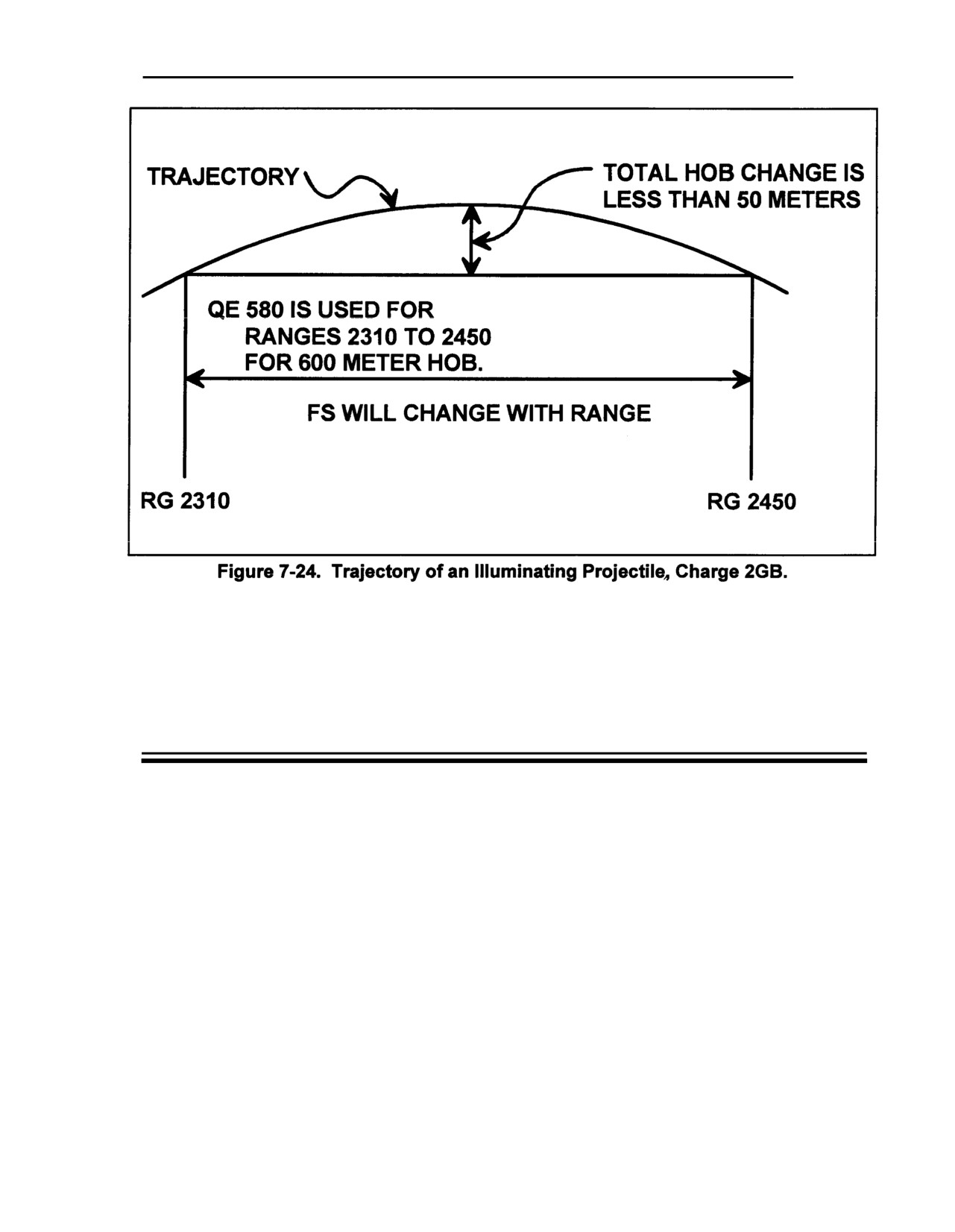
that it represents. (See Figure 7-24.) The corresponding portion of the TFT for a 600-meter (750
meters for 105 mm) HOB is Part 2, Table A, Column 2.
7-30
FM 6-40
f. FS M565. This scale consists of a series of red arcs. The scale includes a red line for
each whole fuze setting increment for the MT, M565 fuze. The value of each line is printed in
red at the bottom of the scale. The fuze setting is read for the desired range and HOB to an
accuracy of 0.1 FS increment by visual interpolation. The corresponding portion of the TFT for a
600-meter (750 meters for 105 mm) HOB is Part 2, Table A, Column 3.
7-31
FM 6-40
Chapter 8
SITE
This chapter implements a portion of QSTAG 224.
Site is computed to correct for situations where the target is not at the same altitude as
the unit. To understand site, a brief description of the trajectory is necessary.
8-1. Initial Elements of the Trajectory
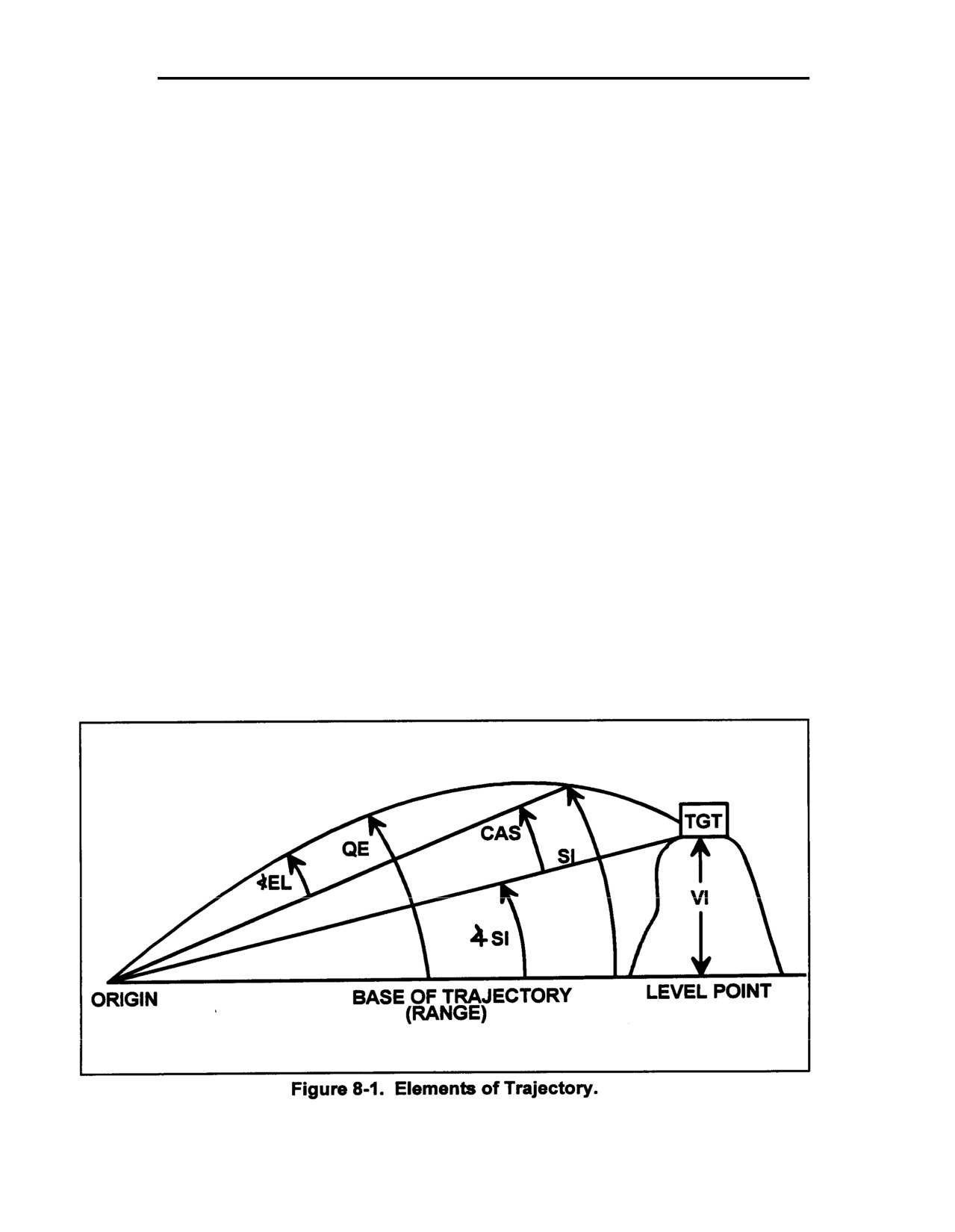
a. Vertical Interval. The vertical interval is the difference in altitude between the unit
or observer and the target or point of burst. (See Figure 8-1.) The VCO determines the vertical
interval by subtracting the altitude of the unit or observer from the altitude of the target or point
of burst. The vertical interval is determined to the nearest meter and is a signed value.
b. Angle of Site. The angle of site compensates for the vertical interval. The angle of
site is the smaller angle in a vertical plane from the base of the trajectory to the straight line
joining the origin and the target. The angle of site has a positive value when the target is above
the base of the trajectory and a negative value when the target is below the base of the trajectory.
The angle of site is determined to the nearest 0.1 mil and is a signed value. It carries the same
sign as the VI.
c. Complementary Angle of Site. The complementary angle of site is an angle that is
algebraically added to the angle of site to compensate for the nonrigidity of the trajectory. When
large angles of site or greater ranges for any one charge are involved, a significant error is
introduced because of changes in the shape of the trajectory. If CAS is not added to angle of site
in low-angle fire, the trajectory will pass under the target if the target is at an altitude higher than
the unit. The trajectory will pass over the target if the target is at an altitude lower than the unit.
Complementary angle of site is dependent on the following:
Charge.
Range.
Angle of site.
Weapon system.
Projectile family.
Angle of fire (high or low).
(1) For a given charge and range, there is a specific complementary angle of site for
every 1 mil angle of site. This specific value is listed in Table G of the TFT, Columns 12 and 13,
in the form of the complementary site factor (comp site factor or CSF). The CSF must be applied
to a particular angle of site to determine complementary angle of site. The CSF must be
determined by interpolation for the chart range to the nearest 10 meters. Complementary angle of
site is computed to the nearest 0.1 mil and is a signed quantity. The sign is the same as the CSF
value.
8-1
FM 6-40
(2) A study of listed values for the CSF reveals that for short ranges the CSF is
negligible. As the range increases, the factor increases for any given charge. Thus, at greater
ranges, the CSF is significant even for small angles of site. The CSF also varies with the charge
for any given range.
d. Site. Site is the algebraic sum of the angle of site and the complementary angle of
site. It is determined to the nearest mil and is a signed value.
e. Angle of Elevation. The angle of elevation is the vertical angle between the
horizontal and the axis of the bore required for a projectile to achieve a prescribed range under
standard conditions.
f. Quadrant Elevation. Quadrant elevation is the algebraic sum of site and the angle of
elevation. It is determined to the nearest mil.
8-2. Site in High-Angle Fire
Site has a relatively small effect in high-angle fire because of the large angle of fall. In
high-angle missions, a minus site must be used to compensate for a positive vertical interval and
a Plus site must be used to compensate for a negative vertical interval. Therefore, high-angle site
will have the opposite sign of the VI.
8-3. Determination of Altitudes
The altitude of the unit or base piece is nomally known by map spot or survey and
labeled on the firing chart. To determine the target altitude, the VCO must analyze the call for
fire sent by the observer.
a. The observer may report a target location by using the grid coordinate method. This
method requires a map of the target area. The easiest way to determine altitude from a map is by
reading the contour lines. The VCO plots the grid sent by the observer and extracts the altitude
from the map.
8-2
FM 6-40
b. The observer may report a target location by using polar coordinates. He locates the
target in relation to his own location by sending a direction and distance to the target. The
observer may also transmit an up or down vertical shift from his location. If the observer
transmits a vertical shift, the altitude of the target is determined in relation to the observer by
applying the vertical shift to the observer’s altitude. If not, the grid is plotted and altitude is
determined as in paragraph a.
c. The observer may report a target location with reference to a known point plotted on
the firing chart. This method of target location is known as shift from a known point. The
vertical shift sent by the observer is applied to the known point altitude to determine the target
altitude.
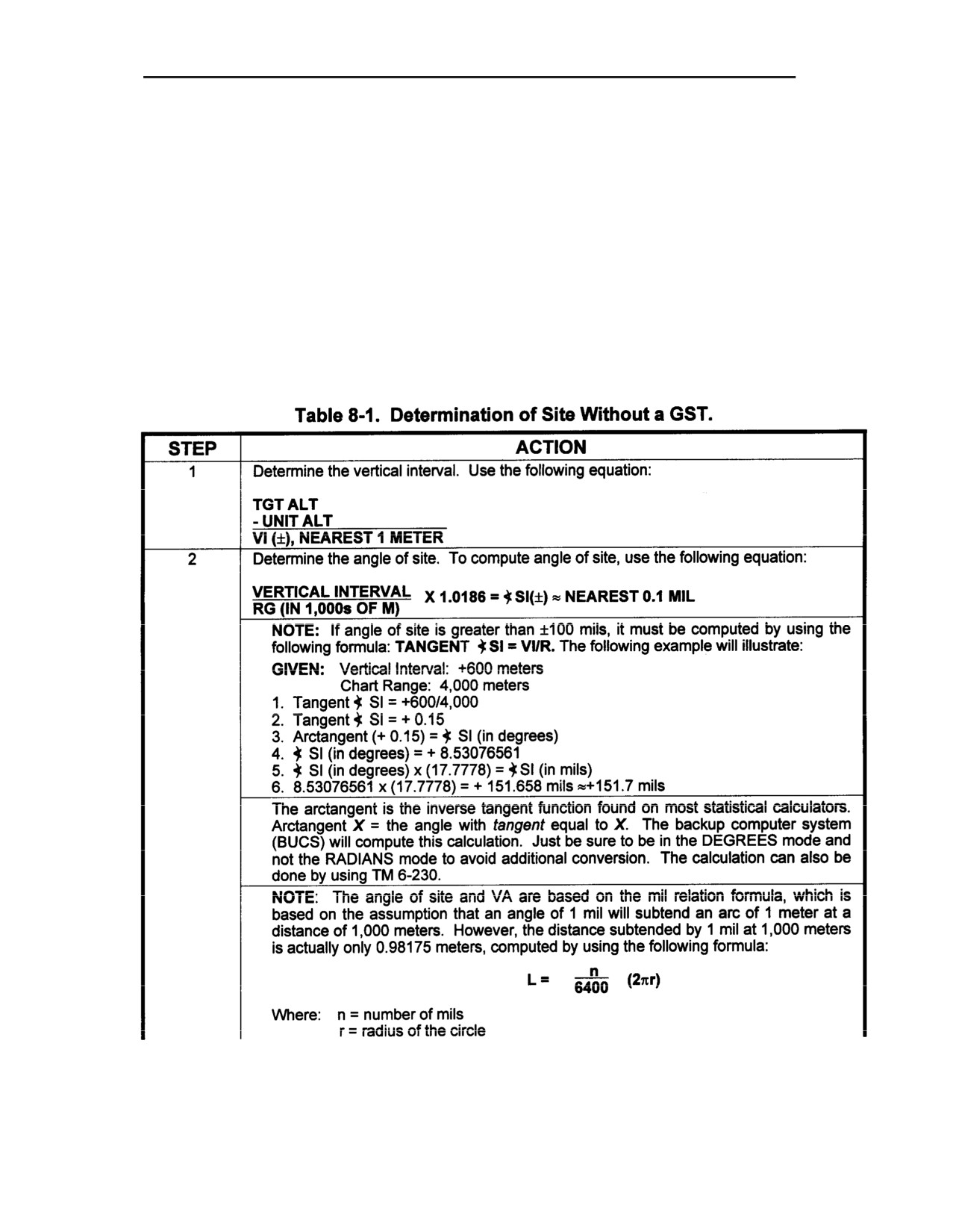
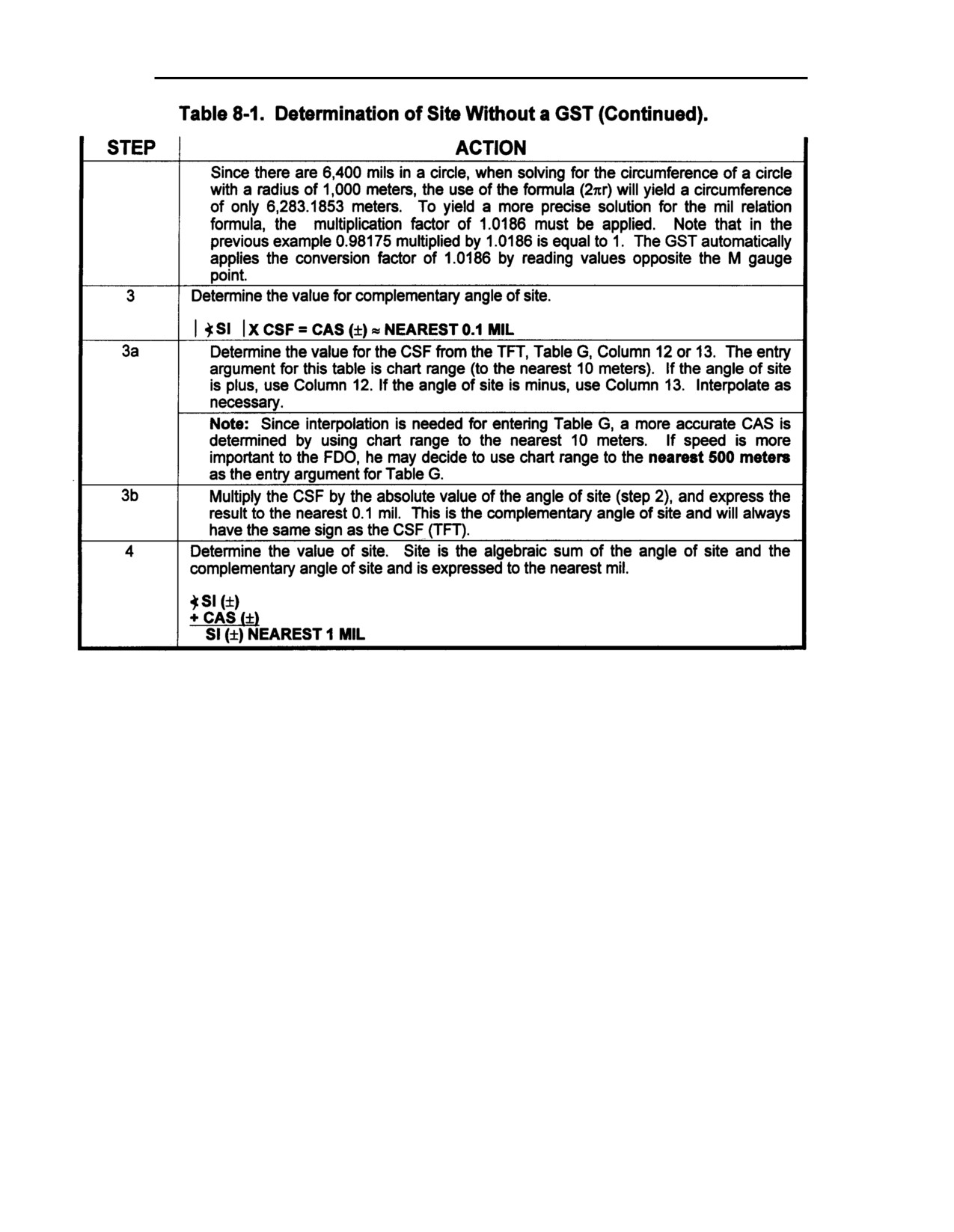
8-4. Determination of Site without a Graphical Site Table
In Table 8-1 are the procedures for determining site without a GST.
8-3
FM 6-40
8-5. Determination of Site Without a GST, Requiring Interpolation
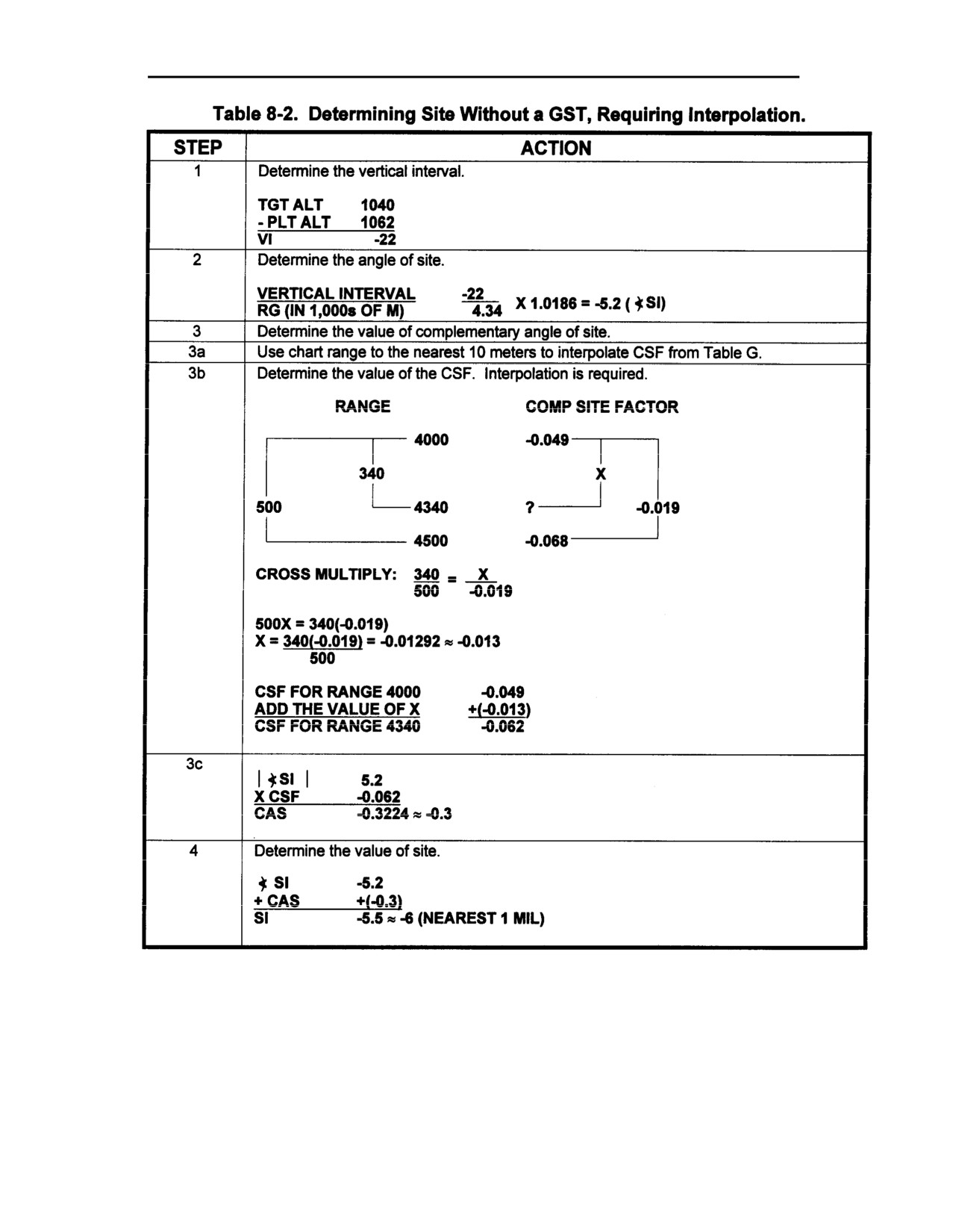
The example in Table 8-2 uses data for the firing unit location and firing chart from
Chapter 6. The following data are given:
Weapon System:
MI09A3
Charge:
4GB
Chart Rg From l/A to the
Tgt (Grid 430 290):
4,340 meters
l/A Altitude:
1062
Target Altitude (Map Spot): 1040
8-4
FM 6-40
8-5
FM 6-40
8-6. Determination of Vertical Angle
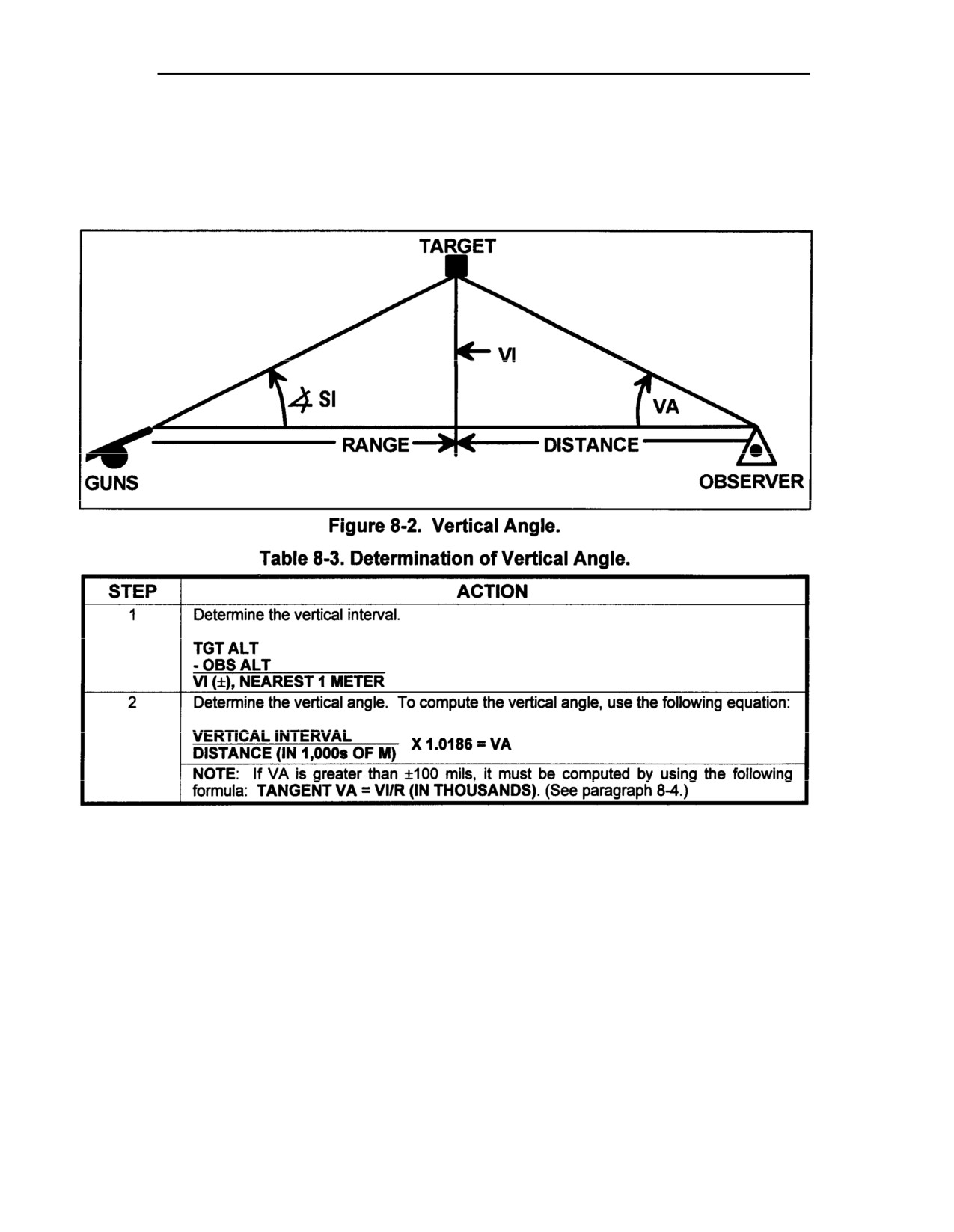
The vertical angle is the smaller angle in a vertical plane from the horizontal to a straight
line joining the observer and target. The angle of site and the vertical angle are essentially the
same angles viewed from different perspectives. (See Figure 8-2.) The steps for determining VA
are in Table 8-3.
8-7. The Graphical Site Table
a. The computation of site with the TFT is time consuming. The GST was developed to
provide a quick and accurate computation of vertical angle, angle of site, and site. The GST can
also be used to compute the vertical interval when the site, the charge, and the range are known
or when the vertical angle and the distance are known. It can be used to convert yards to meters
or meters to yards and to multiply and divide. Each GST is designed for a particular weapon and
projectile family, and the computations are valid only for the weapon specified on the GST.
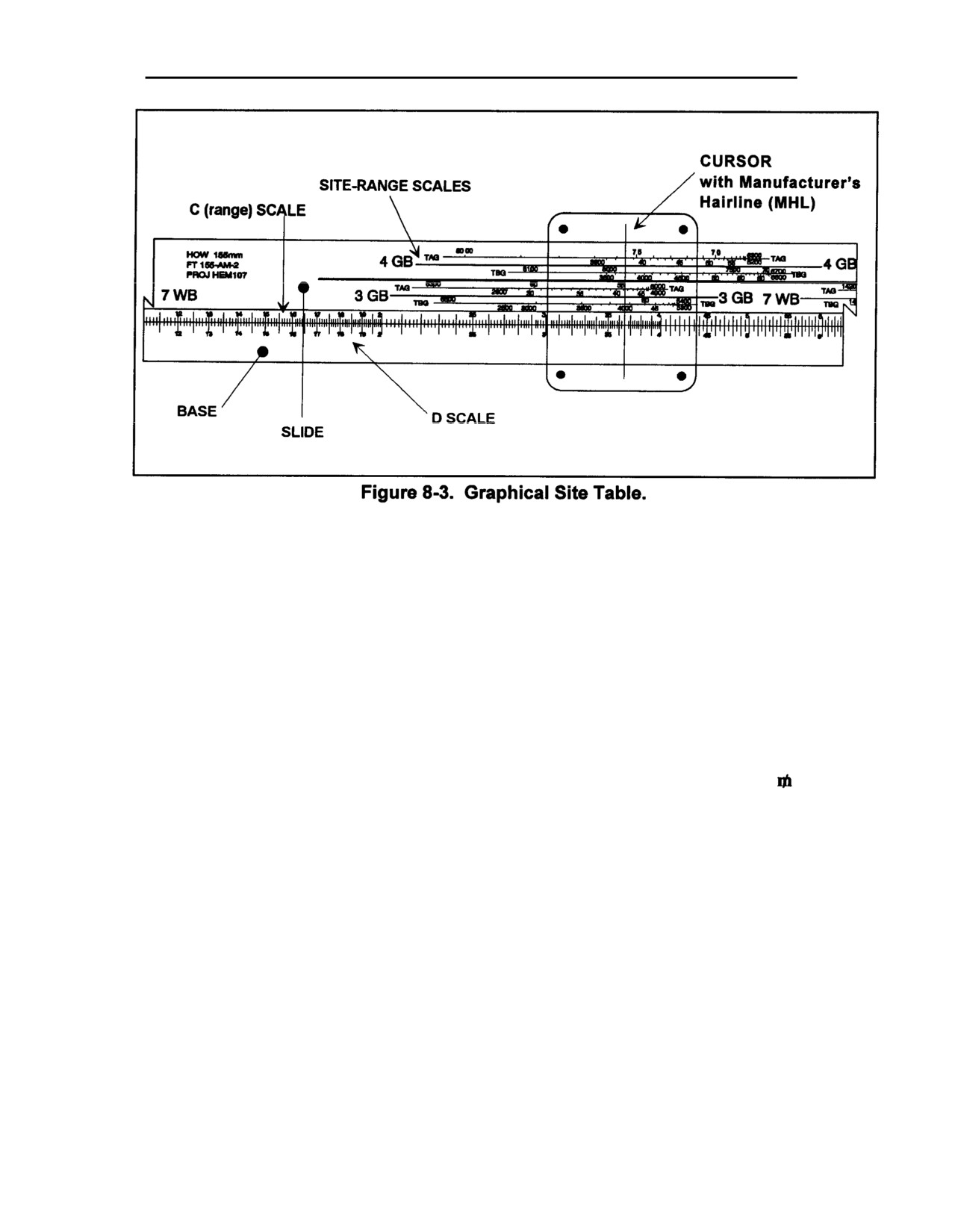
b. The GST consists of three parts: a base, a slide, and a cursor with a manufacturer’s
hairline. (See Figure 8-3.)
8-6
FM 6-40
(1) Base. The base is marked by the D scale, which is a logarithmic scale of
variable graduations. This scale is used to determine VI, VA, angle of site, and site. The
accuracy depends on the values read off the scale. The back of some GSTs have instructions on
how to use it.
(2) Slide. The slide is marked with a C scale, gauge points, and site-range scales.
(a) C (range) scale. This scale is identical to the logarithmic D scale, and
there are two sides to the slide. The C and D scales, along with the M gauge point, are used for
computing vertical interval, vertical angle, and angle of site. Multiplication and division may
also be performed by using the C and D scales.
(b) Gauge points. The C scale is marked with two M (meter) and YD (yard)
gauge points. The M gauge point multiplies the value opposite the C index by 1.0186, which
gives a precise solution to the mil relation formula and is used in all computations (
=1.0186
W/R). The YD gauge point multiplies the value opposite the M gauge point by 0.9144, which
gives an immediate solution to the formula: (YARDS x 0.9144 = METERS).
(c) Site-range scales. These scales are used to compute site when the VI and
range are known or to compute the VI when the site and range are known. For each charge
indicated, there are two site-range scales. One is black, marked “TAG,” and the other is red,
marked “TBG.” Each side is placed in relation to the M gauge point so that site is read on the D
scale opposite the M gauge point when VI on the D scale is divided by range on the site-range
scale. The TAG and TBG scales are constructed to include CAS. They differ from each other
just as the CSF for a plus angle of site differs from the CSF for a minus angle of site. The TAG
scale is used when the VI is plus, and the TBG scale is used when the VI is minus. The value of
site is read or placed opposite the M gauge point. When there are no site range scales for a
particular charge or the scale does not include the appropriate gun target range, site for that
charge must be computed manually.
8-7
FM 6-40
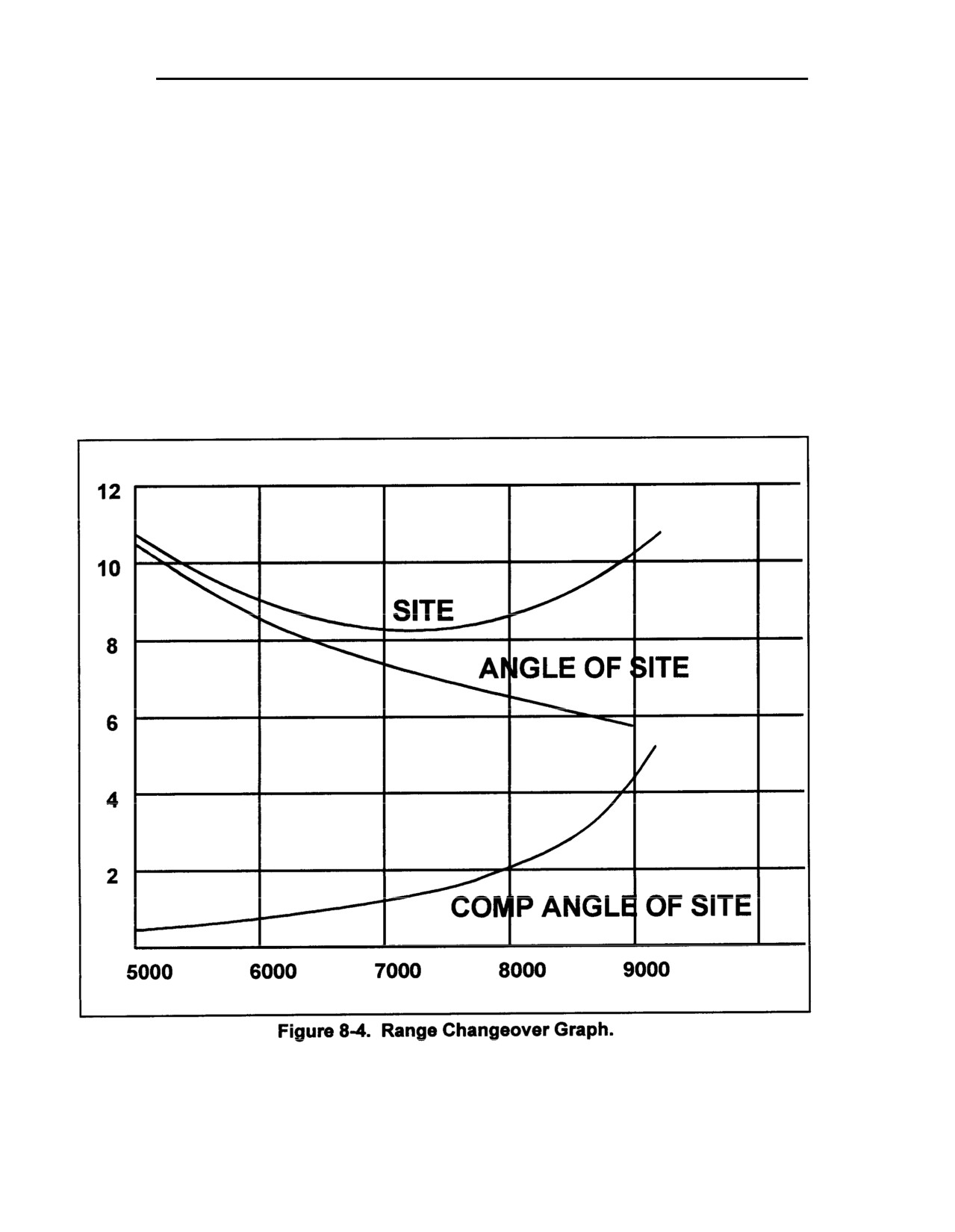
(d) Range changeover point. On all GSTs for all charges, there is a point on
all site-range scales where the scales begin to “double back”; that is, the cursor is moved to the
left rather than to the right for an increase in range for a given VI. The range at which each scale
reverses direction is called the range changeover point. The location of the changeover point can
be shown by plotting site as a function of site in mils and range in meters (Figure 8-4). Recall
that site equals the angle of site plus the complementary angle of site. In Figure 8-4, at the lesser
ranges (5,000 to 7,000 meters), the angle of site is decreasing at a greater rate than
complementary angle of site is increasing; thus, site decreases. At the longer ranges (8,000 to
9,000 meters), the angle of site is decreasing at a lesser rate than the complementary angle of site
is increasing; thus, site increases. The site curve shows decreasing values up to a range of about
7,600 meters and then increasing values beyond. The range at which site is at an absolute
minimum value is 7,600 meters and is the range changeover point for that charge and projectile.
(e) Cursor. The cursor has a vertical hairline, known as the manufacturer’s
hairline. It enables the user to place or read a value on the slide opposite another value on the
base.
8-8
FM 6-40
8-8. Average Site
a. A considerable amount of time can be saved in mission processing if average site can
be precomputed for the area of operations. As time permits after occupation, the VCO should
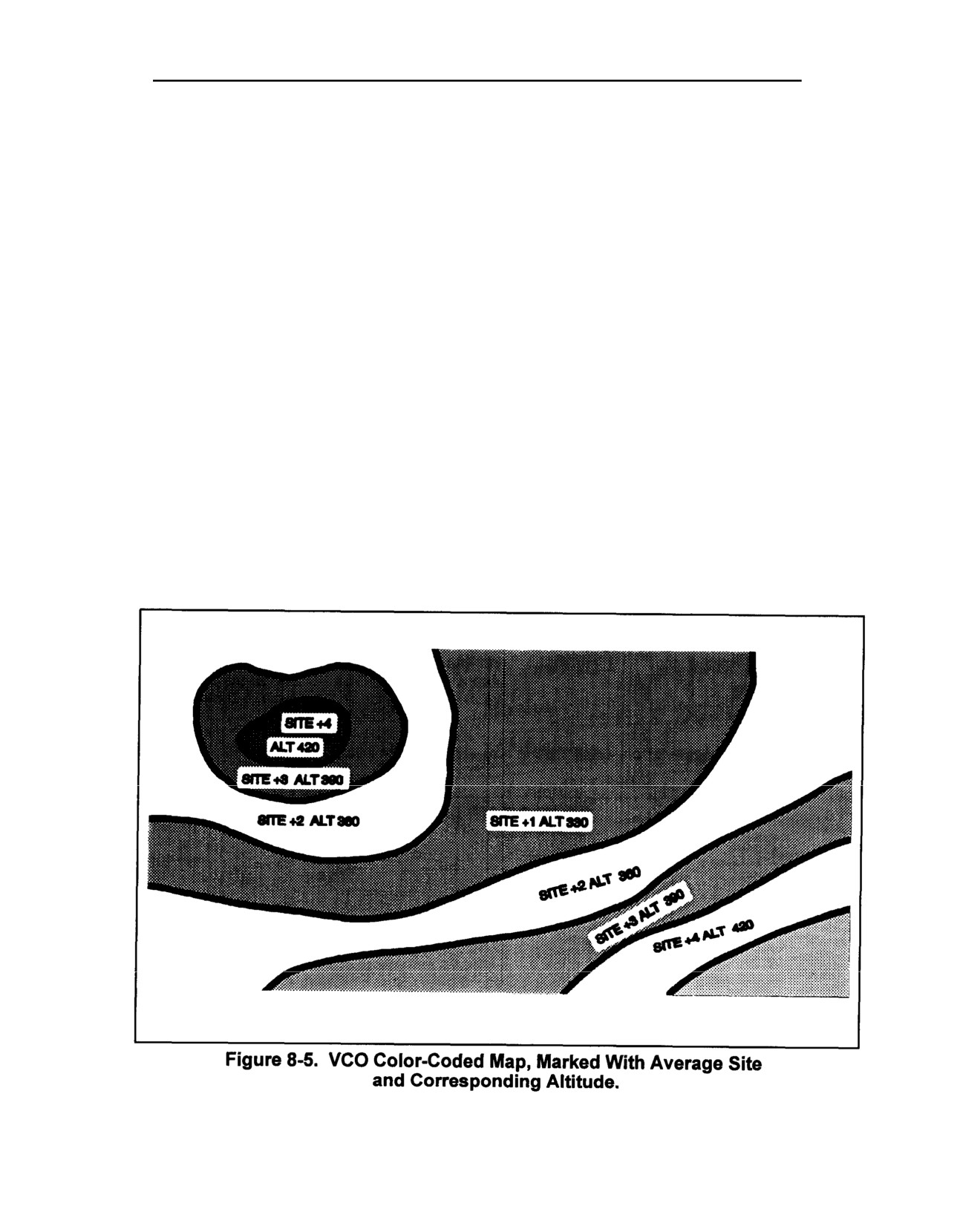
develop a color-coded average site map (Figure 8-5). The average sites and altitudes would be
listed within each color-coded area. Site is computed for vertical interval segments on the basis
of ranges and charges to be used most frequently. The error in site will normally be small and is
an acceptable tradeoff of accuracy for speed. When a target is plotted on the average site map,
the VCO can read and announce site. This technique may not be practical in certain situations,
for example, in mountainous terrain or in fast-moving situations. Here the VCO could use the
altitude of the nearest preplotted target to compute site.
b. The VCO creates and improves his average site map by using the following steps.
(1) Plotting of contour intervals. The VCO color-codes his map along with selected
contour intervals, creating zones with little variation in altitude. VI is based on the mean altitude
in each zone. Compute site for each color-coded zone by using the range to the center of the
zone and the appropriate charge. This will result in an average site to use for all targets plotted
within a color-coded zone.
(2) Refining average site. As time permits, average site values can be refined by
computing additional values for variations in range within a color-coded zone.
This will
determine if there are significant changes in site caused by changes in range. For example, site
would be computed for a zone between the 300 and 320 contour intervals by using ranges
throughout the zone (that is, 5,000, 6,000, 7,000). If site changes by more than 1 mil, the VCO
would announce the refined site.
8-9
FM 6-40
8-9. Determination of Angle of Site and Vertical Angle With the GST
a. The procedures for computing angle of site and vertical angle are the same. Both are
computed by using the C and D scales and are not associated with a particular charge or a
particular weapon. In each case, two values are needed: the range (or distance) to the target in
meters and the number of meters the target is above or below the howitzer or observer (vertical
interval.,
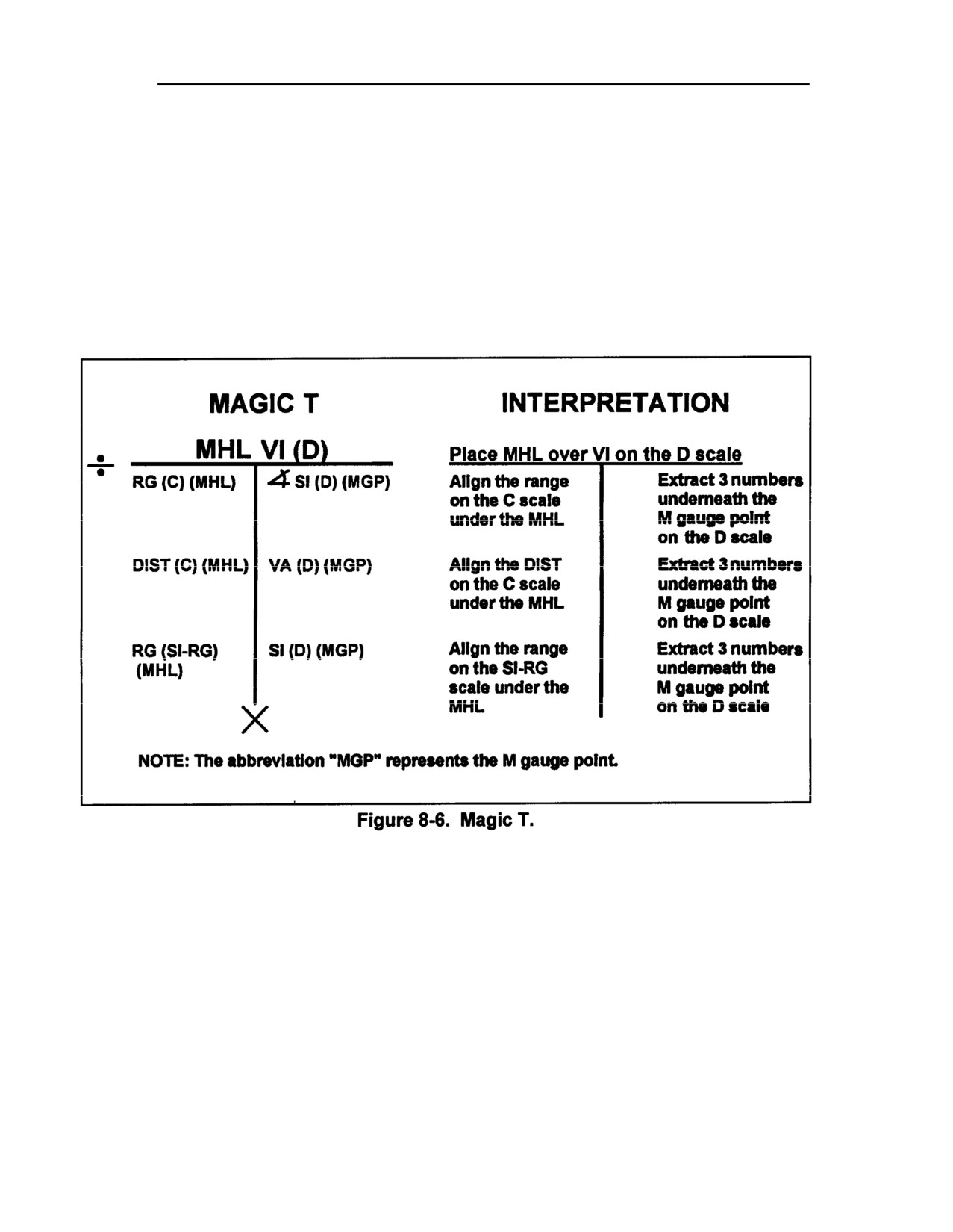
b. The diagram in Figure 8-6 is known as the Magic T. It can be used to help
determine angle of site, VA, and site when using the GST. The horizontal line in the Magic T
represents division, and the vertical line represents multiplication.
8-10
FM 6-40
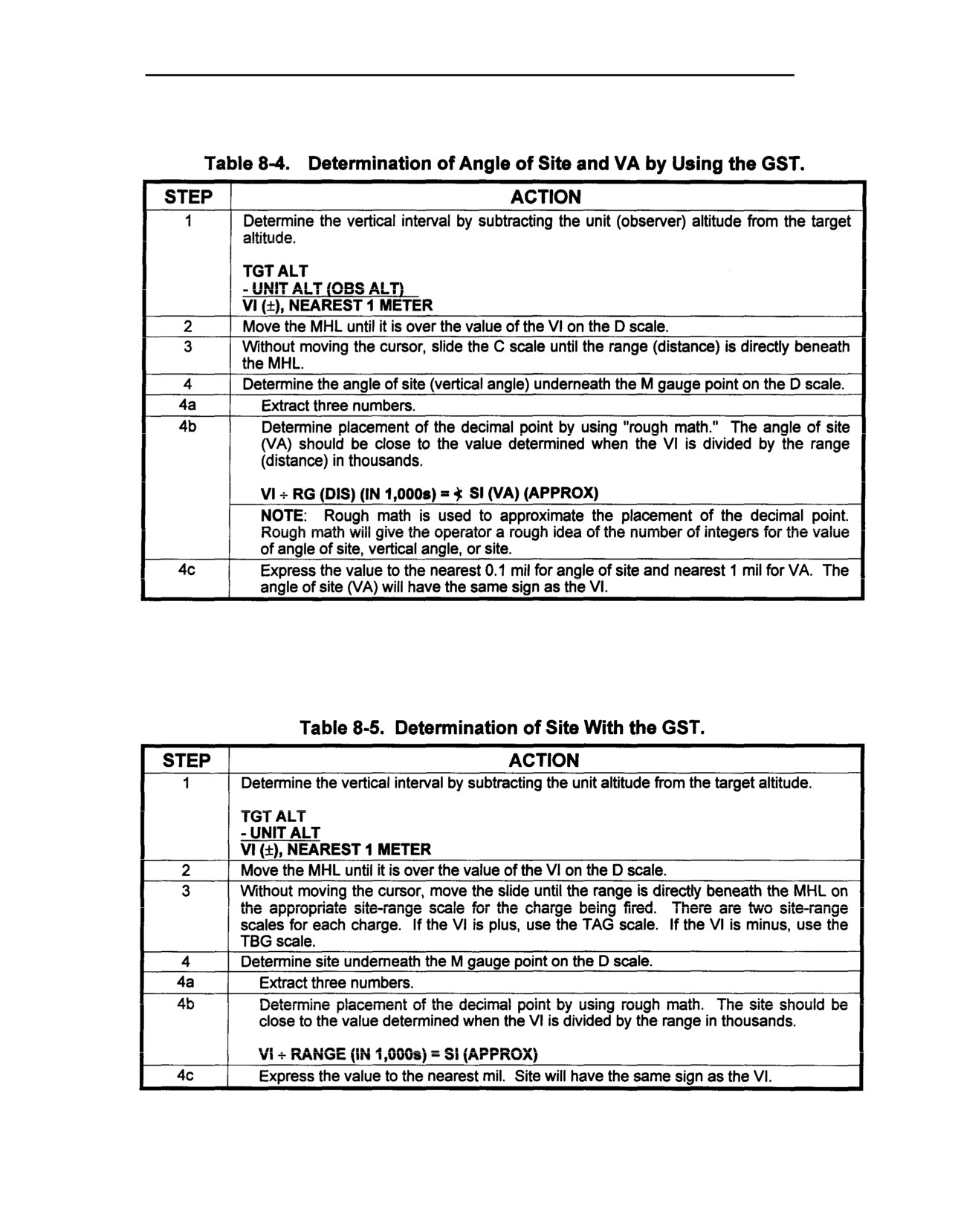
c. The following steps in Table 8-4 show how to determine angle of site and VA by
using the GST.
8-10. Determination of Site With the GST
Site is computed by using the site-range and D scales. The value determined will be valid
for a particular charge, weapon, and projectile family. Two values are needed--the range to the
target in meters and the vertical interval. Use the steps in Table 8-5 to determine site with a GST.
8-11
FM 6-40
8-11. Sample Problems
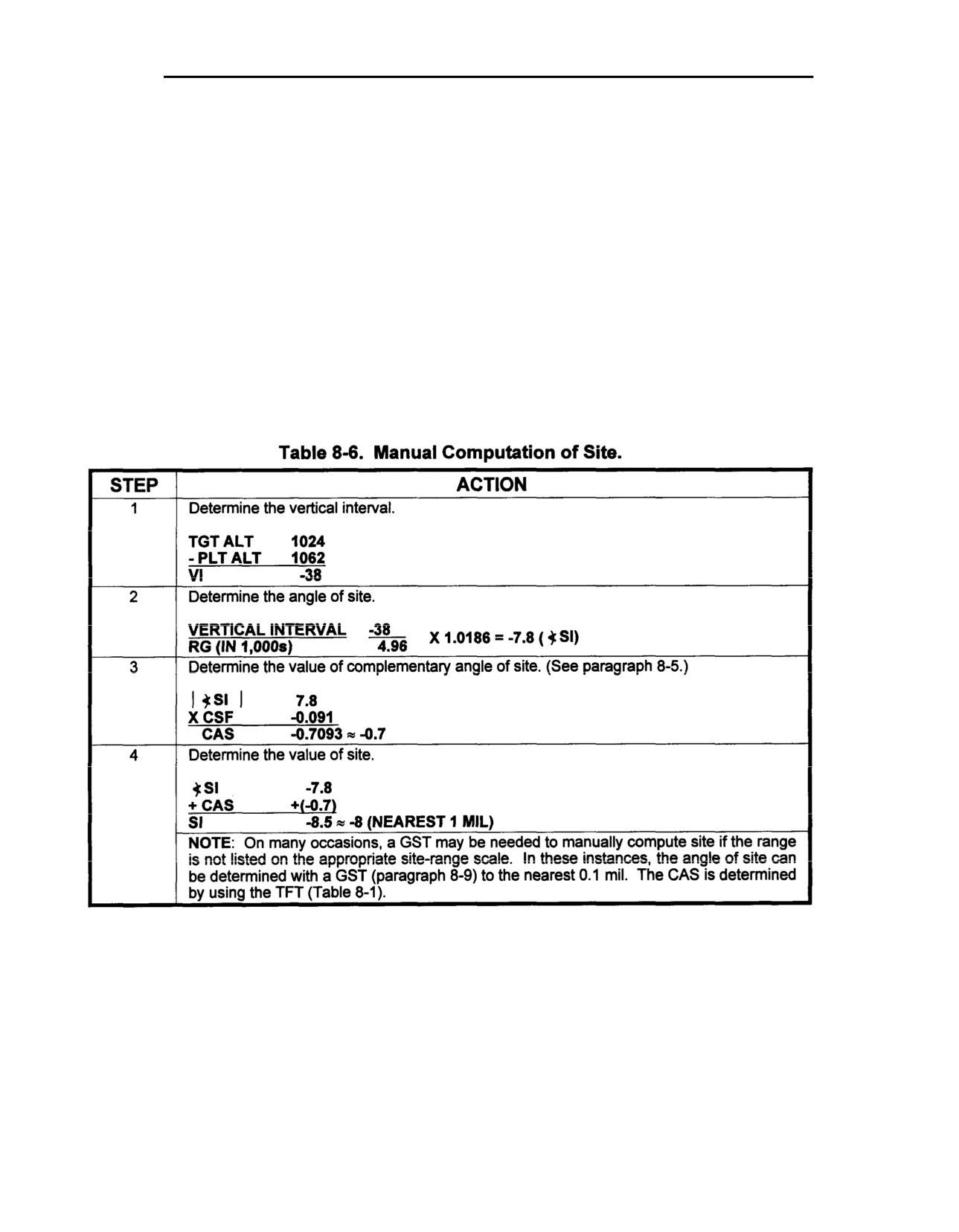
The examples in Tables 8-6 through 8-9 use data for the firing unit location, known point,
and observer (T03) from Chapter 6. The following data are given:
Weapon System:
M109A3
Charge:
4GB
Chart Rg From l/A to
Known Point 1:
4,960 meters
Distance from T03 to
Known Point 1:
1,760 meters
l/A Altitude:
1062
T03 Altitude:
1127
Known Point 1 Altitude:
1024
a. Determination of Site (Manual Computation). Table 8-6 shows an example of
manually determining site.
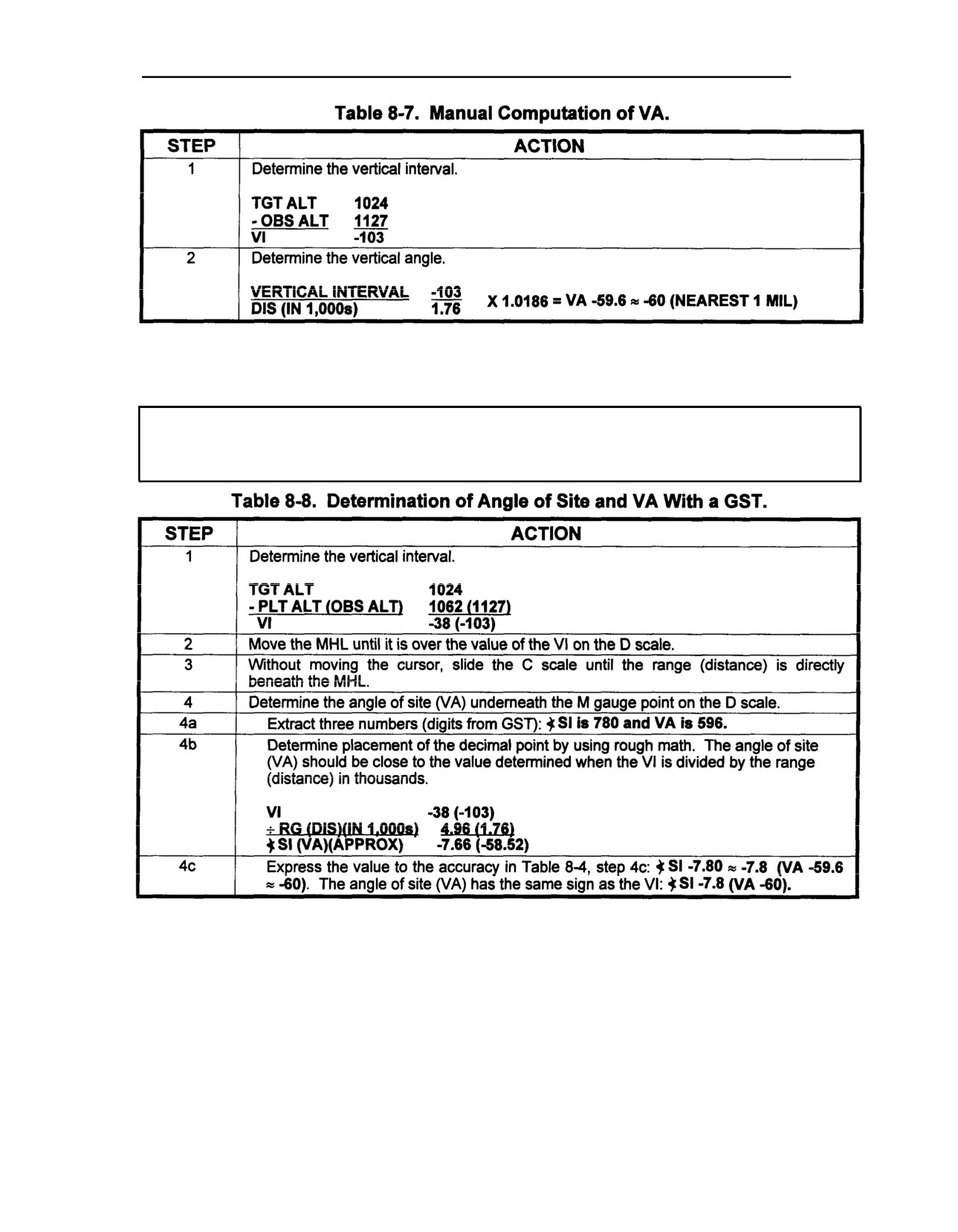
b. Determination of Vertical Angle (Manual Computation). Table 8-7 shows an
example of manually computing VA.
8-12
FM 6-40
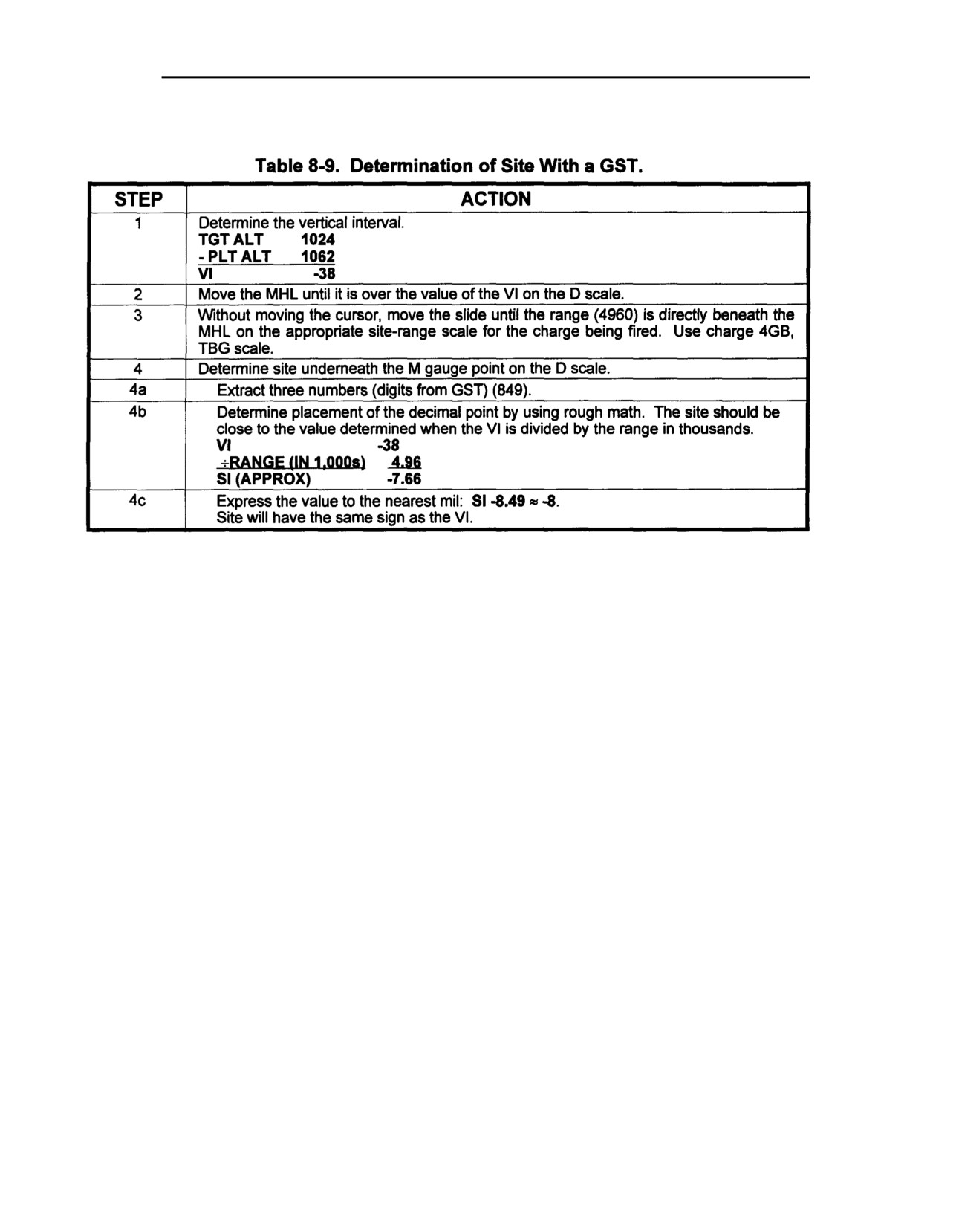
c. Determination of Angle of Site and Vertical Angle With the GST.Table 8-8
shows an example of determining angle of site and VA with the GST.
NOTE: The values in parentheses pertain to the observer and the determination of
VA.
8-13
FM 6-40
d. Determination of Site With a GST. Table 8-9 shows an example of determining
site with a GST.
8-12. High-Angle Site
a. Site is always computed for high-angle fire and added to the determined angle of
elevation, which yields high-angle QE. However, site may have a relatively small effect in
high-angle fire because of the large angle of fall. Therefore, if the angle of site is small and the
FDO directs to ignore it, then site may be ignored.
b. In high-angle fire, an increase in the angle of elevation decreases range. A decrease
in the angle of elevation increases range. The complementary site factors, found in Table G of
the TFT, are relatively large (greater than 1) and are the opposite sign of the VI and angle of site.
Therefore, the site will have the opposite sign of the VI and angle of site.
c. High-angle site is determined by using the CSF (TFT) or the 10-mil site factor from
the GFT. Using the GFT is the preferred method. The reading obtained from the 10-mil site
factor scale is the actual site for each 10 mils of angle of site. The site is computed by
multiplying the angle of site, divided by 10, by the 10-mil site factor. The 10-mil site factor is
always negative.
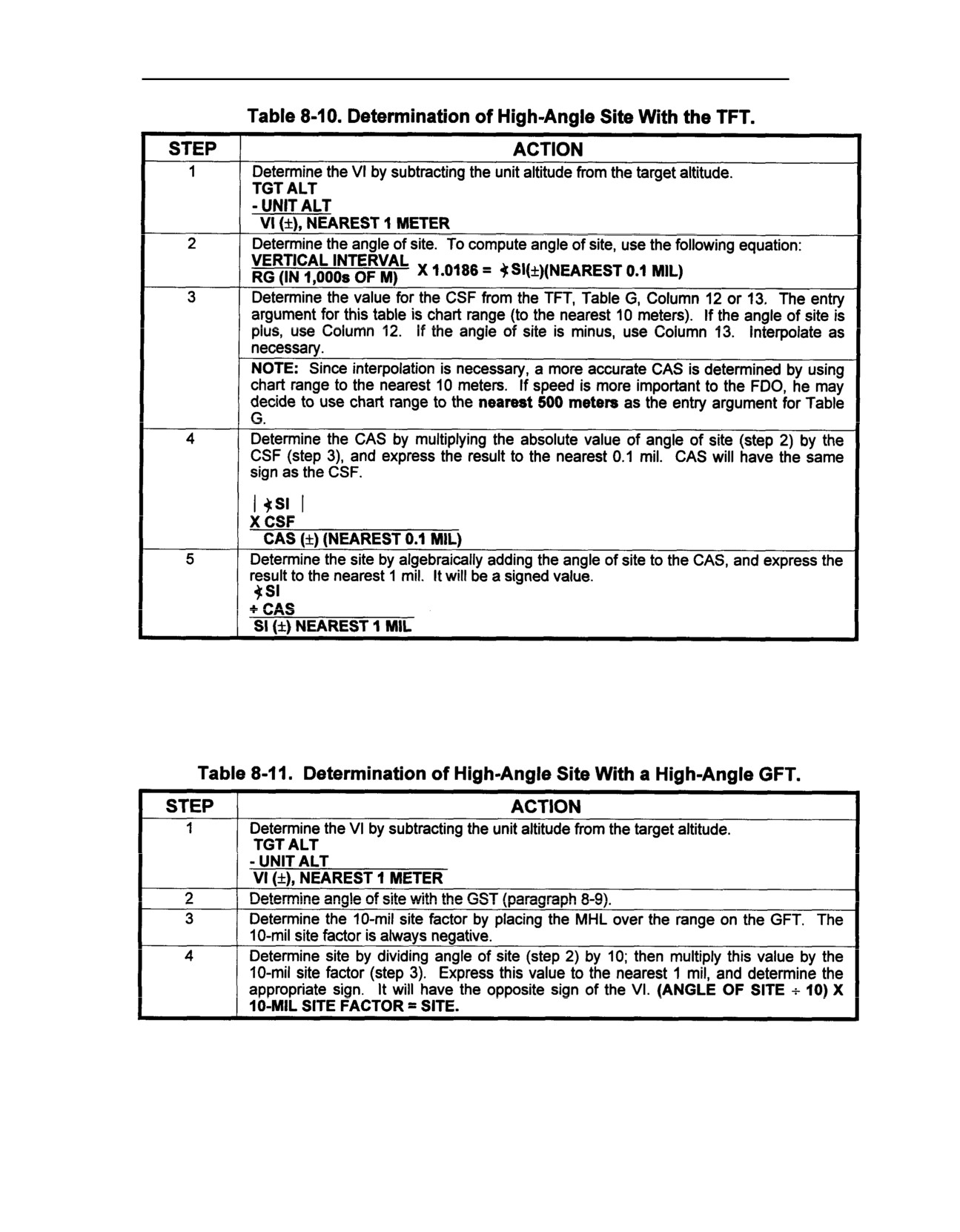
8-13. Determination of High-Angle Site With the TFT
The procedures for computing high-angle site with a TFT (Table 8-10) are the same as
low-angle manual computations of site (Table 8-l). A GST can be used to compute the angle of
site.
8-14
FM 6-40
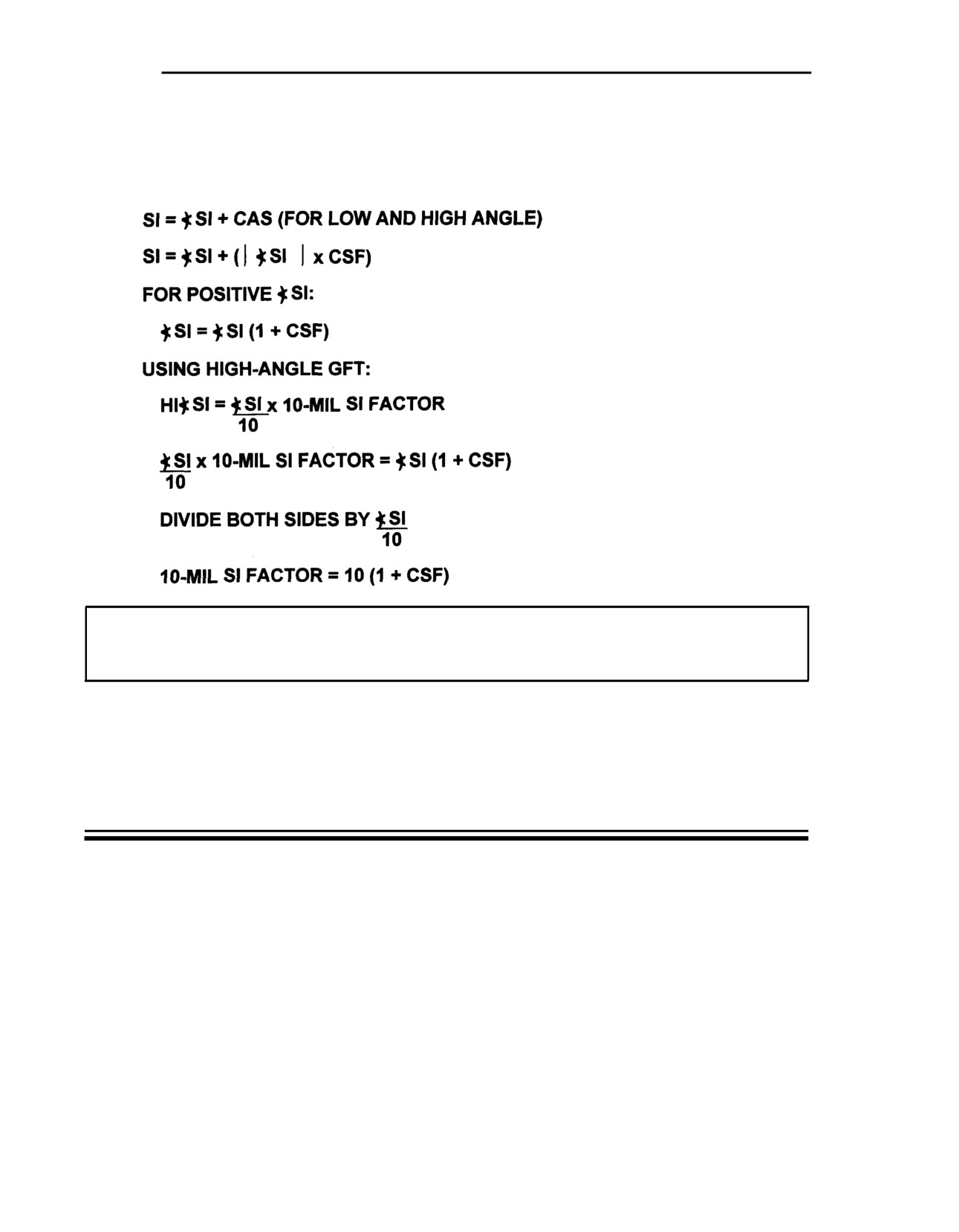
8-14. Determination of High-Angle Site With a High-Angle GFT
The use of the high-angle GFT to determine site is the preferred method. (See Table
8-11.)
8-15
FM 6-40
8-15. Determination of 10-Mil Site Factor Without a High-Angle GFT
The 10-mil site factor is the value of high-angle site for every 10 mils of angle of site.
The 10-mil site factor can be determined manually by solving two equal equations for the 10-mil
site factor.
NOTE: If the 10-mil site factor is not listed on the high-angle GFT, use the last
listed value or change charges.
The FDC can compute high-angle site by manually determining the 10-mil site factor
for those situations when a high-angle GFT is not available. The 10-mil site factor
from the GFT actually reflects the complementary angle of site for a positive VI.
Therefore, this method will introduce a slight inaccuracy when estimating for negative
VIs.
8-16
FM 6-40
Chapter
9
FIRE MISSION PROCESSING
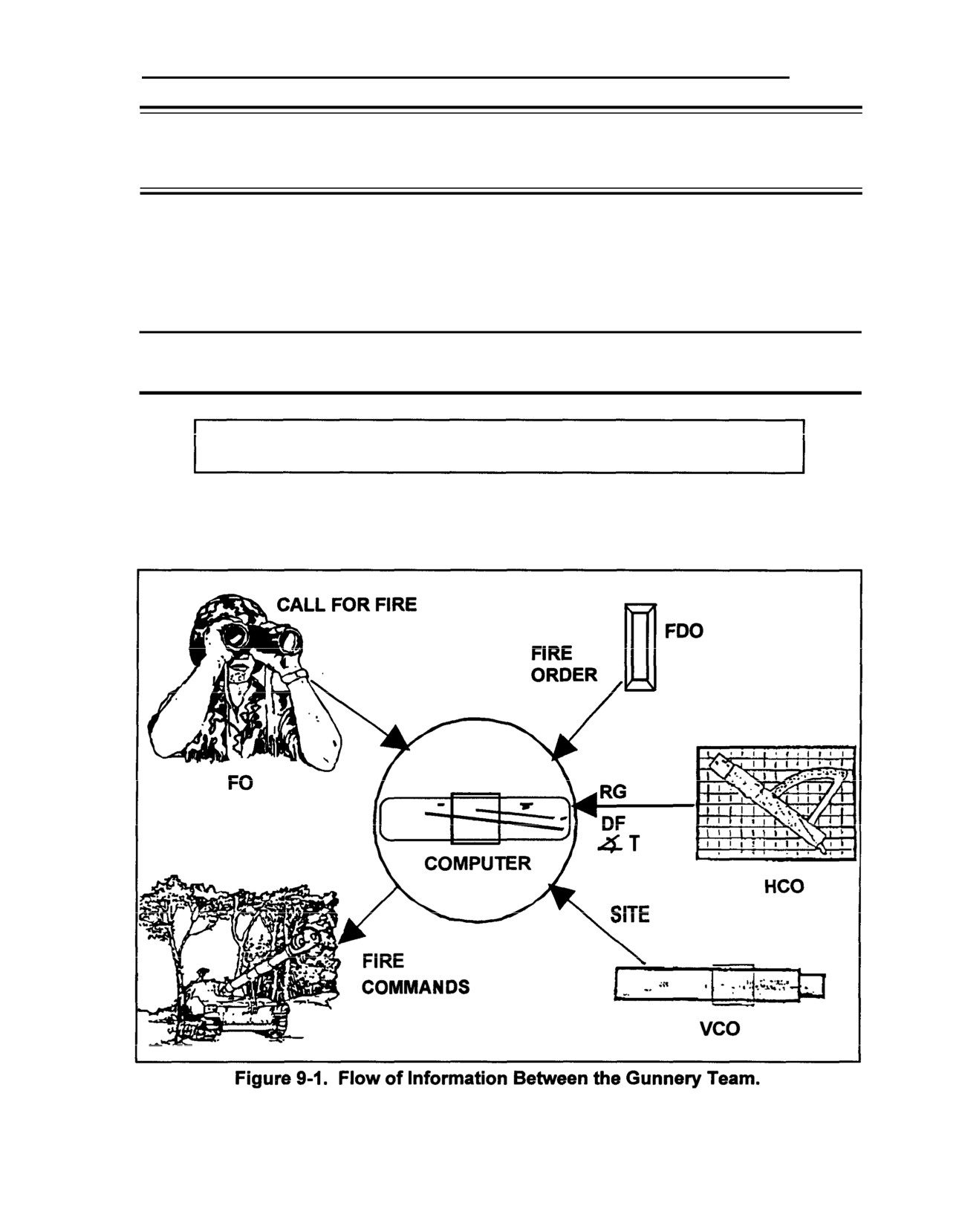
In the battery or platoon FDC, all actions are oriented toward timely and accurate fire
mission processing. All actions must provide the best possible flow of information between FDC
personnel. The battery or platoon FDC must be trained to determine responsive and accurate
firing data. Upon receipt of a call for fire, FDC personnel must work as a team to accomplish
many tasks at the same time. (See Figure 9-1.)
Section I
Duties and the Record of Fire
This section implements STANAG 2934 and QSTAG 225.
Understanding the duties within the FDC is imperative. All activity
supports the computer. He determines and records firing data on the record of
fire. He is also the link to the howitzers, because he transmits the fire commands.
9-1
FM 6-40
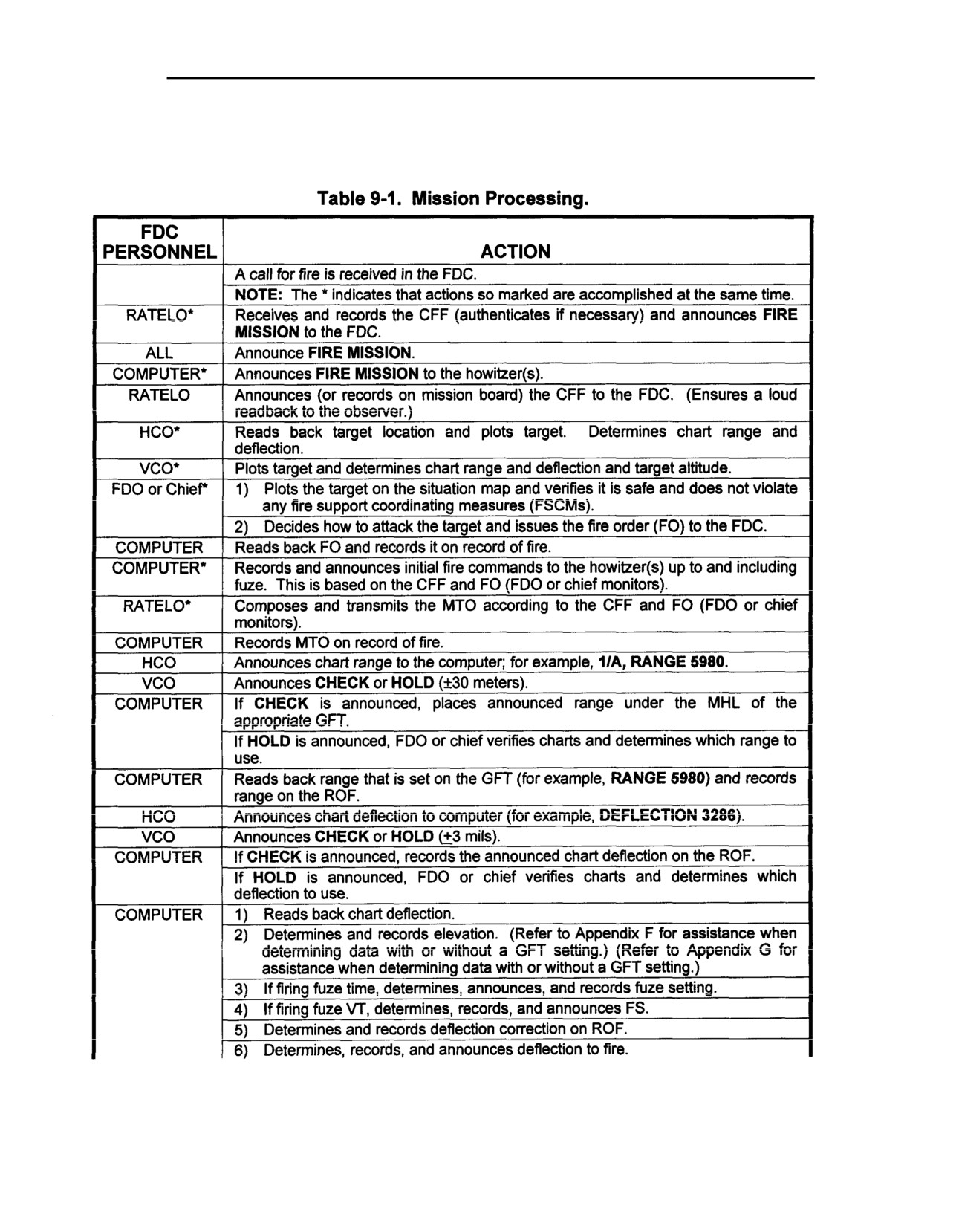
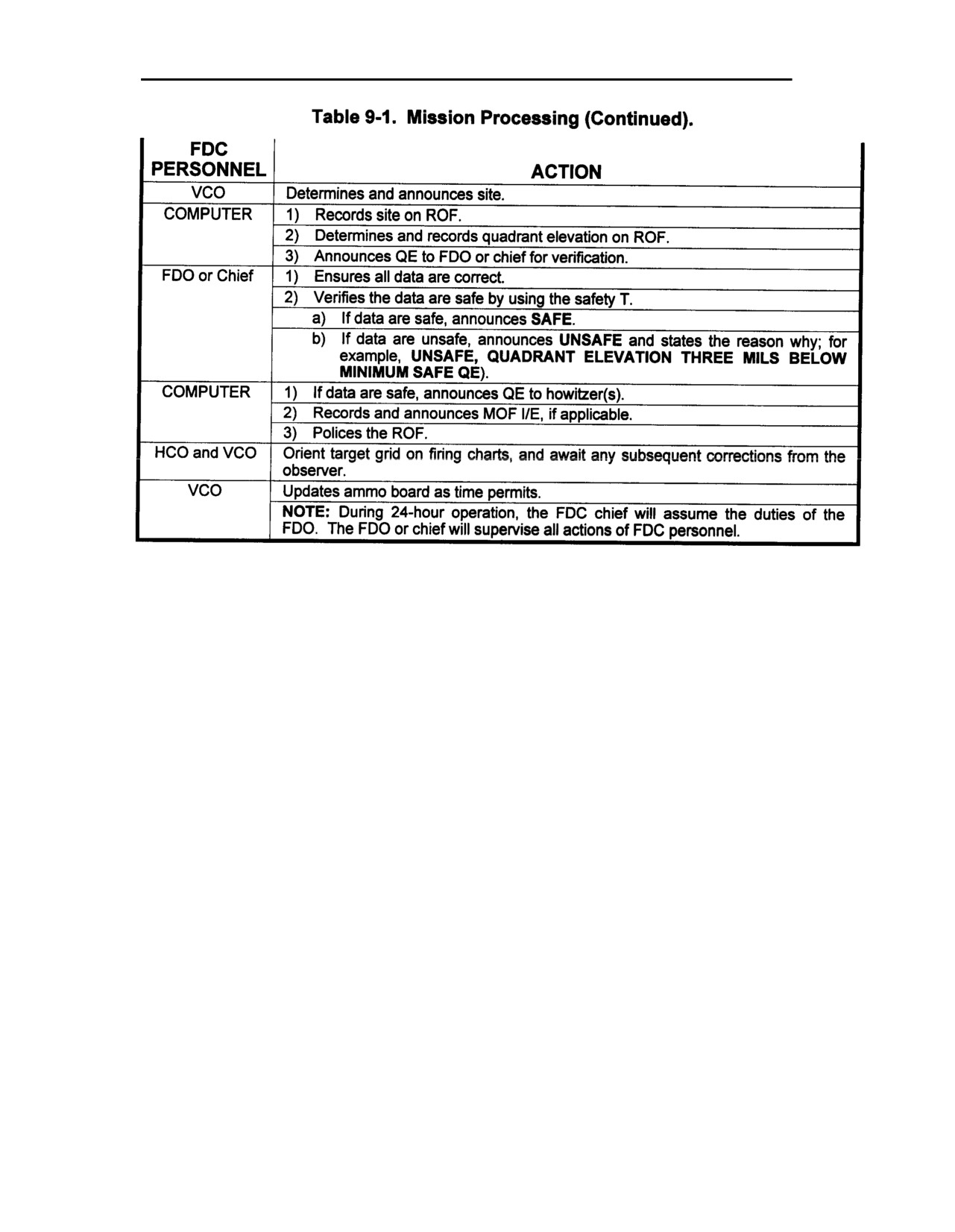
9-1. Crew Duties for the FDC
The procedures in Table 9-1 should be used to facilitate mission processing and ensure
responsiveness. (For automated FDC crew duties, see Appendix F.)
9-2
FM 6-40
9-2. Elements of Firing Data
The data determined from the firing chart must be converted to firing data that can be
placed on the weapon and ammunition. These data consist of the charge, fuze setting (when
applicable), deflection, and quadrant elevation to be fired.
a. Shell. Shell is the projectile to be fired. The projectile will have a direct impact on
determining the remaining elements since firing tables are based on the projectile.
b. Charge. The amount of propellant to be fired with artillery ammunition is varied by
the number of propellant increments. The charge selected is based on the range to the target and
the tactical situation.
c. Fuze. Fuze is the fuze to be fired. The fuze will have a direct impact on determining
the quadrant elevation when firing mechanical time fuzes.
d. Fuze Setting. When a projectile with a mechanical time or proximity fuze is fired,
the computer determines a fuze setting to be set on the fuze that should cause it to function at the
desired point along the trajectory. Fuze setting is a function of elevation. This fuze setting is
determined from the TFT or GFT. Some projectiles may also be fired with a point-detonating
fuze, which can be set for delay action.
e. Deflection. The deflection to fire is the deflection announced to the howitzer. To
compute deflection to fire, apply the deflection correction to the announced chart deflection by
using the LARS rule (left, add; right, subtract). Determine the deflection correction by adding
the GFT deflection correction to the drift corresponding to the initial elevation. (GFT deflection
correction is discussed in Chapter 10.)
9-3
FM 6-40
f. Quadrant Elevation. Quadrant elevation is the algebraic sum of site and the angle of
elevation. Quadrant elevation is the angle through which the tube of the howitzer must be
elevated from the base of the trajectory to cause the trajectory to pass through the target.
(1) Elevation. The angle of elevation is the vertical angle between the base of the
trajectory and the axis of the bore required for a projectile to achieve a prescribed range under
standard conditions.
(2) Site. If the target and the howitzer are not at the same altitude, site will be
determined. Site is combined with elevation to cause the trajectory to pass through the target. If
the target and howitzer are at the same altitude, site is announced as zero.
9-3. Recording Firing Data
a. DA Form 4504 (Record of Fire) is a legal document used for determiningg and
recording iring data. It is organized to allow a smooth flow in determining and processing afire
mission. It is used for the following:
Recording the call for fire.
Computing and recording firing data for all types of fire missions.
Keeping a permanent record of a fire mission, to include the type and amount of
ammo expended during the mission.
b. On DA Form 4504 (Figure 9-2), the heavy black lines indicate major sections of the
form. Shaded portions denote items that must be announced to the howitzer sections. The use of
each block on the record of fire is explained below.
(1) Call for fire block. The CFF announced by the observer is recorded in this
block. (See Figure 9-3.) Table 9-2 explains each item and its use.
9-4