FM 6-40 TTP for Field Artillery Manual Cannon Battery U.S. - page 13
FM 6-40
13-15
FM 6-40
13-16
FM 6-40
13-17
FM 6-40
Section II
ROCKET-ASSISTEDPROJECTILE
Rocket-assisted projectiles are available for the 105-mm and 155-mm
howitzers. They are designed to extend the range of the howitzers. The basic
rocket-assisted projectiles are filled with HE material. They produce blast and
fragmentation in the target area. Computation procedures for the two basic HE
RAPs are identical. Firing tables are available for the rocket on mode only.
13-15. Description
a. The 105-mm RAPs are the M548 and M913. The 155-mm projectiles are the M549
and M549A1. For the Ml 09A2/A3 weapons, these projectiles are fired with charges 7 (M4A2),
8 (Ml 19A1), and 7 (Ml 19A2). The M198 howitzers may use charges 7 (M4A2), 8 (Ml 19A1), 7
(Ml 19A2), and 8S (M203 only for the M549A1 projectile).
b. Rocket-assisted projectiles should always be fired by using current GFT settings
because most RAP missions are expected to be FFE missions. The multiplot GFT setting is
recommended for use with RAP. When no RAP registration data are available, a met-to-target
technique should be solved by using MV data, propellant temperature, and rocket motor
temperature (assumed to be the same as the propellant temperature).
13-16. Manual Computations
a. Procedures for computing HE RAP firing data are identical to those for conventional HE
rounds. The RAP GFTs and GSTs are similar to and are read in the same way as those for
conventional HE rounds with two exceptions. The 155-mmM549A1 GFT has no fuze setting scale.
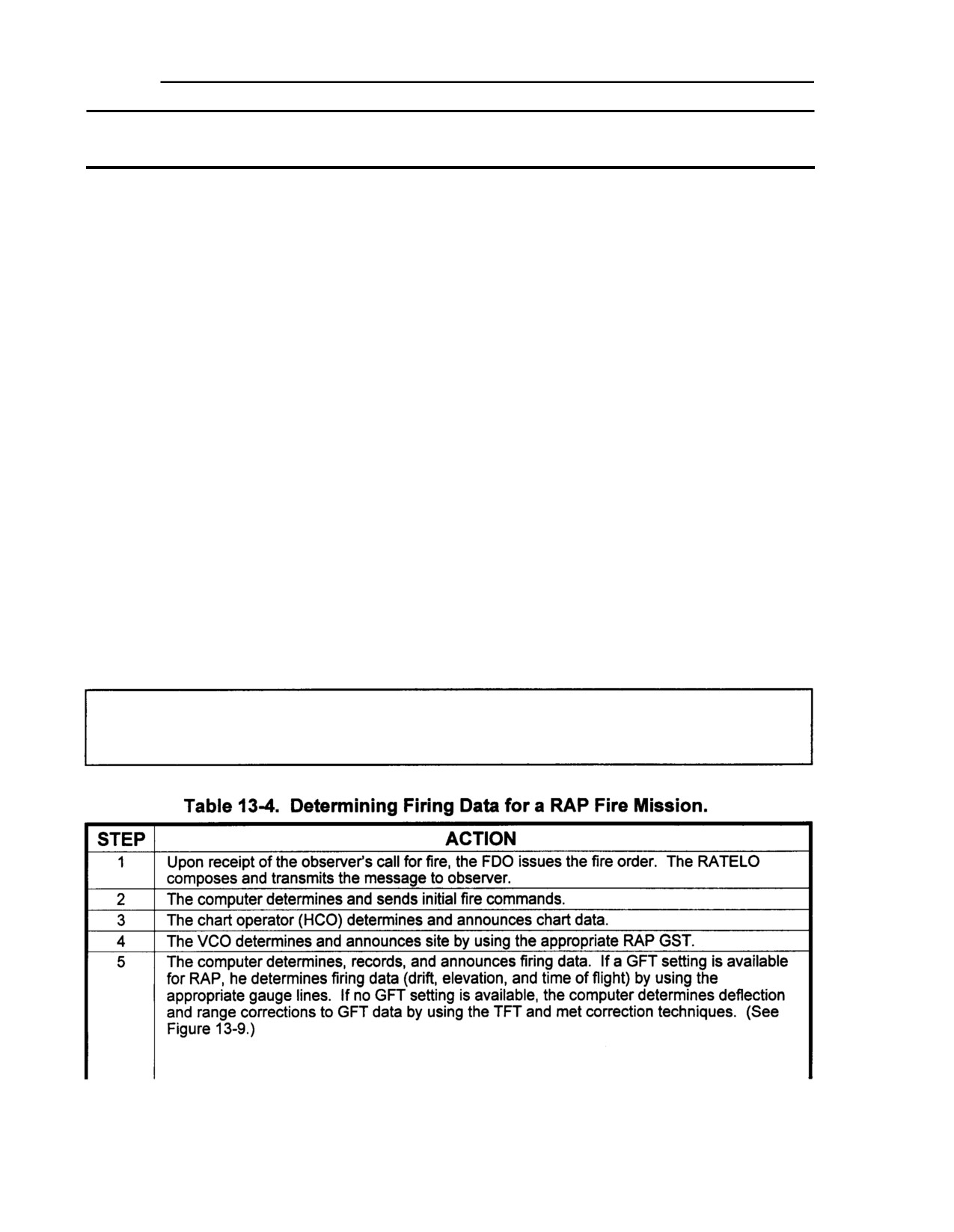
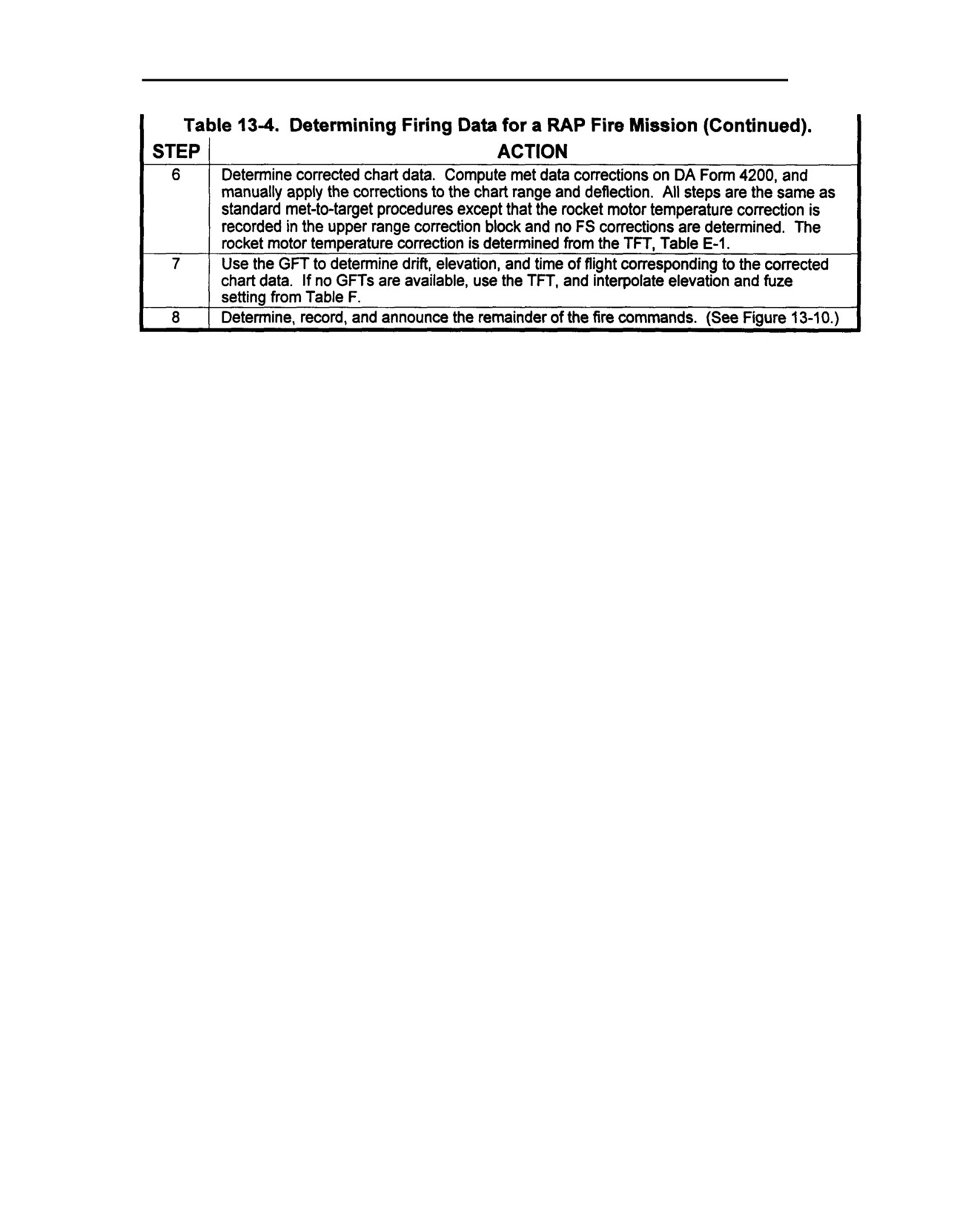
b. Table 13-4 shows the steps for determining firing data for the RAP.
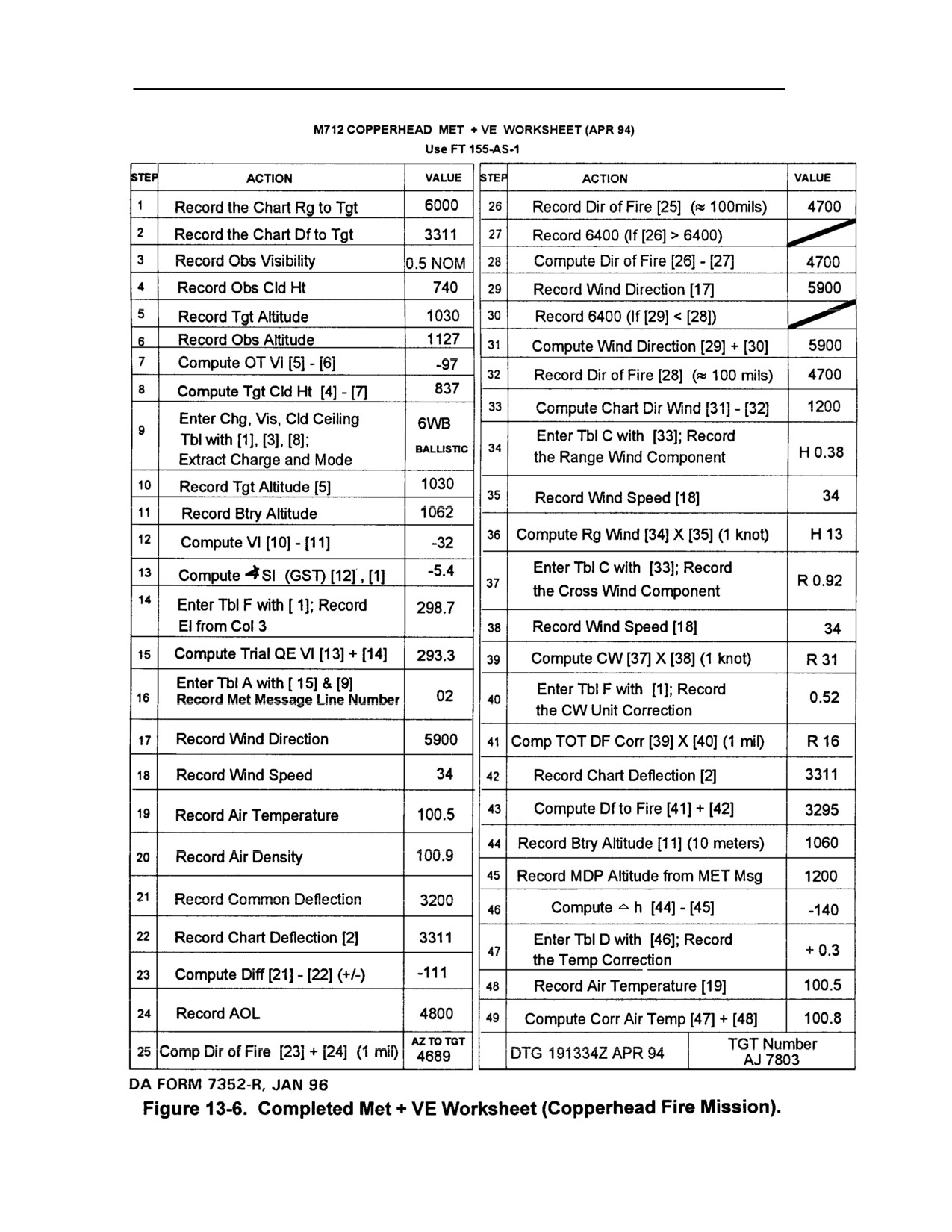
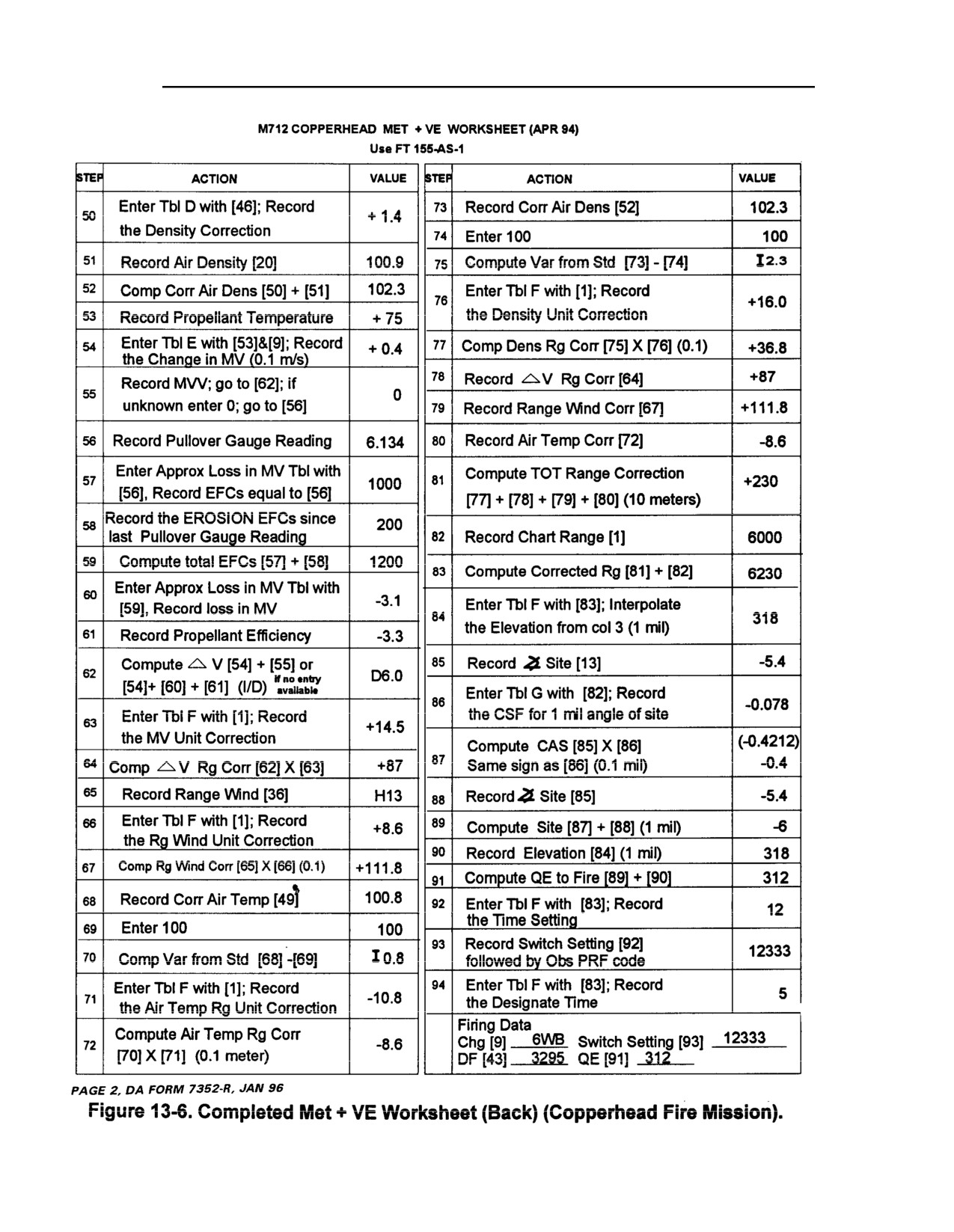
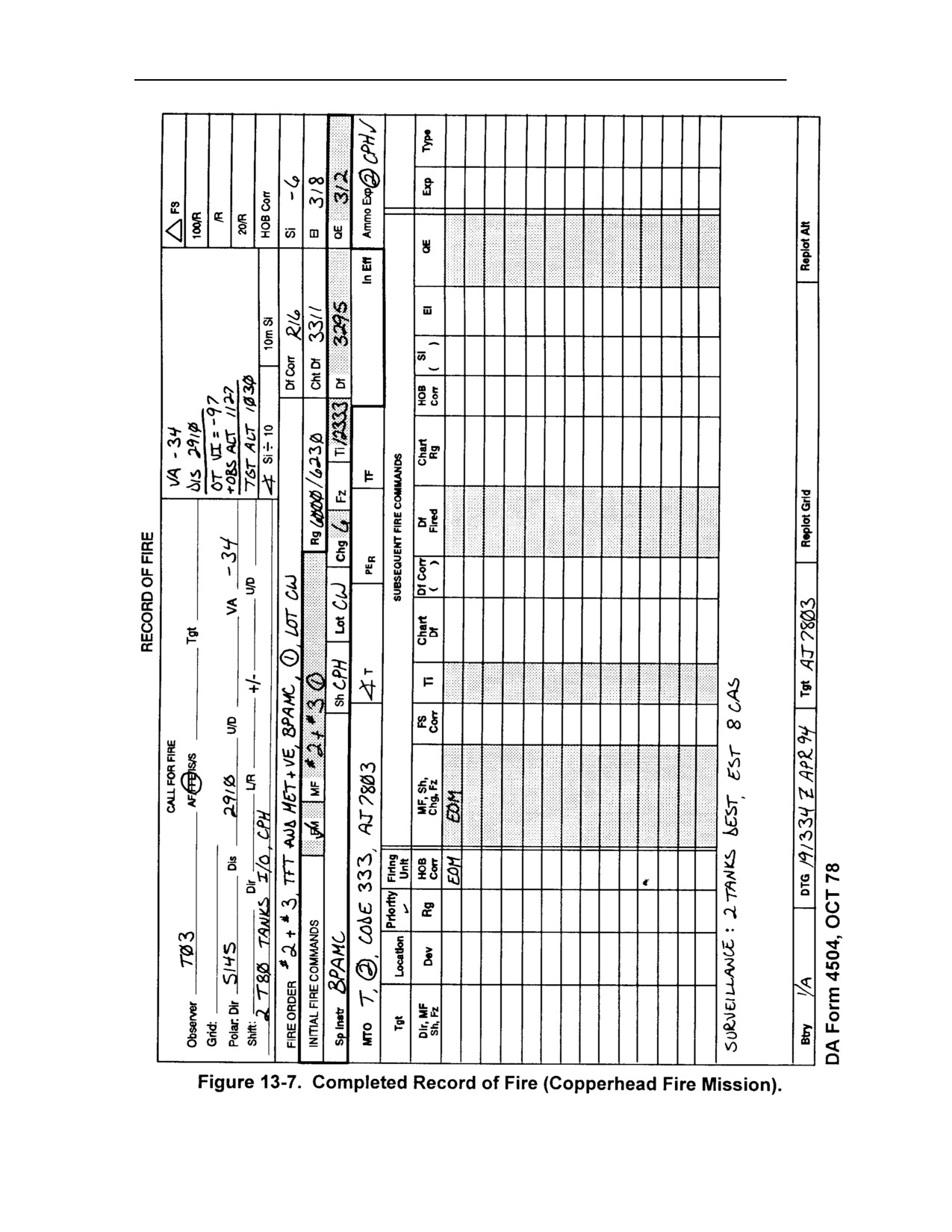
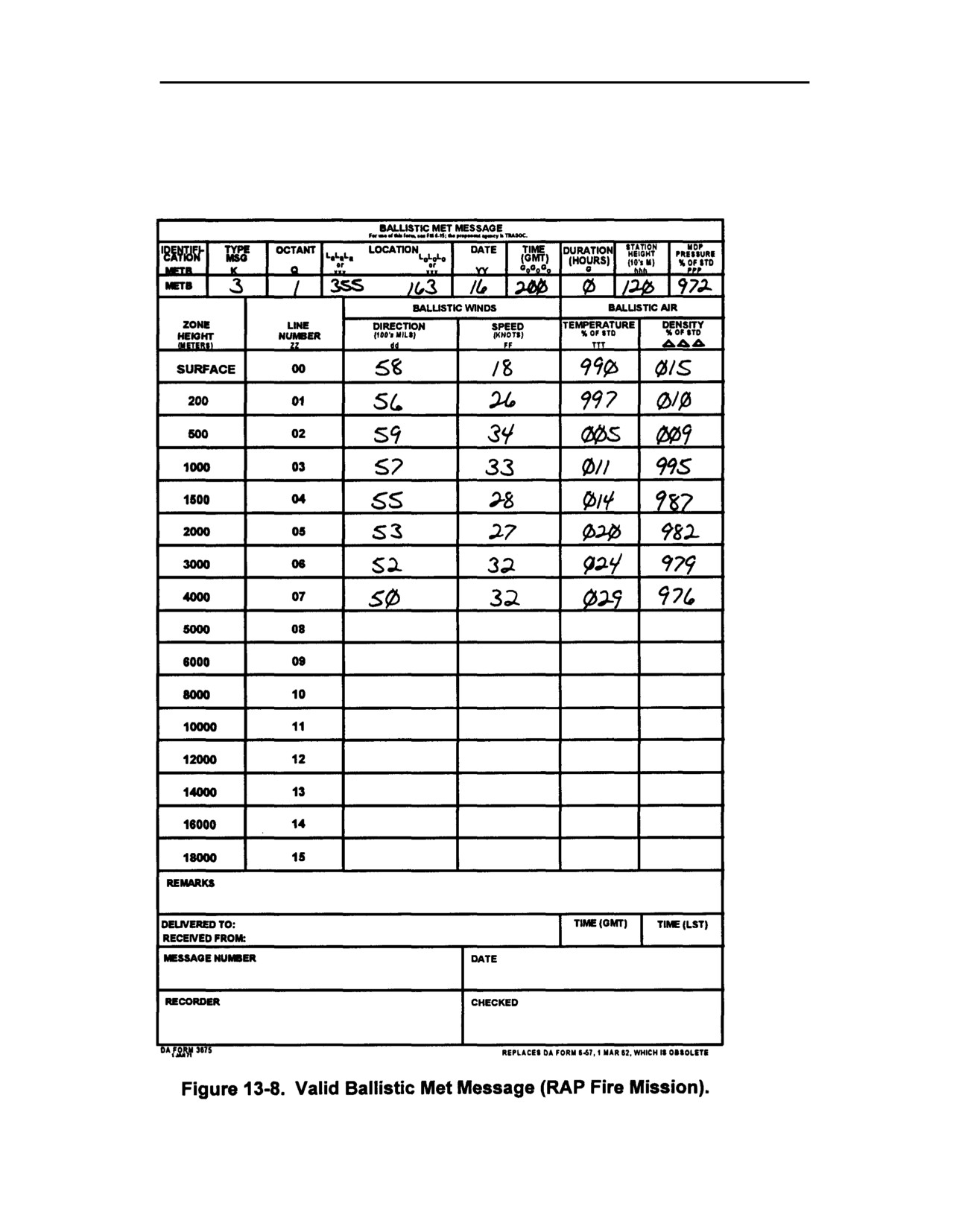
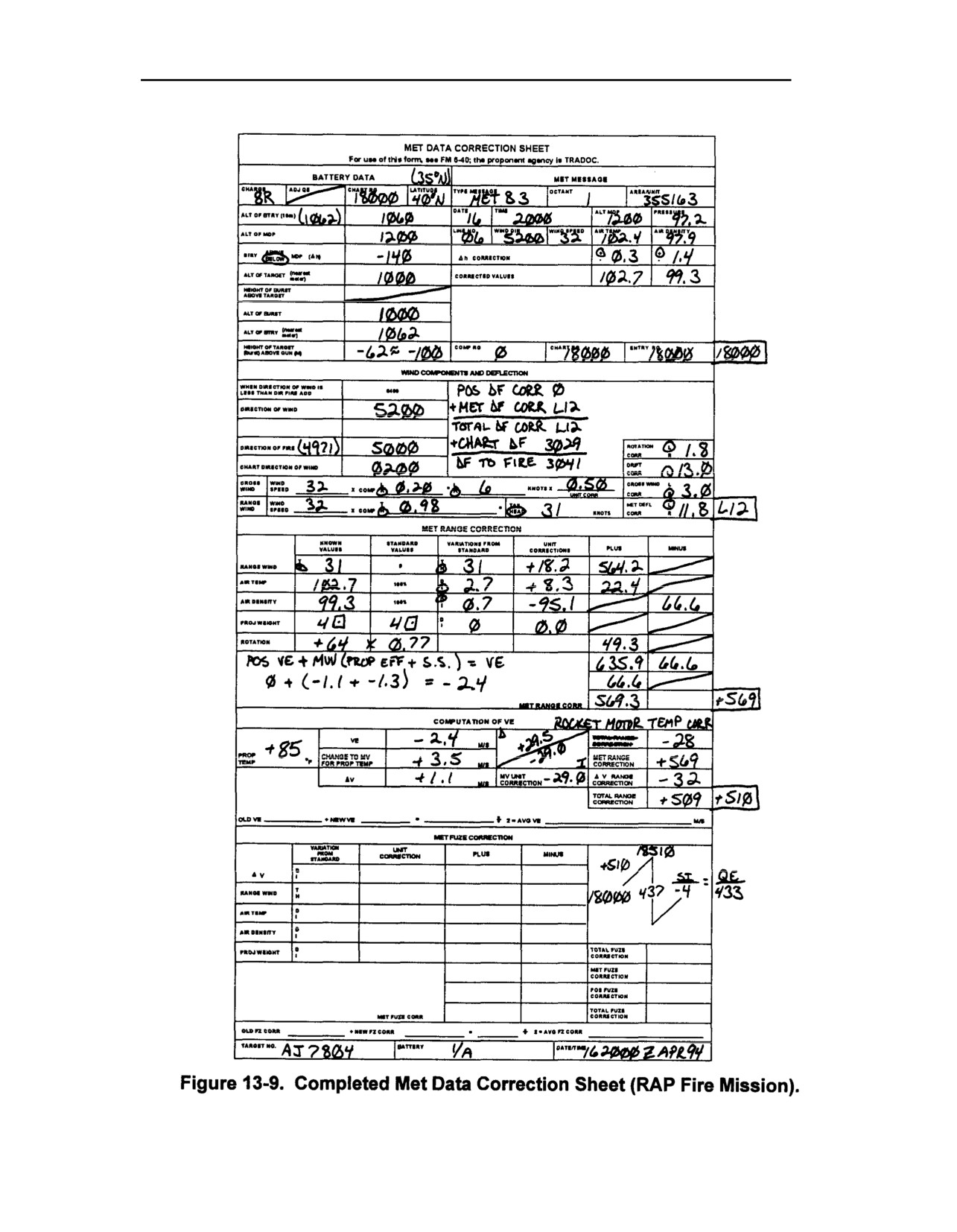
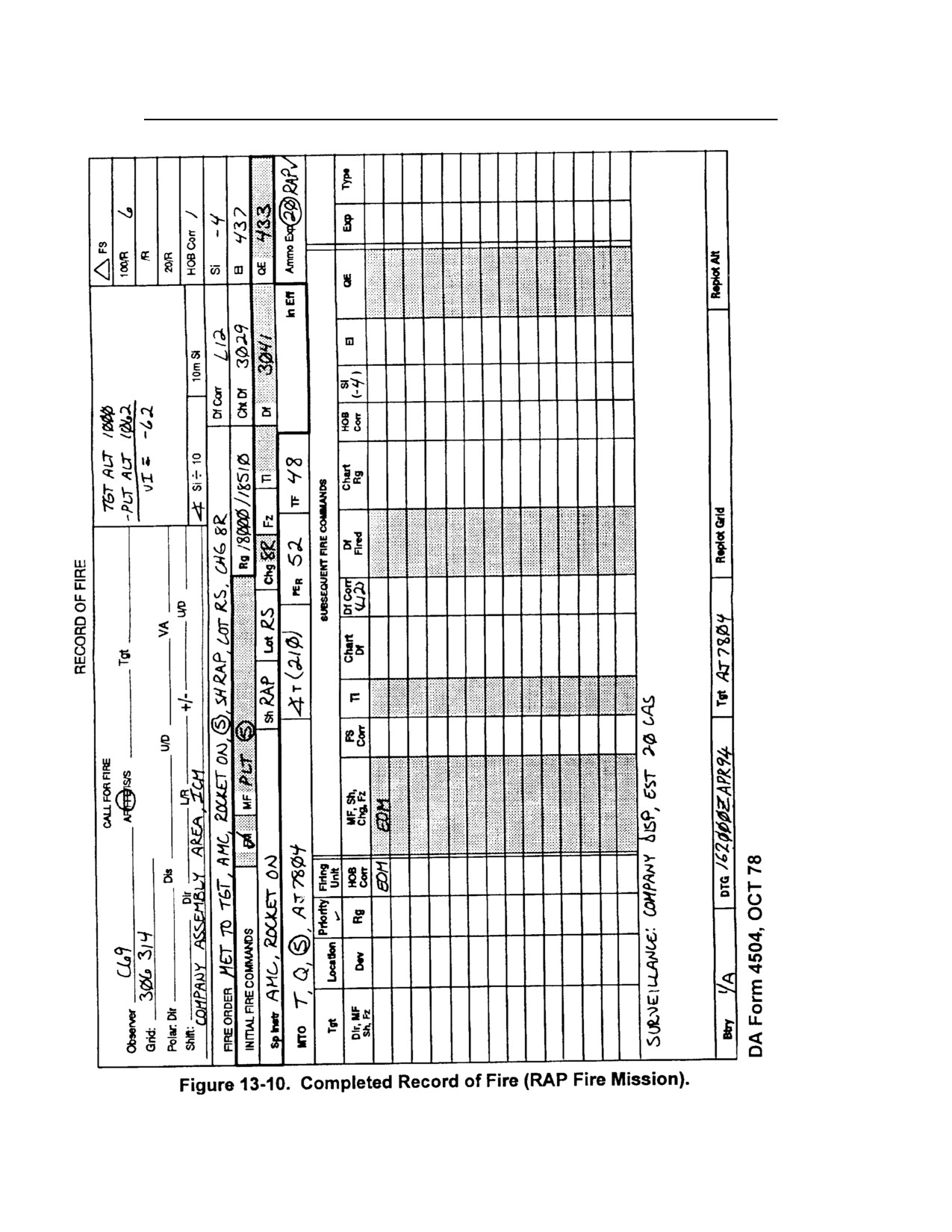
NOTE: Figures 13-8 through 13-10 show a completed RAP fire mission. An
Ml 09A3 howitzer, propellant Ml 19AI, and TFT 155-AO-0 were used.
I
13-18
FM 6-40
13-17. Registration and Determining a GFT Setting
a. Units most likely will not register with the rocket-assisted projectile. An inferred
GFT setting can be computed without registration data. Use a subsequent met technique such as
met + VE, met to target, or met to met-check gauge point. Assume position constants are zero.
As time allows, compute a multiplot GFT setting to improve accuracy at all ranges. Include
range corrections for rocket motor temperature (Table E-1) for solving RAP met techniques for
rocket motor on mode. For 105-mm howitzers in the rocket motor on mode, met techniques or
registrations for RAP will yield unacceptable fuze corrections because of the large fuze-related
probable errors. Therefore, do not compute them. For 155-mm howitzers, there is no Table J for
fuze correction computations in the RAP TFT, since it can only be fired in the rocket motor on
mode.
b. In a combat environment, the unit may conduct registrations with RAP. All of the
probable errors involved in firing RAP force the observer to modify a precision registration and
severely degrade its accuracy. For this reason, an MPI registration is the best option. However,
probable errors also affect the MPI registration. Since the observer obtains spottings of a number
of impacts without adjustment, the effects of the probable errors are lessened in comparison to a
precision registration. The determined mean point of impact most likely is not as accurate as one
determined for an HE MPI registration. However, the RAP MPI registration still provides a GFT
setting and increases accuracy. If the unit does register, it also solves a concurrent met and
derives position constants for use with later RAP missions. Use the position constants and a
subsequent met technique to determine a GFT setting for new missions. As time allows, use the
position constants and subsequent met techniques to construct a multiplot GFT setting and
improve accuracy at all ranges.
13-19
FM 6-40
13-20
FM 6-40
13-21
FM 6-40
13-22
FM 6-40
Section III
SMOKE PROJECTILES
Smoke projectiles are used for smoke screens, obscuring smoke, and
marking targets for aircraft.
13-18. Description
a. Types. The three types of smoke projectiles areas follows:
(1) Hexachloroethane. Hexachloroethane (HC) smoke (smk) projectiles are
available for 105-mm and 155-mm howitzers. They are used for screening, obscuration, spotting,
and signaling purposes. The projectile has no casualty-producing effects. This base-ejection
projectile is ballistically simailar to the HE projectile. It is fitted with a mechanical time fuze
M565 or M577. The round expels smoke canisters that emit smoke for a period of 40 to 90
seconds.
(2) Burster-type white phosphorus. White phosphorus projectiles are available
for 105-rnm and 155-mm howitzers. They are bursting-tube type projectiles that can be fired
with point-detonating (PD) or MTSQ fuzes. The projectile has an incendiary-producing effect
and is ballistically similar to the HE projectile. Normally, shell WP is employed for its
incendiary effect. The projectile also can be used for screening, spotting, and signaling purposes.
(3) M825 white phosphorus. The M825 WP projectile is an FA-delivered 155-mm
base-ejection projectile designed to produce a smoke screen on the ground for a duration of 5 to
15 minutes. It consists of two major components--the projectile carrier and the payload. The
projectile carrier delivers the payload to the target. The payload consists of 116 WP-saturated
felt wedges. The smoke screen is produced when a predetermined fuze action causes ejection of
the payload from the projectile. After ejection, the WP-saturated felt wedges in the payload fall to
the ground in an elliptical pattern. Each wedge then becomes a point or source of smoke. The
M825 is ballistically similar to the M483A1 (DPICM) family of projectiles.
b. Employment. Smoke is employed by using the quick smoke and immediate smoke
techniques.
(1) Quick smoke. A quick smoke mission is used to build a screen 100 to 1,500
meters in length, depending on the munition selected. It may be fired as a preplanned target or as
a target of opportunity. Targets greater than 250 meters in length should be preplanned because
of ammunition constraints and the possible need to segment the target. Quick smoke may be
processed as an adjust-fire or FFE mission. Accurate FFE mission processing on preplanned
targets presupposes a positive correlation between wind direction at the screen location and that
listed on line 00 of the current computer met message, in addition to meeting the five
requirements for accurate predicted fire. The following is a list of quick smoke mission
characteristics.
Delivery technique: Quick smoke.
Type of target: Planned, or target of opportunity, 100 to 1,500 meters.
Number of howitzers: 2 to 16.
Type of ammunition: M825, HC or WP.
13-23
FM 640
Sheaf: Linear.
Obscuration Time: 5 to 15 minutes.
Command and Control: Approval of maneuver commander.
Computations (155 mm): FT 155-AM-2 for HC and WP data, FT
155-AM-2 and FT 155-ADD-T-0 or FT 155-AN-2 and FT 155-ADD-Q-0
for M825 data, and/or corresponding GFTs and GSTs.
NOTE: GFTs are available for 155 AM-2 that have M825 scales in place of ICM
scales. The M825 data are determined on the basis of the HE quadrant and fuze
setting.
(2) Immediate smoke. An immediate smoke mission may be fired as a separate
mission or as a follow-up to immediate suppression. Immediate smoke missions normally are
fired by platoon. The initial volley may be fired with shell WP, fuze quick, or a mix of shell WP
and shell HC. If additional volleys are fired, all howitzers should fire HC smoke. When firing
the M825 smoke round, all howitzers should fire the M825 projectile for the initial and any
subsequent volleys. Unit SOP should dictate the number of volleys and which howitzers will fire
WP and which will fire HC smoke, if applicable. The following is a list of immediate smoke
mission characteristics.
Delivery technique: Immediate smoke (point suppression). The immediate
smoke technique can be used in an immediate suppression mission on a
target of opportunity by unit SOP. A mix of WP and HC normally will
follow the initial suppression rounds when immediate smoke is requested.
Type of target: Point or small area of 150 meters or less.
Number of howitzers: One platoon.
Type of ammunition: First volley, WP and/or HC; subsequent volleys, HC;
or all volleys M825 smoke.
Sheaf: Parallel.
Obscuration time: 30 seconds to 5 minutes.
Command and control: By SOP and/or approval of maneuver commander.
Computations (155 mm): FT 155-AM-2 for HC and WP data, FT
155-AM-2 and FT 155-ADD-T-0 or FT 155-AN-2 and FT 155-ADD-Q-0
for M825 data, and/or corresponding GFTs and GSTs.
13-19. Quick Smoke
a. Quick smoke missions are fired by using linear sheafs and TGPCs or special
corrections. Depending on the atmospheric conditions and the type of smoke desired, the FDC
may need to determine two sets of firing data--one set for the initial rounds and one set for the
sustainment rounds. The initial rounds establish the smoke screen, and the sustainment rounds
ensure the smoke screen is in place for the desired duration.
13-24
FM 6-40
b. For the FDC to provide an effective smoke screen, the FDO needs to obtain
additional information not normally provided for other missions. From the observer, the FDO
needs the following:
The center grid of the desired smoke screen. The FDC will compute offset
aimpoints on the basis of the type of munition, wind speed, and/or wind direction.
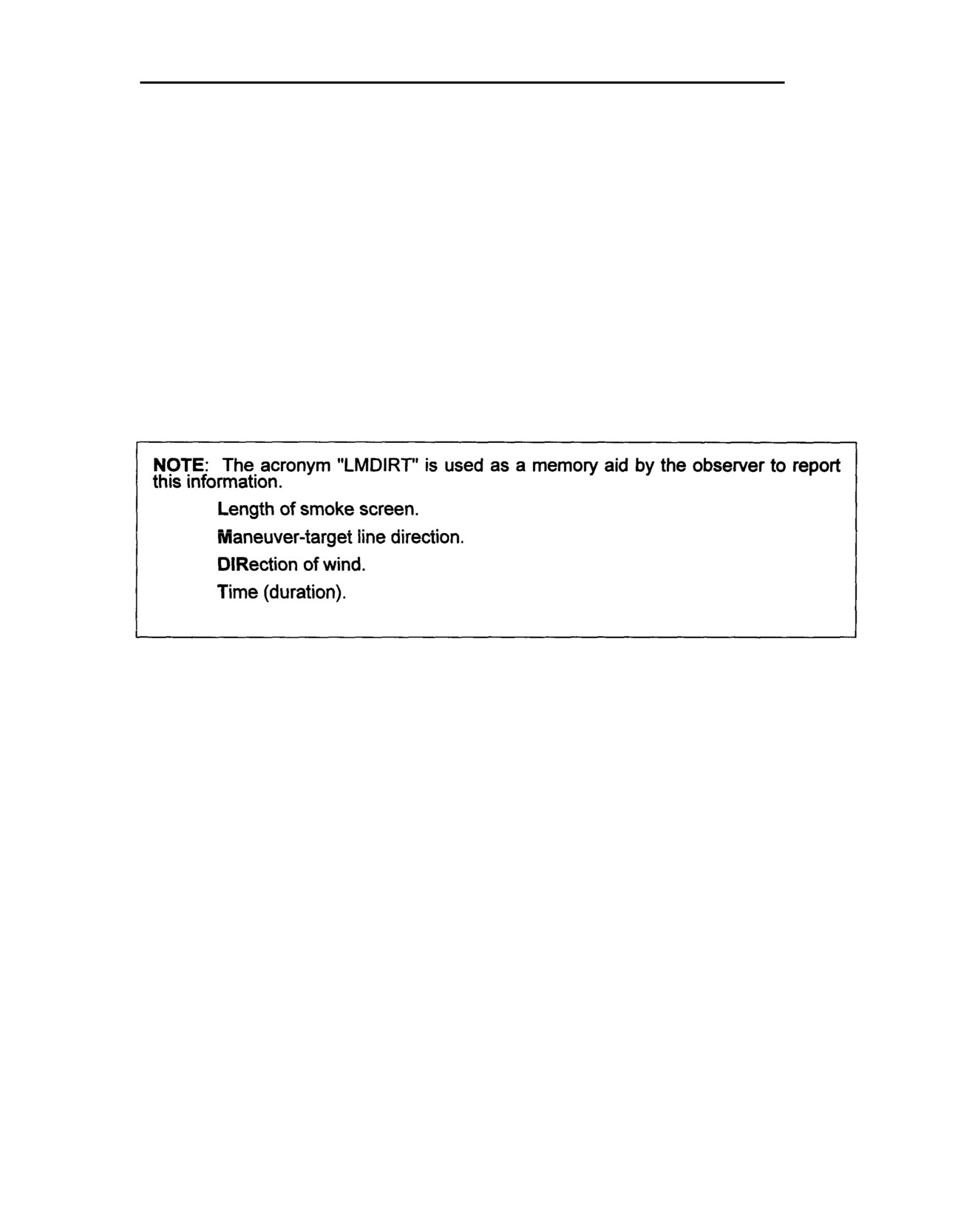
The length of the smoke screen.
The maneuver target (MT) direction. The direction from the point at which the
maneuver element will be most susceptible to enemy observation to the target.
Wind direction in reference to the maneuver target line. The observer must let the
FDC know if the wind is a head wind, tail wind, left crosswind, or right crosswind
in relation to the maneuver target line.
The screen time (duration), in minutes.
c. From the met station, the FDO will need to know the relative humidity for line 00 of
the latest met message. This should be prearranged by unit SOP.
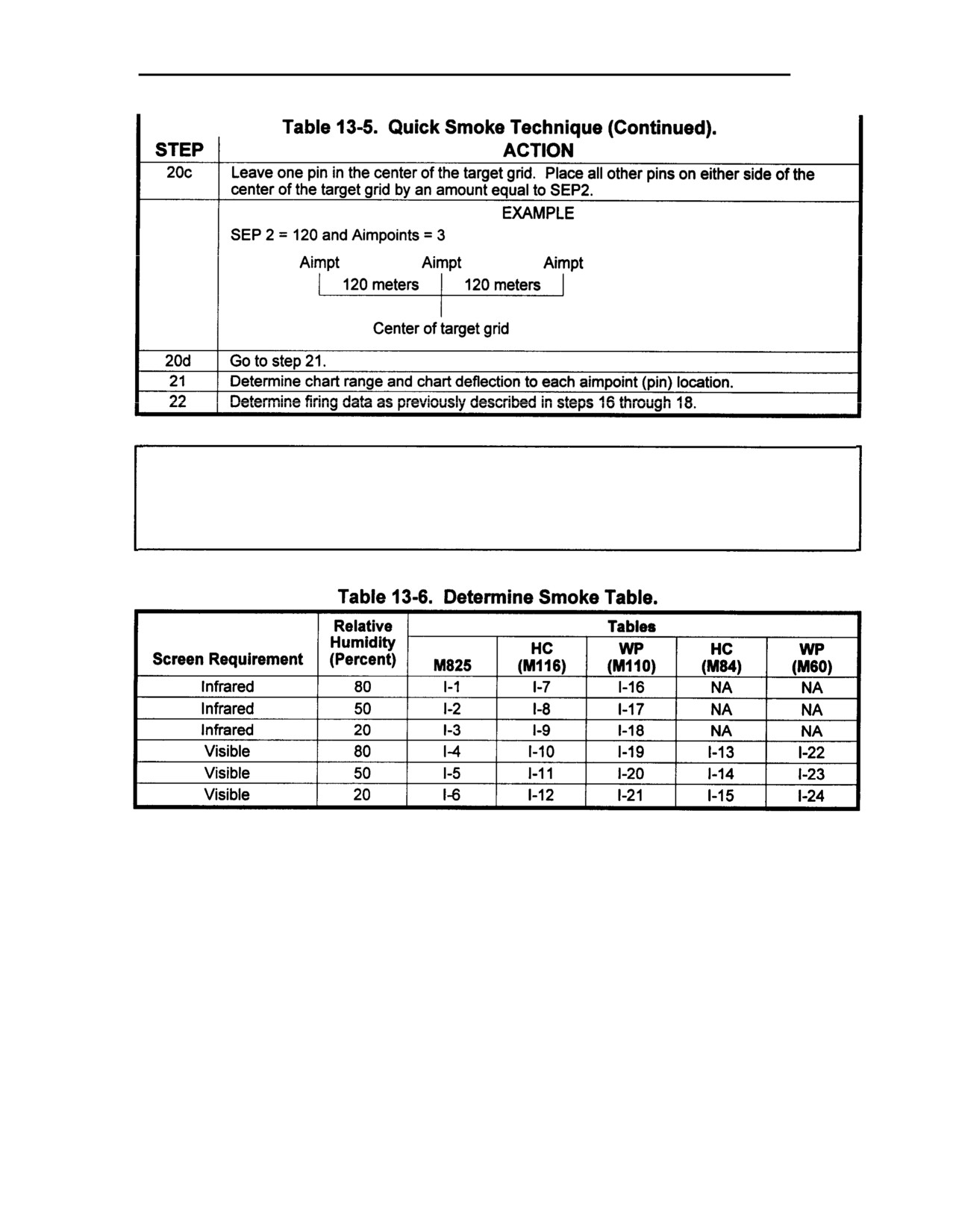
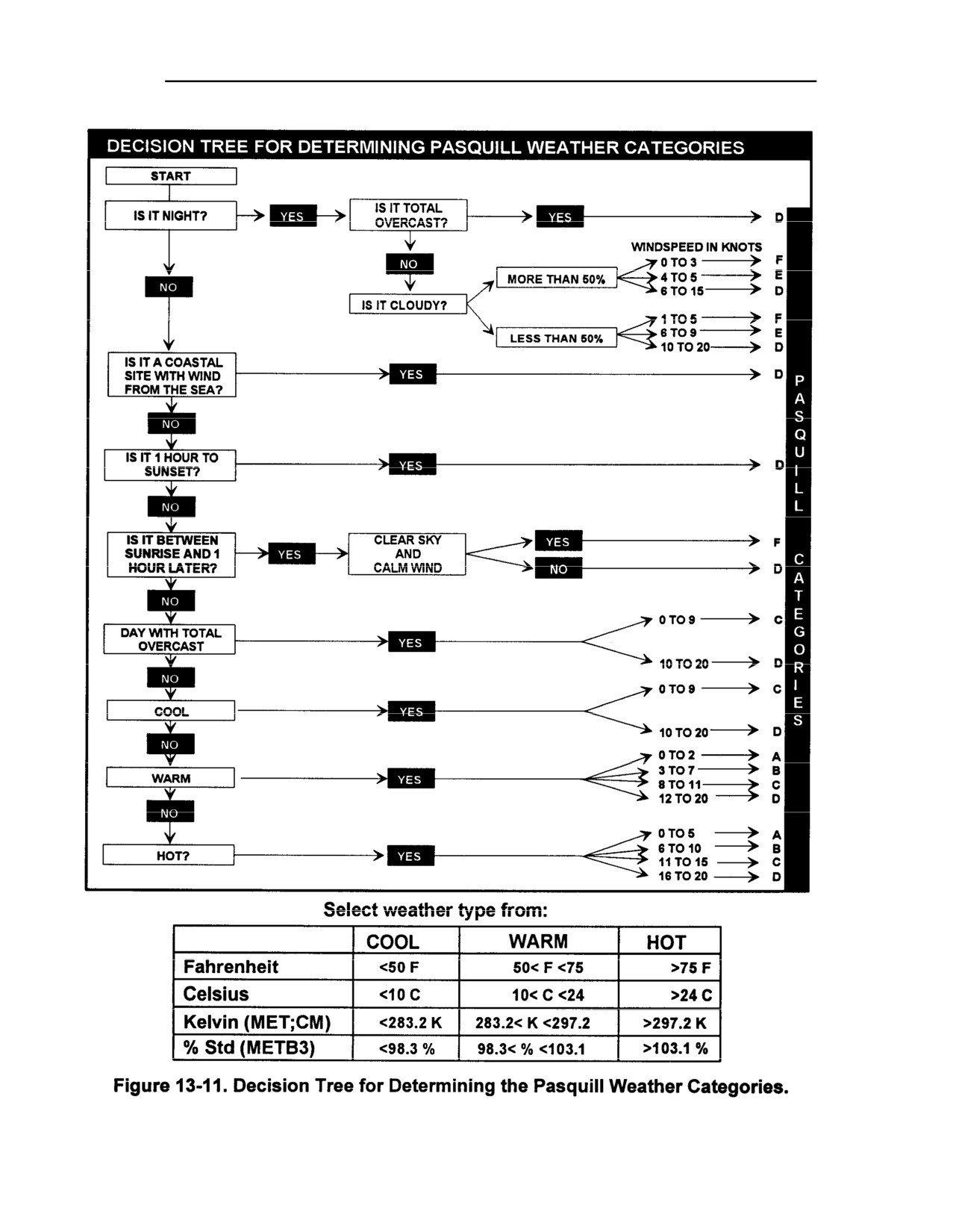
d. When the call for fire is received, the FDO will use a series of tables to
determine the Pasquill weather category, mean wind speed, the number of rounds to fire
to establish the smoke screen (initial rounds), and the number of rounds to fire to
maintain the screen for the desired duration requested (sustainment rounds). If the
number of aimpoints, rounds, or guns exceeds unit capabilities, the FDO will notify
higher headquarters per unit SOP.
e. Once the number of rounds has been determined, the FDO will go through a series of
computations to determine the number of meters between rounds (separation distance) and the
necessary upwind offset corrections.
f. The HCO will plot the center grid of the smoke screen on the firing chart and
will plot the upwind offset correction on the basis of the wind direction, the maneuver
target direction, and the upwind offset correction. He will then plot the aimpoints and
determine chart data to each aimpoint.
13-25
FM 6-40
NOTE: It is necessary to determine individual piece data to each aimpoint. Proper
manual computational procedures entail the use of the Ml 7 plotting board and the
TGPC/Special Correction Worksheet. This must be prepared in advance. Different
aimpoint values for the initial and sustainment volleys would normally require the
computation of two sets of special corrections for each mission. An alternative
method is to plot the aimpoints on the firing chart, and determine firing data for each
howitzer on the basis of the base piece location. When converged sheaf TGPCs
(recomputed for the appropriate sector and already relayed to each gun section)
are applied, the solution approximates the previous method. Errors induced by this
alternate method (that is, because of screen location at other than center of the
TGPC sector) are offset by decreased computational time and complexity and the
nature of the effects of smoke (large area covered per round). This latter method of
computation will be used in this chapter.
g. The computer will determine and announce firing commands for each piece for the
initial and sustainment volleys.
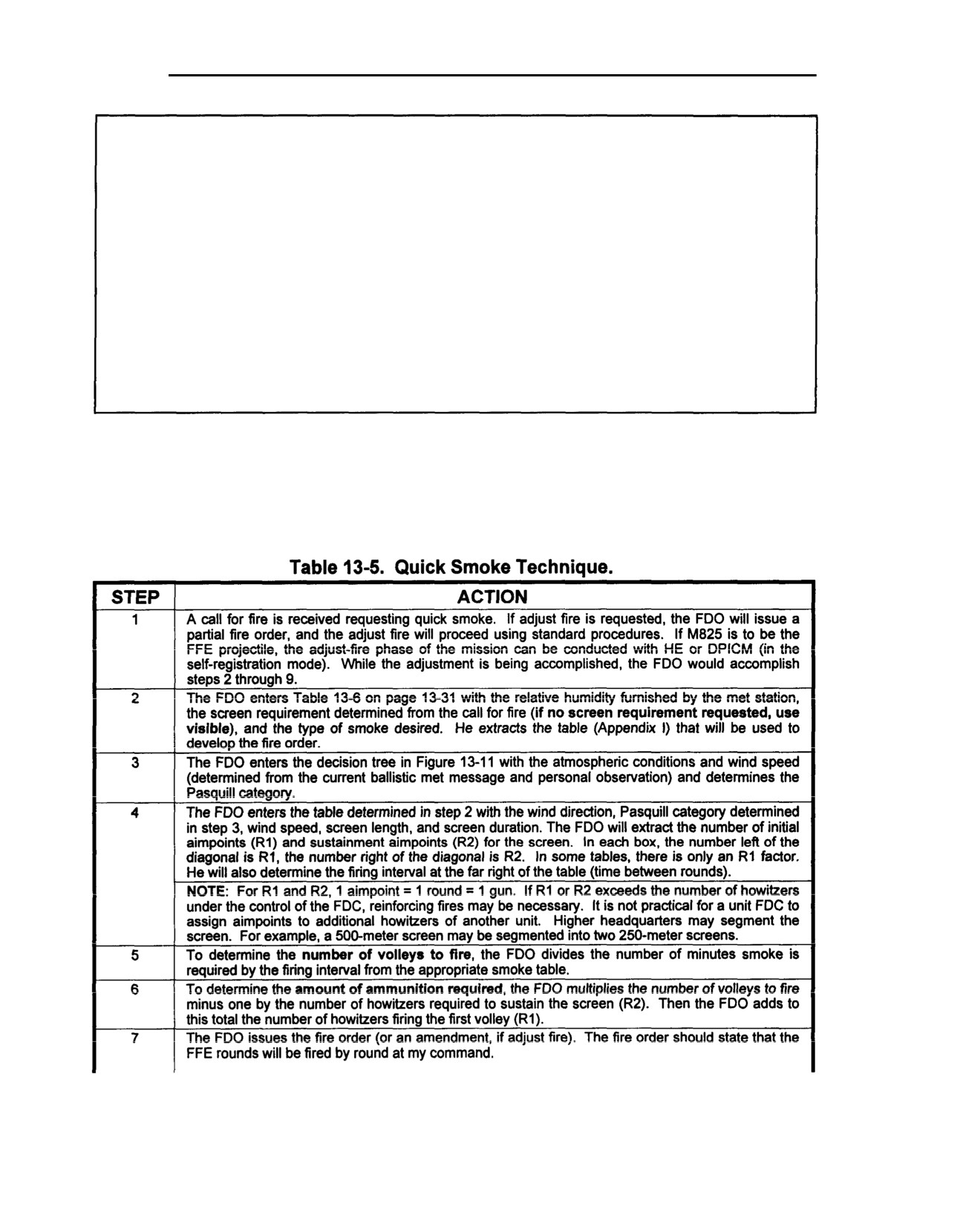
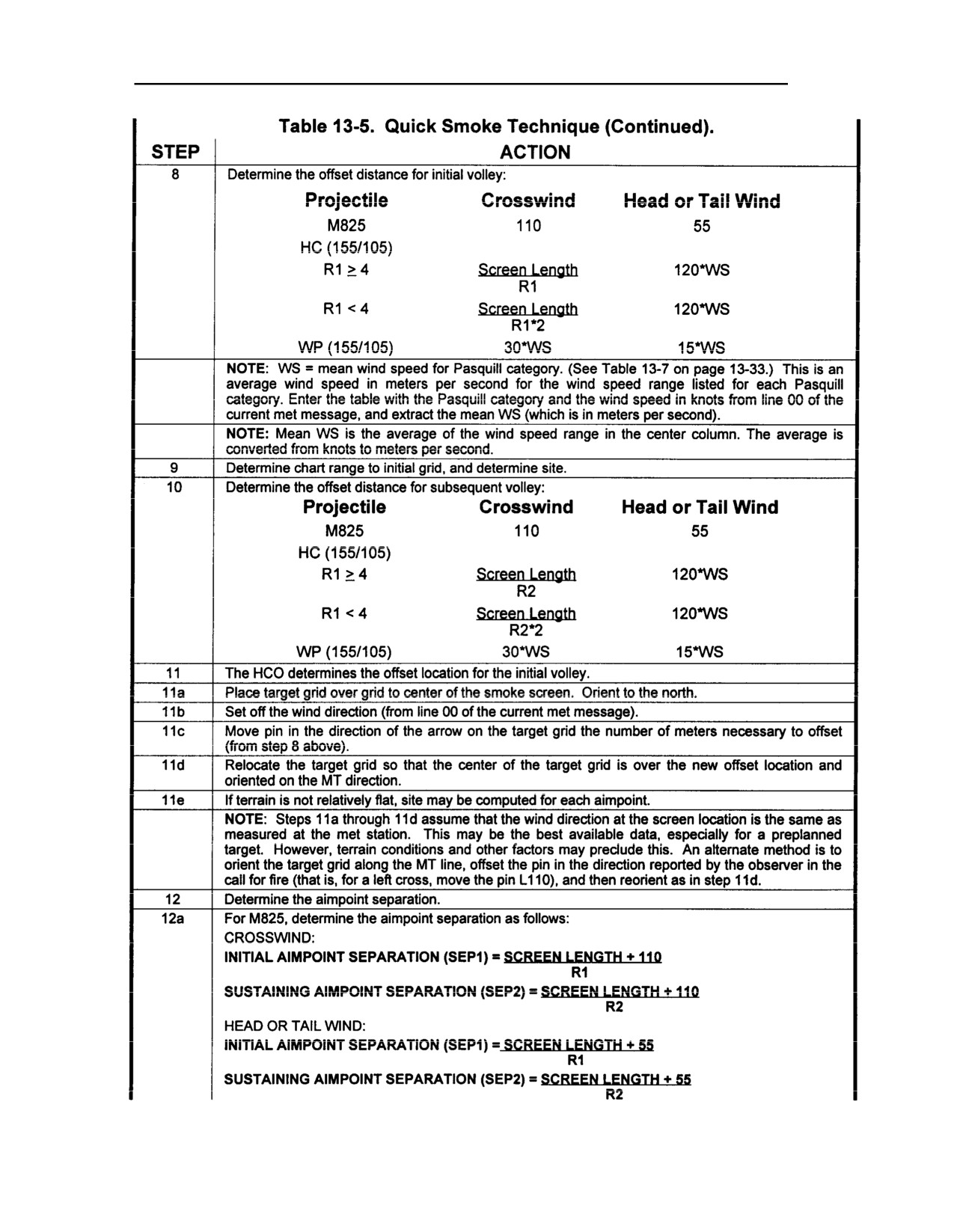
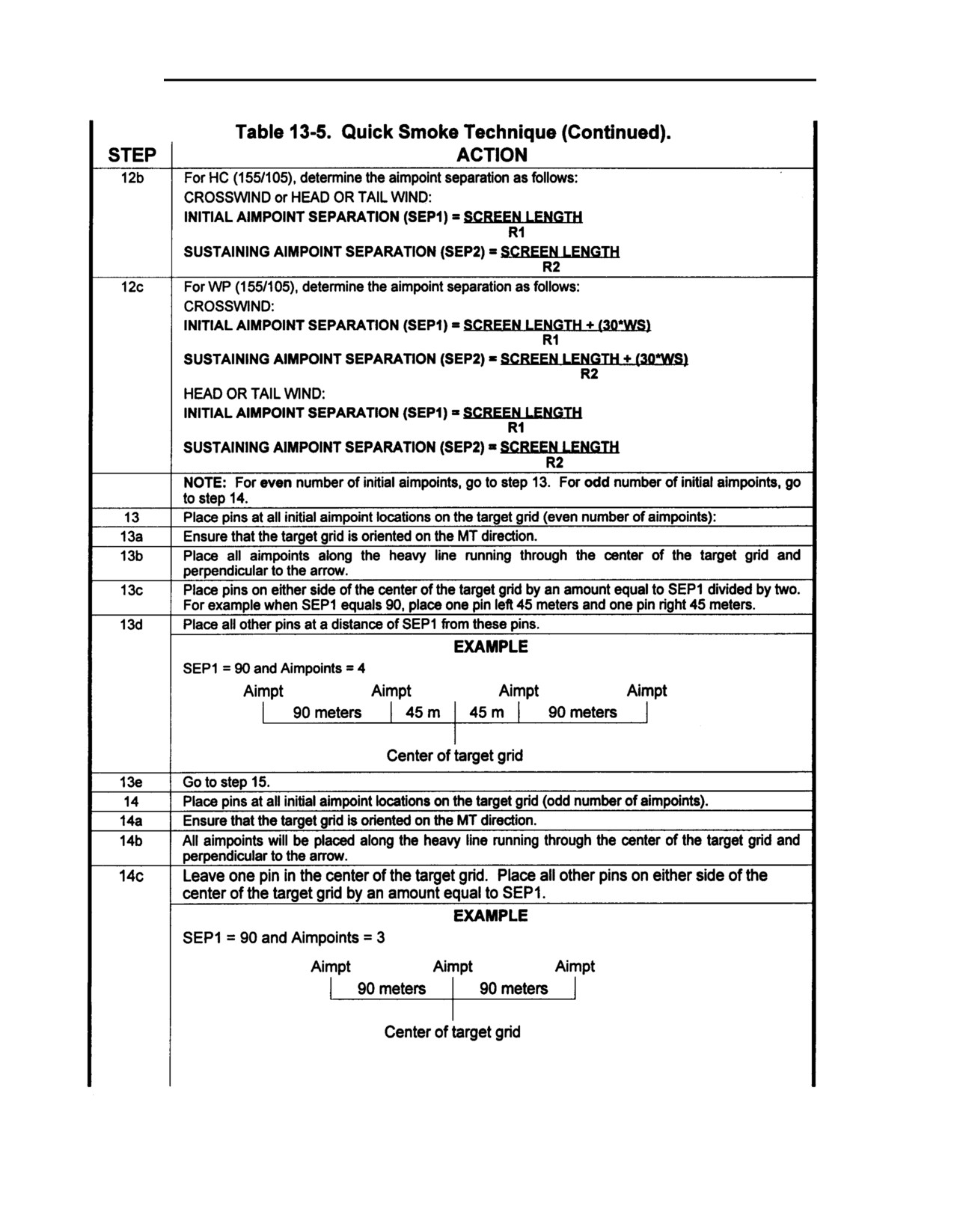
13-20. Quick Smoke Technique
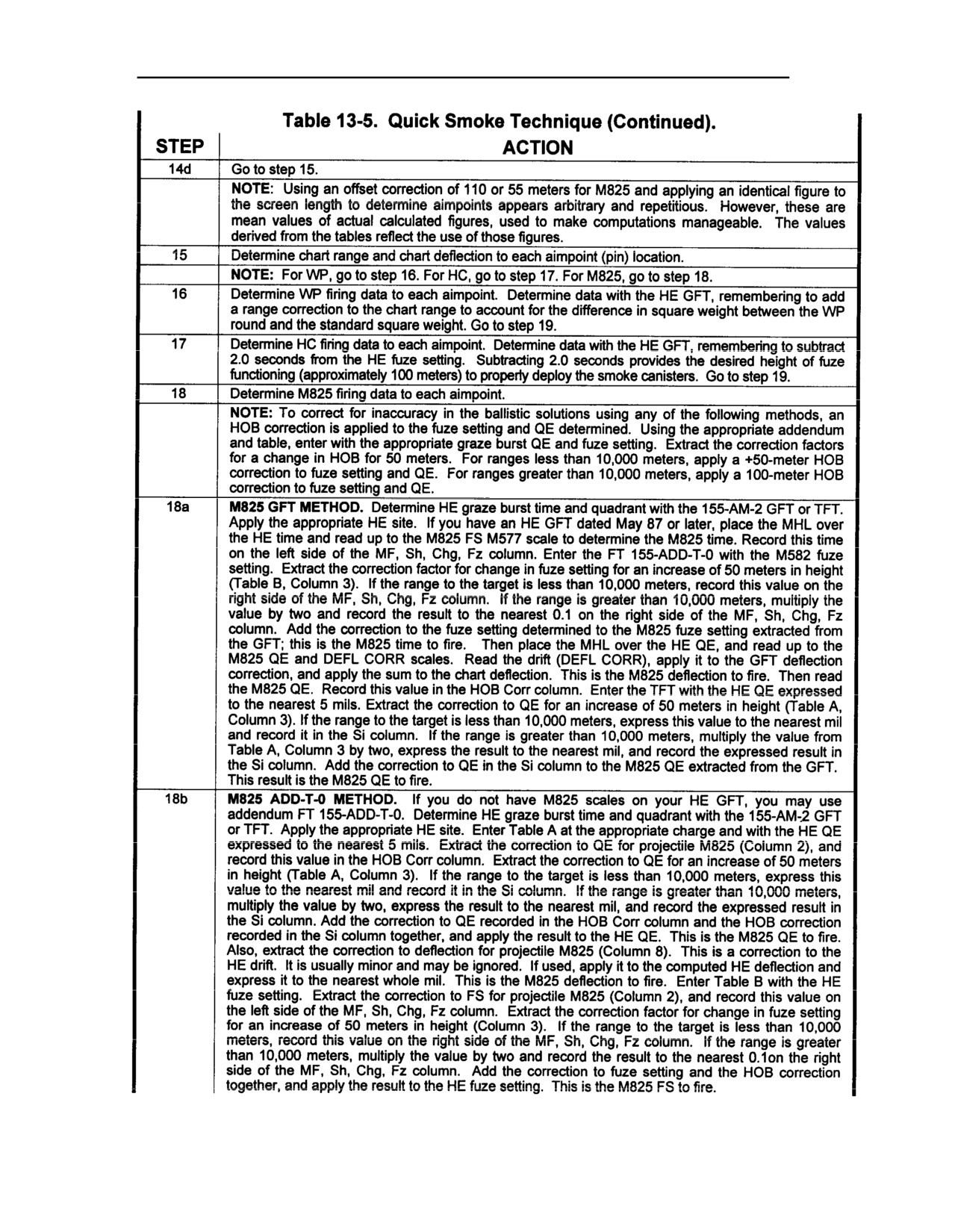
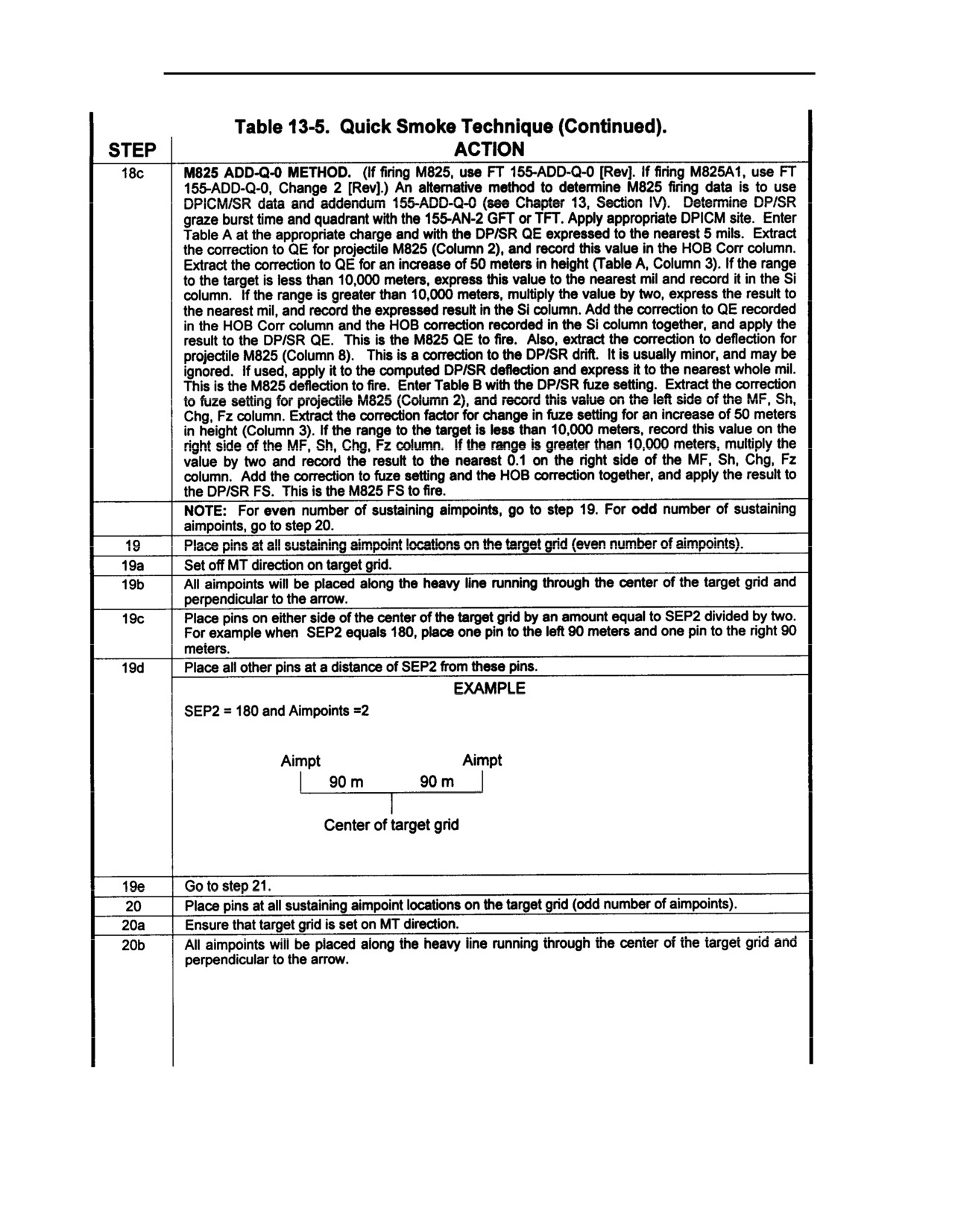
The steps in Table 13-5 are used to determine firing data for the quick smoke technique.
13-26
FM 6-40
13-27
FM 6-40
13-28
FM 6-40
13-29
FM 6-40
13-30
FM 640
NOTE: A study of the RI and R2 factors for HC and WP under poor conditions for
smoke (calm, clear, warm, daylight) reveals an excessive number of aimpoints for a
given screen width. The use of M825 or other means of screening should be
considered in those instances.
13-31
FM 6-40
13-32
FM 6-40
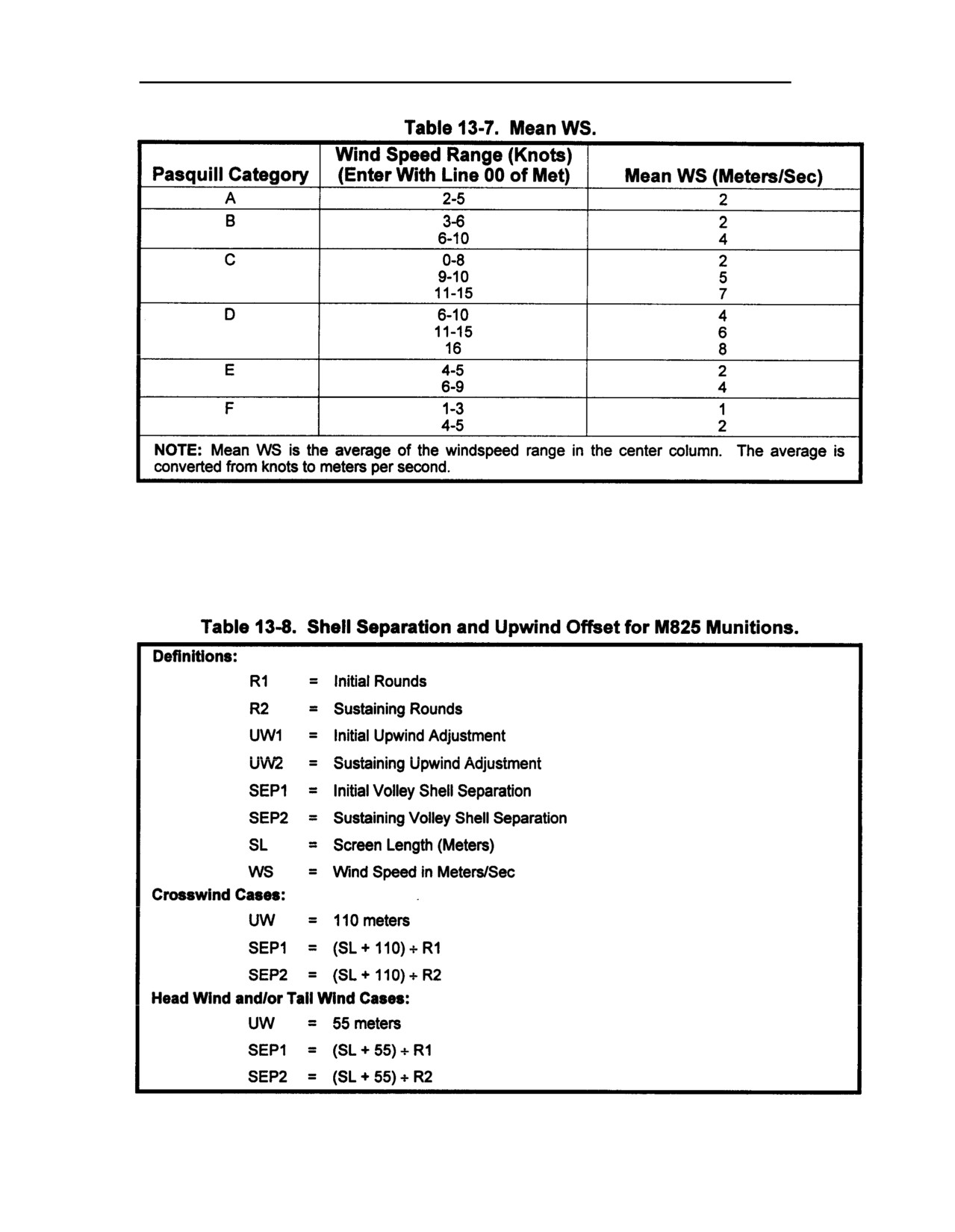
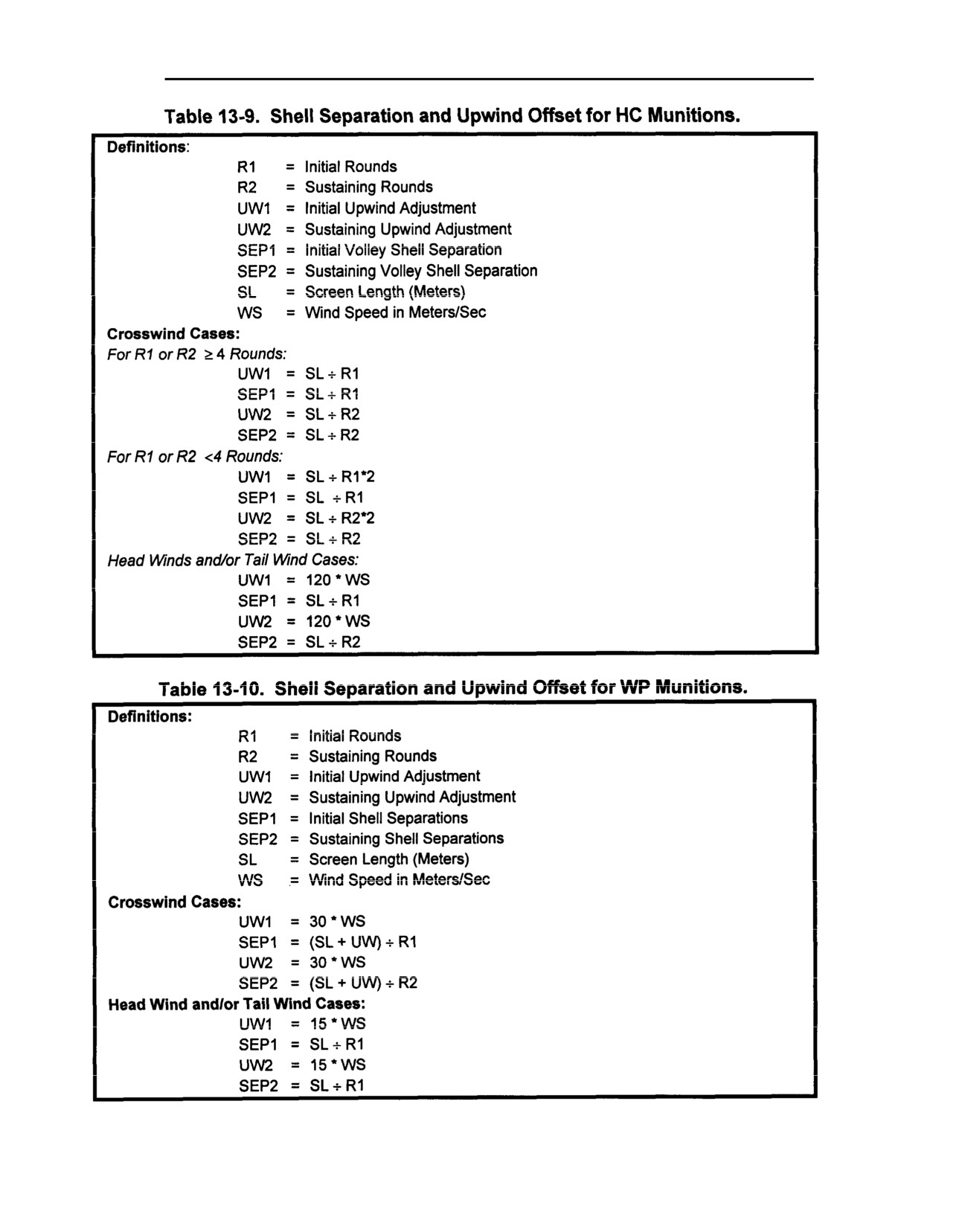
13-21. Smoke Munitions Expenditure Tables and Equations
Smoke munitions (M825, M116, and M110) are used to establish and maintain smoke
screens. The following tables and equations can help you determine data when firing M825,
M116, or M110 smoke munitions. (See Tables 13-8 through 13-10.)
13-33
FM 6-40
13-34
FM 6-40
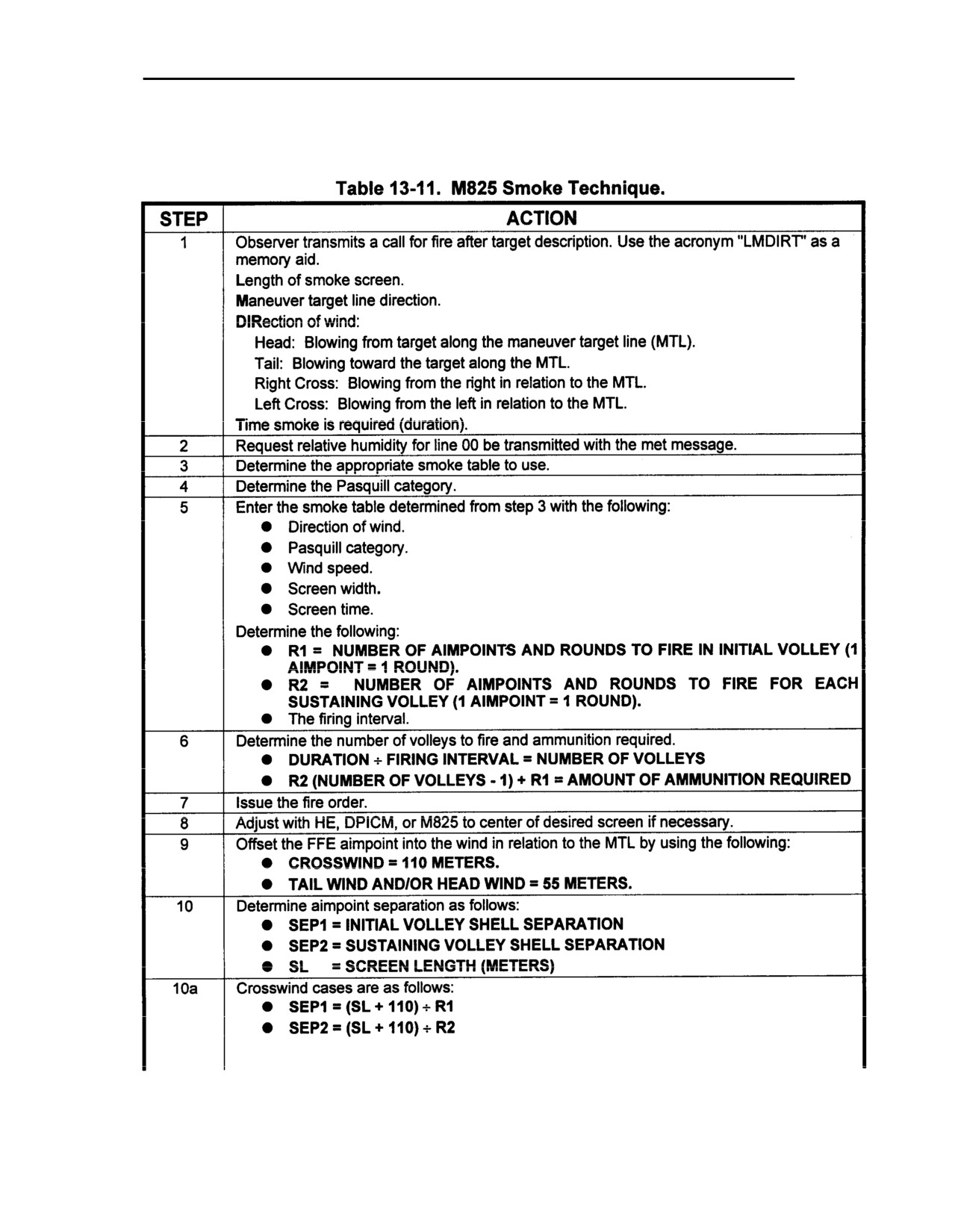
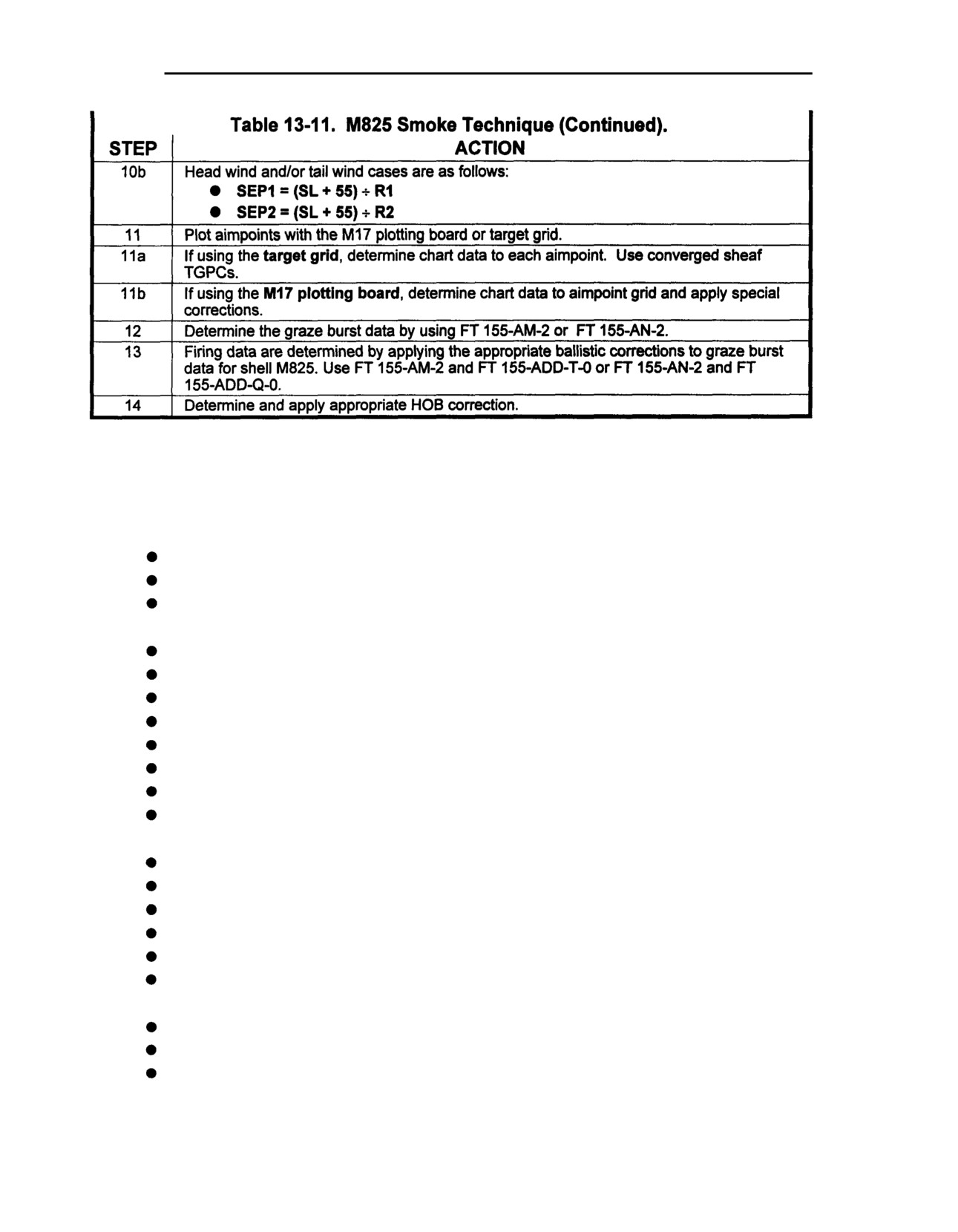
13-22. M825 Smoke Procedures
The steps in Table 13-11 are used to determine firing data for shell M825.
13-35
FM 6-40
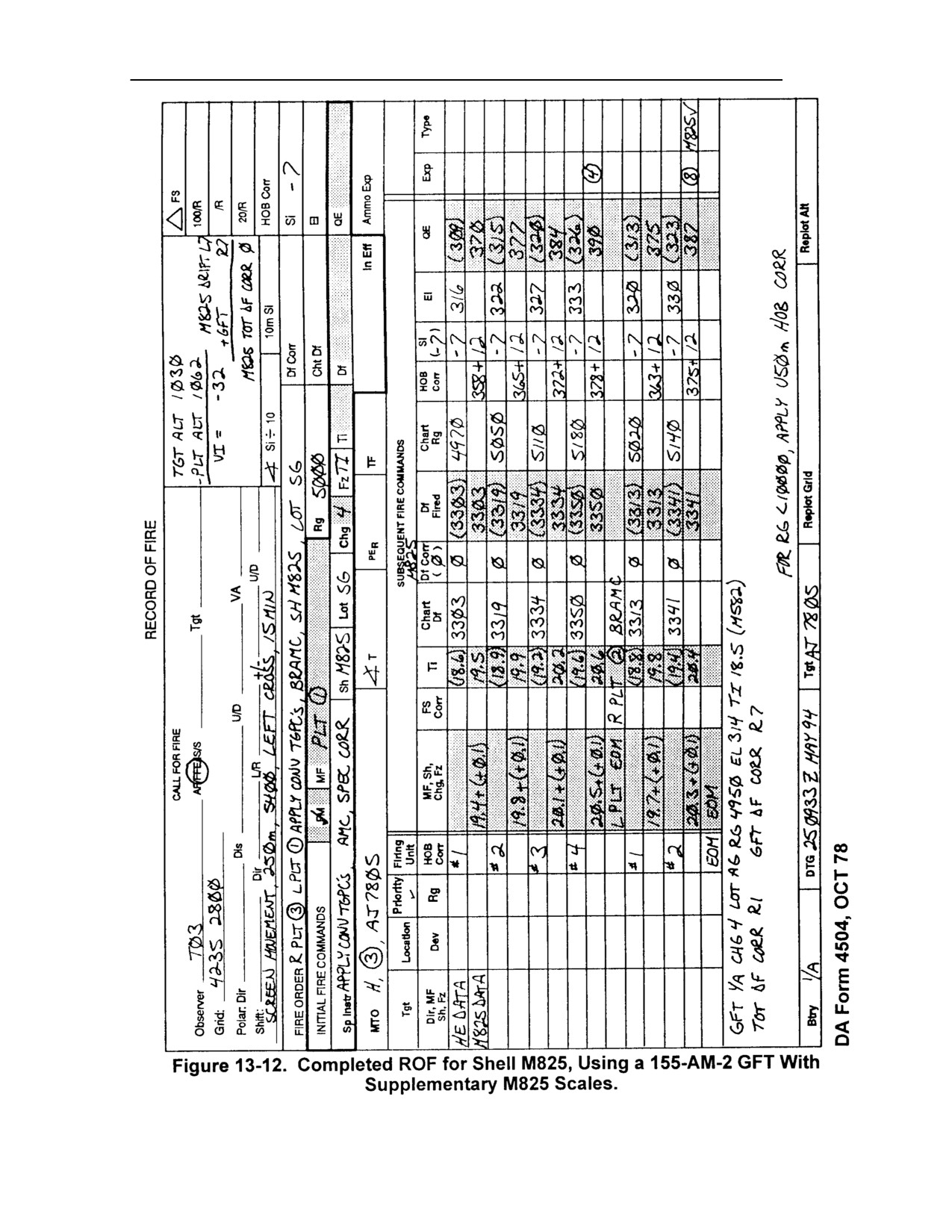
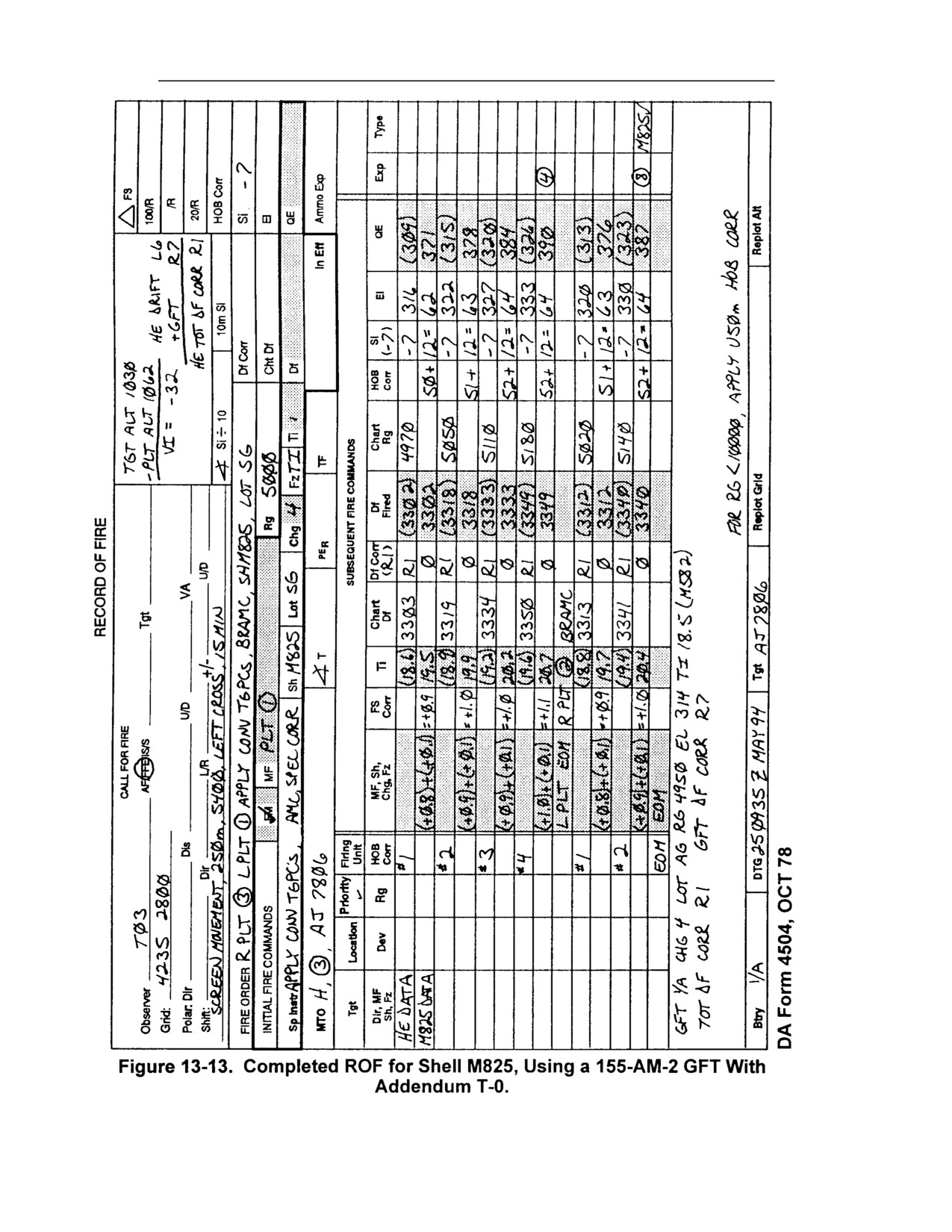
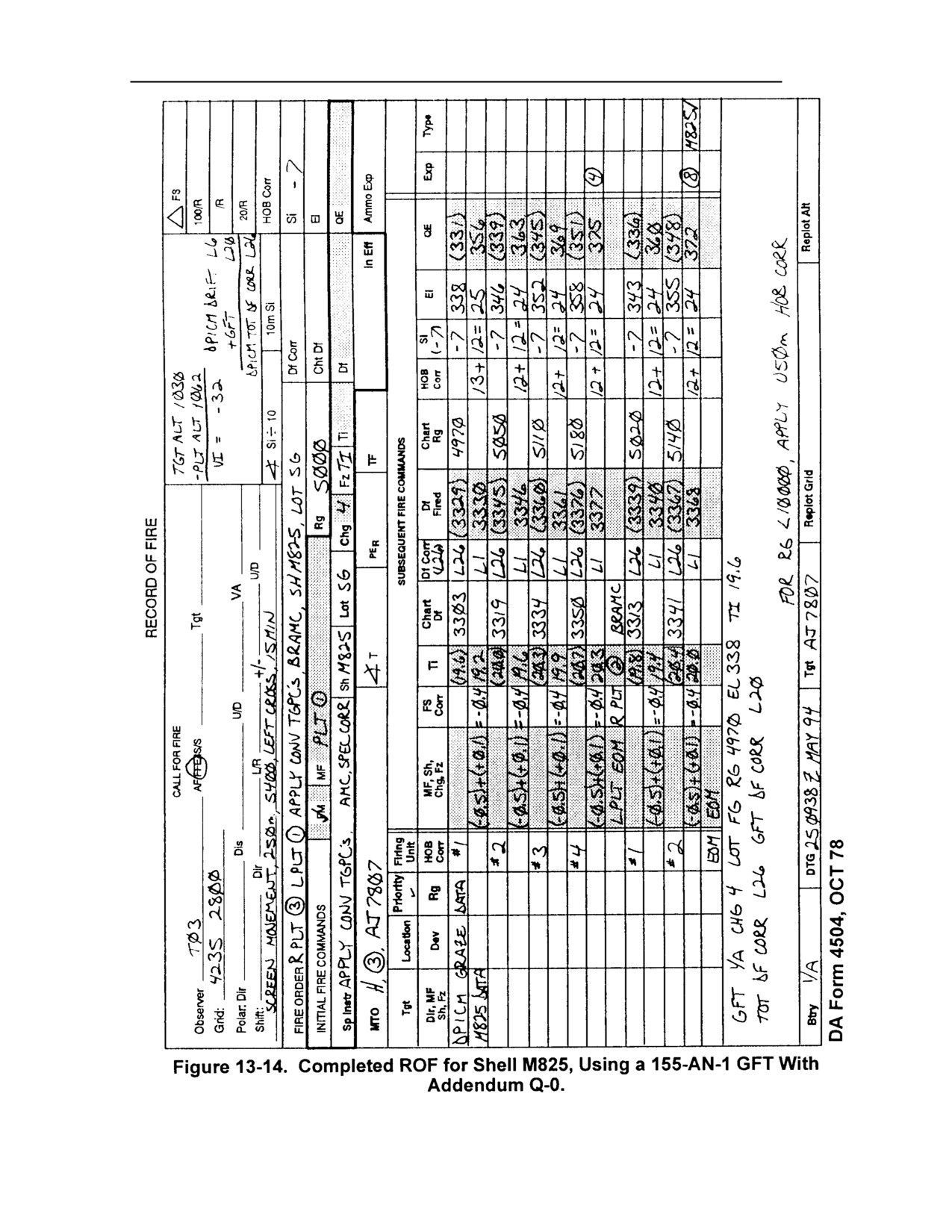
13-23. M825 Examples
The following data are used in the examples shown in Figures 13-12 through 13-14.
Known Data:
Unit: 1/A, four-gun platoon
Azimuth of fire: 4800
Altitude: 1062
Conditions:
Completely overcast afternoon
Wind speed: 10 knots
Humidity: 50 percent
Wind direction: 3900 (left crosswind)
Met line number: 00
Assumed screening: Normal visibility
Screen length: 250 meters
Duration: 15 minutes
Tactical Solution:
Pasquill category: D
Table: I-5
R1:4
R2:2
Firing interval: 5 min
Number of volleys: 15 5 = 3
Aimpoint Separation:
SEP1: 90 meters
SEP2: 180 meters
Offset aimpoint: 110 meters
13-36
FM 6-40
13-37
FM 6-40
13-38
FM 6-40
13-39
FM 6-40
Section IV
Dual-Purpose Improved Conventional Munitions
Dual-purpose improved conventional munitions are base-ejection (155
mm only), payload-carrying projectiles. These projectiles are fired with M577
MT fuzes and are filled with 88 dual-purpose grenades. During flight, the base of
the projectile is blown off and centrlfugal force disperses the grenades radially
from the projectile line of flight.
13-24. Overview
The 155-mm DPICM projectile contains two types of dual-purpose grenades (64 M42 and 24
M46). Both types are capable of penetrating more than 2.5 inches of rolled homogeneous armor. They
are also capable of fragmentation for incapacitating personnel. The M577 MT fuze is preset to
function over the target area and initiate the expulsion charge. The expulsion charge pushes the
grenades out of the container and onto the target area. The projectile can be modified for the SR
mode. The SR mode causes the round to point detonate so as to be visible to the observer and destroy
the submunitions. It also may produce an airburst for high-burst registrations.
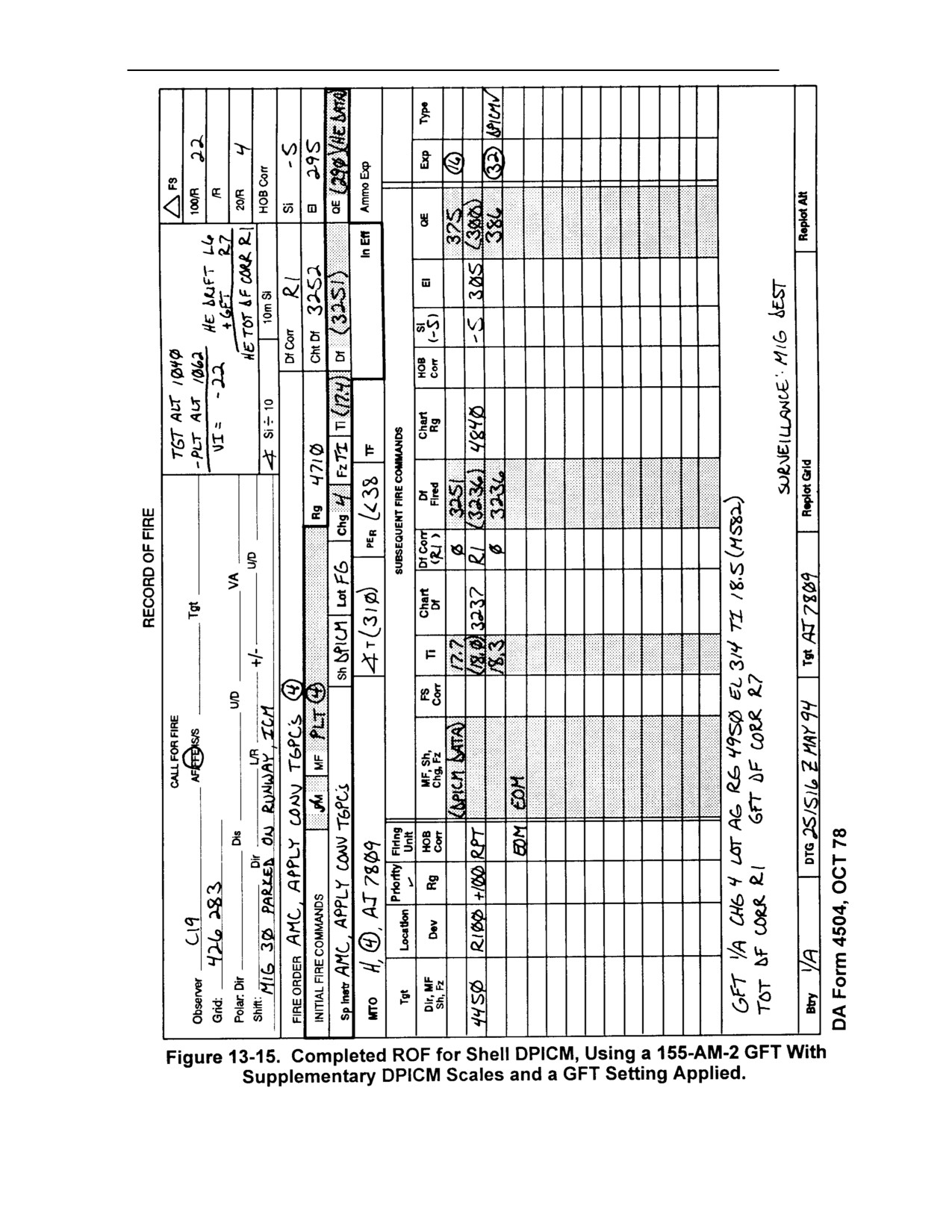
13-25. Determining DPICM Firing Data
a. There are three ways to determine DPICM firing data. The preferred method is to use
the 155-AM-2 GFT with the DPICM scales and a GFT setting. The second way is to use either
the 155-AM-2 GFT without a GFT setting or the FT 155-AM-2 and the addendum for DPICM
(ADD-R-l). The third way is to use the FT 155-AN-2 and the addendum for DPICM (ADD-J-l).
Because the DPICM scales on the 155-AM-2 GFT are based on HE data, HE data from the base
(graze burst) scale must be determined before DPICM data can be determined.
(1) To determine the DPICM fuze setting, you must first determine the HE
fuze setting. Once the HE fuze setting has been determined, move the MHL over the
HE fuze setting on the base scale and read up to the DPICM fuze scale. This is the
DPICM fuze setting. Since DPICM is fired with the M577 fuze, the HE fuze setting
must be determined from the M582 scale.
(2) To determine the DPICM deflection to fire, you must first have the chart
deflection from the HCO. There are three different ways to determine the deflection to fire on
the basis of the type of mission being fired.
(a) If DPICM is the only shell fired during the mission, to include the
adjustment and fire for effect phases, or if a straight FFE mission was conducted, the drift is
taken from the DPICM scale instead of the HE base scale. The MHL is placed over the HE QE
on the base HE EL scale. Read up to determine the proper value for drift on the DPICM scale.
This drift will be used throughout the remainder of the mission.
(b) If HE is used in the adjust-fire phase and DPICM is used to fire for effect,
then as soon as the type of shell is changed (HE to DPICM) a new value for drift must be
determined from the DPICM drift scale. This drift will be determined by placing the MHL over
the HE QE on the base scale and then reading up to the DPICM drift scale. Compare this
DPICM drift to the HE drift to determine the change in drift (DPICM DRIFT - HE DRIFT=
CHANGE IN DRIFT). This change in drift is applied to the HE deflection fired (not to be
13-40
FM 6-40
confused with the chart deflection) to determine the DPICM deflection. Another method is to use
DPICM DRIFT+ GFT DF CORR + CHART DF = DPICM DF TO FIRE.
(c) The last method is to use the appropriate addendum. As soon as the
projectile changes, go to the addendum and extract the drift correction from Table A, Column 8.
Take this new drift correction, express it to the nearest mil, and add it to the HE deflection fired
so that anew DPICM deflection can be determined for this mission.
(3) To determine the DPICM QE, first determine the HE QE. Place the MHL over the
HE QE on the base HE EL scale. Now read up to the DPICM QE scale, and determine the QE to fire.
(4) To determine HOB corrections for DPICM, we must use the ADD-R-1. Table
A is used to determine the correction factor that will be applied to the QE. Table B is used to
determine the correction factor that will be applied to the fuze setting. Remember, the HE data
are used to enter the tables, but the correction factors extracted are applied to the DPICM data.
b. To determine firing data without a GFT setting for DPICM, use the 155-AM-2 GFT
or the FT 155-AM-2 and the ADD-R-1. This procedure is valid for low-angle fire only.
(1) Using the proper charge and range, begin by determining HE data from the FT
155-AM-2, Table F. Elevation is extracted from Column 2, the fuze setting is extracted from
Column 7 (M582), and the drift that will be added to the chart deflection is in Column 8. Site is
computed in the normal way and then algebraically added to the elevation.
(2) Once the base HE data have been determined, the ballistic corrections to
compensate for the DPICM projectile need to be extracted from the ADD-R-1. Table A of the
appropriate charge will yield corrections for QE and deflection. Table A is entered with the HE
QE expressed to the nearest listed value. Column 2 will yield the correction factor that must be
added to the HE QE to determine the DPICM QE. Column 8 has the deflection correction that
must be applied to the HE deflection (chart deflection plus drift) before firing. Table B contains
the correction factor that will be applied to the HE fuze setting. Enter Table B with the HE fuze
setting, and extract the fuze correction. Apply this correction to the HE fuze setting to determine
the DPICM fuze setting.
(3) The HOB of the DPICM projectile is dependent on the charge fired. If the
observer transmits a request for an HOB correction, the ADD-R-1 will be used to determine the
correction factors that must be applied to the DPICM fuze setting and QE. Table A, Column 3,
of the appropriate charge will yield the correction factor for a 50-meter change in HOB. Multiply
the correction factor by the number of 50-meter increments needed. Express the answer to the
nearest mil. Apply the HOB correction to the DPICM QE. If it was an up correction, add the
HOB correction to the DPICM QE; if it was a down correction, subtract the HOB correction from
the DPICM QE. Table B, Column 3, of the appropriate charge will yield the FS correction for a
50-meter change in HOB. Multiply the correction factor by the number of 50-meter increments
needed. Express the answer to the nearest FS increment. Apply the HOB correction to the
DPICM fuze setting. If it was an up correction, add the HOB correction to the DPICM fuze
setting; if it was a down correction, subtract the HOB correction from the DPICM fuze setting.
c. To determine firing data without a GFT setting for DPICM, use the FT 155-AN-2 and
the ADD-J-1. This procedure is valid for low-angle fire only.
(1) Begin by determining DPICM graze burst data from the FT 155-AN-2, Table F,
by using the proper charge and range. Elevation is extracted from Column 2, the graze burst fuze
setting is extracted from Column 3 (M577), and the drift that will be added to the chart deflection
13-41
FM 6-40
is extracted from Column 8. Site is computed manually or by using the 155-AN-1 GST and then
algebraically adding it to the elevation.
(2) Once the graze burst DPICM data have been determined, the ballistic
corrections to compensate for the HOB of the DPICM projectile need to be extracted from the
ADD-J-1. Table A of the appropriate charge will yield the corrections for QE. Table A is
entered with the DPICM graze burst QE expressed to the nearest listed value. Column 2 will
yield the correction factor that must be added to the DPICM graze burst QE so that the actual
DPICM QE can be determined. Table B contains the correction factor that will be applied to the
DPICM graze burst fuze setting. Enter Table B with the DPICM graze burst fuze setting, and
extract the fuze correction. Apply this correction to the DPICM graze burst fuze setting so that
the actual DPICM fuze setting can be determined.
(3) If during the course of a fire mission an HOB correction is sent to the FDC for
shell DPICM, the ADD-J-1 will be used to determine the correction factors that must be applied
to the DPICM fuze setting and QE. Table A, Column 3, of the appropriate charge will yield the
correction factor for a 50-meter change in HOB. Multiply the correction factor by the number of
50-meter increments needed. Express the answer to the nearest mil. Apply the HOB correction
to the DPICM QE. If it was an up correction, add the HOB correction to the DPICM QE; if it
was a down correction, subtract the HOB correction from the DPICM QE. Table B, Column 3,
of the appropriate charge will yield the FS correction for a 50-meter change in HOB. Multiply
the correction factor by the number of 50-meter increments needed. Express the answer to the
nearest FS increment. Apply the HOB correction to the DPICM fuze setting. If it was an up
correction, add the HOB correction to the DPICM fuze setting; if it was a down correction,
subtract it from the DPICM fuze setting.
NOTE: APICM data can be determined in a similar manner. The preferred method
is to use the 155-AM-2 GFT with the APICM scales and a GFT setting. The other
way is to use the 155-AM-2 GFT without a GFT setting or the FT 155-AM-2 and the
addendum for APICM (ADD-l-2).
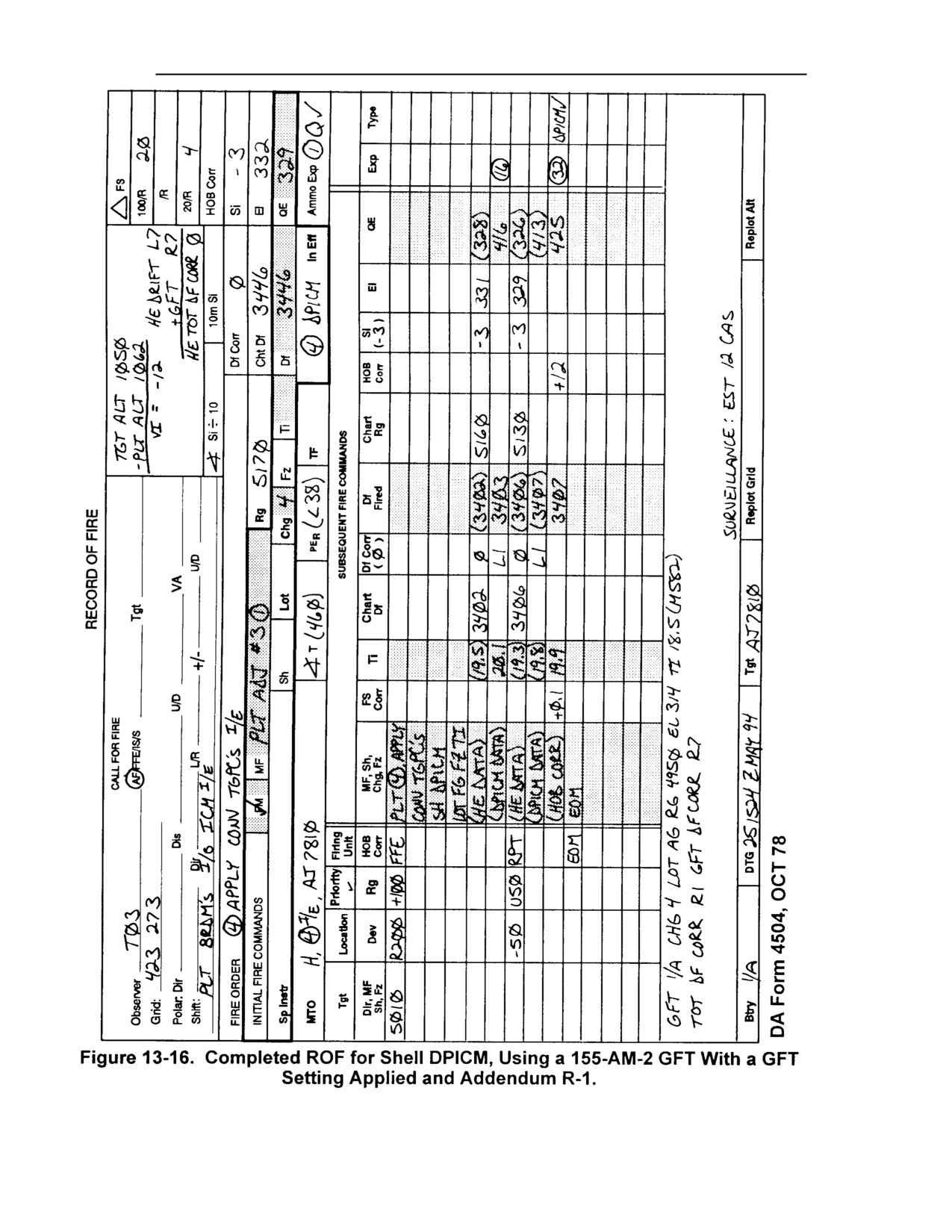
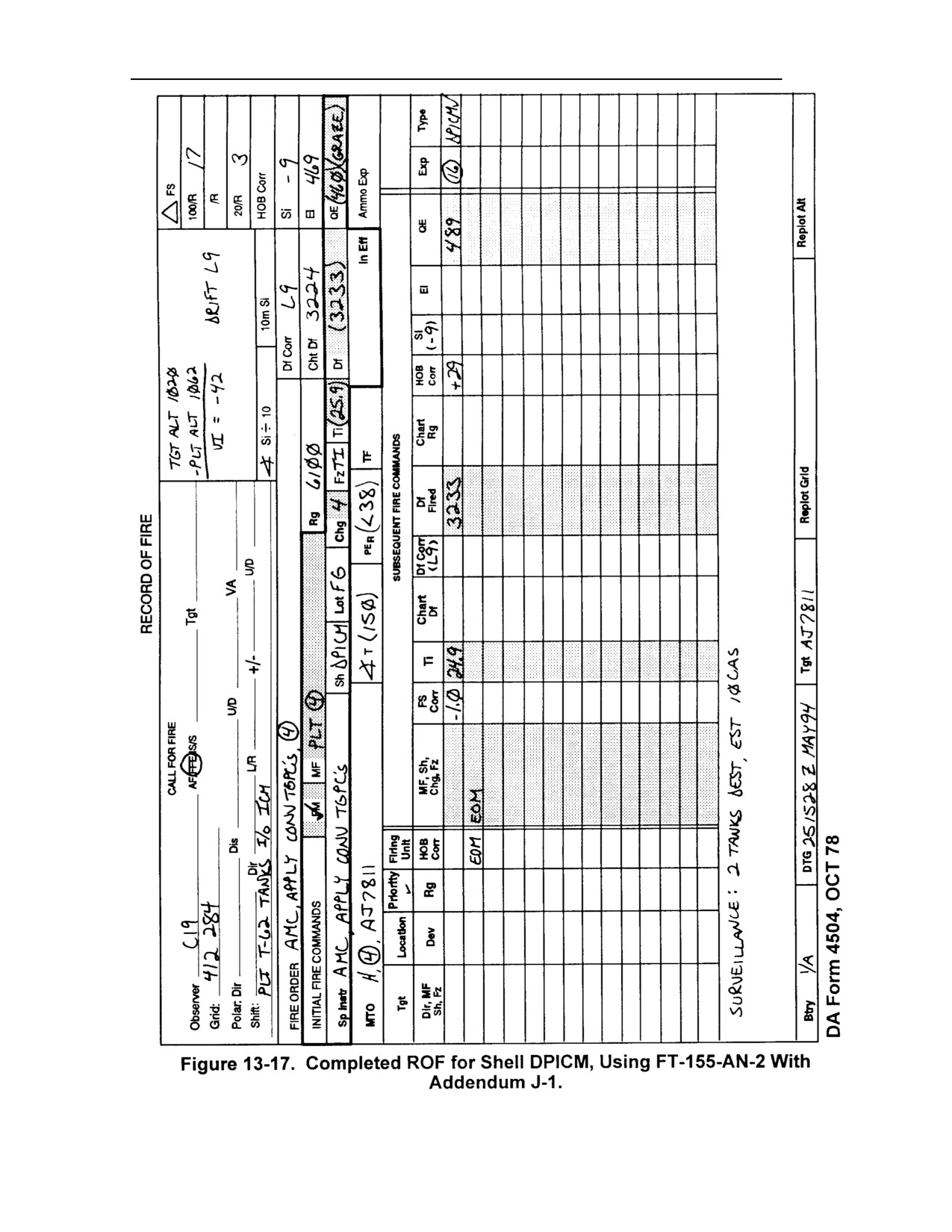
d. Figures 13-15 through 13-17 show completed ROFs for all three methods of
determining firing data for shell DPICM.
13-42
FM 6-40
13-43
FM6-40
13-44
FM 6-40
13-45
FM 6-40
Section V
Family of Scatterable Mines
This section implements STANAG 2963 and QSTAG 802.
The family of scatterable mines adds new dimension to mine warfare,
providing the maneuver commander with a rapid, flexible means of delaying,
harassing, paralyzing, canalizing, or wearing down the enemy forces in both
offensive and defensive operations. Mines can force the enemy into kill zones,
change their direction of attack, spend time in clearing operations, or take evasive
actions. FASCAM presents an array of air and FA-delivered scatterable mines
available to maneuver force commanders. The two types of FA-delivered
scatterable mines are ADAM and RAAMS.
13-26. Types of Scatterable Mines
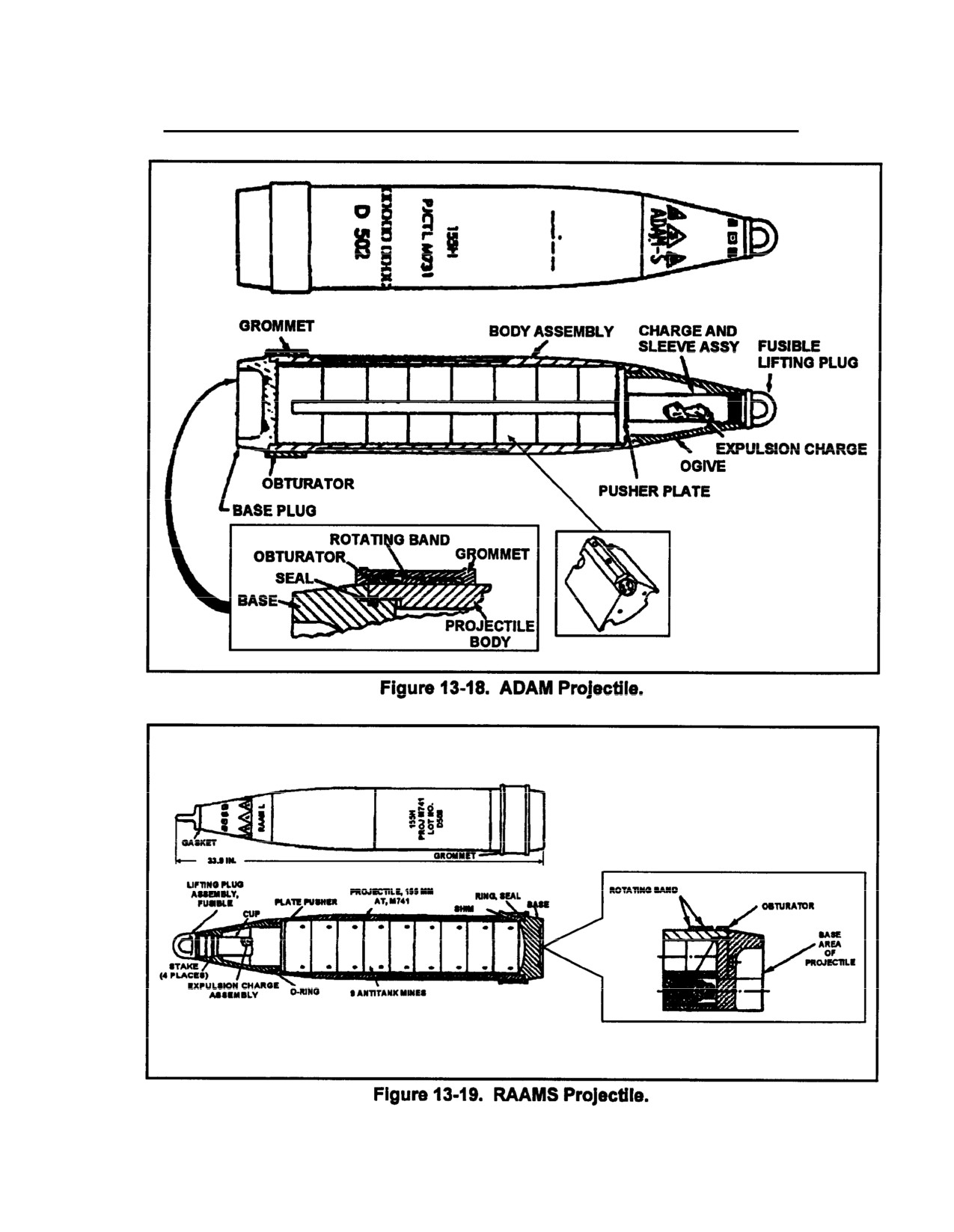
a. ADAM is an antipersonnel mine activated by deployed trip lines. There are 36
wedge-shaped mines contained in the 155-mm projectile. Minefield density can be selectively
determined by altering the number of rounds applied. There are currently three densities: low,
medium, and high. The mines are expelled from the projectile (approximately 600 meters) over
the designated target. Shortly after ground impact, up to seven trip line sensors are released out
to a maximum length of 20 feet. The detonators are armed to fiction in the event of any small
disturbance. The ADAM mine has lethality out to 15 feet. Self-destruct times are 4 hours for
short self-destruct (M731 ) and 48 hours for long self-destruct (M692). Figure 13-18 shows an
ADAM projectile.
b. RAAMS is effective against armored vehicles. The mines are expelled from the rear
of the projectile over the target. After ground impact and roll, the mine is armed and ready to
detonate upon sensing a proper armored vehicle signature (electromagnetic). A percentage of the
nine RAAMS mines are equipped with an antidisturbance device. RAAMS is highly effective
when used in conjunction with the ADAM mine, which helps prevent neutralization by enemy
ground troops. There are nine RAAMS mines per 155-mm projectile. Minefield densities and
self-destruct times are the same as ADAM (M741 short-destruct, M718 long-destruct). Figure
13-19 shows a RAAMS projectile.
13-46
FM 6-40
13-47
FM 6-40
13-27. FASCAM Tactical Considerations and Fire Order Process
a. Two types of minefields can be developed with FASCAM--planned minefield and
target of opportunity minefields.
(1) Planned minefields begin with the development of the scheme of maneuver and
then the barrier and/or obstacle plan by the G3 and/or S3 and engineer. Before deciding on the
employment of ADAM and/or RAAMS, the FSCOORD is brought into the planning process to
provide guidance on the availability of FA mines and delivery units. The process is then initiated
with the DA Form 5032-R (Field Artillery Delivered Minefield Planning Sheet).
(2) Minefields employed against targets of opportunity (unplanned) must be
emplaced immediately because of the tactical nature of the targets. They are requested through
the fire support channels at any level. Once the maneuver brigade or division commander has
approved the use of FA mines, they can be emplaced appropriately. Normally, targets of
opportunity are used when the delivery of the mines can be observed. Aimpoints for target of
opportunity minefields can be computed as in a planned minefield. However, this will be
time-consuming and may not meet the demands of the tactical situation. Therefore, it is
recommended that units establish an SOP for a “standard minefield” to fire when the tactical
situation requires an immediate minefield. For example, the unit SOP may be for a 400 x 400
minefield, high angle, medium density, with two aimpoints. The SOP will allow FSOs to
determine the number of target of opportunity minefields that are available for the maneuver
commander. This determination is based on the unit’s FASCAM unit basic load (UBL).
b. Upon receiving a request for a FASCAM minefield, the FDO must begin a detailed
process to determine the fire order. The first thing that the FDO must understand is that
FASCAM employment is based on a concept known as planning modules. The planning module
for RAAMS low angle is 200 meters x 200 meters. The planning module for RAAMS high angle
and for ADAM low or high angle is 400 meters x 400 meters. This does not mean that the
minefield planner cannot request a minefield that is larger than the planning module. In any
FASCAM minefield, the requesting agency defines the minefield size in terms of the length,
width, and attitude. The length of the minefield is always the longest axis. The concept of the
planning modules is based on the minefield width. In other words, the width of all minefields
must be in multiples of the planning module defined above. The FDO will use the length, width,
and planning module to determine the number of linear sheafs required to establish the required
minefield. The linear sheafs will evenly divide each module and will be parallel to the long axis
(length) of the minefield. Refer to paragraph (13) for an example that illustrates this concept.
(1) Once the call for fire on a DA Form 5032-R is received, the FDO will plot the
target. In FASCAM missions, DPICM graze burst data, battery-minefield angle (BMA), angle of
fire, number of aimpoints, and the desired minefield density must be determined before issuing
the fire order.
(2) Plot the minefield linear sheaf, determine the minefield center point of each
linear sheaf, and determine the chart range and deflection to the minefield center point(s).
Record the chart range and chart deflection on the ROF.
(3) Determine DPICM graze burst data to the center point computed in (2) above.
For RAAMS only, determine chart range. For ADAM, determine chart range and DPICM QE.
(4) Determine the battery minefield angle. The BMA is defined as the smaller
angle formed by the intersection of the attitude of the minefield and the GT line with the vertex at
13-48
FM 6-40
the center point of the minefield. Using the target grid, set off the minefield attitude and with the
vertex at the battery or platoon location, place the RDP against the center point. The smaller
interior angle is the BMA. BMA is always less than 1,600 mils. Record this in the computation
block of the ROF.
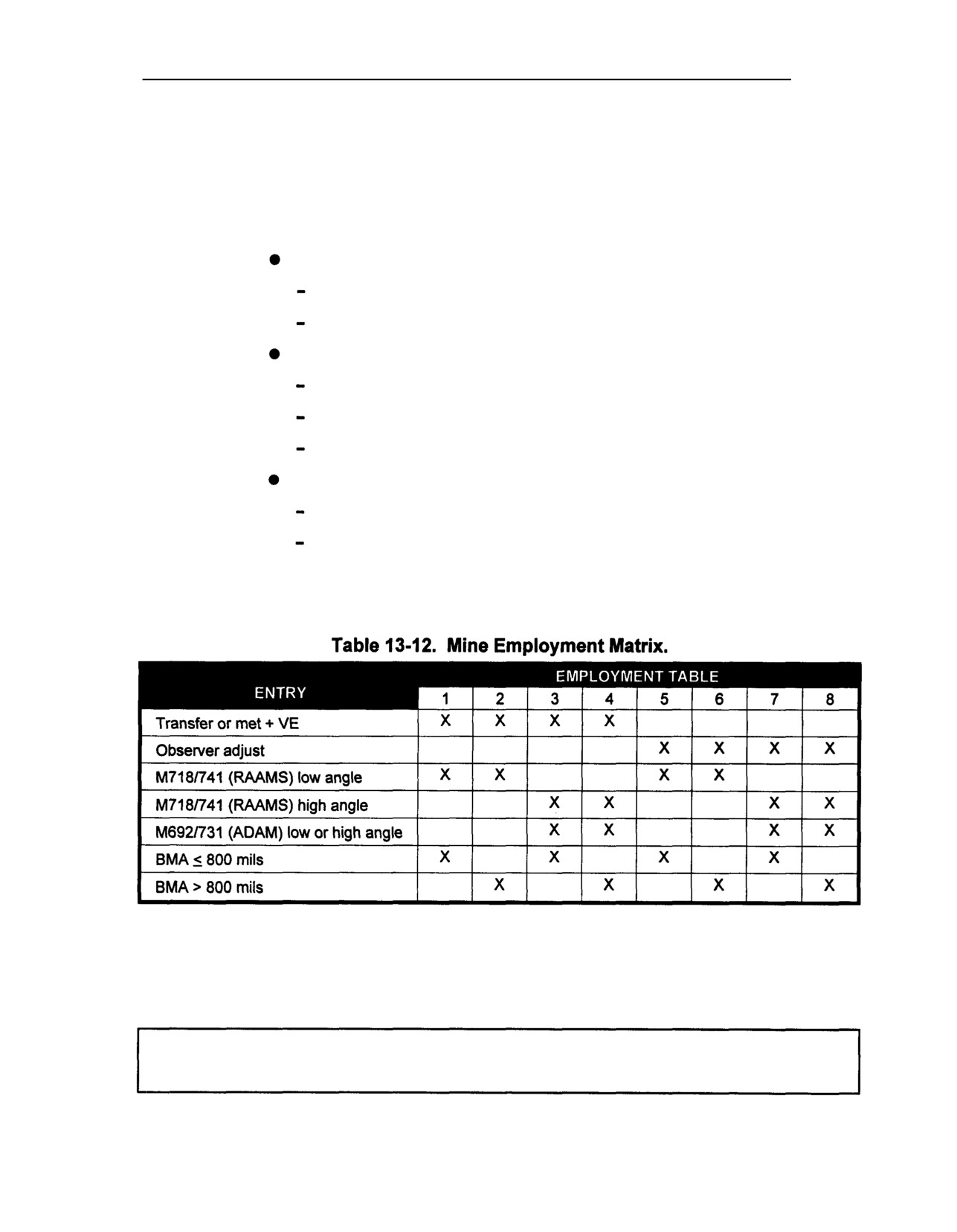
(5) To determine the appropriate mine employment table to use, the FDO must ask
three questions:
What delivery technique am I using?
Met + VE (FFE).
Observer adjust (AF).
What shell and trajectory will I fire?
M718/M741 (RAAMS) low angle.
M718/M741 (RAAMS) high angle.
M692/M731 (ADAM) low or high angle.
What is the BMA?
Less than or equal to 800.
Greater than 800.
(6) The matrix key is used to determine the mine employment table to use. The
table number that is displayed for each of the three entry arguments is the table used for mine
employment. See the matrix shown in Table 13-12.
(7) The trajectory makes a difference in the minefield module that can be achieved.
RAAMS low-angle planning module is 200 x 200. RAAMS high-angle planning module is 400
x 400. ADAM low- or high-angle planning module is 400 x 400. So, only with RAAMS low
angle can you achieve a minefield width of 200 meters, or every 200 meters.
NOTE: If ADAM and RAAMS are employed together, then the process for
determination of the appropriate mine employment table is done for each shell.
13-49
FM 6-40
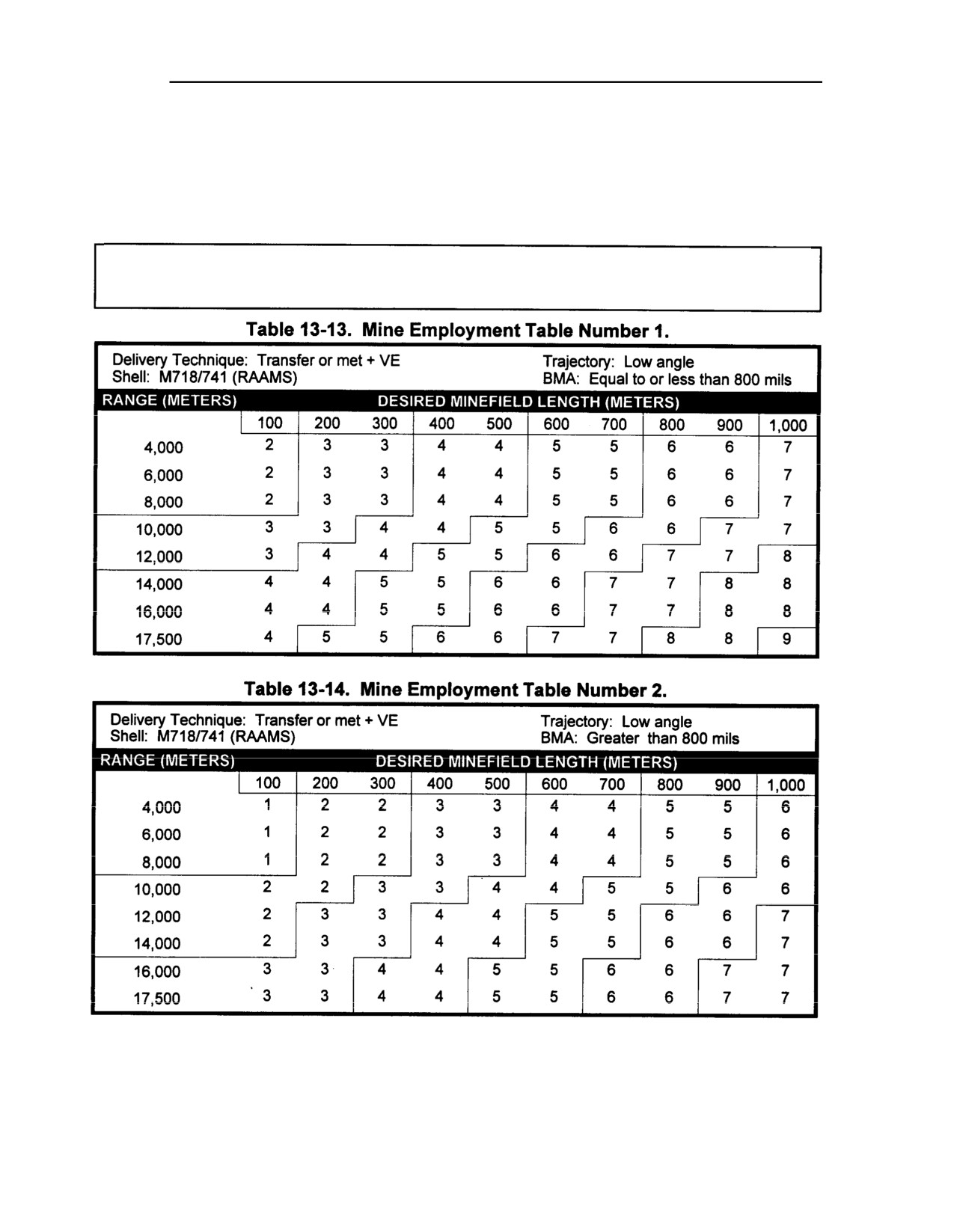
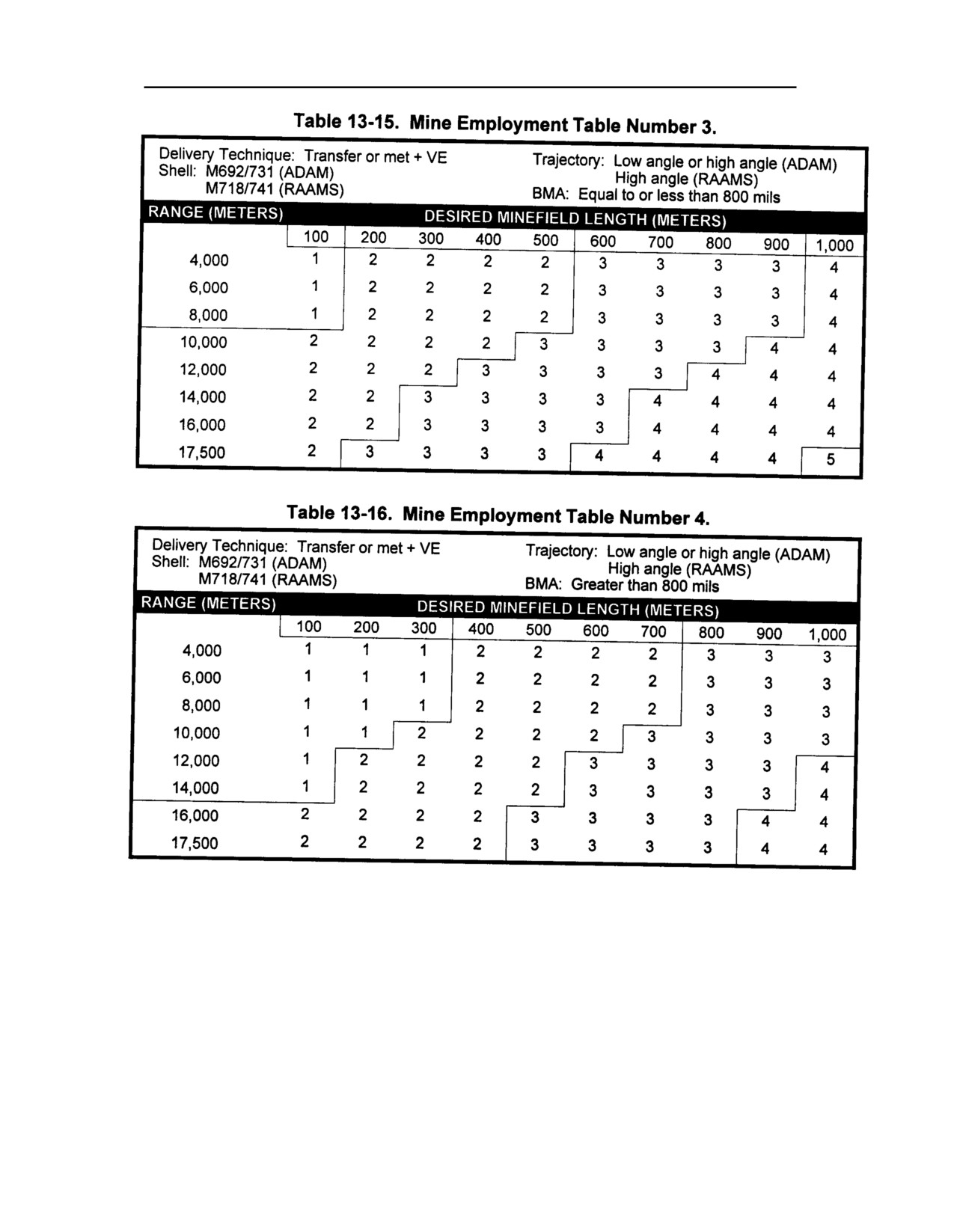
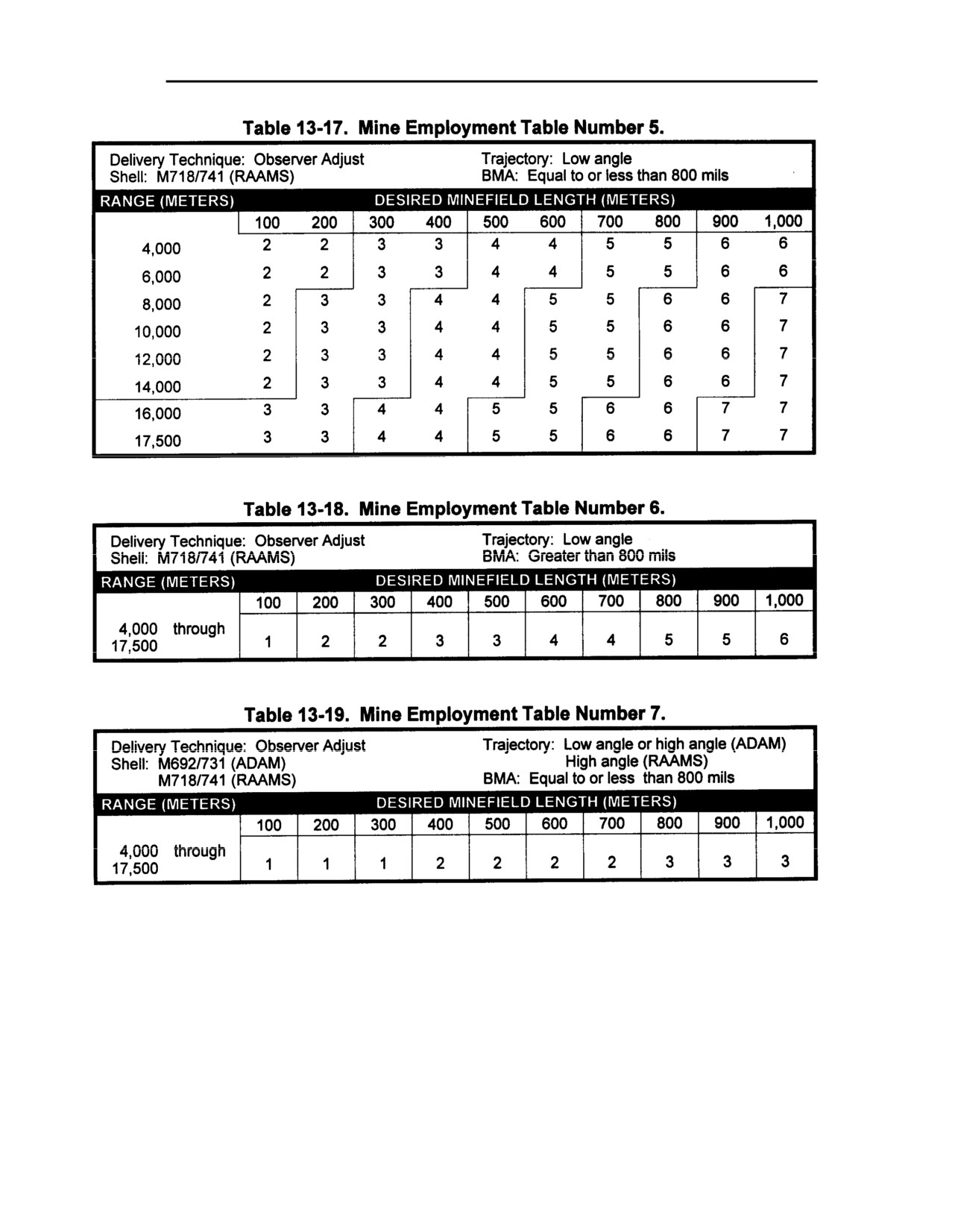
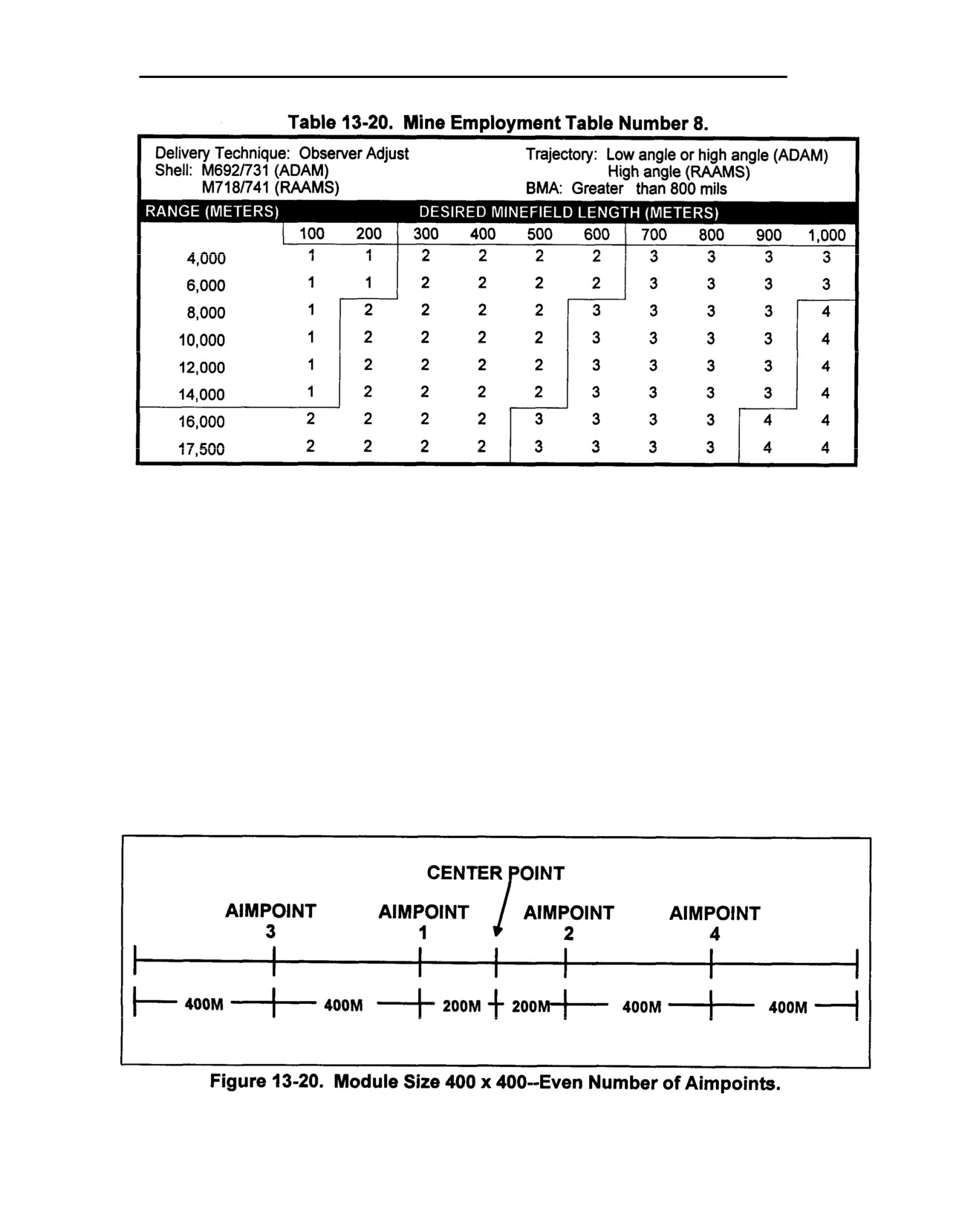
(8) The mine employment tables are used to determine the number of aimpoints
required. Review the header information to verify the appropriate table is being used. The entry
argument into the mine employment tables are the length (greatest axis) along the top and chart
range for entering along the left side of the table (enter with the nearest listed value). If the chart
range falls exactly halfway between two ranges, use the lower listed range. The mine
employment tables are shown in Tables 13-13 through 13-20.
NOTE: These tables are number of aimpoints per linear sheaf (planning module
width).
13-50
FM 6-40
13-51
FM 6-40
13-52
FM 6-40
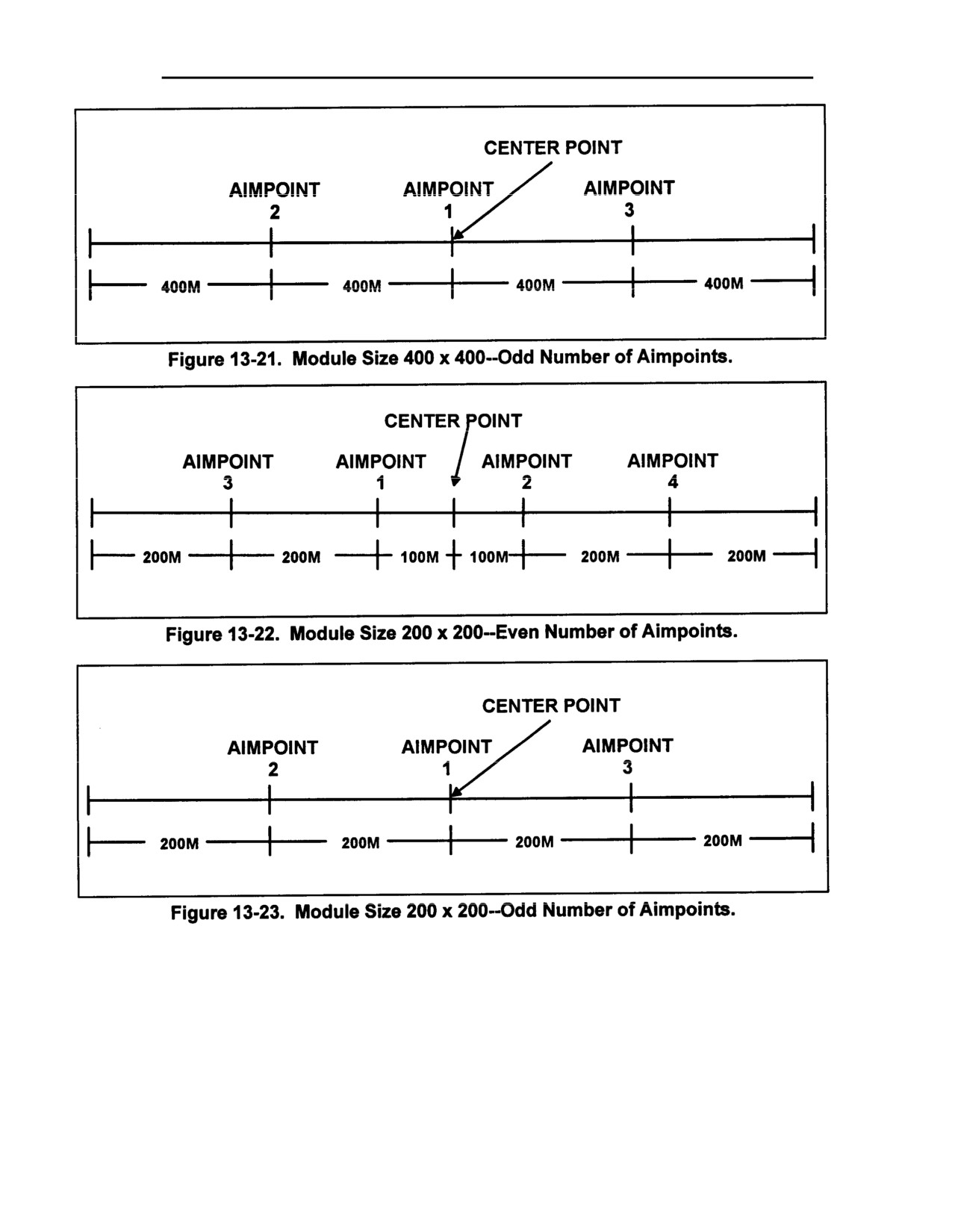
(9) On the basis of the module size and the number of aimpoints, the location of the
aimpoints is determined.
(a) Module size 400- by 400-meters--even number of aimpoints. Place
aimpoints 200 meters left and right of the center point along each centerline. Place the others at
intervals of 400 meters. (See Figure 13-20.)
(b) Module size 400- by 400-meters--odd number of aimpoints. Place the first
aimpoint at the center point of the minefield. Place the others at intervals of 400 meters left and
right of the center point along each centerline. (See Figure 13-21.)
(c) Module size 200- by 200-meters--even number of aimpoints. Place the
aimpoints 100 meters left and right of the center point along each centerline. Place the others at
intervals of 200 meters. (See Figure 13-22.)
(d) Module size 200- by 200-meters--odd number of aimpoints. Place the first
aimpoint at the center point of the minefield. Place the others at intervals of 200 meters left and
right of the center point along each centerline. (See Figure 13-23.)
13-53
FM 6-40
13-54