MULTISERVICE TACTICS, TECHNIQUES, AND PROCEDURES FOR NUCLEAR, BIOLOGICAL, AND CHEMICAL RECONNAISSANCE FM 3-11.19 (JULY 2004) - page 7
drift (direction and speed). This technique requires 30 to 45 minutes and
can support warning of specific areas.
• Detection and tracking of an aerosol. This technique estimates the
downwind cloud drift (direction and speed) and classifies the aerosol
(naturally occurring or man-made). However, it does not determine the
left and right limits of the cloud. This technique requires about 15
minutes.
• Detection and classification of an aerosol. The system team detects
the cloud and determines if it is naturally occurring or man-made. This
technique requires about 5 minutes.
e.
Mission. The system provides long-range biological information. It detects,
ranges, and tracks large-area aerosols disseminated on the ground or in the air.
Although the system is configured for aerial-based surveillance, it cannot be configured
for use on other small or medium rotary-wing aircraft.
7.
Conducting Medical Surveillance
Personnel presenting symptoms may be the first indication of an attack, but they
may not occur until after a lengthy incubation period. Careful tracking of disease spikes
is critical to an effective detection system.
a.
Establishing an environmental baseline is important to help identify variances
that may be attributable to a BW attack. MTFs and PVNTMED facilities routinely
perform medical surveillance of disease incidence and of syndromes associated with
biological agents. In CONUS, all daily Ambulatory Data System information from each
MTF is extracted by the DOD Global Emerging Infections System and evaluated by the
Electronic Surveillance System for the Early Notification of Community-Based
Epidemics. The Air Force uses the Global Expeditionary Medical System for this purpose
at deployed locations.
b.
The effectiveness of routine medical surveillance may be improved by—
• Reviewing local and regional endemic diseases.
• Developing a baseline profile of the water and sampling food and water
supplies periodically (frequently during high-threat periods).
• Providing updates to personnel on symptoms associated with high-threat
agents and ensuring that medical personnel are briefed to look for such
symptoms. (This must be balanced against the potential for worried well,
which associates symptoms of commonly occurring diseases or infections
with a BW agent attack.)
• Sharing information with surrounding hospitals and clinics.
• Determining the accessibility of a regionally networked database that
tracks spikes in certain disease symptoms and training personnel to use
the information to provide early warning of a BW attack.
c.
Medical surveillance is a technique designed to detect to protect or treat, not
detect to warn. The following limitations pertain to medical surveillance TTP:
H-10
• Many BW-related diseases can result in vague, nonspecific symptoms
during the early stages of illness. Classic, fully differentiated syndromes
may not be apparent until late in the clinical course.
• Many medical personnel have little clinical experience in recognizing BW-
related disease or infection. A diagnosis of initial cases is confounded by
clinical presentations that mimic naturally acquired diseases.
• Affected personnel may not be familiar with symptoms caused by BW
agents and may not seek early medical treatment.
• Relatively few hospitals and clinics have established, networked
databases to track symptoms, identify symptom clusters, and rapidly
identify medical situations characteristic of a BW attack.
H-11
Appendix I
RADIOLOGICAL SEARCH AND SURVEY DETECTION METHODS
1.
Background
Radiological monitoring is conducted to determine the presence, distribution, type,
and intensity of residual radiation. It is performed in a stationary position. The AN/VDR-
2 and AN/UDR-13 radiac sets are used to support the monitoring process. The AN/UDR-
13 measures gamma radiation dose rates. The AN/VDR-2 measures gamma radiation
dose rates and can detect, but not measure, beta radiation.
2.
Area Monitoring
Nuclear weapons or radiological agents may be employed at anytime on the
battlefield. All units monitor for radiation upon initial deployment. Monitoring provides
early warning and useful radiological information to units at all levels. There are two
types of area monitoring—periodic and continuous.
a.
Periodic Monitoring. Periodic monitoring consists of frequent checks of the unit
area or ship for the arrival or presence of radiation. It assures the commanding officer
that the unit area or ship is not contaminated. The direct or indirect technique
(paragraph 3) can be used for periodic monitoring, and only one radiac meter is required.
Periodic monitoring warns the unit if contamination arrives, and it is initiated—
• After the first use of a nuclear weapon in theater.
• When a unit is out of contact with higher headquarters.
• When ordered by higher headquarters.
• When continuous monitoring is terminated.
• At least once each hour to record readings. SOPs and ship bills dictate the
frequency of readings and provide detailed information on monitoring
procedures.
b.
Continuous Monitoring. Continuous monitoring involves checking for radiation
in the unit area. The indirect technique (paragraph 3b) is normally used. Continuous
monitoring is initiated or required—
• When a nuclear detonation is observed, heard, or reported in the AO.
• When a nuclear report is received and the unit is in the predicted area of
contamination.
• When a dose rate of 1 centigray per hour (cGyph) is recorded during
periodic monitoring.
• When ordered by the commander.
NOTE: Periodic monitoring is resumed when the unshielded dose rate falls
below 1 cGyph.
I-1
3.
Monitoring Techniques
There are two types of monitoring techniques—direct and indirect.
a.
Direct Monitoring.
(1) Direct monitoring is the simplest, most precise monitoring technique. The
radiac meter is used to get an unshielded (outside) dose rate, and the highest reading
observed on the radiac meter is recorded. Direct readings are used when conditions and
OEG permit. The unshielded dose rate is determined by—
• Standing outside at least 10 meters away from buildings or other
large structures or objects that may shield out a portion of the
reading.
• Holding the radiac meter at waist level or 1 meter off the ground or
deck.
• Rotating your body 360° while standing in one place.
(2)
Direct monitoring is used—
• While monitoring for the initial detection or arrival of fallout.
• When in low dose rate areas.
• When determining unshielded (outside) ground dose rates for
transmission or correlation factors.
• When verifying the contamination status of a new position.
• While moving through a contaminated area on foot.
b.
Indirect Monitoring.
(1) Indirect monitoring is used by a unit to measure radiation levels when
dose rates are high enough to be read inside a shielded location. It keeps exposure to a
minimum because personnel remain inside shelters or vehicles. It is conducted as
follows:
• Take dose rate readings inside the shelter or vehicle.
• Take at least one dose rate reading outside the shelter or vehicle to
determine the correlation factor.
• Take the inside and outside dose rate readings after fallout and
within 3 minutes of each other. To obtain the inside dose rate
reading, stand in the center of the shelter, hold the radiac meter at
waist level or 1 meter off the ground or deck, and rotate your body
360° while standing in one spot. Record the highest dose rate reading
observed.
• Obtain both readings before determining the correlation factor.
(2) If the vehicle does not have a designated location for the survey meter, the
monitor (positioned in the assistant driver’s seat) should hold it in a vertical position. He
should take the readings with the survey meter consistently located in the selected
position.
I-2
(3) If the radiac meter is installed in a vehicle or a building, the user verifies
that the correct attenuation factor was entered. If the correct attenuation factor was set,
he reads the outside dosage directly off the instrument. If the attenuation factor was not
set properly, he corrects the setting and retakes the reading.
4.
Correlation Factors
Correlation factors are required to convert inside dose rate readings to outside dose
rate readings. They are calculated using the following formula:
CF
= --------
ID
where—
CF
=
Correlation factor
OD
=
Outside dose rate
ID
=
Inside dose rate
NOTE: Correlation factors are always greater than 1.00 and are rounded to the
nearest hundredth.
a.
Vehicle Correlation Factor.
(1) Data for the vehicle correlation factor is provided by the survey party, and
it consists of a set of two readings taken at the same location. One reading is taken inside
the vehicle or bay with the instrument correctly located. All subsequent inside readings
must be taken with the survey meter in this same position. The other reading is taken
immediately as a normal monitoring reading, at the same location, with the vehicle
moved at least 10 meters away.
(2) One or two additional sets should be taken at different locations so that
the NBC defense team can use an average vehicle correlation factor. Sites selected for
vehicle correlation factor data should have foliage and surface conditions similar to the
contaminated area. New correlation factor data must be obtained if ground surface
conditions change or if there is a change in the survey meter or vehicle.
b. Air-Ground Correlation Factor. The air-ground correlation factor is the ratio of
an outside ground reading to an inside air reading taken at the height of the survey. The
air reading is taken directly above the ground reading. An air-ground correlation factor
must be obtained for the survey information to be useful. The survey team must obtain
new air-ground correlation factor data—
• When beginning each 2-, 3-, or 4-course leg.
• When changing the survey height.
• When a change in ground foliage occurs.
• When changing the aircraft.
• When changing the survey instrument or the batteries in the survey
instrument.
• When a change in the average surface condition occurs.
I-3
5.
Recording
The control center relies on monitoring reports to construct and update
contamination overlays. These overlays are used by the entire command. The following
forms are used to record monitoring data.
•
Point technique form.
n
The form should contain self-explanatory block headings.
n
Any heading not applicable to the situation should be lined through.
n
Space should be allocated for the monitor to enter the correlation factor
data.
n
The monitor does not calculate the correlation factor; it is done by the unit
NBC defense team.
n
The remarks section should be used to provide any additional information
of value to the NBC defense team.
n
The NBC defense team uses the remarks section to show the calculation
of the correlation factor, normalizing factor calculations, the time of burst,
and any additional information of value.
•
Course leg technique form.
n
The form should contain self-explanatory block headings.
n
Any heading not applicable to the situation should be lined through.
n
Space should be allocated for the monitor to enter the correlation factor
data.
n
The monitor does not calculate the correlation factor; it is done by the unit
NBC defense team.
n
The NBC defense team uses the remarks section to show the calculation
of the correlation factor, normalizing factor calculations, the time of burst,
and any additional information of value.
6.
Radiological Surveys
Radiological surveys are used to find the extent and intensity of radiological
contamination. They require time and coordination, and team members and equipment
must be diverted from primary missions. Because of these circumstances, surveys are
conducted only when directed and when the intensity of contamination must be known.
The NBC control center initiates all radiological surveys to ensure that the right amount
of data is obtained at the right time. The survey team consists of a monitor and the
necessary support and security personnel. The control center briefs the survey teams and
controls their movements. The two types of radiological surveys are aerial and ground.
a.
Aerial Survey.
(1) Advantages.
• A large area can be surveyed quickly.
I-4
• Personnel are exposed to a low dosage because of the distance the
aircraft flies above the ground.
• Less equipment and personnel are required. A helicopter and a
survey team can cover more terrain than 10 trucks with ground
survey teams.
• Inaccessible areas can be surveyed.
(2) Techniques.
• Point. The point technique is used to determine ground dose rates at
points of operational concern. The aircraft flies to and lands at
specified points.
• Course leg. The pilot flies a straight line between two checkpoints;
for example, from Point A (top of a hill) to Point B (top of another
hill). The aircraft only lands to obtain the air-ground correlation
factor data.
• Route. The pilot flies between two checkpoints, following the route
of a predominant terrain feature (such as a road, riverbank, or
railroad track) that connects the two checkpoints. The aircraft only
lands to get the air-ground correlation factor data needed by the
control center.
(3) Procedures. The control center team briefs the pilot and the survey team.
All information concerning the mission (such as survey height, ground speed, routes,
course legs, checkpoints) comes from the control center team. The TL and the instrument
operator sit beside each other to aid in communications. The TL should be able to speak
with the pilot. The following procedures are used:
(a) Point. The aircraft must land near the point of interest. The monitor
dismounts, proceeds to the selected point, and takes the reading by using normal ground
monitoring procedures. When high dose rates do not permit this procedure, aerial dose
rates are taken using an air-ground correlation factor.
(b) Course Leg.
• The pilot maintains (as near as possible) a constant height
aboveground, a constant ground speed, and a straight flight
direction between the start and end checkpoints of each course
leg.
• The pilot flies the aircraft on the proper course, over the start
checkpoint, and on a straight path to the end checkpoint.
Shortly before reaching the start checkpoint, he alerts the
monitor and gives him the height aboveground.
• The monitor records the time and height aboveground. He
rechecks and zeros the radiac meter before each course leg to
assure proper operation.
• The pilot gives the mark command when the aircraft is directly
over the start checkpoint.
I-5
• The monitor reads the survey meter, records the dose rate, and
begins timing preselected time intervals.
• The monitor reads the survey meter and records the dose rate
at each preselected time interval; for example, every 10 seconds.
• The pilot alerts the monitor again when the aircraft approaches
the end checkpoint. He gives the mark command when the
aircraft is directly over the end checkpoint.
• The monitor reads and records the final dose rate.
(c) Route. The procedures are identical to those for a course leg survey;
however, a straight flight direction may or may not be required.
b.
Ground Survey.
(1)
Advantages.
• A ground survey is independent of weather conditions.
• A ground survey provides more accurate information than an aerial
survey.
• An echelon can use regularly assigned personnel and equipment to
perform a ground survey within its AOR.
(2)
Disadvantages.
• Lacks the speed and flexibility of an aerial survey.
• Results in higher radiation dosages to personnel.
• Places a larger load on communications facilities.
• Diverts more personnel and equipment from the mission.
(3)
Techniques.
• Route. The team takes dose rate readings inside the vehicle at
selected intervals between checkpoints along a route.
• Point. The team travels to a point and takes one reading for that
location.
• Preselected dose rate. The team looks for a given dose rate
designated by the control center team. This technique is used for old
contamination and neutron-induced radiation. For old contamination
that is greater than the time of attack (H)+48, the team drives into
an area until it finds 1 cGyph or a designated dose rate. A neutron-
induced pattern is circular and decays much slower than fallout.
(4)
Procedures. The control center team briefs the driver and the survey
team. All information (such as the ground speed, routes or points to be surveyed,
checkpoints concerning the mission) comes from the control center team. The TL sits
behind the driver and watches the odometer. The monitor sits in a position, usually the
front passenger’s seat. This must be the same spot where the correlation factor data was
taken.
• The driver tells the team when they are at the start point.
I-6
• The TL records the time and identifies the mark. If it is a point
survey, the monitor can exit the vehicle and take an unshielded
reading. If the correlation factor data has already been taken, the
monitor can stay in the vehicle.
• The driver starts driving the route. The TL watches the odometer
and gives the mark command at preset distance intervals; for
example, every 0.3 mile.
• The monitor records the last reading and the TL records the ending
time when the vehicle arrives at the end checkpoint.
NOTE: The survey data (Figures I-1 and I-2, pages I-8 and I-9) is delivered to the
control center after the survey team is monitored for radiological
contamination.
c.
Equipment. The following equipment is required for radiological surveying:
• A radiac meter to measure dose rates.
• An individual radiation exposure meter for radiation exposure control.
• Forms for recording information collected during the survey. Local
reproduction of survey forms should be authorized.
• A watch to determine the time when survey readings are taken. An aerial
survey requires a stopwatch or a watch with a second hand.
• A vehicle with high radiation-shielding characteristics.
• Communications equipment for rapid reporting.
• Maps of the land to be surveyed.
d. Turn-Back Dose and Turn-Back Dose Rate. The control center team provides
the TL with the turn-back dose and the turn-back dose rate.
(1) Turn-Back Dose. This is the maximum total dosage that the team is
allowed. The TL monitors the total dosage for all personnel on the mission. When the
turn-back dose is acquired, the team turns around, uses the same route, and returns to
its unit for monitoring and, if necessary, decontamination.
(2) Turn-Back Dose Rate. This is the maximum dose rate that the team is
allowed. The TL keeps track of the dose rate and brings his team back if the turn-back
dose rate is detected. An area survey meter is used to detect the radiation level.
I-7

Date
Page No.
No. of Pages
RADIOLOGICAL DATA SHEET
MONITORING OR POINT TECHNIQUE
10 January 2005
1
1
Survey Party or Monitoring Unit Designation
Monitor (Print Name)
Co B, 1-11 Inf
PFC I.M. Observer
Map Used
Type of Vehicle or Other Shielding
Instrument Type
Bierhofen 1:50,000
Foxhole
IM-174B/PD
Dose
Dose
Reading
Reading
Location
Time
Rate
Location
Time
Rate
No.
No.
(cGyph)
(cGyph)
1
AY123456
0600
0
16
AY123456
0945
7
2
AY123456
0615
0
17
AY123456
1000
7
3
AY123456
0630
0
18
AY123456
1015
7
4
AY123456
0645
1
19
AY123456
1030
8
5
AY123456
0700
0
20
AY123456
1045
8
6
AY123456
0715
0
21
AY123456
1100
8
7
AY123456
0730
0
22
AY123456
1115
8
8
AY123456
0745
1
23
AY123456
1130
9
9
AY123456
0800
1
24
AY123456
1145
9
10
AY123456
0815
1
25
AY123456
1200
8
11
AY123456
0830
2
26
AY123456
1215
8
12
AY123456
0845
2
27
AY123456
1230
7
13
AY123456
0900
3
28
AY123456
1245
7
14
AY123456
0915
5
29
AY123456
1300
6
15
AY123456
0930
7
30
AY123456
1315
6
Remarks
180
TOB 0555
--------
9
CF = 20
Correlation Factor Data
Dose Rate
Dose Rate
Reading
Reading
Location
(cGyph)
CF
Location
(cGyph)
CF
No.
No.
Inside
Outside
Inside
Outside
AY123456
24
9
180
20
Figure I-1. Sample Survey Data (Monitoring or Point Technique)
I-8
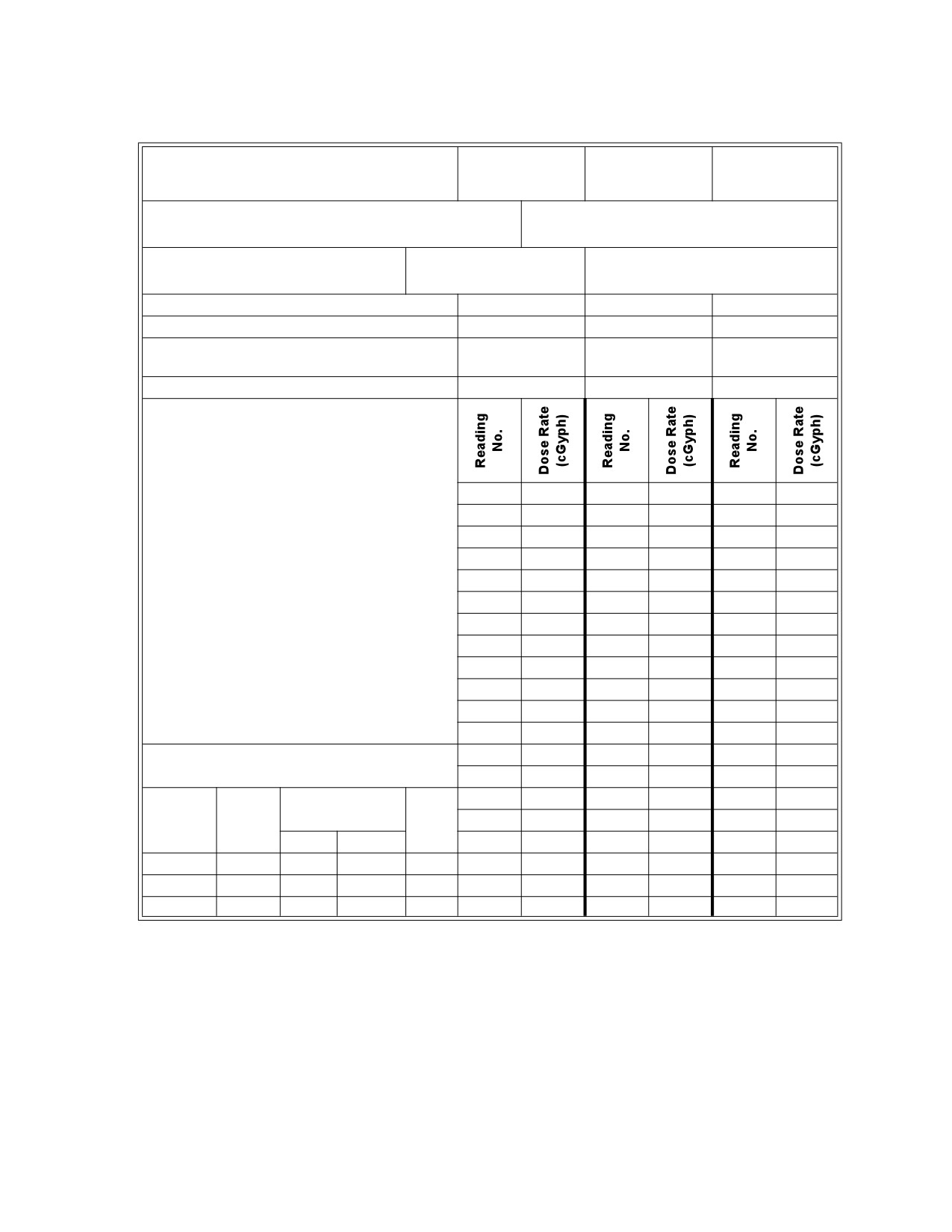
RADIOLOGICAL DATA SHEET
Date
Page No.
No. of Pages
ROUTE OR COURSE LEG TECHNIQUE
20 July 2005
1
1
(Ground and Aerial Survey)
Survey Party Designation
Monitor (Print Name)
B-2-9
PFC Fares
Map Used
Aircraft or Vehicle Type
Instrument Type
Bierhofen 1:50,000
UH-60
AN/VDR-2
Route or Course Leg Designation
CK-CE
CE-CB
CB-CD
Time at Start of Leg or Route
0950Z
0955Z
1005Z
Time Route Completed (Ground) or Survey
200 ft
200 ft
200 ft
Height (Air)
Distance or Time Interval Used
10 sec
10 sec
10 sec
Remarks
Time of Burst: 200730Z
N = 1.2
CA-CE
AGCF =
3.800
1
1
1
NF
=
2.767
OCF
=
10.515
2
2
2
3
3
3
CE-CB
AGCF =
3.800
NF
=
2.884
4
4
4
OCF
=
10.559
5
5
5
CB-CD
AGCF =
3.800
6
6
6
NF
=
3.123
7
7
7
OCF
=
11.867
8
8
8
Start and stop times are reported for each route
9
9
9
or portion of a route completed at one time by the
10
10
10
ground survey. If a route is done in pieces, use a
separate column for each piece.
11
11
11
12
12
12
Air-Ground or Vehicle
13
13
13
Correlation Factor Data
14
14
14
15
15
15
Height
Dose Rate
Location
(Air
(cGyph)
CF
16
16
16
Only)
Inside
Outside
17
17
17
BF
200 ft
5
18
3.8
18
18
18
19
19
19
20
20
20
Figure I-2. Sample Survey Data (Route or Course Leg Technique)
I-9
e.
Control Center Decisions. The following actions must be taken by the control
center team before operations can begin:
• Sequence. Survey the areas that carry the most essential operational
interest first.
• Monitoring reports. Check the monitoring reports that have been
received first. It is better to use units already in the contaminated areas
than to place more personnel at risk.
• Height aboveground. Determine if presurvey flights over course legs
are needed to ensure clearance for the survey aircraft. Intelligence units
or organizations can help by providing information on the area of concern.
The optimum height is 200 feet aboveground, and the maximum height is
500 feet aboveground.
NOTE: Flight at these altitudes places the aircraft in an exposed position and
should be avoided, especially near known threat activity. Survey altitudes
should be as low as possible so that the aircraft is camouflaged with
surrounding terrain and vegetation.
f.
Correlation Factor Data. The control center team determines where to obtain
correlation factor data. The location is based on the direction that the survey will be
flown or driven. This goes hand in hand with the sequence. If more than one route or
course leg is to be done, the mission is planned so that the pilot or driver can make an
easy transition to each subsequent route or course leg. Pilots and, possibly, drivers
should participate in this planning. The slower the aircraft air speed and the shorter the
time between readings, the more accurate the results will be.
g.
Mission Order. Use the five-paragraph OPORD format to brief the monitor and
the survey team on their missions as shown in Figure I-3.
7.
Radiological Monitoring (Search)
Radiological monitoring detects the presence of radiation and measures it with
radiac instruments while moving. It is done before the main body of the unit encounters
the hazard and is conducted to initially detect or determine the extent of the
contamination. Regardless of the radiation source, monitoring concentrates on the
location rather than the intensity of the dose rate. Thus, reconnaissance provides
information about the size of a contaminated area and little else. Once plotted,
reconnaissance data provides the minimum essential information needed to evaluate the
impact the contamination will have on current operations, such as—
• The location of and details concerning uncontaminated (clean) areas that can
be used to avoid a contaminated area. If total avoidance cannot be
accomplished, reconnaissance may determine the route with the lowest dose
rate.
• A hazard that might otherwise go undetected.
• The extent or size of a hazard.
a. Attack Indicators. When reconnoitering for a radiological hazard, the team
surveys the surroundings for attack indicators, such as—
• Arrival and settling of dust-like particles.
I-10
1.
SITUATION.
a.
Operational situation. Briefly describe the operational situation because it concerns the survey.
Include enemy forces, friendly forces, and planned actions.
b.
Contamination situation. Present any factual information available about the contaminated area.
Include the limits, dose rate, sources of contamination, terrain, and weather.
2.
MISSION. Write a clear, concise statement of the task to be accomplished (who, what, when, where, and
why).
3.
EXECUTION.
a.
Concept of operations.
b.
Specific assignment for each team. In subsequent, separate, lettered subparagraphs (a, b, c), give
the specific task for each survey party. Include the coordination elements required.
c.
Coordinating instructions. In the last subparagraph of paragraph 3, include instructions applicable to
two or more survey teams, such as—
•
Time of departure and return.
•
Routes and alternate routes to and from the contaminated area.
•
Coordination required.
•
Dosage danger limitations. If a radiac meter is used to check the turn-back dose or turn-back
dose rate, enter the value as the alarm set point and check it before departure.
•
Actions to be taken upon reaching dosage limitations.
•
Marking of contaminated areas if and when it is required.
•
Debriefing information (where, when, and by whom).
•
Decontamination information, if required (when, where, and by whom).
4.
ADMINISTRATION AND LOGISTICS. Include information on the required equipment and forms.
5.
COMMAND AND SIGNAL.
a.
Command. Include the location of the defense team.
b.
Signal. Include the following information:
•
Procedures for reporting data.
•
Special instructions concerning signal operating instructions.
•
Call signs, code to be used, and reporting times.
•
Communications means (primary and alternate).
Figure I-3. Sample Mission Order Format
• Trees blown down.
• Scorching on one side of objects.
• Overturned objects.
• Evidence of treetop fires.
• Dead animals and birds.
• Rain or snow after an airburst occurs.
b.
Limitations. Radiation presents a penetrating hazard, and the only complete
protection from radiological contamination is completely avoiding the area. When
radiological hazards are initially located, there may be no indication that the maximum
I-11
dose rate may be found. The process of determining the highest dose rate may be lethal
to the team. The commander specifies the turn-back rate for each mission, and it must be
low enough to permit additional contamination exposure.
c.
Techniques.
(1) The most desirable information is the location of uncontaminated areas.
Nuclear reconnaissance is rarely concerned with determining the dose rates inside
contaminated areas. The monitoring team conducts radiological reconnaissance using
the zigzag, lane, and star patterns shown in Appendix G.
(2) The location of the contamination perimeter (area or path) is of principal
value and importance. Monitoring teams must be provided with the turn-back dose and
the turn-back dose rate. The turn-back dose rate serves as the threshold for
contamination. It may be specified in the unit SOP or provided in mission briefings.
(3) When monitoring teams discover contamination, they report its location
and may also report dose rates and the time of detection. The NBC 4 nuclear report
format can be used to report the data; however, most expeditious reporting requires only
a simple statement that contamination is present at a specific location. When the NBC 4
nuclear report format is used, the word contact is used in the GENTEXT entry.
(4) Upon detecting contamination, the team records the reading and the time
and location of the reading, renders a report to alert the main body or unit, and then
withdraws to an uncontaminated area. The team flanks the contamination, repeating
the in-and-out process within its assigned area, section, or zone.
d. Marking Areas. Monitoring teams mark the outer boundaries of the
contamination unless otherwise directed. In some cases, this may provide information to
the enemy about troop movements. Markers are erected only at logical points of entry,
facing away from the contamination.
e.
Washout.
(1) Washing out radiological fallout particles from the air can vastly effect
monitoring operations. If the washout is caused by rain, the resulting contamination will
collect in low areas, streams, ponds, and rivers and create hot spots. However, large
bodies of water allow heavier fallout particles to settle and provide shielding. If snow
causes the washout, the area will initially be evenly blanketed. Heavy snowfall may
shield indications and readings of radiation levels, but it will eventually melt and the
result will be the same as that caused by rain.
(2) A washout area can be larger or smaller than the fallout area when the
same size of attack is employed as a surface burst. There is no satisfactory washout
prediction system. Essentially, prediction involves determining when moisture will fall,
how much moisture will fall, how large the particles will be, and what the form (rain,
sleet, hail, snow) of the moisture will be. Washout can also cause a significant hot spot in
an otherwise normal fallout pattern.
I-12
Appendix J
UNITED STATES ARMY NUCLEAR, BIOLOGICAL, AND
CHEMICAL RECONNAISSANCE UNIT OPERATIONS
1.
Background
This appendix addresses NBCRSs and NBC reconnaissance units. It discusses the
different types of units and their functions and responsibilities, including unit planning,
search, survey, surveillance, sampling, and employment.
2.
Equipment
a.
NBC reconnaissance supports the defense principle of contamination
avoidance. The basic item of equipment used is the M93-series Fox NBCRS. It is being
replaced by the Stryker NBCRV as part of the Stryker joint-service, lightweight NBCRS
program.
b.
NBCRS vehicles (Fox and Stryker) are capable of NBC detection, warning, and
sampling. The sensor suites are integrated into high-speed, high-mobility, wheeled or
armored vehicles and are capable of performing NBC reconnaissance on primary,
secondary, and cross-country routes throughout the battlefield. NBCRS vehicles are not
fighting vehicles. They are scarce resources that are vulnerable to damage and
destruction from enemy fire, so they must be protected. They are designed to improve
reconnaissance operations while on the move and provide a safe environment for the
crew by using an overpressure system. NBCRS vehicles (Fox and Stryker)—
• Provide reduced response time and quick detection.
• Allow identification within seconds.
• Pinpoint contamination within minutes.
• Have quick marking capabilities.
c.
Tables J-1 and J-2, page J-2, list the capabilities and limitations of M93 and
M93A1 NBCRSs, respectively. Table J-3, page J-3, shows a comparison of the NBCRS
and the NBCRV.
J-1

Table J-1. M93 Capabilities and Limitations
Capabilities
Limitations
Conducts NBC reconnaissance on the move.
The vehicle is not readily recognizable as friendly.
Conducts NBC reconnaissance without personnel
The system requires specialized maintenance
exiting the vehicle.
support.
Has an overpressure system that allows the crew to
The MM1 spectrometer requires 15 to 20 minutes for
operate in an NBC-contaminated environment without
initial preparation before operation.
masking.
Detects and identifies 60 chemical agents.
The vehicle is not heavily armored.
Provides location data to better delineate
The MM1 cannot operate continuously.
contamination.
Swims readily with little preparation.
The MM1 is not an effective chemical vapor detector.
Is air-conditioned to enhance crew working conditions
The system does not have standoff CB detection
and keep electronic equipment from overheating.
capability.
Allows contamination to be marked without exposing
The cooling system is undersized for some high-
the crew.
workload activities.
Stores data on unknown, suspected chemical agents.
The system is non-mission-capable without an
operating air conditioner.
Keeps up with maneuver forces.
The system does not have biological detection or
identification capability.
Has a built-in vehicle orientation system for
navigation.
Is mobile to allow large-area coverage.
Has self-recovery capability.
Retrieves and retains samples.
Table J-2. M93A1 Capabilities and Limitations
Capabilities
Limitations
Conducts NBC reconnaissance and survey on the
The vehicle is not readily recognizable as friendly.
move.
Conducts NBC reconnaissance without personnel
The system requires specialized maintenance
exiting the vehicle.
support.
Has an overpressure system that allows the crew to
The MM1 spectrometer requires 15 to 20 minutes for
operate in an NBC-contaminated environment without
initial preparation before operation.
masking.
Detects and identifies 60 chemical agents.
The vehicle is not heavily armored.
Provides location data to better delineate
The M21 remote-sensing, chemical-agent alarm
contamination using the onboard navigation system,
cannot conduct standoff chemical surveillance on the
Force XXI battle command brigade and below, and
move.
enhanced position locating and reporting system.
Swims readily with little preparation.
The MM1 cannot operate continuously.
Is air-conditioned to enhance crew working conditions
The MM1 is not an effective chemical vapor detector.
and keep electronic equipment from overheating.
Allows contamination to be marked without exposing
The cooling system is undersized for some high-
the crew.
workload activities.
Stores data on unknown, suspected chemical agents.
The system does not have biological detection or
identification capability.
J-2

Table J-2. M93A1 Capabilities and Limitations (Continued)
Capabilities
Limitations
Keeps up with maneuver forces.
The system will continue to operate without an
operating air conditioner; however, the crew will not
be able to continue for extended periods.
Has a built-in vehicle orientation system for
navigation.
Is mobile to allow large-area coverage.
Has self-recovery capability.
Has digital communications capability.
Has standoff detection capability (M21).
Has an automated, double-wheel system.
Has computer integration of a detection suite that
allows operation by a smaller crew (reduced from 4 to
3).
Has a metrological sensor.
Has a ground temperature sensor.
Has an improved marking system.
Has an improved overpressure system.
Retrieves and retains samples.
Table J-3. Comparison of the NBCRS and the NBCRV
NBCRS
NBCRV
Armor
7.62-mm armor plate
14.5-mm armor plate
Weapon
M240 machine gun (7.62-mm) on
M2 machine gun (.50 caliber),
cupola
remotely operated
Liquid chemical agent
MMI
CB mass spectronometer II with
improved interference rejection
Stationary standoff
M21 (60° field of view)
Joint-service, lightweight, standoff
chemical vapor
chemical-agent detector (360° scan
capability)
Mobile standoff chemical
None
Joint-service, lightweight, standoff
vapor
chemical-agent detector (360°scan
capability)
Chemical vapor
None
Yes
confirmation
Biological detection/aerosol
None
Yes
3.
Functions and Responsibilities
The NBC reconnaissance platoon performs five critical tasks—detect, identify,
mark, report, and sample. Timely, accurate detection and warning are critical for
battlefield success. The key people performing these tasks are the platoon leader, platoon
sergeant, squad leader, vehicle commander, and vehicle crew.
a. Platoon Leader. The platoon leader is responsible for platoon discipline and
training and equipment maintenance. He obtains NBC intelligence for the supported
J-3
unit commander to support successful tactical operations. He also serves as a vehicle
commander. The platoon leader assists the supported unit battle staff in preparing plans
and missions for his platoon. He acts as the SME on the capabilities and limitations of
the NBC reconnaissance platoon. This prevents his platoon from being tasked with
missions that it does not have the equipment or training to perform.
b.
Platoon Sergeant. The platoon sergeant is second in command and is
responsible to the platoon leader for maintenance, logistics, and discipline. He ensures
that training is conducted according to the platoon leader’s guidance. He also serves as a
vehicle commander.
c.
Squad Leader. The squad leader has overall responsibility for the squad. While
conducting NBC reconnaissance operations, he directs and controls the movement of the
squad. He selects vehicle positions during movements, sets vehicles into position during
occupations, and determines routes of movement. The squad leader communicates with
the platoon leader and executes his commands. He supervises the preparation of the
squad to conduct operations and is responsible for training the vehicle commanders in
his squad.
d. Vehicle Commander. The vehicle commander is responsible for crew discipline
and training, equipment maintenance, logistical monitoring and reporting, and tactical
employment of his vehicle. He briefs the crew, controls vehicle movement, submits crew
reports to the squad leader, and supervises the initial first aid and evacuation of
wounded crew members. He is responsible for planning and conducting NBC
reconnaissance missions when operating as a reconnaissance team. He is also
responsible for controlling all onboard weapon systems.
e.
Vehicle Crew. The vehicle crew consists of the following members:
• M93. A vehicle commander, a driver, and two surveyors (one is the MM1
operator).
• M93A1. A vehicle commander, a driver, and one surveyor (MM1
operator).
4.
Types of Reconnaissance Units
NOTE: See Appendix F for information on NBC reconnaissance unit
organization and capabilities.
a.
NBCRS- and NBCRV-Equipped Units.
(1) There are several types of NBCRS- and NBCRV-equipped units. For
example—
• The heavy division chemical company (currently in transition to
division cavalry squadron) NBC reconnaissance platoon has six
M93A1s.
• The corps NBC reconnaissance company platoon has eight M93A1s.
• The NBC reconnaissance platoon (ACR) (heavy) has six M93A1s.
• The NBC reconnaissance platoon (ACR) (light) has four M93A1s.
• The most recent NBC unit organization is the Stryker brigade
combat team NBC reconnaissance platoon. It is located within the
J-4
reconnaissance, surveillance, and target acquisition (RSTA)
squadron and has three M93A1s. (This is an in-lieu-of system until
the Stryker NBCRV is fielded.)
(2) Although there are various types of NBC reconnaissance platoons, the
basic building block or the most optimal employment method of NBC reconnaissance
organizations is the squad configuration (two M93A1s), where the vehicles operate as a
pair. All platoon variations generally follow the same doctrinal employment concept. The
units conduct route, zone, and area NBC reconnaissance to determine the presence and
extent of NBC contamination using the NBC reconnaissance techniques of search,
survey, and surveillance. However, due to the new operating environment, flexibility and
creativity are essential for the employment of NBC reconnaissance assets where a
templated NBC threat is not as clearly defined (see Chapter II). In these instances,
METT-TC drives the employment method and operating as a pair may not always be the
preferred method for NBC reconnaissance missions.
(3) An NBCRS-equipped unit can be employed to operate as a pure element
or decentralized, depending on METT-TC factors, to respond to asymmetrical threats
over a large operating environment. The NBC reconnaissance platoon normally operates
as one of three configurations—team, squad, or platoon—and supported units must be
familiar with NBC reconnaissance unit capabilities. The task organization facilitates
NBC ISR throughout the depth and width of the battlespace. This broadened ISR
requirement is achievable by planning and conducting a comprehensive vulnerability
and mission analysis and a coordinated IPB. Other potential NBC reconnaissance
missions include environmental or industrial hazard surveillance and overwatching key
fixed sites, such as airfields or ports. Regardless of the mission, NBCRSs and vehicles
require a security element or wing man to provide conventional threat overwatch.
(a) Team. The team configuration is used when one NBCRS or vehicle
operates by itself, without the support of another NBCRS or vehicle. For most NBC
reconnaissance organizations, this is not the optimal employment method, but it is the
normal configuration for the Stryker NBC reconnaissance platoon in the RSTA
squadron. In the RSTA squadron, one NBCRS or vehicle is generally paired with a
security element or wing man from the reconnaissance troop. This allows maximum
coverage for NBC ISR missions in a 50- by 50-kilometer area that the Stryker brigade
combat team may have to cover.
(b) Squad. The squad configuration is preferred for most NBC
reconnaissance units. A squad consists of two NBCRSs or vehicles and is the most
optimal organization under most conditions, including large-area reconnaissance,
extended route reconnaissance, deliberate attacks, and defensive operations. NBC
reconnaissance squads rely on a security element that can be provided by the supported
unit. This configuration allows two NBCRSs or vehicles to complement each other with
their sensors and maximize contamination avoidance and detect-to-warn principles.
When operating as a pair, the squad can quickly find bypass routes around
contamination to avoid the loss of maneuver force momentum or it can locate an
uncontaminated route. The third NBCRS or vehicle can perform NBC surveillance
operations oriented on NAIs developed during the process as an integral part of the
overall intelligence collection effort, or it can provide overwatch on key fixed sites.
(c) Platoon. In the platoon configuration, all vehicles operate together in
unison, no matter how many vehicles are in a platoon. For instance, the corps NBC
J-5
platoons and the heavy division chemical company NBC reconnaissance platoons could
operate together. These types of combined missions may be necessary for large SPODs or
APODs or in strategically located key areas where numerous vehicles are required. For
the Stryker brigade combat team reconnaissance platoon, this means that the three
vehicles are operating in unison. The platoon configuration is rarely formed in the
Stryker brigade combat team because it provides little flexibility to the commander.
However, it may be necessary for all types of platoons when large contaminated areas or
locations require extensive marking or surveillance.
(4) NBCRS- or NBCRV-equipped units possess NBC collective protection;
however, that capability is negated in an oxygen-deficient environment. Additionally, the
use of NBC reconnaissance assets are prioritized because the size of the AO may present
a challenge for the unit to provide full coverage. Any determined effort by an adversary
to employ NBC capabilities requires that the NBC staff and reconnaissance units receive
augmentation. Security for NBC reconnaissance assets is always a concern, and proper
coordination and planning must occur to prevent fratricide.
b.
Wheeled or Armored Vehicle-Equipped Reconnaissance Units. Some NBC
reconnaissance units have been issued wheeled or armored vehicles (such as HMMWVs
or armored personnel carriers [APCs]) pending the receipt of NBCRSs or vehicles. When
using a wheeled or armored vehicle as a prime mover and as standard detection,
identification, and sampling equipment, the following procedures may be used:
• The TL provides and orients the organic weapon on the sector of fire. He
visually inspects the area for signs of contamination.
• The NBC specialist opens the door of the vehicle wide enough to take a
reading with the NBC detection and identification equipment or to collect
a suspect sample of CB contamination. He attaches M8 detector paper to
a long handle or stake, reaches it out the door of the vehicle or over the
side of the HMMWV, and touches the ground or vegetation.
• The TL may conduct periodic checks from an armored vehicle hatch
position, using an M256A1 chemical detector kit. He places the expended
tickets in a waterproof bag after writing the checkpoint number on the
paper tab.
• The NBC specialist inspects the M8 detector paper for signs of
contamination and informs the TL of the results. He seals positive M8
detector paper in a plastic bag and labels the bag with the date-time
group (DTG), location (grid) where the sample was taken, and possible
type of contamination. He places the sample bag inside a large,
waterproof bag that holds all the samples collected during the mission.
• The NBC specialist places a CAM outside the door, approximately 1 meter
aboveground, and checks for contamination. If contamination vapors are
detected and there is no doubt as to the validity of the results, he uses an
M256A1 chemical detector kit to verify the results and he bags all
expended tickets.
NOTE: If a positive reading for chemical contamination is obtained, move back
100 to 200 meters from the position where the initial positive reading was
detected and repeat the procedure until a negative reading is obtained.
J-6
• The NBC specialist exits the vehicle, if necessary, to check the area
around the vehicle for contamination using M8 detector paper and the
CAM or improved CAM.
• The NBC specialist collects samples of small dead animals, discolored
leaves, soils, etc. as stated in the OPORD or orders from higher
headquarters. He reports all findings to the TL, and the TL or driver
records all findings on the appropriate forms.
5.
Planning
NBC reconnaissance planning is critical, and there is seldom enough time to plan
for every possible situation. There are, however, essential elements (such as the
commander’s intent and a complete mission statement) that must be included in all NBC
reconnaissance plans. These elements provide a level of detail required to ensure total
integration and utilization of NBC reconnaissance assets. The commander’s intent for
the mission must be clearly identified. The intent is what the commander wants the
mission to accomplish when completed—a clear concise statement of who, what, when,
where, and why NBC reconnaissance is needed to support the operation.
a.
Initial Planning and Coordination.
(1) Plan and prepare for reconnaissance using troop-leading procedures and
the situation estimate. Identify required actions to be performed at the objective, and
then plan backward to the departure from friendly lines and forward to the reentry of
friendly lines. The platoon or squad leader normally receives the OPORD in the
supported unit tactical operations center (TOC), where communications are good and key
personnel are available for questions and coordination. Mission coordination must be
thorough and detailed since NBC reconnaissance platoons and squads act semi-
independently, temporarily move beyond direct-fire support of the supported unit, and
occasionally operate forward of friendly units.
(2) The platoon or squad leader normally coordinates directly with the
supported unit staff. The NBC reconnaissance unit leader must continuously coordinate
with the support unit staff throughout the planning and preparation phases. NBC
reconnaissance leaders must coordinate directly with the unit conducting forward and
rearward passage of lines and with other units operating in the AO and adjacent areas.
Items to coordinate with the supported unit include—
• Changes and updates in the enemy and friendly situations.
• The best use of terrain for routes, rally points, and forward
reconnaissance bases.
• Light and weather data.
• The security of the NBC reconnaissance element.
• The use and location of LZs.
• The departure and reentry of friendly lines.
• Fire support on the objective and along the planned routes, including
alternate routes.
• Rehearsal areas and times.
J-7
• Special equipment requirements.
• HSS, including medical evacuation.
• Logistics support.
• Signal plan call signs, frequencies, code words, pyrotechnics,
challenges, and passwords.
• Identification to reduce the incidence of fratricide.
b.
Plan Completion. Consider the following:
• Essential and supporting tasks. Ensure the assignment of all essential
tasks to be performed on the objective, at danger areas, at security or
surveillance locations, along routes, and during the passage of lines.
• Key travel and execution times. Estimate the time requirements for
moving to the objective, reconnoitering the objective, establishing security
and surveillance, completing assigned tasks while on the objective,
moving to and through friendly lines, and conducting operational
debriefings.
• Primary and alternate routes. Select primary and alternate routes to
and from the objective.
• Signals. Consider using special signals, including approved hand-and-
arm signals, flares, voice, whistles, radios, and infrared equipment.
c.
Planning Components. Consider the following:
•
Missions. Examine the mission. Ensure that plans cover ways to enhance
the survivability and mobility of friendly forces, assist in the regeneration
of combat power, and identify forward combat and rear areas.
•
Available resources. Ensure that plans identify—
n
Organic NBC unit assets.
n
Resources available from higher headquarters.
n
Materials and equipment available from the HN.
•
Coordination. Coordinate NBC unit planning with all staff elements,
especially operations and logistics sections. The enemy NBC threat is
critical and requires close coordination with the intelligence section. The
employment of NBC reconnaissance elements should not duplicate the
efforts of conventional reconnaissance assets. Careful deployment and
coordination with adjacent and supported units and fire support elements
will enhance chemical unit survivability. Friendly units must know the
location and intent of all chemical units to avoid fratricide, and chemical
unit operations must be logistically supportable.
•
Simplicity. Exclude unnecessary elements, and reduce essential
elements to the simplest form.
•
Organizational relationships. Clearly define command and support
relationships, and fix responsibilities.
J-8
• Continuity. Designate an alternate headquarters to assume
responsibility when the primary headquarters is out of action.
• Versatility. Ensure that NBC units are able to react to unexpected
situations.
• Effective control. Realize that NBC units will operate away from their
parent units. Electronic and NBC warfare, along with the sheer size of the
battlefield, will make communications difficult. Ensure that the plan
establishes a C2 system and provides specific measures to adopt in the
absence of direct communications links or control.
• Decentralized execution. Delegate authorities, yet keep necessary
control.
• Habitual relationships. Be aware that it is beneficial to have the same
chemical unit always supporting the same unit.
d. Integrated NBC Reconnaissance Unit Reporting. Integrated, automated
capabilities can be used to report NBC information. The multipurpose, integrated
chemical-agent detector—
• Automates the NBC warning and reporting system process throughout
the battlespace.
• Automates the gathering of contamination data.
• Automatically formats and transmits reports.
• Sounds an alarm.
• Interfaces with the M43A1 chemical alarm, automatic chemical-agent
detector and alarm, AN/VDR-2 radiac set, and other existing and
developmental detectors.
• Interfaces, as required, with other vehicle subsystems, such as the GPS
and M42 chemical alarm.
• Automatically formats and transmits NBC reports (chemical and nuclear)
upon detection.
• Transmits audible “Gas, Gas, Gas” or “Fallout, Fallout, Fallout” warnings
over the communications net upon chemical or nuclear detection.
However, in order to receive this audible warning, the receiving system
must be equipped with specific hardware.
J-9

6.
Search and Survey
NOTE: The procedures outlined below are specific to the M93-series NBCRS.
a.
Vehicle commanders must train their crews to follow certain procedures when
conducting NBC search and survey techniques for NBC hazards, regardless of the MM1
mobile mass spectrometer method (Table J-4) used by the detection suite operator.
Table J-4. MM1 Methods
Number
Name
Description
1
Test/110
Confidence check/calibration
2
CW agent wheel/180
Search and survey
3
CW agent surface/120
Verification of alarm
4
CW agent air/180
Vapor detection only
5
N simulant wheel/180
Search and survey
6
N simulant surface/120
Verification of alarm
7
N simulant air/180
Vapor detection only
(1) The NBCRS operates in the air-high mode during movement from the
assembly area to the start point. At the start point, the double-wheel sampling system
operates and the MM1 is in the wheel-high position.
(2) For multiple missions, the lateral intervals between NBC reconnaissance
teams are approximately 100 meters, based on METT-TC. If the MM1 operator detects a
trace level reading of contamination, he notifies the vehicle commander. The vehicle
commander directs the driver to stop the NBCRS, and he notifies the vehicle commander
of the other team(s) that contamination is present. Next, the NBC reconnaissance team
continues the process to identify the type and extent of the contamination. The other
team(s) executes a search and survey pattern appropriate to the stated NBC
reconnaissance mission and the situation. While the team is conducting a search and
survey, the vehicle commanders of all NBCRS vehicles turn control of the vehicles over to
their respective MM1 operators.
(3) For single NBCRS missions, the NBCRS team warns the supported force,
backs out of the contamination, drops a marker, and executes a search and survey
pattern appropriate to the stated NBC reconnaissance mission and situation. The team
then continues with the supported unit or goes back to the perimeter to mark the
contamination.
b.
The following procedures provide a standardized method for NBCRS teams to
verify detection results. The use of these procedures may vary based on METT-TC (e.g.,
initial or follow-up detection, available time, enemy situation).
(1) The MM1 operator performs the following steps:
Step 1. Change to method 3, and wait until the sampler line temperature
drops to 120°C.
J-10
Step 2. Direct the surveyor to lower the probe to within 10, 5, and 1
centimeter of the ground and hold it at each depth until the temperature
has dropped to 110°C.
Step 3. Watch the monitor until the maximum ion intensity (higher than
4) is displayed.
Step 4. Press the SPECTRUM/AMOUNT VS. TIME button, and direct
the surveyor to put the probe back in its monitoring position.
Step 5. Press the PRINT button. The ion fragments will be printed by
mass and weight.
Step 6. Assign the substance an extra substance number (61 to 68).
Step 7. Go to the LOGBOOK screen, move the cursor to the substance
number, and enter the extra substance number (61 to 68).
Step 8. Change the monitor code to 1, and then go back to the LOGBOOK
screen.
Step 9. Check the monitor list for the extra substance number (61 to 68),
and press the AIR MONITOR button.
Step 10. Lower the probe to the surface, and hold it for 4 or 5 seconds to
verify the extra substance against the original substance. Press the
PRINT button when the extra substance and the agent detected appear
together on the screen.
Step 11. Delete the item (extra substance or agent) that has the lowest
reading. If the agent is unknown, leave the extra substance on the
monitor list.
(2)
The vehicle commander—
• Inserts the information into an NBC 4 report and transmits it to
higher headquarters.
• Directs the driver to make a 180° turn and proceed 200 meters or
until the MM1 shows normal readings.
• Directs the surveyor to drop a contamination marker at least 200
meters from the edge of the contamination.
(3)
The MM1 operator records the marker and location number in the
logbook. He also records the number of samples taken, if any.
(4) The search and identification team rejoins the other team to continue the
mission.
c.
There are seven search and survey patterns—zigzag, box, star, cloverleaf, lane,
nearside/farside, and bounce-and-bypass (Table J-5, page J-12). As a general rule, the
zigzag, lane, star, and bounce-and-bypass patterns are used with the search technique
and the box, cloverleaf, and nearside/farside patterns are used with the survey
technique.
(1) Contamination markers are positioned to mark the limits of a
contaminated area (perimeter marking) or to mark a bypass route (bypass marking).
J-11

Table J-5. Search and Survey Patterns
Mission
Formation
Survey Pattern
Search Pattern
Route
Staggered column
Nearside/farside
Bounce-and-bypass
Cloverleaf
Lane
Box
Zigzag
Area
Line
Cloverleaf
Lane
Box
Star
Nearside/farside
Zone
Line
Cloverleaf
Bounce-and-bypass
Wedge
Box
Lane
Nearside/farside
Star
Point
Line
Cloverleaf
Bounce-and-bypass
Box
Lane
Nearside/farside
Star
Ensure that the markers are within LOS of each other. After the markers are dropped,
periodically report their locations to higher headquarters via an NBC 4 report.
(2) NBC reconnaissance markers are not easily seen by heavy forces
conducting rapid movements, so unit SOPs should prescribe far NBC warning marker
procedures. VS17 recognition panels are excellent far NBC warning markers. Locally
fabricated far NBC warning markers should be emplaced by unit scouts, engineers, or
military police—not NBC reconnaissance teams. NBC reconnaissance teams are more
likely to be contaminated and should not break the seal of their overpressure system to
emplace far NBC warning markers. Far NBC warning markers are emplaced 100 to 200
meters back from the NBCRS markers and positioned to facilitate bypass by rapidly
moving forces. Traffic control around contaminated areas can be enhanced by
establishing traffic control points manned by unit personnel.
7.
Surveillance
The M21 remote-sensing, chemical-agent alarm supports the avoidance of
contamination by conducting standoff detection of chemical clouds. (See the unit staff
chemical officer for range detection distances.) It can be used to augment point detectors,
such as the M8- and M22-series alarms. There are two methods of employment—
dismounted and mounted.
• Dismounted. In supporting defensive operations, the M21 can be dismounted
on a tripod and powered by connecting a 65-foot cable to the vehicle slave
receptacle. A pair of M21s should be employed so that their fields of view
(FOVs) interlock with each other.
• Mounted. In supporting offensive operations, the detector is mounted on an
NBCRS and used to provide forward-area surveillance. The NBCRS vehicle
can bound from one surveillance location to another to help maneuver
elements avoid chemical clouds and give the reconnaissance element an idea of
where to look for ground contamination. When moving with a combat element,
the NBCRS squad leapfrogs forward. One team should never be more than 3
J-12
kilometers forward of the other team. A pair of M21s should be employed so
that their FOVs interlock with each other.
a.
Point Surveillance. Point surveillance ensures that time-sensitive critical
operations can be conducted without unwarned encounters with chemical clouds. It can
be performed mounted or dismounted. Point surveillance missions are short in duration
(usually less than 2 hours) and are usually oriented on key terrain features (chokepoints,
bridges, barriers, road intersections).
b.
Area Surveillance. Area surveillance provides greater detection capability in
large areas and is used by an NBCRS squad, section, or platoon. Area surveillance can be
performed mounted or dismounted. It requires detailed planning and can be oriented on
the wind. The following are some examples of area surveillance:
• Scan AAs.
• Reconnoiter forward logistics areas.
• Provide hasty detection during halts and silent watches.
• Confirm or deny NBC reports from other sources.
• Keep a previously cleared area under surveillance until it is used to
ensure that no chemical employment has occurred.
• Provide vapor detection in support of movement operations.
c.
Mission Planning.
(1) To ensure success, an M21 mission must be planned to match the mission
it is supporting. The commander’s concept of the operation is the key to how the M21 can
best support the mission. At the operator level, guidance is provided for employment on
sites that require surveillance. It is the vehicle commander’s responsibility to ensure
that the M21 is employed to support the concept of the operation.
(2) A reconnaissance of potential sites is required to ensure that the required
coverage can be provided. This may be a map reconnaissance or, in some cases, a
physical reconnaissance. An overlay of the plan is probably going to be provided. Using a
map, conduct a hasty map reconnaissance of the specified surveillance sites and assess
their FOVs using the M21 template.
(a) Map Reconnaissance. This is the easiest method to use, but it is also
the least accurate. Obtaining aerial photographs can help with the accuracy. A map
reconnaissance is usually conducted to tentatively select employment sites. If adequate
time is available, request an LOS analysis from the intelligence section or a summary of
the NAIs from the supporting engineer unit or section. The intelligence section
sometimes has tools that allow stereoscopic analysis of the terrain. If necessary, use the
following techniques to conduct an unassisted map reconnaissance:
• Select a map with the highest possible resolution.
• Use an M21 template.
n
Select the scale.
n
Mark the site location.
n
Draw a line 5,000 meters long on the center, individual
FOV.
J-13
n
Draw seven vectors at 10°.
n
Number the vectors from left to right (1 through 7).
n
Intersect the vectors at 500-meter intervals.
n
Label the template.
• Locate potential employment sites.
•
(Dismounted Only) Construct a range card when the M21 is in
position.
n
Mark the grid reference lines.
n
Mark the site location with a “+.”
n
Draw seven vectors out to their maximum individual LOS.
n
Draw a small, perpendicular line at the end of each vector.
n
Label each vector line from left to right (1 through 7).
n
Record the distance along the side of each vector.
n
Record the marginal data (scale, M21 location, reference,
and preparer).
(b) Physical Reconnaissance. This is the best method to determine the
actual LOS available, but it depends on the tactical situation. Do an initial map
reconnaissance to select tentative sites, and then do a physical reconnaissance. Ensure
that the NBCRS has security provided by the supported unit when moving to the
surveillance sites. Use a lensatic compass or the onboard navigation equipment to
determine the azimuths for each potential individual FOV, and record the LOS available
on the M21 template or, if used, a range card.
(3) If no surveillance sites have been specified, select general areas (six-digit
grid coordinates) that will provide the proper coverage. Always consider the
commander’s intent when selecting the locations. The scheme of maneuver, operational
security, emplacement/recovery time (dismounted operations), mission requirements,
and operational risks affect the selection of the M21 employment site. A good site will
meet the following criteria:
• An LOS between the detector and the target area. Without an LOS,
the detector cannot get the correct background readings.
• Radio and/or wire communications. Without communications to pass
the alarm and detection data to affected units, the system is of little
use.
• Routes for rapid displacement to the next employment site. Some
missions will place the detector well forward, and rapid displacement
is essential to providing continuous support.
• Security by combat elements. This is essential to ensure that the
system remains combat-effective and is not destroyed or captured by
enemy forces.
• Protection from direct and indirect fires and observation. Cover and
concealment improve the survivability of the system.
J-14
• Ideal wind direction. When deployed in an area surveillance mission,
the detector can be oriented toward the wind to warn of approaching
chemical clouds.
(4) It is normal to plan at least three different sites for each surveillance
mission—primary, alternate, and different.
• Primary. This is the actual location of the detector, with orientation
upon the target area. It is usually the best site of those initially
selected.
• Alternate. This is another site with the same target area. It is
usually identified as an alternative to the primary site in the event
that the first site is compromised and or comes under enemy fire.
• Different. This is a different location that is used to view a different
target. It may be necessary because of a change in the plan for a
surveillance mission or a change in the wind direction.
NOTE: See Appendix N for information on NBCRV joint-service, lightweight,
standoff chemical-agent detector surveillance techniques.
8.
Sampling
a.
Sampling operations are particularly important if a previously unknown agent
is used or if the suspected use is the first use of a CB agent by a threat force. If the type
of agent is unknown, the unit leader conducts an RA to provide safety for his unit (e.g.,
an unknown agent could potentially penetrate collective protection equipment). During
the mission analysis for TIM reconnaissance, consider the availability of appropriate
individual and collective protection. The collection of CB samples and the background
information must be as detailed and comprehensive as possible. Each sample is
processed and analyzed to provide data for intelligence analysts to use. The processing of
CB samples includes collecting, handling, transferring, and maintaining the chain of
custody.
b.
Chemical samples are taken when directed by higher headquarters or when
the sensor detects or identifies the presence of a chemical substance. Biological samples
are taken when directed by higher headquarters. The NBCRS does not have biological
detection capability, so take samples in an area where suspected contamination exists
(look for dead animals and plants). Possible ground locations include low-lying areas, wet
or damp terrain, and shady areas. Grassy terrain provides better quality samples than
rocky terrain.
c.
Plan sampling operations in advance, and use the following steps to take CB
samples:
Step 1. Perform preventive-maintenance checks and services on all equipment.
Step 2. Remove sample bottles, and mark them with control numbers using a
china or indelible marker (see Appendix E).
Step 3. Enter all sample bottle numbers in the crew logbook.
Step 4. Take at least two samples about 500 meters upwind of the sample area.
These are known as background samples that are not contaminated. They are
J-15
used as comparison samples to ensure that a compound is not naturally found
in the area.
Step 5. Enter the contaminated area, and identify the sample (dirt,
vegetation).
Step 6. Mount the protective work glove into the work port.
Step 7. Insert your left arm into the work glove.
Step 8. Release the latch on the sample tray, and pull the tray out to the fully
extended position.
Step 9. Remove the cap from the sample bottle.
Step 10. Grasp the gripper tongs by the handle and slide them out of the tray.
Step 11. Watch through the floor window, and use the tongs to grasp the
sample and place it in a sample bottle.
Step 12. Replace the tongs on the tray.
Step 13. Replace the cap on the sample bottle.
Step 14. Transfer the samples to the proper organization (e.g., technical
intelligence collection point).
NOTE: A soil sample should weigh about 10 grams, and a liquid sample should
be 15 to 25 milliliters.
d. A sample collected from an area is significant, but it can become useless if
proper steps are not taken to record critical information about its collection. See
Appendix E for the proper procedures for recording the information.
e.
After the NBCRS team takes the samples and arrives at the decontamination
site, it conducts a sample change of custody at a site or grid coordinate established by the
controlling headquarters. The controlling headquarters is responsible for getting
personnel to the site to effect the transfer. Samples are passed through the glove port to
receiving personnel, who are typically technical intelligence or escort teams. The
following items should accompany the samples:
• Information contained in the crew’s mission log.
• Printout from the MM1.
• Chain-of-custody form.
9.
Unit Employment
NBC reconnaissance units are employed to enhance combat power. Combat power is
the ability to fight; and it is achieved by combining maneuver, firepower, protection, and
leadership.
a. Employment Guidelines.
(1) Task-organize NBC reconnaissance units based on the mission and the
type of unit being supported (e.g., battalion, regiment). NBC reconnaissance units are
concentrated and weighted with the main effort to help ensure success, but there are
never enough units to handle all tasks. Concentrating NBC reconnaissance assets can
J-16
improve the speed of detection and the speed of locating bypasses for maneuver forces;
however, a trade-off occurs in the amount of area that can be covered. Commanders
should consider this as a choice when choosing between mass and economy of force.
(2) Integrate NBC reconnaissance units with fire and maneuver. The scheme
of maneuver supports NBC reconnaissance plan preparation. NBC reconnaissance units
enhance the effectiveness of fire and maneuver, can operate well forward in the combat
zone, and require the protection offered by fire and maneuver.
(3) Ensure that current NBC reconnaissance unit operations promote future
force operations. NBC units and staffs must anticipate future missions and reposition
units, if necessary, while accomplishing the current mission.
(4) Do not hold NBC reconnaissance units in reserve. NBC reconnaissance
units do not remain with forces that are not in the fight. They remain out of action only
long enough to refit after a major action.
(5) Build a logistically sustainable force. Resources are always limited. NBC
reconnaissance units cannot sustain themselves; they require support from other
organizations. NBC reconnaissance, unit sustainment, and the supporting logistics
structure, including CLS, must be planned in detail.
(6) Maintain effective battle command. Effective plans use all available NBC
unit headquarters, align them with maneuver boundaries, and hand off operations
smoothly between them.
b.
Command and Support Relationships. NBC units can operate under two types
of relationships—command and support. Command responsibility and authority are
established through command relationships. Support relationships are established to
define specific relationships and responsibilities between supporting and supported
units. Command and logistics responsibilities and the authority to reorganize or reassign
component elements of a supporting force remain with the higher headquarters or
parent organization unless otherwise specified.
(1) Command. Chemical units can operate under four command
relationships—organic, assigned, attached, and OPCON.
• Organic. An organic unit forms a part of another unit and is listed
in the table of organization. It may be attached, placed under
OPCON, or given a direct support (DS) mission to a subordinate
element of the parent unit. An organic unit may also be retained in
general support (GS) of the entire parent unit.
• Assigned. An assigned unit is placed under control of higher
headquarters, usually above division level, on a relatively permanent
basis. It may be attached, placed under OPCON, or given a DS
mission to a subordinate element of the parent unit. An assigned
unit may also be retained in GS of the entire parent unit.
• Attached. An attached unit is usually attached to a larger unit for
an extended period of time. Unless otherwise specified in the order,
the gaining unit is responsible for C2 and logistical support and the
parent unit retains responsibility for personnel transfers and
promotions.
J-17
• OPCON. The gaining commander can use an OPCON unit like an
organic unit for mission accomplishment. This includes task-
organizing subordinate forces, assigning tasks, and designating
objectives. Unless otherwise specified in the order, the parent unit
retains responsibility for logistical and administrative support.
(2) Support. A support relationship is established when NBC units are placed
in DS of a force or when a commander elects to retain chemical units in GS of his
command. Command responsibility is retained by the parent unit. Full logistics
responsibility also rests with the parent unit unless the supported unit is directed to
fulfill certain logistical functions, such as rations, POL, or medical support.
(a) DS. A DS unit provides dedicated support to a specific unit, usually
for a single operation or for a short time. The supported unit commander has a high
degree of control over the tasks performed by the supporting unit, without the
responsibility for logistics or administration. The supporting unit takes task
assignments and priorities from the supported unit and gives priority of support to it.
The parent unit retains command authority and logistics and administration
responsibilities. This relationship precludes further task organization.
(b) GS. A commander with organic, assigned, attached, or OPCON units
may elect to retain any part of those assets in GS. They are retained in GS when higher
headquarters requires greater flexibility and control. In this relationship, support is to
the force as a whole, rather than to a particular subdivision of the force. The subordinate
force commander requests support from the senior force commander, task by task, rather
than from the supporting unit.
c.
Offensive Operations. The main focus of NBC reconnaissance in the offense is
the freedom of maneuver so that the commander can avoid contaminated areas. The IPB
identifies likely and known areas of contamination. The NBCRS allows commanders to
rapidly bypass contaminated areas and maintain the operating tempo (OPTEMPO). All
NBC reconnaissance operations during the offensive tend to occur in sequential phases.
The length and nature of each phase, and whether they even occur, varies from situation
to situation. The four phases of support are planning, preparation, execution, and
recovery.
• Planning. The NBC reconnaissance unit leader must understand the
supported unit’s mission, its concept of operations, and the commander’s
intent. The NBC reconnaissance unit leader then begins troop-leading
procedures. To support a maneuver unit conducting offensive operations,
he considers the—
n
Command and support relationship.
n
Location of enemy forces (known and templated).
n
Range of enemy weapon systems.
n
Location of enemy and friendly obstacles (known and templated).
n
Surface wind direction and speed.
n
Type of NBC weapon the enemy could employ.
The supported unit’s battle staff (intelligence and chemical) can provide
most of this information. The NBC reconnaissance unit conducts a
J-18
physical reconnaissance or, if necessary, a detailed map reconnaissance of
the mission area. When possible, the NBC reconnaissance unit leader
issues his order at a terrain vantage point overlooking the operational
area; otherwise, he uses a sand table. Each vehicle commander should
have a copy of the supported unit’s operations overlay.
•
Preparation. Preparation begins when the WARNORD is received, and
it includes—
n
Conducting precombat checks.
n
Maintaining and inspecting equipment.
n
Distributing supplies.
n
Feeding soldiers.
n
Resting.
n
Checking the physical health of soldiers.
n
Camouflaging.
Next, the NBC reconnaissance unit leader issues the mission order and
coordinates with the supported unit to ensure understanding of how the
mission will be executed. The leader may be required to back-brief the
supported unit and should attend rehearsals.
•
Execution. The NBC reconnaissance unit begins movement with
sufficient time to cross the LD in the designated order of march. The NBC
reconnaissance unit leader monitors both units’ internal net and the
supported unit’s net (usually the command net).
•
Recovery. During the recovery phase, the NBC reconnaissance unit
rearms, refuels, and refits as quickly as possible. If the NBC
reconnaissance unit becomes contaminated during the mission,
decontamination will be necessary. The level of decontamination required
depends on the weather, type of contamination, and follow-on mission.
The unit’s main objective during this phase is to become fully mission-
capable and ready for future operations.
(1)
Movement to Contact. The purpose of a movement to contact is to make
initial contact with the enemy or to regain lost contact. The supported force conducts a
movement to contact in a way that risks the smallest part of the force, while the
remainder is available to immediately respond when contact is made.
(a) The force conducting a movement to contact is normally organized
into a forward security element, a security force, flank and rear guards, and a main body.
The enemy can use persistent chemical agents to contaminate terrain, shape the
battlefield, force friendly forces into engagement areas, and deny or restrict terrain from
friendly use. Limited knowledge of the terrain and AO can result in the friendly force
encountering contamination from previous battles.
(b) During a maneuver unit (i.e., divisional) movement to contact, an
NBC reconnaissance platoon could provide one squad to each maneuver brigade. If the
threat of encountering contamination is high, the platoon may form into sections.
However, employment by a squad is the preferred means. For cavalry regiments
J-19
conducting a movement to contact, each ground cavalry squadron is supported by a
squad.
(c) The squad should remain intact to avoid diluting its potential to
rapidly detect NBC hazards. NBC reconnaissance teams typically operate apart from
each other, but in mutual support. The squad can operate inside the supported unit’s
formation or as part of the flank security.
(d) When operating inside the formation, one NBCRS team or squad
generally moves in the forward security element and the other team or squad moves with
the security force. If the lead combat element encounters contamination, the lead
NBCRS moves forward (on order) to locate a clean route around the contamination. The
supported force selects the preferred direction (or bypass to the right or left) before
conducting the operation. If a bypass route cannot be located in the preferred direction,
the NBCRS team attempts to locate a bypass in the other direction.
(e) When the squad operates as part of the flank security, one NBCRS
team moves on each flank. The teams may move continuously or by alternating bounds.
When operating by alternating bounds, the stationary team overwatches using the M21
remote-sensing, chemical-agent alarm. If the overwatching team detects a chemical
cloud, the supported force halts. The other NBCRS team moves forward and initiates a
scan with the M21. By using triangulation, the location of the cloud can be determined.
Once the relative position of the cloud is known, the NBC reconnaissance squad moves
forward to determine if there is any liquid contaminant. The NBC reconnaissance squad
must be supported by a direct-fire combat unit while it moves forward to reconnoiter for
a liquid contaminant. If contamination is found, the squad tries to locate a bypass route.
Upon contact with the enemy, the squad leader quickly determines the threat and the
main effort of the supported force. He determines where and how he can provide support.
NBCRS teams do not close with enemy forces.
(2) Attack. The adversary may use persistent chemical agents to slow or fix
attacking forces. He will attempt to alter the OPTEMPO in his favor and will use
chemical weapons to provide this ability. Persistent chemical agents can be used to
protect exposed flanks. NBC reconnaissance units may be employed with the supported
force to provide contamination avoidance forward. Squads are weighted to the main
effort of the attack to provide early warning of possible contamination and find bypasses
to maintain attack tempo. When possible, NBCRS teams stay under central control of
the squad leader to allow coordination and synchronization.
(3) Exploitation. Exploitation is conducted to take advantage of success on
the battlefield. It prevents the enemy from reconstituting an organized defense or
conducting an organized withdrawal. Enemy forces may employ persistent chemical
agents to deny or restrict key terrain. They may contaminate routes behind them in an
attempt to break contact. NBC reconnaissance units may be employed with the
exploitation force. Their main focus is to quickly find routes around contaminated areas
so that the momentum of the exploitation is maintained.
(4) Pursuit. The purpose of a pursuit is to complete the destruction of an
enemy while it is withdrawing. The enemy force is the main objective. The enemy may
use chemical agents to break contact or slow pursuing forces. It may use persistent
chemical agents to its rear and flanks. Nonpersistent chemical agents will be used
directly on friendly forces to slow their advance. NBC reconnaissance units will move
with direct pressure and enveloping forces to assist in their rapid movement. Areas of
J-20
contamination must be quickly bypassed. These areas must be accurately reported and
marked so that follow-on forces can avoid them.
d. Defensive Operations. The main focus of NBC reconnaissance in the defense is
to identify NBC hazards that could hinder maneuver and support forces and to decrease
the survivability of defending forces. By identifying and marking hazards,
counterattacking or repositioning forces can avoid them. This allows the defender to gain
time, concentrate forces elsewhere, control key or decisive terrain, and wear down enemy
forces as a prelude to offensive operations.
(1) Planning. When planning at the platoon level during defensive
operations, the platoon leader considers the—
• Command and support relationships.
• Friendly scheme of maneuver.
• Supported unit commander’s intent.
• Likely enemy COAs.
• Location of friendly obstacles.
• Weather (surface wind direction and speed).
(a) It is important that the NBC reconnaissance unit leader conduct a
leader’s reconnaissance. He should conduct a physical reconnaissance of the area and
determine the location of friendly obstacles. This will prevent fratricide from friendly
minefields and other obstacles.
(b) The NBC reconnaissance unit conducts precombat checks and
inspections and readies all equipment and personnel for the upcoming mission. Orders
must thoroughly cover the defensive operations and possible enemy COAs to reduce
platoon reaction time. The NBC reconnaissance unit must know the—
• Location of friendly obstacles.
• Location of designated passage points and lanes.
• Recognition signals.
• Location of the counterreconnaissance screen.
(c) The need for close coordination with the supported unit remains the
same during defensive operations. NBC reconnaissance units operating forward of the
supported unit’s defensive positions must understand the scheme for
counterreconnaissance to reduce the possibility of fratricide. The NBC reconnaissance
unit must coordinate all movements in the main defensive area to prevent losses to
friendly minefields, obstacles, and counterreconnaissance efforts. The NBC
reconnaissance unit leader should obtain a copy of the fire support overlay before
departure or coordinate with the fire support officer to use the existing target
information reference system to adjust fire.
(d) The NBC reconnaissance unit’s mission will probably begin before
defense execution. It may be part of the counterreconnaissance smoke operations during
the supported unit’s defense preparation. Throughout the defensive operation, the NBC
reconnaissance unit must be aware of increased enemy reconnaissance operations. It
J-21
could encounter enemy reconnaissance elements during reconnaissance operations or
while in the assembly area.
(e) The NBC reconnaissance unit must recover quickly to support
possible follow-on offensive operations. It rearms, refuels, and refits as quickly as
possible; and its main objective during this phase is to become fully mission-capable.
(2) Covering Force. The corps and division may establish a covering force as
the first echelon of a two-echelon defense. The function of a covering force is to destroy
the leading elements of the attacking force, cause the deployment of follow-on forces, and
force the enemy to disclose its main effort. The enemy may use chemical weapons to force
the withdrawal of the covering force or fix it in place. Persistent chemical agents are
employed to contaminate the covering force, degrade the ability to operate, deny terrain
or routes, and protect the flanks of attacking forces. An NBC reconnaissance unit
assigned to a covering force positions itself to observe NAIs. The NAIs are selected
during the IPB process as possible targets for enemy NBC attacks. If these areas are
contaminated, they may affect the way the covering force executes the commander’s
intent. Additionally, the NBC reconnaissance unit must be in a position to quickly
respond to reported NBC attacks throughout the covering force area.
(3) Sector. A defense sector is an area designated by boundaries that defines
where a unit operates. Commanders often use sectors for maximum freedom to execute
the defense using whatever techniques are necessary. The enemy uses NBC weapons in
much the same manner as it does in a covering force. The enemy attempts to locate the
reserve and destroy or slow its entry into the battle. NBC reconnaissance units are
positioned in the defense sector to provide NBC reconnaissance support. A squad
typically operates in support of a maneuver brigade. When a division is conducting a
defensive operation, NBC reconnaissance squads are task-organized to the defending
brigades and the division reserve. In defending brigades, the NBC reconnaissance squad
is kept under brigade control. The squad is assigned a surveillance mission to observe
NAIs and react to reports of NBC attacks. During the execution of a counterattack, the
squad or a team may provide support to the counterattack force.
(4) Battle Position. A battle position is a general location and orientation of
forces on the ground. Units defend from a battle position. The NBC reconnaissance unit
leader uses IPB and the deployment support team to determine the likely enemy NBC
threat. NBC reconnaissance teams are positioned to overwatch expected attack locations.
(5) Strongpoint. A unit is given a strongpoint defense mission when terrain
retention is required to stop or redirect enemy formations. The NBC reconnaissance unit
leader uses IPB and the deployment support team to determine the likely enemy NBC
threat. NBC reconnaissance teams are positioned to overwatch expected attack locations.
J-22
Appendix K
MONITORING, RECONNAISSANCE, SURVEILLANCE, AND
SURVEY REPORTS
1.
Background
NBC contamination data is submitted by unit monitoring, reconnaissance,
surveillance, and survey teams. The NBC 4 monitoring and survey report is used to pass
NBC hazard information to the NBC control center. When more information is needed,
the NBC control center coordinates with a team to collect and forward the necessary
data.
2.
Types of Reports
a.
NBC reports start with a common message heading that consists of the NBC
report number (1 through 6) and the event (NBC, release other than attack, or
unknown). The heading is followed by sets that provide contamination data. The
following NBC reports are commonly used:
•
NBC 1. Observer’s report that gives basic data.
•
NBC 2. Report for passing the evaluated data that is collected from NBC
1 reports.
•
NBC 3. Report for the immediate warning of predicted contamination and
hazard areas.
•
NBC 4. Report for forwarding detection data, such as monitoring, survey
or reconnaissance results. This report is used in two cases—if an attack is
not observed and the first indication of contamination is by detection and
to report measured contamination as a part of a survey or monitoring
team.
•
NBC 5. Report for passing information on areas of actual contamination.
This report can include areas of possible contamination, but only if actual
contamination coordinates are included in the report. The NBC 5 report
consists of a series of grid coordinates, and it is prepared from information
provided in the NBC 4 report. It is also used to transmit the decay rate of
fallout. The NBC 5 report may be sent before or after the NBC 4 report
has been received and may be revised and sent several times during the
period of interest.
•
NBC 6. Report for passing detailed information on NBC events.
Battalion-size or equivalent organizations prepare the NBC 6 report when
requested by higher headquarters to summarize information concerning
CB attacks. The report provides intelligence information that is used to
analyze future enemy intentions.
b.
NBC 3, 4, 5, and 6 reports are important tools for forwarding monitoring,
survey, and reconnaissance data. Figures K-1 through K-6, pages K-2 through K-7, show
the sets that are included in these reports.
K-1

Set
Description
Condition
Example/Remarks
ALFA
Strike serial number
M
ALFA/UK/A231/001/N//
DELTA
DTG of attack or
M
DELTA/201405ZSEP1997//
detonation and attack
end
FOXTROT
Location of attack or
M
FOXTROT/32UNB058640/EE//
event
GOLF
Delivery and quantity
O
GOLF/SUS/AIR/1/BOM/4//
information
HOTEL
Type of nuclear burst
O
HOTEL/SURF//
NOVEMBER
Estimated nuclear yield
O
NOVEMBER/50//
in kilotons
PAPA BRAVO
Detailed fallout hazard
M
PAPAB/019KPH/33KM/5KM/272DGT/
prediction parameters
312DGT//
PAPA
Radar-determined
O
PAPAC/32VNJ456280/32VNJ456119
CHARLIE
external contour of
32VNJ556182/32VNJ576200/
radioactive cloud
32VNJ566217/32VNJ456280//
PAPA DELTA
Radar-determined
O
PAPAD/030DGT//
downwind direction of
radioactive cloud
XRAY BRAVO
Predicted contour
O
This set can be repeated up to three times to
information
describe three possible hazard areas
corresponding to the time period from the
chemical downwind message. A hazard area
for a following time period will always include
the previous hazard area.
YANKEE
Downwind direction and
O
YANKEE/27ODGT/015KPH//
speed
ZULU
Actual weather
O
ZULU/4/10C/7/5/1//
conditions
GENTEXT
General text
O
Include general remarks as appropriate.
M = Mandatory (information is always sent)
O = Operational (information is sent based on availability)
C = Conditional (information is tied to other message contents)
Figure K-1. Sample NBC 3 Report (Nuclear)
K-2

Set
Description
Condition
Example/Remarks
ALFA
Strike serial number
M
ALFA/UK/A231/001/C//
DELTA
DTG of attack or
M
DELTA/201405ZSEP1997/201420ZSEP1997//
detonation and attack
end
FOXTROT
Location of attack or
M
FOXTROT/32UNB058640/EE//
event
GOLF
Delivery and quantity
O
GOLF/OBS/AIR/1/BML/-//
information
INDIA
Release information on
M
INDIA/AIR/NERV/P/ACD//
CB agent attacks or
releases other than
attack
PAPA ALPHA
Predicted attack and
M
PAPAA/1KM/2-6DAY//
hazard area
PAPA XRAY
Hazard area location for
M
PAPAX/201600ZSEP1997/
weather period
32VNJ456280/32VNJ456119/
32VNJ576200/32VNJ566217/
32VNJ456280//
XRAY BRAVO
Predicted contour
O
This set can be repeated up to 50 times to
information
represent multiple contours.
YANKEE
Downwind direction and
O
YANKEE/27ODGT/015KPH//
speed
ZULU
Actual weather
O
ZULU/4/10C/7/5/1//
conditions
GENTEXT
General text
O
GENTEXT/NBCINFO/RECALCULATION
BASED ON WEATHER CHANGE//
M = Mandatory (information is always sent)
O = Operational (information is sent based on availability)
C = Conditional (information is tied to other message contents)
Figure K-2. Sample NBC 3 Report (CB)
K-3

Set
Description
Condition
Example/Remarks
ALFA
Strike serial number
M
ALFA/US/WEP/001/RN//
CHARLIE
DTG of report or
M
DELTA/281405ZSEP1997//
observation and event
end
FOXTROT
Location of attack or
M
FOXTROT/32UNB058640/EE//
event
GOLF
Delivery and quantity
O
GOLF/SUS/TPT/1/TNK/1//
information
INDIA
Release information on
M
INDIA/SURF/2978/-/ARD//
CB agent attacks or
releases other than
attack
PAPA ROMEO
Predicted isolation and
M
PAPAR/1000M/5KM//
hazard area
PAPA XRAY
Hazard area location for
M
PAPAX/081200ZSEP1997/
weather period
32VNJ456280/32VNJ456119/
32VNJ576200/32/VNJ566217/
32VNJ456280//
XRAY BRAVO
Predicted contour
O
This set can be repeated up to 50 times to
information
represent multiple contours.
YANKEE
Downwind direction and
O
YANKEE/27ODGT/015KPH//
speed
ZULU
Actual weather
O
ZULU/4/10C/7/5/1//
conditions
GENTEXT
General text
O
Include general remarks as appropriate.
M = Mandatory (information is always sent)
O = Operational (information is sent based on availability)
C = Conditional (information is tied to other message contents)
Figure K-3. Sample NBC 3 Report (Release-Other-Than-Attack)
K-4