MULTISERVICE TACTICS, TECHNIQUES, AND PROCEDURES FOR NUCLEAR, BIOLOGICAL, AND CHEMICAL RECONNAISSANCE FM 3-11.19 (JULY 2004) - page 8

Set
Description
Condition
Example/Remarks
ALFA
Strike serial number
O
ALFA/US/WEP/001/RN//
INDIA
Release information on
O
INDIA/SURF/2978/-/SPEC//
CB agent attacks or
releases other than
attack
QUEBEC1
Location of reading,
M
QUBEC/32VNJ481203/GAMMA/-//
sample, or detection
and type of sample or
detection
ROMEO1
Level of contamination,
O
ROMEO/7CGH/DECR/DF//
dose rate trend, and
decay rate trend
SIERRA1
DTG of reading or initial
M
SIERRA/202300ZSEP1997//
detection of
contamination
TANGO1
Terrain, topography,
M
TANGO/URBAN/URBAN//
and vegetation
description
WHISKEY
Sensor information
O
WHISKEY/-/POS/NO/HIGH//
YANKEE1
Downwind direction and
O
YANKEE/27ODGT/015KPH//
speed
ZULU1
Actual weather
O
ZULU/4/10C/7/5/1//
conditions
GENTEXT
General text
O
Include general remarks as appropriate.
1Sets QUEBEC, ROMEO, SIERRA, and TANGO are a segment. With the exclusion of set ROMEO, this
segment is mandatory. Sets YANKEE and ZULU are a second segment, which is operationally determined.
These sets or segments can be repeated up to 20 times to describe multiple detection, monitoring, or survey
points.
M = Mandatory (information is always sent)
O = Operational (information is sent based on availability)
C = Conditional (information is tied to other message contents)
Figure K-4. Sample NBC 4 Report (CB or Release-Other-Than-Attack)
K-5

Set
Description
Condition
Example/Remarks
ALFA
Strike serial number
O
ALFA/US/WEP/001/RN//
CHARLIE
DTG of report or
O
CHARLIE/281530ZSEP1997//
observation and event
end
INDIA
Release information on
M
INDIA/SURF/2978/-/SPEC//
CB agent attacks or
releases other than
attack
OSCAR
Reference DTG for
M
OSCAR/281830ZSEP1997//
estimated contour lines
XRAY ALPHA
Actual contour
M
XRAYA/0.003CGH/334015N1064010W/
information
334020N1064010W/
334020N1064020W/
334015N1064020W/
334015N1064010W//
This set can be repeated up to 50 times to
represent multiple contours.
XRAY BRAVO
Predicted contour
O
This set can be repeated up to 50 times to
information
represent multiple contours.
YANKEE
Downwind direction and
O
YANKEE/27ODGT/015KPH//
speed
ZULU
Actual weather
O
ZULU/4/10C/7/5/1//
conditions
GENTEXT
General text
O
Include general remarks as appropriate.
M = Mandatory (information is always sent)
O = Operational (information is sent based on availability)
C = Conditional (information is tied to other message contents)
Figure K-5. Sample NBC 5 Report (Release-Other-Than-Attack)
K-6

Set
Description
Condition
Example/Remarks
ALFA
Strike serial number
O
ALFA/US/WEP/001/RN//
CHARLIE
DTG of report or
O
CHARLIE/281530ZSEP1997/
observation and event
281545ZSEP1997//
end
FOXTROT
Location of attack or
O
FOXTROT/32UNB058640/EE//
event
INDIA
Release information on
O
INDIA/SURF/2978/-/SPEC/-//
CB agent attacks or
releases other than
attack
QUEBEC
Location and type of
O
QUEBEC/32VNJ481203/GAMMA//
reading or sample
detection
SIERRA
DTG of reading
O
SIERRA/282300ZSEP1997//
GENTEXT
General text
M
GENTEXT/NBCINFO/HOSPITAL VEHICLE
CARRYING RADIOACTIVE WASTE
OVERTURNED ON ROUTE 25//
M = Mandatory (information is always sent)
O = Operational (information is sent based on availability)
C = Conditional (information is tied to other message contents)
Figure K-6. Sample NBC 6 Report (Release-Other-Than-Attack)
3.
Integrated, Automated Warning and Reporting
Integrated, automated capabilities (such as the multipurpose, integrated, chemical-
agent detector and embedded common technical architecture) can be used to provide
warning to combat and armored vehicles, tactical vans, and shelters. These systems
automate the NBC warning and reporting system process throughout the battlespace.
They automate the gathering of contamination data from fielded NBC detectors and
sensors and automatically format and transmit reports.
4.
Reporting
a.
Information for Reporting Monitoring Data. Monitoring reports provide the
location of the reading, the dose rate, and the DTG the reading was taken. The following
information is provided:
• Line Quebec contains the location in military grid reference system
(MGRS) latitude and longitude coordinates.
• Line Romeo contains the dose rate reading in cGyph. Only the outside
(unshielded) dose rate is reported by the unit NBC defense team. Certain
words that describe the circumstances surrounding the contamination are
associated with the dose rate. The following words should be used in
K-7
conjunction with line Romeo, and more than one word can be used on a
single report.
n
Initial, peak, special, and contact (used by reconnaissance only).
n
Series, summary, and verification.
n
Increasing, decreasing, fallout, induced, and overlapping.
• Line Sierra contains the DTG, which is reported in Zulu time.
• Line Zulu Bravo is used to transmit correlation factor data.
b.
Formatting Instructions. Only the unit NBC defense team places monitoring
data to be sent to higher headquarters in the NBC 4 nuclear report format. Monitors do
not originate or send the NBC 4 report to higher headquarters. The following
information is provided:
• Lines Quebec, Romeo, and Sierra may be repeated as many times as
necessary.
• An NBC 4 report is sent when locations and times change. It provides a
specific picture of the contamination throughout the area.
• The control center provides guidance on the message precedence for an
NBC 4 report. The guidance is based on whether the report is automatic
or additional.
• Precedence is normally immediate, but it may be upgraded or
downgraded depending on the urgency.
• Line Quebec should be encoded for OPSEC purposes.
• An NBC 4 report may contain lines other than Quebec, Romeo, Sierra,
and Zulu Bravo at the discretion of the sender.
c.
Automatic Reports. Automatic reports prevent overload of the communications
network and ensure that only meaningful data is reported. The types of automatic
reports are initial, peak, and special. Some other automatic reports may be specified by
the control center or required by the intermediate commander for operational purposes.
(1) Initial Report. When the unit monitor records a dose rate of one or more
cGyph outside, he notes the time, moves directly to the shelter, and reports the findings
to the unit NBC defense team. The unit NBC defense team warns and alerts personnel of
fallout and formats an NBC 4 nuclear report to send to the control center, using the word
initial on line Romeo. The control center uses the initial report to confirm the fallout
prediction. Initial report dose rates cannot be converted to H+1.
(2) Peak Report.
(a) While performing continuous monitoring, the unit monitor records
dose rates according to the time intervals specified by the unit. While fallout is arriving,
dose rates are recorded at 15-minute or directed intervals. The dose rate will steadily
rise until it reaches a peak, and then it will begin to decrease. Once there is a constant
decrease, the monitor—
• Takes inside and outside dose rate readings for the correlation
factor calculation.
K-8
• Records the inside dose rate reading as the next reading in the
sequence in the main body of the recording form and in the
correlation factor data block.
• Completes the location and dose rate reading blocks.
• Obtains another outside dose rate reading at the same location
within 3 minutes and immediately returns to the shelter.
• Records the highest outside dose rate reading in the correlation
factor data block.
• Reports the inside and outside dose rate readings and when
(time) and where (location) they were obtained to the NBC
defense team via radio, wire nets, or in person.
• Does not calculate or apply the correlation factor to this data or
use a standard report format to send the data.
• Resumes continuous monitoring and records dose rates at 30-
minute or directed intervals after the peak dose rate is reported.
• Continues the procedures until the unit leaves the
contaminated area, the radiation level drops to 1 cGyph, or the
CO directs that periodic monitoring begin.
(b) The unit NBC defense team calculates the correlation factor and
applies it to the highest dose rate recorded. The team then formats the NBC 4 nuclear
report, using the word peak in line Romeo. Do not screen or delay a peak report because
the information is extremely important to the control center.
(3) Special Report. Unit instructions may establish the requirement for
special NBC 4 nuclear reports, which are evaluated by the control center. They invite
command attention to areas or conditions of serious concern. The operational situation
and unit radiation status determine the criteria for these reports.
d. Directed Reports. Selected units in the contaminated area will be directed to
submit additional NBC 4 nuclear reports that are used by the control center to evaluate
the radiological contamination hazard. There are three directed reports—series,
summary, and verification.
(1) Series Report.
(a) A series report consists of dose rate readings taken at the same
location at 30-minute intervals for 2½ hours, followed by hourly reports. A series report
begins after a peak dose rate has been noted at the monitor’s location. The monitor—
• Starts taking readings at the time of burst. (The instrument
used to measure dose rates should be rezeroed before each
reading.)
• Takes readings at the same location.
• Records readings on the designated service form.
• Reports each dose rate reading and the time it was taken to the
NBC defense team.
• Continues the procedures until told to stop.
K-9
(b) The unit NBC defense team organizes the data into an NBC 4
nuclear report. Do not screen or delay a series report because the information is needed
by the control center to determine the fallout decay rate and other calculations.
(2) Summary Report.
(a) A summary report shows the radiation distribution throughout a
unit AOR and can be used to verify an overlay of shrinking contamination. The unit NBC
defense team directs the monitor to take dose rate readings at several locations within
the subunit or ship boundaries. The monitor records the location, dose rate, and time of
readings and returns the recording form to the unit NBC defense team.
(b) The NBC defense team places the data into the proper report format,
such as an NBC 4 nuclear report, using the word summary as a text entry in the NBC
report line GENTEXT. The NBC defense team ensures that sufficient readings were
taken to represent the situation across its area. The report is sent through intermediate
headquarters (where additional data from other units is added if available) to the control
center.
(3) Verification Report.
(a) A verification report is completed in response to a direct request from
the control center and is passed to the control center without delay. It is used to recheck
unusually high dose rates, a zero reading, or other abnormalities. A verification report is
not a retransmission of previously reported readings, but a check of the actual condition
of the area.
(b) Units tasked to provide a verification report receive specific
instructions on the location of readings, why the report is being requested, and details
about communications. The direct monitoring technique is used when possible.
(c) The monitor records data on the appropriate form and turns the form
in to the unit NBC defense team when the mission is complete. The NBC defense team
formats the information into the proper format, such as an NBC 4 report, using the word
verification as a text entry in the NBC report line GENTEXT.
K-10
Appendix L
CHEMICAL SERVICES ORGANIZATIONS
NOTE: The NBC reconnaissance (LB) team organization (commonly referred to
as the CRD in the SOF community) is undergoing an extensive force design
update. It will increase from 5 to 14 personnel to better serve the requirements
of geographic COCOM and SF commanders. This appendix addresses the
mission and capabilities of the new and old organizations. CRDs reside in
active and reserve components. The restructure will occur at different rates
and times over the next several years, but the reserve component changes are
expected in 2006.
1.
Background
This appendix provides TTP for the LB team and CRD. It is a general guide and
does not eliminate the requirement for well-written, practiced, mission-essential task list
(METL)-driven SOPs. Users of this appendix can adapt their TTP to meet different
situations that are caused by various METT-TC factors.
2.
General
a.
Where proliferation has occurred in regions of potential conflict, deterrence of
an adversary’s NBC weapons employment is a principal US national objective. The
United States Special Operations Command (USSOCOM) must train and prepare forces
to meet the requirements for planned, contingency, and unexpected (but plausible)
operations in NBC environments in the geographic COCOM AOR. A CRD provides the
geographic COCOM and SF commanders with an effective, deep NBC strategic
reconnaissance capability to detect and assess WMDs in any environment.
b.
This proliferation of NBC weapons places an increased reliance on intelligence
collection efforts. The evidence from such efforts defines the threat capability to develop,
produce, stockpile, and employ NBC weapons. US foreign policy decisions and initiatives
depend heavily on the evidence of using (or preparing to use) NBC weapons in conflicts
not directly involving the US.
c.
SF are deployed worldwide across the spectrum of conflict in peace and in war.
Since the 1960s, the US has dealt with a series of asymmetric threats, which have
increased in lethality exponentially over time. The evolution of terrorism has shown
trends over time that evolved conventional cold war threats into asymmetric threats.
Foreign terrorism continues to be active against US targets overseas. This mandates
allocating additional resources to combat asymmetrical threats and protect US national
interests.
d. Emerging asymmetric threats (such as WMDs) challenge the safety of this
nation and our coalition partners. In response to these emerging threats, US forces must
be capable of conducting special NBC reconnaissance activities to provide SA and
support to interagency or joint operations, foreign internal defensive operations,
unconventional warfare, and counterterrorism (CT) and counterproliferation (CP) of
WMD.
L-1
e.
Once hostilities have started, a difficult requirement (which has national and
international implications) is the confirmation of the first use of WMDs, particularly CB
weapons. The use of NBC weapons against the US or our allies must be verified.
Evidence, therefore, must be scientifically valid, and any samples must have a legal
chain of custody from the point of collection to presentation (see Appendix E). The
operational capabilities of the LB team and CRD help support these IR. Strategic and
tactical intelligence focuses special NBC reconnaissance elements on specific areas of
alleged threat NBC activities and also supports MDMP.
f.
CRDs are assigned to existing SFGs. These SFGs are regionally oriented to
each COCOM in various regions around the world. This alignment allows each CRD to
conduct area studies of its assigned joint operations area (JOA). Active component CRDs
are aligned with SFGs that have a high NBC threat; reserve component CRDs support
SFGs with a lesser NBC threat. All CRDs, regardless of alignment, are capable of being
task-organized under any joint special operations task force (JSOTF). Using a CRD in its
targeted JOA increases its effectiveness.
3.
Support to Special Operations Principal Missions
Based on the possibility of operating in a semipermissive or nonpermissive,
contaminated NBC environment, SOF have organized, trained, and equipped special
NBC reconnaissance teams to support these operations.
a.
CP of WMDs. The application and use of NBC reconnaissance assets may
include actions taken to seize, destroy, render safe, capture, or recover WMDs. Specific
CP activities conducted by SOF are classified, and further discussion of CP is beyond the
scope of this manual.
b. Foreign Internal Defense (FID). FID is participation by civilian and military
agencies of a government in any of the action programs taken by another government to
free and protect its society from subversion, lawlessness, and insurgency. The primary
contribution of an LB team or CRD in this interagency activity could be to organize,
train, advise, and assist HN military forces, paramilitary forces, and NBC
reconnaissance resources. They can provide training that ranges from the use of
chemical detection equipment to more sophisticated TIM detection and identification
equipment.
c.
Special Reconnaissance (SR). SR actions are conducted by SOF to obtain or
verify (by visual observation or other collection methods) information concerning the
capabilities, intentions, and activities of actual or potential enemies. SR includes special
NBC reconnaissance; area assessment; environmental hydrographic, geological, and
meteorological reconnaissance; coastal patrol and interdiction; target and threat
assessment; and poststrike reconnaissance. In addition to SR, overt information
collection may be conducted to determine the need for, or viability of, contemplated
operations. Examples of SR missions include—
• Collecting critical information on NBC capabilities and intentions.
• Observing fauna, flora, and civilian or threat losses caused by friendly
nuclear or chemical strikes.
L-2
• Conducting special NBC reconnaissance throughout the joint special
operations area (JSOA) and areas near SOF operational and support
center sites.
• Assessing and sampling NBC hazards at damaged enemy WMD facilities
(production, stockpile, research, and development centers).
• Developing site characteristics, indicators, and profiles.
• Conducting battle damage assessment (BDA) of previously attacked sites.
d. Direct Action. Direct action may involve short-duration strikes and other
small-scale offensive surgical actions by SOF or SO-capable units to seize, destroy,
capture, recover, or inflict damage on designated personnel or material. Sample
activities include raids, ambushes, direct assaults, standoff attacks, terminal guidance
operations, precision destruction operations, and recovery operations (including
noncombatant evacuation). When conducting direct actions against an adversary, SOF
must consider the collateral effects of the strike. The collateral effects may cause NBC
hazards that affect SOF operating in the area and the need to conduct NBC
reconnaissance to determine the presence or absence of contamination. LB team or CRD
tasks can include—
• Advising SOF on the hazards when the intended target or AO presents an
NBC threat.
• Retrieving a sample after SOF have gained access to a site.
• Providing specific training to SOF in the collection or identification of
NBC materials.
• Augmenting SOF conducting a WMD munitions seizure by providing
technical information on munition and agent characteristics or providing
actual hands-on preparation of seized munitions.
• Providing BDA of a direct action target after SOF interdict it.
e.
Unconventional Warfare (UW). UW is a broad spectrum of military and
paramilitary operations. It is normally of long duration and predominantly conducted by
indigenous or surrogate forces who are organized, trained, equipped, supported, and
directed in varying degrees by an external source. It includes guerrilla warfare and other
direct, offensive, low-visibility covert or clandestine operations. UW also includes
indirect activities, such as subversion, sabotage, intelligence activities, evasion, and
escape. It is further complicated by the presence of NBC weapons. SOF NBC
reconnaissance assets can assist indigenous forces with NBC reconnaissance training,
intelligence, and communications. When SOF are conducting UW against an adversary
with suspected NBC capability, SOF commanders use NBC reconnaissance assets to
support vulnerability analysis, determine the risk involved, and determine the necessary
active and passive defense measures.
4.
Support to Special Operations Collateral Missions
LB team and CRD support to special operations principal missions are enduring
and will change infrequently; however, special operations collateral missions will shift
more readily because of the changing international environment. SOF are not manned,
trained, or equipped for collateral missions. They conduct collateral missions using
L-3
inherent capabilities resident in the primary missions. Collateral missions are missions
other than those that a force is primarily organized, trained, and equipped for and that
the force can accomplish by virtue of its inherent capabilities.
a.
Coalition Support. Coalition support may include training coalition partners
on NBC reconnaissance tactics and techniques, assisting with communications interface
to integrate coalition partners into the NBC warning and reporting structure, and
establishing liaison.
b.
Security Assistance. Security assistance consists of US programs that provide
defense articles, military training, and other defense-related services by grant, loan,
credit, or cash sales in furtherance of national policies and objectives. Security assistance
tasks could include NBC vulnerability analysis and assessments and the development of
mitigation techniques. The primary SOF role in security assistance is to provide mobile
training teams (MTTs) and other forms of training assistance. Personnel conducting
security assistance are prohibited by law from performing combatant duties. For
additional information, see Joint Tactics, Techniques, and Procedures for Foreign
Internal Defense and Joint Tactics, Techniques, and Procedures for Foreign
Humanitarian Assistance.
c.
Other Support. Support to other federal agencies may occur on a case-by-case
basis. An example is supporting the Department of State (DOS) overseas during a WMD
terrorist event against US facilities (e.g., consulate).
5.
Five-Man LB Team
a.
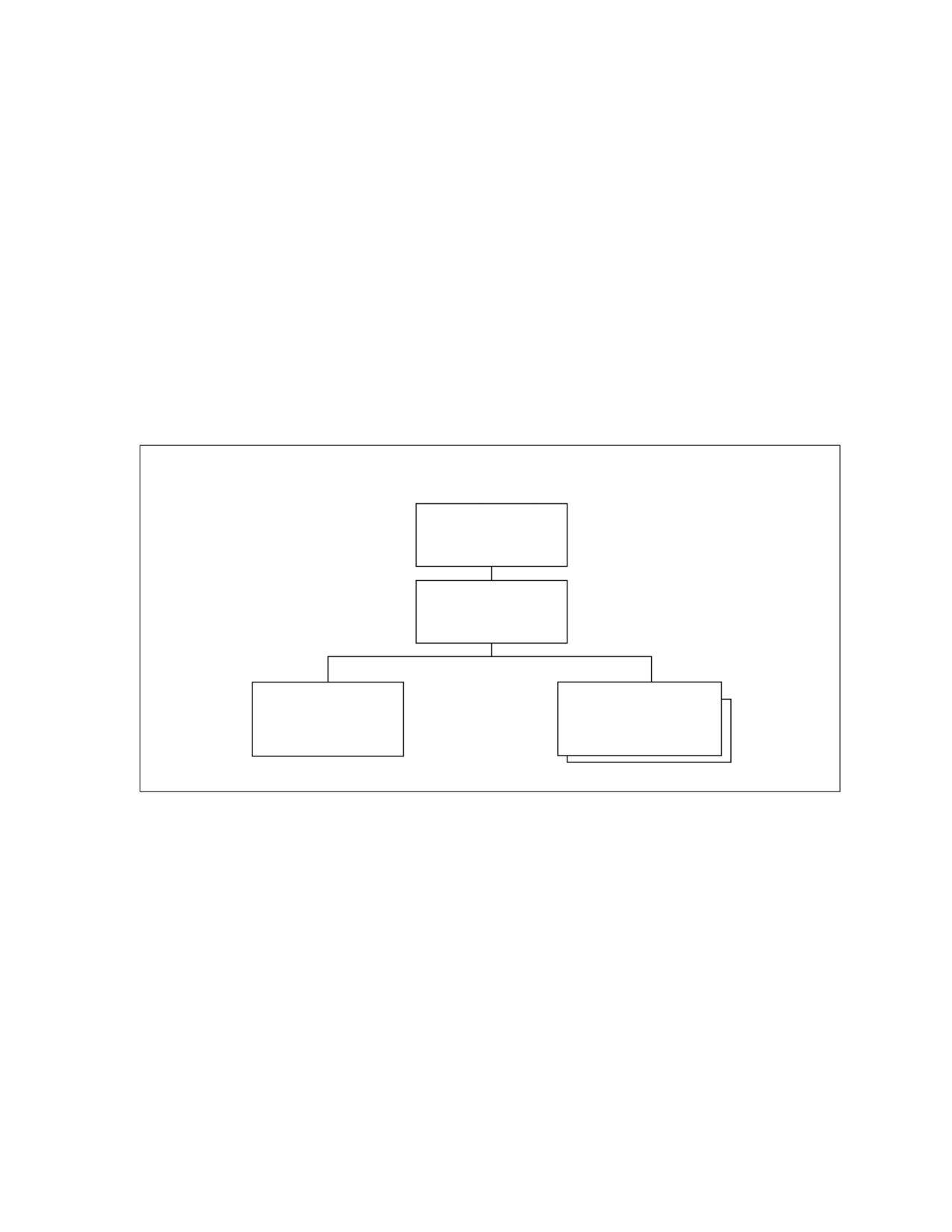
An LB team (Figure L-1) is a light, airborne, airmobile, five-man team. Each
position has its own operations and functions and is identified and coded with a
parachutist additional skill identifier. An LB team consists of the following positions:
• NBC officer.
n
Establishes policies and procedures.
n
Supervises and inspects operations.
n
Makes recommendations to the SFG and special forces operational
detachment (SFOD) commanders.
n
Prepares OPORDs and OPLANs for employment of the detachment.
n
Keeps the commander or TL advised on the status of ongoing NBC
operations.
n
Is particularly important in the verification and collection of CB
agents, precursors, and industrial agents.
n
Is responsible for the direct supervision of missions that are intended
as field verification and collection operations.
• Operations sergeant.
n
Has primary responsibility for team and individual training and
readiness.
n
Prepares OPORDs.
n
Develops and analyzes the intelligence situation and mission profile.
L-4
n
Supervises team operations when operating in a split-team
configuration.
• Chemical operations specialist.
n
Executes the missions planned by the NBC officer.
n
Conducts NBC reconnaissance and sample collection.
n
Operates NBC detection equipment, communications equipment,
photographic equipment, CB sampling equipment, and weapons.
n
Trains and supervises nonchemical soldiers in the execution of NBC
reconnaissance when required.
• Assistant chemical operations specialists (two).
n
Execute the missions planned by the NBC officer.
n
Operate detection and sampling equipment.
03
NBC Officer
74A005P
E7
Operations Sergeant
54B4P
E4
E3
Chemical Operations
Assistant Chemical
Specialist
Operations Specialist
54B1P
54B1P
Figure L-1. LB Team
b.
A five-man LB team—
• Provides special NBC reconnaissance support to SOF who are supporting
strategic, operational, or tactical objectives.
• Can be attached to an SFOD as an augmenting technical team in a
nonpermissive or semipermissive environment.
• Can be deployed independently in a permissive environment.
• Is an SFG commander’s primary means of conducting special NBC
reconnaissance operations. The current rank structure and organizational
density within an LB team limits its ability to support the assigned SFG.
It is primarily an augmentation team and, therefore, has operational
limitations (security, medical support, language skills, communications).
L-5
•
Supports NBC aspects of SR, UW, FID, and direct-action operations.
•
Deploys on short notice, with minimal preparation, at any level of conflict.
•
Conducts operations anytime and in all types of terrain and weather.
•
Normally has the same regional orientation as the SFG.
•
Can augment an SFOD with NBC material detection, collection, field
identification, sampling, and packaging.
•
Possesses specialized NBC protective equipment.
•
Detects nuclear and chemical material.
•
Conducts presumptive identification of biological material.
•
Collects NBC samples.
•
Is a specialized technical reconnaissance unit that supports SOF NBC
requirements.
•
Gives the SOF commander a unique, specialized detachment for special
NBC reconnaissance.
•
Can be attached to another SOF or to a conventional element for a specific
mission.
•
Can provide training to other personnel (e.g., SFOD-A personnel) on NBC
skills to support mission requirements.
•
Conducts collection and identification operations.
•
Focuses on special NBC reconnaissance operations in areas that are not
accessible to conventional reconnaissance elements.
•
Rapidly deploys to areas of suspected NBC use.
•
Conducts sampling and field identification.
c.
The mission can require augmentation by the entire LB team, or the team can
be split into two subelements. Each subelement should consist of at least two LB team
members. In unique situations, depending on METT-TC, attaching only one LB team
member may be required. The LB team commander, along with his supported element,
tailors the level of support or effort required based on the mission requirements and
limitations.
d. The supported commander (or leader), with input from the LB team
commander, determines the configuration of each subelement according to METT-TC.
Normally, the split-team configuration consists of two subelements. The LB team NBC
officer takes the first subelement with one chemical operations specialist and one
assistant chemical operations specialist. The operations sergeant takes the second
subelement with the remaining personnel.
L-6
6.
Special Forces Chemical Reconnaissance Detachment
a.
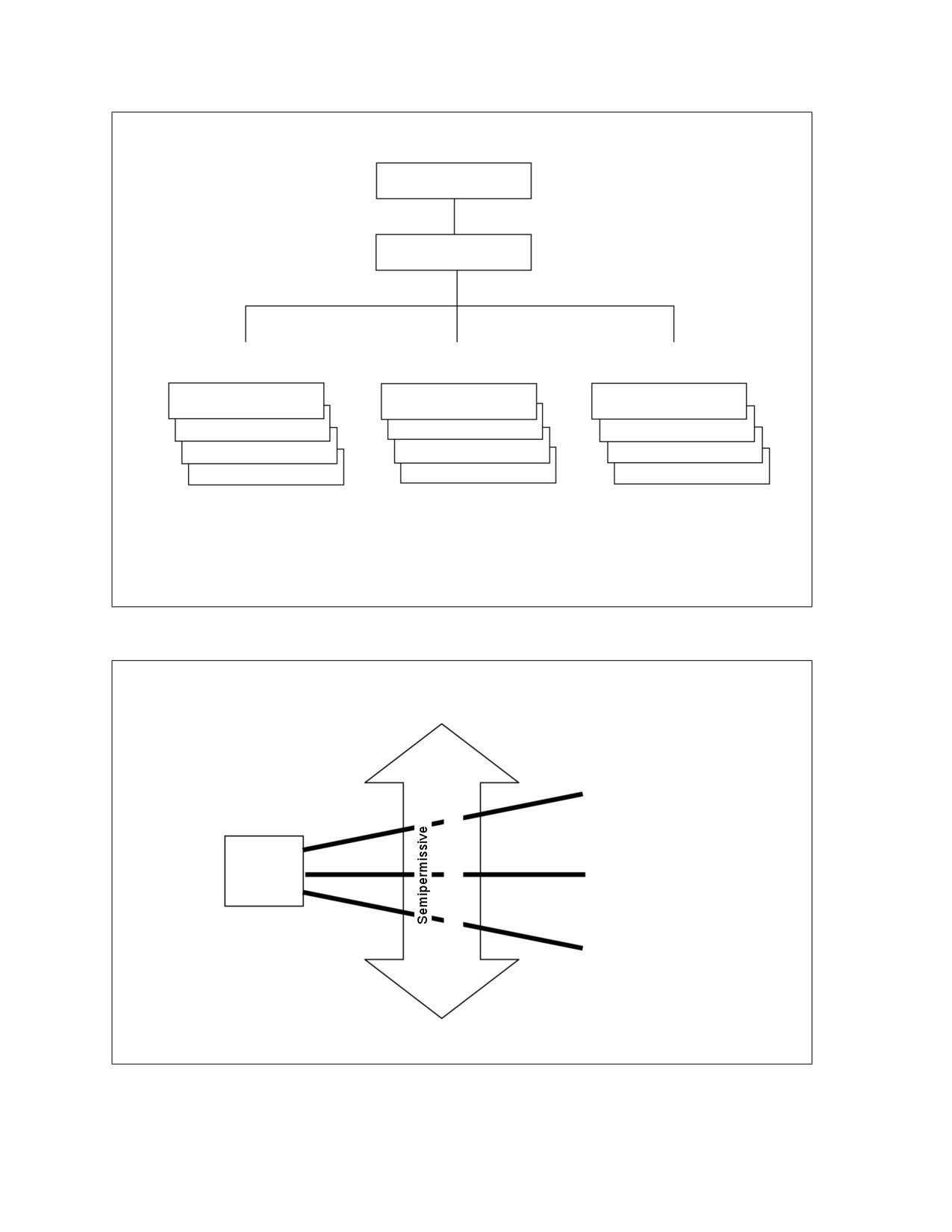
A CRD is a light, airborne, airmobile, 14-man detachment (Figure L-2, page
L-8). The headquarters plans and supports reconnaissance operations and provides C2 of
subordinate elements. CRD-As conduct special NBC reconnaissance and survey
operations in conjunction with SOF in all environments. Each position has its own
operations and functions, and positions are identified and coded with additional skill
identifiers (parachutist, ranger, and technical escort). A CRD team consists of the
following positions:
•
Commander.
n
Establishes policies and procedures.
n
Supervises CRD operations.
n
Makes recommendations to the SFG chemical staff, operations
section, and commander.
n
Provides training guidance to CRD-As.
•
Detachment sergeant.
n
Is responsible to the commander for CRD operations, maintenance,
logistics, and discipline.
n
Ensures that training is conducted according to the commander’s
guidance.
n
Coordinates and provides required assets for current detachment
operations, and anticipates requirements for future operations.
•
CRD-As.
n
Operations NCOIC. (1) Supervises detachment operations. (2)
Ensures detachment training and readiness. (3) Integrates into the
planning process of the supported SFOD-A by helping develop and
analyze the intelligence situation and mission profile.
n
Chemical operations sergeants. (1) Execute missions planned by the
supported SOF element and CRD-A NCOIC. (2) Conduct NBC
reconnaissance and sample collection. (3) Operate standard and
SOF-unique NBC detection equipment, communications equipment,
photographic equipment, CB sampling equipment, and weapons. (4)
Train and supervise nonchemical soldiers in the execution of special
NBC reconnaissance when required.
b.
A CRD provides NBC reconnaissance for a deployed SFOD in all environments
(permissive, semipermissive, and nonpermissive) in support of strategic, operational,
and tactical objectives (Figure L-3, page L-8). It is employed in one of two modes—
• Unilaterally in a permissive environment.
• As augmentation or training support to an SFOD in a semipermissive or
nonpermissive environment.
L-7
Commander
03
74A005S
Detachment Sergeant
E8
54B5VJ5
CRD-A
CRD-A
CRD-A
1st FOB (SF Bn)
2d FOB (SF Bn)
3d FOB (SF Bn)
E7
54B4VJ5
E7
54B4VJ5
E7
54B4VJ5
E6
54B3VJ5
E6
54B3VJ5
E6
54B3VJ5
E5
54B2V
E5
54B2V
E5
54B2V
E5
54B2V
E5
54B2V
E5
54B2V
NOTE: CDR-As are doctrinally organized like their SOF counterparts (SFOD-As) with
autonomous split characteristics. The split team configuration consists of the E6 and one
E5 in one team and the E7 and one E5 in the other team.
Figure L-2. CRD
Nonpermissive
Train/augment
SFOD
E
N
V
I
R
LB/CRD
O
Augment SFOD
N
M
E
N
T
Perform unilateral
actions
Permissive
Figure L-3. LB Team/CRD Scope of Employment Within the Operational Environment
L-8
c.
A CRD provides significantly increased SR activities, including SA,
interagency and joint operations, FID, UW, and CT and CP of WMDs. It detects,
samples, and presumptively identifies NBC agents.
d. The normal employment configuration of a CRD is to attach a CDR-A to each
SF battalion (or forward operating base [FOB]) for a habitual relationship. In this
configuration, the headquarters is located at the SFG headquarters or special forces
operations base (SFOB) for planning purposes. Other configurations depend on METT-
TC. For example, the entire CRD could work together as one organization, possibly for
foreign consequence management missions or reconnaissance missions requiring rest
plans. In addition, two CRD-As could be task-organized as the main effort, while leaving
one SF battalion without a CRD asset. CRD employment is not limited to these options,
but planners should strive to maintain a habitual relationship through training or
operations.
e.
CRD-As can conduct split-team operations when required. This operational
doctrine allows them to quickly and efficiently conduct special NBC reconnaissance and
surveys of several WMD targets within large special operations areas. CRD-A
capabilities include—
• Operations in industrial chemical hazard environments for short
durations.
• Support to foreign consequence management operations as directed by
regional COCOMs.
• Technical escort in support of consequence management missions.
f.
CRD equipment authorizations include common and SOF-unique items. They
have the same equipment as their SOF counterparts (SFOD-As) to ensure their
interoperability with them. Table L-1, page L-10, shows representative equipment
authorizations; specific equipment allowances will vary based on the modified table of
organization and equipment (MTOE).
7.
Communications
The LB team and CRD must maintain secure communications—
• Internally with the FOB, SFOB, or advanced operations base (AOB) in a
permissive environment.
• Externally with the supported unit (e.g., SFOD) in semipermissive and
nonpermissive environments. The SFOD will dictate communications
protocols.
8.
Command and Staff Relationships
The SF unit commander has overall responsibility for the LB team and CRD. He
provides his staff with his intent, and the staff plans accordingly. The SF unit staff has
the following responsibilities:
• Operations. The LB team and CRD report to unit operations for planning,
training, and budgeting guidance and coordination. This includes planning and
employment considerations with the SFG or battalion chemical staff.
L-9

Table L-1. Representative CRD Equipment
Communications-Electronics
Detection
Cable, WD-1/TT
CAM
Digital camera (still, video, and audio capability)
CB sampling kit
Interrogator set, AN/PSX-1
Chemical-agent detector, M21
MINTERM, KY-99
Chemical-agent detector, M22
Monocular night device, AN/PVS-14
Radiac meter, AN/PDR-77
Multiband, intrateam radio
Radiac set, AN/UDR-13
Navigation set, GPS
Radiac set, AN/UDR-13
Night vision goggles, AN/PVS-7D
Mobility
Radio set, AN/PRC-126
Truck, utility, HMMWV
Radio set, AN/PRQ-7
FP
Radio set, AN/PSC-5
Adapter rail weapon, mounted, M5
Reeling cable, hand, RL-39
Bayonet system, XM9
Special mission radio, AN/PRC-137F
Carbine, 5.56-mm, M4
Transponder set, AN/PSC-12
Mask, M40, and standard PPE
Pistol, 9-mm, M9
Self-contained breathing apparatus (Level A)
SOF-modified M4
NOTE: This equipment is likely to change or be upgraded due to the SOF rapid-acquisition cycle for
government and commercial off-the-shelf equipment.
• Intelligence. Unit intelligence provides all the intelligence needs to the LB
team and CRD for planning and execution. Intelligence information includes
the locations of enemy units and facilities, confirmed and suspected use of NBC
warfare, and enemy intent to use NBC warfare. The intelligence staff also
assumes control of special intelligence material and information during
deployment and missions.
• Group chemical staff. The group chemical staff is the primary advisor to the
SFG commander. It advises on CRD capabilities, limitations, and employment
considerations and provides general training guidance.
• Supply. Unit supply assists with the acquisition, maintenance, and resupply
of specialized pieces of equipment needed for operations.
• Group support company. The group support company provides
administration, personnel services, and all classes of supply. The CRD is
attached to the group support company.
9.
Premission Activities
a.
The keystone of SOF premission planning is the operational element that
plans and executes the mission. The inherent qualities of special operations involve
detailed planning and foresight. The intelligence preparation of the JSOA is critical
when an operational area contains an NBC threat.
b.
Training requirements are extensive. Each unit member possesses the skills
necessary to conduct special NBC reconnaissance in permissive, semipermissive, and
nonpermissive areas. Each unit member can operate authorized equipment for suspected
L-10
agent detection, identification, and sampling. Unit personnel operate for extended
periods in full NBC PPE.
c.
Additionally, CRD personnel have the technical escort additional skill
identifier (J5) and are ranger-qualified. They can conduct technical reach-back to
selected agencies and provide details on agent characteristics and threat WMD systems.
They do this through requests for information, primarily during the planning phases of a
mission. Requests for information may also be submitted during or after mission
execution, if required.
d. Figure L-3, page L-8, shows the employment ranges from unilateral missions
in permissive regions to augmentation in semipermissive or nonpermissive (denied)
special operations areas. The COCOM may determine augmentation of an SOF unit with
an LB team or CRD, or the SOF unit may determine a requirement for augmentation.
The C2 relationships integrate the LB team or CRD into the normal SFOD C2 scheme. In
all environments, the LB team or CRD can be attached or in OPCON to a SFOD, JSOTF,
coalition JSOTF, SFOB, FOB, or AOB.
e.
Once assigned to an SFG, a CRD soldier receives the required orientation,
cross training, field craft, and survival training that enable the team to infiltrate and
perform as a member in all environments. Training requirements demand a high level of
physical fitness, airborne qualification, and a high degree of motivation. Unit personnel
conduct specific, area-oriented SF training to enable them to integrate their operations
into those of the SFOD.
f.
In addition, the team conducts advanced technical training that enables it to
carry out its unique tasks. The advanced technical training requires refresher training at
regular intervals to sustain team proficiency. The group chemical officer and NCO
monitor and assist in the technical, tactical, and professional development of CRD
personnel.
g.
LB team and CRD unit personnel require sufficient training in selected SF (18-
series military occupational specialty [MOS]) tasks that allow them to function in a
semipermissive or nonpermissive environment with an SFOD or other SOF element. The
LB team and CRD also conduct training according to the SFG area orientation.
h. NBC technical training covers conventional and special NBC reconnaissance
training, CB sampling techniques, detection techniques, field identification procedures,
technical escort tasks, and NBC technical observation and evaluation skills. The team/
detachment has the latest technical field equipment available from government agencies
or commercial sources.
i.
Every team member is qualified in special NBC reconnaissance TTP. For
example, unit personnel are trained on the details of safe sampling and detection of
known or suspected toxic materials and radiological agents, such as NBC contaminants
and environmental samples of suspected contaminated air, soil, water, and vegetation.
The training also includes procedures for taking background and control samples. Team/
detachment personnel also train in confined-space and target entry techniques for
civilian and military operations (TIM and NBC agents).
j.
Team/detachment members help SFODs prepare a target analysis matrix,
which is also known as a CARVER (criticality, accessibility, recuperability, vulnerability,
effect, recognizability) report. They train SFODs on the skills required to conduct a
technical evaluation, or they augment an SFOD and provide observation and
L-11

identification, as required, of preplanned objectives for inclusion in the CARVER report.
Therefore, detachment/team members must be able to observe and evaluate the
activities and resources at CB agent production and storage sites. Unit personnel gain
the necessary information by going to and studying the various chemical weapons
demilitarization facilities, chemical weapons storage sites, and CB defense research
facilities and by conducting in-depth area studies of SFG target areas.
k. This paragraph identifies the various stages of a team/detachment mission.
Since a team/detachment may augment an SFOD, the team/detachment NBC officer
must integrate his mission planning cycle into the SFOD planning cycle. During mission
planning, the CRD/CRD-A will be integrated into all aspects of the SFOD plan as
appropriate (see Table L-2).
Table L-2. Sample Mission Tasking and Planning Process
Step 1. The SFG receives a mission from the JSOTF via a mission tasking.
Step 2. The SFG commander and his staff, including the chemical staff, conduct a brief mission analysis and
further delegate the mission tasking to an FOB commander. The SFG attaches a CRD-A to the FOB if it is not
already attached.
Step 3. The SFG gives the CRD a WARNORD of the mission and requirement for a CRD-A. The CRD
commander determines which CRD-A will report to the FOB if it is not already attached.
Step 4. The FOB commander, his staff, and selected SFOD-A prepare a MICON and send it to the SFG
commander for approval.
Step 5. The CRD-A reports to the FOB and its supported SFOD-A for mission planning. This planning is
normally done in isolation.
Step 6. The SFOD-A and CRD-A determine the level of effort that is required by the CRD-A during mission
planning. They plan and prepare to execute the mission.
Step 7. The SFG normally returns the MICON approval to the FOB during mission planning.
Step 8. The plan is briefed to the FOB and SFG commander during a “brief back” at the end of the mission
planning. This is where the NBC staff, including the CRD commander can check the plan.
Step 9. Any remaining CRD-A members who took part in the mission planning phase remain in isolation until
after mission completion if only portions of the CRD-A accompany the SFOD-A into the JOA. This ensures that
OPSEC is maintained.
(1) Just as conventional units task-organize to perform specific missions, SF
commanders also task-organize SFODs in response to mission requirements. SF mission
taskings that require the capabilities of an LB team/CRD-A may need the assistance of
only one or two NBC reconnaissance team members. SF commanders tailor their force to
the mission requirements and constraints.
(2) When tasked to execute a specific mission, the LB team/CRD-A moves to
the isolation facility. If the SFOD requires augmentation, the LB team/CRD-A links with
the employed SFOD-A in the isolation facility. The LB team and the SFOD-A jointly
complete existing plans or conduct deliberate mission planning. The LB team/CRD-A
task organization is established. The combined team—
• Receives operational intelligence briefings.
• Refines the execution plan based on the actual situation.
• Conducts required specialized training.
• Requests and receives specialized mission-specific equipment.
L-12
• Rehearses the combined team activities.
• Resolves legal or policy issues concerning the mission.
• Commits the details of the mission to memory.
• Prepares a written OPORD.
• Prepares individual and team equipment for infiltration.
• Develops requirements for intelligence to send forward and monitors
the progress for inclusion in planning.
(3) After the SFOD receives the mission statement, the SFOD commander
and the LB team or CRD-A commander provide the supported commander with a short,
informal mission concept (MICON) brief, which is forwarded to the tasking
headquarters. The MICON brief ensures that the planning efforts meet the supported
commander’s intent. When the MICON is approved and the planning is complete, the
SFOD-A and LB team or CRD-A commanders give the supported commander and his
staff a mission back brief (Table L-3, page L-14). The SFOD-A and LB team or CRD-A
modify their plan, if required, after the back brief. Finally, the LB team or CRD-A
prepares accompanying supplies and equipment for infiltration.
l.
There are multiple factors to consider as the LB team or CRD-A plans its
mission. Table L-4, page L-15, is a checklist that contains sample considerations for the
various phases of an assigned mission.
10. Mission Activities
a.
Commanders may order the collection of material and environmental samples
for support of intelligence and operational requirements, such as evidence that an attack
has occurred, field identification of agents used, degradation of products or delivery
systems, and the agent nation of origin. Sampling operations are particularly important
if a threat uses a previously unknown agent or a CB agent first. Therefore, the collection
of samples and background information must be as detailed and comprehensive as
possible. CRDs may use photographs to help make the background information
comprehensive.
b.
Threats may also use radiological agents to restrict the use of terrain and to
cause delayed casualties. Further, residual radiation can potentially cause high dosages
for those who operate in the contaminated area. The team may collect samples to verify
use and identify radionuclides.
c.
Special NBC reconnaissance tasks include conducting sampling operations,
providing NBC-related technical evaluation and observation, and providing advice and
training on special NBC reconnaissance skills. The data from sampling operations
supports the IPB process and directly relates to ongoing and future operations. Real-time
data transmission and sampling supports—
• Collecting and providing baseline bioenvironmental samples for
background levels of indigenous biological material in a given area.
• Collecting and identifying suspect CB samples (chemical, biological,
biomedical, environmental [soil, air, liquids, vegetation]) and anatomical
samples from animals or suspect contaminated animal specimens.
L-13

Table L-3. Outline for a Mission Back Brief
Responsibility
Item to Brief
Purpose
Mission
Commander or NCOIC
Higher commander’s intent
Detachment commander’s intent
Responsibilities
Concept of operations
ROE
Infiltration plan (if different than the SFOD-A plan or if only into the target area from
the objective rally point)
•
Point of no return
•
Contingency plan
•
Primary and alternate points of entry
•
Contingency plan at entry points
•
Assembly plan
Primary and alternate points of entry
Disposition of excess items
•
Contact points (primary, alternate, and contingency)
Operations Sergeant
•
Movement plans
Actions from points of entry to the contact site
Actions from the contact site to the operational area
•
Security plans
•
Actions at the objective
Specific duties of the technical team, the sample recovery team, and other
specialized teams
•
Withdrawal
•
Linkup or exfiltration plan (primary, alternate, and contingency)
•
Training plan
Tentative plan to train indigenous force
Program of instruction (individual, collective, and leader)
Supplies and equipment
Supply Sergeant
Special mission equipment issued to the LB team
Cross-load plan
Closing statement
CRD/LB Commander
Readiness posture of team
or NCOIC
Unresolved issues and concerns
Questions
NOTE: This outline is for LB team and CRD topics and activities. The format must be coordinated with
the SFOD-A briefer.
L-14

Table L-4. Checklist for Mission Considerations
Prelaunch
r
Receive pretreatments and prophylaxis.
r
Prehydrate during planning phase (most likely you will not be able to stay hydrated during operations).
r
Bring additional food and water for en route time, return trips, and possible delays.
r
Bring additional ground ensembles and masks.
r
Consider weather conditions (humidity [for persistent agents], wind direction, and temperature) and the
time of day that may effect NBC use while en route and at the site.
r
Be prepared to wear some sort of undergarment to allow for bodily functions.
r
Ensure that necessary medical pretreatments, barrier creams, prophylaxis, decontamination kits, and
professional gear are accessible after donning PPE.
r
Coordinate the disposition of contaminated equipment after the mission.
r
Coordinate decontamination line procedures for everyone involved.
En Route
r
Ensure time for detector warm-up and purging.
r
Conduct background checks.
r
Establish mission support sites.
r
Avoid known areas of NBC use (upwind) if possible.
Infiltration/Exfiltration
r
Determine if the location is contaminated.
r
Decontaminate personnel and equipment as soon as possible (threat may dictate otherwise).
On Site
r
Report the status.
r
Coordinate security.
r
Conduct sample preparation and packaging.
r
Initiate sample chain of custody.
r
Maintain documentation (photos, logs, locations, weather, background).
r
Perform protection and documentation actions.
r
Maintain a low signature.
Recovery
r
Determine if the element is returning with a known contaminant.
r
Check detectors.
r
Coordinate the recovery location with all units arriving at the same location.
r
Coordinate decontamination lines and standard life support procedures with all units at the arrival location.
r
Maintain sample chain of custody.
• Collecting radiological samples, such as radioactive dust particles, pellets,
or industrial waste spread throughout an area.
• Providing preliminary identification of chemically contaminated samples
and presumptive identification of biological samples.
NOTE: See Appendix E for an overview of CBR sampling operations.
d. The LB team/CRD may augment an SFOD conducting a unilateral collection
mission, such as technical observations to support surveillance of known or suspected
NBC facilities in hostile areas where the threat precludes the use of other human
L-15
intelligence means. The LB team/CRD provides NBC technical training to an SFOD if
mission requirements prevent augmentation.
11. Postmission Activities
a.
Information gathering is the goal of NBC reconnaissance operations. After
completing special NBC reconnaissance mission tasks, the team/detachment quickly
exfiltrates to an isolation facility or other secure area for postmission activities.
Postmission activities include a debriefing, after-action report (AAR), reconstitution,
recovery, stand-down, and regeneration. Command emphasis is essential to the success
of postmission activities.
b.
The team/detachment has SOPs for postmission debriefings, which ensures
that all the needed information is provided. If the LB team/CRD is part of an SFOD, its
debriefing is integrated into the operational detachment debriefing. A debriefing has
two primary purposes—
• To review the information developed by the team at mission completion.
This allows the team to expand on what it has already reported, adding
details to fill in the gaps.
• To review the total operation, from planning through extraction. This
allows the team to pinpoint what worked, what did not work, and how to
make it better.
c.
The deploying headquarters should conduct a debriefing immediately after
extraction to cover what has to be disseminated immediately. Within 2 hours of
extraction, the deploying headquarters should begin a detailed debriefing of the SFOD
and CRD-A/CRD. Intelligence personnel should direct the debriefing, if possible. The
deploying headquarters operations section should have tracking maps, the team mission
profile folder, the team journal, team messages, and debriefing formats on hand. The
team should complete a written debriefing in the format provided by the deploying
headquarters before starting the formal debriefing. The communications NCO should
debrief radio-telephone operators. Aircrews and drivers should be debriefed after an
insertion or extraction. One copy of the debriefing should go to higher headquarters, and
a copy should be included in the unit historical records.
d. After the debriefing, the detachment commander (with the assistance of other
members of the LB team/CRD) prepares the AAR. The AAR states the “who, what,
where, when, and how” of the operation. It is a permanent record of major team
activities, from isolation to debriefing. As such, it is an extremely important template on
which past missions may be compared and future missions planned. If the LB team/CRD
was part of an SFOD mission, the AAR should be integrated into the operational
detachment AAR. Whether the LB team/CRD conducted missions as part of an
operational detachment or unilaterally, the AAR is submitted to unit operations and
forwarded through command channels to the commander not later than 48 hours after
the LB team/CRD has been debriefed. The intelligence officer at each echelon maintains
copies of the LB team/CRD AAR.
e.
Follow-on missions may be conducted, but are normally an exception. The LB
team/CRD may perform follow-on missions under the following conditions:
• The follow-on mission—
L-16
n
Becomes a new, separate mission.
n
Allows for additional planning time.
n
Does not compromise the main mission.
n
Does not go beyond the capability of the LB team/CRD.
• The LB teams/CRD have trained for the follow-on mission and have the
mission-specific equipment required.
• The LB team/CRD, when going into isolation, understands that there may
be a “be-prepared-to” follow-on mission at the time they receive the
mission letter/briefing.
• Follow-on mission supply pallets and door bundles should be constructed
for possible future missions prior to infiltration.
L-17
Appendix M
ADVANCED STANDOFF CHEMICAL DETECTOR
1.
Background
CAUTION
Standoff chemical detectors may not detect low levels of
TIM and should not be relied on as an indication that an
area is clear.
a. Advanced standoff chemical detectors rapidly detect and identify the presence
of CW vapors. (See the unit staff chemical officer for range detection distances.) They
contain several improvements over the M21 remote-sensing, chemical-agent alarm.
Advanced standoff chemical detectors—
• Detect nerve-, blister-, and blood-agent vapors and can be programmed to
detect a wide variety of other chemical vapors, including some TICs.
• Provide 360° coverage.
• Will work on the move at speeds up to 56 kilometers per hour (kph).
• Employ a passive infrared system that detects the presence or absence of
chemical agents by completing a spectral analysis of target chemicals.
b.
Some detectors can operate from a tripod-mounted platform or be integrated
into mobile reconnaissance platforms, where the results can be communicated to local
and remote personnel via C2 systems. The tripod-mounted variant is intended to operate
in the operational field environment at static, designated locations and ground fixed-site
locations near or around ABs and ports. With integration into a mobile reconnaissance
platform, detectors can also be positioned in a covered and concealed location with
maximum LOS to designated key terrain. Figure M-1, page M-2, provides information on
performance parameters.
c.
Advanced standoff chemical detectors have the following constraints:
• Networking for remote operation. A detector can be networked to
provide remote operation. Multiple alerts and information are displayed
on a single screen, allowing the operator to easily triangulate the actual
hazard location. This can only be done when an effective communications
network exists.
• Locating the hazard. A detector reports the direction of a hazard based
on the relative bearing from the scanner position. It reports the right and
left limits, elevation, and declination of a hazard, but does not provide the
distance from the scanner or the depth of the cloud.
• Tracking the hazard. A detector reports the movement of a hazard as
scans are updated in the search mode. Each detection and subsequent
alert is treated as a separate event. Tracking the cloud is only provided
when triangulation is available. Additionally, the detector may not detect
low-level emissions, such as something leaking from a container.
M-1
Detection range
Up to 3.1 miles
Field of regard
360o cone
360o azimuth, -10o to 50o elevation
60o cone
60o forward, -30o to 30o elevation
FOV
1.5o + 0.2o circular
Detection time
360o cone
Less than 30 seconds
60o cone
Less than 29 seconds
Maximum operating altitude
24,000 feet
NOTE: The distance from the center of the crosshairs provides elevation
information.
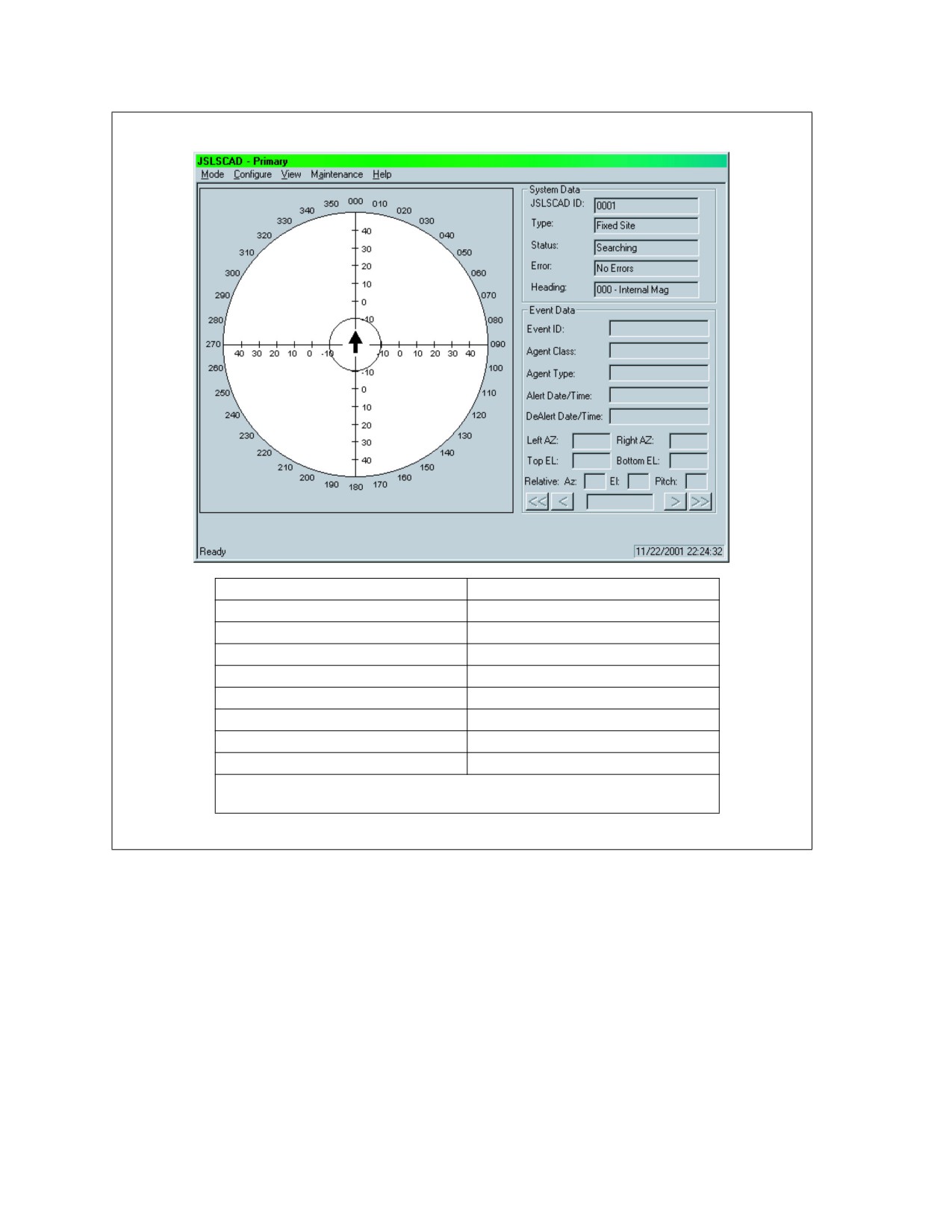
Figure M-1. Advanced Standoff Chemical Detector Performance Parameters
• Detecting cloud formations. A detector is designed to detect clouds
containing selected CW agents in vapor form. The operator must be aware
of how the weather impacts the system. For example, a cold or frozen
agent may not produce enough vapor to be detected, rain may interfere
with detection, and detection of some agents (e.g., blood agents) may only
occur within 5 kilometers due to agent volatility.
M-2
2.
Concept of Operations
Advanced standoff chemical detectors allow war-fighting commanders to monitor
the battlespace for CW agents. During periods of increased tension, detectors will be
deployed at fixed sites, as mobile detection systems on and around fixed sites (such as
main and collocated operating bases), or in support of maneuver units. They will be
positioned to maximize detection in designated areas, and they can also be used in an
overlapping FOV to provide triangulation and tracking of a cloud. Advanced standoff
chemical detectors—
• Monitor AAs and egress routes.
• Search areas between friendly and enemy forces.
• Monitor bridges, road junctions, and other point targets.
• Monitor barriers, such as minefields, obstacles, and chokepoints.
• Cue and vector NBCRVs to or around suspected hazard areas.
• Provide advance detection and warning (i.e., area surveillance or unit
defense) of hazards to units located adjacent to favorable terrain (i.e.,
having adequate LOS).
a.
Operation Modes. Advanced standoff chemical detectors can be operated in two
modes—vehicle-mounted and tripod-mounted.
(1) Vehicle-Mounted. The detector is integrated into a mobile reconnaissance
platform. NBCRVs equipped with an advanced standoff chemical detector should be
positioned with maximum LOS to designated key terrain.
(2) Tripod-Mounted. The detector is powered by an auxiliary power unit that
is serviced and refueled as needed. The detectors may be interfaced with a warning and
reporting network to transmit detection information to an operations center. After the
detector is positioned, a terrain sketch is prepared to indicate the LOS. The information
is then correlated with terrain data at the operations center to provide cloud location
information. The operations center periodically interrogates the detector to ensure that
the system is functioning properly. Every effort should be made to maximize the FOV of
the standoff detector. Mounting it on a building roof or another elevated structure is
encouraged to improve visibility. Standoff detectors have a declination angle of 10°, so
ensure that they are not so far off the ground that coverage is limited in critical areas.
b.
Mobile Employment.
(1) Where possible, advanced standoff chemical detectors will be employed in
pairs (two reconnaissance teams) so that one team can use the detector in an overwatch
position while the other team is moving. The detector is powered up while the vehicle is
moving so that scans can be made at short halts without the need for instrument warm-
up. The detector can be moved by the reconnaissance vehicle at a maximum speed of 56
kph. The detector moves in 1,000-meter intervals and stops for about 2½ minutes to
gather data at each point. If it indicates the presence of vapor hazard, the reconnaissance
M-3
team uses remaining onboard detectors to determine the extent and type of
contamination present.
CAUTION
The maximum speed (56 kph) may exceed the safe
speed of the vehicle over certain types of terrain. Never
plan a reconnaissance to exceed the maximum safe
speed of the vehicle for the terrain being traversed.
(2) Advanced standoff chemical detectors are used on mobile reconnaissance
platforms to conduct reconnaissance in the following roles:
• Identifying potential routes that contain a vapor hazard.
• Providing overwatch for vapor hazards while other mobile
reconnaissance platforms search for liquid hazards.
• Searching an area that units want to use (e.g., assembly area) to
determine the presence of vapor hazards.
• Performing a secondary role to provide warning of off-target vapor
attacks at fixed sites that have suitable conditions for employment.
(3) In determining the exact location of vapor hazards, there are different
types of chemical agents (such as GB and thickened GD, VX, and HD) that produce
varying amounts of vapor, depending on agent characteristics and weather conditions.
Additionally, standoff chemical detection provides only the direction of the hazard, not
distance information. To determine the actual location of a hazard, the unit can use
various techniques.
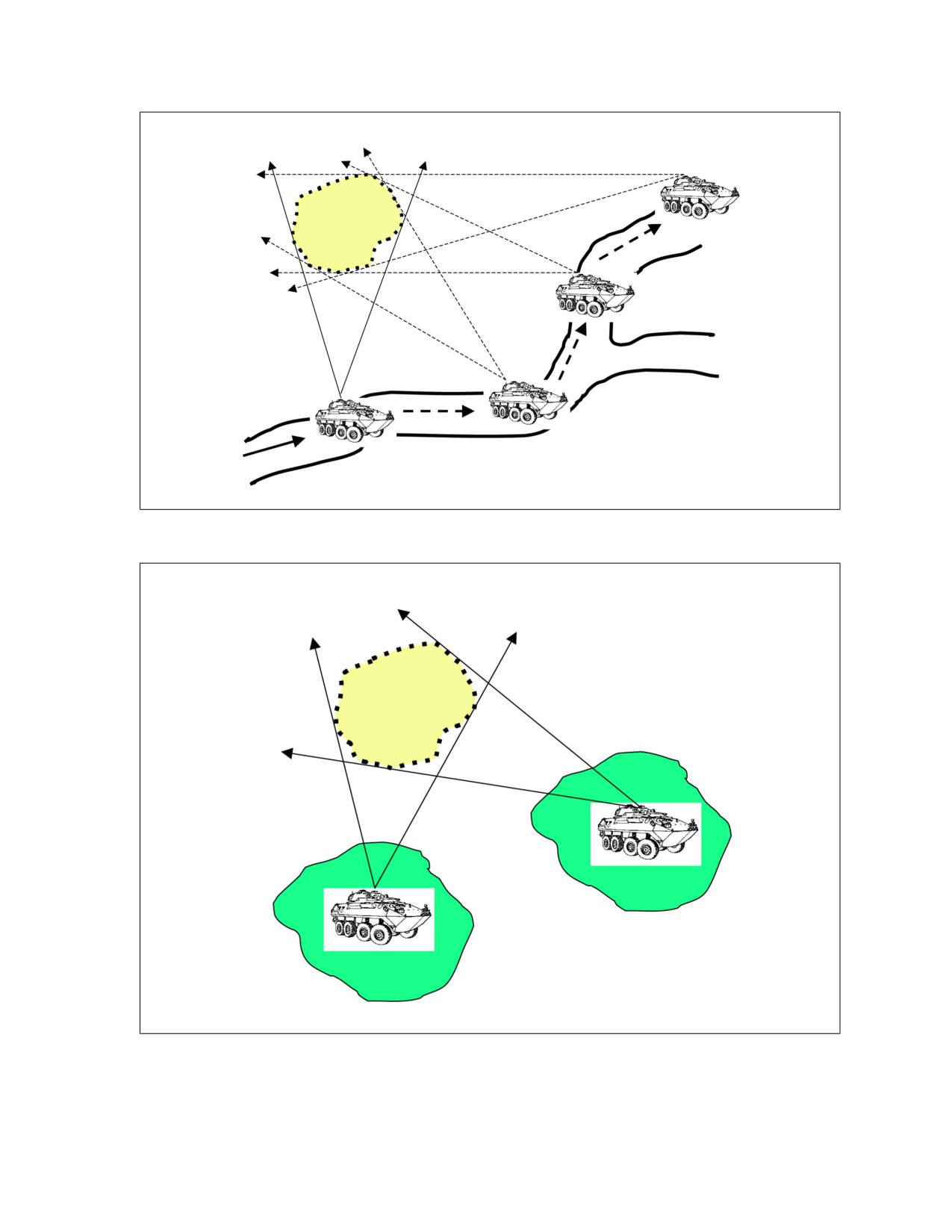
(a) Single System. A single reconnaissance platform (Figure M-2) can
take information from multiple detections and perform the map resections on all
detections. This method can be effective when the wind speed is less then 10 kph for a
point release.
(b) Multiple Systems. Information from multiple reconnaissance
systems (Figure M-3) can be combined. Using the direction of the left and right limits, a
resection is performed on a map indicating the location of the hazard. This is the
preferred method, especially when wind speeds are in excess of 10 kph, which creates a
moving hazard. This method effectively locates point releases, such as a surface-to-
surface missile system (SCUD) impact or a limited artillery strike, but is less effective
against a line release.
(c) Cueing and Vectoring. A reconnaissance system can follow the
direction provided by the detector, vectoring in on the location. Other onboard sensors
(such as the automatic, chemical-agent detector and alarm or the CB mass spectrometer)
will alarm when contact with the hazard occurs. This is the least preferred method since
it is the most time-consuming and provides very little useful information. It provides
leading-edge information for one point only and may not be a true representation of the
larger picture. Cloud locations can quickly change, and the detector operator may have
difficulty detecting movement when he is in contact with the cloud. Cueing and vectoring
may be used to locate off-gassing from ground contamination, allowing a reconnaissance
platform to begin a survey and determine the limits of the ground contamination.
M-4
Hazard area
Figure M-2. Single-System Detection Technique
Hazard area
Figure M-3. Multiple-System Detection Technique
M-5
c.
Reporting Information. The unit should use an NBC 1 report to transmit
standoff detection of a chemical agent. Current and future standoff detectors should
provide the agent type, the right and left limits of vapors, and the elevation and
declination of vapors. Existing standoff detectors do not provide the distance to the cloud,
which means that the specific location of the hazard is unknown. Near-term detectors
may provide the distance to the initial edge of the hazard, but they will not provide the
total depth.
d. Fixed-Site Tactical Employment.
(1) The tripod-mounted, advanced standoff chemical detector can be
employed as a networked or stand-alone detector. As a point detector, it indicates the
onset or arrival of chemical agents. Employment of the detector should ensure good
visibility of upwind areas of operating forces to detect attacks and allow the commander
sufficient time to take immediate action.
(2) Advanced standoff chemical detectors may be employed at airfields,
forward facilities, logistics bases, rear area CPs and headquarters (fixed sites), and port
facilities. They may also be used to detect chemical agents and provide early warning
around MSRs and other LOCs.
(3) The distance between detectors is based on the terrain and the threat.
The distance between the fixed site and the detector is based on the terrain, the size of
the area to be covered, the radio transmission range, the desired warning time, and
METT-TC.
(4) Fixed-site installation of detectors should exploit available terrain and
infrastructure to the maximum extent possible. Buildings and other high ground should
be exploited to improve visibility and limit uncovered areas hidden behind other
structures. Power converters may be used to capitalize on the electrical or generator
power available.
(5) At least three detectors are required to conduct a reliable map resection
and provide the cloud location (Figure M-4). If only two systems are used or if all three
systems are placed in a straight line, the cloud location cannot be determined in many
situations.
(6) Information provided by an advanced standoff chemical detector is used
by the NBC center, cell, or SRC staff to help determine the status of the installation
before, during, and after an attack. The detector provides detection and warning
information, and the input supports recommendations on appropriate modifications to
FP and MOPP levels. The advanced standoff chemical detector provides near real-time
stationary and on-the-move detection of chemical agents. The operator display unit
provides a visual display for the detection. The data fields provide the azimuth to the
cloud, the cloud height, the date and time of detection, and the type of agent detected
(Figure M-5).
e.
TICs. TICs confront personnel from fixed-site storage and production facilities
and from mobile sources, such as pipelines and tanker trucks. The ability to detect
significant releases of TICs at a distance, especially those with the ability to penetrate
protective masks, is very valuable. Standoff chemical detectors detect a very limited
number of TICs. The fingerprint or spectra required for detecting a specific chemical can
be individually loaded onto a system as needed. If it suspected that a facility contains
TICs that a standoff chemical detector has been programmed to detect, reconnaissance
M-6
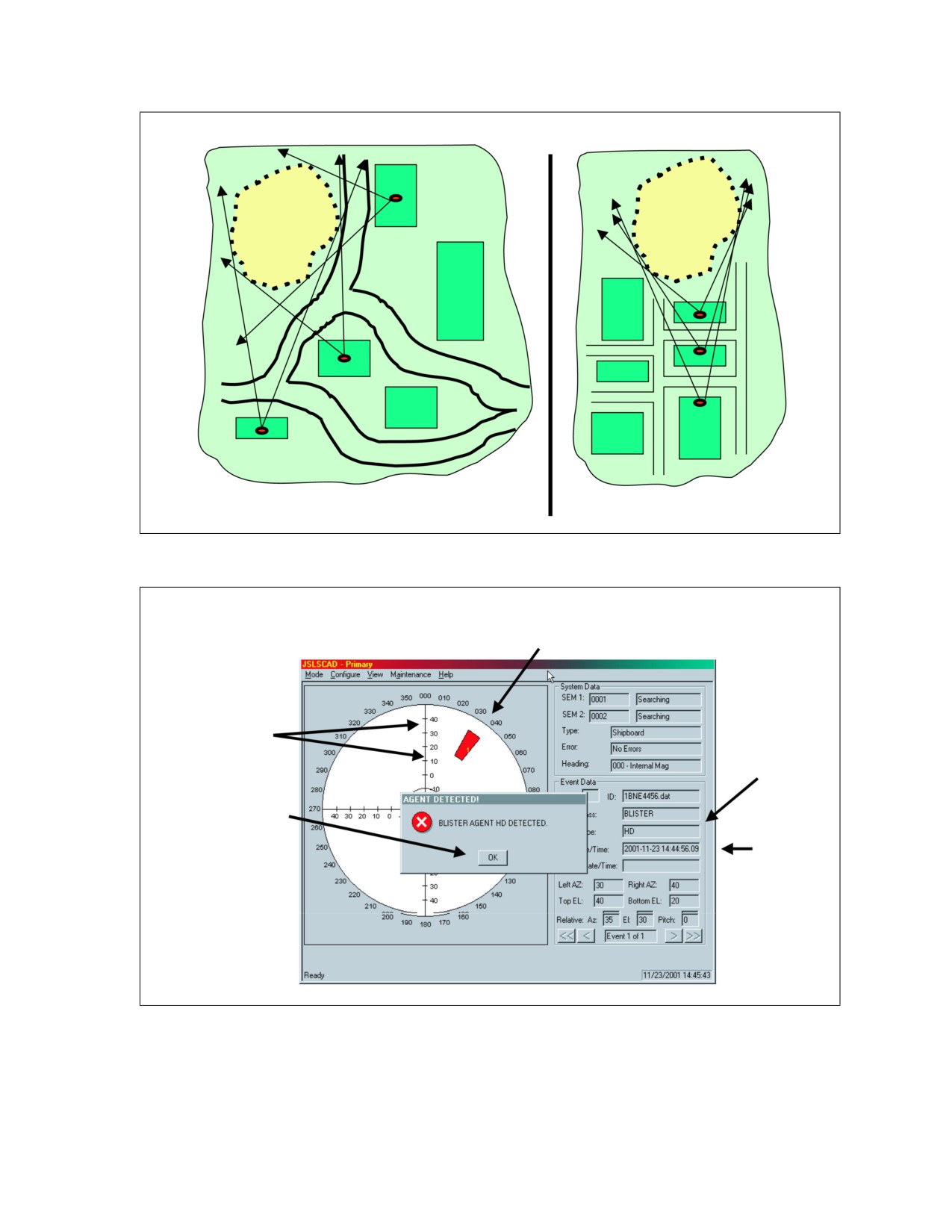
Hazard area
Hazard area
Preferred positions
Incorrect positions
Figure M-4. Positioning Detectors at Fixed-Site Locations
Direction
Top and bottom
elevation
Agent class
and type
Agent class
and type
DTG
Figure M-5. Operator Display Unit Indicating Detection of a Blister Agent
M-7
can be performed from a mobile platform or the facility can be monitored from a static
location.
CAUTION
Standoff chemical detectors do not determine if an area
is low in oxygen (depleted oxygen environment). Use
extra caution when dealing with enclosed areas or very
large amounts of chemicals.
3.
Air Base Fixed-Site Employment
a. Introduction.
(1) Because of their passive nature, advanced standoff chemical detectors
cannot provide the specific location, tracking (movement), or distance to the leading or
trailing edge of the detected cloud. To maximize the effectiveness and provide this
information, triangulation with two or more detectors can be used. To perform
triangulation, the fields of the detectors must cross or overlap. The basic detection grid
could require four detectors to provide coverage for a small installation (about 1,500 by
2,500 meters). A larger installation (3,000 by 500 meters) would require about six to
provide coverage.
(2) Installation size is only one factor in determining the required number of
detectors. FOV is another factor that could effect the number of detectors required.
Standoff detectors must be positioned so that they have an unobstructed FOV. This may
require elevating the detector scanner or sensor electronics module to a height that
provides a clear view of the horizon. Tall or large structures (such as dormitories,
hangars, and fuel tanks) can obstruct the FOV. Terrain features (such as mountains,
hills, and valleys) may also obstruct the FOV. These factors must be considered when
locating the detector so that blind areas are minimized and the overlapping of detectors
is maximized to ensure adequate coverage of the fixed site through point or area
surveillance.
(a) Point Surveillance. Point surveillance is conducted for a specific
period of time and oriented or focused on key terrain located on or off the installation or
base property. For example, the detector would be focused into the wind or toward an
area of concern. The detector defaults at 360° and can be adjusted to focus on specific
areas of concern, thereby reducing the reaction time to agent threats.
(b) Area Surveillance. Area surveillance provides warning to friendly
units, allowing them to avoid contaminated areas before they pose a hazard to resources.
It may be conducted while positioned around the AB perimeter. On-the-move area
surveillance can be conducted if a mobile reconnaissance platform is available.
b.
Vehicle-Mounted Employment.
(1) Single System. A single system provides a 5-kilometer LOS (10-kilometer
diameter) circular ring of coverage around an employed site. In this situation, the system
should be located as close as possible to the center of the AB with an unobstructed field of
regard. The information provided by a single system is based on the location of the
detector and limited to the relative azimuth, elevation, and pitch of the cloud.
M-8
(2) Multiple Systems. Multiple systems, configured with an overlapping field
of regard, provide the ability to gather cloud location and tracking information when the
data is plotted on a grid map. Vehicle-mounted detectors are positioned strategically
around the AB as close to the perimeter as possible. For example, three systems could be
placed upwind of the base airfield, and a fourth system could be positioned strategically
on the base. Four systems provide a sensor perimeter (scanning diameter) for each
system and provide an outer perimeter (overall diameter) for the combined field of
regard. As the individual fields of regard bisect, the detection event data from individual
systems can be analyzed to provide triangulation. Triangulation occurs when the fields of
regard of two or more scanners bisect or overlap. Triangulation is not performed by the
system software or computer interface; it must be performed manually by plotting the
detection information from each detector on an installation or area map. The process of
establishing a triangulated pattern is accomplished by separating two or more detectors
by approximately 1,000 meters and focusing the field of regard so that they cross.
c.
Tripod-Mounted Employment.
(1) A tripod-mounted system can be used in and around fixed-site
installations to optimize the sensor FOV and to overcome obstructions from buildings
and equipment. Key definitions that must be understood for fixed-site elevation
include—
• Sensor height. Sensor height is the elevation at which the sensor is
placed on the ground, building, or equipment to provide an
unimpeded field of regard or clear LOS.
• Ground intersect. Ground intersect is the distance from the system
that the lower tangent of 10° will intersect the ground. The ground
intersect is representative of the distance from the detector that will
not be viewable in the field of regard. Always consider the ground
intersect when elevating the system.
(2) To execute fixed-site elevation of advanced standoff chemical detectors,
assess the following factors:
• Survey. Examine the perimeter of the installation to determine
potential limiting factors. This includes determining the presence of
topographical or structural blockages. Survey off-site areas up to 5
kilometers away to ensure that an unobstructed field of regard is
provided to each detector.
• Site preparation. Prepare each detector position or site according
to the paragraph 2d. Include mounting brackets or tripods needed to
affix the detector to the site.
• Elevation. Consider using the roofs of existing buildings or
structures to elevate the system.
(3) The operator display unit provides detection information based on a
single detector. Triangulation is the plane formed when connecting data from two or
more detectors. To conduct triangulation, determine the location of each detector and
plot the locations on an installation or area grid map. The location can be determined by
measuring from the detector to two known points, such as buildings or other structures.
A GPS can also be used to determine the exact detector location.
M-9
4.
Aerospace Configuration
Advanced standoff chemical detectors can be operated with low or mid-level aerial
platforms (such as unmanned aerial vehicles) and with aircraft (such as MH-53J/M, AC-
130H/U, MC-130E/H/P variants, and CV-22). These aircraft are usually tasked for
insertion, extraction, direct action, BDA, low-level refueling, or combat search and rescue
and are typically employed without additional airborne support assets. The threat to
aircraft from chemical contamination is greatest at low altitudes (below 1,000 feet above
ground level) and while operating into and out of airfields. Downward-looking aerial
application of standoff detection has the added value of determining cloud location.
5.
Maritime Configuration
Information obtained from the advanced standoff chemical detector can be used by
the commander for contamination avoidance maneuvers. Onboard ship, the detectors
replace the AN/KAS-1 CW directional detectors. The joint-service, lightweight, standoff
chemical-agent detector will be used on ships, on boats, on rotary-wing aircraft, and in
various expeditionary (beach reconnaissance) and base applications.
a.
Surface Combatants, Command Ships, Aircraft Carriers, and Amphibious
Ships. These ships have two detectors with overlapping fields of regard to assure
improved coverage. The operator display unit is located on the bridge and in the combat
information center. The detectors are primarily operated from the combat information
center, allowing remote control and visual display of information (agent type and
location) via the operator display unit. The operating system passively and continuously
scans the field of regard (total search area of 360° azimuth, -10°/+50° vertical). Upon
detection of a chemical agent, the detector provides a local chemical-agent warning and
directional data. The information provided by the detector is evaluated with intelligence,
radar, electronic-warfare sensors, lookouts, and other sensors and available information
to determine and correlate threat bearings displayed on the operator display unit. The
officer of the deck or the tactical action officer take evasive maneuvering actions,
increase protective levels, reconfigure ventilation systems, and activate countermeasure
washdown systems as appropriate.
b.
Mine/Countermine Ships. These vessels may have one or two sensors to
provide coverage.
c.
Amphibious Readiness Groups. Each deployed assault craft unit detachment
with landing craft units is equipped with two detectors, but they are not permanently
mounted. They are available for use if intelligence sources indicate the possibility of
contamination on the objective beach. Landing craft units are equipped with mounting
brackets and are the primary platform for beach reconnaissance missions.
d. Aircraft. The standard manned aerial configuration consists of a forward-
looking sensor module mounted on an exterior hard point of the aircraft. The module
interfaces with the operator display unit via a direct connection and associated power
cable. The operator display unit is mounted inside the aircraft, away from the cockpit
area. The detector scans a 60°, forward-looking cone and provides early warning of
contamination and hazard areas that allows appropriate and timely aircrew responses. If
a positive reaction is noted, a chemical-agent warning is provided locally to the aircrew
chief via the operator display unit.
M-10
e.
Selected Naval Installations. Advanced standoff chemical detectors will be
deployed at various points around the facility according to terrain in order to provide
overlapping detection areas that provide the facility 360° coverage.
f.
Ashore Expeditionary Forces. Naval construction battalions, naval beach
groups, naval beach masters, and amphibious construction battalions deploy joint-
service, lightweight, standoff chemical-agent detectors to provide detection while
operating in forward-deployed and expeditionary areas where there is an indication of
the potential use of chemical agents.
g.
Naval Special Warfare (NSW). Advanced standoff chemical detectors installed
on NSW watercraft receive one sensor with a forward-looking field of regard. The sensor
has about 180° azimuth extent and is capable of high-speed operations (0 to 60 knots).
The remaining detectors assigned to NSW teams and combat support teams are portable
and tripod-mounted.
h. Medical. Advanced standoff chemical detectors are used by fleet hospitals.
They are employed on a four-point system to achieve overlapping 360° coverage.
Forward-deployed preventive medical units also receive detectors to use in stand-alone
medical facilities in high-threat areas.
WARNING
The decision to sound an alarm and further
disseminate the word that a chemical attack has
taken place must occur within seconds. Use NBC 1
reports to pass the alarm and alert the NBC control
center or the SRC that an attack has occurred.
The commander must rapidly gather detection,
intelligence, medical, and other pertinent information
to determine the next COA. False alarms must be
confirmed as rapidly as possible to get personnel
out of MOPP and to restore full operational
capability.
The NBC control center or the SRC will confirm and
validate the attack through the evaluation of reports.
M-11
Appendix N
JOINT-SERVICE, LIGHTWEIGHT NUCLEAR, BIOLOGICAL,
AND CHEMICAL RECONNAISSANCE SYSTEM
AND STRYKER NUCLEAR, BIOLOGICAL, AND CHEMICAL
RECONNAISSANCE VEHICLE
1.
Background
The joint-service, lightweight NBCRS and the Stryker NBCRV provide the
commander with the capability to conduct NBC reconnaissance in his AO (e.g., fixed site,
port, airfield, maneuver unit). They have comparable detection suites on different
vehicles. For example, the Stryker NBCRV is a Stryker wheeled, armored vehicle and
the joint-service, lightweight NBCRS is an armored LAV or HMMWV variant.
2.
Description
a.
The joint-service, lightweight NBCRS and the Stryker NBCRV—
• Are deployed as mobile detection systems on and around fixed sites (main
operating bases, collocated operating bases, and bare bases).
• Are deployed in support of land forces.
• Are deployed to perform NBC reconnaissance tasks as described in
Chapter VI.
• Perform nuclear and chemical detection on the move, at speeds up to 45
kph (depending on METT-TC).
• Perform stationary NBC surveillance missions, such as biological
detection.
NOTE: The biological detection capability can only be used in a
stationary surveillance role. Taking into account METT-TC and the
most recent enemy intelligence, systems and vehicles are positioned
to maximize the probability of detection in a designated area.
• Can conduct NBC point detection and standoff chemical detection
through air and surface sampling.
• Warn of NBC agent detection.
• Identify specific BW and CW agents.
• Measure or detect radiation.
• Take samples for lab analysis.
• Are used to supplement other CB detectors on the battlefield.
b.
Once an area is searched and contamination is confirmed, the area is marked
with the appropriate NBC markers. NBC warning reports with meteorological and
N-1
location data are forwarded to the supporting NBC control center or SRC, using digital or
voice means to update the situation for commanders.
c.
Operators perform NBC reconnaissance operations in an environmentally
controlled atmosphere that is protected from all known CB warfare agents, nuclear
particulates, and most TIM. The information received from the detectors is automatically
prepared for electronic transmission through the NBC warning and reporting system.
d. The joint-service, lightweight NBCRS has its own electrical power source to
provide support to the system. During stationary operations, it can operate from
standard external power sources. The Stryker NBCRV has a NATO power adapter and
can also operate from an external power source.
3.
Employment
a.
Capabilities. The joint-service, lightweight NBCRS and the Stryker NBCRV
provide—
• Stationary, mobile, and standoff chemical (liquid and vapor) detection.
• Stationary and mobile radiation detection.
• Stationary biological detection
They are tactical assets, and commanders plan for their use to support war requirements
at the tactical and operational levels. Multiple systems are required to establish an area
or critical-node array, and they provide another asset that can be used for point
biological detection. When conducting point biological detection operations, they cannot
conduct mobile chemical or radiological detection, but can still conduct stationary
monitoring.
(1) Tactical Level. They can provide tremendous coverage of an AO (i.e.,
provide large-area coverage, conduct several search or survey missions) in support of
chemical and radiological detection. There is a tremendous benefit through the use of
their reconnaissance capabilities, and they provide critical information to the
commander. The joint-service, lightweight NBCRS and the Stryker NBCRV are
important, low-density assets. Task-organizing them to support AB, brigade, and
regimental missions increases the overall combat power of the tactical-level commander
(i.e., avoid contamination, maintain OPTEMPO).
(2) Operational Level. As part of an operational-level biological detector
array, the control of these detection assets could likely revert to an operational-level war
commander (e.g., JTF), because centralized reporting is generally conducted to help
determine if a biological attack occurred. Additionally, the operational-level commander
should have access to other resources (i.e., Biological Integrated Detection System)
whose primary mission is to conduct point BW detection. Further, there may be specific
METT-TC situations when the joint-service, lightweight NBCRS and the Stryker
NBCRV are used as point biological detectors. For example, during FP early-entry
operations, they may be used to support biological detection if other BW detection assets
are not available. They can also use their chemical point and standoff capabilities during
a biological surveillance mission. When additional forces with BW detection capabilities
arrive, the joint-service, lightweight NBCRS and the Stryker NBCRV would likely
resume support for other NBC reconnaissance operation, such as search or survey.
N-2
b.
Operational Differences. There are also some operational differences between
the joint-service, lightweight NBCRS and the Stryker NBCRV that leaders must
consider during the employment of NBC reconnaissance capabilities. Selected differences
include the following:
• Radiological detection. The Stryker NBCRV uses an AN/UDR-13 and
AN/VDR-2. The joint-service, lightweight NBCRS uses an AN/VDR-2. The
AF joint-service, lightweight NBCRS uses an AN/VDR-2 and ADM-300.
• Chemical vapor sampling. The Stryker NBCRV has a chemical vapor
sampling system to confirm vapor detection. The joint-service, lightweight
NBCRS does not have a similar capability.
• Vehicle variants. The Stryker NBCRV and the joint-service, lightweight
NBCRS (LAV) are wheeled, armored vehicles. Commanders will likely
task-organize them to support combat forces (i.e., maneuver elements).
The joint-service, lightweight NBCRS (HMMWV) will likely be task-
organized to support fixed-site NBC reconnaissance operations or other
areas of the battlespace that will enhance system survivability.
• Armament. The Stryker NBCRV has a remotely operated weapon
capability. The joint-service, lightweight NBCRS (LAV) weapon cannot be
remotely operated. The joint-service, lightweight NBCRS (HMMWV) does
not have weapon capability.
c.
ABs, Ports, and Fixed Sites.
(1) Both detection assets can be deployed at ABs, ports, and fixed sites as
outlined by base support plans. Key nodes (such as the NBC control center) monitor the
units on the base and receive data reports via radio links. The commander combines the
information with that from other deployed detectors at fixed sites to make decisions and
take appropriate actions.
(2) The detection assets will normally be assigned specific sectors at a fixed
site, such as an AB. Each fixed site should have a plan to receive and place the assets.
The assets will be used as directed via the wing operations center, SRC, or NBC cell
based on the threat and any vulnerability in the fixed detector array.
d. Land Forces. When deployed with forward combat units, both detection assets
are integrated into the overall ISR effort to provide early warning and confirm
contaminated or uncontaminated areas in support of combat operations.
(1) Offensive Operations. Movement to contact, attack, exploitation, and
pursuit are all offensive operations that need to maintain momentum. The detection
assets support these operations by deploying with or immediately behind forward forces
to quickly mark and identify routes around contaminated areas.
(2) Defensive Operations. Two patterns of defensive operations are mobile
defense and area defense. The detection assets can be deployed with forward security
forces and reserve counterattack forces to mark and provide bypass routes. Other
missions include monitoring MSRs, troop concentrations, APODs, and SPODs.
N-3
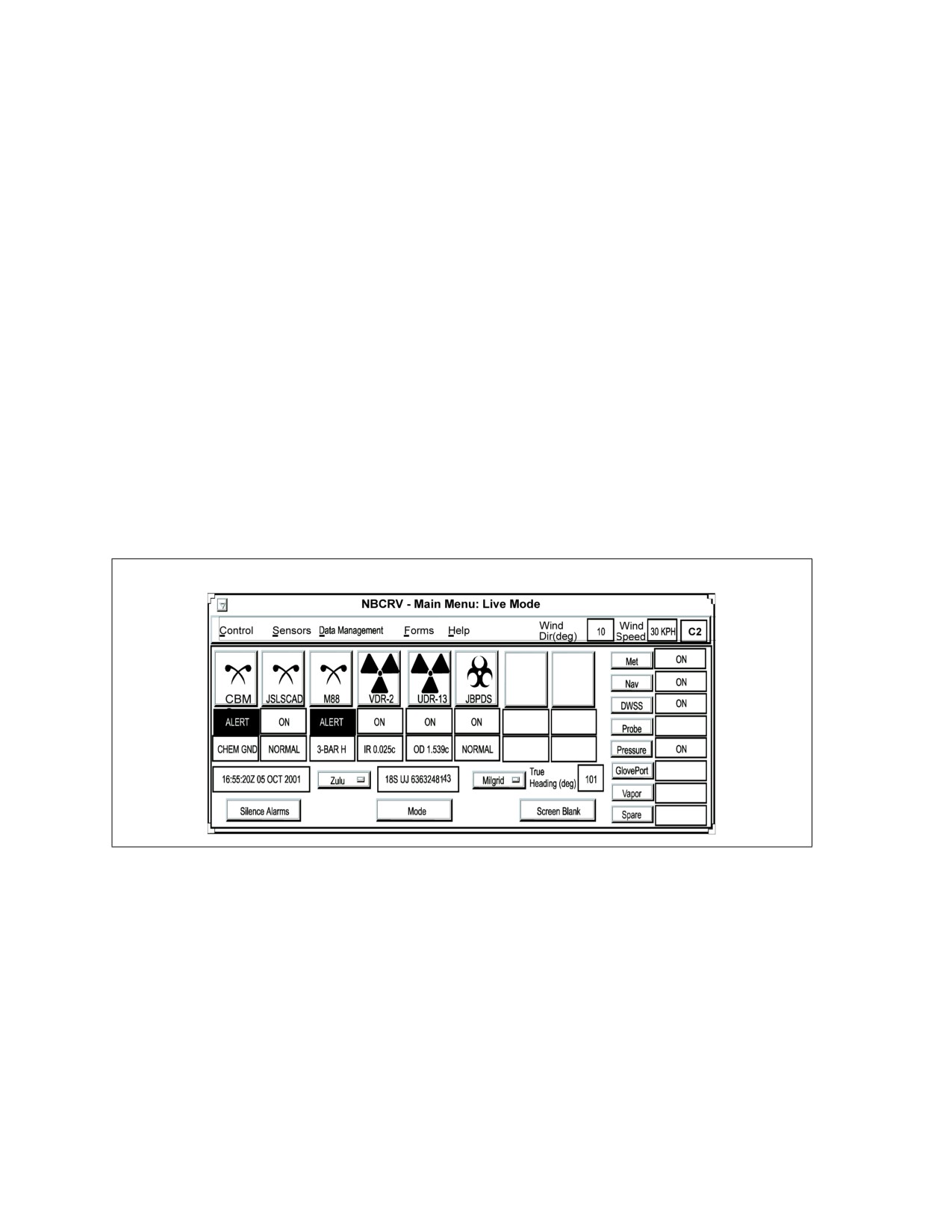
4.
Tasks
a.
The joint-service, lightweight NBCRS and the Stryker NBCRV warn units of
contamination, report the location of hazards, mark areas of contamination, locate clean
bypass routes, and collect and transport samples of NBC material for later analysis.
They accomplish these functions by performing the following tasks:
• Search. See Appendix G for information on search techniques.
• Survey. See Appendixes G and I for information on survey techniques.
• Surveillance. See Appendix H for information on surveillance
techniques and procedures (i.e., observing NAIs, establishing a biological
detection array). See Appendix M for information on advanced chemical
standoff detector employment.
• Sampling. See Appendix E for information on sampling techniques.
b.
Both detection assets use onboard detectors (e.g., M22) to detect and identify
NBC agents, allowing commanders to take appropriate defensive measures. Once
contamination has been located, physical markers are dropped to locate the extent of the
hazard area. The assets also capture, contain, and provide samples for confirmatory
analysis using the sampling arm and external storage vials. Figure N-1 shows the main-
menu screen of the Stryker NBCRV; it provides feedback on NBC detection suite results.
Figure N-1. Stryker NBCRV Main-Menu Sample Screen
(1) CB Mass Spectrometer. The spectrometer provides point and mobile
detection and identification of chemical agents (e.g., ground contamination and vapor).
The data input is received and displayed on the main-menu screen.
(2) Joint Biological Point Detection System. This system provides point
detection and identification of biological agents.
NOTE: The Joint Biological Point Detection System will not be placed in the
standby mode while on the move.
N-4
(3) Joint-Service, Lightweight, Chemical-Agent Detector. This detector
provides point and mobile standoff detection of chemical agents. (See Appendix M for
further information.)
(4) M88 Chemical-Agent Sensor. This sensor provides point and mobile
detection of G-series nerve and blister agents. It provides agent concentration, when and
where the agent was first detected, and when and where the agent was last detected.
Information from the M88 is fed to the main-menu screen of the Stryker NBCRV.
(5) Radiation Detectors.
(a) AN/VDR-2 Radiac Meter. It provides the radiation dose rate and the
total accumulated dosage inside and outside the vehicle in near real time. Information
from the AN/VDR-2 is fed to the main-menu screen of the Stryker NBCRV. The ADM-
300 radiac meter provides similar capabilities for the AF variant of the joint-service,
lightweight NBCRS.
(b) AN/UDR-13 Radiac Meter. It provides the radiation dose rate and
the total accumulated dosage inside and outside the vehicle. It also measures prompt
gamma and neutron dosages from a nuclear event and gamma dosages and dose rates
from a nuclear fallout. Information from the AN/UDR-13 is fed to the main-menu screen
of the Stryker NBCRV.
5.
Task Organization
The joint-service, lightweight NBCRS and the Stryker NBCRV are subject to
established command and support relationships according to applicable OPLANs and
OPORDs. For example, at USAF installations, the installation commander will likely
maintain control of these assets through the NBC control center located in the SRC. For
further detail on these relationships, see applicable service publications.
6.
Communications
The joint-service, lightweight NBCRS and the Stryker NBCRV require interface
with installation level and/or unit communications to support connectivity to the
supported unit. Short- or long-range vehicle radios (AN/VRC-90A/D/F) will be used.
These assets can communicate digitally with the Enhanced Position Locating and
Reporting System or through voice communication with the Single-Channel, Ground-to-
Air Radio System.
N-5
REFERENCES
Department of Defense
DD Form 1911, Material Courier Receipt, May 1982.
DODD 2000.12, DOD Antiterrorism (AT) Program, 18 August 1999.
DODD 3025.1M, Manual for Civil Emergencies, June 1994 (U).
DODD 3025.12, Military Assistance for Civil Disturbances (MACDIS), 4 February 1994
(U).
DODD 3025.15, Military Assistance to Civil Authorities, 18 February 1997.
DODD 3150.8, DOD Response to Radiological Accidents, 13 June 1996.
DODD 3150.8M, Nuclear Weapon Accident Response Procedures (NARP), December 1999.
DODD 5100.77, DOD Law of War Program, 9 December 1998.
DODD 5240.1, DOD Intelligence Activities, 25 April 1988 (U).
DODD 5525.5, DOD Cooperation with Civilian Law Enforcement Officials,
15 January 1986.
Joint
CJCSI 3125.01, Military Assistance to Domestic Consequence Management Operations in
Response to a Chemical, Biological, Nuclear, or High-Yield Explosive Situation,
3 August 2001.
CJCSM 3150.03B, Joint Reporting Structure Event and Incident Reports, 23 July 2003.
CJCSM 3500.04C, Universal Joint Task List, 1 July 2002.
Joint Service Chemical and Biological Defense Fact Sheets, August 1998.
Joint Service Chemical and Biological Defense Program FY 00-02 Overview.
Joint Service Nuclear, Biological, and Chemical Defense Concept, September 1997.
JP 1, Joint Warfare of the Armed Forces of the United States, 14 November 2000.
JP 1-01, Joint Doctrine Development System, 5 July 2000.
JP 1-02, Department of Defense Dictionary of Military and Associated Terms,
12 April 2001.
JP 2-01.3, Joint Tactics, Techniques, and Procedures for Joint Intelligence Preparation of
the Battlespace, 24 May 2000.
JP 3-0, Doctrine for Joint Operations, 10 September 2001.
JP 3-01, Joint Doctrine for Countering Air and Missile Threats, 19 October 1999.
JP 3-01.5, Doctrine for Joint Theater Missile Defense, 22 February 1996.
References-1