FM 3-21.220 STATIC LINE PARACHUTING TECHNIQUES AND TRAINING (SEPTEMBER 2003) - page 10
FM 3-21.220/MCWP 3-15.7/AFMAN11-420/NAVSEA SS400-AF-MMO-010
c. Mask Clearance. Since the aircraft is required to fly along the markings on the
DZ, these markings must be visible to the aircrew. The markings are placed where
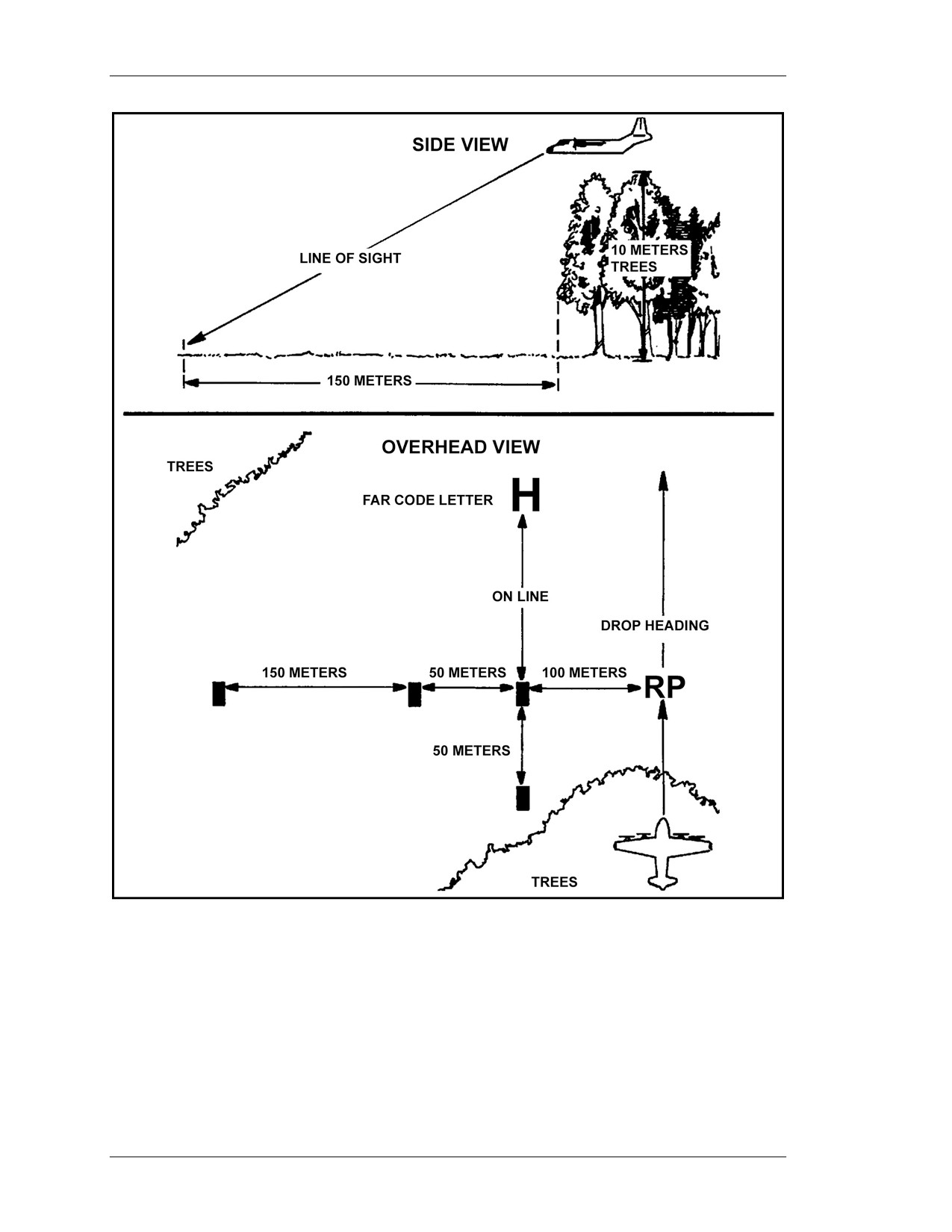
obstacles will not mask the pilot’s line of sight. As a guide, a mask clearance ratio of 1:15
is used, that is, one unit of vertical clearance for every 15 units of horizontal clearance.
For example, if a DZ marker must be positioned near a terrain mask, such as the edge of a
forest that is on the DZ track, and the trees are 10 meters high (33 feet), the markings
would require 150 meters (492 feet) of horizontal clearance from the trees (Figure 22-4,
page 22-6). This applies to static line jumps only.
d. Code Letters. If any portion of the inverted L falls within a 15 to 1 (15:1) mask
clearance ratio of obstacles on the approach end of the DZ, a code letter (H, E, A, T) or
far panel is required on the departure end of the DZ for CDS or bundle drop and should
be coordinated during the DZST/aircrew mission briefing. This far marking is on line
with the corner (A) panel to allow the aircrew to begin alignment on the release point
until the inverted L comes into view. If a code letter is used, it can be used to distinguish
the DZ from other DZs in the area.
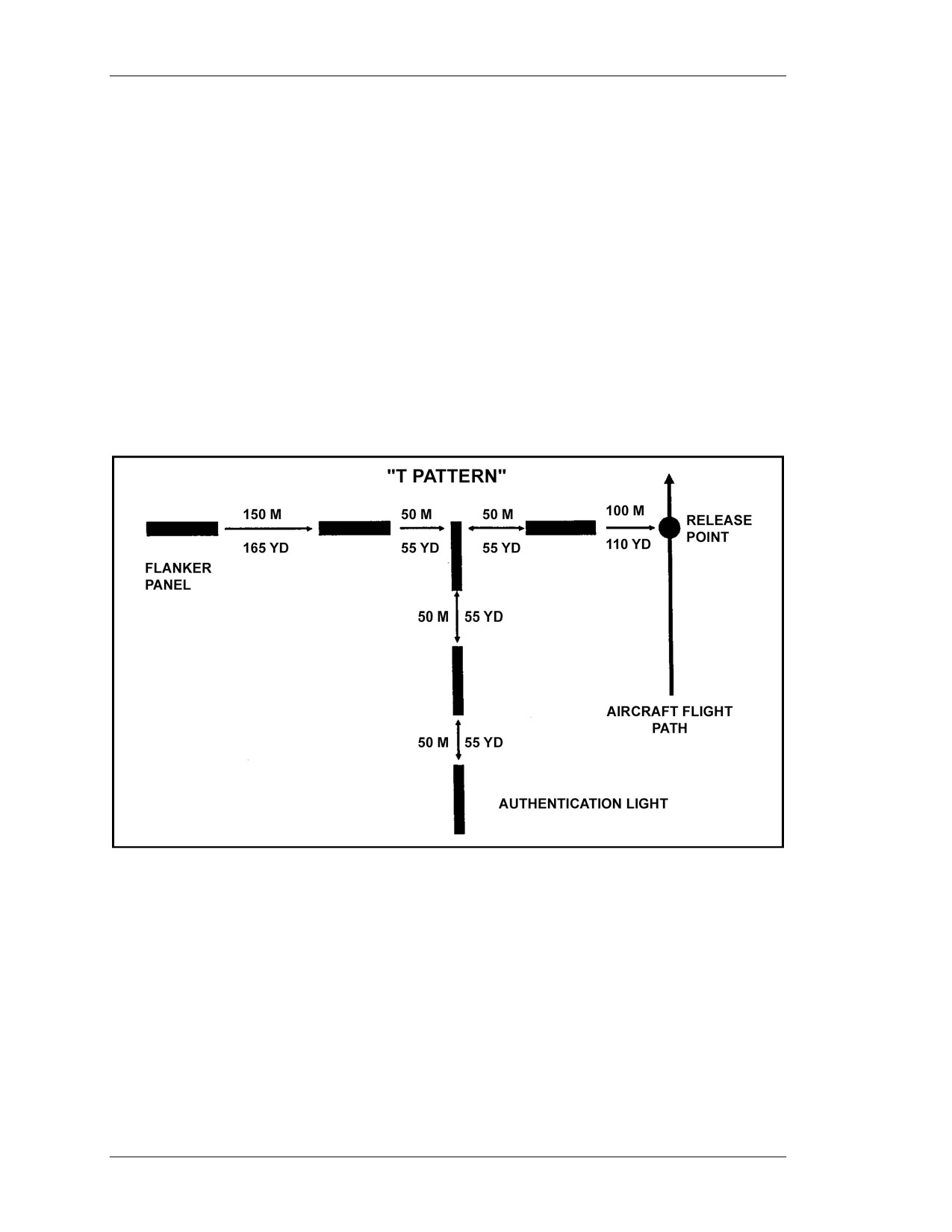
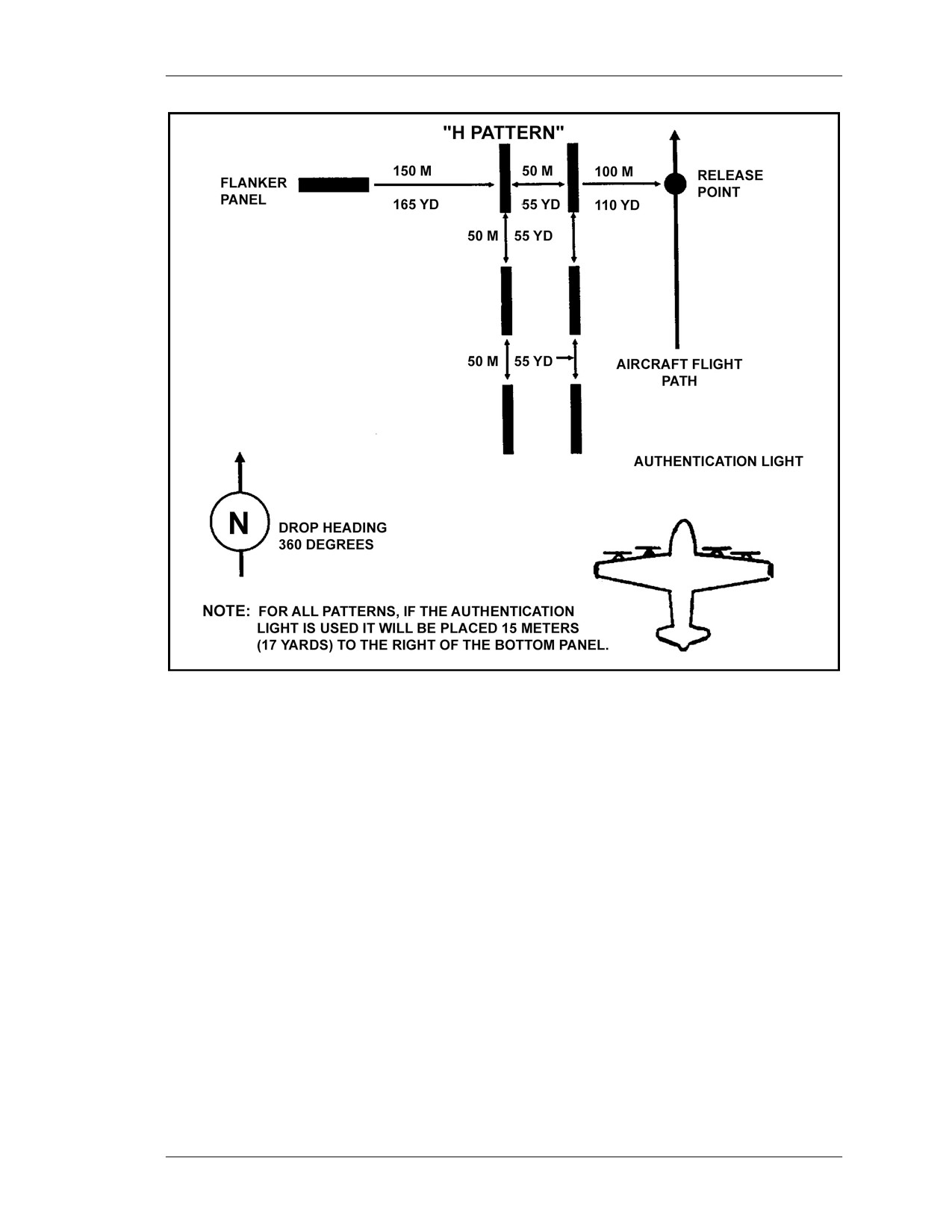
Figure 22-3. GMRS panel emplacement.
22-4
FM 3-21.220/MCWP 3-15.7/AFMAN11-420/NAVSEA SS400-AF-MMO-010
Figure 22-3. GMRS panel emplacement (continued).
22-5
FM 3-21.220/MCWP 3-15.7/AFMAN11-420/NAVSEA SS400-AF-MMO-010
Figure 22-4. The 15:1 mask clearance ratio.
22-4. VERBALLY INITIATED RELEASE SYSTEM FOR ROTARY-WING
AND FIXED-WING AIRCRAFT
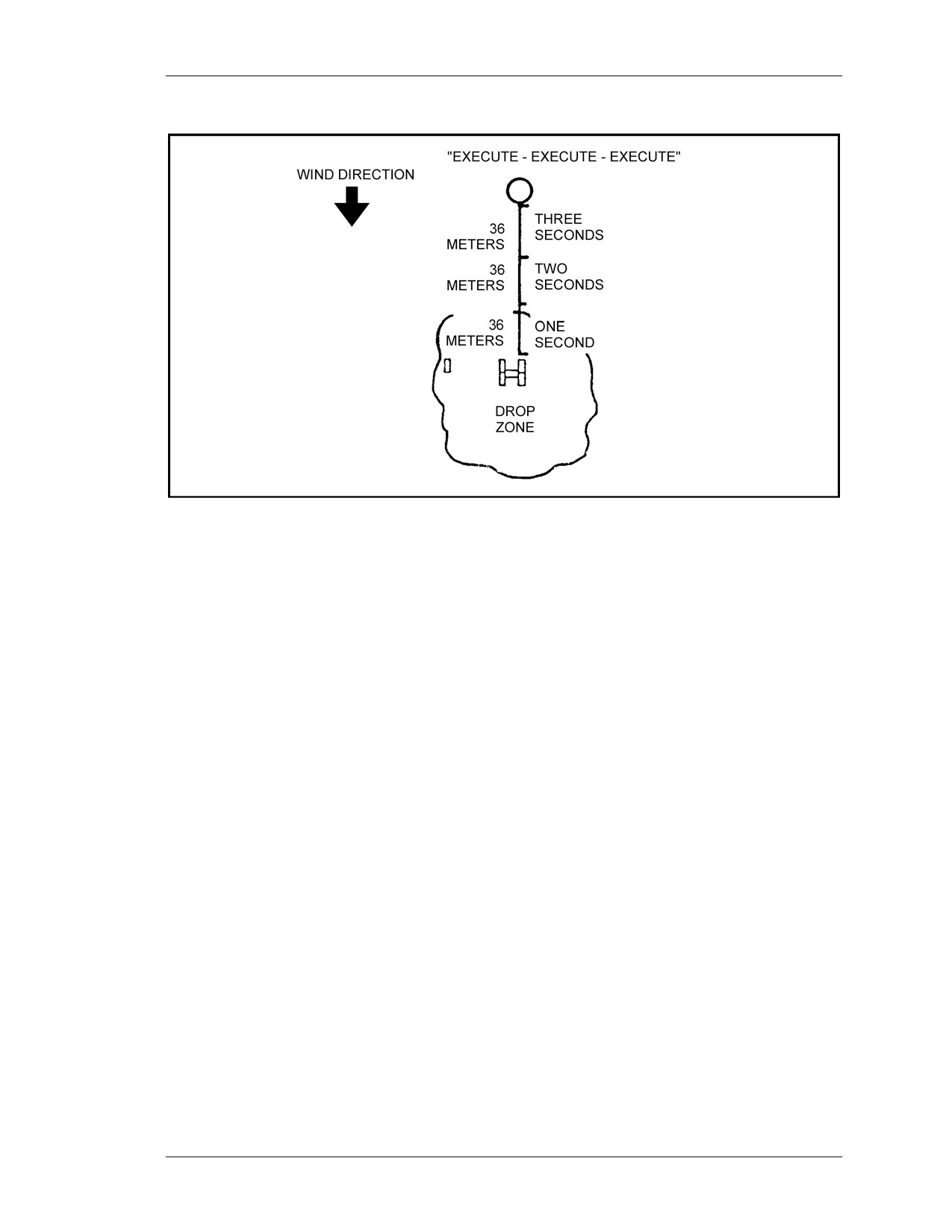
VIRS is used to execute a drop over the RP by GTA verbal command. This method
allows the conduct of the operation with a minimum amount of prior DZ information and
coordination. The aircraft flies the given direction until the DZSTL sees the aircraft. A
code letter (H,E,A,T) marks the RP. Once the crew identifies the DZ, the radio operator
directs the aircraft over the drop heading RP. When the aircraft is directly over the RP,
the command EXECUTE, EXECUTE, EXECUTE initiates the drop (Figure 22-5).
22-6
FM 3-21.220/MCWP 3-15.7/AFMAN11-420/NAVSEA SS400-AF-MMO-010
Figure 22-5. Army VIRS offset.
a. Day DZ Markings.
(1) Determination of Release Point. The DZSTL then places the code letter on the
drop heading, with the base panel of the letter at the release point. The code letter is
formed by VS-17G panels placed together. Each letter is two panels high and one panel
wide.
(2) Placement of Flank Panel. The flank panel is placed parallel to the code letter
and aligned with the base panel. It is placed 200 meters to the left of the code letter (or at
the edge of the DZ, whichever is closer).
(3) Placement of Far Panel. The far panel is placed 500 meters from the base panel
(or at the edge of the DZ, whichever is closer) and on line with the drop heading.
(4) Panel Construction. Both the far and flank panels consist of a single VS-17G
panel. These panels may also be elevated at a 45-degree angle to improve visibility.
b. Night DZ Markings.
(1) Use of Lights. The procedures for establishing the DZ are the same for night
operations except that white light is used for the code letter and far and flank markings.
(2) Code Letter Construction. Each code letter is four lights high and three lights
wide. There is a distance of 5 meters between each light in the code letter. The far and
flank lights are signal lights. Also, a white-and-red lens ATC (SE-11) light should be
located at the RP.
(3) Security. Lights may be shielded on three sides or placed in pits to prevent enemy
ground observation.
22-5. GUIDANCE PROCEDURES
During Army DZ operations, the GTA is responsible for guiding the jump aircraft to the
DZ, over the DZ on the proper drop heading, and at the proper altitude and drop speed.
He ensures the parachutists exit the aircraft at the proper release point. Once the
22-7
FM 3-21.220/MCWP 3-15.7/AFMAN11-420/NAVSEA SS400-AF-MMO-010
parachutists have exited the aircraft, the GTA must then clear the aircraft from the
control zone.
EXAMPLE:
Pilot: C3D36, this is A2A22, over.
GTA: A2A22, this is C3D36, over.
Pilot: D36, this is A22, CCP inbound for a personnel parachute drop, over.
GTA: A22, this is D36, state type and number, over.
Pilot: D36, A22 is a single UH-1H, over.
GTA: A22, this is D36, (GTA controller reads entire ATC block* to the pilot
and ends the transmission with continue approach for visual identification,
over).
Heading ___________ Distance _________ (from CCP)
Drop heading __________________________________
Drop altitude ______________________
(feet indicated)
Drop speed
___________________________________
Number jumpers/bundles that can be accepted
_______
Pilot: Wilco.
Upon sighting aircraft, the GTA tells the pilot:
GTA: A22, this is D36, I am at your 11 o’clock, 500 meters, signal out, can
you identify, over.
Pilot: D36, A22 identifies orange panel, over.
GTA: A22, D36 has visual contact, turn to drop heading, over.
Pilot: D36, A22 turning drop heading, over.
GTA: A22, this is D36, steer left/right, over.
Pilot: D36, A22 roger.
GTA: A22, this is D36, on course, over.
Pilot: D36, A22 roger.
When aircraft is 8 to 10 seconds out from release point:
GTA: A22, this is D36, with six jumpers, stand by, over.
Pilot: D36, this is A22, standing by, over.
When aircraft is directly over release point:
GTA: A22, this is D36, with six jumpers, execute, execute, execute. (GTA
must say EXECUTE or NO DROP at least three times, or until first load exits.)
At completion of operation, the GTA tells the pilot:
22-8
FM 3-21.220/MCWP 3-15.7/AFMAN11-420/NAVSEA SS400-AF-MMO-010
GTA: A22, this is D36, I observe six jumpers away and clear, state intention
and report when clear of my control zone, (issue any advisories), over. (GTA
must place aircraft into a closed traffic pattern with a reporting point if more
than one pass is required.)
22-6. ACCEPTABLE WIND LIMITATIONS
Maximum allowable surface wind for static line parachute personnel airdrops is 13 knots
(17 knots for WDZ). The maximum surface wind speed for static line heavy equipment
airdrops is 17 knots with ground quick disconnects, 13 knots without ground quick
disconnects, and 20 knots for CDS using G-13/14 parachutes. There is no wind speed
restriction when HV parachutes are used with door bundles and CDS. There is no altitude
wind limitation. Winds on the DZ are measured using the AN/PMQ-3A anemometer, or
commercial anemometers authorized by USAIS messages DTG 101000Z MAR 94,
subject: Use of Anemometers During Airdrop Operations, and DTG 211200Z OCT 94,
subject: Use of Turbometer During Static Line Airdrop Operations)—two (one each for
the DZSO and the assistant DZSO). Other anemometers not recommended for use should
be employed only after a command-initiated risk assessment is completed. Regardless of
the method or device used to measure DZ winds, the airborne commander is responsible
for ensuring winds on the DZ do not exceed 13 knots during static line personnel
airdrops.
22-7. THE 10-MINUTE WINDOW
On multiple aircraft operations or single aircraft operations using more than 2,100 meters
of DZ, the surface wind is measured from the control center and the highest point of
elevation on the DZ or the trail edge of the DZ. For single operations using less than
2,100 meters of DZ, the wind is measured from only one location, normally the control
center. Beginning 12 minutes before TOT, the DZSO begins a constant monitoring of the
surface wind using an anemometer.
a. Surface Wind Exceeds Limits. If the surface wind exceeds allowable wind
limits, the aircraft is notified of a NO DROP, and a new
10-minute window is
established. If the wind remains within limits during this new window, the drop takes
place as planned. If the winds exceed allowable limits during the new window, NO
DROP is relayed to the pilot and the entire procedure starts again.
b. No-Drop Signal. A NO DROP signal may be relayed to the aircraft by radio, red
smoke, red flares, scrambled panels, or another planned signal.
22-8. POSTMISSION REQUIREMENTS
Immediately following the operation, several reports must be forwarded to higher
headquarters.
a. Required Reports. Most of these reports are self-explanatory and require little
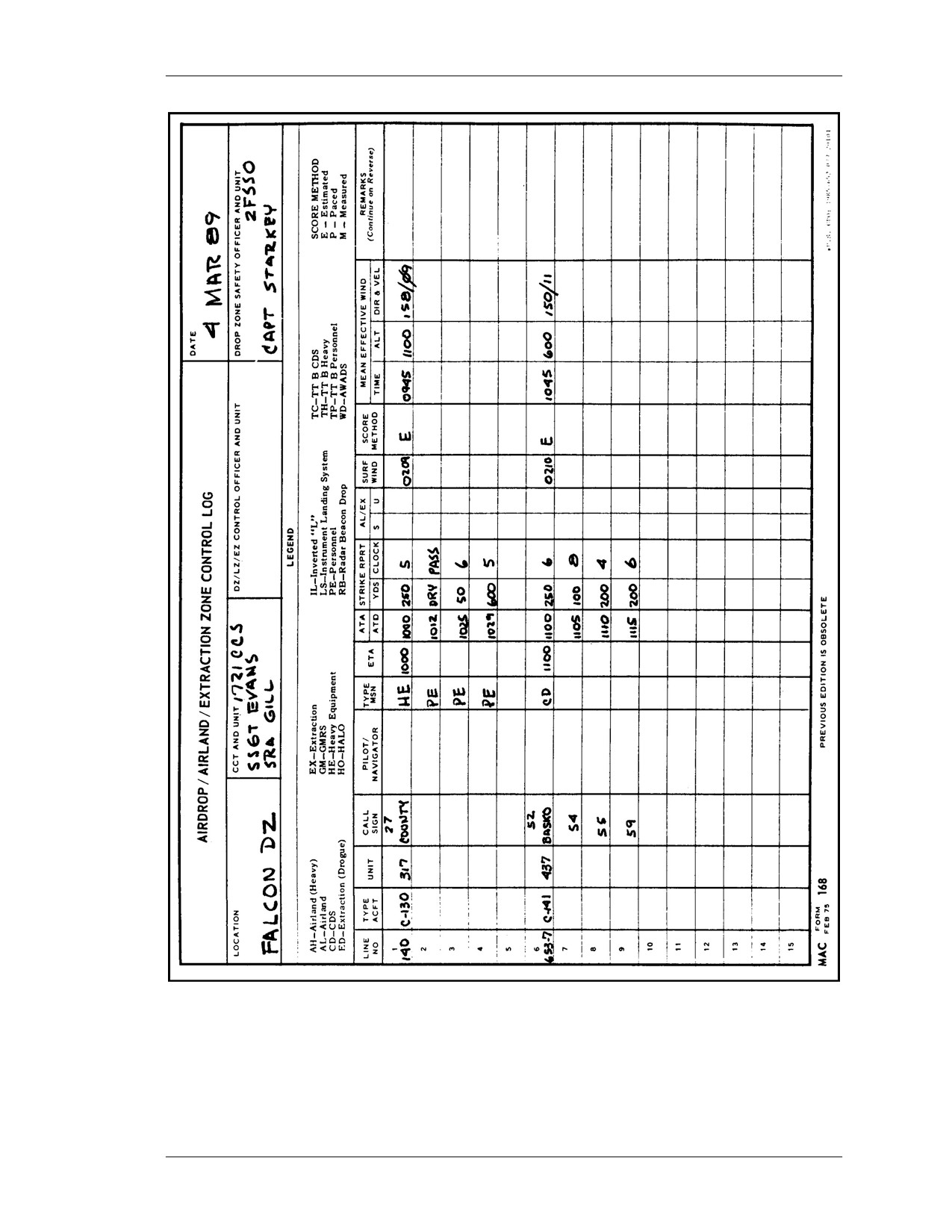
time to complete. MAC Form 168 is used to record strike report information. All services
will complete parachute malfunction and incident reports IAW AR 59-4/MCO 13480.1B/
OPNAVINST 4630.24C/AFJ 13-210(I). All services may also be required to report
malfunctions and incidents on the loss of equipment and or injury to personnel IAW
service regulations, ground mishap reporting MCO P5102.1 and OPNAVISNT 5102.1C.
• DZSO report.
22-9
FM 3-21.220/MCWP 3-15.7/AFMAN11-420/NAVSEA SS400-AF-MMO-010
• Malfunction report.
• MAC Form 168, Airdrop/Airland/Extraction Zone Control Log (Figure 22-6,
page 22-11).
• Incident reporting format (Figure 22-7, page 22-12).
NOTE: MAC Form 168 will become AMC Form168 in the next printing.
b. MAC Form 168 Completion. Complete the MAC Form 168 as follows:
(1) DATE box—date of airdrop.
(2) LOCATION box—name of DZ.
(3) SST AND UNIT box—SST name and unit.
(4) DZ/LZ/EZ CONTROL OFFICER AND UNIT box—DZSTL name and unit.
(5) DROP ZONE SAFETY OFFICER AND UNIT box—enter names.
(6) LINE NO column—mission sequence number of each aircraft.
NOTE: Every aircraft has a mission sequence number (entered under LINE NO
column). Subsequent passes by that same aircraft will all be scored on
separate lines, in the order that they occur, immediately below the line for the
first pass.
(7) TYPE ACFT column—type of aircraft.
(8) UNIT column—unit of aircraft.
(9) CALL SIGN column—call sign of pilot.
(10) TYPE MSN column—type of mission; refer to LEGEND for abbreviations.
(11) ETA column—estimated time of arrival, estimated TOT, S3 air brief.
(12) ETA column—actual arrival time of every pass.
(13) STRIKE RPRT columns—
• YDS column—distance first jumper/container lands from PI in yards; if
within 25 yards, it is scored a PI.
• CLOCK column—using direction of flight as 12 o’clock and its back azimuth
as 6 o’clock, estimated direction from PI to first jumper/bundle.
(14) SURF WIND column—surface wind; direction in degrees and velocity in knots.
(15) SCORE METHOD column—refer to LEGEND.
(16) MEAN EFFECTIVE WIND columns—
• TIME column—time taken.
• ALT column—what altitude taken to (should be drop altitude).
• DIR & VEL column—wind direction in degrees and velocity in knots.
c. MAC Form 168 Routing. The DZSTL forwards the completed MAC Form 168
to his air operations officer, who in turn submits it through the chain of command to the
USAF representative.
22-10
FM 3-21.220/MCWP 3-15.7/AFMAN11-420/NAVSEA SS400-AF-MMO-010
Figure 22-6. Example of completed MAC Form 168.
22-11

FM 3-21.220/MCWP 3-15.7/AFMAN11-420/NAVSEA SS400-AF-MMO-010
A.
GENERAL
(1) JA/ATT Sequence Number ___________________________________________
(2) Date (of Operation)
_________________________________________________
(3) TOT (Local Time) __________________________________________________
(4) Type Mission ______________________________________________________
(a) Number of Aircraft
______________________________________________
(b) Type Aircraft ___________________________________________________
(c) Type Assault Zone _______________________________________________
(d) Type of Delivery (CARP, VIRS, GMRS) _____________________________
B.
PERSONNEL INVOLVED
(1) Flying Unit ________________________________________________________
(2) Unit Supported _____________________________________________________
(3) DZSTL (Name/Rank/Unit)
___________________________________________
(4) Medics (In Place) ___________________________________________________
(5) POC for Further Information __________________________________________
C.
ASSAULT ZONE
(1) Name/Type ________________________________________________________
(2) Location __________________________________________________________
(3) Any Deviations from Survey __________________________________________
(4) Marked IAW the Survey _____________________________________________
D.
COMMUNICATIONS WITH AIRCRAFT
(1) Type Radios _______________________________________________________
(2) Frequency Used ____________________________________________________
(3) Problems
_________________________________________________________
E.
WEATHER PASSED TO AIRCRAFT
(1) Time of Observation
________________________________________________
(2) Time Weather was Passed to Aircraft ___________________________________
(3) MEW ____________________________________________________________
(4) Surface Wind ______________________________________________________
(5) Remarks __________________________________________________________
F.
POST-INCIDENT WEATHER OBSERVATION __________________________
________________________________________________________________________
G. NARRATIVE ________________________________________________________
________________________________________________________________________
________________________________________________________________________
Figure 22-7. Example of suggested format for incident reporting.
22-12
FM 3-21.220/MCWP 3-15.7/AFMAN11-420/NAVSEA SS400-AF-MMO-010
22-9. SURVEYS
USAF DZs are surveyed by qualified CCT/DZST (for SOF only—JM qualified at
minimum). However, CCT are not required to be JM qualified. All DZs will be surveyed
or tactically assessed by qualified STT/DZSTL/JM/Pathfinder personnel prior to use.
Procedures can be found in FM 3-21.38(FM 57-38) and AFI 13-217. All information
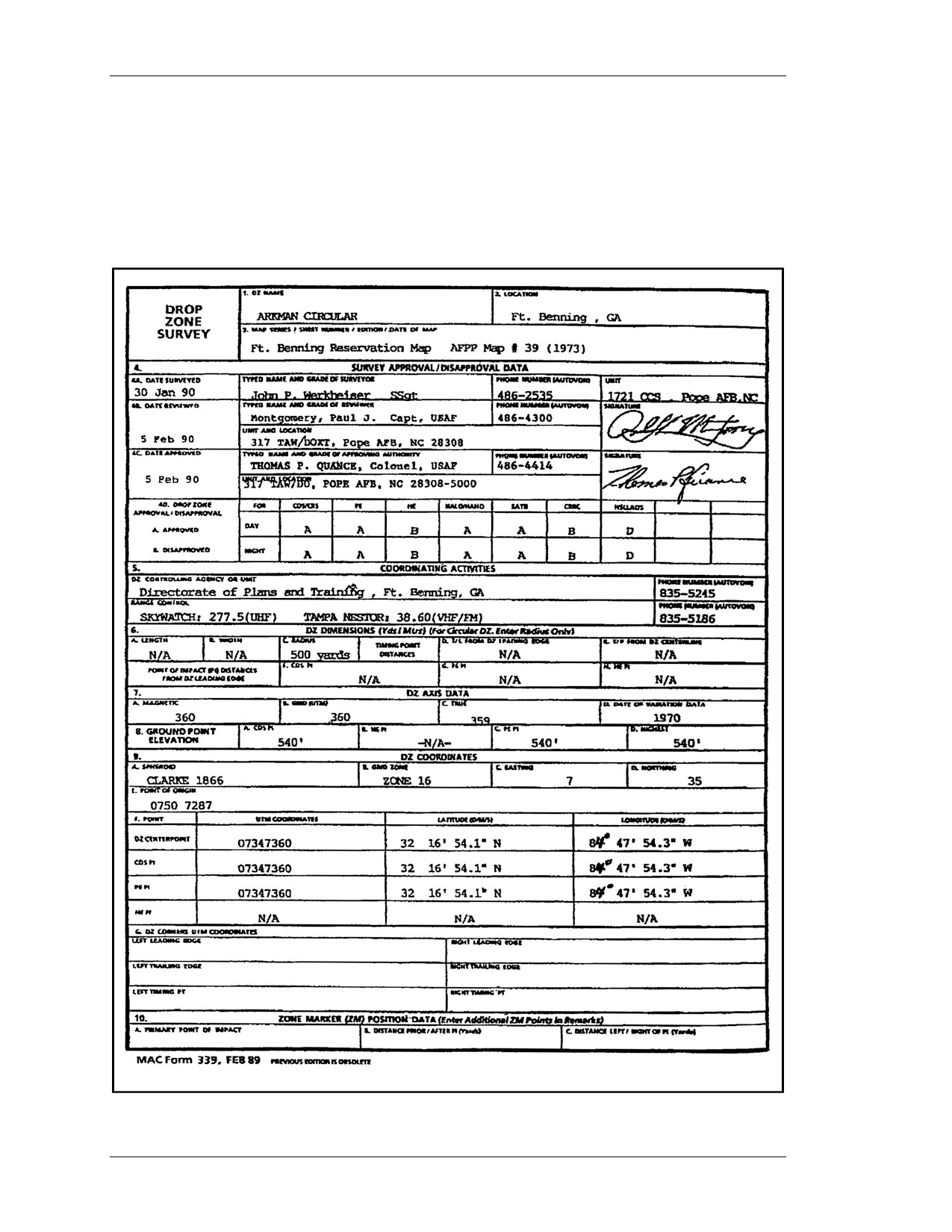
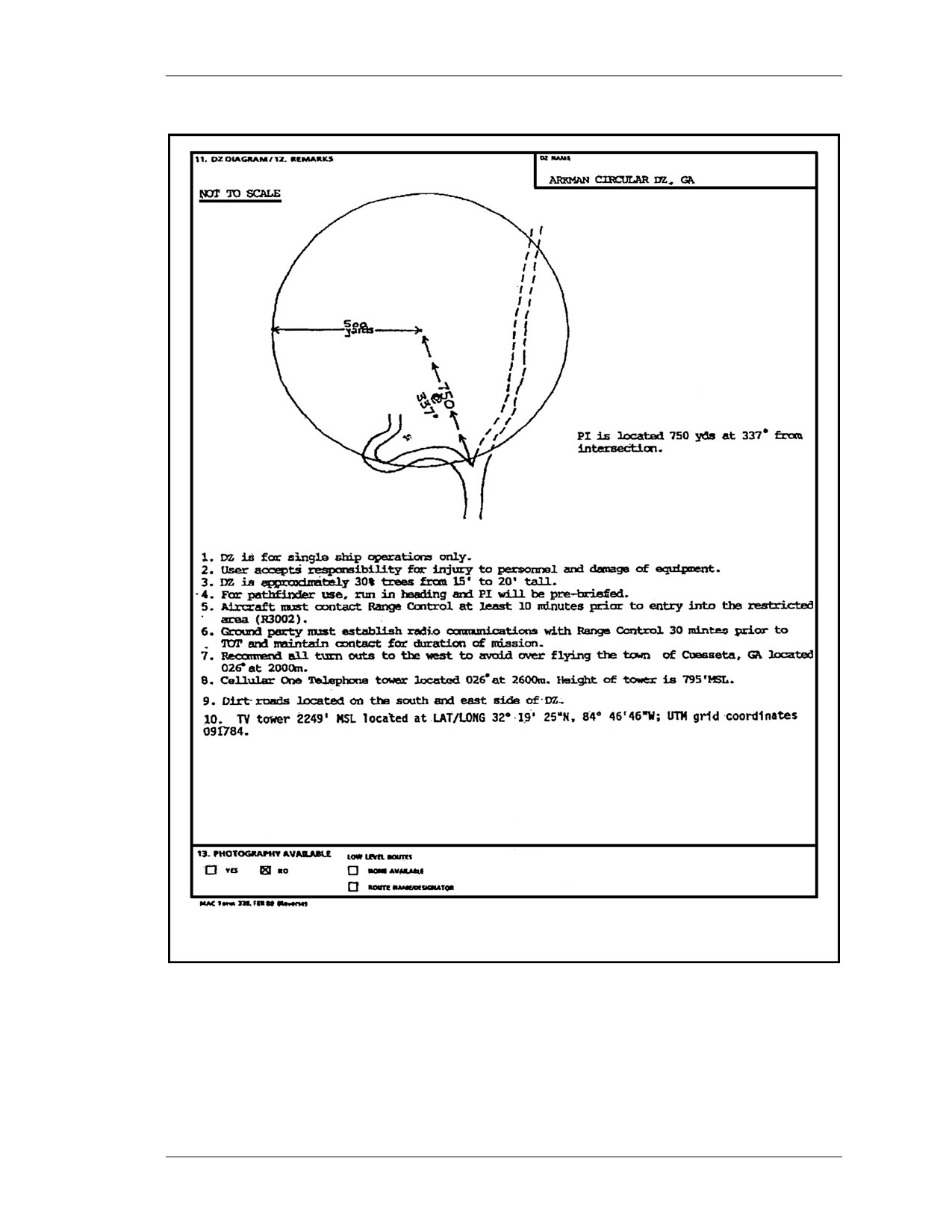
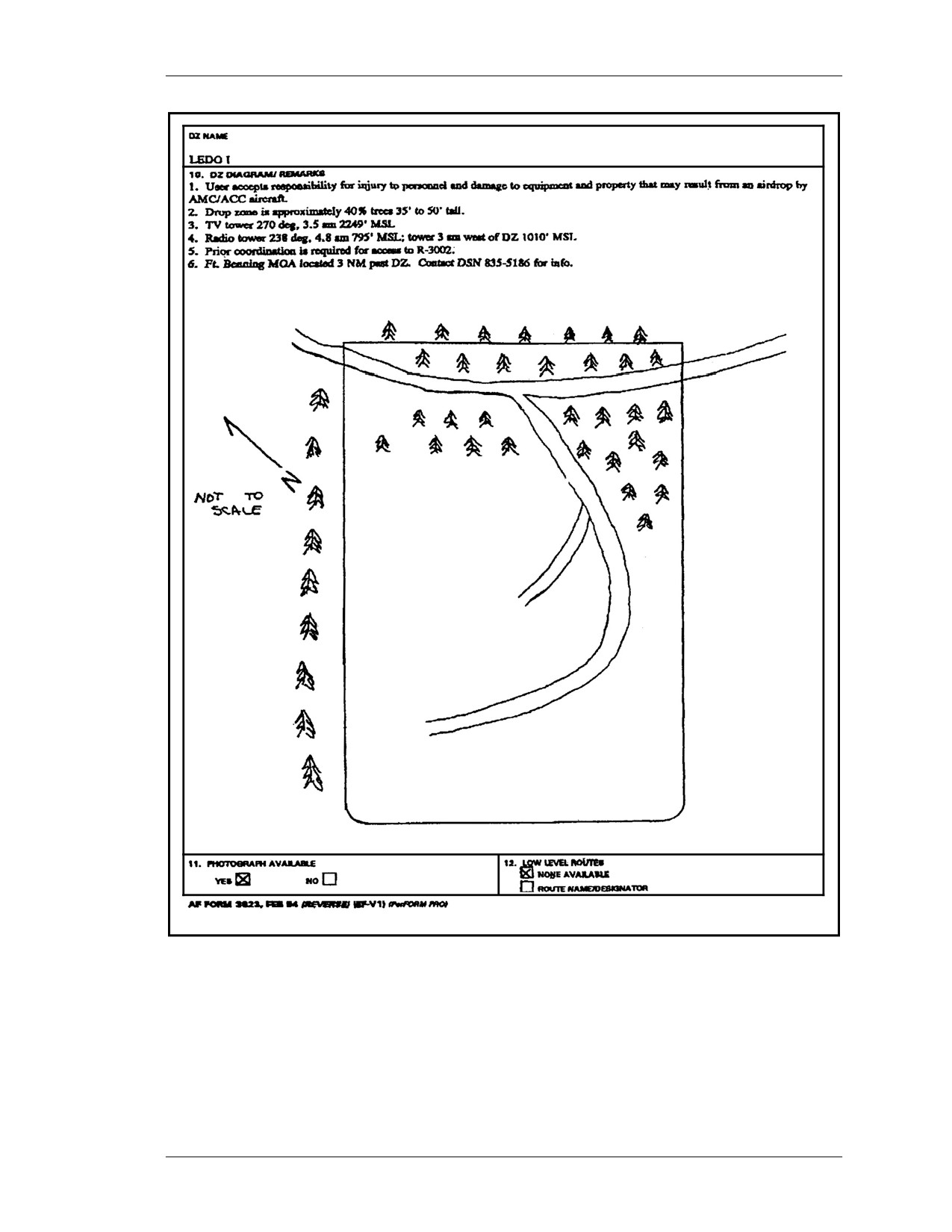
concerning the DZ is placed on MAC Form 339, Drop Zone Survey (Figure 22-8, page
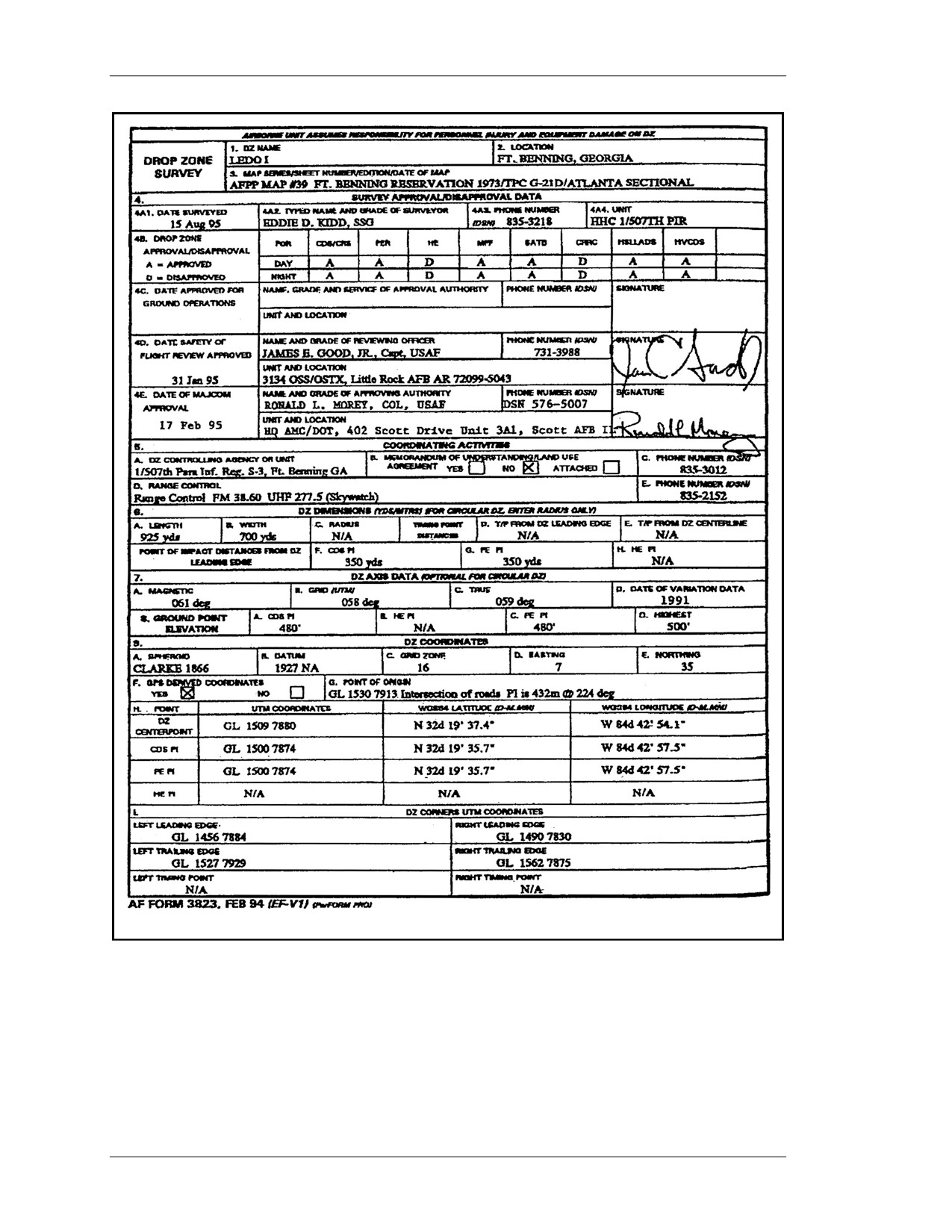
22-14 and Figure 22-9, page 22-15), or AF Form 3823, Drop Zone Survey (Figure 22-10,
page 22-16 and Figure 22-11, page 22-17). These forms provide the user the essential
information needed to operate the DZ. Section 4 of the forms states what type of missions
may be conducted on the DZ.
NOTE: When supplies of MAC Form 339 are exhausted, it will be replaced with
AF Form 3823.
a. Contingency/Wartime Operations. During contingency/wartime and major
exercises, DZSTLs may be expected to tactically locate, inspect, and approve a potential
DZ for follow-up airdrop of resupply or reinforcements.
b. Tactical Assessment. All services will conduct airdrops on approved DZs. The
tactical assessment is an approved means to certify a DZ for airdrop on both fixed-wing
and rotary-wing aircraft. All tactical DZ assessments that can be used for future
operations and that meet the standard for USAF aircraft will be forwarded to the USAF
for inclusion in the AZAR. This will be accomplished using the following checklist, AFI
13-217, and FM 57-38. The JM/DZSTL will ensure all DZ requirements are within
standards for the type of personnel, parachutes, and equipment airdropped. Once a DZ
has been
tactically assessed, it must be approved using AF Form 3823 (Drop Zone
Survey).
•
DZ name or intended call sign.
•
Topographical map series and sheet number.
•
Recommended approach axis magnetic course.
•
Point of impact location (eight-digit grid).
•
Leading edge centerline coordinates (eight-digit grid).
•
DZ size in meters or yards.
•
Air traffic restrictions/hazards.
•
Name of surveyor and unit assigned.
•
Recommended approval/disapproval (cite reason for disapproval).
•
Remarks (include a recommendation for airdrop option, CARP, GMRS,
VIRS, or blind drop).
•
All other requirements must be met for a nontactical drop zone.
NOTE:
Airdrop operations on tactically assessed DZs are made only under the
following conditions:
• During training events, using rotary-wing or fixed-wing aircraft.
• The airdrop is located within a military reservation or on US government
leased property.
• The supported service accepts the responsibility for any damage that
occurs as a result of airdrop activity.
22-13
FM 3-21.220/MCWP 3-15.7/AFMAN11-420/NAVSEA SS400-AF-MMO-010
• There is adequate time for safe, effective planning.
• All hazards and obstacles are identified.
• A detailed risk assessment is completed.
• The tactical assessment is documented on AF Form 3823 and is approved
by the first O6 in the chain of command.
Figure 22-8. Example of completed MAC Form 339 (front).
22-14
FM 3-21.220/MCWP 3-15.7/AFMAN11-420/NAVSEA SS400-AF-MMO-010
Figure 22-9. Example of completed MAC Form 339 (back).
22-15
FM 3-21.220/MCWP 3-15.7/AFMAN11-420/NAVSEA SS400-AF-MMO-010
Figure 22-10. Example of completed AF Form 3823 (front).
22-16
FM 3-21.220/MCWP 3-15.7/AFMAN11-420/NAVSEA SS400-AF-MMO-010
Figure 22-11. Example of completed AF Form 3823 (back).
22-17
FM 3-21.220(FM 57-220)/MCWP 3-15.7/AFMAN11-420/NAVSEA SS400-AF-MMO-010
CHAPTER 23
MALFUNCTIONS REPORTING AND DUTIES
OF THE MALFUNCTION OFFICER
The investigation of personnel, parachutes, and equipment
malfunctions receives the highest priority and is secondary in priority only
to medical aid for the injured. It supersedes all other aspects of the
operation to include ground tactical play. Prompt and accurate
investigations and reporting could save lives and equipment. The report
provides data to determine if a system or procedural training change is
necessary to prevent future occurrences. The MO is a member of the drop
zone support team. Any assistance required by the MO must pass through
the DZSO/DZST, who controls the DZ.
AR 59-4 governs the duties and responsibilities of the malfunction
officer. The following chapter provides only the minimum requirements for
performing the duties of the MO. If there is a conflict between this FM and
AR 59-4, follow the guidance in AR 59-4.
23-1. MALFUNCTION OFFICER DUTIES AND QUALIFICATIONS
The organization that provides the air items provides the malfunction officer. He must be
present on the drop zone during all personnel and equipment drops and must be familiar
with the requirements. The MO positions himself where he can best observe the
entire DZ.
a. Qualifications. The MO must be a commissioned officer, warrant officer, or
NCO (E-5 or above). (For USAF unilateral training loads, the DZ MO will be an E-4 or
above. Specific AFSCs of personnel will be identified in AFI 11-410.) He must be a
trained parachute rigger
(92R, 921A, 92D) who is familiar with airdrop, parachute
recovery, and aircraft personnel parachute escape systems. The MO will meet the
qualifications IAW Chapter 7 and AR 59-4/MCO13480. 1B/PNAVINST 4630.24C/AFJ
13-210(I), Joint Airdrop Inspection Records, Malfunction Investigations, and Activity
Reporting.
b. Equipment. The malfunction officer must have the following equipment during
performance of duty:
• A communication capability with the DZ control party.
• A good quality camera to take photographs of malfunctions or incidents,
airdrop equipment, and impact sites. Photographic equipment is essential for
the proper performance of MO duties. A video camera is optimal. Pictures
recording a malfunction or the equipment involved greatly assist in the
investigation.
• The forms and clerical supplies necessary to tag equipment and initiate
reports.
• Binoculars (day) or night vision devices (night).
• Transportation to move around the DZ.
23-1
FM 3-21.220/MCWP 3-15.7/AFMAN11-420/NAVSEA SS400-AF-MMO-010
c. MO Duties. The MO performs the following actions in case of a malfunction:
(1) Partial or Total Malfunction with No Serious Injuries.
(a) Secure and guard the impact site. Conduct an on-site investigation to determine, if
possible, the cause of the malfunction, and to ascertain whether a criminal or malicious
act may have caused the malfunction. (Refer to AR 59-4, Appendixes B and C, for
checklists.)
(b) Photograph the malfunction as it happens
(if possible), the malfunctioned
equipment, and the malfunction or impact site. Sketch the impact site in relation to the
DZ.
(c) Collect, properly identify, tag, and maintain chain of custody for items of physical
evidence involved in the malfunction
(such as clothing, equipment, air items, and
personal property).
(d) Conduct a detailed component-by-component examination of all equipment.
(e) Collect statements from any personnel present who witnessed the malfunction.
Take statements from JM/AJM, safeties, previous jumper, follow-on jumper, ground
observers, and aircraft personnel who are able to provide facts.
(f) Appropriately tag and bag the collected equipment and evacuate it to an
appropriate area to conduct the TM-10-1670-series rigger type investigation.
(g) Ensure all air items and evidence are retained until the investigating authority
releases them.
(h) Prepare and submit the appropriate reports IAW AR 59-4, Chapter 5.
(2) Partial or Total Malfunction with Serious Injury or Death.
(a) Place the impact area off limits and post a guard to ensure the integrity of the
scene and to limit access to authorized personnel only. Take immediate possession of the
log record book (DA Form 3912), and limit access to the appointed investigating officer.
In the event of a death, ensure the DZSTL notifies the military police immediately.
Access to the site is limited to the malfunction officer, the SME assisting the MO, and
responding CID and medical personnel only.
(b) Photograph the parachutist, the impact site, and any obvious defects in the
equipment (to include damage done by the impact). Sketch the impact site in relation to
the DZ and mark the impact location of the parachutist and his equipment.
(c) Collect all items of equipment involved and maintain chain of custody.
(d) Immediately initiate an investigation prior to the arrival of the CID and ensure the
scene is not altered. If determination of tampering or intentional sabotage is made, the
entire investigation is turned over to the CID. If there has been no tampering or sabotage,
continue with the investigation.
(e) Request that medical personnel secure and preserve the parachutist’s clothing and
equipment that is removed from the DZ.
(f) Gather statements from previous jumper, follow-on jumper, JM/AJM, safeties,
and from any other ground or aircraft personnel who may be able to provide facts.
(g) Record the name and unit of any personnel who observed the incident even if the
information is not new to the investigation.
(h) Secure a copy of the jump manifest. Reconstruct the jump stick from personnel
present if required.
(i) Conduct a detailed component-by-component examination of all equipment after
the parachutist has been evacuated.
23-2
FM 3-21.220/MCWP 3-15.7/AFMAN11-420/NAVSEA SS400-AF-MMO-010
(j) Request the DZSO/DZSTL notify the DACO so the aircrew can inspect the
aircraft for any defects or damage that may have contributed to or caused the
malfunction. Request DACO ensure the parachute deployment bags from that aircraft be
identified and segregated from those of other aircraft.
(k) Obtain the deployment bag serial number from the log record book or parachute
pack sheet and secure it with the remainder of the parachute assembly until the
investigation is completed.
(l) When removing the parachute and related air items to a suitable area to perform
the TM-10-1670-series rigger type investigation, ensure the parachute is loosely rolled,
leaving any turns, tangles, or twists in the suspension lines. Appropriately tag and bag the
air items and maintain chain of custody. Release these to the investigating SME only.
(m)Ensure that the DZSO/DZSTL signs for any organizational and personal clothing,
weapons, and equipment not collected as part of the investigation. This equipment will be
returned to the jumper’s unit, and the unit will preserve the equipment until the
completion of the investigation.
23-2. MALFUNCTION OFFICER RESPONSIBILITIES DURING
INVESTIGATIONS
The depth of any investigation varies according to the severity of the malfunction and
resultant injuries. In cases apparently not involving death or serious injury, the MO
conducts the on-sight investigation solely to determine the cause of the malfunction and
actions required to prevent future occurrences.
a. MO Follow-On Investigation. In cases involving misconduct, serious incident or
injury, or death, the MO conducts a follow-on investigation according to service
directives and AR 59-4. His investigative notes, insights, reports, and physical evidence
are available to these investigations. The MO must ensure that after the component-by-
component examination is completed, the equipment involved in the malfunction is
secured and accessible only to the appointed investigating SME.
b. Confidentiality of Investigation. During the investigation, the MO gathers items
of information and evidence that are sensitive in nature. He ensures the information
pertaining to the investigation is given only to authorized personnel on a need-to-know
basis. The MO must exercise great care so that the rights of involved personnel are not
compromised and the government is not placed in an unfavorable position.
23-3. REPORTING DATA
The MO discusses as much data as allowable with the DZSO/DZSTL prior to
transmitting it to the control group. The MO and the DZSO/DZSTL normally discuss this
feeder information immediately after the jump is complete.
NOTE: The MO uses DD Form 1748-2 to report all airdrop personnel malfunctions
IAW AR 59-4.
23-3
FM 3-21.220(FM 57-220)/MCWP 3-15.7/AFMAN11-420/NAVSEA SS400-AF-MMO-010
PART SIX
Special Airborne Procedures
CHAPTER 24
ADVERSE WEATHER AERIAL DELIVERY SYSTEM
AWADS is a navigational system installed in some USAF C-130
aircraft. It enables the aircraft to fly to a DZ during reduced visibility, and
provides flexibility to the airborne force commander in the
accomplishment of all airborne missions. AWADS is effective in large,
joint operations, tactical reinforcements, and specialized missions.
24-1. MULTIPLE MISSION SUPPORT
AWADS operations facilitate rapid and continuous aerial deployment or resupply in
adverse weather or darkness. Units can execute a parachute assault without a pre-
positioned AFCCT or an Army DZST. As a result, time (length) of the air formation is
shortened, and the air corridor must be cleared only once by tactical air to heighten the
element of surprise. AFCCTs are introduced with the assault elements and assist the GUC
with additional CDS, airland, or HD missions. AWADS enables a commander to conduct
a rapid vertical reinforcement during instrument meteorological conditions or visual
meteorological conditions for units threatened by enemy penetration.
NOTE: A minimum ceiling of 200 feet and a minimum visibility of 1/2 mile for
personnel and equipment are imposed for tactical training.
24-2. TRAINING AND PREPARATION
AWADS operations demand detailed planning, rehearsal, training, and coordination
between USAF and Army units to be effective. Due to limited visibility in the air and
during assembly on the ground, AWADS requires both technical training and
psychological preparation of the parachutists. AWADS sustained prejump training
requires modification to normal jump conditions.
24-3. MODIFIED JUMPMASTER DUTIES
The JM relies on the loadmaster to obtain and relay en route information. Under AWADS
conditions, the JM still attempts to perform all of the required checks. He may not be able
to observe safety hazards beyond the immediate area of the door.
24-4. MODIFIED PARACHUTIST ACTIONS
Parachutist actions during descent under normal conditions must be modified in AWADS
training. Modifications are made when using the T-10-series and MC1-series parachutes.
a. T-10-Series Points of Performance.
(1) Check body position and count.
(2) Check canopy and gain canopy control. Any malfunction under these conditions
requires activation of the reserve since the parachutist cannot effectively judge the rate of
descent.
24-1
FM 3-21.220/MCWP 3-15.7/AFMAN11-420/NAVSEA SS400-AF-MMO-010
(3) Keep a sharp lookout during descent.
(4) Do not slip, except to avoid collisions, until after breaking through the clouds.
(5) Give way. Give lower canopies the right of way; higher canopies slip to
avoid them.
(6) Recheck the canopy. Make this check after breaking through the clouds if the
canopy could not be checked while in the clouds.
(7) Prepare to land. Do not release equipment until the ground can be seen and it is
clear below.
(8) Land. Execute a proper PLF.
b. MC1-Series Points of Performance.
(1) Check body position and count.
(2) Check canopy and gain canopy control. If the TU modification is to the front,
there is a complete inversion. Do not activate the reserve since the canopy can still be
controlled. For any other malfunction, activate the reserve immediately.
(3) Identify steering toggles. Grasp each one and bring them both to chest level to
reduce lateral movement and perform braking; this helps to eliminate midair collisions
and extreme dispersion due to excessive drift.
(4) If either or both toggles are broken, steer the canopy by pulling a slip with the rear
riser on the side of the intended turn. In the clouds, anyone with a broken toggle and not
applying “brakes” automatically has a greater lateral drift than anyone else and must keep
alert during descent.
(5) Keep a sharp lookout during descent. During reduced visibility prepare to take
immediate evasive action.
(6) Give way. Give lower canopies the right of way. If parachutists see the possibility
of converging at any altitude and from any direction, they immediately turn away from
each other by pulling the toggle that is away from the other parachutist.
(7) Recheck canopy. Perform a thorough canopy inspection after breaking through
the clouds. Release the toggles when the ground is in sight and prepare equipment for
landing. Use the lowering lines.
(8) Prepare to land. Turn into the wind 75 to 150 feet above the ground. Obstacles
spotted when coming out of low clouds normally require rapid preparation for the
appropriate emergency landing.
(9) Land. Execute a proper PLF.
24-2
FM 3-21.220(FM 57-220)/MCWP 3-15.7/AFMAN11-420/NAVSEA SS400-AF-MMO-010
CHAPTER 25
DELIBERATE WATER DROP ZONE OPERATIONS
Units conducting water drop zone operations should use the following
procedures as a guide to ensure the mission is conducted safely. Conduct
all jumps under the following conditions:
• Daylight; warm weather conditions.
• Surface winds do not exceed 17 knots.
• Drop control—visual marking system.
• Helicopter—flying under visual flight conditions.
• Wind conditions permit operation on the WDZ.
• Water should be more than 10 feet deep with no underwater
obstacles that depth.
• Briefing held for WDZ operations by DZSO/DZSTL and WDZ
control personnel.
• All parachutists are classified as swimmers or strong swimmers.
(USMC S-1 or higher).
• All parachutists have completed drownproofing training within the
preceding 12 months.
• All parachutists have been trained on activation procedures for the
life preserver in use, to include manual inflation procedures.
• All parachutists have attended prejump training on deliberate
water DZ procedures according to unit SOP.
• All combat equipment is float checked.
NOTE:
The parachute operation OIC briefs parachutists, aircrew, JM, and
WDZ
control party regarding WDZ operations.
WARNING
The MC1-1B should be used, if available. The
porosity of the MC1-1C is extremely limited and
may create a suffocation hazard if the jumper is
trapped under the canopy.
25-1. PERSONNEL AND EQUIPMENT
The following personnel and equipment are required for deliberate WDZ operations:
a. Personnel.
(1) JM, AJM, safety personnel, as required for the type of aircraft used.
(2) DZSO/DZSTL, JM qualified and current IAW Chapter 7.
(3) Medic/corpsman with resuscitator.
(4) Safety vehicle driver.
(5) Boat commander/coxswain for each boat.
25-1
FM 3-21.220/MCWP 3-15.7/AFMAN11-420/NAVSEA SS400-AF-MMO-010
(6) Malfunction officer.
(7) Safety swimmers—minimum of one safety swimmer is required to be on board
each recovery boat. The safety swimmer must have fins, facemask, knife, and an
inflatable life preserver. The safety swimmers will be used to recover personnel and
equipment, and assist parachutists as needed. The safety swimmer cannot be additionally
assigned as the boat coxswain or corpsman. The safety swimmer should be a qualified
parachutist and, as a minimum, will be qualified as a US Army Class 1 advanced survival
swimmer (IAW TC 21-21), USMC CWS1, Navy 1st class, or lifeguard certified. The
safety swimmer will attend prejump training for intentional water jumps with parachutists
and wet silk training.
b. Water Drop Zone Equipment.
(1) Equipment for safety swimmers.
(2) Serviceable boats, motors, and fuel (RB-15 boats, 14-foot engineer assault boats,
combat rubber raiding craft, or civilian equivalent boats with motors). If available,
hard-body boats should be used.
(3) Equipment for recovery and command boats.
(4) Required panels and smoke.
(5) Required communications equipment for each boat to include spare batteries and
one complete spare radio set for the operation. Boat-to-boat and boat-to-air
communication should be checked.
(6) Floating, nonflammable container with suitable anchor for smoke grenades.
(7) First aid equipment to include resuscitator and backboard.
(8) Bailing cup per boat.
(9) Motor tie-down rope per boat.
(10)
Sheath knife (boat commander and safety swimmer) per boat.
(11)
Pliers per boat.
(12)
One extra life preserver for emergencies per boat.
(13)
Life jackets or life preservers for all personnel onboard each boat.
(14)
Oars or paddles per boat.
(15)
Boat hook per boat.
(17)
Approved anemometers. The approved anemometers are the DIC, DIC3,
TurboMeter, and AN/PMQ-3A. (The AN/ML433A/PM and the anemometers that use
floating balls or small floating lightweight aluminum devices in a tube are not authorized
for use during personnel or cargo airdrop operations. See Chapter 20, paragraph 20-9 for
use and calibration information.)
c. Parachutist Requirements. Parachutists, at a minimum, must be classified as a
US Army Class 3 basic survival swimmer, USMC CWS-1, or Navy 1st class swimmer
before making a water parachute drop. Parachutists will be current static line jumpers
before making water jumps. Wet silk training for intentional water jumps will be
conducted at a minimum of once every six months by all parachutists and safety
swimmers involved in water jumps.
a. An individual’s first water jump must be performed during the day and without
combat equipment. To be classified as a Class 1 advanced water survival swimmer,
personnel will be tested and documented on an annual basis and must pass the
requirements contained in TC 21-21.
25-2
FM 3-21.220/MCWP 3-15.7/AFMAN11-420/NAVSEA SS400-AF-MMO-010
b. Wet silk training is conducted at the unit level by certified personnel (Class 1
advanced water survival swimmer [IAW TC 21-21], USMC CWS1, Navy 1st class, or
lifeguard-certified current JM) by putting an unserviceable parachute in a pool, in a
controlled environment, with safety swimmers. The jumpers, one at a time, demonstrate
the actions to take during a water landing, jump into the water, and swim under the
canopy to experience what it is like to be under a parachute in the water. The jumper
demonstrates his ability to follow a radial seam to get safely out from under the canopy,
make an air pocket under the canopy to breathe from, and breathe from the apex of the
canopy. If a jumper is trapped under the canopy during wet silk training, the safety
swimmers pull the jumper out of the water. A minimum of two safety swimmers with
mask, fins, snorkel, and dive knife and a medic/corpsman will be available during this
training. A standby diver on SCUBA is also recommended.
25-2. ORGANIZATION AND EQUIPMENT OF DROP ZONE DETAIL
The organization and equipment of the drop zone detail include the following:
a. DZSO Command Boat. The command boat will be separate from the recovery
boats. It will be used by the DZSO and medic/corpsman and will not be used to recover
parachutists or equipment except in the case of an emergency. The command boat (boat
number 1) includes the following personnel and equipment:
NOTE: All boats required for the operation will be on station with required personnel
and the engines running before the release of parachutists.
(1) Personnel.
• Drop zone safety officer.
• Boat commander/boat coxswain.
• Safety swimmer with equipment.
• Medic/corpsman with equipment.
• Malfunction officer.
(2) Equipment.
• Marker panels.
• Medical aid kit.
• Backboard.
• Resuscitator.
• Boat hook.
• FM radio (complete) with extra battery for boat-to-boat, boat-to-air, and
surface communications.
• Approved anemometers. The approved anemometers are the DIC, DIC3,
TurboMeter, and AN/PMQ-3A. (The AN/ML433A/PM and the anemometers
that use floating balls or small floating lightweight aluminum devices in a tube
are not authorized for use during personnel or cargo airdrop operations. See
Chapter 20, paragraph 20-9 for use and calibration information.)
• Bailing cup.
• Motor tie-down rope.
• Sheath knife (safety swimmer and boat commander).
25-3
FM 3-21.220/MCWP 3-15.7/AFMAN11-420/NAVSEA SS400-AF-MMO-010
• Pliers.
• Life jackets or life preservers for all personnel on board.
• One extra life preserver for emergencies.
• Oars or paddles per boat.
b. Recovery Boats for Equipment Drops. A minimum of one power driven boat is
required for two equipment platforms dropped on the same pass. Equipment recovery
boats are to be used in the recovery of equipment parachutes and platforms. Recovery
boats assigned to recover jumpers doe not meet this requirement when jumpers and
equipment are on the same pass. Equipment recovery boats must be large enough to
recover cargo parachutes and platforms. The boat coxswain’s only duty is to navigate the
boat. The boat coxswain cannot act as the safety swimmer or corpsman.
(1) Use extreme caution when recovering CRRC and other equipment in the water.
(2) The jumpers are the recovery personnel. They will have assisted in the rigging of
the CRRC and container equipment before the airdrop. This will help they know what
straps to cut without losing the equipment or injuring other personnel.
(3) Ensure a safety tie is rigged between the platform and boat and is cut last after the
recovery boat has secured the platform.
(4) Tow the platform back to shore with the recovery boat. Place sandbags on the
back of the platform to raise the front to ease towing.
WARNING
Ensure that all personnel are clear of the platform
and equipment and not fouled in any lines before
cutting the equipment loose from the platform.
Failure to do so may cause serious injury or death
if the platform sinks.
b. Recovery Boats for Personnel. A minimum of one power driven recovery boat is
required for every three parachutists being dropped on the same pass. Parachutist
recovery boats must have an inflatable boat or ladder rigged along side if they have a
freeboard of more than 3 feet and or the boats do not provide an easy platform for
recovery of personnel. Boats assigned as personnel recovery platforms may only be used
to assist in the recovery of airdropped equipment after all parachutists have been
recovered. The boat coxswain’s only duty is to navigate the boat. The boat coxswain
cannot act as the safety swimmer or corpsman.
c. Equipment and Personnel Requirements for Recovery Boats. Recovery boats
require the following personnel and equipment:
(1) Personnel (Personnel and Cargo Recovery Boats).
• Boat commander/coxswain.
• Safety swimmer with equipment.
(2) Equipment (Personnel and Cargo Recovery Boats).
• Boat hook.
• Bailing cup.
• Motor tie-down rope.
25-4
FM 3-21.220/MCWP 3-15.7/AFMAN11-420/NAVSEA SS400-AF-MMO-010
• Sheath knife (safety swimmer and boat commander).
• Pliers.
• Life jackets or life preservers for all personnel onboard.
• Extra approved life preserver for emergencies.
• Oars or paddles per boat.
• Radio (complete) with extra battery for boat-to-boat surface communications.
(3) Safety Swimmer Equipment.
• Swim fins—one pair.
• Face mask.
• Snorkel.
• Sheath knife.
• Life vest.
• Wet suit—optional.
(4) Safety Vehicle Operator.
• Driver (on standby).
• Radio (communicate with command boat).
NOTE: The JM briefs the parachutists, aircrew, and WDZ control party regarding
WDZ operations.
(5) DZSO (Additional Duties).
(a) Briefs boat crews, safety swimmers, medic, and safety vehicle driver on the
following:
• Overall organization of WDZ.
• Number of lifts and personnel to be dropped.
• Drop altitude and aircraft heading.
• Surface winds.
• Water depth.
• Turnaround time between drops.
• Recovery procedures.
• Communications plan.
• Emergency recovery and evacuation plan.
• Drop and abort signals.
• Applicable special instructions.
(b) Maintains visual observation of all parachutists until safely recovered.
(6) Jumpmaster.
(a) Performs JM duties.
(b) Helps recover personnel from the water in an emergency.
(c) Keeps parachutists under observation. Does not release the next pass until all
parachutists have been recovered.
(7) Boat Commander/Coxswain.
(a) Ensures all personnel and equipment are on board.
(b) Ensures that all equipment is operational.
(c) Ensures that the safety swimmer has been briefed and understands instructions.
(d) Maintains visual observations of parachutists from time of exit to safe recovery.
25-5
FM 3-21.220/MCWP 3-15.7/AFMAN11-420/NAVSEA SS400-AF-MMO-010
(e) Controls actions of safety swimmer.
(f) Ensures all personnel are trained and rehearsed in their duties.
(8) Safety Swimmer.
(a) Maintains visual observation of parachutists from time of exit to safe recovery. Is
alert at all times for parachutists in trouble and is prepared to enter the water to assist
parachutists.
(b) Enters water (on order of boat commander) and assists parachutist recovery.
(9) Medic/Corpsman.
(a) Ensures the resuscitator is complete and in operational condition.
(b) Ensures that safety personnel understand lifesaving techniques.
(c) Uses applicable medical equipment and provides required first-aid treatment and
medical evacuation.
25-3. SAFE CONDITIONS
Units conducting WDZ operations should use the following to ensure the mission is
conducted safely. Ensure all WDZ parachute jumps are conducted under the following
conditions for all services.
•
Water will be more than 10 feet deep.
•
The WDZ will not be in or near the surf zone.
•
Surface winds will not be in excess of 17 knots.
•
Sea state is no more than 2. (IAW MCWP 2-15.3, Table 7-1, or Joint Pub 4-01.6,
sea state 2 indicates that wave height will not exceed 1 2/3 feet (20 inches), as
measured from a wave crest and the preceding trough.)
•
Parachutists jumping in cold water (60 degrees or lower) will wear wetsuits or dry
suits.
•
All parachutists are classified as strong swimmers, USMC CWS-1, or Navy 1st
class swimmers.
•
All safety swimmers should be parachutists and will be classified as Class 1
advanced water survival swimmers (IAW TC 21-21), USMC CWS-1, Navy 1st
class swimmer, or lifeguard certified.
•
All parachutists and swimmers have completed wet silk training in the past six
months.
•
All parachutists and swimmers have been trained on activation procedures for the
life preserver in their use to include manual inflation procedures.
•
All floatation devices are approved, serviceable, and properly maintained.
•
All parachutists have attended prejump training on deliberate water DZ
procedures according to this chapter and unit SOP.
•
All combat equipment is waterproofed and float checked.
•
All jumpers and equipment have chem lights and strobes attached for night jumps.
•
Night vision devices will be used on the WDZ for all night drops.
•
Drop control—visual marking system: mirror, smoke, VS-17 panels.
•
Release method: CARP or WSVC.
•
Helicopter or fixed-wing—flying under visual flight conditions.
•
Only one to three parachutist jumps for each recovery boat for each pass.
(Boat-to-jumper ratio depends on unit and jumper experience with water jumps.
25-6
FM 3-21.220/MCWP 3-15.7/AFMAN11-420/NAVSEA SS400-AF-MMO-010
One boat to one jumper is strongly recommended for units that rarely conduct
WDZ operations.)
• Sufficient boats are properly manned with the engines running during all live
passes.
• Clear to drop is by radio or by all the boats driving in one big circle.
• Abort the pass is by radio or by all the boats being scrambled.
25-4. JUMP RECOVERY PROCEDURES
After parachutists enter the water, recovery boats
(boat numbers 2 and 3 and any
additional recovery boats) proceed to the location of designated parachutists and begin
recovery operations.
a. Boat Commander/Coxswain. The boat commander/coxswain of each recovery
boat identifies his assigned parachutists as soon as possible.
(1) The boat coxswain determines whether the parachutist’s life preserver has been
inflated. If the life preserver has not inflated, the recovery boat coxswain immediately
proceeds to the impact point, taking care to stay out of the way of the other parachutists.
Upon reaching the assigned parachutist, the boat coxswain treats the situation as a
parachutist in distress and takes appropriate action.
(2) The DZSO command boat (boat number 1) is located so the DZSO can observe
the landing of parachutists and reinforces recovery boats with additional safety swimmers
and a resuscitator as required.
(3) The following procedure is used for recovery operations.
(a) When possible, recovery boats approach parachutists from alongside. This will
help avoid getting the parachute stuck in the engine crop. Recover parachutes by the
apex.
(b) If the parachutist experiences no difficulties after impact, he signals “All OK” by
raising one arm straight up (without waving).
NOTE: Any other signal or no signal given by the parachutist is considered as a
distress situation and immediate action is taken.
(c) The boat coxswain directs the boat alongside the parachutist; the safety swimmer
extends the boat hook so that the parachutist can grasp it. If the parachutist is unable to
grasp the hook, the safety swimmer secures a portion of the parachutist’s equipment with
the hook.
b. Safety Swimmers. On instruction from the boat commander/coxswain, the safety
swimmer enters the water alongside the parachutist to assist the parachutist and to
recover the parachute canopy and other equipment. If a parachutist has gone underwater,
the following action is taken.
(1) Red smoke is displayed to indicate an emergency and a message is transmitted to
the command boat by radio. All other activities cease. (A red smoke grenade may be
activated and dropped in an ammunition can bolted to a wood plate, or a smoke machine
may be used.)
(2) The safety swimmer dives to recover the parachutist and cuts him free of
equipment as required.
25-7
FM 3-21.220/MCWP 3-15.7/AFMAN11-420/NAVSEA SS400-AF-MMO-010
(3) The DZSO moves his boat to the scene and the medic/corpsman prepares to use
the resuscitator and backboard.
c. Recovery Helicopter (if used). The jump aircraft is alerted to assist in emergency
recovery operations.
(1) When directed by the DZSO, the pilot stands-by the location to provide medical
evacuation by air, if necessary.
(2) After normal recovery operations, parachutists and equipment are unloaded at the
assembly area. All boats are repositioned for the resumption of jump operations.
25-5. WATER DROP ZONE PREJUMP TRAINING
Prejump training for water jumps should be conducted within 24 hours before the
scheduled jump. This training includes demonstrations and practical exercises for all
parachutists; use of the suspended harness is recommended. Prejump training includes,
but is not limited to, the following:
a.
Six points of performance for water jumps.
• Check body position and count.
• Check canopy and gain canopy control.
• Prepare to land with a life preserver (B-7 or UDT, see below).
• Keep a sharp lookout during descent and maneuver to indicated impact area.
• Prepare to land by turning and facing into the wind, maintaining position until
just before landing.
• Prepare to make a PLF (if water is shallow or ground contact is made).
b.
Emergencies in the air.
c.
Emergencies in the water.
• Ensure the life preserver is fully inflated.
• If trapped under the canopy, the jumper finds a radial seam and follows it to
the edge.
• If trapped under the canopy, the jumper lifts his hand slowly and creates an air
pocket to breath, then cuts a hole in the canopy material. (If the jumper lifts
his hand too quickly, he will create a suction and the canopy will stick to his
face and arm.)
• Wet silk training will have been completed and documented within six months
prior to the jump.
d.
Recovery procedures.
• Recover parachutes by pulling them in the boat by the apex.
• Ensure the boat is kept free of gasoline and oil, which would ruin the
parachutes.
e.
Orientation at the WDZ for the WDZ crew.
f.
Any special instructions.
25-6.
PROCEDURES FOR DELIBERATE WATER LANDINGS WITH A LIFE
PRESERVER
The procedures for deliberate water landings with a life preserver are as follows:
• Parachutists may wear combat equipment only after it has been waterproofed and
float checked. To waterproof equipment, use bags and rigger tape inside
25-8
FM 3-21.220/MCWP 3-15.7/AFMAN11-420/NAVSEA SS400-AF-MMO-010
equipment containers. Float check by submerging in a tank of water until
saturated and ensure the equipment is neutral or positive buoyant (floats).
• Parachutists will wear service-approved life preservers.
• Parachutists will wear the ballistic helmet or a service-approved helmet during
WDZ operations.
• Parachutists jumping in cold water (60 degrees or below) will wear wetsuits or
dry suits and may wear a wetsuit/dry suit hood under the ballistic helmet.
• Parachutists may wear wetsuit booties, coral booties, or tennis shoes.
• Parachutists may jump with mask and fins. Fins to be worn on the feet will be
taped or tucked under the left arm and should be dummy-corded to the jumper
with 1/4-inch cotton webbing.
• All jumpers will wear a knife for emergencies.
• Jumpers may follow equipment, such as door bundles, CRRC, and RAMZ, on a
single-ship operation. There will be three seconds between the cargo exit and the
first jumper’s exit to ensure the jumpers do not become entangled with the cargo.
• The cargo and jumpers are hooked to the same anchor line cable on the same side
when jumping the ramp.
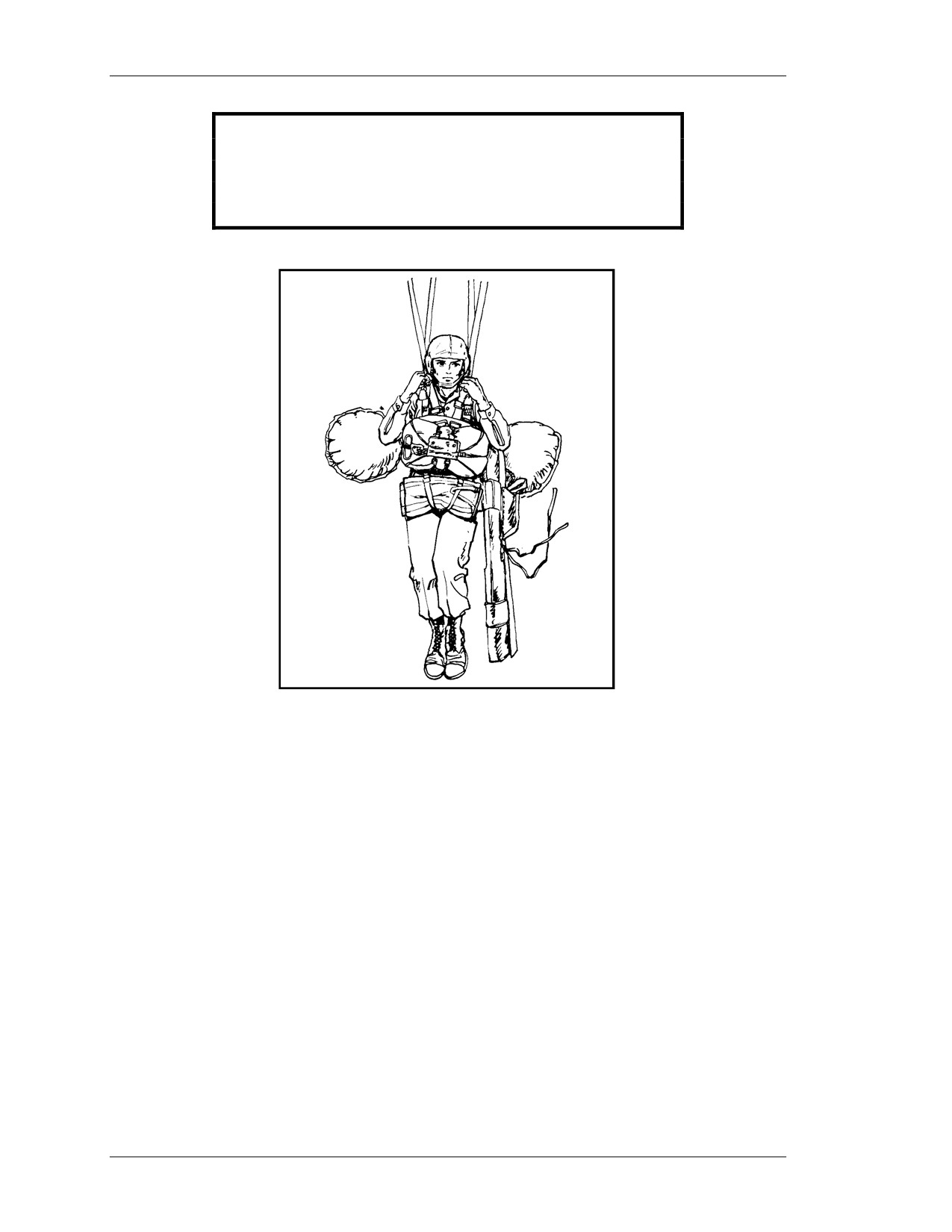
a. Deliberate Water Landing with the B-7 Life Preserver. The B-7 is worn under
the parachute harness with the inflatable portions under the jumper’s armpits (Figure
25-1, page 25-10). At altitude, the jumper releases all equipment tie-downs and lowers
equipment, but does not jettison it.
(1) During the descent, the parachutist inflates the life preserver by discharging the
attached CO2 cartridges. If necessary, the life preserver can be inflated by blowing air
into the inflation valve hose.
(2) After entering the water, the parachutist activates both canopy release assemblies.
He pulls the cable release safety clip out and away from his body (exposing the cable
loops) and activates the canopy release assembly using one of the two methods (hand to
shoulder or two-hand assist) as his feet touch the water.
(3) Since the B-7 life preserver will provide 500 pounds of positive buoyancy, the
parachutist does not remove the harness and equipment.
(4) The parachutist swims upstream or upwind away from the parachute to avoid
becoming entangled, and signals “All okay” to the recovery boat.
WARNING
Do not release the canopy release assemblies
until the feet make contact with the water. Altitude
is hard to judge over the water. If the jumper
activates his canopy releases at even moderately
high altitude (for example, 50 feet), serious injury
or death may result.
25-9
FM 3-21.220/MCWP 3-15.7/AFMAN11-420/NAVSEA SS400-AF-MMO-010
CAUTION
The jumper must stay clear of the suspension lines to
avoid entanglement. If the parachute and equipment
are to heavy and hard to hold on to, the jumper lets
go of the equipment to avoid being pulled under.
Figure 25-1. Landing with the B-7 life preserver.
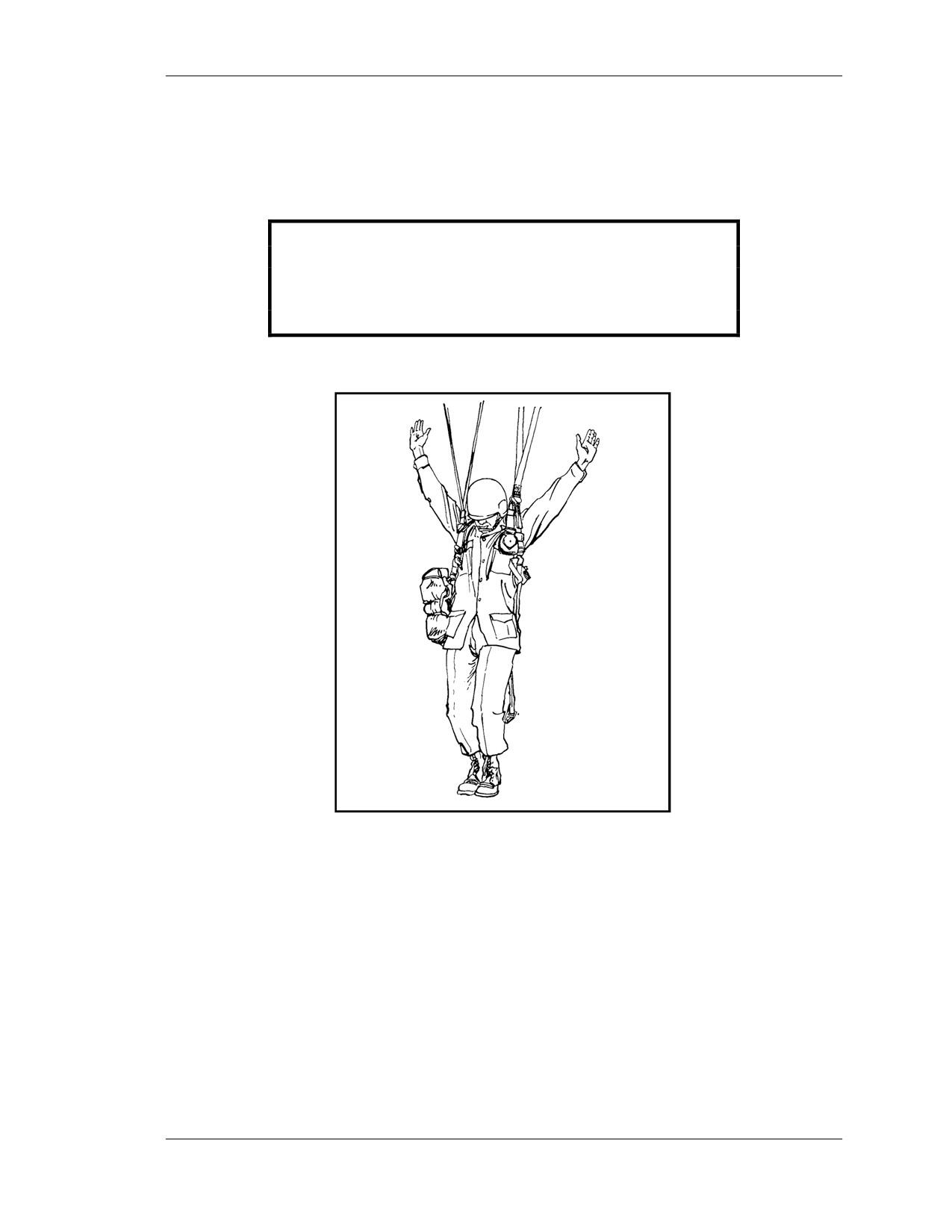
b. Deliberate Water Landing with UDT Life Preserver. Parachutists wearing a
UDT vest route the chest strap under the UDT vest so that the chest is not crushed if the
UDT is inflated.
(1) Upon exiting the aircraft, the jumper checks the canopy and steers away from
other jumpers. At altitude, the jumper releases all equipment tie-downs and lowers
equipment, but does not jettison it.
(2) The jumper activates the quick-release on the waistband and unsnaps the left
connector snap on the reserve parachute. He rotates the reserve to the right side of the
parachute harness and seats himself well into the saddle.
(3) The jumper activates the ejector snap on the chest snap and inflates his life
preserver with air by blowing into the inflation tube or activating the CO2 cartridge.
(4) Sitting back in the harness and using the right hand to hold onto the left main lift
web, the jumper steers with his left hand. Just before entering the water, he places his
hands on the ejector snaps on the leg straps.
(5) The jumper activates the ejector snaps on the leg straps, throws his arms up, and
arches out of the harness when entering the water. He prepares to execute a PLF if the
water is shallow.
25-10
FM 3-21.220/MCWP 3-15.7/AFMAN11-420/NAVSEA SS400-AF-MMO-010
(6) The jumper swims upstream or upwind away from the parachute to avoid
becoming entangled, and signals “All okay” to the recovery boat. He recovers the
parachute by grabbing the apex.
CAUTION
The jumper must stay clear of the suspension lines to
avoid entanglement. If the parachute and equipment
is too heavy to hold on to, the jumper legs go of the
equipment to avoid being pulled under.
Figure 25-2. Landing with a UDT life preserver.
c. Landing Procedures. Upon landing, personnel must be prepared to perform the
following procedures.
(1) If being dragged in the water, parachutists activate one (or both) canopy release
assemblies after entering the water.
(2) Parachutists prevent fouling in the canopy or suspension lines during severe wind
conditions.
(3) Parachutists signal “All okay” by extending one stationary arm overhead (DO
NOT WAVE) or “Help” (any other signal or no signal) to the recovery boat, and stand by
for pickup, remaining calm.
25-11
FM 3-21.220/MCWP 3-15.7/AFMAN11-420/NAVSEA SS400-AF-MMO-010
d. OIC Responsibilities. The parachute operation OIC ensures that—
• All personnel scheduled for a water jump are not less than Class 3 basic water
survival swimmer qualified IAW TC 21-21 (Army), USMC CWS-1 (USMC),
or Navy 1st class swimmers (USN).
• All jumpers and safety swimmers have completed wet silk training within the
past six months.
• All equipment has been waterproofed and float checked.
• All jumpers are using approved serviceable floatation.
• All jumpers have completed the required prejump training.
25-12
FM 3-21.220(FM 57-220)/MCWP 3-15.7/AFMAN11-420/NAVSEA SS400-AF-MMO-010
CHAPTER 26
EXIT PROCEDURES
Two types of exit procedures can be used on fixed-wing aircraft:
ADEPT exit and mass exit.
DANGER
ONLY ONE TYPE OF PARACHUTE (T-10- OR MC1-SERIES)
MAY BE USED DURING ANY ONE GIVEN PASS OVER A DROP
ZONE. THE MIXING OF PARACHUTES THAT HAVE DIFFERENT
OPENING PERFORMANCE CHARACTERISTICS, SUCH AS
NONSTEERABLE
(T-10-SERIES) VERSUS STEERABLE
(MC1-SERIES), CAN CAUSE HIGH-ALTITUDE INCIDENTS
DURING ADEPT OPTION 2 OR MASS EXIT OPERATIONS.
26-1. ALTERNATE DOOR EXIT PROCEDURES FOR TRAINING (ADEPT)
OPTIONS 1 AND 2
The ADEPT options are used when jumping the T-10- and MC1-series parachute. This
training safety measure allows the maximum number of parachutists to exit the aircraft
with a minimum risk of high-altitude entanglements.
a. ADEPT Option 1.
(1) During a single pass over the drop zone, only one stick of parachutists on one side
of the aircraft jumps. After issuing the eighth jump command, the JM turns toward the
paratroop door and regains control of his static line. He is positioned close enough to the
door to control the flow of jumpers but far enough back not to impede the jumpers’
movement to the door. The JM controls the number 1 jumper by grasping the jumper’s
saddle. When the jump caution lights turn green, the JM (on the active door for the pass)
issues the ninth jump command, GO, to the first parachutist and taps him on the thigh.
The JM controls the flow of parachutists
(performing a visual inspection of each
parachutist, his static line, and his equipment as he approaches the door) and observes the
jump caution lights; the safety takes the static lines.
(2) Once the last parachutist exits the active door, the safety visually clears to the
rear, gives the loadmaster a thumbs-up signal, and, with the assistance of the loadmaster
and or static line retriever, pulls in the static lines and deployment bags.
(3) During the pass, the JM in the inactive door performs outside air safety checks
and then observes the actions in the active door, since (under this option) he will not have
any parachutists exiting his door.
(4) Subsequent passes alternate from door to door until all parachutists have exited.
The AJM is the last parachutist on his side of the aircraft. The JM is the last parachutist
onboard the aircraft; he exits from his door.
b. ADEPT Option 2.
(1) During a single pass over the drop zone, one stick of parachutists exit from the
JM’s door, followed by a stick of parachutists from the AJM’s door. After issuing the
26-1
FM 3-21.220/MCWP 3-15.7/AFMAN11-420/NAVSEA SS400-AF-MMO-010
eighth jump command, the JM turns toward the paratroop door and regains control of his
static line. He is positioned close enough to the door to control the flow of jumpers but
far enough back not to impede the jumpers’ movement to the door. The JM controls the
number 1 jumper by grasping the jumper’s saddle. When the jump caution lights turn
green, the JM (on the primary door for the pass) issues the ninth jump command, GO, to
the first parachutist and taps him on the thigh. The JM controls the flow of parachutists
(performing a visual inspection of each parachutist, his static line, and his equipment as
he approaches the door) and observes the jump caution lights; the safety takes the static
lines.
(2) The AJM observes the actions in the JM’s door. When he sees only three
parachutists remaining in the JM’s stick, he faces his parachutists and issues the eighth
jump command. When the AJM sees the last parachutist clear the jump platform in the
JM’s door, he turns and rechecks his jump caution lights. (The JM is now observing the
actions in the AJM’s door.)
(3) If the jump caution lights are still green, the AJM verbally issues the ninth jump
command, GO, to his first parachutist and taps him on the thigh. He controls the flow of
parachutists (performing a visual inspection of each parachutist and his equipment as he
approaches the door) and observes the jump caution lights; the safety takes the static
lines.
(4) When the last parachutist exits from his side of the aircraft (last pass), the AJM
gives his static line to the safety, checks the jump caution lights, and, if they are green,
exits. The JM, seeing the AJM exit, passes his static line to the safety, checks the jump
caution lights, and, if they are green, exits.
(5) Safety personnel visually clear to the rear of the aircraft and give the loadmaster a
thumbs-up signal. They help the loadmaster recover static lines and deployment bags.
26-2. MASS EXITS
This exit procedure is used only when jumping the T-10-series parachute. During this
type of exit, parachutists may exit from both doors at the same time. The JM gives the
command GO, and the AJM then turns and gives his jumper the command GO to create a
staggered effect.
26-2
FM 3-21.220(FM 57-220)/MCWP 3-15.7/AFMAN11-420/NAVSEA SS400-AF-MMO-010
CHAPTER 27
BUNDLE DELIVERY SYSTEM (WEDGE)
The bundle delivery system (referred to as a wedge because of its
shape) is constructed with two Type II, 8-foot, modular airdrop platforms;
a lightweight aluminum frame; four sections of skate wheel roller
conveyors; and bundle release assemblies. The wedge weighs 930 pounds.
It is designed to lock into the ramp restraint rails and to provide adequate
tie-downs to secure various A-7A and A-21 configurations for flight. When
positioned on the raised cargo ramp in flight, the wedge provides an
inclined platform so that bundles can be released by rolling them out and
off the ramp immediately before or after parachutists exit the doors.
27-1. APPLICATION
The wedge provides minimum dispersion between parachutists and equipment bundles on
a single pass over the drop zone. The bundles can be released individually or in any
group combination from the wedge when the loadmaster pulls the release pins from one
or more release plates, depending on the number of bundles to be released at one time.
Each release plate system employs a 1/8-inch-diameter steel release pin, a restraint
release plate, and a 1-inch-wide tubular nylon restraint strap that secures each bundle, or
each combination of bundles, to the wedge. A 1-inch-wide tubular nylon strap lanyard is
attached to each steel release pin. Releasing the restraint strap allows the bundle(s) to roll
off the aircraft ramp under the force of gravity.
27-2. RESTRICTIONS
The following restrictions apply when using the wedge:
a. General Restrictions. The wedge accommodates six A-7A or A-21 aerial
delivery bundles, or a combination thereof, aboard the C-130 for cargo ramp airdrop. It
limits parachutists to 20 for each door. (The anchor line cable stops are positioned about
26 inches forward of the center anchor line cable supports.)
NOTE: Wedge bundles can be dropped only on the first pass across the drop zone.
b. Bundle Sizes. Bundle sizes are limited to 27 inches long by 42 inches wide by 48
inches high, to include parachutes. The total rigged weight for each bundle must not
exceed 538 pounds. Maximum allowable weight is 3,228 pounds for each six bundles.
For example, maximum dimensions for mortar bundles are 27 inches long by 60 inches
wide by 27 inches high
(height dimension does not include the cargo parachute,
paperboard honeycomb, and skid board). Mortar bundles must weigh between 320
pounds and 538 pounds (weights include skid board and cargo parachute). These
dimensions allow up to three mortar bundles to be configured on the wedge, or mortar
bundles can be mixed with smaller (27 inches by 42 inches) bundles to facilitate cross-
loading. Two configurations are possible when mixing bundles: one mortar and four
normal-size bundles (27 inches by 42 inches) or two mortar and two normal-size bundles.
c. Aircraft. During tactical training (visual or instrument flight regulations), bundle
drops are restricted to the first three aircraft.
27-1
FM 3-21.220/MCWP 3-15.7/AFMAN11-420/NAVSEA SS400-AF-MMO-010
27-3. RIGGING PROCEDURES
Aerial delivery units usually rig the wedge; however, the system may be rigged in the
airborne unit area. The areas of responsibility overlap; therefore, the JM must be familiar
with the rigging procedures. However, the wedge must have a final inspection by a
qualified rigger before the wedge leaves the rigging site.
27-4. BUNDLE DROP SEQUENCE
Bundles may be dropped from the wedge in the following sequence:
• A single bundle before and after the parachutists exit.
• A single unit of two to three bundles before or after the parachutists exit.
• Two units of two or three bundles for each drop with one unit dropped before and
one unit after the parachutists exit.
The bundle sequence is determined before loading the wedge. If single bundles are to be
dropped, a restraint strap and release lanyard are required for each bundle. If multiple
bundles are to be dropped in units of two or three, a restraint strap and release lanyard are
required for the aft bundle in each unit. Three exceptions are as follows:
a. A-7 and A-21 Bundles. The skid board size is 27 inches by 42 inches by 3/4 inch.
Drill the skid board and center a 1-inch hole on the 42-inch side, 1 inch from the edge.
Place two layers of honeycomb the size of the bundle on the skid board.
b. Bundle Restraint Strap. A restraint strap is formed by cutting a 12-foot length of
1-inch-wide tubular nylon webbing (requirement for maximum-size bundle). Form a
6-inch loop, with an overhand knot, 3 feet from one end of the strap. Lay the tie across
the honeycomb with the loop next to the center hole in the skid. The 3-foot length of strap
should be at the front of the skid (the front is the side with the 1-inch hole nearest the
edge). Place the bundle on top of the honeycomb and rig the bundle (FM 10-500-3/
FMFM 7-47/TO 13C7-1-11, which supersedes FM 10-501/TO 13C7-1-11). Place the
running ends of the restraint strap on top of the rigged bundle in preparation for loading
on the wedge.
c. Cargo Parachutes. Use G-14 cargo parachutes, rigged with nonbreakaway static
lines without drogue for A-7A or A-21 bundles dropped from the wedge. Attach the
parachutes to the bundles after they are loaded aboard the wedge and restraint straps are
secured.
27-5. INSPECTION
Before bundles are loaded, the wedge is inspected for completeness and serviceability
and to ensure that the roller conveyors are properly positioned and secured to the
platform. The bundle release plates are correctly installed as follows:
a. Left-Side Release Plates. Install left-side release plates (three each) between
roller conveyors 1 and 2 at rollers 1, 2, 11, and 12, 21, 22, counting from the front to the
rear of the wedge.
b. Right-Side Release Plates. Install right-side release plates between roller
conveyors 3 and 4 at roller positions 1, 2, 11, and 12, 21, 22.
c. Release Lanyard. Install a 1-inch-wide tubular nylon webbing release lanyard
with a 5 3/4-inch by 1/8-inch steel pin and ensure it is serviceable, marked, and secured
to the correct release plate with a 20-inch length of Type III nylon cord. (The 20-inch
27-2
FM 3-21.220/MCWP 3-15.7/AFMAN11-420/NAVSEA SS400-AF-MMO-010
cord forms a safety to prevent rebound of the lanyard and possible injury to personnel
releasing the bundles.)
NOTE: If a lanyard is unserviceable, make a new one with a length of 1-inch tubular
nylon webbing and a 5 3/4-inch by 1/8-inch steel pin. Using a bowline knot,
attach the pin to one end of the webbing. Insert the pin in the appropriate
release plate hole and extend the webbing forward to a point 30 inches from
the forward edge of the wedge. Cut the webbing and form a 6-inch loop in the
running end to provide a secure handhold for releasing the bundles.
27-6. LOADING, RIGGING, AND RESTRAINING BUNDLES TO WEDGE
Bundles are loaded, rigged, and secured to the wedge at the rigging site, and then
transported to the aircraft for loading. The following procedure is for loading and rigging
bundles to be dropped individually.
a. Load bundle number 3, left unit, with the loop of the restraint strap forward.
b. Position the loaded skid board with the 1-inch hole centered over the hole in the
forward release plate. Pass the 6-inch loop of the restraint strap down through the hole in
the board and release plate. Insert the release lanyard pin through the restraint strap loop
and the hole in the release plate.
c. Form a loop in the forward running end of the restraint strap. Pass the forward
running end of the restraint strap through the loop, cinch the strap tight around the
bundle, and secure with two half hitches and an overhand knot.
d. Secure the release lanyard pin with one complete turn (attach cotton ticket number
8/7). Pass the cord down through the hole in the release plate and through the pin loop.
Tie the running end with a square knot and a locking knot.
NOTE: Repeat the above procedure for each bundle in the following sequence:
bundles 2 and 1, left side; bundles 3, 2, and 1, right side.
e. Position, attach, and secure G-14 cargo parachutes to the bundles. Using tie-down
straps, secure the bundles to the wedge to prevent movement and possible damage to the
release pin during transport and to the wedge when loading aboard the aircraft.
NOTE: If bundles are to be dropped in multiples of two or three, only the aft bundle
requires a restraint strap and release lanyard. Bundles are loaded on the wedge
in reverse order—left to right, front to rear—with the loop of the restraint loop
strap forward.
27-7. JUMPMASTER PROCEDURES
JM procedures include managing anchor line cables and performing inspections before
and after loading.
a. Anchor Line Cables. The JM ensures that—
(1) Anchor line cables are disconnected from the center anchor cable supports and
secured to preclude obstruction to personnel.
27-3
FM 3-21.220/MCWP 3-15.7/AFMAN11-420/NAVSEA SS400-AF-MMO-010
(2) Stops are installed and taped on the inboard anchor line cable at fuselage station
749 for the bundle static lines, and about 26 inches forward of the center anchor cable
support for parachutist static lines.
NOTE: Static line retrieval spools are forward of these stops. The stops and spools are
adjusted so that the distance from the forward edge of the anchor cable
supports to the forward edge of the spool is 26 inches.
b. Inspection Before Loading. The JM is responsible for inspecting, with a
qualified parachute rigger, the following items on the wedge before loading. (He also
inspects them with the loadmaster after loading.)
• Bundles A-7A or A-21 are present and are properly secured to plywood skid
board (FM 10-500-3/TO 13C7-1-11).
• Quick-release assemblies are properly seated and safety clip is inserted (A-21
bundle).
• Correct size and layers of honeycomb are present.
• Bundles are properly secured to plywood skid board.
• A one-inch tubular nylon restraint strap is routed vertically around bundles,
with a six-inch lanyard overhand loop at the release point.
• G-14 cargo parachute(s) is rigged for nonbreakaway and without drogue.
• Parachute is properly attached and secured to bundle(s).
c. Inspection After Loading. The JM is responsible for inspecting the wedge for
correct positioning and locking into the aircraft restraint rails when the following actions
are accomplished:
• Wedge is positioned so that aft restraint rail lock in platform number 6 indent
is in place (counting from the rear of the platform).
• Cargo parachute static lines are connected to the inboard anchor line cables
forward of the stops at station 749.
• Bundle release lanyards are correctly routed.
• Release pins are seated in the release plates.
• Safety tie is in place.
• Bundles are secured for flight.
27-8. BRIEFING RELEASE PROCEDURES
Briefing release procedures include the following:
a. Identify the jumpmaster, loadmaster, safety personnel, and assistants; brief each
individual on his responsibilities.
b. Coordinate type signals to be used to conduct the drop—for example, thumbs-up
for DROP, thumbs-down for NO DROP.
c. Coordinate bundle release and parachutist exit sequence to be used—for example,
on the green light, the number 1 loadmaster releases the bundle(s) on his side of the
aircraft. All parachutists will exit after the last bundle clears the aircraft ramp. After the
last parachutist exits the aircraft, safety personnel give a thumbs-up, signaling the number
2 loadmaster to release the bundle(s) on his side of the aircraft.
d. Review procedures for a bundle hung up in the aircraft—for example, the
loadmaster will signal NO DROP and notify the pilot; the pilot turns on the NO DROP
27-4
FM 3-21.220/MCWP 3-15.7/AFMAN11-420/NAVSEA SS400-AF-MMO-010
red light. The drop is canceled if the problem cannot be immediately identified and safely
corrected.
27-9. LOADMASTER AND JUMPMASTER DUTIES DURING FLIGHT
Airdrop sequence of bundles and personnel include:
a. Loadmaster. At the 3-minute slowdown, the loadmaster raises the cargo door and
installs the anchor line cables in the center anchor line cable supports.
b. Jumpmaster. The JM hooks up, issues the 6-minute warning, and begins the
jump commands.
NOTE: All commands are the same (whether using the wedge or not) unless all
bundles are to be released before the exit of the parachutists. Then, the
command STAND BY is given. The number 1 parachutist in each door
assumes a position at a 10-degree angle to the forward edge of the doors and
observes the JM.
(1) Bundles Precede Jumpers. On the green light, the loadmasters release the
bundles. When the JM observes that the last bundle has cleared the aircraft ramp, he
gives the command GO. All parachutists then exit the aircraft.
(2) Jumpers Precede Bundles. If all bundles are to be released after the parachutists
exit, the JM gives the command STAND BY for the first two parachutists. On the green
light, the command GO is given. When the parachutists have exited, the static safety
personnel give a thumbs-up signal for the loadmaster to release the bundles.
(3) Bundles Released Before and After the Jumpers. On the green light, the number
1 loadmaster releases the required bundles. When the JM observes that the last bundle
has cleared the aircraft ramp, he gives the command GO. All parachutists then exit, and
the static safety personnel signal thumbs-up to the number 2 loadmaster to release the
remaining bundles. Static lines are retrieved, and the cargo and troop doors are secured
by the loadmaster.
27-5
FM 3-21.220(FM 57-220)/MCWP 3-15.7/AFMAN11-420/NAVSEA SS400-AF-MMO-010
CHAPTER 28
COMBAT AIRBORNE OPERATIONS
This chapter describes allowable combat techniques for airborne
operations, which may deviate from those for peacetime operations.
Commanders should conduct a detailed risk assessment before modifying
normal peacetime techniques to which their soldiers have grown
accustomed in training. Failure to do so can result in unnecessary loss of
combat power and additional casualties that must be cared for on the drop
zone. Commanders should ensure any changes are thoroughly briefed,
understood, and rehearsed during troop leading procedures and pre-jump
training. Within the constraints of this chapter, MACOMs should develop
their own combat procedures based upon their mission, organizational
structure, and level of training.
28-1. MODIFICATIONS TO PERSONNEL AND EQUIPMENT PROCEDURES
Personnel and equipment can be dropped in any sequence that best supports the ground
tactical plan. Commanders may modify peacetime aircraft, serial, and formation interval
rules based upon METT-T.
a. All aircraft are loaded to the maximum.
b. The static line snap hook safety wire is not required to be inserted in the snap
hook.
c. The right connector snap of the reserve parachute does not require a safety wire.
d. The waistband, if not used, is rolled and secured with a piece of masking tape to
keep it out of the way.
e. Jumpers should only carry minimum mission-essential equipment to make room
for ammunition.
f. Commanders should determine, based upon METT-T, when jumpers should hook
up. If faced with a well-developed enemy air defense threat, jumpers should be stood up
prior to entering the threat zone.
g. The green light should go on to achieve the desired PI. There is no requirement
for safety buffers on the lead or trail edge of the DZ, provided there are no obstacles. The
red light should not go on unless there is a significant hazard (such as a large body of
water) or the aircraft is scheduled to continue to another DZ.
h. Weapons should be rigged in the M1950 weapons case. (A magazine is loaded,
weapon placed on SAFE, and no round is chambered.) Jumping weapons exposed does
not significantly decrease the time required to place the weapon into action. More
importantly, with jumpers and jumpmasters executing procedures that they have not
rehearsed, jumpers are more likely to become entangled or towed. The M1950 weapons
case is equipped with a quick release zipper. The jumper should not attempt to unzip the
zipper but should grasp the tab thong and pull upward sharply (as if to finish zipping
completely). When the slide fastener disengages, the zipper teeth will uncouple the length
of the M1950.
i.
Leaders and JMs should consider the heavy and nonstandard loads paratroopers
carry. An excessively heavy load or protruding object may prevent a jumper’s strong exit.
28-1
FM 3-21.220/MCWP 3-15.7/AFMAN11-420/NAVSEA SS400-AF-MMO-010
More importantly, the load may become an obstacle and may result in the failure of a
stick to exit.
j.
Jumpmasters should either lead or follow their sticks out on combat jumps.
Commanders should load-plan their jumpmasters to come from the lead or trail edge
units, thereby landing closer to their objectives. Jumpmasters may jump in the stick
closest to their exit points. If safeties are designated to jump, they should come from the
trail edge unit. They should rig as late as possible in order to conduct their required safety
checks unencumbered. Safeties must continue to control static lines until all jumpers have
exited the aircraft.
CAUTION
Do not abandon your training techniques just because
you are in combat. Do a detailed risk assessment to
ensure changes are necessary. Ensure changes are
well briefed, understood by all, and rehearsed during
pre-jump training.
k. Parachutists may be briefed to “pop and go,” leaving all their air items where they
land. If the DZ is under enemy attack and it is necessary to find cover and start fighting,
they may drop their weapons cases and reserves, activate both canopy release assemblies,
and move out, leaving their harnesses on to be discarded later. METT-T may require a
follow-on airland. Jumpers should be briefed to “bag and go” if they land near a runway
or taxiway. This means the jumper places his parachute in the kit bag and leaves it upside
down no closer than 10 meters from the active runway or taxiway. METT-T determines
whether units designate a “clean side” or “dirty side” of the active runway or taxiway.
l.
Drop altitude is determined by coordination between the airborne commander and
the air mission commander. The JTF commander makes the final jump altitude decision.
When conducting risk assessment, commanders are advised of the altitude chart located
in Chapter 26 and are reminded of the 135-foot altimeter error. If the decision is made to
jump at
600 feet AGL or lower, pre-jump training should include the proper
modifications (such as lowering equipment after the second point of performance).
m. Leaders should jump their own radios. Radio frequencies should be accessible,
short whip antennas screwed in, and handsets plugged in. Leader radios are ready to go
immediately after landing.
28-2. MOVEMENT FROM ASSEMBLY AREAS
The quicker assault objectives are secured, the better the odds for a successful mission.
Units should proceed to the assault objective IAW unit SOP.
a. Determine minimum force required to seize and secure the assault objective.
When that force has assembled (to include any “lost” troopers from other units), the
senior leader of the group may begin the assault on the objective IAW the commander’s
intent.
28-2