FM 3-21.220 STATIC LINE PARACHUTING TECHNIQUES AND TRAINING (SEPTEMBER 2003) - page 9
FM 3-21.220/MCWP 3-15.7/AFMAN11-420/NAVSEA SS400-AF-MMO-010
(b) Jumpmaster. Checks green light. Tracks panels/exit point. Gives command of
STAND BY.
(c) Safety. Controls JM’s static line.
(d) Jumpers. Keep eyes on JM.
(6) 30 Seconds (pilot release procedures using GPS/VIRS).
(a) Flight Engineer. Moves to starboard side of aircraft.
(b) Jumpmaster. Gives the command “STAND BY,” turns toward the open ramp,
takes control of his static line from the safety, and keeps eye on jump lights.
(c) Safety. Gives JM his static line and moves to starboard side of aircraft next to
flight engineer.
(7) 10 Seconds (JM release procedures).
(a) Flight Engineer. Ensures he is clear of the ramp.
(b) Jumpmaster. Keeps the panels in sight. Stands up and turns to face the ramp.
Takes the static line from the safety. Waits until panels are 90 degrees from aircraft.
(c) Safety. Gives static line to the JM and moves to the starboard side of the aircraft.
(d) Jumpers. Keep eyes on JM.
(8) Exit (JM release procedures using GMRS/WDI).
(a) Flight Engineer. Ensures he is clear of the ramp.
(b) Jumpmaster. Identifies exit point, gives the command “FOLLOW ME,” and
walks straight out the ramp.
(c) Safety. Controls the jumper interval (one second). Retrieves static lines.
(d) Jumpers. Exit the ramp straight at one-second intervals.
(9) Exit (pilot release procedures using GPS/VIRS).
(a) Flight Engineer. Ensures he is clear of the ramp.
(b) Jumpmaster. When green light is illuminated, gives the command “FOLLOW
ME” and walks out the ramp along the port side.
(c) Safety. Controls the jumper interval (one second). Retrieves static lines.
(d) Jumpers. Exit the ramp straight along the port side at one-second intervals.
CAUTIONS
Low overhead clearance may require jumpers to duck
their heads while exiting the ramp door.
Jumpers must walk STRAIGHT out the ramp and
along the port side fuselage and NOT at a 45-degree
angle towards the center of the ramp.
Safety must remain clear of the ramp door and
against the starboard side fuselage while jumpers
exit.
19-19. CARGO OPERATIONS
The C-23B/B+ Sherpa is capable of both low level and high altitude cargo delivery
operations. Bundle weight on the ramp should not exceed 500 pounds.
19-10
FM 3-21.220/MCWP 3-15.7/AFMAN11-420/NAVSEA SS400-AF-MMO-010
a. Cargo Airdrops Without Personnel. The following are procedures for cargo
airdrops without personnel.
(1) The pilot sets up the approach, airspeed, and altitude. He commands the flight
engineer to “STAND BY.”
(2) The flight engineer ensures the bundle static line is hooked up and moves the
cargo to the edge of the ramp.
(3) The pilot gives countdown to the flight engineer—“5, 4, 3, 2, 1, Now!”
(4) The flight engineer releases the cargo over the ramp and retrieves the static
line/clevis.
b. Cargo Airdrops with Personnel. The following are procedures for cargo
airdrops with personnel.
(1) The JM and safety coordinate and rehearse cargo release procedures with the
flight engineer before the mission.
(2) Cargo may be released before or after jumpers exit.
(3) The safety retrieves static line/clevis after the drop.
NOTE: Based on the mission, the JM selects either the breakaway or nonbreakaway
15-foot static line.
CAUTIONS
No more than four jumpers are authorized aft of the
port side jump door prior to exit.
Excessive weight load and cargo shift in the ramp
door area prior to exit should be avoided.
19-20. MILITARY FREE-FALL OPERATIONS
All MFF operations are conducted IAW FM 31-19.
Section IV. C-27A (AERITALIA G-222)
The C-27A is a pressurized, medium transport aircraft developed from the Aeritalia
G-222. It is a twin-engine, high-wing-mount, tailgate-equipped aircraft that is similar to a
downsized C-130. The C-27A can carry 34 fully equipped combat troops, 28 static line
parachutists, 34 military free fall (MFF) parachutists, or 16 MFF parachutists on oxygen.
It can airdrop up to six CDS bundles. Typical internal loads are two HMMWVs or three
full-sized 463L pallets that are turned sideways. Static line parachutists may be dropped
using either of the two jump doors but may not use the ramp. MFF personnel may use
both jump doors or the ramp.
19-21. SEATING CONFIGURATION
The seating configuration for the C-27A is as follows:
a. Stick Configuration. Parachutists are assembled into two sticks of jumpers.
Jumper number 28 (the JM) is seated on the port side of the aircraft forward of the jump
19-11
FM 3-21.220/MCWP 3-15.7/AFMAN11-420/NAVSEA SS400-AF-MMO-010
door. Forward of him is number 13, then numbers 1 through 12. Jumper number 27 (the
AJM) is seated on the starboard side of the aircraft just forward of the jump door.
Forward of him is jumper number 26; then jumpers 14 through 25. The safeties sit on
each side to the rear of the jump doors.
b. Anchor Line Cables. There are two anchor line cable assemblies in the C-27A.
The anchor line cables are from the attachment point on the forward bulkhead, through
the anchor line support bracket just behind both doors, then to the side of the aircraft over
the tailgate. Each parachutist is issued main and reserve parachutes. Each parachutist is
responsible for inspecting his parachute for safety wires and for fitting of the parachute
harness.
19-22. SUPERVISORY PERSONNEL REQUIRED
To ensure command and control when jumping one jump door, one jumpmaster, one
nonjumping safety, and an airdrop-certified USAF loadmaster are required. These
personnel requirements double when using both troop doors.
19-23. JUMP COMMANDS
Jump commands for the C-27A are as follows:
a. Jump Commands. The following nine jump commands are used whether the
doors or the ramp are jumped.
(1) GET READY. Jumpers respond in the same manner as for other fixed-wing
aircraft.
(2) PORT SIDE PERSONNEL, STAND UP. Jumpers on the left side of the aircraft
stand up, raise and secure their seats, and face the ramp of the aircraft.
(3) STARBOARD SIDE PERSONNEL, STAND UP. Jumpers on the right side of
the aircraft stand up, raise and secure their seats, and face the ramp of the aircraft.
(4) HOOK UP. The jumpers detach the static line snap hook from the top carrying
handle of the reserve parachute and hook up to the anchor line cable with the open
portion of the snap hook facing inboard, ensuring that the snap hook locks properly. The
safety wire is inserted in the hole, pointing toward the rear of the aircraft, and folded
down.
(5) CHECK STATIC LINES, CHECK EQUIPMENT, and SOUND OFF FOR
EQUIPMENT CHECK. These commands are executed in the same manner as with other
fixed-wing aircraft.
(6) STAND IN THE DOOR. A proper door position is taken by the parachutist.
(7) GO. Personnel exit the aircraft at 1-second intervals.
NOTE: Port side personnel exit first. After all port side personnel except the JM have
cleared the aircraft, the starboard side personnel (except the AJM) exit the
aircraft. JMs “clear to the rear” of the aircraft, the AJM exits, and the JM
follows. All jumpers exit using the stand-in-the-door type door exit.
b. Modification of Jump Commands. At the 10-minute warning, the JM and AJM
send jumpers number 13 and number 26 to the forward end of the aircraft to take their
correct place in the stick. The two seats forward of both jump doors are folded upright
and secured. The two safeties fold their seats upright and secure them.
19-12
FM 3-21.220/MCWP 3-15.7/AFMAN11-420/NAVSEA SS400-AF-MMO-010
19-24. SAFETY PRECAUTIONS
Safety precautions for the C-27A are as follows:
a. Jumpmasters. The JMs inspect the door platforms after the doors are opened.
The JMs hook up to the cables on their side of the aircraft. They control and observe the
personnel as they exit. JMs exit last.
b. Safeties. The safeties assist the loadmaster in installation of the door platforms if
they are to be installed in-flight. They ensure personnel hook up consecutively and that
jumpers number 13 and 26 are in the correct position. The safeties control the static lines
as the jumpers approach the door to exit. They assist the loadmasters when retrieving the
deployment bags.
c. Equipment. Standard combat equipment can be jumped out of the doors, which
are 36 by 75 inches. Standard door bundles (that is, A-7A/A-21) can be dropped out of
the doors. The 15-foot static line with drogue is used. Troops may follow.
d. Aircraft. The drop speed of the aircraft is 125 knots. Both doors cannot be
jumped at the same time. The ramp of this aircraft cannot be used for static line ramp
exits.
19-25. OVER-THE-RAMP OPERATIONS
Considerations for over-the-ramp operations follow.
a. Static Line Operations. The erratic behavior of the deployment bags poses a
serious safety hazard; the C-27A cannot be used for static line over-the-ramp operations.
b. Equipment Drop. Door bundles can be pushed off the ramp. The rollers can be
installed on the ramp to aid in handling larger bundles.
c. Military Free Fall. MFF exits can be made over the ramp when both doors are
closed. The C-27A will hold 34 MFF jumpers; however, it is recommended the number
of MFF jumpers be limited to
16 when oxygen consoles are installed, due to
overcrowding in the aircraft. The using unit must provide two console positions for the
loadmasters to use during MFF jumps above 10,000 feet. It is very difficult for the JM to
spot the release point from the aircraft during ramp exits. Therefore, the JM should not
wear an ALICE pack for this type operation, and the unit should use a nonjumping JM.
19-26. JOINT PREFLIGHT INSPECTION
The C-27A is inspected as follows:
a. JM/Aircraft Commander/Loadmaster Coordination. The JM is responsible for
informing the aircraft commander and loadmaster of the exact time sequence of prejump
procedures. Following preliminary orientation, and before loading personnel onboard the
aircraft, the JM and loadmaster make a joint inspection of the aircraft. The purpose of the
joint inspection is to verify the readiness of the aircraft for the conduct of the mission and
to take actions necessary to achieve this readiness.
b. Exterior Inspection. An external inspection of the aircraft is made to detect
hazards to the airdrop of personnel. Particular attention is directed to those areas to the
rear of the aft paratroop doors. Any protruding objects and sharp edges are removed, or
padded and taped.
c. Interior Inspection. An interior inspection checks for the following:
(1) Any sharp edge or protrusion is securely taped and padded, as required.
19-13
FM 3-21.220/MCWP 3-15.7/AFMAN11-420/NAVSEA SS400-AF-MMO-010
(2) All equipment in the cargo compartment is securely stowed and lashed.
(3) The floor is clean and free of lubricants; no obstructions are on the walkway or
along the paratroop exit route (outboard area between the safety fence and fuselage).
(4) Anchor line cables are installed.
(5) A seat and seat belt are available in the troop compartment for each parachutist.
(6) The retrieval system is installed in the aircraft with the winch cable retained in
clips and free of the anchor line cable.
(7) Windscreen systems are available/installed.
(8) Jump platforms are available/installed.
(9) Jump caution lights are operational.
(10) Troop compartment lights are operational.
d. Jumpmaster Preload Inspection of Parachutists. The JM/AJM inspects each
parachutist, parachute, and parachutist’s equipment prior to loading the aircraft.
19-27. LOADMASTER BRIEFING
As soon as all parachutists are seated, the loadmaster briefs them on aircraft safety,
emergency procedures, and comfort facilities.
19-28. TIME WARNINGS
Time warnings are as follows:
a.
20-Minute Warning. JMs check personnel and equipment. Missile jump packs
are attached to the parachutists, their HSPR leg straps are secured, and door bundles are
moved near the personnel doors.
b.
10-Minute Warning. Final onboard JMPI of all parachutists is complete. A
verbal and visual 10-minute warning is given to the JMs by the loadmaster, and the JMs
begin jump commands.
c. Slow-Down Warning. About 3 minutes from drop time, the jump commands are
completed. Personnel doors are opened, and jump platforms are extended and locked.
d.
1-Minute Warning. JMs alert troops and make safety checks from personnel
doors. The AJM informs the JM that his side is clear and that it is safe to jump.
e.
10-Second Warning. The loadmaster gives the JMs a visual 10-second warning.
At this time the JM gives the command STAND IN THE DOOR, and the number 1
jumper assumes a proper door position. The remainder of the stick shuffles aft to close up
the stick.
f. Green Light, GO. At the green light, the JM taps out the first man. Port side
personnel exit first. After all port side personnel have cleared the aircraft, the starboard
side personnel exit the aircraft. JMs “clear to the rear” of the aircraft, the AJM signals to
the JM that all jumpers are clear of the aircraft, the AJM exits, and then the JM exits. All
jumpers exit using the stand-in-the-door exit.
19-29. ADDITIONAL SAFETY PRECAUTIONS
Further safety precautions for the C-27A follow.
a. Platforms, Air Deflectors, Aft Cargo Door. The JMs must ensure that jump
platforms and windscreens are available. This equipment is mandatory for each aft
personnel door that is to be used.
19-14
FM 3-21.220/MCWP 3-15.7/AFMAN11-420/NAVSEA SS400-AF-MMO-010
b. Door Bundles. When personnel follow door bundles, the door bundle static line
will be outfitted with a drogue.
c. Movement into the Door. Parachutists exercise caution as they move to the door
to avoid becoming entangled with the static lines of preceding parachutists. This
precautionary action may slow movement into and out of the door.
19-30. C-27A JUMPMASTER CHECKLIST
The jumpmaster follows this checklist.
a. Seats.
• Adequate seats for troop load are onboard.
• All seats have safety belts.
• Seat backs are secure.
• Seats are serviceable.
• There are no projections through seats; pairs of seats forward of each troop
door have a strap attached to secure them in the upright position.
b. Floor.
• Nonskid surface covering is in good condition.
• Floor is clean and safe to walk on.
• Roller conveyors are stored.
• Loose equipment is secured in the cargo ramp area and does not interfere with
troops.
• Equipment tie-down rings are depressed into their recesses.
c. Jump Platforms.
• Nonskid surface covering is present and in good condition.
• There are no cracks or bends.
• Studs are locked in seat track receptacles.
• Tie-down fitting is locked.
• All bolts and nuts are present.
• Platforms swing in and out easily.
d. Jump Doors.
(1) Ground Check.
• There are no sharp or protruding edges on door frames.
• Doors open and close easily.
(2) Prior to Exit.
• The platforms are locked into the two “keyholes” on the floor and slid to the
rear of the aircraft. The large portion of the keyhole slot should be visible.
• The platform locking lever on the leading edge of the door should be in its
locked position. The lug this lever controls should be engaged to the door
frame.
• The platform locking lever should be taped in place to help prevent any
jumpers from inadvertently unlocking it.
• The flange on the trailing side of the platform must overlap the inside of the
door frame approximately 1/2 inch.
e. Jump Lights (five total).
• Rear at the forward left door.
19-15
FM 3-21.220/MCWP 3-15.7/AFMAN11-420/NAVSEA SS400-AF-MMO-010
• Rear of both troop doors.
• High above and to the rear of the ramp on both sides.
f.
Static Line Anchor Cable System.
• Forward end of cable is firmly secured to bracket on bulkhead with three
threads showing on turnbuckle.
• Rear of cable has a pin in it with tape.
g.
Anchor Cable.
• Cable has no breaks.
• Cable has no frays.
• Cable has no kinks.
• Cable is clean and free of rust.
• Static line stop is present.
• Support bracket at the trailing edge of the door is locked in place to support
the cables.
h.
Static Line Retrievers.
• Motor is operational.
• Cable is secured to ceiling with one turn of double 1/4-inch cotton webbing.
• The Y attachment is in place so one retrieval cable can pull in two groups of
deployment bags. (Y cable is used if both jump doors are used.)
• Retriever cables are not broken, frayed, or kinked. They are clean and free of
rust.
• Phenolic block/anchor cable spool is installed on both anchor cables with the
pull ring on the forward end.
• Retriever equipment is available.
i.
Emergency Equipment.
• First aid kit is onboard (one).
• Fire extinguishers are onboard (two).
• Alarm system is operational.
• Emergency exits are operational and accessible.
• Sufficient emergency parachutes are available.
j.
Miscellaneous.
• Day lighting system is operational.
• Night lighting system is operational.
• Airsickness bags are available.
• JM kit (extra equipment) is onboard.
• Earplugs are available.
• Heavy tape is available to secure the platform and windscreen locking lever.
• If jump platforms and windscreen are not installed in the doors, they must be
secured to the upper ramp.
• All equipment and crew baggage is secured to the floor.
• During the jump briefing, the jumpers are warned to avoid striking or grabbing
the door platform or windscreen locking lever on the leading edge of the door.
19-16
FM 3-21.220/MCWP 3-15.7/AFMAN11-420/NAVSEA SS400-AF-MMO-010
WARNING
It is a serious hazard to the exiting parachutist if
the windscreen locking lever swings into the open
door.
k. Tailgate Drops (MFF and Bundles Only).
• Ensure that the loadmaster installs the stops on both sides of the tailgate so
that it will be level with the aircraft floor when open.
• Disengage the support bracket near the door for bundle drops that use the
retrieval system to pull in the static lines.
• Secure the retrieval cable against the anchor line in several places with
breakaway ties starting at the rear of the cable and ending at the tailgate hinge.
This will prevent the tailgate from cutting the retrieval cable during operation.
l.
Aircraft Slow-Down Warning at 3 Minutes.
• Doors are opened and locked in place.
• Air deflectors are extended.
• Jump platforms are locked in place.
m. Loadmaster/JM Safety Checks.
• Door bundles employ approximately
15-foot-long static lines with three
drogue parachutes.
• Jump platform is secure and will sustain parachutist’s weight.
Section V. C-46 COMMANDO/C-47 SKYTRAIN
The C-46 and the C-47 are twin-engine, short-range transport aircraft. Because of the
similarity in characteristics and procedures, both aircraft are discussed in this section.
19-31. SEATING CONFIGURATIONS
Seating configurations for the C-46 and C-47 are as follows:
a. C-46. A total of 27 parachutists can be jumped from the C-46 using both aft troop
doors. This aircraft can accommodate two sticks: a 14-man stick sits on the starboard
side, and a 13-man stick sits on the port side.
b. C-47. A total of 24 parachutists can be jumped from the C-47 using the aft troop
door. This aircraft can accommodate two sticks: a 12-man stick sits on the starboard side
and a 12-man stick sits on the port side.
19-32. JUMP PROCEDURES
Jump procedures for the C-46 and C-47 are as follows:
a. C-46 Jump Commands.
(1) GET READY. Jumpers respond in the same manner as for other
fixed-wing aircraft.
(2) STAND UP. The parachutists near the doors stand and steady themselves by
firmly grasping a structural member of the cargo compartment wall.
19-17
FM 3-21.220/MCWP 3-15.7/AFMAN11-420/NAVSEA SS400-AF-MMO-010
(3) HOOK UP. The open portion of the static line snap hook is away from the
parachutist and toward the floor of the aircraft when he hooks up. The elbow of the arm
holding the static line is kept close to the body. The static line is controlled by each
parachutist in a reverse bight at waist level in the left hand. When the anchor line cable is
installed along the top of the aircraft, the static line is controlled in a standard bight held
at shoulder level.
(4) CHECK STATIC LINES. Each jumper checks the man in front to ensure the
static line snap hook cover on the 5-foot static line extension covers the snap hook.
(5) CHECK EQUIPMENT. Each jumper checks his equipment and checks the man
in front to ensure that the man’s elbow is close to his body and the static line extension
hangs below and behind the arm.
(6) SOUND OFF FOR EQUIPMENT CHECK. This command is executed in the
same manner as with other fixed-wing aircraft.
(7) STAND IN THE DOOR. A proper door position is taken by the parachutists in
both doors.
(8) GO. Personnel exit the aircraft at 1-second intervals.
b. C-47 Jump Commands.
(1) GET READY. Jumpers respond in the same manner as for other
fixed-wing aircraft.
(2) PORT SIDE PERSONNEL, STAND UP. The odd-numbered jumpers seated on
the left side of the aircraft stand up, secure their seats in the down position, and face the
rear of the aircraft.
(3) STARBOARD SIDE PERSONNEL, STAND UP. The even-numbered jumpers
seated on the right side of the aircraft stand up, secure their seats in the down position,
and face the rear of the aircraft.
(4) HOOK UP. The even-numbered jumpers hook up between the odd-numbered
jumpers to form a staggered stick of jumpers. The static line is controlled by each
parachutist in a reverse bight at waist level in the left hand.
(5) CHECK STATIC LINES. Each jumper checks the man in front to ensure the
static line snap hook cover on the 5-foot static line extension covers the snap hook.
(6) CHECK EQUIPMENT. Each jumper checks the man in front to ensure that the
man’s elbow is close to his body and the static line extension hangs below and behind the
arm.
(7) SOUND OFF FOR EQUIPMENT CHECK. Jumpers respond to this command
in the same manner as with other fixed-wing aircraft.
(8) STAND IN THE DOOR. A proper door position is taken by the parachutists in
both doors.
(9) GO. Personnel exit the aircraft at 1-second intervals.
19-33. SAFETY PRECAUTIONS
Safety precautions for both aircraft are as follows:
a. Parachutists ensure all seats are in the down position when they stand to hook up.
b. Upon exit from the aircraft, parachutists bring their feet and knees together to
form a tight body position.
19-18
FM 3-21.220/MCWP 3-15.7/AFMAN11-420/NAVSEA SS400-AF-MMO-010
19-34. SAFETY PERSONNEL AND JUMPMASTER RESPONSIBILITIES
Responsibilities for the safety and jumpmaster follow.
a. C-46.
(1) The JM or safety ensures personnel hook up in an alternating and
consecutive fashion.
(2) One safety is required when jumping the C-46. After the safety has checked each
parachutist, the safety then moves aft of the door and physically controls the JM’s static
line.
(3) Due to the movement of the safeties and length of the aircraft, it is advisable to
use a USAF BA-18 emergency parachute when using one safety for each door. When
using the safety harness, two safeties are required for each door. Safety number 1 is
positioned forward to inspect jumpers. Safety number 2 is positioned aft to assist the JM.
NOTE: Although the C-46 has two aft troop jump doors, normally only the left aft
troop door is used for jumping. When both doors are used, one safety for each
door is required. The JM (or safety) taps out parachutists alternately at
one-second intervals to preclude simultaneous exits from both sides of the
aircraft.
(4) Normally, the JM exits first when jumping this aircraft. When the JM gives the
command, STAND IN THE DOOR, he moves to the door and assumes a proper door
position. On the command GO, the JM looks at the number 2 man, gives the command
GO, and then exits the aircraft. Once the JM exits, the safety controls the static lines and
the parachutists’ flow out of the aircraft.
b. C-47.
(1) The JM or safety ensures personnel hook up consecutively.
(2) One safety is required when jumping the C-47. After the safety has checked each
parachutist, the safety then moves aft of the door and physically controls the JM’s static
line.
(3) Due to the movement of the safeties and length of the aircraft, it is advisable to
use a USAF BA-18 emergency parachute when using one safety. When using the safety
harness, two safeties are required. Safety number 1 is positioned forward to inspect
jumpers. Safety number 2 is positioned aft to assist the JM.
(4) The JM must exit first when jumping this aircraft. When the JM gives the
command STAND IN THE DOOR, he moves to the door and assumes a proper door
position. On the command GO, the JM looks at the number 2 man, gives the command
GO, and then exits the aircraft. Once the JM exits, the safety controls the static lines and
the parachutists’ flow out of the aircraft.
c. Parachute Fouling. To prevent fouling of the T-10-series or MC1-series type
parachute on the aircraft when jumping the C-46 or C-47, a 5-foot static line extension
must be used. This extension has a snap hook at one end and a nondetachable connector
link at the other end. The connector link on the extension is attached to the snap hook of
the parachute static line. The snap hook on the parachute static line is safetied with a
short piece of wire covered with a canvas duck sleeve and taped in place. The extension
is stowed by using rubber retainer bands, continuing to stow the extension on the pack
19-19
FM 3-21.220/MCWP 3-15.7/AFMAN11-420/NAVSEA SS400-AF-MMO-010
body. When the stow is completed, the static line and extension should have four stows
on the right and three stows on the left.
NOTE: When jumping the C-46 utilizing the MC1-series, parachutists use only the
left aft door.
d. Anchor Line Cables.
(1) The C-46 has two anchor line cables. Both anchor line cables must be detached
from their floor fittings and anchored to the floor in the rear section of the cargo
compartment. A wooden block is used to support the cable at the anchor point.
(2) The C-47 has one permanently installed anchor line cable that must be secured to
the overhead attachment points provided in the center of the aircraft.
• The aft edge of the jump door is lined with a smooth metal tubular stripping,
or it is padded and taped.
• The flooring of the jump door is made smooth by the insertion of an additional
plywood section to butt against the tubing and existing flooring.
• If aft troop exit doors are installed, they are opened at the 20-minute warning.
• A slowdown from cruise airspeed (when applicable) is initiated in enough
time to allow drop-speed cruise two minutes prior to drop time.
• Personnel and cargo drops are normally made from 105 to 125 knots.
• When possible during personnel drops, propeller RPM should be reduced to
lessen the blast effect on the jumpers.
Section VI. DC-3 (CONTRACT AIRCRAFT/CIVILIAN SKYTRAIN)
The DC-3 is the civilian version of the C-47 Skytrain. Like the C-47, the DC-3 is a
twin-engine, short-range transport aircraft.
19-35. SEATING CONFIGURATION
The seating configuration on the DC-3 is as follows:
a. A total of 24 parachutists can be jumped from the DC-3 using the aft troop door.
This aircraft can accommodate two sticks: a 12-man stick sits on the starboard side, and a
12-man stick sits on the port side.
b. Contract DC-3 aircraft are not rigged with paratroop seats or with individual seat
belts. Jumpers are required to sit on the floor. They are restrained by one safety belt over
the entire stick of jumpers. USAF 10,000-pound tie-down straps or C-3A (NSN 1670-00-
447-9504) modified safety belts must be supplied by the using unit.
19-36. JUMP COMMANDS AND PROCEDURES
Jump commands and procedures for the DC-3 follow.
a. GET READY. Jumpers respond in the same manner as for other
fixed-wing aircraft.
b. PORT SIDE PERSONNEL, STAND UP. The odd-numbered jumpers seated on
the left side of the aircraft stand up.
c. STARBOARD SIDE PERSONNEL, STAND UP. The even-numbered jumpers
seated on the right side of the aircraft stand up.
19-20
FM 3-21.220/MCWP 3-15.7/AFMAN11-420/NAVSEA SS400-AF-MMO-010
d. HOOK UP. The open portion of the static line snap hook is toward the port side
of the aircraft. The elbow of the arm holding the static line is kept close to the body. The
static line is controlled by each parachutist in a reverse bight at waist level in the left
hand. The odd-numbered jumpers hook up first, then the even-numbered jumpers hook
up between the odd-numbered jumpers to form a staggered stick of jumpers.
e. CHECK STATIC LINES. Each jumper checks the man in front to ensure the
static line snap hook cover on the 5-foot static line extension covers the snap hook.
f. CHECK EQUIPMENT. Each jumper checks the man in front to ensure that the
man’s elbow is close to his body and the static line extension hangs below and behind the
arm.
g. SOUND OFF FOR EQUIPMENT CHECK. Jumpers respond in the same
manner as with other fixed-wing aircraft.
h. STAND IN THE DOOR. A proper door position is taken by the parachutists.
i.
GO. Personnel exit the aircraft at 1-second intervals.
19-37. SAFETY PRECAUTIONS
Safety precautions for the DC-3 are as follows:
a. Parachutists.
(1) Jumpers hook up using a reverse bight, with the elbow of the arm holding the
static line kept close to the body.
(2) Upon exit from the aircraft, jumpers bring the feet and knees together to form a
tight body position.
b. Safety Personnel Duties.
(1) When using DC-3 aircraft, the safety also performs duties as a loadmaster. Prior
to takeoff, the safety ensures all jumpers are secured and prepared for takeoff.
(2) After he has checked each parachutist, the safety moves to the aft end of the
aircraft, aft of the door, and physically controls the JM’s static line.
(3) The safety maintains communications with the pilots through the ICS located in
the aft of the aircraft, and relays all information to the JM.
(4) Due to the movement of the safeties and length of the aircraft, it is advisable to
use an USAF BA-18 emergency parachute when using one safety. When using the safety
harness, two safeties are required. Safety number 1 is positioned forward to inspect
jumpers. Safety number 2 is positioned aft to assist the JM.
c. Jumpmaster. The JM must exit first when jumping this aircraft. When the JM
gives the command, STAND IN THE DOOR, he moves to the door and assumes a proper
door position. On the command GO, the JM looks at the number 2 man and gives the
command GO, and then he exits the aircraft. Once the JM exits, the safety controls the
static lines, the parachutists’ flow out of the aircraft, and the jumper interval.
d. Anchor Line Cables. The permanently installed anchor line cable must be
secured to the overhead attachment points provided in the center of the aircraft. On the
C-47, the aft anchor point for the cable is located at the aft right side of station number
542. When the anchor line cable anchor point on the DC-3 is at station number 542, all
procedures relevant to the C-47 (Section V) apply.
e. Jump Door.
(1) The aft DC-3 cargo door must be removed and rigged for jumping prior
to takeoff.
19-21
FM 3-21.220/MCWP 3-15.7/AFMAN11-420/NAVSEA SS400-AF-MMO-010
(2) The aft edge of the cargo/jump door is rigged with a smooth metal tubular
stripping or padded and taped.
(3) The two aft cargo door hinges, door hasp, and the door knob are padded
and taped.
Section VII. C-212 (CASA 212)
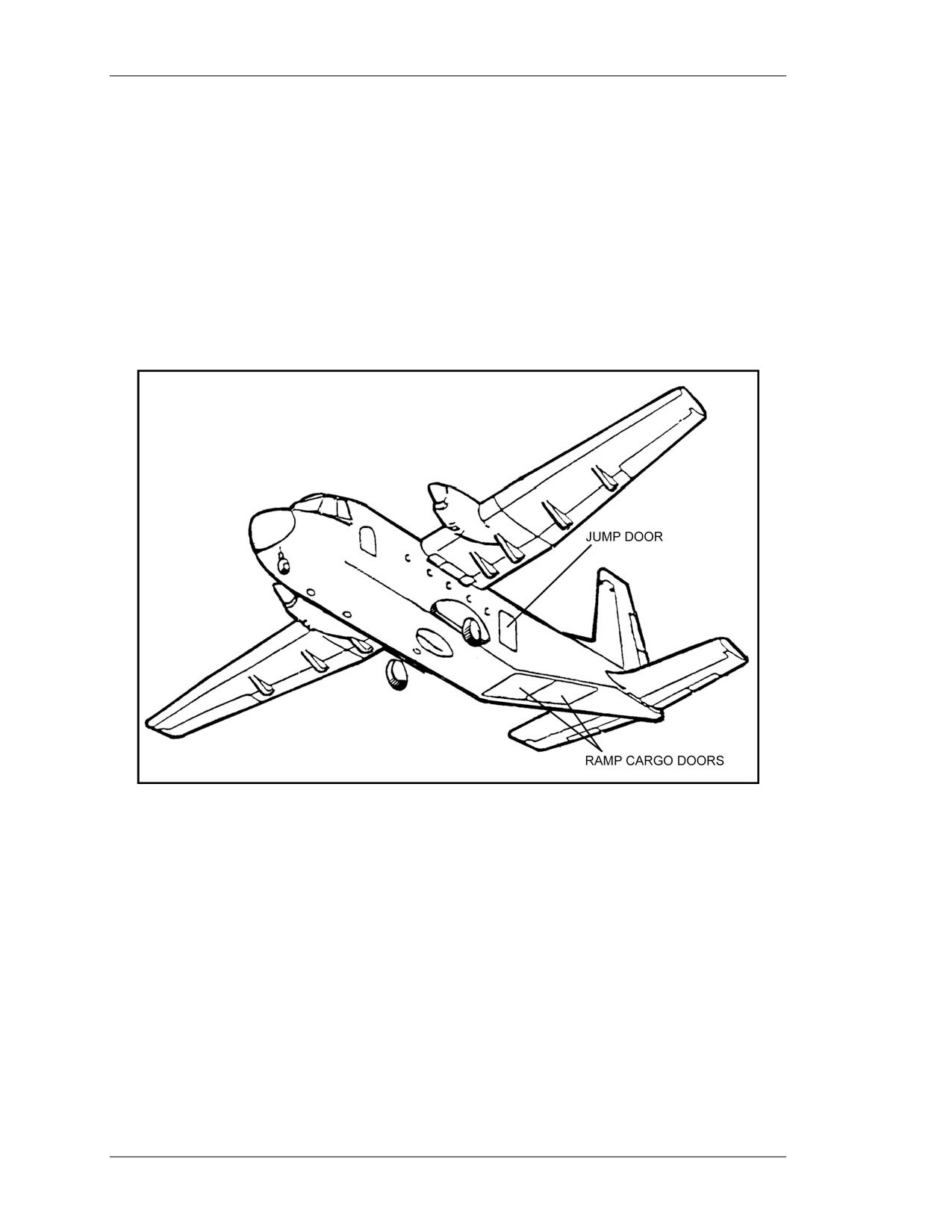
The C-212 is a twin-engine, high-wing, multipurpose light transport designed for
operations involving short, rough airfields (Figure 19-6). The aircraft can transport 24
personnel in a troop lift mode and 15 combat-equipped parachutists in the airdrop mode
using the port door. Troops are loaded over the ramp.
Figure 19-6. C-212 (Casa 212).
19-38. SEATING CONFIGURATION
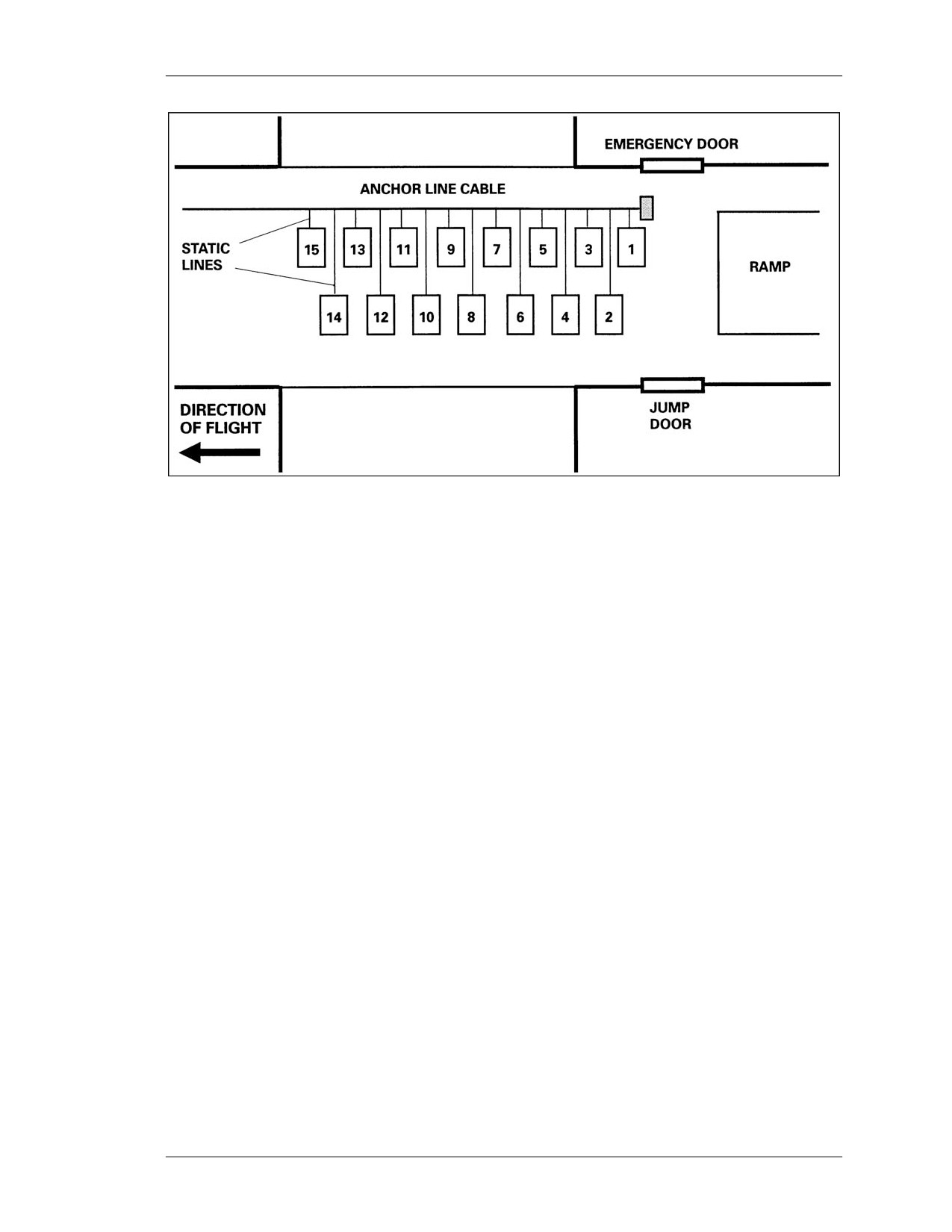
Fifteen parachutists are seated in two sticks of jumpers (Figure 19-7). The odd-numbered
personnel (eight) are seated on the starboard side and the even-numbered personnel
(seven) are seated on the port side.
19-22
FM 3-21.220/MCWP 3-15.7/AFMAN11-420/NAVSEA SS400-AF-MMO-010
Figure 19-7. C-212 seating configuration.
19-39. ANCHOR LINE CABLE ASSEMBLY
There is one anchor line cable assembly in the C-212. It runs from the reinforced anchor
line attachment plate on the forward bulkhead to the anchor line connector near the right
side of the aft starboard emergency door.
19-40. SUPERVISORY PERSONNEL REQUIRED
The following personnel are required for airdrop operations from the C-212: one
jumpmaster to perform standard aircraft check procedures, one safety, and one
loadmaster/crew chief.
19-41. JUMP COMMANDS
The following jump commands are used with the C-212 aircraft.
a. GET READY.
b. STARBOARD SIDE PERSONNEL, STAND UP.
c. PORT SIDE PERSONNEL, STAND UP.
d. HOOK UP. On this command, the odd-numbered personnel hook up between the
even-numbered personnel to form a continuous stick of parachutists, hooking the open
portion of the snap hook facing inboard over the left shoulder. All parachutists take up a
reverse bight.
e. CHECK STATIC LINES, CHECK EQUIPMENT, and SOUND OFF FOR
EQUIPMENT CHECK. These commands are executed in the same manner as with
other fixed-wing aircraft.
f. STAND IN THE DOOR (Door)/STAND BY (Ramp). A proper exit position is
taken by the parachutist.
g. GO. Personnel exit the aircraft at one-second intervals.
19-23
FM 3-21.220/MCWP 3-15.7/AFMAN11-420/NAVSEA SS400-AF-MMO-010
19-42. SAFETY PRECAUTIONS
Safety precautions for the C-212 are as follows:
a. Parachutists.
(1) Ensure that all seats are secured in the up position when parachutists stand to
hook up. During extreme air turbulence, parachutists take a short bight on the static line
to steady themselves.
(2) Parachutists remain off the ramp while it is being lowered for over-the-ramp
operations.
NOTE: To assist the JM in looking for the DZ, the troop door may be removed before
the airborne operation begins. The safety restraint harness is attached to the
500-pound tie-down positions on the floor of the aircraft, out of the way of the
jumpers.
b. Jumpmaster.
(1) The JM or safety ensures all personnel hook up properly.
(2) The JM (if no safety personnel are in the aircraft) jumps last. He hooks up to the
anchor line cable, ensuring his static line does not become fouled.
NOTE: On aircraft that do not have a positive communication system, the following
safety measure is recommended: one ring on the alarm bell signals the JM to
look at the jump light or communicate with the cockpit.
c. Equipment.
(1) When adjustable individual weapons cases are jumped from the door, they must
be reduced to 36 inches in length.
(2) When accompanying supplies and equipment are dropped from the door, the
bundles must be standard air delivery containers no larger than 40 by 24 by 36 inches.
(3) When ramp bundles are dropped, either the 15-foot static line with drogue or the
breakaway static line may be used. When door bundles are dropped, the 15-foot static
line with drogue is used with cargo parachutes.
(4) When ramp bundles are dropped, troops may follow out the troop door. The JM
and safety or loadmaster push the bundles out.
d. Aircraft.
(1) Aircraft speed during the jump is 90 to 110 knots.
(2) When parachutists are jumping from the troop door, the door may be opened or
removed and set into the door recess provided on the ramp.
(3) When conducting bundle operations from the ramp, the JM must close the door.
The door may be opened or removed before the ramp is lowered.
(4) The Omega antenna, located beneath the tail section, must be removed prior to
ramp bundle operations.
19-43. TOWED PARACHUTIST PROCEDURES
Procedures outlined for other fixed-wing aircraft will be followed for the C-212.
19-24
FM 3-21.220/MCWP 3-15.7/AFMAN11-420/NAVSEA SS400-AF-MMO-010
19-44. AIRCRAFT CONFIGURATION FOR RAMP STATIC LINE
PERSONNEL AIRDROP
The loadmaster configures the aircraft. The JM should verify the configuration. Static
line ramp parachute operations are authorized only when the retrieval system is
operational.
a. The aircraft is configured for a static line personnel airdrop. One of each of the
following items of equipment is needed:
(1) Hand winch.
(2) Static line deflector block.
(3) Retrieval bar.
(4) Retrieval strap.
(5) Extended interphone cord.
(6) 2,500-pound tie-down strap.
(7) 5,000-pound tie-down strap.
(8) One 3-foot length of 1-inch tubular nylon.
(9) Cloth-backed adhesive tape.
(10) Anchor cable.
(11) Two restraint harnesses.
b. Install and preflight-inspect the following equipment:
(1) Attach hand winch to right tie-down row in zone 1 and check for security.
(2) Inspect cable for broken wires or kinks and check for operation.
(3) Ensure static line deflector block is attached to the right side of the ramp. Cover
the bolt head with tape.
(4) Inspect retrieval base on board and attaching brackets.
(5) Install and check extended interphone cord for operation.
(6) Fit and adjust restraint harnesses.
(7) Ensure that the
3-foot length of
1-inch tubular nylon and the
5,000-pound
tie-down strap are secured and available for immediate use.
19-45. C-212 JUMPMASTER CHECKLIST
The jumpmaster follows this checklist for the C-212:
a. Seats.
• Adequate seats are available for troop load.
• All seats have safety belts.
• Seat backs are secure.
• Seats are serviceable.
• There are no projections through seats.
b. Floor.
• Nonskid surface covering is in good condition.
• Floor is clean and safe to walk on.
• Loose equipment is secured and does not interfere with troops.
c. Jump Door.
• There are no sharp or protruding edges on door frame.
• Door opens and closes easily.
• Door sits in ramp recess properly.
d. Jump Lights. Check sets for operation.
19-25
FM 3-21.220/MCWP 3-15.7/AFMAN11-420/NAVSEA SS400-AF-MMO-010
• Set 1—above port aft jump door.
• Set 2—above starboard aft emergency door. Check alarm bell; it is the signal
for exiting.
e. Static Line Anchor Cable System.
(1) Forward support beam.
• Bolts, nuts, and safety wire are present.
• Anchor cable is attached to centerline anchor point.
• Cable bolt, locking bolt, nut, and safety wire are present.
• Check anchor line tension indicator—red line indicator should not be seen.
(2) Anchor cable.
• Cable has no breaks, frays, or kinks.
• Cable is clean and free of rust.
• Swage is present.
(3) Anchor line cable aft support.
• Cable, locking bolt, nut, and safety wire are present.
f. Emergency Equipment.
• First aid kits are onboard (2).
• Fire extinguishers are onboard (2).
• Alarm system is operational.
• Sufficient emergency parachutes are available.
g. Miscellaneous.
• Lighting system is operational.
• Airsickness bags are available.
• JM kit (extra equipment) is onboard.
• Earplugs are available.
NOTE: Loose equipment and jump door (removed) are lashed to the cargo ramp or to
the rear of the forward bulkhead.
19-26
FM 3-21.220(FM 57-220)/MCWP 3-15.7/AFMAN11-420/NAVSEA SS400-AF-MMO-010
PART FIVE
Drop Zones
CHAPTER 20
PROCEDURES ON THE DROP ZONE
A drop zone is any designated area where personnel and equipment
may be delivered by means of parachute or free drop. The DZ is located
where it can best support the ground tactical plan; it is selected by the
ground unit commander. For tactical training, the USAF assault zone
availability report should be checked for an approved DZ within the
tactical area. If the selected DZ is not on the AZAR, a tactical assessment
must be conducted.
Section I. DROP ZONE SELECTION AND METHODS
The GUC uses the tactical analysis to select an area that can best support his mission.
This section discusses several technical selection factors that must be considered.
20-1. AIR DROP AIR SPEED
Table 20-1 provides recommended drop speeds for various aircraft.
TYPE OF AIRCRAFT
DROP SPEED
UH-1
50 to 70 knots—optimum 70 knots
UH-60
65 to 75 knots—optimum 70 knots
CH-46 (USMC)
80 to 90 knots
CH-47
80 to 110 knots—optimum 90 knots
CH-53 (USMC)
90 to 110 knots
CH/HH3 (USAF)
70 to 90 knots
C-5/130/141/17/KC-130
130 to 135 knots (personnel)
C-5/130/141/17/KC-130
130 to 150 knots—optimum 130 knots for all loads
(door bundles, CDS, and heavy equipment)
Table 20-1. Aircraft drop speeds.
20-1
FM 3-21.220/MCWP 3-15.7/AFMAN11-420/NAVSEA SS400-AF-MMO-010
20-2. AIRCRAFT DROP ALTITUDES
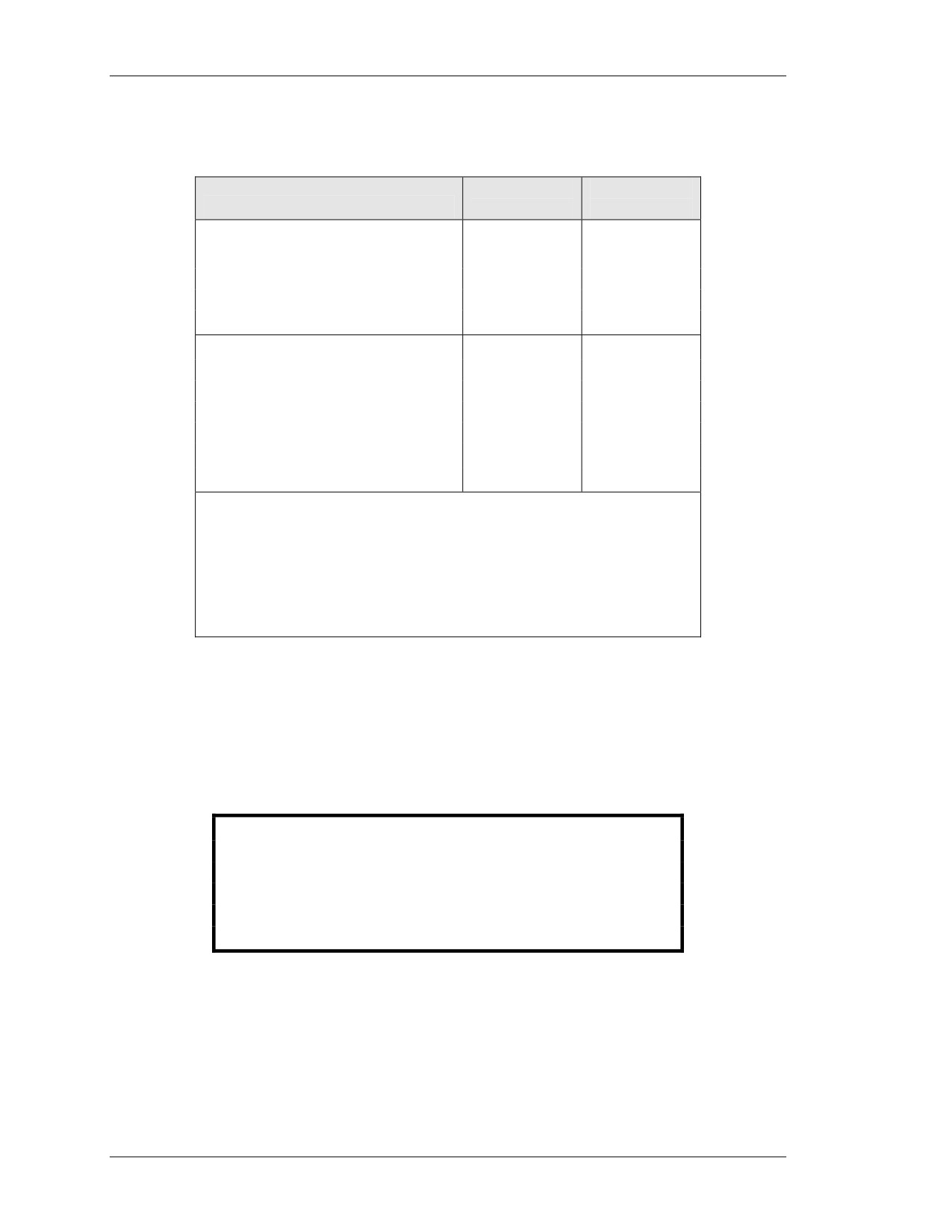
See Table 20-2 for aircraft drop altitudes.
DAY (AGL)
NIGHT (AGL)
AIRCRAFT
(feet)
(feet)
Rotary Wing
(All Services, Rotary Wing))
Personnel
< 90 KTs
1,500
1,500
> 90 KTs
1,500
1,500
Bundles
300
300
Fixed Wing (Troop Carrier)*
Personnel
Basic Airborne Training
1,250
1,250
Training**
1,000
1,000
Tactical
800
800
Door Bundles
300
500
Heavy Equipment
1,100
1,100
* AWADS/SKE - Drop altitude is 500 feet above highest obstacle that
falls within 3 miles either side of DZ run-in. CDS using G-13 or any
other parachute, minimum drop altitude is 400 feet AGL. CDS using
G-14 parachute can drop from 300 feet AGL.
** The training drop altitude of 1,000 feet AGL may be waived to 800
feet AGL by completing a mature risk assessment decision cycle.
Table 20-2. Aircraft drop altitudes.
20-3.
TYPE OF LOAD
Type of load includes personnel (one-second drop interval between jumpers),
CDS,
CRRC, door bundles, heavy equipment (three-second exit interval), or heavy equipment
followed by personnel (three seconds per CDS/CRRC/heavy equipment and one second
for each personnel).
CAUTION
There must be a three-second interval between
equipment drops and the exit of parachutists to avoid
possible jumper entanglement. The DZSO or DZSTL
must follow the procedures for heavy drop operations,
but observe the jumpers as they exit the aircraft.
a. Obstacles. To ensure that the airdrop is safe and that equipment and personnel
can be recovered or employed to accomplish the mission, the drop zone and adjacent
areas should be free of obstacles. Examples of obstacles are—
• Trees 35 feet or higher impeding recovery of personnel or equipment.
• Water 4 feet deep within 1,000 meters from any edge of the DZ.
20-2
FM 3-21.220/MCWP 3-15.7/AFMAN11-420/NAVSEA SS400-AF-MMO-010
• High tension wire that is carrying active current of 50 volts or greater. (Should
be turned off prior to drop.)
• Any other conditions that may injure parachutists or damage equipment
(inactive electric wires, barbed wire fences, swamps, ditches, gullies, and so
forth).
NOTE: See Appendix D for DZ risk assessment.
b. Air Approach and Departure Routes. Air routes to and from the DZ should not
conflict with other air operations or restrictive terrain, or with manmade objects
(television or radio towers).
20-4. METHODS OF DELIVERY
Different drop methods are described as follows:
a. High Velocity. A drogue chute stabilizes and keeps equipment upright but does
not slow the descent (for example, a 12-foot, high-velocity [HV] parachute on a door
bundle).
b. Low Velocity. A parachute slows the rate of descent for a soft landing (for
example, personnel and cargo parachutes).
c. Free Drop. This is cargo that has no device to stabilize or slow the rate of descent
(for example, durable items such as clothing bundles).
20-5. ACCESS TO AREA
The unit must have access to and from the DZ to recover equipment or conduct troop
movement. DZs with no roads leading to them or next to a river with no bridges are
examples of impeded access to areas.
20-6. SIZE
The following information provides minimum peacetime sizes when using fixed-wing
aircraft and must be adhered to unless a waiver is issued. During contingency or wartime
missions, DZ sizes may also be waived. However, size requirements remain a joint
responsibility of the COMALF and the airborne commander.
NOTE: To convert yards to meters, multiply yards times .9144 (yards x .9144). To
convert meters to yards, divide meters by .9144 (meters ÷ .9144).
a. Personnel from Military Rotary-Wing and Small Fixed-Wing Aircraft. The
distance required for personnel is determined by the use of the formula D=RT.
b. GMRS, VIRS, or WSVC DZ. Minimum size is 275 meters by 275 meters.
c. Personnel from Fixed-Wing C-130 and Larger Aircraft Using a CARP DZ.
The ground space required is 550 meters by 550 meters for one parachutist from a single
aircraft (add 70 meters to the length for each additional parachutist).
(1) For drop altitudes above 1,000 feet AGL, add 28 meters (14 meters each side) to
the width and 28 meters (trail edge) for each additional 100 feet.
(2) From official sunset to sunrise, add 90 meters to the width (45 meters each side)
and length (both ends) for visual drops.
20-3
FM 3-21.220/MCWP 3-15.7/AFMAN11-420/NAVSEA SS400-AF-MMO-010
(3) For visual formation, add 90 meters (45 meters each side) to the width.
(4) For AWADS and SKE, add 370 meters (185 meters each side) to the width.
d. Heavy Equipment Drops from Fixed-Wing Aircraft Using a CARP DZ. The
ground space required is 550 meters by 915 meters for one platform from a single
aircraft.
(1) For a C-130, add 370 meters to the length (trail edge) for each additional
platform.
(2) For a C-141, add 460 meters to the length (trail edge) for each additional
platform.
(3) For drop altitudes above 1,100 feet AGL, add 28 meters to the width (14 meters
each side) and to the length (trail edge).
(4) From official sunset to sunrise, add 90 meters to the width (45 meters each side)
and to the length (45 meters each end) for visual drops.
(5) For visual formation drops, add 90 meters to the width (45 meters each side).
(6) For AWADS and SKE, add 370 meters to the width (185 meters each side).
e. Containerized Delivery System
(CDS) Drops for the C-130 Using a
CARP DZ. The ground space required is 370 meters by 370 meters for one container
from a single aircraft (182.5 meters each side).
f. Containerized Delivery System Drops for the C-141 Using a CARP DZ. The
ground space required is 410 meters by 540 meters for one container from a single
aircraft.
(1) For altitudes above 600 feet, add 37 meters for each additional 100 feet to the
width (18.5 meters each side) and to the length (trail edge).
NOTE: Altitudes above 1,000 feet are not recommended.
(2) From official sunset to sunrise, add 90 meters to the width (45 meters each side)
and to the length (45 meters each end) for visual drops.
(3) For visual formation drops, add 90 meters to the width (45 meters each side).
(4) For AWADS and SKE, add 370 meters to the width (185 meters each side).
NOTE: The size of the CDS drop zone depends on drop altitude, number of bundles,
formation, and type of aircraft. (Refer to AFI 13-217.)
Section II. AIRDROP RELEASE METHODS AND PERSONNEL
The number and type of aircraft that air-delivers personnel and equipment, using one of
the four methods, usually dictate the type and composition of the ground support party,
which can be tailored for a mission.
NOTE: The unit mission request for aircraft specifies the type of drop method to be
used, such as CARP, GMRS, VIRS, or WSVC, and the composition of the
ground support party (STT and DZSO; DZST and or DZSO).
20-4
FM 3-21.220/MCWP 3-15.7/AFMAN11-420/NAVSEA SS400-AF-MMO-010
20-7. METHODS
To ensure accurate delivery on the DZ, JMs use four different methods. Each method
uses various input from the ground and air in the calculation formula.
a. Computed Air Release Point (CARP). The CARP is the most often used
method in aerial delivery for conventional airborne operations. The CARP is computed
by the aircrew (navigator) and determines the release point from the air.
b. Ground Marking Release System (GMRS). The GMRS is the method used
mostly by special operations forces (SOF). The GMRS is computed by the DZSTL and
determines the release point from the ground.
c. Verbally Initiated Release System (VIRS). The VIRS is one of the two methods
used by services (Army and USMC) having rotary-wing and fixed-wing aircraft for small
DZs, for dropping a specified number of personnel. VIRS is computed by the DZSTL;
the release point is indicated by an oral command to the aircraft.
d. Wind Streamer Vector Count (WSVC). The WSVC is one of two methods used
by services having rotary-wing and fixed-wing aircraft for DZs for dropping a specified
number of personnel. The release point is JM-directed and is the only method not
requiring markings on the DZ.
20-8. ORGANIZATION
To become operational, drop zones require key personnel to be located on the DZ for
controlling, marking, medical evacuating, wind readings, and malfunctions.
a. USAF STT and DZSO. STT and DZSO personnel are normally used in joint
airborne operations of more than four troop carrier aircraft. Reference MOA 87 airdrop
operations without STT.
b. DZST. The DZST consists of trained military personnel. It is normally used in
small joint airborne operations involving four or fewer troop carrier aircraft. CARP,
GMRS, JSJR, WSVC, or VIRS is used.
c. DZSO. Acting alone, without STT support, the DZSO operates the drop zone,
with a small number of aircraft dropping a limited number of personnel. The airdrop
release method used is CARP or GMRS, or, if rotary-wing and small fixed-wing aircraft
are employed, VIRS or WSVC.
20-9. DROP ZONE SAFETY OFFICER DUTIES
The USAF STT and Army DZSO have specific duties, which are discussed as follows:
a. When the USAF STT is supporting an airborne operation, the DZSO is the
airborne commander’s direct representative on the drop zone. He is responsible for the
safe operation of the DZ. No personnel or equipment is dropped if the DZSO is not
physically on the DZ.
NOTE: The prerequisites to perform the duties of the DZSO are outlined in Chapter 7.
(1) Special Duties. The duties of the DZSO are—
(a) Coordinating with the USAF STT.
(b) Ensuring the drop zone is fully operational 1 hour before drop time.
(c) Opening the drop zone through range control and closing it when accountability
of personnel, air items, and equipment is completed.
20-5
FM 3-21.220/MCWP 3-15.7/AFMAN11-420/NAVSEA SS400-AF-MMO-010
(d) Before the drop, conducting ground or aerial reconnaissance of the DZ for
obstacles or safety hazards.
(e) Collocating with USAF STT and taking initial wind readings 1 hour before the
scheduled drop time.
(f) Establishing communications with the DACO NLT 1 hour before drop time.
(g) Conducting continuous surface wind readings NLT
12 minutes before the
scheduled drop. Giving the CLEAR TO DROP or NO DROP to the STT (to relay to
aircraft) 2 minutes before the scheduled drop.
(h) Monitoring surface winds from the parachutists’ point of impact and at the highest
point of elevation on the drop zone. A NO DROP situation exists when surface winds
exceed the maximum allowable limits within 10 minutes of the actual drop.
(See
paragraph 22-5.)
(i) Controlling all ground and air medical evacuations. Priority for airspace must be
given to medical evacuations. This is particularly important when rescue or medical
aircraft are involved, since they may be delayed if follow-on jumps continue.
(j) Ensuring that any water obstacle is covered by a boat detail. A water obstacle is
water more than 4 feet deep and 40 feet wide that is within 1,000 meters from any edge
of the surveyed DZ. Water that is deeper than 4 feet but less than 40 feet wide is not an
obstacle that requires boats, but does require approved flotation devices for the jumpers.
(k) Submitting postmission reports (for example, MAC Form 168 or incident/accident
forms) to the appropriate agency.
NOTE: The CLEAR TO DROP or NO DROP that is relayed at 2 minutes does not
indicate the final wind reading. If surface winds increase beyond authorized
limits, a NO DROP can be relayed at any time thereafter. If readings exceed
the limits, the DZSO must reestablish a 10-minute window.
(2) Support Requirements. These apply to multiple aircraft formations (fixed-wing
aircraft), personnel, and equipment, or to single aircraft operations on drop zones more
than 2,100 meters in length or with 20 seconds exit time (“green light”).
(a) The DZSO ensures the ground support team is in place on the DZ one hour before
the drop. The support team includes:
• Assistant DZSO (not required for USN or USAF operations).
• Four medical personnel (with two FLA); USMC/USN/USAF require one
qualified support person.
• Malfunction officer (with camera).
• Parachute recovery detail (with saw and tree-climbing equipment).
• Parachute turn-in detail (with vehicles).
• Radios—one for the DZSO and one for the assistant DZSO (minimum).
• Anemometers—Services should only use approved anemometers to measure
surface winds during all personnel and cargo parachute operations. The
approved anemometers are the DIC, DIC3, TurboMeter, and AN/PMQ-3A.
The AN/ML433A/PM and the anemometers that use floating balls or small
floating lightweight aluminum devices in a tube are not authorized for use
during personnel or cargo airdrop operations. The DIC, DIC3, and
20-6
FM 3-21.220/MCWP 3-15.7/AFMAN11-420/NAVSEA SS400-AF-MMO-010
TurboMeter cannot be calibrated; they must be given an expedient check just
before use.
⎯ Ensure fresh batteries are installed in the anemometer.
⎯ Check the anemometer in a no-wind condition such as in a vehicle cab or a
building. Turn on the anemometer and, if any reading other than zero
registers, the anemometer is not fit for use and must be discarded.
⎯ Use a three-anemometer check by comparing the reading on three
anemometers in identical conditions. Discard the one anemometer that
doesn’t read the same as the other two.
⎯ The TurboMeter must be held within 20 degrees of wind line with the
wind entering the rear of the meter to ensure accurate readings.
⎯ Calibration requirements for the AN/PMQ-3A will be conducted IAW
appropriate TMs. Other anemometers not tested and recommended for use
should be employed only after a command-initiated risk assessment is
completed. Regardless of the method or device used to measure DZ winds,
the airborne commander is responsible for ensuring winds on the DZ do
not exceed 13 knots during static line personnel airdrops.
•
Compasses—two (one each for the DZSO and the assistant DZSO).
•
Smoke grenades.
•
Vehicles.
•
Road guards.
•
Military police
(to control vehicles and spectators or appropriate crowd
control).
•
Boat detail.
NOTE:
These requirements may be supplemented based on the type of drop, size of
operation, number of aircraft, number of parachutists, and geographical
location of the DZ.
(b) For single aircraft (no more than a 20-second exit time or no more than 2,100
meters of usable DZ), the composition of a partial control group is as follows:
• One DZSO (an assistant DZSO is not required).
• Wind reading from a single location on the DZ.
• Two medics (with FLA); USMC/USN require one qualified Navy corpsman.
• Malfunction officer (with camera, binoculars, and night vision goggles for
night operations).
• Parachute recovery detail.
• Radio.
• Anemometers—Services should only use approved anemometers to measure
surface winds during all personnel and cargo parachute operations. The
approved anemometers are the DIC, DIC3, TurboMeter, and AN/PMQ-3A.
The AN/ML433A/PM and the anemometers that use floating balls or small
floating lightweight aluminum devices in a tube are not authorized for use
during personnel or cargo airdrop operations. The DIC, DIC3, and
20-7
FM 3-21.220/MCWP 3-15.7/AFMAN11-420/NAVSEA SS400-AF-MMO-010
TurboMeter cannot be calibrated; they must be given an expedient check just
before use.
⎯ Ensure fresh batteries are installed in the anemometer.
⎯ Check the anemometer in a no-wind condition such as in a vehicle cab or a
building. Turn on the anemometer and, if any reading other than zero
registers, the anemometer is not fit for use and must be discarded.
⎯ Use a three-anemometer check by comparing the reading on three
anemometers in identical conditions. Discard the one anemometer that
doesn’t read the same as the other two.
⎯ The TurboMeter must be held within 20 degrees of wind line with the
wind entering the rear of the meter to ensure accurate readings.
⎯ Calibration requirements for the AN/PMQ-3A will be conducted IAW
appropriate TMs. Other anemometers not tested and recommended for use
should be employed only after a command-initiated risk assessment is
completed. Regardless of the method or device used to measure DZ winds,
the airborne commander is responsible for ensuring winds on the DZ do
not exceed 13 knots during static line personnel airdrops.
• Compass.
• Smoke grenades.
• Boat detail and road guards.
b. The DZSO has operational responsibility for the drop zone. In addition to the
DZSO’s duties for drop zones, the DZSO must also—
(1) Be positioned at the point of impact 15 minutes before drop time. The assistant
DZSO is at the highest point of the drop zone or at the opposite end. For combination
airdrop operations, the DZSO/DZSTL must follow the procedures for heavy drop
operations, but observe the jumpers as they exit the aircraft.
(2) Relay a ground weather decision and CLEAR TO DROP or NO DROP signal to
the lead aircraft 2 minutes before the drop for each pass.
(3) During night drops, ensure all lights that are on or next to the drop zone and are
not a part of the drop zone marking system are turned off 5 minutes before drop time and
remain off during the drop (except those lights that mark obstacles).
(4) Contact the pilot of the aircraft immediately after the drop and ask if any
personnel or equipment did not drop. He relays this information to the airborne
commander on the drop zone.
c. When advised of the coordination appointment by the airborne commander or his
representative, the DZSO is furnished the following information:
• Number of lifts.
• Type of aircraft.
• Drop zone requirements.
• Unit SOP.
• Station time.
• Drop time.
• Number of personnel for each pass.
20-8
FM 3-21.220/MCWP 3-15.7/AFMAN11-420/NAVSEA SS400-AF-MMO-010
20-10. DROP ZONE SUPPORT TEAM AND DROP ZONE SUPPORT TEAM
LEADER DUTIES
In operations in which the STT is not present, the DZSTL has overall responsibility for
the conduct of operations on the drop zone. He represents both the airborne and airlift
commanders. The DZSTL assumes all the responsibilities normally associated with the
USAF STT and DZSO. Refer to DZSO MOA between USAF and Army/USMC/Navy
dated 6/26/87.
a. DZSTs have the primary mission of supporting wartime CDS airdrops for
battalion-size units and below and peacetime airdrops of personnel, CDS, and heavy
equipment for one- to four-aircraft operations. With some exceptions, these primary
mission airdrops are limited to day and night visual conditions.
b. DZSTs also maintain the secondary mission of supporting other types of airdrops.
The secondary missions may include wartime force projection and sustainment of
personnel, equipment, and CDS; peacetime airdrops under AWADS and IMC conditions;
and VMC formation drops with four or more aircraft.
c. The DZST consists of one or more individuals. More members may be required,
depending on the complexity of the mission. The senior member of the DZST functions
as the DZSTL. For combination airdrop operations, the DZSO/DZSTL must follow the
procedures for heavy drop operations, but observe the jumpers as they exit the aircraft.
d. If an individual assumes the duties of both the DZSO and the DZSTL, he also is
responsible for the following:
(1) Conducting premission coordination.
(2) Evaluating the DZ for suitability and safe operating conditions.
(3) Ensuring all DZ markings are properly displayed.
(4) Operating all visual acquisition aids.
(5) Ensuring NO DROP signals are relayed to the aircraft.
e. Once the DZSTL has been notified and assigned a mission, he must conduct
accurate premission coordination. The recommended DZST crew mission briefing
checklist (Figure 20-1) reflects the minimum essential information that must be addressed
and confirmed by the DZSTL. Normally, peacetime drops should employ every
acquisition aid and safety device available, including air-to-ground radio
communications, PIBAL mean effective wind measurement, air traffic control light gun,
and smoke or flares. During contingency or wartime operations, limited airdrop support
equipment is available; therefore, it is important for premission coordination and
briefings to be comprehensive with respect to visual signals
(drop cancellation,
postponement, and authentication procedures). The coordination must be timely to ensure
the DZST has enough time for planning and for moving to and establishing the drop
zone.
20-9
FM 3-21.220/MCWP 3-15.7/AFMAN11-420/NAVSEA SS400-AF-MMO-010
20-11. BRIEFING CHECKLIST
Figure 20-1 shows a recommended DZST/aircrew mission briefing checklist.
DZ name/location and JA/ATT mission sequence number verified. __________________
TOT(s) block time (NO DROP procedures, for example, race track). _________________
Valid DZ survey (date) verified.______________________________________________
Type drop (HE, PE, CDS). __________________________________________________
Type release (VIRS, CARP, GMRS, AWADS, WSVC, visual)._____________________
Type parachutes. __________________________________________________________
Ground quick disconnects. __________________________________________________
Number of jumpers/bundles._________________________________________________
Number and type of aircraft._________________________________________________
DZ information. __________________________________________________________
________________________________________________________________________
Markings/signals:
Panels/lights. __________________________________________________________
Block letter identification. _______________________________________________
Smoke, flares. _________________________________________________________
Emergency NO DROP procedures. ________________________________________
_____________________________________________________________________
Mission cancellation indication. ___________________________________________
_____________________________________________________________________
DZ support capabilities:
Radios available/frequencies. _____________________________________________
Visual acquisition aids available. __________________________________________
NAVAIDS available. ___________________________________________________
MEW equipment. ______________________________________________________
Airspace coordination verified._______________________________________________
Aircraft (mission) commander’s name, unit of assignment, telephone number. _________
________________________________________________________________________
DZSTL name, rank, unit of assignment, telephone number. ________________________
________________________________________________________________________
Drop score/incident/accident reporting procedure.________________________________
________________________________________________________________________
Figure 20-1. DZST/aircrew mission briefing checklist.
20-10
FM 3-21.220/MCWP 3-15.7/AFMAN11-420/NAVSEA SS400-AF-MMO-010
20-12. EQUIPMENT
The DZSTL should maintain an inventory of basic equipment to support an airdrop
mission:
• VS-17 panels.
• Smoke (red, yellow, green).
• White steady lights, white omni-directional.
• Amber rotating beacon.
• Air traffic control gun, SE-11 light gun, or 4-cell MAGLITE flashlight.
NOTE: ATC gun requires a special power source and plug to function properly.
•
Signal mirror.
•
Binoculars.
•
Night vision goggles for night operations.
•
Anemometers—Services should only use approved anemometers to measure
surface winds during all personnel and cargo parachute operations. The approved
anemometers are the DIC, DIC3, TurboMeter, and AN/PMQ-3A. The
AN/ML433A/PM and the anemometers that use floating balls or small floating
lightweight aluminum devices in a tube are not authorized for use during
personnel or cargo airdrop operations. The DIC, DIC3, and TurboMeter cannot be
calibrated; they must be given an expedient check just before use.
⎯ Ensure fresh batteries are installed in the anemometer.
⎯ Check the anemometer in a no-wind condition such as in a vehicle cab or a
building. Turn on the anemometer and, if any reading other than zero
registers, the anemometer is not fit for use and must be discarded.
⎯ Use a three-anemometer check by comparing the reading on three
anemometers in identical conditions. Discard the one anemometer that doesn’t
read the same as the other two.
⎯ The TurboMeter must be held within 20 degrees of wind line with the wind
entering the rear of the meter to ensure accurate readings.
⎯ Calibration requirements for the AN/PMQ-3A will be conducted IAW
appropriate TMs. Other anemometers not tested and recommended for use
should be employed only after a command-initiated risk assessment is
completed. Regardless of the method or device used to measure DZ winds, the
airborne commander is responsible for ensuring winds on the DZ do not
exceed 13 knots during static line personnel airdrops.
•
Compass.
•
Signal flares.
•
PIBAL system with helium source.
NOTE: Other items of equipment/signals may be required by premission coordination
and mission complexity.
20-11

FM 3-21.220(FM 57-220)/MCWP 3-15.7/AFMAN11-420/NAVSEA SS400-AF-MMO-010
CHAPTER 21
DROP ZONE COMPUTATIONS AND FORMULAS
Once the composition of the ground party and the selection of a drop
zone have been established, several technical aspects must be considered
and planned for marking the DZ. These technical aspects are critical
because of the data that must be used (ground, winds, drift-distance
formula, forward throw, release point).
21-1. DROP ZONE FORMULAS FOR GMRS AND VIRS
The following procedures for using the distance and time formulas apply to GMRS and
VIRS.
a. Distance Formula (D = RT). Compute DZ length for a specific mission by using
the D = RT formula. (D is the required length of the DZ in meters; R is the ground speed
of the aircraft in meters per second; and T is the time required for the aircraft to release
its cargo.) To use this formula, some conversions and mathematics are required.
(1) Airspeed Conversion to Ground Speed. To find the aircraft ground speed, convert
aircraft airspeed (expressed in knots) to ground speed (meters per second). Do this by
multiplying knots times .51 (knots x .51) (1 knot equals .51 meter per second). The
following table from Chapter 20 is repeated to assist the estimation of aircraft airspeeds.
TYPE OF AIRCRAFT
DROP SPEED
UH-1
50 to 70 knots—optimum 70 knots
UH-60
65 to 75 knots—optimum 70 knots
CH-46 (USMC)
80 to 90 knots—optimum 90 knots
CH-47
80 to 110 knots—optimum 90 knots
CH-53 (USMC)
90 to 110 knots
CH/HH3 (USAF)
70 to 90 knots
C-5/130/141/17/KC-130
130 to 135 knots (personnel)
C-5/130/141//17KC-130
130 to 150 knots—optimum 130 knots for all loads
(door bundles, CDS, and heavy equipment)
Table 21-1. Aircraft drop speeds.
(2) Time Over DZ Requirement. To determine the time over the DZ that is needed to
release a parachutist or equipment, use the following factors:
(a) Allow 1 second for each parachutist to exit the aircraft; do not include the first
parachutist (10 parachutists require 9 seconds). (Mathematically, this is represented as
10 x 1 - 1.)
(b) Allow 3 seconds per bundle to exit the aircraft; do not include the first bundle
(3 bundles would require 6 seconds). (Mathematically, this is represented as 3 x 3 - 3.)
(c) Personnel jumping T-10-series parachutes may exit both doors simultaneously.
The door with the most parachutists is used to calculate the time required.
21-1
FM 3-21.220/MCWP 3-15.7/AFMAN11-420/NAVSEA SS400-AF-MMO-010
EXAMPLE: D = RT
What length DZ would 8 jumpers require when jumping from an aircraft flying at a
drop speed of 90 knots?
Step 1: Solve for R (answer is expressed in meters per second): airspeed x
.51 (90 knots x .51) = 45.90 meters per second.
Step 2: Solve for T (answer is expressed in seconds): number of jumpers x 1
- the first jumper (8 x 1 - 1) = 7 seconds.
Step 3: Solve for D (answer is expressed in meters): 45.90 meters per second
x 7 seconds = 321.30 meters. Always round up to the nearest whole number.
Therefore, D = 322 meters, the required DZ length.
b. Time Formula (T = D/R). Solving this formula provides the seconds required to
exit the jumpers over the DZ (time = meters divided by meters per second). If a DZ less
than the required length must be used, compute the flight time over the DZ to determine
how much of the load can be released in one pass. Use the T = D/R formula: T is the time
the aircraft is over the DZ in seconds, D is the length of the DZ in meters, and R is the
ground speed (rate) of the aircraft in meters per second.
(1) Airspeed Conversion. Convert the aircraft’s airspeed (expressed in knots) to its
ground speed (expressed in meters per second) as in the D = RT formula (knots x .51).
Round up the answer to the next whole number.
(2) Determination of T. Divide the ground speed conversion number into D (the DZ
length); this determines T. Any fractional answer is rounded down to the next whole
number.
EXAMPLE: T = D/R
How many parachutists from a CH-47 (drop speed of 90 knots) can land on a
750-meter DZ each pass?
T = Number of parachutists.
D = DZ length is 750 meters (given).
R = Airspeed is 46 meters per second (90 knots x .51 = 45.9; round up to 46).
Solution: T = D/R (D ÷ R).
D/R = 750 meters divided by 46 meters per second = 16.3 seconds.
T = 16 seconds (round down).
16 seconds over DZ x 1 parachutist per second + 1 parachutist (the first
parachutist exiting the aircraft does not affect the number of seconds spent
over the DZ) = 17 parachutists. Thus, 17 parachutists per pass can land on
the 750-meter DZ.
21-2
FM 3-21.220/MCWP 3-15.7/AFMAN11-420/NAVSEA SS400-AF-MMO-010
21-2. WIND DRIFT
Two means of determining wind drift are the WSVC method and the D = KAV formula.
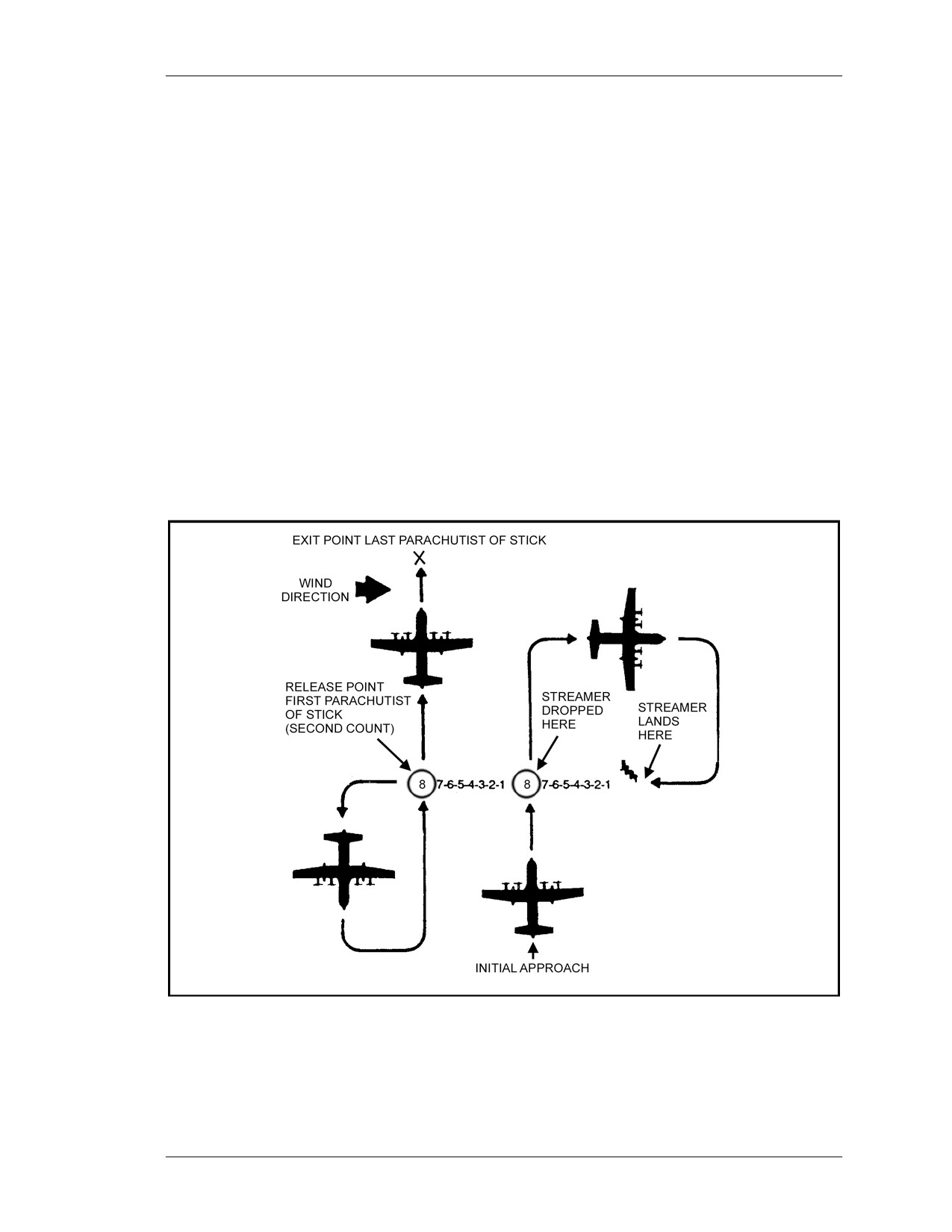
a. Wind Streamer Vector Count. The WSVC method (Figure 21-1) is used when
the release point is determined from the air. It is normally jumpmaster-executed and does
not require markings to be placed on the DZ.
(1) Streamer Drop. On the first aircraft pass over the desired point of impact, a
streamer is dropped from the aircraft. The aircraft then turns to allow the JM to keep the
streamer in sight. The pilot adjusts his route so that the flight path is over the streamer on
the ground and the desired impact point (in a straight line).
(2) Count. As the aircraft passes over the streamer, the JM begins a count, stopping
the count directly over the impact point. He immediately begins a new count. When that
count equals the first count, the aircraft is over the release point for the first parachutist.
(3) Aircraft Flight Adjustment. The pilot then maneuvers the aircraft to fly along the
axis of the DZ and over the release point. Slight adjustments may be made by observing
the parachutists as they land on the DZ.
NOTE: This method should not be used for tactical employment, since the aircraft is
required to make multiple passes over the DZ.
Figure 21-1. Determination of the release point by WSVC.
21-3
FM 3-21.220/MCWP 3-15.7/AFMAN11-420/NAVSEA SS400-AF-MMO-010
b. D = KAV Formula. This is another method for determining the effects of wind
on a parachute: D = drift of parachute (in meters) from a given altitude; K = constant that
represents the typical drift characteristic for a type of parachute. These constants are—
•
1.5 for cargo parachutes and heavy equipment (HD or HE).
•
3.0 for personnel parachutes.
•
2.4 for tactical training bundles.
A = drop altitude (expressed in hundreds of feet AGL); and V = velocity of wind. The
mean effective wind (MEW) should be used for personnel. MEW is the preferred method
for all other types of loads; however, the surface wind may be used during low-risk
operations.
NOTE: If aircraft must be shut down for a long period, a wind drift indicator should
be thrown at the last release point to ensure the release point is still valid.
EXAMPLE:
An aircraft is dropping cargo from 500 feet AGL with a surface wind of 10 knots.
What is the calculated parachute drift? (The parachute drift is calculated using
the D = KAV formula.)
D = Wind-induced drift in meters.
K = Wind drift constant for type of parachute.
A = Drop altitude expressed in hundreds of feet (500 feet would be expressed
as 5).
V = Velocity of wind in knots (either MEW or surface wind measurement).
Step 1: K = 1.5 (cargo parachute or HE constant).
Step 2: A = 5 (500 feet).
Step 3: V = 10 (10 knots).
Step 4: D = 1.5 x 5 x 10 = 75.0, or 75 meters of drift. (Any fractional answer is
rounded up to the nearest whole number.)
21-3. WIND VELOCITY
Two options are available for determining wind velocity.
a. Mean Effective Wind. The most effective option is the use of MEW. This
reading is a constant wind speed average from drop altitude to the ground. The PIBAL
system determines the MEW. This system should be used when possible; it is more
reliable than the other option, which measures surface wind velocity only.
b. Surface Wind Measurement. Either the AN/PMQ-3A or commercial
anemometers authorized by USAIS messages DTG 101000Z MAR 94, subject: Use of
Anemometers During Airdrop Operations, and DTG 211200Z OCT 94, subject: Use of
Turbometer During Static Line Airdrop Operations, are recommended for use. Other
anemometers not recommended for use should be employed only after a command-
initiated risk assessment is completed. Regardless of the method or device used to
21-4
FM 3-21.220/MCWP 3-15.7/AFMAN11-420/NAVSEA SS400-AF-MMO-010
measure DZ winds, the airborne commander is responsible for ensuring winds on the DZ
do not exceed 13 knots during static line personnel airdrops.
(1) Equipment. The equipment needed to compute the MEW by the PIBAL method
is as follows:
• Helium source.
• Pilot balloons (10 or 30 grams).
• Clinometers or other devices for measuring from 0 to 90 degrees.
• Balloon measuring tape (to measure balloon circumference) (10-gram: 57
inches day, 74 inches night; 30-gram: 78 inches day, 94 inches night).
• PIBAL lighting units (Type 5) for night use (liquid-activated lights).
• Compass.
• Conversion charts (10- and 30-gram) (Tables 21-2 and 21-3).
• Watch with second hand.
(2) Procedure. The procedure for measuring MEW using the PIBAL is as follows:
(a) Fill the 10-gram or 30-gram balloon with helium to the required size.
(b) Check the conversion chart for drift time to drop altitude (Table 21-2, page 21-6,
and Table 21-3, page 21-7).
(c) Release the balloon and begin timing.
(d) Keep the balloon in sight.
(e) Once the required time has elapsed, determine the azimuth to the balloon with the
compass and read the degrees from the drift scale.
(f) Refer to the conversion chart and read down the angle column to the number
closest to the angle on the scale.
(g) Read across the top of the chart (altitude in feet) to the drop altitude in use. Read
down this column until the two lines (6 and 7) intersect.
(h) Where the two lines intersect is the MEW at drop altitude, in knots. The direction
of the MEW is the back azimuth of the compass reading that was taken at the same time
as the angle measurement.
(i) The MEW becomes the variable V in the D = KAV formula to determine the
amount of drift in meters.
NOTE: A parachute’s K-factor is based on the parachute’s flight characteristics, not
on its mode of use. IAW Chapter 2 of FM 10-500-3/TO 13C7-1-11, the
K-factor for the T-10-series parachute used in the cargo mode is the same
(3.0) as for personnel drops using the T-10-series parachute.
21-5
FM 3-21.220/MCWP 3-15.7/AFMAN11-420/NAVSEA SS400-AF-MMO-010
WIND SPEED IN KNOTS
10-GRAM HELIUM BALLOON
Inflate balloon to 57” circumference for day and 74” circumference for night.
DROP ALTITUDE IN FEET
500
750
1000
1250
1500
1750
2000
2500
3000
3500
4000
4500
ASCENSION
70
02
02
01
01
01
01
01
01
01
01
01
01
TABLE
60
03
02
02
02
02
02
02
02
02
02
02
02
ALT
55
03
03
03
03
03
03
03
03
03
03
03
03
TIME
(FT)
50
04
04
03
03
03
03
03
03
03
03
03
03
0:10
80
45
05
04
04
04
04
04
04
04
04
04
04
04
0:20
170
40
06
05
05
05
05
05
05
04
04
04
04
04
0:30
250
35
07
06
06
06
06
05
05
05
05
05
05
05
0:40
330
30
08
07
07
07
07
07
07
07
06
06
06
06
0:50
400
25
10
09
09
09
08
08
08
08
08
08
08
08
1:02
500
24
11
10
09
09
09
09
08
08
08
08
08
08
1:10
540
23
11
10
10
09
09
09
09
08
08
08
08
08
1:20
610
22
12
11
10
10
10
10
09
09
09
09
09
09
1:23
670
21
12
11
11
10
10
10
10
10
10
10
10
10
1:43
750
20
13
12
11
11
11
11
11
10
10
10
10
10
1:50
790
19
14
13
12
12
11
11
11
11
11
11
11
11
2:25
1000
18
15
13
13
12
12
12
12
12
11
11
11
11
2:44
1100
17
16
14
13
13
13
13
12
12
12
12
12
12
3:05
1250
16
17
15
14
14
14
13
13
13
13
13
13
13
3:49
1500
15
18
16
15
15
14
14
14
14
14
14
14
14
4:30
1750
14
19
17
16
16
16
15
15
15
15
15
15
15
5:11
2000
13
21
19
18
17
17
17
17
16
16
16
16
16
6:34
2500
12
22
20
19
19
18
18
18
18
17
17
17
17
7:58
3000
11
24
22
21
21
20
20
20
19
19
19
19
19
9:22
3500
10
27
25
23
23
22
22
22
21
21
21
21
21
10:44
4000
09
30
27
26
26
25
24
24
24
23
23
23
23
12:08
4500
Table 21-2. The 10-gram PIBAL chart.
21-4.
FORWARD THROW
Forward throw is the effect that inertia has on a falling object. When an object leaves an
aircraft, it is traveling at a speed equal to the speed of the aircraft. The parachutist (or
bundle) continues to move in the direction of flight until the dynamics of parachuting
takes effect.
a. Forward Throw for Rotary-Wing Aircraft. To determine the amount of
forward throw for rotary-wing aircraft, divide the drop speed of the aircraft in half. This
yields the forward throw in meters. (For example, an aircraft flying at 70 knots would
have a forward throw of 35 meters.)
b. Forward Throw for Fixed-Wing Aircraft. To determine the forward throw for
fixed-wing aircraft, the following distances apply (Table 21-4).
21-6
FM 3-21.220/MCWP 3-15.7/AFMAN11-420/NAVSEA SS400-AF-MMO-010
WIND SPEED IN KNOTS
30-GRAM HELIUM BALLOON
Inflate balloon to 78” circumference for day and 94” circumference for night.
DROP ALTITUDE IN FEET
500
750
1000
1250
1500
1750
2000
2500
3000
3500
4000
4500
ASCENSION
80
01
01
01
01
01
01
01
01
01
01
01
01
TABLE
70
03
03
03
02
02
02
02
02
02
02
02
02
ALT
60
04
04
04
04
04
04
04
04
04
04
04
04
TIME
(FT)
55
05
05
05
05
05
05
05
05
05
05
04
04
0:10
120
50
06
06
06
06
06
06
06
06
05
05
05
05
0:20
240
45
07
07
07
07
07
07
07
07
07
06
06
06
0:30
360
40
09
08
08
08
08
08
08
08
08
08
08
08
0:42
500
35
10
10
10
10
10
10
10
10
09
09
09
09
0:50
400
30
12
12
12
12
12
12
12
11
11
11
11
11
1:02
600
25
15
15
15
15
15
15
14
14
14
14
14
14
1:10
830
24
16
16
15
15
15
15
15
15
15
15
15
15
1:17
1000
23
17
17
16
16
15
15
15
15
15
15
15
15
1:46
1250
22
18
18
17
17
17
17
17
16
16
16
16
16
2:10
1500
21
19
19
18
18
18
17
17
17
17
17
17
17
2:34
1750
20
20
20
19
19
19
19
18
18
18
18
18
17
2:56
2000
19
21
20
20
20
20
20
19
19
19
19
19
18
3:43
2500
18
22
22
21
21
21
21
20
20
20
20
20
20
4:31
3000
17
23
23
23
22
22
22
22
22
21
21
21
21
5:21
3500
16
25
25
24
24
24
24
23
23
23
23
22
22
6:09
4000
15
27
27
26
26
25
25
25
25
24
24
24
24
7:00
4500
14
29
19
18
17
17
17
17
16
16
16
16
25
13
31
20
19
19
18
18
18
18
17
17
17
27
Table 21-3. The 30-gram PIBAL chart.
C-130
C-141
C-5
PERSONNEL/DOOR BUNDLES
229 METERS/
229 METERS/
229 METERS/
250 YARDS
250 YARDS
250 YARDS
HEAVY EQUIPMENT
458 METERS/
668 METERS/
668 METERS/
500 YARDS
730 YARDS
730 YARDS
CONTAINER DELIVERY SYSTEMS
503 METERS/
686 METERS/
686 METERS/
550 YARDS
750 YARDS
750 YARDS
TACTICAL TRAINING BUNDLE
147 METERS/
147 METERS/
147 METERS/
160 YARDS
160 YARDS
160 YARDS
NOTE: To convert yards to meters, multiply yards by .9144.
To convert meters to yards, divide meters by .9144.
Table 21-4. Fixed-wing forward throw data.
21-7
FM 3-21.220/MCWP 3-15.7/AFMAN11-420/NAVSEA SS400-AF-MMO-010
21-5. DROP HEADINGS, POINT OF IMPACT, WIND DRIFT COMPENSATION,
AND FORWARD THROW COMPENSATION
For CARP operations, the navigator onboard the aircraft determines when the load is to
be released from the aircraft (when the green light is turned on). For GMRS and VIRS
operations, ground personnel determine the release point (Figure 21-2).
a. Drop Heading. Drop heading on all DZs depends on three factors—the long axis,
prevailing winds, and obstacles on approach and departure ends. The DZSO or DZSTL
uses all three when the situation permits; however, the long axis is the primary concern.
With a GMRS, WSVC, or CARP DZ, drop heading can be obtained from USAF Form
3823, DZ Survey (formerly MAC Form 339). A circular/random approach DZ does not
have a set drop heading. The mission commander notifies the aircrew and the DZ
commander of the drop heading to be used NLT 24 hours in advance of the airdrop
operation.
NOTE: On some DZs, predetermined drop headings must be used.
b. Point of Impact. The location selected where the first bundle or parachutist
should land is known as the PI. The PI should be located along the DZ centerline.
However, due to the tactical situation, the PI may need to be located near a wood line.
The DZSO or DZSTL uses a buffer zone of 100 meters on one end of the DZ for safety
reasons. PI location for GMRS or VIRS is 100 meters in from the leading edge centerline
for personnel. CARP PI is designated on USAF Form 3823, DZ Survey (formerly MAC
Form 339).
c. Wind Drift Compensation. To compensate for wind drift, the DZSO or DZSTL
moves from the desired PI into the wind the number of meters calculated using the
D = KAV formula. (For example, if drift equals 350 meters from the PI, he faces into the
wind and walks 350 meters in a straight line.)
d. Forward Throw Compensation. To compensate for aircraft forward throw, the
DZSO or DZSTL faces the back azimuth of the drop heading and walks the appropriate
forward-throw distance to the release point.
21-8
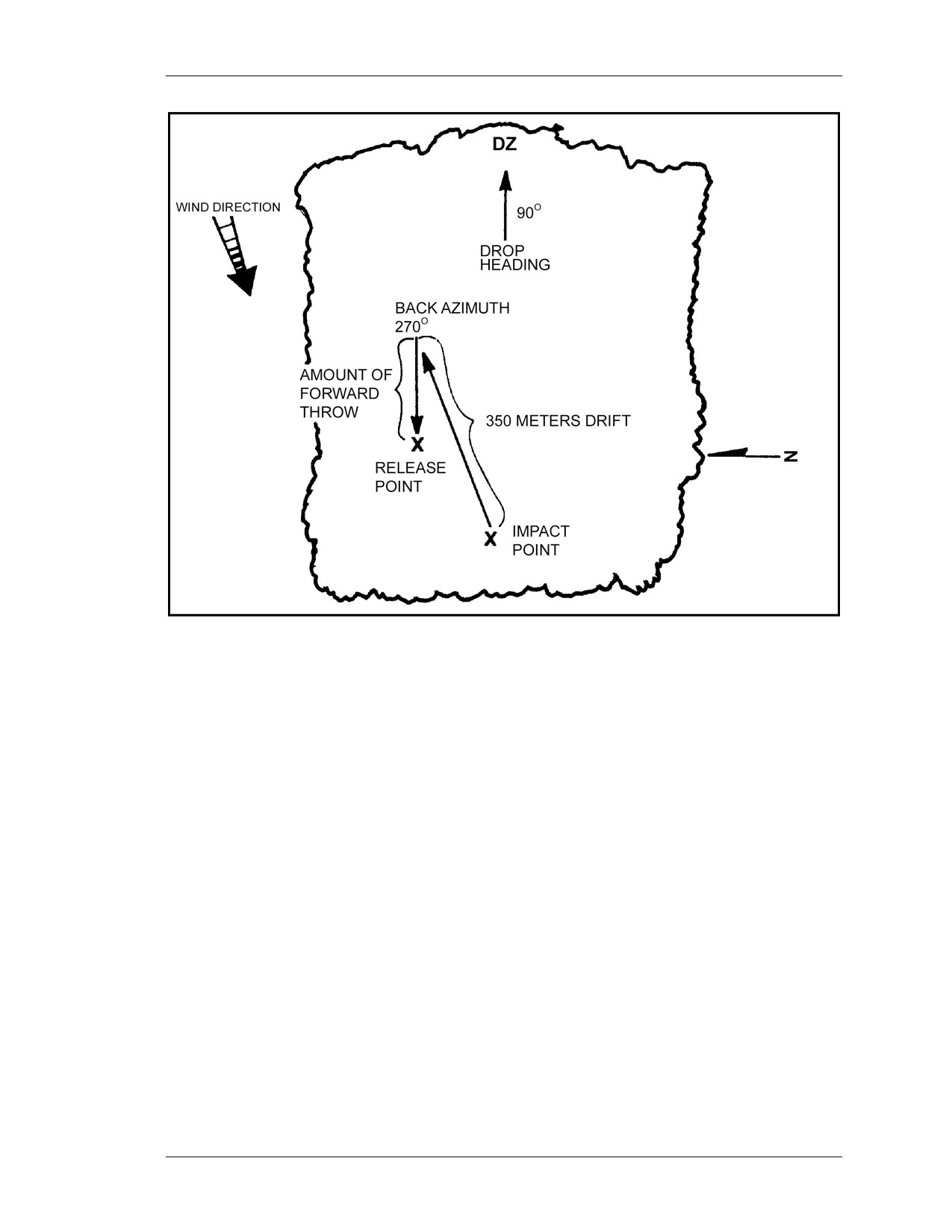
FM 3-21.220/MCWP 3-15.7/AFMAN11-420/NAVSEA SS400-AF-MMO-010
Figure 21-2. RP location for VIRS and GMRS.
21-9
FM 3-21.220(FM 57-220)/MCWP 3-15.7/AFMAN11-420/NAVSEA SS400-AF-MMO-010
CHAPTER 22
ESTABLISHMENT AND OPERATION OF A DROP ZONE
Five methods may be used to establish or operate a drop zone. Four of
these require markings to be placed on the DZ: CARP, GMRS, and VIRS.
The WSVC method requires no markings on the DZ.
22-1. COMPUTED AIR RELEASE POINT
CARP is used only by fixed-wing aircraft in conjunction with a CCT or qualified
DZSTL.
a. CARP Points of Impact (Figures 22-1 and 22-2, page 22-2). The PIs for CARP
operations are as follows:
(1) Personnel. For personnel, drops at the PI are 300 yards (day) or 350 yards (night)
from the leading edge.
(2) CDS. For CDS bundles from a C-130, drops at the PI are 200 yards (day) or 250
yards (night) from the leading edge. For CDS drops from a C-141, the PI is 225 yards
(day) and 275 yards (night).
(3) HE. For heavy equipment, drops at the PI are 500 yards (day) or 550 yards (night)
from the leading edge.
NOTE: On surveyed DZs, the PI for a particular type load is predetermined. Its
surveyed location can be found on AF Form 3823 or MAC Form 339. (Use of
MAC Form 339 is authorized until supplies are exhausted. USAF is
converting all MAC Forms 339 to AF Form 3823 when a DZ comes due for
recertification.)
b. No-Drop Communication to Aircraft. No-drop conditions are relayed to the
aircraft in the following ways: red smoke, red flares, forming the code letter into two
parallel bars perpendicular to flight, or the absence of a planned signal. Forming the code
letter into an X indicates mission cancellation.
NOTE: The type of marking used for no-drop conditions is coordinated in the
premission briefing.
c. Control Center. Control center locations (location of DZSTL) are as follows:
(1) Personnel Drops. Personal drops are normally located at the PI.
(2) CDS Drops. CDS is located 150 yards to the 6 o’clock position of the PI.
(3) HE, Free Drops, High Velocity, AWADS. Heavy equipment, free drops, high
velocity, and AWADS with a ceiling of less than 600 feet are all off the DZ. For this type
of operation, the DZSTL uses the best vantage point off the DZ to observe the airdrop.
22-1
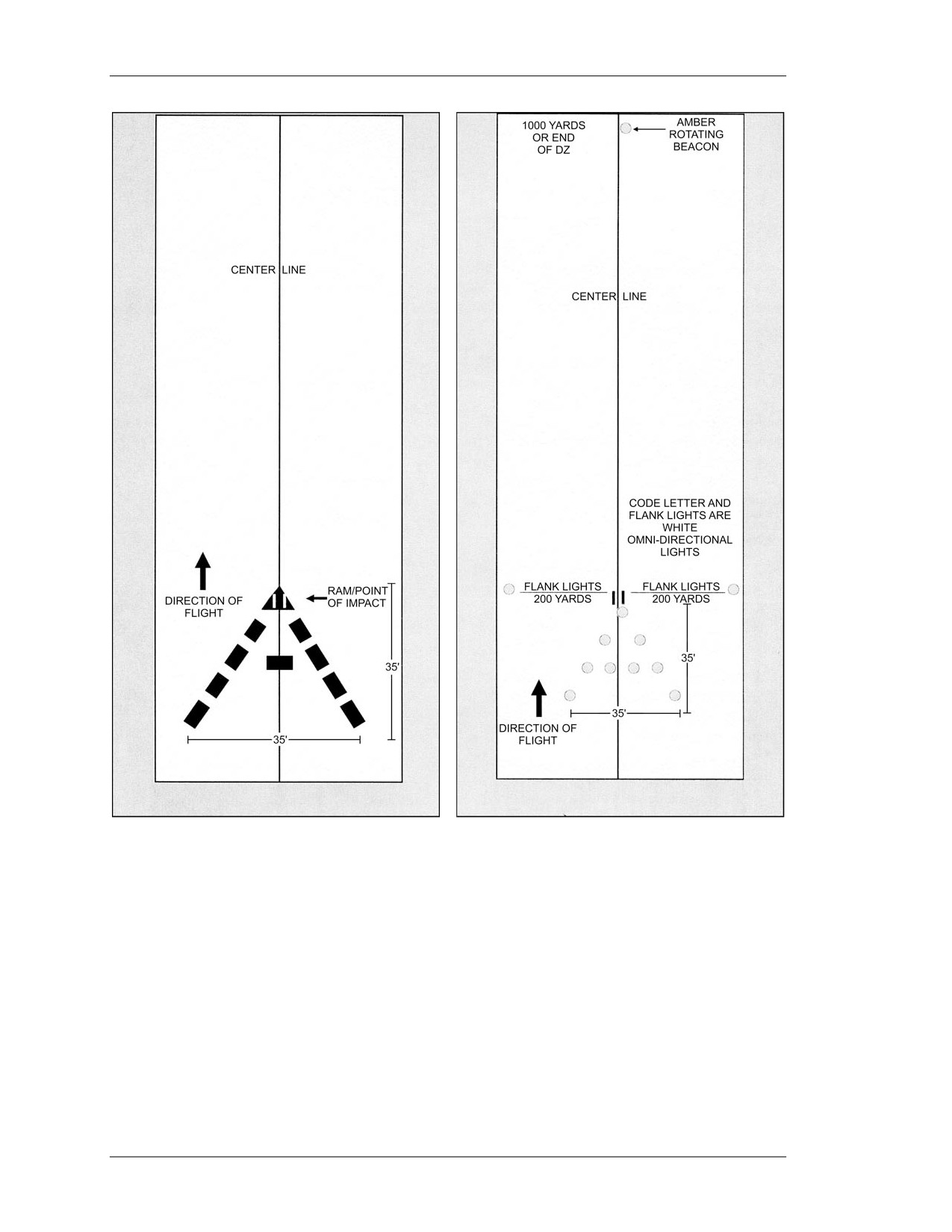
FM 3-21.220/MCWP 3-15.7/AFMAN11-420/NAVSEA SS400-AF-MMO-010
Figure 22-1. Day CARP
Figure 22-2. Night CARP
drop zone markings.
drop zone markings.
22-2. DROP ZONE MARKINGS
A marked DZ has a PI or release point marked with a precoordinated visual or electronic
signal. Standard DZ markings consist of raised angle markers (RAM), VS-17 marker
panels, visible lighting systems, and light beacons. Virtually any type of lighting or visual
marking system is acceptable if all participating units are briefed and concur. Night
markings or visual acquisition aids may include a light gun, flares, fire pots, railroad
fuses, flashlights, chem lights, and infrared (IR) lighting systems. Electronic NAVAID
markings (ZM, SST-181, GAR-I, tactical aid to navigation (TACAN), and so forth) may
be used for either day or night operations and placed as directed by mission requirements.
22-2
FM 3-21.220/MCWP 3-15.7/AFMAN11-420/NAVSEA SS400-AF-MMO-010
a. During day operations, the PI will be marked with a RAM or block letter. If
authentication is required, a block letter will be used instead of the RAM. Authorized
letters for PI markings are A, C, J, R, and S. The block letters H and O are authorized for
random approach DZs. The block letters should be aligned with the surveyed DZ axis or
with the aircraft line-of-flight, if different from the survey. The minimum size for block
letters is 11 meters (35 feet) by 11 meters and consists of at least nine marker panels.
b. During night operations, the PI will be marked with a block letter and flanker
lights. The apex of the block letter will be located on the PI. Flanker lights will be white
and located 250 meters left and right abeam the PI. The minimum size is 11 meters by 11
meters and consists of at least nine white lights with a recommended minimum output
rating of
15 candela. A trailing edge beacon will be used during actual personnel
airdrops. When used, the amber trailing edge beacon will be placed along the surveyed
DZ centerline 1,000 meters from the PI, or at the DZ trailing edge, whichever is closer to
the PI. During premission coordination for personnel drops, aircrews will identify their
trailing edge beacon requirements to STS or DZC. For all airdrops, the DZ identification
must be coordinated and briefed to the ground party and aircrews.
c. When mission requirements dictate and aircrews are qualified and equipped, IR
lights may be substituted for overt lights using the DZ marking patterns specified in
paragraph 22-2b.
22-3. GROUND MARKING RELEASE SYSTEM
The GMRS uses markings known as the four-panel inverted L, six-panel T, or
seven-panel H. The T or H pattern is recommended for C-141/C-5 airdrops due to
aircraft’s side angle vision limitations (Figure 22-3, page 22-4).
a. Inverted L Marking. When the drop aircraft is 100 meters directly to the right of
the corner (A) panel, the drop is executed.
b. Marking Placement for Inverted L. Markings (four panels) are placed as
follows (Figure 22-3, page 22-4):
(1) From the RP, move 100 meters to the left (90 degrees) of drop heading for the
location of the corner (A) panel. Emplace a VS-17G panel with the long axis of the panel
parallel with the drop heading. Elevate the panel at a
45-degree angle toward the
approaching aircraft. This aids the aircrew and the JM in visual identification of the DZ.
(2) From the corner (A) panel, move in the same direction as above for 50 meters for
the location of the alignment (B) panel. Emplace this panel as described above.
(3) From the alignment (B) panel, move 150 meters in the same direction as above
for the location of the flanker (C) panel. Emplace this panel as described above.
(4) From the corner (A) panel, move 50 meters on a back azimuth of the drop heading
for the location of the approach (D) panel. Emplace this panel the same as described
above.
(5) At night, replace all panels with a white omni-directional light. Lights may be
shielded on three sides or placed in pits.
(6) During day operations, smoke may be displayed at the RP. During night
operations, a white air traffic control light may be used to mark the RP.
(7) NO DROP may be signaled to the aircraft by red smoke, red flares, scrambled
panels, or the absence of a planned signal.
22-3