FM 3-21.220 STATIC LINE PARACHUTING TECHNIQUES AND TRAINING (SEPTEMBER 2003) - page 7
FM 3-21.220/MCWP 3-15.7/AFMAN11-420/NAVSEA SS400-AF-MMO-010
15-3. HIGH-ELEVATION JUMPING
The term high-elevation jumping refers to airdrop operations that begin at normal altitude
above ground level (that is, 800 feet AGL) but where the DZ is 5,000 to 10,000 feet
above mean sea level, such as in mountainous terrain. Commanders must consider that
lower air density or higher altitude will increase the canopies’ rate of descent.
a. Parachutes. Standard troop-type parachutes are suitable for the airdrop of
personnel onto DZs with ground elevations up to 10,000 feet. Current jump procedures
are valid.
b. Injuries. Combat or training exercises onto DZ elevations of 5,000 to 10,000 feet
that place safety secondary to tactical considerations can produce injury rates of up to
four times those expected for similar DZ operations near sea level. Injury rates can be
reduced by intensive instruction, training, and practice to include the following.
(1) Exit body position and PLF upon ground impact.
(2) Jumper awareness of increased opening shocks and faster rates of descent.
(3) The ability to control the parachute during sudden wind shifts and changes in
wind velocity.
(4) Wearing equipment correctly and ensuring serviceability.
15-3
FM 3-21.220(FM 57-220)/MCWP 3-15.7/AFMAN11-420/NAVSEA SS400-AF-MMO-010
CHAPTER 16
HIGH-PERFORMANCE TRANSPORT AIRCRAFT
The C-5, MC/C-130, C-17, and C-141 are US Air Force
high-performance aircraft for paratroop drops. These high-performance
transport aircraft, provided by the USAF, are configured to meet the
needs of the unit mission request. These configurations are termed tactical
airdrop personnel
(TAP) for the C-130 and the C-141 in USAF
publications. The initial JA/ATT mission request from the airborne unit
determines aircraft configuration. The USMC version of this aircraft is the
KC-130; characteristics and parachute procedures are similar.
• Tactical mass airdrop
(both jump doors)—full seating
configuration.
• In-flight rigging—tactical mass airdrop (both doors)—full seating
configuration; comfort pallet with/without litters.
• Other load considerations—combination of air-land and airdrop
mission; single door—reduced seating configurations.
• Over-the-ramp—combination equipment and personnel.
Section I. C-130 HERCULES
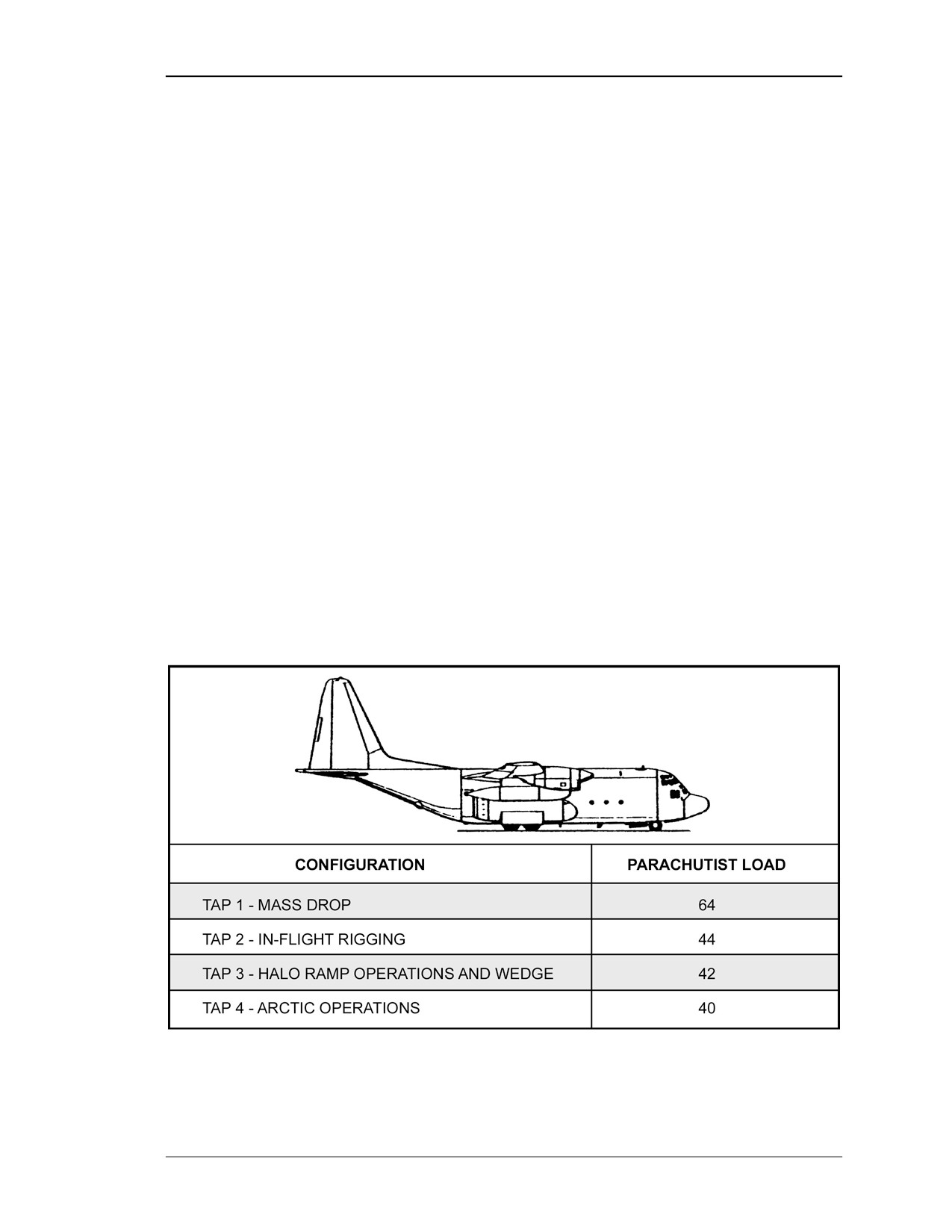
The C-130 (Figure 16-1) is a medium-range, high-wing transport aircraft powered by
four turboprop engines. Parachutists may be dropped using either the two jump doors or
the ramp. (See notes regarding over-the-ramp operations at paragraph 16-3.)
Figure 16-1. C-130 Hercules.
16-1
FM 3-21.220/MCWP 3-15.7/AFMAN11-420/NAVSEA SS400-AF-MMO-010
16-1. SEATING CONFIGURATION
The seating configuration for the C-130 Hercules is as follows:
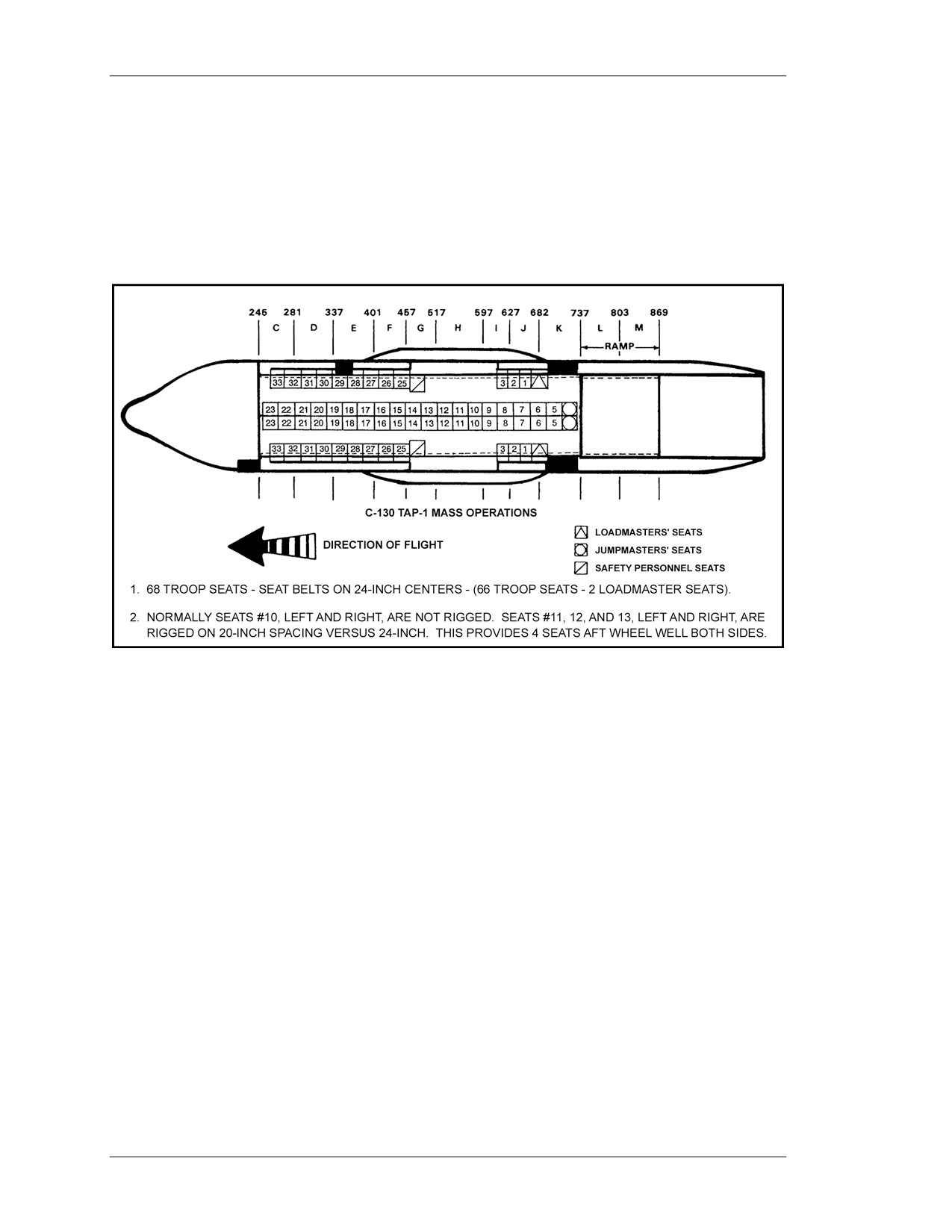
a. Peacetime Training (TAP 1). A total of 64 parachutists can be seated in two
sticks of 32. Numbers 1, 2, and 3 are seated outboard aft of the wheel well; 4 through 23
are seated on the inboard seats; and numbers 24 through 32 are seated outboard forward
on the wheel well (Figure 16-2). Jumpers are normally loaded over the aft end loading
ramp.
Figure 16-2. C-130 seating configuration.
b. Supervisory Personnel Required. Six personnel supervise parachutists and
ensure safety measures are followed (ADEPT options 1, 2, and mass exit. (USAF
operations may not have an AJM or safety on board the aircraft. In these cases, prior
coordination with the aircrew will ensure procedures are known by all personnel
involved.)
• One JM.
• One AJM.
• Two safety personnel.
• Two airdrop certified loadmasters.
NOTE: USMC and USN utilize one door, the other door remains closed and
unmanned, therefore only 1 JM and 1 safety are used. These units do not fall
under AR 350-2.
c. Jump Commands. Jump commands are given in the following sequence:
GET READY.
OUTBOARD PERSONNEL, STAND UP.
INBOARD PERSONNEL, STAND UP.
16-2
FM 3-21.220/MCWP 3-15.7/AFMAN11-420/NAVSEA SS400-AF-MMO-010
HOOK UP.
CHECK STATIC LINES.
CHECK EQUIPMENT.
SOUND OFF FOR EQUIPMENT CHECK.
STAND BY.
GO.
16-2. IN-FLIGHT RIGGING PROCEDURES
In-flight rigging procedures include the following:
a. Personnel. These procedures provide in-flight rigging for the airdrop of
44
personnel
(with equipment) including one JM and four AJMs. Three AJMs are
designated from the parachutists onboard to assist in rigging. Two nonjumping safety
personnel are also required. For USAF operations, a safety is not used and either the JM
or loadmaster fulfills the duty after coordination.
b. Briefing. All parachutists must be briefed and rehearsed on their actions before
executing this type mission. The preferred method for in-flight rigging is buddy rigging.
This allows faster rigging and reduces parachutists’ movement in the aircraft. The other
method, station rigging, is seldom used. (See paragraphs 16-2e and f.)
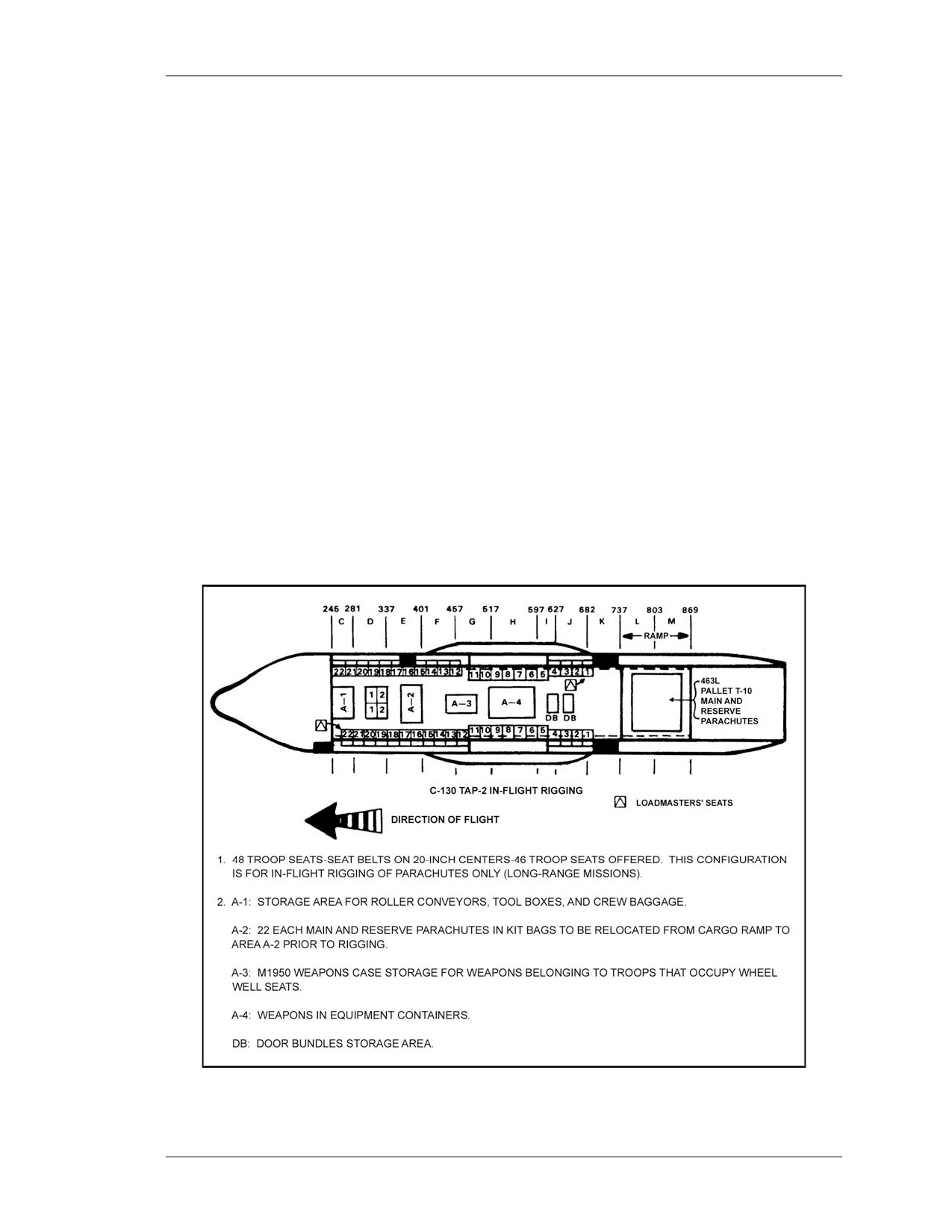
c. Aircraft Configuration. The aircraft is TAP 2 configured to seat a total of 48
personnel to include
2 loadmasters,
2 nonjumping safeties, and
44 parachutists
(Figure 16-3).
Figure 16-3. C-130 configuration for in-flight rigging (48 seats).
16-3
FM 3-21.220/MCWP 3-15.7/AFMAN11-420/NAVSEA SS400-AF-MMO-010
d. Storage of Equipment. Storing equipment involves the following:
(1) Forty-four parachutes and reserves, in kit bags, are palletized (covered with a
cargo net or tie-down devices) on the ramp.
(2) Door bundles are placed in the center aisle just forward of the ramp.
(3) Special items of equipment are placed in the center aisle just forward of the door
bundles.
(4) M1950 weapons cases should be placed behind individual seats. Weapons cases
for personnel occupying wheelwell seats are placed on the floor at Station 477.
(5) Individual equipment should be placed under seats or, if too large, may be placed
in the center aisle forward of the special items of equipment.
(6) All equipment placed in the center aisle must be secured.
e. Buddy Rigging. Buddy rigging begins 2 hours and 20 minutes before drop time.
Rigging must be completed by the 20-minute warning.
(1) The main and reserve parachutes, with kit bags, are passed forward until each
man has a parachute. Once everyone has his parachute, buddy rigging begins under the
supervision of the JMs, designated JM qualified parachutists, and safety personnel. Each
parachutist must know who his rigging partner is.
(2) Once a parachutist is rigged, he sits down and waits to be inspected by one of the
JMs. The safety personnel serve as roving correction inspectors. The attachment of the
static line snap hook to the top carrying handle of the reserve signifies an inspected
parachutist.
(3) The JM supervises the entire rigging operation and assists, as needed.
(4) Once all the parachutists have been inspected, the JMs don equipment, and safety
personnel inspect them. Other JM qualified parachutists may be used to speed up the
rigging process.
f. Station Rigging. One rigging station is established forward of the jump doors;
another station is established forward in the cargo compartment. The forward station is
manned by a safety and the AJM. As the forward rigging station is established, 22
parachutes (in aviator kit bags) are passed forward to the safety personnel. One JM kit
bag must be present at each station.
(1) Starting in the center of the stick, two parachutists (one on each side of the
aircraft) pick up their combat equipment. Each jumper moves to the designated rigging
station to don the parachute and equipment, assisted by the safety.
(2) When completely rigged, the parachutist moves to the AJM (stationed nearby) for
inspection. The AJM attaches the static line snap hook to the top carrying handle of the
reserve parachute when he reaches that portion of the inspection sequence. Only the JM
or AJM removes the static line snap hook from the reserve before the command HOOK
UP, since this indicates that the jumper has received JMPI.
(3) After JMPI, the jumper returns to his proper seat (or stick position). To ensure
minimum time loss, the next parachutist is waiting to be rigged by safety personnel.
16-3. OVER-THE-RAMP OPERATIONS
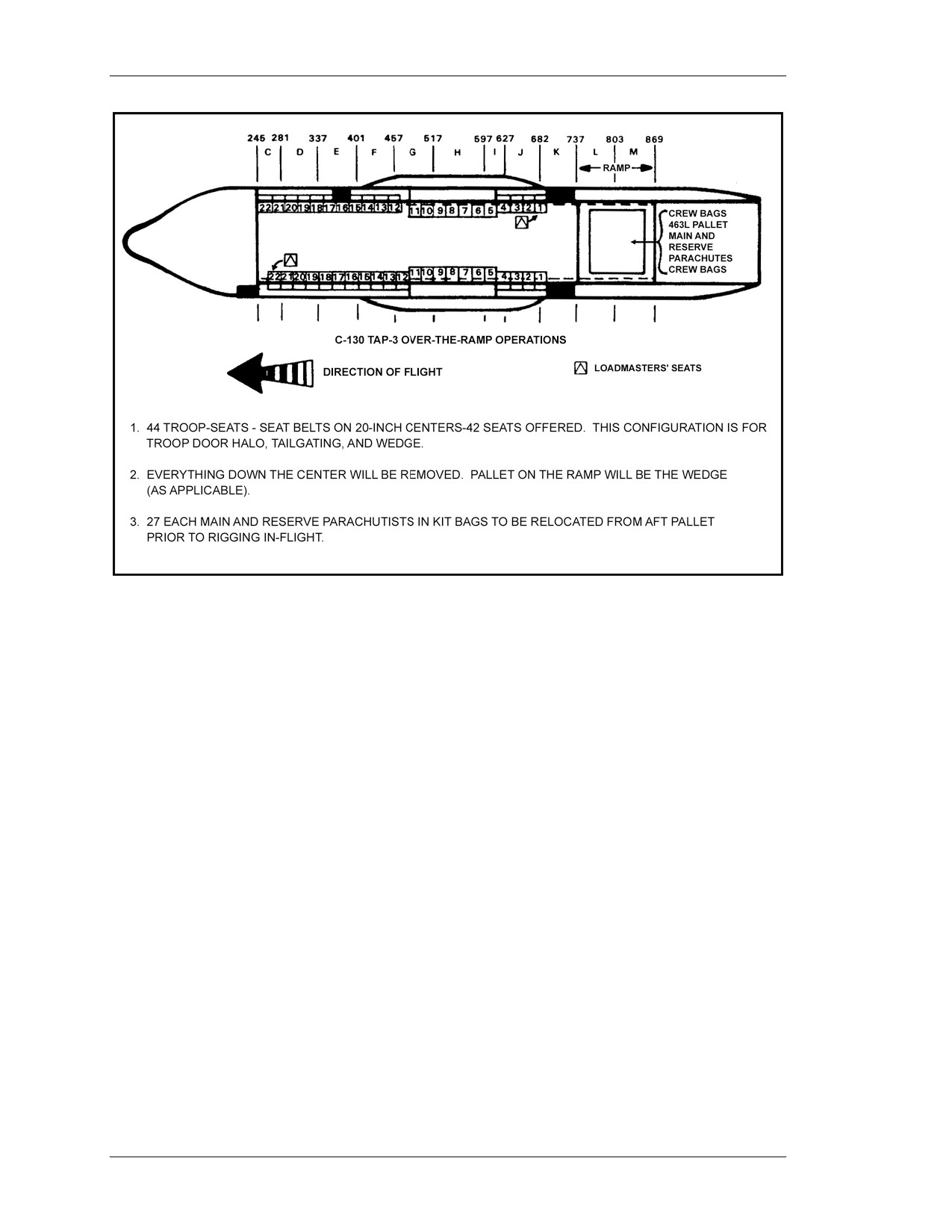
These procedures provide for over-the-ramp airdrop of 40 personnel including one JM,
one AJM, and two nonjumping safety personnel (Figure 16-4, page 16-6). For USAF
operations, a safety is not used and either the JM or loadmaster fulfills the duty after
coordination.
16-4
FM 3-21.220/MCWP 3-15.7/AFMAN11-420/NAVSEA SS400-AF-MMO-010
NOTES:
1.
IAW message Headquarters, USAF AMC, DTG 021431Z MAY 1990,
subject: C-130 Tailgating; over-the-ramp C-130 airdrop operations are
restricted
“to combination airdrops, tests requiring over-the-ramp
operations to satisfy a specific objective, jumpers required to jump with
snow skis, support for special operations forces training, MC-130,
pathfinder and SOLL II operations.” SOF were defined as “USA Special
Forces (Green Berets), Ranger units, and Ranger Training Brigade, Navy
Seals, USAF Combat Control Teams, Pararescue Teams, and those
assigned to special tactics units.” Message further stated, “These forces
will continue to train for over-the-ramp operations which is their normal
method for deployment.”
2.
IAW message Headquarters, USAF AMC, DTG 111345Z JUL 1991,
subject: Authorization of Arctic Equipped Parachutists to Tailgate;
authorization was granted “to allow arctic equipped parachutists with large
field pack and/or skis to tailgate from C-130 aircraft.” (Large field pack
mentioned in message DTG 111345Z JUL 1991 is the FPLIF.)
3.
IAW letter CG, Marine Corps Combat Development Command, C42 over
5600, dated 22 AUG 95, USMC Force Reconnaissance and Air Naval
Gunfire Liaison Company
(ANGLICO) personnel are authorized to
conduct C-130 over-the-ramp parachute operations if required by their
mission. These units train for over-the-ramp parachute operations as a
normal method of employment.
4.
Based on Airborne materiel and training proponency issues, the
1st
Battalion (Abn), 507th Infantry, 11th Infantry Regiment, United States
Army Infantry School is authorized to plan and conduct over-the-ramp
operations from the C-130 aircraft.
a.
Equipment Drop. Over-the-ramp operations can include the combination of an
equipment drop followed by parachutists. Equipment is defined as heavy equipment
rigged for airdrop, or equipment packaged and contained in the A-7A or A-21 containers.
Parachutists may be dropped over the ramp without an equipment drop (maximum of 20
parachutists for each pass).
16-5
FM 3-21.220/MCWP 3-15.7/AFMAN11-420/NAVSEA SS400-AF-MMO-010
Figure 16-4. C-130 configuration for over-the-ramp operations.
b. Aircraft Operation. The anchor line cables (only two are used—one on each
side) are rigged from the forward outboard anchor line cable attachments to the aft
inboard anchor line cable attachments. The anchor line cable stop (a small clevis, padded
and taped) must be installed on the anchor line cable 20 inches aft of the center anchor
line cable support bracket. The center anchor line cable support brackets at the door are
disconnected and secured at the top of the fuselage. The static line retriever cables are
tied or taped to the sides of the fuselage aft of the doors to ensure that they remain
secured.
c. Jump Commands. Jump commands are given in the following sequence:
GET READY.
STAND UP.
HOOK UP.
CHECK STATIC LINES.
CHECK EQUIPMENT.
SOUND OFF FOR EQUIPMENT CHECK.
STAND BY. (Parachutists maintain a reverse bight in the static line.)
GO. (On the command GO, movement onto the ramp is a normal walking or
shuffle pace. Exits are made at an angle of about 30 degrees toward the side of
the aircraft and are not vigorous. Parachutists place their hands on the ends of
their reserve parachute prior to exit.)
16-6
FM 3-21.220/MCWP 3-15.7/AFMAN11-420/NAVSEA SS400-AF-MMO-010
d. Jump Procedures. If the JM and AJM elect to jump, they will be the number 1
parachutist of each stick. Therefore, the safeties control the flow of the parachutists.
(1) An oral 10-minute warning is given, and the JM begins the jump commands. Prior
to the 10-minute warning, the JMs hook up to the anchor line cable, hand the static line to
the safety, and announce, SAFETY, CONTROL MY STATIC LINE. The JM then issues
the jump commands.
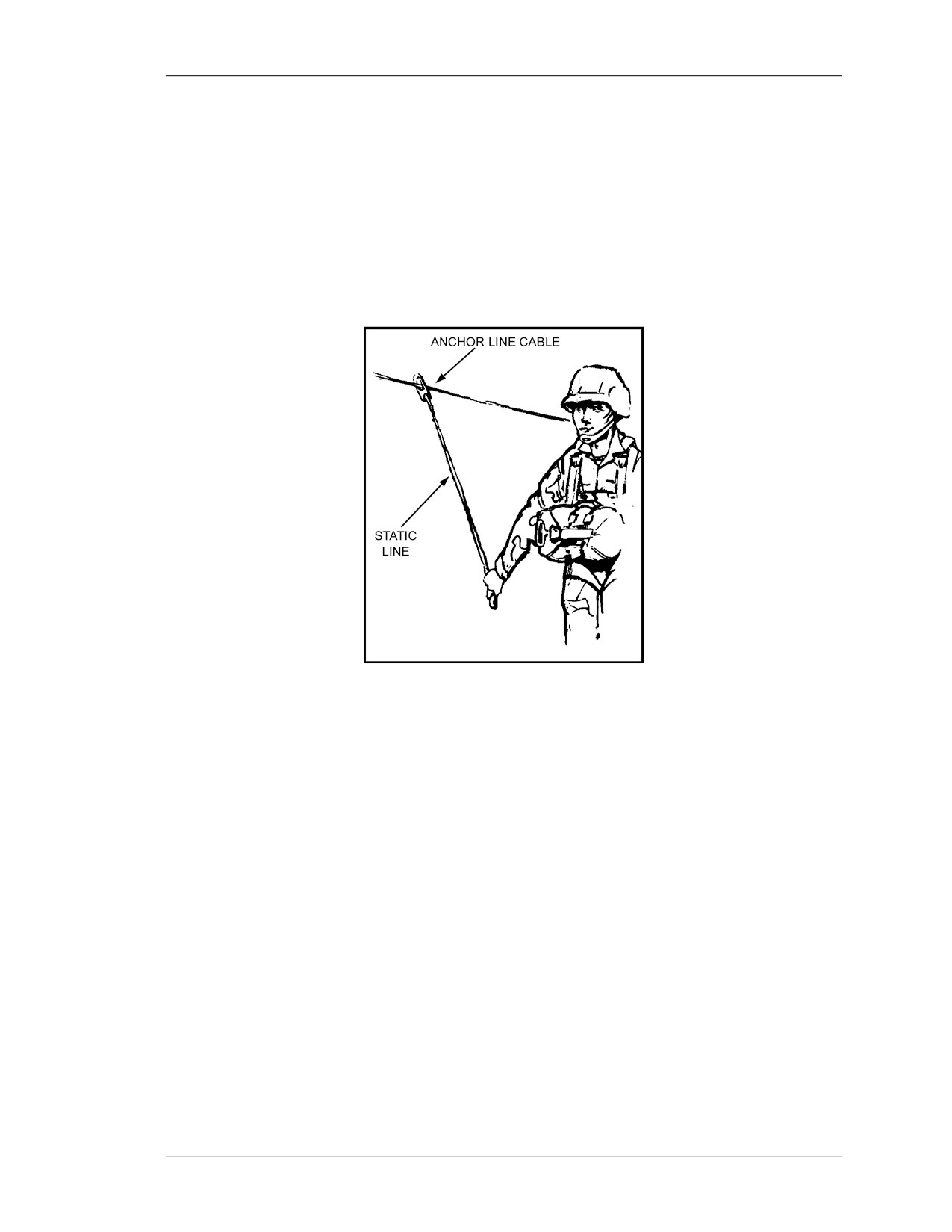
(2) Jumpers hook up to the appropriate anchor line cable with the open gate of the
static line snap hook facing toward the skin of the aircraft. They maintain a reverse bight
(Figure 16-5).
Figure 16-5. Static line grasped with reverse bight.
(3) Door check is not required. If using GMRS, the JM must spot the ground marking
from the left side of the ramp.
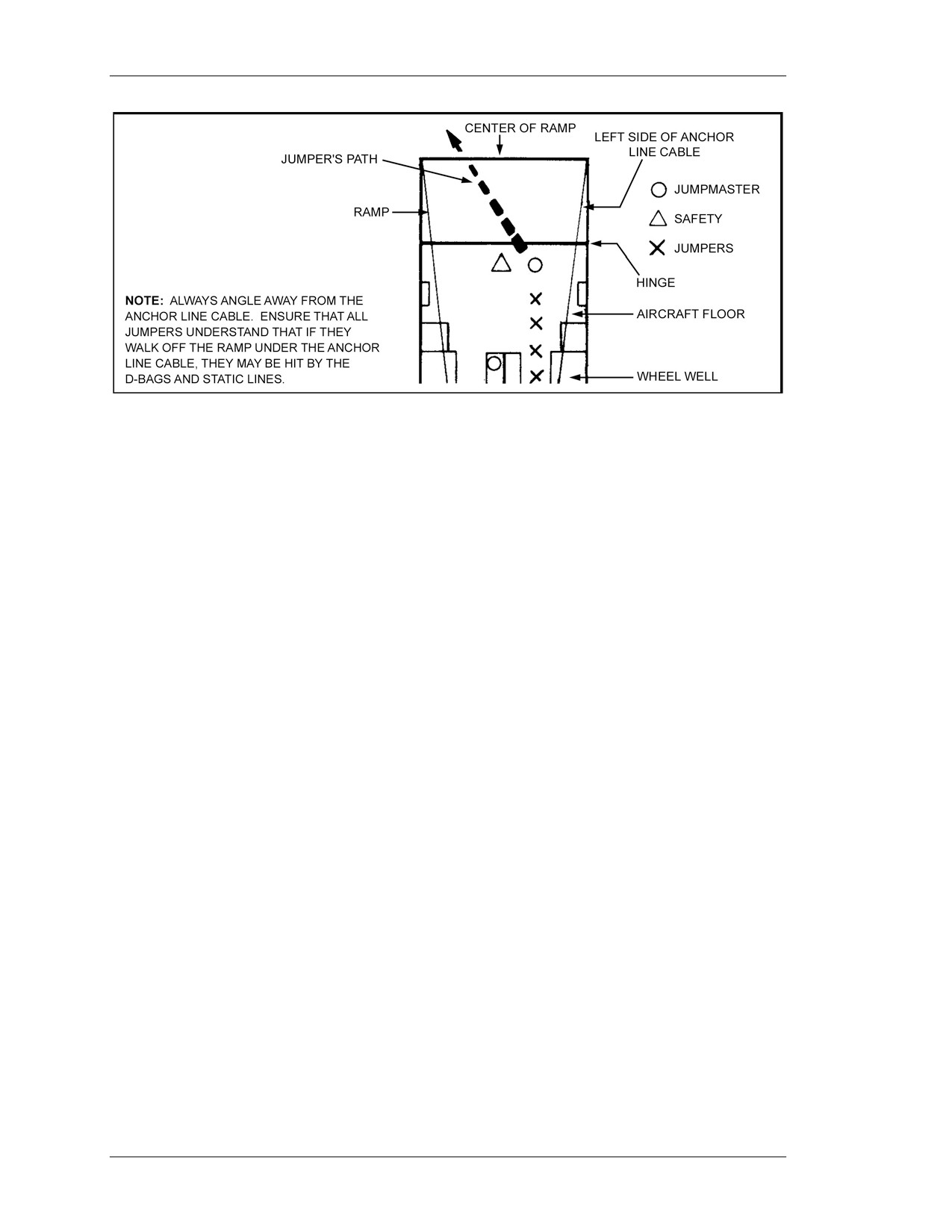
(4) After giving the command STAND BY, the JM moves to the center edge of the
ramp and exits on green light. The safety positions himself immediately behind the
hinged portion of the ramp and controls the flow of parachutists.
(5) Each parachutist walks off toward the center of the ramp at an angle away from
the anchor line cable (Figure 16-6, page 16-8).
16-7
FM 3-21.220/MCWP 3-15.7/AFMAN11-420/NAVSEA SS400-AF-MMO-010
Figure 16-6. Personnel locations.
16-4. COMBAT CONCENTRATED LOAD SEATING CONFIGURATION
A maximum of 80 parachutists can be dropped when these procedures are used for
wartime emergency operations. Concentrated parachutist loading is used when not
enough C-130 and C-141B aircraft are available. Combat procedures reduce individual
space inside the aircraft; crowded conditions restrict freedom of movement and present
potential hazards if not supervised. Flight time beyond 1.5 hours may intensify adverse
effects on parachutists. Data and seating schematics are included under appropriate
aircraft titles. When the sticks are over 40 parachutists for each pass, additional safety
personnel may be used to complete required safety inspections within the time warnings.
a. Supervisory Personnel Required. Six personnel supervise parachutists and
ensure safety measures are followed.
• One JM.
• One AJM.
• Two (jumping) safety personnel.
• Two loadmasters.
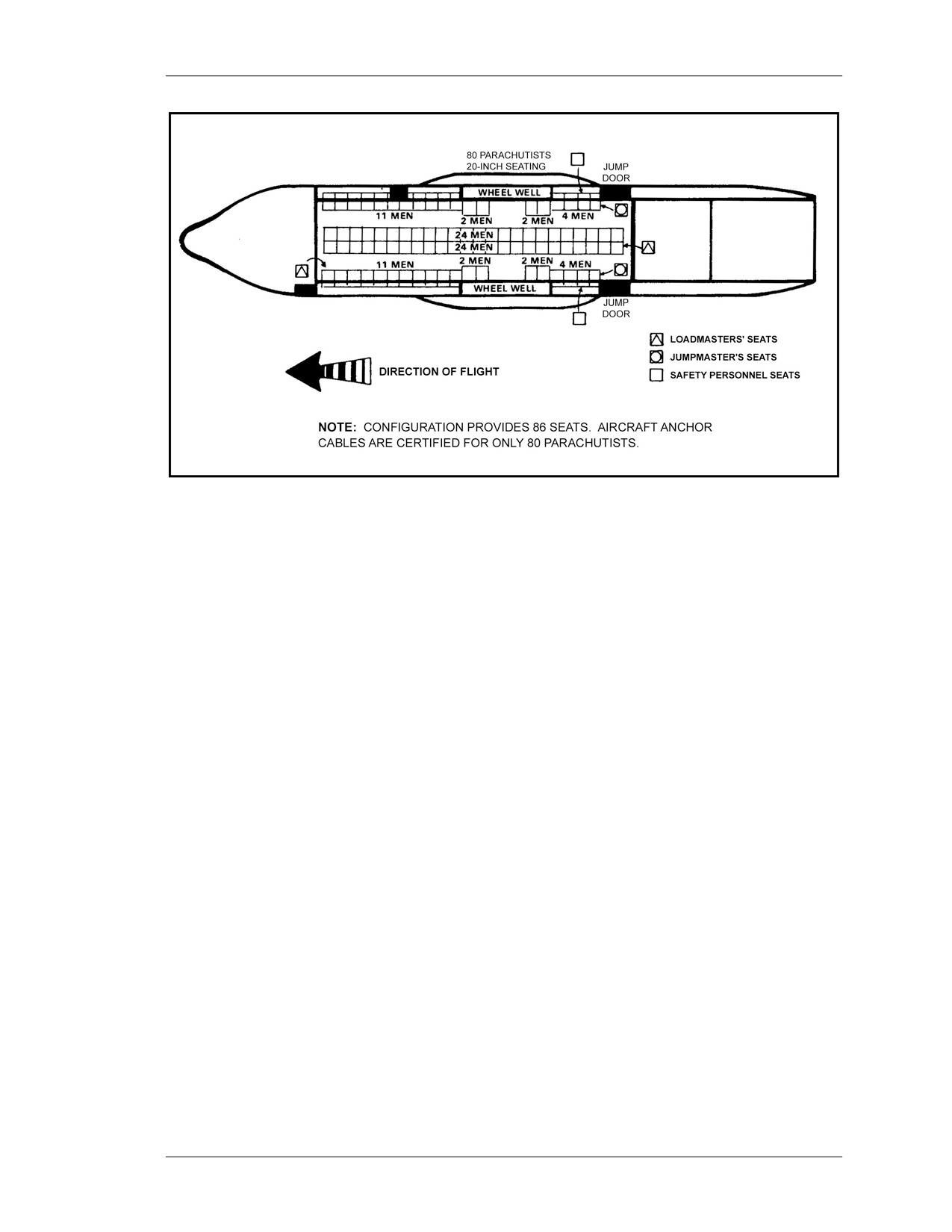
b. Loading Procedures and Seating Arrangement. The aircraft is configured to
provide 19 outboard seats and 21 inboard seats with seat belts installed on 20-inch centers
(Figure 16-7).
16-8
FM 3-21.220/MCWP 3-15.7/AFMAN11-420/NAVSEA SS400-AF-MMO-010
Figure 16-7. C-130 combat concentrated load.
(1) Jumpers are loaded through the aft end loading ramp and seated in two sticks of
40 jumpers each. Before entering the aircraft, all jumpers release their adjustable leg
straps so they can lift their equipment over the seats. These safety straps are retied when
the jumper is seated with seat belt in place.
(2) Each jumper must be assisted in seating by the AJM or safety personnel. They
ensure that jumpers select the correct seat belt and that it is properly fastened.
NOTE: Parachutists sitting in outboard wheel well seats must place their knees
forward or aft in the space of the raised seat. The area is not spacious enough
to allow inboard or outboard parachutists to face each other.
c. Jump Procedures. The jump procedures for the C-130 remain the same with the
following exceptions:
(1) The
30-minute time warning replaces the
20-minute time warning, and the
15-minute time warning replaces the 10-minute time warning.
(2) On the command STAND UP, inboard parachutists stand up and then stand on
their seats, supporting themselves by grasping the center stanchion seat support rail. They
remain in this position until outboard parachutists stand up and raise and secure their
seats in the up position. On the command GET DOWN, inboard parachutists step off
their seats, then raise and secure them in the up position. Standard jump commands are
then resumed.
(3) On the command HOOK UP, no more than 20 parachutists hook up and exit on
any single anchor line cable.
(4) When the command GO is given, outboard personnel exit in numerical sequence,
followed by inboard personnel.
d. Safety Procedures. The standard safety procedures for the C-130 apply, with the
following changes:
16-9
FM 3-21.220/MCWP 3-15.7/AFMAN11-420/NAVSEA SS400-AF-MMO-010
(1) Concentrated parachutist loading is used only for wartime emergency operations.
It allows the maximum number of combat troops to jump. This includes parachutists
designated as safety personnel who conduct inspections before donning their equipment,
which allows them to move freely about the aircraft. This inspection begins at the
30-minute warning to allow the safeties time to don their parachutes.
(2) Parachutists jumping with equipment containers are seated aft of the wheel well in
outboard seats; the equipment containers are stowed on the aircraft ramp. Attaching
special items of equipment will occur at the 30-minute time warning.
(3) During movement in the aircraft and execution of jump commands, each
parachutist protects the reserve parachute rip cord grip to prevent activation of the reserve
inside the aircraft.
(4) Execution of jump commands begins at the 15-minute time warning. This allows
for more time to stow all seats and to ensure that no more than 20 parachutists are hooked
on a single anchor line cable.
(5) When preparing for airborne operations, JMs should provide latrine facilities. To
minimize individual movement during flight, jumpers are encouraged to use the latrine
before boarding the aircraft.
16-5. C-130 JUMPMASTER CHECKLIST
The JM inspects the aircraft for the following:
a.
Seats.
• Enough seats are available for troop load.
• All seats have safety belts.
• Seats are not torn.
• No seat projections are present.
• Seat legs are locked into floor.
• Diagonal leg brace is attached in each set section (if required).
• Seats along the wheel well are removed (if required).
b.
Floor.
• Nonskid covering is in good condition.
• Floor is clean and safe to walk on.
• All cargo compartment roller conveyors and dual rail system floor sections are
removed when jumping the door.
• Loose equipment is lashed and does not interfere with movement or comfort.
c.
Jump Platform.
• Nonskid surface is present.
• No cracks or bends are present.
• Hinge plate slots are engaged by tie-down studs and screw (with washer) so
that the hinge fittings do not slide off the tie-down studs. When the screw and
washer are missing, the hinge plate must be safety wired with four turns of
stainless steel wire to the tie-down ring bracket.
• Two spring-down lock catches engage the edge of the door.
• Clutch mechanism is present on the spring-down lock catches.
16-10
FM 3-21.220/MCWP 3-15.7/AFMAN11-420/NAVSEA SS400-AF-MMO-010
d. Jump Doors.
• No excessive grease is on the door tracks.
• No sharp edges or protrusions are on door frames.
• Pip pin in top, forward edge of door frame is present.
• Auxiliary hydraulic ramp pump handle is secured (after takeoff).
• Doors open and close easily.
(Doors are operated in flight by aircrew
members.)
e. Air Deflectors.
• No sharp edges are on trailing edge.
• Deflectors operate electrically.
• No items or trash are stored in wells.
f. Jump Caution Lights. (Check all seven sets for operation.)
• Set 1—crew entrance door.
• Sets 2 and 3—top leading edges of right and left doors.
• Sets 4 and 5—trailing edges of right and left doors, waist high.
• Sets 6 and 7—right and left anchor cable aft supports.
g. Anchor Cable System.
(1) Forward Support Beam.
• Four U-bolts, with self-locking nuts or nuts with cotter pins, are attached.
• Anchor cables are attached to first and second U-bolts right and left of center
line for personnel jump.
• Forward latch assembly is in the locked position and secured with locking
pins.
(2) Anchor Cable.
• No breaks (within acceptable tolerances of TO 1C-130A-9), frays, or kinks
exist.
• Cable is clean and free of rust.
(3) Anchor Cable Intermediate Center Support.
• Cables run through slots after ramp is closed.
• Quick-release retaining pins are present
(4) Anchor Cable Aft Support.
• Aft latch assembly is closed.
• U-bolts, nuts, and safety pins are present.
• Support anchor bolts, nuts, and safety pins are present.
(5) Static Line Retrievers.
• Motor is operational.
• Retriever cables are not broken
(within acceptable tolerances of
TO 1C-130A-9), frayed, kinked, dirty, or rusty.
• Spool clamp and shackle are attached forward of intermediate cable support
and are tied to support with two turns of 1/4-inch cotton webbing.
• Retriever cables are secured with two turns of 1/4-inch cotton webbing to
litter brackets at station 627. If cable clips are installed on the wheel well, the
tie at station 627 is not used. (Retriever cable must be at least 4 inches above
the anchor line cable.)
16-11
FM 3-21.220/MCWP 3-15.7/AFMAN11-420/NAVSEA SS400-AF-MMO-010
h. Emergency Equipment.
• First aid kits (4) are present.
• Fire extinguishers (3) are present.
• CGU1-B cargo tie-down straps (2) (for retrieval of towed parachutists) are
present.
• Alarm system is operational.
• Emergency exits are operational and accessible.
• Sufficient emergency parachutes are available.
i.
Miscellaneous.
• Lighting system is operational.
• Airsickness bags are available.
• Comfort facilities are available.
• JM kit bag (extra equipment) is onboard.
Section II. C-141B STARLIFTER
The C-141B (Figure 16-8) is a swept-wing, long-range transport powered by four
turbofan jet engines and equipped for in-air refueling. The aircraft can be configured in
different peacetime troop-carrying modes for airborne operations. Parachutists jump from
the two aft doors of the aircraft.
Figure 16-8. C-141B Starlifter.
16-12
FM 3-21.220/MCWP 3-15.7/AFMAN11-420/NAVSEA SS400-AF-MMO-010
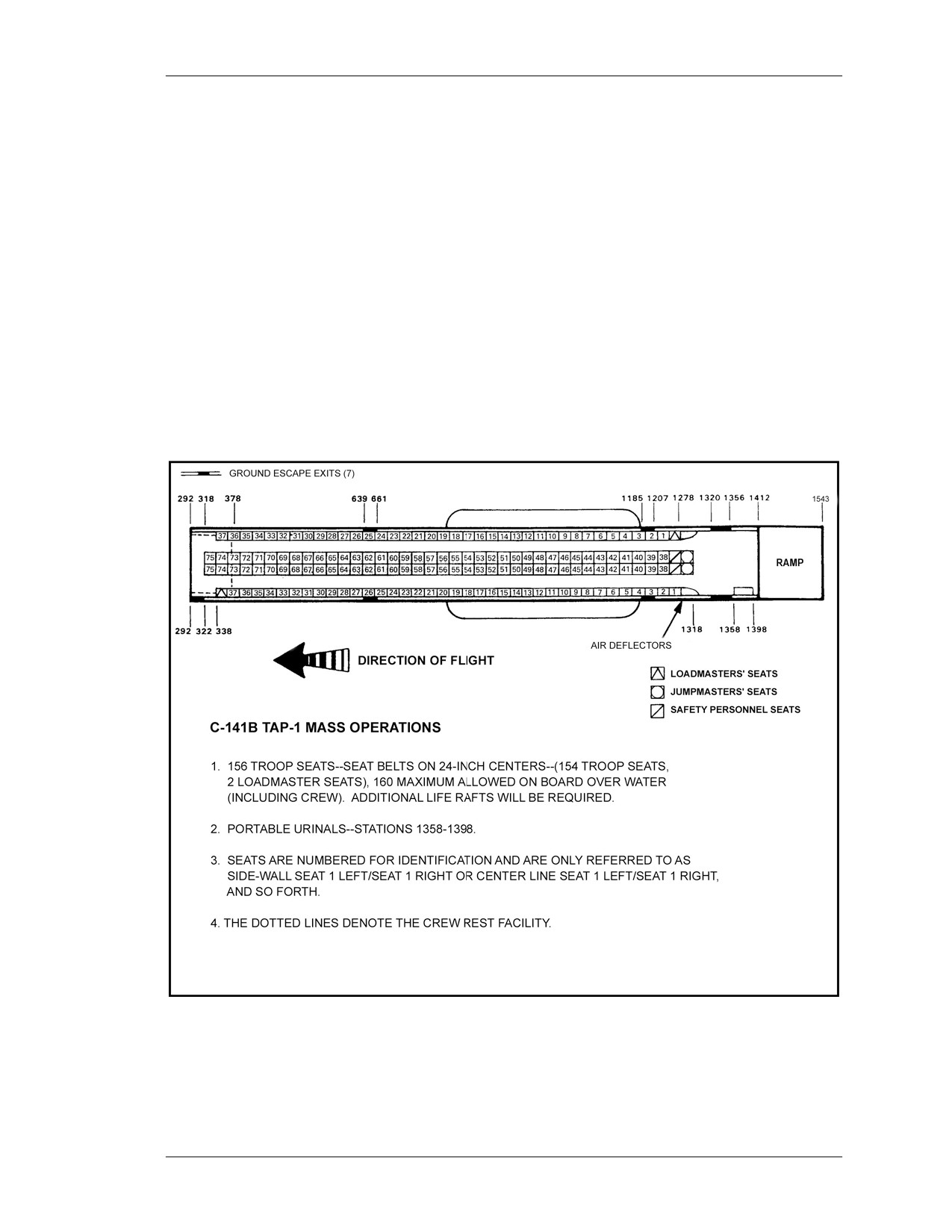
16-6. SEATING CONFIGURATION WITHOUT COMFORT PALLET
The seating configuration for the C-141B is as follows:
a. Peacetime Training
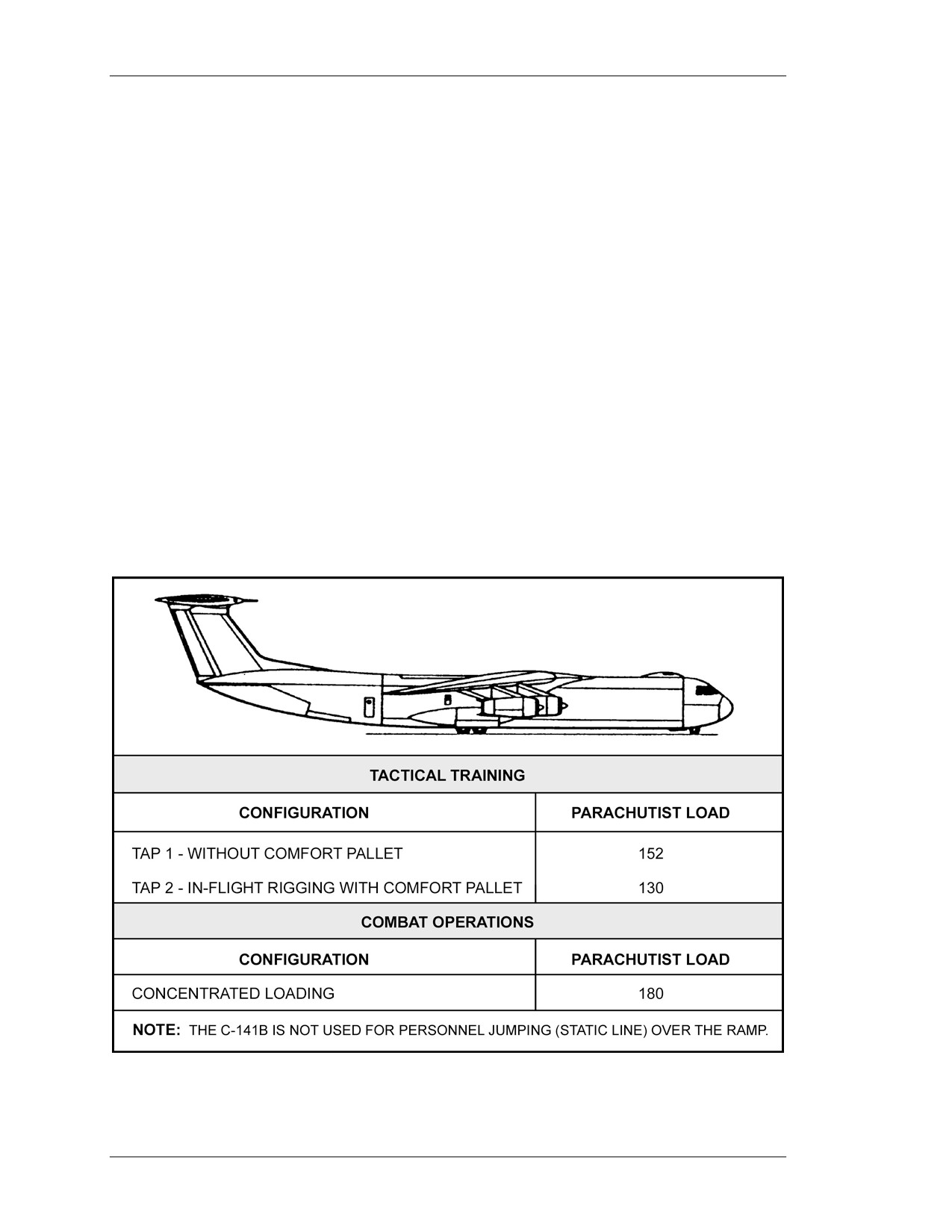
(TAP 1). In this configuration, the C-141B seats
156
personnel: 152 parachutists, 2 static safety personnel, and 2 airdrop qualified loadmasters
(Figure 16-9). The maximum number of personnel for each anchor line cable is 45.
b. Supervisory Personnel Required. Six personnel supervise parachutists and
ensure safety measures are followed.
• One JM.
• One AJM.
• Two static safety personnel.
• Two airdrop qualified loadmasters.
NOTE: USMC and USN utilize one door, the other door remains closed and
unmanned. Therefore, only one JM and one safety are used. These units do
not fall under AR 350-2.
Figure 16-9. C-141B seating configuration without comfort pallet.
16-13
FM 3-21.220/MCWP 3-15.7/AFMAN11-420/NAVSEA SS400-AF-MMO-010
c. Time Warnings. Time warnings include the following:
(1) The 20-minute time warning may be increased to 30 minutes to provide enough
time for static safety personnel to complete safety checks and to rig equipment
containers.
(2) The 10-minute time warning may be increased to 15 minutes to allow time for
parachutists to release and stow troop seats and for static safety personnel to complete
safety checks before the 1-minute time warning. Prior to the 10-minute time warning, the
JMs hook up to the inboard anchor line cable (or anchor line cable if only one is
available), hand the static line to the safety, and announce, SAFETY, CONTROL MY
STATIC LINE. The JM then issues the jump commands. If the aircraft is configured with
only one anchor line cable, the JMs hook up to the one cable.
d. Jump Commands. The loadmaster gives the JM an oral 10-minute time warning.
Emphasis is on using a public address system to give jump commands, since parachutists
in the forward end of the cargo compartment may not be able to see JM hand-and-arm
signals.
GET READY.
OUTBOARD PERSONNEL, STAND UP.
INBOARD PERSONNEL, STAND UP.
HOOK UP.
CHECK STATIC LINES.
CHECK EQUIPMENT.
SOUND OFF FOR EQUIPMENT CHECK.
STAND BY. (Parachutists maintain a bight in the static line while maintaining
balance with the hand nearest the aircraft fuselage.)
GO. (On the command GO, movement into the door is a normal walking pace.
Parachutists pass the static line to safety personnel, place their hands on the
ends of the reserve parachute, and exit.)
e. Safety Considerations. Safety personnel are seated aft to aid the JMs, at the
20-minute time warning, in positioning door bundles and performing other duties.
(1) Static safety personnel must complete their 20-minute checks and arrive at the
forward end of the cargo compartment before the 10-minute time warning.
(2) No more than 45 parachutists are hooked to any one anchor cable.
(3) Deployment bags may be trailed between passes on single drop zones, or when
dropping on multiple drop zones with less than 10 minutes flight time between drop
zones.
16-7. IN-FLIGHT RIGGING SEATING CONFIGURATION WITH
COMFORT PALLET
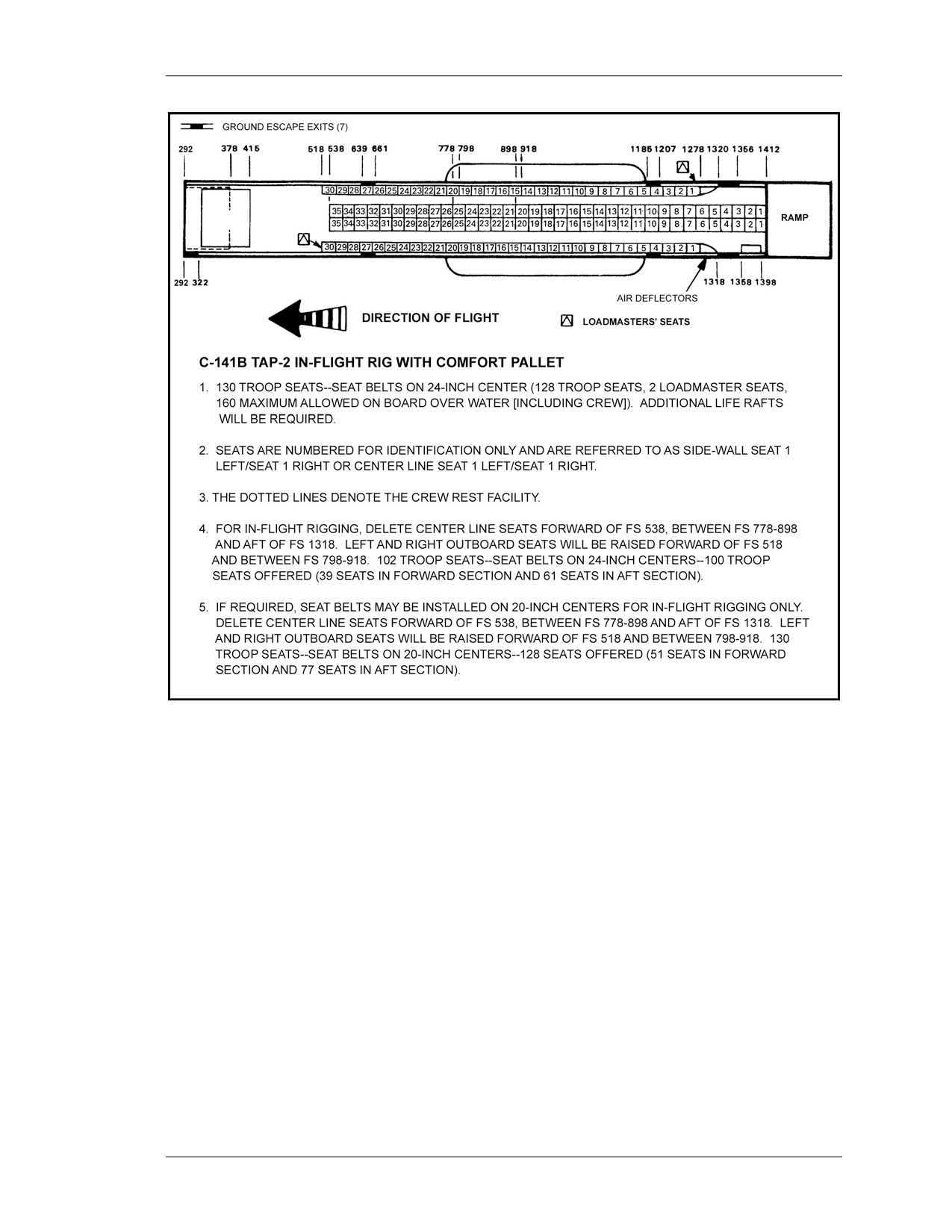
In this TAP 2 configuration, the C-141B seats 134 personnel: 130 parachutists, 2 static
safety personnel, and 2 loadmasters. Floor space is provided forward, midway, and aft for
stowage of parachute assemblies. Seats are on a 24-inch center (Figure 16-10).
16-14
FM 3-21.220/MCWP 3-15.7/AFMAN11-420/NAVSEA SS400-AF-MMO-010
Figure 16-10. C-141B seating configuration with comfort pallet.
a. Supervisory Personnel Required. Fifteen personnel supervise parachutists and
ensure safety measures are followed.
• One JM.
• Six AJM.
• Six safety personnel (two static).
• Two loadmasters.
b. Storage of Equipment. Parachute assemblies (133) are placed in aviator kit bags
and stowed and secured in three locations on the cargo floor. There are 130 parachutists
seated in two sticks of 65 each on the left and right.
(1) Door bundles are stowed on the cargo ramp.
(2) Individual equipment, web gear, ballistic helmets, and ALICE packs are stowed
under the troop seats; weapon containers are stowed behind the seats; and individual
equipment containers are stowed in the aisles or with the parachutes.
(3) One JM kit bag is stowed at each of the six rigging stations (two forward, two
midway, and two aft).
c. Buddy Rigging. The JM initiates in-flight buddy rigging 2 hours before the 20- or
30-minute time warning. Parachutists unzip the seats, place their equipment on the seats,
16-15
FM 3-21.220/MCWP 3-15.7/AFMAN11-420/NAVSEA SS400-AF-MMO-010
and sit on top of the equipment. This clears the aisle for the parachutists to stand while
buddy rigging.
(1) Parachutes are passed out from each of the three locations until each person has
one. Then buddy rigging begins.
(2) Each parachutist must know exactly who he will rig up with. The JMs, safety
personnel, and designated JM qualified parachutists supervise. Once a parachutist has
been rigged, he sits down and waits to be inspected by one of the JMs.
(3) Safety personnel serve as roving correction inspectors. Attaching the static line
snap hook to the top carrying handle of the reserve indicates an inspected parachutist.
(4) The JM supervises the operation. If there are other currently qualified JMs, they
may be used.
(5) Once all the parachutists have been inspected, the JMs rig up, and safety
personnel inspect them.
d. Station Rigging. Station rigging involves the following:
(1) Six AJMs and six safety personnel (two static and four jumping safety personnel)
are required to man the six rigging stations.
(2) Parachutists are divided into three segments and assigned to rigging stations.
(3) The JM initiates in-flight rigging
2 hours before the 20- or 30-minute time
warning.
(4) Before initiation of in-flight rigging, jumpers are instructed to unzip the troop
seats, place their equipment on the seats, and sit on it. Placing equipment on the seats
clears the aisles for jumpers moving to and from the rigging stations.
(5) AJMs and safety personnel at each rigging station stow their seats to provide
more rigging space.
(6) Starting with two parachutists from the end of the divided sticks, each parachutist
moves to a designated rigging station and is rigged by safety personnel. When completely
rigged, the parachutist moves to the AJM (stationed nearby) for inspection. The AJM
attaches the static line snap hook to the top carrying handle of the reserve parachute when
he reaches that portion of the inspection sequence.
(7) Only the JM or AJM removes the static line snap hook from the reserve (before
the command HOOK UP) since this indicates that the parachutist has received the JM’s
inspection.
16-8. COMBAT CONCENTRATED LOAD SEATING CONFIGURATION
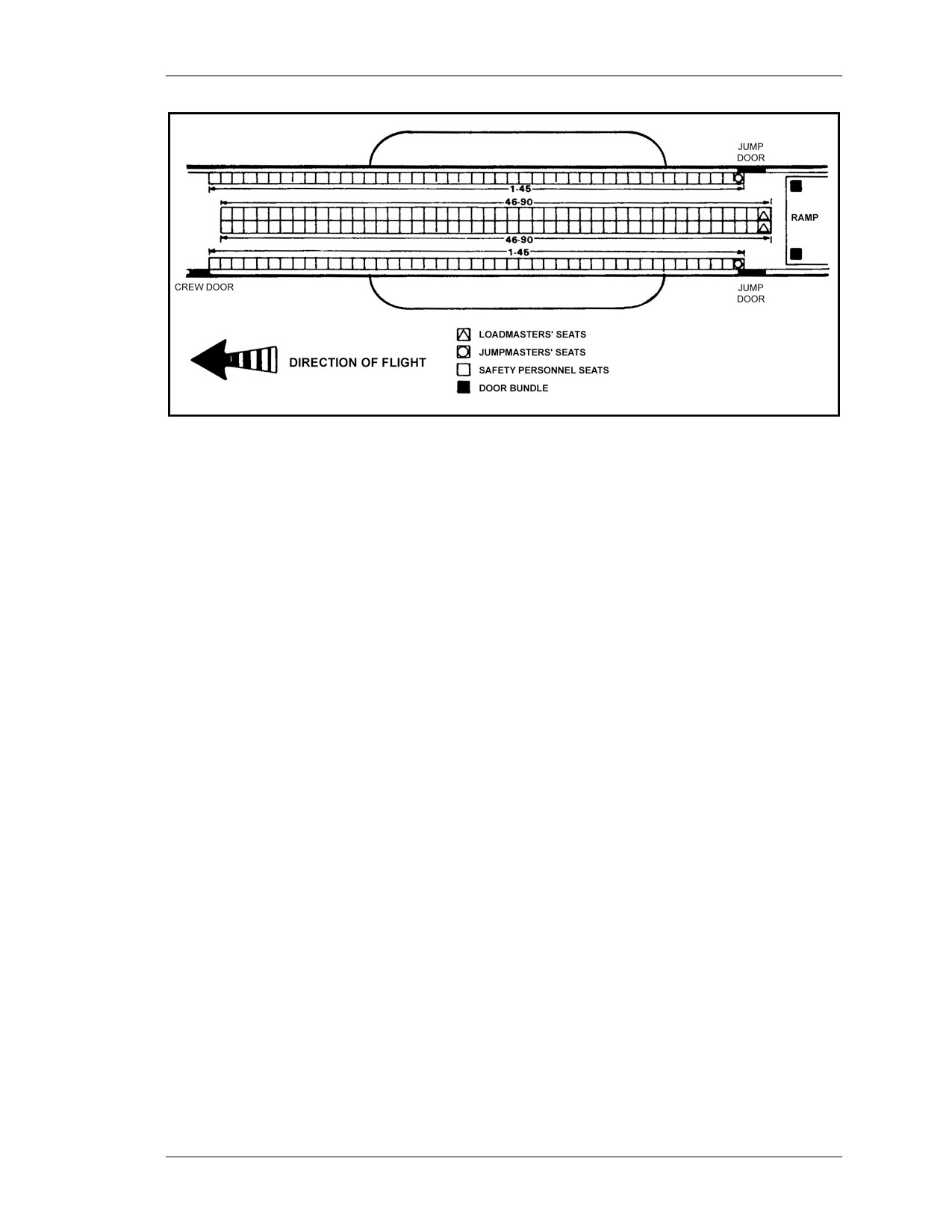
In this configuration, the C-141B seats 182 personnel: 180 parachutists and 2 loadmasters
(Figure 16-11). Personnel are seated on the side-facing seats on
20-inch centers.
Parachutists (180) are seated in two sticks of 90 each on the left and right sides. If 45
parachutists cannot be seated on the outboard seats, the overflow may be seated inboard
aft on available center seats. The JM must ensure that only 45 parachutists hook up to the
outboard/inboard anchor cables.
16-16
FM 3-21.220/MCWP 3-15.7/AFMAN11-420/NAVSEA SS400-AF-MMO-010
Figure 16-11. C-141B configured for combat load (182 seats).
NOTE: Concentrated parachutist loading is used in wartime emergency operations
when not enough C-130 and C-141B aircraft are available. These procedures
reduce individual space inside the aircraft. Crowded conditions restrict
freedom of movement and present a potential safety hazard if jumpers are not
supervised. Flight time beyond 1.5 hours may intensify adverse effects on
parachutists. Data and seating schematics are included under appropriate
aircraft titles. Additional safety personnel may be used (if the sticks have over
40 personnel for each pass) to complete the required safety inspection within
the time warnings.
a. Supervisory Personnel Required. Six personnel supervise parachutists and
ensure safety measures are followed.
• One JM.
• One AJM.
• Two (jumping) safety personnel.
• Two airdrop qualified loadmasters.
b. Jump Procedures. Jump procedures involve the following:
(1) Jump procedures for the C-141B remain the same with the following exceptions:
the 30-minute warning replaces the 20-minute time warning, and the 15-minute time
warning replaces the 10-minute time warning.
(2) Jump commands are echoed by jumpers since parachutists in the forward end of
the cargo compartment cannot see the JM’s arm-and-hand signals.
c. Safety Considerations. At the 30-minute time warning, safety personnel are
seated aft to aid the JMs in positioning door bundles and in performing other duties. The
JMs ensure that no more than 45 parachutists are hooked to any one anchor line cable.
(1) The standard safety procedures for the C-141B apply with the following changes:
(a) Concentrated parachutist loading is used only for wartime emergency operations
and allows the maximum number of combat troops to jump. This includes parachutists
designated as safety personnel who conduct safety inspections before donning their
equipment, which allows them to move freely about the aircraft. This inspection begins at
16-17
FM 3-21.220/MCWP 3-15.7/AFMAN11-420/NAVSEA SS400-AF-MMO-010
the 30-minute time warning to allow adequate time to complete inspection and to provide
time for safety personnel to don their parachutes.
(b) During movement in the aircraft and execution of jump commands, each
parachutist protects the reserve parachute rip cord grip to prevent activation of the reserve
inside the aircraft.
(2) There is no time to retrieve, detach, and stow the deployment bags and rerig the
retrieval system between passes or drop zones. Deployment bags are trailed between
passes on single drop zones, or when airdropping on multiple drop zones with less than
10 minutes flight time between drop zones.
16-9. C-141B JUMPMASTER CHECKLIST
The JM inspects for the following:
a.
Seats.
• Enough seats for troop load are present.
• All seats have safety belts.
• Seat backs are secured.
• Seats are not torn.
• No projections exist through seats.
• Legs are locked into floor.
b.
Floor.
• Nonskid covering is in good condition.
• Floor is clean and safe to walk on.
• Roller conveyors are stowed.
• Loose equipment is secured in the cargo ramp area and does not interfere with
troops.
c.
Jump Platforms.
• Nonskid surface is present.
• No cracks or bends exist.
• Studs are locked in seat track receptacles.
• Tie-down fitting is locked.
• All bolts and nuts are present.
• Platforms swing in and out easily.
• The two spring-down lock catches engage the edge of the door.
d.
Jump Doors.
• No excessive grease on the door tracks exists.
• No sharp or protruding edges exist on door frames or on loading strut door (aft
and down from jump door).
• Doors open and close easily.
• Door lever catches are operational.
e.
Air Deflectors.
• No sharp edges present.
• Deflectors operate electrically.
f.
Jump Caution Lights. (Check seven sets for operation.)
• Set 1—crew entrance door.
• Sets 2 and 3—top leading edges of right and left doors.
16-18
FM 3-21.220/MCWP 3-15.7/AFMAN11-420/NAVSEA SS400-AF-MMO-010
• Sets 4 and 5—trailing edges of right and left doors, waist high.
• Sets 6 and 7—right and left anchor cable aft supports.
g. Anchor Cable System.
(1) Forward Support Beam.
• Bolts and nuts are present and tight.
• Anchor cables are attached to first and third anchor points right and left of
enter line for personnel jumps.
• Cable, bolts, nuts, and safety wire are present.
• Turnbuckle is secured with safety wire.
(2) Anchor Cable.
• No breaks (within acceptable tolerances of TO 1C-141B-9), frays, or kinks
exist.
• Cable is clean and free of rust.
• Cable swage is present.
(3) Anchor Cable Intermediate Support.
• Cables run through slots after ramp is closed.
• Quick-release retaining pip pins are present.
(4) Static Line Retrievers.
• Motor is operational.
• Retriever spools are secured forward of intermediate cable support and tied to
supports with one turn of double 1/4-inch cotton webbing.
• Retriever cables are not broken
(within acceptable tolerances of
TO 1C-141B-1), frayed, or kinked.
• Retriever cables are secured in spring clips.
• Retriever bars are available (one for each door).
NOTE: Retriever cable must be at least 4 inches above the anchor line cable.
h. Emergency Equipment.
• Public address system is operational.
• First aid kits (4) are present.
• Fire extinguishers (3) are present.
• Alarm system is operational.
• Emergency exits are operational and accessible.
• Sufficient emergency parachutes are available.
i.
Miscellaneous.
• Lighting system is operational.
• Airsickness bags are available.
• Comfort facilities are present.
• JM kit bag (extra equipment) is onboard.
16-19
FM 3-21.220/MCWP 3-15.7/AFMAN11-420/NAVSEA SS400-AF-MMO-010
Section III. C-5 A/B/C GALAXY
The C-5 A/B/C Galaxy is a swept-wing, long-range transport powered by four turbofan
jet engines and equipped for in-flight refueling. The aircraft can be configured in
different peacetime troop-carrying modes for airborne operations. Parachutists jump the
two aft doors of the aircraft.
16-10. SEATING CONFIGURATION WITHOUT COMFORT PALLET
The configuration for the C-5 A/B/C for peacetime training is TAP-1. This configuration
offers seats for 73 parachutists in the troop compartment and provisions for personnel
airdrop as follows: 71 jumpers and 2 static safety personnel. The maximum number of
personnel for each anchor line cable is 40.
16-11. IN-FLIGHT RIGGING SEATING CONFIGURATION WITH
COMFORT PALLET
This configuration offers a partial palletized seat kit (eight seat pallets and one comfort
pallet) for 78 jumpers in the cargo compartment and provisions for personnel airdrop. It
does not provide ditching exits or sufficient ground emergency exits. Therefore, this
configuration should be carefully evaluated when considered for use. This configuration
should be used only during over-land missions.
16-12. JOINT PREFLIGHT INSPECTION
The purpose of the joint preflight inspection (JPI) is to verify the readiness of the aircraft
for the conduct of aircraft missions and to take actions necessary to achieve this
readiness.
a. Supervisory Personnel Required. To ensure command and control, a JM, AJM,
and two safety personnel are used for C-5 A/B/C airdrops.
b. Jumpmaster/Aircraft Commander/Loadmaster Coordination. It is the
responsibility of the JM to inform the aircraft commander and loadmaster of the exact
time sequence of prejump procedures. Following preliminary orientation and before
loading personnel onboard the aircraft, the JM and loadmaster make a joint inspection of
the aircraft.
c. Exterior Inspection. An external inspection of the aircraft is made to detect
hazards to the airdrop of personnel. Particular attention is directed to the rear of the aft
paratroop doors. Any protruding objects and sharp edges must be removed or padded and
taped.
d. Interior Inspection. This inspection is conducted to detect and correct any
interior safety hazards.
(1) Any sharp edge or protrusion is securely taped and padded, as required.
(2) All equipment in the cargo compartment is securely stowed and lashed.
(3) The floor is clean and free of lubricants; no obstructions are on the walkway or
along the paratroop exit route (outboard area between the safety fence and fuselage).
(4) Anchor line cables are installed and under correct tension. Maximum deflection of
the cable at midpoint (FS 1465) must produce a minimum cable height of 73 inches
above the cargo compartment floor.
(5) A seat and seat belt are available in the troop compartment for each parachutist.
16-20
FM 3-21.220/MCWP 3-15.7/AFMAN11-420/NAVSEA SS400-AF-MMO-010
(6) The retrieval system is installed in the aircraft with the winch cable retained in
clips and free of the anchor line cable. The retriever spool is secured to the aft support
frame with one turn of double 80-pound, 1/4-inch cotton webbing. A phenolic (plastic)
block is installed on the leading edge of the paratroop doors at the retriever bar level.
(7) Troop compartment lavatory units are installed and operational.
(8) Air deflector systems are installed.
(9) Jump platforms are installed.
(10) Jump signal lights are operational.
(11) Cargo compartment and troop compartment lights are operational.
(12) The public address intercomm system is operational.
NOTE: To reduce confusion in loading, the safety fence can be numbered at this time.
e. Jumpmaster Preload Inspection of Parachutists. The JM/AJM inspects each
parachutist, parachute, and parachutist’s equipment prior to loading the aircraft. The
JM/AJM inspects—
(1) Parachutist’s helmet.
(2) Parachutist’s ID tags and ID card.
(3) Rigging of parachutist’s equipment:
• ALICE pack with H-harness, AIRPAC, and PIE/R2, or CWIE containers.
• Dragon missile jump pack, Stinger missile jump pack, or AT4 jump pack.
• M1950 weapons case.
• Lowering lines.
f. Parachute Stowage. Personnel stow parachutes in aviator kit bags, secure all
equipment, and move to the aircraft.
g. Aircraft Loading Sequence. Loading is determined by the USAF loadmaster.
h. Aircraft Loading Through Forward Ramp. When loading through the forward
ramp, parachutists enter in normal sequence (1 through 36 right side, 1 through 37 left
side). When loading through the aft right door, parachutists enter in reverse sequence
(36 through 1 right side, 37 through 1 left side).
16-13. PERSONNEL AND EQUIPMENT CONFIGURATION
Personnel seating configuration and equipment stowage for the C-5B Galaxy are as
follows:
a. Seating Configuration. Parachutists are assembled into two sticks:
37
parachutists for the left door and 36 parachutists for the right door. Each parachutist is
assigned a number in the stick. This number is the parachutist’s rigging station and seat
number. Each parachutist is issued a main and reserve parachute. Each parachutist must
inspect his own parachute for safety wires and for fitting of the parachute harness.
b. Equipment Configuration. Personnel face inboard, cover on the nylon net
assembly equipment stowage sections, and place their equipment on the floor of the cargo
compartment. Equipment is stowed on the safety fence under the parachutist’s assigned
stick number. To facilitate equipment stowage on the safety fence, the two top retaining
straps of the nylon net assembly must be fully extended. The individual parachutist’s
equipment (load-bearing equipment, weapons, and main and reserve parachutes) is
stowed under the retaining straps.
16-21
FM 3-21.220/MCWP 3-15.7/AFMAN11-420/NAVSEA SS400-AF-MMO-010
16-14. MOVEMENT TO THE TROOP COMPARTMENT
On jumpmaster order, parachutists begin movement to the troop compartment as follows:
a. Left Stick. The left stick faces aft, moves in stick order, and ascends the aft
stair/ladder to the troop compartment. Upon reaching the troop compartment, the stick
leader faces the forward end of the aircraft and moves to the forward row of seats on the
left side. The left stick is seated row by row. Seats are occupied in the following forward
to aft order: outboard, center, and aisle.
b. Right Stick. As the left stick begins to ascend the aft stair/ladder, the right stick
faces aft, moves past the end section of the safety fence, crosses the airdrop system guide
rails/rollers to the left side of the cargo compartment, and moves to the base of the
stair/ladder. Parachutists must exercise caution to avoid tripping over the rails and rollers
of the airdrop system. The right stick ascends the stair/ladder into the troop compartment
and is seated on the right side, row by row, forward to aft, outboard to inboard in the
same manner as the left stick.
NOTE: The troop compartment contains 75 seats: 73 seats are for parachutists and the
remaining 2 are reserved for USAF loadmasters.
16-15. LOADMASTER BRIEFING
As soon as all parachutists are seated, the loadmaster uses the public address/intercomm
system to brief the parachutists on aircraft safety, emergency procedures, and comfort
facilities.
16-16. MOVEMENT TO THE CARGO COMPARTMENT FOR IN-FLIGHT
RIGGING PROCEDURES
Movement to the cargo compartment for in-flight rigging proceeds as follows:
a. Movement of Left and Right Sticks.
(1) The loadmaster alerts the jumpmaster 1 hour 20 minutes prior to drop time. At
that time, the JM moves the two sticks to the cargo compartment, right stick followed by
left stick, both sticks in reverse stick order.
(2) Each stick descends the stair/ladder to the floor of the cargo compartment and
moves to the equipment stowed on the safety fence. Routes used are the same as those
used in moving to the troop compartment. The right stick must exercise care in crossing
the airdrop system rails and rollers.
NOTE: The 1-hour 20-minute time warning can be modified to a shorter time
depending on the situation and number of parachutists.
CAUTION
Each parachutist must descend to the cargo compartment facing
the troop ladder with both hands on the handrail, using caution at
each step.
16-22
FM 3-21.220/MCWP 3-15.7/AFMAN11-420/NAVSEA SS400-AF-MMO-010
b. In-Flight Rigging Procedures.
(1) Individuals face inboard and cover on their stowed equipment.
(2) Using the buddy system, half of the parachutists in each stick don their parachutes
and equipment. After the first group have completed donning their equipment, the second
half don their parachutes and equipment.
(3) JMPI begins as soon as rigging is complete. The JM and AJM inspect each
parachutist and correct any errors. As the JM/AJM completes inspection of each
parachutist, the rigged parachutists are seated on the walkway. Safeties assist the
JM/AJM during JMPI.
CAUTION
When on, lights located under the walkway can get hot enough to
melt nylon.
16-17. JUMP COMMANDS
The following eight jump commands are used:
GET READY.
STAND UP.
HOOK UP.
CHECK STATIC LINES.
CHECK EQUIPMENT.
SOUND OFF FOR EQUIPMENT CHECK.
STAND BY.
GO.
16-18. JUMP PROCEDURES
The jump procedures for the C-5 A/B/C are as follows:
a. Jumpmaster and Assistant Jumpmasters. The JM and AJM hook up to the
anchor line cable and stand adjacent to the rear of their respective aft personnel door. The
JM and AJM face their sticks to give jump commands. The JM initiates the jump
commands, which are then relayed by the AJM.
b. Parachutists. All parachutists are hooked up to the paratroop anchor line cable.
Personnel must close up tightly, reserve to backpack, to the aft end of the aircraft to
permit sufficient room for all parachutists to hook up to the anchor line cable. The
number 1 parachutist in each stick does not move aft of the air deflector while it is
positioned inside the aircraft. When parachutists are rigged with combat equipment, it
may become necessary to stagger the parachutists to have enough room for all
parachutists to hook up.
c. Commands. The following commands are used:
(1) SOUND OFF FOR EQUIPMENT CHECK. At this command, the two safety
personnel move from forward to aft, checking each parachutist’s static line. The safety
personnel report to the JM or AJM at the completion of the check, hook up, and then
position themselves by the aft personnel door to control the static lines of exiting
16-23
FM 3-21.220/MCWP 3-15.7/AFMAN11-420/NAVSEA SS400-AF-MMO-010
parachutists. The two safety personnel must be JM qualified and may jump at the end of
the stick. The JM may jump from either aft personnel door. He should jump from the
door from which he can best observe checkpoints and the drop zone.
(2) STAND BY. At this command, the number 1 parachutist moves toward the door
and assumes a normal number 2 man position.
(3) GO. At this command, parachutists’ movement into the door will be at a normal
walking pace, without shuffling. Exits from the troop doors are not vigorous and are
made at an angle of about 70 to 80 degrees to the tail of the aircraft. Each parachutist
passes his static line to the safety, places both hands on the ends of his reserve parachute,
and exits the aircraft.
16-19. TIME WARNINGS
The following actions occur at each time warning:
a.
1-Hour
20-Minute Time Warning. Parachutists are moved from troop
compartment to cargo compartment under the supervision of the JM, AJM, and safeties.
In-flight rigging and JMPI begins.
b.
20-Minute Time Warning. The JM makes necessary checks of personnel and
equipment. Special items of equipment are attached to the parachutists, and door bundles
are moved to the vicinity of the personnel doors.
c.
6-Minute Time Warning. JMPI of all parachutists is complete. The loadmaster
gives the JM a verbal and visual
6-minute warning, and the JM begins his jump
commands.
d. Slow-Down Warning. Approximately 3 minutes from drop time, the jump
commands are completed. Personnel doors are opened, air deflectors deployed, and jump
platforms extended and locked.
e.
1-Minute Time Warning. Troops are alerted. The JM and AJM make safety
checks from personnel doors. The AJM informs the JM that the AJM’s side is clear and
that it is safe to jump.
f.
10-Second Time Advisory. The loadmaster gives the JM a visual 10-second time
advisory. At this time, the JM gives the command STAND BY, and the first parachutist
assumes a normal number 2 position. The remainder of the stick moves aft to close up the
stick.
g. Green Light, GO. At the green light signal, the JM taps out the first man. If
T-10-series type parachutes are issued, the AJM taps out the first man in the opposite
door.
16-20. SAFETY PRECAUTIONS
Safety precautions for the C-5 A/B/C are as follows:
a. Platforms, Air Deflectors, Aft Cargo Door. The JM ensures that jump platforms
are extended and locked and that the air deflectors are fully deployed. The aircraft will
not be jumped unless these conditions are met. These conditions are mandatory for each
aft personnel door that is to be used.
b. Door Bundles. When personnel are to follow door bundles, the door bundle static
line is outfitted with three drogue devices, a breakaway static line, or a T-10-series
parachute.
16-24
FM 3-21.220/MCWP 3-15.7/AFMAN11-420/NAVSEA SS400-AF-MMO-010
c. Movement into the Door. Parachutists must exercise caution as they move to the
door to avoid becoming entangled with the static lines of preceding parachutists. This
precautionary action may slow movement into and out of the door.
d. MC1-Series Type Parachutes. Only single door exits will be executed when
MC1-series type parachutes are used. However, both doors must be open to conduct
outside air safety checks.
e. Ramp Exits. Static line parachutists are not authorized to make aft ramp exits of
the C-5 A/B/C aircraft.
16-21. C-5 A/B/C JUMPMASTER CHECKLIST
The jumpmaster inspects the following at the departure airfield:
a.
Seats.
• Enough seats are available for troop load.
• All seats have safety belts.
b.
Safety Fence.
• Safety fence is installed.
• Sufficient equipment restraint nets are available for troop load.
c.
Floor.
• Nonskid surface covering is in good condition.
• Floor is clean and safe to walk on.
• Roller conveyors are stored.
• Loose equipment is secured in the cargo ramp area and does not interfere with
troops.
d.
Jump Platforms.
• Nonskid surface covering is present and in good condition.
• No cracks or bends are present.
• Studs are locked in seat track receptacles.
• Tie-down fitting is locked.
• All bolts and nuts are present.
• Platforms swing in and out easily.
e.
Jump Doors.
• No excessive grease is on door tracks.
• No sharp or protruding edges are on door frames or on loading strut door (aft
and down from jump door).
• Doors open and close easily.
• Door level catches operate.
• Phenolic (plastic) block is installed on leading edge at retriever bar height.
f.
Air Deflectors.
• No sharp edges are present.
• Deflectors operate electrically.
g.
Jump Lights. (Check five sets for operation.)
• Set 1—crew entrance door.
• Sets 2 and 3—leading edges, top of right and left doors.
• Sets 4 and 5—trailing edges, right and left doors, waist high.
h.
Anchor Line Cable System.
16-25
FM 3-21.220/MCWP 3-15.7/AFMAN11-420/NAVSEA SS400-AF-MMO-010
(1) Forward Support Beam.
• Bolts and nuts are present and tight.
• Cable, bolts, nuts, and safety wire are present.
• Turnbuckle is secured with safety wire or tied with 1/4-inch cotton webbing.
(2) Anchor Line Cable.
• Cable has no breaks.
• Cable has no frays.
• Cable has no kinks.
• Cable is clean and free of rust.
• Cable swage is present.
• Cable is at least 73 inches above floor.
(3) Static Line Retrievers.
• Motor is operational.
• Retriever spools are secured and tied to supports with one turn of double
1/4-inch cotton webbing.
• Retriever cables are not broken, frayed, or kinked.
• Retriever cables are secured in spring clips.
• Retriever bar is available.
NOTE: Retriever cable must be in position, not less than 4 inches above the anchor
line cable.
i.
Emergency Equipment.
• Public address system is operational (upper deck only).
• First aid kits (4) are present.
• Fire extinguishers (3) are present.
• Alarm system is operational.
• Emergency exits are operational and accessible.
• Sufficient emergency parachutes are available.
j.
Miscellaneous.
• Lighting system is operational.
• Airsickness bags are available.
• Comfort facilities are available.
• JM kit (extra equipment) is onboard.
k. Aircraft Slowdown Warning (about 3 minutes).
• Doors are opened and locked in place.
• Air deflectors are extended.
• Jump platforms are locked in place.
l.
Loadmaster/Jumpmaster Safety Checks.
(1) Equipment.
• Door bundles employ 15-foot-long static lines with three
drogue
devices,
breakaway static lines, or T-10-series cargo parachute.
(2) Aircraft.
• Jump platform is secure and will sustain parachutist’s weight.
16-26
FM 3-21.220/MCWP 3-15.7/AFMAN11-420/NAVSEA SS400-AF-MMO-010
NOTE: The C-5 A/B/C aircraft cannot be used for aft ramp static line jumping. HALO
personnel may conduct aft ramp jumps from this aircraft. Due to the number
of jumpers that can be hooked up to one anchor line cable, the C-5 A/B/C
aircraft have not been certified for combat concentrated loads. Any deviation
to the listed configurations requires authorization from HQ, AMC/DOT/DOV.
Section IV. C-17A GLOBEMASTER III
The C-17A (Globemaster III) is a swept-wing, long-range transport aircraft powered by
four turbofan engines capable of airlifting large payloads over intercontinental ranges
without refueling. An in-flight refueling capability increases the deployment range. The
cargo compartment is designed to permit safe and efficient operation with one loadmaster
for any mission. The aircraft accommodates outsize or oversize cargo, tactical vehicles,
container loads (which can be configured to conduct a combination of airland, personnel
and equipment airdrop), and MEDEVAC operations. The C-17A can be configured with
or without a comfort pallet. The jump platforms and air deflectors are an integral part of
the aircraft fuselage. A dedicated antenna system enables use of organic Army tactical
satellite (TACSAT) communication systems en route.
16-22. SEATING CONFIGURATION
The seating configuration for the C-17A (Globemaster III) is as follows:
a.
102 parachutists, includes seating for JM, AJM, and static safety personnel.
b. Two static safety personnel seated in crew compartment.
c. One loadmaster seated in forward loadmaster station.
d. Two door bundles (one per door) placed on the aircraft floor aft of the inboard
seats.
16-23. SUPERVISORY PERSONNEL REQUIRED
The following personnel are required for all C-17A personnel airdrop operations:
• One JM.
• One AJM.
• Two JM qualified and current static safety personnel.
• One loadmaster.
16-24. TIME WARNINGS
Time warnings include the following:
a.
2-Hour 20-Minute Time Warning (used only on in-flight rigging missions).
b.
20-Minute Time Warning. At the 20-minute time warning, all in-flight rigging is
complete. All jumpers are alert with ballistic helmets fastened. Door bundles are
positioned in the vicinity of the jump doors, hooked up to the outboard anchor line cable
and inspected. Special items of equipment are attached to their respective jumpers and
inspected.
c.
10-Minute Time Warning. The aircrew turns on the red jump caution lights, then
notifies the JM and all that the inspections are complete. The JMs hook up to the inboard
anchor line cables and begin issuing jump commands. If both doors are used on one pass,
then both JMs issue the commands at the same time.
16-27
FM 3-21.220/MCWP 3-15.7/AFMAN11-420/NAVSEA SS400-AF-MMO-010
d.
6-Minute Time Warning and Aircraft Slowdown. The aircrew completes their
6-minute slowdown check: aircraft deck is set between 6 and 7 degrees, aircraft slows to
a drop speed of 130 knots (plus or minus 3 knots indicated airspeed), air deflectors are
deployed, and troop doors opened. The loadmaster takes a position between both jump
doors and gives control of the doors to the JMs. The JMs perform troop door safety
checks, outside air safety checks, and spot for checkpoints en route to the drop zone.
e.
1-Minute Time Warning. The JM issues the time warning to the parachutists
with his lead hand and then spots for checkpoints.
f.
30-Second Time Warning. At the 30-second reference point, the JMs make a
final outside safety check, return inside the aircraft, gain eye-to-eye contact with each
other, and give each other a “thumbs up” indicating that all conditions outside the aircraft
are safe for the jump. The amber jump caution light is turned on. The JMs face the
jumpers and issue the eighth jump command, STAND BY.
g. Green Light. The green light is the final time warning on an Air Force aircraft.
When it comes on, the JM issues the ninth jump command, GO. The JM’s first jumper
exits the aircraft. The AJM taps his first jumper out a half-second after the JM’s
number 1 jumper exits.
16-25. JUMP COMMANDS
Jump commands are given in the following sequence:
a. GET READY. Jumpers undo their seatbelts.
b. OUTBOARD PERSONNEL, STAND UP. All outboard jumpers stand, place
their seatbelts in their seats, and push in the seats to retract them to the raised position.
(This allows the jumpers to use the handhold straps on the cargo wall and assists in
keeping the seatbelts off the floor, reducing tripping hazards.)
c. INBOARD PERSONNEL, STAND UP. Jumpers stand up. (The inboard seats
do not fold.) Safety moves forward in the aircraft and inspects each jumper’s quick
release in the waistband, quick-release snap on the M1950 weapons case, ejector snap of
the hook-pile tape lowering line, and the adjustable leg straps of the HSPR.
d. HOOK UP. During mass tactical operations, a maximum of 27 jumpers on the
outboard anchor line cables and 24 jumpers on the inboard anchor line cables are
allowed.
e. CHECK STATIC LINES. The last two jumpers turn toward the skin of the
aircraft. The second to the last jumper checks the last jumper’s static line. Each jumper
checks the static line of the jumper to his front.
f. CHECK EQUIPMENT. The JMs immediately check their own equipment.
g. SOUND OFF FOR EQUIPMENT CHECK. At this command, both safeties
move from the forward portion of the aircraft to the aft end. They check the jumpers’
static lines and tell the jumpers to gain eye-to-eye contact when handing their static lines
to the safety.
h. STAND BY. The amber light activates
10 seconds before the green light
activates, and both number 1 jumpers assume a position in the door but not on the jump
platform. Each JM takes a position facing his door to control the flow of the jumpers to
the platform. The safeties stand directly under the aft end of the anchor line cable support
bracket facing the jumpers. They control the static lines by vigorously pushing them back
16-28
FM 3-21.220/MCWP 3-15.7/AFMAN11-420/NAVSEA SS400-AF-MMO-010
and to the upper trailing corner of the door and not allowing slack to fall down into the
door.
i.
GO. During mass exits, on the command GO, the JM exits his number 1 jumper.
The AJM taps out his number 1 jumper a half second after the JM’s number 1 jumper
exits the aircraft. Movement to the door is a normal walking pace without shuffling. The
jumper keeps his arms straight and elbows locked while passing his static line to the
safety; he places both hands on the ends of the reserve parachute and exits the aircraft.
Exits are made at a 90-degree angle off the jump platform. The AJM follows his last
jumper out the aircraft. The JM waits until the AJM clears the platform, then exits the
aircraft. The safeties immediately conduct a towed jumper inspection and turn the door
over to the loadmaster with a “thumbs up.” (If using ADEPT options 1 or 2, use the
appropriate exit procedures.)
16-26. DOOR CHECK PROCEDURES
After the JM receives the announcement “All okay, jumpmaster,” from the jumpers, he
regains control of his static line from the safety and takes the number 1 jumper position.
Once the aircrew has completed their slowdown checks, the loadmaster transfers control
of the door by giving the JM a “thumbs up” signal and moves to the center of the cargo
floor area where he can observe both doors. It is important for the safeties to control the
JM’s static line with two hands and also to keep an eye on the loadmaster and the
jumpers. The JM is now ready to perform his door safety check. He transfers control of
his static line back to the safety. The JM then grasps the troop door guide tracks with his
trail hand and conducts the door safety check procedures.
a. Troop Door Up-Lock. With the lead hand, the JM grasps the troop door lifting
bar, raises the door up, and then pulls it back down to the door up-lock. A visual
inspection of the door up-lock verifies that it is in the locked position.
b. Trail Edge of the Troop Door. With the lead hand, the JM starts at the top of the
trail edge of the troop door and traces down to the inside edge, then back up to the door
clearance faring guard cover, then back down the trail edge of the door clearance faring.
At this point, the JM ensures the troop door clearance faring is fully retracted and locked
in the stowed position. He traces back up to the top of the door. Then he secures a
handhold with his lead hand by grasping the troop door guide or the handhold provided
on the lead edge of the door
CAUTION
The JM must be aware that the reserve parachute ripcord grip can
contact the trail edge of the door and could cause inadvertent
reserve parachute deployment.
c. Air Deflector. To check the air deflector, the JM leans toward the trail edge of
the door and performs a visual inspection of the air deflector, ensuring it is fully
deployed.
d. Outside Air Safety Check. The JM places either foot on the center of the
platform with his trail foot a comfortable distance behind the lead foot. He leans out by
16-29
FM 3-21.220/MCWP 3-15.7/AFMAN11-420/NAVSEA SS400-AF-MMO-010
bending forward at the waist and locking both elbows. He maintains a firm grasp with
both hands at all times and performs his initial 360-degree outside air safety check:
• Direction of flight.
• Overhead.
• Rear.
• Straight down.
• Straight to the front.
• Back toward the direction of flight.
The JM continues his duties at subsequent time warnings.
WARNING
At no time during airborne operations should the cargo ramp
door be open when the troop doors are open. If this situation
exists, all jumpers, including JMs and safety personnel must
be seated and strapped in, guarding the ripcord grip of their
reserve parachutes. If Army personnel must work around the
open troop doors, caution must be taken to prevent personnel
from being swept out of the aircraft. Reserve activation with
troop doors and cargo door open can cause serious injury or
death.
16-27. DOOR BUNDLE PROCEDURES AND EJECTION
Bundles may be pushed out the door. Use the same procedures as for the C-130 or C-141
aircrafts.
16-28. SAFETY PRECAUTIONS
In accordance with a memorandum from Headquarters, US Army Test and Evaluation
Command (Subject: Safety of Personnel Formation Airdrop Operations from the C-17,
Date: 8 March 1997), personnel parachutes MUST be equipped with a 20-foot static line.
a. Ramp Jumps. Static line personnel airdrops from the cargo ramp are prohibited.
The cargo ramp must be closed during static line jumps from the paratroop doors.
b. Aircraft Configuration.
(1) The aircraft deck angle is set between 6 and 7 degrees during static line personnel
airdrops with an air speed of 130 knots, plus or minus 3 knots indicated airspeed.
(2) The total aircraft gross weight should not exceed 360,000 pounds at the time static
line personnel airdrops are initiated.
(3) Troop air deflector is deployed.
c. Bundle Static Line. All door bundles are equipped with a 20-foot static line, with
one static line drogue device attached.
d. Static Safety Personnel.
(1) Static safety personnel are seated in the crew compartment, but they move to the
troop compartment after takeoff.
16-30
FM 3-21.220/MCWP 3-15.7/AFMAN11-420/NAVSEA SS400-AF-MMO-010
(2) Static safety personnel must complete their 20-minute checks and arrive at the
forward end of the cargo compartment before the 10-minute time warning.
(3) The safeties stand directly under the aft end of the anchor line cable support
bracket facing the jumpers. They control the static lines by vigorously pushing them back
and to the upper trailing corner of the door and not allowing slack to fall down into the
door.
e. Jumper Exit Technique. All jumpers must be trained to exit the aircraft with a
strong effort in leaving the platform at a 90-degree angle straight out the door as close to
the lead edge of the door as possible.
f. Aircraft Inspection. Before the flight, the JM or safety inspects the exterior aft of
the troop doors for any protrusions, sharp edges, or snag hazards. He closes the cargo
ramp during this inspection to allow for examination of the actuator door bulb seal and
jack pads.
g. Paratroop Retrieval System. Static line personnel airdrops are restricted to
C-17A aircraft with installed paratroop retrieval system (Canadian retrieval systems).
h. Anchor Line Cable. The JMs ensure that no more than 27 jumpers are hooked up
to the outboard anchor line cables and no more than 24 jumpers are hooked up to the
inboard anchor line cables during mass tactical operations.
i.
Formation. For personnel airdrop operations from separate aircraft, the formation
separation time between aircrafts is 2.5 to 3 minutes or 26,000 feet to avoid any aircraft
wake vortex interference with jumpers.
16-29. IN-FLIGHT RIGGING PROCEDURES
The C-17A seats 102 jumpers, 2 static safeties, and 1 loadmaster. Ramp space is provided
for storage of parachute assemblies on pallets and door bundles.
a. Supervisory Personnel Required. The following are required for
in-flight rigging:
• One JM (supervises in-flight rigging).
• Eight AJMs.
• Two static safety personnel.
• One loadmaster.
b. Equipment Stowage. Parachute assemblies (mains and reserves, 106 each) are
placed in kit bags and stowed and secured in two pallets on the ramp. Jumpers are seated
in two sticks each on the left and right sides of the aircraft. All ALICE packs and
weapons containers are placed in the center aisles and are strapped down by the
loadmaster. All DMJPs, SMJPs, AT-4s, and door bundles are strapped down to the cargo
floor section aft of the inboard seats or on the ramp. The jumper keeps his ballistic
helmet, protective mask, and LBE under the seat.
c. Parachute Issue. All ALICE packs and weapons containers are retrieved from
the center aisles and placed on the jumper’s lap. Starting with the left outboard stick, each
jumper stands up, places his ALICE pack and weapon on his seat, walks to the pallets on
the ramp, draws an aviator kit bag, continues in a counterclockwise motion between the
two sticks of jumpers seated on the right side of the aircraft, and returns to his original
seat. The left inboard stick repeats the same procedure following the outboard jumpers.
After the left side is complete, the right outboard stick jumpers stand up, place their
ALICE packs and weapons on their seats, and draw aviator kit bags in the same manner
16-31
FM 3-21.220/MCWP 3-15.7/AFMAN11-420/NAVSEA SS400-AF-MMO-010
except that they return in a clockwise motion moving through the left door center aisles.
Right inboard jumpers follow the outboard jumpers.
d. Buddy Rigging. The JM initiates in-flight buddy rigging two hours before the
20-minute time warning.
(1) Once the parachutes are issued, buddy rigging begins. The JM, safety personnel,
and designated AJMs supervise. Once a parachutist has been rigged, he sits down and
waits to be inspected by one of the JMs.
(2) The JM personnel serve as roving inspectors. Attaching the static line snap hook
to the top carrying handle of the reserve designates inspected jumpers.
(3) The JM supervises the operation and ensures all personnel are inspected. If there
are other current and qualified JMs onboard the aircraft, they may be used.
(4) Once all the jumpers have been inspected, the JMs don their equipment, and the
safety personnel inspect them.
16-30. JUMPMASTER AIRCRAFT INSPECTION
The JM inspects the aircraft as follows:
a.
Exterior of Aircraft Fuselage.
• Inspect aft of doors for any protrusions, sharp edges, or snag hazards.
• Inspect ramp area with the ramp in the closed position. Special attention must
be made to the actuator door bulb seal on both sides of the exterior of the
cargo ramp. Ensure that the rubber seal is in place and that there are no sharp
edges or snag hazards.
b.
Seats.
• There should be enough seats for troop load
(102, normal load;
108,
maximum), and all seats should be serviceable.
• All seats should have safety belts.
• Seats are secured to the floor or sidewall of the aircraft.
c.
Floor.
• Nonskid covering is in good condition, clean, and safe to walk on.
• Roller conveyors are stowed.
• Loose equipment is secured in the cargo area.
• Deck tie-down ring covers (4) in place and secured just before each door.
d.
Jump Platforms.
• Nonskid surface present.
• Platform lights operate for night jumps.
e.
Jump Doors.
• No excessive grease on the door tracks.
• No sharp or protruding edges on door frames.
• Doors open and close without excessive force.
• Door lever catches operate in the up-lock position.
f.
Troop Door Clearance Faring.
• No sharp edges, retracts properly, and can be locked into place.
g.
Air Deflector.
• No sharp edges.
• Deploys properly to 40 degrees, as indicated by the interior angle gauge.
16-32
FM 3-21.220/MCWP 3-15.7/AFMAN11-420/NAVSEA SS400-AF-MMO-010
h.
Jump Caution Lights.
• Check for proper operation: red, amber (10 seconds), to green.
i.
Anchor Line Cable System.
• Properly installed with no breaks, kinks, or frays. Ensure the cables are clean
and free of rust.
• Cables run through slots.
• Quick release retaining pip pins are present and installed.
• Paratroop retrieval system (Canadian retrieval system) attachment point on aft
anchor line cable stanchion present.
j.
Static Line Retrievers.
• Paratroop retrieval system assembly present and complete.
• Motor is operational.
• Retriever cables are not broken, frayed, or kinked.
• Retriever cables are secured in spring clips.
k.
Emergency Equipment.
• Public address system is operational.
• First aid kits and fire extinguishers present.
• Alarm system is operational.
• Emergency exits are operational and accessible.
• Sufficient emergency parachutes are available.
l.
Miscellaneous.
• Lighting system is operational, especially red lights for night operations.
• Air sickness bags and hearing protection are available.
• Comfort facilities, water, urinals, and so forth, are available for in-flight
rigging.
• Complete JM kit bag is on the aircraft.
16-31. TOWED JUMPER PROCEDURES
When a jumper becomes towed, follow these procedures:
a. Supervisory Personnel Actions. When a jumper becomes towed, the JM stops
the stick and notifies the loadmaster. The loadmaster notifies the pilot, and requests that
the drop altitude and speed be maintained. The JM identifies how the jumper is being
towed. If the jumper is being towed by anything other than his static line, the JM attempts
to free the jumper. If the jumper is being towed by the static line, recovery procedures are
initiated. The JM observes the jumper and recommends whether to retrieve or cut the
jumper free. The recommendation is relayed by the loadmaster to the pilot. The pilot
makes the decision to retrieve or cut the jumper free from the aircraft. If directed by the
pilot, the USAF loadmaster cuts the jumper free from the aircraft.
b. Jumper Actions. If a towed jumper is conscious, he maintains a good tight body
position with both hands on the ends of the reserve, right hand protecting the rip cord
grip, and he is prepared to activate the reserve if cut free from the aircraft.
c. Priority for Action.
(1) First Priority (Jumper is Towed by the Static Line): Retrieve the jumper using
the paratroop retrieval system.
(2) Second Priority: Cut the jumper free.
16-33
FM 3-21.220/MCWP 3-15.7/AFMAN11-420/NAVSEA SS400-AF-MMO-010
(3) Third Priority (Least Preferred): Land with the jumper outside the aircraft. When
using this method, if the jumper cannot be completely retrieved into the aircraft, he
should be retrieved as close as possible to the door and secured. The aircraft lands at the
closest available runway.
d. AJM and Static Safety Actions. If the jumper is to be retrieved, the AJM and
safeties move the remaining jumpers toward the front of the aircraft. All personnel stay
clear of the door and line of travel of the static line retriever cable. When the jumper has
been retrieved to the door, the JM and the safety gain physical control of the jumper. At
no time should the JM or the safety grasp the jumper’s reserve parachute. The retrieved
jumper is moved all the way forward in the aircraft, and he does not exit the aircraft
during the airdrop operation. Instruct the jumper not to touch any of his equipment or
de-rig in any way. If emergency medical treatment is needed, cancel the airdrop operation
during training. During combat operations, the mission may be continued.
e. Emergency Jettisoning. To jettison the HSPR in an emergency, the parachutist
lowers the ALICE pack, lowers the M1950 weapons case, and then pulls out on the
yellow safety lanyard (attached to the ejector snap on the HPT lowering line), which
allows the ALICE pack to fall free.
16-34
FM 3-21.220(FM 57-220)/MCWP 3-15.7/AFMAN11-420/NAVSEA SS400-AF-MMO-010
CHAPTER 17
ROTARY-WING AIRCRAFT
Rotary-wing aircraft can be used for airdrop operations when special
missions are conducted to deploy small-unit forces. The aviation unit
supporting the airdrop is responsible for preparing the aircraft for
equipment and personnel drops to include seat and door removal (if
required) and installation or rearrangement of seat belts. The installation
of the field-expedient anchor line system is the JM’s responsibility.
Aircraft preparation is usually accomplished jointly by the crew chief
and JM.
Section I. SAFETY CONSIDERATIONS
Although safety considerations for each aircraft are discussed, the requirements below
apply to all Army aircraft (unless otherwise indicated).
17-1. GROUND TRAINING
Unit commanders require all personnel to participate in ground training immediately
before the jump. The parachutists are shown the correct movement procedures inside the
aircraft and the exit procedures. Parachutists are required to practice and demonstrate
these procedures to JM satisfaction before the jump. Different techniques are involved in
jumping from rotary-wing aircraft; failure to conduct ground training may result in a
serious jump accident.
17-2. MOVEMENT IN AIRCRAFT
The pilot is briefed to expect rapid shifts in the aircraft’s center of gravity during stand
up, hook up, and exit of parachutists.
17-3. RESERVE PARACHUTE
Crowded conditions inside the cargo compartment could cause accidental activation of a
reserve parachute, creating an extremely hazardous situation. During movement, the rip
cord grip of the reserve parachute is protected by placing the right hand and forearm over
the front of the reserve. This method allows the parachutist to control the pilot chute and
canopy in case of accidental activation.
17-4. SPACE LIMITATIONS
The total number of parachutists and air delivery containers must conform to the weight
and space limitations of the specific aircraft involved.
17-5.
6-SECOND COUNT
Due to the slow forward speed of helicopters and the downward rotor wash, the time
interval between exit and full deployment of T-10-series or MC1-series parachutes
requires about 100 feet more altitude. Due to the longer opening time, the parachutist
extends the normal 4000-count to a 6000-count.
17-1
FM 3-21.220/MCWP 3-15.7/AFMAN11-420/NAVSEA SS400-AF-MMO-010
17-6. STATIC LINES AND DEPLOYMENT BAGS
Static lines and deployment bags are retrieved by the JM or crew chief immediately after
the last parachutist is clear. The static lines and deployment bags are secured as soon as
they are retrieved inside the aircraft. If the door on the aircraft can be closed, the static
lines can be removed from the anchor cable or attaching point; otherwise, the static lines
are not detached until the aircraft is on the ground.
17-7. CROWDED CONDITIONS
Crowded conditions inside these aircraft dictate that caution be used to prevent
entanglement or misrouting of static lines during the parachutist’s exit. Each parachutist
is cautioned to watch the static line of the preceding parachutist and to observe all the
static lines trailing from the lower aft corner of the cargo or personnel door. This
precaution ensures that succeeding parachutists do not jump until the parachute of the
preceding parachutist has deployed, and that the deployment bag has trailed to the rear of
the aircraft.
17-8. CONTAINER LOADS
If container loads are to be airdropped from bomb shackles (wing load), helicopter door,
bomb bay, or the doors of utility airplanes, they must be rigged using parachutes
equipped with breakaway static lines. A-7A, A-21, and CDS container loads using
breakaway static lines may be airdropped from the ramp or rear end (tailgate) of cargo
and transport-type aircraft without jumpers following. CRRC loads may be dropped
followed by jumpers with the 15-foot extraction parachute packed in a main parachute
deployment bag IAW FM 10-542. Container loads with breakaway static lines are not
rigged for airdrop from the troop door (side door) of cargo and transport-type aircraft.
IAW message DTG 311313ZOCT00, for paratroop door drops, loads that will be
followed immediately by parachutists will be rigged with cargo parachutes having
nonbreakaway static lines. Each static line must have a drogue attached to it as outlined
in the parachute’s technical manual. When using the T-10-series cargo parachute or the
68-inch pilot parachute for the paratroop door load, the deployment bag serves as the
drogue. Parachutists are not dropped at the same time as bundles that are rigged for
release from bomb shackles.
17-9. HOOKUP PROCEDURES
When using rotary-wing and small fixed-wing aircraft for airborne operations,
parachutists might use different hookup procedures from the standard hookup procedures
used in USAF large fixed-wing troop carrier aircraft. This difference is due to the
location of the anchor cables. Also, the JM may hook up the individual jumper. Unless
otherwise specified in the hookup procedures for specific aircraft, the rule is to hook the
open portion of the snap hook to the front of the aircraft with all static line snap hooks
facing the same direction. This permits rapid, visual inspection before the jump and easy
removal of the static lines after the jump.
17-10. TOWED PARACHUTIST PROCEDURES
In the event of a towed jumper on a rotary-wing aircraft, the jumpmaster will prevent any
other jumpers from exiting and will notify the pilot. The parachutist stays in a tight body
17-2
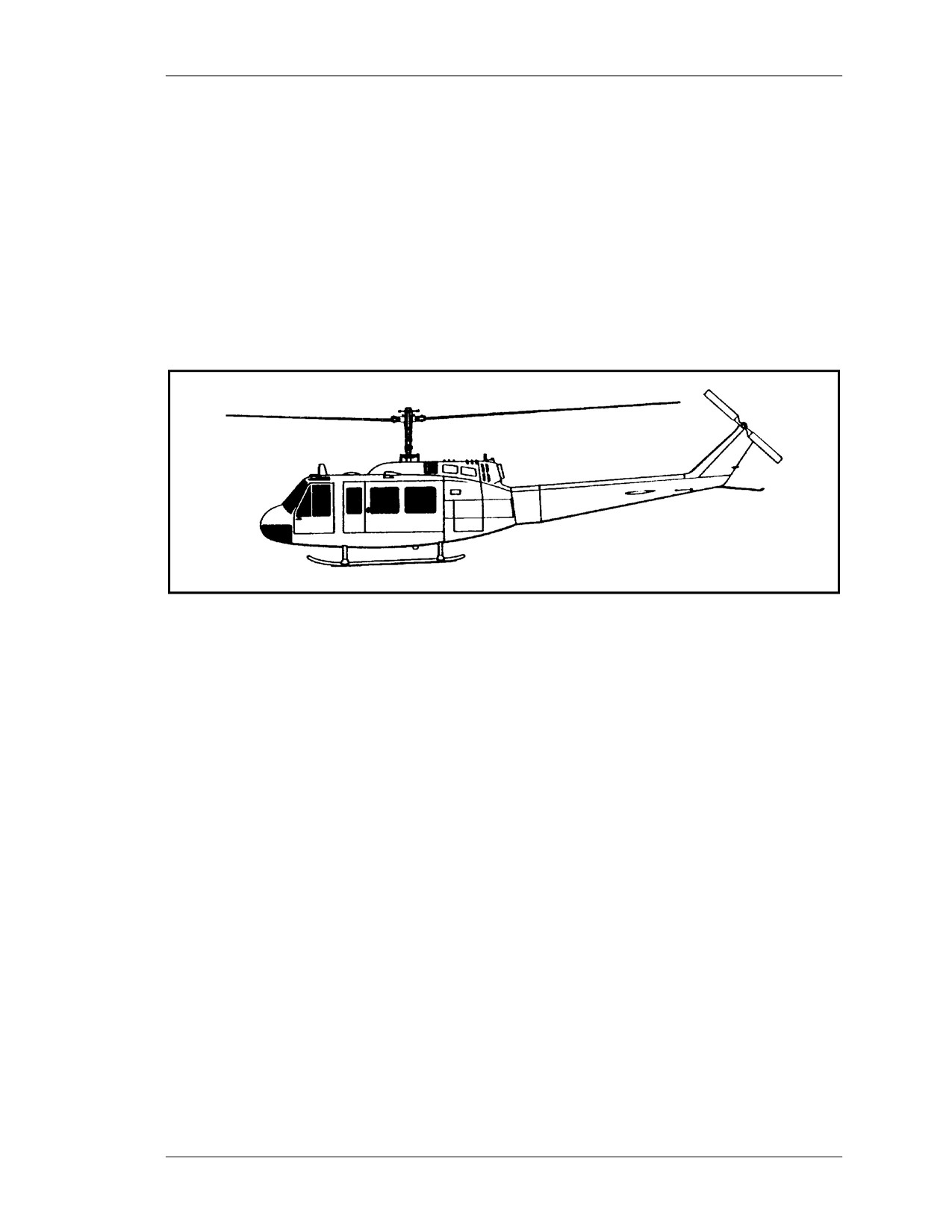
FM 3-21.220/MCWP 3-15.7/AFMAN11-420/NAVSEA SS400-AF-MMO-010
position and protects the rip cord grip. The jumpmaster will ensure the jumper is securely
attached to the aircraft and will not break free during descent. If the jumper is not
securely attached, the jumpmaster will attempt to shake or cut him free. If the jumper is
attached, the aircraft will slowly descend to the DZ and come to a hover, and the jumper
will be freed from the aircraft.
Section II. UH-1H IROQUOIS/UH-1N HUEY
The Army’s UH-1H is powered by a single gas turbine engine; the USMC UH-1N has
two gas turbine engines. Up to 8 combat-equipped parachutists can jump from the
UH-1H/UH1-N, consistent with weight limitations (Figure 17-1). The JM is a static JM.
Figure 17-1. UH-1H Iroquois/UH-1N Huey.
17-11. PREPARATION AND INSPECTION
Prepare and inspect the UH-1H as follows:
a. Preparation. The following steps prepare the UH-1H for jumping:
(1) Both cargo compartment doors are locked in the open position. If the doors cannot
be locked, they are removed.
(2) All troop seats are removed except one seat on each side (located to the rear of the
pilot and copilot seats). These two seats are installed so they are facing to the rear of the
aircraft. If the parachutists are equipped with combat equipment and eight parachutists
are to jump, all seats in the cargo compartment are removed.
(3) The door and frame are inspected to ensure there are no sharp edges that could cut
or fray static lines. If these are determined to be hazardous, corrective action is taken
before the helicopter is jumped.
(4) Under field conditions, the door and frame can be padded and taped to preclude a
mission abort. Otherwise, the aircraft is returned to maintenance for correction of the
deficiency.
(5) Safety belts are attached to the tie-down rings on each side of the compartment for
floor-seated parachutists.
(6) The door gunner/crew chief foot-operated radio switch may be unscrewed (by
hand) before jumping. The exposed radio switch wires are taped to prevent an electrical
short. If the switch is not removed, it is padded and taped. The ground-handling
wheel-mount brackets on both landing skids are padded with cellulose wadding and taped
17-3
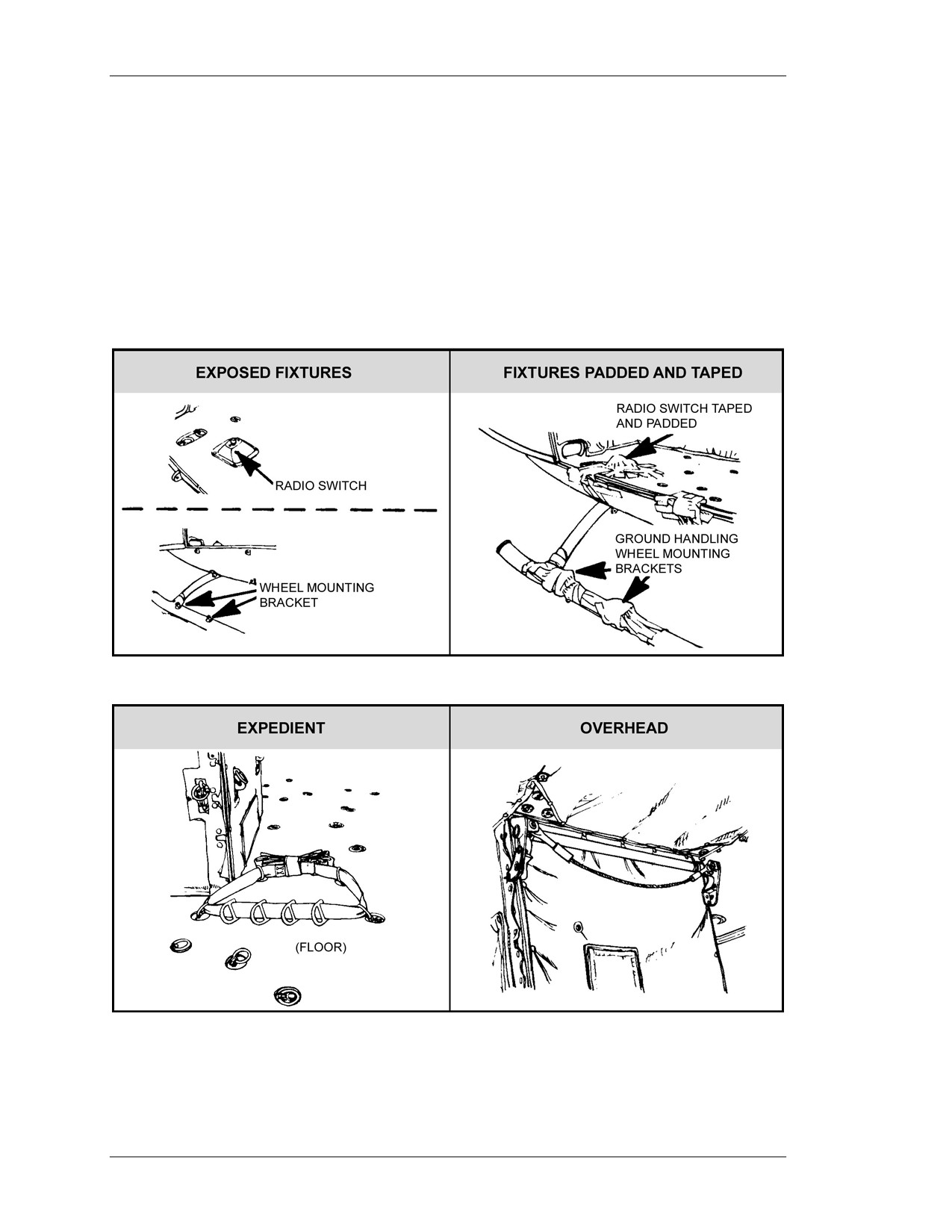
FM 3-21.220/MCWP 3-15.7/AFMAN11-420/NAVSEA SS400-AF-MMO-010
(Figure 17-2, page 17-4). Some aviation units have fabricated special covers that may be
used to cover the wheel-mount brackets.
b. Anchor Line Systems. Two anchor line systems are available with the UH-1H
aircraft for airdrop of personnel. They are the standard overhead system and the
expedient system (Figure 17-3, page 17-4). The expedient system (modified STABO
strap or Type XXVI nylon webbing anchor line cable assembly) consists of a nylon A-7A
strap, four D-rings, and four connector snaps (TM 10-1670-298-20&P authorized the
fabrication of the modified STABO strap or Type XXVI nylon webbing strap from Type
XIII nylon webbing). Nylon modified STABO straps or Type XXVI nylon webbing must
be used with cotton buffers on the D-rings and connector snaps.
Figure 17-2. UH-1 exposed fixtures padded.
Figure 17-3. UH-1 anchor line system.
c. Anchor Line Assembly Installation. An anchor line assembly is installed on
each side of the aircraft. It can be installed quickly by means of four tie-down rings
17-4
FM 3-21.220/MCWP 3-15.7/AFMAN11-420/NAVSEA SS400-AF-MMO-010
located on the floor on the right and left sides of the aircraft compartment. The modified
STABO strap or Type XXVI nylon webbing strap is threaded through the D-rings, which
are used for attachment of the static line snap hooks (Figure 17-4).
(1) Left Door. For the left door, one connector snap on the modified STABO strap or
Type XXVI nylon webbing strap is attached to the tie-down ring number G2. The strap is
connected to the tie-down ring number F4. Four D-rings are on the strap with the round
part of the rings facing outboard (of aircraft). The strap is then connected to tie-down ring
number K3 and tie-down ring number J4. The free end of the strap is secured to the strap
fastener, and any excess between tie-down rings number J4 and number G2 is taped. All
connector snaps must be safety wired.
(2) Right Door. The same procedures apply to the right door as the left except that
the A-7A strap is attached to tie-down ring number G1, then to F2. Four D-rings are on
the strap with the round part of the rings facing outboard (of aircraft). The free end of the
strap is secured to tie-down rings number K2 and number J3, and the strap fastener is
secured. Excess strap between tie-down rings number J3 and number G1 is taped.
d. Inspection. Before enplaning, the JM and pilot, or pilot’s representative, jointly
inspect the aircraft to determine the following:
(1) All protruding objects near the cargo compartment doors are removed or taped.
(2) The lower right and left aft edges of both the cargo compartment doors are padded
and taped.
(3) The anchor line cable or field-expedient anchor line system is secure, serviceable,
and properly installed.
(4) A safety belt is available for each parachutist.
(5) A headset is available for the jumpmaster to effect coordination among the
jumpmaster, the pilot, and the ground.
17-12. LOADING TECHNIQUES AND SEATING CONFIGURATION
During loading, jumpers should not approach directly from the front or sides but at a
45-degree angle to the nose of the aircraft. Jumpers
1 through 4 enter the cargo
compartment through the right door, are hooked up by the JM in numerical order, and
seat themselves
(Figures 17-4 and
17-5). Jumpers
5 through
8 enter the cargo
compartment through the left door, are hooked up by the JM in numerical order, and seat
themselves.
17-5