FM 3-21.220 STATIC LINE PARACHUTING TECHNIQUES AND TRAINING (SEPTEMBER 2003) - page 6
FM 3-21.220/MCWP 3-15.7/AFMAN11-420/NAVSEA SS400-AF-MMO-010
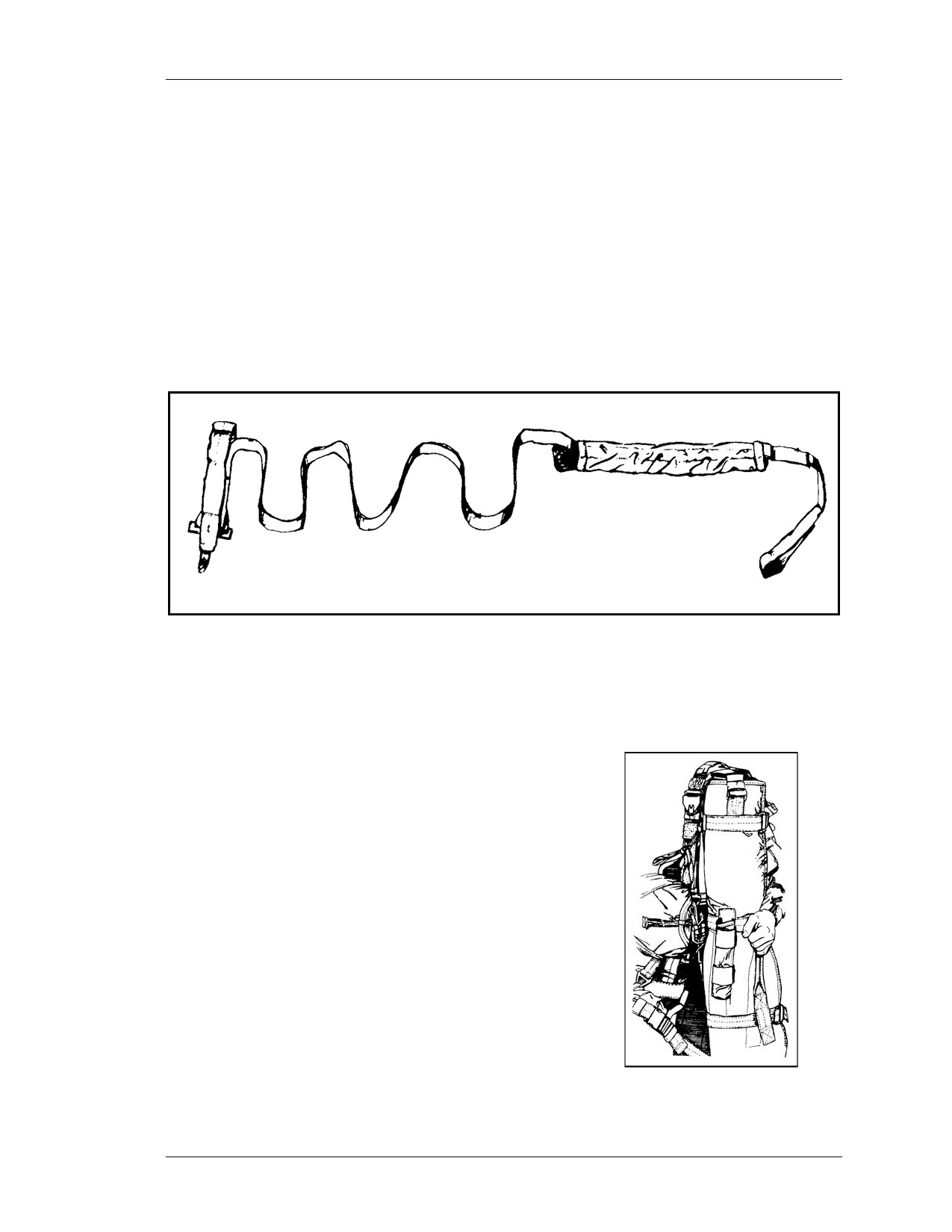
12-54. ALICE PACK WITH FRAME AND AT4JP RIGGED
The quick-release snap is not attached at this point. This will be accomplished during the
equipment attaching sequence. To stow the DMJP/AT4JP modified lowering line for
tandem load, the following must be performed:
a. S-fold the lowering line neatly on top of the web inside the retainer, ensuring that
ends are stacked evenly with the retainer outer edges.
b. Secure the pile tab on the web that is located 46 inches from the ejector snap end
to hook extension on retainer.
c. Fold the hook side of the flap tightly over S-folded lowering line and, holding it
firmly, fold the pile side of the flap over and secure hook and pile together.
d. Secure the pile extension on the retainer flap to the hook tab at the looped end of
the lowering line (Figure 12-56, page 12-56).
Figure 12-56. HPT lowering line stowed for tandem load.
12-55. EQUIPMENT ATTACHED TO PARACHUTIST (MODIFIED STOWED
LOWERING LINE)
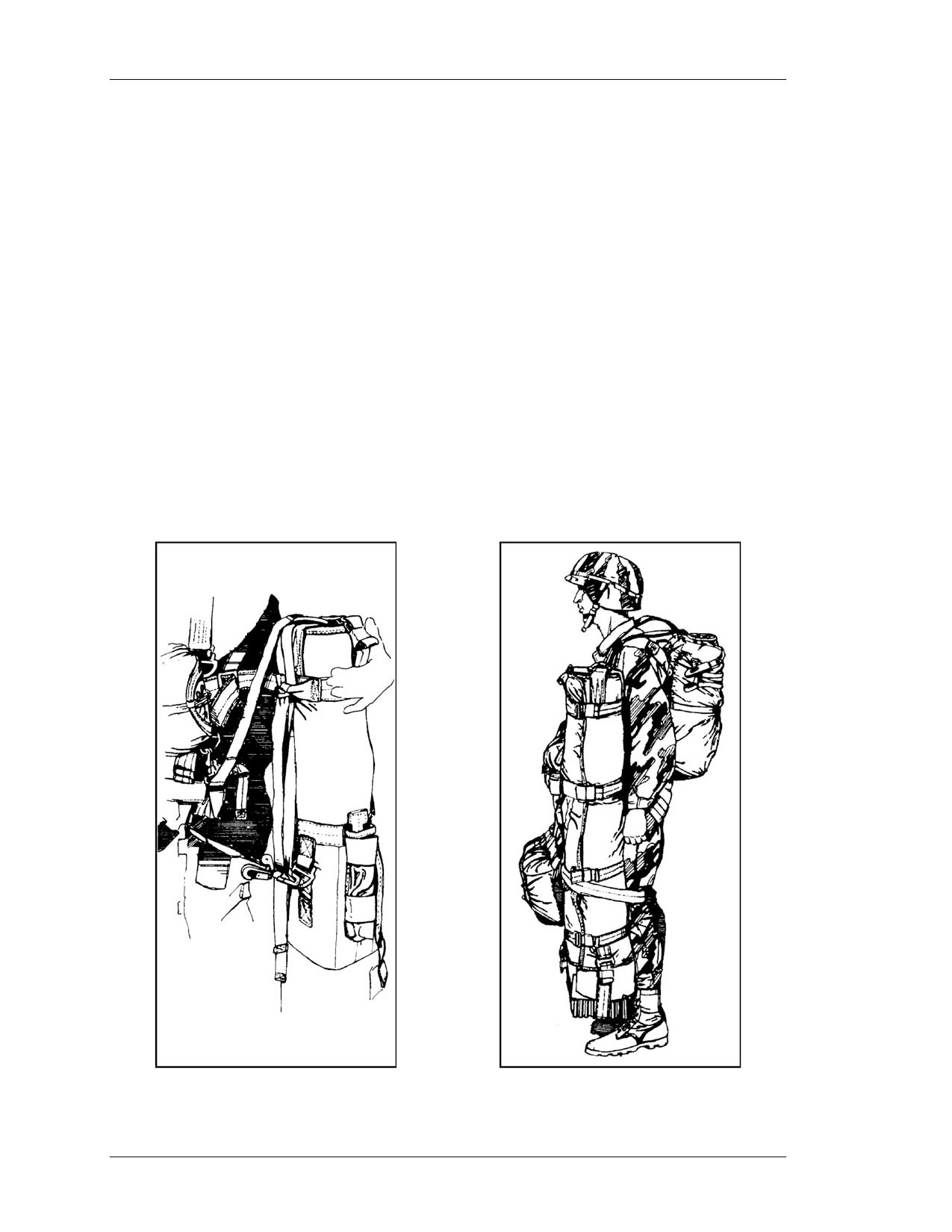
To rig the ALICE pack with frame, the parachutist’s ALICE pack with frame is prepared
following procedures listed in paragraph 12-43 with
the following exception: secure the modified stowed
lowering line to the left side
(as worn on the
parachutist) on the vertical pack frame bar in two
places with two turns of masking tape or two sets of
retainer bands. The lowering line ejector snap faces
up and to the right or left.
a. Attach the D-ring attaching strap snap hooks
(on rigged ALICE pack) to the harness D-rings
outside of the reserve connector snaps.
b. Secure the ALICE pack to the parachutist’s
leg.
c. Stand the rigged AT4JP next to the
parachutist’s left side.
d. Grasp the ejector snap of the modified HPT
lowering line already attached to the ALICE pack
and route (from bottom to top) through the D-ring
Figure 12-57. Attaching
opening at the center of the pack, upper tie-down
equipment to parachutist.
12-53
FM 3-21.220/MCWP 3-15.7/AFMAN11-420/NAVSEA SS400-AF-MMO-010
chafe loop, and top D-ring located at the aft end. Position the 18-inch strata blue marking
on the modified HPT lowering line even with the D-ring on top of the AT4JP
(Figure 12-57).
e. Attach the quick-release snap to the AT4JP. The snap opening faces away
from the pack.
f. Attach the modified HPT lowering line ejector snap to the lowering line
adapter web.
g. Secure the AT4JP by attaching the quick-release assembly to the left D-ring
outboard of the H-harness snap. Ensure that the quick-release safety gate is closed, the
quick-release snap is locked to the D-ring, and the quick-release assembly release lever is
fully seated (do not safety tie). The harness left D-ring snap attachment sequence is
inboard to outboard as follows: reserve, H-harness, and AT4JP quick-release snap.
h. Route the upper tie-down tape under and around the left main lift web directly
below the chest strap. Tie snugly with a double-loop bowknot on the front of the AT4JP
where it is easy to reach (Figure 12-58).
i.
Route the lower tie-down tape around the AT4JP and the left leg. Tie with a
double-loop bowknot on the front of the AT4JP where it is easy to reach. If the HSPR is
used, remove the lower tie-down on the AT4JP and route the left leg strap of the HSPR
around the outside of the AT4JP, then tighten (Figure 12-59).
Figure 12-58. Routing upper
Figure 12-59. Lower tie-down tape
tie-down.
routed around AT4JP.
12-54
FM 3-21.220/MCWP 3-15.7/AFMAN11-420/NAVSEA SS400-AF-MMO-010
12-56. ALICE PACK AND AT4JP RELEASED
The lower and upper tie-downs on the AT4JP are released.
a. Release the ALICE pack as follows:
(1) H-harness (modified). Release the lower tie-down tape on the ALICE pack. About
100 to 200 feet above ground, drop the ALICE pack by simultaneously pulling the
quick-release folds on the D-ring attaching straps, allowing the pack to fall to the end of
the line.
(2) HSPR. About 200 feet above the ground, grasp the release handle and pull up and
out quickly, simultaneously releasing the load from the harness and legs, allowing the
load to drop the length of the lowering line. Release the handle immediately following
separation of the load from the parachutist. Secure the handle for releasing the load to
the HSPR with a length of tubular webbing and stay with the HSPR to prevent its loss
and separation.
b. Push out on the activating arm of the quick-release assembly of the AT4JP to
lower the AT4JP. The AT4JP will either fall to the end of its lowering line or slide down
the tandem lowering line to the ALICE pack.
NOTE: To jettison the ALICE pack and AT4JP in an emergency, the parachutist (after
performing the above) lifts the reserve up and pulls the yellow safety lanyard
on the lowering line ejector snap, allowing the ALICE pack and AT4JP to fall
free.
WARNING
Under no circumstances will the parachutist release the AT4JP
before releasing the ALICE pack.
c. Upon landing, remove the HPT lowering line by pulling the line through the two
D-rings and disassembling the girth hitch on the H-harness.
d. Store the AT4JP modified HPT lowering line and polyurethane shock absorber
with the AT4JP for reuse.
Section XIII. ALL-PURPOSE WEAPONS AND EQUIPMENT
CONTAINER SYSTEM (AIRPAC)
The AIRPAC is a lightweight nylon equipment pack system used to enclose a jump load.
The AIRPAC front-mount container can accommodate all size packs, M47 tracker,
radios, and 60-mm mortar with baseplate or bipod. The side-mount container can hold
one M47 round of ammunition, the AT4, M4, M24, SAW, M60 machine gun, and other
ancillary equipment.
12-57. COMPONENTS
The AIRPAC consists of the front-mount container, the side-mount container, and the
parachutist’s individual equipment rapid release (PIE/R2) release mechanism.
12-55
FM 3-21.220/MCWP 3-15.7/AFMAN11-420/NAVSEA SS400-AF-MMO-010
12-58. RIGGING LOADS IN THE FRONT-MOUNT CONTAINER
Loads in the front-mount container are rigged as follows:
a. Rigging the ALICE Pack and the Field Pack, Large, Internal
Frame (FPLIF).
(1) Extend all retaining straps outward to their limits. (The retainer strap with the
circular closing flap is the top of the container.)
(2) Place the container so that the retaining straps face the ground and the parachute
recovery bag faces up.
(3) Fold the parachute recovery bag (PRB) so that no portions protrude outside the
container limits.
(4) Place pack on the PRB. Ensure the circular release rings on the bottom of the
container are not constrained by the pack. The ALICE pack is jumped upside down with
the waist pad against the front of the thighs. The FPLIF is jumped right side up.
(5) Bring the right side of the container material up first, then the left side and the
bottom flap, and then the top flap.
(6) Place the circular closing flap on top of the pack and open the circular closing flap
by pulling the tab. Bring the left, right, and bottom retaining straps to the center of the
circular closing flap and route the white grommet securing loop through each grommet of
the retaining straps. No specific order is required. Bring the top flap material up last.
Place the cotter pin through the white grommet securing loop.
(7) Tighten all retaining straps, ensuring that the circular closing flap remains
centered on the ALICE pack. Adjust the protective flaps to stow excess fabric. Close the
circular closing flap using three hook-pile tabs.
(8) Underhand fold the free-running ends of the retaining straps toward the friction
adapters and secure them under the webbing retainers.
NOTE: The circular release rings should be exposed on the top flap of the front-mount
container. If the rigged pack is above the rings and restricts the rings’
movement, the load must be adjusted.
b. Rigging the Release Mechanism of the Front-Mount Container.
(1) Stand the rigged pack in an upright position with the bottom of the AIRPAC
facing the jumper.
(2) Route release handle cables through the cross strap on top of the container and
secure the HPT.
(3) With the attaching strap snap hook facing down and towards the jumper, route the
circular ring of the attaching strap (from bottom to top) through the circular release ring
on top of the container. Fold the circular ring of the attaching strap back over and route
the red attaching loop through the attaching ring on the attaching strap. With the cable
loop retainer on the female portion of the leg strap release assembly facing up, route the
red attaching loop from bottom to top through the grommet on the female portion of the
leg strap release assembly. Route the release handle cable through the red attaching loop
and then through the cable loop retainer. Repeat this sequence for the other strap.
12-56

FM 3-21.220/MCWP 3-15.7/AFMAN11-420/NAVSEA SS400-AF-MMO-010
c. Rigging the HPT Lowering Line.
(1) Select the desired landing orientation of the front-mount container (horizontally or
vertically) and attach the short bridle to the appropriate triangle link.
(2) Route the looped end of the HPT lowering line through the unsewn portion of the
short bridle and form a girth hitch. Place a retainer band around the nylon tab located
inside the closure flaps. Route the HPT lowering line through the retainer band and stow
in the retention pocket. Secure the HPT.
(3) For transportation, attach the ejector snap to the primary short bridle triangle link.
12-59. RIGGING LOADS IN THE SIDE-MOUNT CONTAINER
Rigging procedures for the side-mount container are as follows:
a. Place the side-mount container on the ground with the friction adapters facing
down and the free-running ends of the internal securing strap to the right. Then, position
packing material flush with the bottom edge of the fabric flaps and place the weapon on
the container in the following orientation (Table 12-3):
WEAPON
PACKED ORIENTATION
PACKING MATERIAL
M60 MG/SAW
Muzzle up
None required
AT4
Muzzle up
1 piece 6” by 6” honeycomb on bottom
60-mm Mortar
Muzzle down
1 piece 6” by 6” honeycomb on bottom
Dragon
Muzzle down
2 pieces 8” by 8” honeycomb on bottom
Table 12-3. Packed weapon orientation and packing material required for
side-mount container.
b. Tape and pad exposed or protruding parts (that is, sight posts, grip stocks, or
bipods) with a soft material such as cellulose wadding or an adequate substitute.
c. Center load on the internal securing strap and pull lower fabric flap over packing
material. Route free-running end of internal securing strap through the friction adapter on
the lower fabric cap. Place floating V-ring of internal securing strap on the top center of
the load. Form a 5- to 6-inch quick release in the strap and tighten. From the top, fold
excess weapons container material downward until flush with the top of the load.
d. Wrap unpadded fabric flap over weapon. Bring padded fabric flap over load and
loosely secure container retaining straps to friction adapters; form a 5- to 6-inch quick
release in the strap. Do not tighten strap.
NOTE: If jumping an individual weapon, place weapon muzzle down in container
slide-fastener compartment. Secure the slide fastener.
e. Tighten the container retaining straps
(with quick releases). S-fold excess
webbing and secure to the quick-release loop with two turns of a retainer band, leaving a
3-inch tail. Secure drawstring on top of container with a quick-release knot, if necessary.
12-57
FM 3-21.220/MCWP 3-15.7/AFMAN11-420/NAVSEA SS400-AF-MMO-010
12-60. RIGGING AIRPAC AS TANDEM LOAD WITH HOOK-PILE TAPE
LOWERING LINE
The AIRPAC is rigged as a tandem load with HPT lowering line as follows:
a. If the HPT lowering line is attached to the front-mount container, detach and
place to the side. Using the extended bridle, place the looped end through unsewn portion
of short bridle and secure with a girth hitch. Route looped end of HPT lowering line
through floating V-ring of extended bridle and form a girth hitch.
b. Stow the HPT lowering line in the retention pocket. Stow extended bridle excess
in the retention pocket, allowing for a 2-foot running end. Secure the retention pocket and
attach the ejector snap of the HPT lowering line to the accessory attaching ring, triangle
link, or left D-ring on the parachutist’s harness.
c. After the side-mount container is attached to the jumper, the extended bridle snap
hook is attached to the V-ring on the top of the side-mount container.
12-61. AIRPAC ATTACHED TO PARACHUTIST USING PIE/R2 RELEASE
MECHANISM
AIRPAC is attached to parachutist using the PIE/R2 release mechanism as follows:
a. Place the front-mount container attaching straps under the reserve parachute and
attach the front-mount container snap hooks to the enlarged D-rings on the outside of the
reserve connector snaps (same as a single-point release system).
b. Attach the HPT lowering line ejector snap to the parachutist harness lowering line
adapter web.
NOTE: When using the PIE/R2 release mechanism, ensure the harness has a lowering
line adapter web or new harness triangle link.
c. Attach the PIE/R2 release mechanism to the side-mount container (located on
jumper’s left side) by placing the hook portion of the snap shackle with the hook through
the quick-release link from top to bottom. The spring-loaded gate should face away from
the container. Remember to hook the gate toward jumper’s groin muscle.
d. Open the snap shackle with hook, attach to the D-ring on the outside of the
attaching strap snap hook from back to front, and close the snap shackle.
e. Take the extended bridle snap hook and attach to floating V-ring on top of side
container. Secure extended bridle under retention flap on container.
f. On the PIE/R2 release mechanism, route the upper attaching strap around the
back of the side-mount container, through the main lift web, and above the chest strap.
With orange release handle facing forward on the side-mount container, route the
grommet tab through the looped end of the upper attachment strap, over the red attaching
loop, and secure with cable. Tighten the upper strap, ensuring that the orange release
handle stays on the front portion of the side-mount container.
g. Connect the white release lanyard snap hook to the short bridle attaching the
V-ring on the top of the front-mount container. Listen for a metallic click and pull to
ensure the snap hook is secure.
h. Attach the leg straps, ensuring the left leg strap is also routed around the side
container. Tighten and secure. Stow excess webbing under webbing retainers.
12-58
FM 3-21.220/MCWP 3-15.7/AFMAN11-420/NAVSEA SS400-AF-MMO-010
Section XIV. STINGER MISSILE JUMP PACK
The Stinger missile jump pack provides a means for the air delivery of the Stinger missile
system when it is attached to a jumper during airborne operations. The SMJP is an
overpack body constructed of nylon duck material, shock-absorbing material, nylon
securing straps, an HPT lowering line, and a quick-release snap shackle.
WARNING
Parachutists carrying the SMJP will jump from the first two
positions in the stick only. Parachutists who are less than 5
feet 8 inches in height are not permitted to jump the SMJP. The
SMJP is authorized to be jumped from C-130 and C-141 aircraft
only.
12-62. COMPONENTS
Components of the Stinger missile jump pack are as follows:
a. The SMJP consists of a pack body constructed of nylon duck material, shock-
absorbing material, nylon securing straps, an HPT lowering line, and a quick-release snap
shackle.
b. When rigged with a Stinger missile round, the SMJP is 12 inches in diameter, 68
inches long, and weighs approximately 38 pounds. It is secured vertically by the quick-
release snap shackle to the left D-ring on the parachutist’s harness. To prevent the SMJP
from swaying during exit and deployment of the parachute, the parachutist uses the nylon
webbing tie-downs to secure the SMJP to the left leg and to the parachute harness at chest
level.
c. The HPT lowering line with a 6-foot extension is part of the SMJP system. The
web loop end of the lowering line extension is attached to the SMJP with the HPT
lowering line ejector snap routed through the D-ring on the other end of the extension
sling and to the lowering line adapter web on the parachute harness. The HPT lowering
line is attached to a front-mount container (ALICE pack, large, or the FPLIF) which
contains the detachable Stinger weapon round components (gripstock, IFF, and the three
BCUs). The parachutist lowers the SMJP and ALICE pack by pulling the SMJP
quick-release assembly. Upon landing, the parachutist can rapidly gain access to the
Stinger.
12-63. RIGGING PROCEDURES
Rigging procedures for the Stinger missile jump pack are as follows:
NOTES:
1. Throughout the rigging procedure, duct tape and masking tape are used to
tape various parts of the webbing. The jumper can use duct tape for
masking tape, except where the procedures state “masking tape only.”
2. Throughout the instructions, the phrases “forward end” and “aft end” are
used to describe the SMJP, Stinger missile round, and FHT. The forward
12-59
FM 3-21.220/MCWP 3-15.7/AFMAN11-420/NAVSEA SS400-AF-MMO-010
end is nearest the gripstock and sight assembly; the aft end is furthest from
the gripstock and sight assembly.
a. Stinger Round. Before rigging the SMJP, inspect the Stinger round or FHT IAW
TM 9-1425-429-12. A Stinger round exhibiting damage must not be jumped under any
circumstances. It must be returned to the ASP for repair. Field handling trainers that
exhibit signs of general minor damage and no major ruptures or cracks may be jumped if
the damage does not exceed safe or serviceable limits. Pad the Stinger round with a
6-inch-wide piece of cellulose wadding placed around the aft end of the round near, but
not on, the blowout disk. Tape the wadding with masking tape only.
b. Aft Foam End Cap. Place the foam end cap on the aft end of the missile round,
one half at a time, ensuring the foam posts slide into the holes in the opposite end cap
half. The end cap should fit snugly. If not, check to see that both halves fit together
without any gaps and there is enough cellulose wadding about the missile round. Tape the
foam end cap halves together using duct tape.
c. Front Cover. Make sure the front cover is on firmly. If loose, use a pen (or
similar object) to press in the three rubber spacers on the cover. Push each spacer in
evenly to achieve a firm fit between the cover and the missile round. The cover should
slide on snugly when properly adjusted. Make sure the tab on the cover aligns with the
notch on the missile round. When the cover is properly fitted, the “lollipop” should be
visible when looking through the sight.
d. Forward Foam End Cap. Place the foam end cap on the forward end of the
missile round in the same fashion, ensuring that the “lollipop” on the front cover is
positioned in the cutout of the foam end cap. Tape the foam end caps together using duct
tape, ensuring that there are no gaps.
e. Sight. Flip up the sight on the missile round.
(1) Fold a piece of cellulose wadding, making a piece that is 6 inches by 24 inches.
Place the wadding under the sight and lower the sight down onto the wadding. Make sure
that the wadding is not placed over the clip. Firmly press down on the sight to make the
wadding fill the gap between the sight and the missile round and lock the sight into
position.
(2) Loosely wrap cellulose wadding around the entire sight area until the wadding
measures about 11 to 12 inches in diameter, about the same as the diameter of the foam
end cap. Tape the wadding in place using masking tape only.
f. Stinger Round Positioning. Place the SMJP on the ground, felt side up. Make
sure all straps are extended. Position the missile in the SMJP with the aft foam end cap
fitted in the SMJP nonadjustable end strap bridle and with the missile round carrying
strap facing up.
g. SMJP Closing. Fold the pack around the missile, keeping the securing strap
quick-fit adjusters on the outside of the pack.
(1) Route the side securing straps through the quick-fit adjusters using a quick-release
fold. Loosely tighten the straps to form the SMJP around the missile. Do not tighten the
straps.
(2) Place the SMJP on the aft end so the free-running end straps are on top. Route the
end straps through the quick-fit adapter opposite of each strap. Sit on the ground, place
12-60
FM 3-21.220/MCWP 3-15.7/AFMAN11-420/NAVSEA SS400-AF-MMO-010
your foot on the forward end cap, and tighten the adjustable straps. Tighten the end
straps. Do not use a quick-release.
(3) Place the pack on the side and tighten the side securing straps, using a quick
release. Tighten the side securing straps so the pack overlaps the entire length of the
round. S-fold excess webbing and tape, using masking tape only.
NOTE: If there is a gap near the sight assembly, remove cellulose wadding until the
gap is closed.
(4) Stand the SMJP on the aft end cap. Center a 6-inch by 6-inch piece of honeycomb
on the forward end cap. Route the free-running end straps over the honeycomb, through
the opposite quick-fit adapters, and tighten to form an X over the honeycomb.
(5) Secure straps with a quick release.
(6) S-fold excess webbing and tape with duct tape.
h. Attachment of the Quick-Release Assembly. Secure the quick-release web and
SMJP HPT. Route the coated wires into the fabric guides. Hook the quick-release shackle
onto the lowest SMJP D-ring which, when the SMJP is attached to the jumper, keeps the
SMJP from dragging the ground.
NOTE: The quick-release handle must face toward the jumper’s rear.
WARNING
A parachutist harness with too much slack, or with the
incorrect SMJP D-ring, will cause the SMJP to drag on the
aircraft floor and can result in jumper injury when he exits the
aircraft.
i.
Weapon Components Rigging. The gripstock, IFF, and the three BCUs are
packed in the ALICE pack or FPLIF where they can be quickly recovered on the DZ.
(1) To protect the weapon components, load hard items in the lower portion of the
pack, place soft items on top of the hard items, and pack the Stinger weapon components
on top of the soft items near the top of the pack.
(2) Wrap each component with one wrap of cellulose wadding and secure with
masking tape only.
(a) Gripstock antenna. The gripstock antenna must be in the folded position. Secure
the gripstock antenna attaching clip in the closed position, with masking tape only.
(b) IFF. The interconnecting cable must remain attached to the IFF and wrapped
separately to avoid metal-to-metal contact between the cable and IFF. Secure the
wrapped cable to the wrapped IFF. Ensure the electrical outlet protecting cap is in place.
12-64. STINGER MISSILE JUMP PACK ATTACHED TO PARACHUTIST
The SMJP is the last item attached to the parachutist harness.
a. Secure the SMJP to the parachutist harness by attaching the quick-release snap
shackle to the left D-ring, ensuring it opens away from the jumper.
12-61
FM 3-21.220/MCWP 3-15.7/AFMAN11-420/NAVSEA SS400-AF-MMO-010
NOTE: Failure to place the snap shackle away from the jumper may cause the SMJP
to hang when the release is activated.
b. Route the lowering line ejector snap hook through the SMJP lowering line
extension sling D-ring and connect to the lowering line adapter web.
c. Secure the lowering line and SMJP HPT.
d. Secure the lowering line extension to the SMJP and tape with masking tape only.
Make sure there is no slack in the lowering line extension.
e. Route the chest tie-down around the left main lift web directly below the chest
strap and around the SMJP. Route the chest tie-down strap with grommet through the
chest tie-down loop. Route the red fabric loop through the grommet and place the coated
wire through the red loop.
f. Route the leg tie-down around the parachutist’s left leg, through the frame on the
ALICE pack or through the nearest equipment retaining ban on the FPLIF, and around
the SMJP. Secure in the same manner as the chest tie-down.
g. Attach a 6- to 8-foot doubled piece of 1/4-inch, 80-pound cotton webbing to the
SMJP carrying handle. Route the cotton webbing through a secure loop on or near the
bottom of the front-mount ALICE pack and tie to the handle of the HSPR.
NOTE: The jumper must use the HSPR when jumping the SMJP.
12-65. INDIVIDUAL JUMP PROCEDURES
The SMJP must be jumped with a front-mount container.
a. At the 20-minute warning, a safety attaches the SMJP to the parachutist and
inspects it.
b. At exit, the jumper must not assume a tight body position. A tight body position
causes severe twists and may flip the jumper through his risers. It also causes
entanglement in suspension lines.
c. About 200 to 100 feet above the ground, the jumper ensures the area below is
clear and activates the release by pulling the orange release tab down and away from his
body with the left hand. The SMJP falls the length of the lowering line.
NOTE: To jettison the SMJP, the parachutist lowers the SMJP and pulls out on the
yellow lanyard attached to the quick-ejector snap.
Section XV. RANGER ANTIARMOR/ANTIPERSONNEL WEAPON SYSTEM
PACKED IN AT4JP AND DRAGON MISSILE JUMP PACK
The AT4JP and Dragon missile jump pack can be used to secure the RAAWS during
airborne operations.
12-66. COMPONENTS AND CONTAINER DESCRIPTION
The RAAWS consists of three main components plus the cleaning kit and gun-mount.
a. Main Components. The main components are the weapon system, the telescopic
sighting system, and various types of loads.
12-62
FM 3-21.220/MCWP 3-15.7/AFMAN11-420/NAVSEA SS400-AF-MMO-010
(1) Weapon and telescoping sighting system. When carried by the parachutist, they
are packed in the AT4JP.
(2) Rounds of ammunition. The missile round containers are constructed of molded
polyethylene. The rounds come in two container sizes: 27.6 inches (TP and HEAT) and
21 inches (illumination, smoke, and HE). The TP and HEAT round containers must be
rigged in a DMJP (modified). Illumination, smoke, or HE missile rounds are packed
under the top pack flap of the large ALICE pack or FPLIF.
b. Cleaning Kit and Gun-Mount. The cleaning kit and gun-mount are packed
separately near the top of the jumper’s ALICE pack or FPLIF.
c. Container Description. When configured for RAAWS rigging, the AT4JP
cannot be rigged with the M16/M203. The AT4JP is about 49 inches long and 9 inches in
diameter, and it weighs about 26 pounds. It is secured vertically to the left D-ring on the
parachutist harness. To prevent the AT4JP from swaying, two tie-down tapes are
attached. The upper tie secures the AT4JP to the main lift web below the chest strap, and
the lower tape secures the jump pack to the parachutist’s left leg (provided the jumper is
not using the HSPR). A 15-foot lowering line and 24-inch lowering line attachment web
are used. Two 9-inch by 9-inch pieces of honeycomb are used at the venturi end of the
weapon (on the bottom, when rigged) to cushion the weapon during impact. After
landing, the parachutist rapidly gains weapon access by pulling seven quick releases.
12-67. RIGGING PROCEDURES
Rigging procedures for RAAWS components are as follows:
a. Rig the RAAWS weapon and sighting system.
(1) Lay the jump pack on the ground (felt side up) and fully extend all securing webs.
(2) Place the venturi and muzzle covers on the weapon.
(3) Position the telescopic sight package on the weapon (between the front grip and
the shoulder pad) and alongside the firing mechanism. Secure the telescopic sight
package to the weapon with two lengths of 1/4-inch cotton webbing.
(4) Place the weapon on the pack with the front grip pointed straight up, the muzzle
(small end of weapon) fitted into the nonadjustable cross D-ring strap, and the venturi
(large end of weapon) centered on the middle launcher aft end securing strap.
(5) Ensure the muzzle fits snugly into the nonadjustable cross D-ring strap.
(6) Fold the rifle and muzzle pockets portion of the pack over the weapon.
(7) Rotate the unfolded flap portion over the other flap and route the four side
securing straps through the adapters and form quick releases. S-fold the running ends and
secure by folding excess back under corresponding quick-fit adapter.
(8) Position two 9-inch by 9-inch pieces of honeycomb onto the venturi of the
weapon. Route the two aft end securing straps over the honeycomb, through the quick-fit
adapters, and tighten securely. Form a quick release with the running ends, S-fold the
excess, and secure by folding excess back under the corresponding quick-fit adapter.
(9) Route one turn of 1/4-inch cotton webbing around the securing straps between the
honeycomb and the pack; tie securely. (This tie will prevent the honeycomb from
shifting.)
(10) Attach the HPT lowering line to the AT4JP using procedures described in
paragraph 12-8. If the AT4JP lowering line is to be employed, a 24-inch lowering line
adapter web must be attached to the parachutist harness.
12-63
FM 3-21.220/MCWP 3-15.7/AFMAN11-420/NAVSEA SS400-AF-MMO-010
b. Rig the RAAWS 84-mm TP and HEAT rounds in the DMJP MOD.
NOTE: Due to the length of the TP and HEAT twin-tube containers, the containers
must be jumped inside the DMJP MOD. DMJP modification procedures are
described in paragraph 12-70.
(1) Lay the DMJP MOD on the ground felt side up.
(2) Center the long twin tube containers on the DMJP MOD.
(3) Route the center vertical and horizontal securing straps over the container and
secure with a quick release. Ensure the tubes are oriented so the container caps are at the
upper portion of the pack.
(4) Fold the flap containing the M16/M203 rifle muzzle stow pocket over the tubes.
(5) Place the M16/M203 rifle muzzle into the stow pocket, ensuring the carrying
handle is facing away from the tubes.
(6) Fold the unfolded flap over the M16/M203 and secure the three horizontal
securing straps. Ensure the center securing strap is routed through the rifle carrying
handle. Form quick releases in the running ends, S-fold, and fold the excess back under
the corresponding quick-fit adapters.
(7) Route the rifle butt securing strap over the butt and through the quick-fit adapter.
Pull as tight as possible and form a quick release.
(8) Cut two pieces of honeycomb 5 inches by 11 inches. Place the two pieces onto the
end of the container with the exposed rifle butt. Route the two aft end securing straps
over the honeycomb, through the quick-fit adapters, and secure as tight as possible.
S-fold the excess back under the corresponding quick-fit adapters.
(9) Tie the two securing straps together at the point where they cross with one turn of
1/4-inch cotton webbing to prevent them from shifting.
(10) Cut two pieces of 5 1/2-inch by 9 1/2-inch honeycomb. Place the honeycomb on
the other end (top) portion of the container.
(11) Route the center securing strap through a D-ring, over the honeycomb, and
through the quick-fit adapter. Tighten securely, S-fold, and fold the excess back under the
corresponding quick-fit adapters.
NOTE: The nonadjustable strap is not used. It is pushed into the top of the pack before
placing the honeycomb on top.
(12) Secure the D-ring to the center of the strap by running a length of 1/4-inch cotton
webbing through the lower portion of the D-ring, around the strap, and tying. This will
prevent the D-ring from shifting on the strap.
(13) Attach the lowering line to the DMJP MOD.
NOTE: The DMJP MOD with the long tubes must be rigged with its own
lowering line.
(a) Attach the lowering line to the D-ring on top of the DMJP MOD by routing the
lowering line through the D-ring and then girth-hitch the lowering line through itself.
12-64
FM 3-21.220/MCWP 3-15.7/AFMAN11-420/NAVSEA SS400-AF-MMO-010
(b) Stow the lowering line into the stow pocket on the DMJP MOD by pushing it as
far as possible into the pocket. It will be halfway into the pocket. Secure the upper HPT
flaps around the stowed lowering line.
NOTE: Do not tighten the lower HPT. This may bind the lowering line and prevent
the DMJP MOD from lowering.
c. Rig the RAAWS 84-mm (illumination, smoke, or HE) rounds (short twin tubes)
in the large ALICE pack with frame.
(1) Place the short tubes on the top of the ALICE pack and under the top flap. Secure
all straps.
(2) Route one turn single Type I or III nylon cord through the equipment attaching
points on one side of the ALICE pack, over the tubes, and through the equipment
attaching points on the other side of the ALICE pack, then secure the running ends
together.
d. Attach the HSPR to the ALICE pack.
12-68. EQUIPMENT ATTACHED TO PARACHUTIST
The AT4JP is secured to the parachutist after the reserve parachute and ALICE pack or
FPLIF have been attached to the parachute harness D-rings.
a. Secure the AT4JP to the parachutist by attaching the quick-release assembly to
the left D-ring. Ensure that the safety gate is completely closed, secure, and the activating
arm is fully seated.
b. Ensure the harness left D-ring snap attachment sequence is inboard to outboard
as follows:
(1) Reserve parachute.
(2) H-harness or other equipment.
(3) AT4JP quick-release snap.
c. Secure lowering line to parachutist by attaching the ejector snap to the lowering
line adapter web. Ensure activating lever is fully seated. Ensure the yellow safety lanyard
is not misrouted or entangled and is immediately accessible to the parachutist.
d. Route the upper tie-down tape around the main lift web at a point below the chest
strap. Secure the lower tie-down tape around the left leg, or use the HSPR leg strap.
12-69. MODIFICATION PROCEDURES FOR THE DRAGON MISSILE
JUMP PACK
Equipment needed to modify a DMJP for RAAWS missile round rigging are as follows:
DMJP, two each A-7A straps, markers, a cutting tool, suitable needle, and No. 6 nylon
thread.
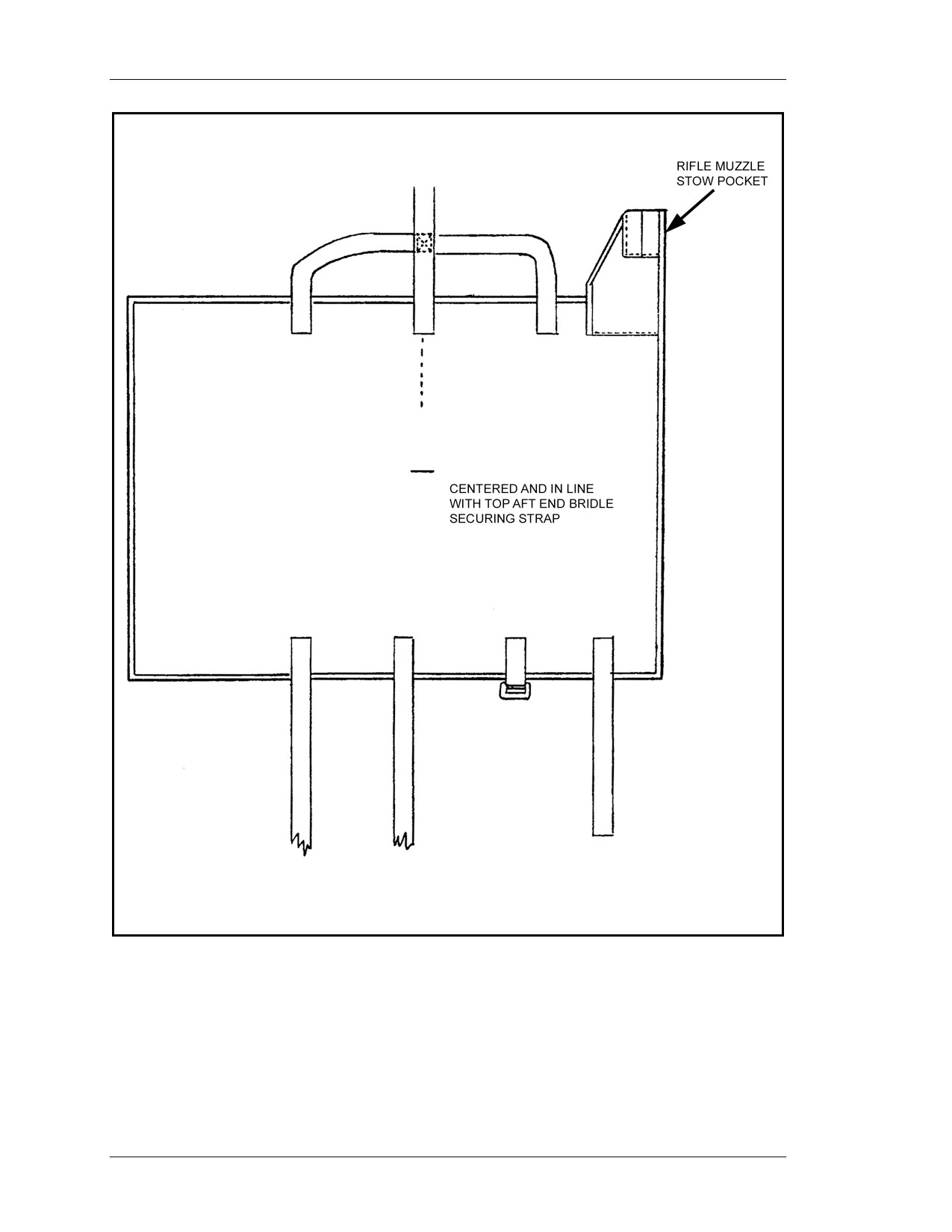
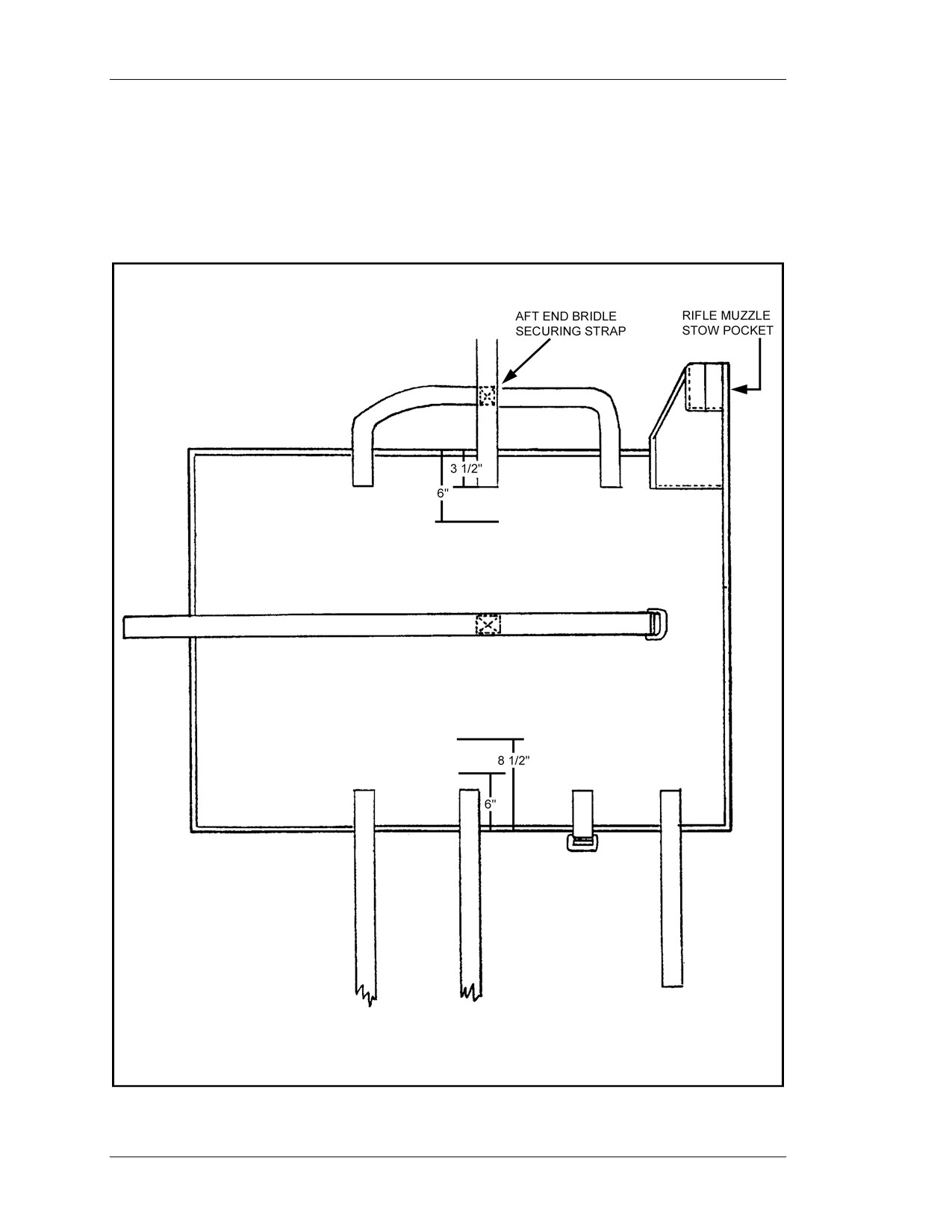
a. Lay the DMJP for modification flat, felt side up. Using a suitable marker, make a
mark at the center of the pack and in line with the aft end bridle securing strap at the top
of the DMJP (Figure 12-60).
12-65
FM 3-21.220/MCWP 3-15.7/AFMAN11-420/NAVSEA SS400-AF-MMO-010
Figure 12-60. Marking the center of the DMJP.
12-66
FM 3-21.220/MCWP 3-15.7/AFMAN11-420/NAVSEA SS400-AF-MMO-010
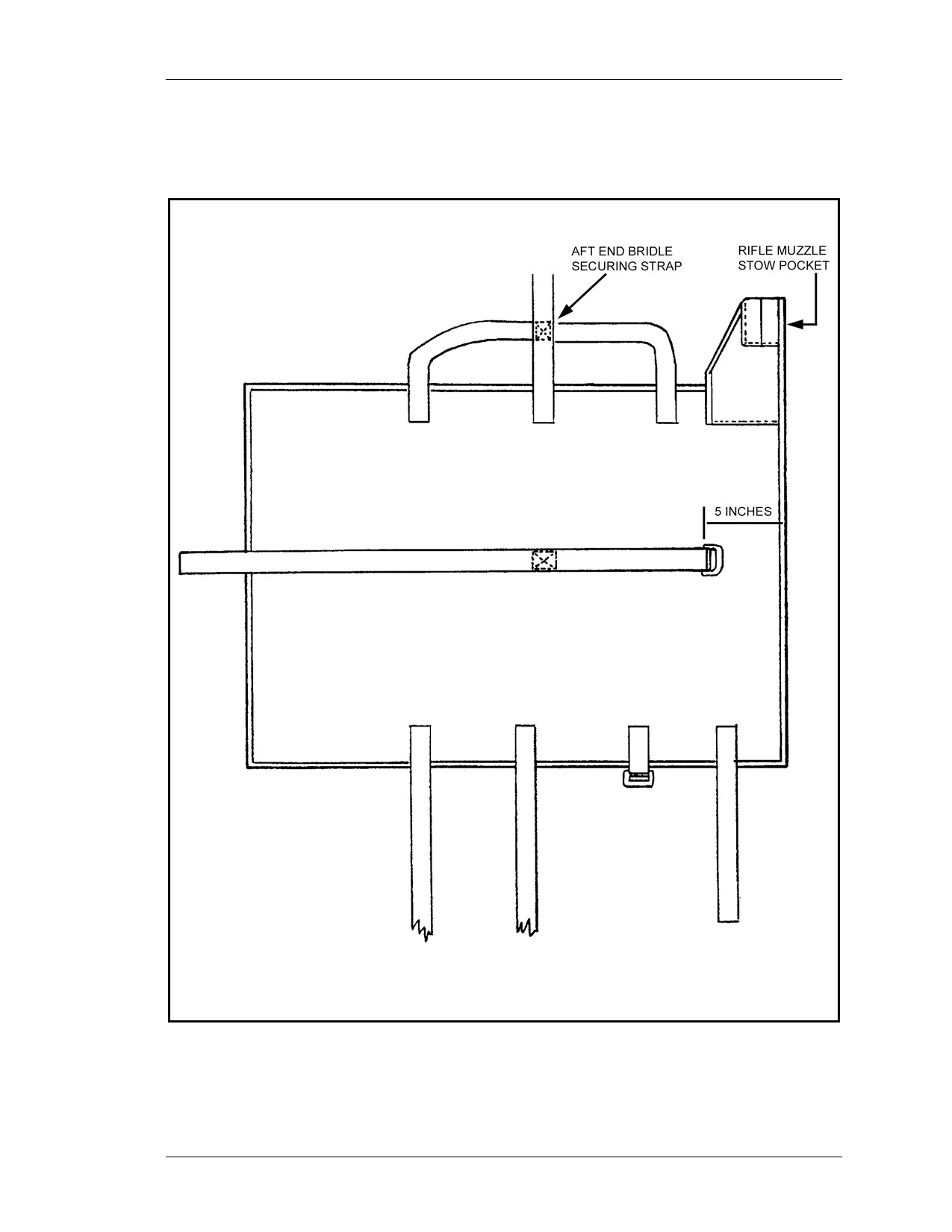
b. Cut the running end of an A-7A strap so its overall length is 38 inches. Place the
strap on the center mark and stitch in place forming a 2 1/2-inch box-X stitch using No. 6
nylon thread. Ensure the buckle end is 5 inches from the side of the pack (Figure 12-61).
Figure 12-61. A-7A strap centered and stitched.
12-67
FM 3-21.220/MCWP 3-15.7/AFMAN11-420/NAVSEA SS400-AF-MMO-010
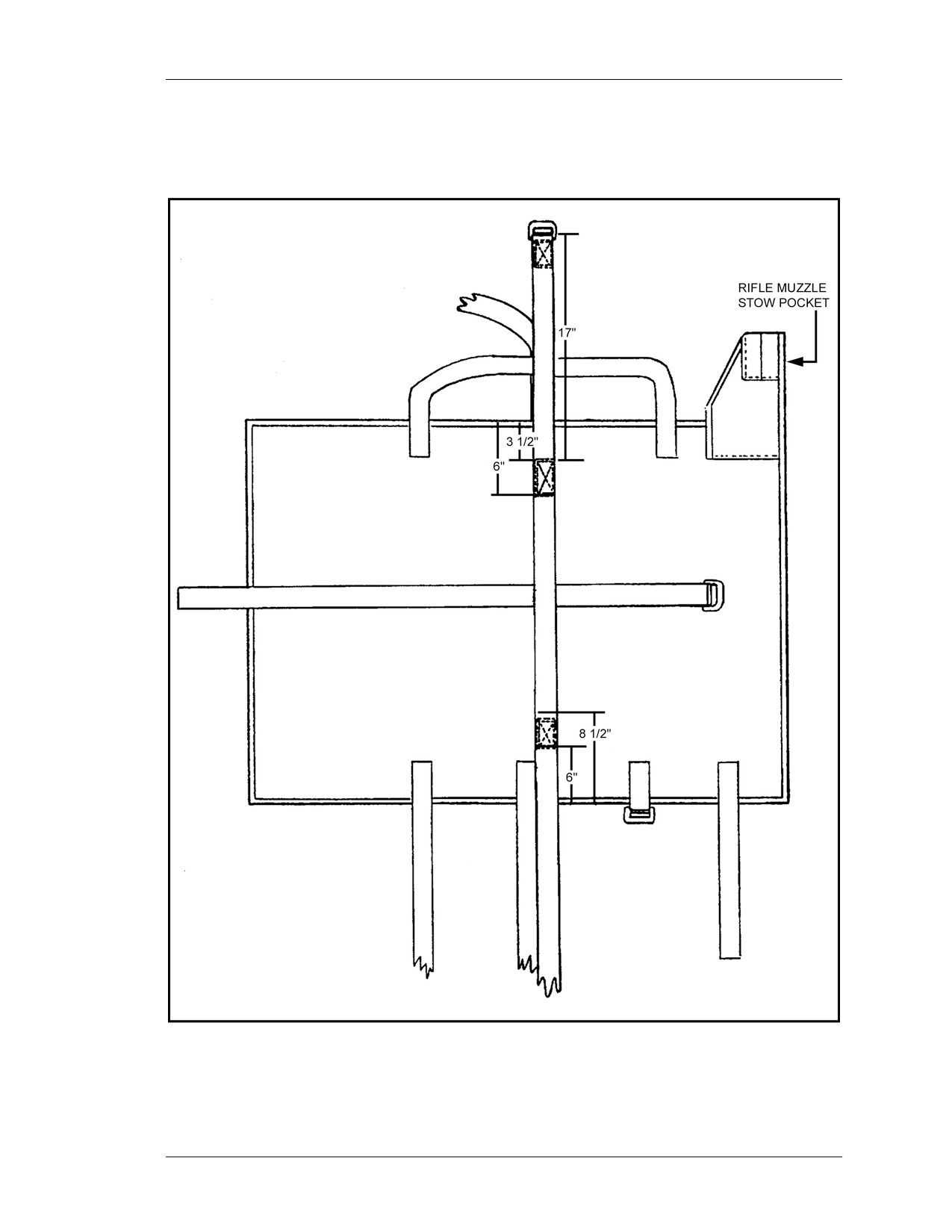
c. Locate the point where the aft end bridle securing strap crosses the U-shaped
portion and is sewn. Cut and remove this stitching, being careful to not damage the straps
(Figure 12-62).
d. From this side of the DMJP, measure and make two marks at 3 1/2 inches and 6
inches. From the other side of the DMJP, measure and mark at 6 inches and 8 1/2 inches
(Figure 12-62).
Figure 12-62. Stitching removed and DMJP markings.
12-68
FM 3-21.220/MCWP 3-15.7/AFMAN11-420/NAVSEA SS400-AF-MMO-010
e. Cut a second A-7A strap to an overall length of 68 inches. Mark the A-7A strap at
a point 17 inches from the buckle. Align this mark with the 3 1/2-inch mark and stitch
with two box-X stitch formations (Figure 12-63).
Figure 12-63. A-7A strap cut, marked, aligned, and stitched.
12-69
FM 3-21.220/MCWP 3-15.7/AFMAN11-420/NAVSEA SS400-AF-MMO-010
Section XVI. FIELD PACK, LARGE, INTERNAL FRAME
The FPLIF, with or without the patrol pack, can be rigged in the HSPR during airborne
operations. However, the FPLIF is not recommended for jumping; substantial damage
can occur to the pack and cause it to be unserviceable for further use.
12-70. RIGGING THE FIELD PACK, LARGE, INTERNAL FRAME WITHOUT
PATROL PACK
Rigging instructions for the FPLIF without patrol pack, using the HSPR, are as follows:
a. Before attaching the harness to the FPLIF, attach the release handle assembly,
adjustable D-ring attaching straps, and leg strap release assembly to the harness. S-fold,
or accordion fold, all excess on the equipment retainer straps and secure with two turns of
retainer band. No additional equipment will be attached to the outside of the FPLIF.
WARNING
The packed FPLIF can be no longer than 30 inches when
rigged with the standard HSPR. The maximum recommended
total rigged weight is 75 pounds, including the patrol pack.
because of its internal frame, the FPLIF should be jumped in
its fully extended position. THE H-harness cannot be used with
the FPLIF.
b. Shorten the shoulder straps to their minimum length, roll and tape the free-
running ends, route the cross-chest strap around the shoulder straps, and then fasten the
cross-chest strap buckle. Stow upper patrol pack attaching straps inside the FPLIF by
tucking them through the antenna closure flaps.
c. Extend the waistband straps, turn the FPLIF over with the shoulder straps down,
route the waistband straps through the bottom loops formed by the lower patrol pack
attaching straps, and buckle the waistband fastener.
d. Lay the HSPR on top of the FPLIF with the release handle assembly toward the
top of the FPLIF, the adjustable cross-strap facing up, and the leg straps above the
equipment retainer straps. Route the running ends of the HSPR equipment retainer straps
from the top of the FPLIF down through the FPLIF’s second and third equipment
attaching loops. Route the adjustable leg straps through the second equipment attaching
loops only. Route the HSPR equipment retainer straps under the waistband. Extend the
HSPR adjustable cross-strap halfway.
e. Turn the FPLIF over with the shoulder straps facing up. Route the HSPR
equipment retainer straps over the bottom of the FPLIF, under the waistband (through the
outer waistband frame loops), and up over the comfort pad; form an X with the running
ends. Ensuring that the release handle assembly is positioned on the top of the FPLIF,
continue to route the HSPR equipment retainer straps under the shoulder straps, through
the loops sewn on the back of the FPLIF near the top of the frame staves, and connect the
free-running ends to the friction adapters, forming quick releases. S-fold the free-running
ends and secure with retainer bands.
12-70
FM 3-21.220/MCWP 3-15.7/AFMAN11-420/NAVSEA SS400-AF-MMO-010
f. To attach the HPT lowering line to the HSPR, route the looped end of the HPT
lowering line under the X formed by the HSPR equipment retainer straps, from top to
bottom. Route the ejector snap through the loop, forming a girth hitch. Route the HPT
lowering line over the top of the right FPLIF shoulder strap. Secure the HPT lowering
line on the right side of the FPLIF to the horizontal FPLIF compression straps with two
retainer bands, routing the ejector snap from bottom to top so that the HPT lowering line
ejector snap is at the top.
g. Temporarily attach the HPT lowering line ejector snap to the triangle link of the
left attaching harness strap. Attach the adjustable leg straps to the leg strap release
assemblies, take up the slack in the adjustable leg straps, and fold and stow the excess
using the webbing retainers. Attach the adjustable D-ring attaching strap snap hooks to
the top carrying handle on the FPLIF.
12-71. RIGGING THE FIELD PACK, LARGE, INTERNAL FRAME WITH
PATROL PACK
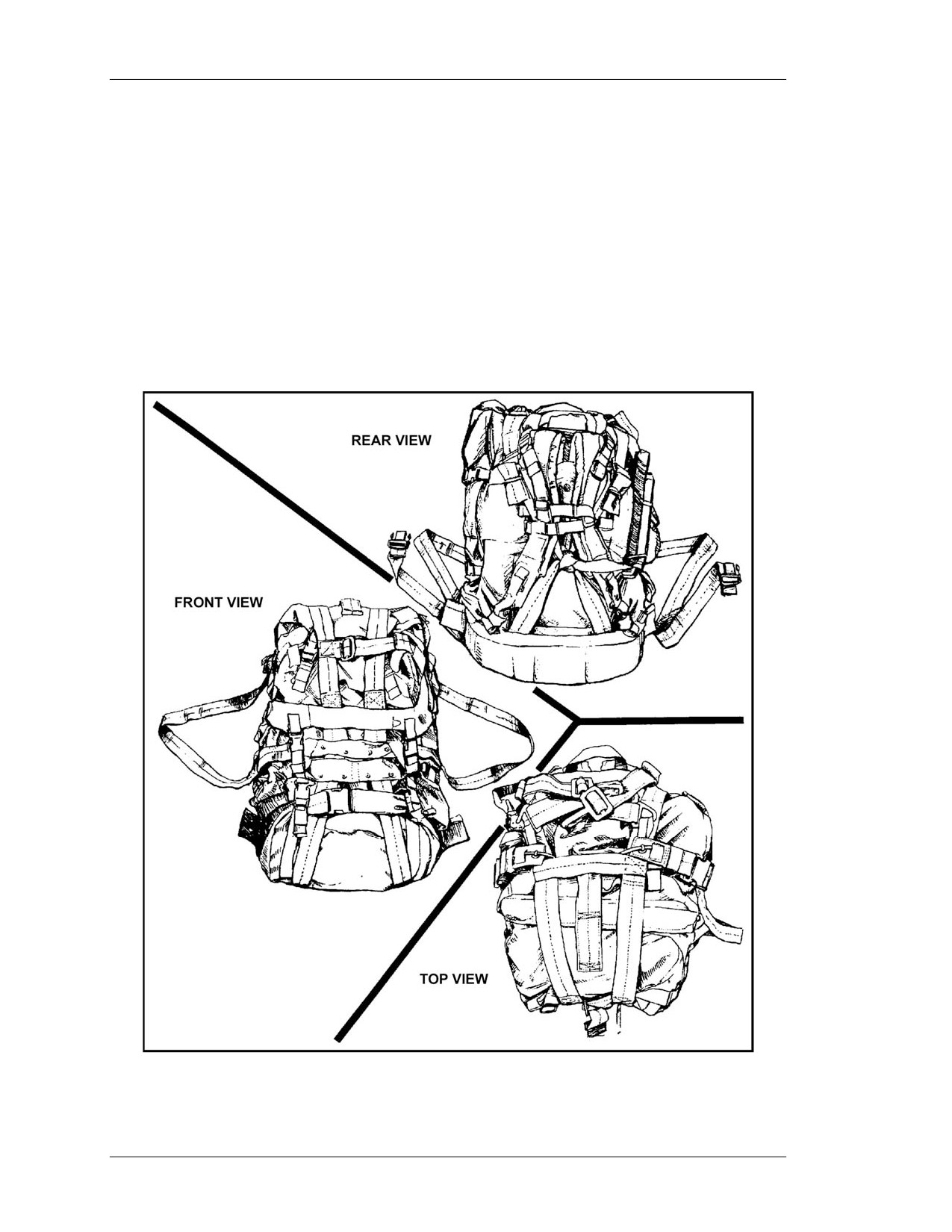
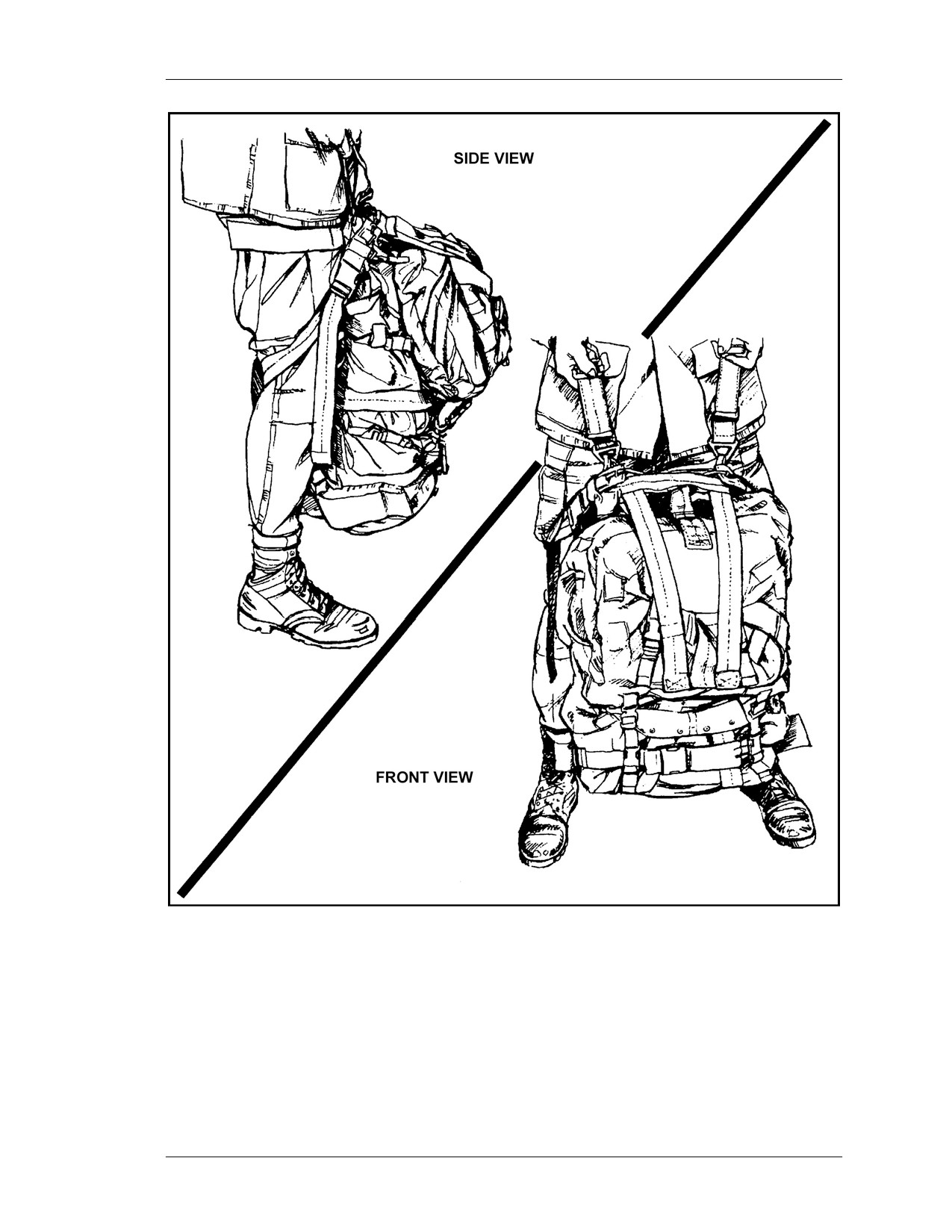
Rigging instructions for the FPLIF with patrol pack, using the HSPR, are as follows: (See
Figure 12-64, page 12-75 and Figure 12-65, page 12-76.)
a. Before attaching the harness to the FPLIF, attach the release handle assembly,
adjustable D-ring attaching straps, and leg strap release assembly to the harness. Fold and
tape the running ends of all straps. No additional equipment will be attached to the
outside of the FPLIF.
b. Shorten the shoulder straps to their minimum length, roll and tape the free-
running ends, route the cross-chest strap around the shoulder straps, and then fasten the
cross-chest strap buckle.
c. Extend the waistband straps, turn the FPLIF over with the shoulder straps down,
route the waistband straps through the bottom loops formed by the lower patrol pack
attaching straps, and buckle the waistband fastener.
d. Place the patrol pack on the outside front of the FPLIF and fasten the upper patrol
pack attaching straps. Lay the HSPR on top of the patrol pack with the release handle
assembly toward the top of the FPLIF, with the adjustable cross-strap facing up, and with
the adjustable leg straps above the equipment retainer straps. Route the running ends of
the HSPR equipment retainer straps and adjustable leg straps over the top of the patrol
pack and down through the bottom equipment attaching loops of the patrol pack. Then
route the equipment retainer straps through the second and third equipment attaching
loops on the FPLIF. Route the adjustable leg straps through the second equipment
attaching loops, only. Route the HSPR equipment retainer straps under the waistband.
Route the lower patrol pack attaching straps under the third FPLIF equipment retainer
loops and fasten them to the bottom of the patrol pack.
e. Turn the FPLIF over with the shoulder straps facing up. Route the HSPR
equipment retainer straps over the bottom of the FPLIF, under the waistband (through the
outer waistband frame loops), and up over the comfort pad; form an X with the running
ends. Ensuring that the release handle assembly is positioned on the top of the FPLIF,
continue to route the HSPR equipment retainer straps under the shoulder straps, through
the loops sewn on the back of the FPLIF near the top of the frame staves, and connect the
free-running ends to the friction adapters, forming quick releases. S-fold the free-running
ends and secure with retainer bands.
12-71
FM 3-21.220/MCWP 3-15.7/AFMAN11-420/NAVSEA SS400-AF-MMO-010
f. To attach the HPT lowering line to the HSPR, route the looped end of the HPT
lowering line under the X formed by the HSPR equipment retainer straps, from top to
bottom. Route the ejector snap through the loop, forming a girth hitch. Route the HPT
lowering line over the top of the right FPLIF shoulder strap. Secure the HPT lowering
line on the right side of the FPLIF to the horizontal FPLIF compression straps with two
retainer bands, routing the ejector snap from bottom to top so that the HPT lowering line
quick-ejector snap is at the top.
g. Temporarily attach the HPT lowering line ejector snap to the triangle link of the
left attaching harness strap. Attach the adjustable leg straps to the leg strap release
assemblies, take up the slack in the adjustable leg straps, and fold and stow the excess
using the webbing retainers. Attach the adjustable D-ring attaching strap snap hooks to
the top carrying handle on the FPLIF.
Figure 12-64. FPLIF with patrol pack on front.
12-72
FM 3-21.220/MCWP 3-15.7/AFMAN11-420/NAVSEA SS400-AF-MMO-010
Figure 12-65. FPLIF with patrol pack attached to jumper.
12-72. RIGGING THE M82, MEDIC JUMP PACK WITH FRAME
Secure all Fastex fasteners and stow all excess webbing in the webbing retainer or
webbing retainer bands. Ensure the center cargo pocket is packed with nonbreakable
items.
a. Secure the HSPR to the M82.
(1) Lay out the HSPR with the attaching loops facing up.
12-73
FM 3-21.220/MCWP 3-15.7/AFMAN11-420/NAVSEA SS400-AF-MMO-010
(2) Route the two release handle cables between the two plies of the release handle
cross strap. Attach the pile tape of the release handle assembly to the hook tab located
between the plies of the release handle cross strap. Ensure the release handle lanyard is
not misrouted.
(3) Place the triangle links of the adjustable D-ring attaching straps on top of the
white attaching loops, with the opening gates of the snap hooks facing down. Route the
white attaching loop through the triangle link; the green loop through the white attaching
loop; the red attaching loop through the green attaching loop and then through the
grommet on the female portion of the leg strap assembly. Ensure the cable loop retainer
on the female portion of the leg strap assembly is facing up. Route the release handle
cable through the red attaching loop and then through the cable loop retainer. Repeat this
procedure for the other adjustable D-ring attaching strap.
(4) Turn the HSPR over so that the opening gates on the snap hooks of the adjustable
D-ring attaching straps are facing up.
(5) Place the M82 upside down on the HSPR so that the center cargo pocket is in the
window formed by the adjustable cross strap and the release handle cross strap.
(6) Route the equipment retainer straps under the frame and cross them in the center
forming an “X”, then route them to the appropriate friction adapter. Form a two- to
three-finger quick release and tighten. S-roll the free-running ends and secure with two
turns of retainer band (do not secure the excess to the quick releases).
(7) Route the male portion of the leg strap release assembly around the M82. Ensure
the leg straps are fully extended with no twists and then attach them to the female portion
of the leg strap release assembly.
NOTE: When stowing the HPT lowering line within the retainer flap, ensure stows are
even with the retainer flap. No excess should exceed either end of the retainer
flap.
b. Attach the HPT Lowering Line to the HSPR.
(1) Route the looped end of the HPT lowering line under the “X” formed by the
equipment retainer straps from top to bottom (bottom to top), north to south (south to
north).
(2) Route the remainder of the HPT lowering line through the loop end of the HPT
lowering line, then pull it tight forming a girth hitch around the “X” formed by the
equipment retainer straps.
(3) Secure the HPT lowering line to the left side of the frame by routing the ejector
snap and HPT lowering line within the closed retainer flap through two retainer bands
from bottom to top as the M82 is worn by the jumper.
12-74
FM 3-21.220(FM 57-220)/MCWP 3-15.7/AFMAN11-420/NAVSEA SS400-AF-MMO-010
CHAPTER 13
ARCTIC RIGGING
When using arctic rigging, the number of personnel who can be
parachuted from a single aircraft is reduced by the bulk of equipment and
cold weather clothing. When computing weight factors, the cold weather-
equipped parachutist is estimated to weigh 310 pounds.
Section I. ARCTIC EQUIPMENT SPACE CONSIDERATIONS
Exiting interval between each parachutist is increased to two seconds when using arctic
rigging. Aircraft compartment space required for a parachutist is 1 1/2 times more in cold
regions than in temperate climates. Commanders must be familiar with the airborne
operations portion of FM 31-71 for successful arctic rigging operations. However,
plane-side parachute issue and rigging are impossible during winter months due to harsh
temperatures.
13-1. WEIGHT FACTORS
Aircraft must be within 200 meters of the parachute rigging facility to keep rigged
jumpers from walking through deep snow or over ice during winter months when
temperatures are low and the individual parachutist’s equipment is the heaviest. The
serviceability of the activating lever on the ejector snap of the HPT lowering line should
be checked, since there is an increased risk of the lever malfunctioning due to the heavy
loads.
13-2. MODIFICATIONS
Modifications of standard equipment must be made for airborne operations under cold
weather conditions.
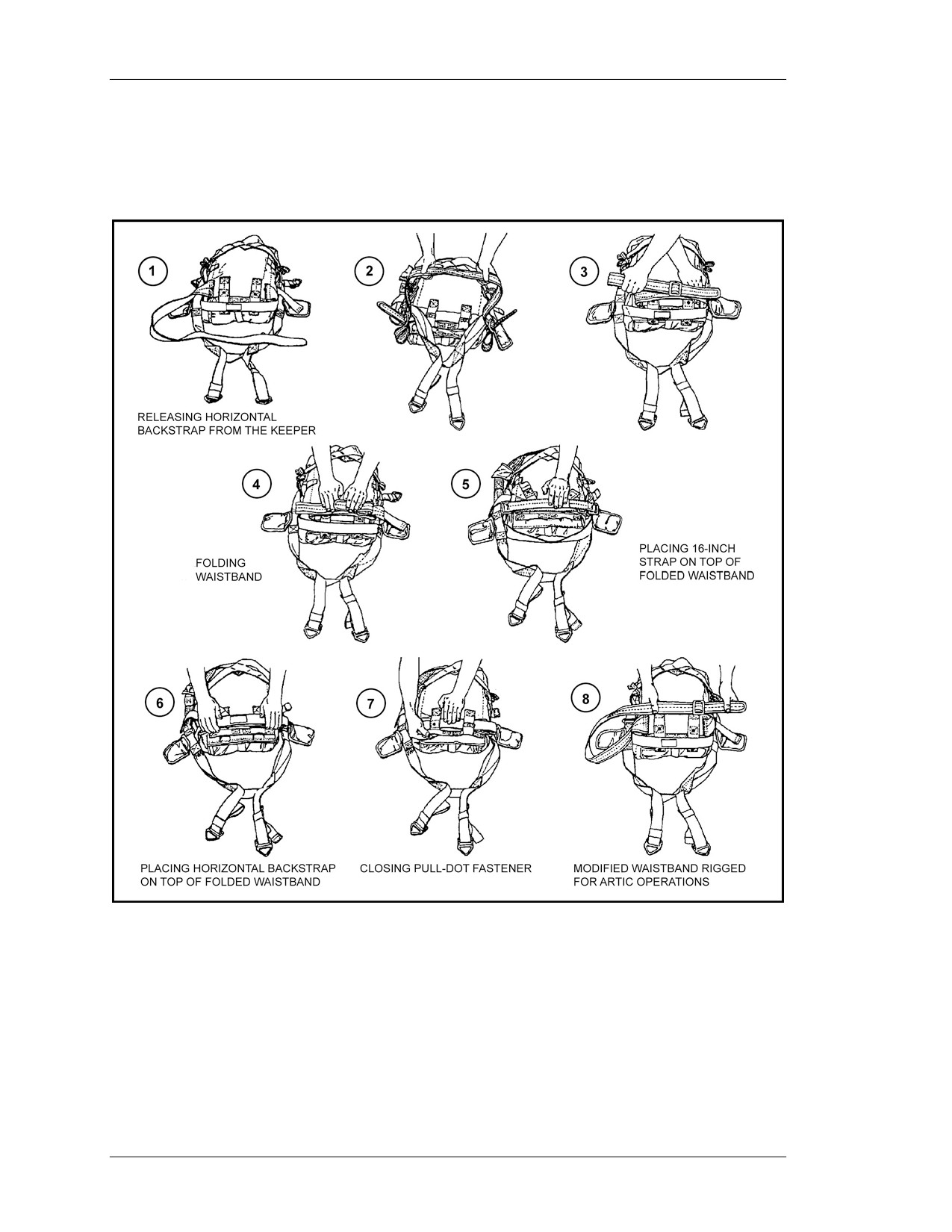
a. Waistband. A modified waistband strap is used in lieu of the standard waistband
when parachuting with snowshoes or skis. The strap consists of two pieces: a 6-foot
A-7A strap and a 16-inch strap with a buckle at each end. The skis or snowshoes are
attached to the side of the jumper opposite the static line (to prevent fouling). The
modified waistband allows the buckle for the quick-release fold to be located on the same
(either) side with the snowshoes or skis (Figure 13-1, page 13-2). Tandem loads are
dropped on a single lowering line. Rigging or lowering procedures are contained in this
chapter. Under arctic conditions, most individual equipment is lowered during descent
due to the weight.
b. Reserve Parachute. Deployment of the reserve parachute under arctic or extreme
cold weather conditions may be hindered by the bulkiness of the gloves worn. To
overcome this obstacle, the rip cord is inverted as an optional requirement. Commanders
requesting the MIRPS or T-10 reserve parachute for an arctic airborne operation must
allow enough time for the reserves to be modified.
c. Mittens. Arctic mittens are not worn during the parachute jump; their bulkiness
interferes with deployment of the reserve parachute and the lowering of equipment. The
mittens are tucked inside the front of the jacket or under the parachute harness. They are
not attached to, or packed in, a container. Trigger-finger mittens are stowed inside the
jacket for wear as soon as the jumper is on the ground.
13-1
FM 3-21.220/MCWP 3-15.7/AFMAN11-420/NAVSEA SS400-AF-MMO-010
d. Arctic Canteen. The arctic canteen poses a hazard due to its long neck and metal
body, which can injure a jumper if the PLF is executed on top of the canteen.
Commanders should consider packing it in the ALICE pack to prevent personal injury or
damage to the canteen.
Figure 13-1. Modified waistband routed on parachute harness.
Section II. SNOWSHOES AND INDIVIDUAL WEAPON
Snowshoes are usually rigged on the parachutist to allow for immediate access.
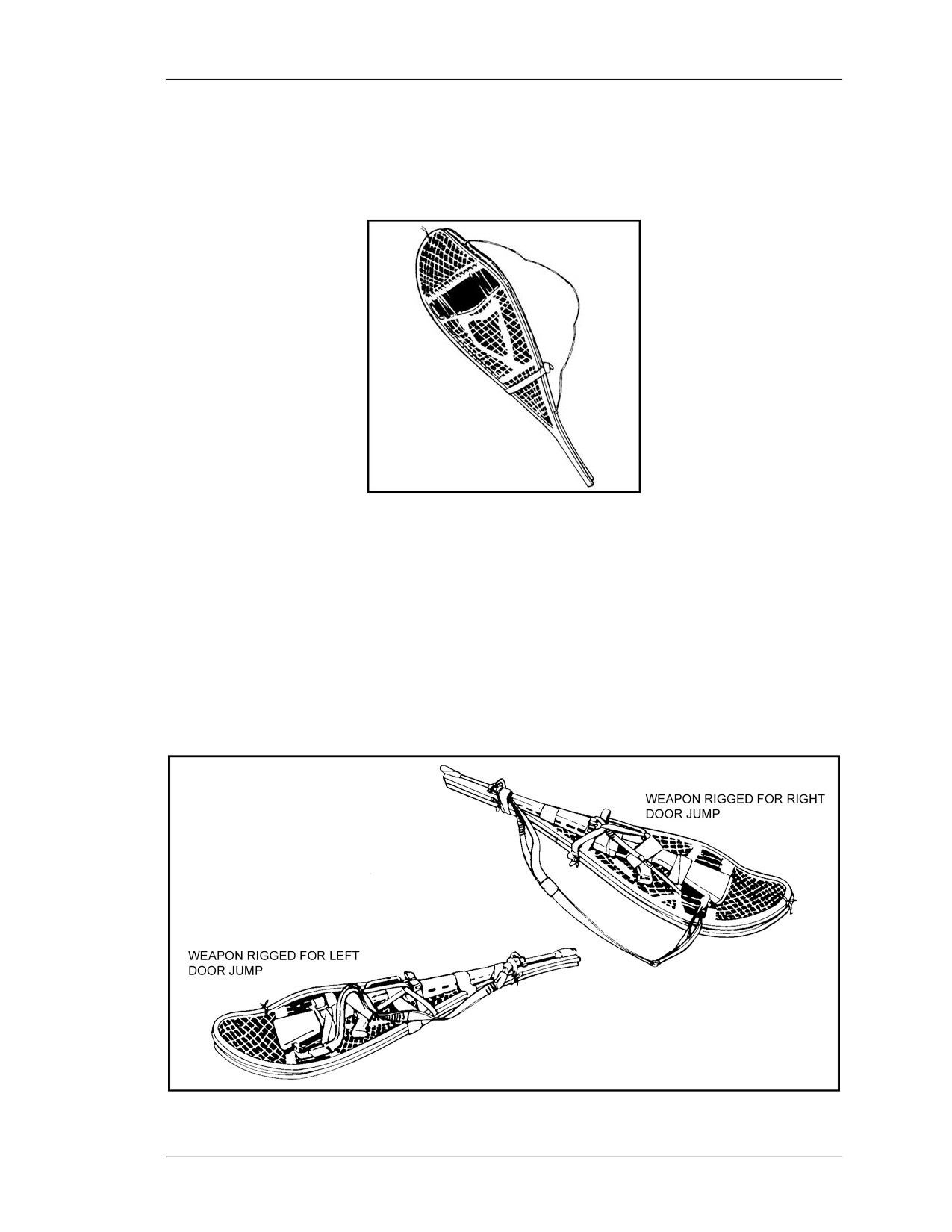
13-3. SNOWSHOES WITHOUT WEAPON
The prefitted snowshoes are placed one on top of the other. The heel strap of the lower
snowshoe is run underneath the lower shoe and up between the frame and webbing of
13-2
FM 3-21.220/MCWP 3-15.7/AFMAN11-420/NAVSEA SS400-AF-MMO-010
both snowshoes. The heel strap buckle is brought up similarly on the other side of the
snowshoes. A sling may be fabricated using 550-cord (or other suitable material). The
snowshoes are secured with an additional tie-down, using
550-cord at the toe
(Figure 13-2).
Figure 13-2. Snowshoes without weapon.
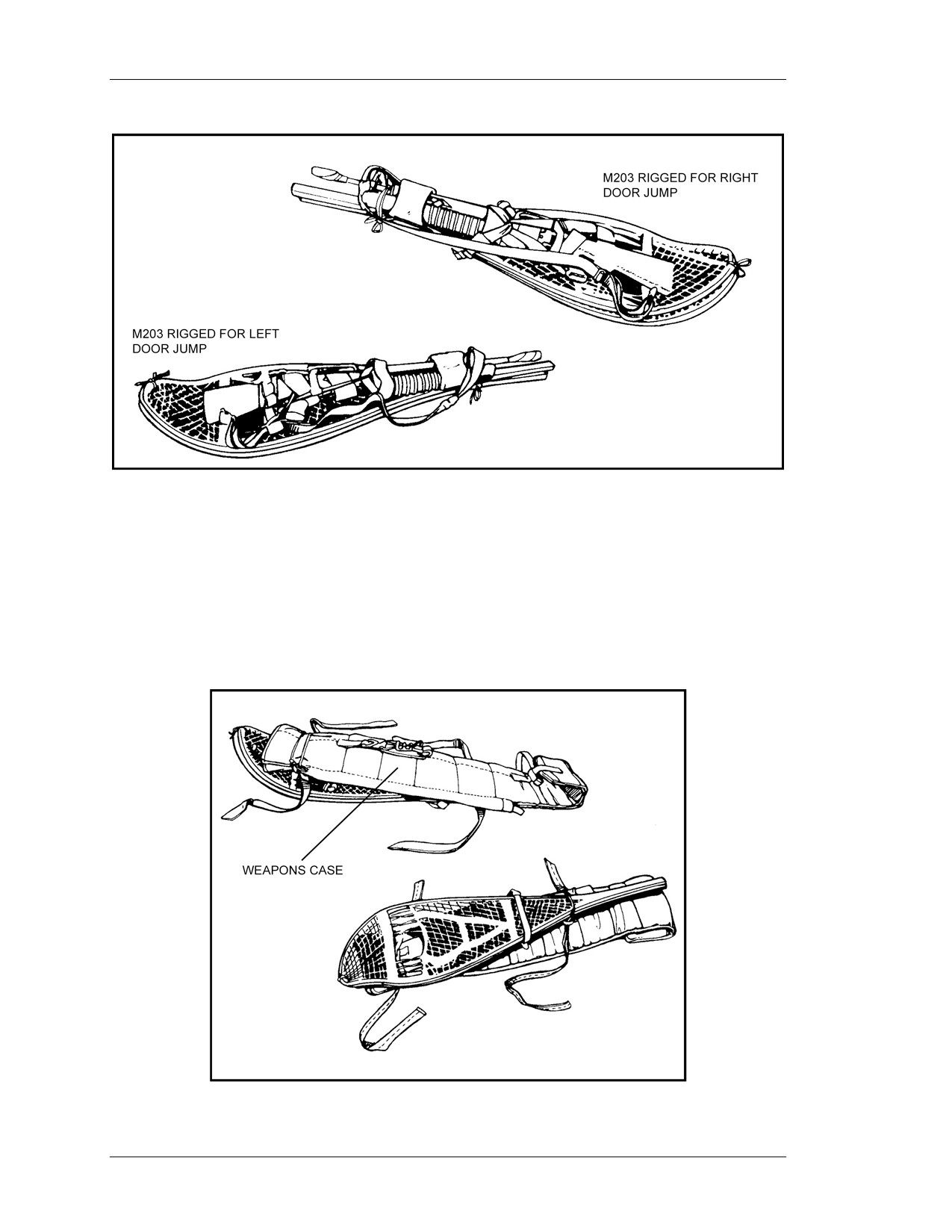
13-4. SNOWSHOES WITH WEAPON EXPOSED
The snowshoes are rigged as previously described, and the rifle sling is secured. The M16
rifle is placed so that the barrel rests on top of the snowshoe trails, with the bolt-assist up.
The M16 rifle is secured to the snowshoes (Figure 13-3) by buckling the heel strap
around the slip ring and the toe strap around the small of the stock. The barrel is secured
to the yoke of the snowshoes with 550-cord, using a bow knot. The M203 grenade
launcher is rigged in a similar manner (Figure 13-4, page 13-4).
NOTE: Using this method, the parachutist may exit either the right or left jump door.
Figure 13-3. Snowshoes with weapon.
13-3
FM 3-21.220/MCWP 3-15.7/AFMAN11-420/NAVSEA SS400-AF-MMO-010
Figure 13-4. Snowshoes with M203.
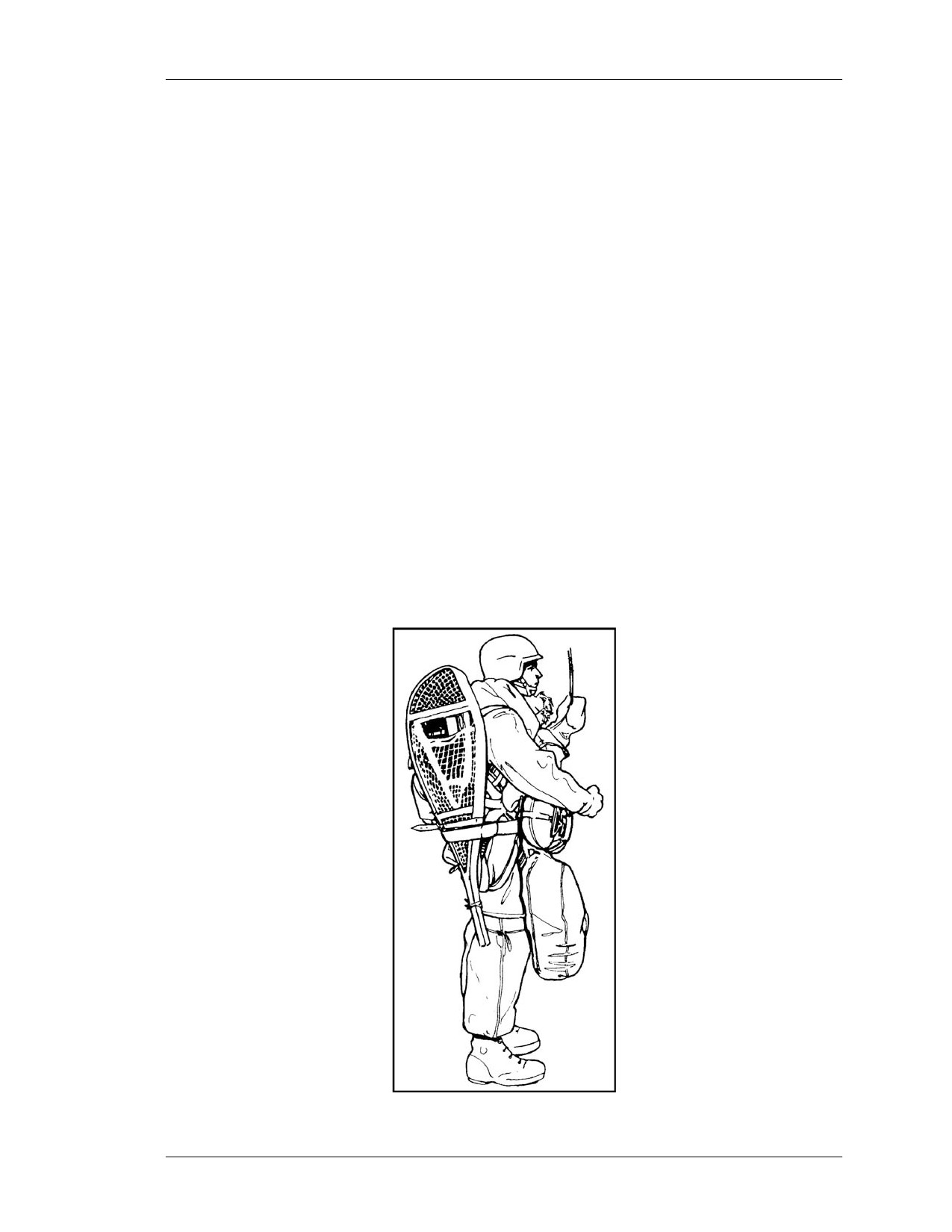
13-5. JUMPING SNOWSHOES WITH M1950 WEAPONS CASE
Snowshoes are attached to the outside of the M1950 with the tails down and the tips of
the snowshoes facing the jumper. The 550-cord is used to secure the snowshoes to the
M1950 through both the upper and lower tie-down tape retaining bars. The running ends
of the upper tie-down tape are routed through the toe window on the snowshoes and then
around the M1950 to the left side of the main lift web. The M1950 is then attached as the
outermost item to the left D-ring (Figure 13-5).
Figure 13-5. Snowshoes with weapons case.
13-4
FM 3-21.220/MCWP 3-15.7/AFMAN11-420/NAVSEA SS400-AF-MMO-010
NOTE: Using this method, the parachutist does not need the modified waistband. The
standard waistband is routed through the waistband retainers of the reserve
parachute to the waistband adjuster panel without going around the outside of
the snowshoes and M1950. The M1950 is then lowered in the same manner as
in a tandem load without snowshoes.
Section III. TANDEM LOAD ON SINGLE LOWERING LINE
Tandem loads rigged on a single lowering line allow the individual parachutist to lower
two items of equipment. This procedure reduces the time and tasks required to lower
equipment and provides more time for canopy control and landing preparations.
13-6. RIGGED LOAD
The ALICE pack or weapons case is worn in the prescribed manner. The rifle sling is
used to attach the snowshoes to the rifle. This load is suspended over the shoulder
opposite the static line. The running end of the modified waistband extension is threaded
through the waistband retainers of the reserve parachute and around the snowshoes, and
the end is made into a quick-release fold (Figure 13-6).
NOTE: The rifle sling is adjusted to fit the parachutist snugly. The sling adjustment is
also small enough so that it does not come off the load when released to slide
down the lowering line.
Figure 13-6. Parachutist rigged to jump left door.
13-5
FM 3-21.220/MCWP 3-15.7/AFMAN11-420/NAVSEA SS400-AF-MMO-010
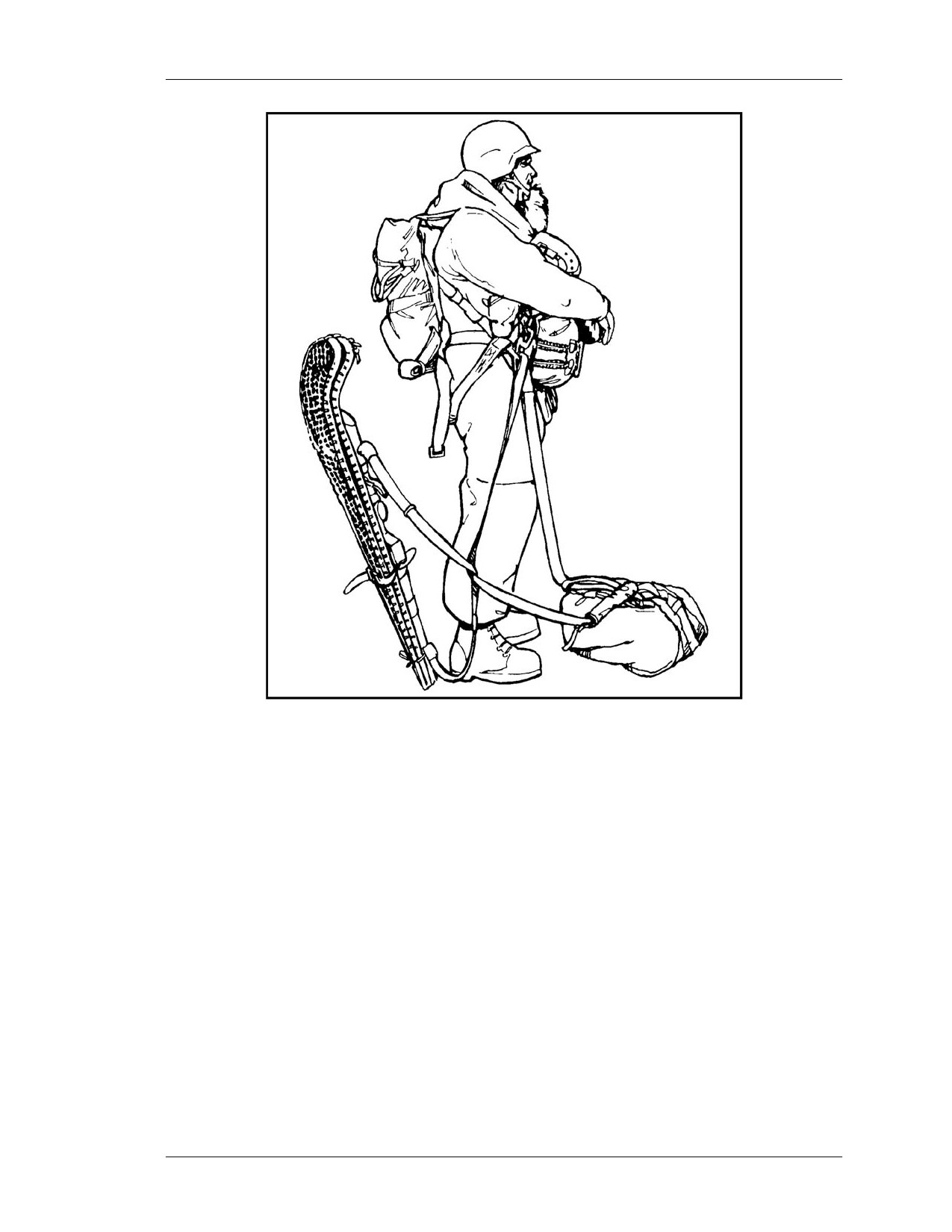
13-7. HOOK-PILE TAPE LOWERING LINE
The lowering line is threaded through the rifle sling and attached to the main lift web of
the parachutist (on the side the snowshoes are attached).
a. A length of 80-pound test tape is attached around the sling and the main lift web
with a bow knot (just below the canopy release assembly). The lowering line adapter web
is attached (Figure 13-7) to the left (right) side, corresponding to the side to which the
snowshoes and rifle are to be attached.
b. When jumping with the ALICE pack or weapons case, the parachutist routes the
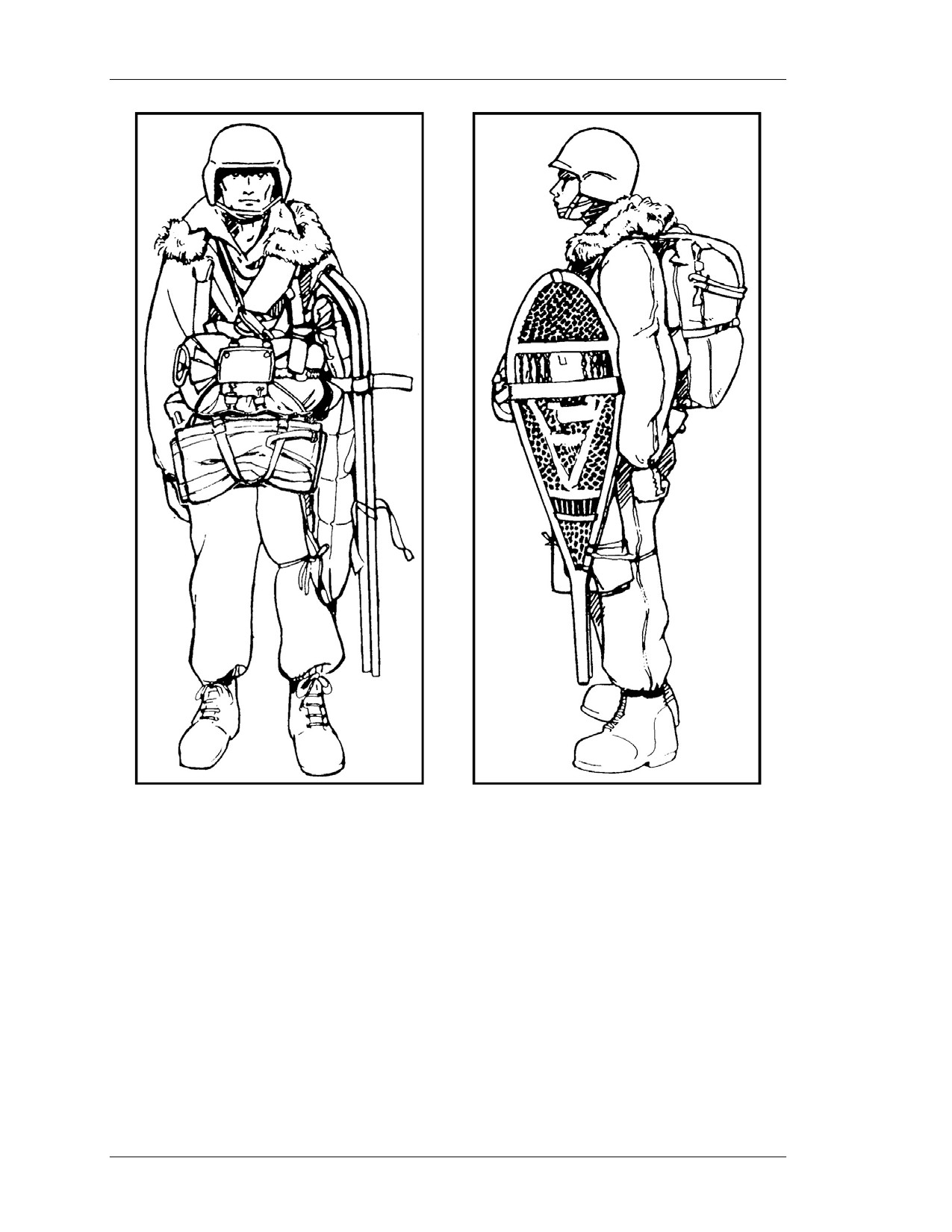
lower tie-down on the case through the metal frame and around the leg. A separate
tie-down tape for each is not necessary (Figure 13-8, page 13-8).
c. The stowed lowering line is secured with two retainer bands to the left (right) side
of the vertical bar of the combat pack. After the pack, snowshoes, and rifle are attached to
the parachutist, the lowering line ejector snap is passed through the rifle sling and
attached to the accessory attaching ring of the adapter web. If the adapter web is not used,
the ejector snap is attached directly to the D-ring on the harness. If the weapons case is
attached to the snowshoes (Figure 13-9, page 13-8), the lowering line ejector snap is
passed between the case and the cotton chafe material, which is attached to the case
V-ring.
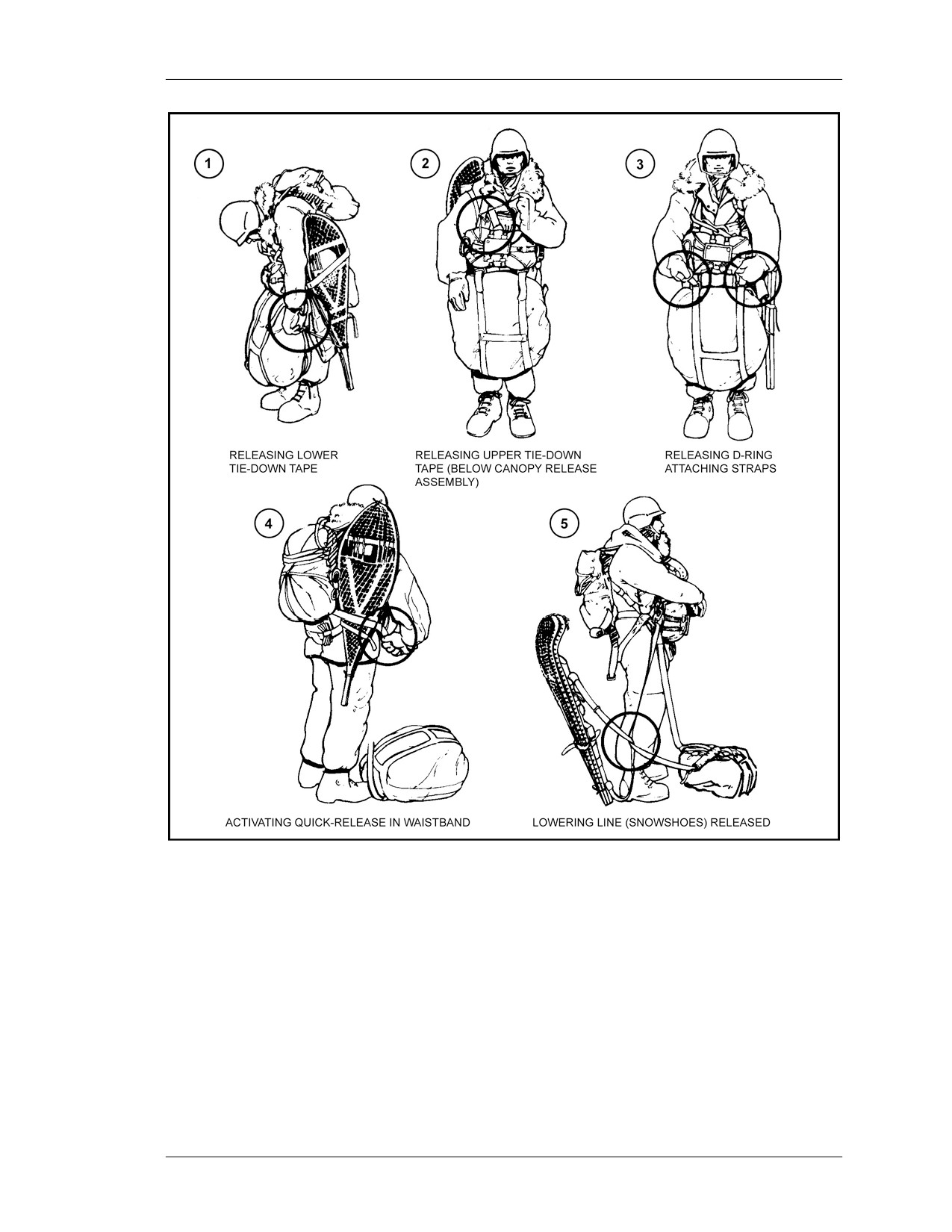
d. The upper tie-down tape (above the chest strap and below the canopy release
assembly) and the lower tie-down tape around the parachutist’s leg are untied, and the
load is dropped by pulling the white release handle located on the cross strap of the
HSPR. This ensures that the pack load falls the length of the line. The modified
waistband quick-release fold is pulled and releases the snowshoes, which slide down the
lowering line on top of the pack (Figure 13-10, page 13-9).
13-6
FM 3-21.220/MCWP 3-15.7/AFMAN11-420/NAVSEA SS400-AF-MMO-010
Figure 13-7. Lowering line assembly attached for a tandem load.
13-7
FM 3-21.220/MCWP 3-15.7/AFMAN11-420/NAVSEA SS400-AF-MMO-010
Figure 13-8. Upper and lower
Figure 13-9. Left side view with
tie-downs.
weapons case.
13-8
FM 3-21.220/MCWP 3-15.7/AFMAN11-420/NAVSEA SS400-AF-MMO-010
Figure 13-10. Arctic equipment released and lowered.
13-9
FM 3-21.220/MCWP 3-15.7/AFMAN11-420/NAVSEA SS400-AF-MMO-010
Section IV. SKIS JUMPED WITH RIFLE OR ALICE PACK
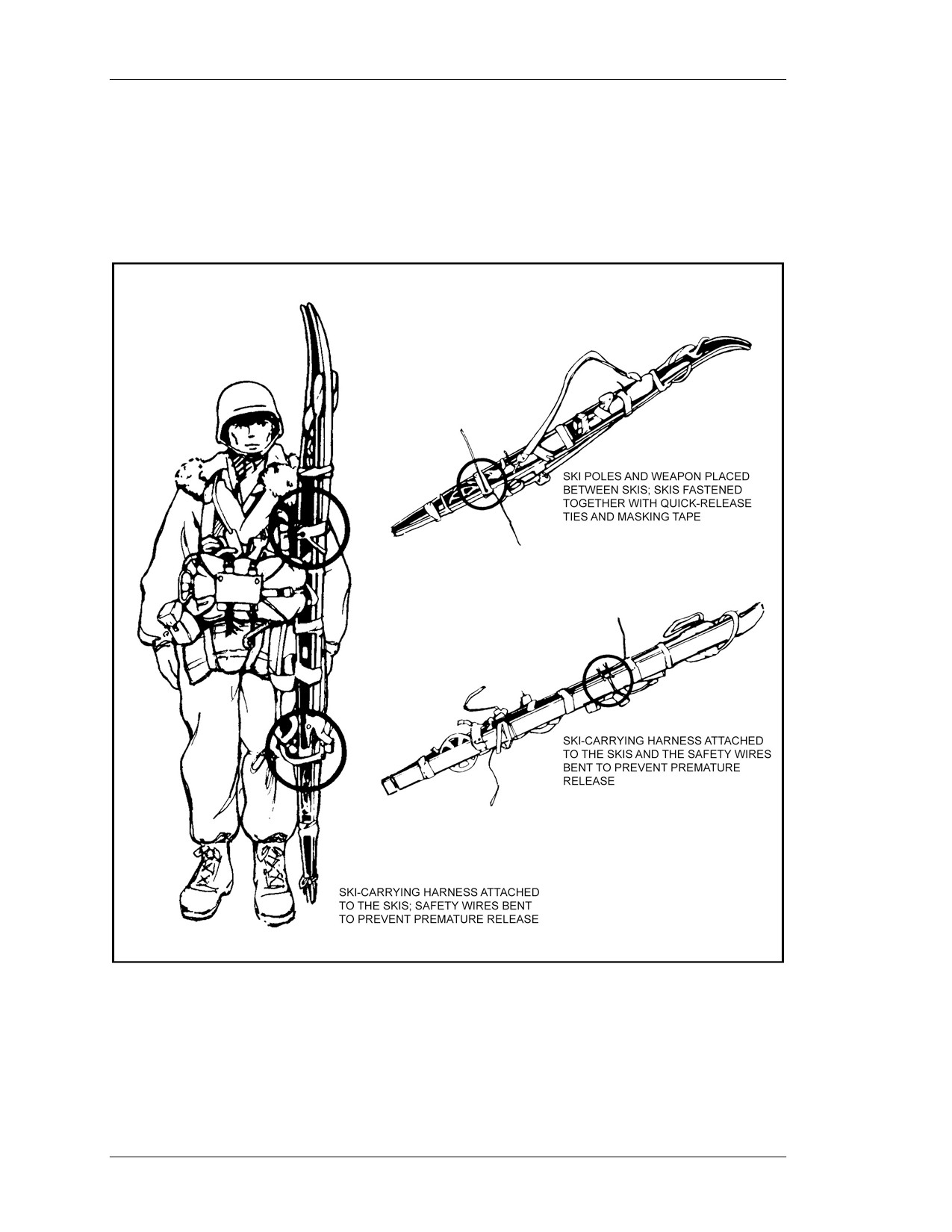
Skis, with the rifle attached, can be jumped using the procedures outlined.
13-8. SKIS AND RIFLE
When the parachutist jumps with skis, or with skis as part of the individual jump load, the
jump must be from a rear platform or ramp (Figure 13-11).
Figure 13-11. Skis and rifle rigged.
13-10
FM 3-21.220/MCWP 3-15.7/AFMAN11-420/NAVSEA SS400-AF-MMO-010
13-9. SKIS AND ALICE PACK OR WEAPONS CASE
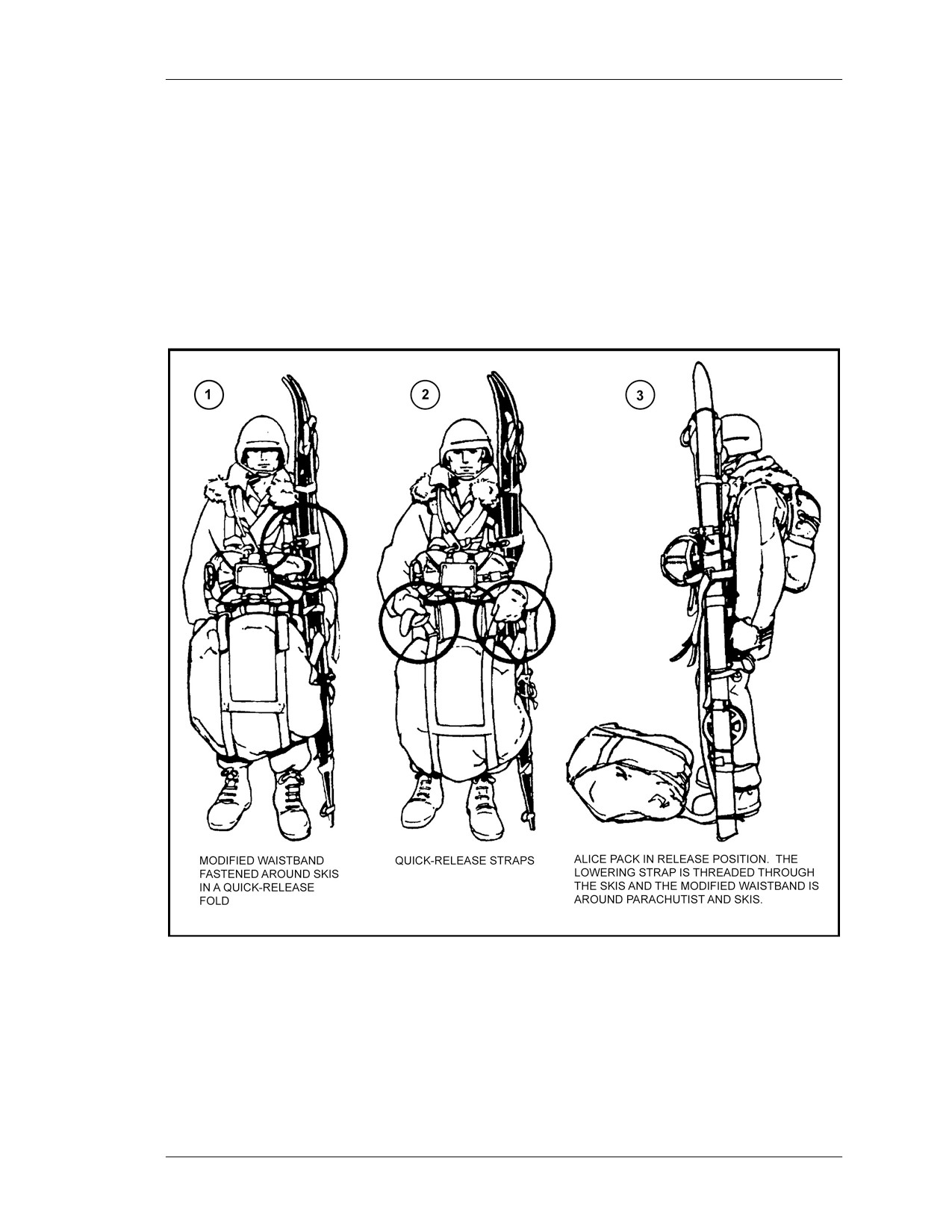
The ALICE pack (or weapons case) lowering line is threaded between the skis and
attached to the main lift web on the side to which the skis are attached. The lowering line
is routed the same way, and the ejector snap is fastened to the lowering line adapter web
or to the D-ring on the parachute harness (Figure 13-12). To secure and stabilize the skis,
a length of 80-pound test is attached to the top and bottom of the skis with a bow knot.
The skis and ALICE pack (or weapons case) are lowered by pulling the release handle.
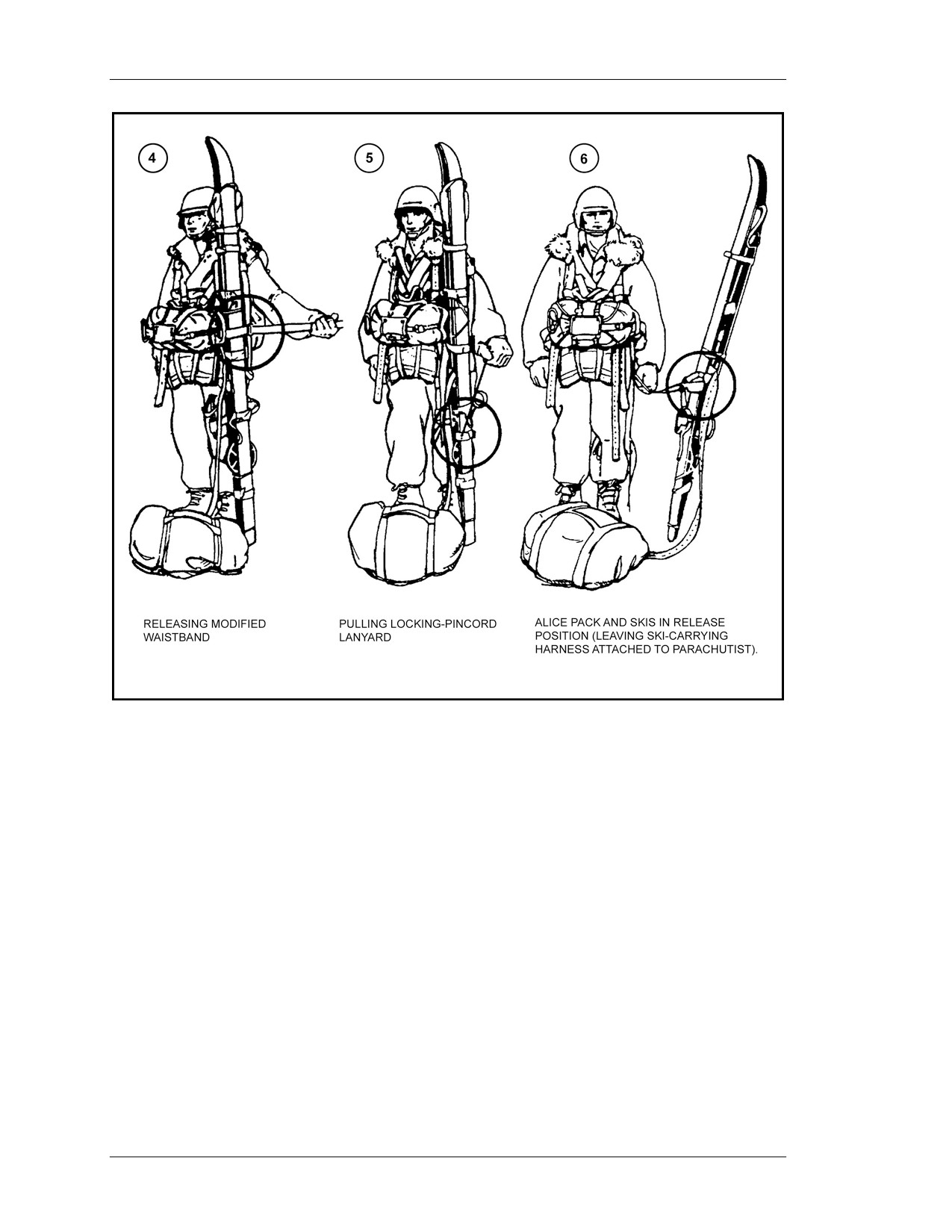
This drops the load down the length of the lowering line. Pulling the quick-release fold of
the A-7A strap and the locking-pin cord lanyard of the ski-carrying harness releases and
lowers the skis.
Figure 13-12. Skis and ALICE pack released.
13-11
FM 3-21.220/MCWP 3-15.7/AFMAN11-420/NAVSEA SS400-AF-MMO-010
Figure 13-12. Skis and ALICE pack released (continued).
13-12
FM 3-21.220(FM 57-220)/MCWP 3-15.7/AFMAN11-420/NAVSEA SS400-AF-MMO-010
CHAPTER 14
A-SERIES CONTAINERS
Two types of A-series containers are used with rigging door bundles:
the A-7A cargo sling and A-21 cargo bag. The containers can be rigged
with a drogue or breakaway static line. For rotary-wing aircraft, a
container load to be air-dropped from a shackle (wing load), helicopter
door, or utility aircraft is rigged with a breakaway static line. For
high-performance fixed-wing aircraft, loads are normally rigged with
parachutes having nonbreakaway static lines. Paratroop door loads that
are to be followed immediately by parachutists must be rigged with
parachutes having nonbreakaway static lines. Each static line must have a
drogue attached to it as outlined in appropriate technical manuals. Loads
must be placed in the paratroop doors so the largest dimension is
upright/vertical. The parachute must be positioned on top of the load or
toward the inside of the aircraft. A ramp load to be followed immediately
by parachutists must be rigged with a T-10-series main parachute
(converted for cargo) or a parachute having a nonbreakaway static line.
All A-7A, A-21, and CDS containers will be rigged IAW FM 100-500-3;
CRRC will be rigged IAW FM 10-542.
Section I. RIGGING PROCEDURES
Door bundles are rigged in such a manner that when placed on the balance point of the
jump platform, the parachute is on top or facing the center of the aircraft, based on the
largest dimension, and not on the side. The maximum weight of the bundle is 500 pounds
(not including parachute weight). Exceptions to this rigging technique are allowed for the
90-mm recoilless rifle and the Stinger missile. In both cases, the bundle is placed upright
with the parachute facing the center of the aircraft. Both are rigged using the A-21
container. The skid board on the Stinger is placed inside the canvas cover.
14-1. ASSEMBLIES
When rigging an item, all components needed for its assembly must be packed in the
same airdrop bundle. (For example, a radio and battery are packed in the same bundle.)
When items such as radio equipment are rigged, each item is individually wrapped.
Padding or honeycomb is placed under the item being prepared and inserted between the
items comprising the load to prevent contact. Cellulose wadding, felt, or other suitable
material must be used to avoid metal-to-metal or metal-to-wood contact.
14-2. WEBBING
All excess lengths of webbing are rolled and tied with 1/4-inch cotton webbing in a
surgeon’s knot and locking knot. This reduces the danger of bundles becoming snagged
when ejected or released from the aircraft.
14-1
FM 3-21.220/MCWP 3-15.7/AFMAN11-420/NAVSEA SS400-AF-MMO-010
14-3. HAZARDOUS MATERIALS
If hazardous materials are placed inside bundles, they must have a shipper’s certificate
completed IAW AFJMAN 24-204/TM 38-250.
NOTE: The shipper’s certificate is attached to the manifest, not the bundle.
Section II. A-7A CARGO SLING
The A-7A consists of the following components:
• Four straps, 188 inches long, constructed of Type X cotton or Type VII nylon.
• A strap fastener at one end of each strap.
• Four D-rings.
14-4. CHARACTERISTICS
Container components weigh 8 pounds with a maximum weight of 500 pounds (not
including the parachute). The minimum weight depends on the parachute used. The
dimensions are a maximum 30 inches wide by 48 inches deep by 66 inches high (to
include cargo parachute).
14-5. TWO-STRAP BUNDLE
The jumpmaster lays out one strap perpendicular (lengthwise) to the bundle with the
thick lip portion of the friction bar on the strap fastener facing down. He lays out one
strap parallel (width) to the bundle with the thick lip portion of the friction bar on the
strap fastener facing down and over the top of the perpendicular strap. When the straps
are in place, they are ready to receive the bundle.
a. Center the bundle on the perpendicular strap. Route the perpendicular strap over
the top of the bundle and through the single D-ring (through the rectangular portion of the
D-ring), fold, and secure. When using the G-14 or T-10-series, two D-rings are used on
the perpendicular strap. They are tied in place with Type II or Type III nylon cord gutted.
b. Route the parallel strap through the D-ring (through the rectangular portion of the
D-ring), roll, and secure. Tie all excess webbing onto itself using one turn of 1/4-inch
cotton webbing tied in a surgeon’s knot and locking knot.
c. Tighten all straps. Tie off the excess above the strap fastener; ensure that the
excess webbing is not above the top of the bundle. The bundle has one smooth side for
ease in ejecting from the aircraft.
14-6. THREE-STRAP BUNDLE
The jumpmaster lays out one strap parallel (lengthwise) to the load. He then lays out two
more straps parallel to each other and perpendicular to the load. He ensures that the strap
fasteners for these straps are on the same side of the load and that straps are at least 16
inches from each other, and are centered on the load.
a. Center the load to be rigged on the straps. Route the strap that is running parallel
(lengthwise) to the load over the top of the load and through the two D-rings. Center the
two D-rings on top of the load. Route the strap through the strap fastener and tighten it
down. Ensure that the strap fastener does not rest on the top of the load. Roll the excess
hand over hand towards the load and secure it with a non-slip knot above the strap
14-2
FM 3-21.220/MCWP 3-15.7/AFMAN11-420/NAVSEA SS400-AF-MMO-010
fastener, but not on top of the load. Route the straps that are running perpendicular to
load through the D-rings on the top of the load, from the inside toward the outside so that
the D-rings are pointing towards each other. Route the straps through the strap fasteners,
and tighten them down. Roll the excess hand over hand towards the load and secure it
with a non-slip knot above the strap fastener, but not on top of the load.
b. Once all straps are tightened and secured, the free running ends should not rest on
top of the load. The bundle should have one smooth side for ease in ejecting it from the
aircraft.
14-7. FOUR-STRAP BUNDLE
The jumpmaster lays out two straps parallel (lengthwise) to the load and centered,
ensuring that both strap fasteners are on the same side of the load. He then lays out two
straps parallel to each other and perpendicular to the load, ensuring that both strap
fasteners are on the same side of the load and that all straps are centered on the load.
a. Route the two straps that are running lengthwise on the load over the top of the
load and through the two D-rings (one D-ring per strap). Center the D-rings on top of the
load. Route the straps through the appropriate strap fasteners and tighten them down. Roll
the excess webbing hand over hand towards the load and secure it with a non-slip knot
above the strap fastener. Route the straps that are running perpendicular to the load from
inside to outside through the appropriate D-rings (ensuring that both D-rings point in the
same direction). Then, route the straps through the appropriate strap fasteners and tighten
them down. Roll the excess webbing hand over hand towards the load and secure it with
a non-slip knot above the strap fastener.
b. When tying off the free running ends of the straps, tie them in a non-slip knot
above the strap fastener; ensure that the excess webbing does not rest on top of the load.
The load should have one smooth side for ease in ejecting it from the aircraft.
Section III. A-21 CARGO BAG
The A-21 cargo bag consists of the following components.
• Canvas cover: Cotton duck material, 97 inches by 115 inches, with eight strap
keepers.
• Sling assembly with scuff pad: One 188-inch main strap, two 144-inch side straps,
scuff pad 30 inches by 48 inches, and four lifting handles.
• Quick-release assembly: Quick-release device with safety clip, three quick-release
straps, and one fixed quick-release strap.
• Two-ring straps: The ring strap has one 9-inch strap that has a friction adapter,
and one 7-inch strap with a D-ring.
14-8. CHARACTERISTICS
Container components weigh 18 pounds with a maximum weight of 500 pounds (not
including the parachute). (The minimum weight depends on the parachute.) Dimensions
are a maximum 30 inches wide by 48 inches deep by 66 inches high, or 69 inches high
for the Stinger missile (see FM 10-550). Dimensions include the cargo parachute.
NOTE: See FM 10-500-3 for further information on rigging containers.
14-3
FM 3-21.220/MCWP 3-15.7/AFMAN11-420/NAVSEA SS400-AF-MMO-010
14-9. METHOD OF RIGGING
The jumpmaster spreads the canvas cover on a level surface with all strap keepers facing
up. He positions the sling assembly webbing straps down on the canvas cover and threads
the straps through the keepers. The sling and canvas cover are turned over as a unit so the
sling is beneath the cover. The parachutist centers the load on the canvas cover, using
cushioning material, as needed. He wraps the load in the canvas cover, side flap first, and
folds all excess material under.
a. Attach the two-ring straps to the
188-inch main strap, keeping the
D-ring-to-D-ring contact and ensuring they are centered. Attach the four quick-release
straps to the 144-inch side straps. Ensure that the rotating disk is facing up when the
quick-release assembly is placed on top of the load (thick-lip portion of the friction bar
facing out).
b. Thread the fixed, quick-release strap with the quick-release assembly attached
through the nearest steel rod ring. Thread the remaining quick-release straps through the
nearest steel rod rings. Insert the lugs into the quick-release assembly.
c. Tighten the quick-release straps and the two-ring straps; roll all excess webbing.
Ensure that it is tied off below the friction adapter with a surgeon’s knot and locking knot
and that the quick-release device is centered on the bundle.
Section IV. CARGO PARACHUTE RIGGING ON A-SERIES CONTAINERS
After the A-series containers are rigged, the jumpmaster inspects the cargo parachutes
and attaches them to the load.
14-10. INSPECTION
The cargo parachute is placed on the center of the bundle and is inspected for—
• Four tie-down straps.
• Two risers complete (clevis, clevis pin, safety wire).
• Static line complete with drogue device (clevis, clevis pin, safety wire). The
drogue device must be attached to the breakcord attaching loop, unless a
breakaway static line is used.
14-11. ATTACHMENT
The jumpmaster ensures that the risers go directly to the attaching point
(D-ring),
tie-downs are attached (tied to side straps), static line is free to deploy, and risers are not
routed around or under any part of the bundle.
NOTE: The cargo parachute should be attached with the side of the pack where the
risers come out, collocated to the rough side of the bundle.
14-4
FM 3-21.220(FM 57-220)/MCWP 3-15.7/AFMAN11-420/NAVSEA SS400-AF-MMO-010
PART FOUR
Aircraft Used in Airborne Operations
CHAPTER 15
AIRCRAFT AND JUMP ALTITUDES
This chapter contains general aircraft descriptions, jumpmaster
procedures, and aircraft preparations. Critical elements of airborne
operations are the aircraft and drop altitudes. These aircraft are service
tested and approved for troop jumping. Minimum jump altitudes and
considerations that apply to basic airborne jumps, tactical jumps, and
combat jumps are discussed.
15-1. TYPES OF AIRCRAFT
Commonly used types of aircraft for airborne operations are:
a. High-Performance Aircraft. The C-5, MC/C-130, KC-130, C-17, and C-141 are
high-performance fixed-wing aircraft used for paratroop drops.
(Nonstandard jump
aircraft are found in Chapter 19.)
b. Utility Rotary-Wing Aircraft. The UH-1 series, UH-60, CH-47, CH-53
(USMC), and CH-46 (USMC) are the most commonly used rotary-wing aircraft for troop
airdrop.
15-2. JUMP ALTITUDES
The minimum criteria discussed below include a 125-foot aircraft altimeter error and a
100-foot canopy control requirement for the MC1-series.
a. Minimum Jump Altitudes. The minimum jump altitudes for all aircraft are
as follows.
(1) Peacetime Tactical Training.
• Basic airborne training—1,250 feet AGL.
• Tactical training—1,000 feet AGL; however, 800 feet AGL drop altitude may
be employed after a mature Command Decision Risk Assessment has been
completed.
• Aircraft with a drop speed of 90 knots or less—1,500 feet AGL.
(2) Combat (Wartime). (Restricted to aircraft with a drop speed of 90 knots or
higher.)
(a) Rotary-Wing Aircraft with a Drop Speed of 90 Knots or Greater.
• T-10-series parachute—600 feet AGL.
• MC1-series parachute—600 feet AGL.
• Minimum airspeed—90 knots.
(b) Fixed-Wing Aircraft with a Drop Speed of 125 Knots or Higher.
• T-10-series parachute—435 feet AGL.
• MC1-series parachute—475 feet AGL.
• Minimum airspeed—125 knots.
• Reserve parachute—optional.
15-1

FM 3-21.220/MCWP 3-15.7/AFMAN11-420/NAVSEA SS400-AF-MMO-010
b. Prejump Training. Sustained prejump training is modified to ensure that the
individual parachutist accomplishes the following tasks:
(1) Upon receiving the opening shock of the main, immediately lowers individual
equipment.
(2) Assumes the landing attitude (T-10-series) or canopy control (MC1-series).
c. Data Summarizing Parachute Reliability. Table 15-1 summarizes parachute
reliability data at varying altitudes with personnel parachutes (mains only—not reserves).
T-10-Series PARACHUTE
MC1-Series PARACHUTE
Percentage of
Percentage of
Percentage of
canopies that
parachutists who
Exit
parachutists who
would be open
would have
altitude
Percentage of
would have 100
and would provide
canopy control
in feet
canopies that
feet or more to
canopy control
plus 100 feet or
AGL
would be open
prepare to land
(no twists).
more to land
200
76.11
4.00
13.00
NONE
300
99.92
76.11
90.66
13.00
400
99.98
99.92
99.98
90.66
500
99.98
99.98
99.98
99.98
600
99.98
99.98
99.98
99.98
700
99.98
99.98
99.98
99.98
800
99.98
99.98
99.98
99.98
Table 15-1. Parachute reliability data for varying altitudes.
d. Jump Altitude Risk Assessment Decision-Making. When making a training
parachute jump altitude risk assessment decision, the airborne commander should
consider soldier experience levels, soldier fatigue at jump time, whether the jump altitude
is critical to mission success, and the data from Table
15-2 below. Risk reduction
measures include alternate methods of entry for personal equipment (CDS, door bundle,
and so on) and action-in-the-aircraft rehearsals, with particular attention devoted to
jumper exit procedures.
Planned
Possible Aircraft
Actual Jump
Total Time Available
Time Available
Altitude
Altimeter Error
Altitude Feet
to Activate Reserve
Minus 4000-Count
(Feet AGL)
(Feet)
(AGL)
(Seconds)
(Seconds)
+125
1,375
9.4
5.4
1,250
0
1,250
8.8
4.8
-125
1,125
8.2
4.2
+125
1,125
8.2
4.2
1,000
0
1.000
7.6
3.6
-125
875
6.9
2.9
+125
925
7.1
3.1
800
0
800
6.4
2.4
-125
675
5.6
1.6
Table 15-2. Time available to activate reserve parachute.
15-2