FM 3-21.220 STATIC LINE PARACHUTING TECHNIQUES AND TRAINING (SEPTEMBER 2003) - page 4
FM 3-21.220/MCWP 3-15.7/AFMAN11-420/NAVSEA SS400-AF-MMO-010
(4) Use either hand to form a bight in the static line, and inspect the static line
retainer to ensure it is not cut, torn, or frayed more than 50 percent. Insert the static line
bight from top to bottom through the static line slack retainer and pull the excess through.
Flip the bight on top of the pack tray and place either hand on it. The hand that controls
the bite becomes the control hand. With the index finger and thumb of working hand
pinch off the first stow and pull it one or two inches toward the center of the pack tray.
Look behind the stow to ensure that the static line has not been misrouted around the
static line stow bar and that it is free of cuts, frays, or burns. Release the first stow and let
it pop back into place.
(5) Insert the index finger of the working hand from bottom to top behind the first
strand of static line as close as possible to the first stow. Trace the first strand static line
over to the second stow to ensure that it is free of all cuts, frays, and burns. Once contact
is made with the second stow, pinch it off with the index finger and thumb of the working
hand, pull it one to two inches toward the center of the pack tray, and conduct the same
inspection. Place the index finger or thumb of the working hand behind the second strand
of static line and trace it away from you ensuring it is not cut, frayed, or burned. Continue
to inspect the static line in the same manner down to the pack opening loop ensuring that
you inspect the last strand of static line with the index finger only. Ensure that the last
strand of universal static line is routed from the right outer static line stow bar.
(6) Once contact is made with the pack opening loop ensure that it is situated between
the pack closing loops at the 6 and 9 o’clock position. Insert the index finger of the
working hand from bottom to top into the pack opening loop. Pull down and out on the
pack opening loop, look inside to ensure the pack closing tie has been routed through the
pack opening loop, and that the pack opening loop is not torn or frayed. Let the pack
opening loop pop off your finger.
(a) Place the index finer of the working hand on the pack closing loop at the 6
o’clock position. Look at the pack closing loop to ensure the pack closing tie is routed
through the pack closing loop and the pack closing loop is not torn or frayed more than
50 percent. Inspect the remaining pack closing loops in the same manner using a
clockwise motion (9 o’clock, 12 o’clock, 3 o’clock).
(b) Look at the pack closing tie and the surgeon’s knot locking knot. Ensure the
surgeon’s knot locking knot is properly positioned between the pack closing loops at the
3 o’clock and 6 o’clock position. Insert the index finger of the working hand from bottom
to top behind the surgeon’s knot locking knot. Pull down and out to ensure it is secure
and that the pack closing tie has been properly constructed of one turn only of 1/4-inch
cotton webbing. Let the pack closing tie pop off the end of your finger, stand up directly
behind the jumper, and issue the command TILT YOUR HEAD FORWARD.
b. Universal Static Line.
(1) With the right hand, grasp the USL snap hook and give it a slight tug, ensuring
that the USL snap hook is secured to the top carrying handle of the reserve parachute. Let
the USL snap hook rest in the palm of the right hand. Place the index finger of the left
hand on the girth hitch to ensure that it is routed around the narrow portion of the static
line snap hook and that the green marking stitching is present on the static line. Place
your index finger on the rivet ensuring that it is present, then place the index finger on the
opening gate of the USL snap hook and finger it one time ensuring that it has spring
tension and that the opening gate is facing toward the jumper. Regrasp the USL snap
9-9
FM 3-21.220/MCWP 3-15.7/AFMAN11-420/NAVSEA SS400-AF-MMO-010
hook and position it perpendicular to the reserve. With the left hand palm facing the
jumper, thumb pointing down, grasp the USL just above the girth hitch and rotate it down
into the jumper’s right. Push the static line toward the girth hitch and inspect the inside
upper loop portion of the static line ensuring it is free of all cuts, frays, or burns. With the
right thumb or index finger, push in on the upper loop portion of the static line and
conduct the same inspection. Redress the static line around the narrow portion of the USL
snap hook.
(2) Since the static line is routed over the jumper’s right shoulder, form an “O” with
the index finger and thumb of the right hand around the USL snap hook. The right hand
now becomes the working hand. Raise the hand, simultaneously inspecting the static line
as it runs through the “O” ensuring the static line is free of all cuts, frays, or burns. When
the working hand is as high as it will go, issue the command TURN. Once the jumper has
completed the turn, the right hand should have been raised high enough to pull all of the
slack from the static line slack retainer. Keep the USL tight between the control hand and
the first stow and place the index finger (or index finger and middle finger) of the
working hand behind the USL below the control hand so there is skin-to-skin contact.
Trace the USL down to the first stow ensuring that it is free of all cuts, frays, and burns
and it has not been misrouted under or through either riser assembly.
(3) The JM will then use either hand to form a bight in the static line. The JM will
now inspect the static line retainer to ensure it is not cut, torn, or frayed more than 50
percent. Insert the static line bight from top to bottom through the static line slack retainer
and pull the excess through. Flip the bight on top of the pack tray and place either hand
on it. The hand that controls the bite becomes the control hand. With the index finger and
thumb of the working hand, pinch off the first stow and pull it one or two inches toward
the center of the pack tray. Look behind the stow to ensure that the USL has not bee
misrouted around the static line stow bar and it is free of cuts, frays, or burns. Release the
first stow and let it pop back into place.
(4) Insert the index finger of the working hand from bottom to top behind the first
strand of USL as close as possible to the first stow. Trace the first strand of USL over to
the second stow to ensure that it is free of all cuts, frays, and burns. Once contact is made
with the second stow, pinch it off with the index finger and thumb of the working hand,
pull it one to two inches toward the center of the pack tray, and conduct the same
inspection. Place the index finger or thumb of the working hand behind the second strand
of static line and trace it away from you ensuring it is not cut, frayed, or burned. Continue
to inspect the USL in the same manner down to the pack opening loop ensuring that you
inspect the last strand of static line with the index finger only, and the last strand of USL
is routed from the right outer static line stow bar.
(5) Once contact is made with the pack opening loop ensure that it is situated between
the pack closing loops at the 6 and 9 o’clock position. Insert the index finger of the
working hand from bottom to top into the pack opening loop. Pull down and out on the
pack opening loop and look inside to ensure the pack closing tie has been routed through
the pack opening loop and that the pack opening loop is not torn or frayed. Let the pack
opening loop pop off your finger. Place the index finger of the working hand on the pack
closing loop at the 6 o’clock position.
(a) Look at the pack closing loop to ensure the pack closing tie is routed through the
pack closing loop and the pack closing loop is not torn or frayed more than 50 percent.
9-10
FM 3-21.220/MCWP 3-15.7/AFMAN11-420/NAVSEA SS400-AF-MMO-010
Inspect the remaining pack closing loops in the same manner using a clockwise motion (9
o’clock, 12 o’clock, 3 o’clock).
(b) Look at the pack closing tie and the surgeon’s knot locking knot. Ensure the
surgeon’s knot locking knot is properly positioned between the pack closing loops at the
3 o’clock and 6 o’clock position. Insert the index finger of the working hand from bottom
to top behind the surgeon’s knot locking knot and pull down and out. Ensure it is secure
and that the pack closing tie has been properly constructed of one turn only of 1/4-inch
cotton webbing. Let the pack closing tie pop off the end of your finger, stand up directly
behind the jumper, and issue the command TILT YOUR HEAD FORWARD.
9-12. BALLISTIC HELMET (BACK)
Place both hands on the rim of the ballistic helmet on the extreme left-hand side, fingers
and thumb extended and joined, fingers pointing skyward, and palms facing the jumper.
a. The left hand is the control hand and the right hand is the working hand. With the
working hand, trace the rim of the ballistic helmet across to the opposite side, ensuring
there are no sharp or protruding edges that could cut or damage the jumper’s static line
upon exiting the aircraft.
b. Once the hands are parallel, place the thumb of each hand on the rim of the
ballistic helmet and tilt the jumper’s head forward. Look at the parachutist’s retention
strap to ensure that it is properly routed between the helmet shell and the foam impact
pad and that it is not twisted.
c. With the index finger and thumb of either hand, pinch off the foam impact pad
and pull down slightly to ensure that it is secured to the shell of the ballistic helmet and
that it is serviceable.
9-13. ADVANCED COMBAT HELMET (BACK)
Place both hands on the left side of the ACH with the fingers extended and joined, fingers
pointing skyward, with the palms facing the jumper. The left hand is the control hand and
the right hand is the working hand.
a. With the working hand, trace the rear of the ACH checking for sharp or
protruding edges that could cut or fray the static line. Once both hands are parallel with
each other, tilt the jumper’s head forward.
b. Place the right index finger on the ladder lock to ensure the back adjustment strap
is properly routed through the ladder lock, is free of all cracked components, and is
serviceable. Trace the back adjustment strap forward until contact is made with the chin
strap to ensure the back strap is not twisted, cut, or frayed. Place the left index finger on
the left ladder lock and conduct the same inspection.
c. Conduct a visual inspection of the nape pad to ensure it is present, secure, and
serviceable.
NOTES:
1. There are four different configurations for the individual pads inside the
ACH.
2. Ensure there is a minimum of seven pads inside the ACH and four pads
are covering the locking nuts.
3. The pads in the rear should extend slightly past the bottom of the ACH.
9-11
FM 3-21.220/MCWP 3-15.7/AFMAN11-420/NAVSEA SS400-AF-MMO-010
9-14. RISER ASSEMBLIES
Reach as far forward over the jumper’s shoulders as possible and, with each hand, grasp a
riser assembly just above the canopy release assemblies.
a. Give the left riser assembly a sharp tug to the rear. Open the hand to form an “L.”
Apply upward pressure with the left thumb and trace the riser assembly rearward to
where it disappears into the main pack tray, ensuring that it is not twisted, cut, torn, or
frayed. Leave your left hand in place and repeat the same procedure for the right riser
assembly.
b. Ensure a log record book is present in either riser assembly.
9-15. PACK TRAY
An overall inspection of the pack tray is conducted to ensure the pack tray is free of
grease, oil, dirt, mud, or tears. Place both hands on the top left corner of the pack tray,
palms facing the pack tray. The left hand is the control hand and the right hand is the
working hand.
a. With the head and eyes 6 to 8 inches away from the working hand, trace across
the top pack closing flap, down the right pack closing flap, across the bottom pack
closing flap, flip the right hand over, and trace up the left pack closing flap.
b. When the working hand makes contact with the control, raise the control hand out
of the way and trace across the top left corner of the pack tray where the control hand had
been. Form knife edges with both hands, palms facing the JM, and issue the command
ARCH YOUR BACK.
9-16. DIAGONAL BACK STRAPS
Insert each hand under the “X” formed by the diagonal back strap.
a. Look at the diagonal back straps to ensure they have been properly routed over
the appropriate shoulder and that the top diagonal back strap has one more row of
exposed stitching than the one on the bottom
b. Look at the diagonal back strap retainers to ensure that they are routed through the
sizing channels in the diagonal back straps. The diagonal back strap retainers are routed
around the diagonal back strap keepers and the pull-the-dot fasteners are secured.
c. With both thumbs, apply upward pressure to the pull-the-dot fasteners to further
ensure that they are secure. Focus attention on the left hand and the left side of the
jumper.
d. With the left hand, trace down the diagonal back strap to the back strap adjuster,
ensuring it is not twisted, cut, or frayed. Grasp the back strap adjuster with the left hand
and focus attention on the jumper’s right side.
e. With the right hand, trace the diagonal back strap, ensuring that it is not twisted,
cut, or frayed; bypass the back strap adjuster; and continue the inspection of the
horizontal back strap.
9-17. HORIZONTAL BACK STRAP
The JM picks up the horizontal back strap.
a. Trace the horizontal back strap down to where it disappears into the main lift web.
Withdraw the right hand from under the horizontal back strap and reinsert it (fingers and
9-12
FM 3-21.220/MCWP 3-15.7/AFMAN11-420/NAVSEA SS400-AF-MMO-010
thumb extended and joined, fingers pointed skyward, palms facing the JM) from bottom
to top behind the horizontal back strap where it reemerges from the main left web. Issue
the jumper the command, BEND FORWARD AT THE WAIST.
b. Release the back strap adjuster and, with the left hand, reach across the pack tray
and grasp the center of the bottom pack closing flap. With the head and eyes 6 to 8 inches
from the working hand, trace the horizontal back strap across the jumper’s back, ensuring
that it is not twisted, cut, or frayed. Ensure that the horizontal back strap is properly
routed through both horizontal back strap retainers, the horizontal back strap retainers are
routed around the horizontal back strap keepers, and the pull-the-dot fasteners are
secured.
c. Continue tracing the horizontal back strap to where it disappears into the main lift
web on the left side of the jumper. With the left hand, palm facing skyward, regrasp the
back strap adjuster on the jumper’s left side.
d. Withdraw the right hand from behind the horizontal back strap and reinsert it
(fingers and thumb extended and joined, palm facing the JM) from top to bottom or
bottom to top behind the horizontal back strap where it reemerges from the main lift web.
Trace the horizontal back strap up to where contact is made with the control hand still in
place on the back strap adjuster. Withdraw the right hand from behind the horizontal back
strap and get left hip to left hip with the jumper.
9-18. SADDLE
Place the fingertips of the right hand (fingers and thumb extended and joined, fingers
pointed down, palm facing the jumper) on the accessory attaching ring of the lowering
line adapter web or the single “X” boxed stitch on the left main left web.
a. Trace the saddle across the jumper’s buttocks, ensuring that the saddle is not
inverted, twisted, cut, or frayed, and that neither leg strap has been misrouted around the
saddle. Trace the saddle until contact is made with the single “X” boxed stitching on the
right main lift web.
b. Give the jumper the good seal of approval by lightly tapping him on the buttocks
and issuing the command RECOVER.
9-19. WEAPONS CASE, M1950
The M1950 weapons case will be inspected in its entirety before inspecting the reserve
parachute.
a. The inspection of the M1950 weapons case begins with its point of attachment on
the left D-ring. Look at the opening gate of the quick-release snap to ensure that the
opening gate is facing the jumper’s body and is the outermost item on the left D-ring
(unless the harness is not equipped with either the lowering line adapter web or triangle
links). With the right index finger, finger the opening gate one time to ensure that it is
properly attached to the left D-ring, it has spring tension, and it has not been safetied.
With the heel of the right hand, press up on the activating arm of the quick-release snap
to ensure that it is seated between the ball detents. With the index finger of the right hand,
trace down until contact is made with the V-ring. Ensure the quick-release link is routed
through the V-ring and is secured by the rotating claw.
b. Continue to trace down the inside of the M1950 weapons case until contact is
made with the adjusting strap. Ensure the adjusting strap is routed through the appropriate
9-13
FM 3-21.220/MCWP 3-15.7/AFMAN11-420/NAVSEA SS400-AF-MMO-010
set of adjusting strap connectors, secured by means of a half hitch, and is not twisted, cut
or frayed. Continue tracing down the inside of the M1950 weapons case until the fingers
fall off the bottom.
c. Form a knife-edge with the right hand, palm facing skyward, and trace from front
to rear along the bottom of the M1950 weapons case to ensure the muzzle of the weapon
is not protruding.
d. Place the index finger of the right hand on the slide fastener at the bottom of the
closing flap. Ensure the slide fastener is secure by tracing up the outside of the M1950
weapons case to the vicinity of the lift fastener. With the index finger and thumb of the
right hand, pinch off the slide fastener and tab thong. Pull down and out to ensure the
slide fastener and tab thong are secured by the upper tie-down tape or have been
separated over the lift fastener.
e. Drop the right hand down 10 to 12 inches from the top of the M1950 weapons
case and give it a sharp slap, feeling for the forward assist of the M16-series rifle or the
charging handle of the M249.
f. With the index finger and thumb of the right hand, pinch off the bow knot of the
upper tie-down tape on the front of the M1950 weapons case. Visually inspect the upper
tie-down tape to ensure it is properly routed behind the M1950 weapons case, around the
main lift web, above the chest strap, and secured by a bow knot. This concludes the
inspection of the M1950 weapons case.
g. With the left hand, grasp the top carrying handle of the reserve parachute, palm
facing the reserve parachute, and lift up and out. Place the index finger of the right hand
on the inner mounting screw of the L-bar connector link to ensure that it is present and
tightly secured. Rotate the right index finger around to the outer mounting screw of the
L-bar connector link and conduct the same inspection.
h. Place the right index finger behind the main lift web from the outside to the inside
and feel for the exposed metal of the L-bar connector link. Inspect the reserve parachute
in the same manner as if it were on a Hollywood jumper and issue the jumper the
command HOLD.
9-20. ALICE PACK WITH HARNESS, SINGLE-POINT RELEASE, AND
HOOK-PILE TAPE LOWERING LINE
After the JM has completed the overall inspection of the reserve parachute, he then
inspects the ALICE pack.
a. With the left hand, secure the snap hook for the right adjustable D-ring attaching
strap. With the right hand, secure the snap hook for the left adjustable D-ring attaching
strap. Begin the inspection with the right adjustable D-ring attaching strap. Look at the
snap hook to ensure that the opening gate is facing the jumper’s body and it is attached to
the outside of the right connector snap. With the index finger of the left hand, finger the
opening gate one time to ensure that it is properly secured to the right D-ring and has
spring tension. With the left thumb, flip the free-running end of the right adjustable
D-ring attaching strap out of the way.
b. Place the index of the left hand on the front of the right adjustable D-ring
attaching strap just below the snap hook. Trace down the right adjustable D-ring
attaching strap until contact is made with the white attaching loop, ensuring that it is not
twisted, cut, or frayed. Once contact is made with the white attaching loop, bypass the
9-14
FM 3-21.220/MCWP 3-15.7/AFMAN11-420/NAVSEA SS400-AF-MMO-010
triangle link and pick up the inspection of the white attaching loop in front of the triangle
link.
c. With the left index finger, trace down the attaching loops to ensure that the white
attaching loop is routed from bottom to top through the triangle link, the green attaching
loop is routed from bottom to top through the white attaching loop, the red attaching loop
is routed from bottom to top through the green attaching loop, and all are routed from
bottom to top through the grommet in the female portion leg strap release assembly.
Place the index finger of the left hand on the single “X” boxed stitch on the release
handle cross strap.
d. Look at the release handle cable where it emerges from the release handle cross
strap. Ensure the release handle cable is properly routed through the red attaching loop
and secured by the cable loop retainer. Leave the left index finger in place and, with the
right hand; conduct the same inspection on the left adjustable D-ring attaching strap.
After inspecting the left adjustable D-ring attaching strap, focus on the release handle.
e. With the right hand, lift up on the release handle. Ensure the release handle is
properly routed between the two plies of the release handle cross strap and secured by the
hook-pile tabs.
f. Form knife edges with each hand, palms facing each other, and place them on the
equipment retainer straps. Trace the equipment retainer straps down between the external
cargo compartments of the ALICE pack until you make contact with the adjustable cross
strap.
g. Leave the left hand in place and with the right hand grasp the free-running end of
the adjustable cross strap and give it a tug to the jumper’s left, ensuring that all the slack
has been removed from the adjustable cross strap. Raise the ALICE pack to the jumper
and issue the command HOLD.
h. Reform the knife edges with each hand, palms facing each other, and place them
on the equipment retainer straps where they come out of the cushioned envelope at the
top of the ALICE pack. Trace the equipment retainer straps down, bypassing the girth
hitch formed by the hook-pile tape lowering line, until contact is made with the friction
adapters. Look at the friction adapters to ensure the equipment retainer straps are properly
routed through the friction adapters.
i.
Simultaneously, place the index finger and middle finger of each hand on top of
the quick releases to ensure they are no more than three fingers and no less than two.
With the thumbs of each hand, simultaneously pick up the free-running ends of the
equipment retainer straps. Look at them to ensure that they are “S”-folded or accordion
folded and not rolled and are secured by two turns of retainer band.
j.
With the left hand, palm facing the ALICE pack, grasp the hook-pile tape
lowering line in the vicinity of the girth hitch. Look at and pull up on the girth hitch to
ensure it is properly routed from north to south and not east to west to the “X” formed by
the equipment retainer straps.
k. Place the index finger of the right hand on the hook-pile tape lowering line so
there is skin-to-skin contact with the control hand. Begin tracing the hook-pile tape
lowering line ensuring that it is routed over the left adjustable shoulder-carrying strap.
Continue to trace the hook-pile tape lowering line until contact is made with the first set
of hook-pile tabs. Ensure the hook-pile tabs are secured and no folds of the hook-pile tape
lowering line are protruding from the retainer flap.
9-15
FM 3-21.220/MCWP 3-15.7/AFMAN11-420/NAVSEA SS400-AF-MMO-010
l.
Continue to trace down the hook-pile tape lowering line ensuring that it is secured
to the tubular portion of the frame by two retainer bands. Continue tracing the hook-pile
tape lowering line until contact is made with the second set of hook-pile tabs. Ensure they
are properly secured and no folds of the hook-pile tape lowering line are protruding from
the retainer flap. Continue to trace the hook-pile tape lowering line until it disappears
behind the nylon chaff of the M1950 weapons case. Leave the right hand in place and,
with the left hand, release the hook-pile tape lowering line.
m. With the left hand, grasp the trail edge of the M1950 weapons case and pull it
forward. With the right index finger, pick up the hook-pile tape lowering line on the
backside of the nylon chaff and trace it up to its point of attachment. Once the hook-pile
tape lowering line has been traced to its point of attachment, look at the ejector snap to
ensure the opening gate is facing the jumper’s body.
n. With the right thumb, press in on the activating lever to ensure that it is properly
seated over the ball detent and free of all foreign matter. Turn the ejector snap 1/4-turn
out to ensure the small tooth is present.
o. Visually inspect the yellow safety lanyard to ensure that it is serviceable and has
not been wired, tied, or taped down.
p. Place the index finger of the right hand on the surgeon’s knot locking knot to
ensure that the lowering line adapter web has been tied off to the main lift web.
q. With the right index finger, trace up the lowering line adapter web until it
disappears behind the waistband, ensuring that it is not twisted, cut, or frayed, or
misrouted in any manner.
r. Move back to the front of the jumper and issue the command SQUAT. Continue
to inspect the remainder of the jumper in the same manner as a Hollywood jumper.
9-21. JMPI OPTIONS WITH COMBAT EQUIPMENT
The jumpmaster is responsible for inspecting each jumper and item of equipment as
outlined in paragraphs 9-3 through 9-20. Long flights, heavy loads, extreme heat, tactical
updates, and special items of equipment (DMJP, STINGER, and so on) may warrant
delaying the attachment of equipment until a predesignated time later in the mission
timeline. Under such conditions, the airborne commander may decide to conduct the
JMPI without equipment. The commander must consider individual and unit proficiency
when conducting the command risk assessment. When equipment is attached after the
JMPI, a jumpmaster should attach and inspect the equipment.
9-22. MOLLE
Rigging and JMPI procedures for the MOLLE are contained in this paragraph.
a. Rigging Procedures. Rigging procedures include preparing the MOLLE for
rigging and securing the HSPR to the MOLLE.
(1) Preparation. Prepare the MOLLE for rigging as follows:
(a) Remove the excess slack from both adjustable shoulder straps.
(b) Secure all excess webbing (roll and tape).
(c) Attach two retainer bands to the left side of the frame.
(d) When jumping special items of equipment (60-mm modified M1950 weapons
case, AT4JP, DMJP, SMJP, or side-mount AIRPAC) or any other equipment that exceeds
9-16
FM 3-21.220/MCWP 3-15.7/AFMAN11-420/NAVSEA SS400-AF-MMO-010
30 inches in width, either empty the outer pockets or remove them and place them inside
the MOLLE.
(2) Secure the HSPR to the MOLLE. Both sides of the HSPR are prepared in the
same manner. Secure the HSPR to the MOLLE as follows:
(a) Place the HSPR on a smooth flat surface with the attaching loops facing up and
the equipment retainer straps toward the jumper. Remove all twists or turns from the
equipment retainer straps and the male portion leg strap release assembly.
(b) Route the release handle assembly between the two plies of the release handle
cross strap from bottom to top (release handle cable first). Secure the release handle
assembly in place with the hook-pile tape.
(c) Place the adjustable D-ring attaching strap alongside the HSPR so the opening
gate of the snap hook is facing downward and the triangle link is over the white attaching
loop.
(d) Route the white attaching loop from bottom to top through the triangle link; route
the green attaching loop from bottom to top through the white attaching loop; route the
red attaching loop from bottom to top through the green attaching loop and then through
the grommet on the female portion of the leg strap release assembly. Ensure the cable
loop retainer is facing upward.
(e) Route the release handle cable through the red attaching loop and the cable loop
retainer.
(f) Rotate the HSPR over (so the bottom is on top) and remove all twists and turns.
Ensure all running ends of webbing on the MOLLE are properly secured with an elastic
keeper or retainer band.
(g) With the frame side facing up, place the MOLLE upside down with the bottom of
the pack toward the adjustable D-ring attaching straps on the HSPR.
(h) Route the equipment retainer straps through the carrying strap on the top of the
pack (bottom, as rigged), under the top horizontal support of the frame (between the
shoulder straps), and over the back pad. Cross the retainer straps forming an “X” pattern
at the back of the MOLLE.
(i) From the bottom of the MOLLE (top, as rigged), route the two friction adapters
between the frame and the waist belt. Secure the retainer straps to their appropriate
friction adapter. Form a quick release in each equipment retainer strap.
(j) Adjust the HSPR before tightening. On the front of the MOLLE, ensure the
equipment retainer straps are routed on each side of the pouch. Ensure the white attaching
loops are in line with the center of the bottom portion of the MOLLE (top, as rigged).
(k) Tighten the equipment retainer straps by pulling on the lower looped portion of
the quick releases using a see-saw method. After tightening, ensure the quick releases are
accessible for the JM to inspect during JMPI.
(l) Adjust the length of the quick releases so they are no shorter than two fingers
width and no longer than three fingers width.
(m)S-fold and secure the equipment retainer straps with masking tape or retainer
bands—always one, never both. Do not secure the quick releases to the S-folds.
(n) Route the male portion of the leg strap release assembly from the point where it is
sewn to the equipment retainer strap by the most direct route down the side of the
MOLLE and attach it to the female portion of the leg strap release assembly forming the
adjustable leg strap.
9-17
FM 3-21.220/MCWP 3-15.7/AFMAN11-420/NAVSEA SS400-AF-MMO-010
(o) Tighten and S-fold, or roll, the excess webbing and secure in the webbing
retainer. Tighten both adjustable shoulder-carrying straps and secure excess webbing.
(p) Secure any exposed items with 1/4-inch cotton webbing, or tape.
(r) Bend each side of the waist belt toward the frame and secure to the frame with a
retainer band or 1/4-inch cotton webbing.
b. JMPI Procedures. After the JM has completed the inspection of the reserve
parachute, he lifts up on the reserve parachute and issues the command HOLD. He then
inspects the MOLLE as follows:
(1) With the left hand, secure the snap hook on the right adjustable D-ring attaching
strap. With the right hand, secure the snap hook on the left adjustable D-ring attaching
strap. Begin the inspection with the right adjustable D-ring attaching strap.
(a) Look at the snap hook to ensure that the opening gate is facing the jumper’s body
and is the outermost item on the right D-ring. With the left index finger, finger the
opening gate to ensure that it is properly secured to the right D-ring, and it has spring
tension.
(b) With the left thumb, flip the free-running end of the right adjustable D-ring
attaching strap out of the way.
(c) With the index and middle finger of the left hand behind the right adjustable
D-ring attaching strap, trace down the right adjustable D-ring attaching strap until contact
is made with the white attaching loop, ensuring that strap is not twisted, cut, or frayed.
(d) Once contact is made with the white attaching loop, bypass the triangle link and
pick up the inspection of the white attaching loop in front of the triangle link. With the
left index finger, trace down the attaching loops to ensure that the white attaching loop is
routed from bottom to top through the triangle link, the green attaching loop is routed
from bottom to top through the white attaching loop, and the red attaching loop is routed
from the bottom to the top through the green attaching loop and then through the
grommet in the female portion of the leg strap release assembly. The only way to ensure
that the red attaching loop has been routed properly is to pull back on the female portion
of the leg strap release assembly and look behind it.
(e) Place the left index finger on the single “X” boxed stitch on the release handle
cross strap just below the female portion of the leg strap release assembly. Look at the
release handle cable where it comes out of the release handle cross strap to ensure that it
is routed through the red attaching loop and is secured in the cable loop retainer.
(f) Leave the left hand in place and focus attention on the right hand and left
adjustable D-ring attaching strap. Inspect it in the same manner.
(2) Once the inspection of the left adjustable D-ring attaching strap has been
completed, focus attention on the release handle. With the right hand, gently pick up on
the release handle assembly and ensure that it has been routed through the two plies of
the release handle cross strap and is secured by the hook-pile tab provided.
(a) Form a knife edge with each hand, palms facing each other, and place them on the
single “X” boxed stitch. Simultaneously trace down the equipment retainer straps to the
outside of the pouch of the MOLLE pack until contact is made with the adjustable cross
strap.
(b) Leave the left hand in place. With the right hand grasp the free-running end of the
adjustable cross strap and give it a sharp tug to the jumper’s left, ensuring that all of the
slack has been taken out of the adjustable cross strap.
9-18
FM 3-21.220/MCWP 3-15.7/AFMAN11-420/NAVSEA SS400-AF-MMO-010
(c) Continue to trace down the equipment retainer straps until your fingers fall off the
bottom.
(3) Raise the MOLLE pack up and visually inspect the equipment retainer straps to
ensure they are routed through the top carrying strap, under the top horizontal support
frame, and over the back pad. Then issue the next command of HOLD.
(a) Reform knife edges with each hand, palms facing each other, and place them on
the equipment retainer straps where they reemerge under the support frame on top of the
back pad. Simultaneously trace down the equipment retainer straps bypassing the girth
hitch formed by the hook-pile tape lowering line, and trace all the way down to the
friction adapters. Look at the friction adapters to ensure that the equipment retainer straps
have been properly routed through them.
(b) Simultaneously place the index and middle finger of each hand on top of the two-
to three-finger width quick releases in the equipment retainer straps to ensure that they
are no more than three fingers width and no less than two fingers width.
(c) Simultaneously pick up the free-running ends of the equipment retainer straps
with your thumbs. Look at them to ensure that they are S-folded (or accordion folded)
and secured by at least two turns of a retainer band or masking tape—always one, never
both.
(4) Next, secure the free-running ends of the adjustable shoulder-carrying straps and
conduct a visual inspection ensuring that they are S-folded (or accordion folded) and
secured with a retainer band or masking tape—always one, never both.
c. Hook-Pile Tape Lowering Line. Inspect the hook-pile tape lowering line as
follows:
(1) With the left hand (palm facing the MOLLE pack, thumb down), grasp the
hook-pile tape lowering line just above the girth hitch. This is the control hand. Look at
and pull up on the girth hitch to ensure it is properly secured to the “X” formed by the
equipment retainer straps, from north to south, and is centered on the back pad.
(2) Place the index finger of the right hand on the hook-pile tape lowering line
directly beside the control hand making skin-to-skin contact. Begin tracing the hook-pile
tape lowering line to ensure that it is routed over the left adjustable shoulder-carrying
strap. Continue to trace the hook-pile tape lowering line until contact is made with the
first hook tab.
(3) Ensure that the first hook tab is properly secured and no folds of the hook-pile
tape lowering line are protruding out of the retainer flaps. Continue to trace down the
hook-pile tape lowering line ensuring that it is secured to the frame of the MOLLE by a
retainer band on each end of the retainer flap. Continue tracing the hook-pile tape
lowering line until contact is made with the second hook tab to ensure that it is properly
secured and no folds of the hook-pile tape lowering line are protruding out of the retainer
flaps. Continue to trace the hook-pile tape lowering line until it disappears behind the
nylon chafe on the M1950 weapons case.
(4) Release the hook-pile tape lowering line with the left hand and grasp the trail edge
of the M1950 weapons case and pull it forward.
(5) With the right index finger, continue the inspection of the hook-pile tape lowering
line on the backside of the nylon chafe and trace it up to its point of attachment.
(6) Once the hook-pile tape lowering line has been traced to its point of attachment,
look at the ejector snap to ensure the opening gate is facing the jumper’s body. With the
9-19
FM 3-21.220/MCWP 3-15.7/AFMAN11-420/NAVSEA SS400-AF-MMO-010
right thumb, press in on the activating lever to ensure that it is properly seated over the
ball detent and free of all foreign matter. With the right index finger and thumb, pinch off
the yellow safety lanyard and trace down to ensure that it is serviceable and has not been
wired, tied, or taped down.
(7) With the right index finger, pull out on the accessory attaching ring of the
lowering line adapter web to ensure that it has been tied off to the main lift web. With the
right index finger, trace up the lowering line adapter web until it disappears behind the
waistband ensuring that it is not twisted, cut, frayed, or misrouted in any manner.
(8) Move back to the front of the jumper, issue the command SQUAT, and inspect
the remainder of the jumper in the same manner as a Hollywood jumper.
9-23. JMPI SEQUENCE FOR AIRPAC
The jumpmaster inspects the AIRPAC as follows:
NOTE: This JMPI sequence is for the front-mounted AIRPAC when jumped with a
M1950 weapons case.
a. Place the left hand on the snap hook for the right D-ring attaching strap and the
right hand on the snap hook for the left D-ring attaching strap. Leave the right hand in
place and focus attention on the left hand and the right D-ring attaching strap.
(1) With the index finger of the left hand, finger the opening gate to ensure it has
spring tension and is properly attached to the right D-ring to the outside of the connector
snap. Place the index and middle finger of the left hand from outside to inside behind the
nylon portion of the D-ring attaching strap and trace down until the middle finger makes
contact with the circular ring, ensuring the strap is not twisted, cut, or frayed.
(2) Bypass the circular ring and place the index finger on the red attaching loop.
Visually inspect the circular release ring to ensure it has been routed through the circular
ring and folded back against the nylon portion of the D-ring attaching strap. Ensure the
red attaching loop has been routed bottom to top through the circular release ring and
then through the grommet on the female portion of the leg strap release assembly. With
the thumb and index finger, peel back on either the top or bottom corner of the female
portion of the leg strap release assembly to further ensure the red attaching loop has been
properly routed.
(3) Place the index finger of the left hand on the single “X” boxed stitch just below
the circular ring. Conduct a visual inspection of the release handle cable to ensure it is
properly routed under both plies of the release handle cross strap and through the red
attaching loop. Conduct the same inspection on the left D-ring attaching strap.
b. Leave the left index finger in place and, with the right hand, gently lift up on the
release handle to ensure it has been properly routed under both plies of the release handle
cross strap and has been secured by the hook-pile tabs.
c. Form a knife edge with both hands, palms facing each other, and place them on
the outer edge of the equipment retainer straps. Simultaneously trace down the equipment
retainer straps until contact is made with the friction adapters. Leaving both hands in
place, look at the friction adapters, ensuring the equipment retainer straps have been
properly routed through them and the free-running ends are secured by means of the
webbing retainers.
9-20
FM 3-21.220/MCWP 3-15.7/AFMAN11-420/NAVSEA SS400-AF-MMO-010
d. With either hand, carefully open the circular closing flap and hold it up and out of
the way. This hand is now the control hand. Place the index finger of the working hand
on the single “X” boxed stitch on the 6-o’clock set of equipment retainer straps. Visually
inspect both friction adapters to ensure the free-running ends of the equipment retainer
straps are properly routed through them and are secured by means of the webbing
retainers.
e. Conduct the same inspection for the 9-o’clock and 3-o’clock set of friction
adapters. Place the index finger of the working hand on the eyelet of the cotter pin.
f. Ensure that the white grommet securing loop has been routed through all three
grommets, is not cut or frayed, and has been secured by the cotter pin.
g. Close the circular closing flap, lift the AIRPAC to the jumper, and issue the
command HOLD.
h. With the left hand, grasp the hook-pile tape lowering line, palm facing the
jumpmaster. Pull up if the short bridal is attached horizontally, or to the jumper’s left if it
is attached vertically.
i.
Insert the index finger and middle finger of the right hand, from the jumper’s left
to right, behind the locking D-ring. Ensure that it is properly attached to the triangle link
and is locked into place.
j.
Trace up the short bridal, ensuring it is not twisted, cut, or frayed, until contact is
made with the girth hitch of the hook-pile tape lowering line.
k. Place the index finger of the right hand on the girth hitch, ensuring the cotton
buffer is present.
l.
Place the index finger and middle finger of the right hand from the jumper’s left
to right behind the short bridal on the opposite side of the girth hitch. Trace the short
bridal until contact is made with the triangle link, ensuring it is not twisted, cut, or frayed,
paying special attention to the point of attachment at the triangle link.
m. Leave the left hand in place and put the index finger of the right hand on the
hook-pile tape lowering line where it emerges from the lowering line stow pocket. Ensure
that no excess of the hook-pile tape lowering line is protruding from the retainer flap.
Trace the hook-pile tape lowering line until the index finger disappears behind the nylon
chaff portion of the M1950 weapons case ensuring it is not cut, frayed, or burned.
n. Leave the right index finger in place and, with the left hand, grasp the trail edge of
the M1950 weapons case and pull it toward him. Remove the right index finger and rotate
it around to the backside of the M1950 weapons case and continue the inspection of the
hook-pile tape lowering line where it reemerges from the nylon chaffing.
o. Trace the hook-pile tape lowering line to its point of attachment.
p. With the thumb of the right hand, push in on the activating lever of the ejector
snap to ensure it is properly seated over the ball detent. Ensure it is free of any foreign
matter, and the opening gate is facing the jumper’s body.
q. With the thumb and index finger of the right hand, pinch off the yellow safety
lanyard and trace it until his fingers fall off the end, ensuring it is not wired, tied, or
taped.
r. Move to the front of the jumper and issue the command SQUAT.
9-21
FM 3-21.220/MCWP 3-15.7/AFMAN11-420/NAVSEA SS400-AF-MMO-010
9-24. TECHNICAL INSPECTION FOR SIDE-MOUNT AIRPAC
The side-mount container is technically inspected and attached at the 20-minute time
warning.
a. Ensure all visible container retaining straps are properly secured to their
appropriate friction adapter.
(All visible container retaining straps have a five- to
six-finger quick release.)
NOTE: Five- to six-finger quick releases will depend on the item of equipment inside
the side-mount AIRPAC.
b. Ensure the free-running ends of the container retaining straps are S-folded and
secured to the quick-release loop by two turns of a retainer band.
c. Ensure the slide fastener is secure.
d. Ensure there is no excess in the fabric flap.
e. Ensure packing material is present, if required for particular weapon system.
9-25. M82, MEDIC JUMP PACK
Inspect the M82, medic jump pack (MJP) as follows:
a. With the left hand, secure the snap hook for the right adjustable D-ring attaching
strap. With the right hand, secure the snap hook for the left adjustable D-ring attaching
strap.
b. Begin the inspection with the right adjustable D-ring attaching strap. Look at the
snap hook to ensure that the opening gate is facing the jumper’s body and is the
outermost item on the right D-ring. With the left index finger, finger the opening gate to
ensure it is properly secured to the right D-ring and has spring tension. With the left
thumb, flip the free-running end of the right adjustable D-ring attaching strap out of the
way.
(1) With the index and middle finger of the left hand behind the right adjustable
D-ring attaching strap, trace down the right adjustable D-ring attaching strap until contact
is made with the white attaching loop, ensuring it is not twisted, cut, or frayed.
(2) Once contact is made with the white attaching loop, bypass the triangle link and
continue the inspection of the white attaching loop in front of the triangle link. With the
left index finger, trace down the attaching loops to ensure the white attaching loop is
routed from bottom to top through the triangle link; the green attaching loop is routed
from bottom to top through the white attaching loop; and the red attaching loop is routed
from the bottom to top through the green attaching loop and then through the grommet in
the female portion of the leg strap release assembly.
(3) Pull back on the female portion of the leg strap release assembly and look behind
it to further ensure the red attaching loop is routed properly. Place the index finger of the
left hand on the single “X” boxed stitch on the release handle cross strap just below the
female portion of the leg strap release assembly.
(4) Look at the release handle cable where it comes out of the release handle cross
strap to ensure it is routed through the red attaching loop protruding out of the grommet
in the female portion of the leg strap release assembly and is secured in the cable loop
retainer.
9-22
FM 3-21.220/MCWP 3-15.7/AFMAN11-420/NAVSEA SS400-AF-MMO-010
(5) Leave the left hand in place and focus attention on the right hand and the left
adjustable D-ring attaching strap and inspect it in the same manner.
c. After inspecting the left adjustable D-ring attaching strap, focus attention on the
release handle. With the right hand, gently pick up on the release handle and ensure that it
has been routed through the two plies of the release handle cross strap and is secured by
the hook-pile tab provided.
d. Form a knife edge with each hand, palms facing each other, and place them on the
equipment retainer straps. Simultaneously trace down the equipment retainer straps until
contact is made with the adjustable cross strap. Once contact has been made with the
adjustable cross strap, leave the left hand in place.
e. With the right hand, grasp the free-running end of the adjustable cross strap and
give it a sharp tug to the jumper’s left ensuring that all slack has been taken out the
adjustable cross strap.
f. Raise the M82 to the jumper and issue the command HOLD.
g. Re-form knife edges with each hand, palms facing each other, and place them on
the equipment retainer straps where they come out of the cushioned envelope on the top
of the M82. Simultaneously, with both hands, trace down the equipment retainer straps,
bypassing the girth hitch formed by the hook-pile tape lowering line and trace all the way
down to the friction adapters.
h. Look at the friction adapters to ensure the equipment retainer straps have been
properly routed through them. Place the index and middle fingers of each hand on top of
the two- to three-finger quick releases in the equipment retainer straps to ensure they are
not more than three fingers and no less than two. Simultaneously pick up the free-running
ends of the equipment retainer straps and ensure they are S-folded (or accordion folded)
and have not been rolled. Ensure they are secured by two turns of a retainer band.
i.
With the left hand (palm facing the M82, thumb down), grasp the hook-pile tape
lowering line just above the girth hitch.
j.
Look at, and pull up on, the girth hitch to ensure it is properly routed south to
north through the “X” formed by the equipment retainer straps.
k. Place the right hand index finger on the hook-pile tape lowering line directly
beside the control hand. Begin tracing the hook-pile tape lowering line ensuring it is
routed over the left adjustable shoulder-carrying strap. Trace the hook-pile tape lowering
line until contact is made with the first hook tab. Ensure the first hook tab is properly
secured and no folds of the hook-pile tape lowering line protrude from the retainer flap.
l.
Continue to trace down the hook-pile tape lowering line ensuring it is secured to
the tubular portion of the frame by retainer bands. Continue tracing the hook-pile tape
lowering line until contact is made with the second hook tab. Ensure the second hook tab
is properly secured and no folds of the hook-pile tape lowering line protrude from the
retainer flap. Continue to trace the hook-pile tape lowering line until the right index
finger disappears behind all three plies of nylon chaffing on the M1950 weapons case.
m. Release the hook-pile tape lowering line with the left hand and grasp the trailing
edge of the M1950 weapons case and pull it forward.
n. With the right index finger, pick up the hook-pile tape lowering line on the back
side of the three plies of nylon chaffing and trace it to its point of attachment. Look at the
ejector snap to ensure the opening gate faces the jumper’s body.
9-23
FM 3-21.220/MCWP 3-15.7/AFMAN11-420/NAVSEA SS400-AF-MMO-010
o. With the right thumb, press in on the activating lever to ensure it is properly
seated over the ball detent and free of foreign matter.
p. With the right index finger and thumb, pinch off the yellow safety lanyard and
trace down to ensure it is serviceable and has not been wired, tied, or taped down.
q. Move back to the front of the jumper and inspect the remainder of the jumper in
the same manner as a Hollywood jumper.
Section III. MOVEMENT ON THE AIRFIELD
After personnel inspection, safety personnel load the parachutists aboard the aircraft.
Load time is the time agreed on by the Army and Air Force for loading the aircraft.
Station time is the time the aircrew, parachutists, and equipment are inside the aircraft
and are prepared for takeoff (everyone seated with seat belts fastened and helmets on).
(See Table 9-1.)
9-26. AIRFIELD MOVEMENT PROCEDURES
These procedures must be followed when moving parachutists on or across an active
airfield:
a. Coordinate with DACO for permission to cross the airfield.
b. Keep parachutists in closed formation.
c. Cross active runways at authorized crossing points.
d. Cross only on light signals from airfield control tower:
• Green (GO).
• Red (STOP, DO NOT PROCEED).
• Flashing red (CLEAR TAXI STRIPS AND RUNWAYS).
• Flashing red and green (EMERGENCY WARNING, BE ALERT).
• Flashing white (RETURN TO STARTING POINT).
e. Display checkered flags on the first and last escort vehicles.
f. Keep vehicles in low gear while crossing runways.
g. Do not raise radio antennas within 50 feet of any aircraft.
h. Do not smoke in the vicinity of any aircraft.
i.
Avoid aircraft propellers.
j.
Avoid jet engine intakes/exhausts. Stay about 50 feet from intakes and 200 feet
from exhausts.
9-27. LOADING AIRCRAFT
Parachutists are loaded in the aircraft in reverse order. During loading, safety personnel
move forward in the aircraft ahead of the chalk and supervise seating of the chalk to
ensure that all seats are filled, seat belts are fastened, and that personnel are in proper
stick order. They also assist in loading equipment aboard the aircraft. The aircrew
briefing may be given before or after loading the aircraft but must be completed before
takeoff.
NOTE: The actions taken are according to type of aircraft used during the airdrop.
9-24
FM 3-21.220/MCWP 3-15.7/AFMAN11-420/NAVSEA SS400-AF-MMO-010
9-28. IN-FLIGHT EMERGENCY PROCEDURES
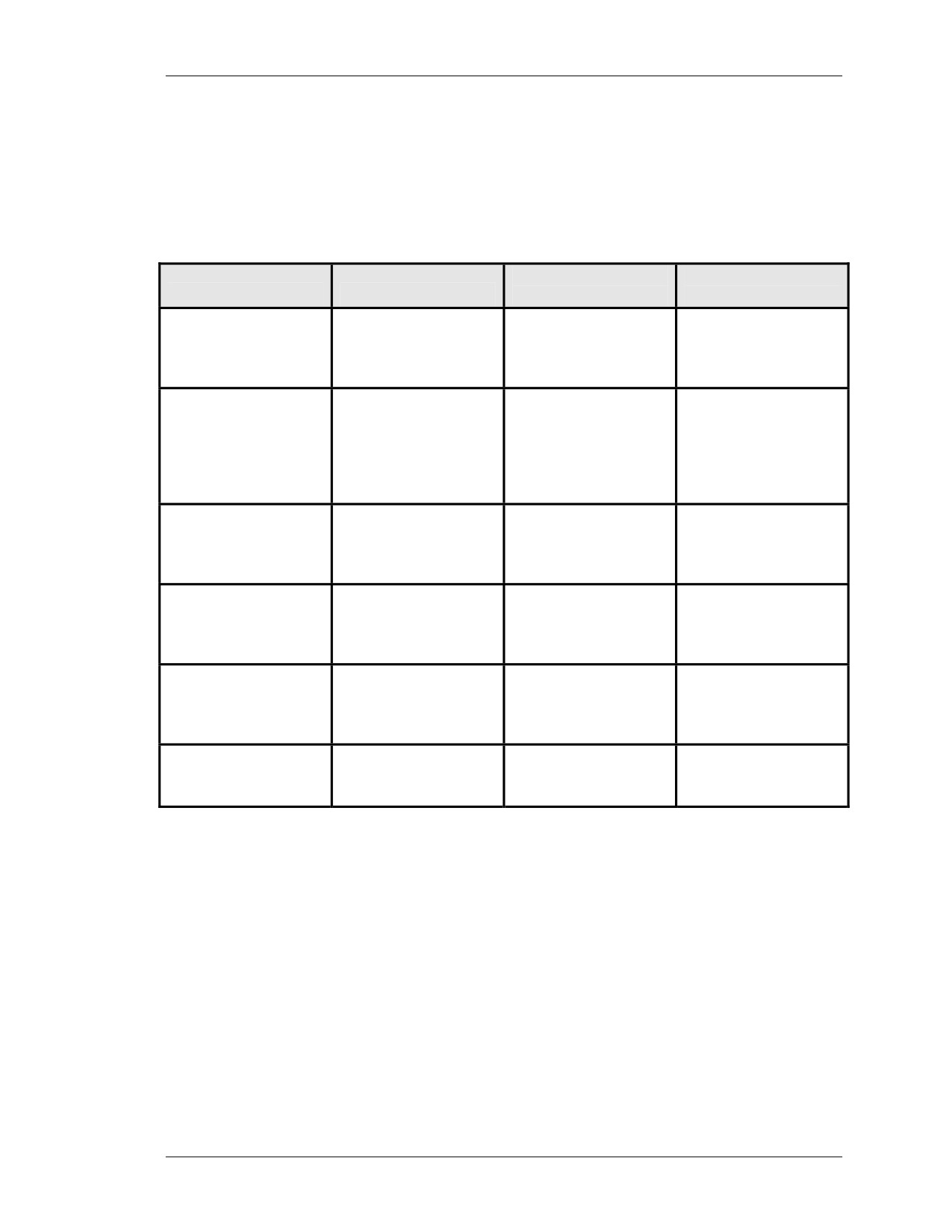
Jumpers must be briefed on in-flight emergency procedures described in Table 9-1.
NOTE: Rotary-wing aircraft in-flight emergency procedures are different from those
shown in Table 9-1. They are explained by either the PJM or pilot before
boarding the aircraft.
ACTIONS IN
ACTIONS IN
SITUATION
SIGNAL
USAF AIRCRAFT
ARMY AIRCRAFT
Crash landing during
Continuous ringing of
Remain seated until
Pull legs inside
takeoff
alarm bell or oral
aircraft stops, then
aircraft; remain in
warnings
exit.
position; cover head
with arms.
Crash landing during
Six short rings of
Jump if time permits.
As directed by pilot.
flight
alarm bell or oral
If not, secure seat
warning
belts; brace for impact
on continuous ring;
remain seated until
aircraft has stopped.
Emergency bailout
Three short bells of
Stand up and hook up
Exit aircraft under
alarm bell or oral
on continuous ring;
direction of PJM.
warning
exit aircraft under
direction of PJM.
Ditching over water
Six short rings and
Use available
Pull legs inside
with insufficient drop
oral warning
padding, remain
aircraft; remain in
attitude
seated, and secure
position; cover head
seat belts.
with arms.
Lighten load
Oral warning
Designated
As directed by pilot.
parachutist may assist
PJM or loadmaster in
jettisoning cargo.
Fire in flight
Oral warning
Remove parachutists
As directed by pilot.
from fire area and
extinguish fire.
Table 9-1. In-flight emergency procedures.
9-25
FM 3-21.220(FM 57-220)/MCWP 3-15.7/AFMAN11-420/NAVSEA SS400-AF-MMO-010
CHAPTER 10
JUMPMASTER AND SAFETY DUTIES IN FLIGHT
This chapter provides an overview of the duties of the jumpmaster,
assistant jumpmaster, and safety personnel during flight. For aircraft-
specific personnel duties, see Part Four, Aircraft Used in Airborne
Operations.
Section I. PRIMARY JUMPMASTER, SAFETY PERSONNEL, AND
ASSISTANT JUMPMASTER
After aircraft takeoff, the JM must remain oriented to aircraft position at all times and
keep the parachutists informed of any deviations from flight plan. He may coordinate
with the navigator or use strip maps and checkpoints. He also remains in communication
with the pilot. This is performed by relay through the loadmaster over the interphone. On
Army aircraft, the JM or safety personnel should wear a flight helmet or headset for
direct communication with the pilot and to monitor the ground control element. If the
JM/safety cannot wear a flight helmet or headset, communication can be made through
the crew chief.
10-1. PRIMARY JUMPMASTER
General rules stress that the JM must—
• Not sacrifice safety for any reason.
• Rehearse JM procedures on the ground.
• Hook up before opening jump door(s) or ramp.
• Face the open jump door or tailgate when in flight.
• Maintain a firm handhold on the aircraft when working in or close to the open
jump door or ramp.
• Not allow anyone in or near the open jump door without a helmet (or equivalent)
and safety harness or parachute.
The JM must remember that jumpers’ eyes require 20 minutes to adjust to lower light
levels before night operations. Therefore, only red compartment lights or night vision
imaging systems (NVIS) lighting will be used 20 minutes before drop time. This allows
for physical adjustment and minimizes the impairment of a jumper’s night vision during
the critical first seconds of a night drop. If the white light is substituted for the red light
before drop time, the jumpers’ eyes must readjust by turning on the red compartment
lights for 20 minutes.
10-2. SAFETY PERSONNEL
During flight, safety personnel constantly check on the condition of all parachutists and
distribute airsickness bags where needed. They also assist the JM in relocating personnel
who are too sick to jump, jump refusals, and other types of no-jumps. If a jump refusal
occurs, safety personnel move the parachutist forward in the cargo compartment to be
seated. During in-flight rigging missions, safety personnel assist in parachute issue. They
operate rigging, JMPI, and correction stations as directed by the JM. The safety double
10-1
FM 3-21.220/MCWP 3-15.7/AFMAN11-420/NAVSEA SS400-AF-MMO-010
checks to ensure the pilot and loadmaster have designated a specific individual to cut
away a towed jumper.
10-3. PRIMARY JUMPMASTER/ASSISTANT JUMPMASTER DUTIES
JM/AJM duties are as follows:
a. Enforce flight rules and regulations.
b. Issue time warnings.
c. Issue jump commands.
d. Perform door safety checks.
e. Perform outside air safety checks.
f. Control exit of all parachutists.
g. Eject door bundles.
h. Perform in-flight rigging mission.
Section II. DOOR PROCEDURES AND DOOR BUNDLE EJECTION
Time warnings, door procedures, and door bundle ejection are events that commonly
occur during each airdrop operation. Time warnings and door procedures are completed
during each airdrop operation, but door bundles are not always ejected. The time
warnings and door procedures are considered critical aspects of JM operations during all
airdrop operations.
NOTE: The 20-minute time warning may be increased to 30 minutes aboard the
C-141 or C-17 if the JMs need more time to accomplish their duties.
10-4. THE 20-MINUTE TIME WARNING
JMs unbuckle their seat belts and stand up. They move to the rear of the aircraft, turn, and
face the parachutists. (All time warnings begin and end at the shoulders with closed fists.)
They extend both arms straight forward, extending and spreading the fingers and thumb
of each hand. This is repeated twice while the oral command is given.
a. All CWIEs, AT4JPs, and DMJPs are attached to designated parachutists and are
inspected. Safety personnel assist the JMs with attaching equipment and ensuring the
tie-downs are secure and the lower lines are attached and secure. JMs and safeties unlash
door bundles (if any) and move them near the jump door(s). Once positioned, the static
line of each cargo parachute is attached to the outboard anchor line cable and the
following inspection sequence is completed:
• Static line and clevis (safety wire must be bent so that it has metal-to-metal
contact).
• Pack closing tie.
• Drogue device (one for C-130; two for C-141).
• Point of attachment to the bundles (risers).
• Tie-down tapes (one on each corner).
• Pack tray and bundle (for any loose or excess webbing).
b. When the inspection is completed, the JM slaps the smooth side of the bundle and
ensures it is facing the trailing edge of the door(s).
10-2
FM 3-21.220/MCWP 3-15.7/AFMAN11-420/NAVSEA SS400-AF-MMO-010
NOTE: The 10-minute time warning may be increased to 15 minutes aboard the
C-141 or C-17 if the JMs need more time to accomplish their duties.
10-5. THE 10-MINUTE TIME WARNING
When the loadmaster informs the JMs that the aircraft is 10 minutes from the DZ, the
JMs unbuckle their seat belts and stand up (if seated). They hook up to the inboard
anchor line cable, move to the rear of the aircraft near the jump door, and transfer control
of their static lines to safety personnel. They announce, SAFETY, CONTROL MY
STATIC LINE, and ensure the safety has positive control before turning to face the
parachutists. The JMs begin jump commands at the 10-minute time warning. During this
process, the safeties help the JMs hook up, watch for excess static line, and stow any
excess static line in the static line slack retainer. After inspection of the JMs’ static lines,
safeties move out to inspect the sticks, as indicated in the following paragraph.
10-6. FIRST SEVEN JUMP COMMANDS
The JM is now ready to issue the first seven jump commands.
a. After the parachutists are standing, safety personnel inspect the following items
on each parachutist while moving forward in the aircraft:
• Waistband for proper quick release.
• Ejector snap on the HPT lowering line for proper attachment.
• Quick-release assembly on the weapons case for proper attachment.
• Adjustable leg straps on harness, single-point release.
NOTE: Safeties must be alert for and correct any excess webbing or loose lowering
line.
b. Once the safeties have checked the last parachutist, and after the command
HOOK UP, they return to the aft end of the aircraft. While moving to the aft end, safeties
check the full length of each parachutist’s static line to ensure proper routing and
attachment to the anchor line cable. They check with both eyes and hands and stow any
excess static line in the static line slack retainer so that each static line is taut from the
anchor line cable to the main pack tray. As the safety checks each static line, he reminds
each jumper to “make eye-to-eye contact and hand the safety your static line.” After he
checks the first parachutist and the JM’s static line, the safety resumes control of the JM’s
static line.
c. After the JM receives “All okay, JM,” he regains control of his static line from the
safety, takes the number 1 parachutist position, and waits for slow-down procedures.
d. Once the aircrew has completed their slow-down checklist (slow aircraft to drop
speed, open jump doors, deploy air deflectors, and position jump platforms), the
loadmaster relinquishes control of the jump door to the JM by giving the JM a thumbs-up
signal. He then moves to the ramp area.
10-7. DOOR SAFETY CHECK
Safety personnel position themselves near the trail edge of the jump door and control the
static line for the JM as he performs the door safety check and outside air safety check.
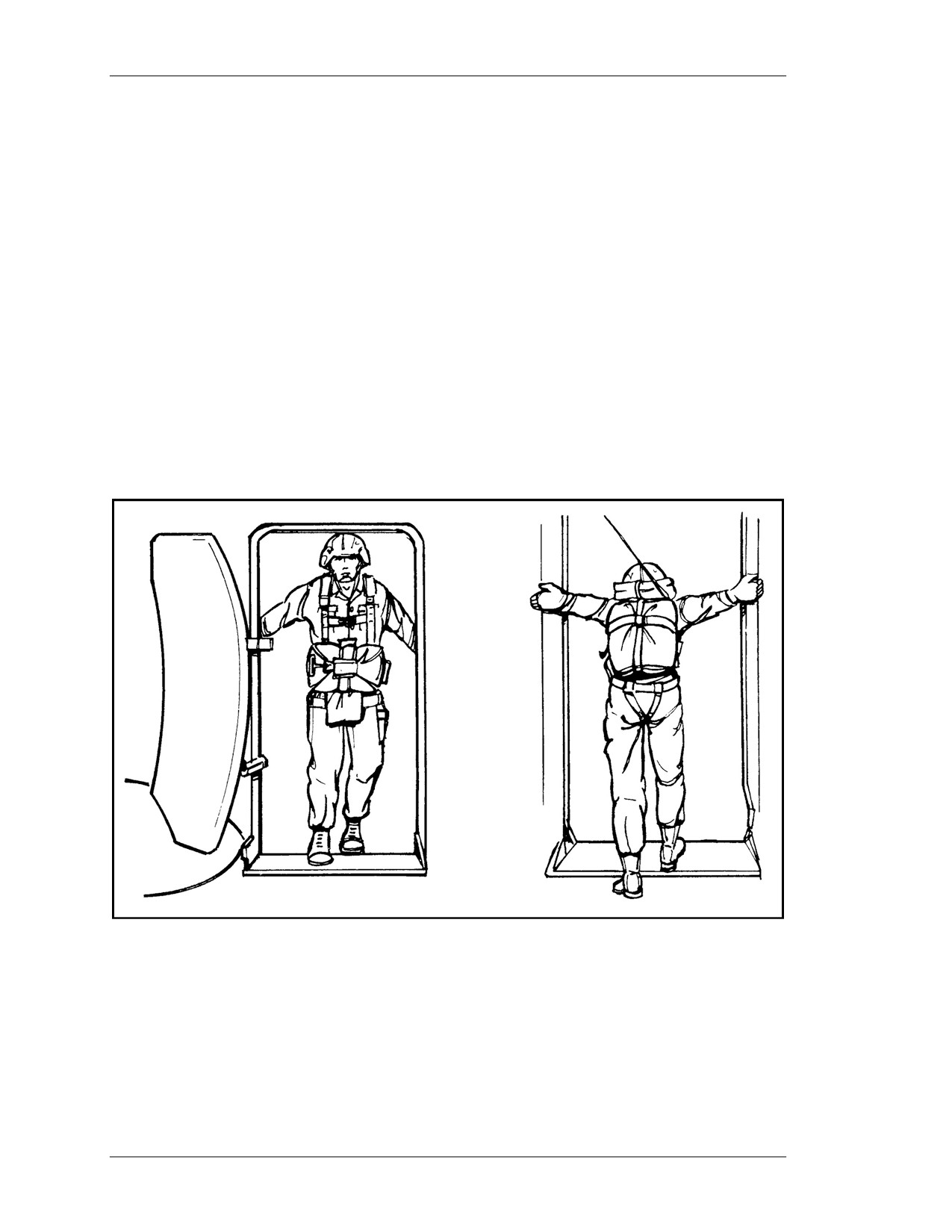
He grasps the lead edge of the door with his lead hand and transfers control of his static
10-3
FM 3-21.220/MCWP 3-15.7/AFMAN11-420/NAVSEA SS400-AF-MMO-010
line back to the safety (Figure 10-1). Then, he grasps the trail edge of the door with his
trail hand. Using only the lead hand, he ensures the pip pin is in place, securing the jump
door in the open position on the C-130, or that the door-latch catch operates properly on
the C-141. (See Chapter 16 for door procedures for the C-17A.)
a. Jump Platform. The JM checks the jump platform by—
(1) Tapping the lead down lock with the lead foot and then the trail down lock with
the trail foot and visually checking to ensure they are engaged.
(2) Placing his trail foot in the center of the jump platform and shifting his weight to
the platform, ensuring the platform can support his body weight. The trail foot remains in
place. (If the JM removes his foot from the platform, he must again check the down locks
and ensure the platform can support his body weight.) From this rest position, the JM
performs all remaining duties in the door until it is time to issue the eighth jump
command (or place bundles in the door).
b. Trail Edge of Door. With the trail hand, the JM starts at the top of the trail edge
of the door, tracing all the way down to the trail down lock, then back to the top to ensure
no sharp or protruding edges exist.
c. Air Deflector. The JM looks at the air deflector, ensuring it is fully deployed.
Figure 10-1. JM door position.
10-8. INITIAL OUTSIDE AIR SAFETY CHECK AND CHECKPOINTS
The JM must make outside air safety checks to ensure there are no unsafe conditions
outside the aircraft (aircraft in the formation to the rear that are below drop altitude or
other low-flying aircraft). From the same rest position, the JM leans far enough outside
the aircraft to make a proper air safety check, and visually checks—
• Direction of flight.
• Overhead.
10-4
FM 3-21.220/MCWP 3-15.7/AFMAN11-420/NAVSEA SS400-AF-MMO-010
• Rear.
• Straight down.
• Straight to his front.
• Direction of flight.
The JM continues observing outside the aircraft and spotting for checkpoints en route to
the DZ. In the absence of checkpoints, he uses additional time advisories from the air
crew, which must have been identified during the pilot/JM briefing. The navigator and
primary loadmaster should also be present for this briefing. The JM relays checkpoints or
time advisories to the parachutists by leaning back inside the aircraft, keeping his foot
centered on the platform, facing the parachutists, and issuing the checkpoint or time
advisories.
NOTES:
1. When the JM leans back inside the aircraft to assume the rest position, he
will not collapse his trail elbow with the lead arm locked. Allowing his trail
elbow to collapse could cause accidental MIRPS activation resulting in JM
extraction from the aircraft. Such an extraction can result in serious injury or
death.
2. The JM may lock his elbows, if deemed necessary, to properly conduct
outside air safety checks, or when checking for towed jumpers. However, the
JM is not required to lock his elbows when performing those actions.
3. The loadmaster should relay time warnings to the jumpmaster or safety by
using hand signals. The exact hand signals must be coordinated between the
jumpmaster and loadmaster during the aircrew brief. However, suggested
hand signals are as follows: 1-minute time warning--the index finger extended
vertically; 30-second time advisory—the index finger and thumb held closely
together.
10-9. THE 1-MINUTE TIME WARNING
Approximately one minute from the green light, the safety passes along loadmaster time
warnings if the jumpmaster fails to hear them. The JM relays the 1-minute warning to the
parachutists by leaning back, keeping his foot centered on the platform, facing the
jumpers, and extending the index finger of his lead hand. He announces, ONE MINUTE.
The jumpers relay the announcement to the rear. The JM continues observing outside for
the
30-second checkpoint, or until he receives a 30-second time advisory from the
loadmaster.
10-10. FINAL OUTSIDE AIR SAFETY CHECK
The JM announces, THIRTY SECONDS. The jumpers relay the announcement to the
rear. After the JM has given the 30-second checkpoint or relayed a 30-second time
advisory, he makes his final outside safety check and, based on his checkpoint or
USAF/other service aircraft advisory, determines when the aircraft is about 10 seconds
(20 seconds for bundle drops) from the release point. Once again, he leans out and
visually checks—
• Direction of flight.
10-5
FM 3-21.220/MCWP 3-15.7/AFMAN11-420/NAVSEA SS400-AF-MMO-010
• Overhead.
• Rear (ensures no aircraft in the formation have dropped below jump altitude).
• Straight down.
• Straight to the front.
• Direction of flight (the JM may be able to see the DZ at this time, depending on
the aircraft axis of approach).
The safety, positioned at the aft end of the door, controls the JM’s static line during all
outside safety checks.
NOTE: For a CARP/VIRS DZ, the JM has no responsibility to positively identify the
DZ, code letter, or color of smoke. The responsibility to positively identify the
DZ, code letter, or color of smoke rests with the USAF/other service aircraft.
a. Unsafe Condition Outside Aircraft. If the JM observes any unsafe conditions
outside the aircraft, he notifies the loadmaster by a preplanned arm-and-hand signal (for
example, a cutting motion across the throat) that a NO DROP situation exists for this
pass.
b. Bundle Drops, 20 Seconds from Release Point. The JM moves back inside the
aircraft and positions the first door bundle on the jump platform so that it is on its balance
point with its longest dimension vertically in the door and the parachute on the top or
inboard side of the bundle. Then the JM—
(1) Maintains a firm grasp on the bundle with the lead hand and a firm grasp on the
trail edge of the jump door with the trail hand. He ensures that the cargo parachute static
line is routed above the trail arm.
(2) Keeps his eyes on the jump caution light. When the light turns green, he ejects the
door bundle(s), ensuring that it goes straight out and does not tumble.
(3) Maintains a firm grasp with his trail hand and turns toward the cargo area. The JM
and AJM make eye-to-eye contact and give each other the thumbs-up signal, indicating
that the door bundle has been ejected, that they are not aware of any unsafe conditions,
and that they are ready to exit personnel. (Parachutists are not positioned in the door until
this is accomplished.) This procedure is followed when ejecting door bundles from one
door or both doors, as long as both doors are open.
(4) Moves on line with the lead edge of the jump door and issues the eighth jump
command IAW the exit procedures.
c. No Bundle Drops, 10 Seconds from Release Point. When door bundles are not
used on an airborne operation, the JM makes his final check to determine that the aircraft
is about 10 seconds out from the RP, based on his checkpoint or USAF/other service
aircraft advisory. Then he—
(1) Maintains a firm grasp on the trail edge of the door with the trail hand and turns
as far as possible toward the cargo area. The JM and AJM make eye-to-eye contact and
give each other the thumbs-up signal, indicating that there are no unsafe conditions
outside the aircraft and that they are ready to exit personnel. This procedure is followed
when exiting personnel from one or both doors, as long as both doors are open.
(2) Releases the trail edge of the door and issues the eight jump command (keeping
his body centered on the trail edge of the door).
10-6
FM 3-21.220/MCWP 3-15.7/AFMAN11-420/NAVSEA SS400-AF-MMO-010
10-11. EIGHTH JUMP COMMAND
The JM issues the eighth jump command, STAND BY. The safety positions himself near
the trail edge of the door, ensuring he does not impede the flow of jumpers.
a. Computed Air Release Point. After issuing the eighth jump command, the JM
immediately regains control of his static line from the safety. He backs away from the
door toward the middle of the aircraft to allow the safety room to control static lines. The
safety receives the first parachutist’s static line with his forward hand and secures it with
his aft hand by pinning it against the aft anchor line support.
b. Ground Marking Release System. After issuing the eighth jump command, the
JM continues to spot for the DZ and DZ markings. He backs away from the door toward
the middle of the aircraft to allow the safety room to control static lines. When the line of
the panels break the trailing edge of the jump door, the JM issues the command, GO. The
safety receives the first parachutist’s static line with his forward hand and secures it with
his aft hand by pinning it against the aft anchor line support. For USAF operations, a
safety is not used and either the JM or loadmaster fulfills the duty after coordination.
10-12. NINTH JUMP COMMAND
When the JM issues the ninth jump command, GO, he ensures that he has backed away
from the door where he can best control his stick and away from the safety, to avoid
confusion or congestion. Safety personnel take static lines while the JM controls the flow
of parachutists. The safety grabs each static line with his forward hand, passes it back to
his aft hand, and ensures the line is firmly seated against the aft anchor line cable support.
After all parachutists have exited the aircraft, the JM and AJM hand off their static lines
to the safeties and exit the aircraft. The safety immediately makes a visual check for
toward jumpers. He then looks directly at the loadmaster, passes him a thumbs-up signal,
and states YOUR DOOR, AIR FORCE.
a. Red Light Procedures. If a JM sees a red jump caution light, he sounds off with
“RED LIGHT, RED LIGHT, RED LIGHT,” and then moves forward to block the flow of
the stick. If any parachutist tries to exit on the red light, he will be allowed to exit, except
in the case of an unsafe parachutist. No one touches or physically tries to stop a
parachutist who is past the leading edge of the door. Parachutists will be stopped only by
oral command; this reduces the risk of accidentally activating the jumper’s reserve.
b. Jump Refusals. When removing a jump refusal from the door, the JM tells the
refusal,
“GREEN LIGHT, GO; GREEN LIGHT, GO; GREEN LIGHT, GO.” If the
jumper does not exit, he tells the refusal, “YOU ARE A JUMP REFUSAL AND I AM
TAKING YOU OUT OF THE DOOR.” Then, the JM should approach the parachutist
from the rear and grasp the sides of his parachute. The JM never puts his hand in front of
the parachutist’s face or grabs the back of his ballistic helmet.
(1) The safety warns the refusal that he is being brought back inside the aircraft.
Under NO condition should the JM reach around in front of the refusal to pull him back
into the aircraft; the JM could accidentally hit or grab the reserve rip cord grip.
(2) After the jump refusal is brought inside the aircraft, he is guided as far forward in
the aircraft as is possible, seated, buckled up, unhooked, and directed to not touch his
equipment. During training, a jump refusal will stop the jump for that pass.
c. Unsafe Parachutist. If a parachutist has passed the leading edge of the door and
must be stopped because of a misrouted static line or other critical deficiency, the safety
10-7
FM 3-21.220/MCWP 3-15.7/AFMAN11-420/NAVSEA SS400-AF-MMO-010
approaches the jumper from the back to grab the sides of his parachute. The safety never
reaches around in front of the parachutist, puts his hands in front of the parachutist’s face,
or grabs the back of his helmet.
10-13. TOWED PARACHUTIST (FIXED-WING AIRCRAFT)
Actions to retrieve or cut free a towed parachutist are as follows:
a. JM Actions. If the JM observes a towed parachutist, he takes the following
actions. The JM—
(1) Stops the stick of parachutists (if applicable).
(2) Notifies the loadmaster, who then notifies the pilot and requests that drop altitude
be maintained.
(3) Identifies how the parachutist is being towed. If the parachutist is being towed by
anything other than the lowering line or static line, the JM attempts to free him. If the
parachutist is being towed by a lowering line, the JM immediately cuts the lowering line,
thus freeing the parachutist. If the parachutist is being towed by the static line, the JM
initiates recovery procedures.
b. JM Recommendations. The JM observes the towed parachutist and recommends
whether to retrieve or cut the parachutist free. The recommendation is relayed by the
loadmaster to the pilot. The pilot makes the decision. If the decision is to cut the jumper
free, the loadmaster will cut the static line on command of the pilot. Priority is as follows:
(1) Door. Safety personnel move the remainder of the stick toward the front of the
aircraft. If the parachutist is to be retrieved, the loadmaster uses the Towed Parachutist
Retrieval System (TPRS) or installs the retrieval bar on the C-141 or the CGU1-B cargo
strap on the C-130, retracts or folds in the jump platform, and initiates retrieval. All
personnel stay clear of the door and line of travel of the static line retriever cable. When
the parachutist has been retrieved to the door, the JM and safety personnel gain physical
control of the parachutist. The loadmaster relieves tension from the static line retriever so
that the parachutist can be brought inside the aircraft. The retrieved parachutist is moved
all the way forward and is seated. He does not jump again. If the retrieval is unsuccessful
and the parachutist must be cut free, the loadmaster cuts the static line.
(2) Ramp. If a parachutist is towed following a ramp exit and is to be cut free, the
loadmaster partly retrieves the static lines to reach the towed parachutist’s static line in
order to cut it. If the parachutist is to be retrieved, the loadmaster uses the Towed
Parachutist Retrieval System (TPRS) or installs a CGU1-B cargo strap (C-130) about 5
1/2 feet above the ramp. The static lines are retrieved over the CGU1-B strap. As the
parachutist is retrieved to the ramp area, the JM and safety personnel gain physical
control of him. The parachutist is pulled into the aircraft
(under the strap) as the
loadmaster relieves tension from the static line retriever cable. The parachutist is moved
all the way forward and is seated; he does not jump again.
c. Modifications to Towed Jumper Procedures. Occasionally, the above towed
jumper procedures must be modified. JMs are responsible for the safety of the
parachutists’ equipment checks and deployment safety as long as they are onboard the
deployment aircraft. The loadmaster(s) is trained and responsible for retrieving towed
parachutists. No additional JMs or safeties are required to remain onboard the aircraft
unless specified in the jumping unit’s ASOP. If all parachutists have exited, those actions
described as JM responsibilities are accomplished by the loadmaster(s). The aircrew is
10-8
FM 3-21.220/MCWP 3-15.7/AFMAN11-420/NAVSEA SS400-AF-MMO-010
responsible for all equipment left onboard the aircraft by the jump unit until it can be
retrieved or turned over to the unit concerned.
NOTE: Towed jumper procedures for rotary-wing aircraft are addressed in
Chapter 17.
d. Safety Duties. After all parachutists have exited
(including JMs), the safety
makes a visual check for towed parachutists to the rear of the jump door, gives the USAF
loadmaster a thumbs-up signal, and an oral YOUR DOOR, AIR FORCE. This indicates
that all parachutists are free and clear of the aircraft.
e. Static Line and Deployment Bag Retrieval. Safety personnel and the
loadmaster retrieve the static lines and deployment bags. Once the static lines and
deployment bags are inside the aircraft, safety personnel detach the static lines and store
them with the deployment bags in extra aviator kit bags.
f. During Return to Departure Airfield. While en route to the departure airfield,
safety personnel obtain the name, rank, social security number, unit, and reason (that is,
sickness, equipment malfunction, jump refusal) for any manifested parachutist remaining
onboard. They also check the aircraft for any Army equipment that was left onboard for
turn-in to the DACO, collect trash and airsick bags, and reinstall seats and seat belts if
subsequent lifts are planned.
g. At Departure Airfield. On return to the departure airfield, safety personnel turn
in all air items (reserves, deployment bags, and kit bags) left onboard the aircraft to the
storage facility (obtain a receipt). They also turn over any unit or personal equipment
left aboard the aircraft to the DACO. All jump refusals and personnel left aboard the
aircraft are immediately turned over to the DACO with a full account of the
circumstances for each. Any jump refusal’s personal equipment remains under DACO
control until relieved of authority by competent unit personnel.
10-9
FM 3-21.220(FM 57-220)/MCWP 3-15.7/AFMAN11-420/NAVSEA SS400-AF-MMO-010
CHAPTER 11
DEPARTURE AIRFIELD CONTROL OFFICER
The DACO is appointed by the airborne commander and is
responsible for coordination and control of the loading of personnel,
equipment, and supplies into aircraft. The DACO is located at the
departure airfield.
11-1. INITIAL COORDINATION
When advised of appointment, the DACO is furnished the following information:
• The unit(s) that is jumping.
• Type of jump and number of personnel.
• Type and number of aircraft.
• Number of lifts.
• Load time.
• Station time.
• Weather decision time.
• Drop zone.
• Names of DZSO, assistant DZSO, DZSTL, JM, AJM, and safety personnel.
11-2. TANKER/AIRLIFT CONTROL ELEMENT COORDINATION
At the departure airfield, the DACO makes contact with the tanker/airlift control
element(TALCE)/aircrew to discuss, coordinate, and confirm the following:
• Aircraft parking plan.
• Aircraft tail number(s).
• Time of pilot/jumpmaster briefing.
• Time aircraft will be available for jumpmaster inspection.
• Weather data.
• Flight line safety measures.
• Appointment and identification of the GLO.
• Current safety regulations (TALCE/aircrew advises DACO).
• Aircraft loading procedure and time.
• Return of jump refusals (how they are to be managed).
• Manifest distribution to TALCE/aircrew.
• Inspection of aircraft for air items and other airborne unit equipment left onboard
upon its return to departure airfield.
11-3. DROP ZONE SAFETY OFFICER/DROP ZONE SUPPORT TEAM
COORDINATION
The DACO—
• Contacts the DZSO/DZSTL one hour before drop time.
• Informs the DZSO/DZSTL of aircraft aborts.
• Updates the DZSO/DZSTL on changes.
11-1
FM 3-21.220/MCWP 3-15.7/AFMAN11-420/NAVSEA SS400-AF-MMO-010
• Requests a closure report from the DZSO/DZSTL.
• Requests timely wind readings from the DZSO/DZSTL.
11-4. ADDITIONAL RESPONSIBILITIES OF THE DEPARTURE AIRFIELD
CONTROL OFFICER
The DACO—
• Maintains radio and telephone contact with TALCE/aircrew and higher
headquarters.
• Controls movement of all vehicles.
• Coordinates with TALCE/aircrew/GLO for airfield lighting to assist night airdrop
departure airfield operations.
• Ensures all units police their areas before enplaning.
• Reports all serious incidents.
• Is physically present for all weather briefings and decisions.
• Ensures parachute maintenance personnel are present for issue and technical
assistance.
• Becomes familiar with regulations and the SOP of the unit involved in the
operation.
11-5. AIRFIELD AND RUNWAY SAFETY
The DACO—
• Is responsible for the movement in and around aircraft, taxiways, and runways.
• Briefs JM/AJM on airfield procedures.
11-2
FM 3-21.220(FM 57-220)/MCWP 3-15.7/AFMAN11-420/NAVSEA SS400-AF-MMO-010
PART THREE
Equipment
CHAPTER 12
INDIVIDUAL COMBAT EQUIPMENT JUMP LOADS
Individual equipment and weapons are attached or worn by the
parachutist in several configurations--for example, exposed, placed inside
containers, or a mix of the two. Unit airborne SOPs specify ways of
packing equipment and other mission-essential items consistent with safety
requirements and this manual. However, to ensure personnel safety, all
small arms must be on “SAFE” when jumping.
Section I. LOAD PLACEMENT
Fragile items, such as weapon sights, are padded. Crushable items are not placed directly
under the attaching harness. Exposed weapons or equipment, snap hooks, and projections
on containers are potential safety hazards and must be taped.
12-1. LOAD DISTRIBUTION
Individual equipment attached to the equipment belt is placed on the front or sides of the
body away from the PLF points of contact. The medium or large ALICE pack is attached
to the front of the parachutist using an H-harness or HSPR. A lowering line is attached if
the pack exceeds 35 pounds or has a frame attached. Hard, bulky, or irregularly shaped
items are not placed to the rear of the parachutist or on the thighs. Jumpmasters and unit
leaders must inspect parachutists to ensure weight and distribution of the load does not
interfere with the parachutist’s ability to perform a strong exit from the aircraft door.
12-2. CONSIDERATIONS
In accordance with AFI 11-2-C-130-Vol III, commanders will not load parachutists with
equipment to exceed 350 pounds total weight and will reduce this weight by 12.5 pounds
for every thousand feet of exit altitude above 3,000 feet MSL for fixed- and rotary-wing
jumps. Total weight will not exceed 325 pounds for C-130 ramp jumps. Failure to
comply could result in D-ring failure if the reserve is deployed at terminal velocity and or
the JM is unable to retrieve the towed parachutist. The variety and weight of equipment
or weapons attached to a jumper may exceed the parachute load limits and a safe descent
rate. Also, the jumper’s actions or time available to release tie-down straps and lower
equipment may interfere with control of the parachute close to the ground (Tables 12-1
and 12-2, page 12-2). Commanders should use all the equipment methods of entry
available to them (CDS, door bundles, wedge, and so on) to prevent overloading any
individual parachutist.
12-1
FM 3-21.220/MCWP 3-15.7/AFMAN11-420/NAVSEA SS400-AF-MMO-010
TWO EQUIPMENT LOADS AND BASIC LOAD (POUNDS)
Load-
Suspended
Bearing
ALICE
Battle
Weight of
Equipment
Pack with
Dress
T-10-/
Total
with Two
Sleeping
Uniform
M1950
Weapons
MC1-Series
Suspended
Soldier
Canteens
Bag
Helmet,
Weapons
Loaded with
Parachute
Soldier
Weight
Load Type
(Water)
(Winter)
and Boots
Container
Ammunition
and Reserve
Weight
(Pounds)
(1)
(2)
(3)
M16
11.5
32
15
7.3
31.0
23
205
324.8
Rifleman
M60
11.5
32
15
7.3
54.4
23
205
348.2
Machine
Gunner
M203
11.5
32
15
7.3
40.0
23
205
333.8
Gunner
Dragon
11.5
32
15
6.5
55.9
23
205
348.9
Gunner
(weapons
only)
Radio
11.5
32
15
7.3
71.6
23
205
365.4
Operator
(1)
Weight of uniform does not include winter gear (for example, parka, liners, underwear).
(2)
Includes basic load of ammunition, grenades, Claymore, bayonet, and cleaning kit.
(3)
Does not include arctic gear.
Table 12-1. Weight of parachutist.
WEIGHT
DESCRIPTION
(POUNDS)
REFERENCE
REMARKS
For every 1,000 feet
above 3,000 feet
MSL subtract 12.5
pounds from the
jumper’s total weight,
Maximum Load-Bearing Capacity
Natick Research,
which includes the
T-10-Series/MC1-Series Main
360
Development, and
parachute assembly.
Canopy
Engineering Center
Failure to comply
may result in D-ring
or reserve failure if
the reserve is
deployed at terminal
velocity.
Maximum Load-Bearing Capacity
Natick Research,
to Achieve 22 Feet Per Second or
Total suspended
360
Development, and
Less Descent Rate, T-10-Series/
weight
Engineering Center
MC1-Series Main Canopy
Air Movement Planning Weight of
Parachutist with one
260
Combat-Equipped Parachutist
equipment container
Table 12-2. Parachute load limits.
Section II. LIFE PRESERVERS
Jumpers wear life preservers whenever a flight is conducted over water, a water obstacle
is on the DZ, or the intended DZ is close to a water obstacle. (See Appendix D.) The B-7,
the B-5, the LPU-10/P, and the life preserver inflatable (NSN 4220-0027-6892-9050) life
preservers are currently certified for use by parachutists. Other life preservers may be
used if approved by the individual service components.
12-2
FM 3-21.220/MCWP 3-15.7/AFMAN11-420/NAVSEA SS400-AF-MMO-010
12-3. B-7 LIFE PRESERVER
The B-7 is worn under the parachute harness. To fit the B-7 life preserver, the
parachutist places one flotation packet under each arm so that the packet flaps are to the
outside and the toggle cords are down and to the front. He runs the shoulder strap from
front to rear over the left shoulder, under the back strap, then from rear to front over the
right shoulder, and attaches it to the ring on the right flotation packet. He adjusts the
shoulder strap so that the flotation packets fit snugly against his armpits. The parachutist
then attaches the chest strap to the attachment rings on the left flotation packet, forming a
quick release.
WARNING
Ensure that the B-7 life preserver is worn so that the inflatable
portion is not between the parachute harness and the body.
Serious injury may result if it is in this position when inflated.
12-4. B-5 LIFE PRESERVER
The B-5 is worn under the parachute harness. The parachutist inflates the vest by pulling
two toggle cords (at the bottom of the vest) which activate CO2 cartridges that fill the
vest with gas. An alternate provision for inflating the vest is by blowing into the manual
inflation valve rubber hoses located on the upper right side of the vest. Manual inflation
should be used only if the CO2 inflation valves fail to operate. The flotation vest is
placed over the neck so that the inflatable vest is on the parachutist’s chest. The manual
inflating valves should be completely closed when donning the life vest. The back strap
and leg straps are then adjusted.
WARNING
Do not inflate the B-5 life preserver until the parachute harness
is removed. The B-5 can crush an individual’s chest if inflated
beneath a parachute harness.
12-5. LPU-10/P LIFE PRESERVER
The LPU-10/P is a standard USAF carbon-dioxide cartridge-activated life preserver
assembly worn during flights over water or during airdrops when water obstacles are near
or on the intended DZ. The LPU-10/P has an adjustable harness and underarm inflation
bladders. It is designed to keep the wearer’s head above water at weights up to 250
pounds for up to 10 minutes. The LPU-10/P is compatible with the USAF C-9, T-10, and
MC-4 parachute harness assemblies. The LPU-10/P must be maintained IAW USAF
TO 14S-1-102.
a. Donning the LPU-10/P. The LPU-10/P is worn under the parachute harness.
The harness is worn so that the inflatable pockets are under the parachutist’s arms. The
12-3
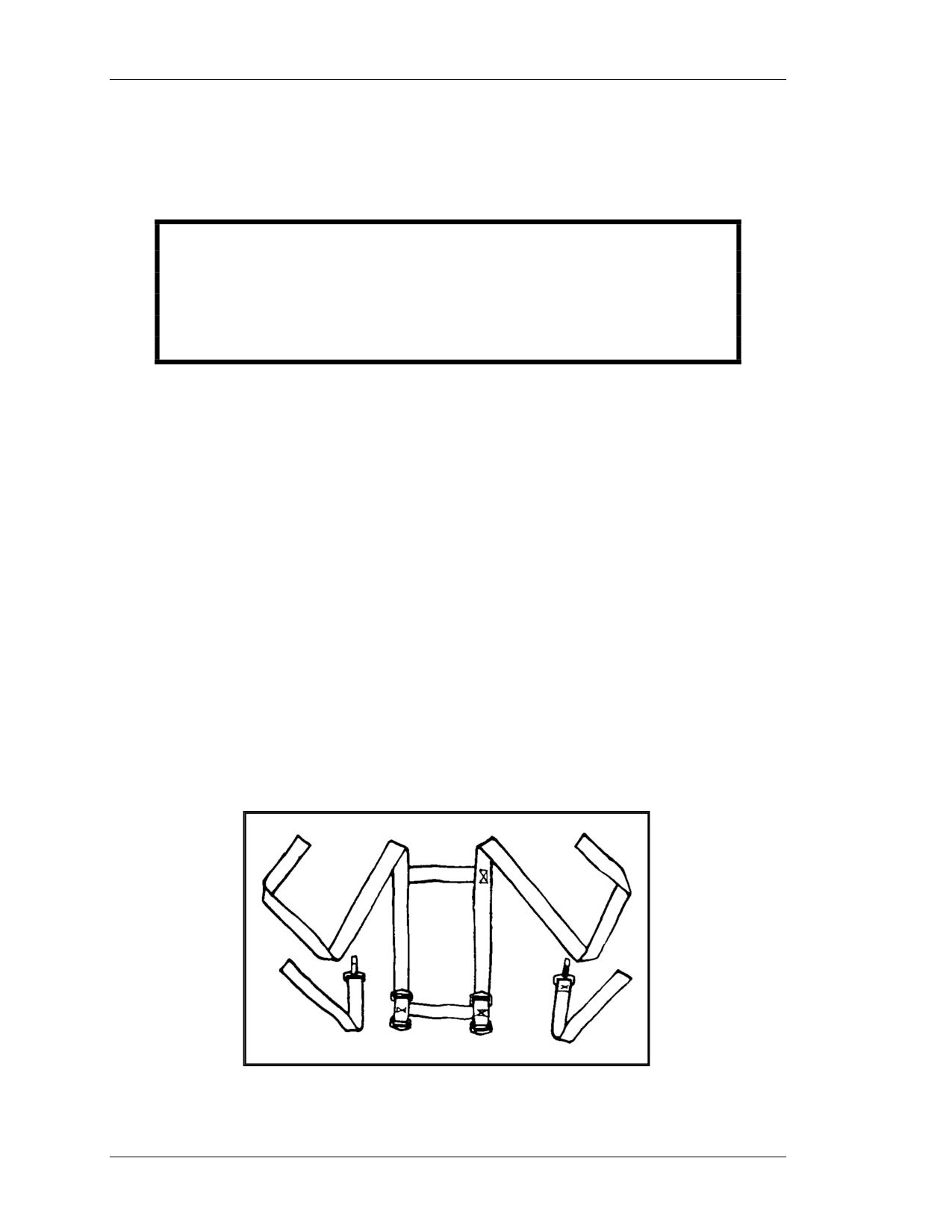
FM 3-21.220/MCWP 3-15.7/AFMAN11-420/NAVSEA SS400-AF-MMO-010
manual inflating valves should be completely closed when donning the life vest. The
shoulder and waist straps are then adjusted to ensure the inflation container is one hand
width beneath the armpit and not constrained by the parachute harness.
WARNING
The inflation wings must be one hand-width beneath the
jumper’s armpit and clear of the harness straps. If the inflation
pockets are too snug under the armpit, or if they are between
the harness and the jumper’s body, the jumper can experience
severe pain or crushed ribs during inflation.
b. Inflating the LPU-10/P. The parachutist inflates the flotation bladders by pulling
two toggle cords (at the bottom of the vest) which activate CO2 cartridges that fill the
bladders with gas. An alternate provision for inflating the vest is by blowing into the
manual inflation valve rubber hoses located on the bottom side of the wings. Manual
inflation should be used only if the CO2 inflation valves fail to operate.
Section III. HARNESSES AND LOWERING LINE
All load carriers (ALICE packs and weapons cases) are attached to the parachutist by
harnesses and, if lowered, rigged with the lowering line. Two types of harnesses are
used--the older H-harness (modified) and the new Standard A, HSPR assembly. (The
HSPR replaces the modified H-harness through attrition.)
12-6. H-HARNESS
The H-harness (modified) (Figure 12-1) consists of two equipment retainer straps.
a. These straps are connected by two cross straps. Each equipment retainer strap has
two friction adapters 3 inches apart. Two D-ring attaching straps terminate in a free-
running end on one end and a snap hook on the other end.
Figure 12-1. H-harness (modified).
12-4
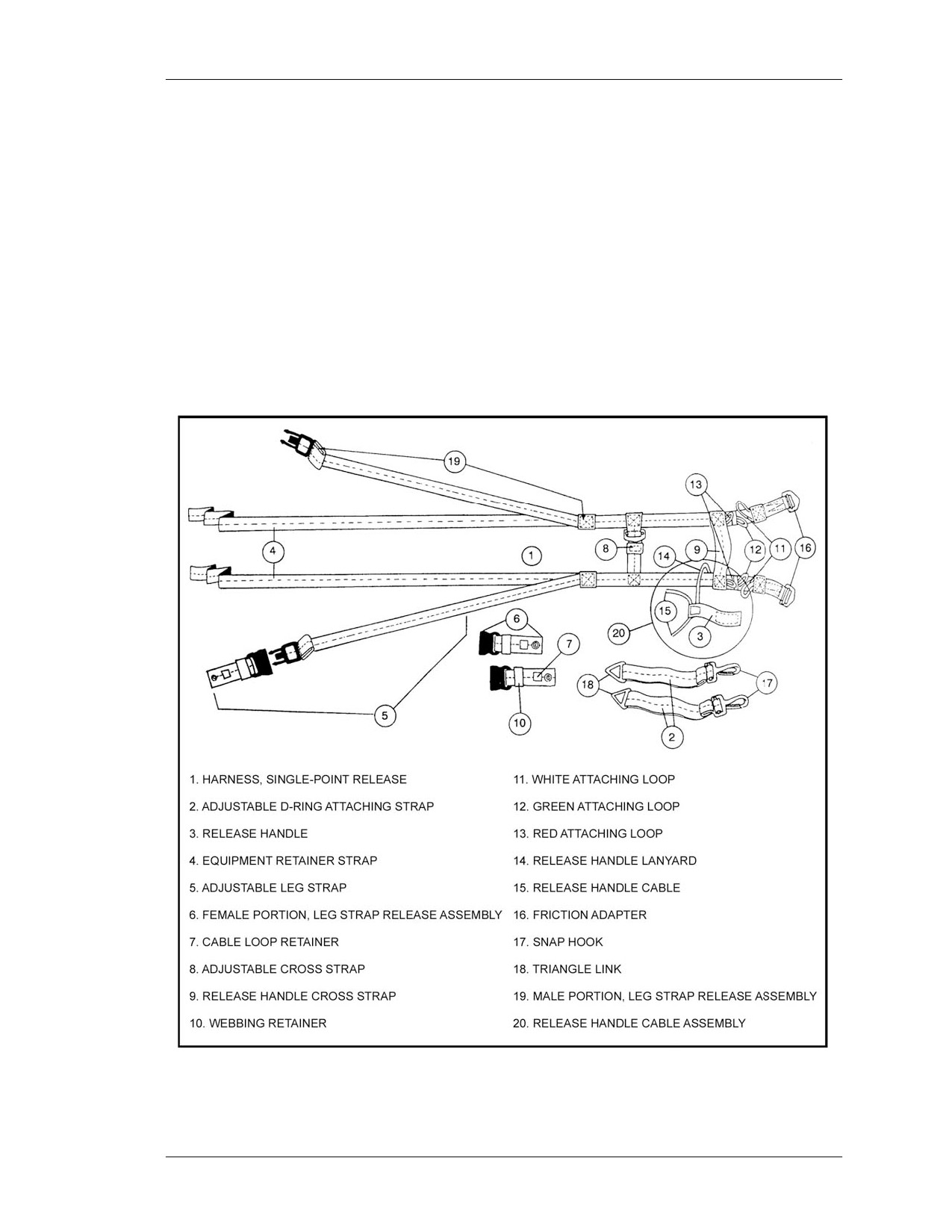
FM 3-21.220/MCWP 3-15.7/AFMAN11-420/NAVSEA SS400-AF-MMO-010
b. The H-harness is used to rig the ALICE pack to the parachute harness. When
rigging the H-harness, the parachutist ensures that equipment fits snugly under the
reserve parachute and that the D-ring attaching strap snap hooks are spaced a four-finger
distance from the H-harness friction adapters.
12-7. HARNESS, SINGLE-POINT RELEASE
The HSPR is an H-type design. It is made of nylon webbing with friction adapters to
secure it around the load, and it has two adjustable D-ring attaching straps. To stabilize
the pack to the parachutist during movement in the aircraft, exit, and main parachute
deployment, two adjustable leg straps are provided to secure the pack to the parachutist’s
right and left legs. The leg straps are equipped with the male portion of the leg strap
release assembly. The harness has a single-point release assembly that simultaneously
releases the load and leg straps from the parachutist and parachute harness (Figure 12-2).
Figure 12-2. HSPR (NSN 1670-01-227-7992).
12-5
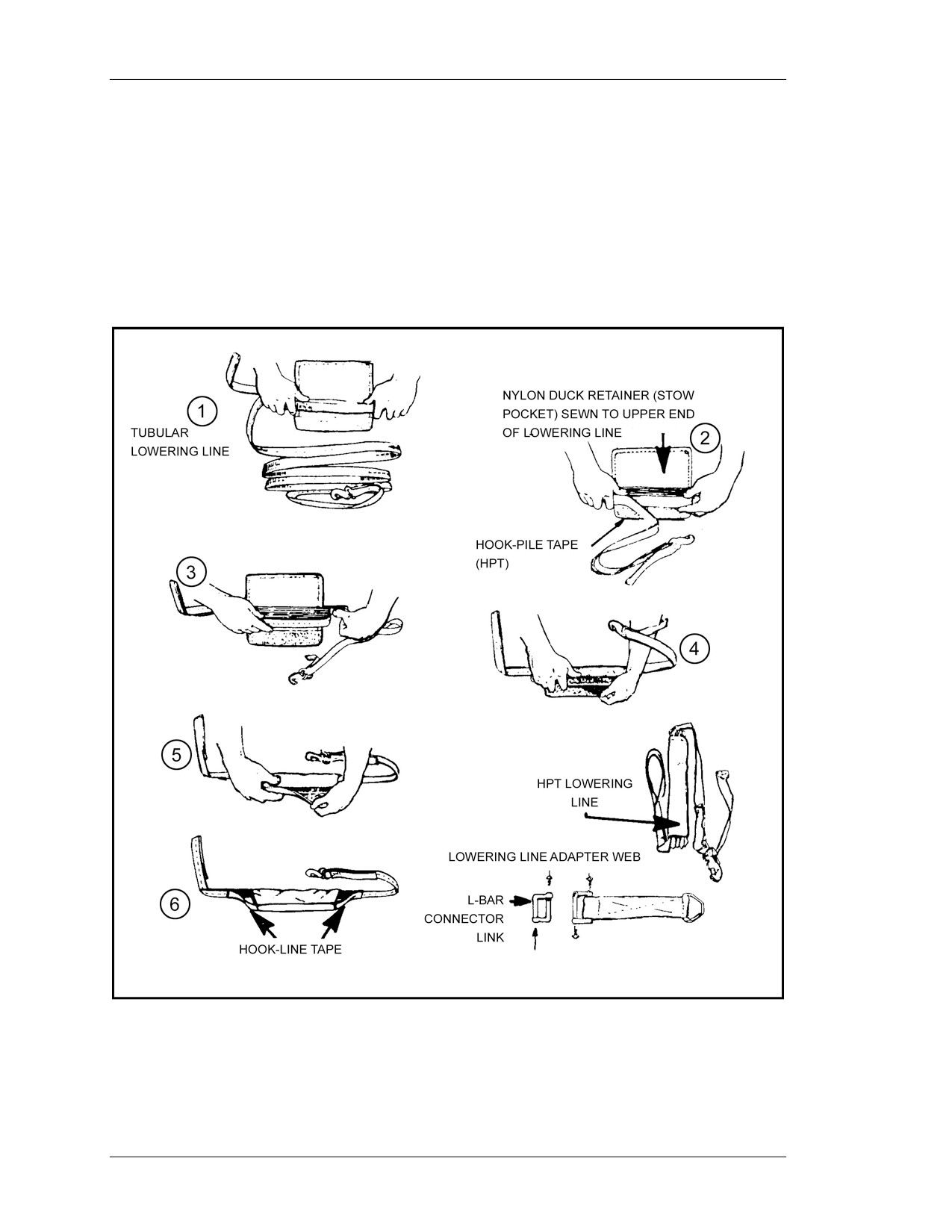
FM 3-21.220/MCWP 3-15.7/AFMAN11-420/NAVSEA SS400-AF-MMO-010
12-8. HOOK-PILE TAPE LOWERING LINE
The HPT lowering line (Figure 12-3) is used to lower all equipment attached to the
parachutist. The HPT has been modified to accommodate the DMJP and AT4JP when
lowered as a tandem load.
a. The standard 15-foot lowering line is made of tubular nylon (1 inch wide) with
two retainer flaps sewn on. The retainer flaps have HPT sewn to the edges.
b. Two-inch tabs are sewn on the lowering line and, when the line is stowed, the tabs
are secured to prevent line spillage. The ejector snap has a yellow safety lanyard (1 inch
by 8 inches) attached.
Figure 12-3. Hook-pile tape lowering line.
12-9. HOOK-PILE TAPE LOWERING LINE (MODIFIED)
The modified HPT lowering line (NSN 1670-01-067-6838) must be used when the DMJP
and AT4JP are lowered as a tandem load. The modification is accomplished in the field.
12-6
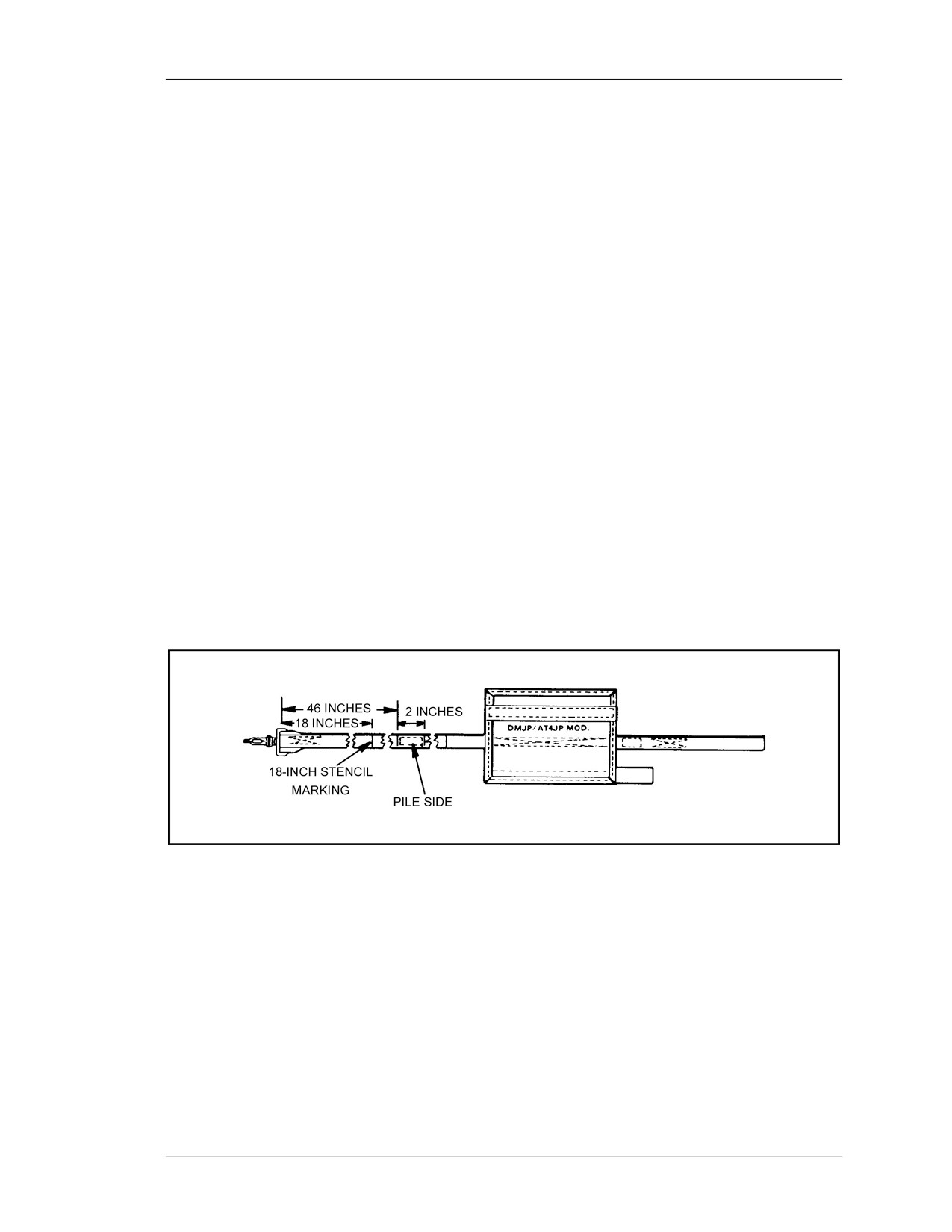
FM 3-21.220/MCWP 3-15.7/AFMAN11-420/NAVSEA SS400-AF-MMO-010
a. Materials Required.
(1) Fastener tape, pile, color OD
106,
1 inch wide, Class
1, MIL-F-21840,
NSN 8315-00-106-5974.
(2) Thread, nylon, color OD-S1, Type II, Class A, size E, V-T-295, 2,500-yard tube,
NSN 8310-00-244-0609.
(3) Ink, marking, parachute, color strata blue, Type IV of MIL-I-6903
(or
AA-59291), NSN 7510-00-286-5362.
b. Stitching Requirements.
(1) Stitching will conform to FED-STD-751, Type 301, 7 to 9 stitches per inch.
(2) Ends of stitching will be over-stitched not less than 1/2 inch.
c. Modification Procedure (Figure 12-4).
(1) Carefully cut the stitching that secures the 2-inch-long HPT located about 11 3/4
inches from the ejector snap end and remove cut stitching.
(2) Cut a 2-inch length of HPT. (If the previously removed HPT is undamaged, it
may be used in lieu of replacement tape.)
(3) Place marks 46 and 48 inches from the folded web edge ejector snap end on the
same side of the removed 2-inch HPT of the 1-inch-wide lowering line.
(4) With pile side facing up, position the 2-inch HPT between the markings and stitch
with a single box stitch formation.
d. Markings.
(1) Stencil the following with 1/2-inch-high characters on the outside of retainer
fabric using a stencil brush and parachute-marking blue ink: “DMJP/AT4JP MOD.”
(2) Stencil a 1/8-inch-wide line across the web width on each side of the lowering
line, 18 inches from the fold web edge ejector snap end.
Figure 12-4. Method for attaching HPT and stencil markings.
12-10. LOWERING LINE ADAPTER WEB
The lowering line adapter web is attached to the left main lift web of the parachute
harness and is the attaching point for the HPT lowering line.
a. The adapter web is attached by removing the screws from the L-bar connector
link and removing the assembly from the web. The free end of the web is threaded
through the left D-ring of the parachute harness and between the L-bar and main lift web.
The link assembly is reattached through the loop on the free end of the adapter web and
around the main lift web, and the screws are securely reset (Figure 12-5).
12-7
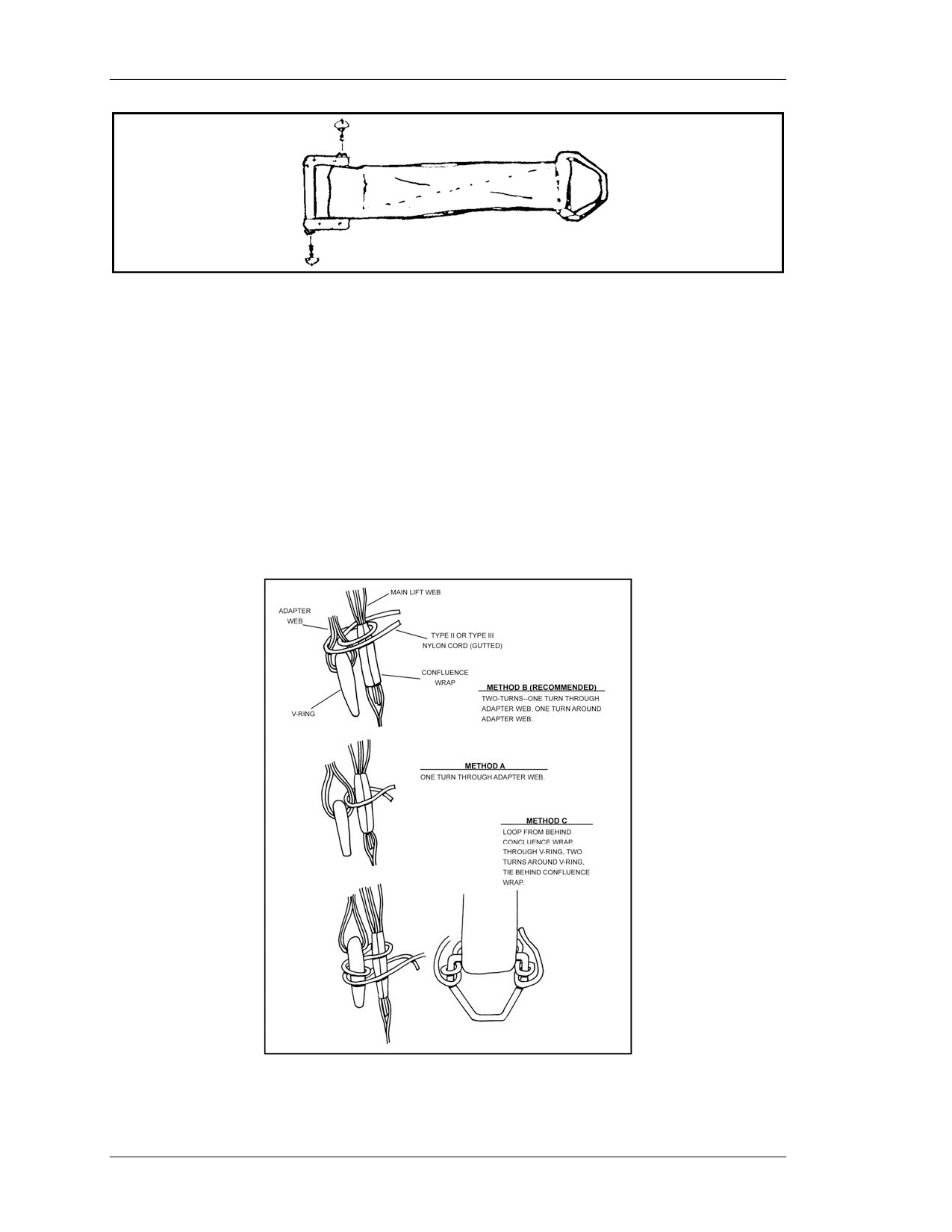
FM 3-21.220/MCWP 3-15.7/AFMAN11-420/NAVSEA SS400-AF-MMO-010
Figure 12-5. Lowering line adapter web.
b. When attaching equipment to be lowered, the web must be routed under the
waistband. Type II or III nylon cord (gutted) is used to eliminate slack between the
accessory attaching ring and the parachute harness main lift web. This is done by making
one turn through the accessory attaching ring loop in the adapter web, and one turn
around the main lift web of the parachute harness and the lowering line adapter web
(Figure 12-6). The loose ends must be tied together using a suitable joining knot such as a
square knot followed by two overhand knots or a surgeon’s knot.
NOTE: The lowering line adapter web will become obsolete when the T-10-series
modified parachute harness with triangle links is received by units.
Figure 12-6. Securing lowering line adapter web with
Type II or Type III nylon cord.
12-8
FM 3-21.220/MCWP 3-15.7/AFMAN11-420/NAVSEA SS400-AF-MMO-010
Section IV. ALICE PACKS AND LOAD-BEARING EQUIPMENT
Combat packs and rucksacks are used to carry individual and crew-served equipment
during airdrop operations. Proper rigging is critical to the jumper’s mission execution and
safety. The following procedures ensure the jumper and loaded equipment will safely
arrive on the drop zone.
12-11. ALICE PACKS (MEDIUM AND LARGE)
Medium and large ALICE packs are attached to the parachutist using the H-harness or the
HSPR. They can be lowered during descent by attaching the HPT lowering line.
a. Items of equipment are inserted, and padding is placed between the load and the
front portion of the pack. The outside pockets are filled with nonfragile items (full
pockets help position the H-harness on the pack). The pack is closed by engaging the
drawstrings and tie-down straps. The adjustable shoulder carrying straps are adjusted
snugly. The excess webbing on the adjustable shoulder carrying straps is rolled and
taped. The running ends of the waist straps are routed around the frame opposite the
lower back pad, tightened, and secured in place by taping. This secures the adjustable
shoulder carrying straps and reduces the possibility of entanglement onboard the aircraft.
b. If carried, the sleeping mat is rolled tightly to reduce its size. The mat is placed
between the two top vertical tie-down straps and the top cover of the pack. It is secured
by tightening the straps. The H-harness or HSPR encompasses the mat when it is routed
around the ALICE pack.
12-12. ALICE PACK RIGGED WITH FRAME, H-HARNESS, AND HOOK-PILE
TAPE LOWERING LINE
Rig, attach, and release the ALICE pack as follows:
a. Rigging the Pack.
(1) Lay the H-harness flat, ensuring the friction adapters are facing down. Place the
center outside pocket of the ALICE pack in the “window” provided by the cross straps.
Ensure the bottom of the ALICE pack is pointed toward the friction adapters.
(2) Run the equipment retainer straps over the top of the pack load outside the
shoulder carrying loop strap and then under the top portion of the frame.
(3) Then, run the equipment retainer straps over the horizontal bar of the frame and
cross them at the center of the back of the pack.
(4) Run the straps under the frame and secure them to the friction adapters, forming a
two- to three-finger quick release.
(5) Thread the (H-harness) D-ring attaching straps through the intermediate friction
adapters, forming a quick release with the free-running ends pointing away from the
parachutist.
b. Attaching Lowering Line While Rigging ALICE Pack.
(1) Girth-hitch the looped end HPT lowering line (at the rear center of the pack from
top to bottom) around the X formed by the crossed equipment retainer straps. This
ensures that the looped end of the lowering line does not slide up or down the H-harness.
(2) Stow the lowering line in its retainer flaps and secure it to the left side (as worn)
of the pack frame with two retainer bands.
12-9
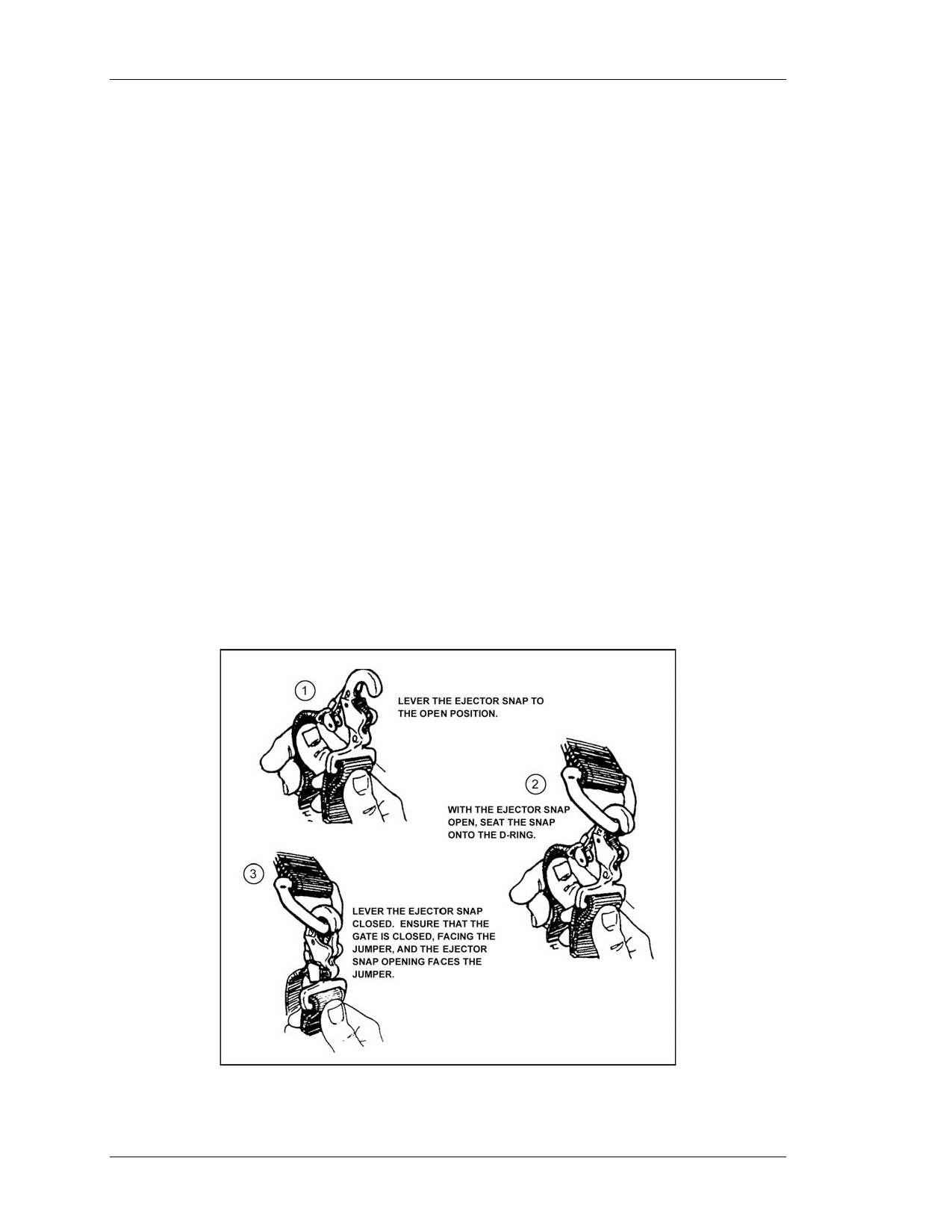
FM 3-21.220/MCWP 3-15.7/AFMAN11-420/NAVSEA SS400-AF-MMO-010
NOTE: It is strongly discouraged that any additional items, such as canteens and
entrenching tools, be attached to the outer portion of the ALICE pack.
However, mission requirements may dictate that some items be rigged to the
outside of the ALICE pack. Items such as canteens and entrenching tools may
be attached to the outside of the ALICE pack in accordance with individual
unit SOPs, providing they are secured by point of attachment (clips) and
further secured with 1/4-inch cotton webbing (two turns) or Type II or III
nylon cord.
c. Attaching the ALICE Pack.
(1) Attach the snap hooks of the D-ring attaching straps to the D-rings on the
parachute main lift web outside the reserve parachute connector snaps. Secure the ALICE
pack in one of two ways:
NOTE: This load must be snug under the reserve parachute.
(a) When jumping from the right door, route the lower tie-down tape on the weapons
case around the left leg and frame of the ALICE pack. Tie it with a bowknot on the
leading edge of the weapons case.
(b) When jumping from the left door, attach 1/4-inch cotton webbing to the ALICE
frame on the right side (as worn) by means of a girth hitch, secure it around the right leg,
and tie in a bowknot.
(2) Attach the HPT lowering line ejector snap to the accessory attaching ring on the
lowering line adapter web (Figure 12-7).
Figure 12-7. Ejector snap on HPT lowering line attached to accessory
attaching ring on lowering line adapter web.
12-10
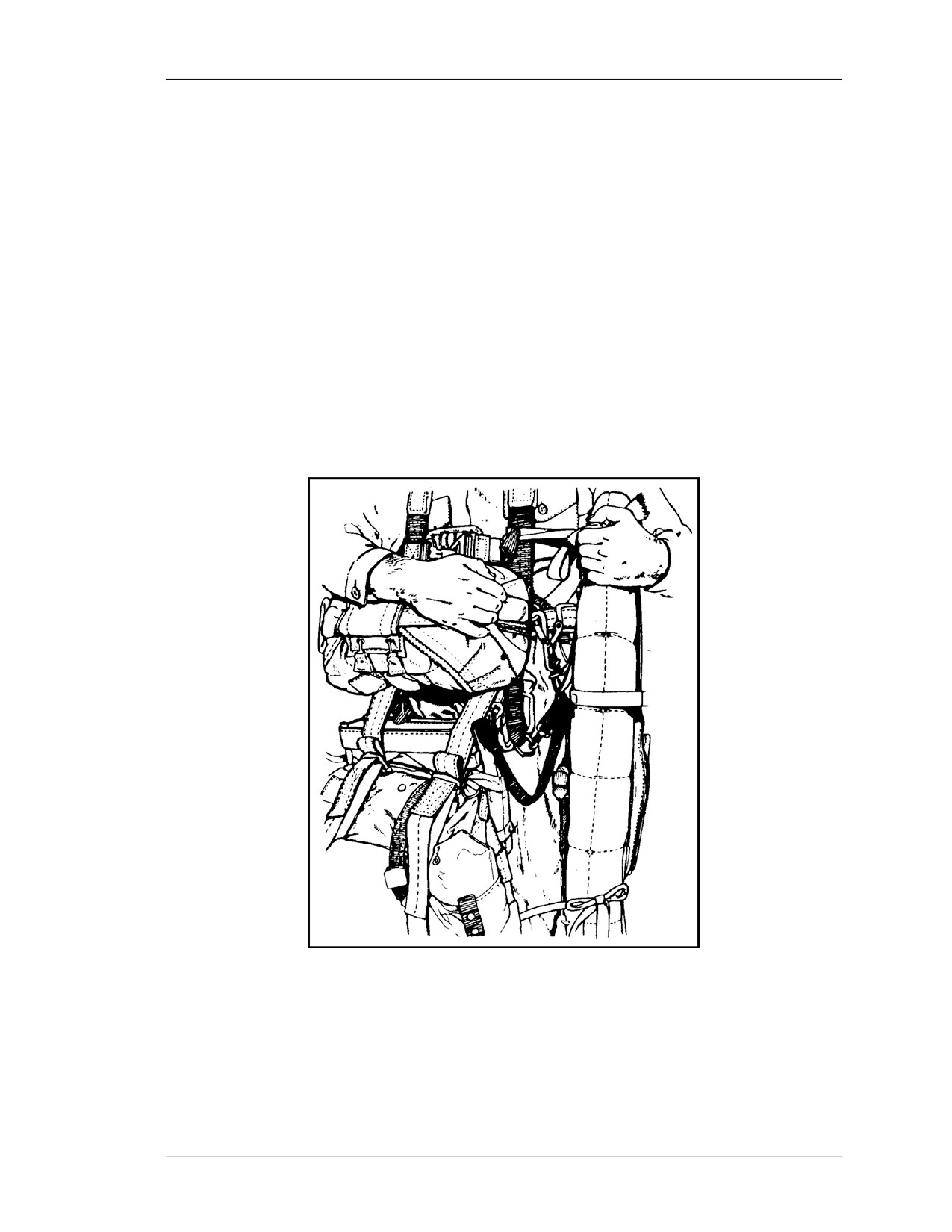
FM 3-21.220/MCWP 3-15.7/AFMAN11-420/NAVSEA SS400-AF-MMO-010
d. Releasing the Pack.
(1) Upon exiting the aircraft, execute the first two points of performance and, during
the third point of performance, release all tie-downs.
(2) At 100 to 200 feet above the ground (during the fourth point of performance),
check below for other parachutists, then pull both free-running ends of the D-ring
attaching straps, allowing the ALICE pack to fall the length of the lowering line.
12-13. TANDEM LOAD AND LOWERING LINE
After the pack is rigged to the H-harness and frame, the lowering line is attached to the
H-harness and stowed. The lowering line is secured to the left vertical bar of the frame
(as worn) with two retainer bands. The ALICE pack and M1950 weapons case, when
jumped together, are rigged as a tandem load and lowered on the same lowering line.
After the ALICE pack and weapons case are attached to the parachute harness D-rings,
the lowering line ejector snap is passed between the weapons case and the nylon chafe
material of the case. The lowering line ejector snap is then attached to the accessory
attaching ring on the lowering line adapter web (Figure 12-8).
Figure 12-8. Lowering line attached for tandem rigging.
12-14. TANDEM LOADS RELEASED AND LOWERED (H-HARNESS)
Upon exiting the aircraft, the parachutist executes the first two points of performance.
Then, during the third point of performance, the upper and lower tie-down tapes on the
weapons case are untied. The right leg tie-down on the ALICE pack is released (if
jumping the left door). During the fourth point of performance at an altitude of about 100
12-11
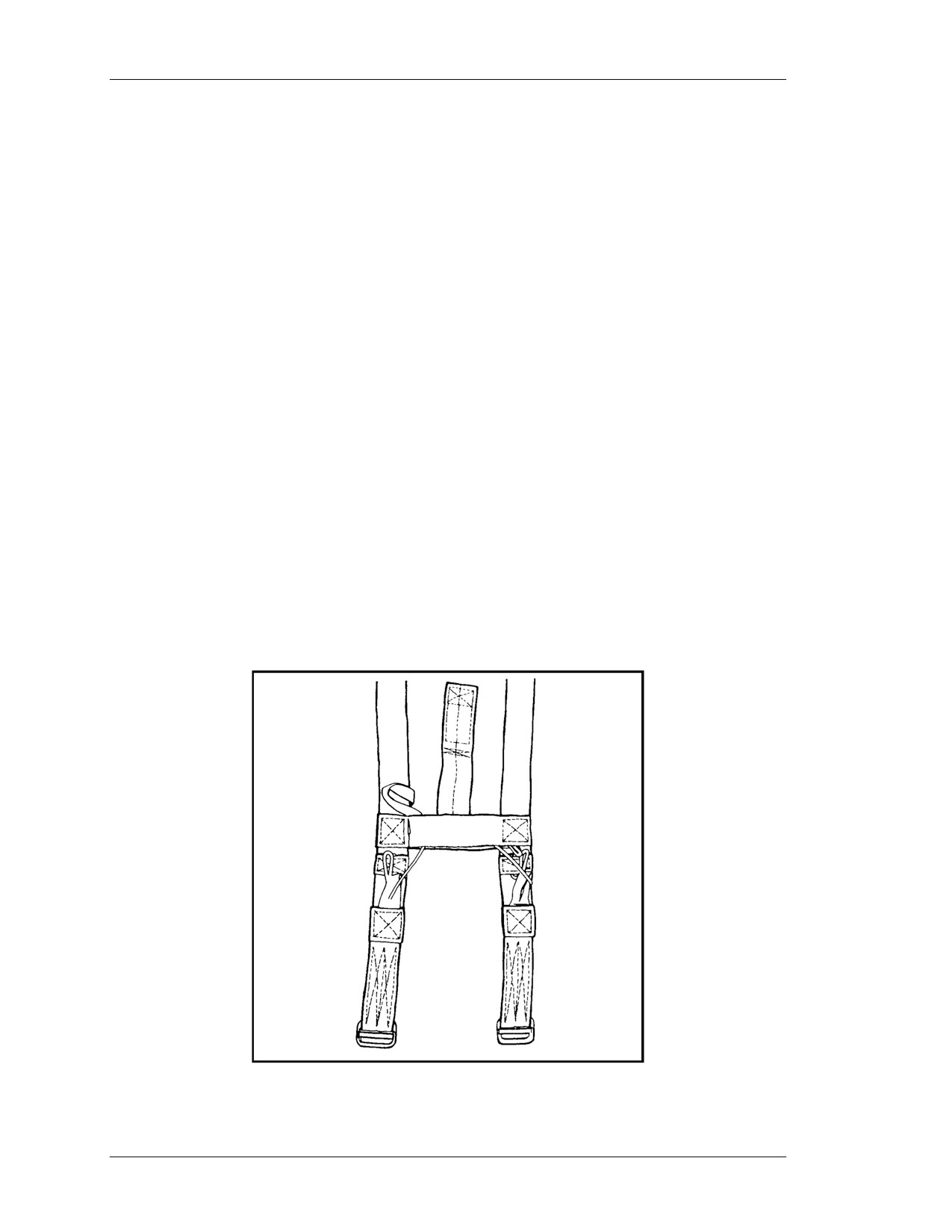
FM 3-21.220/MCWP 3-15.7/AFMAN11-420/NAVSEA SS400-AF-MMO-010
to 200 feet above the ground, the ALICE pack is lowered by pulling at the same time on
the free-running ends of the D-ring attaching straps, allowing the pack to fall to the end
of the line. The activating arm of the quick-release assembly on the weapons case is
activated, and the case slides down the lowering line to rest on top of the (lowered) pack.
NOTE: The D-ring attaching straps are removed from the parachute harness and
secured to the H-harness before the parachute is returned to parachute
maintenance after a jump exercise.
12-15. ALICE PACK RIGGED WITH FRAME USING HARNESS, SINGLE-
POINT RELEASE AND HOOK-PILE TAPE LOWERING LINE
Before attaching the HSPR to the pack, the release handle and adjustable D-ring attaching
straps are attached to the HSPR (Figure 12-9).
a. Route the two release handle cables between the two plies of the release handle
cross strap. Attach the pile tape of the release handle to the hook tape attaching tab
located between the plies of the release handle cross strap. Ensure that the release handle
lanyard is not misrouted. Place the triangle links of the adjustable D-ring attaching straps
on top of the white attaching loops. Route the white attaching loop up through the
triangle link.
b. Route the green attaching loop up through the white attaching loop. Route the red
attaching loop up through the green attaching loop. Route the red attaching loop through
the grommet on the female portion leg strap release assembly. Ensure that the cable loop
retainer on the female portion of the leg strap release assembly is facing up. Route the
release handle cable through the red attaching loop and then through the cable loop
retainer.
Figure 12-9. Release handle assembly.
12-12