FM 3-21.220 STATIC LINE PARACHUTING TECHNIQUES AND TRAINING (SEPTEMBER 2003) - page 3
FM 3-21.220(FM 57-220)/MCWP 3-15.7/AFMAN11-420/NAVSEA SS400-AF-MMO-010
CHAPTER 5
JUMP COMMAND SEQUENCE AND JUMPER ACTIONS
The JM gives a sequence of nine jump commands to ensure positive
control of parachutists inside the aircraft and immediately before exiting.
Every command requires specific actions by each parachutist. When
commands are executed properly, they ensure a safe exit from the aircraft.
5-1.
PRESENTATION
The commands are given orally but, as a backup, arm-and-hand signals are also used with
each command because of the aircraft engine noise. The signals must be smooth,
coordinated, and precisely executed.
a. The commands listed, with variations explained in Chapters 17, 18, and 19, are
employed on high-performance jump aircraft. JMs ensure that the correct sequence is
used for a particular aircraft. The correct commands are explained and demonstrated to
parachutists during prejump briefing.
b. Prior to the 10-minute time warning, the JMs hook up to the inboard anchor line
cable, hand the static line to the safety, and announce, SAFETY, CONTROL MY
STATIC LINE. The JMs then issue the jump commands. If the aircraft is configured with
only one anchor line cable, the JMs hook up to the one cable.
5-2.
GET READY
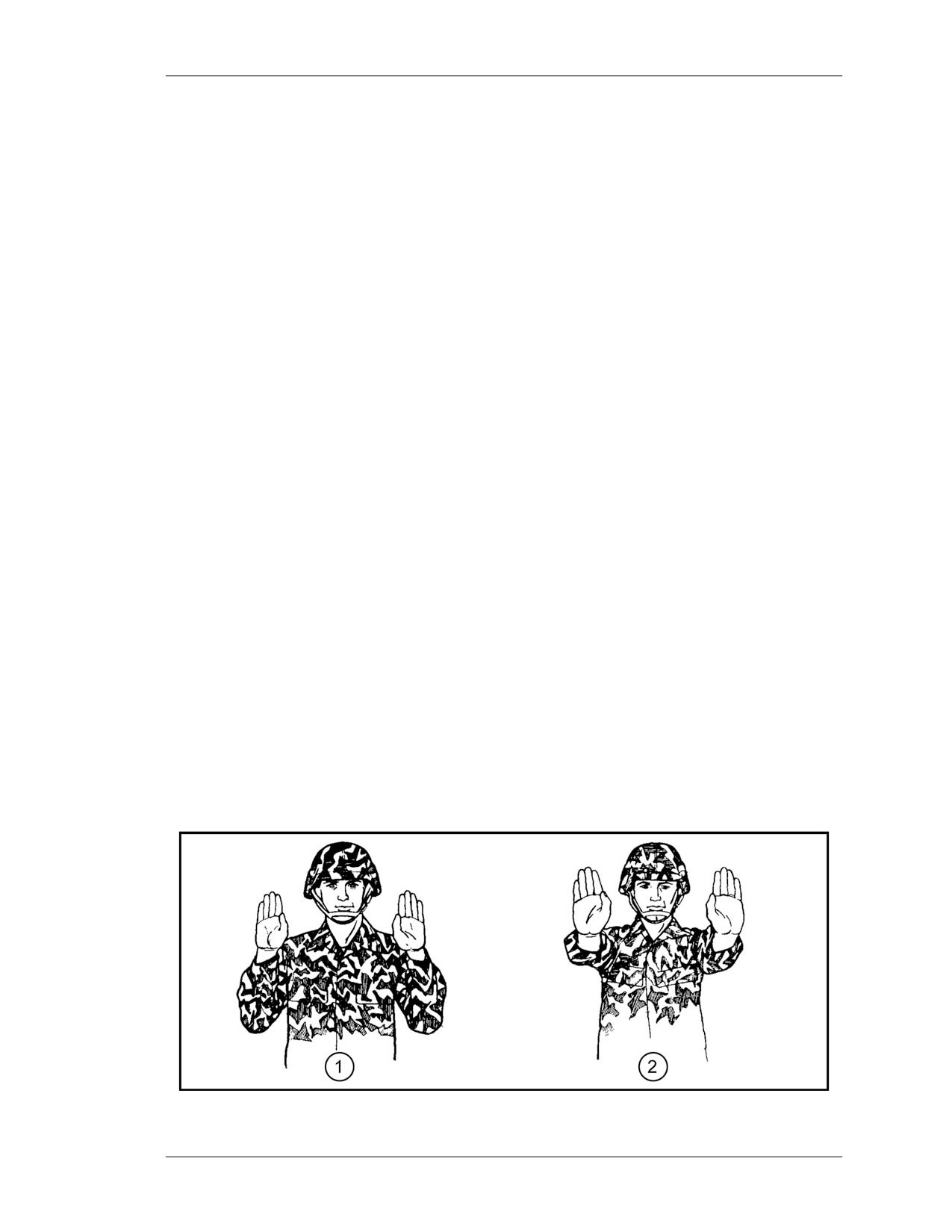
GET READY is the first jump command.
a. Command. This jump command alerts the parachutists seated in the aircraft and
directs their complete attention to the JM.
(1) The JM starts the command with his arms at his sides and gives the arm-and-hand
signal by extending both arms to the front at shoulder level with his palms facing the
parachutists.
(2) He begins at shoulder level, fingers and thumbs extended and joined, palms facing
toward the parachutists. He extends both arms forward until the elbows lock, with the
palms toward the parachutists. He gives the oral command GET READY, then returns to
the start position with arms at the sides (Figure 5-1).
Figure 5-1. GET READY.
5-1
FM 3-21.220/MCWP 3-15.7/AFMAN11-420/NAVSEA SS400-AF-MMO-010
b. Static Line. The static line is over the appropriate shoulder and fastened to the
top carrying handle of the reserve parachute. Parachutists do not remove the static line
snap hook from the reserve parachute after the JM inspection or anytime before the
command HOOK UP.
c. Jumper Actions. Each parachutist signifies alertness by leaning forward and
placing both hands on his knees. Each parachutist positions his foot nearest the jump door
under the seat and places his foot nearest the pilot’s compartment in the aisle.
5-3.
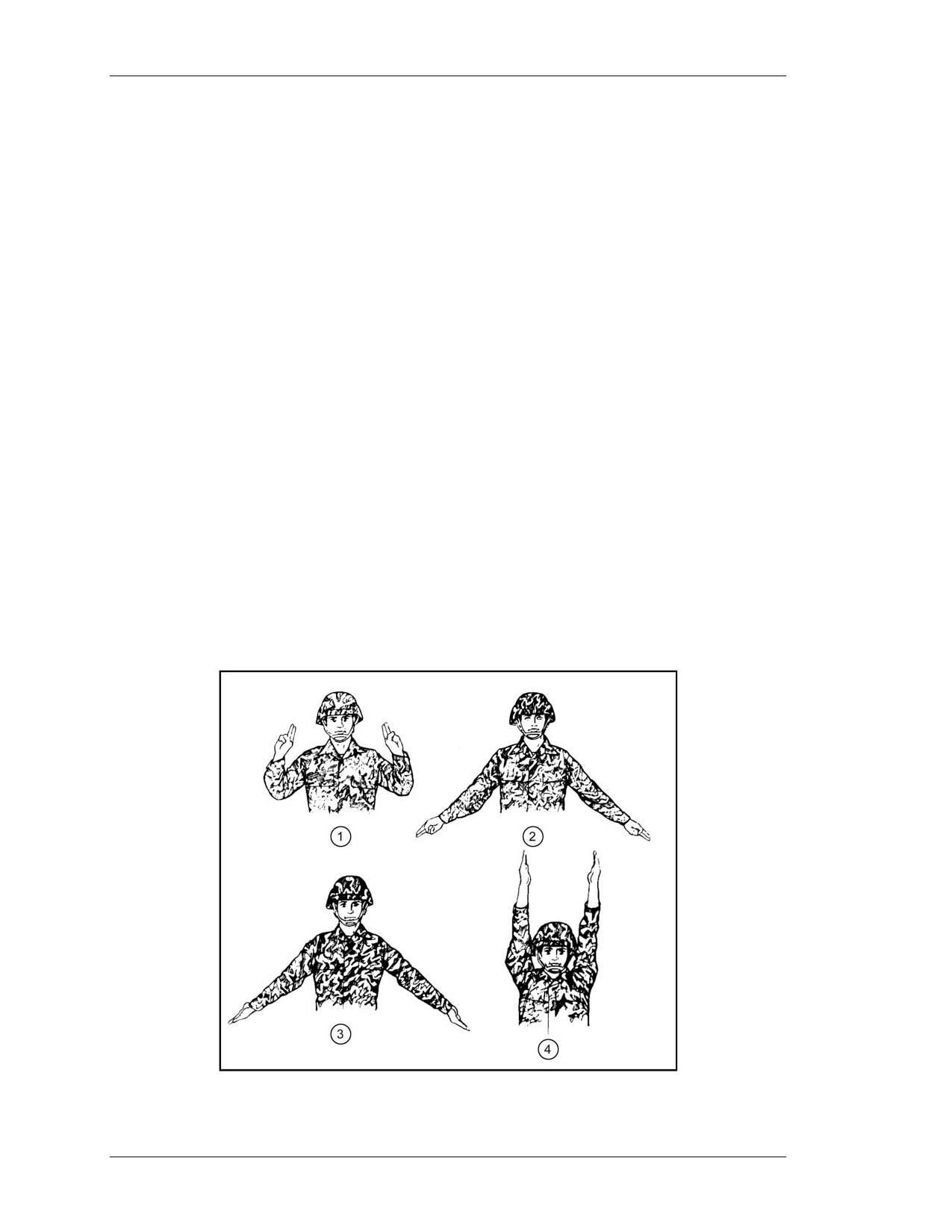
OUTBOARD PERSONNEL, STAND UP
OUTBOARD PERSONNEL, STAND UP is the second jump command. For this
command, the arm-and-hand signal has two parts.
Part One. The JM starts at the shoulders, index and middle fingers extended and
joined, with remaining fingers and thumbs curled to the palms. He gives the
command OUTBOARD PERSONNEL, lowers the arms down to the sides at a
45-degree angle, and locks the elbows.
Part Two. The JM gives the command STAND UP. He extends and joins the fingers
and thumb of each hand, rotates the hands so the palms face up, and then raises the
arms straight overhead, keeping the elbows locked (Figure 5-2). At this command,
parachutists sitting nearest the outboard side of the aircraft stand up, raise and secure
the seats, face the jump doors, and assume the shuffle position.
NOTE: The method of releasing the seats from the floor varies, depending on the
model and year of aircraft. Before takeoff, these devices are inspected and the
method of release explained.
Figure 5-2. OUTBOARD PERSONNEL, STAND UP.
5-2
FM 3-21.220/MCWP 3-15.7/AFMAN11-420/NAVSEA SS400-AF-MMO-010
5-4.
INBOARD PERSONNEL, STAND UP
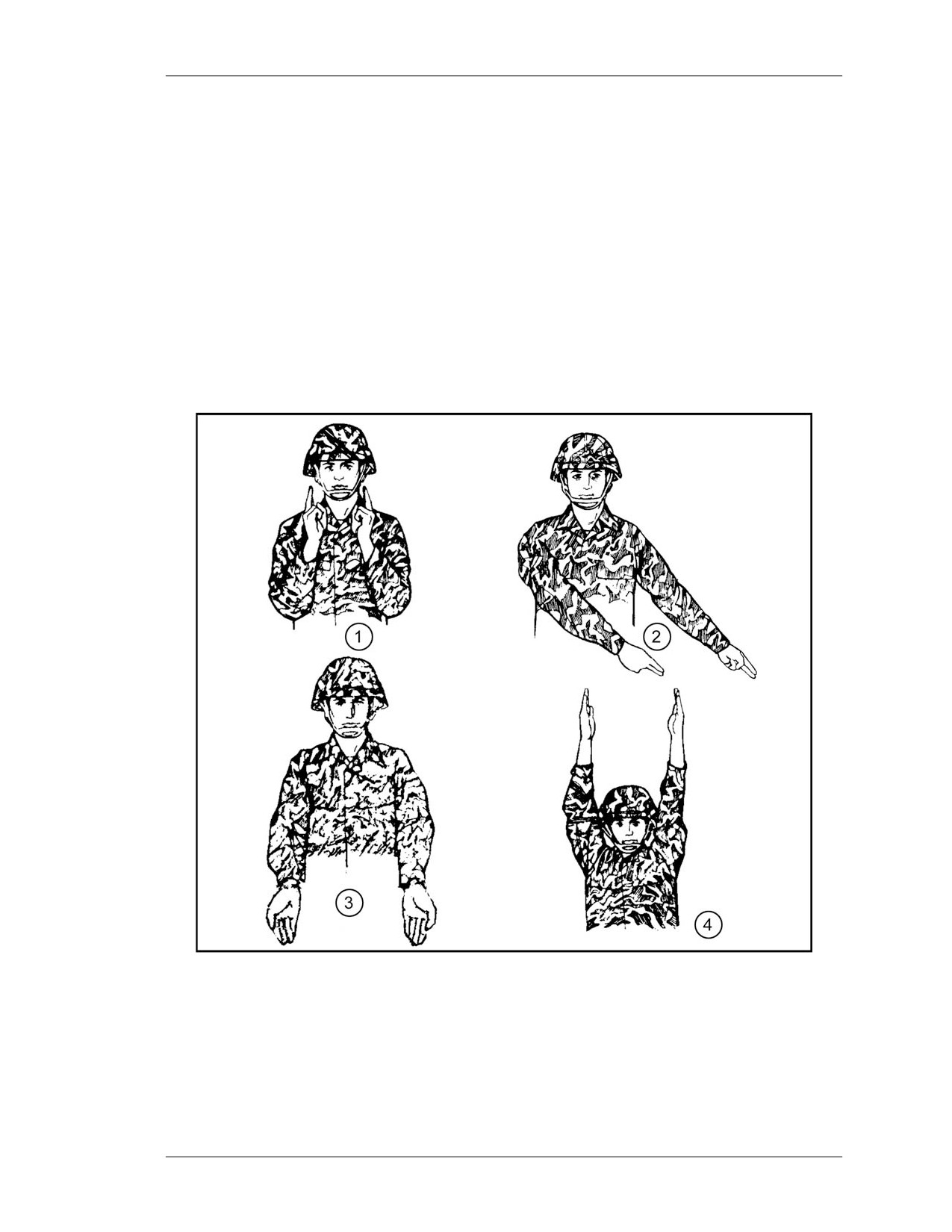
INBOARD PERSONNEL, STAND UP is the third jump command. The arm-and-hand
signal has two parts.
Part One. The JM starts with the hands centered on the chest at shoulder level, index
and middle fingers extended and joined, remaining fingers and thumbs curled to the
palms. He gives the command INBOARD PERSONNEL, extends the arms forward
at a 45-degree angle, toward the inboard seats, and locks the elbows.
Part Two. The JM gives the command STAND UP. He first rotates his arms to the
sides and down at a 45-degree angle. Then he extends and joins the fingers and thumb
of each hand, rotates his hands so the palms face up, and raises his arms straight
overhead, keeping the elbows locked (Figure 5-3).
The parachutists seated inboard react in the same manner as the outboard personnel
described in the previous paragraph.
Figure 5-3. INBOARD PERSONNEL, STAND UP.
5-3
FM 3-21.220/MCWP 3-15.7/AFMAN11-420/NAVSEA SS400-AF-MMO-010
5-5.
HOOK UP
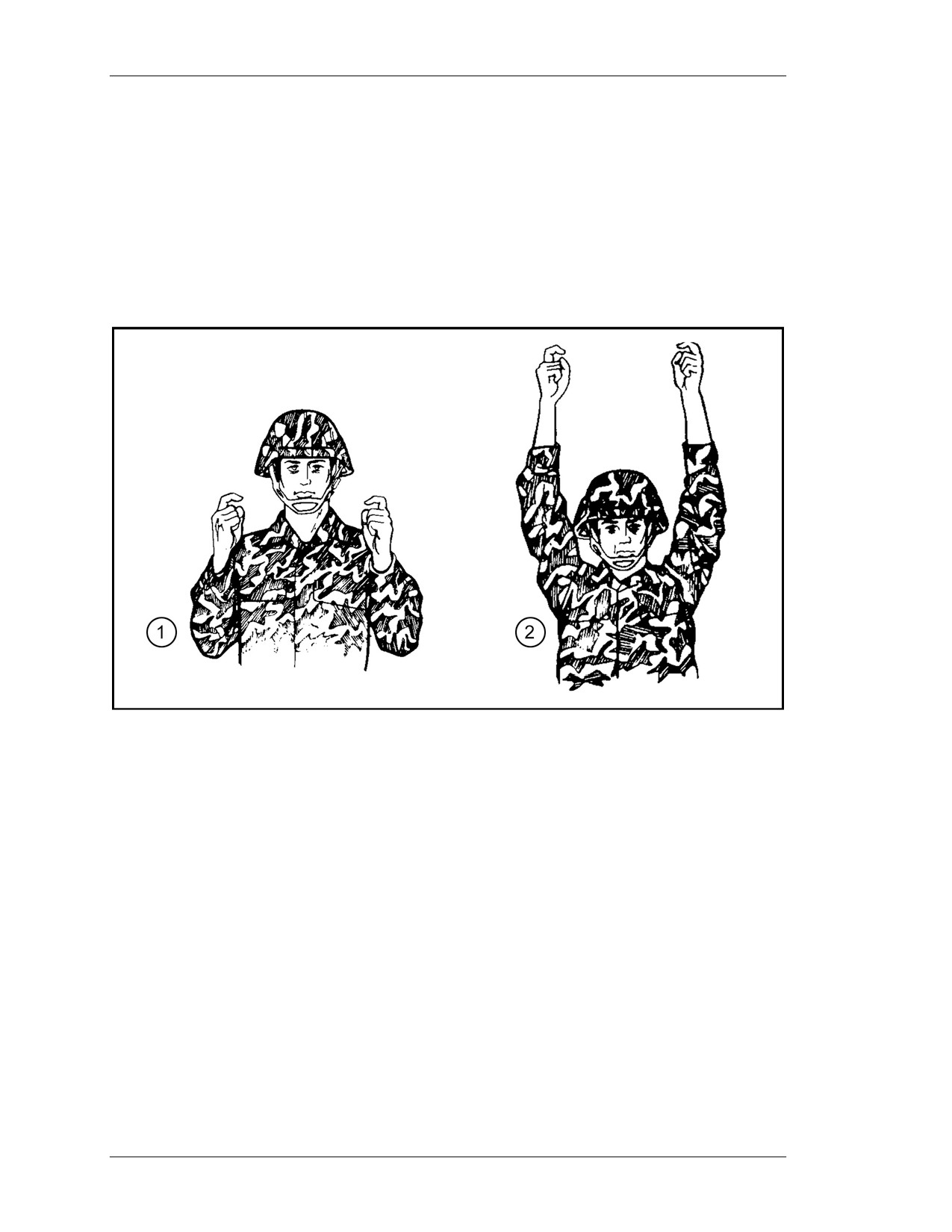
HOOK UP is the fourth jump command.
a. Command.
(1) The JM begins with his arms either extended directly overhead with elbows
locked or with arms bent, hands at shoulder level.
(2) He forms a hook with the index finger of each hand. He forms fists with the
remaining fingers and thumb of each hand (Figure 5-4).
(3) As he gives the oral command, he moves his arms down and up in a pumping
motion. He repeats the arm-and-hand signal at least three times.
Figure 5-4. HOOK UP.
b. Jumper Actions.
(1) At this command, each parachutist detaches the static line snap hook from the top
carrying handle of the reserve parachute and hooks up to the appropriate anchor line
cable, with the open portion of the snap hook toward the outboard side of the aircraft.
Each parachutist must ensure that the snap hook locks properly.
(2) The safety wire is inserted in the hole and folded down. To protect the eyes, the
wire is inserted by pointing it toward the rear of the aircraft. Then a bight is formed in the
static line and held at eye level. The bight is not released until the parachutist moves into
the door.
(3) Personnel jumping the left (right) door have the static line over the left (right)
shoulder.
5-4
FM 3-21.220/MCWP 3-15.7/AFMAN11-420/NAVSEA SS400-AF-MMO-010
5-6.
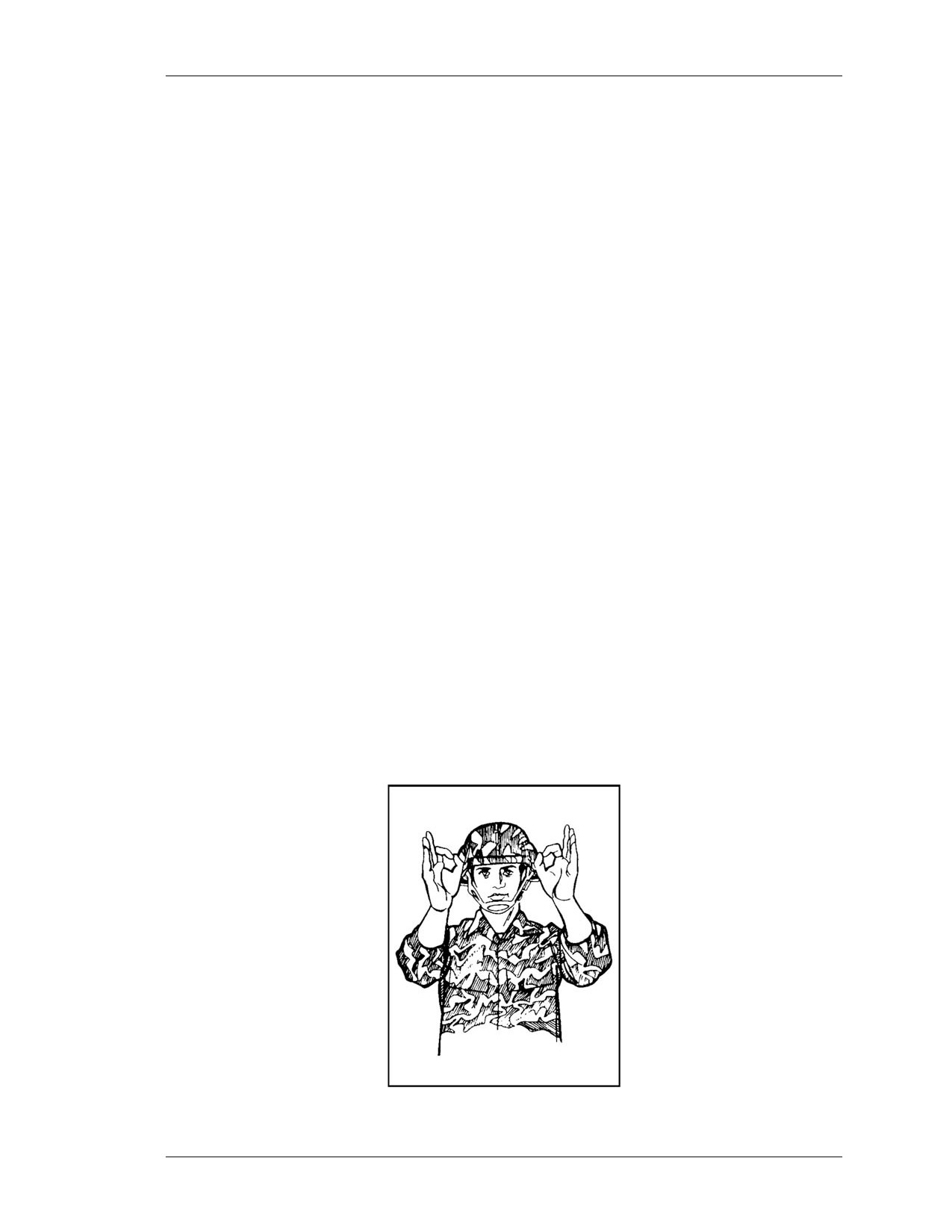
CHECK STATIC LINES
CHECK STATIC LINES is the fifth jump command.
a. Command.
(1) This is a plural command since there are several static lines attached to the anchor
line cable. It begins at eye level, with the thumb and index finger of each hand forming
an “O.”
(2) The JM extends and joins his remaining fingers with the palms facing in. As he
gives the oral command, he extends his arms to the front until the elbows are nearly
locked, then returns to the starting position.
(3) He repeats the arm-and-hand signal at least three times, ensuring the knife edge of
his hands are toward the parachutists and the palms face each other (Figure 5-5).
b. Jumper Actions.
(1) Upon receiving this command, each parachutist checks his static line and the
static line of the parachutist to the front.
(2) Each parachutist checks visually and by feeling with his free hand. He does not
release the bight for checks. He verifies the following items:
• Static line snap hook is properly attached to the anchor line cable with the
safety wire properly inserted. Static line is free of frays and tears.
• Static line is not misrouted and is properly stowed on pack tray.
• All excess slack in the static line is taken up and stowed in the static line slack
retainer.
• Pack closing tie is routed through the pack opening loop.
• Pack tray is intact.
NOTE: The last two jumpers in each stick face about. The next to last jumper inspects
the last jumper’s static line and gives him a sharp tap to indicate that the static
line and pack tray have been checked and are safe for jumping.
(3) Each parachutist gives the parachutist to the front a sharp tap signifying that the
static line and pack tray have been checked and are safe for jumping.
Figure 5-5. CHECK STATIC LINES.
5-5
FM 3-21.220/MCWP 3-15.7/AFMAN11-420/NAVSEA SS400-AF-MMO-010
5-7.
CHECK EQUIPMENT
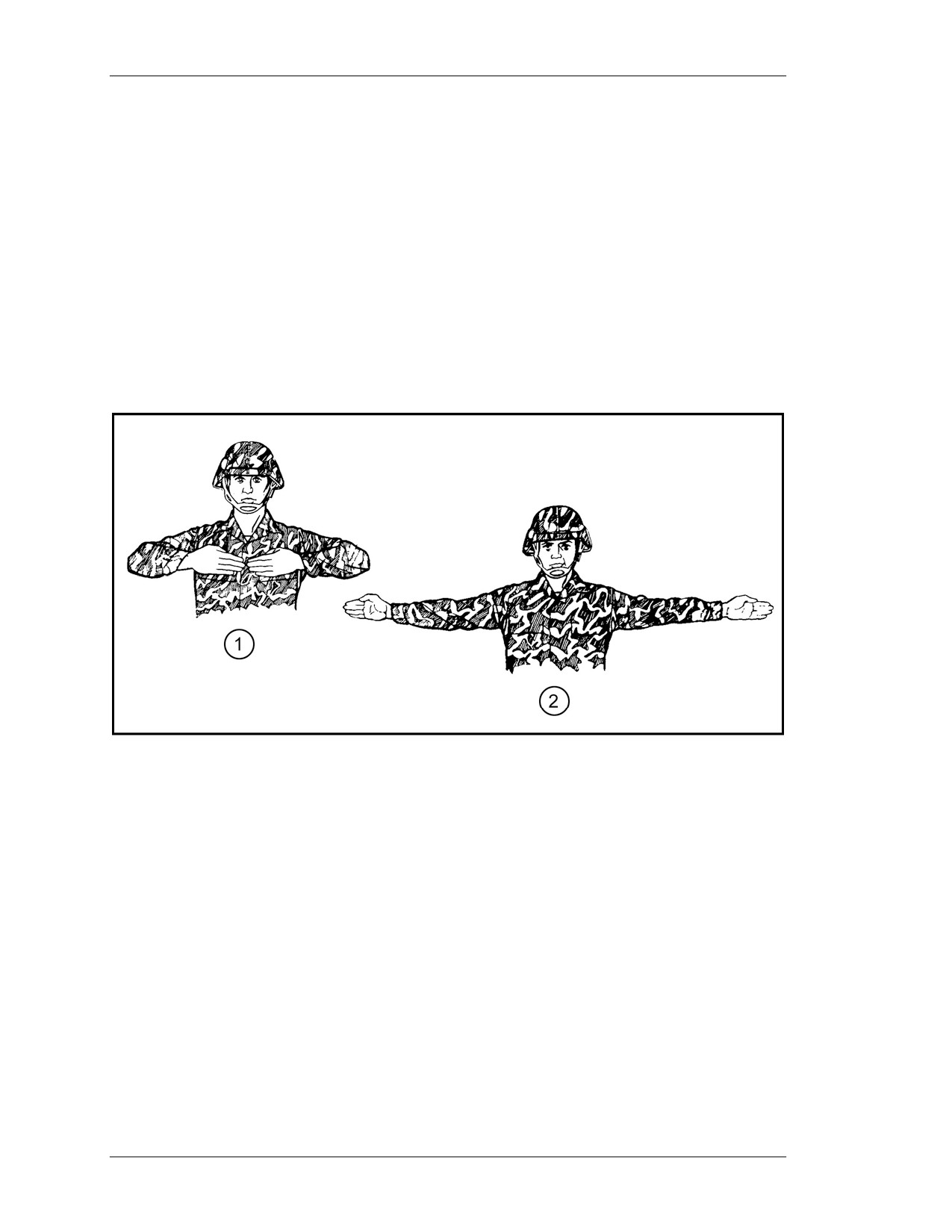
CHECK EQUIPMENT is the sixth jump command.
a. Command.
(1) The JM starts this arm-and-hand signal with the fingertips centered on his chest,
palms facing the chest, and fingers and thumb of each hand extended and joined; or with
his arms extended to the sides at shoulder level, fingers and thumbs extended and joined,
and palms facing toward the parachutist.
(2) He gives the oral command, extends his arms to the sides at shoulder level, and
then returns them to the chest; or bends his arms at the elbows, bringing the fingertips to
the center of the chest, and then returns to the extended position (Figure 5-6).
(3) He repeats the arm-and-hand signal at least three times. (The JM must check his
own equipment.)
Figure 5-6. CHECK EQUIPMENT.
b. Jumper Actions.
(1) At this command, each parachutist checks his equipment, starting at the helmet,
and ensures there are no sharp edges on the rim of the ballistic helmet and that the chin
strap and parachutist retention straps are properly routed and secured. The parachutist
then physically seats the activating lever of the chest strap ejector snap and the leg strap
ejector snaps. If jumping combat equipment, the parachutist also ensures the ejector snap
of the HPT lowering line is properly attached and seated.
(2) The parachutist completes these actions with the free hand while maintaining a
firm grip on the static line bight with the other hand.
5-8.
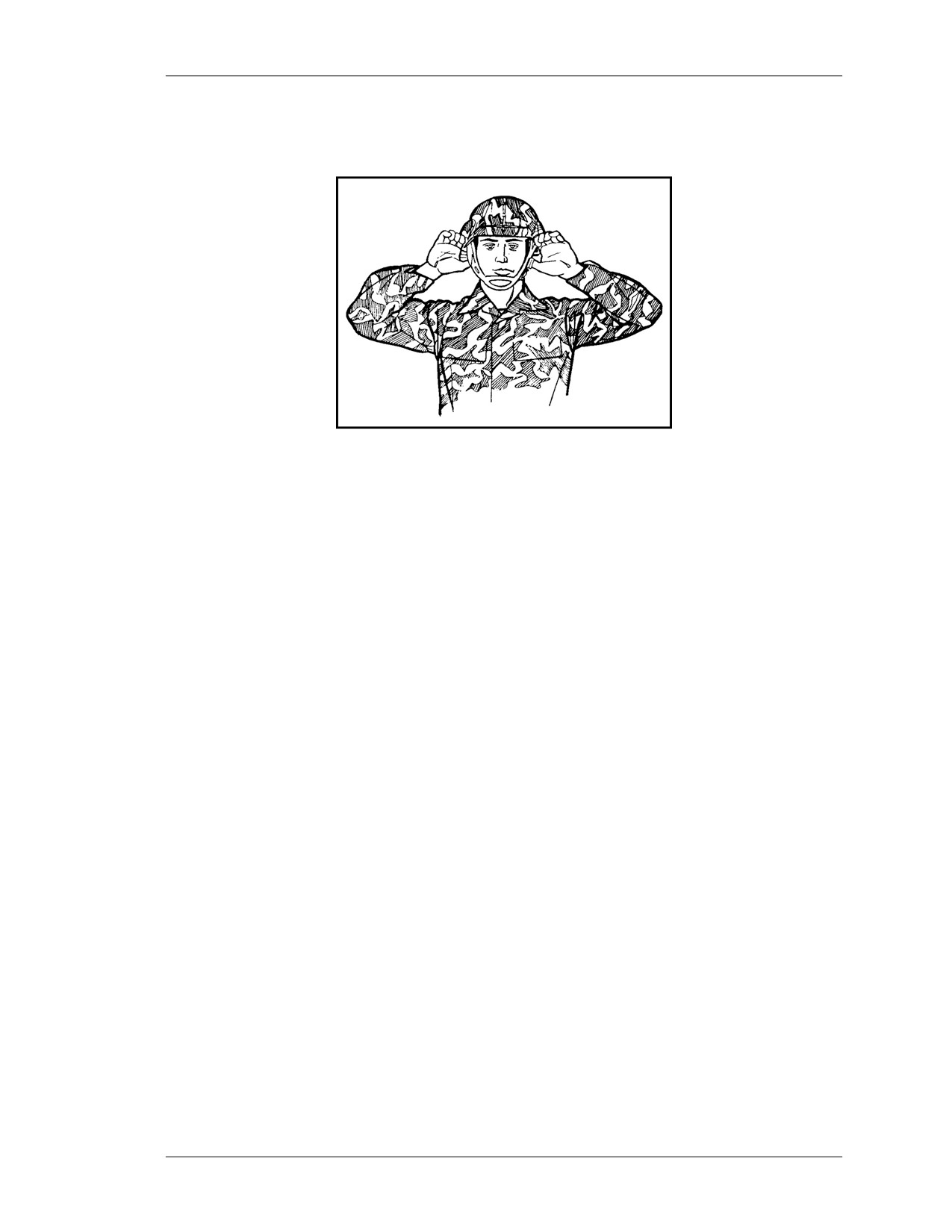
SOUND OFF FOR EQUIPMENT CHECK
This is the seventh jump command.
a. Command.
(1) The JM cups his hands and places the thumbs behind the ears.
5-6
FM 3-21.220/MCWP 3-15.7/AFMAN11-420/NAVSEA SS400-AF-MMO-010
(2) He gives the oral command SOUND OFF FOR EQUIPMENT CHECK
(Figure 5-7).
Figure 5-7. SOUND OFF FOR EQUIPMENT CHECK.
b. Jumper Actions.
(1) At this command, the last parachutist in the outboard stick sounds off, saying
“OK,” and gives the parachutist in front a sharp tap on the thigh. The signal is continued
until it gets to the number 1 parachutist, who notifies the JM by pointing to the JM and
saying, “All OK, jumpmaster.”
(2) For a C-130 aircraft, this signal is passed to number 25 parachutist (just forward
of the wheel well), who forms a circle with his index finger and thumb of his free hand,
turns toward the center of the aircraft, and gives the okay signal to number 24 (the last
parachutist of the inboard stick). The tap and indication that all previous parachutists are
okay is passed up to number 4, first parachutist of the inboard stick, who signals
number 3, first parachutist to the rear of the wheel well. The signal is continued until it
gets to the number 1 parachutist, who notifies the JM by pointing to the JM and saying,
“All OK.”
(3) A parachutist who has an equipment problem notifies the JM, AJM, or safety
personnel by raising his outboard hand high above the anchor line cable, palm facing the
JM. The parachutists do not pass this signal. The JM, AJM, or safety either corrects the
deficiency or removes the parachutist from the stick.
NOTE: After the JM receives “All OK, jumpmaster,” he regains control of his static
line from the safety and takes the number 1 parachutist position.
5-9.
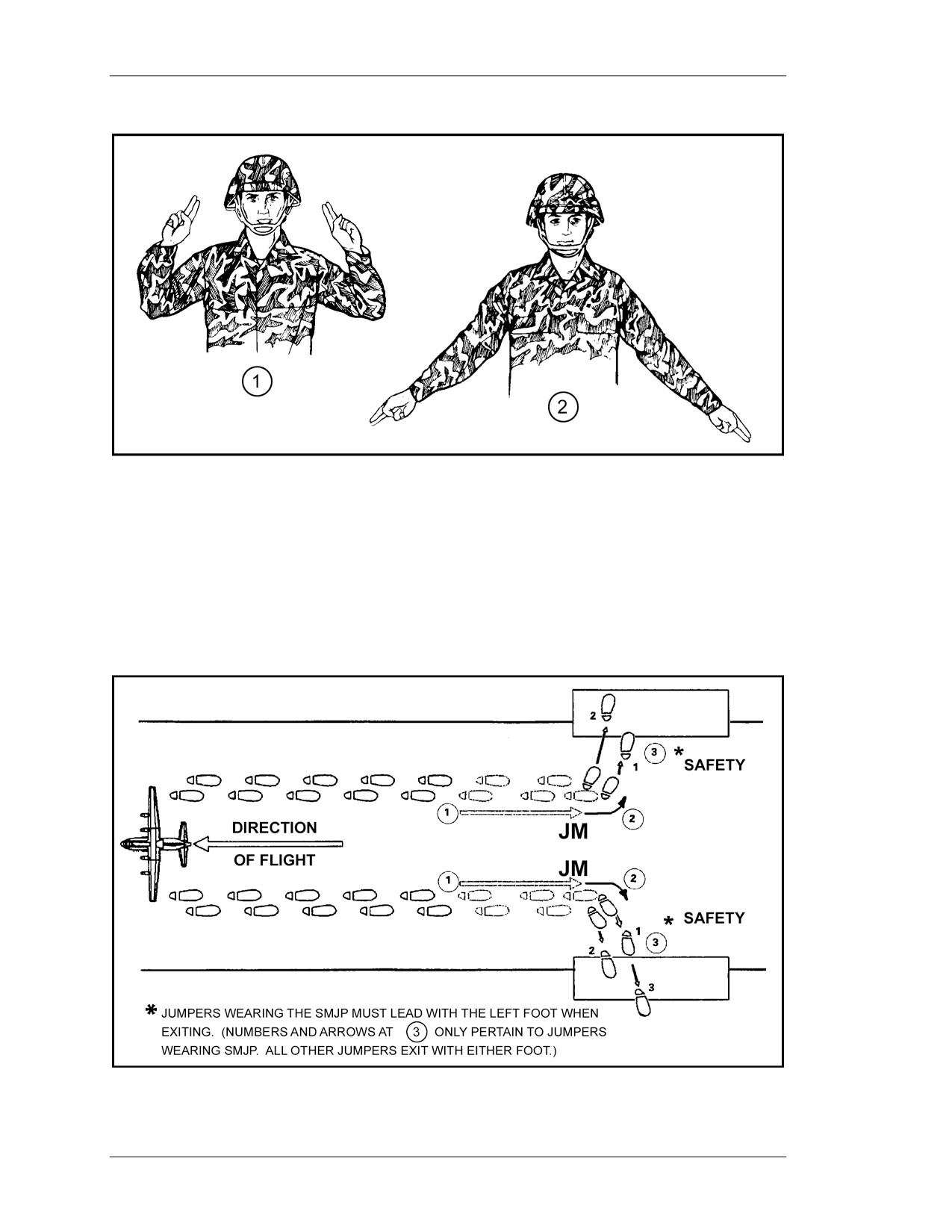
STAND BY
STAND BY is the eighth jump command. This command (Figure 5-8, page 5-8) is given
about 10 seconds before the aircraft reaches the release point and only after the aircraft
has cleared all obstacles near the DZ.
a. Command.
(1) Starting at the shoulders, the JM extends and joins his index and middle fingers,
curling the remaining fingers and thumb of each hand toward the palm.
(2) He extends his arms down to the sides at a 45-degree angle by locking the elbows,
and points to both doors at the same time.
5-7
FM 3-21.220/MCWP 3-15.7/AFMAN11-420/NAVSEA SS400-AF-MMO-010
Figure 5-8. STAND BY.
b. Jumper Actions.
(1) At this command, parachutist number 1 shuffles toward the door, establishes eye-
to-eye contact with the safety, hands the safety his static line, holds his elbows firmly into
his sides with his palms on the end of the reserve, turns and centers himself in the open
jump door, and awaits the command GO.
(2) All following parachutists maintain the static line bight and close up behind the
preceding parachutist (Figure 5-9).
Figure 5-9. Jumper execution upon receiving the command STAND BY.
5-8
FM 3-21.220/MCWP 3-15.7/AFMAN11-420/NAVSEA SS400-AF-MMO-010
5-10. GO
GO is the ninth jump command. The green light is the final time warning on USAF
aircraft. It tells the JM that as far as the aircrew is concerned, conditions are safe and it is
time to issue the ninth jump command, GO.
a. Command.
(1) The JM gives the verbal command GO and may also tap the first parachutist out.
(2) In this case, the command GO and a sharp tap on the thigh is the signal to exit. If
this signal is used, it is explained during the JM’s briefing.
b. Jumper Actions.
(1) At the command GO, the first parachutist exits the aircraft. All subsequent
jumpers begin moving toward the door using a shuffle.
(2) Once the jumpers begin to shuffle, they assume an elbow-locked position with the
arm that is controlling their static line. The jumpers place their static line control hand so
that it is nearly touching the back of the pack tray of the jumper in front of them. This
establishes the proper jump interval. Jumpers do not place their static line control hand in
a position so that it extends past the pack tray of the jumper in front of them.
(3) As each jumper approaches the door, he establishes eye-to-eye contact with the
safety and hands his static line to the safety. Once the safety has control of the jumper’s
static line, the jumper returns his hand to the end of the reserve parachute with his fingers
spread.
(4) After handing his static line to the safety (vicinity of the lead edge of the door),
the jumper executes a left or right turn (as appropriate) and faces directly toward and
centered on the door with both hands over the ends of the reserve parachute, fingers
spread. He continues the momentum of his movement by walking toward the door,
focusing on the horizon, and stepping on the jump platform. He pushes off with either
foot and vigorously jumps up and out away from the aircraft. He immediately snaps into
a good tight body position and exaggerates the bend into his hips to form an “L” shape.
NOTE: The commands STAND BY and GO are first taught during the initial training
periods on the mock door and the 34-foot tower. As training progresses, the
complete command sequence is taught.
5-9
FM 3-21.220(FM 57-220)/MCWP 3-15.7/AFMAN11-420/NAVSEA SS400-AF-MMO-010
CHAPTER 6
MAIN PARACHUTE MALFUNCTIONS AND
EMPLOYMENT OF THE RESERVE PARACHUTE
A malfunction is any failure in the deployment or inflation of a
parachute; or it is canopy damage, which can create a faulty, irregular, or
abnormal condition that increases the jumper’s rate of descent. The two
classes of main parachute malfunction (total and partial) demand the
jumper’s immediate attention. Jumpers must be trained to identify the
malfunction and take the appropriate action. Thorough training in what
actions to take in the case of a malfunction is essential for parachutists.
Practical exercises involving the activation of the reserve parachute are
incorporated into all phases of training. Each type of malfunction is
demonstrated so that jumpers can see exactly how each type of
malfunction looks.
6-1.
PULL-DROP METHOD (FOR MIRPS AND T-10 RESERVE)
When a total malfunction occurs, or the parachute provides no lift, the jumper must
activate his reserve using the pull-drop method. Also, at the end of the 4000-count, if the
jumper feels no opening shock, he should immediately activate his reserve using the pull-
drop method. The jumper—
• Keeps a tight body position.
• Keeps his feet and knees together.
• Grasps the left carrying handle of the reserve parachute with his left hand.
• Turns his head left or right.
• Pulls the rip cord grip with his right hand and drops it to the ground.
When descending with only the reserve parachute inflated, the parachutist controls
directional movement by slipping. The proper landing attitude is obtained by reaching up
and grasping as many suspension lines in the opposite direction of drift as possible and
slipping (as in the prepare-to-land attitude with the T-10-series parachute). Upon landing,
the parachutist makes a quick recovery and collapses the canopy. In strong winds, if a
quick recovery is impossible, the parachutist grasps one suspension line from either
suspension line group and pulls the suspension line toward himself until the canopy
collapses.
NOTE: If the MIRPS does not activate immediately, the jumper remains in a good
tight body position while still grasping the left carrying handle. With the right
hand forming a knife cutting edge, he sweeps the top panel of the reserve up
and away, ensuring that the right hand does not interfere with the
spring-loaded deployment assistance device.
6-2.
DOWN-AND-AWAY METHOD (FOR T-10 RESERVE ONLY)
To activate the reserve parachute using the down-and-away method, the jumper—
• Returns to a tight modified body position with his feet and knees together.
6-1
FM 3-21.220/MCWP 3-15.7/AFMAN11-420/NAVSEA SS400-AF-MMO-010
• Places his hand on the middle of the reserve (over the rip cord protector flap). He
exerts pressure on the reserve and grasps the rip cord grip with his right hand.
NOTE: Strong pressure must be maintained with the left hand to prevent the pilot
chute and reserve canopy from springing out.
• Pulls the rip cord grip and drops it.
• With the right hand forming a knife edge, palm facing out, reaches between the
pack assembly and canopy, and grabs as much canopy and reserve parachute
suspension lines as possible.
• Throws the reserve parachute down and to the right (or left) side at about a
45-degree angle. (If the jumper is spinning, the canopy is thrown in the direction
of the spin.) (If the reserve does not inflate, the jumper must retrieve the canopy
and continue to throw it down and away until it inflates.)
• Uses the thumbs to clear all remaining suspension lines from the pack tray.
When the reserve parachute has activated, the jumper may have two inflated canopies.
When descending with two inflated canopies, he has no direction control over the
parachutes; all other jumpers remain clear.
6-3.
TOTAL MALFUNCTION
A total malfunction is the failure of the parachute to open or to deploy.
a. Causes of a Total Malfunction. The failure of the parachute to deploy can be
caused by a severed static line, a broken snap hook, or a broken anchor line cable. The
jumper’s failure to hook up also results in the failure of the parachute to deploy.
Malfunctions of these types are rare.
b. Streamer. Although not defined as total malfunction, a deployed parachute with a
“cigarette roll” or “streamer” provides little or no lift for the jumper. This malfunction
must be treated as a total malfunction. This malfunction occurs when a portion of the
skirt blows between two suspension lines and begins to roll with the opposite fabric. The
heat generated by the friction of the fabric being rolled causes the nylon to fuze and
blocks the air channel in the canopy. The jumper immediately activates his reserve using
the pull-drop method.
c. Towed Jumper. Although not classed as a parachute malfunction, a parachutist
can be towed behind the aircraft by a misrouted static line or by a piece of equipment that
has snagged the aircraft during the jumper’s exit. During the 4000-count, the jumper feels
an excessive opening shock and then feels himself being towed by the aircraft. The
jumper remains in a tight body position, protecting his rip cord grip until he is either
retrieved inside the aircraft or is cut free by the loadmaster on the pilot’s order. If the
jumper is being towed by the static line and is cut free, the main parachute will not
deploy, and the jumper will have to activate his reserve using the pull-drop method. The
jumper’s actions are as follows:
(1) Retrieving the Jumper Inside the Aircraft. The jumper remains in a tight body
position until he is completely inside the aircraft. A towed jumper must not use his hands
to assist the retrieving personnel. The most important action of a towed jumper is to
protect his rip cord grip.
6-2
FM 3-21.220/MCWP 3-15.7/AFMAN11-420/NAVSEA SS400-AF-MMO-010
(2) Cutting the Jumper Away. Once the jumper is cut free of the aircraft, the main
parachute may, or may not, deploy. If the jumper was towed by something other than the
static line, the main parachute will deploy and inflate. There is no need to activate the
reserve parachute. If the jumper was towed by the static line and is cut free, the jumper
must immediately deploy his reserve using the pull-drop method.
WARNING
The towed jumper must remain in tight body position and
protect the rip cord grip with his right hand. Accidental
activation of the reserve while being towed may be fatal.
6-4.
PARTIAL MALFUNCTION
The four types of partial malfunctions are complete inversion, semi-inversion, blown
section or gore, and broken suspension lines.
a. Complete Inversion. This malfunction may occur when a portion of the skirt
blows inward between a pair of suspension lines on the opposite side of the parachute.
This portion of the skirt forms a secondary lobe that fills with air and enlarges at the
expense of the rest of the canopy. The portion of the canopy forming the secondary lobe
is inverted. The canopy turns inside out with no decrease in its lifting surface.
(1) It is difficult to detect if a complete inversion occurs during the initial deployment
of the canopy. With a T-10-series, the rear risers control the front of the canopy and the
front risers control the rear of the canopy. With an MC1-series, the orifice and control
toggles are to the parachutist’s front and maneuvering techniques are reversed.
(2) There may be no need for the parachutist to activate the reserve parachute unless
the canopy was damaged during inversion. The parachute failed to function properly, but
will support the parachutist. The inversion may increase the jumper’s rate of descent. If
the jumper’s rate of descent is greater than that of other jumpers, he deploys his reserve.
If he is using the T-10 reserve and his rate of descent is only slightly greater than other
jumpers, he uses the down-and-away method. Otherwise, he uses the pull-drop method
(the only method of activating the MIRPS).
b. Semi-Inversion. This malfunction may occur if development of the secondary
lobe stops before completely inverting. This malfunction may remain stable, become
completely inverted, or revert to normal during descent. The total lifting capability of the
canopy is decreased by the formation of a secondary lobe. The fabric can be burned by
friction and weakened during descent. With this malfunction, the parachutist must deploy
his reserve. (If he is using the T-10 reserve, he uses the down-and-away method.) The
T-10-series and MC1-series parachutes have anti-inversion nets that reduce the chance of
this type of malfunction.
c. Blown Section or Gore. This malfunction occurs when the strain placed on the
canopy during inflation is great and a panel, section, or gore is ripped or torn out,
resulting in a hole(s) in the canopy. The jumper compares his rate of descent with that of
other jumpers. If the jumper is falling faster than other jumpers around him, he must
deploy the reserve parachute. (If he is using the T-10 reserve, he uses the down-and-away
method.) Large holes in the canopy should be treated like a blown section or gore.
6-3
FM 3-21.220/MCWP 3-15.7/AFMAN11-420/NAVSEA SS400-AF-MMO-010
d. Broken Suspension Lines. This malfunction occurs when enough suspension
lines break causing the jumper’s rate of descent to be greater than fellow jumpers; the
parachutist must activate his reserve using the down and away method. If control lines on
an MC1-series canopy break, the parachutist controls the canopy by pulling only one of
the rear risers in the direction that he wishes to turn. He must use a rear riser.
6-4
FM 3-21.220(FM 57-220)/MCWP 3-15.7/AFMAN11-420/NAVSEA SS400-AF-MMO-010
PART TWO
Duties and Functions of Key Personnel,
Advanced Airborne Techniques and Training
CHAPTER 7
RESPONSIBILITIES AND QUALIFICATIONS
OF KEY PERSONNEL
The initial training and follow-on refresher training of key personnel
are of major concern to commanders. The proper training and supervision
of key personnel ensure that correct procedures and operational safety
measures are followed during airborne operations.
7-1.
COMMANDER’S RESPONSIBILITIES
The airborne commander designates the key personnel for each airborne operation. These
key personnel are the primary jumpmaster (JM), assistant jumpmasters (AJMs), safety
personnel, departure airfield control officer (DACO), drop zone support team leader
(DZSTL), drop zone safety officer (DZSO), and malfunction officer (MO).
a. Each aircraft has designated JM, AJM, and safety personnel. The airborne
commander gives the designated JM command authority over, and responsibility for, all
personnel onboard a jump aircraft. JM, AJM, and safety duties are described in Chapters
8, 9, and 10.
b. The DACO is located at the departure airfield and has coordination responsibility
with the GLO and TALCE/aircrew for the loading of personnel, equipment, and supplies
into the aircraft. Also, the DACO provides the JM with changes to station time and the
overall operational plan, current DZ weather, airfield crossing procedures, and the aircraft
parking plan. Complete DACO duties are discussed in Chapter 11.
c. Each DZ has a DZSO or DZSTL. The DZSO or DZSTL has command authority
over the actions and safety of all personnel on the drop zone. DZSO and DZSTL
procedures for DZ operations are described in Chapters 20, 21, and 22.
d. The MO, as a member of the DZST, is located on the DZ. Detailed MO duties are
described in Chapter 23.
The JM, DACO, DZSTL, or DZSO can delegate their authority to subordinates, but they
cannot delegate their responsibilities.
7-2.
KEY PERSONNEL PREREQUISITES
The following minimum standards must be met before personnel will be allowed to
perform JM, AJM, safety, DACO, DZSO, DZSTL, or MO duties for personnel and heavy
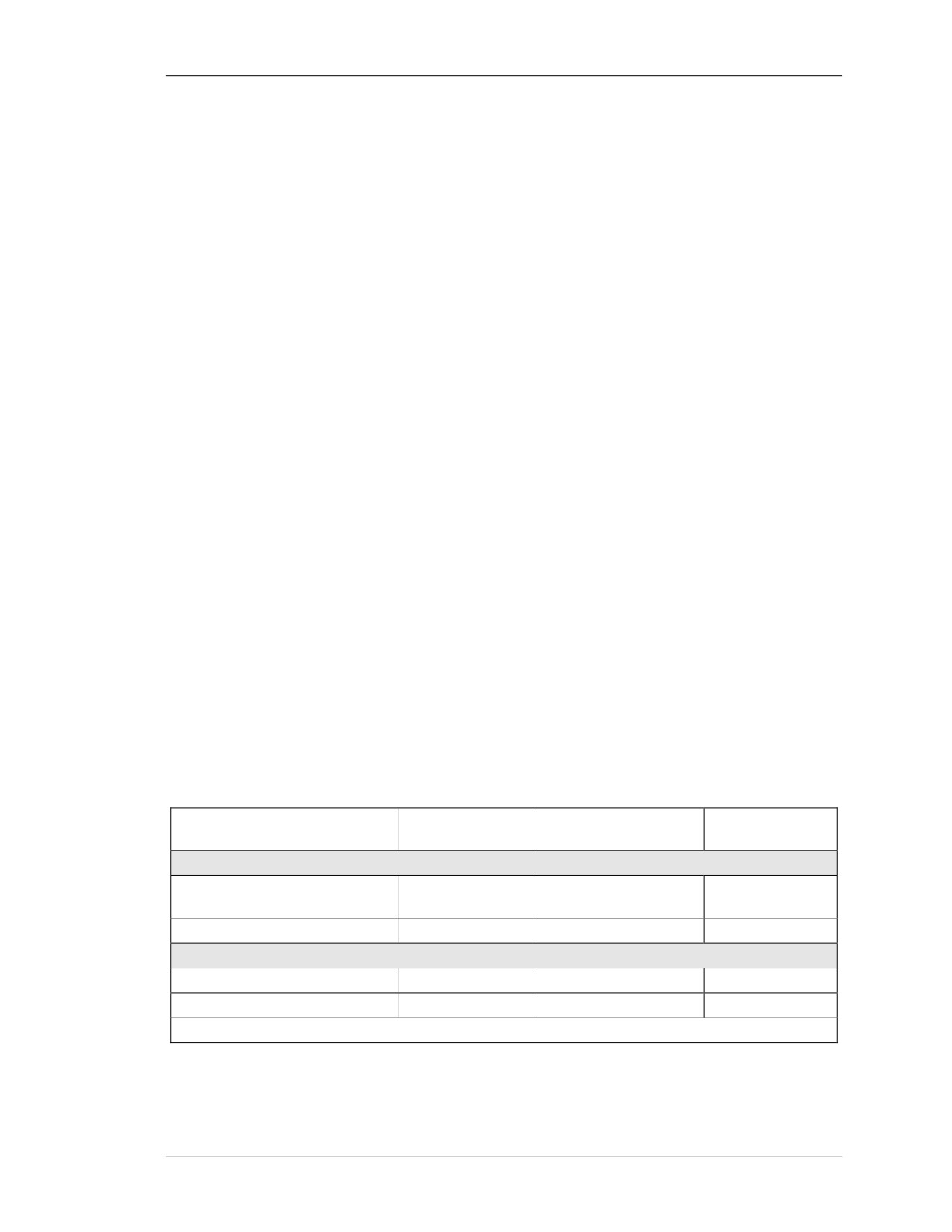
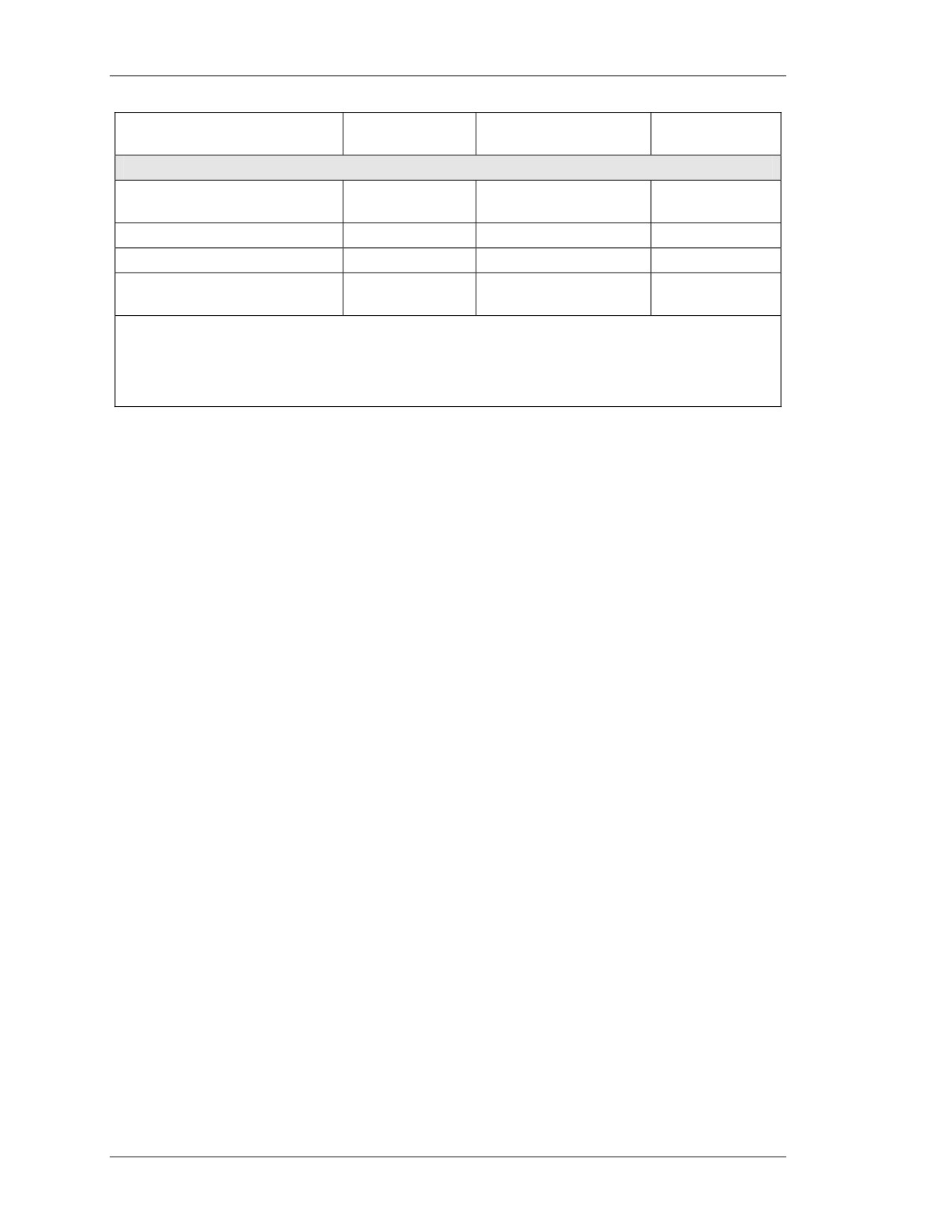
equipment airdrop operations. Tables 7-1 and 7-2 (pages 7-3 and 7-4) indicate the duties
that JM, DZSO, and DZSTL qualified and current personnel may perform, the airdrop
method that will be used, and the type of airdrop mission that may be flown.
a. JM, AJM, and Safety Personnel. To be appointed as JM, AJM, or safety
personnel, individuals must meet the following prerequisites:
7-1
FM 3-21.220/MCWP 3-15.7/AFMAN11-420/NAVSEA SS400-AF-MMO-010
(1) Primary Jumpmaster.
(a) Commissioned officer, warrant officer, or NCO (US Army and US Navy: E5 or
above; USMC and USAF: E4 or above).
(b) JM qualified. To be JM qualified, the JM must be a graduate from an authorized
JM course (see Appendix B) at Fort Benning, GA; at a Fort Benning MTT; at Fort Bragg,
NC; at a Fort Bragg MTT; or from an SOF JM course. (JMs qualified through SOF JM
course must be JM refreshed prior to assuming JM duties outside SOF units.)
(c) JM current. To be JM current, the JM must have either performed JM or AJM
duties within the preceding
180 days; or, if a senior or master rated parachutist,
performed duty as a safety on military fixed-wing aircraft, utilizing door or ramp exit
within the preceding 180 days; or completed a JM refresher course (see Appendix C) in
the preceding 180 days and be a current jumper. (JM or safety duties performed on
rotary-wing aircraft will apply for JM currency.)
(d) Prior experience. Perform duties twice as the AJM and perform duties twice as
a safety. USAF personnel must complete the job qualification requirements for their Air
Force specialty code (AFSC).
(2) Assistant Jumpmaster.
(a) Commissioned officer, warrant officer, or NCO (US Army and US Navy: E5 or
above; USMC and USAF: E4 or above).
(b) JM qualified and current.
(c) Prior experience. Perform duties twice as a safety.
(3) Safety Personnel.
(a) Commissioned officer, warrant officer, or NCO (US Army: E5 or above; USMC,
USN, USAF: E4 or above).
(b) JM qualified and current.
b. DACO, DZSO, DZSTL, and MO. To be appointed a DACO, DZSO, DZSTL, or
MO, individuals must meet the following prerequisites:
(1) DACO.
(a) Commissioned officer, warrant officer, or NCO (US Army: E5 or above; USMC,
USAF: E4 or above).
(b) JM qualified and current.
(c) Prior experience. Perform duties as assistant DACO at least once.
(2) DZSO.
(a) Commissioned officer, warrant officer, or NCO (US Army and US Navy: E5 or
above; USMC, USAF: E4 or above).
(b) JM qualified and current or CCT/STS certified.
(c) Prior experience. Perform the duties of assistant DZSO in support of an airborne
operation involving personnel or heavy equipment at least once.
NOTE: For combination airdrop operations the DZSO/DZSTL must follow the
procedures for heavy drop operations, but observe the jumpers as they exit the
aircraft.
(3) DZSTL.
(a) Commissioned officer, warrant officer, or NCO (US Army: E5 or above; USMC,
USAF: E4 or above), or civilian equivalent. (This position is not required for USN.)
7-2
FM 3-21.220/MCWP 3-15.7/AFMAN11-420/NAVSEA SS400-AF-MMO-010
(b) JM qualified and current for PE or HE.
(c) Certified as a DZSTL by having attended one of the following since 1988:
• USAIS Pathfinder Course.
• USAIS Jumpmaster Course (for CARP DZs only).
• USAIS DZSTL MTT.
•
82d Airborne Division Advanced Airborne School DZSTL Course.
•
82d Airborne Division Advanced Airborne School JM Course (for CARP DZs
only).
• US Army Special Operations Command (USASOC) Jumpmaster Course.
(d) Prior experience. Observed and assisted a qualified and current DZSTL while
performing his duties during an airdrop operation involving personnel or heavy
equipment.
(e) DZSTL current. To be DZSTL current, the DZSTL must have performed the
duties of DZSTL or assistant DZSTL within the preceding 180 days or completed a
DZSTL refresher course taught by a current DZSTL within the preceding 180 days.
NOTE: DZSTLs in support of CDS airdrops are not required to be airborne qualified,
on jump status, or JM qualified and current, but they must have attended an
authorized Pathfinder or DZST course. For combination airdrop operations the
DZSO/DZSTL must follow the procedures for heavy drop operations, but
observe the jumpers as they exit the aircraft.
(4) Malfunction Officer.
(a) Commissioned officer, warrant officer, or NCO (US Army and US Navy: E5 or
above; USMC, USAF: E4 or above), or civilian equivalent. USAF: DZC/DCSO will fill
the duties as the MO and be designated in writing as an MO. He will have a thorough
understanding of the parachute equipment used for the operation. USAF combat control
personnel are authorized to perform the duties of MO during unilateral operations.
(b) Qualified parachute rigger from the unit providing the air items used during the
operation (IAW AR 59-4/MCO 13480.1B). (For the USMC only, the malfunction officer
does not have to be from the organization providing the air items.)
DUTY TO
AIRDROP
TYPE
PERFORM
METHOD
AIRDROP
1. JM SCHOOL GRADUATE BEFORE SEP 1988:
(A) JM (C)
JM, DZSO,
CARP, VIRS, WSVC,
CDS, HE, PERS
DZSTL
GMRS
(B) JM (NC)
NONE
2. JM SCHOOL GRADUATE AFTER SEP 1988:
(A) JM (C)
JM, DZSO
CARP
CDS, HE, PERS
(B) JM (NC)
DZSO
CARP
CDS
C = CURRENT
NC = NOT CURRENT
Table 7-1. Duties that Jumpmaster School certified personnel may perform.
7-3
FM 3-21.220/MCWP 3-15.7/AFMAN11-420/NAVSEA SS400-AF-MMO-010
DUTY TO
AIRDROP
TYPE
PERFORM
METHOD
AIRDROP
1. USAIS PATHFINDER SCHOOL GRADUATE AFTER SEP 1988:
(A) JM (C) DZST (C)
JM, DZSTL
CARP, *GMRS, VIRS
CDS, HE,
PERS
(B) JM (NC) DZST (C)
DZSTL
CARP
CDS
(C) JM (C) DZST (NC)
JM
(D) NONAIRBORNE DZST
DZSTL
CARP
CDS
(C)
C = CURRENT
NC = NOT CURRENT
* GMRS DZ NORMALLY RESERVED FOR SOCOM UNITS, AND REQUIRES
DOCUMENTED TRAINING FROM DZSTL MTT
Table 7-2. Duties that USAIS Pathfinder School graduates may perform.
7-4
FM 3-21.220(FM 57-220)/MCWP 3-15.7/AFMAN11-420/NAVSEA SS400-AF-MMO-010
CHAPTER 8
JUMPMASTER DUTIES AT THE UNIT AREA
The success of airborne operations depends mainly on how well the
JM executes his duties. He must receive mission briefings, conduct
prejump training, supervise rigging of equipment, and move to the
departure airfield, all within a rigid time schedule.
Section I. ESSENTIAL INFORMATION
A key factor in the JM duties is the mission briefing. H-hour (TOT) is established at this
time and the backward planning process begins.
NOTE: Jumpmaster duties begin immediately upon notification.
8-1.
DESIGNATION NOTIFICATION
Upon notification that he has been designated as JM, the individual obtains or is provided
the following information:
•
Mission and ground tactical plan.
•
Air movement plan to include time of flight, formations, route, direction of flight
over drop zone, drop altitude, location and design of code letters, racetracks, and
emergency call signs/frequencies.
•
Names of AJM(s) and safety personnel, and time and place to brief them.
•
Time and place of initial manifest call.
•
Time and place of final manifest call.
•
Time and place to conduct operations briefing.
•
Time and place to conduct prejump training.
•
Time and place to check and inspect parachutists’ uniforms and equipment.
•
Transportation (movement to marshaling area and departure airfield plan and
times).
•
Tactical cross-load plan.
•
Time and place of parachute issue, including types of parachutes.
•
Weather decision time(s).
•
Time and place of troop safety briefing.
•
Type of aircraft for the operation and special items of equipment being worn by
jumpers (DMJP, AIRPAC, AT4JP, SMJP, or CWIE) or A-series containers
aboard aircraft (door bundles or wedge).
•
Aircraft tail numbers, chalk numbers, and parking spots.
•
Load time.
•
Time and place of aircrew/JM briefing.
•
Station time.
•
Takeoff time.
•
Time on target.
8-1
FM 3-21.220/MCWP 3-15.7/AFMAN11-420/NAVSEA SS400-AF-MMO-010
NOTE: If, during the joint planning and preparation phase for airborne operations, it is
decided host nation aircraft are to be used without navigational equipment, a
detailed pilot, loadmaster, and JM brief must take place.
• Landing plan to include drop zones, drop times, delivery sequence, number/type
of loads (PP, HD, CDS, LAPES), and types of drops (CARP, GMRS, VIRS, or
WSVC).
• Mission and ground tactical plan.
• Air item turn-in plan.
• Medical support plan.
8-2.
ASSISTANT’S BRIEFING
After he receives the initial operation briefing, the JM returns to the unit and briefs his
AJM and safety personnel. The JM assigns them duties for the remainder of the
operation. At this time, the JM determines who assumes responsibility for parachutists
remaining onboard. The manifest of personnel scheduled to jump is prepared. The JM
schedules a full rehearsal with the JM team before the JM team assembles the chalk
(planeload).
a. Upon completion of the briefing, the JM organizes the chalk IAW the cross-
loading plan and conducts the initial manifest call. AJM(s) and safety personnel check the
identification card and identification tags of each parachutist.
b. Items for cross-loading include door bundles and large, bulky equipment carried
by individual parachutists (CWIE, DMJP). The JM determines which chalk and informs
parachutists which position and door they will jump.
c. The JM, aided by his AJM(s) and safety personnel, inspects each parachutist’s
equipment to ensure proper rigging. Parachutists pack and rig their equipment and
containers before airborne operations.
NOTE: Primary jumpmaster can delegate authority, but not responsibility.
8-3.
JUMPMASTER/SAFETY KIT BAG
The JM ensures aviator kit bags for use onboard the aircraft have been prepared to
contain extra items that may be needed during any phase of the airborne operation. This
is referred to as the JM/safety kit bag and is used by the JM, AJM, and safety personnel.
Items to consider for use onboard the aircraft
(depending on the type of airborne
operation) are—
• Flashlight (night operations).
• Masking tape/cloth.
• Roll of 1/4-inch cotton webbing.
• Safety wires (with lanyards).
• Harness single point release (HSPR) complete, or H-harness complete.
• Hook-pile tape (HPT) lowering lines.
• Foam impact pads, chin straps, pull-the-dot fasteners with tabs, headbands with
attaching clips, and parachutist retention straps.
• Quick-release snaps.
• Upper tie-downs for M1950 weapons cases.
8-2
FM 3-21.220/MCWP 3-15.7/AFMAN11-420/NAVSEA SS400-AF-MMO-010
• Retainer bands.
• Trash bags.
• Earplugs and airsickness bags.
• Two extra reserves and extra aviator kit bags (for static lines and deployment)
(1 bag for every 15 deployment bags).
• A knife will be carried by the JM, AJM, and safety personnel. (Knife should not
be carried on a point of contact.)
8-4.
OPERATION BRIEFING
As soon as practical after the initial manifest call, the JM briefs personnel on the details
of the operation. Following the operation briefing, prejump training is conducted in the
unit area or at the departure airfield. It should be scheduled and conducted within 24
hours before takeoff and include the following:
•
Drop zone.
•
Type of aircraft.
•
Chalk number(s).
•
Type of parachute(s).
•
Briefing on serials, container delivery system, heavy drop, and type of aircraft, if
a part of a larger airborne operation.
•
Weather decision time (for GO, NO-GO decision).
•
Type of individual equipment and separate equipment that troops will be jumping
(CWIE, AIRPAC, DMJP, ALICE pack, SMJP, M1950 weapons case).
•
Time and place of parachute issue.
•
Load time.
•
Station time.
•
Takeoff time.
•
Length of flight.
•
Time on target.
•
Direction of flight over DZ.
•
Drop altitude.
•
Predicted winds on the DZ and direction.
•
Route checkpoints.
•
DZ assembly aids and area.
•
Parachute turn-in point(s).
•
Time and place of final manifest call.
•
Medical support plan.
•
Obstacles on or near the DZ.
NOTE: If the unit jumps nonstandard equipment containers, the rigging on these
containers must be approved IAW individual service regulations. These
rigging procedures must be forwarded for testing to US Army Airborne
Special Operations Test Directorate (USAABNSOTD), Fort Bragg, NC, and
then for approval to Commander, 1st Battalion (Abn), 507th Infantry, ATTN:
Jumpmaster School, Fort Benning, GA 31905.
8-3
FM 3-21.220/MCWP 3-15.7/AFMAN11-420/NAVSEA SS400-AF-MMO-010
Section II. SUSTAINED AIRBORNE TRAINING
All personnel require sustained airborne training. The JM usually does not know the
proficiency of all parachutists he is responsible for; therefore, basic airborne jump
techniques are rehearsed so each parachutist can demonstrate his ability to perform them.
Jumpmasters, safeties, and key leaders will make on-the-spot corrections of any jumper
not properly performing the required training. (See paragraph 8-15 for a sample prejump
training narrative.)
8-5.
MINIMUM TRAINING
Sustained airborne training will consist of, at a minimum, prejump training to include
PLFs and mock door training. Prejump training will include a review of the five points of
performance, towed jumpers, collisions and entanglements, malfunctions, activation of
the reserve, and emergency landings. Mock door training will include rehearsal of every
detail involved with the airborne operation to include accidental activation of the reserve
on board the aircraft. Jumpers must make a minimum of two exits from the mock door.
a. Training Apparatuses. Army personnel will use aircraft fuselage mock-ups to
rehearse preflight and in-flight action.
(Aircraft fuselage mock-ups can be complete
airframes or may be field-expedient training devices as simple as rope strung to simulate
an anchor line cable and ballistic helmets on the ground to mark the jump door. The use
of field-expedient training devices is not the preferred method for conducting sustained
airborne training.) Also, actions-in-the-aircraft training reminds parachutists what occurs
in flight before jumping. The JM can use the mock door apparatus to show parachutists
where their relative positions will be in the aircraft. If in-flight rigging is to be performed,
the rigging station locations can be indicated also. The JM reviews and leads a rehearsal
of all actions related to in-flight procedures so the jump mission will be smooth and safe.
b. Execution. Each parachutist should be seen by the JM and should hear him (a
bullhorn should be used, if necessary). Performance-oriented training is conducted for
emergency landings. AJM and safety personnel must make aggressive and positive
on-the-spot corrections. Prejump training must be taught proficiently.
8-6.
PREJUMP TRAINING
All personnel must attend prejump training. Jumpers must be positioned so that their
actions can be viewed by the JM and so they can hear him. A bullhorn can be used, if
necessary. Prejump training is performance-oriented and should be tailored to fit the
mission. AJM and safety personnel must make aggressive and positive on-the-spot
corrections. Prejump training must be taught proficiently.
8-7.
FIVE POINTS OF PERFORMANCE
Training on the five points of performance must be attended by all parachutists and JMs.
a. Proper Exit, Check Body Position and Count.
(1) Keep chin on chest.
(2) Keep eyes open.
(3) Keep elbows into sides.
(4) Hands over the ends of the reserve parachute, fingers spread, right palm
protecting the rip cord grip.
8-4
FM 3-21.220/MCWP 3-15.7/AFMAN11-420/NAVSEA SS400-AF-MMO-010
(5) Bend body forward at the waist.
(6) Keep feet and knees together.
(7) Lock knees.
(8) Count to four thousand (fixed-wing aircraft).
(9) Count to six thousand (helicopters).
(10) Immediately activate the reserve parachute using the proper method if opening
shock is not felt.
b. Check Canopy and Gain Canopy Control.
(1) Reach up and grasp toggles (MC1-series); or grasp risers (T-10-series).
(2) Make a 360-degree check of the canopy.
(3) Remove twists, if any: grasp a set of risers in each hand, thumbs down with
knuckles to the rear, and apply outward pressure while bicycling the legs in a vigorous
motion.
(4) Immediately recheck canopy and gain canopy control.
c. Keep a Sharp Lookout for All Jumpers During Descent.
(1) Remember the three rules of the air.
(2) Always look before turning/slipping.
(3) Always slip/turn in the opposite direction from other jumpers.
(4) Always give lower parachutist the right-of-way.
(5) Avoid other parachutists all the way to the ground; maintain 25 feet of separation
(T-10-series) or 50 feet of separation (MC1-series) between jumpers in the air.
(6) At the end of the third point of performance, release all appropriate equipment
tiedowns.
d. Slip/Turn into the Wind and Prepare to Land.
(1) Check to ensure the air below and around is clear of other parachutists. At no
higher than 200 feet, lower equipment. Immediately regain canopy control and continue
to keep a sharp lookout for other parachutists.
(2) When 100 feet above ground level, slip into the wind (T-10-series), or turn and
hold into the wind (MC1-series).
(3) Keep feet and knees together.
(4) Keep knees slightly bent and unlocked.
(5) Point balls of the feet toward the ground.
(6) Keep head and eyes toward the horizon. Before making contact with the ground,
turn the lower portion of the body (below the waist) to a 45-degree angle (front or rear
PLF), exposing the portion of the body that will come in contact with the ground.
e. Land.
(1) Make a PLF using the five points of contact.
(2) Make no stand-up landings.
(3) Remain on your back and activate one canopy release assembly using either the
hand-assist or hand-to-shoulder method.
(4) Recover and turn in equipment.
• Remain in prone position; place weapon into operation and remove harness.
• Remove air items from D-rings on parachute harness.
• Elongate canopy into the wind, remove debris, and figure-eight roll.
• Insert canopy into aviator kit bag with bridle loop on top. Insert waistband
through bridle loop.
8-5
FM 3-21.220/MCWP 3-15.7/AFMAN11-420/NAVSEA SS400-AF-MMO-010
• Snap aviator kit bag closed; do not zip.
• Attach reserve parachute to the carrying handle of the aviator’s kit bag.
• Maintain noise and light discipline. Move rapidly to the nearest turn-in point.
8-8.
FIVE POINTS OF CONTACT
Training on the five points of contact includes the following:
a. Review of Five Points of Contact.
• Balls of the feet.
• Calves.
• Thighs.
• Buttocks.
• Pull-up muscle (right or left side).
b. Parachute Landing Falls. All manifested jumpers must perform one satisfactory
PLF in each of the four directions.
• Left side.
• Right side.
• Front.
• Rear.
8-9.
TOTAL MALFUNCTIONS (NO LIFT CAPABILITY)
Parachutists must receive training on total malfunctions and control of the
reserve parachute.
a. Reserve Activation. Activate the reserve using the pull-drop method.
• Remain in a tight body position.
• Keep feet and knees together.
• Grasp the left carrying handle of the reserve parachute with the left hand.
• T-10: Turn head to either side. With the right hand, pull the rip cord grip and
drop it.
• MIRPS: Sweep up and away on rip cord protector flap.
b. Reserve Parachute Control. While descending under the reserve, control the
canopy by slipping and assume the landing attitude by reaching up and grasping as many
suspension lines in the opposite direction of drift as possible and slipping with both hands
(as in the prepare-to-land attitude with the T-10-series parachute).
c. MIRPS Sweep Method. If the reserve parachute does not activate immediately,
the jumper remains in a good tight body position while still grasping the left carrying
handle. With the right hand forming a knife cutting edge, he sweeps up on the rip cord
protector flap, ensuring that the right hand does not interfere with the spring-loaded
deployment assistance device.
8-10. PARTIAL MALFUNCTIONS
Parachutists must receive training on partial malfunctions.
a. Partial Malfunction Indicators.
• Complete inversion.
• Semi-inversion.
• Blown section or gore.
8-6
FM 3-21.220/MCWP 3-15.7/AFMAN11-420/NAVSEA SS400-AF-MMO-010
• More than six broken suspension lines.
• Holes.
Should any of these malfunctions occur and cause the parachutist’s rate of descent to
increase in comparison to other parachutists, the parachutist activates his reserve
parachute as follows:
(1) T-10 Reserve.
(a) Snaps back into a tight body position.
(b) Places the left hand over the rip cord protector flap, fingers extended and spread.
Applies pressure to prevent canopy from deploying.
(c) Pulls the rip cord grip with the right hand and drops it.
(d) Forms a knife cutting edge with the right hand to reach into the pack tray, at the
same time releasing pressure with the right hand, and grasps as much canopy as possible.
(e) Keeps feet and knees together.
(f) Throws canopy down and away from the body in the same direction as the spin.
(Spin is to right, throw right; spin is to left, throw left.) If the reserve does not inflate,
pulls it back in and throws it in the opposite direction.
(g) Immediately frees all suspension lines using the thumbs in a downward
raking motion.
(2) MIRPS.
(a) Snaps back into a tight body position.
(b) With the left hand, grasps the left carrying handle.
(c) Pulls the rip cord grip with the right hand and drops it.
(d) If the reserve does not deploy, forms a knife cutting edge with the right hand and
sweeps the rip cord protector flap up.
b. Reserve Inflates. When the reserve parachute inflates, and there are two inflated
canopies, the parachutist has no directional control over his parachute. All other
parachutists slip or steer clear. To assume the proper landing attitude, the parachutist
reaches high on all four risers of the main parachute and maintains this attitude until
making ground contact. Immediately upon landing, he releases the main parachute (using
the canopy release assemblies) and collapses the reserve by using either the
quick-recovery method or by detaching the connector snaps from the D-rings of the main
lift web.
8-11. COLLISIONS
The parachutist must always attempt to slip or turn away. If unable to avoid a collision,
he uses the spread-eagle method to bounce off another canopy or suspension lines. If a
parachutist enters another parachutist’s suspension lines, the entering parachutist assumes
the modified position of attention with the right hand protecting (but not grasping) the rip
cord grip, in hope that he will exit the same location without becoming entangled. If not,
the entering parachutist may use his left hand to assist in exiting the other jumper’s
canopy and suspension lines the same way he entered.
8-12. ENTANGLEMENTS
If parachutists become entangled, their actions required to correct the problem depend
upon the type parachute used. Reaction techniques are as follows:
8-7
FM 3-21.220/MCWP 3-15.7/AFMAN11-420/NAVSEA SS400-AF-MMO-010
a. T-10-Series Parachute. The higher parachutist moves hand under hand down to
the lower parachutist. They attempt to establish eye-to-eye contact and hold onto each
other by the left main lift web(s). They must NOT touch the other jumper’s canopy
release assemblies. They decide which parachute landing fall to execute upon contact
with the ground and both parachutists execute the same PLF. If they are face-to-face, they
will NOT execute a front PLF. If they are back-to-back, they will NOT execute a rear
PLF. If one parachutist has a completely inflated canopy, neither parachutist activates the
reserve parachute. If both parachutes lose lift capabilities, parachutists use the pull-drop
method to activate their reserve parachutes.
b. MC1-Series Parachute. Both parachutists immediately activate their reserve
parachutes for a partial malfunction. Neither parachutist attempts to climb to the other
parachutist. The higher parachutist avoids the lower parachutist when landing.
8-13. EMERGENCY LANDINGS
Depending upon the type of emergency landing initiated, the parachutist performs
specific actions.
a. Tree Landing. The parachutist—
(1) Attempts to avoid the trees.
(2) Retains combat equipment (if not already lowered).
(3) Checks below, then jettisons combat equipment (if already lowered). (Ballistic
helmet remains on the head.)
(4) Maintains canopy control until making contact with trees.
(5) Rotates forearms in front of his face and chest when making contact with trees.
(6) Prepares to execute PLF if passing through trees.
(7) Considers the possibility of activating the reserve parachute and climbing down
the outside of it if hung up in trees.
b. Wire Landing. The parachutist—
(1) Attempts to avoid the wires.
(2) Lowers combat equipment, checks below, then jettisons equipment.
(3) Raises both arms to the elbow-locked position and places the palms of the hands
on the inside of the front set of risers before contact. The feet and knees are together
(bend in knees is exaggerated), and chin is on the chest.
(4) Upon making contact with the wires, the jumper pushes forward on the front set
of risers, arches his back, and kicks vigorously with the legs, initiating a rocking motion,
and attempts to work through the wires.
(5) Prepares to do a PLF if he should pass through the wires.
c. Water Landing without Life Preserver. The parachutist—
(1) Attempts to avoid the water (lake or river).
(2) Checks below and then, if clear, jettisons headgear.
(3) Releases all equipment tie-downs and lowers equipment, but does not jettison it.
(4) Activates quick release on the waistband.
(5) Unsnaps the left connector snap on the reserve parachute.
(6) Rotates the reserve to the right side of the parachute harness.
(7) Seats himself well into the saddle.
(8) Activates the ejector snap on the chest snap.
(9) Places hands on the ejector snaps on the leg straps.
8-8
FM 3-21.220/MCWP 3-15.7/AFMAN11-420/NAVSEA SS400-AF-MMO-010
(10) Activates the ejector snaps on the leg straps, throws arms up, and arches out of the
harness when entering the water.
(11) Prepares to execute a PLF if the water is shallow.
(12) Swims upstream, upwind, or away from the parachute to avoid becoming
entangled with it.
d. Water Landing With Life Preserver.
(1) Emergency water landings could occur on a tactical training mission where the
route to the DZ is over a large body of water. On such flights, life preservers are issued to
parachutists. If the aircraft malfunctions, the parachutists may need to jump over
the water.
(2) Emergency water landings require parachutists to leave any combat equipment
onboard the aircraft so they do not become entangled with the equipment in the water.
(3) A parachutist may find himself over water with attached combat equipment due to
his drifting off a DZ bordered by water, or during emergency bailout after being hooked
up onboard the aircraft. If this occurs, the jumper must lower his combat equipment but
not jettison it.
(4) Deliberate water landings are executed for training in selected water drop zones.
Parachutists may wear combat equipment only after is has been waterproofed and float
checked.
(5) The parachutist wears the inflatable life preserver under his harness with the
inflatable portions under his armpits. Parachutists wearing a UDT vest will route the
chest strap under the UDT vest to prevent crushing the chest if inflated.
(6) During the third point of performance, the parachutist inflates the life preserver by
discharging the attached CO2 cartridges. If necessary, the life preserver can be inflated
by blowing air into the inflation valve hose.
(7) Upon entering the water, the parachutist activates both canopy release assemblies
and swims upstream or away from the canopy.
8-14. RESERVE ACTIVATION INSIDE AIRCRAFT
If the reserve parachute is activated inside an aircraft, the aircrew must follow certain
procedures.
a. Fixed-Wing Aircraft. If the parachutist is aft of the wheel well, and the jump
doors (or ramp) are open and the reserve canopy is in or going out the door (or ramp), the
JM and safety personnel do not attempt to retain the parachutist inside the aircraft.
(1) The area is cleared, if possible, and the parachutist exits immediately. If the
canopy is not in the door (or ramp), the deployed reserve canopy is secured as quickly as
possible by anyone nearby. Then, the parachutist is moved to the forward section of the
aircraft, the open reserve is removed, another reserve is attached, and the parachutist is
returned to the stick to jump.
(2) If the parachutist is forward of the wheel well, and the jump doors (or ramp) are
open, the parachutist either steps on or grasps the reserve canopy and traps it so it cannot
inflate. Safety personnel move the parachutist to the forward section of the aircraft. They
remove the reserve and attach another, and the parachutist jumps on the next pass over
the DZ.
(3) If the jump doors (or ramp) are closed and a reserve parachute deploys, the JM or
safety personnel move the parachutist to the forward section of the aircraft. The deployed
8-9
FM 3-21.220/MCWP 3-15.7/AFMAN11-420/NAVSEA SS400-AF-MMO-010
reserve is removed, and the loadmaster is told not to open the jump doors (or ramp).
Another reserve is attached, and the parachutist is returned to the stick to jump.
b. Rotary-Wing Aircraft. If the reserve parachute is activated in an aircraft that
requires the parachutist to sit in the door, no attempt is made to stop the parachutist from
exiting the aircraft. The parachutist immediately exits. In an aircraft that requires
parachutists to exit over the ramp, the procedures described for fixed-wing aircraft are
followed.
8-15. TOWED PARACHUTIST PROCEDURES
A towed parachutist is retrieved or cut free as follows:
a. If the parachutist is being towed by the static line, he is retrieved back inside the
aircraft. Once he nears the jump door, he does not reach for the JM but continues to
protect the rip cord grip; the JM or safety reaches for him. If the jumper cannot be
retrieved, he is cut free over the drop zone. Once he feels himself fall free from the
aircraft, he must immediately activate his reserve parachute for a total malfunction.
b. If the parachutist is being towed by anything other than the static line, the JM or
safety tries to jog him free from the aircraft. If the parachutist cannot be freed, he is
retrieved. If he is freed from the aircraft, he does not need to activate his reserve since his
main parachute will deploy.
c. Only the aircraft loadmaster and the JM (with assistance from the safety) will
perform towed parachutist retrieval.
8-16. SAMPLE PREJUMP TRAINING NARRATIVE
Prior to beginning prejump training, jumpmaster personnel check ID card, ID tags, and
ballistic helmets for serviceability and proper routing of parachutist helmet retention
strap. Then, the JM organizes jumpers into either a half-moon or extended rectangular
formation. The JM uses a half-moon formation for 30 or fewer jumpers and an extended
rectangular formation for more than
30 jumpers. When in a half-moon formation,
jumpers must be positioned so the JM can see them easily. The extended rectangular
formation provides better control for on-the-spot corrections than does the half-moon
formation. Once the jumpers are in the chosen formation, safety personnel check
identification tags and cards. When finished, they make on-the-spot corrections on the
jumpers as they conduct prejump training. Figure 8-1 shows a sample prejump training
briefing that will help the JM conduct an effective prejump training session for his
jumpers. The jumpmaster should give the prejump training narrative outlined in Figure
8-1 verbatim. The jumpmaster will not read the narrative to the jumpers.
NOTES:
1. The following items are to be covered during prejump training:
• Five points of performance.
• Recovery of equipment.
• Towed parachutist procedures.
• Malfunctions.
• Collisions and entanglements.
• Emergency landings (tree, wire, and water).
• Parachute landing falls.
8-10
FM 3-21.220/MCWP 3-15.7/AFMAN11-420/NAVSEA SS400-AF-MMO-010
2. Although the prejump briefing can be given by anyone in the jumpmaster
team
(JM, AJM, safety), the primary jumpmaster can delegate his
authority but cannot delegate his responsibility.
3. Prejump training is performance-oriented training and should be tailored
to each mission. The jumpmaster should refer to his unit SOP for
additional guidance. During prejump training, the JM uses the command
HIT IT as often as needed to keep the jumpers actively involved
Prior to prejump training, place your jumpers into a formation that allows you to easily
control them and make on-the-spot corrections. The extended rectangular formation and
the horseshoe formation are two preferred formations.
Prior to placing them in formation, ensure the jumpmaster team inspects ballistic helmets,
ID tags, and ID cards. The jumpmasters or the safeties can accomplish this inspection.
Although prejump can be given by anyone on the jumpmaster team, the primary
jumpmaster can delegate authority but not responsibility.
Holding, running, one riser slips, and other information can be inserted into the prejump if
the airborne commander deems it necessary.
Although prejump training should be tailored to fit the mission, emergency landings
should always be covered due to the many variables involved with emergency situations;
for example, if jumpers have to conduct an emergency bailout over unfamiliar terrain.
Prejump training is performance-oriented training and the jumpmaster team must ensure
that the jumpers are performing the actions as they are being covered. During prejump
training, use the “HIT IT” exercise as often as needed to keep the jumpers actively
involved. Jumpmasters will refer to their unit ASOPs for additional guidance.
When jumping rotary-wing aircraft, jumpers will extend their count to six thousand.
The first point of performance is PROPER EXIT, CHECK BODY POSITION, AND COUNT.
Jumpers “HIT IT.” Upon exiting the aircraft, snap into a good tight body position. Keep
your eyes open, chin on your chest, elbows tight into your sides, hands on the end of the
reserve with your fingers spread, right hand covering the rip cord grip. Bend forward at
the waist keeping your feet and knees together, knees locked to the rear, and count to four
thousand.
At the end of your four thousand count, immediately go into your second point of
performance—CHECK CANOPY AND IMMEDIATELY GAIN CANOPY CONTROL. When
jumping the T-10-series parachute, reach up to the elbow locked position and secure a set
of risers in each hand; simultaneously conduct a 360-degree check of your canopy. When
jumping the MC1-series parachute, secure a toggle in each hand and pull them down to
eye level, simultaneously conducting a 360-degree check of your canopy. If, during your
second point of performance, you find that you have twists, reach up with both hands and
grab a set of risers, thumbs down, knuckles to the rear. Pull the risers apart and begin a
vigorous bicycling motion. When the twist comes out, check canopy and immediately gain
canopy control.
Figure 8-1. Sample prejump training briefing.
8-11
FM 3-21.220/MCWP 3-15.7/AFMAN11-420/NAVSEA SS400-AF-MMO-010
Your third point of performance is KEEP A SHARP LOOKOUT DURING YOUR ENTIRE
DESCENT. Remember the three rules of the air and repeat them after me. Look before you
slip/turn; slip/turn iin the opposite direction to avoid collisions, and the lower jumper has
the right of way. Avoid all jumpers all the way to the ground and maintain a 25-foot
separation when jumping the T-10-series parachute and a 50-foot separation when
jumping the MC1-series parachute. Some time during your third point of performance,
release all appropriate equipment tie downs.
This brings you to your fourth point of performance, which is PREPARE TO LAND. At 200
to 100 feet AGL, look below you to ensure there are no fellow jumpers, and lower your
equipment. Regain canopy control. At approximately 100 feet AGL, slip/turn into the wind
and assume a landing attitude. When jumping the T-10-series parachute and the wind is
blowing from your left, reach up on the left set of risers and pull them deep into your
chest. If the wind is blowing from your front, reach up on the front set of risers and pull
them deep into your chest. If the wind is blowing from your right, reach up on your right
set of risers and pull them deep into your chest. If the wind is blowing from your rear,
reach up on your rear set of risers and pull them deep into your chest. When jumping the
MC1-series parachute and the wind is blowing from your left, pull your left toggle down to
the elbow locked position. When you are facing into the wind, let up slowly to prevent
oscillation. If the wind is blowing from your rear, pull either toggle down to the elbow
locked position. When you are facing into the wind, let up slowly to prevent oscillation. If
the wind is blowing from your front, make minor corrections to remain facing into the
wind. Once you are facing into the wind, assume a landing attitude by keeping your feet
and knees together, knees slightly bent, with your head and eyes on the horizon.
When the balls of your feet make contact with the ground, you will go into your fifth point
of performance, LAND. You will make a proper PLF by hitting all five points of contact.
Touch them and repeat them after me. 1) BALLS OF THE FEET. 2) CALF. 3) THIGH. 4)
BUTTOCKS. 5) PULL UP MUSCLE. You will never attempt the make a stand up landing.
Remain on your back and activate one of your canopy release assemblies using either the
hand-to-shoulder method or the hand assist method. To activate your canopy release
assembly using the hand-to-shoulder method, with either hand reach up and secure a
safety clip and pull it out and down exposing the cable loop. Insert the thumb from bottom
to top through the cable loop, turn your head in the opposite direction, and pull out and
down on the cable loop. To activate the canopy release using the hand assist method, with
either hand reach up and secure a safety clip and pull it out and down exposing the cable
loop. Insert the thumb from bottom to top. Reinforce that hand with the other hand, turn
your head in the opposite direction, and pull out and down on the cable loop. If your
canopy fails to deflate, activate the other canopy release assembly. Place your weapon
into operation and remove the parachute harness.
I will now cover RECOVERY OF EQUIPMENT. Once out of the parachute harness, remove
all air items from the parachute harness. Place the parachute harness inside the aviator’s
kit bag smooth side facing up, leaving the waistband exposed. Elongate the canopy and
suspension lines removing all debris as you go. Once you reach the apex of the canopy,
insert your thumb into the bridle loop and figure-eight roll the canopy and suspension
lines all the way down the aviator’s kit bag. Place the canopy and suspension lines into
the aviator’s kit bag. Route the waistband through the bridle loop leaving 6 to 8 inches of
the waistband exposed. Snap the aviator’s kit bag closed. Do not zip. Secure the reserve
parachute to the aviator’s kit bag, place it over your head, conduct a 360-degree police of
your area, and move to your assembly area.
Figure 8-1. Sample prejump training briefing (continued).
8-12
FM 3-21.220/MCWP 3-15.7/AFMAN11-420/NAVSEA SS400-AF-MMO-010
I will now cover TOWED JUMPER PROCEDURES. “JUMPERS, HIT IT.” If you become a
towed jumper and are being towed by your static line and are unconscious, you will be
retrieved inside the aircraft. If you are conscious, maintain a good tight body position with
your right hand protecting your rip cord grip, and an attempt will made to retrieve you
inside the aircraft. As you near the jump door, DO NOT REACH FOR US, continue to
protect your rip cord grip. If you cannot be retrieved, you will be cut free. Once you feel
yourself falling free from the aircraft, immediately activate your reserve parachute for a
total malfunction.
If you are being towed by your equipment, regardless of whether you are conscious or
unconscious, we will cut or jog your equipment free and your main parachute will deploy.
NOTE: If you are being towed from a rotary-wing aircraft, maintain a good tight body
position and protect your rip cord grip. The aircraft will slowly descend to the DZ, come to
a hove, and the jumpmaster will free you from the aircraft.
The next item I will cover is MALFUNCTIONS. There are two types of malfunctions: total
and partial. A total malfunction provides no lift capability what-so-ever; therefore, you
must activate your reserve using the PULL DROP METHOD.
There are several types of partial malfunctions and actions for each. If you have broken
suspension lines or blown sections or gores, compare your rate of descent with fellow
jumpers. If you are falling faster than fellow jumpers, activate your reserve for a partial
malfunction. If you have a squid, semi-inversion, or a complete inversion with damage to
the canopy or suspension lines, you must immediately activate your reserve for a partial
malfunction. If you have a complete inversion with no damage to the canopy or
suspension lines, do not activate your reserve.
I will not cover ACTIVATION OF THE MODIFIED IMPROVED RESERVE PARACHUTE
SYSTEM. To activate the MIRPS, you will use the “PULL DROP METHOD.” “JUMPERS, HIT
IT.” Maintain a good tight body position. Grasp the left carrying handle with your left hand;
with right hand grasp the rip cord grip. Pull out on the rip cord grip and drop it. Your
reserve will activate.
NOTE: If your reserve does not activate, maintain a good tight body position, and with
your right hand form a knife cutting edge and sweep the rip cord protector flap up and
away allowing the DADS to properly deploy.
To activate the T-10 reserve for a total malfunction, use the “PULL DROP METHOD.”
“JUMPERS, HIT IT.” If you do not feel an opening shock at the end of your count, maintain
a good tight body position. With your left hand, grasp the left carrying handle; with your
right grasp the rip cord grip. Turn your head to the left or right; pull the rip cord grip and
drop it. Your reserve will activate.
To activate the T-10 reserve for a partial malfunction, use the down-and-away method.
“JUMPERS, HIT IT. CHECK CANOPY.” Snap back into a good tight body position. With the
left hand, cover the rip cord protector flap and with the right hand, grasp the rip cord grip.
Apply inward pressure with the left hand and with the right hand pull the rip cord grip and
drop it. Form a knife cutting edge with the right hand and insert it into the upper right hand
corner of the reserve. Grasp as much canopy and suspension lines as possible and pull
out and up over either shoulder and throw it down and away in the direction you are
Figure 8-1. Sample prejump training briefing (continued).
8-13
FM 3-21.220/MCWP 3-15.7/AFMAN11-420/NAVSEA SS400-AF-MMO-010
spinning. If the canopy fails to inflate, pull it back into your body and throw it down and
away in the opposite direction. Once your reserve activates, with each hand form a fist,
thumbs exposed, and with a sweeping motion, clear all of the suspension lines from the
pack tray ensuring they are deployed.
NOTE: If you have to activate the reserve for a partial malfunction, any attempt to control
either canopy will be useless as one canopy will act as a brake for the other.
The next items I will cover are COLLISIONS AND ENTANGLEMENTS. “JUMPERS, HIT IT.
CHECK CANOPY.” If you see another jumper approaching, immediately attempt to
slip/turn away. If you cannot avoid the collision, assume a spread eagle position and
attempt to bounce off the jumper’s canopy and suspension lines and then slip/turn away.
If you become entangled and are jumping the T-10-series parachute, the higher jumper will
climb down to the lower jumper using the hand-under-hand method. Once both jumpers
are even, you will face each other and grasp each other’s main lift web. Both jumpers will
discuss which PLF to execute. Both jumpers will conduct a PLF with the direction of drift.
Neither jumper will fall into the other jumper. Both jumpers will continue to observe their
canopies. If one canopy collapses, neither jumper will activate their reserve as one
T-10-series parachute can safely deliver two combat-equipped jumpers to the ground. If
both canopies collapse, the jumpers will pull towards each other to create a clear path for
the activation of their reserve parachutes, then activate their reserves using the PULL
DROP METHOD.
If you are jumping the MC1-series parachute, both jumpers will remain where they are,
obtain a clear path, and immediately activate their reserve using the PULL DROP METHOD.
The next items I will cover are EMERGENCY LANDINGS. The first emergency landing I will
cover is the tree landing. If you are drifting towards the trees, immediately slip/turn away.
If you cannot avoid the trees and have lowered your equipment, look below you to ensure
there are no fellow jumpers and then jettison your equipment making a mental note of
where it lands. If you have not lowered your equipment, keep it on you to provide extra
protection while passing through the trees. At approximately 100 feet AGL, assume a
landing attitude by keeping your feet and knees together, knees slightly bent, with your
head and eyes on the horizon. When the balls of your feet make contact with the trees,
rotate your hands in front of your face with your elbows high. Be prepared to execute a
PLF if you pass through the trees.
If you get hung up in the trees, keep your ballistic helmet on and lower and jettison all
unneeded equipment. Activate the chest strap ejector strap and activate the quick release
in your waistband. Place your left hand over the rip cord protector flap and apply pressure.
Grasp the rip cord grip with your right hand and pull it and drop it. Control the activation
of the reserve parachute toward the ground ensuring that all suspension lines are
completely deployed. Disconnect the left connector snap and rotate the reserve to the
right. Grasp the main lift web with either hand below the canopy release assembly and
with the other hand activate the leg strap ejector snaps and climb down the outside of the
reserve.
Remember, when in doubt, stay where you are and wait for assistance.
Figure 8-1. Sample prejump training briefing (continued).
8-14
FM 3-21.220/MCWP 3-15.7/AFMAN11-420/NAVSEA SS400-AF-MMO-010
The next emergency landing I will cover is the wire landing. If you are drifting toward
wires, immediately slip/turn away. If you cannot avoid the wires, look below you to ensure
there are no fellow jumpers and then lower and jettison your equipment making a mental
note of where it lands. Assume a landing attitude by placing your hands, fingers extended
and joined, high on the inside of the front set of risers with the elbows locked. Place your
chin on your chest, keep your feet and knees together, and exaggerate the bend in your
knees. When the balls of your feet make contact with the wires, begin a vigorous rocking
motion in an attempt to pass all the way through the wires. Be prepared to execute a PLF if
you pass all the way through the wires. If you get hung up in the wires, stay where you are
and wait for assistance.
The last emergency landing I will cover is the water landing. The water landing is the most
dangerous emergency landing because it takes the most time to prepare for. If you are
drifting towards a body of water, immediately slip/turn away. If you cannot avoid the water,
look below you to ensure there are no fellow jumpers, and then lower, DO NOT JETTISON,
your equipment. Next, jettison your ballistic helmet. Activate the quick release in your
waistband, disconnect the left connector snap and rotate the reserve to the right. Seat
yourself well into the saddle and activate the chest strap ejector snap. Regain canopy
control. Before entering the water, assume a landing attitude by keeping your feet and
knees together, knees slight bent, and place your hands on the leg strap ejector snaps.
When the balls of your feet make contact with the water, activate the leg strap ejector
snaps, arch your back, throw your arms above your head, and slide out of the parachute
harness. Swim upwind or upstream away from the canopy. Be prepared to execute a PLF if
the water is shallow. If the canopy comes down on top of you, locate a radial seam, follow
it to the skirt of the canopy and swim upstream or upwind away from the canopy.
NOTE: If you are jumping the B-7 life preserver, activate it in the air. If you are jumping the
B-5 life preserver, activate it in the water after you remove the parachute harness.
NIGHT JUMPS: When conducting night jumps, be sure to give your canopy an extra look,
maintain noise and light discipline, and be prepared to execute a PLF because you will hit
the ground 5 to 10 seconds before you think you will.
AWADS: When jumping under AWADS conditions, do not lower your equipment until you
have passed through the clouds. Do not slip/turn unless you must to avoid a collision. If
you have any type of malfunction, immediately activate your reserve using the pull drop
method, because you cannot compare your rate of descent. Ensure you recheck your
canopy once you pass through the clouds.
PLFs: We will now move to the PLF platform and conduct one satisfactory PLF in each of
the four directions, ensuring you conduct a proper PLF.
Figure 8-1. Sample prejump training briefing (continued).
8-15
FM 3-21.220(FM 57-220)/MCWP 3-15.7/AFMAN11-420/NAVSEA SS400-AF-MMO-010
CHAPTER 9
JUMPMASTER AND SAFETY DUTIES
AT THE DEPARTURE AIRFIELD
Time is a critical factor at the departure airfield. The following events
occur at the same time to allow the unit to meet station time:
• DACO/PJM update briefing.
• PJM aircraft inspection and coordination with aircrew.
• Control of parachute issue by AJM/safeties.
• Rigging/inspection of parachutists.
• Loading of aircraft.
The PJM usually turns control of the chalk (planeload) over to the AJM
and safeties while he accomplishes update briefings, aircraft inspection,
and aircrew coordination. The AJM and safeties control parachute issue
and prepare for rigging/inspection of the chalk. All JM team personnel
must draw their own parachutes for wear during airdrop operations; the
aircrew cannot provide parachutes for the JM team.
Section I. KEY PERSONNEL
The commander selects the best-qualified jumpers to perform the JM, AJM, DACO, and
DZSO/DZSTL duties for a unit airdrop operation. Those selected key personnel must
correctly perform their assigned duties to ensure mission success and jumper safety. This
responsibility may be delegated to qualified personnel in accordance with individual
service component regulations.
9-1.
PRIMARY JUMPMASTER/ASSISTANT JUMPMASTER DUTIES
PJM/AJM duties are as follows:
a. PJM/DACO Briefing. Upon arrival at the airfield, the PJM reports to the DACO
for an update briefing to include:
• Change in the station time.
• Change in the overall operation plan.
• Current weather and winds.
• Parking plan of aircraft (location and tail number of the assigned aircraft).
• Coordination with the USAF guide if wheeled vehicles are used for transport
to aircraft.
b. Manifest Distribution. Normally the manifest (DA Form 1306) is distributed
as follows:
• DACO—two copies (original plus one copy).
• PJM—one copy.
• Pilot or his representative—one copy.
• Parachute issue facility—one copy.
• Unit suspense file—one copy.
c. PJM/Aircrew Initial Coordination. After DACO coordination, the PJM should
proceed to the aircraft for initial coordination. Normally, the aircraft is open with a
9-1
FM 3-21.220/MCWP 3-15.7/AFMAN11-420/NAVSEA SS400-AF-MMO-010
crewmember onboard one hour before station time. Items to be discussed, verified, or
agreed to include:
(1) Aircraft configuration IAW the unit mission. If the aircraft is incorrectly
configured, the requesting unit has the option to accept or reject it. If the mission request
asks for both doors to be open for a mass troop drop but one door is inoperative (in flight
or on the ground), the requesting unit has the option to continue the mission using one
door or to abort the mission. For single door operations, one door may be used for
personnel airdrop. However, if the other paratroop door is open, it must be manned by a
current JM. If only one door is being used, it must be manned by a current JM/safety
team. A single-door aircraft operation must be conducted in a military controlled air
space environment.
(2) Control of the jump doors.
(3) Drop altitude, speed, and heading.
(4) Racetracks.
(5) Towed parachutist procedures (in detail).
(6) Emergency actions onboard.
(7) Time warnings and checkpoints.
(8) Type of drop, for example, CARP, GMRS, VIRS.
(9) Load time.
(10) Station time.
(11) Takeoff time.
(12) Initial contact time with CCT or DZST for update on DZ conditions
(if
communications are being used).
(13) Drop time.
(14) Additional details:
(a) If a ground abort occurs, designate which key personnel onboard must be advised.
(b) If the PJM is not the last parachutist, designate who is in command of the troops
on board in an emergency.
(c) Emphasize to the aircrew the importance of accurate direction and velocity of DZ
winds (before the 1-minute time warning) and accurate time warnings.
(d) Ensure seats are stowed by releasing the support leg from the aircraft floor,
rotating the support leg 270 degrees until it rests on the seat, folding the seat up until it is
vertical to the aircraft floor, and securing it there by attaching the clip provided on the
stowage strap to the upper seat back support.
d. Aircraft Inspection. The PJM, accompanied by a crew member (usually the
loadmaster), inspects the aircraft and coordinates any activities related to the airborne
operation. The PJM must check the exterior and interior portions of the aircraft directly
related to the airborne operation.
9-2.
SAFETY PERSONNEL
While the PJM inspects the aircraft, safety personnel control the chalk, making sure
personnel remain in assigned stick at all times. Personnel must also be accounted for at
all times.
a. Parachute Issue. AJM/safety personnel supervise the chalk during parachute and
air item issue. They draw extra aviator kit bags (1 for every 15 jumpers) and at least two
extra reserve parachutes. The extra kit bags are used to store the static lines and
9-2
FM 3-21.220/MCWP 3-15.7/AFMAN11-420/NAVSEA SS400-AF-MMO-010
deployment bags after the jump. (The extra kit bags are placed in or with the PJM
kit bag.)
b. Departure Airfield Layout Inspection. All air items and combat equipment
should be displayed for inspection by AJM/safety personnel before donning or loading on
the aircraft.
c. Parachutes and Equipment. AJM/safety personnel ensure that all parachutists
use the buddy system when donning parachutes and equipment. (Personnel should not
start donning parachutes and equipment earlier than one hour before load time to avoid
unnecessary time in the harness.)
d. Final DACO Coordination. If directed by the JM, AJM/safety personnel report
to the DACO for any special or last-minute instructions that must be passed to the JM.
e. JMPI. AJM/safety personnel assist in rigging, inspecting, and correcting
deficiencies as directed by the PJM. The PJM’s role during JMPI is to observe and
supervise. The PJM should only perform JMPI to facilitate meeting station time.
NOTE: All current and qualified JMs assist during the JMPI.
Section II. JUMPMASTER PERSONNEL INSPECTION
The PJM is responsible for the inspection of his parachutists before an airborne operation.
Only by a complete and systematic equipment inspection of each parachutist can the PJM
ensure that personnel aboard his aircraft are safe to jump.
9-3.
HANDS-ON INSPECTION
During JMPI, the PJM uses a control hand and a working hand. During the course of the
inspection, the control hand and working hand may change. The control hand remains
stationary, while the eyes follow the working hand. The principle is to look at what is
touched by the working hand. When locations are described in this sequence (top, right,
left), it is in relation to the parachutist—not the JM. The word “trace” describes the
working hand moving along the item being inspected to ensure that it is not twisted, cut,
frayed, or misrouted. When tracing metal items, the JM inspects for sharp edges and
proper assembly. The inspection sequence described in this section is followed for a
typical combat parachutist rigged with LBE
(exposed), combat pack
(ALICE
pack/FPLIF), M1950 weapons case, and main and reserve parachutes. (Other items and
combinations of equipment are prescribed elsewhere in this manual.) When performing
JMPI on these items, the JM starts at the point of attachment to the parachute harness and
completely inspects that item before proceeding with the remainder of the inspection
sequence.
9-4.
BALLISTIC HELMET (FRONT)
The jumper moves to the JM and the JM tells him, “Open your rip cord protector flap.”
The JM then proceeds as follows:
a. Place both hands on the rim of the ballistic helmet, on the extreme right side,
fingers extended and joined, palms facing the parachutist. Using the right hand as the
working hand and the left hand as the control hand, trace across the rim of the ballistic
helmet with the working hand to the opposite side of the ballistic helmet, inspecting for
9-3
FM 3-21.220/MCWP 3-15.7/AFMAN11-420/NAVSEA SS400-AF-MMO-010
any sharp or protruding edges that may damage or cut the static line during aircraft exit.
Once the hands are parallel, insert the thumb of each hand under the rim and feel for the
locking nuts to ensure they are present and secured.
b. Gently tilt the parachutist’s head back and look at the headband. Ensure that the
smooth leather portion is toward the parachutist’s head and the openings of the attaching
clips are down, visible, and secured. Place the right index finger on the pull-the-dot
fastener with tab. Ensure that it is a serviceable pull-the-dot fastener in that there are four
plies of nylon, three of which must run through the snap portion, and it is secured.
c. Bypass the pull-the-dot fastener with tab and trace down to the point of
attachment for the chin strap. Ensure the chin strap is properly routed through the
adjusting buckle and that the parachutist retention strap is routed around the long
continuous portion of the chin strap and under the adjusting buckle, with the pile portion
of the parachutist retention strap away from the jumper’s face.
d. Continue to trace the long continuous portion of the chin strap down under the
parachutist’s chin and back up to the point of attachment on the opposite side, and
conduct the same inspection.
e. Finally, trace the inside of the nylon portion of the adjusting buckle until you
make contact with the left thumb, which is still on the locking nut. Trace the short, sewn
portion of the chin strap across the front of the parachutist’s chin. Drop both hands.
9-5.
ADVANCED COMBAT HELMET (FRONT)
The ACH is the programmed replacement for the ballistic helmet. It is compatible with
NVDs and chemical defense equipment, allows maximum sensory and situational
awareness, provides an unobstructed field of view, and increases ambient hearing
capabilities. With proper sizing, the ACH retention and suspension system provides
balance, stability, comfort, fit, ventilation, and superior impact protection throughout all
static line airborne operational scenarios. The JM inspects the ACH as follows:
a. Move to the jumper’s front and issue the command “OPEN YOUR RIP CORD
PROTECTOR FLAP.” Place your hands on the extreme right hand side of the helmet,
fingers and thumb extended and joined, palms facing the jumper. The left hand is the
control hand and the right hand is the working hand. With the working hand, trace across
the rim of the ACH and feel for any sharp or protruding edges.
b. Place the right index finger on the ladder locks to ensure the chinstrap is properly
routed through the ladder locks and free of all cracked components and is serviceable.
Trace the chinstrap down to the fastener and ensure that it is free of all cracked
components and is properly secured. Continue to trace the long continuous portion of the
chinstrap under the jumper’s chin to its point of attachment on the opposite side and
conduct the same inspection. Place your index finger on the short sewn portion of the
chinstrap and trace it across the jumper’s chin.
9-6.
CANOPY RELEASE ASSEMBLIES
The JM inspects the right canopy release assembly.
a. Look at the right canopy release assembly. Tap the canopy release assembly with
the knuckles of the left hand and ensure that it sounds solid. Turn the right canopy release
assembly one-quarter turn out and look at it closely. Ensure that it is properly assembled,
has no cracked components, and is free of all foreign matter. Look at the left canopy
9-4
FM 3-21.220/MCWP 3-15.7/AFMAN11-420/NAVSEA SS400-AF-MMO-010
release assembly and, with the right hand, conduct the same inspection. If the static line is
resting against either canopy release assembly, move it so that it does not obstruct the
view of the assembly.
b. When inspecting a parachute harness equipped with the modified D-rings, use the
thumb of the left hand to pull down on the right upper D-ring to ensure it is secured to the
jumper’s right main lift web with gutted Type II or Type III nylon cord, and that it is
routed under the jumper’s chest strap. With the right hand, conduct the same inspection
on the jumper’s left upper D-ring.
9-7.
CHEST STRAP
The JM inspects the chest strap next.
a. Simultaneously slide both hands down the main lift web until the little fingers
make contact with either the D-rings or the L-bar connector link.
b. When two sets of D-rings are present, look at the left existing D-ring verifying it
is rotated in the up position and safetied behind the main lift web using either Type II or
Type III nylon cord (core threads removed).
c. Move the left hand below the “new” D-ring and rotate the main lift web inward,
verifying the D-ring is positioned immediately below the existing D-ring and directly
above the confluence wrap.
d. Visually verify the screw pin is fully seated. It will be slightly recessed below the
screw pinhead housing and staked. (Any sign of screw pin misalignment immediately
renders the harness unserviceable. It will not be jumped and must be removed from
service.)
e. Repeat this inspection procedure for the right main lift web.
f. Look at the chest strap and ensure that it is not misrouted around the main lift
web.
g. Insert the right hand (fingers and thumb extended and joined, fingers pointed
skyward, palm facing the jumpmaster) from bottom to top behind the chest strap (next to
where it is sewn into the main lift web)
h. Trace the chest strap until the right hand is behind the ejector snap, ensuring it is
not twisted, cut, or frayed. The ejector snap pad will not come between the right hand and
the ejector snap.
i.
With the thumb of the right hand, press in on the activating lever for the ejector
snap to ensure that it is properly seated over the ball detents and is free of all foreign
matter. Leave the right hand and thumb in place and move to the right side of the jumper.
9-8.
WAISTBAND
The JM begins the inspection by moving to the right side of the parachutist.
a. Insert the left hand
(fingers and thumb extended and joined, fingers pointed
skyward, palm facing the jumpmaster) from the bottom to the top behind the waistband
(next to where it is sewn into the pack tray). Look at the waistband where it is sewn into
the pack tray and ensure that at least 50 percent of one row of stitching is present.
b. Trace the waistband forward to ensure that it is not twisted, cut, or frayed and that
it has not been misrouted behind the horizontal back strap. Trace the waistband forward
until the left hand makes contact with the right D-ring. Look at the waistband to ensure
that it is routed over the right main lift web and under the right D-ring.
9-5
FM 3-21.220/MCWP 3-15.7/AFMAN11-420/NAVSEA SS400-AF-MMO-010
c. Rotate the right hand down and grasp the top carrying handle of the reserve
parachute, palm facing the reserve. Simultaneously lift up and out on the reserve
parachute and place the left hand, palm facing the jumper, into the jumper’s chest. Look
at the waistband where it is routed behind the reserve parachute to ensure that it is routed
through both waistband retainers and is not twisted, cut, or frayed.
d. Withdraw the left hand from the jumper’s chest, reach under the right forearm,
and grasp the left carrying handle of the reserve parachute (palm facing away from the
reserve, fingers spread). Release the top carrying handle of the reserve with the right hand
and move to the left side of the parachutist. Insert the right hand (fingers and thumb
extended and joined, pointing up, and the palm facing away from the parachutist) from
bottom to top behind the waistband as close to the left D-ring as possible. Look at the
waistband to ensure that it is routed over the left main lift web and under the left D-ring.
e. Trace waistband back to the metal adjuster, ensuring that it is not twisted, cut, or
frayed. Leave the right hand in place behind the metal adjuster. Remove the left hand
from the left carrying handle and insert the index and middle fingers of the left hand into
the quick release of the waistband, ensuring that it is a two- to three-finger quick release,
and not a false quick release. Remove the index and middle fingers from the quick release
and, with the index finger and thumb of the left hand, pinch off the free-running end of
the waistband where it comes out of the metal adjuster. Trace the free-running end of the
waistband until the fingers fall off the end. Ensure the free-running end is not cut, torn, or
frayed and that it is easily accessible to the jumper.
f. Reinsert the left hand into the left carrying handle of the reserve, with the palm
facing away from the reserve and the fingers spread. Look at the right hand and trace the
waistband adjuster panel back to the pack tray, ensuring it is not twisted, cut, frayed, or
misrouted under the horizontal back strap. Look at the waistband adjuster panel where it
is sewn to the pack tray and ensure that at least 50 percent of one row of stitching is
present. Drop both hands and move to the jumper’s front.
9-9.
RESERVE PARACHUTE
The JM begins by grasping the top carrying handle with the left hand (with the palm
facing the reserve) and pulling up and out slightly. He looks at the left connector snap
and, with the index finger or thumb of the right hand, checks the left connector snap to
ensure that it is secured to the left D-ring, that it has spring tension, and is not safetied.
a. With the left hand, grasp the top carrying handle of the reserve, palm facing the
reserve parachute, and lift up and out. Look at the left connector snap and, with the index
finger of the right hand, finger the left connector snap one time to ensure that it is
properly secured to the left D-ring, has spring tension, and has not been safetied. Grasp
the top carrying handle of the reserve parachute with the right hand, palm facing the
reserve, and lift up and out. Look at the right connector snap and, with the index finger of
the left hand, finger the right connector snap one time to ensure that it is properly secured
to the D-ring, does not have spring tension, and has been safetied. To further ensure that
the right connector snap has been safetied, with the left index finger, pull down and out
on the safety wire and lanyard to ensure that the safety wire has been routed through the
drilled hole in the right connector snap. Insert the left index finger from the top to the
bottom on the inside of the right connector snap to ensure the safety wire has been bent
down toward the ground.
9-6
FM 3-21.220/MCWP 3-15.7/AFMAN11-420/NAVSEA SS400-AF-MMO-010
b. Place the right hand on the left end panel of the reserve parachute. Form a knife
edge with the left hand, palm facing the jumpmaster, and trace from top to bottom
between the rip cord grip and the right end panel of the reserve parachute to ensure that
the rip cord grip is not winterized (unless the mission calls for it) and that the right pack
opening spring band is not misrouted over the rip cord grip. Insert the index finger of the
left hand into the rip cord grip stow pocket and feel for the steel swaged ball. With the
left index finger and thumb, pinch off the first locking pin where it comes out of the rip
cord grip stow pocket. Apply inward pressure on the left end panel with the right hand
and physically seat the first locking pin from the jumper’s right to the jumper’s left
through its cone. Trace the cable over to the second locking pin and continue tracing until
the fingers fall off end, ensuring that the locking pins are not bent, cracked, or corroded
and that the cable is not kinked or frayed.
c. Grasp the right end panel of the reserve parachute with the left hand and look at
the first set of locking pins, cones, and grommets. Rotate the reserve parachute 360
degrees ensuring there is no exposed canopy or suspension lines and no rust or corrosion,
and that the locking pins are properly assembled. Look at the second set of locking pins,
cones, and grommets and repeat the same inspection. With the index finger and thumb of
either hand, pinch off the rip cord protector flap, visually and physically ensure the log
record book is present, then close the rip cord protector flap. When inspecting the
MIRPS, ensure that a 1/4-inch strip of yellow binding tape has been permanently sewn
across the top of the rip cord protector flap. The jumpmaster then places either hand on
the bulge created by the deployment assistance device to ensure it is centered behind the
rip cord protector flap.
d. Inspect the pack opening spring bands for exposed metal, spring tension, and
proper routing. Form a knife edge with the left hand (fingers and thumb extended and
joined, palm facing the jumpmaster) and sweep the top carrying handle and universal
static line snap hook back toward the jumper (this will be the control hand). Begin the
inspection with the top right pack opening spring band.
(1) With the index finger and thumb of the right hand, pinch off the tab portion of the
top right pack opening spring band and pull it down toward the rip cord protector flap.
Look at the pack opening spring band to ensure that it is routed through the reinforced
nylon webbing at the back of the reserve, it is properly routed under the top carrying
handle, and that there is no exposed metal on the pack opening spring band. When the tab
portion of the pack opening spring band is released, the pack opening spring band should
snap back into place. Repeat the same inspection for the top left pack opening spring
bands. Place the control hand on the bottom right corner of the reserve parachute, lifting
it up and out, so that the bottom left and bottom right pack opening spring bands can be
inspected in the same manner.
(2) Lower the reserve parachute back to its original position, leaving the control hand
on the bottom right corner of the reserve, and inspect the right pack opening spring band.
e. Conduct an overall inspection of the reserve parachute to ensure that it is free of
grease, oil, dirt, mud, tears, and exposed canopy. Place both hands on the top right corner
of the reserve parachute, palms facing the reserve. The left hand is the control hand and
the right hand is the working hand. With the head and eyes 6 to 8 inches away from the
working hand, trace across the top panel and down the left end panel. Move the control
hand down to the bottom right corner of the reserve and lift the reserve parachute up and
9-7
FM 3-21.220/MCWP 3-15.7/AFMAN11-420/NAVSEA SS400-AF-MMO-010
out, exposing the bottom panel. Trace the bottom panel across until contact is made with
the control hand. Lower the reserve parachute back to its original position, returning the
control hand to the top right corner. Flip the right hand over and trace up the right end
panel until contact is made with the control hand. Raise the control hand up out of the
way and trace across the top right corner where the control hand had been. Raise the
reserve parachute to the jumper and command, HOLD, SQUAT.
9-10. LEG STRAPS
Insert the index and middle fingers of both hands, from outside to inside, under the leg
straps right below the aviator’s kit bag where the natural pocket is formed.
Simultaneously slide both hands rearward on the leg straps back to the saddle, ensuring
that the leg straps are not crossed.
a. With the left hand, trace the right leg strap forward to the quick-fit V-ring. Ensure
that the leg strap is not twisted, cut, or frayed. With the left thumb, push in on the
activating lever of the ejector snap to ensure it is properly seated over the ball detents and
is free of all foreign matter.
b. Leave the left hand in place and look at the left leg strap. With the right hand,
trace the left leg strap up to the quick-fit V-ring, ensuring that it is not twisted, cut, or
frayed, and is properly routed through the exposed carrying handle of the aviator’s kit
bag, over the bottom and under the top. With the right thumb, push in on the activating
lever of the ejector snap to ensure it is properly seated over the ball detents and is free of
all foreign matter. Look at the aviator’s kit bag and ensure that it has not been reversed
and that the sewn, reinforced portion is facing away from the jumper. Tap the jumper on
the thigh and command, RECOVER.
9-11. STATIC LINES
If the static line has not been routed over the parachutist’s shoulder, the JM routes it at
this time. The following explanation is for the static line when routed over the right
shoulder. For the left shoulder, the hands are reversed.
a. Static Line.
(1) With the right hand, secure the static line snap hook. Pull up on the static line
snap hook and ensure that it is attached to the top carrying handle of the reserve
parachute. Open the palm and look at the static line snap hook. Place the index finger of
the left hand on the static line snap hook next to the drilled hole and ensure the hole for
the safety wire is present and free of all obstructions.
(2) Regrasp the static line snap hook and, with the left thumb and index finger, pinch
the safety wire and lanyard at its point of attachment; look at the safety wire and lanyard.
Ensure that the lanyard is attached to the upper loop portion of the static line and not to
the cut-away portion of the static line snap hook. Trace the safety wire and lanyard to
ensure it is not too long, too short, or excessively bent. Drop the safety wire and lanyard.
(3) Grasp the static line above the static line snap hook with the left hand, palm
facing the jumper, thumb down just above the upper loop portion. Rotate it to the
parachutist’s right and push it toward the static line snap hook, exposing the inside of the
looped portion of the static line. Look inside the looped portion of the static line to ensure
that it is not cut, frayed, or burned. Rotate the static line snap hook 180 degrees and
inspect it again in the same manner. Drop the left hand.
9-8