FM 3-21.220 STATIC LINE PARACHUTING TECHNIQUES AND TRAINING (SEPTEMBER 2003) - page 2
FM 3-21.220/MCWP 3-15.7/AFMAN11-420/NAVSEA SS400-AF-MMO-010
c. Donning the Ballistic Helmet. The ballistic helmet is placed on the head to make
any comfort adjustments. The chinstrap is fastened and the chin cup is adjusted to fit
snugly. Then, each end of the parachutist retention strap is placed alongside the face and
wrapped around the chinstrap, and its free-running end (below the adjusting buckle) is
pulled tight and fastened to itself with the hook-pile tape attachment.
2-16. ADVANCED COMBAT HELMET DESCRIPTION
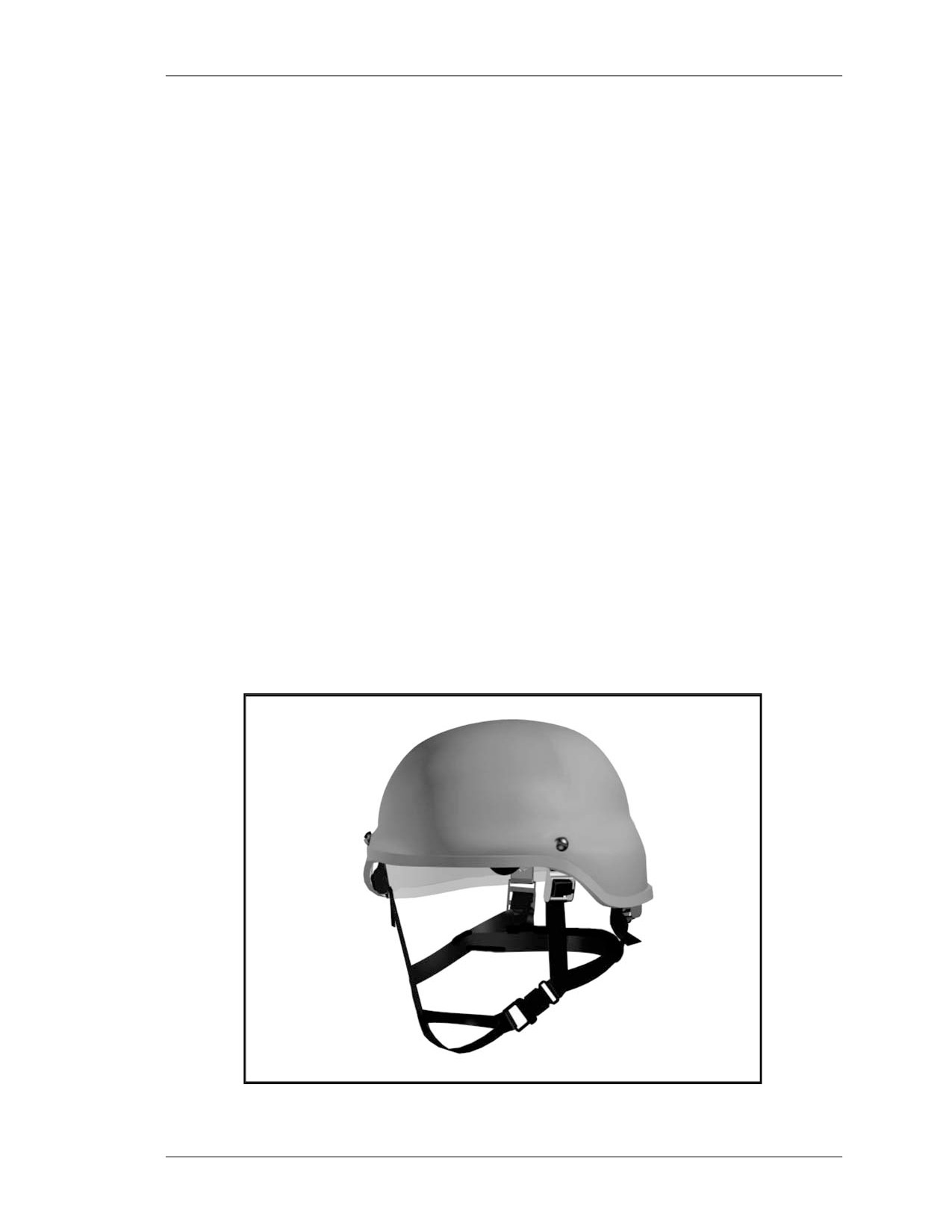
The ACH is a modular helmet system that provides ballistic, fragmentation, and impact
protection (Figure 2-13). This system is compatible with the current night vision devices
(NVGs), communications packages, and chemical defense (NBC) equipment. The ACH
is intended to replace standard government and commercial helmet systems currently
in use.
• The helmet system provides 9-mm and fragmentation protection within a
spectrum of environments (cold [-40 degrees Fahrenheit]; hot [140 degrees
Fahrenheit]; salt water; fresh water; petroleum, oils, and lubricants [POL]; and
so on).
• The ACH allows maximum sensory awareness for the operator. which
includes an unobstructed field of view and increased ambient hearing
capabilities.
• The helmet’s retention/suspension system provides unsurpassed balance,
stability, and comfort. This unique system provides for proper size, fit, and
ventilation.
• The pad suspension system provides superior impact protection throughout all
operational requirements.
Figure 2-13. Advanced combat helmet.
2-21
FM 3-21.220/MCWP 3-15.7/AFMAN11-420/NAVSEA SS400-AF-MMO-010
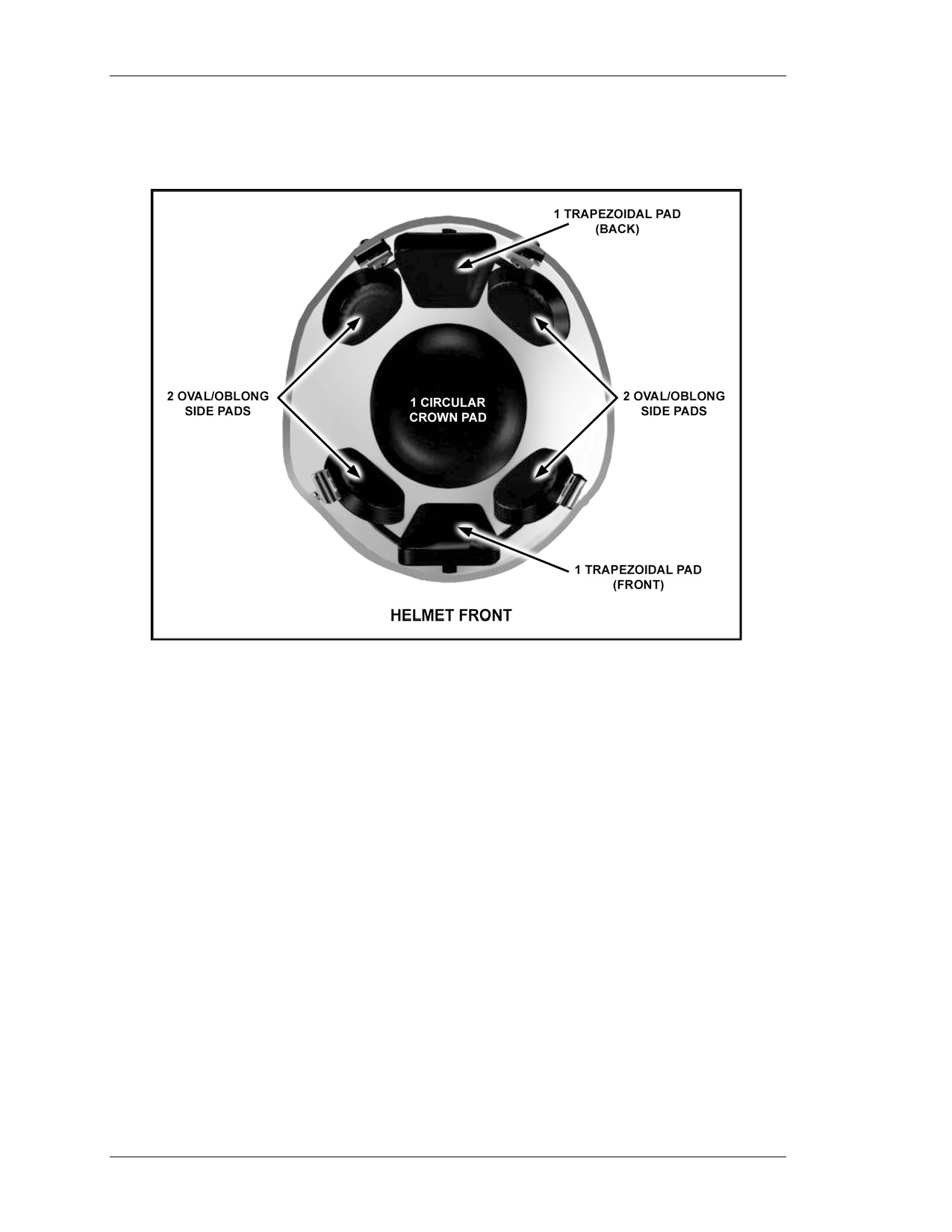
a. Helmet Assembly. The ACH has a unique, fully adjustable pad suspension
system. All seven pads are worn with the helmet (Figure 2-14).
Figure 2-14. ACH pads.
(1) The placement of the oblong side pads must cover the four bolt ends in the four
internal buckles in the helmet shell.
(2) The crown pad may be replaced by two oblong/oval pads. The direction of the
side oblong/oval pads may be changed to maximize comfort: they may be routed
vertically from bolt to crown, which maximizes airflow for better temperature regulation;
or, they may be routed horizontally to make a seal around the user’s head, which is better
for cold weather environments.
NOTES:
1. If hot spots or discomfort are experienced, try rearranging the pad system
to accommodate a more comfortable fit. If discomfort persists, try resizing
the shell.
2. See the sizing and fitting troubleshooting guidelines (paragraph c, page
2-26) for problems with fit, such as tightness or looseness, or if the helmet
profile is too high or too low.
3. When trying on the helmet for the first time in a cold environment, wear
the helmet for a few minutes to allow the pads to warm up and conform to
the shape of your head.
2-22
FM 3-21.220/MCWP 3-15.7/AFMAN11-420/NAVSEA SS400-AF-MMO-010
WARNING
Helmet must be worn with crown pad or two
properly placed oblong/oval pads (size 6 or 8) to
meet the impact protection requirement.
b. Fitting. Adjust the chinstrap to optimize fit and comfort.
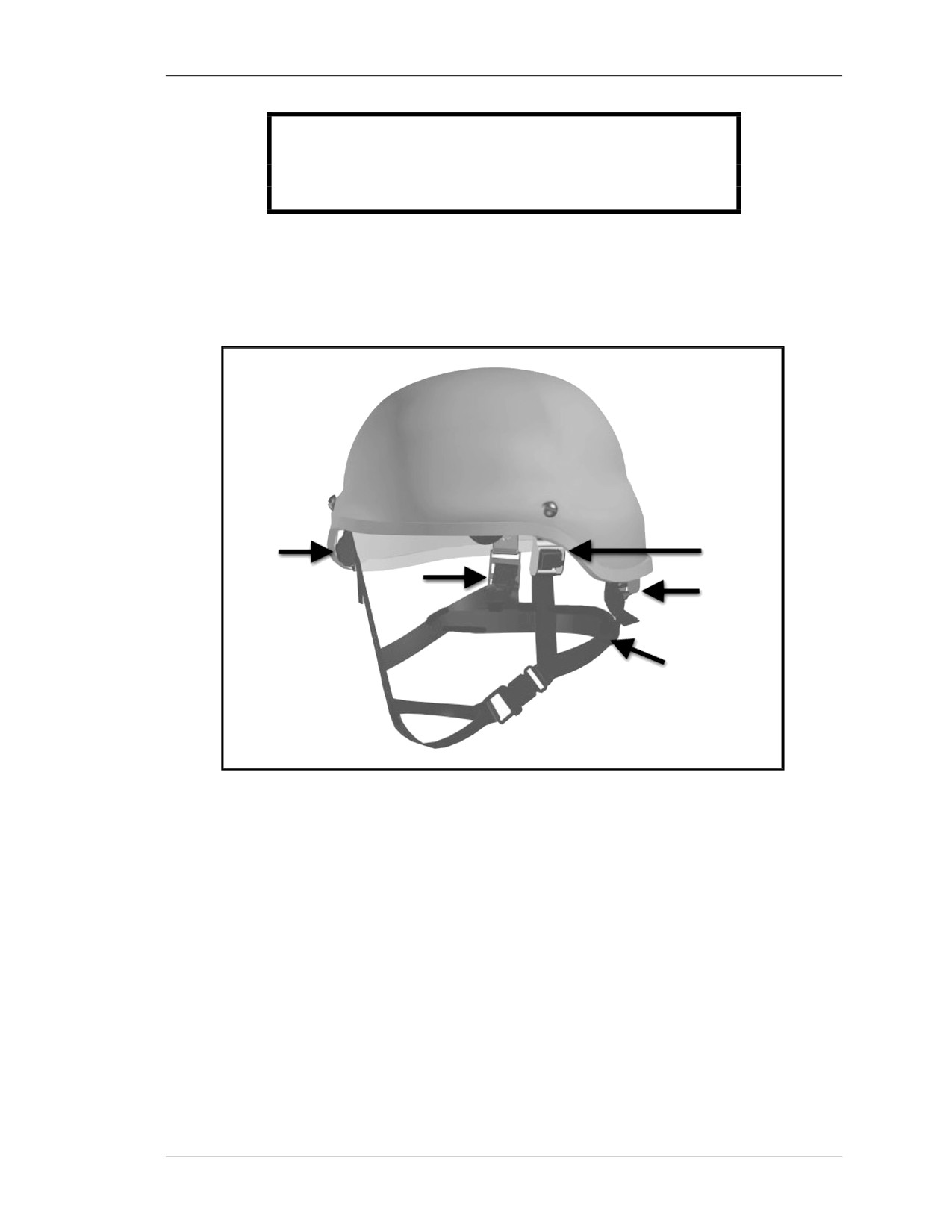
(1) Step 1. Before donning the helmet, loosen all adjustment straps (two in front, two
in back, one on nape of neck) (Figure 2-15).
Figure 2-15. ACH adjustable straps.
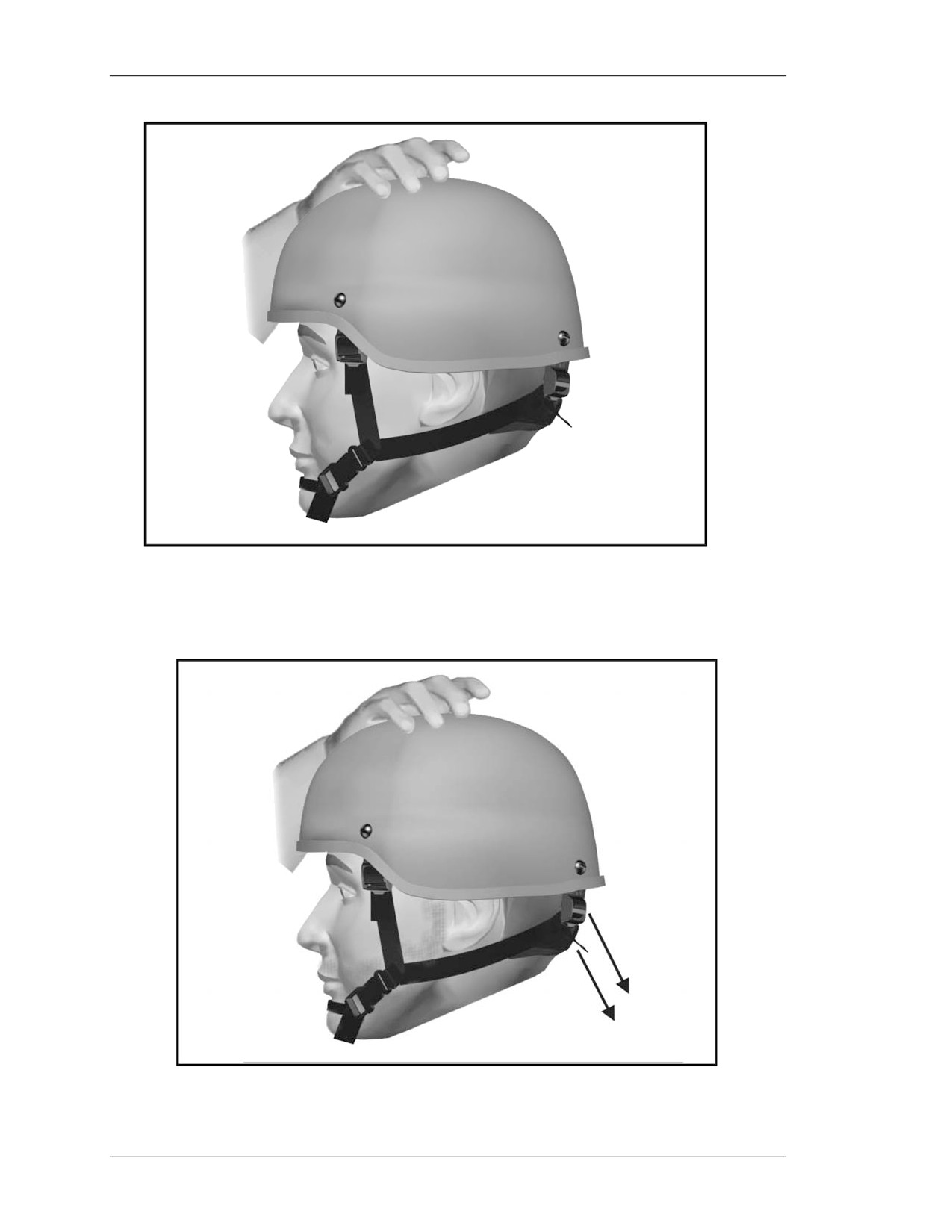
(2) Step 2. Position the helmet on the head and hold in place with one hand on top of
the helmet for initial adjustment (Figure 2-16, page 2-24).
2-23
FM 3-21.220/MCWP 3-15.7/AFMAN11-420/NAVSEA SS400-AF-MMO-010
Figure 2-16. ACH held in place for initial adjustment.
(3) Step 3. Partially tighten the two back adjustment straps (one side at a time)
(Figure 2-17).
Figure 2-17. Partially tighten two back straps.
2-24
FM 3-21.220/MCWP 3-15.7/AFMAN11-420/NAVSEA SS400-AF-MMO-010
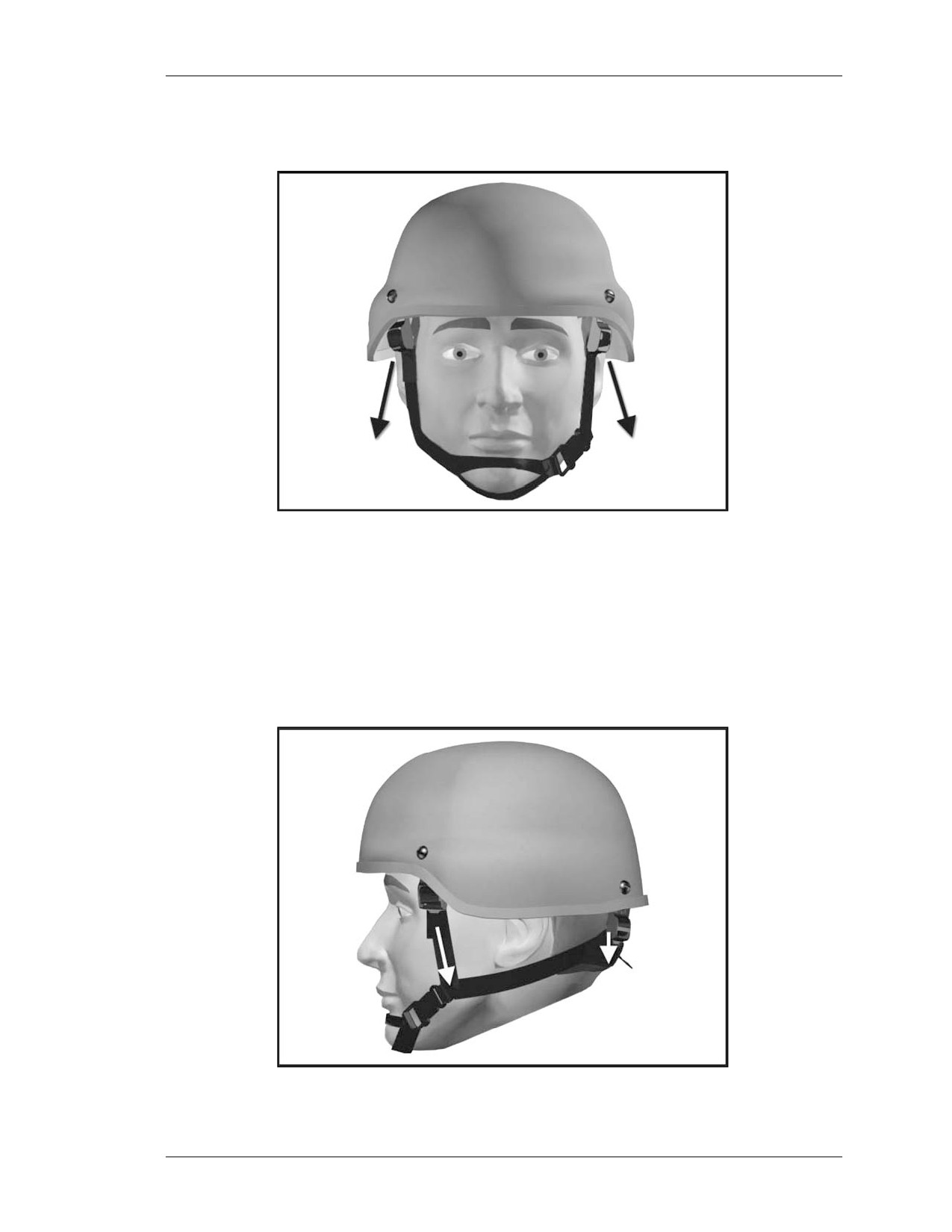
(4) Step 4. Partially tighten the two front adjustment straps (one side at a time)
(Figure 2-18).
Figure 2-18. Partially tighten two front straps.
NOTE: If any one strap is pulled too tightly during steps 3 and 4, the helmet may
become uncomfortable and tilted on the head.
(5) Step 5. With both hands, fully tighten the front and back adjustment straps
(Figure 2-19).
Figure 2-19. Fully tighten front and back straps.
2-25
FM 3-21.220/MCWP 3-15.7/AFMAN11-420/NAVSEA SS400-AF-MMO-010
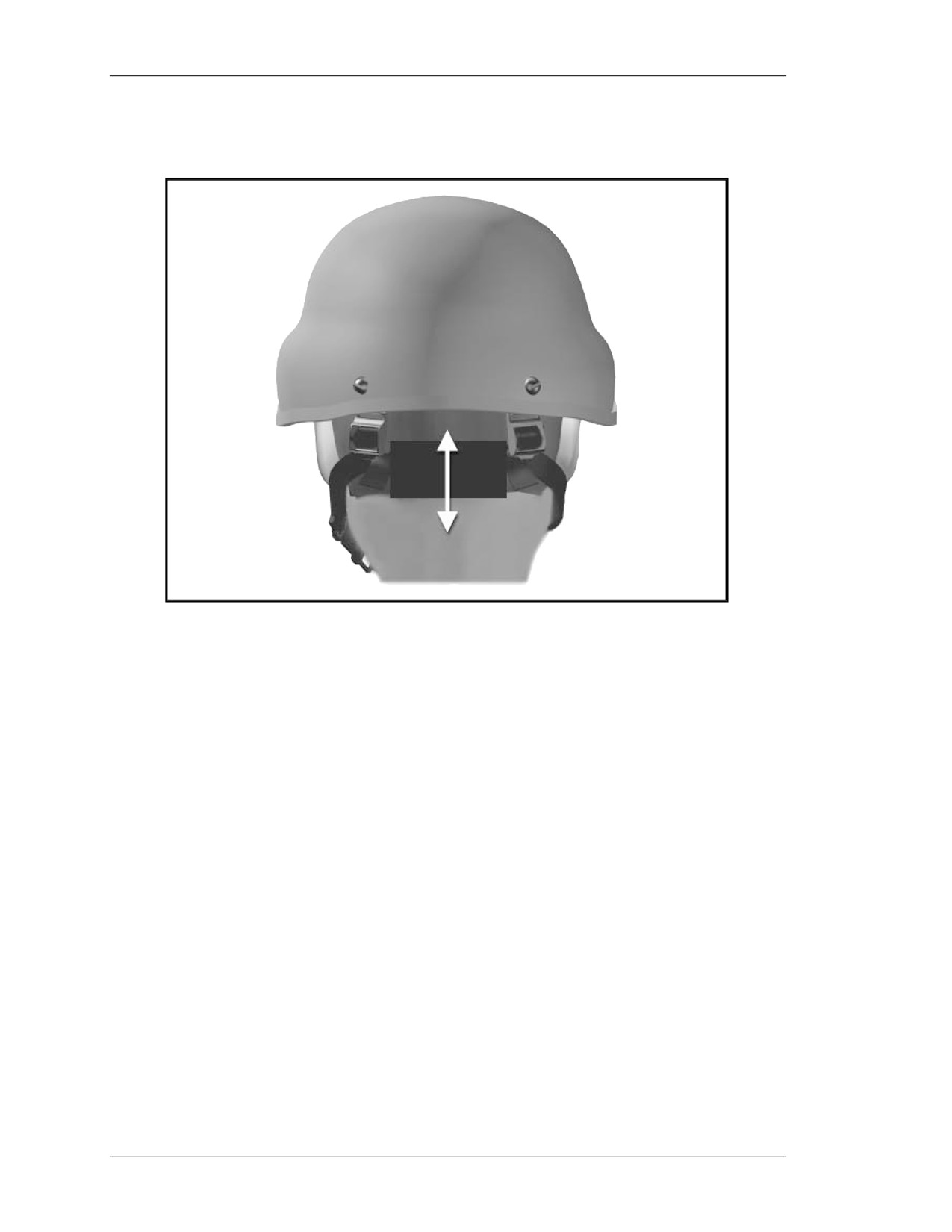
(6) Step
6. Position the nape pad up and down according to personal comfort
(Figure 2-20).
Figure 2-20. Position nape pad.
c. Sizing and Fitting Troubleshooting Guidelines. Use the following guidelines to
solve the problems discussed herein.
(1) ACH Too Tight. If the ACH feels too tight—
•
Try arranging the side pads in a vertical configuration.
•
Try removing the back pad and rearranging the side pads.
•
Try to create space in the area that feels tight.
•
Try the next smallest pad size if rearranging the pads does not alleviate the
tightness.
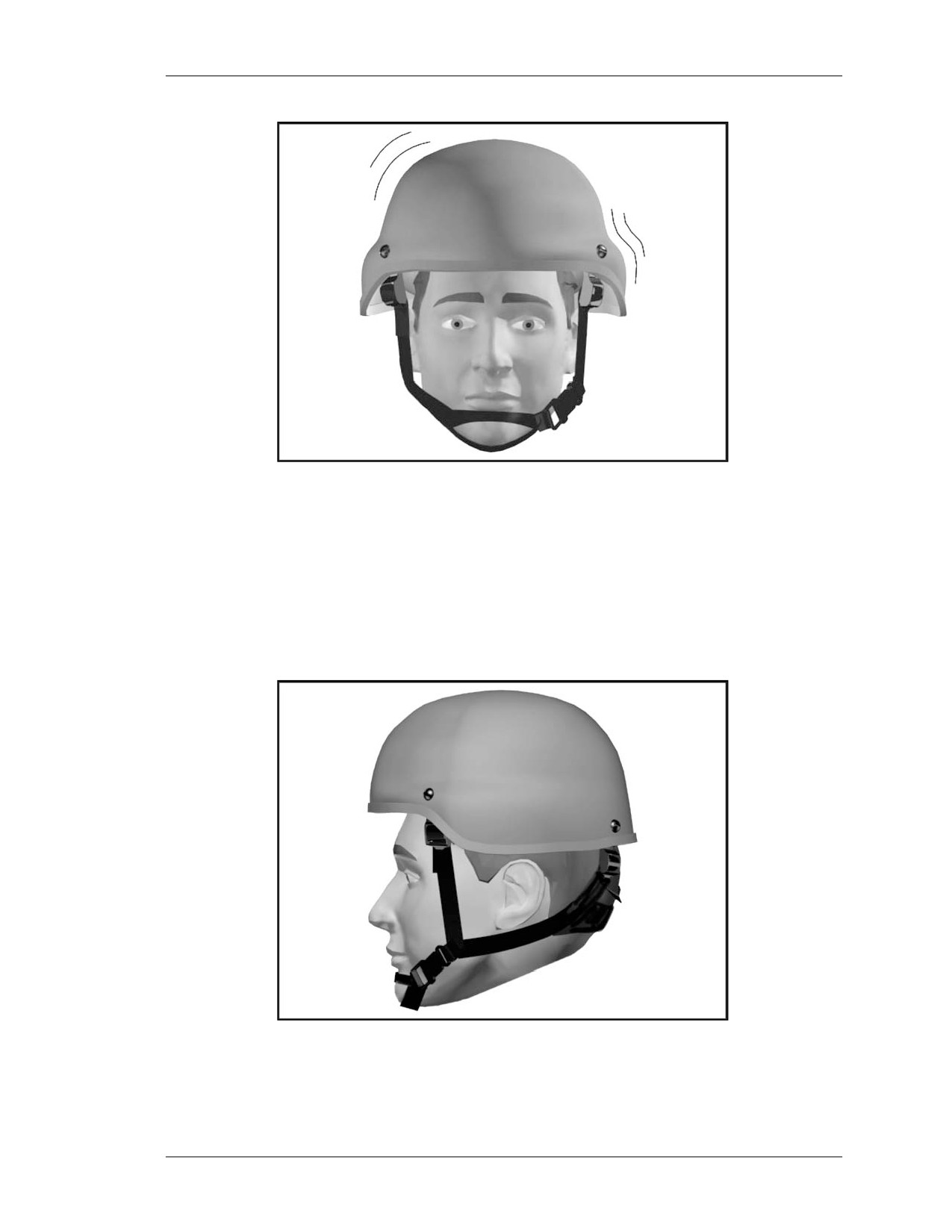
(2) ACH Too Loose. If the ACH feels too loose (Figure 2-21)—
•
Try a larger sized pad set or increase the current number of pads in use.
• If wearing a size 8 pad set and a size large shell, downsize to a size medium
shell. If the helmet is still too loose, increase the number of pads.
2-26
FM 3-21.220/MCWP 3-15.7/AFMAN11-420/NAVSEA SS400-AF-MMO-010
Figure 2-21. ACH too loose.
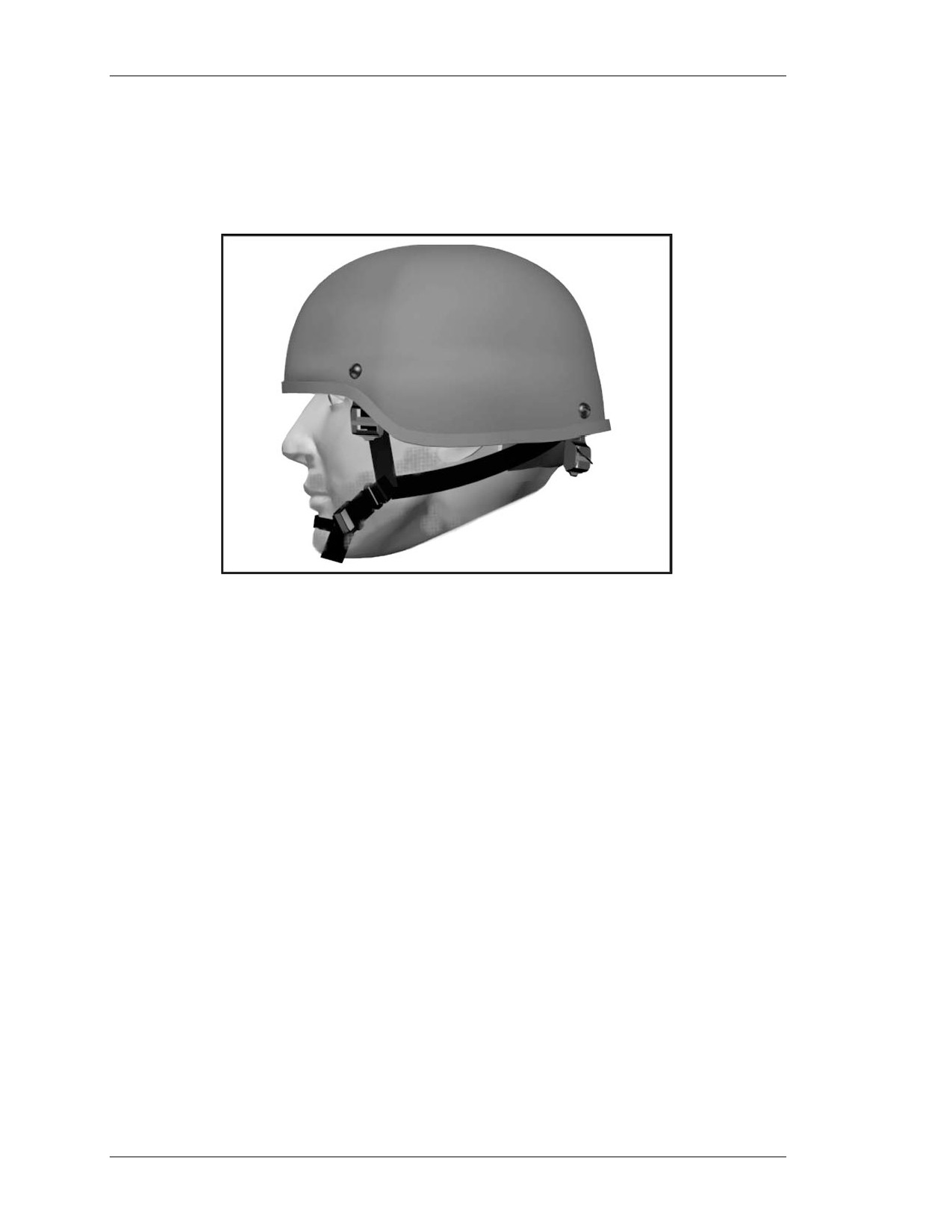
(3) ACH Too High. If the crown pad does not touch the top of the head or the
forehead is too exposed (Figure 2-22)—
Try a smaller sized pad set.
Try a larger shell size if smaller pads do not work.
Figure 2-22. ACH sits too high.
2-27
FM 3-21.220/MCWP 3-15.7/AFMAN11-420/NAVSEA SS400-AF-MMO-010
(4) ACH Too Low. If the ACH sits too low on the brow, is not compatible with
eyewear, or other compatibility issues exist (Figure 2-23)—
• Try larger suspension pads.
• Try a smaller ballistic helmet shell if the larger pads do not solve the problem.
Figure 2-23. ACH sits too low.
Section IV. PARACHUTIST ANKLE BRACE
The parachutist ankle brace (PAB) stabilizes the jumper’s ankle during PLFs and reduces
the potential for ankle injury. The PAB, which is worn outside the combat boot, consists
of sidewalls that extend vertically to encircle the ankle and the lower leg. The side and
back portions are connected by a U-shaped support that fits over the boot heel. The
support has a hook-pile strap system that attaches the brace to the leg and boot. The PAB
is lined with a three-section aircell to cushion the lower leg.
NOTE: The PAB is not a required item of equipment.
2-17. OBTAINING THE PARACHUTIST ANKLE BRACE
The unit orders the PAB or the heel strap replacement kit directly from AIRCAST,
P.O. Box 709, Summit, NJ 07902-0709, commercial 1-800-526-8785. All sizes are based
on men’s shoe sizes. The size codes for ordering are small, less than men’s size 8, 02G
(NSN 8465-01-416-6217); medium, men’s sizes 8 through 11, 02H (NSN 8465-01-417-
4002); or large, larger than men’s size 11, 02I (NSN 8465-01-416-6218). European sizes
are small, less than 42; medium, 42 through 45; and large, larger than 45. The cost is
about $60 per pair.
2-28
FM 3-21.220/MCWP 3-15.7/AFMAN11-420/NAVSEA SS400-AF-MMO-010
NOTE: The PAB must be worn with standard-heeled boots. When worn with boots
with flat or rippled soles, the PAB tends to slip and does not provide the
proper support for the jumper’s ankles.
2-18. INSPECTING THE PARACHUTIST ANKLE BRACE
Both jumpmaster and parachutist inspect the parachute ankle brace for serviceability as
follows:
a. Inspection. Parachute ankle braces are inspected by examining the PAB cushion,
the upper and lower leg straps, and the heel strap.
(1) If the leg cushion is missing, the PAB is unserviceable. If the cushion is torn, the
jumpmaster decides whether the PAB is serviceable.
(2) If the hook portion of the hook-pile tape is missing from the leg straps, the PAB is
unserviceable and must be replaced.
(3) If the heel strap is unserviceable, it can be replaced by following the
instructions below.
b. Heel Strap Replacement. If the PAB is unserviceable because of a worn or torn
heel strap, the heel strap is replaced as follows:
(1) Use a flat-blade screwdriver to remove the screw that secures the heel strap to the
brace. Save the screw from the folded tab on the heel strap.
(2) Unthread and remove the heel strap from the buckle on the opposite side of
the brace.
(3) Fasten the hook-pile tab to the brace.
NOTE: Ensure the new heel strap size corresponds to the brace size (small, medium,
or large).
(4) Flip the brace over so the heel strap buckle is facing up. Thread the heel strap
through the buckle top slot and pull through the slack. Loop the strap through the bottom
slot and pull until snug.
(5) Flip the brace back over, remove the hook-pile tab to expose the screw hole, fold
the strap end over, line up the screw holes, insert the screw through the strap, and refasten
the screw to the brace.
2-19. DONNING THE PARACHUTIST ANKLE BRACE
To reduce the potential for jumper ankle injury, the parachutist ankle brace must be
adjusted to fit snugly around the foot, ankle, and lower leg. The PAB is adjusted to the
jumper’s foot as follows:
a. Loosen the two leg straps and the heel strap, step into the PAB with the heel strap
under the boot’s instep (the area in front of the boot heel), and tighten the heel strap and
then the two leg straps. The bottom of the shell should align with the top of the sole.
b. Fasten the leg straps using only the outer portion of the leg strap buckle. If both
inner and outer portions of the buckle are used, the PAB could be difficult to remove in a
tactical situation.
NOTE: The PAB is designed so the jumper can run short distances while wearing the
PAB if necessary due to the tactical situation.
2-29
FM 3-21.220/MCWP 3-15.7/AFMAN11-420/NAVSEA SS400-AF-MMO-010
2-20. DOFFING THE PARACHUTIST ANKLE BRACE
The parachutist ankle brace is removed by loosening the leg straps and pulling the PAB
off the leg and foot. The PAB is an air item and must be retained by the jumper for use
during subsequent jumps.
2-30
FM 3-21.220(FM 57-220)/MCWP 3-15.7/AFMAN11-420/NAVSEA SS400-AF-MMO-010
CHAPTER 3
FIVE POINTS OF PERFORMANCE
The five points of performance are specific actions the parachutist
performs between the time of exit from the aircraft and the recovery after
landing. These points of performance are individual actions and are
essential on every parachute jump. Failure to perform any one point
correctly could result in a jump injury. They are stressed during jumper
training, and each point is taught using one or more of the training
apparatuses.
3-1.
FIRST POINT OF PERFORMANCE:
PROPER EXIT, CHECK BODY POSITION AND COUNT
A proper exit, body position, and count are essential to lessen the possibility of a
parachute malfunction/bodily injury during the deployment and inflation of the
parachute. The duration of the 4000-count corresponds to the approximate time it takes
the main parachute to fully deploy when used by a jumper exiting an aircraft flying 130
knots per hour. The following must be trained reflex actions as the parachutist exits the
aircraft:
a. The parachutist starts the 4000-count at ONE THOUSAND and snaps his feet and
legs together, locking his knees and pointing his boot toes toward the ground. He lowers
his head and places his chin firmly against his chest.
b. At the same time, he rotates his elbows firmly into his sides (with the palms of his
hands on the ends of the reserve parachute, fingers spread, and right hand over the rip
cord grip), and he bends his body forward at the waist to look over the reserve and to see
his boot toes while he continues to count, TWO THOUSAND, THREE THOUSAND,
FOUR THOUSAND, at normal cadence. (He keeps his eyes open to react to situations
around him.)
WARNING
If no opening shock is felt by the parachutist at the end of the
4000-count, he must activate the reserve parachute as for a
total malfunction.
3-2.
SECOND POINT OF PERFORMANCE:
CHECK CANOPY AND GAIN CANOPY CONTROL
When he finishes the 4000-count, the parachutist feels the parachute open, checks the
canopy for malfunction/damage, and controls the parachute.
a. T-10-Series. He grasps the risers (thumbs up), spreads the risers apart, and throws
his head back to inspect the entire canopy.
b. MC1-Series. He throws his head back to inspect the entire canopy and at the
same time grasps the control line toggles, with his elbows well back, for immediate
canopy control.
3-1
FM 3-21.220/MCWP 3-15.7/AFMAN11-420/NAVSEA SS400-AF-MMO-010
c. Twists. The main parachute may have twisted suspension lines, risers, or both.
This condition may be caused by a single action or a combination of actions. The most
common causes include the following:
• The deployment bag spinning before the canopy deploys.
• The canopy spinning when it comes out of the deployment bag and before
it inflates.
• The parachutist tumbling or spinning (caused by improper exit and body
position) during his descent.
If the suspension lines are twisted and the parachutist cannot raise his head enough to
check the canopy properly, he compares his rate of descent with that of nearby
parachutists.
(1) Rate of descent same as others around him. If his descent is the same as other
jumpers around him, the parachutist untwists his suspension lines by reaching behind his
neck, grasping each pair of risers (thumbs down, knuckles to the rear), and exerting an
outward pull on each pair. He kicks his legs in a bicycle motion, continues to pull
outward on the risers, and kicks until the twists are out of the suspension lines. When the
twists are out of the lines, he checks the canopy and gains canopy control.
(2) Partial malfunction and rate of descent too fast. If the parachutist’s main canopy
has a partial malfunction and his descent is too fast
(when compared to nearby
parachutists), he activates the reserve parachute. (If using the T-10 reserve parachute, he
uses the down-and-away method of activation.) See Chapter 6 for more information on
activation of the reserve.
(3) No comparison can be made. When other parachutists are not close enough to
compare rates of descent, he activates the reserve parachute (down-and-away method if
using the T-10).
3-3.
THIRD POINT OF PERFORMANCE:
KEEP A SHARP LOOKOUT DURING THE ENTIRE DESCENT
The ability to hit a specific landing spot and to avoid other parachutists during descent is
essential to successful airborne operations.
WARNING
During descent, the parachutist must watch to
avoid collisions and entanglements with other
parachutists and to avoid obstacles on the DZ.
Jumpers stay 25 feet away from other jumpers.
a. T-10-Series Parachute. The degree of maneuverability with a T-10-series
parachute is limited compared to the MC1-series. The jumper maneuvers the T-10-series
parachute using slips.
(1) Use of Slips. The parachutist performs slips to avoid other parachutists, to avoid
obstacles on the ground, and to prepare to land.
3-2
FM 3-21.220/MCWP 3-15.7/AFMAN11-420/NAVSEA SS400-AF-MMO-010
(2) Types of Slips. The two types of slips are the two-riser and the one-riser. For an
effective slip of either type, the parachutist must ensure his hands are not placed through
or behind the riser(s).
(3) Execution. When slipping, the parachutist looks in the direction that the slip is
being made, makes a sharp initial pull to effectively spill air from the canopy, and
releases the riser(s) slowly to prevent spinning or oscillations.
(a) Two-riser slip. A two-riser slip is made by reaching up to the elbow-locked
position, grasping a pair of risers in the direction of the desired movement, and pulling
them down to your chest.
(b) One-riser slip. A one-riser slip is made by pulling down three full arm lengths of
the one riser nearest the desired direction of movement with a hand-over-hand motion.
b. MC1-Series Parachute. Depending on the wind conditions and his skill, the
parachutist can steer his parachute to a selected point of impact on the DZ to avoid other
parachutists in the air, to avoid obstacles on the ground, or to use a preferred PLF. To
control MC1-series movement, the parachutist must know the principles by which the
canopy operates and the factors that govern its control. The movement of the canopy is
controlled by the action of the wind, the position of the canopy orifice (opening) relative
to wind direction, and the way in which the control lines are manipulated.
WARNING
Due to the canopy’s steerability, parachutists
should stay at least 50 feet apart in the air to
prevent collisions.
(1) Opening Away from Wind. When the orifice is located directly opposite the wind,
the thrust of the orifice will be acting against the wind. This reduces the effect of wind
velocity on the canopy and will retard the lateral movement of the canopy in the direction
of the wind. This technique is called holding.
(2) Opening with the Wind. When the orifice is located directly with the wind, the
thrust of the orifice combines with the thrust of the wind to speed the movement of the
canopy in the direction of the wind. This technique is called running.
(3) Opening at an Angle. When the orifice is at an angle to wind direction, then the
force of the wind from one direction and the thrust of the orifice at the angle moves the
canopy in a direction near to a right angle to the direction of orifice thrust. The direction
of movement varies with wind velocity and the angle at which the orifice is pointed. This
technique is called crabbing.
WARNING
Before attempting any maneuvers, the parachutist
must check around him to prevent collisions with
other parachutists.
3-3
FM 3-21.220/MCWP 3-15.7/AFMAN11-420/NAVSEA SS400-AF-MMO-010
(4) Canopy Manipulation. Properly executed MC1-series maneuvers require correct
canopy manipulation to combine the force of the wind and the thrust of the canopy orifice
to move the parachute in a given direction. To maneuver the parachute to a certain point
on the ground or to avoid ground obstacles, the parachutist may have to turn and hold
into the wind, run with the wind, or crab to the left or right while running or holding.
(a) Turning. This is accomplished by pulling down on one control line toggle. The
farther down the toggle is pulled, the faster the turn. Pulling the right toggle causes a right
turn. Pulling the left toggle causes a left turn. Pulling both at the same time reduces
forward speed but increases the rate of descent. This is called braking. To deliberately
lose altitude quickly, the parachutist pulls down on both toggles. This maneuver should
be stopped before he is less than 250 feet above the ground.
(b) Holding into the Wind. Holding into the wind is done by rotating the MC1-series
canopy until the orifice is on the downwind side. Thereafter, the parachutist manipulates
the control line toggles to retain this position.
(c) Running with the Wind. Running with the wind is accomplished when the
parachutist rotates the canopy until the orifice is on the upwind side. Thereafter, control
line toggles are manipulated as needed to retain the position.
WARNING
Running with the wind just prior to landing can
cause injury and must be avoided below 100 feet
above the ground.
(d) Crabbing. Maneuvering while holding into, or running with or at an angle to the
wind, is performed by rotating the canopy to the left or right. As the canopy begins to
move in the desired direction, the parachutist manipulates the control line toggles to
maintain this direction.
(e) Maneuvering with a Broken Control Line. If a right or left control line is broken,
the canopy can still be maneuvered, though more slowly. The parachutist reaches high on
the right or left rear riser, on the same side as the broken control line, and pulls down.
(f) Maneuvering with an Inversion. If the canopy has inverted while opening, the
parachutist reverses the maneuvering technique. To turn left, the parachutist pulls down
on the right control line; to turn right, he pulls down on the left control line.
(g) Maneuvering with a Tangled Control Line. If the control line becomes tangled in
a suspension line, the parachutist uses the same procedure as with a broken control line.
c. Collisions and Entanglements. A collision is the physical impact or contact,
however slight, of one parachutist or parachutist’s equipment with that of another
parachutist. An entanglement is the entwining or attachment of a parachutist or
parachutist’s equipment with that of another parachutist during descent, whether or not
the entanglement lasts until the parachutists contact the ground.
(1) Collisions. Parachutists must be alert in the air and warn each other of impending
collisions. If a collision cannot be avoided by slipping or turning, the parachutist attempts
to bounce off the other parachutist’s suspension lines or canopy by spreading his arms
and legs just before making contact.
3-4
FM 3-21.220/MCWP 3-15.7/AFMAN11-420/NAVSEA SS400-AF-MMO-010
(2) Entanglements. If a parachutist becomes entangled with one or more suspension
lines of another parachute, the parachutist does one of the following, depending on the
type of parachute being used.
(a) T-10-Series. Release entanglements as follows:
• The upper parachutist firmly grasps a portion of the lower parachute and
moves hand under hand down the suspension lines of the lower parachute
until each parachutist can grasp and hold the main lift web of the other’s
parachute, being careful not to grip the canopy release assemblies.
• If neither parachutist has a fully inflated canopy, both parachutists will push
away from each other and activate their reserves using the pull-drop method.
• When the balls of the feet strike the ground, both parachutists release their
grips and make either right, left, or rear PLFs away from each other. No front
PLFs will be made.
• With the T-10-series, both jumpers can ride one good canopy to the ground. If
both canopies collapse, both jumpers must activate their reserves using the
pull-drop method.
(b) MC1-Series. Both jumpers remain where they are and activate their reserves for a
partial malfunction. When using the MIRPS, jumpers must have a clear path to their front
for the spring-assisted deployment device.
d. Stealing Air. A descending parachute causes an area of partial air compression
immediately below the canopy and an area of partial vacuum and descending turbulent
air above the canopy. This turbulent air extends about 50 feet above the canopy.
(1) A parachute falling into an area of partial vacuum (from a parachute below) does
not capture enough air to stay fully inflated. The top parachute may partially collapse and
drop below the other parachutist’s canopy until the force of unaffected air reinflates it.
Then this canopy, being lower, “steals” the air from the canopy above; this causes the
canopy above to partially collapse and the jumper to drop past the lower canopy. This
“leap-frogging” action continues unless corrective action is taken by the parachutist.
Depending on the type of parachutes involved, the parachutist does one of the following:
(a) T-10-Series. He slips vigorously to maintain a lateral distance of at least 25 feet
between the parachutes.
(b) MC1-Series. He turns in the opposite direction to provide at least a 50-foot
distance between the parachutes. (When facing another parachutist, both parachutists
execute a right turn.)
(2) When 250 feet or less above the ground, parachutists must exercise care to avoid
stealing air from another parachute, because a deflated canopy will not be high enough
above the ground to reinflate completely. If this situation occurs, the parachutist
immediately prepares to land and to execute a PLF.
3-4.
FOURTH POINT OF PERFORMANCE:
PREPARE TO LAND
A proper landing attitude is necessary to lessen the risk of injury to the parachutist when
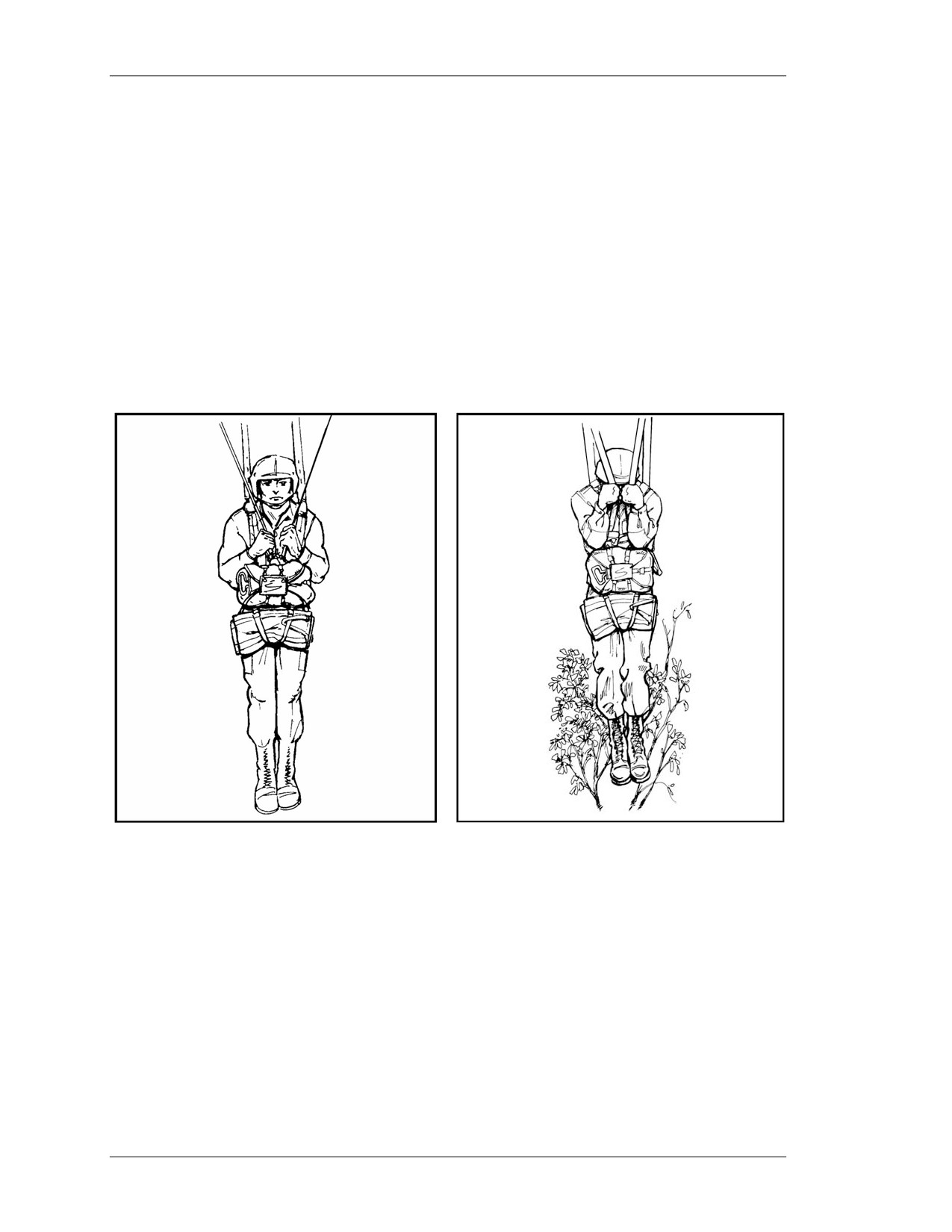
he hits the ground (Figure 3-1, page 3-6). The preliminary movements of the parachutist
vary, depending on the type of parachute used. However, lowering his individual
equipment is the same with either parachute. He lowers the equipment on a lowering line
when he is between 200 and 100 feet above the ground.
3-5
FM 3-21.220/MCWP 3-15.7/AFMAN11-420/NAVSEA SS400-AF-MMO-010
a. T-10-Series. When he is about 100 feet above the ground, the parachutist checks
the direction of drift and pulls a two-riser slip into the wind. He holds the risers firmly
against his chest and presses his elbows against his body. He keeps his head erect with
his eyes on the horizon. He keeps his legs slightly bent and knees unlocked, and he keeps
his feet and knees together with the balls of his feet pointed slightly toward the ground.
He maintains moderate muscular tension in the legs, which absorb a significant portion of
the landing impact, and he avoids becoming stiff or tense.
b. MC1-Series. When he is about 100 feet above the ground, the parachutist turns
and holds into the wind. When nearing the ground, he holds the control line toggles at eye
level. On impact, he holds the toggles, rotates his arms into his body, and executes a PLF.
c. Obstacles. The parachutist slips or turns to avoid obstacles. If obstacles (trees,
water, or high tension wires) cannot be avoided, the parachutist takes the following
precautions.
Figure 3-1. Landing attitude.
Figure 3-2. Tree landing attitude.
(1) Tree Landing. Initial precautions taken depend on the type parachute worn.
(a) T-10-Series. The parachutist continues to execute a diagonal slip to avoid the
trees. Once he sees he cannot avoid them, he immediately assumes a normal
prepare-to-land attitude. Just before he makes contact with the trees, he brings his hands
up in front of his head and elbows in front of his chest while he continues to grasp the
risers (Figure 3-2). He keeps his equipment attached. If he has lowered his equipment
before realizing a tree landing is imminent, he looks below prior to jettisoning his
equipment and then jettisons the equipment. He continues to watch the ground and trees.
He keeps his feet and knees together and prepares to make a good PLF should he pass
through the trees.
3-6
FM 3-21.220/MCWP 3-15.7/AFMAN11-420/NAVSEA SS400-AF-MMO-010
(b) MC1-Series. The parachutist keeps his feet and knees together and toes pointed
downward. He continues to control the canopy to avoid the trees if possible. He keeps his
equipment attached and wears his ballistic helmet. If he has lowered his equipment before
realizing a tree landing is imminent, he looks below prior to jettisoning his equipment
and then jettisons the equipment. He continues to watch the ground and trees. Just before
impact, he assumes a normal prepare-to-land attitude, but he rotates his arms inward with
his elbows high. Upon impact with a tree, the jumper places his hands in front of his face.
He must be prepared to execute a parachute landing fall. If he gets hung up in a tree, he
takes the following action:
• He reaches up high on both sets of risers and tugs on them three or four times
to determine if he is securely hung. He prepares to do a good PLF in case
he drops.
• He tries to reach the tree trunk or a large limb to allow him to climb down to
the ground.
• If this does not work, he pulls the saddle down and over his buttocks and sits
well in the saddle.
• He locates the D-ring attaching straps on his combat equipment and looks to
see if it is clear below. Then he pulls down and out on the D-ring attaching
straps and lowers and jettisons his combat equipment.
• He releases the chest strap by pulling outward on the ejector snap
activating lever.
• He activates the reserve parachute by pulling the rip cord grip. (When using
the MIRPS, the jumper ensures his left hand covers the ripcord protector flap
to control the spring-loaded deployment assistance device.) He helps feed the
canopy of the reserve out to ensure that all of the suspension lines are
completely out of their retainers.
WARNING
Make sure the reserve reaches the ground, or is
close to it, before continuing with the following
actions.
• He activates the quick release in the waistband and frees it from the
metal adjuster.
• He unfastens the left connector snap of the reserve from the left D-ring and
pushes the reserve behind his right arm.
• He seats himself well into the saddle.
• He wraps his legs around the suspension lines of the reserve parachute and
then carefully gets out of the harness.
• With one hand, he grasps the main lift web and holds it firmly.
• With the other hand, he grasps the activating lever of either the left or right leg
strap and pulls outward, releasing the leg strap. He releases the other leg strap
in the same manner.
3-7
FM 3-21.220/MCWP 3-15.7/AFMAN11-420/NAVSEA SS400-AF-MMO-010
• He climbs down the suspension lines and canopy, staying to the outside of the
canopy.
(2) Water Landing. As soon as the parachutist realizes he is going to land in water,
he does the following:
• He tries to slip, or steer, away from the water.
• He looks below to be sure the area is clear. Then he jettisons his helmet.
• He releases all equipment tie-downs.
• He looks below to be sure the area is clear. Then, he lowers any attached
equipment.
• He activates the waistband quick release.
• He unhooks the left connector snap of the reserve parachute from the D-ring
and rotates the reserve parachute to his right side.
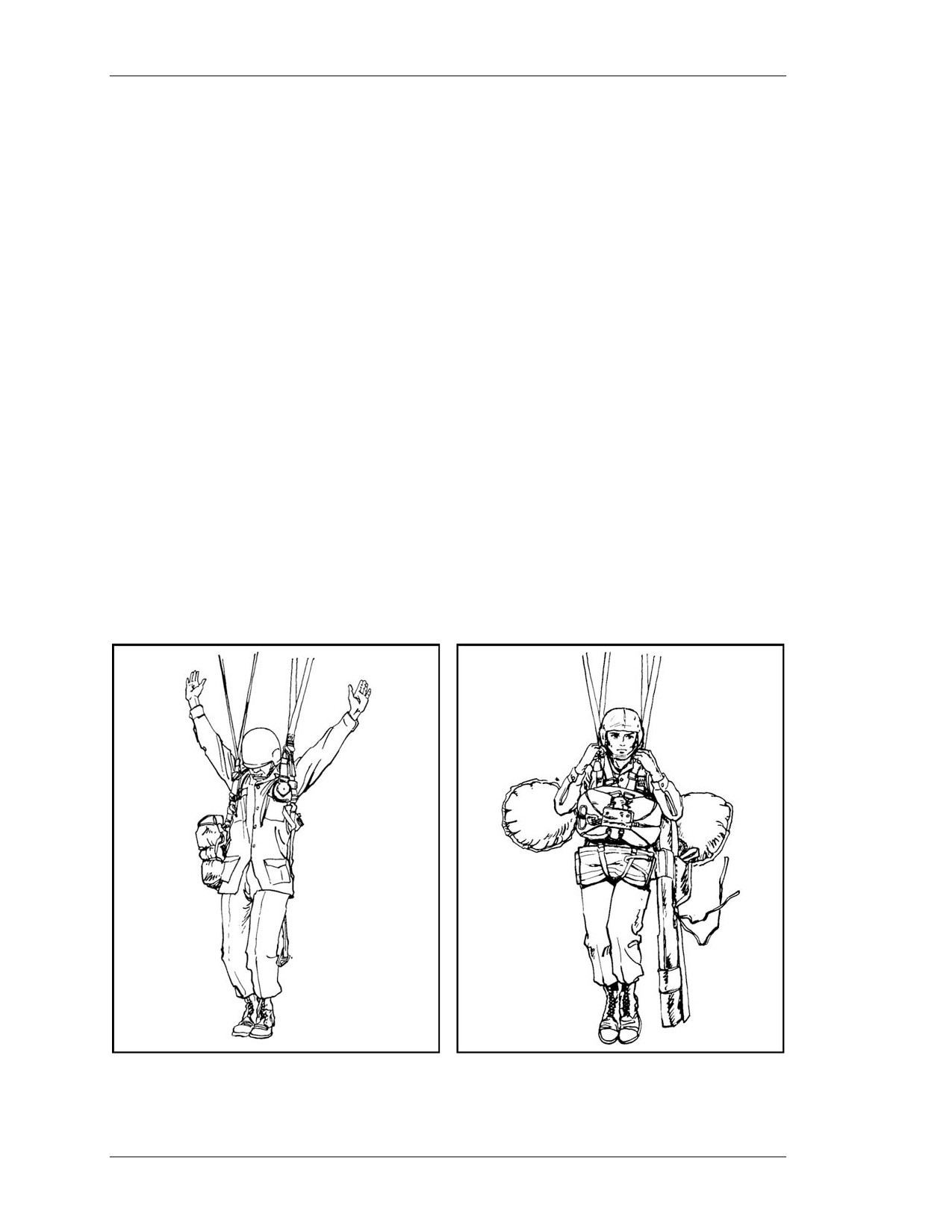
(a) Without a Life Preserver. When wearing the troop parachute harness and a water
landing without a life preserver is imminent, the parachutist does the following
(Figure 3-3):
• He pulls the saddle well under his buttocks.
• He releases the chest strap by pulling on the activating lever of the
ejector snap.
• He makes all possible attempts to remove the pistol belt and all equipment
attached to his body that may hinder movement in the water.
• He releases the leg straps ejector snaps when his feet touch the water.
• He prepares to make a PLF in case the water is shallow (2 feet or less
in depth).
Figure 3-3. Landing without a
Figure 3-4. Landing with a B-7
life preserver.
life preserver.
3-8
FM 3-21.220/MCWP 3-15.7/AFMAN11-420/NAVSEA SS400-AF-MMO-010
(b) With a Life Preserver. When wearing a troop parachute harness and jumping with
a B-7 or service approved life preserver (Figure 3-4), the parachutist does the following:
• He activates the B-7 after checking the canopy. If the B-7 fails to inflate, the
parachutist inflates the B-7 manually by blowing air into the inflation valve
hose. The parachutist activates one canopy release assembly after entering the
water and signals “All okay” to the recovery boat.
• He pulls the safety clip out and away from his body (exposing the cable loops)
and activates the canopy release assembly using one of the two methods used
in the recovery from the drag as his feet touch the water.
• He does not remove the harness and equipment, since the B-7 will support up
to 500 pounds.
NOTE: For more information on life preservers, see Chapter 12, Section II.
WARNING
When wearing the B-5, the parachutist does not
inflate the B-5 until the parachute harness is
removed. If restricted by the harness, the inflation
force may crush his ribs.
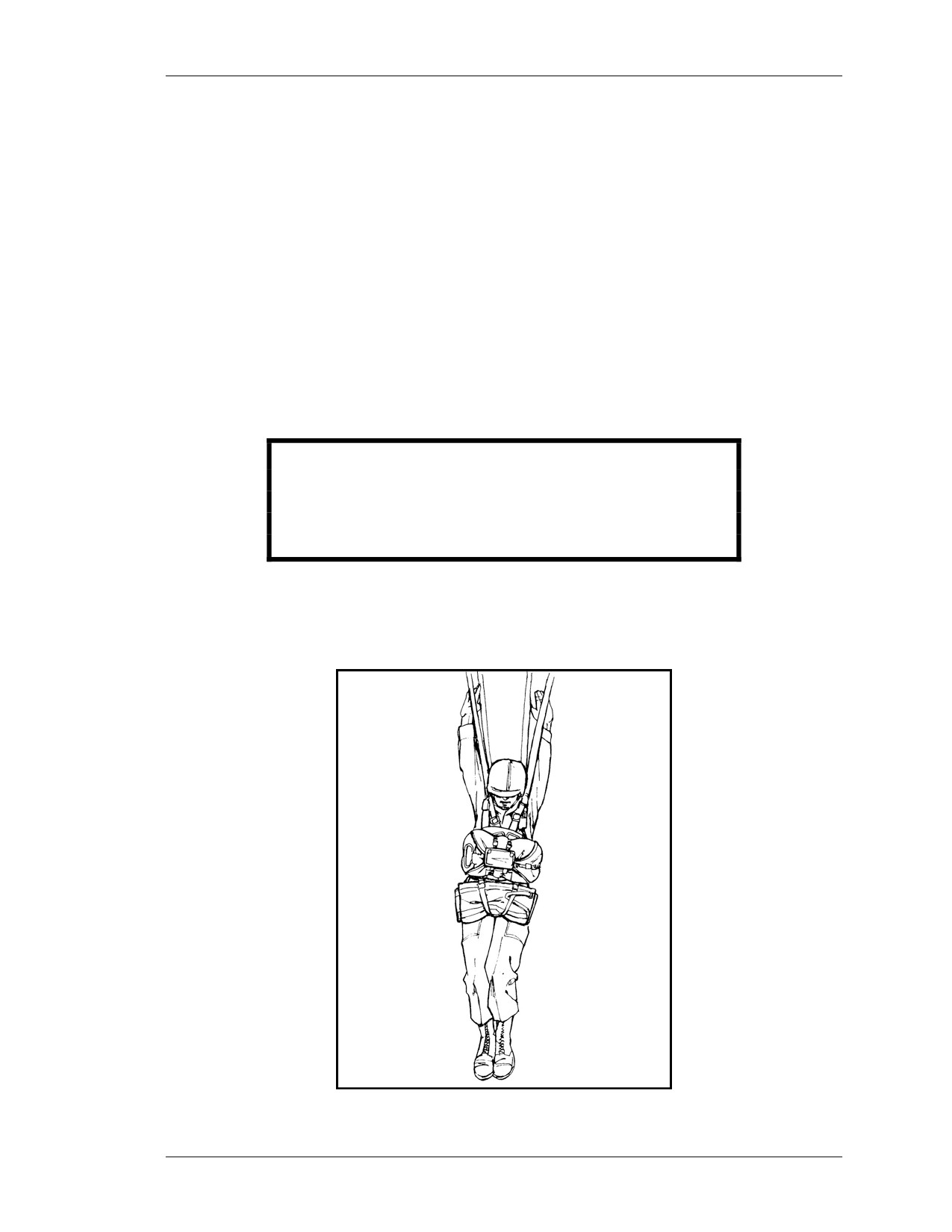
(3) High Tension Wire Landing. The parachutist does the following if unable to
avoid high tension lines when landing (Figure 3-5):
Figure 3-5. Wire landing attitude.
3-9
FM 3-21.220/MCWP 3-15.7/AFMAN11-420/NAVSEA SS400-AF-MMO-010
• He tries to slip away from the wires.
• He keeps his feet and knees together and toes pointed downward.
• He looks below and checks for fellow jumpers.
• He jettisons his combat equipment.
• He holds his hands high, inside the front set of risers with palms out and
thumbs behind the risers, elbows back, with the fingers extended and joined.
• He keeps his chin on his chest, his body straight, with an exaggerated bend to
his knees.
• He prepares to make a normal parachute landing fall.
If he contacts the wires, he begins a rocking motion with his body by pushing forward on
the front risers and kicking back with his legs; this may keep him from getting entangled
in the wires. He prepares to execute a PLF should he pass through the wires.
NOTE: If the jumper becomes entangled in the wires, he makes no attempt to climb
down, but waits to be rescued by a recovery team.
3-5.
FIFTH POINT OF PERFORMANCE: LAND
Most jump injuries occur because of improper PLF techniques. To lessen the possibility
of injuries, the parachutist is trained to absorb the impact of landing by executing a
proper PLF. To do this, the following five fleshy portions of the body must contact the
ground in sequence: balls of feet, calf, thigh, buttock, and pull-up muscle(s). The three
basic PLFs are side (right or left), front (right or left), and rear (right or left). The type
of fall to be made is dictated by the direction of the wind drift. Before the landing attitude
is assumed, the parachutist judges the direction of drift by looking at the ground. Then he
prepares to make the appropriate PLF.
a. Side PLF. As the balls of his feet strike the ground, the parachutist begins several
actions at the same time. As the fall continues, he does the following to complete a
left-side PLF. (The right-side PLF is similar to the left-side PLF, except the points of
contact on the right side of the body are used.)
(1) He lowers his chin firmly to his chest and tenses his neck. He brings his hands up
in front of his head and elbows in front of his chest, continuing to grasp the risers
(T-10-series) or the toggles (MC1-series). Then he bends and twists his torso sharply to
the right. This movement forces the body into an arc. The twisting motion of the hips
pushes both knees to the left as the fall continues, and it exposes the second through the
fifth points of contact (calf, thigh, buttock, side).
(2) As the PLF is completed in the direction of drift, the parachutist maintains tension
in his neck to prevent his head from striking the ground. The momentum caused by drift
brings his feet around to the right and into the line of drift. After completing the PLF, he
activates the canopy release assembly to keep from being dragged.
b. Front PLF. The two types of front falls are right-front fall and left-front fall.
The right-front fall is used if the direction of (wind) drift is slightly to the right. The
left-front fall is used if the direction of drift is slightly to the left. If the direction of drift
is directly to the front, the parachutist selects either PLF. For a left-front PLF, he rotates
from the waist down 45 degrees to his right, exposing his second and third points of
contact to the line of drift. Upon contact, he continues to rotate his body to the right,
3-10
FM 3-21.220/MCWP 3-15.7/AFMAN11-420/NAVSEA SS400-AF-MMO-010
exposing the second, third, fourth, and fifth points of contact. (When executing the
right-front PLF, he rotates to the left.)
c. Rear PLF. The two variations of the rear PLF are right-rear PLF and
left-rear PLF.
(1) The parachutist determines what PLF to make by checking the direction of drift.
If the drift is directly to the rear, he selects the appropriate PLF.
(2) For a left-rear PLF, he rotates from the waist down 45 degrees to his left,
exposing the second and third points of contact to the line of drift. Upon contact, he
continues to rotate his body and bend his upper torso away in the opposite direction,
exposing the second, third, fourth, and fifth points of contact. When executing the
right-rear PLF, he rotates to the right.
3-11
FM 3-21.220(FM 57-220)/MCWP 3-15.7/AFMAN11-420/NAVSEA SS400-AF-MMO-010
CHAPTER 4
TRAINING APPARATUSES
The apparatuses described in this chapter are used in basic airborne
training. They allow the student to demonstrate proficiency in the tasks
necessary to complete the course.
Section I. PARACHUTE LANDING FALL DEVICES
The three types of PLF training devices are the 2-foot high platform, the lateral drift
apparatus, and the swing landing trainer. The 2-foot high platform may be portable or
permanently fixed. A soft landing area of pea gravel or like material is used with all of
the training apparatuses. These devices are used to teach front, side (right and left), and
rear PLFs. They are high enough to simulate the shock the student will feel when he
contacts the ground during parachute jumps. Initial instruction for each PLF is given
without using the apparatuses. Once students are familiar with the techniques, they
progress to the 2-foot high platform, the lateral drift apparatus, and the swing landing
trainer. The swing landing trainer provides a means for gaining forward momentum and
simulating the lateral movement experienced during a parachute landing.
4-1.
INSTRUCTOR CRITIQUES
Table 4-1, on page 4-3, lists common PLF errors, their causes, and ways to correct them.
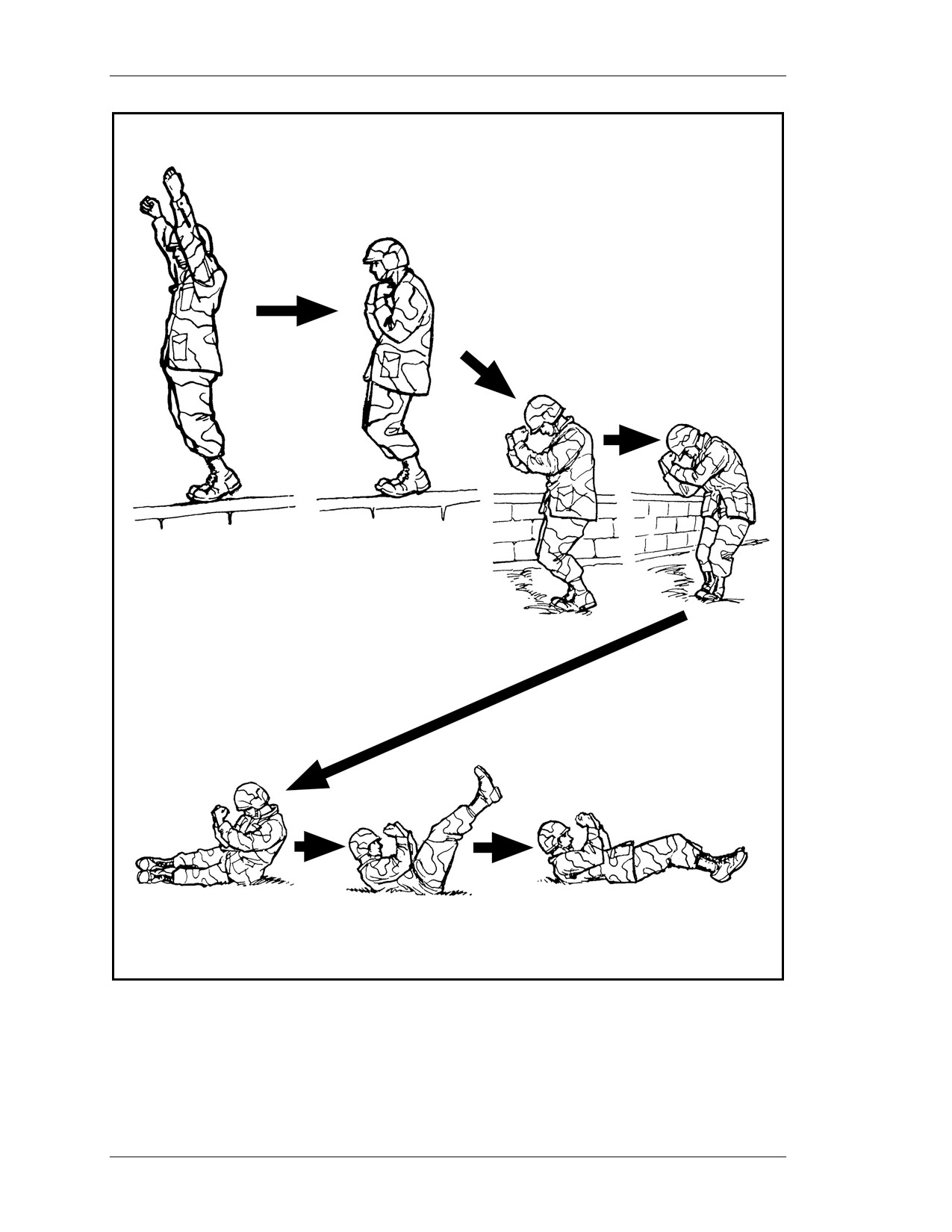
Instructor PLF critiques should be brief and clear, and should emphasize the following
points to students (Figure 4-1, page 4-2).
a. When the balls of your feet make contact with the ground, several actions occur at
the same time: Place your chin on your chest, tense your neck muscles, bring your elbows
high in front of your face, and expose the second (calf) and third (thigh) points of contact
by shifting and bending your knees, maintaining pressure with your opposite knee.
b. Rotate your upper body (from the waist up) around toward the opposite direction
of drift. Your body should be contorted in an arc, and the four remaining points of contact
should be exposed at this time.
c. Lay the points of contact down on the ground in sequence and complete the fall
by bringing your feet up and around your opposite shoulder, completing the fall on
your back.
4-1
FM 3-21.220/MCWP 3-15.7/AFMAN11-420/NAVSEA SS400-AF-MMO-010
Figure 4-1. PLF sequence.
4-2

FM 3-21.220/MCWP 3-15.7/AFMAN11-420/NAVSEA SS400-AF-MMO-010
ERROR
CAUSE
CORRECTION
Feet apart
Anticipation of landing.
Keep moderate muscle tension
in the legs. Keep feet and knees
together.
Drawing the legs up
Anticipation of landing. Relaxing
Keep moderate muscle tension
under the buttocks
the knees. Exaggeration of the
in legs. Maintain a proper
bend in the knees. Pulling feet up
prepare-to-land attitude,
upon landing.
naturally exposing the balls of
the feet to the ground.
Missing the second
Feet and knees apart.
Bend the knees slightly. Keep
(calf) and third (thigh)
Straightening the legs. Failure to
feet and knees together. Shift
points of contact
shift the knees.
and bend the knees throughout
the fall.
Knees into the ground
Hesitation upon landing. Pushing
Do not hesitate upon landing.
knees forward toward ground.
Shift knees to the side. Keep
Excessive bend in knees.
moderate muscle tension in
Turning the feet toward the
legs. Maintain the proper
direction of drift.
prepare-to-land attitude.
Elbows hit the ground
Leaning forward toward ground.
Rotate upper body away from
Failure to rotate upper body away
the ground with elbows up in
from ground. Breaking fall with
front of face.
elbows.
Head strikes the ground
Relaxing the neck. Arching the
Keep chin on chest. Tense neck
back during the prepare-to-land
muscle throughout the PLF.
attitude. Rotating the upper body
Assume proper prepare-to-land
into the ground. Missing the
attitude. Rotate upper body
points of contact.
away from the ground.
Table 4-1. Common PLF errors.
4-2.
TWO-FOOT HIGH PLATFORM
Each platform is divided into dismount points. One instructor controls each point.
a. On the command READY, the student rocks up on the balls of the feet with feet
and knees together and knees slightly bent, naturally exposing the balls of the feet to the
ground. Arms are skyward, simulating the grasping and spreading of the risers for the
T-10-series parachute, or, for the MC1-series, palms are facing forward at eye level with
elbows out to the side and back.
b. On the command SLIP (TURN for MC1-series), the student assumes a landing
attitude by simulating the grasping of a set of risers opposite the direction of drift and
pulling down into his chest with his head and eyes on the horizon, back straight, elbows
tight into the side, and feet and knees together. If executing front or rear parachute
landing falls, the student rotates his lower body (from the waist down) 45 degrees to
expose the second and third points of contact.
c. On the command LAND, the student jumps straight off the platform, executes the
PLF, and makes a quick recovery.
d. The instructor critiques each PLF immediately, emphasizing the significance of
the five points of contact.
4-3
FM 3-21.220/MCWP 3-15.7/AFMAN11-420/NAVSEA SS400-AF-MMO-010
4-3.
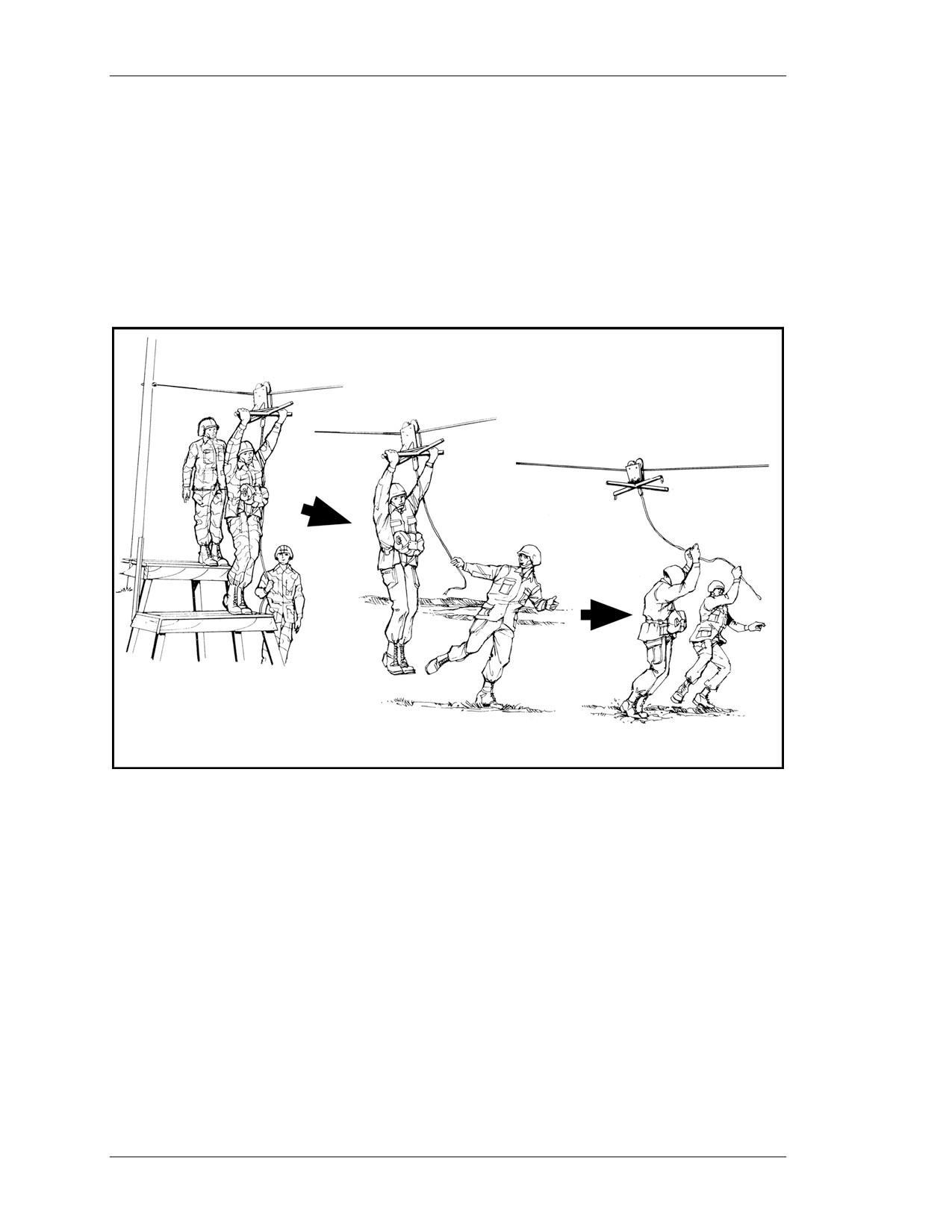
LATERAL DRIFT APPARATUS
A platoon is distributed among several apparatuses. Each apparatus requires a
parachutist, a ropeman, and a safety officer. The safety officer is positioned on the top
step of the platform to catch the trolley when it is returned by the ropeman, who is
located to the left side at the base of the platform (Figure 4-2). The parachutist mounts
the platform, grasps the bar with his palms facing toward his face, and assumes a good
landing attitude. On the command CLEAR THE PLATFORM, the parachutist maintains
a grasp on the trolley with both hands, picks up his feet, and drifts off the platform. On
the command LAND, the parachutist releases the bar and executes the PLF.
Figure 4-2. Lateral drift apparatus.
4-4.
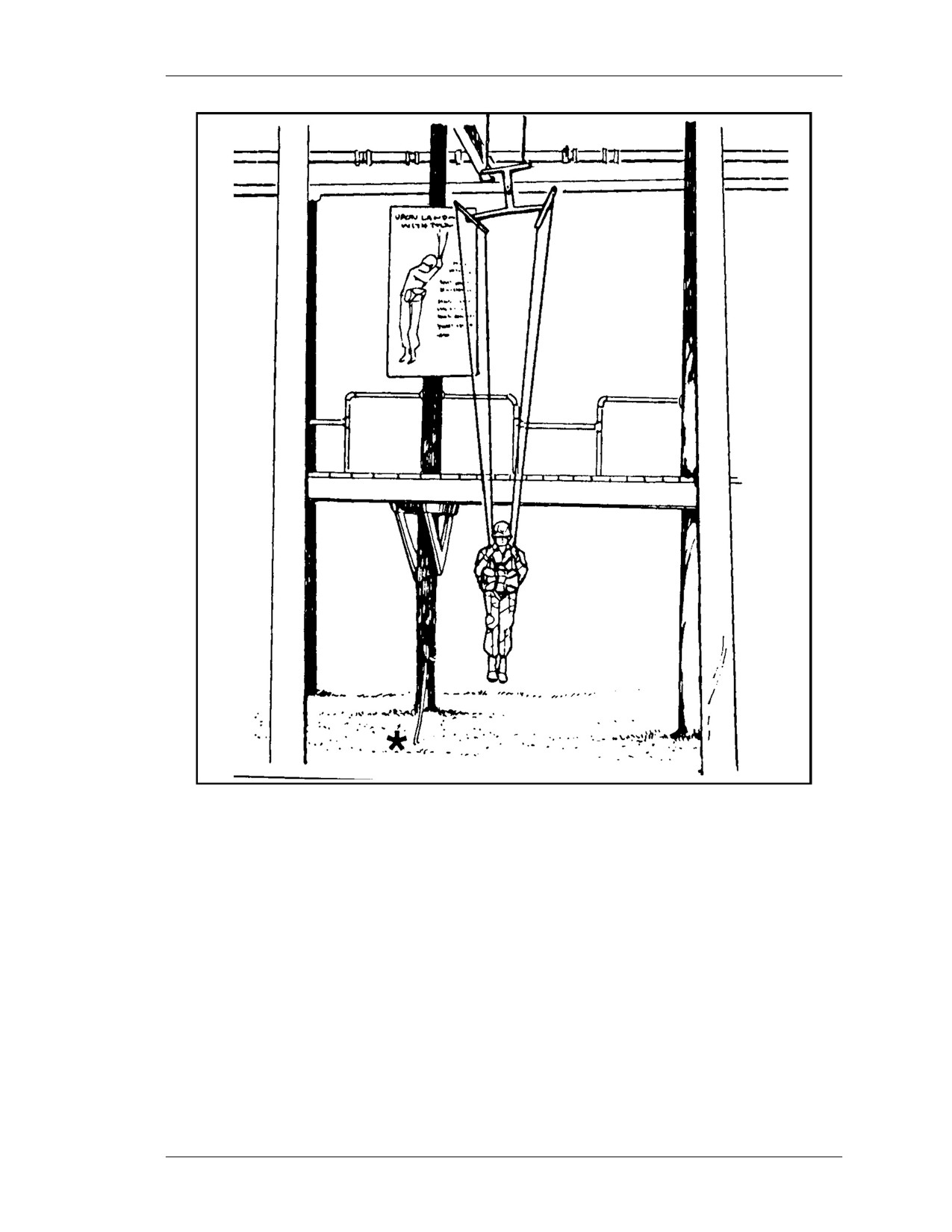
SWING LANDING TRAINER
The swing landing trainer (SLT) apparatus is suspended above a 12-foot-high platform
from which students, wearing a parachute harness, descend to practice PLFs (Figure 4-3).
The apparatus provides a downward motion and oscillation similar to that experienced
during a parachute jump. The suspension is placed so that the student swings when
stepping off the platform. Using a control line, the instructor controls the rate of descent.
Students receive practical work in two fundamental training objectives: assuming the
correct landing attitude (T-10-series and MC1-series) and executing front, side, and rear
PLFs.
4-4
FM 3-21.220/MCWP 3-15.7/AFMAN11-420/NAVSEA SS400-AF-MMO-010
Figure 4-3. Swing landing trainer.
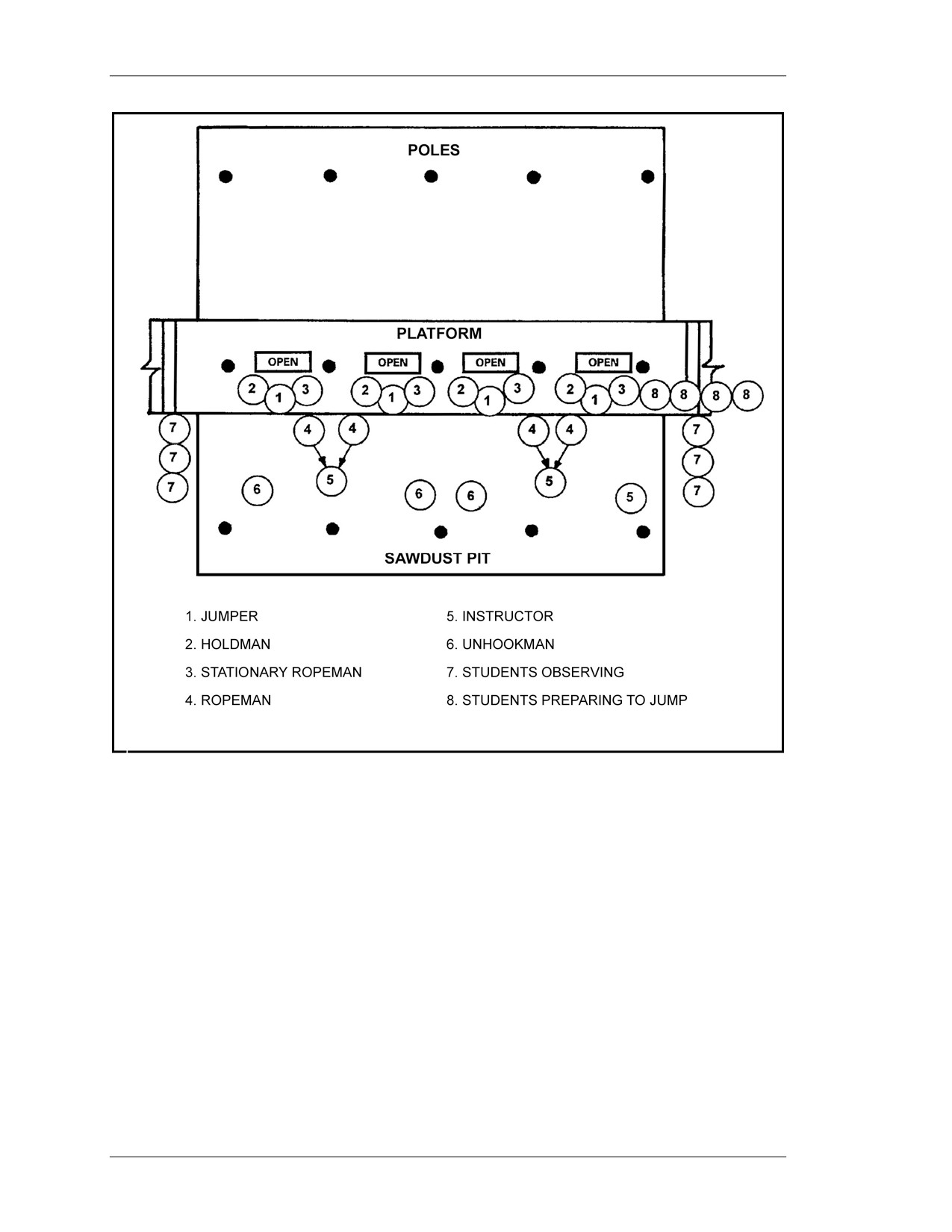
a. Personnel and Equipment Requirements. Personnel required to train on the
SLT apparatus include one instructor for every two dismount points in use and four detail
personnel for each unit (Figure 4-4, page 4-6). Enough harnesses to accommodate the
students are also required.
4-5
FM 3-21.220/MCWP 3-15.7/AFMAN11-420/NAVSEA SS400-AF-MMO-010
Figure 4-4. Personnel positioning for the SLT.
b. Training. The swing landing trainer provides practical exercise in the various
PLFs and may be used to practice the last two points of performance. Students must—
• Secure a harness and reserve parachute, and put them on using the buddy
system.
NOTE: The instructor inspects students before they mount the steps.
• Move to and mount the stairs at an assigned point. One student covers each
open point. If a point is not open, the students wait on the stairs. Students
stand on alternate steps of the stairs while waiting.
• Jump from two even or odd points in a section. They do not change sections
or switch sides of the apparatus unless directed to by an instructor.
Detail personnel hook up students, who await commands from instructors.
4-6
FM 3-21.220/MCWP 3-15.7/AFMAN11-420/NAVSEA SS400-AF-MMO-010
c. Platform Personnel Duties. The following detail personnel are needed for
training with the SLT.
(1) Stationary Ropeman. The stationary ropeman stands by the stationary rope and—
• Pulls up the stationary rope with risers hooked to it.
• Unhooks the risers from the rope.
• Passes one set of risers to the holdman.
• Hooks one set of risers to one of the jumper’s D-rings and butterfly snaps.
• Grasps the horizontal back strap of the parachutist to prevent him from
clearing the platform before being told to do so. The stationary ropeman
grasps the platform handhold with his free hand.
• Releases the parachutist on the command, CLEAR THE PLATFORM.
(2) Holdman. The holdman on the platform stands beside the rail padding, allowing
space for the parachutist between himself and the stationary ropeman. He—
• Receives one set of risers from the stationary ropeman and removes any
twists.
• Hooks the risers to the jumper’s D-rings and butterfly snaps.
• Grasps the horizontal back strap of the parachutist to prevent the parachutist
from clearing the platform before being told to do so. The holdman grasps the
platform handhold with his free hand.
• Releases the parachutist on the command, CLEAR THE PLATFORM.
(3) Unhookman. The unhookman stands in the pit at parade rest near the outside pole
at each point. The unhookman—
• Commands the ropeman, TAKE UP THE SLACK, ROPEMAN.
• Unhooks the parachutist’s risers after each PLF.
• Hooks the risers to the stationary rope and returns to his assigned position.
(4) Ropeman. The ropeman stands beneath the platform and—
• On the command TAKE UP THE SLACK, ROPEMAN, grasps the rope in
both hands and moves toward the instructor while taking up the slack.
• Gives the rope to the instructor and sounds off, “Rope, Sergeant”; he then
returns to his assigned position.
d. Instructor Duties. When ready to drop a student, the instructor takes the rope
from the ropeman and tells the parachutist the direction of drift and type of parachute
(T-10-series or MC1-series) before commanding CLEAR THE PLATFORM. Then the
following occurs:
• The platform detail personnel release the parachutist.
• The parachutist executes a half chin-up on the risers, clears the platform, and
assumes the correct landing attitude.
• The instructor lowers the student to the ground.
• At the completion of the PLF, the parachutist activates one canopy release
assembly, makes a quick recovery, and reports to the instructor for a critique
and grade.
• The parachutist sounds off “Clear” or “Not clear” at the completion of the
critique and moves directly out of the pit.
• The detail personnel perform their duties in sequence to prepare another
student for the exercise.
4-7
FM 3-21.220/MCWP 3-15.7/AFMAN11-420/NAVSEA SS400-AF-MMO-010
4-5.
SAFETY CONSIDERATIONS
The following precautions are taken to ensure the student’s safety.
• The landing area must be constructed of at least 12 inches of pea gravel or like
material.
• The pea gravel must be loosened by raking before each period of instruction.
• The ropes on the apparatus must be checked daily for wear.
• The spreader bars and risers must be checked for wear.
• The harnesses and canopy release assemblies must be checked for completeness
and serviceability.
• The student must not be dropped from more than 3 feet.
• The student must not be dropped on the initial oscillation or when unprepared for
the PLF.
• The student must be dropped at a point in oscillation that aids in executing the
desired PLF.
• Any student with a prior head injury will have the letter H on his helmet to allow
close instructor monitoring.
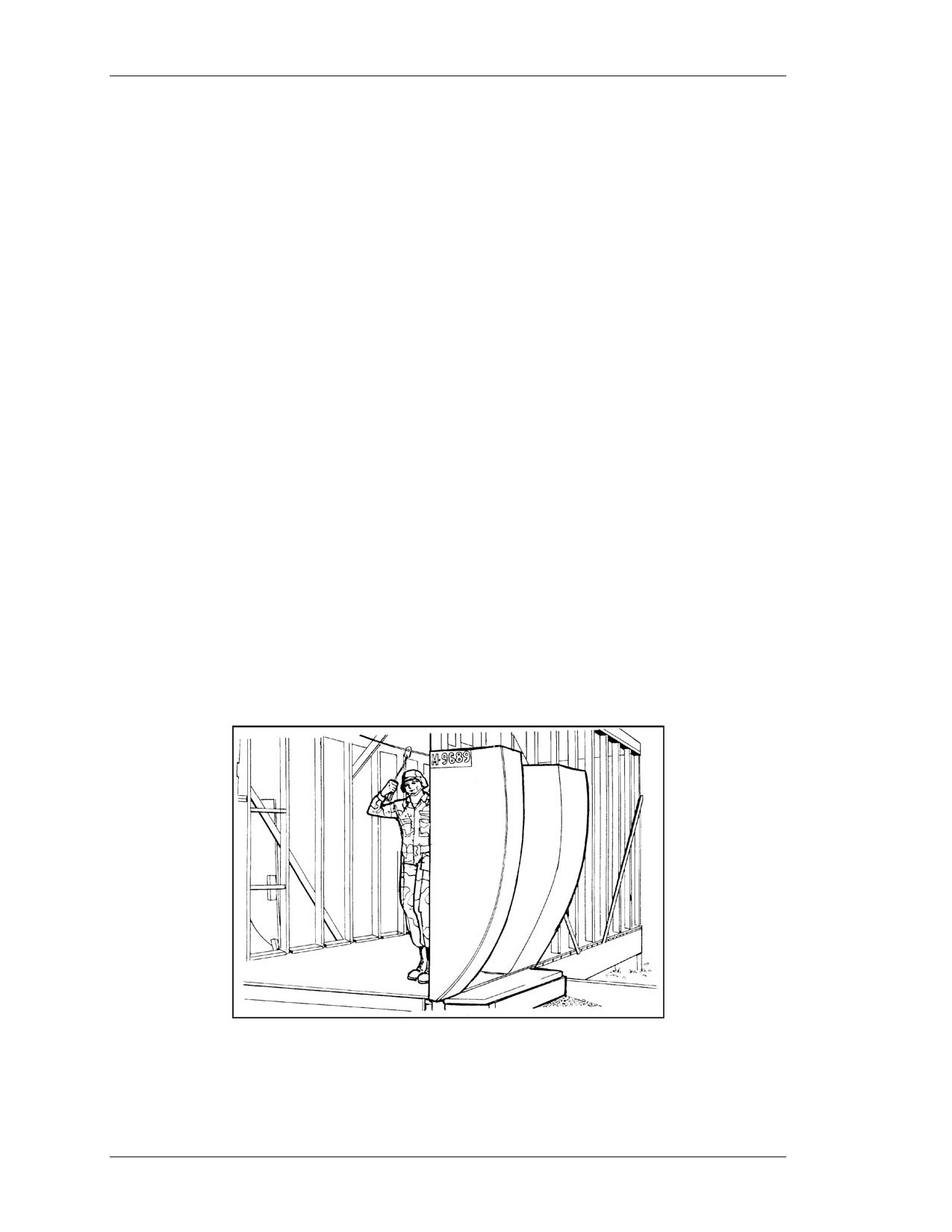
Section II. MOCK DOOR
The mock door is a replica of the cargo/troop compartment of a troop carrier aircraft.
This apparatus includes openings about the size of the aircraft door and anchor line cables
for each door (Figure 4-5). For training purposes, the instruction is divided into a basic
phase and an advanced phase. The basic phase teaches basic jump techniques and
familiarizes students with equipment, aircraft terms, and safety procedures. The advanced
phase provides instruction in the sequence of jump commands and the mass exit
technique.
Figure 4-5. Mock door apparatus.
4-8
FM 3-21.220/MCWP 3-15.7/AFMAN11-420/NAVSEA SS400-AF-MMO-010
4-6.
BASIC PHASE
Students are taught the terms and nomenclature of military parachuting and the use of
aircraft equipment. Teaching objectives include the shuffle position, static line control,
the STAND BY position, the exit and body positions, and the 4000-count.
a. Personnel and Equipment Requirements. One instructor is required for each
mock door in use. One section of static line (about 4 feet long and not attached to the
parachute assembly) is required for each student. Loudspeakers will be needed if the class
or facilities are large.
b. Training. The initial instruction in the mock door apparatus includes a lecture
and demonstration followed by practical exercises.
(1) Each student is given the commands STAND BY and GO. The student is
critiqued and corrected by the instructor on the movement to the door, his exit, his body
position, and the 4000-count.
(2) Repetition is the key to this training; however, its value is decreased if allowed to
become boring. Correct and automatic reactions by each student is the goal.
(3) The “Hit It” exercise is given as a test of mental alertness and for practical work
in assuming the proper body position. On the command HIT IT, the student—
• Snaps into the proper body position and at the same time commences the
4000-count.
• Remains in the body position until commanded to RECOVER, or until he is
told to CHECK CANOPY and GAIN CANOPY CONTROL. The student
simulates checking the canopy. Then he is told to RECOVER or that there is a
MALFUNCTION. In the latter case, the student returns to a modified body
position and simulates activation of the reserve. The command RECOVER is
given.
• Receives instruction on the right and left jump doors of the mockup.
c. Terms. The following terms are important in mock door training and are
explained during the initial phase of instruction.
(1) Left and Right Door. When the parachutist is facing the pilot’s compartment, the
door on his right is the right door; the door to his left is the left door.
(2) Anchor Line Cable. A cable is normally extended along the long axis of the
cargo/troop compartment and secured at both ends. The cable is designed to
accommodate the static line snap hook and to initiate parachute deployment.
(3) Stick of Parachutists. This is a group of parachutists exiting from the same door
(or from one side of a ramp) during one pass over the DZ.
(4) Drop Zone. This is a designated area where personnel or equipment are delivered
by means of parachute or free drop. The GUC designates the DZ location.
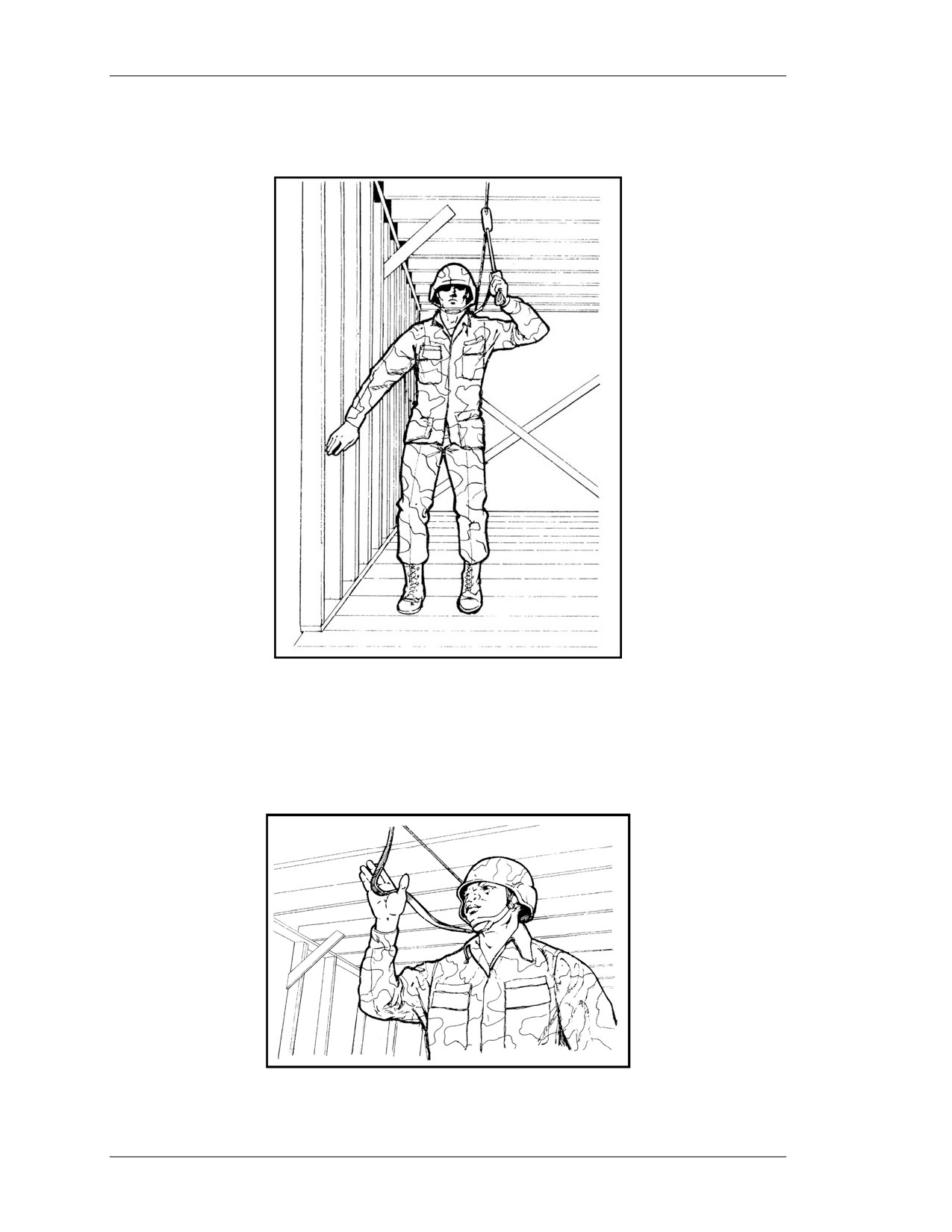
(5) Shuffle Position. This is a method of moving toward the jump door, used to avoid
losing balance or tripping (Figure 4-6, page 4-10).
(a) The guide hand is extended down and out to maintain balance; the other hand
grasps the static line. When jumping the left door, the parachutist has the static line over
the left shoulder; when jumping the right door, he has the static line over the right
shoulder.
(b) Facing the rear of the aircraft, the parachutist keeps both feet directly beneath the
body and staggered with the outboard foot forward; this is the shuffle foot. The inboard
foot is the trail foot.
4-9
FM 3-21.220/MCWP 3-15.7/AFMAN11-420/NAVSEA SS400-AF-MMO-010
(c) The parachutist moves by stepping forward 6 to 8 inches with his shuffle foot and
then his trail foot. Both feet are staggered in the same heel-and-toe position.
Figure 4-6. Shuffle position.
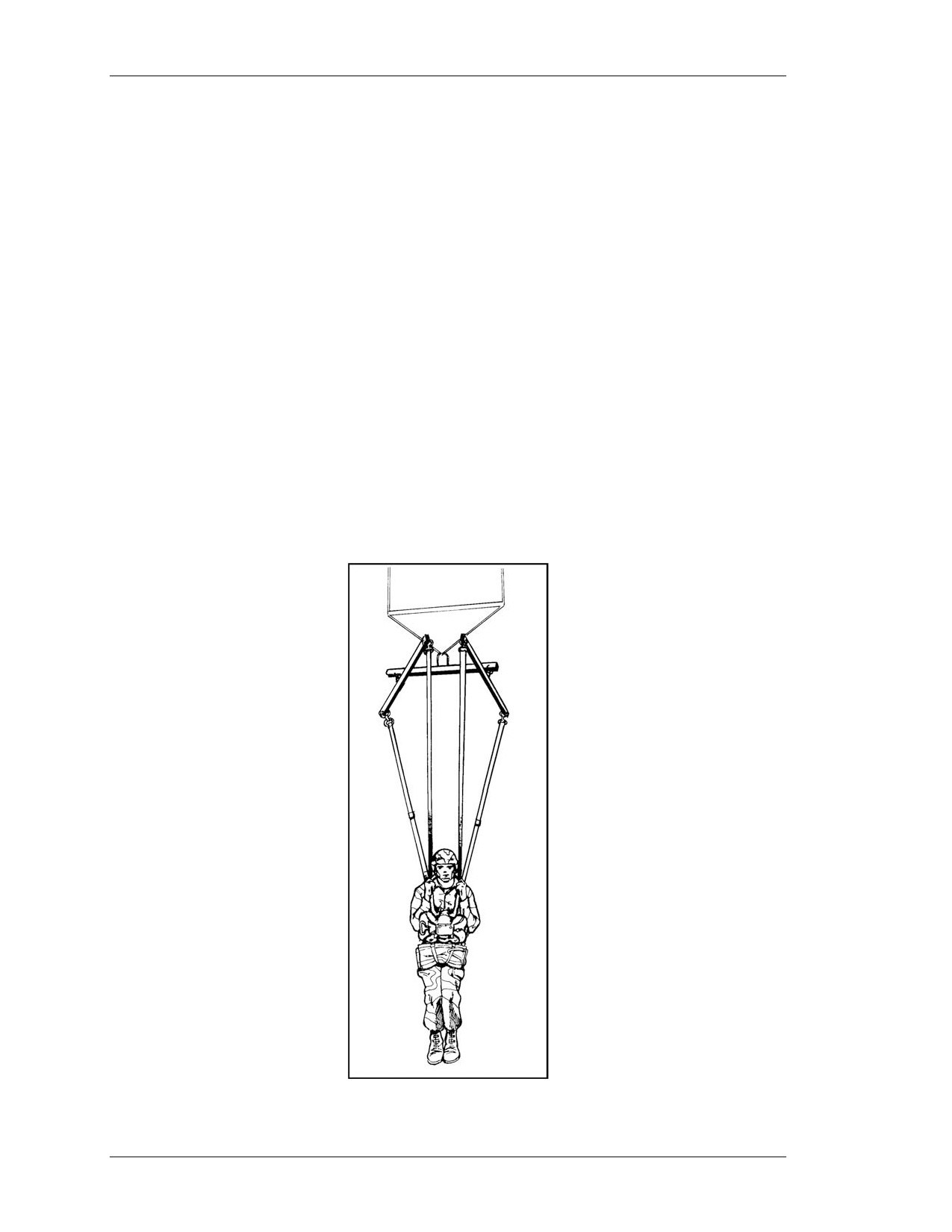
(6) Bight. The parachutist forms a bight of about 6 inches in the static line by making
one fold and grasping the loop at eye level about 6 inches to the front (Figure 4-7). The
remainder of the static line is routed over the shoulder. The free hand is used to steady the
parachutist while moving toward the door.
Figure 4-7. Static line bight.
4-10
FM 3-21.220/MCWP 3-15.7/AFMAN11-420/NAVSEA SS400-AF-MMO-010
(7) Jump Commands. The last two jump commands, STAND BY and GO, are used
for each student when practicing exits.
(a) On the command STAND BY, the parachutists shuffle toward the jump door.
• When the first jumper is perpendicular to the jump door, he takes one more
shuffle step and halts his movement about 2 feet from the center of the jump
platform. He keeps his feet spread and legs slightly flexed so that his weight is
equally distributed over both feet to maintain balance.
• He makes eye-to-eye contact with the safety and hands the static line to the
safety.
• He executes a left or right turn to face the open jump door, ensures his arm is
not entangled with the static line, holds his elbows firmly into his sides, and
places the palms of his hands (fingers spread) on the ends of the reserve
parachute with his right hand protecting the rip cord grip.
• At the command STAND BY, the number 2 jumper will be positioned about
even with the leading edge of the jump door, 2 feet from the skin of the
aircraft and facing to the rear, in the shuffle position with his feet spread and
legs slightly flexed so that the weight is equally distributed over both feet to
maintain balance.
• Follow-on jumpers close up behind the preceding jumper and keep the shuffle
position with the feet spread and legs slightly flexed so that their weight is
equally distributed over both feet to maintain balance.
(b) At the command GO, the number 1 jumper walks toward the door and onto the
jump platform, focusing on the horizon. He pushes off with either foot and vigorously
jumps up and out away from the jump platform, immediately snapping into a good tight
body position.
(c) The number 2 jumper (and all following jumpers) performs the following:
• He shuffles toward the jump door, ensuring he is about 2 feet from the skin of
the aircraft.
• As he begins to shuffle, he assumes an elbow-locked position with the arm
that is controlling his static line. He places his static line control hand so that it
is nearly touching the back of the pack tray of the jumper in front of him,
which establishes the proper interval between jumpers. He does not place his
static line control hand in a position so that it extends past the pack tray of the
jumper in front of him.
• When about perpendicular to the jump door, he takes one more shuffle step,
makes eye-to-eye contact with the safety, and hands the static line to the
safety.
• He ensures his arm is not entangled with the static line, and he holds his
elbows firmly into his sides.
• He places the palms of his hands (fingers spread) on the ends of the reserve
parachute, with his right hand protecting the rip cord grip.
• He executes a left or right turn to face the open jump door.
• He walks toward the door and onto the jump platform, focusing on the
horizon. He pushes off with either foot and vigorously jumps up and out
away from the jump platform, immediately snapping into a good tight body
position.
4-11
FM 3-21.220/MCWP 3-15.7/AFMAN11-420/NAVSEA SS400-AF-MMO-010
(8) Body Position. The student remains in the body position, is critiqued by the
instructor, and is told to RECOVER and wait for further instruction.
4-7.
ADVANCED PHASE
The training provided during the advanced phase is presented in the same manner as in
the basic phase except that the entire sequence of time warnings and jump commands is
given, and mass exits are substituted for individual exits.
a. Personnel. Extra instructors may be needed to ensure that all students in the mock
door apparatus react properly to each of the jump commands.
b. Execution. When the mass exit technique is taught, each stick receives the
commands STAND BY and GO. Each succeeding student shuffles to the door and exits
the aircraft. A one-second interval must be maintained between students.
Section III. SUSPENDED HARNESS
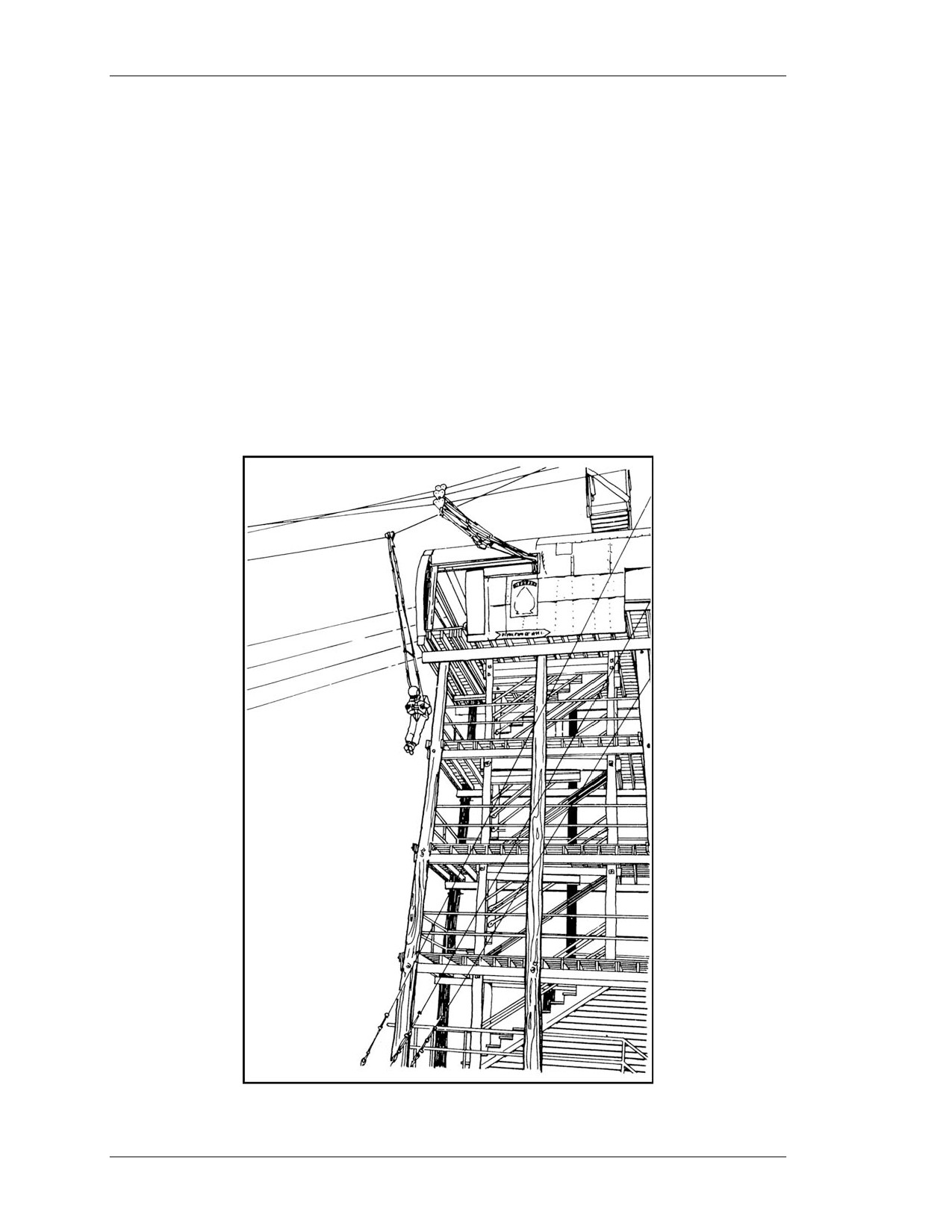
The suspended parachute harness apparatus is a modified troop parachute harness
suspended from a spreader bar assembly by four web risers (Figure 4-8). The spreader
bars react to riser (T-10-series) or toggle (MC1-series) manipulation much the same as
the canopy. The suspended harness simulates the third and fourth points of performance:
canopy control and prepare to land.
Figure 4-8. Suspended harness.
4-12
FM 3-21.220/MCWP 3-15.7/AFMAN11-420/NAVSEA SS400-AF-MMO-010
4-8.
OBJECTIVES
The suspended harness apparatus is designed to teach the student to execute the following
maneuvers:
• T-10-series slips (two-riser and one-riser).
• MC1-series turning, holding, running, and crabbing.
• T-10-/MC1-series landing attitude.
• T-10-/MC1-series emergency landings (tree, water, and wire).
• React to twists, collisions, and entanglements.
4-9.
PERSONNEL AND EQUIPMENT REQUIREMENTS
The following personnel and equipment are needed to conduct training on the
suspended harness.
a. One instructor is needed to give commands, and at least one assistant instructor is
needed for each platform to control and supervise student performance. One troop
harness is required for every two students. A modified MC1-series riser assembly is used,
which facilitates training on a simulated T-10-series or MC1-series parachute.
b. A platoon is divided into teams of two students each. Number 1 is the parachutist,
and number 2 is the coach.
(1) The parachutist obtains a troop parachute harness and moves to a specific point at
the suspended harness apparatus.
(2) The coach mounts the platform and adjusts the risers so that the male fitting of the
canopy release assembly is level with the parachutist’s shoulders below. The coach
dismounts the platform and helps the parachutist don the harness and attach it to the
risers. The coach remounts the platform and takes up all the slack in the
parachutist’s risers.
(3) All parachutists face the instructor and await commands.
4-10. SEQUENCE OF COMMANDS
The instructor uses the following sequence of commands. (The let-up position is the
starting position for all training on the suspended harness.)
a. LET UP. On this command, each parachutist:
• Has his head erect and his eyes on the horizon.
• Grasps all four risers (T-10-series) with his hands and locks his elbows.
• Grasps the steering toggles (MC1-series) with his hands (palms outward, eye
level, elbows back) and applies moderate tension (enough to take out any
slack in the control lines).
• Has his back straight.
• Has his feet and knees together. (The parachutist is standing flat-footed on the
ground.)
b. AT EASE IN THE HARNESS. On this command, each parachutist comes to a
modified position of parade rest in the harness. From the let-up position, the instructor
directs the parachutist to practice appropriate parachute maneuvers.
c. CHANGE OVER. Number 2 switches places with number 1 and becomes the
parachutist; number 1 becomes the coach. Instructors may give additional commands and
4-13
FM 3-21.220/MCWP 3-15.7/AFMAN11-420/NAVSEA SS400-AF-MMO-010
instruction to ensure proper fitting, wearing, or removal of equipment and proper student
performance on the apparatus.
Section IV. THE 34-FOOT TOWER
The 34-foot tower supports a replica of a section of a troop carrier aircraft (Figure 4-9). A
jump door is on each side of the replica. Four steel cables are suspended parallel to the
ground and slightly above each door. A trolley, which supports tow trolley risers, is
attached to each cable. Each trolley riser has a ring attached to its free end. This ring is
connected to a modified harness worn by students during training on the tower. The
tower is a primary training apparatus to help teach basic jump techniques and points of
performance. For ease in training, the instruction is divided into two phases: The basic
training phase continues instruction presented on the mock door apparatus. The
advanced training phase continues instruction on the mass exit technique, simulates
parachute malfunctions, and familiarizes the students with jumping combat equipment.
Figure 4-9. The 34-foot tower.
4-14
FM 3-21.220/MCWP 3-15.7/AFMAN11-420/NAVSEA SS400-AF-MMO-010
4-11. BASIC TRAINING OBJECTIVES
Students practice the exit technique, the proper body position, and the 4000-count. The
tower also gives each student experience to overcome his fear of height, and it simulates
the opening shock.
a. Training. The initial period of instruction on the tower apparatus includes an
orientation and demonstration of the apparatus, duties of instructor personnel (graders,
JMs, harness checker), and duties of all detail personnel. Each student is given the
commands STAND BY and GO by the JM in the tower. The student’s exit, body
position, 4000-count, and simulated canopy checks are critiqued and graded by the grader
on the ground.
b. Safety. To prevent safety problems, all personnel must be safety conscious. The
following measures are taken to prevent unsafe conditions:
(1) Tower JMs must wear safety belts.
(2) Students must have equipment adjusted properly, and instructors must check them
to ensure a snug fit, the absence of frays or tears, the serviceability of snaps, and a
properly fitted helmet.
(3) Qualified maintenance personnel must perform and record thorough inspections
of the tower weekly. Inspections must include trolley risers, cables, trolleys, and JM
safety belts.
(4) Students must lift their legs as they approach the mound at the end of the cable
run to prevent injury.
4-12. PERSONNEL AND EQUIPMENT REQUIREMENTS
The following personnel manage, operate, and carry out 34-foot tower training.
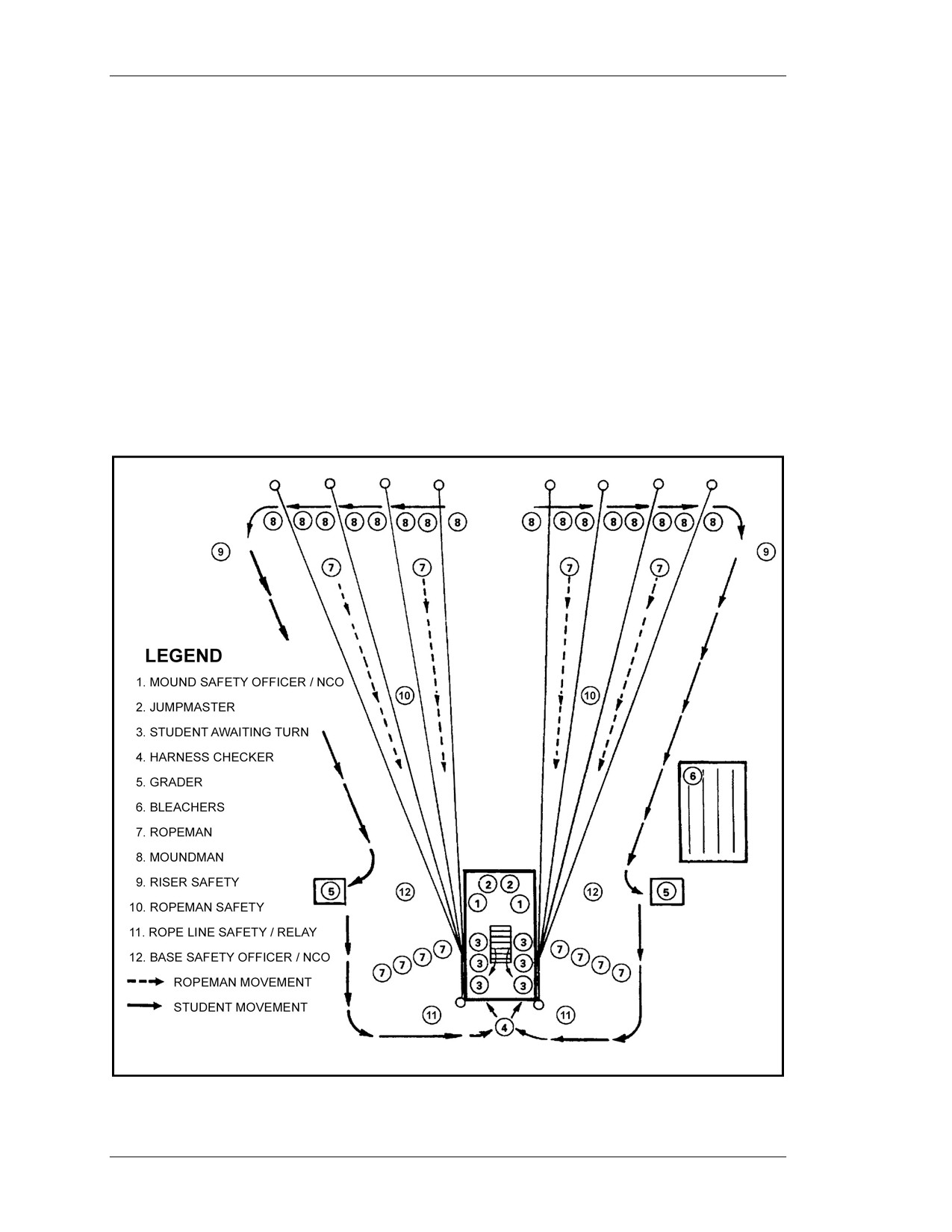
a. Instructors. A minimum of seven instructors are required to operate this
apparatus. Their positions are indicated in Figure 4-10 (page 4-16).
(1) Two JMs hook up students in the tower and issue the last two jump commands.
(2) One harness checker inspects all harnesses before students exit the tower.
(3) Two graders on the ground critique and grade the students’ performance on
the apparatus.
(4) Two mock door instructors correct students on problem areas and give them
additional practice.
b. Detail Personnel. A minimum of 38 detail personnel are required.
(1) Mound Safety Officers/NCOs. A student stands at parade rest on top of the
mound between and slightly to the rear of the moundmen assigned to his side of the
tower. He is responsible for the safety and conduct of the moundmen. He should be the
most senior officer or NCO on the mound on each side (2 total).
(2) Moundmen. Two students are assigned to each cable on the tower (16 total).
They stand at parade rest on top of the mound, facing the tower. After the parachutists
reach the mound and come into contact with the stop cable, the moundmen unhook the
parachutist and then hook the rope to the trolley risers.
(3) Ropemen. One student at each point along the beaded path returns the trolley
risers (with rope attached) to the tower after the parachutist is detached. The ropemen
take commands from the ropeman safety and rope line safety/relay. The ropemen for each
4-15
FM 3-21.220/MCWP 3-15.7/AFMAN11-420/NAVSEA SS400-AF-MMO-010
two points rotate, and there are always two additional ropemen standing at the base of the
pole supporting the tower (12 total).
(4) Riser Safeties. One student stands at parade rest off each side of the mound and
outside of the path leading to the grader’s booth (2 total). He is responsible for attaching
the butterfly snaps on the risers to the D-rings of the harness.
(5) Ropeman Safeties. One ropeman safety is located between points 2 and 3 and the
other between points 6 and 7 on the beaded path (2 total). They are responsible for
controlling the flow of the ropemen from the mound to the tower.
(6) Rope Line Safeties/Relays. One student (officer or NCO) for each side of the
tower (2 total) stands at parade rest near the base of the pole supporting the cables facing
the rope line. He relays the commands of the jumpmaster to the ropemen and ensures
students do not pass under the safety ropes and anchor cables.
(7) Base Safety Officers/NCOs. One student (officer or NCO) for each side of the
tower (2 total) stands inside the base of the tower next to the stairs. He places the risers
over the proper shoulder for the door (right or left) each parachutist will jump.
Figure 4-10. Tower personnel positions.
4-16
FM 3-21.220/MCWP 3-15.7/AFMAN11-420/NAVSEA SS400-AF-MMO-010
c. Equipment. The equipment includes one troop parachute harness assembly (with
four risers) and a training reserve parachute for each student.
4-13. ADVANCED TRAINING OBJECTIVES
These objectives have the student practice exits using the mass exit technique with and
without combat equipment. If exiting with combat equipment, he must also practice
lowering the equipment. The student must practice simulating activation of the reserve
parachute. He must do this instantly when told a malfunction has occurred.
a. Training. The initial period of instruction during this phase includes a lecture and
demonstration on the mass exit technique.
b. Common Student Errors. The following errors are often made by students.
• Failing to maintain a 1-second interval between jumpers.
• Using improper body position (caused by rushing).
• Improper exit.
• Falling out of the door.
• Failing to count.
c. Safety. Safety considerations for the advanced phase are the same as in the
basic phase.
d. Personnel. Personnel requirements are reduced slightly from the basic phase to a
minimum of 29: 16 moundmen, 8 ropemen, 2 mound safety officers, 2 rope line safety
officers, and a harness checker.
e. Equipment. Combat equipment is required for the students. (Actual packed
combat equipment containers, or combat equipment containers which approximate
packed loads, can be used to train students in the techniques of exiting with this type
of load.)
Section V. METHODS OF RECOVERY
During methods of recovery training, the jumper learns the steps he must take to
consolidate with his unit as a member of the fighting force. Once the jumper lands on the
drop zone, he must quickly recover, correctly stow his air items, and quickly proceed to
the unit assembly area.
4-14. TRAINING OBJECTIVES
This phase of training teaches the student to properly activate the canopy release
assemblies on the parachute harnesses. He learns to perform the buddy-assist method of
recovery and to react properly when using the various recovery training apparatuses. He
is also taught how to recover the parachute and individual equipment from the DZ and to
rapidly clear the DZ.
4-15. PERSONNEL AND EQUIPMENT REQUIREMENTS
Personnel required are one instructor, one assistant for every two dismount points, and
four detail personnel for each dismount point. Sufficient harnesses and combat gear
properly rigged to accommodate each student are also needed.
4-17
FM 3-21.220/MCWP 3-15.7/AFMAN11-420/NAVSEA SS400-AF-MMO-010
4-16. TRAINING APPARATUS
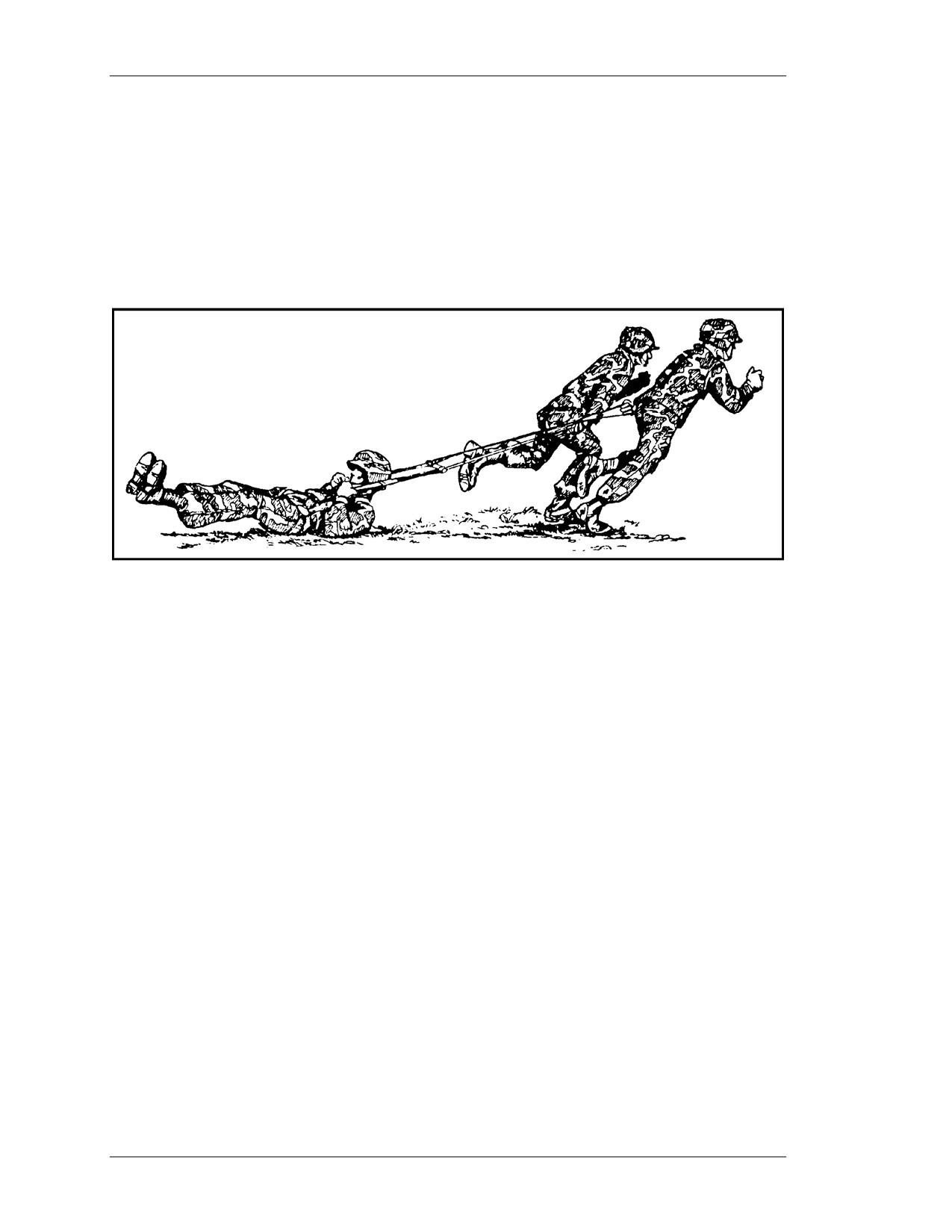
The hand-towed drag pad training apparatus is used in teaching students how to activate
the canopy release assemblies. The hand-towed drag pad is made of two pieces of
webbing attached to a metal bar with a loop on each end. Attached to the bar are two
risers with the male fitting of the canopy release assemblies attached to the opposite ends
(Figure 4-11). Students train in three-man teams as follows:
• Number 1 is the parachutist and wears the drag pad.
• Number 2 and number 3 pull the drag pad.
Figure 4-11. Hand-towed drag pad.
• Number 1 puts on the harness and passes the risers to numbers
2 and 3.
Numbers 2 and 3 then attach the risers to the canopy release assemblies, and
number 1 lies on his back.
• On the command PREPARE TO DRAG, number 1 places his chin on his chest,
raises his feet 6 inches off the ground, and places his hands on the canopy release
assemblies.
• On the command DRAG, numbers 2 and 3 drag number 1 across the ground.
• On the command RELEASE, number 1 reaches down and activates the canopy
release assemblies using the prescribed method.
• The three students immediately return to the starting line.
• Numbers 2 and 3 hook up the parachutist to the drag pad again.
• At the command CHANGE OVER, number
2 becomes the parachutist
(number 1), number 3 becomes number 2, and number 1 becomes number 3.
Students rotate numbered positions until each student becomes proficient in
the procedures.
4-17. CANOPY RELEASE ASSEMBLIES
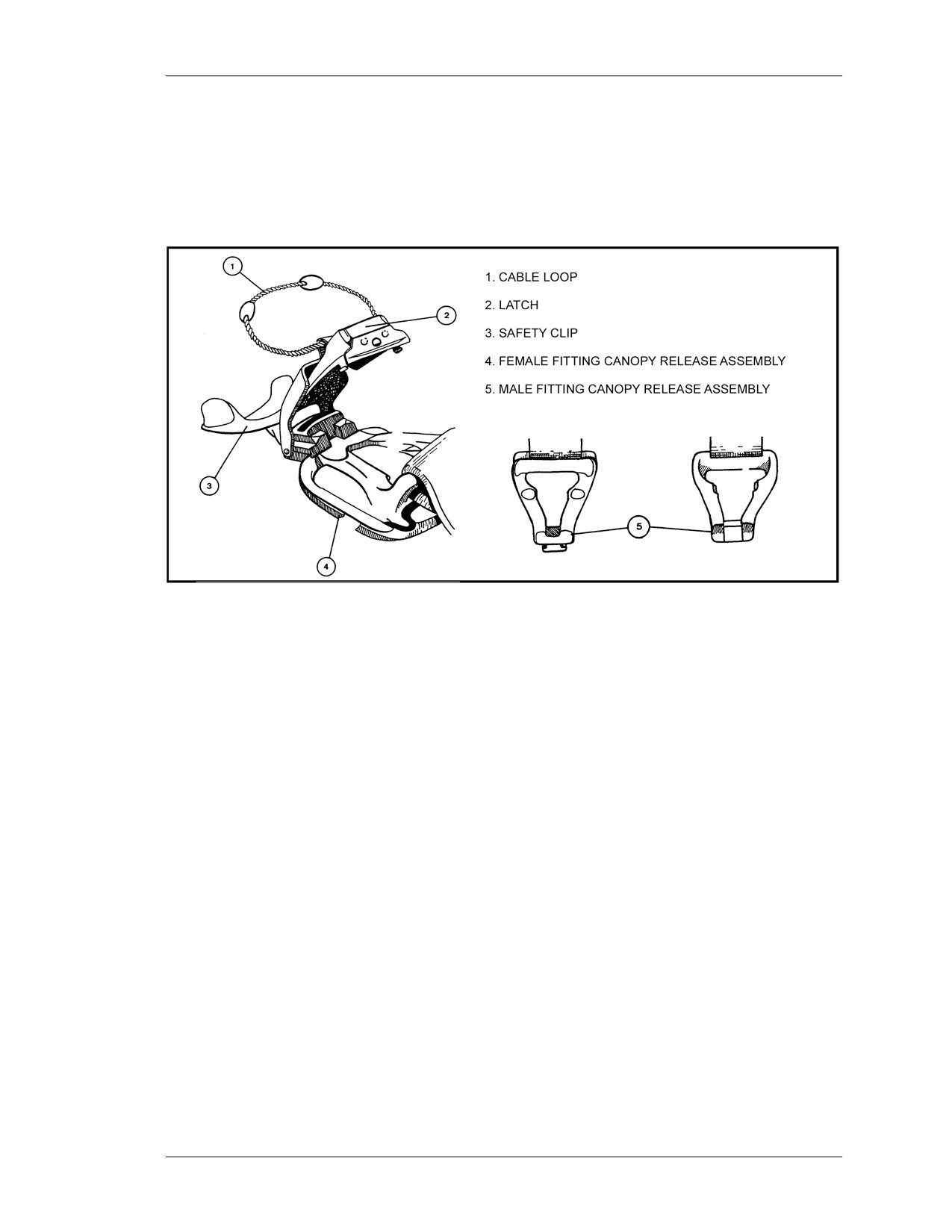
Before the canopy release assemblies can be activated, the safety clip must be pulled
down to expose the cable loop. There are two ways to activate the canopy release
assembly. One is the hand-to-shoulder method and the other is the hand-assist method.
4-18
FM 3-21.220/MCWP 3-15.7/AFMAN11-420/NAVSEA SS400-AF-MMO-010
4-18. CANOPY RELEASE ASSEMBLY ACTIVATION
The instructor tells the student to pull the safety clip out and away from the body. The
cable loop release does not require a great deal of strength to activate, and, if the
parachutist is injured, the cable loop release can be easily activated by the thumb or
fingers of either hand (Figure 4-12).
Figure 4-12. Cable loop release.
4-19. JUMP REFRESHER TRAINING
Before making a parachute jump, students make several refresher jumps from platforms.
They are required to make a satisfactory PLF in each of the principal directions before
they leave the platform area.
(A detailed description of refresher training is in
Appendix A.)
4-19