FM 3-21.220 STATIC LINE PARACHUTING TECHNIQUES AND TRAINING (SEPTEMBER 2003) - page 1
FM 3-21.220(FM 57-220)/
MCWP 3-15.7/AFMAN11-420/
NAVSEA SS400-AF-MMO-010
STATIC LINE PARACHUTING
TECHNIQUES AND TRAINING
SEPTEMBER 2003
HEADQUARTERS
DEPARTMENT OF THE ARMY
DISTRIBUTION RESTRICTION: Approved for public release; distribution is
unlimited.
*FM 3-21.220(FM 57-220)/
MCWP 3-15.7/AFMAN11-420/
NAVSEA SS400-AF-MMO-010
FIELD MANUAL
HEADQUARTERS
No. 3-21.220(57-220)/
DEPARTMENT OF THE ARMY
MCWP 3-1.5.7/AFMAN11-420/
Washington, DC, 23 September 2003
NAVSEA SS400-AF-MMO-010
STATIC LINE PARACHUTING TECHNIQUES
AND TACTICS
CONTENTS
Page
PREFACE
xv
Part One. BASIC AIRBORNE TECHNIQUES AND TRAINING
CHAPTER 1.
AIRBORNE TRAINING
1-1.
Standards
1-1
1-2.
Phases
1-1
1-3.
Prejump Orientations
1-4
CHAPTER 2.
PERSONAL EQUIPMENT
Section
I.
Parachutes
2-1
2-1.
Harness Assembly
2-1
2-2.
Riser Assembly
2-2
2-3.
Deployment Bag and Permanently Sewn 15-Foot
Static Line Assembly
2-3
2-4.
Deployment Bag with Universal Static Line Assembly
2-4
2-5.
Pack Tray
2-6
2-6.
Canopy Assembly
2-7
2-7.
Modified Improved Reserve Parachute System
2-9
2-8.
T-10 Troop Chest Reserve Parachute
2-12
2-9.
BA-18 Back Automatic Parachute
2-13
2-10.
Care of the Parachute Before Jumping
2-15
2-11.
Care of the Parachute After Jumping
2-15
2-12.
Shakeout Procedures
2-16
Section
II.
Donning the Parachutes
2-17
2-13. Troop Parachute Harness
2-17
2-14. MIRPS/T-10 Reserve Parachute
2-19
Section
III.
Protective Headgear
2-19
2-15. Ballistic Helmet Description
2-19
2-16. Advanced Combat Helmet Description
2-21
DISTRIBUTION RESTRICTION: Approved for public release; distribution is unlimited.
_____________________
*This publication supersedes FM 57-220/MCWP 3-1.5.7/TO 14D1-2-1-121, 19 August 1996.
i
FM 3-21.220/MCWP 3-15.7/AFMAN11-420/NAVSEA SS400-AF-MMO-010
Page
Section
IV. Parachutist Ankle Brace
2-28
2-17. Obtaining the Parachutist Ankle Brace
2-28
2-18. Inspecting the Parachutist Ankle Brace
2-29
2-19. Donning the Parachutist Ankle Brace
2-29
2-20. Doffing the Parachutist Ankle Brace
2-30
CHAPTER 3. FIVE POINTS OF PERFORMANCE
3-1.
First Point of Performance:
Proper Exit, Check Body Position and Count
3-1
3-2.
Second Point of Performance:
Check Canopy and Gain Canopy Control
3-1
3-3.
Third Point of Performance:
Keep a Sharp Lookout During the Entire Descent
3-2
3-4.
Fourth Point of Performance: Prepare to Land
3-5
3-5.
Fifth Point of Performance: Land
3-10
CHAPTER 4. TRAINING APPARATUSES
Section
I.
Parachute Landing Fall Devices
4-1
4-1.
Instructor Critiques
4-1
4-2.
Two-Foot High Platform
4-3
4-3.
Lateral Drift Apparatus
4-4
4-4.
Swing Landing Trainer
4-4
4-5.
Safety Considerations
4-8
Section
II.
Mock Door
4-8
4-6.
Basic Phase
4-9
4-7.
Advanced Phase
4-12
Section
III.
Suspended Harness
4-12
4-8.
Objectives
4-13
4-9.
Personnel and Equipment Requirements
4-13
4-10.
Sequence of Commands
4-13
Section
IV.
The 34-Foot Tower
4-14
4-11. Basic Training Objectives
4-15
4-12. Personnel and Equipment Requirements
4-15
4-13. Advanced Training Objectives
4-17
Section
V.
Methods of Recovery
4-17
4-14. Training Objectives
4-17
4-15. Personnel and Equipment Requirements
4-17
4-16. Training Apparatus
4-18
4-17. Canopy Release Assemblies
4-18
4-18. Canopy Release Assembly Activation
4-19
4-19. Jump Refresher Training
4-19
CHAPTER 5.
JUMP COMMAND SEQUENCE AND JUMPER ACTIONS
5-1.
Presentation
5-1
5-2.
Get Ready
5-1
5-3.
Outboard Personnel, Stand Up
5-2
ii
FM 3-21.220/MCWP 3-15.7/AFMAN11-420/NAVSEA SS400-AF-MMO-010
Page
5-4.
Inboard Personnel, Stand Up
5-3
5-5.
Hook Up
5-4
5-6.
Check Static Lines
5-5
5-7.
Check Equipment
5-6
5-8.
Sound Off for Equipment Check
5-6
5-9.
Stand By
5-7
5-10.
Go
5-9
CHAPTER 6. MAIN PARACHUTE MALFUNCTIONS AND EMPLOYMENT
OF THE RESERVE PARACHUTE
6-1.
Pull-Drop Method (for MIRPS and T-10 Reserve)
6-1
6-2.
Down-and-Away Method (for T-10 Reserve Only)
6-1
6-3.
Total Malfunction
6-2
6-4.
Partial Malfunction
6-3
Part Two. DUTIES AND FUNCTIONS OF KEY PERSONNEL,
ADVANCED AIRBORNE TECHNIQUES AND TRAINING
CHAPTER 7.
RESPONSIBILITIES AND QUALIFICATIONS OF
KEY PERSONNEL
7-1.
Commander's Responsibilities
7-1
7-2.
Key Personnel Prerequisites
7-1
CHAPTER 8.
JUMPMASTER DUTIES AT THE UNIT AREA
Section
I.
Essential Information
8-1
8-1.
Designation Notification
8-1
8-2.
Assistant's Briefing
8-2
8-3.
Jumpmaster/Safety Kit Bag
8-2
8-4.
Operation Briefing
8-3
Section
II.
Sustained Airborne Training
8-4
8-5.
Minimum Training
8-4
8-6.
Prejump Training
8-4
8-7.
Five Points of Performance
8-4
8-8.
Five Points of Contact
8-6
8-9.
Total Malfunctions (No Lift Capability)
8-6
8-10.
Partial Malfunctions
8-6
8-11.
Collisions
8-7
8-12.
Entanglements
8-7
8-13.
Emergency Landings
8-8
8-14.
Reserve Activation Inside Aircraft
8-9
8-15.
Towed Parachutist Procedures
8-10
8-16.
Sample Prejump Training Narrative
8-10
iii
FM 3-21.220/MCWP 3-15.7/AFMAN11-420/NAVSEA SS400-AF-MMO-010
Page
CHAPTER 9.
JUMPMASTER AND SAFETY DUTIES AT THE
DEPARTURE AIRFIELD
Section
I.
Key Personnel
9-1
9-1.
Primary Jumpmaster/Assistant Jumpmaster Duties
9-1
9-2.
Safety Personnel
9-2
Section
II.
Jumpmaster Personnel Inspection
9-3
9-3.
Hands-On Inspection
9-3
9-4.
Ballistic Helmet (Front)
9-3
9-5.
Advanced Combat Helmet (Front)
9-4
9-6.
Canopy Release Assemblies
9-4
9-7.
Chest Strap
9-5
9-8.
Waistband
9-5
9-9.
Reserve Parachute
9-6
9-10.
Leg Straps
9-8
9-11.
Static Line
9-8
9-12.
Ballistic Helmet (Back)
9-11
9-13.
Advanced Combat Helmet (Back)
9-11
9-14.
Riser Assemblies
9-12
9-15.
Main Pack Tray
9-12
9-16.
Diagonal Back Straps
9-12
9-17.
Horizontal Back Strap
9-12
9-18.
Saddle
9-13
9-19.
Weapons Case, M1950
9-13
9-20.
ALICE Pack with H-Harness and Hook-Pile Tape
Lowering Line
9-14
9-21.
JMPI Options with Combat Equipment
9-16
9-22.
MOLLE
9-16
9-23.
JMPI Sequence for AIRPAC
9-20
9-24.
Technical Inspection for Side-Mount AIRPAC
9-22
9-25.
M82, Medic Jump Pack
9-22
Section
III.
Movement on the Airfield
9-24
9-26. Airfield Movement Procedures
9-24
9-27 Loading Aircraft
9-24
9-28. In-Flight Emergency Procedures
9-25
CHAPTER 10. JUMPMASTER AND SAFETY DUTIES IN FLIGHT
Section
I. Primary Jumpmaster, Safety Personnel,
and Assistant Jumpmaster
10-1
10-1. Primary Jumpmaster
10-1
10-2. Safety Personnel
10-1
10-3. Primary Jumpmaster/Assistant Jumpmaster Duties
10-2
Section
II. Door Procedures and Door Bundle Ejection
10-2
10-4. The 20-Minute Time Warning
10-2
10-5. The 10-Minute Time Warning
10-3
10-6. First Seven Jump Commands
10-3
10-7. Door Safety Check
10-3
iv
FM 3-21.220/MCWP 3-15.7/AFMAN11-420/NAVSEA SS400-AF-MMO-010
Page
10-8. Initial Outside Air Safety Check and Checkpoints
10-4
10-9. The 1-Minute Time Warning
10-5
10-10. Final Outside Air Safety Check
10-5
10-11. Eighth Jump Command
10-7
10-12. Ninth Jump Command
10-7
10-13. Towed Parachutist (Fixed-Wing Aircraft)
10-8
CHAPTER 11. DEPARTURE AIRFIELD CONTROL OFFICER
11-1. Initial Coordination
11-1
11-2. Tanker/Airlift Control Element Coordination
11-1
11-3. Drop Zone Safety Officer/Drop Zone Support Team
Coordination
11-1
11-4. Additional Responsibilities of the Departure Airfield
Control Officer
11-2
11-5. Airfield and Runway Safety
11-2
Part Three. EQUIPMENT
CHAPTER 12. INDIVIDUAL COMBAT EQUIPMENT JUMP LOADS
Section
I.
Load Placement
12-1
12-1. Load Distribution
12-1
12-2. Considerations
12-1
Section
II.
Life Preservers
12-2
12-3. B-7 Life Preserver
12-3
12-4. B-5 Life Preserver
12-3
12-5. LPU-10/P Life Preserver
12-3
Section
III.
Harnesses and Lowering Line
12-4
12-6. H-Harness
12-4
12-7. Harness, Single-Point Release
12-5
12-8. Hook-Pile Tape Lowering Line
12-6
12-9. Hook-Pile Tape Lowering Line (Modified)
12-6
12-10. Lowering Line Adapter Web
12-7
Section
IV.
ALICE Packs and Load-Bearing Equipment
12-9
12-11. ALICE Packs (Medium and Large)
12-9
12-12. ALICE Pack Rigged with Frame, H-Harness,
and Hook-Pile Tape Lowering Line
12-9
12-13. Tandem Load and Lowering Line
12-11
12-14. Tandem Loads Released and Lowered (H-Harness)
12-11
12-15. ALICE Pack Rigged with Frame Using Harness, Single-
Point Release and Hook-Pile Tape Lowering Line
12-12
12-16. Attachment of Harness, Single-Point Release and
ALICE Pack to Parachutist
12-14
12-17. Tandem Load Attached to Parachutist
12-15
12-18. Tandem Loads Released and Lowered (Harness,
Single-Point Release)
12-16
12-19. Jumping of Exposed Load-Bearing Equipment
12-16
v
FM 3-21.220/MCWP 3-15.7/AFMAN11-420/NAVSEA SS400-AF-MMO-010
Page
12-20. Enhanced Tactical Load-Bearing Vest
12-18
Section
V.
Adjustable Individual Weapons Case (M1950)
12-18
12-21. M1950 Secured to Parachutist
12-18
12-22. M1950 Attached to Parachutist
12-18
Section
VI.
M16 Rifle/M203 Grenade Launcher, Exposed and Packed
12-19
12-23. M16 Rifle/M203 Grenade Launcher Exposed
12-19
12-24. M16 Rifle/M203 Grenade Launcher Packed in M1950
12-21
Section
VII.
M60 Machine Gun
12-21
12-25. M60 Packed Assembled
12-22
12-26. M60 Packed Disassembled
12-22
Section
VIII.
M249 Squad Automatic Weapon
12-22
12-27. SAW MOD M1950 Weapons Case
12-22
12-28. Attachment to Parachutist
12-22
Section
IX.
M224, 60-mm Mortar
12-24
12-29. Major Components
12-24
12-30. Load Distribution
12-24
12-31. Instructions for Rigging
12-25
Section
X.
Container, Weapon, Individual Equipment and M202A1
Rocket Pack
12-27
12-32. Preparation of Container for Packing
12-27
12-33. Harness Assembly Attached to Container
12-28
12-34. Container and Assembly Attached to Parachutist
12-29
12-35. Container Released
12-29
Section
XI.
Dragon Missile Jump Pack
12-30
12-36. Missile and Tracker
12-31
12-37. Dragon Missile Jump Pack Rigged
12-31
12-38. Dragon Missile Jump Pack Attached to Parachutist
12-38
12-39. Individual Jump Procedures
12-40
12-40. Dragon Tracker
12-41
12-41. Dragon Missile Jump Pack and ALICE Pack
Rigged as a Tandem Load
12-41
12-42. ALICE Pack (Large) Jumped with
Dragon Missile Jump Pack
12-42
12-43. ALICE Pack Rigged with Frame
12-43
12-44. Dragon Missile Jump Pack Rigged
12-43
12-45. ALICE Pack Attached to Parachutist
12-43
12-46. Dragon Missile Jump Pack Rigged for Tandem Load
12-43
12-47. Dragon Missile Jump Pack Attached to Parachutist
12-44
12-48. ALICE Pack and Dragon Missile Jump Pack Released
12-45
12-49. Removal of Lowering Line
12-46
Section
XII.
AT4 Jump Pack
12-46
12-50. Components
12-46
12-51. AT4 Jump Pack Rigged
12-47
12-52. AT4 and ALICE Pack Rigged
12-50
12-53. Equipment Attached to Parachutist (Stowed
Lowering Line)
12-51
vi
FM 3-21.220/MCWP 3-15.7/AFMAN11-420/NAVSEA SS400-AF-MMO-010
Page
12-54. ALICE Pack with Frame and AT4JP Rigged
12-53
12-55. Equipment Attached to Parachutist (Modified Stowed
Lowering Line)
12-53
12-56. ALICE Pack and AT4JP Released
12-55
Section
XIII.
All-Purpose Weapons and Equipment Container
System (AIRPAC)
12-55
12-57. Components
12-55
12-58. Rigging Loads in the Front-Mount Container
12-56
12-59. Rigging Loads in the Side-Mount Container
12-57
12-60. Rigging AIRPAC as Tandem Load with Hook-Pile Tape
Lowering Line
12-58
12-61. AIRPAC Attached to Parachutist Using PIE/R2
Release Mechanism
12-58
Section
XIV.
Stinger Missile Jump Pack
12-59
12-62. Components
12-59
12-63. Rigging Procedures
12-59
12-64. Stinger Missile Jump Pack Attached to Parachutist
12-61
12-65. Individual Jump Procedures
12-62
Section
XV.
Ranger Antiarmor/Antipersonnel Weapon System Packed in
AT4JP and Dragon Missile Jump Pack
12-62
12-66. Components and Container Description
12-62
12-67. Rigging Procedures
12-63
12-68. Equipment Attached to Parachutist
12-65
12-69. Modification Procedures for the Dragon
Missile Jump Pack
12-65
Section
XVI.
Field Pack, Large, Internal Frame (FPLIF)
12-70
12-70. Rigging the Field Pack, Large, Internal Frame without
Patrol Pack
12-70
12-71. Rigging the Field Pack, Large, Internal Frame with
Patrol Pack
12-71
12-72. Rigging the M82, Medic Jump Pack with Frame
12-73
CHAPTER 13. ARCTIC RIGGING
Section
I. Arctic Equipment Space Considerations
13-1
13-1. Weight Factors
13-1
13-2. Modifications
13-1
Section
II. Snowshoes and Individual Weapon
13-2
13-3. Snowshoes without Weapon
13-2
13-4. Snowshoes with Weapon Exposed
13-3
13-5. Jumping Snowshoes with M1950 Weapons Case
13-4
Section
III. Tandem Load on Single Lowering Line
13-5
13-6. Rigged Load
13-5
13-7. Hook-Pile Tape Lowering Line
13-6
Section
IV. Skis Jumped with Rifle or ALICE Pack
13-10
13-8. Skis and Rifle
13-10
13-9. Skis and ALICE Pack or Weapons Case
13-11
vii
FM 3-21.220/MCWP 3-15.7/AFMAN11-420/NAVSEA SS400-AF-MMO-010
Page
CHAPTER 14. A-SERIES CONTAINERS
Section
I. Rigging Procedures
14-1
14-1. Assemblies
14-1
14-2. Webbing
14-1
14-3. Hazardous Materials
14-2
Section
II. A-7A Cargo Sling
14-2
14-4. Characteristics
14-2
14-5. Two-Strap Bundle
14-2
14-6. Three-Strap Bundle
14-2
14-7. Four-Strap Bundle
14-3
Section
III. A-21 Cargo Bag
14-3
14-8. Characteristics
14-3
14-9. Method of Rigging
14-4
Section
IV. Cargo Parachute Rigging on A-Series Containers
14-4
14-10. Inspection
14-4
14-11. Attachment
14-4
Part Four. AIRCRAFT USED IN AIRBORNE OPERATIONS
CHAPTER 15. AIRCRAFT AND JUMP ALTITUDES
15-1. Types of Aircraft
15-1
15-2. Jump Altitudes
15-1
15-3. High-Elevation Jumping
15-3
CHAPTER 16. HIGH-PERFORMANCE TRANSPORT AIRCRAFT
Section
I. C-130 Hercules
16-1
16-1. Seating Configuration
16-2
16-2. In-Flight Rigging Procedures
16-3
16-3. Over-the-Ramp Operations
16-4
16-4. Combat Concentrated Load Seating Configuration
16-8
16-5. C-130 Jumpmaster Checklist
16-10
Section
II. C-141B Starlifter
16-12
16-6. Seating Configuration without Comfort Pallet
16-13
16-7. In-Flight Rigging Seating Configuration with
Comfort Pallet
16-14
16-8. Combat Concentrated Load Seating Configuration
16-16
16-9. C-141B Jumpmaster Checklist
16-18
Section
III. C-5 A/B/C Galaxy
16-20
16-10. Seating Configuration without Comfort Pallet
16-20
16-11. In-Flight Rigging Seating Configuration with
Comfort Pallet
16-20
16-12. Joint Preflight Inspection
16-20
16-13. Personnel and Equipment Configuration
16-21
16-14. Movement to the Troop Compartment
16-22
16-15. Loadmaster Briefing
16-22
viii
FM 3-21.220/MCWP 3-15.7/AFMAN11-420/NAVSEA SS400-AF-MMO-010
Page
16-16. Movement to the Cargo Compartment for In-Flight
Rigging Procedures
16-22
16-17. Jump Commands
16-23
16-18. Jump Procedures
16-23
16-19. Time Warnings
16-24
16-20. Safety Precautions
16-24
16-21. C-5 A/B/C Jumpmaster Checklist
16-25
Section
IV. C-17A Globemaster III
16-27
16-22. Seating Configuration
16-27
16-23. Supervisory Personnel Required
16-27
16-24. Time Warnings
16-27
16-25. Jump Commands
16-28
16-26. Door Check Procedures
16-29
16-27. Door Bundle Procedures and Ejection
16-30
16-28. Safety Precautions
16-30
16-29. In-Flight Rigging Procedures
16-31
16-30. Jumpmaster Aircraft Inspection
16-32
16-31. Towed Jumper Procedures
16-33
CHAPTER 17. ROTARY-WING AIRCRAFT
Section
I.
Safety Considerations
17-1
17-1. Ground Training
17-1
17-2. Movement in Aircraft
17-1
17-3. Reserve Parachute
17-1
17-4. Space Limitations
17-1
17-5.
6-Second Count
17-1
17-6.
Static Lines and Deployment Bags
17-2
17-7.
Crowded Conditions
17-2
17-8.
Container Loads
17-2
17-9.
Hookup Procedures
17-2
17-10. Towed Parachutist Procedures
17-2
Section
II.
UH-1H Iroquois/UH-1N Huey
17-3
17-11. Preparation and Inspection
17-3
17-12. Loading Techniques and Seating Configuration
17-5
17-13. Jump Commands
17-6
17-14. Arctic Operations
17-7
17-15. Safety Precautions
17-7
Section
III.
UH-60A Black Hawk
17-7
17-16. Preparation and Inspection
17-8
17-17. Loading Techniques and Seating Configuration
17-12
17-18. Jump Procedures
17-15
17-19. Jump Commands
17-16
17-20. Safety Precautions
17-17
17-21. Safety Belt Modification
17-18
Section
IV.
CH-47 Chinook
17-19
17-22. Preparation and Inspection
17-19
ix
FM 3-21.220/MCWP 3-15.7/AFMAN11-420/NAVSEA SS400-AF-MMO-010
Page
17-23. Seating Configuration
17-20
17-24. Jump Procedures
17-20
17-25. Jump Commands
17-20
17-26. Safety Precautions
17-21
CHAPTER 18. OTHER SERVICE AIRCRAFT
Section
I. CH-53 Sea Stallion (USMC)
18-1
18-1. Preparation and Inspection
18-1
18-2. Loading Techniques and Seating Configuration
18-3
18-3. Jump Commands and Procedures
18-3
18-4. Safety Precautions
18-4
Section
II. CH-46 Sea Knight (USMC)
18-4
18-5. Preparation and Inspection
18-5
18-6. Loading Techniques and Seating Configuration
18-8
18-7. Jump Commands and Procedures
18-8
18-8. Safety Precautions
18-11
Section
III. CH/HH-3 Jolly Green Giant (USAF)
18-11
18-9. Preparation and Inspection
18-12
18-10. Loading Techniques and Seating Configuration
18-13
18-11. Jump Commands and Procedures
18-13
18-12. Safety Precautions
18-14
CHAPTER 19. NONSTANDARD AIRCRAFT USED DURING
AIRBORNE OPERATIONS
Section
I.
Modifications to Jump Commands and Jumpers' Movement
in Nonstandard Aircraft
19-1
19-1. Shuffle
19-1
19-2. Stand in the Door
19-1
19-3. Go
19-2
Section
II.
C-7A Caribou
19-2
19-4. Seating Configuration
19-2
19-5. Supervisory Personnel Required
19-3
19-6. Anchor Line Cable Assemblies
19-3
19-7. Jump Commands
19-3
19-8. Ramp Jumping
19-3
19-9. Door Jumping
19-4
19-10. Safety Precautions
19-5
Section
III.
C-23B/B+ Sherpa
19-6
19-11. Drop Procedures
19-6
19-12. Seating Configuration
19-6
19-13. Anchor Line Cable Assemblies
19-7
19-14. Static Line Retrieval Systems
19-7
19-15. Supervisory Personnel Required
19-7
19-16. Preparation and Inspection
19-7
19-17. Loading Parachutists
19-8
19-18. Jump Commands and Time Warnings
19-8
x
FM 3-21.220/MCWP 3-15.7/AFMAN11-420/NAVSEA SS400-AF-MMO-010
Page
19-19. Cargo Operations
19-10
19-20. Military Free-Fall Operations
19-11
Section
IV.
C-27A (Aeritalia G-222)
19-11
19-21. Seating Configuration
19-11
19-22. Supervisory Personnel Required
19-12
19-23. Jump Commands
19-12
19-24. Safety Precautions
19-13
19-25. Over-the-Ramp Operations
19-13
19-26. Joint Preflight Inspection
19-13
19-27. Loadmaster Briefing
19-14
19-28. Time Warnings
19-14
19-29. Additional Safety Precautions
19-14
19-30. C-27A Jumpmaster Checklist
19-15
Section
V.
C-46 Commando/C-47 Skytrain
19-17
19-31. Seating Configurations
19-17
19-32. Jump Procedures
19-17
19-33. Safety Precautions
19-18
19-34. Safety Personnel and Jumpmaster Responsibilities
19-19
Section
VI.
DC-3 (Contract Aircraft/Civilian Skytrain)
19-20
19-35. Seating Configuration
19-20
19-36. Jump Commands and Procedures
19-20
19-37. Safety Precautions
19-21
Section
VII.
C-212 (Casa 212)
19-22
19-38. Seating Configuration
19-22
19-39. Anchor Line Cable Assembly
19-23
19-40. Supervisory Personnel Required
19-23
19-41. Jump Commands
19-23
19-42. Safety Precautions
19-24
19-43. Towed Parachutist Procedures
19-24
19-44. Aircraft Configuration for Ramp Static Line
Personnel Airdrop
19-25
19-45. C-212 Jumpmaster Checklist
19-25
Part Five. DROP ZONES
CHAPTER 20. PROCEDURES ON THE DROP ZONE
Section
I. Drop Zone Selection and Methods
20-1
20-1. Air Drop Air Speed
20-1
20-2. Aircraft Drop Altitudes
20-2
20-3. Type of Load
20-2
20-4. Methods of Delivery
20-3
20-5. Access to Area
20-3
20-6. Size
20-3
Section
II. Airdrop Release Methods and Personnel
20-4
20-7. Methods
20-5
20-8. Organization
20-5
xi
FM 3-21.220/MCWP 3-15.7/AFMAN11-420/NAVSEA SS400-AF-MMO-010
Page
20-9. Drop Zone Safety Officer Duties
20-5
20-10. Drop Zone Support Team and Drop Zone Support
Team Leader Duties
20-9
20-11. Briefing Checklist
20-10
20-12. Equipment
20-11
CHAPTER 21. DROP ZONE COMPUTATIONS AND FORMULAS
21-1. Drop Zone Formulas for GMRS and VIRS
21-1
21-2. Wind Drift
21-3
21-3. Wind Velocity
21-4
21-4. Forward Throw
21-6
21-5. Drop Headings, Point of Impact, Wind Drift Compensation,
and Forward Throw Compensation
21-8
CHAPTER 22. ESTABLISHMENT AND OPERATION OF A DROP ZONE
22-1. Computed Air Release Point
22-1
22-2. Drop Zone Markings
22-2
22-3. Ground Marking Release System
22-3
22-4. Verbally Initiated Release System for Rotary-Wing
and Fixed-Wing Aircraft
22-6
22-5. Guidance Procedures
22-7
22-6. Acceptable Wind Limitations
22-9
22-7. The 10-minute Window
22-9
22-8. Postmission Requirements
22-9
22-9. Surveys
22-13
CHAPTER 23. MALFUNCTIONS REPORTING AND DUTIES OF THE
MALFUNCTION OFFICER
23-1. Malfunction Officer Duties and Qualifications
23-1
23-2. Malfunction Officer Responsibilities
During Investigations
23-3
23-3. Reporting Data
23-3
Part Six. SPECIAL AIRBORNE PROCEDURES
CHAPTER 24. ADVERSE WEATHER AERIAL DELIVERY SYSTEM
24-1. Multiple Mission Support
24-1
24-2. Training and Preparation
24-1
24-3. Modified Jumpmaster Duties
24-1
24-4. Modified Parachutist Actions
24-1
CHAPTER 25. DELIBERATE WATER DROP ZONE OPERATIONS
25-1. Personnel and Equipment
25-1
25-2. Organization and Equipment of Drop Zone Detail
25-4
25-3. Safe Conditions
25-6
xii
FM 3-21.220/MCWP 3-15.7/AFMAN11-420/NAVSEA SS400-AF-MMO-010
Page
25-4. Jump Recovery Procedures
25-7
25-5. Water Drop Zone Prejump Training
25-8
25-6. Procedures for Deliberate Water Landings
with a Life Preserver
25-8
CHAPTER 26. EXIT PROCEDURES
26-1. Alternate Door Exit Procedures for Training (ADEPT)
Options 1 and 2
26-1
26-2. Mass Exits
26-2
CHAPTER 27. BUNDLE DELIVERY SYSTEM (WEDGE)
27-1. Application
27-1
27-2. Restrictions
27-1
27-3. Rigging Procedures
27-2
27-4. Bundle Drop Sequence
27-2
27-5. Inspection
27-2
27-6. Loading, Rigging, and Restraining Bundles to Wedge
27-3
27-7. Jumpmaster Procedures
27-3
27-8. Briefing Release Procedures
27-4
27-9. Loadmaster and Jumpmaster Duties During Flight
27-5
CHAPTER 28. COMBAT AIRBORNE OPERATIONS
28-1. Modifications to Personnel and Equipment Procedures
28-1
28-2. Movement from Assembly Areas
28-2
28-3. Landing Plan
28-3
28-4. Heavy Drop Loads
28-3
28-5. Injured Personnel
28-3
28-6. Supplies
28-4
APPENDIX A. AIRBORNE REFRESHER TRAINING
A-1
APPENDIX B. JUMPMASTER TRAINING COURSE
B-1
APPENDIX C. JUMPMASTER REFRESHER COURSE
C-1
APPENDIX D. PLANNING CONSIDERATIONS FOR WATER,
WIRE, AND TREE EMERGENCY LANDINGS
D-1
GLOSSARY
Glossary-1
REFERENCES
References-1
INDEX
Index-1
xiii
FM 3-21.220/MCWP 3-15.7/AFMAN11-420/NAVSEA SS400-AF-MMO-010
PREFACE
This manual contains basic and advanced training and techniques for static line
parachuting. It is designed to standardize procedures for initial qualification and training
of personnel in their duties and responsibilities in airborne operations. The jumpmaster,
assistant jumpmaster, safeties, DACO, DZSTL, and DZSO occupy key positions in
airborne operations. This manual contains the initial training and qualifications of the
personnel designated to occupy these critical positions.
SOF unit personnel must meet the requirements for static line parachuting contained
in this manual as well as provide special training and instruction for nonstandard
equipment, aircraft, and personnel procedures. These procedures are documented in
FM 31-19, TC 31-24, TC 31-25, and USASOC Reg 350-2.
Individual service components that deviate from this manual will use approved
procedures, techniques, equipment, and equipment-attaching methods specified by their
respective service. All deviations must be approved in writing by the using unit
commanders.
The proponent of this publication is HQ U.S. Army Infantry School. Submit changes
for improving this publication to doctrine@benning.army.mil or on DA Form 2028
(Recommended Changes to Publications and Blank Forms) directly to Commandant, U.S.
Army Infantry School, ATTN: ATSH-TPP-A, Fort Benning, Georgia 31905-5593.
Unless this publication states otherwise, masculine nouns and pronouns do not refer
exclusively to men.
NOTE: The terms jumper and parachutist are used interchangeably in this manual.
xv
FM 3-21.220(FM 57-220)/MCWP 3-15.7/AFMAN11-420/NAVSEA SS400-AF-MMO-010
PART ONE
Basic Airborne Techniques and Training
CHAPTER 1
AIRBORNE TRAINING
The purpose of airborne training is to qualify personnel in the use of
the parachute as a means of combat deployment. This training also
develops leadership, self-confidence, and aggressive spirit through tough
mental and physical conditioning.
1-1.
STANDARDS
Airborne training initiates and sustains a high standard of proficiency through repetition
and time-proven techniques. Valid results are obtained when the following training
standards are employed:
• Strict discipline.
• High standards of proficiency on each training apparatus and during each phase of
training.
• A vigorous physical conditioning program to ensure parachutists are capable of
jumping with a minimum risk of injury.
• A strong sense of esprit de corps and camaraderie among parachutists.
• Emphasis on developing mental alertness, instantaneous execution of commands,
self-confidence, and confidence in the equipment.
1-2.
PHASES
The three-week airborne course is divided into two training phases. Weeks 1 and 2 form
the ground and tower training phase, and Week 3 is the jump training phase.
a. Ground and Tower Phase. Each of the five basic jump techniques pertains to a
particular area of military parachuting and provides a sequence for dividing the ground
phase into six instructional segments.
(1) Actions Inside the Aircraft. To ensure that the maximum number of parachutists
can safely exit an aircraft, a means of controlling their actions inside the aircraft just
before exiting is necessary. The jumpmaster maintains control by issuing jump
commands. Each command calls for specific action on the part of each parachutist.
(2) Body Control Until Opening Shock. Due to aircraft speed and air turbulence
around the rear of the aircraft, the parachutist must exit properly and maintain the correct
body position after exiting. This action reduces spinning and tumbling in the air and
allows for proper parachute deployment.
(3) Parachute Control During Descent. Parachute control is essential to avoid other
parachutists in the air and to avoid hitting obstacles on the ground.
(4) Parachute Landing Fall Execution. The PLF is a landing technique that enables
the parachutist to distribute the landing shock over his entire body to reduce the impact
and the possibility of injury.
1-1

FM 3-21.220/MCWP 3-15.7/AFMAN11-420/NAVSEA SS400-AF-MMO-010
(5) Parachute Control on Landing. The parachutist releases one canopy release
assembly after landing. Winds on the drop zone may cause a parachutist to be injured
from being dragged along the ground.
(6) Physical Training. Prior to reporting for airborne training, volunteers must
achieve APFT standards for the 17- to 21-year-old level (Table 1-1 and DA Pam 351-4).
Physical training is included in each day of ground training. Students who cannot
progress in daily physical training are referred to a board that decides either to recycle
them or to return them to their unit. Daily exercises are designed to condition the muscle
groups that play a significant part in jumping (Table 1-2).
REPETITIONS
EVENT
MALE
FEMALE
TIME LIMIT
PUSH-UPS
42
19
2 MINUTES
SIT-UPS
53
53
2 MINUTES
MALE
15.54 MINUTES
TWO-MILE RUN
FEMALE
18.54 MINUTES
Table 1-1. APFT standards for the 17- to 21-year-old level.
WARM-UP EXERCISES
SETS
REPETITIONS
CHIN-UPS (MALE)
1
10
CHIN-UPS (FEMALE)
1
10
ROTATION EXERCISES
SETS
INTERVAL
NECK ROTATION
1
10 seconds
ARM/SHOULDER ROTATION
1
10 seconds
HIP ROTATION
1
10 seconds
KNEE/ANKLE ROTATION
1
10 seconds
STRETCHING EXERCISES
SETS
INTERVAL
ABDOMINAL STRETCH
1
15 seconds
OVERHEAD ARM PULL
1
15 seconds
UPPER BACK STRETCH
1
15 seconds
CALF STRETCH
1
15 seconds
HAMSTRING STRETCH
1
15 seconds
HIP/BACK STRETCH
1
15 seconds
GROIN STRETCH (SEATED)
1
15 seconds
Table 1-2. Daily physical training exercises.
1-2

FM 3-21.220/MCWP 3-15.7/AFMAN11-420/NAVSEA SS400-AF-MMO-010
NOTE: The following calisthenic exercises are conducted with a
15-second break between each exercise.
CALISTHENIC EXERCISES
CATEGORY A
SETS
REPETITIONS
SKI JUMPER
1
15
FOUR-COUNT PUSH-UP
2
15
SIT-UP
2
15
MOUNTAIN CLIMBER
2
15
KNEE BENDER
2
15
CALISTHENIC EXERCISES
CATEGORY B
SETS
REPETITIONS
SKI JUMPER
1
15
EIGHT-COUNT PUSH-UP
2
15
SUPINE BICYCLE
2
15
SQUAT BENDER
2
15
FLUTTER KICK
2
15
RUN DISTANCES AND TIMES PER MILE
WEEK
DISTANCE
TIME PER MILE
TOTAL TIME
GROUND
3.2 MILES
Min. 8:45 - Max. 9:15
Min. 28:00 - Max. 29:36
TOWER
4.0 MILES
Min. 8:45 - Max. 9:15
Min. 35:00 - Max. 37:00
8:45-MIN MILE
9:00-MIN MILE
9:15-MIN MILE
.2 MILE
1 MIN 45 SEC
.2 MILE
1 MIN 50 SEC
.2 MILE
1 MIN 51 SEC
.4 MILE
3 MIN 30 SEC
.4 MILE
3 MIN 35 SEC
.4 MILE
3 MIN 42 SEC
.6 MILE
5 MIN 15 SEC
.6 MILE
5 MIN 15 SEC
.6 MILE
5 MIN 33 SEC
.8 MILE
7 MIN 00 SEC
.8 MILE
7 MIN 15 SEC
.8 MILE
7 MIN 24 SEC
1 MILE
8 MIN 45 SEC
1 MILE
9 MIN 00 SEC
1 MILE
9 MIN 15 SEC
Table 1-2. Daily physical training exercises (continued).
During
ground week, students must complete three
3.2-mile runs at a
8:45-
to
9:15-minute pace. The runs are completed in formation and the student must not fall
more than three steps behind the original formation. During tower week, students must
complete two 4-mile runs at the same standard (Table 1-2) and one 5-mile off-track run.
b. Jump Phase. Students who meet training proficiency in the basic jump
techniques and physical fitness requirements during ground and tower week training are
advanced to the jump training phase. During jump phase training, the student makes five
qualifying jumps from aircraft at an altitude of 1,250 feet AGL (Table 1-3, page 1-4).
1-3

FM 3-21.220/MCWP 3-15.7/AFMAN11-420/NAVSEA SS400-AF-MMO-010
JUMP
NUMBER
EQUIPMENT
TYPE EXIT
1
Ballistic helmet
ADEPT Option 1
Individual Exit
2
Ballistic helmet, combat equipment
ADEPT Option 2
(HSPR, ALICE pack, and M1950
Both Doors
weapons case)
3
Ballistic helmet
Mass Exit
Both Doors
4
Ballistic helmet
Mass Exit
Both Doors
5
Ballistic helmet, combat equipment
Mass Exit
(Night)
(HSPR, ALICE pack, and M1950
Both Doors
weapons case)
Table 1-3. Typical jump week schedule.
1-3.
PREJUMP ORIENTATIONS
Students are thoroughly briefed before performing their qualification jumps. The topics
include—
• A review of the five points of performance, collisions and entanglements, towed
parachutist, malfunctions, activation of the reserve, and emergency landings.
• Maintenance of the T-10-series or MC1-series parachute to include shakeout and
storage after landing.
• Donning the parachute “by the numbers” on the first jump. Additional instructors
are available for close supervision and JMPI.
• Aircraft orientation to include enplaning and jump procedures.
• Drop zone and approximate point of impact.
1-4
FM 3-21.220(FM 57-220)/MCWP 3-15.7/AFMAN11-420/NAVSEA SS400-AF-MMO-010
CHAPTER 2
PERSONAL EQUIPMENT
This chapter discusses the types of parachutes, donning the
parachutes, and the headgear used in airborne training.
Section I. PARACHUTES
The T-10-series and MC1-series parachutes are used during static line airborne
operations. The T-10-series is a nonsteerable canopy and the MC1-series is a steerable
canopy. The main parachute consists of five major components—the harness assembly,
the riser assembly, the deployment bag, the pack tray, and the canopy assembly. A
reserve—either the modified improved reserve parachute system (MIRPS) or the T-10
troop chest reserve parachute—is used in conjunction with the main parachute.
2-1.
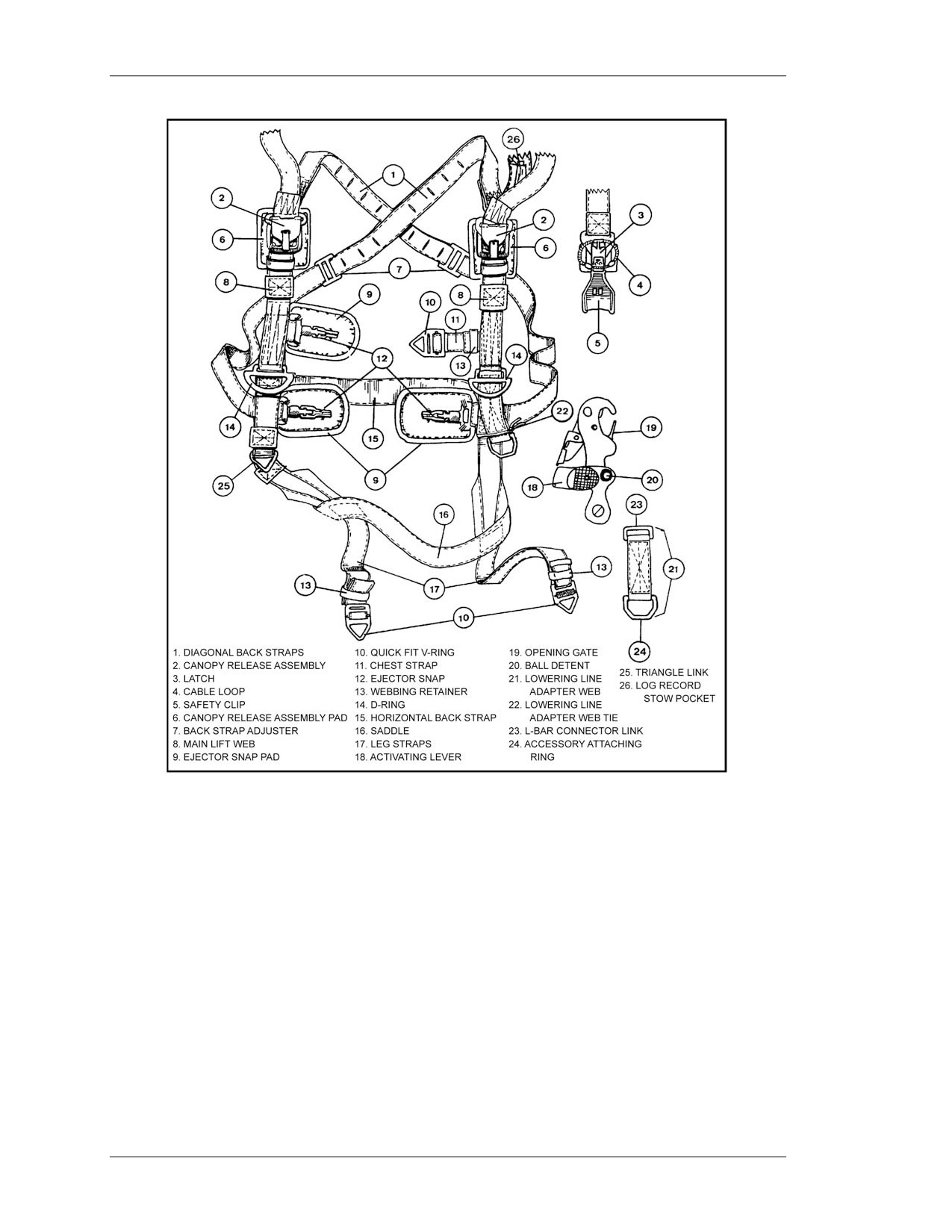
HARNESS ASSEMBLY
The T-10-series harness assembly (Figure 2-1, page 2-2) is used with the T-10-series and
MC1-series main canopies.
a. Components. The harness assembly is made of a flexible framework of
Type XIII nylon webbing. The components attached to it are as follows:
(1) Female fitting, canopy release assembly with a safety clip, cable loop, and latch.
Rated capacity of the assembly is 5,000 pounds.
(2) Canopy release assembly pads permanently attached behind the canopy release
assembly.
(3) Main lift web constructed of two plies of Type XIII nylon with a rated capacity of
6,500 pounds.
(4) Chest strap with an ejector snap with activating lever, ball detent, and opening
gate with a rated capacity of 2,500 pounds.
• An ejector snap pad is attached behind the ejector snap.
• The quick-fit V-ring has a rated capacity of 2,500 pounds.
• A webbing retainer is used for stowing excess webbing.
(5) D-rings used for attaching the MIRPS or T-10 reserve and additional combat
equipment, with a rated capacity of 5,000 pounds.
(6) Triangle links sewn into the main lift web of the harness (about 5 1/2 inches
below the D-rings) for attaching equipment and lowering lines.
(7) Leg straps with an ejector snap with activating lever, ball detent, and opening gate
with a rated capacity of 2,500 pounds. The parts of the leg straps (ejector snap pads,
quick-fit V-rings, and webbing retainers) are identical to the chest strap.
(8) Saddle (Type XIII nylon) with two attached leg straps.
(9) Diagonal back straps with six sizing channels (S, 1, 2, 3, 4, and L).
(10) Back strap adjusters with attached free-running ends of the horizontal back strap
(rolled and sewn).
b. Adjustment Points. The harness assembly has five points of adjustment: the
chest strap, two leg straps, and two free-running ends of the horizontal back strap.
2-1
FM 3-21.220/MCWP 3-15.7/AFMAN11-420/NAVSEA SS400-AF-MMO-010
Figure 2-1. T-10-series harness assembly and nomenclature.
2-2.
RISER ASSEMBLY
The riser assembly on the T-10-series consists of the following:
• Two riser assemblies, with a finished length of 30 inches (Type XIII nylon) and a
tensile strength of
6,500 pounds. A male fitting canopy release assembly is
permanently attached to the center of the webbing. When attached to the canopy,
the riser assemblies provide four individual risers.
• Log record stow pocket. Opening the log record book by non-parachute rigger
personnel is prohibited.
• Connector link loops.
• L-bar connector links.
The riser assembly on the MC1-series is identical to the T-10-series, but it also has a
guide ring retainer strap, a guide ring, and upper and lower control line channels.
2-2
FM 3-21.220/MCWP 3-15.7/AFMAN11-420/NAVSEA SS400-AF-MMO-010
2-3.
DEPLOYMENT BAG AND PERMANENTLY SEWN 15-FOOT STATIC
LINE ASSEMBLY
The deployment bag (D-bag) (18 by 12 by 5 inches) is constructed of 8.8-ounce cotton
sateen cloth. The static line (Type VIII yellow nylon) is permanently attached to the
D-bag, is 15 feet long, and has a tensile strength of 3,600 pounds.
a. D-Bag. The D-bag consists of the following:
• Suspension line protective flap with data block.
• Suspension line protective flap tie loop.
• Stow loop panel (used to retain the suspension lines).
• Locking stow loops (two, which keep the D-bag closed until the first two
stows are pulled free).
• Connector link tie loops (four).
• Side flaps (two).
• Break cord attaching strap pocket.
• Locking stow panel.
• Locking stow loop hood.
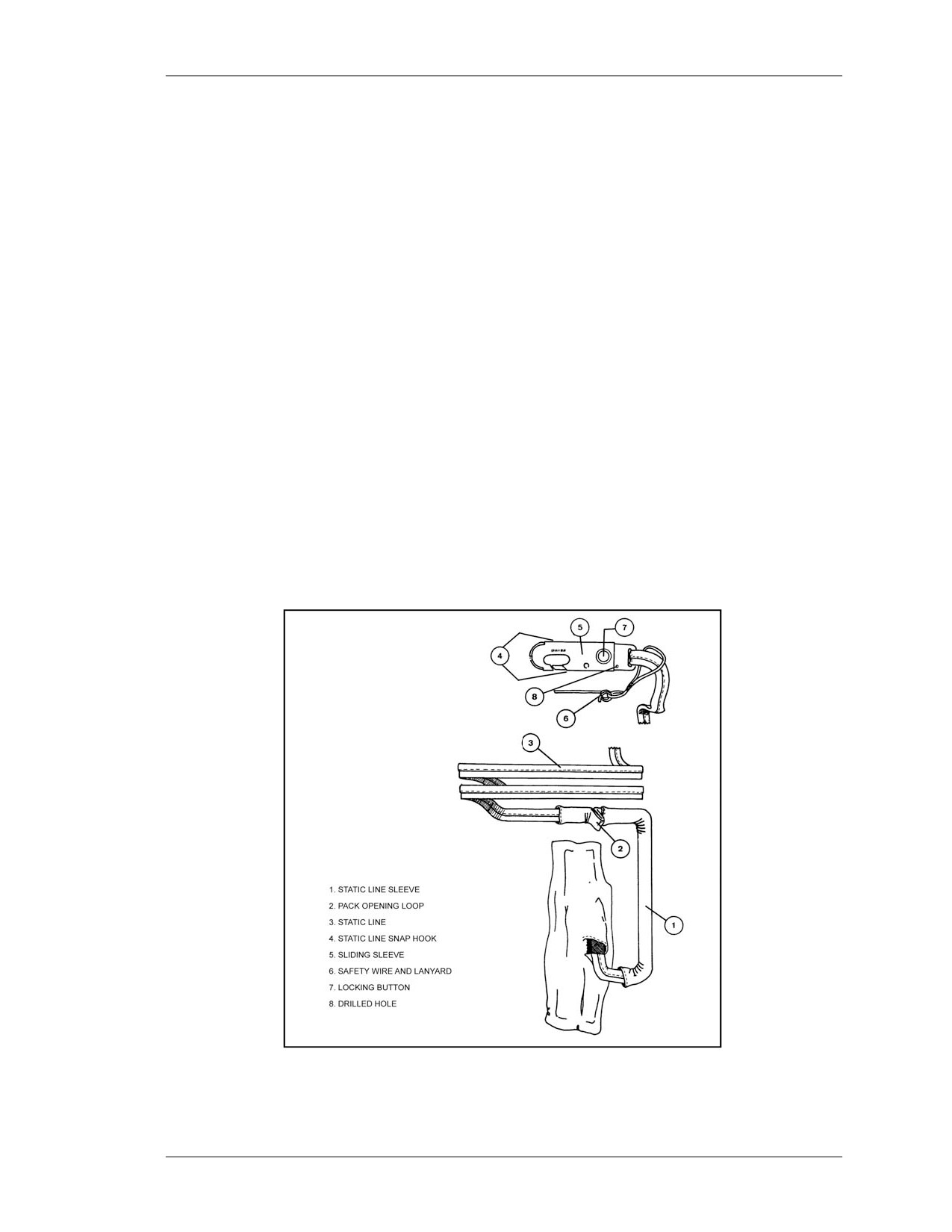
b. Static Line Assembly. The static line (Figure 2-2) consists of the following:
• Static line sleeve.
• Pack opening loop.
• Safety wire and lanyard.
• Static line snap hook with locking button and sliding sleeve.
Figure 2-2. Static line and nomenclature.
2-3
FM 3-21.220/MCWP 3-15.7/AFMAN11-420/NAVSEA SS400-AF-MMO-010
2-4.
DEPLOYMENT BAG WITH UNIVERSAL STATIC LINE ASSEMBLY
The deployment bag (D-bag) (Figure 2-3) consists of the following:
•
Suspension line protective flap with data block.
•
Suspension line protective flap tie loop.
•
Stow loop panel (used to retain the suspension lines).
•
Two locking stow loop, which keep the D-bag closed until the first stows are
pulled free.
•
Four connector link tie loops.
•
Two side flaps.
•
Break cord attaching strap pocket.
•
Locking stow panel.
•
Locking stow loop hood.
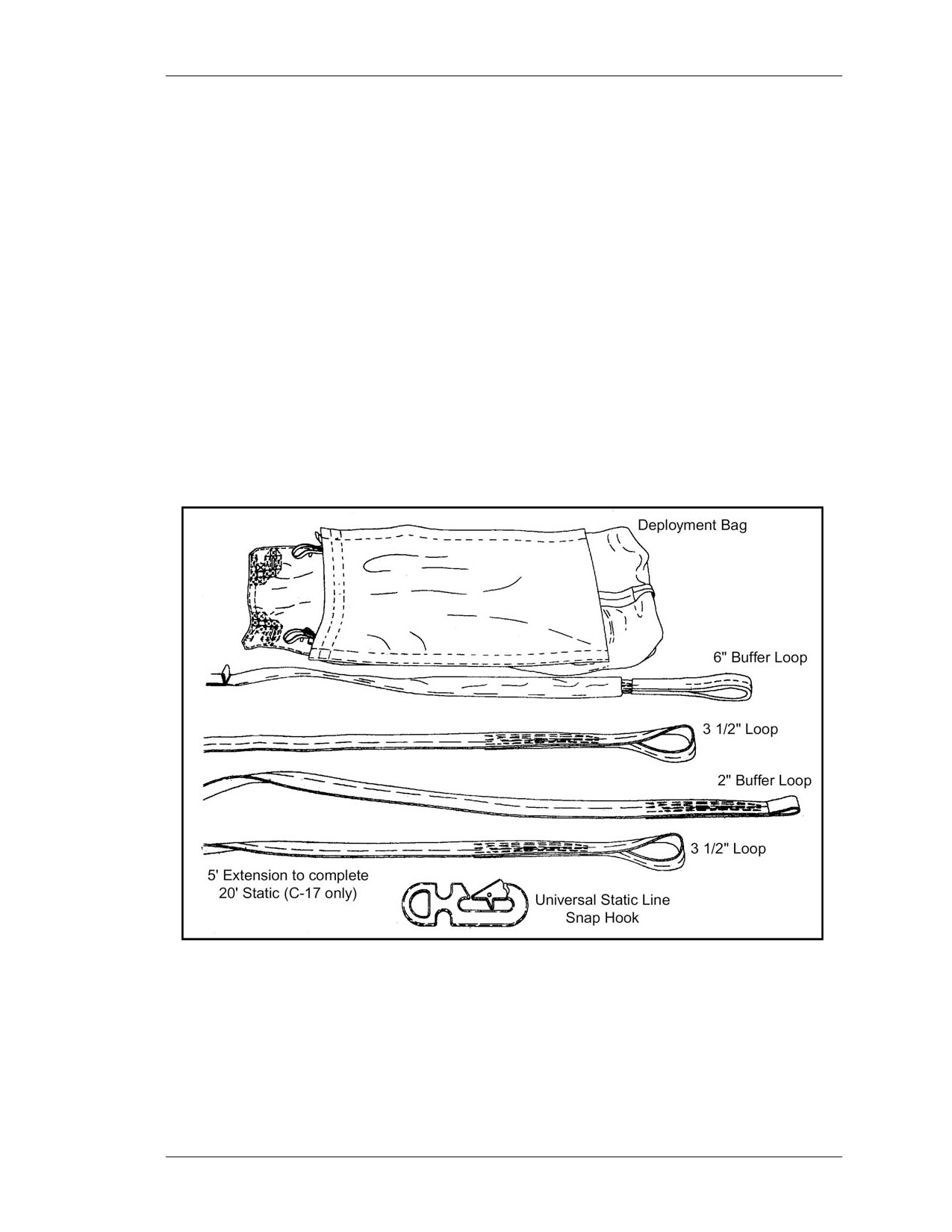
a. Universal Static Line. A 15-foot universal static line (USL) is secured to the
D-bag by a girth hitch. The opposite end of the USL has a snap hook, which is also
secured by a girth hitch. To configure the USL to the 20-foot length, the snap hook is
removed and the extension is secured to the USL by a girth hitch. The snap hook is then
secured to the opposite end of the extension. The length of the 15-foot static line after
being secured to the deployment bag and snap hook is 14 feet 7 inches. The 20-foot
configuration is 20 feet 1 inch long. There are four separate components to the USL,
which must be purchased separately: deployment bag, static line, static line extension
(Figure 2-4), and static line snap hook (Figure 2-5, page 2-6).
Figure 2-3. Deployment bag components with universal static line.
2-4
FM 3-21.220/MCWP 3-15.7/AFMAN11-420/NAVSEA SS400-AF-MMO-010
b. Deployment Bag. The deployment bag is currently used on the T10- and
MC1-series personnel parachutes. The deployment bag comes without the static line and
snap hook.
c. Static Line. The static line is 14 feet 10 inches long (+ - 1 inch). The static line
webbing material is 3/4-inch wide, nylon, tube edge, class 1A (nylon 6.6), class R (resin
treated), with “Dooley” finish. It has a 4,000-pound breaking strength and 30 percent
minimum elongation. It is yellow in color with one green color marker yarn located at the
center of the warp.
d. Static Line Extension. The static line extension is 70 1/2 inches long (+ - 1/2
inch) (Figure 2-4). It is made from the same webbing as the static line.
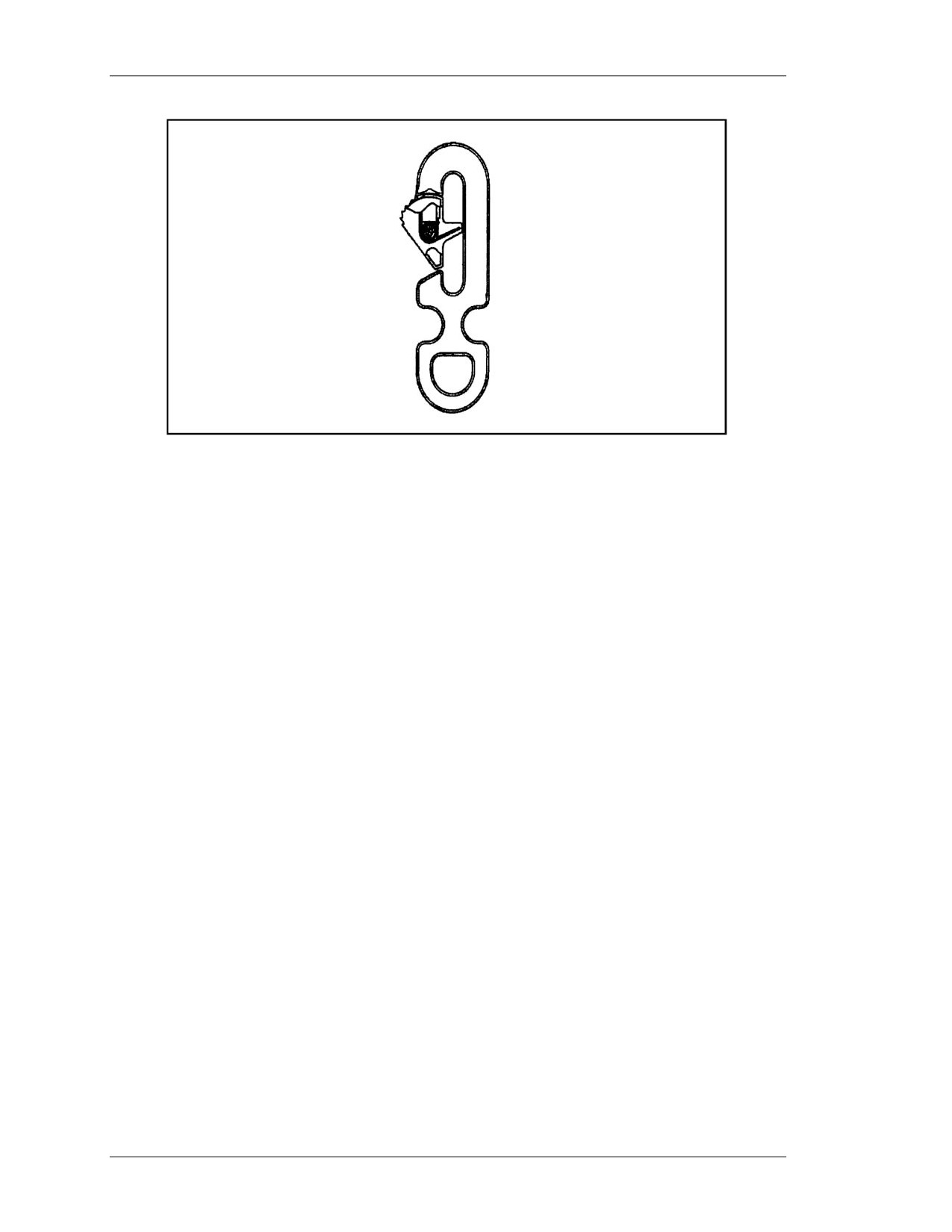
e. Snap Hook. The snap hook is 5 1/2 inches long, approximately 1/4-inch thick,
and weights 0.67 pounds (Figure 2-5, page 2-6). It is made from alloy steel with
Dacroment 320, grade A plus L finish for abrasion/humidity/salt/fog protection. The
finish is environmentally compliant and a standard in the automotive industry. The snap
hook gate and rivet pin are made from the same alloy steel, whereas the pullback spring
is made from steel spring wire. The snap hook is rated to withstand a 1,750-pound load
and has an ultimate failure rate of no less than 8,000 pounds.
Figure 2-4. Static line extension.
2-5
FM 3-21.220/MCWP 3-15.7/AFMAN11-420/NAVSEA SS400-AF-MMO-010
Figure 2-5. Static line snap hook.
2-5.
PACK TRAY
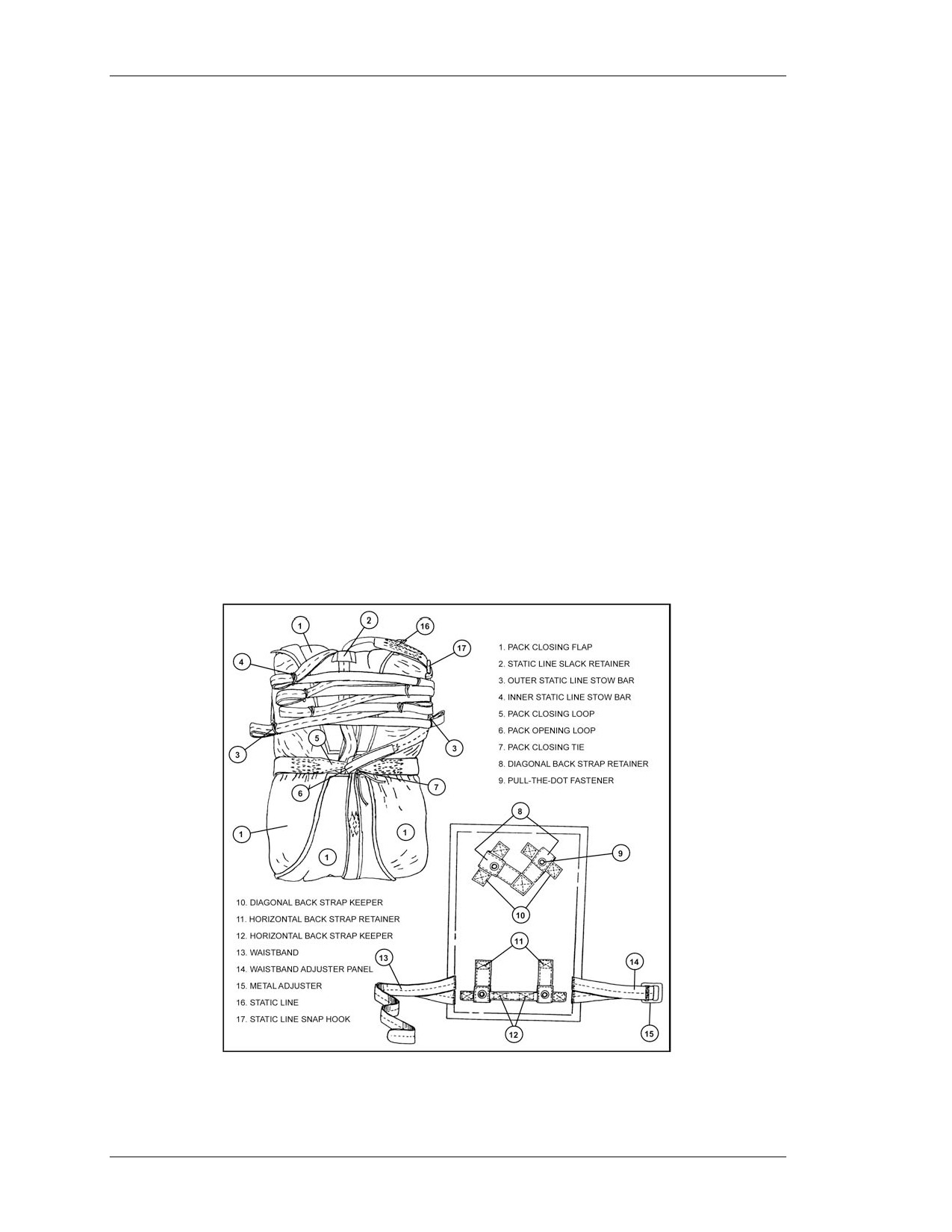
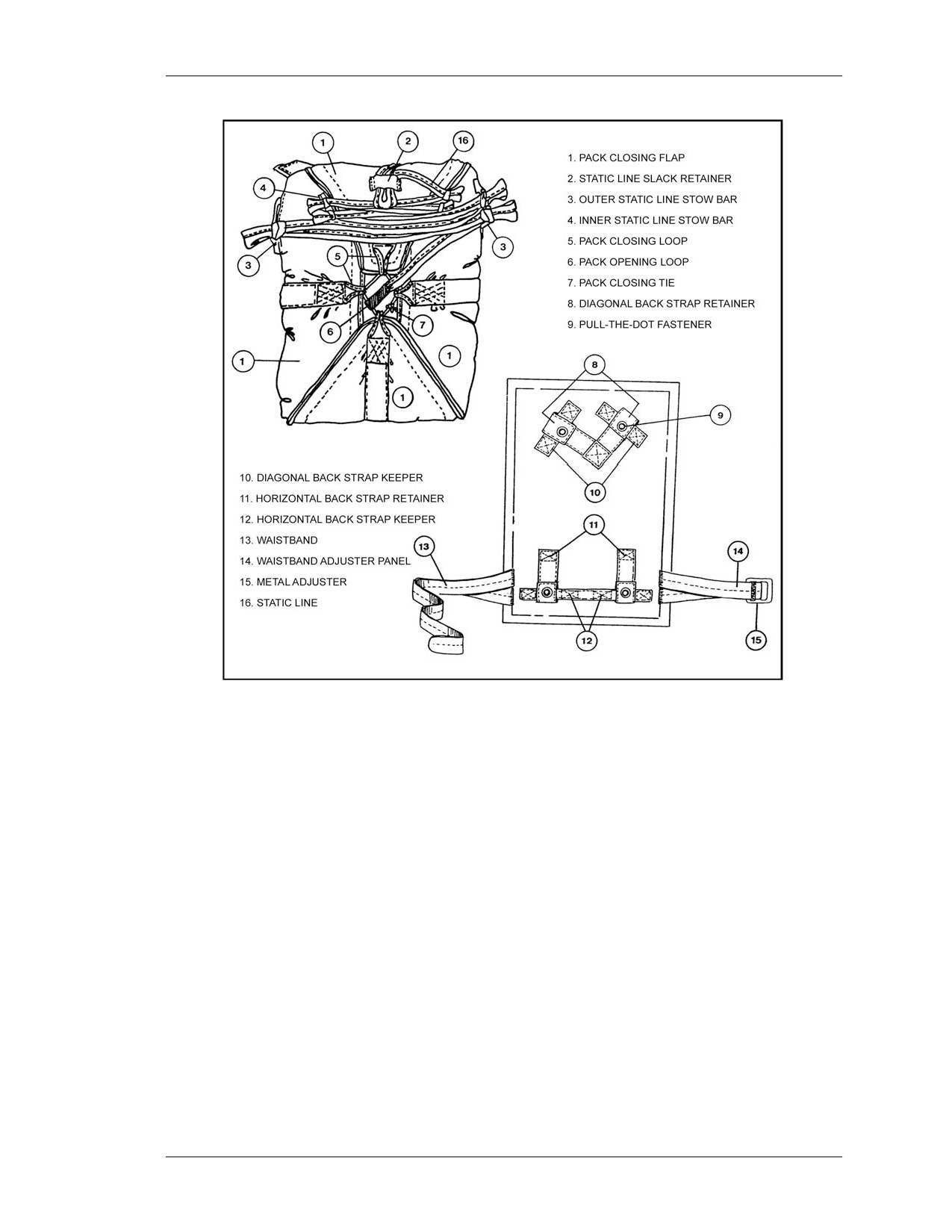
The pack tray (20 by 14 by 5 inches) (Figure 2-6) is constructed of 7.25-ounce nylon
duck material and consists of the following:
• Pack closing flaps (four): right and left side flaps, and upper and lower end flaps.
• Pack closing loops (four): right and left side pack closing loops, and upper and
lower end pack closing loops.
• Static line stow bar.
• Waistband adjuster panel.
• Metal adjuster.
• Waistband (43 inches long).
• Pack closing tie (one turn 1/4-inch cotton webbing) tied in a surgeon’s knot and a
locking knot; the knot is between the 3 and 6 o’clock positions.
• Diagonal back-strap retainer.
• Diagonal back-strap keeper.
• Horizontal back-strap retainer.
• Horizontal back-strap keeper.
2-6
FM 3-21.220/MCWP 3-15.7/AFMAN11-420/NAVSEA SS400-AF-MMO-010
Figure 2-6. T-10-series parachute pack tray and nomenclature.
2-6.
CANOPY ASSEMBLY
The T-10- and MC1-series parachutes are static line deployed. The parachute deployment
sequence is the same for both types of canopies.
• The parachutist falls to the end of the static line. His body weight breaks the pack
closing tie, and the deployment bag is pulled from the pack tray.
• Two connector link ties break, and the suspension lines are pulled from the
deployment bag.
• Two locking stows disengage, and the canopy is pulled from the deployment bag
to its full length.
• The break cord tie securing the apex of the canopy to the static line ending loop
breaks, and the parachute begins to inflate, retarding the parachutist’s rate of
descent.
a. General Characteristics. Following are characteristics of both T-10-series and
MC1-series canopies:
(1) Shape and Weight. Shape is parabolic; weight is between 28 and 31 pounds.
2-7
FM 3-21.220/MCWP 3-15.7/AFMAN11-420/NAVSEA SS400-AF-MMO-010
(2) Rates of Descent. Depending on the jumper’s total weight and relative air density,
the average rates of descent for the different canopies are as follows: MC1-series, 14 to
22 feet per second and T-10-series, 19 to 23 feet per second.
(3) Diameter. Nominal diameter is 35 feet (measured 3 feet up from the skirt) and
24.5 feet at the skirt.
(4) Anti-Inversion Nets. The anti-inversion net is sewn 18 inches down on each
suspension line and is made of 3 3/4-inch square mesh, knotless, braided nylon.
(5) Shelf and Service Life. Combined shelf life and service life is 16.5 years; service
life is 12 years, and shelf life is 4.5 years.
(6) Repacking. Both canopies are repacked every 120 days.
(7) Use. Both canopies are suitable for airdropping personnel from as high as 10,000
feet MSL.
b. MC1-1B Parachute Design Characteristics. The MC1-1B has an estimated
8.8-second turn rate.
(1) The bridle loop is 3 inches in diameter; it is made of Type VIII nylon with a
tensile strength of 3,600 pounds.
(2) The 15 apex vent lines are 19 inches long and made of Type II nylon cord with a
tensile strength of 375 pounds. The apex vent lines with centering lines keep the bridle
loop in place and the canopy even during deployment.
(3) The apex vent cap has a 3-inch diameter opening, which reduces oscillation and
assists in a positive opening of the canopy.
(4) The upper lateral band is 1-inch tubular nylon with a tensile strength of 4,000
pounds. It is sewn in as reinforcement, since the first 64 inches of the canopy is a
high-pressure area.
(5) Each canopy has 30 gores with five sections in each gore. Each gore is numbered
1 through 30, and each section is sewn diagonally to prevent rips and holes from
spreading throughout the canopy.
(6) The 30 radial seams are 9/16 inch wide and 17 feet 2 7/32 inches long, measured
from the upper lateral band to the lower lateral band.
(7) The T-U shaped configuration has 11 gores removed (25 to 5) from the rear
(100.4 square feet of canopy), which enables the canopy to turn 360 degrees in 8.8
seconds and gives a forward thrust of 8 knots (9.5 mph), or 14 feet per second.
(8) Two 28-foot-long control lines are attached to a control bridle that in turn is
attached to radial seams 5 and 6. They are 6 feet long and attached to seams 25 and 26.
They run down and out to the front of the rear set of risers and through the control line
channel and control line guide ring. They are attached to a toggle that is a 5/8-inch
diameter hardwood dowel.
(9) The lower lateral band is a 1-inch nylon tape with a tensile strength of 525
pounds.
(10) The 15 pocket bands ensure positive opening of the canopy.
(11) The 30 V-tabs are 9/16 inch wide and are sewn over the suspension lines to the
lower lateral band for reinforcement.
(12) The 30 suspension lines are Type II nylon with a tensile strength of 375 pounds.
They are 25 feet 6 inches long when measured from the lower lateral band to the L-bar
connector link.
2-8
FM 3-21.220/MCWP 3-15.7/AFMAN11-420/NAVSEA SS400-AF-MMO-010
c. MC1-1C Parachute Design Characteristics. The MC1-1C canopy has the same
basic design as the MC1-1B with the following exceptions:
(1) It has an estimated 7.7-second turn rate.
(2) It is made of nonporous (NOPO) material (0-3 CFM).
(3) The vent cap is removed.
(4) The suspension lines are shortened to 22 feet.
(5) The H-TC modification is a 60-square-foot opening.
d. T-10-Series Parachute Design Characteristics. The T-10-series parachute is
designed with the following characteristics:
(1) The bridle loop is 3 inches in diameter and made of Type VIII cotton or nylon
with a tensile strength of 3,600 pounds.
(2) The 15 apex vent lines are 19 inches long and made of Type II nylon cord with a
tensile strength of 375 pounds.
(3) The two apex centering loops are 9 inches long and made of Type II nylon cord
with a tensile strength of 375 pounds.
(4) The apex vent is 20 inches in diameter and expands to 22 inches in diameter when
the canopy is inflated.
(5) The upper lateral band is 1-inch tubular nylon with a tensile strength of 4,000
pounds.
(6) The 30 gores have five sections each.
(7) The 30 radial seams are 9/16 inch wide and 17 feet 2 7/32 inches long.
(8) The lower lateral band is made of 1-inch nylon tape with a tensile strength of 525
pounds.
(9) The 15 pocket bands have been lengthened to 7 1/2 inches to provide a more
positive opening and a 4.37 foot (overall) increase in the canopy to reduce descent to
about 15 feet per second.
(10) The 30 V-tabs are 9/16 inch wide.
(11) The 30 suspension lines are 25 feet 6 inches long.
2-7.
MODIFIED IMPROVED RESERVE PARACHUTE SYSTEM
The MIRPS (used with the T-10- and MC1-series) is an emergency-type parachute
designed to be activated by the parachutist if the main parachute malfunctions. It is
chest-mounted, manually operated, and loaf-shaped when packed. It weighs between 13
and 13.5 pounds, has a combined shelf life and service life not to exceed 16.5 years, and
is 24 feet in diameter. It is repacked every 365 days. The MIRPS consists of six major
components: pilot parachute, bridle line with weight and apex weight, ejector spring,
canopy assembly, pack assembly, and rip cord assembly.
a. Pilot Parachute Assembly. The pilot parachute assists in deployment of the
parachute canopy by serving as an air anchor. It is a five-foot, flat, circular parachute
with bridle line and is constructed from zero-porosity nylon parachute cloth and
marquisette netting. The netting is reinforced with six radial tapes that form the bridle
attachment loop. A centerline is attached to the parachute cloth to speed pilot chute
inflation and also forms part of the bridle attachment loop. The pilot chute does not have
suspension lines. It resembles a large ball.
b. Bridle Line Assembly. The bridle line assembly is 13 feet long and is constructed
from two-inch-wide polyester webbing with a four-inch loop at each end. One end of the
2-9
FM 3-21.220/MCWP 3-15.7/AFMAN11-420/NAVSEA SS400-AF-MMO-010
bridle line is fitted with an apex sock that aids in pressurizing the reserve main canopy
during low-speed deployments. Adjacent to the apex sock, the bridle line is fitted with
two curved metal pins that are used to secure the canopy staging flaps located in the pack
assembly. The other end of the bridle line is fitted with a five-ounce deployment weight.
The deployment weight provides the necessary mass to cause positive launch of the pilot
chute once the ejector spring reaches full extension.
c. Deployment Assistance Device. The ejector spring is a 30-inch-long helical
spring encased in marquisette netting and fitted with an end cap at each end. On one end
cap, two grommet tabs are attached. These are used only during packing to keep the
spring compressed. Before the final closing of the pack, the spring compression aid is
removed, and the grommet tabs are no longer used.
d. Canopy Assembly. The canopy assembly is a 24-foot, flat, circular parachute
constructed of 1.1-ounce olive drab ripstop nylon parachute cloth. Depending on the
jumper’s total weight, its rate of descent varies from 15 to 22 feet per second. It is
described as follows:
(1) An apex vent, 20 inches in diameter.
(2) Twelve suspension lines, 57 feet 6 inches long (measured from connector snap to
connector snap), made of Type III nylon cord with a tensile strength of 550 pounds. On
this parachute, the suspension lines serve three purposes:
• From the connector snaps that double as connector links, the lines are 20-foot
suspension lines.
• Where the suspension lines go through the radial seams of the canopy, they
become canopy lines.
• Across the apex vent, the canopy lines become apex vent lines until they again
go into the upper radial seam; there they again become canopy lines.
(3) An upper lateral band of 1-inch tubular nylon with a tensile strength of 4,000
pounds.
(4) A lower lateral band of 1-inch nylon tape with a tensile strength of 525 pounds.
(5) Twenty-four gores with four sections in each gore.
(6) A 9/16-inch nylon V-tab reinforcement sewn into the lower lateral band of the
parachute and wrapped around each suspension line.
(7) Twenty-four pocket bands.
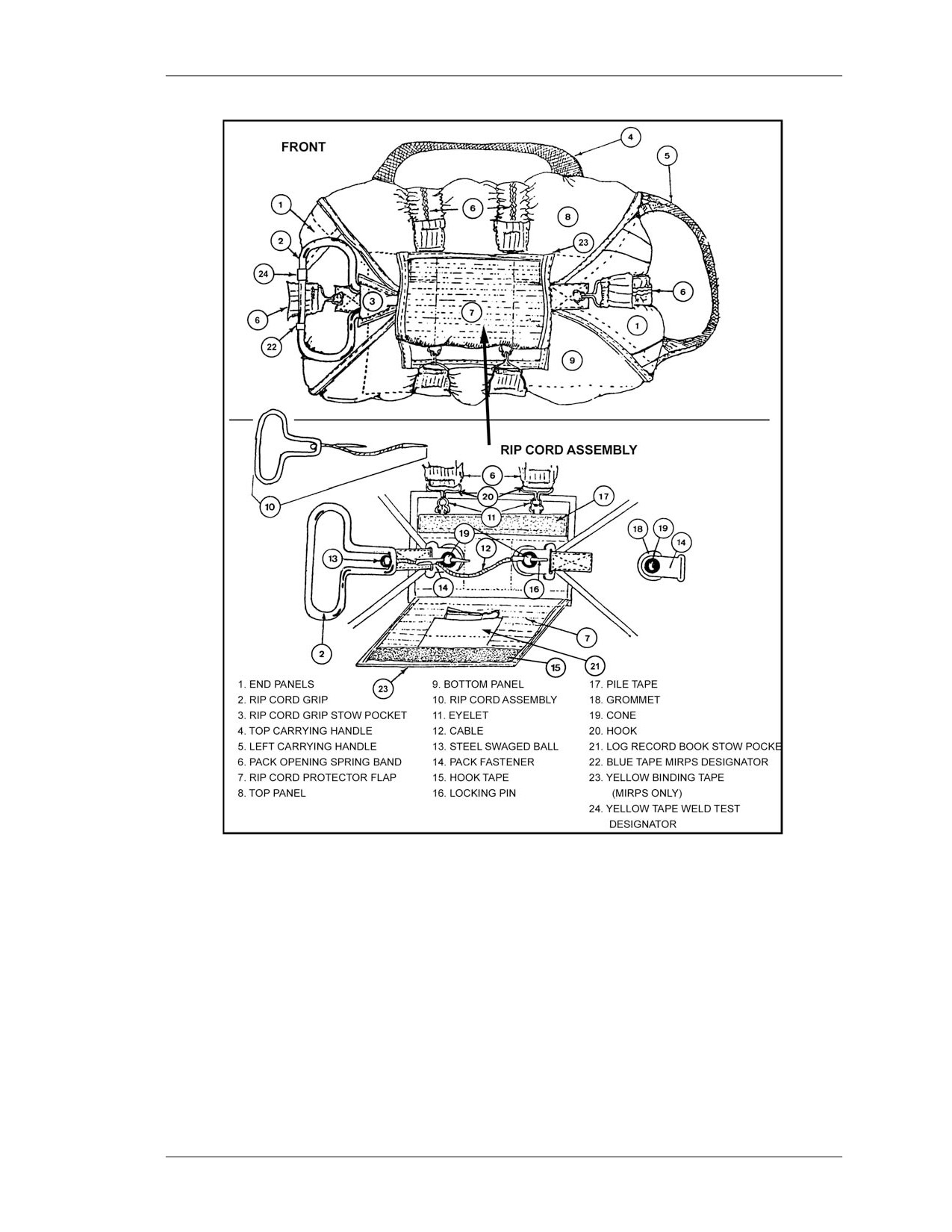
e. Pack Tray. The MIRPS and the T-10 troop chest reserve use different pack trays
that are almost identical on the outside (Figure 2-7 and Figure 2-8, page 2-12). Thus, an
identifying yellow binding tape on the rip cord protector flap distinguishes the MIRPS.
The major parts of the pack tray used for the MIRPS are the main panel and two end
panels. The main panel forms a top and bottom flap, and the end panels form a right end
flap and a left end flap. A rectangular metal pack frame is enclosed in a pocket formed in
the bottom. The pack has two holes with lift-the-dot strap fasteners for attaching the
MIRPS to the primary parachute harness using the connector snaps. A suspension-line
free-bag deployment pouch is located on the inside of the container on the pack bottom.
Canopy staging flaps are attached to the inside of the top and bottom flaps; these provide
canopy retention.
2-10
FM 3-21.220/MCWP 3-15.7/AFMAN11-420/NAVSEA SS400-AF-MMO-010
Figure 2-7. MIRPS/T-10 reserve parachute pack tray
and nomenclature (front).
2-11
FM 3-21.220/MCWP 3-15.7/AFMAN11-420/NAVSEA SS400-AF-MMO-010
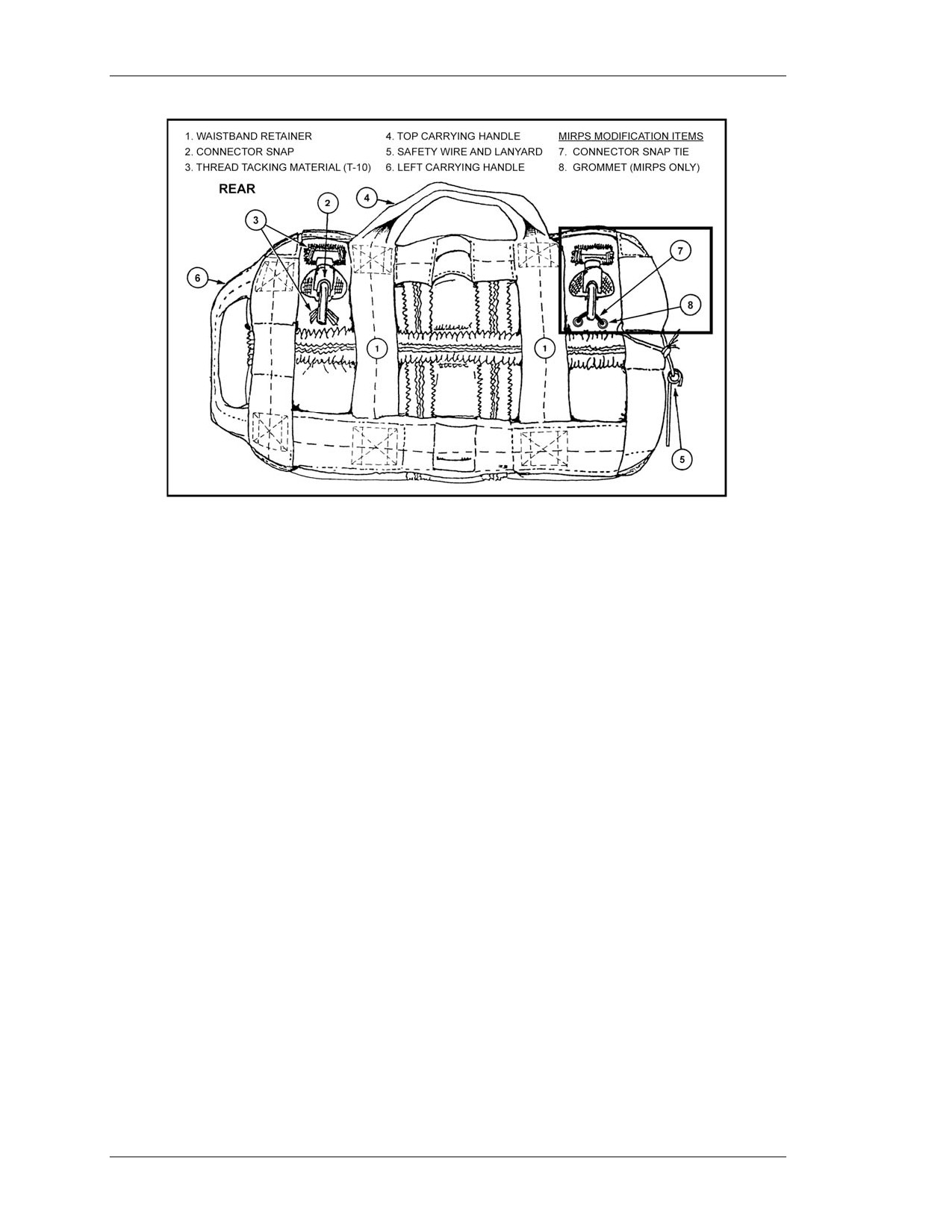
Figure 2-8. MIRPS/T-10 reserve parachute pack tray
and nomenclature (back).
f. Rip Cord Assembly. The rip cord assembly is used to activate the reserve
parachute and requires about
27 pounds of pull pressure. It is composed of a
cloverleaf-shaped, stainless steel rip cord grip attached to a 7.25-inch-long flexible steel
cable by means of a steel swaged ball. The cable has two permanently fastened locking
pins (1 1/4 inches long) that are inserted into holes in the pack tray bottom panel cones;
they keep the reserve pack tray closed until activation.
2-8.
T-10 TROOP CHEST RESERVE PARACHUTE
The T-10 reserve parachute
(used with T-10- and MC1-series) is chest-mounted,
manually operated, and loaf-shaped when packed. It weighs about 12 pounds, has a
combined shelf life and service life not to exceed 16.5 years, and is 24 feet in diameter. It
is repacked every 365 days. It is an emergency-type parachute designed to be activated
by the parachutist if the main parachute malfunctions. The T-10 reserve parachute
consists of four major components: spring-activated pilot parachute assembly, canopy
assembly, pack tray assembly, and rip cord assembly. The rip cord grip must be marked
with a blue and yellow piece of tape. Blue signifies that it is for the MIRPS and yellow
shows that it has been weld tested.
a. Pilot Parachute Assembly. The pilot parachute acts as an air anchor to assist the
canopy in deploying quickly. It is spring-activated, made of 1.1-ounce ripstop nylon
parachute cloth, and is 40 inches in diameter. It is described as follows:
(1) Octagon-shaped, with reinforcements sewn to the inside of the canopy.
(2) Four pockets sewn on the inside of the canopy to stow the spring framework.
(3) Eight suspension lines of Type I nylon cord. Each pair of suspension lines is
formed by one continuous line that runs through the canopy and is stitched together at the
lowest point to form the connector loop. The connector loop is used to attach the pilot
2-12
FM 3-21.220/MCWP 3-15.7/AFMAN11-420/NAVSEA SS400-AF-MMO-010
parachute to the apex of the reserve by means of a bridle line that is 15 inches long and
made of Type III nylon cord with a tensile strength of 550 pounds.
b. Canopy Assembly. The canopy assembly in the T-10 reserve is the same canopy
used for the MIRPS.
NOTE: Inside the pack tray is a 10-inch spreader bar. If one reserve connector snap
becomes disconnected from one of the harness D-rings, the spreader bar keeps
that connector snap attached to the parachute harness. This arrangement
enables the reserve to function if a malfunction occurs.
c. Pack Tray. The pack tray is made of 12.29-ounce nylon or 7.25-ounce nylon on a
rigid frame (Figures 2-7 and 2-8). It contains the parachute until activation. The pack tray
is described as follows:
(1) Carrying handles (top and left).
(2) A safety wire and lanyard.
(3) Four panels (right end panel, left end panel, top panel, and bottom panel) with
attached eyelets.
(4) Three pack opening spring bands with six running ends connected to six hooks.
(5) A rip cord grip stow pocket sewn to the right-end panel.
(6) A rip cord protector flap sewn to the bottom panel, with log record stow pocket on
the inside of the rip cord protector flap.
(7) Pack fasteners sewn to the left- and right-end panels.
(8) Grommets and cones that keep the pack closed by inserting the locking pins of the
rip cord assembly through the cones. (Grommets are on the top panel and cones are on
the bottom panel.)
(9) Two connector snaps to attach the reserve to the D-rings.
(10) Two nylon waistband retainers through which the waistband is routed. The
waistband retainers consist of a single piece of material sewn into the pack tray, which
forms the reserve top carrying handle.
d. Rip Cord Assembly. The rip cord assembly for the T-10 reserve is the same as
for the MIRPS with one exception. The length of the cable is .25 inch shorter (7 inches
rather than 7.25).
2-9.
BA-18 BACK AUTOMATIC PARACHUTE
The USAF emergency parachute BA-18, back automatic parachute, is used by non-
jumping jumpmasters and safety personnel onboard USAF aircraft. This USAF parachute
has a repack cycle of 180 days and must pass a routine inspection at the home unit every
30 days. Once the parachute is activated, it must be destroyed. The BA-18 is equipped
with either an FLB-Model 7000 or FLB-Model 11000 automatic release system (ARS).
The owning USAF unit’s life support department sets the time delay release (from 1 to 13
seconds) and then attaches a small white tag on the back of the BA-18 to indicate what
delay time has been set (3 seconds, 4 seconds, 5 seconds, and so on). To employ the
BA-18, the jumper either pulls the red arming cable knob to activate the time delay
feature or overrides the ARS by pulling the T-shaped blast handle. Personnel scheduled
to wear the BA-18 must inspect it before each use. If they note any discrepancies during
the inspection, they must not use the parachute.
2-13
FM 3-21.220/MCWP 3-15.7/AFMAN11-420/NAVSEA SS400-AF-MMO-010
a. BA-18 Inspection Criteria. The inspection procedures are simple, and their
sequence is not important. However, the parachute must be inspected before each
donning.
(1) Check the canopy release assemblies in the same manner as on the T-10-series or
MC1-series main parachutes.
(2) Ensure that no straps (chest, leg, and horizontal back strap) are cut or frayed.
(3) Ensure all three ejector snaps are serviceable.
(4) Between the parachute harness assembly and the pack tray, a pad is held with four
pull-the-dot fasteners (one at each corner). Open the pull-the-dot fasteners, expose the
long zipper that is behind the pad, and unzip the zipper. Ensure that the locking pins are
not bent and are routed through the white nylon cord loops, and that the cable is free of
rust or other corrosion. Re-secure the zipper and pad once the inspection has been
completed.
(5) Inspect the risers and ensure they are not cut or frayed and are secured to the
canopy release assemblies.
(6) Make an overall inspection on the outside of the pack tray to ensure that the pack
tray is free of rips, tears, oil, grease, dirt, or water and that no canopy or suspension lines
protrude from the pack tray.
(7) Open the slide fastener on the back of the pack tray. Ensure that the spring has
both hooks (one at each end) routed through the white nylon cord loops; then secure the
slide fastener.
(8) Ensure the rip cord is properly stowed and free of rust or other corrosion.
(9) Ensure the red time delay arming cable knob is properly stowed.
(10) If the parachute is equipped with a personnel lowering device, inspect it to ensure
that the associated hardware is secure inside the stow pocket. Inspect the lowering line
from where it exits the stow pocket to the point it disappears into the pack tray.
b. Planned and Unplanned Exits.
(1) Above 14,000 Feet.
(a) Once the last jumper has exited the aircraft, pull the red automatic release arming
knob to arm the ARS, and exit the aircraft.
(b) When you reach an altitude of 14,000 feet, the canopy will open. However, at
anytime during descent, you can activate the rip cord and override the ARS.
(2) Below 14,000 Feet.
(a) If the parachute is equipped with an ARS set for a delay of 4 seconds or more,
pull the automatic release arming knob and exit the aircraft.
(b) If the parachute is equipped with an ARS set for less than 4 seconds, exit the
aircraft, assume the correct body position, and pull the automatic release arming knob. To
assume the correct body position, place your chin on your chest, your elbows into your
sides, your feet and knees together, and visually locate and place your hand(s) on the rip
cord. Allow sufficient time (one second, minimum) to clear the aircraft, then pull the
rip cord.
NOTE: When bailing out of an aircraft at extremely low levels, the most important
factor is to pull the rip cord as soon as you clear the aircraft, regardless of
your body position.
2-14
FM 3-21.220/MCWP 3-15.7/AFMAN11-420/NAVSEA SS400-AF-MMO-010
c. Proper Method to Pull the Rip Cord.
(1) The automatic release may be overridden by pulling the rip cord. Grasp the “T”
handle with your right hand and guide or assist it with your left hand. Pull the rip cord
down toward your feet and away from your body hard and fast. Pull it to arm’s length and
then bring your arms back close to your body immediately. Ensure the rip cord clears
the housing.
(2) After exiting the aircraft, complete the normal remaining four points of
performance—check canopy and gain canopy control, keep a sharp lookout during your
entire descent, prepare to land, and land (see Chapter 3). To avoid obstacles and other
jumpers in the air, or maneuver the canopy, pull a vigorous two-riser slip in the desired
direction of travel. To execute a two-riser slip with this canopy, reach up high onto the
risers to the elbow-locked position, grasp a set of risers in the direction of the desired
movement, and pull them down to your chest.
d. Personnel Lowering Device (PLD). If you become hung in wires, trees, or rough
terrain and the parachute is equipped with a PLD, use it to climb down to safety.
(1) Visually check to see that you are securely hung in the obstacle.
(2) Take the hardware out of the stow pocket. Grasp the braking device and snap it
into the top portion of the V-ring of the chest strap with the hook side facing your
midsection.
(3) Pass the snap hook at the end of the tape through the “V” of both risers.
(4) Attach the snap hook to the O-ring (which should be in front of your face).
(5) Grasp the tape with your left hand and disconnect the right canopy release
assembly with the right hand. Exchange hands on the tape, with your left hand
disconnecting the left canopy release assembly.
(6) Lower yourself to the ground by feeding the tape through the braking device.
(7) To stop the descent, pull the tape up vertically with your right hand.
2-10. CARE OF THE PARACHUTE BEFORE JUMPING
Troop parachute assemblies and reserves may be issued in kit bags to aid handling and to
prevent damage or unintentional opening. Until removed for fitting by parachutists,
parachutes and reserves should remain in the kit bags and protected from moisture during
storage to prevent mildew. (Kit bags are not waterproof and do not provide adequate
protection from wet weather or damp ground.) Parachutes must be stored in weatherproof
areas such as adequate storage buildings, trucks, tents, or transport aircraft.
2-11. CARE OF THE PARACHUTE AFTER JUMPING
The parachute is recovered and properly cared for to minimize damage. Upon landing,
parachutists activate the canopy release assembly (while lying on their backs to observe
other landing parachutists), take off the harness, and place the parachute in the kit bag
using either the tactical recovery method or by executing a series of figure-eight folds
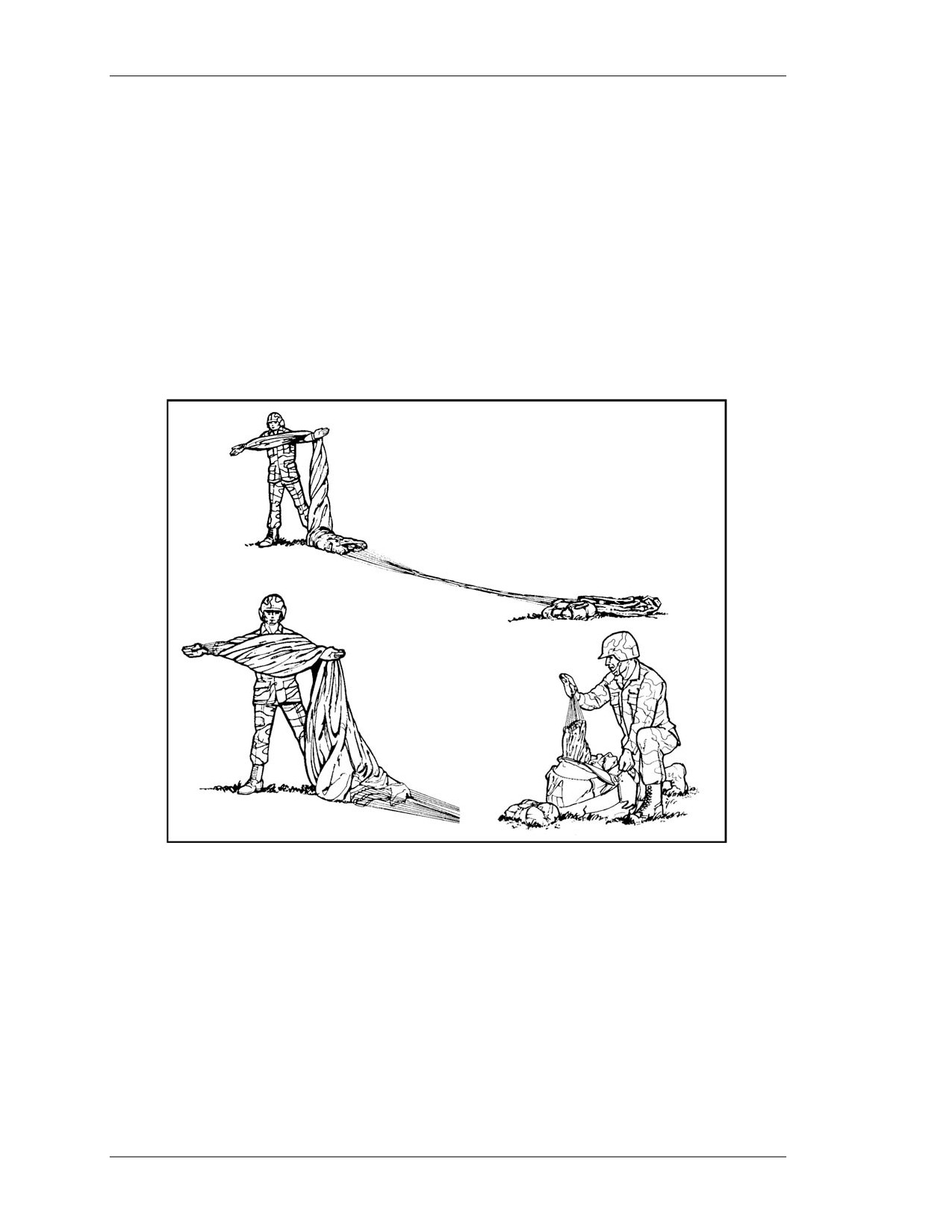
with the arms (Figure 2-9, page 2-16). The specific actions are as follows:
a. Remove all air items. Place harness in the aviator kit bag with the smooth side up,
leaving the waistband out. Place released riser underneath the harness.
b. Move to the apex of the canopy, grasp the bridle loop, elongate the parachute into
the wind to straighten the canopy and suspension lines, and remove all foreign objects
and debris from suspension lines and canopy.
2-15
FM 3-21.220/MCWP 3-15.7/AFMAN11-420/NAVSEA SS400-AF-MMO-010
c. Fold the canopy and suspension lines into a series of figure eights, using both
arms. Do not twist the canopy unnecessarily because friction can cause the nylon to fuse.
d. Lay the canopy on the top of the harness and, before closing the bag fasteners,
ensure the bridle loop is on top of the canopy and the waistband is routed through the
bridle loop. Close bag fasteners; do not zip the bag because the canopy may become
entangled in the zipper and damaged. Attach a reserve connector snap to each kit bag
handle. Carry the equipment so the reserve parachute is to the (parachutist’s) front and
the kit bag to the rear. (Reverse the carry when jumping with combat equipment.)
NOTE: If it is necessary to activate both canopy release assemblies upon landing, then
fold the canopy in figure eights by itself and place it in the kit bag on top of
the harness.
Figure 2-9. Stowing the parachute.
2-12. SHAKEOUT PROCEDURES
The parachute is suspended from a rope passed over a pulley suspended from a ceiling
(or from pole’s) high enough to allow the canopy to clear the surface area.
a. Main Canopy. A two-man shakeout team is recommended. Number 1 holds the
bridle loop, while number 2 fastens the rope to the loop. Number 2 pulls the rope until the
skirt is about 1 foot above number 1’s head. They accomplish the rest of the shakeout by
taking the following steps:
STEP 1: The team leaves the bulk of the suspension lines and the parachute
harness in the kit bag. Number 2 grasps the rope attached to the suspended canopy
while number 1 shakes the parachute.
2-16
FM 3-21.220/MCWP 3-15.7/AFMAN11-420/NAVSEA SS400-AF-MMO-010
STEP 2: Number 1 grasps two adjacent suspension lines at the lower lateral band,
one in each hand, and vigorously shakes the gore, making certain no grass, twigs,
insects, or other foreign matter are left on the fabric or tangled in the anti-
inversion net.
STEP 3: Number 1 then transfers both suspension lines to his left hand, grasps the
suspension lines of the next gore with his right hand and continues as in step 2,
working counterclockwise, until each gore has been shaken and all suspension
lines are in his left hand. He must pay particular attention to the anti-inversion net
to ensure no foreign material remains. Debris left in the net can result in a total
malfunction.
STEP 4: Number 2 begins to slowly pull the canopy up, elongating the suspension
lines. Number 1 shakes the suspension lines and dusts them by hand and then
turns the kit bag inside out and cleans it thoroughly to ensure no debris is in the
bag.
STEP 5: Number 1 puts the harness in the bag.
STEP 6: Number 2 then slowly lowers the parachute while number 1 coils the
suspension lines on top of the harness and places the canopy inside the bag.
b. Reserve Parachute. The shakeout procedure for the reserve parachute (if used) is
the same as that for the main canopy. Do the shakeout as soon after jumping as
practicable.
c. Wet Parachute Procedures. Parachutes used in wet weather or exposed to
moisture will be hung to dry within 24 hours of the jump. Once dry, shakeout procedures
will then occur.
Section II. DONNING THE PARACHUTES
Using the buddy system to properly don and adjust the troop parachute harness provides
an additional safety check, prevents delays during JM inspection, and provides minimum
discomfort to the parachutist while aboard the aircraft or when receiving the opening
shock of the parachute. The buddy system method provides the best combination of speed
and accuracy for parachutists to adjust and check each other’s parachutes.
2-13. TROOP PARACHUTE HARNESS
Each parachutist first checks the parachute assembly for visible defects.
STEP 1: The parachutist lays the assembly out with the pack tray face down.
Then he—
(1) Activates the waistband quick-release and pulls up each of the activating
levers on the ejector snaps, releasing the leg straps and the chest strap.
(2) Checks for appropriate size and, if necessary—
• Lifts the pull-the-dot fasteners on the diagonal back-strap retainer and
frees the diagonal back straps from the sizing channel (using fingers only;
do not use tools).
• Sizes the parachute to one of the six sizing channels (S, 1, 2, 3, 4, and L).
• Rechannels the diagonal back strap retainer and fastens the pull-the-dot
fastener.
2-17
FM 3-21.220/MCWP 3-15.7/AFMAN11-420/NAVSEA SS400-AF-MMO-010
• Lets out about half of the slack in the horizontal back strap, leg straps, and
chest strap; straightens the leg straps and chest strap; and folds the kit bag,
leaving the outermost carrying handle extended.
STEP 2: The parachutist (number 1) bends slightly forward at the waist to don the
parachute. A second parachutist (number 2) holds the parachute assembly by the main
lift web under the canopy release assemblies and places it on the back of number 1.
STEP 3: Number 1 remains bent forward at the waist; number 2 pushes the pack tray
high on number 1’s back and pulls the saddle well down over the buttocks. As the
adjustment is being made, number 1 fastens the chest strap and ensures that the
activating lever is closed over the ball detent.
STEP 4: Number 2 calls out “Left leg strap,” grasps the leg strap by the quick-fit
V-ring with one hand, and with his other hand starts from the saddle (with thumb and
index finger) and feels the length of the leg strap, removing any twists and turns, and
hands the left leg strap to the jumper. Number 1 inserts the left leg strap through (over
the bottom and under the top) the kit bag carrying handle and snaps the quick-fit
V-ring into the left ejector snap. The right leg strap is passed over the other end of the
kit bag (securing it in place), and the quick-fit V-ring is snapped into the right ejector
snap. The parachutist ensures that both the left and right activating levers are closed
over the ball detents.
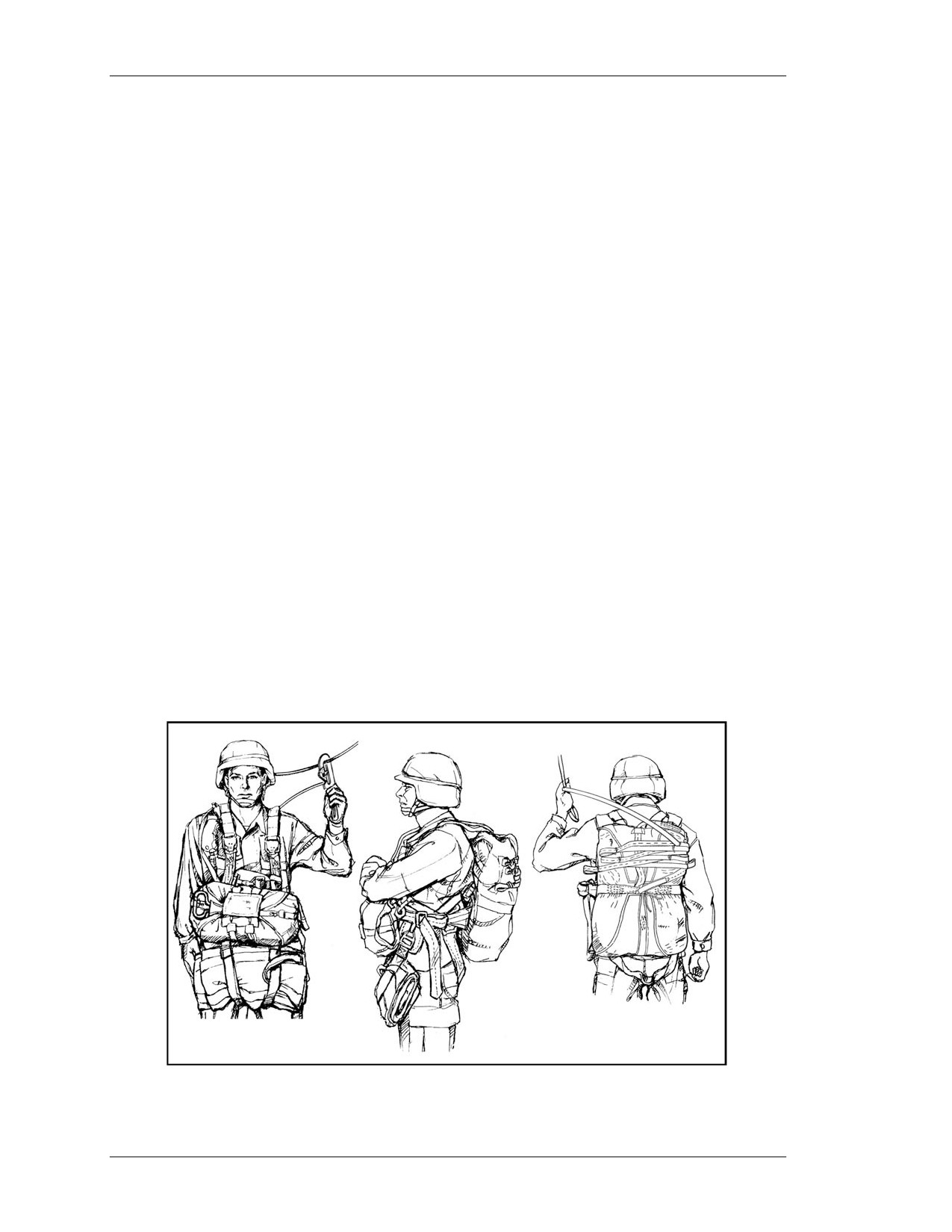
STEP 5: Number 1 stands erect and checks to ensure the canopy release assemblies
are in the pockets of the shoulders.
STEP 6: Number 2 locates the free-running ends of the horizontal back strap and
tightens the harness until number 1 indicates it fits snugly and comfortably. The
horizontal back strap is the main point of adjustment for the harness. After final
adjustment, number 1 should be able to stand fully erect without straining
(Figure 2-10).
Figure 2-10. Troop parachute harness fitted.
2-18
FM 3-21.220/MCWP 3-15.7/AFMAN11-420/NAVSEA SS400-AF-MMO-010
STEP 7: Number 1 and number 2 then change positions and repeat steps 1 through 6.
When both parachutists have donned their parachute harnesses, they face each other
and make a visual inspection. They correct any discrepancies before securing the
reserve parachute.
All excess webbing is stowed in webbing retainers.
2-14. MIRPS/T-10 RESERVE PARACHUTE
The parachutist attaches the reserve parachute by cradling the parachute in his left arm
with the connector snaps up and the rip cord grip in the palm of the left hand.
STEP 1: Using the right hand, start at the pack tray and run out the waistband
between the thumb and index finger to remove any twists or turns.
STEP 2: Thread the waistband through the two reserve waistband retainers and fasten
the right connector snap to the right D-ring. Insert the safety wire in the right
connector snap and then bend the wire down to safety it. Then connect the left
connector snap to the left D-ring.
STEP 3: Parachutists help each other in securing the waistband and forming the
quick-release. They ensure that all slack is pulled out of the waistband, and the slack
in the quick-release loop is about the width of two to three fingers.
NOTE: During the initial periods of airborne training, students receive thorough
training in the nomenclature, fitting, and wearing of the parachute assemblies.
Demonstration, followed by student participation, is the key to the success of
this instruction. Instructors constantly check to ensure students know the
proper nomenclature as well as the proper methods of wearing and fitting the
parachutes.
Section III. PROTECTIVE HEADGEAR
The ballistic helmet or the advanced combat helmet (ACH) is used during airborne
operations. The helmets must be fitted properly to ensure they stay on the parachutist’s
head during deployment of the parachute and during the parachute landing fall.
2-15. BALLISTIC HELMET DESCRIPTION
The ballistic helmet is a laminated, one-piece helmet. It has a low profile, a close fit, and
a low center of gravity. The helmet is available in four sizes: extra small, small, medium,
and large. It weighs from 2 pounds 8 ounces (extra small) to 3 pounds 4 ounces (large).
a. Parachutist Helmet Modifications. The ballistic helmet is modified for airborne
operations by adding a parachutist retention strap and a foam impact pad (Figure 2-11,
page 2-20). These items provide maximum safety and stability.
NOTE: Be sure the hook-pile tape on the ends of the parachutist retention strap faces
the rear of the helmet.
2-19
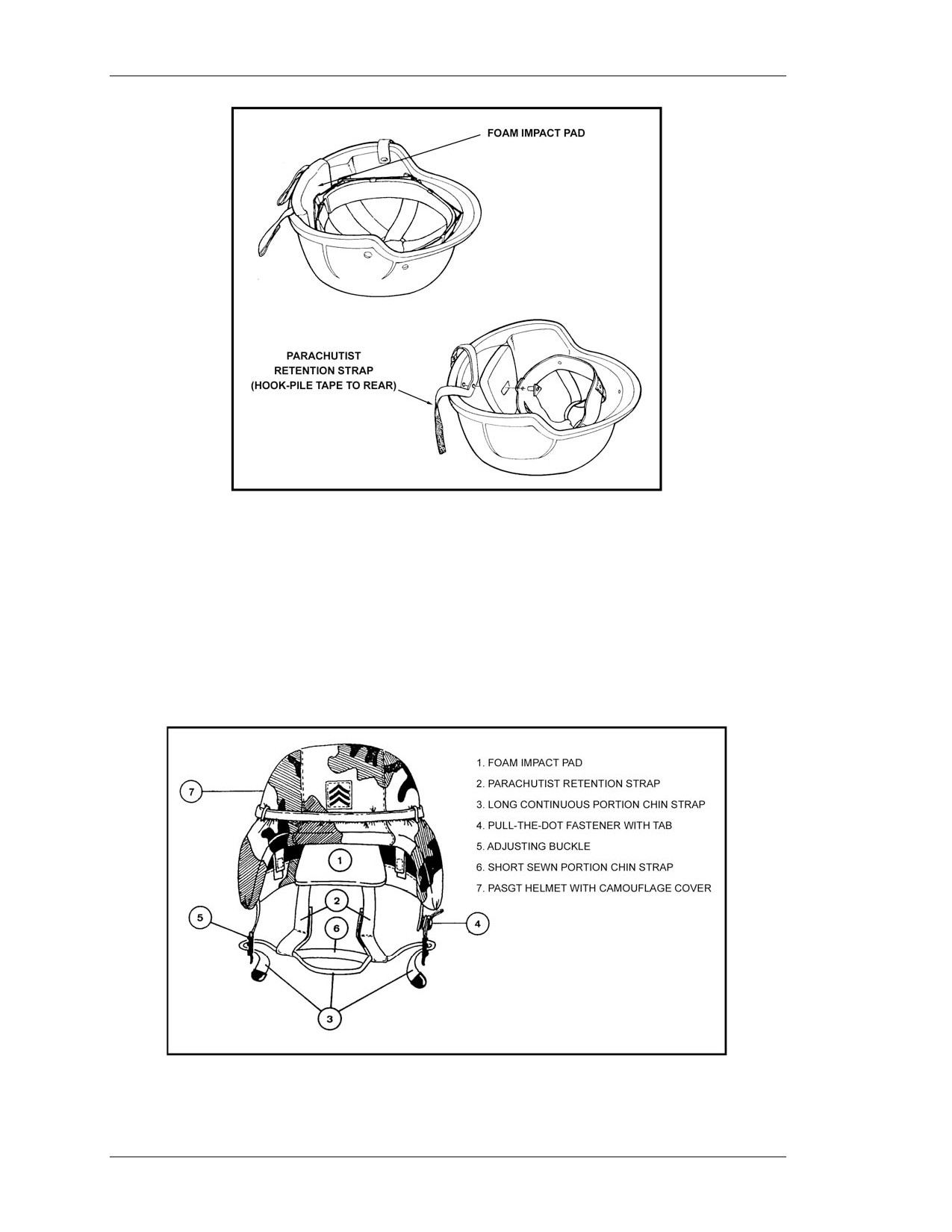
FM 3-21.220/MCWP 3-15.7/AFMAN11-420/NAVSEA SS400-AF-MMO-010
Figure 2-11. Ballistic helmet with retention strap and foam impact pad.
b. Camouflage Cover. A camouflage cover (Figure 2-12) is secured to the helmet
by placing the cover over the helmet and threading both sides of the unfastened chin strap
through the corresponding slits in the cover. The two rear attachment tabs of the cover are
tucked between the cover and the helmet. The two ends of the parachutist retention strap
are threaded through the corresponding slits in the rear of the cover. The four remaining
attachment tabs are fastened around the nylon webbing of the suspension band with
drawstring and adjustable tab.
Figure 2-12. Ballistic helmet and nomenclature.
2-20
///////////////////////////////////////