FM 3-21.220 STATIC LINE PARACHUTING TECHNIQUES AND TRAINING (SEPTEMBER 2003) - page 5
FM 3-21.220/MCWP 3-15.7/AFMAN11-420/NAVSEA SS400-AF-MMO-010
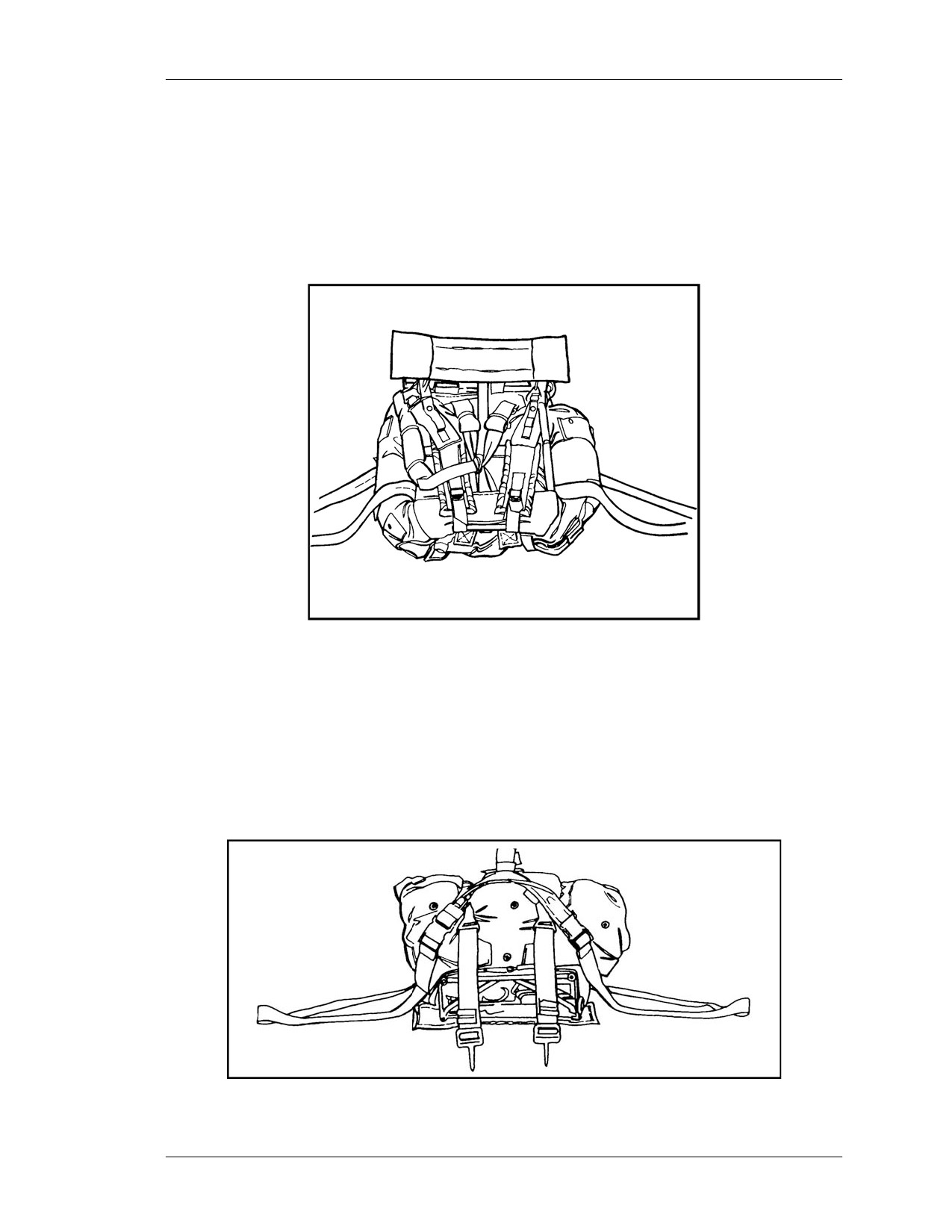
c. Repeat the process for the other strap. Turn the harness over so that the adjustable
D-ring attaching straps are on the bottom. Place the ALICE pack on top of the harness so
that the middle outer cargo pocket is placed between the release handle cross strap and
the adjustable cross strap. Ensure the top of the pack is facing the equipment retainer
straps. Route the equipment retainer straps underneath the top of the frame, cross them on
the back of the pack to form an X, then route them underneath the frame and the backrest
of the pack (Figure 12-10).
Figure 12-10. Harness routed.
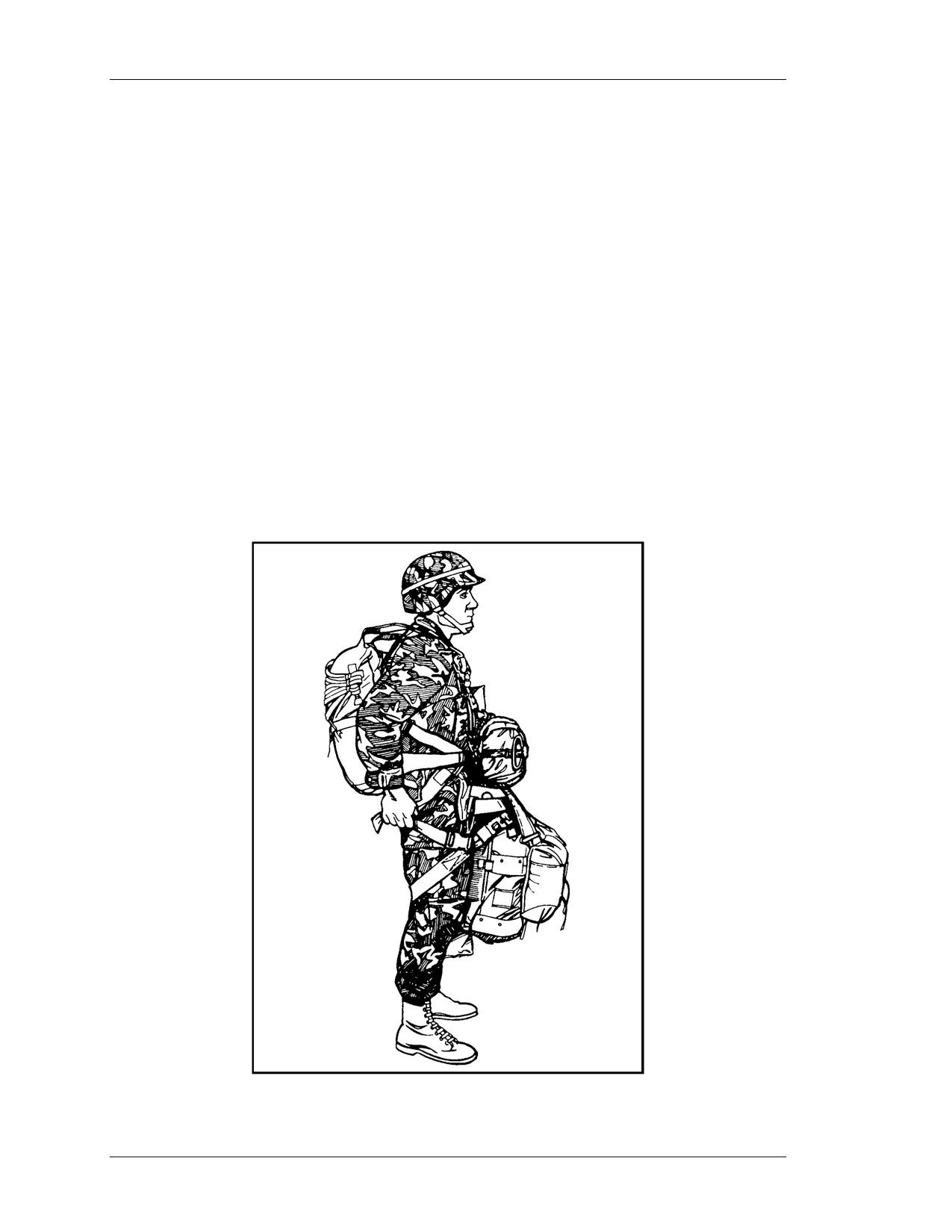
d. Route the equipment retainer straps through their appropriate friction adapters and
form a two- or three-finger quick release. S-roll the excess webbing and secure it with
two turns of the retainer bands. Do not secure the excess webbing to the quick release.
Route the adjustable leg straps in the most direct route around the pack and attach the
male portion of the leg strap release assembly to the female portion of the leg strap
release assembly. Fold the excess webbing and secure it in the webbing retainer. Attach
the HPT lowering line the same as with the standard H-harness (Figure 12-11).
Figure 12-11. Leg straps routed.
12-13
FM 3-21.220/MCWP 3-15.7/AFMAN11-420/NAVSEA SS400-AF-MMO-010
12-16. ATTACHMENT OF HARNESS, SINGLE-POINT RELEASE AND ALICE
PACK TO PARACHUTIST
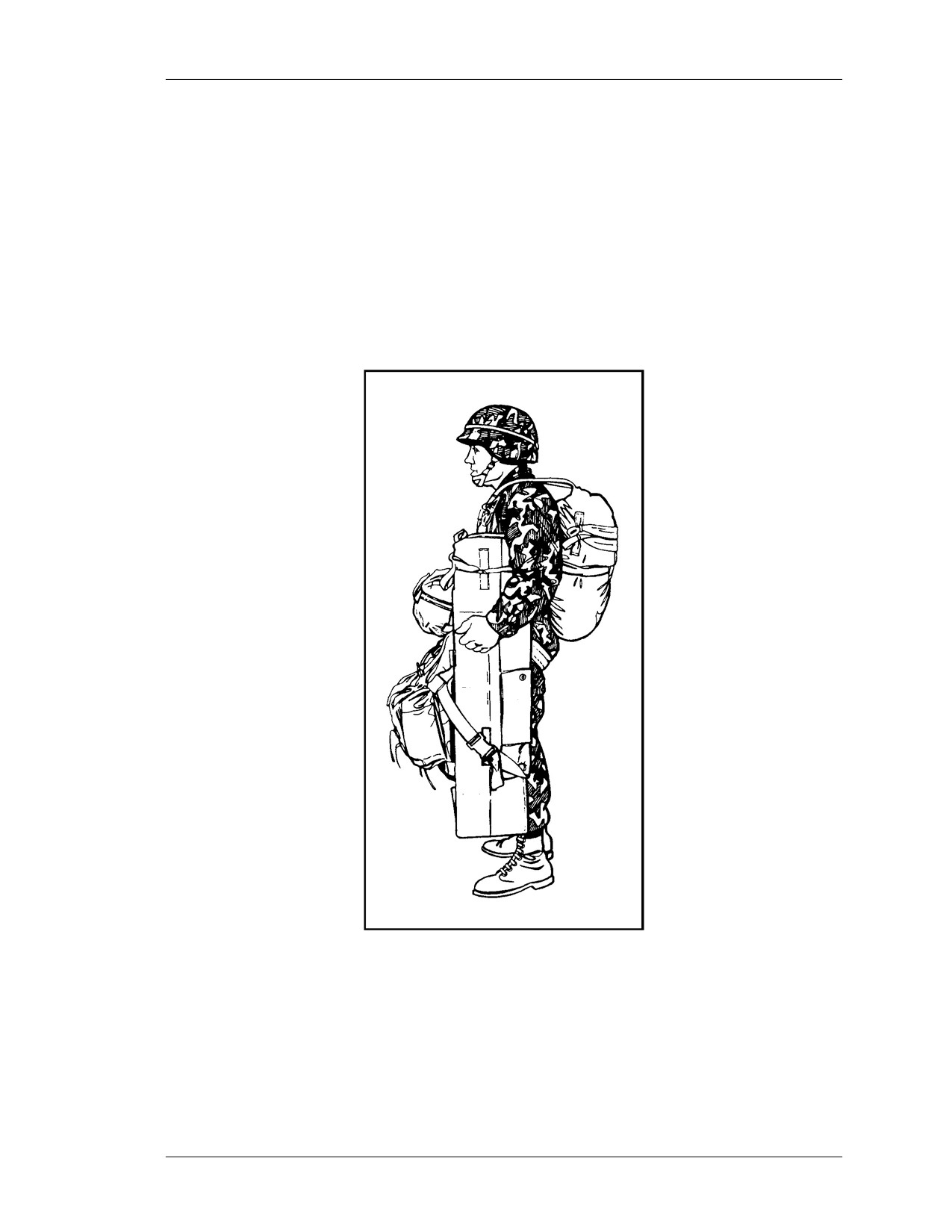
When completely rigged, the HSPR is attached to the parachutist in the following
sequence.
a. Using the buddy system, the parachutist stands in front of the HSPR-rigged
ALICE pack. He grasps the harness by the two adjustable D-ring attaching straps and
secures them to the D-rings on the main lift web outside of the connector snaps of the
MIRPS/T-10 reserve (Figure 12-12).
b. The parachutist pulls on the free-running ends of the adjustable D-ring attaching
straps and snugs the pack under the reserve. He then routes the ejector snap of the HPT
lowering line through the nylon chafe material on the M1950 weapons case, from front to
rear, then attaches the M1950 weapons case. He attaches the ejector snap on the HPT
lowering line to the accessory attaching ring or triangle line as the outermost item on the
D-ring. To attach the HPTL to the left D-ring, first open the ejector snap.
c. After the JM completes his JMPI, he routes the male portion leg strap release
assemblies around the parachutist’s legs and the M1950 weapons case, and attaches them
to the female portion leg strap release. Adjustable leg straps may be tightly secured, but
must not be so tight that they prevent the parachutist from executing a strong exit.
Figure 12-12. Parachutist adjusts leg straps.
12-14
FM 3-21.220/MCWP 3-15.7/AFMAN11-420/NAVSEA SS400-AF-MMO-010
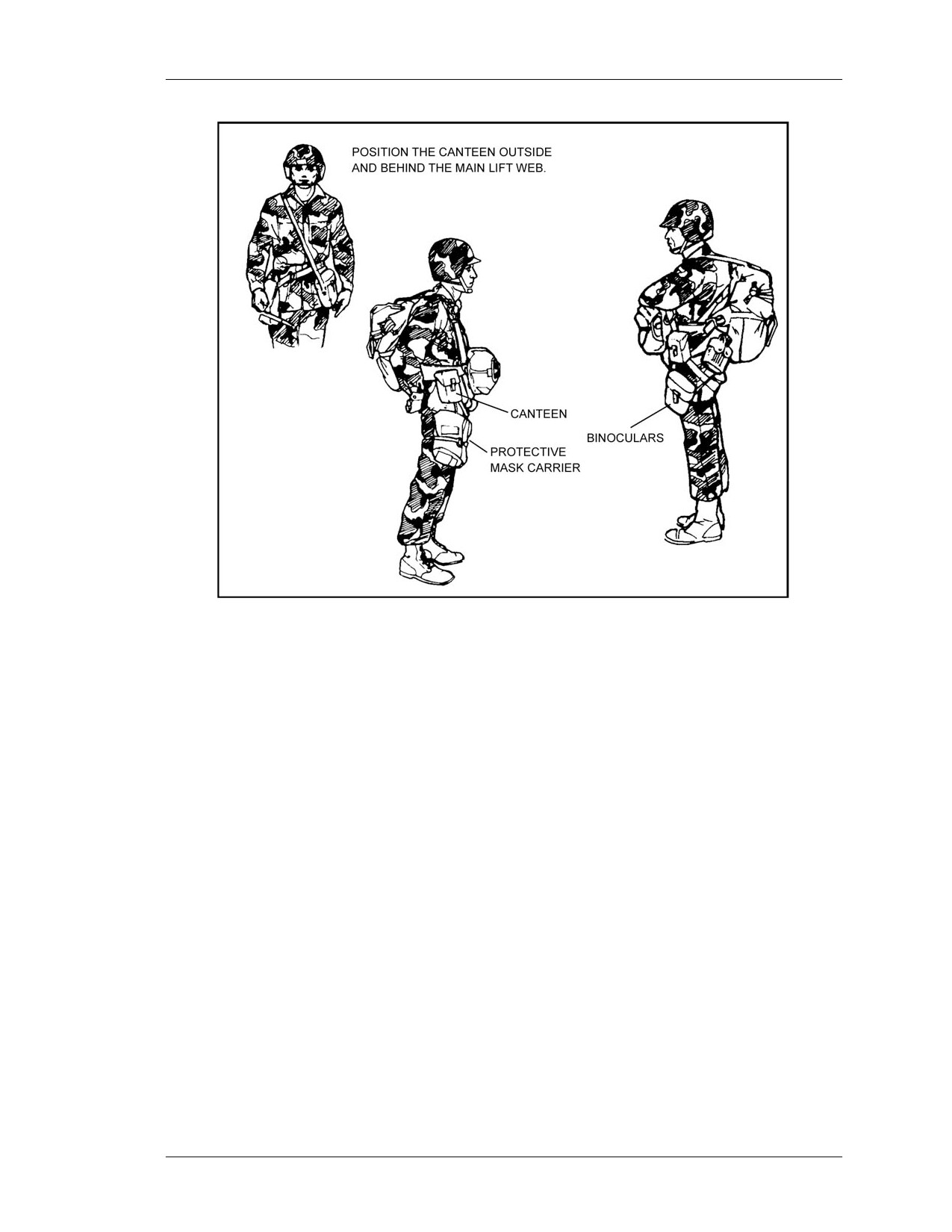
12-17. TANDEM LOAD ATTACHED TO PARACHUTIST
The attachment of the rigged pack to the parachutist is identical to the procedure
described in paragraph 12-16, with the following exceptions (Figure 12-13).
a. The lower tie-down tape is removed from the weapons case. If using the modified
weapons case (with the HPT leg tie-down strap), the tie-down is routed around the case,
the HPT is pressed together, and excess webbing is secured.
b. After the weapons case is attached to the parachutist, the leg strap of the HSPR is
routed around the jumper’s leg and the outside of the weapons case. Then the jumper
tightens the adjustable leg strap after hooking the static line snap hook to the anchor line
cable.
Figure 12-13. Tandem load attached.
c. The long end of the upper tie-down tape on the weapons case is routed around the
case and main lift web directly above the chest strap of the parachute harness. It is tied
with a bowknot on the front leading edge of the weapons case.
12-15
FM 3-21.220/MCWP 3-15.7/AFMAN11-420/NAVSEA SS400-AF-MMO-010
12-18. TANDEM LOADS RELEASED AND LOWERED (HARNESS, SINGLE-
POINT RELEASE)
Upon exiting the aircraft, the parachutist executes the first two points of performance and
then, during the third point of performance, unties the upper tie-down tape on the
weapons case.
a. About 100 to 200 feet above the ground, the parachutist grasps the release handle
and pulls up and out quickly, while at the same time releasing the load (and leg straps)
and allowing it to drop the length of the lowering line. The activating arm of the
quick-release snap on the weapons case is activated, and the case slides down the
lowering line to rest on top of the (lowered) pack.
b. The release handle is released immediately following separation of the load from
the jumper. The handle for releasing the load is secured to the HSPR with a release
handle lanyard and stays with the HSPR to prevent its loss or separation.
c. To jettison the HSPR in an emergency, the parachutist lowers the pack, lowers the
M1950 weapons case, then pulls out on the yellow safety lanyard (attached to the ejector
snap on the HPT lowering line), which allows the pack to fall free.
12-19. JUMPING OF EXPOSED LOAD-BEARING EQUIPMENT
The procedures for rigging and wearing the protective mask carrier and the exposed
load-bearing equipment during airdrop operations are as follows (Figure 12-14).
a. Protective Mask Carrier. The exposed protective mask carrier is worn in a
different manner when airdrop operations are conducted.
(1) Wrap the narrow waist strap around the carrier, underneath the flap of the lower
outside pocket, through the large O-ring, and hook it to the small D-ring to secure the
quick opening flap securely closed.
CAUTION
Do not place masking tape on the mask carrier.
12-16
FM 3-21.220/MCWP 3-15.7/AFMAN11-420/NAVSEA SS400-AF-MMO-010
Figure 12-14. Binoculars and protective mask carrier rigged.
(2) Route the wide waist strap around the jumper’s waist and hook it to the large
D-ring, before donning the parachute and LBE. Don LBE and parachute, if LBE is to be
jumped exposed.
(3) Place the aviator kit bag under the protective mask carrier. Route the parachute
harness left leg strap through the carrying handle of the aviator kit bag and connect it to
the left ejector snap. Route the parachute harness right leg strap directly to the right
ejector snap. Do not attempt to secure the mask carrier with the leg straps.
(4) Adjust the length of the wide waist strap of the mask carrier so the entire mask
carrier rests below the hip pad of the ALICE pack, but not so low that it interferes with
the parachutist’s ability to walk.
b. Load-Bearing Equipment. The LBE is worn in a standard manner when airdrop
operations are conducted.
(1) Position the LBE just below the bottom of the parachute pack tray so that no
portion of the parachute harness (for example, waistband, horizontal back strap, diagonal
back straps, and so forth) rests on any major accessory item placed on the LBE (for
example, canteen or ammunition pouch).
(2) Ensure the LBE is not covering any point of contact
(for example, thighs,
buttocks, or pull-up muscle) and is not buckled in front. JMs and jumpers must not wear
knives on a point of contact.
(3) If a field pack is worn (for example, buttpack), make sure it does not contain any
fragile items or equipment that is in a hard case.
12-17
FM 3-21.220/MCWP 3-15.7/AFMAN11-420/NAVSEA SS400-AF-MMO-010
(4) Tape any sharp edged piece of equipment, such as the wire cutter on the M9
bayonet sheath, with 100-mph tape to prevent snagging on other equipment.
(5) Ensure proper wear of the LBE by fitting it snugly against the jumper’s body to
prevent it from becoming entangled in risers, suspension lines, or equipment inside the
aircraft.
(6) Route the LBE through the parachute harness before donning, or wear it before
donning the parachute.
12-20. ENHANCED TACTICAL LOAD-BEARING VEST
The ETLBV must be in its full extended position. Both upper and lower chest buckles
and the pistol belt remain unfastened. The jumper removes all slack from the chest buckle
adjusting strap, S-folds or rolls the excess webbing, and secures the tape. After the
jumper dons his parachute, the pistol belt and canteens are routed below the horizontal
back strap and over the saddle. The ETLBV chest-mounted sewn-in magazine pouches
are routed in the V formed by the horizontal back straps.
Section V. ADJUSTABLE INDIVIDUAL WEAPONS CASE (M1950)
The parachutist’s M1950 individual weapons case is designed to carry individual or
crew-served weapons. The M1950 may also be modified for other configurations. It is 10
inches wide and is adjustable in length from 33 1/2 inches to 50 1/2 inches. It is secured
vertically by a quick-release snap attached to the left D-ring on the parachute harness.
12-21. M1950 SECURED TO PARACHUTIST
To prevent the M1950 from swaying during the opening shock of the parachute, two tie-
downs fasten the case to the parachutist.
a. The upper tie-down tape is tied around the main lift web of the harness, and the
lower tie-down tape goes around the parachutist’s leg. If the weapons case has been
modified, the lower tie-down strap (HPT) is secured around the leg.
b. Upon landing, the parachutist can secure his weapon quickly by opening the slide
fastener, which is protected by a closing flap.
c. The slide fastener is designed as a quick release. To activate it (when the case is
closed), a sharp tug on the slide fastener and tab thong (in the same direction as when
zipping the container closed) causes the slide fastener to come apart.
12-22. M1950 ATTACHED TO PARACHUTIST
The M1950 is attached after the parachutist dons (and adjusts) the main and reserve
parachutes.
a. The quick-release snap is attached to the quick-release link on the case. The
opening gate of the quick-release snap faces the parachutist and is attached to the
parachutist’s left D-ring (to the outside of the reserve parachute connector snap).
b. The long end of the lower tie-down tape is passed around the outside of the case
and in back of the left leg above the knee. Using a bowknot, the ends of this tape are tied
together on the front leading edge of the weapons case. (The knot is untied before
landing.) If the case has been modified with HPT leg straps, the piles are pressed
together.
12-18
FM 3-21.220/MCWP 3-15.7/AFMAN11-420/NAVSEA SS400-AF-MMO-010
c. The long end of the upper tie-down tape is passed (from left to right) around the
weapons case and main lift web of the parachute harness above the chest strap. Using a
bowknot, the ends of this tape are tied together on the front leading edge of the weapons
case.
Section VI. M16 RIFLE/M203 GRENADE LAUNCHER,
EXPOSED AND PACKED
The M16 rifle or M203 grenade launcher can be jumped exposed or inside the M1950
weapons case. If the field-expedient method (weapon exposed) is used, the commander
must consider that this may increase risk of injury to the parachutists and, therefore,
hinder success of the mission. Inherent hazards of the exposed weapon include—
• The weapon becoming entangled with another jumper’s parachute if a midair
collision occurs.
• Possible injury to the parachutist during the PLF.
• Damage to the weapon during landing, which may cause a failure to fire.
12-23. M16 RIFLE/M203 GRENADE LAUNCHER EXPOSED
The sling is extended all the way, and the keeper is taped in place. The padding is secured
over the side-mounted bolt forward assist and charging handle.
a. Place a plastic muzzle cap on the M16 muzzle, or pad and tape the muzzle and
sight. This prevents the weapon from becoming entangled with the parachute suspension
lines, or dirt from clogging the weapon during landing. Insert a magazine into the weapon
and tape the magazine to the receiver, including the ejector port cover, to prevent loss of
the magazine and debris from entering the bolt area.
(Ensure that a round is not
chambered and the weapon is placed on SAFE). Tape the hand guards to prevent loss
upon impact when landing. (To aid in the removal of the padding and tape, fold and press
the adhesive side on the running end of the tape together to form a quick-release pull tab.)
b. Further secure the weapon with two tie-downs of 1/4-inch cotton webbing (or a
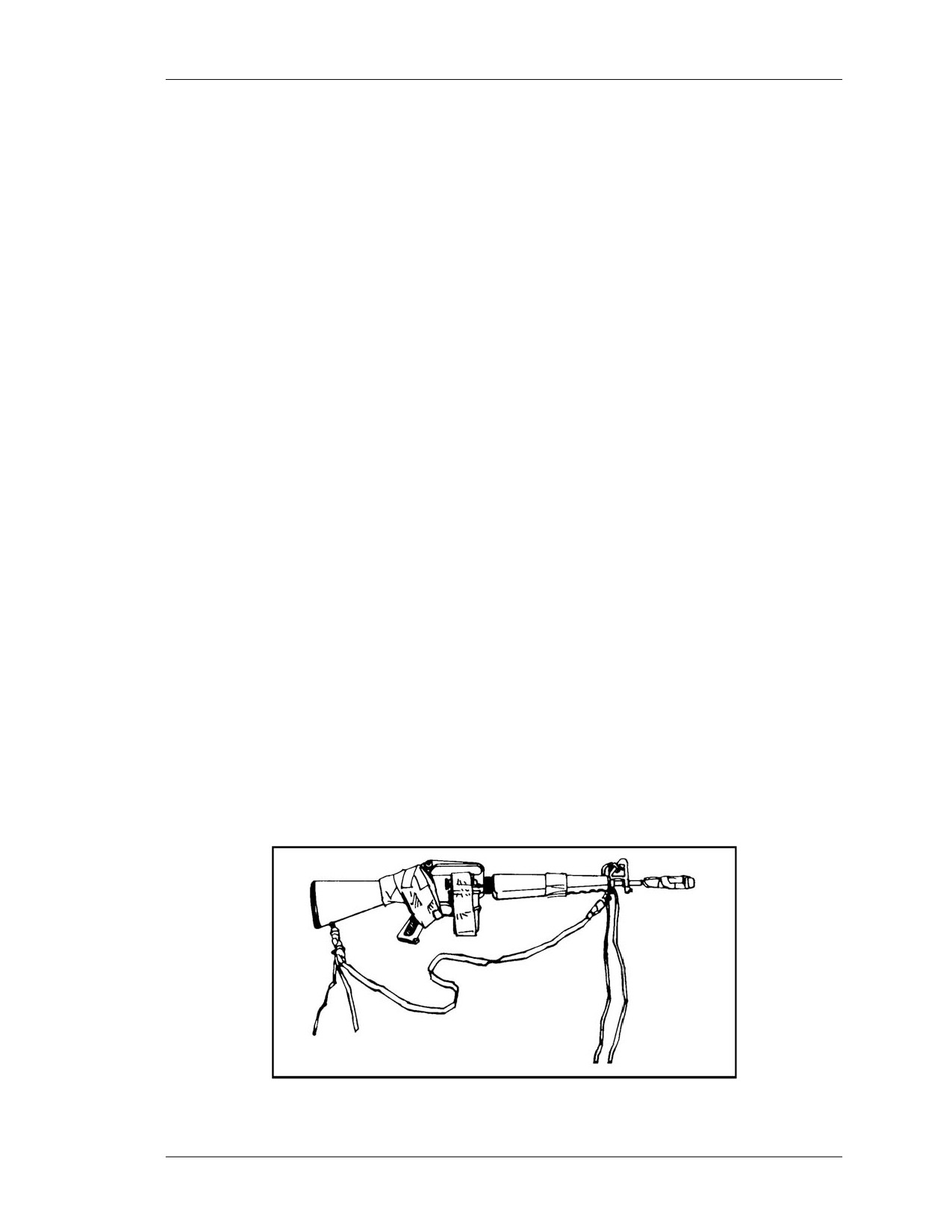
like item) with bowknots (Figure 12-15). Secure the sling to the diagonal back strap with
the upper tie-down, which is a 12-inch tie strap. Secure the barrel of the rifle to the leg
with a 24-inch strap to prevent possible entanglement with suspension lines. Remove the
lower tie-down before landing to avoid personal injury.
Figure 12-15. Tie-downs.
12-19
FM 3-21.220/MCWP 3-15.7/AFMAN11-420/NAVSEA SS400-AF-MMO-010
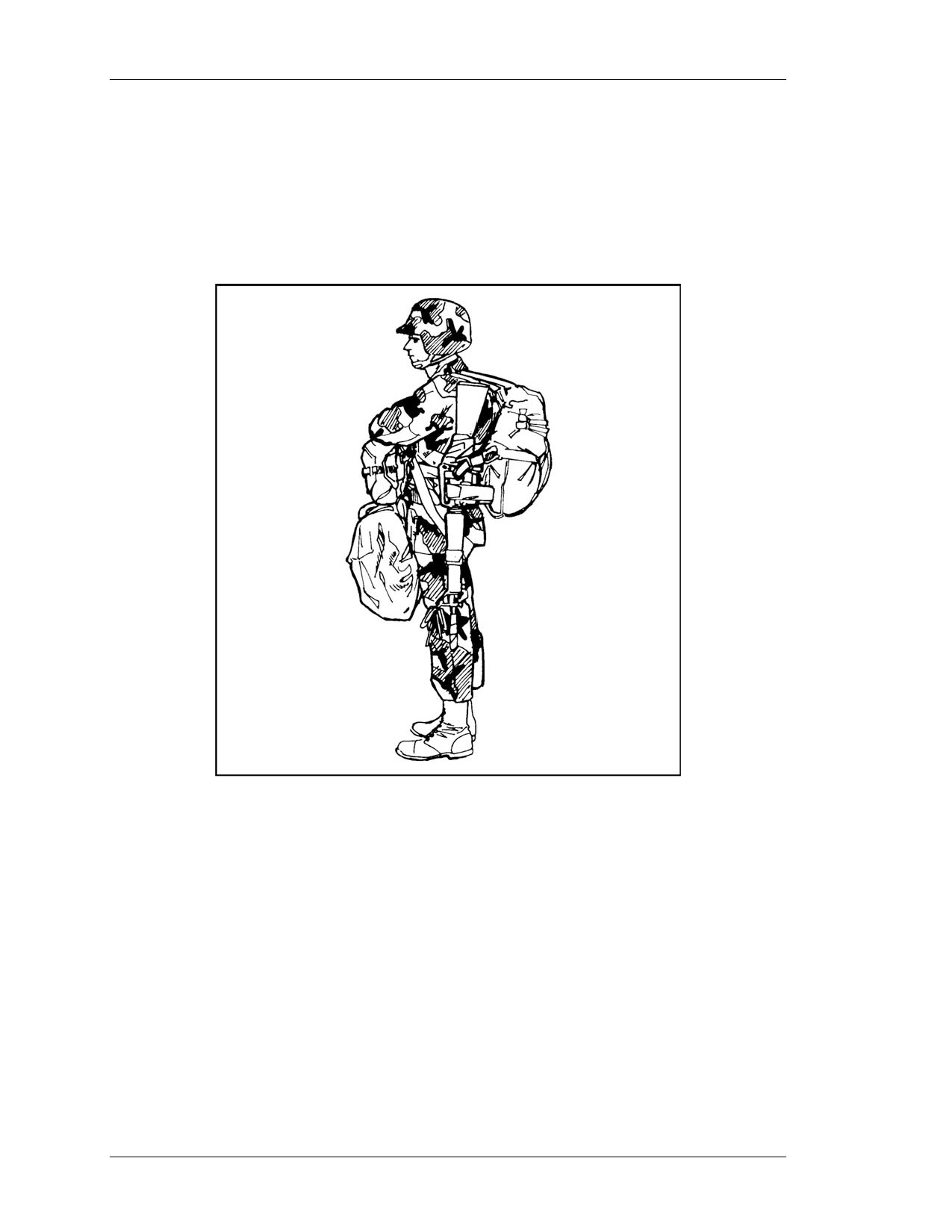
c. Sling the weapon over the left shoulder, with the muzzle down, and rotate it so
that the pistol grip is facing the (parachutist’s) rear (Figure 12-16). Place the sling from
the lower keeper (stock) on the outside of the stock and over the left shoulder. Then run it
under the chest strap of the main lift web. Thread the waistband through the carrying
handle and into the metal adjuster on the waistband adjuster panel. Tighten the waistband
securely so the weapon lies snugly against the parachutist’s side.
Figure 12-16. Rifle positioned with muzzle down.
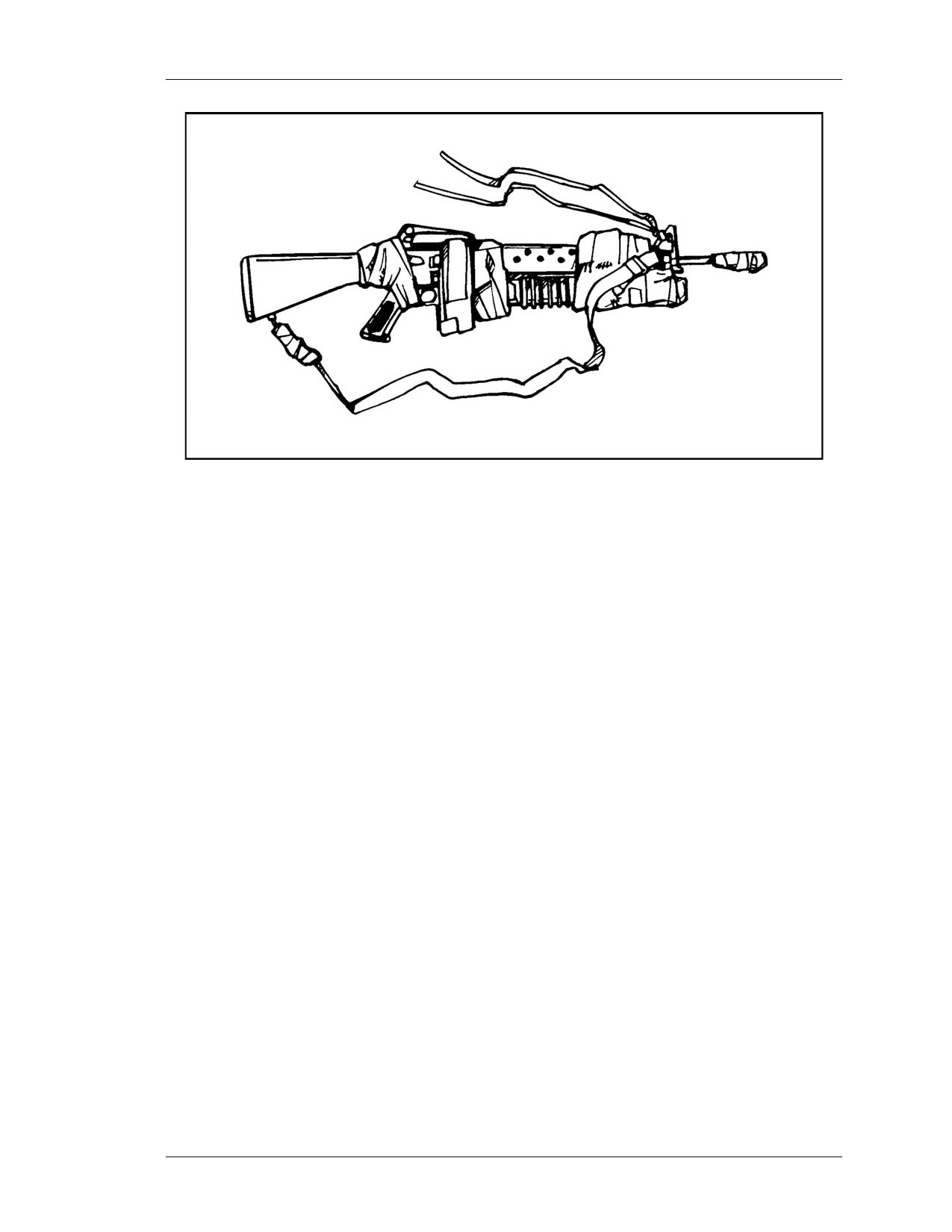
d. Prepare the M203 grenade launcher as outlined above, but place additional
padding and tape around it (Figure 12-17).
12-20
FM 3-21.220/MCWP 3-15.7/AFMAN11-420/NAVSEA SS400-AF-MMO-010
Figure 12-17. M203 grenade launcher, padded and taped.
12-24. M16 RIFLE/M203 GRENADE LAUNCHER PACKED IN M1950
The M1950 weapons case is laid flat with the closing flap facing up and opened. The
weapon is inserted muzzle end first into the case with the forward assist facing up. A
20-round magazine is placed in the magazine well, if desired, but the parachutist ensures
that a round is not chambered.
a. Close the case by using the flap thong, slide fastener and tab thong, and slide
fastener. Leaving the slide fastener 1 to 2 inches from the top, separate the slide fastener
and tab thong over the male portion lift fastener, and secure the female portion lift
fastener to the male portion. If the lift fastener (or post) is unserviceable, route the upper
tie-down tape through the slide fastener and tab thong.
b. Stand the case on its end so the weapon’s muzzle is pointed up. Fold the excess
case over the back side of the case and route the adjusting strap through the top set of
adjusting strap connectors and secure it with a half hitch.
c. The M16/M203 may be jumped inside the case with a LAW or starlight scope. To
do this, place the LAW or starlight scope on top of the M16/M203 and add padding
(cellulose wadding) between the two items. It is usually rigged to the parachutist as a
tandem load to be lowered on a single lowering line with the ALICE pack
(paragraph 12-13).
Section VII. M60 MACHINE GUN
The M60 machine gun can be rigged on the individual parachutist or dropped as an
accompanying load. If jumped on the individual, it is jumped as a team load.
12-25. M60 PACKED ASSEMBLED
The M1950 weapons case is laid down with the closing flap facing up. The muzzle of the
M60 is placed into the lower-right corner of the weapons case. The weapon is pressed
down until it is seated inside the case with the operating bolt up.
12-21
FM 3-21.220/MCWP 3-15.7/AFMAN11-420/NAVSEA SS400-AF-MMO-010
12-26. M60 PACKED DISASSEMBLED
The M1950 weapons case is shortened to 36 inches and laid down with the closing flap
facing up (required when characteristics of a particular aircraft dictate length restrictions).
It is packed as follows:
a. Disassemble the two groups by removing the barrel group.
b. Place the receiver group in the weapons case with the forearm assembly to the
right and the cover facing down.
c. Place the barrel group in the case with the front sight to the left and
pointing down.
d. Fit in the barrel group by sliding it to the right as far as possible so that the bipod-
leg feet are not opposite the trigger housing group.
e. Add padding between the two groups.
NOTE: When the M60 is team loaded, the accessory bag, spare barrel, and tripod are
placed in a separate weapons case and jumped by the assistant gunner. Both
cases are usually tandem rigged and lowered (paragraph 12-13).
Section VIII. M249 SQUAD AUTOMATIC WEAPON
The SAW can be rigged for lowering as a tandem load or individual load. Tandem
rigging is the same as for the M1950 weapons case and ALICE pack.
12-27. SAW MOD M1950 WEAPONS CASE
A modified M1950 weapons case is used for the SAW. The case is marked “SAW MOD”
on the outside and has an extended 6 1/2-inch closing flap, which allows the weapon to
fit in the case. A piece of cellulose wadding, about 20 inches long and 10 inches wide, is
folded to form a pad about 10 inches long and 5 inches wide. This pad is placed in the
muzzle end of the case. A 30-round magazine may be jumped with the SAW. The
magazine is taped to the left side of the buttstock. The SAW is placed inside the case
muzzle first. The pistol grip is toward the inside, and the carrying handle is facing up and
away from the parachutist’s body.
12-28. ATTACHMENT TO PARACHUTIST
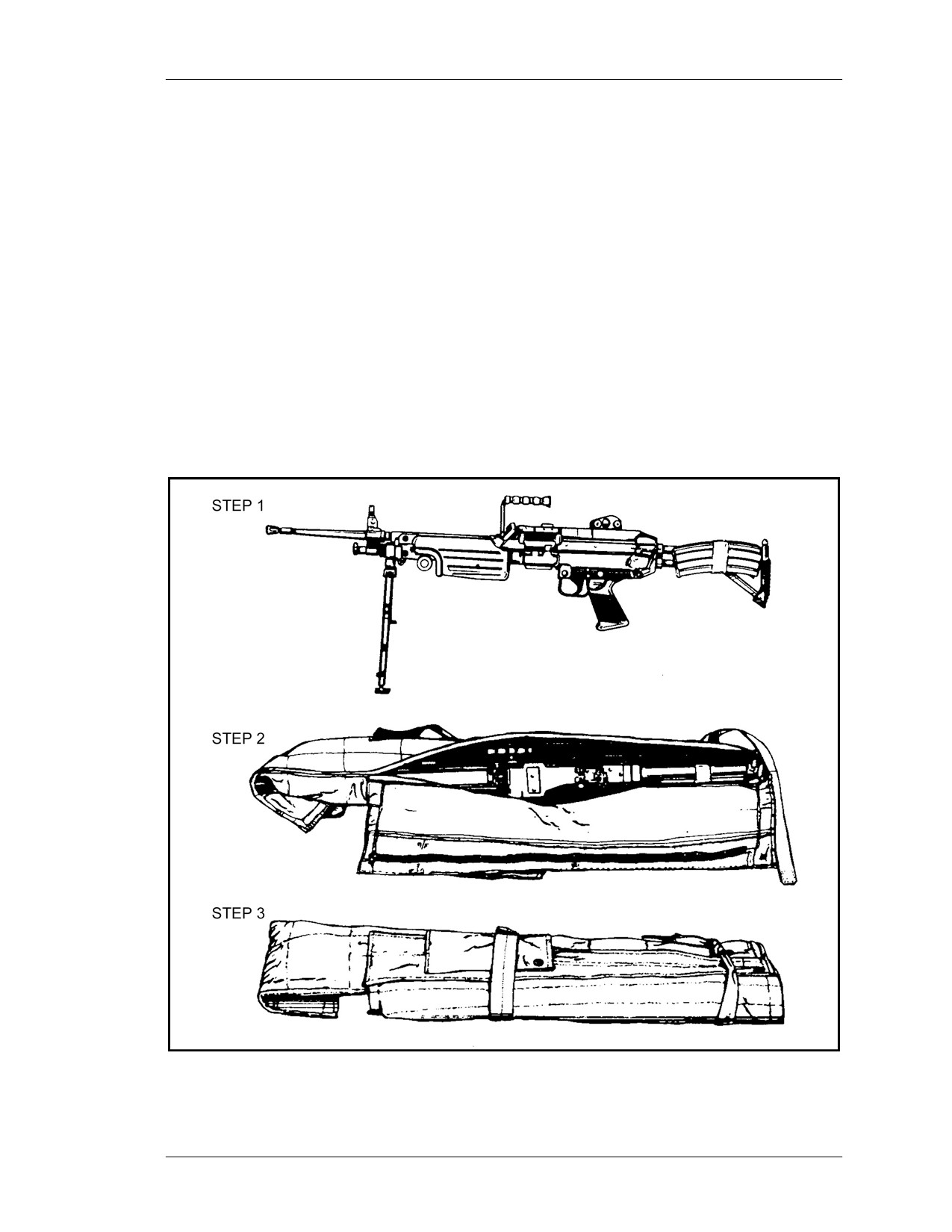
When rigging the SAW as a single item to be lowered (Figure 12-18), the parachutist
attaches the quick-release snap to the quick-release link. This ensures that the opening
gate quick-release snap is facing away from the main body of the SAW MOD M1950
weapons case when the quick-release link is pointed toward the top of the case. The
parachutist does not route the quick-release link through the metal V-ring. No safety tie
is used.
a. Prepare the HPT lowering line by folding it in the normal manner. No HPT
lowering line should protrude from the retainer flaps. Secure each end of the HPT
retainer flap with the HPT tab.
b. Route the looped end HPT lowering line from top to bottom through the V-ring of
the SAW MOD M1950 weapons case. Route the entire HPT lowering line through the
looped end HPT lowering line, forming a tight girth hitch around the V-ring.
12-22
FM 3-21.220/MCWP 3-15.7/AFMAN11-420/NAVSEA SS400-AF-MMO-010
c. Place the HPT lowering line against the main body of the SAW MOD M1950
weapons case to the left of the nylon chafe material, which secures the V-ring and quick-
release link. The lowering line ejector snap points toward the top of the SAW MOD
M1950 weapons case. The 1-inch tubular nylon webbing, which forms the looped end
HPT lowering line, should rest between the retainer flap of the HPT lowering line and the
nylon chafe material.
d. Secure the HPT lowering line with four turns of 1-inch-wide masking tape--two
turns are routed around the main body directly below the quick-release link, and two
turns are routed around the main body directly above the upper set of the adjusting strap
connectors.
e. To attach the SAW MOD M1950 weapons case to the jumper’s parachute
harness, attach the quick-release assembly to the left D-ring of the parachute harness as
the outermost item of equipment. Route the lowering line ejector snap below the quick-
release assembly and attach it to the accessory attaching ring on the lowering line adapter
web, with the opening gate facing toward the parachutist. Secure the upper tie-down tape
and lower tie-down strap.
Figure 12-18. SAW rigged as a single item to be lowered.
12-23
FM 3-21.220/MCWP 3-15.7/AFMAN11-420/NAVSEA SS400-AF-MMO-010
Section IX. M224, 60-MM MORTAR
A modified M1950 weapons case is used for the M224 60-mm mortar. It is marked
“60-mm MOD” on the outside and has an extended 11 3/4-inch closing flap.
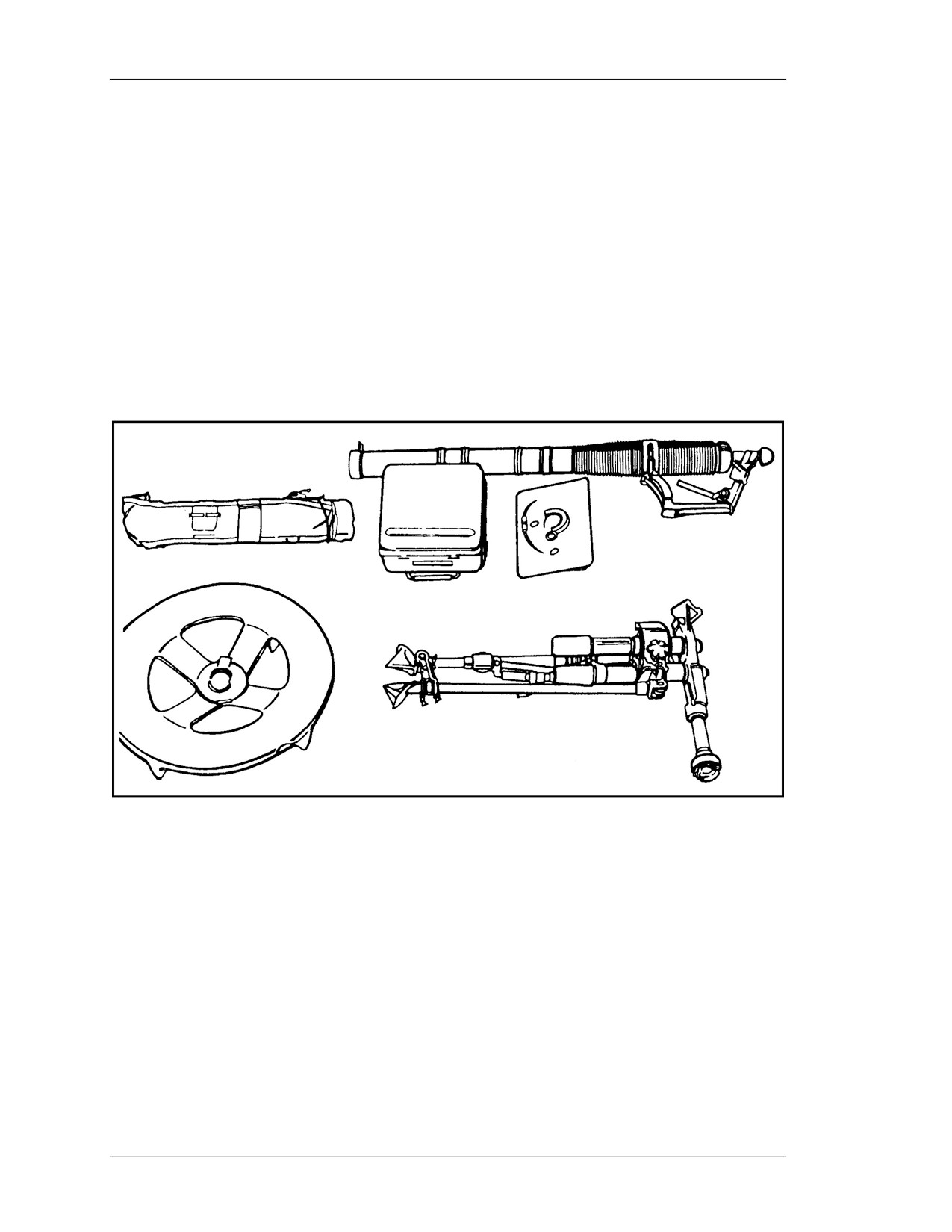
12-29. MAJOR COMPONENTS
The components of the M224 are as follows (Figure 12-19).
• Aiming posts with case.
• M8 baseplate (small).
• M64 sight unit.
• M225 barrel.
• M170 bipod assembly.
• M7 baseplate (large).
Figure 12-19. Components, M224 mortar.
12-30. LOAD DISTRIBUTION
The M224 crew members jump with the following components.
a. Gunner.
• M224 barrel, in M1950 modified weapons case marked “60-mm MOD.”
• M8 baseplate, in ALICE pack.
• M64 sight unit, centered in ALICE pack.
b. Assistant Gunner.
• M170 bipod, in M1950 modified weapons gunner assembly case marked
“60-mm MOD.”
c. Ammunition Bearer.
• Ammunition, in ALICE pack.
12-24
FM 3-21.220/MCWP 3-15.7/AFMAN11-420/NAVSEA SS400-AF-MMO-010
• M7 baseplate, in ALICE pack (outside of ALICE pack).
• Aiming posts, in ALICE pack (on top) with case.
12-31. INSTRUCTIONS FOR RIGGING
Following are instructions for rigging the M224 60-mm mortar.
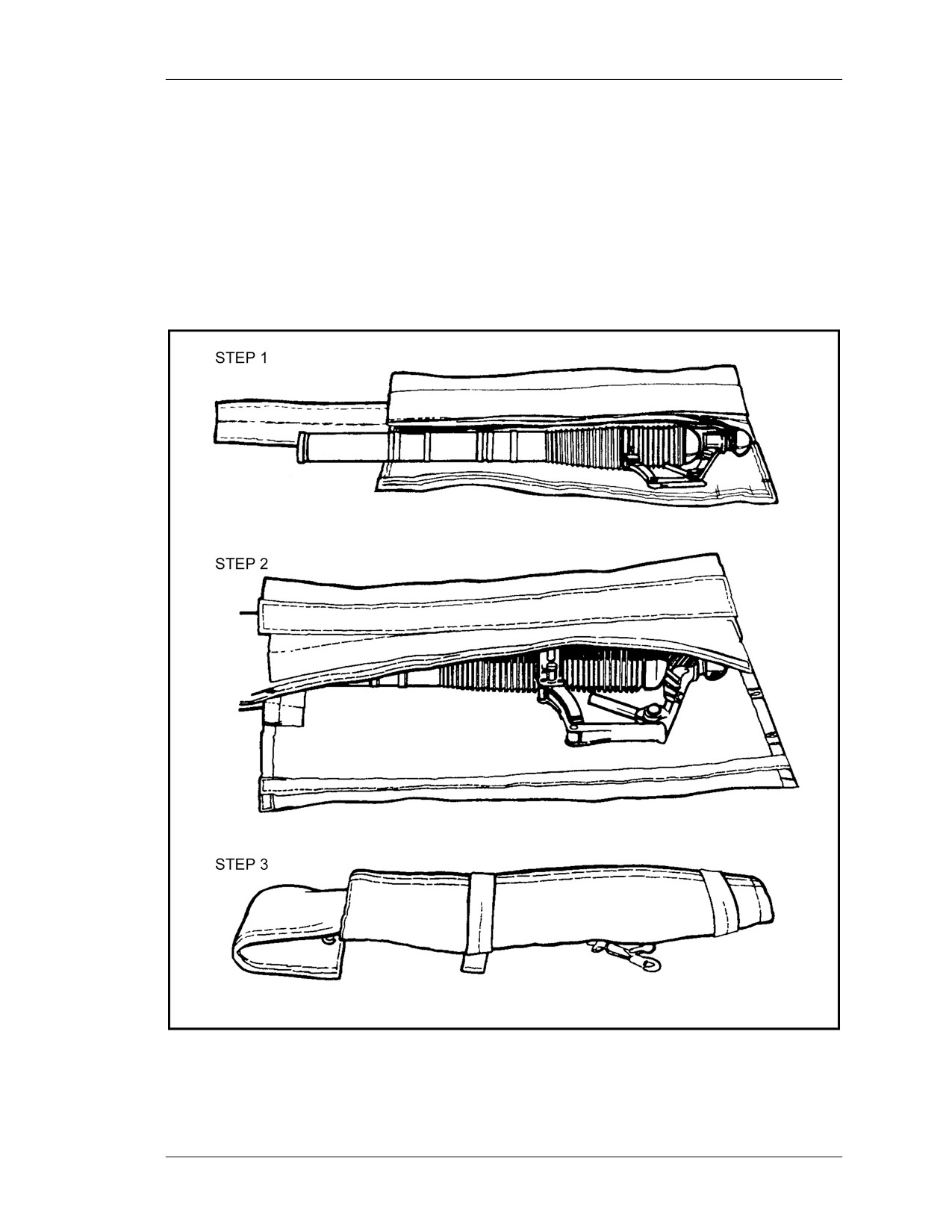
a. Gunner. Place the barrel inside the case, muzzle down. Pack the small baseplate
and sight unit inside the ALICE pack. Pad the sight unit with clothing or cellulose
wadding to absorb the impact shock. Tandem-rig the pack and case for lowering
(Figure 12-20).
Figure 12-20. Barrel packed.
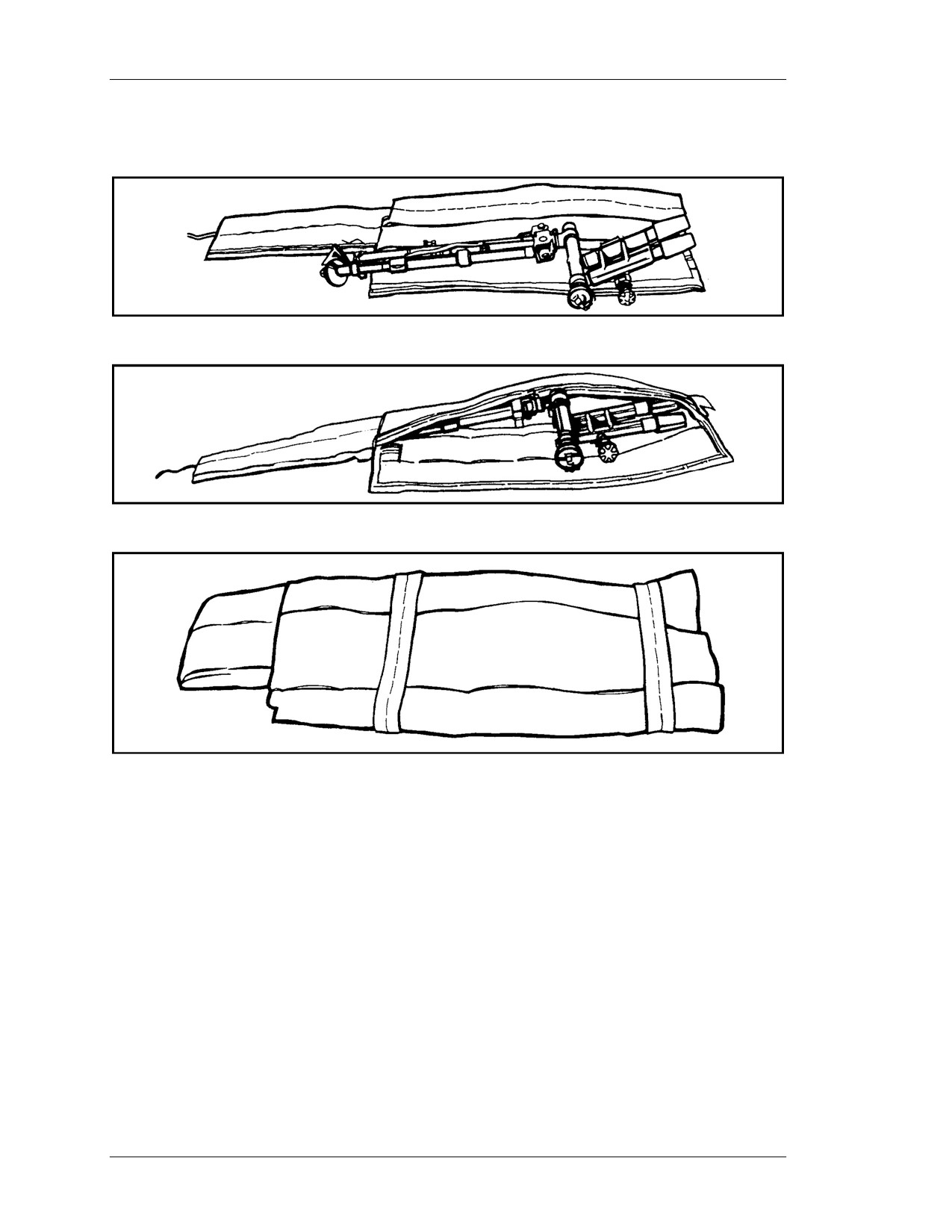
b. Assistant Gunner. Place the bipod assembly inside the case (Figures 12-21 and
12-22, page 12-26), ensuring that the traversing mechanism is in the middle of the case.
12-25
FM 3-21.220/MCWP 3-15.7/AFMAN11-420/NAVSEA SS400-AF-MMO-010
Secure the closing flap. Tandem-rig the case and pack for lowering (Figure 12-23 and
paragraph 12-13).
Figure 12-21. Bipod with case.
Figure 12-22. Bipod in case.
Figure 12-23. Assistant gunner’s case completed for jumping.
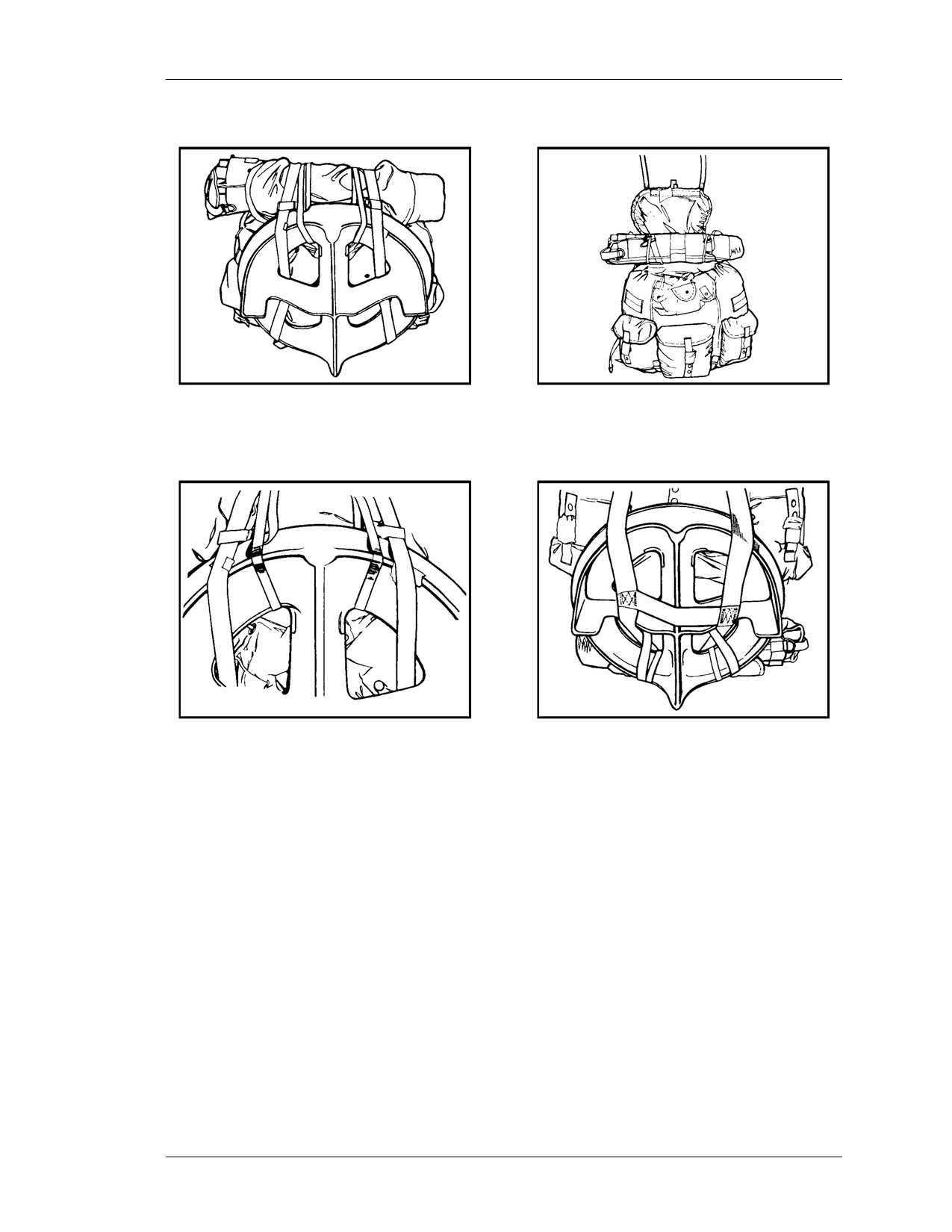
c. Ammunition Bearer. Place the aiming posts under the top flap of the pack and
secure with 1/4-inch cotton webbing to the top of the frame (Figure 12-24). Place the
large baseplate over the outer accessory pouches and secure to the top of the frame with
1/2-inch tubular nylon webbing (Figure 12-25). Route the free-running ends of the pack
adjusting straps through the baseplate (over, under, and over) and secure (Figure 12-26).
Secure the H-harness to the pack and baseplate, ensuring that the equipment retainer
straps are routed under the baseplate (top of the ALICE pack) (Figure 12-27) and over the
baseplate (bottom of the ALICE pack).
NOTES:
1. Protect ammunition with cellulose wadding or clothing in ALICE pack.
2. Do not exceed weight limitations of the ALICE packs (large, 95 pounds;
medium, 70 pounds).
3. Do not exceed weight limitation of parachute (360 pounds rigged weight
for the T-10-series or the MC1-series).
12-26
FM 3-21.220/MCWP 3-15.7/AFMAN11-420/NAVSEA SS400-AF-MMO-010
Figure 12-24. Aiming posts packed
Figure 12-25. Large baseplate
and secure.
secured to frame.
Figure 12-26. Pack adjusting straps
Figure 12-27. H-harness secured to
routed through baseplate.
pack and baseplate.
Section X. CONTAINER, WEAPON, INDIVIDUAL EQUIPMENT
AND M202A1 ROCKET PACK
The CWIE is a general-purpose item used to carry designated combat equipment. It
consists of a container and harness assembly, and when rigged for jumping, the container
is attached to a harness assembly. The maximum dimensions for the CWIE are 12 inches
wide, 12 inches deep, and 36 inches long. It can be adjusted to a minimum size of 12
inches wide, 6 inches deep, and 18 inches long. The CWIE weighs 16 1/2 pounds and,
when packed, the container and contents must not exceed 95 pounds gross weight.
12-32. PREPARATION OF CONTAINER FOR PACKING
The container is laid down with the open portion facing up. A check is made to ensure
that all securing straps and quick-fit adapters are present and serviceable.
12-27
FM 3-21.220/MCWP 3-15.7/AFMAN11-420/NAVSEA SS400-AF-MMO-010
a. Packing Container.
(1) Enough padding is used between items to prevent metal-to-metal contact. Special
care is given to fragile items such as radios.
(2) Weapons that are too long to fit into the container are disassembled, and the parts
are wrapped in padding.
(3) A combat pack or sleeping roll is placed in the bottom, which will hit the ground
first to cushion the load.
(4) Related items are packed as one load.
(5) The heaviest items of equipment are loaded at the bottom of the container.
b. Closing Container.
(1) The side panels are folded over the contents.
(2) The bottom of the container is folded in an S-pattern to the desired length.
(3) The running ends of the three horizontal securing straps are passed over the
container and fastened to the appropriate quick-fit adapters (using quick-release folds).
(4) The running ends of the two vertical securing straps are passed over the S-fold at
the bottom of the container and fastened in a like manner.
12-33. HARNESS ASSEMBLY ATTACHED TO CONTAINER
The harness assembly is laid down with the inside portion facing up. All straps are
straightened. The container is placed on the harness assembly. (The word TOP faces up.
The arrow points toward the top of the harness assembly.)
a. The top and middle horizontal securing straps are placed around the container.
The parachutist ensures that they are routed through (not over) the carrying straps. Each
securing strap is fastened to the appropriate quick-fit adapters with a quick-release fold.
b. The bottom horizontal securing strap is placed around the container and secured
to its quick-fit adapter. The two vertical securing straps are placed around the container.
The parachutist ensures the securing straps are routed through (not over) the carrying
straps and fastened to the appropriate quick-fit adapters with quick-release folds. The
quick-fit adapters pass under the top carrying handle and the cable and conduit assembly.
c. The side securing strap is placed around the bottom of the container and over the
two vertical securing straps. It is fastened to the appropriate quick-fit adapter with a
quick-release fold.
d. The parachutist stands the entire assembly on end, top up. He tightens all securing
straps and tapes any excess webbing. He then pulls out the release knob (red ball attached
to the harness assembly).
e. The quick-release, quick-fit connecting links are inserted into the female part of
the side fasteners on the harness assembly. The release knob, when pushed in, allows the
cable to engage the claws in the hole of the quick-release, quick-fit connecting links.
f. The safety pin is inserted into the recess in the release knob from either side.
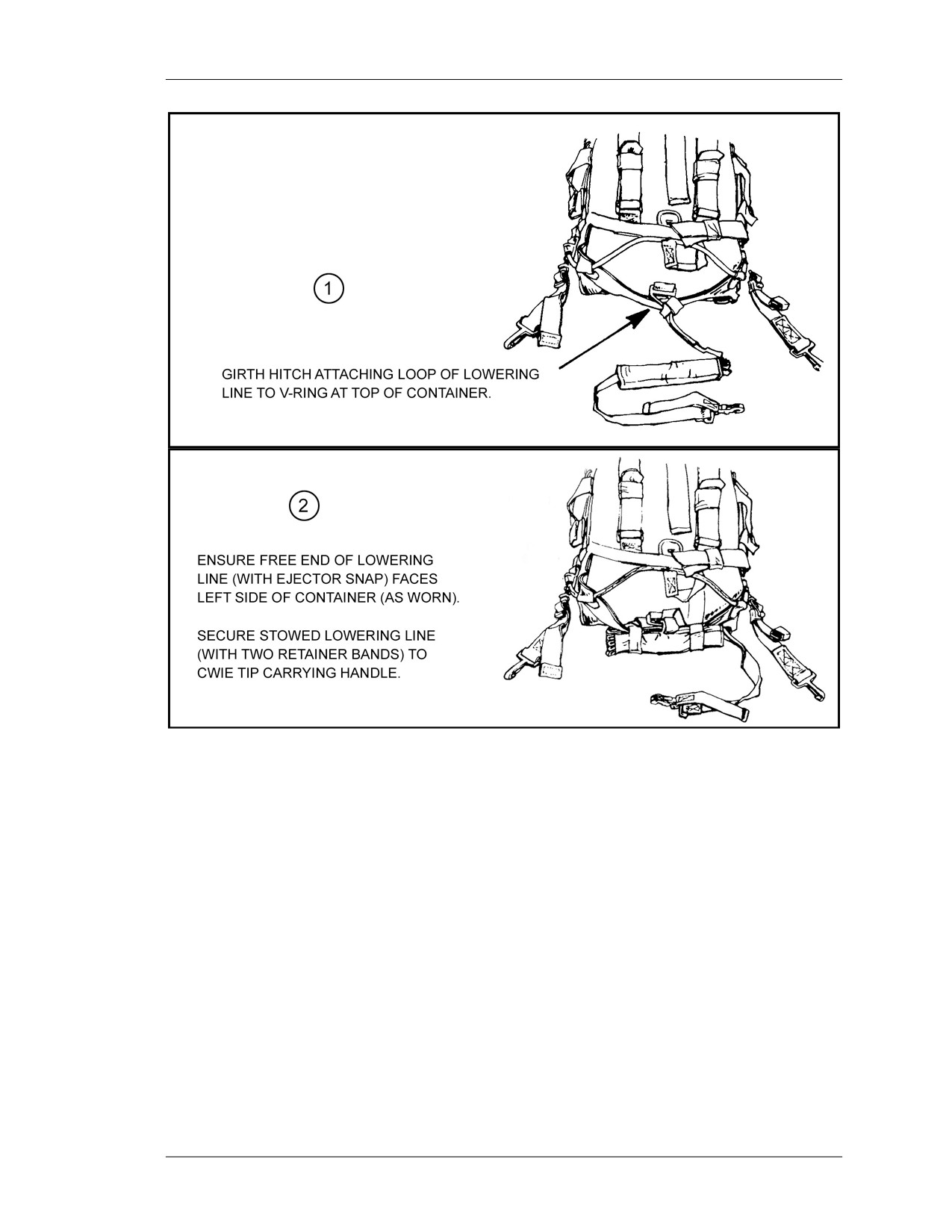
g. The looped end of the lowering line is threaded through the V-ring and under the
carrying handle on top of the harness assembly. The entire length of the lowering line is
pulled back through the loop and then pulled tight (Figure 12-28).
h. The HPT lowering line is folded, stowed in its container, and attached to the top
carrying handle with two retainer bands.
12-28
FM 3-21.220/MCWP 3-15.7/AFMAN11-420/NAVSEA SS400-AF-MMO-010
Figure 12-28. HPT lowering line attached to CWIE.
12-34. CONTAINER AND ASSEMBLY ATTACHED TO PARACHUTIST
The snap hooks of the quick-release straps are attached to the D-rings on the parachute
harness. The parachutist ensures that the snap hooks are positioned to the outside of the
connector snaps of the reserve parachute. The leg retaining strap is fastened around the
leg (left leg, right door; right leg, left door), through the friction adapter, and a quick-
release fold is made. The ejector snap on the HPT lowering line is attached to the
lowering line adapter web on the left side of the parachute harness.
12-35. CONTAINER RELEASED
After exiting the aircraft, the parachutist executes the first three points of performance.
After he executes the third point of performance, he releases the leg retaining strap and
checks below to ensure that no other parachutists are in the way. The parachutist removes
the safety pin from the red release knob when about 200 feet above the ground. He pulls
the red release knob up and out, allowing the container to drop the full length of the
lowering line.
12-29
FM 3-21.220/MCWP 3-15.7/AFMAN11-420/NAVSEA SS400-AF-MMO-010
Section XI. DRAGON MISSILE JUMP PACK
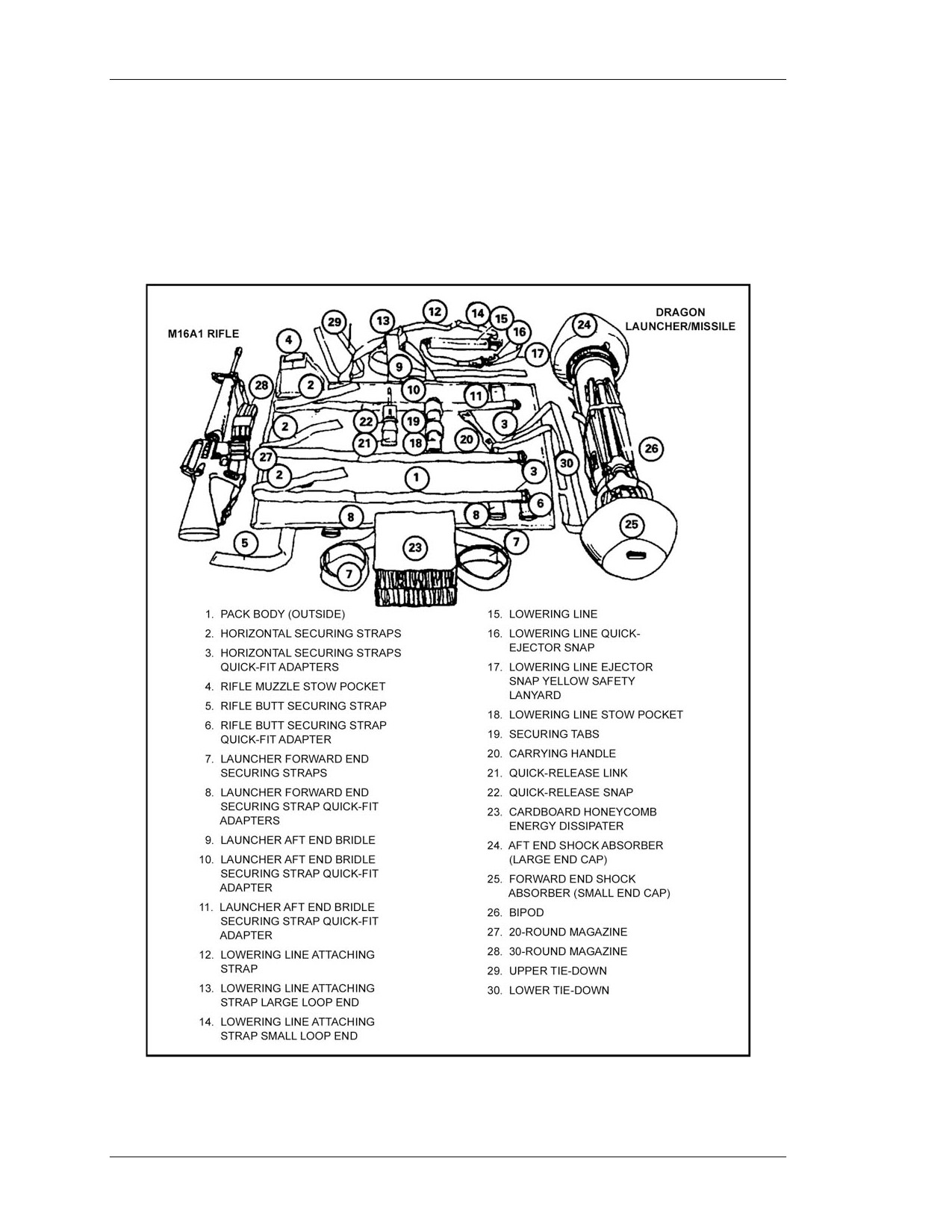
The Dragon (M47) missile jump pack (DMJP) is designed to carry one missile system
and the M16 or M203 (Figure 12-29). The jump pack consists of a pack body constructed
of nylon duck material with 1/4-inch felt material permanently sewn inside, nylon
securing straps, lowering line, and quick-release assembly.
Figure 12-29. Nomenclature, DMJP.
12-30
FM 3-21.220/MCWP 3-15.7/AFMAN11-420/NAVSEA SS400-AF-MMO-010
12-36. MISSILE AND TRACKER
The missile and tracker can be jumped in two configurations. They can be rigged to be
lowered as individual items, requiring two lowering lines, or tandem rigged on a single
lowering line. The tandem rig requires the DMJP/AT4JP MOD HPT lowering line and
modifications to the jump pack.
a. Due to the length of the missile and the difficulties in handling and moving the
equipment around in the aircraft, the DMJP is restricted to parachutists who are at least 5
feet 6 inches tall. The DMJP cannot be jumped from any aircraft that requires the
parachutist to sit on the aircraft floor during exit.
b. When the jump pack is rigged with the missile and an M16/M203, it is 11 1/2
inches in diameter and weighs about 40 pounds. It is secured vertically by a quick-release
snap assembly to the left D-ring of the parachutist’s harness. To prevent the pack from
swaying during the parachutist’s exit from the aircraft or from the opening shock of the
parachute, two tie-downs are provided. The upper tie-down tape is routed around the
main lift web, directly below the chest strap, while the lower tie-down secures the pack to
the parachutist’s left leg.
c. An HPT lowering line assembly is issued with the jump pack and can only be
used to lower the DMJP as a single item. Tandem lowering requires the modified HPT
lowering line. The looped end of the lowering line is attached to the lowering line
attaching strap on the jump pack, and the ejector snap is attached to the lowering line
adapter web.
d. Upon landing, the parachutist can rapidly get to the weapons by pulling the
running ends of the quick releases on the three horizontal securing straps and three
adjustable end straps.
12-37. DRAGON MISSILE JUMP PACK RIGGED
A detailed explanation of rigging the jump pack follows.
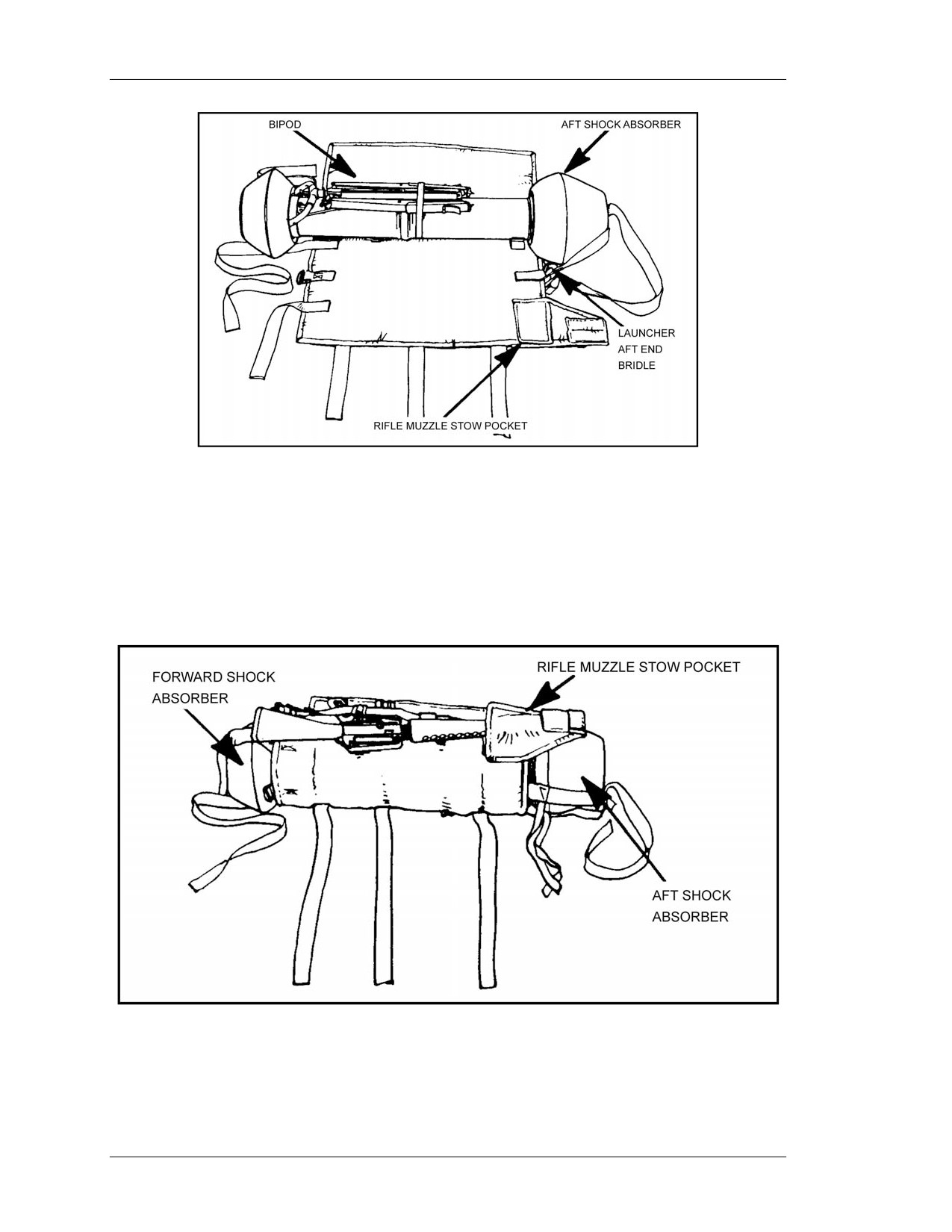
a. Position the Dragon missile.
(1) Place the pack with the felt side of the pack body facing up and extend all straps.
(2) Position the missile in the pack with the bipod facing up (Figure 12-30).
(3) Fit the aft shock absorber (large end) into the launcher aft end bridle of the
jump pack.
12-31
FM 3-21.220/MCWP 3-15.7/AFMAN11-420/NAVSEA SS400-AF-MMO-010
Figure 12-30. Missile being positioned.
b. Position the weapon.
(1) Insert a 20-round magazine into the magazine well (optional).
(2) Secure a 30-round magazine to the weapon sling, using adhesive tape (optional).
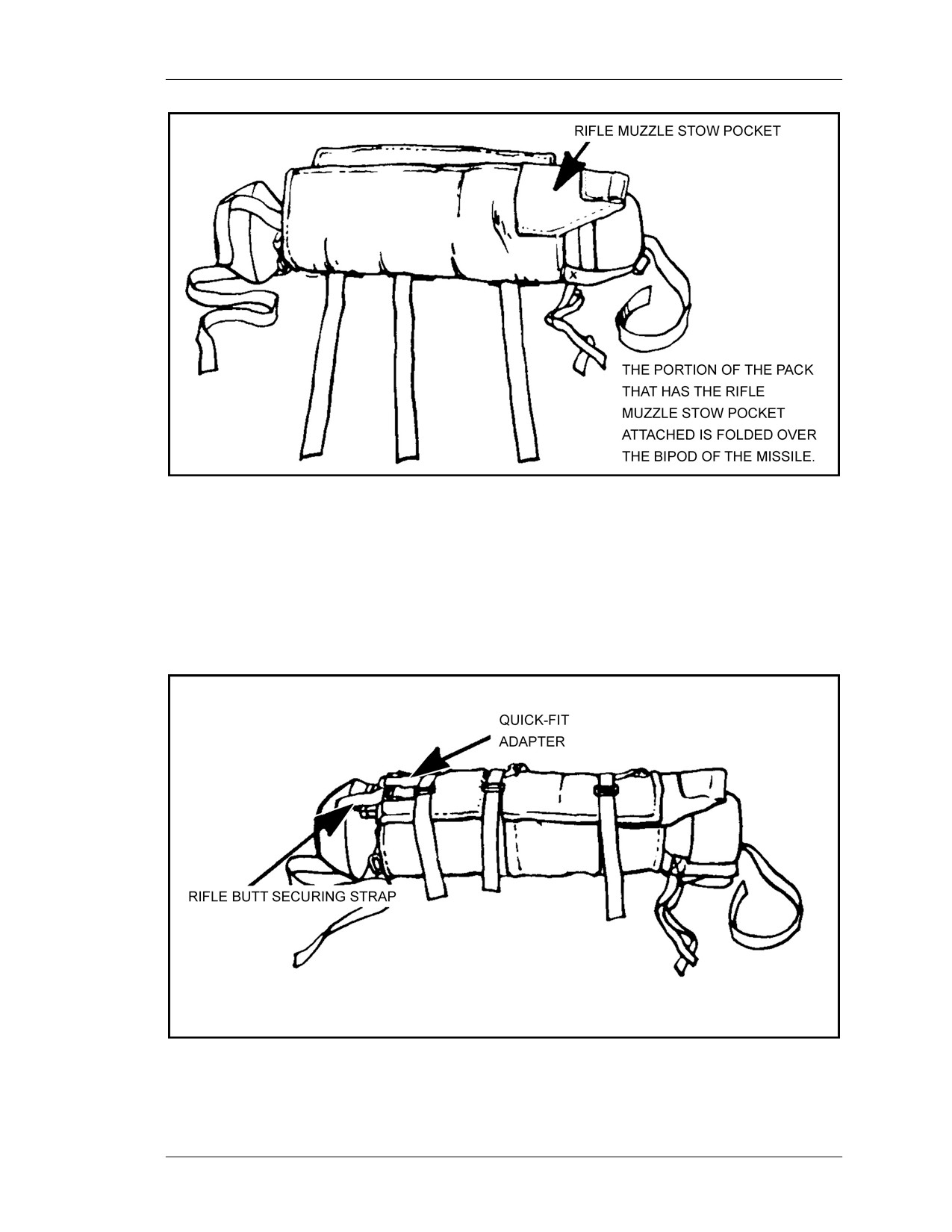
(3) Position the rifle on top of the pack, on top of the missile bipod, by inserting the
rifle muzzle into the rifle muzzle stow pocket. The butt of the rifle pistol grip lies along
the inner edge of the jump pack (Figures 12-31 and 12-32).
Figure 12-31. Rifle positioned.
12-32
FM 3-21.220/MCWP 3-15.7/AFMAN11-420/NAVSEA SS400-AF-MMO-010
Figure 12-32. Pack folded.
c. Close the pack.
(1) Fold the outer flap of the jump pack over the weapon (if packed).
(2) Route the three horizontal securing straps through the quick-fit adapters using a
quick-release fold, but do not tighten.
(3) Route the rifle butt securing strap through the quick-fit adapter. Tighten the strap
as much as possible, using a quick-release fold (Figure 12-33).
Figure 12-33. Pack closed.
12-33
FM 3-21.220/MCWP 3-15.7/AFMAN11-420/NAVSEA SS400-AF-MMO-010
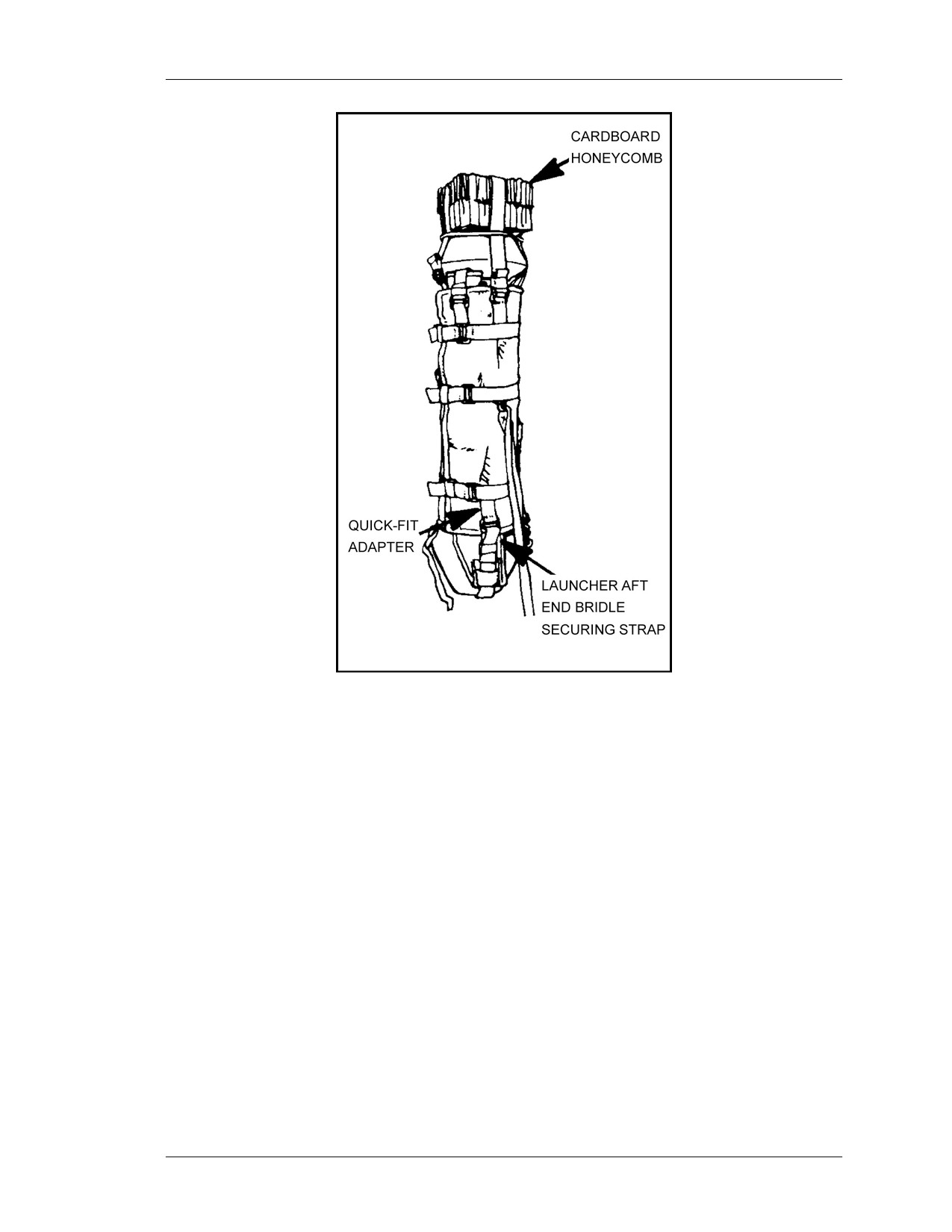
d. Secure honeycomb squares.
(1) Route the missile launcher aft end bridle securing strap through its quick-fit
adapter and tighten, using a quick-release fold.
(2) Secure two
9-inch-square blocks of cardboard honeycomb energy dissipater
across the forward shock absorber of the missile, using the launcher forward end securing
straps. Tighten the straps and form an X over the center of the honeycomb. Secure the
straps using a quick-release fold (Figure 12-34). Tie one turn of 1/4-inch cotton webbing
around the X formed by the launcher forward end, securing straps in a surgeon’s knot and
locking knot. Tie another one turn of 1/4-inch cotton webbing around the launcher
forward end, securing straps below the cardboard honeycomb energy dissipator in a
surgeon’s knot and locking knot. If the missile forward end shock absorber is missing
from the Dragon missile training round, it should be replaced with a 9- by 9-inch square
of cardboard honeycomb.
WARNING
Never jump a live missile without this honeycomb in place and
securely fastened. Place parachutists with DMJPs or CWIEs to
the front of the stick. Staggered exits are difficult to control if
individuals carrying either the DMJP or CWIE are not near the
front of the sticks.
12-34
FM 3-21.220/MCWP 3-15.7/AFMAN11-420/NAVSEA SS400-AF-MMO-010
Figure 12-34. Honeycomb squares secured.
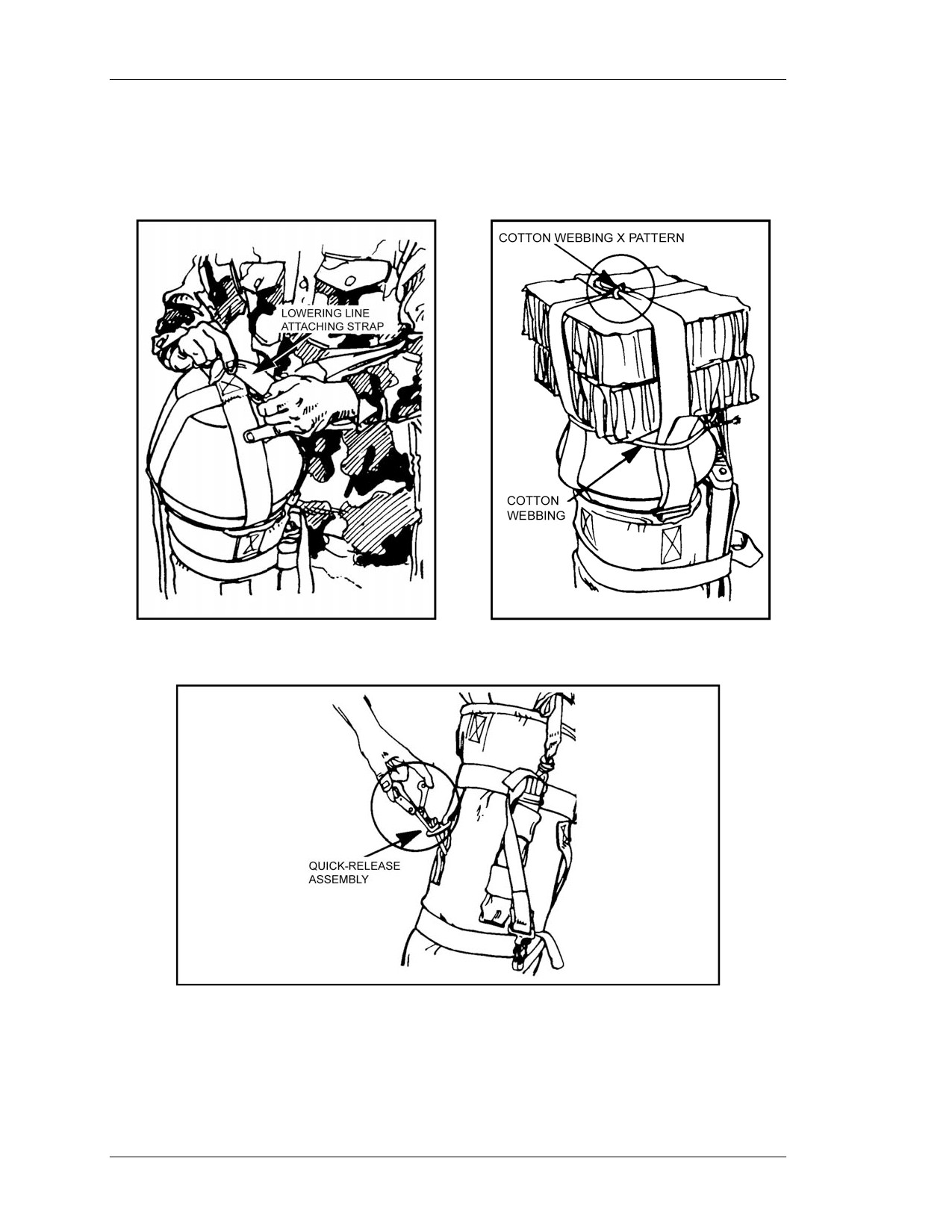
(3) If not already installed, attach the lowering line attaching strap to the launcher aft
end bridle by means of a girth hitch with the large loop end (Figure 12-35, page 12-36).
Run the small loop end through the large loop end and tighten (run the small loop end
toward the lowering line stow pocket).
(4) Position the DMJP on the aft end shock absorber and retighten the launcher
forward end securing straps using quick-release folds. All excess on the securing straps
are folded back under the corresponding quick-fit adapter. Retighten one turn of 1/4-inch,
80-pound test cotton webbing in an X pattern around the launcher forward end securing
straps, and tie securely with a surgeon’s knot and locking knot (Figure 12-36, page
12-36).
(5) Tie one turn of 1/4-inch, 80-pound test cotton webbing around the launcher
forward end, securing straps below the 9-inch square honeycomb. Tie in a surgeon’s knot
and locking knot to prevent the honeycomb from shifting.
(6) Position the DMJP on the honeycomb and tighten the launcher aft end bridle
securing strap. Secure its running end by folding it back under the corresponding quick-
fit adapter.
12-35
FM 3-21.220/MCWP 3-15.7/AFMAN11-420/NAVSEA SS400-AF-MMO-010
(7) Tighten the three horizontal securing straps as evenly as possible around the
weapon(s). Incorporate a quick-release fold and secure with a retainer band or two turns
of masking tape.
(8) Attach the quick-release assembly to the pack (Figure 12-37).
Figure 12-35.
Figure 12-36.
Lowering line attaching strap installed.
X pattern.
Figure 12-37. Quick-release assembly.
NOTE: Apply more tension to the end strap by tightening the three horizontal
securing straps evenly. Uneven or insufficient tension can cause misalignment
of the overlap portion of the pack and result in improper retention and
protection of the rifle.
12-36
FM 3-21.220/MCWP 3-15.7/AFMAN11-420/NAVSEA SS400-AF-MMO-010
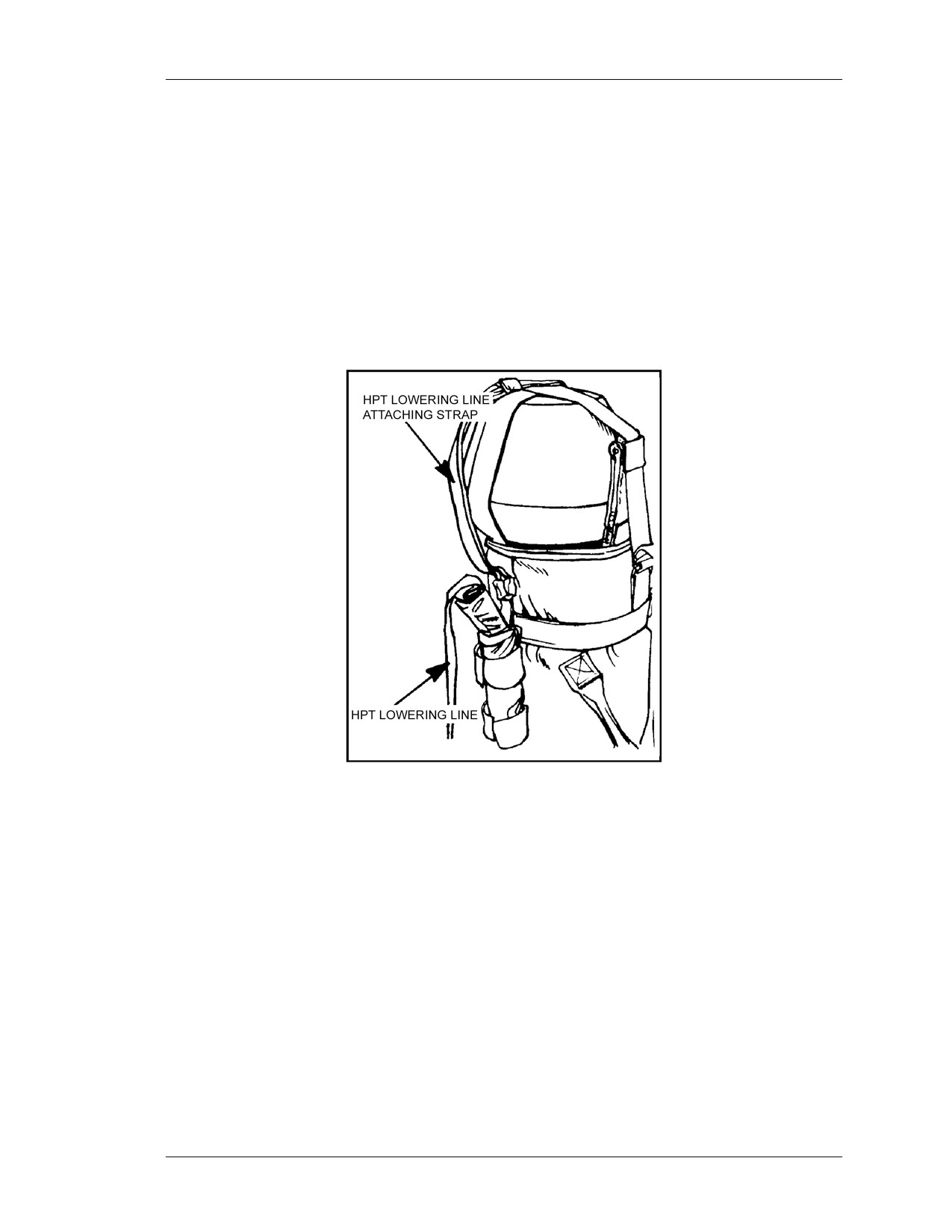
e. Attach lowering line to DMJP.
(1) Attach the lowering line to the lowering line attaching strap by routing the looped
end of the HPT lowering line through the looped end of the lowering line attaching strap
(Figure 12-38). Route the lowering line through its own loop and pull tight, forming a
girth hitch.
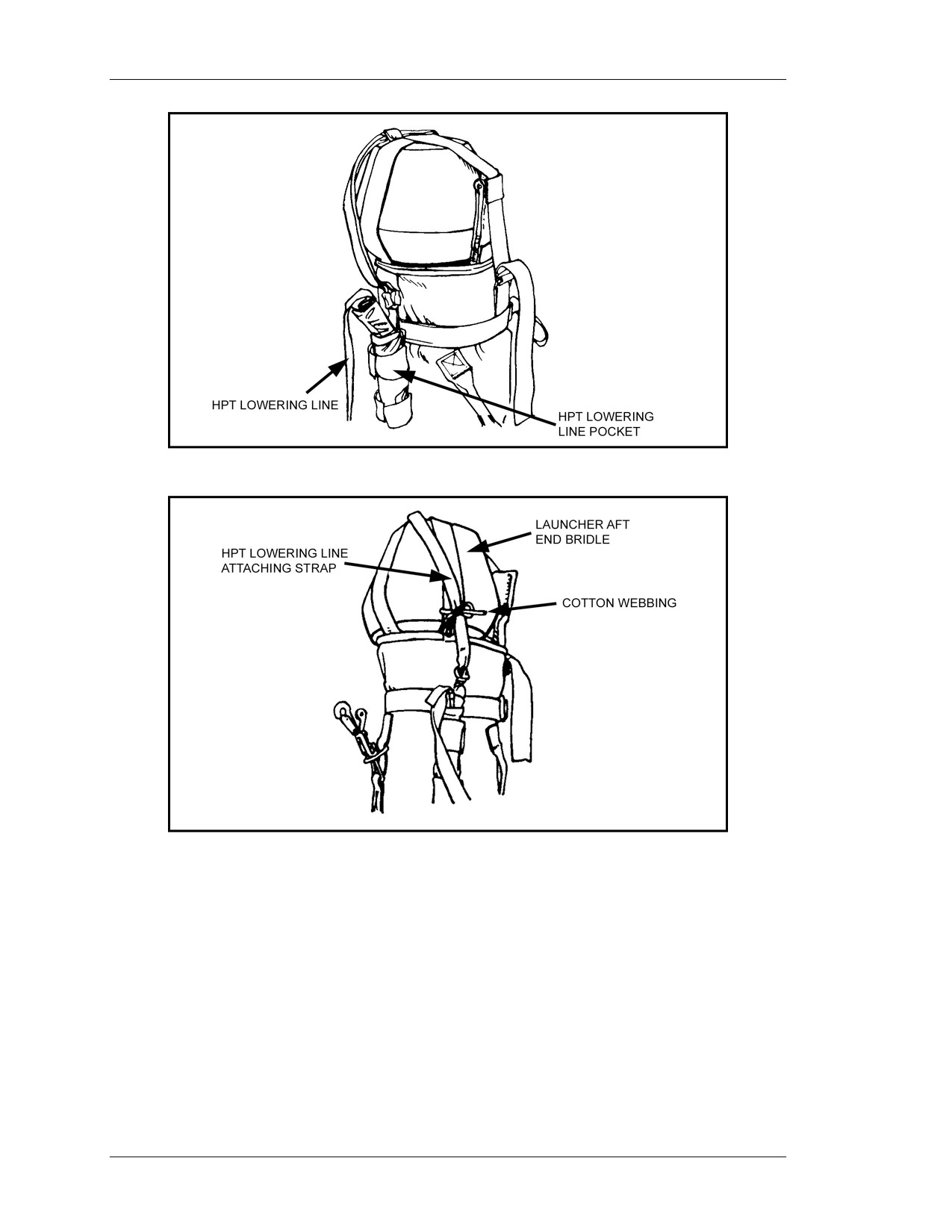
(2) S-fold and place the lowering line inside the lowering line stow pocket (Figure
12-39, page 12-40). Tighten the securing tabs (Figure 12-40, page 12-41). The ejector
snap of the HPT lowering line protrudes from the lowering line stow pocket.
(3) Install one turn of 1/4-inch, 80-pound test cotton webbing around the lowering
line attaching strap and the adjacent launcher aft end bridle strap, and tie securely.
Figure 12-38. Lowering line.
12-37
FM 3-21.220/MCWP 3-15.7/AFMAN11-420/NAVSEA SS400-AF-MMO-010
Figure 12-39. Lowering line inserted in pocket.
Figure 12-40. Lowering line attaching strap secured.
12-38. DRAGON MISSILE JUMP PACK ATTACHED TO PARACHUTIST
The DMJP is the last item attached to the parachutist.
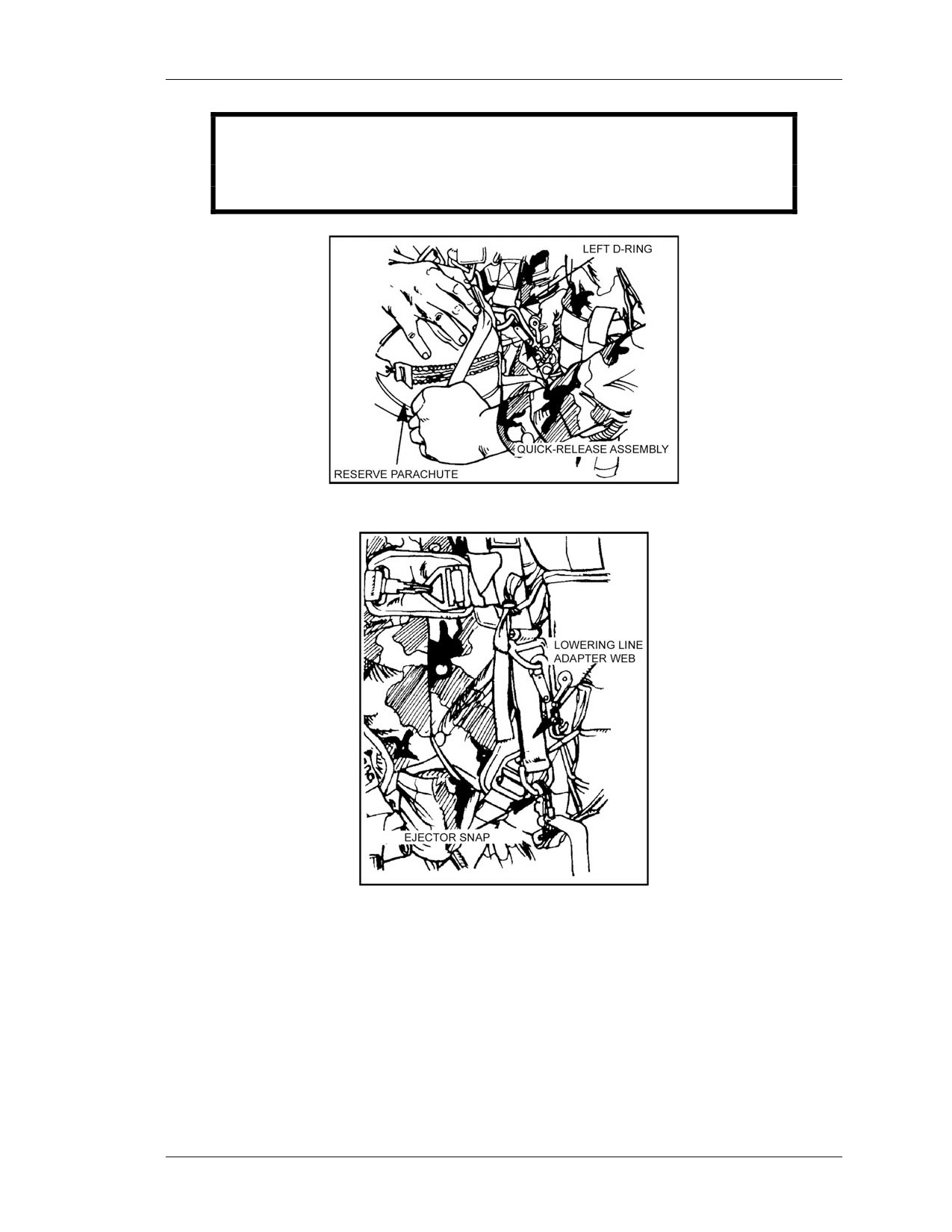
a. The DMJP is secured to the parachutist by attaching the quick-release snap to the
parachutist’s left D-ring as the outermost item (Figure 12-41).
b. The lower tie-down tape is routed around the DMJP and the parachutist’s left leg
(Figure 12-42). A single-loop bowknot is tied on the front of the DMJP where it is easy
for the parachutist to reach.
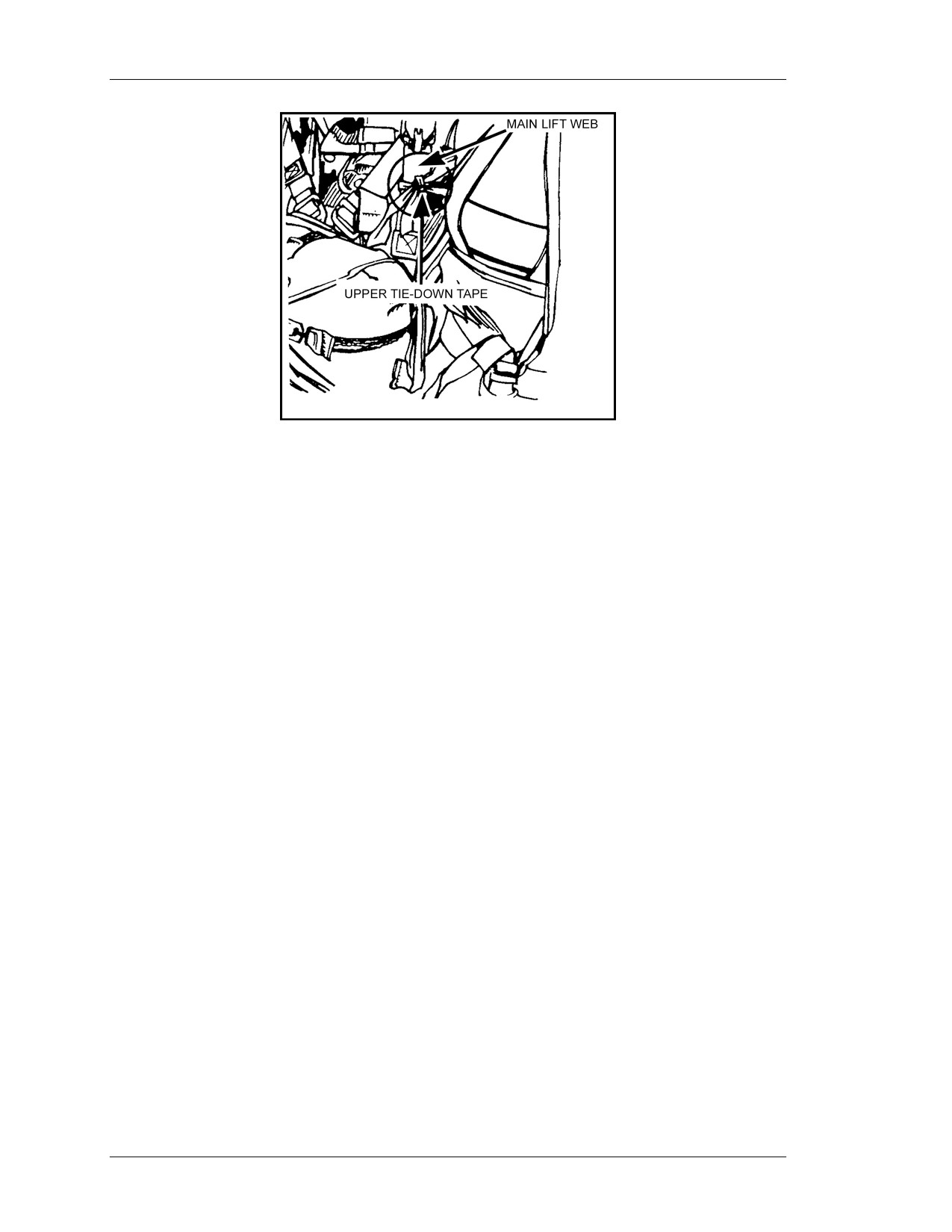
c. The upper tie-down tape is routed around the left main lift web directly below the
chest strap. It is tied snugly with a single-loop bowknot (Figure 12-43, page 12-42).
12-38
FM 3-21.220/MCWP 3-15.7/AFMAN11-420/NAVSEA SS400-AF-MMO-010
WARNING
The quick-release opening gate is closed and locks the quick-
release assembly to the left D-ring. The quick-release snap
activating arm is fully seated (do not safety tie).
Figure 12-41. DMJP attached.
Figure 12-42. HPT lowering line attached.
12-39
FM 3-21.220/MCWP 3-15.7/AFMAN11-420/NAVSEA SS400-AF-MMO-010
Figure 12-43. Upper tie-down.
12-39. INDIVIDUAL JUMP PROCEDURES
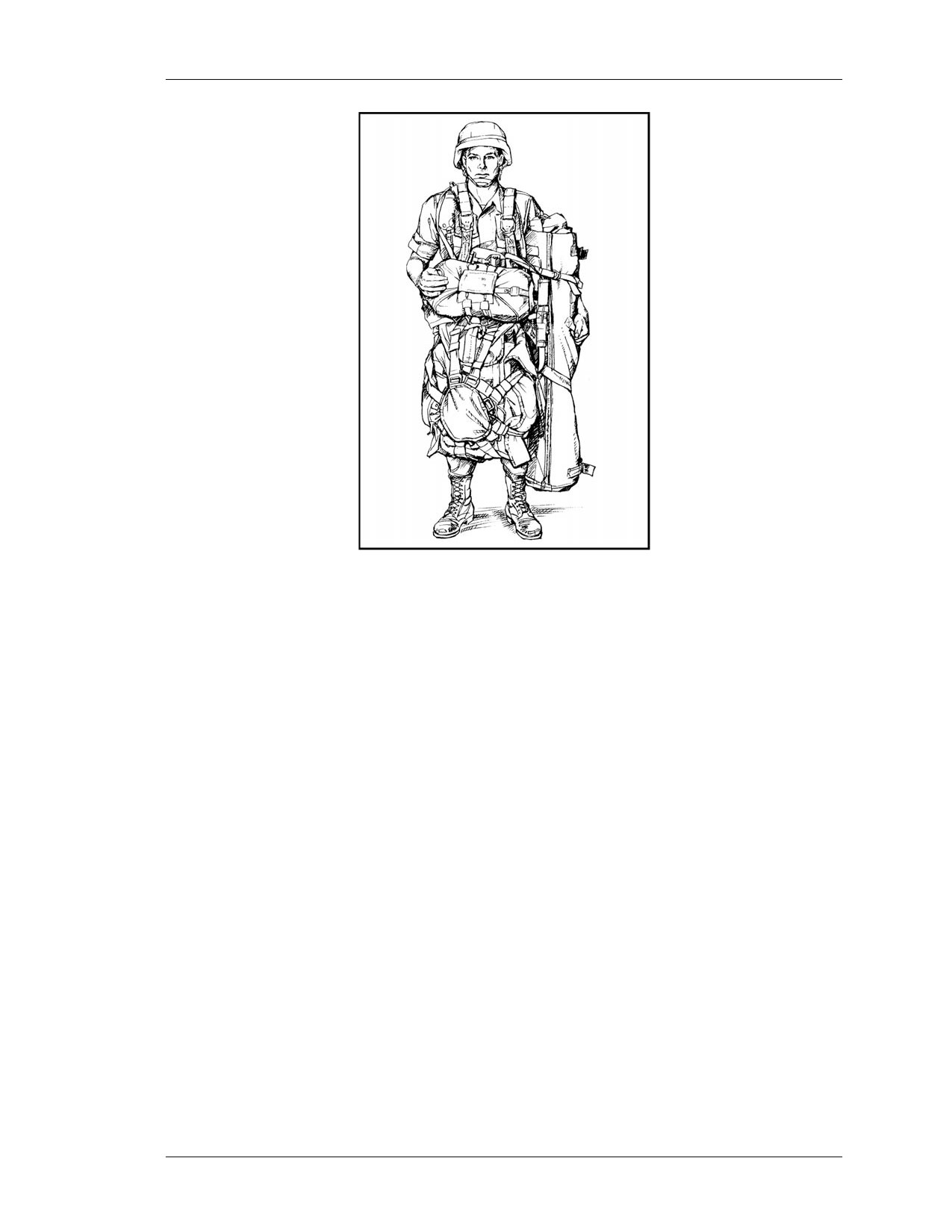
The DMJP is jumped with a front-mounted large ALICE pack (Figure 12-44).
a. At the 20-minute time warning, one of the safety personnel attaches the DMJP to
the parachutist and inspects it.
b. After leaving the aircraft, the parachutist—
(1) Releases the lower tie-down tape, then the upper tie-down tape, in sequence. If
either tie malfunctions and the parachutist must ride the missile down, it is important that
the missile be vertical, not hanging directly below the feet.
(2) Looks to see that the area below is clear (about 100 to 200 feet above ground),
and activates the DMJP quick-release assembly by using the left hand to push down and
away on the activating arm, allowing it to fall the length of the lowering line.
NOTE: To jettison the DMJP in an emergency, the parachutist lowers the pack, then
pulls out on the yellow safety lanyard attached to the ejector snap, allowing
the missile pack to fall free.
12-40
FM 3-21.220/MCWP 3-15.7/AFMAN11-420/NAVSEA SS400-AF-MMO-010
Figure 12-44. DMJP attached to parachutist.
12-40. DRAGON TRACKER
The tracker (sighting system) is placed inside the large ALICE pack and is attached to the
parachutist. The system must remain in its protective case during the jump.
12-41. DRAGON MISSILE JUMP PACK AND ALICE PACK RIGGED AS A
TANDEM LOAD
To rig the DMJP and ALICE pack for lowering, modifications are required along with
the DMJP/AT4JP modified HPT lowering line.
a. Materials.
• Fastener tape, pile, color OD 106, 1-inch width, Class 1, MIL-F-21840, NSN
8315-00-106-5974.
• Fastener tape, hook, color OD 106, 1-inch width, Class 1, Type II, MIL-F-
21840, NSN 8315-00-106-5973.
• Webbing, textile, nylon, Type X, Class 1, 1 23/32-inch width, color olive
drab, MIL-W-4088, and Class R, MIL-W-27265, NSN 8305-00-261-8584.
• Thread, nylon, color OD-S1, conforming to Type II, Class A, Size 3, 800-yard
tube of V-T-295, NSN 8310-00-559-5212.
• D-ring, parachute harness, drawing, No. 11-1-485.
b. Stitching Requirements.
(1) Stitching must conform to FED-STD-751, Type 301, 5 to 8 stitches per inch.
(2) Ends of stitching must be over-stitched not less than 1/2 inch.
c. Modification Procedure.
(1) Replacement of the V-ring with D-ring, 11-1-485.
(a) Place the jump pack on a repair table, positioning it so the outside faces upward.
12-41
FM 3-21.220/MCWP 3-15.7/AFMAN11-420/NAVSEA SS400-AF-MMO-010
(b) Cut the box-X stitching on the chafe web end, which secures the V-ring to the
pack. Remove the V-ring and cut the stitching.
(c) Pass the end of the chafe through replacement D-ring 11-1-485 and stitch with the
box-X stitch formation to pack as in the original construction.
(2) Attachment of the D-ring 11-1-485 and web chafe to aft shock absorber harness
cross adjustable strap.
(a) If installed, remove the lowering line attaching web, which is girth-hitched to the
aft shock absorber harness cross straps.
(b) Cut a
7 1/4-inch length of Type X nylon webbing and sear cut ends to
prevent fraying.
(c) Place marks 3 inches from each end and in the center of the webbing.
(d) Place marks 3 5/8 inches from each side of the center of the aft harness cross
adjustable strap.
(e) Pass the end of 7 1/4-inch Type X nylon webbing through the D-ring 11-1-485
loop and position it between the markings of the aft harness cross adjustable strap. Stitch
with a 3-inch, 4-point WW stitch formation at each end.
(3) Attachment of hook-and-pile lowering line retainer.
(a) Cut a 3 1/2-inch length of hook tape.
(b) Cut a 4-inch length of pile tape.
(c) With hook and pile facing each other, overlap tabs
1 3/4 inches and press
together.
(d) Place marks 1 and 2 inches (on the inside) from the binding edge of the pack body
on the aft cross adjustable strap.
(e) With pile side facing toward outside of pack and hook facing to inside of pack,
position edges of tape overlap even with cross strap edges between markings and stitch to
cross strap with a single box stitch formation.
12-42. ALICE PACK (LARGE) JUMPED WITH DRAGON MISSILE
JUMP PACK
The large ALICE pack with frame must be jumped with the DMJP to stabilize the DMJP
and to accommodate the Dragon tracker assembly.
a. Completely pad the tracker assembly with cellulose wadding to prevent damage.
b. Place the padded tracker assembly in the inside pouch with soft articles of
clothing or equipment packed around it. Place additional items in the pouch, with hard
and sharp items padded.
c. Fill the outside ALICE pockets with nonfragile items to capacity, since the filled
pockets aid the positioning and prevent slippage of the H-harness during parachute
opening and lowering line deployment.
d. Close the pack by use of the drawstring closure, engaging the securing straps and
attachment of pocket snap fasteners.
e. Adjust the adjustable shoulder carrying straps snugly. S-fold and tape the excess
webbing on the adjustable shoulder carrying straps. Route the running ends of the waist
straps around the frame opposite the lower back pad, tighten, and secure in place by
taping. This secures the adjustable should carrying straps and reduces the possibility of
entanglement on board the aircraft.
12-42
FM 3-21.220/MCWP 3-15.7/AFMAN11-420/NAVSEA SS400-AF-MMO-010
f. To stow the Dragon modified lowering line, S-fold the lowering line neatly on top
of the web inside the retainer, ensuring that ends are stacked evenly with the retainer
outer edges. Secure the pile tab on web located 46 inches from the ejector snap end to
hook the extension on the retainer. Fold the hook side of flap tightly over the S-folded
lowering line and, holding it firmly, fold pile side of the flap over and secure hook and
pile together. Secure the pile extension on the retainer flap to the hook tab at the looped
end of the lowering line.
12-43. ALICE PACK RIGGED WITH FRAME
The pack is turned upside down.
a. Place the modified H-harness on the pack so that the cross straps are in front of
the pack and the friction adapters are touching (or near) the bottom of the pack frame.
(1) Route the equipment retainer straps over the top of the pack and then under the
top portion of the frame.
(2) Route the equipment retainer straps over the horizontal bar of the frame and cross
at the center of the back of the pack.
(3) Route the straps under the frame and secure them to the friction adapters, forming
a quick release.
b. To attach the lowering line after rigging pack, girth-hitch the lowering line loop at
the intersection of the crossed equipment retainer straps (at the rear center of the pack).
(1) Secure the stowed lowering line to the left side (as worn on the parachutist) on the
keepers of the pack with two turns of masking tape or two sets of retainer bands. The
lowering line ejector snap faces up and to the right or left.
(2) Thread the (H-harness) D-ring attaching straps through the intermediate friction
adapters, forming a quick release with the running ends that are pointing away from the
parachutist.
12-44. DRAGON MISSILE JUMP PACK RIGGED
The DMJP is rigged as described above, omitting installation of the lowering line
attaching strap.
12-45. ALICE PACK ATTACHED TO PARACHUTIST
The D-ring attaching strap snap hooks (on rigged ALICE) are attached to the harness
D-rings outside of the reserve connector snaps.
12-46. DRAGON MISSILE JUMP PACK RIGGED FOR TANDEM LOAD
The rigged DMJP is placed next to the parachutist’s left side.
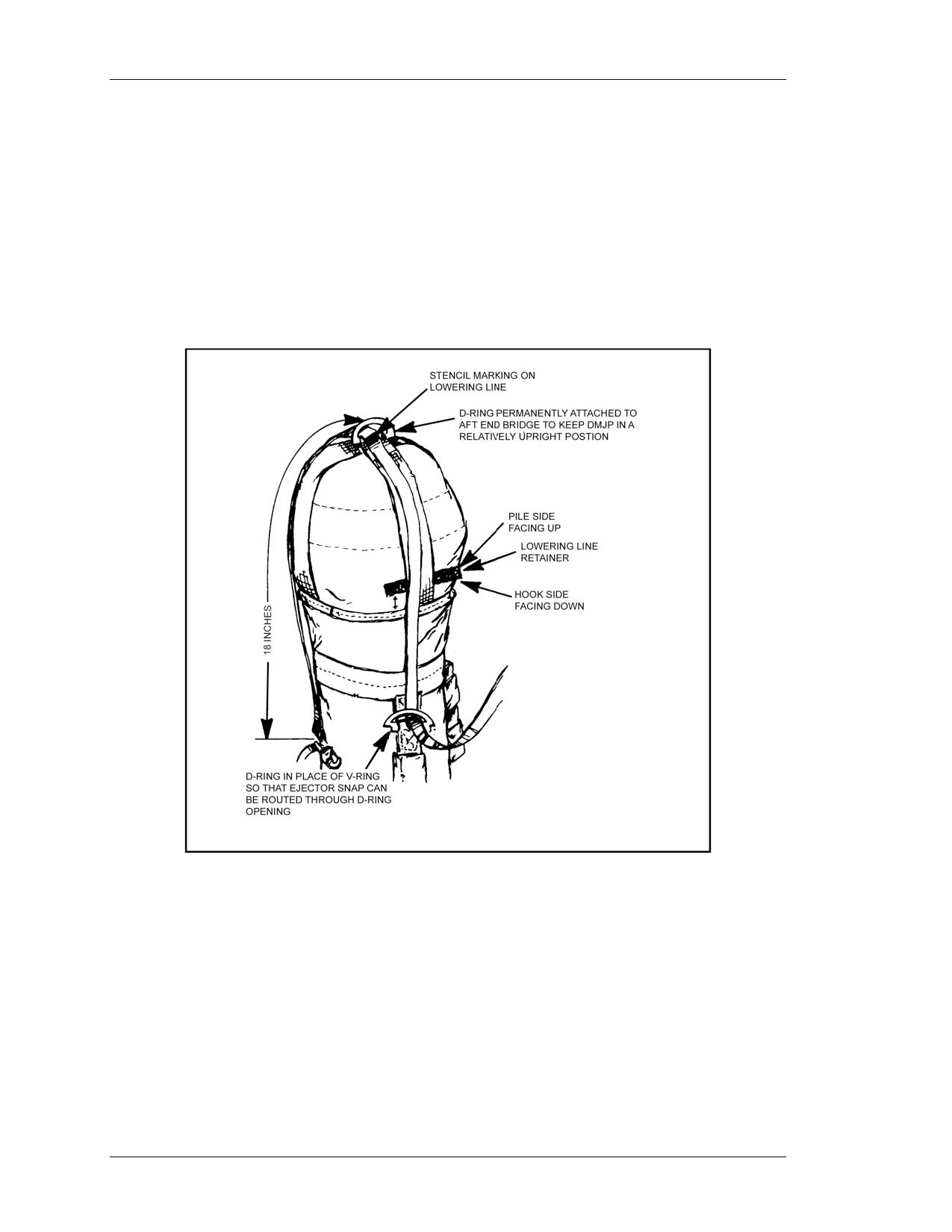
a. To secure the 15-foot HPT lowering line, grasp the ejector snap of the HPT
lowering line. Route it (from bottom to top) through the D-ring openings at the pack body
and aft end locations. Position the 18-inch strata blue marking on the HPT lowering line
even with the D-ring on top of the DMJP (Figure 12-45).
b. Secure the lowering line to the aft cross strap at the pack body end by folding the
hook tab over the lowering line and fastening pile together.
c. Attach the quick-release snap to the quick-release link, which has been routed
through the D-ring. The snap opening must face away from the pack.
12-43
FM 3-21.220/MCWP 3-15.7/AFMAN11-420/NAVSEA SS400-AF-MMO-010
12-47. DRAGON MISSILE JUMP PACK ATTACHED TO PARACHUTIST
The DMJP quick-release assembly is attached to the left harness D-ring outside of the
reserve connector snap and H-harness or HSPR snap hook (Figure 12-46).
a. Attach the HPT lowering line ejector snap to the lowering line adapter web.
b. Route the lower tie-down tape around the DMJP and the parachutist’s left leg.
c. Tie with a bowknot on the front of the DMJP so it is easy for the parachutist
to reach.
d. Route the upper tie-down tape under and around the left main lift web directly
below the chest strap and tie snugly with a bowknot.
e. Use the adjustable leg strap of the HSPR as a lower tie-down tape.
Figure 12-45. DMJP modified with D-ring.
12-44
FM 3-21.220/MCWP 3-15.7/AFMAN11-420/NAVSEA SS400-AF-MMO-010
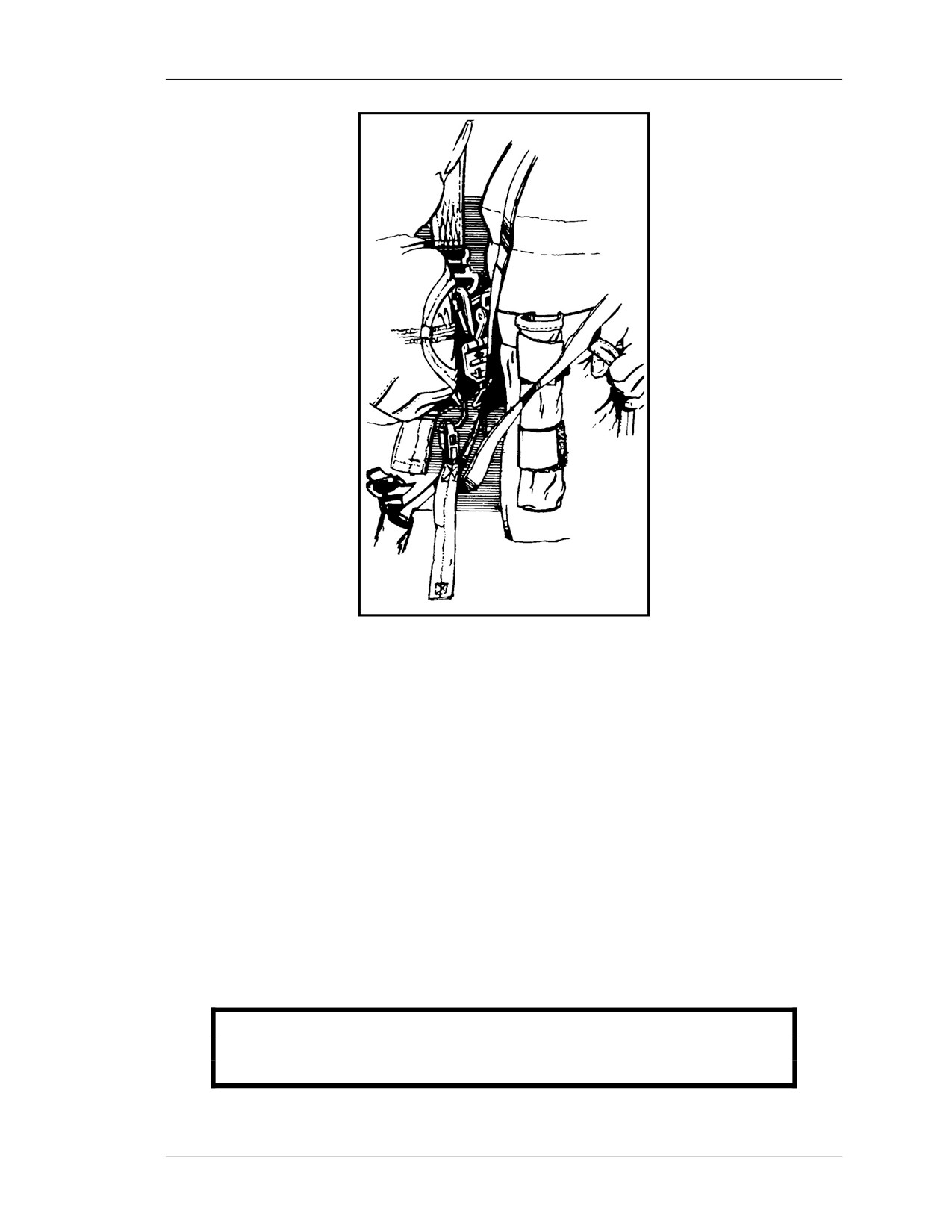
Figure 12-46. DMJP tandem lowering line attached to parachutist.
NOTE: When using the improved harness, route the upper tie-down tape below the
chest strap.
12-48. ALICE PACK AND DRAGON MISSILE JUMP PACK RELEASED
The upper and lower tie-down tapes are untied on the DMJP.
a. Release the lower tie-down tape on the ALICE pack.
b. Drop the ALICE pack by simultaneously pulling the D-ring attaching straps,
allowing the pack to fall to the end of the lowering line.
c. Push out on the activating arm on the DMJP quick-release assembly so the DMJP
slides down the lowering line to the end.
NOTE: To jettison the ALICE pack and DMJP in an emergency (after performing the
above), lift the reserve up and pull the yellow safety lanyard on the lowering
line ejector snap, allowing the ALICE pack/DMJP to fall free.
WARNING
Under no circumstances will the parachutist release the DMJP
before releasing the ALICE pack.
12-45
FM 3-21.220/MCWP 3-15.7/AFMAN11-420/NAVSEA SS400-AF-MMO-010
12-49. REMOVAL OF LOWERING LINE
Upon landing, the parachutist removes the lowering line by pulling the line through the
two D-rings and releasing the girth hitch on the H-harness. The DMJP MOD lowering
line is stored with the DMJP for reuse.
Section XII. AT4 JUMP PACK
The parachutist’s AT4JP is designed to carry one AT4 weapon round (SM-136) and one
M16 rifle. The jump pack consists of a pack body constructed of nylon and 1/4-inch thick
felt material. When the jump pack is rigged with the AT4 weapon round, M16, and shock
absorber, it is 47 inches long, 9 inches in diameter, and weighs about 29 pounds. It is
secured vertically by a quick-release snap to the left D-ring of the parachutist’s harness.
12-50. COMPONENTS
To prevent the jump pack from swaying during the parachutist’s exit from the aircraft or
the opening shock of the parachute, two tie-down tapes are provided. The upper tie-down
secures the pack to the main lift web, while the lower tie-down secures the pack to the
parachutist’s left leg.
a. A lowering line stow pocket is attached to the exterior of the pack for retaining
the HPT lowering line. A 24-inch lowering line attaching strap is issued with the jump
pack and is required for assembling the pack and lowering line when rigged for delivery
of the AT4JP only. (When the AT4JP and ALICE are rigged for tandem load, a modified
[DMJP/AT4] lowering line is required.) The looped end of the lowering line or lowering
line attaching strap (based upon the configuration to be lowered) is attached to the
nonadjustable cross D-ring strap on the jump pack so it will be suspended below the
parachutist and impact in a vertical position. The ejector snap on the opposite end is
attached to the lowering line adapter web on the parachutist’s harness.
b. The shock absorber (polyurethane/honeycomb) configuration at the aft end of the
jump pack is intended to prevent damage to the AT4 weapon round during ground
impact. Upon landing, the parachutist can rapidly gain access to the weapon round and
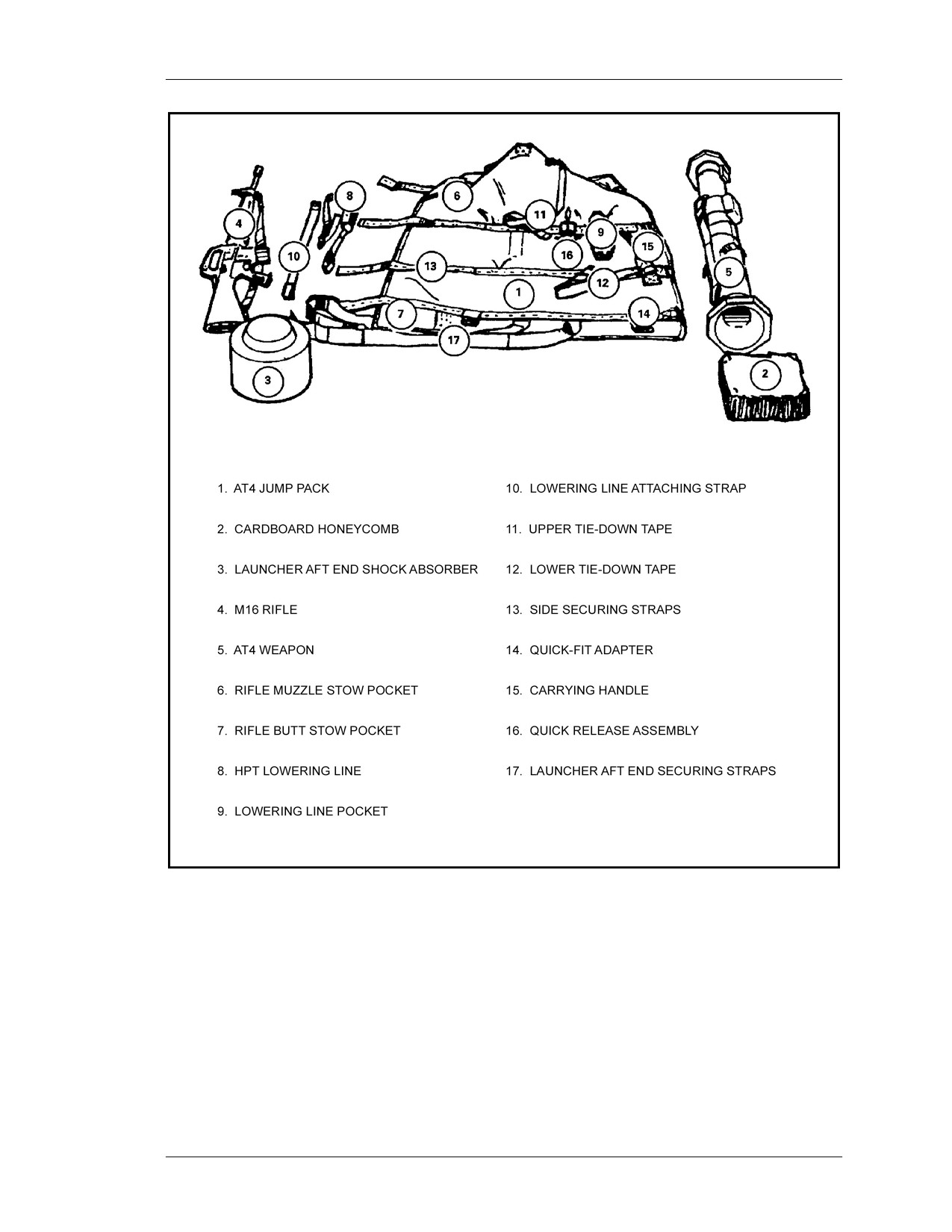
M16 by pulling the quick releases rigged into the jump pack securing straps. The total
assembly is shown in Figure 12-47.
12-46
FM 3-21.220/MCWP 3-15.7/AFMAN11-420/NAVSEA SS400-AF-MMO-010
Figure 12-47. AT4 nomenclature.
12-51. AT4 JUMP PACK RIGGED
To prepare the pack, the parachutist lays the pack down with the felt side of the pack
facing up and extends all securing straps.
a. Positioning the AT4 Weapon Round.
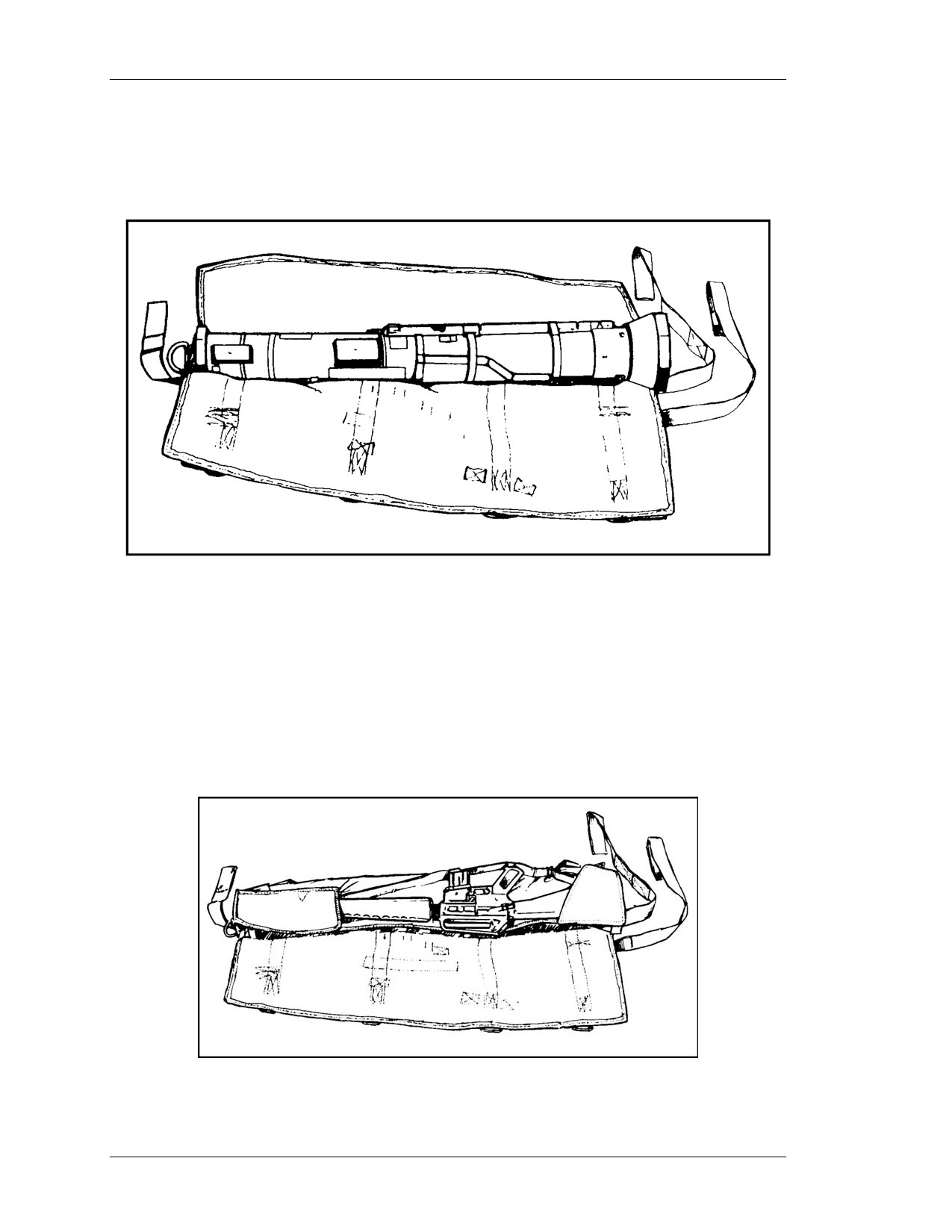
(1) Position the weapon round on the pack with the carrying sling facing down, the
launcher forward (small) end fitted into the forward end securing strap, and the launcher
aft (large) end centered on the middle launcher aft end securing strap (Figure 12-48, page
12-48).
12-47
FM 3-21.220/MCWP 3-15.7/AFMAN11-420/NAVSEA SS400-AF-MMO-010
(2) Ensure that the launcher forward (small) end fits snugly into the nonadjustable
cross D-ring strap.
(3) Fold the portion of the pack that has the rifle muzzle and butt stow pockets
attached over the weapon round.
Figure 12-48. AT4 weapon round positioned.
b. Positioning the M16.
(1) Insert a 20-round magazine into the rifle (optional).
(2) Secure a
30-round magazine to the sling of the rifle, using adhesive tape
(optional).
(3) Insert the rifle muzzle into the muzzle stow pocket and place the butt in the rifle
butt stow pocket as shown in Figure 12-49. Ensure that the magazine well and pistol grip
point toward the side securing straps, and the rifle muzzle is inserted into the muzzle
pocket as far as possible.
Figure 12-49. Positioning the M16.
12-48
FM 3-21.220/MCWP 3-15.7/AFMAN11-420/NAVSEA SS400-AF-MMO-010
c. Closing the Pack.
(1) Rotate the unfolded portion over the rifle and weapon round snugly.
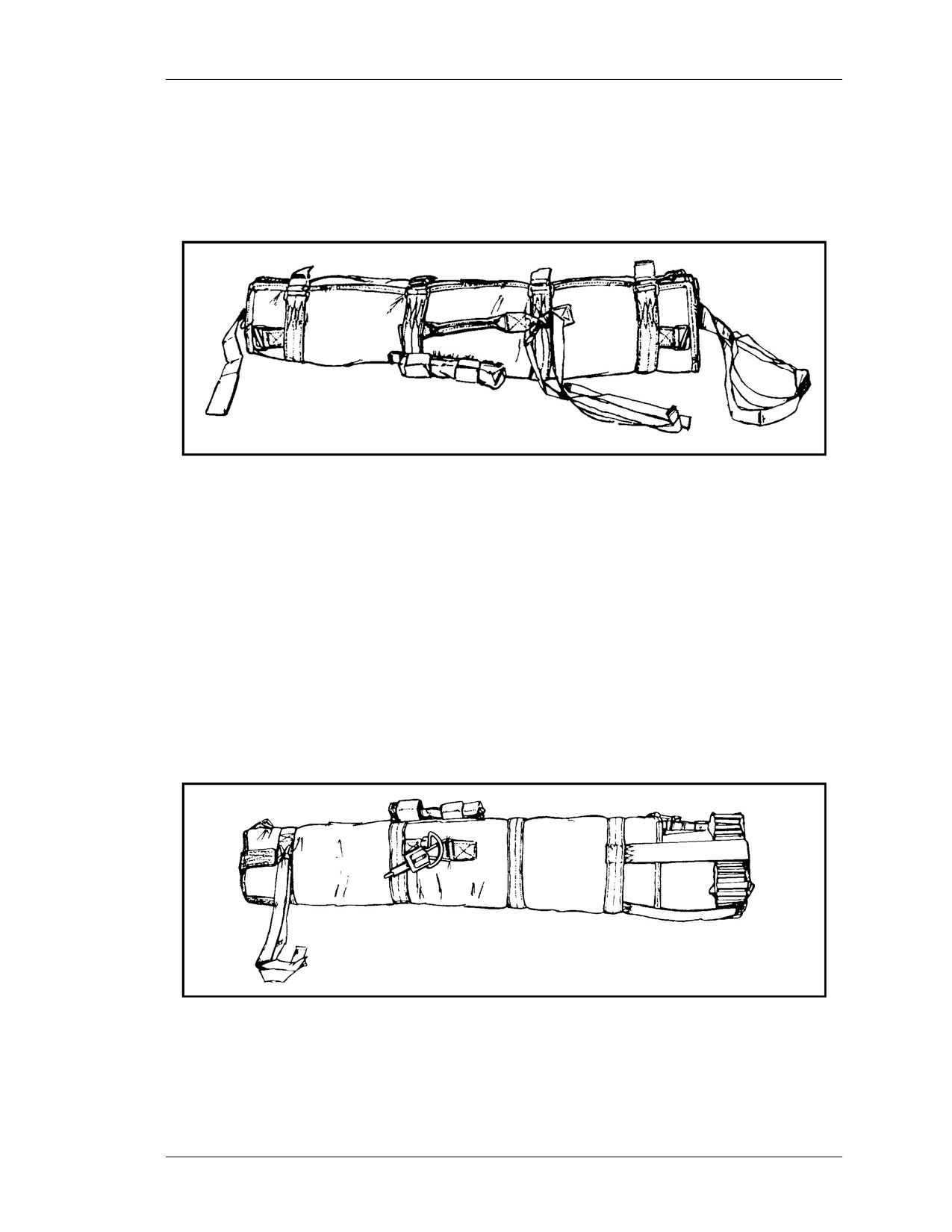
(2) Route the four side securing straps through the quick-fit adapters and tighten, then
thread the end through the adapter, forming a quick-release fold. Fold the strap excess
back under its corresponding quick-fit adapter (Figure 12-50).
Figure 12-50. Pack closed.
(3) Insert the cone-shaped end of the shock absorber into the launch tube aft end.
(4) Position the 8-inch square honeycomb on the shock absorber flat surface. If the
shock absorber is missing from the training round, replace it with two 8- by 8-inch
cardboard honeycomb energy dissipaters. Thread the end of the securing strap through
the launcher aft end securing strap keeper. Route the two aft end securing straps over the
cardboard honeycomb through each quick-fit adapter and tighten, then thread the end
through the adapter, forming a quick-release fold. Fold excess securing straps back under
the corresponding quick-fit adapter (Figure 12-51).
(5) Route the launcher forward end securing strap under the nonadjustable cross
D-ring strap through the quick-fit adapter and tighten. Then thread the end through the
adapter, forming a quick-release fold. Fold excess securing straps back under the
corresponding quick-fit adapter.
Figure 12-51. Running ends secured.
NOTE: The procedures for rigging the AT4JP vary at this point, depending on the
method used to lower the parachutist’s equipment. Follow paragraphs 12-51
and 12-52 if a single lowering line (tandem) is used.
12-49
FM 3-21.220/MCWP 3-15.7/AFMAN11-420/NAVSEA SS400-AF-MMO-010
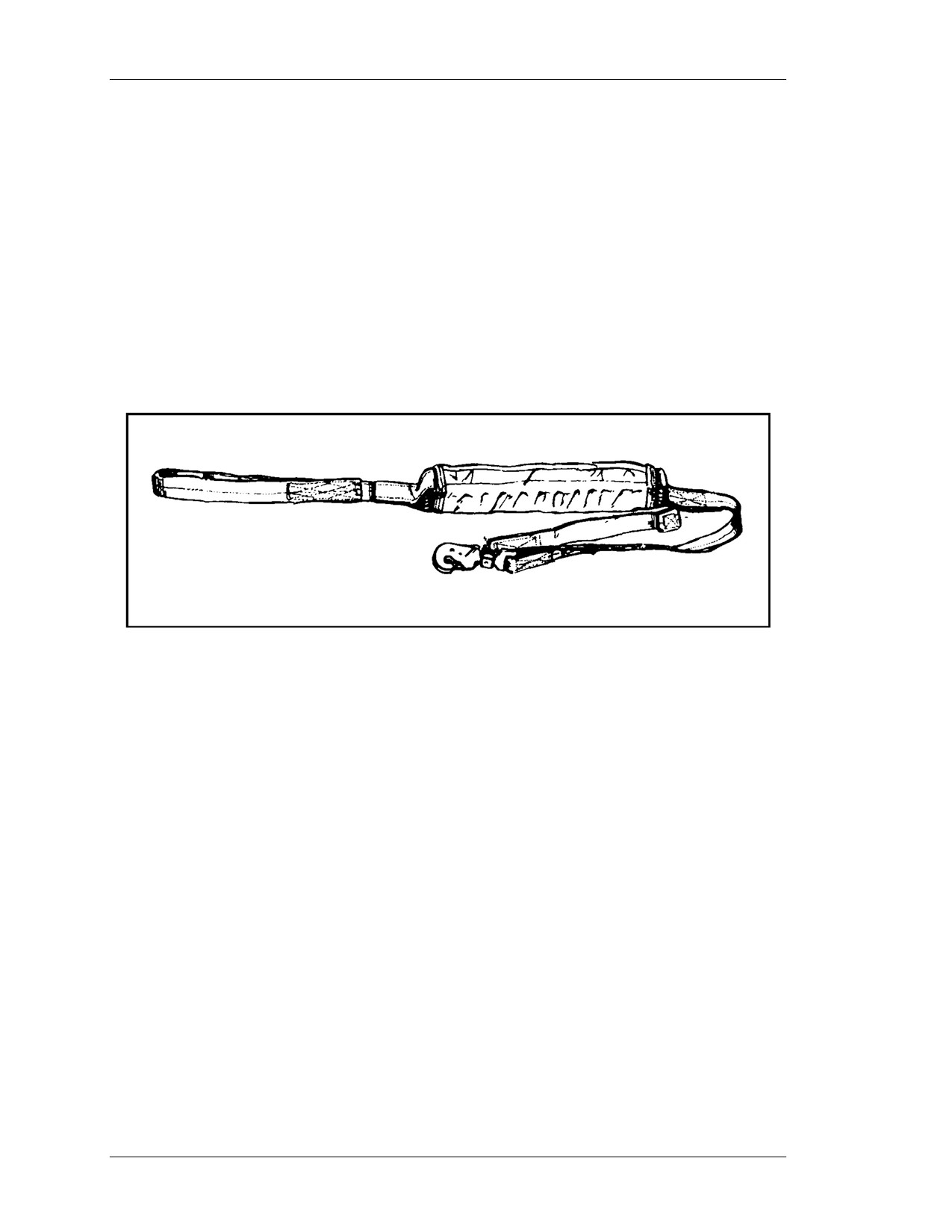
12-52. AT4 AND ALICE PACK RIGGED
To attach the quick-release snap, the parachutist attaches it to the quick-release link that
is routed through the D-ring. The opening gate should face away from the pack
(Figure 12-52).
a. Stowing the Standard Lowering Line.
(1) S-fold the lowering line neatly on top of the web inside the retainer, ensuring that
the ends are stacked evenly with the retainer flap outer edges. Secure the pile tab on the
web located at the ejector snap end to hook extension on retainer.
(2) Fold the hook side of the flap tightly over the S-folded lowering line and, holding
it firmly, fold the pile side of flap over and secure hook and pile together.
(3) Secure the pile extension on the flap retainer to the hook tab at the loop end of the
lowering line (Figure 12-53).
Figure 12-52. HPT lowering line stowed.
NOTE: The hook-pile tape located on the retainer flap and at each end of the stowed
lowering line assembly must be secured firmly and without slack to prevent
line spillage. To provide a secure closure of the hook and pile, press them
firmly, evenly, and smoothly together without puckers.
b. Securing the Attaching Web to the Standard Lowering Line.
(1) Attach the lowering line to the lowering line attaching strap by routing the loop of
the lowering line through the small loop end of the lowering line attaching strap.
(2) Route the lowering line through its own loop and pull tight (Figure 12-53).
c. Fastening Attaching Strap to Nonadjustable Cross Strap D-Ring.
(1) If not already installed, attach the lowering line attaching strap to the
nonadjustable cross strap D-ring by routing the large loop around the D-ring.
(2) Route the lowering line through the attaching strap loop and pull tight
(Figure 12-53).
12-50
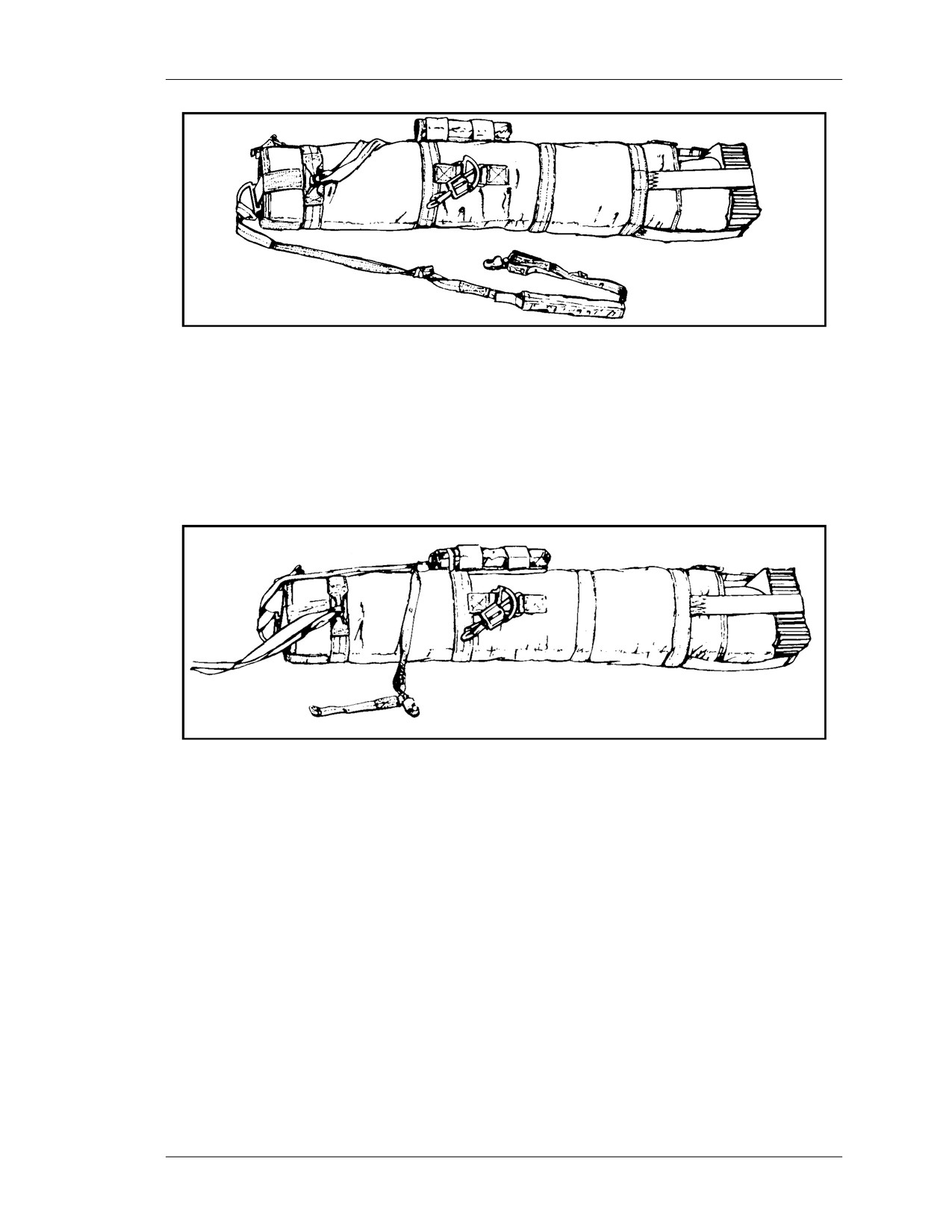
FM 3-21.220/MCWP 3-15.7/AFMAN11-420/NAVSEA SS400-AF-MMO-010
Figure 12-53. Attaching strap secured.
d. Stowing the Standard Lowering Line in Stow Pocket.
(1) Insert the lowering line assembly in the lowering line stow pocket with the
attaching strap positioned against the pack body and ejector snap away from the jump
pack.
(2) Fasten the hook-pile tabs firmly together around the lowering line stow pocket
(Figure 12-54). The AT4JP is now ready for attachment to the parachutist.
Figure 12-54. Standard lowering line stowed.
NOTE: Before attachment of the reserve parachute, individual equipment, and AT4JP,
ensure that the canopy release assemblies of the T-10-series harness are in the
hollows of the parachutist’s shoulders for a proper fit. Adjust an improperly
fitted harness by repositioning the diagonal back straps to the size channel that
correctly fits the parachutist. A properly adjusted T-10-series harness on the
parachutist ensures that the reserve parachute, individual equipment, and
AT4JP are in the proper position. An improperly fitted harness with a full
equipment and weapon load is uncomfortable and could result in problems
during ground movement prior to enplaning, movement in the aircraft, aircraft
exit, and main parachute deployment.
12-53. EQUIPMENT ATTACHED TO PARACHUTIST (STOWED
LOWERING LINE)
To rig the ALICE pack with frame, the parachutist’s ALICE pack with frame is prepared
following procedures listed in paragraph 12-43, with the following exception: secure the
12-51
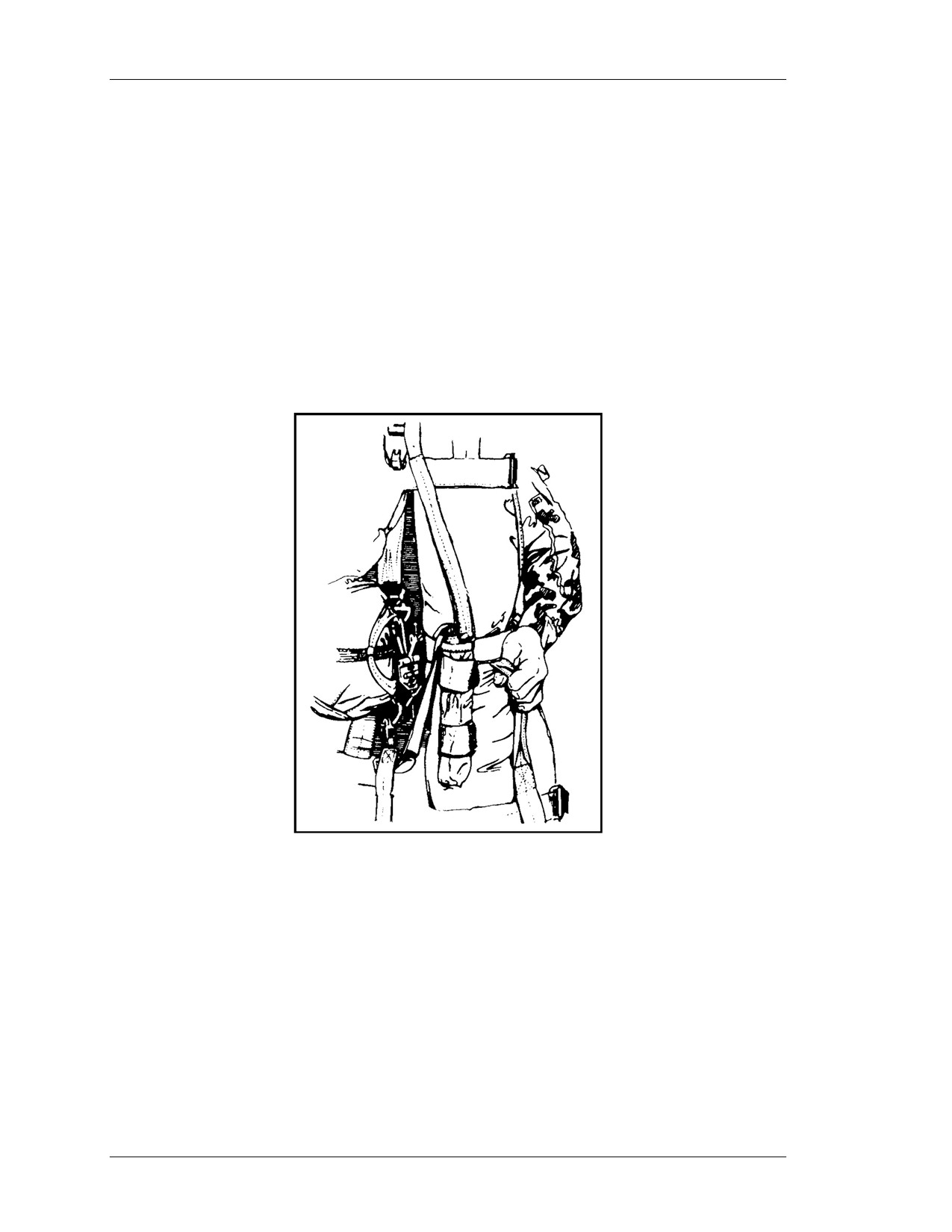
FM 3-21.220/MCWP 3-15.7/AFMAN11-420/NAVSEA SS400-AF-MMO-010
stowed lowering line to the right side (as worn on the parachutist) on the vertical pack
frame bar in two places with two turns of masking tape or two sets of retainer bands. The
lowering line ejector snap faces up and to the right or left.
a. Attach the D-ring attaching strap snap hooks (on rigged ALICE pack) to the
harness D-rings outside of the reserve connector snaps.
b. Secure ALICE pack to the parachutist’s leg.
c. Attach the HPT lowering line ejector snap from the ALICE pack to the right
D-ring on the harness.
d. Secure the AT4JP by attaching the quick-release snap to the left D-ring outside of
the H-harness snap hook (Figure 12-55). Ensure that the quick-release safety gate is
closed and the quick-release snap is locked to the D-ring, and that the quick-release
assembly release attachment sequence is inboard to outboard as follows: reserve,
H-harness, and AT4JP quick-release snap.
Figure 12-55. AT4JP secured.
e. Route the upper tie-down tape under and around the left main lift web directly
below the chest strap. Tie snugly with a double-loop bowknot on the front of the AT4JP
where it is easy for the parachutist to reach.
f. Route the lower tie-down tape around the AT4JP and the left leg. Tie with a
double-loop bowknot on the front of the AT4JP where it is easy to reach. (If the HSPR is
used, remove the lower tie-down on the AT4JP and route the left leg strap of the HSPR
around the outside of the AT4JP, then retighten.)
12-52