FM 3-04.126 Attack Reconnaissance Helicopter Operations (February 2007) - page 7

Joint Air Attack Team Operations
Table C-1. Joint air attack planning guideline
Sensor employment plan
Timing options
Alternate targets/contingency plans
TOT or time to target (TTT) methods
Electro-optical tactical decision aids
Attack methods
Mission abort criteria/notification procedures
Target area mechanics/geometry
C2
Target reference point
Communications (frequencies, Have Quick procedures,
Target sort
and authentication)
Laser employment plan
EW considerations.
Target marking options
Lost communications procedures
Disengagement considerations
Egress/return to force procedures
Mutual support
ROE/training rules
Fires
Risk management
Sensor support
PR considerations
Communications relay
Critical information flow
PR
Collection of BDA
ARMY/AIR FORCE COMPONENT
C-40. When adequate planning time exists (normally a minimum of 36 hours), a commander requests a
JAAT with an air support request message (FM 101-5-2, message number A020). The request states the
JAAT mission to ensure availability of aircraft and pilots qualified to conduct JAAT operations. An Army
request for JAAT is processed through Army FS channels up through corps for approval. The Commander
Army Forces headquarters consolidates and prioritizes air support requests received from corps and
subordinate units and forwards them to the BCD at the JAOC. At the JAOC, air requests from all
components are considered and those with sufficient priority are included in the ATO. Simultaneously, the
ALO assists the commander in planning the operation. Air Force request for a JAAT is considered at the
JAOC with the BCD in a similar manner.
IMMEDIATE FIXED-WING REQUEST
C-41. When preplanning time is not available to submit the request in time for publication in the ATO, the
TACP submits an immediate air support request, DD Form 1972 (Joint Tactical Air Strike Request),
through the Air Force air request net directly to the ASOC at corps. The TACPs at intermediate levels
monitor and inform corresponding commanders of the requests. They are allowed a designated time
interval (theater specific, normally 10 minutes) to consider disapproving the mission request. A lack of
response during the designated time translates into approval (silence is consent). Once the allotted time has
expired with no disapproval, the mission is considered valid at those levels. The ASOC forwards the
request to the G3 for approval. If approved, the ASOC tasks available on-call FW aircraft to support the
request. If the ASOC has no FW available it can, with Army concurrence, divert sorties from lower priority
targets or request support from lateral or higher commands. The requesting TACP remains the point of
contact for mission information. Personnel at corps level and below for Army and ASOC level and below
for Air Force have key planning responsibilities for employment of a JAAT.
16 February 2007
FM 3-04.126
C-7
Appendix C
NAVY COMPONENT
C-42. Navy FW aircraft supports JAAT operations when tasked by the joint force air component
commander (JFACC) or other theater air component commanders. All Navy tactical air wings deploying to
a theater of operations are capable of supporting JAAT operations. Since naval forces are not commanding
or directing JAAT operations, any Navy aircraft tasked with supporting JAAT operations falls under the
TACON of the unit responsible for the JAAT. A deployed carrier air wing (CVW) commander can provide
augmentation personnel to the JFACC, if established, as required and directed by higher authority.
C-43. The deployed CVW commander ensures all air wing personnel committed to a hostile environment
are familiar with tactics employed for JAAT operations. Subordinate commanders ensure their personnel
are familiar with JAAT tactics and capable of meeting individual responsibilities.
C-44. The CVW commander supports JAAT operations when excess sorties are available. Any aircrew
tasked to support JAAT operations falls under subordinate control of the appropriate air combat element
(ACE) commander in the operation. The designated FAC (A) aircrew has primary responsibility for air
wing training and execution of JAAT support. Whenever possible, this aircrew plans and leads any JAAT
support requested or tasked by higher authority. The functions and capabilities of these FAC (A) aircrews
are aerial reconnaissance, radio relay, control and coordination of fixed- and rotary-wing aircraft
individually or as combined arms. This includes coordination and control of SEAD to achieve desired
objectives. While the CVW commander maintains operational control of all organic air assets, sorties are
normally made available to the JFC for tasking through the JFACC in support of JAAT operations.
SECTION III - EXECUTION
BASIC JOINT AIR ATTACK TEAM COMPONENTS
C-45. The JAAT mission commander must effectively integrate the following five components to
accomplish the assigned mission:
z
ACMs.
z
Check-in and briefing.
z
Firepower timing options.
z
Attack methods.
z
Disengagement.
AIRSPACE COORDINATION
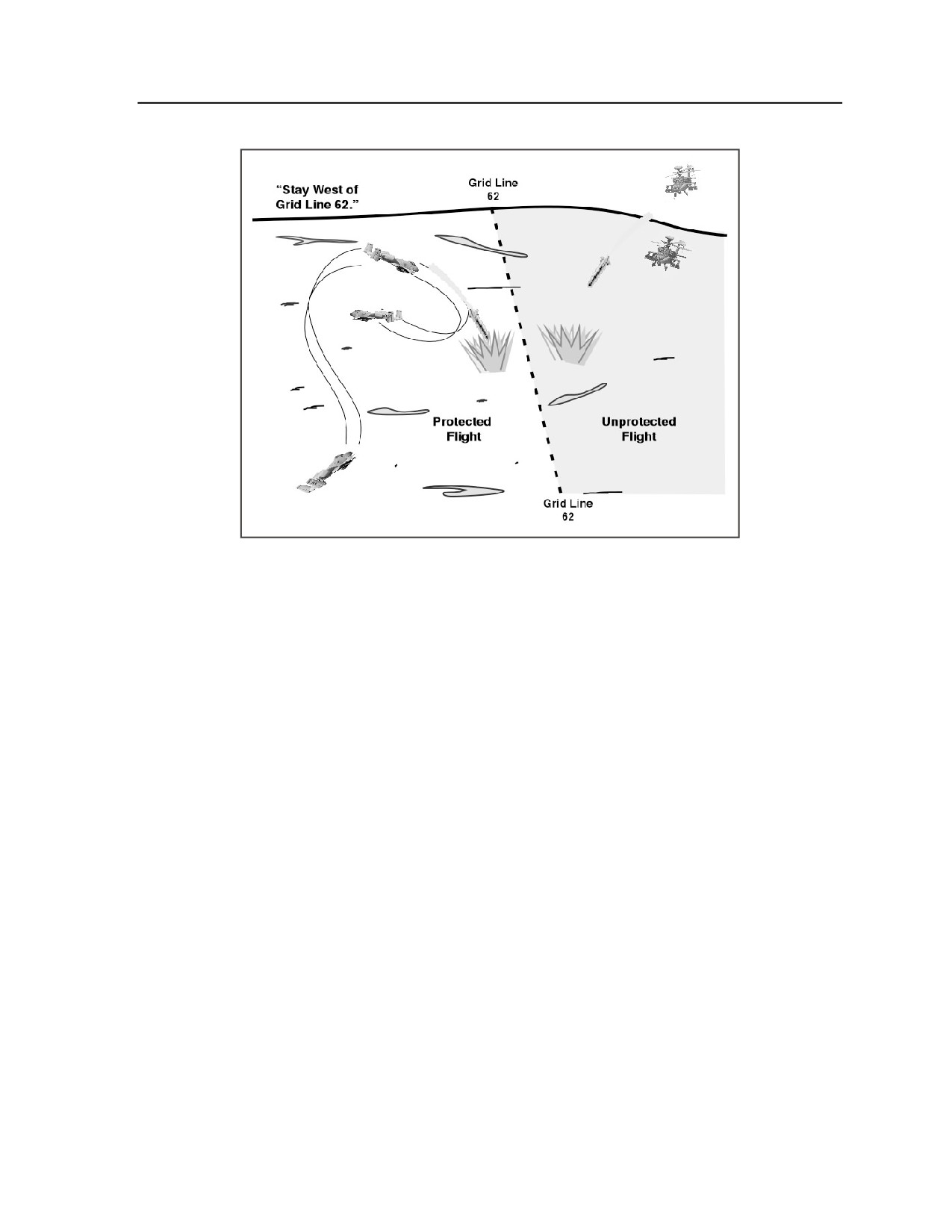
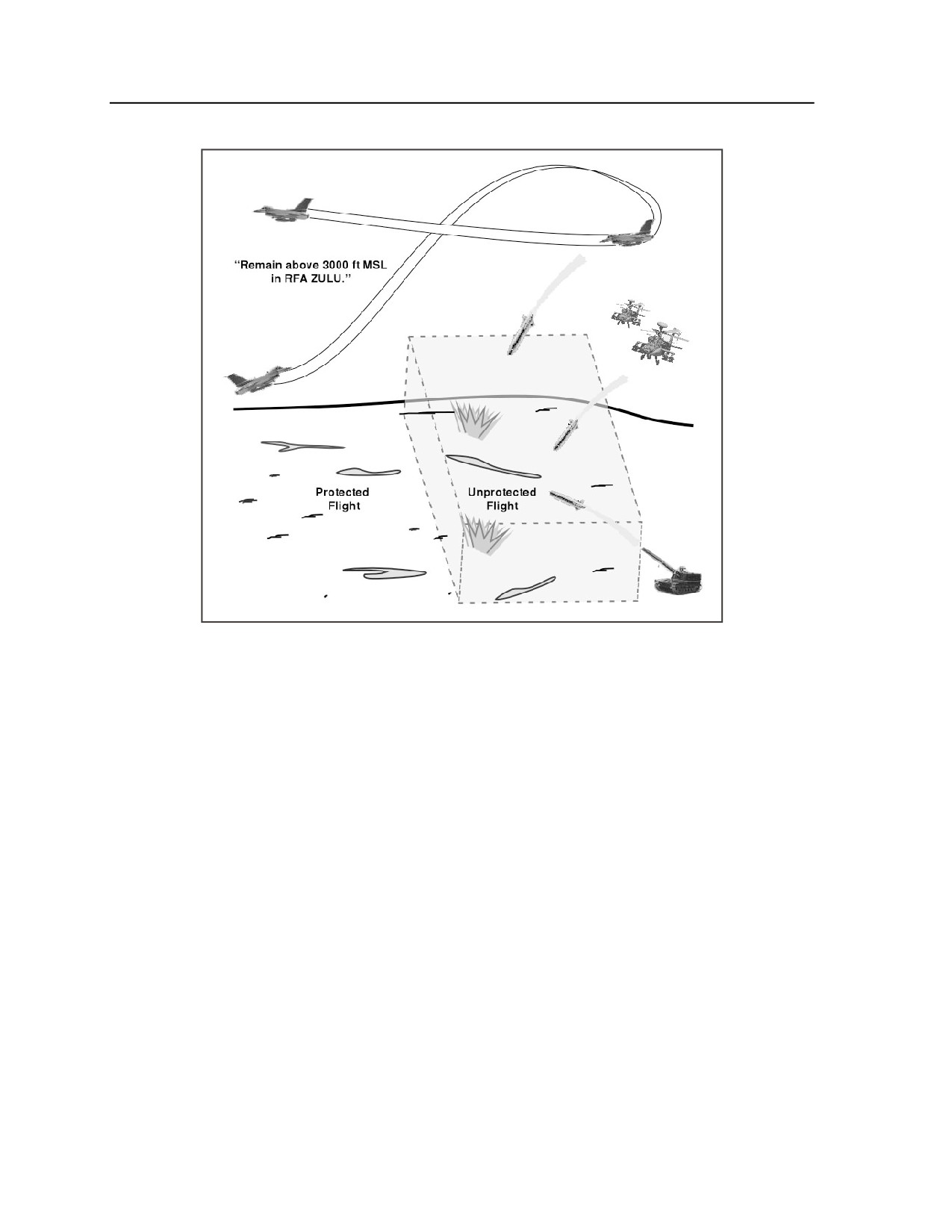
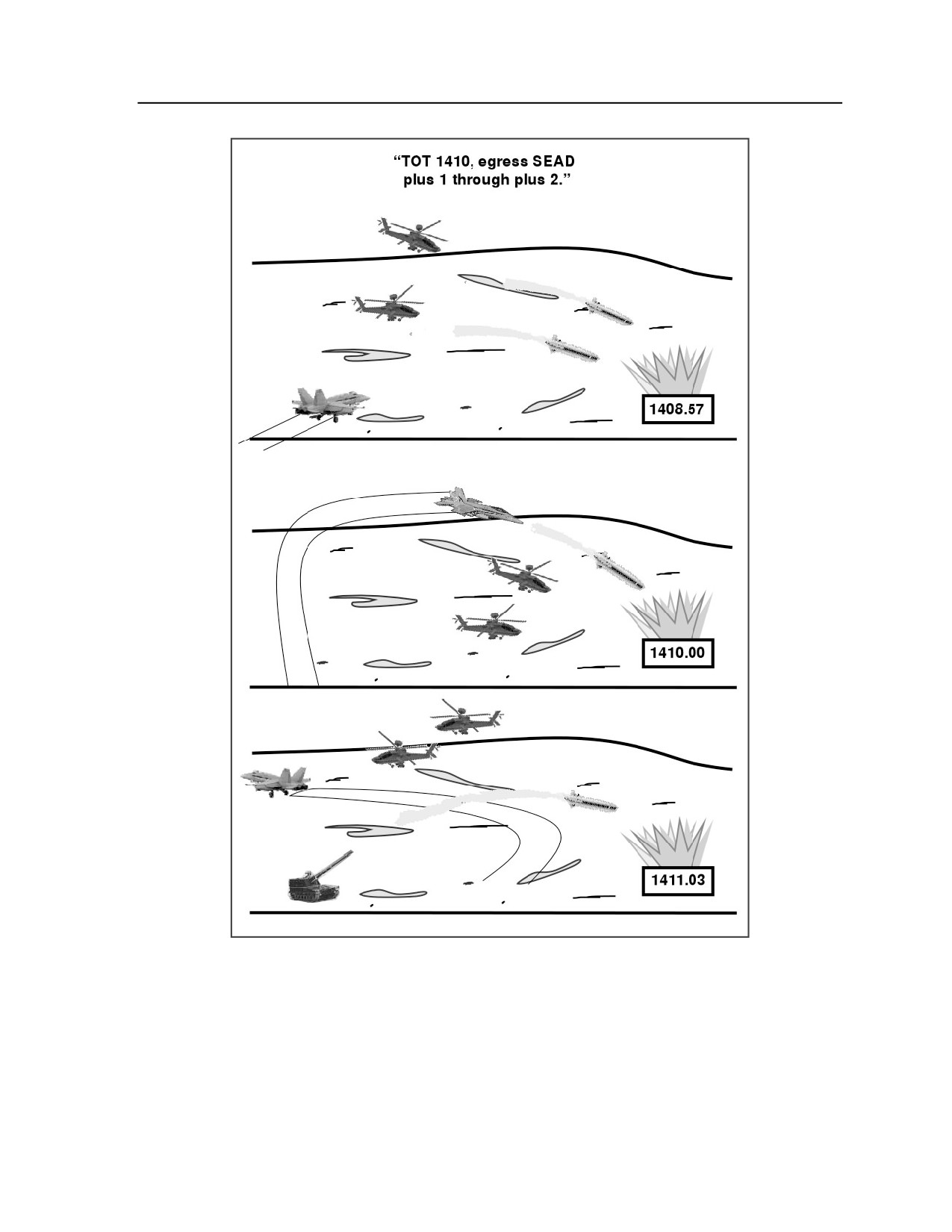
C-46. The following four methods are used to establish an ACA to deconflict attack helicopter and FW
aircraft from indirect fires:
z
Lateral/geographic separation (figure C-1, page C-9).
z
Altitude separation (figure C-2, page C-9).
z
Time separation (figure C-3, page C-10).
z
Combination of the above.
C-8
FM 3-04.126
16 February 2007
Joint Air Attack Team Operations
Figure C-1. Lateral/geographic separation
16 February 2007
FM 3-04.126
C-9
Appendix C
Figure C-2. Altitude separation
C-10
FM 3-04.126
16 February 2007
Joint Air Attack Team Operations
Figure C-3. Time separation
C-47. The fire plan includes appropriate airspace coordination measures and coordinates use of ACAs for
JAAT operations. For more information on ACAs, see JP 3-52 and FM 3-09.32.
C-48. The mission commander is responsible for ensuring ACMs are established and coordinated with all
JAAT participants. Airspace management methods in the objective include ACAs, restrictive fire headings,
maximum ordnance trajectory, minimum altitude, sectors, and timing separation.
16 February 2007
FM 3-04.126
C-11

Appendix C
C-49. Detailed ACMs, disseminated via DD Form 1972, can be used during preplanned JAAT operations,
while immediate missions may require simpler coordinating measures. All participants must understand
established coordinating measures.
CHECK-IN AND BRIEFING
C-50. FW participants check-in with the TACP, FAC (A), or Army AMC in accordance with CAS check-
in briefing (figure C-4).
CAS CHECK-IN BRIEFING
Aircraft Transmits to Controller
Aircraft “______________ this is _______________________________”
(Controller Call Sign)
(Aircraft Call Sign)
Note: Authentication and appropriate response suggested here. The brief may be abbreviated for
brevity or security (“as fragged” or “with exception”).
Identification/Mission Number:___________________________________________
Number and Type of Aircraft:____________________________________________
Position and Altitude:__________________________________________________
Ordnance:___________________________________________________________
Play Time:__________________________________________________ (if applicable)
Abort Code ___________________________________ (NVG, LST, Special Mission Items)
*Remarks (as appropriate):______________________________________________
*Optional Entry
Figure C-4. CAS check-in briefing
C-51. After initial contact between the flight lead and controller has been established, the controller
provides the standard 9-line CAS brief to the FW flight lead (figure C-5, page C-12).
C-12
FM 3-04.126
16 February 2007

Joint Air Attack Team Operations
CAS BRIEFING FORMAT (9-LINE)
(Omit data note required, do not transmit line numbers. Unit of measure are standard unless
otherwise specified. *Denotes minimum essential in limited communications environment. BOLD
denotes readback items when requested. )
Terminal controller:“___________________ this is __________________________”
(Aircraft Call Sign )
(Terminal Controller)
*1. IP/BP:“__________________________________________________________”
*2. Heading :“_________________________________________________” (Magnetic)
(IP/BP to Target)
Offset “____________________________________________________(Left/Right)
*3. Distance:________________________________________________________”
(IP-to-Target in Nautical Miles/BP-to-Target in Meters)
*4. Target Elevation:__________________________________________________”
(in Feet/MSL)
*5. Target Description:________________________________________________”
*6. Target Location:“___________” (Latitude/Longitude or Grid Coordinates or Offsets or Visual)
*7. Type Mark:“____________________” Code: “___________________________”
(WP, Laser, IR Beacon)
(Actual Code)
Laser to Target Line:“_____________________________ Degrees”
*8. Location of Friendlies:__________________________________________”
Position Marked By:____________________________________________”
9. Egress:__________________________________________________________”
Remarks (as appropriate):______________________________________________”
(Threats, Restrictions, Danger Close, Attack Clearance, SEAD, Abort
Codes, Hazards)
*TOT:“__ “ or TTT: “Stand by __ plus ____, Hack.”
Note: When identifying position coordinates for joint operations, include the map datum data.
Figure C-5. CAS briefing format
16 February 2007
FM 3-04.126
C-13
Appendix C
FIREPOWER TIMING OPTIONS
C-52. The three firepower timing options (table C-2) —simultaneous, sequential, and random—are used to
mass and deconflict fires. These timing options are employed using the attack methods described later in
the section.
Table C-2. Comparison of firepower timing options
Advantages
Disadvantages
Simultaneous
Masses fires.
Complicates target array sorting & direct fire
planning.
Maximizes shock effect.
Simultaneous weapons impacts can
Complicates enemy ADA targeting scheme.
interfere with one another.
Unpredictability.
Sequential
Target area marked for subsequent attackers.
Enemy ADs can target all players.
Continuous pressure on target over time allows
Takes longer, reduces shock effect, & could
attackers to reposition while other attackers
provide opportunities to the enemy.
shoot.
Less interference from weapons effects for
subsequent shooters.
Ensures individual targets are not double-
targeted.
Preference for multiple flights of FW.
Random
Easiest on pilots—no timing required.
Requires aircraft/weapons deconfliction.
Reduced C2 requirements.
No guarantees for effects, possible loss of
pressure on the enemy.
Unpredictability.
May complicate FS plan.
ATTACK METHODS
C-53. The attack methods describe control techniques for attacking targets within an objective area and is
briefed during the 9-Line. Methods may apply to the joint attack as a whole and again within each
attacking flight or units’ individual attack plan. The two attack methods are combined and sectored.
Combined Method
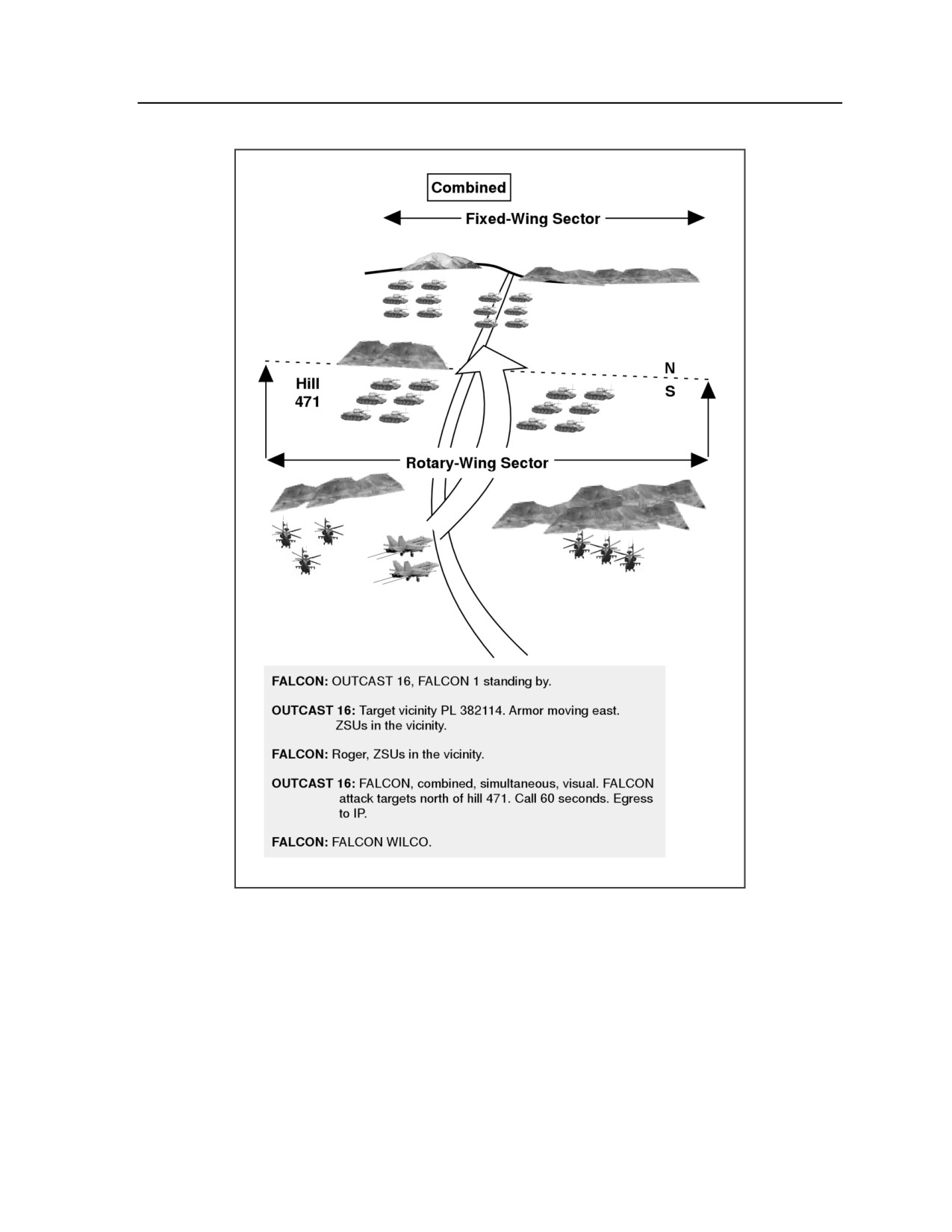
C-54. The avenue to the target is shared airspace. During this attack, all JAAT members fly in the same
area. The AMC references the FW’s 60-second call, visually acquires the FW, and directs the attack
helicopters to engage. The intent, in this case, is for all elements to attack simultaneously. FW flight is
directed to attack the northern half of the specified target area. After attacking, the FW are directed to clear
the target area. This may imply a follow-on artillery barrage or simply reflect the ground commander’s
scheme of maneuver (figure C-6, page C-14).
C-14
FM 3-04.126
16 February 2007
Joint Air Attack Team Operations
Figure C-6. Example of combined attack
Sectored Method
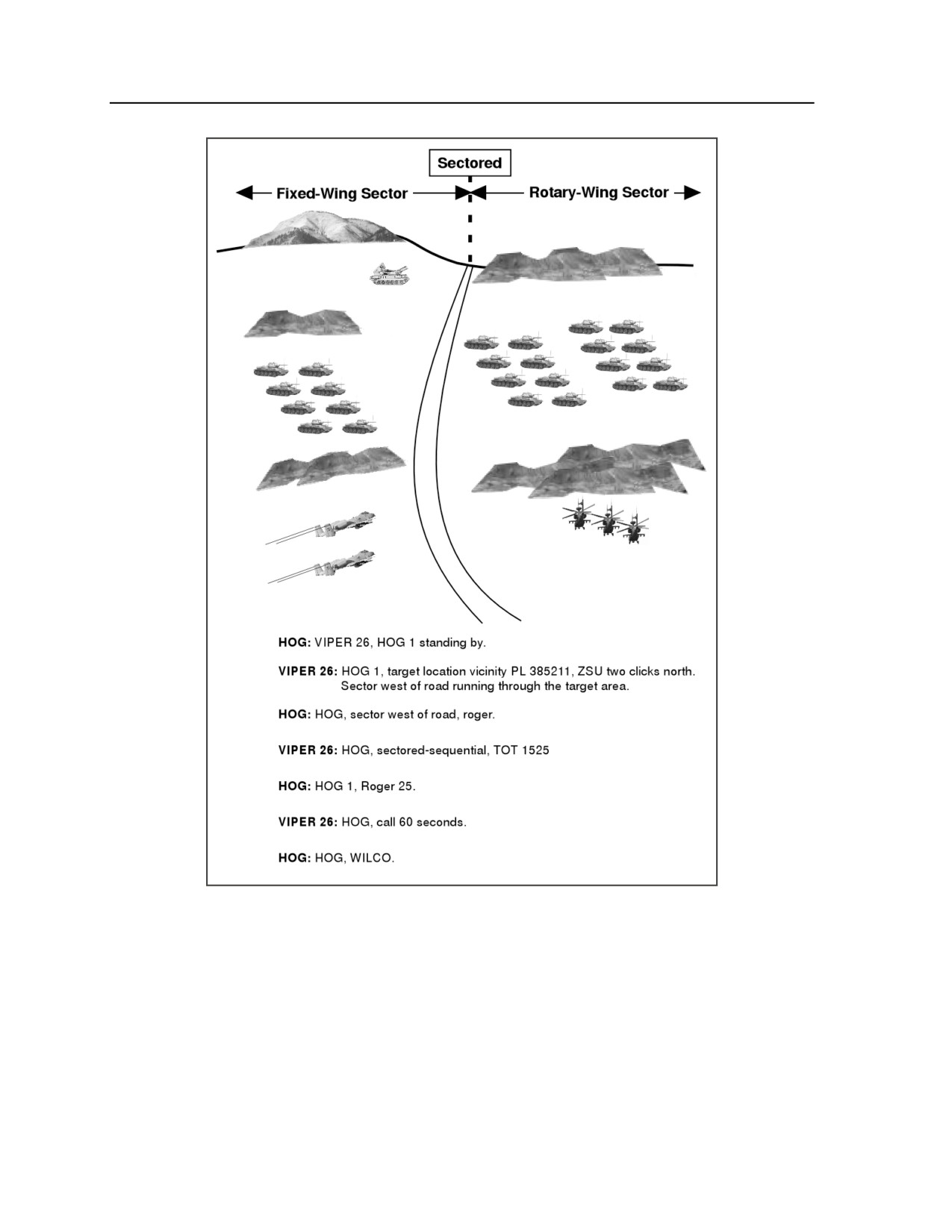
C-55. The avenue to the target is sectored (using acknowledged sectors). During this attack, the A-10 flight
maneuvers exclusively west of a north/south line drawn through the target area (the road). The mission
commander directs the A-10 flight to attack at a specified time on target (TOT). The timing coordination
call (60 seconds in this example) is requested to update the attack plan timing. Pilots must still deconflict
weapons fans to preclude friendly casualties. While ensuring weapons or weapons effects do not cross an
established sector line, a rule of thumb commonly employed is to never fire more than 30-degrees towards
or into the other sector. Coordination between the type of attack and timing option is vital (figure C-7, page
C-15).
16 February 2007
FM 3-04.126
C-15
Appendix C
Figure C-7. Example of a sectored attack
DISENGAGEMENT
C-56. Consideration must be given to the disengagement phase of the operation. These considerations
include covering fires and route of egress.
Covering Fires
C-57. Fixed- and rotary-wing aircraft may provide suppressive fires and SEAD as other elements egress.
Artillery
(cannon, Multiple Launch Rocket System
[MLRS], and Army Tactical Missile System
C-16
FM 3-04.126
16 February 2007
Joint Air Attack Team Operations
[ATACMS], if authorized) can also provide suppressive and SEAD fires. EW assets also may provide
SEAD with anti-radiation missiles or electronic attack.
Route of Egress
C-58. Due to the flexible nature of operations, planned egress routes may not be available to all JAAT
participants. Consideration must be given to coordinating new egress routes.
Example: FW aircraft might be tasked to provide reconnaissance of a hasty rotary-wing egress
route.
RISK MANAGEMENT
C-59. Risk management consists of identifying hazards and implementing controls during planning,
preparation, and execution. During the execution phase, all participants in the JAAT focus primarily on
implementation of controls. However, as additional hazards are identified during execution, participants
must implement additional controls.
C-60. Hazards to consider include—
z
Enemy forces/threats.
z
Weapons release parameters/dangers.
z
Surface danger zones.
z
Laser operations.
z
Environmental factors.
z
Friendly unit location/SU.
z
Human factors.
z
Battlefield obscuration/clutter.
z
Terminology.
C-61. Control measures used to mitigate risk may include—
z
ACMs.
z
Flight techniques tactics.
z
Use of personnel specifically trained and experienced in JAAT operations.
z
Lethal and nonlethal SEAD.
z
FSCM.
z
Suppressive fires.
z
Positive control.
z
Reasonable assurance/indirect control.
C-62. Minimum criteria include—
z
Adequate SA.
z
Known location of friendly elements.
z
Positive hostile identification.
z
Minimum separation for munitions employment (fragmentation deconfliction).
z
Communications.
z
Friendly combat identification (IFF, IR markings, lights).
z
Authentication.
16 February 2007
FM 3-04.126
C-17
Appendix C
NIGHT CONSIDERATIONS
C-63. Tactics procedures for night employment of the JAAT remain the same as for day operations.
However, techniques required to accomplish night JAAT operations tactics involve a more deliberate
tempo and strict adherence to these basic procedures to ensure all participants maintain SA. FM 3-09.32
and unit/aircraft specific tactics manuals provide detailed information on conducting night operations.
C-64. Perspective and target resolution vary based on aircraft systems. The aviation mission commander
must provide a detailed description of the objective area to ensure all participants, regardless of perspective
or available sensors, have a clear picture of the objective area. Night sensor/NVG used by all participants
greatly increase capability and effectiveness of the JAAT; however, certain limitations exist. A terrain
feature visible by a NVG/ FLIR equipped rotary-wing aircraft at 50 feet may not be visible or recognizable
by an NVG-equipped pilot or for a FLIR equipped aircraft at 20,000 feet.
C-65. Night positive control is more difficult as controllers cannot observe both target and attacking
aircraft. Friendly and threat SA is necessary. Aircraft lighting, thermal combat identification, ground unit
identification, and location descriptions all aid in SA.
C-66. IR illumination, offset illumination, IR pointers and illuminators, indirect fires, direct fires, laser, and
grid coordinates are all techniques for marking targets. Consideration must be made for the marker effects
on all participants.
CONTROL MEASURES
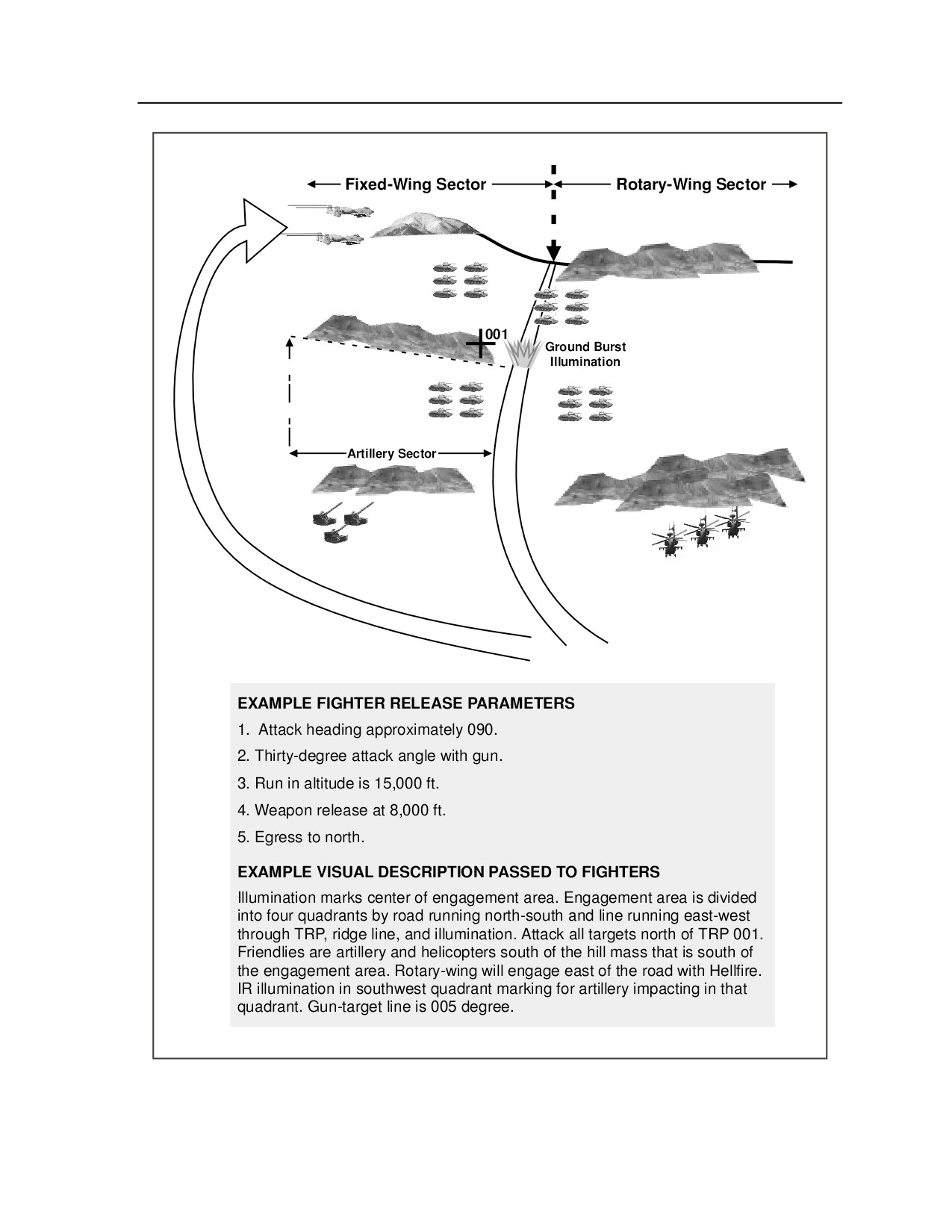
C-67. Figure C-8, page C-18, depicts example measures assisting JAAT participants in controlling their
fires. Other factors include—
z
Attack heading.
z
Weapons selection for pass.
z
Ingress and release altitudes.
z
Dive angle.
z
Distance from target.
LASER BACKGROUND
C-68. Modern rotary-wing laser systems greatly enhance effectiveness of the JAAT by offering increased
mobility, accuracy, and lethality. Airborne target lasing capabilities coupled with laser spot tracking
equipment provide greater efficiency, integration, and distribution of weapons effects. Due to the variety of
laser systems employed during a JAAT operation, laser techniques and procedures, along with specific
laser codes, must be coordinated by all JAAT elements to ensure successful operations. Laser code and
laser-to target line information is found on line 7 of the 9-line brief. JAAT procedures have been developed
and successfully tested using Apache laser designators with the laser spot tracking equipment on aerial
vehicle-8 Harriers, F/A-18 Hornets, and A-10 Thunderbolt II. The scenario and descriptions of JAAT
operations using laser operations cite the A/AO-10 for illustrative purposes only.
C-18
FM 3-04.126
16 February 2007
Joint Air Attack Team Operations
Figure C-8. Night JAAT and associated control measures
16 February 2007
FM 3-04.126
C-19
Appendix C
OPERATIONS
C-69. JAAT-laser calls are made on the JAAT common frequency. Airborne LSTs for target acquisition
accept four digit codes; ground systems accept only three digit laser codes. Therefore, aircrews must place
a 1 at the first digit of the laser code.
C-70. The terminal controller ensures the following events occur for an effective JAAT:
z
Include laser code and laser target line (LTL) on line 7 of the 9-line brief.
z
Aircraft avoid the 20-degree safety zone (10 degrees either side of the LTL for aircraft run-ins).
z
Brief pilot, if possible.
z
Plan early and prepare FO teams/ fire support teams ready for mission.
z
Ensure code in laser target designator matches code pilot passed.
z
Actual LTL is no more than 5 degrees off briefed LTL.
z
Explain he in control and the laser target designator is operated at his command.
z
Ensure simple and easily understandable communications are in place.
z
Ensure appropriate safety zone is established around laser designators and friendly units are not
overflown during weapons employment.
RADIO CALLS
C-71. The required radio calls for laser operations are found in table C-3 and FM 90-21.
Table C-3. Laser operations example radio calls
A-10: “HOG 1, departing IP”
AH-64: “Apache 1, roger”
A-10: “Hog 1, 60 seconds
Maverick”
A-10: “Hog 1, 10 seconds”
A-10: “Hog 1, laser on”
AH-64: “Apache 1, laser on”
A-10 “Hog 1, spot”
A-10 “Hog 1, rifle”
A-10 “Hog 2, shift, gun”
AH-64: “Apache 1, shift
set”
A-10: “HOG 2, spot”
A-10: “HOG 2, terminate”
Departing Initial Point
C-72. This is a situation awareness call informing all in the JAAT the CAS/FW flight has departed the
initial point and is inbound to the target.
Timing Coordination and Type Weapon Call
C-73. The timing coordination call notifies the mission commander the FW flight is inbound and states
approximate amount of time from attacking in the immediate target area. It also alerts the Army asset as to
what type of weapons (for example, missiles, and guns) will be used. Normally, 60 seconds gives the laser
designator time to complete the present engagement, acquire a new target, and prepare to laser it.
C-20
FM 3-04.126
16 February 2007
Joint Air Attack Team Operations
Directive to Standby
C-74. Ten seconds. The directive to terminal controller is given to standby for laser on call in
approximately 10 seconds. The laser should be turned on in 10 seconds even if the laser on call is not
heard.
Directive to Start Laser Designation
C-75. Laser on. The laser is turned on. Normal laser designation time is 20 seconds maximum. The
aircrew may request a longer laser on time by saying laser on and time (laser on, 30 seconds.).
Acquisition of Laser Designation
C-76. The aircrew calls SPOT when acquiring the laser spot, confirming to the FAC and wingman the
aircraft or weapon laser seeker has identified a source of laser energy which may be the designated target.
For multiple aircraft in the same attack, SHIFT calls may be used after the lead aircraft calls SPOT to direct
the laser designator operator (LDO) to shift the laser to the next aircraft’s target. This call is usually used
for target acquisition in conjunction with weapons not requiring terminal laser guidance.
Maverick Launch
C-77. Rifle (AGM-65 Maverick launch). The advisory call indicates the Maverick missile is inbound.
Directive to Shift Laser Illumination
C-78. Shift. Once the lead aircraft engages the target, a shift call can be made to shift the laser to the next
target. The laser must remain on during the shift to maintain a laser lock-on. If the laser is turned off, the
laser spot tracking equipment reverts to a search mode. Depending on the search mode, it could take 10 to
20 seconds to reacquire the laser energy, leading to unacceptable exposure times and aborted attacks.
Terminate
C-79. Laser illumination of a target ceases. This call indicates the laser is no longer needed. Careful
planning must be done when FW are attacking in line or wedge formations to ensure that the lead aircraft
does not terminate the laser before the wingman’s lock-on. When in trail, each aircraft may want to make
separate laser on and termination calls, depending on their separation. Minimizing the time a laser is on is
important in a laser countermeasure environment and when employing battery operated laser designators.
C-80. The laser operator turns the laser off—
z
When terminate call is heard.
z
When the weapon hits the target.
z
After 20 seconds (or longer if requested).
16 February 2007
FM 3-04.126
C-21

Appendix D
Briefings, Reports, and Formats
This appendix provides a reference for briefings, reports, and formats used by
aviation units during training or combat to more efficiently accomplish assigned tasks
and missions. Please note, it is not all inclusive; products are used as a guide and do
not supersede unit SOPs.
PREDEPLOYMENT AND PRETEMPORARY DUTY
D-1. Table D-1 provides example for predeployment and pretemporary duty requirements.
Table D-1. Example for predeployment and pretemporary duty
Finance
Yes
No
N/A
Task/Action
Bills, recurring and nonrecurring.
Bank accounts, checking, savings, loans. Investments and other income sources.
Safety deposit boxes.
Legal
Power of Attorney as needed (specific, general).
Wills updated.
Living wills updated.
Spouse’s SSN.
Guardianship for children.
Insurance policies; life, auto, home/renters, floater.
Deeds, leases, rentals, real estate documents, management company.
Marriage or divorce papers.
Birth certificates, adoption papers.
School records.
Naturalization documents.
Vehicle titles and registration.
Taxes.
Necessary court documents.
Personnel Issues
TDY or PCS orders.
Emergency data cards complete.
ID cards, copy, expiration dates, DEERS enrollment.
SGLI.
Passport and Visa documents.
Family care plan.
NEO/Safe haven information.
Personal affairs; funeral and burial instructions.
Household
Vehicle registration, inspection, all stickers and tags.
Crime prevention measures/force protection information.
Maintenance/utilities/list of who to contact for problems and repairs.
Disaster/evacuation plan and survival kit; water, food, clothing, other personal
necessities.
16 February 2007
FM 3-04.126
D-1

Appendix D
Table D-1. Example for predeployment and pretemporary duty
Communication
Community contact information
Local emergency contacts; police, fire, Red Cross, poison control, hospital,
TRICARE.
Post Chaplain, ACS, MPs.
Unit contact information (include phone numbers, physical address and e-mail
address)
Unit name, DIV, BDE, BN, CO.
Commander, CSM/1SG, UMT, supervisor.
Family Readiness Group spouses.
Orderly room, SDO, FOD.
Rear detachment commander/OIC and NCOIC.
TDY; dates, location, phone and emergency phone.
Personal contact information
Family.
Friends.
Immediate neighbors.
Financial.
Insurances.
Emergency family and friends.
Medical
TRICARE enrollment/claim process.
Locations/providers/clinic contact information.
Records; medical, dental, shot, other.
Pets
Records.
Veterinarian; regular and emergency.
CONVOY PRECOMBAT INSPECTION
D-2. Table D-2 provides an example for convoy precombat inspection requirements.
Table D-2. Example for convoy precombat inspection
Completed
Vehicles:
Vehicles are inspected at operating temperatures with hoods open.
5988Es are current with all parts installed.
Vehicle fuel will be topped off.
All basic issue items present and serviceable.
Three days rations per Soldier per vehicle.
Five-gallon water cans topped off.
Water buffalo sanitized and topped off.
All supply trucks are covered.
Complete combat lifesaver bag on hand (if applicable.)
Weapons:
Crew-served weapons functionally checked.
.50-cal headspace and timing set.
Functions check on all individual weapons.
5988Es are present and current for all crew-served weapons .
D-2
FM 3-04.126
16 February 2007
Briefings, Reports, and Formats
Table D-2. Example for convoy precombat inspection
All weapons are lubricated.
Communications:
Radios loaded with correct frequencies. Call signs recorded.
5998Es are all current with PMCS and manual.
Batteries are present for dismounted radios.
Long-range radio checks are complete.
Digital nonsecure voice telephones are present with 2 miles of WF-16 wire per phone.
TA-1s or TA-312s are operational with 1 roll of WD-1 per set.
Automated net control devices are present and loaded.
CBRN Equipment:
5988Es are present for all CBRN equipment.
M-8/M-22 alarms are complete with batteries and operational alarm.
IM-93 is present and operational.
M8 and M9 paper present and attached.
M256A1 chemical detection kit (1 per squad) on hand.
CBRN markers are present and stocked.
CBRN teams identified.
Night Observation Devices (NODs):
5988Es are present and complete for all NODs.
15-day supply of batteries for all NODs.
Carrying cases are complete with accessories and lens cleaning equipment.
Individual Solider:
Load-bearing equipment worn in accordance with TACSOP and properly fitted.
Flack jacket is present/Gortex jacket if necessary.
Flashlight present with the appropriate filter.
Identification tags and identification card present.
7 magazine per M-16/M-4; 3 per M-9 9-mm.
Department of the Army Form 1156 in the first aid pouch and left pocket of the chemical
protective overgarments.
Serviceable first aid packets.
One-quart canteen with cup and cover (extra canteen optional) present. Canteens must
be filled and fitted with CBRN cap.
All Soldiers understand the mission.
Drivers:
5988E with current PMCS and quality control within 72 hours.
Dispatch signed by the driver and the company commander/XO.
Driver has a current ULLS computer-generated license.
Driver has combat service support graphics, control measures, and a map of the
operational area.
Leaders:
Map with current graphics and/or strip map.
Field trains TACSOP.
Leaders have appropriate FMs and Army training and evaluation program (ARTEP)-
MTPs.
List of all sensitive items on company standardized sensitive items sheet.
Current list of all vehicles organic or attached.
Current signal operating instructions for brigade support area and TF.
S-2 threat assessment.
Prepared convoy commander brief.
16 February 2007
FM 3-04.126
D-3

Appendix D
PRECOMBAT
D-3. Table D-3 provides example for precombat operations requirements.
Table D-3. Example for precombat inspections
Platoon Sergeant
Check
Platoon Sergeant (cont’d)
Check
Personnel Accounted For
Platoon Status to First Sergeant
Individual PCI Completed
Situation Briefed
Reference Publications Reviewed
MREs Issued
Uploaded by Load Plan
Personnel Accounted For
Expendable Supplies on hand
Individual PCI Completed
Communications Equipment
Reference Publications Reviewed
Equipment Accounted For
Uploaded by Load Plan
Radios
Expendable Supplies on hand
Microphones
Sleep Plan Established
Operation Equipment
MOPP Level known and disseminated
Maps, Updated
Weapons control
Compasses
Section Status to Platoon Sergeant
Pens, etc
Situation Briefed
Sleep Plan Established
MRE’s Issued
Class V Issued
Ammo Basic Load Issued
MOPP Level known and disseminated
Personnel Accounted For
Weapons control
Individual PCI Completed
COMBAT OPERATIONS
D-4. Table D-4 provides an example for PR planning requirements.
Table D-4. Example for personnel recovery planning
Personnel Recovery Planning Requirements
Date Time Group (DTG) Notified:
Premission planning
Go/No-Go
Record event on appropriate incident form
Determine PR plan of action
Complete PR worksheet
Obtain current INTEL brief
Obtain ISOPREP, authentication data, and EPA
Determine threat level
Obtain weather brief
Study terrain/obtain sea conditions
Determine survival equipment
Determine CBRN contamination
Determine medical status
Special considerations
Complete PR planning:
PR plan (forces, timing, locations)
Comm plan/flight following including backups
Rescue forces informed
Support forces requested (as requested)
OSC appointed /notified
Coordination complete with all PR forces
Mission Execution
Monitor mission progress
Start times
Keep component rescue coordination center (RCC)/ISRC advised of actions
D-4
FM 3-04.126
16 February 2007

Briefings, Reports, and Formats
Table D-4. Example for personnel recovery planning
Personnel Recovery Planning Requirements
Date Time Group (DTG) Notified:
Premission planning
Go/No-Go
Arrival times at scene
Arrange for transport of injured (as required)
Obtain additional PR forces/support (as required)
Complete reports (as required)
Closing Actions
Rescue personnel debriefed
INTEL debriefed (as required)
Component RCC/ISRC notified of mission results
Rescued personnel status confirmed
Paperwork complete
PR Precombat Checks/Precombat Inspection
Medics kit inventoried, splints, IV bags, sufficient for full up crew of downed aircraft (UH-60=four
personnel, AH-64 and OH-58=two personnel).
Commo cards accurate? (prepared by RCC)
Location of Level I &II Care known, frequencies and approach paths into C Med. known?
Contingency plans for early departure from battle, return crossing of PP if cross-FLOT?
Aircrew knowledge of adjacent airspace coordination measures.
Personnel qualified/trained/rehearsed.
Weapons PCC/PCI.
Battle graphics on maps.
Safing procedures for downed aircraft.
Personnel should be trained on the use of all survival equipment to include the forest penetrator
and horse collar.
Emphasis should be placed on letting the hoist cable ground itself before touching.
Personnel Recovery Planning Requirements
Date Time Group (DTG) Notified:
Premission planning
Go/No-Go
Ensure that they have completed DD Form 1833 (Isolated Personnel Report (ISOPREP).
Ensure PRC-112 radios are programmed correctly with frequencies and isolated personnel code.
Airspace Coordination Measures
Must have coordination for PPs in cross-FLOT.
Must have location of Level II care, communication, and familiar with landing site at Level II care.
Must have knowledge of all airspace available and ability to coordinate passage through adjacent
airspace.
Enemy Situation.
Friendly Situation.
Air Routes.
Individual PR related requirement.
All aircrew personnel should wear on their person the following equipment:
• A survival vest with CSEL or PRC-112 radio.
• Strobe light with IR cover.
•
6 chemlights.
•
Signal mirror.
Ensure that they have completed DD Form 1833.
Ensure PRC-112 radios are programmed correctly with frequencies and isolated personnel code.
Security team personnel should be equipped with the following nonstandard items:
• Crash rescue (quickie) saw.
• Crowbars.
16 February 2007
FM 3-04.126
D-5

Appendix D
Table D-4. Example for personnel recovery planning
Personnel Recovery Planning Requirements
Date Time Group (DTG) Notified:
Premission planning
Go/No-Go
• Crash axes.
• Rappel ropes.
• STABO harnesses.
• Aviator flak vests.
• SABRE radios (w/headsets).
• PRC-112s.
• Additional back boards and medical supplies.
AMC
Go/No-Go
Appoint an OSC.
• Usually wingman (will have location and condition information).
• If not wingman relay vicinity and condition if known.
• Consider station time and weapons load.
Ensure OSC authenticates the downed aircrew ASAP IAW the spins and passes
all used/compromised authentication data to higher.
Obtain PRC-112 CSEL codes (PLS codes) and ISOPREP data from S-2 and pass
to RMC or OSC.
Coordinate and monitor PR radio nets.
Manage flow of aircraft to and from the objective area.
OSC
Authenticate isolated personnel.
• Record all used:
• Call sign ___________________________________________
• Authentication used ________________________________________
Personnel Recovery Planning Requirements
Date Time Group (DTG) Notified:
Premission planning
Evaluate:
Why did aircraft go down? ____________________________
Check all assets for:
• Station time ____________________________________
• Ordnance _____________________________________
• What is needed/on the way? ______________________
• Reset Bingo (don’t overfly) ________________________
• Weather options ________________________________
RMC
Complete all necessary information in the Rescue Mission Brief.
Determine Isolated Personnel’s available signaling devices.
Conduct a thorough threat assessment:
• Recommend ingress and egress routes
• Inform RESCORT of threat positions so they can be circumvented.
• Request additional support if required.
Make Go/No-Go recommendation based on information gathered at the objective
area.
Brief replacement RMC/RESCORT using the Rescue Mission Brief
D-6
FM 3-04.126
16 February 2007

Briefings, Reports, and Formats
Table D-4. Example for personnel recovery planning
Personnel Recovery Planning Requirements
Date Time Group (DTG) Notified:
Premission planning
Go/No-Go
Prepare the Isolated Personnel for pick-up
Reauthenticate the Isolated Personnel after OSC changeover only when the
situation warrants
SARIR TEMPLATE
INFO: ALPHA
DTG
LINE 1
CALL SIGN
LINE 2
AIRCRAFT TYPE
LINE 3
NATIONALITY
LINE 4
BAILOUT LOCATION
LINE 5
SOURCE
TIME
ALTITUDE
WINDS
LINE 6
GROUND LOCATION
LINE 7
SOURCE
TIME
LINE 8
DTG OF INCIDENT
LINE 9
CAUSE OF INCIDENT
LINE 10
DETAILS
LINE 11
CONDITIONS OF ISOLATED PERSON
LINE 12
LAST CONTACT
LINE 13
REPORTED BY
METHOD
AUTHENTICATED YES OR NO
LINE 14
AUTHENTICATION USED
LINE 15
SITUATION
AIR DEFENSE
GROUND
LINE 16
SAR CODE/PLS 112 CSEL CODE
CORDON AND SEARCH
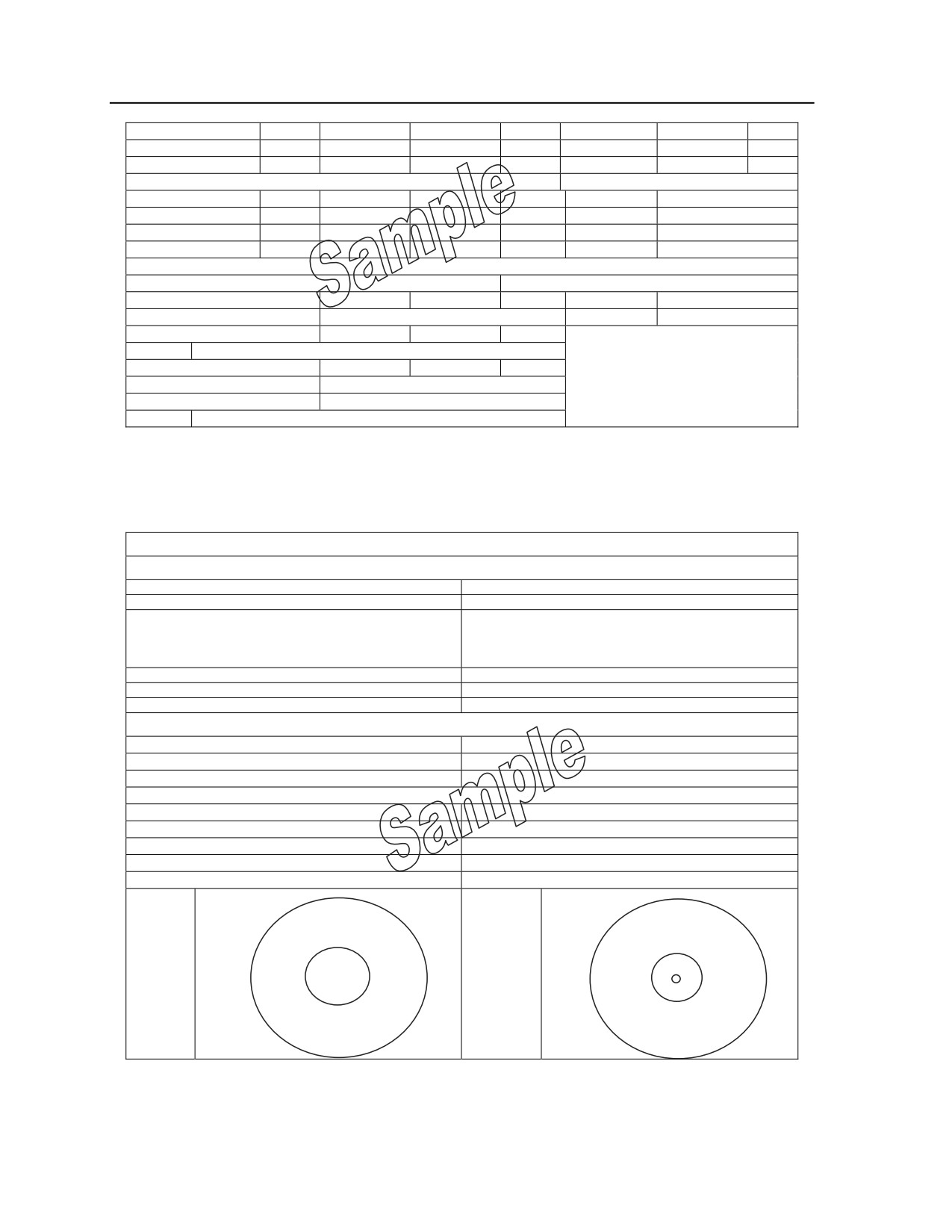
D-5. Table D-5 is an example for cordon and search requirements.
Table D-5. Example for cordon and search
CORDON AND SEARCH REQUIREMENTS
DTG Msn Conducted:
Msn Name:
Mission Statement:
Unit:
C/S:
Freq: P/A
Msn Time:
No#/Type Veh:
Type Marking:
Timeline
Event
Time
Waypoint
Location
Rmk
Waypoint
Location
Rmk
Convoy Start Point
Convoy RP
Cordon Set
A/C On Station
Msn Complete
16 February 2007
FM 3-04.126
D-7
Appendix D
FS
Building Marking
C/S
Freq
Location
Type
Name
Location
How Marked
Msn Info
Type Msn
Convoy Security
Recon
Before
During
After
Infil
Yes/No
Obj And Orientation
Exfil
Yes/No
Standoff/Overwatch
Before
During
After
Msn Remarks:
Rmk
Presence
Before
During
After
Obj And Orientation
Add. Areas Of Interest
Rmks
RESCUE MISSION BRIEF
D-6. Table D-6 provides an example rescue mission brief.
Table D-6. Example rescue mission brief
Rescue Mission Brief
Survivor Information
Call sign
Number of survivors
Location - Circle appropriate
GRID
-
L/L
RNG/BRG - SARDOT/DPP
GPS, map or flyover
Condition/Injuries
Walking (yes or no )
Equipment (Communication/Signal)
Authentication Complete
(yes/no)
Method
Recovery Area Brief
Threats
Elevation
Description
RESCORT Plan
IP
Ingress
Egress
Ordinance
RESCORT Tactics
Interior
Exterior
Objective
Area
D-8
FM 3-04.126
16 February 2007
Briefings, Reports, and Formats
LANDING ZONE SURVEY
D-7. Table D-7 depicts an example for LZ survey requirements.
Table D-7. Example landing zone survey
SURVEY DATE:
LZ#:
LZ NAME:
GPS COORD:
MGRS GRID:
LANDING AREA
TYPE:
[
] Helipad
[
] Field
[
] Road
[
] Other ______________
SURFACE:
[
] Level
[
] Sloped
[
] Rocky
[
] Dusty
[
] Wet
WIND INDICATOR:
[
] Wind Sock
[
] None
[
] Other _____________
LIGHTING:
[
] Chem-lite
[
] Bean Bag
[
] Inverted Y
[
] None
[
] Other _____
LZ OBSTACLES
[
] Towers
[
] High Grass
[
] Brush
[
] Trees
[
] Buildings
[
] Poles
[
] Wires/Height
[
] Other_______________
APPROACH INFORMATION
LZ Long Axis:__________ (degrees magnetic)
LZ Size: (meters) _________ x _________
Approach Heading: _____________________
Departure Heading: ___________________
NUMBER/TYPE AIRCRAFT:
UH-60
CH-47
OH-58
AH-64
FLIGHT ROUTE
UNAIDED NIGHT OPS:
NVD OPS:
[
] Yes
[
] No
[
] Yes
[
] No
ACCESSIBILITY
[
] Ground/Emergency Vehicles
[
] Other ______________________________
CONSIDERATIONS:
[
] Near Housing Area
[
] Noise Abatement
[
] Other _________________
RESTRICTIONS/REMARKS: (OGE, IGE, Number & Type A/C, Day Only, etc.)
LZ SKETCH/PHOTO: (Attach to this document)
DISTRIBUTION:
[
] Reading File
[
] Detachment Ops Files
SURVEYOR: _________________________________________________________________
RISK:
[
] Low
[
] Medium
[
] High
*** THIS FORM IS INTENDED FOR USE AT FIELD SITE LANDING AREAS, NOT HELIPADS***
SPOT REPORT
D-8. Table D-8 provides an example of a SPOTREP.
Table D-8, Example spot report
Spot Report
Spot reports are used to send information to provide timely intelligence or status regarding events that
could have an immediate and significant effect on current planning and operations.
LINE 1: Date and time group of report.
LINE 2: Unit making report.
LINE 3: Size of enemy unit.
16 February 2007
FM 3-04.126
D-9
Appendix D
Table D-8, Example spot report
LINE 4: Activity of enemy at DTG or report.
LINE 5: Location of enemy activity or event observed.
LINE 6: Unit, (enemy unit).
LINE 7: Time of observation.
LINE 8: Equipment of unit observed.
LINE 9: Sender’s assessment of activity.
LINE 10: Narrative of action taken by friendly forces.
LINE 11: Report Authentication.
LINE 12: Distribution of report.
CONVOY STATUS REPORT
D-9. Table D-9 provides an example of a convoy status report.
Table D-9. Example convoy status report
Convoy Status Report
Use the following report to update convoy start point, stops en route, and RP.
LINE 1:DTG.
LINE 2: Unit making report.
LINE 3: Convoy commander.
LINE 4: Convoy unit number.
LINE 5: Number of wheeled vehicles.
LINE 6: Number of personnel.
LINE 7: Route being used and alternate proposed.
LINE 8: Starting point, include first vehicle to DTG and last vehicle DTG.
LINE 9: Resting points.
a. DTG of arrival and departure at/from resting point.
b. Number of vehicles arrived and number of vehicles departing.
c. Number of personnel arrived and number of personnel departing.
LINE 10: RP including DTG of first vehicle to cross and last vehicle to cross RP.
LINE 11: CP.
LINE 12: Convoy closing DTG.
LINE 13: Accidents/breakdowns.
a. Type/bumper number/unit of broken down vehicles/equipment.
b. Location or broken vehicles/equipment.
c. Estimated time to continue operations.
LINE 14: Sensitive items status.
LINE 15: Narrative/remarks.
LINE 16: Authentication.
WEATHER ADVISORY/WATCH (WEATHERWATCH) REPORT
D-10. Table D-10 provides an example of a weather advisory/watch report.
Table D-10. Example weather advisory/watch report
Weather Advisory/Watch [Weather Watch] Report
Use to send flash weather information that will effect current unit operations.
LINE 1: DTG.
LINE 2: Unit making report.
LINE 3: Report line.
LINE 4: Summary of Warning.
LINE 5: Time of watch (DTG from-to DTG as of DTG of watch).
LINE 6: Area Effected.
LINE 7: Narrative/remarks, free text for additional information required for clarification of report.
LINE 8: Report Authentication.
D-10
FM 3-04.126
16 February 2007

Briefings, Reports, and Formats
RAIL LOAD STATUS REPORT
D-11. Table D-11, page D-12, provides an example of a rail load status report.
Table D-11. Example rail load status report
Rail Load Status Report
Use the following report to update rail upload and download status.
Unit making the report.
DTG of report.
LINE 1: DTG loading or off loading began.
LINE 2: DTG loading or off loading completed.
LINE 3: Loading or off loading railhead commander.
LINE 4: Loading or off loading railhead location.
LINE 5: Number of wheeled vehicles loaded or off loaded.
LINE 6: Other cargo loaded or off loaded (specify).
LINE 7: Number of passengers by grade including train guards.
LINE 8: Estimated pull or arrival DTG.
LINE 9: Rail destination.
LINE 10: Remarks.
CLOSURE REPORT
D-12. Table D-12 provides an example of a closure report.
Table D-12. Example closure report
Closure Report
Use to inform commander of status of movement and capability of the unit to conduct future operations.
Submit upon completion of movement or as directed by commander.
LINE 1: DTG
LINE 2: Unit making report.
LINE 3: Start point grid point and DTG.
LINE 4: RP grid point and DTG.
LINE 5: CP location.
LINE 6: Closing DTG.
LINE 7: Accidents/incidents/enemy activity encountered.
LINE 8: Estimated time unit will be reconstituted and ready to continue operations.
LINE 9: Sensitive items status, include detailed lost items report and action being taken.
LINE 10: Remarks.
LINE 11: Report authentication.
AIRCRAFT SLANT REPORT
D-13. Table D-13 provides an example of an aircraft slant report.
Table D-13. Example aircraft slant report
Aircraft Slant Report
Use the following report to keep the battalion CP informed of the company’s current aircraft availability.
Typically the report is sent in the AM (0800 hours) and the PM (2000 hours) or when there is a significant
change in the aircraft status.
LINE 1: Unit making the report.
LINE 2: Aircraft type.
LINE 3: Current operational readiness rate.
LINE 4: Current aircraft down and estimated time up.
LINE 5: Remarks.
16 February 2007
FM 3-04.126
D-11

Appendix D
PERSONNEL DAILY SUMMARY REPORT
D-14. The personnel daily summary (PDS) report (table D-14) is submitted to give a view of overall
personnel strengths, and changes to personnel strengths from the previous report. A consolidated crew
status of major weapons systems is also reported.
D-15. The report covers a 12 hour time period and is cumulative. It is submitted twice daily AM and PM.
Table D-14. Example personnel daily summary report
Personnel Daily Summary Report
Required information:
Consolidated strength-
Required strength, required strength on MTOE.
Previous strength, strength reported from last PDS.
Replacements, replacement Soldiers from higher HQ.
RTD/ATCH, returned to duty Soldiers.
KIA/WIA/MIA, killed/wounded/missing in action.
DNBI, disease/nonbattle injury.
ADMIN, administrative losses.
Current Strength, previous strength + gains - losses.
Required and assigned strength by MOS and grade.
Junior grade officers (O1-O3).
Warrant officers (W1-W4).
Senior enlisted (E7-E9).
Junior NCOs (E5-E6).
Junior enlisted (E1-E4).
Significant remarks to explain drastic strength changes.
MEACONING, INTRUSION, JAMMING, INTERFERENCE REPORT
D-16. Table D-15 provides an example of a meaconing, intrusion, jamming, and interference report.
Table D-15. Example meaconing, intrusion, jamming, interference report
Meaconing, Intrusion, Jamming, Interference Report
Type:
Meaconing.
Intrusion.
Jamming.
Interference.
Affected stations (call signs).
Location(s).
Frequency.
Type of equipment affected.
Type of interference.
Strength of interference.
Date and time interference started and stopped.
Remarks.
D-12
FM 3-04.126
16 February 2007

Briefings, Reports, and Formats
MEDICAL EVACUATION NINE-LINE REPORT
D-17. Table D-16 provides an example of a medical evacuation nine-line report.
Table D-16. Example medical evacuation nine-line report
Medical Evacuation Nine-Line Report
LINE 1: Location of pickup site (full grid ie 34T EN43532501):______________
LINE 2: Frequency/call sign at pickup site (30.75 is mandatory): 30.750 ______
Call sign of personnel at pick up site.
LINE 3: Number of patients by precedence.
Urgent - to save life, limb, or eyesight within two hours. Evacuate within 2
hours.
Urgent surgery - must receive surgical care within 2 hours.
Priority - evacuate within 4 hours.
Routine - evacuate within 24 hours.
LINE 4: Special equipment (circle one if needed):
None.
Hoist.
Extraction equipment.
Ventilator.
LINE 5: Number of patients by type:
L: Number of litter patients.
A: Number of ambulatory patients.
LINE 6: Security of pickup site:
N: no enemy troops.
P: possible enemy troops.
E: enemy troops in area (caution).
X: enemy troops in area (armed escort required).
LINE 7: Method of marking pickup site:
Panels.
Pyrotechnics.
Smoke signals.
None.
Other: __________________
LINE 8: Patient nationality and status:
United States military.
United States civilian.
Non-United States military, specify______________
Medical Evacuation Nine-Line Report
Non-United States civilian, specify______________
EPW, nationality_____________
Other, specify_____________
LINE 9: PZ CBRN status (wartime) terrain description (peacetime).
16 February 2007
FM 3-04.126
D-13

Appendix D
UNEXPLODED ORDINANCE REPORT
D-18. Table D-17 provides an example of an unexploded ordinance report.
Table D-17. Example unexploded ordinance report
Unexploded Ordinance Report
LINE 1: DTG item was discovered.
LINE 2: Reporting unit and location (grid or directions from landmark).
LINE 3: Contact method between witness and responding EOD team (radio frequency, call sign, point of
contact, phone number, meeting place, etc.).
LINE 4: Type of ordnance (dropped, placed, projected, or thrown). Give short description of item and
quantity, if more than one.
LINE 5: CBRN contamination in the area. Be as specific as possible.
LINE 6: Resources threatened. Facilities, routes, etc.
LINE 7: Impact on mission. How the threat from the UXO affects your mission.
LINE 8: Protective measures that you have taken to protect personnel or equipment.
LINE 9: Recommended priority for response by EOD technicians. Priorities:
IMMEDIATE-When the UXO stop’s the unit’s maneuver and mission capability or threatens
critical assets vital to the mission.
INDIRECT-When the UXO slows the maneuver or mission capability or threatens critical assets
important to the mission.
MINOR-When the UXO reduces the unit’s maneuver and mission capability or threatens
noncritical assets of value.
NO THREAT-When the UXO has little or no affect on the unit’s mission or assets.
EXAMPLE COMPANY WARNO
D-19. Table D-18 provides an example of a company WARNO.
Table D-18. Example of a company warning order
AIR MISSION COMMANDER
Task Org
Sit Overview
Proposed Mission
1. SITUATION
a. Enemy Forces (CELL 1)
Unit
Task
Purpose
Most dangerous COA
Most likely COA
AIR MISSION COMMANDER
b. Friendly Forces (CELL 3-Air Mission Commander)
Battalion Msn
Battalion Intent
c. Weather and Terrain (CELL 2)
2. MISSION (CELL 3-AIR MISSION COMMANDER)
a.
(2) Fires (CELL 4)
b. Tasks to Maneuver Units (CELL 3)
D-14
FM 3-04.126
16 February 2007

Briefings, Reports, and Formats
Table D-18. Example of a company warning order
AIR MISSION COMMANDER
c. Tasks to Maintenance Team
A/C Required
Hours Required
Preflight Time
Weapons Configuration
T/O
RTB
Rotor Stables
Aux Requirement
d. Coordinating Instructions (CELL 5)
4. SERVICE SUPPORT (CELL 6)
5. COMMAND & SIGNAL (CELL 7)
a. Command
Key Leader Locations
Bn CDR
XO
S-3
CSM
Co CDR
1SG
b. Signal (Brief Commo Card)
6. Risk Assessment (CELL 3)
7. AMC
Questions
Next Critical
Time
EXAMPLE OF AN COMPANY/TROOP OPORD
D-20. Table D-19 provides an example of an OPORD.
Table D-19. Example company/troop operation order
Mission Briefing
Roll call
Hold all questions until the end of the briefing
Time hack
Packet inventory
References: maps and charts
Task organization: aircraft/aircrew mix, team composition
I. SITUATION:
a. Enemy Forces
(1) Location and activity
(2) Strength and composition
(3) Weapons and equipment
(4) Most likely course of action
(5) Most dangerous course of action
b. Friendly Forces
(1) Higher (BDE/BN CDR’s Intent)
(2) Adjacent
(3) Supported
(4) Supporting
(5) Other aviation elements in area of operations
c. Attachments and Detachments:
d. Weather:
16 February 2007
FM 3-04.126
D-15
Appendix D
Table D-19. Example company/troop operation order
(1) Current weather and light data
(2) Forecast weather
(3) Special environmental considerations or hazards
(4) Published weather minimums for operations
e. Terrain
f. NOTAMS
II. MISSION: (Who, What, When, Where, and Why)
III. EXECUTION:
a. Concept of operation (overlay) (Company Commanders Intent)
(1). Scheme of maneuver (Include ground maneuver plan)
(2) Fire support
(3) CAS
(4) SEAD plan
(5) Threat risk assessment/ASE plan
b. Specific instructions to subordinate units.
c. Coordinating instructions
(1) CCIR
(2) Times (posted on execution matrix)
Preflight
Rehearsal
Update brief
Start
Communication check
Lineup
Takeoff
On-station
Relief-on-station
(3) Routes (brief AMPS data/graphics)
Ingress/egress (primary/alternate)
Formations
Altitude, airspeed
Movement techniques
(4) Aircraft lighting
(5) Actions of contact
(6) Passage of lines
(7) IFF on/off line
(8) PR Plan/SERE
(9) Weapons status
(10) ROE
(11) ACO data
(12) Abort criteria / bump plan
(13) Engagement / bypass criteria
(14) Inadvertent IMC procedures
(15) Special-mission equipment
D-16
FM 3-04.126
16 February 2007
Briefings, Reports, and Formats
Table D-19. Example company/troop operation order
(16) MOPP level
(17) ADA status
(18) MEDEVAC procedures/CASH location
(19) Post mission actions
IV. SERVICE SUPPORT:
a. Supply
(1) Class I
(2) FARP information
(3) Aircraft load (ammunition/fuel)
b. Service and Transportation
(1) Aircraft maintenance status
(2) Location of AVUM/contact teams
(3) Recovery of aircraft
V. COMMAND AND SIGNAL:
a. Command
(1) Chain of Command
(2) Team Leads
b. Signal (Brief commo card)
(1) Communication sets and changeover time
(2) IFF
(3) Prowords to be used
(4) Lost communications procedures
(5) Challenge and password
WHAT ARE YOUR QUESTIONS?
BACKBRIEF
16 February 2007
FM 3-04.126
D-17
Appendix D
FLOUNDER REPORT
D-21. Table D-20, page D-19, provides an example of a flounder report.
Table D-20. Example of flounder report
Flounder Report
Initial Report
1
Location and type of aircraft
2
Injuries requiring immediate attention
3
Reason aircraft went down
Follow-on Report
4
Tail number of aircraft
5
DTG aircraft went down
6
Proword: Sierra=secured
November=not secured
7
Call sign of downed aircraft
8
Personnel:
• Number on board
• Number WIA/KIA/MIA
• Perched=Survivors at site
• Flown Coop=Survivor’s E &
E’d
9
Aircraft Status:
• Damage assessment
• COMSEC status
10
Threat situation at site
11
Call sign of sender
12
Remarks
D-18
FM 3-04.126
16 February 2007

Appendix E
Aircraft Characteristics
This appendix provides an overview of basic characteristics and capabilities of
aircraft organic to attack reconnaissance battalions/squadrons.
SECTION I - OH-58D(R) KIOWA WARRIOR
E-1. The primary roles of this aircraft are armed reconnaissance and attack. The OH-58D aircraft
discussed herein are the version addressed with affectivity code “R” in TM 1-1520-248-10.
DESCRIPTION
E-2. The OH-58D is a single-engine, dual-seat, armed observation aircraft. It has an improved master
controller processing unit system providing highly integrated communication, navigation, aircraft, and
mission equipment subsystems. The video crosslink can store compressed images in memory and enables
transmission of video images between aircraft. The mast-mounted sight (MMS) contains a suite of sensors
including a high-resolution television camera, IR thermal imaging, laser rangefinder, laser designator, and
videotape recorder. Table E-1 outlines OH-58D aircraft characteristics.
Table E-1. OH-58D characteristics
Specifications:
Length: 41 ft 2.4 in
Height: 12 ft 10.6 in
Fuselage width (w/weapons pylons): 9 ft 2 in
Main Rotor Diameter: 35 ft
Max Speed (Level): 110 kts
Max Gross Wt: 5500 lbs (5200 lbs by interim statement of airworthiness qualification)
Cruise Airspeed: 90 kts*
Combat Radius: 120 km*
Armament:
Missile range (Hellfire): 8,000 m
Missile range (ATA Stinger): 5,000 m
Rocket range (Hydra 70): 6,000m (Airburst), 8000m (Contact)
Gun Range (.50 Cal):
2000 m (1600 m tracer burnout)
Optics - MMS:
Thermal Imaging System:
Detection 10+ km
Recognition 6-7 km
Identification 3 km
Television Sensor:
Detection 8+km
Recognition 7 km
Identification 4-6 km
Laser Range Finder/Designator:
Maximum ranging distance 9.99 km.
Lasing a known point will update the navigation system.
Maximum designating distance limited only by thermal imaging system/television sensor.
Navigation Equipment:
Inertial Navigation System (INS)/GPS.
Can slave MMS to grid input by operator.
* varies with environmental/mission conditions
16 February 2007
FM 3-04.126
E-1
Appendix E
CAPABILITIES
E-3. The OH-58D provides the following:
z
Day, night, battlefield obscurant, and limited adverse-weather fighting capabilities.
z
Data transfer system permitting upload from AMPS DTM and downloading of selected
postmission data.
z
Countermeasure suite of IR jammers, radar warning receivers, and laser warning detectors.
z
Moving map display.
z
Video recording and cockpit playback of television and thermal imagery from the mission.
z
Advanced navigation and mission planning equipment; transportable in the C-130, C-141, C-5,
and C-17.
ARMAMENT SYSTEMS
E-4. The OH-58D armament capabilities consist of a .50-caliber machine gun, 2.75-inch rockets, Hellfire
missiles, and Stinger air-to-air missiles. These systems are mounted on two universal weapons pylons. The
aircraft has a laser rangefinder/designator used to designate for the weapons system as well as provide
range-to-target information for onboard weapons systems. Additionally, the OH-58D utilizes an AIM-1 IR
Laser Aiming Light as an aiming device for night combat engagements. The AIM-1 can also be utilized to
identify and/or confirm enemy targets.
.50-Caliber Machine Gun
E-5. The machine gun is an air-cooled, belt fed, recoil operated, electronically controlled weapon. The
gun is mounted in a fixed position to the universal weapon pylon on the left side of the aircraft. It is
capable of firing 750-850 rounds per minute at a maximum effective range of 2000m. The ammunition
feed and storage system holds approximately 500 rounds.
2.75-Inch Rocket System
E-6. The 2.75-inch weapon system is a light assault weapon for use against enemy personnel, light
armored vehicles, and other soft-skinned targets. The system is comprised of one or two 7-shot rocket
launcher(s) and may be installed on one or both sides of the aircraft. This area system can launch multiple
rockets with various warhead mixes including high explosive, high-explosive MPSM, white phosphorous,
illumination, and flechette. The maximum range is 6000m for airburst warheads, and 8000m for contact
warheads.
Hellfire Missile
E-7. The Hellfire missile system is an air-to-surface, laser guided missile system. The hellfire missile is a
point target weapon system using high explosive anti-tank (HEAT) warheads to destroy armored targets
and blast fragmentation and thermo-baric warheads to defeat all targets, except armor targets, utilizing blast
and fragmentation. The Hellfire missile system can be comprised of one or two launchers containing up to
two missiles each. However, weight restrictions may limit the aircraft to just one launcher. The minimum
engagement range is 500 meters; maximum range is 8,000 meters. Laser designation may be autonomous
or by remote ground or airborne designators.
Air-to-Air Stinger Missile System
E-8. The air-to-air Stinger is an IR, heat-seeking, fire-and-forget missile capable of engaging airborne
targets day or night. The OH-58D can carry two Stinger missiles per pylon for a maximum of four missiles.
The maximum range is more than 4,000 meters.
ARMAMENT CONFIGURATIONS
E-9. Table E-2 provides typical OH-58D ordnance loads.
E-2
FM 3-04.126
16 February 2007
Briefings, Reports, and Formats
Table E-2. Typical OH-58D helicopter ordnance loads
Aircraft
Gun
2.75-in Rockets
Missiles
OH-58D
500
7
OH-58D
14
OH-58D
500
2 air-to-air Stingers
OH-58D
4 Hellfire
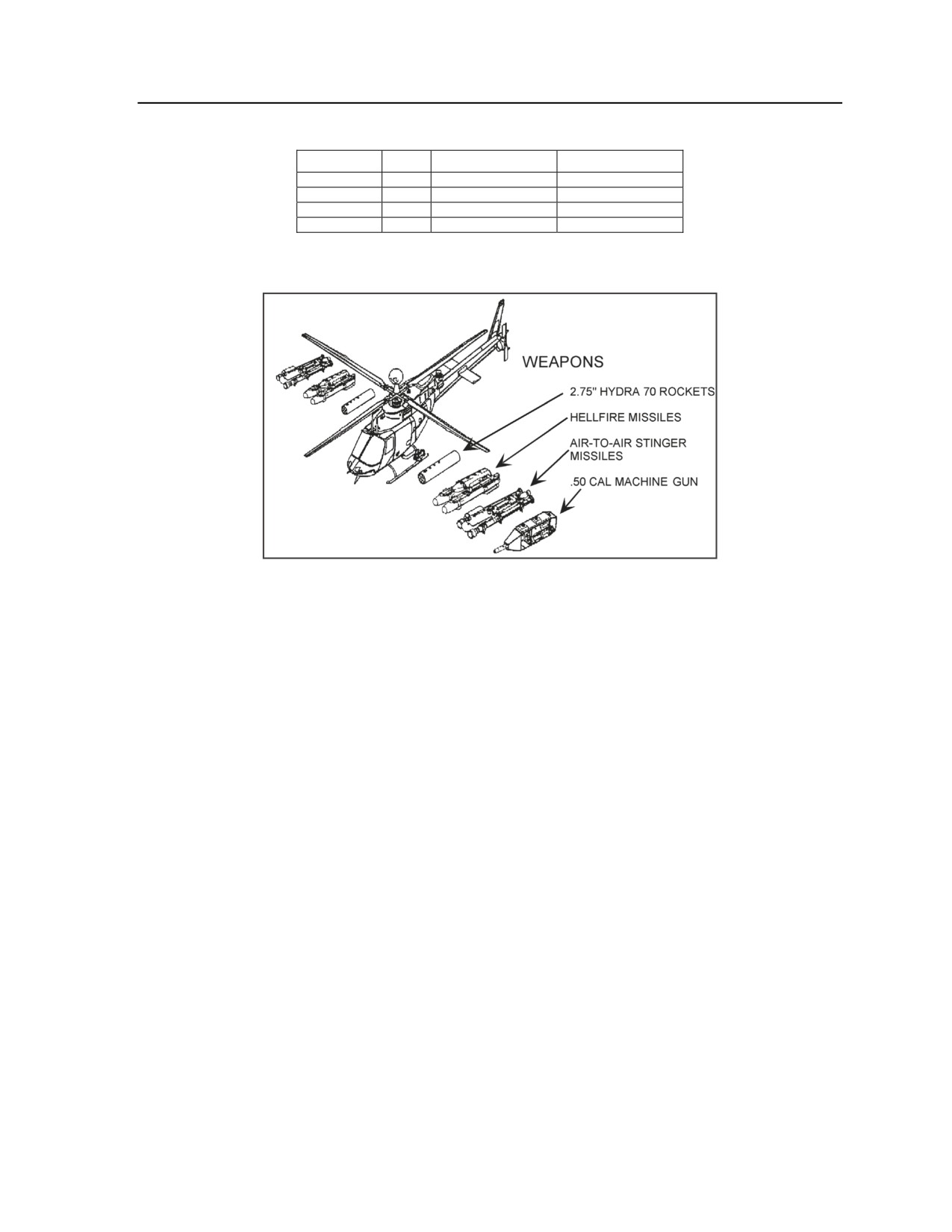
E-10. Figure E-1 illustrates an example of mission load configurations. Only one system at a time may be
mounted per side.
Figure E-1. OH-58D weapons loading
COMMUNICATIONS
E-11. The OH-58D has the following communications systems:
z
Two AN/ARC-201D SINCGARS with embedded encryption and data capability. Both operate
in the 30 to 87.975 MHz frequency range and have anti-jam, frequency-hopping capability.
z
The AN/ARC-186 provides VHF-AM (116 to 151.975 MHz).
z
The AN/ARC-164 Have Quick II provides anti-jam frequency-hopping UHF-AM
communications in the 225 to 399.975 MHz range at 25 KHz intervals.
z
An IDM transfers digital messages. The KY-58 provides secure communications for Have
Quick II and VHF-AM/FM radios.
NAVIGATION SYSTEM
E-12. The embedded global positioning system inertial navigation system (EGI) is a self-contained, all-
attitude navigation system that works with the radar altimeter and laser rangefinder/designator. Its
embedded global positioning system receiver supports both pure and blended GPS, and INS solutions. The
system is capable of storing waypoint and target information for making flight plan routes and altering
these routes if a mission changes. EGI also provides target location in longitude and latitude or MGRS
coordinates and altitude in meters or feet MSL when range, bearing, and declination to the target are
provided to the navigation subsystem for the MMS.
LIMITATIONS
E-13. The following paragraphs discuss limitations of the OH-58D.
16 February 2007
FM 3-04.126
E-3

Appendix E
Infrared Radiation Crossover
E-14. The thermal imaging sensor operates by determining temperature differentials; when targets and
their surroundings reach the same temperature, target detection degrades.
Obscurants
E-15. Some obscurants (dust, rain, haze, or smoke) can keep laser energy from reaching the target and hide
it from the incoming munitions seeker.
SECTION II - APACHE (ALPHA/DELTA)
E-16. The AH-64 is a highly stable aerial weapons-delivery platform. Its primary role is to attack. It can
fight to destroy, attrit, disrupt, or delay enemy forces. Armed reconnaissance and security are secondary
roles.
DESCRIPTION
E-17. The AH-64 is a twin-engine, tandem-seat, aerial weapons platform. It is equipped with a Target
Acquisition Designation Sight (TADS), tri-service laser designator/range finder,, and a Pilot Night Vision
Sensor (PNVS) allowing the two-man crew to navigate and attack at night at extended standoff ranges, and
in some adverse weather conditions. The Apache has a full range of ASE and can withstand a hit from
rounds as large as 23-millimeters in some critical areas.
E-18. The AH-64D is a remanufactured AH-64A. Its improved navigation system integrates dual INS/GPS
and Doppler radar for acceleration cueing. Some Longbow models are equipped with a millimeter wave
fire control radar (FCR) allowing the helicopter to identify, classify, prioritize, and track certain targets to
the maximum range of the Hellfire weapon system. Table E-3 compares Apache aircraft specifications.
Table E-4 details AH-64D characteristics.
Table E-3. Comparison of Apache specifications
AH-64D w/o
AH-64D
Model
AH-64A
Radar
Longbow
Length (ft)
57.67
57.67
57.67
Height (ft)
15.25
13.33
16.08
Width (ft)
17.17
15.50
15.05
Main Rotor Span (ft)
48
48
48
Max Gross Wt (lbs)
21,000
23,000
23,000
Cruise Speed (kts)
120*
130*
130*
Combat Radius (km)
200*
200
200
Combat Radius w/One 230-Gallon Aux Fuel Tank (km)
350*
350*
350*
Self-Deployability
Yes
Yes
Yes
*Varies with a multitude of factors such as temperature, wind, gross weight, and mission-specific time requirements.
E-4
FM 3-04.126
16 February 2007

Briefings, Reports, and Formats
Table E-4. AH-64D characteristics
Armament:
Maximum autonomous Hellfire missile range: 7,000m
Maximum remote designated Hellfire missile range: 8,000m
2.75” Rocket hover fire most effective dispersion pattern: 3,000 - 5,000m for MPSM and unitary warhead
2.75’ Rocket running/diving fires in CCA accuracy degrades beyond 1000-1200m
Maximum 30mm Gun range: 4,000 m
Maximum effective gun range from a hover using TADS: 1500 point targets, 3000m area targets
Running/diving fires in CCA accuracy degrades beyond 800-1000m
Optics:
TADS/Day TV (Low Light, Daytime) Allows autonomous laser designation of tank size target with image auto
tracker at 6000m, 4000m using manual tracking
TADS/FLIR (day, night, weather, obscurants) Allows autonomous laser designation of tank sized target with image
auto tracker at 3500m, 3000 using manual tracking.
PNVS (night, weather, obscurants)
MTADS (2nd gen FLIR) greatly increases TADS capability to detect and identify, not
available on all AH-64D aircraft.
Navigation Equipment:
Dual EGI/GPS, Doppler radar, ADF
Flight Characteristics:
Max speed in level flight is a function of environmental conditions, aircraft weight and engine capabilities and will
not normally exceed 140-145 Kts.. Normal cruise speed: 110 - 120 kts
Additional Capabilities:
Aircraft can be configured with up to four 230 gallon external fuel tanks for ferrying/self-deployment missions.
Use of IZLID laser for AGI to allow ground units to view laser through NVDs.
Can be configured with Roberson internal fuel tank to increase flight range by 45-55 minutes.
Limitations:
Threat ID; IR crossover; Weather may inhibit Hellfire engagements (seeker must be able to “see” the laser
designated spot); overwater operations severely degrade navigation system; PNVS cannot detect wires or other
small obstacles. TADS and PNVS FLIR quality can be severely degraded by weather conditions that will not
normally affect ground maneuver forces, i.e. rain, fog, snow. Aircrews may or may not have NVG capability.
Fire-Control Radar
E-19. The Apache Longbow system consists of an integrated millimeter wave FCR, along with a Radio
Frequency Interferometer
(RFI). The FCR enables Apache Longbow helicopters to detect, classify,
prioritize, and engage targets with RF Hellfire missiles without visually acquiring the target. Apache
Longbow crews may also employ RF Hellfire missile during poor visibility when laser, optical, and FLIR
sensors are degraded. The FCR will not identify friend or foe, however the RFI can detect and identify
radar systems and display targeting information on the same screen as the information from the FCR.
E-20. Apaches equipped with the Longbow system are denoted as either AH-64D with radar or AH-64D
Longbow. The Longbow is equipped with FCR, a radar frequency interferometer, and upgraded 701C
engines to compensate for the additional weight of the Longbow system. The Longbow system is
integrated with the TADS to allow simultaneous and autonomous operation of the TADS and the FCR.
Without Radar
E-21. The AH-64D without radar includes all preceding Longbow aircraft upgrades except an FCR, a radar
frequency interferometer system, and their associated black boxes. The aircraft may not have the improved
701C engine installed. The AH-64D without radar can be converted to an AH-64D with radar upon
installation of the Longbow system and 701C engines. The AH-64D without radar can fire the RF Hellfire
16 February 2007
FM 3-04.126
E-5
Appendix E
missile autonomously (with LOS to the target) or by using FCR targeting data handed over from an AH-
64D with radar.
CAPABILITIES
E-22. The AH-64 provides the following:
z
Precision attacks during day or night, or when the battlefield is obscured (Longbow).
z
Wide array of firepower options.
z
Detection, classification, and prioritization of stationary and moving ground and airborne targets
(Longbow).
z
Robust suite of EW systems.
z
Lethal destruction of enemy ADs.
z
Real-time SA and intelligence of the battlefield to the digitized aviation/ground commander;
data transfer system to upload from the AMPS data-transfer cartridge and download postmission
data.
z
HF radio for NOE long-distance NLOS communications.
ATTACK HELICOPTER ARMAMENT SYSTEMS
E-23. The AH-64 can carry up to a total of 16 Hellfire laser-designated missiles on four wing store pylons,
or up to a total of 76 2.75-inch folding fin aerial rockets on four wing store pylons, and up to 1,200 rounds
of ammunition for its 30-millimeter cannon. Wing stores may be configured to allow both hellfire and
rockets to be carried. Each pylon may carry up to 19 rockets or 8 hellfire missiles. Environmental
conditions may significantly restrict weapons loads and station time associated with those loads. In
addition, the use of a Roberson internal auxiliary fuel tank will limit 30mm to 300 rounds.
E-24. The Apache Longbow system enhances the rapid employment of all available weapons including
Hellfire missiles, aerial rocket system, and the 30-millimeter cannon. Once the FCR detects, classifies, and
prioritizes targets, the gunner selects the desired weapon for attack. This data is automatically transferred to
the weapon and displayed on the selected weapon sight.
30-Millimeter Chain Gun
E-25. The M230E1 is a chain-driven area weapons system mounted to a hydraulically driven turret under
the helicopter forward fuselage. It fires the United States M789 NATO standard ammunition HEDP round.
Each shell contains 21.5 grams of explosive charge sealed in a shaped-charge liner. It can penetrate more
than 2 inches of armor at 2,500 meters and produces antipersonnel effects within a 4-meter radius. At
typical engagement ranges, HEDP ammunition will defeat BMP type targets. The AH-64 can carry 1,200
rounds of 30-millimeter ammunition. It has a rate of fire of 600 to 650 rounds per minute with a maximum
effective range from a hover using TADS of approximately 1,500 meters against point targets and 3,000
meters against area targets. Running/diving fires in a CCA environment are limited by range source
selection and often fired using the helmet sight at ranges of less than 1000m.
2.75-Inch Rocket System
E-26. When configured with four 19 shot rocket pods, the AH-64D can carry a maximum of 76 folding-fin
aerial rockets for use against enemy personnel, light armored vehicles, and other soft-skinned targets. The
system can launch multiple rockets with various warhead mixes to include; high explosive point
detonating, high-explosive MPSMs, white phosphorous, red phosphorous, overt and covert illumination,
and flechette. Aircrews select the quantity and type to be fired. The maximum range varies with warhead,
Hellfire Missile
E-27. The Hellfire is used primarily to destroy tanks, armored vehicles, and other hard-material targets.
The AH-64A is capable of firing only the SAL Hellfire while the AH64D is capable of firing both the SAL
E-6
FM 3-04.126
16 February 2007