FM 3-04.126 Attack Reconnaissance Helicopter Operations (February 2007) - page 5
Employment
z Degraded visibility and toxic fumes are possible when flying near or through smoke and dust.
3-438. Manmade structures and density of noncombatants in urban terrain affect tactical options available
to commanders and aircrews. Whether engaged in offensive, defensive, stability or civil support
operations, aviation units may conduct missions in urbanized terrain. This is due not only to growing
populations but also a potential adversary's tendency to create a nonlinear operational environment rather
than face United States forces directly. Potential adversaries can be expected to use urban terrain for cover
and concealment, and to reduce United States combat superiority by taking advantage of weapons
restrictions and reduced options available to commanders under ROE, ROI, and law of war. ROE and ROI
must be rehearsed, practiced, and reinforced continually throughout the operation. FM 3-06 and FM 3-06.1
contain additional information. Aviation enhances urban operations by providing―
z Reconnaissance.
z Speed of resupply.
z Rapid troop movement.
z Evacuation of personnel and equipment.
z Cooperative maneuver.
z Precision fires in support of ground forces.
z Ability to quickly and efficiently transition to new missions.
PLANNING CONSIDERATIONS
3-439. Operations in urban terrain generally follow the same planning and execution concepts as in other
terrain; however, special planning and consideration of characteristics unique to urban terrain are required.
Aircraft must standoff to engage targets in urban areas. Overflight and engagement of targets within urban
areas may require night operations and special preparation due to possible enemy direct fire at very close
range. Hovering in urban areas exposes aircraft to small arms fire and should only be done if essential to
the mission and adequate overwatch fires are available. Other planning considerations include the
following:
z
Through knowledge of key terrain. Operations require a thorough knowledge and
understanding of key terrain (intersections, roads, hospitals, schools, cultural, religious, and
municipal buildings), flight routes in and out of the AO, and flight hazards (towers, wires,
canals, and power lines).
z
Do not be predictable. Use alternate flight routes and checkpoints. Plan and vary times for
egress and contingency routes, rally procedures, and backup navigation times.
z
Minimize signature. Take maximum advantage of flight profile options and existing conditions
lessening risk of acquisition and engagement. Plan and execute the mission with maximum
emphasis on aircraft signature reduction. Fly at medium to higher airspeeds, depending on
altitude and hazards, decreasing the opportunity for engagement by ground weapons.
z
Know the current situation. Insist on the most current information available regarding friendly
forces, demographics of the local population and enemy, and hazards. Update information prior
to takeoff, en route to the objective, and continuously during the mission.
z
Establish communications with all players. Determine net information for all participating and
supporting elements. Establish communications with ground maneuver elements as soon as
possible en route to the objective.
z
Confirm weapons engagement. Develop a clear understanding of the friendly situation before
engaging targets to minimize fratricide. Ensure IFF and ASE are working, and know the purpose
and demarcation lines for IFF and ASE. Select the proper weapon system producing the desired
effect while minimizing collateral damage and maximizing standoff.
z
Ensure airspace deconfliction. Establish boundaries for aircraft operating in the AO. Prior
coordination with other aircraft not in flight and UAS reduces facilitates airspace deconfliction.
See and avoid is difficult at night in an urban environment due to city lights and mixing of
aircrews utilizing NVDs and FLIR.
16 February 2007
FM 3-04.126
3-99
Chapter 3
3-440. Due to dynamics of urban growth, current maps and photographs are essential for accurate
planning. In the absence of these materials, detailed reconnaissance is required to minimize risk.
ROUTE PLANNING AND NAVIGATION
3-441. Navigation over urban terrain can be more difficult than natural terrain as most maps do not show
vertical development of urban terrain. Cities are compartmented, causing small navigational errors to have
significant effect. High density and similarity of structures and variety of geographical references can cause
confusion. Navigation in the city can be overwhelming due to an overabundance of visual cues.
3-442. If electrical power is still available, high ambient light levels can create problems with NVD.
Familiar landmarks may disappear, become covered with rubble, or be obscured by smoke and dust during
flight. Other factors in route planning and navigation include—
z Using vertical and linear references to distinguish en route checkpoints. Choosing easily
recognizable features such as cemeteries, stadiums, cathedrals, radio towers, tall buildings, and
major roads. Highways, rivers, railways, canals, and coastlines provide easily recognizable
boundaries and references to assist in maintaining orientation. Prominent rail and highway
interchanges are useful as en route checkpoints.
z Obtaining maps with proper information for both navigation and synchronization with ground
maneuver elements. Photomaps of the village, town, or city are great tools.
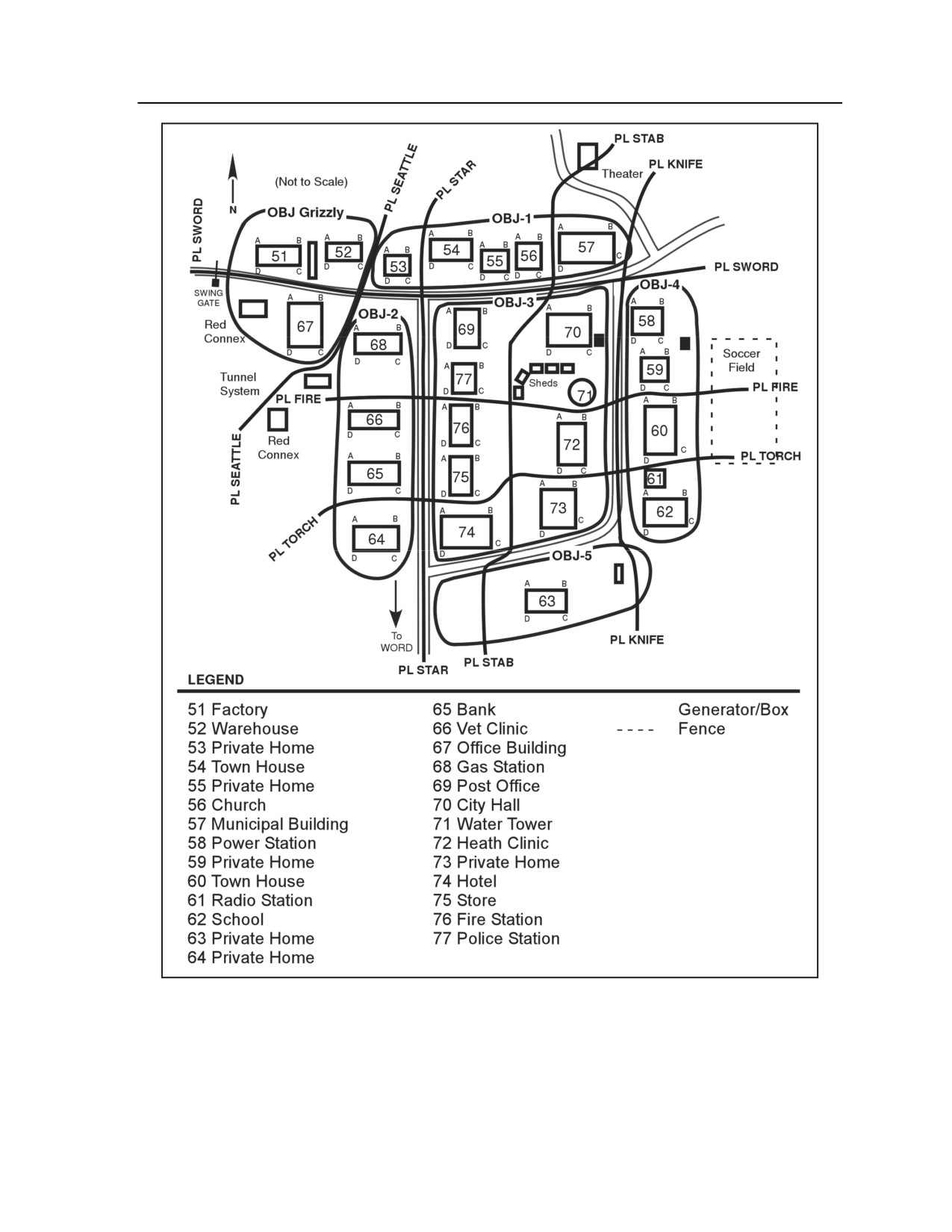
z Using an area sketch for target areas and objectives. Area sketches identify natural and manmade
features in the area and code them with letters, numbers, or code words. Identification of targets
and friendly unit location is much easier with both air and ground units using the same area
sketch. Figure 3-46, page 3-103, provides an example of an area sketch.
z Converting civilian maps to the military grid reference system (MGRS). Civilian maps also
include names of streets and key buildings, locations, and terrain within the city.
z Using GPS to ease the problems associated with navigation in urban areas. GPS does not
eliminate need for other navigational methods. Navigation may be degraded due to interference
inducted by buildings and GPS jammers.
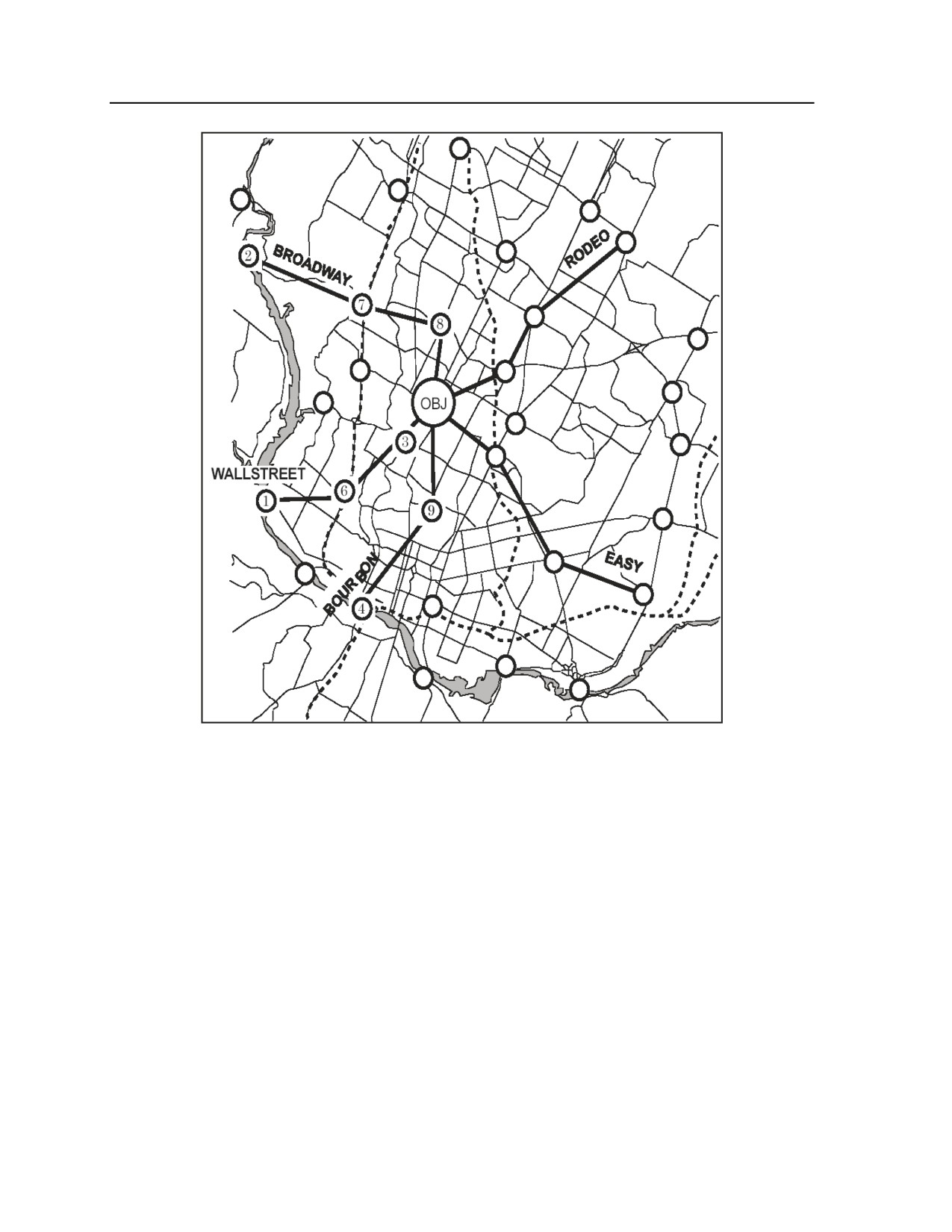
z Using a network route structure “spider web” of ACPs and air routes (preferably surveyed) to
facilitate route planning, navigation, and C2. ACPs are placed on easily identifiable features,
then linked together to form the route. The spider web concept provides many different routes
and variations of routes using established checkpoints. However, any type of route structure may
lead to predictability. See figure
3-47, page 3-104, for an example of a spider web route
structure.
3-100
FM 3-04.126
16 February 2007
Employment
Figure 3-46. Example of an area sketch
16 February 2007
FM 3-04.126
3-101
Chapter 3
Figure 3-47. Example of a network “spider web” route structure
LANDING ZONE, PICKUP ZONE, AND FORWARD ARMING AND REFUELING POINT
SELECTION
3-443. Units must look at all available products to find suitable sites for LZs, PZs, and FARPs. City
maps, overhead imagery, and reconnaissance flights help identify proper sites. Consider use of city parks,
parking lots, stadium fields, and athletic fields. Major highways and large multilane roads offer potential
LZ, PZ, and FARP sites if civilian traffic is not using them.
3-444. Hazards effecting selection of LZs, PZs, and FARPs include antennas, light poles, debris, wires,
enemy locations, and winds. Winds may change direction because of buildings and built-up areas. Tall
buildings may funnel winds through the streets, causing a much higher wind condition than briefed.
Lighting at LZs, PZs and FARPs is a factor. If the city is not blacked out, city lights affect NVDs.
DIRECT FIRE PLANNING CONSIDERATIONS
3-445. When fighting in urban terrain, most targets are fleeting and near the identifying Soldier. Few
personnel targets will be visible beyond 50 meters, and engagements usually occur at 35 meters or less.
Helicopter engagements supporting troops in such proximity require careful coordination and execution.
To reduce risk of fratricide, aircrews must be familiar with minimum arming distances and risk-estimate
3-102
FM 3-04.126
16 February 2007
Employment
distances. Falling debris from urban structures can be as deadly as shrapnel. FM
3-09.32 contains
additional information regarding danger close ranges. Other planning considerations include the following:
z Urban terrain is severely canalized causing severely limited fields of fire.
z Streets limit target views to a narrow corridor along the street or from high angles over buildings.
z Enemy forces utilize near sides of buildings, putting them out of view.
z Targets move rapidly from cover to cover and require quick engagement.
z When forced to fight and fly over areas where the enemy has not been cleared, it is better to keep
aircraft moving and make it a harder target to hit.
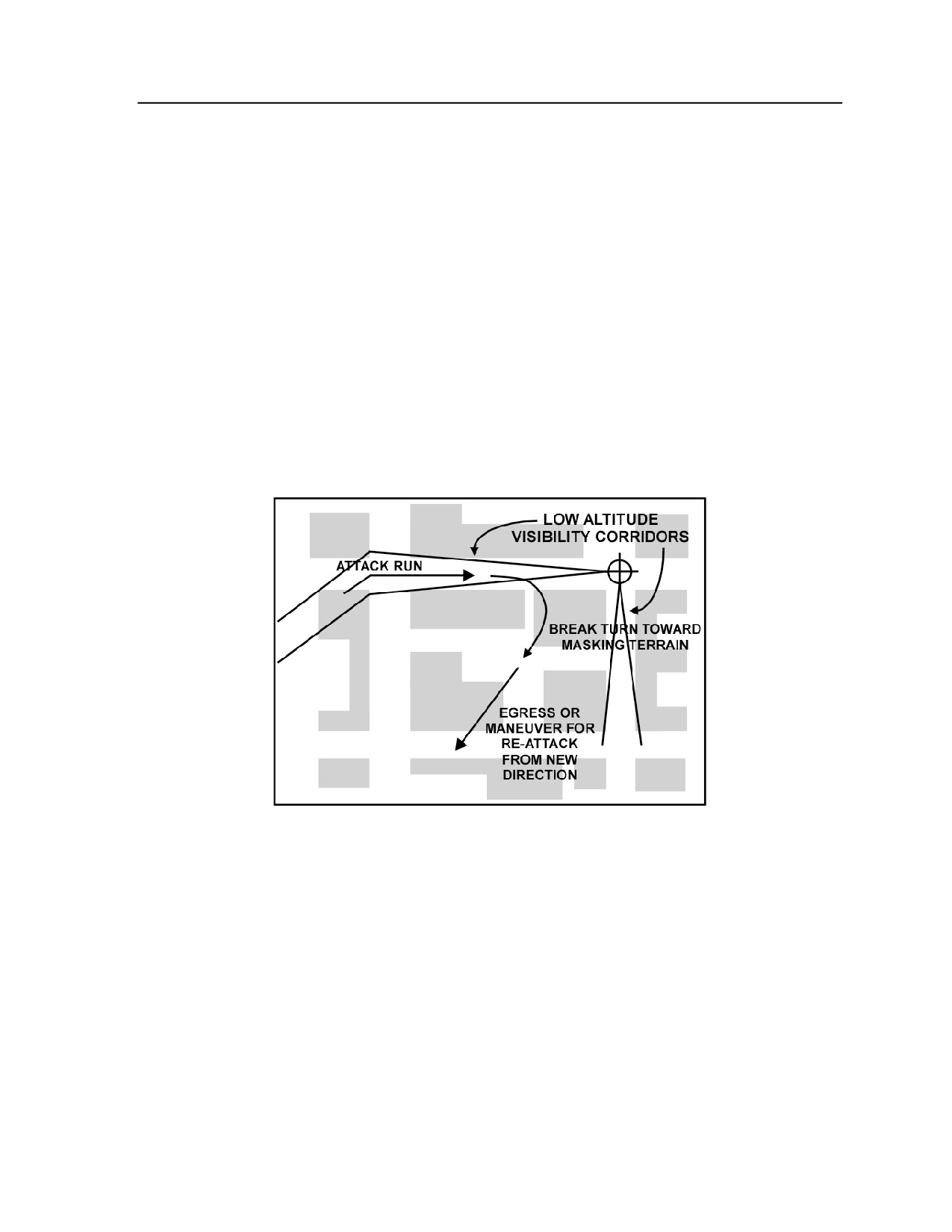
z Running fire generally offers better aircraft survivability. Conduct running fire engagements
from an initial point, engaging the target, and returning to a safe area to regroup for another
attack. The lead wingman concept is excellent for this type of attack. The wingman can suppress
the target after the lead engagement and “cover the break.” When using running fire, aircrews
must be aware of overflight of friendly units, although ground units provide suppressive fires to
protect aircraft during the attack. Figure 3-48 provides an example of running fire engagement
technique.
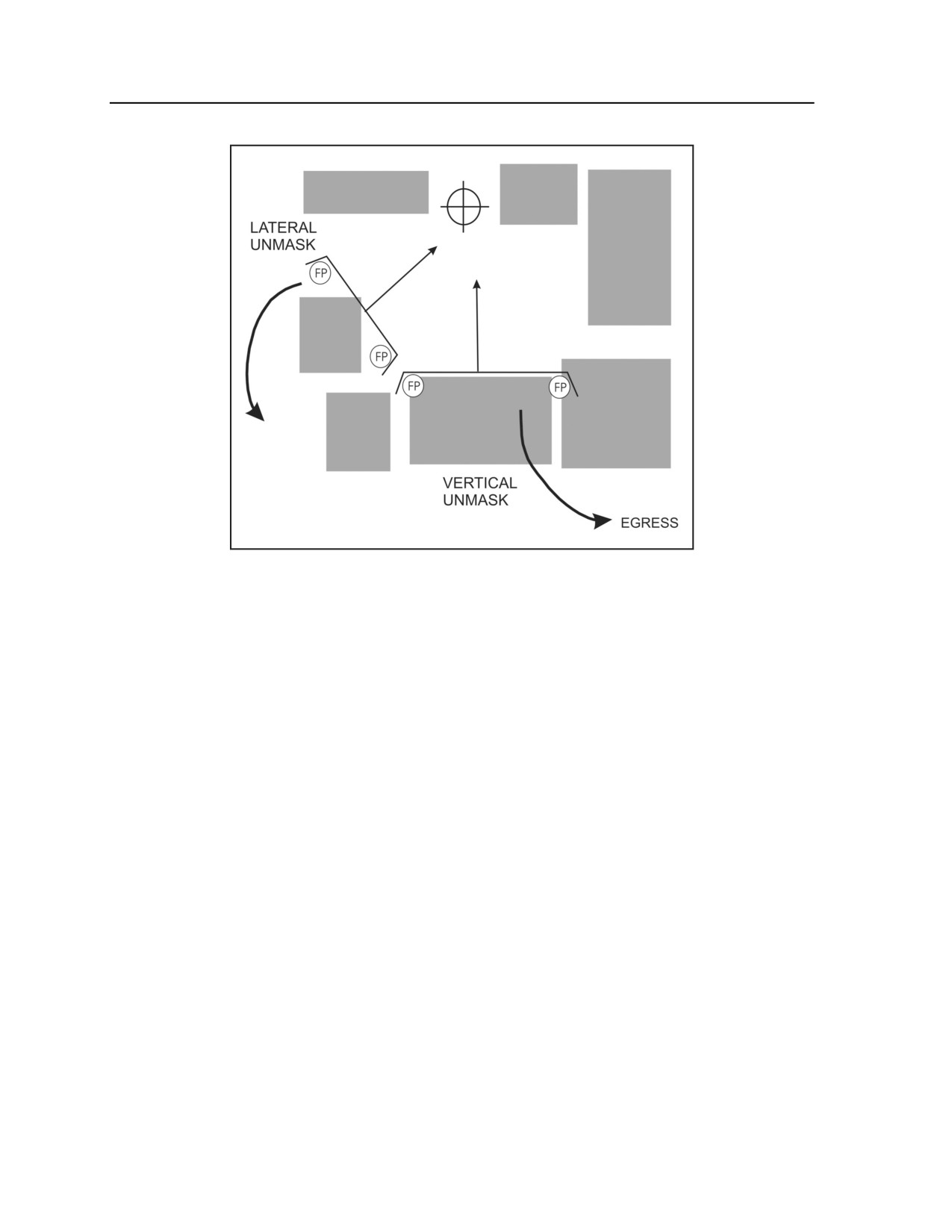
z Hovering fire allows aircrews to unmask both laterally and vertically from behind cover.
However it is the least recommended in urbanized terrain since aircrews must maneuver within
2,000 meters to observe the target. Figure 3-49, page 106, shows an example of the hovering fire
technique.
Figure 3-48. Example of running fire technique
16 February 2007
FM 3-04.126
3-103
Chapter 3
Figure 3-49. Example of hovering fire technique
Targeting Grids and Reference Techniques
3-446. Ground elements generally use a terrain-based reference system during urban operations. MGRS
coordinates have little meaning at street level. Aviation and ground forces must use common control
methods. Possible techniques include urban targeting grid system, objective area reference grid (bull’s-eye
targeting technique), and TRPs technique. These techniques are based on the street and structure pattern
without regard to the MGRS. Using common techniques allows aircrews to make the transition to the
system in use by the ground element upon arrival in the objective area. For example, references to the
objective or target may include local landmarks such as “third floor of the Hotel Caviar, southeast corner.”
This transition should be facilitated by using a “big-to-small” acquisition technique.
Urban targeting grid system
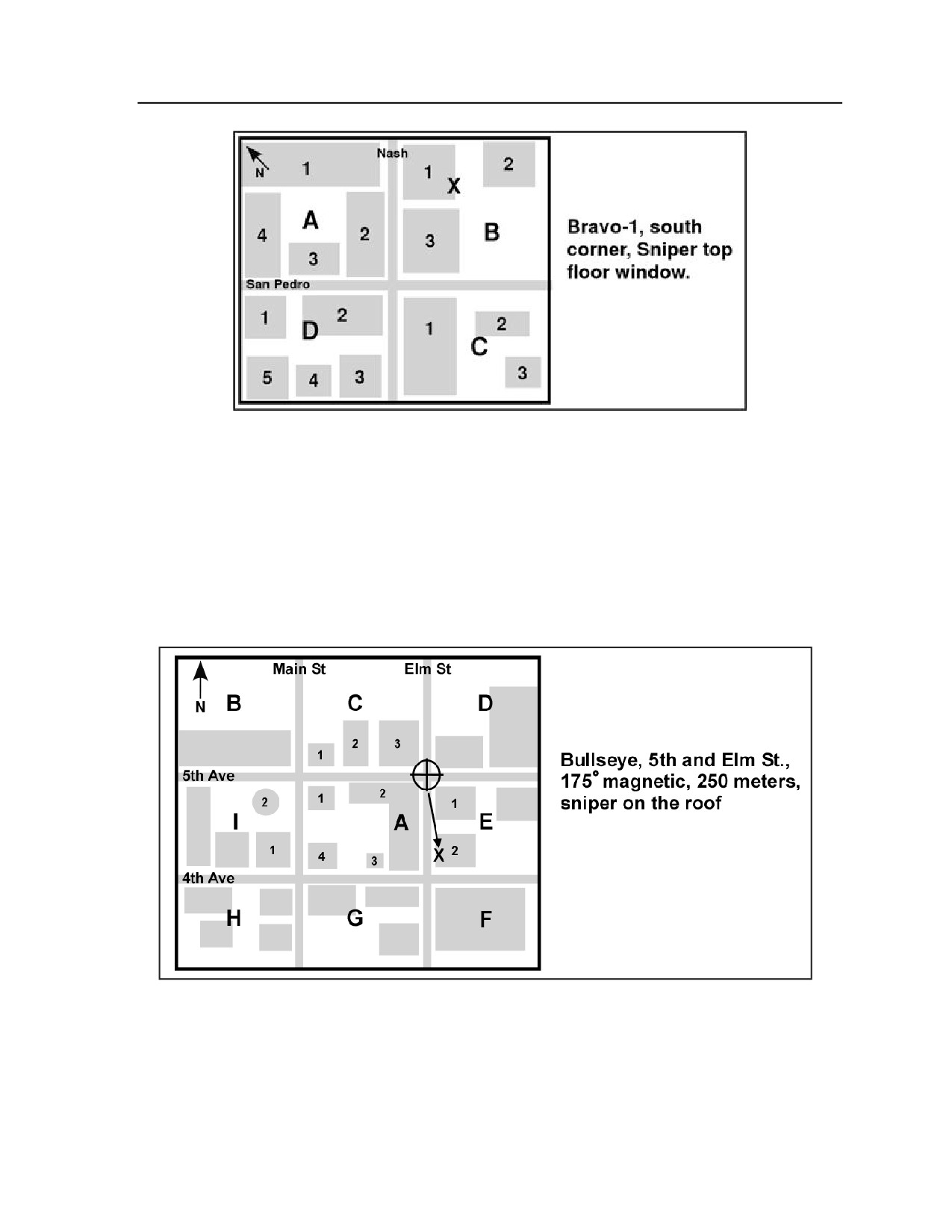
3-447. The urban targeting grid system is a technique dividing the urban area into specific grid sectors. A
number or letter identifies each building. Coding the corners of buildings facilitates rapid fires. Target
handover to the aircrew is simply the location from the grid system and a brief target description. Aircrew
and ground unit must have the same urban targeting grid for effective coordination to occur. Figure 3-50,
page 3-107, provides an example of the urban targeting grid system.
3-104
FM 3-04.126
16 February 2007
Employment
Figure 3-50. Example of urban targeting grid system
Objective area reference grid technique
3-448. The objective area reference grid technique, also known as the bull’s-eye method, gives the
aircrew a specific point and reference target location from that point. The bull’s-eye must be a point that is
easily recognizable for both the unit in contact and the aircrew flying the mission. The bull’s-eye may be
preplanned or given to the aircrew on site. As long as the aircrew and the ground unit are working from the
same map or both are familiar with the area, bull’s-eye targeting is very effective. Target handover to
aircrew is simply a distance and direction from the bull’s-eye and a target description. Figure 3-51 provides
an example of the objective area reference grid technique.
Figure 3-51. Example of objective area reference grid system
Target reference points technique
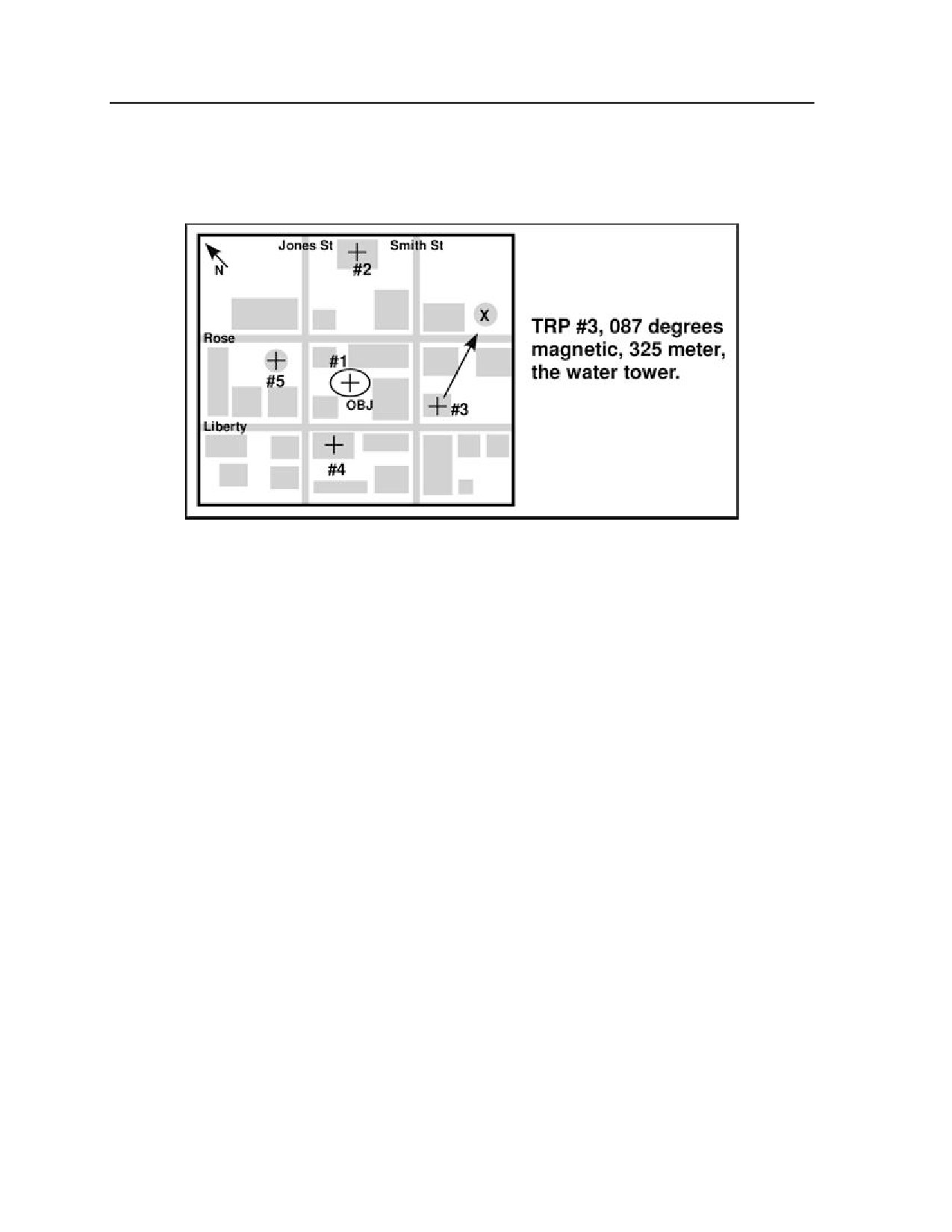
3-449. TRPs are tools air and ground units can use to coordinate fires. They are easily recognized points
on the ground (either natural or manmade) used to initiate, distribute, and control fires. TRPs are
16 February 2007
FM 3-04.126
3-105
Chapter 3
designated by maneuver leaders to define sectors of fire or observation. They can also designate the center
of an area in which the commander plans to converge or distribute fires of his weapons rapidly. Target
handover is similar to bull’s-eye targeting; a distance and direction from the TRP and a brief target
description. Figure 3-52 provides an example or TRPs technique.
Figure 3-52. Example of target reference points technique
Building marking technique
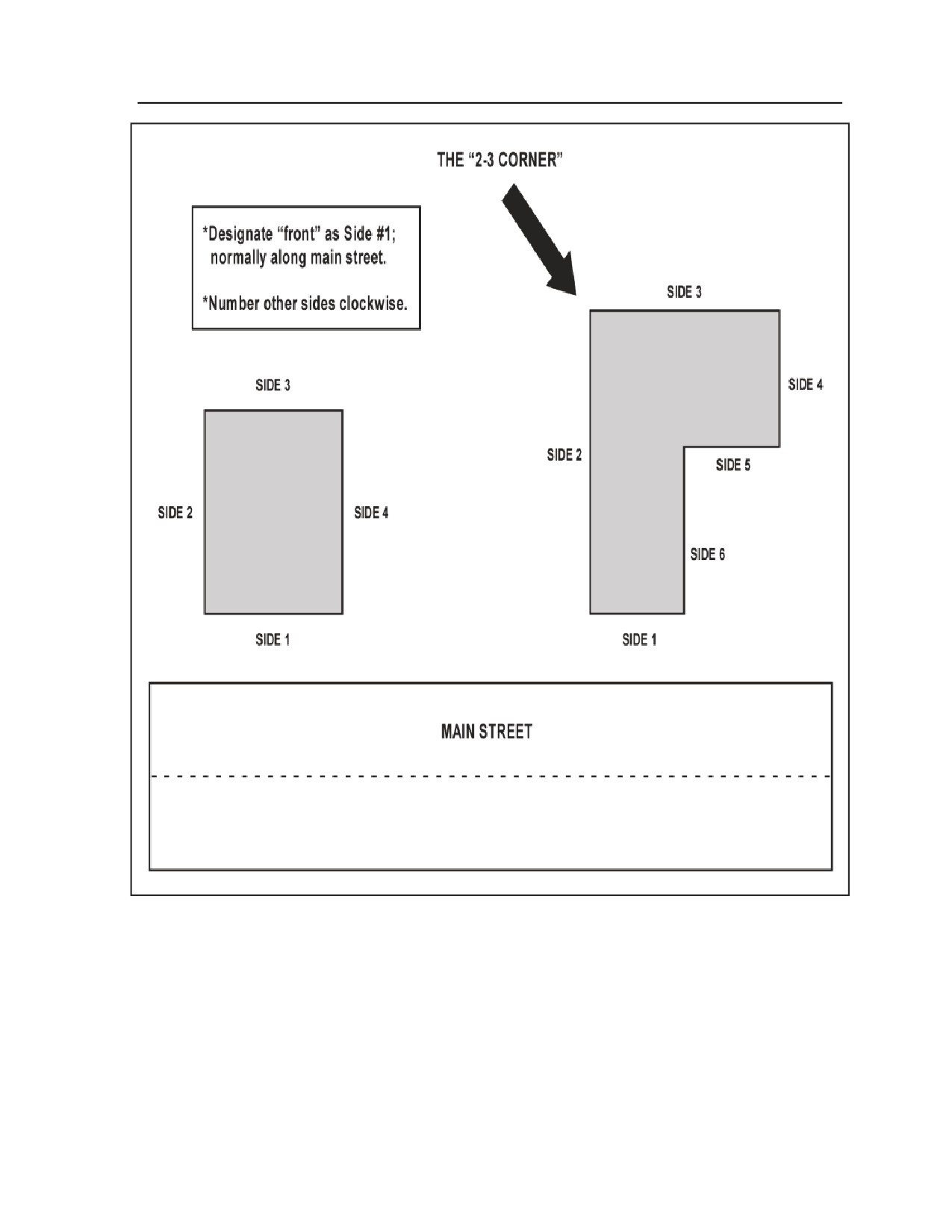
3-450. The building marking technique gives the aircrew a specific location in reference to a building or
fixed structure. All buildings sides are numbered clockwise with the front being the starting point. The
designated front is normally along the main street or main avenue of approach (figure 3-53, page 3-109).
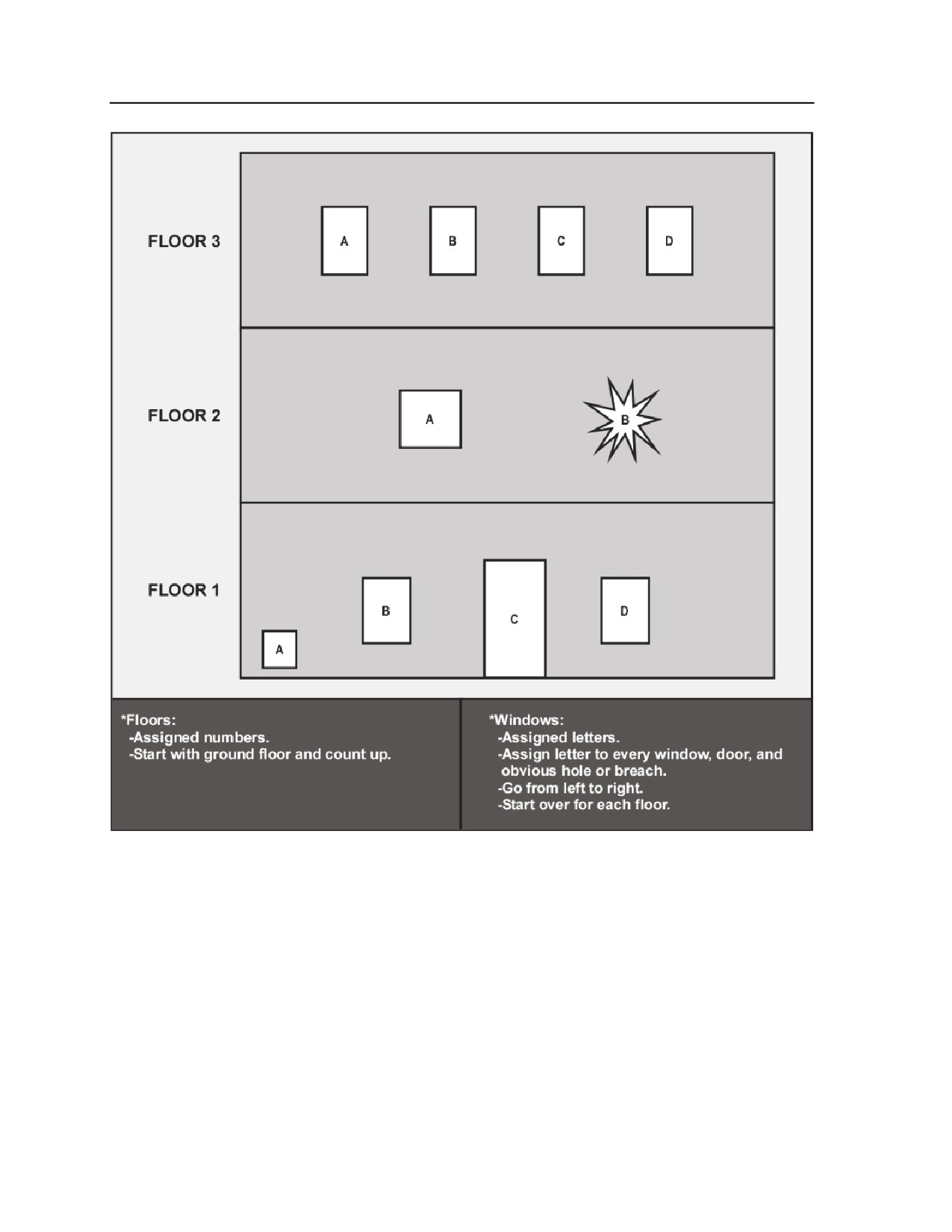
The floors, windows, and openings of the structure are labeled numerically (floors) and then alphabetically
(windows, openings). Numbering of the floors begins with the ground floor and ascends to the top floor.
Windows and opening are assigned letters, beginning with A, and are labeled from left to right. The
lettering sequence begins over with each floor ensuring all windows, openings, and obvious holes and/or
breaches are assigned the appropriate letter. This technique may also incorporate a direct description (the
window to the right of the flames). Figure 3-54, page 3-110, depicts an example of floor and window
lettering convention.
3-106
FM 3-04.126
16 February 2007
Employment
Figure 3-53. Example of building numbering convention
16 February 2007
FM 3-04.126
3-107
Chapter 3
Figure 3-54. Example of floor and window lettering convention
Aviation Weapons Effects
3-451. In urban terrain, targets rarely present themselves for extended periods of time. Aircrews can
expect short target exposure and rapid engagement; aircrews must be constantly on the lookout for targets
and ready to engage. Aircrews must expect enemy-held structures to be covered by fire and dead space
within urban areas. Large, tall buildings and narrow streets create dead space aircrews cannot cover. If
enemy units are in buildings, the buildings must be attacked first to get to the threat inside. Weapons able
to break through walls must be used. Weapons found on aircraft designed to destroy vehicular targets and
troops in the open are also effective in the urban environment. Other considerations for fires in urban areas
include the following:
z Minimum arming and slant ranges within urban areas limit use of some weapons.
3-108
FM 3-04.126
16 February 2007
Employment
z Heavy concentration of precision weapon systems along a narrow front may cause coordination
problems.
z Precision weapons can cause fratricide if planning is not precise.
z Multiple flat, polished surfaces in an urban area may degrade laser use.
z Urban targets are usually hard and smooth, and contain flat surfaces. Rounds fired from the air
strike the surface at an angle and tend to ricochet, causing impact-fused weapons to not
detonate.
z Heavily developed urban centers can limit CAS.
z Direct and indirect suppressive ground fire should augment the escort suppressive fires as air
assaulting forces approach intended LZs.
z Operations could be in areas with a high potential for significant civilian injury and collateral
damage of property, specific knowledge of weapons effect is critical.
z Hellfire missile precision may minimize collateral damage. Due to its accuracy, the use of a
Hellfire missile may be appropriate eliminating such targets as a sniper or machine-gun nest.
Selection of the correct type of Hellfire warhead is also critical.
Machine Guns
3-452. Though considered an area fire weapon, the 30-millimeter cannon is very accurate and may be
employed against a single person or groups. It can penetrate walls of most conventional structures.
3-453. The 50-caliber and 7.62-millimeter machine gun are both area fire weapons, but do not have
penetration capability of the 30-millimeter. The 50-caliber does possess a greater effect than the 7.62-
millimeter. Both are good for suppressive fires and against nonarmored targets.
Rockets
3-454. The 2.75-inch rockets suppress and destroy targets. As currently configured, these are area fire
weapons, whose accuracy is tied directly to crew proficiency. Running or diving fire often yields the best
results. Rockets are effective against troops and equipment in open streets and plazas when enough
standoff and maneuver room is available. High explosive rounds produce the best effects on buildings
whereas flechette rounds are effective for clearing rooftops or attacking troops in the open. Smoke rounds
are excellent for masking friendly movement.
Missiles
3-455. Hellfire missiles produce effects on structures found in urban environments. The precision of a
Hellfire missile may minimize collateral damage. Due to its accuracy, the use of a Hellfire missile may be
appropriate eliminating such targets as a sniper or machine-gun nest. It is also gives aircrews the ability to
target specific windows, floors, or sections of a building. Selection of the correct type of Hellfire warhead
is also critical.
OPERATIONAL PHASES
3-456. There are five distinct phases to urban operations—reconnoiter the objective, move to the
objective, isolate the objective, secure a foothold, and clear the objective. ARBs can expect missions
during each phase of the operation.
RECONNOITER THE OBJECTIVE
3-457. Aviation units assist the ground unit in a thorough route, area, and zone reconnaissance of the
objective to complete the operation. Planning considerations for reconnaissance remain the same, focusing
on the following critical tasks:
z Conducting route reconnaissance of the routes leading to and from the urban area (both ground
and air).
16 February 2007
FM 3-04.126
3-109
Chapter 3
z Conducting zone reconnaissance of areas around the city.
z Conducting area reconnaissance of key terrain or areas leading to the city.
z Conducting IAs or CCAs on enemy units found during this phase of the operation.
z Providing security during insertion of scout and long-range surveillance teams.
MOVE TO THE OBJECTIVE
3-458. Critical tasks the ARB accomplishes during this phase of the operation include—
z Continuing aerial reconnaissance operations to detect enemy forces, positions, and obstacles and
prevent them from interfering with the operation.
z Supporting air assaults with area reconnaissance of air route and LZ/PZs.
z Conducting a screen of a moving force as ground units move along their attack routes into the
urban area.
z Conducting a zone reconnaissance to locate and defeat enemy forces along the route or in areas
influencing ground scheme of maneuver.
z Continuing to identify routes or confirm previously cleared routes are still free of obstacles.
z Conducting CCA and IAs on enemy units and positions.
z Supporting repositioning of ground forces to assault positions.
z Supporting movement of supplies by air.
ISOLATE THE OBJECTIVE
3-459. Critical tasks accomplished during this phase include—
z Isolating the objective to prevent the enemy from escaping or reinforcing the urban area.
z Conducting screens to provide early warning of incoming enemy forces attempting to reinforce
the city.
z Helping develop the situation.
z Destroying enemy forces.
z Assisting with BHOs.
z Securing a foothold
z Securing a foothold involves seizing an intermediate objective providing cover from enemy fire
and a place for attacking troops to enter the built-up area.
3-460. Critical tasks the ARB provides during this phase include—
z Conducting area reconnaissance to determine possible enemy forces, weak points, flanks, and
enemy composition.
z Massing aviation fires to assist ground units with establishing a foothold.
z Conducting area security, reconnaissance, or other security missions maintaining isolation of the
urban area.
z Providing suppressive fires from ABFs, SBFs, or BPs.
z Employing precision fires to destroy enemy armor on high-speed avenues of approach into the
city.
z Coordinating with JAAT to destroy armored forces securing the breech point.
z Providing laser identification of targets.
z Providing security for assault units transporting ground forces to the area.
z Continuing to conduct reconnaissance, security, and CCA to maintain isolation of the city.
3-110
FM 3-04.126
16 February 2007
Employment
ASSIST IN CLEARING A BUILT-UP AREA
3-461. Clearing a built-up area is characterized by systematic house-to-house fighting as ground forces
attempt to force the enemy from the city. Planning considerations include those associated with cordon and
search and also include the following tasks:
z Continuing isolation of city operations.
z Conducting reconnaissance and security operations in the city to support ground units in contact.
z Screening outside the city to prevent reinforcements from arriving or the enemy resupplying the
city.
z Conducting reconnaissance within the city that supports assault units, repositioning forces, or
forces conducting aerial supply.
z Conducting IAs and CCA missions in support of the unit in contact.
z Reconnoitering LZs in large parking lots, city parks, athletic fields, and on buildings.
z Supporting CASEVAC missions.
AIRCREW URBAN THREAT CONSIDERATIONS
3-462. Some special considerations for threat in urban operations include the following:
z
Enemy forces may infiltrate urban terrain and ambush helicopters from positions inside
buildings. The presence of snipers increases the vulnerability of ambush.
z
Every building and structure in an urban area is a potential enemy position.
z
Portable surface-to-air missile systems are difficult to detect in and among buildings.
z
Difficulty in distinguishing combatants from noncombatants places participants under additional
psychological stress.
z
Defending forces normally have the advantage of familiarity with terrain.
z
Aircraft are more vulnerable to low-tech weapons in urban combat.
z
Because LZs may be scarce and, therefore, predictable, air assault operations in mass may be
vulnerable to enemy fires.
z
Urban terrain provides excellent cover and concealment for a variety of weapon systems.
Coupled with restrictions on airspace available for maneuver, this makes these weapons a more
significant threat to aircraft than they normally are in open terrain. Some of these weapons
include—
Tank main gun. Modern fire control systems permit effective aircraft engagement by tanks
with their main gun. Development of effective anti-helicopter ammunition, such as the
United States-fielded multi-purpose anti-tank round, includes an air/ground fuse.
ATGMs. Most ATGMs have an effective range of between 3,000 and 5,000 meters and can
engage helicopters in the same way they engage ground targets. ATGMs are a threat to
rotary-wing aircraft in an urban environment due to restriction and compression of airspace
and operating closer to potential threat positions.
Antiarmor rockets. Antiarmor rockets, such as the rocket propelled grenade are readily
available, inexpensive, and normally standard equipment at the small unit level, even in
irregular forces. They are unguided and have effective ranges of less than 500 meters and
are a real threat to rotary-wing aircraft.
Medium cannons. Many armored personnel carriers (APCs) and infantry fighting vehicles
carry rapid-fire cannons ranging from 20 to 40 millimeters, and are effective against rotary-
wing aircraft.
Small arms and machine guns. Small arms and machine guns can also become a more
significant threat in an urban environment. Generally,
5.56-milimeter and
7.62 x 39-
milimeter rifles are effective up to 500 meters, 7.62-milimeter machine guns and sniper
rifles of similar caliber are effective up to 1,000 meters, and .50-caliber/12.7-milimeter
machine guns and sniper rifles are effective up to 2,000 meters. Another consideration is
these weapons can be placed on the upper floors of buildings above the helicopters to fire
16 February 2007
FM 3-04.126
3-111
Chapter 3
down on the helicopters. Since these are small, light weapons, they can be easily moved to
unexpected positions easily.
RECONNAISSANCE OPERATIONS
3-463. Varying terrain in urban environments poses several challenges for attack reconnaissance teams
conducting reconnaissance missions. There are a wide variety of small villages/towns and NAIs in flat
areas as well as nested on a hill or arrayed on both sides of a valley. These areas make a clear FOV for
observation very difficult and sometimes unavailable without having an aircraft fly right up to or over the
reconnaissance objective. UAS and joint sensors may provide assistance while conducting reconnaissance
in urban environments.
URBAN AREA WITH MOUNTAINOUS TERRAIN
3-464. To gain valuable observation of the target area or confirm or deny activity in the urban area, it may
be necessary to utilize the following:
z AMPS of Falcon view. Use AMPS to check LOS from a vantage point close enough to the
reconnaissance objective without compromising security for the attack reconnaissance team.
z Overlapping FOVs. Overlap FOV of the attack reconnaissance teams from different angles to
the target. By choosing a series of OPs surrounding the objective area, the team will be able to
cover two of the cardinal directions while still providing security to the other aircraft if needed.
Keep movement between the lead and wing aircraft to provide total observation and gain SA. It
may become necessary to place the lead aircraft at a vantage point higher than the target to see
the topside, and the wing aircraft at the bottom side of the target to gain observation of the entire
target.
z Obstacle FOV. Conducting technical map reconnaissance, in conjunction with AMPS LOS, is a
proven method of gaining observation from the planning phase. The only caution when gaining
the best vantage point to the objective is taking into account vegetation and manmade structures
that become a hindrance to LOS. There are times the best FOV is accomplished by checking
rise-over-run and keeping the team high enough to maintain observation. At times it may be
prudent to be deceptive and maintain a constant flight path past the objective area, with the
attitude to the aircraft flying abeam the target, employing the site systems of the aircraft. This
technique works well in restrictive terrain locations, spurs, and in valleys where the only
observation may be right over the target as FOV is obstructed by natural or manmade obstacles.
z Constant movement between the team. This allows the team to gain SA of the entire
reconnaissance area. A person’s natural response is to look up to high ground when they hear
the audible sound of an aircraft. Employing one aircraft on high ground and drawing attention of
villagers provides the lower aircraft the opportunity to gain observation and movement in and
around the objective without drawing attention to it, and still be in position to support when
required. In locations where OPs do not provide the best observation, “fly-by” reconnaissance
should be employed.
URBAN AREA WITH FLAT TERRAIN
3-465. To gain observation of the target area in this type of environment, it may be necessary to employ
the following:
z Maintain constant orbit around the objective. This technique provides the team 360-degree
observation and affords LOS on different axis of view in and out of the reconnaissance area.
Distance between lead and wing aircraft may vary depending upon the size of the area, however
as the lead aircraft is conducting a turn looking down a road, alley, or linear area, the wing
aircraft can support/backup the FOV from the reverse side. It becomes critical to employ on-
board systems augmenting visual cues the aircrew employs to acquire targets. This technique
assists in reducing dead space/unobserved area the lead aircraft may not be able to view after
passing the location on the ground. It is still the wing aircraft’s responsibility to “follow and
3-112
FM 3-04.126
16 February 2007
Employment
support” with suppressive fires or observation at a distance to the lead aircraft with enough
reaction time to influence the situation.
z Alternating a right or left orbit around the objective. When standoff distance is greater than
1,500 meters, a left orbit is conducted around the reconnaissance area. The copilot employs the
on-board site system searching the area in different FOVs and providing reconnaissance
information on the objective area with the use of the site system at a standoff distance. When
reconnaissance requires the team to move in closer to gain a more detailed picture or support a
ground element, the rotation changes around the target to a right orbit. This technique allows the
pilot observation on targets at a closer range to employ suppressive fires quickly and guide
ground elements on the target. Cross talk between aircrews is important to delineate between
what targets are primary and alternate, but the employment of suppressive fires and direct
movement for the ground forces at this point becomes largely the responsibility of the pilot in
the right or back seat.
z Conduct observation at a higher vantage point and slower airspeeds. Recognizing obstacles
of an urban flat area and built-up features obstructing FOV, the team has to adapt to the
obstructions and gain observation by flying at a higher altitude above the ground and operate at
slower airspeeds. Employing these two techniques allows the team to view the ground floor of
buildings, roads, or open areas obstructed by some other natural or manmade obstacle. A small
row of roadside trees or a two- or three-story building is an obstruction when attempting to gain
observation on a location where activity may occur. By increasing the flight path above ground
level (AGL), the attack reconnaissance team now has an advantage over unobserved locations.
Increasing AGL observation, coupled with reducing airspeed, only increases the amount of time
the team can maintain observation of a target.
EMPLOYMENT OF LASERS
3-466. One of the most effective tools assisting ground forces with identification of targets in urban areas
is the laser. When employing lasers, the aircrew must use positive verbiage or terms to identify movement
to the ground element. Even when a laser spot is seen on a target, all references need to be in cardinal
directions for ease of guidance. When giving a clock direction or a variant to a clock direction for guiding
techniques to the ground forces, it is imperative to call all movements off the ground element and not the
attitude of the aircraft. This is very important when calling directions in an urban environment and can be
employed by calling a direction and a certain number of houses/buildings from the ground elements
position to a target location. Some techniques used by attack reconnaissance teams in support of ground
elements include—
z Air-to-ground laser use.
z Ground-to-ground laser use.
AIR-TO-GROUND LASER USE
3-467. The OH-58D uses an AIM-1 IR marking system normally mounted on the .50 caliber machine gun
to provide a direct beam onto a target when viewed under a NVD. If available, an additional AIM-1 laser is
placed inside the cockpit for the copilot to use as a marking tool. If available, the AH-64 utilizes the
infrared zoom laser illuminator designator (IZLID) laser device attached to the 30-mm gun in the same
manner. The copilot has the AIM-1/IZLID on a lanyard, connected to the ALSE vest, and employs it when
identifying a target during an air-to-ground walk-on. The AIM-1/IZLID is also used to—
z Identify a target handover.
z Illuminate a location on the ground for relief on station.
z Mark an LZ/PZ for utility helicopters.
z Mark targets for ground forces.
3-468. This technique is also used to guide FW aircraft or ground elements onto a target, and marking
with the laser beam reduces the error of identifying targets in congested areas. When working with ground
forces, it becomes important to mark ground targets not on ground level, but a little higher so the LOS is
16 February 2007
FM 3-04.126
3-113
Chapter 3
visible to the ground element. What the attack reconnaissance team observes from the air at a higher
elevation may not be visible to ground forces because other obstacles obstruct ground-level view.
3-469. Place the “hit spot” of the AIM-1/IZLID higher on a target (third story of a house, top of a
building) to allow ground forces to view the target from ground level. This allows them to maneuver into
position on a reference point and acquire or search an identified objective. When city lights are intense, the
use of the AIM-1 laser is also better identified toward the top of a building when viewed from ground
level. A key point for the “walk on” phase of employing the AIM-1/IZLID laser is moving the beam in a
zigzag or circular pattern for easier identification by the ground force. This is useful when showing the
ground path from the ground unit to the target by moving the laser hit spot in front of the ground elements
as they continue to move. The air commander’s laser pointer and PAC-4 laser, mounted on an M-4 carbine,
may also be employed from an aircraft.
GROUND-TO-GROUND LASER USE
3-470. Most ground units employ a PAC-4 laser marking system attached to their personal weapons or a
commander’s pointer. These lasers are the same style as the AIM-1 in that they are used to mark targets
when using NVDs. The ground element can direct movement to a location for target identification or TA to
aircrews supporting the ground plan.
SECTION X - QUICK REACTION FORCE OPERATIONS
QUICK REACTION FORCE
3-471. A QRF is any force poised to respond on very short notice. The QRF provides the TF commander
an “on call” capability to react to contingencies within the AO. The QRF package is based on anticipated
mission requirements and crew and aircraft assets available. Because of the short fused launch order,
mission success requires extensive preplanning by QRF aircrews and the supporting operations cell. While
reaction time afforded to the QRF is challenging, the actual missions performed are within the ARC’s
METL. ARCs are frequently tasked as an element of the QRF, with a main mission of security and
reconnaissance. The minimum ARC package consists of two attack reconnaissance aircraft.
3-472. The ARC supports the QRF as a pre-positioned force within the AA, or responds to contingencies
via a “change of mission.” When operating as a pre-positioned force, the ARC QRF is expected to support
24 hour coverage or until relieved by the higher headquarters. The ARC commander must plan and allocate
resources (aircraft, aircrews, and maintenance support) to execute the tasking.
PRE-POSITIONED QUICK REACTION FORCE
3-473. The standard battalion pre-positioned QRF package includes two attack reconnaissance aircraft,
two utility aircraft
(UH-60), and ground forces. The parent CAB may also have two UH-60s, a
MEDEVAC aircraft and one heavy lift helicopter (CH-47) are on call to support if required. The QRF
maintains a readiness condition (REDCON) as established in the OPORD for the duration of the duty
period. The standard QRF duty day is 14 hours, allowing for two hours of mission planning and a 12-hour
shift. Depending on the number of crews available and the OPTEMPO, the ARC commander, with the TF
commander’s approval, may consider a “first up/second up” crew duty/rest model to support the QRF
tasking.
3-474. Aircrews assigned as the QRF should not be tasked for additional missions. To reduce risk of
aircrew fatigue while assigned to the QRF, the following steps are taken:
z Restrict QRF crewmembers from conducting rigorous physical training while on QRF.
z Afford aircrews the opportunity to sleep during the QRF duty period, if the tactical situation
allows.
z Provide the QRF separate environmentally controlled staging area for all crews and personnel.
3-114
FM 3-04.126
16 February 2007
Employment
z Exempt QRF crews from conducting any other additional duties that distract from QRF
readiness.
z The TF commander approves training flights during QRF duty period.
PRELAUNCH PLANNING CONSIDERATIONS
3-475. The QRF AMC is the focal point of all coordination between the supporting staff and the QRF.
Prior to assuming the mission, the AMC—
z Obtains a tactical update brief and determines the status of the on-duty QRF elements and/or
ongoing missions. This action determines the possibility of a relief-in-place or immediate
launch.
z Obtains a weather brief for the duration of duty shift plus two hours.
z Files an EPA and flight plan for the entire QRF package. All mission planning except takeoff
time, route-of-flight, duration-of-flight, and destination is completed.
z Completes a mission risk assessment and obtains approval from the TF/battalion commander.
The mission risk assessment should approve no lower than medium risk operations. Approved
operations include all tasks on the crew’s CTL, all conditions (day, night, NVD), and all modes
of flight that may be encountered during the duty period. The crews are briefed to operate in the
worst weather forecasted during the duty period or go/no-go weather is briefed.
z Completes crew mission kneeboard packets for each aircraft providing all known information.
z Conducts an air mission brief with all known information and ensures each aircrew completes
applicable crew and passenger briefings.
z Ensures all aircraft, crews, and support personnel assume designated REDCON level. All aircraft
are preflighted and individual equipment checks complete prior to assuming mission. Depending
on unit SOP and mission, aircraft are run-up with communications checks complete (includes
spare aircraft).
z Ensures QRF package maintains REDCON level as briefed until alerted or relieved.
z Conducts static rehearsal of anticipated missions.
z Immediately informs controlling flight operations of any developments that will interfere with
QRF launch.
QUICK REACTION FORCE ALERT PROCEDURES
3-476. The battalion or TF commander establishes criteria for launching the QRF so that unnecessary
alerts are avoided; however, the QRF is alerted as early as possible. Alert of the QRF normally meets the
following criteria:
z The QRF launch authority approves the mission.
z The mission is a “preapproved” immediate response mission.
z The battalion/TF commander determines that alerting the QRF is justified in anticipation of
launch approval.
3-477. When alerted, the QRF assumes the designated REDCON as quickly as possible and awaits either
a launch order or stand-down order. Specific tasks necessary to assume the mission include—
z QRF AMC reports to the operations center for a mission brief. Crew packets are completed and
printed for all aircrews. In some cases, the QRF is ordered to launch immediately and crews
proceed with communications cards and products on hand, received during initial QRF brief.
The QRF AMC receives and briefs the mission via radio.
z PCs from each aircraft meet the AMC for a mission brief.
z Copilot and crewmembers from each aircraft run-up the auxiliary power unit, if required, and
initialize all systems, mission equipment, and weapons. The communications check consists of
all copilots checking in with the AMC’s copilot when able.
z When the mission brief is complete, each PC reports to their aircraft to complete run-up, brief the
crew, and conduct communications check with the AMC.
16 February 2007
FM 3-04.126
3-115
Chapter 3
z Once the QRF package is at the appropriate REDCON level, the AMC reports to the operations
center and awaits further instructions.
QUICK REACTION FORCE POST-LAUNCH PROCEDURES
3-478. Once ordered to launch, the AMC or flight lead requests priority handling from the control agency
for takeoff and route of flight. This should be precoordinated and is usually based on call sign. As the
mission progresses, the AMC updates the operations center and requests any additional follow-on forces.
When the mission is complete, the QRF returns to the AA and assumes the designated REDCON level. The
AMC reports to the operations center and debriefs the battalion/TF S-2 and/or S-3. Part of the debrief is a
QRF status report with information as to how much mission time each crew has remaining and if any crews
or aircraft need replacing.
CHANGE OF MISSION
3-479. Change of mission is the most common QRF tasking received by the ARC. Due to the mobility,
lethality, and flexibility of the attack reconnaissance teams, change of mission allows the TF commander to
task organize assets quickly when responding to contingencies. Change of mission occurs when the ARC is
conducting a current tasking and is given a new task and purpose. The higher headquarters issues a
FRAGO to the team consisting of the supported unit’s call sign, frequency, rally point, command
relationship (attached, OPCON, tactical control [TACON]) and a general task and purpose. Typically, the
team can expect to execute security, reconnaissance, and CCA when given a change of mission. Once a
team receives the change of mission, the AMC contacts the supported unit and provides the following
information:
z Call sign of all aircraft.
z Type of aircraft.
z Ordnance status.
z Time on station.
z Any mission restrictions.
3-480. The supported unit in return provides the attack reconnaissance team the following:
z Task.
z Purpose.
z Situational update to include threat activities, friendly forces activities and location, control
measures, and any pertinent information necessary to conduct the mission.
z CCA check-in, if applicable.
3-481. Once the team has received planning information from the supported unit, the AMC conducts TLP
for team employment and notifies its higher headquarters. Additional resources and support are determined
for accomplishment of the mission. If the attack reconnaissance team is supporting aviation elements,
coordination is conducted to determine flight formations, routes, movement methods, and actions on the
objective. The most preferred method of planning and coordination is face to face with the supported unit.
SECTION XI - PASSAGE OF LINES AND BATTLE HANDOVER
PASSAGE OF LINES
3-482. A passage of lines is an operation in which one force moves through another force's position,
without interference, with the intent of moving into or out of contact with the enemy. The battalion can
conduct a passage as a part of attack, reconnaissance, security, or air assault operations. There are
occasions when other units pass through the battalion’s position. Also, the battalion may facilitate another
unit's movement by monitoring its progress through PPs and contact points.
z Forward passage is executed during both offensive operations and defensive operations. In the
offense, attack reconnaissance aircraft may conduct forward passage to continue an attack;
3-116
FM 3-04.126
16 February 2007
Employment
conduct a penetration, envelopment, or a pursuit; or pass another unit for any reason. In the
defense, a forward passage of lines may be conducted as part of a counterattack of one unit
through another.
z Lateral passage is conducted in the same manner as forward passage.
z Rearward passage is conducted as part of a retrograde operation or when an aviation or ground
unit returns from a cross-FLOT mission.
CONSIDERATIONS
3-483. When a company is the passing force, it is particularly vulnerable because aircraft may be overly
concentrated, stationary force fires may be temporarily masked, and the unit passed through may not be
properly positioned to react to enemy actions. Reconnaissance and coordination are critical to ensure
passage is conducted quickly and smoothly. With aircraft in an overwatch/security position, ground
elements can verify friendly and enemy positions with air elements to avoid fratricide.
Control Measures
3-484. Control measures associated with a passage of lines are generally restrictive to prevent fratricide.
As a minimum, they include—
z PPs.
z Passage lanes.
z ABF/SBFs.
z BHO line.
z Contact points.
z Routes (air and ground).
z PLs.
z Recognition signals.
z FSCMs.
z AAs.
z HAs.
3-485. The headquarters directing the passage designates or recommends contact points, passage lanes,
AAs, routes, and start and end times for the passage. The commander may also use start points, RPs,
FSCMs (such as CFLs), and other control measures as necessary to conduct this task.
3-486. Contact points for ground elements should be located along the designated passage PL allowing
the passed unit to provide overwatching fires. Contact points normally should be at easily identifiable
terrain features, such as road junctions. For terrain without many identifiable terrain features, GPS
coordinates are an excellent backup.
Planning
3-487. Timely and specific coordination before passage of lines is essential. The most desirable method is
a face-to-face exchange of information. At a minimum, the exchange should include—
z Intelligence information.
z Confirmation of IFF codes.
z Tactical plans.
z SOPs.
z Period of time required for passage.
z Locations of PPs and friendly unit locations.
z Disposition and scheme of maneuver of friendly units.
z Enemy situation in sector, including air activity.
z Types and numbers of aircraft to pass.
16 February 2007
FM 3-04.126
3-117
Chapter 3
z Methods of communication, to include frequencies and call signs, visual signals, and backups.
z Control of friendly supporting fires, including restrictive FS coordination.
z AD weapon control status.
z Friendly minefields and obstacles.
z Contingency plans for stationary and passing units if they are attacked during passage.
3-488. Other considerations include—
z Flight formations.
z Movement techniques.
z Link-up procedures (if multiple PPs are used).
z IFF on/off procedures.
z C2 procedures.
AVIATION SUPPORT OF GROUND UNIT PASSAGE OF LINES
3-489. When one ground unit is conducting a passage of lines through another ground unit, ARCs may
support by conducting a reconnaissance of the PPs, initiating and maintaining liaison, or conducting
screening or overwatch operations. Attack reconnaissance assets can assist in preparation for a forward
passage of lines by reconnaissance of routes to, through, and beyond the area of passage. They also may
reconnoiter existing unit locations and proposed positions. Care must be taken not to compromise unit
locations and intentions. Attack reconnaissance assets may also assist in a passage of lines by screening
between the enemy and the passing force to provide early warning and overwatching fires.
BATTLE HANDOVER
3-490. A BHO is a coordinated operation between two units transferring responsibility for fighting an
enemy force from one element to another. The BHO maintains continuity of the combined arms fight and
protects the combat potential of both forces. Ground BHOs, such as aircraft passing back through friendly
lines, are usually associated with a passage of lines. BHO may occur during offensive or defensive
operations.
3-491. BHO is a common ARC operation. It occurs between attack reconnaissance units during relief on
station, and between attack reconnaissance units and ground units. The control measures used are simple
and standardized. When conducting air and ground operations, air and ground commanders often pass an
enemy force in contact to another. BHO governs this process in terms of close coordination, FS, and
mutual understanding of responsibilities. No method of communication is better than face-to-face contact.
Whenever the situation permits, face-to-face, air-to-ground, and air-to-air linkups between individuals
should be made. There are innumerable benefits to landing next to a relieving counterpart, getting out and
showing that person, on a map, the specific operational environment situation gathered. ARCs can also
assist in BHOs between ground units.
3-492. When conducting a BHO, whether with another air or ground unit, the element conducting the
handover must accomplish critical tasks. Tasks associated with a BHO to or from a ground unit include―
z Establishment of communications.
z Contact points.
z Overwatch positions.
z Unit locations using PLs, check points, or other control measures.
z Frequencies.
z Signals and alternates.
z Codes.
z Recognition signals.
z Fire coordination measures.
3-118
FM 3-04.126
16 February 2007

Employment
z Threat situation.
z BDA.
3-493. When conducting a BHO between ARC elements or another attack reconnaissance unit, additional
critical information is passed from the unit in contact and the relieving unit. A method/technique for
conducting a BHO is the lead of the relieving team links up with and flies trail for the lead of the team
being relieved. This technique allows specific points of interest to be evaluated (with laser pointers if
applicable) and gives the best SA to the relieving team. Table 3-10 provides voice BHO information.
Digital BHO is used in conjunction with voice BHO to provide rapid and accurate information transfer.
The unit on station sends information via the IDM to the relieving unit. Table 3-11 provides AH-64D
digital BHO information.
Table 3-10. Voice battle handover information
Unit on Station
Line
Information
Description
1
Description of enemy
Forces and locations
2
ADA
Assets and locations
3
Bypassed locations
Enemy units bypassed
4
Current threat activity
Direction and speed
5
Changes to mission
Received and acknowledged
6
Friendly forces
Location, activity, markings
7
Recommended ABF/SBF/BP
Method of attack (CCM-static)
8
Conditions at ABF/SBF/BP
Dust, smoke, rotor wash
9
CBRN threat
CBRN conditions
10
A2C2 information
Egress route
Relieving Unit
1
Update FARP/AA information
Current/future location, active FARP
2
A2C2 changes
Routes, active fire control measures
3
Mission changes
Shift active FARP, type of attack, etc.
4
Pertinent issues
Any information not previously passed
Table 3-11. AH-64D Digital battle handover information
Unit on Station
Line
Information
1
Target and threat files
2
FCR targets
3
Shot at files (BDA)
4
Any No-fire areas
5
Updated waypoints, hazards, and control measures
3-494. When a follow-on attack is required, ARC elements conduct BHO in the following format:
z Team lead of relieving unit enters the net of the unit to be relieved. Aircraft locations are passed
to the relieving unit.
z Team leads exchange BHO information.
z Relieving unit gives ETA to “set” prior to advancing into firing positions.
z Once in firing positions, relieving unit calls “set”.
z The unit being relieved breaks station and egresses in a counter-clockwise movement.
z The unit being relieved calls “handover complete” once all aircraft complete egress.
16 February 2007
FM 3-04.126
3-119
Chapter 3
SECTION XII - AIR COMBAT OPERATIONS
GENERAL
3-495. Deliberate and chance encounters with enemy aircraft may occur throughout the AO. Currently,
enemy tactical fighter threat to helicopters is low to moderate. Dissimilar speed, altitude, and maneuvering
characteristics offset the likelihood of engagement between the two types of aircraft. Enemy aircraft with
look-down, shoot-down radar are potential threats because of their ability to detect and engage flying
targets. However, there is no specific indication of potential threat countries training their pilots to engage
helicopters nor is there any indication of tactical fighters or interceptors being integrated into the low-level
integrated AD.
PLANNING CONSIDERATIONS
3-496. Generally, air combat between Army helicopters and enemy rotary-wing or FW aircraft is not
desired. Although the higher headquarters sets the battle space to minimize the probability of undesired
aerial encounters, commanders must anticipate the possibility of chance air combat operations and plan
accordingly. Priority remains to the assigned mission.
AVOID DETECTION
3-497. During the MDMP, battalion plans the operation to minimize the enemy's ability to detect unit
aircraft. Missions are planned to avoid known and suspected enemy locations, if feasible. Appropriate
maneuver, terrain masking, cloud cover, obscurants, night operations, and FS help degrade enemy
detection capabilities. The TACOPS officer, with the S-2 and S-3, recommends ASE settings to thwart the
capabilities of known and suspected threat detection systems.
PROVIDE EARLY WARNING
3-498. The higher headquarters staff coordinates with various intelligence elements, AD units, UAS
units, and the airborne warning and control system to provide early warning of enemy aircraft affecting the
operation. Appropriate ASE settings, OH-58D thermal imaging system, and AH-64 Longbow Apache’s
FCR can assist in seeing the enemy first.
PROVIDE FOR SUPPORT
3-499. The higher headquarters staff coordinates for rapid fighter support to protect Army aircraft should
they come under air attack
COORDINATING INSTRUCTIONS
3-500. The battalion OPORD should contain the commander's instructions regarding subordinate unit
action upon contact with enemy aircraft, if the commander’s desires or priorities during the operation vary
from the SOP. Actions available to aircrews, in the commonly desired order of preference, are avoid,
evade, threaten, or engage threat aircraft.
SECTION XIII - DECEPTION OPERATIONS
3-501. Deception operations most commonly performed by battalions are feint and demonstration.
Deception operations are almost always conducted as part of a larger operation.
FEINT
3-502. A feint is a limited attack to divert an enemy's attack or deceive him as to friendly force intentions.
Feints are frequently used for deception before or during a main attack. To succeed, a feint must appear to
3-120
FM 3-04.126
16 February 2007
Employment
be the main attack. Additional feints are conducted to cause the enemy to reveal its defensive posture and
disrupt its decision making cycle. Feints reduce resistance the main attacking force will encounter by
holding enemy units in the feint area.
3-503. ARCs normally attack enemy targets or conduct reconnaissance and security operations in support
of ground feints. ARCs perform air route reconnaissance and security for assault units executing false or
actual air assault operations in support of the feint. ARCs can also conduct feints independently.
DEMONSTRATION
3-504. A demonstration serves the same purpose as a feint but does not involve contact with the enemy.
The objective of a demonstration is to deceive and confuse the enemy as to the real intentions of the
attacking force. For a demonstration to succeed, the enemy must observe the demonstrating force's
operation and be deceived but not actively engaged by it. The nature of a demonstration allows for the use
of decoys, simulations, and tactically inoperable equipment to portray additional strength. Demonstrations
also may be used to provide security or conduct reconnaissance to assess enemy reaction.
3-505. ARCs normally provide fires or conduct R&S operations in support of a ground demonstration.
ARCs perform air route reconnaissance and security for assault units executing false or actual air assault
operations. ARCs can also conduct demonstrations independently.
16 February 2007
FM 3-04.126
3-121
Chapter 4
Sustainment Operations
This chapter describes maintenance and logistics doctrine. The role of these functions
is maintaining and supplying the force during continuous operations. This chapter
discusses how to coordinate for different levels of support, and how to request and
receive support from the ASB. A thorough understanding of the mission and function
is critical to successful aviation logistics and sustainment. See FM 3.04.500 for more
information on aviation maintenance and logistics operations.
SECTION I - INTRODUCTION
4-1. Aviation logistics organizations must be
designed to place the right logistics resources at the
Contents
right location at the right time. Aviation logistics
organizations primarily consist of an ASB within
Section I - Introduction
4-1
CABs at division and theater levels and an aviation
Section II - Logistics Fundamentals
4-1
maintenance company and FSC with each
Section III - Maintenance
4-6
operational aviation battalion. These units
Section IV - Battalion Sustainment
collectively form the framework for aviation
Units
4-11
logistics in the Army’s redesigned force structure.
Section V - Standard Army
The ARB’s supply and maintenance support
Management Information Systems
4-20
structure is as follows:
z Aviation battalion’s HHC.
z Aviation battalion’s FSC.
z Aviation battalion’s aviation maintenance company.
z CAB’s ASB consisting of—
Headquarters and support company (HSC).
Network support company.
Distribution company.
Aviation support company (ASC).
SECTION II - LOGISTICS FUNDAMENTALS
4-2. It is essential for all leaders, not just logisticians, to understand the fundamentals for supporting
military operations. By understanding how the logistician is trained, manned and equipped for sustainment
operations, the supported commander will know what to expect. The following paragraphs discuss logistics
characteristics and methods of resupply.
LOGISTICS CHARACTERISTICS
4-3. Historically, success in battle is dependent upon unity of effort between the tactical operation and its
sustainment operations. The combat commander succeeds or fails by how well the logistics operators in the
operational environment understand and adhere to logistics characteristics discussed in FM 4-0. These
logistics (sustainment) characteristics are—
z Responsiveness.
z Simplicity.
16 February 2007
FM 3-04.126
4-1
Chapter 4
z Flexibility.
z Attainability.
z Sustainability.
z Survivability.
z Economy.
z Integration.
4-4. In addition, how well the combat commander emphasizes accurate and timely reporting and
incorporates logistics leaders into the planning and preparing process prior to execution also impacts upon
his success or failure.
METHODS OF DISTRIBUTION
4-5. A company uses voice or digital means to request resupply and report status. The method used is
determined after an analysis of the factors of METT-TC. The three distribution methods of resupply are—
z Supply point distribution. Supply point distribution requires unit representatives to move to a
supply point to pick up their supplies using their organic transportation.
z Unit distribution. The ASB may use combat logistics convoys
(CLCs) to conduct unit
distribution operations. Unit distribution provides delivery of supplies directly to the unit. A unit
representative meets the resupply package at the logistics release point (LRP) and guides the
package to the battalion or company’s position.
z Throughput distribution. Shipments bypass one or more echelons in the supply chain and
speed delivery forward. Throughput is more responsive to the user, provides more efficient use
of transportation assets, and supplies are handled or transloaded less. Throughput is used
frequently to resupply FARP operations. Throughput to forward areas leverages configured
loads, containerization, information, force structure design, technological enablers, and C2
relationships to deliver sustainment from the operational level directly to the customer or its
supporting unit.
SUPPLY OPERATIONS
4-6. The battalion is responsible for coordinating and requisitioning supplies for companies. Although the
companies do not have a TOE position for a supply officer, it should be assigned as an additional duty. The
assigned supply sergeant assists the 1SG in obtaining and delivering supplies. Some items are handled
internally, while coordination is made with the battalion S-4 for transportation assets (internal or external)
to deliver bulky items. The commander ultimately establishes priorities for delivery, but supplies and
equipment in classes I, III, V, and IX are usually the most critical to successful operations.
4-7. To manage unit supply operations, the supply officer/sergeant uses commander’s guidance;
authorization documents (TOE/MTOE, hand receipts TMs, and FMs); and external supply SOPs (ASB,
aviation maintenance company, and/or FSC). The battalion SOP provides detailed procedures for
requesting, receiving, storing, inventorying, issuing, and turning in supplies, equipment, and repairable
parts (serviceable and unserviceable).
4-8. Supply operations involve acquisition, management, receipt, storage, and issuance of all classes of
supply except class VIII. Army regulation (AR) 710-2, FM 3-04.500, FM 4-0, JP 4-0, JP 4-03, and FM 10-
1 contain additional information. See table 4-1, page 4-3, for classes of supply.
4-2
FM 3-04.126
16 February 2007

Sustainment Operations
Table 4-1. Classes of supply
CLASSES
ITEMS
Class I
Subsistence, including free health and welfare items.
Class II
Clothing, individual equipment, tentage, tool sets and kits, hand-tools, administrative,
and housekeeping supplies and equipment (including maps). This also includes items of
equipment other that major items, prescribed in authorization/allowance tables and items
of supply (not including repair parts).
Class III
Petroleum, oils, and lubricants (POL), petroleum and solid fuels, including bulk and
packaged fuels, lubricating oils and lubricants, petroleum specialty products, coal, and
related products.
Class IV
Construction materials, including installed equipment, and all fortification/barrier
materials.
Class V
Ammunition, of all types (including chemical, radiological, and special weapons), bombs,
explosives, mines, detonators, pyrotechnics, missiles, rockets, propellants, and other
associated items.
Class VI
Personal demand items (nonmilitary sales items).
Class VII
Major items: A final combination of end products which is ready for its intended use
(principal item), such as, aircraft, mobile machine shops, and vehicles.
Class VIII
Medical material, including medical peculiar repair parts.
Class IX/IX(a)
Repair parts and components, including kits, assemblies, and subassemblies, reparable
and nonreparable, required for maintenance support of all equipment.
Class X
Material to support nonmilitary programs, such as, agricultural and economic
development, not included in classes I through IX.
CLASS I
4-9. The battalion S-4 requests class I supplies automatically on the daily strength report. Class I ration
requests are consolidated by the S-4 section staff and forwarded to the CAB S-4 or appropriate support
area if operating independently. Extra rations usually are not available at distribution points; therefore,
ration requests must accurately reflect personnel present for duty. The CAB S-4 section staff draws rations
from the distribution point and issues them to the battalion. Company 1SGs have added responsibility of
ensuring all attached, OPCON, and DS elements within their respective AOs are included in the head
count.
CLASS II
4-10. The supply officer/sergeant uses unit-level logistics system-logistics staff officer (ULLS-S4) to
request class II supplies and equipment; expendable items such as soap, toilet tissue, and insecticide are
distributed during LOGPAC operations. Section leaders and/or platoon sergeants submit requests to the
supply officer/sergeant, who then must obtain budget approval from the parent organization S-4 before
submitting the ULLS-S4. The items are then distributed to the battalion using supply point distribution. In
some cases, the items may be throughput from division or theater to subordinate battalions.
CLASS III
4-11. Units normally use fuel forecasts to determine bulk POL requirements. The company 1SG submits
requests for POL to the parent organization S-4. Battalions consolidate company forecasts and estimate
amount of fuel required based on projected operations, usually for the period covering 72 hours beyond the
next day. Battalion S-4s forward requests through brigade S-4 to the appropriate material management
center (MMC). Fuel trucks from the ASB return to battalion areas either as a part of the LOGPACs or to
refueling points in FARPs.
4-12. Class III bulk for the CAB is delivered by division or corps sustainment brigade assets. The division
sustainment brigade can store a one-day supply of class III bulk. The fuel is stored and distributed from
collapsible bladders or 5,000-gallon tanker trailers. Class III bulk normally is delivered to the ASB, and
16 February 2007
FM 3-04.126
4-3
Chapter 4
routinely delivered by the sustainment brigade as far forward as the aviation brigade support area (BSA).
However, it may be delivered as far forward as battalion FARPs in certain situations.
CLASS IV
4-13. Battalions usually need these items for fighting positions, perimeter defense, and access points.
Commanders should ensure the SOP specifies vehicle loads for each item. The company supply
officer/sergeant requests class IV items using ULLS-S4.
CLASS V
4-14. Normally, the S-4 requests ammunition from the appropriate MMC. Ammunition managers use
combat loads rather than days of supply (DOS). Combat loads measure the amount of class V a unit can
carry into combat on its weapons system. Once the request has been authenticated, the ammunition is
distributed to the battalion FSC by the ASB’s distribution company.
Required Supply Rate
4-15. Required supply rate (RSR) is the estimated amount of ammunition needed to sustain the operations
of a combat force without restrictions for a specific period. RSR is expressed in rounds per weapon per day
and is used to state ammunition requirements. The battalion S-3, in conjunction with the S-4, normally
formulates the battalion RSR, although it is often adjusted by higher headquarters.
Controlled Supply Rate
4-16. Controlled supply rate (CSR) is the rate of ammunition consumption (expressed in rounds per day
per unit, weapon system, or individual) supported for a given period. It is based on ammunition
availability, storage facilities, and transportation capabilities. A unit may not exceed its CSR for
ammunition without authority from higher headquarters. The battalion S-4 compares the CSR against the
RSR; then remedies shortages by requesting more ammunition, suballocating ammunition, cross-leveling,
or prioritizing support to subordinate units. The battalion commander establishes CSRs for subordinate
units; the company commander ensures company requirements are anticipated, requested and received.
Basic Load
4-17. Basic load is the quantity of ammunition authorized by the theater commander for wartime purposes
and is required to be carried into combat by a unit. The basic load provides the unit with enough
ammunition to sustain itself in combat until the unit can be resupplied. The unit basic load (UBL) may not
be the appropriate load to conduct operations based upon contingencies. Any deviation from the UBL is
requested early for approval and resourcing.
Combat Load
4-18. Combat load is the quantity of supplies, such as fuel or ammunition, carried by the combat system or
Solider into combat. The commander knows the required combat load for each system and Soldier per
individual mission requirement.
CLASS VI
4-19. Class VI supplies are made available through local procurement, transfer from theater stocks, or
requisitioning from the Army and Air Force Exchange Service. When a post exchange is not available, the
S-1 is responsible for overseeing and submitting class VI requests.
CLASS VII
4-20. Class VII items are controlled through command channels and managed by the supporting MMC.
Each echelon manages requisition, distribution, maintenance, and disposal of these items ensuring visibility
4-4
FM 3-04.126
16 February 2007
Sustainment Operations
and operational readiness. Units report losses of major items through both supply and command channels.
Replacement requires coordination among materiel managers, class VII supply units, transporters,
maintenance elements, and personnel managers. Class VII items are issued based on battle loss reports a
company submits to its parent organization S-4. Each battalion should have a property book officer (PBO)
to account for these items, any stay behind equipment, or other theater issued stock items received in the
theater of operations.
CLASS IX AND CLASS IX (A)
4-21. Class IX supplies include repair parts and documents required for equipment maintenance
operations. When a company orders repair parts, the platoon sergeant (ground components) and material
manager/tech supply (air components) coordinate with the FSC supporting the specific requests. The
company also obtains repair parts by exchanging repairable parts, including batteries, for NVDs and
manportable radios.
4-22. Class IX requisition begins with the unit filling requisitions from its combat spares. If the item is not
stocked on the combat spares or is at zero balance, the requisition is passed to the supply support activity
(SSA). This SSA fills the request from its authorized stock lists (ASLs) or passes the requisition to the
MMC. The ground maintenance sections of ASBs normally maintain the class IX ASLs for ground
equipment. The ASC maintains the class IX (A) combat spares.
CLASS X
4-23. Division level or higher provides instructions for request and issue of class X supplies.
MAPS
4-24. Unit personnel submit requests for unclassified maps to battalion S-4, and requests for classified
maps through battalion S-2. If a digital topographic support system team is attached, personnel may also
make customized AO maps upon request to the main CP.
SUPPORT BY HOST NATION
4-25. Logistics support and transportation may be provided by host nation organizations and facilities.
Common classes of supply may be available and obtained from local civilian sources. Items may include
barrier and construction materials, fuel for vehicles, and some food and medical supplies. Requisition and
distribution are coordinated through logistics and liaison channels.
SUSTAINMENT DURING COMBAT OPERATIONS
4-26. Sustainment operations are inseparable from decisive and shaping operations. Failure to sustain may
result in mission failure. Sustainment operations occur throughout the AO, not just within the rear area or
noncontiguous support areas. Sustaining operations determines how fast forces reconstitute and how far
forces can exploit success. At the tactical level, sustaining operations establish the tempo of the overall
operation.
4-27. Aviation logistics units should be trained, equipped and manned to operate in a hostile environment
while accomplishing their mission. The aviation unit commander must consider what level of force
protection his unit can accomplish while still performing sustainment and support operations; for example,
destroy level I, defeat level II with assistance, and employment of a tactical combat force (TCF) for level
III (appendix A). This does not presume that 100 percent level of sustainment operations can occur 100
percent of the time. Sustainment may fluctuate depending upon the threat level and enemy operations. If
the enemy threat is stronger than the ability of the aviation logistics unit to destroy or defeat, then the
prudent commander knows other forces are required to sustain logistics operations at the level desired or
risk their destruction.
16 February 2007
FM 3-04.126
4-5
Chapter 4
4-28. Aviation logistics leaders must understand the concepts of battle command as discussed in chapter 2
of this manual. This requires logistics Soldiers gain and sustain competency in executing individual and
collective level combat tasks required for their unit and its associated operational environment.
4-29. Maneuver commanders must be willing to allocate combat power as an essential part of the
sustainment mission. This allows maneuver forces to defend high risk aviation logistics units and open and
maintain as necessary ground and aerial lines of communication. This may take the form of combat unit(s)
escorting CLCs, attaching a combat unit to reinforce the perimeter defense or occupying an area with
sufficient force for a stated period of time to eliminate an air or ground threat.
4-30. The implied task for the aviation unit commander is possessing the requisite skills necessary to
integrate the maneuver commander’s forces into his security plan. All logistics leaders must also be
capable of defending an assigned AO by employing organic assets. As appropriate, the aviation logistics
commander should coordinate with the CAB or battalion S-3 for assistance in development of the area
defense plan.
SECTION III - MAINTENANCE
PRINCIPLES
FUNDAMENTALS
4-31. Maintenance is a combat multiplier. When enemy forces have relative parity in numbers and quality
of equipment, the force combining skillful use of equipment with an effective maintenance system has a
decisive advantage. This force has an initial advantage in that it enters battle with equipment that is likely
to remain operational longer. A subsequent advantage is it can repair damaged equipment, make it
operational and return the equipment to the battle faster.
4-32. Well-trained and equipped forward maintenance elements are critical to the success of the
maintenance concept. They must have the proper personnel, equipment, tools, and immediate access to
high usage replacement parts. Field maintenance units concentrate on rapid turnaround of equipment to the
battle, while sustainment-level maintenance units repair and return equipment to the supply system.
4-33. The maintenance system is organized around forward support. All damaged or malfunctioning
equipment should be repaired onsite or as close to site as possible.
SUPPORT SYSTEM STRUCTURE
4-34. The maintenance support system is a two-level structure—field maintenance and sustainment
maintenance.
Field Maintenance
4-35. Field maintenance is performed by aviation brigade personnel assigned to flight companies, aviation
maintenance companies and ASCs. The aviation maneuver battalion’s assigned flight companies perform
authorized maintenance procedures within their capability. Aviation maintenance companies assigned to
aviation maneuver battalions provide maintenance support to all flight companies. As compared to the
ASC, operational flight battalions are more agile, flexible, and mobile because they have reduced sets, kits,
outfits, and special tools (SKOT).
4-36. Both the aviation maintenance company and the ASC perform field-level maintenance; however, the
aviation maintenance company is limited to unit maintenance while the ASC is equipped with additional
SKOT and is authorized to perform intermediate maintenance. On a case-by-case basis, the aviation
brigade may obtain specialized repair authorization from Aviation and Missile Command (AMCOM) to
perform limited depot repairs on specific equipment classified as depot level according to the maintenance
allocation chart (MAC).
4-6
FM 3-04.126
16 February 2007
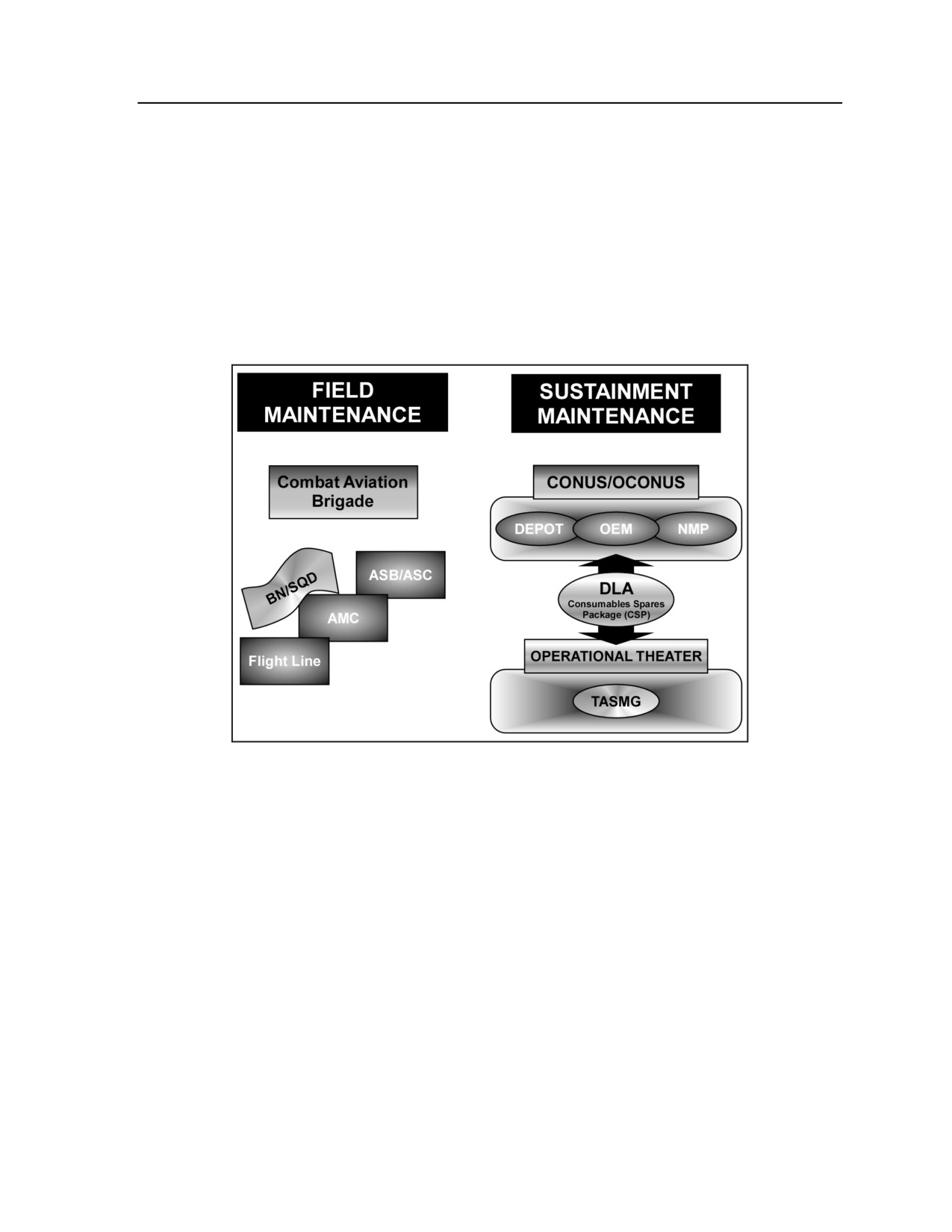
Sustainment Operations
Sustainment Maintenance
4-37. According to FM 4-0, sustainment maintenance is the Army’s strategic support. The strategic
support base is the backbone of the National Maintenance Program
(NMP) and the sustainment
maintenance system. At this level, maintenance supports the supply system by economically repairing or
overhauling components. Maintenance management concentrates on identifying the needs of the Army
supply system and developing programs to meet the supply system demands.
4-38. Sustainment maintenance support is divided and primarily performed by three separate entities—the
original equipment manufacturers and their contract field service representatives; Army depots, located at
fixed bases in the CONUS; and by the NMP sources of repair.
4-39. Figure 4-1 shows a graphic depiction of two-level maintenance, which illustrates the supported and
supporting relationships of field to sustainment maintenance.
Figure 4-1. Two-level aviation maintenance and sustainment
AVIATION MAINTENANCE OPERATIONS
4-40. As Army aviation transforms, the aviation maintenance company within each battalion will continue
to provide unit maintenance above the capability of the flight companies. The ASC assigned to the ASB
will continue to provide primarily intermediate maintenance and secondary backup unit maintenance to the
CAB’s battalions.
4-41. Aviation maintenance is performed on a 24-hour basis. Again, the governing concept is to replace
forward and repair rearward so units can rapidly return aircraft for operational needs. Emphasis is on
component replacement rather than repair. Such replacement requires increased stockage of line
replaceable units (LRUs) and quick change assemblies. Damaged or inoperable aircraft requiring time-
consuming repair actions are handled in more secure areas toward the rear. FM 3-04.500 provides more
detail.
MANAGEMENT BALANCE
4-42. The flying hour program and operational readiness rates must be balanced ensuring bank hours
(hours remaining per aircraft till phase) are available to meet the operational needs required during a
16 February 2007
FM 3-04.126
4-7
Chapter 4
deployment and/or training. Commanders and maintenance officers evaluate available resources and adjust
them accordingly. The problem, plan, people, parts, time, and tools (P4T2) concept may assist in this
evaluation. Another tool available to commanders and maintenance officers for managing aircraft
maintenance is the flowchart.
Flowchart
4-43. The flowchart is a simple, but effective, method that maintenance officers use. Unit-level logistics
system-aviation (ULLS-A) provides a flowchart outlining bank time to assist maintenance managers in
scheduling maintenance. The flowchart-
z Prevents an unnecessary backlog of scheduled maintenance inspections under normal conditions.
z Prevents a corresponding sudden surge in requirements for aircraft parts.
z Allows the unit maintenance officer a degree of control over individual aircraft hours flown.
z Provides a graphic depiction of future scheduled maintenance requirements.
Operational Readiness Rate
4-44. The ability of an aviation unit to perform its wartime mission is numerically represented by its
aircraft operational readiness rate. Higher operational readiness rates are a direct result of effective
maintenance and logistics management by all aviation maintenance leaders, officers, and technicians.
Reducing aircraft downtime proportionally increases aircraft availability providing the battalion
commander with needed aircraft to continue and win the fight (see FM 3-04.500).
SCHEDULED MAINTENANCE
4-45. Scheduled maintenance takes place anytime an aircraft phase, progressive phase management
(PPM), and preventive maintenance services to include scheduled component replacement are to be
conducted. To ensure minimum disruption to the supported unit’s mission (training/tactical), a scheduling
system that promotes efficient workflow is needed. This ensures customers receive their aircraft with the
least possible delay. Many factors must be considered when production control develops a scheduling
system. These factors may include the current workloads and priorities of the supported units, the
availability of tools, and the supply of major components, parts, and hardware.
PHASE AND PROGRESSIVE PHASE MAINTENANCE
4-46. The modular force is changing the levels of responsibility and management of phase/periodic
maintenance scheduling and flow. A methodical and purposeful flow of aircraft scheduled maintenance
events increases overall readiness.
4-47. Ongoing operations, training exercises, and deployments can have a major impact on readiness (for
example, flying too many aircraft into scheduled maintenance at a critical time), deployments, training, and
availability of resources (tools, maintenance personnel, repair parts, special equipment) must be considered
when planning phase maintenance (AH-64) and PPM (OH-58D) inspections.
UNSCHEDULED MAINTENANCE
4-48. Aircraft scheduled for daily mission (training/tactical) requirements may on occasions experience
unexpected malfunction, premature component breakdown, or battlefield damage, causing the aircraft to
undergo unscheduled maintenance
(reactive). Unplanned aircraft system, subsystem, or components
malfunctions or breakdowns will prompt production control to coordinate for unscheduled (reactive)
maintenance to bring affected aircraft to a fully mission capable status. It is the production control officer’s
responsibility to prioritize, manage, and track, unscheduled repairs having a negative effect on the total
mission capability of the ARB. Maintenance platoon leadership is ultimately responsible for conducting
maintenance repairs to affected aircraft systems, subsystems, and components according to established
maintenance publications and references.
4-8
FM 3-04.126
16 February 2007
Sustainment Operations
DEFERRED MAINTENANCE
4-49. When the production control officer is prioritizing maintenance actions, he weighs maintenance
actions in terms of what maintenance procedures must be performed immediately, and which maintenance
procedures can be postponed for a later time. When maintenance procedures are postponed, this action is
commonly referred to as deferred maintenance. Deferred maintenance actions must be performed at a time
when an aircraft goes down for unscheduled maintenance or an airframe is scheduled for a preventive
maintenance service or phase. Regardless, deferred maintenance actions cannot be delayed indefinitely; it
must be coordinated and scheduled to be performed at the earliest opportunity. The commander is the
approval authority for all deferred maintenance actions and should be notified immediately when the status
of aircraft flightworthiness changes.
AIRCRAFT RECOVERY, EVACUATION, AND BATTLE DAMAGE ASSESSMENT AND REPAIR
Battlefield Management of Damaged Aircraft
4-50. Battle damage assessment and repair
(BDAR)/recovery operations are normally planned and
coordinated in conjunction with PR operations. Recovery operations move an aircraft system or component
from the battlefield to a maintenance facility. Recovery may require on-site repair for a one-time flight, or
movement by another aircraft or surface vehicle. In extreme circumstances, only portions of inoperative
aircraft may be recovered. An aircraft is cannibalized at a field site only when the combat situation and
aircraft condition are such that the aircraft would otherwise be lost to enemy forces. See FM 3-04.500 and
FM 3-04.513 for more detailed information on aircraft recovery.
Responsibility
4-51. The battalion is responsible for coordinating aircraft recovery; the aviation maintenance company is
responsible for conducting the recovery. A successful recovery operation is a highly coordinated effort
between the owning organization, its ASB support, other supporting units, and ground element where the
operation is to take place. If recovery is beyond the aviation maintenance company team's capability, ASB
support is requested. Overall, control of recovery rests with the CAB CP.
Recovery Teams
4-52. Aviation battalions prepare for aircraft recovery contingencies by designating a DART. The DART,
at a minimum, includes a MP, maintenance/shop platoon personnel, aircraft assessor, and technical
inspector. The technical inspector may also be the assessor. All members must be trained to prepare aircraft
for recovery as this is a unit responsibility. The team chief ensures rigging equipment and quick-fix BDAR
kits
(tools, hardware, POL products, repair parts, and TMs) are kept ready for short-notice recovery
missions. Aircraft recovery can turn into PR if the tactical situation changes; recovery teams are integrated
into the QRF. FM 3-04.513 contains a sample aircraft recovery and evacuation SOP.
Planning Considerations
4-53. Assessment of the following factors facilitates selection of the best COA:
z Location of downed aircraft.
z Types of special equipment packages installed on aircraft.
z Amount of damage to aircraft.
z Weapon munitions onboard the aircraft and requirement for explosive ordnance disposal (EOD).
z Tactical situation and proximity to enemy.
z Time available (planning time for aviation maintenance company preparation and rigging is 30 to
60 minutes, which may vary based on METT-TC).
z Weather.
z P4T2.
16 February 2007
FM 3-04.126
4-9
Chapter 4
Courses of Action
4-54. The unit SOP provides guidance required to determine which of the following actions is appropriate
for the situation:
z Make combat repairs, defer further maintenance, or return aircraft to service.
z Make repairs for one-time flight and fly aircraft to an appropriate maintenance area.
z Rig aircraft for recovery (by ground or air) and arrange for transport.
z Selectively conduct controlled exchange, destroy, or abandon aircraft in accordance with TM
750-244-1-5 and unit SOP.
4-55. General procedures are typically covered in unit SOPs. FM 3-04.513 provides detailed procedures
for preparing and performing recovery operations for specific aircraft. FM 1-120 provides doctrinal
guidance on requirements, procedures, and C2 tasks involved in planning, coordinating, and executing
airspace control functions. Unless a battalion has attached or assigned UH-60s or CH-47s, it will have to
request them to conduct an aerial recovery. Parallel planning using P4T2 for a ground recovery should
occur while any aerial recovery operation is ongoing.
Planning
4-56. Recovery operations and, to a lesser degree, maintenance evacuations, can easily be detected and
attacked by enemy forces. Units must plan command, control, and coordination for recovery operations in
advance. Recovery and evacuation procedures must be included in unit SOPs, contingency plans,
OPORDs, and AMBs.
Aircrew
4-57. Depending on the enemy situation, status of the crew, and aircraft communications, the following
items or additional pertinent information will be obtained from the pilot or aircraft operator:
z Aircraft mission design series and tail number.
z Crew status and condition (are they able to conduct evacuation of aircraft).
z Describe extent of damage (is aircraft airworthy).
z Enemy activity.
z Aircraft altitude when it went down.
z Approximate fuel remaining in aircraft.
z Pilot-reported weather.
z Time and place of last-known position.
z Heading since last-known position.
z Airspeed when aircraft went down.
z Navigation equipment capability.
z NAVAID signals received.
z Visible landmarks.
z Number of people on board.
z Point of departure and destination.
z Emergency equipment on hand.
z Weapons available, if any.
Destruction of Aircraft and Assosciated Equipment
4-58. Destruction of aircraft and associated equipment that cannot be recovered and are in danger of
enemy capture may be destroyed according to TM 750 244-1-5. The authority for destruction will be
delineated and included in SOPs and OPORDs. If possible, aircraft are cannibalized before destruction.
The higher headquarters command assigned to a theater of operations, on a mission basis, mandates
4-10
FM 3-04.126
16 February 2007
Sustainment Operations
recovery and evacuation of enemy, allied, and other United States services’ aircraft using higher-echelon
assets.
VEHICLE AND GROUND EQUIPMENT MAINTENANCE AND
RECOVERY OPERATIONS
MAINTENANCE SUPPORT STRUCTURE
4-59. Ground maintenance support for each battalion is provided by their organic FSC. Sustainment level
units provide maintenance assistance as required.
PREVENTIVE MAINTENANCE CHECKS AND SERVICES
4-60. The operator or crew and organizational maintenance personnel perform unit maintenance including
scheduled and unscheduled unit-level maintenance, repair, and PMCS. PMCS maintains operational
readiness of equipment through preventive maintenance and early diagnosis of problems.
FIELD MAINTENANCE
4-61. Field maintenance units are tailored to the weapons systems of the supported unit and provide the
organizational and DS levels of maintenance with a multicapable mechanic. They provide extensive
maintenance expertise, component replacement, and limited component repair.
SUSTAINMENT MAINTENANCE
4-62. Sustainment maintenance is characterized by extensive component repair capability. It repairs
damaged systems for issue through the supply system as class II, VII, or IX items. This level of
maintenance is normally found at theater or depot level.
VEHICLE AND EQUIPMENT RECOVERY PROCEDURES
4-63. The recovery manager coordinates recovery operations with overall repair effort to best support the
commander's priorities and tactical situation. FM 4-30.31 describes technical aspects of vehicle recovery
operations.
4-64. When the unit recovers its equipment, but lacks the physical means to recover an item, it requests
assistance from the supporting maintenance element. Management of recovery operations is centralized at
battalion whenever possible.
4-65. Maintenance personnel repair equipment as far forward as possible within limits of the tactical
situation, amount of damage, and available resources. Recovery vehicles return equipment to the rear no
further than necessary, usually to the maintenance collection point of the supporting maintenance unit.
4-66. Recovery missions interfering with combat operations, or compromising security, are coordinated
with the tactical commander.
SECTION IV - BATTALION SUSTAINMENT UNITS
FLIGHT COMPANY
4-67. Flight line or company maintenance activities primarily maintain Army aircraft by conducting
scheduled maintenance. Unscheduled maintenance is conducted within the unit’s capability. Strict and
disciplined company operations allow assigned aircraft to be maintained according to prescribed policies
and procedures. An atmosphere of pride of ownership enhances the quality and standard of assigned
company aircraft and improves overall unit readiness.
16 February 2007
FM 3-04.126
4-11
Chapter 4
4-68. Crew chiefs perform aircraft launch and recovery operations, and maintain aircraft logbooks in
accordance with Army guidance and unit SOPs. They perform both scheduled and unscheduled unit
maintenance to include replacement of major subsystem components, maintenance operational checks, and
main and tail rotor vibration analysis. Battalion flight companies receive back-up support from the aviation
maintenance company to perform both scheduled and unscheduled maintenance.
4-69. Leaders must strictly adhere to established standards and maintenance procedures. The assigned
flight crews must conduct detailed preflight and postflight inspections according to the applicable TMs.
The crew must ensure that all identified deficiencies and malfunctions are promptly and accurately entered
into the aircraft logbook.
AVIATION MAINTENANCE COMPANY
4-70. The aviation maintenance company is organic to attack reconnaissance battalions assigned to CABs.
The aviation maintenance company in an ARB comprises of three modular aviation maintenance
platoons—the headquarters platoon, the ARP, and the CRP.
4-71. The purpose of the aviation maintenance company is to provide field level maintenance to enable
CAB aircraft sustain aviation combat power. The aviation maintenance company is organized to provide
quick, responsive, internal maintenance support and repair within its capability and in accordance with the
MAC. The aviation maintenance company troubleshoots airframe and component malfunctions and
performs maintenance and repair actions. It conducts BDAR and recovery operations within its capability
and is assisted by the ASC.
4-72. The aviation maintenance company provides mobile, responsive BDAR and DART operations
support through forward maintenance teams (FMTs). FMTs repair aircraft onsite or prepare them for
evacuation. The aviation maintenance company commander and production control officer coordinate and
schedule maintenance at forward locations of the battalion. The members of the forward element must be
able to diagnose aircraft damage or serviceability rapidly and accurately. FMT operations follow these
principles:
z Teams may be used for aircraft, component, avionics, or armament repair.
z When the time and situation allow, teams repair on site rather than evacuate aircraft; this includes
BDAR.
z Teams must be 100 percent mobile and transported by the fastest means available (usually by
helicopter).
z Teams sent forward may be oriented and equipped for special tasks to include recovery
operations; type of aircraft recovery will depend on the assets available.
4-73. In some situations, normal maintenance procedures must be expedited to meet operational
objectives. In such cases, the unit commander may authorize the use of aircraft combat maintenance and
BDAR procedures. Aircraft combat maintenance and BDAR are an aviation maintenance company
responsibility with backup from supporting ASC units.
4-74. The BDAR concept uses specialized assessment criteria, repair kits, and trained personnel to return
damaged aircraft to the battle as soon as possible. Often, these repairs are only temporary. Permanent
repairs may be required when the tactical situation permits. This method is used to meet operational needs.
It is not used when the situation allows application of standard methods.
HEADQUARTERS PLATOON
4-75. The headquarters platoon contains a headquarters section, production control section, QA sections
and technical supply section. This platoon provides for internal management and quality of repairs, and
logistics support within the battalion. The technical supply section operates logistics standard Army
management information system (STAMIS), requisitions class IX (Air) spares and manages the battalion
prescribed load list (PLL). Oversight is provided by the battalion aviation material officer (AMO) assigned
to the S-4 section.
4-12
FM 3-04.126
16 February 2007
Sustainment Operations
AIRFRAME REPAIR PLATOON
4-76. ARPs assigned to an aviation maintenance company provide their supported aviation units with
scheduled and unscheduled maintenance support. Primary responsibility for unscheduled maintenance falls
on the owning unit. However, when unit OPTEMPO increases, unscheduled maintenance support can be
coordinated and requested through the aviation maintenance company production control office. If the line
company cannot complete the unscheduled maintenance in one day or less, it should contact the production
control office and request ARP maintenance support. Location of the maintenance action can then be
further coordinated by the line company and the production control section. Primary responsibility for
periodic scheduled maintenance falls upon the owning unit. Prolonged scheduled maintenance—to include
aircraft phases, compliance with recently published aviation safety advisory messages (ASAMs)/technical
bulletin (TBs)—can lead a supported unit to request maintenance support from the aviation maintenance
company. Maintenance support can be coordinated and requested by the owning unit through the
production control office.
COMPONENT REPAIR PLATOON
4-77. The CRP is assigned a headquarters section, shops section, and a systems repair section. The CRP
contains assigned aviation repair specialty military occupational specialties (MOSs) to include avionics,
armament, powerplant/powertrain, hydraulics, pneumatics, and sheet metal repair assets. The CRP
diagnoses airframe and component malfunctions and performs maintenance, repair actions, and removes
and installs LRUs within its capabilities.
4-78. The shops section contains an armament/avionics/electrical repair teams. The armament team is
responsible for troubleshooting and repairing armament systems, subsystems, and components. Personnel
assigned to the armament systems repair team conduct preventive maintenance and conduct testing and
troubleshooting of aircraft weapons systems and subsystems. These personnel also perform cleaning,
servicing, and ammunition loading and unloading of weapons systems to include configuration changes.
The armament team is also responsible for repairing and replacing weapons platforms components in
accordance with applicable publications.
4-79. The CRP systems repair section performs preventive maintenance of aircraft components and
structures that require specialized technical skills. In addition, maintainers assigned to this section perform
scheduled and unscheduled maintenance, troubleshoot faulty components, remove and replace aircraft
components, perform BDAR procedures and manage assigned sets, kits, and outfits (SKO) at the platoon
level, and provide mission support to flight companies.
FORWARD SUPPORT COMPANY
4-80. An FSC is assigned to each operational aviation battalion and consists of a headquarters section,
distribution platoon, and ground maintenance platoon (see chapter 1 for organizational structure). The FSC
commander provides all logistics (less medical) to the aviation battalion and is the senior multifunctional
logistician at aviation battalion level. The FSC is designed to provide ground, air, missile, and AGSE
systems support; refueling and rearming support; and necessary logistics support. The FSC also
coordinates with the ASB for additional logistics as required. Each of the FARPs can be task organized to
support continuous operations by providing support for maintenance, armament, and rearming and
refueling. The FSC also maintains two DOSs of class I, provides field feeding and distribution support,
maintains class IX (ground) repair parts and conducts ground maintenance, while maintaining one combat
load of class III (Bulk) and class V for its supported battalion. See FMI 4-90.1 for more information on
FSC operations.
HEADQUARTERS PLATOON
4-81. The headquarters platoon of the FSC consists of the headquarters section and the field feeding
section.
16 February 2007
FM 3-04.126
4-13
Chapter 4
Headquarters Section
4-82. The headquarters section of the FSC provides C2 to assigned and attached personnel. It ensures that
subordinate elements follow the policies and procedures prescribed by the FSC commander and the
battalion commander. It directs the operations of its subordinate sections as well as the overall logistics
operations, less medical, in support of the battalion.
Field Feeding Section
4-83. The field feeding section is found in the FSC of each aviation battalion. The field feeding section
provides class I food service and preparation (from the BSA) for the battalion. This section can prepare hot
meals and distributes prepackaged or prepared food, or both, from the BSA. It can provide one “heat-and-
serve” meal and one “cook-prepared” (A or B ration) meal per day.
DISTRIBUTION PLATOON
4-84. The key activity of the distribution platoon is the conduct of LOGPAC operations to the battalion
and getting replenishment sustainment stocks from sustainment brigade units. The distribution platoon also
provides supply and transportation support to the battalion. The distribution platoon provides class II, III
(Packaged and Bulk), IV, V, VI, and VII to the battalion. The distribution platoon has the ability to conduct
simultaneous class III and V retail support to the companies and HHC. The distribution platoon operates
FBCB2 and the STAMIS to support supplies ordering and receipt.
Forward Arming and Refueling Point Operations
4-85. The FSC commander is responsible for accomplishing the FARP mission. He assists the S-3 in
formulating the FARP plan and coordinates fuel and ammunition requirements with the S-4. The FSC
commander request additional FARP support from the ASB. The increased tempo of operations and/or
density of traffic may require ATS assets. The FSC commander may request a tactical aviation control
team from the general support (GS) aviation battalion ATS company to perform this mission. In addition, a
SO certifies the FARP prior to use. If a SO is not available, a pilot of the first aircraft in the FARP certifies
the FARP according to the FARP checklist in the unit SOP. See FM 3-04.104 for more information on
FARP operations.
4-86. The FSC must be prepared to sustain the ARB with fuel and ammunition during all missions. The
success of the ARB mission is directly related to the effectiveness of the FARP and the personnel who run
it. This success depends on planning and coordination before FARP operations begin. The ARB normally
utilizes four types of FARPs—active, silent, jump, and rolling.
Active
4-87. The active FARP is normally located in the main battle area closer to the area where operations are
being conducted. It provides fuel and ammunition necessary for the employment of ARB units during
conduct of missions. The active FARP conducts refueling and rearming operations and permits to rapidly
refuel and rearm simultaneously.
Silent
4-88. For longer missions, ARBs employ a FARP with additional displaced FARPs (called silent FARPs
until activated) waiting to assume the mission at preplanned times or DPs. The silent FARP has all
equipment and personnel at the future site, but it is not operational.
Jump
4-89. A jump FARP may be necessary if the enemy occupies LOCs in the AO. Air-emplaced jump FARPs
support limited resupply behind enemy lines; the jump FARP is employed for a special mission. It is
composed of a forward area refueling equipment (FARE), 500-gallon collapsible fuel drums, and/or
ammunition (as the mission dictates). The jump FARP is transported and emplaced by ground or air and
4-14
FM 3-04.126
16 February 2007
Sustainment Operations
employed when dictated by time or geographical constraints. It allows the uninterrupted support of ARB
elements during FARP relocation and resupply.
Rolling
4-90. The rolling FARP allows aircraft providing convoy security for fuel tankers, ammunition, supplies,
and FARP movement to refuel and or rearm at the convoy’s location. This minimizes the compromising of
security by reducing the travel times associated with returning to the FARP. If time allows, a map
reconnaissance of the route should be conducted.
Forward Arming and Refueling Point Location
4-91. The FARP location is METT-TC dependent and a function of the battalion S-3. The FARP should be
located as close to the AO as the tactical situation permits. The intent is to reduce the distance or time
traveled for the aircraft, thereby increasing aircraft time on station while simultaneously striking a balance
that exposes the FARP to the least possible risk. The ARB’s ability to move quickly also requires that the
FARP be able to move quickly to maintain support.
4-92. Commanders can employ and configure their assets as the mission dictates to complete the mission
requirements. The commander can choose to have one large FARP or several small FARPs. The ARB can
employ three FARPS under the modular design (three sections of class III and three sections of armament
personnel). Also, the ARB can be augmented by the ASB and the use of Fat Cow (extended range fuel
system [ERFS]/ERFS II) and Fat Hawk/Wet Hawk operations to enhance class III/V requirements. In most
other circumstances, aircraft could rearm and refuel at FARPs within the close area. If a FARP must be
located behind enemy lines, the following factors should be considered:
z The composition of the FARP should be austere.
z Security will be limited because the FARP will be emplaced for a very short time.
z A thorough map reconnaissance and intelligence update must be accomplished for the area.
4-93. The FARP is located as close to the AO as the tactical situation permits. It is usually located as far
forward as 18 to 25 kilometers (METT-TC dependent) behind the FLOT. This distance increases aircraft
time on station by reducing the travel times associated with refueling. If possible, the FARP is kept outside
the threat of medium-range artillery. Movement and resupply of the FARP are conducted by ground or
aerial means. The FARP should remain in one location for only 3 to 6 hours; however, these times may be
reduced by the factors of METT-TC. The size of the FARP will depends on the number of aircraft that will
use the FARP and the type of refueling equipment (FARE/advanced FARE system or heavy expanded
mobility tactical truck [HEMTT]) that is available. Four to eight refueling points are normally sufficient for
continuous mission sustainment.
4-94. Ammunition palletized load system (PLS) trucks with mission-configured loads push supplies down
to the close area where FARP elements meet them at LRPs. When possible, the FSC commander
coordinates for direct delivery to the silent FARP to avoid transloading. Units travel to supply points for
fuel or receive throughput from higher echelon 5,000-gallon tankers for transloading.
4-95. The ARB usually emplaces a FARP using its combat trains. At this site, rearming and refueling
operations take place for a specific mission. When that mission is complete, the air assets transition to the
fixed FARP site in the rear to reconfigure ammunition loads, refuel, and perform required maintenance in
preparation for other missions.
GROUND MAINTENANCE PLATOON
4-96. The ground maintenance platoon is organic to the FSC of each aviation battalion. Field maintenance
units are tailored to weapons systems of the supported unit, providing maintenance expertise for
component replacement and limited component repair.
4-97. The FSC’s maintenance platoon provides field maintenance to itself and its battalion. The platoon
consists of a headquarters section, maintenance control section, recovery section, maintenance and service
16 February 2007
FM 3-04.126
4-15
Chapter 4
section, and the FMTs. The maintenance platoon provides C2 and reinforcing maintenance to the FMTs.
The FMTs provide field maintenance and BDAR to the companies. The platoon maintains a limited
quantity of combat spares (PLL, shop and bench stock) in the maneuver control system (MCS). The
maintenance platoon’s supply section is capable of providing class IX support (combat spares) to each
company and the HHC. It also provides exchange of repairable items.
HEADQUARTERS AND HEADQUARTERS COMPANY
GENERAL
4-98. The HHC supports a higher headquarters commander and his staff. It provides personnel and
equipment for C2 functions of battalion, and security and defense of the CP. The HHC also provides unit-
level personnel service, UMT and logistics and CBRN support.
ORGANIZATION
4-99. Organization and capabilities of the battalion HHC are two of the most important factors in
determining how the HHC supports its respective organizations. Force transformation restructured
composition of the HHC by eliminating most sustainment assets except for the medical treatment team.
With the new HHC organization, remaining sustainment assets are now part of the ASB and FSC.
4-100. The typical aviation battalion HHC consists of a command group, staff, company headquarters
section, supply section, communications/automation section, medical treatment squad, and UMT. The
company command group consists of the commander, 1SG, CBRN NCO, and decontamination specialist
as shown in chapter 1.
Supply Section
4-101. The supply section consists of the battalion supply sergeant, battalion armorer, and supply
specialist. The supply section manages distribution of supplies in support of the battalion. It utilizes unit-
level logistics system-ground and standard Army retail supply system-level
1 (SARSS-1) interfaces
providing supply receipt and issue management for all classes of supplies except class VIII (medical).
Communications Section
4-102. The communications section consists of a communications section chief, team chief, LAN
manager, transmission system operator-maintenance specialists, signal support system maintenance
specialists, and radio RETRANS operators. The communications section plans, coordinates, and oversees
implementation of communications systems. It performs unit-level maintenance on ground radio and field
wire communications equipment and installs, operates, and maintains the radio RETRANS site. The
communications section monitors the maintenance status of signal equipment, coordinates preparation and
distribution of SOIs, and manages COMSEC activities. The communications section’s responsibilities
include supervision of electronic mail on both unclassified and classified nets and the LAN.
Unit Ministry Team
4-103. The UMT is comprised of a chaplain and chaplain’s assistant. The team provides religious support
to all personnel assigned or attached to the battalion and company. The chaplain advises all unit
commanders on religious, moral, and Soldier welfare issues, and establishes liaison with UMTs of higher
and adjacent units.
Medical Treatment Team
4-104. The HHC’s medical treatment section provides health support service (HSS) to battalion. At
battalion level, the medical section consists of a flight surgeon, physician’s assistant, and health care
specialists.
4-16
FM 3-04.126
16 February 2007