FM 3-04.126 Attack Reconnaissance Helicopter Operations (February 2007) - page 6
Sustainment Operations
4-105. The medical treatment section consists of two treatment teams (teams A and B). They operate the
BAS and provide level I medical care and treatment. This includes sick call, emergency medical treatment
(EMT), preventive medicine, and advanced trauma management for wounds, injuries, or illness. The flight
surgeon, physician assistant, health care sergeant and specialists provide EMT and assist with advanced
trauma management procedures related to their occupational specialties. The treatment teams can operate
for limited times in split-based operations in DS of battalion units.
4-106. The medical treatment team usually operates under direction of the battalion main CP. Health care
specialists provide medical treatment under supervision of the flight surgeon or physician’s assistant.
Battalion health care specialists monitor health and hygiene of the battalion, train the battalion’s CLS
personnel, and treat casualties who require additional care during TACOPs. Medical personnel also
provide training in basic first aid and buddy aid; train and direct unit personnel to assist in handling mass
casualties; and assist the commander to ensure assigned and attached personnel meet all deployment
readiness criteria.
4-107. They also coordinate with the supporting medical platoon in the ASB to assist in MEDEVAC from
the point of injury to the level I mission training plan (MTP)/BAS and beyond. The medical sergeant keeps
the S-1 and 1SGs informed of casualties’ status, and coordinates with the S-4 for nonstandard evacuations
as needed.
AVIATION SUPPORT BATTALION
4-108. The ASB is the primary aviation logistics organization above the aviation battalion. The ASB is
organic to the CAB and provides all logistics functions necessary to sustain the ARB during operations.
4-109. The battalion receives logistics from various elements depending on the logistics organizational
structure at brigade and division sustainment brigade. Battalion XOs are responsible to their respective
commanders for overwatching sustainment operations and inserting themselves where appropriate to
ensure successful sustainment operations for the battalion. The battalion S-4 identifies the logistical
requirements for the maneuver plan and provides them to the FSC, ASC or ASB commander as appropriate
for the level of command.
AVIATION SUPPORT BATTALION ORGANIZATION
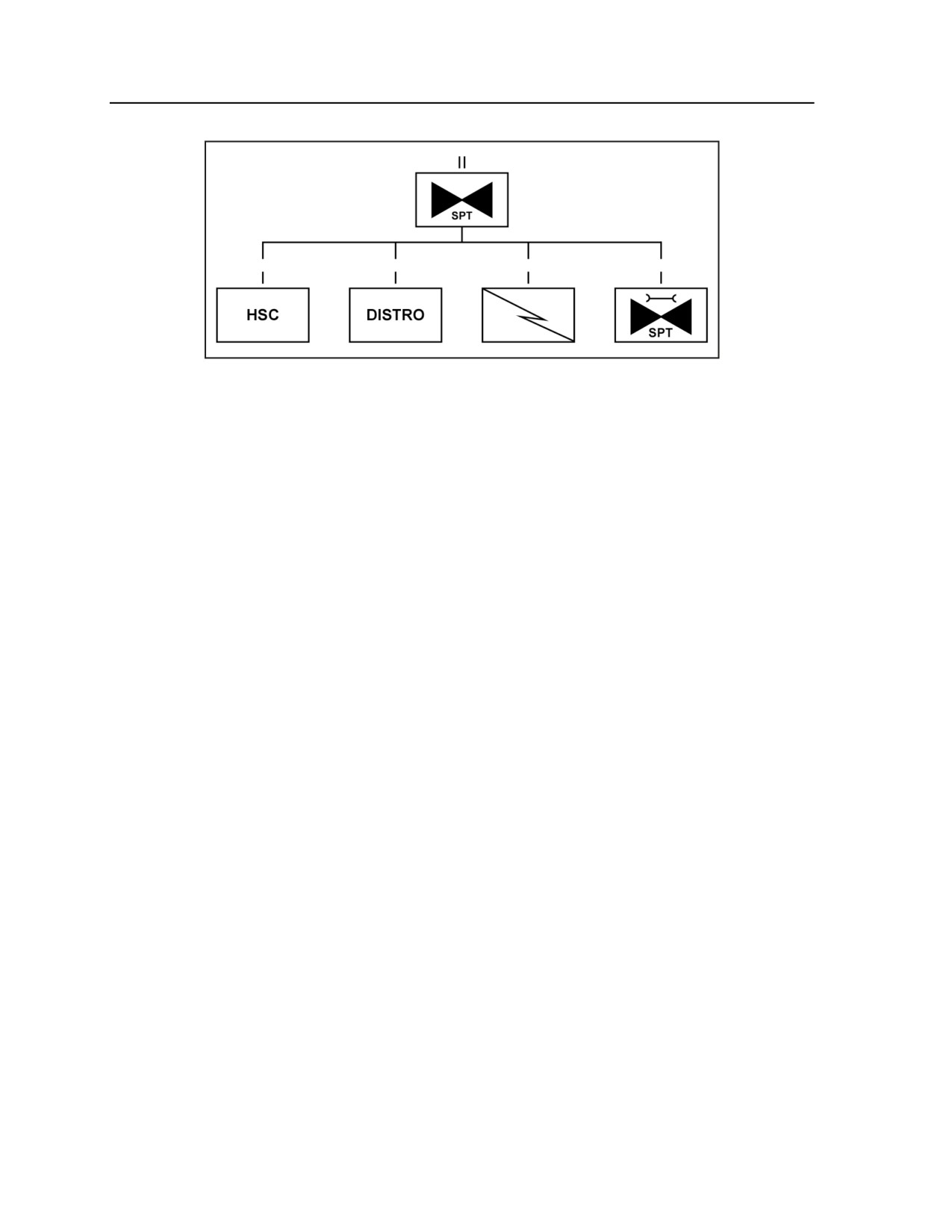
4-110. The ASB (figure 4-2, page 4-18) consists of four companies—HSC, distribution company,
network support company, and ASC nondividionsal ASBs do not have an assigned network support
company. The ASB provides aviation and ground field maintenance, network communications, resupply,
and medical support. The HSC provides medical support and conducts field-ground maintenance and
recovery. The distribution company functions as a SSA and distributes supplies to subordinate units of the
CAB. The network support company provides network and signal support to the CAB headquarters. The
ASC provides intermediate maintenance and support for on-aircraft and critical off-aircraft field level
maintenance and maintenance of UAS. The ASC also conducts BDAR and provides backup support to the
aviation maintenance company.
16 February 2007
FM 3-04.126
4-17
Chapter 4
Figure 4-2. Aviation support battalion
Headquarters and Support Company
4-111. The HSC consists of the battalion HSC. The HSC contains a typical battalion staff structure with a
command section, S-1 section, consolidated S-2/S-3 section, S-4 section, UMT, S-6 section, and a support
operations section. The battalion headquarters provides command, control, and intelligence and
administration support for all organic and attached ASB units. The battalion headquarters also plans,
directs, and supervises logistics support for the battalions of the aviation brigade. The ASB has an organic
combat service support automation management office that provides support to the entire brigade’s
automation, including the ULLS-A.
4-112. The support operations section is organized to coordinate logistics support and provide
distribution management to the aviation brigade. The support operations section is also manned to
accomplish contracting, medical logistics, petroleum, ammunition, movement control, transportation, and
mortuary affairs functions.
4-113. The support company portion of the HSC provides ground maintenance, medical, supply, and food
service support for units organic and attached to the ASB. The maintenance platoon is responsible for field
level maintenance for all of the ASB’s organic ground equipment.
4-114. The medical platoon provides level I enhanced medical care. The platoon is organized into a
headquarters section, a treatment section, and an evacuation section. The medical platoon provides the
following capabilities:
z EMT and acute trauma management for wounded, disease and nonbattle injury (DNBI) patients.
z Sick call services.
z Ground ambulance evacuation from supported units.
z Mass casualty triage and management.
z Limited patient decontamination.
Distribution Company
4-115. The distribution company provides a single source for all supply
(less class VIII) and
transportation operations. The distribution company includes a fuel and water platoon, a supply platoon
and a transportation platoon. Much of the capability now resident in this company was formally provided
by the main support battalion and corps support group.
4-116. The fuel and water platoon has the capability to store and distribute 105,000 gallons (one DOS) of
fuel for the brigade using three load-handling system modular fuel farms. Additionally, the platoon has
capability to set up and run multiple refuel points for brigade aircraft. The fuel and water platoon also has
capability to purify 30,000 gallons of water daily and can store 18,000 gallons of water. The platoon has an
organic quartermaster petroleum QA team assigned to provide QA testing for bulk aviation fuel. The team
4-18
FM 3-04.126
16 February 2007
Sustainment Operations
performs quality evaluation and provides technical assistance for handling, storing, sampling, and
identifying petroleum products and their containers.
4-117. The supply platoon has a SSA and an ammunition transfer holding point (ATHP) section. This
platoon provides class II III (P), IV, V, V1, VII, IX and IX (Air) DS to the brigade. The supply platoon
receives, stores (limited) and issues class II, III (P), IV, and IX. It also receives and distributes class I and
VI under distribution based doctrine of pushing supplies to the FSCs and aviation maintenance companies,
and receives and issues class VII as required. The platoon also maintains class II, III (P), IV and IX ASLs
for the brigade. The ATHP section supports brigade with class V and operates the brigade ATHP.
4-118. The transportation platoon’s purpose is to add organic transportation and distribution capability to
the brigade and increases mobility of the ASB. The transportation platoon also has the ability to transport
class V and class IX to supported FSCs and ASCs.
Network Support Company
4-119. The network support company provides 24 hour operations supporting the aviation brigade
network. It provides signal elements designed to engineer, install, operate, maintain and defend the
network. It extends defense information systems network services to the brigade and its subordinate
elements and provides basic network management capabilities. During military operations, the company
executes its technical mission under functional control of the brigade S-6 based upon brigade OPORDs or
other directives. The S-6 directs actions and movement of signal elements in support of brigade operations.
The network signal company commander maintains command authority over the company's assigned
operational platoons or attached elements.
Aviation Support Company
4-120. Aircraft maintenance above aviation battalion level is provided by the ASB’s ASC. The ASC is
comprised of four platoons—the headquarters, ARP, CRP, and armament platoon. Modularity within the
ASC is based on a contact support team concept and utilizes five shop equipment contact maintenance
(SECM) vehicles per platoon. The ASC is capable of supporting brigade split-based operations. The ASC
primarily performs intermediate maintenance in accordance with the MAC; however, it also provides back-
up unit maintenance in support of the aviation maneuver battalions. The ASC provides aviation logistics
support operations for CAB assets. It provides aviation and ground equipment maintenance, in a sustained
combat environment, to include limited support for UAS and air traffic control equipment. The ASC also
performs production control and QA, conducts maintenance management, and provides MP functions.
Additionally, ASCs have six man electro-optics test facility augmentation teams assigned.
Headquarters platoon
4-121. The headquarters platoon contains a production control section, QA section and technical supply
section. This platoon provides internal management of repairs, quality of repairs, and logistics support
within the battalion. The technical supply section operates logistics STAMIS, requisitions class IX (Air)
spares and manages the battalion PLL. Oversight is provided by the battalion aviation material officer
assigned to the S-4.
Aircraft repair platoon
4-122. ARPs assigned to an ASC provide field-level maintenance support to in accordance with the
MAC. Furthermore, ASC’s ARP has the capability to perform limited sustainment-level maintenance in
support of the aviation maintenance company’s maintenance program. The ASC’s ARP also provides
technical assistance and maintenance support, when requested by supported aviation maintenance
companies, and coordinated through the ASC’s production control office. This support entails performing
field level to include intermediate and, when authorized, sustainment-level
(limited depot) repairs
according to applicable TMs, including electronic TM/interactive electronic TMs. AMCOM logistics
assistant representatives (LARs) will issue a letter of authorization which authorizes ASC ARP maintainers
to perform a one-time sustainment level maintenance repair. The ARP has modular maintenance contact
16 February 2007
FM 3-04.126
4-19
Chapter 4
teams to support battalion-level deployments. ARP personnel, with maintenance officers/technicians,
perform in-depth troubleshooting and diagnostics of aircraft systems, subsystems, and components. The
ARP also provides repair personnel for technical assistance, contact teams, and aircraft recovery teams.
CRP personnel may be attached to ARPs (contact and aircraft recovery teams) to expedite repair of critical
components assisting ARP personnel provide rapid turnaround of unserviceable aircraft. The ARP section
provides modular support to the aviation maintenance company using contact maintenance teams. The
modular support is based on a contact support team concept using five SECM vehicles per platoon.
Component repair platoon
4-123. CRPs assigned to an ASC provide field-level maintenance component repair support functions to
the aviation maintenance company’s assigned aircraft and corresponding aircraft systems. Furthermore,
ASC’s CRP can provide unit-level component repair support, when requested by the aviation maintenance
companies and coordinated through the ASC’s production control office. The CRP performs airframe,
LRU, and component repairs to aircraft systems at the ASC. These maintenance procedures entail
performing field-level maintenance repairs according to applicable TMs and the MAC. Furthermore, CRPs,
are capable of performing limited sustainment. AMCOM LARs will issue a letter of authorization, which
authorizes ASC CRP maintainers to perform a one-time sustainment level maintenance repair. Continuous
component repair support of aviation maintenance companies and of the reparable exchange (RX) program
will increase availability of serviceable aircraft repair parts, thus reducing the customers’ aircraft downtime
and the logistics tail. Sustaining a balanced approach to the battalion’s component repair support program
and the RX program will provide aviation maintenance companies required aircraft repair parts when
needed.
AVIATION SUPPORT BATTALION MISSION
4-124. The ASB distributes supply classes I, II, III, IV, V, VIII, IX and IX (Air). It performs field
maintenance and recovery, both air and ground, and possesses HSS assets to conduct force health
protection level I enhanced for the aviation brigade. It carries logistics stocks exceeding the organic
carrying capability of the battalions which is generally one DOS for most classes of supply except for class
III
(Bulk) and class V where it is one combat load for the brigade. The FSCs have the same type of
carrying capacity relative to support of their battalion. The ASB plans and coordinates for the aviation
brigade’s logistics requirements in coordination with the brigade S-4 during the brigade’s MDMP. The
ASB executes replenishment operations for the FSCs and aviation maintenance companies in concert with
the OPLAN developed by brigade. The ASB is the parent battalion headquarters for the network signal
company in support of the brigade headquarters.
SECTION V - STANDARD ARMY MANAGEMENT INFORMATION SYSTEMS
STANDARD ARMY MAINTENANCE SYSTEM
4-125. This system includes standard Army maintenance system-level 1 (SAMS-1) and standard Army
maintenance system-level 2 (SAMS-2). See FM 3-04.500 for more information.
4-126. STAMIS consists of computer hardware and software systems that automate diverse functions
based on validated customer requirements. STAMIS facilitate vertical and horizontal flow of logistics and
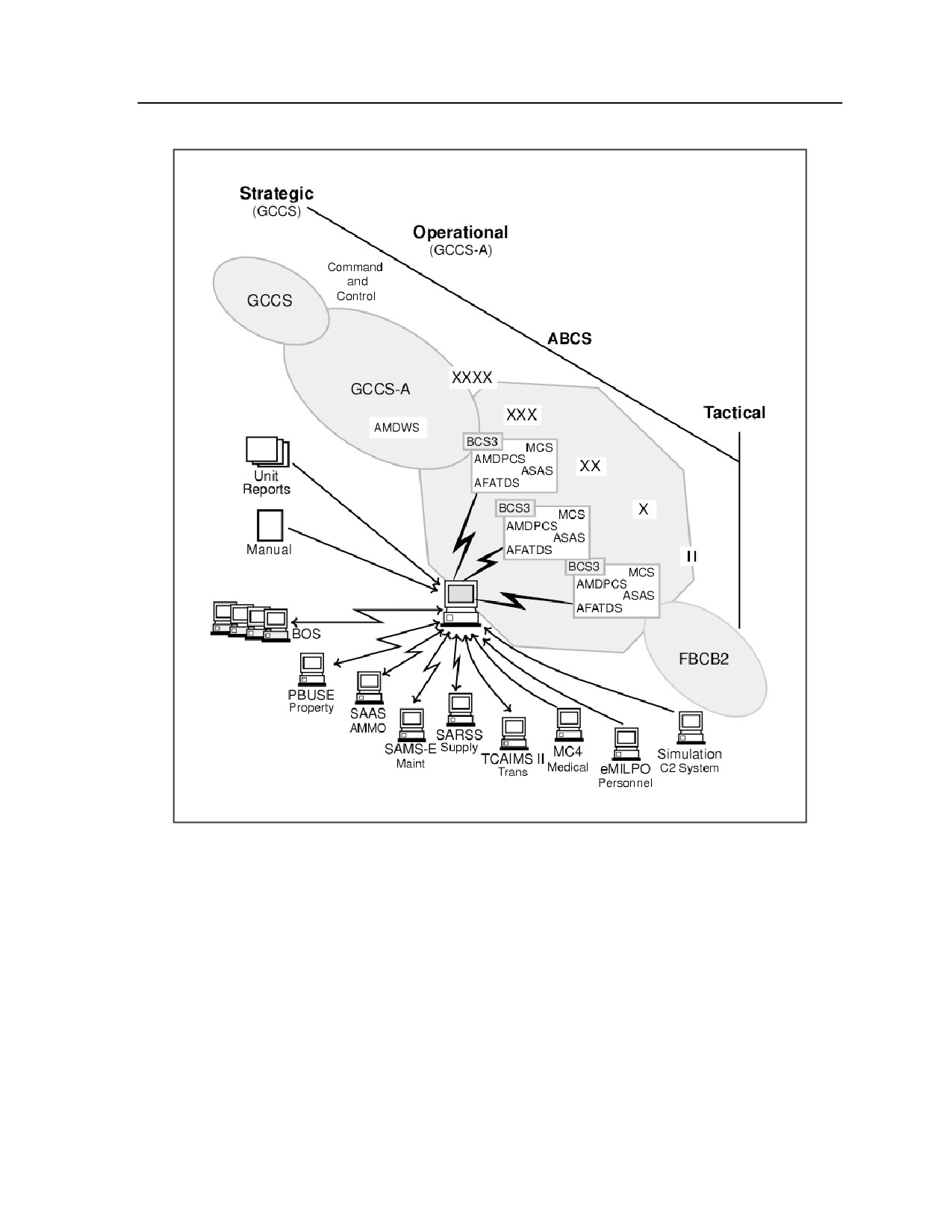
maintenance status information to units Army wide. Figure 4-3, page 4-21, illustrates the systems that
make up the STAMIS architecture. See FM 3-04.500 for more information.
4-20
FM 3-04.126
16 February 2007
Sustainment Operations
Figure 4-3. Standard army management information system architecture
STANDARD ARMY MAINTENANCE SYSTEM-1
4-127. SAMS-1 enables automated processing of DS/GS maintenance shop production functions,
maintenance control work orders, and key supply functions. Requisitions are prepared automatically and
automatic status is received from SARSS-1. SAMS-1 has interfaces with other systems such as unit-level
logistics systems (ULLSs), SAMS-2, and standard Army retail supply system-Gateway (SARSS-Gateway).
It also provides completed work order data to logistics support activity for equipment performance and
other analyses.
STANDARD ARMY MAINTENANCE SYSTEM-2
4-128. SAMS-2 is an automated maintenance management system used at the FSC and ASB level. It
enables monitoring equipment not mission capable
(NMC) status, controlling and coordinating
16 February 2007
FM 3-04.126
4-21
Chapter 4
maintenance actions and repair parts usage to maximize equipment availability. SAMS-2 receives and
processes maintenance data to meet information requirements of the manager, and fulfill reporting
requirements to customers, higher SAMS-2 sites, and the wholesale maintenance level. Data can be
accessed instantly to enable management control, coordination, reports, analysis, and review. SAMS-2
provides maintenance and management information to each level of command from the user to the
wholesale and DA levels.
STANDARD ARMY MAINTENANCE SYSTEM-ENHANCED
4-129. Standard Army maintenance system-enhanced
(SAMS-E) automates maintenance functions,
readiness reporting, unit status reporting functions, and unit-level supply. It provides day-to-day weapon
system and subcomponent readiness status and maintenance and related repair parts information. It
facilitates management functions from the tactical DS/GS-level maintenance activities and the support field
and sustainment maintenance concept (two levels of maintenance). SAMS-E is assigned to ASC and FSC.
SAMS-E consists of SAMS-1 and SAMS-2 applications and supports sustainment, TOE, and
organizational-level maintenance elements. SAMS-E eliminates duplicate processes but includes critical
unit-level functions of equipment operator and qualification, equipment dispatch, equipment PMCS,
scheduling and recording, equipment fault records, organizational work order number
(ORGWON)
generation, Army oil analysis program (AOAP), and Army materiel status system (AMSS) reporting.
SAMS-E allows multiple unit identification code (UIC)/Department of Defense Activity Address Code
(DODAAC) and stock storage in multiple locations. In addition, SAMS-E—
z Automates unit-level class IX (repair parts) functions.
z Enables same-day processing of requisitions to source of supply, thus minimizing order-ship
time.
z Integrates supply and maintenance applications to eliminate redundant functions.
z Automates demand history and stockage-level computations to avoid out-of-stock or excess
conditions.
z Uses both federal logistics (FEDLOG) and the standard Army retail supply system (SARSS)
catalog update.
z Identifies units as either direct or indirect (supported customer).
z Generates a work order automatically when an operator-level fault is initiated and the part
received.
z Changes management of unit data from DODAAC-based to UIC-based selection and entry.
z Retains the man-hour accounting on/off switch as an option in case of deployment.
z Provides password protection to the operational processes and data elements.
PROPERTY BOOK AND UNIT SUPPLY ENHANCED PROGRAM
4-130. Property book and unit supply system-enhanced (PBUSE) is the Army’s Web-based, state-of-the
art, sustainment property accountability system. PBUSE features provide standard property book system-
redesign functionality and data access by permission control system for both garrison and tactical
environments. When tactical requirements dictate and direct connection to the Web is not possible, the
system operates in a disconnected standalone mode. Upon completion of a standalone tactical requirement,
the system is reconnected to the Web for resynchronization of the user’s data to the central database.
PBUSE reduces the footprint and infrastructure requirements by consolidating two baselines into one. The
system functionality provides much efficiency for the logistics community. With PBUSE, the commander
has a real-time view of assets, accurate visibility of the unit’s property book account operating on the AKO
portal, which allows him to access the system for queries without having to depend on the PBO to gather,
prepare, and present the information. PBUSE also provides:
z Real-time total asset visibility throughout all levels of Army management.
z Automatic Logistics Army Authorization Document System
(LOGTAADS) updates;
LOGTAADS is a by-product of an MTOE. LOGTAADS, an electronic version of the MTOE,
updates PBUSE and other property book accounting systems.
4-22
FM 3-04.126
16 February 2007
Sustainment Operations
z Elimination of unique item tracking reporting thorough automatic serial number tracking.
z Automated catalog changes.
z Unit transfer/TF/split operations.
STANDARD ARMY RETAIL SUPPLY SYSTEM
4-131. SARSS is a multiechelon supply management and stock control system that operates in tactical
and garrison environments. SARSS comprises SARSS-1 (at the SSA), standard Army retail supply system-
level 2 (SARSS-2) A/C, or corps/theater automated data processing service center (CTASC), and SARSS-
Gateway. SARSS provides supply-related data to the Integrated Logistics Analysis Program (ILAP) at
various functional levels. SARSS supports ULLS, standard Army maintenance system (SAMS), PBUSE,
nonautomated customers, and the dual-based operations concept. SARSS is fully integrated from the user
through theater Army level. It can support worldwide deployment of combat forces to contemporary
operating environments to include stability and civil support operations missions.
STANDARD ARMY RETAIL SUPPLY SYSTEM-1
4-132. SARSS-1 is the standard supply system used for receipt, issue, replenishment, and storage
operations. It operates at the ASB’s SSA and combat support battalions. SARSS-1 in each supply echelon
is capable of sustaining prime support responsibilities for each customer’s unit. Each customer unit can
interact directly with any SARSS-1. SARSS-1 is the system of record. It maintains accountable balances
and is supported by a SARSS-2A activity. It depends on SARSS-2B for catalog support and computation
of stockage levels.
STANDARD ARMY RETAIL SUPPLY SYSTEM-2A/C/CORPS/THEATER AUTOMATED DATA
PROCESSING SERVICE CENTER
4-133. SARSS-2A performs time-sensitive supply functions. These include management of controlled
items, lateral search of stocks to fulfill unsatisfied customer’s requirements from subordinate SARSS-1
activities, and redistribution of excess. SARSS-2 A/C operates on CTASC hardware. SARSS2-AC/CTASC
performs time-sensitive supply management functions for referral, excess disposition, and management for
classes II, III (P), IV, VII and IX (Air). It manages redistribution of supplies. SARSS 2 A/C/CTASC also
maintains a custodial availability balance file that provides visibility of SARSS-1 assets to include both
divisional and nondivisional functions.
STANDARD ARMY RETAIL SUPPLY SYSTEM-2B
4-134. SARSS-2B performs management functions that are not time sensitive. These include document
history, demand analysis, and catalog updates at installation and United States Property and Fiscal Officer.
It supports subordinate SARSS-1 and SARSS-2A by performing stockage-level computations, tailoring
catalog files, and maintaining active and inactive document history data.
STANDARD ARMY RETAIL SUPPLY SYSTEM-GATEWAY
4-135. SARSS-Gateway is an interactive/batch-oriented transaction processor that routes transactions to
and from each interfacing STAMIS. It provides a communications network and the capability to send
transactions to the defense automatic addressing system (DAAS). It provides the appearance of a seamless,
near real-time supply system to unit-level supply and maintenance activities. SARSS-Gateway provides
customer access to all assets that are available within a specified geographical area. Requests are
electronically transmitted from customers to a gateway computer, where lateral search/issue decisions are
made based on the ABF residing there. If assets are not available, the gateway forwards the request to the
wholesale SOS and provides status to customers on the actions taken.
16 February 2007
FM 3-04.126
4-23
Chapter 4
UNIT-LEVEL LOGISTICS SYSTEM-AVIATION
4-136. The ULLS-A program will enhance the Army’s ability to more accurately track and control
aviation maintenance, logistics, and aircraft forms and records. The ULLS-A program is designed to be
user friendly while reducing man-hours through complete automation. The ULLS-A is an innovative tool
that assists aviation maintenance personnel with various tools to enhance aircraft reporting, status, and
flying hours according to AR 700-138. Furthermore, ULLS-A can process aircraft transfers, maintain
operational and historical records, process class IX (Air) repair parts, and enhance maintenance operations
overall. In addition, ULLS-A automates bench stock listings by shop codes (stocked and maintained
manually with an automated reordering process), PLL, reportable component management, and
maintenance management processes performed by production control. ULLS-A is currently the system of
record for all PLL/bench stock and the Army maintenance management system-aviation operations at the
unit level. ULLS-A enhances and supports those tasks associated with controlled exchange of reportable
components listed in TB 1-1500-341-04.
4-137. ULLS-A at the aviation maintenance company is configured into a network operation. A notebook
computer assigned to line companies facilitates those tasks previously performed on the manual logbook.
Army aviation units are normally supported by three workstation computers (production control, quality
control, and technical supply) and a file server (database) positioned in the production control office. These
automated systems comprise the LAN. Tasks and activities performed by quality and production control
are transferred to the aircraft notebook. These procedures will ensure that the ULLS-A is current and
reflects the latest maintenance and logistics status assigned to the airframe.
4-138. ASCs are provided with an ULLS-A which supports those activities necessary to perform field
maintenance support for customers and operational readiness float/RTF aircraft. If an aircraft is work
ordered to an ASC, the logbook and laptop computer assigned to the aircraft will accompany the aircraft to
track and record all performed maintenance actions. The ULLS-A provides production control with the
ability to generate and manage ASC-level work orders and post statuses to the maintenance request
register. ULLS-A provides the vehicle to produce and manage internal work orders (intrashop), which are
printed and supplied to the ASC component and ARPs.
Note. ULLS-A is currently being fielded to Army aviation units. ULLS-A, once fielded, will be
the system of record to track all logistics and maintenance actions for all aviation maintenance
units. The manual system (hard copies of forms and records) will be used as a backup if ULLS-
A becomes nonfunctional. The production control office is responsible for coordinating the
input and update of all maintenance and logistics actions into ULLS-A once the system is fully
operational.
INTEGRATED LOGISTICS ANALYSIS PROGRAM
4-139. ILAP is the standard management tool used by the Army that collects, integrates, and displays
logistics and financial data. ILAP operates at all echelons of the Army to provide management capability to
unit, corps, installation, component, and theater levels. Financial data are pulled from Defense Finance and
Accounting Service data sites. Logistics data are obtained from appropriate supply and maintenance sites.
The cross-functional data are integrated and aggregated to upper echelons to provide summary decision
support views and detailed information drill-down capabilities to the document detail level. This process of
assembly and aggregation affords Army departmental users the opportunity to do Army-level analysis and
data query. ILAP augments the STAMIS. Managers at all levels execute their duties more efficiently and
effectively by using integrated ILAP data. ILAP is most useful for managers who require data from
disparate and isolated sources because ILAP virtually eliminates the time required for retrieval, integration,
and display to support management analysis.
4-24
FM 3-04.126
16 February 2007
Sustainment Operations
DEFENSE AUTOMATIC ADDRESSING SYSTEM
4-140. The logistics information processing system, maintained by the DAAS, is DOD’s central
repository for information on the status of requisitions. It also augments global transportation network in
monitoring the status of non-unit cargo shipments.
AVIATION LIFE SUPPORT SYSTEM
4-141. Commanders ensure mission-required ALSE is on hand in sufficient quantities, and equipment is
in serviceable condition. To meet the Army's demanding transformation requirements, newer and more
complex integrated systems are being fielded. These systems demand better maintenance planning, higher
maintenance skills, and dedicated facilities.
4-142. Commanders are required to establish an ALSS maintenance management and training program
budget to meet resource requirements. Funding for equipment, supplies, and repair parts is imperative.
When preparing the budget, review AR 95-1; common table of allowances (CTAs) 8-100, 50-900, and 50-
909; and applicable MTOEs and tables of distribution and allowances.
16 February 2007
FM 3-04.126
4-25
Appendix A
Aircraft Survivability
Aircraft survivability is a primary concern throughout planning and execution of all
missions. Army aircrews operate in an extremely hazardous environment of highly
lethal AD threats. The array of enemy AD systems includes radar, IR, optical/EO,
laser and directed-energy weapons (DEWs). Proper use of ASE, combined with
careful route planning and movement techniques, greatly reduces the enemy’s ability
to effectively engage Army helicopters.
SECTION I - THREAT WEAPON SENSORS
A-1. There are four major types of threat weapon sensors—radar, IR, DEW, and EO. These must be man
portable or transportable by land, sea, or aerial platforms. Actual sensor type and guidance package for
each threat should be determined and its inherent capabilities and limitations understood. The four major
types of threat weapon sensors are discussed below.
RADAR
A-2. Direct-threat radar weapons require LOS to hit the target. These radar weapons are either fire-
controlled AAA or, for missile systems, controlled by command, semi-active radar homing, active-radar
homing, track via missile, or ground-aided seeker. Radar weapons must detect, acquire, track, launch and
guide (or fire a ballistic solution), and assess damage. Radar systems have trouble with ground clutter; to
pick out targets from ground clutter, radar systems can detect movement using a moving target indicator,
Doppler (continuous-wave radar), or pulse Doppler. Some modern radar systems can and do track not only
the movement of the aircraft itself but also the rotor blades. A few older radar systems had blind speeds—
called a Doppler notch—where they could not detect an aircraft flying a specific speed toward or away
from the radar. However, modern radar systems cancel blind speeds. Even with older radar systems,
aircraft had difficulty maintaining constant speed and angle to or from one radar; it is impossible to be in
Doppler notch of more than one radar. Radar systems can be detected, avoided, decoyed, jammed, and
destroyed by direct and indirect fires—self, artillery, and antiradiation missiles.
INFRARED
A-3. All IR direct-threat weapons require LOS be established before launch; the in-flight missile must
maintain LOS with the target until impact or detonation by the proximity fuse. IR missiles require the
operator visually detect the target and energize the seeker before the sensor acquires the target. The
operator must track the target with the seeker caged to the LOS until it is determined the seeker is tracking
the target and not background objects—such as natural or manmade objects to include vehicles, the sun, or
energy of the sun reflected off clouds. The IR sensor is also susceptible to atmospheric conditions (haze or
humidity), the signature of the aircraft and its background, flares, decoys, and jamming. Generally, IR
systems are difficult to—
z Detect before launch (passive sensor).
z Predict location (portability).
z Respond to (short time of flight after launch).
z Hard kill (requires shooting at an in-flight missile).
16 February 2007
FM 3-04.126
A-1
Appendix A
LASER AND DIRECTED-ENERGY WEAPONS
A-4. Laser/DEW weapons are two distinct categories—laser-guided or laser-aided weapons and pure
laser/DEW weapons. Laser-guided or laser-aided weapons use laser for ranging, tracking, or guiding
functions of conventional explosive missiles or projectiles. Pure laser/DEW weapons use laser and other
forms of DEW to inflict damage to aircraft or its sensors (the aircrew’s eyes may be damaged). Pure
laser/DEW weapons are not required to burn a hole in the target to destroy it—although these weapons are
reaching such capability. Simply igniting fuel vapor near vents or burning through fuel lines is effective as
well as glazing cockpit glass so aircrew cannot see out. Inherently, laser/DEW weapons are of short
duration, hard to detect, extremely hard to decoy or jam, and hard to kill. Fortunately, they must rely upon
LOS and atmospheric conditions and have a somewhat short range.
OPTICAL/ELECTRO-OPTICAL
A-5. Optical/EO sensors are used as either primary or secondary sensor for all weapon systems. Although
they rely on LOS, they are, with very few exceptions, completely passive. They are limited by human eyes,
atmospheric conditions, distance, jitter, and in many cases, darkness. The optical/EO sensors are the most
difficult to detect, seldom decoyed, and can be jammed in the sense of obscurants but, when located, can be
hard to kill.
SECTION II - OPERATIONAL EMPLOYMENT CONSIDERATIONS
A-6. Aircraft survivability functions must be included throughout mission planning, rehearsal, execution,
and recovery operations. Intelligence drives operations, and mission planning begins with receipt of
situation and mission and continues through completion of mission execution and AAR. From receipt of
enemy situation and mission, it is important to plan and integrate aircraft survivability functions.
A-7. For ASE to provide effective protection, configuration settings must be optimized for known and
suspected threats. TACOPS ensure optimum ASE configuration settings are prepared and briefed for each
flight. TACOPS give consideration for each system and settings for specific theater of operation.
MISSION PLANNING
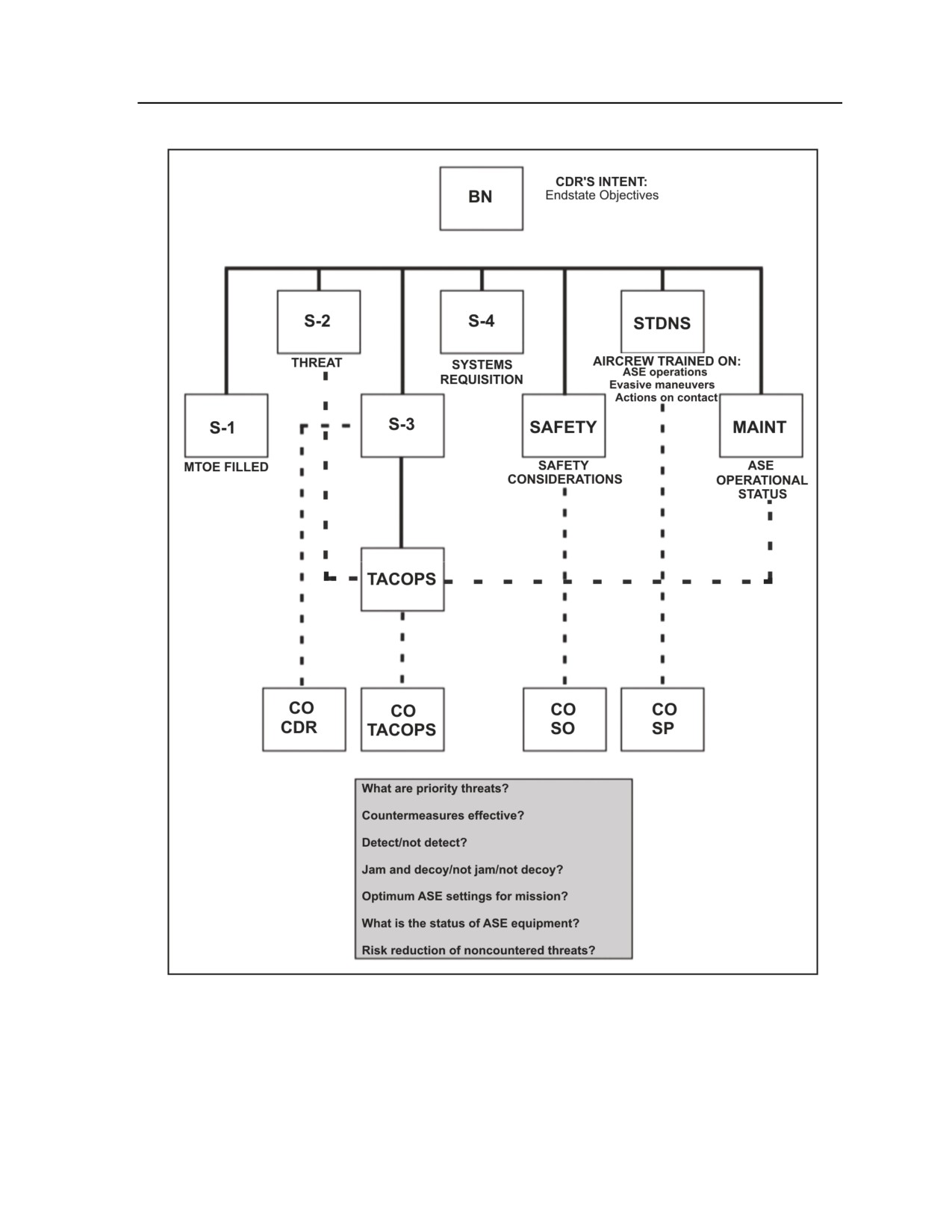
A-8. ASE and EW must be considered in all phases of mission planning and execution. Figure A-1, page
A-3, illustrates roles and responsibilities of ASE planning.
A-9. Once initial analysis of information is completed, the battalion S-3 notifies the battalion TACOPS
and begins the planning cycle. The level of planning involved is always predicated on time, information,
and personnel available. OPORDs for military operations are extensive in scope and contain information
acting as a baseline for most unit operations.
A-10. The generation of the OPORD begins upon receipt of enemy and friendly situation, mission, and
commander’s intent. The EW annex is created to support the OPORD using this information. Enemy and
friendly situations are further defined with emphasis on EW capabilities; each one finds, fixes, jams,
deceives, disrupts, or destroys the other. Once the situation is clearly defined, the mission is analyzed to
evaluate risk to friendly forces while accomplishing the mission within prescribed guidelines. After risk
assessment is complete, risk reduction techniques are specified in the execution instructions. These
techniques require commander’s approval if mission constraints need to be altered significantly from
original intent. The next step is determining service support for EW and command and signal guidance
necessary to accomplish the EW phase of the mission.
A-11. ASE settings depend on accurately analyzing enemy AD threat. Knowing the threat is critical to
effective passive and active countermeasures. Unit TACOPS provide ASE settings/codes for training and
deployment.
A-2
FM 3-04.126
16 February 2007
Aircraft Survivability
Figure A-1. Roles and functions
16 February 2007
FM 3-04.126
A-3
Appendix A
AIRCRAFT SURVIVABILITY EQUIPMENT RISK ANALYSIS
IDENTIFYING RISK
A-12. To perform a thorough risk assessment, detailed information about threat system operating
procedures, tactics, system capabilities, and locations must be analyzed to determine enemy advantages or
disadvantages in use of EW. Capabilities and limitations of friendly EW systems are compared to threats
assessing level of risk associated with the mission. S-2s and TACOPS officers identify the following for
companies:
z Operating frequencies of radar threats.
z RF threats that can or cannot be detected.
z RF threats radar jamming equipment will affect (includes the extent of success jamming has).
z RF threats that can be decoyed (includes the extent of success decoying has).
z IR threats that may be encountered.
z IR threats that can be detected.
z IR threats that can be jammed or decoyed (effectiveness of jamming and decoying).
z Laser threats that can or cannot be detected.
z Optical/EO threats.
ELECTRONIC INTELLIGENCE PRIORITY INTELLIGENCE REPORTS
A-13. Battalion sends electronic intelligence (ELINT) PIR to higher requesting specific threat emitter data
on any templated EW/AD threats. Tabular data associated with any radar hits should also be requested.
ASSESSING RISK
A-14. Companies prioritize threat systems and optimize ASE settings for highest priority threats. Level of
risk is determined based on threat and ASE capabilities and limitations and mission (use DA Form 7573,
Aircraft Survivability Equipment (ASE) Risk Assessment Worksheet Survivability Risk Analysis). The
highest risk is used to determine overall risk to the mission. If risk due to IR threats is high, then overall
mission risk would continue to be high risk. The risk assessment worksheet is used to determine what is
causing the highest risks so controls can be developed to reduce those risks.
Note: Select initial settings for RFI MODE, PRIORITY scheme and TERRAIN to enhance
ability of the AH-64D to detect threats.
Note: Mixed formations must consider suppressed/unsuppressed aircraft configurations when
conducting ASE risk analysis/mission planning.
DEVELOP CONTROLS
A-15. Optimum ASE configuration settings for each aircraft type and threats in the mission area are
determined based on doctrinal assets and requested ELINT PIRs. Threats which are highly lethal and not
countered by ASE are identified and PIRs are developed and submitted by the S-2 to higher headquarters.
Additional requirements include—
z Briefing the S-3 and higher commander on any medium or high risks associated with executing
the planned mission.
z Using AMPS to display high threat areas.
z Making recommendations to higher commander to reduce risk.
Adjusting routes, ABFs, and/or EAs.
Adjusting time of mission.
Employing artillery and smoke to reduce threat to aircraft.
Requesting joint EW assets.
A-4
FM 3-04.126
16 February 2007
Aircraft Survivability
A-16. Apply risk reduction techniques to minimize risk and enhance probability of survival. These
measures include—
z Planning mission time earlier or later to take advantage of night operations.
z Planning J-SEAD at critical points to reduce vulnerability.
z Altering flight routes to avoid known AD areas.
z Altering formation size to reduce signature.
IMPLEMENT CONTROLS
A-17. Commanders and aircrews must take an active role in reducing risks by implementing controls and
supervising their implementation.
z Commanders ensure ASE/EW considerations and configuration settings are briefed to all
aircrews and maintenance personnel.
z Aircrews ensure ASE settings are correct during preflight ASE checks.
z Aircrews ensure IFF codes are activated and deactivated at proper times and locations during
mission execution.
z Commanders collect debriefings from aircrews during AAR.
z Aircrews report all ASE/EW abnormalities experienced during flight (ambiguities, false alarms,
equipment failures).
z Commanders ensure all ASE/EW data are entered into AMPS for the next mission (threat data,
countermeasure responses, locations of false alarms, friendly systems reported as threats).
MISSION BRIEF
A-18. The ASE/EW mission briefing disseminates information and instructions to aircrews prior to the
mission. At least four hours prior to mission execution, the AMC requests an ELINT update. The briefing
alerts aircrews to risks associated with threats, optimum ASE settings, and a review of tactics specific to
the mission. These tactics include evasive maneuvers, actions on contact, multiship breakup and
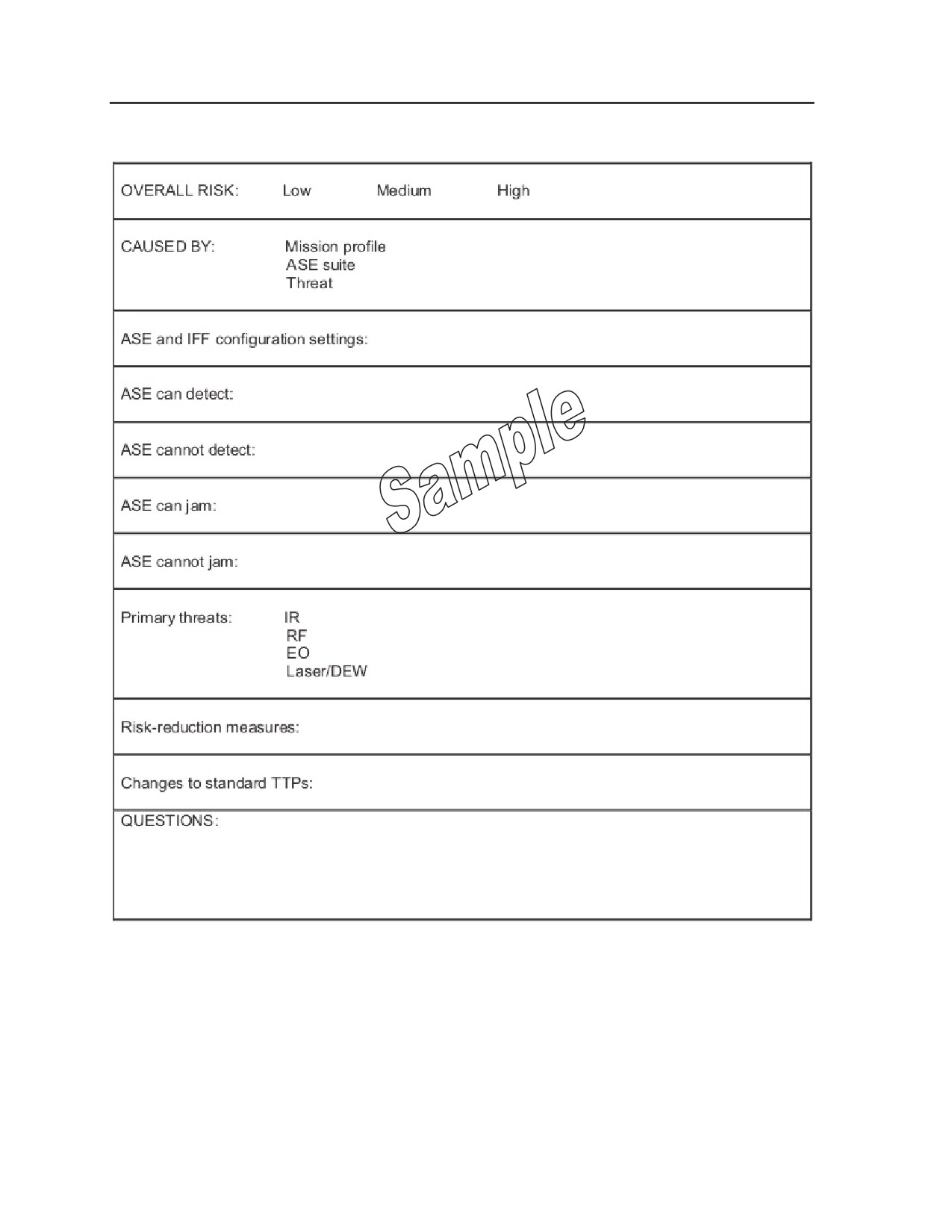
reformation procedures, and ROE for countermeasures weapons employment. Figure A-2, page A-6,
illustrates an example of ASE/EW mission brief format.
MISSION EXECUTION
A-19. During conduct of the mission, it is important for aircrews to be familiar with ASE SA displays and
expected threat indications. Some actions must be performed without delay. When visual indications of a
gun or missile are fired at an aircraft, or ASE indications of radar track or launch, the aircrew has only
seconds to perform an action preventing the aircraft from being hit. Three distinct parts of reacting to threat
engagements are:
z Indication (determines immediate action and deploys to cover).
z Perform evasive maneuver and expend countermeasures (if applicable), if masking terrain is not
readily available.
z Perform actions on contact (decision to continue or abort mission).
CREW COORDINATION
A-20. Crew coordination must be rehearsed to perform evasive maneuvers. Standardized terminology, such
as “missile 3 o’clock, break right” and “break left” should be used to avoid confusion. At other times,
indications do not require evasive maneuvering, such as radar search or acquisition.
16 February 2007
FM 3-04.126
A-5
Appendix A
Figure A-2. Example aircraft survivability equipment/electronic warfare mission brief format
MULTISHIP CONSIDERATIONS
A-21. Formations and spacing intervals should be selected to provide all aircraft maneuver space evading
hostile fire. Standardized terminology, such as “Team 2 break right, missile” or “Team 1, tracers, three
o’clock, break left”, should be used to alert the flight to your actions. Briefings should include evasive
formation breakup procedures and how to reestablish formation after breaking engagement. It is important
for one aircraft in the formation to communicate its ASE indications to the other aircraft since it may be the
A-6
FM 3-04.126
16 February 2007
Aircraft Survivability
only one receiving indications due to terrain, narrow radar beam, altitude, or maintenance problems. See
TC 1-201 for more information.
SECTION III - AIRCRAFT SURVIVABILITY EQUIPMENT/ELECTRONIC
WARFARE TRAINING
A-22. The company commander is responsible for training management and documentation of the
company’s ASE/EW program. This section discusses the ASE/EW management process and training
responsibilities within the company.
A-23. The company ASE/EW program will undergo periodic inspections (Command Inspection Program,
Forces Command Aviation Resource Management Survey, Directorate of Evaluation and Standardization,
division “fly-away” inspections, and external evaluations). When inspections of this nature are conducted,
aviation resource management survey (ARMS) evaluation guidelines are used as evaluation criteria.
TRAINING ASSETS
A-24. ASE/EW training must be conducted on an on-going basis ensuring aircrews are ready to operate on
today’s and tomorrow’s battlefield. Training should be conducted at individual, crew, and collective levels.
Company commanders are required to designate CBAT requirements in accordance with TC 1-210.
Commanders, TACOPS, ASE officers, and unit standardization personnel plan and implement training.
The following assets are available for ASE/EW training at levels indicated:
z Individual.
Academic training and study.
CBAT.
Synthetic Flight Training System, Cockpit Trainer.
ATM flights.
z Crew.
Academic training and study.
CBAT.
ASET IV (when available).
Manportable RF/IR/IV simulators.
EW ranges.
Combat training centers (CTCs).
Longbow Cockpit Trainer.
Onboard ASE trainers (when available).
z Collective.
ASET IV (when available).
Manportable RF/IR/IV simulators.
EW ranges.
CTCs.
TRAINING RESPONSIBILITIES
COMPANY COMMANDER
A-25. The commander is responsible for planning, executing, and documenting the company ASE/EW
program. Other responsibilities include—
z Integrating CBAT into unit ATP.
z Providing necessary equipment to conduct CBAT training.
z Ensuring compliance with procedures for safekeeping and storage of classified material.
16 February 2007
FM 3-04.126
A-7
Appendix A
z Ensuring compliance with security regulations.
z Incorporating IFF training and verification plan into all unit collective training events.
COMPANY TACTICAL OPERATIONS OFFICER
A-26. The company TACOPS officer is authorized per MTOE. The TACOPS officer is school trained with
an additional skill identifier. The TACOPS officer’s responsibilities include—
z Ensuring optimum ASE reprogramming is completed for AOR (settings may be changed during
routine maintenance exchanges).
z Advising the commander with ASE/threat analysis.
z Performing tactical route mission planning.
z Tracking all ASE equipment assigned to company.
z Ensuring procedures for storage and safekeeping of classified materials are followed.
z Conducting monthly inventories of all ASE/EW hardware and software. Forwarding results of
inventory to battalion TACOPS officers and S-2.
z Maintaining security clearance access roster (SCAR) and monitoring usage of CBAT .
z Ensuring a designated, secure area is available for CBAT training. These areas must meet all
security requirements.
z Reporting completion of CBAT requirements to company SP.
z Assisting with threat and countermeasures briefs; assisting in establishment of unit-level ASE
training.
z Developing and maintaining unit ASE/EW SOP.
z Ensuring unit complies with FORSCOM ARMS ASE checklist.
COMPANY STANDARDIZATION INSTRUCTOR PILOT
A-27. The company SP assists the commander in implementation of the unit ASE/EW training plan. Other
responsibilities include—
z Assisting commander by developing training programs and/or STX scenarios using flight
simulators and aircraft to train and evaluate crew ASE/EW qualification and proficiency.
z Ensuring IATFs accurately reflect individual training.
A-8
FM 3-04.126
16 February 2007
Appendix B
Army Aviation Air-Ground Integration
Operations must be integrated so air and ground forces can simultaneously work in
the operational environment to achieve a common objective. Integration maximizes
combat power through synergy of both forces. The synchronization of aviation
operations into the ground commander’s scheme of maneuver may also require
integration of other services or coalition partners. It may also require integration of
attack reconnaissance, assault, and cargo helicopters. Attack reconnaissance units
often engage targets near friendly forces and noncombatants during various types of
operations including shaping, decisive, and sustaining operations.
SECTION I - COMBAT IDENTIFICATION
B-1. Combat identification is the process of attaining an accurate characterization of detected objects in
the operational environment sufficient to support an engagement decision. The combat identification
process has three key purposes—to identify and classify targets in the battlespace; to allow for the timely
application of the appropriate weapon system(s) on targets classified as enemy; and the mitigation of
fratricide and collateral damage to noncombatants.
B-2. The combat identification process is a series of progressive and interdependent steps (or actions)—
target search, detection, location, and identification that lead to the decision process to engage or not
engage. The detect, identify, decide, engage, and assess
(DIDEA) process provides an iterative,
standardized, and systematic approach supporting the application of specific combat identification and
ROE performance steps to target engagement activities. The individual actions of the DIDEA process are
summarized in table B-1.
Table B-1. Individual actions on the detect, identify, decide, engage, and assess process
Detect - the acquisition and location of an object in the operational environment. This first step in the
Universal Target Engagement Process can entail the use of visual, sensor, radar, electronic signals
measurement, or other means for detecting and locating objects in the operational environment.
Identify - a systematic process supporting the characterization of detected objects as friend, enemy, neutral,
or unknown. This is the primary step where specified CID tasks are accomplished. It commences after an
object is detected and located and provides a systematic process whereby the attributes of a detected object
are systematically processed to support a friend, enemy, neutral or unknown determination. In some cases,
the characterization process may need to be further refined to include specific class, type, and nationality
determinations.
Decide - determination of appropriate application of military options and weapons resources on identified
objects. This is the most generic step within the process and is the primary step where specified ROE
application takes place. Specific substeps within the decide phase will vary depending on the weapon
system/platform and mission application. In some cases the decision may be made to employ military options
other than weapons systems (such as the repositioning of ISR assets for further monitoring of identified
objects). In those cases where a weapons resource application is being considered, this phase would primarily
address the following questions:
• Can I engage? (ROE application)
• If multiple targets, what to engage first? (severity of threat, commander’s intent/HPTs)
• What is the best weapons system to engage with? (lethal/nonlethal, munitions effect, collateral
damage assessment)
16 February 2007
FM 3-04.126
B-1
Appendix B
Table B-1. Individual actions on the detect, identify, decide, engage, and assess process
Engage - specific application of military options/weapons resources. In this step the mechanical process of carrying out
the decision made in the previous step takes place.
Assess - did the applied weapons resources bring about the desired effect. In this step we assess the effects of the
engagement phase against desired outcomes. If the desired outcome was not achieved, a decision to re-engage the target
could be made.
GROUND UNIT AND AVIATION TASK FORCE COORDINATION
B-3. Ground maneuver commanders must understand that aviation forces can provide a significant
advantage during operations. In addition, ground maneuver planners must understand that the unique
capabilities of Army aviation also require unique planning and coordination. Army aviation forces must be
fully integrated in the MDMP to ensure effective combined arms employment. Effective combined arms
employment also requires that aviation and ground maneuver forces synchronize their operations by
operating from a common perspective. See FM 3-06.11 for additional information.
SUPPORT FOR GROUND MANEUVER UNITS
B-4. Ground units may receive support from a variety of attack reconnaissance helicopters including the
AH-64 and OH-58D. Attack reconnaissance helicopters can provide area fire to suppress targets, and
precision fire to destroy specific targets or breach structures. Attack reconnaissance helicopters can also
assist with ISR and communications using their advanced suite of sensors and radios. Other supporting
helicopters, such as the UH-60 and CH-47, may also have weapon systems (7.62-mm or .50-cal) that aid in
the suppression of enemy forces when operating in urban terrain. However, their primary role is to
transport personnel, equipment, and supplies to those critical urban areas. Utility and cargo helicopters can
provide a distinct advantage by placing personnel and weapon systems at critical locations at critical times
to surprise and overwhelm the enemy. Utility and cargo helicopters can also transport needed supplies to
urban areas that may be inaccessible to ground transportation.
B-5. The ground maneuver brigade, through their aviation LNO and BAE, provide the aviation
headquarters the necessary information to meet planning requirements. The initial planning and
information to be passed to the aviation headquarters includes the location of the HA, the air axis, and the
route or corridor for entry and exit through the brigade and battalion sector. Other planning requirements
may include—
z Establish command relationship between supported unit and supporting aircraft.
z Give initial task and purpose to aircrews.
z Give ATF current situation estimate (intelligence and operations).
z Review any updates to the joint A2C2 structure.
z Pass call sign and frequencies for ground elements.
z Establish any control measures (recommended HAs, ROZs, NFAs, BPs, LZs, PZs, or EAs).
WEAPONS INTEGRATION
ACTIONS EN ROUTE TO THE OBJECTIVE
B-6. The ground maneuver headquarters informs its units in contact when aircraft are inbound. En route
to the HA, the AMC contacts the ground maneuver element on the FM command network for a SITREP on
enemy and friendly forces.
B-2
FM 3-04.126
16 February 2007
Army Aviation Air-Ground Integration
B-7. A battalion close fight SITREP may consist of the following:
z Enemy situation
(composition and disposition to include threat to aviation, recent enemy
contacts, and threats to ground maneuver element).
z Friendly situation (including any A2C2 deconfliction with UAS or indirect fires vicinity of the
operation).
z Recommended routing to the contact.
z Restrictions or constraints.
AVIATION TEAM CHECK-IN
B-8. It is essential to positively identify locations of friendly units and supporting aircraft. Aircrews
confirm, with each other or wingmen, their positive location. Ground elements must be extremely careful
when verifying any position information.
B-9. The aviation team usually checks-in using the command net of the unit having the element in contact
or as directed in the mission briefing. Upon initial radio contact, the aviation team leader executes a check-
in. The team's location may be expressed by grid coordinates or position with respect to a known point or
common graphics. At check-in the team leader provides the following:
z
Identification. “(Ground commander), this is the (ARC commander/AMC).”
z
Team composition, location, and ETA (include type and number of aircraft in the team).
z
Munitions available (include type and amount of ordinance).
z
Station time/special capabilities (such as NVGs, TIS, AIM-1).
z
A request for ground SITREP, which includes UAS activity.
B-10. The aviation team, if required, selects and occupies a holding or orbit area within FM
communications range until required coordination is complete. High-density altitudes may preclude
hovering by a fully loaded aircraft. The aviation team may need to establish a racetrack orbit oriented
behind the BP, ABF, or SBF position. The AMC informs the ground unit leader of the orbiting pattern or
series of positions his team will occupy.
B-11. The BP, ABF, or SBF is normally offset from the flank of the friendly ground position but close
enough to facilitate efficient target handoffs. This ensures rotor wash, back blast, ammunition casing
expenditure, and general signature of aircraft do not interfere with operations on the ground or reveal
ground unit positions. The offset position also allows aircraft to engage the enemy on its flanks, rather than
its front, and lessens risk of fratricide along the helicopter gun-target line. Friendly forces should clear any
positions over which helicopters may hover or orbit precluding engagement by hidden enemy forces.
B-12. The AMC provides the ground maneuver unit leader with his concept for the operation. This briefing
may be as simple as relaying direction of aircraft approach or attack route and time required to move to the
recommended BP. On completion of coordination with the lowest unit in contact, the flight departs the
holding or orbit area.
B-13. The main reason for using several weapons systems at once is to overwhelm the enemy with more
than it can counter. When possible, units sequence employment of CAS, indirect fires, direct fires, and
armed helicopters so closely they seem simultaneous in fire effects. This action may be conducted as a
JAAT, mission fires are lifted or shifted at the most advantageous time for ground elements to overwhelm
the objective before the enemy can offer effective opposition.
B-14. Army aviators may be key in controlling employment of multiple weapons systems because of their
vantage point in the operational environment and ability to quickly relocate. Aviation units must routinely
train with ground units so they can effectively employ other Army and joint weapons systems.
INTEGRATED OPERATIONS
B-15. True integration occurs when the commander effectively uses every available asset to its fullest
extent. The following are some available assets and capabilities:
16 February 2007
FM 3-04.126
B-3
Appendix B
z CAS elements destroy enemy formations and installations.
z Attack reconnaissance and ground units search in front of the ground force, confirm enemy
strengths and weaknesses, protect flanks, and allow the commander to orient on threats or
exploit opportunities.
z Tank, mechanized infantry, light infantry, and air assault units—accompanied by AD and
engineer elements, as appropriate—forcibly take and occupy key terrain or deny terrain to the
enemy.
z Attack reconnaissance helicopters maneuver to attack enemy forces and deny terrain for limited
periods.
z UH-60 helicopters move troops, light vehicles, light artillery, and supplies; they also can emplace
minefields and augment C2.
z CH-47 helicopters move troops, medium vehicles, medium artillery, and supplies.
z Artillery provides indirect fires to disrupt and destroy enemy formations; aviation and ground
forces also employ artillery for immediate suppression of enemy elements until they can
maneuver and eliminate the threat (J-SEAD, SEAD, on-call FS).
POSITIVE LOCATION/TARGET IDENTIFICATION
COMMAND AND CONTROL TECHNIQUES
B-16. C2 techniques effective during air-ground operations with Army aircraft are:
z Reference point technique—uses a known TRP or an easily recognizable terrain feature.
z Grid technique—uses grid coordinates to define the point.
z Sector/terrain technique—uses terrain and graphics available to both air and ground units.
z PL technique—uses graphics available to both air and ground units.
MARKING
B-17. There are various ways to mark a location or target. The effectiveness of vision systems on
helicopters compares to those found on ground vehicles. During the day, the vision systems of AH-64 and
OH-58D aircraft allow accurate identification of targets. During periods of reduced visibility, resolution is
greatly degraded, requiring additional methods of verification. This situation requires extra efforts from
both ground unit and aviation element.
B-18. Some United States weapons can kill targets beyond ranges that thermal, optical, and radar
acquisition devices can provide positive identification. Both aviation and ground forces may become
overloaded with tasks in the heat of battle. Simple positive identification procedures must be established
and known to all.
Marking Friendly Positions
B-19. A method of target identification is direction and distance from friendly forces. Friendly forces can
mark their own positions with IR strobes or tape, NVG lights, smoke, signal panels, body position, MRE
heaters, chemical lights, and mirrors. Marking friendly positions is the least desirable method of target
location information and should be used with extreme caution. Marking friendly positions can be a more
time-consuming process than directly marking a target and can reveal friendly positions to the enemy.
Marking Enemy Positions
B-20. Target marking aids aircrews in locating targets the unit in contact desires them to attack. Ground
commanders should provide the target mark whenever possible. To be effective, the mark must be timely,
accurate, and easily identifiable. Target marks may be confused with other fires on the battlefield,
suppression rounds, detonations, and marks on other targets. Although a mark is not mandatory, it assists in
aircrew accuracy, enhances SA, and reduces risk of fratricide.
B-4
FM 3-04.126
16 February 2007

Army Aviation Air-Ground Integration
Marking by Direct Fire
B-21. Direct-fire weapons can deliver a mark. Although this method may be more accurate and timely than
an indirect fire mark, its use may be limited by range and the visibility of the weapon’s burst effect.
Aircraft may be used to deliver a mark. The preferred method is for aircraft to mark with phosphorous,
high-explosive rockets, illumination, or lasers. A burst of cannon fire or a single rocket fired to the left or
right of the target as a marking round may be an option. This method may alert the enemy but is a good
way to verify the target with reduced risk of friendly casualties. Ground units may also mark targets with
direct fire using tracers, M203 smoke rounds, or other means as coordinated by the unit.
INFRARED MARKING
B-22. IR pointers, as well as other IR devices, can be used to mark targets at night for aircrews that are
using NVGs; however, aircrews using other NVDs—such as FLIR or thermal imaging system—may not be
able to see the mark. Unlike laser designators, these IR devices cannot be used to guide or improve
accuracy of aircraft ordnance. IR pointers may expose friendly units to an enemy with night-vision
capability and should be used with caution. Ground units should initiate IR marks when the aircrew request
“SPARKLE” and continue until the aircrew transmits “STOP” or the weapon hits the target.
Marking by Indirect Fire
B-23. Artillery or mortar fires are effective means of assisting aircrews in visually acquiring targets. Before
choosing to mark by artillery or mortars, observers should consider the danger of exposing these
supporting arms to enemy indirect-fire acquisition systems and additional coordination required. Marking
rounds should be delivered as close to target as possible with smoke being the last round. Marking rounds
are most effective when delivered within 100 meters of target, but those within 300 meters are generally
effective enough to direct armed aircraft. If the situation requires a precise mark, observers or spotters can
adjust marking rounds early ensuring an accurate mark is delivered. This action may, however, alert the
enemy to an imminent attack.
Backup Marks
B-24. Whenever a mark is provided, a plan for a backup mark should be considered. For example, direct
fire may be tasked to deliver the primary mark, while a mortar may be assigned responsibility for the
backup mark.
B-25. Table B-2 suggests methods for identifying friendly forces and enemy targets.
Table B-2. Methods of marking friendly and enemy positions
METHOD
DAY
NIGHT
NVG
NVS
FRIENDLY
TARGET
REMARKS
MARKS
MARKS
Smoke
Go
No Go
Marginal
No Go
Good
Good
Easy identification. May
compromise friendly
position, obscure target, or
warn of FS employment.
Placement may be difficult
because of terrain, trees, or
structures.
Smoke (IR)
Go
Go
Go
No Go
Good
Good
Easy identification. May
compromise friendly
position, obscure target, or
warn of FS employment.
Placement may be difficult
because of terrain, trees, or
structures. Night marking is
greatly enhanced by the use
16 February 2007
FM 3-04.126
B-5

Appendix B
Table B-2. Methods of marking friendly and enemy positions
METHOD
DAY
NIGHT
NVG
NVS
FRIENDLY
TARGET
REMARKS
MARKS
MARKS
of IR reflective smoke.
Illumination,
Go
Go
Go
No Go
NA
Good
Easy ID. May wash out
Ground
NVDs.
Burst
Signal
Go
No Go
No Go
No Go
Good
NA
Avoids compromise of
Mirror
friendly location. Depends
on weather and available
light. May be lost in
reflections from other
reflective surfaces such as
windshields, windows, or
water.
Spot Light
No
Go
Go
No Go
Good
Marginal
Highly visible to all.
Go
Compromises friendly
position and warns of FS
employment. Effectiveness
depends on the degree of
ambient lighting.
IR Spot
No
No Go
Go
No Go
Good
Marginal
Visible to all NVGs.
Light
Go
Effectiveness depends on
the degree of ambient
lighting.
IR Laser
No
No Go
Go
No Go
Good
Marginal
Effectiveness depends on
Pointer
Go
the degree of ambient
(below .4
lighting.
watts)
IR Laser
No
No Go
Go
No Go
Good
Good
Less effected by ambient
Pointer
Go
light and weather
(above .4
conditions. Highly effective
watts)
under all but the most
highly lit or worst weather
conditions. IZLID-2 is the
current example.
Visual Laser
No
Go
Go
No Go
Good
Marginal
Highly visible to all. High
Go
risk of compromise.
Effective, depending upon
degree of ambient light.
Laser
Go
Go
No Go
Go
NA
Good
Highly effective with
Designator
precision-guided munitions.
Restrictive laser-acquisition
cone and requires LOS to
target. May require
precoordination of laser
codes. Requires precision-
guided munition or LST
equipped.
B-6
FM 3-04.126
16 February 2007

Army Aviation Air-Ground Integration
TARGET MARKING BREVITY LIST
B-26. Table B-3 lists standard brevity terms.
Table B-3. Brevity list
Term
Meaning
Rope
Observer is circling an IR pointer around an aircraft to help the aircraft identify the friendly
ground position.
Visual
Observer is sighting a friendly aircraft or ground position. Opposite of BLIND.
Blind
Observer has no visual contact with friendly aircraft or ground position. Opposite of VISUAL.
Contact
Observer—
1. Has sensor contact at the stated position.
2. Acknowledges sighting of a specified reference point.
Snake
Aircrew calls to oscillate an IR pointer about a target.
Sparkle
Observer acknowledges—
1. Air-to-surface target marking by IR pointer.
2. Air-to-surface target marking by gunship/FAC-A using incendiary rounds.
Tally
Observer acknowledges sighting of a target, aircraft, landmark, or enemy position. Opposite
of NO JOY.
Steady
Aircrew calls to stop oscillation of IR pointer.
Stop
Aircrew calls to stop IR illumination of a target.
No Joy
Aircrew does not have visual contact with the target/bandit/landmark. Opposite of TALLY.
OTHER OPERATIONS
SPECIAL OPERATIONS
B-27. Training at home station with SOF may not be practical or available. Commanders must be aware
SOF are probably in theater, but their activities may not be published. Establishment of a communications
link with special operations units is essential when coordinating operations.
B-28. SOF are usually well trained in the use of all assets. Their expertise should make flow of
coordination with them simple, but in some instances, the aviation force leader may have to use emergency
coordination measures.
OPERATIONS WITH NONTRADITIONAL FORCES
B-29. Commanders must train their leaders and Soldiers to be flexible and prepared to conduct liaison with
and support elements not traditionally included in home station training. These organizations may include
the Central Intelligence Agency, Department of State, Drug Enforcement Agency, domestic and foreign
police agencies, and indigenous forces. General checklists may be developed to address concerns. Often,
these other agencies may not be aware of aviation capabilities. LNOs must be ready to advise and assist the
supported element.
Emergency Coordination Measures
B-30. Aviators may be required to assist ground personnel who are not fully familiar with aviation assets.
Key personnel who habitually handle coordination for aviation support may become casualties or simply
not be available. These situations require close attention, careful communications, and initiative on the part
of the aviator to place fire on targets or deliver other support as necessary. An attack pilot may have to
assist in extracting personnel.
B-31. Pilots must ask appropriate questions of the requestor with emphasis on positive identification of
location. Possibilities include the following:
z Where is ground unit’s position? What are the GPS coordinates? Are those coordinates verified
with another GPS?
16 February 2007
FM 3-04.126
B-7
Appendix B
z Can ground unit mark its position with smoke, tracers, or other methods? (If smoke is used,
aircrew verifies color after deployment.)
z What assistance does ground unit need? (FS, extraction, or resupply)
z Where is the target? What are the grid coordinates or relationship of the target to a readily
identifiable natural or manmade feature?
z How far is the target from ground unit and in what direction? If the observer is not familiar with
meters, aircrews ask the observer to try football or soccer field lengths estimating distances.
z What is the target? Is it personnel, vehicles, equipment, or buildings? What is the size of the
enemy force, and what is it doing?
B-32. Aviators may have to fly helicopters near friendly troops to deliver ordnance onto the target. Factors
reducing the potential for fratricide include the following:
z Precision-guided munitions.
z FSCMs.
z Planned or hasty coordination and control measures.
z Knowledge of ground tactical plan.
z Knowledge of exact location of friendly troops.
z Composition of friendly forces (number and type of vehicles, types of uniforms if nonstandard or
coalition/host nation forces-Army or police).
z Knowledge of exact location of aircraft.
z Positive identification of targets.
z Familiarity between supported unit and aviation unit.
MISSION TRAINING
B-33. Integration starts at home station with—
z Development of common SOPs among aviation and ground maneuver units.
z Habitual combined training, including battle drills, helping all team elements maintain awareness
of locations and needs of other elements.
z Integration of ARB into ground maneuver unit’s STX/field training exercise (leading to fully
integrated livefire training exercises).
B-34. Training, procedural standardization and familiarity of team members greatly accelerates planning
and coordination, especially in unfamiliar environments. A team built in this manner establishes battle
efficiency sooner and maintains a higher tempo of combat operations. Familiarity and compliance with
joint procedures are essential in allowing seamless integration with other services’ ground and air units.
B-35. Commanders must insist on a high degree of combined arms training with habitually supporting
units in the manner they are expected to fight. Air and ground units regularly train and execute battle drills
together making coordination and reaction in combat instinctive. Although aviation may not be available
for every exercise, ground maneuver units need to understand how to effectively integrate all aviation
systems in their operations. Commanders can further ensure the effective integration into ground maneuver
through OPDs, NCOPDs, and capabilities and limitations briefings with the ground maneuver units.
B-36. When units have not been able to create the desired habitual relationship, planning and coordination
processes will be longer and more detailed. Rehearsals are essential for success. In-country training
exercises should also be accomplished whenever possible. The probability of mistakes is increased unless
coordination, planning, rehearsals, and training are conducted. Commanders must apply risk-management
procedures throughout planning and execution.
MISSION PLANNING
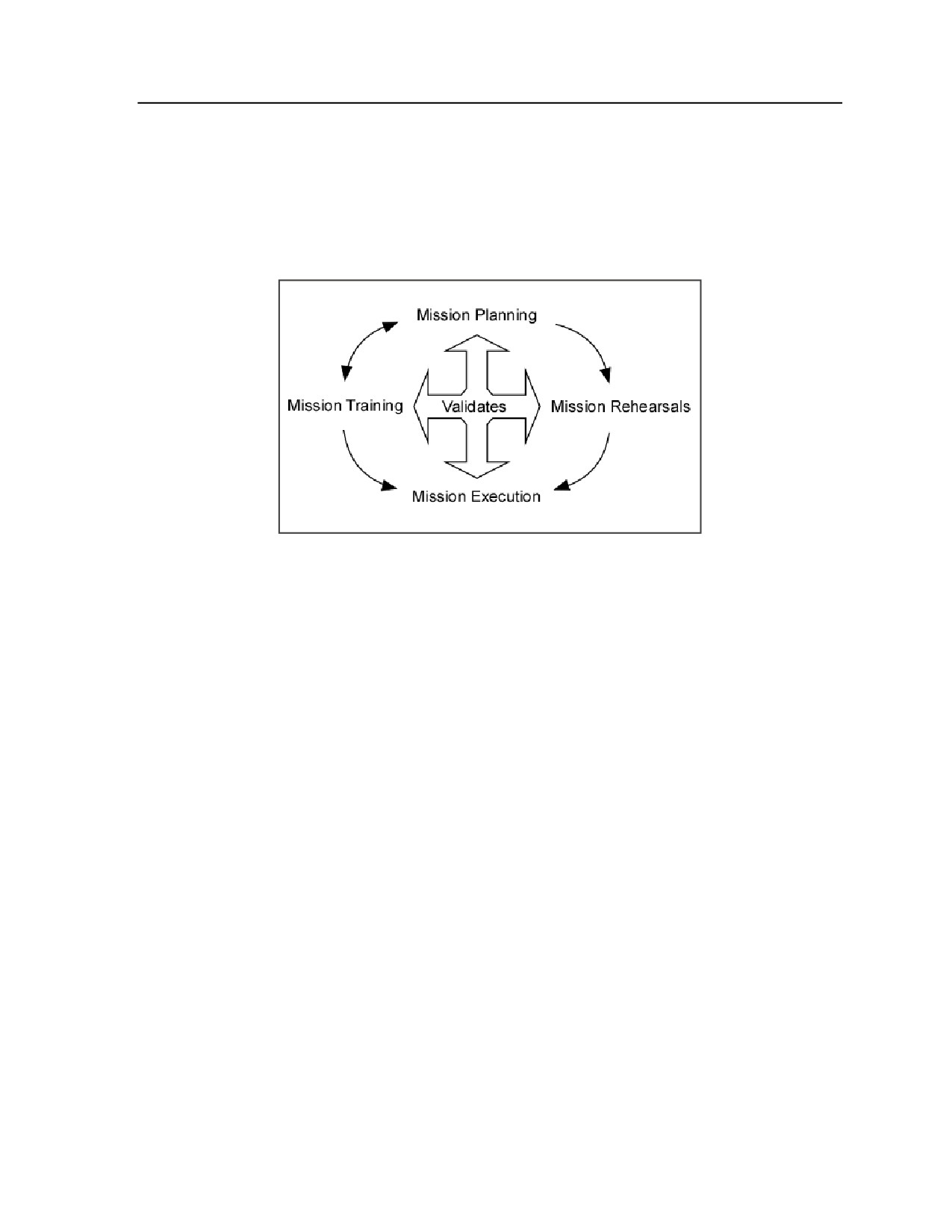
B-37. Mission planning encompasses mission training, rehearsal, and execution. During planning, a
company or troop commander analyzes the OPORD using TLP (identifying specified, essential and implied
B-8
FM 3-04.126
16 February 2007
Army Aviation Air-Ground Integration
tasks), visualizes how the operational environment will look at various stages, develops a plan, and
prepares the unit to conduct the operation. During split-based operations, platoon leaders and section
leaders must utilize these same TLP prior to conducting operations supporting the maneuver commander’s
intent.
B-38. Training exercises validate planning, training, and rehearsal, while the outcome of these exercises
tells the commander where to place emphasis for future training and where to focus sustainment training
(figure B-1).
Figure B-1. Mission planning through execution cycle
B-39. Mission recovery ensures readiness for subsequent missions. Recovery includes munitions
reconfiguration, refueling, maintenance, CP movement, and crew changes.
B-40. The minimum information required by an Army aviation team to ensure accurate and timely support
includes—
z Situation including friendly forces’ location, enemy situation highlighting known ADA threat in
the AO, mission request, and tentative EA coordinates.
z Updating brigade- and battalion-level graphics via MCS, AMPS, or radio communications.
Updating critical items—such as LOA, fire control measures, and maneuver graphics, ensures
better integration into the friendly scheme of maneuver.
z FS coordination information including location of DS artillery and organic mortars, and call
signs and frequencies.
z Ingress/egress routes into the AO, including PPs into sector or zone, and air routes to the HA or
LZ.
z Call signs and frequencies of the battalion in contact, down to the company in contact; air-
ground coordination must be done on command frequencies to provide SA for all elements
involved.
z GPS and SINCGARS time coordination; care must be taken to ensure all units are operating on
the same time. All units should use GPS time which is the most accurate. A common error is for
some ground units and aviation operations centers to set SINCGARS time by ANCD/CYZ 10
instead of GPS time. This results in ground and air communication failure due to
time/synchronization error.
B-41. Digital transmission of information, such as coordinates, is faster and more accurate, if available.
Voice communications are necessary to verify information and clarify needs and intentions.
16 February 2007
FM 3-04.126
B-9
Appendix B
LIAISON WITH THE GROUND MANEUVER FORCE
B-42. The BAE is a planning and coordination cell whose major function is incorporating aviation into the
ground commander’s scheme of maneuver. The BAE focuses on providing employment advice and initial
planning for aviation missions, UAS, airspace planning and coordination, and synchronization with the
ALO and effects coordinator. The BAE also coordinates directly with the CAB or supporting aviation TF
for detailed mission planning. The liaison demands on aviation units are reduced by implementation of the
BAE.
B-43. Although the BAE will conduct many of the functions traditionally performed by LNOs, aviation
LNO teams will remain a critical part of the process and must be staffed appropriately. While the members
of the BAE work directly for the BCT commander as permanent members of his staff, aviation LNO teams
represent the supporting aviation TF at a designated maneuver headquarters only for the duration of a
specific operation. Effective employment of LNOs is imperative for coordination and synchronization.
Often aviation LNO teams will coordinate with the BAE and then proceed to a supported ground maneuver
battalion. An example would be an aviation LNO team in support of an infantry battalion performing an
AASLT to seize a key piece of terrain as part of a mechanized BCT scheme of maneuver.
B-44. Aviation LNOs must embody competence and credibility, and act as skillful representatives for their
respective aviation TFs. A commander must exercise extreme care in choosing his LNOs since his unit is
judged by their performance. The LNO must be capable of changing focus and approach depending on
location and who he is supporting at the time. Above all, the LNO must be knowledgeable and project an
ambitious attitude to the supported unit.
B-45. LNO teams maintain and provide current—
z Aviation unit locations.
z Aircraft/equipment status.
z Crew availability and fighter management cycle status.
z Class III/V status.
z METL training status.
z Continuous updates to the aviation commander and staff on the BCT’s plan.
B-46. See TC 1-400 for more information on BAE/liaison operations.
DECONFLICTION
B-47. Deconfliction is a continual process for ground, aviation, and other supporting units.
During
planning and execution, aviation units must deconflict their operations with friendly units:
z Indirect fires, including mortars and possibly NSFS.
z CAS.
z UAS.
z ADs.
z Smoke operations.
z Other internal aviation operations.
z Nonorganic aviation operations.
z Other services’ delivery systems such as supply drops.
SECTION II - FRATRICIDE PREVENTION
GENERAL
B-48. Air and ground assets require effective integration in conducting operations successfully and
minimizing potential for fratricide and civilian casualties. Integration starts at home station with
B-10
FM 3-04.126
16 February 2007
Army Aviation Air-Ground Integration
implementation of effective tactical SOPs, habitual relationships, and training. It continues through
planning, preparation, and execution of the operation.
FUNDAMENTALS
B-49. Fratricide is the employment of friendly weapons and munitions, used with the intent to kill enemy
forces or destroy its equipment or facilities, which results in unforeseen and unintentional death or injury to
friendly, neutral, or noncombatant personnel. Fratricide is a type of accident and is a real and grim
consequence of war. Its effects, spreading deep within a unit, can be devastating.
CAUSES OF FRATRICIDE
B-50. Contributing factors to fratricide include but are not limited to—
z Incorrect target identification.
z Incomplete planning and coordination.
z Improper clearance of fires.
z Equipment failure or improper procedures.
z Inadequate graphic control measures.
z Poor land navigation.
z Loss of communications.
z Position-reporting errors.
B-51. Weapons systems can detect, engage, and destroy targets at maximum range. However, weapons-
sighting equipment cannot provide high resolution of targets at extended ranges, especially during limited-
visibility conditions. The increasing use of common equipment by allied and hostile nations elevates the
probability of fratricide.
FRATRICIDE RISK CONSIDERATIONS
B-52. There are two types of risk—losing men and equipment to accomplish the mission and choosing a
COA that may not be successful or may succeed but fail to achieve the desired effect. A commander must
take such risks with prudence.
B-53. Prudent risk taking emphasizes operational functions with the proper balance of administrative
functions; for example―
z Understanding capabilities and limitations of units and components.
z Understanding task, purpose, and scheme of maneuver for ground units.
z Understanding the enemy, identifying weaknesses, and creating opportunities to exploit enemy
weaknesses.
z Pursuing actions that gain or retain the initiative.
z Planning for a mission or unit training.
z Training with supporting branches (joint and combined arms).
z Participating, supervising, and observing unit training.
B-54. The format for fratricide risk factors in figure B-2, page B-12, and figure B-3, page B-14, parallels
the five-paragraph OPORD. The considerations/factors are essential to fratricide reduction and structured
where they would likely appear in the OPORD. This is neither a change nor an addition to the OPORD
format.
16 February 2007
FM 3-04.126
B-11
Appendix B
Figure B-2. Fratricide risk factors
B-12
FM 3-04.126
16 February 2007
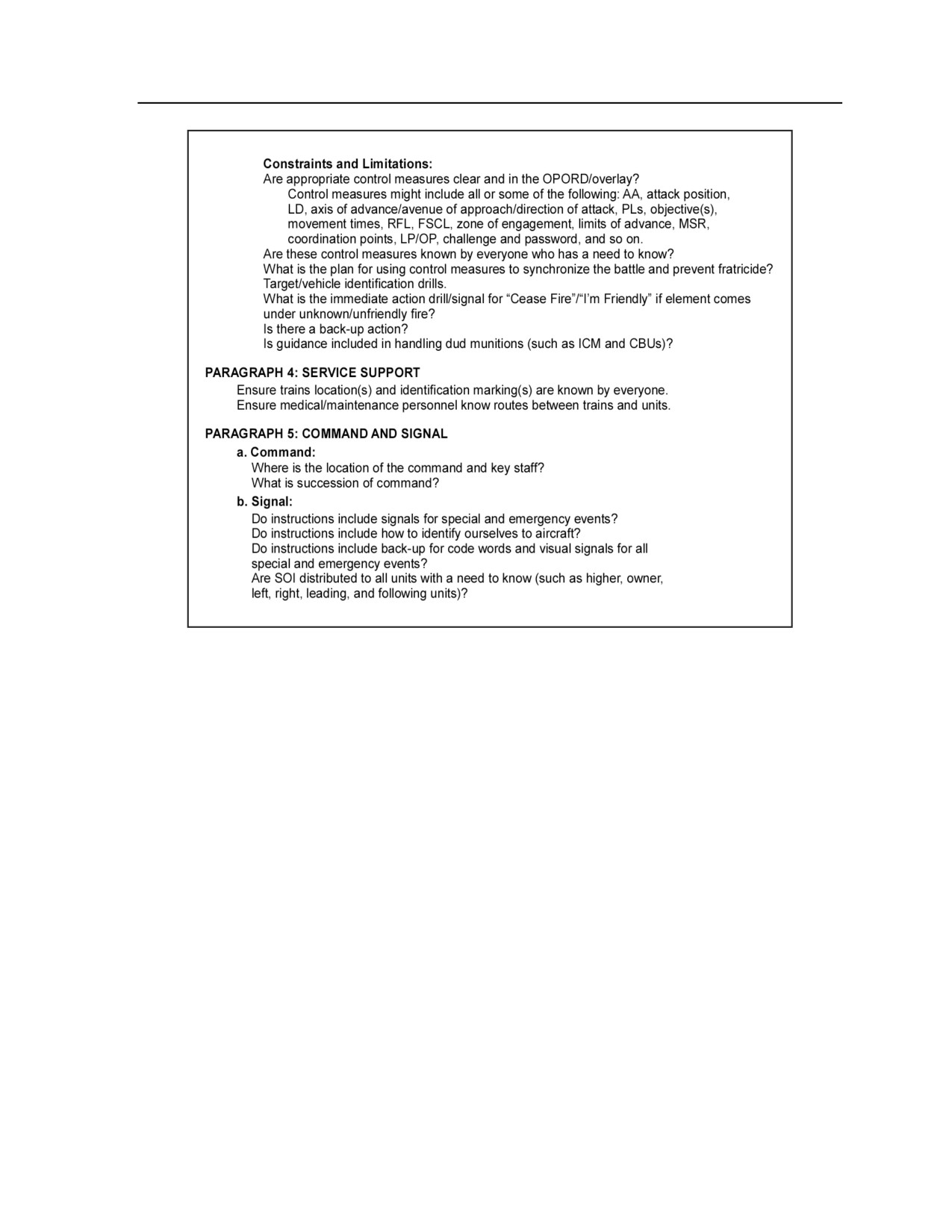
Army Aviation Air-Ground Integration
Figure B-2. Fratricide risk factors (continued)
16 February 2007
FM 3-04.126
B-13
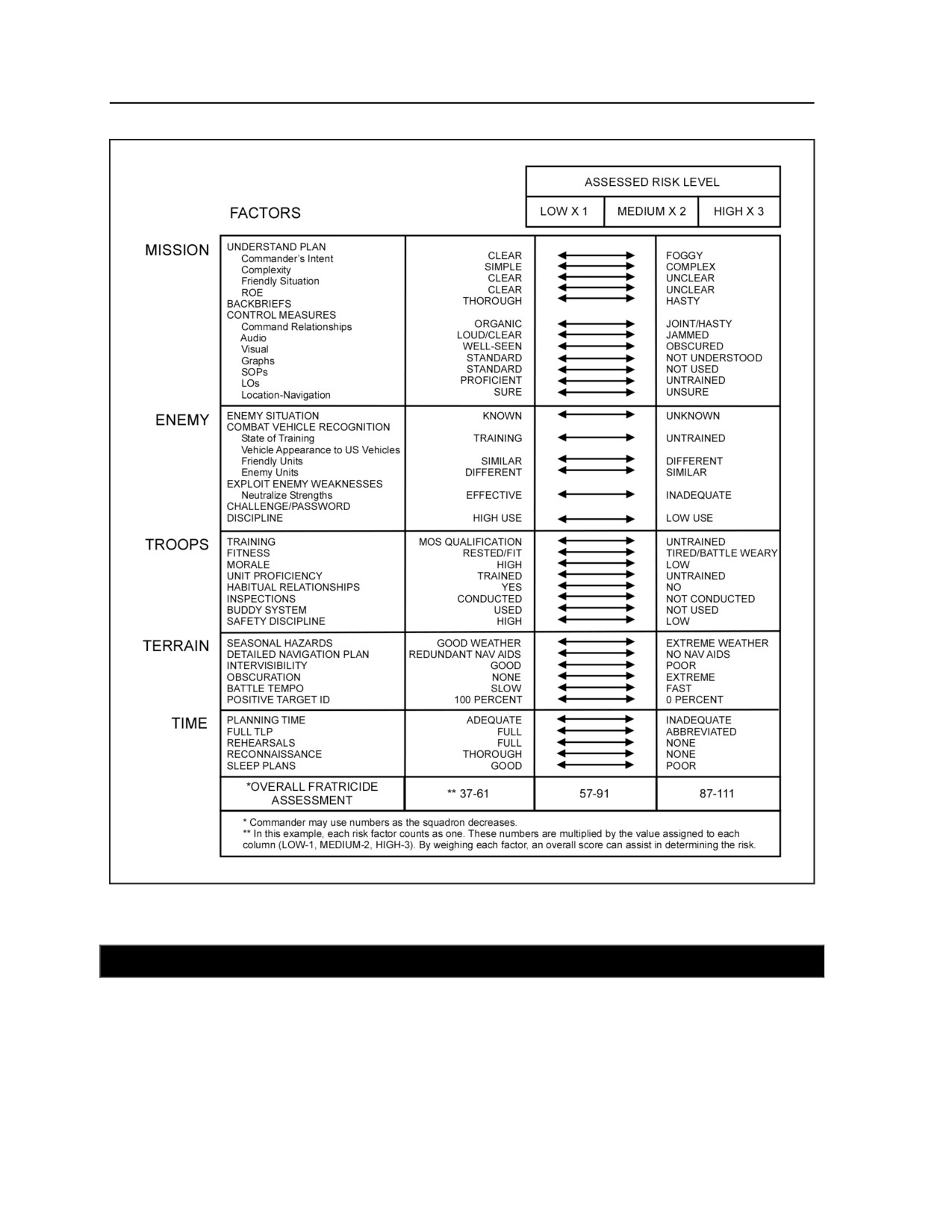
Appendix B
Figure B-3. Risk reduction and/or fratricide prevention measures
SECTION III - BRIGADE COMBAT TEAMS
ORGANIZATION
B-55. Maneuver BCTs are the Army’s basic instrument of tactical execution. Figure B-4, page B-15,
provides an overview of the three types of maneuver BCT organization (refer to FM 3-90.6).
B-14
FM 3-04.126
16 February 2007
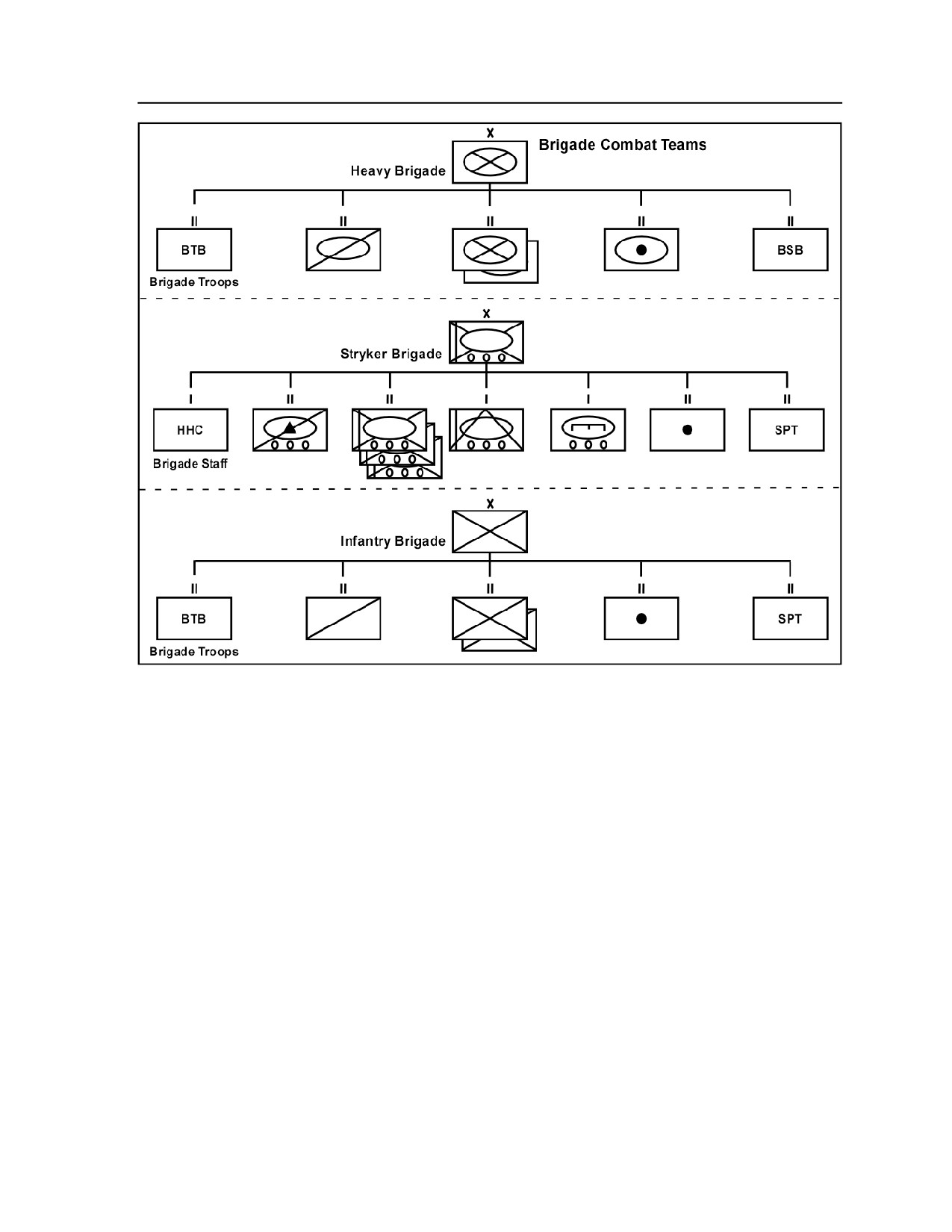
Army Aviation Air-Ground Integration
Figure B-4. Maneuver brigade combat teams
HEAVY BRIGADE COMBAT TEAM
B-56. The heavy brigade combat team (HBCT) reduces complexity of deployment planning and replaces
many variations of divisional armored and mechanized brigades. It contains combined arms components
normally required to rapidly achieve tactical overmatch in a single formation. Robust enough to fight with
or without external support for limited periods, the HBCT can fight “off the ramp” across the full spectrum
of operations when tactically loaded.
STRYKER BRIGADE COMBAT TEAM
B-57. The SBCT can be deployed rapidly and sustained by an austere support structure for up to 72 hours
of independent operations. The SBCT conducts operations against conventional or unconventional enemy
forces in all types of terrain and climate conditions and all full spectrum operations. The SBCT has
personnel strength of approximately 3,500 Soldiers and is preconfigured in ready-to-fight combined arms
packages. The design includes embedded unit-based capabilities such as military intelligence, signal,
engineer, antitank, artillery, and sustainment elements. This design allows the SBCT to fight combined
arms down to company level creating combat power with flexibility in complex and urban terrain.
INFANTRY BRIGADE COMBAT TEAM
B-58. The infantry brigade combat team (IBCT) reduces complexity of deployment planning and replaces
many variations of divisional light, assault and airborne brigades. It contains combined arms components
16 February 2007
FM 3-04.126
B-15
Appendix B
normally required to forcibly enter an AOs and hold key objectives for a short period of time. Robust
enough to fight without external support for limited periods, IBCT can fight “off the ramp” across the full
spectrum of operations when tactically loaded.
B-16
FM 3-04.126
16 February 2007
Appendix C
Joint Air Attack Team Operations
This appendix discusses the fundamentals, planning considerations, and execution of
JAAT. Included is a description of the FSE’s responsibilities and extraneous
considerations necessary for synchronization with other military services. Multiple
service collaboration and utilization of FW and rotary aircraft are emphasized; both
are necessary components to reduce risk for successful support of the JAAT mission.
SECTION I - FUNDAMENTALS
C-1. A JAAT operation is a coordinated attack by rotary and FW aircraft, normally supported by artillery
or NSFS. Ground or airborne EW systems may also support the JAAT. JAAT operations support the joint
force commander (JFC) in offensive and defensive operations day or night. JAAT references include, but
are not limited, to—
z
FM 3-09.32 (Marine Corp reference publication 3-16.6A, Naval Weapons publication 3-09.2,
and Air Force technical training publication [I] 3-2.6).
z
FM 90-21 (Marine Corp reference publication 3-23A, Naval Weapons publication 3-01.03, and
Air Force technical training publication [I] 3-2.10).
z
JP 3-09.1.
z
JP 3-09.3.
z
JP 3-60.
C-2. JAAT operations involve participation of different force components with varying operating
procedures; they are by nature inherently complex and high risk operations. Therefore, execution
procedures must be as simple as possible and lie within the capabilities and understanding of the players
involved. FM 3-09.32 assists the JAAT commander, mission commander, and support personnel identify
areas of consideration for preplanned or immediate JAAT execution. FM 3-09.32 contains procedures
proven by exercise and combat experience that can reduce overall risk to the forces involved.
COMMAND RESPONSIBILITIES
C-3. Normally, the maneuver force commander, within an assigned operational area, is responsible for
determining when a JAAT is necessary, but any commander (air, land, or maritime) may request a JAAT.
In this publication, the terms maneuver force commander and maneuver commander are representative of
any commander (air, land, or sea) with overall command responsibilities within an AO.
C-4. Designation of a mission commander occurs after coordination between the requesting commander
and supporting commanders. The mission commander is responsible for the planning, coordinating, and
executing the JAAT. The mission commander has TACON of JAAT assets to support the commander’s
battle plan.
ROTARY-WING ELEMENT
C-5. Rotary-wing aircraft provide firepower, target acquisition, designation, and mission coordination to
the JAAT. The Army provides AH-64A/D and OH-58D attack reconnaissance rotary-wing aircraft for
JAAT operations. The Marine Corps could provide rotary-wing attack aircraft, specifically AH-1W Super
Cobra or AH-1Z King Cobra. The Navy and Air Force do not have rotary-wing attack aircraft.
16 February 2007
FM 3-04.126
C-1
Appendix C
C-6. As a minimum, Army helicopters operate in teams and are organic to company units. These units
usually employ to provide continuous coverage for the JAAT but may be employed as part of a battalion-
sized flight totaling as many as 24 rotary-wing aircraft to achieve massed fires on the target. When
compared to day time operations, Army rotary-wing aircraft flying NOE are less vulnerable to enemy ADs
requiring visible acquisition or aiming at night; therefore, operations are preferably conducted at night.
FIXED-WING AIRCRAFT
C-7. FW aircraft employ CAS procedures and tactics, described in FM 3-09.32 during JAAT operations.
In addition to exercising control of the aircraft, the forward air controller (airborne) (FAC [A]) may also
provide air reconnaissance, surveillance, target marking, and communications.
AIR FORCE
C-8. Air Force CAS aircraft are capable of performing JAAT operations; however, only qualified
crewmembers are authorized to participate in JAAT. Air Force members execute JAAT according to AFI
11-214 and ACCR 55-26 following CAS procedures detailed in FM 3-09.32.
NAVY
C-9. All tactical FW Navy aircraft are capable of supporting JAAT operations. (EA-6B aircraft may be
able to support JAAT operations with their specific mission roles.) All F-14 squadrons have FAC (A)
qualified aircrews who routinely train in JAAT operations, including control and coordination of FW
aircraft, rotary-wing aircraft, and indirect FS integration and deconfliction. Each air wing typically deploys
with 12 to 16 FAC (A) qualified aircrew. Navy FAC (A) aircrew train routinely with Army and Marine
Corps attack helicopters in JAAT operations. All other Navy tactical FW aircrews have limited training in
JAAT operations and are generally exposed to a JAAT once or twice a year.
INDIRECT FIRE SUPPORT
C-10. Indirect FS (artillery, mortars, and/or NSFS) are planned to support and augment the firepower of
JAAT operations. Normally indirect FS provides SEAD and target marking. Additionally, indirect FS may
provide close fires, fires in depth, and counterfire. JAAT indirect FS requirements generally use the same
request, planning, coordination, control, and execution procedures as ground operations. The Army and
Navy provide indirect FS. NSFS can be referenced in FM 3-09.32 and NWP 3-20.32.
ARMY
C-11. The FSE of the maneuver commander requesting or ordering the JAAT plans for, coordinates, and
oversees the execution of FS. The mission commander contacts the FSE if the mission requires additional
FS or other assistance. The FSE coordinates the requested support. If a maneuver commander requests or
orders a JAAT to take place in another commander’s AO (division JAAT in brigade AO), then that
commander’s FSE must coordinate with the FSE in whose AO the JAAT is to take place.
NAVY
C-12. NSFS for Army units is coordinated through the Marine Corps air and naval gunfire liaison company
(ANGLICO). The ANGLICO division and brigade liaison teams are normally attached to the FSE of the
supported division or brigade. These teams are responsible for planning, liaison, control, coordination, and
employment of supporting arms.
C-2
FM 3-04.126
16 February 2007
Joint Air Attack Team Operations
SECTION II - PLANNING
OPERATIONAL PLANNING CONSIDERATIONS
C-13. The JAAT offers the commander unique strengths. JAAT operations provide mutual support with an
increase in each member’s survivability and a capability to mass combat power through diverse ordnance
and employment procedures. This includes reconnaissance, surveillance, and communications redundancy,
combined with an enhanced force protection capability.
C-14. The maneuver commander has the responsibility for integrating JAAT missions into the battle plan.
The requesting commander’s staff plans for, organizes, and coordinates JAAT operations to support this
plan. Successful JAAT execution depends upon careful mission analysis, coordination, and planning.
MISSION
C-15. The planning process begins during mission analysis when the requesting commander/staff
determines employing JAAT will assist in accomplishing the mission. JAAT EA development and
distribution of all fires must be included when developing the plan. Since each member of the JAAT
retains their own C2 system, mission planning must be a coordinated effort. Constant coordination is
desired between requesting commander, mission commander, FAC
(A), fixed- and rotary-wing
representative, TACP, FSE, and the air support operations center (ASOC). As elements of the mission
change, all members must be informed to adjust accordingly.
INTELLIGENCE PREPARATION OF THE BATTLEFIELD
C-16. A key ingredient to the success of the JAAT intelligence effort is the continuous collection and
appropriate dissemination of information. The mission commander requires continuous information on the
objective before, during, and after the mission. The G2/S2 is responsible for the IPB. The G2/S2 identifies
the target, target area, NAI, enemy defenses, enemy and friendly DPs, and time window when the target
will be active in the EA. Timely JAAT employment is determined by identifying key enemy events that are
target indicators of the enemy’s COA and may act as the trigger for execution of a preplanned attack. The
G2/S2 coordinates the collection effort, refines the information, and ensures the information is received by
planning staffs and supporting units. The IPB process is continuous, occurring before, during, and after the
JAAT to ensure the most up-to-date information on the enemy’s activity is available during the planning
and execution phases.
THREAT AIR DEFENSE ENVIRONMENT
C-17. The mission commander considers how various elements of the JAAT assist to neutralize or suppress
the enemy AD.
TERRAIN ANALYSIS
C-18. Planners ensure the most effective use of terrain. Terrain analysis is conducted to identify EA(s),
ground and air avenues of approach, and gaps in threat AD due to terrain. Terrain analysis also aids in
determining employment methods and selecting ingress and egress routes.
WEATHER
C-19. Weather conditions may limit capabilities of aircraft and weapons. High humidity, fog, and
precipitation reduce visibility and effectiveness of IR devices and interfere with lasers. Low ceilings also
affect the range and employment of laser guided Maverick and Hellfire missiles, since the trajectory may
put the missile in the clouds. High temperature and pressure can limit the range and weapons payload of
aircraft. High or gusting winds effect accuracy of indirect weapons employment and can limit the use of
rotary-wing aircraft. If weather forces the cancellation of one or more JAAT components, a contingency
plan derived.
16 February 2007
FM 3-04.126
C-3
Appendix C
ASSETS
C-20. The commander/staff determines what assets are required and available to accomplish the JAAT.
Assets considered include combat air patrols (CAPs), tankers, UAS, Airborne Warning and Control System
(AWACS), airborne battlefield command and control center
(ABCCC), FW aircraft,
reconnaissance/collectors, rotary-wing assets, and EW assets.
TIME AVAILABLE
C-21. The more complex the JAAT mission the more planning time required. A planning horizon of 36
hours usually allows time for a complete joint ATO cycle. Anything less can be planned but may not be in
the joint ATO. ATO requirements are discussed in JP 3-30. Units include requests for fighter and
reconnaissance aircraft early in the planning process. A staff with prior JAAT training and working SOPs
can significantly reduce the amount of planning needed to conduct a successful operation allowing an
immediate or spontaneous JAAT be accomplished with minimum coordination. A time, location, and
common frequency for all participants may suffice in an immediate or spontaneous JAAT situation.
SYNCHRONIZATION
C-22. A JAAT operation is synchronized at two levels. At the first level, the JAAT operation must be
synchronized with the overall operation. The second level involves synchronization of various elements
during execution of the JAAT operation. The requesting commander is responsible for ensuring
synchronization at the first level and the mission commander is responsible for ensuring synchronization at
the second level. Achieving both levels of synchronization requires an understanding of individual
elements of the JAAT.
OPERATIONAL ENVIRONMENT CONSIDERATIONS
C-23. When planning a JAAT operation, the proximity of friendly forces must be considered. The
requesting commander defines close proximity to friendly forces, and special emphasis is placed on
preventing fratricide. JAAT operations beyond the fire support coordination line
(FSCL) must be
coordinated with the joint air operations center (JAOC) through the battlefield coordination detachment
(BCD).
C-24. The EA is an area the commander intends to fix and attack the enemy force with massed fires of all
available weapons. EAs are terrain oriented control measures that focus the JAAT fires. Fire distribution
planning ensures effective fires throughout the EA. To develop an EA, the IPB process determines where
the enemy is currently located, where they will go, where best to engage them, and when they will be there.
The commander selects the EA based on the IPB. The EA then becomes the focus for JAAT planning.
JAAT assets are coordinated and integrated to destroy enemy in the EA through massed firepower.
C-25. Once the EA is developed, the mission commander develops the fire distribution plan to avoid
redundancy, minimize risk of fratricide, and maximize the effects of long-range weapon systems. Planners
must establish C2 procedures for conducting the attack. A well-written and understandable SOP reduces
C2 coordination requirements. Every effort is made to involve each community in the planning as early as
possible. Face-to-face meetings assist in establishing the team part of JAAT.
C-26. Communications among JAAT participants is key to mission effectiveness. Designing a JAAT
communications plan and disseminating it early to participants ensures timely radio contact. Once
developed, the communications plan is coordinated with the mission commander. Considerations include
using CAS coordinator (airborne)/FAC (A) as a radio relay; availability of Have Quick and secure radios;
and providing all components with the appropriate frequency and authentication. Additionally, friendly
force AD units operating along ingress/egress routes and in the AO must be informed of JAAT missions
occurring in the area.
C-4
FM 3-04.126
16 February 2007
Joint Air Attack Team Operations
FIRE SUPPORT
C-27. The maneuver commander, TACP, effects coordinator (ECOORD) (brigade and above)/fire support
officer (battalion and below), G3/S3, G2/S2, A2C2 element, Army aviation LNO, and mission commander
work together ensuring adequate FS for the JAAT.
INDIRECT
C-28. Indirect FS can greatly increase survivability of JAAT aircraft while promoting destruction of the
enemy. Furthermore, it can be used to begin the attack, suppress or destroy enemy AD, force armored
vehicles to deploy, and create confusion for the enemy.
CLOSE
C-29. FS can attack targets in the EA to assist the JAAT. Planners should consider the effects of close fires
as it may obscure the target area, decreasing pilot’s ability to acquire targets. Using precision-guided
artillery munitions to engage HPTs can minimize obscurants. However, precision-guided munitions require
detailed planning and coordination with observers, artillery firing units, and the mission commander.
COUNTERFIRES
C-30. Rotary-wing attack reconnaissance aircraft are vulnerable to enemy FS during the JAAT operation.
Friendly indirect FS assets are allocated to counter the enemy FS capability. Counterfire radars are
coordinated early to facilitate cueing and assist aviators in identification and selection of rotary-wing BPs.
TARGET MARKING/DESIGNATION
C-31. Target acquisition and identification are critical to effective JAAT operations. Three main techniques
of marking a target are a marking round from any of the JAAT elements; laser designation; and IR pointer
for night operations.
C-32. All FS ground laser designators are used to designate targets for laser guided munitions (Hellfire
missiles, laser guided bombs) and/or laser spot tracking devices. Several FS assets, such as Army fire
support teams and combat observation and lasing teams, Marine forward observer teams/shore fire control
parties, and FAC, could also be made available. Laser-equipped fixed- and rotary-wing aircraft also
provide laser designation and calls for fires during day or night.
C-33. When using multiple lasers in the same area, laser pulse repetition frequency codes must be
coordinated. During planning, the laser geometry must be coordinated to allow best acquisition by laser-
guided weapons and aircraft laser spot trackers (LSTs). In addition, laser geometry should exclude the
designator from the field of view for laser-guided weapons and LST. A laser employment plan is part of
any mission including target designation, particularly multiple lasers.
C-34. For operations involving night vision devices, IR pointers may be used to mark/designated targets.
See JP 3-09.3 for a more detailed discussion of night friendly position and target marking devices.
SOURCES OF JOINT AIR ATTACK TEAM FIRE SUPPORT
C-35. Sources of artillery support vary from brigade to division to corps level. At brigade, indirect fires
may be available from the DS or reinforcing FA battalion or NSFS. Mortars and electronic attack support
may also be coordinated through the BCT S3 and FSE. At division and corps, indirect fires are provided by
FA battalions assigned a GS or GS-reinforcing mission. The division or corps G3 and FSE coordinates for
NSFS when available. Mortar indirect FS is normally not available for tasking at division and corps.
C-36. During rotary-wing movement to contact, the FW element of the JAAT may be capable of providing
additional threat information and SEAD for the attack helicopter component. Due to their higher operating
altitudes and sensors, FW aircraft can often detect AD threats quicker than the attack helicopter force.
Actual engagement of these threats is coordinated by the mission commander, as helicopters offer
16 February 2007
FM 3-04.126
C-5

Appendix C
significant advantages in attacking some SEAD targets while FW aircraft can successfully engage others.
If specific AD systems are in the area, it may be possible to preplan mutually supporting SEAD actions.
Other forms of dedicated SEAD should be considered first, however, since time and fuel may be a limiting
factor for the JAAT participants. Electronic countermeasures pods carried by some FW strike aircraft are
capable of limited jamming in support of other aircraft. When possible, JAAT operations are conducted
concurrently with theater level J-SEAD operations, thereby benefiting from airborne jamming and defense
suppression platforms operating in the same area.
C-37. J-SEAD operations can enhance survivability for JAAT elements operating in the EA as well as
during the ingress/egress phases. The priority of initial observed indirect fires is to suppress enemy AD
systems. Priority of initial rotary-wing fires is to suppress remaining enemy AD systems to protect
themselves and FW aircraft. J-SEAD assets are employed according to mission objectives and system
capabilities. Suppression is accomplished through lethal or nonlethal means or a combination of both.
Destructive means are cumulative and employ direct and indirect fire weapons. Disruptive means
temporarily neutralize enemy ADs. Ground, air, and naval standoff jamming should be part of the overall
battle plan. For a more detailed discussion of J-SEAD operations refer to JP 3-01.4.
C-38. AD threat suppression is provided while friendly aircraft ingress, attack, or egress the EA. During
the JAAT, enemy ADA can be neutralized. Helicopters accompanying lead enemy attack elements
constitute a threat to the JAAT. The ability to rapidly suppress these threats is critical. While rotary- and
FW aircraft react quickly, consideration is given to indirect FS assets that can execute rapidly by using
preplanned targets. The asset allocation decision should be made early and take into account such factors
as reaction time, weapons effects/duration, and economy. Most ADA can be neutralized or suppressed by
observed fire using dual purpose improved conventional munitions or high explosive projectiles with
variable time fuses.
PLANNING GUIDELINE
C-39. Effective preplanned JAAT operations depend on the IPB, resources available to conduct the JAAT,
and time needed for staff to plan the operation. Table C-1 provides a good starting point for JAAT
planning.
Table C-1. Joint air attack planning guideline
Commander’s guidance
EA
Friendly situation
Success criteria
Enemy situation
Tactics and attack options
Success criteria
Firepower timing
Intelligence/weather
FSCM
Collection plan/products request
Aircraft positioning and EA flow
Plan for updates before launch and en route
Ordnance trajectory
Enemy vulnerabilities, possible COAs
Fragmentation/illumination effects
Enemy air threat/type/location (including air and surface
Control points and ABF/BPs
means)
Type of targets and size
Ingress/egress routes
Target priorities
Friendly FS locations and capabilities
Target activity
Provisions for SEAD/J-SEAD
Assets/weapons-to-target/environment match
Friendly AD artillery weapons
coordination
Weather
Locations of other friendly units
C-6
FM 3-04.126
16 February 2007