FM 3-04.126 Attack Reconnaissance Helicopter Operations (February 2007) - page 4
Employment
z Coordinating for indirect fires (to include joint).
z Developing direct fire plan and fire distribution technique to be utilized.
z Determining FARP rotation.
z Conducting BHO to ground elements if necessary.
z Reporting all combat information to higher.
DELIBERATE ATTACK
3-256. A deliberate attack is planned and carefully coordinated with all involved elements to provide
synchronization of combat power at the decisive point. The deliberate attack requires thorough
reconnaissance, evaluation of all available intelligence and relative combat strength, analysis of various
COAs, and other factors affecting the situation. To conduct a successful deliberate attack, the ARC must
effectively integrate with the overall ground scheme of maneuver, or the joint, operational, or tactical plan
to shape the enemy prior to ground force contact.
3-257. The ARC is generally employed as a highly mobile and lethal combat multiplier that provides the
TF and BCT commander aerial firepower, agility, and shock effect. ARCs conduct shaping with joint fires
and air attacks to disrupt enemy elements forward or to the flanks of friendly ground elements.
Critical Tasks
3-258. Critical tasks the ARC accomplishes during a deliberate attack include-
z Conducting TLP and mission planning.
z Performing aerial passage of lines or cross LD.
z Performing reconnaissance of ABFs and SBFs.
z Gaining and maintaining enemy contact.
z Performing actions on contact.
z Fixing the enemy.
z Establishing weapons delivery technique.
z Designating security responsibilities.
z Integrating joint fires.
z Disrupting/neutralizing/destroying the enemy.
z Developing direct fire plan and fire distribution technique to be utilized.
z Conducting BHO.
z Reporting all combat information to higher.
ATTACK MISSIONS
3-259. While an IA is used against specific targets out of contact with friendly forces, CCAs quickly
focuses aerial firepower onto enemy forces in the close fight to support friendly ground maneuver.
CLOSE COMBAT ATTACK
3-260. CCA is defined as a coordinated attack by Army aircraft against targets that are in close proximity
to friendly forces. During CCA, the ARC/SWT engages enemy units with direct fires that impact near
friendly forces. Targets may range from tens of meters to a few thousand meters from friendly forces. CCA
is coordinated and directed by a team, platoon, or company-level ground unit using the standard CCA brief
(table 3-5). Once the aircrews receive the mission from the ground commander, they develop a plan then
engage the enemy force, while maintaining freedom to maneuver. Due to capabilities of the aircraft and the
enhanced SA of the aircrews, terminal control from ground units or controllers is not necessary. CCA is
not synonymous with CAS.
16 February 2007
FM 3-04.126
3-59

Chapter 3
Table 3-5. Close combat attack checklist for ground commander
CLOSE COMBAT ATTACK BRIEF (Ground to Air)
1. Observer/Warning Order:
“_______________________. THIS IS ______________________. FIRE MISSION. OVER.”
(Aircraft)
(Observer C/S)
2. Friendly Location/Mark:
“MY POSITION ___________________________. MARKED BY______________________________.”
(TRP, Grid, etc.)
(Strobe, Beacon, IR Strobe, etc.)
3. Target Location:
“_________________________________________________________________________________.”
(Bearing [magnetic] & Range
[meters], TRP, Grid, etc.)
4. Target Description/Mark:
“________________. MARKED BY ____________________. OVER.”
(Target Description)
(IR pointer, Tracer, etc.)
5. Remarks:
“__________________________________________________________________.”
(Threats, Danger Close Clearance, Restrictions, At My Command, etc.)
AS REQUIRED:
1. Clearance: Transmission of the CCA brief is clearance to fire (unless Danger Close). Danger close
ranges are in accordance with FM 3-09.32. For closer fire, the observer/commander must accept
responsibility for increased risk. State “CLEARED DANGER CLOSE” on line 5. This clearance may be
preplanned.
2. At my command: For positive control of the gunship, state “AT MY COMMAND” on line 5. The gunship
will call “READY FOR FIRE” when ready.
3-261. Effective planning, coordination, and training between ground units and armed aircraft maximize
the capabilities of the combined arms team, while minimizing the risk of fratricide. The key to success for
enhancing air-ground coordination and the subsequent execution of the tasks involved begins with
standardizing techniques and procedures. This procedure is best suited for units maintaining a habitual
combined arms relationship during training and war. However, ARCs can provide CCA to any unit
regardless of training level.
Characteristics
3-262. Characteristics of a CCA include―
z Conducting fire and maneuver in close support of ground forces.
z Providing complementary fires and maneuver while taking advantage of terrain, standoff, and
ground forces for protection.
z Providing reinforcing fires.
z Continuing development of dynamic situation.
z Extending the tactical reach of maneuver forces, particularly in urban and other complex terrain.
z Presenting the enemy with multiple/simultaneous dilemmas from which it cannot escape.
z Establishing and control the operating tempo (OPTEMPO) of the fight.
z Providing extended acquisition range and lethality to the force after contact is made.
z Aviation OPCON to ground forces as situation dictates.
3-60
FM 3-04.126
16 February 2007
Employment
Critical Tasks
3-263. Critical tasks accomplished during conduct of a CCA include—
z Conducting check-in brief to gain friendly and enemy SA.
z Positively identifying friendly and enemy positions and develop hasty fire control measures.
z Synchronizing attack with ground commander to ensure mutually supporting fires and maneuver.
z Maintaining standoff outside effective range of predominant enemy weapon system.
z Using terrain to vary headings of attack runs to remain unpredictable.
z Providing ground commander with BDA and effects assessment with follow-on recommendation
for reattack of end of mission.
3-264. Three key elements form the foundation for conducting CCA with ground maneuver forces—CCA
FRAGO, check-in brief, and the CCA brief.
Close Combat Attack Fragmentary Order
3-265. The CCA FRAGO is critical if the planning process is hasty. It is issued to the ARC commander
or AMC when the team is inbound by the ground force in contact. It contains all the information needed to
complete the mission and paints a clear picture of the current friendly and enemy situation, assigns a clear
task and purpose, and communicates the identification (friend or foe) signals utilized. The FRAGO is
issued as a no change or contains any changes occurring since the final conditions check. The CCA
FRAGO includes—
z Situation.
Enemy.
Friendly.
z Mission.
Task.
Purpose.
z Coordinating instructions.
Friendly location.
Friendly marking.
Enemy location.
Enemy marking (how friendly units will mark the enemy).
C2 net for confirmation/commands.
Clearance of fires approval authority on the ground (call sign, location, and frequency).
Check-in brief
3-266. The check-in brief gives the ground commander information on the air reconnaissance team’s
restrictions or limitations. It is used each time a new team arrives on station. It is especially useful when a
new team arrives with a different task organization, ammunition configuration, station time, or optical
capability than was previously briefed. The check-in brief includes―
z Identification. “(Ground commander), this is the (ARC commander/AMC).”
z Team composition, location, and ETA (include type and number of aircraft in the team).
z Munitions available (include type and amount of ordinance).
z Station time/special capabilities (such as NVGs, TIS, AIM-1).
z A request for ground SITREP, which includes UAS activity.
Close combat attack brief
3-267. The CCA brief is used to initiate the CCA. It involves communication between the ground
commander and team conducting the attack. The CCA brief is crucial in the prevention of fratricide and
destruction of the enemy. The CCA brief allows the ground maneuver forces to communicate and
16 February 2007
FM 3-04.126
3-61
Chapter 3
reconfirm to the attack reconnaissance teams the exact location of friendly and enemy forces. Marking
techniques vary from one ground unit to another. Common means of marking friendly units include VS-17
panels, meal, ready to eat (MRE) heaters, IR strobes, IR chemical lights (chemlights™), and glint tape; all
work well depending on terrain, foliage, and relative location of the SWT teams to the ground forces. See
appendix B for target and friendly marking methods.
3-268. The CCA brief is initiated by the ground commander in accordance with table 3-5, page 3-60.
3-269. The attack reconnaissance team provides the ground commander with the following response
(table 3-6):
Table 3-6. Attack reconnaissance team response
Ground commander, this is aircraft, CCA, out.
Observer identification
Your position is PM 1342 5786, marked by strobe, out.
Friendly location and position mark
Target is _____ degrees, _____ meters,
Target location, target mark, remarks
One mortar team in the open, marked by IR pointer,
At your command, out.
3-270. After completion of CCA, aircrew provides BDA and reattack/end of mission recommendation to
ground commander.
3-271. The AMC/ARC commander and ground unit key leaders must consider the risk to friendly forces
before weapon selection and engagement. If friendly forces are in the lethality zone, the ground leader
must be precise in describing the target that aircraft are to engage and should warn aircrews of the
proximity of those forces. The AMC/ARC commander must be aware of his aircrews’ skills in delivering
fires near friendly forces and visualize exactly where those friendly units are located.
3-272. Engagements at ranges of danger close or less require extremely close coordination and positive
identification. Special precautions must be taken when delivering direct fires on targets within these
ranges, but it does not prohibit delivery of munitions at ranges short of danger close. Accurate delivery of
munitions is essential when engaging at danger close ranges and requires higher crew training standards.
FM 3-09.32 designates danger close range for Army aircraft systems as―
z Hellfire, 105 meters.
z Rockets, 240 meters.
z
30-mm, 40 meters.
3-273. Once coordination between the ground unit and the SWT is complete, the team lead develops the
attack plan for aircraft within the team. Planning considerations include—
z Weapons delivery technique.
Running.
Diving.
Hovering.
z Attack pattern/direction of attack.
Racetrack (turns/breaks).
Cloverleaf (turns/breaks).
L-attack (turns/breaks).
z Munitions.
Type of target.
Minimize collateral damage.
z Attack ranges.
Bump point.
Start fire point.
Break/stop fire point.
3-62
FM 3-04.126
16 February 2007
Employment
z Team support.
Cover only.
Same munitions.
Other instructions.
3-274. During engagement, open communication and continuous coordination with friendly ground
elements are required to ensure the desired effect. Coordination of direct and indirect fires from all
participants produces the most efficient results in the least amount of time with the least risk to all
involved. This coordination includes CAS and any other joint fires that may be employed.
3-275. Since many CCAs are conducted as hasty operations, planning may be very limited to provide in-
time support to the ground element. During a hasty CCA, after location of friendly elements and the threat
has been established, the initial team call may be as simple as, “inbound 360, 80 knots, rockets, right
break.” Following the initial engagement, continuous communications between team members includes
calling bumps, breaks, and reattack directions. Team training and battle drills are critical to the effective
conduct of the hasty CCA by SWT elements.
3-276. Although the Army does not consider its helicopters a CAS system, they can conduct attacks
employing CAS Joint TTP when operating in support of other forces. SWTs should be familiar with CAS
procedures as the supported ground unit may not be familiar with the CCA brief. JP 3-09.3 provides further
guidance for CAS Joint TTP.
INTERDICTION ATTACK
3-277. An IA is an attack by Army aircraft to divert, disrupt, delay, degrade, or destroy enemy combat
power before it can be used effectively against friendly forces. It can take place at any point in the
operational environment and can be hasty or deliberate. IA is conducted at such a distance from friendly
forces that detailed integration with ground forces is not needed. IA combines ground based fires, attack
aviation, unmanned systems, and joint assets to mass effects, isolate and destroy key enemy forces and
capabilities. Deliberate IAs are focused on key objectives and fleeting high value targets such as enemy C2
elements, AD systems, mobile, long-range surface missiles, surface-to-surface missiles (SSMs), artillery,
and reinforcing ground forces. Hasty IAs are the result of sudden enemy contact or as a result of enemy
attack. The purpose of a IA is to deny the enemy freedom of action, support friendly maneuver, and
destroy key enemy forces and capabilities.
Critical Tasks
3-278. IA tasks may include—
z Performing hasty/deliberate attack planning.
z Establishing triggers for commitment of forces.
z Establishing bypass, engagement, and success criteria.
z Conducting EA development and direct fire planning.
z Isolating and destroying key enemy forces and capabilities.
z Synchronizing complimentary FS and CAS to enable maneuver to and from the target.
z Focusing on key objectives and fleeting high value targets.
z Assessing BDA.
JOINT AIR ATTACK TEAM
3-279. A JAAT is an engagement technique using a combination of attack reconnaissance aircraft and
FW CAS aircraft operating together to locate and attack high priority targets and other targets of
opportunity. The JAAT normally operates as a coordinated effort supported by FS, ADA, NSFS, ISR
systems, EW systems, and ground maneuver forces against enemy forces (JP 3-09.3). The overall goal of
JAAT planning is to apply constant, overwhelming firepower from multiple sources against the enemy.
This goal must be tempered with the need to maintain proper coordination to avoid fratricide.
16 February 2007
FM 3-04.126
3-63
Chapter 3
3-280. Attack reconnaissance helicopters normally perform as AMC during JAAT operations because
they have the highest level of SA. To execute JAAT operations effectively, it is important to fully
understand CAS and FA procedures as well as the capabilities and limitations of joint and combined assets.
Appendix C provides detailed procedures for JAAT planning and execution.
ATTACK EMPLOYMENT METHODS
3-281. Timing is critical to the successful employment of the battalion. Employed too early, the battalion
may have to disengage before mission completion because of low fuel. Employed too late, it may miss all
or part of the targeted enemy unit, consequently failing to destroy the enemy force at the designated time
and/or place.
3-282. The battalion commander employs the battalion after detailed coordination with the companies,
combat support elements, and sustainment elements. The three methods of employment are continuous
attack, phased attack, or maximum destruction.
CONTINUOUS ATTACK METHOD
3-283. To exert constant pressure on the enemy force, the battalion commander employs companies using
the continuous attack method. This method ensures at least one ARC will be in the battle at all times.
While one company is engaged in the battle, the other two companies prepare to relieve the engaged
company by positioning at the HA or FARP, or maneuvering to the BP or ABF. The continuous attack
method provides the commander with the most flexibility as well as the most efficient operation of the
FARP.
PHASED ATTACK
3-284. To exert increased initial firepower of the battalion on the enemy force, the battalion commander
employs one ARC to begin attacking the enemy and then quickly phases in the second ARC from a
different BP or ABF. The third ARC is phased into the fight when either of the other companies is low on
fuel or ammunition. The commander may choose to modify this method of employment, for example, one
ARC may be employed to set the conditions for the other companies to exploit the attack. During the
phased attack, it is important to minimize aircraft turnaround time at the FARP. Generally, due to the
FARP limitations, the phased attack will eventually revert to the continuous attack method.
MAXIMUM DESTRUCTION
3-285. To exert maximum combat power on the enemy force, the battalion commander will employ the
maximum destruction method. To overwhelm the enemy force with massed fires, the battalion will attack
with all three companies simultaneously. While employing this method, it is important for the supported
commander to understand the entire battalion may be out of the fight for 20 to 90 minutes at the completion
of the initial attack. The time away from the fight will be dependent on the distance to the FARP and time
required for refueling and rearming after the initial engagement.
SCOUT WEAPONS TEAM ATTACK PATTERNS
3-286. Attacks are characterized by movement and fires. At the SWT level, aircraft are normally
employed using maneuvering flight techniques.
3-287. Maneuvering flight is used when the enemy situation, weapons delivery, or environmental
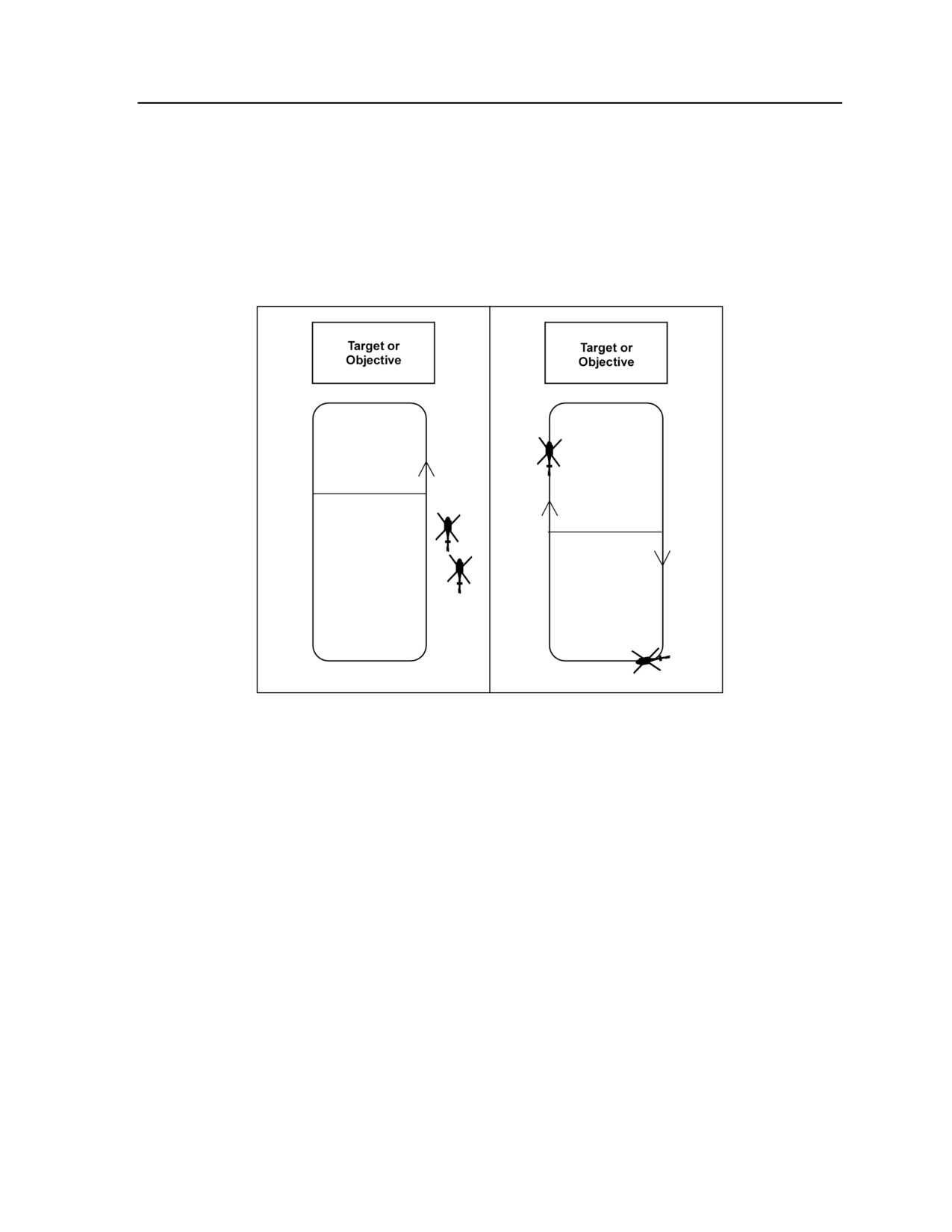
conditions require a dynamic profile. It is used to maintain aircraft within proximity of the target, improve
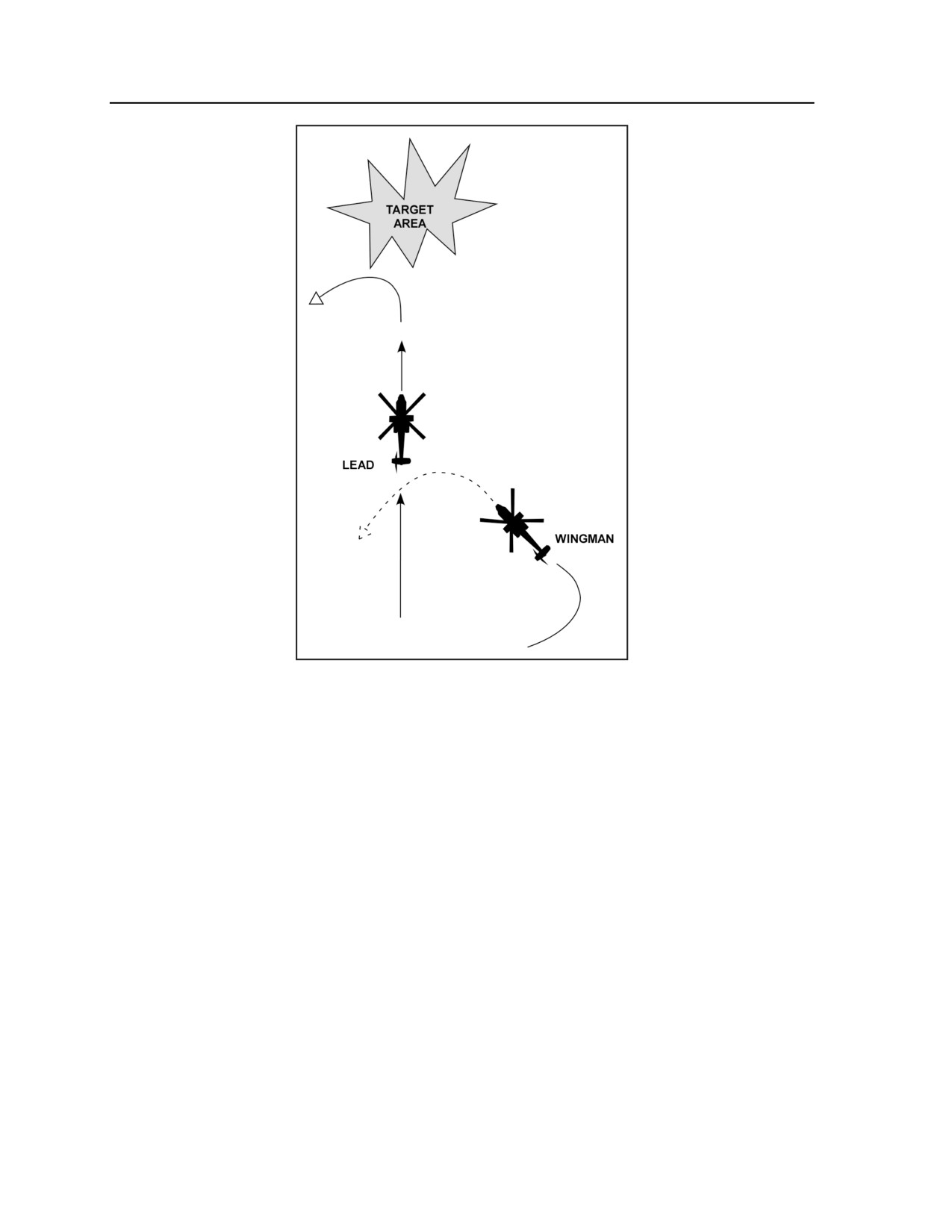
weapons accuracy, and minimize risk associated with static fire. Close combat maneuver (CCM) is
executed based on METT-TC. Maneuvering flight communications require clear concise instructions using
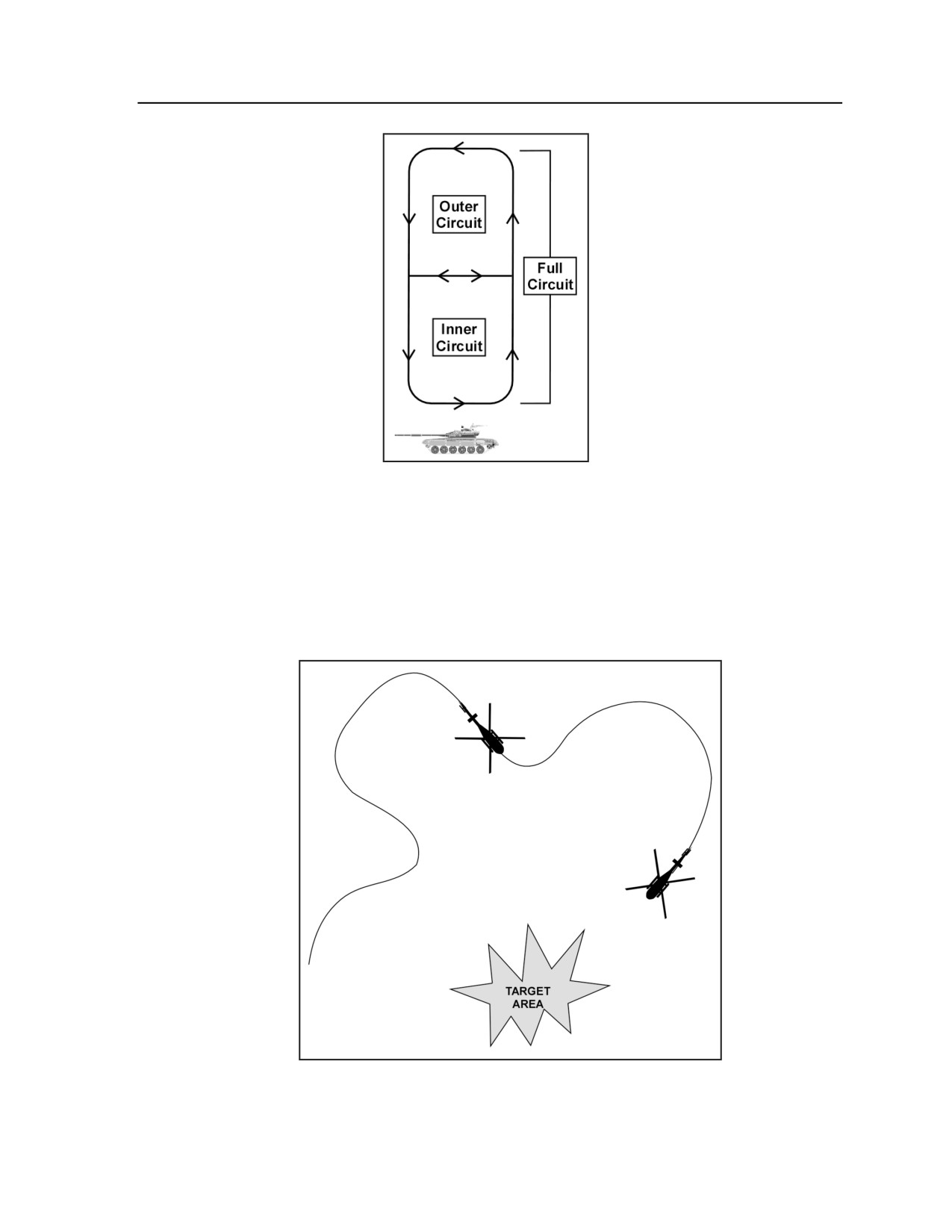
standardized terms as the most efficient method of communicating intent to the flight, such as “team one,
mortar team, 11 o’clock, cloverleaf attack, left turns”.
3-64
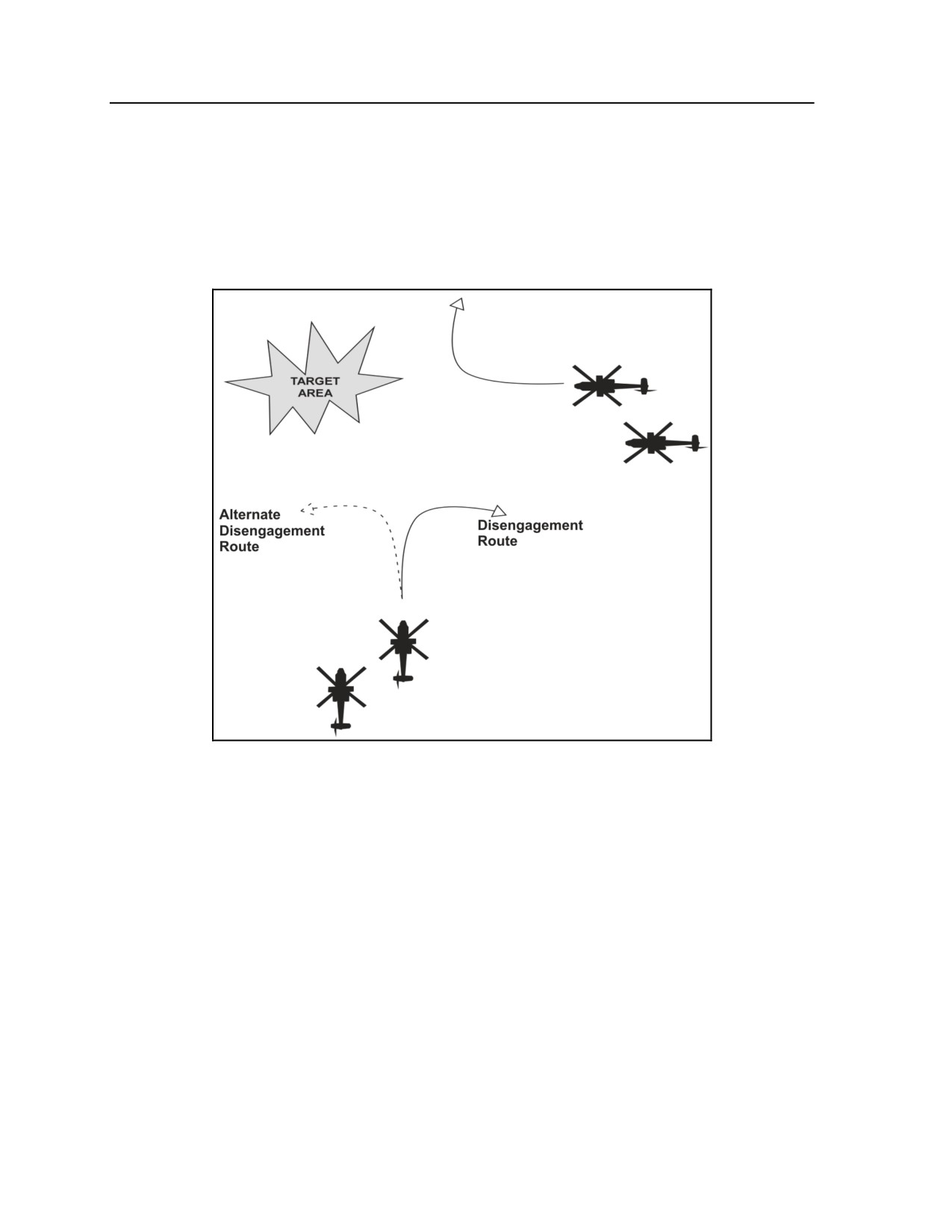
FM 3-04.126
16 February 2007
Employment
3-288. Teams utilize attack patterns to maximize weapons effectiveness and minimize exposure to the
threat. Factors affecting the selection of attack patterns include type/size of threat, ordnance to be fired,
available attack lanes, weapons delivery technique, and location of friendly forces. Examples of attack
patterns utilized by the SWT are racetrack pattern, L attack, and cloverleaf attacks. Company/platoon
attacks can be accomplished utilizing the following methods with multiple teams. These attack patterns are
modified to the operational environment’s dynamic and are situational dependent.
3-289. The AMC modifies the timing of the attack run to provide for a simultaneous or continuous attack
(figure 3-27, page 3-68). This is accomplished by adjusting the spacing between lead and wingman or the
timing of the attack runs between multiple teams.
Figure 3-27. Example of simultaneous and continuous attacks
3-290. A simultaneous attack is executed from combat spread or combat cruise formation and is
normally utilized when taking fire from the target area. Wingman’s attack is timed to provide suppressive
fire for lead’s break-off of the target. Wingman may also fly roughly 45 degrees offset from lead on the
side opposite lead’s break. This permits suppression of the target area while lead is engaging and facilitates
rapid disengagement from the attack run (figure 3-28, page 3-69). Wingman should maintain greater
standoff during attack run because lead cannot provide coverage. Ideally, aircrews vary the direction of the
attack after each turn.
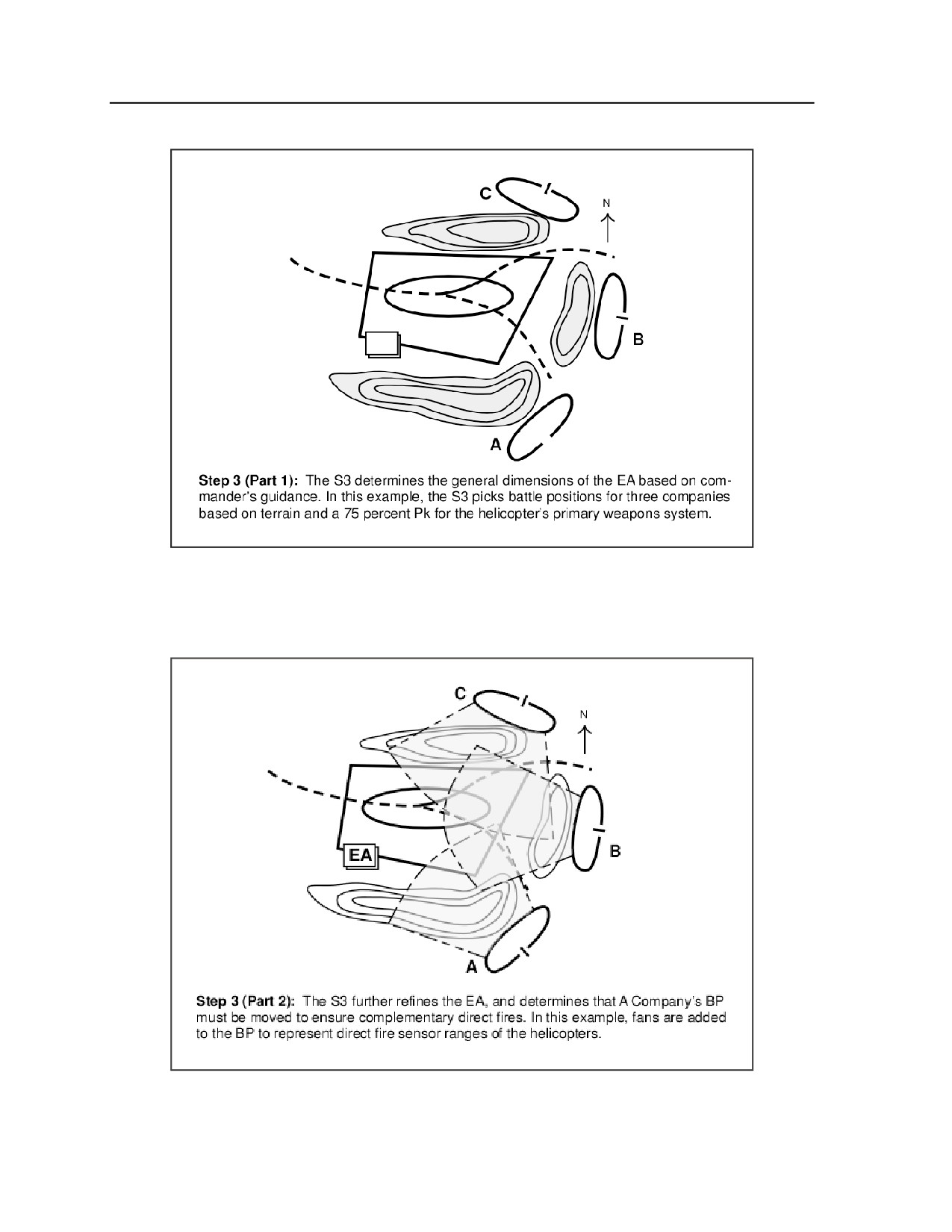
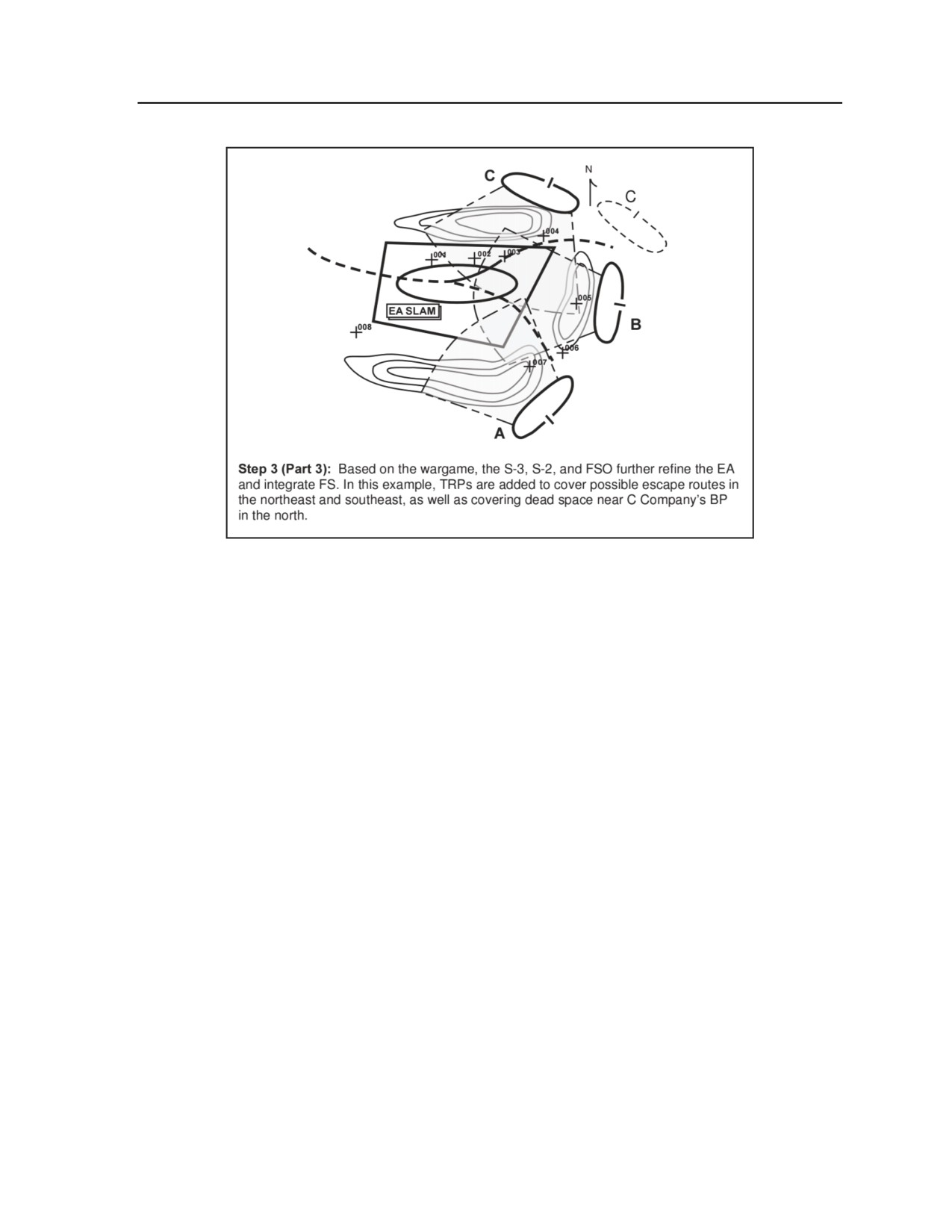
3-291. A continuous attack separates team movement with only one team member inbound to the target
area at a time. This technique is normally employed when the threat to the team is low or constant fire is
desired on the target area. A continuous attack requires greater control and timing; lead should maintain an
established airspeed in order for wingman to maintain proper spacing. Once this relationship is understood,
modifications of the break line, speed, and delivery techniques may be made.
Racetrack Pattern
3-292. The racetrack pattern is the basic attack pattern from which all others are derived and is used to
coordinate actions by each team member.
16 February 2007
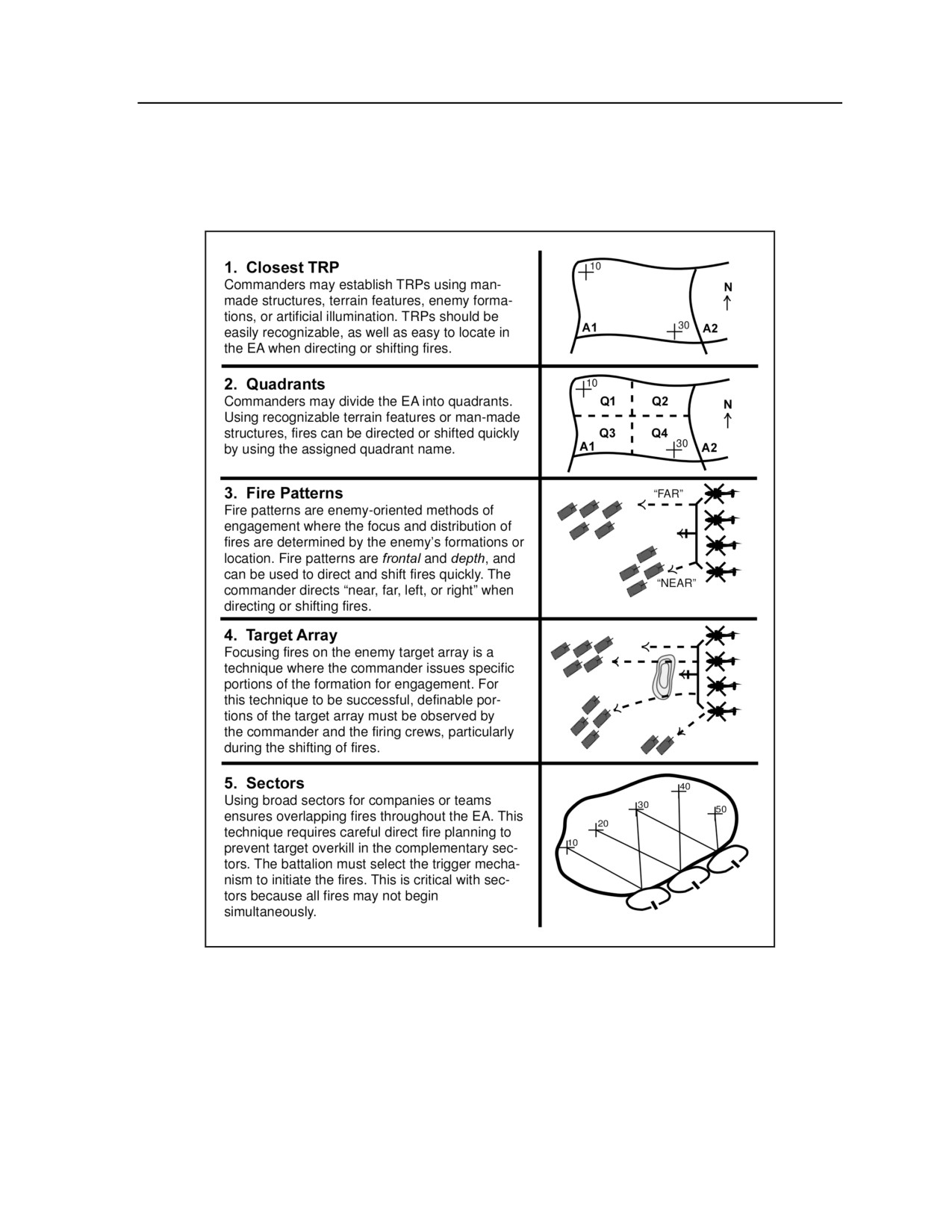
FM 3-04.126
3-65
Chapter 3
Figure 3-28. Example of a 45-degree simultaneous attack
3-293. The racetrack pattern is divided into three circuits based on weapon system capabilities and
average attack speed. Teams adjust distance to targets as necessary based upon METT-TC. The three
circuits are full, outer, and inner (figure 3-29, page 3-69).
z Full circuit. Provides maximum standoff and is primarily used for missile engagements.
z Outer circuit. Outside enemy crew-served weapons range and allows gun, rocket, and missile
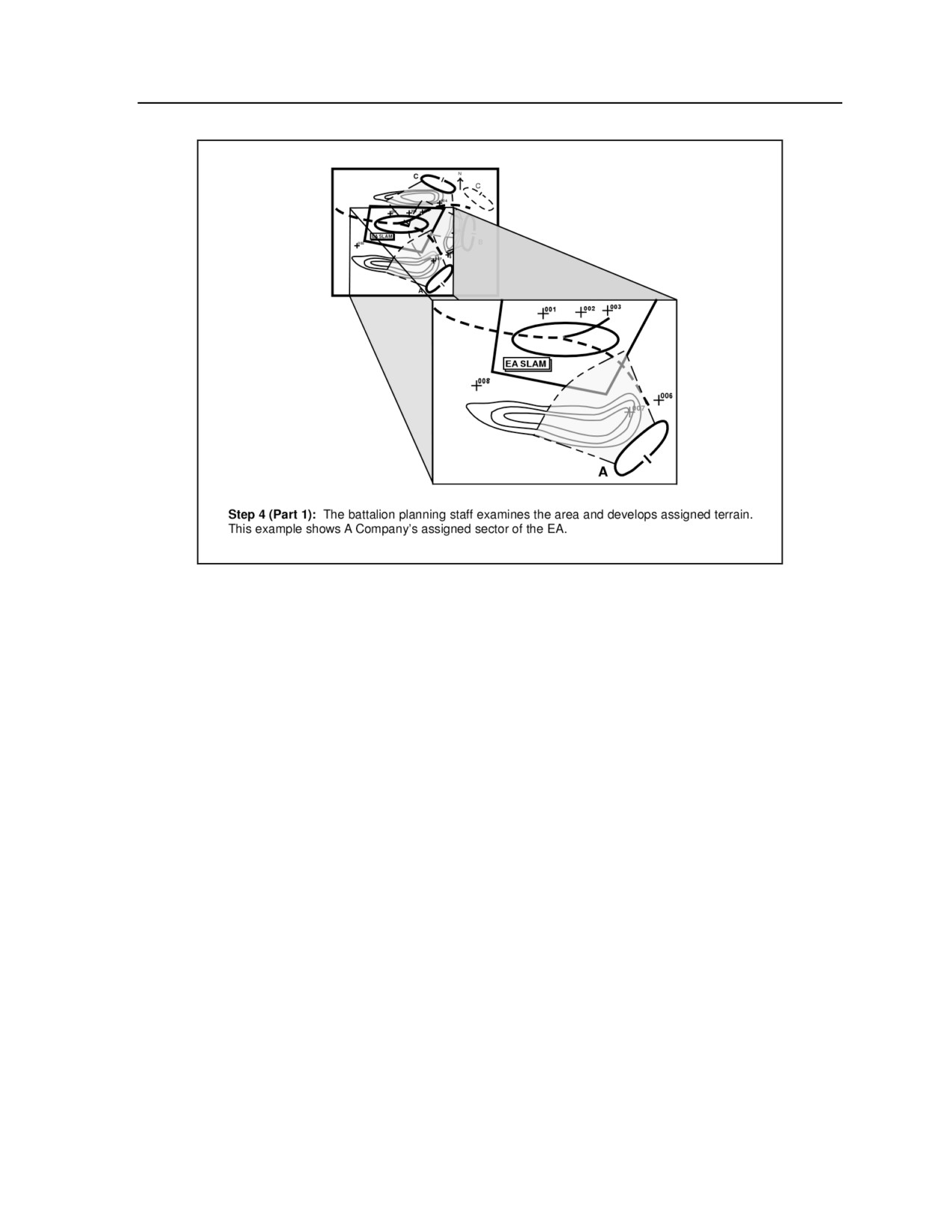
delivery; accuracy is reduced for gun and rocket engagements.
z Inner circuit. Outside enemy small arms range and enables gun and rocket engagements with
best accuracy.
3-66
FM 3-04.126
16 February 2007
Employment
Figure 3-29. Racetrack pattern
Cloverleaf Attack Pattern
3-294. The cloverleaf pattern is a basic variant to the racetrack pattern and eliminates the predictability
caused by multiple attack runs from the same direction. Number of leaves flown, engagement range, and
timing are all flexible. When utilized with multiple teams the enemy is confronted with a high volume of
fire from constantly changing directions. Care must be taken to avoid firing into other teams or overflying
the target(s). Figure 3-30, provides an example of a cloverleaf attack pattern.
Figure 3-30. Example of a cloverleaf pattern
16 February 2007
FM 3-04.126
3-67
Chapter 3
L-Attack Pattern
3-295. The L-attack pattern is used to attack a target requiring a large volume of fire for a short duration
utilizing two SWTs. This pattern is capable of attacking linear targets masked by high terrain or obstacles
on one side. Timing between teams is critical to provide simultaneous fire against the target. If a large
volume of fire is not required both teams can establish racetrack patterns, and proper timing allows one
helicopter at a time to provide neutralization fire. Figure 3-31, page 3-71 provides and example of an L-
attack pattern.
Figure 3-31. Example of an L-attack pattern
Static Attack
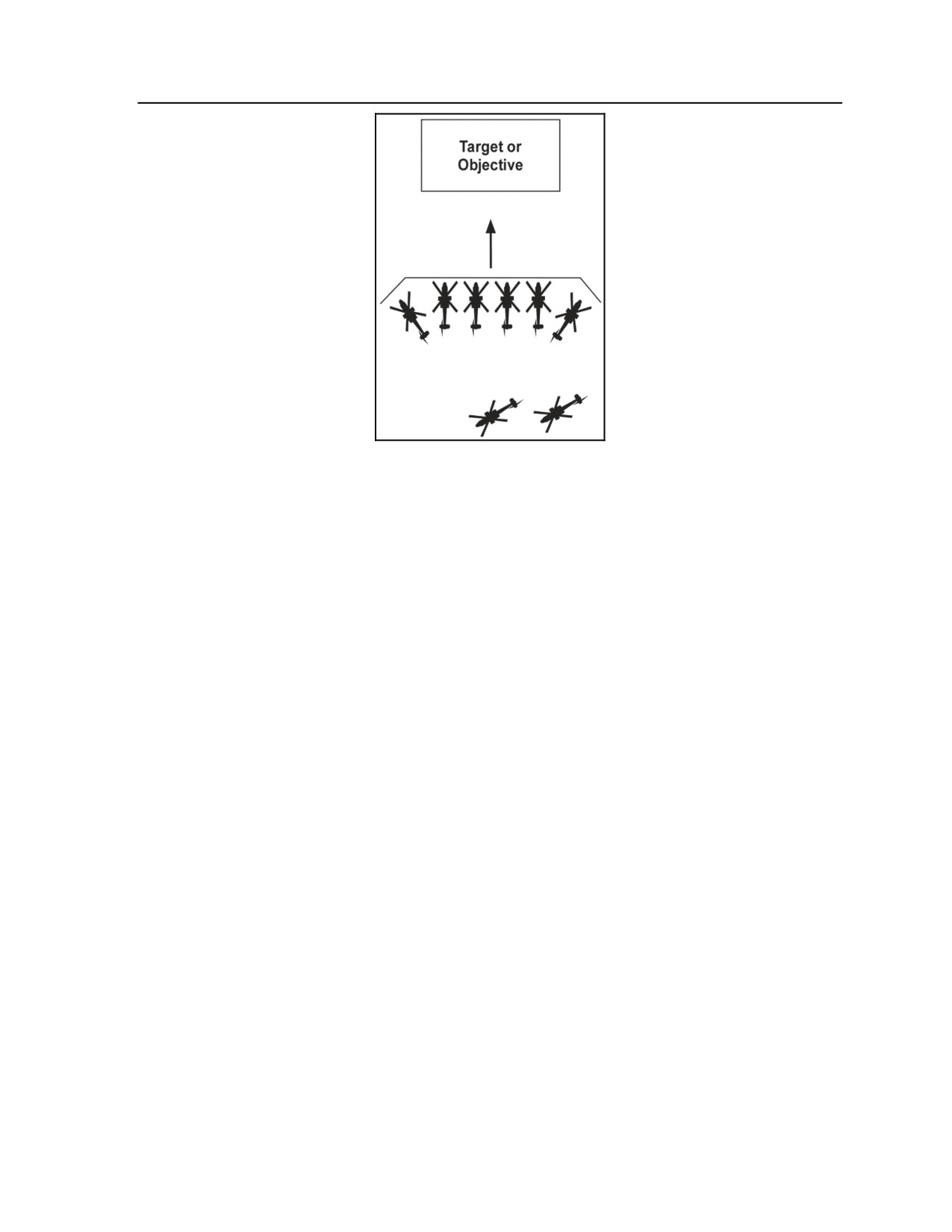
3-296. The static attack maintains all aircraft in an ABF/SBF and is utilized when the threat situation and
environmental conditions allow aircraft to fire from a hover. The static attack provides for ease of C2 when
conducting a platoon or company attack. Consideration must be given to ABF/SBF selection, including
environmental conditions and the ability to maintain rear security. Figure 3-32 provides an example of a
static attack.
3-68
FM 3-04.126
16 February 2007
Employment
Figure 3-32. Example of a static attack pattern
WEAPONS DELIVERY TECHNIQUES
3-297. Teams can use different delivery techniques to engage the threat. These delivery techniques are
divided into three types—hover fire, running fire, and diving fire.
Hover Fire
3-298. Hover fire is any engagement conducted below effective translational lift (ETL). It may be either
stationary or moving. See FM 3-04.140 and ATMs for more information.
Running Fire
3-299. Running fire is an engagement from a moving helicopter above ETL. Forward airspeed adds
stability to the helicopter and increases the delivery accuracy of weapon systems, particularly rockets. See
FM 3-04.140 and ATMs for more information.
Diving Fire
3-300. Diving fire is a direct-fire engagement from a helicopter that is in a diving flight profile according
to the aircraft ATM. The airspeed and altitude of the aircraft improve the accuracy of engagements,
particularly for rockets. See FM 3-04.140 and ATMs for more information.
3-301. Aircrews may employ different attack methods to engage the enemy. These attack methods are
low/level attack, bump attack, and high attack.
Low-level attack
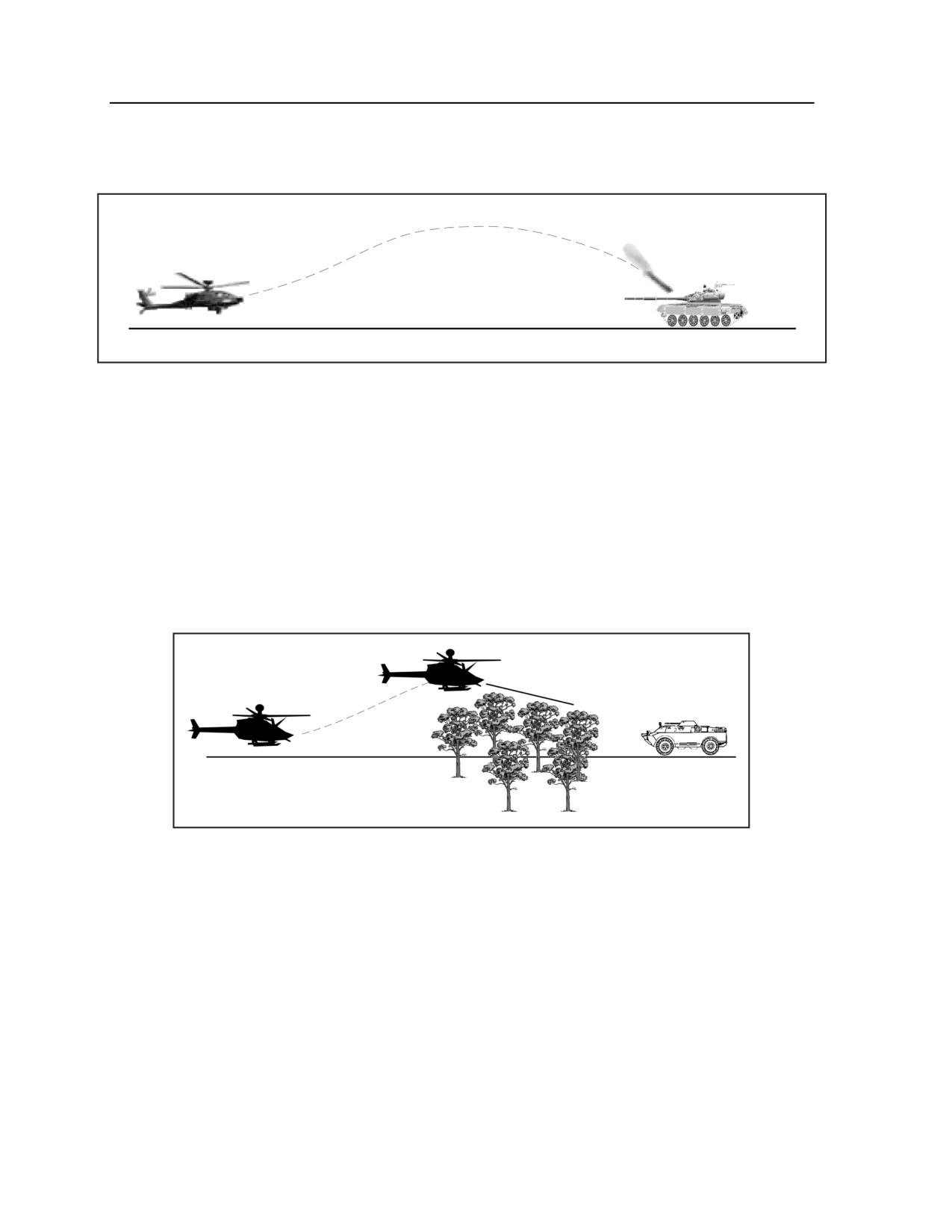
3-302. Low-level attack is used when the aircraft is required to maintain near terrain or NOE when
engaging a target; normally used during hover or running fire. An advantage of this technique is the
aircrew’s ability to maintain a lower profile that is masked by background terrain or vegetation making it
difficult for the enemy to judge closure. A disadvantage is the aircrew cannot engage the target at
maximum range of the weapons system due to targeting hindered by a level viewing angle. Additional
disadvantages include limited LOS, decreased accuracy (both initial and subsequent rounds), and wider
dispersion resulting in decreased weapons effect and increased chances for fratricide and collateral
damage. Figure 3-33 illustrates the low-level attack technique.
16 February 2007
FM 3-04.126
3-69
Chapter 3
Figure 3-33. Low-level attack
Bump attack
3-303. The bump attack is used to take advantage of masking terrain while increasing the angle of attack;
normally used during running fire, transitioning to diving fire. Each aircrew bumps up prior to or during
weapons engagement and then returns to terrain flight altitude.
3-304. Advantages of this technique are the aircrew’s increased ability for longer distance engagements,
dispersion of weapon’s effects is deceased, lookdown angle is increased making target identification easier,
and aircraft momentum is maintained for maneuver. Disadvantages include silhouetting of aircraft on
horizon during bump, and excessive bump reduces airspeed and energy for maneuver. Figure 3-34
illustrates the bump attack.
Figure 3-34. Bump attack
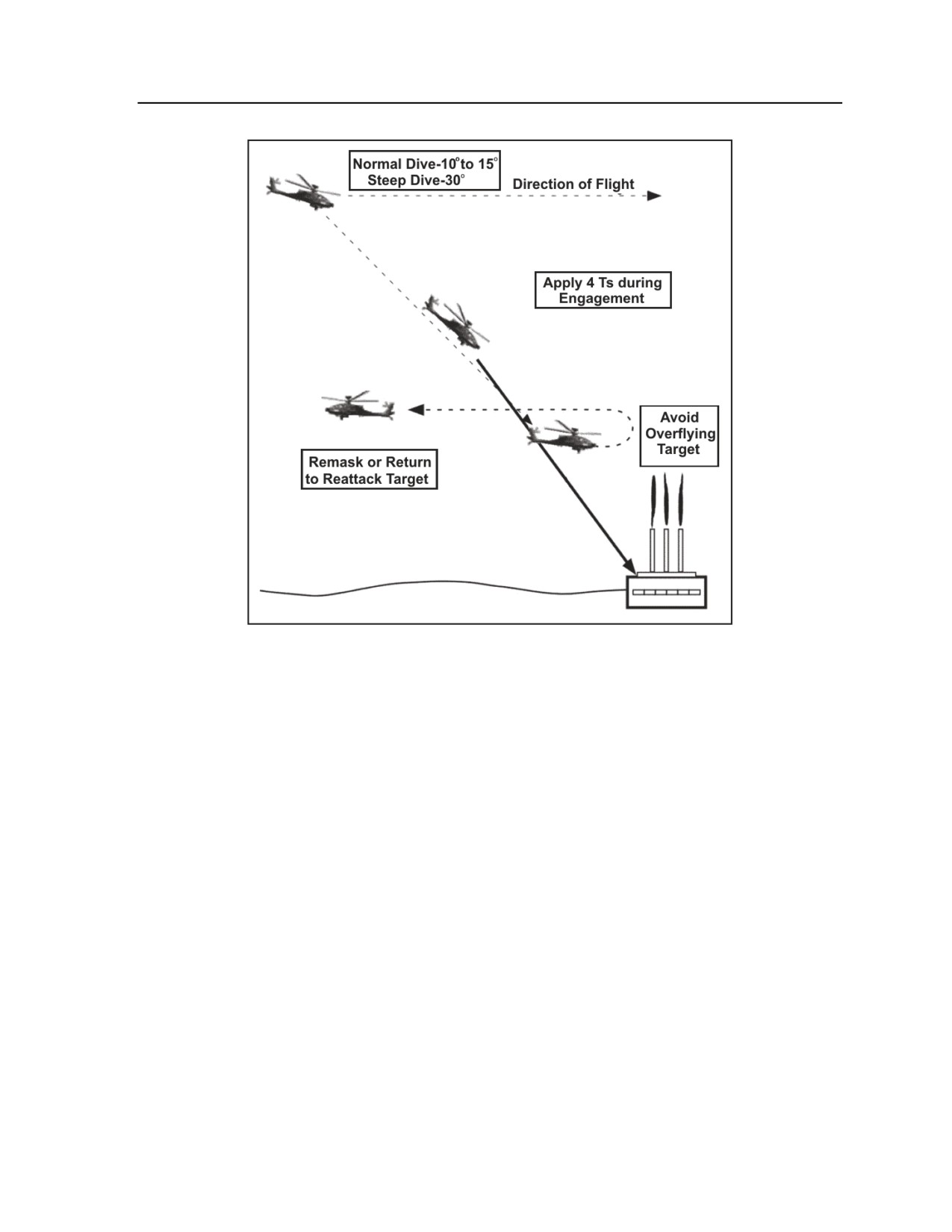
High attack
3-305. High attack is used during diving fire when aircraft are required to maintain higher altitudes,
normally greater than 1,000 feet. This technique is especially useful for following targets through urban
areas and allows for remote engagements. Other advantages include aircraft remain above accurate small
arms fire while retaining energy for maneuver, allows for greater target identification within urban areas or
restrictive terrain, and minimizes weapon’s effects dispersion and laser error. A disadvantage is the higher
altitudes enable greater effectiveness of threat IR and RF missiles. Figure 3-35 illustrates high attack.
3-70
FM 3-04.126
16 February 2007
Employment
Figure 3-35. High attack
3-306. Combinations of the weapons delivery techniques listed may be performed. Variations may be
required, but the basics remain the same. Careful consideration must be given to power available, station
time, continuous attack or team attack, and ordinance to be delivered. Direction of attack should be based
on the same factors used in firing position selection.
ENGAGEMENT AREA DEVELOPMENT
3-307. The battalion or TF is responsible for planning EAs, whereas the company conducts direct fire
planning. The EA development process is characterized by eight steps.
z Step 1. Intelligence preparation of the battlefield.
z Step 2. Select the ground for the attack.
z Step 3. Integrate the EA.
z Step 4. Plan the direct-fire fight.
z Step 5. Fire control.
z Step 6. Review the plan.
z Step 7. Rehearse the plan.
z Step 8. Execute the plan.
16 February 2007
FM 3-04.126
3-71
Chapter 3
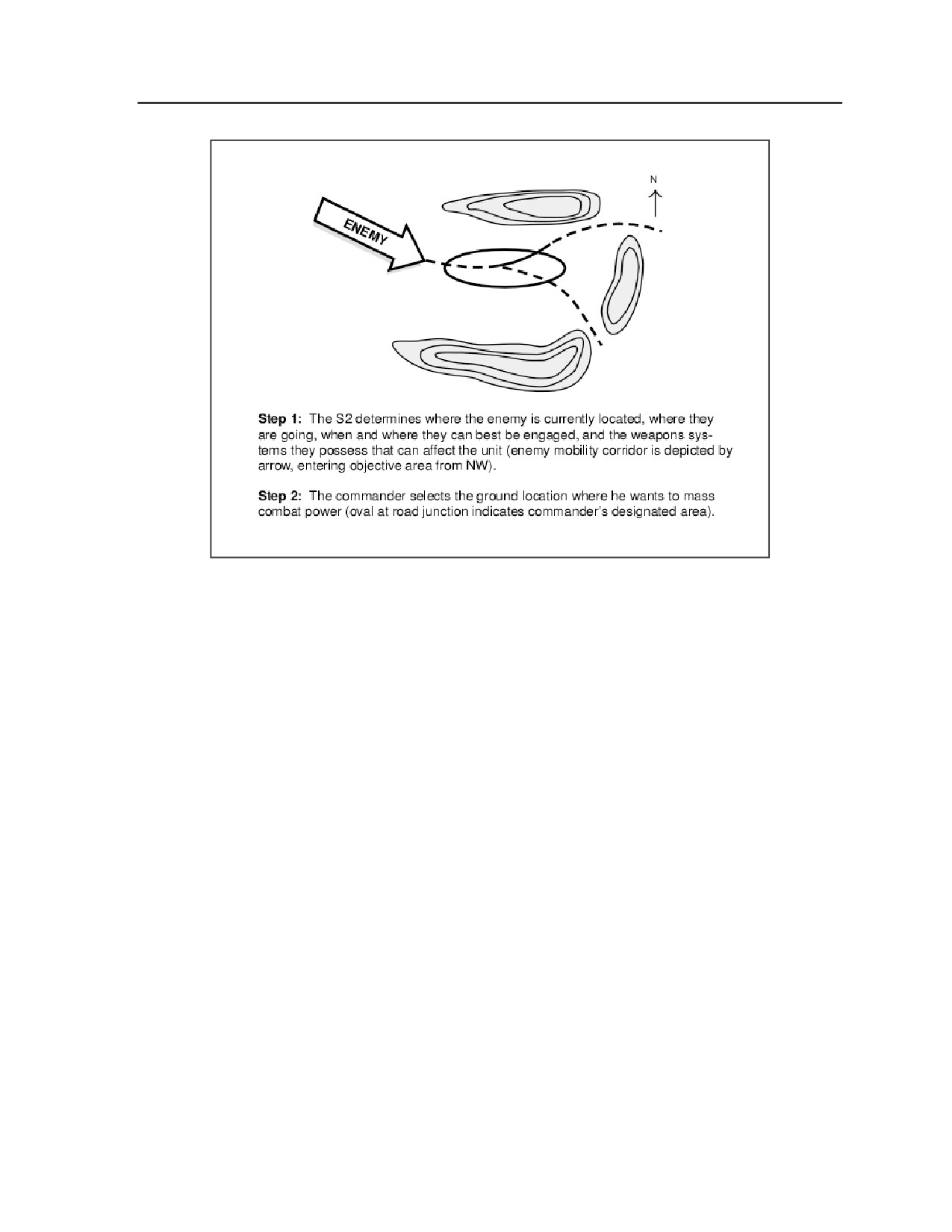
STEP 1—INTELLIGENCE PREPARATION OF THE BATTLEFIELD
3-308. Upon receipt of the mission, the battalion S-2 begins the IPB process (see FM 34-130 for more
information on the IPB process). This initial process includes the following:
z Battlefield area evaluation.
z Terrain analysis.
z Weather analysis.
z Enemy evaluation.
z Enemy integration.
3-309. This process will provide the commander with possible enemy COAs. The S-2 should list these
courses (most probable through most dangerous) in descending probability and select NAIs or points along
enemy mobility corridors that confirm or deny a particular enemy COA. Enemy activity or lack of activity
in a named area of interest (NAI) helps the S-2 refine his estimate of the enemy COA.
3-310. The S-2, in coordination with the S-3, identifies NAIs or points along the enemy’s mobility
corridors where interdiction of enemy forces by friendly force maneuver, fires, or jamming will deprive the
enemy of a particular capability.
3-311. Additional points, DPs, may be selected based on time and space where critical events are
expected to occur which will necessitate a decision. For example, the commander may designate the
enemy’s crossing of DP1 as the event requiring a decision on whether or not to launch the attack.
3-312. The IPB process drives the formulation of plans. At a minimum, the S-2 should answer the
following questions before the OPORD is presented to the companies:
z Where is the enemy currently located?
z Where is the enemy going?
z Where can we best engage the enemy?
z When will the enemy be there?
z What weapons systems do the enemy have that can affect our unit?
STEP 2—SELECT THE GROUND FOR THE ATTACK
3-313. Once the S-2 identifies the enemy’s most probable COA, the battalion commander picks the point
on the ground where the enemy will be attacked. This is the point where the commander intends to mass
combat power. Figure 3-36 illustrates steps one and two.
3-72
FM 3-04.126
16 February 2007
Employment
Figure 3-36. Engagement area development steps one and two
3-314. During this step, the commander issues or reconfirms the nine elements of commander’s guidance:
z Guidance on enemy COA. This element informs the staff which actions to focus on and which
actions to dismiss.
z Restated mission. This element is the approved mission by the commander including all
specified and implied tasks.
z Commander’s intent. This element is the purpose, method, and endstate of the mission. It
clearly states success criteria.
z Concept of the operation. This element features where, when, and how the commander is
expecting to accomplish the mission.
z Deception objective. This element is the deception
(if applicable) tied into the higher
commander’s plan. This may include “deception SEAD”.
z Priorities. These elements are the commander’s combat support and sustainment priorities. The
staff focuses on the fueling, fixing, and rearming functions for the fight.
z Time plan. This element focuses the staff on the amount of time available to the battalion for EA
planning, as well as the time available to the companies to direct fire planning.
z Type of order to issue. This element gives the staff guidance on the type of order to issue to the
companies so they can complete their plan.
z Type of rehearsal to conduct. This element is critical prior to mission execution.
STEP 3—INTEGRATE THE ENGAGEMENT AREA
3-315. The EA is an area where the friendly force commander intends to trap and destroy an enemy force
with the massed fires of all available weapons. EAs are control measures that focus fires and distribute
those fires throughout the target. This step is depicted in three parts with figures 3-37 and 3-38, page 3-74,
and Figure 3-39, page 3-75.
16 February 2007
FM 3-04.126
3-73
Chapter 3
Figure 3-37. Engagement area development step three (part 1)
Figure 3-38. Engagement area development step three (part 2)
3-74
FM 3-04.126
16 February 2007
Employment
Figure 3-39. Engagement area development step three (part 3)
3-316. The staff identifies preliminary BPs for the EA based on the commander’s guidance, terrain, and
sensor range producing an adequate probability of kill (Pk) for the helicopter’s primary precision guided
weapon. Prior to integration of direct fire, the following points must be considered:
z Enemy avenues of approach.
z Enemy rate of advance.
z Key terrain that gives the advantage for specific avenues of approach.
z What formation the enemy will use, and at what point will they likely change formation?
z Expected range to engagement.
z Maximum effective range of friendly weapons systems (direct and indirect).
z When the enemy will begin counter-engagements?
z Maximum effective range of enemy weapons systems (direct and indirect).
z Where is the dead space in the EA, and how it will be covered?
3-317. Based on the outcome of the EA wargame, the FSO, S-3, and S-2 will integrate the use of artillery,
CAS, UAS, and mortars to shape the operational environment for the direct fire fight. This integration of
fires is based on the commander’s intent for fires on the objective. The following questions must be
answered prior to mission execution:
z What is the endstate of the direct fire plan?
z How much artillery, CAS, and mortars will be available for employment in the EA?
z Who will initiate the fires?
z How will the friendly unit shift fires?
z Who will clear fires once the direct fire fight starts?
3-318. An obstructed EA complicates actions on the objective. While the EA may be perfectly clear when
the first rounds are fired, burning vehicles, munitions impacts, and/or environmental conditions can quickly
obscure the view from the planned BPs. Consequently, it is important to consider the following during
planning:
16 February 2007
FM 3-04.126
3-75
Chapter 3
z Prevailing/forecast winds. During the planning process, forecasted winds in the EA that will
obscure either the BP or the EA must be considered for engagement priorities and techniques.
Smoke and/or dust may cause laser ranging and designation to be unreliable.
z Nature of the target. If the targets to be engaged have the propensity to burn after being hit,
thought must be given to the engagement priorities. As an example, a brightly burning light
skinned vehicle near a BP may obscure heavier, more dangerous vehicles in the EA.
z Number of targets. If the plan calls for destroying or killing a large number of targets with
direct fire, consider engaging targets across the depth of the formation simultaneously. This
technique will disorganize the formation quickly and allow for engagement throughout the EA
with rockets and indirect fire.
z Terrain. It is important to cover dead space with indirect fires or rockets. Units should also be
aware smoke tends to cling in the low ground during hours of darkness. This may allow enemy
vehicles to move undetected, making it difficult, if not impossible, to engage those vehicles with
laser-guided weapons.
z Planned obscurants. FLIR sights may be required during daylight operations for target
engagement to see through obscurants. Aircrews must complete boresights and operational
checks of all sights, whether or not the crew expects to use them during the actual mission.
z Effective engagement. Planners understand for different missiles, cloud ceilings below certain
elevations will inhibit effective engagement. These minimums cloud cover conditions require
careful planning to ensure the use of the correct missile type and programmed trajectory for
predominant weather in the contingency area. Because of sensor and laser limitations, missile
engagements beyond 6 kilometers require a closer remote designator to permit a higher lock-on-
after-launch Pk.
3-319. While remote designation must occur for a minimum length of time, continuous target designation
is undesirable due to backscatter and other potential countermeasure capabilities. Fog, haze, snow, and
dust/blowing sand may increase backscatter causing an out-of-constraint condition. Remote designation
from too great a distance may result in beam divergence and too wide of a spot on target.
3-320. Once the staff planning is complete, the commander should be able to answer yes to each question
in the EA checklist (table 3-7).
Table 3-7. Engagement area checklist
Does The Plan
Yes
No
Concentrate on long range targets?
Engage targets with high Pk?
Minimize risk?
Destroy most dangerous targets first?
Maximize each weapon system?
STEP 4—PLAN THE DIRECT-FIRE FIGHT
3-321. The plan is generated by battalion planners with input from company officers encouraged in the
process.
3-322. The battalion commander assembles his aircrews and planners to obtain a final view of the
battalion plan. Using the overlay and any additional information provided by the staff, the commander
ensures that crews can identify the TRPs, obstacles, avenues of approach, prominent terrain features, and
dead space present in the EA.
3-323. Using TRPs, terrain features, or manmade obstacles, the commander sectors the EA by ensuring
each crew has a well-defined and understood responsibility. An individual helicopter sector should be wide
enough to allow some overlap with adjacent helicopters, but narrow enough to prevent overkill. This action
will reduce the scanning required by the crew and minimize the likelihood for overkill; it also ensures the
entire EA or sector is effectively covered by direct fire.
3-76
FM 3-04.126
16 February 2007
Employment
3-324. The company commander establishes control measures for the direct-fire fight and other actions
time or space dependent. Most commonly, the battalion commander will establish a trigger line for the
direct firefight; however, a company commander initiates it. Further, on-scene visualization will help the
commander decide which fire distribution method to employ. Fire distribution methods include closest
TRPs, quadrants, fire patterns, target array, and sectors. Figure 3-40 addresses fire distribution techniques.
Figure 3-40. Techniques of fire distribution
3-325. The battalion commander assigns sectors of fire to each company, providing full mutual support
between helicopters and integrating FS. This planning includes the following:
z The battalion commander must plan for rear flank security in the BPs. One to two helicopters
may be designated for security during the engagement.
z The direct fire plan assigns responsibilities for long range direct fires. The commander also
defines areas designated by engagement with rockets and cannon, and how those fires are
16 February 2007
FM 3-04.126
3-77
Chapter 3
initiated. During company level planning, “range fans” or arcs are drawn on the sector sketch to
represent weapons ranges and time of employment. This type of planning helps crews select the
proper weapon for the anticipated target at certain ranges.
z Crews must be ready to repel dismounted infantry and other vehicles in the BP; and they must
know positions of friendly elements in the area.
3-326. The battalion commander ensures supplementary BPs integrate the same level of planning and FS
as the primary positions. Each crew must also have a complete understanding of the criteria for movement
from the primary to the supplemental BP.
3-327. Lastly, the commander will devise a method to determine if and when the mission has been
accomplished. The commander’s intent describes the destruction criteria and endstate, and the commander
will not conclude the mission until those criteria are met.
3-328. Commanders mass the effects of onboard weapons in the EA. They also use complementary
systems, such as artillery, CAS, mortars, and other available systems as combat multipliers to overwhelm
the enemy at the decisive place and time.
3-329. Piecemeal fires limit the attack reconnaissance unit's capability. There must always be a primary
and alternate method of executing the fires.
3-330. Fires must be focused on the critical point at the critical time. The three key elements to successful
massing of direct fires against any target are—
z Clearly communicating instructions to fire elements.
z Using recognizable control measures, whether friendly, enemy, or terrain based.
z Detailed training, SOPs, and planning for engagement.
3-331. Principles for distributing fires are listed below:
z Critical targets are engaged first.
z Engagements are conducted laterally and in-depth simultaneously.
z Designation of which weapons will engage which targets is decided during planning.
z Designation of which aircrew will engage which targets is decided during planning.
3-332. Fires must be controlled and shifted to react to enemy actions. Shifting of fires should be planned
and rehearsed. When conducting hasty operations, fire distribution for the ARC must be kept simple. To
maintain simplicity, adhere to the following general principal of fire distribution:
z Left shoots left, right shoots right, and rear and center shoots center zone.
z Priority fire zones (PFZs) are the primary method of distribution.
PFZs are established by the company commander or the first aircraft with eyes on the
sector.
PFZs are oriented with the movement of the enemy in a logical manner.
PFZs are based on mission, terrain, and number of aircraft.
z Teams are assigned a specific zone and utilize the general principle of fire distribution in each.
3-333. All crews must understand the fire plan. This includes a solid understanding of the mission and the
commander’s intent. The fire plan rehearsal allows every crewmember to understand it and point out any
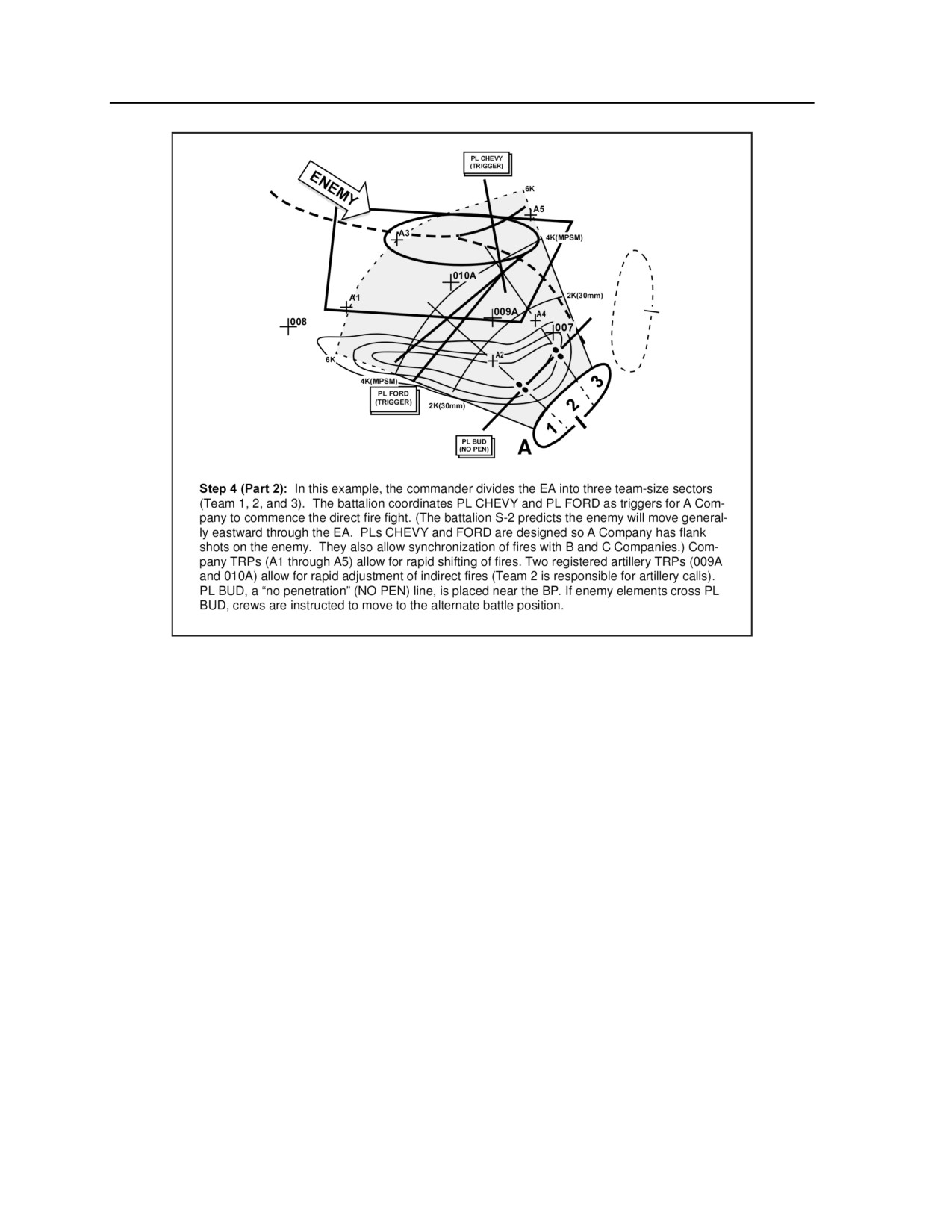
shortcoming in the plan prior to execution. Step 4 is depicted in figures 3-41 and 3-42, page 3-81.
3-78
FM 3-04.126
16 February 2007
Employment
Figure 3-41. Engagement area development step four (part 1)
16 February 2007
FM 3-04.126
3-79
Chapter 3
Figure 3-42. Engagement area development step four (part 2)
STEP 5—FIRE CONTROL
3-334. The company commander or AMC is in control of fires. The commander uses two processes to
control fires—fire planning using triggers and fire commands using communication. The commander
decides how to control fires based on the situation and time available to plan and prepare.
3-335. A standard unit fire command may include as many as five elements in the following order:
z Alert.
z Weapon or ammunition.
z Target description.
z Orientation.
z Execution.
3-336. In a deliberate attack, with prior planning time available, the commander can initiate the fight with
a trigger. A trigger is an event, such as enemy crossing a terrain feature, beginning the direct fire plan.
Further fire commands may be required, but the object of the planning phase is to anticipate events and
coordinate fires before the fight starts.
3-337. In a meeting engagement or movement to contact, when planning time is limited, the commander
initiates fires with a standardized abbreviated fire command. For example:
z Alert—"Blue 14, this is Blue 6."
z Description—"Three tanks and multiple armored personnel carriers."
3-80
FM 3-04.126
16 February 2007
Employment
z Orientation—"Vicinity TRDP 016."
z Execution—"At my command, fire."
3-338. A coordinated fire plan requires minimum radio traffic over the net during execution. Trigger
points, priority of engagements, and targets are established in advance. This assures direct fires are placed
on the enemy even if communications are interrupted or unit leadership is disabled.
3-339. Standardized fire commands are established in the unit SOP and practiced by the chain of
command. Using a standard format for a fire command ensures all essential information and control
measures are given quickly and accurately. Even under the most adverse conditions, this format causes
positive reaction by the unit. Brevity and clarity are essential. Abbreviated methods for identifying target
locations are encouraged, but they must be familiar and understandable.
3-340. Coordinating instructions for additional information may be given by the commander to individual
aircraft; however, this information is not part of the fire command. When a crew renders a contact or
SPOTREP, and it is reasonable to believe all other aircraft in the company received it, the commander
issues only the elements needed to complete fire command.
3-341. The nature of the target dictates the type of fire pattern used. During premission planning and/or
rehearsal, each aircrew must completely understand how the threat will look within the EA, and what
effects the engagement will have on that threat. Whether engaging massed armor formations on the move
or fixed targets, the way each crew executes fires must be solidly understood.
3-342. The two basic fire patterns are frontal and depth. These two fire patterns cover most situations and
promote rapid, effective fire distribution. Regardless of which fire pattern is employed, the objective is to
engage far and flank targets first and then shift fires to near and center targets. Enemy targets should be
engaged by most dangerous to least dangerous within the assigned sector. The commander may choose to
modify this practice should a designated priority target come into view.
z Frontal pattern. The frontal pattern is used when all engaging helicopters have unobstructed
fields of fire to their front. Flank helicopters engage targets to the front and then shift their fires
toward the center as the targets are destroyed. Frontal engagement calls for crews to engage
targets near to far and flank to center.
z Depth fire pattern. The depth fire pattern is used when targets are exposed in depth. An entire
company may be required to fire on a column formation in depth, or individual helicopters
engaging in their sector may have to fire in depth. Should the entire company be engaging the
threat simultaneously, it may be possible for each helicopter to fire in depth on a portion of the
enemy formation. In this type of situation the far left helicopter engages the far left target and
shifts fire toward the center as targets are destroyed. The left center helicopter engages the
closest (front) targets and shifts to the rear as targets are destroyed; the right center helicopter
engages the center targets and shifts fires to the front as targets are destroyed and the far right
helicopter engages targets on the far right and shifts fires to the center as targets are destroyed.
The commander always has the option to employ something other than simultaneous fire and
will specify that order in the alert element of the fire command.
Principles of Fire Control
3-343. More than any other factor, it is important to avoid overkill as it increases a weapon’s Pk. In a
target-rich environment, a unit may expend its ammunition and still not meet defeat criteria stated in the
commander’s intent.
3-344. Each weapon system must be used effectively. A detailed IPB will help the commander decide
which target should be serviced by which weapon. For example, if all antitank guided missiles (ATGMs)
have been expended against trucks and a tank battalion enters the EA, the ARC may not be able to
accomplish the mission.
3-345. The most dangerous targets are to be destroyed first. Commanders ensure engagement priorities
are fully understood by each crew member. The targets posing the greatest threat to force must be
destroyed first to expose the more lucrative targets.
16 February 2007
FM 3-04.126
3-81
Chapter 3
3-346. Units must concentrate on long-range targets. This principle will provide standoff and allow the
commander time and maneuver space should the enemy decide to maneuver their forces toward the
friendly force. The commander must understand the limitations of air crews, weapons, and sensors to
determine at what ranges targets can be engaged while maintaining a high Pk. Additionally, environmental
conditions may minimize effectiveness of long-range weapons due to the sensor’s inability to identify the
target because of fog, dust, or other environmental conditions.
3-347. Units prudently to take the best shot and expose only those aircraft engaging the enemy target.
This principle will increase the Pk, while protecting the aircraft as long as possible. High Pk will confuse
the enemy in regard to friendly force size and disposition.
3-348. Prior to assignment of fire patterns, the commander remains focused on the effects fires have had
based on the desired outcome of the pending engagement. The goal should be ensuring the enemy remains
in the EA until its force strength has been degraded to the level that is outlined in the commander’s intent.
By ensuring that the EA is effectively covered, the enemy will not be able to leave the area prior to
termination of engagement.
3-349. Termination of engagement occurs in one of three following ways:
z The commander announces to cease fire.
z All targets are destroyed.
z All ammunition is expended.
Step 6—Review the Plan
3-350. To ensure detailed and complete planning, the staff and aircrews should be able to answer the
following questions:
z What is the mission and endstate?
z Where is the enemy, and how will it enter the AO? What does the IPB say?
z Where are the enemy’s key weapons? What are its capabilities?
z Where will the enemy be killed?
z Where will the enemy be engaged? Are the ranges realistic? Are the positions too restrictive?
z What is the role of complimentary systems and joint fires?
z What is the appropriate weapons load?
z What is the target priority?
z How will fires be initiated?
z What is the fire command? Which weapon systems will be fired first?
z What is the desired effect of fires from each system?
z How will fires be distributed?
z How will fires be massed? Does the unit have the required volume?
z Can the unit complete the job with time and assets provided in the assigned space?
z Where will C2 be? Can the commander see the battlefield?
z How/when does the unit shift fires? What is the “key event” to cause shifting of fires?
z How does the unit deal with enemy reactions to fires?
z What is the plan for flank and rear area security in the BP?
z Does the plan follow the principles of direct fire?
Step 7—Rehearse the Plan
3-351. Once the battalion commander is comfortable with the concept of the operation, fire distribution
plan, and crew’s understanding of the plan, all crews are assembled for a rehearsal.
3-352. Rehearsals start with actions on the objective area in case the rehearsal must be cut short. Time
permitting; the rehearsal can then revert to the AA with communication checks and progresses through
3-82
FM 3-04.126
16 February 2007
Employment
lineup for take-off, air routes, occupying BPs at the objective area, and egress. Critical questions needing
answered are—
z Who is responsible for initiating the secure communications check?
z Who will call for indirect fires?
z Who will be assigned BP security?
z How will SPOTREPs be collected and sent?
z How will the fires be initiated?
z Who is responsible for coordinating and communicating with United States Air Force JAAT?
z Who will coordinate and communicate with the ground force commander?
z What radio calls are required during conduct of the operation?
z What are the actions on contact?
z What are the contingency plans?
z What is the success criterion and what will determine if that criterion has been met?
3-353. Rehearsing the plan is an ideal opportunity for identification of possible conflicts and resolving
them prior to execution. However, the primary purpose of the rehearsal is ensuring all crews know and
understand the commander’s intent and how it will be executed.
Step 8—Execute the Plan
3-354. After the decision has been made to initiate mission execution, units fly their assigned routes to
their BPs, ABFs, or SBFs. En route crews will engage or bypass unanticipated threats in accordance with
predetermined criteria. Possible engagement priorities may include—
z Threat to self.
z Threat to unit.
z Threat to friendly forces.
z Target priorities.
3-355. Once established in BPs, crews prepare for engagement. They must expect the enemy to employ
active and passive AD measures unless reliable intelligence predicts otherwise.
3-356. When targets have been located and positively identified, a contact (SPOTREP) is sent to the
commander. Ideally, the commander will be able to issue a fire command with “at my command” as the
control element. At this point, individual crews will—
z Observe and select the targets based on the preplanned fire pattern(s).
z Acquire and range the first target.
z Hold for the commander’s order to “fire”.
3-357. Simultaneously, while crews fix their targets, the commander coordinates for indirect fires to
engage enemy forces within the EA.
3-358. Execution begins at receipt of the fire command or a predetermined trigger point. As the fight
progresses, aircrews adjust fires and switch targets according to the fire command or SOP. As an example,
the target priorities may be—
z Most dangerous targets (ADA Systems).
z Tanks and/or ATGMs.
z C2 assets.
z Specialty vehicles.
z Artillery.
z Least dangerous targets.
3-359. The amount of time a helicopter can safely remain unmasked will depend on the enemy. Should
enemy AD or tanks be in overwatch, or if the target is stationary, the aircrew should not make more than
16 February 2007
FM 3-04.126
3-83
Chapter 3
two engagements from the same firing position. When not engaging targets, aircrews should remask and
reposition to provide observation or assistance to other crews, as practical.
3-360. After the commander has issued a cease fire and engagement is complete, he completes a BDA
and consolidates fuel, ammunition (cannon), rocket, and munitions reports of each crew. With that, a
determination is made to continue the attack or the helicopters break station. The commander’s timely
assessment of the engagement forwarded to battalion headquarters is critical for possible follow-on
planning or action.
ENGAGEMENT AREA DEVELOPMENT/DIRECT FIRE SUMMARY
3-361. Basic fundamentals are summarized below.
z Battalions plan EAs. Companies conduct direct fire planning.
z Standardized fire commands must be established by unit SOP and practiced by all leaders and
crews.
z All crews must understand basic fire patterns and each crew’s responsibility for target
engagement by SOP.
z A well-planned engagement requires minimum radio traffic during execution; trigger points,
priority of engagements, and targets are established in advance.
z Leaders must plan engagements within the “useable range” of the sensors, not merely “maximum
range”.
z All crewmembers must understand the mission and commander’s intent.
z Conduct joint fire operations.
z Destroy enemy C2 elements, AD systems, long-range SSMs and artillery, and reinforcing ground
forces.
HOLDING AREA OPERATIONS
3-362. The HA is the last covered and concealed position prior to the objective that is occupied for short
periods of time. It is normally located approximately 2 to 5 kilometers behind the BP, ABF, or FLOT.
However, in the common operating environment, the HA may be located in a forward operating base
(FOB) based on METT-TC. Occupation of a HA allows for final reconnaissance and coordination of assets
by the commander. If the HA is occupied for more than a few minutes, aircraft move to an alternate HA or
return to the FAA. HA occupation is based on environmental conditions and may be modified by teams as
they enter the HA. Units that occupy HAs ensure—
z Aircraft remain at NOE altitudes at or within the vicinity of the HA.
z Aircraft maintain operating revolutions per minute (aircraft may hover or land, but will not be
shut down).
z Crews maintain radio listening silence
(one crew member dismounts for face-to-face
coordination with the commander).
z Separate HAs are established for each company.
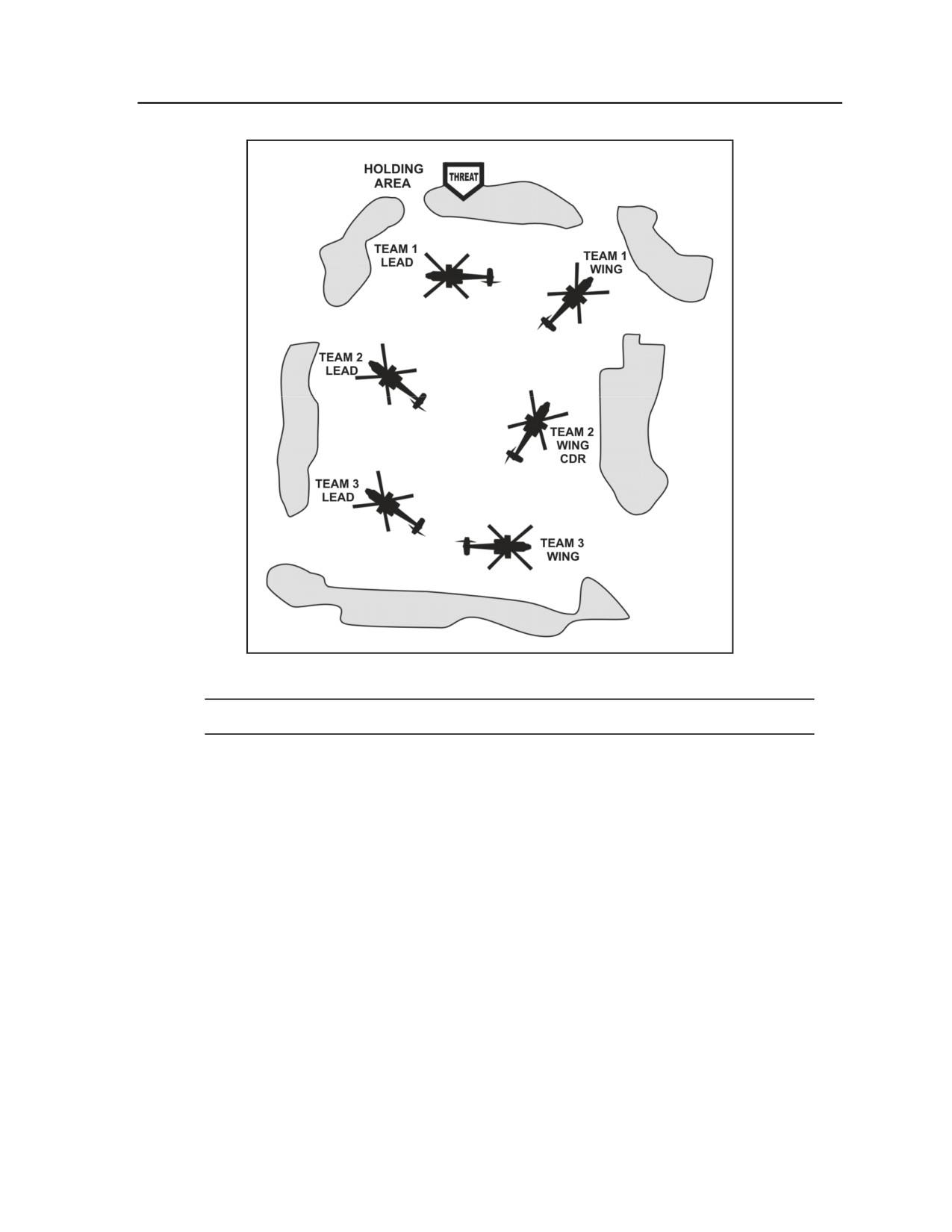
z Aircraft establish positions that provide 360-degree security (figure 3-43).
z The 12 o’clock position is oriented towards the enemy.
z HA is terrain masked and free of sources of rotor wash signature.
z Aircraft are dispersed and maintain team integrity while ensuring intervisibility for security.
3-84
FM 3-04.126
16 February 2007
Employment
Figure 3-43. Holding area occupation
Note: Teams 4 and 5 land in a similar fashion as team 3 providing 360-degree security.
ATTACK BY FIRE/BATTLE POSITION OPERATIONS
3-363. ABF and BP operations are key components of the overall success of the battalion/company in
combat. Efficient concentration of combat power at the objective is gained through disciplined operations,
trained movements, standardized procedures, disciplined fire distribution, and exacting mission rehearsals.
ATTACK BY FIRE/BATTLE POSITION OCCUPATION
3-364. Occupation of the ABF and BP are very similar. Occupation of the ABF, while deliberate, is
normally characterized by greater freedom of movement than the occupation of the BP.
3-365. Once the commander issues the order to move to the ABF/BP, the lead team clears the attack
route, maneuver area, and ABF/BP of immediate threats. Once the ABF/BP is cleared of threats, the teams
move into position (see section VI, attack operations). The commander may position teams in a standard or
nonstandard set.
Standard Set
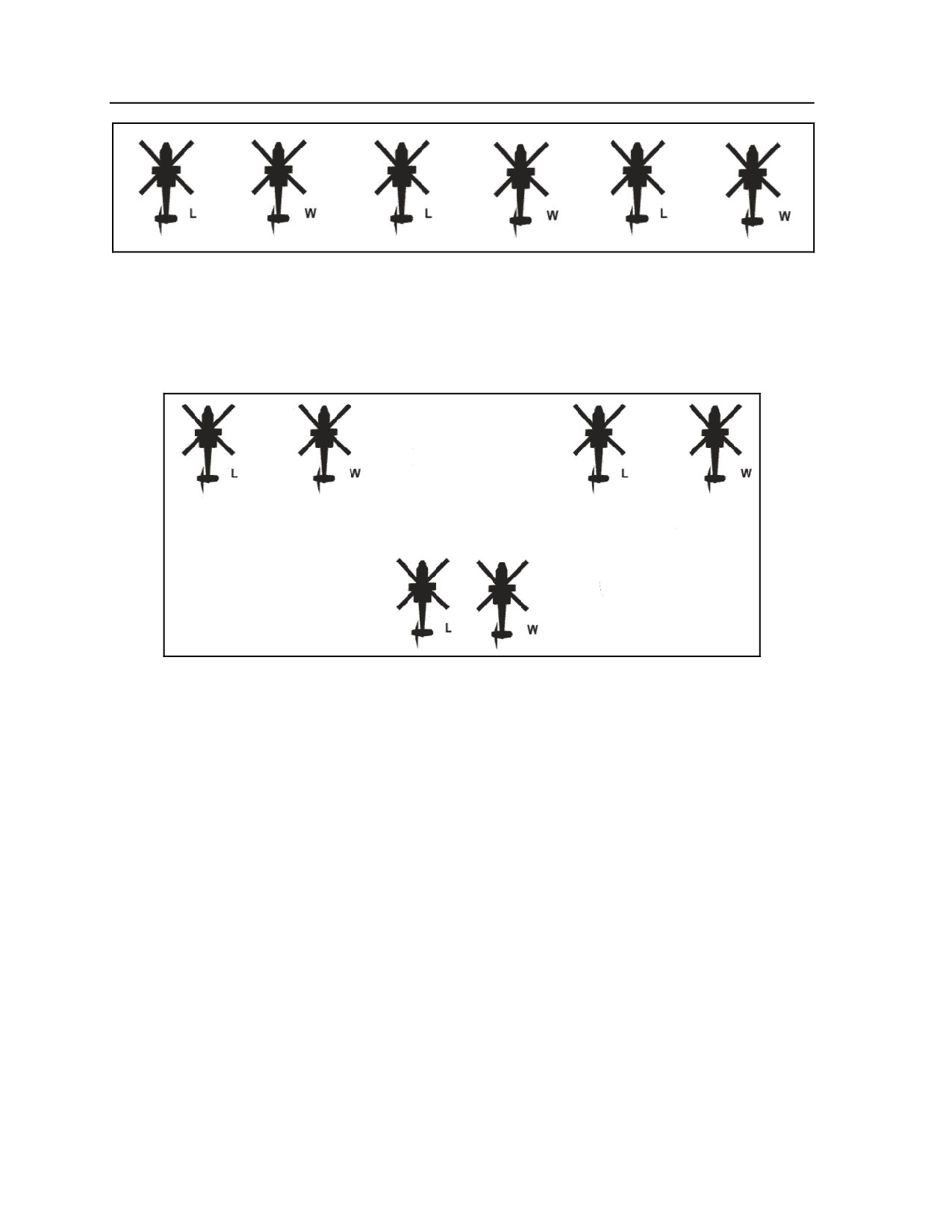
3-366. Teams key off the lead team and begin occupying firing positions as briefed. This set is used
unless the commander selects a nonstandard set. Figure 3-44 illustrates an example of a standard set.
16 February 2007
FM 3-04.126
3-85
Chapter 3
Figure 3-44. Example of a standard set
Nonstandard Set
3-367. Teams key off the lead team and begin occupying firing positions as briefed. Figure 3-45
illustrates an example of a nonstandard set.
Figure 3-45. Example of a nonstandard set
3-368. When all teams are established in the ABF/BP, the commander calls “SET HOT” (teams are in
position and have targets in sight) or “SET COLD” (teams are in position and do not have targets in sight).
If all indications are that the enemy is in the EA and cannot be seen, the commander may have to move the
teams forward to get the enemy in sensor range. Sensor range, not weapons range, is the key factor when
selecting ABFs/BPs.
FIRE DISTRIBUTION IN THE ATTACK BY FIRE POSITION/BATTLE POSITION
3-369. Fire distribution for the ARC must be kept simple. Normally, this means that the EA is divided
and each selected aircraft designates targets in a specified area. Many techniques are used to effectively
divide up target areas. To maintain simplicity, adhere to the general principle of fire distribution-left shoots
left and lead, right shoots right and rear, and center shoots center zone. PFZs are the primary method of
distribution. Teams are assigned to a specific zone and utilize the general principle of fire distribution. See
section V, attack operations, for a further discussion on fire distribution.
EGRESS FROM THE ATTACK BY FIRE POSITION/BATTLE POSITION
3-370. Egress from the ABF/BP occurs when the mission success criterion is met, or when relief on
station is accomplished. As a rule, no more than 10 minutes should be spent in any one BP. Depending on
the mission, the commander may egress prior to or after sending a BHO to the next inbound company.
Once the BHO is complete, the teams egress on a planned route using terrain flight to the RP. Remaining
teams cover the egress with supportive fires as necessary.
3-86
FM 3-04.126
16 February 2007
Employment
3-371. Situational awareness is critical in knowing where all teams are located. If all teams are not in
visual range, present position requests and/or team lead calls with heading and distance to RP to facilitate
SA.
SECTION VI - MOVEMENT TO CONTACT
3-372. A movement to contact gains initial contact with the enemy or regains lost contact. The ARC plans
and executes the movement to contact like a zone reconnaissance. Unlike a zone reconnaissance, the effort
focuses on finding the enemy force, developing the situation early, and preventing the premature
deployment of the BCT main body. Terrain reconnaissance is conducted as necessary to support locating
the enemy. As a result, movement-to-contact proceeds much faster than a zone reconnaissance. Some
additional fundamentals of a movement to contact include-
z Maintaining a mobility advantage over the threat providing the higher commander maximum
flexibility to develop the situation.
z Making initial contact with the threat and develop the situation enabling the main body to
maneuver out of contact to an advantageous position.
z Maintaining contact unless directed otherwise by the higher commander.
3-373. The movement-to-contact terminates when the ARC reaches the objective or LOA without enemy
contact or upon contact with an enemy force. Actions on contact occur rapidly at team, platoon, and
company level to defeat the enemy force within its capability and prevent unnecessary deployment of other
TF assets. Should the enemy prove to be too strong, the ARC establishes a screen and conducts a BHO
with friendly forces.
3-374. Using joint fires, the ARC harasses, impedes, and destroys enemy elements to preclude their
influence on the main body. The ARC directs ground elements to the vicinity of enemy units and supports
those ground elements with fires. With its organic fire power, the ARC maintains surveillance and contains
small forces until follow-on elements arrive to destroy the enemy.
SEARCH AND ATTACK
3-375. The search and attack mission utilizes smaller, light maneuver units and attack reconnaissance or
air assault forces in large areas to destroy enemy forces or deny area to the enemy. Search and attack
operations may be conducted against a dispersed enemy in close terrain unsuitable for ground maneuver, in
rear areas against enemy SOFs or infiltrators, or as an area security mission to clear assigned zones.
3-376. The search and attack technique is best used when the enemy is operating in small teams using hit-
and-run tactics over a large area in a generally decentralized manner. The purpose of this operation is
defined as one or more of the following:
z Destruction of the enemy.
z Area denial.
z Force protection.
ATTACK RECONNAISSANCE ROLE
3-377. From attack reconnaissance's perspective, the search and attack mission is performed like a
movement to contact or a force-oriented area security mission.
Elements of Search and Attack
3-378. The major elements of the search and attack are find, fix, or destroy the enemy.
Find the enemy
3-379. Attack reconnaissance elements find the enemy by performing a movement to contact or force-
oriented area security mission. The reconnaissance is specifically focused on enemy force location and
16 February 2007
FM 3-04.126
3-87
Chapter 3
composition, not on destruction. Stealth by the reconnaissance force is of great importance. If the
reconnaissance force is able to locate the enemy without being detected, it allows the commander time to
develop the situation properly with fixing and finishing elements.
Fix the enemy
3-380. If the battalion is the fixing unit, consideration must be given to augmentation with other enablers
or maneuver forces unless the requirement is to fix by direct fire. The most common tactic for fixing is to
block an enemy element from moving along its most likely avenue of departure. This blocking can be
accomplished by mounted or dismounted elements, aviation forces, mines, or obstacles covered by fire.
The key is ensuring the fixing unit has sufficient combat power and capability to react to the enemy in
unanticipated locations. ARBs generally require augmentation for fixing missions depending on enemy
size and capability.
Destroy the enemy
3-381. Any maneuver force with the combat power to destroy the designated enemy force may
accomplish this. Attack reconnaissance elements help destroy the enemy by massing fires in a hasty or
deliberate attack, either independently or in combination with ground forces. The key to success for this
part of the mission is the ability to bring the destroying force's combat power to bear at the key time when
the fixing force has halted the enemy's movement.
SECTION VII - PERSONNEL RECOVERY OPERATIONS
3-382. The Army’s PR philosophy is one of leadership and accountability. It comprises primarily the
Soldier’s Creed, directed responsibilities, and practical considerations. The Army conducts PR as a
collection of architecture and activities designed to affect the recovery of personnel who are isolated,
missing, detained, or captured (IMDC). PR is no longer just combat search and rescue (CSAR), special
operation force or air asset centric operation designed primarily for the rescue of aviators.
3-383. The Army PR function is defined as “the sum of military, diplomatic, and civil efforts to affect the
recovery and return of United States military, Department of Defense (DOD) civilians, DOD contractor
personnel, and/or other personnel, as determined by the Secretary of Defense, who are IMDC in an
operational environment.” PR is one of the highest priorities within the DOD.
3-384. Army aviation’s role is in the execution of preestablished procedures and well rehearsed
operations to report, locate, support, recover and repatriate IMDC personnel. Specifically, aviation is
involved in the recovery of personnel within the unit’s or supported units’ AO when the IMDC personnel’s
location is known. Four principle methods of recovery are used when planning and executing recoveries—
immediate, deliberate, external supported and unassisted.
z Immediate recovery is the sum of actions conducted to locate and recover IMDC personnel by
forces directly observing the isolating event or, through the reporting process, determining that
IMDC personnel are close enough for them to conduct a rapid recovery. Immediate recovery
assumes that the tactical situation permits a recovery with the forces at hand without detailed
planning or coordination.
z Deliberate recovery is the sum of actions conducted by Army forces when an incident is reported
and an immediate recovery is not feasible or was not successful. Weather, enemy actions, IMDC
personnel location, and recovery force capabilities are examples of factors that may require the
detailed planning and coordination of a deliberate recovery.
z External supported recovery
(ESR) is the sum of actions conducted when immediate or
deliberate recovery is not feasible or was not successful. ESR is either the support provided by
the Army to other joint TF components, interagency organizations, or multinational forces or the
support provided by these entities to the Army. CAS, ISR, and airborne C2 are examples of
capabilities that may be required from different components to execute an ESR.
3-88
FM 3-04.126
16 February 2007

Employment
z Unassisted recovery comprises actions taken by IMDC personnel to achieve their own recovery
without outside assistance. An unassisted recovery typically involves an evasion effort by IMDC
personnel to get back to friendly forces, or to a point where they can be recovered via another
method. While the code of conduct requires IMDC personnel to make every effort to evade or
escape, commanders must strive to recover these personnel via one or a combination of the other
methods.
3-385. Attack reconnaissance units concentrate on the immediate recovery of personnel and the security
escort of assets involved in a deliberate recovery. Self-extraction procedures and required cross-training
should be detailed in the brigade/battalion TACSOPs and ATPs. Additionally, attack reconnaissance assets
may be involved in providing security for externally supported recoveries involving joint forces. It is
imperative that attack reconnaissance aircrews understand the terms, roles, and responsibilities involved in
any recovery.
ROLES AND RESPONSIBILITIES
3-386. PR is a dynamic and unique mission including all levels of threat. The vast geographic area,
variety of hostile defenses, and geographic separation of friendly forces demand thorough mission
coordination. Each PR event has the possibility of becoming a joint mission depending on the situation of
forces involved in a recovery. Some joint participants receive specialized training to execute their role in a
recovery. A thorough understanding of the roles and responsibilities of all participants ensures recoveries
that start as immediate or deliberate may be continued as externally supported with a minimum of
confusion. This level of functionality and modularity requires an understanding of terms, recovery training
and action drill rehearsals at all levels.
Personnel Recovery Terms
3-387. Any PR event has the possibility of becoming a joint mission. Additionally, the Army may be
called upon to participate in civil search and rescue (SAR) operations. Therefore, it is important to note key
Joint terms with regards to other services and civil SAR as well as the Army (table 3-8, page 3-89).
Table 3-8. Personnel recovery terms
Joint Terms
Army Terms
Civilian Terms
Joint Personnel Recovery Center (JPRC)
JPRC
Rescue Coordination Center
Personnel Recovery Coordination Cell
PRCC
Rescue Subcenter
(PRCC)
Personnel Recovery Officer (PRO)
PRO
SAR Mission Coordinator
On-scene Commander (OSC)
OSC
OSC
Airborne Mission Commander
Operations Officer S3/Battle
Aircraft Coordinator
Captain/ C2
CSAR Unit
No Army Term
SAR Unit
Helicopter Recovery Force
Helicopter Recovery Force
SAR Unit
Rescue Escort (RESCORT)
Gun Escort
No Civilian Term
RESCORT Commander
AMC (Attack)
No Civilian Term
Battalion Role
3-388. The Army has detailed the PR planning process and equipment requirements in FM 3-50.1. In
many cases, the battalion or TF headquarters may act as C2, coordinator or facilitator for PR recoveries by
providing assets, an OSC, coordination for recovery assets or communication relay. Overall execute
authority for deliberate recoveries should be outlined in theater SOP and/or unit SOP.
3-389. Predeployment PR training/preparation for all personnel should include ISOPREP development,
high risk to capture training and use of weapons, PR drills and ground to air communication/signaling
procedures. Aircrews should receive additional training on SPINS data, ATO data, SOPs and self-
extraction procedures. ARB CP personnel should be trained on PR procedures and have rehearsed PR
missions prior to deployment.
16 February 2007
FM 3-04.126
3-89
Chapter 3
3-390. Commanders must ensure that only forces required to accomplish the recovery are put at risk.
Additional forces may only complicate the recovery planning and execution. Execution tasks for the
battalion may vary based on the mission, level and type of recovery. The Air Force utilizes an airborne
mission commander in much the same way as the battalion operation staff functions. (The Air Force AMC
is usually on board an ABC3 capable aircraft, from which Tanker Tracks, Fighter CAPs, and other PR
coordination is orchestrated). The difference being, the airborne mission commander is airborne. Some
common execution tasks are—
z Appointing an OSC and coordinating OSC relief as the situation dictates. Communications
capability, weapons load, fuel status, and aircraft limitations are considered when selecting the
OSC. The initial OSC may be the wingman, or a ground unit in the area.
z Locating low-threat areas where the rescue assets can hold and egress.
z Determining the threat level in the isolated personnel’s area.
z Obtaining evasive plan of action (EPA) data from flight operations and passes data to the
recovery force, OSC, and PRCC.
z Coordinating and monitoring PR radio nets. Aircrews use an FM radio as the primary net if
Army assets are only used during the operation. UHF/VHF becomes primary if the operation is
inter-service or joint.
z Continuing to gather information from all sources and passing to higher in accordance with
SPINS and PR plan using the search and rescue incident report (SARIR)/SARSIT reporting
formats.
z Managing flow of aircraft to and from the objective area.
3-391. Battalion operations will execute additional tasks based on the mission to include—
z Briefing the designated RESCORT or PR recovery force on missions with the potential for an
isolating event. This may be a part of the briefing for the QRF, or DART.
z Completing all necessary information in the rescue mission brief (RMB).
z Determining isolated personnel’s available signaling devices.
z Conducting a thorough threat assessment and developing a threat map covering the following to
permit protection of the recovery team:
Radar sites due to their ability to detect PR forces, intercept communications, and possibly
direct hostile forces to the vicinity of isolated personnel.
Threats to primary rescue vehicles such as helicopters, antiaircraft artillery (AAA), man-
portable AD systems, small-arms fire from ground forces, and armed enemy aircraft.
Known or suspected enemy sites should be avoided at all times.
Location of restricted operating zones (ROZs) for EW and airborne C2 platforms often
required for PR missions.
Data concerning enemy weapons and troop deployments with terrain and weapon ranges
denoted. This provides PR mission planners with detailed threat information to optimally
plan ingress and egress routes for rescue vehicles with respect to specific enemy weapon
systems and ground forces.
z Recommending air routes to and from the area. If threats, informing RESCORT of threat
positions so threats can be circumvented or additional support assets requested.
z Making a go/no-go recommendation based on information gathered at the objective area.
z Preparing isolated personnel for pick-up.
Company Role
3-392. The company’s role in PR is at execution level. The commander must understand PR includes
training of all aircrews and personnel in PR procedures for both execution of recovery and actions of
company personnel if they become isolated. It is important that all aircrews, (including crew chiefs and
engineers) know and understand the Isolated Personnel Guidance within the Theater SPINS. Rescue Forces
are extremely vulnerable, especially during the Terminal phase of rescue operations, and properly trained
3-90
FM 3-04.126
16 February 2007
Employment
survivors (IPs) have a critical role in a successful mission. Procedures for immediate recoveries should be
outlined in the unit TACSOP and procedures rehearsed based on the type of airframe and the
circumstances for its use. This section will concentrate on procedures for a deliberate recovery or
participation in an externally supported recovery. Following are terms that personnel should be familiar
with.
On-scene commander
3-393. The OSC is the person designated to coordinate recovery operations within a specified area. He
does not have to be in an aircraft; he may be ground or vessel based, but must be proficient in all PR
procedures and have the ability to communicate with higher. While the Air Force qualifies a pilot to act as
OSC, any Army aircrew may be called upon to act in this capacity. In fact, if any aircraft goes down, the
first aircraft to arrive on scene (wingman) assumes OSC responsibilities regardless of proficiency. The
OSC checklist may be found in the theater SPINS. While the Air Force qualifies a pilot to act as OSC, any
Army aircrew may be called upon to act in this capacity. Other responsibilities of the OSC include—
z Establishing and authenticating communication with isolated personnel.
z Locating isolated personnel and passing initial information to the AMC via the RMB.
z Conducting a threat assessment of the objective area (avoid highlighting the isolated personnel’s
location).
z Completing the OSC checklist.
z Determining the health/condition of isolated personnel and passing status to the AMC.
z Reauthenticating isolated personnel after OSC changeover only when the situation warrants.
Rescue mission commander
3-394. The rescue mission commander (RMC) is the designated AMC that maintains control of the entire
recovery during the launch, en route and terminal phase of the recovery. Careful consideration to selection
of the RMC should include knowledge of the overall mission, capabilities of the helicopter recovery force,
requirements for communication, night vision capabilities and joint interoperability.
Recovery force
3-395. The PR force consists of the personnel that will affect the actual recovery of the isolated
personnel. This includes security personnel for the area around the extraction point; recovery personnel
that authenticates and moves the isolated personnel to the aircraft; and medical personnel that provide
immediate assistance to the isolated personnel or injured security force personnel. The size and
composition of this force may vary with the mission supported and the perceived or actual threat. During
recovery operations the RMC should be in the gun escort for SA at the objective. However, this is mission
dependant.
Helicopter recovery force
3-396. The helicopter recovery force will consist of lift aircraft used to move the recovery force to and
from the objective area and move the recovered IMDC personnel back to friendly forces. The helicopter
recovery force will designate an AMC. The helicopter recovery force AMC will coordinate all PR Force
efforts on the objective.
Gun escort
3-397. The attack/reconnaissance assets utilized to provide security escort to the helicopter recovery force
may also be called the RESCORT. The primary duty of the gun escort or RESCORT is to provide
protection and SA for the helicopter recovery force. The principles of air assault security are used in
execution of this task. Priority is to avoid, suppress, and destroy targets posing a threat to the helicopter
recovery force or recovery force on the ground and to initiate communication with OSC, or the IP if no
OSC is on station.
16 February 2007
FM 3-04.126
3-91
Chapter 3
TYPES OF ESCORT
3-398. Several types of escort methods may be used during the en route phase, but the tactics will depend
on factors such as speed, altitude, distance, fuel, level of threat, weather conditions, and whether it is a day
or night operation. Two common types of escort may be utilized (table 3-9, page 3-92).
z Attached escort. This method allows continuous visual or radar contact (AH-64D FCR) of the
helicopter recovery force.
z Detached escort. This method includes reconnaissance ahead of the helicopter recovery force,
trail escort or proximity escort. Detached escort requires knowledge of routes and planned
timing or position calls.
If the escort sweeps ahead of the helicopter recovery force it suppresses threats along the
ingress route, or redirects the helicopter recovery force to avoid enemy activity.
Checkpoints or control points must be established to maintain SA and horizontal airspace
deconfliction.
Trail escort employs the escort in a rear quadrant. This may be used for rapid linkup of the
gun escort with the helicopter recovery force, but delays response time to en route
engagements and puts the trail elements at more of a risk.
Proximity escort is similar to trail escort but allows the gun escort to fly a parallel course to
the helicopter recovery force. This provides an increased survivability from surface to and
air engagements and decreased probability of detection for both groups.
Table 3-9. Types of escort
Type of escort
Advantages
Disadvantages
Attached Escort
• Good SA of helicopter recovery
• Escort may highlight the
force assets and status
formation
• Rapid response to threats
• Increased potential for aircraft
conflict due to formation
• Mutual response from recovery
force assets.
• Decreased formation
maneuverability
Detached Escort
• Does not highlight helicopter
• May preclude continuous
recovery assets.
visual, radar or radio contact.
• Allows flexibility in maneuver
• Helicopter recovery force may
not be aware of threats to
• Allows escort to maximize
assets or responsive to the
individual tactics.
threats.
• Potential for loss of mutual
support.
SEQUENCE OF EVENTS
3-399. To effectively integrate into the PR architecture the unit should ensure that PR has been rehearsed
exhaustively. The dynamic and unpredictable nature of this mission requires time and effort in preparation
to reduce risk during execution. The gun escort mission includes, but is not limited to—
z Rendezvousing with the helicopter recovery force.
z Ingressing.
z Conducting security escort and/or suppression.
z Providing cover and/or suppression during the extraction.
z Egressing security escort and/or suppression to a friendly or permissive threat environment.
3-92
FM 3-04.126
16 February 2007
Employment
Premission Planning
3-400. To effectively integrate a deliberate recovery into the PR architecture the unit should ensure that
PR has been rehearsed exhaustively. The dynamic and unpredictable nature of this mission requires time
and effort in preparation to reduce risk during execution. A determination must be made immediately
based on predetermined factors if the unit is capable of conducting the recovery or if the recovery should
be conducted by externally supported assets.
3-401. Whether aircrews are being utilized as gun escort for a designated helicopter recovery force or are
maintaining an on order status as part of QRF, friendly and enemy SA is of primary concern. Each aircrew
should understand their role in the recovery operation. Knowledge of the helicopter recovery force
procedures, the PR force actions on the ground and OSC procedures are critical.
3-402. The capabilities of the helicopter recovery force must be considered carefully. The threat, ability
to provide forward firepower, locate the threat at night and maneuver must be considered when
determining formation, patterns and actions on the objective.
3-403. Planning for a deliberate recovery is conducted from TF/battalion level down to aircrews
performing the mission. Commanders must ensure that missions are planned using only the forces required
to gain the situational advantage required to execute the recovery. This may not be achieved by aviation
assets only. Aircrews assigned the PR missions must have adequate time for planning to ensure mission
success. Information necessary to execute a PR mission includes—
z Call sign, type of aircraft, and number of personnel.
z Enemy situation.
z Last known location/position.
z FLOT penetration points/routes.
z ISOPREP and SPINS data for time of PR incident. (SPINS will change immediately following
PR incident).
z SPINS data for time of PR incident. (SPINS SAR information will freeze immediately following
a PR incident for those isolated, and change for the rest of the theater).
z EPA gathered for isolated personnel. To get an idea of the isolated personnel’s intensions,
confirm SAR information and signaling devises isolated personnel have available for use.
z ISOPREP information from isolated personnel’s records.
3-404. Basic attack reconnaissance planning factors are the same regardless of the mission type or aircraft
utilized. METT-TC and the following factors should be considered:
z Isolated personnel, location, and condition.
z Threat.
z Ingress/egress routes.
z Meteorology.
z Terrain.
z Navigation.
z Fuel (FARPs and aircraft ranges).
z Flight formation.
z ROE.
z SEAD plan.
z Elements of PR TF.
z Deception plan.
z Security.
z Defining and coordinating action at the terminal objective area.
z LZ.
z Force requirements.
z EPA.
16 February 2007
FM 3-04.126
3-93
Chapter 3
z Aircraft destruction criteria.
z Transload required after isolated personnel pickup. Y/N? If yes, where?
z Location (FOB/CASH) where rescued personnel will be returned
Notification
3-405. The notification procedures during an isolating event should be the same whether it is unit
personnel, or personnel outside the unit that has been isolated. Immediately following notification of a
possible isolating incident the operations section should execute its immediate action steps which should
include receiving or transmitting the IMDC’s ISOPREP, EPA and the SARIR to/from the PRCC. This
enables parallel planning at all levels and opens the lines of communication to receive additional assets to
aid in the recovery.
Note: Updates or mission complete messages are sent to the PRCC in the SARSIT format.
3-406. Aircrews that are part of the unit’s designated PR helicopter recovery force should begin
preparations for launch based on mission requirements. Local SOP should outline how this is accomplished
to ensure each member of the aircrew has all information required to complete their part of the mission.
Sensitive IMDC information like the ISOPREP and EPA should not be carried by the recovery force.
3-407. The staff should brief the RMC on all aspects of the recovery and construct the RMB or order.
Launch and En route
3-408. Following notification and passing of the RMB or order, the helicopter recovery force and gun
escort are directed to launch. The execution authority for the recovery should be outlined in the SOP.
Depending on the isolated personnel’s location, the helicopter recovery force launches and is expected to
hold at a point outside hostile fire range until permission to enter is given by the gun escort AMC. If the
initial legs of the flight to the objective area are to be conducted in friendly territory, the helicopter
recovery force proceeds without gun escort (provided they are not collocated) reducing the helicopter
recovery force en route time once the execute order is given.
3-409. If not collocated, the gun escort or RESCORT conducts an aerial link-up with the helicopter
recovery force and conducts the following tasks:
z Reconnoiters the planned ingress route.
z Provides security for the recovery force along the designated route to the HA.
z Passes all updates to the helicopter recovery force AMC.
z Escorts the helicopter recovery force to the objective area (isolated personnel’s location).
3-410. Before the recovery force is established in the objective area, the gun escort or RESCORT sets the
conditions at both the primary and alternate LZ for insertion of the recovery force. Conditions that must be
met include—
z No armored vehicles in the objective area.
z No indirect fire affecting the LZ.
z No unit larger than squad size in the objective area.
z No weapon larger than 7.62 millimeter.
3-411. The gun escort AMC or RMC conducts an inventory of the isolated personnel’s signaling devices,
directs isolated personnel (derived from the isolated personnel’s EPA and from the isolated personnel
guidance within the SPINS) to prepare the appropriate device for identification and briefs the pick-up plan
to all participants per the RMB or order. This briefing is completed prior to the terminal area phase.
3-94
FM 3-04.126
16 February 2007
Employment
Terminal Area Phase
3-412. During the terminal area phase, the gun escort attempts radio contact with the isolated personnel in
an effort to determine their precise location. When radio contact is made and the gun escort clears the
objective area, the helicopter recovery force moves from the HA to the objective area. The helicopter
recovery force may require vectors from the HA to the objective area from the gun escort or from isolated
personnel if communications permit. Once visual contact is established, the helicopter recovery force
assumes communication responsibility with the isolated personnel. The primary means of recovery is
conducted by landing in the objective are, but alternate means may be required.
3-413. The gun escort or RESCORT provides overwatch utilizing preestablished orbit patterns or from an
ABF during the operation. The patterns or ABF should allow coverage of any avenues of approach into the
objective area and permits the gun escort or RESCORT to observe the isolated personnel’s position. This
should be accomplished by establishing an inner area of security around the objective area then moving
outward to form an outer band of security.
3-414. RMC, gun escort or RESCORT continually reports higher or relays through airborne C2 assets on
the current situation and helicopter recovery force’s location throughout the mission.
Reintegration Phase
3-415. Reintegration begins once the isolated personnel is in positive control. The level of reintegration
required is determined during the medical evaluation and, if appropriate, SERE debrief following an
isolating event. It is important to note that an isolating event is traumatic and each Soldier will react
differently based on the intensity and duration of the event. A miscalculation or lack of emphasis on the
complete reintegration of an isolated soldier has unpredictable results. A well-organized and efficient
reintegration program includes, but is not limited to—
z Medical evaluation and followup.
z SERE debrief.
z Psychological evaluation and followup treatment.
z Limited duty.
z Medical or psychological evacuation for continued care.
SECTION VIII - STABILITY AND CIVIL SUPPORT OPERATIONS
OVERVIEW
3-416. Stability and civil support operations are separate activities not necessarily involving armed
conflict between organized forces. Attack reconnaissance units do not perform any unique missions during
stability and civil support operations. They simply perform the same mission sets described above with a
different operational environment and certain specific mission planning considerations. Additional
information is found in FM 3-0.
3-417. During stability operations, attack reconnaissance units primarily perform its METL-related tasks
and remains prepared for potential escalation to full armed conflict. During civil support operations, it uses
the capabilities of its combat systems to increase effectiveness of the overall effort. Again, the battalion
must remain prepared for renewed hostilities or civil disorder. Many of these missions will be performed as
an integrated piece of the overall United States military capability—often in conjunction with forces from
other nations, other United States agencies, nongovernmental organizations, and United Nations forces.
Therefore, leaders should familiarize themselves with joint operational procedures and terms.
3-418. Combatant commanders employ attack reconnaissance helicopter forces in stability operations
outside the United States to promote and protect United States national interests. The purpose of stability
operations if to establish civil control and reconstruct or restore essential services and governance. These
operations include developmental, cooperative activities during peacetime and coercive actions in response
to crisis. Stability operations are normally nonlinear and often conducted in noncontiguous AOs.
16 February 2007
FM 3-04.126
3-95
Chapter 3
3-419. Civil support operations are operations conducted in the United States and its territories to assist
civil authorities as they prepare for or respond to crises and relieve suffering. The purpose of civil support
operations is to support civil authorities and law enforcement, protect military and civilian critical assets,
and reinforce civil authority in disaster response. Attack reconnaissance forces provide essential support,
services, assets, or specialized resources to help civil authorities deal with situations beyond their
capabilities. In extreme or exceptional cases, United States forces may provide relief or assistance directly
to those in need. More commonly, they help civil authorities or nongovernmental organizations provide
support.
3-420. During declared disasters or emergencies within the United States, battalions may be called upon
to supplement efforts and resources of state and local governments for Homeland Defense. Such operations
may include responding to natural or manmade disasters, controlling civil disturbances, conducting
counter-drug activities, combating terrorism, or aiding law enforcement. The battalion may be employed to
augment C2 requirements, provide security for air movement, search for casualties, and assess damage.
PLANNING CONSIDERATIONS
3-421. The battalion commander faces challenges that may differ from those involved in conventional
operations. A discussion of some of the planning factors commanders must consider follows.
MISSION ANALYSIS
3-422. Perhaps the greatest obstacle for the commander to overcome in stability and civil support
operations is defining the mission for the unit. When he receives the OPLAN, OPORD, or implementing
instructions, mission analysis begins. The commander must pay particular attention to limitations placed
upon him by the ROE or political considerations.
TASK ORGANIZATION
3-423. Task organization for stability and civil support operations is METT-TC driven. The commander
must assess the battalion's capabilities versus the mission, and determine if task organization is capable of
accomplishing assigned missions. If not, the commander should modify the organization.
COMMAND RELATIONSHIPS
3-424. It is critical the command relationships for stability and civil support operations be established
early. Elements of the battalion may deploy for stability and civil support operations without its parent
headquarters. Attack reconnaissance units may be called on to support the United States government, host
nation, and international agencies. These agencies may not have the military style chain of command to
which United States Soldiers are accustomed. Prior coordination and flexibility are keys to mission
success. The chain of command, support responsibility, reporting requirements, and authority to approve
specific actions must be clearly understood by all parties prior to initiating the mission. Units must
maintain liaisons with local police, air traffic control, and civil and military authorities. A clear
understanding of the command, control, and support relationship helps reduce confusion and allows the
unit to integrate with their controlling headquarters early and with proper resource support requirements.
ADVANCE PARTY OPERATIONS
3-425. Advance party personnel need a comprehensive overview of their unit's mission, capabilities,
requirements, and commander's intent prior to deployment. They must coordinate with the gaining or
outgoing command, higher headquarters, and local population. The commander must carefully select
advanced party (ADVON) personnel. For example, deploying to another country with an undeveloped
logistics base may require the advance party be heavily logistics weighted and contain foreign language
specialists, while other missions such as counter-drug operations can be weighted with operational
personnel. Whichever the commander chooses, the advance party must receive guidance and focus prior to
3-96
FM 3-04.126
16 February 2007
Employment
deployment. The advance party must also keep the commander informed as to their actions and current
situation.
SPLIT-BASED OPERATIONS
3-426. The battalion, or some of its elements, will often deploy on stability and civil support operations
into a theater having an immature logistics base. Logistics operations may be conducted in theater from the
unit's home station. This is termed split-based operations. The commander who deploys on a split-based
operation must consider the type of support required from home station. He must pay special attention to
communications between the theater of operations and home station, and to the transportation means
available to provide a timely flow of logistics.
SPECIAL CONSIDERATIONS
3-427. There are several key employment guidelines for the battalion commander to consider during the
planning process. These guidelines are preparation, specialty augmentation, host nation requirements,
ROE, and rules of instruction (ROI).
PREPARATION
3-428. Battalion and companies should expect a wide range in the tempo of operations and plan
accordingly. Staff must be able to adjust rapidly to many different operational considerations. They must
plan ahead and have contingency plans for numerous situations not normally addressed in the unit's METL.
These situations can be identified and trained at home station. Examples of situations include civilians on
the battlefield, media relations, public affairs, and defense against terrorism.
SPECIALTY PERSONNEL AUGMENTATION
3-429. Operational conditions of stability and civil support operations frequently require integration of
specialty personnel with battalion staff including CA, PSYOPS, Staff Judge Advocate (SJA), and Special
Forces personnel. Besides specialty staff personnel, battalion may be required to operate with infantry,
armor, artillery, engineer, sustainment, or a combination of these and other assets. Whatever the
composition, staff must be fully integrated to coordinate and plan operations. LNOs from the battalion to
other units and from supporting units to battalion are critical.
3-430. Airspace restrictions, flight clearances, refueling procedures, civil and military laws,
environmental laws and regulations, radio frequency usage, ground convoy clearances, and product
disposal procedures vary from country to country. The commander must adapt unit procedures to the host
nation's operating environment and procedures. Serious complications can develop when host nation
requirements are not met, with repercussions ranging from mission restrictions to mission failure. In some
situations, battalions conducting stability operations may be included on the air component commander's
ATO to ensure SA and reduce possibility of fratricide.
HOST NATION CONSIDERATIONS
3-431. Commanders must adapt to local procedures to accomplish the mission. They must consider
factors such as civil and military laws, environmental laws and regulations, airspace procedures, radio
frequency usage, ground convoy clearances, flight restrictions, local customs, and host nation contracting
prior to executing stability operations.
EMPLOYMENT
3-432. The majority of missions assigned to battalions during stability and civil support operations will
either conform to or build upon their standard reconnaissance and security roles. Generally, the major
16 February 2007
FM 3-04.126
3-97
Chapter 3
differences in unit operations during stability and civil support operations will be in the C2 relationships
between the battalion and its higher headquarters, and the greater requirement for restraint in potentially
hostile situations.
RULES OF ENGAGEMENT
3-433. ROE are designed to control the application of force. ROE are prepared and issued by higher
headquarters. Commanders must clearly understand the ROE and ensure all Soldiers in the unit understand
them. ROE situations should be rehearsed in detail prior to deploying or executing a mission. No situation
should occur in which personnel are unsure whether to use force, and what types of force—including
deadly force—are warranted. For ROE assistance, the commander should consult with the SJA
representative.
RULES OF INTERACTION
3-434. ROI embody the human dimension of stability operations; they lay the foundation for successful
relationships with the myriad of factions and individuals playing critical roles in these operations. ROI
encompass an array of interpersonal communication skills, such as persuasion and negotiation.
3-435. ROI are tools the individual Soldier will need to deal with the nontraditional threats prevalent in
stability operations, including political friction, unfamiliar cultures, and conflicting ideologies. In turn, ROI
enhance the Soldier’s survivability in such situations. ROI, when applied with good interpersonal
communication skills, improve military personnel's ability to accomplish the mission while reducing
possible hostile confrontations.
3-436. ROI are based on applicable ROE for a particular operation; they must be tailored to specific
regions, cultures, and/or populations affected by the operation. Like ROE, ROI can be effective only if they
are thoroughly rehearsed and understood by every Soldier in the unit.
SECTION IX - URBAN OPERATIONS
3-437. In urban areas, fields of fire are restricted, landing areas are limited, and buildings provide cover
for enemy forces to engage helicopters with near impunity. The presence of noncombatants, protected
structures, and important resources and facilities normally demands careful weapons and munitions
selection minimizing collateral damage. The proximity of enemy and friendly ground forces increases risk
of fratricide. Communications may be degraded by numerous structures. Thermal effects from paved
surfaces and channeling effects of buildings can cause wind conditions to vary significantly from point to
point. Special, restrictive ROE should be expected. Maintaining standoff is essential to aviation survival.
Other important characteristics of aviation in urban operations include—
z Weather, especially wind patterns, directly affects urban areas.
z Numerous buildings and streets and few map references complicate navigation over built-up
areas. Flight routes over urban terrain may increase employment time and fuel consumption.
z Buildings limit maneuverability and engagement ranges.
z Urbanized terrain may limit FARP size, location, and response times.
z Extensive urban sprawl and high buildings degrade communications and may require extensive
relay and transmission sites.
z Urbanized terrain masks intelligence and EW acquisition capabilities.
z Landing and PZs may be severely limited; operations from rooftops may be required.
z Aviation units face increased hazards to flight operations—towers, wires, and antenna hazards.
z Night-vision system degradation due to city lights and thermal imagery create challenges in the
city.
z Aircraft are at high risk, complicated by close proximity of both friendly forces and
noncombatants, from close-range, small-arms fires.
3-98
FM 3-04.126
16 February 2007